EP3106851A1 - Process of determining at least one thermal property of a fluid under investigation with a thermal sensor - Google Patents
Process of determining at least one thermal property of a fluid under investigation with a thermal sensor Download PDFInfo
- Publication number
- EP3106851A1 EP3106851A1 EP15172915.9A EP15172915A EP3106851A1 EP 3106851 A1 EP3106851 A1 EP 3106851A1 EP 15172915 A EP15172915 A EP 15172915A EP 3106851 A1 EP3106851 A1 EP 3106851A1
- Authority
- EP
- European Patent Office
- Prior art keywords
- thermal
- sensor
- model
- reduced order
- under investigation
- Prior art date
- Legal status (The legal status is an assumption and is not a legal conclusion. Google has not performed a legal analysis and makes no representation as to the accuracy of the status listed.)
- Granted
Links
Images


Classifications
-
- G—PHYSICS
- G01—MEASURING; TESTING
- G01N—INVESTIGATING OR ANALYSING MATERIALS BY DETERMINING THEIR CHEMICAL OR PHYSICAL PROPERTIES
- G01N25/00—Investigating or analyzing materials by the use of thermal means
- G01N25/18—Investigating or analyzing materials by the use of thermal means by investigating thermal conductivity
-
- G—PHYSICS
- G01—MEASURING; TESTING
- G01K—MEASURING TEMPERATURE; MEASURING QUANTITY OF HEAT; THERMALLY-SENSITIVE ELEMENTS NOT OTHERWISE PROVIDED FOR
- G01K15/00—Testing or calibrating of thermometers
- G01K15/005—Calibration
-
- G—PHYSICS
- G01—MEASURING; TESTING
- G01K—MEASURING TEMPERATURE; MEASURING QUANTITY OF HEAT; THERMALLY-SENSITIVE ELEMENTS NOT OTHERWISE PROVIDED FOR
- G01K17/00—Measuring quantity of heat
-
- G—PHYSICS
- G01—MEASURING; TESTING
- G01N—INVESTIGATING OR ANALYSING MATERIALS BY DETERMINING THEIR CHEMICAL OR PHYSICAL PROPERTIES
- G01N25/00—Investigating or analyzing materials by the use of thermal means
- G01N25/005—Investigating or analyzing materials by the use of thermal means by investigating specific heat
Definitions
- the current invention relates to a Process of determining at least one thermal property of a fluid under investigation with a thermal sensor and to a thermal sensor.
- the reduction process starts with the finite element method (FEM) model that is a high order model and needs high computational effort.
- FEM finite element method
- ROM reduced order model
- FEM model the high order model
- ROM can be solved much faster than the high order model, due to its significantly lower dimensions.
- the reduced order modeling methods are mainly used for system simulation, control and design.
- One significant application fields constitutes the structural dynamics.
- Reduced order modeling approach for thermals system has been presented by C. Moosmann, E. B. Rudnyi, A. Greiner, and J. G. Korvink, "Model Order Reduction for Linear Convective Thermal Flow,” no. April, pp. 1-9, 2004 for the simulation of a micro thermal flow meter.
- the process can be applied as a computer program product in a processing unit of a computer. However, most preferably it can be applied in an evaluation unit of a thermal sensor, for example in a transducer, since the process represents a very efficient and precise method for determining the thermal properties of a fluid, which is called herein fluid under investigation.
- step of providing a calibrated reduced order model according to step a) comprises the step of
- step of providing a calibrated reduced order model according to step a) comprises the step of
- the step of providing a calibrated reduced order model includes a generation of a reduced order model from the 3D model of the sensor by applying one model order reduction method.
- the step of providing a calibrated reduced order model can comprise steps that are applied before the start of the process of determining at least one thermal property, as a pre-conditioning of the sensor.
- the reduced order model is a Proper Orthogonal Decomposition Model.
- the thermal sensor operates with an harmonic excitation and that the reduced order model is fitted according to the following equation: min ⁇ T sens , - T sens , measured ⁇ 2 , wherein the measured amplitude and the measured phase of T sens,measured detected by the first or second sensor element, are the entry values for the aforementioned equation, while the output values of the aforementioned equation are the thermal properties, preferably the thermal conductivity and/or the volumetric heat capacity, or values that correspond to these values.
- the thermal sensor can operate in the same way with the 3-omega method or transient method instead of the harmonic excitation.
- the fitting can be done in the same way as described before.
- the thermal sensor determines both, the thermal conductivity (k) and the volumetric heat capacity ( ⁇ c p ) of the fluid under investigation.
- a thermal sensor for determining at least one thermal property of a fluid under investigation has at least a first sensor element that is heated to provide heat to the fluid under investigation; the first or a second sensor element that can sense the temperature of the fluid under investigation; wherein the thermal sensor comprises an evaluation unit that is adapted to determine at least one thermal property according to the process of one of the preceding claims.
- the current invention relates to a process for the determination of at least one thermal property by thermal sensor sensor.
- the thermal sensor is for example able to determine the thermal conductivity (k), the volumetric heat capacity ( ⁇ c p ) and/or the thermal diffusivity (a).
- sensor has a model for the calculated of the end physical quantity from the direct measured quantity.
- An example of an analytical model which is already known in the art for a thermal sensor which consist of a hot wire sensor element can be found in E. Yusibani and P. Woodfield, "A procedure for application of the three-omega method to measurement of gas thermal conductivity," Journal of Thermal Science and Technology, vol. 4, no. 1, pp. 146-158, 2009 .
- the direct measured quantity is the temperature of the temperature sensors, which is derived from the measured resistance or the measured voltage by sensor elements of the thermal property sensor.
- the direct measured quantity is the temperature of the temperature sensors, which is derived from the measured resistance or the measured voltage by sensor elements of the thermal property sensor.
- the current invention proposes the use of a parametric reduced order model for the determination of the desired property values in a thermal property sensor, especially in a transmitter of such a thermal property sensor.
- This model can provide a far more accurate calculation of the end quantity, respectively the desired properties, such as k and ⁇ c p , as the model can take into consideration and compensate effects that cannot be modeled by an analytical model.
- the reduced order model has very low dimensions. In the current case a reduced order model with a matrices with dimensions lower than 30 ⁇ 30 can been used. Models of this size can be handled by embedded system micro-processors which are present in the transmitter of said thermal property sensor.
- ROM parametric reduced order model
- FEM finite element method
- Fig. 1 the direct parametric reduced order modelling approach is shown.
- the two input parameters are the thermal conductivity (k) and the volumetric heat capacity ( ⁇ c p ), solving the reduced order model for specific values of the parameters, the temperature amplitude and phase of the temperature sensor can be calculated.
- the volumetric heat capacity is the product between the density and the specific heat capacity ( ⁇ c p ).
- the parametric reduced order model is a numerical model in form of matrices and/or the matrices have coefficients which consists of the parameters of the system.
- ODEs Ordinary Differential Equations
- AEs Algebraic Equations
- the system is the combination of the sensor, including sensor geometrics, and the fluid.
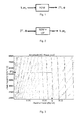
- the proposed approach of the current invention can preferably but not exclusively be applied for a sensor under harmonic excitation (temperature oscillating technique) and can be summarized in the diagram of figure 2 .
- Fig 2 shows schematically an inverse parametric reduced order modelling (ROM) approach for a sensor with harmonic excitation (temperature oscillating technique).
- ROM inverse parametric reduced order modelling
- a least square fitting algorithm or another approach can be used complementary.
- Another option for the extraction of thermal properties (k, ⁇ c p ) from the reduced order model avoiding a fitting algorithm would be the pre-calculation of an amplitude and a phase for all of the values of thermal conductivity (k) and volumetric heat capacity ( ⁇ c p ). Then during the measurement process the combination of measured temperature amplitude and phase
- a graphical presentation of this approach is given in figure 3 , where the cross point of amplitude
- thermo property sensor independent of the measurement principle that it uses.
- temperature oscillating technique transient method
- 3 ⁇ steady state (only thermal conductivity measurement).
- Different parametric reduced order modelling techniques can be used for the modelling of a fluid thermal sensor.
- Reduced Basis method Krylov-Sub-Space methods, Truncated Balanced Realization and the Proper Orthogonal Decomposition (POD) and other.
- POD-model is the preferred modeling technique.
- Fig. 3 shows a graphical representation of thermal conductivity and volumetric heat capacity calculation from the measured amplitude and phase. Amplitude solid lines and phase dashed lines. The cross point of the iso-curves corresponds to the thermal properties k, ⁇ c p .
- a parametric reduced order model extraction process according to an advantageous embodiment is shown.
- the pro- cess begins with a 3D CAD model of the sensor.
- the parametric reduced order model (ROM) is extracted following one of the reduced order model methods.
- the extracted reduced order model is parametrised and a simple form can be seen in equation 2 and 3.
- the fluid thermal properties which are scalar quantities, are parameter of fluid matrices. It could be a gas or a liquid.
- the K r,fluid and Mr r , fluid are the fluid matrices with dimensions N r ⁇ N r extracted from the ROM.
- the K solid and M solid are the matrices which correspond to sensor (solid part) of the domain which are extracted from the ROM. In a more general frame, we can say that these matrices contain the information of the fluid and solid domains respectively.
- the vector Q ⁇ r . (N r ⁇ 1) corresponds to the energy generation in the domain
- the vector N r,sens (N r ⁇ 1) corresponds to the domain of the temperature sensor and is used for the calculation of the averaged temperature.
- T r is the state variable vector (temperature vector). The temperature in the temperature sensor can be calculated from equation 3.
- the second step of the ROM extraction is, according to Fig. 5 , the calibration of the parametric reduced order model.
- the reduce order model can also be calibrated by adding calibration factors in equation 2 and 3. This can eliminate any discrepancies between the model and the real sensor response.
- the calibration parameters extracted by fitting the model to measured data of a fluid with known properties.
- this calibrated parametric reduced order model can be used inversely for the calculation of the thermal properties (k, ⁇ c p ) from the direct measured quantities, the temperature of the temperature sensor (T sens ) or sensors in the current case.
- a parametric reduced order model as a replacement of the analytical models or the equivalent electrical circuit thermal models, which has been used so far in a fluid thermal property sensors with scope the calculation of fluid thermal properties, especially the thermal conductivity and/or the thermal diffusivity as well as the volumetric heat capacity.
- the reduced order models have low dimensions, which reduces significantly the computation effort.
- any reduction method, which is applicable in this field can be used, but the parametric POD-model is preferred among the other models.
- thermal property sensor independent of the working principle.
- temperature oscillation technique 3 ⁇ method
- steady state method steady state method
- transient method transient method
- the said invention could also be used in other thermal sensors.
- a simplified thermal sensor 1 is shown in Fig. 6 .
- This sensor has a first and a second sensor element 2 and 3, which are arranged in a free space of the sensor.
- the first sensor element 2 provides heat to a fluid of investigation with unknown properties which surrounds the sensor element, displayed in the plan view of Fig. 6 .
- the second sensor element 3 can measure the temperature of the senor, including an amplitude and a phase.
- the measured signals are transferred to an evaluation unit 4, having a microprocessor and a data storage unit.
- the evaluation unit (4) is adapted to use the reduced order model to determine the thermal properties of the fluid under investigation.
Landscapes
- Physics & Mathematics (AREA)
- General Physics & Mathematics (AREA)
- Chemical & Material Sciences (AREA)
- Life Sciences & Earth Sciences (AREA)
- Health & Medical Sciences (AREA)
- Analytical Chemistry (AREA)
- Biochemistry (AREA)
- General Health & Medical Sciences (AREA)
- Immunology (AREA)
- Pathology (AREA)
- Combustion & Propulsion (AREA)
- Engineering & Computer Science (AREA)
- Investigating Or Analyzing Materials Using Thermal Means (AREA)
Abstract
wherein the thermal sensor has at least
a first sensor element that is heated to provide heat to the fluid under investigation;
the first or a second sensor that can sense the temperature of the fluid under investigation;
wherein the process is characterized by the following steps
a) Providing a calibrated reduced order model which is calibrated with one or more thermal properties of at least a second and a third fluid;
b) (Applying an amount of heat to the fluid under investigation by the first sensor element and) measuring the temperature Tsens at the first and/or second sensor element said fluid under investigation
c) Extracting one or more thermal property of the fluid under investigation by applying the said temperature Tsens to said calibrated reduced order model.
Description
- The current invention relates to a Process of determining at least one thermal property of a fluid under investigation with a thermal sensor and to a thermal sensor.
- Sensors that can determine thermal quantities such as the thermal conductivity belong already to the state of the art. Most of them determine the thermal properties with the help of analytical models or equivalent electrical circuit thermal models. This is described for example by J. Kuntner, F. Kohl, and B. Jakoby, "Simultaneous thermal conductivity and diffusivity sensing in liquids using a micromachined device," Sensors Actuators, A Phys., vol. 130-131, no. SPEC. ISS., pp. 62-67, Aug. 2006.
- Reduced order models were so far used for different reasons. Different reduced order model methods have been developed and a classification of them was made by T. Antoulas, "Model reduction of large-scale systems Lecture I : Overview Balanced truncation Krylov methods Moment matching," 2008.
- They can be classified in two main categories, these are the Krylov-based methods and the SVD-based (Singular Value Decomposition) methods. The reduction process starts with the finite element method (FEM) model that is a high order model and needs high computational effort. This is the advantage of a reduced order model (ROM) against the high order model (FEM model), as ROM can be solved much faster than the high order model, due to its significantly lower dimensions.
- The reduced order modeling methods are mainly used for system simulation, control and design. One significant application fields constitutes the structural dynamics. Reduced order modeling approach for thermals system has been presented by C. Moosmann, E. B. Rudnyi, A. Greiner, and J. G. Korvink, "Model Order Reduction for Linear Convective Thermal Flow," no. April, pp. 1-9, 2004 for the simulation of a micro thermal flow meter.
- In addition, U. Baur, P. Benner, a. Greiner, J. Korvink, J. Lienemann, and C. Moosmann, "Parameter pre- serving model order reduction for MEMS applications," Mathematical and Computer Modeling of Dynamical Systems, vol. 17, pp. 297-317, Aug. 2011 also used parametric reduced order model for micro-thermal flow meter.
- Starting from the aforementioned processes of determining the thermal properties with the help of analytical models or equivalent electrical circuit thermal models it is the object of the current invention to determine the thermal property or properties more accurately.
- This object is achieved with a process having the features of
claim 1. - According to the invention, a Process of determining at least one thermal property of a fluid under investigation with a thermal sensor by using a calibrated reduced order model (ROM),
wherein the thermal sensor has at least
a first sensor element that is heated to provide heat to the fluid under investigation;
the first or a second sensor element that can sense the temperature of the fluid under investigation;
wherein the process is characterized by the following steps - a) Providing a calibrated reduced order model which is calibrated with one or more thermal properties of at least a second fluid;
- b) Applying an amount of heat to the fluid under investigation by the first sensor element and measuring the temperature Tsens of said fluid under investigation at the first and/or second sensor element;
- c) Extracting one or more thermal property of the fluid under investigation by applying the said temperature Tsens to said calibrated reduced order model.
- The process can be applied as a computer program product in a processing unit of a computer. However, most preferably it can be applied in an evaluation unit of a thermal sensor, for example in a transducer, since the process represents a very efficient and precise method for determining the thermal properties of a fluid, which is called herein fluid under investigation.
- Further advantageous embodiments are subject-matter of the sub-claims.
- It is of advantage if the step of providing a calibrated reduced order model according to step a) comprises the step of
- a1) Provide set of data representing a 3D-model of the sensor.
- It is of advantage if the step of providing a calibrated reduced order model according to step a) comprises the step of
- a2) comprises an adaptation of the set of data of the 3D-model to a reduced order model.
- It is of advantage if the step of providing a calibrated reduced order model includes a generation of a reduced order model from the 3D model of the sensor by applying one model order reduction method.
- The step of providing a calibrated reduced order model can comprise steps that are applied before the start of the process of determining at least one thermal property, as a pre-conditioning of the sensor.
- It is of advantage if the reduced order model is a Proper Orthogonal Decomposition Model.
- It is of advantage if the thermal sensor operates with an harmonic excitation and that the reduced order model is fitted according to the following equation:

, wherein the measured amplitude and the measured phase of Tsens,measured detected by the first or second sensor element, are the entry values for the aforementioned equation, while the output values of the aforementioned equation are the thermal properties, preferably the thermal conductivity and/or the volumetric heat capacity, or values that correspond to these values. - Alternatively the thermal sensor can operate in the same way with the 3-omega method or transient method instead of the harmonic excitation. The fitting can be done in the same way as described before.
- It is of advantage if the thermal sensor determines both, the thermal conductivity (k) and the volumetric heat capacity (ρcp) of the fluid under investigation.
- According to the invention a thermal sensor for determining at least one thermal property of a fluid under investigation,
has at least
a first sensor element that is heated to provide heat to the fluid under investigation;
the first or a second sensor element that can sense the temperature of the fluid under investigation;
wherein the thermal sensor comprises an evaluation unit that is adapted to determine at least one thermal property according to the process of one of the preceding claims. - Hereinafter the invention is explained more in detail with some drawings
- Fig. 1
- direct parametric ROM-approach (not part of the invention);
- Fig. 2
- inverse paramentric ROM-approach;
- Fig. 3
- graphical representation of the thermal conductivity and volumetric heat capacity calculation;
- Fig. 4
- ROM-classes according to the state of the art;
- Fig. 5
- Parametric ROM extraction process for receiving a calibrated ROM; and
- Fig. 6
- Schematical presentation of a thermal sensor.
- The current invention relates to a process for the determination of at least one thermal property by thermal sensor sensor. The thermal sensor is for example able to determine the thermal conductivity (k), the volumetric heat capacity (ρcp) and/or the thermal diffusivity (a).
- It is known in the art that sensor has a model for the calculated of the end physical quantity from the direct measured quantity. An example of an analytical model which is already known in the art for a thermal sensor which consist of a hot wire sensor element can be found in E. Yusibani and P. Woodfield, "A procedure for application of the three-omega method to measurement of gas thermal conductivity," Journal of Thermal Science and Technology, vol. 4, no. 1, pp. 146-158, 2009.
- In the case of said thermal property sensor the direct measured quantity is the temperature of the temperature sensors, which is derived from the measured resistance or the measured voltage by sensor elements of the thermal property sensor. However, if there is no 1-1 (monotonic) relation between the direct measured quantity and the end measured quantity, respectively the desired properties, normal models often fail.
- In the case of a thermal property sensor this non-monotonic behavior could be observed for the end measured quantities, which are the desired thermal properties, such as k and ρcp. The direct measured quantities, that means the temperatures, are coupled with both of the thermal properties (k, ρcp) and the real physical behavior cannot be described accurately with an analytical modelling approach or with an equivalent electrical circuit thermal model approach.
- The current invention proposes the use of a parametric reduced order model for the determination of the desired property values in a thermal property sensor, especially in a transmitter of such a thermal property sensor. This model can provide a far more accurate calculation of the end quantity, respectively the desired properties, such as k and ρcp, as the model can take into consideration and compensate effects that cannot be modeled by an analytical model.
- Common modern mathematical models of real-life processes used in numerical simulations are often complex and have a large size dimension and need therefore a computing capacity. Compared to these models, a reduced order model has lower the computational complexity of such problems, for example, in simulations of large-scale dynamical systems and control systems. By a reduction of the model's associated state space dimension or degrees of freedom, an approximation to the original model is computed. This reduced order model (ROM) can then be evaluated with slightly lower accuracy but in significantly less time.
- An approach for model order reduction is projection-based reduction. The following methods were comprised in this class:
- Proper Orthogonal Decomposition (POD-Model); Balanced Truncation; Approximate Balancing; Reduced Basis Method; Matrix Interpolation; Transfer Function Interpolation; Piecewise Tangential Interpolation; Loewner Framework and (Empirical) Cross Gramian. Some more reduced order models are classified in
Fig. 4 . - In general all these methods can be applied for the modelling of a thermal property sensor and for the determination of the desired properties.
- The reduced order model has very low dimensions. In the current case a reduced order model with a matrices with dimensions lower than 30 × 30 can been used. Models of this size can be handled by embedded system micro-processors which are present in the transmitter of said thermal property sensor.
- Usually a parametric reduced order model (ROM) is extracted from a respective finite element method (FEM) model and is used for the calculation of the system response, this is the direct or forward problem.
- In
Fig. 1 the direct parametric reduced order modelling approach is shown. As it is presented infigure 1 , for a thermal sensor with harmonic excitation (temperature oscillating technique), the two input parameters are the thermal conductivity (k) and the volumetric heat capacity (ρcp), solving the reduced order model for specific values of the parameters, the temperature amplitude and phase of the temperature sensor can be calculated. The volumetric heat capacity is the product between the density and the specific heat capacity (ρcp). - For the better understating, the parametric reduced order model is a numerical model in form of matrices and/or the matrices have coefficients which consists of the parameters of the system. In other words, is a system of equations of Ordinary Differential Equations (ODEs) or Algebraic Equations (AEs) in matrix form. The system is the combination of the sensor, including sensor geometrics, and the fluid.
- Although the parametric reduced order modelling approach has been used for parametric analysis of sensors and their optimization, no use of the parametric reduced order model in the inverse problem has been found in literature for applications of fluid thermal property sensors. Therefore the use of a reduced order model by an evaluation unit of a thermal property sensor for the determination of said properties is so far not known in the art. Especially the reduced order modeling can be used in a sensor which is fully described in
WO2015/074833 A1 . Reference is made to the construction of the sensors disclosed therein, which can be also applied for a thermal property sensor in the context with the current invention. - The proposed approach of the current invention can preferably but not exclusively be applied for a sensor under harmonic excitation (temperature oscillating technique) and can be summarized in the diagram of
figure 2 . - In case of a thermal sensor with harmonic excitation (temperature oscillating technique), the amplitude and the phase on the temperature sensor are measured and then the model is fitted according to equation (1), cited below, on the measured value of temperature T = |T|eiϕ with parameters of the thermal fluid properties, especially k and ρcp. We have to mention here that the parametric reduced order model has to be calibrated first in known fluid, where k, ρcp are known.

-
Fig 2 shows schematically an inverse parametric reduced order modelling (ROM) approach for a sensor with harmonic excitation (temperature oscillating technique). A least square fitting algorithm or another approach can be used complementary.
Another option for the extraction of thermal properties (k, ρcp) from the reduced order model avoiding a fitting algorithm would be the pre-calculation of an amplitude and a phase for all of the values of thermal conductivity (k) and volumetric heat capacity (ρcp). Then during the measurement process the combination of measured temperature amplitude and phase |T|, ϕ provides the combination of the thermal properties k and ρcp. A graphical presentation of this approach is given infigure 3 , where the cross point of amplitude |T| and phase ϕ iso-curves is used for the extraction of the thermal conductivity and the volumetric heat capacity of the fluid. - Applicability of the method is possible in every thermal property sensor independent of the measurement principle that it uses. For example temperature oscillating technique, transient method, 3ω, steady state (only thermal conductivity measurement).
- Different parametric reduced order modelling techniques can be used for the modelling of a fluid thermal sensor. For example, Reduced Basis method, Krylov-Sub-Space methods, Truncated Balanced Realization and the Proper Orthogonal Decomposition (POD) and other. However the POD-model is the preferred modeling technique.
-
Fig. 3 shows a graphical representation of thermal conductivity and volumetric heat capacity calculation from the measured amplitude and phase. Amplitude solid lines and phase dashed lines. The cross point of the iso-curves corresponds to the thermal properties k,ρcp. - For the further explanation of the use of a parametric reduced order model according to the invention a preferred embodiment is described by the following example:
- In the following analysis the thermal property sensor operates using the temperature oscillating technique (harmonic excitation). The thermal property sensor consists of a heater, as a first sensor element, which operates using a harmonic excitation

wherein Q̇ is defined as Energy generation in the volume of the heater
|Q̇| is defined as Amplitude of the Energy generation
eiω t is defined as exponential form of an harmonic excitation
and a temperature sensor, as a second sensor element. The heater and the temperature sensor can also be included in only one first sensor element, which is can operate between two operation modes, a heating mode and a temperature sensing mode. - The temperature on the temperature sensor

wherein - Tsens is the temperature by the temperature sensor element of the thermal property sensor in a fluid;
- |Tsens | is the amplitude of the aforementioned measured temperature Tsens ; and
- e is the exponential form of the harmonic response of the temperature of the sensor including the phase (ϕ).
- In
Fig 5 a parametric reduced order model extraction process according to an advantageous embodiment is shown. InFig. 5 the parametric reduced order model extraction process is described. The pro- cess begins with a 3D CAD model of the sensor. The parametric reduced order model (ROM) is extracted following one of the reduced order model methods. The extracted reduced order model is parametrised and a simple form can be seen inequation equation 3.


- The second step of the ROM extraction is, according to
Fig. 5 , the calibration of the parametric reduced order model. The reduce order model can also be calibrated by adding calibration factors inequation - Finally, this calibrated parametric reduced order model can be used inversely for the calculation of the thermal properties (k,ρcp) from the direct measured quantities, the temperature of the temperature sensor (Tsens) or sensors in the current case.
- According to the current invention it is proposed the use of a parametric reduced order model as a replacement of the analytical models or the equivalent electrical circuit thermal models, which has been used so far in a fluid thermal property sensors with scope the calculation of fluid thermal properties, especially the thermal conductivity and/or the thermal diffusivity as well as the volumetric heat capacity. The reduced order models have low dimensions, which reduces significantly the computation effort. For the extraction of the parametric reduced order model any reduction method, which is applicable in this field can be used, but the parametric POD-model is preferred among the other models.
- As mentioned before proposed invention can be used for thermal property sensor independent of the working principle. For example, temperature oscillation technique, 3ω method, steady state method, transient method and other. The said invention could also be used in other thermal sensors.
- A simplified
thermal sensor 1 is shown inFig. 6 . This sensor has a first and asecond sensor element first sensor element 2 provides heat to a fluid of investigation with unknown properties which surrounds the sensor element, displayed in the plan view ofFig. 6 . Thesecond sensor element 3 can measure the temperature of the senor, including an amplitude and a phase. The measured signals are transferred to anevaluation unit 4, having a microprocessor and a data storage unit. The evaluation unit (4) is adapted to use the reduced order model to determine the thermal properties of the fluid under investigation.
Claims (10)
- Process of determining at least one thermal property of a fluid under investigation with a thermal sensor (1) by using a calibrated reduced order model (ROM),
wherein the thermal sensor (1) has at least
a first sensor element (2) that is heated to provide heat to the fluid under investigation;
the first or a second sensor element (2 or 3) that can sense the temperature of the fluid under investigation;
wherein the process is characterized by the following stepsa) Providing a calibrated reduced order model which is calibrated with one or more thermal properties of at least a second and a third fluid;b) Applying an amount of heat to the fluid under investigation by the first sensor element (2) and measuring the temperature Tsens at the first and/or second sensor element (2 or 3) said fluid under investigationc) Extracting one or more thermal property of the fluid under investigation by applying the said temperature Tsens to said calibrated reduced order model. - Process according to claim 1, characterized in that the step of providing a calibrated reduced order model according to step a) comprises the step ofa1) Provide set of data representing a 3D-model of the thermal sensor (1).
- Process according to claim 1 or 2, characterized in that the step of providing a calibrated reduced order model according to step a) comprises the step ofa2) comprises the adaptation of the set of data of the 3D-model to a reduced order model.
- Process according to one of the preceding claims characterized in that the step of providing a calibrated reduced order model includes a generation of a reduced order model from the 3D model of the sensor by applying one model order reduction method.
- Process according to one of the preceding claims characterized in that the step of providing a calibrated reduced order model comprises steps that are applied before the start of the process of determining at least one thermal property.
- Process according to one of the preceding claims, characterized in that the reduced order model is a Proper Orthogonal Decomposition Model.
- Process according to one of the preceding claims, characterized in that the thermal sensor operates with an harmonic excitation and that the reduced order model is fitted according to the following equation:

, wherein the measured amplitude and the measured phase of Tsens,measured detected by the first or second sensor element (2 or 3), are the entry values for the aforementioned equation, while the output values of the aforementioned equation are the thermal properties (k, ρcp ). - Process according to one of the preceding claims, characterized in that the thermal sensor operates with the 3-omega method or transient method instead of the harmonic excitation.
- Process according to one of the preceding claims, characterized in that the thermal sensor determines the thermal conductivity (k) and the volumetric heat capacity (ρcp) of the fluid under investigation.
- Thermal sensor (1) for determining at least one thermal property of a fluid under investigation,
having at least
a first sensor element (2) that is heated to provide heat to the fluid under investigation;
the first or a second sensor (2 or 3) that can sense the temperature of the fluid under investigation;
wherein the thermal sensor (1) comprises an evaluation unit (4) that is adapted to determine at least one thermal property according to the process of one of the preceding claims.
Priority Applications (4)
| Application Number | Priority Date | Filing Date | Title |
|---|---|---|---|
| EP15172915.9A EP3106851B1 (en) | 2015-06-19 | 2015-06-19 | Process of determining at least one thermal property of a fluid under investigation with a thermal sensor |
| US15/579,983 US10613045B2 (en) | 2015-06-19 | 2016-05-24 | Process of determining at least one thermal property of a fluid under investigation with a thermal sensor |
| CN201680034691.4A CN108027288B (en) | 2015-06-19 | 2016-05-24 | Process for determining at least one thermal property of a fluid of interest using a thermal sensor |
| PCT/EP2016/061649 WO2016202538A1 (en) | 2015-06-19 | 2016-05-24 | Process of determining at least one thermal property of a fluid under investigation with a thermal sensor |
Applications Claiming Priority (1)
| Application Number | Priority Date | Filing Date | Title |
|---|---|---|---|
| EP15172915.9A EP3106851B1 (en) | 2015-06-19 | 2015-06-19 | Process of determining at least one thermal property of a fluid under investigation with a thermal sensor |
Publications (2)
| Publication Number | Publication Date |
|---|---|
| EP3106851A1 true EP3106851A1 (en) | 2016-12-21 |
| EP3106851B1 EP3106851B1 (en) | 2019-01-02 |
Family
ID=53483713
Family Applications (1)
| Application Number | Title | Priority Date | Filing Date |
|---|---|---|---|
| EP15172915.9A Active EP3106851B1 (en) | 2015-06-19 | 2015-06-19 | Process of determining at least one thermal property of a fluid under investigation with a thermal sensor |
Country Status (4)
| Country | Link |
|---|---|
| US (1) | US10613045B2 (en) |
| EP (1) | EP3106851B1 (en) |
| CN (1) | CN108027288B (en) |
| WO (1) | WO2016202538A1 (en) |
Cited By (2)
| Publication number | Priority date | Publication date | Assignee | Title |
|---|---|---|---|---|
| US10613045B2 (en) | 2015-06-19 | 2020-04-07 | Endress + Hauser Flowtec Ag | Process of determining at least one thermal property of a fluid under investigation with a thermal sensor |
| WO2021239349A1 (en) * | 2020-05-29 | 2021-12-02 | Innovative Sensor Technology Ist Ag | Thermal flow sensor and method for operating same |
Families Citing this family (1)
| Publication number | Priority date | Publication date | Assignee | Title |
|---|---|---|---|---|
| US11300461B2 (en) | 2017-12-20 | 2022-04-12 | Endress+Hauser Flowtec Ag | Measuring device for the determination of at least one thermal property of a fluid, especially the volumetric heat capacity and the thermal conductivity |
Citations (1)
| Publication number | Priority date | Publication date | Assignee | Title |
|---|---|---|---|---|
| WO2015074833A1 (en) | 2013-11-19 | 2015-05-28 | Endress+Hauser Flowtec Ag | Measuring device and method for determining a corrected mass flow, and uses of the measuring device |
Family Cites Families (5)
| Publication number | Priority date | Publication date | Assignee | Title |
|---|---|---|---|---|
| US8016757B2 (en) * | 2005-09-30 | 2011-09-13 | University Of Washington | Non-invasive temperature estimation technique for HIFU therapy monitoring using backscattered ultrasound |
| EP2214005B1 (en) | 2009-02-03 | 2019-09-18 | Mettler-Toledo GmbH | Thermo-Analytical Instrument |
| CN101587068B (en) | 2009-05-27 | 2012-03-28 | 陈小英 | Multi-sensor gas analyzer |
| CN103336021B (en) | 2013-06-25 | 2015-03-11 | 公安部天津消防研究所 | Material thermal decomposition experimental apparatus and method |
| EP3106851B1 (en) | 2015-06-19 | 2019-01-02 | Endress + Hauser Flowtec AG | Process of determining at least one thermal property of a fluid under investigation with a thermal sensor |
-
2015
- 2015-06-19 EP EP15172915.9A patent/EP3106851B1/en active Active
-
2016
- 2016-05-24 WO PCT/EP2016/061649 patent/WO2016202538A1/en not_active Ceased
- 2016-05-24 US US15/579,983 patent/US10613045B2/en active Active
- 2016-05-24 CN CN201680034691.4A patent/CN108027288B/en active Active
Patent Citations (1)
| Publication number | Priority date | Publication date | Assignee | Title |
|---|---|---|---|---|
| WO2015074833A1 (en) | 2013-11-19 | 2015-05-28 | Endress+Hauser Flowtec Ag | Measuring device and method for determining a corrected mass flow, and uses of the measuring device |
Non-Patent Citations (6)
| Title |
|---|
| BECHTOLD T ET AL: "Efficient extraction of thin film thermal properties via parametric model order reduction and optimization", SOLID-STATE SENSORS, ACTUATORS AND MICROSYSTEMS CONFERENCE, 2009. TRANSDUCERS 2009. INTERNATIONAL, IEEE, PISCATAWAY, NJ, USA, 21 June 2009 (2009-06-21), pages 2437 - 2440, XP031545355, ISBN: 978-1-4244-4190-7 * |
| C. MOOSMANN; E. B. RUDNYI; A. GREINER; J. G. KORVINK: "the simulation of a micro thermal flow meter", MODEL ORDER REDUCTION FOR LINEAR CONVECTIVE THERMAL FLOW, April 2004 (2004-04-01), pages 1 - 9 |
| E. YUSIBANI; P. WOODFIELD: "A procedure for application of the three-omega method to measurement of gas thermal conductivity", JOURNAL OF THERMAL SCIENCE AND TECHNOLOGY, vol. 4, no. 1, 2009, pages 146 - 158 |
| J. KUNTNER; F. KOHL; B. JAKOBY: "Simultaneous thermal conductivity and diffusivity sensing in liquids using a micromachined device", SENSORS ACTUATORS, A PHYS., vol. 130-131, no. SPEC., August 2006 (2006-08-01), pages 62 - 67, XP025081825, DOI: doi:10.1016/j.sna.2005.11.021 |
| T. ANTOULAS, MODEL REDUCTION OF LARGE-SCALE SYSTEMS LECTURE I : OVERVIEW BALANCED TRUNCATION KRYLOV METHODS MOMENT MATCHING, 2008 |
| U. BAUR; P. BENNER; A. GREINER; J. KORVINK; J. LIENEMANN; C. MOOSMANN: "Parameter pre- serving model order reduction for MEMS applications", MATHEMATICAL AND COMPUTER MODELING OF DYNAMICAL SYSTEMS, vol. 17, August 2011 (2011-08-01), pages 297 - 317 |
Cited By (3)
| Publication number | Priority date | Publication date | Assignee | Title |
|---|---|---|---|---|
| US10613045B2 (en) | 2015-06-19 | 2020-04-07 | Endress + Hauser Flowtec Ag | Process of determining at least one thermal property of a fluid under investigation with a thermal sensor |
| WO2021239349A1 (en) * | 2020-05-29 | 2021-12-02 | Innovative Sensor Technology Ist Ag | Thermal flow sensor and method for operating same |
| US11988535B2 (en) | 2020-05-29 | 2024-05-21 | Innovator Sensor Technology IST AG | Thermal flow sensor and method for operating same |
Also Published As
| Publication number | Publication date |
|---|---|
| WO2016202538A1 (en) | 2016-12-22 |
| US10613045B2 (en) | 2020-04-07 |
| US20180172610A1 (en) | 2018-06-21 |
| CN108027288B (en) | 2020-08-21 |
| EP3106851B1 (en) | 2019-01-02 |
| CN108027288A (en) | 2018-05-11 |
Similar Documents
| Publication | Publication Date | Title |
|---|---|---|
| Klostermann et al. | Numerical simulation of a single rising bubble by VOF with surface compression | |
| Bull et al. | Simulation of the Taylor–Green vortex using high-order flux reconstruction schemes | |
| Supeene et al. | Deformation of a droplet in an electric field: Nonlinear transient response in perfect and leaky dielectric media | |
| Sun et al. | High-order multidomain spectral difference method for the Navier-Stokes equations | |
| Vila-Pérez et al. | Hybridisable Discontinuous Galerkin Formulation of Compressible Flows: J. Vila-Pérez et al. | |
| Huerta et al. | A simple shock‐capturing technique for high‐order discontinuous Galerkin methods | |
| CN102713592B (en) | 3D Imaging of Mass Flow | |
| Kalaiarassan et al. | One-dimension force balance system for hypersonic vehicle an experimental and fuzzy prediction approach | |
| Kerfriden et al. | Certification of projection‐based reduced order modelling in computational homogenisation by the constitutive relation error | |
| Qu et al. | Investigation into the influences of the low-speed flows' accuracy on RANS simulations | |
| Gao et al. | Differential formulation of discontinuous Galerkin and related methods for the Navier-Stokes equations | |
| Lavoie et al. | Comparison of two-dimensional flood propagation models: SRH-2D and Hydro_AS-2D | |
| Zhang et al. | An immersed boundary method for simulation of inviscid compressible flows | |
| Papadimitriou et al. | Optimal sensor placement for the estimation of turbulence model parameters in CFD | |
| US10613045B2 (en) | Process of determining at least one thermal property of a fluid under investigation with a thermal sensor | |
| Lin et al. | A depth-averaged electrokinetic flow model for shallow microchannels | |
| Morren et al. | 2D permeability tensor identification of fibrous reinforcements for RTM using an inverse method | |
| Chen et al. | Nonlinear, rescaling-based inverse heat conduction calibration method and optimal regularization parameter strategy | |
| Malendowski | Analytical solution for adiabatic surface temperature (AST) | |
| Hu et al. | A multi-mesh adaptive finite element approximation to phase field models | |
| Spalart et al. | RANS solutions in Couette flow with streamwise vortices | |
| Nam et al. | Assessment of ghost-cell based cut-cell method for large-eddy simulations of compressible flows at high Reynolds number | |
| Behzad et al. | On the sensitivity and accuracy of proper-orthogonal-decomposition-based reduced order models for Burgers equation | |
| O’Donnell et al. | Proper orthogonal decomposition and incompressible flow: An application to particle modeling | |
| Sladek et al. | Inverse heat conduction problems in three-dimensional anisotropic functionally graded solids |
Legal Events
| Date | Code | Title | Description |
|---|---|---|---|
| PUAI | Public reference made under article 153(3) epc to a published international application that has entered the european phase |
Free format text: ORIGINAL CODE: 0009012 |
|
| STAA | Information on the status of an ep patent application or granted ep patent |
Free format text: STATUS: THE APPLICATION HAS BEEN PUBLISHED |
|
| AK | Designated contracting states |
Kind code of ref document: A1 Designated state(s): AL AT BE BG CH CY CZ DE DK EE ES FI FR GB GR HR HU IE IS IT LI LT LU LV MC MK MT NL NO PL PT RO RS SE SI SK SM TR |
|
| AX | Request for extension of the european patent |
Extension state: BA ME |
|
| STAA | Information on the status of an ep patent application or granted ep patent |
Free format text: STATUS: REQUEST FOR EXAMINATION WAS MADE |
|
| 17P | Request for examination filed |
Effective date: 20170519 |
|
| RBV | Designated contracting states (corrected) |
Designated state(s): AL AT BE BG CH CY CZ DE DK EE ES FI FR GB GR HR HU IE IS IT LI LT LU LV MC MK MT NL NO PL PT RO RS SE SI SK SM TR |
|
| STAA | Information on the status of an ep patent application or granted ep patent |
Free format text: STATUS: EXAMINATION IS IN PROGRESS |
|
| 17Q | First examination report despatched |
Effective date: 20180228 |
|
| GRAP | Despatch of communication of intention to grant a patent |
Free format text: ORIGINAL CODE: EPIDOSNIGR1 |
|
| STAA | Information on the status of an ep patent application or granted ep patent |
Free format text: STATUS: GRANT OF PATENT IS INTENDED |
|
| INTG | Intention to grant announced |
Effective date: 20180829 |
|
| GRAS | Grant fee paid |
Free format text: ORIGINAL CODE: EPIDOSNIGR3 |
|
| GRAA | (expected) grant |
Free format text: ORIGINAL CODE: 0009210 |
|
| STAA | Information on the status of an ep patent application or granted ep patent |
Free format text: STATUS: THE PATENT HAS BEEN GRANTED |
|
| AK | Designated contracting states |
Kind code of ref document: B1 Designated state(s): AL AT BE BG CH CY CZ DE DK EE ES FI FR GB GR HR HU IE IS IT LI LT LU LV MC MK MT NL NO PL PT RO RS SE SI SK SM TR |
|
| REG | Reference to a national code |
Ref country code: GB Ref legal event code: FG4D |
|
| REG | Reference to a national code |
Ref country code: CH Ref legal event code: EP Ref country code: AT Ref legal event code: REF Ref document number: 1084988 Country of ref document: AT Kind code of ref document: T Effective date: 20190115 |
|
| REG | Reference to a national code |
Ref country code: IE Ref legal event code: FG4D |
|
| REG | Reference to a national code |
Ref country code: DE Ref legal event code: R096 Ref document number: 602015022618 Country of ref document: DE |
|
| REG | Reference to a national code |
Ref country code: NL Ref legal event code: MP Effective date: 20190102 |
|
| REG | Reference to a national code |
Ref country code: LT Ref legal event code: MG4D |
|
| REG | Reference to a national code |
Ref country code: AT Ref legal event code: MK05 Ref document number: 1084988 Country of ref document: AT Kind code of ref document: T Effective date: 20190102 |
|
| PG25 | Lapsed in a contracting state [announced via postgrant information from national office to epo] |
Ref country code: NL Free format text: LAPSE BECAUSE OF FAILURE TO SUBMIT A TRANSLATION OF THE DESCRIPTION OR TO PAY THE FEE WITHIN THE PRESCRIBED TIME-LIMIT Effective date: 20190102 |
|
| PG25 | Lapsed in a contracting state [announced via postgrant information from national office to epo] |
Ref country code: PT Free format text: LAPSE BECAUSE OF FAILURE TO SUBMIT A TRANSLATION OF THE DESCRIPTION OR TO PAY THE FEE WITHIN THE PRESCRIBED TIME-LIMIT Effective date: 20190502 Ref country code: NO Free format text: LAPSE BECAUSE OF FAILURE TO SUBMIT A TRANSLATION OF THE DESCRIPTION OR TO PAY THE FEE WITHIN THE PRESCRIBED TIME-LIMIT Effective date: 20190402 Ref country code: FI Free format text: LAPSE BECAUSE OF FAILURE TO SUBMIT A TRANSLATION OF THE DESCRIPTION OR TO PAY THE FEE WITHIN THE PRESCRIBED TIME-LIMIT Effective date: 20190102 Ref country code: SE Free format text: LAPSE BECAUSE OF FAILURE TO SUBMIT A TRANSLATION OF THE DESCRIPTION OR TO PAY THE FEE WITHIN THE PRESCRIBED TIME-LIMIT Effective date: 20190102 Ref country code: PL Free format text: LAPSE BECAUSE OF FAILURE TO SUBMIT A TRANSLATION OF THE DESCRIPTION OR TO PAY THE FEE WITHIN THE PRESCRIBED TIME-LIMIT Effective date: 20190102 Ref country code: LT Free format text: LAPSE BECAUSE OF FAILURE TO SUBMIT A TRANSLATION OF THE DESCRIPTION OR TO PAY THE FEE WITHIN THE PRESCRIBED TIME-LIMIT Effective date: 20190102 Ref country code: ES Free format text: LAPSE BECAUSE OF FAILURE TO SUBMIT A TRANSLATION OF THE DESCRIPTION OR TO PAY THE FEE WITHIN THE PRESCRIBED TIME-LIMIT Effective date: 20190102 |
|
| PG25 | Lapsed in a contracting state [announced via postgrant information from national office to epo] |
Ref country code: RS Free format text: LAPSE BECAUSE OF FAILURE TO SUBMIT A TRANSLATION OF THE DESCRIPTION OR TO PAY THE FEE WITHIN THE PRESCRIBED TIME-LIMIT Effective date: 20190102 Ref country code: HR Free format text: LAPSE BECAUSE OF FAILURE TO SUBMIT A TRANSLATION OF THE DESCRIPTION OR TO PAY THE FEE WITHIN THE PRESCRIBED TIME-LIMIT Effective date: 20190102 Ref country code: LV Free format text: LAPSE BECAUSE OF FAILURE TO SUBMIT A TRANSLATION OF THE DESCRIPTION OR TO PAY THE FEE WITHIN THE PRESCRIBED TIME-LIMIT Effective date: 20190102 Ref country code: GR Free format text: LAPSE BECAUSE OF FAILURE TO SUBMIT A TRANSLATION OF THE DESCRIPTION OR TO PAY THE FEE WITHIN THE PRESCRIBED TIME-LIMIT Effective date: 20190403 Ref country code: IS Free format text: LAPSE BECAUSE OF FAILURE TO SUBMIT A TRANSLATION OF THE DESCRIPTION OR TO PAY THE FEE WITHIN THE PRESCRIBED TIME-LIMIT Effective date: 20190502 Ref country code: BG Free format text: LAPSE BECAUSE OF FAILURE TO SUBMIT A TRANSLATION OF THE DESCRIPTION OR TO PAY THE FEE WITHIN THE PRESCRIBED TIME-LIMIT Effective date: 20190402 |
|
| REG | Reference to a national code |
Ref country code: DE Ref legal event code: R097 Ref document number: 602015022618 Country of ref document: DE |
|
| PG25 | Lapsed in a contracting state [announced via postgrant information from national office to epo] |
Ref country code: EE Free format text: LAPSE BECAUSE OF FAILURE TO SUBMIT A TRANSLATION OF THE DESCRIPTION OR TO PAY THE FEE WITHIN THE PRESCRIBED TIME-LIMIT Effective date: 20190102 Ref country code: DK Free format text: LAPSE BECAUSE OF FAILURE TO SUBMIT A TRANSLATION OF THE DESCRIPTION OR TO PAY THE FEE WITHIN THE PRESCRIBED TIME-LIMIT Effective date: 20190102 Ref country code: IT Free format text: LAPSE BECAUSE OF FAILURE TO SUBMIT A TRANSLATION OF THE DESCRIPTION OR TO PAY THE FEE WITHIN THE PRESCRIBED TIME-LIMIT Effective date: 20190102 Ref country code: RO Free format text: LAPSE BECAUSE OF FAILURE TO SUBMIT A TRANSLATION OF THE DESCRIPTION OR TO PAY THE FEE WITHIN THE PRESCRIBED TIME-LIMIT Effective date: 20190102 Ref country code: AT Free format text: LAPSE BECAUSE OF FAILURE TO SUBMIT A TRANSLATION OF THE DESCRIPTION OR TO PAY THE FEE WITHIN THE PRESCRIBED TIME-LIMIT Effective date: 20190102 Ref country code: AL Free format text: LAPSE BECAUSE OF FAILURE TO SUBMIT A TRANSLATION OF THE DESCRIPTION OR TO PAY THE FEE WITHIN THE PRESCRIBED TIME-LIMIT Effective date: 20190102 Ref country code: CZ Free format text: LAPSE BECAUSE OF FAILURE TO SUBMIT A TRANSLATION OF THE DESCRIPTION OR TO PAY THE FEE WITHIN THE PRESCRIBED TIME-LIMIT Effective date: 20190102 Ref country code: SK Free format text: LAPSE BECAUSE OF FAILURE TO SUBMIT A TRANSLATION OF THE DESCRIPTION OR TO PAY THE FEE WITHIN THE PRESCRIBED TIME-LIMIT Effective date: 20190102 |
|
| PLBE | No opposition filed within time limit |
Free format text: ORIGINAL CODE: 0009261 |
|
| STAA | Information on the status of an ep patent application or granted ep patent |
Free format text: STATUS: NO OPPOSITION FILED WITHIN TIME LIMIT |
|
| PG25 | Lapsed in a contracting state [announced via postgrant information from national office to epo] |
Ref country code: SM Free format text: LAPSE BECAUSE OF FAILURE TO SUBMIT A TRANSLATION OF THE DESCRIPTION OR TO PAY THE FEE WITHIN THE PRESCRIBED TIME-LIMIT Effective date: 20190102 |
|
| 26N | No opposition filed |
Effective date: 20191003 |
|
| PG25 | Lapsed in a contracting state [announced via postgrant information from national office to epo] |
Ref country code: MC Free format text: LAPSE BECAUSE OF FAILURE TO SUBMIT A TRANSLATION OF THE DESCRIPTION OR TO PAY THE FEE WITHIN THE PRESCRIBED TIME-LIMIT Effective date: 20190102 |
|
| REG | Reference to a national code |
Ref country code: CH Ref legal event code: PL |
|
| PG25 | Lapsed in a contracting state [announced via postgrant information from national office to epo] |
Ref country code: SI Free format text: LAPSE BECAUSE OF FAILURE TO SUBMIT A TRANSLATION OF THE DESCRIPTION OR TO PAY THE FEE WITHIN THE PRESCRIBED TIME-LIMIT Effective date: 20190102 |
|
| REG | Reference to a national code |
Ref country code: BE Ref legal event code: MM Effective date: 20190630 |
|
| PG25 | Lapsed in a contracting state [announced via postgrant information from national office to epo] |
Ref country code: TR Free format text: LAPSE BECAUSE OF FAILURE TO SUBMIT A TRANSLATION OF THE DESCRIPTION OR TO PAY THE FEE WITHIN THE PRESCRIBED TIME-LIMIT Effective date: 20190102 |
|
| PG25 | Lapsed in a contracting state [announced via postgrant information from national office to epo] |
Ref country code: IE Free format text: LAPSE BECAUSE OF NON-PAYMENT OF DUE FEES Effective date: 20190619 |
|
| PG25 | Lapsed in a contracting state [announced via postgrant information from national office to epo] |
Ref country code: BE Free format text: LAPSE BECAUSE OF NON-PAYMENT OF DUE FEES Effective date: 20190630 Ref country code: LU Free format text: LAPSE BECAUSE OF NON-PAYMENT OF DUE FEES Effective date: 20190619 Ref country code: LI Free format text: LAPSE BECAUSE OF NON-PAYMENT OF DUE FEES Effective date: 20190630 Ref country code: CH Free format text: LAPSE BECAUSE OF NON-PAYMENT OF DUE FEES Effective date: 20190630 |
|
| PG25 | Lapsed in a contracting state [announced via postgrant information from national office to epo] |
Ref country code: CY Free format text: LAPSE BECAUSE OF FAILURE TO SUBMIT A TRANSLATION OF THE DESCRIPTION OR TO PAY THE FEE WITHIN THE PRESCRIBED TIME-LIMIT Effective date: 20190102 |
|
| PG25 | Lapsed in a contracting state [announced via postgrant information from national office to epo] |
Ref country code: MT Free format text: LAPSE BECAUSE OF FAILURE TO SUBMIT A TRANSLATION OF THE DESCRIPTION OR TO PAY THE FEE WITHIN THE PRESCRIBED TIME-LIMIT Effective date: 20190102 Ref country code: HU Free format text: LAPSE BECAUSE OF FAILURE TO SUBMIT A TRANSLATION OF THE DESCRIPTION OR TO PAY THE FEE WITHIN THE PRESCRIBED TIME-LIMIT; INVALID AB INITIO Effective date: 20150619 |
|
| PG25 | Lapsed in a contracting state [announced via postgrant information from national office to epo] |
Ref country code: MK Free format text: LAPSE BECAUSE OF FAILURE TO SUBMIT A TRANSLATION OF THE DESCRIPTION OR TO PAY THE FEE WITHIN THE PRESCRIBED TIME-LIMIT Effective date: 20190102 |
|
| P01 | Opt-out of the competence of the unified patent court (upc) registered |
Effective date: 20230601 |
|
| PGFP | Annual fee paid to national office [announced via postgrant information from national office to epo] |
Ref country code: DE Payment date: 20250618 Year of fee payment: 11 |
|
| PGFP | Annual fee paid to national office [announced via postgrant information from national office to epo] |
Ref country code: GB Payment date: 20250618 Year of fee payment: 11 |
|
| PGFP | Annual fee paid to national office [announced via postgrant information from national office to epo] |
Ref country code: FR Payment date: 20250625 Year of fee payment: 11 |