EP3104576A1 - Platform selection according to requested service for mobile-edge computing - Google Patents
Platform selection according to requested service for mobile-edge computing Download PDFInfo
- Publication number
- EP3104576A1 EP3104576A1 EP15202496.4A EP15202496A EP3104576A1 EP 3104576 A1 EP3104576 A1 EP 3104576A1 EP 15202496 A EP15202496 A EP 15202496A EP 3104576 A1 EP3104576 A1 EP 3104576A1
- Authority
- EP
- European Patent Office
- Prior art keywords
- service
- application service
- request message
- application
- platforms
- Prior art date
- Legal status (The legal status is an assumption and is not a legal conclusion. Google has not performed a legal analysis and makes no representation as to the accuracy of the status listed.)
- Ceased
Links
Images





Classifications
-
- H—ELECTRICITY
- H04—ELECTRIC COMMUNICATION TECHNIQUE
- H04L—TRANSMISSION OF DIGITAL INFORMATION, e.g. TELEGRAPHIC COMMUNICATION
- H04L67/00—Network arrangements or protocols for supporting network services or applications
- H04L67/50—Network services
- H04L67/60—Scheduling or organising the servicing of application requests, e.g. requests for application data transmissions using the analysis and optimisation of the required network resources
-
- H—ELECTRICITY
- H04—ELECTRIC COMMUNICATION TECHNIQUE
- H04L—TRANSMISSION OF DIGITAL INFORMATION, e.g. TELEGRAPHIC COMMUNICATION
- H04L67/00—Network arrangements or protocols for supporting network services or applications
- H04L67/01—Protocols
- H04L67/10—Protocols in which an application is distributed across nodes in the network
- H04L67/1001—Protocols in which an application is distributed across nodes in the network for accessing one among a plurality of replicated servers
- H04L67/1004—Server selection for load balancing
- H04L67/1008—Server selection for load balancing based on parameters of servers, e.g. available memory or workload
-
- G—PHYSICS
- G06—COMPUTING OR CALCULATING; COUNTING
- G06F—ELECTRIC DIGITAL DATA PROCESSING
- G06F9/00—Arrangements for program control, e.g. control units
- G06F9/06—Arrangements for program control, e.g. control units using stored programs, i.e. using an internal store of processing equipment to receive or retain programs
- G06F9/46—Multiprogramming arrangements
- G06F9/50—Allocation of resources, e.g. of the central processing unit [CPU]
- G06F9/5005—Allocation of resources, e.g. of the central processing unit [CPU] to service a request
- G06F9/5027—Allocation of resources, e.g. of the central processing unit [CPU] to service a request the resource being a machine, e.g. CPUs, Servers, Terminals
- G06F9/505—Allocation of resources, e.g. of the central processing unit [CPU] to service a request the resource being a machine, e.g. CPUs, Servers, Terminals considering the load
-
- G—PHYSICS
- G06—COMPUTING OR CALCULATING; COUNTING
- G06F—ELECTRIC DIGITAL DATA PROCESSING
- G06F9/00—Arrangements for program control, e.g. control units
- G06F9/06—Arrangements for program control, e.g. control units using stored programs, i.e. using an internal store of processing equipment to receive or retain programs
- G06F9/46—Multiprogramming arrangements
- G06F9/50—Allocation of resources, e.g. of the central processing unit [CPU]
- G06F9/5061—Partitioning or combining of resources
- G06F9/5072—Grid computing
-
- H—ELECTRICITY
- H04—ELECTRIC COMMUNICATION TECHNIQUE
- H04L—TRANSMISSION OF DIGITAL INFORMATION, e.g. TELEGRAPHIC COMMUNICATION
- H04L67/00—Network arrangements or protocols for supporting network services or applications
- H04L67/50—Network services
- H04L67/51—Discovery or management thereof, e.g. service location protocol [SLP] or web services
Definitions
- the disclosure relates in general to a controlling method and a network system, and more particularly to a controlling method and a network system for mobile-edge computing (MEC).
- MEC mobile-edge computing
- the disclosure is directed to a controlling method and a network system for mobile-edge computing (MEC).
- the application services share information and communicate with each other through the platform interfaces.
- a controlling method for mobile-edge computing includes the following steps.
- a request message for requesting an application service is received by one of a plurality of service platforms.
- One of the service platforms is selected according to the application service of the request message.
- the application service is performed by the selected service platform.
- a network system for mobile-edge computing includes a plurality of service platforms.
- a request message for requesting an application service is received by one of the service platforms.
- One of the service platforms is selected according to the application service of the request message.
- the application service is performed by the selected service platform.
- the service platform 100 includes a message processing unit MU, a control unit CU, a user interface UI, a service interface SI and a platform interface GI.
- the message processing unit MU is for receiving and analyzing various messages.
- the control unit CU is for performing various control procedures, determination procedures and calculation procedures.
- the user interface UI is for providing a standard interface of information exchange to communicate with the user end.
- the service interface SI is for communicating with various application services SR1, SR2, and so on. Examples of the application services SR1, SR2, and so on include community websites, video sharing websites, Internet banking, restaurant reservation tools and map tools.
- the platform interface GI is for providing a standard interface of service information exchange to communicate with another service platform 100.
- Each of the message processing unit MU, the control unit CU, the user interface UI, the service interface SI and the platform interface GI can be realized by such as a chip, a circuit board, a circuit or a storage medium storing a plurality of programming codes.
- each service platform 100 can share information and communicate with another service platform 100 through the platform interface GI. Therefore, various application services of a plurality of service platforms 100 can be efficiently integrated.
- a network system 1000 for mobile-edge computing is shown.
- a plurality of service platforms 100 can be connected wirelessly or by cable through the platform interface GI (illustrated in FIG. 1 ) to form the network system 1000 for mobile-edge computing.
- the network system 1000 for mobile-edge computing is connected between a core network 2000 and a user end 900 to form a device to device relay base local cloud.
- Various application services are disposed on the service platforms 100.
- the user end 900 wants to perform a particular application service, the user end 900 can directly perform the application service on the network system 1000 for mobile-edge computing instead of the core network 2000.
- the application service provider can directly provide various messages to the user end 900 through the application service disposed on the network system 1000 for mobile-edge computing instead of the core network 2000.
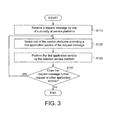
- FIG. 3 is a flowchart of a controlling method for mobile-edge computing.
- FIG. 4 is a data transmission diagram according to an embodiment. In FIG. 4 , dotted lines and solid lines are used to indicate connection relationship between the elements, and the solid lines indicate data transmission in the present example.
- the service platform 100A has application services SR1, SR2, and so on.
- the service platform 100B has application services SR1, SR3, and so on.
- the service platform 100C has application service SR1, SR4, and so on.
- the method begins at step S110, the user end 900 transmits a request message Q1 to one of the service platforms 100A, 100B, and 100C.
- the user end 900 transmits the request message Q1 to the service platform 100A.
- the request message Q1 is written in a standard hypertext application language (HAL).
- HAL hypertext application language
- the message processing unit MU analyzes the content of the request message Q1.
- the request message Q1 is for requesting the application service SR2.
- step S120 the control unit CU of the service platform 100A selects one of the service platforms 100A, 100B, and 100C according to the application service SR2 of the request message Q1.
- the control unit CU of the service platform 100A selects the service platform 100A.
- Table 1 Application Service Service Platform User Population User Population Upper Limit Application Service SR1 Service Platform 100A 3 12 Application Service SR1 Service Platform 100B 5 15 Application Service SR1 Service Platform 100C 3 10 Application Service SR2 Service Platform 100A 5 10 Application Service SR3 Service Platform 100B 4 7 Application Service SR4 Service Platform 100C 3 5 ⁇ ⁇ ⁇ ⁇
- step S130 the control unit CU performs the application service SR2 through the selected service platform 100A.
- the control unit CU accesses the application service SR2 through the service interface SI and a result R1 is transmitted to the user interface UI from the service interface SI, the control unit CU further transmits the result R1 to the user end 900.
- step S140 the control unit CU determines whether the request message Q1 further requests another application service.
- the request message Q1 requests to perform not any other application services but the application service SR2, so the method terminates.
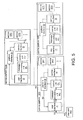
- FIG. 5 is a data transmission diagram according to another embodiment.
- dotted lines and solid lines are used to indicate connection relationship between the elements, and solid lines indicate data transmission in the present example.
- the method begins at step S110, the user end 900 transmits a request message Q2 to one of the service platforms 100A, 100B, and 100C.
- the user end 900 transmits the request message Q2 to the service platform 100A.
- the message processing unit MU analyzes the content of the request message Q2.
- the request message Q2 is for requesting the application service SR3.
- step S120 the control unit CU of the service platform 100A selects one of the service platforms 100A, 100B, and 100C according to the application service SR3 of the request message Q2. As it is shown in the service mapping of Table 1 above that only the service platform 100B has the application service SR3, the control unit CU of the service platform 100A selects the service platform 100B.
- step S130 the control unit CU performs the application service SR3 through the selected service platform 100B.
- the control unit CU of the service platform 100A accesses the application service SR3 through the platform interface GI of the service platform 100A, the platform interface GI of the service platform 100B, and the service interface SI of the service platform 100B.
- the result R2 is further transmitted to the user end 900 through the service interface SI of the service platform 100B, the platform interface GI of the service platform 100B, the platform interface GI of the service platform 100A, and the user interface UI of the service platform 100A.
- step S140 the control unit CU determines whether the request message Q2 further requests another application service.
- the request message Q2 requests to perform not any other application services but the application service SR3, so the method terminates.
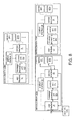
- FIG. 6 is a data transmission diagram according to another embodiment.
- dotted lines and solid lines are used to indicate connection relationship between the elements, and solid lines indicate data transmission in the present example.
- the method begins at step S110, the user end 900 transmits a request message Q3 to one of the service platforms 100A, 100B, and 100C.
- the user end 900 transmits the request message Q3 to the service platform 100A.
- the message processing unit MU analyzes the content of the request message Q3.
- the request message Q3 is for requesting the application service SR1.
- step S120 the control unit CU of the service platform 100A selects one of the service platforms 100A, 100B, and 100C according to the application service SR1 of the request message Q3. As it is shown in the service mapping of Table 1 above that the three service platforms 100A, 100B, and 100C have the application service SR1, the control unit CU of the service platform 100A needs to select from the three service platforms 100A, 100B, and 100C.
- FIG. 7 is a detailed flowchart of the step S120 of FIG. 3 .
- Table 2 shows the operation status of the platforms.
- Table 2 Service Platform Processor Loading Rate (%) Available Memory Capacity (Mbyte) Delay Time (ms) Login Populatio n Login Population Upper Limit 100A 25 1520 100 33 50 100B 42 220 500 10 100 100C 50 170 200 5 70 and so on and so on and so on and so on and so on and so on and so on and so on and so on and so on and so on and so on
- step S121 the control unit CU of the service platform 100A calculates an application service loading rate of each of the service platforms 100A, 100B, and 100C for the application service SR1, and screens the service platforms 100A, 100B, and 100C according to the application service loading rates.
- the application service loading rate is a ratio of a user population to a user population upper limit.
- the service platforms having an application service loading rate lower than a first standard value are screened out.
- the service platform 100A has an application service loading rate of 25% (3/12)
- the service platform 100B has an application service loading rate of 33% (5/15)
- the service platform 100C has an application service loading rate of 30% (3/10).
- the three service platforms 100A, 100B, and 100C each having an application service loading rate lower than the first standard value are all selected.
- step S122 the control unit CU of the service platform 100A calculates a login loading rate of each of the service platforms 100A, 100B, and 100C, and screens the service platforms 100A, 100B, and 100C according to the login loading rates.
- the login loading rate is a ratio of a login population to a login population upper limit.
- the service platforms having a login loading rate lower than a second standard value are screened out.
- the service platform 100A has a login loading rate of 66% (33/50)
- the service platform 100B has a login loading rate of 10% (10/100)
- the service platform 100C has a login loading rate of 7% (5/70).
- the service platforms 100B and 100C each having a login loading rate lower than the second standard value are selected.
- step S123 the control unit CU of the service platform 100A calculates a processor loading rate of each of the service platforms 100B and 100C, and screens the service platforms 100B and 100C according to the processor loading rates.
- the service platforms having a processor loading rate lower than a third standard value are selected.
- the service platform 100B has a processor loading rate of 42%
- the service platform 100C has a processor loading rate of 50%.
- the service platforms 100B and 100C each having a processor loading rate lower than the third standard value are selected.
- step S124 the control unit CU of the service platform 100A calculates an available memory capacity of each of the service platforms 100B and 100C, and screens the service platforms 100B and 100C according to the available memory capacities.
- the service platforms having an available memory capacity higher than a fourth standard value are screened out.
- the service platform 100B has an available memory capacity of 220 Mbyte
- the service platform 100C ha an available memory capacity of 170 Mbyte.
- the service platforms 100B and 100C each having an available memory capacity higher than the fourth standard value are selected.
- step S125 the control unit CU of the service platform 100A calculates a delay time of each of the service platforms 100B and 100C, and screens the service platforms 100B and 100C according to the delay times.
- the service platform having the shortest delay time is selected. As indicated in Table 2, the service platform 100B has a delay time of 500 ms, and the service platform 100C has a delay time of 200 ms. The service platform 100C having the shortest delay time is selected.
- step S130 the control unit CU performs the application service SR1 through the selected service platform 100C.
- the control unit CU of the service platform 100A accesses the application service SR1 through the platform interface GI of the service platform 100A, the platform interface GI of the service platform 100C, and the service interface SI of the service platform 100C.
- the result R3 is transmitted to the user end 900 through the service interface SI of the service platform 100C, the platform interface GI of the service platform 100C, the platform interface GI of the service platform 100A and the user interface UI of the service platform 100A.
- step S140 the control unit CU determines whether the request message Q3 further requests another application service.
- the request message Q3 requests to perform not any other application services but the application service SR1, so the method terminates.
- the request message Q4 further requests the application service SR1 in addition to the application service SR2. Therefore, following step S140 of the flowchart of FIG. 3 , the method returns to step S120, one of the service platforms 100A, 100B, and 100C is selected according to the application service SR1. In the present embodiment, the application service SR2 and the application service SR1 are performed by the same service platform 100A.
- the request message Q5 further requests the application service SR4 in addition to the application service SR3.
- the method returns to step S120, one of the service platforms 100A, 100B and 100C is selected to perform the application service SR4.
- the application service SR3 and the application service SR4 are performed by different service platforms 100B and 100C.
- the service platform can share information and communicate with another service platform through a platform interface, such that various application service of the service platform can be effectively integrated, the waiting time of the application service can be reduced and the network speed can be increased.
Landscapes
- Engineering & Computer Science (AREA)
- Software Systems (AREA)
- Theoretical Computer Science (AREA)
- Physics & Mathematics (AREA)
- General Engineering & Computer Science (AREA)
- Computer Networks & Wireless Communication (AREA)
- Signal Processing (AREA)
- General Physics & Mathematics (AREA)
- Mathematical Physics (AREA)
- Computer Hardware Design (AREA)
- Information Transfer Between Computers (AREA)
- Mobile Radio Communication Systems (AREA)
Abstract
Description
- The disclosure relates in general to a controlling method and a network system, and more particularly to a controlling method and a network system for mobile-edge computing (MEC).
- Along with the explosive growth in information technology, various electronic devices are equipped with network function for performing various application services. Examples of commonly used application services include community websites, video sharing websites, Internet banking, restaurant reservations tool and map tool.
- Apart from smart phones and smart TVs, the launching of wearable devices further brings an explosive growth to the networking electronic devices. When many electronic devices are connected to an application service through network, the waiting time of the application service will increase and the network speed will deteriorate. Therefore, how to resolve the above problems has become a prominent task for the industries.
- The disclosure is directed to a controlling method and a network system for mobile-edge computing (MEC). The application services share information and communicate with each other through the platform interfaces.
- According to one embodiment of the invention, a controlling method for mobile-edge computing (MEC) is provided. The controlling method includes the following steps. A request message for requesting an application service is received by one of a plurality of service platforms. One of the service platforms is selected according to the application service of the request message. The application service is performed by the selected service platform.
- According to another embodiment of the invention, a network system for mobile-edge computing is provided. The network system for mobile-edge computing includes a plurality of service platforms. A request message for requesting an application service is received by one of the service platforms. One of the service platforms is selected according to the application service of the request message. The application service is performed by the selected service platform.
- The above embodiments of the invention will become better understood with regard to the following detailed description of the preferred but non-limiting embodiment (s). The following description is made with reference to the accompanying drawings.
-
-
FIG. 1 is a schematic diagram of a service platform for mobile-edge computing. -
FIG. 2 is a schematic diagram of a network system for mobile-edge computing. -
FIG. 3 is a flowchart of a controlling method for mobile-edge computing. -
FIG. 4 is a data transmission diagram according to an embodiment. -
FIG. 5 is a data transmission diagram according to another embodiment. -
FIG. 6 is a data transmission diagram according to another embodiment. -
FIG. 7 is a detailed flowchart of the step S120 ofFIG. 3 . -
FIG. 8 is a data transmission diagram according to another embodiment. -
FIG. 9 is a data transmission diagram according to another embodiment. - In the following detailed description, for purposes of explanation, numerous specific details are set forth in order to provide a thorough understanding of the disclosed embodiments. It will be apparent, however, that one or more embodiments may be practiced without these specific details. In other instances, well-known structures and devices are schematically shown in order to simplify the drawing.
- Referring to
FIG. 1 , a schematic diagram of aservice platform 100 for mobile-edge computing is shown. Theservice platform 100 includes a message processing unit MU, a control unit CU, a user interface UI, a service interface SI and a platform interface GI. The message processing unit MU is for receiving and analyzing various messages. The control unit CU is for performing various control procedures, determination procedures and calculation procedures. The user interface UI is for providing a standard interface of information exchange to communicate with the user end. The service interface SI is for communicating with various application services SR1, SR2, and so on. Examples of the application services SR1, SR2, and so on include community websites, video sharing websites, Internet banking, restaurant reservation tools and map tools. The platform interface GI is for providing a standard interface of service information exchange to communicate with anotherservice platform 100. Each of the message processing unit MU, the control unit CU, the user interface UI, the service interface SI and the platform interface GI can be realized by such as a chip, a circuit board, a circuit or a storage medium storing a plurality of programming codes. - In another embodiment according to the disclosure, each
service platform 100 can share information and communicate with anotherservice platform 100 through the platform interface GI. Therefore, various application services of a plurality ofservice platforms 100 can be efficiently integrated. - Referring to
FIG. 2 , a network system 1000 for mobile-edge computing is shown. A plurality ofservice platforms 100 can be connected wirelessly or by cable through the platform interface GI (illustrated inFIG. 1 ) to form the network system 1000 for mobile-edge computing. The network system 1000 for mobile-edge computing is connected between acore network 2000 and auser end 900 to form a device to device relay base local cloud. Various application services are disposed on theservice platforms 100. When theuser end 900 wants to perform a particular application service, theuser end 900 can directly perform the application service on the network system 1000 for mobile-edge computing instead of thecore network 2000. Or, the application service provider can directly provide various messages to theuser end 900 through the application service disposed on the network system 1000 for mobile-edge computing instead of thecore network 2000. - Refer to
FIGS. 3 to 4 .FIG. 3 is a flowchart of a controlling method for mobile-edge computing.FIG. 4 is a data transmission diagram according to an embodiment. InFIG. 4 , dotted lines and solid lines are used to indicate connection relationship between the elements, and the solid lines indicate data transmission in the present example. Theservice platform 100A has application services SR1, SR2, and so on. Theservice platform 100B has application services SR1, SR3, and so on. Theservice platform 100C has application service SR1, SR4, and so on. - Firstly, the method begins at step S110, the
user end 900 transmits a request message Q1 to one of theservice platforms user end 900 transmits the request message Q1 to theservice platform 100A. In an embodiment, the request message Q1 is written in a standard hypertext application language (HAL). After the user interface UI of theservice platform 100A receives the request message Q1, the message processing unit MU analyzes the content of the request message Q1. In the example ofFIG. 4 , the request message Q1 is for requesting the application service SR2. - Next, the method proceeds to step S120, the control unit CU of the
service platform 100A selects one of theservice platforms service platform 100A has the application service SR2, the control unit CU of theservice platform 100A selects theservice platform 100A.Table 1 Application Service Service Platform User Population User Population Upper Limit Application Service SR1 Service Platform 100A 3 12 Application Service SR1 Service Platform 100B 5 15 Application Service SR1 Service Platform 100C 3 10 Application Service SR2 Service Platform 100A 5 10 Application Service SR3 Service Platform 100B 4 7 Application Service SR4 Service Platform 100C 3 5 ··· ··· ··· ··· - Then, the method proceeds to step S130, the control unit CU performs the application service SR2 through the selected
service platform 100A. In the present step, the control unit CU accesses the application service SR2 through the service interface SI and a result R1 is transmitted to the user interface UI from the service interface SI, the control unit CU further transmits the result R1 to theuser end 900. - Then, the method proceeds to step S140, the control unit CU determines whether the request message Q1 further requests another application service. In the example of
FIG. 4 , the request message Q1 requests to perform not any other application services but the application service SR2, so the method terminates. - Refer to
FIGS. 3 and5. FIG. 5 is a data transmission diagram according to another embodiment. InFIG. 5 , dotted lines and solid lines are used to indicate connection relationship between the elements, and solid lines indicate data transmission in the present example. - Firstly, the method begins at step S110, the
user end 900 transmits a request message Q2 to one of theservice platforms user end 900 transmits the request message Q2 to theservice platform 100A. After the user interface UI of theservice platform 100A receives the request message Q2, the message processing unit MU analyzes the content of the request message Q2. In the example ofFIG. 5 , the request message Q2 is for requesting the application service SR3. - Next, the method proceeds to step S120, the control unit CU of the
service platform 100A selects one of theservice platforms service platform 100B has the application service SR3, the control unit CU of theservice platform 100A selects theservice platform 100B. - Then, the method proceeds to step S130, the control unit CU performs the application service SR3 through the selected
service platform 100B. In the present step, the control unit CU of theservice platform 100A accesses the application service SR3 through the platform interface GI of theservice platform 100A, the platform interface GI of theservice platform 100B, and the service interface SI of theservice platform 100B. The result R2 is further transmitted to theuser end 900 through the service interface SI of theservice platform 100B, the platform interface GI of theservice platform 100B, the platform interface GI of theservice platform 100A, and the user interface UI of theservice platform 100A. - Then, the method proceeds to step S140, the control unit CU determines whether the request message Q2 further requests another application service. In the example of
FIG. 5 , the request message Q2 requests to perform not any other application services but the application service SR3, so the method terminates. - Refer to
FIGS. 3 and6. FIG. 6 is a data transmission diagram according to another embodiment. InFIG. 6 , dotted lines and solid lines are used to indicate connection relationship between the elements, and solid lines indicate data transmission in the present example. - Firstly, the method begins at step S110, the
user end 900 transmits a request message Q3 to one of theservice platforms user end 900 transmits the request message Q3 to theservice platform 100A. After the user interface UI of theservice platform 100A receives the request message Q3, the message processing unit MU analyzes the content of the request message Q3. In the example ofFIG. 6 , the request message Q3 is for requesting the application service SR1. - Next, the method proceeds to step S120, the control unit CU of the
service platform 100A selects one of theservice platforms service platforms service platform 100A needs to select from the threeservice platforms - Refer to
FIG. 7 and Table 2.FIG. 7 is a detailed flowchart of the step S120 ofFIG. 3 . Table 2 shows the operation status of the platforms.Table 2 Service Platform Processor Loading Rate (%) Available Memory Capacity (Mbyte) Delay Time (ms) Login Populatio n Login Population Upper Limit 100A 25 1520 100 33 50 100B 42 220 500 10 100 100C 50 170 200 5 70 and so on and so on and so on and so on and so on and so on - In step S121, the control unit CU of the
service platform 100A calculates an application service loading rate of each of theservice platforms service platforms service platform 100A has an application service loading rate of 25% (3/12), theservice platform 100B has an application service loading rate of 33% (5/15), and theservice platform 100C has an application service loading rate of 30% (3/10). The threeservice platforms - In step S122, the control unit CU of the
service platform 100A calculates a login loading rate of each of theservice platforms service platforms service platform 100A has a login loading rate of 66% (33/50), theservice platform 100B has a login loading rate of 10% (10/100), and theservice platform 100C has a login loading rate of 7% (5/70). Theservice platforms - In step S123, the control unit CU of the
service platform 100A calculates a processor loading rate of each of theservice platforms service platforms service platform 100B has a processor loading rate of 42%, and theservice platform 100C has a processor loading rate of 50%. Theservice platforms - In step S124, the control unit CU of the
service platform 100A calculates an available memory capacity of each of theservice platforms service platforms service platform 100B has an available memory capacity of 220 Mbyte, and theservice platform 100C ha an available memory capacity of 170 Mbyte. Theservice platforms - In step S125, the control unit CU of the
service platform 100A calculates a delay time of each of theservice platforms service platforms service platform 100B has a delay time of 500 ms, and theservice platform 100C has a delay time of 200 ms. Theservice platform 100C having the shortest delay time is selected. - The sequence of the steps S121, S122, S123, S124, and S125 can be adjusted according to actual needs.
- Then, the method proceeds to step S130, the control unit CU performs the application service SR1 through the selected
service platform 100C. In the present step, the control unit CU of theservice platform 100A accesses the application service SR1 through the platform interface GI of theservice platform 100A, the platform interface GI of theservice platform 100C, and the service interface SI of theservice platform 100C. The result R3 is transmitted to theuser end 900 through the service interface SI of theservice platform 100C, the platform interface GI of theservice platform 100C, the platform interface GI of theservice platform 100A and the user interface UI of theservice platform 100A. - Then, the method proceeds to step S140, the control unit CU determines whether the request message Q3 further requests another application service. In the example of
FIG. 6 , the request message Q3 requests to perform not any other application services but the application service SR1, so the method terminates. - Referring to
FIG. 8 , a data transmission diagram according to another embodiment is shown. In another embodiment, the request message Q4 further requests the application service SR1 in addition to the application service SR2. Therefore, following step S140 of the flowchart ofFIG. 3 , the method returns to step S120, one of theservice platforms same service platform 100A. - Referring to
FIG. 9 , a data transmission diagram according to another embodiment is shown. In another embodiment, the request message Q5 further requests the application service SR4 in addition to the application service SR3. As indicated inFIG. 3 , after step S140 is performed, the method returns to step S120, one of theservice platforms different service platforms - As disclosed in the above embodiments, the service platform can share information and communicate with another service platform through a platform interface, such that various application service of the service platform can be effectively integrated, the waiting time of the application service can be reduced and the network speed can be increased.
- It will be apparent to those skilled in the art that various modifications and variations can be made to the disclosed embodiments. It is intended that the specification and examples be considered as exemplary only, with a true scope of the disclosure being indicated by the following claims and their equivalents.
Claims (15)
- A controlling method for mobile-edge computing (MEC), characterized in that the controlling method comprises:receiving a request message (Q1, Q2, Q3, Q4, Q5) for requesting a first application service (SR1, SR2, SR3, SR4) by one of a plurality of service platforms (100, 100A, 100B, 100C);selecting one of the service platforms (100, 100A, 100B, 100C) according the first application service (SR1, SR2, SR3, SR4) of the request message (Q1, Q2, Q3, Q4, Q5); andperforming the first application service (SR1, SR2, SR3, SR4) by the selected service platform (100, 100A, 100B, 100C).
- The controlling method for mobile-edge computing according to claim 1, wherein the service platform receiving the request message is different from the service platform performing the first application service.
- The controlling method for mobile-edge computing according to claim 1, wherein the request message further requests a second application service, and the controlling method further comprises:selecting one of the service platforms according to the second application service; andperforming the second application service by the selected service platform, wherein the first application service and the second application service are performed by the same service platform.
- The controlling method for mobile-edge computing according to claim 1, wherein the request message further requests a second application service, and the controlling method further comprises:selecting one of the service platforms according to the second application service of the request message; andperforming the second application service by the selected service platform, wherein the first application service and the second application service are performed by different service platforms.
- The controlling method for mobile-edge computing according to claim 1, wherein the step of selecting one of the service platforms according to the first application service of the request message comprises:calculating an application service loading rate of each service platform for the first application service, wherein the application service loading rate is a ratio of a user population to a user population upper limit; andscreening the service platforms according to the application service loading rates.
- The controlling method for mobile-edge computing according to claim 1, wherein the step of selecting one of the service platforms according to the first application service of the request message comprises:calculating a login loading rate of each service platform, wherein the login loading rate is a ratio of a login population to a login population upper limit; andscreening the service platforms according to the login loading rates.
- The controlling method for mobile-edge computing according to claim 1, wherein the step of selecting one of the service platforms according to the first application service of the request message comprises:calculating a processor loading rate of each service platform; andscreening the service platforms according to the processor loading rates.
- The controlling method for mobile-edge computing according to claim 1, wherein the step of selecting one of the service platforms according to the first application service of the request message comprises:calculating an available memory capacity of each service platform; andscreening the service platforms according to the available memory capacities.
- The controlling method for mobile-edge computing according to claim 1, wherein the step of selecting one of the service platforms according to the first application service of the request message comprises:calculating a delay time by which each service platform performs the first application service; andscreening the service platforms according to the delay times.
- A network system (1000) for mobile-edge computing, charactrtised in that the network system (1000) comprises:a plurality of service platforms (100, 100A, 100B, 100C), wherein one of the service platforms (100, 100A, 100B, 100C) receives a request message (Q1, Q2, Q3, Q4, Q5) for requesting a first application service (SR1, SR2, SR3, SR4);wherein one of the service platforms (100, 100A, 100B, 100C) is selected according to the first application service (SR1, SR2, SR3, SR4) of the request message (Q1, Q2, Q3, Q4, Q5), and the first application service (SR1, SR2, SR3, SR4) is performed by the selected service platform (100, 100A, 100B, 100C).
- The network system for mobile-edge computing according to claim 10, wherein the service platform receiving the request message is different from the service platform performing the first application service.
- The network system for mobile-edge computing according to claim 10, wherein the request message further requests a second application service, one of the service platforms is selected according to the second application service of the request message, the second application service is performed by the selected service platform, and the first application service and the second application service are performed by the same service platform.
- The network system for mobile-edge computing according to claim 10, wherein the request message further requests a second application service, one of the service platforms is selected according to the second application service of the request message, the second application service is performed by the selected service platform, and the first application service and the second application service are performed by different service platforms.
- The network system for mobile-edge computing according to claim 10, wherein each service platform has a login loading rate and an application service loading rate for the first application service, the application service loading rate is a ratio of a user population to a user population upper limit, the login loading rate is a ratio of a login population to a login population upper limit, and the service platforms are screened according to the login loading rates or the application service loading rates.
- The network system for mobile-edge computing according to claim 10, wherein each service platform has a processor loading rate, an available memory capacity and a delay time by which the first application service is performed, and the service platforms are screened according to the processor loading rates, the available memory capacities, or the delay times.
Applications Claiming Priority (2)
| Application Number | Priority Date | Filing Date | Title |
|---|---|---|---|
| US201562174535P | 2015-06-12 | 2015-06-12 | |
| TW104129504A TWI581588B (en) | 2015-06-12 | 2015-09-07 | Controlling method, network system and service platform for mobile-edge computing |
Publications (1)
| Publication Number | Publication Date |
|---|---|
| EP3104576A1 true EP3104576A1 (en) | 2016-12-14 |
Family
ID=55085477
Family Applications (1)
| Application Number | Title | Priority Date | Filing Date |
|---|---|---|---|
| EP15202496.4A Ceased EP3104576A1 (en) | 2015-06-12 | 2015-12-23 | Platform selection according to requested service for mobile-edge computing |
Country Status (3)
| Country | Link |
|---|---|
| US (1) | US20160366244A1 (en) |
| EP (1) | EP3104576A1 (en) |
| CN (1) | CN106254408A (en) |
Cited By (2)
| Publication number | Priority date | Publication date | Assignee | Title |
|---|---|---|---|---|
| CN108235298A (en) * | 2016-12-21 | 2018-06-29 | 上海中兴软件有限责任公司 | Path switching method, mobile edge calculations platform and gateway in mobile edge calculations |
| GB2589154A (en) * | 2019-11-25 | 2021-05-26 | Ind Tech Res Inst | Method and system for accessing private network services |
Families Citing this family (30)
| Publication number | Priority date | Publication date | Assignee | Title |
|---|---|---|---|---|
| US9900725B2 (en) | 2015-07-29 | 2018-02-20 | Intel Corporation | Technologies for an automated application exchange in wireless networks |
| CN108243027B (en) * | 2016-12-23 | 2020-04-07 | 大唐移动通信设备有限公司 | Port initialization method and device |
| CN108616826B (en) * | 2016-12-30 | 2021-07-06 | 中国移动通信集团上海有限公司 | MEC service prompting method and device |
| CN108574728B (en) * | 2017-03-08 | 2021-05-04 | 中兴通讯股份有限公司 | Method and apparatus for traffic path change detection for moving edge computation |
| WO2018170732A1 (en) * | 2017-03-21 | 2018-09-27 | 华为技术有限公司 | Method and device for service deployment under edge cloud architecture |
| WO2018182732A1 (en) * | 2017-03-31 | 2018-10-04 | Intel Corporation | Vehicle communication |
| US10270884B2 (en) * | 2017-06-02 | 2019-04-23 | Wistron Neweb Corporation | Control method, network system and control platform for mobile-edge computing |
| CN107450982B (en) * | 2017-06-07 | 2019-11-19 | 上海交通大学 | A Task Scheduling Method Based on System State |
| CN109039665A (en) * | 2017-06-08 | 2018-12-18 | 中兴通讯股份有限公司 | List generating method and device |
| CN107404733B (en) * | 2017-08-22 | 2020-04-24 | 山东省计算中心(国家超级计算济南中心) | 5G mobile communication method and system based on MEC and layered SDN |
| CN109429284B (en) * | 2017-08-31 | 2020-08-25 | 华为技术有限公司 | Instance switching method, related device, instance switching system and storage medium |
| TWI627871B (en) * | 2017-09-05 | 2018-06-21 | 財團法人工業技術研究院 | Control method for network communication system and multi-access edge computing ecosystem device |
| US10693950B2 (en) | 2017-09-05 | 2020-06-23 | Industrial Technology Research Institute | Control method for network communication system including base station network management server and multi-access edge computing ecosystem device |
| CN109495929B (en) * | 2017-09-12 | 2021-08-03 | 华为技术有限公司 | A service processing method, mobile edge computing device and network device |
| CN109542458B (en) | 2017-09-19 | 2021-02-05 | 华为技术有限公司 | Application program management method and device |
| US10887198B2 (en) * | 2017-09-29 | 2021-01-05 | Nec Corporation | System and method to support network slicing in an MEC system providing automatic conflict resolution arising from multiple tenancy in the MEC environment |
| US10938736B2 (en) | 2017-10-18 | 2021-03-02 | Futurewei Technologies, Inc. | Dynamic allocation of edge computing resources in edge computing centers |
| CN109756903B (en) * | 2017-11-03 | 2022-03-29 | 南宁富桂精密工业有限公司 | Method and related apparatus for optimizing a moving edge computing system |
| CN109818868B (en) * | 2017-11-20 | 2021-06-22 | 中兴通讯股份有限公司 | A method, apparatus, device and storage medium for realizing edge network capability opening |
| EP3703337B1 (en) * | 2017-11-22 | 2022-12-21 | Huawei Technologies Co., Ltd. | Mobile edge host-machine service notification method and apparatus |
| TWI679864B (en) * | 2017-12-07 | 2019-12-11 | 中華電信股份有限公司 | Mobile edge computing platform and packet forwarding method thereof |
| TWI679865B (en) * | 2017-12-07 | 2019-12-11 | 中華電信股份有限公司 | Mobile edge computing platform and application service guiding method thereof |
| CN108063773B (en) * | 2018-02-11 | 2020-05-08 | 清华大学 | A kind of application service access method and device based on mobile edge computing |
| CN108355350B (en) * | 2018-02-11 | 2020-04-10 | 清华大学 | Application service access method and device based on mobile edge computing |
| CN110688213B (en) * | 2018-07-05 | 2023-02-10 | 深圳先进技术研究院 | Resource management method, system and electronic device based on edge computing |
| CN109347739B (en) * | 2018-11-14 | 2021-06-22 | 电子科技大学 | A method for providing resource configuration and access point selection strategy for multi-access edge computing |
| TWI699124B (en) * | 2018-12-06 | 2020-07-11 | 中華電信股份有限公司 | System for service continual forwarding about user data based on mobile edge computing and method thereof |
| US11395195B2 (en) * | 2020-01-22 | 2022-07-19 | Cisco Technology, Inc. | Systems and methods for managing MEC application hosting |
| KR102960454B1 (en) | 2020-03-25 | 2026-04-30 | 삼성전자주식회사 | Method and apparatus for transmitting mobile edge computing application |
| CN113949705B (en) * | 2020-06-29 | 2023-07-11 | 华为技术有限公司 | Communication method and communication device |
Citations (4)
| Publication number | Priority date | Publication date | Assignee | Title |
|---|---|---|---|---|
| WO2002015526A1 (en) * | 2000-08-11 | 2002-02-21 | Netscape Communications Corporation | Server-side session management |
| WO2007099073A1 (en) * | 2006-03-01 | 2007-09-07 | International Business Machines Corporation | Method, system, and program product for deploying a platform dependent application in a grid environment |
| US20090037367A1 (en) * | 2007-07-30 | 2009-02-05 | Sybase, Inc. | System and Methodology Providing Workload Management in Database Cluster |
| US20140101226A1 (en) * | 2012-10-08 | 2014-04-10 | Motorola Mobility Llc | Methods and apparatus for performing dynamic load balancing of processing resources |
Family Cites Families (6)
| Publication number | Priority date | Publication date | Assignee | Title |
|---|---|---|---|---|
| CN101014042A (en) * | 2007-02-05 | 2007-08-08 | 浪潮乐金信息系统有限公司 | Web Service balancing loading method |
| CN101299747A (en) * | 2007-04-30 | 2008-11-05 | 华为技术有限公司 | A media control method, system, device and media service combination equipment |
| US20100297983A1 (en) * | 2009-05-19 | 2010-11-25 | Nokia Corporation | Method and apparatus for electronic credential security |
| US9201639B2 (en) * | 2012-09-07 | 2015-12-01 | Oracle International Corporation | System and method for service definition packages for use with a cloud computing environment |
| CN103227838B (en) * | 2013-05-10 | 2015-09-30 | 中国工商银行股份有限公司 | A kind of multi-load equilibrium treatment apparatus and method |
| CN104023068B (en) * | 2014-06-13 | 2017-12-15 | 北京信诺瑞得软件系统有限公司 | A kind of method that Passive Mode elastic calculation scheduling of resource is realized in load balancing |
-
2015
- 2015-10-08 CN CN201510644795.4A patent/CN106254408A/en active Pending
- 2015-11-23 US US14/949,264 patent/US20160366244A1/en not_active Abandoned
- 2015-12-23 EP EP15202496.4A patent/EP3104576A1/en not_active Ceased
Patent Citations (4)
| Publication number | Priority date | Publication date | Assignee | Title |
|---|---|---|---|---|
| WO2002015526A1 (en) * | 2000-08-11 | 2002-02-21 | Netscape Communications Corporation | Server-side session management |
| WO2007099073A1 (en) * | 2006-03-01 | 2007-09-07 | International Business Machines Corporation | Method, system, and program product for deploying a platform dependent application in a grid environment |
| US20090037367A1 (en) * | 2007-07-30 | 2009-02-05 | Sybase, Inc. | System and Methodology Providing Workload Management in Database Cluster |
| US20140101226A1 (en) * | 2012-10-08 | 2014-04-10 | Motorola Mobility Llc | Methods and apparatus for performing dynamic load balancing of processing resources |
Non-Patent Citations (1)
| Title |
|---|
| "Mobile-Edge Computing (MEC); Technical Requirements;Draft ETSI GS MEC 002", ETSI DRAFT; DRAFT ETSI GS MEC 002, EUROPEAN TELECOMMUNICATIONS STANDARDS INSTITUTE (ETSI), 650, ROUTE DES LUCIOLES ; F-06921 SOPHIA-ANTIPOLIS ; FRANCE, vol. ISG - MEC, no. V0.1.3, 16 April 2015 (2015-04-16), pages 1 - 20, XP014238842 * |
Cited By (3)
| Publication number | Priority date | Publication date | Assignee | Title |
|---|---|---|---|---|
| CN108235298A (en) * | 2016-12-21 | 2018-06-29 | 上海中兴软件有限责任公司 | Path switching method, mobile edge calculations platform and gateway in mobile edge calculations |
| GB2589154A (en) * | 2019-11-25 | 2021-05-26 | Ind Tech Res Inst | Method and system for accessing private network services |
| GB2589154B (en) * | 2019-11-25 | 2022-05-25 | Ind Tech Res Inst | Method and system for accessing private network services |
Also Published As
| Publication number | Publication date |
|---|---|
| US20160366244A1 (en) | 2016-12-15 |
| CN106254408A (en) | 2016-12-21 |
Similar Documents
| Publication | Publication Date | Title |
|---|---|---|
| US20160366244A1 (en) | Controlling method, network system and service platform for mobile-edge computing | |
| JP4190455B2 (en) | Load balancing apparatus and program | |
| US20190379790A1 (en) | System and method for optimizing agent time | |
| US10116791B2 (en) | Methods and apparatus for transmitting data | |
| US20140372945A1 (en) | Method for outputting images, apparatus and mobile terminal therefor | |
| TWI581588B (en) | Controlling method, network system and service platform for mobile-edge computing | |
| US10136298B2 (en) | Device-to-device content delivery method through interworking with service control apparatus | |
| WO2017050015A1 (en) | Data transmission method and device and terminal | |
| US11706301B2 (en) | Server node selection method and terminal device | |
| CN110650209B (en) | Method and device for realizing load balancing | |
| US9602770B2 (en) | Method and system for supporting videoconference in distributed telepresence platform | |
| CN109804660A (en) | Service quality stream remaps implementation method, device, equipment and storage medium | |
| US10158587B2 (en) | Communication between a web application instance connected to a connection server and a calling entity other than said connection server | |
| JP2001156838A (en) | Communication resource reservation method and apparatus, and recording medium recording communication resource reservation program | |
| CN107105317B (en) | Video playing method and device | |
| US20140289307A1 (en) | Method for transmitting data between electronic devices | |
| KR101719724B1 (en) | Resource management system and method, and method for deciding resource price by the same system | |
| US20160352642A1 (en) | Rendezvous flow control apparatus, method, and non-transitory tangible computer readable medium | |
| EP3694151B1 (en) | Terminal network sharing method, apparatus, air conditioning adjustment device, and storage medium | |
| US11785603B2 (en) | Method, apparatus and non-transitory computer readable medium for selecting a PUSCH to carry UCI | |
| CN117478676A (en) | Load balancing method and device, load balancing system and storage medium | |
| CN112714420B (en) | Network access method and device of wifi hotspot providing equipment and electronic equipment | |
| CN116820612A (en) | Micro front-end integration method, device, equipment and storage medium of front-end system | |
| CN108271033A (en) | A kind of net cast method and device | |
| TWI665932B (en) | Group host selection method for device-to-device network and control platform for selecting group host |
Legal Events
| Date | Code | Title | Description |
|---|---|---|---|
| PUAI | Public reference made under article 153(3) epc to a published international application that has entered the european phase |
Free format text: ORIGINAL CODE: 0009012 |
|
| STAA | Information on the status of an ep patent application or granted ep patent |
Free format text: STATUS: REQUEST FOR EXAMINATION WAS MADE |
|
| 17P | Request for examination filed |
Effective date: 20161104 |
|
| AK | Designated contracting states |
Kind code of ref document: A1 Designated state(s): AL AT BE BG CH CY CZ DE DK EE ES FI FR GB GR HR HU IE IS IT LI LT LU LV MC MK MT NL NO PL PT RO RS SE SI SK SM TR |
|
| AX | Request for extension of the european patent |
Extension state: BA ME |
|
| STAA | Information on the status of an ep patent application or granted ep patent |
Free format text: STATUS: EXAMINATION IS IN PROGRESS |
|
| 17Q | First examination report despatched |
Effective date: 20170511 |
|
| STAA | Information on the status of an ep patent application or granted ep patent |
Free format text: STATUS: THE APPLICATION HAS BEEN REFUSED |
|
| 18R | Application refused |
Effective date: 20180603 |