EP3103797A1 - 2,5-dioxoimidazolidin-1-yl-3-phenylurea derivatives as formyl peptide receptor like-1 (fprl-1) receptor modulators - Google Patents
2,5-dioxoimidazolidin-1-yl-3-phenylurea derivatives as formyl peptide receptor like-1 (fprl-1) receptor modulators Download PDFInfo
- Publication number
- EP3103797A1 EP3103797A1 EP16177209.0A EP16177209A EP3103797A1 EP 3103797 A1 EP3103797 A1 EP 3103797A1 EP 16177209 A EP16177209 A EP 16177209A EP 3103797 A1 EP3103797 A1 EP 3103797A1
- Authority
- EP
- European Patent Office
- Prior art keywords
- optionally substituted
- alkyl
- urea
- dioxoimidazolidin
- bromophenyl
- Prior art date
- Legal status (The legal status is an assumption and is not a legal conclusion. Google has not performed a legal analysis and makes no representation as to the accuracy of the status listed.)
- Granted
Links
- 0 C*C(N(*)C(C)C**)=O Chemical compound C*C(N(*)C(C)C**)=O 0.000 description 19
- FDXWKBLUSSGUFT-UHFFFAOYSA-N CC(CCc1ccccc1)(C(N1NC(Nc(cc2)ccc2F)=O)=O)NC1=O Chemical compound CC(CCc1ccccc1)(C(N1NC(Nc(cc2)ccc2F)=O)=O)NC1=O FDXWKBLUSSGUFT-UHFFFAOYSA-N 0.000 description 3
- GDOPTJXRTPNYNR-UHFFFAOYSA-N CC1CCCC1 Chemical compound CC1CCCC1 GDOPTJXRTPNYNR-UHFFFAOYSA-N 0.000 description 3
- IFTRQJLVEBNKJK-UHFFFAOYSA-N CCC1CCCC1 Chemical compound CCC1CCCC1 IFTRQJLVEBNKJK-UHFFFAOYSA-N 0.000 description 2
- FYMHXYMMTVLRIX-NVXXTVOZSA-N C/C(/Br)=C\C=C(/C#C)\NC(NN(C(C1(Cc2ccccc2C1)N1)=O)C1=O)=O Chemical compound C/C(/Br)=C\C=C(/C#C)\NC(NN(C(C1(Cc2ccccc2C1)N1)=O)C1=O)=O FYMHXYMMTVLRIX-NVXXTVOZSA-N 0.000 description 1
- TVTSDGXSKKHGAQ-UHFFFAOYSA-N CC(C)C(CC(NC(C)(C)C(O)=O)=O)(C(N1NC(Nc(cc2)ccc2[Br]=C)=O)=O)NC1=O Chemical compound CC(C)C(CC(NC(C)(C)C(O)=O)=O)(C(N1NC(Nc(cc2)ccc2[Br]=C)=O)=O)NC1=O TVTSDGXSKKHGAQ-UHFFFAOYSA-N 0.000 description 1
- LOYONTWKVFYWKS-UHFFFAOYSA-N CC(C)C(CCO)(C(N1NC(Nc(cc2)ccc2Br)=O)=O)NC1=O Chemical compound CC(C)C(CCO)(C(N1NC(Nc(cc2)ccc2Br)=O)=O)NC1=O LOYONTWKVFYWKS-UHFFFAOYSA-N 0.000 description 1
- UNACWJHJEJMFBE-UHFFFAOYSA-N CC(C)C(CO)(C(N1NC(Nc(c(F)c2)ccc2Br)=O)=O)NC1=O Chemical compound CC(C)C(CO)(C(N1NC(Nc(c(F)c2)ccc2Br)=O)=O)NC1=O UNACWJHJEJMFBE-UHFFFAOYSA-N 0.000 description 1
- ABUHHTLKKHEDAG-UHFFFAOYSA-N CC(C)CC(CCc1ccccc1)(C(N1NC(Nc(ccc(Br)c2)c2F)=O)=O)NC1=O Chemical compound CC(C)CC(CCc1ccccc1)(C(N1NC(Nc(ccc(Br)c2)c2F)=O)=O)NC1=O ABUHHTLKKHEDAG-UHFFFAOYSA-N 0.000 description 1
- ZPQJNLOWYQRPJU-UHFFFAOYSA-N CC(CC(N1NC(Nc(c(C#N)c2)ccc2F)=O)=O)(c2cc(OC)ccc2)NC1=O Chemical compound CC(CC(N1NC(Nc(c(C#N)c2)ccc2F)=O)=O)(c2cc(OC)ccc2)NC1=O ZPQJNLOWYQRPJU-UHFFFAOYSA-N 0.000 description 1
- FBVMGGOVQVUPHB-UHFFFAOYSA-N CC(CCc(cc1)ccc1C(OC)=O)(C(N1N)=O)NC1=O Chemical compound CC(CCc(cc1)ccc1C(OC)=O)(C(N1N)=O)NC1=O FBVMGGOVQVUPHB-UHFFFAOYSA-N 0.000 description 1
- ZNEDUOGCPIGJMX-UHFFFAOYSA-N CC(CCc1cccc(O)c1)(C(N1N)=O)NC1=O Chemical compound CC(CCc1cccc(O)c1)(C(N1N)=O)NC1=O ZNEDUOGCPIGJMX-UHFFFAOYSA-N 0.000 description 1
- LQPVBOMJPJRRKR-UHFFFAOYSA-N CC(CCc1ccccc1[Br]=C)(C(N1)=O)NC1=O Chemical compound CC(CCc1ccccc1[Br]=C)(C(N1)=O)NC1=O LQPVBOMJPJRRKR-UHFFFAOYSA-N 0.000 description 1
- ZGKLRHHWQLBTCW-UHFFFAOYSA-N CCC(C)(C(N1NC(Nc(cc2)ccc2Cl)=O)=O)NC1=O Chemical compound CCC(C)(C(N1NC(Nc(cc2)ccc2Cl)=O)=O)NC1=O ZGKLRHHWQLBTCW-UHFFFAOYSA-N 0.000 description 1
- HVSSCPMYKDNJFK-UHFFFAOYSA-N CCC(CC)(C(N1NC(Nc(cc2)ccc2[Br]=C)=O)=O)NC1=O Chemical compound CCC(CC)(C(N1NC(Nc(cc2)ccc2[Br]=C)=O)=O)NC1=O HVSSCPMYKDNJFK-UHFFFAOYSA-N 0.000 description 1
- WZUBWDFMPJHXBA-UHFFFAOYSA-N CCC(CCc1ccccc1)(C(N1NC(Nc(cc2)ccc2Br)=O)=O)NC1=O Chemical compound CCC(CCc1ccccc1)(C(N1NC(Nc(cc2)ccc2Br)=O)=O)NC1=O WZUBWDFMPJHXBA-UHFFFAOYSA-N 0.000 description 1
- ONYHIOZWMQBLFW-UHFFFAOYSA-N CCc(cc1)cc2c1[nH]c(C(C)(C(N1NC(Nc(c(F)c3)ccc3Br)=O)=O)NC1=O)c2 Chemical compound CCc(cc1)cc2c1[nH]c(C(C)(C(N1NC(Nc(c(F)c3)ccc3Br)=O)=O)NC1=O)c2 ONYHIOZWMQBLFW-UHFFFAOYSA-N 0.000 description 1
- YZAGCPWUWDUMKB-UHFFFAOYSA-N COc(cc1)ccc1NC(NN(C(C1(CCCCC1)N1)=O)C1=O)=O Chemical compound COc(cc1)ccc1NC(NN(C(C1(CCCCC1)N1)=O)C1=O)=O YZAGCPWUWDUMKB-UHFFFAOYSA-N 0.000 description 1
- LFAJLUPDADECSJ-UHFFFAOYSA-N O=C(Nc(cc1)ccc1Br)NN(C(C1(CCCCC1)N1)=O)C1=O Chemical compound O=C(Nc(cc1)ccc1Br)NN(C(C1(CCCCC1)N1)=O)C1=O LFAJLUPDADECSJ-UHFFFAOYSA-N 0.000 description 1
Classifications
-
- C—CHEMISTRY; METALLURGY
- C07—ORGANIC CHEMISTRY
- C07D—HETEROCYCLIC COMPOUNDS
- C07D233/00—Heterocyclic compounds containing 1,3-diazole or hydrogenated 1,3-diazole rings, not condensed with other rings
- C07D233/54—Heterocyclic compounds containing 1,3-diazole or hydrogenated 1,3-diazole rings, not condensed with other rings having two double bonds between ring members or between ring members and non-ring members
- C07D233/66—Heterocyclic compounds containing 1,3-diazole or hydrogenated 1,3-diazole rings, not condensed with other rings having two double bonds between ring members or between ring members and non-ring members with hetero atoms or with carbon atoms having three bonds to hetero atoms with at the most one bond to halogen, e.g. ester or nitrile radicals, directly attached to ring carbon atoms
- C07D233/72—Two oxygen atoms, e.g. hydantoin
- C07D233/80—Two oxygen atoms, e.g. hydantoin with hetero atoms or acyl radicals directly attached to ring nitrogen atoms
-
- C—CHEMISTRY; METALLURGY
- C07—ORGANIC CHEMISTRY
- C07D—HETEROCYCLIC COMPOUNDS
- C07D233/00—Heterocyclic compounds containing 1,3-diazole or hydrogenated 1,3-diazole rings, not condensed with other rings
- C07D233/54—Heterocyclic compounds containing 1,3-diazole or hydrogenated 1,3-diazole rings, not condensed with other rings having two double bonds between ring members or between ring members and non-ring members
- C07D233/66—Heterocyclic compounds containing 1,3-diazole or hydrogenated 1,3-diazole rings, not condensed with other rings having two double bonds between ring members or between ring members and non-ring members with hetero atoms or with carbon atoms having three bonds to hetero atoms with at the most one bond to halogen, e.g. ester or nitrile radicals, directly attached to ring carbon atoms
- C07D233/86—Oxygen and sulfur atoms, e.g. thiohydantoin
-
- A—HUMAN NECESSITIES
- A61—MEDICAL OR VETERINARY SCIENCE; HYGIENE
- A61K—PREPARATIONS FOR MEDICAL, DENTAL OR TOILETRY PURPOSES
- A61K31/00—Medicinal preparations containing organic active ingredients
- A61K31/33—Heterocyclic compounds
- A61K31/395—Heterocyclic compounds having nitrogen as a ring hetero atom, e.g. guanethidine or rifamycins
- A61K31/41—Heterocyclic compounds having nitrogen as a ring hetero atom, e.g. guanethidine or rifamycins having five-membered rings with two or more ring hetero atoms, at least one of which being nitrogen, e.g. tetrazole
- A61K31/4164—1,3-Diazoles
- A61K31/4166—1,3-Diazoles having oxo groups directly attached to the heterocyclic ring, e.g. phenytoin
-
- A—HUMAN NECESSITIES
- A61—MEDICAL OR VETERINARY SCIENCE; HYGIENE
- A61K—PREPARATIONS FOR MEDICAL, DENTAL OR TOILETRY PURPOSES
- A61K31/00—Medicinal preparations containing organic active ingredients
- A61K31/33—Heterocyclic compounds
- A61K31/395—Heterocyclic compounds having nitrogen as a ring hetero atom, e.g. guanethidine or rifamycins
- A61K31/41—Heterocyclic compounds having nitrogen as a ring hetero atom, e.g. guanethidine or rifamycins having five-membered rings with two or more ring hetero atoms, at least one of which being nitrogen, e.g. tetrazole
- A61K31/4164—1,3-Diazoles
- A61K31/4178—1,3-Diazoles not condensed 1,3-diazoles and containing further heterocyclic rings, e.g. pilocarpine, nitrofurantoin
-
- A—HUMAN NECESSITIES
- A61—MEDICAL OR VETERINARY SCIENCE; HYGIENE
- A61K—PREPARATIONS FOR MEDICAL, DENTAL OR TOILETRY PURPOSES
- A61K31/00—Medicinal preparations containing organic active ingredients
- A61K31/33—Heterocyclic compounds
- A61K31/395—Heterocyclic compounds having nitrogen as a ring hetero atom, e.g. guanethidine or rifamycins
- A61K31/41—Heterocyclic compounds having nitrogen as a ring hetero atom, e.g. guanethidine or rifamycins having five-membered rings with two or more ring hetero atoms, at least one of which being nitrogen, e.g. tetrazole
- A61K31/4164—1,3-Diazoles
- A61K31/4184—1,3-Diazoles condensed with carbocyclic rings, e.g. benzimidazoles
-
- A—HUMAN NECESSITIES
- A61—MEDICAL OR VETERINARY SCIENCE; HYGIENE
- A61P—SPECIFIC THERAPEUTIC ACTIVITY OF CHEMICAL COMPOUNDS OR MEDICINAL PREPARATIONS
- A61P17/00—Drugs for dermatological disorders
-
- A—HUMAN NECESSITIES
- A61—MEDICAL OR VETERINARY SCIENCE; HYGIENE
- A61P—SPECIFIC THERAPEUTIC ACTIVITY OF CHEMICAL COMPOUNDS OR MEDICINAL PREPARATIONS
- A61P17/00—Drugs for dermatological disorders
- A61P17/14—Drugs for dermatological disorders for baldness or alopecia
-
- A—HUMAN NECESSITIES
- A61—MEDICAL OR VETERINARY SCIENCE; HYGIENE
- A61P—SPECIFIC THERAPEUTIC ACTIVITY OF CHEMICAL COMPOUNDS OR MEDICINAL PREPARATIONS
- A61P27/00—Drugs for disorders of the senses
- A61P27/02—Ophthalmic agents
-
- A—HUMAN NECESSITIES
- A61—MEDICAL OR VETERINARY SCIENCE; HYGIENE
- A61P—SPECIFIC THERAPEUTIC ACTIVITY OF CHEMICAL COMPOUNDS OR MEDICINAL PREPARATIONS
- A61P27/00—Drugs for disorders of the senses
- A61P27/02—Ophthalmic agents
- A61P27/14—Decongestants or antiallergics
-
- A—HUMAN NECESSITIES
- A61—MEDICAL OR VETERINARY SCIENCE; HYGIENE
- A61P—SPECIFIC THERAPEUTIC ACTIVITY OF CHEMICAL COMPOUNDS OR MEDICINAL PREPARATIONS
- A61P29/00—Non-central analgesic, antipyretic or antiinflammatory agents, e.g. antirheumatic agents; Non-steroidal antiinflammatory drugs [NSAID]
-
- A—HUMAN NECESSITIES
- A61—MEDICAL OR VETERINARY SCIENCE; HYGIENE
- A61P—SPECIFIC THERAPEUTIC ACTIVITY OF CHEMICAL COMPOUNDS OR MEDICINAL PREPARATIONS
- A61P43/00—Drugs for specific purposes, not provided for in groups A61P1/00-A61P41/00
-
- A—HUMAN NECESSITIES
- A61—MEDICAL OR VETERINARY SCIENCE; HYGIENE
- A61P—SPECIFIC THERAPEUTIC ACTIVITY OF CHEMICAL COMPOUNDS OR MEDICINAL PREPARATIONS
- A61P9/00—Drugs for disorders of the cardiovascular system
-
- C—CHEMISTRY; METALLURGY
- C07—ORGANIC CHEMISTRY
- C07D—HETEROCYCLIC COMPOUNDS
- C07D235/00—Heterocyclic compounds containing 1,3-diazole or hydrogenated 1,3-diazole rings, condensed with other rings
- C07D235/02—Heterocyclic compounds containing 1,3-diazole or hydrogenated 1,3-diazole rings, condensed with other rings condensed with carbocyclic rings or ring systems
-
- C—CHEMISTRY; METALLURGY
- C07—ORGANIC CHEMISTRY
- C07D—HETEROCYCLIC COMPOUNDS
- C07D401/00—Heterocyclic compounds containing two or more hetero rings, having nitrogen atoms as the only ring hetero atoms, at least one ring being a six-membered ring with only one nitrogen atom
- C07D401/02—Heterocyclic compounds containing two or more hetero rings, having nitrogen atoms as the only ring hetero atoms, at least one ring being a six-membered ring with only one nitrogen atom containing two hetero rings
- C07D401/06—Heterocyclic compounds containing two or more hetero rings, having nitrogen atoms as the only ring hetero atoms, at least one ring being a six-membered ring with only one nitrogen atom containing two hetero rings linked by a carbon chain containing only aliphatic carbon atoms
-
- C—CHEMISTRY; METALLURGY
- C07—ORGANIC CHEMISTRY
- C07D—HETEROCYCLIC COMPOUNDS
- C07D403/00—Heterocyclic compounds containing two or more hetero rings, having nitrogen atoms as the only ring hetero atoms, not provided for by group C07D401/00
- C07D403/02—Heterocyclic compounds containing two or more hetero rings, having nitrogen atoms as the only ring hetero atoms, not provided for by group C07D401/00 containing two hetero rings
- C07D403/04—Heterocyclic compounds containing two or more hetero rings, having nitrogen atoms as the only ring hetero atoms, not provided for by group C07D401/00 containing two hetero rings directly linked by a ring-member-to-ring-member bond
-
- C—CHEMISTRY; METALLURGY
- C07—ORGANIC CHEMISTRY
- C07D—HETEROCYCLIC COMPOUNDS
- C07D403/00—Heterocyclic compounds containing two or more hetero rings, having nitrogen atoms as the only ring hetero atoms, not provided for by group C07D401/00
- C07D403/02—Heterocyclic compounds containing two or more hetero rings, having nitrogen atoms as the only ring hetero atoms, not provided for by group C07D401/00 containing two hetero rings
- C07D403/06—Heterocyclic compounds containing two or more hetero rings, having nitrogen atoms as the only ring hetero atoms, not provided for by group C07D401/00 containing two hetero rings linked by a carbon chain containing only aliphatic carbon atoms
-
- C—CHEMISTRY; METALLURGY
- C07—ORGANIC CHEMISTRY
- C07D—HETEROCYCLIC COMPOUNDS
- C07D405/00—Heterocyclic compounds containing both one or more hetero rings having oxygen atoms as the only ring hetero atoms, and one or more rings having nitrogen as the only ring hetero atom
- C07D405/02—Heterocyclic compounds containing both one or more hetero rings having oxygen atoms as the only ring hetero atoms, and one or more rings having nitrogen as the only ring hetero atom containing two hetero rings
- C07D405/06—Heterocyclic compounds containing both one or more hetero rings having oxygen atoms as the only ring hetero atoms, and one or more rings having nitrogen as the only ring hetero atom containing two hetero rings linked by a carbon chain containing only aliphatic carbon atoms
-
- C—CHEMISTRY; METALLURGY
- C07—ORGANIC CHEMISTRY
- C07D—HETEROCYCLIC COMPOUNDS
- C07D409/00—Heterocyclic compounds containing two or more hetero rings, at least one ring having sulfur atoms as the only ring hetero atoms
- C07D409/02—Heterocyclic compounds containing two or more hetero rings, at least one ring having sulfur atoms as the only ring hetero atoms containing two hetero rings
- C07D409/06—Heterocyclic compounds containing two or more hetero rings, at least one ring having sulfur atoms as the only ring hetero atoms containing two hetero rings linked by a carbon chain containing only aliphatic carbon atoms
-
- C—CHEMISTRY; METALLURGY
- C07—ORGANIC CHEMISTRY
- C07D—HETEROCYCLIC COMPOUNDS
- C07D471/00—Heterocyclic compounds containing nitrogen atoms as the only ring hetero atoms in the condensed system, at least one ring being a six-membered ring with one nitrogen atom, not provided for by groups C07D451/00 - C07D463/00
- C07D471/02—Heterocyclic compounds containing nitrogen atoms as the only ring hetero atoms in the condensed system, at least one ring being a six-membered ring with one nitrogen atom, not provided for by groups C07D451/00 - C07D463/00 in which the condensed system contains two hetero rings
- C07D471/04—Ortho-condensed systems
-
- C—CHEMISTRY; METALLURGY
- C07—ORGANIC CHEMISTRY
- C07F—ACYCLIC, CARBOCYCLIC OR HETEROCYCLIC COMPOUNDS CONTAINING ELEMENTS OTHER THAN CARBON, HYDROGEN, HALOGEN, OXYGEN, NITROGEN, SULFUR, SELENIUM OR TELLURIUM
- C07F9/00—Compounds containing elements of Groups 5 or 15 of the Periodic Table
- C07F9/02—Phosphorus compounds
- C07F9/547—Heterocyclic compounds, e.g. containing phosphorus as a ring hetero atom
- C07F9/645—Heterocyclic compounds, e.g. containing phosphorus as a ring hetero atom having two nitrogen atoms as the only ring hetero atoms
- C07F9/6503—Five-membered rings
- C07F9/6506—Five-membered rings having the nitrogen atoms in positions 1 and 3
Definitions
- the present invention relates to novel 2,5-dioxoimidazolidin-1-yl-3-phenylurea derivatives, processes for preparing them, pharmaceutical compositions containing them and their use as pharmaceuticals as modulators of the N-formyl peptide receptor like-1 (FPRL-1) receptor.
- the invention relates specifically to the use of these compounds and their pharmaceutical compositions to treat disorders associated with the N-formyl peptide receptor like-1 (FPRL-1) receptor modulation.
- the N-formyl peptide receptor like-1 (FPRL-1) receptor also known as the N-formyl peptide receptor 2 (FPR2), is a G protein-coupled receptor that is expressed on inflammatory cells such as monocytes and neutrophils, as well as T cells and has been shown to play a critical role in leukocyte trafficking during inflammation and human pathology.
- FPRL-1 N-formyl peptide receptor like-1
- FPR2 N-formyl peptide receptor 2
- FPRL-1 is an exceptionally promiscuous receptor that responds to a large array of exogenous and endogenous ligands, including Serum amyloid A (SAA), chemokine variant sCK ⁇ 8-1, the neuroprotective peptide human, anti-inflammatory eicosanoid lipoxin A4 (LXA4) and glucocorticoid-modulated protein annexin A1.
- SAA Serum amyloid A
- LXA4 anti-inflammatory eicosanoid lipoxin A4
- FPRL-1 transduces anti-inflammatory effects of LXA4 in many systems, but it also can mediate the pro-inflammatory signaling cascade of peptides such as SAA.
- the ability of the receptor to mediate two opposite effects is proposed to be a result of different receptor domains used by different agonists ( Parmentier, Marc et al. Cytokine & Growth Factor Reviews 17
- FPRL-1 Activation of FPRL-1 by LXA4 or its analogs and by Annexin I protein has been shown to result in anti-inflammatory activity by promoting active resolution of inflammation which involves inhibition of polymorphonuclear neutrophil (PMN) and eosinophil migration and also stimulate monocyte migration enabling clearance of apoptotic cells from the site of inflammation in a nonphlogistic manner.
- PMN polymorphonuclear neutrophil
- FPRL-1 has been shown to inhibit natural killer (NK) cell cytotoxicity and promote activation of T cells which further contributes to down regulation of tissue damaging inflammatory signals.
- NK natural killer
- FPRL-1/ LXA4 interaction has been shown to be beneficial in experimental models of ischemia reperfusion, angiogenesis, dermal inflammation, chemotherapy-induced alopecia, ocular inflammation such as endotoxin-induced uveitis, corneal wound healing, re-epithelialization etc.
- FPRL-1 thus represents an important novel pro-resolutionary molecular target for the development of new therapeutic agents in diseases with excessive inflammatory responses.
- modulator includes but is not limited to: receptor agonist, antagonist, inverse agonist, inverse antagonist, partial agonist, partial antagonist.
- This invention describes compounds of Formula I, which have FPRL-1 receptor biological activity.
- the compounds in accordance with the present invention are thus of use in medicine, for example in the treatment of humans with diseases and conditions that are alleviated by FPRL-1 modulation.
- the invention provides a compound having Formula I or the geometrical isomers, enantiomers, diastereoisomers, zwitterions, hydrates, solvates or a pharmaceutically acceptable salt thereof:
- the invention provides a compound having Formula I wherein:
- the invention provides a compound having Formula I wherein:
- the invention provides a compound having Formula I wherein:
- the invention provides a compound having Formula I wherein:
- the invention provides a compound having Formula I wherein:
- the invention provides a compound having Formula I wherein:
- the invention provides a compound having Formula I wherein:
- the invention provides a compound having Formula I wherein:
- the invention provides a compound having Formula I wherein:
- the invention provides a compound having Formula I wherein:
- the invention provides a compound having Formula I wherein:
- the invention provides a compound having Formula I wherein:
- the invention provides a compound having Formula I wherein:
- alkyl refers to saturated, monovalent or divalent hydrocarbon moieties having linear or branched moieties or combinations thereof and containing 1 to 8 carbon atoms, unless otherwise specified.
- One methylene (-CH 2 -) group, of the alkyl can be replaced by oxygen, sulfur, sulfoxide, nitrogen, carbonyl, carboxyl, sulfonyl, sulfate, sulfonate, amide, sulfonamide, by a divalent C 3-8 cycloalkyl, by a divalent heterocycle, or by a divalent aryl group.
- Alkyl groups can be independently substituted by halogen atoms, hydroxyl groups, C 3-8 cycloalkyl groups, amino groups, heterocyclic groups, optionally substituted aryl groups, carboxylic acid groups, phosphonic acid groups, phosphonate groups, sulphonic acid groups, phosphoric acid groups, nitro groups, amide groups, ester groups, ether groups, ketone groups, sulfonamide groups.
- cycloalkyl refers to a monovalent or divalent group of 3 to 8 carbon atoms derived from a saturated cyclic hydrocarbon. Cycloalkyl groups can be monocyclic or polycyclic. One methylene (-CH 2 -) group, of the cycloalkyl can be replaced by oxygen, sulfur, sulfoxide, nitrogen, carbonyl, carboxyl, sulfonyl, sulfate, sulfonate, amide, sulfonamide, a divalent C 3-8 cycloalkyl, by a divalent heterocycle, or by a divalent aryl group.
- Cycloalkyl can be independently substituted by halogen atoms, sulfonyl(C 1-8 alky) groups, sulfoxide(C 1-8 alky) groups, sulfonamide groups, nitro groups, cyano groups, -OC 1-6 alkyl groups, -SH, - SC 1-6 alkyl groups, -C 1-6 alkyl groups, -C 2-6 alkenyl groups, - C 2-6 alkynyl groups , amide groups, ester groups, ether groups, ketone groups, alkylamino groups, amino groups, aryl groups, C 3-8 cycloalkyl groups or hydroxyl groups.
- cycloalkenyl refers to a monovalent or divalent group of 3 to 8 carbon atoms derived from a saturated cycloalkyl having at least one double bond. Cycloalkenyl groups can be monocyclic or polycyclic. One methylene (-CH 2 -) group, of the cycloalkenyl can be replaced, by a divalent C 3-8 cycloalkyl, by a divalent heterocycle, or by a divalent aryl group.
- Cycloalkenyl groups can be independently substituted by halogen atoms, sulfonyl groups, sulfoxide groups, nitro groups, cyano groups, -OC 1-6 alkyl groups, -SC 1-6 alkyl groups, -C 1-6 alkyl groups, - C 2-6 alkenyl groups, - C 2-6 alkynyl groups , ketone groups, alkylamino groups, amide groups, ester groups, ether groups, amino groups, aryl groups, sulfonamide groups, C 3-8 cycloalkyl groups or hydroxyl groups.
- halogen refers to an atom of chlorine, bromine, fluorine, iodine.
- alkenyl refers to a monovalent or divalent hydrocarbon radical having 2 to 6 carbon atoms, derived from a saturated alkyl, having at least one double bond.
- C 2-6 alkenyl can be in the E or Z configuration.
- Alkenyl groups can be substituted by alkyl groups, as defined above or by halogen atoms.
- alkynyl refers to a monovalent or divalent hydrocarbon radical having 2 to 6 carbon atoms, derived from a saturated alkyl, having at least one triple bond. Alkynyl groups can be substituted by alkyl groups, as defined above, or by halogen atoms.
- heterocycle refers to a 3 to 10 membered ring, which can be aromatic or non-aromatic, saturated or unsaturated, containing at least one heteroatom selected from oxygen, nitrogen, sulfur or combinations of at least two thereof, interrupting the carbocyclic ring structure.
- Heterocycles can be monocyclic or polycyclic.
- Heterocyclic ring moieties can be substituted by halogen atoms, sulfonyl groups, sulfoxide groups, sulfonamide groups, nitro groups, cyano groups, -OC 1-6 alkyl groups, -SC 1-6 alkyl groups, -C 1-6 alkyl groups, -C 2-6 alkenyl groups, - C 2-6 alkynyl groups, ketone groups, alkylamino groups, amino groups, aryl groups, amide groups, ester groups, ether groups, C 3-8 cycloalkyl groups or hydroxyl groups.
- aryl refers to an organic moiety derived from an aromatic hydrocarbon consisting of a ring containing 6 to 10 carbon atoms by removal of one hydrogen.
- Aryls can be monocyclic or polycyclic.
- One or more hydrogen atoms can be independently substituted by halogen atoms, sulfonyl(C 1-6 alkyl) groups, sulfoxide(C 1-6 alkyl) groups, sulfonamide groups, carboxylic acid groups, C 1-6 alkyl carboxylates (ester) groups, amide groups, nitro groups, cyano groups, -OC 1-6 alkyl groups, -SH, -SC 1-6 alkyl groups, -C 1-6 alkyl groups, -C 2-6 alkenyl groups, - C 2 - 6 alkynyl groups , ether groups, ketone groups, aldehydes groups, sulfonamide groups, alkylamino groups, ester groups, amino groups, ary
- hydroxyl as used herein, represents a group of formula "-OH”.
- carbonyl as used herein, represents a group of formula "-C(O)-”.
- aldehyde as used herein, represents a group of formula "-C(O)H".
- ketone represents a group of formula -C(O)R x wherein R x is alkyl, aryl, cycloalkyl, cycloalkenyl, heterocycle as defined above.
- ether represents a group of formula -(O)R x wherein R x is alkyl, aryl, cycloalkyl, cycloalkenyl, heterocycle as defined above.
- amine as used herein, represents a group of formula "-NR x R y " wherein R x is alkyl, aryl, cycloalkyl, cycloalkenyl, heterocycle as defined above and R y is alkyl, aryl, cycloalkyl, cycloalkenyl, heterocycle as defined above.
- sulfonyl as used herein, represents a group of formula "-SO 2 - ".
- sulfonate represents a group of the formula "-S(O) 2 -O-".
- carboxylic acid as used herein, represents a group of formula "-C(O)OH".
- esters as used herein, represents a group of formula "-C(O)OR x ", wherein R x is alkyl, aryl, cycloalkyl, cycloalkenyl, heterocycle as defined above.
- nitro as used herein, represents a group of formula "-NO 2 ".
- cyano as used herein, represents a group of formula "-CN”.
- amide as used herein, represents a group of formula "-C(O)NR x R y ,” wherein R x and R y can be independently hydrogen, alkyl, aryl, cycloalkyl, cycloalkenyl, heterocycle as defined above.
- sulfonamide represents a group of formula "-S(O) 2 NR x R y " wherein R x and R y can independently be hydrogen, alkyl, aryl, cycloalkyl, cycloalkenyl, heterocycle as defined above.
- sulfoxide as used herein, represents a group of formula "-S(O)-”.
- phosphonic acid as used herein, represents a group of formula "-P(O)(OH) 2 ".
- phosphoric acid as used herein, represents a group of formula "-OP(O)(OH) 2 ".
- sulphonic acid as used herein, represents a group of formula "-S(O) 2 OH”.
- N represents a nitrogen atom
- R 1 is halogen, hydrogen, optionally substituted C 1-8 alkyl, OR 9 , C(O)R 10 , NO 2 , NR 13 R 14 , CN, SR 15 or SO 2 R 16 .
- Preferred R 1 is halogen or hydrogen. More preferred R 1 is hydrogen or fluorine.
- R 2 is halogen, optionally substituted C 1-8 alkyl, OR 9 , C(O)R 10 , CF 3 , NO 2 , NR 13 R 14 , CN, SR 15 or SO 2 R 16 .
- Preferred R 2 is halogen, optionally substituted C 1-8 alkyl, OR 9 , CN or SR 15 . More preferred R 2 is chlorine, bromine, methoxy, CF 3 , methyl, ethyl, cyano, thiomethyl.
- R 3 is hydrogen, optionally substituted C 1-8 alkyl, optionally substituted C 3-8 cycloalkyl, optionally substituted C 3-8 cycloalkenyl, optionally substituted C 6-10 aryl, optionally substituted heterocycle, or together with R 5 forms a 5 or 6 member ring which is optionally substituted.
- Preferred R 3 is hydrogen or together with R 5 forms a 5 or 6 member ring which is optionally substituted.
- More preferred R 3 is hydrogen or together with R 5 forms a 6 member ring which is optionally substituted.
- R 4 is hydrogen, optionally substituted C 1-8 alkyl, optionally substituted C 3-8 cycloalkyl, optionally substituted C 3-8 cycloalkenyl, optionally substituted C 6-10 aryl, optionally substituted heterocycle, or together with R 5 forms a spiro monocyclic or polycyclic, carbocyclic or heterocyclic, saturated or unsaturated 5 to 10 member ring which is optionally substituted.
- Preferred R 4 is optionally substituted C 1-8 alkyl, optionally substituted C 3-8 cycloalkyl or together with R 5 forms a spiro monocyclic or polycyclic, carbocyclic or heterocyclic, saturated or unsaturated 5 to 10 member ring which is optionally substituted.
- R 4 is methyl, isopropyl, ethyl, cyclopropyl, isobutyl, or together with R 5 forms a spiro monocyclic or polycyclic, carbocyclic, saturated or unsaturated 5 to 10 member ring.
- Most preferred R 4 is methyl, isopropyl, ethyl, cyclopropyl, isobutyl, or together with R 5 forms a spiro cyclopentyl or cyclohexyl monocyclic saturated carbocycle or a spiro polycyclic partially unsaturated 8 or 10 member ring such as 2,3-dihydro-1H-indene or 1,2,3,4-tetrahydronaphtalene.
- R 5 is hydrogen, optionally substituted C 1-8 alkyl, optionally substituted C 3-8 cycloalkyl, optionally substituted C 3-8 cycloalkenyl, optionally substituted C 6-10 aryl, optionally substituted heterocycle, or together with R 4 forms a spiro monocyclic or polycyclic carbocyclic or heterocyclic, saturated or unsaturated 5 to 10 member ring which is optionally substituted or together with R 3 forms a 5 or 6 member ring which is optionally substituted.
- R 5 is optionally substituted C 1-8 alkyl, optionally substituted C 3-8 cycloalkyl, optionally substituted heterocycle, or together with R 4 forms a spiro monocyclic or polycyclic carbocyclic or heterocyclic, saturated or unsaturated 5 to 10 member ring which is optionally substituted or together with R 3 forms a 5 or 6 member ring which is optionally substituted.
- R 5 is methyl, ethyl, iso-propyl, iso-butyl, ethyl substituted with optionally substituted phenyl, ethyl substituted with optionally substituted furan, ethyl substituted with optionally substituted thiophene, optionally substituted indole, cyclopropyl, or together with R 4 forms a spiro cyclopenyl or cyclohexyl monocyclic saturated carbocycle or a spiro polycyclic partially unsaturated 8 or 10 member ring such as 2,3-dihydro-1H-indene or 1,2,3,4-tetrahydronaphtalene or forms a 6 member ring which is optionally substituted.
- R 6 is halogen, hydrogen, optionally substituted C 1-8 alkyl, OR 9 , C(O)R 10 , NO 2 , NR 13 R 14 , CN, SR 15 or SO 2 R 16 .
- Preferred R 6 is halogen or hydrogen. More preferred R 6 is fluorine or hydrogen.
- R 7 is halogen, hydrogen, optionally substituted C 1-8 alkyl, OR 9 , C(O)R 10 , NO 2 , NR 13 R 14 , CN, SR 15 or SO 2 R 16 .
- Preferred R 7 is hydrogen.
- R 8 is halogen, hydrogen, optionally substituted C 1-8 alkyl, OR 9 , C(O)R 10 , NO 2 , NR 13 R 14 , CN, SR 15 or SO 2 R 16 .
- Preferred R 8 is hydrogen.
- R 9 is hydrogen, C(O)(C 1-8 alkyl), or optionally substituted C 1-8 alkyl.
- Preferred R 9 is optionally substituted C 1-8 alkyl. More preferred R 9 is methyl.
- R 10 is hydrogen, optionally substituted C 1-8 alkyl, O(C 1-8 alkyl), NR 11 R 12 or OH.
- R 11 is hydrogen, optionally substituted C 6-10 aryl or optionally substituted C 1-8 alkyl.
- R 12 is hydrogen, optionally substituted C 6-10 aryl or optionally substituted C 1-8 alkyl.
- R 13 is hydrogen, optionally substituted C 6-10 aryl or optionally substituted C 1-8 alkyl.
- R 14 is hydrogen, optionally substituted C 6-10 aryl, optionally substituted C 1-8 alkyl, C(O)(C 1-8 alkyl) or SO 2 (C 1-8 alkyl).
- R 15 is hydrogen, optionally substituted C 1-8 alkyl or O(C 1-8 alkyl).
- R 16 is hydroxyl, O(C 1-8 alkyl), (C 1-8 alkyl) or NR 11 R 12 .
- R 17 is hydrogen, optionally substituted C 6-10 aryl or optionally substituted C 1-8 alkyl.
- Preferred R 17 is hydrogen, methyl, ethyl, tert-butyl.
- R 1 8 is hydrogen, C(O)(C 1-8 alkyl), optionally substituted C 6-10 aryl or optionally substituted C 1-8 alkyl.
- Preferred R 1 8 is hydrogen, methyl, ethyl, tert-butyl -(CH 2 ) n -(COOC 1-8 alkyl),-(CH 2 ) n -OH, -(CH 2 ) n -P(O)(OC 1-8 alkyl) 2 , -(CH 2 ) n -P(O)(OH)(OC 1-8 alkyl), -(CH 2 ) n -(COOH),-(CH 2 ) n -(CONH(C 1 - 8 alkyl)), -(CH 2 ) n -(CONH 2 ), -(CH 2 ) n -(CONH 2 ), -(CH 2 ) n -(CON(C 1-8 alkyl)(C 1-8 alkyl)),-
- R 1 8 is hydrogen, -(CH 2 ) 2 (OH), -(CH 2 )(COOtBu), -(CH 2 ) (CONH 2 ),-(C(CH 3 ) 2 )(COOH), -(C(CH 3 ) 2 )(COOtBu), -(CH 2 )P(O)(OiPr) 2 , -(CH 2 )P(O)(OEt) 2 , -(CH 2 ) P(O)(OH)(OEt), -(CH 2 ) 2 (COOtBu), -(CH 2 ) 2 (CONH 2 ), -(C(CH 3 ) 2 )(CH 2 )(COOH),-(C(CH 3 ) 2 )(CH 2 )(COOtBu), -(CH 2 ) 2 P(O)(OiPr) 2 , -(CH 2 ) 2 P(O)(OEt) 2 , or (CH 2 ) 2 P(O
- R 19 is hydrogen, C(O)(C 1-8 alkyl), optionally substituted C 6-10 aryl or optionally substituted C 1-8 alkyl.
- Preferred R 19 is hydrogen, methyl, ethyl, tert-butyl, -(CH 2 ) n -(COOC 1-8 alkyl),-(CH 2 ) n -OH,-(CH 2 ) n -P(O)(OC 1-8 alkyl) 2 , -(CH 2 ) n -P(O)(OH)(OC 1-8 alkyl), -(CH 2 ) n -(COOH),-(CH 2 ) n -(CONH(C 1-8 alkyl)), -(CH 2 ) n -(CONH 2 ), -(CH 2 ) n -(CONH 2 ), -(CH 2 ) n -(CON(C 1-8 alkyl)(C 1-8 alkyl)),-(CH 2
- R 20 is hydrogen, optionally substituted C 6-10 aryl or optionally substituted C 1-8 alkyl.
- Preferred R 20 is hydrogen, methyl, ethyl, tert-butyl.
- R 21 is hydrogen, optionally substituted C 6-10 aryl or optionally substituted C 1-8 alkyl.
- Preferred R 21 is hydrogen, methyl, ethyl, tert-butyl.
- n 1, 2, 3, 4, or 5.
- Preferred n is1, 2 or 3.
- Most preferred n is 1 or 2.
- n 1, 2, 3, 4, or 5.
- Preferred m is1, 2 or 3.
- Most preferred m is 1 or 2.
- Some compounds of Formula I and some of their intermediates have at least one asymmetric center in their structure.
- This asymmetric center may be present in an R or S configuration, said R and S notation is used in correspondence with the rules described in Pure Appli. Chem. (1976), 45, 11-13 .
- pharmaceutically acceptable salts refers to salts or complexes that retain the desired biological activity of the above identified compounds and exhibit minimal or no undesired toxicological effects.
- pharmaceutically acceptable salts according to the invention include therapeutically active, non-toxic base or acid salt forms, which the compounds of Formula I are able to form.
- the acid addition salt form of a compound of Formula I that occurs in its free form as a base can be obtained by treating the free base with an appropriate acid such as an inorganic acid, for example, hydrochloric acid, hydrobromic acid, sulfuric acid, phosphoric acid, nitric acid and the like; or an organic acid such as for example, acetic acid, hydroxyacetic acid, propanoic acid, lactic acid, pyruvic acid, malonic acid, fumaric acid, maleic acid, oxalic acid, tartaric acid, succinic acid, malic acid, ascorbic acid, benzoic acid, tannic acid, pamoic acid, citric acid, methylsulfonic acid, ethanesulfonic acid, benzenesulfonic acid, formic and the like ( Handbook of Pharmaceutical Salts, P.Heinrich Stahal& Camille G. Wermuth (Eds), Verlag Helvetica Chemica Acta- Switzerland, 2002, 329-345 ).
- the base addition salt form of a compound of Formula I that occurs in its acid form can be obtained by treating the acid with an appropriate base such as an inorganic base, for example, sodium hydroxide, magnesium hydroxide, potassium hydroxide, Calcium hydroxide, ammonia and the like; or an organic base such as for example, L-Arginine, ethanolamine, betaine, benzathine, morpholine and the like.
- an appropriate base such as an inorganic base, for example, sodium hydroxide, magnesium hydroxide, potassium hydroxide, Calcium hydroxide, ammonia and the like
- an organic base such as for example, L-Arginine, ethanolamine, betaine, benzathine, morpholine and the like.
- solvates include for example hydrates, alcoholates and the like.
- the compounds of the invention are indicated for use in treating or preventing conditions in which there is likely to be a component involving the N-formyl peptide receptor like-1 receptor.
- compositions including at least one compound of the invention in a pharmaceutically acceptable carrier.
- Such methods can be performed, for example, by administering to a subject in need thereof a pharmaceutical composition containing a therapeutically effective amount of at least one compound of the invention.
- N-formyl peptide receptor like-1 receptor modulators are ocular inflammatory diseases including, but not limited to, wet and dry age-related macular degeneration (ARMD), uveitis, dry eye, Keratitis, allergic eye disease and conditions affecting the posterior part of the eye, such as maculopathies and retinal degeneration including non-exudative age related macular degeneration, exudative age related macular degeneration, choroidal neovascularization, diabetic retinopathy (proliferative), retinopathy of prematurity (ROP), acute macular neuroretinopathy, central serous chorioretinopathy, cystoid macular edema, and diabetic macular edema; infectious keratitis, uveitis, herpetic keratitis, corneal angiogenesis, lymphangiogenesis, uveitis, retinitis, and choroiditis such as acute multifocal placoid pigment epitheliopathy, Be
- N-formyl peptide receptor like-1 receptor modulation including, but not limited to the treatment of ocular inflammatory diseases: wet and dry age-related macular degeneration (ARMD), uveitis, dry eye, Keratitis, allergic eye disease and conditions affecting the posterior part of the eye, such as maculopathies and retinal degeneration including non-exudative age related macular degeneration, exudative age related macular degeneration, choroidal neovascularization, diabetic retinopathy (proliferative), retinopathy of prematurity (ROP), acute macular neuroretinopathy, central serous chorioretinopathy, cystoid macular edema, and diabetic macular edema; infectious keratitis, uveitis, herpetic keratitis, corneal angiogenesis, lymphangiogenesis, uveitis, retin
- methods for treating disorders associated with modulation of the FPRL-1 receptor can be performed, for example, by administering to a subject in need thereof a therapeutically effective amount of at least one compound of the invention, or any combination thereof, or pharmaceutically acceptable salts, hydrates, solvates, crystal forms and individual isomers, enantiomers, and diastereomers thereof.
- the present invention concerns the use of a compound of Formula I or a pharmaceutically acceptable salt thereof, for the manufacture of a medicament for the treatment of ocular inflammatory diseases including, but not limited to, uveitis, dry eye, Keratitis, allergic eye disease and conditions affecting the posterior part of the eye, such as maculopathies and retinal degeneration including non-exudative age related macular degeneration, exudative age related macular degeneration, choroidal neovascularization, diabetic retinopathy, acute macular neuroretinopathy, central serous chorioretinopathy, cystoid macular edema, and diabetic macular edema; infectious keratitis, uveitis, herpetic keratitis, corneal angiogenesis, lymphangiogenesis, uveitis, retinitis, and choroiditis such as acute multifocal placoid pigment epitheliopathy, Behcet's disease, birdshot retinochoroidopathy, infectious (s
- the actual amount of the compound to be administered in any given case will be determined by a physician taking into account the relevant circumstances, such as the severity of the condition, the age and weight of the patient, the patient's general physical condition, the cause of the condition, and the route of administration.
- the patient will be administered the compound orally in any acceptable form, such as a tablet, liquid, capsule, powder and the like, or other routes may be desirable or necessary, particularly if the patient suffers from nausea.
- routes may include, without exception, transdermal, parenteral, subcutaneous, intranasal, via an implant stent, intrathecal, intravitreal, topical to the eye, back to the eye, intramuscular, intravenous, and intrarectal modes of delivery.
- the formulations may be designed to delay release of the active compound over a given period of time, or to carefully control the amount of drug released at a given time during the course of therapy.
- compositions including at least one compound of the invention in a pharmaceutically acceptable carrier thereof.
- pharmaceutically acceptable means the carrier, diluent or excipient must be compatible with the other ingredients of the formulation and not deleterious to the recipient thereof.
- compositions of the present invention can be used in the form of a solid, a solution, an emulsion, a dispersion, a patch, a micelle, a liposome, and the like, wherein the resulting composition contains one or more compounds of the present invention, as an active ingredient, in admixture with an organic or inorganic carrier or excipient suitable for enteral or parenteral applications.
- Invention compounds may be combined, for example, with the usual non-toxic, pharmaceutically acceptable carriers for tablets, pellets, capsules, suppositories, solutions, emulsions, suspensions, and any other form suitable for use.
- the carriers which can be used include glucose, lactose, gum acacia, gelatin, mannitol, starch paste, magnesium trisilicate, talc, corn starch, keratin, colloidal silica, potato starch, urea, medium chain length triglycerides, dextrans, and other carriers suitable for use in manufacturing preparations, in solid, semisolid, or liquid form.
- Invention compounds are included in the pharmaceutical composition in an amount sufficient to produce the desired effect upon the process or disease condition.
- compositions containing invention compounds may be in a form suitable for oral use, for example, as tablets, troches, lozenges, aqueous or oily suspensions, dispersible powders or granules, emulsions, hard or soft capsules, or syrups or elixirs.
- Compositions intended for oral use may be prepared according to any method known in the art for the manufacture of pharmaceutical compositions and such compositions may contain one or more agents selected from the group consisting of a sweetening agent such as sucrose, lactose, or saccharin, flavoring agents such as peppermint, oil of wintergreen or cherry, coloring agents and preserving agents in order to provide pharmaceutically elegant and palatable preparations.
- Tablets containing invention compounds in admixture with non-toxic pharmaceutically acceptable excipients may also be manufactured by known methods.
- the excipients used may be, for example, (1) inert diluents such as calcium carbonate, lactose, calcium phosphate or sodium phosphate; (2) granulating and disintegrating agents such as corn starch, potato starch or alginic acid; (3) binding agents such as gum tragacanth, corn starch, gelatin or acacia, and (4) lubricating agents such as magnesium stearate, stearic acid or talc.
- the tablets may be uncoated or they may be coated by known techniques to delay disintegration and absorption in the gastrointestinal tract and thereby provide a sustained action over a longer period.
- a time delay material such as glyceryl monostearate or glyceryl distearate may be employed.
- formulations for oral use may be in the form of hard gelatin capsules wherein the invention compounds are mixed with an inert solid diluent, for example, calcium carbonate, calcium phosphate or kaolin. They may also be in the form of soft gelatin capsules wherein the invention compounds are mixed with water or an oil medium, for example, peanut oil, liquid paraffin or olive oil.
- an inert solid diluent for example, calcium carbonate, calcium phosphate or kaolin.
- water or an oil medium for example, peanut oil, liquid paraffin or olive oil.
- the pharmaceutical compositions may be in the form of a sterile injectable suspension.
- This suspension may be formulated according to known methods using suitable dispersing or wetting agents and suspending agents.
- the sterile injectable preparation may also be a sterile injectable solution or suspension in a non-toxic parenterally-acceptable diluent or solvent, for example, as a solution in 1,3-butanediol.
- Sterile, fixed oils are conventionally employed as a solvent or suspending medium.
- any bland fixed oil may be employed including synthetic mono- or diglycerides, fatty acids (including oleic acid), naturally occurring vegetable oils like sesame oil, coconut oil, peanut oil, cottonseed oil, etc., or synthetic fatty vehicles like ethyl oleate or the like. Buffers, preservatives, antioxidants, and the like can be incorporated as required.
- compositions may be prepared by mixing the invention compounds with a suitable non-irritating excipient, such as cocoa butter, synthetic glyceride esters of polyethylene glycols, which are solid at ordinary temperatures, but liquefy and/or dissolve in the rectal cavity to release the drug.
- a suitable non-irritating excipient such as cocoa butter, synthetic glyceride esters of polyethylene glycols, which are solid at ordinary temperatures, but liquefy and/or dissolve in the rectal cavity to release the drug.
- the compounds and pharmaceutical compositions described herein are useful as medicaments in mammals, including humans, for treatment of diseases and/or alleviations of conditions which are responsive to treatment by agonists or functional antagonists of the N-formyl peptide receptor like-1 (FPRL-1) receptor.
- FPRL-1 N-formyl peptide receptor like-1
- methods for treating a disorder associated with modulation of the N-formyl peptide receptor like-1 (FPRL-1) receptor can be performed, for example, by administering to a subject in need thereof a pharmaceutical composition containing a therapeutically effective amount of at least one invention compound.
- the term "therapeutically effective amount” means the amount of the pharmaceutical composition that will elicit the biological or medical response of a subject in need thereof that is being sought by the researcher, veterinarian, medical doctor or other clinician.
- the subject in need thereof is a mammal. In some embodiments, the mammal is human.
- the present invention concerns also processes for preparing the compounds of Formula I.
- the compounds of formula I according to the invention can be prepared analogously to conventional methods as understood by the person skilled in the art of synthetic organic chemistry. Synthetic Scheme 1 set forth below, illustrates how the compounds according to the invention can be made.
- the compounds of the invention may contain one or more asymmetric centers, such that the compounds may exist in enantiomeric as well as in diastereomeric forms. Unless it is specifically noted otherwise, the scope of the present invention includes all enantiomers, diastereomers and racemic mixtures. Some of the compounds of the invention may form salts with pharmaceutically acceptable acids or bases, and such pharmaceutically acceptable salts of the compounds described herein are also within the scope of the invention.
- the present invention includes all pharmaceutically acceptable isotopically enriched compounds.
- Any compound of the invention may contain one or more isotopic atoms enriched or different than the natural ratio such as deuterium 2 H (or D) in place of hydrogen 1 H (or H) or use of 13 C enriched material in place of 12 C and the like. Similar substitutions can be employed for N, O and S.
- the use of isotopes may assist in analytical as well as therapeutic aspects of the invention. For example, use of deuterium may increase the in vivo half-life by altering the metabolism (rate) of the compounds of the invention.
- These compounds can be prepared in accord with the preparations described by use of isotopically enriched reagents.
- characterization of the compounds was performed using NMR spectra, which were recorded on 300 or 600 MHz Varian and acquired at room temperature. Chemical shifts are given in ppm referenced either to internal TMS or to the solvent signal. The optical rotation was recorded on Perkin Elmer Polarimeter 341, 589 nm at 20 °C, Na/Hal lamp.
- Enantiomers of racemic compounds were separated by chiral stationary phase high pressure liquid chromatography.
- Racemic Compound 9 was separated into the individual enantiomers Compound 70 and Compound 71, by chiral stationary phase high pressure liquid chromatography: preparative column (IC, 2 x 15 cm) and mobile phase (super critical fluid) 20% methanol (0.1 % DEA)/CO 2 , 100 bar; 70 mL/min, UV 220 nm.
- Racemic Compound 18 was separated into the individual enantiomers, Compound 72 and Compound 73 , by chiral stationary phase high pressure liquid chromatography: preparative column (IA, 2 x 15 cm) and mobile phase (super critical fluid) 50% methanol (0.1% DEA)/CO 2 , 100 bar; 70 mL/min, UV 254 nm.
- Biological activity of compounds according to Formula 1 is set forth in Table 11 below.
- HEK-G ⁇ 16 and CHO-G ⁇ 16 cells stably expressing FPRL1 were cultured in (F12, 10% FBS, 1% PSA, 400 ⁇ g/ml geneticin and 50 ⁇ g/ml hygromycin) and HEK- Gqi5 cells stable expressing FPR1 were cultured in (DMEM high glucose, 10% FBS, 1% PSA, 400 ⁇ g/ml geneticin and 50 ⁇ g/ml hygromycin).
- DMEM high glucose, 10% FBS, 1% PSA, 400 ⁇ g/ml geneticin and 50 ⁇ g/ml hygromycin In general, the day before the experiment, 18,000 cells/well were plated in a 384-well clear bottom poly-d-lysine coated plate.
- the drug plates were prepared in 384-well microplates using the EP3 and the MultiPROBE robotic liquid handling systems. Compounds were tested at concentrations ranging from 0.61 to 10,000 nM. Results are expressed as EC 50 (nM) and efficacy values.
Landscapes
- Chemical & Material Sciences (AREA)
- Organic Chemistry (AREA)
- Health & Medical Sciences (AREA)
- General Health & Medical Sciences (AREA)
- Life Sciences & Earth Sciences (AREA)
- Veterinary Medicine (AREA)
- Public Health (AREA)
- Animal Behavior & Ethology (AREA)
- Medicinal Chemistry (AREA)
- Pharmacology & Pharmacy (AREA)
- Chemical Kinetics & Catalysis (AREA)
- General Chemical & Material Sciences (AREA)
- Nuclear Medicine, Radiotherapy & Molecular Imaging (AREA)
- Bioinformatics & Cheminformatics (AREA)
- Engineering & Computer Science (AREA)
- Molecular Biology (AREA)
- Epidemiology (AREA)
- Biochemistry (AREA)
- Ophthalmology & Optometry (AREA)
- Dermatology (AREA)
- Cardiology (AREA)
- Pain & Pain Management (AREA)
- Rheumatology (AREA)
- Heart & Thoracic Surgery (AREA)
- Pharmaceuticals Containing Other Organic And Inorganic Compounds (AREA)
- Plural Heterocyclic Compounds (AREA)
- Nitrogen Condensed Heterocyclic Rings (AREA)
Abstract
Description
- This application claims the benefit of
U.S. Provisional Application Serial No. 61/558,080, filed November 10, 2011 - The present invention relates to novel 2,5-dioxoimidazolidin-1-yl-3-phenylurea derivatives, processes for preparing them, pharmaceutical compositions containing them and their use as pharmaceuticals as modulators of the N-formyl peptide receptor like-1 (FPRL-1) receptor. The invention relates specifically to the use of these compounds and their pharmaceutical compositions to treat disorders associated with the N-formyl peptide receptor like-1 (FPRL-1) receptor modulation.
- The N-formyl peptide receptor like-1 (FPRL-1) receptor, also known as the N-formyl peptide receptor 2 (FPR2), is a G protein-coupled receptor that is expressed on inflammatory cells such as monocytes and neutrophils, as well as T cells and has been shown to play a critical role in leukocyte trafficking during inflammation and human pathology. FPRL-1 is an exceptionally promiscuous receptor that responds to a large array of exogenous and endogenous ligands, including Serum amyloid A (SAA), chemokine variant sCKβ8-1, the neuroprotective peptide human, anti-inflammatory eicosanoid lipoxin A4 (LXA4) and glucocorticoid-modulated protein annexin A1. FPRL-1 transduces anti-inflammatory effects of LXA4 in many systems, but it also can mediate the pro-inflammatory signaling cascade of peptides such as SAA. The ability of the receptor to mediate two opposite effects is proposed to be a result of different receptor domains used by different agonists (Parmentier, Marc et al. Cytokine & Growth Factor Reviews 17 (2006) 501-519).
- Activation of FPRL-1 by LXA4 or its analogs and by Annexin I protein has been shown to result in anti-inflammatory activity by promoting active resolution of inflammation which involves inhibition of polymorphonuclear neutrophil (PMN) and eosinophil migration and also stimulate monocyte migration enabling clearance of apoptotic cells from the site of inflammation in a nonphlogistic manner. In addition, FPRL-1 has been shown to inhibit natural killer (NK) cell cytotoxicity and promote activation of T cells which further contributes to down regulation of tissue damaging inflammatory signals. FPRL-1/ LXA4 interaction has been shown to be beneficial in experimental models of ischemia reperfusion, angiogenesis, dermal inflammation, chemotherapy-induced alopecia, ocular inflammation such as endotoxin-induced uveitis, corneal wound healing, re-epithelialization etc. FPRL-1 thus represents an important novel pro-resolutionary molecular target for the development of new therapeutic agents in diseases with excessive inflammatory responses.
- We have now discovered a group of novel compounds which are potent and selective FPRL-1 modulators. As such, the compounds described herein are useful in treating a wide variety of disorders associated with modulation of FPRL-1 receptor. The term "modulator" as used herein, includes but is not limited to: receptor agonist, antagonist, inverse agonist, inverse antagonist, partial agonist, partial antagonist.
- This invention describes compounds of Formula I, which have FPRL-1 receptor biological activity. The compounds in accordance with the present invention are thus of use in medicine, for example in the treatment of humans with diseases and conditions that are alleviated by FPRL-1 modulation.
- In one aspect, the invention provides a compound having Formula I or the geometrical isomers, enantiomers, diastereoisomers, zwitterions, hydrates, solvates or a pharmaceutically acceptable salt thereof:

- R1 is halogen, hydrogen, optionally substituted C1-8 alkyl, OR9, C(O)R10, NO2, NR13R14, CN, SR15 or SO2R16;
- R2 is halogen, optionally substituted C1-8 alkyl, CF3, OR9, C(O)R10, NO2, NR13R14, CN, SR15 or SO2R16;
- R3 is hydrogen, optionally substituted C1-8 alkyl, optionally substituted C3-8 cycloalkyl, optionally substituted C3-8 cycloalkenyl, optionally substituted C6-10 aryl, optionally substituted heterocycle, or together with R5 forms a 5 or 6 member ring which is optionally substituted;
- R4 is hydrogen, optionally substituted C1-8 alkyl,


- R5 is hydrogen, optionally substituted C1-8 alkyl, optionally substituted C3-8 cycloalkyl, optionally substituted C3-8 cycloalkenyl, optionally substituted C6-10 aryl, optionally substituted heterocycle, or together with R4 forms a spiro monocyclic or polycyclic carbocyclic or heterocyclic, saturated or unsaturated 5 to 10 member ring which is optionally substituted or together with R3 forms a 5 or 6 member ring which is optionally substituted;
- R6 is halogen, hydrogen, optionally substituted C1-8 alkyl, OR9, C(O)R10, NO2, NR13R14, CN, SR15 or SO2R16;
- R7 is halogen, hydrogen, optionally substituted C1-8 alkyl, OR9, C(O)R10, NO2, NR13R14, CN, SR15 or SO2R16;
- R8 is halogen, hydrogen, optionally substituted C1-8 alkyl, OR9, C(O)R10, NO2, NR13R14, CN, SR15 or SO2R16;
- R9 is hydrogen, C(O)(C1-8 alkyl) or optionally substituted C1-8 alkyl;
- R10 is hydrogen, optionally substituted C1-8 alkyl, O(C1-8 alkyl), NR11R12 or OH;
- R11 is hydrogen, optionally substituted C6-10 aryl or optionally substituted C1-8 alkyl;
- R12 is hydrogen, optionally substituted C6-10 aryl or optionally substituted C1-8 alkyl;
- R13 is hydrogen, optionally substituted C6-10 aryl or optionally substituted C1-8 alkyl;
- R14 is hydrogen, optionally substituted C6-10 aryl, optionally substituted C1-8 alkyl, C(O)(C1-8 alkyl) or SO2(C1-8 alkyl);
- R15 is hydrogen, optionally substituted C1-8 alkyl or O(C 1-8 alkyl);
- R 16 is OH, O(C 1-8 alkyl), (C1-8 alkyl) or NR11R12 ;
- R17 is hydrogen, optionally substituted C6-10 aryl or optionally substituted C1-8 alkyl;
- R18 is hydrogen, C(O)(C1-8 alkyl), optionally substituted C6-10 aryl, or optionally substituted C1-8 alkyl;
- R19 is hydrogen, C(O)(C1-8 alkyl), optionally substituted C6-10 aryl or optionally substituted C1-8 alkyl;
- R20 is hydrogen, optionally substituted C6-10 aryl or optionally substituted C1-8 alkyl;
- R21 is hydrogen, optionally substituted C6-10 aryl or optionally substituted C1-8 alkyl; n is 1, 2, 3, 4, or 5;
- m is 1, 2, 3, 4, or 5; and
- In another aspect, the invention provides a compound having Formula I wherein:
- R1 is halogen, hydrogen or optionally substituted C1-8 alkyl;
- R2 is halogen, optionally substituted C1-8 alkyl, CF3, SR15, OR9 or CN;
- R3 is hydrogen, optionally substituted C1-8 alkyl, optionally substituted C3-8 cycloalkyl or optionally substituted C3-8 cycloalkenyl;
- R4 is optionally substituted C1-8 alkyl, optionally substituted C3-8 cycloalkyl, optionally substituted C3-8 cycloalkenyl, optionally substituted C6-10 aryl or optionally substituted heterocycle;
- R5 is optionally substituted C1-8 alkyl, optionally substituted C3-8 cycloalkyl, optionally substituted C3-8 cycloalkenyl, optionally substituted C6-10 aryl or optionally substituted heterocycle;
- R6 is halogen, hydrogen or optionally substituted C1-8 alkyl;
- R7 is halogen, hydrogen or optionally substituted C1-8 alkyl;
- R8 is halogen, hydrogen or optionally substituted C1-8 alkyl;
- R9 is hydrogen, C(O)(C1-8 alkyl) or optionally substituted C1-8 alkyl;
- R15 is hydrogen, optionally substituted C1-8 alkyl or O(C1-8 alkyl); and
- In another aspect, the invention provides a compound having Formula I wherein:
- R1 is halogen, hydrogen or optionally substituted C1-8 alkyl;
- R2 is halogen, optionally substituted C1-8 alkyl, CF3, SR15, OR9 or CN;
- R3 is hydrogen, optionally substituted C1-8 alkyl, optionally substituted C3-8 cycloalkyl or optionally substituted C3-8 cycloalkenyl;
- R4 is optionally substituted C1-8 alkyl, optionally substituted C6-10 aryl,


- R5 is optionally substituted C1-8 alkyl or optionally substituted C3-8 cycloalkyl;
- R6 is halogen, hydrogen or optionally substituted C1-8 alkyl;
- R7 is halogen, hydrogen or optionally substituted C1-8 alkyl;
- R8 is halogen, hydrogen or optionally substituted C1-8 alkyl;
- R9 is hydrogen, C(O)(C1-8 alkyl) or optionally substituted C1-8 alkyl;
- R15 is hydrogen, optionally substituted C1-8 alkyl or O(C1-8 alkyl);
- R17 is hydrogen, optionally substituted C6-10 aryl or optionally substituted C 1-8 alkyl;
- R 18 is hydrogen, C(O)(C1-8 alkyl), optionally substituted C6-10 aryl or optionally substituted C1-8 alkyl;
- R19 is hydrogen, C(O)(C1-8 alkyl), optionally substituted C6-10 aryl or optionally substituted C1-8 alkyl;
- R20 is hydrogen, optionally substituted C6-10 aryl or optionally substituted C1-8 alkyl;
- R21 is hydrogen, optionally substituted C6-10 aryl or optionally substituted C1-8 alkyl; n is 1, 2, 3, 4, or 5;
- mis1,2,3,4,or5;and
- In another aspect, the invention provides a compound having Formula I wherein:
- R1 is halogen, hydrogen or optionally substituted C1-8 alkyl;
- R2 is halogen, optionally substituted C1-8 alkyl, SR15, CF3, OR9 or CN;
- R3 is hydrogen;
- R4 is optionally substituted C1-8 alkyl, optionally substituted C6-10 aryl,


- R5 is optionally substituted C1-8 alkyl or optionally substituted C3-8 cycloalkyl;
- R6 is halogen, hydrogen or optionally substituted C1-8 alkyl;
- R7 is halogen, hydrogen or optionally substituted C1-8 alkyl;
- R8 is halogen, hydrogen or optionally substituted C1-8 alkyl;
- R9 is hydrogen, C(O)(C1-8 alkyl) or optionally substituted C1-8 alkyl;
- R15 is hydrogen, optionally substituted C1-8 alkyl or O(C1-8 alkyl);
- R17 is hydrogen, optionally substituted C6-10 aryl or optionally substituted C1-8 alkyl;
- R18 is hydrogen, C(O)(C1-8 alkyl), optionally substituted C6-10 aryl or optionally substituted C1-8 alkyl;
- R19 is hydrogen, C(O)(C1-8 alkyl), optionally substituted C6-10 aryl or optionally substituted C1-8 alkyl;
- R20 is hydrogen, optionally substituted C6-10 aryl or optionally substituted C1-8 alkyl;
- R21 is hydrogen, optionally substituted C6-10 aryl or optionally substituted C1-8 alkyl;
- n is 1, 2, 3, 4, or 5;
- mis1,2,3,4,or5;and
- In another aspect, the invention provides a compound having Formula I wherein:
- R1 is halogen, hydrogen or optionally substituted C1-8 alkyl;
- R2 is halogen, optionally substituted C1-8 alkyl, CF3, SR15, OR9 or CN;
- R3 is hydrogen, optionally substituted C1-8 alkyl, optionally substituted C3-8 cycloalkyl or optionally substituted C3-8 cycloalkenyl;
- R4 is optionally substituted C1-8 alkyl,


- R5 is optionally substituted C1-8 alkyl;
- R6 is halogen, hydrogen or optionally substituted C1-8 alkyl;
- R7 is halogen, hydrogen or optionally substituted C1-8 alkyl;
- R8 is halogen, hydrogen or optionally substituted C1-8 alkyl;
- R9 is hydrogen, C(O)(C1-8 alkyl) or optionally substituted C1-8 alkyl;
- R15 is hydrogen, optionally substituted C1-8 alkyl or O(C1-8 alkyl);
- R17 is hydrogen, optionally substituted C6-10 aryl or optionally substituted C1-8 alkyl;
- R 18 is hydrogen, C(O)(C1-8 alkyl), optionally substituted C6-10 aryl or optionally substituted C1-8 alkyl;
- R19 is hydrogen, C(O)(C1-8 alkyl), optionally substituted C6-10 aryl or optionally substituted C1-8 alkyl;
- R20 is hydrogen, optionally substituted C6-10 aryl or optionally substituted C1-8 alkyl;
- R21 is hydrogen, optionally substituted C6-10 aryl or optionally substituted C1-8 alkyl;
- n is 1, 2, 3, 4, or 5;
- m is 1, 2, 3, 4, or 5; and
- In another aspect, the invention provides a compound having Formula I wherein:
- R1 is halogen, hydrogen or optionally substituted C1-8 alkyl;
- R2 is halogen, optionally substituted C1-8 alkyl, CF3, SR15, OR9 or CN;
- R3 is hydrogen, optionally substituted C1-8 alkyl, optionally substituted C3-8 cycloalkyl or optionally substituted C3-8 cycloalkenyl; R4 is


- R5 is optionally substituted C1-8 alkyl;
- R6 is halogen, hydrogen or optionally substituted C1-8 alkyl;
- R7 is halogen, hydrogen or optionally substituted C1-8 alkyl;
- R8 is halogen, hydrogen or optionally substituted C1-8 alkyl;
- R9 is hydrogen, C(O)(C1-8 alkyl) or optionally substituted C1-8 alkyl;
- R15 is hydrogen, optionally substituted C1-8 alkyl or O(C1-8 alkyl);
- R17 is hydrogen, optionally substituted C6-10 aryl or optionally substituted C1-8 alkyl;
- R18 is hydrogen, C(O)(C1-8 alkyl), optionally substituted C6-10 aryl or optionally substituted C1-8 alkyl;
- R19 is hydrogen, C(O)(C1-8 alkyl), optionally substituted C6-10 aryl or optionally substituted C1-8 alkyl;
- R20 is hydrogen, optionally substituted C6-10 aryl or optionally substituted C1-8 alkyl;
- R21 is hydrogen, optionally substituted C6-10 aryl or optionally substituted C1-8 alkyl;
- n is 1, 2, 3, 4, or 5;
- mis1,2,3,4,or5;and
- In another aspect, the invention provides a compound having Formula I wherein:
- R1 is halogen, hydrogen or optionally substituted C1-8 alkyl;
- R2 is halogen, optionally substituted C1-8 alkyl, CF3, SR15, OR9 or CN;
- R3 is hydrogen;
- R4 is


- R5 is optionally substituted C1-8 alkyl;
- R6 is halogen, hydrogen or optionally substituted C1-8 alkyl;
- R7 is halogen, hydrogen or optionally substituted C1-8 alkyl;
- R8 is halogen, hydrogen or optionally substituted C1-8 alkyl;
- R9 is hydrogen, C(O)(C1-8 alkyl) or optionally substituted C1-8 alkyl;
- R15 is hydrogen, optionally substituted C1-8 alkyl or O(C1-8 alkyl);
- R17 is hydrogen, optionally substituted C6-10 aryl or optionally substituted C1-8 alkyl;
- R 18 is hydrogen, C(O)(C1-8 alkyl), optionally substituted C6-10 aryl or optionally substituted C1-8 alkyl;
- R19 is hydrogen, C(O)(C1-8 alkyl), optionally substituted C6-10 aryl or optionally substituted C1-8 alkyl;
- R20 is hydrogen, optionally substituted C6-10 aryl or optionally substituted C1-8 alkyl;
- R21 is hydrogen, optionally substituted C6-10 aryl or optionally substituted C1-8 alkyl;
- n is 1, 2, 3, 4, or 5
- mis1,2,3,4,or5;and
- In another aspect, the invention provides a compound having Formula I wherein:
- R1 is halogen, hydrogen or optionally substituted C1-8 alkyl;
- R2 is halogen, optionally substituted C1-8 alkyl, SR15, CF3, OR9 or CN;
- R3 is hydrogen, optionally substituted C1-8 alkyl, optionally substituted C3-8 cycloalkyl or optionally substituted C3-8 cycloalkenyl;
- R4 is optionally substituted C1-8 alkyl;
- R5 is optionally substituted C1-8 alkyl, optionally substituted C3-8 cycloalkyl, optionally substituted C3-8 cycloalkenyl, optionally substituted C6-10 aryl or optionally substituted heterocycle;
- R6 is halogen, hydrogen or optionally substituted C1-8 alkyl;
- R7 is halogen, hydrogen or optionally substituted C1-8 alkyl;
- R8 is halogen, hydrogen or optionally substituted C1-8 alkyl;
- R9 is hydrogen, C(O)(C1-8 alkyl) or optionally substituted C1-8 alkyl;
- R15 is hydrogen, optionally substituted C1-8 alkyl or O(C1-8 alkyl); and
- with the proviso that the compound of Formula I is not of structures:

- In another aspect, the invention provides a compound having Formula I wherein:
- R1 is halogen, hydrogen or optionally substituted C1-8 alkyl;
- R2 is halogen, optionally substituted C1-8 alkyl, SR15, CF3, OR9 or CN;
- R3 is hydrogen, optionally substituted C1-8 alkyl, optionally substituted C3-8 cycloalkyl or optionally substituted C3-8 cycloalkenyl;
- R4 is optionally substituted C1-8 alkyl,


- R5 is optionally substituted C1-8 alkyl, optionally substituted C3-8 cycloalkyl, optionally substituted C3-8 cycloalkenyl, optionally substituted C6-10 aryl or optionally substituted heterocycle;
- R6 is halogen, hydrogen or optionally substituted C1-8 alkyl;
- R7 is halogen, hydrogen or optionally substituted C1-8 alkyl;
- R8 is halogen, hydrogen or optionally substituted C1-8 alkyl;
- R9 is hydrogen, C(O)(C1-8 alkyl) or optionally substituted C1-8 alkyl;
- R15 is hydrogen, optionally substituted C1-8 alkyl or O(C1-8 alkyl);
- R17 is hydrogen, optionally substituted C6-10 aryl or optionally substituted C1-8 alkyl;
- R 18 is hydrogen, C(O)(C1-8 alkyl), optionally substituted C6-10 aryl or optionally substituted C1-8 alkyl;
- R19 is hydrogen, C(O)(C1-8 alkyl), optionally substituted C6-10 aryl or optionally substituted C1-8 alkyl;
- R20 is hydrogen, optionally substituted C6-10 aryl or optionally substituted C1-8 alkyl;
- R21 is hydrogen, optionally substituted C6-10 aryl or optionally substituted C1-8 alkyl;
- n is 1, 2, 3, 4, or 5
- mis1,2,3,4,or5;and
- In another aspect, the invention provides a compound having Formula I wherein:
- R1 is halogen or hydrogen;
- R2 is halogen, optionally substituted C1-8 alkyl, SR15, CF3, OR9 or CN;
- R3 is hydrogen;
- R4 is optionally substituted C1-8 alkyl;
- R5 is optionally substituted C1-8 alkyl;
- R6 is halogen or hydrogen;
- R7 is hydrogen;
- R8 is hydrogen;
- R9 is optionally substituted C1-8 alkyl;
- R15 is hydrogen, optionally substituted C1-8 alkyl or O(C1-8 alkyl); and
- In another aspect, the invention provides a compound having Formula I wherein:
- R1 is halogen, hydrogen, optionally substituted C1-8 alkyl;
- R2 is halogen, optionally substituted C1-8 alkyl, SR15, CF3, OR9 or CN;
- R3 together with R5 forms a 5 or 6 member ring which is optionally substituted;
- R4 is hydrogen, optionally substituted C1-8 alkyl, optionally substituted C3-8 cycloalkyl, optionally substituted C3-8 cycloalkenyl, optionally substituted C6-10 aryl, optionally substituted heterocycle,
- R5 together with R3 forms a 5 or 6 member ring which is optionally substituted;
- R6 is halogen, hydrogen, optionally substituted C1-8 alkyl;
- R7 is halogen, hydrogen, optionally substituted C1-8 alkyl;
- R8 is halogen, hydrogen, optionally substituted C1-8 alkyl;
- R9 is hydrogen or optionally substituted C1-8 alkyl; and
- R15 is hydrogen, optionally substituted C1-8 alkyl or O(C1-8 alkyl).
- In another aspect, the invention provides a compound having Formula I wherein:
- R1 is halogen, hydrogen or optionally substituted C1-8 alkyl;
- R2 is halogen, optionally substituted C1-8 alkyl, SR15, CF3, OR9 or CN;
- R3 is hydrogen, optionally substituted C1-3 alkyl, optionally substituted C3-8 cycloalkyl, optionally substituted C3-8 cycloalkenyl, optionally substituted C6-10 aryl or optionally substituted heterocycle;
- R4 together with R5 forms a spiro monocyclic or polycyclic, carbocyclic or heterocyclic, saturated or unsaturated 5 to 10 member ring which is optionally substituted;
- R5 together with R4 forms a spiro monocyclic or polycyclic carbocyclic or heterocyclic, saturated or unsaturated 5 to 10 member ring which is optionally substituted;
- R6 is halogen, hydrogen, optionally substituted C1-8 alkyl;
- R7 is halogen, hydrogen, optionally substituted C1-8 alkyl;
- R8 is halogen, hydrogen, optionally substituted C1-8 alkyl;
- R9 is hydrogen or optionally substituted C1-8 alkyl;
- R15 is hydrogen, optionally substituted C1-8 alkyl or O(C1-8alkyl); and
- In another aspect, the invention provides a compound having Formula I wherein:
- R1 is halogen, hydrogen or optionally substituted C1-8 alkyl;
- R2 is halogen, optionally substituted C1-8 alkyl, Sir15, CF3, OR9 or CN;
- R3 is hydrogen, optionally substituted C1-8 alkyl, optionally substituted C3-8 cycloalkyl or optionally substituted C3-8 cycloalkenyl;
- R4 is hydrogen, optionally substituted C1-8 alkyl,


- R5 is optionally substituted C1-8 alkyl;
- R6 is halogen, hydrogen or optionally substituted C1-8 alkyl;
- R7 is halogen, hydrogen or optionally substituted C1-8 alkyl;
- R8 is halogen, hydrogen or optionally substituted C1-8 alkyl;
- R9 is hydrogen, C(O)(C1-8 alkyl) or optionally substituted C1-8 alkyl;
- R15 is hydrogen, optionally substituted C1-8 alkyl or O(C1-8 alkyl);
- R17 is hydrogen, optionally substituted C6-10 aryl or optionally substituted C1-8 alkyl;
- R 18 is hydrogen, C(O)(C1-8 alkyl), optionally substituted C6-10 aryl or optionally substituted C1-8 alkyl;
- R19 is hydrogen, C(O)(C1-8 alkyl), optionally substituted C6-10 aryl or optionally substituted C1-8 alkyl;
- R20 is hydrogen, optionally substituted C6-10 aryl or optionally substituted C1-8 alkyl;
- R21 is hydrogen, optionally substituted C6-10 aryl or optionally substituted C1-8 alkyl;
- n is 1, 2, 3, 4, or 5;
- m is 1, 2, 3, 4, or 5; and
- In another aspect, the invention provides a compound having Formula I wherein:
- R1 is halogen, hydrogen or optionally substituted C1-8 alkyl;
- R2 is halogen, optionally substituted C1-8 alkyl, SR15, CF3, OR9 or CN;
- R3 is hydrogen, optionally substituted C1-8 alkyl, optionally substituted C3-8 cycloalkyl or optionally substituted C3-8 cycloalkenyl;
- R4 is hydrogen, optionally substituted C1-8 alkyl,


- R5 is optionally substituted C1-8 alkyl;
- R6 is halogen, hydrogen or optionally substituted C1-8 alkyl;
- R7 is halogen, hydrogen or optionally substituted C1-8 alkyl;
- R8 is halogen, hydrogen or optionally substituted C1-8 alkyl;
- R9 is hydrogen, C(O)(C1-8 alkyl) or optionally substituted C1-8 alkyl;
- R15 is hydrogen, optionally substituted C1-8 alkyl or O(C1-8 alkyl);
- R17 is hydrogen, optionally substituted C6-10 aryl or optionally substituted C1-8 alkyl;
- R18 is hydrogen, C(O)(C1-8 alkyl), optionally substituted C6-10 aryl or optionally substituted C1-8 alkyl;
- R19 is hydrogen, C(O)(C1-8 alkyl), optionally substituted C6-10 aryl or optionally substituted C1-8 alkyl;
- R20 is hydrogen, optionally substituted C6-10 aryl or optionally substituted C1-8 alkyl;
- R21 is hydrogen, optionally substituted C6-10 aryl or optionally substituted C1-8 alkyl;
- n is 1, 2, 3, 4, or 5;
- mis1,2,3,4,or5;and
- The term "alkyl", as used herein, refers to saturated, monovalent or divalent hydrocarbon moieties having linear or branched moieties or combinations thereof and containing 1 to 8 carbon atoms, unless otherwise specified. One methylene (-CH2-) group, of the alkyl can be replaced by oxygen, sulfur, sulfoxide, nitrogen, carbonyl, carboxyl, sulfonyl, sulfate, sulfonate, amide, sulfonamide, by a divalent C3-8 cycloalkyl, by a divalent heterocycle, or by a divalent aryl group. Alkyl groups can be independently substituted by halogen atoms, hydroxyl groups, C3-8 cycloalkyl groups, amino groups, heterocyclic groups, optionally substituted aryl groups, carboxylic acid groups, phosphonic acid groups, phosphonate groups, sulphonic acid groups, phosphoric acid groups, nitro groups, amide groups, ester groups, ether groups, ketone groups, sulfonamide groups.
- The term "cycloalkyl", as used herein, refers to a monovalent or divalent group of 3 to 8 carbon atoms derived from a saturated cyclic hydrocarbon. Cycloalkyl groups can be monocyclic or polycyclic. One methylene (-CH2-) group, of the cycloalkyl can be replaced by oxygen, sulfur, sulfoxide, nitrogen, carbonyl, carboxyl, sulfonyl, sulfate, sulfonate, amide, sulfonamide, a divalent C3-8 cycloalkyl, by a divalent heterocycle, or by a divalent aryl group. Cycloalkyl can be independently substituted by halogen atoms, sulfonyl(C1-8 alky) groups, sulfoxide(C1-8 alky) groups, sulfonamide groups, nitro groups, cyano groups, -OC1-6 alkyl groups, -SH, - SC1-6 alkyl groups, -C1-6 alkyl groups, -C2-6 alkenyl groups, - C2-6 alkynyl groups , amide groups, ester groups, ether groups, ketone groups, alkylamino groups, amino groups, aryl groups, C3-8 cycloalkyl groups or hydroxyl groups.
- The term "cycloalkenyl", as used herein, refers to a monovalent or divalent group of 3 to 8 carbon atoms derived from a saturated cycloalkyl having at least one double bond. Cycloalkenyl groups can be monocyclic or polycyclic. One methylene (-CH2-) group, of the cycloalkenyl can be replaced, by a divalent C3-8 cycloalkyl, by a divalent heterocycle, or by a divalent aryl group. Cycloalkenyl groups can be independently substituted by halogen atoms, sulfonyl groups, sulfoxide groups, nitro groups, cyano groups, -OC1-6 alkyl groups, -SC1-6 alkyl groups, -C1-6 alkyl groups, - C2-6 alkenyl groups, - C2-6 alkynyl groups , ketone groups, alkylamino groups, amide groups, ester groups, ether groups, amino groups, aryl groups, sulfonamide groups, C3-8 cycloalkyl groups or hydroxyl groups.
- The term "halogen", as used herein, refers to an atom of chlorine, bromine, fluorine, iodine.
- The term "alkenyl", as used herein, refers to a monovalent or divalent hydrocarbon radical having 2 to 6 carbon atoms, derived from a saturated alkyl, having at least one double bond. C2-6 alkenyl can be in the E or Z configuration. Alkenyl groups can be substituted by alkyl groups, as defined above or by halogen atoms.
- The term "alkynyl", as used herein, refers to a monovalent or divalent hydrocarbon radical having 2 to 6 carbon atoms, derived from a saturated alkyl, having at least one triple bond. Alkynyl groups can be substituted by alkyl groups, as defined above, or by halogen atoms.
- The term "heterocycle" as used herein, refers to a 3 to 10 membered ring, which can be aromatic or non-aromatic, saturated or unsaturated, containing at least one heteroatom selected from oxygen, nitrogen, sulfur or combinations of at least two thereof, interrupting the carbocyclic ring structure. The heterocyclic ring can be interrupted by a C=O; the S and N heteroatoms can be oxidized. Heterocycles can be monocyclic or polycyclic. Heterocyclic ring moieties can be substituted by halogen atoms, sulfonyl groups, sulfoxide groups, sulfonamide groups, nitro groups, cyano groups, -OC1-6 alkyl groups, -SC1-6 alkyl groups, -C1-6 alkyl groups, -C2-6 alkenyl groups, - C2-6 alkynyl groups, ketone groups, alkylamino groups, amino groups, aryl groups, amide groups, ester groups, ether groups, C3-8 cycloalkyl groups or hydroxyl groups.
- The term "aryl" as used herein, refers to an organic moiety derived from an aromatic hydrocarbon consisting of a ring containing 6 to 10 carbon atoms by removal of one hydrogen. Aryls can be monocyclic or polycyclic. One or more hydrogen atoms can be independently substituted by halogen atoms, sulfonyl(C1-6 alkyl) groups, sulfoxide(C1-6 alkyl) groups, sulfonamide groups, carboxylic acid groups, C1-6 alkyl carboxylates (ester) groups, amide groups, nitro groups, cyano groups, -OC1-6 alkyl groups, -SH, -SC1-6 alkyl groups, -C1-6 alkyl groups, -C2-6 alkenyl groups, - C2-6 alkynyl groups , ether groups, ketone groups, aldehydes groups, sulfonamide groups, alkylamino groups, ester groups, amino groups, aryl groups, C3-8 cycloalkyl groups or hydroxyl groups.
- The term "hydroxyl" as used herein, represents a group of formula "-OH".
- The term "carbonyl" as used herein, represents a group of formula "-C(O)-".
- The term "aldehyde" as used herein, represents a group of formula "-C(O)H".
- The term "ketone" as used herein, represents a group of formula -C(O)Rx wherein Rx is alkyl, aryl, cycloalkyl, cycloalkenyl, heterocycle as defined above.
- The term "ether" as used herein, represents a group of formula -(O)Rx wherein Rx is alkyl, aryl, cycloalkyl, cycloalkenyl, heterocycle as defined above.
- The term "amine" as used herein, represents a group of formula "-NRxRy " wherein Rx is alkyl, aryl, cycloalkyl, cycloalkenyl, heterocycle as defined above and Ry is alkyl, aryl, cycloalkyl, cycloalkenyl, heterocycle as defined above.
- The term "carboxyl" as used herein, represents a group of formula "-C(O)O-".
- The term "sulfonyl" as used herein, represents a group of formula "-SO2 -".
- The term "sulfate" as used herein, represents a group of formula "-O-S(O)2-O-"
- The term "sulfonate" as used herein, represents a group of the formula "-S(O)2-O-".
- The term "carboxylic acid" as used herein, represents a group of formula "-C(O)OH".
- The term "ester" as used herein, represents a group of formula "-C(O)ORx", wherein Rx is alkyl, aryl, cycloalkyl, cycloalkenyl, heterocycle as defined above.
- The term "nitro" as used herein, represents a group of formula "-NO2".
- The term "cyano" as used herein, represents a group of formula "-CN".
- The term "amide" as used herein, represents a group of formula "-C(O)NRxRy," wherein Rx and Ry can be independently hydrogen, alkyl, aryl, cycloalkyl, cycloalkenyl, heterocycle as defined above.
- The term "sulfonamide" as used herein, represents a group of formula "-S(O)2NRxRy" wherein Rx and Ry can independently be hydrogen, alkyl, aryl, cycloalkyl, cycloalkenyl, heterocycle as defined above.
- The term "sulfoxide" as used herein, represents a group of formula "-S(O)-".
- The term "phosphonic acid" as used herein, represents a group of formula "-P(O)(OH)2".
- The term "phosphonate" as used herein, represents a group of formulae "-P(O)(OH)(OC1-8 alkyl)" or "-P(O)(OC1-8 alkyl)(OC1-8 alkyl)".
- The term "phosphoric acid" as used herein, represents a group of formula "-OP(O)(OH)2".
- The term "sulphonic acid" as used herein, represents a group of formula "-S(O)2OH".
- The formula "H", as used herein, represents a hydrogen atom.
- The formula "O", as used herein, represents an oxygen atom.
- The formula "N", as used herein, represents a nitrogen atom.
- The formula "S", as used herein, represents a sulfur atom.
- Usually R1 is halogen, hydrogen, optionally substituted C1-8 alkyl, OR9, C(O)R10, NO2, NR13R14, CN, SR15 or SO2R16. Preferred R1 is halogen or hydrogen. More preferred R1 is hydrogen or fluorine.
- Usually R2 is halogen, optionally substituted C1-8 alkyl, OR9, C(O)R10, CF3, NO2, NR13R14, CN, SR15 or SO2R16. Preferred R2 is halogen, optionally substituted C1-8 alkyl, OR9, CN or SR15. More preferred R2 is chlorine, bromine, methoxy, CF3, methyl, ethyl, cyano, thiomethyl.
- Usually R3 is hydrogen, optionally substituted C1-8 alkyl, optionally substituted C3-8 cycloalkyl, optionally substituted C3-8 cycloalkenyl, optionally substituted C6-10 aryl, optionally substituted heterocycle, or together with R5 forms a 5 or 6 member ring which is optionally substituted. Preferred R3 is hydrogen or together with R5 forms a 5 or 6 member ring which is optionally substituted. More preferred R3 is hydrogen or together with R5 forms a 6 member ring which is optionally substituted.
- Usually R4 is hydrogen, optionally substituted C1-8 alkyl,


- More preferred R4 is methyl, isopropyl, ethyl, cyclopropyl, isobutyl,





- Usually R5 is hydrogen, optionally substituted C1-8 alkyl, optionally substituted C3-8 cycloalkyl, optionally substituted C3-8 cycloalkenyl, optionally substituted C6-10 aryl, optionally substituted heterocycle, or together with R4 forms a spiro monocyclic or polycyclic carbocyclic or heterocyclic, saturated or unsaturated 5 to 10 member ring which is optionally substituted or together with R3 forms a 5 or 6 member ring which is optionally substituted. Preferred R5 is optionally substituted C1-8 alkyl, optionally substituted C3-8 cycloalkyl, optionally substituted heterocycle, or together with R4 forms a spiro monocyclic or polycyclic carbocyclic or heterocyclic, saturated or unsaturated 5 to 10 member ring which is optionally substituted or together with R3 forms a 5 or 6 member ring which is optionally substituted.
More preferred R5 is methyl, ethyl, iso-propyl, iso-butyl, ethyl substituted with optionally substituted phenyl, ethyl substituted with optionally substituted furan, ethyl substituted with optionally substituted thiophene, optionally substituted indole, cyclopropyl, or together with R4 forms a spiro cyclopenyl or cyclohexyl monocyclic saturated carbocycle or a spiro polycyclic partially unsaturated 8 or 10 member ring such as 2,3-dihydro-1H-indene or 1,2,3,4-tetrahydronaphtalene or forms a 6 member ring which is optionally substituted. - Usually R6 is halogen, hydrogen, optionally substituted C1-8 alkyl, OR9, C(O)R10, NO2, NR13R14, CN, SR15 or SO2R16. Preferred R6 is halogen or hydrogen. More preferred R6 is fluorine or hydrogen.
- Usually R7 is halogen, hydrogen, optionally substituted C1-8 alkyl, OR9, C(O)R10, NO2, NR13R14, CN, SR15 or SO2R16. Preferred R7 is hydrogen.
- Usually R8 is halogen, hydrogen, optionally substituted C1-8 alkyl, OR9, C(O)R10, NO2, NR13R14, CN, SR15 or SO2R16. Preferred R8 is hydrogen.
- Usually R9 is hydrogen, C(O)(C1-8 alkyl), or optionally substituted C1-8 alkyl. Preferred R9 is optionally substituted C1-8 alkyl. More preferred R9 is methyl.
- Usually R10 is hydrogen, optionally substituted C1-8 alkyl, O(C1-8 alkyl), NR11R12 or OH.
- Usually R11 is hydrogen, optionally substituted C6-10 aryl or optionally substituted C1-8 alkyl.
- Usually R12 is hydrogen, optionally substituted C6-10 aryl or optionally substituted C1-8 alkyl.
- Usually R13 is hydrogen, optionally substituted C6-10 aryl or optionally substituted C1-8 alkyl.
- Usually R14 is hydrogen, optionally substituted C6-10 aryl, optionally substituted C1-8 alkyl, C(O)(C1-8 alkyl) or SO2(C1-8 alkyl).
- Usually R15 is hydrogen, optionally substituted C1-8 alkyl or O(C1-8 alkyl).
- Usually R16 is hydroxyl, O(C1-8 alkyl), (C1-8 alkyl) or NR11R12.
Usually R17 is hydrogen, optionally substituted C6-10 aryl or optionally substituted C1-8 alkyl.
Preferred R17 is hydrogen, methyl, ethyl, tert-butyl. - Usually R 18 is hydrogen, C(O)(C1-8 alkyl), optionally substituted C6-10 aryl or optionally substituted C1-8 alkyl.
Preferred R 18 is hydrogen, methyl, ethyl, tert-butyl -(CH2)n-(COOC1-8 alkyl),-(CH2)n-OH, -(CH2)n-P(O)(OC1-8 alkyl)2, -(CH2)n-P(O)(OH)(OC1-8 alkyl), -(CH2)n-(COOH),-(CH2)n-(CONH(C1-8 alkyl)), -(CH2)n-(CONH2), -(CH2)n-(CON(C1-8 alkyl)(C1-8 alkyl)),-(CH2)n-(SO3H), -(C(C1-8alkyl)(C1-8alkyl))n(COOC1-8alkyl), -(C(C1-8alkyl)(C1-8 alkyl))n(OH), -(C(C1-8alkyl)(C1-8alkyl) P(O)(OC1-8alkyl)2, -(C(C1-8alkyl)(C1-8alkyl))n P(O)(OH)(OC1-8alkyl), -(C(C1-8alkyl)(C1-8alkyl))n(COOH), -(C(C1-8 alkyl)(C1-8 alkyl))n(CONH(C1-8alkyl)), -(C(C1-8alkyl)(C1-8alkyl))n(CONH2), -(C(C1-8alkyl)(C1-8 alkyl))n(CON(C1-8 alkyl)(C1-8alkyl)), -(C(C1-8alkyl)(C1-8alkyl))n-(SO3H), -(CH(C1-8 alkyl))n(COOC1-8alkyl), -(CH(C1-8alkyl))n(OH), -(CH(C1-8alkyl))n P(O)(OC1-8alkyl)2,-(CH(C1-8alkyl))n P(O)(OH)(OC1-8alkyl), -(CH(C1-8alkyl))n(COOH), -(CH(C1-8 alkyl))n(CONH(C1-8alkyl)), -(CH(C1-8alkyl))n(CONH2), -(CH(C1-8alkyl))n(CON(C1-8 alkyl)(C1-8alkyl)), -(CH(C1-8alkyl))n-(SO3H).
More preferred R 18 is hydrogen, -(CH2)2(OH), -(CH2)(COOtBu), -(CH2) (CONH2),-(C(CH3)2)(COOH), -(C(CH3)2)(COOtBu), -(CH2)P(O)(OiPr)2, -(CH2)P(O)(OEt)2, -(CH2) P(O)(OH)(OEt), -(CH2)2(COOtBu), -(CH2)2(CONH2), -(C(CH3)2)(CH2)(COOH),-(C(CH3)2)(CH2)(COOtBu), -(CH2)2P(O)(OiPr)2, -(CH2)2P(O)(OEt)2, or (CH2)2P(O)(OH)(OEt). - Usually R19 is hydrogen, C(O)(C1-8 alkyl), optionally substituted C6-10 aryl or optionally substituted C1-8 alkyl.
Preferred R19 is hydrogen, methyl, ethyl, tert-butyl, -(CH2)n-(COOC1-8 alkyl),-(CH2)n-OH,-(CH2)n-P(O)(OC1-8alkyl)2, -(CH2)n-P(O)(OH)(OC1-8alkyl), -(CH2)n-(COOH),-(CH2)n-(CONH(C1-8 alkyl)), -(CH2)n-(CONH2), -(CH2)n-(CON(C1-8 alkyl)(C1-8 alkyl)),-(CH2)n-(SO3H), -(C(C1-8alkyl)(C1-8alkyl))n(COOC1-8alkyl), -(C(C1-8 alkyl)(C1-8 alkyl))n(OH), -(C(C1-8alkyl)(C1-8alkyl) P(O)(OC1-8alkyl)2, -(C(C1-8alkyl)(C1-8alkyl) P(O)(OH)(OC1-8 alkyl), -(C(C1-8alkyl)(C1-8alkyl))n(COOH), -(C(C1-8alkyl)(C1-8 alkyl))n(CONH(C1-8 alkyl)), -(C(C1-8alkyl)(C1-8alkyl))n(CONH2), -(C(C1-8 alkyl)(C1-8 alkyl))n(CON(C1-8alkyl)(C1-8alkyl)), -(C(C1-8alkyl)(C1-8alkyl))"-(SO3H), -(CH(C1-8 alkyl))n(COOC1-8alkyl), -(CH(C1-8alkyl))n(OH), -(CH(C1-8alkyl) P(O)(OC1-8alkyl)2,-(CH(C1-8alkyl) P(O)(OH)(OC1-8alkyl), -(CH(C1-8alkyl))n(COOH), -(CH(C1-8 alkyl))n(CONH(C1-8 alkyl)), -(CH(C1-8 alkyl))n(CONH2), -(CH(C1-8alkyl))n(CON(C1-8 alkyl)(C1-8alkyl)), -(CH(C1-8alkyl))n-(SO3H).
Preferred R19 is hydrogen, methyl, ethyl, tert-butyl. - Usually R20 is hydrogen, optionally substituted C6-10 aryl or optionally substituted C1-8 alkyl. Preferred R20 is hydrogen, methyl, ethyl, tert-butyl.
- Usually R21 is hydrogen, optionally substituted C6-10 aryl or optionally substituted C1-8 alkyl. Preferred R21 is hydrogen, methyl, ethyl, tert-butyl.
- Usually n is 1, 2, 3, 4, or 5. Preferred n is1, 2 or 3. Most preferred n is 1 or 2.
- Usually m is 1, 2, 3, 4, or 5. Preferred m is1, 2 or 3. Most preferred m is 1 or 2.
- Compounds of the invention are:
- 1-(4-Bromophenyl)-3-(4,4-diethyl-2,5-dioxoimidazolidin-1-yl)urea;
- 1-(4-Chlorophenyl)-3-(4,4-diethyl-2,5-dioxoimidazolidin-1-yl)urea;
- 1-(4-Methoxyphenyl)-3-(4,4-diethyl-2,5-dioxoimidazolid in-1-yl)urea;
- 1-(4-Ethylphenyl)-3-(4,4-diethyl-2,5-dioxoimidazolidin-1-yl)urea;
- 1-(4-Cyanophenyl)-3-(4,4-d iethyl-2,5-dioxoimidazolidin-1-yl)urea;
- 1-(4-Bromo-2-fluorophenyl)-3-(4,4-diethyl-2,5-dioxoimidazolidin-1-yl)urea;
- 1-(4-Methylphenyl)-3-(4,4-diethyl-2,5-dioxoimidazolidin-1-yl)urea;
- 1-(4-Methylthiophenyl)-3-(4,4-diethyl-2,5-dioxoimidazolidin-1-yl)urea;
- 1-(4-Bromophenyl)-3-(4-methyl-2,5-dioxo-4-phenethylimidazolidin-1-yl)urea;
- 1-(4-Bromophenyl)-3-(2,4-dioxo-1,3-diazaspiro[4.4]nonan-3-yl)urea;
- 1-(4-Bromo-2-fluorophenyl)-3-(2,4-dioxo-1,3-diazaspiro[4.4]nonan-3-yl)urea;
- 1-(4-Bromophenyl)-3-(4,4-dimethyl-2,5-d ioxoimidazolidin-1-yl)urea;
- 1-(4-Bromophenyl)-3-(2,5-dioxo-1',3'-dihydrospiro[imidazoli dine-4,2'-inden]-1-yl)urea;
- 1-(4-Bromophenyl)-3-(2,4-dioxo-1,3-diazaspiro[4.5]decan-3-yl)urea;
- 1-(4-Bromo-2-fluorophenyl)-3-(2,4-dioxo-1,3-diazaspiro[4.5]decan-3-yl)urea;
- 1-(4-Chloro-2-fluorophenyl)-3-(4,4-diethyl-2,5-dioxoimidazolidin-1-yl)urea;
- 1-(4-Bromo-2-fluorophenyl)-3-(4-methyl-2,5-dioxo-4-phenethylimidazolidin-1-yl)urea;
- 1-(4-Bromophenyl)-3-(4-ethyl-4-isopropyl-2,5-d ioxoimidazolidin-1-yl)urea;
- 1-(4-Chloro-3-fluorophenyl)-3-(4,4-diethyl-2,5-dioxoimidazolidin-1-yl)urea;
- 1-(4-Bromo-2-fluorophenyl)-3-(4-ethyl-4-isopropyl-2,5-dioxoimidazolidin-1-yl)urea;
- 1-(2,4-Dioxo-1,3-diazaspiro[4,5]decan-3-yl)-3-(4-methoxypheynyl)urea;
- (S)-1-(4-Bromophenyl)-3-(1,3-dioxo-10,10a-dihydroimidazo[1,5-b]isoquinolin-2(1 H,3H,5H)-yl)urea;
- (S)-1-(4-Bromo-2-fluorophenyl)-3-(1,3-dioxo-10,10a-dihydroimidazo[1,5-b]isoquinolin-2(1 H,3H,5H)-yl)urea;
- 1-(4-Bromo-2-fluorophenyl)-3-(2,5-dioxo-1',3'-dihydrospiro[imidazolidine-4,2'-inden]-1-yl)urea;
- 1-(4-Bromophenyl)-3-(4-methyl-2,5-dioxo-4-(phenoxymethyl)imidazolidin-1-yl)urea;
- 1-(4-Bromo-2-fluorophenyl)-3-(2,5-dioxo-3',4'-dihydro-1'H-spiro[imidazolidine-4.2'naphthalen-1-yl)urea;
- 1-(4-Bromo-2-fluorophenyl)-3-(2,5-dioxo-3',4'-dihydro-1'H-spiro[imidazolidine-4.2'naphthalen-1-yl)urea;
- 1-(4-Bromo-2-fluorophenyl)-3-(4-methyl-2,5-dioxo-4-(phenoxymethyl)imidazolidin-1-yl)urea;
- 1-(4-Bromo-2-fluorophenyl)-3-(4-ethyl-2,5-dioxo-4-(phenethyl)imidazolidin-1-yl)urea;
- 1-(4-Bromophenyl)-3-(4-ethyl-2,5-dioxo-4-(phenethyl)imidazolidin-1-yl)urea;
- 1-(4-Bromophenyl)-3-(4-isobutyl-2,5-dioxo-4-phenethyl)imidazolidin-1-yl)urea;
- 1-(4-Bromo-2-fluorophenyl)-3-(4-isobutyl-2,5-dioxo-4-phenethyl)imidazolidin-1-yl)urea;
- 1-(4-Bromophenyl)-3-(4-(4-chlorophenethyl)-4-methyl-2,5-dioxoimidazolidin-1-yl)urea;
- 1-(4-Bromo-2-fluorophenyl)-3-(4-chlorophenethyl)-4-methyl-2,5-dioxo-imidazolidin-1-yl)urea;
- 1-(4-Bromophenyl)-3-(4-(2-furan-2-yl)ethyl)-4-methyl-2,5-d ioxoimidazolidin-1-yl)urea;
- 1-(4-Bromo-2-fluorophenyl)-3-(4-(2-furan-2-yl)ethyl)-4-methyl-2,5-dioxoimidazolidin-1-yl)urea;
- 1-(4-Bromophenyl)-3-(4-(2-fluorophenethyl)-4-methyl-2,5-d ioxoimidazolidin-1-yl)urea;
- 1-(4-Bromo-2-fluorophenyl)-3-(4-(2-fluorophenethyl)-4-methyl-2,5-dioxoimidazolidin-1-yl)urea;
- 1-(4-Bromophenyl)-3-(4-(4-fluorophenethyl)-4-methyl-2,5-dioxoimidazolidin-1-yl)urea;
- 1-(4-Bromo-2-fluorophenyl)-3-(4-(4-fluorophenethyl)-4-methyl-2,5-dioxoimidazolidin-1-yl)urea;
- 1-(4-Bromophenyl)-3-(4-(3-fluorophenethyl)-4-methyl-2,5-dioxoimidazolidin-1-yl)urea;
- 1-(4-Bromophenyl)-3-(4-(4-hydroxyphenethyl)-4-methyl-2,5-dioxoimidazolidin-1-yl)urea;
- 1-(4-Bromophenyl)-3-(4-methyl-2,5-dioxo-4-(2-thiophen-2-yl)ethyl)imidazolidin-1-yl)urea;
- 1-(4-Bromo-2-fluorophenyl)-3-(4-methyl-2,5-dioxo-4-(2-thiophen-2-yl)ethyl)imidazolidin-1-yl)urea;
- 1-(4-Bromo-2-fluorophenyl)-3-(4-(4-hydroxyphenethyl)-4-methyl-2,5-dioxoimidazolidin-1-yl)urea;
- 1-(4-Bromophenyl)-3-(4-methyl-4-(2-(5-methylfuran-2-yl)ethyl)2,5-dioxoimidazolidin-1-yl)urea;
- 1-(4-Bromophenyl)-3-(4-(3-fluoro-4-hydroxyphenethyl)-4-methyl-2,5-dioxoimidazolidin-1-yl)urea;
- 1-(4-Bromophenyl)-3-(4-(3-fluoro-4-hydroxyphenethyl)-4-methyl-2,5-dioxoimidazolidin-1-yl)urea;
- 1-(4-Bromophenyl)-3-(4-isopropyl-4-(2-((4-methoxybenzyl)oxy)ethyl)-2,5-dioxoimidazolidin-1-yl)urea;
- 1-(4-Bromophenyl)-3-(4-(2-hydroxyphenethyl)-4-methyl-2,5-dioxoimidazolidin-1-yl)urea;
- 1-(4-Bromo-2-fluorophenyl)-3-(4-(2-hyd roxyphenethyl)-4-methyl-2,5-dioxoimidazolidin-1-yl)urea;
- 1-(4-Bromophenyl)-3-(4-(3-hydroxyphenethyl)-4-methyl-2,5-dioxoimidazolidin-1-yl)urea;
- 1-(4-Bromo-2-fluorophenyl)-3-(4-(3-hydroxyphenethyl)-4-methyl-2,5-dioxoimidazolidin-1-yl)urea;
- 1-(4-Bromophenyl)-3-(4-methyl-2,5-dioxo-4-(2-(pyridin-4-yl)ethyl)imidazolidin-1-yl)urea;
- 1-(4-Bromo-2-fluorophenyl)-3-(4-methyl-2,5-dioxo-4-(pyrid in-4-yl)ethyl)imidazolidin-1-yl)urea;
- 1-(4-Bromophenyl)-3-(4-isopropyl-4-(((4-methoxybenzyl)oxy)methyl)-2,5-dioxoimidazolidin-1-yl)urea;
- 1-(4-Bromo-2-fluorophenyl)-3-(4-isopropyl-4-(((4-methoxybenzyl)oxy)methyl)-2,5-dioxoimidazolidin-1-yl)urea;
- Methyl 4-(2-(1-(3-(4-Bromophenyl)ureido)-4-methyl-2,5-dioxoimidazolidin-4-yl)ethyl)benzoate;
- Methyl 2-(2-(1-(3-(4-bromophenyl)ureido)-4-methyl-2,5-dioxoimidazolidin-4-yl)ethyl)benzoate;
- Methyl 2-(2-(1-(3-(4-bromophenyl)ureido)-4-ethyl-2,5-dioxoimidazolidin-4-yl)ethyl)benzoate;
- Methyl 2-(2-(1-(3-(4-bromo-2-fluorophenyl)ureido)-4-ethyl-2,5-dioxoimidazolidin-4-yl)ethyl)benzoate;
- Ethyl 2-(1-(3-(4-bromo-2-fluorophenyl)ureido)-4-isopropyl-2,5-dioxoimidazolidin-4-yl)acetate;
- Ethyl 2-(1-(3-(4-bromophenyl)ureido)-4-isopropyl-2,5-dioxoimidazolidin-4-yl)acetate;
- 1-(4-Bromophenyl)-3-[4-(1 H-indol-3-ylmethyl)-4-methyl-2,5-dioxoimidazolidin-1-yl]urea;
- 1-(4-Bromo-2-fluorophenyl)-3-[4-(5-ethyl-1 H-indol-2-yl)-4-methyl-2,5-dioxoimidazolidin-1-yl]urea;
- 1-(4-Bromophenyl)-3-(4,4-dicyclopropyl-2,5-dioxoimidazolidin-1-yl)urea;
- 1-(4-Bromophenyl)-3-[2,5-dioxo-4,4-di(propan-2-yl)imidazolidin-1-yl]urea;
- Ethyl-3-[1-{[(4-bromophenyl)carbamoyl]amino}-2,5-dioxo-4-(propan-2-yl)imidazolidin-4-yl]propanoate;
- 1-(4-Bromophenyl)-3-(4,4-dimethyl-2,5-dioxo-3-phenylimidazolidin-1-yl)urea;
- (-)-1-(4-Bromophenyl)-3-(4-methyl-2,5-dioxo-4-phenethylimidazolidin-1-yl)urea;
- (+)-1-(4-Bromophenyl)-3-(4-methyl-2,5-dioxo-4-phenethylimidazolidin-1-yl)urea ;
- (+)-1-(4-Bromophenyl)-3-(4-ethyl-4-isopropyl-2,5-dioxoimidazolidin-1-yl)urea ;
- (-)-1-(4-Bromophenyl)-3-(4-ethyl-4-isopropyl-2,5-dioxoimidazolidin-1-yl)urea;
- 1-(4-Bromophenyl)-3-(4-(hydroxymethyl)-4-isopropyl-2,5-dioxoimidazolidin-1-yl)urea;
- 1-(4-Bromophenyl)-3-(4-(2-hydroxyethyl)-4-isopropyl-2,5-d ioxoimidazolidin-1-yl)urea;
- 1-(4-Bromo-2-fluorophenyl)-3-(4-(2-hydroxymethyl)-4-isopropyl-2,5-dioxoimidazolidin-1-yl)urea;
- 4-(2-(1-(3-(4-Bromophenyl)ureido)-4-methyl-2,5-dioxoimidazolidin-4-yl)ethyl)benzoic acid;
- 2-(2-(1-(3-(4-Bromophenyl)ureido)-4-methyl-2,5-dioxoimidazolidin-4-yl)ethyl)benzoic acid;
- 2-(2-(1-(3-(4-Bromophenyl)ureido)-4-ethyl-2, 5-dioxoimidazolidin-4-yl)ethyl)benzoic acid;
- Methyl 2-(2-(1-(3-(4-bromo-2-fluorophenyl)ureido)-4-ethyl-2,5-dioxoimidazolidin-4-yl)ethyl)benzoate;
- 2-(1-(3-(4-Bromophenyl)ureido)-4-isopropyl-2,5-dioxoimidazolidin-4-yl)acetic acid;
- 2-(1-(3-(4-Bromo-2-fluorophenyl)ureido)-4-isopropyl-2,5-dioxoimidazolidin-4-yl)acetic acid;
- 3-[1-{[(4-bromophenyl)carbamoyl]amino}-2,5-dioxo-4-(propan-2-yl)imidazolidin-4-yl]propanoic acid;
- 3-(2-(1-(3-(4-Bromophenyl)ureido)-4-isopropyl-2,5-dioxoimidazolidin-4-yl)acetamido)propanoic acid;
- 2-(1-(3-(4-Bromophenyl)ureido)-4-isopropyl-2,5-dioxoimidazolidin-4-yl)-N-(2-hydroxyethyl)acetamide;
- tert-Butyl 2-(2-(1-(3-(4-bromophenyl)ureido)-4-isopropyl-2,5-dioxoimidazolidin-4-yl)acetamido)acetate;
- Diethyl ((2-(1-(3-(4-bromophenyl)ureido)-4-isopropyl-2,5-dioxoimidazolidin-4-yl)acetamido)methyl)phosphonate;
- 2-(1-(3-(4-Bromophenyl)ureido)-4-isopropyl-2,5-dioxoimidazolidin-4-yl)-N,N-bis(2-hydroxyethyl)acetamide;
- Diisopropyl ((2-(1-(3-(4-bromophenyl)ureido)-4-isopropyl-2,5-dioxoimidazolidin-4-yl)acetamido)methyl)phosphonate;
- Ethyl hydrogen((2-(1-(3-(4-bromophenyl)ureido)-4-isopropyl-2,5-dioxoimidazolidin-4-yl)acetamido)methyl)phosphonate;
- tert-Butyl 2-(2-(1-(3-(4-bromophenyl)ureido)-4-isopropyl-2,5-dioxoimidazolidin-4-yl)acetamido)2-methylpropanoate;
- tert-Butyl 3-(2-(1-(3-(4-bromophenyl)ureido)-4-isopropyl-2,5-dioxoimidazolidin-4-yl)acetamido)propanoate;
- 2-(2-(1-(3-(4-Bromophenyl)ureido)-4-isopropyl-2,5-dioxoimidazolidin-4-yl)acetamido)acetic acid;
- 3-(2-(1-(3-(4-Bromophenyl)ureido)-4-isopropyl-2,5-dioxoimidazolidin-4-yl)acetamido)propanoic acid;
- 2-(1-(3-(4-Bromo-2-fluorophenyl)ureido)-4-isopropyl-2,5-dioxoimidazolidin-4-yl)-N-(2-hydroxyethyl)acetamide;
- 2-(2-(1-(3-(4-Bromophenyl)ureido)-4-isopropyl-2,5-dioxoimidazolidin-4-yl)acetamido)2-methylpropanoic acid;
- N-(2-Amino-2-oxoethyl)-2-(1-(3-(4-bromophenyl)ureido)-4-isopropyl-2,5-dioxoimidazolidin-4-yl)acetamide.
- Some compounds of Formula I and some of their intermediates have at least one asymmetric center in their structure. This asymmetric center may be present in an R or S configuration, said R and S notation is used in correspondence with the rules described in Pure Appli. Chem. (1976), 45, 11-13.
- The term "pharmaceutically acceptable salts" refers to salts or complexes that retain the desired biological activity of the above identified compounds and exhibit minimal or no undesired toxicological effects. The "pharmaceutically acceptable salts" according to the invention include therapeutically active, non-toxic base or acid salt forms, which the compounds of Formula I are able to form.
- The acid addition salt form of a compound of Formula I that occurs in its free form as a base can be obtained by treating the free base with an appropriate acid such as an inorganic acid, for example, hydrochloric acid, hydrobromic acid, sulfuric acid, phosphoric acid, nitric acid and the like; or an organic acid such as for example, acetic acid, hydroxyacetic acid, propanoic acid, lactic acid, pyruvic acid, malonic acid, fumaric acid, maleic acid, oxalic acid, tartaric acid, succinic acid, malic acid, ascorbic acid, benzoic acid, tannic acid, pamoic acid, citric acid, methylsulfonic acid, ethanesulfonic acid, benzenesulfonic acid, formic and the like (Handbook of Pharmaceutical Salts, P.Heinrich Stahal& Camille G. Wermuth (Eds), Verlag Helvetica Chemica Acta- Zürich, 2002, 329-345).
- The base addition salt form of a compound of Formula I that occurs in its acid form can be obtained by treating the acid with an appropriate base such as an inorganic base, for example, sodium hydroxide, magnesium hydroxide, potassium hydroxide, Calcium hydroxide, ammonia and the like; or an organic base such as for example, L-Arginine, ethanolamine, betaine, benzathine, morpholine and the like. (Handbook of Pharmaceutical Salts, P.Heinrich Stahal& Camille G. Wermuth (Eds), Verlag Helvetica Chemica Acta- Zürich, 2002, 329-345).
- Compounds of Formula I and their salts can be in the form of a solvate, which is included within the scope of the present invention. Such solvates include for example hydrates, alcoholates and the like.
- With respect to the present invention reference to a compound or compounds, is intended to encompass that compound in each of its possible isomeric forms and mixtures thereof unless the particular isomeric form is referred to specifically.
- Compounds according to the present invention may exist in different polymorphic forms. Although not explicitly indicated in the above formula, such forms are intended to be included within the scope of the present invention.
- The compounds of the invention are indicated for use in treating or preventing conditions in which there is likely to be a component involving the N-formyl peptide receptor like-1 receptor.
- In another embodiment, there are provided pharmaceutical compositions including at least one compound of the invention in a pharmaceutically acceptable carrier.
- In a further embodiment of the invention, there are provided methods for treating disorders associated with modulation of the N-formyl peptide receptor like-1 receptor.
- Such methods can be performed, for example, by administering to a subject in need thereof a pharmaceutical composition containing a therapeutically effective amount of at least one compound of the invention.
- Therapeutic utilities of the N-formyl peptide receptor like-1 receptor modulators are ocular inflammatory diseases including, but not limited to, wet and dry age-related macular degeneration (ARMD), uveitis, dry eye, Keratitis, allergic eye disease and conditions affecting the posterior part of the eye, such as maculopathies and retinal degeneration including non-exudative age related macular degeneration, exudative age related macular degeneration, choroidal neovascularization, diabetic retinopathy (proliferative), retinopathy of prematurity (ROP), acute macular neuroretinopathy, central serous chorioretinopathy, cystoid macular edema, and diabetic macular edema; infectious keratitis, uveitis, herpetic keratitis, corneal angiogenesis, lymphangiogenesis, uveitis, retinitis, and choroiditis such as acute multifocal placoid pigment epitheliopathy, Behcet's disease, birdshot retinochoroidopathy, infectious (syphilis, lyme, tuberculosis, toxoplasmosis), intermediate uveitis (pars planitis), multifocal choroiditis, multiple evanescent white dot syndrome (mewds), ocular sarcoidosis, posterior scleritis, serpiginous choroiditis, subretinal fibrosis and uveitis syndrome, Vogt-Koyanagi-and Harada syndrome; vasuclar diseases/ exudative diseases such as retinal arterial occlusive disease, central retinal vein occlusion, cystoids macular edema, disseminated intravascular coagulopathy, branch retinal vein occlusion, hypertensive fundus changes, ocular ischemic syndrome, retinal arterial microaneurysms, Coat's disease, parafoveal telangiectasis, hemi-retinal vein occlusion, papillophlebitis, central retinal artery occlusion, branch retinal artery occlusion, carotid artery disease (CAD), frosted branch angiitis, sickle cell retinopathy and other hemoglobinopathies, angioid streaks, familial exudative vitreoretinopathy, and Eales disease; traumatic/ surgical conditions such as sympathetic ophthalmia, uveitic retinal disease, retinal detachment, trauma, conditions caused by laser, conditions caused by photodynamic therapy, photocoagulation, hypoperfusion during surgery, radiation retinopathy, and bone marrow transplant retinopathy; proliferative disorders such as proliferative vitreal retinopathy and epiretinal membranes, and proliferative diabetic retinopathy; infectious disorders such as ocular histoplasmosis, ocular toxocariasis, presumed ocular histoplasmosis syndrome (POHS), endophthalmitis, toxoplasmosis, retinal diseases associated with HIV infection, choroidal disease associate with HIV infection, uveitic disease associate with HIV infection, viral retinitis, acute retinal necrosis, progressive outer retinal necrosis, fungal retinal diseases, ocular syphilis, ocular tuberculosis, diffuse unilateral subacute neuroretinitis, and myiasis; genetic disorders such as retinitis pigmentosa, systemic disorders with accosiated retinal dystrophies, congenital stationary night blindness, cone dystrophies, Stargardt's disease and fundus flavimaculatus, Best's disease, pattern dystrophy of the retinal pigmented epithelium, X-linked retinoschisis, Sorsby's fundus dystrophy, benign concentric maculopathy, Bietti's crystalline dystrophy, and pseudoxanthoma elasticum; retinal tears/ holes such as retinal detachment, macular hole, and giant retinal tear; tumors such as retinal disease associated with tumors, congenital hypertrophy of the retinal pigmented epithelium, posterior uveal melanoma, choroidal hemangioma, choroidal osteoma, choroidal metastasis, combined hamartoma of the retina and retinal pigmented epithelium, retinoblastoma, vasoproliferative tumors of the ocular fundus, retinal astrocytoma, and intraocular lymphoid tumors; and miscellaneous other diseases affecting the posterior part of the eye such as punctate inner choroidopathy, acute posterior multifocal placoid pigment epitheliopathy, myopic retinal degeneration, and acute retinal pigement epitheliitis, systemic inflammatory diseases such as stroke, coronary artery disease, obstructive airway diseases, HIV-mediated retroviral infections, cardiovascular disorders including coronary artery disease, neuroinflammation, neurological disorders, pain and immunological disorders, asthma, allergic disorders, inflammation, systemic lupus erythematosus, psoriasis, CNS disorders such as Alzheimer's disease, arthritis, sepsis, inflammatory bowel disease, cachexia, angina pectoris, post-surgical corneal inflammation, blepharitis, MGD, dermal wound healing, burns, rosacea, atopic dermatitis, acne, psoriasis, seborrheic dermatitis, actinic keratoses, viral warts, photoaging rheumatoid arthritis and related inflammatory disorders, alopecia, glaucoma, branch vein occlusion, Best's vitelliform macular degenartion, retinitis pigmentosa, proliferative vitreoretinopathy (PVR), and any other degenerative disease of either the photoreceptors or the RPE (Perretti, Mauro et al. Pharmacology & Therapeutics 127 (2010) 175-188.)
- These compounds are useful for the treatment of mammals, including humans, with a range of conditions and diseases that are alleviated by the N-formyl peptide receptor like-1 receptor modulation: including, but not limited to the treatment of ocular inflammatory diseases: wet and dry age-related macular degeneration (ARMD), uveitis, dry eye, Keratitis, allergic eye disease and conditions affecting the posterior part of the eye, such as maculopathies and retinal degeneration including non-exudative age related macular degeneration, exudative age related macular degeneration, choroidal neovascularization, diabetic retinopathy (proliferative), retinopathy of prematurity (ROP), acute macular neuroretinopathy, central serous chorioretinopathy, cystoid macular edema, and diabetic macular edema; infectious keratitis, uveitis, herpetic keratitis, corneal angiogenesis, lymphangiogenesis, uveitis, retinitis, and choroiditis such as acute multifocal placoid pigment epitheliopathy, Behcet's disease, birdshot retinochoroidopathy, infectious (syphilis, lyme, tuberculosis, toxoplasmosis), intermediate uveitis (pars planitis), multifocal choroiditis, multiple evanescent white dot syndrome (mewds), ocular sarcoidosis, posterior scleritis, serpiginous choroiditis, subretinal fibrosis and uveitis syndrome, Vogt-Koyanagi-and Harada syndrome; vasuclar diseases/ exudative diseases such as retinal arterial occlusive disease, central retinal vein occlusion, cystoids macular edema, disseminated intravascular coagulopathy, branch retinal vein occlusion, hypertensive fundus changes, ocular ischemic syndrome, retinal arterial microaneurysms, Coat's disease, parafoveal telangiectasis, hemi-retinal vein occlusion, papillophlebitis, central retinal artery occlusion, branch retinal artery occlusion, carotid artery disease (CAD), frosted branch angiitis, sickle cell retinopathy and other hemoglobinopathies, angioid streaks, familial exudative vitreoretinopathy, and Eales disease; traumatic/ surgical conditions such as sympathetic ophthalmia, uveitic retinal disease, retinal detachment, trauma, conditions caused by laser, conditions caused by photodynamic therapy, photocoagulation, hypoperfusion during surgery, radiation retinopathy, and bone marrow transplant retinopathy; proliferative disorders such as proliferative vitreal retinopathy and epiretinal membranes, and proliferative diabetic retinopathy; infectious disorders such as ocular histoplasmosis, ocular toxocariasis, presumed ocular histoplasmosis syndrome (POHS), endophthalmitis, toxoplasmosis, retinal diseases associated with HIV infection, choroidal disease associate with HIV infection, uveitic disease associate with HIV infection, viral retinitis, acute retinal necrosis, progressive outer retinal necrosis, fungal retinal diseases, ocular syphilis, ocular tuberculosis, diffuse unilateral subacute neuroretinitis, and myiasis; genetic disorders such as retinitis pigmentosa, systemic disorders with accosiated retinal dystrophies, congenital stationary night blindness, cone dystrophies, Stargardt's disease and fundus flavimaculatus, Best's disease, pattern dystrophy of the retinal pigmented epithelium, X-linked retinoschisis, Sorsby's fundus dystrophy, benign concentric maculopathy, Bietti's crystalline dystrophy, and pseudoxanthoma elasticum; retinal tears/ holes such as retinal detachment, macular hole, and giant retinal tear; tumors such as retinal disease associated with tumors, congenital hypertrophy of the retinal pigmented epithelium, posterior uveal melanoma, choroidal hemangioma, choroidal osteoma, choroidal metastasis, combined hamartoma of the retina and retinal pigmented epithelium, retinoblastoma, vasoproliferative tumors of the ocular fundus, retinal astrocytoma, and intraocular lymphoid tumors; and miscellaneous other diseases affecting the posterior part of the eye such as punctate inner choroidopathy, acute posterior multifocal placoid pigment epitheliopathy, myopic retinal degeneration, and acute retinal pigement epitheliitis, systemic inflammatory diseases such as stroke, coronary artery disease, obstructive airway diseases, HIV-mediated retroviral infections, cardiovascular disorders including coronary artery disease, neuroinflammation, neurological disorders, pain and immunological disorders, asthma, allergic disorders, inflammation, systemic lupus erythematosus, psoriasis, CNS disorders such as Alzheimer's disease, arthritis, sepsis, inflammatory bowel disease, cachexia, angina pectoris, post-surgical corneal inflammation, blepharitis, MGD, dermal wound healing, burns, rosacea, atopic dermatitis, acne, psoriasis, seborrheic dermatitis, actinic keratoses, viral warts, photoaging rheumatoid arthritis and related inflammatory disorders, alopecia, glaucoma, branch vein occlusion, Best's vitelliform macular degenartion, retinitis pigmentosa, proliferative vitreoretinopathy (PVR), and any other degenerative disease of either the photoreceptors or the RPE.
- In still another embodiment of the invention, there are provided methods for treating disorders associated with modulation of the FPRL-1 receptor. Such methods can be performed, for example, by administering to a subject in need thereof a therapeutically effective amount of at least one compound of the invention, or any combination thereof, or pharmaceutically acceptable salts, hydrates, solvates, crystal forms and individual isomers, enantiomers, and diastereomers thereof.
- The present invention concerns the use of a compound of Formula I or a pharmaceutically acceptable salt thereof, for the manufacture of a medicament for the treatment of ocular inflammatory diseases including, but not limited to, uveitis, dry eye, Keratitis, allergic eye disease and conditions affecting the posterior part of the eye, such as maculopathies and retinal degeneration including non-exudative age related macular degeneration, exudative age related macular degeneration, choroidal neovascularization, diabetic retinopathy, acute macular neuroretinopathy, central serous chorioretinopathy, cystoid macular edema, and diabetic macular edema; infectious keratitis, uveitis, herpetic keratitis, corneal angiogenesis, lymphangiogenesis, uveitis, retinitis, and choroiditis such as acute multifocal placoid pigment epitheliopathy, Behcet's disease, birdshot retinochoroidopathy, infectious (syphilis, lyme, tuberculosis, toxoplasmosis), intermediate uveitis (pars planitis), multifocal choroiditis, multiple evanescent white dot syndrome (mewds), ocular sarcoidosis, posterior scleritis, serpiginous choroiditis, subretinal fibrosis and uveitis syndrome, Vogt-Koyanagi-and Harada syndrome; vasuclar diseases/ exudative diseases such as retinal arterial occlusive disease, central retinal vein occlusion, disseminated intravascular coagulopathy, branch retinal vein occlusion, hypertensive fundus changes, ocular ischemic syndrome, retinal arterial microaneurysms, Coat's disease, parafoveal telangiectasis, hemi-retinal vein occlusion, papillophlebitis, central retinal artery occlusion, branch retinal artery occlusion, carotid artery disease (CAD), frosted branch angiitis, sickle cell retinopathy and other hemoglobinopathies, angioid streaks, familial exudative vitreoretinopathy, and Eales disease; traumatic/ surgical conditions such as sympathetic ophthalmia, uveitic retinal disease, retinal detachment, trauma, conditions caused by laser, conditions caused by photodynamic therapy, photocoagulation, hypoperfusion during surgery, radiation retinopathy, and bone marrow transplant retinopathy; proliferative disorders such as proliferative vitreal retinopathy and epiretinal membranes, and proliferative diabetic retinopathy; infectious disorders such as ocular histoplasmosis, ocular toxocariasis, presumed ocular histoplasmosis syndrome (POHS), endophthalmitis, toxoplasmosis, retinal diseases associated with HIV infection, choroidal disease associate with HIV infection, uveitic disease associate with HIV infection, viral retinitis, acute retinal necrosis, progressive outer retinal necrosis, fungal retinal diseases, ocular syphilis, ocular tuberculosis, diffuse unilateral subacute neuroretinitis, and myiasis; genetic disorders such as retinitis pigmentosa, systemic disorders with accosiated retinal dystrophies, congenital stationary night blindness, cone dystrophies, Stargardt's disease and fundus flavimaculatus, Best's disease, pattern dystrophy of the retinal pigmented epithelium, X-linked retinoschisis, Sorsby's fundus dystrophy, benign concentric maculopathy, Bietti's crystalline dystrophy, and pseudoxanthoma elasticum; retinal tears/ holes such as retinal detachment, macular hole, and giant retinal tear; tumors such as retinal disease associated with tumors, congenital hypertrophy of the retinal pigmented epithelium, posterior uveal melanoma, choroidal hemangioma, choroidal osteoma, choroidal metastasis, combined hamartoma of the retina and retinal pigmented epithelium, retinoblastoma, vasoproliferative tumors of the ocular fundus, retinal astrocytoma, and intraocular lymphoid tumors; and miscellaneous other diseases affecting the posterior part of the eye such as punctate inner choroidopathy, acute posterior multifocal placoid pigment epitheliopathy, myopic retinal degeneration, and acute retinal pigement epitheliitis, systemic inflammatory diseases such as stroke, coronary artery disease, obstructive airway diseases, HIV-mediated retroviral infections, cardiovascular disorders including coronary artery disease, neuroinflammation, neurological disorders, pain and immunological disorders, asthma, allergic disorders, inflammation, systemic lupus erythematosus, psoriasis, CNS disorders such as Alzheimer's disease, arthritis, sepsis, inflammatory bowel disease, cachexia, angina pectoris, post-surgical corneal inflammation, blepharitis, MGD, dermal wound healing, burns, rosacea, atopic dermatitis, acne, psoriasis, seborrheic dermatitis, actinic keratoses, viral warts, photoaging rheumatoid arthritis and related inflammatory disorders, alopecia, glaucoma, branch vein occlusion, Best's vitelliform macular degenartion, retinitis pigmentosa, proliferative vitreoretinopathy (PVR), and any other degenerative disease of either the photoreceptors or the RPE.
- The actual amount of the compound to be administered in any given case will be determined by a physician taking into account the relevant circumstances, such as the severity of the condition, the age and weight of the patient, the patient's general physical condition, the cause of the condition, and the route of administration.
- The patient will be administered the compound orally in any acceptable form, such as a tablet, liquid, capsule, powder and the like, or other routes may be desirable or necessary, particularly if the patient suffers from nausea. Such other routes may include, without exception, transdermal, parenteral, subcutaneous, intranasal, via an implant stent, intrathecal, intravitreal, topical to the eye, back to the eye, intramuscular, intravenous, and intrarectal modes of delivery. Additionally, the formulations may be designed to delay release of the active compound over a given period of time, or to carefully control the amount of drug released at a given time during the course of therapy.
- In another embodiment of the invention, there are provided pharmaceutical compositions including at least one compound of the invention in a pharmaceutically acceptable carrier thereof. The phrase "pharmaceutically acceptable" means the carrier, diluent or excipient must be compatible with the other ingredients of the formulation and not deleterious to the recipient thereof.
- Pharmaceutical compositions of the present invention can be used in the form of a solid, a solution, an emulsion, a dispersion, a patch, a micelle, a liposome, and the like, wherein the resulting composition contains one or more compounds of the present invention, as an active ingredient, in admixture with an organic or inorganic carrier or excipient suitable for enteral or parenteral applications. Invention compounds may be combined, for example, with the usual non-toxic, pharmaceutically acceptable carriers for tablets, pellets, capsules, suppositories, solutions, emulsions, suspensions, and any other form suitable for use. The carriers which can be used include glucose, lactose, gum acacia, gelatin, mannitol, starch paste, magnesium trisilicate, talc, corn starch, keratin, colloidal silica, potato starch, urea, medium chain length triglycerides, dextrans, and other carriers suitable for use in manufacturing preparations, in solid, semisolid, or liquid form. In addition auxiliary, stabilizing, thickening and coloring agents and perfumes may be used. Invention compounds are included in the pharmaceutical composition in an amount sufficient to produce the desired effect upon the process or disease condition.
- Pharmaceutical compositions containing invention compounds may be in a form suitable for oral use, for example, as tablets, troches, lozenges, aqueous or oily suspensions, dispersible powders or granules, emulsions, hard or soft capsules, or syrups or elixirs. Compositions intended for oral use may be prepared according to any method known in the art for the manufacture of pharmaceutical compositions and such compositions may contain one or more agents selected from the group consisting of a sweetening agent such as sucrose, lactose, or saccharin, flavoring agents such as peppermint, oil of wintergreen or cherry, coloring agents and preserving agents in order to provide pharmaceutically elegant and palatable preparations. Tablets containing invention compounds in admixture with non-toxic pharmaceutically acceptable excipients may also be manufactured by known methods. The excipients used may be, for example, (1) inert diluents such as calcium carbonate, lactose, calcium phosphate or sodium phosphate; (2) granulating and disintegrating agents such as corn starch, potato starch or alginic acid; (3) binding agents such as gum tragacanth, corn starch, gelatin or acacia, and (4) lubricating agents such as magnesium stearate, stearic acid or talc. The tablets may be uncoated or they may be coated by known techniques to delay disintegration and absorption in the gastrointestinal tract and thereby provide a sustained action over a longer period. For example, a time delay material such as glyceryl monostearate or glyceryl distearate may be employed.
- In some cases, formulations for oral use may be in the form of hard gelatin capsules wherein the invention compounds are mixed with an inert solid diluent, for example, calcium carbonate, calcium phosphate or kaolin. They may also be in the form of soft gelatin capsules wherein the invention compounds are mixed with water or an oil medium, for example, peanut oil, liquid paraffin or olive oil.
- The pharmaceutical compositions may be in the form of a sterile injectable suspension. This suspension may be formulated according to known methods using suitable dispersing or wetting agents and suspending agents. The sterile injectable preparation may also be a sterile injectable solution or suspension in a non-toxic parenterally-acceptable diluent or solvent, for example, as a solution in 1,3-butanediol. Sterile, fixed oils are conventionally employed as a solvent or suspending medium. For this purpose any bland fixed oil may be employed including synthetic mono- or diglycerides, fatty acids (including oleic acid), naturally occurring vegetable oils like sesame oil, coconut oil, peanut oil, cottonseed oil, etc., or synthetic fatty vehicles like ethyl oleate or the like. Buffers, preservatives, antioxidants, and the like can be incorporated as required.
- The compounds of the invention may also be administered in the form of suppositories for rectal administration of the drug. These compositions may be prepared by mixing the invention compounds with a suitable non-irritating excipient, such as cocoa butter, synthetic glyceride esters of polyethylene glycols, which are solid at ordinary temperatures, but liquefy and/or dissolve in the rectal cavity to release the drug.
- Since individual subjects may present a wide variation in severity of symptoms and each drug has its unique therapeutic characteristics, the precise mode of administration and dosage employed for each subject is left to the discretion of the practitioner.
- The compounds and pharmaceutical compositions described herein are useful as medicaments in mammals, including humans, for treatment of diseases and/or alleviations of conditions which are responsive to treatment by agonists or functional antagonists of the N-formyl peptide receptor like-1 (FPRL-1) receptor. Thus, in further embodiments of the invention, there are provided methods for treating a disorder associated with modulation of the N-formyl peptide receptor like-1 (FPRL-1) receptor. Such methods can be performed, for example, by administering to a subject in need thereof a pharmaceutical composition containing a therapeutically effective amount of at least one invention compound. As used herein, the term "therapeutically effective amount" means the amount of the pharmaceutical composition that will elicit the biological or medical response of a subject in need thereof that is being sought by the researcher, veterinarian, medical doctor or other clinician. In some embodiments, the subject in need thereof is a mammal. In some embodiments, the mammal is human.
- The present invention concerns also processes for preparing the compounds of Formula I. The compounds of formula I according to the invention can be prepared analogously to conventional methods as understood by the person skilled in the art of synthetic organic chemistry. Synthetic Scheme 1 set forth below, illustrates how the compounds according to the invention can be made.

- Compounds within the scope of the invention may be prepared as depicted in Scheme 1. In general, a 3-amino-2,4-Imidazolidinedione, can be reacted with a phenylisocyanate in toluene at 100 °C to provide compounds of Formula I. At this stage, those skilled in the art will appreciate that many additional compounds that fall under the scope of the invention may be prepared by performing various common chemical reactions. Details of certain specific chemical transformations are provided in the examples.
- Those skilled in the art will be able to routinely modify and/or adapt the following scheme to synthesize any compounds of the invention covered by Formula I .
- It is to be understood that both the foregoing general description and the following detailed description are exemplary and explanatory only and are not restrictive of the invention claimed. As used herein, the use of the singular includes the plural unless specifically stated otherwise.
- It will be readily apparent to those skilled in the art that some of the compounds of the invention may contain one or more asymmetric centers, such that the compounds may exist in enantiomeric as well as in diastereomeric forms. Unless it is specifically noted otherwise, the scope of the present invention includes all enantiomers, diastereomers and racemic mixtures. Some of the compounds of the invention may form salts with pharmaceutically acceptable acids or bases, and such pharmaceutically acceptable salts of the compounds described herein are also within the scope of the invention.
- The present invention includes all pharmaceutically acceptable isotopically enriched compounds. Any compound of the invention may contain one or more isotopic atoms enriched or different than the natural ratio such as deuterium 2H (or D) in place of hydrogen 1H (or H) or use of 13C enriched material in place of 12C and the like. Similar substitutions can be employed for N, O and S. The use of isotopes may assist in analytical as well as therapeutic aspects of the invention. For example, use of deuterium may increase the in vivo half-life by altering the metabolism (rate) of the compounds of the invention. These compounds can be prepared in accord with the preparations described by use of isotopically enriched reagents.
- The following examples are for illustrative purposes only and are not intended, nor should they be construed as limiting the invention in any manner. Those skilled in the art will appreciate that variations and modifications of the following examples can be made without exceeding the spirit or scope of the invention.
- As will be evident to those skilled in the art, individual isomeric forms can be obtained by separation of mixtures thereof in conventional manner. For example, in the case of diasteroisomeric isomers, chromatographic separation may be employed.
- Compound names were generated with ACD version 12.5; some intermediates' and reagents' names used in the examples were generated with softwares such as Chem Bio Draw Ultra version 12.0, ACD version 12.5 or Auto Nom 2000 from MDL ISIS Draw 2.5 SP1.
- In general, characterization of the compounds was performed using NMR spectra, which were recorded on 300 or 600 MHz Varian and acquired at room temperature. Chemical shifts are given in ppm referenced either to internal TMS or to the solvent signal. The optical rotation was recorded on Perkin Elmer Polarimeter 341, 589 nm at 20 °C, Na/Hal lamp.
- All the reagents, solvents, catalysts for which the synthesis is not described are purchased from chemical vendors such as Sigma Aldrich, Fluka, Bio-Blocks, Combi-blocks, TCI, VWR, Lancaster, Oakwood, Trans World Chemical, Alfa, Fisher, Maybridge, Frontier, Matrix, Ukrorgsynth, Toronto, Ryan Scientific, SiliCycle, Anaspec, Syn Chem, Chem-Impex, MIC-scientific, Ltd; however some known intermediates, were prepared according to published procedures.
- Usually the compounds of the invention were purified by column chromatography (Auto-column) on Teledyne-ISCO CombiFlash with a silica column, unless noted otherwise.
- Enantiomers of racemic compounds were separated by chiral stationary phase high pressure liquid chromatography.
- The following abbreviations are used in the examples:
- Et3N
- triethylamine
- THF
- tertrahydrofuran
- h
- hours
- DEA
- diethanolamine
- CF3CO2H
- trifluoroacetic acid
- MgSO4
- magnesium sulfate
- CH2Cl2
- dichloromethane
- EtOAc
- ethyl acetate
- NaHCO3
- sodium bicarbonate
- CDCl3
- deuterated chloroform
- MeOH
- methanol
- CD3OD
- deuterated methanol
- HCl
- hydrochloric acid
- (NH4)2CO3
- ammonium carbonate
- KCN
- potassium cyanide
- K2CO3
- potassium carbonate
- DMSO
- dimethylsulfonamide
- Pd(OAc)2
- palladium acetate
- DDQ
- 2,3-dichloro-5,6-dicyanobenzoquinone
- RT
- room temperature
- i-PrMgCl-THF
- Isopropylmagnesium chloride in tetrahydrofuran
- EtOH
- ethanol
- DMF
- dimethylformamide
- NH3
- ammonium
- KOH
- potassium hydroxide
- DMAP
- 4-Dimethylaminopyridine
- LiOH
- lithium hydroxide
- CICO2Et
- ethylchloroformate
- The following synthetic procedures illustrate how compounds according to the invention can be made. Those skilled in the art will be routinely able to modify and/or adapt the following schemes to synthesize any compound of the invention covered by Formula I.
-

- To a solution of, di-1 H-imidazol-1-yl- methanone CAS 530-62-1 (486 mg, 3 mmol) in dioxane (10 mL) was added a solution of 1,1-dimethylethyl ester hydrazinecarboxylic acid, CAS 870-46-2 (330 mg, 2.5 mmol) in dioxane (10 mL) and stirred for 90 min at ambient temperature. Then, 2-amino-2,3-dihydro-1 H-indene-2-carboxylic acid methyl ester, CAS 199330-64-8 (570 mg, 2.5 mmol) was added as solid to the reaction, immediately followed by Et3N (505 mg, 5 mmol). The reaction was then heated to 65°C for 4h. The reaction mixture was concentrated to ∼15mL, and allowed to settle at ambient temperature. Intermediate 1 separated as a white solid and was collected by filtration.
1HNMR (CDCl3): δ 1.50 (s, 9H), 3.16 (br d, J = 15 Hz, 2H), 3.69 (d, J = 15 Hz, 2H), 7.23 (br s, 4H). -

- To a cold (-78°C) Intermediate 1 (300 mg, 0.94 mmol) was added CF3CO2H (3 mL). Then the cooling bath was removed and the stirred reaction mixture was allowed to warm at ambient temperature. After 30 min. all the CF3CO2H was removed and the crude mixture was quenched by aq. NaHCO3 until alkaline. The mixture was extracted with CH2Cl2 (2 x 30 mL). The organic layers were combined and dried with MgSO4, and filtered and the solvent was removed under reduced pressure. Intermediate 2 was isolated.
1HNMR (CD3OD): δ 3.10 (d, J = 16.2 Hz, 2H), 3.51 (d, J = 16.2 Hz, 2H), 7.19 - 7.25 (m, 4H). -

- To a cold solution (0°C) of 1-hydroxy-4-methylpentan-3-one CAS 132350-33-5 (580 mg, 5 mmol) in CH2Cl2 (8 mL) was added camphor sulfonic acid (58 mg) followed by a solution of 4-methoxybenzyl-2,2,2-trichloroacetimidate CAS 89238-99-3 (1.42 g, 5 mmol) in CH2Cl2 (8 mL) was added and stirred at RT for 16h. The reaction was quenched by adding aq. NaHCO3 (10 mL), extracted with CH2Cl2 (30 mL). The organic layer was dried (MgSO4) and solvent removed under reduced pressure. The crude product was purified by silicagel chromatography using EtOAc in Hexane as eluent. Intermediate 3 was isolated as a colorless oil.
1HNMR (CDCl3): δ 1.10 (d, J = 6.9 Hz, 6H), 2.50 - 2.67 (m, 1 H), 2.74 (t, J = 6.6 Hz, 2H), 3.71 (t, J = 6.6 Hz, 2H), 3.80 (s, 3H), 4.44 (s, 2H), 6.84 - 6.89 (m, 2H), 7.21-7.27 (m, 2H -

- To a cold (-78°C) solution of N-methoxy-2-((4-methoxybenzyl)oxy)-N-methylacetamide CAS 191731-32-5 (856 mg, 3.6 mmol) in THF (10 mL) was added i-PrMgCl-THF solution. Then the reaction was warmed to RT, and stirred for 2 h, The reaction mixture was poured into cold 2N HCl and extracted with EtOAc, the organic layer was dried (MgSO4) and solvent removed under reduced pressure. The crude mixture was purified by silicagel chromatography using EtOAc in hexane. Intermediate 4 was isolated as a colorless oil.
1HNMR (CDCl3): δ 1.08 (d, J = 6.7 Hz, 6H), 2.70 - 2.91 (m, 1H), 3.80 (s, 3H), 4.10 (s, 2H), 4.52 (s, 2H), 6.88 (d, J = 8.8 Hz, 2H), 7.28 (d, J = 8.8 Hz, 2H). -

- A mixture of Intermediate 3 1.82 g, 10 mmol), (NH4)2CO3 (4.24 g, 40 mmol), KCN (2.5 g, 37.5 mmol) and EtOH (20 mL) was heated to 60°C for 15h. The crude mixture was filtered through a short celite column. Then the solvent was removed under reduced pressure and Intermediate 5 was isolated as a solid.
1HNMR (CDCl3): δ 0.94 (d, J = 4.2 Hz, 3H), 0.96 (d, J = 4.2 Hz, 3H), 1.90 - 2.21 (m, 3H), 3.41 - 3.60 (m, 2H), 3.78 (s, 3H), 4.34 (d, J = 8.4 Hz, 1 H), 4.38 (d, J = 8.4 Hz, 1 H), 6.80 - 6.90 (m, 2H), 7.20 - 7.27 (m, 2H). - Intermediates 6 through 10 were prepared in a similar manner to the procedure described in Example 5 for Intermediate 5. The starting materials used and the results are tabulated below in Table 1.
Table 1 Interm. No. IUPAC name Structure Starting material 1H NMR δ (ppm) 6 5-(4-Bromophenethyl)-5-methylimidazolidine-2,4-dione 4-(4-bromophenyl)butan -2-one 1HNMR (CD3OD): δ 1.36 (s, 3H), 1.78-1.87 (m, 1H), 1.90-2.02 (m, 1H), 2.38-2.45 (m, 1H), 2.58-2.65 (m, 1H), 7.10 (d, J = 7.8 Hz, 2H), 7.38 (d, J = 7.8 Hz, 2H). 
CAS 89201-84-3 7 5-(2-Bromophenethyl)-5-methylimidazolidine-2,4-dione 4-(2-bromophenyl)butan -2-one 1HNMR (CD3OD): δ 1.42 (s, 3H), 1.84-1.92 (m, 1H), 1.99-2.07 (m, 1H),2.58-2.66 (m, 1H), 2.80-2.88 (m, 1H), 7.02-7.10 (m, 1H), 7.22-7.28 (m, 2H), 7.52 (dd, J = 7.8, 1.2 Hz, 1H). 
CAS 3506-68-1 8 Ethyl-2-(4-isopropyl-2,5-dioxoimidazolidin-4-yl)acetate ethyl 4-methyl-3-oxopentanoate 1HNMR (DMSO-d6): δ 0.80 (d, J = 7.5 Hz, 3H), 0.88 (d, J = 7.5 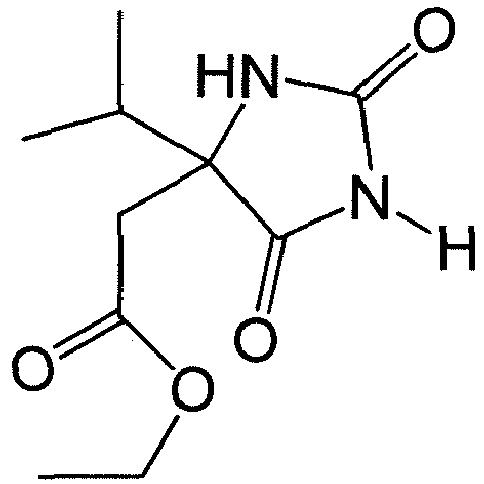
CAS 7152-15-0 Hz, 3H), 1.18 (t, J = 7.4 Hz, 3H), 1.82 (sept, J = 7.5 Hz, 1H), 2.70 (m, 2H), 4.03 (m, 2H). 9 Ethyl-3-(4-isopropyl-2,5-dioxoimidazolidine-4-yl)propanoate 5-Methyl-4-oxo-, ethyl ester hexanoic acid 1H NMR (300 MHz, CD3OD): δ 0.91 (d, J = 7.5 Hz, 3H), 0.98 (d, J = 7.5 Hz, 3H), 1.24 (t, J = 7.2 Hz, 3H), 1.90-2.38 (m, 5H), 4.11 (q, J = 7.2 Hz, 2H). 
CAS 54857-48-6 10 5-(5-Ethyl-1-H-indol-2-yl)-5-methylimidazolidine-2,4-dione 1-(5-ethyl-1-H-indol-2-yl)ethanone 1H NMR (600 MHz, CD3OD): δ 1.25 (t, J = 7.2 Hz, 3H), 1.84 (s, 3H), 2.69 (q, J = 7.2 Hz, 2H), 6.39 (s, 1H), 6.95 (d, J = 8.2 Hz, 1H), 7.12 (d, J = 8.2 Hz, 1H), 7.18 (s, 1H). 
CAS 16244-23-8 11 5-iso-Propyl-5-(2-((4-methoxybenzyl) oxy)methyl)imidazolidine-2,4-dione Intermediate 4 1HNMR (CD3OD): δ 0.88 (d, J = 7.3 Hz, 3H), 0.91 (d, J = 7.3 Hz, 3H), 1.94 - 2.07 (m, 1H), 3.62 (d, J = 4.7 Hz, 2H), 3.80 (s, 3H), 4.44 (s, 2H), 6.86 (d, J = 8.5 Hz, 2H), 7.20 (d, J = 8.5 Hz, 2H). 
-

- A mixture of 5-ethyl-5-(1-methylethyl)- 2,4-imidazolidinedione CAS 98492-91-2 (2.47 g, 14.53 mmol) and hydrazine hydrate (10 mL) was heated at 150°C in a sealed tube for 5 days. The crude mixture was purified by silica gel flash chromatography using MeOH : CH2Cl2, (1:19). Intermediate 12 was isolated as a white solid.
1HNMR (CD3OD): δ 0.78 - 0.92 (m, 6H), 0.95 (d, J = 6.00 Hz, 3H), 1.78 (q, J = 7.33 Hz, 2H), 1.96 - 2.06 (m, 1 H). - Intermediates 13 through 19 were prepared in a similar manner to the procedure described in Example 6 for Intermediate 12. The starting material used and the results are tabulated below in Table 2.
Table 2 Interm. No. IUPAC name Structure Starting material 1H NMR δ (ppm) 13 3-Amino-5-(4-hydroxyphenethyl)-5-methylimidazolidine-2,4-dione 5-(4-hydroxyphen ethyl)-5-methylimidazolidine -2,4-dione 1HNMR (CD3OD): δ 1.39 (s, 3H), 1.80-1.92 (m, 1H), 1.98-2.42 (m, 1H), 2.30-2.40 (m, 1H), 2.50-2.60 (m, 1H), 6.66-6.70 (m, 2H), 6.90-7.05 (m, 2H). 
CAS 91567-45-2 14 5-((1H-indol-3-yl)methyl)-3-amino-5-methylimidazolidine-2,4-dione 2,4-Imidazolidinedione, 5-(1H-indol-3-ylmethyl)-5-methyl- 1H NMR (600 MHz, CD3OD): δ 1.49 (s, 3H), 3.05 (d, J = 15.0 Hz, 1H), 3.25 (d, J = 15.0 Hz, 1H), 6.99 (t, J = 8.4 Hz, 1H), 7.05 (d, J = 8.4 Hz, 1H), 7.06 (s, 1H), 7.28 (d, J = 8.4 CAS 54585-06-7 
Hz, 1H), 7.55 (d, J = 8.4 Hz, 1H). 15 3-Amino-5-methyl-5-(phenoxymethyl)imidazolidi ne-2,4-dione 5-methyl-5-(phenoxymethyl)imi dazolidine-2,4-dione 1HNMR (CD3OD): δ 1.44 (s, 3H), 4.00 (d, J = 8.4 Hz, 1H), 4.17 (d, J = 8.4 Hz, 1H), 6.88-6.98 (m, 3H), 7.20-7.25 (m, 2H). 
CAS 554445-55-5 16 1-Amino-3',4'-dihydro-1'H-spiro[imidazolidine-4,2'-naphthalene]-2,5-dione 3',4'-dihydro-1'H-spiro[imidazolidine-4,2'-naphthalene]-2,5-dione 1HNMR (CD3OD): δ 1.80 - 1.95 (m, 1H), 2.05 - 2.20 (m, 1H), 2.76 - 2.90 (m, 1H). 2.99 (dt, J = 8.1, 4.0 Hz, 2H), 3.22 - 3.27 (m, 1H), 7.05 - 7.20 (m, 4H). 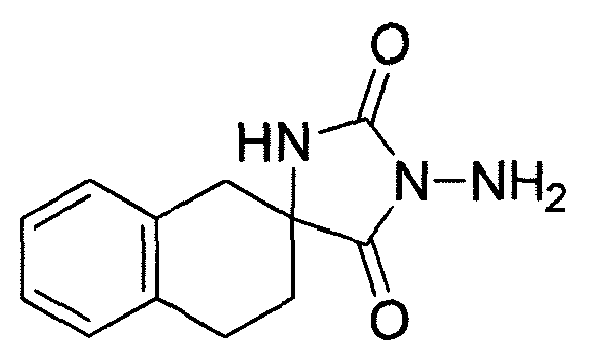
CAS 52094-70-9 17 3-Amino-5-ethyl-5-phenethylimidazolidine-2,4-dione 5-ethyl-5-phenethylimidazolid ine-2,4-dione CAS 857817-27-7 1HNMR (CD3OD): δ 0.85 - 0.95 (m, 3H), 1.65 - 2.15 (m, 4H), 2.44 (dt, J = 12.6, 5.6 Hz, 1H), 2.62 (dt, J = 12.4, 4.8 Hz, 1H), 7.12 - 7.19 (m, 3H), 7.21-7.29 (m, 2H). 
18 3-Amino-5-isobutyl-5-phenethylimidazolidine-2,4-dione 5-isobutyl-5-phenethylimidazolid ine-2,4-dione CAS 858206-01-6 1HNMR (CD3OD): δ 0.80 - 1.00 (m, 6H), 1.55 - 1.90 (m, 5H), 2.25 - 2.45 (m, 1H), 2.55 - 2.70 (m, 1H).7.10 - 7.20 (m, 3H), 7.25 - 7.29 (m, 2H). 
19 3-Amino-5-(5-ethyl-1-H-indol-2-yl)-5-methylimidazolidine-2,4-dione Intermediate 10 1H NMR (300 MHz, CD3OD): δ 1.23 (t, J = 7.2 Hz, 3H), 1.82 (s, 3H), 2.66 (q, J = 7.2 Hz, 2H), 6.40 (s, 1H), 
6.90 - 7.0 (m, 1H), 7.15 - 7.31 (m, 2H). -

- A mixture of 4-(4-chlorophenyl)butan-2-one CAS 3506-75-0 (1.82 g, 10 mmol), (NH4)2CO3 (4.24 g, 40 mmol), KCN (2.5 g, 37.5 mmol) and EtOH (20 mL) was heated to 60°C for 15h. The crude mixture was filtered through a short celite column. Then the solvent was removed under reduced pressure.

- Intermediate 5-(4-chlorophenethyl)-5-methylimidazolidine-2,4-dione was isolated as a brown solid. A mixture of 5-(4-chloropheneyhtl)-5-methylimidazolidine-2,4-dione (400 mg, 1.9 mmol) and hydrazine hydrate (4 mL) was heated to 100°C for 5 h in a sealed tube. This mixture was purified by silicagel chromatography using MeOH in CH2Cl2 as eluent, and Intermediate 20 was isolated as a white solid.
1HNMR (CD3OD): δ 1.40 (s, 3H), 1.82 - 1.95 (m, 1H), 2.01 - 2.10 (m, 1H), 2.40 - 2.46 (m, 1H), 2.58 - 2.66 (m, 1H), 7.14 (d, J = 8.4 Hz, 2H), 7.25 (d, J = 8.4 Hz, 2H). - Intermediates 21 through 31 were prepared in a similar manner to the procedure described in Example 7 for Intermediate 20. The starting materials used and the results are tabulated below in Table 3.
Table 3 Interm. No. IUPAC name Structure Starting material 1H 1HNMR δ (ppm) for Compound 21 3-Amino-5-(2-furan-2-yl)ethyl)-5-methylimidazolidine-2,4-dione 4-(furan-2-yl)butan-2-one 1HNMR (CD3OD): δ 1.32 (s, 3H), 1.82-1.90 (m, 1H), 2.01-2.10 (m, 1H), 2.48-2.49 (m, 2H), 5.99-6.03 (m, 1H), 6.27 (dd, J = 3.1, 1.9 Hz, 1H), 7.31 - 7.35 (m, 1H). 
CAS 699-17-2 22 3-Amino-5-(2-fluorophenethyl)-5-methylimidazolidine-2,4-dione 4-(2-fluorophenyl)butan-2-one 1HNMR (CD3OD): δ 1.41 (s, 3H), 1.83-1.93 (m, 1H), 2.05-2.08 (m, 1H), 2.42-2.51 (m, 1H), 2.62-2.71 (m, 1H), 7.01 (t, J = 9.6 Hz, 1H), 7.07 (t, J = 8.4 Hz, 1H), 7.18-7.22 (m, 2H). 
CAS63416-65-9 23 3-Amino-5-(4-fluorophenethyl)-5-methylimidazolidine-2,4-dione 4-(4-fluorophenyl)butan-2-one 1HNMR (CD3OD): δ 1.40 (s, 3H), 1.80-2.10 (m, 2H), 2.35-2.45 (m, 1H), 2.55-2.70 (m, 1H), 6.97 (t, J = 9.0 Hz, 2H), 7.15 (dd, J = 9.0, 5.4, 2H). 
CAS 63416-61-5 24 3-Amino-5-(3-fluorophenethyl)-5-methylimidazolidine-2,4-dione 4-(3-fluorophenyl)butan-2-one 1HNMR (CD3OD): δ 1.41 (s, 3H), 1.85-1.95 (m, 1H), 2.05-2.10 (m, 1H), 2.40-2.50 (m, 1H), 2.60-2.70 (m, 1H), 6.82 - CAS 3508-77-2 
6.94 (m, 2H), 6.96 (d, J = 7.9 Hz, 1H), 7.27 (q, J = 7.2 Hz, 1H). 25 3-Amino-5-methyl-5-(2-(thiophen-2-yl)ethyl)imidazolidine-2,4-dione 4-(thiophen-2-yl)butan-2-one 1HNMR (CD3OD): δ 1.40 (s, 3H), 1.96-2.10 (m, 1H), 2.10-2.16 (m, 1H), 2.66-2.72 (m, 1H), 2.68-2.88 (m, 1H), 6.77-6.80 (m, 1H), 6.86-6.91 (m, 1H), 7.15-7.18 (m, 1H). 
CAS 59594-93-3 26 3-Amino-5-methyl-5-(2-(5-methylfuran-2-yl)ethyl)imidazolidine-2,4-dione 4-(5-methylfuran-2-yl)butan-2-one 1HNMR (CD3OD): δ 1.38 (s, 3H), 1.89-1.98 (m, 1H), 2.12-2.20 (m, 1H), 2.20 (s, 3H), 2.39 - 2.50 (m, 1H), 2.55 - 2.65 (m, 1H), 5.82 - 5.90 (m, 2H). 
CAS 13679-56-6 27 3-Amino-5-(3-fluoro-4-hydroxyphenethyl)-5-methylimidazolidine-2,4-dione 4-(3-fluoro-4-hydroxyphenethyl)b utan-2-one 1HNMR (CD3OD): δ 1.40 (s, 3H), 1.83-1.92 (m, 1H), 1.94-2.10 (m, 1H), 2.25-2.45 (m, 1H), 2.50-2.70 (m, 1H), 6.72-6.89 (m, 3H). 
CAS 173851-92-8 28 3-Amino-5-(2-hydroxyphenethyl)-5-methylimidazolidine-2,4-dione 4-(2-hydroxyphenethyl) butane-2-one 1HNMR (CD3OD): δ 1.40 (s, 3H), 1.76-2.15 (m, 2H), 2.35-2.47 (m, 1H), 2.60-2.74 (m, 1H), 6.68-6.75 (m, 2H), 6.97-7.05 (m, 2H). 
CAS61844-32-4 29 3-Amino-5-(3-hydroxyphenethyl)-5-methylimidazolidine-2,4-dione 4-(3-hydroxyphenethyl) butane-2-one 1HNMR (CD3OD): δ 1.40 (s, 3H), 1.80-1.93 (m, 1H), 1.95-2.03 (m, 1H), 2.38 (dt, J = 12.8, 5.0 Hz, 1H), 2.59 (dt, J = 12.8, 5.0 Hz, 1H), 6.56 - 6.65 (m, 3H), 7.02 - 7.10 (m, 1H). 
CAS56363-73-6 30 3-Amino-5-methyl-5-2-(pyridin-4-yl)ethyl)imidazolidine-2,4-dione 4-(pyridin-4-yl)butan-2-one 1HNMR (CD3OD): δ 1.42 (s, 3H), 1.87-2.02 (m, 1H), 2.05-2.14 (m, 1H), 2.50-2.58 (m, 1H), 2.62-2.70 (m, 1H), 7.23-7.31 (m, 2H), 8.36-8.45 (m, 2H). 
CAS 35250-71-6 31 3-Amino-5-(2-bromophenethyl)-5-ethyl)imidazolidine-2,4-dione 1-(2-bromophenyl)penta n-3-one 1HNMR (CD3OD): δ 0.91 (t, J = 1.64 - 1.94 (m, 6H), 2.00 (td, J = 9.3, 5.1 Hz, 1H), 2.61 (td, J = 9.9, 5.1 Hz, 1H), 2.84 (td, J = 9.9, 5.1 Hz, 1H), 7.07-7.131 (m, 1H), 7.21-7.31 (m, 2H), 7.51 (d, J = 8.1 Hz, 1H). 
CAS 97640-57-8 -

- A mixture of Intermediate 5 (320 mg, 1.05 mmol), K2CO3, DMF (3 mL), THF (3 mL) was heated to 70°C and O-(2,4-dinitrophenyl)hydroxylamine CAS 17508-17-7 (224 mg, 1.55 mmol) was added in one portion. At 15 minute intervals O-(2,4-dinitrophenyl)hydroxylamine CAS 17508-17-7(112 mg each time) and K2CO3 (120 mg) were added four times. The mixture was cooled to RT, extracted with EtOAc (70 mL), washed with aq. K2CO3, dried (MgSO4) and solvent removed. The crude intermediate was purified by silicagel chromatography using EtOAc in hexane as eluent and Intermediate 32 was isolated.
1HNMR (CD3OD): δ 0.86 (d, J = 4.2 Hz, 3H), 0.95 (d, J = 4.2 Hz, 3H), 1.94-2.00 (m, 2H), 2.18 - 2.22 (m, 1H), 3.45 - 3.50 (m, 2H), 3.77 (s, 3H), 4.26 (d, J = 10.8 Hz, 1 H), 4.34 (d, J = 10.8 Hz, 1 H), 6.82 - 6.90 (m, 2H), 7.20 - 7.24 (m, 2H). - Intermediates 33 through 39 were prepared in a similar manner to the procedure described in Example 8 for Intermediate 32. The starting materials used and the results are tabulated below in Table 4.
Table 4 Interm. No. IUPAC name Structure Starting material 1H NMR δ (ppm) 33 3-Amino- 5-(4-bromophenethyl)-5-methylimidazolidine-2,4-dione Intermediate 6 1HNMR (CD3OD): δ 1.40 (s, 3H), 1.83-1.92 (m, 1H), 2.00-2.09 (m, 1H), 2.38-2.47 (m, 1H), 2.58-2.67 (m, 1H), 7.08 (d, J = 7.8 Hz, 2H), 7.40 (d, J = 7.8 Hz, 2H). 
34 3-Amino- 5-(2-bromophenethyl)-5-methylimidazolidine-2,4-dione Intermediate 7 1HNMR (CD3OD): δ 1.43 (s, 3H), 1.84-1.92 (m, 1H), 1.99-2.07 (m, 1H),2.56 - 2.66 (m, 1H), 2.76-2.86 (m, 1H), 7.02 - 
7.10 (m, 1H), 7.22-7.26 (m, 2H), 7.53 (d, J = 8.4 Hz, 1H). 35 Ethyl-2-(1-amino-4-isopropyl-2,5-dioxoimidazolidin-4-yl)acetate Intermediate 8 1HNMR (DMSO-d6): δ 0.76 (d, J = 7.5 Hz, 3H), 0.84 (d, J = 7.5 Hz, 3H), 1.10 (t, J = 7.4 Hz, 3H), 1.85 (sept, J = 7.5 Hz, 1H), 2.76 (m, 2H), 4.01 (m, 2H). 
36 Ethyl-3-(1-amino-4-isopropyl-2,5-dioxoimidazolidin-4-yl)propanoate Intermediate 9 1H NMR (300 MHz, CD3OD): δ 0.87 (d, J = 7.5 Hz, 3H), 0.97 (d, J = 7.5 Hz, 3H), 1.23 (t, J = 7.2 Hz, 3H), 1.95-2.30 (m, 5H), 4.12 (q, J = 7.2 Hz, 2H). 
37 3-Amino-5,5-diisopropylimidazolidine-2,4-dione 5,5-diisopropylimidazoli dine-2,4-dione 1H NMR (300 MHz, CDCl3): δ 2.23 (sept, 2H), 1.00 (d, 6H), 0.95 (d, 6H). 
CAS 52532-01-1 38 3-amino-5,5-dicyclopropylimidazolidine-2,4-dione 5,5-dicyclopropyl2,4-Imidazolidinedione 1H NMR (300 MHz, CDCl3): δ 1.49 (m, 2H), 0.68-0.58 (m, 2H), 
CAS 7250-75-1 0.52-0.36 (m, 6H). 39 3-Amino-5-isopropyl-5-(2-((4-methoxybenzyl) oxy)methyl)imidazolidine-2,4-dione Intermediate 11 1HNMR (CD3OD): δ 0.86 (d, J = 4.2 Hz, 3H), 0.95 (d, J = 4.2 Hz, 3H), 1.94 - 2.00 (m, 2H), 2.18 - 2.22 (m, 1H), 3.45 - 3.50 (m, 2H), 3.77 (s, 3H), 4.26 (d, J = 10.8 Hz, 1H), 4.34 (d, J = 10.8 Hz, 1H), 6.82 - 6.90 (m, 2H), 7.20 - 7.24 (m, 2H). 
40 3-Amino-5,5-dimethyl-1-phenylimidazolidine-2,4-dione 5,5-dimethyl-1-phenylimidazolidi ne-2,4-dione 1H NMR (300 MHz, CDCl3): δ 7.52-7.40 (m, 3H), 7.29-7.22 (m, 2H), 1.49 (s, 6H). 
CAS 138027-72-2 -
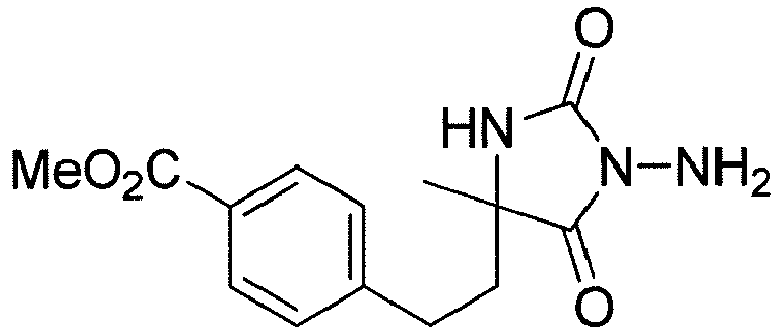
- Intermediate 33 (460 mg, 1.5 mmol), Phosphine, 1,1'-(1,3-propanediyl)bis[1,1-dicyclohexyl-, tetrafluoroborate(1-)CAS 1002345-50-7 (40 mg, 0.08 mmol), Pd(OAc)2 (9 mg), K2CO3 (600 mg, 4.5 mmol), molecular sieves (4Å, 600 mg) DMSO (6 mL) were bubbled with carbon monoxide then MeOH (250 mg) was added to the reaction and the reaction was covered with a rubber septum and a carbon monoxide filled balloon was inserted into the septum. The reaction was heated to 75°C for 16h and was worked up by removing the solvent under reduced pressure, the crude was purified by silicagel chromatography using 5% 7N NH3-MeOH and 95% CH2Cl2. Intermediate 41 was isolated as a white solid.
1HNMR (CD3OD): δ 1.41 (s, 3H), 1.90 - 1.97 (m, 1 H), 2.07 - 2.14 (m, 1 H), 2.52 - 2.54 (m, 1 H), 2.66 - 2.71 (m, 1 H), 3.88 (s, 3H), 7.27 (d, J = 8.4 Hz, 2H), 7.91 (dd, J = 8.4, 1.8 Hz, 2H). - Intermediates 42 and 43 were prepared in a similar manner to the procedure described in Example 9 for Intermediate 41. The starting materials used and the results are tabulated below in Table 5.
Table 5 Interm. No. IUPAC name Structure Starting material 1H NMR δ (ppm) 42 Methyl-2-(2-(1-amino-4-methyl-2,5-dioxoimidazolidin-4-yl)ethyl)benzoate Intermediate 34 1HNMR (CD3OD): δ 1.41 (s, 3H), 1.82-2.10 (m, 2H), 2.64-2.80 (m, 1H), 2.95-3.10 (m 1H), 3,80 (s 3H), 7.20 - 7.30 (m, 1H), 7.45 (t, J = 7.2 Hz, 2H), 7.83 (d, J = 7.2 Hz, 1H). 
43 Methyl-2-(2-(1-amino-4-ethyl-2,5-dioxoimidazolidin-4-yl)ethyl)benzoate Intermediate 31 1HNMR (CD3OD): δ 0.89 (t, J = 7.5 Hz, 3H), 1.70 - 2.10 (m, 4H), 2.45 - 2.65 (m, 2H), 3.88 (s, 3H), 7.24 - 7.35 (m, 2H), 7.46 (td, J = 7.5, 1.5 Hz, 1 H), 7.84 (dd, J = 7.5, 1.5Hz,1H). 
-

- A mixture of 3-amino-5,5-diethylimidazolidine-2,4-dione CAS 1007-61-0 (70 mg, 0.4 mmol), 4-bromophenylisocyanate CAS 2493-02-9 (80 mg, 0.4 mmol) in toluene (5 mL) was heated at 100°C for 8 h. Upon cooling the reaction to ambient temperature, Compound 1 separated as a white solid, which was collected by filtration and dried under high vacuum.
1HNMR (CD3OD): δ 0.95 (br s, 6H), 1.65 - 1.75 (m, 2H), 1.81 - 1.91 (m, 2H), 7.36 (d, J = 6.00 Hz, 2H), 7.40 (d, J = 6.00 Hz, 2 H). - Compounds 2 through 68 were prepared in a similar manner to the procedure described in Example 10 for Compound 1. The starting materials used and the results are tabulated below in Table 6.
Table 6 Comp. No. IUPAC name Starting material 1H NMR δ (ppm) for Compound 2 1-(4-Chlorophenyl)-3-(4,4-diethyl-2,5-dioxoimidazolidin-1-yl)urea 3-amino-5,5-diethylimidazolidine-2,4-dione 1HNMR (CD3OD): δ 0.95 (br s, 6H), 1.65-1.75 (m, 2H), 1.81 - 
CAS 1007-61-0 4-chlorophenyl isocyanate CAS 104-12-1 1.95 (m, 2H), 7.36 (d, J = 6.00 Hz, 2H), 7.40 (d, J = 6.00 Hz, 2 H). 3 1-(4-Methoxyphenyl)-3-(4,4-diethyl-2,5-dioxoimidazolidin-1-yl)urea 3-amino-5,5-diethylimidazolidine-2,4-dione 1HNMR (CD3OD): δ 0.94 (br s, 6H), 1.68-1.78 (m, 2H), 1.80-1.95 (m, 2H), 3.75 (s, 3H), 6.85 (d, J = 9.00 Hz, 2H), 7.28 (d, J = 9.00 Hz, 2H). 
CAS 1007-61-0 4-methoxyphenyl isocyanate CAS 5416-93-3 4 1-(4-Ethylphenyl)-3-(4,4-diethyl-2,5-dioxoimidazolidin-1-yl)urea 3-amino-5,5-diethylimidazolidine-2,4-dione 1HNMR (CD3OD): δ 0.94 (t, J = 7.5 Hz, 6H), 1.19 (t, J = 7.8 Hz, 3H), 1.62 - 1.95 (m, 4H), 2.60 (q, J = 7.8 Hz, 2H), 7.11 (d, J = 8.4 Hz, 2H), 7.29 (d, J = 8.4 Hz, 2 H). 
CAS 1007-61-0 4-ethylphenyl isocyanate CAS 23138-50-3 5 1-(4-Cyanophenyl)-3-(4,4-diethyl-2,5-dioxoimidazolidin-1-yl)urea 3-amino-5,5-diethylimidazolidine-2,4-dione 1HNMR (CD3OD): δ 0.95 (br s, 6H), 1.69-1.78 (m, 2H), 1.82-1.95 (m, 2H), 7.62 (s, 4H). 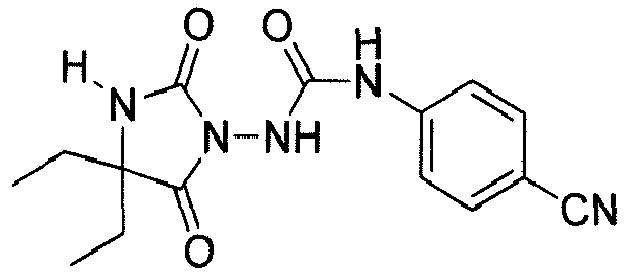
CAS 1007-61-0 4-cyanophenyl isocyanate CAS 40465-45-0 6 1-(4-Bromo-2-fluorophenyl)-3-(4,4-diethyl-2,5-dioxoimidazolidin-1-yl)urea 3-amino-5,5-diethylimidazolidine-2,4-dione 1HNMR (CD3OD): δ 0.94 (t, J = 7.2 Hz, 6H), 1.63 - 1.95 (m, 4H), 7.27 (dd, J = 1.2, 9.0 Hz, 1H), 7.36 (dd, J = 1.8, 9.0 Hz, 1H), 7.90 (t, J = 8.7 Hz, 1H). 
CAS 1007-61-0 4-bromo-2-fluorophenyl isocyanate CAS 88112-75-8 7 1-(4-Methylphenyl)-3-(4,4-diethyl-2,5-dioxoimidazolidin-1-yl)urea 3-amino-5,5-diethylimidazolidine-2,4-dione 1HNMR (CD3OD): δ 0.94 (br s, 6H), 1.63-1.78 (m, 2H), 1.80-1.88 (m, 2H), 2.28 (s, 3H), 7.09 (d, J = 8.4 Hz, 2H), 7.26 (d, J = 8.4 Hz, 2H). 
CAS 1007-61-0 4-methylphenyl isocyanate CAS 622-58-2 8 1-(4-Methylthiophenyl)-3-(4,4-diethyl-2,5-dioxoimidazolidin-1-yl)urea 3-amino-5,5-diethylimidazolidine-2,4-dione 1HNMR (CD3OD): δ 0.95 (br s, 6H), 1.68-1.78 (m, 2H), 1.82-1.90 (m, 2H), 2.43 (s, 3H), 7.22 (d, J = 6.6 Hz, 2H), 7.35 (d, J = 6.6 Hz, 2H). 
CAS 1007-61-0 4-thiomethylphenyl isocyanate CAS 1632-84-4 9 1-(4-Bromophenyl)-3-(4-methyl-2,5-dioxo-4-phenethylimidazolidin-1-yl)urea Imidazolidinedione, 3-amino-5-methyl-5-(2-phenylethyl)- 1HNMR (CD3OD): δ 1.49 (s, 3H), 1.94-2.01 (m, 1H), 2.07-2.17 (m, 1H), 2.60 (br s, 1H), 2.66 - 2.75 (m, 1H), 7.14 - 7.19 (m, 3H), 7.22 - 7.31 (m, 2H), 7.37 (d, J = 5.86 Hz, 2H), 7.41 (d, J = 5.86 Hz, 2H). 
CAS 956437-87-9 4-bromophenylisocyan ate CAS 2493-02-9 10 1-(4-Bromophenyl)-3-(2,4-dioxo-1,3-diazaspiro[4.4]nonan-3-yl)urea 3-amino-1,3-diazaspiro[4,4]nona ne-2,4-dione 1HNMR (CD3OD): δ 1.75 - 1.90 (m, 6H), 2.15 - 2.25 (br s, 2H), 7.36 (d, J = 6.6 Hz, 2H), 7.41 (d, J = 6.6 Hz, 2H). 
CAS 16252-62-3 4-bromophenylisocyan ate CAS 2493-02-9 11 1-(4-Bromo-2-fluorophenyl)-3-(2,4-dioxo-1,3-diazaspiro[4.4]nonan-3-yl)urea 3-amino-1,3-diazaspiro[4,4]nona ne-2,4-dione 1HNMR (CD3OD): δ□1.84 - 1.94 (m, 6H), 2.15 - 2.25 (m 2H), 7.28 (dt, J = 1.5, 9.0 Hz, 1H), 7.36 (dd, J = 1.2, 9.0 Hz, 1H), 7.89 (t, J = 9.0 Hz, 1H). 
CAS 16252-62-3 4-bromo-2-fluorophenyl isocyanate CAS 88112-75-8 12 1-(4-Bromophenyl)-3-(4,4-dimethyl-2,5-dioxoimidazolidin-1-yl)urea 2,4-Imidazolidinedione, 3-amino-5,5-dimethyl- 1HNMR (CD3OD): δ□1.52 (s, 6H), 7.27 (d, J = 8.4, Hz, 2H), 7.46 (d, J = 8.4 Hz, 2H). 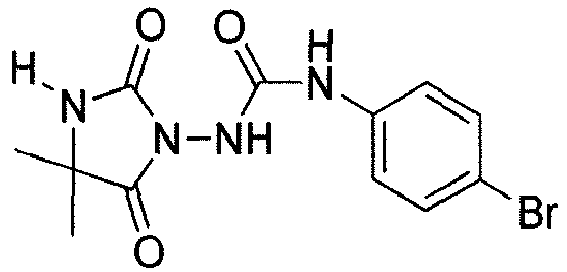
CAS 1123-44-0 4-bromophenylisocyan ate CAS 2493-02-9 13 1-(4-Bromophenyl)-3-(2,5-dioxo-1',3'-dihydrospiro[imidazoli dine-4,2'-inden]-1-yl)urea Intermediate 2 1HNMR (CD3OD): δ □3.22 (d, J = 16.2 Hz, 2H), 3.58 (d, J = 16.2 Hz, 2H), 7.20 -7.22 (m, 2H), 7.24 - 7.30 (m, 2H), 7.37 (d, J = 8.4 Hz, 2H), 7.41 (d, J = 8.4 Hz, 2H). 4-bromophenyl isocyanate 
CAS 2493-02-9 14 1-(4-Bromophenyl)-3-(2,4-dioxo-1,3-diazaspiro[4.5]decan-3-yl)urea 1,3-Diazaspiro[4.5]deca ne-2,4-dione, 3-amino 1HNMR (CD3OD): δ□1.40 - 1.90 (m, 10H), 7.36 (d, J = 8.4 Hz, 2H), 7.41 (d, J = 8.4 Hz, 2H). 
CAS 16252-63-4 4-bromophenylisocyan ate CAS 2493-02-9 15 1-(4-Bromo-2-fluorophenyl)-3-(2,4-dioxo-1,3-diazaspiro[4.5]decan-3-yl)urea 1,3-Diazaspiro[4.5]deca ne-2,4-dione, 3-amino 1HNMR (CD3OD): δ□1.40 - 1.90 (m, 10H), 7.28 (dd, J = 10.4, 2.2 Hz, 1H), 7.36 (dd, J = 10.4, 2.2 Hz, 1H), 7.86 (t, J = 8.6 Hz, 1H). 
CAS 16252-63-4 4-bromo-2-fluorophenyl isocyanate CAS 88112-75-8 16 1-(4-Chloro-2-fluorophenyl)-3-(4,4-diethyl-2,5-dioxoimidazolidin-1-yl)urea 3-amino-5,5-diethylimidazolidine-2,4-dione 1HNMR (CD3OD): δ □0.96 (t, H = 7.2 Hz, 6H), 1.65 - 1.91 (m, 4H), 7.12 (dd, J = 8.79, 2.34 Hz, 1H), 7.22 (dd, J = 10.84, 2.34 Hz, 1H), 7.93 (t, J = 8.79 Hz, 1H). 
CAS 1007-61-0 4-chloro-2-fluorophenyl isocyanate CAS 69922-26-5 17 1-(4-Bromo-2-fluorophenyl)-3-(4-methyl-2,5-dioxo-4-phenethylimidazolidin-1-yl)urea 2,4-Imidazolidinedione, 3-amino-5-methyl-5-(2-phenylethyl)- 1HNMR (CD3OD): δ 1.49 (s, 3H), 1.90-2.01 (m, 1H), 2.07-2.19 (m, 1H), 2.50 (br s, 1H), 2.66 - 2.78 (m, 1H), 7.12 - 7.20 (m, 3H), 7.22 - 7.29 (m, 3H), 7.37 (dd, J = 10.55, 2.05 Hz, 1H), 
CAS 956437-87-9 4-bromo-2-fluorophenyl isocyanate CAS 88112-75-8 7.91 (t, J = 8.79 Hz, 2H). 18 1-(4-Bromophenyl)-3-(4-ethyl-4-isopropyl-2,5-dioxoimidazolidin-1-yl)urea Intermediate 12 1HNMR (CD3OD): δ 0.90 - 1.05 (m, 9H), 1.83 (q, J = 7.33 Hz, 2H), 1.98 - 2.10 (m, 1H), 7.34 (d, J = 7.33 Hz, 2H), 7.40 (d, J = 7.33 Hz, 2H). 
4-bromophenyl isocyanate CAS 2493-02-9 19 1-(4-Chloro-3-fluorophenyl)-3-(4,4-diethyl-2,5-dioxoimidazolidin-1-yl)urea 3-amino-5,5-diethylimidazolidine-2,4-dione 1HNMR (CD3OD): δ 0.90 - 1.05 (m, 9H), 1.83 (q, J = 7.33 Hz, 2H), 1.98 - 2.10 (m, 1H), 7.34 (d, J = 7.33 Hz, 2H), 7.40 (d, J = 7.33 Hz, 2H). 
CAS 1007-61-0 4-chloro-3-fluorophenylisocyan ate CAS 51163-28-1 20 1-(4-Chloro-2-fluorophenyl)-3-(4,ethyl-4-isopropyl-2,5-dioxoimidazolidin-1-yl)urea Intermediate 12 4-bromo-2-fluorophenyl isocyanate 1HNMR (CD3OD): δ 0.90 - 1.05 (m, 9H), 1.83 (q, J = 7.23 Hz, 2H), 1.98 - 2.12 (m, 1H), 7.27 (d, J = 10.55, 2.05 Hz, 1H), 7.36 (dd, J = 10.55, 2.05, 1H), 7.89 (t, J = 8.79 Hz, 1H). 
CAS 88112-75-8 21 1-(2,4-Dioxo-1,3-diazaspiro[4,5]decan-3-yl)-3-(4-methoxypheynyl)urea 3-amino-1,3-diazaspiro[4.5]deca ne-2,4-dione 1HNMR (CD3OD): δ 1.35 - 1.90 (m, 10H), 3.76 (s, 3H), 6.85 (d, J = 9.1 Hz, 2H), 7.29 (d, J = 9.1 Hz, 2H). 
CAS 16252-63-4 1-isocyanato-4-methoxybenzene CAS 5416-93-3 22 (S)-1-(4-Bromophenyl)-3-(1,3-dioxo-10,10a-dihydroimidazo[1,5-b]isoquinolin-2(1 H,3H,5H)-yl)urea (S)-2-amino-10,10a-dihydroimidazo[1,5-b]isoquinoline-1,3(2H,5H)-dione 1HNMR (CD3OD): δ 3.27 (dd, J = 15.6, 4.2 Hz, 2H), 4.34 (dd, J = 11.4, 4.2 Hz, 1H), 4.49 (d, J = 16.8 Hz, 1H), 4.97 (d, J = 16.8 Hz, 1H), 7.23 - 7.30 CAS 128609-05-2 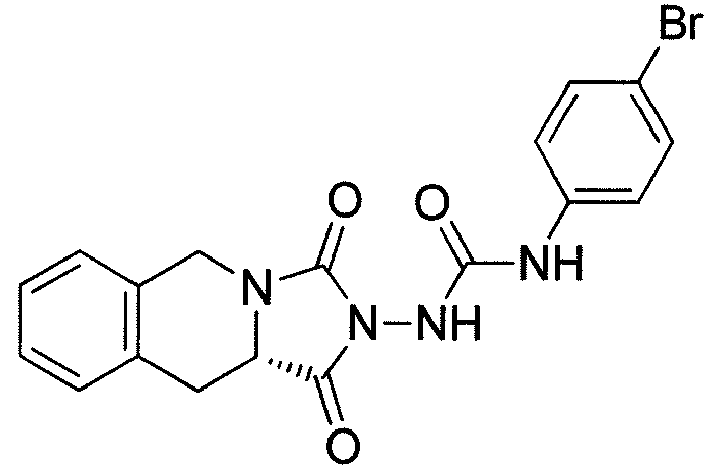
1-bromo-4-isocyanatobenzene (m, 4H), 7.35 - 7.48 (m, 4H). CAS 2493-02-9 23 (S)-1-(4-Bromo-2-fluorophenyl)-3-(1,3-dioxo-10,10a-dihydroimidazo[1,5-b]isoquinolin-2(1H,3H,5H)-yl)urea (S)-2-amino-10,10a-dihydroimidazo[1,5-b]isoquinoline-1,3(2H,5H)-dione 1HNMR (CD3OD): δ 3.02 (t, J = 13.8 Hz, 1H), 3.27 (dd, J = 15.0, 4.2 Hz, 1H), 4.35 (d, J = 11.4 Hz, 1H), 4.49 (d, J = 16.8 Hz, 1H), 4.98 (d, J = 16.8 Hz, 1H), 7.20-7.42 (m, 6H), 7.88 (t, J = 8.4 Hz, 1H). 
CAS 128609-05-2 4-bromo-2-fluoro-1-isocyanatobenzene CAS 88112-75-8 24 1-(4-Bromo-2-fluorophenyl)-3-(2,5-dioxo-1',3'-dihydrospiro[imidazolidine-4,2'-inden]-1-yl)urea Intermediate 2 1HNMR (CD3OD): δ 3.23 (d, J = 16.2 Hz, 2H), 3.58 (d, J = 16.2 Hz, 2H), 7.20 - 7.27 (m, 4H), 7.27 - 7.30 (m , 1H), 7.37 (dd, J = 10.6, 2.1 Hz, 1H), 7.91 (t, J = 8.4 Hz, 1 H). 4-bromo-2-fluoro-1-isocyanatobenzene 
CAS 88112-75-8 25 1-(4-Bromophenyl)-3-(4-methyl-2,5-dioxo-4-(phenoxymethyl)imidazolidi n-1-yl)urea Intermediate 15 1HNMR (CD3OD): δ 1.55 (s, 3H), 4.07 (d, J = 9.0 Hz, 1H), 4.22 (d, J = 9.0 Hz, 1H), 6.95 (t, J = 6.6 Hz, 3H), 7.26 (t, J = 8.4 Hz, 2H), 7.38 (d, J = 9.0 Hz, 2H), 7.41 (d, J = 9.0 Hz, 2H). 1-bromo-4-isocyanatobenzene 
CAS 2493-02-9 26 1-(4-Bromo-2-fluorophenyl)-3-(2,5-dioxo-3',4'-dihydro-1'H-spiro[imidazolidine-4.2'naphthalen-1-yl)urea Intermediate 16 1HNMR (CD3OD): δ 1.95 - 2.10 (m, 1H), 2.15 - 2.30 (m, 1H), 2.76 - 3.05 (m, 3H). 3.30 - 3.34 (m, 1H), 7.05 - 7.20 (m, 4H), 7.25 - 7.35 (m, 1H), 7.38 (dd, J = 10.5, 2.3, 1 H), 7.91 (t, J = 8.6 Hz, 1H). 4-bromo-2-fluoro-1-isocyanatobenzene 
CAS 88112-75-8 27 1-(4-Bromo-2-fluorophenyl)-3-(2,5-dioxo-3',4'-dihydro-1'H-spiro[imidazolidine-4.2'naphthalen-1-yl)urea Intermediate 16 1HNMR (CD3OD): δ 1.95 - 2.10 (m, 1H), 2.15 - 2.30 (m, 1H), 2.76 - 3.05 (m, 3H). 3.30 - 3.34 (m, 1H), 7.05 - 7.20 (m, 4H), 7.25 - 7.35 (m, 1H), 7.38 (dd, J = 10.5, 2.3, 1H), 7.91 (t, J = 8.6 Hz, 1H). 1-bromo-4-isocyanatobenzene 
CAS 2493-02-9 28 1-(4-Bromo-2-fluorophenyl)-3-(4-methyl-2,5-dioxo-4-(phenoxymethyl)imidazolidi n-1-yl)urea Intermediate 15 1HNMR (CD3OD): δ 1.54 (s, 3H), 4.07 (d, J = 8.4 Hz, 1H), 4.22 (d, J = 8.4 Hz, 1H), 6.94 - 6.99 (m, 3H), 7.26-7.31 (m, 3H), 7.35-7.38 (m, 1H), 7.41 (t, J = 8.4 Hz, 1H). 4-bromo-2-fluoro-1-isocyanatobenzene 
CAS 88112-75-8 29 1-(4-Bromo-2-fluorophenyl)-3-(4-ethyl-2,5-dioxo-4-(phenethyl)imidazolidin-1-yl)urea Intermediate 17 1HNMR (CD3OD): δ 0.93 - 1.00 (m, 3H), 1.70 - 2.20 (m, 4H), 2.60 - 2.75 (m, 2H), 7.12 - 7.19 (m, 3H), 7.25 - 7.23 (m, 3H), 7.36 (dd, J = 10.5, 2.1, 1 H), 7.91 (t, J = 8.6 Hz, 1H). 4-bromo-2-fluoro-1-isocyanatobenzene 
CAS 88112-75-8 30 1-(4-Bromophenyl)-3-(4-ethyl-2,5-dioxo-4-(phenethyl)imidazolidin-1-yl)urea Intermediate 17 1NMR (CD3OD): δ 0.93 - 1.00 (m, 3H), 1.70 - 2.20 (m, 4H), 2.60 - 2.75 (m, 2H), 7.12 - 7.19 (m, 3H), 7.22 - 7.27 (m, 2H), 7.33 - 7.42 (m, 4H). 1-bromo-4-isocyanatobenzene 
CAS 2493-02-9 31 1-(4-Bromophenyl)-3-(4-isobutyl-2,5-dioxo-4-phenethyl)imidazolidin-1-yl)urea Intermediate 18 1HNMR (CD3OD): δ 0.92 (d, J = 6.5 Hz, 6H), 1.60 - 2.20 (m, 6H), 2.55 - 2.75 (m, 1H), 7.10 - 7.20 (m, 3H), 7.22 - 7.26 (m, 2H), 7.30 - 7.42 (m, 4H) 1-bromo-4-isocyanatobenzene 
CAS 2493-02-9 32 1-(4-Bromo-2-fluorophenyl)-3-(4-isobutyl-2,5-dioxo-4-phenethyl)imidazolidin-1-yl)urea Intermediate 18 1HNMR (CD3OD): δ 0.91 (d, J = 6.5 Hz, 3H), 0.98 (d, J = 6.5 Hz, 3H), 1.60 - 2.15 (m, 6H), 2.55 - 2.70 (m, 1H), 7.12 - 7.19 (m, 3H), 7.21 - 7.30 (m, 3H), 7.32 - 7.40 (m, 1 H), 7.92 (t, J = 8.6 Hz, 1 H). 4-bromo-2-fluoro-1-isocyanatobenzene 
CAS 88112-75-8 33 1-(4-Bromophenyl)-3-(4-(4-chlorophenethyl)-4-methyl-2,5-dioxoimidazolidin-1-yl)urea Intermediate 20 1HNMR (CD3OD): δ 1.50 (s, 3H), 1.90 - 2.00 (m, 1H), 2.05 - 2.15 (m, 1H), 2.60 - 2.80 (m, 2H), 7.18 (d, J = 8.4 Hz, 2H), 7.26 (d, J = 8.4 Hz, 2H), 7.36 (d, J = 9.0 Hz, 2H), 7.40 (d, J = 9.0 Hz, 2H). 1-bromo-4-isocyanatobenzene CAS 2493-02-9 
34 1-(4-Bromo-2-fluorophenyl)-3-(4-chlorophenethyl)-4-methyl-2,5-dioxoimidazolidin-1-yl)urea Intermediate 20 1HNMR (DMSO-D6): δ 1.37 (s, 3H),1.82 - 1.90 (m, 1H), 1.92 - 2.00 (m, 1H), 2.55 - 2.65 (m, 2H), 7.20 (d, J = 7.2 Hz, 2H), 7.33 (d, J = 8.4 Hz, 3H), 7.58 (dd, J = 10.8, 1.8 Hz, 1H), 7.90 (brs, 1H). 4-bromo-2-fluoro-1-isocyanatobenzene 
CAS 88112-75-8 35 1-(4-Bromophenyl)-3-(4-(2-furan-2-yl)ethyl)-4-methyl-2,5-dioxoimidazolidin-1-yl)urea Intermediate 21 1HNMR (CD3OD): δ 1.48 (s, 3H), 1.95 - 2.06 (m, 1H), 2.12 - 2.25 (m, 1H), 2.55 - 2.80 (m, 2H), 6.05 (dd, J = 3.2, 0.6 Hz, 1H), 6.28 (dd, J = 3.1, 1.9 Hz, 1H), 7.22 - 7.50 (m, 5H). 1-bromo-4-isocyanatobenzene 
CAS 2493-02-9 36 1-(4-Bromo-2-fluorophenyl)-3-(4-(2-furan-2-yl)ethyl)-4-methyl-2,5-dioxoimidazolidin-1-yl)urea Intermediate 21 1HNMR (DMSO-D6): δ 1.38 (s, 3H), 1.91 - 2.00 (m, 1H), 2.02 - 2.12 (m, 1H), 2.50 - 2.70 (m, 2H), 5.98 - 6.01 (m, 1H), 6.24 (dd, J = 3.1, 1.9 Hz, 1H), 7.30 (dd, J = 1.9, 0.7 Hz, 1H). 4-bromo-2-fluoro-1-isocyanatobenzene 
CAS 88112-75-8 37 1-(4-Bromophenyl)-3-(4-(2-fluorophenethyl)-4-methyl-2,5-dioxoimidazolidin-1-yl)urea Intermediate 22 1HNMR (CD3OD): δ 1.50 (s, 3H), 1.90 - 2.00 (m, 1H), 2.09 - 2.20 (m, 1H), 2.60 - 2.85 (m, 2H), 7.02 (t, J = 9.6 Hz, 1H), 7.08 (t, J = 8.4 Hz, 1H), 1-bromo-4-isocyanatobenzene CAS 2493-02-9 
7.20 - 7.30 (m, 2H), 7.35 - 7.45 (m, 4H). 38 1-(4-Bromo-2-fluorophenyl)-3-(4-(2-fluorophenethyl)-4-methyl-2,5-dioxoimidazolidin-1-yl)urea Intermediate 22 1HNMR (DMSO-D6): δ 1.50 (s, 3H), 1.92 - 2.00 (m, 1H), 2.10 - 2.18 (m, 1H), 2.60 - 2.82 (m, 2H), 7.02 (t, J = 9.6 Hz, 1H), 7.08 (t, J = 8.4 Hz, 1H), 7.20 - 7.28 (m, 2H), 7.28 (d, J = 8.4 Hz, 1H), 7.37 (dd, J = 8.4, 2.2 Hz, 1H), 7.92 (t, J = 9.0 Hz, 1H). 4-bromo-2-fluoro-1-isocyanatobenzene 
CAS 88112-75-8 39 1-(4-Bromophe nyl)-3-(4-(4-fluorophenethyl)-4-methyl-2,5-dioxoimidazolidin-1-yl)urea Intermediate 23 1HNMR (CD3OD): δ 1.49 (s, 3H), 1.88 - 2.01 (m, 1H), 2.05 - 2.17 (m, 1H), 2.50 - 2.77 (m, 2H), 6.92 - 7.03 (m, 2H), 7.18 - 7.25 (m, 2H), 7.31 - 7.44 (m, 4H) 1-bromo-4-isocyanatobenzene 
CAS 2493-02-9 40 1-(4-Bromo-2-fluorophenyl)-3-(4-(4-fluorophenethyl)-4-methyl-2,5-dioxoimidazolidin-1-yl)urea Intermediate 23 1HNMR (CD3OD): δ 1.49 (s, 3H), 1.88 - 2.18 (m, 2H), 2.55 - 2.78 (m, 2H), 6.94 - 7.02 (m, 2H), 7.15 - 7.21 (m, 2H), 7.23 - 7.28 (m, 1H), 7.40 - 7.45 (m, 1H), 7.91 (t, J=9.0Hz, 1H). 4-bromo-2-fluoro-1-isocyanatobenzene 
CAS 88112-75-8 41 1-(4-Bromophenyl)-3-(4-(3-fluorophenethyl)-4-methyl-2,5-dioxoimidazolidin-1-yl)urea Intermediate 24 1HNMR (CD3OD): δ 1.50 (s, 3H), 1.90 - 2.05 (m, 1H), 2.08 - 2.20 (m, 1H), 2.60 - 2.80 (m, 2H), 6.85 - 7.02 (m, 3H), 7.23 - 1-bromo-4-isocyanatobenzene CAS 2493-02-9 
7.31 (m, 1H), 7.32 - 7.45 (m, 4H). 42 1-(4-Bromophenyl)-3-(4-(4-hydroxyphenethyl)-4-methyl-2,5-dioxoimidazolidin-1-yl)urea Intermediate 13 1HNMR (CD3OD): δ 1.48 (s, 3H), 1.80 - 2.75 (m, 2H), 2.45 - 2.65 (m, 2H), 6.74 (d, 8.7 Hz, 2H), 7.00 (d, J = 8.7 Hz, 2H), 7.35 - 7.43 (m, 4H). 1-bromo-4-isocyanatobenzene 
CAS 2493-02-9 43 1-(4-Bromophenyl)-3-(4-methyl-2,5-dioxo-4-(2-thiophen-2-yl)ethyl)imidazolidin-1-yl)urea Intermediate 25 1HNMR (CD3OD): δ 1.49 (s, 3H), 1.89 - 2.09 (m, 1H), 2.12 - 2.28 (m, 1H), 2.75 - 3.00 (m, 2H), 6.83 (dd, J = 3.5, 1.2 Hz, 1H), 6.90 (dd, J = 5.1, 3.4, 1H), 7.18 (dd, 5.3, 1.2 Hz, 1H), 7.33 - 7.45 (m, 4H). 1-bromo-4-isocyanatobenzene 
CAS 2493-02-9 44 1-(4-Bromo-2-fluorophenyl)-3-(4-methyl-2,5-dioxo-4-(2-thiophen-2-yl)ethyl)imidazolidin-1-yl)urea Intermediate 25 1HNMR (CD3OD): δ 1.49 (S, 3H), 1.98 - 2.10 (m, 1H), 2.15 - 2.27 (m, 1H), 2.75 - 3.00 (m, 2H),6.83 (d, J = 2.93, 1H), 6.90 (dd, J = 5.1, 3.4 Hz, 1H), 7.18 (dd, J = 5.1, 0.7 Hz, 1H), 7.28 (dt, J = 8.8, 1.5 Hz, 1H), 7.37 (dd, J = 10.6, 2.3 Hz, 1 H), 7.91 (t, J = 8.6 Hz, 1H). 4-bromo-2-fluoro-1-isocyanatobenzene 
CAS 88112-75-8 45 1-(4-Bromo-2-fluorophenyl)-3-(4-(4-hydroxyphenethyl)-4-methyl-2,5-dioxoimidazolidin-1-yl)urea Intermediate 13 1HNMR (CD3OD): δ 1.48 (s, 3H), 1.82 - 1.95 (m, 1H), 2.03 - 2.14 (m, 1H), 2.40-2.70 (m, 2H), 6.65 - 6.72 (m, 2H), 6.95 - 7.01 (m, 2H), 7.25 - 7.30 (m, 1H), 7.29 - 7.40 (m, 1H), 7.91 (t, J=8.7Hz, 1H). 4-bromo-2-fluoro-1-isocyanatobenzene 
CAS 88112-75-8 46 1-(4-Bromophenyl)-3-(4-methyl-4-(2-(5-methylfuran-2-yl)ethyl)2,5-dioxoimidazolidin-1-yl)urea Intermediate 26 1HNMR (CD3OD): δ 1.48 (s, 3H), 1.89 - 2.02 (m, 1H), 2.12 - 2.20 (m, 1H), 2.20 (s, 3H), 2.50 - 2.80 (m, 2H), 5.83 - 5.90 (m, 2H), 7.31 - 7.42 (m, 4H) 1-bromo-4-isocyanatobenzene 
CAS 2493-02-9 47 1-(4-Bromophenyl)-3-(4-(3-fluoro-4-hydroxyphenethyl)-4-methyl-2,5-dioxoimidazolidin-1-yl)urea Intermediate 27 1HNMR (CD3OD): δ 1.48 (s, 3H), 1.89 - 2.00 (m, 1H), 2.02 - 2.15 (m, 1H), 2.45 - 2.70 (m, 2H), 6.75 - 6.92 (m, 3H), 7.31 - 7.44 (m, 4H). 1-bromo-4-isocyanatobenzene 
CAS 2493-02-9 48 1-(4-Bromophenyl)-3-(4-(3-fluoro-4-hydroxyphenethyl)-4-methyl-2,5-dioxoimidazolidin-1-yl)urea Intermediate 27 1HNMR (CD3OD): δ 1.48 (s, 3H), 1.89 - 2.00 (m, 1H), 2.02 - 2.15 (m, 1H), 2.45 - 2.70 (m, 2H), 6.75 - 6.92 (m, 2H), 7.25 - 7.31 (m, 1H), 7.33 - 7.40 (m, 1H), 7.36 (dd, J = 10.6, 2.1 Hz, 1 H), 7.91 (t, J = 8.8 Hz, 1 H). 4-bromo-2-fluoro-1-isocyanatobenzene 
CAS 88112-75-8 49 1-(4-Bromophenyl)-3-(4-isopropyl-4-(2-((4-methoxybenzyl)oxy)ethyl)-2,5-dioxoimidazolidin-1-yl)urea Intermediate 32 δ 1HNMR (CD3OD): δ 0.98 (d, J = 7.2 Hz, 3H), 1.01 (d, J = 7.2 Hz, 3H), 2.00 - 2.10 (m, 2H), 2.20 - 2.31 (m, 1H), 3.50 - 3.70 (m, 2H), 3.75 (s, 3H), 4.33 (d, J = 11.4 Hz, 1H), 4.43 (d, J = 11.2 Hz, 1H),6.81 (d, J = 8.7 Hz, 2H), 7.20 7.41 (m, 6H). 1-bromo-4-isocyanatobenzene 
CAS 2493-02-9 50 1-(4-Bromophenyl)-3-(4-(2-hydroxyphenethyl)-4-methyl-2,5-dioxoimidazolidin-1-yl)urea Intermediate 28 1HNMR (CD3OD): δ 1.49 (s, 3H), 1.91 - 2.14 (m, 2H), 2.45 - 2.55 (m, 1H), 2.68 - 2.80 (m, 1H), 6.70 - 6.76 (m, 2H), 6.95 - 7.10 (m, 2H), 7.31 - 7.42 (m, 4H) 1-bromo-4-isocyanatobenzene 
CAS 2493-02-9 51 1-(4-Bromo-2-fluorophenyl)-3-(4-(2-hydroxyphenethyl)-4-methyl-2,5-dioxoimidazolidin-1-yl)urea Intermediate 28 1HNMR (CD3OD): 5 1.48 (s, 3H), 1.90 - 2.15 (m, 2H), 2.40 - 2.60 (m, 1H), 2.65 - 2.82 (m, 1H), 6.70 - 6.76 (m, 2H), 6.95 - 7.10 (m, 2H), 7.24 - 7.31 (m, 1H), 7.36 (dd, J = 10.6, 2.3 Hz, 1 H), 7.91 (t, J = 8.6 Hz,1H). 4-bromo-2-fluoro-1-isocyanatobenzene 
CAS 88112-75-8 52 1-(4-Bromophenyl)-3-(4-(3-hydroxyphenethyl)-4-methyl-2,5-dioxoimidazolidin-1-yl)urea Intermediate 29 1HNMR (CD3OD): δ 1.49 (s, 3H), 1.90 - 2.00 (m, 1H), 2.04 - 2.16 (m, 1H), 2.40 - 2.70 (m, 2H), 6.57 - 6.67 (m, 3H), 7.07 (t, J = 7.9 Hz, 1H), 7.36 - 7.45 (m, 4H). 1-bromo-4-isocyanatobenzene CAS 2493-02-9 
53 1-(4-Bromo-2-fluorophenyl)-3-(4-(3-hydroxyphenethyl)-4-methyl-2,5-dioxoimidazolidin-1-yl)urea Intermediate 29 1HNMR (CD3OD): δ 1.48 (s, 3H), 1.90 - 2.00 (m, 1H), 2.04 - 2.16 (m, 1H), 2.40 - 2.70 (m, 2H), 6.57 - 6.67 (m, 3H), 7.07 (t, J = 7.9 Hz, 1H), 7.27 (dd, J = 10.6, 2.1 Hz, 1H), 7.36 (dd, J = 10.6, 2.1 Hz, 1H), 7.91 (t, J = 8.6 Hz, 1 H). 4-bromo-2-fluoro-1-isocyanatobenzene 
CAS 88112-75-8 54 1-(4-Bromophenyl)-3-(4-methyl-2,5-dioxo-4-(2-(pyridin-4-yl)ethyl)imidazolidin-1-yl)urea Intermediate 30 1HNMR (CD3OD): δ 1.50 (s, 3H), 1.95 - 2.24 (m, 2H), 2.60 - 2.85 (m, 2H), 7.30 (d, J = 6.2 Hz, 2H), 7.30 - 7.43 (m, 4H), 8.41 (d, J = 6.2 Hz, 2H). 1-bromo-4-isocyanatobenzene 
CAS 2493-02-9 55 1-(4-Bromo-2-fluorophenyl)-3-(4-methyl-2,5-dioxo-4-(pyridin-4-yl)ethyl)imidazolidin-1-yl)urea Intermediate 30 1HNMR (CD3OD): δ 1.49 (s, 3H), 1.95 - 2.07 (m, 1H), 2.14 - 2.22 (m, 1H), 2.61 - 2.90 (m, 2H), 7.20 - 7.35 (m, 4H), 7.88 (t, J = 8.6 Hz, 1H), 8.39 (brs,2H). 4-bromo-2-fluoro-1-isocyanatobenzene 
CAS 88112-75-8 56 1-(4-Bromophenyl)-3-(4- Intermediate 39 1HNMR (CD3OD): δ 0.84 (d, J = 7.3 Hz, isopropyl-4-(((4-methoxybenzyl)oxy)methyl)-2,5-dioxoimidazolidin-1-yl)urea 1-bromo-4-isocyanatobenzene 3H), 0.90 (d, J = 7.3 Hz, 3H), 1.99 - 2.14 (m, 1H), 3.57 - 3.70 (m, 2H), 3.77 (s, 3H), 4.41 - 4.47 (m, 2H), 6.86 (d, J = 8.5 Hz, 4H), 7.16 - 7.38 (m, 4H). 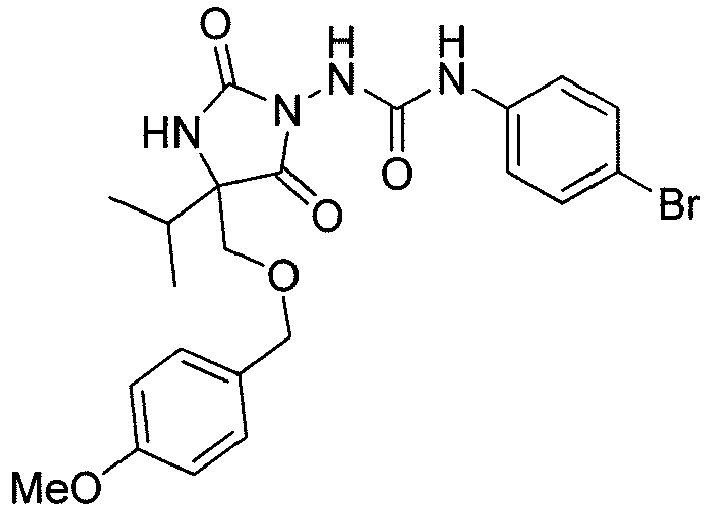
CAS 2493-02-9 57 1-(4-Bromo-2-fluorophenyl)-3-(4-isopropyl-4-(((4-methoxybenzyl)oxy)methyl)-2,5-dioxoimidazolidin-1-yl)urea Intermediate 39 1HNMR (CD3OD): δ 0.96 (d, J = 7.3 Hz, 3H), 0.98 (d, J = 7.3 Hz, 3H), 1.99 - 2.18 (m, 1H), 3.57 - 3.70 (m, 2H), 3.75 (s, 3H), 4.45 (s, 2H), 6.84 - 6.88 (m, 3H), 7.15 - 7.33 (m, 4H) 4-bromo-2-fluoro-1-isocyanatobenzene 
CAS 88112-75-8 58 Methyl 4-(2-(1-(3-(4-Bromophenyl)ureido)-4-methyl-2,5-dioxoimidazolidin-4-yl)ethyl)benzoate Intermediate 41 1HNMR (CD3OD): δ 1.50 (s, 3H), 1.92 - 2.03 (m, 1H), 2.11 - 2.21 (m, 1H), 2.62 - 2.85 (m, 2H), 3.88 (s, 3H), 7.32 (d, J = 8.4 Hz, 2H), 7.35 - 7.43 (m, 4H), 7.93 (dd, J = 8.4, 1.8 Hz, 2H). 1-bromo-4-isocyanatobenzene 
CAS 2493-02-9 59 Methyl 2-(2-(1-(3-(4-bromophenyl)ureido)-4-methyl-2,5-dioxoimidazolidin-4-yl)ethyl)benzoate Intermediate 42 1HNMR (CD3OD): δ 1.50 (s, 3H), 1.95 - 2.03 (m, 1H), 2.06 - 2.14 (m, 1H), 2.93 (br s, 1H), 3.08 -3.16 (m, 1H), 3.89 (s, 3H), 7.27 1-bromo-4-isocyanatobenzene CAS 2493-02-9 
- 7.31 (m, 2H), 7.35 - 7.42 (m, 4H), 7.47 (dt, J = 7.2, 1.2 Hz, 1H), 7.84 (d, J = 7.8 Hz, 1H). 60 Methyl 2-(2-(1-(3-(4-bromophenyl)ureido)-4-ethyl-2,5-dioxoimidazolidin-4-yl)ethyl)benzoate Intermediate 43 1HNMR (CD3OD): δ 0.97 (t, J = 7.5 Hz, 3H), 1.65 - 2.15 (m, 4H), 2.90 (br s, 1H), 3.01 - 3.15 (m, 1H), 3.89 (s, 3H), 7.23 - 7.50 (m, 7H), 7.83 (d, J=7.7Hz, 1H). 1-bromo-4-isocyanatobenzene 
CAS 2493-02-9 61 Methyl 2-(2-(1-(3-(4-bromo-2-fluorophenyl)ureido)-4-ethyl-2,5-dioxoimidazolidin-4-yl)ethyl)benzoate Intermediate 43 1HNMR (CD3OD): δ 0.97 (t, J = 6.9 Hz, 3H), 1.70 - 2.16 (m, 4H), 2.94 (br s, 1H), 3.01 - 3.15 (m, 1H), 3.84 (s, 3H), 7.21 - 7.44 (m, 5H), 7.84 (dd, J = 8.4, 1.5 Hz, 1H), 7.91 (t, J = 8.4 Hz,1H). 4-bromo-2-fluoro-1-isocyanatobenzene 
CAS 88112-75-8 62 Ethyl 2-(1-(3-(4-bromo-2-fluorophenyl)ureido)-4-isopropyl-2,5-dioxoimidazolidin-4-yl)acetate Intermediate 35 1H NMR (CD3OD): δ 0.89 - 1.01 (m, 6H), 1.19 - 1.27 (t, J = 7.5 Hz, 3H), 2.03 - 2.10 (m, 1H), 2.87 - 3.07 (m, 2H), 401 - 4.18 (m, 2H), 7.30 (d, J = 1.3 Hz, 1H), 7.36 (dd, J = 10.4, 2.2 Hz, 1H), 7.78 - 7.96 (m, 1H). 4-bromo-2-fluoro-1-isocyanatobenzene 
CAS 88112-75-8 63 Ethyl 2-(1-(3-(4-bromophenyl)ureido)-4-isopropyl-2,5-dioxoimidazolidin-4-yl)acetate Intermediate 35 1HNMR (CDCl3): δ 0.96 (d, J = 7.5 Hz, 3H), 1.01 (d, J = 7.5 Hz, 3H), 1.29 (t, J = 7.4 Hz, 3H), 2.10 (sept, J = 7.5 Hz, 1H), 3.01 (m, 2H), 4.17 (m, 2H), 7.35 (d, J = 8.2 Hz, 2H), 7.42 (d, J = 8.2 Hz, 2H). 1-bromo-4-isocyanatobenzene 
CAS 2493-02-9 64 1-(4-Bromophenyl)-3-[4-(1H-indol-3-ylmethyl)-4-methyl-2,5-dioxoimidazolidin-1-yl]urea Intermediate 14 1H NMR (600 MHz, CD3OD): δ 1.58 (s, 3H), 3.11 (d, J = 15.0 Hz, 1H), 3.31 (d, J = 15.0 Hz, 1H), 7.01 (t, J = 8.4 Hz, 1H), 7.05 (t, J = 8.4 Hz, 1H), 7.28 (d, J = 8.4 Hz, 1H), 7.55 (d, J = 8.4 Hz, 1 H). 1-bromo-4-isocyanatobenzene 
CAS 2493-02-9 65 1-(4-Bromo-2-fluorophenyl)-3-[4-(5-ethyl-1H-indol-2-yl)-4-methyl-2,5-dioxoimidazolidin-1-yl]urea Intermediate 19 1H NMR (300 MHz, CD3OD): δ 1.24 (t, J = 7.6 Hz, 3H), 1.94 (s, 3H), 2.68 (q, J = 7.6 Hz, 2H), 6.47 (s, 1H), 6.98 (dd, J = 8.2, 1.8 Hz, 1H), 7.31 - 7.34 (m, 4H), 7.91 (t, J = 8.6Hz, 1H). 4-bromo-2-fluoro-1-isocyanatobenzene 
CAS 88112-75-8 66 1-(4-Bromophenyl)-3-(4,4-dicyclopropyl-2,5-dioxoimidazolidin-1-yl)urea Intermediate 38 1H NMR (300 MHz, CD3OD): δ 7.40 (dd, 4H), 4.88 (s, 3H), 1.25 (m, 2H), 0.63-0.41 (m, 8H) 
1 -bromo-4-isocyanatobenzene CAS 2493-02-9 67 1-(4-Bromophenyl)-3-[2,5-dioxo-4,4-di(propan-2-yl)imidazolidin-1-yl]urea Intermediate 37 1H NMR (300 MHz, CD3OD): δ 7.40 (dd, 4H), 4.88 (s, 3H), 2.23 (sept, 2H), 1.05 (d, 6H), 1.00 (d, 6H). 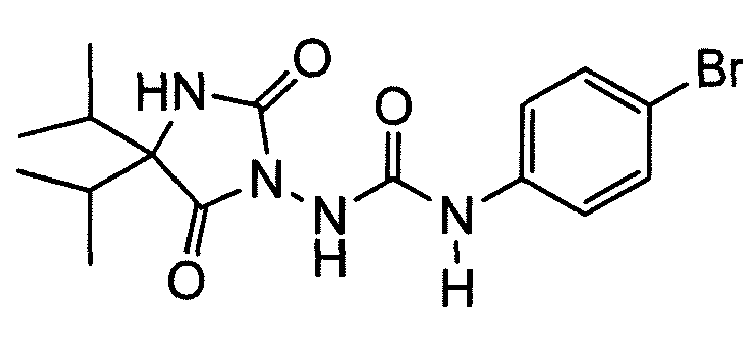
1-bromo-4-isocyanatobenzene CAS 2493-02-9 68 Ethyl-3-[1-{[(4-bromophenyl)carbamoyl]am ino}-2,5-dioxo-4-(propan-2-yl)imidazolidin-4-yl]propanoate Intermediate 36 1H NMR (300 MHz, CD3OD): δ 0.98 (d, J = 7.5 Hz, 3H), 1.03 (d, J = 7.5 Hz, 3H), 1.24 (t, J = 7.2 Hz, 3H), 2.00 - 2.20 (m, 3H), 2.40 (br s, 2H), 4.12 (q, J = 7.2 Hz, 2H), 7.35 (d, J = 9.3 Hz, 2H), 7.40 (d, J = 9.3 Hz, 2H). 1-bromo-4-isocyanatobenzene 
CAS 2493-02-9 69 1-(4-Bromophenyl)-3-(4,4-dimethyl-2,5-dioxo-3-phenylimidazolidin-1-yl)urea Intermediate 40 1H NMR (300 MHz, CDCl3): δ 8.02 (s, 1H), 8.00 (s, 1H), 7.53-7.40 (m, 3H), 7.33-7.24 (m, 2H), 7.16 (d, 2H), 6.94 (d, 2H), 1.5 (s, 6H). 
1-bromo-4-isocyanatobenzene CAS 2493-02-9 -

-

- Racemic Compound 9 was separated into the individual enantiomers Compound 70 and Compound 71, by chiral stationary phase high pressure liquid chromatography: preparative column (IC, 2 x 15 cm) and mobile phase (super critical fluid) 20% methanol (0.1 % DEA)/CO2, 100 bar; 70 mL/min, UV 220 nm.
- (-) Enantiomer, peak 1, RT 0.86 min - Compound 70
- [α]D = -16.52°, MeOH, c = 0.0115g/mL
- (+) Enantiomer, peak 2, RT 1.09 min - Compound 71
- [α]D = +16.69°, MeOH, c = 0.0115g/MI
-

-

- Racemic Compound 18 was separated into the individual enantiomers, Compound 72 and Compound 73, by chiral stationary phase high pressure liquid chromatography: preparative column (IA, 2 x 15 cm) and mobile phase (super critical fluid) 50% methanol (0.1% DEA)/CO2, 100 bar; 70 mL/min, UV 254 nm.
- (+) Enantiomer, peak 1, RT 2.22 min - Compound 72
- [α]D = +15.9°, MeOH, c = 0.9364g/mL
- (-) Enantiomer, peak 2, RT 4.82 min - Compound 73
- [α]D = - 15.4°, MeOH, c = 0.9182g/mL
-

- To a cold (0°C) solution of Compound 56 (100 mg, 0.2 mmol) in CH2Cl2 (5 mL) was added DDQ, CAS 84-58-2 (100 mg, 0.4 mmol) and stirred for 90 min. To the reaction saturated sodium thiosulfate (2 mL) was added and stirred for 30 min. The solvent removed under reduced pressure and purified by silicagel chromatography using MeOH in CH2Cl2. The product was obtained as a white solid.
1HNMR (CD3OD): δ 0.98 (d, J = 7.0 Hz, 6H), 2.06 - 2.20 (m, 1H), 3.75 - 3.90 (m, 2H), 7.31 - 7.41 (m, 4H). - Compounds 75 and 76 were prepared in a similar manner to the procedure described in Example 13 for Compound 74. The starting materials used and the results are tabulated below in Table 7.
Table 7 Comp. No. IUPAC name Starting material 1H NMR δ (ppm) for Compound 75 1-(4-Bromophenyl)-3-(4-(2-hydroxyethyl)-4-isopropyl-2,5-dioxoimidazolidin-1-yl)urea Compound 49 1HNMR (CD3OD): δ 0.96 (brs, 3H), 1.01 (d, J = 7.2 Hz, 3H), 1.95-2.10 (m, 2H), 2.18 (br s, 1H), 3.72 (br s, 2H), 7.34 - 7.40 (m, 4H).. 
76 1-(4-Bromo-2-fluorophenyl)-3-(4-(2-hydroxymethyl)-4-isopropyl-2,5-dioxoimidazolidin-1-yl)urea Compound 57 1HNMR (CD3OD): δ 0.98 (d, J = 6.7 Hz, 3H), 1.00 (d, J = 6.7 Hz, 3H), 2.08 - 2.19 (m, 1H), 3.73 - 3.87 (m, 2H), 7.26 (dt, J = 8.8, 1.6 Hz, 1H), 7.34 (dd, J = 10.6, 2.1 Hz, 1H), 7.87 (t, J = 8.6 Hz,1H). 
-

- To a solution of Compound 58 (30 mg, 0.06 mmol) in dioxane (2 mL) was added KOH-H2O (0.5M solution, 1 mL) was added and stirred at RT for 90 min. Solvent was removed under reduced pressure, then the reaction was cooled (0°C) and acidified to pH 2 with 10% HCl. The crude product was purified by silicagel chromatography using MeOH in CH2Cl2. Compound 77 was isolated as a white solid.
1HNMR (CD3OD): δ 1.50 (s, 3H), 1.92 - 2.03 (m, 1H), 2.11 - 2.21 (m, 1H), 2.62 - 2.85 (m, 2H), 7.32 (d, J = 7.8 Hz, 2H), 7.35 - 7.45 (m, 4H), 7.92 - 7.97 (m, 2H). - Compounds 78 through 83 were prepared in a similar manner to the procedure described in Example 14 for Compound 77. The starting materials used and the results are tabulated below in Table 8.
Table 8 Comp. No. IUPAC name Starting material 1H NMR δ (ppm) for Compound 78 2-(2-(1-(3-(4-Bromophenyl)ureido)-4-methyl-2,5-dioxoimidazolidin-4-yl)ethyl)benzoic acid Compound 59 1HNMR (CD3OD): δ 1.50 (s, 3H), 1.95-2.10 (m, 2H), 2.90 (br s, 1H), 3.15 (br s, 1H), 7.25 - 7.35 (m, 2H), 7.37 - 7.49 (m, 5H), 7.84 (d, J = 7.8 Hz, 
1H). 79 2-(2-(1-(3-(4-Bromophenyl)ureido)-4-ethyl-2,5-dioxoimidazolidin-4-yl)ethyl)benzoic acid Compound 60 1HNMR (CD3OD): δ 0.96 (t, J = 7.5Hz, 3H), 1.75 - 2.20 (m, 4H), 2.90 (br s, 1H), 2.20 (br s, 1H), 7.20 - 7.50 (m, 7H), 7.88 (d, J = 7.7 Hz, 1H). 
80 Methyl 2-(2-(1-(3-(4-bromo-2-fluorophenyl)ureido)-4-ethyl-2,5-dioxoimidazolidin-4-yl)ethyl)benzoate Compound 61 1HNMR (CD3OD): δ 0.97 (t, J = 7.5 Hz, 3H), 1.70 - 2.15 (m, 4H), 2.90 (br s, 1H), 3.10 - 3.25 (m, 1H), 7.22 - 7.48 (m, 5H), 7.83 - 7.96 (m, 2H). 
81 2-(1-(3-(4-Bromophenyl)ureido)-4-isopropyl-2,5-dioxoimidazolidin-4-yl)acetic acid Compound 63 1HNMR (CD3OD): δ 0.98 (d, J = 7.5 Hz, 3H), 1.03 (d, J = 7.5 Hz, 3H), 2.07 (sept, J = 7.5 Hz, 1H), 3.02 (m, 2H), 7.41 (d, J = 8.2 Hz, 2H), 7.50 (d, J = 8.2 Hz, 2H). 
82 2-(1-(3-(4-Bromo-2-fluorophenyl)ureido)-4-isopropyl-2,5-dioxoimidazolidin-4-yl)acetic acid Compound 62 1H NMR (CD3OD): δ 0.97 - 1.08 (m, 6H), 2.00 - 2.14 (m, 1H), 2.94 (d, J = 9.9 Hz, 2H), 7.29 (d, J = 1.3 Hz, 1H), 7.34 (10.3, 2.2 Hz, 1H), 7.67 - 7.89 (m, 1H). 
83 3-[1-{[(4-bromophenyl)carbamoyl]am ino}-2,5-dioxo-4-(propan-2-yl)imidazolidin-4-yl]propanoic acid Compound 68 LiOH 1H NMR (300 MHz, CD3OD): δ 0.98 (d, J = 6.6 Hz, 3H), 1.03 (d, J = 6.6 Hz, 3H), 2.00 - 2.20 (m, 3H), 2.40 (br s, 2H), 7.35 (d, J = 9.3 Hz, 2H), 7.40 (d, J = 9.3 Hz, 2H) 
-

- To a solution of Compound 81 (50 mg, 0.12 mmol) in CH2Cl2 (5 mL) was added ethanolamine (15 mg, 0.24 mmol), propyl propionic anhydride (0.1 mL, 50% wt/wt in EtOAc), Et3N (61 mg, 0.6 mmol), DMAP (4 mg) and stirred at RT for 18 h. The solvent was removed on rotavapor and the crude reaction was purified by Preparative Thin layer chromatography. Compound 84 was isolated as white solid. 1H NMR (CD3OD) δ □0.90 - 1.08 (m, 6H), 1.97 - 2.09 (m, 1 H), 2.92 (d, J = 9.4 Hz, 2H), 3.52 - 3.66 (m, 4H), 7.31 - 7.47 (m, 2H), 7.56 (br. s, 2H).
- Compounds 85 through 91 were prepared in a similar manner to the procedure described in Example 15 for Compound 84. The starting materials used and the results are tabulated below in Table 9.
Table 9 Comp. No. IUPAC name Starting material 1H NMR δ (ppm) for Compound 85 tert-Butyl 2-(2-(1-(3-(4-bromophenyl)ureido)-4-isopropyl-2,5-dioxoimidazolidin-4-yl)acetamido)acetate Compound 81 1H NMR (CD3OD) δ 0.94 (d, J = 6.6 Hz, 3H), 1.03 (d, J = 6.8 Hz, 3H), 1.37 (s, 9H), 1.96 - 2.09 (m, 1H), 2.88 - 3.07 (m, 2H), 3.84 - 3.95 (m, 2H), 7.38 (d, J = 8.9 Hz, 2H), 7.45 - 7.65 (m, 2H). 1-Ethyl-3-(3-dimethylaminoprop yl)carbodiimide 
CAS 52399-93-6 86 Diethyl ((2-(1-(3-(4-bromophenyl)ureido)-4-isopropyl-2,5-dioxoimidazolidin-4-yl)acetamido)methyl)phosph onate Compound 81 1H NMR (CD3OD) δ 0.88 - 1.08 (m, 6H), 1.25 (q, J = 6.9 Hz, 6H), 1.94 - 2.11 (m, 1H), 2.96 (br.s, 2H), 3.57 - 3.84 (m 2H), 4.06 (quin., J = 7.3 Hz, 4H), 7.40 (d, J = 8.9 Hz, 2H), 7.56 (br. s, 2H). 
87 2-(1-(3-(4-Bromophenyl)ureido)-4-isopropyl-2,5-dioxoimidazolidin-4-yl)-N,N bis(2-hydroxyethyl)acetamide Compound 81 1H NMR (CD3OD) δ 0.88 - 0.98 (m, 3H), 0.98 - 1.10 (m, 3H), 1.93 - 2.10 (m, 1H), 2.86 - 3.05 (m, 2H), 3.54 - 3.70 (m, 4H), 
3.85 - 4.00 (m, 4H), 7.31 - 7.45 (m, 2H), 7.48 - 7.6 (m, 2H). 88 Diisopropyl ((2-(1-(3-(4-bromophenyl)ureido)-4-isopropyl-2,5-dioxoimidazolidin-4-yl)acetamido)methyl)phosph onate Compound 81 1H NMR (CD3OD) δ 0.88 - 1.07 (m, 6H), 1.21 - 1.33 (m, 12H), 1.95 - 2.10 (m, 1H), 2.97 (br. s, 2H), 3.55 - 3.77 (m, 2H), 4.54 - 4.72 (m, 2H), 7.40 (d, J = 8.9 Hz, 2H), 7.55 - 7.63 (m, 2H). 
89 Ethyl hydrogen((2-(1-(3-(4-bromophenyl)ureido)-4-isopropyl-2,5-dioxoimidazolidin-4-yl)acetamido)methyl)phosph onate Compound 86 LiOH 1H NMR (CD3OD) δ 0.89 - 0.96 (m, 3H), 1.03 (d, J = 6.8 Hz, 3H), 1.10 - 1.18 (m 3H), 1.94 - 2.06 (m, 1H), 2.89 - 2.99 (m, 2H), 3.25 - 3.31 (m, 2H), 3.74 - 3.88 (m, 2H), 7.41 (d, J = 8.9 Hz, 4H). 
90 tert-Butyl 2-(2-(1-(3-(4-bromophenyl)ureido)-4-isopropyl-2,5-dioxoimidazolidin-4-yl)acetamido)2-methylpropanoate Compound 81 1H NMR (CD3OD) δ 0.94 (d, J = 6.7 Hz, 3H), 1.02 (d, J = 6.7 Hz, 3H), 1.33 (9H), 1.45 (s, 3H), 1.47 (s, 3H), 1.93 - 2.09 (m, 1 H), 2.91 (s, 2H), 7.37 (d, J = 8.9 Hz, 2H), 7.50 - 7.61 (m, 2H). 
91 tert-Butyl 3-(2-(1-(3-(4-bromophenyl)ureido)-4-isopropyl-2,5-dioxoimidazolidin-4-yl)acetamido)propanoate Compound 81 1H NMR (CD3OD) δ 0.93 (d, J = 6.6 Hz, 3H), 1.01 (d, J = 6.8 Hz, 3H), 1.41 (s, 9H), 1.94 - 2.08 (m, 1H), 2.41 - 2.44 (m, 2H), 2.78 - 2.96 (m, 2H), 2.34 - 3.49 (m, 2H), 7.39 (d, J = 8.9 Hz, 2H), 7.54 - 7.66 (m, 2H). 
-

- To Compound 85 (131 mg, 0.23 mmol) was added formic acid (3 mL) and stirred at RT for 1 h. The solvent was removed at RT under vacuum. Compound 92 was isolated as white solid.
1H NMR (CD3OD) δ 0.94 (d, J = 6.5 Hz, 3H), 1.03 (d, J = 6.9 Hz, 3H), 2.03 (m, 1 H), 3.00 (d, J = 6.2 Hz, 2H), 3.90 (d, J = 4.4 Hz, 2H), 7.37 (d, J = 8.9 Hz, 2H), 7.47 - 7.60 (m, 2H). - Compounds 93 through 96 were prepared in a similar manner to the procedure described in Example 16 for Compound 92. The starting materials used and the results are tabulated below in Table 10.
Table 10 Comp. No. IUPAC name Starting material 1H NMR δ (ppm) for Compound 93 3-(2-(1-(3-(4-Bromophenyl)ureido)-4-isopropyl-2,5-dioxoimidazolidin-4-yl)acetamido)propanoic acid Compound 91 1H NMR (CD3OD) δ: 0.93 (d, J = 6.6 Hz, 3H), 1.01 (d, J = 6.8 Hz, 3H), 1.94 - 2.08 (m, 1H), 2.43 (m, 2H), 2.78 - 2.96 (m, 2H), 3.34 - 3.49 (m, 2H), 7.39 (d, J = 8.9 Hz, 2H), 7.54 - 7.66 (m, 2H). 
94 3-(2-(1-(3-(4-bromo-2-fluorophenyl)ureido)-4-isopropyl-2,5-dioxoimidazolidin-4-yl)acetamido)propanoic acid Compound 82 (in 2 steps) 1H NMR (CD3OD) δ:0.97- 1.08 (m, 6H), 1.97 - 2.09 (m, 1H), 2.80 - 2.92 (m, 2H), 3.20 - 3.30 (m, 2H), 3.51 - 3.59 (m, 2H), 7.27 - 7.37 (m, 2H), 7.66(br.s,1H). 
95 2-(2-(1-(3-(4-Bromophenyl)ureido)-4-isopropyl-2,5-dioxoimidazolidin-4-yl)acetamido)2-methylpropanoic acid Compound 90 1H NMR (CD3OD) δ: 0.88 - 1.06 (m, 6H), 1.45 (s, 3H), 1.47 (s, 3H), 1.90 - 2.08 (m, 1H), 2.92 (s, 2H), 7.31 - 7.44 (m, 2H), 7.56 (d, J = 7.8 Hz, 2H). 
-

- To a cold (-31°C) turbid mixture of Compound 92 (180 mg, 0.38 mmol) in THF (5 mL) was added Et3N (118 mg, 1.18 mmol). After 5 min ClCO2Et (66 mg, 0.61 mmol) was added and stirred for 20 min. NH3 gas was bubbled through the reaction mixture. Then the reaction was gradually warmed to RT. The crude reaction was purified by silicagel chromatography eluting with 10% MeOH in CH2Cl2. The product was then washed with 10% HCl to remove basic impurities in the product. The Compound 96 was isolated as a white solid.
1H NMR (METHANOL-d4) δ 0.95 (d, J = 6.6 Hz, 3H), 1.03 (d, J = 6.9 Hz, 3H), 1.94 - 2.12 (m, 1 H), 2.88 - 3.14 (m, 2H), 3.84 (d, J = 11.0 Hz, 2H), 7.33 - 7.47 (m, 2H), 7.49 - 7.63 (m, 2H). - Biological activity of compounds according to Formula 1 is set forth in Table 11 below. HEK-Gα16 and CHO-Gα16 cells stably expressing FPRL1 were cultured in (F12, 10% FBS, 1% PSA, 400 µg/ml geneticin and 50 µg/ml hygromycin) and HEK- Gqi5 cells stable expressing FPR1 were cultured in (DMEM high glucose, 10% FBS, 1% PSA, 400 µg/ml geneticin and 50 µg/ml hygromycin). In general, the day before the experiment, 18,000 cells/well were plated in a 384-well clear bottom poly-d-lysine coated plate. The following day the screening compound-induced calcium activity was assayed on the FLIPRTetra. The drug plates were prepared in 384-well microplates using the EP3 and the MultiPROBE robotic liquid handling systems. Compounds were tested at concentrations ranging from 0.61 to 10,000 nM. Results are expressed as EC50 (nM) and efficacy values.
Table 11 Compound IUPAC name FPRL-1 Ga16-CHO EC50 (%eff) 1-(4-Chlorophenyl)-3-(4,4-diethyl-2,5-dioxoimidazolidin-1-yl)urea 27 nM (1.0) 1-(4-Bromophenyl)-3-(4,4-diethyl-2,5-dioxoimidazolidin-1-yl)urea 9.1 nM (1.0) 1-(4-Methoxyphenyl)-3-(4,4-diethyl-2,5-dioxoimidazolidin-1-yl)urea 194 nM (1.0) 1-(4-Ethylphenyl)-3-(4,4-diethyl-2,5-dioxoimidazolidin-1-yl)urea 125 nM (1.0) 1-(4-Cyanophenyl)-3-(4,4-diethyl-2,5-dioxoimidazolidin-1-yl)urea 1229 nM (1.0) 1-(4-Bromo-2-fluorophenyl)-3-(4,4-diethyl-2,5-dioxoimidazolidin-1-yl)urea 15.6 nM (1.0) 1-(4-Methylphenyl)-3-(4,4-diethyl-2,5-dioxoimidazolidin-1-yl)urea 96.0 nM (1.0) 1-(4-Methylthiophenyl)-3-(4,4-diethyl-2,5-dioxoimidazolidin-1-yl)urea 37.1 nM (1.0) 1-(4-Bromo-2-fluorophenyl)-3-(2,4-dioxo-1,3-diazaspiro[4.5]decan-3-yl)urea 233 nM (1.0) 1-(4-Bromophenyl)-3-(2,4-dioxo-1,3-diazaspiro[4.5]decan-3-yl)urea 13.6 nM (1.0) 1-(4-Chloro-2-fluorophenyl)-3-(4,4-diethyl-2,5-dioxoimidazolidin-1-yl)urea 39 nM (0.98) 1-(4-Bromo-2-fluorophenyl)-3-(2,4-dioxo-1,3-diazaspiro[4.4]nonan-3-yl)urea 23.9 nM (0.89) 1-(4-Bromophenyl)-3-(4,4-dimethyl-2,5-dioxoimidazolidin-1-yl)urea 74.9 nM (1.0) 1-(4-Bromophenyl)-3-(4-methyl-2,5-dioxo-4-phenethylimidazolidin-1-yl)urea 5.1 nM (0.87) 1-(4-Bromo-2-fluorophenyl)-3-(4-methyl-2,5-dioxo-4-phenethylimidazolidin-1-yl)urea 61.0 nM (0.88) (-)-1-(4-Bromophenyl)-3-(4-methyl-2,5-dioxo-4-phenethylimidazolidin-1-yl)urea 22 nM (0.92) (+)-1-(4-Bromophenyl)-3-(4-methyl-2,5-dioxo-4-phenethylimidazolidin-1-yl)urea 2.4 nM (0.83) 1-(4-Bromophenyl)-3-(4-ethyl-4-isopropyl-2,5-dioxoimidazolidin-1-yl)urea 6.3 nM (0.91) 1-(4-Bromophenyl)-3-(2,5-dioxo-1',3'-dihydrospiro[imidazoli dine-4,2'-inden)-1-yl)urea 47 nM (0.89) 1-(4-Chloro-3-fluorophenyl)-3-(4,4-diethyl-2,5-dioxoimidazolidin-1-yl)urea 149 nM (0.97) 1-(4-Bromo-2-fluorophenyl)-3-(4-ethyl-4-isopropyl-2,5-dioxoimidazolidin-1-yl)urea 6.3 nM (1.0) (+)-1-(4-Bromophenyl)-3-(4-ethyl-4-isopropyl-2,5-dioxoimidazolidin-1-yl)urea 4.3 nM (0.96) (-)-1-(4-Bromophenyl)-3-(4-ethyl-4-isopropyl-2,5-dioxoimidazolidin-1-yl)urea 3.3 nM (1.0) 1-(4-Bromophenyl)-3-[4-methyl-2,5-dioxo-4-(phenoxymethyl)imidazolidin-1-yl]urea 22.1 (0.99) 1-(4-Bromophenyl)-3-[2,5-dioxo-4,4-di(propan-2-yl)imidazolidin-1-yl]urea <2 (0.98) 1-(4-Bromophenyl)-3-(4,4-dicyclopropyl-2,5-dioxoimidazolidin-1-yl)urea 14.3 (1.00) 1-(4-Bromo-2-fluorophenyl)-3-(2,5-dioxo-3',4'-dihydro-1H,1'H-spiro[imidazolidine-4,2'-naphthalen]-1-yl)urea 191.1 (0.92) 1-(4-Bromo-2-fluorophenyl)-3-[4-methyl-2,5-dioxo-4-(phenoxymethyl)imidazolidin-1-yl]urea 52.1 (0.96) 1-(4-Bromophenyl)-3-(2,5-dioxo-3',4'-dihydro-1H,1'H-spiro[imidazolidine-4,2'-naphthalen]-1-yl)urea 53.5 (1.00) 1-(4-Bromo-2-fluorophenyl)-3-[4-ethyl-2,5-dioxo-4-(2-phenylethyl)imidazolidin-1-yl]urea <2 (0.91) 1-(4-Bromophenyl)-3-[4-ethyl-2,5-dioxo-4-(2-phenylethyl)imidazolidin-1-yl]urea 0.5 (1.00) 1-(4-Bromophenyl)-3-[4-(2-methylpropyl)-2, 5-dioxo-4-(2-phenylethyl)imidazolidin-1-yl]urea 86.4 (0.90) 1-(4-Bromo-2-fluorophenyl)-3-[4-(2-methylpropyl)-2,5-dioxo-4-(2-phenylethyl)imidazolidin-1-yl]urea 105.3 (1.00) 1-(4-Bromophenyl)-3-{4-[2-(4-chlorophenyl)ethyl]-4-methyl-2,5-dioxoimidazolidin-1-yl}urea 333.4 (0.86) 1-(4-Bromo-2-fluorophenyl)-3-{4-[2-(4-chlorophenyl)ethyl]-4-methyt-2,5-dioxoimidazolidin-1-yl}urea 1381 (0.77) 1-(4-Bromophenyl)-3-{4-[2-(furan-2-yl)ethyl]-4-methyl-2,5-dioxoimidazolidin-1-yl}urea 6.9 (1.00) 1-(4-Bromo-2-fluorophenyl)-3-{4-[2-(furan-2-yl)ethyl]-4-methyl-2,5-dioxoimidazolidin-1-yl}urea 39.8 (0.99) 1-(4-Bromophenyl)-3-{4-[2-(2-fluorophenyl)ethyl]-4-methyl-2,5-dioxoimidazolidin-1-yl}urea 14 (0.99) 1-(4-Bromophenyl)-3-{4-[2-(4-fluorophenyl)ethyl]-4-methyl-2,5-dioxoimidazolidin-1-yl}urea 17 (1.00) 1-(4-Bromophenyl)-3-[4-(1H-indol-3-ylmethyl)-4-methyl-2,5-dioxoimidazolidin-1-yl]urea 113.7 (1.00) 1-(4-Bromo-2-fluorophenyl)-3-{4-[2-(2-fluorophenyl)ethyl]-4-methyl-2,5-dioxoimidazolidin-1-yl}urea 56.2 (0.86) 1-(4-Bromo-2-fluorophenyl)-3-{4-[2-(4-fluorophenyl)ethyl]-4-methyl-2,5-dioxoimidazolidin-1-yl}urea 117.9 (0.87) 1-(4-Bromophenyl)-3-{4-[2-(3-fluorophenyl)ethyl]-4-methyl-2,5-dioxoimidazotidin-1-yl}urea 11.1 (1.00) 1-(4-Bromophenyl)-3-{4-[2-(4-hydroxyphenyl)ethyl]-4-methyl- 13.3 2,5-dioxoimidazolidin-1-yl}urea (1.00) 1-(4-Bromo-2-fluorophenyl)-3-{4-methyl-2,5-dioxo-4-[2-(thiophen-2-yl)ethyl]imidazolidin-1-yl}urea 86 (1.00) 1-(4-Bromophenyl)-3-{4-methyl-2,5-dioxo-4-[2-(thiophen-2-yl)ethyl]imidazolidin-1-yl}urea 7.9 (0.94) 1-(4-Bromo-2-fluorophenyl)-3-{4-[2-(4-hydroxyphenyl)ethyl]-4-methyl-2,5-dioxoimidazolidin-1-yl}urea 8.7 (0.85) 1-(4-Bromo-2-fluorophenyl)-3-[4-(5-ethyl-1H-indol-2-yl)-4-methyl-2,5-dioxoimidazolidin-1-yl]urea 169.4 (0.88) 1-(4-Bromophenyl)-3-{4-methyl-4-[2-(5-methylfuran-2-yl)ethyl]-2,5-dioxoimidazolidin-1-yl}urea 3.5 (0.95) 1-(4-Bromo-2-fluorophenyl)-3-{4-[2-(3-fluoro-4-hydroxyphenyl)ethyl]-4-methyl-2,5-dioxoimidazolidin-1-yl}urea 7.4 (0.91) 1-(4-Bromophenyl)-3-{4-[2-(3-fluoro-4-hydroxyphenyl)ethyl]-4-methyl-2,5-dioxoimidazolidin-1-yl}urea 7.9 (1.00) 1-(4-Bromo-2-fluorophenyl)-3-{4-[2-(2-hydroxyphenyl)ethyl]-4-methyl-2,5-dioxoimidazolidin-1-yl}urea 5.8 (0.85) 1-(4-Bromo-2-fluorophenyl)-3-{4-[2-(3-hydroxyphenyl)ethyl]-4-methyl-2,5-dioxoimidazolidin-1-yl}urea 2.9 (0.79) 1-(4-Bromophenyl)-3-{4-[2-(3-hydroxyphenyl)ethyl]-4-methyl-2,5-dioxoimidazolidin-1-yl}urea 1.5 (0.98) 1-(4-Bromophenyl)-3-[4-{2-[(4-methoxybenzyl)oxy]ethyl}-2,5-dioxo-4-(propan-2-yl)imidazolidin-1-yl]urea 232.1 (0.93) 1-(4-Bromophenyl)-3-{4-[2-(2-hydroxyphenyl)ethyl]-4-methyl-2,5-dioxoimidazolidin-1-yl}urea 0.97 (0.93) Methyl-4-[2-(1-{[(4-bromophenyl)carbamoyl]amino}-4-methyl-2,5-dioxoimidazolidin-4-yl)ethyl]benzoate 204.4 (0.96) 4-[2-(1-{[(4-Bromophenyl)carbamoyl]amino}-4-methyl-2,5-dioxoimidazolidin-4-yl)ethyllbenzoic acid 210.1 (0.99) 1-(4-Bromophenyl)-3-{4-methyl-2,5-dioxo-4-[2-(pyridin-4-yl)ethyl]imidazolidin-1-yl}urea 30.2 (1.00) 1-(4-Bromo-2-fluorophenyl)-3-{4-methyl-2,5-dioxo-4-[2-(pyridin-4-yl)ethyl]imidazolidin-1-yl)urea 28.6 (0.98) Methyl-2-[2-(1-{[(4-bromophenyl)carbamoyl]amino}-4-methyl-2,5-dioxoimidazolidin-4-yl)ethyl]benzoate 28.9 (1.00) 2-[2-(1-{[(4-Bromophenyl)carbamoyl]amino}-4-methyl-2,5-dioxoimidazolidin-4-yl)ethyl]benzoic acid 17.19 (1.02) 3-(2-(1-(3-(4-Bromophenyl)ureido)-4-isopropyl-2,5-dioxoimidazolidin-4-yl)acetamido)propanoic acid 5.16 (0.97) tert-Butyl3-({[1-{[(4-bromophenyl)carbamoyl]amino}-2,5-dioxo-4-(propan-2-yl)imidazolidin-4-yl]acetyl}amino)propanoate 79.06 (0.86) 2-[2-(1-{[(4-Bromo-2-fluorophenyl)carbamoyl]amino}-4-ethyl-2,5-dioxoimidazolidin-4-yl)ethyl]benzoic acid 11.06 (1.03) 2-({[1-{[(4-Bromophenyl)carbamoyl]amino}-2,5-dioxo-4-(propan-2-yl)imidazolidin-4-yl]acetyl}amino)-2-methylpropanoic acid 109.12 (1.00) Methyl-2-[2-(1-{[(4-bromo-2-fluorophenyl)carbamoyl]amino}-4-ethyl-2,5-dioxoimidazolidin-4-yl)ethyl]benzoate 14.93 (0.92) [1-{[(4-Bromo-2-fluorophenyl)carbamoyl]amino}-2,5-dioxo-4-(propan-2-yl)imidazolidin-4-yl]acetic acid 712.91 (0.93) 2-[1-{[(4-Bromophenyl)carbamoyl]amino}-2,5-dioxo-4-(propan-2-yl)imidazolidin-4-yl]-N-(1,3-dihydroxypropan-2-yl)acetamide 16.16 (0.94) Methyl-2-[2-(1-{[(4-bromophenyl)carbamoyl]amino}-4-ethyl-2,5-dioxoimidazolidin-4-yl)ethyl]benzoate 10.28 (0.92) Ethyl hydrogen [({[1-{[(4-bromophenyl)carbamoyl]amino}-2,5-dioxo-4-(propan-2-yl)imidazolidin-4-yl]acetyl}amino)methyl]phosphonate 313.28 (1.07) N-(2-Amino-2-oxoethyl)-2-[1-{[(4-bromophenyl)carbamoyl]amino}-2,5-dioxo-4-(propan-2-yl)imidazolidin-4-yl]acetamide 51.28 (1.05) ({[1-{[(4-Bromophenyl)carbamoyl]amino}-2,5-dioxo-4-(propan-2-yl)imidazolidin-4-yl]acetyl}amino)acetic acid 132.65 (0.9) di-Propan-2-yl [({[1-{[(4-bromophenyl)carbamoyl]amino}-2,5-dioxo-4-(propan-2-yl)imidazolidin-4-yl]acetyl}amino)methyl]phosphonate 192.98 (0.87) tert-Butyl ({[1-{[(4-bromophenyl)carbamoyl]amino}-2,5-dioxo-4-(propan-2-yl)imidazolidin-4-yl]acetyl}amino)acetate 301.77 (1.01) di-Ethyl [({[1-{[(4-bromophenyl)carbamoyl]amino}-2,5-dioxo-4-(propan-2-yl)imidazolidin-4-yl]acetyl}amino)methyl]phosphonate 271.74 (0.83) 2-[1-{[(4-Bromophenyl)carbamoyl]amino}-2,5-dioxo-4-(propan-2-yl)imidazolidin-4-yl]-N-(2-hydroxyethyl)acetamide 16.2 (0.86) 1-(4-Bromophenyl)-3-[4-(hydroxymethyl)-2,5-dioxo-4-(propan-2-yl)imidazolidin-1-yl]urea 2.65 (1.01) 1-(4-Bromo-2-fluorophenyl)-3-[4-(hydroxymethyl)-2,5-dioxo-4-(propan-2-yl)imidazolidin-1-yl]urea 50 (1.03) 1-(4-Bromophenyl)-3-{4-[2-(3-hydroxyphenyl)ethyl]-4-methyl-2,5-dioxoimidazolidin-1-yl}urea 2.07 (1.01) [1-{[(4-Bromophenyl)carbamoyl]amino}-2,5-dioxo-4-(propan-2-yl)imidazolidin-4-yl]acetic acid 459.42 (0.8) 1-(4-Bromophenyl)-3-[4-(2-hydroxyethyl)-2,5-dioxo-4-(propan-2-yl)imidazolidin-1-yl]urea 21.21 (0.95) 3-(4-Bromophenyl)-5-(5-ethyl-1H-indol-2-yl)-5-methylimidazolidine-2,4-dione 2588.94 (0.77) - The invention may be also illustrated by the following embodiments:
- 1. A compound represented by Formula I, its enantiomers, diastereoisomers, hydrates, solvates or a pharmaceutically acceptable salt thereof:
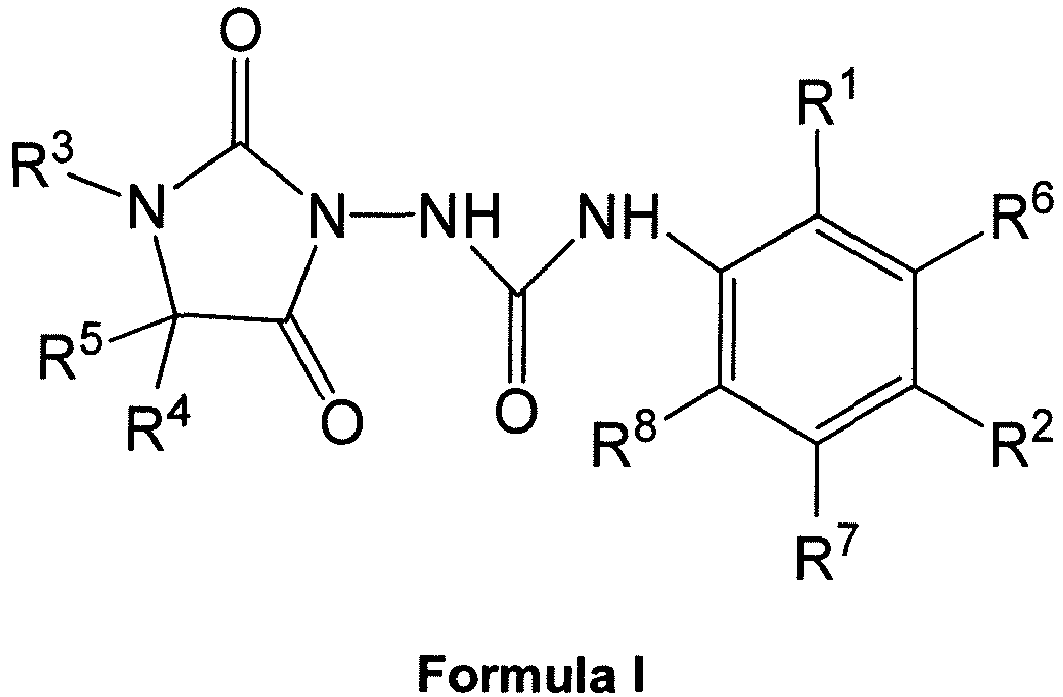
- R1 is halogen, hydrogen, optionally substituted C1-8 alkyl, OR9, C(O)R10, NO2, NR13R14, CN, SR15 or SO2R16;
- R2 is halogen, optionally substituted C1-8 alkyl, CF3, OR9, C(O)R10, NO2, NR13R14, CN, SR15 or SO2R16;
- R3 is hydrogen, optionally substituted C1-8 alkyl, optionally substituted C3-8 cycloalkyl, optionally substituted C3-8 cycloalkenyl, optionally substituted C6-10 aryl, optionally substituted heterocycle, or together with R5 forms a 5 or 6 member ring which is optionally substituted;
- R4 is hydrogen, optionally substituted C1-8 alkyl,


- R5 is hydrogen, optionally substituted C1-8 alkyl, optionally substituted C3-8 cycloalkyl, optionally substituted C3-8 cycloalkenyl, optionally substituted C6-10 aryl, optionally substituted heterocycle, or together with R4 forms a spiro monocyclic or polycyclic carbocyclic or heterocyclic, saturated or unsaturated 5 to 10 member ring which is optionally substituted or together with R3 forms a 5 or 6 member ring which is optionally substituted;
- R6 is halogen, hydrogen, optionally substituted C1-8 alkyl, OR9, C(O)R10, NO2, NR13R14 CN, SR15 or SO2R16;
- R7 is halogen, hydrogen, optionally substituted C1-8 alkyl, OR9, C(O)R10, NO2, NR13R14, CN, SR15 or SO2R16;
- R8 is halogen, hydrogen, optionally substituted C1-8 alkyl, OR9, C(O)R10, NO2, NR13R14, CN, SR15 or SO2R16;
- R9 is hydrogen, C(O)(C1-8 alkyl) or optionally substituted C1-8 alkyl;
- R10 is hydrogen, optionally substituted C1-8 alkyl, O(C1-8 alkyl), NR11R12 or OH;
- R11 is hydrogen, optionally substituted C6-10 aryl or optionally substituted C1-8 alkyl;
- R12 is hydrogen, optionally substituted C6-10 aryl or optionally substituted C1-3 alkyl;
- R13 is hydrogen, optionally substituted C 6-10 aryl or optionally substituted C1-8 alkyl;
- R14 is hydrogen, optionally substituted C6-10 aryl, optionally substituted C1-8 alkyl, C(O)(C1-8 alkyl) or SO2(C1-8alkyl);
- R15 is hydrogen, optionally substituted C1-8 alkyl or O(C1-8 alkyl);
- R16 is OH, O(C1-8alkyl), (C1-8alkyl) or NR11R12;
- R17 is hydrogen, optionally substituted C6-10 aryl or optionally substituted C1-8 alkyl;
- R18 is hydrogen, C(O)(C1-8alkyl), optionally substituted C6-10 aryl, or optionally substituted C1-8 alkyl;
- R19 is hydrogen, C(O)(C1-8alkyl), optionally substituted C6-10 aryl or optionally substituted C1-8 alkyl;
- R20 is hydrogen, optionally substituted C6-10 aryl or optionally substituted C1-8 alkyl;
- R21 is hydrogen, optionally substituted C6-10 aryl or optionally substituted C1-3 alkyl;
- n is 1, 2, 3, 4, or 5;
- m is 1, 2, 3, 4, or 5; and


- 2. A compound according to embodiment 1, wherein:
- R1 is halogen, hydrogen or optionally substituted C1-8 alkyl;
- R2 is halogen, optionally substituted C1-8 alkyl, CF3, SR15, OR9 or CN;
- R3 is hydrogen, optionally substituted C1-8 alkyl, optionally substituted C3-8 cycloalkyl or optionally substituted C3-8 cycloalkenyl;
- R4 is optionally substituted C1-8 alkyl, optionally substituted C3-8 cycloalkyl, optionally substituted C3-8 cycloalkenyl, optionally substituted C6-10 aryl or optionally substituted heterocycle;
- R5 is optionally substituted C1-8 alkyl, optionally substituted C3-8 cycloalkyl, optionally substituted C3-8 cycloalkenyl, optionally substituted C6-10 aryl or optionally substituted heterocycle;
- R6 is halogen, hydrogen or optionally substituted C1-8 alkyl;
- R7 is halogen, hydrogen or optionally substituted C1-8 alkyl;
- R8 is halogen, hydrogen or optionally substituted C1-8 alkyl;
- R9 is hydrogen, C(O)(C1-8alkyl) or optionally substituted C1-8 alkyl; and
- R15 is hydrogen, optionally substituted C1-8alkyl or O(C1-8alkyl).
- 3. A compound according to embodiment 1, wherein:
- R1 is halogen, hydrogen or optionally substituted C1-8alkyl;
- R2 is halogen, optionally substituted C1-8alkyl, CF3, SR15, OR9 or CN;
- R3 is hydrogen, optionally substituted C1-8alkyl, optionally substituted C3-8 cycloalkyl or optionally substituted C3-8 cycloalkenyl;
- R4 is optionally substituted C1-8alkyl, optionally substituted C6-10 aryl,


- R5 is optionally substituted C1-8alkyl or optionally substituted C3-8 cycloalkyl;
- R6 is halogen, hydrogen or optionally substituted C1-8alkyl;
- R7 is halogen, hydrogen or optionally substituted C1-8alkyl;
- R8 is halogen, hydrogen or optionally substituted C1-8alkyl;
- R9 is hydrogen, C(O)(C1-8alkyl) or optionally substituted C1-8alkyl;
- R15 is hydrogen, optionally substituted C1-8alkyl or O(C1-8alkyl);
- R17 is hydrogen, optionally substituted C 6-10 aryl or optionally substituted C1-8alkyl;
- R18 is hydrogen, C(O)(C1-8alkyl), optionally substituted C6-10 aryl or optionally substituted C1-8alkyl;
- R19 is hydrogen, C(O)(C1-8 alkyl), optionally substituted C6-10 aryl or optionally substituted C1-8alkyl;
- R20 is hydrogen, optionally substituted C6-10 aryl or optionally substituted C1-8alkyl;
- R21 is hydrogen, optionally substituted C6-10 aryl or optionally substituted C1-8alkyl;
- nis1,2,3,4,or5;and
- m is 1, 2, 3, 4, or 5.
- 4. A compound according to embodiment 1, wherein:
- R1 is halogen, hydrogen or optionally substituted C1-8alkyl;
- R2 is halogen, optionally substituted C1-8alkyl, SR15, CF3, OR9 or CN;
- R3 is hydrogen;
- R4 is optionally substituted C1-8alkyl, optionally substituted C6-10aryl,


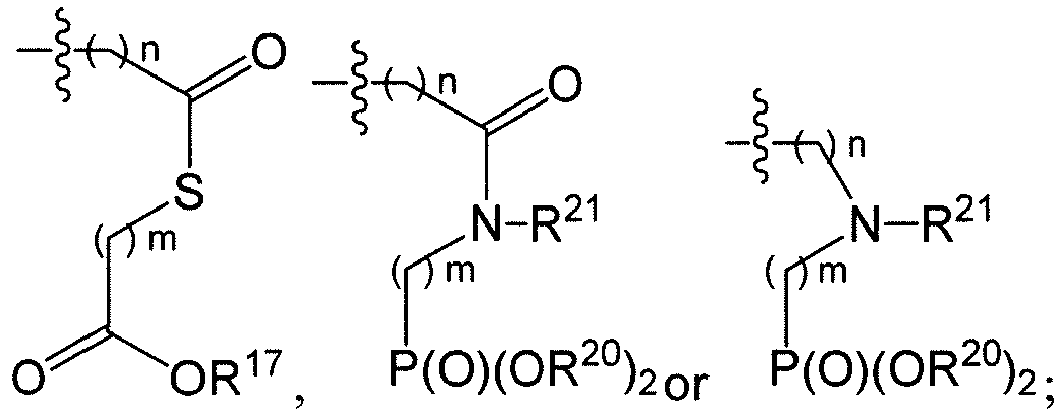
- R5 is optionally substituted C1-8alkyl or optionally substituted C3-8 cycloalkyl;
- R6 is halogen, hydrogen or optionally substituted C1-8alkyl;
- R7 is halogen, hydrogen or optionally substituted C1-8alkyl;
- R8 is halogen, hydrogen or optionally substituted C1-8alkyl;
- R9 is hydrogen, C(O)(C1-8alkyl) or optionally substituted C1-8alkyl;
- R15 is hydrogen, optionally substituted C1-8alkyl or O(C1-8alkyl);
- R17 is hydrogen, optionally substituted C6-10 aryl or optionally substituted C1-8alkyl;
- R18 is hydrogen, C(O)(C1-8alkyl), optionally substituted C 6-10 aryl or optionally substituted C1-8alkyl;
- R19 is hydrogen, C(O)(C1-8 alkyl), optionally substituted C6-10 aryl or optionally substituted C1-8alkyl;
- R20 is hydrogen, optionally substituted C6-10 aryl or optionally substituted C1-8alkyl;
- R21 is hydrogen, optionally substituted C6-10 aryl or optionally substituted C1-8alkyl;
- nis1,2,3,4,or5;and
- m is 1, 2, 3, 4, or 5.
- 5. A compound according to embodiment 1, wherein:
- R1 is halogen, hydrogen or optionally substituted C1-8alkyl;
- R2 is halogen, optionally substituted C1-8alkyl, CF3, SR15, OR9 or CN;
- R3 is hydrogen, optionally substituted C1-8alkyl, optionally substituted C3-8 cycloalkyl or optionally substituted C3-8 cycloalkenyl;
- R4 is optionally substituted C1-8alkyl,


- R5 is optionally substituted C1-8alkyl;
- R6 is halogen, hydrogen or optionally substituted C1-8alkyl;
- R7 is halogen, hydrogen or optionally substituted C1-8alkyl;
- R8 is halogen, hydrogen or optionally substituted C1-8alkyl;
- R9 is hydrogen, C(O)(C1-8alkyl) or optionally substituted C1-8alkyl;
- R15 is hydrogen, optionally substituted C1-8alkyl or O(C1-8alkyl);
- R17 is hydrogen, optionally substituted C6-10 aryl or optionally substituted C1-8alkyl;
- R18 is hydrogen, C(O)(C1-8 alkyl), optionally substituted C6-10 aryl or optionally substituted C1-8alkyl;
- R19 is hydrogen, C(O)(C1-8 alkyl), optionally substituted C6-10 aryl or optionally substituted C1-8alkyl;
- R20 is hydrogen, optionally substituted C6-10 aryl or optionally substituted C1-8alkyl;
- R21 is hydrogen, optionally substituted C6-10 aryl or optionally substituted C1-8alkyl;
- n is 1, 2, 3, 4, or 5; and
- m is 1, 2, 3, 4, or 5.
- 6. A compound according to embodiment 1, wherein:
- R1 is halogen, hydrogen or optionally substituted C1-8alkyl;
- R2 is halogen, optionally substituted C1-8alkyl, CF3, SR15, OR9 or CN;
- R3 is hydrogen;
- R4 is


- R5 is optionally substituted C1-8alkyl;
- R6 is halogen, hydrogen or optionally substituted C1-8alkyl;
- R7 is halogen, hydrogen or optionally substituted C1-8alkyl;
- R8 is halogen, hydrogen or optionally substituted C1-8alkyl;
- R9 is hydrogen, C(O)(C1-8alkyl) or optionally substituted C1-8alkyl;
- R15 is hydrogen, optionally substituted C1-8alkyl or O(C1-8alkyl);
- R17 is hydrogen, optionally substituted C 6-10 aryl or optionally substituted C1-8alkyl;
- R18 is hydrogen, C(O)(C1-8alkyl), optionally substituted C6-10 aryl or optionally substituted C1-8alkyl;
- R19 is hydrogen, C(O)(C1-8 alkyl), optionally substituted C6-10 aryl or optionally substituted C1-8alkyl;
- R20 is hydrogen, optionally substituted C6-10 aryl or optionally substituted C1-8alkyl;
- R21 is hydrogen, optionally substituted C6-10 aryl or optionally substituted C1-8alkyl;
- nis1,2,3,4,or5;and
- m is 1, 2, 3, 4, or 5.
- 7. A compound according to embodiment 1, wherein:
- R1 is halogen, hydrogen or optionally substituted C1-8alkyl;
- R2 is halogen, optionally substituted C1-8alkyl, SR15, CF3, OR9 or CN;
- R3 is hydrogen, optionally substituted C1-8alkyl, optionally substituted C3-8 cycloalkyl or optionally substituted C3-8 cycloalkenyl;
- R4 is optionally substituted C1-8alkyl;
- R5 is optionally substituted C1-8alkyl, optionally substituted C3-8 cycloalkyl, optionally substituted C3-8 cycloalkenyl, optionally substituted C6-10 aryl or optionally substituted heterocycle;
- R6 is halogen, hydrogen or optionally substituted C1-8alkyl;
- R7 is halogen, hydrogen or optionally substituted C1-8alkyl;
- R8 is halogen, hydrogen or optionally substituted C1-8alkyl;
- R9 is hydrogen, C(O)(C1-8 alkyl) or optionally substituted C1-8alkyl; and
- R15 is hydrogen, optionally substituted C1-8alkyl or O(C1-8alkyl).
- 8. A compound according to embodiment 1, wherein:
- R1 is halogen, hydrogen or optionally substituted C1-8alkyl;
- R2 is halogen, optionally substituted C1-8alkyl, SR15, CF3, OR9 or CN;
- R3 is hydrogen;
- R4 is



- R5 is optionally substituted C1-8alkyl;
- R6 is halogen, hydrogen or optionally substituted C1-8alkyl;
- R7 is halogen, hydrogen or optionally substituted C1-8 alkyl;
- R8 is halogen, hydrogen or optionally substituted C1-8alkyl;
- R9 is hydrogen, C(O)(C1-8alkyl) or optionally substituted C1-8alkyl;
- R15 is hydrogen, optionally substituted C1-8alkyl or O(C1-8alkyl);
- R17 is hydrogen, optionally substituted C 6-10 aryl or optionally substituted C1-8alkyl;
- R18 is hydrogen, C(O)(C1-8 alkyl), optionally substituted C6-10 aryl or optionally substituted C1-8alkyl;
- R19 is hydrogen, C(O)(C1-8alkyl), optionally substituted C6-10 aryl or optionally substituted C1-8alkyl;
- R20 is hydrogen, optionally substituted C6-10 aryl or optionally substituted C1-8alkyl;
- R21 is hydrogen, optionally substituted C6-10 aryl or optionally substituted C1-8alkyl;
- n is 1 or 2; and
- m is 1 or 2.
- 9. A compound according to embodiment 1, wherein:
- R1 is halogen, hydrogen or optionally substituted C1-8alkyl;
- R2 is halogen, optionally substituted C1-8alkyl, SR15, CF3, OR9 or CN;
- R3 is hydrogen, optionally substituted C1-8alkyl, optionally substituted C3-8 cycloalkyl, optionally substituted C3-8 cycloalkenyl, optionally substituted C 6-10 aryl or optionally substituted heterocycle;
- R4 together with R5 forms a spiro monocyclic or polycyclic, carbocyclic or heterocyclic, saturated or unsaturated 5 to 10 member ring which is optionally substituted;
- R5 together with R4 forms a spiro monocyclic or polycyclic carbocyclic or heterocyclic, saturated or unsaturated 5 to 10 member ring which is optionally substituted;
- R6 is halogen, hydrogen, optionally substituted C1-8alkyl;
- R7 is halogen, hydrogen, optionally substituted C1-8alkyl;
- R8 is halogen, hydrogen, optionally substituted C1-8alkyl;
- R9 is hydrogen or optionally substituted C1-8alkyl; and
- R15 is hydrogen, optionally substituted C1-8alkyl or O(C1-8alkyl).
- 10. A compound according to embodiment 1, wherein:
- R1 is halogen, hydrogen, optionally substituted C1-8alkyl;
- R2 is halogen, optionally substituted C1-8alkyl, SR15,CF3, OR9 or CN;
- R3 together with R5 forms a 5 or 6 member ring which is optionally substituted;
- R4 is hydrogen, optionally substituted C1-8alkyl, optionally substituted C3-8 cycloalkyl, optionally substituted C3-8 cycloalkenyl, optionally substituted C 6-10 aryl, optionally substituted heterocycle,
- R5 together with R3 forms a 5 or 6 member ring which is optionally substituted;
- R6 is halogen, hydrogen, optionally substituted C1-8alkyl;
- R7 is halogen, hydrogen, optionally substituted C1-8alkyl;
- R8 is halogen, hydrogen, optionally substituted C1-8alkyl;
- R9 is hydrogen or optionally substituted C1-8alkyl; and
- R15 is hydrogen, optionally substituted C1-8alkyl or O(C1-8alkyl).
- 11. A compound according to embodiment 1, wherein:
- R1 is halogen or hydrogen;
- R2 is halogen, optionally substituted C1-8alkyl, SR15, CF3, OR9 or CN;
- R3 is hydrogen;
- R4 is optionally substituted C1-8alkyl;
- R5 is optionally substituted C1-8alkyl;
- R6 is halogen or hydrogen;
- R7 is hydrogen;
- R8 is hydrogen;
- R9 is optionally substituted C1-8alkyl; and
- R15 is hydrogen, optionally substituted C1-8alkyl or O(C1-8alkyl).
- 12. A compound according to embodiment 1 selected from:
- 1-(4-Bromophenyl)-3-(4,4-diethyl-2,5-dioxoimidazolidin-1-yl)urea;
- 1-(4-Chlorophenyl)-3-(4,4-diethyl-2,5-dioxoimidazolidin-1-yl)urea;
- 1-(4-Methoxyphenyl)-3-(4,4-diethyl-2,5-dioxoimidazolidin-1-yl)urea;
- 1-(4-Ethylphenyl)-3-(4,4-diethyl-2,5-dioxoimidazolidin-1-yl)urea;
- 1-(4-Cyanophenyl)-3-(4,4-diethyl-2,5-dioxoimidazolidin-1-yl)urea;
- 1-(4-Bromo-2-fluorophenyl)-3-(4,4-diethyl-2,5-dioxoimidazolidin-1-yl)urea;
- 1-(4-Methylphenyl)-3-(4,4-diethyl-2,5-dioxoimidazolidin-1-yl)urea;
- 1-(4-Methylthiophenyl)-3-(4,4-diethyl-2,5-dioxoimidazolidin-1-yl)urea;
- 1-(4-Bromophenyl)-3-(4-methyl-2,5-dioxo-4-phenethylimidazolidin-1-yl)urea;
- 1-(4-Bromophenyl)-3-(2,4-dioxo-1,3-diazaspiro[4.4]nonan-3-yl)urea;
- 1-(4-Bromo-2-fluorophenyl)-3-(2,4-dioxo-1,3-diazaspiro[4.4]nonan-3-yl)urea;
- 1-(4-Bromophenyl)-3-(4,4-dimethyl-2,5-dioxoimidazolidin-1-yl)urea;
- 1-(4-Bromophenyl)-3-(2,5-dioxo-1',3'-dihydrospiro[imidazolidine-4,2'-inden]-1-yl)urea;
- 1-(4-Bromophenyl)-3-(2,4-dioxo-1,3-diazaspiro[4.5]decan-3-yl)urea;
- 1-(4-Bromo-2-fluorophenyl)-3-(2,4-dioxo-1,3-diazaspiro[4.5]decan-3-yl)urea;
- 1-(4-Chloro-2-fluorophenyl)-3-(4,4-diethyl-2,5-dioxoimidazolidin-1-yl)urea;
- 1-(4-Bromo-2-fluorophenyl)-3-(4-methyl-2,5-d ioxo-4-phenethylimidazolidin-1-yl)urea;
- 1-(4-Bromophenyl)-3-(4-ethyl-4-isopropyl-2,5-dioxoimidazolidin-1-yl)urea;
- 1-(4-Chloro-3-fluorophenyl)-3-(4,4-diethyl-2,5-dioxoimidazolidin-1-yl)urea;
- 1-(4-Bromo-2-fluorophenyl)-3-(4-ethyl-4-isopropyl-2,5-dioxoimidazolidin-1-yl)urea;
- 1-(2,4-Dioxo-1,3-diazaspiro[4,5]decan-3-yl)-3-(4-methoxypheynyl)urea;
- (S)-1-(4-Bromophenyl)-3-(1,3-dioxo-10,10a-dihydroimidazo[1,5-b]isoquinolin-2(1 H,3H,5H)-yl)urea;
- (S)-1-(4-Bromo-2-fluorophenyl)-3-(1,3-dioxo-10,10a-dihydroimidazo[1,5-b]isoquinolin-2(1 H,3H,5H)-yl)urea;
- 1-(4-Bromo-2-fluorophenyl)-3-(2,5-dioxo-1',3'-dihydrospiro[imidazolidine-4,2'-inden]-1-yl)urea;
- 1-(4-Bromophenyl)-3-(4-methyl-2,5-dioxo-4-(phenoxymethyl)imidazolidin-1-yl)urea;
- 1-(4-Bromo-2-fluorophenyl)-3-(2,5-dioxo-3',4'-dihydro-1'H-spiro[imidazolidine-4.2'naphthalen-1-yl)urea;
- 1-(4-Bromo-2-fluorophenyl)-3-(2,5-dioxo-3',4'-dihydro-1'H-spiro[imidazolidine-4.2'naphthalen-1-yl)urea;
- 1-(4-Bromo-2-fluorophenyl)-3-(4-methyl-2,5-dioxo-4-(phenoxymethyl)imidazolidin-1-yl)urea;
- 1-(4-Bromo-2-fluorophenyl)-3-(4-ethyl-2,5-dioxo-4-(phenethyl)imidazolidin-1-yl)urea;
- 1-(4-Bromophenyl)-3-(4-ethyl-2,5-dioxo-4-(phenethyl)imidazolidin-1-yl)urea;
- 1-(4-Bromophenyl)-3-(4-isobutyl-2,5-dioxo-4-phenethyl)imidazolidin-1-yl)urea;
- 1-(4-Bromo-2-fluorophenyl)-3-(4-isobutyl-2,5-dioxo-4-phenethyl)imidazolidin-1-yl)urea;
- 1-(4-Bromophenyl)-3-(4-(4-chlorophenethyl)-4-methyl-2,5-dioxoimidazolidin-1-yl)urea;
- 1-(4-Bromo-2-fluorophenyl)-3-(4-chlorophenethyl)-4-methyl-2,5-d ioxo-imidazolidin-1-yl)urea;
- 1-(4-Bromophenyl)-3-(4-(2-furan-2-yl)ethyl)-4-methyl-2,5-dioxoimidazolidin-1-yl)urea;
- 1-(4-Bromo-2-fluorophenyl)-3-(4-(2-furan-2-yl)ethyl)-4-methyl-2,5-dioxoimidazolidin-1-yl)urea;
- 1-(4-Bromophenyl)-3-(4-(2-fluorophenethyl)-4-methyl-2,5-dioxoimidazolidin-1-yl)urea;
- 1-(4-Bromo-2-fluorophenyl)-3-(4-(2-fluorophenethyl)-4-methyl-2,5-dioxoimidazolidin-1-yl)urea;
- 1-(4-Bromophenyl)-3-(4-(4-fluorophenethyl)-4-methyl-2,5-dioxoimidazolidin-1-yl)urea;
- 1-(4-Bromo-2-fluorophenyl)-3-(4-(4-fluorophenethyl)-4-methyl-2,5-dioxoimidazolidin-1-yl)urea;
- 1-(4-Bromophenyl)-3-(4-(3-fluorophenethyl)-4-methyl-2,5-dioxoimidazolidin-1-yl)urea;
- 1-(4-Bromophenyl)-3-(4-(4-hydroxyphenethyl)-4-methyl-2,5-dioxoimidazolidin-1-yl)urea;
- 1-(4-Bromophenyl)-3-(4-methyl-2, 5-dioxo-4-(2-thiophen-2-yl)ethyl)imidazolidin-1-yl)urea;
- 1-(4-Bromo-2-fluorophenyl)-3-(4-methyl-2,5-dioxo-4-(2-thiophen-2-yl)ethyl)imidazolidin-1-yl)urea;
- 1-(4-Bromo-2-fluorophenyl)-3-(4-(4-hydroxyphenethyl)-4-methyl-2,5-dioxoimidazolidin-1-yl)urea;
- 1-(4-Bromophenyl)-3-(4-methyl-4-(2-(5-methylfuran-2-yl)ethyl)2,5-dioxoimidazolidin-1-yl)urea;
- 1-(4-Bromophenyl)-3-(4-(3-fluoro-4-hydroxyphenethyl)-4-methyl-2,5-dioxoimidazolidin-1-yl)urea;
- 1-(4-Bromophenyl)-3-(4-(3-fluoro-4-hydroxyphenethyl)-4-methyl-2,5-dioxoimidazolidin-1-yl)urea;
- 1-(4-Bromophenyl)-3-(4-isopropyl-4-(2-((4-methoxybenzyl)oxy)ethyl)-2,5-dioxoimidazolidin-1-yl)urea;
- 1-(4-Bromophenyl)-3-(4-(2-hydroxyphenethyl)-4-methyl-2,5-dioxoimidazolidin-1-yl)urea;
- 1-(4-Bromo-2-fluorophenyl)-3-(4-(2-hydroxyphenethyl)-4-methyl-2,5-dioxoimidazolidin-1-yl)urea;
- 1-(4-Bromophenyl)-3-(4-(3-hydroxyphenethyl)-4-methyl-2,5-dioxoimidazolidin-1-yl)urea;
- 1-(4-Bromo-2-fluorophenyl)-3-(4-(3-hydroxyphenethyl)-4-methyl-2,5-dioxoimidazolidin-1-yl)urea;
- 1-(4-Bromophenyl)-3-(4-methyl-2,5-dioxo-4-(2-(pyridin-4-yl)ethyl)imidazolidin-1-yl)urea;
- 1-(4-Bromo-2-fluorophenyl)-3-(4-methyl-2,5-dioxo-4-(pyridin-4-yl)ethyl)imidazolidin-1-yl)urea;
- 1-(4-Bromophenyl)-3-(4-isopropyl-4-(((4-methoxybenzyl)oxy)methyl)-2,5-dioxoimidazolidin-1-yl)urea;
- 1-(4-Bromo-2-fluorophenyl)-3-(4-isopropyl-4-(((4-methoxybenzyl)oxy)methyl)-2,5-dioxoimidazolidin-1-yl)urea;
- Methyl 4-(2-(1-(3-(4-Bromophenyl)ureido)-4-methyl-2,5-dioxoimidazolidin-4-yl)ethyl)benzoate;
- Methyl 2-(2-(1-(3-(4-bromophenyl)ureido)-4-methyl-2,5-dioxoimidazolidin-4-yl)ethyl)benzoate;
- Methyl 2-(2-(1-(3-(4-bromophenyl)ureido)-4-ethyl-2,5-dioxoimidazolidin-4-yl)ethyl)benzoate;
- Methyl 2-(2-(1-(3-(4-bromo-2-fluorophenyl)ureido)-4-ethyl-2,5-dioxoimidazolidin-4-yl)ethyl)benzoate;
- Ethyl 2-(1-(3-(4-bromo-2-fluorophenyl)ureido)-4-isopropyl-2,5-dioxoimidazolidin-4-yl)acetate;
- Ethyl 2-(1-(3-(4-bromophenyl)ureido)-4-isopropyl-2,5-dioxoimidazolidin-4-yl)acetate;
- 1-(4-Bromophenyl)-3-[4-(1H-indol-3-ylmethyl)-4-methyl-2,5-dioxoimidazolidin-1-yl]urea;
- 1-(4-Bromo-2-fluorophenyl)-3-[4-(5-ethyl-1H-indol-2-yl)-4-methyl-2,5-dioxoimidazolidin-1-yl]urea;
- 1-(4-Bromophenyl)-3-(4,4-dicyclopropyl-2,5-dioxoimidazolidin-1-yl)urea;
- 1-(4-Bromophenyl)-3-[2,5-dioxo-4,4-di(propan-2-yl)imidazolidin-1-yl]urea;
- Ethyl-3-[1-{[(4-bromophenyl)carbamoyl]amino}-2,5-dioxo-4-(propan-2-yl)imidazolidin-4-yl]propanoate;
- 1-(4-Bromophenyl)-3-(4,4-dimethyl-2,5-dioxo-3-phenylimidazolidin-1-yl)urea;
- (-)-1-(4-Bromophenyl)-3-(4-methyl-2,5-dioxo-4-phenethylimidazolidin-1-yl)urea;
- (+)-1-(4-Bromophenyl)-3-(4-methyl-2,5-dioxo-4-phenethylimidazolidin-1-yl)urea ;
- (+)-1-(4-Bromophenyl)-3-(4-ethyl-4-isopropyl-2,5-dioxoimidazolidin-1-yl)urea ;
- (-)-1-(4-Bromophenyl)-3-(4-ethyl-4-isopropyl-2,5-dioxoimidazolidin-1-yl)urea;
- 1-(4-Bromophenyl)-3-(4-(hydroxymethyl)-4-isopropyl-2,5-dioxoimidazolidin-1-yl)urea;
- 1-(4-Bromophenyl)-3-(4-(2-hydroxyethyl)-4-isopropyl-2,5-dioxoimidazolidin-1-yl)urea;
- 1-(4-Bromo-2-fluorophenyl)-3-(4-(2-hyd roxymethyl)-4-isopropyl-2,5-dioxoimidazolidin-1-yl)urea;
- 4-(2-(1-(3-(4-Bromophenyl)ureido)-4-methyl-2,5-dioxoimidazolidin-4-yl)ethyl)benzoic acid;
- 2-(2-(1-(3-(4-Bromophenyl)ureido)-4-methyl-2,5-dioxoimidazolidin-4-yl)ethyl)benzoic acid;
- 2-(2-(1-(3-(4-Bromophenyl)ureido)-4-ethyl-2,5-dioxoimidazolidin-4-yl)ethyl)benzoic acid;
- Methyl 2-(2-(1-(3-(4-bromo-2-fluorophenyl)ureido)-4-ethyl-2,5-dioxoimidazolidin-4-yl)ethyl)benzoate;
- 2-(1-(3-(4-Bromophenyl)ureido)-4-isopropyl-2,5-dioxoimidazolidin-4-yl)acetic acid;
- 2-(1-(3-(4-Bromo-2-fluorophenyl)ureido)-4-isopropyl-2,5-dioxoimidazolidin-4-yl)acetic acid;
- 3-[1-{[(4-bromophenyl)carbamoyl]amino}-2,5-dioxo-4-(propan-2-yl)imidazolidin-4-yl]propanoic acid;
- 2-(1-(3-(4-Bromophenyl)ureido)-4-isopropyl-2,5-dioxoimidazolidin-4-yl)-N-(2-hydroxyethyl)acetamide;
- tert-Butyl 2-(2-(1-(3-(4-bromophenyl)ureido)-4-isopropyl-2,5-dioxoimidazolidin-4-yl)acetamido)acetate;
- Diethyl ((2-(1-(3-(4-bromophenyl)ureido)-4-isopropyl-2,5-dioxoimidazolidin-4-yl)acetamido)methyl)phosphonate;
- 2-(1-(3-(4-Bromophenyl)ureido)-4-isopropyl-2,5-dioxoimidazolidin-4-yl)-N,N-bis(2-hydroxyethyl)acetamide;
- Diisopropyl ((2-(1-(3-(4-bromophenyl)ureido)-4-isopropyl-2,5-dioxoimidazolidin-4-yl)acetamido)methyl)phosphonate;
- Ethyl hydrogen((2-(1-(3-(4-bromophenyl)ureido)-4-isopropyl-2,5-dioxoimidazolidin-4-yl)acetamido)methyl)phosphonate;
- tert-Butyl 2-(2-(1-(3-(4-bromophenyl)ureido)-4-isopropyl-2,5-dioxoimidazolidin-4-yl)acetamido)2-methylpropanoate;
- tert-Butyl 3-(2-(1-(3-(4-bromophenyl)ureido)-4-isopropyl-2,5-dioxoimidazolidin-4-yl)acetamido)propanoate;
- 2-(2-(1-(3-(4-Bromophenyl)ureido)-4-isopropyl-2,5-dioxoimidazolidin-4-yl)acetamido)acetic acid;
- 3-(2-(1-(3-(4-Bromophenyl)ureido)-4-isopropyl-2,5-dioxoimidazolidin-4-yl)acetamido)propanoic acid;
- 2-(1-(3-(4-Bromo-2-fluorophenyl)ureido)-4-isopropyl-2,5-dioxoimidazolidin-4-yl)-N-(2-hydroxyethyl)acetamide;
- 2-(2-(1-(3-(4-Bromophenyl)ureido)-4-isopropyl-2,5-dioxoimidazolidin-4-yl)acetamido)2-methylpropanoic acid; and
- N-(2-Amino-2-oxoethyl)-2-(1-(3-(4-bromophenyl)ureido)-4-isopropyl-2,5-dioxoimidazolidin-4-yl)acetamide.
- 13. A pharmaceutical composition comprising as active ingredient a therapeutically effective amount of a compound according to embodiment 1 and a pharmaceutically acceptable adjuvant, diluents or carrier.
- 14. A pharmaceutical composition according to embodiment 13 wherein the compound is selected from:
- 1-(4-Bromophenyl)-3-(4,4-diethyl-2,5-dioxoimidazolidin-1-yl)urea;
- 1-(4-Chlorophenyl)-3-(4,4-diethyl-2,5-dioxoimidazolidin-1-yl)urea;
- 1-(4-Methoxyphenyl)-3-(4,4-diethyl-2,5-dioxoimidazolidin-1-yl)urea;
- 1-(4-Ethylphenyl)-3-(4,4-diethyl-2,5-dioxoimidazolidin-1-yl)urea;
- 1-(4-Cyanophenyl)-3-(4,4-diethyl-2,5-dioxoimidazolidin-1-yl)urea;
- 1-(4-Bromo-2-fluorophenyl)-3-(4,4-diethyl-2,5-dioxoimidazolidin-1-yl)urea;
- 1-(4-Methylphenyl)-3-(4,4-diethyl-2,5-dioxoimidazolidin-1-yl)urea;
- 1-(4-Methylthiophenyl)-3-(4,4-diethyl-2,5-dioxoimidazolidin-1-yl)urea;
- 1-(4-Bromophenyl)-3-(4-methyl-2,5-dioxo-4-phenethylimidazolidin-1-yl)urea;
- 1-(4-Bromophenyl)-3-(2,4-dioxo-1,3-diazaspiro[4.4]nonan-3-yl)urea;
- 1-(4-Bromo-2-fluorophenyl)-3-(2,4-dioxo-1,3-diazaspiro[4.4]nonan-3-yl)urea;
- 1-(4-Bromophenyl)-3-(4,4-dimethyl-2,5-dioxoimidazolidin-1-yl)urea;
- 1-(4-Bromophenyl)-3-(2,5-dioxo-1',3'-dihydrospiro[imidazolidine-4,2'-inden]-1-yl)urea;
- 1-(4-Bromophenyl)-3-(2,4-dioxo-1,3-diazaspiro[4.5]decan-3-yl)urea;
- 1-(4-Bromo-2-fluorophenyl)-3-(2,4-dioxo-1,3-diazaspiro[4.5]decan-3-yl)urea;
- 1-(4-Chloro-2-fluorophenyl)-3-(4,4-diethyl-2,5-dioxoimidazolidin-1-yl)urea;
- 1-(4-Bromo-2-fluorophenyl)-3-(4-methyl-2,5-dioxo-4-phenethylimidazolidin-1-yl)urea;
- 1-(4-Bromophenyl)-3-(4-ethyl-4-isopropyl-2,5-dioxoimidazolidin-1-yl)urea;
- 1-(4-Chloro-3-fluorophenyl)-3-(4,4-diethyl-2,5-dioxoimidazolidin-1-yl)urea;
- 1-(4-Bromo-2-fluorophenyl)-3-(4-ethyl-4-isopropyl-2,5-dioxoimidazolidin-1-yl)urea;
- 1-(2,4-Dioxo-1,3-diazaspiro[4,5]decan-3-yl)-3-(4-methoxypheynyl)urea;
- (S)-1-(4-Bromophenyl)-3-(1,3-dioxo-10,10a-dihydroimidazo[1,5-b]isoquinolin-2(1 H,3H,5H)-yl)urea;
- (S)-1-(4-Bromo-2-fluorophenyl)-3-(1,3-dioxo-10,10a-dihydroimidazo[1,5-b]isoquinolin-2(1 H,3H,5H)-yl)urea;
- 1-(4-Bromo-2-fluorophenyl)-3-(2,5-dioxo-1',3'-dihydrospiro[imidazolidine-4,2'-inden]-1-yl)urea;
- 1-(4-Bromophenyl)-3-(4-methyl-2,5-dioxo-4-(phenoxymethyl)imidazolidin-1-yl)urea;
- 1-(4-Bromo-2-fluorophenyl)-3-(2,5-dioxo-3',4'-dihydro-1'H-spiro[imidazolidine-4.2'naphthalen-1-yl)urea;
- 1-(4-Bromo-2-fluorophenyl)-3-(2,5-dioxo-3',4'-dihydro-1'H-spiro[imidazolidine-4.2'naphthalen-1-yl)urea;
- 1-(4-Bromo-2-fluorophenyl)-3-(4-methyl-2,5-dioxo-4-(phenoxymethyl)imidazolidin-1-yl)urea;
- 1-(4-Bromo-2-fluorophenyl)-3-(4-ethyl-2,5-dioxo-4-(phenethyl)imidazolidin-1-yl)urea;
- 1-(4-Bromophenyl)-3-(4-ethyl-2,5-dioxo-4-(phenethyl)imidazolidin-1-yl)urea;
- 1-(4-Bromophenyl)-3-(4-isobutyl-2,5-dioxo-4-phenethyl)imidazolidin-1-yl)urea;
- 1-(4-Bromo-2-fluorophenyl)-3-(4-isobutyl-2,5-dioxo-4-phenethyl)imidazolidin-1-yl)urea;
- 1-(4-Bromophenyl)-3-(4-(4-chlorophenethyl)-4-methyl-2,5-dioxoimidazolidin-1-yl)urea;
- 1-(4-Bromo-2-fluorophenyl)-3-(4-chlorophenethyl)-4-methyl-2,5-dioxo-imidazolidin-1-yl)urea;
- 1-(4-Bromophenyl)-3-(4-(2-furan-2-yl)ethyl)-4-methyl-2,5-dioxoimidazolidin-1-yl)urea;
- 1-(4-Bromo-2-fluorophenyl)-3-(4-(2-furan-2-yl)ethyl)-4-methyl-2,5-dioxoimidazolidin-1-yl)urea;
- 1-(4-Bromophenyl)-3-(4-(2-fluorophenethyl)-4-methyl-2,5-dioxoimidazolidin-1-yl)urea; 1-(4-Bromo-2-fluorophenyl)-3-(4-(2-fluorophenethyl)-4-methyl-2,5-dioxoimidazolidin-1-yl)urea;
- 1-(4-Bromophenyl)-3-(4-(4-fluorophenethyl)-4-methyl-2,5-dioxoimidazolidin-1-yl)urea;
- 1-(4-Bromo-2-fluorophenyl)-3-(4-(4-fluorophenethyl)-4-methyl-2,5-dioxoimidazolidin-1-yl)urea;
- 1-(4-Bromophenyl)-3-(4-(3-fluorophenethyl)-4-methyl-2,5-dioxoimidazolidin-1-yl)urea;
- 1-(4-Bromophenyl)-3-(4-(4-hydroxyphenethyl)-4-methyl-2,5-dioxoimidazolidin-1-yl)urea;
- 1-(4-Bromophenyl)-3-(4-methyl-2,5-dioxo-4-(2-thiophen-2-yl)ethyl)imidazolidin-1-yl)urea;
- 1-(4-Bromo-2-fluorophenyl)-3-(4-methyl-2,5-dioxo-4-(2-thiophen-2-yl)ethyl)imidazolidin-1-yl)urea;
- 1-(4-Bromo-2-fluorophenyl)-3-(4-(4-hydroxyphenethyl)-4-methyl-2,5-dioxoimidazolidin-1-yl)urea;
- 1-(4-Bromophenyl)-3-(4-methyl-4-(2-(5-methylfuran-2-yl)ethyl)2,5-dioxoimidazolidin-1-yl)urea;
- 1-(4-Bromophenyl)-3-(4-(3-fluoro-4-hydroxyphenethyl)-4-methyl-2,5-dioxoimidazolidin-1-yl)urea;
- 1-(4-Bromophenyl)-3-(4-(3-fluoro-4-hydroxyphenethyl)-4-methyl-2,5-dioxoimidazolidin-1-yl)urea;
- 1-(4-Bromophenyl)-3-(4-isopropyl-4-(2-((4-methoxybenzyl)oxy)ethyl)-2,5-dioxoimidazolidin-1-yl)urea;
- 1-(4-Bromophenyl)-3-(4-(2-hydroxyphenethyl)-4-methyl-2,5-dioxoimidazolidin-1-yl)urea;
- 1-(4-Bromo-2-fluorophenyl)-3-(4-(2-hydroxyphenethyl)-4-methyl-2,5-dioxoimidazolidin-1-yl)urea;
- 1-(4-Bromophenyl)-3-(4-(3-hydroxyphenethyl)-4-methyl-2,5-dioxoimidazolidin-1-yl)urea;
- 1-(4-Bromo-2-fluorophenyl)-3-(4-(3-hydroxyphenethyl)-4-methyl-2,5-dioxoimidazolidin-1-yl)urea;
- 1-(4-Bromophenyl)-3-(4-methyl-2,5-dioxo-4-(2-(pyridin-4-yl)ethyl)imidazolidin-1-yl)urea;
- 1-(4-Bromo-2-fluorophenyl)-3-(4-methyl-2,5-d ioxo-4-(pyridin-4-yl)ethyl)imidazolidin-1-yl)urea;
- 1-(4-Bromophenyl)-3-(4-isopropyl-4-(((4-methoxybenzyl)oxy)methyl)-2,5-dioxoimidazolidin-1-yl)urea;
- 1-(4-Bromo-2-fluorophenyl)-3-(4-isopropyl-4-(((4-methoxybenzyl)oxy)methyl)-2,5-dioxoimidazolidin-1-yl)urea;
- Methyl 4-(2-(1-(3-(4-Bromophenyl)ureido)-4-methyl-2,5-dioxoimidazolidin-4-yl)ethyl)benzoate;
- Methyl 2-(2-(1-(3-(4-bromophenyl)ureido)-4-methyl-2,5-dioxoimidazolidin-4-yl)ethyl)benzoate;
- Methyl 2-(2-(1-(3-(4-bromophenyl)ureido)-4-ethyl-2,5-dioxoimidazolidin-4-yl)ethyl)benzoate;
- Methyl 2-(2-(1-(3-(4-bromo-2-fluorophenyl)ureido)-4-ethyl-2,5-dioxoimidazolidin-4-yl)ethyl)benzoate;
- Ethyl 2-(1-(3-(4-bromo-2-fluorophenyl)ureido)-4-isopropyl-2,5-dioxoimidazolidin-4-yl)acetate;
- Ethyl 2-(1-(3-(4-bromophenyl)ureido)-4-isopropyl-2,5-dioxoimidazolidin-4-yl)acetate;
- 1-(4-Bromophenyl)-3-[4-(1H-indol-3-ylmethyl)-4-methyl-2,5-dioxoimidazolidin-1-yl]urea;
- 1-(4-Bromo-2-fluorophenyl)-3-[4-(5-ethyl-1 H-indol-2-yl)-4-methyl-2,5-dioxoimidazolidin-1-yl]urea;
- 1-(4-Bromophenyl)-3-(4,4-dicyclopropyl-2,5-dioxoimidazolidin-1-yl)urea;
- 1-(4-Bromophenyl)-3-[2,5-dioxo-4,4-di(propan-2-yl)imidazolidin-1-yl]urea;
- Ethyl-3-[1-{[(4-bromophenyl)carbamoyl]amino}-2,5-dioxo-4-(propan-2-yl)imidazolidin-4-yl]propanoate;
- 1-(4-Bromophenyl)-3-(4,4-dimethyl-2,5-dioxo-3-phenylimidazolidin-1-yl)urea;
- (-)-1-(4-Bromophenyl)-3-(4-methyl-2,5-dioxo-4-phenethylimidazolidin-1-yl)urea;
- (+)-1-(4-Bromophenyl)-3-(4-methyl-2,5-dioxo-4-phenethylimidazolidin-1-yl)urea ;
- (+)-1-(4-Bromophenyl)-3-(4-ethyl-4-isopropyl-2,5-dioxoimidazolidin-1-yl)urea ;
- (-)-1-(4-Bromophenyl)-3-(4-ethyl-4-isopropyl-2,5-dioxoimidazolidin-1-yl)urea;
- 1-(4-Bromophenyl)-3-(4-(hydroxymethyl)-4-isopropyl-2,5-dioxoimidazolidin-1-yl)urea;
- 1-(4-Bromophenyl)-3-(4-(2-hydroxyethyl)-4-isopropyl-2,5-dioxoimidazolidin-1-yl)urea;
- 1-(4-Bromo-2-fluorophenyl)-3-(4-(2-hydroxymethyl)-4-isopropyl-2,5-dioxoimidazolidin-1-yl)urea;
- 4-(2-(1-(3-(4-Bromophenyl)ureido)-4-methyl-2,5-dioxoimidazolidin-4-yl)ethyl)benzoic acid;
- 2-(2-(1-(3-(4-Bromophenyl)ureido)-4-methyl-2,5-dioxoimidazolidin-4-yl)ethyl)benzoic acid;
- 2-(2-(1-(3-(4-Bromophenyl)ureido)-4-ethyl-2,5-dioxoimidazolidin-4-yl)ethyl)benzoic acid;
- Methyl 2-(2-(1-(3-(4-bromo-2-fluorophenyl)ureido)-4-ethyl-2,5-dioxoimidazolidin-4-yl)ethyl)benzoate;
- 2-(1-(3-(4-Bromophenyl)ureido)-4-isopropyl-2,5-dioxoimidazolidin-4-yl)acetic acid;
- 2-(1-(3-(4-Bromo-2-fluorophenyl)ureido)-4-isopropyl-2,5-dioxoimidazolidin-4-yl)acetic acid;
- 3-[1-{[(4-bromophenyl)carbamoyl]amino}-2,5-dioxo-4-(propan-2-yl)imidazolidin-4-yl]propanoic acid;
- 2-(1-(3-(4-Bromophenyl)ureido)-4-isopropyl-2,5-dioxoimidazolidin-4-yl)-N-(2-hydroxyethyl)acetamide;
- tert-Butyl 2-(2-(1-(3-(4-bromophenyl)ureido)-4-isopropyl-2,5-dioxoimidazolidin-4-yl)acetamido)acetate;
- Diethyl ((2-(1-(3-(4-bromophenyl)ureido)-4-isopropyl-2,5-dioxoimidazolidin-4-yl)acetamido)methyl)phosphonate;
- 2-(1-(3-(4-Bromophenyl)ureido)-4-isopropyl-2,5-dioxoimidazolidin-4-yl)-N,N-bis(2-hydroxyethyl)acetamide;
- Diisopropyl ((2-(1-(3-(4-bromophenyl)ureido)-4-isopropyl-2,5-dioxoimidazolidin-4-yl)acetamido)methyl)phosphonate;
- Ethyl hydrogen((2-(1-(3-(4-bromophenyl)ureido)-4-isopropyl-2,5-dioxoimidazolidin-4-yl)acetamido)methyl)phosphonate;
- tert-Butyl 2-(2-(1-(3-(4-bromophenyl)ureido)-4-isopropyl-2,5-dioxoimidazolidin-4-yl)acetamido)2-methylpropanoate;
- tert-Butyl 3-(2-(1-(3-(4-bromophenyl)ureido)-4-isopropyl-2,5-dioxoimidazolidin-4-yl)acetamido)propanoate;
- 2-(2-(1-(3-(4-Bromophenyl)ureido)-4-isopropyl-2,5-dioxoimidazolidin-4-yl)acetamido)acetic acid;
- 3-(2-(1-(3-(4-Bromophenyl)ureido)-4-isopropyl-2,5-dioxoimidazolidin-4-yl)acetamido)propanoic acid;
- 2-(1-(3-(4-Bromo-2-fluorophenyl)ureido)-4-isopropyl-2,5-dioxoimidazolidin-4-yl)-N-(2-hydroxyethyl)acetamide;
- 2-(2-(1-(3-(4-Bromophenyl)ureido)-4-isopropyl-2,5-dioxoimidazolidin-4-yl)acetamido)2-methylpropanoic acid; and
- N-(2-Amino-2-oxoethyl)-2-(1-(3-(4-bromophenyl)ureido)-4-isopropyl-2,5-dioxoimidazolidin-4-yl)acetamide.

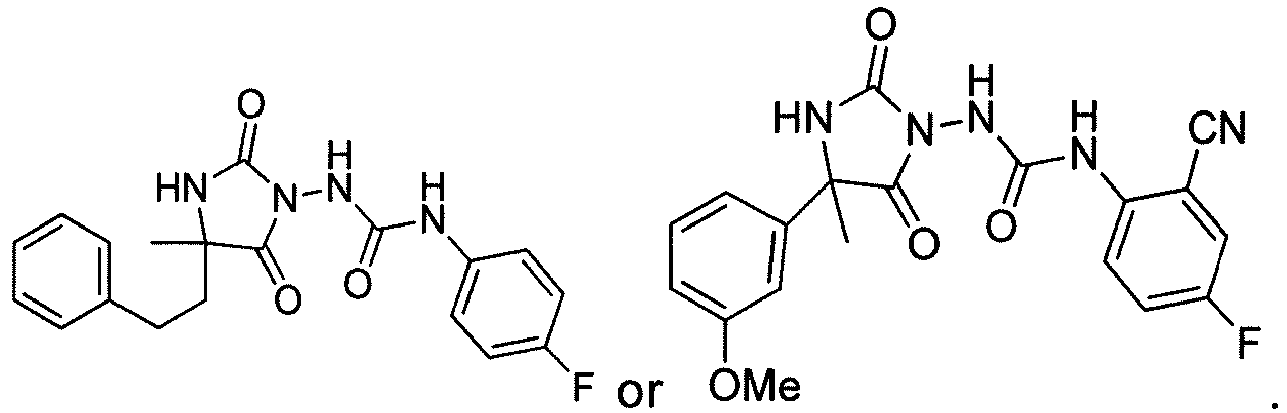


Claims (15)
- A compound represented by the following Formula I or a pharmaceutically-acceptable salt thereof; or a pharmaceutical composition comprising as active ingredient a therapeutically effective amount of said compound or said pharmaceutically acceptable salt thereof, and a pharmaceutically acceptable adjuvant, diluents or carrier; for use in treating a disorder associated with modulation of the N-formyl peptide receptor like-1 receptor:
 R1 is hydrogen or halogen;R2 is halogen, unsubstituted C1-8alkyl, CF3, OR9, CN or SR15;R3 is hydrogen, unsubstituted C6-10aryl, or together with R5 forms a 5- or 6-membered ring;R4 is hydrogen, optionally substituted C1-8alkyl,


 R5 is hydrogen, optionally substituted C1-8alkyl, optionally substituted C3-8 cycloalkyl, optionally substituted C3-8 cycloalkenyl, optionally substituted C6-10aryl, optionally substituted heterocycle, or together with R4 forms a spiro monocyclic or polycyclic, carbocyclic or heterocyclic, saturated or unsaturated 5- to 10-membered ring, or together with R3 forms a 5- or 6-membered ring;R6 is hydrogen or halogen;R7 is hydrogen or halogen;R8 is hydrogen or halogen;R9 is unsubstituted C1-8alkyl;R10 is hydrogen, optionally substituted C1-8alkyl, O(C1-8alkyl), NR11R12 or OH;R11 is hydrogen, optionally substituted C6-10aryl or optionally substituted C1-8 alkyl;R12 is hydrogen, optionally substituted C6-10aryl or optionally substituted C1-8 alkyl;R13 is hydrogen, optionally substituted C6-10aryl or optionally substituted C1-8 alkyl;R14 is hydrogen, optionally substituted C6-10aryl, optionally substituted C1-8 alkyl, C(O)(C1-8alkyl) or SO2(C1-8alkyl);R15 is unsubstituted C1-8alkyl;R16 is OH, O(C1-8alkyl), C1-8alkyl or NR11R12;R17 is hydrogen, optionally substituted C6-10aryl or optionally substituted C1-8 alkyl;R18 is hydrogen, C(O)(C1-8alkyl), optionally substituted C6-10aryl or optionally substituted C1-8alkyl;R19 is hydrogen, C(O)(C1-8alkyl), optionally substituted C6-10aryl or optionally substituted C1-8alkyl;R20 is hydrogen, optionally substituted C6-10aryl or optionally substituted C1-8 alkyl;R21 is hydrogen, optionally substituted C6-10aryl or optionally substituted C1-8 alkyl;the optional substituents of the C1-8alkyl groups are selected from halogen, hydroxyl, C3-8 cycloalkyl, amino, heterocycle, optionally substituted aryl, carboxylic acid, phosphonic acid, phosphonate, sulphonic acid, phosphoric acid, nitro, amide, ester, ether, ketone and sulfonamide;the optional substituents of the (C6-10)aryl groups are selected from halogen, sulfonyl(C1-6alkyl), sulfoxide(C1-6alkyl), sulfonamide, carboxylic acid, C1-6alkyl carboxylate (ester), amide, nitro, cyano, -OC1-6alkyl, SH, -SC1-6alkyl, C1-6alkyl, C2-6 alkenyl, C2-6alkynyl, ether, ketone, aldehyde, sulfonamide, alkylamino, ester, amino, aryl, C3-8 cycloalkyl and hydroxyl;the optional substituents of the C3-8 cycloalkyl groups are selected from halogen, sulfonyl(C1-8 alkyl), sulfoxide(C1-8alkyl), sulfonamide, nitro, cyano, -OC1-6 alkyl, SH, -SC1-6alkyl, C1-6alkyl, C2-6alkenyl, C2-6alkynyl, amide, ester, ether, ketone, alkylamino, amino, aryl, C3-8 cycloalkyl and hydroxyl;the optional substituents of the C3-8 cycloalkenyl groups are selected from halogen, sulfonyl, sulfoxide, nitro, cyano, -OC1-6alkyl, -SC1-6alkyl, C1-6alkyl, C2-6 alkenyl, C2-6alkynyl, ketone, alkylamino, amide, ester, ether, amino, aryl, sulfonamide, C3-8 cycloalkyl and hydroxyl;the optional substituents of the heterocyles are selected from halogen, sulfonyl sulfoxide, sulfonamide, nitro, cyano, -OC1-6alkyl, -SC1-6alkyl, C1-6alkyl, C2-6 alkenyl, C2-6alkynyl, ketone, alkylamino, amino, aryl, amide, ester, ether, C3-8 cycloalkyl and hydroxyl;m is 1, 2, 3, 4 or 5; andn is 1, 2, 3, 4 or 5;with the proviso that the compound of Formula I is not one of the following compounds:

- The compound or the pharmaceutical composition for use according to claim 1, wherein:R4 is optionally substituted C1-8alkyl, optionally substituted C3-8 cycloalkyl, optionally substituted C3-8 cycloalkenyl, optionally substituted C6-10aryl or optionally substituted heterocycle; andR5 is optionally substituted C1-8alkyl, optionally substituted C3-8 cycloalkyl, optionally substituted C3-8 cycloalkenyl, optionally substituted C6-10aryl or optionally substituted heterocycle.
- The compound or the pharmaceutical composition for use according to any one of claims 1-2, wherein:R4 is optionally substituted C1-8alkyl, optionally substituted C6-10aryl,


- The compound or the pharmaceutical composition for use according to any one of claims 1-3, wherein:R3 is hydrogen;R4 is optionally substituted C1-8alkyl, optionally substituted C6-10aryl,


R5 is optionally substituted C1-8alkyl or optionally substituted C3-8 cycloalkyl; - The compound or the pharmaceutical composition for use according to any one of claims 1-4, wherein:R3 is hydrogen;R4 is


- The compound or the pharmaceutical composition for use according to any one of claims 1-5, wherein:R3 is hydrogen;R4 is


 R5 is optionally substituted C1-8alkyl;m is 1 or 2; andn is 1 or 2.
 - The compound or the pharmaceutical composition for use according to any one of claims 1-6, wherein:R3 together with R5 forms a 5- or 6-membered ring; andR4 is hydrogen, optionally substituted C1-8alkyl, optionally substituted C3-8 cycloalkyl, optionally substituted C3-8 cycloalkenyl, optionally substituted C6-10aryl or optionally substituted heterocycle.
- The compound or the pharmaceutical composition for use according to any one of claims 1-7, wherein:R3 is hydrogen;R4 is optionally substituted C1-8alkyl;R5 is optionally substituted C1-8alkyl;R7 is hydrogen; andR8 is hydrogen.
- The compound or pharmaceutical composition for use according to any one of claims 1-8, wherein the compound is selected from the following compounds or a pharmaceutically-acceptable salt thereof:1-(4-bromophenyl)-3-(4,4-diethyl-2,5-dioxoimidazolidin-1-yl)urea;1-(4-chlorophenyl)-3-(4,4-diethyl-2,5-dioxoimidazolidin-1-yl)urea;1-(4-methoxyphenyl)-3-(4,4-diethyl-2,5-dioxoimidazolidin-1-yl)urea;1-(4-ethylphenyl)-3-(4,4-diethyl-2,5-dioxoimidazolidin-1-yl)urea;1-(4-cyanophenyl)-3-(4,4-diethyl-2,5-dioxoimidazolidin-1-yl)urea;1-(4-bromo-2-fluorophenyl)-3-(4,4-diethyl-2,5-dioxoimidazolidin-1-yl)urea;1-(4-methylphenyl)-3-(4,4-diethyl-2,5-dioxoimidazolidin-1-yl)urea;1-(4-methylthiophenyl)-3-(4,4-diethyl-2,5-dioxoimidazolidin-1-yl)urea;1-(4-bromophenyl)-3-(4-methyl-2,5-dioxo-4-phenethylimidazolidin-1-yl)urea;1-(4-bromophenyl)-3-(2,4-dioxo-1,3-diazaspiro[4.4]nonan-3-yl)urea;1-(4-bromo-2-fluorophenyl)-3-(2,4-dioxo-1,3-diazaspiro[4.4]nonan-3-yl)urea;1-(4-bromophenyl)-3-(4,4-dimethyl-2,5-dioxoimidazolidin-1-yl)urea;1-(4-bromophenyl)-3-(2,5-dioxo-1',3'-dihydrospiro[imidazoli dine-4,2'-inden]-1-yl)urea;1-(4-bromophenyl)-3-(2,4-dioxo-1,3-diazaspiro[4.5]decan-3-yl)urea;1-(4-bromo-2-fluorophenyl)-3-(2,4-dioxo-1,3-diazaspiro[4.5]decan-3-yl)urea;1-(4-chloro-2-fluorophenyl)-3-(4,4-diethyl-2,5-dioxoimidazolidin-1-yl)urea;1-(4-bromo-2-fluorophenyl)-3-(4-methyl-2,5-dioxo-4-phenethylimidazolidin-1-yl)urea;1-(4-bromophenyl)-3-(4-ethyl-4-isopropyl-2,5-dioxoimidazolidin-1-yl)urea;1-(4-chloro-3-fluorophenyl)-3-(4,4-diethyl-2,5-dioxoimidazolidin-1-yl)urea;1-(4-bromo-2-fluorophenyl)-3-(4-ethyl-4-isopropyl-2,5-dioxoimidazolidin-1-yl)urea;1-(2,4-dioxo-1,3-diazaspiro[4,5]decan-3-yl)-3-(4-methoxypheynyl)urea;(S)-1-(4-bromophenyl)-3-(1,3-dioxo-10,10a-dihydroimidazo[1,5-b]isoquinolin-2(1 H,3H,5H)-yl)urea;(S)-1-(4-bromo-2-fluorophenyl)-3-(1,3-dioxo-10,10a-dihydroimidazo[1,5-b]isoquinolin-2(1 H,3H,5H)-yl)urea;1-(4-bromo-2-fluorophenyl)-3-(2,5-dioxo-1',3'-dihydrospiro[imidazolidine-4,2'-inden]-1-yl)urea;1-(4-bromophenyl)-3-(4-methyl-2,5-dioxo-4-(phenoxymethyl)imidazolidin-1-yl)urea;1-(4-bromo-2-fluorophenyl)-3-(2,5-dioxo-3',4'-dihydro-1'H-spiro[imidazolidine-4.2'naphthalen-1-yl)urea;1-(4-bromo-2-fluorophenyl)-3-(2,5-dioxo-3',4'-dihydro-1'H-spiro[imidazolidine-4.2'naphthalen-1-yl)urea;1-(4-bromo-2-fluorophenyl)-3-(4-methyl-2,5-dioxo-4-(phenoxymethyl)imidazolidin-1-yl)urea;1-(4-bromo-2-fluorophenyl)-3-(4-ethyl-2,5-dioxo-4-(phenethyl)imidazolidin-1-yl)urea;1-(4-bromophenyl)-3-(4-ethyl-2,5-dioxo-4-(phenethyl)imidazolidin-1-yl)urea;1-(4-bromophenyl)-3-(4-isobutyl-2,5-dioxo-4-phenethyl)imidazolidin-1-yl)urea;1-(4-bromo-2-fluorophenyl)-3-(4-isobutyl-2,5-dioxo-4-phenethyl)imidazolidin-1-yl)urea;1-(4-bromophenyl)-3-(4-(4-chlorophenethyl)-4-methyl-2,5-dioxoimidazolidin-1-yl)urea;1-(4-bromo-2-fluorophenyl)-3-(4-chlorophenethyl)-4-methyl-2,5-d ioxo-imidazolidin-1-yl)urea;1-(4-bromophenyl)-3-(4-(2-furan-2-yl)ethyl)-4-methyl-2,5-dioxoimidazolid in-1-yl)urea;1-(4-bromo-2-fluorophenyl)-3-(4-(2-furan-2-yl)ethyl)-4-methyl-2,5-dioxoimidazolidin-1-yl)urea;1-(4-bromophenyl)-3-(4-(2-fluorophenethyl)-4-methyl-2,5-dioxoimidazolidin-1-yl)urea;1-(4-bromo-2-fluorophenyl)-3-(4-(2-fluorophenethyl)-4-methyl-2,5-dioxoimidazolidin-1-yl)urea;1-(4-bromophenyl)-3-(4-(4-fluorophenethyl)-4-methyl-2,5-dioxoimidazolidin-1-yl)urea;1-(4-bromo-2-fluorophenyl)-3-(4-(4-fluorophenethyl)-4-methyl-2,5-dioxoimidazolidin-1-yl)urea;1-(4-bromophenyl)-3-(4-(3-fluorophenethyl)-4-methyl-2,5-dioxoimidazolidin-1-yl)urea;1-(4-bromophenyl)-3-(4-(4-hydroxyphenethyl)-4-methyl-2,5-dioxoimidazolidin-1-yl)urea;1-(4-bromophenyl)-3-(4-methyl-2,5-dioxo-4-(2-thiophen-2-yl)ethyl)imidazolidin-1-yl)urea;1-(4-bromo-2-fluorophenyl)-3-(4-methyl-2,5-dioxo-4-(2-thiophen-2-yl)ethyl)imidazolidin-1-yl)urea;1-(4-bromo-2-fluorophenyl)-3-(4-(4-hydroxyphenethyl)-4-methyl-2,5-dioxoimidazolidin-1-yl)urea;1-(4-bromophenyl)-3-(4-methyl-4-(2-(5-methylfuran-2-yl)ethyl)2,5-dioxoimidazolidin-1-yl)urea;1-(4-bromophenyl)-3-(4-(3-fluoro-4-hydroxyphenethyl)-4-methyl-2,5-dioxoimidazolidin-1-yl)urea;1-(4-bromophenyl)-3-(4-(3-fluoro-4-hydroxyphenethyl)-4-methyl-2,5-dioxoimidazolidin-1-yl)urea;1-(4-bromophenyl)-3-(4-isopropyl-4-(2-((4-methoxybenzyl)oxy)ethyl)-2,5-dioxoimidazolidin-1-yl)urea;1-(4-bromophenyl)-3-(4-(2-hydroxyphenethyl)-4-methyl-2,5-dioxoimidazolidin-1-yl)urea;1-(4-bromo-2-fluorophenyl)-3-(4-(2-hydroxyphenethyl)-4-methyl-2,5-dioxoimidazolidin-1-yl)urea;1-(4-bromophenyl)-3-(4-(3-hydroxyphenethyl)-4-methyl-2,5-dioxoimidazolidin-1-yl)urea;1-(4-bromo-2-fluorophenyl)-3-(4-(3-hydroxyphenethyl)-4-methyl-2,5-dioxoimidazolidin-1-yl)urea;1-(4-bromophenyl)-3-(4-methyl-2,5-dioxo-4-(2-(pyridin-4-yl)ethyl)imidazolidin-1-yl)urea;1-(4-bromo-2-fluorophenyl)-3-(4-methyl-2,5-dioxo-4-(pyridin-4-yl)ethyl)imidazolidin-1-yl)urea;1-(4-bromophenyl)-3-(4-isopropyl-4-(((4-methoxybenzyl)oxy)methyl)-2,5-dioxoimidazolidin-1-yl)urea;1-(4-bromo-2-fluorophenyl)-3-(4-isopropyl-4-(((4-methoxybenzyl)oxy)methyl)-2,5-dioxoimidazolidin-1-yl)urea;methyl 4-(2-(1-(3-(4-bromophenyl)ureido)-4-methyl-2,5-dioxoimidazolidin-4-yl)ethyl)benzoate;methyl 2-(2-(1-(3-(4-bromophenyl)ureido)-4-methyl-2,5-dioxoimidazolidin-4-yl)ethyl)benzoate;methyl 2-(2-(1-(3-(4-bromophenyl)ureido)-4-ethyl-2,5-dioxoimidazolidin-4-yl)ethyl)benzoate;methyl 2-(2-(1-(3-(4-bromo-2-fluorophenyl)ureido)-4-ethyl-2,5-dioxoimidazolidin-4-yl)ethyl)benzoate;ethyl 2-(1-(3-(4-bromo-2-fluorophenyl)ureido)-4-isopropyl-2,5-dioxoimidazolidin-4-yl)acetate;ethyl 2-(1-(3-(4-bromophenyl)ureido)-4-isopropyl-2,5-dioxoimidazolidin-4-yl)acetate;1-(4-bromophenyl)-3-[4-(1H-indol-3-ylmethyl)-4-methyl-2,5-dioxoimidazolidin-1-yl]urea;1-(4-bromo-2-fluorophenyl)-3-[4-(5-ethyl-1H-indol-2-yl)-4-methyl-2,5-dioxoimidazolidin-1-yl]urea;1-(4-bromophenyl)-3-(4,4-dicyclopropyl-2,5-dioxoimidazolidin-1-yl)urea;1-(4-bromophenyl)-3-[2,5-dioxo-4,4-di(propan-2-yl)imidazolidin-1-yl]urea;ethyl-3-[1-{[(4-bromophenyl)carbamoyl]amino}-2,5-dioxo-4-(propan-2-yl)imidazolidin-4-yl]propanoate;1-(4-bromophenyl)-3-(4,4-dimethyl-2,5-dioxo-3-phenylimidazolidin-1-yl)urea;(-)-1-(4-bromophenyl)-3-(4-methyl-2,5-dioxo-4-phenethylimidazolidin-1-yl)urea;(+)-1-(4-bromophenyl)-3-(4-methyl-2,5-dioxo-4-phenethylimidazolidin-1-yl)urea;(+)-1-(4-bromophenyl)-3-(4-ethyl-4-isopropyl-2,5-dioxoimidazolidin-1-yl)urea;(-)-1-(4-bromophenyl)-3-(4-ethyl-4-isopropyl-2,5-dioxoimidazolidin-1-yl)urea;1-(4-bromophenyl)-3-(4-(hydroxymethyl)-4-isopropyl-2,5-dioxoimidazolidin-1-yl)urea;1-(4-bromophenyl)-3-(4-(2-hydroxyethyl)-4-isopropyl-2,5-dioxoimidazolidin-1-yl)urea;1-(4-bromo-2-fluorophenyl)-3-(4-(2-hydroxymethyl)-4-isopropyl-2,5-dioxoimidazolidin-1-yl)urea;4-(2-(1-(3-(4-bromophenyl)ureido)-4-methyl-2,5-dioxoimidazolidin-4-yl)ethyl)benzoic acid;2-(2-(1-(3-(4-bromophenyl)ureido)-4-methyl-2,5-dioxoimidazolidin-4-yl)ethyl)benzoic acid;2-(2-(1-(3-(4-bromophenyl)ureido)-4-ethyl-2,5-dioxoimidazolidin-4-yl)ethyl)benzoic acid;methyl 2-(2-(1-(3-(4-bromo-2-fluorophenyl)ureido)-4-ethyl-2,5-dioxoimidazolidin-4-yl)ethyl)benzoate;2-(1-(3-(4-bromophenyl)ureido)-4-isopropyl-2,5-dioxoimidazolidin-4-yl)acetic acid;2-(1-(3-(4-bromo-2-fluorophenyl)ureido)-4-isopropyl-2,5-dioxoimidazolidin-4-yl)acetic acid;3-[1-{[(4-bromophenyl)carbamoyl]amino}-2,5-dioxo-4-(propan-2-yl)imidazolidin-4-yl]propanoic acid;2-(1-(3-(4-bromophenyl)ureido)-4-isopropyl-2,5-dioxoimidazolidin-4-yl)-N-(2-hydroxyethyl)acetamide;tert-butyl 2-(2-(1-(3-(4-bromophenyl)ureido)-4-isopropyl-2,5-dioxoimidazolidin-4-yl)acetamido)acetate;diethyl ((2-(1-(3-(4-bromophenyl)ureido)-4-isopropyl-2,5-dioxoimidazolidin-4-yl)acetamido)methyl)phosphonate;2-(1-(3-(4-bromophenyl)ureido)-4-isopropyl-2,5-dioxoimidazolidin-4-yl)-N,N-bis(2-hydroxyethyl)acetamide;diisopropyl ((2-(1-(3-(4-bromophenyl)ureido)-4-isopropyl-2,5-dioxoimidazolidin-4-yl)acetamido)methyl)phosphonate;ethyl hydrogen((2-(1-(3-(4-bromophenyl)ureido)-4-isopropyl-2,5-dioxoimidazolidin-4-yl)acetamido)methyl)phosphonate;tert-butyl 2-(2-(1-(3-(4-bromophenyl)ureido)-4-isopropyl-2,5-dioxoimidazolidin-4-yl)acetamido)2-methylpropanoate;tert-butyl 3-(2-(1-(3-(4-bromophenyl)ureido)-4-isopropyl-2,5-dioxoimidazolidin-4-yl)acetamido)propanoate;2-(2-(1-(3-(4-bromophenyl)ureido)-4-isopropyl-2,5-dioxoimidazolidin-4-yl)acetamido)acetic acid;3-(2-(1-(3-(4-bromophenyl)ureido)-4-isopropyl-2,5-dioxoimidazolidin-4-yl)acetamido)propanoic acid;2-(1-(3-(4-bromo-2-fluorophenyl)ureido)-4-isopropyl-2,5-dioxoimidazolidin-4-yl)-N-(2-hydroxyethyl)acetamide;2-(2-(1-(3-(4-bromophenyl)ureido)-4-isopropyl-2,5-dioxoimidazolidin-4-yl)acetamido)2-methylpropanoic acid; andN-(2-amino-2-oxoethyl)-2-(1-(3-(4-bromophenyl)ureido)-4-isopropyl-2,5-dioxoimidazolidin-4-yl)acetamide.
- The compound or the pharmaceutical composition for use according to any one of claims 1-9, wherein the disorder associated with modulation of the N-formyl peptide receptor like-1 receptor is dry eye.
- The compound or the pharmaceutical composition for use according to any one of claims 1-9, wherein the disorder associated with modulation of the N-formyl peptide receptor like-1 receptor is selected from the group consisting of systemic inflammatory disease; pain; immunological disorder; dermal wound healing; burns; rosacea; atopic dermatitis; acne; psoriasis; seborrheic dermatitis; actinic keratosis; viral warts; photoaging; rheumatoid arthritis and a related inflammatory disorder.
- The compound or the pharmaceutical composition for use according to any one of claims 1-9 and 11, wherein the disorder associated with modulation of the N-formyl peptide receptor like-1 receptor is dermal wound healing.
- The compound or the pharmaceutical composition for use according to any one of claims 1-9 and 11, wherein the disorder associated with modulation of the N-formyl peptide receptor like-1 receptor is pain.
- The compound or the pharmaceutical composition for use according to any one of claims 1-9 and 11, wherein the disorder associated with modulation of the N-formyl peptide receptor like-1 receptor is rheumatoid arthritis.
- The compound or the pharmaceutical composition for use according to any one of claims 1-9 and 11, wherein the disorder associated with modulation of the N-formyl peptide receptor like-1 receptor is psoriasis.
Applications Claiming Priority (3)
| Application Number | Priority Date | Filing Date | Title |
|---|---|---|---|
| US201161558080P | 2011-11-10 | 2011-11-10 | |
| PCT/US2012/064571 WO2013071203A1 (en) | 2011-11-10 | 2012-11-10 | 2,5-dioxoimidazolidin-1-yl-3-phenylurea derivatives as formyl peptide receptor like-1 (fprl-1) receptor modulators |
| EP12791050.3A EP2776403B1 (en) | 2011-11-10 | 2012-11-10 | 2,5-dioxoimidazolidin-1-yl-3-phenylurea derivatives as formyl peptide receptor like-1 (fprl-1) receptor modulators |
Related Parent Applications (2)
| Application Number | Title | Priority Date | Filing Date |
|---|---|---|---|
| EP12791050.3A Division EP2776403B1 (en) | 2011-11-10 | 2012-11-10 | 2,5-dioxoimidazolidin-1-yl-3-phenylurea derivatives as formyl peptide receptor like-1 (fprl-1) receptor modulators |
| EP12791050.3A Division-Into EP2776403B1 (en) | 2011-11-10 | 2012-11-10 | 2,5-dioxoimidazolidin-1-yl-3-phenylurea derivatives as formyl peptide receptor like-1 (fprl-1) receptor modulators |
Publications (2)
| Publication Number | Publication Date |
|---|---|
| EP3103797A1 true EP3103797A1 (en) | 2016-12-14 |
| EP3103797B1 EP3103797B1 (en) | 2019-04-10 |
Family
ID=47222328
Family Applications (2)
| Application Number | Title | Priority Date | Filing Date |
|---|---|---|---|
| EP12791050.3A Not-in-force EP2776403B1 (en) | 2011-11-10 | 2012-11-10 | 2,5-dioxoimidazolidin-1-yl-3-phenylurea derivatives as formyl peptide receptor like-1 (fprl-1) receptor modulators |
| EP16177209.0A Active EP3103797B1 (en) | 2011-11-10 | 2012-11-10 | 2,5-dioxoimidazolidin-1-yl-3-phenylurea derivatives as formyl peptide receptor like-1 (fprl-1) receptor modulators |
Family Applications Before (1)
| Application Number | Title | Priority Date | Filing Date |
|---|---|---|---|
| EP12791050.3A Not-in-force EP2776403B1 (en) | 2011-11-10 | 2012-11-10 | 2,5-dioxoimidazolidin-1-yl-3-phenylurea derivatives as formyl peptide receptor like-1 (fprl-1) receptor modulators |
Country Status (13)
| Country | Link |
|---|---|
| US (1) | US8492556B2 (en) |
| EP (2) | EP2776403B1 (en) |
| JP (2) | JP6078075B2 (en) |
| KR (1) | KR102271500B1 (en) |
| CN (1) | CN104114541A (en) |
| AU (2) | AU2012335039C1 (en) |
| BR (1) | BR112014011316A2 (en) |
| CA (1) | CA2855390C (en) |
| DK (1) | DK3103797T3 (en) |
| ES (1) | ES2733826T3 (en) |
| RU (1) | RU2645673C2 (en) |
| TR (1) | TR201909663T4 (en) |
| WO (1) | WO2013071203A1 (en) |
Cited By (3)
| Publication number | Priority date | Publication date | Assignee | Title |
|---|---|---|---|---|
| EP2964214A1 (en) * | 2013-03-06 | 2016-01-13 | Allergan, Inc. | Use of agonists of formyl peptide receptor 2 for treating dermatological diseases |
| EP2964213B1 (en) * | 2013-03-06 | 2020-11-04 | Allergan, Inc. | Use of agonists of formyl peptide receptor 2 for treating ocular inflammatory diseases |
| US10993931B2 (en) | 2011-10-26 | 2021-05-04 | Allergan, Inc. | Amide derivatives of N-urea substituted amino acids as formyl peptide receptor like-1 (FPRL-1) receptor modulators |
Families Citing this family (15)
| Publication number | Priority date | Publication date | Assignee | Title |
|---|---|---|---|---|
| US8492556B2 (en) * | 2011-11-10 | 2013-07-23 | Allergan, Inc. | 2,5-Dioxoimidazolidin-1-yl-3-phenylurea derivatives as formyl peptide receptor like-1 (FPRL-1) receptor modulators |
| AR097279A1 (en) * | 2013-08-09 | 2016-03-02 | Actelion Pharmaceuticals Ltd | DERIVATIVES OF BENZIMIDAZOLIL-METIL UREA AS ALX RECEIVER AGONISTS |
| BR112016011417A8 (en) | 2013-11-21 | 2020-05-05 | Allergan Inc | phenylcarbamate derivatives as modulators of the peptide formyl receptor, pharmaceutical composition, and their uses |
| EP3305763B1 (en) * | 2013-11-28 | 2019-07-24 | Kyorin Pharmaceutical Co., Ltd. | Deuterated or isotopically labeled urea derivatives or pharmacologically acceptable salts thereof useful as fprl-1 agonists |
| US9920013B2 (en) * | 2014-01-29 | 2018-03-20 | Allergan, Inc. | 2,5-dioxoimidazolidin-1-yl-3-urea derivatives as formyl peptide modulators |
| US9604934B2 (en) * | 2014-01-29 | 2017-03-28 | Allergan, Inc. | Urea hydantoin derivatives as formyl peptide modulators |
| KR20170005121A (en) | 2014-05-21 | 2017-01-11 | 알러간, 인코포레이티드 | Imidazole derivatives as formyl peptide receptor modulators |
| WO2016094846A1 (en) | 2014-12-11 | 2016-06-16 | President And Fellows Of Harvard College | Inhibitors of cellular necrosis and related methods |
| WO2016189877A1 (en) | 2015-05-27 | 2016-12-01 | Kyorin Pharmaceutical Co., Ltd. | Urea derivative or pharmacologically acceptable salt thereof |
| AU2016266190A1 (en) * | 2015-05-27 | 2018-01-18 | Kyorin Pharmaceutical Co., Ltd. | Urea derivative or pharmacologically acceptable salt thereof |
| JP2020015664A (en) * | 2016-11-21 | 2020-01-30 | 宇部興産株式会社 | Nitrogen-containing polycyclic heterocyclic derivative |
| JP7094989B2 (en) * | 2017-06-09 | 2022-07-04 | ブリストル-マイヤーズ スクイブ カンパニー | Cyclopropylurea formylpeptide 2 receptor and formylpeptide 1 receptor agonist |
| WO2019173182A1 (en) * | 2018-03-05 | 2019-09-12 | Bristol-Myers Squibb Company | Phenylpyrrolidinone formyl peptide 2 receptor agonists |
| KR102217512B1 (en) * | 2020-07-07 | 2021-02-19 | 한화시스템 주식회사 | Unmanned submercible for performing a recovery request or automatic return through battery management system |
| CN114805334B (en) * | 2022-05-24 | 2023-06-09 | 深圳大学 | A kind of QC and GSK-3β multi-targeting inhibitor and its preparation method and application |
Family Cites Families (12)
| Publication number | Priority date | Publication date | Assignee | Title |
|---|---|---|---|---|
| US6699888B2 (en) * | 2000-05-31 | 2004-03-02 | Tanabe Seiyaku Co., Ltd. | Inhibitors of αLβ2 mediated cell adhesion |
| SE0100903D0 (en) * | 2001-03-15 | 2001-03-15 | Astrazeneca Ab | Compounds |
| MXPA04000224A (en) * | 2001-07-10 | 2005-07-25 | 4Sc Ag | Novel compounds as anti-inflammatory, immunomodulatory and anti-proliferatory agents. |
| FR2850652B1 (en) * | 2003-01-31 | 2008-05-30 | Aventis Pharma Sa | NOVEL CYCLIC UREA DERIVATIVES, THEIR PREPARATION AND THEIR PHARMACEUTICAL USE AS INHIBITORS OF KINASES |
| CN1894580A (en) * | 2003-11-07 | 2007-01-10 | 阿卡蒂亚药品公司 | The lipoxin receptor, FPRL1, as a tool for identifying compounds effective in the treatment of pain and inflammation |
| WO2005087236A1 (en) * | 2004-03-11 | 2005-09-22 | Glaxo Group Limited | Novel m3 muscarinic acetylcholine receptor antagonists |
| CN100506802C (en) * | 2004-06-04 | 2009-07-01 | 中国科学院上海药物研究所 | Formyl peptide-like acceptor-1 regulator and its Preparation and use |
| CA2652307A1 (en) * | 2006-04-10 | 2007-10-18 | Painceptor Pharma Corporation | Compositions and methods for modulating gated ion channels |
| WO2009064431A1 (en) * | 2007-11-15 | 2009-05-22 | Eisai E & D Management Co., Ltd. | Methods of use |
| US8541577B2 (en) * | 2011-11-10 | 2013-09-24 | Allergan, Inc. | Aryl urea derivatives as N-formyl peptide receptors like-1 (FPRL-1) receptor modulators |
| US8492556B2 (en) * | 2011-11-10 | 2013-07-23 | Allergan, Inc. | 2,5-Dioxoimidazolidin-1-yl-3-phenylurea derivatives as formyl peptide receptor like-1 (FPRL-1) receptor modulators |
| EP2814815A1 (en) * | 2012-02-16 | 2014-12-24 | Allergan, Inc. | Imidazolidine-2,4-dione derivatives as n-formyl peptide receptor 2 modulators |
-
2012
- 2012-11-09 US US13/673,800 patent/US8492556B2/en active Active
- 2012-11-10 KR KR1020147015539A patent/KR102271500B1/en not_active Expired - Fee Related
- 2012-11-10 AU AU2012335039A patent/AU2012335039C1/en not_active Ceased
- 2012-11-10 WO PCT/US2012/064571 patent/WO2013071203A1/en not_active Ceased
- 2012-11-10 CA CA2855390A patent/CA2855390C/en active Active
- 2012-11-10 JP JP2014541358A patent/JP6078075B2/en not_active Expired - Fee Related
- 2012-11-10 BR BR112014011316A patent/BR112014011316A2/en not_active Application Discontinuation
- 2012-11-10 CN CN201280060036.8A patent/CN104114541A/en active Pending
- 2012-11-10 EP EP12791050.3A patent/EP2776403B1/en not_active Not-in-force
- 2012-11-10 TR TR2019/09663T patent/TR201909663T4/en unknown
- 2012-11-10 RU RU2014122753A patent/RU2645673C2/en active
- 2012-11-10 DK DK16177209.0T patent/DK3103797T3/en active
- 2012-11-10 EP EP16177209.0A patent/EP3103797B1/en active Active
- 2012-11-10 ES ES16177209T patent/ES2733826T3/en active Active
-
2017
- 2017-01-13 JP JP2017004062A patent/JP6392382B2/en not_active Expired - Fee Related
- 2017-11-16 AU AU2017261559A patent/AU2017261559C1/en not_active Ceased
Non-Patent Citations (6)
| Title |
|---|
| "Handbook of Pharmaceutical Salts", 2002, VERLAG HELVETICA CHEMICA ACTA- ZURICH, pages: 329 - 345 |
| AGOSTINO CILIBRIZZI ET AL: "6-Methyl-2,4-Disubstituted Pyridazin-3( 2H )-ones: A Novel Class of Small-Molecule Agonists for Formyl Peptide Receptors", JOURNAL OF MEDICINAL CHEMISTRY, vol. 52, no. 16, 27 August 2009 (2009-08-27), pages 5044 - 5057, XP055047389, ISSN: 0022-2623, DOI: 10.1021/jm900592h * |
| BURLI R W ET AL: "Potent hFPRL1 (ALXR) agonists as potential anti-inflammatory agents", BIOORGANIC & MEDICINAL CHEMISTRY LETTERS, PERGAMON, ELSEVIER SCIENCE, GB, vol. 16, no. 14, 15 July 2006 (2006-07-15), pages 3713 - 3718, XP027965631, ISSN: 0960-894X, [retrieved on 20060715] * |
| PARMENTIER, MARC ET AL., CYTOKINE & GROWTH FACTOR REVIEWS, vol. 17, 2006, pages 501 - 519 |
| PERRETTI, MAURO ET AL., PHARMACOLOGY & THERAPEUTICS, vol. 127, 2010, pages 175 - 188 |
| PURE APPLI. CHEM., vol. 45, 1976, pages 11 - 13 |
Cited By (5)
| Publication number | Priority date | Publication date | Assignee | Title |
|---|---|---|---|---|
| US10993931B2 (en) | 2011-10-26 | 2021-05-04 | Allergan, Inc. | Amide derivatives of N-urea substituted amino acids as formyl peptide receptor like-1 (FPRL-1) receptor modulators |
| EP2964214A1 (en) * | 2013-03-06 | 2016-01-13 | Allergan, Inc. | Use of agonists of formyl peptide receptor 2 for treating dermatological diseases |
| US10799518B2 (en) | 2013-03-06 | 2020-10-13 | Allergan, Inc. | Use of agonists of formyl peptide receptor 2 for treating dermatological diseases |
| EP2964213B1 (en) * | 2013-03-06 | 2020-11-04 | Allergan, Inc. | Use of agonists of formyl peptide receptor 2 for treating ocular inflammatory diseases |
| US10899780B2 (en) | 2013-03-06 | 2021-01-26 | Allergan, Inc. | Use of agonists of formyl peptide receptor 2 for treating ocular inflammatory diseases |
Also Published As
| Publication number | Publication date |
|---|---|
| CA2855390A1 (en) | 2013-05-16 |
| US8492556B2 (en) | 2013-07-23 |
| AU2012335039B2 (en) | 2017-08-17 |
| CN104114541A (en) | 2014-10-22 |
| RU2645673C2 (en) | 2018-02-27 |
| KR102271500B1 (en) | 2021-07-01 |
| WO2013071203A1 (en) | 2013-05-16 |
| AU2017261559B2 (en) | 2019-09-26 |
| DK3103797T3 (en) | 2019-07-15 |
| AU2017261559C1 (en) | 2019-12-19 |
| TR201909663T4 (en) | 2019-07-22 |
| AU2012335039A1 (en) | 2014-06-05 |
| KR20140116379A (en) | 2014-10-02 |
| EP3103797B1 (en) | 2019-04-10 |
| CA2855390C (en) | 2020-08-25 |
| JP2014533282A (en) | 2014-12-11 |
| JP6078075B2 (en) | 2017-02-08 |
| BR112014011316A2 (en) | 2017-05-09 |
| RU2014122753A (en) | 2015-12-20 |
| EP2776403A1 (en) | 2014-09-17 |
| AU2012335039C1 (en) | 2018-03-01 |
| JP2017066164A (en) | 2017-04-06 |
| US20130123215A1 (en) | 2013-05-16 |
| EP2776403B1 (en) | 2016-09-14 |
| AU2017261559A1 (en) | 2017-12-07 |
| JP6392382B2 (en) | 2018-09-19 |
| ES2733826T3 (en) | 2019-12-03 |
Similar Documents
| Publication | Publication Date | Title |
|---|---|---|
| EP3103797B1 (en) | 2,5-dioxoimidazolidin-1-yl-3-phenylurea derivatives as formyl peptide receptor like-1 (fprl-1) receptor modulators | |
| AU2012336013C1 (en) | Aryl urea derivatives as N-formyl peptide receptor like-1 (FPRL-1) receptor modulators | |
| US8729096B2 (en) | Imidazolidine-2,4-dione derivatives as N-formyl peptide receptor 2 modulators | |
| US8440684B2 (en) | Polycyclic pyrrolidine-2,5-dione derivatives as -formyl peptide receptor like-1 (FPRL-1) receptor modulators | |
| EP3145916B1 (en) | Imidazole derivatives as formyl peptide receptor modulators | |
| WO2015042071A1 (en) | Diphenyl urea derivatives as formyl peptide receptor modulators | |
| HK1199639B (en) | Aryl urea derivatives as n-formyl peptide receptor like-1 (fprl-1) receptor modulators |
Legal Events
| Date | Code | Title | Description |
|---|---|---|---|
| PUAI | Public reference made under article 153(3) epc to a published international application that has entered the european phase |
Free format text: ORIGINAL CODE: 0009012 |
|
| STAA | Information on the status of an ep patent application or granted ep patent |
Free format text: STATUS: REQUEST FOR EXAMINATION WAS MADE |
|
| 17P | Request for examination filed |
Effective date: 20160630 |
|
| AC | Divisional application: reference to earlier application |
Ref document number: 2776403 Country of ref document: EP Kind code of ref document: P |
|
| AK | Designated contracting states |
Kind code of ref document: A1 Designated state(s): AL AT BE BG CH CY CZ DE DK EE ES FI FR GB GR HR HU IE IS IT LI LT LU LV MC MK MT NL NO PL PT RO RS SE SI SK SM TR |
|
| GRAP | Despatch of communication of intention to grant a patent |
Free format text: ORIGINAL CODE: EPIDOSNIGR1 |
|
| STAA | Information on the status of an ep patent application or granted ep patent |
Free format text: STATUS: GRANT OF PATENT IS INTENDED |
|
| INTG | Intention to grant announced |
Effective date: 20180612 |
|
| GRAJ | Information related to disapproval of communication of intention to grant by the applicant or resumption of examination proceedings by the epo deleted |
Free format text: ORIGINAL CODE: EPIDOSDIGR1 |
|
| STAA | Information on the status of an ep patent application or granted ep patent |
Free format text: STATUS: REQUEST FOR EXAMINATION WAS MADE |
|
| GRAP | Despatch of communication of intention to grant a patent |
Free format text: ORIGINAL CODE: EPIDOSNIGR1 |
|
| STAA | Information on the status of an ep patent application or granted ep patent |
Free format text: STATUS: GRANT OF PATENT IS INTENDED |
|
| INTC | Intention to grant announced (deleted) | ||
| INTG | Intention to grant announced |
Effective date: 20181113 |
|
| GRAS | Grant fee paid |
Free format text: ORIGINAL CODE: EPIDOSNIGR3 |
|
| GRAA | (expected) grant |
Free format text: ORIGINAL CODE: 0009210 |
|
| STAA | Information on the status of an ep patent application or granted ep patent |
Free format text: STATUS: THE PATENT HAS BEEN GRANTED |
|
| AC | Divisional application: reference to earlier application |
Ref document number: 2776403 Country of ref document: EP Kind code of ref document: P |
|
| AK | Designated contracting states |
Kind code of ref document: B1 Designated state(s): AL AT BE BG CH CY CZ DE DK EE ES FI FR GB GR HR HU IE IS IT LI LT LU LV MC MK MT NL NO PL PT RO RS SE SI SK SM TR |
|
| REG | Reference to a national code |
Ref country code: GB Ref legal event code: FG4D |
|
| REG | Reference to a national code |
Ref country code: CH Ref legal event code: EP Ref country code: AT Ref legal event code: REF Ref document number: 1118464 Country of ref document: AT Kind code of ref document: T Effective date: 20190415 |
|
| REG | Reference to a national code |
Ref country code: DE Ref legal event code: R096 Ref document number: 602012058983 Country of ref document: DE |
|
| REG | Reference to a national code |
Ref country code: IE Ref legal event code: FG4D |
|
| REG | Reference to a national code |
Ref country code: CH Ref legal event code: NV Representative=s name: VALIPAT S.A. C/O BOVARD SA NEUCHATEL, CH |
|
| REG | Reference to a national code |
Ref country code: DK Ref legal event code: T3 Effective date: 20190708 |
|
| REG | Reference to a national code |
Ref country code: NL Ref legal event code: FP |
|
| REG | Reference to a national code |
Ref country code: SE Ref legal event code: TRGR |
|
| REG | Reference to a national code |
Ref country code: LT Ref legal event code: MG4D |
|
| REG | Reference to a national code |
Ref country code: AT Ref legal event code: MK05 Ref document number: 1118464 Country of ref document: AT Kind code of ref document: T Effective date: 20190410 |
|
| PG25 | Lapsed in a contracting state [announced via postgrant information from national office to epo] |
Ref country code: PT Free format text: LAPSE BECAUSE OF FAILURE TO SUBMIT A TRANSLATION OF THE DESCRIPTION OR TO PAY THE FEE WITHIN THE PRESCRIBED TIME-LIMIT Effective date: 20190910 Ref country code: HR Free format text: LAPSE BECAUSE OF FAILURE TO SUBMIT A TRANSLATION OF THE DESCRIPTION OR TO PAY THE FEE WITHIN THE PRESCRIBED TIME-LIMIT Effective date: 20190410 Ref country code: NO Free format text: LAPSE BECAUSE OF FAILURE TO SUBMIT A TRANSLATION OF THE DESCRIPTION OR TO PAY THE FEE WITHIN THE PRESCRIBED TIME-LIMIT Effective date: 20190710 Ref country code: AL Free format text: LAPSE BECAUSE OF FAILURE TO SUBMIT A TRANSLATION OF THE DESCRIPTION OR TO PAY THE FEE WITHIN THE PRESCRIBED TIME-LIMIT Effective date: 20190410 Ref country code: FI Free format text: LAPSE BECAUSE OF FAILURE TO SUBMIT A TRANSLATION OF THE DESCRIPTION OR TO PAY THE FEE WITHIN THE PRESCRIBED TIME-LIMIT Effective date: 20190410 Ref country code: LT Free format text: LAPSE BECAUSE OF FAILURE TO SUBMIT A TRANSLATION OF THE DESCRIPTION OR TO PAY THE FEE WITHIN THE PRESCRIBED TIME-LIMIT Effective date: 20190410 |
|
| PG25 | Lapsed in a contracting state [announced via postgrant information from national office to epo] |
Ref country code: BG Free format text: LAPSE BECAUSE OF FAILURE TO SUBMIT A TRANSLATION OF THE DESCRIPTION OR TO PAY THE FEE WITHIN THE PRESCRIBED TIME-LIMIT Effective date: 20190710 Ref country code: RS Free format text: LAPSE BECAUSE OF FAILURE TO SUBMIT A TRANSLATION OF THE DESCRIPTION OR TO PAY THE FEE WITHIN THE PRESCRIBED TIME-LIMIT Effective date: 20190410 Ref country code: PL Free format text: LAPSE BECAUSE OF FAILURE TO SUBMIT A TRANSLATION OF THE DESCRIPTION OR TO PAY THE FEE WITHIN THE PRESCRIBED TIME-LIMIT Effective date: 20190410 Ref country code: LV Free format text: LAPSE BECAUSE OF FAILURE TO SUBMIT A TRANSLATION OF THE DESCRIPTION OR TO PAY THE FEE WITHIN THE PRESCRIBED TIME-LIMIT Effective date: 20190410 Ref country code: GR Free format text: LAPSE BECAUSE OF FAILURE TO SUBMIT A TRANSLATION OF THE DESCRIPTION OR TO PAY THE FEE WITHIN THE PRESCRIBED TIME-LIMIT Effective date: 20190711 |
|
| REG | Reference to a national code |
Ref country code: ES Ref legal event code: FG2A Ref document number: 2733826 Country of ref document: ES Kind code of ref document: T3 Effective date: 20191203 |
|
| PG25 | Lapsed in a contracting state [announced via postgrant information from national office to epo] |
Ref country code: AT Free format text: LAPSE BECAUSE OF FAILURE TO SUBMIT A TRANSLATION OF THE DESCRIPTION OR TO PAY THE FEE WITHIN THE PRESCRIBED TIME-LIMIT Effective date: 20190410 Ref country code: IS Free format text: LAPSE BECAUSE OF FAILURE TO SUBMIT A TRANSLATION OF THE DESCRIPTION OR TO PAY THE FEE WITHIN THE PRESCRIBED TIME-LIMIT Effective date: 20190810 |
|
| REG | Reference to a national code |
Ref country code: DE Ref legal event code: R097 Ref document number: 602012058983 Country of ref document: DE |
|
| PG25 | Lapsed in a contracting state [announced via postgrant information from national office to epo] |
Ref country code: EE Free format text: LAPSE BECAUSE OF FAILURE TO SUBMIT A TRANSLATION OF THE DESCRIPTION OR TO PAY THE FEE WITHIN THE PRESCRIBED TIME-LIMIT Effective date: 20190410 Ref country code: CZ Free format text: LAPSE BECAUSE OF FAILURE TO SUBMIT A TRANSLATION OF THE DESCRIPTION OR TO PAY THE FEE WITHIN THE PRESCRIBED TIME-LIMIT Effective date: 20190410 Ref country code: RO Free format text: LAPSE BECAUSE OF FAILURE TO SUBMIT A TRANSLATION OF THE DESCRIPTION OR TO PAY THE FEE WITHIN THE PRESCRIBED TIME-LIMIT Effective date: 20190410 Ref country code: SK Free format text: LAPSE BECAUSE OF FAILURE TO SUBMIT A TRANSLATION OF THE DESCRIPTION OR TO PAY THE FEE WITHIN THE PRESCRIBED TIME-LIMIT Effective date: 20190410 |
|
| PLBE | No opposition filed within time limit |
Free format text: ORIGINAL CODE: 0009261 |
|
| STAA | Information on the status of an ep patent application or granted ep patent |
Free format text: STATUS: NO OPPOSITION FILED WITHIN TIME LIMIT |
|
| PG25 | Lapsed in a contracting state [announced via postgrant information from national office to epo] |
Ref country code: SM Free format text: LAPSE BECAUSE OF FAILURE TO SUBMIT A TRANSLATION OF THE DESCRIPTION OR TO PAY THE FEE WITHIN THE PRESCRIBED TIME-LIMIT Effective date: 20190410 |
|
| 26N | No opposition filed |
Effective date: 20200113 |
|
| PG25 | Lapsed in a contracting state [announced via postgrant information from national office to epo] |
Ref country code: SI Free format text: LAPSE BECAUSE OF FAILURE TO SUBMIT A TRANSLATION OF THE DESCRIPTION OR TO PAY THE FEE WITHIN THE PRESCRIBED TIME-LIMIT Effective date: 20190410 |
|
| PG25 | Lapsed in a contracting state [announced via postgrant information from national office to epo] |
Ref country code: MC Free format text: LAPSE BECAUSE OF FAILURE TO SUBMIT A TRANSLATION OF THE DESCRIPTION OR TO PAY THE FEE WITHIN THE PRESCRIBED TIME-LIMIT Effective date: 20190410 Ref country code: LU Free format text: LAPSE BECAUSE OF NON-PAYMENT OF DUE FEES Effective date: 20191110 |
|
| REG | Reference to a national code |
Ref country code: BE Ref legal event code: MM Effective date: 20191130 |
|
| PG25 | Lapsed in a contracting state [announced via postgrant information from national office to epo] |
Ref country code: BE Free format text: LAPSE BECAUSE OF NON-PAYMENT OF DUE FEES Effective date: 20191130 |
|
| PG25 | Lapsed in a contracting state [announced via postgrant information from national office to epo] |
Ref country code: CY Free format text: LAPSE BECAUSE OF FAILURE TO SUBMIT A TRANSLATION OF THE DESCRIPTION OR TO PAY THE FEE WITHIN THE PRESCRIBED TIME-LIMIT Effective date: 20190410 |
|
| PG25 | Lapsed in a contracting state [announced via postgrant information from national office to epo] |
Ref country code: MT Free format text: LAPSE BECAUSE OF FAILURE TO SUBMIT A TRANSLATION OF THE DESCRIPTION OR TO PAY THE FEE WITHIN THE PRESCRIBED TIME-LIMIT Effective date: 20190410 Ref country code: HU Free format text: LAPSE BECAUSE OF FAILURE TO SUBMIT A TRANSLATION OF THE DESCRIPTION OR TO PAY THE FEE WITHIN THE PRESCRIBED TIME-LIMIT; INVALID AB INITIO Effective date: 20121110 |
|
| PG25 | Lapsed in a contracting state [announced via postgrant information from national office to epo] |
Ref country code: MK Free format text: LAPSE BECAUSE OF FAILURE TO SUBMIT A TRANSLATION OF THE DESCRIPTION OR TO PAY THE FEE WITHIN THE PRESCRIBED TIME-LIMIT Effective date: 20190410 |
|
| P01 | Opt-out of the competence of the unified patent court (upc) registered |
Effective date: 20230331 |
|
| PGFP | Annual fee paid to national office [announced via postgrant information from national office to epo] |
Ref country code: NL Payment date: 20231012 Year of fee payment: 12 |
|
| PGFP | Annual fee paid to national office [announced via postgrant information from national office to epo] |
Ref country code: GB Payment date: 20231013 Year of fee payment: 12 |
|
| PGFP | Annual fee paid to national office [announced via postgrant information from national office to epo] |
Ref country code: ES Payment date: 20231208 Year of fee payment: 12 |
|
| PGFP | Annual fee paid to national office [announced via postgrant information from national office to epo] |
Ref country code: TR Payment date: 20231109 Year of fee payment: 12 Ref country code: SE Payment date: 20231108 Year of fee payment: 12 Ref country code: IT Payment date: 20231114 Year of fee payment: 12 Ref country code: IE Payment date: 20231026 Year of fee payment: 12 Ref country code: FR Payment date: 20231010 Year of fee payment: 12 Ref country code: DK Payment date: 20231027 Year of fee payment: 12 Ref country code: DE Payment date: 20231010 Year of fee payment: 12 Ref country code: CH Payment date: 20231201 Year of fee payment: 12 |
|
| REG | Reference to a national code |
Ref country code: DE Ref legal event code: R119 Ref document number: 602012058983 Country of ref document: DE |
|
| REG | Reference to a national code |
Ref country code: DK Ref legal event code: EBP Effective date: 20241130 |
|
| REG | Reference to a national code |
Ref country code: CH Ref legal event code: PL |
|
| REG | Reference to a national code |
Ref country code: SE Ref legal event code: EUG |
|
| REG | Reference to a national code |
Ref country code: NL Ref legal event code: MM Effective date: 20241201 |
|
| REG | Reference to a national code |
Ref country code: CH Ref legal event code: PL |
|
| GBPC | Gb: european patent ceased through non-payment of renewal fee |
Effective date: 20241110 |
|
| PG25 | Lapsed in a contracting state [announced via postgrant information from national office to epo] |
Ref country code: CH Free format text: LAPSE BECAUSE OF NON-PAYMENT OF DUE FEES Effective date: 20241130 |
|
| PG25 | Lapsed in a contracting state [announced via postgrant information from national office to epo] |
Ref country code: NL Free format text: LAPSE BECAUSE OF NON-PAYMENT OF DUE FEES Effective date: 20241201 |
|
| PG25 | Lapsed in a contracting state [announced via postgrant information from national office to epo] |
Ref country code: DE Free format text: LAPSE BECAUSE OF NON-PAYMENT OF DUE FEES Effective date: 20250603 Ref country code: DK Free format text: LAPSE BECAUSE OF NON-PAYMENT OF DUE FEES Effective date: 20241130 |
|
| PG25 | Lapsed in a contracting state [announced via postgrant information from national office to epo] |
Ref country code: SE Free format text: LAPSE BECAUSE OF NON-PAYMENT OF DUE FEES Effective date: 20241111 Ref country code: IT Free format text: LAPSE BECAUSE OF NON-PAYMENT OF DUE FEES Effective date: 20241110 |
|
| PG25 | Lapsed in a contracting state [announced via postgrant information from national office to epo] |
Ref country code: GB Free format text: LAPSE BECAUSE OF NON-PAYMENT OF DUE FEES Effective date: 20241110 |
|
| PG25 | Lapsed in a contracting state [announced via postgrant information from national office to epo] |
Ref country code: FR Free format text: LAPSE BECAUSE OF NON-PAYMENT OF DUE FEES Effective date: 20241130 |
|
| PG25 | Lapsed in a contracting state [announced via postgrant information from national office to epo] |
Ref country code: IE Free format text: LAPSE BECAUSE OF NON-PAYMENT OF DUE FEES Effective date: 20241110 |
|
| REG | Reference to a national code |
Ref country code: ES Ref legal event code: FD2A Effective date: 20260105 |
|
| PG25 | Lapsed in a contracting state [announced via postgrant information from national office to epo] |
Ref country code: ES Free format text: LAPSE BECAUSE OF NON-PAYMENT OF DUE FEES Effective date: 20241111 |
|
| PG25 | Lapsed in a contracting state [announced via postgrant information from national office to epo] |
Ref country code: TR Free format text: LAPSE BECAUSE OF NON-PAYMENT OF DUE FEES Effective date: 20241110 |