EP3101934B1 - Interference control methods and apparatus therefor in an heterogeneous system - Google Patents
Interference control methods and apparatus therefor in an heterogeneous system Download PDFInfo
- Publication number
- EP3101934B1 EP3101934B1 EP15742696.6A EP15742696A EP3101934B1 EP 3101934 B1 EP3101934 B1 EP 3101934B1 EP 15742696 A EP15742696 A EP 15742696A EP 3101934 B1 EP3101934 B1 EP 3101934B1
- Authority
- EP
- European Patent Office
- Prior art keywords
- gbr
- ues
- base station
- load
- information
- Prior art date
- Legal status (The legal status is an assumption and is not a legal conclusion. Google has not performed a legal analysis and makes no representation as to the accuracy of the status listed.)
- Not-in-force
Links
Images





Classifications
-
- H—ELECTRICITY
- H04—ELECTRIC COMMUNICATION TECHNIQUE
- H04W—WIRELESS COMMUNICATION NETWORKS
- H04W36/00—Hand-off or reselection arrangements
- H04W36/16—Performing reselection for specific purposes
- H04W36/20—Performing reselection for specific purposes for optimising the interference level
-
- H—ELECTRICITY
- H04—ELECTRIC COMMUNICATION TECHNIQUE
- H04W—WIRELESS COMMUNICATION NETWORKS
- H04W16/00—Network planning, e.g. coverage or traffic planning tools; Network deployment, e.g. resource partitioning or cells structures
- H04W16/02—Resource partitioning among network components, e.g. reuse partitioning
- H04W16/04—Traffic adaptive resource partitioning
-
- H—ELECTRICITY
- H04—ELECTRIC COMMUNICATION TECHNIQUE
- H04B—TRANSMISSION
- H04B17/00—Monitoring; Testing
- H04B17/30—Monitoring; Testing of propagation channels
- H04B17/309—Measuring or estimating channel quality parameters
- H04B17/336—Signal-to-interference ratio [SIR] or carrier-to-interference ratio [CIR]
-
- H—ELECTRICITY
- H04—ELECTRIC COMMUNICATION TECHNIQUE
- H04B—TRANSMISSION
- H04B7/00—Radio transmission systems, i.e. using radiation field
- H04B7/02—Diversity systems; Multi-antenna system, i.e. transmission or reception using multiple antennas
- H04B7/04—Diversity systems; Multi-antenna system, i.e. transmission or reception using multiple antennas using two or more spaced independent antennas
- H04B7/06—Diversity systems; Multi-antenna system, i.e. transmission or reception using multiple antennas using two or more spaced independent antennas at the transmitting station
- H04B7/0613—Diversity systems; Multi-antenna system, i.e. transmission or reception using multiple antennas using two or more spaced independent antennas at the transmitting station using simultaneous transmission
- H04B7/0615—Diversity systems; Multi-antenna system, i.e. transmission or reception using multiple antennas using two or more spaced independent antennas at the transmitting station using simultaneous transmission of weighted versions of same signal
- H04B7/0619—Diversity systems; Multi-antenna system, i.e. transmission or reception using multiple antennas using two or more spaced independent antennas at the transmitting station using simultaneous transmission of weighted versions of same signal using feedback from receiving side
- H04B7/0621—Feedback content
- H04B7/0632—Channel quality parameters, e.g. channel quality indicator [CQI]
-
- H—ELECTRICITY
- H04—ELECTRIC COMMUNICATION TECHNIQUE
- H04L—TRANSMISSION OF DIGITAL INFORMATION, e.g. TELEGRAPHIC COMMUNICATION
- H04L1/00—Arrangements for detecting or preventing errors in the information received
- H04L1/12—Arrangements for detecting or preventing errors in the information received by using return channel
- H04L1/16—Arrangements for detecting or preventing errors in the information received by using return channel in which the return channel carries supervisory signals, e.g. repetition request signals
- H04L1/18—Automatic repetition systems, e.g. Van Duuren systems
- H04L1/1822—Automatic repetition systems, e.g. Van Duuren systems involving configuration of automatic repeat request [ARQ] with parallel processes
-
- H—ELECTRICITY
- H04—ELECTRIC COMMUNICATION TECHNIQUE
- H04W—WIRELESS COMMUNICATION NETWORKS
- H04W16/00—Network planning, e.g. coverage or traffic planning tools; Network deployment, e.g. resource partitioning or cells structures
- H04W16/02—Resource partitioning among network components, e.g. reuse partitioning
- H04W16/06—Hybrid resource partitioning, e.g. channel borrowing
-
- H—ELECTRICITY
- H04—ELECTRIC COMMUNICATION TECHNIQUE
- H04W—WIRELESS COMMUNICATION NETWORKS
- H04W16/00—Network planning, e.g. coverage or traffic planning tools; Network deployment, e.g. resource partitioning or cells structures
- H04W16/02—Resource partitioning among network components, e.g. reuse partitioning
- H04W16/06—Hybrid resource partitioning, e.g. channel borrowing
- H04W16/08—Load shedding arrangements
-
- H—ELECTRICITY
- H04—ELECTRIC COMMUNICATION TECHNIQUE
- H04W—WIRELESS COMMUNICATION NETWORKS
- H04W24/00—Supervisory, monitoring or testing arrangements
- H04W24/02—Arrangements for optimising operational condition
-
- H—ELECTRICITY
- H04—ELECTRIC COMMUNICATION TECHNIQUE
- H04W—WIRELESS COMMUNICATION NETWORKS
- H04W24/00—Supervisory, monitoring or testing arrangements
- H04W24/10—Scheduling measurement reports ; Arrangements for measurement reports
-
- H—ELECTRICITY
- H04—ELECTRIC COMMUNICATION TECHNIQUE
- H04W—WIRELESS COMMUNICATION NETWORKS
- H04W28/00—Network traffic management; Network resource management
- H04W28/02—Traffic management, e.g. flow control or congestion control
- H04W28/0231—Traffic management, e.g. flow control or congestion control based on communication conditions
- H04W28/0236—Traffic management, e.g. flow control or congestion control based on communication conditions radio quality, e.g. interference, losses or delay
-
- H—ELECTRICITY
- H04—ELECTRIC COMMUNICATION TECHNIQUE
- H04W—WIRELESS COMMUNICATION NETWORKS
- H04W28/00—Network traffic management; Network resource management
- H04W28/02—Traffic management, e.g. flow control or congestion control
- H04W28/08—Load balancing or load distribution
- H04W28/086—Load balancing or load distribution among access entities
- H04W28/0861—Load balancing or load distribution among access entities between base stations
- H04W28/0864—Load balancing or load distribution among access entities between base stations of different hierarchy levels, e.g. Master Evolved Node B [MeNB] or Secondary Evolved node B [SeNB]
-
- H—ELECTRICITY
- H04—ELECTRIC COMMUNICATION TECHNIQUE
- H04W—WIRELESS COMMUNICATION NETWORKS
- H04W28/00—Network traffic management; Network resource management
- H04W28/02—Traffic management, e.g. flow control or congestion control
- H04W28/08—Load balancing or load distribution
- H04W28/09—Management thereof
- H04W28/0958—Management thereof based on metrics or performance parameters
-
- H—ELECTRICITY
- H04—ELECTRIC COMMUNICATION TECHNIQUE
- H04W—WIRELESS COMMUNICATION NETWORKS
- H04W68/00—User notification, e.g. alerting and paging, for incoming communication, change of service or the like
- H04W68/005—Transmission of information for alerting of incoming communication
-
- H—ELECTRICITY
- H04—ELECTRIC COMMUNICATION TECHNIQUE
- H04W—WIRELESS COMMUNICATION NETWORKS
- H04W72/00—Local resource management
- H04W72/04—Wireless resource allocation
-
- H—ELECTRICITY
- H04—ELECTRIC COMMUNICATION TECHNIQUE
- H04W—WIRELESS COMMUNICATION NETWORKS
- H04W72/00—Local resource management
- H04W72/04—Wireless resource allocation
- H04W72/044—Wireless resource allocation based on the type of the allocated resource
- H04W72/0446—Resources in time domain, e.g. slots or frames
-
- H—ELECTRICITY
- H04—ELECTRIC COMMUNICATION TECHNIQUE
- H04W—WIRELESS COMMUNICATION NETWORKS
- H04W72/00—Local resource management
- H04W72/20—Control channels or signalling for resource management
- H04W72/21—Control channels or signalling for resource management in the uplink direction of a wireless link, i.e. towards the network
-
- H—ELECTRICITY
- H04—ELECTRIC COMMUNICATION TECHNIQUE
- H04W—WIRELESS COMMUNICATION NETWORKS
- H04W72/00—Local resource management
- H04W72/20—Control channels or signalling for resource management
- H04W72/23—Control channels or signalling for resource management in the downlink direction of a wireless link, i.e. towards a terminal
-
- H—ELECTRICITY
- H04—ELECTRIC COMMUNICATION TECHNIQUE
- H04W—WIRELESS COMMUNICATION NETWORKS
- H04W72/00—Local resource management
- H04W72/50—Allocation or scheduling criteria for wireless resources
- H04W72/54—Allocation or scheduling criteria for wireless resources based on quality criteria
- H04W72/542—Allocation or scheduling criteria for wireless resources based on quality criteria using measured or perceived quality
-
- H—ELECTRICITY
- H04—ELECTRIC COMMUNICATION TECHNIQUE
- H04W—WIRELESS COMMUNICATION NETWORKS
- H04W16/00—Network planning, e.g. coverage or traffic planning tools; Network deployment, e.g. resource partitioning or cells structures
- H04W16/24—Cell structures
- H04W16/32—Hierarchical cell structures
-
- H—ELECTRICITY
- H04—ELECTRIC COMMUNICATION TECHNIQUE
- H04W—WIRELESS COMMUNICATION NETWORKS
- H04W36/00—Hand-off or reselection arrangements
- H04W36/04—Reselecting a cell layer in multi-layered cells
-
- H—ELECTRICITY
- H04—ELECTRIC COMMUNICATION TECHNIQUE
- H04W—WIRELESS COMMUNICATION NETWORKS
- H04W72/00—Local resource management
- H04W72/50—Allocation or scheduling criteria for wireless resources
- H04W72/52—Allocation or scheduling criteria for wireless resources based on load
-
- H—ELECTRICITY
- H04—ELECTRIC COMMUNICATION TECHNIQUE
- H04W—WIRELESS COMMUNICATION NETWORKS
- H04W72/00—Local resource management
- H04W72/50—Allocation or scheduling criteria for wireless resources
- H04W72/54—Allocation or scheduling criteria for wireless resources based on quality criteria
- H04W72/541—Allocation or scheduling criteria for wireless resources based on quality criteria using the level of interference
Definitions
- the present invention relates to methods and apparatus for controlling interference in a heterogeneous network system.
- the 3GPP has introduced Enhanced Inter-Cell Interference Coordination (eICIC).
- eICIC Enhanced Inter-Cell Interference Coordination
- picocells are lower in transmit power and antenna height compared with macrocells.
- the rule of association between base station (ENB) and user equipment (UE) (a UE is served by the ENB with the highest signal strength) is applied, the load of macrocells may be not sufficiently distributed over picocells.
- RSRP Reference Signal Received Power
- some UEs may connect to the macrocell although a picocell is the best cell. Such UEs may cause severe interference to the picocell, degrading overall network performance.
- the efficiency of resource utilization may become very poor.
- CRE Cell Range Expansion
- UEs in the CRE zone connecting to the picocell can suffer from severe interference from the macrocell since the RSRP of the macrocell is higher than that of the picocell for such UEs.
- the macrocell may reduce interference to the picocell by not transmitting data at a specific subframe.
- a sub frame at which the macrocell does not transmit data is referred to as an Almost Blank Subframe (ABS).
- ABS ratio the ratio of ABSs to all sub frames
- the ABS ratio may be determined on the basis of the number of UEs connected to the macrocell and the number of UEs connected to the picocell. The ABS ratio determined in this way may be appropriate when individual UEs need the same amount of radio resources.
- determining the ABS ratio based on the number of macrocell UEs and picocell UEs may be inappropriate when UEs generate different amounts of traffic or need different amounts of radio resources owing to different channel quality levels. For example, when the macrocell serves five UEs needing 50 resource blocks (RB) per subframe and the picocell serves five UEs needing one RB per subframe, if the ABS ratio is determined based on the number of UEs, the ABS ratio may be set to a value larger than necessary although the number of subframes needed by the macrocell for
- US 2013/0250764 A1 discloses a method of setting an almost blank subframe (ABS) duty cycle in a heterogeneous network including a macro cell and one or more small cells, loading information corresponding to each of the macro cell and the one or more small cells, the loading information including an indication of an amount of information buffered at the cell for each user attached to the cell, and determining the ABS duty cycle based on the obtained loading information.
- ABS almost blank subframe
- Load information may be in the form of load metric information.
- the load information may be exchanged between system elements, and an almost blank subframe proportioning may be updated by one or more of the base stations.
- US 2013/0065599 A1 discloses a method wherein information from wireless access points are used to change the quantity of almost blank subframes delivered by the macro base station, adjust the cell range extension area of one or more of the wireless access points, or provide instructions to alter the number of wireless access points.
- An aspect of the present invention is to provide a method that can efficiently determine the ABS ratio for inter-cell interference control in a broadband wireless communication system including many macrocells and many picocells.
- Another aspect of the present invention is to provide a method that enables individual cells to measure the load and to exchange the result of measurement to thereby determine the ABS ratio.
- the invention is embodied in the method performed by an ABS radio determination device of independent claim 1, in the method performed by a macro base station of independent claim 4, in the method performed by a small base station of independent claim 7, in the device of ABS radio determination of independent claim 9, in the macro base station of independent claim 12 and in the small base station of independent claim 14.
- the interference control method can determine the ABS ratio by use of load information of each cell and increase the overall performance of the network system including macrocells and picocells.
- the present invention may be applied to a broadband wireless communication system including many macrocells and many picocells.
- picocells are used as representative small cells.
- the present invention is not limited to picocells.
- the present invention may also be applied to other small cells such as nanocells or pemtocells.
- the CRE zone may be referred to as a reserved zone that is configured to distribute loads between cells.
- the present invention relates to a method for controlling interference caused by a macrocell to picocells in a wireless communication system in which macrocells coexist with small cells.
- the present invention relates to a method for efficiently determining the time duration during which the macrocell is not allowed to perform downlink transmission so as to reduce interference affecting the picocell.
- the time duration during which the macrocell is not allowed to perform downlink transmission may be determined on the basis of load information exchanged between the macrocell and the picocell. To determine this time duration, the present invention provides a scheme that enables individual cells to measure their loads and to exchange the measurement information with one another.
- 3GPP 3rd Generation Partnership Project
- LTE Long Term Evolution
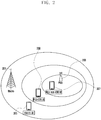
- FIG. 1 illustrates the configuration of a wireless communication system to which the present invention is applied.
- the wireless communication system to which the present invention is applied may include at least one macrocell and at least one picocell.
- a macrocell may be served by a macro ENB 101 or 103, and a picocell may be served by a pico ENB 105 or 107.
- Picocells may serve some of UEs in a macrocell to distribute the load of the macrocell.
- the transmit power of the pico ENB 105 or 107 is much lower than that of the macro ENB 101 or 103, and the coverage of the pico ENB 105 or 107 is much smaller than that of the macro ENB 101 or 103.
- a UE may connect to a macrocell or picocell to perform data communication.
- the UE may select a cell with the highest RSRP as the serving cell.
- the UE may connect to the macrocell although the picocell is the best cell for the UE. In this case, as the UE connected to the macrocell is close to the picocell, it may cause interference to those UEs receiving a service from the picocell.
- CRE may be configured so that a specific UE may receive a service from the picocell.
- CRE is described in more detail with reference to FIG. 2 .
- FIG. 2 illustrates a CRE UE.
- UEs in a picocell may be classified into CRE UEs and non-CRE UEs.
- the UE may receive a service from the macro ENB 201.
- a UE receiving a service from the macro ENB 201 may be referred to as a macro UE (e.g. macro UE 205).
- a macro UE 205 may be closer to the macro ENB 201 than the pico ENB 203. While receiving a service from the macro ENB 201, the macro UE 205 does not severely suffer from interference caused by the picocell.
- a UE receiving a service from the pico ENB 203 may be referred to as a pico UE or non-CRE UE (e.g. non-CRE UE 207).
- a non-CRE UE 207 may be closer to the pico ENB 203 than the macro ENB 201.
- the network may force a certain UE to connect to the pico ENB 203 although the RSRP from the macro ENB 201 is higher than that from the pico ENB 203. This is to distribute the load of the macrocell over the picocell and provide a higher data rate to the UE.
- the network may allow the UE to connect to the pico ENB 203 if the received signal strength from the picocell is less than that from the macrocell by a preset CRE bias (dB).
- Allowing a UE outside the picocell to receive a service from the picocell may correspond to defining a new region between the macrocell and the picocell.
- this region may be referred to as a CRE zone, and a UE operating in the CRE zone may be referred to as a CRE UE (e.g. CRE UE 209).
- a CRE UE may be a terminal severely suffering from interference caused by the macrocell, and a non-CRE UE may be a terminal hardly suffering from interference caused by the macrocell.
- the CRE UE 209 receiving a service from the pico ENB 203 may severely suffer from interference caused by the macrocell as it remains in a region where the RSRP from the macro ENB 201 is higher than that from the pico ENB 203.
- the macro ENB 201 may configure some of total subframes as an ABS and does not perform downlink data transmission at the ABS.
- the picocell does not suffer from interference caused by the macrocell at the ABS, if resources are allocated to the CRE UE 209 at the ABS, it is possible to increase performance of the CRE UE 209.
- the macro ENB 201 configures a large number of ABSs (i.e. the ABS ratio is high)
- this may increase the performance of UEs receiving a service from the picocell as the period free from interference caused by the macrocell becomes long.
- downlink transmission of the macrocell can be delayed, lowering the performance of macro UEs 205 receiving a service from the macro ENB 201.
- macro UEs 205 require a large number of subframes to receive downlink data, when a high ABS ratio is used for CRE UEs 209 because the number of CRE UEs 209 is large, the overall network performance may be degraded owing to reduced efficiency.
- FIG. 3 is a block diagram of entities performing a method for determining the ABS ratio according to the present invention.
- ABS ratio determination may be performed by a macro ENB 301, a pico ENB 307, and an ABS ratio determination device 313.
- the terms “macro ENB” and “macrocell” may be used interchangeably.
- the macro ENB 301 may include a control unit 303 and a communication unit 305.
- the control unit 303 may include a separate load measurer or may operate as a load measurer to perform load measurement according to the present invention.
- the control unit 303 may measure the load of the cell and control reporting of the measured load information to the ABS ratio determination device 313.
- the control unit 303 may compute the load for macro UEs on the basis of information regarding the buffer occupancy (BO), the amount of transmittable data per RB, and the total number of RBs.
- the control unit 303 may separately compute the load due to guaranteed bit rate (GBR) UEs (GBR load) and the load due to non-GBR UEs (non-GBR load).
- GBR UE refers to a UE that receives a GBR traffic service
- a non-GBR UE refers to a UE that receives a non-GBR traffic service.
- the control unit 303 may compute the GBR load and the non-GBR load, and determine the total load by adding the GBR load and the non-GBR load together.
- Load computation of the control unit 303 is described in detail later with reference to FIG. 4 .
- the control unit 303 may report the determined load information to the ABS ratio determination device 313.
- the control unit 303 may report at least one of the total load, the GBR load, and the non-GBR load.
- the control unit 303 may report the total load and the GBR load to the ABS ratio determination device 313.
- the communication unit 305 may send and receive data to and from another device under the control of the control unit 303.
- the communication unit 305 may send load information to the ABS ratio determination device 313 or may receive ABS ratio information from the ABS ratio determination device 313.
- the terms “pico ENB” and “picocell” may be used interchangeably.
- the pico ENB 307 may include a control unit 309 and a communication unit 311.
- the control unit 309 may include a separate load measurer or may operate as a load measurer to perform load measurement according to the present invention.
- the control unit 309 may measure the load of the cell and control reporting of the measured load information to the ABS ratio determination device 313.
- the control unit 309 may compute the load for picocell UEs on the basis of information regarding the buffer occupancy (BO), the amount of transmittable data per RB, and the total number of RBs.
- the control unit 309 may separately compute the GBR load, the load due to non-GBR CRE UEs (non-GBR CRE load), and the load due to non-GBR non-CRE UEs (non-GBR non-CRE load).
- a non-GBR CRE UE refers to a non-GBR UE that remains in the CRE zone to receive a service, and may severely suffer from interference caused by the macrocell.
- a non-GBR non-CRE UE refers to a non-GBR UE that remains in the picocell other than the CRE zone to receive a service, and may hardly suffer from interference caused by the macrocell.
- Non-GBR UEs may be classified into non-GBR CRE UEs and non-GBR non-CRE UEs in various ways. For example, when the value obtained by dividing the spectral efficiency at an ABS by the spectral efficiency at a non-ABS (spectral efficiency at ABS / spectral efficiency at non-ABS) is greater than or equal to a preset threshold, a non-GBR UE may be classified into a non-GBR CRE UE. Otherwise, a non-GBR UE may be classified into a non-GBR non-CRE UE.
- a non-GBR UE when a non-GBR UE is unable to transmit at a non-ABS, it may be classified into a non-GBR CRE UE; and a non-GBR UE is able to transmit at a non-ABS, it may be classified into a non-GBR non-CRE UE.
- the control unit 309 may compute the GBR load, the non-GBR CRE load, and the non-GBR non-CRE load, and determine the total load by adding them together.
- Load computation of the control unit 309 is described in detail later with reference to FIG. 5 .
- the control unit 309 may report the determined load information to the ABS ratio determination device 313.
- the control unit 309 may report at least one of the total load, the GBR load, the non-GBR CRE load, and the non-GBR non-CRE load.
- the control unit 309 may report the total load, the GBR load, and the non-GBR CRE load to the ABS ratio determination device 313.
- the communication unit 311 may send and receive data to and from another device under the control of the control unit 309.
- the communication unit 311 may send load information to the ABS ratio determination device 313 or may receive ABS ratio information from the ABS ratio determination device 313.
- the ABS ratio determination device 313 may control at least one macro ENB (e.g. macro ENB 301) and at least one pico ENB (e.g. pico ENB 307) to determine the ABS ratio.
- the ABS ratio determination device 313 performing ABS ratio determination may be referred to as a different name such as an ABS control device or an interference control device.
- the ABS ratio determination device 313 is depicted as a separate entity from the macro ENB 301 and the pico ENB 307. However, the macro ENB 301 or the pico ENB 307 may perform the function of the ABS ratio determination device 313.
- the ABS ratio determination device 313 may include a control unit 315 and a communication unit 317.
- the control unit 315 may determine the ABS ratio on the basis of cell load information received from the macro ENB 301 and the pico ENB 307.
- the control unit 315 may determine the ABS ratio by using at least a portion of the received information.
- the control unit 315 may determine the ABS ratio on the basis of the total load in the macrocell, the load due to CRE UEs in the picocell, and the load due to non-CRE UEs in the picocell.
- the control unit 315 may set the ABS ratio to a large value in order to reduce interference caused by the macro ENB 301 to the CRE UEs.
- the control unit 315 may set the ABS ratio to a small value in order to allow the macro ENB 301 to efficiently transmit data.
- ABS ratio determination of the control unit 315 is described in detail later with reference to FIG. 6 .
- the control unit 315 may send the determined ABS ratio to the macro ENB 301, which then may configure ABSs according to the determined ABS ratio.
- the communication unit 317 may send and receive data to and from another device under the control of the control unit 315.
- the communication unit 317 may receive load information from the macro ENB 301 and pico ENB 307 or may send determined ABS ratio information to the macro ENB 301.
- FIG. 3 illustrates one macro ENB and one pico ENB.
- the present invention is not limited thereto. It may be evident that the subject matter of the present invention can also be applied to a situation where multiple macro ENBs and multiple pico ENBs are present.
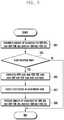
- FIG. 4 is a flowchart of a procedure for a macro ENB to compute the load according to the present invention.
- the macro ENB determines the amount of radio resources needed for GBR UEs and non-GBR UEs.
- the amount of radio resources may refer to the number of RBs needed for GBR UEs and non-GBR UEs at a specific subframe.
- the amount of radio resources, the amount of resources, the amount of needed resources, and the amount of used resources may be used interchangeably.
- the macro ENB may determine the total number of RBs needed for GBR UEs and non-GBR UEs.
- the macro ENB may determine the amount of radio resources on the basis of the buffer occupancy for GBR UEs and non-GBR UEs (i.e. the amount of UE data to be transmitted).
- the macro ENB may determine the amount of radio resources needed for GBR UEs and non-GBR UEs using Equation 1 below.
- N RB GBR + ⁇ U ⁇ GBR min BO u TBSperRB u N RB DL
- N RB nonGBR + ⁇ U ⁇ nonGBR min BO u TBSperRB u N RB DL
- N RB GBR indicates the amount of radio resources for GBR UEs
- N RB nonGBR indicates the amount of radio resources for non-GBR UEs
- BO(u) indicates the buffer occupancy (BO) for UE u
- TBSperRB(u) indicates the amount of data transmittable per RB for UE u
- N RB DL indicates the total number of RBs (the number of downlink RBs).
- the macro ENB may determine the amount of radio resources needed for GBR UEs and non-GBR UEs using Equation 2 below.
- N RB GBR indicates the amount of radio resources for GBR UEs
- N RB nonGBR indicates the amount of radio resources for non-GBR UEs
- N RB DL indicates the total number of RBs (the number of downlink RBs).
- the macro ENB checks whether a load reporting time is reached.
- the macro ENB may send a load report on a periodic basis or at a preset point in time.
- the macro ENB may collect information on the amount of radio resources for GBR UEs and non-GBR UEs before arrival of the load reporting time, and may initiate load computation on the basis of the collected information after arrival of the load reporting time.
- the macro ENB may send a load report once every W subframes (W subframe window).
- the macro ENB may collect information during the W subframe window and compute the load on the basis of the collected information.
- the macro ENB may determine that the load reporting time is reached. When Equation 3 produces a value of non-zero, the macro ENB may determine that the load reporting time is not reached and continue information collection.
- the macro ENB computes the load.
- the macro ENB may determine the GBR load, non-GBR load, and total load.
- the macro ENB may compute the load on the basis of the information on the amount of radio resources for GBR UEs and non-GBR UEs.
- the macro ENB determines the GBR load according to Equation 4 below.
- L GBR N RB GBR W ⁇ N RB DL
- L GBR indicates the GBR load
- N RB GBR indicates the amount of radio resources for GBR UEs
- W indicates the window size
- N RB DL indicates the total number of RBs (the number of downlink RBs).
- the macro ENB determines the non-GBR load according to Equation 5 below.
- L nonGBR 1 W ⁇ N RB DL ⁇ W ⁇ N RB DL ⁇ N RB GBR W ⁇ N RB nonGBR ⁇ N RB nonGBR
- L nonGBR indicates the non-GBR load
- W indicates the window size
- N RB DL indicates the total number of RBs (the number of downlink RBs)
- N RB GBR indicates the amount of radio resources for GBR UEs
- N RB nonGBR indicates the amount of radio resources for non-GBR UEs.
- the macro ENB computes the total load by adding the GBR load and the non-GBR load together. This may be represented as Equation 6 below.
- L macro L GBR + L nonGBR
- L macro indicates the total load of the macrocell
- L GBR indicates the GBR load
- L nonGBR indicates the non-GBR load.
- the macro ENB Upon determining the load, at step 407, the macro ENB reports information on the load.
- the macro ENB may report at least a portion of the information on the load to the ABS ratio determination device.
- the macro ENB may report at least one of the total load, GBR load, and non-GBR load in the macrocell. For example, if the total load and GBR load for the macrocell are known to the ABS ratio determination device, as the ABS ratio determination device may also identify the non-GBR load, the macro ENB may report at least two of the total load, GBR load, and non-GBR load in the macrocell. That is, the macro ENB may report only the total load and GBR load for the macrocell. This may reduce data traffic between the macro ENB and the ABS ratio determination device.
- the macro ENB may report the determined load values as is, or may convert the load values into other values and report the converted values. For reporting, the macro ENB may convert the total load value and the GBR load value into Composite Available Capacity (CAC) and GBR usage values, respectively.
- CAC Composite Available Capacity
- GBR usage are the same as those defined in the LTE standards. This conversion may be represented as Equation 7 below.
- CAC 1 ⁇ L macro ⁇ 100
- GBR _ Usage L GBR ⁇ 100
- CAC and GBR usage are just an example of available conversion schemes.
- a high load value is converted into a small CAC value. That is, as the CAC represents the available capacity, the available capacity becomes small when the load is high.
- phrases "high load” and “low load” may correspond respectively to “low CAC” and "high CAC”.
- the macro ENB After reporting the load information, at step 409, the macro ENB initializes the amount of radio resources for GBR UEs and non-GBR UEs for subsequent load computation.
- the load due to GBR UEs and the load due to non-GBR UEs are separately computed.
- load computation may become complicated.
- the macro ENB may select some of GBR UEs and some of non-GBR UEs, compute the load for the selected GBR and non-GBR UEs, and extrapolate the computed load into the case of all GBR UEs in the macrocell.
- the macro ENB may select some GBR UEs among all the GBR UEs and form a sample_GBR set of the selected GBR UEs.
- the macro ENB may compute the load due to UEs belonging to the sample_GBR set only, and may determine the GBR load by multiplying the computed load and a scaling factor (scaling_GBR) together.
- scaling_GBR scaling factor
- the scaling factor may be determined by dividing the total number of GBR UEs by the number of UEs in the sample_GBR set (total number of GBR UEs / number of UEs in sample GBR set).
- the sample_GBR set may be determined in various ways.
- the macro ENB may randomly select some UEs for the sample_GBR set from among GBR UEs on a sub frame basis.
- the macro ENB may randomly select some UEs for the sample_GBR set from among GBR UEs whose BO is greater than zero on a sub frame basis.
- the macro ENB may select some UEs from among all non-GBR UEs and form a sample_nonGBR set of the selected non-GBR UEs.
- the macro ENB may compute the load due to UEs belonging to the sample_nonGBR set only, and may determine the non-GBR load by multiplying the computed load and a scaling factor (scaling nonGBR) together.
- scaling factor may be determined by dividing the total number of non-GBR UEs by the number of UEs in the sample nonGBR set (total number of non-GBR UEs / number of UEs in sample_nonGBR set).
- the sample_nonGBR set may be determined in a manner similar to the case of the sample_GBR set.
- the amount of radio resources for GBR UEs and non-GBR UEs may be computed according to Equation 8.
- N RB GBR + scalin _ GBR ⁇ ⁇ u ⁇ sample GBR min BO u TBSperRB u N RB DL
- N RB nonGBR + scaling _ nonGBR ⁇ ⁇ u ⁇ sample non GBR min BO u TBSperRB u N RB DL
- the macro ENB may use the amount of radio resources for GBR UEs and non-GBR UEs computed using Equation 8 to determine the total load, GBR load, and non-GBR load in the macrocell.
- FIG. 5 is a flowchart of a procedure for a pico ENB to compute the load according to the present invention.
- the pico ENB determines the amount of radio resources needed for GBR UEs, non-GBR CRE UEs, and non-GBR non-CRE UEs.
- the amount of radio resources may refer to the number of RBs needed for GBR UEs, non-GBR CRE UEs, and non-GBR non-CRE UEs at a specific subframe.
- the pico ENB may determine the total number of RBs needed for GBR UEs, non-GBR CRE UEs, and non-GBR non-CRE UEs.
- the pico ENB may determine the amount of radio resources on the basis of the buffer occupancy for GBR UEs, non-GBR CRE UEs, and non-GBR non-CRE UEs (i.e. the amount of UE data to be transmitted).
- the pico ENB may determine the amount of radio resources needed for GBR UEs, non-GBR CRE UEs, and non-GBR non-CRE UEs using Equation 9 below.
- nonCRE + ⁇ u ⁇ nonGBR & nonCRE min BO u TBSperRB u N RB DL N RB nonGBR
- CRE + ⁇ u ⁇ nonGBR & CRE min BO u TBSperRB u N RB DL
- N RB GBR indicates the amount of radio resources for GBR UEs
- N RB nonGBR,nonCRE indicates the amount of radio resources for non-GBR non-CRE UEs
- N RB nonGBR,CRE indicates the amount of radio resources for non-GBR CRE UEs
- BO(u) indicates the buffer occupancy (BO) for UE u
- TBSperRB(u) indicates the amount of data transmittable per RB for UE u
- N RB DL indicates the total number of RBs (the number of downlink RBs).
- the pico ENB checks whether a load reporting time is reached.
- the pico ENB may send a load report on a periodic basis or at a preset point in time.
- the pico ENB may collect information on the amount of radio resources for GBR UEs, non-GBR CRE UEs, and non-GBR non-CRE UEs before arrival of the load reporting time, and may initiate load computation on the basis of the collected information after arrival of the load reporting time.
- the pico ENB may send a load report once every W subframes (W subframe window).
- the pico ENB may collect information during the W subframe window and compute the load on the basis of the collected information.
- the pico ENB may determine whether the load reporting time is reached by performing modulo operation on the current subframe index and W. This may be represented as Equation 10 below. mod subframe index , W
- the pico ENB may determine that the load reporting time is reached.
- the pico ENB may determine that the load reporting time is not reached and continue information collection.
- the pico ENB computes the load.
- the pico ENB may determine the GBR load, non-GBR CRE load, non-GBR non-CRE load, and total load.
- the pico ENB may compute the load on the basis of the information on the amount of radio resources for GBR UEs, non-GBR CRE UEs, and non-GBR non-CRE UEs.
- the pico ENB determines the GBR load according to Equation 11 below.
- L GBR N RB GBR W ⁇ N RB DL
- L GBR indicates the GBR load
- N RB GBR indicates the amount of radio resources for GBR UEs
- W indicates the window size
- N RB DL indicates the total number of RBs (the number of downlink RBs).
- the pico ENB determines the non-GBR CRE load according to Equation 12 below.
- L nonGBR , CRE 1 W ⁇ N RB DL ⁇ W ⁇ N RB DL ⁇ N RB GBR W ⁇ N RB DL + N RB nonGBR , nonCRE + N RB nonGBR , CRE ⁇ N RB nonGBR , CRE
- L nonGBR,CRE indicates the non-GBR CRE load
- W indicates the window size
- N RB DL indicates the total number of RBs (the number of downlink RBs)
- N RB GBR indicates the amount of radio resources for GBR UEs
- N RB nonGBR,nonCRE indicates the amount of radio resources for non-GBR non-CRE UEs
- N RB nonGBR,CRE indicates the amount of radio resources for non-GBR CRE UEs.
- the pico ENB determines the non-GBR non-CRE load according to Equation 13 below.
- L nonGBR , CRE 1 W ⁇ N RB DL ⁇ W ⁇ N RB DL ⁇ N RB GBR W ⁇ N RB DL + N RB nonGBR , nonCRE + N RB nonGBR , CRE ⁇ N RB nonGBR , nonCRE
- L nonGBR,nonCRE indicates the non-GBR non-CRE load
- W indicates the window size
- N RB DL indicates the total number of RBs (the number of downlink RBs)
- N RB GBR indicates the amount of radio resources for GBR UEs
- N RB nonGBR,nonCRE indicates the amount of radio resources for non-GBR non-CRE UEs
- N RB nonGBR,CRE indicates the amount of radio resources for non-GBR CRE UEs.
- the pico ENB computes the total load by adding the GBR load, non-GBR CRE load, and non-GBR non-CRE load together. This may be represented as Equation 14 below.
- L pico L GBR + L nonGBR , nonCRE + L nonGBR , CRE
- L pico indicates the total load of the picocell
- L GBR indicates the GBR load
- L nonGBR,CRE indicates the non-GBR CRE load
- L nonGBR,nonCRE indicates the non-GBR non-CRE load.
- the pico ENB Upon determining the load, at step 507, the pico ENB reports information on the load.
- the pico ENB may report at least a portion of the information on the load to the ABS ratio determination device.
- the pico ENB may report at least one of the total load, GBR load, non-GBR CRE load, and non-GBR non-CRE load in the macrocell. For example, if the total load, non-GBR CRE load, and non-GBR non-CRE load for the picocell are known to the ABS ratio determination device, as the ABS ratio determination device may also identify the GBR load, the pico ENB may report at least three of the total load, GBR load, non-GBR CRE load, and non-GBR non-CRE load in the picocell. That is, the pico ENB may report only the total load, GBR load, and non-GBR CRE load for the picocell. This may reduce data traffic between the pico ENB and the ABS ratio determination device.
- the pico ENB may report the determined load values as is, or may convert the load values into other values and report the converted values. For reporting, the pico ENB may convert the total load value, the GBR load value, and the non-GBR CRE load value into Composite Available Capacity (CAC), GBR usage, and DL ABS Status (DAs) values, respectively.
- CAC Composite Available Capacity
- GBR usage and DAs
- the CAC, GBR usage, and DAs are the same as those defined in the LTE standards. This conversion may be represented as Equation 15 below.
- CAC 1 ⁇ L pico ⁇ 100
- DAs 1 ⁇ L nonGBR
- GBR _ Usage L GBR ⁇ 100
- the pico ENB After reporting the load information, at step 509, the pico ENB initializes the amount of radio resources for GBR UEs, non-GBR CRE UEs, and non-GBR non-CRE UEs for subsequent load computation.
- the load due to GBR UEs, the load due to non-GBR CRE UEs, and the load due to non-GBR non-CRE UEs are separately computed.
- the pico ENB may select some of GBR UEs and some of non-GBR UEs, compute the load for the selected GBR and non-GBR UEs, and extrapolate the computed load into the case of all GBR UEs in the picocell.
- the pico ENB may select some GBR UEs among all the GBR UEs and form a sample_GBR set of the selected GBR UEs.
- the pico ENB may compute the load due to UEs belonging to the sample_GBR set only, and may determine the GBR load by multiplying the computed load and a scaling factor (scaling_GBR) together.
- scaling_GBR scaling factor
- the scaling factor may be determined by dividing the total number of GBR UEs by the number of UEs in the sample_GBR set (total number of GBR UEs / number of UEs in sample_GBR set).
- the sample_GBR set may be determined in various ways.
- the pico ENB may randomly select some UEs for the sample_GBR set from among GBR UEs on a subframe basis.
- the pico ENB may randomly select some UEs for the sample_GBR set from among GBR UEs whose BO is greater than zero on a subframe basis.
- the pico ENB may select some UEs from among all non-GBR CRE UEs and form a sample nonGBR-CRE set of the selected non-GBR CRE UEs.
- the pico ENB may compute the load due to UEs belonging to the sample_nonGBR-CRE set only, and may determine the non-GBR CRE load by multiplying the computed load and a scaling factor (scaling_nonGBR-CRE) together.
- scaling factor may be determined by dividing the total number of non-GBR UEs by the number of UEs in the sample_nonGBR-CRE set (total number of non-GBR UEs / number of UEs in sample_nonGBR-CRE set).
- the pico ENB may select some UEs from among all non-GBR non-CRE UEs and form a sample nonGBR-nonCRE set of the selected non-GBR non-CRE UEs.
- the pico ENB may compute the load due to UEs belonging to the sample_nonGBR-nonCRE set only, and may determine the non-GBR non-CRE load by multiplying the computed load and a scaling factor (scaling_nonGBR-nonCRE) together.
- the scaling factor may be determined by dividing the total number of non-GBR UEs by the number of UEs in the sample_nonGBR-nonCRE set (total number of non-GBR UEs / number of UEs in sample_nonGBR-nonCRE set).
- n RB GBR + scaling .
- GBR ⁇ ⁇ u ⁇ sample GBR min BO u TBSperRB u N RB DL N RB nonGBR
- nonCRE + scaling _ nonGBR ⁇ nonCRE ⁇ ⁇ u ⁇ sample
- CRE + scaling _ nonGBR ⁇ nonCRE ⁇ ⁇ u ⁇ sample nonGBR ⁇ CRE min BO u TBSperRB N RB DL
- the macro ENB may use the amount of radio resources for GBR UEs, non-GBR CRE UEs, and non-GBR non-CRE UEs computed using Equation 16 to determine the total load, GBR load, non-GBR CRE load, and non-GBR non-CRE load in the picocell.
- FIG. 6 is a flowchart of a procedure for an ABS ratio determination device to determine the ABS ratio according to the present invention.
- the ABS ratio determination device receives load information from a macro ENB and a pico ENB.
- the ABS ratio determination device may receive cell load information from at least one macro ENB and at least one pico ENB.
- Load information from a macro ENB may include information on at least one of the total load, GBR load, and non-GBR load in the corresponding macrocell.
- Load information from a pico ENB may include information on at least one of the total load, GBR load, non-GBR CRE load, and non-GBR non-CRE load in the corresponding picocell.
- the ABS ratio determination device may determine the ABS ratio on the basis of the received load information.
- the ABS ratio determination device determines the amount of radio resources for non-GBR UEs in each macrocell and the amount of radio resources for all macrocells.
- the ABS ratio determination device may identify the amount of radio resources for non-GBR UEs in each macrocell on the basis of the reported load information, and determine the amount of radio resources for the macrocell using the identified information.
- the ABS ratio determination device may identify the non-GBR load for the macrocell on the basis of the reported information.
- the amount of radio resources for non-GBR UEs in each macrocell and the amount of radio resources for all macrocells may be determined according to Equation 17 below.
- U nonGBR j 100 ⁇ GBR _ Usage j ⁇ CAC j CAC j , j : macro cell index
- U macro ⁇ j ⁇ macro
- j indicates the macrocell index
- U nonGBR (j) indicates the amount of radio resources for non-GBR UEs in the j th macrocell
- GBR_Usage(j) indicates the GBR load in the j th macrocell
- CAC(j) indicates the total load in the j th macrocell
- U macro indicates the amount of radio resources for all macrocells.
- the ABS ratio determination device determines the amount of radio resources for non-GBR UEs and non-GBR CRE UEs in each picocell.
- the ABS ratio determination device may identify the total load, non GBR load, and non-GBR CRE load in each picocell on the basis of the reported load information, and may determine the amount of radio resources for non-GBR UEs and non-GBR CRE UEs in the picocell using the identified information.
- the ABS ratio determination device may identify the non-GBR load of the picocell on the basis of the total load and GBR load.
- the amount of radio resources for non-GBR UEs and non-GBR CRE UEs in each picocell may be determined according to Equation 18 below.
- U nonGBR i 100 ⁇ GBR _ Usage i ⁇ CAC i CAC i , i : pico cell index
- U nonGBR , CRE i U nonGBR i 100 ⁇ DAs i 100 ⁇ CAC i ⁇ GBR _ Usage i , i : pico cell index
- i indicates the picocell index
- U nonGBR (i) indicates the amount of radio resources for non-GBR UEs in the i th picocell
- GBR_Usage(i) indicates the GBR load in the i th picocell
- CAC(i) indicates the total load in the i th picocell
- U nonGBR,CRE (i) indicates the amount of radio resources for non-GBR CRE UEs in the i th picocell
- DAs(i) indicates the non-GBR CRE load in the i th picocell.
- the ABS ratio determination device sorts the picocells in descending order of the ratio of the resource amount for non-GBR CRE UEs to the resource amount for non-GBR UEs (U nonGBR,CRE (i)/U nonGBR (i)).
- the ABS ratio determination device may list the picocells in descending order of the ratio of the resource amount for non-GBR CRE UEs.
- the ABS ratio determination device finds k in the sorted picocell list such that the ABS ratio determined under the assumption that only k sorted picocells (1 st to k th picocells) are present becomes greater than the ratio of the resource amount for non-GBR CRE UEs in the k+1 th picocell.
- the ABS ratio determination device may determine the ABS ratio first under the assumption that only one picocell (1 st sorted picocell) is present in the network. Specifically, assuming that only one picocell (1 st sorted picocell) is present, the ABS ratio determination device sets the ABS ratio to the ratio of the resource amount for picocell non-GBR CRE UEs to the sum of the resource amount for macrocell non-GBR UEs and the resource amount for picocell non-GBR UEs. The ABS ratio determination device checks whether the ABS ratio is greater than the non-GBR CRE ratio of the resource amount for non-GBR CRE UEs to the resource amount for non-GBR UEs in the 2 nd sorted picocell.
- the ABS ratio determination device may determine the ABS ratio under the assumption that only two sorted picocells (1 st to 2 nd picocells) are present in the network. Specifically, assuming that only two sorted picocells (1 st to 2 nd picocells) are present, the ABS ratio determination device may set the ABS ratio to the ratio of the resource amount for picocell non-GBR CRE UEs to the sum of the resource amount for macrocell non-GBR UEs and the resource amount for picocell non-GBR UEs.
- the ABS ratio determination device checks whether the ABS ratio is greater than the non-GBR CRE ratio of the resource amount for non-GBR CRE UEs to the resource amount for non-GBR UEs in the 3 rd sorted picocell. This process is continued until the ABS ratio determined under the assumption that only k sorted picocells (1 st to k th picocells) are present becomes greater than the non-GBR CRE ratio of the resource amount for non-GBR CRE UEs to the resource amount for non-GBR UEs in the k+1 th picocell.
- ABS ratio determination device determines the ABS ratio finally according to Equation 19 below. Thereby, it is possible to prevent a picocell whose non-GBR CRE load is very low from affecting determination of the ABS ratio, prohibiting the ABS ratio from being too small.
- ABS Ratio indicates the ABS ratio
- A k
- U nonGBR,CRE (i) indicates the amount of radio resources for non-GBR CRE UEs in the i th picocell
- U macro indicates the amount of radio resources for all macrocells
- U nonGBR (i) indicates the amount of radio resources for non-GBR UEs in the i th picocell
- GBR_Usage(j) indicates the GBR load in the j th macrocell.
- Equation 19 enables the ABS ratio determination device to determine the ABS ratio in consideration of many GBR UEs remaining in the macrocell. That is, to prevent a problem that macrocell GBR UEs are not sufficiently covered owing to a too low ABS ratio, the ABS ratio determination device may determine the ABS ratio in consideration of a situation where many GBR UEs remain in the macrocell.
- the ABS ratio is determined with respect to a picocell whose non-GBR CRE load is very low. Hence, it is possible to prohibit the ABS ratio from being too low.
- the ABS ratio determination device may determine the ABS ratio with due consideration of the macrocell load and the picocell load.
- the ABS ratio determination device checks whether the total load of a macrocell whose total load is lowest among all macrocells is lower than a preset threshold. If the total load of a macrocell with the lowest total load is lower than the preset threshold, at step 615, the ABS ratio determination device sets the ABS ratio to a preset value. That is, when a macrocell with the lowest total load is lightly loaded, if the macrocell can perform data transmission and reception without much difficulty even when a relatively high ABS ratio is used, the ABS ratio may be set to a preset value larger than that computed above.
- the ABS ratio determination device may perform one of the two operations above according to implementation.
- Steps 609 to 615 for ABS ratio determination may be represented as a flowchart of FIG. 7 with mathematical notations. A detailed description of the flowchart is given above.
- i max indicates the number of picocells.
- the ABS ratio determination device sends the determined ABS ratio to the macro ENB.
- the macro ENB may configure ABSs for all radio resources according to the determined ABS ratio and perform data transmission and reception accordingly.
- FIG. 8 is a sequence diagram illustrating a procedure for ABS ratio determination according to the present invention.
- the macro ENB measures the load of the macrocell.
- the macro ENB may determine the total load, GBR load, and non-GBR load in the macrocell.
- the pico ENB measures the load of the picocell.
- the pico ENB may determine the total load, GBR load, non-GBR CRE load, and non-GBR non-CRE load in the picocell.
- the macro ENB Upon arrival of a load reporting time, at step 805, the macro ENB reports load information to the ABS ratio determination device; and, at step 807, the pico ENB reports load information to the ABS ratio determination device.
- the macro ENB may report at least two of the total load, GBR load, and non-GBR load in the macrocell.
- the pico ENB may report at least three of the total load, GBR load, non-GBR CRE load, and non-GBR non-CRE load in the picocell.
- the ABS ratio determination device determines the ABS ratio on the basis of the reported load information.
- the ABS ratio determination device may determine the ABS ratio on the basis of the ratio of the radio resource amount for non-GBR CRE UEs to the total radio resource amount of all cells.
- the ABS ratio determination device may determine the ABS ratio on the basis of the ratio of the resource amount for picocell non-GBR CRE UEs to the sum of the resource amount for macrocell non-GBR UEs and the resource amount for picocell non-GBR UEs.
- the ABS ratio determination device may determine the ABS ratio in consideration of the macrocell GBR load.
- the ABS ratio determination device may set the ABS ratio to the larger one of a preset value and the ABS ratio determined above to enable smooth data transmission and reception in the macrocell.
- the preset value for the ABS ratio may be large enough to permit smooth data transmission and reception of CRE-zone UEs connected to the picocell.
- the ABS ratio determination device sends the determined ABS ratio to the macro ENB.
- the macro ENB may share the received ABS ratio with the pico ENB.
- the macro ENB sends and receives data to and from UEs in the macrocell according to the determined ABS ratio.
- the pico ENB sends and receives data to and from UEs in the picocell according to the determined ABS ratio.
- the macro ENB configures ABSs according to the determined ABS ratio and does not perform data transmission and reception at an ABS.
- the pico ENB may send and receive data to and from UEs in the picocell without interference.
Landscapes
- Engineering & Computer Science (AREA)
- Computer Networks & Wireless Communication (AREA)
- Signal Processing (AREA)
- Quality & Reliability (AREA)
- Physics & Mathematics (AREA)
- Electromagnetism (AREA)
- Mobile Radio Communication Systems (AREA)
Description
- The present invention relates to methods and apparatus for controlling interference in a heterogeneous network system.
- In recent years, the 3GPP has conducted research on picocells with a view to distributing the load of macrocells. The heterogeneous network environment where macrocells coexist with picocells has attracted much attention because it can improve system performance even further compared with the existing macrocell environment.
- To efficiently distribute the load of macrocells over picocells, the 3GPP has introduced Enhanced Inter-Cell Interference Coordination (eICIC).
- In general, picocells are lower in transmit power and antenna height compared with macrocells. Hence, when the rule of association between base station (ENB) and user equipment (UE) (a UE is served by the ENB with the highest signal strength) is applied, the load of macrocells may be not sufficiently distributed over picocells.
- In other words, when each UE selects a cell with the highest Reference Signal Received Power (RSRP) as the serving cell, some UEs may connect to the macrocell although a picocell is the best cell. Such UEs may cause severe interference to the picocell, degrading overall network performance. In addition, when the number of UEs connected to the picocell is much smaller than the number of UEs connected to the macrocell, the efficiency of resource utilization may become very poor.
- To address the above problem, elCIC provides Cell Range Expansion (CRE) to set a criterion for handover between macrocell and picocell. CRE enables higher user offloading from the macrocell on to picocells by requiring a UE to preferentially select a picocell if the received signal strength from the picocell is less than that from the macrocell by a preset CRE bias (dB).
- However, UEs in the CRE zone connecting to the picocell can suffer from severe interference from the macrocell since the RSRP of the macrocell is higher than that of the picocell for such UEs.
- To guarantee signal quality for UEs that would not receive a service from the picocell if the CRE bias were 0dB (referred to as a CRE UE), the macrocell may reduce interference to the picocell by not transmitting data at a specific subframe. Such a sub frame at which the macrocell does not transmit data is referred to as an Almost Blank Subframe (ABS). To enhance performance of the overall network including macrocells and picocells, it is necessary to appropriately set the ratio of ABSs to all sub frames (ABS ratio).
- In the related art, the ABS ratio may be determined on the basis of the number of UEs connected to the macrocell and the number of UEs connected to the picocell. The ABS ratio determined in this way may be appropriate when individual UEs need the same amount of radio resources.
- However, determining the ABS ratio based on the number of macrocell UEs and picocell UEs may be inappropriate when UEs generate different amounts of traffic or need different amounts of radio resources owing to different channel quality levels. For example, when the macrocell serves five UEs needing 50 resource blocks (RB) per subframe and the picocell serves five UEs needing one RB per subframe, if the ABS ratio is determined based on the number of UEs, the ABS ratio may be set to a value larger than necessary although the number of subframes needed by the macrocell for
- data transmission is larger than that needed by the picocell.
- Accordingly, it is necessary to provide a scheme for controlling interference in a heterogeneous network system including macrocells and picocells by efficiently determining the ABS ratio in consideration of overall network performance.
-
US 2013/0250764 A1 discloses a method of setting an almost blank subframe (ABS) duty cycle in a heterogeneous network including a macro cell and one or more small cells, loading information corresponding to each of the macro cell and the one or more small cells, the loading information including an indication of an amount of information buffered at the cell for each user attached to the cell, and determining the ABS duty cycle based on the obtained loading information. - In
US 2013/0084865 A1 , base stations in a wireless network monitor load information affecting network nodes. Load information may be in the form of load metric information. The load information may be exchanged between system elements, and an almost blank subframe proportioning may be updated by one or more of the base stations. -
US 2013/0065599 A1 discloses a method wherein information from wireless access points are used to change the quantity of almost blank subframes delivered by the macro base station, adjust the cell range extension area of one or more of the wireless access points, or provide instructions to alter the number of wireless access points. - An aspect of the present invention is to provide a method that can efficiently determine the ABS ratio for inter-cell interference control in a broadband wireless communication system including many macrocells and many picocells.
- Another aspect of the present invention is to provide a method that enables individual cells to measure the load and to exchange the result of measurement to thereby determine the ABS ratio.
- The invention is embodied in the method performed by an ABS radio determination device of
independent claim 1, in the method performed by a macro base station of independent claim 4, in the method performed by a small base station of independent claim 7, in the device of ABS radio determination ofindependent claim 9, in the macro base station of independent claim 12 and in the small base station of independent claim 14. - In a feature of the present invention, the interference control method can determine the ABS ratio by use of load information of each cell and increase the overall performance of the network system including macrocells and picocells.
-
-
FIG. 1 illustrates the configuration of a wireless communication system to which the present invention is applied. -
FIG. 2 illustrates a CRE UE. -
FIG. 3 is a block diagram of entities performing a method for determining the ABS ratio . -
FIG. 4 is a flowchart of a procedure for a macro ENB to compute the load . -
FIG. 5 is a flowchart of a procedure for a pico ENB to compute the load . -
FIG. 6 is a flowchart of a procedure for an ABS ratio determination device to determine the ABS ratio . -
FIG. 7 is a flowchart illustrating detailed steps for ABS ratio determination in the procedure ofFIG. 6 . -
FIG. 8 is a sequence diagram illustrating a procedure for ABS ratio determination . - The present invention may be applied to a broadband wireless communication system including many macrocells and many picocells. In the description of various embodiments, picocells are used as representative small cells. However, the present invention is not limited to picocells. The present invention may also be applied to other small cells such as nanocells or pemtocells.
- The CRE zone may be referred to as a reserved zone that is configured to distribute loads between cells.
- The present invention relates to a method for controlling interference caused by a macrocell to picocells in a wireless communication system in which macrocells coexist with small cells. The present invention relates to a method for efficiently determining the time duration during which the macrocell is not allowed to perform downlink transmission so as to reduce interference affecting the picocell. In the present invention, the time duration during which the macrocell is not allowed to perform downlink transmission may be determined on the basis of load information exchanged between the macrocell and the picocell. To determine this time duration, the present invention provides a scheme that enables individual cells to measure their loads and to exchange the measurement information with one another.
- Although the description of the present invention is based on 3rd Generation Partnership Project (3GPP) Long Term Evolution (LTE) standards for wireless communication, it can be extended to other communication systems.
- Hereinafter, embodiments of the present invention are described in detail with reference to the accompanying drawings. Detailed descriptions of well-known functions and structures incorporated herein may be omitted to avoid obscuring the subject matter of the present invention. Particular terms may be defined to describe the invention in the best manner.
-
FIG. 1 illustrates the configuration of a wireless communication system to which the present invention is applied. - Referring to
FIG. 1 , the wireless communication system to which the present invention is applied may include at least one macrocell and at least one picocell. - A macrocell may be served by a macro ENB 101 or 103, and a picocell may be served by a
pico ENB - The transmit power of the pico ENB 105 or 107 is much lower than that of the macro ENB 101 or 103, and the coverage of the pico ENB 105 or 107 is much smaller than that of the macro ENB 101 or 103.
- A UE may connect to a macrocell or picocell to perform data communication. The UE may select a cell with the highest RSRP as the serving cell. When the UE selects a serving cell on the basis of the RSRP, the UE may connect to the macrocell although the picocell is the best cell for the UE. In this case, as the UE connected to the macrocell is close to the picocell, it may cause interference to those UEs receiving a service from the picocell.
- To this context, even when the RSRP from the macrocell is higher than that from the picocell, CRE may be configured so that a specific UE may receive a service from the picocell. CRE is described in more detail with reference to
FIG. 2 . -
FIG. 2 illustrates a CRE UE. - Referring to
FIG. 2 , in a wireless communication system of the present invention, UEs in a picocell may be classified into CRE UEs and non-CRE UEs. - In
FIG. 2 , for a UE in the macrocell, when the RSRP from themacro ENB 201 is higher than that from thepico ENB 203, the UE may receive a service from themacro ENB 201. In the following description, a UE receiving a service from themacro ENB 201 may be referred to as a macro UE (e.g. macro UE 205). Such amacro UE 205 may be closer to themacro ENB 201 than thepico ENB 203. While receiving a service from themacro ENB 201, themacro UE 205 does not severely suffer from interference caused by the picocell. - For a UE in the macrocell, when the RSRP from the
macro ENB 201 is lower than that from thepico ENB 203, the UE may receive a service from thepico ENB 203. In the following description, a UE receiving a service from thepico ENB 203 may be referred to as a pico UE or non-CRE UE (e.g. non-CRE UE 207). Such anon-CRE UE 207 may be closer to thepico ENB 203 than themacro ENB 201. - The network may force a certain UE to connect to the
pico ENB 203 although the RSRP from themacro ENB 201 is higher than that from thepico ENB 203. This is to distribute the load of the macrocell over the picocell and provide a higher data rate to the UE. Here, the network may allow the UE to connect to thepico ENB 203 if the received signal strength from the picocell is less than that from the macrocell by a preset CRE bias (dB). - Allowing a UE outside the picocell to receive a service from the picocell may correspond to defining a new region between the macrocell and the picocell. In the following description, this region may be referred to as a CRE zone, and a UE operating in the CRE zone may be referred to as a CRE UE (e.g. CRE UE 209).
- A CRE UE may be a terminal severely suffering from interference caused by the macrocell, and a non-CRE UE may be a terminal hardly suffering from interference caused by the macrocell.
- The
CRE UE 209 receiving a service from thepico ENB 203 may severely suffer from interference caused by the macrocell as it remains in a region where the RSRP from themacro ENB 201 is higher than that from thepico ENB 203. Hence, to reduce interference to theCRE UE 209, themacro ENB 201 may configure some of total subframes as an ABS and does not perform downlink data transmission at the ABS. As the picocell does not suffer from interference caused by the macrocell at the ABS, if resources are allocated to theCRE UE 209 at the ABS, it is possible to increase performance of theCRE UE 209. - When the
macro ENB 201 configures a large number of ABSs (i.e. the ABS ratio is high), this may increase the performance of UEs receiving a service from the picocell as the period free from interference caused by the macrocell becomes long. However, in this case, downlink transmission of the macrocell can be delayed, lowering the performance ofmacro UEs 205 receiving a service from themacro ENB 201. Althoughmacro UEs 205 require a large number of subframes to receive downlink data, when a high ABS ratio is used forCRE UEs 209 because the number ofCRE UEs 209 is large, the overall network performance may be degraded owing to reduced efficiency. - Next, a description is given of a scheme for controlling interference within the network by efficiently determining the ABS ratio according to an embodiment of the present invention.
-
FIG. 3 is a block diagram of entities performing a method for determining the ABS ratio according to the present invention. - Referring to
FIG. 3 , in the present invention, ABS ratio determination may be performed by amacro ENB 301, apico ENB 307, and an ABSratio determination device 313. - The terms "macro ENB" and "macrocell" may be used interchangeably. The
macro ENB 301 may include acontrol unit 303 and acommunication unit 305. - The
control unit 303 may include a separate load measurer or may operate as a load measurer to perform load measurement according to the present invention. Thecontrol unit 303 may measure the load of the cell and control reporting of the measured load information to the ABSratio determination device 313. - Specifically, the
control unit 303 may compute the load for macro UEs on the basis of information regarding the buffer occupancy (BO), the amount of transmittable data per RB, and the total number of RBs. Here, thecontrol unit 303 may separately compute the load due to guaranteed bit rate (GBR) UEs (GBR load) and the load due to non-GBR UEs (non-GBR load). A GBR UE refers to a UE that receives a GBR traffic service, and a non-GBR UE refers to a UE that receives a non-GBR traffic service. Thecontrol unit 303 may compute the GBR load and the non-GBR load, and determine the total load by adding the GBR load and the non-GBR load together. - Load computation of the
control unit 303 is described in detail later with reference toFIG. 4 . - The
control unit 303 may report the determined load information to the ABSratio determination device 313. Thecontrol unit 303 may report at least one of the total load, the GBR load, and the non-GBR load. For example, thecontrol unit 303 may report the total load and the GBR load to the ABSratio determination device 313. - The
communication unit 305 may send and receive data to and from another device under the control of thecontrol unit 303. Thecommunication unit 305 may send load information to the ABSratio determination device 313 or may receive ABS ratio information from the ABSratio determination device 313. - The terms "pico ENB" and "picocell" may be used interchangeably. The
pico ENB 307 may include acontrol unit 309 and acommunication unit 311. - The
control unit 309 may include a separate load measurer or may operate as a load measurer to perform load measurement according to the present invention. Thecontrol unit 309 may measure the load of the cell and control reporting of the measured load information to the ABSratio determination device 313. - Specifically, the
control unit 309 may compute the load for picocell UEs on the basis of information regarding the buffer occupancy (BO), the amount of transmittable data per RB, and the total number of RBs. Here, thecontrol unit 309 may separately compute the GBR load, the load due to non-GBR CRE UEs (non-GBR CRE load), and the load due to non-GBR non-CRE UEs (non-GBR non-CRE load). A non-GBR CRE UE refers to a non-GBR UE that remains in the CRE zone to receive a service, and may severely suffer from interference caused by the macrocell. A non-GBR non-CRE UE refers to a non-GBR UE that remains in the picocell other than the CRE zone to receive a service, and may hardly suffer from interference caused by the macrocell. - Non-GBR UEs may be classified into non-GBR CRE UEs and non-GBR non-CRE UEs in various ways. For example, when the value obtained by dividing the spectral efficiency at an ABS by the spectral efficiency at a non-ABS (spectral efficiency at ABS / spectral efficiency at non-ABS) is greater than or equal to a preset threshold, a non-GBR UE may be classified into a non-GBR CRE UE. Otherwise, a non-GBR UE may be classified into a non-GBR non-CRE UE. As another example, when a non-GBR UE is unable to transmit at a non-ABS, it may be classified into a non-GBR CRE UE; and a non-GBR UE is able to transmit at a non-ABS, it may be classified into a non-GBR non-CRE UE.
- The
control unit 309 may compute the GBR load, the non-GBR CRE load, and the non-GBR non-CRE load, and determine the total load by adding them together. - Load computation of the
control unit 309 is described in detail later with reference toFIG. 5 . - The
control unit 309 may report the determined load information to the ABSratio determination device 313. Thecontrol unit 309 may report at least one of the total load, the GBR load, the non-GBR CRE load, and the non-GBR non-CRE load. For example, thecontrol unit 309 may report the total load, the GBR load, and the non-GBR CRE load to the ABSratio determination device 313. - The
communication unit 311 may send and receive data to and from another device under the control of thecontrol unit 309. Thecommunication unit 311 may send load information to the ABSratio determination device 313 or may receive ABS ratio information from the ABSratio determination device 313. - The ABS
ratio determination device 313 may control at least one macro ENB (e.g. macro ENB 301) and at least one pico ENB (e.g. pico ENB 307) to determine the ABS ratio. In the present invention, the ABSratio determination device 313 performing ABS ratio determination may be referred to as a different name such as an ABS control device or an interference control device. - In
FIG. 3 , the ABSratio determination device 313 is depicted as a separate entity from themacro ENB 301 and thepico ENB 307. However, themacro ENB 301 or thepico ENB 307 may perform the function of the ABSratio determination device 313. - The ABS
ratio determination device 313 may include acontrol unit 315 and a communication unit 317. - The
control unit 315 may determine the ABS ratio on the basis of cell load information received from themacro ENB 301 and thepico ENB 307. Thecontrol unit 315 may determine the ABS ratio by using at least a portion of the received information. Thecontrol unit 315 may determine the ABS ratio on the basis of the total load in the macrocell, the load due to CRE UEs in the picocell, and the load due to non-CRE UEs in the picocell. - For example, when the load due to CRE UEs in the picocell is relatively high, the
control unit 315 may set the ABS ratio to a large value in order to reduce interference caused by themacro ENB 301 to the CRE UEs. When the load due to non-CRE UEs in the picocell is relatively high, thecontrol unit 315 may set the ABS ratio to a small value in order to allow themacro ENB 301 to efficiently transmit data. - ABS ratio determination of the
control unit 315 is described in detail later with reference toFIG. 6 . - The
control unit 315 may send the determined ABS ratio to themacro ENB 301, which then may configure ABSs according to the determined ABS ratio. - The communication unit 317 may send and receive data to and from another device under the control of the
control unit 315. The communication unit 317 may receive load information from themacro ENB 301 andpico ENB 307 or may send determined ABS ratio information to themacro ENB 301. -
FIG. 3 illustrates one macro ENB and one pico ENB. However, the present invention is not limited thereto. It may be evident that the subject matter of the present invention can also be applied to a situation where multiple macro ENBs and multiple pico ENBs are present. -
FIG. 4 is a flowchart of a procedure for a macro ENB to compute the load according to the present invention. - Referring to
FIG. 4 , atstep 401, the macro ENB determines the amount of radio resources needed for GBR UEs and non-GBR UEs. Here, the amount of radio resources may refer to the number of RBs needed for GBR UEs and non-GBR UEs at a specific subframe. In the following description, the amount of radio resources, the amount of resources, the amount of needed resources, and the amount of used resources may be used interchangeably. The macro ENB may determine the total number of RBs needed for GBR UEs and non-GBR UEs. - The macro ENB may determine the amount of radio resources on the basis of the buffer occupancy for GBR UEs and non-GBR UEs (i.e. the amount of UE data to be transmitted).
- When the current subframe is a non-ABS, the macro ENB may determine the amount of radio resources needed for GBR UEs and non-GBR
UEs using Equation 1 below.
- Here, NRB GBR indicates the amount of radio resources for GBR UEs, NRB nonGBR indicates the amount of radio resources for non-GBR UEs, BO(u) indicates the buffer occupancy (BO) for UE u, TBSperRB(u) indicates the amount of data transmittable per RB for UE u, and NRB DL indicates the total number of RBs (the number of downlink RBs).
- When the current subframe is an ABS, the macro ENB may determine the amount of radio resources needed for GBR UEs and non-GBR UEs using Equation 2 below.

- Here, NRB GBR indicates the amount of radio resources for GBR UEs, NRB nonGBR indicates the amount of radio resources for non-GBR UEs, and NRB DL indicates the total number of RBs (the number of downlink RBs).
- At
step 403, the macro ENB checks whether a load reporting time is reached. The macro ENB may send a load report on a periodic basis or at a preset point in time. The macro ENB may collect information on the amount of radio resources for GBR UEs and non-GBR UEs before arrival of the load reporting time, and may initiate load computation on the basis of the collected information after arrival of the load reporting time. - The macro ENB may send a load report once every W subframes (W subframe window). Here, the macro ENB may collect information during the W subframe window and compute the load on the basis of the collected information.
- The macro ENB may determine whether the load reporting time is reached by performing modulo operation on the current subframe index and W. This may be represented as Equation 3 below.

- When Equation 3 produces a value of zero, the macro ENB may determine that the load reporting time is reached. When Equation 3 produces a value of non-zero, the macro ENB may determine that the load reporting time is not reached and continue information collection.
- If the load reporting time is reached, at
step 405, the macro ENB computes the load. The macro ENB may determine the GBR load, non-GBR load, and total load. The macro ENB may compute the load on the basis of the information on the amount of radio resources for GBR UEs and non-GBR UEs. - The macro ENB determines the GBR load according to Equation 4 below.
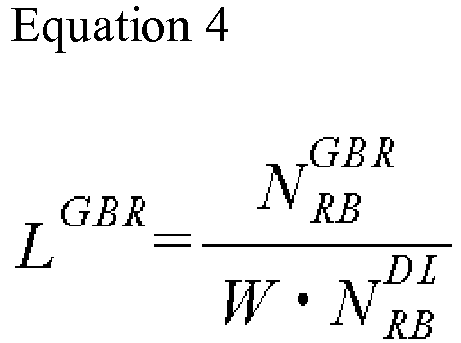
- Here, LGBR indicates the GBR load, NRB GBR indicates the amount of radio resources for GBR UEs, W indicates the window size, and NRB DL indicates the total number of RBs (the number of downlink RBs).
- The macro ENB determines the non-GBR load according to Equation 5 below.

- Here, LnonGBR indicates the non-GBR load, W indicates the window size, NRB DL indicates the total number of RBs (the number of downlink RBs), NRB GBR indicates the amount of radio resources for GBR UEs, and NRB nonGBR indicates the amount of radio resources for non-GBR UEs.
- The macro ENB computes the total load by adding the GBR load and the non-GBR load together. This may be represented as Equation 6 below.

- Here, Lmacro indicates the total load of the macrocell, LGBR indicates the GBR load, and LnonGBR indicates the non-GBR load.
- Upon determining the load, at
step 407, the macro ENB reports information on the load. The macro ENB may report at least a portion of the information on the load to the ABS ratio determination device. - The macro ENB may report at least one of the total load, GBR load, and non-GBR load in the macrocell. For example, if the total load and GBR load for the macrocell are known to the ABS ratio determination device, as the ABS ratio determination device may also identify the non-GBR load, the macro ENB may report at least two of the total load, GBR load, and non-GBR load in the macrocell. That is, the macro ENB may report only the total load and GBR load for the macrocell. This may reduce data traffic between the macro ENB and the ABS ratio determination device.
- The macro ENB may report the determined load values as is, or may convert the load values into other values and report the converted values. For reporting, the macro ENB may convert the total load value and the GBR load value into Composite Available Capacity (CAC) and GBR usage values, respectively. The CAC and GBR usage are the same as those defined in the LTE standards. This conversion may be represented as Equation 7 below.

- The CAC and GBR usage are just an example of available conversion schemes. As the CAC value is obtained based on a load of 1, a high load value is converted into a small CAC value. That is, as the CAC represents the available capacity, the available capacity becomes small when the load is high. Hence, in the following description, phrases "high load" and "low load" may correspond respectively to "low CAC" and "high CAC".
- It is necessary for the macro ENB and the ABS ratio determination device to share information regarding the CAC and GBR usage conversion rule according to Equation 7 in advance.
- After reporting the load information, at
step 409, the macro ENB initializes the amount of radio resources for GBR UEs and non-GBR UEs for subsequent load computation. - As described above, to compute the load of the macrocell, the load due to GBR UEs and the load due to non-GBR UEs are separately computed. In this case, if the number of GBR UEs or non-GBR UEs is large, load computation may become complicated. To reduce complexity of load computation, the macro ENB may select some of GBR UEs and some of non-GBR UEs, compute the load for the selected GBR and non-GBR UEs, and extrapolate the computed load into the case of all GBR UEs in the macrocell.
- Specifically, the macro ENB may select some GBR UEs among all the GBR UEs and form a sample_GBR set of the selected GBR UEs. The macro ENB may compute the load due to UEs belonging to the sample_GBR set only, and may determine the GBR load by multiplying the computed load and a scaling factor (scaling_GBR) together. Here, the scaling factor may be determined by dividing the total number of GBR UEs by the number of UEs in the sample_GBR set (total number of GBR UEs / number of UEs in sample GBR set).
- The sample_GBR set may be determined in various ways. For example, the macro ENB may randomly select some UEs for the sample_GBR set from among GBR UEs on a sub frame basis. As another example, the macro ENB may randomly select some UEs for the sample_GBR set from among GBR UEs whose BO is greater than zero on a sub frame basis.
- Likewise, the macro ENB may select some UEs from among all non-GBR UEs and form a sample_nonGBR set of the selected non-GBR UEs. The macro ENB may compute the load due to UEs belonging to the sample_nonGBR set only, and may determine the non-GBR load by multiplying the computed load and a scaling factor (scaling nonGBR) together. Here, the scaling factor may be determined by dividing the total number of non-GBR UEs by the number of UEs in the sample nonGBR set (total number of non-GBR UEs / number of UEs in sample_nonGBR set).
- The sample_nonGBR set may be determined in a manner similar to the case of the sample_GBR set.
- When the above scheme is used, the amount of radio resources for GBR UEs and non-GBR UEs may be computed according to Equation 8.

- The macro ENB may use the amount of radio resources for GBR UEs and non-GBR UEs computed using Equation 8 to determine the total load, GBR load, and non-GBR load in the macrocell.
-
FIG. 5 is a flowchart of a procedure for a pico ENB to compute the load according to the present invention. - Referring to
FIG. 5 , atstep 501, the pico ENB determines the amount of radio resources needed for GBR UEs, non-GBR CRE UEs, and non-GBR non-CRE UEs. Here, the amount of radio resources may refer to the number of RBs needed for GBR UEs, non-GBR CRE UEs, and non-GBR non-CRE UEs at a specific subframe. The pico ENB may determine the total number of RBs needed for GBR UEs, non-GBR CRE UEs, and non-GBR non-CRE UEs. - The pico ENB may determine the amount of radio resources on the basis of the buffer occupancy for GBR UEs, non-GBR CRE UEs, and non-GBR non-CRE UEs (i.e. the amount of UE data to be transmitted).
- The pico ENB may determine the amount of radio resources needed for GBR UEs, non-GBR CRE UEs, and non-GBR non-CRE
UEs using Equation 9 below.
- Here, NRB GBR indicates the amount of radio resources for GBR UEs, NRB nonGBR,nonCRE indicates the amount of radio resources for non-GBR non-CRE UEs, NRB nonGBR,CRE indicates the amount of radio resources for non-GBR CRE UEs, BO(u) indicates the buffer occupancy (BO) for UE u, TBSperRB(u) indicates the amount of data transmittable per RB for UE u, and NRB DL indicates the total number of RBs (the number of downlink RBs).
- At
step 503, the pico ENB checks whether a load reporting time is reached. - The pico ENB may send a load report on a periodic basis or at a preset point in time. The pico ENB may collect information on the amount of radio resources for GBR UEs, non-GBR CRE UEs, and non-GBR non-CRE UEs before arrival of the load reporting time, and may initiate load computation on the basis of the collected information after arrival of the load reporting time.
- The pico ENB may send a load report once every W subframes (W subframe window). Here, the pico ENB may collect information during the W subframe window and compute the load on the basis of the collected information.
- The pico ENB may determine whether the load reporting time is reached by performing modulo operation on the current subframe index and W. This may be represented as Equation 10 below.

- When Equation 10 produces a value of zero, the pico ENB may determine that the load reporting time is reached. When Equation 10 produces a value of non-zero, the pico ENB may determine that the load reporting time is not reached and continue information collection.
- If the load reporting time is reached, at
step 505, the pico ENB computes the load. The pico ENB may determine the GBR load, non-GBR CRE load, non-GBR non-CRE load, and total load. The pico ENB may compute the load on the basis of the information on the amount of radio resources for GBR UEs, non-GBR CRE UEs, and non-GBR non-CRE UEs. - The pico ENB determines the GBR load according to Equation 11 below.

- Here, LGBR indicates the GBR load, NRB GBR indicates the amount of radio resources for GBR UEs, W indicates the window size, and NRB DL indicates the total number of RBs (the number of downlink RBs).
- The pico ENB determines the non-GBR CRE load according to Equation 12 below.

- Here, LnonGBR,CRE indicates the non-GBR CRE load, W indicates the window size, NRB DL indicates the total number of RBs (the number of downlink RBs), NRB GBR indicates the amount of radio resources for GBR UEs, NRB nonGBR,nonCRE indicates the amount of radio resources for non-GBR non-CRE UEs, and NRB nonGBR,CRE indicates the amount of radio resources for non-GBR CRE UEs.
- The pico ENB determines the non-GBR non-CRE load according to Equation 13 below.

- Here, LnonGBR,nonCRE indicates the non-GBR non-CRE load, W indicates the window size, NRB DL indicates the total number of RBs (the number of downlink RBs), NRB GBR indicates the amount of radio resources for GBR UEs, NRB nonGBR,nonCRE indicates the amount of radio resources for non-GBR non-CRE UEs, and NRB nonGBR,CRE indicates the amount of radio resources for non-GBR CRE UEs.
- The pico ENB computes the total load by adding the GBR load, non-GBR CRE load, and non-GBR non-CRE load together. This may be represented as Equation 14 below.

- Here, Lpico indicates the total load of the picocell, LGBR indicates the GBR load, LnonGBR,CRE indicates the non-GBR CRE load, and LnonGBR,nonCRE indicates the non-GBR non-CRE load.
- Upon determining the load, at
step 507, the pico ENB reports information on the load. The pico ENB may report at least a portion of the information on the load to the ABS ratio determination device. - The pico ENB may report at least one of the total load, GBR load, non-GBR CRE load, and non-GBR non-CRE load in the macrocell. For example, if the total load, non-GBR CRE load, and non-GBR non-CRE load for the picocell are known to the ABS ratio determination device, as the ABS ratio determination device may also identify the GBR load, the pico ENB may report at least three of the total load, GBR load, non-GBR CRE load, and non-GBR non-CRE load in the picocell. That is, the pico ENB may report only the total load, GBR load, and non-GBR CRE load for the picocell. This may reduce data traffic between the pico ENB and the ABS ratio determination device.
- The pico ENB may report the determined load values as is, or may convert the load values into other values and report the converted values. For reporting, the pico ENB may convert the total load value, the GBR load value, and the non-GBR CRE load value into Composite Available Capacity (CAC), GBR usage, and DL ABS Status (DAs) values, respectively. The CAC, GBR usage, and DAs are the same as those defined in the LTE standards. This conversion may be represented as Equation 15 below.

- It is necessary for the pico ENB and the ABS ratio determination device to share information regarding the CAC, GBR usage, and DAs conversion rule according to Equation 15 in advance.
- After reporting the load information, at
step 509, the pico ENB initializes the amount of radio resources for GBR UEs, non-GBR CRE UEs, and non-GBR non-CRE UEs for subsequent load computation. - As described above, to compute the load of the picocell, the load due to GBR UEs, the load due to non-GBR CRE UEs, and the load due to non-GBR non-CRE UEs are separately computed. In this case, if the number of GBR UEs or non-GBR UEs is large, load computation may become complicated. To reduce complexity of load computation, the pico ENB may select some of GBR UEs and some of non-GBR UEs, compute the load for the selected GBR and non-GBR UEs, and extrapolate the computed load into the case of all GBR UEs in the picocell.
- Specifically, the pico ENB may select some GBR UEs among all the GBR UEs and form a sample_GBR set of the selected GBR UEs. The pico ENB may compute the load due to UEs belonging to the sample_GBR set only, and may determine the GBR load by multiplying the computed load and a scaling factor (scaling_GBR) together. Here, the scaling factor may be determined by dividing the total number of GBR UEs by the number of UEs in the sample_GBR set (total number of GBR UEs / number of UEs in sample_GBR set).
- The sample_GBR set may be determined in various ways. For example, the pico ENB may randomly select some UEs for the sample_GBR set from among GBR UEs on a subframe basis. As another example, the pico ENB may randomly select some UEs for the sample_GBR set from among GBR UEs whose BO is greater than zero on a subframe basis.
- Likewise, the pico ENB may select some UEs from among all non-GBR CRE UEs and form a sample nonGBR-CRE set of the selected non-GBR CRE UEs. The pico ENB may compute the load due to UEs belonging to the sample_nonGBR-CRE set only, and may determine the non-GBR CRE load by multiplying the computed load and a scaling factor (scaling_nonGBR-CRE) together. Here, the scaling factor may be determined by dividing the total number of non-GBR UEs by the number of UEs in the sample_nonGBR-CRE set (total number of non-GBR UEs / number of UEs in sample_nonGBR-CRE set).
- In addition, the pico ENB may select some UEs from among all non-GBR non-CRE UEs and form a sample nonGBR-nonCRE set of the selected non-GBR non-CRE UEs. The pico ENB may compute the load due to UEs belonging to the sample_nonGBR-nonCRE set only, and may determine the non-GBR non-CRE load by multiplying the computed load and a scaling factor (scaling_nonGBR-nonCRE) together. Here, the scaling factor may be determined by dividing the total number of non-GBR UEs by the number of UEs in the sample_nonGBR-nonCRE set (total number of non-GBR UEs / number of UEs in sample_nonGBR-nonCRE set).
- When the above scheme is used, the amount of radio resources for GBR UEs, non-GBR CRE UEs, and non-GBR non-CRE UEs may be computed according to Equation 16 below.

- The macro ENB may use the amount of radio resources for GBR UEs, non-GBR CRE UEs, and non-GBR non-CRE UEs computed using Equation 16 to determine the total load, GBR load, non-GBR CRE load, and non-GBR non-CRE load in the picocell.
-
FIG. 6 is a flowchart of a procedure for an ABS ratio determination device to determine the ABS ratio according to the present invention. - Referring to
FIG. 6 , atstep 601, the ABS ratio determination device receives load information from a macro ENB and a pico ENB. The ABS ratio determination device may receive cell load information from at least one macro ENB and at least one pico ENB. - Load information from a macro ENB may include information on at least one of the total load, GBR load, and non-GBR load in the corresponding macrocell. Load information from a pico ENB may include information on at least one of the total load, GBR load, non-GBR CRE load, and non-GBR non-CRE load in the corresponding picocell.
- The ABS ratio determination device may determine the ABS ratio on the basis of the received load information.
- Specifically, at
step 603, the ABS ratio determination device determines the amount of radio resources for non-GBR UEs in each macrocell and the amount of radio resources for all macrocells. The ABS ratio determination device may identify the amount of radio resources for non-GBR UEs in each macrocell on the basis of the reported load information, and determine the amount of radio resources for the macrocell using the identified information. When the GBR load and total load of a macrocell are reported to the ABS ratio determination device, the ABS ratio determination device may identify the non-GBR load for the macrocell on the basis of the reported information. - The amount of radio resources for non-GBR UEs in each macrocell and the amount of radio resources for all macrocells may be determined according to Equation 17 below.

- Here, j indicates the macrocell index, UnonGBR(j) indicates the amount of radio resources for non-GBR UEs in the jth macrocell, GBR_Usage(j) indicates the GBR load in the jth macrocell, CAC(j) indicates the total load in the jth macrocell, and Umacro indicates the amount of radio resources for all macrocells.
- At
step 605, the ABS ratio determination device determines the amount of radio resources for non-GBR UEs and non-GBR CRE UEs in each picocell. The ABS ratio determination device may identify the total load, non GBR load, and non-GBR CRE load in each picocell on the basis of the reported load information, and may determine the amount of radio resources for non-GBR UEs and non-GBR CRE UEs in the picocell using the identified information. When the GBR load, non-GBR CRE load, and total load of a picocell are reported to the ABS ratio determination device, the ABS ratio determination device may identify the non-GBR load of the picocell on the basis of the total load and GBR load. - The amount of radio resources for non-GBR UEs and non-GBR CRE UEs in each picocell may be determined according to Equation 18 below.

- Here, i indicates the picocell index, UnonGBR(i) indicates the amount of radio resources for non-GBR UEs in the ith picocell, GBR_Usage(i) indicates the GBR load in the ith picocell, CAC(i) indicates the total load in the ith picocell, and UnonGBR,CRE(i) indicates the amount of radio resources for non-GBR CRE UEs in the ith picocell, and DAs(i) indicates the non-GBR CRE load in the ith picocell.
- At
step 607, the ABS ratio determination device sorts the picocells in descending order of the ratio of the resource amount for non-GBR CRE UEs to the resource amount for non-GBR UEs (UnonGBR,CRE(i)/UnonGBR(i)). The ABS ratio determination device may list the picocells in descending order of the ratio of the resource amount for non-GBR CRE UEs. - At
step 609, the ABS ratio determination device finds k in the sorted picocell list such that the ABS ratio determined under the assumption that only k sorted picocells (1st to kth picocells) are present becomes greater than the ratio of the resource amount for non-GBR CRE UEs in the k+1th picocell. - The ABS ratio determination device may determine the ABS ratio first under the assumption that only one picocell (1st sorted picocell) is present in the network. Specifically, assuming that only one picocell (1st sorted picocell) is present, the ABS ratio determination device sets the ABS ratio to the ratio of the resource amount for picocell non-GBR CRE UEs to the sum of the resource amount for macrocell non-GBR UEs and the resource amount for picocell non-GBR UEs. The ABS ratio determination device checks whether the ABS ratio is greater than the non-GBR CRE ratio of the resource amount for non-GBR CRE UEs to the resource amount for non-GBR UEs in the 2nd sorted picocell. If the ABS ratio is not greater than the non-GBR CRE ratio, the ABS ratio determination device may determine the ABS ratio under the assumption that only two sorted picocells (1st to 2nd picocells) are present in the network. Specifically, assuming that only two sorted picocells (1st to 2nd picocells) are present, the ABS ratio determination device may set the ABS ratio to the ratio of the resource amount for picocell non-GBR CRE UEs to the sum of the resource amount for macrocell non-GBR UEs and the resource amount for picocell non-GBR UEs. The ABS ratio determination device checks whether the ABS ratio is greater than the non-GBR CRE ratio of the resource amount for non-GBR CRE UEs to the resource amount for non-GBR UEs in the 3rd sorted picocell. This process is continued until the ABS ratio determined under the assumption that only k sorted picocells (1st to kth picocells) are present becomes greater than the non-GBR CRE ratio of the resource amount for non-GBR CRE UEs to the resource amount for non-GBR UEs in the k+1th picocell.
- If the ABS ratio determined under the assumption that only k sorted picocells (1st to kth picocells) are present is greater than the non-GBR CRE ratio of the k+1th picocell, at
step 611, the ABS ratio determination device determines the ABS ratio finally according to Equation 19 below. Thereby, it is possible to prevent a picocell whose non-GBR CRE load is very low from affecting determination of the ABS ratio, prohibiting the ABS ratio from being too small.
- Here, ABS Ratio indicates the ABS ratio, A=k, UnonGBR,CRE(i) indicates the amount of radio resources for non-GBR CRE UEs in the ith picocell, Umacro indicates the amount of radio resources for all macrocells, UnonGBR(i) indicates the amount of radio resources for non-GBR UEs in the ith picocell, and GBR_Usage(j) indicates the GBR load in the jth macrocell.
- Equation 19 enables the ABS ratio determination device to determine the ABS ratio in consideration of many GBR UEs remaining in the macrocell. That is, to prevent a problem that macrocell GBR UEs are not sufficiently covered owing to a too low ABS ratio, the ABS ratio determination device may determine the ABS ratio in consideration of a situation where many GBR UEs remain in the macrocell.
- As described above, the ABS ratio is determined with respect to a picocell whose non-GBR CRE load is very low. Hence, it is possible to prohibit the ABS ratio from being too low. When the ABS ratio is too low, the GBR usage in the macrocell becomes too high in a non-ABS duration. Accordingly, the ABS ratio determination device may determine the ABS ratio with due consideration of the macrocell load and the picocell load.
- At
step 613, the ABS ratio determination device checks whether the total load of a macrocell whose total load is lowest among all macrocells is lower than a preset threshold. If the total load of a macrocell with the lowest total load is lower than the preset threshold, atstep 615, the ABS ratio determination device sets the ABS ratio to a preset value. That is, when a macrocell with the lowest total load is lightly loaded, if the macrocell can perform data transmission and reception without much difficulty even when a relatively high ABS ratio is used, the ABS ratio may be set to a preset value larger than that computed above. - If the total load of a macrocell with the lowest total load is equal to the preset threshold, the ABS ratio determination device may perform one of the two operations above according to implementation.
- Here, how to define the preset threshold and the default ABS ratio is not limited to a particular scheme.
-
Steps 609 to 615 for ABS ratio determination may be represented as a flowchart ofFIG. 7 with mathematical notations. A detailed description of the flowchart is given above. InFIG. 7 , imax indicates the number of picocells. - At
step 617, the ABS ratio determination device sends the determined ABS ratio to the macro ENB. After the ABS ratio determination device sends the ABS ratio information to the macro ENB, the macro ENB may configure ABSs for all radio resources according to the determined ABS ratio and perform data transmission and reception accordingly. -
FIG. 8 is a sequence diagram illustrating a procedure for ABS ratio determination according to the present invention. - Referring to
FIG. 8 , atstep 801, the macro ENB measures the load of the macrocell. The macro ENB may determine the total load, GBR load, and non-GBR load in the macrocell. - At
step 803, the pico ENB measures the load of the picocell. The pico ENB may determine the total load, GBR load, non-GBR CRE load, and non-GBR non-CRE load in the picocell. - Upon arrival of a load reporting time, at
step 805, the macro ENB reports load information to the ABS ratio determination device; and, atstep 807, the pico ENB reports load information to the ABS ratio determination device. The macro ENB may report at least two of the total load, GBR load, and non-GBR load in the macrocell. The pico ENB may report at least three of the total load, GBR load, non-GBR CRE load, and non-GBR non-CRE load in the picocell. - At
step 809, the ABS ratio determination device determines the ABS ratio on the basis of the reported load information. The ABS ratio determination device may determine the ABS ratio on the basis of the ratio of the radio resource amount for non-GBR CRE UEs to the total radio resource amount of all cells. In other words, the ABS ratio determination device may determine the ABS ratio on the basis of the ratio of the resource amount for picocell non-GBR CRE UEs to the sum of the resource amount for macrocell non-GBR UEs and the resource amount for picocell non-GBR UEs. Here, the ABS ratio determination device may determine the ABS ratio in consideration of the macrocell GBR load. - If the total load of a macrocell with the lowest total load is lower than a preset threshold, the ABS ratio determination device may set the ABS ratio to the larger one of a preset value and the ABS ratio determined above to enable smooth data transmission and reception in the macrocell. Here, the preset value for the ABS ratio may be large enough to permit smooth data transmission and reception of CRE-zone UEs connected to the picocell.
- At
step 811, the ABS ratio determination device sends the determined ABS ratio to the macro ENB. The macro ENB may share the received ABS ratio with the pico ENB. - Thereafter, at
step 813, the macro ENB sends and receives data to and from UEs in the macrocell according to the determined ABS ratio. Atstep 815, the pico ENB sends and receives data to and from UEs in the picocell according to the determined ABS ratio. The macro ENB configures ABSs according to the determined ABS ratio and does not perform data transmission and reception at an ABS. At an ABS configured by the macro ENB, the pico ENB may send and receive data to and from UEs in the picocell without interference. - Those skilled in the art will recognize that various changes and modifications of the embodiments described herein can be made without departing from the scope .
- Hereinabove, exemplary embodiments of the present invention have been described with reference to the accompanying drawings. Specific terms or words used in the description should be construed without limiting the subject matter thereof. It should be understood that many variations and modifications of the basic inventive concept described herein will still fall within the scope of the present invention as defined in the appended claims .
Claims (15)
- A method performed by an almost blank subframe, ABS, ratio determination device in a wireless communication system, the method comprising:obtaining (805, 807) first load information from a macro base station and second load information from at least one small base station;determining (809) a first radio resource amount for first non-guaranteed bit rate, GBR, user equipments, UEs, of the macro base station based on the first load information, and determining (809) a second radio resource amount for second non-GBR UEs of the at least one small base station and a third radio resource amount for third non-GBR, cell range expansion, CRE, UEs among the second non-GBR UEs based on the second load information;determining (809) an ABS ratio as a ratio of the third radio resource amount to the first radio resource amount and the second radio resource amount; andtransmitting (811) the determined ABS ratio to the macro base station,wherein the first non-GBR UEs are located in a cell of the macro base station and receive non-GBR traffic,wherein the second non-GBR UEs are located in a cell of the at least one small base station and receive non-GBR traffic, andwherein the third non-GBR CRE UEs among the second non-GBR UEs are located in a CRE zone of the at least one small base station and receive non-GBR traffic.
- The method of claim 1, wherein the first load information includes at least one of information on a total data load of the macro base station, information on a data load for GBR UEs receiving GBR traffic for the macro base station, and information on a data load for the first non-GBR UEs receiving the non-GBR traffic for the macro base station, and
wherein the second load information includes at least one of information on a total data load for the at least one small base station, information on a data load for GBR UEs receiving GBR traffic for the at least one small base station, information on a data load for the third non-GBR CRE UEs among the second non-GBR UEs for the at least one small base station, and information on a data load for non-GBR non-CRE UEs among the second non-GBR UEs for the at least one small base station. - The method of claim 2, wherein determining the ABS ratio comprises:configuring (809), in case that the total data load of the macro base station is lower than a preset threshold, an ABS ratio to a larger one of a preset ABS ratio and the determined ABS ratio, andwherein the total data load of the macro base station is determined by summing the data load for GBR UEs receiving the GBR traffic for the macro base station and the data load for the first non-GBR UEs receiving the non-GBR traffic for the macro base station, andwherein the non-GBR-non-CRE UEs are located in a serving area of the at least one small base station excluding the CRE zone.
- A method performed by a macro base station for use in a wireless communication system, the method comprising:reporting (807) first load information to an almost blank subframe, ABS, ratio determination device;receiving an ABS ratio from the ABS ratio determination device; andtransmitting data using a radio resource associated with an ABS configured according to the ABS ratio,wherein the ABS ratio is determined as a ratio of a third radio resource amount to a first radio resource amount and a second radio resource amount,wherein the first radio resource amount for first non-guaranteed bit rate, GBR, user equipments, UEs, is determined based on the first load information,wherein the second radio resource amount for second non-GBR UEs of the at least one small base station and the third radio resource amount for third non-GBR, cell range expansion, CRE, UEs among the second non-GBR UEs are determined based on second load information obtained from the at least one small base station,wherein the first non-GBR UEs are located in a cell of the macro base station and receive non-GBR traffic,wherein the second non-GBR UEs are located in a cell of the at least one small base station and receive non-GBR traffic, andwherein the third non-GBR CRE UEs among the second non-GBR UEs are located in a CRE zone of the at least one small base station and receive non-GBR traffic.
- The method of claim 4, wherein the first load information includes at least one of information on a total data load of the macro base station, information on a data load for GBR UEs receiving GBR traffic for the macro base station, and information on a data load for the first non-GBR UEs receiving the non-GBR traffic for the macro base station,
wherein the second load information includes at least one of information on a total data load for the at least one small base station, information on a data load for GBR UEs receiving GBR traffic for the at least one small base station, information on a data load for the third non-GBR CRE UEs among the second non-GBR UEs for the at least one small base station, and information on a data load for non-GBR non-CRE UEs among the second non-GBR UEs for the at least one small base station,
wherein, in case that the total data load of the macro base station is lower than a preset threshold, an ABS ratio is configured as a larger one of a preset ABS ratio and the determined ABS ratio, and
wherein the total data load of the macro base station is determined by summing the data load for GBR UEs receiving the GBR traffic for the macro base station and the data load for the first non-GBR UEs receiving the non-GBR traffic for the macro base station. - The method of claim 5, wherein the non-GBR non-CRE UEs are located in a serving area of the at least one small base station excluding the CRE zone.
- A method performed by a small base station for use in a wireless communication system, the method comprising:reporting (805) second load information to an almost blank subframe, ABS, ratio determination device; andtransmitting data using a radio resource that is associated with an ABS and is allocated by a macro base station according to an ABS ratio,wherein the ABS ratio is determined as a ratio of a third radio resource amount to a first radio resource amount and a second radio resource amount,wherein the first radio resource amount for first non-guaranteed bit rate, GBR, user equipments, UEs, is determined based on first load information obtained from the macro base station,wherein the second radio resource amount for second non-GBR UEs of the small base station and the third radio resource amount for third non-GBR, cell range expansion, CRE, UEs among the second non-GBR UEs are determined based on the second load information,wherein the first non-GBR UEs are located in a cell of the macro base station and receive non-GBR traffic,wherein the second non-GBR UEs are located in a cell of the at least one small base station and receive non-GBR traffic, andwherein the third non-GBR CRE UEs among the second non-GBR UEs are located in a CRE zone of the at least one small base station and receive non-GBR traffic.
- The method of claim 7, wherein the first load information includes at least one of information on a total data load of the macro base station, information on a data load for GBR UEs receiving the GBR traffic for the macro base station, and information on a data load for the first non-GBR UEs receiving the non-GBR traffic for the macro base station,
wherein the second load information includes at least one of information on a total data load for the small base station, information on a data load for GBR UEs receiving GBR traffic for the small base station, information on a data load for the third non-GBR CRE UEs among the second non-GBR UEs for the small base station, and information on a data load for non-GBR non-CRE UEs among the second non-GBR UEs for the small base station,
wherein, in case that the total data load of the macro base station is lower than a preset threshold, an ABS ratio is determined as a larger one of a preset ABS ratio and the determined ABS ratio,
wherein the total data load of the macro base station is determined by summing the data load for GBR UEs receiving the GBR traffic for the macro base station and the data load for the first non-GBR UEs receiving the non-GBR traffic for the macro base station, and
wherein the non-GBR non-CRE UEs are located in a serving area of the small base station excluding the CRE zone. - A device of almost blank subframe, ABS, ratio determination for use in a wireless communication system, the device comprising:a transceiver (317); anda controller (315) coupled with the transceiver (317) and configured to:
obtain, via the transceiver, first load information from a macro base station and second load information from at least one small base station,determine a first radio resource amount for first non-guaranteed bit rate, GBR, user equipments, UEs, of the macro base station based on the first load information, and determining (809) a second radio resource amount for second non-GBR UEs of the at least one small base station and a third radio resource amount for third non-GBR, cell range expansion, CRE, UEs among the second non-GBR UEs based on the second load information,determine an ABS ratio as a ratio of the third radio resource amount to the first radio resource amount and the second radio resource amount, and
transmit, via the transceiver, the determined ABS ratio to the macro base station,wherein the first non-GBR UEs are located in a cell of the macro base station and receive non-GBR traffic,wherein the second non-GBR UEs are located in a cell of the at least one small base station and receive non-GBR traffic, andwherein the third non-GBR CRE UEs among the second non-GBR UEs are located in a CRE zone of the at least one small base station and receive non-GBR traffic. - The device of claim 9, wherein the first load information includes at least one of information on a total data load of the macro base station, information on a data load for GBR UEs receiving GBR traffic for the macro base station, and information on a data load for the first non-GBR UEs receiving the non-GBR traffic for the macro base station,
wherein the second load information includes at least one of information on a total data load for the at least one small base station, information on a data load for GBR UEs receiving GBR traffic for the at least one small base station, information on a data load for the third non-GBR CRE UEs among the second non-GBR UEs for the at least one small base station, and information on a data load for non-GBR non-CRE UEs among the second non-GBR UEs for the at least one small base station,
wherein, in case that the total data load of the macro base station is lower than a preset threshold, an ABS ratio is configured as a larger one of a preset ABS ratio and the determined ABS ratio, and
wherein the total data load of the macro base station is determined by summing the data load for GBR UEs receiving the GBR traffic for the macro base station and the data load for the first non-GBR UEs receiving the non-GBR traffic for the macro base station. - The device of claim 10,
wherein the non-GBR non-CRE UEs are located in a serving area of the at least one small base station excluding the CRE zone. - A macro base station for use in a wireless communication system, the macro base station comprising:a transceiver (303); anda controller (305) coupled with the transceiver (303) and configured to:report, via the transceiver, first load information to an almost blank subframe, ABS, ratio determination device,receive, via the transceiver, an ABS ratio from the ABS ratio determination device, andtransmit, via the transceiver, data using a radio resource associated with an ABS configured according to the ABS ratio,wherein the ABS ratio is determined as a ratio of a third radio resource amount to a first radio resource amount and a second radio resource amount,wherein the first radio resource amount for first non-guaranteed bit rate, GBR, user equipments, UEs, is determined based on the first load information,wherein the second radio resource amount for second non-GBR UEs of the at least one small base station and the third radio resource amount for third non-GBR, cell range expansion, CRE, UEs among the second non-GBR UEs are determined based on second load information obtained from the at least one small base station,wherein the first non-GBR UEs are located in a cell of the macro base station and receive non-GBR traffic,wherein the second non-GBR UEs are located in a cell of the at least one small base station and receive non-GBR traffic, andwherein the third non-GBR CRE UEs among the second non-GBR UEs are located in a CRE zone of the at least one small base station and receive non-GBR traffic.
- The macro base station of claim 12, wherein the first load information includes at least one of information on a total data load of the macro base station, information on a data load for GBR UEs receiving GBR traffic for the macro base station, and information on a data load for the first non-GBR UEs receiving the non-GBR traffic for the macro base station,
wherein the second load information includes at least one of information on a total data load of the at least one small base station, information on a data load for GBR UEs receiving GBR traffic for the at least one small base station, information on a data load for the third CRE UEs among the second non-GBR UEs for the at least one small base station, and information on a data load for non-GBR non-CRE UEs among the second non-GBR UEs for the at least one small base station,
wherein, in case that the total data load of the macro base station is lower than a preset threshold, an ABS ratio is determined as a larger one of a preset ABS ratio and the determined ABS ratio,
wherein the total data load of the macro base station is determined by summing the data load for GBR UEs receiving the GBR traffic for the macro base station and the data load for the first non-GBR UEs receiving the non-GBR traffic for the macro base station, and
wherein the non-GBR non-CRE UEs are located in a serving area of the at least one small base station excluding the CRE zone. - A small base station for use in a wireless communication system, the small base station comprising:a transceiver (309); anda controller (311) coupled with the transceiver (309) and configured to:report, via the transceiver, second load information to an almost blank subframe, ABS, ratio determination device, andtransmit, via the transceiver, data using a radio resource that is associated with an ABS and is allocated by a macro base station according to an ABS ratio,wherein the ABS ratio is determined as a ratio of a third radio resource amount to a first radio resource amount and a second radio resource amount,wherein the first radio resource amount for first non-guaranteed bit rate, GBR, user equipments, UEs, is determined based on first load information obtained from the macro base station,wherein the second radio resource amount for second non-GBR UEs of the small base station and the third radio resource amount for third non-GBR, cell range expansion, CRE, UEs among the second non-GBR UEs are determined based on the second load information,wherein the first non-GBR UEs are located in a cell of the macro base station and receive non-GBR traffic,wherein the second non-GBR UEs are located in a cell of the at least one small base station and receive non-GBR traffic, andwherein the third non-GBR CRE UEs among the second non-GBR UEs are located in a CRE zone of the at least one small base station and receive non-GBR traffic.
- The small base station of claim 14, wherein the first load information includes at least one of information on a total data load of the macro base station, information on a data load for GBR UEs receiving GBR traffic for the macro base station, information on a data load for the first non-GBR UEs receiving the non-GBR traffic for the macro base station,
wherein the second load information includes at least one of information on a total data load for the small base station, information on a data load for GBR UEs receiving GBR traffic for the small base station, information on a data load for the third non-GBR CRE UEs among the second non-GBR UEs for the small base station, and information on a data load for non-GBR non-CRE UEs among the second non-GBR UEs for the small base station,
wherein, in case that the total data load of the macro base station is lower than a preset threshold, an ABS ratio is determined as a larger one of a preset ABS ratio and the determined ABS ratio,
wherein the total data load of the macro base station is determined by summing the data load for GBR UEs receiving the GBR traffic for the macro base station and the data load for the first non-GBR UEs receiving the non-GBR traffic for the macro base station, and
wherein the non-GBR non-CRE UEs are located in a serving area of the small base station excluding the CRE zone.
Applications Claiming Priority (3)
| Application Number | Priority Date | Filing Date | Title |
|---|---|---|---|
| US201461932513P | 2014-01-28 | 2014-01-28 | |
| KR1020140040208A KR102208356B1 (en) | 2014-01-28 | 2014-04-03 | Method And Apparatus For Controlling Interference In Heterogeneous Network System |
| PCT/KR2015/000880 WO2015115785A1 (en) | 2014-01-28 | 2015-01-28 | Interference control method and apparatus therefor in a heterogeneous system |
Publications (3)
| Publication Number | Publication Date |
|---|---|
| EP3101934A1 EP3101934A1 (en) | 2016-12-07 |
| EP3101934A4 EP3101934A4 (en) | 2017-11-29 |
| EP3101934B1 true EP3101934B1 (en) | 2021-11-17 |
Family
ID=53886235
Family Applications (3)
| Application Number | Title | Priority Date | Filing Date |
|---|---|---|---|
| EP15742696.6A Not-in-force EP3101934B1 (en) | 2014-01-28 | 2015-01-28 | Interference control methods and apparatus therefor in an heterogeneous system |
| EP15743680.9A Active EP3101935B1 (en) | 2014-01-28 | 2015-01-28 | Method and apparatus for applying resources in heterogeneous network system |
| EP15744012.4A Active EP3101936B1 (en) | 2014-01-28 | 2015-01-28 | Method and apparatus for inter-cell load distribution and interference mitigation in a wireless communication system |
Family Applications After (2)
| Application Number | Title | Priority Date | Filing Date |
|---|---|---|---|
| EP15743680.9A Active EP3101935B1 (en) | 2014-01-28 | 2015-01-28 | Method and apparatus for applying resources in heterogeneous network system |
| EP15744012.4A Active EP3101936B1 (en) | 2014-01-28 | 2015-01-28 | Method and apparatus for inter-cell load distribution and interference mitigation in a wireless communication system |
Country Status (5)
| Country | Link |
|---|---|
| US (3) | US10306528B2 (en) |
| EP (3) | EP3101934B1 (en) |
| JP (1) | JP6704347B2 (en) |
| KR (4) | KR102175177B1 (en) |
| CN (2) | CN105940694B (en) |
Families Citing this family (27)
| Publication number | Priority date | Publication date | Assignee | Title |
|---|---|---|---|---|
| WO2015109441A1 (en) | 2014-01-21 | 2015-07-30 | Telefonaktiebolaget L M Ericsson (Publ) | Methods and apparatuses for coordinating resource scheduling between wireless networks |
| CN106465131B (en) * | 2014-04-09 | 2020-01-21 | 瑞典爱立信有限公司 | Method and apparatus for coordinating resources between different networks |
| KR102273878B1 (en) | 2014-07-02 | 2021-07-06 | 삼성전자 주식회사 | Method and apparatus for load balancing inter cell in wireless communication system |
| KR101629950B1 (en) * | 2014-08-01 | 2016-06-13 | 에스케이텔레콤 주식회사 | Base station management apparatus and control method thereof |
| KR102301826B1 (en) * | 2014-08-27 | 2021-09-14 | 삼성전자 주식회사 | Wireless communication system and method for managing resource for interference coordication thereof |
| US10154417B2 (en) * | 2014-09-08 | 2018-12-11 | Telefonaktiebolaget Lm Ericsson (Publ) | Network node and a method therein for computing cell range expansion (CRE) values |
| CN105517164A (en) * | 2014-09-24 | 2016-04-20 | 中兴通讯股份有限公司 | Interference adjustment processing method and device |
| JP5992984B2 (en) * | 2014-12-04 | 2016-09-14 | ソフトバンク株式会社 | Base station equipment |
| JP2016111570A (en) * | 2014-12-08 | 2016-06-20 | 富士通株式会社 | Base station and communication control method |
| US10512033B2 (en) * | 2015-01-29 | 2019-12-17 | Qualcomm Incorporated | Timing information for discovery in unlicensed spectrum |
| KR102522985B1 (en) | 2015-10-13 | 2023-04-18 | 삼성전자주식회사 | Method and appatatus for controlling interference in wireless communicatoin system |
| KR102512319B1 (en) * | 2015-10-19 | 2023-03-22 | 삼성전자 주식회사 | Method and appatatus for controlling interference in wireless communicatoin system |
| JP6184040B2 (en) * | 2016-01-29 | 2017-08-23 | ソフトバンク株式会社 | Base station equipment |
| WO2018063051A1 (en) | 2016-09-30 | 2018-04-05 | Telefonaktiebolaget Lm Ericsson (Publ) | Network, network node, user equipment and method therein for establishing active mode beam to idle mode cells neighbour relations in a wireles communication network |
| JP6916274B2 (en) * | 2016-09-30 | 2021-08-11 | テレフオンアクチーボラゲット エルエム エリクソン(パブル) | Networks, network nodes, and methods for handling connections in wireless communication networks |
| EP3366072B1 (en) * | 2016-12-30 | 2022-09-21 | Telefonaktiebolaget LM Ericsson (publ) | Methods and devices for multi-connection transmission |
| KR102054415B1 (en) * | 2017-02-10 | 2019-12-11 | 한국전자통신연구원 | Method and apparatus for detecting terminal under interference |
| KR102648505B1 (en) | 2017-02-24 | 2024-03-18 | 삼성전자주식회사 | Apparatus and method for load balancing in wireless communication system |
| KR102542595B1 (en) | 2017-02-28 | 2023-06-14 | 삼성전자 주식회사 | METHOD AND APPARATUS OF HAND OVER IN WIRELESS COMMUNICATION SYSTEM SUPPORTING FUNCTION OF CELL RANGE SUPPORTING eICIC |
| CN107682138B (en) * | 2017-11-06 | 2020-12-08 | 京信通信系统(中国)有限公司 | Communication method and device |
| CN110505041B (en) * | 2018-05-17 | 2021-08-06 | 中国移动通信有限公司研究院 | Information reporting method, data transmission method, user equipment and network side equipment |
| WO2020034369A1 (en) * | 2018-09-30 | 2020-02-20 | Zte Corporation | Channel measurement configuration and reporting |
| KR102916646B1 (en) | 2019-10-30 | 2026-01-22 | 삼성전자주식회사 | Apparatus and method for front haul transmission in wireless communication system |
| US20210227442A1 (en) * | 2020-04-01 | 2021-07-22 | Intel Corporation | Location-based event trigger and conditional handover |
| CN115669054B (en) * | 2020-05-23 | 2025-07-25 | 高通股份有限公司 | Techniques for avoiding frequent handovers in small cells |
| US11646837B2 (en) * | 2020-09-18 | 2023-05-09 | Qualcomm Incorporated | Interference measurement report with indication of inter-cell interference burst dynamic |
| CN120345232A (en) | 2022-12-20 | 2025-07-18 | 三星电子株式会社 | Electronic device and method for modulating and compressing data transmitted via user plane messages in a fronthaul interface |
Family Cites Families (81)
| Publication number | Priority date | Publication date | Assignee | Title |
|---|---|---|---|---|
| JP2008259046A (en) * | 2007-04-06 | 2008-10-23 | Matsushita Electric Ind Co Ltd | Radio control apparatus, radio base station, communication terminal apparatus, and forced handover method |
| US8755350B2 (en) * | 2008-06-13 | 2014-06-17 | Qualcomm Incorporated | Mobile devices with femto cell functionality |
| JPWO2009157171A1 (en) * | 2008-06-24 | 2011-12-08 | パナソニック株式会社 | Handover processing method, mobile terminal and connection management device used in the method |
| JP2011035763A (en) | 2009-08-04 | 2011-02-17 | Hitachi Ltd | Load distribution method and radio base station control apparatus |
| KR20130052558A (en) | 2010-04-28 | 2013-05-22 | 교세라 가부시키가이샤 | Wireless communication system, radio base station, and communication control method |
| JP5269831B2 (en) | 2010-04-30 | 2013-08-21 | 株式会社エヌ・ティ・ティ・ドコモ | Base station apparatus, mobile terminal apparatus and communication control method |
| KR101750824B1 (en) * | 2010-06-07 | 2017-07-04 | 삼성전자주식회사 | Apparatus and method for controlling interference in hierarchical cell structure wireless communication system |
| US8917700B2 (en) * | 2010-09-17 | 2014-12-23 | Qualcomm Incorporated | Method and apparatus for interference mitigation in wireless networks |
| WO2012060608A2 (en) | 2010-11-01 | 2012-05-10 | 엘지전자 주식회사 | Method for coordinating inter-cell interference and base station |
| JP5505262B2 (en) * | 2010-11-05 | 2014-05-28 | 富士通株式会社 | Load balancing method, base station |
| US8743723B2 (en) | 2010-11-05 | 2014-06-03 | Interdigital Patent Holdings, Inc. | Methods, apparatus and systems for applying almost blank subframe (ABS) patterns |
| EP2636235A4 (en) | 2010-11-05 | 2016-08-10 | Alcatel Lucent | Method and device for requesting almost blank sub frames in heterogeneous networks |
| JP5473866B2 (en) * | 2010-11-08 | 2014-04-16 | 株式会社Nttドコモ | Notification method, user terminal and radio base station |
| WO2012064080A2 (en) * | 2010-11-08 | 2012-05-18 | 한국전자통신연구원 | Method for controlling interference in an overlaid network environment |
| CN107318125B (en) * | 2010-11-11 | 2021-08-27 | 瑞典爱立信有限公司 | Method and network node for configuring an ABS transmission mode and corresponding measurement mode |
| JP5698375B2 (en) | 2010-11-11 | 2015-04-08 | 聯發科技股▲ふん▼有限公司Mediatek Inc. | Method for setting channel state information measurement and communication apparatus using the same |
| JP5584312B2 (en) | 2010-11-18 | 2014-09-03 | 京セラ株式会社 | Mobile communication system, base station, and communication method |
| US8423008B2 (en) | 2010-12-20 | 2013-04-16 | Nokia Siemens Networks Oy | Signaling UE measurement restrictions for inter-cell interference |
| KR20120080493A (en) | 2011-01-07 | 2012-07-17 | 주식회사 팬택 | Method and apparatus for transmitting and receiving measurement pattern in comp system |
| CN106028393B (en) | 2011-01-10 | 2020-01-17 | 寰发股份有限公司 | communication device |
| KR20120084533A (en) | 2011-01-20 | 2012-07-30 | 삼성전자주식회사 | Method and apparatus for supporting handover in heterogeneous network |
| US9131499B2 (en) | 2011-02-09 | 2015-09-08 | Lg Electronics Inc. | Method for signaling a subframe pattern for preventing inter-cell interference from occurring in heterogeneous network system and apparatus for the same |
| CN103096487B (en) | 2011-04-26 | 2016-02-24 | 普天信息技术研究院有限公司 | The method and system of semi-persistent scheduling in a kind of heterogeneous network |
| US8605685B2 (en) | 2011-05-05 | 2013-12-10 | Qualcomm Incorporated | Determining UE interference during handover in enhanced inter-cell interference coordination |
| WO2012157869A2 (en) | 2011-05-16 | 2012-11-22 | 엘지전자 주식회사 | Method and device for terminal to execute uplink harq operation in wireless communication system |
| EP2710826A1 (en) | 2011-05-17 | 2014-03-26 | Interdigital Patent Holdings, Inc. | Nodeb power adaptation for reducing references |
| US8774813B2 (en) * | 2011-08-11 | 2014-07-08 | Verizon Patent And Licensing Inc. | Interference management |
| US9078255B2 (en) | 2011-08-16 | 2015-07-07 | Alcatel Lucent | Method and apparatus for allocating almost blank subframes |
| US8737222B2 (en) * | 2011-08-18 | 2014-05-27 | Alcatel Lucent | Method and apparatus for providing increased small cell resource utilization |
| EP2761797B1 (en) * | 2011-09-29 | 2020-09-09 | Nokia Solutions and Networks Oy | Methods and apparatus for interference management |
| KR101964220B1 (en) | 2011-10-05 | 2019-04-03 | 삼성전자주식회사 | Apparatus and method for allocating resource in overlapped wierless network |
| WO2013062355A1 (en) * | 2011-10-26 | 2013-05-02 | 엘지전자 주식회사 | Method and apparatus for controlling inter-cell interference in wireless communication system |
| US8971250B2 (en) | 2011-10-29 | 2015-03-03 | Ofinno Technologies, Llc | Special subframe allocation |
| US9060377B2 (en) | 2011-11-02 | 2015-06-16 | Hitachi, Ltd. | ABS-based method for inter cell interference coordination in LTE-advanced networks |
| US9253794B2 (en) * | 2011-12-02 | 2016-02-02 | Telefonaktiebolaget L M Ericsson (Publ) | Efficient spectrum utilization with almost blank subframes |
| CN103220678B (en) | 2012-01-18 | 2015-06-17 | 普天信息技术研究院有限公司 | Interference coordination method |
| WO2013112090A2 (en) * | 2012-01-25 | 2013-08-01 | Telefonaktiebolaget L M Ericsson (Publ) | Methods and apparatus for hetergeneous network handover |
| JP6022775B2 (en) | 2012-01-30 | 2016-11-09 | 株式会社Nttドコモ | Wireless communication system, base station apparatus, terminal apparatus, and wireless communication control method |
| US20140378135A1 (en) | 2012-01-30 | 2014-12-25 | Panasonic Corporation | Management server, mobile base station and wireless communication system |
| GB2499222A (en) | 2012-02-08 | 2013-08-14 | Nec Corp | Generating a measurement report comprising information calculated from a power ratio of a non-zero power almost blank sub-frame |
| CN103313312B (en) | 2012-03-07 | 2016-08-03 | 中兴通讯股份有限公司 | The collocation method of heterogeneous network ABS and device, system |
| US20130237233A1 (en) | 2012-03-08 | 2013-09-12 | Qualcomm Incorporated | Method and apparatus for offloading devices in femtocell coverage |
| US8744449B2 (en) * | 2012-03-16 | 2014-06-03 | Blackberry Limited | Mobility parameter adjustment and mobility state estimation in heterogeneous networks |
| EP2639983A1 (en) | 2012-03-16 | 2013-09-18 | Panasonic Corporation | MCS table adaptation for low power ABS |
| JP6045801B2 (en) * | 2012-03-16 | 2016-12-14 | 株式会社Nttドコモ | Wireless communication method, wireless base station, user terminal, and wireless communication system |
| KR20130107158A (en) * | 2012-03-21 | 2013-10-01 | 주식회사 팬택 | Apparatus and method for transmitting inter-heterogeneous cell interference coordination information |
| US9288680B2 (en) * | 2012-03-22 | 2016-03-15 | Alcatel Lucent | Almost blank subframe duty cycle adaptation in heterogeneous networks |
| CN103369610B (en) | 2012-03-27 | 2016-08-17 | 北京电信技术发展产业协会 | The self adaptation method to set up of a kind of community switching biasing and device |
| JP5960481B2 (en) | 2012-04-12 | 2016-08-02 | 株式会社日立製作所 | Wireless communication system and interference control method for wireless communication system |
| WO2013152488A1 (en) | 2012-04-12 | 2013-10-17 | Renesas Mobile Corporation | Apparatuses, methods and computer program product for improvement of time domain based enhanced inter-cell interference coordination solution in heterogeneous networks |
| CN103379574B (en) * | 2012-04-26 | 2016-03-30 | 京信通信系统(中国)有限公司 | Method for handover control, Apparatus and system |
| JP5671494B2 (en) | 2012-05-09 | 2015-02-18 | 株式会社Nttドコモ | Wireless communication system and wireless base station |
| WO2013169198A1 (en) * | 2012-05-09 | 2013-11-14 | Telefonaktiebolaget L M Ericsson (Publ) | Radio base station |
| CN104365044B (en) * | 2012-06-14 | 2017-10-17 | 瑞典爱立信有限公司 | Interference Cancellation in Wireless Networks |
| WO2014007538A1 (en) * | 2012-07-03 | 2014-01-09 | 엘지전자 주식회사 | Method and device for receiving downlink signal in wireless communication system |
| US9538406B2 (en) * | 2012-07-12 | 2017-01-03 | Lg Electronics Inc. | Method for using terminal to detect small-scale cell in environment in which macrocell and small-scale cell coexist |
| US20150208410A1 (en) | 2012-07-30 | 2015-07-23 | Telefonaktiebolaget L M Ericsson (Publ) | Nodes and Methods Therein for Managing Time-Frequency Resources |
| EP2874456B1 (en) | 2012-08-03 | 2019-10-09 | Huawei Technologies Co., Ltd. | Information transmission method, terminal, and base station |
| JP5935583B2 (en) * | 2012-08-07 | 2016-06-15 | 富士通株式会社 | Small base station, communication system and communication method |
| US9693280B2 (en) * | 2012-08-08 | 2017-06-27 | Nokia Solutions And Networks Oy | Interference reduction through cell activation methods in heterogeneous networks |
| WO2014025139A1 (en) * | 2012-08-10 | 2014-02-13 | 엘지전자 주식회사 | Method and apparatus for receiving downlink signal in wireless communication system |
| CN103686835A (en) | 2012-09-10 | 2014-03-26 | 普天信息技术研究院有限公司 | A Method for Adjusting Transmitting Power of Near Blank Subframes in Heterogeneous Networks |
| US9537624B2 (en) * | 2012-09-13 | 2017-01-03 | Nokia Solutions And Networks Oy | Fast load balancing by cooperative scheduling for heterogeneous networks with eICIC |
| US9615366B2 (en) | 2012-11-09 | 2017-04-04 | Nec Corporation | Radio resource setting method, base station, radio resource setting system, and non-transitory computer readable medium |
| WO2014077489A1 (en) * | 2012-11-13 | 2014-05-22 | 엘지전자 주식회사 | Method and terminal for performing measurements in coverage extension area of small-scale cell when macro cell and small-scale cell coexist |
| CN103857040B9 (en) * | 2012-11-28 | 2019-10-08 | 索尼公司 | Apparatus and method for configuring quasi-blank subframes and wireless communication heterogeneous network |
| US9155013B2 (en) * | 2013-01-14 | 2015-10-06 | Qualcomm Incorporated | Cell range expansion elasticity control |
| US9801191B2 (en) * | 2013-01-18 | 2017-10-24 | Lg Electronics Inc. | Resource allocation method for supporting interference removal, and serving cell base station |
| WO2014112785A1 (en) * | 2013-01-18 | 2014-07-24 | 엘지전자 주식회사 | Interference-removed reception method and terminal |
| CN103974297A (en) | 2013-01-18 | 2014-08-06 | 北京三星通信技术研究有限公司 | A self-optimization method for UE groups |
| WO2014110793A1 (en) * | 2013-01-18 | 2014-07-24 | 华为技术有限公司 | Method for sending control information, base station, and user equipment |
| CN103945515B (en) | 2013-01-18 | 2017-07-21 | 华为技术有限公司 | Power Control, method for parameter configuration and device |
| US9521670B2 (en) * | 2013-03-05 | 2016-12-13 | Marvell World Trade Ltd. | Signal decoding in the presence of almost-blank subframes (ABS) |
| US9642135B2 (en) * | 2013-04-15 | 2017-05-02 | Avago Technologies General Ip (Singapore) Pte. Ltd. | Method and apparatus for management of protected resource in a heterogeneous network |
| US9345023B2 (en) * | 2013-04-24 | 2016-05-17 | Alcatel Lucent | Method and apparatus for determination of almost blank subframe pattern by network listening |
| CN103281733B (en) | 2013-05-22 | 2016-12-28 | 华为技术有限公司 | Downlink transmission method and control equipment, base station and heterogeneous system in heterogeneous network |
| US9917168B2 (en) * | 2013-06-27 | 2018-03-13 | Taiwan Semiconductor Manufacturing Company, Ltd. | Metal oxide semiconductor field effect transistor having variable thickness gate dielectric |
| US9629143B2 (en) * | 2014-01-06 | 2017-04-18 | Intel IP Corporation | Systems, methods, and devices for enhancing spectral efficiency with network-assisted advanced receivers |
| US9288804B2 (en) | 2014-04-25 | 2016-03-15 | Cisco Technology, Inc. | Almost blank subframe based orthogonal resource allocation in a wireless network environment |
| US20150350919A1 (en) | 2014-05-27 | 2015-12-03 | Qualcomm Incorporated | Adaptation of enhanced inter-cell interference coordination configuration |
| GB2532792A (en) | 2014-11-28 | 2016-06-01 | Vodafone Ip Licensing Ltd | Telecommunications control with almost blank subframe reservation in a self organizing network |
-
2014
- 2014-04-03 KR KR1020140040199A patent/KR102175177B1/en active Active
- 2014-04-03 KR KR1020140040208A patent/KR102208356B1/en not_active Expired - Fee Related
- 2014-04-03 KR KR1020140040220A patent/KR102226464B1/en active Active
- 2014-04-03 KR KR1020140040193A patent/KR20150089890A/en not_active Withdrawn
-
2015
- 2015-01-28 US US15/114,589 patent/US10306528B2/en active Active
- 2015-01-28 US US15/114,596 patent/US10517029B2/en active Active
- 2015-01-28 CN CN201580006367.7A patent/CN105940694B/en active Active
- 2015-01-28 JP JP2016549125A patent/JP6704347B2/en active Active
- 2015-01-28 EP EP15742696.6A patent/EP3101934B1/en not_active Not-in-force
- 2015-01-28 US US15/114,626 patent/US10999774B2/en active Active
- 2015-01-28 EP EP15743680.9A patent/EP3101935B1/en active Active
- 2015-01-28 EP EP15744012.4A patent/EP3101936B1/en active Active
- 2015-01-28 CN CN201580006389.3A patent/CN106105286B/en active Active
Non-Patent Citations (1)
| Title |
|---|
| None * |
Also Published As
| Publication number | Publication date |
|---|---|
| US20160353451A1 (en) | 2016-12-01 |
| JP6704347B2 (en) | 2020-06-03 |
| US10517029B2 (en) | 2019-12-24 |
| EP3101934A1 (en) | 2016-12-07 |
| EP3101935A1 (en) | 2016-12-07 |
| KR20150089893A (en) | 2015-08-05 |
| CN106105286A (en) | 2016-11-09 |
| KR20150089890A (en) | 2015-08-05 |
| US20160345338A1 (en) | 2016-11-24 |
| US20160353347A1 (en) | 2016-12-01 |
| CN105940694B (en) | 2021-03-23 |
| US10306528B2 (en) | 2019-05-28 |
| CN106105286B (en) | 2021-08-17 |
| KR20150089891A (en) | 2015-08-05 |
| KR102208356B1 (en) | 2021-01-28 |
| US10999774B2 (en) | 2021-05-04 |
| EP3101935B1 (en) | 2022-10-19 |
| KR20150089892A (en) | 2015-08-05 |
| EP3101934A4 (en) | 2017-11-29 |
| EP3101936B1 (en) | 2021-09-01 |
| EP3101935A4 (en) | 2017-11-29 |
| EP3101936A1 (en) | 2016-12-07 |
| KR102175177B1 (en) | 2020-11-06 |
| JP2017506035A (en) | 2017-02-23 |
| CN105940694A (en) | 2016-09-14 |
| KR102226464B1 (en) | 2021-03-11 |
| EP3101936A4 (en) | 2017-11-15 |
Similar Documents
| Publication | Publication Date | Title |
|---|---|---|
| US10306528B2 (en) | Interference control method and apparatus therefor in a heterogeneous system | |
| JP6968114B2 (en) | Uplink power control methods and devices in wireless communication systems | |
| Afroz et al. | SINR, RSRP, RSSI and RSRQ measurements in long term evolution networks | |
| EP2708066B1 (en) | Methods in base stations, base stations, computer programs and computer-readable storage media | |
| KR101671261B1 (en) | Apparatus and method for supporting coverage expansion of compact cell in heterogeneous network system | |
| US9173140B2 (en) | Methods and apparatus for handover management | |
| US10945260B2 (en) | Methods and network nodes for enhanced radio resource deployment | |
| JP5642164B2 (en) | Wireless communication system, wireless base station, and communication control method | |
| US8880088B2 (en) | Signalling for interference management in HETNETs | |
| EP2941044A1 (en) | Load balancing method and network control node | |
| US9288680B2 (en) | Almost blank subframe duty cycle adaptation in heterogeneous networks | |
| EP3005774B1 (en) | Establishing cooperating clusters in cellular communications systems | |
| WO2010115372A1 (en) | A mechanism of dynamic resource transaction for wireless ofdma systems | |
| KR102077831B1 (en) | Radio resource management method and apparatus in a wireless communication system | |
| EP3437244B1 (en) | A method, system and devices for enabling a network node to perform a radio operation task in a telecommunication network | |
| CN102202350B (en) | Optimization method for load balancing actively initiated by light load cell | |
| CN104010315B (en) | A kind of cell selecting method based on user experience quality | |
| EP2918130B1 (en) | Method and base station for a cell selection | |
| EP2566079A1 (en) | Method for coordinating at least one first transmission from a single-point transmitter to a single-point receiver and at least one second transmission from a multipoint transmitter or to a multipoint receiver in a radio communication system, network node and mobile station thereof | |
| US8886199B2 (en) | Apparatus and method for controlling interference via information exchange between base stations in communication system | |
| Safjan et al. | Automatic methods for HetNet uplink power control optimization under fractional load | |
| Kshatriya et al. | A novel power control scheme for macro-pico heterogeneous networks with biased association | |
| Daeinabi et al. | A Proposal for an Enhanced Inter-Cell Interference Coordination Scheme with Cell Range Expansion in LTE-A Heterogeneous Networks | |
| KR102662509B1 (en) | method for dynamically allocating downlink resource considering Macrocell Interference at femto cell environment | |
| CN105430657A (en) | Method and device for dynamic cooperation resource distribution in heterogeneous network |
Legal Events
| Date | Code | Title | Description |
|---|---|---|---|
| PUAI | Public reference made under article 153(3) epc to a published international application that has entered the european phase |
Free format text: ORIGINAL CODE: 0009012 |
|
| STAA | Information on the status of an ep patent application or granted ep patent |
Free format text: STATUS: REQUEST FOR EXAMINATION WAS MADE |
|
| 17P | Request for examination filed |
Effective date: 20160802 |
|
| AK | Designated contracting states |
Kind code of ref document: A1 Designated state(s): AL AT BE BG CH CY CZ DE DK EE ES FI FR GB GR HR HU IE IS IT LI LT LU LV MC MK MT NL NO PL PT RO RS SE SI SK SM TR |
|
| AX | Request for extension of the european patent |
Extension state: BA ME |
|
| DAX | Request for extension of the european patent (deleted) | ||
| A4 | Supplementary search report drawn up and despatched |
Effective date: 20171030 |
|
| RIC1 | Information provided on ipc code assigned before grant |
Ipc: H04W 36/20 20090101ALI20171024BHEP Ipc: H04W 88/08 20090101ALI20171024BHEP Ipc: H04W 16/08 20090101AFI20171024BHEP Ipc: H04W 36/04 20090101ALI20171024BHEP Ipc: H04W 16/06 20090101ALI20171024BHEP Ipc: H04W 28/08 20090101ALI20171024BHEP Ipc: H04L 1/18 20060101ALI20171024BHEP Ipc: H04W 16/32 20090101ALI20171024BHEP Ipc: H04W 16/04 20090101ALI20171024BHEP Ipc: H04W 24/02 20090101ALI20171024BHEP Ipc: H04W 72/04 20090101ALI20171024BHEP Ipc: H04W 72/08 20090101ALI20171024BHEP Ipc: H04W 28/02 20090101ALI20171024BHEP |
|
| STAA | Information on the status of an ep patent application or granted ep patent |
Free format text: STATUS: EXAMINATION IS IN PROGRESS |
|
| 17Q | First examination report despatched |
Effective date: 20200408 |
|
| REG | Reference to a national code |
Ref country code: DE Ref legal event code: R079 Ref document number: 602015075077 Country of ref document: DE Free format text: PREVIOUS MAIN CLASS: H04W0016040000 Ipc: H04W0016060000 |
|
| GRAP | Despatch of communication of intention to grant a patent |
Free format text: ORIGINAL CODE: EPIDOSNIGR1 |
|
| STAA | Information on the status of an ep patent application or granted ep patent |
Free format text: STATUS: GRANT OF PATENT IS INTENDED |
|
| RIC1 | Information provided on ipc code assigned before grant |
Ipc: H04W 16/06 20090101AFI20210628BHEP Ipc: H04W 16/04 20090101ALI20210628BHEP Ipc: H04W 16/08 20090101ALI20210628BHEP Ipc: H04W 24/02 20090101ALI20210628BHEP Ipc: H04W 28/02 20090101ALI20210628BHEP Ipc: H04W 28/08 20090101ALI20210628BHEP Ipc: H04W 16/32 20090101ALN20210628BHEP Ipc: H04W 72/04 20090101ALN20210628BHEP Ipc: H04W 72/08 20090101ALN20210628BHEP Ipc: H04W 36/04 20090101ALN20210628BHEP |
|
| RIC1 | Information provided on ipc code assigned before grant |
Ipc: H04W 16/06 20090101AFI20210719BHEP Ipc: H04W 16/04 20090101ALI20210719BHEP Ipc: H04W 16/08 20090101ALI20210719BHEP Ipc: H04W 24/02 20090101ALI20210719BHEP Ipc: H04W 28/02 20090101ALI20210719BHEP Ipc: H04W 28/08 20090101ALI20210719BHEP Ipc: H04W 16/32 20090101ALN20210719BHEP Ipc: H04W 72/04 20090101ALN20210719BHEP Ipc: H04W 72/08 20090101ALN20210719BHEP Ipc: H04W 36/04 20090101ALN20210719BHEP |
|
| INTG | Intention to grant announced |
Effective date: 20210803 |
|
| GRAS | Grant fee paid |
Free format text: ORIGINAL CODE: EPIDOSNIGR3 |
|
| GRAA | (expected) grant |
Free format text: ORIGINAL CODE: 0009210 |
|
| STAA | Information on the status of an ep patent application or granted ep patent |
Free format text: STATUS: THE PATENT HAS BEEN GRANTED |
|
| AK | Designated contracting states |
Kind code of ref document: B1 Designated state(s): AL AT BE BG CH CY CZ DE DK EE ES FI FR GB GR HR HU IE IS IT LI LT LU LV MC MK MT NL NO PL PT RO RS SE SI SK SM TR |
|
| REG | Reference to a national code |
Ref country code: GB Ref legal event code: FG4D |
|
| REG | Reference to a national code |
Ref country code: IE Ref legal event code: FG4D |
|
| REG | Reference to a national code |
Ref country code: DE Ref legal event code: R096 Ref document number: 602015075077 Country of ref document: DE |
|
| REG | Reference to a national code |
Ref country code: AT Ref legal event code: REF Ref document number: 1449042 Country of ref document: AT Kind code of ref document: T Effective date: 20211215 |
|
| REG | Reference to a national code |
Ref country code: LT Ref legal event code: MG9D |
|
| REG | Reference to a national code |
Ref country code: NL Ref legal event code: MP Effective date: 20211117 |
|
| REG | Reference to a national code |
Ref country code: AT Ref legal event code: MK05 Ref document number: 1449042 Country of ref document: AT Kind code of ref document: T Effective date: 20211117 |
|
| PG25 | Lapsed in a contracting state [announced via postgrant information from national office to epo] |
Ref country code: RS Free format text: LAPSE BECAUSE OF FAILURE TO SUBMIT A TRANSLATION OF THE DESCRIPTION OR TO PAY THE FEE WITHIN THE PRESCRIBED TIME-LIMIT Effective date: 20211117 Ref country code: LT Free format text: LAPSE BECAUSE OF FAILURE TO SUBMIT A TRANSLATION OF THE DESCRIPTION OR TO PAY THE FEE WITHIN THE PRESCRIBED TIME-LIMIT Effective date: 20211117 Ref country code: FI Free format text: LAPSE BECAUSE OF FAILURE TO SUBMIT A TRANSLATION OF THE DESCRIPTION OR TO PAY THE FEE WITHIN THE PRESCRIBED TIME-LIMIT Effective date: 20211117 Ref country code: BG Free format text: LAPSE BECAUSE OF FAILURE TO SUBMIT A TRANSLATION OF THE DESCRIPTION OR TO PAY THE FEE WITHIN THE PRESCRIBED TIME-LIMIT Effective date: 20220217 Ref country code: AT Free format text: LAPSE BECAUSE OF FAILURE TO SUBMIT A TRANSLATION OF THE DESCRIPTION OR TO PAY THE FEE WITHIN THE PRESCRIBED TIME-LIMIT Effective date: 20211117 |
|
| PG25 | Lapsed in a contracting state [announced via postgrant information from national office to epo] |
Ref country code: IS Free format text: LAPSE BECAUSE OF FAILURE TO SUBMIT A TRANSLATION OF THE DESCRIPTION OR TO PAY THE FEE WITHIN THE PRESCRIBED TIME-LIMIT Effective date: 20220317 Ref country code: SE Free format text: LAPSE BECAUSE OF FAILURE TO SUBMIT A TRANSLATION OF THE DESCRIPTION OR TO PAY THE FEE WITHIN THE PRESCRIBED TIME-LIMIT Effective date: 20211117 Ref country code: PT Free format text: LAPSE BECAUSE OF FAILURE TO SUBMIT A TRANSLATION OF THE DESCRIPTION OR TO PAY THE FEE WITHIN THE PRESCRIBED TIME-LIMIT Effective date: 20220317 Ref country code: PL Free format text: LAPSE BECAUSE OF FAILURE TO SUBMIT A TRANSLATION OF THE DESCRIPTION OR TO PAY THE FEE WITHIN THE PRESCRIBED TIME-LIMIT Effective date: 20211117 Ref country code: NO Free format text: LAPSE BECAUSE OF FAILURE TO SUBMIT A TRANSLATION OF THE DESCRIPTION OR TO PAY THE FEE WITHIN THE PRESCRIBED TIME-LIMIT Effective date: 20220217 Ref country code: NL Free format text: LAPSE BECAUSE OF FAILURE TO SUBMIT A TRANSLATION OF THE DESCRIPTION OR TO PAY THE FEE WITHIN THE PRESCRIBED TIME-LIMIT Effective date: 20211117 Ref country code: LV Free format text: LAPSE BECAUSE OF FAILURE TO SUBMIT A TRANSLATION OF THE DESCRIPTION OR TO PAY THE FEE WITHIN THE PRESCRIBED TIME-LIMIT Effective date: 20211117 Ref country code: HR Free format text: LAPSE BECAUSE OF FAILURE TO SUBMIT A TRANSLATION OF THE DESCRIPTION OR TO PAY THE FEE WITHIN THE PRESCRIBED TIME-LIMIT Effective date: 20211117 Ref country code: GR Free format text: LAPSE BECAUSE OF FAILURE TO SUBMIT A TRANSLATION OF THE DESCRIPTION OR TO PAY THE FEE WITHIN THE PRESCRIBED TIME-LIMIT Effective date: 20220218 Ref country code: ES Free format text: LAPSE BECAUSE OF FAILURE TO SUBMIT A TRANSLATION OF THE DESCRIPTION OR TO PAY THE FEE WITHIN THE PRESCRIBED TIME-LIMIT Effective date: 20211117 |
|
| PG25 | Lapsed in a contracting state [announced via postgrant information from national office to epo] |
Ref country code: SM Free format text: LAPSE BECAUSE OF FAILURE TO SUBMIT A TRANSLATION OF THE DESCRIPTION OR TO PAY THE FEE WITHIN THE PRESCRIBED TIME-LIMIT Effective date: 20211117 Ref country code: SK Free format text: LAPSE BECAUSE OF FAILURE TO SUBMIT A TRANSLATION OF THE DESCRIPTION OR TO PAY THE FEE WITHIN THE PRESCRIBED TIME-LIMIT Effective date: 20211117 Ref country code: RO Free format text: LAPSE BECAUSE OF FAILURE TO SUBMIT A TRANSLATION OF THE DESCRIPTION OR TO PAY THE FEE WITHIN THE PRESCRIBED TIME-LIMIT Effective date: 20211117 Ref country code: EE Free format text: LAPSE BECAUSE OF FAILURE TO SUBMIT A TRANSLATION OF THE DESCRIPTION OR TO PAY THE FEE WITHIN THE PRESCRIBED TIME-LIMIT Effective date: 20211117 Ref country code: DK Free format text: LAPSE BECAUSE OF FAILURE TO SUBMIT A TRANSLATION OF THE DESCRIPTION OR TO PAY THE FEE WITHIN THE PRESCRIBED TIME-LIMIT Effective date: 20211117 Ref country code: CZ Free format text: LAPSE BECAUSE OF FAILURE TO SUBMIT A TRANSLATION OF THE DESCRIPTION OR TO PAY THE FEE WITHIN THE PRESCRIBED TIME-LIMIT Effective date: 20211117 |
|
| REG | Reference to a national code |
Ref country code: DE Ref legal event code: R119 Ref document number: 602015075077 Country of ref document: DE |
|
| PG25 | Lapsed in a contracting state [announced via postgrant information from national office to epo] |
Ref country code: MC Free format text: LAPSE BECAUSE OF FAILURE TO SUBMIT A TRANSLATION OF THE DESCRIPTION OR TO PAY THE FEE WITHIN THE PRESCRIBED TIME-LIMIT Effective date: 20211117 |
|
| REG | Reference to a national code |
Ref country code: CH Ref legal event code: PL |
|
| PLBE | No opposition filed within time limit |
Free format text: ORIGINAL CODE: 0009261 |
|
| STAA | Information on the status of an ep patent application or granted ep patent |
Free format text: STATUS: NO OPPOSITION FILED WITHIN TIME LIMIT |
|
| REG | Reference to a national code |
Ref country code: BE Ref legal event code: MM Effective date: 20220131 |
|
| 26N | No opposition filed |
Effective date: 20220818 |
|
| PG25 | Lapsed in a contracting state [announced via postgrant information from national office to epo] |
Ref country code: LU Free format text: LAPSE BECAUSE OF NON-PAYMENT OF DUE FEES Effective date: 20220128 Ref country code: DE Free format text: LAPSE BECAUSE OF NON-PAYMENT OF DUE FEES Effective date: 20220802 Ref country code: AL Free format text: LAPSE BECAUSE OF FAILURE TO SUBMIT A TRANSLATION OF THE DESCRIPTION OR TO PAY THE FEE WITHIN THE PRESCRIBED TIME-LIMIT Effective date: 20211117 |
|
| PG25 | Lapsed in a contracting state [announced via postgrant information from national office to epo] |
Ref country code: SI Free format text: LAPSE BECAUSE OF FAILURE TO SUBMIT A TRANSLATION OF THE DESCRIPTION OR TO PAY THE FEE WITHIN THE PRESCRIBED TIME-LIMIT Effective date: 20211117 Ref country code: FR Free format text: LAPSE BECAUSE OF NON-PAYMENT OF DUE FEES Effective date: 20220131 Ref country code: BE Free format text: LAPSE BECAUSE OF NON-PAYMENT OF DUE FEES Effective date: 20220131 |
|
| PG25 | Lapsed in a contracting state [announced via postgrant information from national office to epo] |
Ref country code: LI Free format text: LAPSE BECAUSE OF NON-PAYMENT OF DUE FEES Effective date: 20220131 Ref country code: CH Free format text: LAPSE BECAUSE OF NON-PAYMENT OF DUE FEES Effective date: 20220131 |
|
| PG25 | Lapsed in a contracting state [announced via postgrant information from national office to epo] |
Ref country code: IE Free format text: LAPSE BECAUSE OF NON-PAYMENT OF DUE FEES Effective date: 20220128 |
|
| PGFP | Annual fee paid to national office [announced via postgrant information from national office to epo] |
Ref country code: GB Payment date: 20221220 Year of fee payment: 9 |
|
| PG25 | Lapsed in a contracting state [announced via postgrant information from national office to epo] |
Ref country code: IT Free format text: LAPSE BECAUSE OF FAILURE TO SUBMIT A TRANSLATION OF THE DESCRIPTION OR TO PAY THE FEE WITHIN THE PRESCRIBED TIME-LIMIT Effective date: 20211117 |
|
| PG25 | Lapsed in a contracting state [announced via postgrant information from national office to epo] |
Ref country code: HU Free format text: LAPSE BECAUSE OF FAILURE TO SUBMIT A TRANSLATION OF THE DESCRIPTION OR TO PAY THE FEE WITHIN THE PRESCRIBED TIME-LIMIT; INVALID AB INITIO Effective date: 20150128 |
|
| PG25 | Lapsed in a contracting state [announced via postgrant information from national office to epo] |
Ref country code: MK Free format text: LAPSE BECAUSE OF FAILURE TO SUBMIT A TRANSLATION OF THE DESCRIPTION OR TO PAY THE FEE WITHIN THE PRESCRIBED TIME-LIMIT Effective date: 20211117 Ref country code: CY Free format text: LAPSE BECAUSE OF FAILURE TO SUBMIT A TRANSLATION OF THE DESCRIPTION OR TO PAY THE FEE WITHIN THE PRESCRIBED TIME-LIMIT Effective date: 20211117 |
|
| GBPC | Gb: european patent ceased through non-payment of renewal fee |
Effective date: 20240128 |
|
| PG25 | Lapsed in a contracting state [announced via postgrant information from national office to epo] |
Ref country code: MT Free format text: LAPSE BECAUSE OF FAILURE TO SUBMIT A TRANSLATION OF THE DESCRIPTION OR TO PAY THE FEE WITHIN THE PRESCRIBED TIME-LIMIT Effective date: 20211117 |
|
| PG25 | Lapsed in a contracting state [announced via postgrant information from national office to epo] |
Ref country code: GB Free format text: LAPSE BECAUSE OF NON-PAYMENT OF DUE FEES Effective date: 20240128 |
|
| PG25 | Lapsed in a contracting state [announced via postgrant information from national office to epo] |
Ref country code: GB Free format text: LAPSE BECAUSE OF NON-PAYMENT OF DUE FEES Effective date: 20240128 |
|
| PG25 | Lapsed in a contracting state [announced via postgrant information from national office to epo] |
Ref country code: TR Free format text: LAPSE BECAUSE OF FAILURE TO SUBMIT A TRANSLATION OF THE DESCRIPTION OR TO PAY THE FEE WITHIN THE PRESCRIBED TIME-LIMIT Effective date: 20211117 |