EP3101531A2 - Input tray selection mechanism - Google Patents
Input tray selection mechanism Download PDFInfo
- Publication number
- EP3101531A2 EP3101531A2 EP16168764.5A EP16168764A EP3101531A2 EP 3101531 A2 EP3101531 A2 EP 3101531A2 EP 16168764 A EP16168764 A EP 16168764A EP 3101531 A2 EP3101531 A2 EP 3101531A2
- Authority
- EP
- European Patent Office
- Prior art keywords
- tray
- action
- machine
- print job
- specified
- Prior art date
- Legal status (The legal status is an assumption and is not a legal conclusion. Google has not performed a legal analysis and makes no representation as to the accuracy of the status listed.)
- Withdrawn
Links
Images




Classifications
-
- G—PHYSICS
- G06—COMPUTING OR CALCULATING; COUNTING
- G06F—ELECTRIC DIGITAL DATA PROCESSING
- G06F3/00—Input arrangements for transferring data to be processed into a form capable of being handled by the computer; Output arrangements for transferring data from processing unit to output unit, e.g. interface arrangements
- G06F3/12—Digital output to print unit, e.g. line printer, chain printer
- G06F3/1201—Dedicated interfaces to print systems
- G06F3/1202—Dedicated interfaces to print systems specifically adapted to achieve a particular effect
- G06F3/1203—Improving or facilitating administration, e.g. print management
- G06F3/1208—Improving or facilitating administration, e.g. print management resulting in improved quality of the output result, e.g. print layout, colours, workflows, print preview
-
- G—PHYSICS
- G06—COMPUTING OR CALCULATING; COUNTING
- G06F—ELECTRIC DIGITAL DATA PROCESSING
- G06F3/00—Input arrangements for transferring data to be processed into a form capable of being handled by the computer; Output arrangements for transferring data from processing unit to output unit, e.g. interface arrangements
- G06F3/12—Digital output to print unit, e.g. line printer, chain printer
- G06F3/1201—Dedicated interfaces to print systems
- G06F3/1223—Dedicated interfaces to print systems specifically adapted to use a particular technique
- G06F3/1237—Print job management
- G06F3/1253—Configuration of print job parameters, e.g. using UI at the client
- G06F3/1255—Settings incompatibility, e.g. constraints, user requirements vs. device capabilities
-
- G—PHYSICS
- G06—COMPUTING OR CALCULATING; COUNTING
- G06F—ELECTRIC DIGITAL DATA PROCESSING
- G06F3/00—Input arrangements for transferring data to be processed into a form capable of being handled by the computer; Output arrangements for transferring data from processing unit to output unit, e.g. interface arrangements
- G06F3/12—Digital output to print unit, e.g. line printer, chain printer
- G06F3/1201—Dedicated interfaces to print systems
- G06F3/1278—Dedicated interfaces to print systems specifically adapted to adopt a particular infrastructure
- G06F3/1285—Remote printer device, e.g. being remote from client or server
Definitions
- the invention relates to the field of printing systems, and in particular, to processing print jobs at a printing system.
- a PDL data stream typically includes attributes that assist in defining processing steps that may be performed for the print job.
- a printer controller selects an appropriate input tray from which to print a job included within the PDL data stream. Subsequently, the controller takes an appropriate action depending on a degree to which the content of the tray matches the job requirement. Exemplary actions include prompting a user to load a required media, or aborting the job.
- a job may specify a particular tray. Only an appropriate action needs to be determined in such instances. However, when a job does not specify a tray an appropriate tray needs to be selected. Additionally, the selection of trays and actions may vary depending on print fidelity (e.g., how to process a job when the requirements do not match completely).
- fail-job fidelity job requirements must be completely satisfied in order to print the job, while in print-anyway fidelity some requirements may be compromised to print the job.
- print-anyway fidelity some requirements may be compromised to print the job.
- the various contexts and variables render the logic of tray selection and determination of action complex and difficult to maintain.
- customers often request changes in the behavior of tray selection and prompting for media, which require significant effort to implement.
- a method is disclosed.
- the method includes receiving a print job data stream, selecting an appropriate input tray from which to print the print job based on a set of rules indicated in one or more tables and performing an action indicated in the one or more tables.
- FIG. 1 is a block diagram illustrating one embodiment of a printing system 100.
- Printing system 100 is a system used to provide marks on a media, such as a continuous forms printer or a cut sheet page printer.
- Printing system 100 may include any digital hardcopy output device, such as printers, copiers, multifunction printers (MFPs) and facsimiles.
- MFPs multifunction printers
- printing system 100 is shared by multiple users.
- printing system 100 includes a print controller 102 and one or more print engines 104.
- Print controller 102 includes any system, server, or components operable to interface one or more host systems 107 and 108, and a printer 109, via network 110 with one or more print engines 104, and to control the printing of print jobs 136-138 received from the host systems 107 and 108, and a printer 109, respectively, on print engine 104.
- Print engine 104 provides an imaging process to mark a printable medium, such as paper.
- print controller 102 includes memory 103, RIP processor 110 and a print job manager 112.
- Memory 103 includes any storage system operable to store data.
- RIP processor 110 performs rasterization to convert print data received in the form of a page description language (PDL) to image bitmap data.
- print job manager 112 manages the printing of documents at printing system 100. Particularly, print job manager 112 controls print jobs as they wait to print, arranges the priority of the print jobs, generates separator pages and distributes jobs to the destination print engine 104.
- print job manager 112 may be implemented using either InfoPrint Manager (IPM) or InfoPrint ProcessDirector (IPPD), although other types of print job managers may be used instead.
- IPM InfoPrint Manager
- IPPD InfoPrint ProcessDirector
- print job manager 112 holds received print jobs in memory 103 before processing the print job.
- memory 103 stores the print jobs as either a data file or rasterized bitmap file. For example, print jobs stored as rasterized files reduce print time for the held jobs versus those stored as data files. Once stored, each print job may be held until the user that generated the print job retrieves the corresponding document from printing system 100, at which time the print job is processed and printed.
- a user may release a selected job for printing at printing system 100 via user input 106.
- Printing system 100 thereby processes the print job by printing via print engine 104.
- multiple selected print jobs being held for a particular user may be simultaneously processed and printed at print engine 104. Therefore, all print jobs for the same user are printed together when multiple print jobs are released to print.
- print job manager 112 includes tray selection unit 120 that selects an appropriate input tray from which to print a received job.
- tray selection unit 120 performs tray selection based on a set of rules and determines appropriate actions that enable alteration (e.g., addition and/or modification) of the rules.
- tray selection unit 120 enables a user to configure actions via graphical user interface (GUI) 121 to suit a particular printing environment.
- GUI graphical user interface
- tray selection unit 120 performs a tray selection process using a set of tray action tables 124 stored in memory 103.
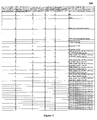
- Figure 2 illustrates one embodiment of an action table 200 that specifies an action to be taken based on a degree to which a tray matches a job requirement upon a job requesting a particular tray.
- the degree to which a tray matches the job requirement is described by parameters.
- the parameters may include Job Fidelity, Tray Validity, Duplex Match, and Big 5 and Orientation Match.
- the Job Fidelity parameter specifies how a job should be processed when the requirements do not match completely.
- the Tray Validity parameter specifies if a tray is valid.
- Duplex Match specifies whether a tray is capable of duplex printing on a required media if a job requests duplex printing.
- Big 5 and Orientation Match relate to basic job parameters.
- the Big 5 refers to basic job requirements such as width, height, weight, type, and color, while orientation is either long-edge-feed or short-edge-feed.
- a logical 0 value the media in the tray and the job requirement do not match in terms of at least one of the 5 properties and orientation.
- a logical 1 value a complete match.
- various actions may be taken based on different combinations of the values of the above-described input parameters.
- Table 1 illustrates an embodiment of the actions that may be taken.
- Table 1 ACTION DESCRIPTION Abort The job is aborted. Prompt The user is prompted to load the required media in the specified tray. Tray_OK The specified tray can be used to print the job; continue processing the job. Change_Tray The specified tray cannot be used to print the job and the printer may search for a different suitable tray to from which to print the job. Make_Simplex_OK Force the job to be simplex and use the specified tray to continue processing the job. Make_Simplex_Prompt Force the job to be simplex and then prompt the user to load the required media in the specified tray to continue processing the job from the tray.
- Figure 3 illustrates one embodiment of an action table 300.
- table 300 describes a tray selection and a course of action when a tray is not specified by a print job.
- table 200 is used to determine an appropriate action for each tray. Subsequently, a final action is determined using table 300 based on whether or not there were some trays corresponding to each action.
- any column titled 'Some tray x?' has a logical 1 value if there was at least one tray found which would lead to action x.
- table 300 assumes that the Tray_OK action has the highest priority because whenever some tray is Tray_OK, the final action is also Tray_OK, regardless of what action other trays result in. Similarly, Make_Simplex_Tray_OK has the next highest priority, followed by Prompt, Make_Simplex_Prompt and Abort. The priority of these actions, however, can be changed any time.
- Figure 4 is a flow diagram illustrating one embodiment of a method 400 for selecting a tray and determining an appropriate action based on action tables 200 and 300 and input priorities of actions.
- Method 400 may be performed by processing logic that may comprise hardware (e.g., circuitry, dedicated logic, programmable logic, etc.), software (such as instructions run on a processing device), or a combination thereof.
- method 400 may be performed by tray selection unit 120.
- the processes of method 400 are illustrated in linear sequences for brevity and clarity in presentation; however, it is contemplated that any number of them can be performed in parallel, asynchronously, or in different orders. For brevity, clarity, and ease of understanding, many of the details discussed with reference to Figures 1-3 are not discussed or repeated here.
- a print job data stream is received at print controller 102.
- a determination is made as to whether a tray from which the job is to be processed is specified in the print job data stream. If a determination is made that a tray is specified, job requirements specified in the print job data stream are matched with the content of the specified tray, processing block 415.
- a lookup of table 200 is performed to determine an action that is to be implemented at the specified tray.
- a determination is made as to whether the action is a change tray action. If not, the specified action in table 200 corresponding to the tray is performed, processing block 430.
- processing block 445 a lookup of table 200 is performed to determine an action that is to be implemented for the tray.
- decision block 455 a determination is made as to whether there are additional trays to process. If so, control is returned to processing block 445 where the job requirements specified in the print job data stream are matched with the content of a second specified tray, and processing block 450 where a subsequent lookup of table 200 is performed. Accordingly, processing blocks 445 and 450 are implemented for each tray.
- Table 300 is generated upon determining there are no additional trays to process, processing block 460.
- a lookup of table 300 is performed for a final action and a selected tray using the action for each tray.
- the final action is performed from the selected tray.
- Figure 5 illustrates one embodiment of program code corresponding to method 400.
- Figure 6 illustrates a computer system 600 on which printing system 100 may be implemented.
- Computer system 600 includes a system bus 620 for communicating information, and a processor 610 coupled to bus 620 for processing information.
- Computer system 600 further comprises a random access memory (RAM) or other dynamic storage device 625 (referred to herein as main memory), coupled to bus 620 for storing information and instructions to be executed by processor 610.
- Main memory 625 also may be used for storing temporary variables or other intermediate information during execution of instructions by processor 610.
- Computer system 600 also may include a read only memory (ROM) and or other static storage device 626 coupled to bus 620 for storing static information and instructions used by processor 610.
- ROM read only memory
- a data storage device 625 such as a magnetic disk or optical disc and its corresponding drive may also be coupled to computer system 600 for storing information and instructions.
- Computer system 600 can also be coupled to a second I/O bus 650 via an I/O interface 630.
- a plurality of I/O devices may be coupled to I/O bus 650, including a display device 624, an input device (e.g., an alphanumeric input device 623 and or a cursor control device 622).
- the communication device 621 is for accessing other computers (servers or clients).
- the communication device 621 may comprise a modem, a network interface card, or other well-known interface device, such as those used for coupling to Ethernet, token ring, or other types of networks.
- Embodiments of the invention may include various steps as set forth above.
- the steps may be embodied in machine-executable instructions.
- the instructions can be used to cause a general-purpose or special-purpose processor to perform certain steps.
- these steps may be performed by specific hardware components that contain hardwired logic for performing the steps, or by any combination of programmed computer components and custom hardware components.
- Elements of the present invention may also be provided as a machine-readable medium for storing the machine-executable instructions.
- the machine-readable medium may include, but is not limited to, floppy diskettes, optical disks, CD-ROMs, and magneto-optical disks, ROMs, RAMs, EPROMs, EEPROMs, magnetic or optical cards, propagation media or other type of media/machine-readable medium suitable for storing electronic instructions.
- the present invention may be downloaded as a computer program which may be transferred from a remote computer (e.g., a server) to a requesting computer (e.g., a client) by way of data signals embodied in a carrier wave or other propagation medium via a communication link (e.g., a modem or network connection).
- a remote computer e.g., a server
- a requesting computer e.g., a client
- a communication link e.g., a modem or network connection
Landscapes
- Engineering & Computer Science (AREA)
- Theoretical Computer Science (AREA)
- Human Computer Interaction (AREA)
- Physics & Mathematics (AREA)
- General Engineering & Computer Science (AREA)
- General Physics & Mathematics (AREA)
- Quality & Reliability (AREA)
- Accessory Devices And Overall Control Thereof (AREA)
- Sheets, Magazines, And Separation Thereof (AREA)
- Facsimiles In General (AREA)
Abstract
Description
- The invention relates to the field of printing systems, and in particular, to processing print jobs at a printing system.
- In the field of printing, users prefer systems that allow for flexible processing of print jobs, which typically comprise print data received in the form of a page description language (PDL). A PDL data stream typically includes attributes that assist in defining processing steps that may be performed for the print job. Upon receiving a PDL data stream, a printer controller selects an appropriate input tray from which to print a job included within the PDL data stream. Subsequently, the controller takes an appropriate action depending on a degree to which the content of the tray matches the job requirement. Exemplary actions include prompting a user to load a required media, or aborting the job.
- In some instances a job may specify a particular tray. Only an appropriate action needs to be determined in such instances. However, when a job does not specify a tray an appropriate tray needs to be selected. Additionally, the selection of trays and actions may vary depending on print fidelity (e.g., how to process a job when the requirements do not match completely).
- Typically, two types of fidelity are considered: fail-job and print-anyway. In fail-job fidelity, job requirements must be completely satisfied in order to print the job, while in print-anyway fidelity some requirements may be compromised to print the job. The various contexts and variables render the logic of tray selection and determination of action complex and difficult to maintain. Moreover, customers often request changes in the behavior of tray selection and prompting for media, which require significant effort to implement.
- Accordingly, a mechanism to model tray selection and determine appropriate actions is desired.
- In one embodiment, a method is disclosed.
- The method includes receiving a print job data stream, selecting an appropriate input tray from which to print the print job based on a set of rules indicated in one or more tables and performing an action indicated in the one or more tables.
- A better understanding of the present invention can be obtained from the following detailed description in conjunction with the following drawings.
-
Figure 1 illustrates one embodiment of a printing system. -
Figure 2 illustrates one embodiment of an action-based table. -
Figure 3 illustrates another embodiment of an action-based table. -
Figure 4 is a flow diagram illustrating one embodiment of a tray selection process. -
Figure 5 illustrates one embodiment of code implemented to select a tray and determine an action. -
Figure 6 illustrates one embodiment of a computer system. - An input tray selection mechanism is described. In the following description, for the purposes of explanation, numerous specific details are set forth in order to provide a thorough understanding of the present invention. It will be apparent, however, to one skilled in the art that the present invention may be practiced without some of these specific details. In other instances, well-known structures and devices are shown in block diagram form to avoid obscuring the underlying principles of the present invention.
- Reference in the specification to "one embodiment" or "an embodiment" means that a particular feature, structure, or characteristic described in connection with the embodiment is included in at least one embodiment of the invention. The appearances of the phrase "in one embodiment" in various places in the specification are not necessarily all referring to the same embodiment.
-
Figure 1 is a block diagram illustrating one embodiment of aprinting system 100.Printing system 100 is a system used to provide marks on a media, such as a continuous forms printer or a cut sheet page printer.Printing system 100 may include any digital hardcopy output device, such as printers, copiers, multifunction printers (MFPs) and facsimiles. - In one embodiment,
printing system 100 is shared by multiple users. In such an embodiment,printing system 100 includes aprint controller 102 and one ormore print engines 104.Print controller 102 includes any system, server, or components operable to interface one ormore host systems 107 and 108, and a printer 109, vianetwork 110 with one ormore print engines 104, and to control the printing of print jobs 136-138 received from thehost systems 107 and 108, and a printer 109, respectively, onprint engine 104.Print engine 104 provides an imaging process to mark a printable medium, such as paper. - According to one embodiment,
print controller 102 includesmemory 103,RIP processor 110 and aprint job manager 112.Memory 103 includes any storage system operable to store data.RIP processor 110 performs rasterization to convert print data received in the form of a page description language (PDL) to image bitmap data. In one embodiment,print job manager 112 manages the printing of documents atprinting system 100. Particularly,print job manager 112 controls print jobs as they wait to print, arranges the priority of the print jobs, generates separator pages and distributes jobs to thedestination print engine 104. In one embodiment,print job manager 112 may be implemented using either InfoPrint Manager (IPM) or InfoPrint ProcessDirector (IPPD), although other types of print job managers may be used instead. - In one embodiment,
print job manager 112 holds received print jobs inmemory 103 before processing the print job. In such an embodiment,memory 103 stores the print jobs as either a data file or rasterized bitmap file. For example, print jobs stored as rasterized files reduce print time for the held jobs versus those stored as data files. Once stored, each print job may be held until the user that generated the print job retrieves the corresponding document fromprinting system 100, at which time the print job is processed and printed. - In a further embodiment, a user may release a selected job for printing at
printing system 100 viauser input 106.Printing system 100 thereby processes the print job by printing viaprint engine 104. In still a further embodiment, multiple selected print jobs being held for a particular user may be simultaneously processed and printed atprint engine 104. Therefore, all print jobs for the same user are printed together when multiple print jobs are released to print. - According to one embodiment,
print job manager 112 includestray selection unit 120 that selects an appropriate input tray from which to print a received job. In such an embodiment,tray selection unit 120 performs tray selection based on a set of rules and determines appropriate actions that enable alteration (e.g., addition and/or modification) of the rules. In addition,tray selection unit 120 enables a user to configure actions via graphical user interface (GUI) 121 to suit a particular printing environment. - In one embodiment,
tray selection unit 120 performs a tray selection process using a set of tray action tables 124 stored inmemory 103.Figure 2 illustrates one embodiment of an action table 200 that specifies an action to be taken based on a degree to which a tray matches a job requirement upon a job requesting a particular tray. In one embodiment, the degree to which a tray matches the job requirement is described by parameters. The parameters may include Job Fidelity, Tray Validity, Duplex Match, and Big 5 and Orientation Match. - The Job Fidelity parameter specifies how a job should be processed when the requirements do not match completely. In one embodiment, a logical 0 value = fail-job and logical 1 value = print-anyway. The Tray Validity parameter specifies if a tray is valid. A logical 0 value = invalid and a logical 1 value = valid. Duplex Match specifies whether a tray is capable of duplex printing on a required media if a job requests duplex printing. A logical 1 value = tray is capable, and logical 0 value = tray is not capable. Big 5 and Orientation Match relate to basic job parameters. For instance, the
Big 5 refers to basic job requirements such as width, height, weight, type, and color, while orientation is either long-edge-feed or short-edge-feed. A logical 0 value = the media in the tray and the job requirement do not match in terms of at least one of the 5 properties and orientation. A logical 1 value = a complete match. - According to one embodiment, various actions may be taken based on different combinations of the values of the above-described input parameters. Table 1 illustrates an embodiment of the actions that may be taken.
Table 1 ACTION DESCRIPTION Abort The job is aborted. Prompt The user is prompted to load the required media in the specified tray. Tray_OK The specified tray can be used to print the job; continue processing the job. Change_Tray The specified tray cannot be used to print the job and the printer may search for a different suitable tray to from which to print the job. Make_Simplex_OK Force the job to be simplex and use the specified tray to continue processing the job. Make_Simplex_Prompt Force the job to be simplex and then prompt the user to load the required media in the specified tray to continue processing the job from the tray. -
Figure 3 illustrates one embodiment of an action table 300. In one embodiment, table 300 describes a tray selection and a course of action when a tray is not specified by a print job. In such an embodiment, table 200 is used to determine an appropriate action for each tray. Subsequently, a final action is determined using table 300 based on whether or not there were some trays corresponding to each action. In table 300, any column titled 'Some tray x?' has a logical 1 value if there was at least one tray found which would lead to action x. - According to one embodiment, table 300 assumes that the Tray_OK action has the highest priority because whenever some tray is Tray_OK, the final action is also Tray_OK, regardless of what action other trays result in. Similarly, Make_Simplex_Tray_OK has the next highest priority, followed by Prompt, Make_Simplex_Prompt and Abort. The priority of these actions, however, can be changed any time.
-
Figure 4 is a flow diagram illustrating one embodiment of a method 400 for selecting a tray and determining an appropriate action based on action tables 200 and 300 and input priorities of actions. Method 400 may be performed by processing logic that may comprise hardware (e.g., circuitry, dedicated logic, programmable logic, etc.), software (such as instructions run on a processing device), or a combination thereof. In one embodiment, method 400 may be performed bytray selection unit 120. The processes of method 400 are illustrated in linear sequences for brevity and clarity in presentation; however, it is contemplated that any number of them can be performed in parallel, asynchronously, or in different orders. For brevity, clarity, and ease of understanding, many of the details discussed with reference toFigures 1-3 are not discussed or repeated here. - At
processing block 405, a print job data stream is received atprint controller 102. Atdecision block 410, a determination is made as to whether a tray from which the job is to be processed is specified in the print job data stream. If a determination is made that a tray is specified, job requirements specified in the print job data stream are matched with the content of the specified tray,processing block 415. Atprocessing block 420, a lookup of table 200 is performed to determine an action that is to be implemented at the specified tray. Atdecision block 425, a determination is made as to whether the action is a change tray action. If not, the specified action in table 200 corresponding to the tray is performed,processing block 430. - However if the action is a change tray action, or a tray has not been specified at
decision block 410, the job requirements specified in the print job data stream are matched with the content of a tray,processing block 445. Atprocessing block 450, a lookup of table 200 is performed to determine an action that is to be implemented for the tray. Atdecision block 455, a determination is made as to whether there are additional trays to process. If so, control is returned to processing block 445 where the job requirements specified in the print job data stream are matched with the content of a second specified tray, andprocessing block 450 where a subsequent lookup of table 200 is performed. Accordingly, processing blocks 445 and 450 are implemented for each tray. - Table 300 is generated upon determining there are no additional trays to process, processing
block 460. Atprocessing block 465, a lookup of table 300 is performed for a final action and a selected tray using the action for each tray. Atprocessing block 470, the final action is performed from the selected tray.Figure 5 illustrates one embodiment of program code corresponding to method 400. -
Figure 6 illustrates acomputer system 600 on whichprinting system 100 may be implemented.Computer system 600 includes a system bus 620 for communicating information, and aprocessor 610 coupled to bus 620 for processing information. -
Computer system 600 further comprises a random access memory (RAM) or other dynamic storage device 625 (referred to herein as main memory), coupled to bus 620 for storing information and instructions to be executed byprocessor 610.Main memory 625 also may be used for storing temporary variables or other intermediate information during execution of instructions byprocessor 610.Computer system 600 also may include a read only memory (ROM) and or otherstatic storage device 626 coupled to bus 620 for storing static information and instructions used byprocessor 610. - A
data storage device 625 such as a magnetic disk or optical disc and its corresponding drive may also be coupled tocomputer system 600 for storing information and instructions.Computer system 600 can also be coupled to a second I/O bus 650 via an I/O interface 630. A plurality of I/O devices may be coupled to I/O bus 650, including adisplay device 624, an input device (e.g., analphanumeric input device 623 and or a cursor control device 622). Thecommunication device 621 is for accessing other computers (servers or clients). Thecommunication device 621 may comprise a modem, a network interface card, or other well-known interface device, such as those used for coupling to Ethernet, token ring, or other types of networks. - Embodiments of the invention may include various steps as set forth above. The steps may be embodied in machine-executable instructions. The instructions can be used to cause a general-purpose or special-purpose processor to perform certain steps. Alternatively, these steps may be performed by specific hardware components that contain hardwired logic for performing the steps, or by any combination of programmed computer components and custom hardware components.
- Elements of the present invention may also be provided as a machine-readable medium for storing the machine-executable instructions. The machine-readable medium may include, but is not limited to, floppy diskettes, optical disks, CD-ROMs, and magneto-optical disks, ROMs, RAMs, EPROMs, EEPROMs, magnetic or optical cards, propagation media or other type of media/machine-readable medium suitable for storing electronic instructions. For example, the present invention may be downloaded as a computer program which may be transferred from a remote computer (e.g., a server) to a requesting computer (e.g., a client) by way of data signals embodied in a carrier wave or other propagation medium via a communication link (e.g., a modem or network connection).
- Whereas many alterations and modifications of the present invention will no doubt become apparent to a person of ordinary skill in the art after having read the foregoing description, it is to be understood that any particular embodiment shown and described by way of illustration is in no way intended to be considered limiting. Therefore, references to details of various embodiments are not intended to limit the scope of the claims, which in themselves recite only those features regarded as essential to the invention.
- The present application is based on and claims the benefit of priority of
U. S. Patent Application No. 14/709,673, filed on May 12, 2015
Claims (15)
- A non-transitory machine-readable medium including data that, when accessed by a machine, cause the machine to perform operations comprising:receiving a print job data stream;processing the print job data stream to determine whether a tray has been specified;matching job requirements specified in the print job data stream with content of the specified tray upon determining that a tray has been specified;performing a lookup of a first of one or more tables to determine an action that is to be implemented at the specified tray; andperforming an action indicated in the one or more tables.
- The machine-readable medium of claim 1 including data that, when accessed by the machine, further cause the machine to perform operations comprising
determining actions to enable alteration of a set of rules. - The machine-readable medium of claim 1 including data that, when accessed by the machine, further cause the machine to perform operations comprising:determining whether the action is a change tray action; andperforming the action upon determining that the action is a not change tray action.
- The machine-readable medium of claim 3 including data that, when accessed by the machine, further cause the machine to perform operations comprising:matching job requirements specified in the print job data stream with content of a first tray upon determining that the action is a change tray action; andperforming a lookup of the first table to determine an action that is to be implemented at the first tray.
- The machine-readable medium of claim 4 including data that, when accessed by the machine, further cause the machine to perform operations comprising:determining whether there are additional trays; andfor each additional tray:matching job requirements specified in the print job data stream with content of the tray; andperforming a lookup of the first table to determine an action that is to be implemented at the tray.
- The machine-readable medium of claim 5 including data that, when accessed by the machine, further cause the machine to perform operations comprising:generating a second of the one or more tables upon determining there are no additional trays;performing a lookup of the second table to determine an action that is to be performed and select a tray corresponding to the action that is to be implemented; andperforming the action at the selected tray.
- The machine-readable medium of claim 1 including data that, when accessed by the machine, further cause the machine to perform operations comprising:matching job requirements specified in the print job data stream with content of a first tray upon determining that a tray has not been specified; andperforming a lookup of the first table to determine an action that is to be implemented at the first tray.
- The machine-readable medium of claim 7 including data that, when accessed by the machine, further cause the machine to perform operations comprising:determining whether there are additional trays; andfor each additional tray:matching job requirements specified in the print job data stream with content of the tray; andperforming a lookup of the first table to determine an action that is to be implemented at the tray.
- The machine-readable medium of claim 8 including data that, when accessed by the machine, further cause the machine to perform operations comprising:generating a second of the one or more tables upon determining there are no additional trays;performing a lookup of the second table to determine an action that is to be performed and select a tray corresponding to the action that is to be implemented; andperforming the action at the selected tray.
- A printing system comprising:a memory device to store one or more tray action tables; anda print job manager to receive a print job included in a print job data stream, process the print job data stream to determine whether a tray has been specified, match job requirements specified in the print job data stream with content of the specified tray upon determining that a tray has been specified, perform a lookup of a first of the one or more tables to determine an action that is to be implemented at the specified tray, and perform an action indicated in the one or more tables.
- The printing system of claim 10 wherein the one or more tables comprise:a first table that specifies an action to be taken based on a degree to which a tray matches a print job requirement; anda second table that describes a tray selection and a course of action when a tray is not specified by a print job.
- The printing system of claim 11 wherein the degree to which a tray matches the job requirement is described by parameters included in the print job data stream upon a job requesting a particular tray.
- The printing system of claim 10 wherein the print job manager determines whether the action is a change tray action and performs the action upon determining that the action is a not change tray action.
- The printing system of claim 13 wherein the print job manager matches job requirements specified in the print job data stream with content of a first tray upon determining that the action is a change tray action and performs a lookup of the first table to determine an action that is to be implemented at the first tray.
- The printing system of claim 14 wherein the print job manager determines whether there are additional trays, and for each additional tray matching job requirements specified in the print job data stream with content of the tray and performs a lookup of the first table to determine an action that is to be implemented at the tray.
Applications Claiming Priority (1)
| Application Number | Priority Date | Filing Date | Title |
|---|---|---|---|
| US14/709,673 US9530083B2 (en) | 2013-02-28 | 2015-05-12 | Input tray selection mechanism |
Publications (2)
| Publication Number | Publication Date |
|---|---|
| EP3101531A2 true EP3101531A2 (en) | 2016-12-07 |
| EP3101531A3 EP3101531A3 (en) | 2017-03-15 |
Family
ID=55967096
Family Applications (1)
| Application Number | Title | Priority Date | Filing Date |
|---|---|---|---|
| EP16168764.5A Withdrawn EP3101531A3 (en) | 2015-05-12 | 2016-05-09 | Input tray selection mechanism |
Country Status (2)
| Country | Link |
|---|---|
| EP (1) | EP3101531A3 (en) |
| JP (1) | JP6274249B2 (en) |
Family Cites Families (3)
| Publication number | Priority date | Publication date | Assignee | Title |
|---|---|---|---|---|
| JP2001191618A (en) * | 2000-01-06 | 2001-07-17 | Fujitsu Ltd | Printing equipment |
| JP2004268528A (en) * | 2003-03-11 | 2004-09-30 | Ricoh Co Ltd | Image forming system and image forming apparatus |
| JP5448632B2 (en) * | 2009-08-07 | 2014-03-19 | キヤノン株式会社 | Information processing apparatus, information processing apparatus control method, and program |
-
2016
- 2016-05-09 JP JP2016093750A patent/JP6274249B2/en not_active Expired - Fee Related
- 2016-05-09 EP EP16168764.5A patent/EP3101531A3/en not_active Withdrawn
Non-Patent Citations (1)
| Title |
|---|
| None |
Also Published As
| Publication number | Publication date |
|---|---|
| JP6274249B2 (en) | 2018-02-07 |
| EP3101531A3 (en) | 2017-03-15 |
| JP2016210187A (en) | 2016-12-15 |
Similar Documents
| Publication | Publication Date | Title |
|---|---|---|
| US7265855B2 (en) | Priority interruptible printing system | |
| US9195414B2 (en) | Image processing apparatus functioning as a print server changing print settings of saved job on demand from an external terminal | |
| US8107122B2 (en) | Methods and apparatus for print job submission | |
| JP5189814B2 (en) | Print shop management method and apparatus for printing using a plurality of apparatuses | |
| US8064084B2 (en) | Distributed processing of print jobs | |
| JP2007310870A (en) | Method for printing document included with color, and black and white | |
| JP2007272903A (en) | Print shop management method and apparatus for printing mixed color and black and white documents | |
| US10003703B2 (en) | Data processing apparatus and print system | |
| US10558411B2 (en) | Server apparatus, method of controlling the server apparatus, storage medium, and printing system that determine whether to perform, in the server apparatus, rendering processing on a page of a print job | |
| US9292234B2 (en) | Print job correction mechanism | |
| US20130063745A1 (en) | Generating a page of an electronic document using a multifunction printer | |
| US9530083B2 (en) | Input tray selection mechanism | |
| EP3798832A1 (en) | Image processing mechanism | |
| US8988707B2 (en) | Method of managing plural print jobs by using a print job group list | |
| JP2016110266A (en) | Information processing device, method for controlling information processing device, and program | |
| US10268428B2 (en) | Medium prompting mechanism | |
| US20120250053A1 (en) | Method and system for handling sub-jobs | |
| US20190034133A1 (en) | Image forming apparatus, method of controlling the same, and storage medium | |
| US9952813B2 (en) | Non-transitory computer-readable storage medium storing print control program and print control apparatus | |
| US10310792B2 (en) | Mechanism for generating index separator pages | |
| US8860994B2 (en) | Electronic replacement of pre-printed forms | |
| US20140362398A1 (en) | Mechanism for Tracking Print Job Segments | |
| JP6274249B2 (en) | Input tray selection mechanism | |
| JP2016172331A (en) | Image formation method, information processing method and program | |
| US8659780B2 (en) | Print management for plurality of print requests in image forming apparatus |
Legal Events
| Date | Code | Title | Description |
|---|---|---|---|
| PUAI | Public reference made under article 153(3) epc to a published international application that has entered the european phase |
Free format text: ORIGINAL CODE: 0009012 |
|
| STAA | Information on the status of an ep patent application or granted ep patent |
Free format text: STATUS: REQUEST FOR EXAMINATION WAS MADE |
|
| 17P | Request for examination filed |
Effective date: 20160509 |
|
| AK | Designated contracting states |
Kind code of ref document: A2 Designated state(s): AL AT BE BG CH CY CZ DE DK EE ES FI FR GB GR HR HU IE IS IT LI LT LU LV MC MK MT NL NO PL PT RO RS SE SI SK SM TR |
|
| AX | Request for extension of the european patent |
Extension state: BA ME |
|
| PUAL | Search report despatched |
Free format text: ORIGINAL CODE: 0009013 |
|
| RIC1 | Information provided on ipc code assigned before grant |
Ipc: G06F 3/12 20060101AFI20170117BHEP |
|
| RIC1 | Information provided on ipc code assigned before grant |
Ipc: G06F 3/12 20060101AFI20170126BHEP |
|
| AK | Designated contracting states |
Kind code of ref document: A3 Designated state(s): AL AT BE BG CH CY CZ DE DK EE ES FI FR GB GR HR HU IE IS IT LI LT LU LV MC MK MT NL NO PL PT RO RS SE SI SK SM TR |
|
| AX | Request for extension of the european patent |
Extension state: BA ME |
|
| RIC1 | Information provided on ipc code assigned before grant |
Ipc: G06F 3/12 20060101AFI20170206BHEP |
|
| STAA | Information on the status of an ep patent application or granted ep patent |
Free format text: STATUS: EXAMINATION IS IN PROGRESS |
|
| 17Q | First examination report despatched |
Effective date: 20200311 |
|
| STAA | Information on the status of an ep patent application or granted ep patent |
Free format text: STATUS: THE APPLICATION IS DEEMED TO BE WITHDRAWN |
|
| 18D | Application deemed to be withdrawn |
Effective date: 20211201 |