EP3101004A1 - Bipyridyl compound - Google Patents
Bipyridyl compound Download PDFInfo
- Publication number
- EP3101004A1 EP3101004A1 EP15744067.8A EP15744067A EP3101004A1 EP 3101004 A1 EP3101004 A1 EP 3101004A1 EP 15744067 A EP15744067 A EP 15744067A EP 3101004 A1 EP3101004 A1 EP 3101004A1
- Authority
- EP
- European Patent Office
- Prior art keywords
- group
- nmr
- cdcl
- mhz
- optionally substituted
- Prior art date
- Legal status (The legal status is an assumption and is not a legal conclusion. Google has not performed a legal analysis and makes no representation as to the accuracy of the status listed.)
- Granted
Links
- 0 CN(Cc1cc(*)ccc11)C1=O Chemical compound CN(Cc1cc(*)ccc11)C1=O 0.000 description 1
Classifications
-
- C—CHEMISTRY; METALLURGY
- C07—ORGANIC CHEMISTRY
- C07D—HETEROCYCLIC COMPOUNDS
- C07D213/00—Heterocyclic compounds containing six-membered rings, not condensed with other rings, with one nitrogen atom as the only ring hetero atom and three or more double bonds between ring members or between ring members and non-ring members
- C07D213/02—Heterocyclic compounds containing six-membered rings, not condensed with other rings, with one nitrogen atom as the only ring hetero atom and three or more double bonds between ring members or between ring members and non-ring members having three double bonds between ring members or between ring members and non-ring members
- C07D213/04—Heterocyclic compounds containing six-membered rings, not condensed with other rings, with one nitrogen atom as the only ring hetero atom and three or more double bonds between ring members or between ring members and non-ring members having three double bonds between ring members or between ring members and non-ring members having no bond between the ring nitrogen atom and a non-ring member or having only hydrogen or carbon atoms directly attached to the ring nitrogen atom
- C07D213/24—Heterocyclic compounds containing six-membered rings, not condensed with other rings, with one nitrogen atom as the only ring hetero atom and three or more double bonds between ring members or between ring members and non-ring members having three double bonds between ring members or between ring members and non-ring members having no bond between the ring nitrogen atom and a non-ring member or having only hydrogen or carbon atoms directly attached to the ring nitrogen atom with substituted hydrocarbon radicals attached to ring carbon atoms
- C07D213/44—Radicals substituted by doubly-bound oxygen, sulfur, or nitrogen atoms, or by two such atoms singly-bound to the same carbon atom
- C07D213/53—Nitrogen atoms
-
- B—PERFORMING OPERATIONS; TRANSPORTING
- B01—PHYSICAL OR CHEMICAL PROCESSES OR APPARATUS IN GENERAL
- B01J—CHEMICAL OR PHYSICAL PROCESSES, e.g. CATALYSIS OR COLLOID CHEMISTRY; THEIR RELEVANT APPARATUS
- B01J31/00—Catalysts comprising hydrides, coordination complexes or organic compounds
- B01J31/16—Catalysts comprising hydrides, coordination complexes or organic compounds containing coordination complexes
- B01J31/18—Catalysts comprising hydrides, coordination complexes or organic compounds containing coordination complexes containing nitrogen, phosphorus, arsenic or antimony as complexing atoms, e.g. in pyridine ligands, or in resonance therewith, e.g. in isocyanide ligands C=N-R or as complexed central atoms
- B01J31/1805—Catalysts comprising hydrides, coordination complexes or organic compounds containing coordination complexes containing nitrogen, phosphorus, arsenic or antimony as complexing atoms, e.g. in pyridine ligands, or in resonance therewith, e.g. in isocyanide ligands C=N-R or as complexed central atoms the ligands containing nitrogen
- B01J31/181—Cyclic ligands, including e.g. non-condensed polycyclic ligands, comprising at least one complexing nitrogen atom as ring member, e.g. pyridine
- B01J31/1815—Cyclic ligands, including e.g. non-condensed polycyclic ligands, comprising at least one complexing nitrogen atom as ring member, e.g. pyridine with more than one complexing nitrogen atom, e.g. bipyridyl, 2-aminopyridine
-
- B—PERFORMING OPERATIONS; TRANSPORTING
- B01—PHYSICAL OR CHEMICAL PROCESSES OR APPARATUS IN GENERAL
- B01J—CHEMICAL OR PHYSICAL PROCESSES, e.g. CATALYSIS OR COLLOID CHEMISTRY; THEIR RELEVANT APPARATUS
- B01J31/00—Catalysts comprising hydrides, coordination complexes or organic compounds
- B01J31/16—Catalysts comprising hydrides, coordination complexes or organic compounds containing coordination complexes
- B01J31/22—Organic complexes
-
- C—CHEMISTRY; METALLURGY
- C07—ORGANIC CHEMISTRY
- C07F—ACYCLIC, CARBOCYCLIC OR HETEROCYCLIC COMPOUNDS CONTAINING ELEMENTS OTHER THAN CARBON, HYDROGEN, HALOGEN, OXYGEN, NITROGEN, SULFUR, SELENIUM OR TELLURIUM
- C07F15/00—Compounds containing elements of Groups 8, 9, 10 or 18 of the Periodic Table
- C07F15/0006—Compounds containing elements of Groups 8, 9, 10 or 18 of the Periodic Table compounds of the platinum group
- C07F15/0033—Iridium compounds
-
- B—PERFORMING OPERATIONS; TRANSPORTING
- B01—PHYSICAL OR CHEMICAL PROCESSES OR APPARATUS IN GENERAL
- B01J—CHEMICAL OR PHYSICAL PROCESSES, e.g. CATALYSIS OR COLLOID CHEMISTRY; THEIR RELEVANT APPARATUS
- B01J2231/00—Catalytic reactions performed with catalysts classified in B01J31/00
- B01J2231/40—Substitution reactions at carbon centres, e.g. C-C or C-X, i.e. carbon-hetero atom, cross-coupling, C-H activation or ring-opening reactions
-
- B—PERFORMING OPERATIONS; TRANSPORTING
- B01—PHYSICAL OR CHEMICAL PROCESSES OR APPARATUS IN GENERAL
- B01J—CHEMICAL OR PHYSICAL PROCESSES, e.g. CATALYSIS OR COLLOID CHEMISTRY; THEIR RELEVANT APPARATUS
- B01J2231/00—Catalytic reactions performed with catalysts classified in B01J31/00
- B01J2231/40—Substitution reactions at carbon centres, e.g. C-C or C-X, i.e. carbon-hetero atom, cross-coupling, C-H activation or ring-opening reactions
- B01J2231/42—Catalytic cross-coupling, i.e. connection of previously not connected C-atoms or C- and X-atoms without rearrangement
- B01J2231/4277—C-X Cross-coupling, e.g. nucleophilic aromatic amination, alkoxylation or analogues
-
- B—PERFORMING OPERATIONS; TRANSPORTING
- B01—PHYSICAL OR CHEMICAL PROCESSES OR APPARATUS IN GENERAL
- B01J—CHEMICAL OR PHYSICAL PROCESSES, e.g. CATALYSIS OR COLLOID CHEMISTRY; THEIR RELEVANT APPARATUS
- B01J2531/00—Additional information regarding catalytic systems classified in B01J31/00
- B01J2531/80—Complexes comprising metals of Group VIII as the central metal
- B01J2531/82—Metals of the platinum group
- B01J2531/827—Iridium
Definitions
- the present invention relates to a bipyridyl compound useful as a ligand of a metal catalyst and a catalyst including the same bipyridyl compound as a ligand.
- the Suzuki-Miyaura reaction performing a cross coupling between an organic halogen compound and an organic boron compound is an important method for carbon-carbon bond formation reaction and is widely applied.
- the organic boron compound used in this reaction is stable against water or air, and the product of the reaction is a boric acid salt to be thereby low in toxicity and has an advantage of being easily separable from the target product by washing with water.
- the technical problem of the present invention is to provide a compound capable of being a novel ligand allowing regioselective borylation to be performed in the aromatic borylation reaction, and a catalyst using the same compound.
- the present inventors made various studies on the ligand enabling regioselective borylation in the aromatic borylation reaction, and consequently succeeded in the synthesis of a novel compound having a bipyridine skeleton and a benzeneureido skeleton. Moreover, when an aromatic borylation reaction was performed by using a catalyst having the aforementioned compound as a ligand, the borylation reaction proceeded selectively at the meta position of the aromatic compound, and thus, the present inventors found that the aforementioned catalyst is useful as a meta-selective borylation catalyst, and consequently accomplished the present invention.
- the present invention provide the following [1] to [6].
- the catalyst including the compound (1) of the present invention as a ligand is useful as a catalyst to selectively introduce a boron atom into the meta position of an aromatic compound. Accordingly, the use of the catalyst including the compound (1) of the present invention as a ligand enables the production of various regioselective aromatic boron compounds usable in the coupling reaction such as the Suzuki-Miyaura reaction.
- the bipyridyl compound of the general formula (1) is characterized by having both of a bipyridine skeleton and a benzeneureido skeleton.
- A represents a single bond, a vinylene group or an ethynylene group.
- a single bond or an ethynylene group are preferable, and a single bond is more preferable.
- the bonding position of A in the benzene ring may be any of the ortho position, meta position and para position in relation to the ureido group, and is more preferably the ortho position.
- X represents an oxygen atom or a sulfur atom. Of these, an oxygen atom is preferable.
- R 1 represents a hydrogen atom, a halogen atom, an optionally substituted hydrocarbon group, an optionally substituted alkoxy group, an optionally substituted aryloxy group, an optionally substituted amino group, a cyano group, a nitro group, or an alkoxycarbonyl group, or two adjacent R 1 may form a saturated or unsaturated ring structure optionally containing a hetero atom together with the carbon atoms bonded to the two R 1 .
- halogen atom examples include a fluorine atom, a bromine atom, a chlorine atom and an iodine atom.
- a hydrocarbon group having 1 to 16 carbon atoms is preferable, an alkyl group having 1 to 16 carbon atoms, an alkenyl group having 2 to 16 carbon atoms, a cycloalkyl group having 3 to 16 carbon atoms, an aryl group having 6 to 14 carbon atoms and an arylalkyl group having 7 to 16 carbon atoms are more preferable, and an alkyl group having 1 to 16 carbon atoms, an alkenyl group having 2 to 16 carbon atoms, a cycloalkyl group having 3 to 7 carbon atoms, an aryl group having 6 to 10 carbon atoms and an arylalkyl group having 7 to 16 carbon atoms are furthermore preferable.
- alkyl group having 1 to 16 carbon atoms examples include: linear or branched alkyl groups such as a methyl group, an ethyl group, an n-propyl group, an isopropyl group, an n-butyl group, an isobutyl group, a sec-butyl group, a tert-butyl group, an n-pentyl group, an isopentyl group, an n-hexyl group, an n-octyl group and an n-decyl group.
- linear or branched alkyl groups such as a methyl group, an ethyl group, an n-propyl group, an isopropyl group, an n-butyl group, an isobutyl group, a sec-butyl group, a tert-butyl group, an n-pentyl group, an isopentyl group, an n-hexyl group, an
- Examples of the alkenyl group having 2 to 16 carbon atoms include: a vinyl group, an allyl group, a propenyl group, a butenyl group and a hexenyl group.
- Examples of the cycloalkyl group having 3 to 7 carbon atoms include: a cyclopropyl group, a cyclobutyl group, a cyclopentyl group, a cyclohexyl group and a cycloheptyl group.
- Examples of the aryl group having 6 to 10 carbon atoms include a phenyl group and a naphthyl group.
- Examples of the arylalkyl group having 7 to 16 carbon atoms include a phenyl-C 1-6 alkyl group and a naphthyl-C 1-6 alkyl group.
- an alkoxy group having 1 to 16 carbon atoms is preferable and an alkoxy group having 1 to 6 carbon atoms is more preferable.
- Specific examples of the alkoxy group include a methoxy group, an ethoxy group, an n-propyloxy group and an isopropyloxy group.
- Examples of the aryloxy group include a C 6-10 aryloxy group, and as the aryloxy group, a phenoxy group, a naphthyloxy group and the like are more preferable.
- alkoxycarbonyl group examples include a C 1-6 alkoxycarbonyl group, and specific examples of the alkoxycarbonyl group include a methoxycarbonyl group and an ethoxycarbonyl group.
- examples of the group capable of being substituted in the hydrocarbon group represented by R 1 include: 1 to 3 halogen atoms, a cyano group, a nitro group, a halogeno C 1-6 alkyl group and a C 1-6 alkoxy group.
- examples of the group capable of being substituted in the alkoxy group and the aryloxy group include 1 to 3 halogen atoms, a cyano group, a nitro group, a halogeno C 1-6 alkyl group and a C 1-6 alkoxy group.
- Examples of the group capable of being substituted in the amino group include a C 1-6 alkyl group and a halogeno C 1-6 alkyl group.
- n represents a number of 1 to 4, and is preferably a number of 1 or 2.
- substitution position of R 1 is not particularly limited, but is preferably a position not disturbing the coordination bonding of the nitrogen atom of the pyridine ring to a metal atom, namely, a position distant from the nitrogen atom, preferably a position at the meta position or the para position relative to the nitrogen atom, and particularly preferably the para position.
- R 2 represents a hydrogen atom, an optionally substituted hydrocarbon group, an optionally substituted alkoxy group, or an optionally substituted aryloxy group.
- a hydrocarbon group having 1 to 16 carbon atoms is preferable, an alkyl group having 1 to 16 carbon atoms, an alkenyl group having 2 to 16 carbon atoms, a cycloalkyl group having 3 to 16 carbon atoms, an aryl group having 6 to 14 carbon atoms and an arylalkyl group having 7 to 16 carbon atoms are more preferable, and an alkyl group having 1 to 16 carbon atoms, an alkenyl group having 2 to 16 carbon atoms, a cycloalkyl group having 3 to 7 carbon atoms, an aryl group having 6 to 10 carbon atoms and an arylalkyl group having 7 to 16 carbon atoms are furthermore preferable.
- alkyl group having 1 to 16 carbon atoms examples include linear or branched alkyl groups such as a methyl group, an ethyl group, an n-propyl group, an isopropyl group, an n-butyl group, an isobutyl group, a sec-butyl group, a tert-butyl group, an n-pentyl group, an isopentyl group, an n-hexyl group, an n-octyl group and an n-decyl group.
- linear or branched alkyl groups such as a methyl group, an ethyl group, an n-propyl group, an isopropyl group, an n-butyl group, an isobutyl group, a sec-butyl group, a tert-butyl group, an n-pentyl group, an isopentyl group, an n-hexyl group, an n
- Examples of the alkenyl group having 2 to 16 carbon atoms include: a vinyl group, an allyl group, a propenyl group, a butenyl group and a hexenyl group.
- Examples of the cycloalkyl group having 3 to 7 carbon atoms include: a cyclopropyl group, a cyclobutyl group, a cyclopentyl group, a cyclohexyl group and cycloheptyl group.
- Examples of the aryl group having 6 to 10 carbon atoms include: a phenyl group and a naphthyl group.
- Examples of the arylalkyl group having 7 to 16 carbon atoms include a phenyl C 1-6 alkyl group and a naphthyl C 1-6 alkyl group.
- an alkoxy group having 1 to 16 carbon atoms is preferable, and an alkoxy group having 1 to 6 carbon atoms is more preferable.
- Specific examples of the alkoxy group include: a methoxy group, an ethoxy group, an n-propyloxy group and an isopropyloxy group.
- Examples of the aryloxy group include a C 6-10 aryloxy group, and a phenoxy group, a naphthyloxy group and the like are more preferable.
- Examples of the group capable of being substituted in the hydrocarbon group represented by R 2 include: 1 to 3 halogen atoms, a cyano group, a nitro group, a halogeno C 1-6 alkyl group and a C 1-6 alkoxy group.
- Examples of the group capable of being substituted in an alkoxy group and an aryloxy group include: 1 to 3 halogen atoms, a cyano group, a nitro group, a halogeno C 1-6 alkyl group and a C 1-6 alkoxy group.
- R 1 a hydrogen atom, a halogen atom, an alkyl group having 1 to 10 carbon atoms, an alkenyl group having 2 to 10 carbon atoms, a cycloalkyl group having 3 to 7 carbon atoms, an aryl group having 6 to 10 carbon atoms, an alkoxy group having 1 to 10 carbon atoms, an aryloxy group having 6 to 10 carbon atoms, a C 1-6 alkylamino group, a di (C 1-6 alkyl)amino group, a cyano group and a C 1-10 alkoxycarbonyl group are more preferable.
- R 2 a hydrogen atom, an optionally substituted alkyl group having 1 to 10 carbon atoms, an optionally substituted alkenyl group having 2 to 10 carbon atoms, an optionally substituted cycloalkyl group having 3 to 7 carbon atoms, an optionally substituted aryl group having 6 to 10 carbon atoms, an optionally substituted alkoxy group having 1 to 10 carbon atoms and an optionally substituted aryloxy group having 6 to 10 carbon atoms are preferable.
- R 2 Particularly preferable as R 2 are the C 1-10 alkyl group optionally substituted with the substituent (such as a halogen atom or a C 1-6 alkoxy group), the C 3-7 cycloalkyl group optionally substituted with the substituent (such as a C 1-6 alkyl group, a halogeno C 1-6 alkyl group or a C 1-6 alkoxy group), and the phenyl group optionally substituted with the substituent (such as a C 1-6 alkyl group, a halogeno C 1-6 alkyl group or a C 1-6 alkoxy group).
- the substituent such as a halogen atom or a C 1-6 alkoxy group
- the C 3-7 cycloalkyl group optionally substituted with the substituent
- the phenyl group optionally substituted with the substituent (such as a C 1-6 alkyl group, a halogeno C 1-6 alkyl group or a C 1-6 alkoxy group).
- the bipyridyl compound (1) can be produced according to, for example, the following reaction formula.
- X 1 represents a halogen atom
- X 2 represents a halogen atom, a vinylene group or an ethynylene group
- R 1 , A, X, R 2 and n are the same as described above.
- the first step is a step of obtaining a compound (4) by coupling a bipyridine compound (2) and an aniline compound (3) with each other.
- X 2 is a halogen atom
- X 2 is a halogen atom
- the compound(3) is coupled with the compound (2).
- the borylation reaction of the compound (3) can be performed by allowing a boron compound such as pinacolborane to react with the compound (3) in the presence of palladium-phosphine and a base.
- the subsequent coupling reaction can be performed by adding a base such as barium hydroxide.
- pinacolborane As the boron compound, pinacolborane, bis(pinacolato)diborane and the like are used.
- palladium-phosphine for example, bis(diphenylphosphino)alkanes (such as DPPM, DPPE and DPPP), bis(diphosphino)ferrocene (DPPF), bis(diphenylphosphino)binaphthyl (BINAP) and xantphos are used.
- DPPF bis(diphenylphosphino)alkanes
- DPPF bis(diphosphino)ferrocene
- BINAP bis(diphenylphosphino)binaphthyl
- xantphos As the base, tertiary amines such as triethylamine are used.
- Examples of the base used in the subsequent coupling reaction include: barium hydroxide, sodium carbonate, potassium carbonate and sodium hydrogen carbonate.
- the coupling reaction can be performed in an inert solvent such as dioxane at 50 to 100°C for 2 to 12 hours.
- the coupling reaction is preferably performed by the Sonogashira coupling using a palladium catalyst, a copper catalyst and a base.
- the palladium catalyst examples include: tetrakis(triphenylphosphine)palladium(0) and dichlorobis(triphenylphosphine)palladium(II).
- the copper catalyst copper halides such as copper iodide are preferable.
- the base tertiary amines such as triethylamine are preferable.
- the coupling reaction can be performed in an amine at 30 to 100°C for 1 to 10 hours.
- the second step is a step of obtaining the bipyridyl compound (1) by allowing an isocyanate (5) or a thioisocyanate (5) to react with the compound (4).
- This reaction can be performed by allowing an isocyanate (5) or a thioisocyanate (5) to react with the compound (4), in an inert solvent such as dichloromethane, at a temperature from room temperature to 100°C, for 1 to 10 hours.
- an inert solvent such as dichloromethane
- the bipyridyl compound (1) thus obtained is useful as a ligand of an aromatic borylation catalyst for borylation of an aromatic compound. More specifically, a metal catalyst including the bipyridyl compound (1) as a ligand is useful as a catalyst for selective borylation of the meta position of an aromatic compound, and hence the bipyridyl compound (1) is useful as a ligand of the aromatic borylation catalyst.
- the aromatic borylation catalyst of the present invention is a transition metal catalyst in which the two nitrogen atoms in the bipyridine skeleton are coordination bonded to the transition metal (M).
- transition metal examples include: iridium (Ir), rhenium (Re), rhodium (Rh), palladium (Pd) and ruthenium (Ru); among these, iridium is more preferable.
- a compound other than the bipyridyl compound (1) can also be coordinated.
- a ligand include cyclooctadiene (cod).
- Such an aromatic borylation catalyst can be formed in a borylation reaction system by adding the bipyridyl compound (1) to, for example, M(OMe)(cod) or M(cod)(Cl).
- An aromatic compound and a boron compound such as pinacolborane or bis(pinacolato)diboron are allowed to react with each other in the presence of the catalyst of the present invention, and thus a boron atom is introduced into the aromatic compound.
- a monosubstituted aromatic compound as a raw material results in a selective introduction of a boron atom into the meta position of the monosubstituted aromatic compound.
- This reaction can be performed by using a boron compound in an amount 0.50 to 10 moles in relation to 1 mole of the aromatic compound, in an inert solvent such as p-xylene, cyclohexane or dioxane, at room temperature to 100°C for 1 to 24 hours.
- the amount used of the catalyst can be 1.5 mol% in relation to 1 mole of the aromatic compound.
- the aromatic compound include an aromatic hydrocarbon having 6 to 50 carbon atoms and an aromatic heterocyclic compound having 5 to 45 carbon atoms.
- the substituted aromatic compound to be a substrate of the borylation reaction include: compounds having 1 to 2 substituents in these aromatic hydrocarbons or these aromatic heterocyclic compounds.
- substituents in such mono- or disubstituted aromatic compounds are not particularly limited; examples of the substituents include: a halogen atom, an alkyl group, a cyclic alkyl group, a hydroxyl group, an alkoxy group, an amino group, an alkylamino group, a dialkylamino group, an acyl group, a carboxyl group, a carbamoyl group, an N-substituted carbamoyl group, a phosphate group, a phosphine group, a carboxyalkyl group, an alkoxycarbonylalkyl group, a phosphinediamide group, an aromatic hydrocarbon group and an aromatic heterocyclic group.
- the aromatic boron compound thus obtained are usable as the raw materials for the coupling reaction such as the Suzuki-Miyaura coupling.
- 2-Bromoaniline (0.566 mL, 5.00 mmol, 1 equiv) was dissolved in 10 mL of dioxane 10 mL, and to the resulting solution, triethylamine (2.80 mL, 20.0 mmol, 4 equiv), PdCl 2 (dppf) (183 mg, 0.250 mmol, 5 mol%) and pinacolborane (2.2 mL, 15.0 mmol, 3 equiv) were added and stirred at 100°C for 4 hours.
- reaction solution was cooled to room temperature, 2.2 mL of water, Ba(OH) 2 ⁇ 8H 2 O (4.73 g, 15.0 mmol, 3 equiv) and 5'-bromo-2,2'-bipyridine (1.08 g, 4.60 mmol, 0.92 equiv) were added to the reaction solution, and then further stirred at 100°C for 4 hours.
- the reaction solution was cooled to room temperature, then filtered with Celite, and washed with 120 mL of ethyl acetate. The filtrate was subjected to separatory washing with 120 mL of water, dried with anhydrous sodium sulfate, and then filtered; the solvent was removed under reduced pressure to yield a crude product.
- the target product was produced in the same manner as Example 1 (2).
- N,N-Dihexyl-(1-methyl-4-(4,4,5,5-tetramethyl-1,3,2-dioxaborolan-2-yl)-1H-pyrrole)-2-carboxamide 1 H NMR (500 MHz, CDCl 3 ⁇ 0.78-0.94 (m, 6H), 1.10-1.40 (m, 24H), 1.42-1.75 (m, 4H), 3.26-3.54 (m, 4H), 3.71 (s, 3H), 6.56-6.60 (m, 1H), 7.04-7.11 (m, 1H); 13 C NMR (125 MHz, CDCl 3 ⁇ 13.9 (2C), 22.5 (2C), 24.7, 26.4 (2C), 27.5 (br), 28.6 (br), 31.4 (2C), 35.6, 44.6 (br), 48.9 (br), 82.9, 117.0, 127.6, 134.0, 164.0.
- the borylation of aromatic compounds by the catalyst of the present invention results in the meta-selective borylation.
- Table 1 shows the meta-para selectivity (m/p) in the case where the borylation reaction was performed in the same manner as Example 9(1) by using the ligands described in Examples 2 to 6.
Landscapes
- Chemical & Material Sciences (AREA)
- Organic Chemistry (AREA)
- Inorganic Chemistry (AREA)
- Engineering & Computer Science (AREA)
- Materials Engineering (AREA)
- Chemical Kinetics & Catalysis (AREA)
- Pyridine Compounds (AREA)
- Catalysts (AREA)
Abstract
Description
- The present invention relates to a bipyridyl compound useful as a ligand of a metal catalyst and a catalyst including the same bipyridyl compound as a ligand.
- The Suzuki-Miyaura reaction performing a cross coupling between an organic halogen compound and an organic boron compound is an important method for carbon-carbon bond formation reaction and is widely applied.
The organic boron compound used in this reaction is stable against water or air, and the product of the reaction is a boric acid salt to be thereby low in toxicity and has an advantage of being easily separable from the target product by washing with water. - For the purpose of synthesizing a wide range of compounds by using the Suzuki-Miyaura reaction, it is important to produce compounds each having a boron atom bonded to a specific position in an aromatic compound.
In this connection, catalysts such as rhodium catalysts, iridium catalysts and rhenium catalysts are known as the catalysts for the aromatic borylation reactions allowing boron atoms to be bonded to aromatic compounds. In these catalysts, bipyridyl compounds, ethylenediamine compounds, phenanthroline compounds, cyclopentadienyl compounds and the like are used as ligands (Non Patent Literature 1 to Non Patent Literature 9). -
- [Non Patent Literature 1] J. Am. Chem. Soc. 1999, 121, 7696
- [Non Patent Literature 2] Science 2002, 295, 305
- [Non Patent Literature 3] J. Am. Chem. Soc. 2000, 122, 12868
- [Non Patent Literature 4] Org. Lett. 2001, 3, 2831
- [Non Patent Literature 5] Adv. Synth. Catal. 2003, 345, 1103
- [Non Patent Literature 6] J. Am. Chem. Soc. 2002, 124, 390
- [Non Patent Literature 7] Tetrahedron Lett. 2002, 43, 5649
- [Non Patent Literature 8] Angew. Chem. Int. Ed. 2002, 41, 3056
- [Non Patent Literature 9] J. Organomet. Chem. 2003, 680, 3
- However, there has been a problem such that when an aromatic borylation reaction is performed by using an iridium catalyst including a hitherto reported bipyridyl compound as a ligand, the control of the substitution position of a boron in an aromatic compound is difficult, and a selective borylation at an intended position is not achievable.
- Accordingly, the technical problem of the present invention is to provide a compound capable of being a novel ligand allowing regioselective borylation to be performed in the aromatic borylation reaction, and a catalyst using the same compound.
- Thus, the present inventors made various studies on the ligand enabling regioselective borylation in the aromatic borylation reaction, and consequently succeeded in the synthesis of a novel compound having a bipyridine skeleton and a benzeneureido skeleton. Moreover, when an aromatic borylation reaction was performed by using a catalyst having the aforementioned compound as a ligand, the borylation reaction proceeded selectively at the meta position of the aromatic compound, and thus, the present inventors found that the aforementioned catalyst is useful as a meta-selective borylation catalyst, and consequently accomplished the present invention.
- Specifically, the present invention provide the following [1] to [6].
- [1] A bipyridyl compound represented by a general formula (1) :

- (wherein A represents a single bond, a vinylene group (-CH=CH-) or an ethynylene group (-C=C-);
- X represents an oxygen atom or a sulfur atom;
- n pieces of R1 may be the same or different, and R1 represents a hydrogen atom, a halogen atom, an optionally substituted hydrocarbon group, an optionally substituted alkoxy group, an optionally substituted aryloxy group, an optionally substituted amino group, a cyano group, a nitro group, or an alkoxycarbonyl group, or two adjacent R1 may form a saturated or unsaturated ring structure optionally containing a hetero atom together with the carbon atoms bonded to the two R1;
- R2 represents a hydrogen atom, an optionally substituted hydrocarbon group, an optionally substituted alkoxy group, or an optionally substituted aryloxy group; and
- n represents a number of 1 to 4).
- [2] The bipyridyl compound according to [1], wherein A is a single bond.
- [3] The bipyridyl compound according to [1] or [2], wherein R1 is a hydrogen atom, a halogen atom, an alkyl group having 1 to 10 carbon atoms, an alkenyl group having 2 to 10 carbon atoms, a cycloalkyl group having 3 to 7 carbon atoms, an aryl group having 6 to 10 carbon atoms, an aryloxy group having 6 to 10 carbon atoms, an alkoxy group having 1 to 10 carbon atoms, a C1-6 alkylamino group, a di (C1-6 alkyl) amino group or a C1-10 alkoxycarbonyl group.
- [4] The bipyridyl compound according to any one of [1] to[3], wherein R2 is a hydrogen atom, an optionally substituted alkyl group having 1 to 10 carbon atoms, an optionally substituted alkenyl group having 2 to 10 carbon atoms, an optionally substituted cycloalkyl group having 3 to 7 carbon atoms, an optionally substituted aryl group having 6 to 10 carbon atoms, an optionally substituted alkoxy group having 1 to 10 carbon atoms or an optionally substituted aryloxy group having 6 to 10 carbon atoms.
- [5] An aromatic borylation catalyst including the bipyridyl compound according to any one of [1] to [4] as a ligand.
- [6] The catalyst according to [5], wherein the bipyridyl compound according to any one of [1] to [4] is coordinated to iridium.
- The catalyst including the compound (1) of the present invention as a ligand is useful as a catalyst to selectively introduce a boron atom into the meta position of an aromatic compound. Accordingly, the use of the catalyst including the compound (1) of the present invention as a ligand enables the production of various regioselective aromatic boron compounds usable in the coupling reaction such as the Suzuki-Miyaura reaction.
- The bipyridyl compound of the general formula (1) is characterized by having both of a bipyridine skeleton and a benzeneureido skeleton.
- In the general formula (1), A represents a single bond, a vinylene group or an ethynylene group. Among these, a single bond or an ethynylene group are preferable, and a single bond is more preferable.
- The bonding position of A in the benzene ring may be any of the ortho position, meta position and para position in relation to the ureido group, and is more preferably the ortho position.
- X represents an oxygen atom or a sulfur atom. Of these, an oxygen atom is preferable.
- The n pieces of R1 may be the same or different, and R1 represents a hydrogen atom, a halogen atom, an optionally substituted hydrocarbon group, an optionally substituted alkoxy group, an optionally substituted aryloxy group, an optionally substituted amino group, a cyano group, a nitro group, or an alkoxycarbonyl group, or two adjacent R1 may form a saturated or unsaturated ring structure optionally containing a hetero atom together with the carbon atoms bonded to the two R1.
- Examples of the halogen atom include a fluorine atom, a bromine atom, a chlorine atom and an iodine atom.
- As a hydrocarbon group, a hydrocarbon group having 1 to 16 carbon atoms is preferable, an alkyl group having 1 to 16 carbon atoms, an alkenyl group having 2 to 16 carbon atoms, a cycloalkyl group having 3 to 16 carbon atoms, an aryl group having 6 to 14 carbon atoms and an arylalkyl group having 7 to 16 carbon atoms are more preferable, and an alkyl group having 1 to 16 carbon atoms, an alkenyl group having 2 to 16 carbon atoms, a cycloalkyl group having 3 to 7 carbon atoms, an aryl group having 6 to 10 carbon atoms and an arylalkyl group having 7 to 16 carbon atoms are furthermore preferable.
- Examples of the alkyl group having 1 to 16 carbon atoms include: linear or branched alkyl groups such as a methyl group, an ethyl group, an n-propyl group, an isopropyl group, an n-butyl group, an isobutyl group, a sec-butyl group, a tert-butyl group, an n-pentyl group, an isopentyl group, an n-hexyl group, an n-octyl group and an n-decyl group. Examples of the alkenyl group having 2 to 16 carbon atoms include: a vinyl group, an allyl group, a propenyl group, a butenyl group and a hexenyl group. Examples of the cycloalkyl group having 3 to 7 carbon atoms include: a cyclopropyl group, a cyclobutyl group, a cyclopentyl group, a cyclohexyl group and a cycloheptyl group. Examples of the aryl group having 6 to 10 carbon atoms include a phenyl group and a naphthyl group. Examples of the arylalkyl group having 7 to 16 carbon atoms include a phenyl-C1-6 alkyl group and a naphthyl-C1-6 alkyl group.
- As the alkoxy group, an alkoxy group having 1 to 16 carbon atoms is preferable and an alkoxy group having 1 to 6 carbon atoms is more preferable. Specific examples of the alkoxy group include a methoxy group, an ethoxy group, an n-propyloxy group and an isopropyloxy group. Examples of the aryloxy group include a C6-10 aryloxy group, and as the aryloxy group, a phenoxy group, a naphthyloxy group and the like are more preferable.
- Examples of the alkoxycarbonyl group include a C1-6 alkoxycarbonyl group, and specific examples of the alkoxycarbonyl group include a methoxycarbonyl group and an ethoxycarbonyl group.
- Here, examples of the group capable of being substituted in the hydrocarbon group represented by R1 include: 1 to 3 halogen atoms, a cyano group, a nitro group, a halogeno C1-6 alkyl group and a C1-6 alkoxy group. Examples of the group capable of being substituted in the alkoxy group and the aryloxy group include 1 to 3 halogen atoms, a cyano group, a nitro group, a halogeno C1-6 alkyl group and a C1-6 alkoxy group. Examples of the group capable of being substituted in the amino group include a C1-6 alkyl group and a halogeno C1-6 alkyl group.
- Here, n represents a number of 1 to 4, and is preferably a number of 1 or 2.
- The substitution position of R1 is not particularly limited, but is preferably a position not disturbing the coordination bonding of the nitrogen atom of the pyridine ring to a metal atom, namely, a position distant from the nitrogen atom, preferably a position at the meta position or the para position relative to the nitrogen atom, and particularly preferably the para position.
- R2 represents a hydrogen atom, an optionally substituted hydrocarbon group, an optionally substituted alkoxy group, or an optionally substituted aryloxy group.
- As the hydrocarbon group, a hydrocarbon group having 1 to 16 carbon atoms is preferable, an alkyl group having 1 to 16 carbon atoms, an alkenyl group having 2 to 16 carbon atoms, a cycloalkyl group having 3 to 16 carbon atoms, an aryl group having 6 to 14 carbon atoms and an arylalkyl group having 7 to 16 carbon atoms are more preferable, and an alkyl group having 1 to 16 carbon atoms, an alkenyl group having 2 to 16 carbon atoms, a cycloalkyl group having 3 to 7 carbon atoms, an aryl group having 6 to 10 carbon atoms and an arylalkyl group having 7 to 16 carbon atoms are furthermore preferable.
- Examples of the alkyl group having 1 to 16 carbon atoms include linear or branched alkyl groups such as a methyl group, an ethyl group, an n-propyl group, an isopropyl group, an n-butyl group, an isobutyl group, a sec-butyl group, a tert-butyl group, an n-pentyl group, an isopentyl group, an n-hexyl group, an n-octyl group and an n-decyl group. Examples of the alkenyl group having 2 to 16 carbon atoms include: a vinyl group, an allyl group, a propenyl group, a butenyl group and a hexenyl group. Examples of the cycloalkyl group having 3 to 7 carbon atoms include: a cyclopropyl group, a cyclobutyl group, a cyclopentyl group, a cyclohexyl group and cycloheptyl group. Examples of the aryl group having 6 to 10 carbon atoms include: a phenyl group and a naphthyl group. Examples of the arylalkyl group having 7 to 16 carbon atoms include a phenyl C1-6 alkyl group and a naphthyl C1-6 alkyl group.
- As the alkoxy group, an alkoxy group having 1 to 16 carbon atoms is preferable, and an alkoxy group having 1 to 6 carbon atoms is more preferable. Specific examples of the alkoxy group include: a methoxy group, an ethoxy group, an n-propyloxy group and an isopropyloxy group. Examples of the aryloxy group include a C6-10 aryloxy group, and a phenoxy group, a naphthyloxy group and the like are more preferable.
- Examples of the group capable of being substituted in the hydrocarbon group represented by R2 include: 1 to 3 halogen atoms, a cyano group, a nitro group, a halogeno C1-6 alkyl group and a C1-6 alkoxy group. Examples of the group capable of being substituted in an alkoxy group and an aryloxy group include: 1 to 3 halogen atoms, a cyano group, a nitro group, a halogeno C1-6 alkyl group and a C1-6 alkoxy group.
- As R1, a hydrogen atom, a halogen atom, an alkyl group having 1 to 10 carbon atoms, an alkenyl group having 2 to 10 carbon atoms, a cycloalkyl group having 3 to 7 carbon atoms, an aryl group having 6 to 10 carbon atoms, an alkoxy group having 1 to 10 carbon atoms, an aryloxy group having 6 to 10 carbon atoms, a C1-6 alkylamino group, a di (C1-6 alkyl)amino group, a cyano group and a C1-10 alkoxycarbonyl group are more preferable.
- As R2, a hydrogen atom, an optionally substituted alkyl group having 1 to 10 carbon atoms, an optionally substituted alkenyl group having 2 to 10 carbon atoms, an optionally substituted cycloalkyl group having 3 to 7 carbon atoms, an optionally substituted aryl group having 6 to 10 carbon atoms, an optionally substituted alkoxy group having 1 to 10 carbon atoms and an optionally substituted aryloxy group having 6 to 10 carbon atoms are preferable.
- Particularly preferable as R2 are the C1-10 alkyl group optionally substituted with the substituent (such as a halogen atom or a C1-6 alkoxy group), the C3-7 cycloalkyl group optionally substituted with the substituent (such as a C1-6 alkyl group, a halogeno C1-6 alkyl group or a C1-6 alkoxy group), and the phenyl group optionally substituted with the substituent (such as a C1-6 alkyl group, a halogeno C1-6 alkyl group or a C1-6 alkoxy group).
- The bipyridyl compound (1) can be produced according to, for example, the following reaction formula.

- (wherein X1 represents a halogen atom, X2 represents a halogen atom, a vinylene group or an ethynylene group, and R1, A, X, R2 and n are the same as described above).
- The first step is a step of obtaining a compound (4) by coupling a bipyridine compound (2) and an aniline compound (3) with each other.
- In the case where in the compound (3), X2 is a halogen atom, preferable is the Suzuki-Miyaura coupling in which after the borylation of the compound (3), the compound(3) is coupled with the compound (2). The borylation reaction of the compound (3) can be performed by allowing a boron compound such as pinacolborane to react with the compound (3) in the presence of palladium-phosphine and a base. The subsequent coupling reaction can be performed by adding a base such as barium hydroxide.
- As the boron compound, pinacolborane, bis(pinacolato)diborane and the like are used. As palladium-phosphine, for example, bis(diphenylphosphino)alkanes (such as DPPM, DPPE and DPPP), bis(diphosphino)ferrocene (DPPF), bis(diphenylphosphino)binaphthyl (BINAP) and xantphos are used. As the base, tertiary amines such as triethylamine are used.
- Examples of the base used in the subsequent coupling reaction include: barium hydroxide, sodium carbonate, potassium carbonate and sodium hydrogen carbonate.
- The coupling reaction can be performed in an inert solvent such as dioxane at 50 to 100°C for 2 to 12 hours.
- In the case where in the compound (3), X2 is an ethynylene group, the coupling reaction is preferably performed by the Sonogashira coupling using a palladium catalyst, a copper catalyst and a base.
- Examples of the palladium catalyst include: tetrakis(triphenylphosphine)palladium(0) and dichlorobis(triphenylphosphine)palladium(II). As the copper catalyst, copper halides such as copper iodide are preferable. As the base, tertiary amines such as triethylamine are preferable.
- The coupling reaction can be performed in an amine at 30 to 100°C for 1 to 10 hours.
- The second step is a step of obtaining the bipyridyl compound (1) by allowing an isocyanate (5) or a thioisocyanate (5) to react with the compound (4).
- This reaction can be performed by allowing an isocyanate (5) or a thioisocyanate (5) to react with the compound (4), in an inert solvent such as dichloromethane, at a temperature from room temperature to 100°C, for 1 to 10 hours.
- The bipyridyl compound (1) thus obtained is useful as a ligand of an aromatic borylation catalyst for borylation of an aromatic compound. More specifically, a metal catalyst including the bipyridyl compound (1) as a ligand is useful as a catalyst for selective borylation of the meta position of an aromatic compound, and hence the bipyridyl compound (1) is useful as a ligand of the aromatic borylation catalyst.
- The aromatic borylation catalyst of the present invention is a transition metal catalyst in which the two nitrogen atoms in the bipyridine skeleton are coordination bonded to the transition metal (M).
Examples of such a transition metal include: iridium (Ir), rhenium (Re), rhodium (Rh), palladium (Pd) and ruthenium (Ru); among these, iridium is more preferable. - In the aromatic borylation catalyst, a compound other than the bipyridyl compound (1) can also be coordinated. Examples of such a ligand include cyclooctadiene (cod).
- Such an aromatic borylation catalyst can be formed in a borylation reaction system by adding the bipyridyl compound (1) to, for example, M(OMe)(cod) or M(cod)(Cl).
- The aromatic borylation reaction using the aromatic borylation catalyst is described.
- An aromatic compound and a boron compound such as pinacolborane or bis(pinacolato)diboron are allowed to react with each other in the presence of the catalyst of the present invention, and thus a boron atom is introduced into the aromatic compound. In this case, the use of a monosubstituted aromatic compound as a raw material results in a selective introduction of a boron atom into the meta position of the monosubstituted aromatic compound. This reaction can be performed by using a boron compound in an amount 0.50 to 10 moles in relation to 1 mole of the aromatic compound, in an inert solvent such as p-xylene, cyclohexane or dioxane, at room temperature to 100°C for 1 to 24 hours. The amount used of the catalyst can be 1.5 mol% in relation to 1 mole of the aromatic compound. Here, examples of the aromatic compound include an aromatic hydrocarbon having 6 to 50 carbon atoms and an aromatic heterocyclic compound having 5 to 45 carbon atoms. Examples of the substituted aromatic compound to be a substrate of the borylation reaction include: compounds having 1 to 2 substituents in these aromatic hydrocarbons or these aromatic heterocyclic compounds. The substituents in such mono- or disubstituted aromatic compounds are not particularly limited; examples of the substituents include: a halogen atom, an alkyl group, a cyclic alkyl group, a hydroxyl group, an alkoxy group, an amino group, an alkylamino group, a dialkylamino group, an acyl group, a carboxyl group, a carbamoyl group, an N-substituted carbamoyl group, a phosphate group, a phosphine group, a carboxyalkyl group, an alkoxycarbonylalkyl group, a phosphinediamide group, an aromatic hydrocarbon group and an aromatic heterocyclic group.
- The aromatic boron compound thus obtained are usable as the raw materials for the coupling reaction such as the Suzuki-Miyaura coupling.
- Next, the present invention is described in detail with reference to Examples, but the present invention is not limited by these Examples at all.
-

- 2-Bromoaniline (0.566 mL, 5.00 mmol, 1 equiv) was dissolved in 10 mL of dioxane 10 mL, and to the resulting solution, triethylamine (2.80 mL, 20.0 mmol, 4 equiv), PdCl2 (dppf) (183 mg, 0.250 mmol, 5 mol%) and pinacolborane (2.2 mL, 15.0 mmol, 3 equiv) were added and stirred at 100°C for 4 hours. The reaction solution was cooled to room temperature, 2.2 mL of water, Ba(OH)2·8H2O (4.73 g, 15.0 mmol, 3 equiv) and 5'-bromo-2,2'-bipyridine (1.08 g, 4.60 mmol, 0.92 equiv) were added to the reaction solution, and then further stirred at 100°C for 4 hours. The reaction solution was cooled to room temperature, then filtered with Celite, and washed with 120 mL of ethyl acetate. The filtrate was subjected to separatory washing with 120 mL of water, dried with anhydrous sodium sulfate, and then filtered; the solvent was removed under reduced pressure to yield a crude product. By using a silica gel pretreated with a 20% triethylamine-hexane solution (200 mL), the crude product was subjected to a column purification (hexane/ethyl acetate =3/1). Thus, 672 mg (yield: 59%) of a white solid was obtained.
- 59% yield; white solid; Rf = 0.50 (hexane/ethyl acetate = 1/1); 1H NMR (400 MHz, CDCl3) δ3.77 (s, 2H), 6.81 (d, J = 7.8 Hz, 1H), 6.88 (d, J = 7.5 Hz, 1H), 7.17 (d, J = 7.5 Hz, 1H), 7.22 (d, J = 7.8 Hz, 1H), 7.33 (dd, J = 7.8, 5.2 Hz, 1H), 7.84 (dd, J = 7.8, 7.8 Hz, 1H), 7.96 (d, J = 8.2 Hz, 1H), 8.43 (d, J = 7.8 Hz, 1H), 8.47 (d, J = 8.2 Hz, 1H), 8.71 (d, J = 5.2 Hz, 1H), 8.80 (s, 1H); 13C NMR (100 MHz, CDCl3) δ 116.0, 119.0, 121.0, 121.1, 123.6, 123.8, 129.5, 130.6, 135.3, 137.0, 137.5, 143.9, 149.3, 149.5, 154.9, 156.0; IR (KBr, ν / cm-1) 3346, 3219, 1459, 1357, 1240, 1094, 994, 858, 751, 644; HRMS (ESI+) Calcd for C16H13N3Na ([M+Na]+) 270.1002, Found 270.1007.
-

- 2-([2,2'-Bipyridin]-5-yl)aniline (371 mg, 1.5 mmol, 1.0 equiv), isocyanatecyclohexane (0.29 mL, 2.3 mmol, 1.5 equiv) were dissolved in 5.0 mL of dichloromethane, and stirred at room temperature for 24 hours. The solvent was removed under reduced pressure from the reaction solution to yield a crude product. By recrystallization (hexane/dichloromethane), 281 mg (yield: 50%) of a target product was obtained.
- 50% yield; white solid; Rf = 0.53 (hexane/ethyl acetate = 1/2); 1H NMR (400 MHz, CDCl3) δ0.94-1.10 (m, 3H), 1.27-1.34 (m, 3H), 1.52-1.67 (m, 2H), 1.86-1.89 (m, 2H), 3.51-3.59 (m, 1H), 4.86-4.97 (m, 1H), 6.26-6.35 (m, 1H), 7.21 (dd, J = 7.2, 6.3 Hz, 1H), 7.30 (d, J = 6.3 Hz, 1H), 7.35 (dd, J = 7.2, 7.2 Hz, 1H), 7.42 (d, J = 7.2 Hz, 1H), 7.84-7.87 (m, 2H), 7.92 (d, J = 8.6 Hz, 1H), 8.39 (d, J = 8.0 Hz, 1H), 8.44 (d, J = 8.6 Hz, 1H), 8.69-8.71 (m, 2H); 13C NMR (125 MHz, CDCl3) δ 25.0, 25.6, 33.7, 49.2, 121.1, 121.3, 122.5, 123.8, 124.1, 129.0, 129.6, 130.4, 134.8, 136.6, 137.2, 137.9, 149.4, 149.5, 154.8, 155.1, 155.5; IR (KBr, ν / cm-1) 3245, 3219, 1458, 1367, 1240, 1094, 994, 858, 751, 644; HRMS (ESI+) Calcd for C23H24N4NaO ([M+Na]+) 395.1842, Found 395.1850.
- The following compounds were synthesized in the same manner as Example 1.
-

- 62% yield; white solid; Rf = 0.32 (hexane/ethyl acetate = 1/1); 1H NMR (500 MHz, CDCl3) δ 0.79 (t, J = 6.9 Hz, 3H), 1.16-1.22 (m, 6H), 1.33-1.38 (m, 2H), 3.14 (td, J = 7.2, 7.2 Hz, 2H), 5.48 (brs, 1H), 6,70 (s, 1H), 7.12-7.20 (m, 2H), 7.32 (dd, J = 6.3, 4.6, 1.2 Hz, 1H), 7.39 (ddd, J = 6.3, 4.8, 1.1 Hz, 1H), 7.69 (ddd, J = 8.5, 7.6, 2.2 Hz, 1H), 7.81 (ddd, J = 7.7, 7.6, 1.6 Hz, 1H), 8.06 (d, J = 8.1 Hz, 1H), 8.15 (d, J = 8.5 Hz, 1H), 8.19 (d, J = 8.1 Hz, 1H), 8.56 (d, J = 2.2 Hz, 1H), 8.64 (dd, J = 4.0, 1.1 Hz, 1H); 13C NMR (125 MHz, CDCl3) δ 14.0, 22.5, 26.6, 30.0, 31.5, 40.2, 120.9, 121.1, 122.3, 123.2, 124.0, 128.4, 129.4, 130.1, 135.1, 136.9, 137.1, 137.1, 149.1, 149.4, 154.3, 155.2, 156.1; IR (KBr, ν / cm-1) 3292, 2922, 2855, 1626, 1457, 1371, 1266, 1090, 856, 649; HRMS (ESI+) Calcd for C23H26N4NaO ([M+Na]+) 397.1999, Found 397.1997.
-

- 6.5% yield; white solid; Rf = 0.50 (hexane/ethyl acetate = 1/2); 1H NMR (400 MHz, CDCl3) δ 3.62 (s, 3H), 6.71 (d, J = 8.6 Hz, 2H), 6.98 (d, J = 8.6 Hz, 2H), 7.20-7.22 (m, 1H), 7.36-7.38 (m, 3H), 7.46-7.49 (m, 1H), 7.54 (s, 1H), 7.81 (dd, J = 8.0, 2.0 Hz, 1H), 7.89 (ddd, J = 8.0, 7.7, 1.7 Hz, 1H), 7.94-7.96 (m, 1H), 8.44 (d, J = 8.0 Hz, 1H), 8.46 (d, J = 8.0 Hz, 1H), 8.63 (d, J = 1.7 Hz, 1H), 8.73 (d, J = 4.6 Hz, 1H); 13C NMR (125 MHz, DMSO-d6) δ 55.6, 114.1, 120.4, 121.0, 124.7, 126.8, 127.8, 129.2, 130.2, 130.6, 132.0, 135.5, 135.7, 137.1, 137.6, 137.9, 149.3, 149.8, 154.2, 155.3, 157.2, 181.4; IR (KBr, ν/ cm-1) 3278, 1636, 1509, 1458, 1370, 1244, 1111, 855, 756, 649; HRMS (ESI+) Calcd for C24H20N4NaO2 ([M+Na]+) 419.1478, Found 419.1458.
-

- 50% yield; pale yellow solid; Rf = 0.63 (hexane/ethyl acetate = 1/2); 1H NMR (400 MHz, CDCl3) δ 7.10-7.16 (m, 2H), 7.35-7.53 (m, 7H), 7.64 (d, J = 8.1 Hz, 1H), 7.84-7.85 (m, 2H), 8.22 (brs, 1H), 8.42 (d, J = 8.3 Hz, 1H), 8.52 (d, J = 1.3 Hz, 1H), 8.57 (d, J = 3.1 Hz, 1H), 9.35 (brs, 1H); 13C NMR (125 MHz, CDCl3) δ 118.1, 118.7, 121.1, 121.3, 123.2, 123.6 (q, J = 33.6 Hz), 124.3 (q, J = 271 Hz), 124.5, 126.1 (q, J = 3.6 Hz), 127.2, 129.9, 130.3, 135.8, 136.9, 137.7, 138.6, 143.0, 149.5, 150.1, 153.2, 153.5, 154.3; 19F NMR (368 MHz, CDCl3) δ -63.8 (s, 3F); IR (KBr, ν / cm-1) 3331, 3058, 1716, 1654, 1449, 1329, 1165, 1014, 842, 759; HRMS (ESI+) Calcd for C24H17F3N4NaO ([M+Na]+) 457.1247, Found 457.1252.
-

- 27% yield; white solid; Rf = 0.64 (hexane/ethyl acetate = 1/2); 1H NMR (400 MHz, CDCl3) δ 0.85 (t, J = 7.5 Hz, 3H), 1.20-1.28 (m, 2H), 1.38-1.46 (m, 2H), 2.38 (t, J = 7.7 Hz, 2H), 6.94 (d, J = 1.9 Hz, 2H), 7.05-7.15 (m, 4H), 7.34 (dd, J = 7.2, 4.9 Hz, 1H), 7.41 (ddd, J = 7.7, 7.7, 1.7 Hz, 1H), 7.59 (d, J = 8.0 Hz, 1H), 7.82 (dd, J = 7.2, 7.2 Hz, 1H), 8.01-8.03 (m, 1H), 8.15-8.16 (m, 1H), 8.30 (d, J = 8.6 Hz, 1H), 8.52 (s, 1H), 8.65 (d, J = 4.6 Hz, 1H); 13C NMR (125 MHz, CDCl3) δ 14.0, 22.4, 33.7, 35.0, 120.6, 121.0, 121.3, 121.4, 123.2, 124.2, 127.8, 129.0, 129.6, 130.2, 135.1, 136.2, 136.8, 137.3, 138.1, 138.3, 149.4, 149.7, 153.6, 154.4, 155.0; IR (KBr, ν / cm-1) 3293, 1637, 1546, 1509, 1458, 1372, 1246, 1122, 799, 757; HRMS (ESI+) Calcd for C27H26N4NaO ([M+Na]+) 445.1999, Found 445.1989.
-

- 58% yield; white solid; Rf = 0.30 (hexane/ethyl acetate = 1/1); 1H NMR (400 MHz, CDCl3) δ 2.15 (s, 6H), 5.73 (s, 1H), 6.19 (s, 1H), 6.78-6.80 (m, 1H), 6.84 (d, J = 6.7 Hz, 2H), 7.13-7.18 (m, 2H), 7.36-7.44 (m, 2H), 7.48 (d, J = 7.6 Hz, 1H), 7.89 (ddd, J = 7.6, 7.6, 1.8 Hz, 1H), 8.23 (d, J = 8.1 Hz, 1H), 8.29 (d, J = 8.5 Hz, 1H), 8.39 (s, 1H), 8.43 (d, J = 8.1 Hz, 1H), 8.75 (d, J = 4.9 Hz, 1H); 13C NMR (125 MHz, CDCl3) δ 18.3, 120.9, 121.1, 124.1, 128.4, 128.5, 129.0, 129.6, 130.0, 132.8, 133.8, 136.1, 137.0, 137.1, 137.3, 149.1, 149.5, 154.1, 155.3, 155.6, 155.7, 157.0; IR (KBr, ν / cm-1) 3265, 1632, 1550, 1457, 1371, 1240, 1002, 855, 797, 717; HRMS (ESI+) Calcd for C25H22N4NaO ([M+Na]+) 417.1686, Found 417.1679.
-
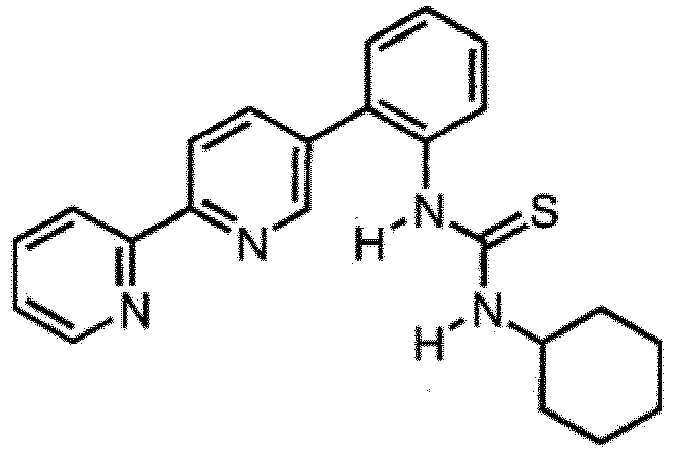
- 51% yield; white solid; Rf = 0.36 (hexane/ethyl acetate = 1/1); 1H NMR (400 MHz, CDCl3) δ 0.96-1.12 (m, 3H), 1.24-1.37 (m, 2H), 1.55-1.63 (m, 4H), 1.90-1.93 (m, 2H), 4.14 (s, 1H), 5.71 (s, 1H), 7.30-7.34 (m, 2H), 7.41-7.54 (m, 3H), 7.82 (d, J = 8.1 Hz, 1H), 7.85 (ddd, J = 8.1, 8.1, 2.2 Hz, 1H), 8.40 (d, J = 8.1 Hz, 1H), 8.47 (d, J = 9.0 Hz, 1H), 8.68-8.73 (m, 2H); 13C NMR (100 MHz, CDCl3) δ 24.8, 25.5, 32.7, 54.1, 121.1, 121.4, 124.0, 127.9 (2C), 128.6, 130.0, 131.6, 133.6, 135.3, 137.0 (2C), 148.9, 149.4, 155.7, 155.8, 179.5; IR (KBr, ν / cm-1) 3293, 2931, 2857, 1637, 1458, 1373, 1229, 1001, 841, 656; HRMS (ESI+) Calcd for C23H24N4NaS ([M+Na]+) 411.1619, Found 411.1611.
-

- A triethylamine (1.3 mL) solution of PdCl2(PPh3)2 (1.8 mg, 2.5 µmol, 0.5 mol%), CuI (1.0 mg, 5.0 µmol, 1.0 mol%) and 5-bromo-2,2'-bipyridine (118 mg, 0.50 mmol, 1 equiv) was stirred for 15 minutes at room temperature. To the resulting solution, 2-ethylaniline (93 µL, 0.6 mmol, 1.2 equiv) was added, and then stirred at 70°C for 3.5 hours. The temperature of the solution was cooled to room temperature, then the solid substances were removed by filtration with Celite, and the obtained filtrate was washed with water (20 mL) and was subjected to extraction with diethyl ether (3 x 20 mL). The crude product was isolated and purified by silica gel column chromatography (hexane/ethyl acetate = 3/1), and thus 106 mg (yield: 78%) of a target product was obtained as a white solid.
- 78% yield; white solid; Rf = 0.15 (hexane/ethyl acetate = 3/1); 1H NMR (400 MHz, CDCl3) δ 4.32 (brs, 2H), 6.72-6.77 (m, 2H), 7.18 (dt, J = 7.6, 1.3 Hz, 1H), 7.34 (dd, J = 7.6, 4.9 Hz, 1H), 7.40 (dd, J = 8.1, 1.8 Hz, 1H), 7.84 (dd, J = 7.6, 7.6 Hz, 1H), 7.93 (dd, J = 8.1, 2.2 Hz, 1H), 8.41-8.44 (m, 2H), 8.70 (d, J = 4.0 Hz, 1H), 8.81 (dd, J = 8.2, 1.8 Hz, 1H); 13C NMR (125 MHz, CDCl3) δ 90.4, 91.8, 107.3, 114.6, 118.2, 120.5 (2C), 121.5, 124.0, 130.4, 132.5, 137.1, 139.2, 148.1, 149.4, 151.5, 154.9, 155.6; IR (KBr, ν / cm-1) 3313, 2362, 2206, 1624, 1569, 1488, 1459, 1312, 1093, 739; HRMS (ESI+) Calcd for C18H13N3Na ([M+Na]+) 294.1007, Found 294.0999.
-

- The target product was produced in the same manner as Example 1 (2).
- 46% yield; white solid; Rf = 0.29 (ethyl acetate); 1H NMR (500 MHz, CDCl3) δ 6.49 (brs, 1H), 7.04-7.10 (m, 3H), 7.29-7.30 (m, 1H), 7.34-7.41 (m, 4H), 7.47-7.49 (m, 2H), 7.58 (d, J = 6.3 Hz, 1H), 7.86 (dd, J = 5.8, 5.8 Hz, 1H), 8.30 (d, J = 6.7 Hz, 1H), 8.37 (d, J = 10.2 Hz, 1H), 8.44 (d, J = 6.3 Hz, 1H), 8.56 (s, 1H), 8.72 (d, J = 3.6 Hz, 1H); 13C NMR (125 MHz, CDCl3) δ 88.8, 92.7, 111.4, 119.4, 134.4, 120.4, 121.6, 122.8, 123.4, 124.3, 125.7, 127.7, 129.8, 130.5, 132.2, 137.2, 139.5, 139.9, 149.5, 151.7, 153.0, 155.3, 155.4; IR (KBr, ν / cm-1) 3299, 1644, 1576, 1552, 1458, 1296, 1091, 794, 743, 692; HRMS (ESI+) Calcd for C25H18N4NaO ([M+Na]+) 413.1378, Found 413.1388.
- In a dried test tube, to a p-xylene (1.5 mL) solution of N,N-dihexylbenzamide (72.4 mg, 0.250 mmol, 1.00 equiv), [Ir(OMe) (cod)]2 (1.2 mg, 1.9 µmol, 0.75 mol%), 1-(2-([2,2'-bipyridin]-5-yl)phenyl)-3-cyclohexylurea (1.2 mg, 3.8 µmol, 1.5 mol%) and bis(pinacolato)diboron (47.6 mg, 0.188 mmol, 0.750 equiv) were added and stirred at 25°C for 24 hours. The solvent was removed under reduced pressure, and then the products were isolated and prepared by recycling preparative HPLC.

- The obtained compounds were as follows.
-

- 40% yield; colorless oil; 1H NMR (500 M Hz, CDCl3) δ 0.82 (t, J = 6.9 Hz, 3H), 0.89-0.92 (m, 3H), 1.10-1.21 (m, 6H), 1.30-1.41 (m, 18H), 1.46-1.50 (m, 2H), 1.65-1.66 (m, 2H), 3.15 (t, J = 6.9 Hz, 2H), 3.46 (t, J = 7.2 Hz, 2H), 7.38 (dd, J = 8.0, 7.2 Hz, 1H), 7.43 (ddd, J = 8.0, 1.7, 1.7 Hz, 1H), 7.78 (s, 1H), 7.80 (ddd, J = 7.2, 1.7, 1.7 Hz, 1H); 13C NMR (100 MHz, CDCl3) δ 14.1, 14.2, 22.6, 22.8, 25.0, 26.3, 26.9, 27.6, 28.8, 31.4, 31.8, 45.0, 49.2, 84.1, 127.8, 129.3, 132.7, 135.4, 136.8, 171.8; 11B NMR (130 MHz, CDCl3) δ 30.2; IR (neat, ν / cm-1) 2930, 2858, 1626, 1411, 1358, 1319, 1144, 861, 754, 666; HRMS (ESI+) Calcd for C25H42BNNaO3([M+Na]+) 438.3150, Found 438.3151.
-

- 3.3% yield; colorless oil; 1H NMR (500MHz, CDCl3) δ 0.82 (t, J = 7.2 Hz, 3H), 0.89-0.92 (m, 3H), 1.06-1.11 (m, 4H), 1.18-1.25 (m, 2H), 1.35-1.36 (m, 18H), 1.46-1.47 (m, 2H), 1.63-1.66 (m, 2H), 3.13 (t, J = 6.9 Hz, 2H), 3.46 (t, J = 7.2 Hz, 2H), 7.32 (d, J = 8.3 Hz, 2H), 7.81 (d, J = 8.3 Hz, 2H); 13C NMR (125 MHz, CDCl3) δ 14.0, 14.1, 22.5, 22.7, 25.0, 26.3, 26.8, 27.6, 28.7, 31.4, 31.7, 44.8, 49.0, 84.1, 125.7, 134.8, 140.1, 171.6; 11B NMR (130 MHz, CDCl3) δ 29.9; IR (neat, ν / cm-1) 2929, 1636, 1511, 1396, 1360, 1322, 1144, 1108, 859, 659; HRMS (ESI+) Calcd for C25H42BNNaO3([M+Na]+) 438.3150, Found 438.3170.
-

- 3.0% yield; colorless oil; 1H NMR (500 MHz, CDCl3) δ 0.81 (t, J = 7.2 Hz, 3H), 0.90-0.93 (m, 3H), 1.10-1.27 (m, 10H), 1.31-1.35 (m, 28H), 1.62-1.66 (m, 2H), 3.12 (t, J = 6.9 Hz, 2H), 3.44 (t, J = 7.2 Hz, 2H), 7.88 (s 2H), 8.26 (s, 1H); 13C NMR (100 MHz, CDCl3) δ 14.1, 14.2, 22.5, 22.8, 25.0, 26.3, 27.0, 27.7, 28.9, 31.4, 31.8, 45.0, 49.3, 84.0, 135.5, 136.3, 141.7, 171.7; 11B NMR (130 MHz, CDCl3) δ 32.9; IR (neat, ν / cm-1) 2929, 1628, 1329, 1265, 1142, 967, 889, 801, 755, 718; HRMS (ESI+) Calcd for C31H53B2NNaO5 ([M+Na]+) 564.4002, Found 564.4021.
- By using the ligand used in (1), the following compounds ((2) to (27)) were obtained in the same manner as the method of (1).
-

- 63% yield [meta/para = 7.5]; colorless oil; 11B NMR (130 MHz, CDCl3) δ 31.9; IR (neat, v/ cm-1) 2930, 1627, 1410, 1355, 1140, 1027, 965, 851, 754, 683; HRMS (ESI+) Calcd for C26H44BNNaO4([M+Na]+) 468.3256, Found 468.3246. N,N-Dihexyl-2-methoxy-5-(4,4,5,5-tetramethyl-1,3,2-dioxaborolan-2-yl)benzamide: 1H NMR (400 MHz, CDCl3) δ 0.80 (t, J = 7.4 Hz, 3H), 0.91 (t, J = 6.7 Hz, 3H), 1.06-1.08 (m, 4H), 1.16-1.50 (m, 22H), 1.62-1.64 (m, 2H), 3.01-3.04 (m, 2H), 3.48-3.49 (m, 2H), 3.82 (s, 3H), 6.87 (d, J = 8.3 Hz, 1H), 7.63 (s, 1H), 7.76 (d, J = 8.3 Hz, 1H); 13C NMR (125 MHz, CDCl3) δ 14.1, 14.2, 22.5, 22.8, 24.7, 26.3, 26.7, 27.6, 28.4, 31.4, 31.8, 44.4, 48.5, 55.4, 83.7, 110.1, 126.6, 134.4, 137.0, 157.8, 169.2. N,N-Dihexyl-2-methoxy-4-(4,4,5,5-tetramethyl-1,3,2-dioxaborolan-2-yl)benzamide: 1H NMR (400 MHz, CDCl3) δ 0.80 (t, J = 7.4 Hz, 3H), 0.91 (t, J = 6.7 Hz,, 3H), 1.06-1.08 (m, 4H), 1.18-1.50 (m, 20H), 1.62-1.64 (m, 4H), 3.01-3.04 (m, 2H), 3.48-3.49 (m, 2H), 3.85 (s, 3H), 7.17 (d, J = 7.2 Hz, 1H), 7.29 (s, 1H), 7.41 (d, J = 7.2 Hz, 1H); 13C NMR (125 MHz, CDCl3) δ 14.1, 14.2, 22.6, 22.8, 25.0, 26.3, 26.8, 27.5, 28.4, 31.4, 31.8, 44.3, 48.3, 55.6, 84.1, 116.4, 127.1, 127.4, 130.0, 154.6, 169.2.
-

- 39% yield [meta/para = 15]; colorless oil; IR (neat, ν / cm-1) 2929, 1634, 1466, 1357, 1145, 1105, 965, 862, 754, 686; HRMS (ESI+) Calcd for C26H44BNNaO3 ([M+Na]+) 452.3306, Found 452.3306.
N,N-Dihexyl-2-methyl-5-(4,4,5,5-tetramethyl-1,3,2-dioxaborolan-2-yl)benzamide: 1H NMR (500 MHz, CDCl3) δ 0.82 (t, J = 7.2 Hz, 3H), 0.91 (t, J = 6.9 Hz, 3H), 1.07-1.11 (m, 4H), 1.14-1.21 (m, 2H), 1.25-1.39 (m, 18H), 1.41-1.47 (m, 2H), 1.62-1.70 (m, 2H), 2.29 (s, 3H), 3.01-3.05 (m, 2H), 3.39-3.56 (m, 2H), 7.19 (d, J = 7.5 Hz, 1H), 7.59 (s, 1H), 7.67 (d, J = 7.5 Hz, 1H); 13C NMR (125 MHz, CDCl3) δ 14.1, 14.2, 19.4, 22.5, 22.8, 25.0, 26.3, 27.0, 27.7, 28.5, 31.3, 31.8, 44.6, 48.6, 83.9, 129.8, 132.3, 134.9, 136.8, 137.4, 171.3; 11B NMR (130 MHz, CDCl3) δ 30.5;
N,N-Dihexyl-2-methyl-4-(4,4,5,5-tetramethyl-1,3,2-dioxaborolan-2-yl)benzamide: 1H NMR (500 MHz, CDCl3) δ 0.81 (t, J = 7.2 Hz, 3H), 0.90 (t, J = 6.0 Hz, 3H), 1.04-1.11 (m, 4H), 1.14-1.26 (m, 2H), 1.28-1.47 (m, 20H), 1.62-1.67 (m, 2H), 2.27 (s, 3H), 2.85-3.15 (m, 2H), 3.20-3.75 (m, 2H), 7.14 (d, J = 7.8 Hz, 1H), 7.62 (d, J = 7.8 Hz, 1H), 7.64 (s, 1H); 13C NMR (125 MHz, CDCl3) δ 14.1, 14.2, 18.9, 22.6, 22.8, 25.0, 26.4, 27.0, 27.6, 28.5, 31.4, 31.8, 44.4, 48.4, 84.1, 125.3, 132.2, 133.2, 136.7, 140.1, 171.2; 11B NMR (130 MHz, CDCl3) δ 31.3. -


- 91% yield [meta/para = 8.6]; colorless oil; 11B NMR (130 MHz, CDCl3) δ 30.0; IR (neat, ν / cm-1) 2929, 1640, 1590, 1355, 1144, 1094, 964, 839, 754, 688; HRMS (ESI+) Calcd for C25H41BBrNNaO3 ([M+Na]+) 516.2255, Found 516.2245. 2-Bromo-N,N-dihexyl-5-(4,4,5,5-tetramethyl-1,3,2-dioxaborolan-2-yl)benzamide: 1H NMR (400 MHz, CDCl3) δ 0.80 (t, J = 7.2 Hz, 3H), 0.91 (t, J = 6.7 Hz, 3H), 1.07-1.10 (m, 4H), 1.16-1.20 (m, 2H), 1.32-1.34 (m, 16H), 1.45-1.59 (m, 4H), 1.66-1.68 (m, 2H), 3.01-3.08 (m, 2H), 3.22-3.29 (m, 1H), 3.66-3.73 (m, 1H), 7.55 (d, J = 7.9 Hz, 1H), 7.61 (dd, J = 7.9, 1.4 Hz, 1H), 7.67 (d, J = 1.4 Hz, 1H); 13C NMR (125 MHz, CDCl3) δ 14.0, 14.2, 22.4, 22.7, 24.8 (br), 26.2, 26.9, 27.3, 28.3, 31.3, 31.7, 44.6, 48.3, 84.2, 122.8, 132.1, 134.2, 135.9, 138.4, 168.9. 2-Bromo-N,N-dihexyl-4-(4,4,5,5-tetramethyl-1,3,2-dioxaborolan-2-yl)benzamide: 1H NMR (400 MHz, CDCl3) δ 0.80 (t, J = 7.2 Hz, 3H), 0.91 (t, J = 6.7 Hz, 3H), 1.07-1.10 (m, 4H), 1.16-1.20 (m, 2H), 1.32-1.34 (m, 16H), 1.45-1.59 (m, 4H), 1.66-1.68 (brs, 2H), 3.01-3.08 (m, 2H), 3.22-3.29 (m, 1H), 3.66-3.73 (m, 1H), 7.23 (d, J = 7.4 Hz, 1H), 7.73 (d, J = 7.4 Hz, 1H), 7.98 (s, 1H); 13C NMR (125 MHz, CDCl3) δ 14.0, 14.2, 22.5, 22.7, 24.9 (br),26.3, 26.9, 27.2, 28.3, 31.2, 31.7, 44.7, 48.5, 84.4, 119.1, 127.3, 133.6, 138.7, 141.3, 168.8.
-


- 84% yield [meta/para = 12]; pale yellow oil; HRMS (ESI+) Calcd for C25H41BClNNaO3 ([M+Na]+) 472.2760, Found 472.2764. 2-Chloro-N,N-dihexyl-5-(4,4,5,5-tetramethyl-1,3,2-dioxaborolan-2-yl)benzamide: 1H NMR (400 MHz, CDCl3) δ 0.80 (t, J = 7.2 Hz, 3H), 0.91 (t, J = 6.7 Hz, 3H), 1.08-1.19 (m, 6H), 1.25-1.61 (m, 20H), 1.63-1.69 (m, 2H), 2.98-3.12 (m, 2H), 3.28-3.34 (m, 1H), 3.64-3.70 (m, 1H), 7.36 (d, J = 8.5 Hz, 1H), 7.69 (s, 1H), 7.70 (d, J = 8.5 Hz, 1H); 13C NMR (125 MHz, CDCl3) δ 14.1, 14.2, 22.5, 22.8, 24.8, 26.3, 26.9, 27.4, 28.4, 31.3, 31.8, 44.7, 48.5, 84.3, 129.0, 133.5, 134.3, 136.0, 136.4, 168.2; 11B NMR (130 MHz, CDCl3) δ 32.1; IR (neat, ν / cm-1) 2929, 2857, 1645, 1507, 1456, 1387, 1144, 1095, 963, 732. 2-Chloro-N,N-dihexyl-4-(4,4,5,5-tetramethyl-1,3,2-dioxaborolan-2-yl)benzamide: 1H NMR (400 MHz, CDCl3) δ 0.81 (t, J = 7.2 Hz, 3H), 0.90 (t, J = 6.5 Hz, 3H), 1.07-1.20 (m, 6H), 1.25-1.51 (m, 20H), 1.65-1.67 (m, 2H), 2.98-3.12 (m, 2H), 3.19-3.26 (m, 1H), 3.71-3.79 (m, 1H), 7.25 (d, J = 7.6 Hz, 1H), 7.69 (d, J = 7.6 Hz, 1H), 7.80 (s, 1H); 13C NMR (125 MHz, CDCl3) δ 14.1, 14.2, 22.5, 22.8, 25.0, 26.4, 26.9, 27.3, 28.4, 31.4, 31.8, 44.6, 48.5, 84.3, 127.4, 132.2, 133.1, 135.7, 139.3, 168.1; 11B NMR (130 MHz, CDCl3) δ 30.2; IR (neat, ν / cm-1) 2929, 2857, 1644, 1498, 1456, 1355, 1143, 1096, 1047, 686.
-

- 93% yield; colorless oil; 1H NMR (500 MHz, CDCl3) δ 0.80 (t, J = 7.2 Hz, 3H), 0.91 (t, J = 6.7 Hz, 3H), 1.07-1.22 (m, 6H), 1.33-1.49 (m, 20H), 1.64-1.65 (m, 2H), 2.88-3.04 (m, 2H), 3.13-3.23 (m, 1H), 3.69-3.79 (m, 1H), 7.65 (d, J = 7.9 Hz, 1H), 7.75 (s, 1H), 7.88 (d, J = 7.9 Hz, 1H); 13C NMR (100 MHz, CDCl3) δ14.0, 14.1, 22.4, 22.7, 24.9, 26.2, 26.8, 27.0, 28.0, 31.3, 31.7, 44.5, 48.8, 84.5, 123.8 (q, J = 275 Hz), 125.6 (q, J = 4.8 Hz), 127.1, 128.7 (q, J = 31.2 Hz), 133.8, 134.9, 168.6; 19F NMR (368 MHz, CDCl3) δ -62.0; 11B NMR (130 MHz, CDCl3) δ 30.5; IR (neat, ν / cm-1) 2930, 2859, 1644, 1505, 1467, 1312, 1102, 1041, 844, 690; HRMS (ESI+) Calcd for C26H41BF3NNaO3 ([M+Na]+) 506.3024, Found 506.3018.
-


- 92% yield [meta/para = 6.8]; colorless oil; 19F NMR (368 MHz, CDCl3) δ -58.6; 11B NMR (130 MHz, CDCl3) δ 30.2; IR (neat, ν / cm-1) 2931, 2859, 1644, 1468, 1359, 1255, 1003, 965, 850, 687; HRMS (ESI+) Calcd for C26H41BF3NNaO4 ([M+Na]+) 522.2973, Found 522.2996. N,N-Dihexyl-5-(4,4,5,5-tetramethyl-1,3,2-dioxaborolan-2-yl)-2-(trifluoromethoxy)benzamide: 1H NMR (400 MHz, CDCl3) δ 0.80 (t, J = 7.2 Hz, 3H), 0.90 (t, J = 6.7 Hz, 3H), 1.08-1.09 (m, 4H), 1.17-1.20 (m, 2H), 1.32-1.45 (m, 20H), 1.62-1.67 (m, 2H), 3.04 (t, J = 7.6 Hz, 2H), 3.19-3.26 (m, 1H), 3.72-3.76 (m, 1H), 7.25 (d, J = 8.3 Hz, 1H), 7.75 (s, 1H), 7.82 (d, J = 8.3 Hz, 1H); 13C NMR (100 MHz, CDCl3) δ 13.9, 14.1, 22.4, 22.6, 24.9, 26.2, 26.7, 27.2, 28.3, 31.2, 31.7, 44.4, 48.4, 84.3, 118.6 (q, J = 1.9 Hz), 123.8 (q, J = 258 Hz), 129.8, 135.2, 136.7, 147.1 (q, J = 1.9 Hz), 166.8. N,N-Dihexyl-4-(4,4,5,5-tetramethyl-1,3,2-dioxaborolan-2-yl)-2-(trifluoromethoxy)benzamide: 1H NMR (400 MHz, CDCl3) δ 0.80 (t, J = 7.2 Hz, 3H), 0.90 (t, J = 6.7 Hz, 3H), 1.08-1.09 (m, 4H), 1.17-1.20 (m, 2H), 1.32-1.45 (m, 20H), 1.62-1.67 (m, 2H), 3.04 (t, J = 7.6 Hz, 2H), 3.19-3.26 (m, 1H), 3.72-3.76 (m, 1H), 7.33 (d, J = 7.4 Hz, 1H), 7.67 (s, 1H), 7.73 (d, J = 7.4 Hz, 1H); 13C NMR (100 MHz, CDCl3) δ13.9, 14.1, 22.5, 22.6, 24.8, 26.2, 26.7, 27.2, 28.3, 31.3, 31.7, 44.4, 48.3, 84.4, 123.8 (q, J = 258 Hz), 125.9, 127.9, 133.2, 133.3, 144.5 (q, J = 1.9 Hz), 166.7.
-

- 96% yield; pale yellow oil; 1H NMR (400 MHz, CDCl3) δ 0.79 (t, J = 7.2 Hz, 3H), 0.91 (t, J = 7.0 Hz, 3H), 1.05-1.07 (m, 4H), 1.15-1.20 (m, 2H), 1.30-1.47 (m, 20H), 1.69-1.72 (m, 2H), 2.99 (t, J = 7.8 Hz, 2H), 3.45-3.49 (m, 2H), 3.86 (s, 3H), 7.70 (d, J = 1.0 Hz, 1H), 7.83 (dd, J = 8.0, 1.0 Hz, 1H), 7.99 (d, J = 8.0 Hz, 1H); 13C NMR (100 MHz, CDCl3) δ13.9, 14.1, 22.3, 22.7, 24.8, 26.2, 26.9, 27.1, 28.0, 31.2, 31.7, 44.8, 48.8, 52.2, 84.3, 129.1, 129.6, 133.4, 134.5, 138.3, 166.2, 170.6; 11B NMR (130 MHz, CDCl3) δ 29.6; IR (neat, ν / cm-1) 2930, 2858, 1730, 1639, 1494, 1359, 1143, 964, 855, 795; HRMS (ESI+) Calcd for C27H44BNNaO5 ([M+Na]+) 496.3205, Found 496.3186.
-

- 26% yield; colorless oil; 1H NMR (400 MHz, CDCl3) δ 0.79 (t, J = 7.2 Hz, 3H), 0.88 (t, J = 7.0 Hz, 3H), 0.92-1.01 (m, 4H), 1.05-1.28 (m, 10H), 1.34 (s, 12H), 1.62-1.66 (m, 2H), 2.48-2.54 (m, 1H), 2.80-2.98 (m, 2H), 3.54-3.61 (m, 1H), 7.30-7.41 (m, 4H), 7.48-7.50 (m, 2H), 7.82 (s, 1H), 7.85 (dd, J = 7.9, 1.1 Hz, 1H); 13C NMR (100 MHz, CDCl3) δ 14.1, 14.2, 22.5, 22.7, 24.8, 25.1, 26.2, 26.9, 27.9, 31.3, 31.8, 44.4, 48.3, 84.0, 127.8, 128.4, 128.7, 128.9, 134.1, 135.2, 136.0, 140.0, 141.0, 171.1; 11B NMR (130 MHz, CDCl3) δ 31.8; IR (neat, ν / cm-1) 2928, 2857, 1629, 1466, 1387, 1318, 1144, 965, 700, 611; HRMS (ESI+) Calcd for C31H46BNNaO3([M+Na]+) 514.3463, Found 514.3452.
-
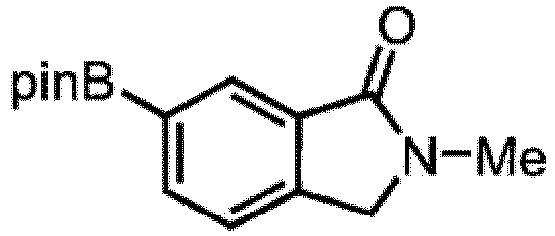

- 39% yield [meta/para = 3.3]; pale yellow solid; 11B NMR (130 MHz, CDCl3) δ 30.8; IR (neat, ν / cm-1) 2978, 2932, 1680, 1397, 1355, 1337, 1309, 1258, 1202, 1143, 1115, 967, 863, 849, 714, 655; HRMS (ESI+) Calcd for C15H20BNNaO3([M+Na]+) 296.1434, Found 296.1438. 2-Methyl-6-(4,4,5,5-tetramethyl-1,3,2-dioxaborolan-2-y1)-isoindolin-1-one: 1H NMR (400 MHz, CDCl3) δ 1.35 (s, 12H), 3.18 (s, 3H), 4.36 (s, 2H), 7.41 (d, J = 7.6 Hz, 1H), 7.93 (d, J = 7.6 Hz, 1H), 8.29 (s, 1H); 13C NMR (125 MHz, CDCl3) δ 24.8, 29.4, 52.1, 84.0, 121.9, 130.1, 132.3, 137.3, 143.8, 168.5. 2-Methyl-5-(4,4,5,5-tetramethyl-1,3,2-dioxaborolan-2-yl)-isoindolin-1-one: 1H NMR (400 MHz, CDCl3) δ 1.35 (s, 12H), 3.19 (s, 3H), 4.35 (s, 2H), 7.81 (d, J = 7.6 Hz, 1H), 7.86 (s, 1H), 7.89 (d, J = 7.6 Hz, 1H); 13C NMR (125 MHz, CDCl3) δ 24.9, 29.5, 51.9, 84.2, 122.7, 128.7, 134.3, 135.2, 140.1, 168.6.
-


- 41% yield [meta/para = 13]; white solid; 11B NMR (130 MHz, CDCl3) δ 30.6; IR (neat, ν / cm-1) 2978, 1634, 1482, 1356, 1267, 1213, 965, 812, 709, 671; HRMS (ESI+) Calcd for C15H22BNNaO3 ( [M+Na]+) 298.1585, Found 298.1585. N,N-Dimethyl-3-(4,4,5,5-tetramethyl-1,3,2-dioxaborolan-2-yl)benzamide: 1H NMR (500 MHz, CDCl3) δ 1.34 (s, 12H), 2.96 (s, 3H), 3.10 (s, 3H), 7.40 (dd, J = 8.0, 8.0 Hz, 1H), 7.49 (ddd, J = 8.1, 1.1, 1.1 Hz, 1H), 7.82-7.84 (m, 2H); 13C NMR (100 MHz, CDCl3) δ 25.0, 35.4, 39.7, 84.1, 127.9, 129.8, 133.2, 135.8, 135.9, 171.8. N,N-Dimethyl-4-(4,4,5,5-tetramethyl-1,3,2-dioxaborolan-2-yl)benzamide: 1H NMR (400 MHz, CDCl3) δ 1.35 (s, 12H), 3.19 (s, 3H), 4.35 (s, 2H), 7.81 (d, J = 7.6 Hz, 1H), 7.86 (s, 1H), 7.89 (d, J = 7.6 Hz, 1H); 13C NMR (125 MHz, CDCl3) δ 24.9, 29.5, 51.9, 84.2, 122.7, 128.7, 134.3, 135.2, 140.1, 168.6.
-

- 11% yield; white solid; 1H NMR (400 MHz, CDCl3) δ 1.33 (s, 24H), 2.95 (s, 3H), 3.09 (s, 3H), 7.93 (d, J = 1.3 Hz, 2H), 8.28 (t, J = 1.3 Hz, 1H); 13C NMR (100 MHz, CDCl3) δ 25.0, 35.3, 39.8, 84.1, 135.5, 135.9, 142.1, 171.9; 11B NMR (130 MHz, CDCl3) δ 30.6; IR (neat, ν / cm-1) 2978, 1636, 1594, 1380, 1330, 1213, 1142, 889, 755, 689; HRMS (ESI+) Calcd for C21H33B2NNaO5 ([M+Na]+) 424.2437, Found 424.2455.
-

- 50% yield; white solid; 1H NMR (400 MHz, CDCl3) δ 1.34 (s, 12H), 1.48-1.51 (m, 2H), 1.63-1.70 (m, 4H), 3.29-3.37 (m, 2H), 3.67-3.73 (m, 2H), 7.38 (dd, J = 7.6, 6.7 Hz, 1H), 7.46 (d, J = 7.6 Hz, 1H), 7.81-7.82 (m, 2H); 13C NMR (100 MHz, CDCl3) 8 24.7, 25.0, 25.7, 26.6, 43.1, 48.9, 84.1, 127.8, 129.5, 133.1, 135.7, 136.1, 170.4; 11B NMR (130 MHz, CDCl3) δ 30.8; IR (neat, ν / cm-1) 2938, 1714, 1626, 1358, 1271, 1143, 1094, 964, 859, 754, 666; HRMS (ESI+) Calcd for C18H26BNNaO3 ([M+Na]+) 338.1898, Found 338.1897.

- 11% yield; white solid; 1H NMR (400 MHz, CDCl3) δ 1.37 (s, 24H), 1.49-1.65 (m, 6H), 3.32-3.33 (m, 2H), 3.64-3.70 (m, 2H), 7.89 (s, 2H), 8.27 (s, 1H); 13C NMR (100 MHz, CDCl3) δ 24.7, 25.0, 25.7, 26.6, 43.1, 48.9, 84.1, 135.6, 135.8, 142.1, 170.5; 11B NMR (130 MHz, CDCl3) δ 30.8; IR (neat, ν / cm-1) 2979, 1624, 1329, 1267, 1142, 966, 889, 755, 716, 666; HRMS (ESI+) Calcd for C24H37B2NNaO5 ([M+Na]+) 464.2750, Found 464.2728.
-


- 88% yield [meta/para = 3.2]; pale yellow solid; 11B NMR (130 MHz, CDCl3) δ 30.8; IR (KBr, ν / cm-1) 2977, 2927, 2857, 1645, 1592, 1434, 1386, 1356, 1280, 1248, 1143, 1114, 1094, 1016, 848, 689; HRMS (ESI+) Calcd for C17H23BBrNNaO4([M+Na]+) 418.0801, Found 418.0791. (2-Bromo-5-(4,4,5,5-tetramethyl-1,3,2-dioxaborolan-2-yl)phenyl)-4-morpholinylmethanone: 1H NMR (500 MHz, CDCl3) δ 1.30 (s, 12H), 3.10-3.29 (m, 2H), 3.50-3.61 (m, 1H), 3.64-3.80 (m, 4H), 3.80-3.89 (m, 1H), 7.55 (d, J = 8.0 Hz, 1H), 7.62 (dd, J = 8.0, 1.8 Hz, 1H), 7.65 (d, J = 1.8 Hz, 1H); 13C NMR (125 MHz, CDCl3) δ 24.9, 41.8, 47.0, 66.5, 66.6, 84.2, 122.4, 132.0, 133.8, 136.4, 138.7, 167.7.
(2-Bromo-4-(4,4,5,5-tetramethyl-1,3,2-dioxaborolan-2-yl)phenyl)-4-morpholinylmethanone: 1H NMR (500 MHz, CDCl3) δ 1.28 (s, 12H), 3.10-3.29 (m, 2H), 3.50-3.61 (m, 1H), 3.64-3.80 (m, 4H), 3.80-3.89 (m, 1H), 7.22 (d, J = 7.5 Hz, 1H), 7.74 (d, J = 7.5 Hz, 1H), 7.97 (s, 1H); 13C NMR (125 MHz, CDCl3) δ24.5, 41.8, 47.0, 66.5, 66.6, 84.3, 118.8, 127.0, 133.8, 136.9, 139.8, 167.5. -

- 36% yield; white solid; 1H NMR (400 MHz, CDCl3) δ 1.34 (s, 12H), 1.59-1.64 (m, 6H), 1.81-1.85 (m, 2H), 3.36 (t, J = 5.4 Hz, 2H), 3.67 (t, J = 5.8 Hz, 2H), 7.38 (dd, J = 7.9, 7.6 Hz, 1H), 7.46 (d, J = 7.9 Hz, 1H), 7.80-7.82 (m, 2H); 13C NMR (100 MHz, CDCl3) δ 25.0, 26.6, 27.4, 28.0, 29.6, 46.3, 49.9, 84.1, 127.8, 129.2, 132.8, 135.4, 136.9, 171.7; 11B NMR (130 MHz, CDCl3) δ 30.6; IR (neat, ν / cm-1) 2977, 2928, 1631, 1409, 1356, 1319, 1216, 1099, 859, 708; HRMS (ESI+) Calcd for C19H28BNNaO3 ( [M+Na]+) 352.2054, Found 352.2049.
-

- 12% yield; white solid; 1H NMR (400 MHz, CDCl3) δ 1.33 (s, 24H), 1.58-1.59 (m, 6H), 1.80-1.86 (m, 2H), 3.36 (t, J = 5.4 Hz, 2H), 3.65 (t, J = 5.4 Hz, 2H), 7.90 (s, 2H), 8.27 (s, 1H); 13C NMR (100 MHz, CDCl3) δ 25.0, 26.7, 27.5, 28.1, 29.6, 46.1, 50.0, 84.1, 135.5, 136.3, 141.8, 171.8; 11B NMR (130 MHz, CDCl3) δ 31.3; IR (neat, ν / cm-1) 2930, 2927, 1628, 1429, 1389, 1270, 1142, 889, 754, 689; HRMS (ESI+) Calcd for C25H39B2NNaO5 ([M+Na]+) 478.2907, Found 478.2926.
-
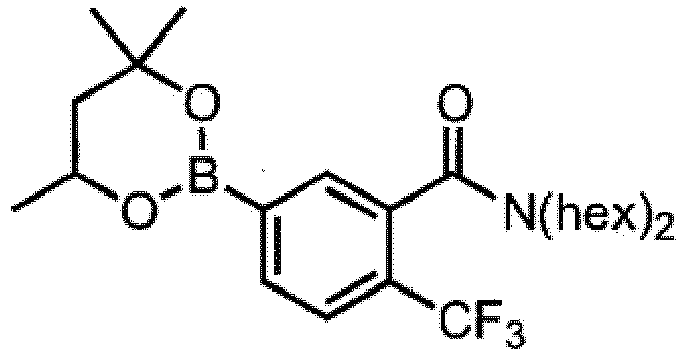
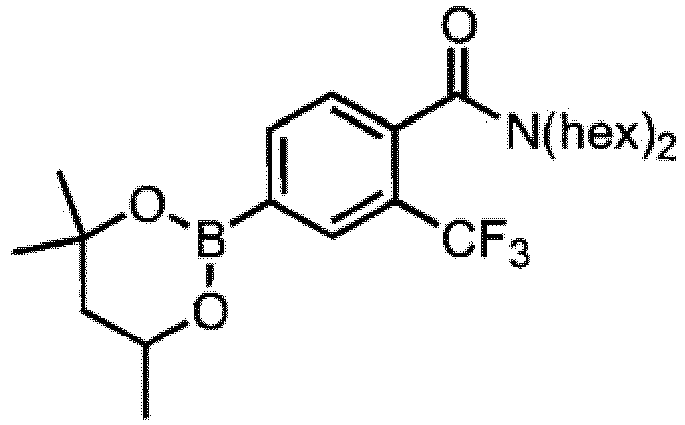
- 62% yield [meta/para = 5.3]; colorless oil; 11B NMR (130 MHz, CDCl3) δ 26.2; ; IR (neat, ν / cm-1) 2931, 1644, 1502, 1408, 1306, 1170, 1039, 844, 767, 687; HRMS (ESI+) Calcd for C26H41BF3NNaO3([M+Na]+) 506.3024, Found 506.3013. N,N-Dihexyl-2-(trifluoromethyl)-5-(4,4,6-trimethyl-1,3,2-dioxaborolan-2-yl)benzamide: 1H NMR (500 MHz, CDCl3) δ 0.81 (t, J = 7.2 Hz, 3H), 0.89-0.92 (m, 3H), 1.08-1.09 (m, 4H), 1.17-1.21 (m, 2H), 1.33-1.47 (m, 18H), 1.61-1.64 (m, 2H), 1.86-1.91 (m, 1H), 2.95-3.00 (m, 2H), 3.12-3.19 (m, 1H), 3.77-3.84 (m, 1H), 4.13-4.37 (m, 1H), 7.60 (d, J = 7.6 Hz, 1H), 7.75 (s, 1H), 7.87 (d, J = 7.6 Hz, 1H); 13C NMR (100 MHz, CDCl3) δ 14.0, 14.1, 22.5, 22.7, 23.1, 26.2, 26.4, 26.9, 28.0, 28.2, 31.2, 31.4, 31.7, 44.4, 46.0, 48.7, 65.4, 71.6, 124.0 (q, J = 274 Hz), 125.2 (q, J = 3.6 Hz), 126.4, 127.6 (q, J = 32.3 Hz), 132.9, 133.9, 169.2; 19F NMR (368 MHz, CDCl3) δ -61.9. N,N-Dihexyl-2-(trifluoromethyl)-4-(4,4,6-trimethyl-1,3,2-dioxaborolan-2-yl)benzamide: 1H NMR (500 M Hz, CDCl3) δ 0.81 (t, J = 7.2 Hz, 3H), 0.89-0.92 (m, 3H), 1.08-1.09 (m, 4H), 1.17-1.21 (m, 2H), 1.33-1.47 (m, 18H), 1.61-1.64 (m, 2H), 1.86-1.91 (m, 1H), 2.95-3.00 (m, 2H), 3.12-3.19 (m, 1H), 3.77-3.84 (m, 1H), 4.13-4.37 (m, 1H), 7.26 (d, J = 6.7 Hz, 1H), 7.96 (d, J = 6.7 Hz, 1H), 8.08 (s, 1H); 13C NMR (100 MHz, CDCl3) δ 14.0, 14.1, 22.4, 22.7, 23.1, 26.2, 26.4, 26.9, 28.0, 28.2, 31.2, 31.3, 31.7, 44.4, 46.0, 48.7, 65.4, 71.6, 124.3 (q, J = 296 Hz), 125.7, 127.6 (q, J = 32.3 Hz), 131.8 (q, J = 4.8 Hz), 134.6, 169.2; 19F NMR (368 MHz, CDCl3) δ -61.5.
-


- 99% yield [meta/para = 7.7]; colorless oil; 11B NMR (130 MHz, CDCl3) δ 30.0; IR (neat, ν / cm-1) 2929, 1633, 1368, 1143, 1099, 968, 923, 854, 756, 676; HRMS (ESI+) Calcd for C25H41BFNNaO3 ([M+Na]+) 456.3056, Found 456.3035. 3-Fluoro-N,N-dihexyl-5-(4,4,5,5-tetramethyl-1,3,2-dioxaborolan-2-yl)benzamide: 1H NMR (400 MHz, CDCl3) δ 0.82 (t, J = 6.7 Hz, 3H), 0.89-0.91 (m, 3H), 1.12-1.17 (m, 4H), 1.21-1.49 (m, 22H), 1.61-1.62 (m, 2H), 3.14 (t, J = 7.2 Hz, 2H), 3.44 (t, J = 7.2 Hz, 2H), 7.13 (d, J = 8.8 Hz, 1H), 7.48 (d, J = 8.8 Hz, 1H), 7.55 (s, 1H); 13C NMR (100 MHz, CDCl3) δ 14.0, 14.1, 22.5, 22.7, 24.9, 26.2, 26.8, 27.5, 28.7, 31.3, 31.7, 45.0, 49.1, 84.3, 116.5 (d, J = 22.6 Hz), 121.6 (d, J = 19.7 Hz), 128.2 (d, J = 2.8 Hz), 138.9 (d, J = 6.6 Hz), 162.2 (d, J = 248 Hz), 170.1; 19F NMR (368 MHz, CDCl3) δ -115.3 (s, 1F). 3-Fluoro-N,N-dihexyl-4-(4,4,5,5-tetramethyl-1,3,2-dioxaborolan-2-yl)benzamide: 1H NMR (400 MHz, CDCl3) δ 0.82 (t, J = 6.7 Hz, 3H), 0.89-0.91 (m, 3H), 1.12-1.18 (m, 4H), 1.21-1.49 (m, 22H), 1.61-1.62 (m, 2H), 3.14 (t, J = 7.2 Hz, 2H), 3.44 (t, J = 7.2 Hz, 2H), 7.01 (d, J = 9.0 Hz, 1H), 7.11 (d, J = 9.0 Hz, 1H), 7.73-7.77 (m, 1H); 13C NMR (100 MHz, CDCl3) δ 14.0, 14.1, 22.5, 22.7, 24.9, 26.2, 26.8, 27.5, 28.7, 31.3, 31.7, 44.8, 49.0, 84.2, 113.6 (d, J =26.3 Hz), 132.0 (br), 137.1 (d, J = 8.4 Hz), 142.4 (d, J = 7.5 Hz), 165.4 (d, J = 253 Hz), 169.9; 19F NMR (368 MHz, CDCl3) δ -103.7 (s, 1F).
-

- 86% yield; pale yellow oil; 1H NMR (400 MHz, CDCl3 δ 0.83 (t, J = 7.2 Hz, 3H), 0.89-0.91 (m, 3H), 1.12-1.17 (m, 4H), 1.21-1.33 (m, 20H), 1.49-1.63 (m, 4H), 3.13 (t, J = 7.6 Hz, 2H), 3.43 (t, J = 7.6 Hz, 2H), 7.56 (s, 1H), 7.69 (s, 1H), 7.93 (s, 1H); 13C NMR (100 MHz, CDCl3 δ 14.0, 14.1, 22.5, 22.7, 24.9, 26.2, 26.8, 27.5, 28.7, 31.3, 31.7, 45.0, 49.1, 84.4, 122.4, 131.0, 132.1, 138.0, 138.8, 169.9; 11B NMR (130 MHz, CDCl3 δ 30.7; IR (neat, ν / cm-1) 2929, 2857, 1635, 1435, 1348, 1143, 965, 964, 885, 704; HRMS (ESI+) Calcd for C25H41BBrNNaO3 ([M+Na]+) 516.2255, Found 516.2255.
-

- 81% yield; pale yellow oil; 1H NMR (400 MHz, CDCl3 δ 0.79 (t, J = 7.2 Hz, 3H), 0.90-0.92 (m, 3H), 1.11-1.19 (m, 6H), 1.23-1.35 (m, 18H), 1.51-1.53 (m, 2H), 1.63-1.66 (m, 2H), 3.20 (t, J =7.6 Hz, 2H), 3.48 (t, J = 8.1 Hz, 2H), 7.34 (t, J = 7.4 Hz, 1H), 7.43 (dd, J = 8.1, 7.4 Hz, 2H), 7.62 (d, J = 8.1 Hz, 2H), 7.66 (s, 1H), 7.76 (s, 1H), 8.05 (s, 1H); 13C NMR (100 MHz, CDCl3 δ 14.1, 14.2, 22.5, 22.8, 25.0, 26.3, 27.0, 27.7, 28.9, 31.4, 31.8, 45.0, 49.3, 84.2, 127.3, 127.6, 128.0, 128.8, 131.6, 134.1, 137.5, 140.6, 140.8, 171.6; 11B NMR (130 MHz, CDCl3 δ 32.5; IR (neat, ν / cm-1) 2929, 2857, 1634, 1411, 1321, 1144, 966, 894, 756, 698; HRMS (ESI+) Calcd for C31H46BNNaO3([M+Na]+) 514.3463, Found 514.3456.
-

- 87% yield; pale yellow oil; 1H NMR (400 MHz, CDCl3 δ 0.82 (t, J = 7.2 Hz, 3H), 0.88-0.90 (m, 3H), 1.11-1.42 (m, 24H), 1.48-1.52 (m, 2H), 1.65-1.69 (m, 2H), 3.11 (t, J = 7.6 Hz, 2H), 3.43 (t, J = 7.6 Hz, 2H), 7.69 (dd, J = 1.6, 1.6 Hz, 1H), 7.97 (dd, J = 1.6, 1.4 Hz, 1H), 8.08 (dd, J = 1.6, 1.4 Hz, 1H); 13C NMR (100 MHz, CDCl3 δ14.0, 14.1, 22.4, 22.6, 24.9, 26.2, 26.8, 27.5, 28.7, 31.2, 31.6, 45.1, 49.2, 84.8, 112.4, 118.2, 132.3, 136.6, 137.9, 138.7, 169.2; 11B NMR (130 MHz, CDCl3 δ 30.3; IR (neat, ν / cm-1) 2930, 2857, 2231, 1637, 1371, 1265, 1143, 966, 850, 704; HRMS (ESI+) Calcd for C26H41BN2NaO3 ([M+Na]+) 463.3102, Found 463.3124.
-

- 94% yield; pale yellow oil; 1H NMR (500 MHz, CDCl3 δ 0.81 (t, J = 7.5 Hz, 3H), 0.91 (t, J = 6.7 Hz, 3H), 1.08-1.11 (m, 4H), 1.18-1.21 (m, 2H), 1.32-1.50 (m, 20H), 1.65-1.70 (m, 2H), 2.98-3.02 (m, 1H), 3.05-3.09 (m, 1H), 3.26-3.31 (m, 1H), 3.64-3.70 (m, 1H), 7.56 (d, J = 1.2 Hz, 1H), 7.85 (d, J = 1.2 Hz, 1H); 13C NMR (100 MHz, CDCl3 δ 14.0, 14.1, 22.4, 22.7, 24.9 (br), 26.2, 26.8, 27.3, 28.3, 31.2, 31.7, 44.7, 48.5, 84.6, 131.6, 131.9, 133.1, 136.3, 138.4, 167.3; 11B NMR (130 MHz, CDCl3 δ30.4; IR (neat, ν / cm-1) 2930, 2858, 1644, 1467, 1350, 1268, 1142, 965, 894, 755; HRMS (ESI+) Calcd for C25H40BCl2NNaO3 ([M+Na]+) 506.2371, Found 506.2394.
-

- 89% yield; pale yellow oil; 1H NMR (400 MHz, CDCl3 δ 0.80 (t, J = 7.2 Hz, 3H), 0.90 (t, J = 6.7 Hz, 3H), 1.08-1.11 (m, 4H), 1.17-1.22 (m, 2H), 1.33-1.49 (m, 20H), 1.65-1.67 (m, 2H), 3.14 (t, J = 7.6 Hz, 2H), 3.40-3.64 (m, 2H), 7.94 (d, J = 6.3 Hz, 1H), 8.05 (d, J = 7.2 Hz, 1H); 13C NMR (100 MHz, CDCl3 δ 13.9, 14.1, 22.4, 22.6, 24.9, 26.1, 26.7, 27.4, 28.4, 31.2, 31.7, 44.9, 48.8, 84.7, 118.4 (qd, J = 33.6, 12.0 Hz), 122.5 (q, J = 272 Hz), 126.6 (d, J = 18.0 Hz), 134.1 (d, J = 3.6 Hz), 139.2 (d, J = 4.8 Hz), 157.3 (d, J = 260 Hz), 165.0; 19F NMR (368 MHz, CDCl3 δ -115.4 (s, 1F), -63.1 (s, 3F) ; 11B NMR (130 MHz, CDCl3 δ 30.1; IR (neat, ν / cm-1) 2931, 1644, 1468, 1385, 1302, 1239, 1197, 914, 756, 672; HRMS (ESI+) Calcd for C26H40BF4NNaO3 ([M+Na]+) 524.2930, Found 524.2939.
-

- 51% yield; pale yellow oil; 1H NMR (500 MHz, CDCl3 δ 0.80-0.92 (m, 6H), 1.16-1.38 (m, 12H), 1.33 (s, 12H), 1.53-1.70 (m, 4H), 3.38-3.44 (m, 4H), 7.30 (d, J = 3.6 Hz, 1H), 7.50 (d, J = 3.6 Hz, 1H); 13C NMR (125 MHz, CDCl3 δ 13.9 (2C), 22.5, 24.7 (2C), 26.4 (br, 2C), 27.5 (br), 28.8 (br), 31.4 (2C), 46.1 (br), 49.3 (br), 84.3, 129.1, 136.3, 144.2, 164.3; 11B NMR (130 MHz, CDCl3 δ 29.0; IR (neat, ν / cm-1) 2956, 2929, 2862, 1625, 1525, 1463, 1419, 1372, 1350, 1287, 1270, 1210, 1143, 1063, 1021, 997, 857, 853, 820, 739, 687, 667; HRMS (ESI+) Calcd for C23H40BNNaO3S ([M+Na]+) 444.2720, Found 444.2731.
-

- 14% yield; pale brown oil; 1H NMR (500 MHz, CDCl3 δ 0.75-0.96 (m, 6H), 1.03-1.53 (m, 40H), 3.05-3.22 (m, 2H), 3.35-3.55 (m, 2H), 7.83 (s, 1H); 13C NMR (125 MHz, CDCl3 δ 13.97, 14.03, 22.4, 22.6, 24.7, 24.8, 26.2, 26.9, 27.0, 28.3, 31.3, 31.7, 45.2, 49.0, 83.6, 84.2, 143.1, 153.2, 165.5; 11B NMR (130 MHz, CDCl3 δ 28.6; IR (neat, ν / cm-1) 3424, 2929, 2859, 1633, 1536, 1455, 1371, 1321, 1268, 1213, 1139, 1111, 1028, 1002, 967, 911, 882, 851, 829, 727, 688, 666; HRMS (ESI+) Calcd for C29H51B2NNaO5S ([M+Na]+) 570.3572, Found 570.3551.
-

- 79% yield; colorless oil; 1H NMR (400 MHz, CDCl3 δ 0.81-0.93 (m, 6H), 1.23-1.36 (m, 24H), 1.53-1.78 (m, 4H), 3.25-3.70 (m, 4H), 6.43-6.70 (m, 1H), 6.74-6.78 (m, 1H), 9.85 (brs, 1H); 13C NMR (125 MHz, CDCl3 δ 14.0 (2C), 22.5, 24.7 (2C), 26.6 (2C), 27.6 (br), 28.8 (br), 31.5 (2C), 47.2 (br), 48.5 (br), 83.8, 111.6, 120.2, 129.2, 161.5; 11B NMR (130 MHz, CDCl3 δ 28.3; IR (neat, ν / cm-1) 3441, 3256, 2929, 2858, 1610, 1553, 1467, 1424, 1345, 1300, 1265, 1219, 1144, 973, 855, 790, 759, 704; HRMS (ESI+) Calcd for C23H41BN2NaO3 ([M+Na]+) 427.3108, Found 427.3114.
-


- 74% yield [5-/4- = 6.7]; pale yellow oil; 11B NMR (130 MHz, CDCl3 δ 28.3; IR (neat, ν / cm-1) 2929, 2858, 1628, 1531, 1467, 1416, 1373, 1302, 1265, 1145, 1108, 1091, 965, 858, 754, 692; HRMS (ESI+) Calcd for C24H43BN2NaO3 ([M+Na]+) 441.3264, Found 441.3255. N,N-Dihexyl-(1-methyl-5-(4,4,5,5-tetramethyl-1,3,2-dioxaborolan-2-yl)-1H-pyrrole)-2-carboxamide: 1H NMR (500 MHz, CDCl3 δ 0.78-0.94 (m, 6H), 1.10-1.40 (m, 24H), 1.42-1.75 (m, 4H), 3.26-3.54 (m, 4H), 3.82 (s, 3H), 6.20 (d, J = 4.0 Hz, 1H), 6.70 (d, J = 4.0 Hz, 1H) ; 13C NMR (125 MHz, CDCl3 δ 13.9 (2C), 22.5 (2C), 24.7, 26.4 (br, 2C), 27.5 (br), 28.6 (br), 31.4 (2C), 34.6, 44.6 (br), 48.9 (br), 83.2, 109.7, 120.2, 132.5, 164.5. N,N-Dihexyl-(1-methyl-4-(4,4,5,5-tetramethyl-1,3,2-dioxaborolan-2-yl)-1H-pyrrole)-2-carboxamide: 1H NMR (500 MHz, CDCl3 δ 0.78-0.94 (m, 6H), 1.10-1.40 (m, 24H), 1.42-1.75 (m, 4H), 3.26-3.54 (m, 4H), 3.71 (s, 3H), 6.56-6.60 (m, 1H), 7.04-7.11 (m, 1H); 13C NMR (125 MHz, CDCl3 δ13.9 (2C), 22.5 (2C), 24.7, 26.4 (2C), 27.5 (br), 28.6 (br), 31.4 (2C), 35.6, 44.6 (br), 48.9 (br), 82.9, 117.0, 127.6, 134.0, 164.0.
-

- 71% yield; pale yellow oil; 1H NMR (500 MHz, CDCl3 δ 0.87-0.96 (m, 6H), 1.30-1.41 (m, 12H), 1.39 (s, 12H), 1.60-1.85 (m, 4H), 3.30-3.90 (m, 4H), 6.75 (d, J = 2.3 Hz, 1H), 7.15 (t, J = 8.0 Hz, 1H), 7.75 (d, J = 8.0 Hz, 1H), 7.78 (d, J = 8.0 Hz, 1H), 9.94 (brs, 1H); 13C NMR (125 MHz, CDCl3 δ 14.0 (2C), 22.5 (2C), 24.9, 26.6 (br, 2C), 27.6 (br), 28.8 (br), 31.5 (2C), 47.4 (br), 49.0 (br), 83.9, 103.9, 119.9, 125.3, 126.9, 129.9, 131.7, 140.0, 162.5; 11B NMR (130 MHz, CDCl3 δ 31.2; IR (neat, ν / cm-1) 3438, 3056, 2927, 2857, 1615, 1595, 1529, 1463, 1443, 1369, 1288, 1200, 1146, 1130, 1110, 1045, 979, 849, 813, 748, 734, 678; HRMS (ESI+) Calcd for C27H43BN2NaO3 ([M+Na]+) 477.3264 Found 477.3264.
-


- 43% yield [4-/5- = 3.6]; white solid; 13C NMR (100 MHz, CDCl3 δ (4- and 5-position isomers) 25.0 (4- and 5-position isomers), 35.71, 35.76, 39.0, 39.1, 84.6, 84.8, 122.7, 128.5, 129.3, 143.4, 147.9, 154.07, 154.13, 156.5, 169.4 (4- and 5-position isomers); 11B NMR (130 MHz, CDCl3 δ 30.6; IR (neat, v/ cm-1) 2979, 1640, 1473, 1358, 1263, 1105, 965, 857, 752, 672; HRMS (ESI+) Calcd for C14H21BN2NaO3 ([M+Na]+) 299.1537, Found 299.1534. N,N-Dimethyl-4-(4,4,5,5-tetramethyl-1,3,2-dioxaborolan-2-yl)picolinamide: 1H NMR (500 MHz, CDCl3 δ 1.34 (s, 12H), 3.04 (s, 3H), 3.13 (s, 3H), 7.65 (d, J = 5.8 Hz, 1H), 7.96 (s, 1H), 8.60 (d, J = 5.8 Hz, 1H). N,N-Dimethyl-5-(4,4,5,5-tetramethyl-1,3,2-dioxaborolan-2-yl)picolinamide: 1H NMR (500 MHz, CDCl3 δ 1.36 (s, 12H), 3.04 (s, 3H), 3.13 (s, 3H), 7.58 (d, J = 7.8 Hz, 1H), 8.15 (d, J = 7.8 Hz, 1H), 8.91 (s, 1H).
- As can be seen from the above-described results, the borylation of aromatic compounds by the catalyst of the present invention results in the meta-selective borylation.
- (27) Table 1 shows the meta-para selectivity (m/p) in the case where the borylation reaction was performed in the same manner as Example 9(1) by using the ligands described in Examples 2 to 6.
[Table 1] R2 X m/p n-Hex O m/p = 7.4 
O m/p = 14 
O m/p = 7.2 
O m/p = 3.9 
O m/p = 3.6 -
- (1) The borylation reaction was performed by using alkoxycarbonyl-substituted pyridines and alkoxycarbonylmethyl-substituted pyridines as the substituted aromatic compounds, the substrates of the borylation reaction, in the same manner as Example 9(1).
- In a dried test tube, to a p-xylene (1.5 mL) solution of an alkoxycarbonyl-substituted pyridine (1.00 equiv), [Ir(OMe)(cod)]2 (1.5 mol%), 1-(2-([2,2'-bipyridin]-5-yl)phenyl)-3-(4-trifluoromethylphenyl)urea (3.0 mol%) and bis(pinacolato)diboron (1.5 equiv) were added and stirred at 25°C for 18 hours. The solvent was removed under reduced pressure, and then the products were isolated and prepared by recycling preparative HPLC.

- The obtained compounds were as follows.
-


- 70% yield [5-/4- = 5.0]; white solid; 13C NMR (100 MHz, CDCl3 δ (4- and 5-position isomers) 25.0 (4- and 5-position isomers), 35.71, 35.76, 39.0, 39.1, 84.6, 84.8, 122.7, 128.5, 129.3, 143.4, 147.9, 154.07, 154.13, 156.5, 169.4 (4- and 5-position isomers); 11B NMR (130 MHz, CDCl3 δ 30.6; IR (neat, ν / cm-1) 2979, 1640, 1473, 1358, 1263, 1105, 965, 857, 752, 672; HRMS (ESI+) Calcd for C14H21BN2NaO3 ([M+Na]+) 299.1537, Found 299.1534. 5-(4,4,5,5-Tetramethyl-1,3,2-dioxaborolan-2-yl)pyridine-2-carboxylate: 1H NMR (500 MHz, CDCl3 δ 1.36 (s, 12H), 3.04 (s, 3H), 3.13 (s, 3H), 7.58 (d, J = 7.8 Hz, 1H), 8.15 (d, J = 7.8 Hz, 1H), 8.91 (s, 1H). 4-(4,4,5,5-Tetramethyl-1,3,2-dioxaborolan-2-yl)pyridine - 2-carboxylate: 1H NMR (500 MHz, CDCl3 δ 1.34 (s, 12H), 3.04 (s, 3H), 3.13 (s, 3H), 7.65 (d, J = 5.8 Hz, 1H), 7.96 (s, 1H), 8.60 (d, J = 5.8 Hz, 1H).
- By using the ligand used in (1), the following compounds were obtained in the same manner as the method of (1).
-


- 64% yield [5-/4- = 1.7]; pale brown oil; 11B NMR (130 MHz, CDCl3 δ 30.9; IR (neat, ν / cm-1)2980, 2934, 1739, 1600, 1557, 1480, 1403, 1371, 1258, 1166, 1145, 1099, 1028, 964, 856, 668; HRMS (ESI+) Calcd for C15H22BNNaO4 ([M+Na]+) 314.1540, Found 314.1539. 2-Ethoxycarbonylmethyl-5-(4,4,5,5-tetramethyl-1,3,2-dioxaborolan-2-yl)pyridine: 1H NMR (500 MHz, CDCl3 δ 1.18-1.25 (m, 3H), 1.32 (s, 12 H), 3.83 (s, 2H), 4.10-4.20 (m, 2H), 7.26 (d, J = 8.0 Hz, 1H), 8.00 (d, J = 8.0 Hz, 1H), 8.86 (s, 1H); 13C NMR (100 MHz, CDCl3 δ 14.1, 24.7, 44.1, 61.0, 84.1, 123.1, 142.9, 155.2, 156.8, 170.4. 2-Ethoxycarbonylmethyl-4-(4,4,5,5-tetramethyl-1,3,2-dioxaborolan-2-yl)pyridine: 1H NMR (500 MHz, CDCl3 δ 1.18-1.25 (m, 3H), 1.32 (s, 12 H), 3.82 (s, 2H), 4.10-4.20 (m, 2H), 7.50 (d, J = 4.6 Hz, 1H), 7.60 (s, 1H), 8.56 (d, J = 4.6 Hz, 1H); 13C NMR (100 MHz, CDCl3 δ 14.1, 24.8, 43.8, 60.9, 84.4, 127.0, 128.9, 148.9, 153.8, 170.7.
-
- (1) The borylation reaction was performed by using a phosphate-, phosphinediamide- or phosphine oxide-substituted benzene as the substituted aromatic compound, the substrate of the borylation reaction, in the same manner as Example 9.
- In a dried test tube, to a p-xylene (1.5 mL) solution of a phosphate-, phosphinediamide- or phosphine oxide-substituted benzene (1.00 equiv), [Ir(OMe)(cod)]2 (1.5 mol%), 1-(2-([2,2'-bipyridin]-5-yl)phenyl)-3-cyclohexylurea (3.0 mol%) and bis(pinacolato)diboron (1.5 equiv) were added and stirred at 25°C or 40°C for 16 hours. The solvent was removed under reduced pressure, and then the products were isolated and prepared by recycling preparative HPLC.

- The obtained compounds were as follows.
-


- 41% yield [meta/para = 17]; colorless solid; 11B NMR (130 MHz, CDCl3 δ 30.7; 31P NMR (158 MHz, CDCl3 δ 28.5, 28.1; IR (KBr, ν / cm-1) 2980, 1599, 1481, 1408, 1390, 1358, 1324, 1243, 1211, 1133, 1136,1097, 1055, 1027, 965, 869, 843, 795, 767, 704, 669; HRMS (ESI+) Calcd for C16H26BO5P ([M+Na]+) 363.1509, Found 363.1498. 3-(4,4,5,5-Tetramethyl-1,3,2-dioxaborolan-2-yl)phenylphosphonate: 1H NMR (400 MHz, CDCl3 δ 1.30 (t, J = 7.2 Hz, 6H), 1.32 (s, 12H), 3.98-4.18 (m, 4H), 7.44 (ddd, J = 7.6, 7.6, 4.0 Hz, 1H), 7.88 (ddd, J = 13.0, 7.6, 1.3 Hz, 1H), 7.95 (dd, J = 7.6, 1.3 Hz, 1H), 8.24 (d, J = 13.0 Hz, 1H), 13C NMR (100 MHz, CDCl3 δ 16.3 (d, JC-P= 6.6 Hz), 24.8, 62.0 (d, JC-P= 5.8 Hz), 84.0, 127.6 (d, JC-P= 187 Hz), 127.7 (d, JC-P = 15.0 Hz), 134.3 (d, JC-P = 10.3 Hz), 138.0 (d, Jc-p = 9.4 Hz),138.6 (d, JC-P = 2.8 Hz). 4-(4,4,5,5-Tetramethyl-1,3,2-dioxaborolan-2-yl)phenylphosphonate: 1H NMR (400 MHz, CDCl3 δ 1.30 (t, J = 7.2 Hz, 6H),1.32 (s, 12H), 3.98-4.18 (m, 4H), 7.78 (dd, J = 13.0, 8.0 Hz, 2H),7.88 (dd, J = 8.0, 4.0 Hz, 2H); 13C NMR (100 MHz, CDCl3 δ 16.3 (d, JC-P= 6.6 Hz), 24.8, 62.0 (d, JC-P = 5.8Hz), 84.0, 130.9 (d, JC-P= 185 Hz), 130.8 (d, JC-P= 9.4 Hz), 134.5 (d, JC-P = 15.0 Hz).
-

- 16% yield; colorless solid; 1H NMR (400 MHz, CDCl3 δ 1.31 (t, J = 7.2 Hz, 6H), 1.33 (s, 24H), 3.99-4.20 (m, 4H), 8.32 (dd, J = 13.0, 1.4 Hz, 1H), 8.40 (d, J = 1.4 Hz, 1H) ; 13C NMR (100 MHz, CDCl3 δ 16.3 (d, JC-P = 6.6 Hz), 24.8, 62.0 (d, JC-P= 5.6 Hz), 84.0, 127.0 (d, JC-P = 187Hz), 140.7 (d, Jc-p = 10.3 Hz), 144.9 (d, JC-P = 1.9 Hz); 11B NMR (130 MHz, CDCl3 δ 31.0; 31P NMR (158 MHz, CDCl3 δ 30.4; IR (KBr, ν / cm-1) 2977, 1597, 1389, 1331,1318, 1272, 1248, 1214, 1168, 1141, 1048, 1019, 964, 952, 886, 848, 790, 718, 691,662; HRMS (ESI+) Calcd for C22H37B2NaO7P ([M+Na]+) 489.2361, Found 489.2364.
- By using the ligand used in (1), the following compounds ((2) to (9)) were obtained in the same manner as the method of (1).
-


- 59% yield [meta/para = 0.54]; pale brown oil; 11B NMR (130 MHz, CDCl3 δ 30.7; 31P NMR (158 MHz, CDCl3 δ 28.1, 28.5; IR (neat, ν / cm-1) 2979, 2935, 2909, 1597, 1550, 1492, 1462, 1393, 1357,1325, 1244, 1164, 1146, 1108, 1078, 1055, 1029, 965, 903, 851, 777, 760, 692, 675; HRMS (ESI+) Calcd for C17H28BNaO6P ([M+Na]+) 393.1614, Found 393.1599.
(2-Methoxy-5-(4,4,5,5-tetramethyl-1,3,2-dioxaborolan-2-yl)phenylphosphonate: 1H NMR (500 MHz, CDCl3 δ 1.15-1.45 (m, 18H), 3.88 (s, 3H), 4.00-4.25 (m, 4H), 6.85-6.92 (m, 1H), 7.91 (d, J = 8.6 Hz, 1H),8.24 (d, J = 14.9 Hz, 1H), 13C NMR (125 MHz, CDCl3 δ 16.3, 24.8, 55.6, 62.0 (d, JC-P = 4.8 Hz), 83.7, 110.3 (d, JC-P= 8.4 Hz), 115.8 (d, Jc-p = 186 Hz), 141.1, 142.0 (d, JC-P= 7.2 Hz), 163.5 (d, Jc-p = 2.4 Hz).
(2-Methoxy-4-(4,4,5,5-tetramethyl-1,3,2-dioxaborolan-2-yl)phenylphosphonate: 1H NMR (500 MHz, CDCl3 δ 1.15-1.45 (m, 18H), 3.91 (s, 3H), 4.00-4.25 (m, 4H), 7.31 (d, J = 6.3 Hz, 1H), 7.41 (dd, J = 7.5, 3.4 Hz, 1H), 7.78 δ (dd, J = 14.3, 7.5 Hz, 1H); 13C NMR (125 MHz, CDCl3 δ 16.2, 24.8, 55.8, 62.1 (d, Jc-p = 6.0 Hz), 84.1, 116.5 (d, JC-P= 8.4Hz), 119.0 (d, JC-P = 185 Hz), 126.5 (d, Jc-p = 14.4 Hz), 134.2 (d, Jc-p = 7.2 Hz), 160.5 (d, JC-P = 2.4 Hz). -


- 66% yield [meta/para = 9.0]; pale yellow oil; 11B NMR (130 MHz, CDCl3 δ 30.9; 31P NMR (158 MHz, CDCl3 δ 30.7, 30.2; IR (neat, ν / cm-1) 2979, 2931, 2906, 1603, 1480, 1445, 1386, 1360, 1317,1248, 1165, 1147, 1109, 1049, 1023, 963, 851, 795, 728, 674; HRMS (ESI+) Calcd for C17H28BNaO5P ([M+Na]+) 377.1665, Found 337.1666.
(2-Methyl-5-(4,4,5,5-tetramethyl-1,3,2-dioxaborolan-2-yl)phenylphosphonate: 1H NMR (500 MHz, CDCl3 δ 1.23-1.38 (m, 18H), 2.56 (s, 3H),4.01-4.18 (m, 4H), 7.24 (dd, J = 7.5, 5.2 Hz, 1H), 7.81 (d, J = 7.5 Hz, 1H), 8.33 (d, J = 14.4 Hz, 1H); 13C NMR (100 MHz, CDCl3 δ 16.2 (d, Jc-p = 6.1 Hz), 21.4 (d, JC-P = 3.3 Hz), 24.8, 61.7 (d, JC-P= 5.6 Hz), 83.8, 126.2 (d, JC-P = 183 Hz), 130.5 (d, JC-P = 14.1 Hz), 138.6 (d, JC-P = 2. Hz), 140.4 (d, JC-P = 10.3 Hz), 144.8 (d, JC-P = 10.3 Hz).
(2-Methyl-4-(4,4,5,5-tetramethyl-1,3,2-dioxaborolan-2-yl)phenylphosphonate: 1H NMR (500 MHz, CDCl3 δ 1.23-1.38 (m, 18H), 2.56 (s, 3H), 4.00-4.17 (m, 4H), 7.65-7.70 (m, 2H), 7.88 (dd, J = 14.3, 8.0 Hz, 1H); 13C NMR (100 MHz, CDCl3 δ 16.2 (d, JC-P = 6.6 Hz), 20.9 (d, JC-P = 2.8 Hz), 24.8, 61.7 (d, JC-P= 5.6 Hz), 84.0, 129.4 (d, JC-P = 181 Hz), 131.5 (d, JC-P = 14.4 Hz), 133.0 (d, JC-P = 10.8 Hz), 137.2 (d, JC-P = 14.4 Hz), 140.7 (d, JC-P = 10.8 Hz). -

- 65% yield; pale yellow oil; 1H NMR (400 MHz, CDCl3 δ 1.29 (s, 12H), 1.32 (t, J = 7.2 Hz, 6H), 4.02-4.22 (m, 4H), 7.63 (dd, J = 8.1, 4.9 Hz, 1H), 7.73 (dd, J = 8.1, 1.3 Hz, 1H), 8.41 (d, J = 13.9, 1.3 Hz, 1H); 13C NMR (125 MHz, CDCl3 δ 16.2 (d, JC-P= 7.2 Hz), 24.8, 62.4 (d, JC-P = 4.8 Hz), 84.2, 128.6 (d, JC-P= 4.8 Hz), 128.7 (d, JC-P = 191 Hz), 133.6 (d, JC-P = 9.6 Hz),139.5 (d, JC-P = 2.4 Hz), 142.6 (d, JC-P = 8.4 Hz); 11B NMR (130 MHz, CDCl3 δ 30.9; 31P NMR (158 MHz, CDCl3 δ 26.1; IR (neat, ν / cm-1) 2979, 2932, 2906, 1585, 1552,1476, 1444, 1373, 1356, 1319, 1262, 1251, 1214, 1166, 1145, 1098, 1054, 1024, 964,845, 796, 766, 726, 671; HRMS (ESI+) Calcd for C16H25BBrNaO5P ([M+Na]+) 441.0614, Found 441.0602.
-

- 30% yield; pale yellow solid; 1H NMR (500 MHz, CDCl3 δ 1.28-1.40 (m, 18H), 4.07-4.26 (m, 4H), 7.78 (dd, J = 8.0, 5.7 Hz, 1H), 8.05 (d, J = 8.0 Hz, 1H), 8.64 (d, J = 14.9 Hz, 1H) ; 13C NMR (100 MHz, CDCl3 δ 16.1 (d, JC-P = 6.6 Hz), 24.8, 62.6 (d, JC-P= 6.1 Hz), 84.5, 121.9 (qd, JC-F, C-P = 273, 4.7 Hz), 126.0 (d, JC-P= 184 Hz), 127.4 (dq, JC-F, C-P = 6.1, 10.8 Hz), 134.3 (qd, JC-F, C-P = 32.4, 7.5 Hz), 138.6 (d, JC-P= 2.8 Hz), 142.1 (d, JC-P = 15.4 Hz); 11B NMR (130 MHz, CDCl3 δ 30.8; 19F NMR (368 MHz, CDCl3 δ -60.9 (s, 3F) ; 31P NMR (158 MHz, CDCl3 δ 26.1; IR (KBr, ν / cm-1) 2993, 1377, 1362,1325, 1308, 1280, 1244, 1148, 1135, 1104, 1059, 1029, 977, 964, 951, 849, 768, 682; HRMS (ESI+) Calcd for C17H25BF3NaO5P ([M+Na]+) 431.1382, Found 431.1379.
-

- 29% yield; pale brown oil; 1H NMR (500 MHz, CDCl3 δ 1.04 (t, J = 7.5 Hz, 12H), 1.33 (s, 12H), 3.00-3.13 (m, 8H), 7.35-7.47 (m, 1H), 7.84 (dd, J = 11.5, 7.5 Hz, 1H), 7.88 (d, J = 6.9 Hz, 1H), 8.19 (d, J = 11.5 Hz, 1H); 13C NMR (125 MHz, CDCl3 δ 13.6 (d, Jc-p = 2.4 Hz), 24.9, 38.4 (d, JC-P = 4.8 Hz), 83.9, 127.5 (d, Jc-p = 12.0 Hz), 132.4 (d, JC-P = 158 Hz), 134.5 (d, JC-P = 8.4 Hz), 137.2, 138.3 (d, JC-P= 8.4 Hz) ; 11B NMR (130 MHz, CDCl3) δ 31.5; 31P NMR (158 MHz, CDCl3 δ 39.4; IR (neat, ν / cm-1) 2973, 2932, 2871, 1594, 1470, 1383, 1357, 1317, 1262, 1216,1187, 1015, 945, 866, 841, 791, 739, 711, 671, 656; HRMS (ESI+) Calcd for C20H37BN2O3P ([M+H]+) 395.2635, Found 395.2639.
-

- 9% yield; pale brown solid; 1H NMR (500 MHz, CDCl3 δ 1.03 (t, J = 6.9 Hz, 12H), 1.31 (s, 24H), 2.98-3.16 (m, 8H), 8.27 (d, J = 12.1 Hz, 2H), 8.32 (s, 1H); 13C NMR (125 MHz, CDCl) δ 13.6 (d, JC-P= 2.4 Hz), 24.8, 38.3 (d, JC-P = 3.6 Hz), 83.8, 131.8 (d, JC-P= 154 Hz), 141.1 (d, Jc-p = 9.6 Hz), 143.5 (d, Jc-p = 2.4 Hz); 11B NMR (130 MHz, CDC133) δ 31.3; 31P NMR (158 MHz, CDCl3 δ 39.5; IR (KBr, ν / cm-1) 2978, 2932, 2873, 1594, 1458, 1383, 1327,1313, 1272, 1220, 1189, 1163, 1144, 1020, 967, 945, 887, 847, 720, 659; HRMS (ESI+) Calcd for C26H47B2N2NaO5P ([M+Na]+) 543.3306, Found 543.3312.
-

- 39% yield; pale brown solid; 1H NMR (500 MHz, CDCl3 δ 1.05-1.37 (m, 21H), 1.50-1.88 (m, 8H), 1.90-2.20 (m, 4H), 2.25-2.46 (m, 1H), 7.40-7.51 (m, 1H),7.68-7.83 (m, 1H), 7.93 (d, J = 6.9 Hz, 1H), 7.98-8.07 (m, 1H); 13C NMR (125 MHz, CDCl3 δ 24.6, 24.9, 25.5, 25.8, 26.2-26.5 (m, 2C), 35.2 (d, JC-P = 66.0 Hz), 84.0,127.4-127.6 (m), 129.1 (d, Jc-p = 85.2 Hz), 134.1-134.4 (m), 137.2-137.5 (m), 137.6; 11B NMR (130 MHz, CDCl3 δ 30.9; 31P NMR (158 MHz, CDCl3 δ 56.7; IR (KBr, ν /cm-1) 2979, 2930, 2853, 1594, 1449, 1404, 1359, 1316, 1273, 1211, 1166, 1145, 1130,1115, 1077, 963, 891, 853, 840, 759, 731, 709, 671; HRMS (ESI+) Calcd for C24H38BNaO3P ([M+Na]+) 439.2549, Found 439.2567.
-

- 35% yield; pale brown solid; 1H NMR (500 MHz, CDCl3 δ 1.08-1.36 (m, 33H), 1.51-1.86 (m, 8H), 1.94-2.13 (m, 4H), 2.23-2.45 (m, 1H), 8.11 (d, J = 9.8 Hz, 1H), 8.37 (s, 1H); 13C NMR (125 MHz, CDCl3 δ 24.7, 24.8, 25.5, 25.8, 26.2-26.5 (m, 2C), 35.3 (d, JC-P = 67.2 Hz), 84.0, 128.5 (d, Jc-p= 85.2 Hz), 140.2 (d, JC-P = 7.2 Hz), 144.0; 11B NMR (130 MHz, CDCl3 δ 31.2; 31P NMR (158 MHz, CDCl3 δ 56.4; IR (KBr, ν / cm-1) 2977, 2929, 2853, 1594, 1449, 1383, 1329, 1272, 1215, 1176, 1143, 966, 888, 849, 716; HRMS (ESI+) Calcd for C30H50B2O5P ([M+H]+) 543.3582, Found. 543.3588.
-

- 99% yield; pale yellow solid; 1H NMR (400 MHz, CDCl3 δ 1.14-1.19 (m, 4H), 1.21-1.42 (m, 16H), 1.44-1.51 (m, 4H), 1.64-1.68 (m, 4H), 1.80-1.84 (m, 2H), 2.03-2.17 (m, 4H), 3.86 (s, 3H), 6.87 (dd, J = 8.7, 4.7 Hz, 1H), 7.91 (d, J = 8.7 Hz, 1H), 8.36 (d, J = 11.7 Hz, 1H); 13C NMR (100 MHz, CDCl3 8 24.9, 25.7 (d, JC-P = 3.8 Hz), 25.9, 26.1 (d, JC-P= 3.8 Hz), 26.6 (d, JC-P = 12.3 Hz), 26.9 (d, JC-P = 14.1 Hz), 36.9 (d, JC-P = 67.7 Hz), 55.1, 83.7, 109.3 (d, JC-P= 6.9 Hz), 118.3 (d, JC-P = 83.8 Hz), 140.1 (d, JC-P = 1.9 Hz), 142.8 (d, JC-P = 3.8 Hz), 161.5 (d, JC-P = 5.6 Hz); 11B NMR (130 MHz, CDCl3 δ 29.8; 31P NMR (158 MHz, CDCl3 δ 59.5; IR (KBr, ν / cm-1) 2978, 2931, 2852, 1594, 1448, 1407, 1385, 1357, 1317, 1279, 1266, 1250, 1212, 1147, 1104, 1077, 1014, 964, 887, 851, 824, 750, 673; HRMS (ESI+) Calcd for C25H40BNaO4P ([M+Na]+) 469.2655, Found 469.2668.
-

- 99% yield; pale yellow solid; 1H NMR (400 MHz, CDCl3 δ 1.16-1.21 (m, 4H), 1.24-1.36 (m, 18H), 1.59-1.70 (m, 6H), 1.83-1.86 (m, 2H), 2.07-2.10 (m, 2H), 2.27-2.36 (m, 2H), 7.36 (dd, J = 7.9, 3.6 Hz, 1H), 7.81 (d, J = 7.9 Hz, 1H), 8.49 (d, J =10.5 Hz, 1H); 13C NMR (100 MHz, CDCl3 δ 24.9, 25.7 (d, JC-P = 1.4 Hz), 26.2 (d, JC-P = 3.3 Hz), 26.3 (d, JC-P = 3.8 Hz), 26.5 (d, JC-P = 12.7 Hz), 26.7 (d, JC-P = 13.6 Hz), 37.4 (d, JC-P = 13.6 Hz), 84.2, 129.3 (d, JC-P= 6.1 Hz), 130.1, 137.3 (d, JC-P = 6.1 Hz), 138.8 (d, JC-P = 2.3 Hz), 143.1 (d, JC-P = 4.7 Hz) ; 11B NMR (130 MHz, CDCl3 δ 30.5; 31P NMR (158 MHz, CDCl3 δ 59.4; IR (KBr, ν / cm-1) 2978, 2932, 2852, 1583, 1557, 1448, 1371, 1356, 1317, 1259, 1214, 1183, 1169, 1143, 1113, 1097, 1031, 964, 845, 755, 726, 671; HRMS (ESI+) Calcd for C24H38BClO3P ([M+H]+) 451.2340, Found 451.2341.
Claims (6)
- A bipyridyl compound represented by a general formula (1) :
 (wherein A represents a single bond, a vinylene group or an ethynylene group;X represents an oxygen atom or a sulfur atom;n pieces of R1 may be the same or different, and R1 represents a hydrogen atom, a halogen atom, an optionally substituted hydrocarbon group, an optionally substituted alkoxy group, an optionally substituted aryloxy group, an optionally substituted amino group, a cyano group, a nitro group, or an alkoxycarbonyl group, or two adjacent R1 may form a saturated or unsaturated ring structure optionally containing a hetero atom together with the carbon atoms bonded to the two R1;R2 represents a hydrogen atom, an optionally substituted hydrocarbon group, an optionally substituted alkoxy group, or an optionally substituted aryloxy group;andn represents a number of 1 to 4).
 - The bipyridyl compound according to claim 1, wherein A is a single bond.
- The bipyridyl compound according to claim 1 or 2,
wherein R1 is a hydrogen atom, a halogen atom, an alkyl group having 1 to 10 carbon atoms, an alkenyl group having 2 to 10 carbon atoms, a cycloalkyl group having 3 to 7 carbon atoms, an aryl group having 6 to 10 carbon atoms, an aryloxy group having 6 to 10 carbon atoms, an alkoxy group having 1 to 10 carbon atoms, a C1-6 alkylamino group, a di(C1-6 alkyl) amino group or a C1-10 alkoxycarbonyl group. - The bipyridyl compound according to any one of claims 1 to 3, wherein R2 is a hydrogen atom, an optionally substituted alkyl group having 1 to 10 carbon atoms, an optionally substituted alkenyl group having 2 to 10 carbon atoms, an optionally substituted cycloalkyl group having 3 to 7 carbon atoms, an optionally substituted aryl group having 6 to 10 carbon atoms, an optionally substituted alkoxy group having 1 to 10 carbon atoms or an optionally substituted aryloxy group having 6 to 10 carbon atoms.
- An aromatic borylation catalyst comprising the bipyridyl compound according to any one of claims 1 to 4 as a ligand.
- The catalyst according to claim 5, wherein the bipyridyl compound according to any one of claims 1 to 4 is coordinated to iridium.
Applications Claiming Priority (2)
| Application Number | Priority Date | Filing Date | Title |
|---|---|---|---|
| JP2014015211 | 2014-01-30 | ||
| PCT/JP2015/052450 WO2015115519A1 (en) | 2014-01-30 | 2015-01-29 | Bipyridyl compound |
Publications (3)
| Publication Number | Publication Date |
|---|---|
| EP3101004A1 true EP3101004A1 (en) | 2016-12-07 |
| EP3101004A4 EP3101004A4 (en) | 2017-07-26 |
| EP3101004B1 EP3101004B1 (en) | 2018-12-05 |
Family
ID=53757091
Family Applications (1)
| Application Number | Title | Priority Date | Filing Date |
|---|---|---|---|
| EP15744067.8A Not-in-force EP3101004B1 (en) | 2014-01-30 | 2015-01-29 | Bipyridyl compound |
Country Status (4)
| Country | Link |
|---|---|
| US (2) | US9908852B2 (en) |
| EP (1) | EP3101004B1 (en) |
| JP (1) | JP6419092B2 (en) |
| WO (1) | WO2015115519A1 (en) |
Families Citing this family (4)
| Publication number | Priority date | Publication date | Assignee | Title |
|---|---|---|---|---|
| WO2015115519A1 (en) * | 2014-01-30 | 2015-08-06 | 独立行政法人科学技術振興機構 | Bipyridyl compound |
| CN108586527B (en) * | 2018-06-01 | 2020-03-31 | 郑州大学 | Aryl phosphonate compound and preparation method thereof |
| WO2022030589A1 (en) * | 2020-08-05 | 2022-02-10 | 国立大学法人北海道大学 | Ligand containing monodentate coordination urea compound, and borylation catalyst containing same |
| CN118684669B (en) * | 2024-07-05 | 2025-11-25 | 大连理工大学 | A novel method for preparing chiral bipyridine and its application in catalytic reactions. |
Family Cites Families (2)
| Publication number | Priority date | Publication date | Assignee | Title |
|---|---|---|---|---|
| JP2012224575A (en) | 2011-04-19 | 2012-11-15 | Nippon Shokubai Co Ltd | Method for producing b-arylborazine |
| WO2015115519A1 (en) * | 2014-01-30 | 2015-08-06 | 独立行政法人科学技術振興機構 | Bipyridyl compound |
-
2015
- 2015-01-29 WO PCT/JP2015/052450 patent/WO2015115519A1/en not_active Ceased
- 2015-01-29 US US15/114,347 patent/US9908852B2/en not_active Expired - Fee Related
- 2015-01-29 JP JP2015560000A patent/JP6419092B2/en not_active Expired - Fee Related
- 2015-01-29 EP EP15744067.8A patent/EP3101004B1/en not_active Not-in-force
-
2017
- 2017-11-21 US US15/819,180 patent/US10280142B2/en not_active Expired - Fee Related
Also Published As
| Publication number | Publication date |
|---|---|
| EP3101004B1 (en) | 2018-12-05 |
| US9908852B2 (en) | 2018-03-06 |
| JP6419092B2 (en) | 2018-11-07 |
| EP3101004A4 (en) | 2017-07-26 |
| WO2015115519A1 (en) | 2015-08-06 |
| US10280142B2 (en) | 2019-05-07 |
| US20170001960A1 (en) | 2017-01-05 |
| JPWO2015115519A1 (en) | 2017-03-23 |
| US20180072672A1 (en) | 2018-03-15 |
Similar Documents
| Publication | Publication Date | Title |
|---|---|---|
| US10280142B2 (en) | Bipyridyl compound | |
| JP2019528296A (en) | Cross coupling method | |
| EP3042889B1 (en) | Method for producing fluorine-containing olefin | |
| Averin et al. | Synthesis of a new family of adamantylpyridin-2-amines by palladium-catalyzed amination | |
| Liu et al. | Imidazolylidene carbene ligated palladium catalysis of the Heck reaction in the presence of air | |
| JP5158348B2 (en) | Method for producing substituted benzene | |
| CN103408573B (en) | Boric acid derivatives and its preparation method and application | |
| Kumari et al. | Synthesis and characterization of new square planar heteroleptic cationic complexes [Ni (ii) β-oxodithioester-dppe]+; their use as a catalyst for Chan–Lam coupling | |
| CN116621835B (en) | A method for synthesizing polycyclic quinoline derivatives based on isonitrile | |
| CN103408572B (en) | Chiral aminoboronic acid derivative and its preparation method and application | |
| Oloyede et al. | N-donor-stabilized Pd (II) species supported by sulphonamide-azo ligands: Ligand architecture, solvent co-ligands, C–C coupling | |
| Oloyede et al. | Flexible, N-sulfonyl-substituted aliphatic amine ligands in palladium-catalyzed Suzuki–Miyaura CC coupling: Influence of substituents bulkiness and co-ligand size | |
| Wang et al. | Iron/Copper-Cocatalyzed Ullmann N, O-Arylation Using FeCl3, CuO, and rac-1, 1′-Binaphthyl-2, 2′-diol | |
| CN113135869B (en) | Method for preparing alpha-aryl carbonyl compound and product | |
| Sharma et al. | First ferrocenylstibines and their molecular structures | |
| CN103483363A (en) | Diverse chiral amino boric acid, preparation method and application thereof | |
| KR20080027794A (en) | Nucleotide heterocyclic carbene derivative of Pd (aca2) for crosslinking reaction | |
| KR20160007581A (en) | Pyridine- or pyrazine-containing compounds | |
| CN103396426B (en) | Chiral boronic acid derivative and its preparation method and application | |
| WO2015039606A1 (en) | Novel phosphines, synthesis thereof and their use in catalysis | |
| Jia et al. | Octalithium, Tetrasodium, and Decalithium Compounds Based on Pyrrolyl Ligands: Synthesis, Structures, and Activation of the C–H Bonds of Pyrrolyl Rings and C═ N Bonds of a Series of Ligands by Organolithium Reagents | |
| Kahlfuss et al. | Construction of hydrogen bonding and coordination networks based on ethynylpyridine-appended nucleobases | |
| CN105859630B (en) | A kind of synthetic method and application of imidazolone derivatives | |
| EP3015472B1 (en) | Compound, manufacturing method therefor, and method for manufacturing optically active alpha-aminophosphonate derivative | |
| Katzsch et al. | Structural study involving 9-(pyrid-2-yl) indolizine-1-one and related derivatives of dipyridyl methanol |
Legal Events
| Date | Code | Title | Description |
|---|---|---|---|
| PUAI | Public reference made under article 153(3) epc to a published international application that has entered the european phase |
Free format text: ORIGINAL CODE: 0009012 |
|
| STAA | Information on the status of an ep patent application or granted ep patent |
Free format text: STATUS: REQUEST FOR EXAMINATION WAS MADE |
|
| 17P | Request for examination filed |
Effective date: 20160808 |
|
| AK | Designated contracting states |
Kind code of ref document: A1 Designated state(s): AL AT BE BG CH CY CZ DE DK EE ES FI FR GB GR HR HU IE IS IT LI LT LU LV MC MK MT NL NO PL PT RO RS SE SI SK SM TR |
|
| AX | Request for extension of the european patent |
Extension state: BA ME |
|
| DAX | Request for extension of the european patent (deleted) | ||
| A4 | Supplementary search report drawn up and despatched |
Effective date: 20170623 |
|
| RIC1 | Information provided on ipc code assigned before grant |
Ipc: C07D 213/53 20060101AFI20170619BHEP Ipc: C07F 5/04 20060101ALI20170619BHEP Ipc: B01J 31/22 20060101ALI20170619BHEP Ipc: C07B 61/00 20060101ALI20170619BHEP |
|
| GRAP | Despatch of communication of intention to grant a patent |
Free format text: ORIGINAL CODE: EPIDOSNIGR1 |
|
| STAA | Information on the status of an ep patent application or granted ep patent |
Free format text: STATUS: GRANT OF PATENT IS INTENDED |
|
| INTG | Intention to grant announced |
Effective date: 20180612 |
|
| GRAJ | Information related to disapproval of communication of intention to grant by the applicant or resumption of examination proceedings by the epo deleted |
Free format text: ORIGINAL CODE: EPIDOSDIGR1 |
|
| STAA | Information on the status of an ep patent application or granted ep patent |
Free format text: STATUS: REQUEST FOR EXAMINATION WAS MADE |
|
| GRAR | Information related to intention to grant a patent recorded |
Free format text: ORIGINAL CODE: EPIDOSNIGR71 |
|
| GRAS | Grant fee paid |
Free format text: ORIGINAL CODE: EPIDOSNIGR3 |
|
| STAA | Information on the status of an ep patent application or granted ep patent |
Free format text: STATUS: GRANT OF PATENT IS INTENDED |
|
| GRAA | (expected) grant |
Free format text: ORIGINAL CODE: 0009210 |
|
| STAA | Information on the status of an ep patent application or granted ep patent |
Free format text: STATUS: THE PATENT HAS BEEN GRANTED |
|
| INTC | Intention to grant announced (deleted) | ||
| AK | Designated contracting states |
Kind code of ref document: B1 Designated state(s): AL AT BE BG CH CY CZ DE DK EE ES FI FR GB GR HR HU IE IS IT LI LT LU LV MC MK MT NL NO PL PT RO RS SE SI SK SM TR |
|
| INTG | Intention to grant announced |
Effective date: 20181024 |
|
| REG | Reference to a national code |
Ref country code: GB Ref legal event code: FG4D |
|
| REG | Reference to a national code |
Ref country code: CH Ref legal event code: EP |
|
| REG | Reference to a national code |
Ref country code: AT Ref legal event code: REF Ref document number: 1072873 Country of ref document: AT Kind code of ref document: T Effective date: 20181215 |
|
| REG | Reference to a national code |
Ref country code: IE Ref legal event code: FG4D |
|
| REG | Reference to a national code |
Ref country code: DE Ref legal event code: R096 Ref document number: 602015020927 Country of ref document: DE |
|
| REG | Reference to a national code |
Ref country code: NL Ref legal event code: MP Effective date: 20181205 |
|
| REG | Reference to a national code |
Ref country code: AT Ref legal event code: MK05 Ref document number: 1072873 Country of ref document: AT Kind code of ref document: T Effective date: 20181205 |
|
| REG | Reference to a national code |
Ref country code: LT Ref legal event code: MG4D |
|
| PG25 | Lapsed in a contracting state [announced via postgrant information from national office to epo] |
Ref country code: BG Free format text: LAPSE BECAUSE OF FAILURE TO SUBMIT A TRANSLATION OF THE DESCRIPTION OR TO PAY THE FEE WITHIN THE PRESCRIBED TIME-LIMIT Effective date: 20190305 Ref country code: LT Free format text: LAPSE BECAUSE OF FAILURE TO SUBMIT A TRANSLATION OF THE DESCRIPTION OR TO PAY THE FEE WITHIN THE PRESCRIBED TIME-LIMIT Effective date: 20181205 Ref country code: FI Free format text: LAPSE BECAUSE OF FAILURE TO SUBMIT A TRANSLATION OF THE DESCRIPTION OR TO PAY THE FEE WITHIN THE PRESCRIBED TIME-LIMIT Effective date: 20181205 Ref country code: NO Free format text: LAPSE BECAUSE OF FAILURE TO SUBMIT A TRANSLATION OF THE DESCRIPTION OR TO PAY THE FEE WITHIN THE PRESCRIBED TIME-LIMIT Effective date: 20190305 Ref country code: AT Free format text: LAPSE BECAUSE OF FAILURE TO SUBMIT A TRANSLATION OF THE DESCRIPTION OR TO PAY THE FEE WITHIN THE PRESCRIBED TIME-LIMIT Effective date: 20181205 Ref country code: ES Free format text: LAPSE BECAUSE OF FAILURE TO SUBMIT A TRANSLATION OF THE DESCRIPTION OR TO PAY THE FEE WITHIN THE PRESCRIBED TIME-LIMIT Effective date: 20181205 Ref country code: LV Free format text: LAPSE BECAUSE OF FAILURE TO SUBMIT A TRANSLATION OF THE DESCRIPTION OR TO PAY THE FEE WITHIN THE PRESCRIBED TIME-LIMIT Effective date: 20181205 Ref country code: HR Free format text: LAPSE BECAUSE OF FAILURE TO SUBMIT A TRANSLATION OF THE DESCRIPTION OR TO PAY THE FEE WITHIN THE PRESCRIBED TIME-LIMIT Effective date: 20181205 |
|
| PGFP | Annual fee paid to national office [announced via postgrant information from national office to epo] |
Ref country code: DE Payment date: 20190131 Year of fee payment: 5 Ref country code: GB Payment date: 20190129 Year of fee payment: 5 Ref country code: FR Payment date: 20190130 Year of fee payment: 5 |
|
| PG25 | Lapsed in a contracting state [announced via postgrant information from national office to epo] |
Ref country code: SE Free format text: LAPSE BECAUSE OF FAILURE TO SUBMIT A TRANSLATION OF THE DESCRIPTION OR TO PAY THE FEE WITHIN THE PRESCRIBED TIME-LIMIT Effective date: 20181205 Ref country code: AL Free format text: LAPSE BECAUSE OF FAILURE TO SUBMIT A TRANSLATION OF THE DESCRIPTION OR TO PAY THE FEE WITHIN THE PRESCRIBED TIME-LIMIT Effective date: 20181205 Ref country code: GR Free format text: LAPSE BECAUSE OF FAILURE TO SUBMIT A TRANSLATION OF THE DESCRIPTION OR TO PAY THE FEE WITHIN THE PRESCRIBED TIME-LIMIT Effective date: 20190306 Ref country code: RS Free format text: LAPSE BECAUSE OF FAILURE TO SUBMIT A TRANSLATION OF THE DESCRIPTION OR TO PAY THE FEE WITHIN THE PRESCRIBED TIME-LIMIT Effective date: 20181205 |
|
| PG25 | Lapsed in a contracting state [announced via postgrant information from national office to epo] |
Ref country code: NL Free format text: LAPSE BECAUSE OF FAILURE TO SUBMIT A TRANSLATION OF THE DESCRIPTION OR TO PAY THE FEE WITHIN THE PRESCRIBED TIME-LIMIT Effective date: 20181205 |
|
| PG25 | Lapsed in a contracting state [announced via postgrant information from national office to epo] |
Ref country code: CZ Free format text: LAPSE BECAUSE OF FAILURE TO SUBMIT A TRANSLATION OF THE DESCRIPTION OR TO PAY THE FEE WITHIN THE PRESCRIBED TIME-LIMIT Effective date: 20181205 Ref country code: PL Free format text: LAPSE BECAUSE OF FAILURE TO SUBMIT A TRANSLATION OF THE DESCRIPTION OR TO PAY THE FEE WITHIN THE PRESCRIBED TIME-LIMIT Effective date: 20181205 Ref country code: PT Free format text: LAPSE BECAUSE OF FAILURE TO SUBMIT A TRANSLATION OF THE DESCRIPTION OR TO PAY THE FEE WITHIN THE PRESCRIBED TIME-LIMIT Effective date: 20190405 Ref country code: IT Free format text: LAPSE BECAUSE OF FAILURE TO SUBMIT A TRANSLATION OF THE DESCRIPTION OR TO PAY THE FEE WITHIN THE PRESCRIBED TIME-LIMIT Effective date: 20181205 |
|
| PG25 | Lapsed in a contracting state [announced via postgrant information from national office to epo] |
Ref country code: EE Free format text: LAPSE BECAUSE OF FAILURE TO SUBMIT A TRANSLATION OF THE DESCRIPTION OR TO PAY THE FEE WITHIN THE PRESCRIBED TIME-LIMIT Effective date: 20181205 Ref country code: SM Free format text: LAPSE BECAUSE OF FAILURE TO SUBMIT A TRANSLATION OF THE DESCRIPTION OR TO PAY THE FEE WITHIN THE PRESCRIBED TIME-LIMIT Effective date: 20181205 Ref country code: IS Free format text: LAPSE BECAUSE OF FAILURE TO SUBMIT A TRANSLATION OF THE DESCRIPTION OR TO PAY THE FEE WITHIN THE PRESCRIBED TIME-LIMIT Effective date: 20190405 Ref country code: SK Free format text: LAPSE BECAUSE OF FAILURE TO SUBMIT A TRANSLATION OF THE DESCRIPTION OR TO PAY THE FEE WITHIN THE PRESCRIBED TIME-LIMIT Effective date: 20181205 Ref country code: RO Free format text: LAPSE BECAUSE OF FAILURE TO SUBMIT A TRANSLATION OF THE DESCRIPTION OR TO PAY THE FEE WITHIN THE PRESCRIBED TIME-LIMIT Effective date: 20181205 |
|
| REG | Reference to a national code |
Ref country code: CH Ref legal event code: PL |
|
| REG | Reference to a national code |
Ref country code: DE Ref legal event code: R097 Ref document number: 602015020927 Country of ref document: DE |
|
| PG25 | Lapsed in a contracting state [announced via postgrant information from national office to epo] |
Ref country code: LU Free format text: LAPSE BECAUSE OF NON-PAYMENT OF DUE FEES Effective date: 20190129 |
|
| PLBE | No opposition filed within time limit |
Free format text: ORIGINAL CODE: 0009261 |
|
| STAA | Information on the status of an ep patent application or granted ep patent |
Free format text: STATUS: NO OPPOSITION FILED WITHIN TIME LIMIT |
|
| REG | Reference to a national code |
Ref country code: BE Ref legal event code: MM Effective date: 20190131 |
|
| REG | Reference to a national code |
Ref country code: IE Ref legal event code: MM4A |
|
| PG25 | Lapsed in a contracting state [announced via postgrant information from national office to epo] |
Ref country code: DK Free format text: LAPSE BECAUSE OF FAILURE TO SUBMIT A TRANSLATION OF THE DESCRIPTION OR TO PAY THE FEE WITHIN THE PRESCRIBED TIME-LIMIT Effective date: 20181205 Ref country code: MC Free format text: LAPSE BECAUSE OF FAILURE TO SUBMIT A TRANSLATION OF THE DESCRIPTION OR TO PAY THE FEE WITHIN THE PRESCRIBED TIME-LIMIT Effective date: 20181205 Ref country code: SI Free format text: LAPSE BECAUSE OF FAILURE TO SUBMIT A TRANSLATION OF THE DESCRIPTION OR TO PAY THE FEE WITHIN THE PRESCRIBED TIME-LIMIT Effective date: 20181205 |
|
| 26N | No opposition filed |
Effective date: 20190906 |
|
| PG25 | Lapsed in a contracting state [announced via postgrant information from national office to epo] |
Ref country code: BE Free format text: LAPSE BECAUSE OF NON-PAYMENT OF DUE FEES Effective date: 20190131 |
|
| PG25 | Lapsed in a contracting state [announced via postgrant information from national office to epo] |
Ref country code: LI Free format text: LAPSE BECAUSE OF NON-PAYMENT OF DUE FEES Effective date: 20190131 Ref country code: CH Free format text: LAPSE BECAUSE OF NON-PAYMENT OF DUE FEES Effective date: 20190131 |
|
| PG25 | Lapsed in a contracting state [announced via postgrant information from national office to epo] |
Ref country code: IE Free format text: LAPSE BECAUSE OF NON-PAYMENT OF DUE FEES Effective date: 20190129 |
|
| PG25 | Lapsed in a contracting state [announced via postgrant information from national office to epo] |
Ref country code: TR Free format text: LAPSE BECAUSE OF FAILURE TO SUBMIT A TRANSLATION OF THE DESCRIPTION OR TO PAY THE FEE WITHIN THE PRESCRIBED TIME-LIMIT Effective date: 20181205 |
|
| PG25 | Lapsed in a contracting state [announced via postgrant information from national office to epo] |
Ref country code: MT Free format text: LAPSE BECAUSE OF NON-PAYMENT OF DUE FEES Effective date: 20190129 |
|
| REG | Reference to a national code |
Ref country code: DE Ref legal event code: R119 Ref document number: 602015020927 Country of ref document: DE |
|
| GBPC | Gb: european patent ceased through non-payment of renewal fee |
Effective date: 20200129 |
|
| PG25 | Lapsed in a contracting state [announced via postgrant information from national office to epo] |
Ref country code: DE Free format text: LAPSE BECAUSE OF NON-PAYMENT OF DUE FEES Effective date: 20200801 Ref country code: GB Free format text: LAPSE BECAUSE OF NON-PAYMENT OF DUE FEES Effective date: 20200129 Ref country code: FR Free format text: LAPSE BECAUSE OF NON-PAYMENT OF DUE FEES Effective date: 20200131 |
|
| PG25 | Lapsed in a contracting state [announced via postgrant information from national office to epo] |
Ref country code: CY Free format text: LAPSE BECAUSE OF FAILURE TO SUBMIT A TRANSLATION OF THE DESCRIPTION OR TO PAY THE FEE WITHIN THE PRESCRIBED TIME-LIMIT Effective date: 20181205 |
|
| PG25 | Lapsed in a contracting state [announced via postgrant information from national office to epo] |
Ref country code: HU Free format text: LAPSE BECAUSE OF FAILURE TO SUBMIT A TRANSLATION OF THE DESCRIPTION OR TO PAY THE FEE WITHIN THE PRESCRIBED TIME-LIMIT; INVALID AB INITIO Effective date: 20150129 |
|
| PG25 | Lapsed in a contracting state [announced via postgrant information from national office to epo] |
Ref country code: MK Free format text: LAPSE BECAUSE OF FAILURE TO SUBMIT A TRANSLATION OF THE DESCRIPTION OR TO PAY THE FEE WITHIN THE PRESCRIBED TIME-LIMIT Effective date: 20181205 |