EP3098284A1 - Near-ultraviolet stimulated light-emitting compound and production method for same - Google Patents
Near-ultraviolet stimulated light-emitting compound and production method for same Download PDFInfo
- Publication number
- EP3098284A1 EP3098284A1 EP15740128.2A EP15740128A EP3098284A1 EP 3098284 A1 EP3098284 A1 EP 3098284A1 EP 15740128 A EP15740128 A EP 15740128A EP 3098284 A1 EP3098284 A1 EP 3098284A1
- Authority
- EP
- European Patent Office
- Prior art keywords
- chloro
- stimulated light
- emitting compound
- compound
- quinazoline
- Prior art date
- Legal status (The legal status is an assumption and is not a legal conclusion. Google has not performed a legal analysis and makes no representation as to the accuracy of the status listed.)
- Granted
Links
Classifications
-
- C—CHEMISTRY; METALLURGY
- C09—DYES; PAINTS; POLISHES; NATURAL RESINS; ADHESIVES; COMPOSITIONS NOT OTHERWISE PROVIDED FOR; APPLICATIONS OF MATERIALS NOT OTHERWISE PROVIDED FOR
- C09K—MATERIALS FOR MISCELLANEOUS APPLICATIONS, NOT PROVIDED FOR ELSEWHERE
- C09K11/00—Luminescent materials, e.g. electroluminescent or chemiluminescent
- C09K11/06—Luminescent materials, e.g. electroluminescent or chemiluminescent containing organic luminescent materials
-
- C—CHEMISTRY; METALLURGY
- C07—ORGANIC CHEMISTRY
- C07D—HETEROCYCLIC COMPOUNDS
- C07D239/00—Heterocyclic compounds containing 1,3-diazine or hydrogenated 1,3-diazine rings
- C07D239/70—Heterocyclic compounds containing 1,3-diazine or hydrogenated 1,3-diazine rings condensed with carbocyclic rings or ring systems
- C07D239/72—Quinazolines; Hydrogenated quinazolines
- C07D239/78—Quinazolines; Hydrogenated quinazolines with hetero atoms directly attached in position 2
- C07D239/80—Oxygen atoms
-
- C—CHEMISTRY; METALLURGY
- C07—ORGANIC CHEMISTRY
- C07D—HETEROCYCLIC COMPOUNDS
- C07D239/00—Heterocyclic compounds containing 1,3-diazine or hydrogenated 1,3-diazine rings
- C07D239/70—Heterocyclic compounds containing 1,3-diazine or hydrogenated 1,3-diazine rings condensed with carbocyclic rings or ring systems
- C07D239/72—Quinazolines; Hydrogenated quinazolines
- C07D239/86—Quinazolines; Hydrogenated quinazolines with hetero atoms directly attached in position 4
- C07D239/88—Oxygen atoms
- C07D239/91—Oxygen atoms with aryl or aralkyl radicals attached in position 2 or 3
-
- C—CHEMISTRY; METALLURGY
- C09—DYES; PAINTS; POLISHES; NATURAL RESINS; ADHESIVES; COMPOSITIONS NOT OTHERWISE PROVIDED FOR; APPLICATIONS OF MATERIALS NOT OTHERWISE PROVIDED FOR
- C09D—COATING COMPOSITIONS, e.g. PAINTS, VARNISHES OR LACQUERS; FILLING PASTES; CHEMICAL PAINT OR INK REMOVERS; INKS; CORRECTING FLUIDS; WOODSTAINS; PASTES OR SOLIDS FOR COLOURING OR PRINTING; USE OF MATERIALS THEREFOR
- C09D11/00—Inks
- C09D11/50—Sympathetic, colour changing or similar inks
-
- C—CHEMISTRY; METALLURGY
- C09—DYES; PAINTS; POLISHES; NATURAL RESINS; ADHESIVES; COMPOSITIONS NOT OTHERWISE PROVIDED FOR; APPLICATIONS OF MATERIALS NOT OTHERWISE PROVIDED FOR
- C09K—MATERIALS FOR MISCELLANEOUS APPLICATIONS, NOT PROVIDED FOR ELSEWHERE
- C09K11/00—Luminescent materials, e.g. electroluminescent or chemiluminescent
- C09K11/02—Use of particular materials as binders, particle coatings or suspension media therefor
-
- C—CHEMISTRY; METALLURGY
- C09—DYES; PAINTS; POLISHES; NATURAL RESINS; ADHESIVES; COMPOSITIONS NOT OTHERWISE PROVIDED FOR; APPLICATIONS OF MATERIALS NOT OTHERWISE PROVIDED FOR
- C09K—MATERIALS FOR MISCELLANEOUS APPLICATIONS, NOT PROVIDED FOR ELSEWHERE
- C09K11/00—Luminescent materials, e.g. electroluminescent or chemiluminescent
- C09K11/02—Use of particular materials as binders, particle coatings or suspension media therefor
- C09K11/025—Use of particular materials as binders, particle coatings or suspension media therefor non-luminescent particle coatings or suspension media
-
- H—ELECTRICITY
- H10—SEMICONDUCTOR DEVICES; ELECTRIC SOLID-STATE DEVICES NOT OTHERWISE PROVIDED FOR
- H10K—ORGANIC ELECTRIC SOLID-STATE DEVICES
- H10K85/00—Organic materials used in the body or electrodes of devices covered by this subclass
- H10K85/60—Organic compounds having low molecular weight
- H10K85/649—Aromatic compounds comprising a hetero atom
- H10K85/657—Polycyclic condensed heteroaromatic hydrocarbons
- H10K85/6572—Polycyclic condensed heteroaromatic hydrocarbons comprising only nitrogen in the heteroaromatic polycondensed ring system, e.g. phenanthroline or carbazole
-
- C—CHEMISTRY; METALLURGY
- C09—DYES; PAINTS; POLISHES; NATURAL RESINS; ADHESIVES; COMPOSITIONS NOT OTHERWISE PROVIDED FOR; APPLICATIONS OF MATERIALS NOT OTHERWISE PROVIDED FOR
- C09K—MATERIALS FOR MISCELLANEOUS APPLICATIONS, NOT PROVIDED FOR ELSEWHERE
- C09K2211/00—Chemical nature of organic luminescent or tenebrescent compounds
- C09K2211/10—Non-macromolecular compounds
- C09K2211/1003—Carbocyclic compounds
- C09K2211/1007—Non-condensed systems
-
- C—CHEMISTRY; METALLURGY
- C09—DYES; PAINTS; POLISHES; NATURAL RESINS; ADHESIVES; COMPOSITIONS NOT OTHERWISE PROVIDED FOR; APPLICATIONS OF MATERIALS NOT OTHERWISE PROVIDED FOR
- C09K—MATERIALS FOR MISCELLANEOUS APPLICATIONS, NOT PROVIDED FOR ELSEWHERE
- C09K2211/00—Chemical nature of organic luminescent or tenebrescent compounds
- C09K2211/10—Non-macromolecular compounds
- C09K2211/1018—Heterocyclic compounds
- C09K2211/1025—Heterocyclic compounds characterised by ligands
- C09K2211/1044—Heterocyclic compounds characterised by ligands containing two nitrogen atoms as heteroatoms
-
- H—ELECTRICITY
- H10—SEMICONDUCTOR DEVICES; ELECTRIC SOLID-STATE DEVICES NOT OTHERWISE PROVIDED FOR
- H10K—ORGANIC ELECTRIC SOLID-STATE DEVICES
- H10K50/00—Organic light-emitting devices
- H10K50/10—OLEDs or polymer light-emitting diodes [PLED]
- H10K50/11—OLEDs or polymer light-emitting diodes [PLED] characterised by the electroluminescent [EL] layers
Definitions
- the present disclosure relates to a near-ultraviolet stimulated light-emitting compound, and more particularly, to a fluorescent quinazolinone compound stimulated in the near-ultraviolet region and a method for producing the same.
- a compound stimulated in near-ultraviolet region is stimulated by ultraviolet rays in a range of 365nm wavelength to emit intense visible light wavelength.
- the compound stimulated in the near-ultraviolet region and emitting visible light wavelength is colorless in the daylight region, but exhibits different fluorescence and durability depending on positions and types of the substituent bound to ligand, when stimulated by ultraviolet rays.
- the near-ultraviolet stimulated compound may be widely used in the industrial application field that utilizes light emitting feature. Most representatively, the near-ultraviolet stimulated compound may be applied to image display devices, organic light emitting diodes, electro-optical devices and analytic means, and may be used in security marking.
- the higher fluorescent feature may be exhibited in coating and plastic molding.
- an object of the present disclosure is to provide a fluorescent quinazolinone compound having high degree of light fastness and thermal stability and stimulated in near-ultraviolet region.
- another object of the present disclosure is to provide a near-ultraviolet stimulated light-emitting compound including the quinazolinone compound and a binder.
- Still another object of the present disclosure is to provide a producing method of the quinazolinone compound.
- a near-ultraviolet stimulated light-emitting compound represented by a following chemical formula I: wherein in the chemical formula I, the L 1 , L 2 , L 3 and L 4 may be respectively and optionally substituted by substituents each independently selected from hydrogen, halogen, hydroxy, cyanide, C 1 -C 8 alkoxy, C 1 -C 8 alkyl, C 5 -C 6 aryl and C 1 -C 8 alkylamino; and the L 5 and L 6 may be respectively and optionally substituted by substituents each independently selected from hydrogen and halogen.
- the halogen may be fluorine (F) or chlorine (Cl).
- the L 1 and L 4 may be hydrogen.
- the L 1 may be hydrogen, and the L 2 may be chlorine (Cl).
- the L 1 may be hydrogen, and the L 2 may be fluorine (F).
- the compound may be 7-chloro-2(5-chloro-2-hydroxyphenyl)quinazoline-4(3H)-on; or 6-chloro-2(5-chloro-2-hydroxyphenyl)quinazoline-4(3H)-on.
- the compound may be selected from a group consisting of:
- the near-ultraviolet stimulated light-emitting compound may further comprise: at least one binder selected from a group consisting of acrylic polymer, polyamide, polyester, polyethylene terephthalate, polycarbonate and polypropylene.
- a method for producing the near-ultraviolet stimulated light-emitting compound comprising:
- the condensation reaction may be accelerated by a catalyst.
- the catalyst may be at least one selected from a group consisting of potassium permanganate, dichloro cyano benzoquinone, sodium bisulfite, scandium triflate, ammonium chloride, cupric chloride, stannic chloride, trifluoroacetic acid, tetrabutylammonium bromide and p-toluenesulfonic acid.
- the condensation reaction is performed in at least one solvent selected from a group consisting of acetonitrile, ethyl alcohol, dimethylacetamide and dimethylformamide.
- the fluorescent quinazolinone compound according to an exemplary embodiment of the present disclosue is colourless in daylight but may exhibit a high fluorescent intensity when irradiated with light in the near ultraviolet region.
- the fluorescent quinazolinone compound can be easily used with printed and plastic molded products since the compound not only has a high degree of light fastness and thermal stability but also high dispersibility.
- daylight refers to all outdoor rays such as the light of the sun or the skylight.
- excited excitation refers to a state where an atom or a molecule absorbs energy by light or heat from external source such that the energy level of orbital electrons has ascended.
- alkyl refers to radicals of saturated aliphatic groups including straight-chain alkyl groups, branched-chain alkyl groups, cycloalkyl (alicyclic) groups, cycloalkyl groups substituted by alkyls, and alkyl groups substituted by cycloalkyls.
- alkyl may further include oxygen, nitrogen, sulfur, or phosphorus atoms, where the oxygen, nitrogen, sulfur, or phosphorus atoms substitute at least one carbon of a hydrocarbon backbone.
- the straight-chain alkyl or the branched-chain alkyl may have, in its backbone, carbon atoms in a number of no more than twenty (e.g. a C 1 -C 20 for straight chain, C 3 -C 20 for branched chain), preferably no more than fifteen, more preferably no more than eight.
- preferred cycloalkyls may have, in their ring structure, carbon atoms in a number of 3-10, preferably in a number of 3,4,5,6, or 7.
- alkyl is intended to include both of “unsubstituted alkyls” and “substituted alkyls”, the latter of which refers to alkyl moieties having substituents substituting a hydrogen on at least one carbon of a hydrocarbon backbone.
- the substituents may include, for example, halogen, hydroxyl, alkylcarbonyloxy, arylcarbonyloxy, alkoxycarbonyloxy, aryloxycarbonyloxy, carboxylate, alkylcarbonyl, alkoxycarbonyl, aminocarbonyl, alkylthiocarbonyl, acoxyl, phosphate, phosphonato, phosphinato, cyano, amino (including alkyl amino, dialkylamino, arylamino, diarylamino, and alkylarylamino), acylamino (including alkylcarbonylamino, arylcarbonylamino, carbamoyl and ureido), amidino, imino, sulfhydryl, alkylthio, arylthio, thiocarboxylate, sulfates, alkylsulfinyl, sulfonato, sulfamoyl, sulf
- a substituted moiety on the hydrocarbon chain may be spontaneously substituted in a suitable case.
- Cycloalkyl may be further substituted with, for example, the above-mentioned substituent.
- An "alkylaryl” moiety is an alkyl substituted with an aryl (for example, phenylmethyl(benzyl).
- the term "alkyl” includes unsaturated aliphatic group capable of being substituted with the above-mentioned alkyl and having a similar length and may include at least one double or triple bond, respectively.
- a "lower alkyl” group may refer to the above-defined alkyl group having 1 to 10, preferably 1 to 6, and more preferably 1 to 4 carbon atoms in its backbone structure that may be a straight chain or a branched chain.
- An example of the lower alkyl group includes methyl, ethyl, n-propyl, i-propyl, tert-butyl, hexyl, heptyl, octyl, and the like.
- the term "lower alkyl” includes a straight-chain alkyl having 4 or less carbon atoms in the backbone thereof.
- the lower alkyl may include C 1 -C 4 alkyl.
- the term "associated with” refers to a condition at which a chemical substance, a compound or a moiety thereof and a binding pocket or binding site of protein are closely positioned.
- the bond may be a non-covalent or covalent bond (energetically preferred by a hydrogen bond or Van der Waals or electrostatic interaction).
- halogen refers to -F, -CI, -Br, or -I.
- hydroxyl refers to -OH.
- hetero atom refers to an atom of any element except for carbon or hydrogen. Some examples of the hetero atoms may be nitrogen, oxygen, sulfur, and phosphorus.
- the term "optionally substituted” is intended to include an unsubstituted group or a group substituted by at least one suitable group except for hydrogen at one or more possible positions (that may be equal to or different from each other), generally, 1, 2, 3, 4, or 5 positions.
- An example of the selective substituent may include carbocyclic and heterocyclic groups, as well as hydroxyl, halogen, cyano, nitro, C 1 -C 8 alkyl, C 2 -C 8 alkenyl, C 2 -C 8 alkynyl, C 1 -C 8 alkoxy, C 2 -C 8 alkylether, C 3 -C 8 alkanone, C 1 -C 8 alkylthio, amino, mono- or di-(C 1 -C 8 alkyl)amino, halo C 1 -C 8 alkyl, halo C 1 -C 8 alkoxy, C 1 -C 8 alkanoyl, C 2 -C 8 alkanoyloxy, C 1 -C 8 alkoxycarbonyl, -COOH, -CONH 2 , mono- or di-(C 1 -C 8 alkyl)aminocarbonyl, -SO 2 NH 2 and/or mono- or di-(C 1 -
- the optional substitution may be described by a phase "substituted by 0 to X substituents", wherein X is the maximum number of possible substituent.
- An optionally substituted group may be substituted by 0 to 2, 3 or 4 independently selected substituents (that is, the group may not be substituted, or the group may be substituted by a number below the maximum number of substituents enumerated).
- chiral refers to molecules which have the property of non-superimposability of the mirror image partner, while the term “achiral” refers to molecules which are superimposable on their mirror image partner.
- diastereomer refers to a stereoisomer with two or more centers of chirality and whose molecules are not mirror images of one another.
- the term “isomer” or “stereoisomer” refers to compounds which have identical chemical constitution, but differ with regard to the arrangement of the atoms or groups in space.
- enantiomers refers to two stereoisomers of a compound which are non-superimposable mirror images of one another.
- An equimolar mixture of two enantiomeric species may be referred to as “racemic mixture” or “racemate”.
- a compound of the present disclosure may include one or more centers of chirality, and therefore, may be present as a racemate or a racemic mixture, a single enantiomer, an individual diastereomer, and a mixture of diastereomers. All isomeric forms of the compound are definitely included in the present disclosure.
- the compound of the present disclosure may be represented as a plurality of tautomeric forms, and the present disclosure definitely includes all tautomeric forms of the compound described in the present disclosure. All isomeric forms of the compound are definitely included in the present disclosure. All crystalline forms of the compound described in the present disclosure are definitely included in the present disclosure.
- a description for a list of chemical functional groups within any of various definitions includes various definitions of any single functional group or combination of functional groups described.
- descriptions for various exemplary embodiments include a single exemplary embodiment, any other exemplary embodiment, or an exemplary embodiment as a combination of parts thereof.
- descriptions for various exemplary embodiments include a single exemplary embodiment, any other exemplary embodiment, or an exemplary embodiment as a combination of parts thereof.
- a near-ultraviolet stimulated light-emitting compound represented by chemical formula I there may be provided a near-ultraviolet stimulated light-emitting compound represented by chemical formula I.
- the L 1 , L 2 , L 3 and L 4 may be respectively and optionally substituted by substituents each independently selected from hydrogen, halogen, hydroxy, cyanide, C 1 -C 8 alkoxy, C 1 -C 8 alkyl, C 5 -C 6 aryl and C 1 -C 8 alkylamino; and the L 5 and L 6 may be respectively and optionally substituted by substituents each independently selected from hydrogen and halogen.
- the halogen may be fluorine (F) or chlorine (Cl).
- the L 1 and L 4 may be hydrogen.
- the L 1 may be hydrogen, and the L 2 may be chlorine (Cl).
- the L 1 may be hydrogen, and the L 2 may be fluorine (F).
- stereochemistry of chiral carbons may be present independently in in (RS) form, R form or S form.
- the constitution of the compound descried in the present disclosure may include particular -NH-, -NH 2 (amino) and -OH (hydroxyl) groups in positions corresponding to those of hydrogen atom(s) which are not clearly shown.
- a near-ultraviolet stimulated light-emitting composition comprising: the near-ultraviolet stimulated light-emitting compound; and at least one binder selected from a group consisting of acrylic polymer, polyamide, polyurethane, polyester, polyethylene terephthalate, polycarbonate and polypropylene.
- the near-ultraviolet stimulated light-emitting composition of the present disclosure may be used, not only in security printouts, plastic cards used as data carriers (e.g. check cards, credit cards, certification cards, etc.), but also in the laminating process of bank notes, certificates, and passports.
- plastic cards used as data carriers e.g. check cards, credit cards, certification cards, etc.
- a schematic reaction formula of the condensation reaction may be represented by chemical formula II as follows.
- the condensation reaction may be accelerated by a catalyst.
- the fluorescent intensity discharged from the compound when irradiated with near-ultraviolet rays may be different depending on the catalyst used in the condensation reaction.
- the catalyst may be a metallic salt catalyst.
- the catalyst may be at least one selected from a group consisting of potassium permanganate, dichloro cyano benzoquinone, sodium bisulfite, scandium triflate, ammonium chloride, cupric chloride, stannic chloride, trifluoroacetic acid, tetrabutylammonium bromide and p-toluenesulfonic acid.
- the present disclosure is not limited to the examples listed in the above.
- the condensation reaction may be performed in at least one solvent selected from a group consisting of acetonitrile, ethyl alcohol, dimethylacetamide and dimethylformamide.
- the compound and composition of the present disclosure may be produced by a means known in the field of organic synthesis, except for the producing method described in the above.
- the method for optimizing reaction conditions required to minimize competitive by-products is well known in the art to which the present disclosure pertains.
- a high-speed parallel synthesis equipment and a computer-controlled microreactor may be appropriately used in optimizing reaction and scaling up (for example, as described in Design And Optimization in Organic Synthesis, 2ndEdition, Carlson R, Ed, 2005; Elsevier Science Ltd. ; Jahnisch, K et al, Angew. Chem. Int. Ed. Engl. 2004 43:406 ; and documents references herein).
- Those skilled in the art may determine additional reaction procedures and protocols using commonly used structure-search database software, e.g. SciFinder® (CAS division of the American Chemical Society) and CrossFire Beilstein® (Elsevier MDL), etc.
- quinazolinone compound including positions and types of different substituents, optionally substituted quinazolinone compounds were produced according to the following method:
- the obtained quinazolinone compound was irradiated with near-UV light in the wavelength of 365 nm, and the intensity of discharged fluorescence was measured.
- the fluorescent intensity was measured using a fluorescence spectrometer (DARSA-5000, PSI Co., Ltd.), under the condition of 365 nm stimulation wavelength, cumulative average of five-time measurements, and 1024x128 CCD sensor shape.
- measurement of residual fluorescent intensity after artificial light exposure was repeated identically according to ASTM G 154-06 Cycle 1 standard.
- the compounds of embodiments 6 and 11 have high fluorescent intensity, high thermal stability, and low solubility in organic solvents as well.
- compositions respectively containing 10% compounds of embodiments 6 and 11 were sealed on a non-florescent paper, using a grinder and an offset plate printing press (HFT-225, HONGFAT machinery manufacturing Co., Ltd.). Chemical resistance tests and solvent resistance tests were performed on the printed material for 30 minutes at 23°C with respect to each of nine product items. Furthermore, grades with reference to the standard and remaining fluorescence intensities were measured by irradiating the near-ultraviolet light of 365 nm wavelength, using a weatherability tester (QUV, Q-LAB Corporation), according to ASTM G154-06 Cycle No. 1 standard (except for the condensation conditions). The measurement results are shown in TABLE 4 below.
- the compounds of embodiments 6 and 11 exhibited relatively high remaining fluorescence intensity in almost all solvents except for the 5% soap solution, to have high solvent resistance. Also in the results of weatherability test, the compounds were confirmed to have higher light fastness grade and remaining fluorescence intensity than those of conventional commercial products.
- the fluorescent quinazolinone compound according to an exemplary embodiment of the present disclosure is colorless in daylight but may exhibit a high fluorescent intensity when irradiated with light in the near ultraviolet region.
- the fluorescent quinazolinone compound can be easily used with printed and plastic molded products since the compound not only has a high degree of light fastness and thermal stability but also high dispersibility.
- the fluorescent quinazolinone compound according to an exemplary embodiment of the present disclosure can extend life cycle of the product by its high durability.
Landscapes
- Chemical & Material Sciences (AREA)
- Organic Chemistry (AREA)
- Engineering & Computer Science (AREA)
- Materials Engineering (AREA)
- Physics & Mathematics (AREA)
- Spectroscopy & Molecular Physics (AREA)
- Life Sciences & Earth Sciences (AREA)
- Wood Science & Technology (AREA)
- Organic Low-Molecular-Weight Compounds And Preparation Thereof (AREA)
- Plural Heterocyclic Compounds (AREA)
- Compositions Of Macromolecular Compounds (AREA)
- Nitrogen Condensed Heterocyclic Rings (AREA)
Abstract
Description
- The present disclosure relates to a near-ultraviolet stimulated light-emitting compound, and more particularly, to a fluorescent quinazolinone compound stimulated in the near-ultraviolet region and a method for producing the same.
- Generally, a compound stimulated in near-ultraviolet region is stimulated by ultraviolet rays in a range of 365nm wavelength to emit intense visible light wavelength. The compound stimulated in the near-ultraviolet region and emitting visible light wavelength is colorless in the daylight region, but exhibits different fluorescence and durability depending on positions and types of the substituent bound to ligand, when stimulated by ultraviolet rays.
- The near-ultraviolet stimulated compound may be widely used in the industrial application field that utilizes light emitting feature. Most representatively, the near-ultraviolet stimulated compound may be applied to image display devices, organic light emitting diodes, electro-optical devices and analytic means, and may be used in security marking.
- As the compound discharged through excitation by ultraviolet rays has the higher fluorescent intensity, fastness, thermal stability, and dispersibility, the higher fluorescent feature may be exhibited in coating and plastic molding.
- Therefore, research on positions and types of substituents is the most important, in order to design a near-ultraviolet stimulated light-emitting compound having excellent feature such as high fluorescent intensity, as well as high fastness, thermal stability, and dispersibility.
- Therefore, an object of the present disclosure is to provide a fluorescent quinazolinone compound having high degree of light fastness and thermal stability and stimulated in near-ultraviolet region.
- In addition, another object of the present disclosure is to provide a near-ultraviolet stimulated light-emitting compound including the quinazolinone compound and a binder.
- Still another object of the present disclosure is to provide a producing method of the quinazolinone compound.
- In order to achieve at least the above objects, in whole or in part, and in accordance with the purposes of the present disclosure, as embodied and broadly described, and in a general aspect, there is provided a near-ultraviolet stimulated light-emitting compound, represented by a following chemical formula I:

- In some exemplary embodiments, the halogen may be fluorine (F) or chlorine (Cl).
- In some exemplary embodiments, the L1 and L4 may be hydrogen.
- In some exemplary embodiments, the L1 may be hydrogen, and the L2 may be chlorine (Cl).
- In some exemplary embodiments, the L1 may be hydrogen, and the L2 may be fluorine (F).
- In some exemplary embodiments, the compound may be 7-chloro-2(5-chloro-2-hydroxyphenyl)quinazoline-4(3H)-on; or
6-chloro-2(5-chloro-2-hydroxyphenyl)quinazoline-4(3H)-on. - In some exemplary embodiments, the compound may be selected from a group consisting of:
- 7-chloro-2(4-chloro-2-hydroxyphenyl)quinazoline-4(3H)-on;
- 2-(5-fluoro-2-hyroxyphenyl)quinazoline-4(3H)-on;
- 2-(3-choloro-2-hydroxyphenyl)quinazoline-4(3H)-on;
- 2-(2-chloro-6-hyrdoxyphenyl)quinazoline-4(3H)-on;
- 6-chloro-2-(4-chloro-2-hydroxyphenyl)quinazoline-4(3H)-on; and
- 2-(4-chloro-2-hyroxyphenyl)quinazoline-4(3H)-on.
- In some exemplary embodiments, the near-ultraviolet stimulated light-emitting compound may further comprise: at least one binder selected from a group consisting of acrylic polymer, polyamide, polyester, polyethylene terephthalate, polycarbonate and polypropylene.
- In another general aspect, there is provided a method for producing the near-ultraviolet stimulated light-emitting compound, the method comprising:
- condensation-reacting a 2-aminobenzamide optionally substituted by a substituent independently selected from hygrogen and halogen; and a phenylaldehyde optionally substituted by a substituent independently selected from hydrogen, halogen, hydroxy, cyanide, C1-C8 alkoxy, C1-C8 alkyl, C5-C6 aryl and C1-C8 alkylamino.
- In some exemplary embodiments, the condensation reaction may be accelerated by a catalyst.
- In some exemplary embodiments, the catalyst may be at least one selected from a group consisting of potassium permanganate, dichloro cyano benzoquinone, sodium bisulfite, scandium triflate, ammonium chloride, cupric chloride, stannic chloride, trifluoroacetic acid, tetrabutylammonium bromide and p-toluenesulfonic acid.
- In some exemplary embodiments, the condensation reaction is performed in at least one solvent selected from a group consisting of acetonitrile, ethyl alcohol, dimethylacetamide and dimethylformamide.
- The fluorescent quinazolinone compound according to an exemplary embodiment of the present disclosue is colourless in daylight but may exhibit a high fluorescent intensity when irradiated with light in the near ultraviolet region. In addition, the fluorescent quinazolinone compound can be easily used with printed and plastic molded products since the compound not only has a high degree of light fastness and thermal stability but also high dispersibility.
- The following description is not intended to limit the present disclosure to the form disclosed herein. Consequently, variations and modifications commensurate with the following teachings, and skill and knowledge of the relevant art are within the scope of the present disclosure. The embodiments described herein are further intended to explain modes known of practicing the present disclosure and to enable others skilled in the art to utilize the present disclosure in such, or other embodiments and with various modifications required by the particular application(s) or use(s) of the present disclosure. When it is determined that a detailed description about known function or structure relating to the present disclosure may evade the main point of the present disclosure, the detailed description may be omitted.
- The terms including ordinal numbers such as "first" or "second" may be used for description of various elements. However, the elements shall not be limited by such the terms. The terms are used merely to distinguish a particular element from another element.
- It will be understood that when an element is referred to as being "connected" or "coupled" to another element, it can be directly connected or coupled to the other elements or intervening elements may be present. In contrast, when an element is referred to as being "directly connected" or "directly coupled" to another element, there are no intervening elements present.
- The terminology used herein is for the purpose of describing particular embodiments only and is not intended to be limiting of the general inventive concept. As used herein, the singular forms "a", "an" and "the" are intended to include the plural forms as well, unless the context clearly indicates otherwise. The terms mentioned herein are used merely for description of a particular exemplary embodiment. Thus, they are not intended to limit the scope of the present disclosure. The singular expression includes numeral expression thereof unless it has a clearly different meaning in the context. In the present disclosure, the terms such as "include" or "have" are state that there may be in existence of features, numbers, steps, functions, elements, components described herein, or compositions thereof. Therefore, they shall not be understood as to exclude the possibility of existence or addition of one or more other features, numbers, steps, functions, elements, components described herein, or compositions thereof.
- As used herein, the term "daylight" refers to all outdoor rays such as the light of the sun or the skylight.
- As used herein, the term "excited excitation (or stimulation)" refers to a state where an atom or a molecule absorbs energy by light or heat from external source such that the energy level of orbital electrons has ascended.
- As used herein, the term "alkyl" refers to radicals of saturated aliphatic groups including straight-chain alkyl groups, branched-chain alkyl groups, cycloalkyl (alicyclic) groups, cycloalkyl groups substituted by alkyls, and alkyl groups substituted by cycloalkyls. The term "alkyl" may further include oxygen, nitrogen, sulfur, or phosphorus atoms, where the oxygen, nitrogen, sulfur, or phosphorus atoms substitute at least one carbon of a hydrocarbon backbone.
- In some exemplary embodiments, the straight-chain alkyl or the branched-chain alkyl may have, in its backbone, carbon atoms in a number of no more than twenty (e.g. a C1-C20 for straight chain, C3-C20 for branched chain), preferably no more than fifteen, more preferably no more than eight. In the same manner, preferred cycloalkyls may have, in their ring structure, carbon atoms in a number of 3-10, preferably in a number of 3,4,5,6, or 7.
- In addition, the term "alkyl" is intended to include both of "unsubstituted alkyls" and "substituted alkyls", the latter of which refers to alkyl moieties having substituents substituting a hydrogen on at least one carbon of a hydrocarbon backbone. The substituents may include, for example, halogen, hydroxyl, alkylcarbonyloxy, arylcarbonyloxy, alkoxycarbonyloxy, aryloxycarbonyloxy, carboxylate, alkylcarbonyl, alkoxycarbonyl, aminocarbonyl, alkylthiocarbonyl, acoxyl, phosphate, phosphonato, phosphinato, cyano, amino (including alkyl amino, dialkylamino, arylamino, diarylamino, and alkylarylamino), acylamino (including alkylcarbonylamino, arylcarbonylamino, carbamoyl and ureido), amidino, imino, sulfhydryl, alkylthio, arylthio, thiocarboxylate, sulfates, alkylsulfinyl, sulfonato, sulfamoyl, sulfonamido, nitro, trifluoromethyl, cyano, azido, heterocyclyl, alkylaryl, or an aromatic or heteroaromatic moiety.
- It may be understood by those skilled in the art that a substituted moiety on the hydrocarbon chain may be spontaneously substituted in a suitable case. Cycloalkyl may be further substituted with, for example, the above-mentioned substituent. An "alkylaryl" moiety is an alkyl substituted with an aryl (for example, phenylmethyl(benzyl). In addition, the term "alkyl" includes unsaturated aliphatic group capable of being substituted with the above-mentioned alkyl and having a similar length and may include at least one double or triple bond, respectively.
- Unless the number of carbon atoms is described otherwise, a "lower alkyl" group may refer to the above-defined alkyl group having 1 to 10, preferably 1 to 6, and more preferably 1 to 4 carbon atoms in its backbone structure that may be a straight chain or a branched chain. An example of the lower alkyl group includes methyl, ethyl, n-propyl, i-propyl, tert-butyl, hexyl, heptyl, octyl, and the like. In some exemplary embodiments, the term "lower alkyl" includes a straight-chain alkyl having 4 or less carbon atoms in the backbone thereof. For example, the lower alkyl may include C1-C4 alkyl.
- As used herein, the term "associated with" refers to a condition at which a chemical substance, a compound or a moiety thereof and a binding pocket or binding site of protein are closely positioned. The bond may be a non-covalent or covalent bond (energetically preferred by a hydrogen bond or Van der Waals or electrostatic interaction).
- As used herein, the term "halogen" refers to -F, -CI, -Br, or -I.
- As used herein, the term "hydroxyl" refers to -OH.
- As used herein, the term "hetero atom" refers to an atom of any element except for carbon or hydrogen. Some examples of the hetero atoms may be nitrogen, oxygen, sulfur, and phosphorus.
- As used herein, the term "optionally substituted" is intended to include an unsubstituted group or a group substituted by at least one suitable group except for hydrogen at one or more possible positions (that may be equal to or different from each other), generally, 1, 2, 3, 4, or 5 positions.
- An example of the selective substituent may include carbocyclic and heterocyclic groups, as well as hydroxyl, halogen, cyano, nitro, C1-C8 alkyl, C2-C8 alkenyl, C2-C8 alkynyl, C1-C8 alkoxy, C2-C8 alkylether, C3-C8 alkanone, C1-C8 alkylthio, amino, mono- or di-(C1-C8 alkyl)amino, halo C1-C8 alkyl, halo C1-C8 alkoxy, C1-C8 alkanoyl, C2-C8 alkanoyloxy, C1-C8 alkoxycarbonyl, -COOH, -CONH2, mono- or di-(C1-C8 alkyl)aminocarbonyl, -SO2NH2 and/or mono- or di-(C1-C8 alkyl)sulfonamide.
- In addition, the optional substitution may be described by a phase "substituted by 0 to X substituents", wherein X is the maximum number of possible substituent. An optionally substituted group may be substituted by 0 to 2, 3 or 4 independently selected substituents (that is, the group may not be substituted, or the group may be substituted by a number below the maximum number of substituents enumerated).
- As used herein, the term "chiral" refers to molecules which have the property of non-superimposability of the mirror image partner, while the term "achiral" refers to molecules which are superimposable on their mirror image partner.
- As used herein, the term "diastereomer" refers to a stereoisomer with two or more centers of chirality and whose molecules are not mirror images of one another.
- As used herein, the term "isomer" or "stereoisomer" refers to compounds which have identical chemical constitution, but differ with regard to the arrangement of the atoms or groups in space.
- The term "enantiomers (mirror image isomers)" refers to two stereoisomers of a compound which are non-superimposable mirror images of one another. An equimolar mixture of two enantiomeric species may be referred to as "racemic mixture" or "racemate". A compound of the present disclosure may include one or more centers of chirality, and therefore, may be present as a racemate or a racemic mixture, a single enantiomer, an individual diastereomer, and a mixture of diastereomers. All isomeric forms of the compound are definitely included in the present disclosure. For example, the compound of the present disclosure may be represented as a plurality of tautomeric forms, and the present disclosure definitely includes all tautomeric forms of the compound described in the present disclosure. All isomeric forms of the compound are definitely included in the present disclosure. All crystalline forms of the compound described in the present disclosure are definitely included in the present disclosure.
- Herein, a description for a list of chemical functional groups within any of various definitions includes various definitions of any single functional group or combination of functional groups described. Herein, descriptions for various exemplary embodiments include a single exemplary embodiment, any other exemplary embodiment, or an exemplary embodiment as a combination of parts thereof. Herein, descriptions for various exemplary embodiments include a single exemplary embodiment, any other exemplary embodiment, or an exemplary embodiment as a combination of parts thereof.
- According to an aspect of the present disclosure, there may be provided a near-ultraviolet stimulated light-emitting compound represented by chemical formula I.

- Here, the L1, L2, L3 and L4 may be respectively and optionally substituted by substituents each independently selected from hydrogen, halogen, hydroxy, cyanide, C1-C8 alkoxy, C1-C8 alkyl, C5-C6 aryl and C1-C8 alkylamino; and the L5 and L6 may be respectively and optionally substituted by substituents each independently selected from hydrogen and halogen.
- According to an exemplary embodiment, the halogen may be fluorine (F) or chlorine (Cl).
- According to an exemplary embodiment, the L1 and L4 may be hydrogen.
- According to an exemplary embodiment, the L1 may be hydrogen, and the L2 may be chlorine (Cl).
- According to an exemplary embodiment, the L1 may be hydrogen, and the L2 may be fluorine (F).
- Exemplary constitutions of the compound of the present disclosure are illustrated in the following.
- Unless otherwise specified herein, stereochemistry of chiral carbons may be present independently in in (RS) form, R form or S form. The constitution of the compound descried in the present disclosure may include particular -NH-, -NH2 (amino) and -OH (hydroxyl) groups in positions corresponding to those of hydrogen atom(s) which are not clearly shown.


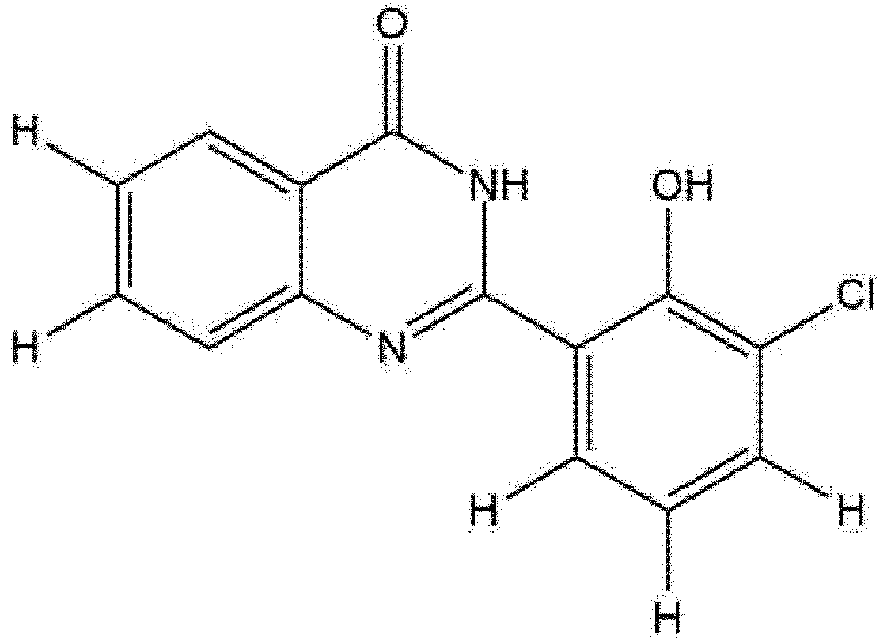
- According to another aspect of the present disclosure, there may be provided a near-ultraviolet stimulated light-emitting composition, comprising: the near-ultraviolet stimulated light-emitting compound; and at least one binder selected from a group consisting of acrylic polymer, polyamide, polyurethane, polyester, polyethylene terephthalate, polycarbonate and polypropylene.
- According to an exemplary embodiment, the near-ultraviolet stimulated light-emitting composition of the present disclosure may be used, not only in security printouts, plastic cards used as data carriers (e.g. check cards, credit cards, certification cards, etc.), but also in the laminating process of bank notes, certificates, and passports.
- According to still another aspect of the present disclosure, there may be provided a method for producing the near-ultraviolet stimulated light-emitting compound of any one of claims 1 to 6, the method comprising: condensation-reacting a 2-aminobenzamide optionally substituted by a substituent independently selected from hygrogen and halogen; and a phenylaldehyde optionally substituted by a substituent independently selected from hydrogen, halogen, hydroxy, cyanide, C1-C8 alkoxy, C1-C8 alkyl, C5-C6 aryl and C1-C8 alkylamino.
- A schematic reaction formula of the condensation reaction may be represented by chemical formula II as follows.

- According to an exemplary embodiment of the present disclosure, the condensation reaction may be accelerated by a catalyst. The fluorescent intensity discharged from the compound when irradiated with near-ultraviolet rays may be different depending on the catalyst used in the condensation reaction.
- According to an exemplary embodiment of the present disclosure, the catalyst may be a metallic salt catalyst. For example, the catalyst may be at least one selected from a group consisting of potassium permanganate, dichloro cyano benzoquinone, sodium bisulfite, scandium triflate, ammonium chloride, cupric chloride, stannic chloride, trifluoroacetic acid, tetrabutylammonium bromide and p-toluenesulfonic acid. However, the present disclosure is not limited to the examples listed in the above.
- According to an exemplary embodiment, the condensation reaction may be performed in at least one solvent selected from a group consisting of acetonitrile, ethyl alcohol, dimethylacetamide and dimethylformamide.
- Unless otherwise specified herein, the compound and composition of the present disclosure may be produced by a means known in the field of organic synthesis, except for the producing method described in the above. The method for optimizing reaction conditions required to minimize competitive by-products is well known in the art to which the present disclosure pertains. A high-speed parallel synthesis equipment and a computer-controlled microreactor may be appropriately used in optimizing reaction and scaling up (for example, as described in Design And Optimization in Organic Synthesis, 2ndEdition, Carlson R, Ed, 2005; Elsevier Science Ltd.; Jahnisch, K et al, Angew. Chem. Int. Ed. Engl. 2004 43:406; and documents references herein). Those skilled in the art may determine additional reaction procedures and protocols using commonly used structure-search database software, e.g. SciFinder® (CAS division of the American Chemical Society) and CrossFire Beilstein® (Elsevier MDL), etc.
- As understandable by those who skilled in the art, it will be apparent that the method for compounding the composition including formulas and embodiments of the present application falls within the scope of ordinary skill in the art. In addition, various compounding steps may be performed in alternative order or sequence in order to obtain preferable compound. Furthermore, the conditions such as solvent, temperature and reaction duration are discussed herein merely for the illustrated purposes, and one skilled in the art will appreciate that changing in these reaction conditions may cause production of preferred compound of the present disclosure.
- Hereinafter, the present disclosure will be described in more detail through exemplary embodiments. However, these embodiments are merely examples and do not limit the scope of the present disclosure. It will be apparent that the persons who skilled in the art of the present disclosure may perform various transformed or modified embodiments within the limit of the claimed technical spirit of the present disclosure.
- In order to ascertain the characteristic of quinazolinone compound including positions and types of different substituents, optionally substituted quinazolinone compounds were produced according to the following method:
- Optionally substituted phenylaldehyde 5.97g and optionally substituted 2-aminobenzamide 7.98g were added to ethyl alcohol 540 mℓ in an 1L four-neck roundbottom flask, and then the mixture was stirred until a transparent solution was obtained. After the phenyl aldehyde and the 2-aminobenzamide were all dissolved, a solution of ethyl alcohol 72 mℓ added with cupric chloride 15.8 g was added dropwise with stirring to the above solution for a predetermined period of time. As the cupric chloride, which is a catalyst, was added dropwise, an optionally substituted quinazolinone compound was generated as a precipitate. Then, the optionally substituted quinazolinone compound was separated and dried.
- The optionally substituted quinazolinone compounds produced according to the above method had in common the constitution represented by chemical formula I. L1∼L6 substituents for compositions in respective embodiments are illustrated in the following TABLE 1.
TABLE 1 Embodiment No. R1 R2 R3 R4 R5 R6 1 -H -H -H -H -H -H 2 -H -H -H -H -Cl -H 3 -H -H -H -H -H -Cl 4 -H -Cl -H -H -H -H 5 -H -Cl -H -H -Cl -H 6 -H -Cl -H -H -H -Cl 7 -H -H -OCH3 -H -H -H 8 -H -H -OCH3 -H -Cl -H 9 -H -H -OCH3 -H -H -Cl 10 -H -H -Cl -H -H -H 11 -H -H -Cl -H -Cl -H 12 -H -H -Cl -H -H -Cl 13 -H -F -H -H -H -H 14 -H -F -H -H -Cl -H 15 -H -F -H -H -H -Cl 16 -Cl -H -H -H -H -H 17 -H -H -H -Cl -H -H - The obtained quinazolinone compound was irradiated with near-UV light in the wavelength of 365 nm, and the intensity of discharged fluorescence was measured. The fluorescent intensity was measured using a fluorescence spectrometer (DARSA-5000, PSI Co., Ltd.), under the condition of 365 nm stimulation wavelength, cumulative average of five-time measurements, and 1024x128 CCD sensor shape. In addition, measurement of residual fluorescent intensity after artificial light exposure was repeated identically according to ASTM G 154-06 Cycle 1 standard.
- The results of fluorescence intensity measurements are shown in TABLE 2 below.
[TABLE 2] Embodiment No. Fluorescent Intensity (UV light 365nm stimulated) Fluorescent Color The remaining fluorescence intensity (after artificial light exposure) Solid Phase Solid Phase Coating (10%) 1 +++++ Green 25% 2 +++++ Green 30% 3 - Non-fluorescent - 4 ++++ Green 65% 5 ++ Yellow 80% 6 +++ Yellow-green 70% 7 ++ Turquoise 40% 8 ++ Turquoise 45% 9 - Non-fluorescent - 10 ++++ Turquoise 60% 11 ++++ Turquoise 70% 12 +++ Turquoise 40% 13 +++++ Green 65% 14 - Non-fluorescent - 15 - Non-fluorescent - 16 ++++ Green 60% 17 ++++ Green 60% - : not measured;
+: very low;
++: low;
+++: medium;
++++: high;
+++++: very high - According to the results shown in TABLE 2, in embodiments 4-8, 10-13, 16 and 17, the compounds exhibited a remaining fluorescence intensity of above 40%. All compounds except for those in embodiments 3, 9, 14 and 15 were excited by the near-ultraviolet irradiation to exhibit the fluorescence emission.
- As shown in TABLE 3 below, 365 nm wavelength of near-ultraviolet light was irradiated to the compounds of embodiments 6 and 11, to measure the intensity of fluorescence discharged up to the range of 400 ∼ 700 nm. Further, the melting point was measured using the melting point measuring instrument (M5000, KRÜSS GmbH), by assuming that the phase change is at the point where the change in transmissivity reaches 20%. Solubility in organic solvents was measured with respect to eight product items.
[TABLE 3] Items Embodiment 6 Embodiment 11 Fluorescence Intensity +++ ++++ Emmax (nm) 527 490 Melting Point (°C) > 390 370 Solubility Acetone <0.1 <0.1 Ethyl Alcohol - - Water <0.1 <0.1 Normal Hexane - - 5% Hydrochloric Acid Solution 2% Sodium Hydroxide (Caustic Soda) Solution Resolved Resolved Ethyl Acetate - - Toluene <0.1 <0.1 - : not measured;
+: very low;
++: low;
+++: medium;
++++: high;
+++++: very high - As described in TABLE 3 in the above, it can be ascertained that the compounds of embodiments 6 and 11 have high fluorescent intensity, high thermal stability, and low solubility in organic solvents as well.
- In addition, compositions respectively containing 10% compounds of embodiments 6 and 11 were sealed on a non-florescent paper, using a grinder and an offset plate printing press (HFT-225, HONGFAT machinery manufacturing Co., Ltd.). Chemical resistance tests and solvent resistance tests were performed on the printed material for 30 minutes at 23°C with respect to each of nine product items. Furthermore, grades with reference to the standard and remaining fluorescence intensities were measured by irradiating the near-ultraviolet light of 365 nm wavelength, using a weatherability tester (QUV, Q-LAB Corporation), according to ASTM G154-06 Cycle No. 1 standard (except for the condensation conditions). The measurement results are shown in TABLE 4 below.
[TABLE 4] Items Application Example 1 Film, 10% Application Example 2 Film, 10% Remaining Fluorescence Intensity (comparing to the initial state) Remaining Fluorescence Intensity (comparing to the initial state) Initial State +++++ +++++ Acid Solution +++++ +++++ Alkaline Solution +++++ +++++ Artificial Sweat Solution +++++ +++++ Ethyl Acetate +++ +++ Ethyl Alcohol +++++ +++++ Petroleum Solvents +++++ +++++ Acetone ++ ++ 5% Soap Solution (80°C) Hot Water (100°C) +++++ +++++ Light Fastness Grade 4 =4 Remaining Fluorescence Intensity (comparing to the initial state) 70% 70% - : not measured;
+: very low;
++: low;
+++: medium;
++++: high;
+++++: very high - As described in TABLE 4 in the above, the compounds of embodiments 6 and 11 exhibited relatively high remaining fluorescence intensity in almost all solvents except for the 5% soap solution, to have high solvent resistance. Also in the results of weatherability test, the compounds were confirmed to have higher light fastness grade and remaining fluorescence intensity than those of conventional commercial products.
- Therefore, the fluorescent quinazolinone compound according to an exemplary embodiment of the present disclosure is colorless in daylight but may exhibit a high fluorescent intensity when irradiated with light in the near ultraviolet region. In addition, the fluorescent quinazolinone compound can be easily used with printed and plastic molded products since the compound not only has a high degree of light fastness and thermal stability but also high dispersibility. Further, the fluorescent quinazolinone compound according to an exemplary embodiment of the present disclosure can extend life cycle of the product by its high durability.
- The abovementioned exemplary embodiments are intended to be illustrative, and not to limit the scope of the claims. Many alternatives, modifications, variations, and equivalents will be apparent to those skilled in the art. The features, structures, methods, and other characteristics of the exemplary embodiments described herein may be combined in various ways to obtain additional and/or alternative exemplary embodiments within an equivalent scope. Therefore, the technical scope of the rights for the present disclosure shall be decided by the appended claims and equivalents thereof.
Claims (12)
- A near-ultraviolet stimulated light-emitting compound, represented by a following chemical formula I:

- The near-ultraviolet stimulated light-emitting compound of claim 1, wherein the halogen is fluorine (F) or chlorine (Cl).
- The near-ultraviolet stimulated light-emitting compound of claim 1, wherein the L1 and L4 are hydrogen.
- The near-ultraviolet stimulated light-emitting compound of claim 1, wherein the L1 is hydrogen, and the L2 is chlorine (Cl).
- The near-ultraviolet stimulated light-emitting compound of claim 1, wherein the L1 is hydrogen, and the L2 is fluorine (F).
- The near-ultraviolet stimulated light-emitting compound of claim 1, wherein the compound is 7-chloro-2(5-chloro-2-hydroxyphenyl)quinazoline-4(3H)-on; or 6-chloro-2(5-chloro-2-hydroxyphenyl)quinazoline-4(3H)-on.
- The near-ultraviolet stimulated light-emitting compound of claim 1, wherein the compound is selected from a group consisting of:7-chloro-2(4-chloro-2-hydroxyphenyl)quinazoline-4(3H)-on;2-(5-fluoro-2-hyroxyphenyl)quinazoline-4(3H)-on;2-(3-choloro-2-hydroxyphenyl)quinazoline-4(3H)-on;2-(2-chloro-6-hyrdoxyphenyl)quinazoline-4(3H)-on;6-chloro-2-(4-chloro-2-hydroxyphenyl)quinazoline-4(3H)-on; and2-(4-chloro-2-hyroxyphenyl)quinazoline-4(3H)-on.
- The near-ultraviolet stimulated light-emitting compound of any one of claims 1 to 7, further comprising:at least one binder selected from a group consisting of acrylic polymer, polyamide, polyurethane, polyester, polyethylene terephthalate, polycarbonate and polypropylene.
- A method for producing the near-ultraviolet stimulated light-emitting compound of any one of claims 1 to 6, the method comprising:condensation-reacting a 2-aminobenzamide optionally substituted by a substituent independently selected from hydrogen and halogen; and a phenylaldehyde optionally substituted by a substituent independently selected from hydrogen, halogen, hydroxy, cyanide, C1-C8 alkoxy, C1-C8 alkyl, C5-C6 aryl and C1-C8 alkylamino.
- The method for producing the near-ultraviolet stimulated light-emitting compound of claim 9, wherein the condensation reaction is accelerated by a catalyst.
- The method for producing the near-ultraviolet stimulated light-emitting compound of claim 10, wherein the catalyst is at least one selected from a group consisting of potassium permanganate, dichloro cyano benzoquinone, sodium bisulfite, scandium triflate, ammonium chloride, cupric chloride, stannic chloride, trifluoroacetic acid, tetrabutylammonium bromide and p-toluenesulfonic acid.
- The method for producing the near-ultraviolet stimulated light-emitting compound of claim 11, wherein the condensation reaction is performed in at least one solvent selected from a group consisting of acetonitrile, ethyl alcohol, dimethylacetamide and dimethylformamide.
Applications Claiming Priority (2)
| Application Number | Priority Date | Filing Date | Title |
|---|---|---|---|
| KR1020140007221A KR101562207B1 (en) | 2014-01-21 | 2014-01-21 | Flourescent compounds excitied by near ultraviolet and preparation method thereof |
| PCT/KR2015/000412 WO2015111872A1 (en) | 2014-01-21 | 2015-01-15 | Near-ultraviolet stimulated light-emitting compound and production method for same |
Publications (4)
| Publication Number | Publication Date |
|---|---|
| EP3098284A1 true EP3098284A1 (en) | 2016-11-30 |
| EP3098284A4 EP3098284A4 (en) | 2017-08-30 |
| EP3098284B1 EP3098284B1 (en) | 2024-09-04 |
| EP3098284C0 EP3098284C0 (en) | 2024-09-04 |
Family
ID=53681631
Family Applications (1)
| Application Number | Title | Priority Date | Filing Date |
|---|---|---|---|
| EP15740128.2A Active EP3098284B1 (en) | 2014-01-21 | 2015-01-15 | Near-ultraviolet stimulated light-emitting compound and production method for same |
Country Status (6)
| Country | Link |
|---|---|
| US (1) | US10050214B2 (en) |
| EP (1) | EP3098284B1 (en) |
| KR (1) | KR101562207B1 (en) |
| ES (1) | ES2989345T3 (en) |
| PL (1) | PL3098284T3 (en) |
| WO (1) | WO2015111872A1 (en) |
Families Citing this family (2)
| Publication number | Priority date | Publication date | Assignee | Title |
|---|---|---|---|---|
| EP3197982B1 (en) * | 2014-09-24 | 2020-05-06 | Merck Patent GmbH | Materials for organic electroluminescent devices |
| CN106632088B (en) * | 2015-10-30 | 2019-04-19 | 华南理工大学 | A kind of aggregation-induced luminescence probe based on quinazolinone compounds, preparation method and application thereof |
Family Cites Families (7)
| Publication number | Priority date | Publication date | Assignee | Title |
|---|---|---|---|---|
| US3526627A (en) * | 1969-06-05 | 1970-09-01 | American Cyanamid Co | Method for preparation of quinazolones |
| US20040132228A1 (en) | 2002-12-17 | 2004-07-08 | Honeywell International Inc. | Method and system for fabricating an OLED |
| WO2008059024A1 (en) * | 2006-11-15 | 2008-05-22 | High Point Pharmaceuticals, Llc | 2- ( 2 -hydroxyphenyl) -quinazolin-4-ones useful for treating obesity and diabetes |
| EP2209906A2 (en) * | 2007-11-05 | 2010-07-28 | Life Technologies Corporation | Novel plating media |
| KR100933498B1 (en) * | 2008-12-12 | 2009-12-23 | 신상규 | Separation and Purification Method of Cunazolinone-based Fluorescent Materials |
| US8697714B2 (en) * | 2010-07-28 | 2014-04-15 | Nanyang Technological University | Quinazolinone based fluorogenic probes |
| US20120094038A1 (en) * | 2010-10-13 | 2012-04-19 | Honeywell International Inc. | Use of humidity stable yellow fluorescent pigments in security applications |
-
2014
- 2014-01-21 KR KR1020140007221A patent/KR101562207B1/en active Active
-
2015
- 2015-01-15 EP EP15740128.2A patent/EP3098284B1/en active Active
- 2015-01-15 US US15/113,379 patent/US10050214B2/en active Active
- 2015-01-15 WO PCT/KR2015/000412 patent/WO2015111872A1/en not_active Ceased
- 2015-01-15 PL PL15740128.2T patent/PL3098284T3/en unknown
- 2015-01-15 ES ES15740128T patent/ES2989345T3/en active Active
Also Published As
| Publication number | Publication date |
|---|---|
| PL3098284T3 (en) | 2024-12-23 |
| KR20150086952A (en) | 2015-07-29 |
| EP3098284B1 (en) | 2024-09-04 |
| EP3098284C0 (en) | 2024-09-04 |
| WO2015111872A1 (en) | 2015-07-30 |
| ES2989345T3 (en) | 2024-11-26 |
| KR101562207B1 (en) | 2015-10-22 |
| US10050214B2 (en) | 2018-08-14 |
| EP3098284A4 (en) | 2017-08-30 |
| US20170012218A1 (en) | 2017-01-12 |
Similar Documents
| Publication | Publication Date | Title |
|---|---|---|
| Dietliker et al. | New developments in photoinitiators | |
| CN1308403C (en) | Ink compositions containing lanthanide complexes | |
| Mau et al. | Donor–acceptor–donor structured thioxanthone derivatives as visible photoinitiators | |
| Azaza et al. | Synthesis and spectral properties of coumarins derivatives fluorescence emitters: Experiment and DFT/TDDFT calculations | |
| EP3172203B1 (en) | Molecules presenting dual emission properties | |
| US10050214B2 (en) | Near-ultraviolet stimulated light-emitting compound and production method for same | |
| JP6255529B2 (en) | Resin composition, method for producing the same, and molded article | |
| US3740402A (en) | Certain 2-(0-sulfonamidophenyl)-4(3h)-quinazolinones | |
| Xu et al. | Evolving a high-performance bio-imaging tool derived from a compact fluorophore as well as creating a reaction-based fluorescent probe for precise determination of Ag+ | |
| CN115768631B (en) | Fluorescent composition for protecting products comprising at least one benzoxazole compound | |
| US3892972A (en) | Method of producing a luminescent surface containing substituted sulfonamido and carboxamido phenyl quinazolones | |
| EP3307817B1 (en) | Novel spiropyran based composition and application thereof as security tag | |
| KR20010020559A (en) | Photochromatic compounds, process for their preparation and their use in polymeric materials | |
| El-Sedik et al. | Synthesis, absorption and fluorescence properties of N-triazinyl derivatives of 2-aminoanthracene | |
| JP7698512B2 (en) | Rare Earth Complexes | |
| EP1794136B1 (en) | Aryl-ureido benzoxazinone compounds | |
| JP7698511B2 (en) | compound | |
| PL238050B1 (en) | New 2-amino-4,6-diphenylbenzene-1,3-dicarbonitrile derivatives, methods of their preparation, new photoinitiation systems for photoinitiated cationic, radical, thiol-ene and hybrid polymerization processes and use of new 2-amino-4,6-diphenylbenzene-1,3-dicarbonitrile derivatives | |
| JP2026082885A (en) | Fluorescent composition containing at least one benzazole compound for ensuring product security | |
| RU2306315C1 (en) | Method for production of e-2-aroylmethylene-1-phenyl-1,2,3,4-tetrahydroquinazolin-4-ones | |
| JP4817309B2 (en) | A light emitting material comprising a tripod type metal complex and a resin composition containing the light emitting material. | |
| RU2847410C1 (en) | Fluorescent composition containing at least one benzazole-type compound for the protection of products | |
| Matschke et al. | The redox behaviour of cyclic tetraaminoethenes derived from 2, 2′-biimidazole | |
| Lohio et al. | New bichromophoric-2, 2′-bipyridines: synthesis and optical properties | |
| JPS63191870A (en) | Luminescent ink composition |
Legal Events
| Date | Code | Title | Description |
|---|---|---|---|
| PUAI | Public reference made under article 153(3) epc to a published international application that has entered the european phase |
Free format text: ORIGINAL CODE: 0009012 |
|
| 17P | Request for examination filed |
Effective date: 20160720 |
|
| AK | Designated contracting states |
Kind code of ref document: A1 Designated state(s): AL AT BE BG CH CY CZ DE DK EE ES FI FR GB GR HR HU IE IS IT LI LT LU LV MC MK MT NL NO PL PT RO RS SE SI SK SM TR |
|
| AX | Request for extension of the european patent |
Extension state: BA ME |
|
| RIN1 | Information on inventor provided before grant (corrected) |
Inventor name: JUN, KUN Inventor name: AN, KYOUNG LYONG Inventor name: SHIN, SEUNG RIM Inventor name: KIM, SHI SURK Inventor name: PARK, JE YOUNG Inventor name: LEE, IN JA |
|
| DAX | Request for extension of the european patent (deleted) | ||
| A4 | Supplementary search report drawn up and despatched |
Effective date: 20170731 |
|
| RIC1 | Information provided on ipc code assigned before grant |
Ipc: H01L 51/50 20060101ALI20170724BHEP Ipc: H01L 51/00 20060101ALI20170724BHEP Ipc: C07D 239/91 20060101ALI20170724BHEP Ipc: C09K 11/06 20060101AFI20170724BHEP Ipc: C09K 11/02 20060101ALI20170724BHEP |
|
| STAA | Information on the status of an ep patent application or granted ep patent |
Free format text: STATUS: EXAMINATION IS IN PROGRESS |
|
| 17Q | First examination report despatched |
Effective date: 20200319 |
|
| REG | Reference to a national code |
Ref country code: DE Ref legal event code: R079 Free format text: PREVIOUS MAIN CLASS: C09K0011060000 Ipc: C07D0239910000 Ref country code: DE Ref legal event code: R079 Ref document number: 602015089768 Country of ref document: DE Free format text: PREVIOUS MAIN CLASS: C09K0011060000 Ipc: C07D0239910000 |
|
| GRAP | Despatch of communication of intention to grant a patent |
Free format text: ORIGINAL CODE: EPIDOSNIGR1 |
|
| STAA | Information on the status of an ep patent application or granted ep patent |
Free format text: STATUS: GRANT OF PATENT IS INTENDED |
|
| RIC1 | Information provided on ipc code assigned before grant |
Ipc: H10K 85/60 20230101ALI20240227BHEP Ipc: C09K 11/02 20060101ALI20240227BHEP Ipc: C09K 11/06 20060101ALI20240227BHEP Ipc: C07D 239/91 20060101AFI20240227BHEP |
|
| INTG | Intention to grant announced |
Effective date: 20240327 |
|
| GRAS | Grant fee paid |
Free format text: ORIGINAL CODE: EPIDOSNIGR3 |
|
| GRAA | (expected) grant |
Free format text: ORIGINAL CODE: 0009210 |
|
| STAA | Information on the status of an ep patent application or granted ep patent |
Free format text: STATUS: THE PATENT HAS BEEN GRANTED |
|
| AK | Designated contracting states |
Kind code of ref document: B1 Designated state(s): AL AT BE BG CH CY CZ DE DK EE ES FI FR GB GR HR HU IE IS IT LI LT LU LV MC MK MT NL NO PL PT RO RS SE SI SK SM TR |
|
| REG | Reference to a national code |
Ref country code: GB Ref legal event code: FG4D |
|
| REG | Reference to a national code |
Ref country code: CH Ref legal event code: EP |
|
| REG | Reference to a national code |
Ref country code: IE Ref legal event code: FG4D |
|
| REG | Reference to a national code |
Ref country code: DE Ref legal event code: R096 Ref document number: 602015089768 Country of ref document: DE |
|
| U01 | Request for unitary effect filed |
Effective date: 20241002 |
|
| REG | Reference to a national code |
Ref country code: ES Ref legal event code: FG2A Ref document number: 2989345 Country of ref document: ES Kind code of ref document: T3 Effective date: 20241126 |
|
| U07 | Unitary effect registered |
Designated state(s): AT BE BG DE DK EE FI FR IT LT LU LV MT NL PT RO SE SI Effective date: 20241028 |
|
| PG25 | Lapsed in a contracting state [announced via postgrant information from national office to epo] |
Ref country code: NO Free format text: LAPSE BECAUSE OF FAILURE TO SUBMIT A TRANSLATION OF THE DESCRIPTION OR TO PAY THE FEE WITHIN THE PRESCRIBED TIME-LIMIT Effective date: 20241204 |
|
| PG25 | Lapsed in a contracting state [announced via postgrant information from national office to epo] |
Ref country code: GR Free format text: LAPSE BECAUSE OF FAILURE TO SUBMIT A TRANSLATION OF THE DESCRIPTION OR TO PAY THE FEE WITHIN THE PRESCRIBED TIME-LIMIT Effective date: 20241205 |
|
| PG25 | Lapsed in a contracting state [announced via postgrant information from national office to epo] |
Ref country code: HR Free format text: LAPSE BECAUSE OF FAILURE TO SUBMIT A TRANSLATION OF THE DESCRIPTION OR TO PAY THE FEE WITHIN THE PRESCRIBED TIME-LIMIT Effective date: 20240904 |
|
| PG25 | Lapsed in a contracting state [announced via postgrant information from national office to epo] |
Ref country code: RS Free format text: LAPSE BECAUSE OF FAILURE TO SUBMIT A TRANSLATION OF THE DESCRIPTION OR TO PAY THE FEE WITHIN THE PRESCRIBED TIME-LIMIT Effective date: 20241204 |
|
| PG25 | Lapsed in a contracting state [announced via postgrant information from national office to epo] |
Ref country code: RS Free format text: LAPSE BECAUSE OF FAILURE TO SUBMIT A TRANSLATION OF THE DESCRIPTION OR TO PAY THE FEE WITHIN THE PRESCRIBED TIME-LIMIT Effective date: 20241204 Ref country code: NO Free format text: LAPSE BECAUSE OF FAILURE TO SUBMIT A TRANSLATION OF THE DESCRIPTION OR TO PAY THE FEE WITHIN THE PRESCRIBED TIME-LIMIT Effective date: 20241204 Ref country code: HR Free format text: LAPSE BECAUSE OF FAILURE TO SUBMIT A TRANSLATION OF THE DESCRIPTION OR TO PAY THE FEE WITHIN THE PRESCRIBED TIME-LIMIT Effective date: 20240904 Ref country code: GR Free format text: LAPSE BECAUSE OF FAILURE TO SUBMIT A TRANSLATION OF THE DESCRIPTION OR TO PAY THE FEE WITHIN THE PRESCRIBED TIME-LIMIT Effective date: 20241205 |
|
| U20 | Renewal fee for the european patent with unitary effect paid |
Year of fee payment: 11 Effective date: 20250124 |
|
| PG25 | Lapsed in a contracting state [announced via postgrant information from national office to epo] |
Ref country code: IS Free format text: LAPSE BECAUSE OF FAILURE TO SUBMIT A TRANSLATION OF THE DESCRIPTION OR TO PAY THE FEE WITHIN THE PRESCRIBED TIME-LIMIT Effective date: 20250104 |
|
| PG25 | Lapsed in a contracting state [announced via postgrant information from national office to epo] |
Ref country code: SM Free format text: LAPSE BECAUSE OF FAILURE TO SUBMIT A TRANSLATION OF THE DESCRIPTION OR TO PAY THE FEE WITHIN THE PRESCRIBED TIME-LIMIT Effective date: 20240904 |
|
| PG25 | Lapsed in a contracting state [announced via postgrant information from national office to epo] |
Ref country code: CZ Free format text: LAPSE BECAUSE OF FAILURE TO SUBMIT A TRANSLATION OF THE DESCRIPTION OR TO PAY THE FEE WITHIN THE PRESCRIBED TIME-LIMIT Effective date: 20240904 |
|
| PG25 | Lapsed in a contracting state [announced via postgrant information from national office to epo] |
Ref country code: SK Free format text: LAPSE BECAUSE OF FAILURE TO SUBMIT A TRANSLATION OF THE DESCRIPTION OR TO PAY THE FEE WITHIN THE PRESCRIBED TIME-LIMIT Effective date: 20240904 |
|
| PLBE | No opposition filed within time limit |
Free format text: ORIGINAL CODE: 0009261 |
|
| STAA | Information on the status of an ep patent application or granted ep patent |
Free format text: STATUS: NO OPPOSITION FILED WITHIN TIME LIMIT |
|
| 26N | No opposition filed |
Effective date: 20250605 |
|
| REG | Reference to a national code |
Ref country code: CH Ref legal event code: PL |
|
| PG25 | Lapsed in a contracting state [announced via postgrant information from national office to epo] |
Ref country code: MC Free format text: LAPSE BECAUSE OF FAILURE TO SUBMIT A TRANSLATION OF THE DESCRIPTION OR TO PAY THE FEE WITHIN THE PRESCRIBED TIME-LIMIT Effective date: 20240904 |
|
| PG25 | Lapsed in a contracting state [announced via postgrant information from national office to epo] |
Ref country code: CH Free format text: LAPSE BECAUSE OF NON-PAYMENT OF DUE FEES Effective date: 20250131 |
|
| PG25 | Lapsed in a contracting state [announced via postgrant information from national office to epo] |
Ref country code: IE Free format text: LAPSE BECAUSE OF NON-PAYMENT OF DUE FEES Effective date: 20250115 |
|
| U20 | Renewal fee for the european patent with unitary effect paid |
Year of fee payment: 12 Effective date: 20260128 |
|
| PGFP | Annual fee paid to national office [announced via postgrant information from national office to epo] |
Ref country code: GB Payment date: 20260121 Year of fee payment: 12 |
|
| PGFP | Annual fee paid to national office [announced via postgrant information from national office to epo] |
Ref country code: ES Payment date: 20260217 Year of fee payment: 12 |
|
| PGFP | Annual fee paid to national office [announced via postgrant information from national office to epo] |
Ref country code: PL Payment date: 20260206 Year of fee payment: 12 |