EP3096571A1 - Method of performing automatic plmn selection in iops-capable wireless communication system - Google Patents
Method of performing automatic plmn selection in iops-capable wireless communication system Download PDFInfo
- Publication number
- EP3096571A1 EP3096571A1 EP16154215.4A EP16154215A EP3096571A1 EP 3096571 A1 EP3096571 A1 EP 3096571A1 EP 16154215 A EP16154215 A EP 16154215A EP 3096571 A1 EP3096571 A1 EP 3096571A1
- Authority
- EP
- European Patent Office
- Prior art keywords
- plmn
- user equipment
- iops
- primary
- mode
- Prior art date
- Legal status (The legal status is an assumption and is not a legal conclusion. Google has not performed a legal analysis and makes no representation as to the accuracy of the status listed.)
- Withdrawn
Links
Images




Classifications
-
- H—ELECTRICITY
- H04—ELECTRIC COMMUNICATION TECHNIQUE
- H04W—WIRELESS COMMUNICATION NETWORKS
- H04W60/00—Affiliation to network, e.g. registration; Terminating affiliation with the network, e.g. de-registration
- H04W60/04—Affiliation to network, e.g. registration; Terminating affiliation with the network, e.g. de-registration using triggered events
-
- H—ELECTRICITY
- H04—ELECTRIC COMMUNICATION TECHNIQUE
- H04M—TELEPHONIC COMMUNICATION
- H04M15/00—Arrangements for metering, time-control or time indication ; Metering, charging or billing arrangements for voice wireline or wireless communications, e.g. VoIP
- H04M15/70—Administration or customization aspects; Counter-checking correct charges
- H04M15/755—Account identification
- H04M15/7556—Account identification by SIM, e.g. smart card account in SCP, SDP or SN
-
- H—ELECTRICITY
- H04—ELECTRIC COMMUNICATION TECHNIQUE
- H04W—WIRELESS COMMUNICATION NETWORKS
- H04W4/00—Services specially adapted for wireless communication networks; Facilities therefor
- H04W4/24—Accounting or billing
-
- H—ELECTRICITY
- H04—ELECTRIC COMMUNICATION TECHNIQUE
- H04W—WIRELESS COMMUNICATION NETWORKS
- H04W4/00—Services specially adapted for wireless communication networks; Facilities therefor
- H04W4/90—Services for handling of emergency or hazardous situations, e.g. earthquake and tsunami warning systems [ETWS]
-
- H—ELECTRICITY
- H04—ELECTRIC COMMUNICATION TECHNIQUE
- H04W—WIRELESS COMMUNICATION NETWORKS
- H04W48/00—Access restriction; Network selection; Access point selection
- H04W48/16—Discovering, processing access restriction or access information
-
- H—ELECTRICITY
- H04—ELECTRIC COMMUNICATION TECHNIQUE
- H04W—WIRELESS COMMUNICATION NETWORKS
- H04W48/00—Access restriction; Network selection; Access point selection
- H04W48/18—Selecting a network or a communication service
-
- H—ELECTRICITY
- H04—ELECTRIC COMMUNICATION TECHNIQUE
- H04W—WIRELESS COMMUNICATION NETWORKS
- H04W60/00—Affiliation to network, e.g. registration; Terminating affiliation with the network, e.g. de-registration
- H04W60/005—Multiple registrations, e.g. multihoming
-
- H—ELECTRICITY
- H04—ELECTRIC COMMUNICATION TECHNIQUE
- H04W—WIRELESS COMMUNICATION NETWORKS
- H04W76/00—Connection management
- H04W76/10—Connection setup
- H04W76/15—Setup of multiple wireless link connections
- H04W76/16—Involving different core network technologies, e.g. a packet-switched [PS] bearer in combination with a circuit-switched [CS] bearer
-
- H—ELECTRICITY
- H04—ELECTRIC COMMUNICATION TECHNIQUE
- H04W—WIRELESS COMMUNICATION NETWORKS
- H04W76/00—Connection management
- H04W76/50—Connection management for emergency connections
-
- H—ELECTRICITY
- H04—ELECTRIC COMMUNICATION TECHNIQUE
- H04W—WIRELESS COMMUNICATION NETWORKS
- H04W84/00—Network topologies
- H04W84/02—Hierarchically pre-organised networks, e.g. paging networks, cellular networks, WLAN [Wireless Local Area Network] or WLL [Wireless Local Loop]
- H04W84/04—Large scale networks; Deep hierarchical networks
- H04W84/042—Public Land Mobile systems, e.g. cellular systems
Definitions
- the present invention is related to a method of performing an automatic PLMN selection in an IOPS-capable wireless communication system for maintaining both normal-mode communications and IOPS mode communications.
- the 3rd Generation Partnership Project (3GPP) has developed a universal mobile telecommunications system (UMTS) which adopts a wideband code division multiple access (WCDMA) technology capable of providing high frequency spectrum utilization, universal coverage, and high-speed/quality multimedia data transmission.
- UMTS universal mobile telecommunications system
- WCDMA wideband code division multiple access
- UTRAN universal terrestrial radio access network
- NBs Node-Bs
- UE user equipment
- LTE long-term evolution
- the LTE system includes a new radio interface and radio network architecture which provides a high data rate, low latency, packet optimization, and improved system capacity and coverage.
- a radio access network known as an evolved UTRAN (E-UTRAN) includes multiple evolved NBs (eNBs) for communicating with multiple UEs and a core network (CN) which includes a mobility management entity (MME), a serving gateway (SGW) and other devices for non-access stratum (NAS)control.
- E-UTRAN evolved UTRAN
- eNBs evolved NBs
- CN core network
- MME mobility management entity
- SGW serving gateway
- NAS non-access stratum
- the general IOPS architectural requirements include:
- the macro EPC is the EPC which serves an eNB in normal mode of operation, while the local EPC is an entity which provides functionality used by an eNB in IOPS mode of operation in order to support public safety services.
- a nomadic eNB (NeNB) is a nomadic cell which may include a base station, antennas, microwave backhaul and support for local services.
- the NeNB is intended for PS use by providing coverage or additional capacity where coverage was never present (e.g. forest fire or underground rescue) or where coverage is no longer present (e.g. due to natural disaster).
- An isolated E-UTRAN can be created by either an E-UTRAN without normal connectivity with the macro EPC or deployed NeNBs with E-UTRAN functionality provided by a local EPC.
- the present invention aims at providing a method of performing an automatic PLMN selection in an IOPS-capable wireless communication system for maintaining both normal-mode communications and IOPS mode communications.
- the claimed method includes a user equipment selecting a first PLMN as a primary PLMN and registering on the primary PLMN; the user equipment performing a PLMN search when registering on the primary PLMN; the user equipment determining if a second PLMN which is currently unable to provide connectivity to the first PLMN can be detected in the PLMN search; the user equipment selecting the second PLMN as a secondary PLMN if the second PLMN can be detected in the PLMN search; and the user equipment registering on both the primary PLMN and the secondary PLMN after selecting the secondary PLMN.
- FIG. 1 is a diagram illustrating a prior art IOPS architecture of an E-UTRAN 100 in response to an outage event within the network.
- An isolated E-UTRAN 100A can be created from the E-UTRAN 100 following an event which isolates a part of the E-UTRAN 100 from normal connectivity with the macro EPC or following deployment of standalone E-UTRAN NeNBs within a part of the E-UTRAN 100.
- the isolated E-UTRAN 100A may include (1) operation with no connection to the macro EPC; (2) one or multiple eNBs; (3) interconnection between eNBs; (4) limited backhaul capacity to the macro EPC; and (5) the services required to support local operations (e.g. group communication) in the case of no network coverage or of limited network coverage.
- the isolated E-UTRAN 100A can be created when the outage event has been occurred within the wireless communication system.
- the eNBs in the normal-mode E-UTRAN 100B are connected to the macro EPC by backhaul connection and the macro EPC is connected to the application server.
- the eNBs in the isolated E-UTRAN 100A are able to support services required for local operations even though a connection to the normal mode E-UTRAN 100B, as well as to the macro EPC, has been cut off.
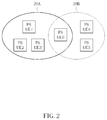
- FIG. 2 is a diagram illustrating prior art UE behavior in an IOPS-capable wireless communication system.
- a coverage area 20A is served by an IOPS-mode eNBI (i.e., isolated from the macro EPC) and a coverage area 20B is served by a normal-mode eNB2 (i.e., connected to the macro EPC).
- PS UE0 ⁇ UE5 represent IOPS-capable mobile devices which can support a PS band.
- the PS UE1 ⁇ UE3 may be served by one or multiple cells in the IOPS-mode eNBI and get connected to each other if the IOPS operation allows it.
- the PS UE4 ⁇ UE5 may be served by one or multiple cells in the normal-mode eNB2 and get connected to each other.
- the PS UE0 is under the coverage of both the IOPS-mode eNBI and the normal-mode eNB2.
- the eNB1 starts advertising an IOPS-dedicated public land mobile network identity (PLMN-ID) in the IOPS mode and only authorized PS UEs can attach to the corresponding IOPS-dedicated PLMN.
- PLMN-ID public land mobile network identity
- UEs are configured to treat this IOPS-dedicated PLMN-ID with lower preference for E-UTRAN access so that other PLMNs of the macro EPC are selected with precedence.
- the PS UE0 since the PS UE0 is under the coverage of both the IOPS-mode eNBI and the normal-mode eNB2, the PS UE0 is configured to select the PLMN-ID received from the normal-mode eNB2 and register on the normal-mode eNB2. Under such circumstance, the PS UE0 is able to communication with the PS UE4 ⁇ UE5, but lost connection with the PS UE1 ⁇ UE3.
- the user can also perform a manual PLMN selection at any time. For example, the user may select the IOPS-dedicated PLMN-ID received from the IOPS-mode eNB1 for the PS UE0 to register on the IOPS-mode eNB1. Under such circumstance, the PS UE0 is able to communication with the PS UE1 ⁇ UE3, but lost connection with the PS UE4 ⁇ UE5.
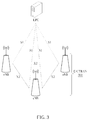
- FIG. 3 is a diagram illustrating a network structure of an E-UTRAN system 300 according to an embodiment of the present invention.
- the E-UTRAN system 300 includes one or more base stations eNBs connected to each other through X2 interfaces, wherein the X2 user plane interface (X2-U, not shown) is defined between eNBs for providing nonguaranteed delivery of user plane protocol data units (PDUs), and the X2 control plane interface (X2-CP, not shown) is defined between two neighbor eNBs.
- X2 user plane interface X2-U, not shown
- X2-CP X2 control plane interface
- Each eNB may be connected to the macro EPC through an S1 interface, wherein the S1 user plane interface (SI-U, not shown) is defined between the eNB and the serving gateway (not shown) for providing nonguaranteed delivery of user plane PDUs between the eNB and the serving gateway, and the S1 control plane interface (SI-MME, not shown) is defined between the eNB and the mobility management entity (not shown).
- SI-U S1 user plane interface
- SI-MME S1 control plane interface
- FIG. 4 is a diagram illustrating an LTE protocol stack adopted by the E-UTRAN system 300 according to an embodiment of the present invention.
- the LTE protocol stack includes a NAS layer 41, a radio resource control (RRC) layer 42, a packet data convergence protocol (PDCP) layer 43, a radio link control (RLC) layer 44, a medium access control (MAC) layer 45, and a physical (PHY) layer 46.
- the LTE protocol stack shown is typically implemented on a mobile terminal (user equipment).
- the NAS layer 41 is configured to maintain a list of allowed PLMN types and a list of PLMN-IDs in priority order, thereby performing PLMN selection accordingly for the user equipment to camp on.
- the RRC layer 42, the PDCP layer 43, the RLC layer 44, the MAC layer 45, and the PHY layer 46 are considered access stratum (AS) layers, which handle functions related to the transmission of data over the radio interface and the management of the radio interface of the user equipment.
- AS layers access stratum
- one function of the AS layers includes supporting PLMN selection of the NAS layer 41 by searching for and reporting available PLMNs to the NAS layer 41.
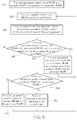
- FIG. 5 is a flowchart illustrating a method of performing automatic PLMN selection in an IOPS-capable wireless communication system according to an embodiment of the present invention.
- the first PLMN is a normal PLMN connected to the macro EPC which serves the user equipment in normal mode of operation
- the second PLMN is an IOPS PLMN connected to a local EPC which provides a local IP connectivity and public safety services to the user equipment in IOPS mode of operation when the backhaul to the macro EPC is lost or not available.
- the first PLMN is an IOPS PLMN connected to a local EPC which provides a local IP connectivity and public safety services to the user equipment in IOPS mode of operation when the backhaul to the macro EPC is lost or not available, while the second PLMN is a normal PLMN connected to the macro EPC which serves the user equipment in normal mode of operation.
- FIG. 6 is a diagram illustrating the operational state of an IOPS-capable user equipment according to an embodiment of the present invention. As depicted, the user equipment may operate in one of the following four states S1 ⁇ S4, and the state transitions are indicated by arrows A1 ⁇ A9.
- step 510 the user equipment is configured to select the first PLMN as the primary PLMN and register on the first PLMN. Referring to FIG. 6 , the user equipment may switch from state S4 to state S1 or S2 after executing step 510, as indicated by arrow A1 or A2.
- step 510 may be executed in a PLMN selection procedure which is performed at switch-on or on recovery from lack of coverage.
- Most mobile devices are able to provide two modes for PLMN selection: manual mode and automatic mode.
- manual mode the user equipment camps on whatever network that user specifies.
- automatic mode a target PLMN is selected based on predefined guidelines.
- the user equipment equipped with a smartcard such as a subscriber identity module (SIM) card, is configured to select and register on a target PLMN based on predefined guidelines in the following order.
- SIM subscriber identity module
- the method of selecting the primary PLMN does not limit the scope of the present invention.
- the user equipment is configured to perform the PLMN search using AS layers.
- the AS layers may scan all the radio frequency (RF) channels within UE's supported RF bands and read system information (SI) to identify each PLMN.
- the PLMN search may be performed according to related 3GPP document. However, the method of performing the PLMN search does not limit the scope of the present invention.
- the AS layers of the user equipment are configured to report the information associated with all available PLMNs to the NAS layer of the user equipment.
- the reported information may include the PLMN_IDs and the qualities of all available PLMNs.
- each IOPS PLMN is assigned with an IOPS-dedicated PLMN_ID so as to be distinguished from a normal PLMN_ID of a normal PLMN.
- one or multiple IOPS-dedicated PLMN_IDs are predefined and stored in the smartcard of the user equipment.
- a PLMN_ID of a specific PLMN matches one of the predefined IOPS-dedicated PLMN_IDs, it means that the specific PLMN is an IOPS PLMN.
- a normal PLMN is an entity which is currently connected to the macro EPC, while an IOPS PLMN an entity which has lost backhaul to the macro EPC or is isolated from the macro EPC. Therefore, there is no connectivity between a first UE which operates in state S1 and a second UE which operates in state S2.
- step 540 if it is determined that the available PLMNs include the second PLMN which is currently unable to provide connectivity to the first PLMN, step 550 is then executed for selecting the second PLMN as the secondary PLMN so that the user equipment may register on both the primary PLMN and the secondary PLMN.
- the first PLMN is a normal PLMN and the available PLMNs include the second PLMN which is an IOPS PLMN
- the UE is configured to register on both the first PLMN and the second PLMN.
- the UE is configured to register on both the first PLMN and the second PLMN.
- the user equipment may switch from state S1 or S2 to state S3 after executing step 550, as indicated by arrow A3 or A4.
- the user equipment may operate in state S3 by registering on both the primary PLMN and the secondary PLMN using various methods.
- the only SIM card may be used to alternatively listen to a first cell in the primary PLMN at a first time slot and a second cell in the secondary PLMN at a second time slot, wherein the first time slot and the second time slot are not overlapped.
- the SIM card specified by the user or selected according to a predetermined rule may be used to alternatively listen to a first cell in the primary PLMN at a first time slot and a second cell in the secondary PLMN at a second time slot, wherein the first time slot and the second time slot are not overlapped.
- a first SIM card may be used to listen to a first cell in the primary PLMN and a second SIM card may be used to listen to a second cell in the secondary PLMN simultaneously.
- the method of performing registration on multiple PLMNs does not limit the scope of the present invention.
- step 560 is then executed for determining if the user equipment needs to detach from the primary PLMN or the secondary PLMN.
- the NAS layer of the user equipment may periodically request the AS layers to report information associated with all available PLMNs.
- access to the primary PLMN or the secondary PLMN may no longer be available to the user equipment.
- the user equipment may switch from state S3 to state S1, S2 or S4 after executing step 570, as indicated by arrow A5, A6 or A7.
- the local EPC may further be configured to delete all registration data of the user equipment so as to prevent duplicated user data in the local EPC and the macro EPC.
- the NAS layer of the user equipment may periodically request the AS layers to report information associated with all available PLMNs.
- access to the primary PLMN may no longer be available to the user equipment.
- the user equipment may switch from state S1 or S2 to state S4 after executing step 570, as indicated by arrow A8 or A9.
- the PS UE1 ⁇ UE3 may be served by one or multiple cells in the IOPS-mode eNBI and the PS UE4 ⁇ UE5 may be served by one or multiple cells in the normal-mode eNB2.
- the PS UE0 is under the coverage of both the IOPS-mode eNBI and the normal-mode eNB2.
- the PS UE0 may register on both the IOPS-mode eNBI and the normal-mode eNB2, thereby capable of communicating with all of the PS UE1 ⁇ UE5.
- the user equipment can serve as a transmitting end on uplink and as a receiving end on downlink
- the eNB can serve as a receiving end on uplink and as a transmitting end on downlink.
- FIG. 7 is a functional diagram illustrating a system 700 which may be used in the user equipment and the eNB for carrying out the present method.
- the system 700 includes a processing component 710, a network connectivity unit 720, random access memory (RAM) 730, read only memory (ROM) 740, a storage device 750, an input/output (I/O) device 760, and a digital signal processor (DSP) 770.
- These components might communicate with one another via a bus 780. In some cases, some of these components may not be present or may be combined in various combinations with one another or with other components not shown. These components might be located in a single physical entity or in more than one physical entity.
- any actions described herein as being taken by the processing component 710 may be taken by the processing component 710 alone or by the processing component 710 in conjunction with one or more components shown or not shown in the drawing, such as with the DSP 770.
- the DSP 770 is shown as a separate component, the DSP 770 might be incorporated into the processing component 710.
- the processing component 710 is configured to execute instructions, codes, computer programs, or scripts which may be accessed from the network connectivity units 720, RAM 730, ROM 740, or the storage device 750.
- the processing component 710 may include one or multiple processors CPU1 ⁇ CPUn for executing the present method simultaneously, serially, or otherwise by one processor.
- the one or multiple processors CPU1 ⁇ CPUn may include one or more application specific integrated circuits (ASICs), DSPs, digital signal processing devices (DSPDs), programmable logic devices (PLDs), field programmable gate arrays (FPGAs), controllers, microcontrollers, microprocessors, or any combination of above.
- ASICs application specific integrated circuits
- DSPs digital signal processing devices
- PLDs programmable logic devices
- FPGAs field programmable gate arrays
- controllers microcontrollers, microprocessors, or any combination of above.
- software code may be stored in the RAM 730, the ROM 740 or the storage device 750 and executed by
- the network connectivity unit 720 may include one or multiple modems, modem banks, Ethernet devices, universal serial bus (USB) interface devices, serial interfaces, token ring devices, fiber distributed data interface (FDDI) devices, wireless local area network (WLAN) devices, radio transceiver devices such as code division multiple access (CDMA) devices, GSM/UMTS/LTE radio transceiver devices, worldwide interoperability for microwave access (WiMAX) devices, and/or other well-known devices for connecting to the eNB.
- the network connectivity unit 720 allows the processing component 710 to communicate with the Internet or one or more telecommunications networks.
- the RAM 730 may be used to store volatile data and instructions that are executed by the processing component 710.
- the ROM 740 may be used to store instructions and data that are read during execution of the instructions.
- the storage device 750 may include various disk-based systems such as hard disk, floppy disk, or optical disk and may be used to store programs that are loaded into the RAM 730 when such programs are selected for execution. Access to both the RAM 730 and the ROM 740 is typically faster than access to the storage device 750, but the storage device 750 can provide larger memory capacity.
- the I/O devices 760 may include one or more of liquid crystal display (LCD) screens, touch screen displays, keyboards, keypads, switches, dials, mice, track balls, voice recognizers, card readers, paper tape readers, printers, video monitors, or other well-known input/output devices.
- LCD liquid crystal display
- the user equipment may be any IOPS-capable transportable electronic device such as a mobile telephone, a personal digital assistant (PDA), a hand-held computer, a tablet, a nettop, a laptop computer, or any device with similar telecommunication capabilities.
- PDA personal digital assistant
- the type of the user equipment does not limit the scope of the present invention.
- UE user equipment
- MS mobile station
- SS subscriber station
- MSS mobile subscriber station
- AMS advanced mobile station
- eNB may be replaced with the terms “BS(base station), “fixed station”, “NB”, “ABS (advanced base station), “AP (access point), etc.
- the user equipment when an IOPS-capable user equipment is under the coverage of both an IOPS-mode eNB and a normal-mode eNB, the user equipment is configured to perform automatic PLMN by registering on both the IOPS-mode eNB and the normal-mode eNB. Therefore, the present invention can improve UE's ability to maintain both normal-mode communications and IOPS mode communications.
Landscapes
- Engineering & Computer Science (AREA)
- Computer Networks & Wireless Communication (AREA)
- Signal Processing (AREA)
- Computer Security & Cryptography (AREA)
- Business, Economics & Management (AREA)
- Health & Medical Sciences (AREA)
- Accounting & Taxation (AREA)
- Emergency Management (AREA)
- Environmental & Geological Engineering (AREA)
- Public Health (AREA)
- Mobile Radio Communication Systems (AREA)
- Quality & Reliability (AREA)
- Physics & Mathematics (AREA)
- Electromagnetism (AREA)
Abstract
Description
- The present invention is related to a method of performing an automatic PLMN selection in an IOPS-capable wireless communication system for maintaining both normal-mode communications and IOPS mode communications.
- The 3rd Generation Partnership Project (3GPP) has developed a universal mobile telecommunications system (UMTS) which adopts a wideband code division multiple access (WCDMA) technology capable of providing high frequency spectrum utilization, universal coverage, and high-speed/quality multimedia data transmission. In the UMTS, a radio access network known as a universal terrestrial radio access network (UTRAN) includes multiple Node-Bs (NBs) for communicating with multiple user equipment (UE). Furthermore, a long-term evolution (LTE) system is now being developed by the 3GPP in order to further improve performance of the UMTS to satisfy users' increasing needs. The LTE system includes a new radio interface and radio network architecture which provides a high data rate, low latency, packet optimization, and improved system capacity and coverage. In the LTE system, a radio access network known as an evolved UTRAN (E-UTRAN) includes multiple evolved NBs (eNBs) for communicating with multiple UEs and a core network (CN) which includes a mobility management entity (MME), a serving gateway (SGW) and other devices for non-access stratum (NAS)control.
- In 3GPP Release 13, a study item was studied on isolated E-UTRAN operations for public safety (IOPS) in support of mission critical network operation for public safety (PS). The main idea laid behind this IOPS study item is to investigate needs and requirements for E-UTRAN operations when encountering connection problems with the macro evolved packet core (EPC).
- For the scenario that an eNB has no backhaul to the macro EPC, the general IOPS architectural requirements include:
- (a) When a UE accesses the eNB in an IOPS mode of operation, a local IP connectivity and transport public safety service shall be provided to the UE by a local EPC connected to the eNB, if authorized.
- (b) An eNB that supports IOPS may enter the IOPS mode of operation after it detects lack of S1 connectivity to the macro EPC. The decision by an eNB to enter the IOPS mode of operation shall be made in accordance with the local policies of the radio access network (RAN) operator.
- According to related 3GPP document, the macro EPC is the EPC which serves an eNB in normal mode of operation, while the local EPC is an entity which provides functionality used by an eNB in IOPS mode of operation in order to support public safety services. A nomadic eNB (NeNB) is a nomadic cell which may include a base station, antennas, microwave backhaul and support for local services. The NeNB is intended for PS use by providing coverage or additional capacity where coverage was never present (e.g. forest fire or underground rescue) or where coverage is no longer present (e.g. due to natural disaster). An isolated E-UTRAN can be created by either an E-UTRAN without normal connectivity with the macro EPC or deployed NeNBs with E-UTRAN functionality provided by a local EPC.
- Therefore, there is a need for a method of performing automatic PLMN in an IOPS-capable wireless communication system in order to improve UE's ability to maintain both normal-mode communications and IOPS mode communications.
- The present invention aims at providing a method of performing an automatic PLMN selection in an IOPS-capable wireless communication system for maintaining both normal-mode communications and IOPS mode communications.
- This is achieved by a method of performing an automatic PLMN selection in an IOPS-capable wireless communication system for maintaining both normal-mode communications and IOPS mode communications according to
claim 1. The dependent claims pertain to corresponding further developments and improvements. - As will be seen more clearly from the detailed description following below, the claimed method of performing an automatic PLMN selection in an IOPS-capable wireless communication system. The method includes a user equipment selecting a first PLMN as a primary PLMN and registering on the primary PLMN; the user equipment performing a PLMN search when registering on the primary PLMN; the user equipment determining if a second PLMN which is currently unable to provide connectivity to the first PLMN can be detected in the PLMN search; the user equipment selecting the second PLMN as a secondary PLMN if the second PLMN can be detected in the PLMN search; and the user equipment registering on both the primary PLMN and the secondary PLMN after selecting the secondary PLMN.
- In the following, the invention is further illustrated by way of example, taking reference to the accompanying drawings.
-
FIG. 1 is a diagram illustrating a prior art IOPS architecture of an E-UTRAN in response to an outage event within the network. -
FIG. 2 is a diagram illustrating prior art UE behavior in an IOPS-capable wireless communication system. -
FIG. 3 is a diagram illustrating a network structure of an E-UTRAN system according to an embodiment of the present invention. -
FIG. 4 is a diagram illustrating an LTE protocol stack adopted by an E-UTRAN system according to an embodiment of the present invention. -
FIG. 5 is a flowchart illustrating a method of performing automatic PLMN selection in an IOPS-capable wireless communication system according to an embodiment of the present invention. -
FIG. 6 is a diagram illustrating the operational state of an IOPS-capable user equipment according to an embodiment of the present invention. -
FIG. 7 is a functional diagram illustrating a system used in an IOPS-capable wireless communication system for carrying out the present method. -
FIG. 1 is a diagram illustrating a prior art IOPS architecture of anE-UTRAN 100 in response to an outage event within the network. An isolated E-UTRAN 100A can be created from the E-UTRAN 100 following an event which isolates a part of theE-UTRAN 100 from normal connectivity with the macro EPC or following deployment of standalone E-UTRAN NeNBs within a part of theE-UTRAN 100. Theisolated E-UTRAN 100A may include (1) operation with no connection to the macro EPC; (2) one or multiple eNBs; (3) interconnection between eNBs; (4) limited backhaul capacity to the macro EPC; and (5) the services required to support local operations (e.g. group communication) in the case of no network coverage or of limited network coverage. - Referring to
FIG. 1 , the isolated E-UTRAN 100A can be created when the outage event has been occurred within the wireless communication system. The eNBs in the normal-mode E-UTRAN 100B are connected to the macro EPC by backhaul connection and the macro EPC is connected to the application server. When the isolated E-UTRAN 100A is created, the eNBs in the isolated E-UTRAN 100A are able to support services required for local operations even though a connection to thenormal mode E-UTRAN 100B, as well as to the macro EPC, has been cut off. -
FIG. 2 is a diagram illustrating prior art UE behavior in an IOPS-capable wireless communication system. For illustrative purpose, it is assumed that acoverage area 20A is served by an IOPS-mode eNBI (i.e., isolated from the macro EPC) and acoverage area 20B is served by a normal-mode eNB2 (i.e., connected to the macro EPC). PS UE0∼UE5 represent IOPS-capable mobile devices which can support a PS band. The PS UE1∼UE3 may be served by one or multiple cells in the IOPS-mode eNBI and get connected to each other if the IOPS operation allows it. The PS UE4∼UE5 may be served by one or multiple cells in the normal-mode eNB2 and get connected to each other. The PS UE0 is under the coverage of both the IOPS-mode eNBI and the normal-mode eNB2. According to 3GPP document TR 23.797 section 6.1, the eNB1 starts advertising an IOPS-dedicated public land mobile network identity (PLMN-ID) in the IOPS mode and only authorized PS UEs can attach to the corresponding IOPS-dedicated PLMN. In the prior art method of performing automatic PLMN selection in the IOPS-capable wireless communication system, UEs are configured to treat this IOPS-dedicated PLMN-ID with lower preference for E-UTRAN access so that other PLMNs of the macro EPC are selected with precedence. In other words, since the PS UE0 is under the coverage of both the IOPS-mode eNBI and the normal-mode eNB2, the PS UE0 is configured to select the PLMN-ID received from the normal-mode eNB2 and register on the normal-mode eNB2. Under such circumstance, the PS UE0 is able to communication with the PS UE4∼UE5, but lost connection with the PS UE1∼UE3. - According to 3GPP document TR 23.797 section 6.1, the user can also perform a manual PLMN selection at any time. For example, the user may select the IOPS-dedicated PLMN-ID received from the IOPS-mode eNB1 for the PS UE0 to register on the IOPS-mode eNB1. Under such circumstance, the PS UE0 is able to communication with the PS UE1∼UE3, but lost connection with the PS UE4∼UE5.
-
FIG. 3 is a diagram illustrating a network structure of anE-UTRAN system 300 according to an embodiment of the present invention. The E-UTRANsystem 300 includes one or more base stations eNBs connected to each other through X2 interfaces, wherein the X2 user plane interface (X2-U, not shown) is defined between eNBs for providing nonguaranteed delivery of user plane protocol data units (PDUs), and the X2 control plane interface (X2-CP, not shown) is defined between two neighbor eNBs. Each eNB may be connected to the macro EPC through an S1 interface, wherein the S1 user plane interface (SI-U, not shown) is defined between the eNB and the serving gateway (not shown) for providing nonguaranteed delivery of user plane PDUs between the eNB and the serving gateway, and the S1 control plane interface (SI-MME, not shown) is defined between the eNB and the mobility management entity (not shown). -
FIG. 4 is a diagram illustrating an LTE protocol stack adopted by the E-UTRANsystem 300 according to an embodiment of the present invention. The LTE protocol stack includes aNAS layer 41, a radio resource control (RRC)layer 42, a packet data convergence protocol (PDCP)layer 43, a radio link control (RLC)layer 44, a medium access control (MAC)layer 45, and a physical (PHY)layer 46. The LTE protocol stack shown is typically implemented on a mobile terminal (user equipment). TheNAS layer 41 is configured to maintain a list of allowed PLMN types and a list of PLMN-IDs in priority order, thereby performing PLMN selection accordingly for the user equipment to camp on. TheRRC layer 42, thePDCP layer 43, theRLC layer 44, theMAC layer 45, and thePHY layer 46 are considered access stratum (AS) layers, which handle functions related to the transmission of data over the radio interface and the management of the radio interface of the user equipment. Specifically, one function of the AS layers includes supporting PLMN selection of theNAS layer 41 by searching for and reporting available PLMNs to theNAS layer 41. -
FIG. 5 is a flowchart illustrating a method of performing automatic PLMN selection in an IOPS-capable wireless communication system according to an embodiment of the present invention. - Step 510:
- the user equipment selects a first PLMN as a primary PLMN and registers on the primary PLMN; execute
step 520. - Step 520:
- the user equipment performs a PLMN search using AS layers; execute
step 530. - Step 530:
- the AS layers of the user equipment reports information associated with all available PLMNs to the NAS layer of the user equipment; execute
step 540. - Step 540:
- the NAS layer determines if the available PLMNs include a second PLMN which is currently unable to provide connectivity to the first PLMN; if yes, execute
step 550; if no, executestep 560. - Step 550:
- the user equipment selects the second PLMN as a secondary PLMN and registers on both the primary PLMN and the secondary PLMN; execute
step 520. - Step 560:
- determine if the user equipment needs to detach from the primary PLMN or the secondary PLMN; if yes, execute
step 570; if no, executestep 580. - Step 570:
- the user equipment detaches from the primary PLMN or the secondary PLMN; execute
step 520. - Step 580:
- the user equipment remains operating in the current state; execute
step 520. - In the present invention, one of the first PLMN and the second PLMN is currently unable to connect to the macro EPC, possibly due an outage event within the wireless communication system. In an embodiment, the first PLMN is a normal PLMN connected to the macro EPC which serves the user equipment in normal mode of operation, while the second PLMN is an IOPS PLMN connected to a local EPC which provides a local IP connectivity and public safety services to the user equipment in IOPS mode of operation when the backhaul to the macro EPC is lost or not available. In another embodiment, the first PLMN is an IOPS PLMN connected to a local EPC which provides a local IP connectivity and public safety services to the user equipment in IOPS mode of operation when the backhaul to the macro EPC is lost or not available, while the second PLMN is a normal PLMN connected to the macro EPC which serves the user equipment in normal mode of operation.
-
FIG. 6 is a diagram illustrating the operational state of an IOPS-capable user equipment according to an embodiment of the present invention. As depicted, the user equipment may operate in one of the following four states S1∼S4, and the state transitions are indicated by arrows A1∼A9. - S1:
- the user equipment is registered on only the normal PLMN;
- S2:
- the user equipment is registered on only the IOPS PLMN;
- S3:
- the user equipment is registered on both the normal PLMN and the IOPS PLMN; and
- S4:
- the user operates in limited service state or OFF state (before switch-on).
- In
step 510, the user equipment is configured to select the first PLMN as the primary PLMN and register on the first PLMN. Referring toFIG. 6 , the user equipment may switch from state S4 to state S1 or S2 after executingstep 510, as indicated by arrow A1 or A2. - In the present invention, step 510 may be executed in a PLMN selection procedure which is performed at switch-on or on recovery from lack of coverage. Most mobile devices are able to provide two modes for PLMN selection: manual mode and automatic mode. In the manual mode, the user equipment camps on whatever network that user specifies. In the automatic mode, a target PLMN is selected based on predefined guidelines. According to related 3GPP document, the user equipment equipped with a smartcard, such as a subscriber identity module (SIM) card, is configured to select and register on a target PLMN based on predefined guidelines in the following order. However, the method of selecting the primary PLMN does not limit the scope of the present invention.
- (1) a home PLMN (HPLMN): a PLMN with a mobile country code (MCC) and a mobile network code (MNC) that match the MCC and MNC of the international mobile subscriber identity (IMSI) associated with the user equipment;
- (2) each PLMN in the "User Controlled PLMN Selector with Access Technology" data field in the SIM card (in priority order);
- (3) each PLMN in the "Operator Controlled PLMN Selector with Access Technology" data field in the SIM card (in priority order);
- (4) other PLMN/access technology combinations with received high quality signal in random order; and
- (5) other PLMN/access technology combinations in order of decreasing signal quality.
- In
step 520, the user equipment is configured to perform the PLMN search using AS layers. The AS layers may scan all the radio frequency (RF) channels within UE's supported RF bands and read system information (SI) to identify each PLMN. The PLMN search may be performed according to related 3GPP document. However, the method of performing the PLMN search does not limit the scope of the present invention. - In
step 530, the AS layers of the user equipment are configured to report the information associated with all available PLMNs to the NAS layer of the user equipment. The reported information may include the PLMN_IDs and the qualities of all available PLMNs. - In an embodiment, each IOPS PLMN is assigned with an IOPS-dedicated PLMN_ID so as to be distinguished from a normal PLMN_ID of a normal PLMN. In another embodiment, one or multiple IOPS-dedicated PLMN_IDs are predefined and stored in the smartcard of the user equipment. When a PLMN_ID of a specific PLMN matches one of the predefined IOPS-dedicated PLMN_IDs, it means that the specific PLMN is an IOPS PLMN. As previously stated, a normal PLMN is an entity which is currently connected to the macro EPC, while an IOPS PLMN an entity which has lost backhaul to the macro EPC or is isolated from the macro EPC. Therefore, there is no connectivity between a first UE which operates in state S1 and a second UE which operates in state S2.
- In
step 540, if it is determined that the available PLMNs include the second PLMN which is currently unable to provide connectivity to the first PLMN,step 550 is then executed for selecting the second PLMN as the secondary PLMN so that the user equipment may register on both the primary PLMN and the secondary PLMN. For example, assuming that the first PLMN is a normal PLMN and the available PLMNs include the second PLMN which is an IOPS PLMN, the UE is configured to register on both the first PLMN and the second PLMN. Similarly, assuming that the first PLMN is an IOPS PLMN and the available PLMNs include the second PLMN which is a normal PLMN, the UE is configured to register on both the first PLMN and the second PLMN. Referring toFIG. 6 , the user equipment may switch from state S1 or S2 to state S3 after executingstep 550, as indicated by arrow A3 or A4. - In the present invention, the user equipment may operate in state S3 by registering on both the primary PLMN and the secondary PLMN using various methods. In an embodiment when the user equipment is a single SIM terminal, the only SIM card may be used to alternatively listen to a first cell in the primary PLMN at a first time slot and a second cell in the secondary PLMN at a second time slot, wherein the first time slot and the second time slot are not overlapped. In another embodiment when the user equipment is a dual SIM standby (DSS) terminal or a dual SIM dual standby (DSDS) terminal, the SIM card specified by the user or selected according to a predetermined rule may be used to alternatively listen to a first cell in the primary PLMN at a first time slot and a second cell in the secondary PLMN at a second time slot, wherein the first time slot and the second time slot are not overlapped. In yet another embodiment when the user equipment is a dual SIM dual active (DSDA) terminal, a first SIM card may be used to listen to a first cell in the primary PLMN and a second SIM card may be used to listen to a second cell in the secondary PLMN simultaneously. However, the method of performing registration on multiple PLMNs does not limit the scope of the present invention.
- If it is determined that the available PLMNs do not include the second PLMN which is currently unable to provide connectivity to the first PLMN or after the user equipment has registered on both the primary PLMN and the secondary PLMN in
step 550,step 560 is then executed for determining if the user equipment needs to detach from the primary PLMN or the secondary PLMN. - If the user equipment is currently operating in state S3, the NAS layer of the user equipment may periodically request the AS layers to report information associated with all available PLMNs. When a failure occurs, access to the primary PLMN or the secondary PLMN may no longer be available to the user equipment. Under such circumstance, it may be determined in
step 560 that the user equipment needs to detach from any or both of the primary PLMN and the secondary PLMN due to registration failure. Referring toFIG. 6 , the user equipment may switch from state S3 to state S1, S2 or S4 after executingstep 570, as indicated by arrow A5, A6 or A7. - Before the user equipment switches from state S3 to state S1, the local EPC may further be configured to delete all registration data of the user equipment so as to prevent duplicated user data in the local EPC and the macro EPC.
- If the user equipment is currently operating in state S1 or S2, the NAS layer of the user equipment may periodically request the AS layers to report information associated with all available PLMNs. When a failure occurs, access to the primary PLMN may no longer be available to the user equipment. Under such circumstance, it may be determined in
step 560 that the user equipment needs to detach from the primary PLMN due to registration failure. Referring toFIG. 6 , the user equipment may switch from state S1 or S2 to state S4 after executingstep 570, as indicated by arrow A8 or A9. - Although the present invention addresses automatic PLMN selection, it is to be noted that the state transitions as indicated by arrows A5∼A9 in
FIG. 6 may also be manually initiated by a user. - Referring to
FIG. 2 again, the PS UE1∼UE3 may be served by one or multiple cells in the IOPS-mode eNBI and the PS UE4∼UE5 may be served by one or multiple cells in the normal-mode eNB2. The PS UE0 is under the coverage of both the IOPS-mode eNBI and the normal-mode eNB2. According to the present invention, the PS UE0 may register on both the IOPS-mode eNBI and the normal-mode eNB2, thereby capable of communicating with all of the PS UE1∼UE5. - In the IOPS-capable wireless communication system for implementing the above-mentioned methods described with reference to
FIGs. 5 and6 , the user equipment can serve as a transmitting end on uplink and as a receiving end on downlink, while the eNB can serve as a receiving end on uplink and as a transmitting end on downlink. -
FIG. 7 is a functional diagram illustrating asystem 700 which may be used in the user equipment and the eNB for carrying out the present method. Thesystem 700 includes aprocessing component 710, anetwork connectivity unit 720, random access memory (RAM) 730, read only memory (ROM) 740, astorage device 750, an input/output (I/O)device 760, and a digital signal processor (DSP) 770. These components might communicate with one another via abus 780. In some cases, some of these components may not be present or may be combined in various combinations with one another or with other components not shown. These components might be located in a single physical entity or in more than one physical entity. Any actions described herein as being taken by theprocessing component 710 may be taken by theprocessing component 710 alone or by theprocessing component 710 in conjunction with one or more components shown or not shown in the drawing, such as with theDSP 770. Although theDSP 770 is shown as a separate component, theDSP 770 might be incorporated into theprocessing component 710. - The
processing component 710 is configured to execute instructions, codes, computer programs, or scripts which may be accessed from thenetwork connectivity units 720,RAM 730,ROM 740, or thestorage device 750. In a hardware configuration, theprocessing component 710 may include one or multiple processors CPU1∼CPUn for executing the present method simultaneously, serially, or otherwise by one processor. The one or multiple processors CPU1∼CPUn may include one or more application specific integrated circuits (ASICs), DSPs, digital signal processing devices (DSPDs), programmable logic devices (PLDs), field programmable gate arrays (FPGAs), controllers, microcontrollers, microprocessors, or any combination of above. In a firmware or software configuration, software code may be stored in theRAM 730, theROM 740 or thestorage device 750 and executed by theprocessing component 710 for achieving the exemplary embodiments of the present invention. - The
network connectivity unit 720 may include one or multiple modems, modem banks, Ethernet devices, universal serial bus (USB) interface devices, serial interfaces, token ring devices, fiber distributed data interface (FDDI) devices, wireless local area network (WLAN) devices, radio transceiver devices such as code division multiple access (CDMA) devices, GSM/UMTS/LTE radio transceiver devices, worldwide interoperability for microwave access (WiMAX) devices, and/or other well-known devices for connecting to the eNB. Thenetwork connectivity unit 720 allows theprocessing component 710 to communicate with the Internet or one or more telecommunications networks. - The
RAM 730 may be used to store volatile data and instructions that are executed by theprocessing component 710. TheROM 740 may be used to store instructions and data that are read during execution of the instructions. Thestorage device 750 may include various disk-based systems such as hard disk, floppy disk, or optical disk and may be used to store programs that are loaded into theRAM 730 when such programs are selected for execution. Access to both theRAM 730 and theROM 740 is typically faster than access to thestorage device 750, but thestorage device 750 can provide larger memory capacity. - The I/
O devices 760 may include one or more of liquid crystal display (LCD) screens, touch screen displays, keyboards, keypads, switches, dials, mice, track balls, voice recognizers, card readers, paper tape readers, printers, video monitors, or other well-known input/output devices. - In the present invention, the user equipment may be any IOPS-capable transportable electronic device such as a mobile telephone, a personal digital assistant (PDA), a hand-held computer, a tablet, a nettop, a laptop computer, or any device with similar telecommunication capabilities. However, the type of the user equipment does not limit the scope of the present invention.
- As well-known to those skilled in the art, the term "UE (user equipment)" may be replaced with the terms "MS(mobile station), "SS(subscriber station)", "MSS (mobile subscriber station), "AMS (advanced mobile station)", mobile terminal, etc. Also, the term "eNB" may be replaced with the terms "BS(base station), "fixed station", "NB", "ABS (advanced base station), "AP (access point), etc.
- In the present invention, when an IOPS-capable user equipment is under the coverage of both an IOPS-mode eNB and a normal-mode eNB, the user equipment is configured to perform automatic PLMN by registering on both the IOPS-mode eNB and the normal-mode eNB. Therefore, the present invention can improve UE's ability to maintain both normal-mode communications and IOPS mode communications.
Claims (10)
- A method of performing an automatic public land mobile network, PLMN, selection in an IOPS-capable wireless communication system, the method characterized in that it comprises the steps of:a user equipment selecting a first PLMN as a primary PLMN and registering on the primary PLMN;the user equipment performing a PLMN search when registering on the primary PLMN;the user equipment determining if a second PLMN which is currently unable to provide connectivity to the first PLMN can be detected in the PLMN search;the user equipment selecting the second PLMN as a secondary PLMN if the second PLMN can be detected in the PLMN search; andthe user equipment registering on both the primary PLMN and the secondary PLMN after selecting the secondary PLMN.
- The method of claim 1, characterized in that:the first PLMN is a normal PLMN connected to a macro evolved packet core, EPC, which serves the user equipment in a normal mode of operation, and the second PLMN is an IOPS PLMN connected to a local EPC which provides a local connectivity and public safety services to the user equipment in an IOPS mode of operation when a backhaul to the macro EPC is lost or not available to the user equipment; orthe first PLMN is the IOPS PLMN and the second PLMN is the normal PLMN.
- The method of claim 2, further characterized by comprising the further step of:assigning a normal PLMN identity to the first PLMN or the second PLMN for use in the normal mode of operation; andassigning an IOPS-dedicated PLMN identity to the first PLMN or the second PLMN for use in the IOPS mode of operation.
- The method of claim 2, further characterized by comprising the further step of:storing an IOPS-dedicated PLMN identity associated with the first PLMN or the second PLMN for use in the IOPS mode of operation in a smartcard of the user equipment.
- The method of any of claims 1-4, characterized in that the user equipment performing the PLMN search includes:access stratum, AS, layers of the user equipment reporting information associated with all available PLMNs to a non-access stratum, NAS, layer of the user equipment; andthe NAS layer determining if the available PLMNs include the second PLMN.
- The method of any of claims 1-5, further characterized by comprising the further step of:determining if the user equipment needs to detach from the primary PLMN or the secondary PLMN based on a signal quality of the primary PLMN or a signal quality the secondary PLMN.
- The method of any of claims 1-6, further characterized by comprising the further step of:the user equipment remaining registering on the primary PLMN if the second PLMN cannot be detected in the PLMN search.
- The method of any of claims 1-7, characterized in that the user equipment registering on both the primary PLMN and the secondary PLMN includes:the user equipment listening to a first cell in the primary PLMN at a first time slot using a smartcard; andthe user equipment listening to a second cell in the secondary PLMN at a second time slot using the smartcard, wherein the first time slot and the second time slot are not overlapped.
- The method of any of claims 1-7, characterized in that the user equipment registering on both the primary PLMN and the secondary PLMN includes:the user equipment listening to a first cell in the primary PLMN at a first time slot using a first smartcard; andthe user equipment listening to a second cell in the secondary PLMN at a second time slot using a second smartcard, wherein the first time slot and the second time slot are not overlapped.
- The method of any of claims 1-7, characterized in that the user equipment registering on both the primary PLMN and the secondary PLMN includes:the user equipment listening to a first cell in the primary PLMN using a first smartcard and listening to a second cell in the secondary PLMN using a second smartcard simultaneously.
Applications Claiming Priority (2)
| Application Number | Priority Date | Filing Date | Title |
|---|---|---|---|
| US201562165218P | 2015-05-22 | 2015-05-22 | |
| US15/006,059 US9820122B2 (en) | 2015-05-22 | 2016-01-25 | Method of performing automatic PLMN selection in IOPS-capable wireless communication system |
Publications (1)
| Publication Number | Publication Date |
|---|---|
| EP3096571A1 true EP3096571A1 (en) | 2016-11-23 |
Family
ID=55486449
Family Applications (1)
| Application Number | Title | Priority Date | Filing Date |
|---|---|---|---|
| EP16154215.4A Withdrawn EP3096571A1 (en) | 2015-05-22 | 2016-02-04 | Method of performing automatic plmn selection in iops-capable wireless communication system |
Country Status (4)
| Country | Link |
|---|---|
| US (1) | US9820122B2 (en) |
| EP (1) | EP3096571A1 (en) |
| CN (1) | CN106170144A (en) |
| TW (1) | TWI609592B (en) |
Cited By (2)
| Publication number | Priority date | Publication date | Assignee | Title |
|---|---|---|---|---|
| CN110719586A (en) * | 2018-07-13 | 2020-01-21 | 成都鼎桥通信技术有限公司 | Service establishing method, device and server |
| CN112235781A (en) * | 2020-09-24 | 2021-01-15 | 紫光展锐(重庆)科技有限公司 | Network registration method, equipment, device and storage medium |
Families Citing this family (15)
| Publication number | Priority date | Publication date | Assignee | Title |
|---|---|---|---|---|
| CN105873010B (en) * | 2015-01-19 | 2021-11-23 | 北京三星通信技术研究有限公司 | Method for supporting user equipment to access wireless network, network equipment and user equipment |
| US10123205B2 (en) | 2015-06-01 | 2018-11-06 | Huawei Technologies Co., Ltd. | Admission of a session to a virtual network service |
| US10298580B2 (en) * | 2015-06-01 | 2019-05-21 | Huawei Technologies Co., Ltd. | Admission of an individual session in a network |
| US9894601B2 (en) * | 2015-08-18 | 2018-02-13 | Ford Global Technologies, Llc | System and method for dynamic wireless carrier swap system |
| US10142956B2 (en) * | 2015-12-23 | 2018-11-27 | Acer Incorporated | Apparatuses and methods for providing assistance information for calls under isolated E-UTRAN operation for public safety (IOPS) |
| US10075891B2 (en) * | 2016-09-30 | 2018-09-11 | Intel IP Corporation | Camping approach in multi-SIM user equipment when present in coverage holes of respective network operators |
| EP3516907B1 (en) * | 2016-10-05 | 2023-05-31 | Huawei Technologies Co., Ltd. | Devices and methods for steering end devices between networks |
| WO2018218145A1 (en) * | 2017-05-26 | 2018-11-29 | Intel IP Corporation | Systems, methods and devices for selecting a public land mobile network using coverage enhancement indicators |
| CN110730483A (en) * | 2018-07-16 | 2020-01-24 | 华为技术有限公司 | Communication method, device and system |
| EP3942857A4 (en) * | 2019-04-25 | 2022-11-23 | Samsung Electronics Co., Ltd. | METHOD AND SYSTEM FOR PROVIDING NON-ACCESS STRATUM (NAS) MESSAGE PROTECTION |
| KR102960453B1 (en) * | 2019-08-16 | 2026-04-30 | 삼성전자주식회사 | Apparatus and method for access control, protection and management in wireless communication system |
| CN113453311B (en) * | 2020-03-27 | 2022-12-13 | 华为技术有限公司 | Method and device for processing information of closed access group |
| EP4066436A4 (en) * | 2020-03-31 | 2022-12-07 | ZTE Corporation | APPLICATION COMMUNICATION ESTABLISHMENT PARAMETERS |
| EP4376491A4 (en) * | 2021-08-30 | 2024-11-27 | Samsung Electronics Co., Ltd. | ELECTRONIC DEVICE FOR MANUAL SEARCH AND CORRESPONDING OPERATING METHOD |
| US20240147355A1 (en) * | 2022-11-02 | 2024-05-02 | Apple Inc. | Technologies for signal level enhanced network selection |
Citations (2)
| Publication number | Priority date | Publication date | Assignee | Title |
|---|---|---|---|---|
| US20090312020A1 (en) * | 2008-06-17 | 2009-12-17 | Samsung Electronics Co. Ltd. | Operation method and apparatus of mobile communication terminal supporting dual mode |
| US20140228039A1 (en) * | 2013-02-11 | 2014-08-14 | Apple Inc. | Facilitating Multiple Subscriber Identity Support in a Wireless Device |
Family Cites Families (8)
| Publication number | Priority date | Publication date | Assignee | Title |
|---|---|---|---|---|
| US6799038B2 (en) * | 2002-01-09 | 2004-09-28 | Motorola, Inc. | Method and apparatus for wireless network selection |
| CN101296454A (en) * | 2008-06-12 | 2008-10-29 | 中兴通讯股份有限公司 | Network registration method and device for multi-mode mobile terminal |
| CN101646226B (en) * | 2009-08-24 | 2013-01-16 | 中兴通讯股份有限公司 | Network selection method and device based on shared network |
| CA2738161C (en) * | 2010-04-26 | 2017-02-07 | Research In Motion Limited | Apparatus and method for searching for and reporting public land mobile networks "plmns" in a mobile telecommunications system |
| CN101932084B (en) * | 2010-08-16 | 2013-03-27 | 展讯通信(上海)有限公司 | Network selection method for double-mode terminal and double-mode terminal |
| KR20120069074A (en) * | 2010-12-20 | 2012-06-28 | 삼성전자주식회사 | Communicating apparatus and method of communication terminal for multiple standby |
| GB2490989B (en) * | 2012-03-07 | 2013-04-10 | Renesas Mobile Corp | Method and apparatus for improving efficiency of cellular communication |
| WO2015152681A1 (en) * | 2014-04-03 | 2015-10-08 | Lg Electronics Inc. | A method and appartus for supporting an iops in a wireless access system |
-
2016
- 2016-01-25 US US15/006,059 patent/US9820122B2/en active Active
- 2016-02-04 EP EP16154215.4A patent/EP3096571A1/en not_active Withdrawn
- 2016-05-09 TW TW105114266A patent/TWI609592B/en active
- 2016-05-16 CN CN201610322125.5A patent/CN106170144A/en not_active Withdrawn
Patent Citations (2)
| Publication number | Priority date | Publication date | Assignee | Title |
|---|---|---|---|---|
| US20090312020A1 (en) * | 2008-06-17 | 2009-12-17 | Samsung Electronics Co. Ltd. | Operation method and apparatus of mobile communication terminal supporting dual mode |
| US20140228039A1 (en) * | 2013-02-11 | 2014-08-14 | Apple Inc. | Facilitating Multiple Subscriber Identity Support in a Wireless Device |
Non-Patent Citations (4)
| Title |
|---|
| "3rd Generation Partnership Project; Technical Specification Group Core Network and Terminals; Non-Access-Stratum (NAS) functions related to Mobile Station (MS) in idle mode (Release 13)", 3GPP STANDARD; 3GPP TS 23.122, 3RD GENERATION PARTNERSHIP PROJECT (3GPP), MOBILE COMPETENCE CENTRE ; 650, ROUTE DES LUCIOLES ; F-06921 SOPHIA-ANTIPOLIS CEDEX ; FRANCE, vol. CT WG1, no. V13.1.0, 19 March 2015 (2015-03-19), pages 1 - 46, XP050927768 * |
| ERICSSON: "PLMN Selection", vol. SA WG2, no. San Jose Del Cabo, Mexico; 20150413 - 20150417, 18 April 2015 (2015-04-18), XP050962599, Retrieved from the Internet <URL:http://www.3gpp.org/ftp/tsg_sa/WG2_Arch/TSGS2_108_Los_Cabos/Docs/> [retrieved on 20150418] * |
| GENERAL DYNAMICS UK LTD: "pCR to 33.997: Discussion of IOPS AKA and Key Issues text proposal", vol. TSG SA, no. Nanjing, China; 20150420 - 20150424, 27 April 2015 (2015-04-27), XP050963091, Retrieved from the Internet <URL:http://www.3gpp.org/ftp/tsg_sa/WG3_Security/TSGS3_79_Nanjing/Docs/> [retrieved on 20150427] * |
| SAMSUNG ET AL: "IOPS solution for backhaul-less scenario", vol. SA WG2, no. Sorrento, Italy; 20150126 - 20150130, 25 January 2015 (2015-01-25), XP050942317, Retrieved from the Internet <URL:http://www.3gpp.org/ftp/Meetings_3GPP_SYNC/SA2/Docs/> [retrieved on 20150125] * |
Cited By (3)
| Publication number | Priority date | Publication date | Assignee | Title |
|---|---|---|---|---|
| CN110719586A (en) * | 2018-07-13 | 2020-01-21 | 成都鼎桥通信技术有限公司 | Service establishing method, device and server |
| CN110719586B (en) * | 2018-07-13 | 2022-06-03 | 成都鼎桥通信技术有限公司 | Service establishing method, device and server |
| CN112235781A (en) * | 2020-09-24 | 2021-01-15 | 紫光展锐(重庆)科技有限公司 | Network registration method, equipment, device and storage medium |
Also Published As
| Publication number | Publication date |
|---|---|
| CN106170144A (en) | 2016-11-30 |
| TW201642683A (en) | 2016-12-01 |
| TWI609592B (en) | 2017-12-21 |
| US20160345151A1 (en) | 2016-11-24 |
| US9820122B2 (en) | 2017-11-14 |
Similar Documents
| Publication | Publication Date | Title |
|---|---|---|
| US9820122B2 (en) | Method of performing automatic PLMN selection in IOPS-capable wireless communication system | |
| EP3116257B1 (en) | Method of making mobile originated calls using user equipment in iops dual plmn mode of operation | |
| US10021673B2 (en) | Mechanisms for optimizing communications band selection depending on ongoing quality of service | |
| WO2015014560A1 (en) | Method and apparatus to handle user equipment context for dual connectivity in enhanced small cell networks | |
| US11419018B2 (en) | Anchor management for dual connectivity devices | |
| CN110809862B (en) | A method, UE and network equipment for indicating the number of UE transmission ports | |
| EP3925318A1 (en) | Apparatus, method and computer program for ue cell selection control in non-terrestial networks | |
| US20240057010A1 (en) | Network node and communication method | |
| US11910472B2 (en) | Systems and methods for cell selection and reselection based on user equipment (“UE”) access level | |
| CN106717066A (en) | Network operator assisted connectivity over a second network | |
| US8744464B2 (en) | Interference coordination in heterogeneous networks | |
| US20250247762A1 (en) | Method and apparatus for cell group change | |
| CN111357345B (en) | Wireless communication system and wireless base station | |
| US11272408B2 (en) | Systems and methods for UE-implemented cell scanning and reporting in a wireless network | |
| US20260025718A1 (en) | Method and apparatus for dual connectivity conditional handover recovery | |
| WO2020156887A1 (en) | New radio - dual connectivity enhancements for lte | |
| US12302287B2 (en) | Method to communicate service type in a paging message for 4G/5G cellular communication | |
| US20260040186A1 (en) | Apparatus, method and computer program | |
| US20250220637A1 (en) | Method and apparatus for paging | |
| US20240373387A1 (en) | Network node and communication method | |
| EP4366329A1 (en) | Network node and communication method |
Legal Events
| Date | Code | Title | Description |
|---|---|---|---|
| PUAI | Public reference made under article 153(3) epc to a published international application that has entered the european phase |
Free format text: ORIGINAL CODE: 0009012 |
|
| AK | Designated contracting states |
Kind code of ref document: A1 Designated state(s): AL AT BE BG CH CY CZ DE DK EE ES FI FR GB GR HR HU IE IS IT LI LT LU LV MC MK MT NL NO PL PT RO RS SE SI SK SM TR |
|
| AX | Request for extension of the european patent |
Extension state: BA ME |
|
| STAA | Information on the status of an ep patent application or granted ep patent |
Free format text: STATUS: REQUEST FOR EXAMINATION WAS MADE |
|
| 17P | Request for examination filed |
Effective date: 20170425 |
|
| RBV | Designated contracting states (corrected) |
Designated state(s): AL AT BE BG CH CY CZ DE DK EE ES FI FR GB GR HR HU IE IS IT LI LT LU LV MC MK MT NL NO PL PT RO RS SE SI SK SM TR |
|
| STAA | Information on the status of an ep patent application or granted ep patent |
Free format text: STATUS: EXAMINATION IS IN PROGRESS |
|
| 17Q | First examination report despatched |
Effective date: 20170908 |
|
| STAA | Information on the status of an ep patent application or granted ep patent |
Free format text: STATUS: THE APPLICATION IS DEEMED TO BE WITHDRAWN |
|
| 18D | Application deemed to be withdrawn |
Effective date: 20180404 |