EP3096428A1 - Dynamic line rating determination apparatus and associated method - Google Patents
Dynamic line rating determination apparatus and associated method Download PDFInfo
- Publication number
- EP3096428A1 EP3096428A1 EP15275139.2A EP15275139A EP3096428A1 EP 3096428 A1 EP3096428 A1 EP 3096428A1 EP 15275139 A EP15275139 A EP 15275139A EP 3096428 A1 EP3096428 A1 EP 3096428A1
- Authority
- EP
- European Patent Office
- Prior art keywords
- power line
- conductor
- current
- line conductor
- temperature
- Prior art date
- Legal status (The legal status is an assumption and is not a legal conclusion. Google has not performed a legal analysis and makes no representation as to the accuracy of the status listed.)
- Granted
Links
Images

Classifications
-
- H—ELECTRICITY
- H02—GENERATION; CONVERSION OR DISTRIBUTION OF ELECTRIC POWER
- H02J—ELECTRIC POWER NETWORKS; CIRCUIT ARRANGEMENTS OR SYSTEMS FOR SUPPLYING OR DISTRIBUTING ELECTRIC POWER; SYSTEMS FOR STORING ELECTRIC ENERGY
- H02J3/00—Circuit arrangements for AC mains or AC distribution networks
- H02J3/18—Arrangements for adjusting, eliminating or compensating reactive power in networks
-
- H—ELECTRICITY
- H02—GENERATION; CONVERSION OR DISTRIBUTION OF ELECTRIC POWER
- H02J—ELECTRIC POWER NETWORKS; CIRCUIT ARRANGEMENTS OR SYSTEMS FOR SUPPLYING OR DISTRIBUTING ELECTRIC POWER; SYSTEMS FOR STORING ELECTRIC ENERGY
- H02J3/00—Circuit arrangements for AC mains or AC distribution networks
-
- H—ELECTRICITY
- H02—GENERATION; CONVERSION OR DISTRIBUTION OF ELECTRIC POWER
- H02J—ELECTRIC POWER NETWORKS; CIRCUIT ARRANGEMENTS OR SYSTEMS FOR SUPPLYING OR DISTRIBUTING ELECTRIC POWER; SYSTEMS FOR STORING ELECTRIC ENERGY
- H02J2103/00—Details of circuit arrangements for mains or AC distribution networks
- H02J2103/30—Simulating, planning, modelling, reliability check or computer assisted design [CAD] of electric power networks
-
- H—ELECTRICITY
- H02—GENERATION; CONVERSION OR DISTRIBUTION OF ELECTRIC POWER
- H02J—ELECTRIC POWER NETWORKS; CIRCUIT ARRANGEMENTS OR SYSTEMS FOR SUPPLYING OR DISTRIBUTING ELECTRIC POWER; SYSTEMS FOR STORING ELECTRIC ENERGY
- H02J3/00—Circuit arrangements for AC mains or AC distribution networks
- H02J3/003—Load forecast, e.g. methods or systems for forecasting future load demand
-
- Y—GENERAL TAGGING OF NEW TECHNOLOGICAL DEVELOPMENTS; GENERAL TAGGING OF CROSS-SECTIONAL TECHNOLOGIES SPANNING OVER SEVERAL SECTIONS OF THE IPC; TECHNICAL SUBJECTS COVERED BY FORMER USPC CROSS-REFERENCE ART COLLECTIONS [XRACs] AND DIGESTS
- Y02—TECHNOLOGIES OR APPLICATIONS FOR MITIGATION OR ADAPTATION AGAINST CLIMATE CHANGE
- Y02E—REDUCTION OF GREENHOUSE GAS [GHG] EMISSIONS, RELATED TO ENERGY GENERATION, TRANSMISSION OR DISTRIBUTION
- Y02E60/00—Enabling technologies; Technologies with a potential or indirect contribution to GHG emissions mitigation
-
- Y—GENERAL TAGGING OF NEW TECHNOLOGICAL DEVELOPMENTS; GENERAL TAGGING OF CROSS-SECTIONAL TECHNOLOGIES SPANNING OVER SEVERAL SECTIONS OF THE IPC; TECHNICAL SUBJECTS COVERED BY FORMER USPC CROSS-REFERENCE ART COLLECTIONS [XRACs] AND DIGESTS
- Y04—INFORMATION OR COMMUNICATION TECHNOLOGIES HAVING AN IMPACT ON OTHER TECHNOLOGY AREAS
- Y04S—SYSTEMS INTEGRATING TECHNOLOGIES RELATED TO POWER NETWORK OPERATION, COMMUNICATION OR INFORMATION TECHNOLOGIES FOR IMPROVING THE ELECTRICAL POWER GENERATION, TRANSMISSION, DISTRIBUTION, MANAGEMENT OR USAGE, i.e. SMART GRIDS
- Y04S40/00—Systems for electrical power generation, transmission, distribution or end-user application management characterised by the use of communication or information technologies, or communication or information technology specific aspects supporting them
- Y04S40/20—Information technology specific aspects, e.g. CAD, simulation, modelling, system security
Definitions
- This invention relates to an apparatus configured to determine a dynamic line rating comprising a dynamic maximum current that can be applied to a power line conductor.
- the invention also relates to an associated method and an electricity distribution and/or transmission grid including said apparatus.
- a dynamic line rating determination apparatus configured to provide for the control of the current applied to a power line conductor by determination of a dynamic maximum current rating for said power line conductor, the apparatus configured to;
- the apparatus does not require measurement of ambient weather or environmental conditions or the measurement of the power line conductor temperature. Instead, through the use of the predetermined power line model and thermal model a surprisingly accurate and effective dynamic maximum current rating can be obtained.
- the apparatus only requires the measurement of voltage and current phasors for each phase at two disparate ends of the power line conductor, with then the real time conductor temperature, steady state conductor temperature and dynamic maximum current rating all being calculated based on said measured phasors.
- a set of positive sequence components derived by a method of symmetrical components, of the voltage and current phase vectors is applied to the predetermined power line model, the set of positive sequence components comprising;
- V ⁇ S and ⁇ S are the positive sequence voltage and current components of the first end
- V ⁇ R and ⁇ R are the positive sequence voltage and current components of the second end
- V ⁇ Sa , V ⁇ Sb and V ⁇ Sc are the voltage phase vectors for each phase a, b, c at the first end
- ⁇ Sa , ⁇ Sb , and ⁇ Sc are the current phase vectors for each phase a, b, c at the first end
- V ⁇ Ra , V ⁇ Rb and V ⁇ Rc are the voltage phase vectors for each phase a, b, c at the second end
- the apparatus is configured to;
- B T c Z c sinh ⁇ l
- C T c sinh ⁇ l / Z c l
- Z c T c r T REF 1 + ⁇ 1 + ⁇ T c - T REF + j ⁇ L u / j ⁇ C u and ⁇ is the propagation constant of the power line conductor;
- l is a length of the power line conductor;
- Z c is a characteristic impedance of the power line conductor;
- T REF is a reference conductor temperature and r(T REF
- the apparatus is configured to determine the elongation parameter by any one of the following methods;
- the estimate of the real time conductor temperature T c is derived using a non-linear least squares method such as the Newton's method.
- the power line conductor current may be an average power line conductor current.
- the apparatus is configured to apply said estimate of the real time conductor temperature to the predetermined thermal model to determine a prediction of a steady state temperature that the power line conductor will reach over time comprises;
- the different times may be a current time and a previous time.
- Calculating the time constant ⁇ may comprise any one of the following methods;
- the apparatus is configured to determine the steady state conductor temperature T css by the following process;
- the apparatus may be configured to verify the acceptability of the predicted steady state conductor temperature T css (k), comprising;
- the apparatus is configured to calculate the dynamic maximum current rating based on one or more of the following;
- the apparatus is configured to calculate the dynamic maximum current rating, I maX (k), based on one or more of the following equations;
- the apparatus is configured to calculate the dynamic maximum current rating, I max , based on; determination of one or more of the following variables for use as judgment conditions in one or more of three different cases, wherein,
- the apparatus is configured to check that the calculated dynamic maximum current rating I max ( k ) value lies within predetermined bounds prior to the apparatus providing it for control of current applied to the power line conductor.
- a computer readable medium or computer program comprising computer code configured to, when executed by a processor having memory, perform the method of the second aspect.
- an electricity distribution grid or an electricity transmission grid including at least one power line conductor for carrying electrical power around said grid, the grid including the apparatus of the first aspect for controlling the power applied to said at least one power line conductor.
- Figure 2 shows a power line conductor comprising a length of an electrical conductor.
- the power line may be an overhead line and/or an underground cable.
- the maximum current that may be passed along the power line is termed the maximum current rating of the power line and it is limited by the maximum conductor temperature which is allowed on the power line.
- the temperature of the power line affects it strength and the amount it may sag from pylons, for example, which must be controlled to ensure the power line remains within safe operating limits. Exceeding the maximum conductor temperature may result in annealing of conductor material thereby causing permanent damage to the power line.
- the maximum conductor temperature may comprise a predetermined value based on the physical dimensions and material of the power line and how it is supported.
- the conductor temperature is a function of at least the current flowing through the power line and environmental conditions, such as the ambient temperature, wind speed, wind direction and incident solar radiation.
- the conventional maximum current rating may be determined based on "worst case” environmental conditions where the environment contributes a substantial amount to the conductor temperature therefore resulting in a relatively low maximum current rating to ensure the maximum conductor temperature is not exceeded.
- the maximum current rating calculated by this method is termed the static line rating.
- the environmental conditions may be rarely close to the "worst case” situation and therefore the maximum current rating determined by the static line rating method may be overly conservative for much of the time. Thus, the capacity of the power line may be under used.
- the maximum current rating may increase if the environmental conditions contribute less to the conductor temperature and decrease if the environmental conditions contribute more to the conductor temperature.
- the maximum current rating determined by this method is termed the dynamic line rating.
- Actively monitoring the conductor temperature to determine if the maximum current rating can be increased or should be decreased typically requires many measurement units situated along the power line to collect environmental information and/or the temperature of the conductor. The use of many measurement units increases the capital cost and the maintenance cost of dynamic line rating installations.
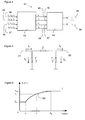
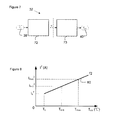
- Figure 1 shows a dynamic line rating apparatus 1 configured to provide a dynamic maximum current rating 2 for a power line section 20 (shown in Figure 2 ) having a first end 21 and a second end 22.
- the power line section 20 may comprise a length of electrical conductor and may form part of an electricity distribution grid or an electricity transmission grid.
- the power line section may be supported along its length by support structures, such as pylons 23.
- the maximum current rating 2 is based on measurements 3 of voltage and current flow at the first end 21 of the power line section 20 and measurements 4 of voltage and current flow at the second end 22 of the power line section 20.
- the apparatus is configured to provide other variables such as an estimated real time conductor temperature 5 and a predicted steady state conductor temperature 6.
- the estimated real time conductor temperature 5 and the predicted steady state conductor temperature 6 are calculated based on the measurements 3, 4 and predetermined modelling of power lines.
- environmental condition measurement sensors are not required, nor are power line temperature sensors.
- the steady state conductor temperature comprises the temperature the power line conductor will ultimately reach after a change in current flow through said power line.
- the change in conductor temperature in response to a step change in current flow may not occur instantaneously but may reach a substantially constant "steady state conductor temperature" after a period of time in the future.
- the steady state conductor temperature comprises a prediction of the temperature the conductor will reach assuming steady state current/power flow and environmental conditions.
- FIG. 3 shows a schematic diagram of the dynamic line rating apparatus 1 comprising three stages 31, 32, 33.
- the first stage 31 comprises determination of the real time conductor temperature, Tc, of the power line section 20 and the average current flowing, I, flowing through the power line section 20.
- Tc real time conductor temperature
- I average current flowing
- the first stage 31 comprises the real time conductor temperature determination stage.
- the first stage 31 is configured to receive: a set of voltage phasors (phase vectors) 34 for each phase measured at the sending end 21; a set of current phasors 35 for each phase measured at the sending end 21; a set of voltage phasors (phase vectors) 36 for each phase measured at the receiving end 22; and a set of current phasors 37 for each phase measured at the receiving end 22.
- V ⁇ Sa , V ⁇ Sb and V ⁇ Sc represent three phase voltage phasors of the sending end 21 of a three phase (phase a, phase b and phase c) system. It will be appreciated that the apparatus 1 may be applied to systems that utilize greater or fewer than three phases. Further, correspondingly, ⁇ Sa , ⁇ Sb and ⁇ Sc represent three phase current phasors as measured at the sending end 21. Further, V ⁇ Ra , V ⁇ Rb and V ⁇ Rc represent three phase voltage phasors as measured at the receiving end 22. Further, ⁇ Ra , ⁇ Rb and ⁇ Rc represent three phase current phasors as measured at the receiving end 22.
- T sample which may be every 20 ms, although other sampling periods may be used.
- T sample The determination of the real time conductor temperature Tc is provided every T s1 seconds where T s1 is greater than the voltage and current phasor sampling period (20 ms in this example).
- T C and I an average conductor current I from these voltage and current measurements will be described below.
- the first stage 31 provides T C as output 38 and I as output 39.
- the second stage 32 comprises a steady state conductor temperature determination stage.
- the second stage 32 is configured to determine the steady state conductor temperature, T css , based on only the average current I and the estimated real time conductor temperature Tc.
- the determination of T CSS is provided every T s2 seconds where T s2 is greater than T s1 .
- the second stage 32 provides T CSS as output 40 and relays I from the first stage as output 41.
- the third stage 33 comprises a dynamic maximum current rating determination stage.
- the third stage 33 is configured to determine the dynamic maximum current rating, I max , based on the steady state conductor temperature, T CSS , determined by the second stage 32 and the average current, I, determined by the first stage 31.
- the only actively measured variables used by the apparatus comprise the voltage and current phasors obtained in the first stage 31.
- the third stage 33 provides I max as output 42.
- the third stage is shown as only providing I max .
- I max may be provided for control of power flow across the power line section 20.
- the apparatus 1 may additionally provide the real time conductor temperature T c and/or the steady state conductor temperature T css as output.
- the real time conductor temperature is evaluated based on the measured voltages and currents from both ends of the power line by solving a power line model equation using the voltage and current phasors as input.
- the power line model equation may comprise a transmission equation of a power line using these voltage and current phasors as input.
- the voltage and current transmitting from one end to another are relative to the line parameters, which are functions of the line temperature, for example.
- Series impedance and shunt admittance of the line may be functions of the conductor temperature. Therefore, the conductor temperature can be obtained by directly solving the transmission equation of a line, in which the voltage and currents are known quantities and the temperature is unknown variable.
- a Newton's method may be utilized to derive the real time conductor temperature T c from the transmission line equation.
- the average conductor current I may be derived based on positive sequence components I S and I R for each phase or, in other examples, is received from a different apparatus.
- the steady state conductor temperature is determined based on the real time conductor temperature derived from the first stage by using a predetermined power line thermal model.
- the maximum current rating is determined based on the steady state conductor temperature derived from the second stage and the average conductor current, as described in more detail below.
- the first stage 31 The first stage 31
- FIG. 4 shows a more detailed conceptual view of the first stage 31.
- the first stage 31 comprises a symmetrical components determination element 43 and a power line model determination element 44.
- the symmetrical components determination element 43 is configured to determine a positive sequence component from the twelve voltage and current phase phasor values 34, 35, 36, 37 measured at the sending and receiving ends 21, 22.
- the symmetrical components determination element 43 is configured to determine a positive sequence voltage term for the first (sending) and second (receiving) ends 20, 21 and a positive sequence current term for the first (sending) and second (receiving) ends 20, 21.
- four positive sequence components 45, 46, 47, 48 are determined.
- the power line model element 44 is configured to receive the positive sequence components 45, 46, 47, 48 from element 43 and solve an equation of a predetermined power line model, as described below, to determine an estimate of the real time conductor temperature 38.
- the power line model element 44 or a further calculation block may be configured to determine the average conductor current, I, shown output at 39.
- B T c Z c sinh ⁇ l
- C T c sinh ⁇ l / Z c l
- Z c T c r T REF 1 + ⁇ 1 + ⁇ T c - T REF + j ⁇ L u / j ⁇ C u ⁇ is the propagation constant
- l is the length of the power line section 20
- Z c is the characteristic impedance of the power line section 20
- T REF is the reference conductor temperature.
- ⁇ can also be evaluated approximately according to the material of the conductor and may thus comprise a predetermined quantity.
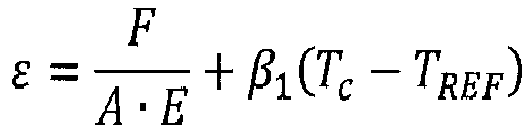
- F is the mechanical force that is being applied on the conductor, measured in Newtons (for example, F can be regarded as the gravitational force due to weight of the conductor between two pylons, which is calculated approximately by dividing the total gravitational force on the cable due to its total weight by the number of sections);
- A is the cross-sectional area in mm 2 of the power line conductor;
- E is the elasticity modulus in Nmm -2 of the power line conductor;
- ⁇ 1 is the linear thermal expansion coefficient in K -1 of the power line conductor; and
- ⁇ 2 is the square thermal expansion coefficient in K -2 of the power line conductor.
- the conductor temperature T c can be derived using a Newton's method. It will be appreciated that other methods applicable to solving non-linear least squares problems may be used. Firstly, the power line model (Equation 1) is rewritten into real number equations.
- Figure 5 shows the positive sequence equivalent PI circuit diagram of a three phase power line with the sending and receiving ends 21, 22 labelled.
- Z' and Y' are the equivalent impedance and admittance of the equivalent PI circuit, as will be understood by those skilled in the art.
- I I ⁇ S - Y ⁇ 2 V ⁇ S + I ⁇ R + Y ⁇ 2 V ⁇ R / 2
- I I ⁇ S + I ⁇ R / 2
- T c r T REF 1 + ⁇ 1 + ⁇ T c - T REF + j w L u j w C u
- Z c T c r T REF 1 + ⁇ 1 + ⁇ T c - T REF + j w L u / j w C u
- Tc has already been obtained by the previous step.
- the estimated real time conductor temperature T C and average current I are passed at 38, 39 to the second stage 32 or steady state conductor temperature determination stage.
- the second stage comprises the determination of the steady state conductor temperature T css from the estimated real time conductor temperature T c .
- Figure 6 shows a typical thermal model for any power line.
- the conductor temperature 60 on the power line will react to the change of current and change from one steady state to a new steady state exponentially.
- T c the real time conductor temperature
- Figure 7 shows a schematic diagram representative of the steps 72 and 73 performed by the second stage 32.
- step 72 comprises calculating the exponentially decaying time constant ⁇ .
- ⁇ can be calculated using several methods.
- T s2 can be selected as 10s.
- the k is the present time sample and k-1 is the previous time sample, within the time interval T s2 .
- ⁇ is calculated, it may be checked against a predetermined condition to determine it reasonability. The following "judgment algorithm" may be applied to determine the reasonability of ⁇ . It will be appreciated that the k and k-1 values below are based on the secondary execution time interval.
- Step 73 comprises the determination of the steady state conductor temperature T css by the following process
- a further "judgement algorithm” may be applied to determine the reasonability of T css (k).
- the steady state conductor temperature T css is determined and provided at output 40.
- the average current value, I may be forwarded to the third stage 33.
- the third stage 33 is the third stage 33
- the third stage 33 comprises the determination of the maximum allowable conductor current based on the steady state conductor temperature T css and the average current I.
- Figure 8 shows the relationship 80 between the squared conductor current (I 2 ) and the steady state conductor temperature (T css ). This relationship may be utilized in the equations below.
- the maximum current rating I max is then determined by the third stage 33.
- the maximum current rating may be determined based on one or more of the following;
- the third stage 33 may be configured to determine one or more of the following variables for use as judgment conditions in three different cases for the calculation of I max .
- T S3 the time interval of samples at the kth and (k-1)th time is T S3 , are based on the tertiary execution time interval of stage 33 unless previously stated otherwise.
- T S3 can be selected as 20s.
- the third stage 33 is configured to calculate I max in different ways depending on one or more conditions.
- three different ways to determine I max are provided and are described in the following three cases.
- T max is the maximum allowable conductor temperature.
- T css (k) is the calculated steady state conductor temperature at (k) th time interval.
- I k is the average conductor temperature at (k) th time interval.
- T c0 (k) T css k - I k 2 T css k - T css k - 1 I k 2 - I k - 1 2
- this updated value of T c0 (k) may be checked for reasonability against at least one predetermined condition.
- this updated value of T c0 (k) may be checked for reasonability against at least one predetermined condition.
- I max (k) can be calculated and then provided for control of the power/current applied to the power line section 20.
- the calculated I max may be multiplied by a coefficient before providing control of the power/current to the power line.
- This coefficient can be termed as the reliability coefficient as it insures the reliability of the dynamic line rating method.
- the reliability coefficient should be in the range of 0 to 1. For example, it can be selected as 0.9.
- the I max ( k ) value calculated above may be subject to a reasonability check prior to being provided for control of the power/current applied to the power line section 20.
- the calculated I max ( k ) value may be checked that it lies within predetermined bounds.
- An example maximum current rating judgment algorithm that may be used to determine the reasonability of the calculated I max ( k ) is as follows;
- the above three stages 31, 32, 33 make up a complete calculation loop. In this way, the maximum current rating of a power line can be predicted.
- the apparatus 1 may be integrated into a power line protection device, which may or may not be already present on the power line 20. Alternatively, the apparatus 1 may be integrated with a supervisory control and data acquisition (SCADA) system of the power line section 20.
- SCADA supervisory control and data acquisition
- the term "power line section" may refer to a portion of or all of the power line.
- the apparatus 1 is shown conceptually comprising three stages in the above description. However, it will be appreciated that any number of calculation/determination stages may be provided to perform the above steps and the steps/stages may be combined rather than following a stepwise determination of the real time conductor temperature, steady state conductor temperature and maximum current rating.
- the above description comprises an implementation on a power line transmitting Alternating Current (AC). This invention can be applied to a power line transmitting Direct Current (DC) as well.
- AC Alternating Current
- DC
Landscapes
- Engineering & Computer Science (AREA)
- Power Engineering (AREA)
- Supply And Distribution Of Alternating Current (AREA)
- Remote Monitoring And Control Of Power-Distribution Networks (AREA)
- Emergency Protection Circuit Devices (AREA)
- Secondary Cells (AREA)
- Testing Of Short-Circuits, Discontinuities, Leakage, Or Incorrect Line Connections (AREA)
Abstract
a voltage phase vector for each phase of electrical power carried by the power line conductor at a first end of the power line conductor;
a voltage phase vector for each phase of electrical power carried by the power line conductor at a second end of the power line conductor;
a current phase vector for each phase of electrical power carried by the power line conductor at a first end of the power line conductor; and
a current phase vector for each phase of electrical power carried by the power line conductor at a second end of the power line conductor;
determine the dynamic maximum current rating by;
applying said set of voltage and current phase vectors to a predetermined power line model to determine an estimate of the real time conductor temperature, applying said estimate of the real time conductor temperature to a predetermined thermal model to determine a prediction of a steady state temperature that the power line conductor will reach over time, and calculating the dynamic maximum current rating based on at least said prediction of the steady state temperature, a power line conductor current, and a maximum temperature limitation value.
Description
- This invention relates to an apparatus configured to determine a dynamic line rating comprising a dynamic maximum current that can be applied to a power line conductor. The invention also relates to an associated method and an electricity distribution and/or transmission grid including said apparatus.
- According to a first aspect of the invention we provide a dynamic line rating determination apparatus configured to provide for the control of the current applied to a power line conductor by determination of a dynamic maximum current rating for said power line conductor, the apparatus configured to;
- based on a set of measured voltage and current phase vectors taken at at least two, temporally spaced sample times, the voltage and current phase vectors comprising;
- a voltage phase vector for each phase of electrical power carried by the power line conductor at a first end of the power line conductor;
- a voltage phase vector for each phase of electrical power carried by the power line conductor at a second end of the power line conductor;
- a current phase vector for each phase of electrical power carried by the power line conductor at a first end of the power line conductor; and
- a current phase vector for each phase of electrical power carried by the power line conductor at a second end of the power line conductor;
- determine the dynamic maximum current rating by;
- applying said voltage and current phase vectors to a predetermined power line model to determine an estimate of the real time conductor temperature Tc, applying said estimate of the real time conductor temperature to a predetermined thermal model to determine a prediction of a steady state temperature that the power line conductor will reach over time, and
- calculating the dynamic maximum current rating based on at least said prediction of a steady state temperature, a power line conductor current, and a maximum temperature limitation value.
- This is advantageous as the apparatus does not require measurement of ambient weather or environmental conditions or the measurement of the power line conductor temperature. Instead, through the use of the predetermined power line model and thermal model a surprisingly accurate and effective dynamic maximum current rating can be obtained. The apparatus only requires the measurement of voltage and current phasors for each phase at two disparate ends of the power line conductor, with then the real time conductor temperature, steady state conductor temperature and dynamic maximum current rating all being calculated based on said measured phasors.
- Optionally, a set of positive sequence components, derived by a method of symmetrical components, of the voltage and current phase vectors is applied to the predetermined power line model, the set of positive sequence components comprising;
- a positive sequence voltage component for the first end;
- a positive sequence voltage component for the second end;
- a positive sequence current component for the first end; and
- a positive sequence current component for the second end.
- Optionally, the set of positive sequence components are determined based on the following equation;

where,
V̇S and İS are the positive sequence voltage and current components of the first end;
V̇R and İR are the positive sequence voltage and current components of the second end;
V̇Sa, V̇Sb and V̇Sc are the voltage phase vectors for each phase a, b, c at the first end;
İSa, İSb, and İSc are the current phase vectors for each phase a, b, c at the first end;
V̇Ra, V̇Rb and V̇Rc are the voltage phase vectors for each phase a, b, c at the second end;
İRa, İRb and İRc are the current phase vectors for each phase a, b, c at the second end;
α is an operator of the transformation where;
and j is the imaginary unit. - It will be appreciated that although this example equation shows the determination of the positive sequence components for a three phase power system, the principle can be applied to any number of phases.
- Optionally, the apparatus is configured to;
- determine the estimate of the real time conductor temperature based on the predetermined power line model represented in the equation below;

- For example, if an equivalent PI section model is used as the power line model, then the parameters A(Tc), B(Tc), C(Tc) and D(Tc) can be expressed as below:


and
γ is the propagation constant of the power line conductor;
l is a length of the power line conductor;
Zc is a characteristic impedance of the power line conductor;
TREF is a reference conductor temperature and r(TREF) is the resistance per unit length of the power line conductor at the temperature of TREF;
ε is a predetermined elongation parameter of the power line conductor; and
j is the imaginary unit,
ω is the angular velocity of the voltage/current where ω = 2πf;
Lu is the inductance per unit length of the power line conductor; and
Cu is the capacitance per unit length of the power line conductor. - Optionally, the apparatus is configured to determine the elongation parameter by any one of the following methods;
- i)

and - ii)

where
F is the mechanical force that is being applied on the conductor, measured in Newtons (for example, F can be regarded as the gravitational force due to weight of the conductor between two pylons, which is calculated approximately by dividing the total gravitational force on the cable due to its total weight by the number of sections);
A is the cross-sectional area in mm2 of the power line conductor;
E is the elasticity modulus in Nmm-2 of the power line conductor;
β 1 is the linear thermal expansion coefficient in K-1 of the power line conductor; and
β 2 is the square thermal expansion coefficient in K-2 of the power line conductor. - Optionally, based on the power line model, the estimate of the real time conductor temperature Tc is derived using a non-linear least squares method such as the Newton's method.
- The power line conductor current may be an average power line conductor current.
- Optionally, the apparatus is configured to determine the power line conductor current, I, as an average power line conductor current, by the following equation;

or by a simplified equation;
where,
V̇S and İS are the positive sequence voltage and current of the first end;
V̇R and İR are the positive sequence voltage and current of the second end; and


TC has already been obtained by the previous step. - Optionally, the apparatus is configured to apply said estimate of the real time conductor temperature to the predetermined thermal model to determine a prediction of a steady state temperature that the power line conductor will reach over time comprises;
- determining a time constant representative of a predicted change in real time conductor temperature over time based on a time derivative of at least two calculated real time conductor temperatures at different times and using said time constant to determine the steady state temperature.
- The different times may be a current time and a previous time.
- Determining the time derivative of the real time conductor temperature may comprise using the following formula;

where Ts1 is the time interval between the Tc(k-1)th and Tc(k)th value, comprising a predetermined primary execution time interval (for example, Ts1 may be selected as 5s);
Tc(k) is the conductor temperature at kth time interval (present time);
Tc(k-1) is the conductor temperature at (k-1)th time interval (previous time); and

- Calculating the time constant α may comprise any one of the following methods;
- i) Using the equation;

- ii) Using the equation;

- Optionally, the apparatus is configured to determine the steady state conductor temperature Tcss by the following process;
- 1) If |ΔT c | < ε

- 2) else

where ΔT c is the difference between two successively calculated real time conductor temperature values, Tc,
- The apparatus may be configured to verify the acceptability of the predicted steady state conductor temperature Tcss(k), comprising;
- 1) If T css (k) ∈ [Tcss_min,Tcss_max], then the calculation result of T css (k) is acceptable;
- 2) If not, then Tcss(k) maintains its previous historical value;

- Optionally, the apparatus is configured to calculate the dynamic maximum current rating based on one or more of the following;
- i) the predicted steady state temperature value Tcss relative to the predetermined maximum conductor temperature limitation value Tmax;
- ii) the difference between a predetermined maximum conductor temperature limitation value Tmax and a first (initial) steady state temperature value Tc0, relative to the difference between a subsequent (current) steady state temperature value and the first (initial) steady state temperature value Tc0;
- iii) the difference between a predetermined maximum conductor temperature limitation value Tmax and a first steady state temperature value Tcss(k-g), where g is an integer, relative to the difference between a subsequent steady state temperature value Tcss(k) and the first steady state temperature value and a change in an average conductor current, I, between the time of the first steady state temperature value and the time of the subsequent steady state temperature value.
- Optionally, the apparatus is configured to calculate the dynamic maximum current rating, ImaX(k), based on one or more of the following equations;
- i)

- ii)

- Optionally, the apparatus is configured to calculate the dynamic maximum current rating, Imax, based on;
determination of one or more of the following variables for use as judgment conditions in one or more of three different cases, wherein, - ΔI is a difference between two successively determined average conductor currents, where k-1 represents a first determined value and k a subsequent determined value;

- ΔT css is a difference between two successively determined steady state conductor temperatures where k-1 represents a first determined value and k a subsequent determined value;

- Tc0 is an initial steady state conductor temperature when there is no current flowing in the power line;
- ΔTc0 is the difference between two successive initial steady state conductor temperature,

- ε1, ε2, ε3 and ε4 are all predetermined threshold values that control the determination of Imax; and
- i) if |ΔI| ≤ ε1, Imax(k) is calculated using the following equation:

in the equation, Tmax is the maximum allowable conductor temperature, Tcss(k) is the calculated steady state conductor temperature at (k)th time interval, and Ik is the average conductor temperature at (k)th time interval; - ii) If |ΔI| ≥ ε1 and |ΔT css | ≤ ε2, Imax(k) maintains the historic value;

- iii) If |ΔI| ≥ ε1 and |ΔTcss| ≥ ε2 the maximum current rating Imax(k) is calculated using the following equation:

- The value of Tc0(k) may be also updated using the equation below:

- Optionally, the apparatus is configured to check that the calculated dynamic maximum current rating Imax(k) value lies within predetermined bounds prior to the apparatus providing it for control of current applied to the power line conductor.
- According to a second aspect we provide a method of providing for the control of the current applied to a power line conductor by determination of a dynamic maximum current rating for said power line conductor, the method comprising;
- based on a set of measured voltage and current phase vectors taken at at least two, temporally spaced sample times, the voltage and current phase vectors comprising;
- a voltage phase vector for each phase of electrical power carried by the power line conductor at a first end of the power line conductor;
- a voltage phase vector for each phase of electrical power carried by the power line conductor at a second end of the power line conductor;
- a current phase vector for each phase of electrical power carried by the power line conductor at a first end of the power line conductor; and
- a current phase vector for each phase of electrical power carried by the power line conductor at a second end of the power line conductor;
- determining the dynamic maximum current rating by;
- applying said set of voltage and current phase vectors to a predetermined power line model to determine an estimate of the real time conductor temperature, applying said estimate of the real time conductor temperature to a predetermined thermal model to determine a prediction of a steady state temperature that the power line conductor will reach over time, and
- calculating the dynamic maximum current rating based on at least said prediction of the steady state temperature, a power line conductor current, and a maximum temperature limitation value.
- According to a further aspect we provide a computer readable medium or computer program comprising computer code configured to, when executed by a processor having memory, perform the method of the second aspect.
- According to a further aspect of the invention we provide an electricity distribution grid or an electricity transmission grid including at least one power line conductor for carrying electrical power around said grid, the grid including the apparatus of the first aspect for controlling the power applied to said at least one power line conductor.
- There now follows, by way of example only, a detailed description of embodiments of the invention with reference to the following figures, in which:
-
Figure 1 shows an example dynamic line rating determination apparatus; -
Figure 2 shows a power line conductor between a first end and a second end; -
Figure 3 shows a more detailed schematic view of the dynamic line rating determination apparatus ofFigure 1 ; -
Figure 4 shows a more detailed schematic view of the first stage shown inFigure 3 ; -
Figure 5 shows a positive sequence equivalent PI circuit diagram of a three phase power line; -
Figure 6 shows a typical thermal model for any power line; -
Figure 7 shows a more detailed schematic view of the second stage shown inFigure 3 ; -
Figure 8 shows a linear relationship between the squared conductor current (I2) and a steady state conductor temperature (Tcss). -
Figure 2 shows a power line conductor comprising a length of an electrical conductor. The power line may be an overhead line and/or an underground cable. The maximum current that may be passed along the power line is termed the maximum current rating of the power line and it is limited by the maximum conductor temperature which is allowed on the power line. The temperature of the power line affects it strength and the amount it may sag from pylons, for example, which must be controlled to ensure the power line remains within safe operating limits. Exceeding the maximum conductor temperature may result in annealing of conductor material thereby causing permanent damage to the power line. The maximum conductor temperature may comprise a predetermined value based on the physical dimensions and material of the power line and how it is supported. The conductor temperature is a function of at least the current flowing through the power line and environmental conditions, such as the ambient temperature, wind speed, wind direction and incident solar radiation. The conventional maximum current rating may be determined based on "worst case" environmental conditions where the environment contributes a substantial amount to the conductor temperature therefore resulting in a relatively low maximum current rating to ensure the maximum conductor temperature is not exceeded. The maximum current rating calculated by this method is termed the static line rating. In practice, the environmental conditions may be rarely close to the "worst case" situation and therefore the maximum current rating determined by the static line rating method may be overly conservative for much of the time. Thus, the capacity of the power line may be under used. - Determination of the maximum current rating based on actual environmental conditions at the present time rather than a "worst case" situation may provide for improved utilization of power line capacity. Therefore, the maximum current rating may increase if the environmental conditions contribute less to the conductor temperature and decrease if the environmental conditions contribute more to the conductor temperature. The maximum current rating determined by this method is termed the dynamic line rating.
- Actively monitoring the conductor temperature to determine if the maximum current rating can be increased or should be decreased typically requires many measurement units situated along the power line to collect environmental information and/or the temperature of the conductor. The use of many measurement units increases the capital cost and the maintenance cost of dynamic line rating installations.
-
Figure 1 shows a dynamicline rating apparatus 1 configured to provide a dynamic maximumcurrent rating 2 for a power line section 20 (shown inFigure 2 ) having afirst end 21 and asecond end 22. Thepower line section 20 may comprise a length of electrical conductor and may form part of an electricity distribution grid or an electricity transmission grid. The power line section may be supported along its length by support structures, such aspylons 23. The maximumcurrent rating 2 is based onmeasurements 3 of voltage and current flow at thefirst end 21 of thepower line section 20 andmeasurements 4 of voltage and current flow at thesecond end 22 of thepower line section 20. - A method of determining the dynamic maximum current rating based only on the
measurements - In addition to the dynamic maximum
current rating 2, the apparatus is configured to provide other variables such as an estimated realtime conductor temperature 5 and a predicted steadystate conductor temperature 6. The estimated realtime conductor temperature 5 and the predicted steadystate conductor temperature 6 are calculated based on themeasurements -
Figure 3 shows a schematic diagram of the dynamicline rating apparatus 1 comprising threestages first stage 31 comprises determination of the real time conductor temperature, Tc, of thepower line section 20 and the average current flowing, I, flowing through thepower line section 20. Thus, thefirst stage 31 comprises the real time conductor temperature determination stage. - For any
power line section 20, either end 21, 22 can be defined as the sending end and, accordingly, the other end is the receiving end. Hereinafter, thefirst end 21 will be referred to as the sending end and thesecond end 22 will be referred to as the receiving end, although it will be appreciated that in other examples this could be reversed. Thefirst stage 31 is configured to receive: a set of voltage phasors (phase vectors) 34 for each phase measured at the sendingend 21; a set ofcurrent phasors 35 for each phase measured at the sendingend 21; a set of voltage phasors (phase vectors) 36 for each phase measured at the receivingend 22; and a set ofcurrent phasors 37 for each phase measured at the receivingend 22. - V̇Sa, V̇Sb and V̇Sc represent three phase voltage phasors of the sending
end 21 of a three phase (phase a, phase b and phase c) system. It will be appreciated that theapparatus 1 may be applied to systems that utilize greater or fewer than three phases. Further, correspondingly, İSa, İSb and İSc represent three phase current phasors as measured at the sendingend 21. Further, V̇Ra, V̇Rb and V̇Rc represent three phase voltage phasors as measured at the receivingend 22. Further, İRa, İRb and İRc represent three phase current phasors as measured at the receivingend 22. These voltage and current phasors are in this example sampled at a sampling period Tsample, which may be every 20 ms, although other sampling periods may be used. The determination of the real time conductor temperature Tc is provided every Ts1 seconds where Ts1 is greater than the voltage and current phasor sampling period (20 ms in this example). The determination of TC and an average conductor current I from these voltage and current measurements will be described below. Thefirst stage 31 provides TC asoutput 38 and I asoutput 39. - The
second stage 32 comprises a steady state conductor temperature determination stage. Thesecond stage 32 is configured to determine the steady state conductor temperature, Tcss, based on only the average current I and the estimated real time conductor temperature Tc. The determination of TCSS is provided every Ts2 seconds where Ts2 is greater than Ts1. Thesecond stage 32 provides TCSS asoutput 40 and relays I from the first stage asoutput 41. - The
third stage 33 comprises a dynamic maximum current rating determination stage. Thethird stage 33 is configured to determine the dynamic maximum current rating, Imax, based on the steady state conductor temperature, TCSS, determined by thesecond stage 32 and the average current, I, determined by thefirst stage 31. Thus, the only actively measured variables used by the apparatus comprise the voltage and current phasors obtained in thefirst stage 31. Thethird stage 33 provides Imax asoutput 42. Infigure 3 , the third stage is shown as only providing Imax. Imax may be provided for control of power flow across thepower line section 20. However, as shown inFigure 1 , theapparatus 1 may additionally provide the real time conductor temperature Tc and/or the steady state conductor temperature Tcss as output. The determination of Imax is provided every Ts3 seconds where Ts3 is greater than Ts2. For example, in the present example, Ts1=5 sec., Ts2=10 sec., and Ts3=20 sec. - In the
first stage 31, the real time conductor temperature is evaluated based on the measured voltages and currents from both ends of the power line by solving a power line model equation using the voltage and current phasors as input. In particular, the power line model equation may comprise a transmission equation of a power line using these voltage and current phasors as input. The voltage and current transmitting from one end to another are relative to the line parameters, which are functions of the line temperature, for example. Series impedance and shunt admittance of the line may be functions of the conductor temperature. Therefore, the conductor temperature can be obtained by directly solving the transmission equation of a line, in which the voltage and currents are known quantities and the temperature is unknown variable. A Newton's method may be utilized to derive the real time conductor temperature Tc from the transmission line equation. The average conductor current I may be derived based on positive sequence components IS and IR for each phase or, in other examples, is received from a different apparatus. - In
second stage 32, the steady state conductor temperature is determined based on the real time conductor temperature derived from the first stage by using a predetermined power line thermal model. - In the
third stage 33, the maximum current rating is determined based on the steady state conductor temperature derived from the second stage and the average conductor current, as described in more detail below. -
Figure 4 shows a more detailed conceptual view of thefirst stage 31. Thefirst stage 31 comprises a symmetricalcomponents determination element 43 and a power linemodel determination element 44. The symmetricalcomponents determination element 43 is configured to determine a positive sequence component from the twelve voltage and current phase phasor values 34, 35, 36, 37 measured at the sending and receiving ends 21, 22. In particular, the symmetricalcomponents determination element 43 is configured to determine a positive sequence voltage term for the first (sending) and second (receiving) ends 20, 21 and a positive sequence current term for the first (sending) and second (receiving) ends 20, 21. Thus, fourpositive sequence components - The power
line model element 44 is configured to receive thepositive sequence components element 43 and solve an equation of a predetermined power line model, as described below, to determine an estimate of the realtime conductor temperature 38. The powerline model element 44 or a further calculation block (not shown in this example) may be configured to determine the average conductor current, I, shown output at 39. - The positive-sequence components V̇S, İSc V̇R and İR are derived in
element 43 using the following equation;
where,
V̇S and İS are the positive sequence voltage and current of the sending end;
V̇R and İR are the positive sequence voltage and current of the receiving end;
V̇Sa, V̇Sb and V̇Sc are the voltage phase vectors for each phase a, b, c at the first end;
İSa, İSb, and İSc are the current phase vectors for each phase a, b, c at the first end;
V̇Ra, V̇Rb and V̇Rc are the voltage phase vectors for each phase a, b, c at the second end;
İRa, İRb and İRc are the current phase vectors for each phase a, b, c at the second end;
α is operator of the transformation; and
j is the imaginary part unit. - The determination of the estimated real time conductor temperature is determined by the
element 44 based on a power line model represented inequation 1 below, which is derived based onFigure 5 .
- For example, if an equivalent PI section model is used as the power line model, then the parameters of A(Tc), B(Tc), C(Tc) and D(Tc) can be expressed as below:


γ is the propagation constant;
l is the length of thepower line section 20;
Zc is the characteristic impedance of thepower line section 20;
TREF is the reference conductor temperature. For example, normally, TREF may be selected at 20°C and r(TREF) is the resistance per unit length at the temperature of TREF;
ε is the elongation of thepower line section 20.
j is the imaginary part unit,
ω is the angular velocity of the voltage/current.
Lu is the inductance per unit length of the power line conductor.
Cu is the capacitance per unit length of the power line conductor. - The elongation may be determined by;

- Or, in a simplified expression, as follows;
- Or, ε can also be evaluated approximately according to the material of the conductor and may thus comprise a predetermined quantity.
where
F is the mechanical force that is being applied on the conductor, measured in Newtons (for example, F can be regarded as the gravitational force due to weight of the conductor between two pylons, which is calculated approximately by dividing the total gravitational force on the cable due to its total weight by the number of sections);
A is the cross-sectional area in mm2 of the power line conductor;
E is the elasticity modulus in Nmm-2 of the power line conductor;
β 1 is the linear thermal expansion coefficient in K-1 of the power line conductor; and
β 2 is the square thermal expansion coefficient in K-2 of the power line conductor. - Based on the power line model above of
Equation 1, the conductor temperature Tc can be derived using a Newton's method. It will be appreciated that other methods applicable to solving non-linear least squares problems may be used. Firstly, the power line model (Equation 1) is rewritten into real number equations.
where,

- Then the conductor temperature Tc is calculated using the method below.
- 1) Select an initial value for Tc : Tc (0)
- 2) Calculate ΔY

- 3) Calculate J

- 4) Calculate ΔT c

- 5) Revise the value of Tc by

- 6) Check if the following condition is reached. If the condition is reached, then proceed to step (7); If the condition is not reached, return to step (2) by replacing Tc (0) with Tc (k) while Y is not changed;

- 7) In this way, the real time conductor temperature Tc is derived by;

-
Figure 5 shows the positive sequence equivalent PI circuit diagram of a three phase power line with the sending and receiving ends 21, 22 labelled. Z' and Y' are the equivalent impedance and admittance of the equivalent PI circuit, as will be understood by those skilled in the art. - Firstly, based on
Figure 5 , it will be appreciated that the average conductor current, I, can be calculated (for example by element 44), whereby;
- Or by a simplified equation;

where


- Tc has already been obtained by the previous step.
- The estimated real time conductor temperature TC and average current I are passed at 38, 39 to the
second stage 32 or steady state conductor temperature determination stage. - The second stage comprises the determination of the steady state conductor temperature Tcss from the estimated real time conductor temperature Tc.
-
Figure 6 shows a typical thermal model for any power line. When the current on a power line has a step change, theconductor temperature 60 on the power line will react to the change of current and change from one steady state to a new steady state exponentially. There is mathematical relationship between the real time conductor temperature Tc and the steady state conductor temperature that will be reached over time. Therefore, the real time conductor temperature calculated in thefirst stage 31 can be used to predict the steady state conductor temperature. -
Figure 7 shows a schematic diagram representative of thesteps second stage 32. -
Step 72 comprises determining the derivative of the real time conductor temperature using the following formulas;

where Ts1 is the primary execution time interval of the first stage 31 (for example, Ts1 can be selected as 5s) i.e. Ts1 is the time interval between the Tc(k-1)th and Tc(k)th value;
Tc(k-1) is the conductor temperature at (k-1)th time interval; and
Tc(k) is the conductor temperature at (k)th time interval (present time).

- Then step 72 comprises calculating the exponentially decaying time constant α. α can be calculated using several methods.
- A first method comprises using the following equation;

- A second method comprises using the following equation;

where Ts2 is the secondary execution time interval of thesecond stage 32. For example, Ts2 can be selected as 10s. The k is the present time sample and k-1 is the previous time sample, within the time interval Ts2. Once α is calculated, it may be checked against a predetermined condition to determine it reasonability. The following "judgment algorithm" may be applied to determine the reasonability of α. It will be appreciated that the k and k-1 values below are based on the secondary execution time interval. - If α(k) ∈ [αmin, αmax], then the calculation result of α(k) is accepted.
- If not, then α(k) maintains the previous value.

[αmin, αmax] is an operating range of α and may be predetermined. For example, in the present apparatus, αmin is set as 0 and αmax is set as 2. It will be appreciated that other ranges may be selected. This parameter is a reflection of the thermal time constant of a power line. It is mainly related to the type of the material of the conductor, the wind pattern in an area (strong wind area/weak wind area), etc. In practice, if the above information is inaccessible, then the range may be set as wide as possible. However, it is preferable to narrow down the range during site commissioning. -
Step 73 comprises the determination of the steady state conductor temperature Tcss by the following process; - 1) If |ΔT c | < ε

- 2) If not

where ΔT c is the difference between two successively calculated real time conductor temperature values, Tc,
ε is a predetermined threshold value, which may be a small value, and represents a limit in the change of conductor temperature for there to be deemed a steady state condition has been reached. For example, ε is set as 0.02 °C in thepresent apparatus 1. - A further "judgement algorithm" may be applied to determine the reasonability of Tcss(k).
- 1) If T css (k) ∈ [T css_min,T css_max], then the calculation result of T css (k) is acceptable.
- 2) If not, then Tcss(k) maintains the previous value.

- In this way, the steady state conductor temperature T css is determined and provided at
output 40. The average current value, I, may be forwarded to thethird stage 33. - The
third stage 33 comprises the determination of the maximum allowable conductor current based on the steady state conductor temperature T css and the average current I. -
Figure 8 shows therelationship 80 between the squared conductor current (I2) and the steady state conductor temperature (Tcss). This relationship may be utilized in the equations below. - The maximum current rating Imax is then determined by the
third stage 33. The maximum current rating may be determined based on one or more of the following; - i) the steady state temperature value Tcss relative to the maximum conductor temperature Tmax;
- ii) the difference between the maximum conductor temperature Tmax and an initial steady state temperature value Tc0, relative to the difference between a current steady state temperature value and the initial steady state temperature value Tc0;
- iii) the difference between the maximum conductor temperature Tmax and a first steady state temperature value Tcss(k-g), (where g may be 1, 2, 3 etc.) relative to the difference between a subsequent steady state temperature value Tcss(k) and the first steady state temperature value; and a change in the average conductor current, I, between the time of the first steady state temperature value and the time of the subsequent steady state temperature value.
- In particular, the
third stage 33 may be configured to determine one or more of the following variables for use as judgment conditions in three different cases for the calculation of Imax. For all the expressions and equations below, the time interval of samples at the kth and (k-1)th time is TS3, are based on the tertiary execution time interval ofstage 33 unless previously stated otherwise. For example, TS3 can be selected as 20s. - ΔI is the difference between two successively determined average conductor currents, where k-1 represents a first determined value and k a subsequent determined value;

- ΔTcss is the difference between two successively determined steady state conductor temperatures where k-1 represents a first determined value and k a subsequent determined value;

- Tc0 is the initial steady state conductor temperature when there is no current flowing in the power line.
- ΔTc0 is the difference of two successive initial steady state conductor temperature,

- ε1, ε2, ε3 and ε4 are all predetermined threshold values that control the determination of Imax based on the values determined by the
first stage 31 andsecond stage 32. For example, in one example, ε1 is set as 0.1 kA, ε2 is set as 0.1 °C, ε3 is set as 0.1 °C, and ε4 is set as 5 °C. - Thus, the
third stage 33 is configured to calculate Imax in different ways depending on one or more conditions. In this example, three different ways to determine Imax are provided and are described in the following three cases. - Case 1: If |ΔI| ≤ ε1, Imax(k) is calculated using the following equation:

- In the equation, Tmax is the maximum allowable conductor temperature. Tcss(k) is the calculated steady state conductor temperature at (k)th time interval. Ik is the average conductor temperature at (k)th time interval.
- Case 2: If |ΔI| ≥ ε1 and|ΔT css | ≤ ε2, Imax(k) maintains the historic value.

- Case 3: If |ΔI| ≥ ε1 and |ΔTcss| ≥ ε2 the maximum current rating is calculated using the following equation:

- In addition, in
Case 3, the value of Tc0(k) is updated using the following equation;
- However, this updated value of Tc0(k) may be checked for reasonability against at least one predetermined condition. In particular,
- If Tc0(k) E [Tc0_min Tc0_max,] and |ΔTc0| ≤ ε4, then the calculated Tc0(k) is acceptable. [Tc0_min,Tc0_max,] is a predetermined operating range of Tc0. For example, in one example, Tc0_min is set at 0 °C and Tc0_max is set at 30 °C.
- If not, Tc0(k) maintains the historical value.

- Through the above three cases, Imax(k) can be calculated and then provided for control of the power/current applied to the
power line section 20. In practice, to insure the calculated Imax will not infringe the actual maximum allowable current of the power line at all times, the calculated Imax may be multiplied by a coefficient before providing control of the power/current to the power line. This coefficient can be termed as the reliability coefficient as it insures the reliability of the dynamic line rating method. The reliability coefficient should be in the range of 0 to 1. For example, it can be selected as 0.9. - In other examples, the Imax(k) value calculated above may be subject to a reasonability check prior to being provided for control of the power/current applied to the
power line section 20. In particular, the calculated Imax(k) value may be checked that it lies within predetermined bounds. An example maximum current rating judgment algorithm that may be used to determine the reasonability of the calculated Imax(k) is as follows; - 1) If I max (k)∈[Imax_min ,Imax_max ], then the calculation result of Imax(k) is acceptable.
- 2) If not, then I max (k) maintains the historical value.

- The above three
stages apparatus 1 may be integrated into a power line protection device, which may or may not be already present on thepower line 20. Alternatively, theapparatus 1 may be integrated with a supervisory control and data acquisition (SCADA) system of thepower line section 20. It will be appreciated that the term "power line section" may refer to a portion of or all of the power line. Theapparatus 1 is shown conceptually comprising three stages in the above description. However, it will be appreciated that any number of calculation/determination stages may be provided to perform the above steps and the steps/stages may be combined rather than following a stepwise determination of the real time conductor temperature, steady state conductor temperature and maximum current rating. The above description comprises an implementation on a power line transmitting Alternating Current (AC). This invention can be applied to a power line transmitting Direct Current (DC) as well.
k is the present time sample and k-1 is the previous sample, which are within the secondary execution time interval Ts2; and


Claims (15)
- A dynamic line rating determination apparatus configured to provide for the control of the current applied to a power line conductor by determination of a dynamic maximum current rating for said power line conductor, the apparatus configured to;
based on a set of measured voltage and current phase vectors taken at at least two, temporally spaced sample times, the voltage and current phase vectors comprising;
a voltage phase vector for each phase of electrical power carried by the power line conductor at a first end of the power line conductor;
a voltage phase vector for each phase of electrical power carried by the power line conductor at a second end of the power line conductor;
a current phase vector for each phase of electrical power carried by the power line conductor at a first end of the power line conductor; and
a current phase vector for each phase of electrical power carried by the power line conductor at a second end of the power line conductor;
determine the dynamic maximum current rating by;
applying said set of voltage and current phase vectors to a predetermined power line model to determine an estimate of the real time conductor temperature, applying said estimate of the real time conductor temperature to a predetermined thermal model to determine a prediction of a steady state temperature that the power line conductor will reach over time, and
calculating the dynamic maximum current rating based on at least said prediction of the steady state temperature, a power line conductor current, and a maximum temperature limitation value. - An apparatus according to claim 1, in which a set of positive sequence components, derived by a method of symmetrical components, of the voltage and current phase vectors is applied to the predetermined power line model, the set of positive sequence components comprising;
a positive sequence voltage component for the first end;
a positive sequence voltage component for the second end;
a positive sequence current component for the first end; and
a positive sequence current component for the second end. - An apparatus according to claim 1 or claim 2, in which the set of positive sequence components are determined based on the following equation;

where,
V̇S and İS are the positive sequence voltage and current components of the first end;
V̇R and İR are the positive sequence voltage and current components of the second end; V̇Sa, V̇Sb and V̇Sc are the voltage phase vectors for each phase a, b, c at the first end;
İSa, İSb, and İSc are the current phase vectors for each phase a, b, c at the first end;
V̇Ra, V̇Rb and V̇Rc are the voltage phase vectors for each phase a, b, c at the second end; İRa, İRb and İRc are the current phase vectors for each phase a, b, c at the second end; α is an operator of the transformation and is defined as;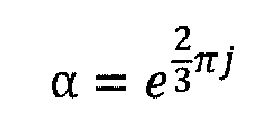
j is the imaginary unit. - The apparatus of any preceding claim in which the apparatus is configured to;
determine the estimate of the real time conductor temperature Tc based on the predetermined power line model represented in the equation below;
where,


and
γ is the propagation constant of the power line conductor;
l is a length of the power line conductor;
Zc is a characteristic impedance of the power line conductor;
TREF is a reference conductor temperature and r(TREF) is the resistance per unit length of the power line conductor at the temperature of TREF;
ε is a predetermined elongation parameter of the power line conductor;
j is the imaginary unit,
ω is the angular velocity of the voltage/current where ω = 2πf;
L u is the inductance per unit length of the power line conductor; and
C u is the capacitance per unit length of the power line conductor. - The apparatus of any one of claims 2 to 4, in which the apparatus is configured to determine the power line conductor current, I, as an average of a power line conductor current, by the following equation;
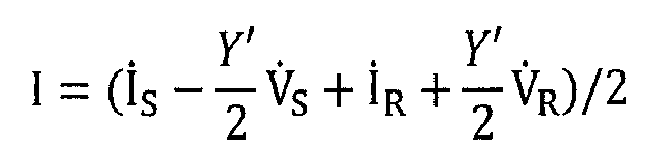
or by the equation;
where,
V̇S and İS are the positive sequence voltage and current components of the first end;
V̇R and İR are the positive sequence voltage and current components of the second end; and


- An apparatus according to claim 5, in which the apparatus is configured to determine the elongation parameter by any one of the following methods;i)
 ii)
ii)
where
F is the mechanical force that is applied to the conductor in N, such as the force due to the weight of the power line conductor between support points;
A is the cross-sectional area in mm2 of the power line conductor;
E is the elasticity modulus in Nmm-2 of the power line conductor;
β 1 is the linear thermal expansion coefficient in K-1 of the power line conductor; and
β 2 is the square thermal expansion coefficient in K-2 of the power line conductor. - An apparatus according to claim 4, in which, based on the power line model, the estimate of the real time conductor temperature Tc is derived using a non-linear least squares method.
- An apparatus according to any preceding claim, in which the apparatus being configured to apply said estimate of the real time conductor temperature to the predetermined thermal model to determine a prediction of a steady state temperature that the power line conductor will reach overtime comprises;
determining a time constant representative of a predicted change in real time conductor temperature over time based on a time derivative of at least two calculated real time conductor temperatures at different times and using said time constant to determine the steady state temperature. - An apparatus according to claim 8, in which the apparatus is configured to determine the steady state conductor temperature Tcss by the following process;1) If |ΔTc| < ε
 2) If not
where ΔT c is the difference between two successively calculated real time conductor temperature values, Tc,
ε is a predetermined threshold value representative of a limit in the change of conductor temperature for there to be deemed a steady state condition has been reached;

Tcv is the average of the present and the previous value of Tc, Tc(k) and Tc(k-1). - An apparatus according to any preceding claim in which, the apparatus is configured to calculate the dynamic maximum current rating based on one or more of the following;i) the predicted steady state temperature value Tcss relative to the predetermined maximum temperature limitation value Tmax;ii) the difference between the predetermined maximum temperature limitation value Tmax and a first steady state temperature value Tc0, relative to the difference between a subsequent steady state temperature value and the first steady state temperature value Tc0;iii) the difference between the predetermined maximum temperature limitation value Tmax and a first steady state temperature value Tcss(k-g), relative to the difference between a subsequent steady state temperature value Tcss(k) and the first steady state temperature value and a change in the average conductor current, I, between the time of the first steady state temperature value and the time of the subsequent steady state temperature value.
- An apparatus according to any preceding claim in which the apparatus is configured to calculate the dynamic maximum current rating, Imax(k), based on one or more of the following equations;i)
 ii)
ii)
- An apparatus according to any preceding claim in which the apparatus is configured to calculate the dynamic maximum current rating, Imax, based on;
determination of one or more of the following variables for use as judgment conditions in one or more of three different cases, wherein,• ΔI is a difference between two successively determined conductor currents, where k-1 represents a first determined value and k a subsequent determined value;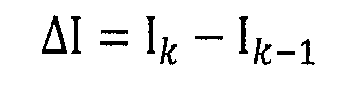 • ΔTcss is a difference between two successively determined steady state conductor temperatures where k-1 represents a first determined value and k a subsequent determined value;
 • Tc0 is an initial steady state conductor temperature when there is no current flowing in the power line;• ΔTc0 is the difference between two successive initial steady state conductor temperature,
 • ε1, ε2, ε3 and ε4 are all predetermined threshold values that control thedetermination of Imax; and
the dynamic maximum current rating Imax is calculated by one or more of the following equations;i) if |ΔI| ≤ ε1, Imax(k) is calculated using the following equation: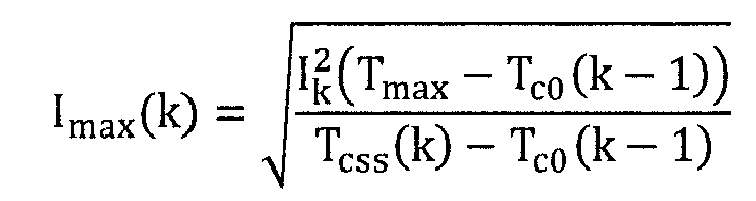
in the equation, Tmax is the maximum allowable conductor temperature, Tcss(k) is the calculated steady state conductor temperature at (k)th time interval, and Ik is the average conductor temperature at (k)th time interval;ii) If |ΔI| ≥ ε1 and |ΔT css | ≤ ε2, Imax(k) maintains the historic value; iii) If |ΔI| ≥ ε1 and |ΔTcss| ≥ ε2 the maximum current rating Imax(k) is calculated using the following equation:
- An apparatus according to any preceding claim in which the apparatus is configured to check that the calculated dynamic maximum current rating Imax(k) value lies within predetermined bounds prior to the apparatus providing it for control of current applied to the power line conductor.
- A method of providing for the control of the current applied to a power line conductor by determination of a dynamic maximum current rating for said power line conductor, the method comprising;
based a set of measured voltage and current phase vectors taken at at least two, temporally spaced sample times, the voltage and current phase vectors comprising;
a voltage phase vector for each phase of electrical power carried by the power line conductor at a first end of the power line conductor;
a voltage phase vector for each phase of electrical power carried by the power line conductor at a second end of the power line conductor;
a current phase vector for each phase of electrical power carried by the power line conductor at a first end of the power line conductor; and
a current phase vector for each phase of electrical power carried by the power line conductor at a second end of the power line conductor;
determining the dynamic maximum current rating by;
applying said voltage and current phase vectors to a predetermined power line model to determine an estimate of the real time conductor temperature,
applying said estimate of the real time conductor temperature to a predetermined thermal model to determine a prediction of a steady state temperature that the power line conductor will reach over time, and
calculating the dynamic maximum current rating based on at least said prediction of a steady state temperature, a power line conductor current, and a maximum temperature limitation value. - An electricity distribution grid or an electricity transmission grid including at least one power line conductor for carrying electrical power around said grid, the grid including the apparatus of any one of claims 1 to 13 for controlling the power applied to said at least one power line conductor.
Priority Applications (7)
| Application Number | Priority Date | Filing Date | Title |
|---|---|---|---|
| EP15275139.2A EP3096428B1 (en) | 2015-05-18 | 2015-05-18 | Dynamic line rating determination apparatus and associated method |
| CN201680028829.XA CN107636926B (en) | 2015-05-18 | 2016-05-17 | Dynamic line rating determination apparatus and associated method |
| JP2017558402A JP6929229B2 (en) | 2015-05-18 | 2016-05-17 | Dynamic power transmission rating determination device and related methods |
| MX2017014783A MX369602B (en) | 2015-05-18 | 2016-05-17 | APPARATUS FOR THE DETERMINATION OF THE DYNAMIC CAPACITY OF TRANSMISSION LINES AND ASSOCIATED METHOD. |
| CA2985553A CA2985553C (en) | 2015-05-18 | 2016-05-17 | Dynamic line rating determination apparatus and associated method |
| PCT/EP2016/061026 WO2016184857A1 (en) | 2015-05-18 | 2016-05-17 | Dynamic line rating determination apparatus and associated method |
| US15/574,854 US10447041B2 (en) | 2015-05-18 | 2016-05-17 | Dynamic line rating determination apparatus and associated method |
Applications Claiming Priority (1)
| Application Number | Priority Date | Filing Date | Title |
|---|---|---|---|
| EP15275139.2A EP3096428B1 (en) | 2015-05-18 | 2015-05-18 | Dynamic line rating determination apparatus and associated method |
Publications (2)
| Publication Number | Publication Date |
|---|---|
| EP3096428A1 true EP3096428A1 (en) | 2016-11-23 |
| EP3096428B1 EP3096428B1 (en) | 2018-08-08 |
Family
ID=53267275
Family Applications (1)
| Application Number | Title | Priority Date | Filing Date |
|---|---|---|---|
| EP15275139.2A Active EP3096428B1 (en) | 2015-05-18 | 2015-05-18 | Dynamic line rating determination apparatus and associated method |
Country Status (7)
| Country | Link |
|---|---|
| US (1) | US10447041B2 (en) |
| EP (1) | EP3096428B1 (en) |
| JP (1) | JP6929229B2 (en) |
| CN (1) | CN107636926B (en) |
| CA (1) | CA2985553C (en) |
| MX (1) | MX369602B (en) |
| WO (1) | WO2016184857A1 (en) |
Cited By (3)
| Publication number | Priority date | Publication date | Assignee | Title |
|---|---|---|---|---|
| US20180316219A1 (en) * | 2017-04-28 | 2018-11-01 | Lindsey Manufacturing Co. | System and method for generating a transmission line reliability rating |
| CN112434874A (en) * | 2020-12-02 | 2021-03-02 | 华北电力大学 | Line capacity optimization method and system for renewable energy consumption |
| US20230145806A1 (en) * | 2020-04-28 | 2023-05-11 | Nippon Telegraph And Telephone Corporation | Temperature Measurement Device and Temperature Measurement Method |
Families Citing this family (6)
| Publication number | Priority date | Publication date | Assignee | Title |
|---|---|---|---|---|
| US10491005B2 (en) * | 2017-02-24 | 2019-11-26 | Hall Labs Llc | Intelligent current limiting to enable chaining of AC appliances |
| US10718129B2 (en) * | 2017-07-03 | 2020-07-21 | Hall Labs Llc | Housing for digital assistant |
| US11373085B2 (en) * | 2020-02-11 | 2022-06-28 | International Business Machines Corporation | IoT based fire prediction |
| CN115036923B (en) * | 2022-08-12 | 2022-10-25 | 南京邮电大学 | Electricity-gas comprehensive energy system state estimation method considering multi-energy flow time sequence |
| US12470064B2 (en) | 2022-10-11 | 2025-11-11 | Ge Vernova Infrastructure Technology Llc | Systems and methods for dynamic rating of power grids |
| US20250337271A1 (en) * | 2024-04-26 | 2025-10-30 | Topolonet Corporation | Real time estimation of transmission line rating parameters, temperatures, and transmission line health |
Citations (1)
| Publication number | Priority date | Publication date | Assignee | Title |
|---|---|---|---|---|
| US20050222808A1 (en) * | 2001-12-21 | 2005-10-06 | Abb Schweiz Ag | Determining an operational limit of a power transmision line |
Family Cites Families (31)
| Publication number | Priority date | Publication date | Assignee | Title |
|---|---|---|---|---|
| SE433777B (en) * | 1980-03-26 | 1984-06-12 | Elfi Innovationer | SET UP AND DEVICE TO MONITOR THE WINDING TEMPERATURE OF AN ASYNCHRONIC MOTOR FOR MONITORING |
| US5181026A (en) * | 1990-01-12 | 1993-01-19 | Granville Group, Inc., The | Power transmission line monitoring system |
| JPH0868812A (en) * | 1994-08-29 | 1996-03-12 | Mitsubishi Electric Corp | Load current measuring device and monitoring device |
| US6694270B2 (en) * | 1994-12-30 | 2004-02-17 | Power Measurement Ltd. | Phasor transducer apparatus and system for protection, control, and management of electricity distribution systems |
| US5933355A (en) * | 1995-05-04 | 1999-08-03 | Deb; Anjan Kumar | Object oriented expert power line ampacity system |
| US20030220752A1 (en) * | 1997-02-12 | 2003-11-27 | Power Measurement Ltd. | Apparatus and system for protection, control, and management of electricity distribution systems using time synchronization |
| US5995911A (en) * | 1997-02-12 | 1999-11-30 | Power Measurement Ltd. | Digital sensor apparatus and system for protection, control, and management of electricity distribution systems |
| US6313752B1 (en) * | 1998-05-21 | 2001-11-06 | Steven P. Corrigan | System for displaying dynamic on-line operating conditions of an interconnected power transmission network |
| US6611922B2 (en) * | 1999-08-09 | 2003-08-26 | Power Measurement, Ltd. | Power system time synchronization device and method for sequence of event recording |
| US6546353B1 (en) * | 1999-09-13 | 2003-04-08 | University Corporation For Atmospheric Research | Hot plate precipitation measuring system |
| US6618684B1 (en) * | 2000-01-26 | 2003-09-09 | Elster Electricity, Llc | System and method for digitally compensating frequency and temperature induced errors in amplitude and phase shift in current sensing of electronic energy meters |
| ES2320310T3 (en) * | 2000-03-10 | 2009-05-21 | Abb Schweiz Ag | METHOD AND DEVICE FOR EVALUATING THE STABILITY OF AN ELECTRICAL TRANSMISSION NETWORK. |
| US20040010350A1 (en) * | 2000-05-31 | 2004-01-15 | Per-Anders Lof | Distributed power generation system protection scheme |
| SE517714C2 (en) * | 2000-05-31 | 2002-07-09 | Abb Ab | Mains protection system for protecting the integrity of a total electrical power system against slightly damped power fluctuations, electric power system including a network protection, system protection system procedure, system protection terminal, computer program product and computer readable medium |
| CA2320565A1 (en) * | 2000-09-22 | 2002-03-22 | Apt Power Technologies, A Division Of Vansco Electronics Ltd. | Monitoring wide area dynamic swing recordings on an electrical power system |
| US6598003B1 (en) * | 2000-10-31 | 2003-07-22 | Rx Monitoring Services, Llc | Power and environmental condition monitoring system and method |
| US6611773B2 (en) * | 2000-11-28 | 2003-08-26 | Power Measurement Ltd. | Apparatus and method for measuring and reporting the reliability of a power distribution system with improved accuracy |
| US6662124B2 (en) * | 2002-04-17 | 2003-12-09 | Schweitzer Engineering Laboratories, Inc. | Protective relay with synchronized phasor measurement capability for use in electric power systems |
| US7180717B2 (en) * | 2002-07-12 | 2007-02-20 | Cooper Technologies Company | Electrical network protection system |
| US6940702B2 (en) * | 2002-07-12 | 2005-09-06 | Mcgraw-Edison Company | Electrical protection system |
| EP2511997A3 (en) * | 2002-10-25 | 2013-11-20 | S & C Electric Company | Method and apparatus for control of an electric power system in response to circuit abnormalities |
| US7010438B2 (en) * | 2002-12-23 | 2006-03-07 | Power Measurement Ltd. | Integrated circuit with power monitoring/control and device incorporating same |
| US20050083206A1 (en) * | 2003-09-05 | 2005-04-21 | Couch Philip R. | Remote electrical power monitoring systems and methods |
| JP2006258443A (en) * | 2005-03-15 | 2006-09-28 | Enegate:Kk | Versatile watt-hour meter |
| US7593747B1 (en) * | 2005-07-01 | 2009-09-22 | Cisco Technology, Inc. | Techniques for controlling delivery of power to a remotely powerable device based on temperature |
| US7620517B2 (en) * | 2007-02-05 | 2009-11-17 | Abb Research Ltd. | Real-time power-line sag monitoring using time-synchronized power system measurements |
| US7641387B2 (en) * | 2007-05-08 | 2010-01-05 | Underground Systems, Inc. | Power line temperature and sag monitor system |
| US9634516B2 (en) * | 2009-04-14 | 2017-04-25 | Ford Global Technologies, Llc | Method and system for monitoring temperature of a power distribution circuit |
| WO2013033576A1 (en) | 2011-09-01 | 2013-03-07 | Utility Risk Management Corporation, Llc | Method and apparatus for real-time line rating of a transmission line |
| US9519014B2 (en) * | 2012-12-06 | 2016-12-13 | Dynamic Engineers, Inc. | Systems and methods for calculating power transmission line capacity |
| CN104092217B (en) * | 2014-07-01 | 2016-04-13 | 国家电网公司 | The control method of feeder load is cut in power circuit or power transformer overload combination choosing |
-
2015
- 2015-05-18 EP EP15275139.2A patent/EP3096428B1/en active Active
-
2016
- 2016-05-17 CA CA2985553A patent/CA2985553C/en active Active
- 2016-05-17 WO PCT/EP2016/061026 patent/WO2016184857A1/en not_active Ceased
- 2016-05-17 CN CN201680028829.XA patent/CN107636926B/en active Active
- 2016-05-17 JP JP2017558402A patent/JP6929229B2/en active Active
- 2016-05-17 US US15/574,854 patent/US10447041B2/en active Active
- 2016-05-17 MX MX2017014783A patent/MX369602B/en active IP Right Grant
Patent Citations (1)
| Publication number | Priority date | Publication date | Assignee | Title |
|---|---|---|---|---|
| US20050222808A1 (en) * | 2001-12-21 | 2005-10-06 | Abb Schweiz Ag | Determining an operational limit of a power transmision line |
Cited By (7)
| Publication number | Priority date | Publication date | Assignee | Title |
|---|---|---|---|---|
| US20180316219A1 (en) * | 2017-04-28 | 2018-11-01 | Lindsey Manufacturing Co. | System and method for generating a transmission line reliability rating |
| WO2018200224A1 (en) | 2017-04-28 | 2018-11-01 | Lindsey Manufacturing Co. | System and method for generating a transmission line reliability rating |
| US10855107B2 (en) * | 2017-04-28 | 2020-12-01 | Lindsey Manufacturing Co. | System and method for generating a transmission line reliability rating |
| EP3615951A4 (en) * | 2017-04-28 | 2021-07-21 | Lindsey Manufacturing Company | SYSTEM AND METHOD FOR GENERATING A TRANSMISSION LINE RELIABILITY CLASSIFICATION |
| US20230145806A1 (en) * | 2020-04-28 | 2023-05-11 | Nippon Telegraph And Telephone Corporation | Temperature Measurement Device and Temperature Measurement Method |
| CN112434874A (en) * | 2020-12-02 | 2021-03-02 | 华北电力大学 | Line capacity optimization method and system for renewable energy consumption |
| CN112434874B (en) * | 2020-12-02 | 2024-05-10 | 华北电力大学 | Line capacity optimization method and system for renewable energy consumption |
Also Published As
| Publication number | Publication date |
|---|---|
| US20180131189A1 (en) | 2018-05-10 |
| JP2018518134A (en) | 2018-07-05 |
| MX369602B (en) | 2019-11-13 |
| MX2017014783A (en) | 2018-03-23 |
| CN107636926B (en) | 2021-02-05 |
| US10447041B2 (en) | 2019-10-15 |
| JP6929229B2 (en) | 2021-09-01 |
| WO2016184857A1 (en) | 2016-11-24 |
| EP3096428B1 (en) | 2018-08-08 |
| CA2985553A1 (en) | 2016-11-24 |
| CN107636926A (en) | 2018-01-26 |
| CA2985553C (en) | 2023-09-26 |
Similar Documents
| Publication | Publication Date | Title |
|---|---|---|
| EP3096428B1 (en) | Dynamic line rating determination apparatus and associated method | |
| EP1261096B1 (en) | Stability prediction for an electric power network | |
| US10222196B2 (en) | Electric power system monitoring device and electric power system monitoring system | |
| EP2050176B1 (en) | Parameter estimation for a thermal model of a power line | |
| EP3238311B1 (en) | Method and system for determining the thermal power line rating | |
| US10628896B2 (en) | System stability monitoring device and system stability monitoring system | |
| Uski-Joutsenvuo et al. | Maximising power line transmission capability by employing dynamic line ratings–technical survey and applicability in Finland | |
| Sidea et al. | Weather-based assessment of the overhead line conductors thermal state | |
| US12146924B2 (en) | Method for monitoring an electrical power transmission system and an associated device | |
| Gubeljak et al. | Preventing transmission line damage caused by ice with smart on-line conductor monitoring | |
| Balangó et al. | Predicting conductor sag of power lines in a new model of dynamic line rating | |
| Rosendo-Macías et al. | The spanish experience: Squeezing line ampacities through dynamic line rating | |
| Barón et al. | Temperature measurements on overhead lines using fiber Bragg grating sensors | |
| Kubis et al. | Synchrophasor based thermal overhead line monitoring considering line spans and thermal transients | |
| Hajeforosh et al. | Transmission line overloading analysis using probabilistic dynamic line rating | |
| Lawry et al. | Overhead line thermal rating calculation based on conductor replica method | |
| Fernandez et al. | Power line monitoring for the analysis of overhead line rating forecasting methods | |
| Bahadoorsingh et al. | Improving overhead transmission line usage efficiency on a caribbean island power system | |
| Hering et al. | On-line ampacity monitoring from phasor measurements | |
| Zafran et al. | A case study on alleviating electric transmission congestion using dynamic thermal rating methodology | |
| Sakata et al. | Genetic algorithm based real-time rating for short-time thermal capacity of duct installed power cables | |
| Karimi et al. | Forecast of transmission line clearance using quantile regression‐based weather forecasts | |
| Baran et al. | Using numerical weather forecast to predict power losses on transmission lines | |
| Vaccaro et al. | Experimental Validation of Adaptive Models for Dynamic Rating of Power Cables with Joints | |
| US20250093227A1 (en) | Machine learning based system to detect fluid leaks in an electrical apparatus |
Legal Events
| Date | Code | Title | Description |
|---|---|---|---|
| PUAI | Public reference made under article 153(3) epc to a published international application that has entered the european phase |
Free format text: ORIGINAL CODE: 0009012 |
|
| AK | Designated contracting states |
Kind code of ref document: A1 Designated state(s): AL AT BE BG CH CY CZ DE DK EE ES FI FR GB GR HR HU IE IS IT LI LT LU LV MC MK MT NL NO PL PT RO RS SE SI SK SM TR |
|
| AX | Request for extension of the european patent |
Extension state: BA ME |
|
| STAA | Information on the status of an ep patent application or granted ep patent |
Free format text: STATUS: REQUEST FOR EXAMINATION WAS MADE |
|
| 17P | Request for examination filed |
Effective date: 20161202 |
|
| RBV | Designated contracting states (corrected) |
Designated state(s): AL AT BE BG CH CY CZ DE DK EE ES FI FR GB GR HR HU IE IS IT LI LT LU LV MC MK MT NL NO PL PT RO RS SE SI SK SM TR |
|
| GRAP | Despatch of communication of intention to grant a patent |
Free format text: ORIGINAL CODE: EPIDOSNIGR1 |
|
| STAA | Information on the status of an ep patent application or granted ep patent |
Free format text: STATUS: GRANT OF PATENT IS INTENDED |
|
| INTG | Intention to grant announced |
Effective date: 20180423 |
|
| GRAS | Grant fee paid |
Free format text: ORIGINAL CODE: EPIDOSNIGR3 |
|
| GRAA | (expected) grant |
Free format text: ORIGINAL CODE: 0009210 |
|
| STAA | Information on the status of an ep patent application or granted ep patent |
Free format text: STATUS: THE PATENT HAS BEEN GRANTED |
|
| AK | Designated contracting states |
Kind code of ref document: B1 Designated state(s): AL AT BE BG CH CY CZ DE DK EE ES FI FR GB GR HR HU IE IS IT LI LT LU LV MC MK MT NL NO PL PT RO RS SE SI SK SM TR |
|
| REG | Reference to a national code |
Ref country code: GB Ref legal event code: FG4D |
|
| REG | Reference to a national code |
Ref country code: CH Ref legal event code: EP Ref country code: AT Ref legal event code: REF Ref document number: 1028097 Country of ref document: AT Kind code of ref document: T Effective date: 20180815 |
|
| REG | Reference to a national code |
Ref country code: IE Ref legal event code: FG4D |
|
| REG | Reference to a national code |
Ref country code: DE Ref legal event code: R096 Ref document number: 602015014593 Country of ref document: DE |
|
| REG | Reference to a national code |
Ref country code: SE Ref legal event code: TRGR |
|
| REG | Reference to a national code |
Ref country code: NL Ref legal event code: MP Effective date: 20180808 |
|
| REG | Reference to a national code |
Ref country code: LT Ref legal event code: MG4D |
|
| REG | Reference to a national code |
Ref country code: AT Ref legal event code: MK05 Ref document number: 1028097 Country of ref document: AT Kind code of ref document: T Effective date: 20180808 |
|
| PG25 | Lapsed in a contracting state [announced via postgrant information from national office to epo] |
Ref country code: AT Free format text: LAPSE BECAUSE OF FAILURE TO SUBMIT A TRANSLATION OF THE DESCRIPTION OR TO PAY THE FEE WITHIN THE PRESCRIBED TIME-LIMIT Effective date: 20180808 Ref country code: NL Free format text: LAPSE BECAUSE OF FAILURE TO SUBMIT A TRANSLATION OF THE DESCRIPTION OR TO PAY THE FEE WITHIN THE PRESCRIBED TIME-LIMIT Effective date: 20180808 Ref country code: RS Free format text: LAPSE BECAUSE OF FAILURE TO SUBMIT A TRANSLATION OF THE DESCRIPTION OR TO PAY THE FEE WITHIN THE PRESCRIBED TIME-LIMIT Effective date: 20180808 Ref country code: IS Free format text: LAPSE BECAUSE OF FAILURE TO SUBMIT A TRANSLATION OF THE DESCRIPTION OR TO PAY THE FEE WITHIN THE PRESCRIBED TIME-LIMIT Effective date: 20181208 Ref country code: BG Free format text: LAPSE BECAUSE OF FAILURE TO SUBMIT A TRANSLATION OF THE DESCRIPTION OR TO PAY THE FEE WITHIN THE PRESCRIBED TIME-LIMIT Effective date: 20181108 Ref country code: LT Free format text: LAPSE BECAUSE OF FAILURE TO SUBMIT A TRANSLATION OF THE DESCRIPTION OR TO PAY THE FEE WITHIN THE PRESCRIBED TIME-LIMIT Effective date: 20180808 Ref country code: GR Free format text: LAPSE BECAUSE OF FAILURE TO SUBMIT A TRANSLATION OF THE DESCRIPTION OR TO PAY THE FEE WITHIN THE PRESCRIBED TIME-LIMIT Effective date: 20181109 Ref country code: NO Free format text: LAPSE BECAUSE OF FAILURE TO SUBMIT A TRANSLATION OF THE DESCRIPTION OR TO PAY THE FEE WITHIN THE PRESCRIBED TIME-LIMIT Effective date: 20181108 Ref country code: FI Free format text: LAPSE BECAUSE OF FAILURE TO SUBMIT A TRANSLATION OF THE DESCRIPTION OR TO PAY THE FEE WITHIN THE PRESCRIBED TIME-LIMIT Effective date: 20180808 Ref country code: PL Free format text: LAPSE BECAUSE OF FAILURE TO SUBMIT A TRANSLATION OF THE DESCRIPTION OR TO PAY THE FEE WITHIN THE PRESCRIBED TIME-LIMIT Effective date: 20180808 |
|
| PG25 | Lapsed in a contracting state [announced via postgrant information from national office to epo] |
Ref country code: HR Free format text: LAPSE BECAUSE OF FAILURE TO SUBMIT A TRANSLATION OF THE DESCRIPTION OR TO PAY THE FEE WITHIN THE PRESCRIBED TIME-LIMIT Effective date: 20180808 Ref country code: LV Free format text: LAPSE BECAUSE OF FAILURE TO SUBMIT A TRANSLATION OF THE DESCRIPTION OR TO PAY THE FEE WITHIN THE PRESCRIBED TIME-LIMIT Effective date: 20180808 Ref country code: AL Free format text: LAPSE BECAUSE OF FAILURE TO SUBMIT A TRANSLATION OF THE DESCRIPTION OR TO PAY THE FEE WITHIN THE PRESCRIBED TIME-LIMIT Effective date: 20180808 |
|
| PG25 | Lapsed in a contracting state [announced via postgrant information from national office to epo] |
Ref country code: IT Free format text: LAPSE BECAUSE OF FAILURE TO SUBMIT A TRANSLATION OF THE DESCRIPTION OR TO PAY THE FEE WITHIN THE PRESCRIBED TIME-LIMIT Effective date: 20180808 Ref country code: RO Free format text: LAPSE BECAUSE OF FAILURE TO SUBMIT A TRANSLATION OF THE DESCRIPTION OR TO PAY THE FEE WITHIN THE PRESCRIBED TIME-LIMIT Effective date: 20180808 Ref country code: ES Free format text: LAPSE BECAUSE OF FAILURE TO SUBMIT A TRANSLATION OF THE DESCRIPTION OR TO PAY THE FEE WITHIN THE PRESCRIBED TIME-LIMIT Effective date: 20180808 Ref country code: EE Free format text: LAPSE BECAUSE OF FAILURE TO SUBMIT A TRANSLATION OF THE DESCRIPTION OR TO PAY THE FEE WITHIN THE PRESCRIBED TIME-LIMIT Effective date: 20180808 Ref country code: CZ Free format text: LAPSE BECAUSE OF FAILURE TO SUBMIT A TRANSLATION OF THE DESCRIPTION OR TO PAY THE FEE WITHIN THE PRESCRIBED TIME-LIMIT Effective date: 20180808 |
|
| REG | Reference to a national code |
Ref country code: DE Ref legal event code: R097 Ref document number: 602015014593 Country of ref document: DE |
|
| PG25 | Lapsed in a contracting state [announced via postgrant information from national office to epo] |
Ref country code: SM Free format text: LAPSE BECAUSE OF FAILURE TO SUBMIT A TRANSLATION OF THE DESCRIPTION OR TO PAY THE FEE WITHIN THE PRESCRIBED TIME-LIMIT Effective date: 20180808 Ref country code: DK Free format text: LAPSE BECAUSE OF FAILURE TO SUBMIT A TRANSLATION OF THE DESCRIPTION OR TO PAY THE FEE WITHIN THE PRESCRIBED TIME-LIMIT Effective date: 20180808 Ref country code: SK Free format text: LAPSE BECAUSE OF FAILURE TO SUBMIT A TRANSLATION OF THE DESCRIPTION OR TO PAY THE FEE WITHIN THE PRESCRIBED TIME-LIMIT Effective date: 20180808 |
|
| PLBE | No opposition filed within time limit |
Free format text: ORIGINAL CODE: 0009261 |
|
| STAA | Information on the status of an ep patent application or granted ep patent |
Free format text: STATUS: NO OPPOSITION FILED WITHIN TIME LIMIT |
|
| 26N | No opposition filed |
Effective date: 20190509 |
|
| PG25 | Lapsed in a contracting state [announced via postgrant information from national office to epo] |
Ref country code: SI Free format text: LAPSE BECAUSE OF FAILURE TO SUBMIT A TRANSLATION OF THE DESCRIPTION OR TO PAY THE FEE WITHIN THE PRESCRIBED TIME-LIMIT Effective date: 20180808 |
|
| REG | Reference to a national code |
Ref country code: CH Ref legal event code: PL |
|
| PG25 | Lapsed in a contracting state [announced via postgrant information from national office to epo] |
Ref country code: LI Free format text: LAPSE BECAUSE OF NON-PAYMENT OF DUE FEES Effective date: 20190531 Ref country code: MC Free format text: LAPSE BECAUSE OF FAILURE TO SUBMIT A TRANSLATION OF THE DESCRIPTION OR TO PAY THE FEE WITHIN THE PRESCRIBED TIME-LIMIT Effective date: 20180808 Ref country code: CH Free format text: LAPSE BECAUSE OF NON-PAYMENT OF DUE FEES Effective date: 20190531 |
|
| REG | Reference to a national code |
Ref country code: BE Ref legal event code: MM Effective date: 20190531 |
|
| PG25 | Lapsed in a contracting state [announced via postgrant information from national office to epo] |
Ref country code: LU Free format text: LAPSE BECAUSE OF NON-PAYMENT OF DUE FEES Effective date: 20190518 |
|
| PG25 | Lapsed in a contracting state [announced via postgrant information from national office to epo] |
Ref country code: TR Free format text: LAPSE BECAUSE OF FAILURE TO SUBMIT A TRANSLATION OF THE DESCRIPTION OR TO PAY THE FEE WITHIN THE PRESCRIBED TIME-LIMIT Effective date: 20180808 |
|
| PG25 | Lapsed in a contracting state [announced via postgrant information from national office to epo] |
Ref country code: IE Free format text: LAPSE BECAUSE OF NON-PAYMENT OF DUE FEES Effective date: 20190518 |
|
| PG25 | Lapsed in a contracting state [announced via postgrant information from national office to epo] |
Ref country code: BE Free format text: LAPSE BECAUSE OF NON-PAYMENT OF DUE FEES Effective date: 20190531 |
|
| PG25 | Lapsed in a contracting state [announced via postgrant information from national office to epo] |
Ref country code: PT Free format text: LAPSE BECAUSE OF FAILURE TO SUBMIT A TRANSLATION OF THE DESCRIPTION OR TO PAY THE FEE WITHIN THE PRESCRIBED TIME-LIMIT Effective date: 20181208 |
|
| PG25 | Lapsed in a contracting state [announced via postgrant information from national office to epo] |
Ref country code: CY Free format text: LAPSE BECAUSE OF FAILURE TO SUBMIT A TRANSLATION OF THE DESCRIPTION OR TO PAY THE FEE WITHIN THE PRESCRIBED TIME-LIMIT Effective date: 20180808 |
|
| PG25 | Lapsed in a contracting state [announced via postgrant information from national office to epo] |
Ref country code: HU Free format text: LAPSE BECAUSE OF FAILURE TO SUBMIT A TRANSLATION OF THE DESCRIPTION OR TO PAY THE FEE WITHIN THE PRESCRIBED TIME-LIMIT; INVALID AB INITIO Effective date: 20150518 Ref country code: MT Free format text: LAPSE BECAUSE OF FAILURE TO SUBMIT A TRANSLATION OF THE DESCRIPTION OR TO PAY THE FEE WITHIN THE PRESCRIBED TIME-LIMIT Effective date: 20180808 |
|
| PG25 | Lapsed in a contracting state [announced via postgrant information from national office to epo] |
Ref country code: MK Free format text: LAPSE BECAUSE OF FAILURE TO SUBMIT A TRANSLATION OF THE DESCRIPTION OR TO PAY THE FEE WITHIN THE PRESCRIBED TIME-LIMIT Effective date: 20180808 |
|
| P01 | Opt-out of the competence of the unified patent court (upc) registered |
Effective date: 20230522 |
|
| PGFP | Annual fee paid to national office [announced via postgrant information from national office to epo] |
Ref country code: DE Payment date: 20250423 Year of fee payment: 11 |
|
| PGFP | Annual fee paid to national office [announced via postgrant information from national office to epo] |
Ref country code: GB Payment date: 20250423 Year of fee payment: 11 |
|
| PGFP | Annual fee paid to national office [announced via postgrant information from national office to epo] |
Ref country code: FR Payment date: 20250423 Year of fee payment: 11 |
|
| PGFP | Annual fee paid to national office [announced via postgrant information from national office to epo] |
Ref country code: SE Payment date: 20250423 Year of fee payment: 11 |