EP3095333A1 - Method and apparatus for the manufacture of a packed product - Google Patents
Method and apparatus for the manufacture of a packed product Download PDFInfo
- Publication number
- EP3095333A1 EP3095333A1 EP15168835.5A EP15168835A EP3095333A1 EP 3095333 A1 EP3095333 A1 EP 3095333A1 EP 15168835 A EP15168835 A EP 15168835A EP 3095333 A1 EP3095333 A1 EP 3095333A1
- Authority
- EP
- European Patent Office
- Prior art keywords
- packing container
- product
- steam atmosphere
- vol
- superheated steam
- Prior art date
- Legal status (The legal status is an assumption and is not a legal conclusion. Google has not performed a legal analysis and makes no representation as to the accuracy of the status listed.)
- Granted
Links
Images
Classifications
-
- B—PERFORMING OPERATIONS; TRANSPORTING
- B65—CONVEYING; PACKING; STORING; HANDLING THIN OR FILAMENTARY MATERIAL
- B65B—MACHINES, APPARATUS OR DEVICES FOR, OR METHODS OF, PACKAGING ARTICLES OR MATERIALS; UNPACKING
- B65B55/00—Preserving, protecting or purifying packages or package contents in association with packaging
- B65B55/02—Sterilising, e.g. of complete packages
- B65B55/12—Sterilising contents prior to, or during, packaging
- B65B55/18—Sterilising contents prior to, or during, packaging by liquids or gases
-
- A—HUMAN NECESSITIES
- A23—FOODS OR FOODSTUFFS; TREATMENT THEREOF, NOT COVERED BY OTHER CLASSES
- A23B—PRESERVATION OF FOODS, FOODSTUFFS OR NON-ALCOHOLIC BEVERAGES; CHEMICAL RIPENING OF FRUIT OR VEGETABLES
- A23B2/00—Preservation of foods or foodstuffs, in general
- A23B2/10—Preservation of foods or foodstuffs, in general by treatment with pressure variation, shock, acceleration or shear stress
-
- A—HUMAN NECESSITIES
- A23—FOODS OR FOODSTUFFS; TREATMENT THEREOF, NOT COVERED BY OTHER CLASSES
- A23B—PRESERVATION OF FOODS, FOODSTUFFS OR NON-ALCOHOLIC BEVERAGES; CHEMICAL RIPENING OF FRUIT OR VEGETABLES
- A23B2/00—Preservation of foods or foodstuffs, in general
- A23B2/40—Preservation of foods or foodstuffs, in general by heating loose unpacked materials
-
- A—HUMAN NECESSITIES
- A23—FOODS OR FOODSTUFFS; TREATMENT THEREOF, NOT COVERED BY OTHER CLASSES
- A23B—PRESERVATION OF FOODS, FOODSTUFFS OR NON-ALCOHOLIC BEVERAGES; CHEMICAL RIPENING OF FRUIT OR VEGETABLES
- A23B2/00—Preservation of foods or foodstuffs, in general
- A23B2/40—Preservation of foods or foodstuffs, in general by heating loose unpacked materials
- A23B2/42—Preservation of foods or foodstuffs, in general by heating loose unpacked materials while they are progressively transported through the apparatus
-
- A—HUMAN NECESSITIES
- A23—FOODS OR FOODSTUFFS; TREATMENT THEREOF, NOT COVERED BY OTHER CLASSES
- A23B—PRESERVATION OF FOODS, FOODSTUFFS OR NON-ALCOHOLIC BEVERAGES; CHEMICAL RIPENING OF FRUIT OR VEGETABLES
- A23B2/00—Preservation of foods or foodstuffs, in general
- A23B2/70—Preservation of foods or foodstuffs, in general by treatment with chemicals
- A23B2/704—Preservation of foods or foodstuffs, in general by treatment with chemicals in the form of gases, e.g. fumigation; Compositions or apparatus therefor
- A23B2/708—Preservation of foods or foodstuffs, in general by treatment with chemicals in the form of gases, e.g. fumigation; Compositions or apparatus therefor in a controlled atmosphere, e.g. partial vacuum, comprising only CO2, N2, O2 or H2O
-
- A—HUMAN NECESSITIES
- A23—FOODS OR FOODSTUFFS; TREATMENT THEREOF, NOT COVERED BY OTHER CLASSES
- A23B—PRESERVATION OF FOODS, FOODSTUFFS OR NON-ALCOHOLIC BEVERAGES; CHEMICAL RIPENING OF FRUIT OR VEGETABLES
- A23B2/00—Preservation of foods or foodstuffs, in general
- A23B2/70—Preservation of foods or foodstuffs, in general by treatment with chemicals
- A23B2/704—Preservation of foods or foodstuffs, in general by treatment with chemicals in the form of gases, e.g. fumigation; Compositions or apparatus therefor
- A23B2/721—Preservation of foods or foodstuffs, in general by treatment with chemicals in the form of gases, e.g. fumigation; Compositions or apparatus therefor in a controlled atmosphere comprising other gases in addition to CO2, N2, O2 or H2O
-
- B—PERFORMING OPERATIONS; TRANSPORTING
- B65—CONVEYING; PACKING; STORING; HANDLING THIN OR FILAMENTARY MATERIAL
- B65B—MACHINES, APPARATUS OR DEVICES FOR, OR METHODS OF, PACKAGING ARTICLES OR MATERIALS; UNPACKING
- B65B31/00—Packaging articles or materials under special atmospheric or gaseous conditions; Adding propellants to aerosol containers
- B65B31/02—Filling, closing, or filling and closing, containers or wrappers in chambers maintained under vacuum or superatmospheric pressure or containing a special atmosphere, e.g. of inert gas
-
- B—PERFORMING OPERATIONS; TRANSPORTING
- B65—CONVEYING; PACKING; STORING; HANDLING THIN OR FILAMENTARY MATERIAL
- B65B—MACHINES, APPARATUS OR DEVICES FOR, OR METHODS OF, PACKAGING ARTICLES OR MATERIALS; UNPACKING
- B65B63/00—Auxiliary devices, not otherwise provided for, for operating on articles or materials to be packaged
- B65B63/08—Auxiliary devices, not otherwise provided for, for operating on articles or materials to be packaged for heating or cooling articles or materials to facilitate packaging
-
- B—PERFORMING OPERATIONS; TRANSPORTING
- B65—CONVEYING; PACKING; STORING; HANDLING THIN OR FILAMENTARY MATERIAL
- B65B—MACHINES, APPARATUS OR DEVICES FOR, OR METHODS OF, PACKAGING ARTICLES OR MATERIALS; UNPACKING
- B65B7/00—Closing containers or receptacles after filling
- B65B7/16—Closing semi-rigid or rigid containers or receptacles not deformed by, or not taking-up shape of, contents, e.g. boxes or cartons
-
- A—HUMAN NECESSITIES
- A23—FOODS OR FOODSTUFFS; TREATMENT THEREOF, NOT COVERED BY OTHER CLASSES
- A23V—INDEXING SCHEME RELATING TO FOODS, FOODSTUFFS OR NON-ALCOHOLIC BEVERAGES AND LACTIC OR PROPIONIC ACID BACTERIA USED IN FOODSTUFFS OR FOOD PREPARATION
- A23V2002/00—Food compositions, function of food ingredients or processes for food or foodstuffs
Definitions
- the invention relates to a method for the manufacture of a packed product, wherein a product is brought into a superheated steam atmosphere and filled in the steam atmosphere into a packing container, which is then sealed or shut so as to be gas-tight.
- Some drawbacks of packed products according to such a method are related to more or less uncontrolled condensation of steam remaining in the packing container after sealing which may affect quality and long term stability of the product.
- the invention provides a method for the manufacture of a packed product, comprising the steps of:
- a further advantage of the method according to the invention is that the steam atmosphere remaining in the packing container cannot condense uncontrollably on walls of the packing container, if this is exposed to a relatively low temperature, for example less than 10°C or 0°C. Otherwise, parts of the packed product could come into direct contact with condensed water, whereby a large moistness or a large a w -value of the product may form, which regarding the durability of the product could be negative (possible growth of bacteria). According to the invention, this is definitely avoided.
- the packing container and the product contained therein can be cooled to a temperature below 50°C, 40°C, 30°C, 20°C or 10°C.
- the product can be a food product.
- the product may be moist before it is brought into the steam atmosphere and have an a w -value of up to 0.9, for example up to 0.8, 0.7, 0.6, 0.5, 0.4 or 0.3.
- the product can consist of protein, particularly animal or vegetable protein, and/or cereals. It may be contemplated that the product is extruded directly into the steam atmosphere.
- the product is dried in the superheated steam atmosphere, and preferably before it is filled into the packing container, particularly to an a w -value of 0.9 or less, for example less than 0.8, 0.7, 0.6 or 0.5.
- a rigid packing container is made available and a portion, predetermined in this way, of the residual volume of superheated steam atmosphere in the packing container is replaced by the inert gas, that after cooling to a temperature of 20° a predetermined pressure of maximum 500 mbar, 550 mbar, 600 mbar, 650 mbar, 700 mbar, 750 mbar, 800 mbar, 850 mbar, 900 mbar or 950 mbar prevails in the packing container.
- At least 55%, 60%, 65%, 70%, 75%, 80%, 85%, 90%, 95%, 98% or 99% of the residual volume of superheated steam atmosphere in the packing container is suitably by the inert gas.
- step c) is implemented within the superheated steam atmosphere.
- the inert gas can be heated before step c) to a temperature of at least 60°C, 80°C, 100°C or to the temperature of the superheated steam atmosphere.
- N 2 , CO 2 , N 2 O, CO, H 2 or a mixture of two or more of these gases can be used as inert gas.
- N 2 or CO 2 with at least 10 vol.-%, 20 vol.-%, 30 vol.-%, 40 vol.-%, 50 vol.-%, 60 vol.-%, 70 vol.-%, 80 vol.-% or 90 vol.-% of CO 2 can be used.
- a receptacle with screw cap for instance made from glass, a can or a plastic bag can be used as packing container.
- the product can be packed in a superheated steam atmosphere with an O 2 content of maximum 7.5 vol.-%, 5 vol.-%, 3 vol.-% or 1 vol.-%.
- the product can be packed in a superheated steam atmosphere with a temperature of at least 110°C, 120°C, 130°C or 150°C.
- the invention also provides a packing container, which is filled with a product and sealed by an inventive method.
- the invention in addition provides an apparatus for carrying out the inventive method, with a steam generator for producing the superheated steam atmosphere, a chamber for holding the superheated steam atmosphere, means for making available a packing container in the chamber, transport equipment for transporting product into the chamber, a filling unit for filling the product into a packing container, a gas injector for controlled injection of sterile inert gas into a packing container filled with product and superheated steam atmosphere, a sealing apparatus for sealing the filled packing container and transport equipment for removing the sealed packing container from the chamber.
- the packing container with the product contained therein can be cooled in a cooling device, particularly following a controlled time-temperature profile or only through contact of the packing container with the environment.
- the gas injector can be disposed within the chamber.
- the gas injector can consist of a gas supply pipe, which as the result of a relative motion between the gas supply pipe and the packing container immerges into this, so that a gas discharge opening of the gas supply pipe is located in the region of a bottom of the container, in any case nearer to a bottom than to an open seal opening of the container.
- a gas nozzle with which the gas in a predetermined direction is jetted into the packing container, can be provided.
- the sealing apparatus is disposed within the chamber.
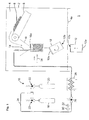
- Fig. 1 shows a schematic illustration of an inventive device for manufacturing a packed product.
- a chamber 2 holds a superheated steam atmosphere 4, the temperature of which is kept above 100°C by a - not illustrated - heating system.
- the pressure in the chamber 2 is atmospheric, i.e. generally 1000 mbar.
- the oxygen content of the steam atmosphere 4 preferably amounts to less than 10 vol.-% of O 2 , particularly less than 3 vol.-%.
- the chamber 2 can be downwardly open as illustrated, a boundary layer 4a forming between steam atmosphere 4 and the ambient air 5.
- a product 6, particularly a food product, is transported by transport equipment 8 into the chamber 2 and finds its way into a product funnel 10.
- the product 6, which may be moist before entering the chamber 2 can be dried to a predetermined moistness, for example to an a w -value of 0.9 or less, so that an increase of microorganisms in the packed condition is excluded.
- a drying process of the product 6 can be effected due to the fact that the product dwells for a certain time in the steam atmosphere 4 before it finds its way into the product funnel 10.
- the product is filled via the product funnel 10 through an opening 10a into a packing container 12 situated under the product funnel 10,
- the packing container 12 has a bottom 12a and a seal opening 12b, which is located directly under the opening 10a.
- the packing container 12 can be a plastic bag, which may be formed within the chamber 2 from a film material, or however as illustrated a can or a receptacle with cap or lid to be sealed.
- a rigid packing container 12 is conveyed from the outside into the steam atmosphere 4 and firstly brought there into an upside-down position, in which the bottom 12a points upwards and the seal opening 12b downwards. In this position ambient air contained in the packing container 12 can escape due to gravity, while the internal volume of the packing container fills with steam atmosphere.
- the packing container 12 is brought into a filling position, in which it can be filled with product.
- a gas supply pipe 14 extends into the packing container 12, whereby a gas discharge opening is located at the end of the gas supply pipe near to the bottom 12a of the packing container 12, preferably directly above the bottom 12a.
- the gas supply pipe 14 is connected to a gas injector 16, which in the example illustrated comprises a pressure cylinder 18 filled with N 2 , a pressure cylinder 20 filled with CO 2 , in each case with a pressure control valve 22, a manifold 24, a solenoid valve 26, a heating station 28 as well as temperature gauge 30 and pressure gauge 32.
- the gas injector 16 is provided with a - not illustrated - control unit, which acts on the pressure control valves 22, the solenoid valve 26 and the heating station 28, in order to control the supply timing, the quantity, the composition and the temperature of the gas mixture fed to the gas supply pipe 14.
- the product to be packed is fed via the transport device 8 or alternatively directly through an extruder into the chamber 2 and the steam atmosphere 4.
- the product is exposed for a certain time to the steam atmosphere 4 and thereby dried.
- the product finds its way into the product funnel 10 and from there into an available packing container 12.
- the packing container 12 is conveyed into the chamber by transport equipment - not illustrated in detail, rotated there by 180° or conveyed into the chamber already in the rotated position, so that the bottom 12a points upwards, and then rotated by 180°, so that the seal opening 12b points upwards, and brought into the filling position.
- the gas supply pipe is located in the packing container before this is filled with product.
- the packing container 12 is filled with product, particularly with lumpy or granular-type product.
- the volume or bulk volume of the filled product can amount to at least 50%, 60%, 70%, 80%, 90%, 95% or 99% of the fillable internal volume of the packing container between bottom and seal opening.
- a sterile gas here a mixture of N 2 and CO 2
- a sterile gas here a mixture of N 2 and CO 2
- a residual volume of steam atmosphere prevails between the individual product pieces and on the other hand in a gap between an upper surface of the filled product and the seal opening 12b.
- the packing container 12 is lowered or the gas supply pipe 14 is raised, so that the gas supply pipe is located outside the packing container, and as necessary this is moved horizontally to a sealing station, in which the packing container 12 is sealed or shut so as to be gas-tight, particularly by applying and sealing a lid 34.
- the sealing station is preferably disposed within the chamber 2 in order to avoid contact with ambient air.
- the packing container 12 After being sealed the packing container 12 is removed from the chamber 2 by means of - not illustrated - transport equipment and either cooled down in a cooling device in accordance with a predetermined time-temperature profile or cooled down only by leaving to stand in the environment.
Landscapes
- Engineering & Computer Science (AREA)
- Life Sciences & Earth Sciences (AREA)
- Chemical & Material Sciences (AREA)
- Wood Science & Technology (AREA)
- Zoology (AREA)
- Food Science & Technology (AREA)
- Polymers & Plastics (AREA)
- Mechanical Engineering (AREA)
- Dispersion Chemistry (AREA)
- Vacuum Packaging (AREA)
Abstract
Description
- The invention relates to a method for the manufacture of a packed product, wherein a product is brought into a superheated steam atmosphere and filled in the steam atmosphere into a packing container, which is then sealed or shut so as to be gas-tight.
- Some drawbacks of packed products according to such a method are related to more or less uncontrolled condensation of steam remaining in the packing container after sealing which may affect quality and long term stability of the product.
- In order to prevent these and further disadvantages the invention provides a method for the manufacture of a packed product, comprising the steps of:
- a) bringing a product into a superheated steam atmosphere with an O2 content of maximum 10 vol.-%, a pressure of between 950 mbar and 1100 mbar and a temperature of at least 100°C,
- b) making available a packing container in the superheated steam atmosphere and filling the packing container with a predetermined quantity of the product, wherein a residual volume of the packing container not filled with product is filled with the superheated steam atmosphere,
- c) replacing at least 50% of the residual volume of superheated steam atmosphere in the packing container with a sterile inert gas,
- d) sealing the packing container, and
- e) cooling the packing container and the product contained therein to a temperature below 100°C.
- As a consequence of replacing by an inert gas part of the steam atmosphere left in the packing container only part of the gaseous atmosphere in the container will condense after cooling, thereby eliminating the problem of producing a substantial negative pressure, particularly if a rigid packing container as for instance a screw-top jar is concerned, which is often undesirable.
- A further advantage of the method according to the invention is that the steam atmosphere remaining in the packing container cannot condense uncontrollably on walls of the packing container, if this is exposed to a relatively low temperature, for example less than 10°C or 0°C. Otherwise, parts of the packed product could come into direct contact with condensed water, whereby a large moistness or a large aw-value of the product may form, which regarding the durability of the product could be negative (possible growth of bacteria). According to the invention, this is definitely avoided.
- The packing container and the product contained therein can be cooled to a temperature below 50°C, 40°C, 30°C, 20°C or 10°C.
- The product can be a food product. The product may be moist before it is brought into the steam atmosphere and have an aw-value of up to 0.9, for example up to 0.8, 0.7, 0.6, 0.5, 0.4 or 0.3.
- The product can consist of protein, particularly animal or vegetable protein, and/or cereals. It may be contemplated that the product is extruded directly into the steam atmosphere.
- It may be contemplated that the product is dried in the superheated steam atmosphere, and preferably before it is filled into the packing container, particularly to an aw-value of 0.9 or less, for example less than 0.8, 0.7, 0.6 or 0.5.
- It may be contemplated that a rigid packing container is made available and a portion, predetermined in this way, of the residual volume of superheated steam atmosphere in the packing container is replaced by the inert gas, that after cooling to a temperature of 20° a predetermined pressure of maximum 500 mbar, 550 mbar, 600 mbar, 650 mbar, 700 mbar, 750 mbar, 800 mbar, 850 mbar, 900 mbar or 950 mbar prevails in the packing container.
- At least 55%, 60%, 65%, 70%, 75%, 80%, 85%, 90%, 95%, 98% or 99% of the residual volume of superheated steam atmosphere in the packing container is suitably by the inert gas.
- Preferably it is contemplated that step c) is implemented within the superheated steam atmosphere.
- The inert gas can be heated before step c) to a temperature of at least 60°C, 80°C, 100°C or to the temperature of the superheated steam atmosphere.
- N2, CO2, N2O, CO, H2 or a mixture of two or more of these gases can be used as inert gas.
- Particularly a mixture of N2 or CO2 with at least 10 vol.-%, 20 vol.-%, 30 vol.-%, 40 vol.-%, 50 vol.-%, 60 vol.-%, 70 vol.-%, 80 vol.-% or 90 vol.-% of CO2 can be used.
- A receptacle with screw cap, for instance made from glass, a can or a plastic bag can be used as packing container.
- The product can be packed in a superheated steam atmosphere with an O2 content of maximum 7.5 vol.-%, 5 vol.-%, 3 vol.-% or 1 vol.-%.
- The product can be packed in a superheated steam atmosphere with a temperature of at least 110°C, 120°C, 130°C or 150°C.
- The invention also provides a packing container, which is filled with a product and sealed by an inventive method.
- The invention in addition provides an apparatus for carrying out the inventive method, with a steam generator for producing the superheated steam atmosphere, a chamber for holding the superheated steam atmosphere, means for making available a packing container in the chamber, transport equipment for transporting product into the chamber, a filling unit for filling the product into a packing container, a gas injector for controlled injection of sterile inert gas into a packing container filled with product and superheated steam atmosphere, a sealing apparatus for sealing the filled packing container and transport equipment for removing the sealed packing container from the chamber. The packing container with the product contained therein can be cooled in a cooling device, particularly following a controlled time-temperature profile or only through contact of the packing container with the environment.
- The gas injector can be disposed within the chamber. The gas injector can consist of a gas supply pipe, which as the result of a relative motion between the gas supply pipe and the packing container immerges into this, so that a gas discharge opening of the gas supply pipe is located in the region of a bottom of the container, in any case nearer to a bottom than to an open seal opening of the container. Thus when inert gas is injected from the gas discharge opening the residual volume of steam atmosphere is expelled from the packing container, particularly if the product is lumpy, granular or granular-type and forms cavities, between which steam atmosphere prevails. Alternatively a gas nozzle, with which the gas in a predetermined direction is jetted into the packing container, can be provided.
- Furthermore it may be contemplated that the sealing apparatus is disposed within the chamber.
- The invention is described below on the basis of an exemplary embodiment, wherein reference is made to a drawing, in which
-
Fig. 1 shows a schematic illustration of an inventive device for manufacturing a packed product. - A
chamber 2 holds asuperheated steam atmosphere 4, the temperature of which is kept above 100°C by a - not illustrated - heating system. The pressure in thechamber 2 is atmospheric, i.e. generally 1000 mbar. The oxygen content of thesteam atmosphere 4 preferably amounts to less than 10 vol.-% of O2, particularly less than 3 vol.-%. Thechamber 2 can be downwardly open as illustrated, aboundary layer 4a forming betweensteam atmosphere 4 and the ambient air 5. - A
product 6, particularly a food product, is transported bytransport equipment 8 into thechamber 2 and finds its way into aproduct funnel 10. - Before entering the
product funnel 10 theproduct 6, which may be moist before entering thechamber 2, can be dried to a predetermined moistness, for example to an aw-value of 0.9 or less, so that an increase of microorganisms in the packed condition is excluded. Such a drying process of theproduct 6 can be effected due to the fact that the product dwells for a certain time in thesteam atmosphere 4 before it finds its way into theproduct funnel 10. - The product is filled via the
product funnel 10 through an opening 10a into apacking container 12 situated under theproduct funnel 10, Thepacking container 12 has abottom 12a and a seal opening 12b, which is located directly under the opening 10a. - The
packing container 12 can be a plastic bag, which may be formed within thechamber 2 from a film material, or however as illustrated a can or a receptacle with cap or lid to be sealed. In the case illustrated arigid packing container 12 is conveyed from the outside into thesteam atmosphere 4 and firstly brought there into an upside-down position, in which thebottom 12a points upwards and the seal opening 12b downwards. In this position ambient air contained in thepacking container 12 can escape due to gravity, while the internal volume of the packing container fills with steam atmosphere. - The
packing container 12 is brought into a filling position, in which it can be filled with product. In the filling position agas supply pipe 14 extends into thepacking container 12, whereby a gas discharge opening is located at the end of the gas supply pipe near to thebottom 12a of thepacking container 12, preferably directly above thebottom 12a. Either the gas supply pipe is firmly mounted and the packing container, while it is being brought into the filling position, is taken into a position embracing the gas supply pipe or the gas supply pipe is moved into the packing container located in the filling position. - The
gas supply pipe 14 is connected to agas injector 16, which in the example illustrated comprises apressure cylinder 18 filled with N2, apressure cylinder 20 filled with CO2, in each case with apressure control valve 22, amanifold 24, asolenoid valve 26, aheating station 28 as well astemperature gauge 30 andpressure gauge 32. Thegas injector 16 is provided with a - not illustrated - control unit, which acts on thepressure control valves 22, thesolenoid valve 26 and theheating station 28, in order to control the supply timing, the quantity, the composition and the temperature of the gas mixture fed to thegas supply pipe 14. - In order to carry out the inventive method the product to be packed is fed via the
transport device 8 or alternatively directly through an extruder into thechamber 2 and thesteam atmosphere 4. Depending on the drying requirement the product is exposed for a certain time to thesteam atmosphere 4 and thereby dried. Subsequently, the product finds its way into theproduct funnel 10 and from there into anavailable packing container 12. - The
packing container 12 is conveyed into the chamber by transport equipment - not illustrated in detail, rotated there by 180° or conveyed into the chamber already in the rotated position, so that thebottom 12a points upwards, and then rotated by 180°, so that the seal opening 12b points upwards, and brought into the filling position. Preferably the gas supply pipe is located in the packing container before this is filled with product. - Subsequently the
packing container 12 is filled with product, particularly with lumpy or granular-type product. The volume or bulk volume of the filled product can amount to at least 50%, 60%, 70%, 80%, 90%, 95% or 99% of the fillable internal volume of the packing container between bottom and seal opening. - Before, during or after filling the product into the packing container a sterile gas, here a mixture of N2 and CO2, is injected through the
gas supply pipe 14 into thepacking container 12, as the result of which at the same time a residual volume of steam atmosphere is expelled from thepacking container 12 and/or replaced by the sterile gas. In the case of a lumpy or granular-type product on the one hand a residual volume of steam atmosphere prevails between the individual product pieces and on the other hand in a gap between an upper surface of the filled product and the seal opening 12b. By disposing the gas discharge opening directly above thebottom 12a of the packing container the remaining steam atmosphere can be expelled to a large extent from both regions. - Subsequently the
packing container 12 is lowered or thegas supply pipe 14 is raised, so that the gas supply pipe is located outside the packing container, and as necessary this is moved horizontally to a sealing station, in which thepacking container 12 is sealed or shut so as to be gas-tight, particularly by applying and sealing alid 34. The sealing station is preferably disposed within thechamber 2 in order to avoid contact with ambient air. - After being sealed the
packing container 12 is removed from thechamber 2 by means of - not illustrated - transport equipment and either cooled down in a cooling device in accordance with a predetermined time-temperature profile or cooled down only by leaving to stand in the environment.Reference symbol list 2 Chamber 4 Steam atmosphere 4a Boundary layer 5 Ambient air 6 Product 8 Transport equipment 10 Product funnel 10a Opening 12 Packing container 12a Bottom 12b Seal opening 14 Gas supply pipe 16 Gas injector 18 N2 pressure cylinder 20 CO2 pressure cylinder 22 Pressure control valve 24 Manifold 26 Solenoid valve 28 Heating station 30 Temperature gauge 32 Pressure gauge 34 Lid
Claims (15)
- Method for the manufacture of a packed product, comprising the steps of:a) bringing a product into a superheated steam atmosphere with an O2 content of maximum 10 vol.-%, a pressure of between 950 mbar and 1100 mbar and a temperature of at least 100°C,b) making available a packing container in the superheated steam atmosphere and filling the packing container with a predetermined quantity of the product, wherein a residual volume of the packing container not filled with product is filled with the superheated steam atmosphere,c) replacing at least 50% of the residual volume of superheated steam atmosphere in the packing container by a sterile inert gas,d) sealing the packing container, ande) cooling the packing container and the product contained therein.
- Method according to claim 1, characterized in that the product is dried in the superheated steam atmosphere to an aw-value of 0.9 or less, before it is filled into the packing container.
- Method according to claim 1 or 2, characterized in that a rigid packing container is made available and a portion, predetermined in this way, of the residual volume of superheated steam atmosphere in the packing container is replaced by the inert gas so that after cooling to a temperature of 20°C a predetermined pressure of maximum 500 mbar, 550 mbar, 600 mbar, 650 mbar, 700 mbar, 750 mbar, 800 mbar, 850 mbar or 900 mbar prevails in the packing container.
- Method according to any one of the above claims, characterized in that at least 55%, 60%, 65%, 70%, 75%, 80%, 85%, 90% or 95% of the residual volume of superheated steam atmosphere in the packing container is replaced by the inert gas.
- Method according to any one of the above claims, characterized in that step c) is implemented within the superheated steam atmosphere.
- Method according to any one of the above claims, characterized in that before step c) the inert gas is heated to a temperature of at least 60°C, 80°C, 100°C or to the temperature of the superheated steam atmosphere.
- Method according to any one of the above claims, characterized in that N2, CO2, N2O, CO, H2 or a mixture of these are used as inert gas.
- Method according to claim 7, characterized in that a mixture of N2 and CO2 with at least 10 vol.-%, 20 vol.-%, 30 vol.-%, 40 vol.-%, 50 vol.-%, 60 vol.-%, 70 vol.-%, 80 vol.-% or 90 vol.-% of CO2 is used.
- Method according to any one of the above claims, characterized in that a receptacle with screw-cap, a can or a plastic bag are used as packing container.
- Method according to any one of the above claims, characterized in that the product is packed in a superheated steam atmosphere with an O2 content of maximum 7.5 vol.-%, 5 vol.-%, 3 vol.-% or 1 vol.-%.
- Method according to any one of the above claims, characterized in that the product is dried in a superheated steam atmosphere with a temperature of at least 110°C, 120°C, 130°C or 150°C.
- Packing container, filled and sealed by a method according to any one of the above claims.
- Apparatus for carrying out the method according to any one of claims 1 to 11, with a steam generator for producing the superheated steam atmosphere, a chamber for holding the superheated steam atmosphere, means for making a packing container available in the chamber, transport equipment for transporting product into the chamber, a filling unit for filling the product into a packing container, a gas injector for controlled injection of sterile inert gas into a packing container filled with product and superheated steam atmosphere, a sealing apparatus for sealing the filled packing container and transport equipment for removing the sealed packing container from the chamber.
- Apparatus according to claim 13, characterized in that the gas injector is disposed within the chamber.
- Apparatus according to claim 13 or 14, characterized in that the sealing apparatus is disposed within the chamber.
Priority Applications (3)
| Application Number | Priority Date | Filing Date | Title |
|---|---|---|---|
| EP15168835.5A EP3095333B1 (en) | 2015-05-22 | 2015-05-22 | Method and apparatus for the manufacture of a packed product |
| PL15168835T PL3095333T3 (en) | 2015-05-22 | 2015-05-22 | Method and apparatus for the manufacture of a packed product |
| US15/160,383 US20160355290A1 (en) | 2015-05-22 | 2016-05-20 | Method and apparatus for the manufacture of a packaged product |
Applications Claiming Priority (1)
| Application Number | Priority Date | Filing Date | Title |
|---|---|---|---|
| EP15168835.5A EP3095333B1 (en) | 2015-05-22 | 2015-05-22 | Method and apparatus for the manufacture of a packed product |
Publications (2)
| Publication Number | Publication Date |
|---|---|
| EP3095333A1 true EP3095333A1 (en) | 2016-11-23 |
| EP3095333B1 EP3095333B1 (en) | 2019-10-23 |
Family
ID=53269317
Family Applications (1)
| Application Number | Title | Priority Date | Filing Date |
|---|---|---|---|
| EP15168835.5A Active EP3095333B1 (en) | 2015-05-22 | 2015-05-22 | Method and apparatus for the manufacture of a packed product |
Country Status (3)
| Country | Link |
|---|---|
| US (1) | US20160355290A1 (en) |
| EP (1) | EP3095333B1 (en) |
| PL (1) | PL3095333T3 (en) |
Families Citing this family (2)
| Publication number | Priority date | Publication date | Assignee | Title |
|---|---|---|---|---|
| DE102007037605A1 (en) | 2007-08-07 | 2009-02-12 | Mars Incorporated | Method and device for drying a material |
| GB201108384D0 (en) | 2011-05-18 | 2011-06-29 | Mars Inc | Chew |
Citations (3)
| Publication number | Priority date | Publication date | Assignee | Title |
|---|---|---|---|---|
| US3875318A (en) * | 1973-03-08 | 1975-04-01 | Elmer S Davies | Aseptic canning method |
| EP0899195A1 (en) * | 1997-08-28 | 1999-03-03 | House Foods Corporation | Germ-free food filling and packaging apparatus |
| CA2898643A1 (en) * | 2013-02-05 | 2014-08-14 | Mars Incorporated | Method of producing a packed food product |
Family Cites Families (1)
| Publication number | Priority date | Publication date | Assignee | Title |
|---|---|---|---|---|
| US4027450A (en) * | 1976-01-19 | 1977-06-07 | Fmc Corporation | Pouch filling under air exclusion |
-
2015
- 2015-05-22 PL PL15168835T patent/PL3095333T3/en unknown
- 2015-05-22 EP EP15168835.5A patent/EP3095333B1/en active Active
-
2016
- 2016-05-20 US US15/160,383 patent/US20160355290A1/en not_active Abandoned
Patent Citations (3)
| Publication number | Priority date | Publication date | Assignee | Title |
|---|---|---|---|---|
| US3875318A (en) * | 1973-03-08 | 1975-04-01 | Elmer S Davies | Aseptic canning method |
| EP0899195A1 (en) * | 1997-08-28 | 1999-03-03 | House Foods Corporation | Germ-free food filling and packaging apparatus |
| CA2898643A1 (en) * | 2013-02-05 | 2014-08-14 | Mars Incorporated | Method of producing a packed food product |
Also Published As
| Publication number | Publication date |
|---|---|
| PL3095333T3 (en) | 2020-05-18 |
| US20160355290A1 (en) | 2016-12-08 |
| EP3095333B1 (en) | 2019-10-23 |
Similar Documents
| Publication | Publication Date | Title |
|---|---|---|
| AU2018202969B2 (en) | Method of producing a packed food product | |
| US6861086B2 (en) | Method of processing roasted coffee | |
| EP3095333B1 (en) | Method and apparatus for the manufacture of a packed product | |
| RS53517B1 (en) | PROCEDURE FOR PACKING OF NON-LIQUID FOODSTUFFS, SPECIALLY THOSE SENSITIVELY TO OXYGEN, IN A LOW OXYGEN CONTAINER | |
| CN207258056U (en) | Nitrogen fresh-keeping capping machine with buffer | |
| JP4428897B2 (en) | Method and apparatus for manufacturing food-filled packaging bag | |
| US3063846A (en) | Process of baking in-can baked products | |
| EP1009238B1 (en) | Method and device for preserving food products | |
| US20070062162A1 (en) | Method and apparatus for cleaning containers to be sealed and containing a filler from oxygen gas | |
| CN113646240B (en) | Method and packaging equipment for packaging products in containers | |
| JP4203753B2 (en) | Method and apparatus for producing cooked food in a container | |
| CN105984826B (en) | For providing the method and apparatus of inert gas in beverage filling plant | |
| RU2672026C1 (en) | Method for packing agricultural products and feeds, in particular, sensitive to oxygen exposure | |
| RU2789395C1 (en) | Method and installation for packaging products, method for production of installation, and container | |
| US3920850A (en) | Method of preserving and packaging cheese | |
| RU2208565C1 (en) | Method of sterilization of milk in bottles | |
| HK1233598A1 (en) | Method of producing a packed food product | |
| HK1233598A (en) | Method of producing a packed food product | |
| WO2023112991A1 (en) | Canned powder, and manufacturing method and manufacturing device of canned powder | |
| US1191839A (en) | Process of preserving food products. |
Legal Events
| Date | Code | Title | Description |
|---|---|---|---|
| PUAI | Public reference made under article 153(3) epc to a published international application that has entered the european phase |
Free format text: ORIGINAL CODE: 0009012 |
|
| AK | Designated contracting states |
Kind code of ref document: A1 Designated state(s): AL AT BE BG CH CY CZ DE DK EE ES FI FR GB GR HR HU IE IS IT LI LT LU LV MC MK MT NL NO PL PT RO RS SE SI SK SM TR |
|
| AX | Request for extension of the european patent |
Extension state: BA ME |
|
| STAA | Information on the status of an ep patent application or granted ep patent |
Free format text: STATUS: REQUEST FOR EXAMINATION WAS MADE |
|
| 17P | Request for examination filed |
Effective date: 20170523 |
|
| RBV | Designated contracting states (corrected) |
Designated state(s): AL AT BE BG CH CY CZ DE DK EE ES FI FR GB GR HR HU IE IS IT LI LT LU LV MC MK MT NL NO PL PT RO RS SE SI SK SM TR |
|
| STAA | Information on the status of an ep patent application or granted ep patent |
Free format text: STATUS: EXAMINATION IS IN PROGRESS |
|
| 17Q | First examination report despatched |
Effective date: 20181106 |
|
| GRAP | Despatch of communication of intention to grant a patent |
Free format text: ORIGINAL CODE: EPIDOSNIGR1 |
|
| STAA | Information on the status of an ep patent application or granted ep patent |
Free format text: STATUS: GRANT OF PATENT IS INTENDED |
|
| RIC1 | Information provided on ipc code assigned before grant |
Ipc: A23L 3/3418 20060101ALI20190415BHEP Ipc: A23L 3/3445 20060101ALI20190415BHEP Ipc: A23L 3/015 20060101AFI20190415BHEP Ipc: A23L 3/18 20060101ALI20190415BHEP Ipc: B65B 31/02 20060101ALI20190415BHEP Ipc: B65B 63/08 20060101ALI20190415BHEP Ipc: A23L 3/16 20060101ALI20190415BHEP |
|
| INTG | Intention to grant announced |
Effective date: 20190516 |
|
| GRAS | Grant fee paid |
Free format text: ORIGINAL CODE: EPIDOSNIGR3 |
|
| GRAA | (expected) grant |
Free format text: ORIGINAL CODE: 0009210 |
|
| STAA | Information on the status of an ep patent application or granted ep patent |
Free format text: STATUS: THE PATENT HAS BEEN GRANTED |
|
| AK | Designated contracting states |
Kind code of ref document: B1 Designated state(s): AL AT BE BG CH CY CZ DE DK EE ES FI FR GB GR HR HU IE IS IT LI LT LU LV MC MK MT NL NO PL PT RO RS SE SI SK SM TR |
|
| REG | Reference to a national code |
Ref country code: GB Ref legal event code: FG4D |
|
| REG | Reference to a national code |
Ref country code: CH Ref legal event code: EP |
|
| REG | Reference to a national code |
Ref country code: IE Ref legal event code: FG4D |
|
| REG | Reference to a national code |
Ref country code: DE Ref legal event code: R096 Ref document number: 602015040148 Country of ref document: DE |
|
| REG | Reference to a national code |
Ref country code: AT Ref legal event code: REF Ref document number: 1192661 Country of ref document: AT Kind code of ref document: T Effective date: 20191115 |
|
| REG | Reference to a national code |
Ref country code: NL Ref legal event code: MP Effective date: 20191023 |
|
| REG | Reference to a national code |
Ref country code: LT Ref legal event code: MG4D |
|
| PG25 | Lapsed in a contracting state [announced via postgrant information from national office to epo] |
Ref country code: PT Free format text: LAPSE BECAUSE OF FAILURE TO SUBMIT A TRANSLATION OF THE DESCRIPTION OR TO PAY THE FEE WITHIN THE PRESCRIBED TIME-LIMIT Effective date: 20200224 Ref country code: GR Free format text: LAPSE BECAUSE OF FAILURE TO SUBMIT A TRANSLATION OF THE DESCRIPTION OR TO PAY THE FEE WITHIN THE PRESCRIBED TIME-LIMIT Effective date: 20200124 Ref country code: NO Free format text: LAPSE BECAUSE OF FAILURE TO SUBMIT A TRANSLATION OF THE DESCRIPTION OR TO PAY THE FEE WITHIN THE PRESCRIBED TIME-LIMIT Effective date: 20200123 Ref country code: LT Free format text: LAPSE BECAUSE OF FAILURE TO SUBMIT A TRANSLATION OF THE DESCRIPTION OR TO PAY THE FEE WITHIN THE PRESCRIBED TIME-LIMIT Effective date: 20191023 Ref country code: SE Free format text: LAPSE BECAUSE OF FAILURE TO SUBMIT A TRANSLATION OF THE DESCRIPTION OR TO PAY THE FEE WITHIN THE PRESCRIBED TIME-LIMIT Effective date: 20191023 Ref country code: LV Free format text: LAPSE BECAUSE OF FAILURE TO SUBMIT A TRANSLATION OF THE DESCRIPTION OR TO PAY THE FEE WITHIN THE PRESCRIBED TIME-LIMIT Effective date: 20191023 Ref country code: NL Free format text: LAPSE BECAUSE OF FAILURE TO SUBMIT A TRANSLATION OF THE DESCRIPTION OR TO PAY THE FEE WITHIN THE PRESCRIBED TIME-LIMIT Effective date: 20191023 Ref country code: BG Free format text: LAPSE BECAUSE OF FAILURE TO SUBMIT A TRANSLATION OF THE DESCRIPTION OR TO PAY THE FEE WITHIN THE PRESCRIBED TIME-LIMIT Effective date: 20200123 Ref country code: FI Free format text: LAPSE BECAUSE OF FAILURE TO SUBMIT A TRANSLATION OF THE DESCRIPTION OR TO PAY THE FEE WITHIN THE PRESCRIBED TIME-LIMIT Effective date: 20191023 |
|
| PG25 | Lapsed in a contracting state [announced via postgrant information from national office to epo] |
Ref country code: HR Free format text: LAPSE BECAUSE OF FAILURE TO SUBMIT A TRANSLATION OF THE DESCRIPTION OR TO PAY THE FEE WITHIN THE PRESCRIBED TIME-LIMIT Effective date: 20191023 Ref country code: RS Free format text: LAPSE BECAUSE OF FAILURE TO SUBMIT A TRANSLATION OF THE DESCRIPTION OR TO PAY THE FEE WITHIN THE PRESCRIBED TIME-LIMIT Effective date: 20191023 Ref country code: IS Free format text: LAPSE BECAUSE OF FAILURE TO SUBMIT A TRANSLATION OF THE DESCRIPTION OR TO PAY THE FEE WITHIN THE PRESCRIBED TIME-LIMIT Effective date: 20200224 |
|
| PG25 | Lapsed in a contracting state [announced via postgrant information from national office to epo] |
Ref country code: AL Free format text: LAPSE BECAUSE OF FAILURE TO SUBMIT A TRANSLATION OF THE DESCRIPTION OR TO PAY THE FEE WITHIN THE PRESCRIBED TIME-LIMIT Effective date: 20191023 |
|
| REG | Reference to a national code |
Ref country code: DE Ref legal event code: R097 Ref document number: 602015040148 Country of ref document: DE |
|
| PG2D | Information on lapse in contracting state deleted |
Ref country code: IS |
|
| PG25 | Lapsed in a contracting state [announced via postgrant information from national office to epo] |
Ref country code: DK Free format text: LAPSE BECAUSE OF FAILURE TO SUBMIT A TRANSLATION OF THE DESCRIPTION OR TO PAY THE FEE WITHIN THE PRESCRIBED TIME-LIMIT Effective date: 20191023 Ref country code: EE Free format text: LAPSE BECAUSE OF FAILURE TO SUBMIT A TRANSLATION OF THE DESCRIPTION OR TO PAY THE FEE WITHIN THE PRESCRIBED TIME-LIMIT Effective date: 20191023 Ref country code: CZ Free format text: LAPSE BECAUSE OF FAILURE TO SUBMIT A TRANSLATION OF THE DESCRIPTION OR TO PAY THE FEE WITHIN THE PRESCRIBED TIME-LIMIT Effective date: 20191023 Ref country code: RO Free format text: LAPSE BECAUSE OF FAILURE TO SUBMIT A TRANSLATION OF THE DESCRIPTION OR TO PAY THE FEE WITHIN THE PRESCRIBED TIME-LIMIT Effective date: 20191023 Ref country code: ES Free format text: LAPSE BECAUSE OF FAILURE TO SUBMIT A TRANSLATION OF THE DESCRIPTION OR TO PAY THE FEE WITHIN THE PRESCRIBED TIME-LIMIT Effective date: 20191023 Ref country code: IS Free format text: LAPSE BECAUSE OF FAILURE TO SUBMIT A TRANSLATION OF THE DESCRIPTION OR TO PAY THE FEE WITHIN THE PRESCRIBED TIME-LIMIT Effective date: 20200223 |
|
| REG | Reference to a national code |
Ref country code: AT Ref legal event code: MK05 Ref document number: 1192661 Country of ref document: AT Kind code of ref document: T Effective date: 20191023 |
|
| PLBE | No opposition filed within time limit |
Free format text: ORIGINAL CODE: 0009261 |
|
| STAA | Information on the status of an ep patent application or granted ep patent |
Free format text: STATUS: NO OPPOSITION FILED WITHIN TIME LIMIT |
|
| PG25 | Lapsed in a contracting state [announced via postgrant information from national office to epo] |
Ref country code: SM Free format text: LAPSE BECAUSE OF FAILURE TO SUBMIT A TRANSLATION OF THE DESCRIPTION OR TO PAY THE FEE WITHIN THE PRESCRIBED TIME-LIMIT Effective date: 20191023 Ref country code: IT Free format text: LAPSE BECAUSE OF FAILURE TO SUBMIT A TRANSLATION OF THE DESCRIPTION OR TO PAY THE FEE WITHIN THE PRESCRIBED TIME-LIMIT Effective date: 20191023 Ref country code: SK Free format text: LAPSE BECAUSE OF FAILURE TO SUBMIT A TRANSLATION OF THE DESCRIPTION OR TO PAY THE FEE WITHIN THE PRESCRIBED TIME-LIMIT Effective date: 20191023 |
|
| 26N | No opposition filed |
Effective date: 20200724 |
|
| PG25 | Lapsed in a contracting state [announced via postgrant information from national office to epo] |
Ref country code: SI Free format text: LAPSE BECAUSE OF FAILURE TO SUBMIT A TRANSLATION OF THE DESCRIPTION OR TO PAY THE FEE WITHIN THE PRESCRIBED TIME-LIMIT Effective date: 20191023 Ref country code: AT Free format text: LAPSE BECAUSE OF FAILURE TO SUBMIT A TRANSLATION OF THE DESCRIPTION OR TO PAY THE FEE WITHIN THE PRESCRIBED TIME-LIMIT Effective date: 20191023 |
|
| PG25 | Lapsed in a contracting state [announced via postgrant information from national office to epo] |
Ref country code: LI Free format text: LAPSE BECAUSE OF NON-PAYMENT OF DUE FEES Effective date: 20200531 Ref country code: MC Free format text: LAPSE BECAUSE OF FAILURE TO SUBMIT A TRANSLATION OF THE DESCRIPTION OR TO PAY THE FEE WITHIN THE PRESCRIBED TIME-LIMIT Effective date: 20191023 Ref country code: CH Free format text: LAPSE BECAUSE OF NON-PAYMENT OF DUE FEES Effective date: 20200531 |
|
| REG | Reference to a national code |
Ref country code: BE Ref legal event code: MM Effective date: 20200531 |
|
| PG25 | Lapsed in a contracting state [announced via postgrant information from national office to epo] |
Ref country code: LU Free format text: LAPSE BECAUSE OF NON-PAYMENT OF DUE FEES Effective date: 20200522 |
|
| PG25 | Lapsed in a contracting state [announced via postgrant information from national office to epo] |
Ref country code: IE Free format text: LAPSE BECAUSE OF NON-PAYMENT OF DUE FEES Effective date: 20200522 |
|
| PG25 | Lapsed in a contracting state [announced via postgrant information from national office to epo] |
Ref country code: BE Free format text: LAPSE BECAUSE OF NON-PAYMENT OF DUE FEES Effective date: 20200531 |
|
| PG25 | Lapsed in a contracting state [announced via postgrant information from national office to epo] |
Ref country code: TR Free format text: LAPSE BECAUSE OF FAILURE TO SUBMIT A TRANSLATION OF THE DESCRIPTION OR TO PAY THE FEE WITHIN THE PRESCRIBED TIME-LIMIT Effective date: 20191023 Ref country code: MT Free format text: LAPSE BECAUSE OF FAILURE TO SUBMIT A TRANSLATION OF THE DESCRIPTION OR TO PAY THE FEE WITHIN THE PRESCRIBED TIME-LIMIT Effective date: 20191023 Ref country code: CY Free format text: LAPSE BECAUSE OF FAILURE TO SUBMIT A TRANSLATION OF THE DESCRIPTION OR TO PAY THE FEE WITHIN THE PRESCRIBED TIME-LIMIT Effective date: 20191023 |
|
| PG25 | Lapsed in a contracting state [announced via postgrant information from national office to epo] |
Ref country code: MK Free format text: LAPSE BECAUSE OF FAILURE TO SUBMIT A TRANSLATION OF THE DESCRIPTION OR TO PAY THE FEE WITHIN THE PRESCRIBED TIME-LIMIT Effective date: 20191023 |
|
| P01 | Opt-out of the competence of the unified patent court (upc) registered |
Effective date: 20230516 |
|
| REG | Reference to a national code |
Ref country code: DE Ref legal event code: R079 Ref document number: 602015040148 Country of ref document: DE Free format text: PREVIOUS MAIN CLASS: A23L0003015000 Ipc: A23B0002100000 |
|
| PGFP | Annual fee paid to national office [announced via postgrant information from national office to epo] |
Ref country code: DE Payment date: 20250529 Year of fee payment: 11 Ref country code: PL Payment date: 20250505 Year of fee payment: 11 |
|
| PGFP | Annual fee paid to national office [announced via postgrant information from national office to epo] |
Ref country code: GB Payment date: 20250527 Year of fee payment: 11 |
|
| PGFP | Annual fee paid to national office [announced via postgrant information from national office to epo] |
Ref country code: FR Payment date: 20250526 Year of fee payment: 11 |