EP3094358B1 - Electroactive bioadhesive compositions - Google Patents
Electroactive bioadhesive compositions Download PDFInfo
- Publication number
- EP3094358B1 EP3094358B1 EP15703123.8A EP15703123A EP3094358B1 EP 3094358 B1 EP3094358 B1 EP 3094358B1 EP 15703123 A EP15703123 A EP 15703123A EP 3094358 B1 EP3094358 B1 EP 3094358B1
- Authority
- EP
- European Patent Office
- Prior art keywords
- group
- chain
- straight
- branched alkyl
- alkyl group
- Prior art date
- Legal status (The legal status is an assumption and is not a legal conclusion. Google has not performed a legal analysis and makes no representation as to the accuracy of the status listed.)
- Active
Links
Images


Classifications
-
- A—HUMAN NECESSITIES
- A61—MEDICAL OR VETERINARY SCIENCE; HYGIENE
- A61L—METHODS OR APPARATUS FOR STERILISING MATERIALS OR OBJECTS IN GENERAL; DISINFECTION, STERILISATION OR DEODORISATION OF AIR; CHEMICAL ASPECTS OF BANDAGES, DRESSINGS, ABSORBENT PADS OR SURGICAL ARTICLES; MATERIALS FOR BANDAGES, DRESSINGS, ABSORBENT PADS OR SURGICAL ARTICLES
- A61L24/00—Surgical adhesives or cements; Adhesives for colostomy devices
- A61L24/001—Use of materials characterised by their function or physical properties
-
- A—HUMAN NECESSITIES
- A61—MEDICAL OR VETERINARY SCIENCE; HYGIENE
- A61B—DIAGNOSIS; SURGERY; IDENTIFICATION
- A61B17/00—Surgical instruments, devices or methods
- A61B17/00491—Surgical glue applicators
-
- A—HUMAN NECESSITIES
- A61—MEDICAL OR VETERINARY SCIENCE; HYGIENE
- A61L—METHODS OR APPARATUS FOR STERILISING MATERIALS OR OBJECTS IN GENERAL; DISINFECTION, STERILISATION OR DEODORISATION OF AIR; CHEMICAL ASPECTS OF BANDAGES, DRESSINGS, ABSORBENT PADS OR SURGICAL ARTICLES; MATERIALS FOR BANDAGES, DRESSINGS, ABSORBENT PADS OR SURGICAL ARTICLES
- A61L24/00—Surgical adhesives or cements; Adhesives for colostomy devices
- A61L24/001—Use of materials characterised by their function or physical properties
- A61L24/0015—Medicaments; Biocides
-
- A—HUMAN NECESSITIES
- A61—MEDICAL OR VETERINARY SCIENCE; HYGIENE
- A61L—METHODS OR APPARATUS FOR STERILISING MATERIALS OR OBJECTS IN GENERAL; DISINFECTION, STERILISATION OR DEODORISATION OF AIR; CHEMICAL ASPECTS OF BANDAGES, DRESSINGS, ABSORBENT PADS OR SURGICAL ARTICLES; MATERIALS FOR BANDAGES, DRESSINGS, ABSORBENT PADS OR SURGICAL ARTICLES
- A61L24/00—Surgical adhesives or cements; Adhesives for colostomy devices
- A61L24/001—Use of materials characterised by their function or physical properties
- A61L24/0031—Hydrogels or hydrocolloids
-
- A—HUMAN NECESSITIES
- A61—MEDICAL OR VETERINARY SCIENCE; HYGIENE
- A61L—METHODS OR APPARATUS FOR STERILISING MATERIALS OR OBJECTS IN GENERAL; DISINFECTION, STERILISATION OR DEODORISATION OF AIR; CHEMICAL ASPECTS OF BANDAGES, DRESSINGS, ABSORBENT PADS OR SURGICAL ARTICLES; MATERIALS FOR BANDAGES, DRESSINGS, ABSORBENT PADS OR SURGICAL ARTICLES
- A61L24/00—Surgical adhesives or cements; Adhesives for colostomy devices
- A61L24/04—Surgical adhesives or cements; Adhesives for colostomy devices containing macromolecular materials
-
- A—HUMAN NECESSITIES
- A61—MEDICAL OR VETERINARY SCIENCE; HYGIENE
- A61L—METHODS OR APPARATUS FOR STERILISING MATERIALS OR OBJECTS IN GENERAL; DISINFECTION, STERILISATION OR DEODORISATION OF AIR; CHEMICAL ASPECTS OF BANDAGES, DRESSINGS, ABSORBENT PADS OR SURGICAL ARTICLES; MATERIALS FOR BANDAGES, DRESSINGS, ABSORBENT PADS OR SURGICAL ARTICLES
- A61L24/00—Surgical adhesives or cements; Adhesives for colostomy devices
- A61L24/04—Surgical adhesives or cements; Adhesives for colostomy devices containing macromolecular materials
- A61L24/08—Polysaccharides
-
- H—ELECTRICITY
- H01—ELECTRIC ELEMENTS
- H01B—CABLES; CONDUCTORS; INSULATORS; SELECTION OF MATERIALS FOR THEIR CONDUCTIVE, INSULATING OR DIELECTRIC PROPERTIES
- H01B1/00—Conductors or conductive bodies characterised by the conductive materials; Selection of materials as conductors
- H01B1/06—Conductors or conductive bodies characterised by the conductive materials; Selection of materials as conductors mainly consisting of other non-metallic substances
- H01B1/12—Conductors or conductive bodies characterised by the conductive materials; Selection of materials as conductors mainly consisting of other non-metallic substances organic substances
- H01B1/124—Intrinsically conductive polymers
-
- A—HUMAN NECESSITIES
- A61—MEDICAL OR VETERINARY SCIENCE; HYGIENE
- A61B—DIAGNOSIS; SURGERY; IDENTIFICATION
- A61B17/00—Surgical instruments, devices or methods
- A61B17/00491—Surgical glue applicators
- A61B2017/005—Surgical glue applicators hardenable using external energy source, e.g. laser, ultrasound
-
- A—HUMAN NECESSITIES
- A61—MEDICAL OR VETERINARY SCIENCE; HYGIENE
- A61L—METHODS OR APPARATUS FOR STERILISING MATERIALS OR OBJECTS IN GENERAL; DISINFECTION, STERILISATION OR DEODORISATION OF AIR; CHEMICAL ASPECTS OF BANDAGES, DRESSINGS, ABSORBENT PADS OR SURGICAL ARTICLES; MATERIALS FOR BANDAGES, DRESSINGS, ABSORBENT PADS OR SURGICAL ARTICLES
- A61L2300/00—Biologically active materials used in bandages, wound dressings, absorbent pads or medical devices
- A61L2300/20—Biologically active materials used in bandages, wound dressings, absorbent pads or medical devices containing or releasing organic materials
- A61L2300/216—Biologically active materials used in bandages, wound dressings, absorbent pads or medical devices containing or releasing organic materials with other specific functional groups, e.g. aldehydes, ketones, phenols, quaternary phosphonium groups
-
- A—HUMAN NECESSITIES
- A61—MEDICAL OR VETERINARY SCIENCE; HYGIENE
- A61L—METHODS OR APPARATUS FOR STERILISING MATERIALS OR OBJECTS IN GENERAL; DISINFECTION, STERILISATION OR DEODORISATION OF AIR; CHEMICAL ASPECTS OF BANDAGES, DRESSINGS, ABSORBENT PADS OR SURGICAL ARTICLES; MATERIALS FOR BANDAGES, DRESSINGS, ABSORBENT PADS OR SURGICAL ARTICLES
- A61L2400/00—Materials characterised by their function or physical properties
Definitions
- the present disclosure relates to electrochemically initiated bioadhesive compositions comprising biocompatible polymers containing derivatives of diazonium, arylsulfonium, or diaryliodonium in general, and to their use in tissue fixation, in particular.
- Bioadhesive 'glues' are a significant engineering hurdle in numerous fields including wound closures, implantable electronics, meshes for abdominal surgeries, and tissue engineering transplants.
- Medical grade cyanoacrylates, for example Dermabond® and Super Glue®, and fibrin tissue adhesives, for example Tisseal® and Evicel®, are currently the only commercially available and FDA approved bioadhesives that have addressed soft tissue fixation. Unfortunately, they trade adhesive strength for biocompatibility or vice versa. Cyanoacrylates typically have strong tissue adhesion, but are relatively inflexible.
- Fibrin-based tissue adhesives have many shortcomings as well. Their bioadhesion is 'hydrogel' weak, has potential neurotoxicity complications and serious religious concerns due to the predominantly human (or bovine) fibrinogen and thrombin sources. Due to their weak mechanical properties, fibrin tissues adhesives are best suited for control of bleeding.
- US 2009/286308 discloses a process for assembling at least one zone of a first surface with at least one zone of a second surface or with a molecule of interest, comprising a step that consists in placing the said zone of the said first surface in contact with the said zone of the said second surface or with the said molecule of interest, the said zone of the said first surface bearing at least one radical and/or ionic species.
- the disclosure also relates to a solid support whose surface bears at least one zone with at least one radical and/or ionic species, with at least one adhesion primer, or with at least one adhesion primer precursor, and to its various uses.
- EP 2341089 discloses radiation-sensitive polymers and compositions which may be used in photolithographic processes.
- EP 2674173 discloses an implantable material having at least one external surface grafted with a polymeric film comprising carboxylate and sulfonate functions wherein the film is produced by copolymerization-like reaction of a source of carboxylate functions and a source of sulfonate functions.
- CA 2255493 discloses a photochemical agent for use as a glue to bind a synthetic material to tissue and tissue to tissue wherein the agent is activated by exposure to electromagnetic radiation.
- WO 2010/100410 and WO 2010/100413 disclose functionalized diazo derivatives, including diazopyruvate, and their use for producing a chemically-bound three-dimensional network on or within a substrate.
- WO 2009/097152 relates to calcium-reactive amines and acrylic or methacrylic ester monomers adhesives, and use thereof for adhering dental and medical biomaterials to hard tissues, such as enamel, dentin, and bone, via a molecular bridge.
- JP 2007254307A describes a dental adhesive that comprises of a polymerizable monomer including an acidic group-containing polymerizable monomer, water and a polymerization initiator comprising a photo acid generator, an oxidation type photoradical generator.
- the photo acid generator is preferably a diaryl iodonium salt-based compound, but the activation of the adhesive is by photo-activation.
- WO 2008/023170 describes a group of diazo compounds used as aryl carbene precursors for use in the process of producing a substrate having an adhesive surface, which allows the substrate to adhere to other materials to be tailored.
- WO 2008/121033 provides an adhesive for facilitating the adhesion between an electroactive polymer and a substrate, wherein the adhesive consists of a platinum or an alloy comprising platinum.
- EP 0330344 relates to use of crosslinked collagen as a bioadhesive for sutureless closures of the skin and eye or as a superhydrated material for contact lenses, moist bandage contact lens, lens or corneal implant material, or as a drug delivery agent.
- collagen which is an example of amino-acid containing polymers, is crosslinked into a highly molecularly crosslinked product upon photoactivation with photoactive crosslinking reagents, such as diazo or azide derivatives.
- Various embodiments of the disclosure provide electroactive polymers containing diazonium, arylsulfonium, or diaryliodonium and the respective derivatives as described below for use in bioadhesion.
- an electroactive polymer for use in bioadhesion comprises a biocompatible polymer comprising a single strand of repeating units and up to 5,000 electroactive groups covalently attached to said strand, wherein said electroactive polymer has a molecular weight of up to 3 million Daltons, and wherein said electroactive groups are derivatives of (i) diazonium, (ii) diaryliodonium, or (iii) arylsulfonium, wherein the (i) diazonium derivatives are selected from the group consisting of
- said biocompatible polymer can be any bioresorbable polymer that has been FDA-approved as a medical device selected from the group consisting of polyethylene glycol (PEG), PEG fatty acid esters, poly-L-lactic acid (PLLA), poly(lactide-co-glycolide) (PLGA), poly caprolactone (PCL), polyvinyl pyrrolidone (PVP), polyvinyl alcohol (PVA), collagen, chitosan, hydroxy propyl cellulose, polyamides, polyglycerol esters of fatty acids, polysaccharides, polyesters, and combinations thereof.
- PEG polyethylene glycol
- PEG fatty acid esters poly-L-lactic acid (PLLA), poly(lactide-co-glycolide) (PLGA), poly caprolactone (PCL), polyvinyl pyrrolidone (PVP), polyvinyl alcohol (PVA), collagen, chitosan, hydroxy propyl cellulose, polyamides, polyglycerol est
- the polysaccharide is selected from the group consisting of dextran, chitosan, heparin, hyaluronic acid, alginates, starch, glycogen, amylose, amylopectin, cellulose, and xylan.
- the electroactive diaryliodonium derivative can be selected from the list of:
- the electroactive arylsulfonium derivative can be selected from the list of:
- an electroactive bioadhesive composition for use in surgery, anastomoses procedures, tissue fixation, suture sealing and replacement, treatment of lung punctures, body lumen punctures or leaks, cerebrospinal fluid membrane damages, obesity treatments, or bowel obstructions.
- the electroactive bioadhesive composition comprises the electroactive polymer of the present disclosure and further components selected from the group consisting of suitable solvents, surfactants, stabilizers, fillers and additives.
- the additives may be anti-inflammatory drugs, anti-proteases, antibiotics, or anti-restenosis compounds.
- the electroactive bioadhesive composition for use in surgery, anastomoses procedures, tissue fixation, suture sealing and replacement, treatment of lung punctures, body lumen punctures or leaks, cerebrospinal fluid membrane damages, obesity treatments, or bowel obstructions can be in a form of hydrogel, biocompatible film, patch or bondage.
- the electroactive bioadhesive composition for use in surgery, anastomoses procedures, tissue fixation, suture sealing and replacement, treatment of lung punctures, body lumen punctures or leaks, cerebrospinal fluid membrane damages, obesity treatments, or bowel obstructions may contain conductive particles or polymers of less than 50 micron made of gold, iron, iron oxides, platinum, magnesium, graphene, carbon black, carbon nanotubes, polyacetylene, poly(3-alkyl-thiophene), polyaniline, polyisothianaphthalene, poly-(p-phenylene), poly-(p-phenylene vinylene), polypyrrole, polythiophene, or combinations thereof.
- the electroactive bioadhesive composition is electrically conductive with conductivity greater than 0.01 siemen per centimeter.
- the conductive particles can be coated with anionic or cationic coating comprising fatty acids, silica, polyethylene glycol, pluronics, poloxamers, polydopamine, or polylysine.
- the electroactive bioadhesive composition may be used in surgery, anastomoses procedures, tissue fixation, suture sealing and replacement, treatment of lung punctures, body lumen punctures or leaks, cerebrospinal fluid membrane damages, obesity treatments, or bowel obstructions.
- the surgery may comprise gastrointestinal surgery towards cancer removal.
- the anastomoses procedures may comprise blood vessel anastomoses wherein two tubes or lumens must be joined.
- the electroactive bioadhesive composition may be for use in tissue fixation.
- the tissue fixation comprises the steps of:
- voltage potential is between negative 5 to positive 5 Volts, such as negative 2 to positive 2 Volts, and time of voltage potential in both cases is less than 20 minutes.
- the potential can be applied also in a sweeping mode, i.e., by changing the potential under a fixed or changeable scan rate (in mV/s) and scanning one or several cycles.
- Biocompatible material is defined as a natural or synthetic material having low variability, high purity, and no detectable biological reactivity as determined by biocompatibility tests.
- Biocompatible polymer is a natural or synthetic polymer having low variability, high purity, and no detectable biological reactivity as determined by biocompatibility tests.
- Bioadhesive or “bioadhesive material” means a synthetic material designed to adhere to biological tissues. By definition, bioadhesives are biocompatible materials.
- a biocompatible polymer of the disclosure is built from a single strand of repeating units and up to 5,000 electroactive groups covalently attached to said strand, and it has a molecular weight of up to 3 million Daltons.
- the crosslinked electroactive groups are derivatives of diazonium, arylsulfonium, diaryliodonium or combinations thereof.
- Arylsulfonium in present context may refer to mono-, di- or tri-arylsulfonium, for example, triphenylsulfonium, diphenylsulfonium, or alkyldiphenylsulfonium.
- the main polymeric strand or backbone can be any bioresorbable polymer that has been FDA-approved as a medical device selected from the group consisting of polyethylene glycol (PEG), PEG fatty acid esters, poly-L-lactic acid (PLLA), poly(lactide-co-glycolide) (PLGA), poly caprolactone (PCL), polyvinyl pyrrolidone (PVP), polyvinyl alcohol (PVA), collagen, chitosan, hydroxy propyl cellulose, polyamides, polyglycerol esters of fatty acids, polysaccharides, polyesters, and combinations thereof.
- PEG polyethylene glycol
- PEG fatty acid esters poly-L-lactic acid (PLLA), poly(lactide-co-glycolide) (PLGA), poly caprolactone (PCL), polyvinyl pyrrolidone (PVP), polyvinyl alcohol (PVA), collagen, chitosan, hydroxy propyl cellulose, polyamides, polyg
- the polysaccharide may be selected from the group consisting of dextran, chitosan, heparin, hyaluronic acid, alginates, starch, glycogen, amylose, amylopectin, cellulose, xylan, and numerous other natural and synthetic polysaccharides.
- PLGA poly(lactic-co-glycolic acid)
- the PLGA polymer can be blended for independent tailoring of thin film mechanical properties to match soft tissue, controlled drug release, and conductivity.
- the electroactive diazonium derivative is a compound of the following formula: wherein
- the electroactive diazonium derivative can be selected from the list of:
- the electroactive diaryliodonium derivative is a compound of the following formula:
- the electroactive diaryliodonium derivative can be selected from the list of:
- the electroactive arylsulfonium derivative is a compound of the following formula:
- the electroactive arylsulfonium derivative can be selected from the list of:
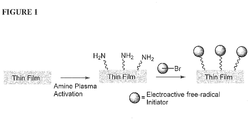
- Fig. 1 schematically showing synthetic route to the biocompatible polymer crosslinked with diazonium, arylsulfonium, diaryliodonium or combinations thereof.
- Fig. 2 where the biocompatible polymer crosslinked with derivatives of diazonium, arylsulfonium, diaryliodonium or combinations thereof is followed by electro-activation through the electrochemical reduction or oxidation, and soft tissue fixation.
- a voltage potential for instance at ⁇ 5 Volts or by scanning the potential with a fixed or changeable scan rate, free radicals are formed that instantly react and crosslink soft tissues and biomaterials by C-C bond formation.
- the novel electroactive polymer used for bioadhesion was conceived after incorporating of key advances in the fields of plasma surface modification, biocompatible polymer functionalized with diazonium, arylsulfonium, diaryliodonium electrochemistry, and antibody-based avidity binding concepts.
- This polymer allows one to trigger the tissue adhesion in situ, directly at the time and place the tissue fixation is required.
- the free-radical bond formation employed is advantageous over other known covalent protein bonding methods, as it leaves the bulk protein conformation relatively intact.
- biocompatible polymer of the present disclosure based on electro-activation of diazonium, arylsulfonium, or diaryliodonium residues, offers greater flexibility by allowing on-demand activation of the diazonium, arylsulfonium, or diaryliodonium -based surface binding. It is the only electroactivated bioadhesive that is free of monomers and toxic photo-initiators. This electroactive polymer creates a fundamental shift in bioadhesive technology that would have considerable impact on medical implants - in vivo adhesion is a difficult hurdle that has yet to be overcome - especially in wet and protein-filled environments.
- Free radicals are generally considered detrimental due to their implications in cellular aging. Recently however, several laboratories have revealed that proteins covalently immobilized by free radical mechanisms tend to retain protein conformation and have more functionality. This is a key observation in the design for soft tissue bioadhesives - the higher the protein conformation retained, the lower the local tissue toxicity and inflammation is likely to be.
- Fig. 2 shows on-demand, electro- activated surface adhesion through surface functionalization of diazonium, arylsulfonium, or diaryliodonium deratives.
- the surface of PLGA thin films undergo plasma activated ammonia reactions, leaving an amine-functionalized surface that readily reacts with bromine derivatives of diazonium, arylsulfonium, or diaryliodonium compound.
- the diazonium, arylsulfonium, or diaryliodonium compounds decompose to an extremely reactive free radical.
- the free radical instantly crosslinks with any nearby polypeptide chains of soft tissues - a fact that has made it widely popular for protein surface functionalization.
- the electroactive functional groups allow in situ free radical generation with little to no toxic byproducts for relatively harmless protein backbone covalent bonding.
- Many other event activated free radical forming are available, i.e. photoactive compounds such as azides, diazo compounds, benzophenone, anthraquinone, diaryl diazomethanes, and psoralene.
- photoactive compounds such as azides, diazo compounds, benzophenone, anthraquinone, diaryl diazomethanes, and psoralene.
- the UV irradiation is required for photoactivation-the large intensities of ionizing radiation required for photo-activation can cause harm to the adjacent tissues.
- cyanoacrylate cannot be activated on demand, often begins to polymerize at the slightest amount of moisture, and tends to be toxic after degradation.
- Light activated acrylate or epoxide polymerization based bioadhesives tend to have high front temperatures (causing thermal damage) and leave behind toxic monomers by-products, as well as photoinitiators.
- the diazonium functional group leaves no monomer or photoinitiator by-products after curing.
- novel poly-diazoniums and poly-diaryliodoniums can be easily synthesized by employing antibody inspired avidity-type binding mechanisms in a one-pot synthesis.
- “Avidity” is a term to define the combined strength of multiple bonding interactions simultaneously with one or more targets.
- Poly-diazoniums and poly-diaryliodoniums bioadhesion attempts to avidity bond soft tissue to soft tissue or soft tissue to other relevant biomaterials.
- the poly-diazonium and poly-diaryliodonium based bioadhesive could be tailored via numerous methods, depending on the application. For example, interfacial bioadhesion strength could be adjusted by varying the density of the functional groups on the polymer backbone or by controlling the intensity/time of the applied voltage potential, so only the needed fraction of diazonium or diaryliodoniums are activated into free-radicals.
- biocompatible polymer of the disclosure has the following advantages over commercially available bioadhesives, such as cyanoacrylates and fibrin-based bioadhesives:
- the electroactive bioadhesive composition may further comprise the electroactive polymer of the present disclosure and suitable solvents, surfactants, stabilizers, fillers and other additives.
- the additives may be anti-inflammatory drugs, anti-proteases, antibiotics, and/or anti-restenosis compounds.
- the composition can be in a form of hydrogel, biocompatible film, patch or bandage.
- Bioadhesive hydrogels could have multiple uses in surgeries, particularly in anastomosis procedures, where two tubes or lumens must be joined. For example, gastrointestinal surgeries towards cancer removal, obesity treatments, and bowel obstructions. Blood vessel anastomosis is in significant need of new bioadhesives. Sutures currently limit blood vessel anastomosis to vessels of more than 1 mm in diameter, which limits reattachment of amputated limbs.
- the bioadhesive hydrogels can be prepared from many common biocompatible polymers and polyglycans, for example dextran, chitosan, heparin, hyaluronic acid, alginates, starch, glycogen, amylose, amylopectin, cellulose, xylan, and numerous other natural and synthetic polysaccharides.
- Polysaccharides can be functionalized with diazonium, arylsulfonium, or diaryliodonium derivatives through primary and secondary amines groups, carbonyl groups such as aldehyde groups, ketones, and carboxylic acids. Most preferably are the primary amines and aldehyde groups.
- Most polysaccharides can be turned into poly-aldehydes through oxidation reactions such as treatment with sodium periodate, treatment with nitrous acid, etc.
- Bioadhesive thin films have numerous applications across the medical spectrum. Biodegradable thin films of the present disclosure offer a more cost effective replacement for sutures, band aids, or dressings. Drug impregnated with diazonium, arylsulfonium, or diaryliodonium derivatives -based bioadhesives offer local drug delivery to a variety of soft-tissues, thereby eliminating systemic drug side effects and first-pass liver metabolism, while allowing delivery of acid-labile therapeutics (which cannot be taken orally).
- the composition can be in a form of hydrogel, biocompatible film, patch or bondage.
- the composition may contain conductive particles or polymers of size less than 50 micron made of gold, iron, iron oxides, platinum, magnesium, graphene, carbon black, carbon nanotubes, polyacetylene, poly(3-alkyl-thiophene), polyaniline, polyisothianaphthalene, poly-(p-phenylene), poly-(p-phenylene vinylene), polypyrole, polythiophene, or combinations thereof.
- the composition is electrically conductive with conductivity greater than 0.01 siemen per centimeter.
- the conductive particles can be coated with anionic or cationic coating comprising fatty acids, silica, polyethylene glycol, pluronics, poloxamers, polydopamine, polylysine or any suitable peptide.
- Bioadhesives towards organ sealants or vascular tissues is the preferable application, due to the plethora of sealants needed, ease of reach with common catheters, or both (sealants for air/lung or dura mater/fluid leakages, trauma haemostasis, or intestinal anastomoses).
- the composition may be used in surgery, such as gastrointestinal surgery towards cancer removal, anastomoses procedures, such as blood vessel anastomoses wherein two tubes or lumens must be joined, tissue fixation, suture sealing and replacement, treatment of lung punctures, body lumen punctures or leaks, cerebrospinal fluid membrane damages, obesity treatments, and bowel obstructions.
- surgery such as gastrointestinal surgery towards cancer removal
- anastomoses procedures such as blood vessel anastomoses wherein two tubes or lumens must be joined
- tissue fixation such as blood vessel anastomoses wherein two tubes or lumens must be joined
- suture sealing and replacement such as astomoses wherein two tubes or lumens must be joined
- treatment of lung punctures, body lumen punctures or leaks such as cerebrospinal fluid membrane damages, obesity treatments, and bowel obstructions.
- a method for the preparation of the electroactive polymer of the present disclosure involves the following steps:
- method of tissue fixation comprises the following steps:
- the applied potential voltage range of the electro-activation is between negative 10 Volts and positive 10 Volts, preferably between negative 5 and positive 5 Volts, and most preferably negative 2 Volts and positive 2 Volts and time of potential voltage in both cases is less than 20 minutes.
- the application of potential can be in the form of a constant or variable potential including AC.
- a biocompatible polymer, composition and methods in accordance with some embodiments of the disclosure may be used, for example, in conjunction with a device which may be inserted into a human body.
- a device which may be inserted into a human body may be used, for example, in conjunction with a device which may be inserted into a human body.
- the scope of the present disclosure is not limited in this regard.
- some embodiments of the disclosure may be used in conjunction with a device which may be inserted into a non-human body or an animal body.
Landscapes
- Health & Medical Sciences (AREA)
- Surgery (AREA)
- Life Sciences & Earth Sciences (AREA)
- Animal Behavior & Ethology (AREA)
- General Health & Medical Sciences (AREA)
- Public Health (AREA)
- Veterinary Medicine (AREA)
- Epidemiology (AREA)
- Chemical & Material Sciences (AREA)
- Engineering & Computer Science (AREA)
- Materials Engineering (AREA)
- Spectroscopy & Molecular Physics (AREA)
- Physics & Mathematics (AREA)
- Biomedical Technology (AREA)
- Nuclear Medicine, Radiotherapy & Molecular Imaging (AREA)
- Dispersion Chemistry (AREA)
- Heart & Thoracic Surgery (AREA)
- Medical Informatics (AREA)
- Molecular Biology (AREA)
- Materials For Medical Uses (AREA)
- Organic Low-Molecular-Weight Compounds And Preparation Thereof (AREA)
- Adhesives Or Adhesive Processes (AREA)
Description
- The present disclosure relates to electrochemically initiated bioadhesive compositions comprising biocompatible polymers containing derivatives of diazonium, arylsulfonium, or diaryliodonium in general, and to their use in tissue fixation, in particular.
- Current methods of tissue fixation leave much to be desired; essentially relying on technologies developed from the clothing and carpentry industries. Screws, pins, wires, sutures, and buttress plates, are examples of bone and soft tissue fixation implants. These devices have many disadvantages, including the need for subsequent operations for removal and interference with mobility and growth impediments in youths. They also have high rates of complications, such as infection and tissue inflammation.
- With the market value of tissue fixation devices estimated at approximately four billion dollars, many attempts have been made to improve upon these implants. Resorbable implants have made inroads in addressing some of the issues above, however they still have problems with the destructive nature of the mechanical fixation. For example, the trauma induced by resorbable suturing on intestinal tissue upregulates enzymes that break down collagen (the structural component) for up to 4 days post-procedure-weakening the intestine tissue and raising the probabilities of tears and intestinal leakages-but it's still the standard operating procedure for intestinal anastomoses. Intestinal anastomoses are typically performed for treatment of colorectal cancer.
- 'Gluing' soft-tissues and biomaterials together is far more convenient than sutures and conventional tissue fixation, but development of a suitable bioadhesive has yet to be fully realized. Bioadhesive 'glues' are a significant engineering hurdle in numerous fields including wound closures, implantable electronics, meshes for abdominal surgeries, and tissue engineering transplants. Medical grade cyanoacrylates, for example Dermabond® and Super Glue®, and fibrin tissue adhesives, for example Tisseal® and Evicel®, are currently the only commercially available and FDA approved bioadhesives that have addressed soft tissue fixation. Unfortunately, they trade adhesive strength for biocompatibility or vice versa. Cyanoacrylates typically have strong tissue adhesion, but are relatively inflexible. Their brittleness, combined with local tissue toxicity and incapability of local drug delivery limits them to skin and other topical adhesions. Fibrin-based tissue adhesives have many shortcomings as well. Their bioadhesion is 'hydrogel' weak, has potential neurotoxicity complications and serious religious concerns due to the predominantly human (or bovine) fibrinogen and thrombin sources. Due to their weak mechanical properties, fibrin tissues adhesives are best suited for control of bleeding.
-
US 2009/286308 discloses a process for assembling at least one zone of a first surface with at least one zone of a second surface or with a molecule of interest, comprising a step that consists in placing the said zone of the said first surface in contact with the said zone of the said second surface or with the said molecule of interest, the said zone of the said first surface bearing at least one radical and/or ionic species. The disclosure also relates to a solid support whose surface bears at least one zone with at least one radical and/or ionic species, with at least one adhesion primer, or with at least one adhesion primer precursor, and to its various uses. -
EP 2341089 discloses radiation-sensitive polymers and compositions which may be used in photolithographic processes. -
EP 2674173 discloses an implantable material having at least one external surface grafted with a polymeric film comprising carboxylate and sulfonate functions wherein the film is produced by copolymerization-like reaction of a source of carboxylate functions and a source of sulfonate functions. -
CA 2255493 discloses a photochemical agent for use as a glue to bind a synthetic material to tissue and tissue to tissue wherein the agent is activated by exposure to electromagnetic radiation. -
WO 2010/100410 andWO 2010/100413 disclose functionalized diazo derivatives, including diazopyruvate, and their use for producing a chemically-bound three-dimensional network on or within a substrate. -
WO 2009/097152 relates to calcium-reactive amines and acrylic or methacrylic ester monomers adhesives, and use thereof for adhering dental and medical biomaterials to hard tissues, such as enamel, dentin, and bone, via a molecular bridge. -
JP 2007254307A -
WO 2008/023170 describes a group of diazo compounds used as aryl carbene precursors for use in the process of producing a substrate having an adhesive surface, which allows the substrate to adhere to other materials to be tailored. -
WO 2008/121033 provides an adhesive for facilitating the adhesion between an electroactive polymer and a substrate, wherein the adhesive consists of a platinum or an alloy comprising platinum. -
EP 0330344 relates to use of crosslinked collagen as a bioadhesive for sutureless closures of the skin and eye or as a superhydrated material for contact lenses, moist bandage contact lens, lens or corneal implant material, or as a drug delivery agent. According toEP 0330344 , collagen, which is an example of amino-acid containing polymers, is crosslinked into a highly molecularly crosslinked product upon photoactivation with photoactive crosslinking reagents, such as diazo or azide derivatives. - Failure of soft tissue bioadhesives to address local tissue fixation and biocompatibility has prompted urgent need for a new bioadhesive that allows biomaterials to be adhered onto soft tissues while maintaining a high level of biocompatibility and adhesive strength.
- The scope of this invention is defined by the claims. Embodiments in the description relating to methods of treatment are not covered by the claims. Any "embodiment" or "example" which is disclosed in the description but is not covered by the claims should be considered as presented for illustrative purpose only.
- Various embodiments of the disclosure provide electroactive polymers containing diazonium, arylsulfonium, or diaryliodonium and the respective derivatives as described below for use in bioadhesion.
- In one embodiment, an electroactive polymer for use in bioadhesion comprises a biocompatible polymer comprising a single strand of repeating units and up to 5,000 electroactive groups covalently attached to said strand, wherein said electroactive polymer has a molecular weight of up to 3 million Daltons, and wherein said electroactive groups are derivatives of (i) diazonium, (ii) diaryliodonium, or (iii) arylsulfonium, wherein the (i) diazonium derivatives are selected from the group consisting of
- 4-(dimethylamino)-benzene-diazonium salt;
- 2-chloro-benzene-diazonium salt;
- 1-naphthalene-diazonium salt;
- 4-anilino-benzene-diazonium salt;
- 3,5-dichloro-benzene-diazonium salt;
- 1-pyrene-diazonium salt;
- 4-methoxy-benzene-diazonium salt;
- 4-bromo-benzene-diazonium salt;
- 4-formyl-benzene-diazonium salt;
- 4-Nitro-benzene-diazonium salt;
- Fast Red TR salt;
- Variamine blue B salt;
- 4-[ethyl(2-hydroxyethyl)amino]-benzene-diazonium salt;
- 4-(diethylamino)-2-methyl-benzene-diazonium salt;
- 4-(ethylamino)-3-methyl-benzene-diazonium salt;
- 5-chloro-2-methoxy-benzene-diazonium salt;
- 3-methyl-4-nitro-benzene-diazonium salt;
- bis[4-(diethylamino)-2-methyl-benzene-diazonium] salt;
- 2,4-dichloro-benzene-diazonium salt;
- 2-methoxy-4-nitro-benzene-diazonium salt;
- 2-chloro-4-nitro-benzene-diazonium 2-naphthalenesulfonate salt;
- 2,5-diethoxy-4-[(4-methylphenyl)sulfanyl]benzenediazonium salt;
- Fast Blue B salt;
- 9H-fluorene-2-diazonium salt; or
- 2-Methoxy-4-morpholinobenzenediazonium salt,
- X is an inorganic anion selected from the group consisting of anion of F-, Cl-, Br-, I- , BF4 -, BF3, ZnCl2, HSO4 -, PF6, HgBr2, HgBr2Cl2 and NO3 -;
- Y is a 5-7 membered saturated cyclic or heterocyclic, aromatic or heteroaromatic ring unsubstituted or mono-, di- or tri- substituted with:
- Ci-Cs straight-chain or branched alkyl group, C2-C8 straight-chain or branched alkenyl or alkynyl group, or phenyl group substituted at any ring position with one or more the same or different Ci-Cs straight-chain or branched alkyl group, phenyl or heterocyclic ring, which may be optionally substituted with one or more the same or different Ci-Cs straight-chain or branched alkyl group, Ci-Cs alkoxy group, C1-C8 alkoxycarbonyl group, carboxyl group, hydroxyl group, nitro group, halogen atom or amino group optionally mono or di-substituted with the same or different Ci-Cs straight-chain or branched alkyl group;
- methyl group substituted with 1-3 halogen atoms;
- amino group optionally mono or di-substituted with the same or different Ci-Cs straight-chain or branched alkyl group;
- thiol or thioether group having the same or different Ci-Cs straight-chain or branched alkyl group;
- sulfone or sulfate group having the same or different Ci-Cs straight-chain or branched alkyl group;
- nitro, cyano, halogen, hydroxy, carboxylic acid or sulfonic acid group; or
- alkoxy or alkoxycarbonyl group having the same or different Ci-Cs straight-chain or branched alkyl group; and
- Z is a 5-7 membered saturated cyclic or heterocyclic, aromatic or heteroaromatic ring unsubstituted or mono-, di- or tri- substituted with:
- C1-C8 straight-chain or branched alkyl group, C2-C8 straight-chain or branched alkenyl or alkynyl group, or phenyl group substituted at any ring position with one or more the same or different Ci-Cs straight-chain or branched alkyl group, phenyl or heterocyclic ring, which may be optionally substituted with one or more the same or different Ci-Cs straight-chain or branched alkyl group, C1-C8 alkoxy group, C1-C8 alkoxycarbonyl group, carboxyl group, hydroxyl group, nitro group, halogen atom or amino group optionally mono or di-substituted with the same or different C1-C8 straight-chain or branched alkyl group;
- methyl group substituted with 1-3 halogen atoms;
- amino group optionally mono or di-substituted with the same or different C1-C8 straight-chain or branched alkyl group;
- thiol or thioether group having the same or different C1-C8 straight-chain or branched alkyl group;
- sulfone or sulfate group having the same or different C1-C8 straight-chain or branched alkyl group;
- nitro, cyano, halogen, hydroxy, carboxylic acid or sulfonic acid group; or
- alkoxy or alkoxycarbonyl group having the same or different C1-C8 straight-chain or branched alkyl group;
or

- X is an inorganic anion selected from the group consisting of anion of F-, Cl-, Br-, I- , BF4 -, BF3, ZnCl2, HSO4 -, PF6, HgBr2, HgBr2Cl2 and NO3 -;
- Y is a bond, C1-C8 straight-chain or branched alkyl group, or 5-7 membered saturated cyclic or heterocyclic, aromatic or heteroaromatic ring unsubstituted or mono-, di- or trisubstituted with:
- C1-C8 straight-chain or branched alkyl group, C2-C8 straight-chain or branched alkenyl or alkynyl group, or phenyl group substituted at any ring position with one or more the same or different C1-C8 straight-chain or branched alkyl group, phenyl or heterocyclic ring, which may be optionally substituted with one or more the same or different C1-C8 straight-chain or branched alkyl group, C1-C8 alkoxy group, C1-C8 alkoxycarbonyl group, carboxyl group, hydroxyl group, nitro group, halogen atom or amino group optionally mono or di-substituted with the same or different C1-C8 straight-chain or branched alkyl group;
- methyl group substituted with 1-3 halogen atoms;
- amino group optionally mono or di-substituted with the same or different C1-C8 straight-chain or branched alkyl group;
- thiol or thioether group having the same or different C1-C8 straight-chain or branched alkyl group;
- sulfone or sulfate group having the same or different C1-C8 straight-chain or branched alkyl group;
- nitro, cyano, halogen, hydroxy, carboxylic acid or sulfonic acid group; or
- alkoxy or alkoxycarbonyl group having the same or different C1-C8 straight-chain or branched alkyl group;
- Z is a bond, C1-C8 straight-chain or branched alkyl group, or 5-7 membered saturated cyclic or heterocyclic, aromatic or heteroaromatic ring unsubstituted or mono-, di- or trisubstituted with:
- C1-C8 straight-chain or branched alkyl group, C2-C8 straight-chain or branched alkenyl or alkynyl group, or phenyl group substituted at any ring position with one or more the same or different C1-C8 straight-chain or branched alkyl group, phenyl or heterocyclic ring, which may be optionally substituted with one or more the same or different C1-C8 straight-chain or branched alkyl group, C1-C8 alkoxy group, C1-C8 alkoxycarbonyl group, carboxyl group, hydroxyl group, nitro group, halogen atom or amino group optionally mono or di-substituted with the same or different C1-C8 straight-chain or branched alkyl group;
- methyl group substituted with 1-3 halogen atoms;
- amino group optionally mono or di-substituted with the same or different C1-C8 straight-chain or branched alkyl group;
- thiol or thioether group having the same or different C1-C8 straight-chain or branched alkyl group;
- sulfone or sulfate group having the same or different C1-C8 straight-chain or branched alkyl group;
- nitro, cyano, halogen, hydroxy, carboxylic acid or sulfonic acid group; or
- alkoxy or alkoxycarbonyl group having the same or different C1-C8 straight-chain or branched alkyl group; and
- W is a bond, C1-C8 straight-chain or branched alkyl group, or 5-7 membered saturated cyclic or heterocyclic, aromatic or heteroaromatic ring unsubstituted or mono-, di- or tri- substituted with:
- C1-C8 straight-chain or branched alkyl group, C2-C8 straight-chain or branched alkenyl or alkynyl group, or phenyl group substituted at any ring position with one or more the same or different C1-C8 straight-chain or branched alkyl group, phenyl or heterocyclic ring, which may be optionally substituted with one or more the same or different C1-C8 straight-chain or branched alkyl group, C1-C8 alkoxy group, C1-C8 alkoxycarbonyl group, carboxyl group, hydroxyl group, nitro group, halogen atom or amino group optionally mono or di-substituted with the same or different C1-C8 straight-chain or branched alkyl group;
- methyl group substituted with 1-3 halogen atoms;
- amino group optionally mono or di-substituted with the same or different C1-C8 straight-chain or branched alkyl group;
- thiol or thioether group having the same or different C1-C8 straight-chain or branched alkyl group;
- sulfone or sulfate group having the same or different C1-C8 straight-chain or branched alkyl group;
- nitro, cyano, halogen, hydroxy, carboxylic acid or sulfonic acid group; or
- alkoxy or alkoxycarbonyl group having the same or different C1-C8 straight-chain or branched alkyl group;
- wherein at least two of W, Y and Z are not a bond, C1-C8 straight-chain or branched alkyl group.
- In particular embodiments, said biocompatible polymer can be any bioresorbable polymer that has been FDA-approved as a medical device selected from the group consisting of polyethylene glycol (PEG), PEG fatty acid esters, poly-L-lactic acid (PLLA), poly(lactide-co-glycolide) (PLGA), poly caprolactone (PCL), polyvinyl pyrrolidone (PVP), polyvinyl alcohol (PVA), collagen, chitosan, hydroxy propyl cellulose, polyamides, polyglycerol esters of fatty acids, polysaccharides, polyesters, and combinations thereof. The polysaccharide is selected from the group consisting of dextran, chitosan, heparin, hyaluronic acid, alginates, starch, glycogen, amylose, amylopectin, cellulose, and xylan.
- In specific embodiments, the electroactive diaryliodonium derivative can be selected from the list of:
- Diphenyliodonium iodide salt;
- bis(4-methoxyphenyl)iodonium salt;
- bis(4-methylphenyl)iodonium salt;
- bis(4-tert-butylphenyl)iodonium salt;
- 4-(phenyliodonio)benzoate salt;
- bis(4-fluorophenyl)iodonium salt;
- bis(4-bromophenyl)iodonium salt;
- bis(4-tert-butylphenyl)iodonium salt;
- mesityl(4-methylphenyl)iodonium salt;
- 2-(phenyliodonio)benzoate salt;
- 2-(phenyliodonio)benzoate;
- (4-nitrophenyl)(phenyl)iodonium;
- phenyl[3-(trifluoromethyl)phenyl]iodonium salt;
- (3-bromophenyl)(mesityl)iodonium salt;
- (2-bromophenyl)(mesityl)iodonium salt;
- mesityl[3-(trifluoromethyl)phenyl]iodonium salt;
- mesityl(4-nitrophenyl)iodonium salt;
- Diphenyleneiodonium salt; and
- 3,7-dinitrodibenziodolium salt.
- In specific embodiments, the electroactive arylsulfonium derivative can be selected from the list of:
- Triphenylsulfonium salt;
- diphenyl[4-(phenylsulfanyl)phenyl]sulfonium salt;
- (4-fluorophenyl)(diphenyl)sulfonium salt;
- tris(4-tert-butylphenyl)sulfonium salt;
- tris(4-chlorophenyl)sulfonium salt;
- (4-chlorophenyl)diphenylsulfonium salt;
- tri-p-tolylsulfonium salt;
- tris(4-methoxyphenyl)sulfonium salt;
- (4-methoxyphenyl)diphenylsulfonium salt;
- ethyl(4-methoxyphenyl)(phenyl)sulfonium salt;
- (3-chloropropyl)diphenylsulfonium salt; and
- (5-chloropentyl)diphenylsulfonium salt.
- In another embodiment, there is provided an electroactive bioadhesive composition for use in surgery, anastomoses procedures, tissue fixation, suture sealing and replacement, treatment of lung punctures, body lumen punctures or leaks, cerebrospinal fluid membrane damages, obesity treatments, or bowel obstructions. The electroactive bioadhesive composition comprises the electroactive polymer of the present disclosure and further components selected from the group consisting of suitable solvents, surfactants, stabilizers, fillers and additives. The additives may be anti-inflammatory drugs, anti-proteases, antibiotics, or anti-restenosis compounds.
- In yet further embodiments, the electroactive bioadhesive composition for use in surgery, anastomoses procedures, tissue fixation, suture sealing and replacement, treatment of lung punctures, body lumen punctures or leaks, cerebrospinal fluid membrane damages, obesity treatments, or bowel obstructions can be in a form of hydrogel, biocompatible film, patch or bondage. In addition, the electroactive bioadhesive composition for use in surgery, anastomoses procedures, tissue fixation, suture sealing and replacement, treatment of lung punctures, body lumen punctures or leaks, cerebrospinal fluid membrane damages, obesity treatments, or bowel obstructions may contain conductive particles or polymers of less than 50 micron made of gold, iron, iron oxides, platinum, magnesium, graphene, carbon black, carbon nanotubes, polyacetylene, poly(3-alkyl-thiophene), polyaniline, polyisothianaphthalene, poly-(p-phenylene), poly-(p-phenylene vinylene), polypyrrole, polythiophene, or combinations thereof. The electroactive bioadhesive composition is electrically conductive with conductivity greater than 0.01 siemen per centimeter.
- In additional embodiments, the conductive particles can be coated with anionic or cationic coating comprising fatty acids, silica, polyethylene glycol, pluronics, poloxamers, polydopamine, or polylysine.
- In a general embodiment, the electroactive bioadhesive composition may be used in surgery, anastomoses procedures, tissue fixation, suture sealing and replacement, treatment of lung punctures, body lumen punctures or leaks, cerebrospinal fluid membrane damages, obesity treatments, or bowel obstructions. The surgery may comprise gastrointestinal surgery towards cancer removal. The anastomoses procedures may comprise blood vessel anastomoses wherein two tubes or lumens must be joined.
- In yet another embodiment, the electroactive bioadhesive composition may be for use in tissue fixation. The tissue fixation comprises the steps of:
- (a) Applying the electroactive bioadhesive composition of the present disclosure, being a hydrogel, film, patch or bondage, to a tissue to be fixed; and
- (b) Activation of a voltage potential applied to an electrode on which the electroactive polymer is placed, across the composition and tissue area with negative 10 to positive 10 Volts vs. a reference electrode that can be of any type such as Ag/AgCl or Ag wire or any other electrode that has a constant potential, which depends on the composition, in an electrolyte with a concentration of between 0.01 and 1 M.
- In still further embodiments, voltage potential is between negative 5 to positive 5 Volts, such as negative 2 to positive 2 Volts, and time of voltage potential in both cases is less than 20 minutes. The potential can be applied also in a sweeping mode, i.e., by changing the potential under a fixed or changeable scan rate (in mV/s) and scanning one or several cycles.
- Various embodiments of the disclosure may allow various benefits, and may be used in conjunction with various applications. The details of one or more embodiments are set forth in the accompanying figures and the description below. Other features, objects and advantages of the described techniques will be apparent from the description and drawings and from the claims.
- The present disclosure will be understood and appreciated more fully from the following detailed description taken in conjunction with the appended figures. Various exemplary embodiments are well illustrated in the accompanying figures with the intent that these examples not be restrictive. It will be appreciated that for simplicity and clarity of the illustration, elements shown in the figures referenced below are schematic. Of the accompanying figures:
-
Fig. 1 is a synthetic route to thin films crosslinked with diazonium, arylsulfonium, or diaryliodonium derivatives used in the tissue fixation; -
Fig. 2 is a schematic of electroactivated tissue fixation through diazonium, arylsulfonium, or diaryliodonium derivatives surface functionalization; -
Fig. 3 shows free radicals on surfaces react with nearly any polypeptide chain nearby, instantly creating new covalent bonds. As an example, by applying high surface concentrations of free radicals on PLGA thin films, strong bioadhesion was observed onto soft arterial tissue. - In the following description, various aspects of the disclosure will be described. For purposes of explanation, specific configurations and details are set forth in order to provide a thorough understanding of the disclosure. However, it will also be apparent to one skilled in the art that the disclosure may be practiced without the specific details presented herein. Furthermore, well-known features may be omitted or simplified in order not to obscure the invention.
- It should be noted that although a portion of the discussion may relate to electroactive bioadhesive materials, compositions and methods, the present disclosure is not limited in this regard, and embodiments of the present disclosure may be used in conjunction with various other biomaterials, compositions and methods of treatment. As such, some embodiments of the disclosure may be used, for example, in conjunction with use of various biocompatible films, patches or bondages and in various surgery procedures. Some embodiments of the disclosure may be used not necessarily in the context of in vivo treatment.
- "Biocompatible" material is defined as a natural or synthetic material having low variability, high purity, and no detectable biological reactivity as determined by biocompatibility tests. "Biocompatible polymer" is a natural or synthetic polymer having low variability, high purity, and no detectable biological reactivity as determined by biocompatibility tests. "Bioadhesive" or "bioadhesive material" means a synthetic material designed to adhere to biological tissues. By definition, bioadhesives are biocompatible materials.
- A biocompatible polymer of the disclosure is built from a single strand of repeating units and up to 5,000 electroactive groups covalently attached to said strand, and it has a molecular weight of up to 3 million Daltons. The crosslinked electroactive groups are derivatives of diazonium, arylsulfonium, diaryliodonium or combinations thereof. Arylsulfonium in present context may refer to mono-, di- or tri-arylsulfonium, for example, triphenylsulfonium, diphenylsulfonium, or alkyldiphenylsulfonium.
- The main polymeric strand or backbone can be any bioresorbable polymer that has been FDA-approved as a medical device selected from the group consisting of polyethylene glycol (PEG), PEG fatty acid esters, poly-L-lactic acid (PLLA), poly(lactide-co-glycolide) (PLGA), poly caprolactone (PCL), polyvinyl pyrrolidone (PVP), polyvinyl alcohol (PVA), collagen, chitosan, hydroxy propyl cellulose, polyamides, polyglycerol esters of fatty acids, polysaccharides, polyesters, and combinations thereof. The polysaccharide may be selected from the group consisting of dextran, chitosan, heparin, hyaluronic acid, alginates, starch, glycogen, amylose, amylopectin, cellulose, xylan, and numerous other natural and synthetic polysaccharides.
- The specific example of a biocompatible polymer that has been FDA-approved as a medical device is poly(lactic-co-glycolic acid) (PLGA) employed in a form of a thin film matrix. It has been incorporated into a number of drug delivery medical devices due to its numerous advantages, i.e. commercial availability in a range of formulations and controlled release for numerous therapeutics. The PLGA polymer can be blended for independent tailoring of thin film mechanical properties to match soft tissue, controlled drug release, and conductivity.
- In a further embodiment, not according to the claimed invention, the electroactive diazonium derivative is a compound of the following formula:

- X is an inorganic or organic anion selected from the group consisting of anion of F-, Cl-, Br-, I-, BF4 -, BF3, ZnCl2, HSO4 -, PF6, HgBr2, HgBr2Cl2, NO3 -, nonafluoro-1-butanesulfonate, trifluoromethanesulfonate, dimethoxy-2-anthracenesulfonate, and methylbenzenesulfonate;
- R is a bond or 5-7 membered saturated cyclic or heterocyclic, aromatic or heteroaromatic ring unsubstituted or mono-, di- or tri- substituted with:
- C1-C8 straight-chain or branched alkyl group, C2-C8 straight-chain or branched alkenyl or alkynyl group, or phenyl group substituted at any ring position with one or more the same or different C1-C8 straight-chain or branched alkyl group, phenyl or heterocyclic ring, which may be optionally substituted with one or more the same or different C1-C8 straight-chain or branched alkyl group, C1-C8 alkoxy group, C1-C8 alkoxycarbonyl group, carboxyl group, hydroxyl group, nitro group, halogen atom or amino group optionally mono or di-substituted with the same or different C1-C8 straight-chain or branched alkyl group;
- methyl group substituted with 1-3 halogen atoms;
- amino group optionally mono or di-substituted with the same or different C1-C8 straight-chain or branched alkyl group;
- thiol or thioether group having the same or different C1-C8 straight-chain or branched alkyl group;
- sulfone or sulfate group having the same or different C1-C8 straight-chain or branched alkyl group;
- nitro, cyano, halogen, hydroxy, carboxylic acid or sulfonic acid group; or
- alkoxy or alkoxycarbonyl group having the same or different C1-C8 straight-chain or branched alkyl group;
- Y is a bond or saturated and unsaturated C1-C500 straight-chain or branched alkyl, alkenyl or alkynyl group, wherein said chain may optionally incorporate at least one hetero atom, and may also comprise at least one substituent; and
- Z is any suitable functional group, such as halogen, amino, cyano, hydroxy, aldehyde, alkoxycarbonyl, N-amide, N-hydroxysuccinimide ester, maleimide or thiol.
- In specific embodiments, which are according to the claimed invention, the electroactive diazonium derivative can be selected from the list of:
- 4-(dimethylamino)-benzene-diazonium salt;
- 2-chloro-benzene-diazonium salt;
- 1-naphthalene-diazonium salt;
- 4-anilino-benzene-diazonium salt;
- 3,5-dichloro-benzene-diazonium salt;
- 1-pyrene-diazonium salt;
- 4-Methoxy-benzene-diazonium salt;
- 4-bromo-benzene-diazonium salt;
- 4-formyl-benzene-diazonium salt;
- 4-Nitro-benzene-diazonium salt;
- Fast Red TR salt;
- Variamine blue B salt;
- 4-[ethyl(2-hydroxyethyl)amino]-benzene-diazonium salt;
- 4-(diethylamino)-2-methyl-benzene-diazonium salt;
- 4-(ethylamino)-3-methyl-benzene-diazonium salt;
- 5-chloro-2-methoxy-benzene-diazonium salt;
- 3-methyl-4-nitro-benzene-diazonium salt;
- bis[4-(diethylamino)-2-methyl-benzene-diazonium] salt;
- 2,4-dichloro-benzene-diazonium salt;
- 2-methoxy-4-nitro-benzene-diazonium salt;
- 2-chloro-4-nitro-benzene-diazonium 2-naphthalenesulfonate;
- 2,5-diethoxy-4-[(4-methylphenyl)sulfanyl]benzenediazonium salt;
- Fast Blue B salt;
- 9H-fluorene-2-diazonium salt; and
- 2-Methoxy-4-morpholinobenzenediazonium salt.
- In a further embodiment, according to the claimed invention, the electroactive diaryliodonium derivative is a compound of the following formula:

- X is an inorganic anion selected from the group consisting of anion of F-, Cl-, Br-, I-, BF4 -, BF3, ZnCl2, HSO4 -, PF6, HgBr2, HgBr2Cl2, and NO3 -;
- Y is a 5-7 membered saturated cyclic or heterocyclic, aromatic or heteroaromatic ring unsubstituted or mono-, di- or tri- substituted with:
- C1-C8 straight-chain or branched alkyl group, C2-C8 straight-chain or branched alkenyl or alkynyl group, or phenyl group substituted at any ring position with one or more the same or different C1-C8 straight-chain or branched alkyl group, phenyl or heterocyclic ring, which may be optionally substituted with one or more the same or different C1-C8 straight-chain or branched alkyl group, C1-C8 alkoxy group, C1-C8 alkoxycarbonyl group, carboxyl group, hydroxyl group, nitro group, halogen atom or amino group optionally mono or di-substituted with the same or different C1-C8 straight-chain or branched alkyl group;
- methyl group substituted with 1-3 halogen atoms;
- amino group optionally mono or di-substituted with the same or different C1-C8 straight-chain or branched alkyl group;
- thiol or thioether group having the same or different C1-C8 straight-chain or branched alkyl group;
- sulfone or sulfate group having the same or different C1-C8 straight-chain or branched alkyl group;
- nitro, cyano, halogen, hydroxy, carboxylic acid or sulfonic acid group; or
- alkoxy or alkoxycarbonyl group having the same or different C1-C8 straight-chain or branched alkyl group;
- Z is a 5-7 membered saturated cyclic or heterocyclic, aromatic or heteroaromatic ring unsubstituted or mono-, di- or tri- substituted with:
- C1-C8 straight-chain or branched alkyl group, C2-C8 straight-chain or branched alkenyl or alkynyl group, or phenyl group substituted at any ring position with one or more the same or different C1-C8 straight-chain or branched alkyl group, phenyl or heterocyclic ring, which may be optionally substituted with one or more the same or different C1-C8 straight-chain or branched alkyl group, C1-C8 alkoxy group, C1-C8 alkoxycarbonyl group, carboxyl group, hydroxyl group, nitro group, halogen atom or amino group optionally mono or di-substituted with the same or different C1-C8 straight-chain or branched alkyl group;
- methyl group substituted with 1-3 halogen atoms;
- amino group optionally mono or di-substituted with the same or different C1-C8 straight-chain or branched alkyl group;
- thiol or thioether group having the same or different C1-C8 straight-chain or branched alkyl group;
- sulfone or sulfate group having the same or different C1-C8 straight-chain or branched alkyl group;
- nitro, cyano, halogen, hydroxy, carboxylic acid or sulfonic acid group; or
- alkoxy or alkoxycarbonyl group having the same or different C1-C8 straight-chain or branched alkyl group.
- In specific embodiments, the electroactive diaryliodonium derivative can be selected from the list of:
- Diphenyliodonium iodide salt;
- bis(4-methoxyphenyl)iodonium salt;
- bis(4-methylphenyl)iodonium salt;
- bis(4-tert-butylphenyl)iodonium salt;
- 4-(phenyliodonio)benzoate salt;
- bis(4-fluorophenyl)iodonium salt;
- bis(4-bromophenyl)iodonium salt;
- bis(4-tert-butylphenyl)iodonium salt;
- mesityl(4-methylphenyl)iodonium salt;
- 2-(phenyliodonio)benzoate salt;
- 2-(phenyliodonio)benzoate;
- (4-nitrophenyl)(phenyl)iodonium;
- phenyl[3-(trifluoromethyl)phenyl]iodonium salt;
- (3-bromophenyl)(mesityl)iodonium salt;
- (2-bromophenyl)(mesityl)iodonium salt;
- mesityl[3-(trifluoromethyl)phenyl]iodonium salt;
- mesityl(4-nitrophenyl)iodonium salt;
- Diphenyleneiodonium salt; and
- 3,7-dinitrodibenziodolium salt.
- In a further embodiment, the electroactive arylsulfonium derivative is a compound of the following formula:

- X is an inorganic anion selected from the group consisting of anion of F-, Cl-, Br-, I-, BF4 -, BF3, ZnCl2, HSO4 -, PF6, HgBr2, HgBr2Cl2, and NO3 -;
- Y is a bond, C1-C8 straight-chain or branched alkyl group, or 5-7 membered saturated cyclic or heterocyclic, aromatic or heteroaromatic ring unsubstituted or mono-, di- or trisubstituted with:
- C1-C8 straight-chain or branched alkyl group, C2-C8 straight-chain or branched alkenyl or alkynyl group, or phenyl group substituted at any ring position with one or more the same or different C1-C8 straight-chain or branched alkyl group, phenyl or heterocyclic ring, which may be optionally substituted with one or more the same or different C1-C8 straight-chain or branched alkyl group, C1-C8 alkoxy group, C1-C8 alkoxycarbonyl group, carboxyl group, hydroxyl group, nitro group, halogen atom or amino group optionally mono or di-substituted with the same or different C1-C8 straight-chain or branched alkyl group;
- methyl group substituted with 1-3 halogen atoms;
- amino group optionally mono or di-substituted with the same or different C1-C8 straight-chain or branched alkyl group;
- thiol or thioether group having the same or different C1-C8 straight-chain or branched alkyl group;
- sulfone or sulfate group having the same or different C1-C8 straight-chain or branched alkyl group;
- nitro, cyano, halogen, hydroxy, carboxylic acid or sulfonic acid group; or
- alkoxy or alkoxycarbonyl group having the same or different C1-C8 straight-chain or branched alkyl group;
- Z is a bond, C1-C8 straight-chain or branched alkyl group, or 5-7 membered saturated cyclic or heterocyclic, aromatic or heteroaromatic ring unsubstituted or mono-, di- or trisubstituted with:
- C1-C8 straight-chain or branched alkyl group, C2-C8 straight-chain or branched alkenyl or alkynyl group, or phenyl group substituted at any ring position with one or more the same or different C1-C8 straight-chain or branched alkyl group, phenyl or heterocyclic ring, which may be optionally substituted with one or more the same or different C1-C8 straight-chain or branched alkyl group, C1-C8 alkoxy group, C1-C8 alkoxycarbonyl group, carboxyl group, hydroxyl group, nitro group, halogen atom or amino group optionally mono or di-substituted with the same or different C1-C8 straight-chain or branched alkyl group;
- methyl group substituted with 1-3 halogen atoms;
- amino group optionally mono or di-substituted with the same or different C1-C8 straight-chain or branched alkyl group;
- thiol or thioether group having the same or different C1-C8 straight-chain or branched alkyl group;
- sulfone or sulfate group having the same or different C1-C8 straight-chain or branched alkyl group;
- nitro, cyano, halogen, hydroxy, carboxylic acid or sulfonic acid group; or
- alkoxy or alkoxycarbonyl group having the same or different C1-C8 straight-chain or branched alkyl group;
- W is a bond, C1-C8 straight-chain or branched alkyl group, or 5-7 membered saturated cyclic or heterocyclic, aromatic or heteroaromatic ring unsubstituted or mono-, di- or tri- substituted with:
- C1-C8 straight-chain or branched alkyl group, C2-C8 straight-chain or branched alkenyl or alkynyl group, or phenyl group substituted at any ring position with one or more the same or different C1-C8 straight-chain or branched alkyl group, phenyl or heterocyclic ring, which may be optionally substituted with one or more the same or different C1-C8 straight-chain or branched alkyl group, C1-C8 alkoxy group, C1-C8 alkoxycarbonyl group, carboxyl group, hydroxyl group, nitro group, halogen atom or amino group optionally mono or di-substituted with the same or different C1-C8 straight-chain or branched alkyl group;
- methyl group substituted with 1-3 halogen atoms;
- amino group optionally mono or di-substituted with the same or different C1-C8 straight-chain or branched alkyl group;
- thiol or thioether group having the same or different C1-C8 straight-chain or branched alkyl group;
- sulfone or sulfate group having the same or different C1-C8 straight-chain or branched alkyl group;
- nitro, cyano, halogen, hydroxy, carboxylic acid or sulfonic acid group; or
- alkoxy or alkoxycarbonyl group having the same or different C1-C8 straight-chain or branched alkyl group;
- wherein at least two of W, Y and Z are not a bond, C1-C8 straight-chain or branched alkyl group.
- In specific embodiments, the electroactive arylsulfonium derivative can be selected from the list of:
- Triphenylsulfonium salt;
- diphenyl[4-(phenylsulfanyl)phenyl]sulfonium salt;
- (4-fluorophenyl)(diphenyl)sulfonium salt;
- tris(4-tert-butylphenyl)sulfonium salt;
- tris(4-chlorophenyl)sulfonium salt;
- (4-chlorophenyl)diphenylsulfonium salt;
- tri-p-tolylsulfonium salt;
- tris(4-methoxyphenyl)sulfonium salt;
- (4-methoxyphenyl)diphenylsulfonium salt;
- ethyl(4-methoxyphenyl)(phenyl)sulfonium salt;
- (3-chloropropyl)diphenylsulfonium salt; and
- (5-chloropentyl)diphenylsulfonium salt.
- Reference is now made to
Fig. 1 schematically showing synthetic route to the biocompatible polymer crosslinked with diazonium, arylsulfonium, diaryliodonium or combinations thereof. - Reference is now made to
Fig. 2 where the biocompatible polymer crosslinked with derivatives of diazonium, arylsulfonium, diaryliodonium or combinations thereof is followed by electro-activation through the electrochemical reduction or oxidation, and soft tissue fixation. Once activated with a voltage potential, for instance at ±5 Volts or by scanning the potential with a fixed or changeable scan rate, free radicals are formed that instantly react and crosslink soft tissues and biomaterials by C-C bond formation. - The novel electroactive polymer used for bioadhesion was conceived after incorporating of key advances in the fields of plasma surface modification, biocompatible polymer functionalized with diazonium, arylsulfonium, diaryliodonium electrochemistry, and antibody-based avidity binding concepts. This polymer allows one to trigger the tissue adhesion in situ, directly at the time and place the tissue fixation is required. The free-radical bond formation employed is advantageous over other known covalent protein bonding methods, as it leaves the bulk protein conformation relatively intact.
- Current commercial bioadhesives employ adhesive mechanisms that are relatively inflexible and tend to have narrow applications. The biocompatible polymer of the present disclosure, based on electro-activation of diazonium, arylsulfonium, or diaryliodonium residues, offers greater flexibility by allowing on-demand activation of the diazonium, arylsulfonium, or diaryliodonium -based surface binding. It is the only electroactivated bioadhesive that is free of monomers and toxic photo-initiators. This electroactive polymer creates a fundamental shift in bioadhesive technology that would have considerable impact on medical implants - in vivo adhesion is a difficult hurdle that has yet to be overcome - especially in wet and protein-filled environments.
- Treatment of surfaces by non-thermal plasmas is well known to create free radicals on biomaterial surfaces while leaving the bulk unaffected. The highly reactive nature of free radicals causes them to have a short half-life, on the order of milliseconds to seconds. However, even within this short life, free radicals react with nearly any polypeptide chains nearby, instantly creating new covalent bonds. As an example, by applying high surface concentrations of free radicals on PLGA thin films, strong bioadhesion was observed onto soft arterial tissue, as seen in
Figure 3 . - Free radicals are generally considered detrimental due to their implications in cellular aging. Recently however, several laboratories have revealed that proteins covalently immobilized by free radical mechanisms tend to retain protein conformation and have more functionality. This is a key observation in the design for soft tissue bioadhesives - the higher the protein conformation retained, the lower the local tissue toxicity and inflammation is likely to be.
- Although bioadhesives based on free radical covalent bonding are interesting, the plasma generation method is impractical due to the complexity of the plasma ovens and the short term half-lives of the radicals themselves (the majority are likely to be quenched upon atmospheric exposure). In order to take advantage of the free radical covalent bonding, a mechanism is needed to generate the radicals in situ (specifically at the time and place soft tissue bonding is desired). The following unique functional groups-diazonium, arylsulfonium, diaryliodonium-allows in situ formation of free radical by an applied voltage potential.
- Reference is now made to
Fig. 2 , which shows on-demand, electro- activated surface adhesion through surface functionalization of diazonium, arylsulfonium, or diaryliodonium deratives. The surface of PLGA thin films undergo plasma activated ammonia reactions, leaving an amine-functionalized surface that readily reacts with bromine derivatives of diazonium, arylsulfonium, or diaryliodonium compound. Upon an applied voltage potential, the diazonium, arylsulfonium, or diaryliodonium compounds decompose to an extremely reactive free radical. The free radical instantly crosslinks with any nearby polypeptide chains of soft tissues - a fact that has made it widely popular for protein surface functionalization. - The electroactive functional groups allow in situ free radical generation with little to no toxic byproducts for relatively harmless protein backbone covalent bonding. Many other event activated free radical forming are available, i.e. photoactive compounds such as azides, diazo compounds, benzophenone, anthraquinone, diaryl diazomethanes, and psoralene. However, the UV irradiation is required for photoactivation-the large intensities of ionizing radiation required for photo-activation can cause harm to the adjacent tissues.
- The electroactive mechanism of adhesion has many advantages over other adhesion mechanisms. For example, cyanoacrylate cannot be activated on demand, often begins to polymerize at the slightest amount of moisture, and tends to be toxic after degradation. Light activated acrylate or epoxide polymerization based bioadhesives tend to have high front temperatures (causing thermal damage) and leave behind toxic monomers by-products, as well as photoinitiators. The diazonium functional group leaves no monomer or photoinitiator by-products after curing.
- With the use of commercially available diazonium and diaryliodonium derivatives, novel poly-diazoniums and poly-diaryliodoniums can be easily synthesized by employing antibody inspired avidity-type binding mechanisms in a one-pot synthesis.
- "Avidity" is a term to define the combined strength of multiple bonding interactions simultaneously with one or more targets. Poly-diazoniums and poly-diaryliodoniums bioadhesion attempts to avidity bond soft tissue to soft tissue or soft tissue to other relevant biomaterials. The poly-diazonium and poly-diaryliodonium based bioadhesive could be tailored via numerous methods, depending on the application. For example, interfacial bioadhesion strength could be adjusted by varying the density of the functional groups on the polymer backbone or by controlling the intensity/time of the applied voltage potential, so only the needed fraction of diazonium or diaryliodoniums are activated into free-radicals.
- In light of the above, the biocompatible polymer of the disclosure has the following advantages over commercially available bioadhesives, such as cyanoacrylates and fibrin-based bioadhesives:
- ▪ Can stick to wet or dry materials;
- ▪ Activated on demand with immediate electro-curing;
- ▪ Adapted to existing biomaterials that have been FDA-approved as a medical device;
- ▪ Adhesion mechanism leaves protein in tissues relatively intact;
- ▪ Avoids any toxic photoinitiators;
- ▪ Degradation has no toxic by-products; and
- ▪ Multiple functional groups can be easily converted in the reactive diazonium, triarylsulfonium, alkyldiphenylsulfonium, or diaryliodonium derivatives, including primary and secondary amines, ketones, and aldehydes.
- The electroactive bioadhesive composition may further comprise the electroactive polymer of the present disclosure and suitable solvents, surfactants, stabilizers, fillers and other additives. The additives may be anti-inflammatory drugs, anti-proteases, antibiotics, and/or anti-restenosis compounds. The composition can be in a form of hydrogel, biocompatible film, patch or bandage.
- Bioadhesive hydrogels could have multiple uses in surgeries, particularly in anastomosis procedures, where two tubes or lumens must be joined. For example, gastrointestinal surgeries towards cancer removal, obesity treatments, and bowel obstructions. Blood vessel anastomosis is in significant need of new bioadhesives. Sutures currently limit blood vessel anastomosis to vessels of more than 1 mm in diameter, which limits reattachment of amputated limbs.
- The bioadhesive hydrogels can be prepared from many common biocompatible polymers and polyglycans, for example dextran, chitosan, heparin, hyaluronic acid, alginates, starch, glycogen, amylose, amylopectin, cellulose, xylan, and numerous other natural and synthetic polysaccharides. Polysaccharides can be functionalized with diazonium, arylsulfonium, or diaryliodonium derivatives through primary and secondary amines groups, carbonyl groups such as aldehyde groups, ketones, and carboxylic acids. Most preferably are the primary amines and aldehyde groups. Most polysaccharides can be turned into poly-aldehydes through oxidation reactions such as treatment with sodium periodate, treatment with nitrous acid, etc.
- Bioadhesive thin films have numerous applications across the medical spectrum. Biodegradable thin films of the present disclosure offer a more cost effective replacement for sutures, band aids, or dressings. Drug impregnated with diazonium, arylsulfonium, or diaryliodonium derivatives -based bioadhesives offer local drug delivery to a variety of soft-tissues, thereby eliminating systemic drug side effects and first-pass liver metabolism, while allowing delivery of acid-labile therapeutics (which cannot be taken orally). The novel approach inherent in the diazonium, arylsulfonium, diaryliodonium derivatives -based bioadhesive design allows adhesion even in wet, protein filled environments - a claim no other bioadhesive has yet to make. This allows targeting of the vasculature ailments by piggybacking the bioadhesive thin films of the disclosure on modified angioplasty balloon catheters.
- In addition, the composition can be in a form of hydrogel, biocompatible film, patch or bondage. In addition, the composition may contain conductive particles or polymers of size less than 50 micron made of gold, iron, iron oxides, platinum, magnesium, graphene, carbon black, carbon nanotubes, polyacetylene, poly(3-alkyl-thiophene), polyaniline, polyisothianaphthalene, poly-(p-phenylene), poly-(p-phenylene vinylene), polypyrole, polythiophene, or combinations thereof. The composition is electrically conductive with conductivity greater than 0.01 siemen per centimeter.
- In additional embodiment, the conductive particles can be coated with anionic or cationic coating comprising fatty acids, silica, polyethylene glycol, pluronics, poloxamers, polydopamine, polylysine or any suitable peptide.
- Bioadhesives towards organ sealants or vascular tissues is the preferable application, due to the plethora of sealants needed, ease of reach with common catheters, or both (sealants for air/lung or dura mater/fluid leakages, trauma haemostasis, or intestinal anastomoses).
- According to the embodiments of the disclosure, the composition may be used in surgery, such as gastrointestinal surgery towards cancer removal, anastomoses procedures, such as blood vessel anastomoses wherein two tubes or lumens must be joined, tissue fixation, suture sealing and replacement, treatment of lung punctures, body lumen punctures or leaks, cerebrospinal fluid membrane damages, obesity treatments, and bowel obstructions.
- A method for the preparation of the electroactive polymer of the present disclosure involves the following steps:
- (a) Preparing a solution of said biocompatible polymer having concentration of 0.1 to 100 mg/ml at pH 7.2;
- (b) Dissolving said diazonium, arylsulfonium, or diaryliodonium derivative compound in a suitable organic solvent within the concentration range of 0.01 to 100 mM;
- (c) Mixing and reacting the solution of said biocompatible polymer prepared in a) with the solution of the derivative prepared in b), in order to covalently attach the derivatives groups to the polymer strand; that is in the form of a thin film on a conductive material, i.e. the electrode.
- (d) Purifying said polymer modified in c) on a Sephadex G-25 column or using other conventional purification and separation techniques in order to remove the unbound derivative molecules.
- According to another embodiment of the disclosure, method of tissue fixation comprises the following steps:
- (a) Applying the electroactive bioadhesive composition of the present disclosure, being a hydrogel, film, patch or bondage, to a tissue to be fixed; and
- (b) Applying a voltage potential to an electrode on which the electroactive polymer is placed, across the composition and tissue area with negative 10 to positive 10 Volts vs. a reference electrode that can be of any type such as Ag/AgCl or Ag wire or any other electrode that has a constant potential, which depends on the composition, in an electrolyte having a concentration of between 0.01 and 1 M.
- The applied potential voltage range of the electro-activation is between negative 10 Volts and positive 10 Volts, preferably between negative 5 and positive 5 Volts, and most preferably negative 2 Volts and positive 2 Volts and time of potential voltage in both cases is less than 20 minutes. The application of potential can be in the form of a constant or variable potential including AC.
- Although portions of the discussion herein may relate to bioadhesion, the present disclosure is not limited in this regard, and may include, for example, additional surgical procedures.
- A biocompatible polymer, composition and methods in accordance with some embodiments of the disclosure may be used, for example, in conjunction with a device which may be inserted into a human body. However, the scope of the present disclosure is not limited in this regard. For example, some embodiments of the disclosure may be used in conjunction with a device which may be inserted into a non-human body or an animal body.
- While certain features of the disclosure have been illustrated and described herein, many modifications, substitutions, changes, and equivalents will now occur to those of ordinary skill in the art.

Claims (14)
- An electroactive polymer for use in bioadhesion, comprising a biocompatible polymer comprising a single strand of repeating units and up to 5,000 electroactive groups covalently attached to said strand, wherein said electroactive polymer has a molecular weight of up to 3 million Daltons, and wherein said electroactive groups are derivatives of (i) diazonium, (ii) diaryliodonium, or (iii) arylsulfonium, wherein the (i) diazonium derivatives are selected from the group consisting of4-(dimethylamino)-benzene-diazonium salt;2-chloro-benzene-diazonium salt;1-naphthalene-diazonium salt;4-anilino-benzene-diazonium salt;3,5-dichloro-benzene-diazonium salt;1-pyrene-diazonium salt;4-methoxy-benzene-diazonium salt;4-bromo-benzene-diazonium salt;4-formyl-benzene-diazonium salt;4-Nitro-benzene-diazonium salt;Fast Red TR salt;Variamine blue B salt;4-[ethyl(2-hydroxyethyl)amino]-benzene-diazonium salt;4-(diethylamino)-2-methyl-benzene-diazonium salt;4-(ethylamino)-3-methyl-benzene-diazonium salt;5-chloro-2-methoxy-benzene-diazonium salt;3-methyl-4-nitro-benzene-diazonium salt;bis[4-(diethylamino)-2-methyl-benzene-diazonium] salt;2,4-dichloro-benzene-diazonium salt;2-methoxy-4-nitro-benzene-diazonium salt;2-chloro-4-nitro-benzene-diazonium 2-naphthalenesulfonate salt;2,5-diethoxy-4-[(4-methylphenyl)sulfanyl]benzenediazonium salt;Fast Blue B salt;9H-fluorene-2-diazonium salt; or2-Methoxy-4-morpholinobenzenediazonium salt,wherein the (ii) diaryliodonium and the (iii) arylsulfonium derivative is represented by the following formulae (ii) and (iii), respectively:
 X is an inorganic anion selected from the group consisting of anion of F-, Cl-, Br-, I- , BF4 -, BF3, ZnCl2, HSO4 -, PF6, HgBr2, HgBr2Cl2 andNO3 -;Y is a 5-7 membered saturated cyclic or heterocyclic, aromatic or heteroaromatic ring unsubstituted or mono-, di- or tri- substituted with:C1-C8 straight-chain or branched alkyl group, C2-C8 straight-chain or branched alkenyl or alkynyl group, or phenyl group substituted at any ring position with one or more the same or different C1-C8 straight-chain or branched alkyl group, phenyl or heterocyclic ring, which may be optionally substituted with one or more the same or different C1-C8 straight-chain or branched alkyl group, C1-C8 alkoxy group, C1-C8 alkoxycarbonyl group, carboxyl group, hydroxyl group, nitro group, halogen atom or amino group optionally mono or di-substituted with the same or different C1-C8 straight-chain or branched alkyl group;methyl group substituted with 1-3 halogen atoms;amino group optionally mono or di-substituted with the same or different C1-C8 straight-chain or branched alkyl group;thiol or thioether group having the same or different C1-C8 straight-chain or branched alkyl group;sulfone or sulfate group having the same or different C1-C8 straight-chain or branched alkyl group;nitro, cyano, halogen, hydroxy, carboxylic acid or sulfonic acid group; oralkoxy or alkoxycarbonyl group having the same or different C1-C8 straight-chain or branched alkyl group; andZ is a 5-7 membered saturated cyclic or heterocyclic, aromatic or heteroaromatic ring unsubstituted or mono-, di- or tri- substituted with:C1-C8 straight-chain or branched alkyl group, C2-C8 straight-chain or branched alkenyl or alkynyl group, or phenyl group substituted at any ring position with one or more the same or different C1-C8 straight-chain or branched alkyl group, phenyl or heterocyclic ring, which may be optionally substituted with one or more the same or different C1-C8 straight-chain or branched alkyl group, C1-C8 alkoxy group, C1-C8 alkoxycarbonyl group, carboxyl group, hydroxyl group, nitro group, halogen atom or amino group optionally mono or di-substituted with the same or different C1-C8 straight-chain or branched alkyl group;methyl group substituted with 1-3 halogen atoms;amino group optionally mono or di-substituted with the same or different C1-C8 straight-chain or branched alkyl group;thiol or thioether group having the same or different C1-C8 straight-chain or branched alkyl group;sulfone or sulfate group having the same or different C1-C8 straight-chain or branched alkyl group;nitro, cyano, halogen, hydroxy, carboxylic acid or sulfonic acid group; oralkoxy or alkoxycarbonyl group having the same or different C1-C8 straight-chain or branched alkyl group;
or X is an inorganic anion selected from the group consisting of anion of F-, Cl-, Br-, I- , BF4 -, BF3, ZnCl2, HSO4 -, PF6, HgBr2, HgBr2Cl2 and NO3 -;Y is a bond, C1-C8 straight-chain or branched alkyl group, or 5-7 membered saturated cyclic or heterocyclic, aromatic or heteroaromatic ring unsubstituted or mono-, di- or trisubstituted with:C1-C8 straight-chain or branched alkyl group, C2-C8 straight-chain or branched alkenyl or alkynyl group, or phenyl group substituted at any ring position with one or more the same or different C1-C8 straight-chain or branched alkyl group, phenyl or heterocyclic ring, which may be optionally substituted with one or more the same or different C1-C8 straight-chain or branched alkyl group, C1-C8 alkoxy group, C1-C8 alkoxycarbonyl group, carboxyl group, hydroxyl group, nitro group, halogen atom or amino group optionally mono or di-substituted with the same or different C1-C8 straight-chain or branched alkyl group;methyl group substituted with 1-3 halogen atoms;amino group optionally mono or di-substituted with the same or different C1-C8 straight-chain or branched alkyl group;thiol or thioether group having the same or different C1-C8 straight-chain or branched alkyl group;sulfone or sulfate group having the same or different C1-C8 straight-chain or branched alkyl group;nitro, cyano, halogen, hydroxy, carboxylic acid or sulfonic acid group; oralkoxy or alkoxycarbonyl group having the same or different C1-C8 straight-chain or branched alkyl group;Z is a bond, C1-C8 straight-chain or branched alkyl group, or 5-7 membered saturated cyclic or heterocyclic, aromatic or heteroaromatic ring unsubstituted or mono-, di- or trisubstituted with:C1-C8 straight-chain or branched alkyl group, C2-C8 straight-chain or branched alkenyl or alkynyl group, or phenyl group substituted at any ring position with one or more the same or different C1-C8 straight-chain or branched alkyl group, phenyl or heterocyclic ring, which may be optionally substituted with one or more the same or different C1-C8 straight-chain or branched alkyl group, C1-C8 alkoxy group, C1-C8 alkoxycarbonyl group, carboxyl group, hydroxyl group, nitro group, halogen atom or amino group optionally mono or di-substituted with the same or different C1-C8 straight-chain or branched alkyl group;methyl group substituted with 1-3 halogen atoms;amino group optionally mono or di-substituted with the same or different C1-C8 straight-chain or branched alkyl group;thiol or thioether group having the same or different C1-C8 straight-chain or branched alkyl group;sulfone or sulfate group having the same or different C1-C8 straight-chain or branched alkyl group;nitro, cyano, halogen, hydroxy, carboxylic acid or sulfonic acid group; oralkoxy or alkoxycarbonyl group having the same or different C1-C8 straight-chain or branched alkyl group; andW is a bond, C1-C8 straight-chain or branched alkyl group, or 5-7 membered saturated cyclic or heterocyclic, aromatic or heteroaromatic ring unsubstituted or mono-, di- or tri- substituted with:C1-C8 straight-chain or branched alkyl group, C2-C8 straight-chain or branched alkenyl or alkynyl group, or phenyl group substituted at any ring position with one or more the same or different C1-C8 straight-chain or branched alkyl group, phenyl or heterocyclic ring, which may be optionally substituted with one or more the same or different C1-C8 straight-chain or branched alkyl group, C1-C8 alkoxy group, C1-C8 alkoxycarbonyl group, carboxyl group, hydroxyl group, nitro group, halogen atom or amino group optionally mono or di-substituted with the same or different C1-C8 straight-chain or branched alkyl group;methyl group substituted with 1-3 halogen atoms;amino group optionally mono or di-substituted with the same or different C1-C8 straight-chain or branched alkyl group;thiol or thioether group having the same or different C1-C8 straight-chain or branched alkyl group;sulfone or sulfate group having the same or different C1-C8 straight-chain or branched alkyl group;nitro, cyano, halogen, hydroxy, carboxylic acid or sulfonic acid group; oralkoxy or alkoxycarbonyl group having the same or different C1-C8 straight-chain or branched alkyl group;wherein at least two of W, Y and Z are not a bond, C1-C8 straight-chain or branched alkyl group.
 - The electroactive polymer for use in bioadhesion according to claim 1, wherein said biocompatible polymer is selected from the group consisting of polyethylene glycol (PEG), PEG fatty acid esters, poly-L-lactic acid (PLLA), poly(lactide-co-glycolide) (PLGA), poly caprolactone (PCL), polyvinyl pyrrolidone (PVP), polyvinyl alcohol (PVA), collagen, chitosan, hydroxy propyl cellulose, polyamides, polyglycerol esters of fatty acids, polysaccharides, polyesters, and combinations thereof.
- The electroactive polymer for use in bioadhesion according to claim 2, wherein said polysaccharide is selected from the group consisting of dextran, chitosan, heparin, hyaluronic acid, alginates, starch, glycogen, amylose, amylopectin, cellulose, and xylan.
- The electroactive polymer for use in bioadhesion according to any one of claims 1 to 3,
wherein said diaryliodonium derivative is Diphenyliodonium iodide salt;bis(4-methoxyphenyl)iodonium salt;bis(4-methylphenyl)iodonium salt;bis(4-tert-butylphenyl)iodonium salt;4-(phenyliodonio)benzoate salt;bis(4-fluorophenyl)iodonium salt;bis(4-bromophenyl)iodonium salt;bis(4-tert-butylphenyl)iodonium salt;mesityl(4-methylphenyl)iodonium salt;2-(phenyliodonio)benzoate salt;2-(phenyliodonio)benzoate;(4-nitrophenyl)(phenyl)iodonium;phenyl[3-(trifluoromethyl)phenyl]iodonium salt;(3-bromophenyl)(mesityl)iodonium salt;(2-bromophenyl)(mesityl)iodonium salt;mesityl[3-(trifluoromethyl)phenyl]iodonium salt;mesityl(4-nitrophenyl)iodonium salt;Diphenyleneiodonium salt; or3,7-dinitrodibenziodolium salt; orwherein said arylsulfonium derivative isTriphenylsulfonium salt;diphenyl[4-(phenylsulfanyl)phenyl]sulfonium salt;(4-fluorophenyl)(diphenyl)sulfonium salt;tris(4-tert-butylphenyl)sulfonium salt;tris(4-chlorophenyl)sulfonium salt;(4-chlorophenyl)diphenylsulfonium salt;tri-p-tolylsulfonium salt;tris(4-methoxyphenyl)sulfonium salt;(4-methoxyphenyl)diphenylsulfonium salt;ethyl(4-methoxyphenyl)(phenyl)sulfonium salt; (3-chloropropyl)diphenylsulfonium salt; or(5-chloropentyl)diphenylsulfonium salt. - An electroactive bioadhesive composition for use in surgery, anastomoses procedures, tissue fixation, suture sealing and replacement, treatment of lung punctures, body lumen punctures or leaks, cerebrospinal fluid membrane damages, obesity treatments, or bowel obstructions, the electroactive bioadhesive composition comprising an electroactive polymer comprising a biocompatible polymer comprising a single strand of repeating units and up to 5,000 electroactive groups covalently attached to said strand, wherein said electroactive polymer has a molecular weight of up to 3 million Daltons, and wherein said electroactive groups are derivatives of (i) diazonium, (ii) diaryliodonium, or (iii) arylsulfonium, wherein the (i) diazonium derivatives are selected from the group consisting of4-(dimethylamino)-benzene-diazonium salt;2-chloro-benzene-diazonium salt;1-naphthalene-diazonium salt;4-anilino-benzene-diazonium salt;3,5-dichloro-benzene-diazonium salt;1-pyrene-diazonium salt;4-methoxy-benzene-diazonium salt;4-bromo-benzene-diazonium salt;4-formyl-benzene-diazonium salt;4-Nitro-benzene-diazonium salt;Fast Red TR salt;Variamine blue B salt;4-[ethyl(2-hydroxyethyl)amino]-benzene-diazonium salt;4-(diethylamino)-2-methyl-benzene-diazonium salt;4-(ethylamino)-3-methyl-benzene-diazonium salt;5-chloro-2-methoxy-benzene-diazonium salt;3-methyl-4-nitro-benzene-diazonium salt;bis[4-(diethylamino)-2-methyl-benzene-diazonium] salt;2,4-dichloro-benzene-diazonium salt;2-methoxy-4-nitro-benzene-diazonium salt;2-chloro-4-nitro-benzene-diazonium 2-naphthalenesulfonate salt;2,5-diethoxy-4-[(4-methylphenyl)sulfanyl]benzenediazonium salt;Fast Blue B salt;9H-fluorene-2-diazonium salt; or2-Methoxy-4-morpholinobenzenediazonium salt,wherein the (ii) diaryliodonium and the (iii) arylsulfonium derivative is represented by the following formulae (ii) and (iii), respectively:
 X is an inorganic anion selected from the group consisting of anion of F-, Cl-, Br-, I- , BF4 -, BF3, ZnCl2, HSO4 -, PF6, HgBr2, HgBr2Cl2 and NO3 -;Y is a 5-7 membered saturated cyclic or heterocyclic, aromatic or heteroaromatic ring unsubstituted or mono-, di- or tri- substituted with:C1-C8 straight-chain or branched alkyl group, C2-C8 straight-chain or branched alkenyl or alkynyl group, or phenyl group substituted at any ring position with one or more the same or different C1-C8 straight-chain or branched alkyl group, phenyl or heterocyclic ring, which may be optionally substituted with one or more the same or different C1-C8 straight-chain or branched alkyl group, C1-C8 alkoxy group, C1-C8 alkoxycarbonyl group, carboxyl group, hydroxyl group, nitro group, halogen atom or amino group optionally mono or di-substituted with the same or different C1-C8 straight-chain or branched alkyl group;methyl group substituted with 1-3 halogen atoms;amino group optionally mono or di-substituted with the same or different C1-C8 straight-chain or branched alkyl group;thiol or thioether group having the same or different C1-C8 straight-chain or branched alkyl group;sulfone or sulfate group having the same or different C1-C8 straight-chain or branched alkyl group;nitro, cyano, halogen, hydroxy, carboxylic acid or sulfonic acid group; oralkoxy or alkoxycarbonyl group having the same or different C1-C8 straight-chain or branched alkyl group; andZ is a 5-7 membered saturated cyclic or heterocyclic, aromatic or heteroaromatic ring unsubstituted or mono-, di- or tri- substituted with:C1-C8 straight-chain or branched alkyl group, C2-C8 straight-chain or branched alkenyl or alkynyl group, or phenyl group substituted at any ring position with one or more the same or different C1-C8 straight-chain or branched alkyl group, phenyl or heterocyclic ring, which may be optionally substituted with one or more the same or different C1-C8 straight-chain or branched alkyl group, C1-C8 alkoxy group, C1-C8 alkoxycarbonyl group, carboxyl group, hydroxyl group, nitro group, halogen atom or amino group optionally mono or di-substituted with the same or different C1-C8 straight-chain or branched alkyl group;methyl group substituted with 1-3 halogen atoms;amino group optionally mono or di-substituted with the same or different C1-C8 straight-chain or branched alkyl group;thiol or thioether group having the same or different C1-C8 straight-chain or branched alkyl group;sulfone or sulfate group having the same or different C1-C8 straight-chain or branched alkyl group;nitro, cyano, halogen, hydroxy, carboxylic acid or sulfonic acid group; oralkoxy or alkoxycarbonyl group having the same or different C1-C8 straight-chain or branched alkyl group;
or X is an inorganic anion selected from the group consisting of anion of F-, Cl-, Br-, I- , BF4 -, BF3, ZnCl2, HSO4 -, PF6, HgBr2, HgBr2Cl2 and NO3 -;Y is a bond, C1-C8 straight-chain or branched alkyl group, or 5-7 membered saturated cyclic or heterocyclic, aromatic or heteroaromatic ring unsubstituted or mono-, di- or trisubstituted with:C1-C8 straight-chain or branched alkyl group, C2-C8 straight-chain or branched alkenyl or alkynyl group, or phenyl group substituted at any ring position with one or more the same or different C1-C8 straight-chain or branched alkyl group, phenyl or heterocyclic ring, which may be optionally substituted with one or more the same or different C1-C8 straight-chain or branched alkyl group, C1-C8 alkoxy group, C1-C8 alkoxycarbonyl group, carboxyl group, hydroxyl group, nitro group, halogen atom or amino group optionally mono or di-substituted with the same or different C1-C8 straight-chain or branched alkyl group;methyl group substituted with 1-3 halogen atoms;amino group optionally mono or di-substituted with the same or different C1-C8 straight-chain or branched alkyl group;thiol or thioether group having the same or different C1-C8 straight-chain or branched alkyl group;sulfone or sulfate group having the same or different C1-C8 straight-chain or branched alkyl group;nitro, cyano, halogen, hydroxy, carboxylic acid or sulfonic acid group; oralkoxy or alkoxycarbonyl group having the same or different C1-C8 straight-chain or branched alkyl group;Z is a bond, C1-C8 straight-chain or branched alkyl group, or 5-7 membered saturated cyclic or heterocyclic, aromatic or heteroaromatic ring unsubstituted or mono-, di- or trisubstituted with:C1-C8 straight-chain or branched alkyl group, C2-C8 straight-chain or branched alkenyl or alkynyl group, or phenyl group substituted at any ring position with one or more the same or different C1-C8 straight-chain or branched alkyl group, phenyl or heterocyclic ring, which may be optionally substituted with one or more the same or different C1-C8 straight-chain or branched alkyl group, C1-C8 alkoxy group, C1-C8 alkoxycarbonyl group, carboxyl group, hydroxyl group, nitro group, halogen atom or amino group optionally mono or di-substituted with the same or different C1-C8 straight-chain or branched alkyl group;methyl group substituted with 1-3 halogen atoms;amino group optionally mono or di-substituted with the same or different C1-C8 straight-chain or branched alkyl group;thiol or thioether group having the same or different C1-C8 straight-chain or branched alkyl group;sulfone or sulfate group having the same or different C1-C8 straight-chain or branched alkyl group;nitro, cyano, halogen, hydroxy, carboxylic acid or sulfonic acid group; oralkoxy or alkoxycarbonyl group having the same or different C1-C8 straight-chain or branched alkyl group; andW is a bond, C1-C8 straight-chain or branched alkyl group, or 5-7 membered saturated cyclic or heterocyclic, aromatic or heteroaromatic ring unsubstituted or mono-, di- or tri- substituted with:C1-C8 straight-chain or branched alkyl group, C2-C8 straight-chain or branched alkenyl or alkynyl group, or phenyl group substituted at any ring position with one or more the same or different C1-C8 straight-chain or branched alkyl group, phenyl or heterocyclic ring, which may be optionally substituted with one or more the same or different C1-C8 straight-chain or branched alkyl group, C1-C8 alkoxy group, C1-C8 alkoxycarbonyl group, carboxyl group, hydroxyl group, nitro group, halogen atom or amino group optionally mono or di-substituted with the same or different C1-C8 straight-chain or branched alkyl group;methyl group substituted with 1-3 halogen atoms;amino group optionally mono or di-substituted with the same or different C1-C8 straight-chain or branched alkyl group;thiol or thioether group having the same or different C1-C8 straight-chain or branched alkyl group;sulfone or sulfate group having the same or different C1-C8 straight-chain or branched alkyl group;nitro, cyano, halogen, hydroxy, carboxylic acid or sulfonic acid group; oralkoxy or alkoxycarbonyl group having the same or different C1-C8 straight-chain or branched alkyl group;wherein at least two of W, Y and Z are not a bond, C1-C8 straight-chain or branched alkyl group,and further components selected from the group consisting of suitable solvents, surfactants, stabilizers, fillers and additives, wherein said additives are preferably anti-inflammatory drugs, anti-proteases, antibiotics, or anti-restenosis compounds.
 - The electroactive bioadhesive composition for use in surgery, anastomoses procedures, tissue fixation, suture sealing and replacement, treatment of lung punctures, body lumen punctures or leaks, cerebrospinal fluid membrane damages, obesity treatments, or bowel obstructions according to claim 5, wherein said electroactive bioadhesive composition is in a form of hydrogel, biocompatible film, patch or bondage.
- The electroactive bioadhesive composition for use in surgery, anastomoses procedures, tissue fixation, suture sealing and replacement, treatment of lung punctures, body lumen punctures or leaks, cerebrospinal fluid membrane damages, obesity treatments, or bowel obstructions according to claim 5 or 6, further comprising conductive particles or polymers of less than 50 micron comprised of gold, iron, iron oxides, platinum, magnesium, graphene, carbon black, carbon nanotubes, polyacetylene, poly(3-alkyl-thiophene), polyaniline, polyisothianaphthalene, poly-(p-phenylene), poly-(p-phenylene vinylene), polypyrrole, polythiophene, or combinations thereof.
- The electroactive bioadhesive composition for use in surgery, anastomoses procedures, tissue fixation, suture sealing and replacement, treatment of lung punctures, body lumen punctures or leaks, cerebrospinal fluid membrane damages, obesity treatments, or bowel obstructions according to claim 7, wherein said electroactive bioadhesive composition is electrically conductive with conductivity greater than 0.01 siemen per centimeter.
- The electroactive bioadhesive composition for use in surgery, anastomoses procedures, tissue fixation, suture sealing and replacement, treatment of lung punctures, body lumen punctures or leaks, cerebrospinal fluid membrane damages, obesity treatments, or bowel obstructions according to claim 7, wherein the conductive particles are coated with anionic or cationic coating, wherein the anionic or cationic coating preferably comprises fatty acids, silica, polyethylene glycol, pluronics, poloxamers, polydopamine, or polylysine.
- The electroactive bioadhesive composition for use in surgery, anastomoses procedures, tissue fixation, suture sealing and replacement, treatment of lung punctures, body lumen punctures or leaks, cerebrospinal fluid membrane damages, obesity treatments, or bowel obstructions according to any one of claims 5 to 9, wherein the surgery comprises gastrointestinal surgery towards cancer removal and/or the anastomoses procedures comprise blood vessel anastomoses wherein two tubes or lumens must be joined.
- The electroactive bioadhesive composition for use in tissue fixation, according to any one of claims 5 to 10.
- The electroactive bioadhesive composition for use in tissue fixation according to claim 11, wherein the tissue fixation comprises the steps of:(a) Applying the electroactive bioadhesive composition according to claim 11 to a tissue to be fixed; and(b) Activation of a voltage potential applied to an electrode on which the electroactive polymer is placed, across the composition and tissue area with negative 10 to positive 10 Volts vs. a reference electrode that can be of any type such as Ag/AgCl or Ag wire or any other electrode that has a constant potential, which depends on the composition, in an electrolyte having a concentration of between 0.01 and 1 M.
- The electroactive bioadhesive composition for use in tissue fixation according to claim 12, wherein the application of voltage potential is in the form of a constant potential.
- The electroactive bioadhesive composition for use in tissue fixation according to claim 12, wherein the application of voltage potential is in the form of a variable potential including AC.
Applications Claiming Priority (2)
| Application Number | Priority Date | Filing Date | Title |
|---|---|---|---|
| US201461927186P | 2014-01-14 | 2014-01-14 | |
| PCT/SG2015/000009 WO2015108487A1 (en) | 2014-01-14 | 2015-01-14 | Electroactive bioadhesive compositions |
Publications (2)
| Publication Number | Publication Date |
|---|---|
| EP3094358A1 EP3094358A1 (en) | 2016-11-23 |
| EP3094358B1 true EP3094358B1 (en) | 2020-12-16 |
Family
ID=52462381
Family Applications (1)
| Application Number | Title | Priority Date | Filing Date |
|---|---|---|---|
| EP15703123.8A Active EP3094358B1 (en) | 2014-01-14 | 2015-01-14 | Electroactive bioadhesive compositions |
Country Status (4)
| Country | Link |
|---|---|
| US (2) | US11357884B2 (en) |
| EP (1) | EP3094358B1 (en) |
| SG (2) | SG11201605434PA (en) |
| WO (1) | WO2015108487A1 (en) |
Cited By (1)
| Publication number | Priority date | Publication date | Assignee | Title |
|---|---|---|---|---|
| CN110624126A (en) * | 2018-06-25 | 2019-12-31 | 中国海洋大学 | A preparation method of aminoglycan/dopamine/diatom biomineralized silicon composite porous hemostatic gel ball |
Families Citing this family (13)
| Publication number | Priority date | Publication date | Assignee | Title |
|---|---|---|---|---|
| EP3162352A1 (en) | 2015-10-26 | 2017-05-03 | Kerr Corporation | Methods and compositions of reactive materials for dental procedures |
| CN105920655B (en) * | 2016-04-22 | 2019-11-26 | 岭南师范学院 | A kind of degradable compound operation suture |
| JP2018024608A (en) * | 2016-08-10 | 2018-02-15 | 株式会社リコー | Electrode sheet for attachment to biological tissue |
| CN107469135B (en) * | 2017-08-25 | 2021-11-16 | 杭州亚慧生物科技有限公司 | Heart sealing gel and preparation method thereof |
| CN108411344B (en) * | 2018-01-24 | 2020-01-10 | 浙江大学 | Composite double-layer film capable of selectively releasing biomolecules by electric field regulation and preparation method thereof |
| CN108504057B (en) * | 2018-03-29 | 2020-07-17 | 北京大学深圳研究生院 | Shape memory composite material and preparation method thereof |
| CN109337096B (en) * | 2018-10-17 | 2020-10-30 | 燕山大学 | A kind of preparation method of flexible hydrogel material |
| CN110117369B (en) * | 2019-05-16 | 2022-03-01 | 吉林大学 | A kind of antibacterial adhesion conductive hydrogel and preparation method and application thereof |
| CN110448721B (en) * | 2019-07-18 | 2020-10-27 | 西安交通大学 | An injectable composite hydrogel with antibacterial adhesion, conductive hemostasis and antioxidation and its preparation method and application |
| CN111363167A (en) * | 2020-03-06 | 2020-07-03 | 西南交通大学 | A kind of preparation method of RGO/HA/PVA shape memory hydrogel and product thereof |
| WO2022212709A1 (en) | 2021-04-01 | 2022-10-06 | Massachusetts Institute Of Technology | An electroceutical patch and catheter system and uses thereof |
| CN116460017B (en) * | 2023-04-03 | 2023-10-13 | 上海槎南工贸发展有限公司 | Sheet metal part surface protective paint coating process |
| CN116370700B (en) * | 2023-04-27 | 2024-10-18 | 湖南省天香生物科技有限责任公司 | Garlicin-based liquid band-aid and preparation method thereof |
Family Cites Families (16)
| Publication number | Priority date | Publication date | Assignee | Title |
|---|---|---|---|---|
| FR2400221A1 (en) * | 1977-08-09 | 1979-03-09 | Kodak Pathe | PHOTOSENSITIVE DIAZONIUM COMPOUND USEFUL, IN PARTICULAR, FOR PREPARING LITHOGRAPHIC PRINTING BOARDS, PROCESS FOR PREPARING THIS COMPOUND AND PLATE PRESENSITIZED WITH THIS COMPOUND |
| US5024742A (en) | 1988-02-24 | 1991-06-18 | Cedars-Sinai Medical Center | Method of crosslinking amino acid containing polymers using photoactivatable chemical crosslinkers |
| US5380923A (en) * | 1993-04-29 | 1995-01-10 | Minnesota Mining And Manufacturing Company | Polymeric sulfonium salts and method of preparation thereof |
| US6187945B1 (en) * | 1998-11-26 | 2001-02-13 | Showa Denko K.K. | Process for producing cyanobenzyl compounds |
| CA2255493C (en) | 1998-12-09 | 2008-11-18 | Michael Darryl Black | Photochemical agent for use as a glue |
| EP1805256A1 (en) * | 2004-10-28 | 2007-07-11 | Dow Corning Corporation | Conductive curable compositions |
| US7374984B2 (en) | 2004-10-29 | 2008-05-20 | Randy Hoffman | Method of forming a thin film component |
| JP4936757B2 (en) | 2006-03-20 | 2012-05-23 | 株式会社トクヤマ | Dental adhesive |
| GB0616724D0 (en) | 2006-08-23 | 2006-10-04 | Isis Innovation | Surface adhesion using arylcarbene reactive intermediates |
| WO2008121033A1 (en) | 2007-04-03 | 2008-10-09 | Micromuscle Ab | Use of a material in a device, a device, and applications and a method for fabrication thereof |
| WO2009097152A1 (en) | 2008-01-31 | 2009-08-06 | The United States Of America As Represented By The Secretary Of The Navy | Multifunctional acrylates used as cross-linkers in dental and biomedical self-etching bonding adhesives |
| FR2929618B1 (en) * | 2008-04-03 | 2011-03-18 | Commissariat Energie Atomique | METHOD FOR ASSEMBLING TWO SURFACES OR A SURFACE WITH A MOLECULE OF INTEREST |
| US10406346B2 (en) * | 2009-02-11 | 2019-09-10 | United States Of America As Represented By The Administrator Of Nasa | Device and method for healing wounds |
| EP2403825B1 (en) | 2009-03-02 | 2019-09-11 | Oxford Advanced Surfaces Ltd | Chemical agents capable of forming covalent 3-d networks |
| JP5851688B2 (en) | 2009-12-31 | 2016-02-03 | ローム アンド ハース エレクトロニック マテリアルズ エルエルシーRohm and Haas Electronic Materials LLC | Photosensitive composition |
| EP2674173A1 (en) | 2012-06-15 | 2013-12-18 | Commissariat A L'energie Atomique Et Aux Energies Alternatives | Implantable material grafted with a cell antiproliferative and/or antibacterial film and process of grafting thereof |
-
2015
- 2015-01-14 SG SG11201605434PA patent/SG11201605434PA/en unknown
- 2015-01-14 SG SG10201806020VA patent/SG10201806020VA/en unknown
- 2015-01-14 WO PCT/SG2015/000009 patent/WO2015108487A1/en not_active Ceased
- 2015-01-14 EP EP15703123.8A patent/EP3094358B1/en active Active
- 2015-01-14 US US15/111,567 patent/US11357884B2/en active Active
-
2022
- 2022-06-02 US US17/831,392 patent/US11964071B2/en active Active
Non-Patent Citations (1)
| Title |
|---|
| None * |
Cited By (2)
| Publication number | Priority date | Publication date | Assignee | Title |
|---|---|---|---|---|
| CN110624126A (en) * | 2018-06-25 | 2019-12-31 | 中国海洋大学 | A preparation method of aminoglycan/dopamine/diatom biomineralized silicon composite porous hemostatic gel ball |
| CN110624126B (en) * | 2018-06-25 | 2021-12-21 | 中国海洋大学 | Preparation method of amino glycan/dopamine/diatom biomineralization silicon composite porous hemostatic rubber ball |
Also Published As
| Publication number | Publication date |
|---|---|
| US20160331861A1 (en) | 2016-11-17 |
| EP3094358A1 (en) | 2016-11-23 |
| US11357884B2 (en) | 2022-06-14 |
| SG10201806020VA (en) | 2018-08-30 |
| US11964071B2 (en) | 2024-04-23 |
| US20220296771A1 (en) | 2022-09-22 |
| WO2015108487A1 (en) | 2015-07-23 |
| SG11201605434PA (en) | 2016-07-28 |
Similar Documents
| Publication | Publication Date | Title |
|---|---|---|
| US11964071B2 (en) | Electroactive bioadhesive compositions | |
| US10005936B2 (en) | Photoactive bioadhesive compositions | |
| US12234319B2 (en) | Sealant composition | |
| JP2019081906A (en) | Hydrophobic tissue adhesive | |
| US9510810B2 (en) | Medical devices incorporating functional adhesives | |
| Montazerian et al. | Catechol conjugation for bioadhesion in photo-cross-linkable biomaterials | |
| US20240245826A1 (en) | Bio-adhesive | |
| Zhang et al. | Photocurable hyperbranched polymer medical glue for water-resistant bonding | |
| JP2018521203A (en) | Adhesive composition | |
| GB2561947A (en) | Tissue-adhesive materials | |
| US11898005B2 (en) | Sealant composition | |
| JP4585743B2 (en) | Biodegradable absorbable adhesive medical material | |
| Lanzalaco et al. | Thermo/pressure-sensitive self-fixation surgical meshes: The role of adhesive hydrogels in interface attachment | |
| JPH10174711A (en) | Compliant tissue sealant | |
| US20110004240A1 (en) | Visible light curable adhesive | |
| WO2026104575A1 (en) | Composition comprising pre-polymer | |
| Singh | Design of electrocuring adhesives for medical implants | |
| Shah | Composite coils: compliant in-vivo tissue fixation device | |
| BR112017026972B1 (en) | COMPOSITION OF SEALANT, ITS METHOD OF MANUFACTURE AND USE, CURED COMPOSITION, METHOD FOR ADHERING OR SEALING FABRIC | |
| HK1221238B (en) | Hydrophobic tissue adhesives | |
| CA3248935A1 (en) | Chemical entities |
Legal Events
| Date | Code | Title | Description |
|---|---|---|---|
| PUAI | Public reference made under article 153(3) epc to a published international application that has entered the european phase |
Free format text: ORIGINAL CODE: 0009012 |
|
| 17P | Request for examination filed |
Effective date: 20160812 |
|
| AK | Designated contracting states |
Kind code of ref document: A1 Designated state(s): AL AT BE BG CH CY CZ DE DK EE ES FI FR GB GR HR HU IE IS IT LI LT LU LV MC MK MT NL NO PL PT RO RS SE SI SK SM TR |
|
| AX | Request for extension of the european patent |
Extension state: BA ME |
|
| DAX | Request for extension of the european patent (deleted) | ||
| STAA | Information on the status of an ep patent application or granted ep patent |
Free format text: STATUS: EXAMINATION IS IN PROGRESS |
|
| 17Q | First examination report despatched |
Effective date: 20180320 |
|
| GRAP | Despatch of communication of intention to grant a patent |
Free format text: ORIGINAL CODE: EPIDOSNIGR1 |
|
| STAA | Information on the status of an ep patent application or granted ep patent |
Free format text: STATUS: GRANT OF PATENT IS INTENDED |
|
| INTG | Intention to grant announced |
Effective date: 20200709 |
|
| RIN1 | Information on inventor provided before grant (corrected) |
Inventor name: MANDLER, DANIEL Inventor name: STEELE, TERRY W.J. |
|
| GRAS | Grant fee paid |
Free format text: ORIGINAL CODE: EPIDOSNIGR3 |
|
| GRAA | (expected) grant |
Free format text: ORIGINAL CODE: 0009210 |
|
| STAA | Information on the status of an ep patent application or granted ep patent |
Free format text: STATUS: THE PATENT HAS BEEN GRANTED |
|
| AK | Designated contracting states |
Kind code of ref document: B1 Designated state(s): AL AT BE BG CH CY CZ DE DK EE ES FI FR GB GR HR HU IE IS IT LI LT LU LV MC MK MT NL NO PL PT RO RS SE SI SK SM TR |
|
| REG | Reference to a national code |
Ref country code: GB Ref legal event code: FG4D |
|
| REG | Reference to a national code |
Ref country code: IE Ref legal event code: FG4D |
|
| REG | Reference to a national code |
Ref country code: DE Ref legal event code: R096 Ref document number: 602015063481 Country of ref document: DE |
|
| REG | Reference to a national code |
Ref country code: AT Ref legal event code: REF Ref document number: 1344998 Country of ref document: AT Kind code of ref document: T Effective date: 20210115 |
|
| PG25 | Lapsed in a contracting state [announced via postgrant information from national office to epo] |
Ref country code: NO Free format text: LAPSE BECAUSE OF FAILURE TO SUBMIT A TRANSLATION OF THE DESCRIPTION OR TO PAY THE FEE WITHIN THE PRESCRIBED TIME-LIMIT Effective date: 20210316 Ref country code: FI Free format text: LAPSE BECAUSE OF FAILURE TO SUBMIT A TRANSLATION OF THE DESCRIPTION OR TO PAY THE FEE WITHIN THE PRESCRIBED TIME-LIMIT Effective date: 20201216 Ref country code: RS Free format text: LAPSE BECAUSE OF FAILURE TO SUBMIT A TRANSLATION OF THE DESCRIPTION OR TO PAY THE FEE WITHIN THE PRESCRIBED TIME-LIMIT Effective date: 20201216 Ref country code: GR Free format text: LAPSE BECAUSE OF FAILURE TO SUBMIT A TRANSLATION OF THE DESCRIPTION OR TO PAY THE FEE WITHIN THE PRESCRIBED TIME-LIMIT Effective date: 20210317 |
|
| REG | Reference to a national code |
Ref country code: AT Ref legal event code: MK05 Ref document number: 1344998 Country of ref document: AT Kind code of ref document: T Effective date: 20201216 |
|
| REG | Reference to a national code |
Ref country code: NL Ref legal event code: MP Effective date: 20201216 |
|
| PG25 | Lapsed in a contracting state [announced via postgrant information from national office to epo] |
Ref country code: BG Free format text: LAPSE BECAUSE OF FAILURE TO SUBMIT A TRANSLATION OF THE DESCRIPTION OR TO PAY THE FEE WITHIN THE PRESCRIBED TIME-LIMIT Effective date: 20210316 Ref country code: SE Free format text: LAPSE BECAUSE OF FAILURE TO SUBMIT A TRANSLATION OF THE DESCRIPTION OR TO PAY THE FEE WITHIN THE PRESCRIBED TIME-LIMIT Effective date: 20201216 Ref country code: LV Free format text: LAPSE BECAUSE OF FAILURE TO SUBMIT A TRANSLATION OF THE DESCRIPTION OR TO PAY THE FEE WITHIN THE PRESCRIBED TIME-LIMIT Effective date: 20201216 |
|
| PG25 | Lapsed in a contracting state [announced via postgrant information from national office to epo] |
Ref country code: HR Free format text: LAPSE BECAUSE OF FAILURE TO SUBMIT A TRANSLATION OF THE DESCRIPTION OR TO PAY THE FEE WITHIN THE PRESCRIBED TIME-LIMIT Effective date: 20201216 Ref country code: NL Free format text: LAPSE BECAUSE OF FAILURE TO SUBMIT A TRANSLATION OF THE DESCRIPTION OR TO PAY THE FEE WITHIN THE PRESCRIBED TIME-LIMIT Effective date: 20201216 |
|
| REG | Reference to a national code |
Ref country code: LT Ref legal event code: MG9D |
|
| PG25 | Lapsed in a contracting state [announced via postgrant information from national office to epo] |
Ref country code: CZ Free format text: LAPSE BECAUSE OF FAILURE TO SUBMIT A TRANSLATION OF THE DESCRIPTION OR TO PAY THE FEE WITHIN THE PRESCRIBED TIME-LIMIT Effective date: 20201216 Ref country code: EE Free format text: LAPSE BECAUSE OF FAILURE TO SUBMIT A TRANSLATION OF THE DESCRIPTION OR TO PAY THE FEE WITHIN THE PRESCRIBED TIME-LIMIT Effective date: 20201216 Ref country code: SM Free format text: LAPSE BECAUSE OF FAILURE TO SUBMIT A TRANSLATION OF THE DESCRIPTION OR TO PAY THE FEE WITHIN THE PRESCRIBED TIME-LIMIT Effective date: 20201216 Ref country code: PT Free format text: LAPSE BECAUSE OF FAILURE TO SUBMIT A TRANSLATION OF THE DESCRIPTION OR TO PAY THE FEE WITHIN THE PRESCRIBED TIME-LIMIT Effective date: 20210416 Ref country code: RO Free format text: LAPSE BECAUSE OF FAILURE TO SUBMIT A TRANSLATION OF THE DESCRIPTION OR TO PAY THE FEE WITHIN THE PRESCRIBED TIME-LIMIT Effective date: 20201216 Ref country code: SK Free format text: LAPSE BECAUSE OF FAILURE TO SUBMIT A TRANSLATION OF THE DESCRIPTION OR TO PAY THE FEE WITHIN THE PRESCRIBED TIME-LIMIT Effective date: 20201216 Ref country code: LT Free format text: LAPSE BECAUSE OF FAILURE TO SUBMIT A TRANSLATION OF THE DESCRIPTION OR TO PAY THE FEE WITHIN THE PRESCRIBED TIME-LIMIT Effective date: 20201216 |
|
| PG25 | Lapsed in a contracting state [announced via postgrant information from national office to epo] |
Ref country code: AT Free format text: LAPSE BECAUSE OF FAILURE TO SUBMIT A TRANSLATION OF THE DESCRIPTION OR TO PAY THE FEE WITHIN THE PRESCRIBED TIME-LIMIT Effective date: 20201216 Ref country code: PL Free format text: LAPSE BECAUSE OF FAILURE TO SUBMIT A TRANSLATION OF THE DESCRIPTION OR TO PAY THE FEE WITHIN THE PRESCRIBED TIME-LIMIT Effective date: 20201216 |
|
| REG | Reference to a national code |
Ref country code: CH Ref legal event code: PL |
|
| REG | Reference to a national code |
Ref country code: DE Ref legal event code: R097 Ref document number: 602015063481 Country of ref document: DE |
|
| PG25 | Lapsed in a contracting state [announced via postgrant information from national office to epo] |
Ref country code: MC Free format text: LAPSE BECAUSE OF FAILURE TO SUBMIT A TRANSLATION OF THE DESCRIPTION OR TO PAY THE FEE WITHIN THE PRESCRIBED TIME-LIMIT Effective date: 20201216 Ref country code: IS Free format text: LAPSE BECAUSE OF FAILURE TO SUBMIT A TRANSLATION OF THE DESCRIPTION OR TO PAY THE FEE WITHIN THE PRESCRIBED TIME-LIMIT Effective date: 20210416 Ref country code: LU Free format text: LAPSE BECAUSE OF NON-PAYMENT OF DUE FEES Effective date: 20210114 |
|
| REG | Reference to a national code |
Ref country code: BE Ref legal event code: MM Effective date: 20210131 |
|
| PLBE | No opposition filed within time limit |
Free format text: ORIGINAL CODE: 0009261 |
|
| STAA | Information on the status of an ep patent application or granted ep patent |
Free format text: STATUS: NO OPPOSITION FILED WITHIN TIME LIMIT |
|
| PG25 | Lapsed in a contracting state [announced via postgrant information from national office to epo] |
Ref country code: IT Free format text: LAPSE BECAUSE OF FAILURE TO SUBMIT A TRANSLATION OF THE DESCRIPTION OR TO PAY THE FEE WITHIN THE PRESCRIBED TIME-LIMIT Effective date: 20201216 Ref country code: AL Free format text: LAPSE BECAUSE OF FAILURE TO SUBMIT A TRANSLATION OF THE DESCRIPTION OR TO PAY THE FEE WITHIN THE PRESCRIBED TIME-LIMIT Effective date: 20201216 |
|
| 26N | No opposition filed |
Effective date: 20210917 |
|
| PG25 | Lapsed in a contracting state [announced via postgrant information from national office to epo] |
Ref country code: ES Free format text: LAPSE BECAUSE OF FAILURE TO SUBMIT A TRANSLATION OF THE DESCRIPTION OR TO PAY THE FEE WITHIN THE PRESCRIBED TIME-LIMIT Effective date: 20201216 Ref country code: DK Free format text: LAPSE BECAUSE OF FAILURE TO SUBMIT A TRANSLATION OF THE DESCRIPTION OR TO PAY THE FEE WITHIN THE PRESCRIBED TIME-LIMIT Effective date: 20201216 Ref country code: CH Free format text: LAPSE BECAUSE OF NON-PAYMENT OF DUE FEES Effective date: 20210131 Ref country code: LI Free format text: LAPSE BECAUSE OF NON-PAYMENT OF DUE FEES Effective date: 20210131 |
|
| PG25 | Lapsed in a contracting state [announced via postgrant information from national office to epo] |
Ref country code: IE Free format text: LAPSE BECAUSE OF NON-PAYMENT OF DUE FEES Effective date: 20210114 |
|
| PG25 | Lapsed in a contracting state [announced via postgrant information from national office to epo] |
Ref country code: SI Free format text: LAPSE BECAUSE OF FAILURE TO SUBMIT A TRANSLATION OF THE DESCRIPTION OR TO PAY THE FEE WITHIN THE PRESCRIBED TIME-LIMIT Effective date: 20201216 |
|
| PG25 | Lapsed in a contracting state [announced via postgrant information from national office to epo] |
Ref country code: IS Free format text: LAPSE BECAUSE OF FAILURE TO SUBMIT A TRANSLATION OF THE DESCRIPTION OR TO PAY THE FEE WITHIN THE PRESCRIBED TIME-LIMIT Effective date: 20210416 |
|
| PG25 | Lapsed in a contracting state [announced via postgrant information from national office to epo] |
Ref country code: BE Free format text: LAPSE BECAUSE OF NON-PAYMENT OF DUE FEES Effective date: 20210131 |
|
| PG25 | Lapsed in a contracting state [announced via postgrant information from national office to epo] |
Ref country code: HU Free format text: LAPSE BECAUSE OF FAILURE TO SUBMIT A TRANSLATION OF THE DESCRIPTION OR TO PAY THE FEE WITHIN THE PRESCRIBED TIME-LIMIT; INVALID AB INITIO Effective date: 20150114 |
|
| PG25 | Lapsed in a contracting state [announced via postgrant information from national office to epo] |
Ref country code: CY Free format text: LAPSE BECAUSE OF FAILURE TO SUBMIT A TRANSLATION OF THE DESCRIPTION OR TO PAY THE FEE WITHIN THE PRESCRIBED TIME-LIMIT Effective date: 20201216 |
|
| P01 | Opt-out of the competence of the unified patent court (upc) registered |
Effective date: 20230601 |
|
| PG25 | Lapsed in a contracting state [announced via postgrant information from national office to epo] |
Ref country code: MK Free format text: LAPSE BECAUSE OF FAILURE TO SUBMIT A TRANSLATION OF THE DESCRIPTION OR TO PAY THE FEE WITHIN THE PRESCRIBED TIME-LIMIT Effective date: 20201216 |
|
| PG25 | Lapsed in a contracting state [announced via postgrant information from national office to epo] |
Ref country code: TR Free format text: LAPSE BECAUSE OF FAILURE TO SUBMIT A TRANSLATION OF THE DESCRIPTION OR TO PAY THE FEE WITHIN THE PRESCRIBED TIME-LIMIT Effective date: 20201216 |
|
| PG25 | Lapsed in a contracting state [announced via postgrant information from national office to epo] |
Ref country code: MT Free format text: LAPSE BECAUSE OF FAILURE TO SUBMIT A TRANSLATION OF THE DESCRIPTION OR TO PAY THE FEE WITHIN THE PRESCRIBED TIME-LIMIT Effective date: 20201216 |
|
| PGFP | Annual fee paid to national office [announced via postgrant information from national office to epo] |
Ref country code: DE Payment date: 20241206 Year of fee payment: 11 |
|
| PGFP | Annual fee paid to national office [announced via postgrant information from national office to epo] |
Ref country code: FR Payment date: 20250123 Year of fee payment: 11 |
|
| PGFP | Annual fee paid to national office [announced via postgrant information from national office to epo] |
Ref country code: GB Payment date: 20250123 Year of fee payment: 11 |