EP3094141A1 - Method for radio network synchronization of a mobile communication network with a local clock functionality providing a local timing reference for each base station entity, mobile communication network, base station entity, program and computer program product - Google Patents
Method for radio network synchronization of a mobile communication network with a local clock functionality providing a local timing reference for each base station entity, mobile communication network, base station entity, program and computer program product Download PDFInfo
- Publication number
- EP3094141A1 EP3094141A1 EP15167418.1A EP15167418A EP3094141A1 EP 3094141 A1 EP3094141 A1 EP 3094141A1 EP 15167418 A EP15167418 A EP 15167418A EP 3094141 A1 EP3094141 A1 EP 3094141A1
- Authority
- EP
- European Patent Office
- Prior art keywords
- base station
- station entity
- user equipment
- entity
- mobile communication
- Prior art date
- Legal status (The legal status is an assumption and is not a legal conclusion. Google has not performed a legal analysis and makes no representation as to the accuracy of the status listed.)
- Granted
Links
Images
Classifications
-
- H—ELECTRICITY
- H04—ELECTRIC COMMUNICATION TECHNIQUE
- H04W—WIRELESS COMMUNICATION NETWORKS
- H04W56/00—Synchronisation arrangements
- H04W56/001—Synchronization between nodes
-
- H—ELECTRICITY
- H04—ELECTRIC COMMUNICATION TECHNIQUE
- H04W—WIRELESS COMMUNICATION NETWORKS
- H04W36/00—Hand-off or reselection arrangements
- H04W36/0005—Control or signalling for completing the hand-off
- H04W36/0055—Transmission or use of information for re-establishing the radio link
- H04W36/0072—Transmission or use of information for re-establishing the radio link of resource information of target access point
-
- H—ELECTRICITY
- H04—ELECTRIC COMMUNICATION TECHNIQUE
- H04W—WIRELESS COMMUNICATION NETWORKS
- H04W36/00—Hand-off or reselection arrangements
- H04W36/08—Reselecting an access point
-
- H—ELECTRICITY
- H04—ELECTRIC COMMUNICATION TECHNIQUE
- H04W—WIRELESS COMMUNICATION NETWORKS
- H04W36/00—Hand-off or reselection arrangements
- H04W36/24—Reselection being triggered by specific parameters
- H04W36/30—Reselection being triggered by specific parameters by measured or perceived connection quality data
- H04W36/302—Reselection being triggered by specific parameters by measured or perceived connection quality data due to low signal strength
-
- H—ELECTRICITY
- H04—ELECTRIC COMMUNICATION TECHNIQUE
- H04W—WIRELESS COMMUNICATION NETWORKS
- H04W56/00—Synchronisation arrangements
- H04W56/001—Synchronization between nodes
- H04W56/0015—Synchronization between nodes one node acting as a reference for the others
-
- H—ELECTRICITY
- H04—ELECTRIC COMMUNICATION TECHNIQUE
- H04W—WIRELESS COMMUNICATION NETWORKS
- H04W88/00—Devices specially adapted for wireless communication networks, e.g. terminals, base stations or access point devices
- H04W88/02—Terminal devices
-
- H—ELECTRICITY
- H04—ELECTRIC COMMUNICATION TECHNIQUE
- H04W—WIRELESS COMMUNICATION NETWORKS
- H04W88/00—Devices specially adapted for wireless communication networks, e.g. terminals, base stations or access point devices
- H04W88/08—Access point devices
Definitions
- the present invention relates to a method for radio network synchronization of a mobile communication network, wherein the mobile communication network comprises a plurality of base station entities and at least one user equipment connected to the mobile communication network, wherein each of the plurality of base station entities comprises a local clock functionality providing a local timing reference for the respective base station entity.
- the present invention relates to a mobile communication network for radio network synchronization of a mobile communication network, wherein the mobile communication network comprises a plurality of base station entities and at least one user equipment connected to the mobile communication network, wherein each of the plurality of base station entities comprises a local clock functionality providing a local timing reference for the respective base station entity
- the present invention relates to a base station entity adapted to be used in connection with such a mobile communication network.
- the present invention relates to a program and to a computer program product for radio network synchronization of a mobile communication network.
- the problem of synchronization of network nodes or base station entities in a mobile communication network relates to the question of how radio access nodes (or base station entities) can be efficiently synchronized against each other in order to use radio resources in a more efficient way. In principle, this applies to all radio access technologies.
- Some modes of the LTE technology require an especially tight network synchronization in order to operate efficiently:
- the TDD (Time Division Multiplex) mode of operation is such an example where the timing, or at least the timing difference between two nodes (or base station entities) needs to be ensured (in an accurate manner) in order to allow the user equipment to use a defined timing for its operation.
- GNSS Global Navigation Satellite System
- GNSS system clock such as a GPS system clock
- This method requires the base station entities to be equipped, respectively, with suitable receivers (e.g. GPS receivers), which are, on the one hand, costly to purchase and install and, on the other hand, only (or mainly) usable outdoors.
- the Network Time Protocol is a networking protocol for clock synchronization between network nodes of a computer systems over packet-switched, variable-latency data networks and is intended to synchronize all participating computers to within a few milliseconds of a given time base. For synchronization purposes between the network nodes of a mobile communication network, this accuracy of a few millisecons is not sufficient.
- the Precision Time Protocol also known as IEEE 1588 - is a protocol used to synchronize clocks of connected network nodes of a computer system such as the base station entities of a mobile communication network.
- PTP Precision Time Protocol
- IEEE 1588 IEEE 1588 - is a protocol used to synchronize clocks of connected network nodes of a computer system such as the base station entities of a mobile communication network.
- NTP Global Positioning System
- An object of the present invention is to provide a technically simple, effective and especially cost effective solution for radio network synchronization of a mobile communication network such that, on the one hand, it is guaranteed that the timing reference used by each network node of the mobile communication network is sufficiently correct and stable, and that, on the other hand, this can be achieved using comparably inexpensive hardware components.
- the aim of the present invention therefore is to provide for the possibility of a serving base station entity to execute a handover procedure at a time when the synchronization procedure should be triggered and on the other hand increase the accuracy of timing drift information by increasing the number of handover procedures between a defined peer set of radio nodes.
- the object of the present invention is achieved by a method for radio network synchronization of a mobile communication network, wherein the mobile communication network comprises a plurality of base station entities and at least one user equipment connected to the mobile communication network, wherein each of the plurality of base station entities comprises a local clock functionality providing a local timing reference for the respective base station entity, wherein in order for a first base station entity among the plurality of base station entities to obtain an indication about the timing reference of a second base station entity among the plurality of base station entities, a handover procedure is triggered - by the first base station entity and for the user equipment - from the first base station entity to the second base station entity, wherein the method comprises the followings steps:
- the first base station entity is able to review its time base (i.e. the local timing reference) based on the timing information received from the user equipment, wherein this timing information depends on the time base (or the local timing reference) of the second base station entity.
- a timing adjustment or synchronization is able to be performed among the first and second base station entity.
- the present invention addresses a method allowing to synchronize at least two radio nodes (or base station entities) of a public land mobile network (PLMN) by means of a predictable forced inter-node handover procedure.
- PLMN public land mobile network
- the method according to the present invention allows a radio access network (RAN) to perform a synchronization procedure (in order to provide for a time synchronization between network nodes, i.e. base station entities of the mobile communication network) by forcing at least one commercial terminal equipment (or user equipment) to perform a handover procedure at a defined time.
- RAN radio access network
- the method according to the present invention is based on terminal based synchronization procedures which allow - e.g. for LTE technology (Long Term Evolution) as radio access technology for fourth generation mobile communication networks, but also for other radio access technologies such as GSM (Global System for Mobile communication used in second generation mobile communication networks) or UMTS (Universal Mobile Telecommunication System used in third generation mobile communication networks) - to use a generic handover procedure to get knowledge of the timing drift between the base station entities (e.g. eNodeBs in the case of LTE technology) involved in the handover procedure, i.e. there is no specific "synchronization procedure" newly defined (i.e. for synchronization purposes only), but the generic handover procedure (that is defined anyway in the context of the respective radio access technology) is used for synchronization purposes, i.e. in other situations than it would normally be used.
- LTE technology Long Term Evolution
- GSM Global System for Mobile communication used in second generation mobile communication networks
- UMTS Universal Mobile Telecommunication System used in third generation mobile communication
- the main advantage of the method and/or the mobile communication network and/or base station entity according to the present invention compared to current methods and/or systems is that any (serving) base station entity having implemented the inventive method (or any mobile communication network being provided such that at least part of the involved base station entities have implemented the inventive method or are working according to the inventive method) is able - in order to obtain timing information for synchronization purposes - to trigger handover procedures
- the mobile communication network comprises a plurality of base station entities, and each of the plurality of base station entities comprises a local clock functionality providing a local timing reference for the respective base station entity. It is supposed that a user equipment is connected to the mobile communication network via a first base station entity, i.e. the first base station entity is the serving base station entity for the user equipment.
- a handover procedure is triggered - by the first (or serving) base station entity and for the user equipment - from the first base station entity to the second base station entity:
- the user equipment is requested to execute a handover towards the second base station entity.
- a timing information is transmitted from the second base station entity - via the user equipment - to the first (or serving) base station entity, the timing information being indicative of the local timing reference of the second base station entity.
- the timing information is used by the first (or serving) base station entity to adjust the local timing reference of the first base station entity.
- the mobile communication network comprises a third base station entity among the plurality of base station entities, wherein in order for the first base station entity to obtain an indication about the timing reference of the third base station entity, a further handover procedure is triggered - by the first base station entity and for either the user equipment or a further user equipment - from the first base station entity to the third base station entity, wherein during the further handover procedure of the user equipment or the further user equipment towards the third base station entity, a further timing information is transmitted from the third base station entity - via the user equipment or the further user equipment - to the first base station entity, the further timing information being indicative of the local timing reference of the third base station entity, wherein the further timing information is used by the first base station entity to adjust the local timing reference of the first base station entity.
- the first (or serving) base station entity is able to obtain the further timing information obtained from the third base station entity.
- the local timing reference of the first (or serving) base station entity can be adjusted not only based on the timing information (of the second base station entity) but also based on the further timing information (of the third base station entity).
- additional timing information are obtained, by the first (or serving) base station entity, from further base station entities (i.e. a fourth base station entity and/or a fifth base station entity and/or a sixth base station entity); however for the sake of simplicity, the possibility of having additional base station entity .
- all these target base station entities i.e. the second base station entity, the third base station entity and/or the further (or additional) base station entities
- the further handover procedure typically either refers to the same user equipment that also conducted (or is or was involved in) the handover procedure (towards the second base station entity as target base station entity), or to another user equipment (i.e. the further user equipment).
- the handover procedure and/or the further handover procedure is or are conducted in a situation of comparably good radio reception conditions, i.e. the signal level of the reception signals, at the first (or serving) base station entity, is comparably high such that data, and hence also the timing information (and/or the further timing information) can be transmitted reliably using the user equipment and/or the further user equipment.
- the handover procedure (and/or the further handover procedure) is triggered despite the fact that the radio reception conditions seen by the user equipment (or the further user equipment) of, on the one hand, the first base station entity, and, on the other hand, the second base station entity and/or the third base station entity) the first base station entity and of the third base station entity are superior to a first radio reception level indicative of the radio reception conditions, i.e. despite the fact that the radio reception conditions (seen by the user equipment (or the further user equipment) with respect to the first and second and/or first and third base station entity) are comparatively good.
- these radio conditions are better than radio reception conditions (second radio reception level) that would normally trigger the respective user equipment to request a handover.
- it is even required that the radio reception conditions are superior to a predefined radio reception level (first radio reception level) that is considerably "higher” (i.e. that corresponds to better radio reception conditions) than compared with the second radio reception level.
- the handover procedure is triggered only in case that the difference between, on the one hand, the radio reception conditions that the user equipment detects of the first base station entity, and, on the other hand, the radio reception conditions that the user equipment detects of the second base station entity is inferior to a difference threshold value and/or wherein the further handover procedure is triggered only in case that the difference between, on the one hand, the radio reception conditions that the user equipment or the further user equipment detects of the first base station entity, and, on the other hand, the radio reception conditions that the user equipment or the further user equipment detects of the third base station entity is inferior to a difference threshold value.
- the handover procedure and/or the further handover procedure is or are conducted in a situation of comparably equal radio reception conditions of the source base station entity and of the target base station entity (i.e. - for the handover procedure - relating to the radio reception conditions seen by the user equipment of the first (serving) base station entity and the second (target) base station entity and/or - for the further handover procedure - relating to the radio reception conditions seen by the user equipment (and/or the further user equipment) of, on the one hand, the first base station entity (as serving base station entity) and, on the other hand, the second base station entity and/or the third base station entity (as target base station entity), such that data, and hence also the timing information (and/or the further timing information) can be transmitted reliably using the user equipment and/or the further user equipment.
- the handover procedure is triggered only in case that the user equipment is detected, by the first base station entity, as being stationary or quasi-stationary and/or wherein the further handover procedure is triggered only in case that the user equipment and/or the further user equipment is detected, by the first base station entity, as being stationary or quasi-stationary.
- the quality of the timing information is not reduced due to a movement (or at least a comparably fast movement) of the user equipment and/or of the further user equipment.
- quality of the timing information and/or of the further timing information refers to the fact that in case of a movement of the user equipment and/or of the further user equipment different radio signal propagation conditions will probably apply dependent on the current location of the user equipment and/or of the further user equipment that will be reflected by the content of the timing information and/or the further timing information, i.e.
- the corresponding pieces of timing information might be less comparable due to the variation of the location of the user equipment and/or of the further user equipment than without such a variation of the location of the user equipment and/or of the further user equipment.
- the first base station entity receives a power supply information from the user equipment, the power supply information indicating that the user equipment is in a mains supply powered state, wherein the handover procedure is triggered only in case that the user equipment indicates a mains supply powered state and/or wherein the first base station entity receives a further power supply information from the further user equipment, indicating that the further user equipment is in a mains supply powered state, wherein the further handover procedure is triggered only in case that the user equipment indicates a mains supply powered state.
- the inventive method does not have any negative consequences on the user equipment and/or on the further user equipment, e.g. due to increased power consumption due to the execution of such additional handover procedures performed merely for synchronization purposes and not triggered by mobility requirements of the respective user equipment.
- the handover procedure is triggered only in case that the user equipment was originally in IDLE or is in CONNECTED mode in a dormant state where no data transfer is currently active and/or wherein the further handover procedure is triggered only in case that the user equipment and/or the further user equipment was originally in IDLE or in CONNECTED mode in a dormant state where no data transfer is currently active.
- the inventive method does not have any negative consequences on the performance or the service level provided to a user of the user equipment and/or on the further user equipment, e.g. due to any interruptions of data connections and/or reductions of available transmission bandwidths due to the execution of such additional handover procedures performed merely for synchronization purposes and not triggered by the respective user equipment.
- the handover procedure and/or the further handover procedure are executed only for the purpose of network synchronization between the first base station entity and the second base station entity and/or between the first base station entity and the third base station entity.
- the timing reference from the global navigation satellite system is transmitted to the first base station entity.
- GNSS global navigation satellite system
- the present invention relates to a mobile communication network for radio network synchronization of the mobile communication network
- the mobile communication network comprises a plurality of base station entities and at least one user equipment connected to the mobile communication network
- each of the plurality of base station entities comprises a local clock functionality providing a local timing reference for the respective base station entity, wherein in order for a first base station entity among the plurality of base station entities to obtain an indication about the timing reference of a second base station entity among the plurality of base station entities, a handover procedure is triggered - by the first base station entity and for the user equipment - from the first base station entity to the second base station entity
- the mobile communication network is configured such that:
- the first base station entity is able to review its time base (i.e. the local timing reference) based on the timing information received from the user equipment, wherein this timing information depends on the time base (or the local timing reference) of the second base station entity.
- the mobile communication network comprises a third base station entity among the plurality of base station entities, wherein in order for the first base station entity to obtain an indication about the timing reference of the third base station entity, a further handover procedure is triggered - by the first base station entity and for either the user equipment or a further user equipment - from the first base station entity to the third base station entity, wherein the mobile communication network is configured such that during the further handover procedure of the user equipment or the further user equipment towards the third base station entity, a further timing information is transmitted from the third base station entity - via the user equipment or the further user equipment - to the first base station entity, the further timing information being indicative of the local timing reference of the third base station entity, wherein the further timing information is used by the first base station entity to adjust the local timing reference of the first base station entity.
- the first (or serving) base station entity is able to obtain the further timing information obtained from the third base station entity.
- the present invention relates to a base station entity for radio network synchronization of a mobile communication network
- the mobile communication network comprises a plurality of base station entities and at least one user equipment connected to the mobile communication network
- each of the plurality of base station entities comprises a local clock functionality providing a local timing reference for the respective base station entity
- a handover procedure is triggered - by the first base station entity and for the user equipment - from the first base station entity to the second base station entity
- the base station entity is configured such that:
- the present invention relates to a program comprising a computer readable program code which, when executed on a computer and/or on a base station entity or on a plurality of base station entities of a mobile communication network and/or on a user equipment, or in part on a base station entity or in part on a plurality of base station entities of a mobile communication network and/or in part on a user equipment, causes the computer and/or base station entity and/or the plurality of base station entities and/or user equipment to perform the inventive method.
- the present invention relates to a computer program product for radio network synchronization of a mobile communication network
- the computer program product comprising a computer program stored on a storage medium
- the computer program comprising program code which, when executed on a computer and/or on a base station entity or on a plurality of base station entities of a mobile communication network and/or on a user equipment, or in part on a base station entity or in part on a plurality of base station entities of a mobile communication network and/or in part on a user equipment, causes the computer and/or base station entity and/or the plurality of base station entities and/or user equipment to perform the inventive method.
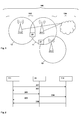
- a mobile communication network 100 is schematically shown, the mobile communication network 100 comprising an access network 110 and a core network 120.
- the mobile communication network 100 is preferably a cellular telecommunications network comprising typically a plurality of network cells (or radio cells), wherein three network cells (or radio cells) are represented in Figure 1 by means of reference signs 11, 12 and 13.
- the mobile communication network 100 typically comprises a plurality of user equipments or telecommunication devices.
- the plurality of user equipments or of telecommunication devices are referred to by means of reference signs 20, 21, wherein reference sign 20 refers to a user equipment (also called first user equipment or first telecommunication device), and reference sign 21 refers to a further user equipment (also called second user equipment or second telecommunication device).
- the access network 110 of the mobile communication network 100 comprises, in the exemplary representation of Figure 1 , a first base station entity 111, serving the (first) radio cell 11. Furthermore, a second base station entity 112, serving the neighbor (second) radio cell 12, is schematically shown. Additionally, a third base station entity 113, serving a further neighbor radio cell 13, is schematically shown.
- the base station entities 111, 112, 113 are typically base stations, base transceiver stations or base station entities, e.g. a NodeB or an eNodeB base transceiver stations.
- base station entities 111, 112 and 113 are not time-synchronized but run an independent timing from each other.
- Methods typically comprise GPS based methods or backhaul based methods (e.g. IEEE1588 standard).
- the timing difference between a handover execution at a source base transceiver station (of a handover procedure), e.g. at the first base station entity 111, and the arrival time at the target base transceiver station, e.g. at the second base station entity 112, is transmitted to the serving base station entity (i.e. the first base station entity 111) such that the serving base station entity 111 (or original source eNB) also receives an information (e.g.
- the target eNB such as the second base station entity 112
- the target eNB such as the second base station entity 112
- the source base transceiver station 111 can calculate the timing difference and adjust its own transmission timing in a way that the overall system timing is synchronised.
- a synchronized mobile communication network (or radio network) is that the timing between the involved eNBs (or base station entities 111, 112, 113) is not necessarily precise over a longer time. The timing of each individual node drifts away due to the limited precision of used components like oscillators or the like. Therefore, a periodical re-assessment (and re-adjustment) of the timing and a resulting adjustment is required in order to keep the radio access system (access network 110) operating in a synchronized manner.
- each of the plurality of base station entities 111, 112, 113 comprises a local clock functionality providing a local timing reference for the respective base station entity.
- the local time bases of the base station entities 111, 112, 113 typically deviate (or drift) in time if there is no synchronization procedure applied, i.e. in reality, the timing of the individual radio cells (i.e. the timing (or local timing reference) of the respective base station entity 111, 112, 113 is not aligned and thus the mobile communication network 100 is not synchronous, potentially leading a reduced level of functionality of the mobile communication network 100.
- the first base station entity 111 In order for (e.g.) the first base station entity 111 to get or maintain a sufficient level of synchronization with the neighboring base station entities 112, 113, the first base station entity 111 needs an indication about the timing reference of the other base station entities, i.e. the second base station 112 entity and/or the third base station entity 113.
- the first base station entity 111 triggers a handover procedure that the user equipment 20 is required to conduct from the first base station entity to the second base station entity, wherein the first base station entity 111 is assumed to be the serving base station entity 111 of the user equipment 20 and wherein the second base station entity 112 is assumed to be a reachable target base station entity for the user equipment 20. It is assured that the second base station entity 112 is a reachable potential target base station entity for the user equipment 20 due to the user equipment 20 transmitting corresponding information (e.g. the neighbor cell list, etc.) to the serving (i.e. the first) base station entity 111 according to the standard communication between the serving base station entity 111 and the user equipment 20.
- corresponding information e.g. the neighbor cell list, etc.
- a timing information is transmitted from the second base station entity 112 - via the user equipment 20 - to the first base station entity 111.
- the timing information is indicative of the local timing reference of the second base station entity 112 (i.e. typically obtained by the internal clock of the second base station entity 112 and/or obtained by other means, e.g. a GPS reception capability of the second base station entity 112).
- the timing information is used by the first base station entity 111 to adjust the local timing reference of the first base station entity 111.
- adjusting especially also means verifying the local timing reference of the first base station entity 111, e.g. detecting whether the local timing reference differs sufficiently from timing reference of the second base station entity 112. If this is the case, an adaption of the local timing reference of the first base station entity 111 takes place.
- the first base station entity 111 is allowed to trigger a handover procedure with respect to the first user equipment 20 (such as a commercial terminal equipment) at any point in time, preferably to a defined known and preselected target radio node such as the second base station entity 112 (and/or the third base station entity 113).
- a re-synchronisation is performed between a plurality of base transceiver stations (or base station entities 111, 112, 113) by involving user equipments 20, 21 (or terminal devices), but not solely relying on handovers (or handover events) which occur for mobility or load balancing reasons, but which are executed especially (or exclusively) for the purpose of re-synchronizing the mobile radio access network.
- the handover procedures are executed using terminal equipments (user equipments 20, 21) that are not moving and connected to a permanent power supply. This increases the accuracy of the timing estimation and does not involve a negative impact to the customers resulting in decrease battery power.
- the two radio nodes between those a handover procedure for time synchronization should be performed are very different in receptions quality or at least only different to a defined max. reception level difference (difference threshold value).
- the handover procedure for time synchronization is used in situations such that the involved terminal device (or user equipments 20, 21) is not in a current data session in order to not impact any ongoing service for the user.
- the user equipment or user equipments 20, 21 are used to re-sync the first base station entity 111 (i.e. serving the user equipment(s) 20, 21), and hence the mobile radio network.
- a procedure is triggered towards the user equipment 20 which is as such equipped with means to generate precise timing information (e.g.
- the user equipment 20 is used to transmit such a precise timing information towards the (serving) first base station entity 111 (e.g. as an answer to a message enquiry from the first base station entity 111.
- the user equipment 20 or terminal equipment
- the Rx-to-Tx time difference (as defined for UMTS in [3GPP TS 25.331]) can be used as corrective parameter.
- the first base station entity 111 is considered the currently serving eNB (i.e. the base station entity) and it triggers a handover procedure toward the user equipment 20 (or terminal device) at a given point in time although there is no need from the point of view of the radio conditions to perform a handover of the user equipment 20 towards the second base station entity 112 (i.e. the neighboring eNB).
- the second base station entity 112 i.e. the neighboring eNB
- the serving base station entity 111 might inquire at the potential target base station entity (second base station entity 112) whether a handover procedure can be triggered (first and second message 201, 202 requesting and acknowledging this).
- the user equipment 20 Upon a positive answer by the second base station entity 112 (by means of the second message 202), by means of a third message 203, the user equipment 20 is triggered to perform the handover procedure towards the second base station entity 112.
- the handover procedure is performed and the timing information transmitted to the first base station entity 111.
- a sixth message from the second base station entity 112 to the first base station entity 111, additional pieces of information are transmitted to the first base station entity 111.
Landscapes
- Engineering & Computer Science (AREA)
- Computer Networks & Wireless Communication (AREA)
- Signal Processing (AREA)
- Mobile Radio Communication Systems (AREA)
Abstract
-- in a first step, the first base station entity is the serving base station entity for the user equipment and requests the user equipment to execute a handover towards the second base station entity,
-- in a second step, during the handover procedure of the user equipment towards the second base station entity, a timing information is transmitted from the second base station entity - via the user equipment - to the first base station entity, the timing information being indicative of the local timing reference of the second base station entity,
-- in a third step, subsequent to the second step, the timing information is used by the first base station entity to adjust the local timing reference of the first base station entity.
Description
- The present invention relates to a method for radio network synchronization of a mobile communication network, wherein the mobile communication network comprises a plurality of base station entities and at least one user equipment connected to the mobile communication network, wherein each of the plurality of base station entities comprises a local clock functionality providing a local timing reference for the respective base station entity.
- Furthermore, the present invention relates to a mobile communication network for radio network synchronization of a mobile communication network, wherein the mobile communication network comprises a plurality of base station entities and at least one user equipment connected to the mobile communication network, wherein each of the plurality of base station entities comprises a local clock functionality providing a local timing reference for the respective base station entity
- Additionally, the present invention relates to a base station entity adapted to be used in connection with such a mobile communication network.
- Furthermore, the present invention relates to a program and to a computer program product for radio network synchronization of a mobile communication network.
- The problem of synchronization of network nodes or base station entities in a mobile communication network relates to the question of how radio access nodes (or base station entities) can be efficiently synchronized against each other in order to use radio resources in a more efficient way. In principle, this applies to all radio access technologies. Some modes of the LTE technology require an especially tight network synchronization in order to operate efficiently: The TDD (Time Division Multiplex) mode of operation is such an example where the timing, or at least the timing difference between two nodes (or base station entities) needs to be ensured (in an accurate manner) in order to allow the user equipment to use a defined timing for its operation.
- Multiple methods of adjusting time drift between different radio nodes (or base station entities) are known today.
- These methods include GNSS (Global Navigation Satellite System) based methods where the synchronization is performed to an external reference, normally provided by the GNSS system clock (such as a GPS system clock). This method requires the base station entities to be equipped, respectively, with suitable receivers (e.g. GPS receivers), which are, on the one hand, costly to purchase and install and, on the other hand, only (or mainly) usable outdoors.
- As the network nodes not only of a mobile communication network but of computer networks in general need to be tightly synchronized in order to be able to properly work, a number of methods to realize the synchronization of network nodes have been proposed: E.g. the Network Time Protocol or the Precision Time Protocol.
- The Network Time Protocol (NTP) is a networking protocol for clock synchronization between network nodes of a computer systems over packet-switched, variable-latency data networks and is intended to synchronize all participating computers to within a few milliseconds of a given time base. For synchronization purposes between the network nodes of a mobile communication network, this accuracy of a few millisecons is not sufficient.
- The Precision Time Protocol (PTP) - also known as IEEE 1588 - is a protocol used to synchronize clocks of connected network nodes of a computer system such as the base station entities of a mobile communication network. Using the Precision Time Protocol, it is possible to attain accuracies beyond those attainable using NTP or for applications without access to a GPS (Global Positioning System) signal.
- However, using the Precision Time Protocol requires using - within each network node of the mobile communication network that needs the precise time base, i.e. within each base station entity - a precision clock, hence a comparably expensive hardware component (being able to maintain a certain timing reference with a certain accuracy).
- When using the PTP for mobile communication networks to adjust time drifts between base station entities, a reference timing from a server is used to convey this timing information via the backhaul to the respective radio nodes. However, the advent of small cells - also for usage indoors - places new requirements on the synchronization methods as GPS does normally not work indoors or is simply too costly and the PTP (or IEEE1588) might not always be available over the low tier backhaul connections some (indoor) small cells are connected to.
- An object of the present invention is to provide a technically simple, effective and especially cost effective solution for radio network synchronization of a mobile communication network such that, on the one hand, it is guaranteed that the timing reference used by each network node of the mobile communication network is sufficiently correct and stable, and that, on the other hand, this can be achieved using comparably inexpensive hardware components. The aim of the present invention therefore is to provide for the possibility of a serving base station entity to execute a handover procedure at a time when the synchronization procedure should be triggered and on the other hand increase the accuracy of timing drift information by increasing the number of handover procedures between a defined peer set of radio nodes.
- The object of the present invention is achieved by a method for radio network synchronization of a mobile communication network, wherein the mobile communication network comprises a plurality of base station entities and at least one user equipment connected to the mobile communication network, wherein each of the plurality of base station entities comprises a local clock functionality providing a local timing reference for the respective base station entity, wherein in order for a first base station entity among the plurality of base station entities to obtain an indication about the timing reference of a second base station entity among the plurality of base station entities, a handover procedure is triggered - by the first base station entity and for the user equipment - from the first base station entity to the second base station entity, wherein the method comprises the followings steps:
- -- in a first step, the first base station entity is the serving base station entity for the user equipment and requests the user equipment to execute a handover towards the second base station entity,
- -- in a second step, during the handover procedure of the user equipment towards the second base station entity, a timing information is transmitted from the second base station entity - via the user equipment - to the first base station entity, the timing information being indicative of the local timing reference of the second base station entity,
- -- in a third step, subsequent to the second step, the timing information is used by the first base station entity to adjust the local timing reference of the first base station entity.
- It is thereby advantageously possible according to the present invention that the first base station entity is able to review its time base (i.e. the local timing reference) based on the timing information received from the user equipment, wherein this timing information depends on the time base (or the local timing reference) of the second base station entity. Thereby, a timing adjustment or synchronization is able to be performed among the first and second base station entity. Hence, the present invention addresses a method allowing to synchronize at least two radio nodes (or base station entities) of a public land mobile network (PLMN) by means of a predictable forced inter-node handover procedure. The method according to the present invention allows a radio access network (RAN) to perform a synchronization procedure (in order to provide for a time synchronization between network nodes, i.e. base station entities of the mobile communication network) by forcing at least one commercial terminal equipment (or user equipment) to perform a handover procedure at a defined time. Preferably it is also possible to predefine the handover target (i.e. the target base station entity of the handover procedure) as part of that procedure.
- The method according to the present invention is based on terminal based synchronization procedures which allow - e.g. for LTE technology (Long Term Evolution) as radio access technology for fourth generation mobile communication networks, but also for other radio access technologies such as GSM (Global System for Mobile communication used in second generation mobile communication networks) or UMTS (Universal Mobile Telecommunication System used in third generation mobile communication networks) - to use a generic handover procedure to get knowledge of the timing drift between the base station entities (e.g. eNodeBs in the case of LTE technology) involved in the handover procedure, i.e. there is no specific "synchronization procedure" newly defined (i.e. for synchronization purposes only), but the generic handover procedure (that is defined anyway in the context of the respective radio access technology) is used for synchronization purposes, i.e. in other situations than it would normally be used.
- The main advantage of the method and/or the mobile communication network and/or base station entity according to the present invention compared to current methods and/or systems is that any (serving) base station entity having implemented the inventive method (or any mobile communication network being provided such that at least part of the involved base station entities have implemented the inventive method or are working according to the inventive method) is able - in order to obtain timing information for synchronization purposes - to trigger handover procedures
- -- at a suitable point in time (i.e. at a time when synchronization is required for the serving base station entity)
- -- related to suitable normal user equipments (i.e. commercial user equipments), and
- -- towards suitable target base station entities.
- According to the present invention, the mobile communication network comprises a plurality of base station entities, and each of the plurality of base station entities comprises a local clock functionality providing a local timing reference for the respective base station entity. It is supposed that a user equipment is connected to the mobile communication network via a first base station entity, i.e. the first base station entity is the serving base station entity for the user equipment. In order for the first (or serving) base station entity to obtain an indication about the timing reference of a second base station entity (especially a neighboring base station entity), a handover procedure is triggered - by the first (or serving) base station entity and for the user equipment - from the first base station entity to the second base station entity: In a first step, the user equipment is requested to execute a handover towards the second base station entity. In a second step (during this handover procedure), a timing information is transmitted from the second base station entity - via the user equipment - to the first (or serving) base station entity, the timing information being indicative of the local timing reference of the second base station entity. In a third step, subsequent to the second step, the timing information is used by the first (or serving) base station entity to adjust the local timing reference of the first base station entity.
- Thereby, it is advantageously possible that the synchronization of the (serving) base station entity (and hence the overall level or synchronization within the mobile communication network) can be enhanced.
- According to a preferred embodiment of the present invention, the mobile communication network comprises a third base station entity among the plurality of base station entities, wherein in order for the first base station entity to obtain an indication about the timing reference of the third base station entity, a further handover procedure is triggered - by the first base station entity and for either the user equipment or a further user equipment - from the first base station entity to the third base station entity, wherein during the further handover procedure of the user equipment or the further user equipment towards the third base station entity, a further timing information is transmitted from the third base station entity - via the user equipment or the further user equipment - to the first base station entity, the further timing information being indicative of the local timing reference of the third base station entity, wherein the further timing information is used by the first base station entity to adjust the local timing reference of the first base station entity.
- Thereby, it is advantageously possible that - in addition to the timing information obtained by the first (i.e. serving) base station entity from the second base station entity - the first (or serving) base station entity is able to obtain the further timing information obtained from the third base station entity. Hence, it is advantageously possible according to the present invention that the local timing reference of the first (or serving) base station entity can be adjusted not only based on the timing information (of the second base station entity) but also based on the further timing information (of the third base station entity). Thereby, it is advantageously possible to adjust the local timing reference of the first base station entity - at least potentially - in a more accurate manner and/or in a manner such that the overall functionality of the mobile communication network is enhanced. Of course, it is also possible and preferred according to the present invention that - in addition to obtaining the timing information from the second base station entity and the further timing information from the third base station entity - additional timing information are obtained, by the first (or serving) base station entity, from further base station entities (i.e. a fourth base station entity and/or a fifth base station entity and/or a sixth base station entity); however for the sake of simplicity, the possibility of having additional base station entity . According to the present invention, all these target base station entities (i.e. the second base station entity, the third base station entity and/or the further (or additional) base station entities) are necessarily neighboring or adjacent base station entities with respect to the first (or serving) base station entity. The further handover procedure (towards the third base station entity as target base station entity) typically either refers to the same user equipment that also conducted (or is or was involved in) the handover procedure (towards the second base station entity as target base station entity), or to another user equipment (i.e. the further user equipment). In case that different user equipments are used for the different handover procedure, it is advantageously possible to conduct or to trigger the handover procedures almost in parallel (i.e. timely at least partially overlapping) which results in obtaining the timing information (from the second base station entity) and the further timing information (from the third base station entity) almost at the same time which could be advantageous in view of accurately adjusting the local timing reference of the first base station entity.
- According to the present invention it is furthermore preferred that
- -- the handover procedure is triggered even though the radio reception conditions that the user equipment detects of the first base station entity and of the second base station entity are superior to a first radio reception level indicative of the radio reception conditions and/or
- -- the further handover procedure is triggered even though the radio reception conditions that the user equipment or the further user equipment detects of the first base station entity and of the third base station entity are superior to a first radio reception level indicative of the radio reception conditions,
- It is thereby advantageously possible that the handover procedure and/or the further handover procedure is or are conducted in a situation of comparably good radio reception conditions, i.e. the signal level of the reception signals, at the first (or serving) base station entity, is comparably high such that data, and hence also the timing information (and/or the further timing information) can be transmitted reliably using the user equipment and/or the further user equipment. This means that the handover procedure (and/or the further handover procedure) is triggered despite the fact that the radio reception conditions seen by the user equipment (or the further user equipment) of, on the one hand, the first base station entity, and, on the other hand, the second base station entity and/or the third base station entity) the first base station entity and of the third base station entity are superior to a first radio reception level indicative of the radio reception conditions, i.e. despite the fact that the radio reception conditions (seen by the user equipment (or the further user equipment) with respect to the first and second and/or first and third base station entity) are comparatively good. Especially, these radio conditions are better than radio reception conditions (second radio reception level) that would normally trigger the respective user equipment to request a handover. Preferably, it is even required that the radio reception conditions are superior to a predefined radio reception level (first radio reception level) that is considerably "higher" (i.e. that corresponds to better radio reception conditions) than compared with the second radio reception level.
- According to the present invention it is preferred that the handover procedure is triggered only in case that the difference between, on the one hand, the radio reception conditions that the user equipment detects of the first base station entity, and, on the other hand, the radio reception conditions that the user equipment detects of the second base station entity is inferior to a difference threshold value and/or wherein the further handover procedure is triggered only in case that the difference between, on the one hand, the radio reception conditions that the user equipment or the further user equipment detects of the first base station entity, and, on the other hand, the radio reception conditions that the user equipment or the further user equipment detects of the third base station entity is inferior to a difference threshold value.
- It is thereby advantageously possible that the handover procedure and/or the further handover procedure is or are conducted in a situation of comparably equal radio reception conditions of the source base station entity and of the target base station entity (i.e. - for the handover procedure - relating to the radio reception conditions seen by the user equipment of the first (serving) base station entity and the second (target) base station entity and/or - for the further handover procedure - relating to the radio reception conditions seen by the user equipment (and/or the further user equipment) of, on the one hand, the first base station entity (as serving base station entity) and, on the other hand, the second base station entity and/or the third base station entity (as target base station entity), such that data, and hence also the timing information (and/or the further timing information) can be transmitted reliably using the user equipment and/or the further user equipment.
- According to a preferred embodiment of the present invention, the handover procedure is triggered only in case that the user equipment is detected, by the first base station entity, as being stationary or quasi-stationary and/or wherein the further handover procedure is triggered only in case that the user equipment and/or the further user equipment is detected, by the first base station entity, as being stationary or quasi-stationary.
- Thereby, it is advantageously possible that the quality of the timing information (and/or the further timing information) is not reduced due to a movement (or at least a comparably fast movement) of the user equipment and/or of the further user equipment. In this respect, quality of the timing information and/or of the further timing information refers to the fact that in case of a movement of the user equipment and/or of the further user equipment different radio signal propagation conditions will probably apply dependent on the current location of the user equipment and/or of the further user equipment that will be reflected by the content of the timing information and/or the further timing information, i.e. at a further point in time (in a situation that the user equipment and/or the further user equipment has changed its location), the corresponding pieces of timing information might be less comparable due to the variation of the location of the user equipment and/or of the further user equipment than without such a variation of the location of the user equipment and/or of the further user equipment.
- According to a further preferred embodiment of the present invention, the first base station entity receives a power supply information from the user equipment, the power supply information indicating that the user equipment is in a mains supply powered state, wherein the handover procedure is triggered only in case that the user equipment indicates a mains supply powered state and/or wherein the first base station entity receives a further power supply information from the further user equipment, indicating that the further user equipment is in a mains supply powered state, wherein the further handover procedure is triggered only in case that the user equipment indicates a mains supply powered state.
- Thereby, it is advantageously possible that the inventive method does not have any negative consequences on the user equipment and/or on the further user equipment, e.g. due to increased power consumption due to the execution of such additional handover procedures performed merely for synchronization purposes and not triggered by mobility requirements of the respective user equipment.
- According to a further preferred embodiment of the present invention, the handover procedure is triggered only in case that the user equipment was originally in IDLE or is in CONNECTED mode in a dormant state where no data transfer is currently active and/or wherein the further handover procedure is triggered only in case that the user equipment and/or the further user equipment was originally in IDLE or in CONNECTED mode in a dormant state where no data transfer is currently active.
- Thereby, it is advantageously possible that the inventive method does not have any negative consequences on the performance or the service level provided to a user of the user equipment and/or on the further user equipment, e.g. due to any interruptions of data connections and/or reductions of available transmission bandwidths due to the execution of such additional handover procedures performed merely for synchronization purposes and not triggered by the respective user equipment.
- According to a further preferred embodiment of the present invention, the handover procedure and/or the further handover procedure are executed only for the purpose of network synchronization between the first base station entity and the second base station entity and/or between the first base station entity and the third base station entity.
- Thereby, it is advantageously possible that a better timing reference is available at the first base station entity and hence a better network synchronization of the mobile communication network.
- According to still a further embodiment of the present invention, in case that the user equipment and/or the further user equipment is able to receive signals of a global navigation satellite system (GNSS), and deduce a timing reference from the global navigation satellite system, the timing reference from the global navigation satellite system is transmitted to the first base station entity.
- Thereby it is advantageously possible according to the present invention to additionally enhance the quality of the timing information provided to the first base station entity.
- Furthermore, the present invention relates to a mobile communication network for radio network synchronization of the mobile communication network, wherein the mobile communication network comprises a plurality of base station entities and at least one user equipment connected to the mobile communication network, wherein each of the plurality of base station entities comprises a local clock functionality providing a local timing reference for the respective base station entity, wherein in order for a first base station entity among the plurality of base station entities to obtain an indication about the timing reference of a second base station entity among the plurality of base station entities, a handover procedure is triggered - by the first base station entity and for the user equipment - from the first base station entity to the second base station entity, wherein the mobile communication network is configured such that:
- -- the first base station entity is the serving base station entity for the user equipment and requests the user equipment to execute a handover towards the second base station entity,
- -- during the handover procedure of the user equipment towards the second base station entity, a timing information is transmitted from the second base station entity - via the user equipment - to the first base station entity, the timing information being indicative of the local timing reference of the second base station entity,
- -- the timing information is used by the first base station entity to adjust the local timing reference of the first base station entity.
- Thereby, it is advantageously possible to provide a mobile communication network such that the first base station entity is able to review its time base (i.e. the local timing reference) based on the timing information received from the user equipment, wherein this timing information depends on the time base (or the local timing reference) of the second base station entity.
- According to a further preferred embodiment of the present invention - especially with respect to the inventive mobile communication network -, the mobile communication network comprises a third base station entity among the plurality of base station entities, wherein in order for the first base station entity to obtain an indication about the timing reference of the third base station entity, a further handover procedure is triggered - by the first base station entity and for either the user equipment or a further user equipment - from the first base station entity to the third base station entity, wherein the mobile communication network is configured such that during the further handover procedure of the user equipment or the further user equipment towards the third base station entity, a further timing information is transmitted from the third base station entity - via the user equipment or the further user equipment - to the first base station entity, the further timing information being indicative of the local timing reference of the third base station entity, wherein the further timing information is used by the first base station entity to adjust the local timing reference of the first base station entity.
- Thereby, it is advantageously possible according to the present invention that - in addition to the timing information obtained by the first (i.e. serving) base station entity from the second base station entity - the first (or serving) base station entity is able to obtain the further timing information obtained from the third base station entity.
- Furthermore, the present invention relates to a base station entity for radio network synchronization of a mobile communication network, wherein the mobile communication network comprises a plurality of base station entities and at least one user equipment connected to the mobile communication network, wherein each of the plurality of base station entities comprises a local clock functionality providing a local timing reference for the respective base station entity, wherein in order for the base station entity among the plurality of base station entities to obtain an indication about the timing reference of a second base station entity among the plurality of base station entities, a handover procedure is triggered - by the first base station entity and for the user equipment - from the first base station entity to the second base station entity, wherein the base station entity is configured such that:
- -- the base station entity is the serving base station entity for the user equipment and requests the user equipment to execute a handover towards the second base station entity,
- -- during the handover procedure of the user equipment towards the second base station entity, a timing information is transmitted from the second base station entity - via the user equipment - to the base station entity, the timing information being indicative of the local timing reference of the second base station entity,
- -- the timing information is used by the base station entity to adjust the local timing reference of the base station entity.
- Additionally, the present invention relates to a program comprising a computer readable program code which, when executed on a computer and/or on a base station entity or on a plurality of base station entities of a mobile communication network and/or on a user equipment, or in part on a base station entity or in part on a plurality of base station entities of a mobile communication network and/or in part on a user equipment, causes the computer and/or base station entity and/or the plurality of base station entities and/or user equipment to perform the inventive method.
- Still additionally, the present invention relates to a computer program product for radio network synchronization of a mobile communication network, the computer program product comprising a computer program stored on a storage medium, the computer program comprising program code which, when executed on a computer and/or on a base station entity or on a plurality of base station entities of a mobile communication network and/or on a user equipment, or in part on a base station entity or in part on a plurality of base station entities of a mobile communication network and/or in part on a user equipment, causes the computer and/or base station entity and/or the plurality of base station entities and/or user equipment to perform the inventive method.
- These and other characteristics, features and advantages of the present invention will become apparent from the following detailed description, taken in conjunction with the accompanying drawings, which illustrate, by way of example, the principles of the invention. The description is given for the sake of example only, without limiting the scope of the invention. The reference figures quoted below refer to the attached drawings.
-
-
Figure 1 schematically illustrate a mobile communication network having a plurality of base station entities and a plurality of telecommunication devices (user equipments). -
Figure 2 schematically illustrates the exchange of information between the first base station entity, the user equipment, and the second base station entity. - The present invention will be described with respect to particular embodiments and with reference to certain drawings but the invention is not limited thereto but only by the claims. The drawings described are only schematic and are non-limiting. In the drawings, the size of some of the elements may be exaggerated and not drawn on scale for illustrative purposes.
- Where an indefinite or definite article is used when referring to a singular noun, e.g. "a", "an", "the", this includes a plural of that noun unless something else is specifically stated.
- Furthermore, the terms first, second, third and the like in the description and in the claims are used for distinguishing between similar elements and not necessarily for describing a sequential or chronological order. It is to be understood that the terms so used are interchangeable under appropriate circumstances and that the embodiments of the invention described herein are capable of operation in other sequences than described or illustrated herein.
- In
Figure 1 , amobile communication network 100, especially a public landmobile network 100, is schematically shown, themobile communication network 100 comprising anaccess network 110 and acore network 120. Themobile communication network 100 is preferably a cellular telecommunications network comprising typically a plurality of network cells (or radio cells), wherein three network cells (or radio cells) are represented inFigure 1 by means ofreference signs mobile communication network 100 typically comprises a plurality of user equipments or telecommunication devices. The plurality of user equipments or of telecommunication devices are referred to by means ofreference signs reference sign 20 refers to a user equipment (also called first user equipment or first telecommunication device), andreference sign 21 refers to a further user equipment (also called second user equipment or second telecommunication device). Theaccess network 110 of themobile communication network 100 comprises, in the exemplary representation ofFigure 1 , a firstbase station entity 111, serving the (first)radio cell 11. Furthermore, a secondbase station entity 112, serving the neighbor (second)radio cell 12, is schematically shown. Additionally, a thirdbase station entity 113, serving a furtherneighbor radio cell 13, is schematically shown. Thebase station entities - Typically
base station entities - It is already known that the timing difference between a handover execution at a source base transceiver station (of a handover procedure), e.g. at the first
base station entity 111, and the arrival time at the target base transceiver station, e.g. at the secondbase station entity 112, is transmitted to the serving base station entity (i.e. the first base station entity 111) such that the serving base station entity 111 (or original source eNB) also receives an information (e.g. an access signal) from theuser equipment 20 being handed over to the target eNB, such as the second base station entity 112), and is, hence, able to calculate the relative timing information between the handover command issued (corresponding to the timing (or timing reference) of the source base transceiver station 111) and the time (or timing reference) of the initial access of the user equipment (or terminal device) 20 to the second base station entity 112 (or second base transceiver station 112). If the secondbase transceiver station 112 indicates its own timing back to the (serving) sourcebase transceiver station 111, e.g. by using the X2 interface of LTE technology, the sourcebase transceiver station 111 can calculate the timing difference and adjust its own transmission timing in a way that the overall system timing is synchronised. - Another characteristic of a synchronized mobile communication network (or radio network) is that the timing between the involved eNBs (or
base station entities - Hence, each of the plurality of
base station entities base station entities base station entity mobile communication network 100 is not synchronous, potentially leading a reduced level of functionality of themobile communication network 100. - In order for (e.g.) the first
base station entity 111 to get or maintain a sufficient level of synchronization with the neighboringbase station entities base station entity 111 needs an indication about the timing reference of the other base station entities, i.e. thesecond base station 112 entity and/or the thirdbase station entity 113. - According to the present invention, it is proposed - in order to provide this indication about the timing reference of the other base station entities to the first base station entity 111 - that the first
base station entity 111 triggers a handover procedure that theuser equipment 20 is required to conduct from the first base station entity to the second base station entity, wherein the firstbase station entity 111 is assumed to be the servingbase station entity 111 of theuser equipment 20 and wherein the secondbase station entity 112 is assumed to be a reachable target base station entity for theuser equipment 20. It is assured that the secondbase station entity 112 is a reachable potential target base station entity for theuser equipment 20 due to theuser equipment 20 transmitting corresponding information (e.g. the neighbor cell list, etc.) to the serving (i.e. the first)base station entity 111 according to the standard communication between the servingbase station entity 111 and theuser equipment 20. - In the course of the handover procedure triggered by the first (serving)
base station entity 111, a timing information is transmitted from the second base station entity 112 - via the user equipment 20 - to the firstbase station entity 111. The timing information is indicative of the local timing reference of the second base station entity 112 (i.e. typically obtained by the internal clock of the secondbase station entity 112 and/or obtained by other means, e.g. a GPS reception capability of the second base station entity 112). Subsequently, the timing information is used by the firstbase station entity 111 to adjust the local timing reference of the firstbase station entity 111. - In the context of the present invention, adjusting especially also means verifying the local timing reference of the first
base station entity 111, e.g. detecting whether the local timing reference differs sufficiently from timing reference of the secondbase station entity 112. If this is the case, an adaption of the local timing reference of the firstbase station entity 111 takes place. - According to the present invention, the first
base station entity 111 is allowed to trigger a handover procedure with respect to the first user equipment 20 (such as a commercial terminal equipment) at any point in time, preferably to a defined known and preselected target radio node such as the second base station entity 112 (and/or the third base station entity 113). - According to the present invention, it is proposed that a re-synchronisation is performed between a plurality of base transceiver stations (or
base station entities user equipments 20, 21 (or terminal devices), but not solely relying on handovers (or handover events) which occur for mobility or load balancing reasons, but which are executed especially (or exclusively) for the purpose of re-synchronizing the mobile radio access network. - Preferably, the handover procedures are executed using terminal equipments (
user equipments 20, 21) that are not moving and connected to a permanent power supply. This increases the accuracy of the timing estimation and does not involve a negative impact to the customers resulting in decrease battery power. - Furthermore preferably, the two radio nodes between those a handover procedure for time synchronization should be performed are very different in receptions quality or at least only different to a defined max. reception level difference (difference threshold value).
- Even further preferably, the handover procedure for time synchronization is used in situations such that the involved terminal device (or
user equipments 20, 21) is not in a current data session in order to not impact any ongoing service for the user. - Additionally, it is proposed according to the method according to the present invention that, additionally to obtaining the timing information from the second base station entity 112 (and/or to obtaining the further timing information from the third base station entity 113), the user equipment or
user equipments 20, 21 (i.e. the terminals) are used to re-sync the first base station entity 111 (i.e. serving the user equipment(s) 20, 21), and hence the mobile radio network. According to this alternative embodiment of the present invention, a procedure is triggered towards theuser equipment 20 which is as such equipped with means to generate precise timing information (e.g. equipped with GPS capabilities or other Global Navigation Satellite System (GNSS) capabilities) such that theuser equipment 20 is used to transmit such a precise timing information towards the (serving) first base station entity 111 (e.g. as an answer to a message enquiry from the firstbase station entity 111. In such an embodiment, the user equipment 20 (or terminal equipment), for example, could receive a GPS timing signal and play this back to the asking base transceiver station, the base transceiver station can poll another terminal device also supporting GPS and thus would get two time information which can be used to synchronise its components towards a single information source. For such a procedure, the Rx-to-Tx time difference (as defined for UMTS in [3GPP TS 25.331]) can be used as corrective parameter. - In
Figure 2 , the exchange of information between the firstbase station entity 111, theuser equipment 20, and the secondbase station entity 112 is schematically illustrated. The firstbase station entity 111 is considered the currently serving eNB (i.e. the base station entity) and it triggers a handover procedure toward the user equipment 20 (or terminal device) at a given point in time although there is no need from the point of view of the radio conditions to perform a handover of theuser equipment 20 towards the second base station entity 112 (i.e. the neighboring eNB). - Initially, the serving
base station entity 111 might inquire at the potential target base station entity (second base station entity 112) whether a handover procedure can be triggered (first andsecond message - Upon a positive answer by the second base station entity 112 (by means of the second message 202), by means of a
third message 203, theuser equipment 20 is triggered to perform the handover procedure towards the secondbase station entity 112. By means of afourth message 204 and afifth message 205, the handover procedure is performed and the timing information transmitted to the firstbase station entity 111. By means of a sixth message from the secondbase station entity 112 to the firstbase station entity 111, additional pieces of information are transmitted to the firstbase station entity 111.
Claims (14)
- Method for radio network synchronization of a mobile communication network (100), wherein the mobile communication network (100) comprises a plurality of base station entities (111, 112, 113) and at least one user equipment (20) connected to the mobile communication network (100), wherein each of the plurality of base station entities (111, 112, 113) comprises a local clock functionality providing a local timing reference for the respective base station entity, wherein in order for a first base station entity (111) among the plurality of base station entities (111, 112, 113) to obtain an indication about the timing reference of a second base station entity (112) among the plurality of base station entities (111, 112, 113), a handover procedure is triggered - by the first base station entity (111) and for the user equipment (20) - from the first base station entity (111) to the second base station entity (112), wherein the method comprises the followings steps:-- in a first step, the first base station entity (111) is the serving base station entity for the user equipment (20) and requests the user equipment (20) to execute a handover towards the second base station entity (112),-- in a second step, during the handover procedure of the user equipment (20) towards the second base station entity (112), a timing information is transmitted from the second base station entity (112) - via the user equipment (20) - to the first base station entity (111), the timing information being indicative of the local timing reference of the second base station entity (112),-- in a third step, subsequent to the second step, the timing information is used by the first base station entity (111) to adjust the local timing reference of the first base station entity (111).
- Method according to claim 1, wherein the mobile communication network (110) comprises a third base station entity (113) among the plurality of base station entities (111, 112, 113), wherein in order for the first base station entity (111) to obtain an indication about the timing reference of the third base station entity (113), a further handover procedure is triggered - by the first base station entity (111) and for either the user equipment (20) or a further user equipment (21) - from the first base station entity (111) to the third base station entity (113), wherein during the further handover procedure of the user equipment (20) or the further user equipment (21) towards the third base station entity (113), a further timing information is transmitted from the third base station entity (113) - via the user equipment (20) or the further user equipment (21) - to the first base station entity (111), the further timing information being indicative of the local timing reference of the third base station entity (113), wherein the further timing information is used by the first base station entity (111) to adjust the local timing reference of the first base station entity (111).
- Method according to one of the preceding claims, wherein-- the handover procedure is triggered even though the radio reception conditions that the user equipment (20) detects of the first base station entity (111) and of the second base station entity (112) are superior to a first radio reception level indicative of the radio reception conditions and/or-- the further handover procedure is triggered even though the radio reception conditions that the user equipment (20) or the further user equipment (21) detects of the first base station entity (111) and of the third base station entity (113) are superior to a first radio reception level indicative of the radio reception conditions, wherein the first radio reception level is superior to a second radio reception level indicative of the radio reception conditions, wherein a mobility related handover is triggered in case that radio reception conditions of the user equipment (20) are detected that are inferior to the second radio reception level.
- Method according to one of the preceding claims, wherein the handover procedure is triggered only in case that the difference between, on the one hand, the radio reception conditions that the user equipment (20) detects of the first base station entity (111), and, on the other hand, the radio reception conditions that the user equipment (20) detects of the second base station entity (112) is inferior to a difference threshold value and/or wherein the further handover procedure is triggered only in case that the difference between, on the one hand, the radio reception conditions that the user equipment (20) or the further user equipment (21) detects of the first base station entity (111), and, on the other hand, the radio reception conditions that the user equipment (20) or the further user equipment (21) detects of the third base station entity (113) is inferior to a difference threshold value.
- Method according to one of the preceding claims, wherein the handover procedure is triggered only in case that the user equipment (20) is detected, by the first base station entity (111), as being stationary or quasi-stationary and/or wherein the further handover procedure is triggered only in case that the user equipment (20) and/or the further user equipment (21) is detected, by the first base station entity (111), as being stationary or quasi-stationary.
- Method according to one of the preceding claims, wherein the first base station entity (111) receives a power supply information from the user equipment (20), the power supply information indicating that the user equipment (20) is in a mains supply powered state, wherein the handover procedure is triggered only in case that the user equipment (20) indicates a mains supply powered state and/or wherein the first base station entity (111) receives a further power supply information from the further user equipment (21), indicating that the further user equipment (21) is in a mains supply powered state, wherein the further handover procedure is triggered only in case that the user equipment (20) indicates a mains supply powered state.
- Method according to one of the preceding claims, wherein the handover procedure is triggered only in case that the user equipment (20) was originally in IDLE or is in CONNECTED mode in a dormant state where no data transfer is currently active and/or wherein the further handover procedure is triggered only in case that the user equipment (20) and/or the further user equipment (21) was originally in IDLE or in CONNECTED mode in a dormant state where no data transfer is currently active.
- Method according to one of the preceding claims, wherein the handover procedure and/or the further handover procedure are executed only for the purpose of network synchronization between the first base station entity (111) and the second base station entity (112) and/or between the first base station entity (111) and the third base station entity (113).
- Method according to one of the preceding claims, wherein in case that the user equipment (20) and/or the further user equipment (21) is able to receive signals of a global navigation satellite system (GNSS), and deduce a timing reference from the global navigation satellite system, the timing reference from the global navigation satellite system is transmitted to the first base station entity (111).
- Mobile communication network (100) for radio network synchronization of the mobile communication network (100), wherein the mobile communication network (100) comprises a plurality of base station entities (111, 112, 113) and at least one user equipment (20) connected to the mobile communication network (100), wherein each of the plurality of base station entities (111, 112, 113) comprises a local clock functionality providing a local timing reference for the respective base station entity, wherein in order for a first base station entity (111) among the plurality of base station entities (111, 112, 113) to obtain an indication about the timing reference of a second base station entity (112) among the plurality of base station entities (111, 112, 113), a handover procedure is triggered - by the first base station entity (111) and for the user equipment (20) - from the first base station entity (111) to the second base station entity (112), wherein the mobile communication network (100) is configured such that:-- the first base station entity (111) is the serving base station entity for the user equipment (20) and requests the user equipment (20) to execute a handover towards the second base station entity (112),-- during the handover procedure of the user equipment (20) towards the second base station entity (112), a timing information is transmitted from the second base station entity (112) - via the user equipment (20) - to the first base station entity (111), the timing information being indicative of the local timing reference of the second base station entity (112),-- the timing information is used by the first base station entity (111) to adjust the local timing reference of the first base station entity (111).
- Mobile communication network (100) according to claim 10, wherein the mobile communication network (110) comprises a third base station entity (113) among the plurality of base station entities (111, 112, 113), wherein in order for the first base station entity (111) to obtain an indication about the timing reference of the third base station entity (113), a further handover procedure is triggered - by the first base station entity (111) and for either the user equipment (20) or a further user equipment (21) - from the first base station entity (111) to the third base station entity (113), wherein the mobile communication network (100) is configured such that during the further handover procedure of the user equipment (20) or the further user equipment (21) towards the third base station entity (113), a further timing information is transmitted from the third base station entity (113) - via the user equipment (20) or the further user equipment (21) - to the first base station entity (111), the further timing information being indicative of the local timing reference of the third base station entity (113), wherein the further timing information is used by the first base station entity (111) to adjust the local timing reference of the first base station entity (111).
- Base station entity (111) for radio network synchronization of a mobile communication network (100), wherein the mobile communication network (100) comprises a plurality of base station entities (111, 112, 113) and at least one user equipment (20) connected to the mobile communication network (100), wherein each of the plurality of base station entities (111, 112, 113) comprises a local clock functionality providing a local timing reference for the respective base station entity, wherein in order for the base station entity (111) among the plurality of base station entities (111, 112, 113) to obtain an indication about the timing reference of a second base station entity (112) among the plurality of base station entities (111, 112, 113), a handover procedure is triggered - by the first base station entity (111) and for the user equipment (20) - from the first base station entity (111) to the second base station entity (112), wherein the base station entity (111) is configured such that:-- the base station entity (111) is the serving base station entity for the user equipment (20) and requests the user equipment (20) to execute a handover towards the second base station entity (112),-- during the handover procedure of the user equipment (20) towards the second base station entity (112), a timing information is transmitted from the second base station entity (112) - via the user equipment (20) - to the base station entity (111), the timing information being indicative of the local timing reference of the second base station entity (112),-- the timing information is used by the base station entity (111) to adjust the local timing reference of the base station entity (111).
- Program comprising a computer readable program code which, when executed on a computer and/or on a base station entity (111) or on a plurality of base station entities (111, 112, 113) of a mobile communication network (100) and/or on a user equipment (20, 21), or in part on a base station entity (111) or in part on a plurality of base station entities (111, 112, 113) of a mobile communication network (100) and/or in part on a user equipment (20, 21), causes the computer and/or base station entity (111) and/or the plurality of base station entities (111, 112, 113) and/or user equipment (20, 21) to perform a method according one of claims 1 to 9.
- Computer program product for radio network synchronization of a mobile communication network (100), the computer program product comprising a computer program stored on a storage medium, the computer program comprising program code which, when executed a computer and/or on a base station entity (111) or on a plurality of base station entities (111, 112, 113) of a mobile communication network (100) and/or on a user equipment (20, 21), or in part on a base station entity (111) and/or in part on a plurality of base station entities (111, 112, 113) of a mobile communication network (100) and/or in part on a user equipment (20, 21), causes the computer and/or base station entity (111) and/or the plurality of base station entities (111, 112, 113) and/or user equipment (20, 21) to perform a method according one of claims 1 to 9.
Priority Applications (5)
| Application Number | Priority Date | Filing Date | Title |
|---|---|---|---|
| EP15167418.1A EP3094141B1 (en) | 2015-05-12 | 2015-05-12 | Method for radio network synchronization of a mobile communication network with a local clock functionality providing a local timing reference for each base station entity, mobile communication network, base station entity, program and computer program product |
| ES15167418T ES2849799T3 (en) | 2015-05-12 | 2015-05-12 | Method for radio network synchronization of a mobile communication network with a local clock functionality that provides a local timing reference for each base station entity, mobile communication network, base station entity, program, and computer program product |
| PCT/EP2016/060374 WO2016180801A1 (en) | 2015-05-12 | 2016-05-10 | Method for radio network synchronization of a mobile communication network with a local clock functionality providing a local timing reference for each base station entity, mobile communication network, base station entity, program and computer program product |
| US15/572,793 US10420048B2 (en) | 2015-05-12 | 2016-05-10 | Radio network synchronization of a mobile communication network with a local clock functionality providing a local timing reference for each base station entity |
| CN201680015853.XA CN107431960B (en) | 2015-05-12 | 2016-05-10 | Method and apparatus for radio network synchronization |
Applications Claiming Priority (1)
| Application Number | Priority Date | Filing Date | Title |
|---|---|---|---|
| EP15167418.1A EP3094141B1 (en) | 2015-05-12 | 2015-05-12 | Method for radio network synchronization of a mobile communication network with a local clock functionality providing a local timing reference for each base station entity, mobile communication network, base station entity, program and computer program product |
Publications (2)
| Publication Number | Publication Date |
|---|---|
| EP3094141A1 true EP3094141A1 (en) | 2016-11-16 |
| EP3094141B1 EP3094141B1 (en) | 2020-12-16 |
Family
ID=53181091
Family Applications (1)
| Application Number | Title | Priority Date | Filing Date |
|---|---|---|---|
| EP15167418.1A Active EP3094141B1 (en) | 2015-05-12 | 2015-05-12 | Method for radio network synchronization of a mobile communication network with a local clock functionality providing a local timing reference for each base station entity, mobile communication network, base station entity, program and computer program product |
Country Status (5)
| Country | Link |
|---|---|
| US (1) | US10420048B2 (en) |
| EP (1) | EP3094141B1 (en) |
| CN (1) | CN107431960B (en) |
| ES (1) | ES2849799T3 (en) |
| WO (1) | WO2016180801A1 (en) |
Families Citing this family (4)
| Publication number | Priority date | Publication date | Assignee | Title |
|---|---|---|---|---|
| JP7531491B2 (en) | 2019-01-08 | 2024-08-09 | ペキン シャオミ モバイル ソフトウェア カンパニー, リミテッド | Power Saving Mechanism |
| US11470567B2 (en) * | 2019-11-18 | 2022-10-11 | Qualcomm Incorporated | Network timing reference synchronization |
| CN113518420B (en) * | 2020-04-09 | 2023-04-07 | 华为技术有限公司 | Communication method and communication device |
| CN111901864B (en) | 2020-04-14 | 2025-08-19 | 中兴通讯股份有限公司 | Clock synchronization method, device and storage medium |
Citations (2)
| Publication number | Priority date | Publication date | Assignee | Title |
|---|---|---|---|---|
| EP2293629A1 (en) * | 2008-06-23 | 2011-03-09 | NEC Corporation | Time synchronizer |
| EP2651049A1 (en) * | 2010-12-10 | 2013-10-16 | Huawei Technologies Co., Ltd. | Method, device and system for synchronization of base stations |
Family Cites Families (18)
| Publication number | Priority date | Publication date | Assignee | Title |
|---|---|---|---|---|
| US7480272B2 (en) * | 2001-04-02 | 2009-01-20 | Toshiba America Research, Inc | Soft handoff in IP-based CDMA networks by IP encapsulation |
| KR100933163B1 (en) * | 2006-12-19 | 2009-12-21 | 삼성전자주식회사 | Handover Device and Method in Communication System |
| EP2140646B1 (en) * | 2007-04-30 | 2014-02-12 | Telefonaktiebolaget LM Ericsson (publ) | Synchronization time difference measurements in OFDM systems |
| EP2168390B1 (en) * | 2007-06-19 | 2018-05-16 | Telefonaktiebolaget LM Ericsson (publ) | Improved resource reservation during handover in a wireless communication system |
| EP2206385A4 (en) * | 2007-10-25 | 2017-03-29 | Optis Cellular Technology, LLC | Reduction in handover interruption in wimax |
| KR101487457B1 (en) * | 2008-06-30 | 2015-02-06 | 삼성전자주식회사 | Apparatus and method for controlling of handover message transmit power in mobile communication system |
| US9026113B2 (en) * | 2008-10-29 | 2015-05-05 | Qualcomm Incorporated | Methods and systems for handover using increased probability for fast ranging success |
| US20110007719A1 (en) * | 2008-11-26 | 2011-01-13 | Chi-Chen Lee | Method for setting transmission timing of wireless communication apparatus |
| KR101718164B1 (en) * | 2009-12-17 | 2017-03-20 | 엘지전자 주식회사 | Method and apparatus for performing handover with considering authentication procedure |
| KR101103941B1 (en) * | 2010-02-22 | 2012-01-12 | 성균관대학교산학협력단 | Handover Method and Control Device for Mobile IPTV Services in Heterogeneous Wireless Communication Networks |
| US9055527B2 (en) * | 2010-05-06 | 2015-06-09 | Telefonaktiebolaget L M Ericsson (Publ) | Method and system for determining a time synchronization offset between radio base stations |
| TWI521989B (en) * | 2011-01-11 | 2016-02-11 | 聯發科技股份有限公司 | Handover method for wireless communication system and user equipment |
| CN102740381B (en) * | 2011-04-12 | 2016-03-09 | 华为技术有限公司 | Information processing method and device |
| KR20120136481A (en) * | 2011-06-09 | 2012-12-20 | 주식회사 팬택 | Apparatus and method for performing uplink synchronization in multiple component carrier system |
| KR20120136867A (en) * | 2011-06-10 | 2012-12-20 | 주식회사 팬택 | Apparatus and method for performing uplink synchronization in multiple component carrier system |
| CN102984794B (en) * | 2011-09-05 | 2017-11-07 | 中兴通讯股份有限公司 | Method, system, base station and terminal that a kind of multicast system data are sent |
| CN103327595B (en) * | 2012-03-23 | 2016-11-23 | 华为技术有限公司 | Uplink power control method, network node and system |
| BR112015032878A2 (en) * | 2013-07-01 | 2017-07-25 | Huawei Tech Co Ltd | Synchronization method based on air interface, base station, control apparatus and wireless communications system |
-
2015
- 2015-05-12 ES ES15167418T patent/ES2849799T3/en active Active
- 2015-05-12 EP EP15167418.1A patent/EP3094141B1/en active Active
-
2016
- 2016-05-10 WO PCT/EP2016/060374 patent/WO2016180801A1/en not_active Ceased
- 2016-05-10 CN CN201680015853.XA patent/CN107431960B/en active Active
- 2016-05-10 US US15/572,793 patent/US10420048B2/en active Active
Patent Citations (2)
| Publication number | Priority date | Publication date | Assignee | Title |
|---|---|---|---|---|
| EP2293629A1 (en) * | 2008-06-23 | 2011-03-09 | NEC Corporation | Time synchronizer |
| EP2651049A1 (en) * | 2010-12-10 | 2013-10-16 | Huawei Technologies Co., Ltd. | Method, device and system for synchronization of base stations |
Also Published As
| Publication number | Publication date |
|---|---|
| WO2016180801A1 (en) | 2016-11-17 |
| US20180146442A1 (en) | 2018-05-24 |
| CN107431960A (en) | 2017-12-01 |
| ES2849799T3 (en) | 2021-08-23 |
| US10420048B2 (en) | 2019-09-17 |
| EP3094141B1 (en) | 2020-12-16 |
| CN107431960B (en) | 2020-12-22 |
Similar Documents
| Publication | Publication Date | Title |
|---|---|---|
| EP3817462B1 (en) | Method and apparatus for implementing network synchronization | |
| US9307468B2 (en) | Communication system and method | |
| US11329746B2 (en) | Method and a first device for clock synchronization | |
| CN109891957B (en) | UE compensated timing advance | |
| CN101184277B (en) | Inter-base station synchronization method in time division multiple access system | |
| WO2019062337A1 (en) | Observed time difference of arrival (otdoa) positioning in wireless communication networks | |
| US20220386262A1 (en) | Positioning and timing advance determination | |
| US11134460B2 (en) | Synchronizing a cloud radio access network to a network time protocol reference clock | |
| TW202014019A (en) | Positioning method and apparatus | |
| Thi et al. | IEEE 802.1 TSN time synchronization over Wi-Fi and 5G mobile networks | |
| CN106612541B (en) | Time synchronization method of communication system, base station, user equipment and base station thereof | |
| US20220369260A1 (en) | Optimized time synchronization for a ue | |
| US10420048B2 (en) | Radio network synchronization of a mobile communication network with a local clock functionality providing a local timing reference for each base station entity | |
| US12207144B2 (en) | User equipment positioning measurements under cell change | |
| US20240214096A1 (en) | Correction of reference clock systematic errors of user equipment | |
| CN109314938A (en) | RIBS-based synchronization service | |
| WO2017080247A1 (en) | Synchronization method and device | |
| EP3419350B1 (en) | Synchronization method and device between base stations | |
| US20240357533A1 (en) | Apparatus, methods, and computer programs for propagation delay determination | |
| WO2014100982A1 (en) | Air interface synchronization method and apparatus therefor | |
| GB2627279A (en) | Apparatus, method, and computer program | |
| CN109314891B (en) | Method, apparatus, and computer-readable medium for candidate link location | |
| WO2019047192A1 (en) | Method, network apparatus, and terminal apparatus for indicating position of synchronization signal block | |
| CN114586422B (en) | Method and device for adjusting threshold of timing advance | |
| US20250247811A1 (en) | Positioning |
Legal Events
| Date | Code | Title | Description |
|---|---|---|---|
| PUAI | Public reference made under article 153(3) epc to a published international application that has entered the european phase |
Free format text: ORIGINAL CODE: 0009012 |
|
| AK | Designated contracting states |
Kind code of ref document: A1 Designated state(s): AL AT BE BG CH CY CZ DE DK EE ES FI FR GB GR HR HU IE IS IT LI LT LU LV MC MK MT NL NO PL PT RO RS SE SI SK SM TR |
|
| AX | Request for extension of the european patent |
Extension state: BA ME |
|
| STAA | Information on the status of an ep patent application or granted ep patent |
Free format text: STATUS: REQUEST FOR EXAMINATION WAS MADE |
|
| 17P | Request for examination filed |
Effective date: 20161125 |
|
| RBV | Designated contracting states (corrected) |
Designated state(s): AL AT BE BG CH CY CZ DE DK EE ES FI FR GB GR HR HU IE IS IT LI LT LU LV MC MK MT NL NO PL PT RO RS SE SI SK SM TR |
|
| STAA | Information on the status of an ep patent application or granted ep patent |
Free format text: STATUS: EXAMINATION IS IN PROGRESS |
|
| 17Q | First examination report despatched |
Effective date: 20171006 |
|
| GRAP | Despatch of communication of intention to grant a patent |
Free format text: ORIGINAL CODE: EPIDOSNIGR1 |
|
| STAA | Information on the status of an ep patent application or granted ep patent |
Free format text: STATUS: GRANT OF PATENT IS INTENDED |
|
| INTG | Intention to grant announced |
Effective date: 20200730 |
|
| GRAS | Grant fee paid |
Free format text: ORIGINAL CODE: EPIDOSNIGR3 |
|
| GRAA | (expected) grant |
Free format text: ORIGINAL CODE: 0009210 |
|
| STAA | Information on the status of an ep patent application or granted ep patent |
Free format text: STATUS: THE PATENT HAS BEEN GRANTED |
|
| AK | Designated contracting states |
Kind code of ref document: B1 Designated state(s): AL AT BE BG CH CY CZ DE DK EE ES FI FR GB GR HR HU IE IS IT LI LT LU LV MC MK MT NL NO PL PT RO RS SE SI SK SM TR |
|
| REG | Reference to a national code |
Ref country code: GB Ref legal event code: FG4D |
|
| REG | Reference to a national code |
Ref country code: IE Ref legal event code: FG4D |
|
| REG | Reference to a national code |
Ref country code: DE Ref legal event code: R096 Ref document number: 602015063455 Country of ref document: DE |
|
| REG | Reference to a national code |
Ref country code: AT Ref legal event code: REF Ref document number: 1346717 Country of ref document: AT Kind code of ref document: T Effective date: 20210115 |
|
| PG25 | Lapsed in a contracting state [announced via postgrant information from national office to epo] |
Ref country code: GR Free format text: LAPSE BECAUSE OF FAILURE TO SUBMIT A TRANSLATION OF THE DESCRIPTION OR TO PAY THE FEE WITHIN THE PRESCRIBED TIME-LIMIT Effective date: 20210317 Ref country code: NO Free format text: LAPSE BECAUSE OF FAILURE TO SUBMIT A TRANSLATION OF THE DESCRIPTION OR TO PAY THE FEE WITHIN THE PRESCRIBED TIME-LIMIT Effective date: 20210316 Ref country code: RS Free format text: LAPSE BECAUSE OF FAILURE TO SUBMIT A TRANSLATION OF THE DESCRIPTION OR TO PAY THE FEE WITHIN THE PRESCRIBED TIME-LIMIT Effective date: 20201216 Ref country code: FI Free format text: LAPSE BECAUSE OF FAILURE TO SUBMIT A TRANSLATION OF THE DESCRIPTION OR TO PAY THE FEE WITHIN THE PRESCRIBED TIME-LIMIT Effective date: 20201216 |
|
| REG | Reference to a national code |
Ref country code: AT Ref legal event code: MK05 Ref document number: 1346717 Country of ref document: AT Kind code of ref document: T Effective date: 20201216 |
|
| REG | Reference to a national code |
Ref country code: NL Ref legal event code: MP Effective date: 20201216 |
|
| PG25 | Lapsed in a contracting state [announced via postgrant information from national office to epo] |
Ref country code: LV Free format text: LAPSE BECAUSE OF FAILURE TO SUBMIT A TRANSLATION OF THE DESCRIPTION OR TO PAY THE FEE WITHIN THE PRESCRIBED TIME-LIMIT Effective date: 20201216 Ref country code: SE Free format text: LAPSE BECAUSE OF FAILURE TO SUBMIT A TRANSLATION OF THE DESCRIPTION OR TO PAY THE FEE WITHIN THE PRESCRIBED TIME-LIMIT Effective date: 20201216 Ref country code: BG Free format text: LAPSE BECAUSE OF FAILURE TO SUBMIT A TRANSLATION OF THE DESCRIPTION OR TO PAY THE FEE WITHIN THE PRESCRIBED TIME-LIMIT Effective date: 20210316 |
|
| PG25 | Lapsed in a contracting state [announced via postgrant information from national office to epo] |
Ref country code: NL Free format text: LAPSE BECAUSE OF FAILURE TO SUBMIT A TRANSLATION OF THE DESCRIPTION OR TO PAY THE FEE WITHIN THE PRESCRIBED TIME-LIMIT Effective date: 20201216 Ref country code: HR Free format text: LAPSE BECAUSE OF FAILURE TO SUBMIT A TRANSLATION OF THE DESCRIPTION OR TO PAY THE FEE WITHIN THE PRESCRIBED TIME-LIMIT Effective date: 20201216 |
|
| REG | Reference to a national code |
Ref country code: LT Ref legal event code: MG9D |
|
| PG25 | Lapsed in a contracting state [announced via postgrant information from national office to epo] |
Ref country code: LT Free format text: LAPSE BECAUSE OF FAILURE TO SUBMIT A TRANSLATION OF THE DESCRIPTION OR TO PAY THE FEE WITHIN THE PRESCRIBED TIME-LIMIT Effective date: 20201216 Ref country code: PT Free format text: LAPSE BECAUSE OF FAILURE TO SUBMIT A TRANSLATION OF THE DESCRIPTION OR TO PAY THE FEE WITHIN THE PRESCRIBED TIME-LIMIT Effective date: 20210416 Ref country code: SK Free format text: LAPSE BECAUSE OF FAILURE TO SUBMIT A TRANSLATION OF THE DESCRIPTION OR TO PAY THE FEE WITHIN THE PRESCRIBED TIME-LIMIT Effective date: 20201216 Ref country code: RO Free format text: LAPSE BECAUSE OF FAILURE TO SUBMIT A TRANSLATION OF THE DESCRIPTION OR TO PAY THE FEE WITHIN THE PRESCRIBED TIME-LIMIT Effective date: 20201216 Ref country code: EE Free format text: LAPSE BECAUSE OF FAILURE TO SUBMIT A TRANSLATION OF THE DESCRIPTION OR TO PAY THE FEE WITHIN THE PRESCRIBED TIME-LIMIT Effective date: 20201216 Ref country code: CZ Free format text: LAPSE BECAUSE OF FAILURE TO SUBMIT A TRANSLATION OF THE DESCRIPTION OR TO PAY THE FEE WITHIN THE PRESCRIBED TIME-LIMIT Effective date: 20201216 Ref country code: SM Free format text: LAPSE BECAUSE OF FAILURE TO SUBMIT A TRANSLATION OF THE DESCRIPTION OR TO PAY THE FEE WITHIN THE PRESCRIBED TIME-LIMIT Effective date: 20201216 |
|
| REG | Reference to a national code |
Ref country code: ES Ref legal event code: FG2A Ref document number: 2849799 Country of ref document: ES Kind code of ref document: T3 Effective date: 20210823 |
|
| PG25 | Lapsed in a contracting state [announced via postgrant information from national office to epo] |
Ref country code: AT Free format text: LAPSE BECAUSE OF FAILURE TO SUBMIT A TRANSLATION OF THE DESCRIPTION OR TO PAY THE FEE WITHIN THE PRESCRIBED TIME-LIMIT Effective date: 20201216 Ref country code: PL Free format text: LAPSE BECAUSE OF FAILURE TO SUBMIT A TRANSLATION OF THE DESCRIPTION OR TO PAY THE FEE WITHIN THE PRESCRIBED TIME-LIMIT Effective date: 20201216 |
|
| REG | Reference to a national code |
Ref country code: DE Ref legal event code: R097 Ref document number: 602015063455 Country of ref document: DE |
|
| PG25 | Lapsed in a contracting state [announced via postgrant information from national office to epo] |
Ref country code: IS Free format text: LAPSE BECAUSE OF FAILURE TO SUBMIT A TRANSLATION OF THE DESCRIPTION OR TO PAY THE FEE WITHIN THE PRESCRIBED TIME-LIMIT Effective date: 20210416 |
|
| PLBE | No opposition filed within time limit |
Free format text: ORIGINAL CODE: 0009261 |
|
| STAA | Information on the status of an ep patent application or granted ep patent |
Free format text: STATUS: NO OPPOSITION FILED WITHIN TIME LIMIT |
|
| PG25 | Lapsed in a contracting state [announced via postgrant information from national office to epo] |
Ref country code: AL Free format text: LAPSE BECAUSE OF FAILURE TO SUBMIT A TRANSLATION OF THE DESCRIPTION OR TO PAY THE FEE WITHIN THE PRESCRIBED TIME-LIMIT Effective date: 20201216 |
|
| 26N | No opposition filed |
Effective date: 20210917 |
|
| PG25 | Lapsed in a contracting state [announced via postgrant information from national office to epo] |
Ref country code: DK Free format text: LAPSE BECAUSE OF FAILURE TO SUBMIT A TRANSLATION OF THE DESCRIPTION OR TO PAY THE FEE WITHIN THE PRESCRIBED TIME-LIMIT Effective date: 20201216 |
|
| REG | Reference to a national code |
Ref country code: CH Ref legal event code: PL |
|
| PG25 | Lapsed in a contracting state [announced via postgrant information from national office to epo] |
Ref country code: MC Free format text: LAPSE BECAUSE OF FAILURE TO SUBMIT A TRANSLATION OF THE DESCRIPTION OR TO PAY THE FEE WITHIN THE PRESCRIBED TIME-LIMIT Effective date: 20201216 Ref country code: LU Free format text: LAPSE BECAUSE OF NON-PAYMENT OF DUE FEES Effective date: 20210512 Ref country code: LI Free format text: LAPSE BECAUSE OF NON-PAYMENT OF DUE FEES Effective date: 20210531 Ref country code: CH Free format text: LAPSE BECAUSE OF NON-PAYMENT OF DUE FEES Effective date: 20210531 |
|
| REG | Reference to a national code |
Ref country code: BE Ref legal event code: MM Effective date: 20210531 |
|
| PG25 | Lapsed in a contracting state [announced via postgrant information from national office to epo] |
Ref country code: SI Free format text: LAPSE BECAUSE OF FAILURE TO SUBMIT A TRANSLATION OF THE DESCRIPTION OR TO PAY THE FEE WITHIN THE PRESCRIBED TIME-LIMIT Effective date: 20201216 |
|
| PG25 | Lapsed in a contracting state [announced via postgrant information from national office to epo] |
Ref country code: IE Free format text: LAPSE BECAUSE OF NON-PAYMENT OF DUE FEES Effective date: 20210512 |
|
| PG25 | Lapsed in a contracting state [announced via postgrant information from national office to epo] |
Ref country code: IS Free format text: LAPSE BECAUSE OF FAILURE TO SUBMIT A TRANSLATION OF THE DESCRIPTION OR TO PAY THE FEE WITHIN THE PRESCRIBED TIME-LIMIT Effective date: 20210416 |
|
| PG25 | Lapsed in a contracting state [announced via postgrant information from national office to epo] |
Ref country code: BE Free format text: LAPSE BECAUSE OF NON-PAYMENT OF DUE FEES Effective date: 20210531 |
|
| PG25 | Lapsed in a contracting state [announced via postgrant information from national office to epo] |
Ref country code: HU Free format text: LAPSE BECAUSE OF FAILURE TO SUBMIT A TRANSLATION OF THE DESCRIPTION OR TO PAY THE FEE WITHIN THE PRESCRIBED TIME-LIMIT; INVALID AB INITIO Effective date: 20150512 |
|
| PG25 | Lapsed in a contracting state [announced via postgrant information from national office to epo] |
Ref country code: CY Free format text: LAPSE BECAUSE OF FAILURE TO SUBMIT A TRANSLATION OF THE DESCRIPTION OR TO PAY THE FEE WITHIN THE PRESCRIBED TIME-LIMIT Effective date: 20201216 |
|
| PG25 | Lapsed in a contracting state [announced via postgrant information from national office to epo] |
Ref country code: MK Free format text: LAPSE BECAUSE OF FAILURE TO SUBMIT A TRANSLATION OF THE DESCRIPTION OR TO PAY THE FEE WITHIN THE PRESCRIBED TIME-LIMIT Effective date: 20201216 |
|
| PG25 | Lapsed in a contracting state [announced via postgrant information from national office to epo] |
Ref country code: MT Free format text: LAPSE BECAUSE OF FAILURE TO SUBMIT A TRANSLATION OF THE DESCRIPTION OR TO PAY THE FEE WITHIN THE PRESCRIBED TIME-LIMIT Effective date: 20201216 |
|
| PG25 | Lapsed in a contracting state [announced via postgrant information from national office to epo] |
Ref country code: TR Free format text: LAPSE BECAUSE OF FAILURE TO SUBMIT A TRANSLATION OF THE DESCRIPTION OR TO PAY THE FEE WITHIN THE PRESCRIBED TIME-LIMIT Effective date: 20201216 |
|
| PGFP | Annual fee paid to national office [announced via postgrant information from national office to epo] |
Ref country code: ES Payment date: 20260618 Year of fee payment: 12 |
|
| PGFP | Annual fee paid to national office [announced via postgrant information from national office to epo] |
Ref country code: GB Payment date: 20260521 Year of fee payment: 12 |
|
| PGFP | Annual fee paid to national office [announced via postgrant information from national office to epo] |
Ref country code: IT Payment date: 20260529 Year of fee payment: 12 |
|
| PGFP | Annual fee paid to national office [announced via postgrant information from national office to epo] |
Ref country code: DE Payment date: 20260520 Year of fee payment: 12 |
|
| PGFP | Annual fee paid to national office [announced via postgrant information from national office to epo] |
Ref country code: FR Payment date: 20260522 Year of fee payment: 12 |