EP3093954A1 - Method and device for starting near field communication (nfc) wireless charging service - Google Patents
Method and device for starting near field communication (nfc) wireless charging service Download PDFInfo
- Publication number
- EP3093954A1 EP3093954A1 EP14878680.9A EP14878680A EP3093954A1 EP 3093954 A1 EP3093954 A1 EP 3093954A1 EP 14878680 A EP14878680 A EP 14878680A EP 3093954 A1 EP3093954 A1 EP 3093954A1
- Authority
- EP
- European Patent Office
- Prior art keywords
- electronic device
- charging
- electric quantity
- information
- output power
- Prior art date
- Legal status (The legal status is an assumption and is not a legal conclusion. Google has not performed a legal analysis and makes no representation as to the accuracy of the status listed.)
- Granted
Links
Images


Classifications
-
- H—ELECTRICITY
- H02—GENERATION; CONVERSION OR DISTRIBUTION OF ELECTRIC POWER
- H02J—ELECTRIC POWER NETWORKS; CIRCUIT ARRANGEMENTS OR SYSTEMS FOR SUPPLYING OR DISTRIBUTING ELECTRIC POWER; SYSTEMS FOR STORING ELECTRIC ENERGY
- H02J50/00—Circuit arrangements or systems for wireless supply or distribution of electric power
- H02J50/80—Circuit arrangements or systems for wireless supply or distribution of electric power involving the exchange of data, concerning supply or distribution of electric power, between transmitting devices and receiving devices
-
- H—ELECTRICITY
- H02—GENERATION; CONVERSION OR DISTRIBUTION OF ELECTRIC POWER
- H02J—ELECTRIC POWER NETWORKS; CIRCUIT ARRANGEMENTS OR SYSTEMS FOR SUPPLYING OR DISTRIBUTING ELECTRIC POWER; SYSTEMS FOR STORING ELECTRIC ENERGY
- H02J50/00—Circuit arrangements or systems for wireless supply or distribution of electric power
- H02J50/10—Circuit arrangements or systems for wireless supply or distribution of electric power using inductive coupling
-
- H—ELECTRICITY
- H02—GENERATION; CONVERSION OR DISTRIBUTION OF ELECTRIC POWER
- H02J—ELECTRIC POWER NETWORKS; CIRCUIT ARRANGEMENTS OR SYSTEMS FOR SUPPLYING OR DISTRIBUTING ELECTRIC POWER; SYSTEMS FOR STORING ELECTRIC ENERGY
- H02J50/00—Circuit arrangements or systems for wireless supply or distribution of electric power
- H02J50/90—Circuit arrangements or systems for wireless supply or distribution of electric power involving detection or optimisation of position, e.g. alignment
-
- H—ELECTRICITY
- H02—GENERATION; CONVERSION OR DISTRIBUTION OF ELECTRIC POWER
- H02J—ELECTRIC POWER NETWORKS; CIRCUIT ARRANGEMENTS OR SYSTEMS FOR SUPPLYING OR DISTRIBUTING ELECTRIC POWER; SYSTEMS FOR STORING ELECTRIC ENERGY
- H02J7/00—Circuit arrangements for charging or discharging batteries or for supplying loads from batteries
- H02J7/40—Circuit arrangements for charging or discharging batteries or for supplying loads from batteries characterised by the exchange of charge or discharge related data
- H02J7/42—Circuit arrangements for charging or discharging batteries or for supplying loads from batteries characterised by the exchange of charge or discharge related data with electronic devices having internal batteries, e.g. mobile phones
-
- H—ELECTRICITY
- H04—ELECTRIC COMMUNICATION TECHNIQUE
- H04B—TRANSMISSION
- H04B5/00—Near-field transmission systems, e.g. inductive or capacitive transmission systems
- H04B5/70—Near-field transmission systems, e.g. inductive or capacitive transmission systems specially adapted for specific purposes
- H04B5/79—Near-field transmission systems, e.g. inductive or capacitive transmission systems specially adapted for specific purposes for data transfer in combination with power transfer
-
- H—ELECTRICITY
- H04—ELECTRIC COMMUNICATION TECHNIQUE
- H04W—WIRELESS COMMUNICATION NETWORKS
- H04W4/00—Services specially adapted for wireless communication networks; Facilities therefor
- H04W4/80—Services using short range communication, e.g. near-field communication [NFC], radio-frequency identification [RFID] or low energy communication
Definitions
- the present invention relates to the field of wireless charging technologies, and in particular, to a method and device for enabling a near field communication NFC wireless charging service.
- NFC Near Field Communication
- NFC wireless charging can be performed only in a case in which a user has a very definite charging purpose and manually enables an NFC wireless charging function of an electronic device providing a charging service, and therefore when NFC wireless charging stops midway (for example, the to-be-charged electronic device leaves an effective range of wireless charging), if the user needs to continue charging, the user can but manually enable again the NFC wireless charging function of the electronic device providing the charging service, which makes user operations troublesome, and deteriorates user experience.
- the present invention provides a method and device for enabling NFC wireless charging, which can automatically enable an NFC wireless charging service of an electronic device providing power.
- a first aspect of the present invention provides a method for enabling an NFC wireless charging service, where the method includes:
- the method before the determining, by a first electronic device, whether a charging party is the first electronic device or a second electronic device according to charging reference information, the method includes: determining that the first electronic device and the second electronic device are kept within an effective distance of NFC communication and a time in which no NFC communication occurs between the both electronic devices exceeds a preset time threshold.
- the charging reference information includes: charging status information of the first electronic device and charging status information of the second electronic device; and the determining, by a first electronic device, whether a charging party is the first electronic device or a second electronic device according to charging reference information includes:
- the charging reference information includes: output power information of the first electronic device, charging status information of the first electronic device and charging status information of the second electronic device; and the determining, by a first electronic device, whether a charging party is the first electronic device or a second electronic device according to charging reference information includes:
- the charging reference information includes: output power information of the first electronic device and residual electric quantity information of the first electronic device; and the determining, by a first electronic device, whether a charging party is the first electronic device or a second electronic device according to charging reference information includes:
- the charging reference information includes: output power information of the first electronic device, output power information of the second electronic device, charging status information of the first electronic device and charging status information of the second electronic device; and the determining, by a first electronic device, whether a charging party is the first electronic device or a second electronic device according to charging reference information includes:
- the charging reference information includes: output power information of the first electronic device, output power information of the second electronic device, residual electric quantity information of the first electronic device and residual electric quantity information of the second electronic device; and the determining, by a first electronic device, whether a charging party is the first electronic device or a second electronic device according to charging reference information includes:
- the charging reference information includes: charging status information of the first electronic device, charging status information of the second electronic device, output power information of the first electronic device, output power information of the second electronic device, and residual electric quantity information of the first electronic device and/or the second electronic device; and the determining, by a first electronic device, whether a charging party is the first electronic device or a second electronic device according to charging reference information includes:
- the electronic device whose output power is larger includes: an electronic device whose output power level is higher, and/or an electronic device whose output power value is larger when an absolute value of a difference between output power values of the both electronic devices is greater than or equal to a preset power difference threshold.
- a second aspect of the present invention provides another method for enabling a near field communication NFC wireless charging service, where the method includes:
- the method before the receiving, by a second electronic device, a notification sent by a first electronic device when the first electronic device determines that the second electronic device is a charging party, the method further includes:
- the method before the sending at least one piece of charging status information of the second electronic device, output power information of the second electronic device and residual electric quantity information of the second electronic device to the first electronic device, the method further includes:
- a third aspect of the present invention provides an electronic device, including:
- the processor is further configured to: before it is determined whether the electronic device is the charging party or the second electronic device is the charging party according to the charging reference information, determine that the electronic device and the second electronic device are kept within an effective distance of NFC communication and a time in which no NFC communication occurs between the both electronic devices exceeds a preset time threshold.
- the charging reference information includes: charging status information of the electronic device and charging status information of the second electronic device; and the processor is specifically configured to:
- the charging reference information includes: output power information of the electronic device, charging status information of the electronic device and charging status information of the second electronic device; and the processor is specifically configured to:
- the charging reference information includes: output power information of the electronic device and residual electric quantity information of the electronic device; and the processor is specifically configured to:
- the charging reference information includes: output power information of the electronic device, output power information of the second electronic device, charging status information of the electronic device and charging status information of the second electronic device; and the processor is specifically configured to:
- the charging reference information includes: output power information of the electronic device, output power information of the second electronic device, residual electric quantity information of the electronic device and residual electric quantity information of the second electronic device; and the processor is specifically configured to:
- the charging reference information includes: charging status information of the electronic device, charging status information of the second electronic device, output power information of the electronic device, output power information of the second electronic device, and residual electric quantity information of the electronic device and/or the second electronic device; and the processor is specifically configured to:
- the electronic device whose output power is larger includes: an electronic device whose output power level is higher, and/or an electronic device whose output power value is larger when an absolute value of a difference between output power values of the both electronic devices is greater than or equal to a preset power difference threshold.
- a fourth aspect of the present invention provides an electronic device, including:
- the transceiver is further configured to: before the notification is received, send at least one piece of charging status information of the electronic device, output power information of the electronic device and residual electric quantity information of the electronic device to the first electronic device; or receive a request message of the first electronic device, and send at least one piece of charging status information of the electronic device, output power information of the electronic device and residual electric quantity information of the electronic device to the first electronic device according to the request message of the first electronic device; and the transceiver is further configured to: before the charging control message is received, send at least one piece of charging status information of the electronic device, output power information of the electronic device and residual electric quantity information of the electronic device to the first electronic device; or receive a request message of the first electronic device, and send at least one piece of charging status information of the electronic device, output power information of the electronic device and residual electric quantity information of the electronic device to the first electronic device according to the request message of the first electronic device.
- the processor is further configured to: before the transceiver sends at least one piece of the charging status information of the electronic device, the output power information of the electronic device and the residual electric quantity information of the electronic device to the first electronic device, determine that the electronic device and the first electronic device are kept within an effective distance of NFC communication and a time in which no NFC communication occurs between the both electronic devices exceeds a preset time threshold.
- a fifth aspect of the present invention provides an electronic device, including:
- the processing unit is further configured to: before it is determined whether the charging party is the electronic device or the second electronic device according to the charging reference information, determine that the electronic device and the second electronic device are kept within an effective distance of NFC communication and a time in which no NFC communication occurs between the both electronic devices exceeds a preset time threshold.
- the charging reference information includes: charging status information of the electronic device and charging status information of the second electronic device; and the processing unit is further configured to:
- the charging reference information includes: output power information of the electronic device, charging status information of the electronic device and charging status information of the second electronic device; and the processing unit is specifically configured to:
- the charging reference information includes: output power information of the electronic device and residual electric quantity information of the electronic device; and the processing unit is specifically configured to:
- the charging reference information includes: output power information of the electronic device, output power information of the second electronic device, charging status information of the electronic device and charging status information of the second electronic device; and the processing unit is specifically configured to:
- the charging reference information includes: output power information of the electronic device, output power information of the second electronic device, residual electric quantity information of the electronic device and residual electric quantity information of the second electronic device; and the processing unit is specifically configured to:
- the charging reference information includes: charging status information of the electronic device, charging status information of the second electronic device, output power information of the electronic device, output power information of the second electronic device, and residual electric quantity information of the electronic device and/or the second electronic device; and the processing unit is specifically configured to:
- an electronic device whose output power level is higher, and/or an electronic device whose output power value is larger when an absolute value of a difference between output power values of the both electronic devices is greater than or equal to a preset power difference threshold in an eighth possible implementation manner, an electronic device whose output power level is higher, and/or an electronic device whose output power value is larger when an absolute value of a difference between output power values of the both electronic devices is greater than or equal to a preset power difference threshold.
- a sixth aspect of the present invention provides an electronic device, including:
- the electronic device further includes a sending unit, where the sending unit is specifically configured to: before the receiving unit receives the notification, send at least one piece of charging status information of the electronic device, output power information of the electronic device and residual electric quantity information of the electronic device to the first electronic device; or receive a request message of the first electronic device, and send at least one piece of charging status information of the electronic device, output power information of the electronic device and residual electric quantity information of the electronic device to the first electronic device according to the request message of the first electronic device; and the sending unit is further configured to: before the receiving unit receives the charging control message, send at least one piece of charging status information of the electronic device, output power information of the electronic device and residual electric quantity information of the electronic device to the first electronic device; or receive a request message of the first electronic device, and send at least one piece of charging status information of the electronic device, output power information of the electronic device and residual electric quantity information of the electronic device to the first electronic device according to the request message of the first electronic device.
- the processing unit is further configured to: before the sending unit sends at least one piece of the charging status information of the electronic device, the output power information of the electronic device and the residual electric quantity information of the electronic device to the first electronic device, determine that the electronic device and the first electronic device are kept within an effective distance of NFC communication and a time in which no NFC communication occurs between the both electronic devices exceeds a preset time threshold.
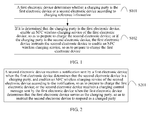
- a first electronic device determines whether a charging party is the first electronic device or a second electronic device according to charging reference information, and when it is determined that the charging party is the first electronic device, the first electronic device enables an NFC wireless charging service of the first electronic device, or when it is determined that the charging party is the second electronic device, the first electronic device instructs the second electronic device to enable an NFC wireless charging service.
- the both electronic devices can determine the charging party according to the charging reference message and automatically enable the NFC wireless charging service of the charging party, which makes full use of more fragmented time to charge a peer electronic device, avoids time consumption and labor consumption caused due to an active operation of a user, and improves user experience.
- An embodiment of the present invention provides a method for enabling an NFC wireless charging service. As shown in FIG. 1 , the method includes:
- the first electronic device may be a mobile phone, a tablet computer, a notebook computer or the like
- the second electronic device may be a Bluetooth headset, a pedometer, a mobile phone or the like
- both the first electronic device and the second electronic device have an NFC communication function.
- the first electronic device determines that the first electronic device and the second electronic device are kept within an effective distance of NFC communication and a time in which no NFC communication occurs between the both electronic devices exceeds a preset time threshold.
- the charging reference information includes information actively sent by the second electronic device to the first electronic device or information sent by the second electronic device to the first electronic device according to a request message of the first electronic device.
- the first electronic device may obtain the charging reference information by sending the request message for multiple times or at one time, which is not limited in the present invention.
- step S101 a manner implemented in step S101 also differs, and specifically includes:
- the first electronic device makes determining according to the charging reference information as follows:
- the charging status information includes a charging identifier that is used for denoting whether a corresponding electronic device is in a state of receiving power, and then when one electronic device is in the state of receiving power, and the other electronic device is not in the state of receiving power, the first electronic device determines that an electronic device being in the state of receiving power is the charging party, and enables an NFC wireless charging service of the charging party, so as to prepare to charge the peer electronic device; when neither of the both electronic devices is in the state of receiving power, the first electronic device may randomly determine that one electronic device is the charging party, or it may be determined by obtaining output power information, residual electric quantity information and the like of the first electronic device and the second electronic device whether the first electronic device or the second electronic device serves as the charging party (for details, refer to the following related implementation manner); or when the both electronic devices are in the state of receiving power, the entire process is terminated.
- a charging identifier that is used for denoting whether a corresponding electronic device is in a state of receiving power, and then when one electronic device
- the first electronic device makes determining according to the charging reference information as follows:
- the output power information may include an output power value, and then the preset power threshold is a threshold value that is preset according to an actual situation; and the output power information may include an output power level, and then the preset power level is a threshold level that is preset according to an actual situation.
- the first electronic device may be the charging party by default.
- the first electronic device makes determining according to the charging reference information as follows:
- the output power information may include output power levels, such as a high level, an intermediate level, and a low level, and in this case, the first electronic device determines an electronic device whose output power is larger by comparing output power levels of the both electronic devices, and determines that the electronic device whose output power is larger is the charging party, for example, when the output power levels of the both electronic devices at least differ by one level, an electronic device whose level is large is the electronic device whose output power is larger; and the output power information may also include an output power value, and in this case, when determining that a difference between output power values of the both electronic devices is greater than a preset power difference threshold, the first electronic device determines that an electronic device whose output power value is larger is the charging party, for example, an output power value of the first electronic device and an output power value of the second electronic device are P1 and P2 respectively, and the preset power difference threshold is ⁇ P, and therefore if P1>P2 and
- the output power information may include both an output power level and an output power value, and then when output power levels of the both electronic devices are the same, the first electronic device may determine the electronic device whose output power is larger by using the foregoing method, that is, by comparing the difference between the output power values of the both electronic devices with the preset power difference threshold. Additionally, the first electronic device may indirectly obtain the output power value by obtaining an output current and an output voltage.
- the first electronic device makes determining according to the charging reference information as follows:
- the first electronic device may first perform determining according to the output power information, or may first perform determining according to the charging status information of the both electronic devices, and a determining sequence of the information is not limited in this manner.
- the first electronic device makes determining according to the charging reference information as follows:
- the first electronic device may first perform determining according to the output power information of the both electronic devices, or may first perform determining according to the charging status information of the both electronic devices, and a determining sequence of the information is not limited in this manner.
- the first electronic device makes determining according to the charging reference information as follows:
- the first electric quantity threshold may be a preset electric quantity threshold, or an electric quantity threshold that is set by the first electronic device according to residual electric quantity information of the both electronic devices after the first electronic device obtains residual electric quantity information of the second electronic device.
- the first electronic device sends a battery information request to the second electronic device, and receives a battery information response that is sent by the second electronic device according to the battery information request, where the battery information request is used for learning residual electric quantity information of a battery of the second electronic device, and then the first electronic device determines the first electric quantity threshold according to the residual electric quantity information of the both electronic devices.
- the residual electric quantity information includes a residual electric quantity value and/or a total battery quantity, and/or a residual electric quantity percentage and a total battery quantity, and the residual electric quantity information may further include a charging demand indication and/or other related parameters such as a maximum or threshold discharging current.
- a residual electric quantity value of the first electronic device is 500 mAh
- a minimum electric quantity value affecting normal usage of a device is 300 mAh
- the first electronic device determines according to a battery information response sent by the second electronic device that a total battery quantity of the second electronic device is 150 mAh
- a residual electric quantity value of the second electronic device is 10 mAh
- the first electronic device may set a first electric quantity threshold that can charge the second electronic device, such as, 400 mAh; and if the first electronic device determines that the total battery quantity of the second electronic device is 2000 mAh, the residual electric quantity value of the second electronic device is 100 mAh, and a maximum discharging current of the second electronic device is 2 A, after the first electronic device charges the second electronic device by an electric quantity of 200 mAh, an estimated normal usage time of the second electronic device is about 10 minutes, and in this case, the first electronic device may set a first electric quantity threshold of 500 mAh for the second electronic device.
- the first electronic device may first perform determining according to the residual electric quantity information of the first electronic device, or may first perform determining according to the charging status information of the both electronic devices, and a determining sequence of the information is not limited in this manner.
- the first electronic device makes determining according to the charging reference information as follows:
- the first electronic device may first perform determining according to the output power information of the first electronic device, or may first perform determining according to the residual electric quantity information of the first electronic device, and a determining sequence of the information is not limited in this manner.
- the first electronic device makes determining according to the charging reference information as follows:
- the first electronic device may first perform determining according to the output power information of the both electronic devices, or may first perform determining according to the residual electric quantity information of the first electronic device, and a determining sequence of the information is not limited in this manner.
- the first electronic device makes determining according to the charging reference information as follows:
- the second electric quantity threshold is similar to the first electric quantity threshold, and may be preset, or may be set according to the residual electric quantity information of the both electronic devices; for a specific method, refer to specific description in Manner 6 described above, and details are not described herein again.
- the first electronic device may first perform determining according to the output power information of the both electronic devices, or may first perform determining according to the residual electric quantity information of the both electronic devices, and a determining sequence of the information is not limited in this manner.
- the first electronic device makes determining according to the charging reference information as follows:
- the first electronic device uses output power information of the first electronic device as a start determining condition. If the output power value of the first electronic device is greater than or equal to the preset power threshold, or the output power level is higher than or equal to the preset power level, determining is performed according to the charging status information and/or the residual electric quantity information of the both electronic devices:
- the entire process may end, or determining may be performed according to the charging status information and/or the residual electric quantity information of the both electronic devices:
- the second electric quantity threshold is similar to the first electric quantity threshold, and may be preset, or may be set according to the residual electric quantity information of the both electronic devices; for a specific method, refer to specific description in Manner 6 described above, and details are not described herein again.
- the first electronic device may first perform determining according to the charging status information of the both electronic devices, or may first perform determining according to the output power information of the first electronic device, or may first perform determining according to the residual electric quantity information of the both electronic devices, and a determining sequence of the information is not limited in this manner.
- the first electronic device makes determining according to the charging reference information as follows:
- the first electronic device uses charging status information of the both electronic devices as a start determining condition. If the both electronic devices are in a state of receiving power, the entire process is ended; if neither of the both electronic devices is in a state of receiving power, the first electronic device then determines according to output power information and residual electric quantity information of the both electronic devices that an electronic device of the both electronic devices whose output power is larger and whose residual electric quantity value is greater than or equal to an electric quantity threshold (that is, a first electric quantity threshold or a second electric quantity threshold) is the charging party; if only the first electronic device is in a state of receiving power, it is then determined, when it is determined according to output power information of the both electronic devices that the first electronic device is an electronic device whose output power is larger, that the first electronic device serves as the charging party; or if only the second electronic device is in a state of receiving power, it is then determined, when it is determined according to output power information of the both electronic devices that the second electronic device is an electronic device whose output power is larger, that the second
- the first electronic device uses output power information of the both electronic devices as a start determining condition. If the first electronic device is an electronic device whose output power is larger, it is then determined according to charging status information and/or residual electric quantity information of the both electronic devices as follows:
- the second electronic device is an electronic device whose output power is larger, it is then determined according to charging status information and/or residual electric quantity information of the both electronic devices as follows:
- output powers of the both electronic devices are equivalent, that is, output power levels of the both electronic devices are the same and/or an absolute value of a difference between output powers of the both electronic devices is less than a preset power difference threshold, the entire process may end, or it may be then determined according to charging status information and/or residual electric quantity information of the both electronic devices whether the first electronic device or the second electronic device serves as the charging party, a specific determining method is the same as those in the foregoing two exemplified cases, and details are not described herein again.
- the first electronic device uses residual electric quantity information of the both electronic devices as a start determining condition. If a residual electric quantity value of the first electronic device is greater than or equal to a first electric quantity threshold and a residual electric quantity value of the second electronic device is greater than or equal to a second electric quantity threshold, it is then determined according to output power information and charging status information of the both electronic devices as follows:
- a residual electric quantity value of the first electronic device is less than a first electric quantity threshold and a residual electric quantity value of the second electronic device is less than a second electric quantity threshold, it is then determined according to output power information and charging status information of the both electronic devices as follows:
- a residual electric quantity value of the first electronic device is greater than or equal to a first electric quantity threshold and a residual electric quantity value of the second electronic device is less than a second electric quantity threshold, it is then determined according to output power information and charging status information of the both electronic devices as follows:
- a residual electric quantity value of the first electronic device is less than a first electric quantity threshold and a residual electric quantity value of the second electronic device is greater than or equal to a second electric quantity threshold, it is then determined according to output power information and charging status information of the both electronic devices as follows:
- the second electric quantity threshold is similar to the first electric quantity threshold, and may be preset, or may be set according to the residual electric quantity information of the both electronic devices; for a specific method, refer to specific description in Manner 6 described above, and details are not described herein again.
- the first electronic device may first perform determining according to the charging status information of the both electronic devices, or may first perform determining according to the output power information of the both electronic devices, or may first perform determining according to the residual electric quantity information of the both electronic devices, and a determining sequence of the information is not limited in this manner.
- S102 If it is determined that the charging party is the first electronic device, enable an NFC wireless charging service of the first electronic device, so as to prepare to charge the second electronic device; or if the charging party is the second electronic device, the first electronic device instructs the second electronic device to enable an NFC wireless charging service, so as to prepare to charge the first electronic device.
- an electronic device that is already determined to be the charging party enables an NFC wireless charging service of the electronic device to prepare to provide a charging service to a peer electronic device.
- a conventional NFC wireless charging process includes an NFC wireless charging control phase and an NFC wireless electric energy transmission phase; therefore, after a charging electronic device enables an NFC wireless charging service, the charging electronic device begins the NFC wireless charging process by using NFC communication, exchanges verification information, technical information and the like with a to-be-charged electronic device by using the NFC wireless charging control phase to select an NFC wireless charging manner or other wireless charging manners, and then charges the to-be-charged electronic device by using the NFC wireless charging electric energy transmission phase.
- wireless charging manners include but are not limited to wireless charging technologies separately formulated by three current major wireless charging alliances: WPC (Wireless Power Consortium), PMA (Power Matters Alliance) and A4WP (Alliance for Wireless Power).
- WPC Wireless Power Consortium
- PMA Power Matters Alliance
- A4WP Alliance for Wireless Power
- a first electronic device determines whether a charging party is the first electronic device or a second electronic device according to charging reference information, and when it is determined that the charging party is the first electronic device, the first electronic device enables an NFC wireless charging service of the first electronic device, or when it is determined that the charging party is the second electronic device, the first electronic device instructs the second electronic device to enable an NFC wireless charging service.
- the both electronic devices can determine the charging party according to the charging reference message and automatically enable the NFC wireless charging service of the charging party, which makes full use of more fragmented time to charge a peer electronic device, avoids time consumption and labor consumption caused due to an active operation of a user, and improves user experience.
- An embodiment of the present invention provides a method for enabling an NFC wireless charging service. As shown in FIG. 2 , the method includes:
- the second electronic device before the second electronic device receives the notification or the charging control message, the second electronic device sends at least one piece of charging status information of the second electronic device, output power information of the second electronic device and residual electric quantity information of the second electronic device to the first electronic device; or the second electronic device receives a request message of the first electronic device, and sends at least one piece of charging status information of the second electronic device, output power information of the second electronic device and residual electric quantity information of the second electronic device to the first electronic device according to the request message of the first electronic device.
- the first electronic device determines whether a charging party is the first electronic device or a second electronic device according to charging reference information, where the charging reference information includes: at least one piece of charging status information of the second electronic device, output power information of the second electronic device and residual electric quantity information of the second electronic device.
- the first electronic device when determining according to the charging reference message that the second electronic device is the charging party, the first electronic device sends the notification to the second electronic device, so that the second electronic device enables the NFC wireless charging service of the second electronic device according to the notification; after enabling the NFC wireless charging service, the second electronic device sends a charging control message to the first electronic device, to enter an NFC wireless charging control phase, and the second electronic device exchanges verification information, technical information and the like with the first electronic device by using the NFC wireless charging control phase to select an NFC wireless charging manner or other wireless charging manners, and then charges the first electronic device by using an NFC wireless charging electric energy transmission phase; when the first electronic device determines according to the charging reference message that the first electronic device is the charging party, the first electronic device enables an NFC wireless charging service, and the second electronic device receives the charging control message sent by the first electronic device and responds according to the charging control message, to enter the NFC wireless charging control phase.
- the both electronic devices may also select other wireless charging technologies by means of information exchange and negotiation in the NFC wireless charging control phase to perform charging, such as wireless charging technologies separately formulated by three current major wireless charging alliances: WPC (Wireless Power Consortium), PMA (Power Matters Alliance) and A4WP (Alliance for Wireless Power).
- WPC Wireless Power Consortium
- PMA Power Matters Alliance
- A4WP Alliance for Wireless Power
- a second electronic device receives a notification sent by a first electronic device when the first electronic device determines that the second electronic device is a charging party, and enables an NFC wireless charging service of the second electronic device according to the notification, so as to prepare to charge the first electronic device; or the second electronic device receives a charging control message sent by the first electronic device when the first electronic device determines that the first electronic device serves as the charging party, so as to instruct the second electronic device to respond as a charged party.
- the both electronic devices can determine the charging party according to the charging reference message and automatically enable the NFC wireless charging service of the charging party, which makes full use of more fragmented time to charge a peer electronic device, avoids time consumption and labor consumption caused due to an active operation of a user, and improves user experience.
- charging reference information includes: charging status information of both electronic devices, output power information of the both electronic devices and residual electric quantity information of a first electronic device.
- the following steps are described by using the first electronic device as a charging party, and the method includes:
- the first electronic device when the first electronic device and the second electronic device are located within an NFC communication range and a time during which there is no NFC communication between the both electronic devices reaches a preset time threshold, the first electronic device sends the output power request message to the second electronic device.
- the output power request message sent by the first electronic device is used for learning output power information of the second electronic device.
- this embodiment is described by using an example in which the first electronic device is an initiator of the current NFC communication.
- the second electronic device may be also an initiator of the current NFC communication; then, in this case, the output power request message should be sent by the second electronic device to the first electronic device, and the following determining should be also completed by the second electronic device.
- the first electronic device determines according to output power information of both electronic devices that the first electronic device is an electronic device whose output power is larger.
- step S302 there are two implementation manners for step S302:
- the first electronic device obtains an output power value of the second electronic device according to the output power response message sent by the second electronic device, and if an absolute value of a difference between an output power value of the first electronic device and the output power value of the second electronic device is greater than a preset power difference threshold and the output power value of the first electronic device is greater than the output power value of the second electronic device, it is determined that the first electronic device is an electronic device whose output power is larger.
- neither of the first electronic device and the second electronic device can serve as the charging party, and in this case, the entire process may end.
- the first electronic device obtains the output power information of the second electronic device by receiving the output power response message sent by the second electronic device
- the output power information of the second electronic device may be the output power value of the second electronic device, or an output current value and an output voltage value of the second electronic device, or may be the output power value, and an output current value and/or an output voltage value of the second electronic device, that is, the first electronic device can directly or indirectly obtain the output power value of the second electronic device by using the output power information.
- the output power value of the first electronic device is Po 1
- the output power value of the second electronic device is P o2
- the output power difference threshold is ⁇ P o
- the first electronic device receives the output power response message that is sent by the second electronic device according to the output power request message, where the output power response message carries the output power value P o2 of the second electronic device, and then the first electronic device determines that an absolute value of a difference between the output power values of the first electronic device and the second electronic device is
- ; for the output power difference threshold ⁇ P o if the first electronic device determines that the absolute value
- an output power of an electronic device may be classified into a high level, an intermediate level, and a low level, for example, a device power level of an electronic device whose output power is less than or equal to 5 w is low, a device power level of an electronic device whose output power is greater than 5 w and less than or equal to 20 w is intermediate, and a device power level of an electronic device whose output power is greater than 20 w is high.
- the first electronic device obtains an output power level of the second electronic device according to the output power response message of the second electronic device, and if an output power level of the first electronic device is higher than the output power level of the second electronic device, it is determined that the first electronic device is an electronic device whose output power is larger.
- the output power level of the first electronic device is intermediate, the output power level of the second electronic device is low, and then after sending the output power request message to the second electronic device, the first electronic device receives the output power response message that is sent by the second electronic device according to the output power request message, where the output power response message carries the output power level of the second electronic device, and if the first electronic device determines according to the output power response message that the output power level of the first electronic device is higher than the output power level of the second electronic device, the first electronic device determines that the first electronic device is an electronic device whose output power is larger.
- the first electronic device may determine according to the output power values of the both electronic devices that the first electronic device is an electronic device whose output power is larger, and for details, refer to description in Manner 1 described above.
- the first electronic device sends a charging status request message to the second electronic device, and receives a charging status response message that is sent by the second electronic device according to the charging status request message.
- the charging status response message includes charging status information, and the first electronic device can determine according to the charging status information whether the second electronic device is in a state of receiving power.
- the first electronic device determines according to charging status information of the both electronic devices whether neither of the first electronic device and the second electronic device is in a state of receiving power.
- step S305 is performed, or if not, step S306 is performed.
- the first electronic device determines that a residual electric quantity value of the first electronic device is greater than or equal to a first electric quantity threshold.
- the first electric quantity threshold is preset by the first electronic device according to parameters of the first electronic device such as a total battery quantity.
- the first electronic device determines by using residual electric quantity information of the first electronic device that a current residual electric quantity value of the first electronic device, and compares the residual electric quantity value with the first electric quantity threshold.
- the first electronic device may further inform a user of an electric quantity by which the first electronic device may specifically charge the second electronic device. For example, before enabling an NFC wireless charging function, the first electronic device may inform the user of "the electronic device may be charged by an electric quantity of XX mAh" by means of screen display or speech, description is made only by using an example herein, and a specific manner of informing the user is not limited in the present invention.
- the first electric quantity threshold may be further determined by the first electronic device according to residual electric quantity information of the both electronic devices.
- the first electronic device sends a battery information request to the second electronic device, and receives a battery information response that is sent by the second electronic device according to the battery information request, where the battery information request is used for learning residual electric quantity information of a battery of the second electronic device, and then the first electronic device determines the first electric quantity threshold according to the residual electric quantity information of the both electronic devices.
- the residual electric quantity information includes a residual electric quantity value and/or a total battery quantity, and/or a residual electric quantity percentage and a total battery quantity, and the residual electric quantity information may further include a charging demand indication and/or other related parameters such as a maximum or threshold discharging current.
- a residual electric quantity value of the first electronic device is 500 mAh
- a minimum electric quantity value affecting normal usage of a device is 300 mAh
- the first electronic device determines according to a battery information response sent by the second electronic device that a total battery quantity of the second electronic device is 150 mAh
- a residual electric quantity value of the second electronic device is 10 mAh
- the first electronic device may set a first electric quantity threshold that can charge the second electronic device, such as, 400 mAh; and if the first electronic device determines that the total battery quantity of the second electronic device is 2000 mAh, the residual electric quantity value of the second electronic device is 100 mAh, and a maximum discharging current of the second electronic device is 2 A, after the first electronic device charges the second electronic device by an electric quantity of 200 mAh, an estimated normal usage time of the second electronic device is about 10 minutes, and in this case, the first electronic device may set a first electric quantity threshold of 500 mAh for the second electronic device.
- step S307 is performed.
- S306 The first electronic device determines that only the first electronic device is in the state of receiving power.
- charging status information of the first electronic device indicates that the first electronic device is in the state of receiving power
- charging status information of the second electronic device indicates that the second electronic device is not in the state of receiving power
- the first electronic device enables an NFC wireless charging service, so as to prepare to charge the second electronic device.
- the first electronic device may further inform the user that wireless charging is already enabled, and certainly may further add a prompt of user confirmation, for example, after enabling the NFC wireless charging service, the first electronic device informs the user of "an NFC wireless charging service being already enabled” or “whether to agree to enable an NFC wireless charging service” by using a screen or speech, and sets options "conform” and “cancel", description is made only by using an example herein, and a specific manner of informing the user is not limited in the present invention.
- the output power request message and the charging status request message that are sent by the first electronic device to the second electronic device and a battery request message that may be needed are sent at several times in the manner, in this embodiment, that is included but is not limited.
- the messages may be sent in other manners, for example, output power information, charging status information, and/or residual electric quantity information is requested from the second electronic device by using a request message; certainly all needed information may be further obtained by using two request messages, and description is not made one by one again herein.
- the first electronic device when the first electronic device and the second electronic device are located within an effective range of NFC communication, after determining according to the charging reference information that the first electronic device serves as the charging party, the first electronic device automatically enable the NFC wireless charging service, which makes full use of more fragmented time to charge the second electronic device, avoids time consumption and labor consumption caused due to an active operation of a user, and improves user experience.
- charging reference information includes: charging status information of both electronic devices, output power information of a first electronic device and residual electric quantity information of the both electronic devices.
- the following steps are described by using the first electronic device as a charging party, and the method includes:
- the charging status request message is used for obtaining current charging status information of the second electronic device.
- the first electronic device can determine according to the charging status information whether the second electronic device is in a state of receiving power.
- the first electronic device obtains output power information of the first electronic device, where the output power information may include an output power value, and therefore when determining that the output power value is greater than or equal to a preset power threshold, the first electronic device sends a charging status request message to the second electronic device, where the preset power threshold is a threshold value that is preset according to an actual situation; and the output power information may further include an output power level, and therefore when determining that the output power level is higher than a preset power level, the first electronic device sends a charging status request message to the second electronic device, where the preset power level is a threshold level that is preset according to an actual situation.
- the second electronic device may also send a charging status request message to the first electronic device; in this way, if the first electronic device receives the charging status request message sent by the second electronic device, the first electronic device sends an output power request message to the second electronic device, or receives an output power request message sent by the second electronic device, and finally determines by using output power levels or output power values of the both electronic devices whether the first electronic device or the second electronic device serves as the charging party.
- the first electronic device receives the charging status request message sent by the second electronic device, the first electronic device sends an output power request message to the second electronic device, or receives an output power request message sent by the second electronic device, and finally determines by using output power levels or output power values of the both electronic devices whether the first electronic device or the second electronic device serves as the charging party.
- Whether the first electronic device sends the output power request message to the second electronic device or the second electronic device sends the output power request message to the first electronic device may be determined by the both parties by setting respective random numbers in respective charging status request messages, and then comparing these two random numbers, for example, if the random number in the charging status request message sent by the first electronic device is greater than the random number of the second electronic device, the first electronic device sends the output power request message.
- the preset power threshold is P o
- the output power value of the first electronic device is P o1
- the output power value of the second electronic device is P o2 , where P o1 is greater than P o and P o2 is greater than P o
- the first electronic device sends a first charging status request message to the second electronic device, and receives a second charging status request message sent by the second electronic device, where the first charging status request message includes a random number R 1
- the second charging status request message includes a random number R 2 ; if the first electronic device determines that the random number R 1 is greater than the random number R 2 , the first electronic device sends an output power request message to the second electronic device; or if the first electronic device determines that the random number R 1 is less than the random number R 2 , the first electronic device receives an output power request message sent by the second electronic device.
- the first electronic device determines according to charging status information of the second electronic device that the second electronic device is not in a state of receiving power.
- the manner of receiving power may be wired or wireless.
- the entire process of enabling an NFC wireless charging service is ended.
- the first electronic device determines according to charging status information of the first electronic device whether the first electronic device is in the state of receiving power.
- step S404 to step S406 are performed; or if the first electronic device is currently in the state of receiving power, step S407 is performed.
- the first electronic device sends a battery information request to the second electronic device, and receives a battery information response that is sent by the second electronic device according to the battery information request.
- this step is optional.
- the battery information response includes residual electric quantity information of the second electronic device.
- the first electronic device determines a first electric quantity threshold according to residual electric quantity information of the both electronic devices.
- step S404 is optional, and consistent with step S404, that is, if there is no step S404, there is no step S405; and if there is step S404, there is step S405.
- the residual electric quantity information includes a residual electric quantity value and/or a total battery quantity, and/or a residual electric quantity percentage and a total battery quantity, and the residual electric quantity information may further include a charging demand indication and/or other related parameters such as a maximum or threshold discharging current.
- a residual electric quantity value of the first electronic device is 500 mAh
- a minimum electric quantity value affecting normal usage of a device is 300 mAh
- the first electronic device determines according to a battery information response sent by the second electronic device that a total battery quantity of the second electronic device is 150 mAh
- a residual electric quantity value of the second electronic device is 10 mAh
- the first electronic device may set a first electric quantity threshold that can charge the second electronic device, such as, 400 mAh; and if the first electronic device determines that the total battery quantity of the second electronic device is 2000 mAh, the residual electric quantity value of the second electronic device is 100 mAh, and a maximum discharging current of the second electronic device is 2 A, after the first electronic device charges the second electronic device by an electric quantity of 200 mAh, an estimated normal usage time of the second electronic device is about 10 minutes, and in this case, the first electronic device may set a first electric quantity threshold of 500 mAh for the second electronic device.
- the first electronic device determines that a residual electric quantity value of the first electronic device is greater than or equal to the first electric quantity threshold.
- the first electric quantity threshold may be also preset according to parameters of the first electronic device such as a total battery quantity, and then when the first electronic device determines according to the charging status response message that the second electronic device is in an uncharged state and the first electronic device is also currently in the uncharged state, the first electronic device may directly determine whether a residual electric quantity value of the first electronic device is greater than the preset electric quantity threshold, and the step is shown by a dashed line in FIG. 4 .
- the first electronic device enables an NFC wireless charging service, so as to prepare to charge the second electronic device.
- the first electronic device may further inform the user that the wireless charging service is already enabled, and certainly may further add a prompt of user confirmation, for example, after enabling the NFC wireless charging service, the first electronic device informs the user of "an NFC wireless charging service being already enabled” or “whether to agree to enable an NFC wireless charging service” by means of screen display or speech, and sets options “conform” and “cancel", description is made only by using an example herein, and a specific manner of informing the user is not limited in the present invention.
- a manner of sending the output power request message and the charging status request message that are sent by the first electronic device to the second electronic device and a battery request message that may be needed is the same as the manner described in the embodiment corresponding to FIG. 3 , and details are not described herein again.
- the first electronic device when the first electronic device and the second electronic device are located within an effective range of NFC communication, after determining according to the charging reference information that the first electronic device serves as the charging party, the first electronic device automatically enable the NFC wireless charging service, which makes full use of more fragmented time to charge the second electronic device, avoids time consumption and labor consumption caused due to an active operation of a user, and improves user experience.
- An embodiment of the present invention provides an electronic device 50, and as shown in FIG. 5 , the electronic device 50 includes:
- the processor 51 may be a multi-core central processing unit CPU, or an application specific integrated circuit ASIC (Application Specific Integrated Circuit), or one or more integrated circuits configured to implement this embodiment of the present invention.
- ASIC Application Specific Integrated Circuit
- the processor 51 is configured to determine whether the electronic device is a charging party or a second electronic device is a charging party according to charging reference information; and if it is determined that the electronic device is the charging party, control the NFC wireless charging controller 52 to enable an NFC wireless charging service, so as to prepare to charge the second electronic device; or if it is determined that the second electronic device is the charging party, control the transceiver 53 to send a notification to the second electronic device.
- the NFC wireless charging controller 52 is configured to enable the NFC wireless charging service according to control of the processor 51, so as to prepare to charge the second electronic device.
- the transceiver 53 is configured to send the notification to the second electronic device according to control of the processor 51, so that the second electronic device enables an NFC wireless charging service of the second electronic device according to the notification, and prepares to charge the electronic device.
- the processor 51 is further configured to: before it is determined whether the electronic device is the charging party or the second electronic device is the charging party according to the charging reference information, determine that the electronic device and the second electronic device are kept within an effective distance of NFC communication and a time in which no NFC communication occurs between the both electronic devices exceeds a preset time threshold.
- a manner in which the processor 51 determines whether the electronic device is the charging party or the second electronic device is the charging party also differs, and specifically includes:
- the electronic device makes determining according to the charging reference information as follows:
- the charging status information includes a charging identifier that is used for denoting whether a corresponding electronic device is in a state of receiving power, and then when one electronic device is in the state of receiving power, and the other electronic device is not in the state of receiving power, the electronic device determines that an electronic device being in the state of receiving power is the charging party, and enables an NFC wireless charging service of the charging party, so as to prepare to charge the peer electronic device; when neither of the both electronic devices is in the state of receiving power, the electronic device may randomly determine that one electronic device is the charging party, or it may be determined by obtaining output power information, residual electric quantity information and the like of the electronic device and the second electronic device whether the electronic device or the second electronic device serves as the charging party (for details, refer to the following related implementation manner); or when the both electronic devices are in the state of receiving power, the entire process is terminated.
- a charging identifier that is used for denoting whether a corresponding electronic device is in a state of receiving power, and then when one electronic device is in the state
- the electronic device makes determining according to the charging reference information as follows:
- the output power information may include an output power value, and then the preset power threshold is a threshold value that is preset according to an actual situation; and the output power information may include an output power level, and then the preset power level is a threshold level that is preset according to an actual situation.
- the electronic device may be the charging party by default.
- the electronic device makes determining according to the charging reference information as follows:
- the output power information may include output power levels, such as a high level, an intermediate level, and a low level, and in this case, the electronic device determines an electronic device whose output power is larger by comparing output power levels of the both electronic devices, and determines that the electronic device whose output power is larger is the charging party, for example, when the output power levels of the both electronic devices at least differ by one level, an electronic device whose level is large is the electronic device whose output power is larger; and the output power information may also include an output power value, and in this case, when determining that a difference between output power values of the both electronic devices is greater than a preset power difference threshold, the electronic device determines that an electronic device whose output power value is larger is the charging party, for example, an output power value of the electronic device and an output power value of the second electronic device are P1 and P2 respectively, and the preset power difference threshold is ⁇ P, and therefore if P1>P2 and
- the output power information may include both an output power level and an output power value, and then when output power levels of the both electronic devices are the same, the electronic device may determine the electronic device whose output power is larger by using the foregoing method, that is, by comparing the difference between the output power values of the both electronic devices with the preset power difference threshold. Additionally, the electronic device may indirectly obtain the output power value by obtaining an output current and an output voltage.
- the electronic device makes determining according to the charging reference information as follows:
- the electronic device may first perform determining according to the output power information, or may first perform determining according to the charging status information of the both electronic devices, and a determining sequence of the information is not limited in this manner.
- the electronic device makes determining according to the charging reference information as follows:
- the electronic device may first perform determining according to the output power information of the both electronic devices, or may first perform determining according to the charging status information of the both electronic devices, and a determining sequence of the information is not limited in this manner.
- the electronic device makes determining according to the charging reference information as follows:
- the first electric quantity threshold may be a preset electric quantity threshold, or an electric quantity threshold that is set by the electronic device according to residual electric quantity information of the both electronic devices after the first electronic device obtains residual electric quantity information of the second electronic device.
- the electronic device sends a battery information request to the second electronic device, and receives a battery information response that is sent by the second electronic device according to the battery information request, where the battery information request is used for learning residual electric quantity information of a battery of the second electronic device, and then the electronic device determines the first electric quantity threshold according to the residual electric quantity information of the both electronic devices.
- the residual electric quantity information includes a residual electric quantity value and/or a total battery quantity, and/or a residual electric quantity percentage and a total battery quantity, and the residual electric quantity information may further include a charging demand indication and/or other related parameters such as a maximum or threshold discharging current.
- a residual electric quantity value of the electronic device is 500 mAh
- a minimum electric quantity value affecting normal usage of a device is 300 mAh
- the electronic device determines according to a battery information response sent by the second electronic device that a total battery quantity of the second electronic device is 150 mAh
- a residual electric quantity value of the second electronic device is 10 mAh
- the electronic device may set a first electric quantity threshold that can charge the second electronic device, such as, 400 mAh; and if the electronic device determines that the total battery quantity of the second electronic device is 2000 mAh, the residual electric quantity value of the second electronic device is 100 mAh, and a maximum discharging current of the second electronic device is 2 A, after the electronic device charges the second electronic device by an electric quantity of 200 mAh, an estimated normal usage time of the second electronic device is about 10 minutes, and in this case, the electronic device may set a first electric quantity threshold of 500 mAh for the second electronic device.
- the electronic device may first perform determining according to the residual electric quantity information of the electronic device, or may first perform determining according to the charging status information of the both electronic devices, and a determining sequence of the information is not limited in this manner.
- the electronic device makes determining according to the charging reference information as follows:
- the electronic device may first perform determining according to the output power information of the electronic devices, or may first perform determining according to the residual electric quantity information of the electronic devices, and a determining sequence of the information is not limited in this manner.
- the electronic device makes determining according to the charging reference information as follows:
- the electronic device may first perform determining according to the output power information of the both electronic devices, or may first perform determining according to the residual electric quantity information of the electronic devices, and a determining sequence of the information is not limited in this manner.
- the electronic device makes determining according to the charging reference information as follows:
- the second electric quantity threshold is similar to the first electric quantity threshold, and may be preset, or may be set according to the residual electric quantity information of the both electronic devices; for a specific method, refer to specific description in Manner 6 described above, and details are not described herein again.
- the electronic device may first perform determining according to the output power information of the both electronic devices, or may first perform determining according to the residual electric quantity information of the both electronic devices, and a determining sequence of the information is not limited in this manner.
- the electronic device makes determining according to the charging reference information as follows:
- the electronic device uses output power information of the electronic devices as a start determining condition. If the output power value of the electronic device is greater than or equal to the preset power threshold, or the output power level is higher than or equal to the preset power level, determining is performed according to the charging status information and/or the residual electric quantity information of the both electronic devices:
- the entire process may end, or determining may be performed according to the charging status information and/or the residual electric quantity information of the both electronic devices:
- the second electric quantity threshold is similar to the first electric quantity threshold, and may be preset, or may be set according to the residual electric quantity information of the both electronic devices; for a specific method, refer to specific description in Manner 6 described above, and details are not described herein again.
- the electronic device may first perform determining according to the charging status information of the both electronic devices, or may first perform determining according to the output power information of the electronic device, or may first perform determining according to the residual electric quantity information of the both electronic devices, and a determining sequence of the information is not limited in this manner.
- the electronic device makes determining according to the charging reference information as follows:
- the electronic device uses charging status information of the both electronic devices as a start determining condition. If the both electronic devices are in a state of receiving power, the entire process is ended; if neither of the both electronic devices is in a state of receiving power, the electronic device then determines according to output power information and residual electric quantity information of the both electronic devices that an electronic device of the both electronic devices whose output power is larger and whose residual electric quantity value is greater than or equal to an electric quantity threshold (that is, a first electric quantity threshold or a second electric quantity threshold) is the charging party; if only the electronic device is in a state of receiving power, it is then determined, when it is determined according to output power information of the both electronic devices that the electronic device is an electronic device whose output power is larger, that the electronic device serves as the charging party; or if only the second electronic device is in a state of receiving power, it is then determined, when it is determined according to output power information of the both electronic devices that the second electronic device is an electronic device whose output power is larger, that the second electronic device serves as the
- the electronic device uses output power information of the both electronic devices as a start determining condition. If the electronic device is an electronic device whose output power is larger, it is then determined according to charging status information and/or residual electric quantity information of the both electronic devices as follows:
- the second electronic device is an electronic device whose output power is larger, it is then determined according to charging status information and/or residual electric quantity information of the both electronic devices as follows:
- output powers of the both electronic devices are equivalent, that is, output power levels of the both electronic devices are the same and/or an absolute value of a difference between output powers of the both electronic devices is less than a preset power difference threshold, the entire process may end, or it may be then determined according to charging status information and/or residual electric quantity information of the both electronic devices whether the electronic device or the second electronic device serves as the charging party, a specific determining method is the same as those in the foregoing two exemplified cases, and details are not described herein again.
- the electronic device uses residual electric quantity information of the both electronic devices as a start determining condition. If a residual electric quantity value of the electronic device is greater than or equal to a first electric quantity threshold and a residual electric quantity value of the second electronic device is greater than or equal to a second electric quantity threshold, it is then determined according to output power information and charging status information of the both electronic devices as follows:
- a residual electric quantity value of the electronic device is less than a first electric quantity threshold and a residual electric quantity value of the second electronic device is less than a second electric quantity threshold, it is then determined according to output power information and charging status information of the both electronic devices as follows:
- a residual electric quantity value of the electronic device is greater than or equal to a first electric quantity threshold and a residual electric quantity value of the second electronic device is less than a second electric quantity threshold, it is then determined according to output power information and charging status information of the both electronic devices as follows:
- a residual electric quantity value of the electronic device is less than a first electric quantity threshold and a residual electric quantity value of the second electronic device is greater than or equal to a second electric quantity threshold, it is then determined according to output power information and charging status information of the both electronic devices as follows:
- the second electric quantity threshold is similar to the first electric quantity threshold, and may be preset, or may be set according to the residual electric quantity information of the both electronic devices; for a specific method, refer to specific description in Manner 6 described above, and details are not described herein again.
- the electronic device may first perform determining according to the charging status information of the both electronic devices, or may first perform determining according to the output power information of the both electronic devices, or may first perform determining according to the residual electric quantity information of the both electronic devices, and a determining sequence of the information is not limited in this manner.
- an electronic device that is already determined to be the charging party enables an NFC wireless charging service of the electronic device to prepare to provide a charging service to a peer electronic device.
- a conventional NFC wireless charging process includes an NFC wireless charging control phase and an NFC wireless electric energy transmission phase; therefore, after a charging electronic device enables an NFC wireless charging service, the charging electronic device begins the NFC wireless charging process by using NFC communication, exchanges verification information, technical information and the like with a to-be-charged electronic device by using the NFC wireless charging control phase to select an NFC wireless charging manner or other wireless charging manners, and then charges the to-be-charged electronic device by using the NFC wireless charging electric energy transmission phase.
- wireless charging manners include but are not limited to wireless charging technologies separately formulated by three current major wireless charging alliances: WPC (Wireless Power Consortium), PMA (Power Matters Alliance) and A4WP (Alliance for Wireless Power).
- WPC Wireless Power Consortium
- PMA Power Matters Alliance
- A4WP Alliance for Wireless Power
- the electronic device determines whether a charging party is the electronic device or a second electronic device according to charging reference information, and when it is determined that the charging party is the electronic device, the electronic device enables an NFC wireless charging service of the electronic device, or when it is determined that the charging party is the second electronic device, the electronic device instructs the second electronic device to enable an NFC wireless charging service.
- the both electronic devices can determine the charging party according to the charging reference message and automatically enable the NFC wireless charging service of the charging party, which makes full use of more fragmented time to charge a peer electronic device, avoids time consumption and labor consumption caused due to an active operation of a user, and improves user experience.
- An embodiment of the present invention provides another electronic device 60, and as shown in FIG. 6 , the electronic device 60 includes:
- the processor 61 may be a multi-core central processing unit CPU, or an application specific integrated circuit ASIC (Application Specific Integrated Circuit), or one or more integrated circuits configured to implement this embodiment of the present invention.
- ASIC Application Specific Integrated Circuit
- the transceiver 63 is configured to receive a notification sent by a first electronic device when the first electronic device determines that the electronic device is a charging party; the processor 61 is configured to control the NFC wireless charging controller 62 according to the notification, so as to enable an NFC wireless charging service of the electronic device; and the NFC wireless charging controller 62 is configured to enable the NFC wireless charging service according to control of the processor, so as to prepare to charge the first electronic device.
- the transceiver 63 is configured to receive a charging control message sent by the first electronic device when the first electronic device determines that the first electronic device is a charging party; and the processor 61 is configured to instruct, according to the charging control message, the electronic device to respond as a charged party.
- the NFC wireless charging controller 62 may be used as an individual module and be disposed separate from the processor 61, or may be used as a part of the processor 61 and be integrated inside the processor 61.
- the transceiver 63 is further configured to: before the notification is received or the charging control message is received, send at least one piece of charging status information of the electronic device, output power information of the electronic device and residual electric quantity information of the electronic device to the first electronic device; or receive a request message of the first electronic device, and send at least one piece of charging status information of the electronic device, output power information of the electronic device and residual electric quantity information of the electronic device to the first electronic device according to the request message of the first electronic device.
- the processor 61 is further configured to: before the transceiver 63 sends at least one piece of the charging status information of the electronic device, the output power information of the electronic device and the residual electric quantity information of the electronic device to the first electronic device, determine that the electronic device and the first electronic device are kept within an effective distance of NFC communication and a time in which no NFC communication occurs between the both electronic devices exceeds a preset time threshold.
- the electronic device receives a notification sent by a first electronic device when the first electronic device determines that the electronic device is a charging party, and enables an NFC wireless charging service of the electronic device according to the notification, so as to prepare to charge the first electronic device; or the electronic device receives a charging control message sent by the first electronic device when the first electronic device determines that the first electronic device serves as the charging party, so as to instruct the electronic device to respond as a charged party.
- the both electronic devices can determine the charging party according to the charging reference message and automatically enable the NFC wireless charging service of the charging party, which makes full use of more fragmented time to charge a peer electronic device, avoids time consumption and labor consumption caused due to an active operation of a user, and improves user experience.
- An embodiment of the present invention provides another electronic device 70, and as shown in FIG. 7 , the electronic device 70 includes:
- the electronic device may be a mobile phone, a tablet computer, a notebook computer or the like
- the second electronic device may be a Bluetooth headset, a pedometer, a mobile phone or the like
- both the electronic device and the second electronic device have an NFC communication function.
- the processing unit 71 is further configured to: before it is determined whether the charging party is the electronic device or the second electronic device according to the charging reference information, determine that the electronic device and the second electronic device are kept within an effective distance of NFC communication and a time in which no NFC communication occurs between the both electronic devices exceeds a preset time threshold.
- the charging reference information includes information actively sent by the second electronic device to the electronic device or information sent by the second electronic device to the electronic device according to a request message of the electronic device.
- the electronic device may obtain the charging reference information by sending the request message for multiple times or at one time, which is not limited in the present invention.
- a manner in which the processing unit 71 determines whether the electronic device is the charging party or the second electronic device is the charging party also differs, and specifically includes:
- the electronic device makes determining according to the charging reference information as follows:
- the charging status information includes a charging identifier that is used for denoting whether a corresponding electronic device is in a state of receiving power, and then when one electronic device is in the state of receiving power, and the other electronic device is not in the state of receiving power, the electronic device determines that an electronic device being in the state of receiving power is the charging party, and enables an NFC wireless charging service of the charging party, so as to prepare to charge the peer electronic device; when neither of the both electronic devices is in the state of receiving power, the electronic device may randomly determine that one electronic device is the charging party, or it may be determined by obtaining output power information, residual electric quantity information and the like of the electronic device and the second electronic device whether the electronic device or the second electronic device serves as the charging party (for details, refer to the following related implementation manner); or when the both electronic devices are in the state of receiving power, the entire process is terminated.
- a charging identifier that is used for denoting whether a corresponding electronic device is in a state of receiving power, and then when one electronic device is in the state
- the electronic device makes determining according to the charging reference information as follows:
- the output power information may include an output power value, and then the preset power threshold is a threshold value that is preset according to an actual situation; and the output power information may include an output power level, and then the preset power level is a threshold level that is preset according to an actual situation.
- the electronic device may be the charging party by default.
- the electronic device makes determining according to the charging reference information as follows:
- the output power information may include output power levels, such as a high level, an intermediate level, and a low level, and in this case, the electronic device determines an electronic device whose output power is larger by comparing output power levels of the both electronic devices, and determines that the electronic device whose output power is larger is the charging party, for example, when the output power levels of the both electronic devices at least differ by one level, an electronic device whose level is large is the electronic device whose output power is larger; and the output power information may also include an output power value, and in this case, when determining that a difference between output power values of the both electronic devices is greater than a preset power difference threshold, the electronic device determines that an electronic device whose output power value is larger is the charging party, for example, an output power value of the electronic device and an output power value of the second electronic device are P1 and P2 respectively, and the preset power difference threshold is ⁇ P, and therefore if P1>P2 and
- the output power information may include both an output power level and an output power value, and then when output power levels of the both electronic devices are the same, the electronic device may determine the electronic device whose output power is larger by using the foregoing method, that is, by comparing the difference between the output power values of the both electronic devices with the preset power difference threshold. Additionally, the electronic device may indirectly obtain the output power value by obtaining an output current and an output voltage.
- the electronic device makes determining according to the charging reference information as follows:
- the electronic device may first perform determining according to the output power information, or may first perform determining according to the charging status information of the both electronic devices, and a determining sequence of the information is not limited in this manner.
- the electronic device makes determining according to the charging reference information as follows:
- the electronic device may first perform determining according to the output power information of the both electronic devices, or may first perform determining according to the charging status information of the both electronic devices, and a determining sequence of the information is not limited in this manner.
- the electronic device makes determining according to the charging reference information as follows:
- the first electric quantity threshold may be a preset electric quantity threshold, or an electric quantity threshold that is set by the electronic device according to residual electric quantity information of the both electronic devices after the first electronic device obtains residual electric quantity information of the second electronic device.
- the electronic device sends a battery information request to the second electronic device, and receives a battery information response that is sent by the second electronic device according to the battery information request, where the battery information request is used for learning residual electric quantity information of a battery of the second electronic device, and then the electronic device determines the first electric quantity threshold according to the residual electric quantity information of the both electronic devices.
- the residual electric quantity information includes a residual electric quantity value and/or a total battery quantity, and/or a residual electric quantity percentage and a total battery quantity, and the residual electric quantity information may further include a charging demand indication and/or other related parameters such as a maximum or threshold discharging current.
- a residual electric quantity value of the electronic device is 500 mAh
- a minimum electric quantity value affecting normal usage of a device is 300 mAh
- the electronic device determines according to a battery information response sent by the second electronic device that a total battery quantity of the second electronic device is 150 mAh
- a residual electric quantity value of the second electronic device is 10 mAh
- the electronic device may set a first electric quantity threshold that can charge the second electronic device, such as, 400 mAh; and if the electronic device determines that the total battery quantity of the second electronic device is 2000 mAh, the residual electric quantity value of the second electronic device is 100 mAh, and a maximum discharging current of the second electronic device is 2 A, after the electronic device charges the second electronic device by an electric quantity of 200 mAh, an estimated normal usage time of the second electronic device is about 10 minutes, and in this case, the electronic device may set a first electric quantity threshold of 500 mAh for the second electronic device.
- the electronic device may first perform determining according to the residual electric quantity information of the electronic device, or may first perform determining according to the charging status information of the both electronic devices, and a determining sequence of the information is not limited in this manner.
- the electronic device makes determining according to the charging reference information as follows:
- the electronic device may first perform determining according to the output power information of the electronic devices, or may first perform determining according to the residual electric quantity information of the electronic devices, and a determining sequence of the information is not limited in this manner.
- the electronic device makes determining according to the charging reference information as follows:
- the electronic device may first perform determining according to the output power information of the both electronic devices, or may first perform determining according to the residual electric quantity information of the electronic devices, and a determining sequence of the information is not limited in this manner.
- the electronic device makes determining according to the charging reference information as follows:
- the second electric quantity threshold is similar to the first electric quantity threshold, and may be preset, or may be set according to the residual electric quantity information of the both electronic devices; for a specific method, refer to specific description in Manner 6 described above, and details are not described herein again.
- the electronic device may first perform determining according to the output power information of the both electronic devices, or may first perform determining according to the residual electric quantity information of the both electronic devices, and a determining sequence of the information is not limited in this manner.
- the electronic device makes determining according to the charging reference information as follows:
- the electronic device uses output power information of the electronic devices as a start determining condition. If the output power value of the electronic device is greater than or equal to the preset power threshold, or the output power level is higher than or equal to the preset power level, determining is performed according to the charging status information and/or the residual electric quantity information of the both electronic devices:
- the entire process may end, or determining may be performed according to the charging status information and/or the residual electric quantity information of the both electronic devices:
- the second electric quantity threshold is similar to the first electric quantity threshold, and may be preset, or may be set according to the residual electric quantity information of the both electronic devices; for a specific method, refer to specific description in Manner 6 described above, and details are not described herein again.
- the electronic device may first perform determining according to the charging status information of the both electronic devices, or may first perform determining according to the output power information of the electronic device, or may first perform determining according to the residual electric quantity information of the both electronic devices, and a determining sequence of the information is not limited in this manner.
- the electronic device makes determining according to the charging reference information as follows:
- the electronic device uses charging status information of the both electronic devices as a start determining condition. If the both electronic devices are in a state of receiving power, the entire process is ended; if neither of the both electronic devices is in a state of receiving power, the electronic device then determines according to output power information and residual electric quantity information of the both electronic devices that an electronic device of the both electronic devices whose output power is larger and whose residual electric quantity value is greater than or equal to an electric quantity threshold (that is, a first electric quantity threshold or a second electric quantity threshold) is the charging party; if only the electronic device is in a state of receiving power, it is then determined, when it is determined according to output power information of the both electronic devices that the electronic device is an electronic device whose output power is larger, that the electronic device serves as the charging party; or if only the second electronic device is in a state of receiving power, it is then determined, when it is determined according to output power information of the both electronic devices that the second electronic device is an electronic device whose output power is larger, that the second electronic device serves as the
- the electronic device uses output power information of the both electronic devices as a start determining condition. If the electronic device is an electronic device whose output power is larger, it is then determined according to charging status information and/or residual electric quantity information of the both electronic devices as follows:
- the second electronic device is an electronic device whose output power is larger, it is then determined according to charging status information and/or residual electric quantity information of the both electronic devices as follows:
- output powers of the both electronic devices are equivalent, that is, output power levels of the both electronic devices are the same and/or an absolute value of a difference between output powers of the both electronic devices is less than a preset power difference threshold, the entire process may end, or it may be then determined according to charging status information and/or residual electric quantity information of the both electronic devices whether the electronic device or the second electronic device serves as the charging party, a specific determining method is the same as those in the foregoing two exemplified cases, and details are not described herein again.
- the electronic device uses residual electric quantity information of the both electronic devices as a start determining condition. If a residual electric quantity value of the electronic device is greater than or equal to a first electric quantity threshold and a residual electric quantity value of the second electronic device is greater than or equal to a second electric quantity threshold, it is then determined according to output power information and charging status information of the both electronic devices as follows:
- a residual electric quantity value of the electronic device is less than a first electric quantity threshold and a residual electric quantity value of the second electronic device is less than a second electric quantity threshold, it is then determined according to output power information and charging status information of the both electronic devices as follows:
- a residual electric quantity value of the electronic device is greater than or equal to a first electric quantity threshold and a residual electric quantity value of the second electronic device is less than a second electric quantity threshold, it is then determined according to output power information and charging status information of the both electronic devices as follows:
- a residual electric quantity value of the electronic device is less than a first electric quantity threshold and a residual electric quantity value of the second electronic device is greater than or equal to a second electric quantity threshold, it is then determined according to output power information and charging status information of the both electronic devices as follows:
- the second electric quantity threshold is similar to the first electric quantity threshold, and may be preset, or may be set according to the residual electric quantity information of the both electronic devices; for a specific method, refer to specific description in Manner 6 described above, and details are not described herein again.
- the electronic device may first perform determining according to the charging status information of the both electronic devices, or may first perform determining according to the output power information of the both electronic devices, or may first perform determining according to the residual electric quantity information of the both electronic devices, and a determining sequence of the information is not limited in this manner.
- an electronic device that is already determined to be the charging party enables an NFC wireless charging service of the electronic device to provide a charging service to a peer electronic device.
- a conventional NFC wireless charging process includes an NFC wireless charging control phase and an NFC wireless electric energy transmission phase; therefore, after a charging electronic device enables an NFC wireless charging service, the charging electronic device begins the NFC wireless charging process by using NFC communication, exchanges verification information, technical information and the like with a to-be-charged electronic device by using the NFC wireless charging control phase to select an NFC wireless charging manner or other wireless charging manners, and then charges the to-be-charged electronic device by using the NFC wireless charging electric energy transmission phase.
- wireless charging manners include but are not limited to wireless charging technologies separately formulated by three current major wireless charging alliances: WPC (Wireless Power Consortium), PMA (Power Matters Alliance) and A4WP (Alliance for Wireless Power).
- WPC Wireless Power Consortium
- PMA Power Matters Alliance
- A4WP Alliance for Wireless Power
- the electronic device determines whether a charging party is the electronic device or a second electronic device according to charging reference information, and when it is determined that the charging party is the electronic device, the electronic device enables an NFC wireless charging service of the electronic device, or when it is determined that the charging party is the second electronic device, the electronic device instructs the second electronic device to enable an NFC wireless charging service.
- the both electronic devices can determine the charging party according to the charging reference message and automatically enable the NFC wireless charging service of the charging party, which makes full use of more fragmented time to charge a peer electronic device, avoids time consumption and labor consumption caused due to an active operation of a user, and improves user experience.
- An embodiment of the present invention provides another electronic device 80, and as shown in FIG. 8 , the electronic device 80 includes:
- the receiving unit 81 is configured to receive a charging control message sent by the first electronic device when the first electronic device determines that the first electronic device is a charging party; and the processing unit 82 is configured to instruct, according to the charging control message received by the receiving unit 81, the electronic device to respond as a charged party.
- the electronic device further includes a sending unit 83, where the sending unit 83 is specifically configured to: before the receiving unit receives the notification or receives the charging control message, send at least one piece of charging status information of the electronic device, output power information of the electronic device and residual electric quantity information of the electronic device to the first electronic device; or receive a request message of the first electronic device, and send at least one piece of charging status information of the electronic device, output power information of the electronic device and residual electric quantity information of the electronic device to the first electronic device according to the request message of the first electronic device.
- the sending unit 83 is specifically configured to: before the receiving unit receives the notification or receives the charging control message, send at least one piece of charging status information of the electronic device, output power information of the electronic device and residual electric quantity information of the electronic device to the first electronic device; or receive a request message of the first electronic device, and send at least one piece of charging status information of the electronic device, output power information of the electronic device and residual electric quantity information of the electronic device to the first electronic device according to the request message of the first
- the processing unit 82 is further configured to: before the sending unit 83 sends at least one piece of the charging status information of the electronic device, the output power information of the electronic device and the residual electric quantity information of the electronic device to the first electronic device, determine that the electronic device and the first electronic device are kept within an effective distance of NFC communication and a time in which no NFC communication occurs between the both electronic devices exceeds a preset time threshold.
- the electronic device receives a notification sent by a first electronic device when the first electronic device determines that the electronic device is a charging party, and enables an NFC wireless charging service of the electronic device according to the notification, so as to prepare to charge the first electronic device; or the electronic device receives a charging control message sent by the first electronic device when the first electronic device determines that the first electronic device serves as the charging party, so as to instruct the electronic device to respond as a charged party.
- the both electronic devices can determine the charging party according to the charging reference message and automatically enable the NFC wireless charging service of the charging party, which makes full use of more fragmented time to charge a peer electronic device, avoids time consumption and labor consumption caused due to an active operation of a user, and improves user experience.
- the disclosed electronic device may be implemented in other manners.
- the described electronic device is merely exemplary.
- the module or unit division is merely logical function division and may be other division in actual implementation.
- a plurality of units or components may be combined or integrated into another system, or some features may be ignored or not performed.
- the displayed or discussed mutual couplings or direct couplings or communication connections may be implemented through some interfaces.
- the indirect couplings or communication connections between the apparatuses or units may be implemented in electronic, mechanical, or other forms.
- the units described as separate parts may or may not be physically separate, and parts displayed as units may or may not be physical units, may be located in one position, or may be distributed on a plurality of network units. Some or all of the units may be selected according to actual needs to achieve the objectives of the solutions of the embodiments.
- functional units in the embodiments of the present application may be integrated into one processing unit, or each of the units may exist alone physically, or two or more units are integrated into one unit.
Landscapes
- Engineering & Computer Science (AREA)
- Power Engineering (AREA)
- Computer Networks & Wireless Communication (AREA)
- Signal Processing (AREA)
- Charge And Discharge Circuits For Batteries Or The Like (AREA)
- Telephone Function (AREA)
Abstract
Description
- The present invention relates to the field of wireless charging technologies, and in particular, to a method and device for enabling a near field communication NFC wireless charging service.
- With continuous increase and diversification of electronic devices, people increasingly wish to remove numerous disorderly charging cables, and under the impetus of this wish, wireless charging technologies increasingly mature.
- In the prior art, before performing NFC (Near Field Communication) wireless charging, a user needs to manually enable a wireless charging function of an electronic device that provides a charging service, and place the to-be-charged electronic device within an effective range of NFC communication, and then the electronic device providing the charging service begins a wireless charging process by using NFC communication.
- It can be known from above, NFC wireless charging can be performed only in a case in which a user has a very definite charging purpose and manually enables an NFC wireless charging function of an electronic device providing a charging service, and therefore when NFC wireless charging stops midway (for example, the to-be-charged electronic device leaves an effective range of wireless charging), if the user needs to continue charging, the user can but manually enable again the NFC wireless charging function of the electronic device providing the charging service, which makes user operations troublesome, and deteriorates user experience.
- The present invention provides a method and device for enabling NFC wireless charging, which can automatically enable an NFC wireless charging service of an electronic device providing power.
- A first aspect of the present invention provides a method for enabling an NFC wireless charging service, where the method includes:
- determining, by a first electronic device, whether a charging party is the first electronic device or a second electronic device according to charging reference information; and
- if it is determined that the charging party is the first electronic device, enabling an NFC wireless charging service of the first electronic device, so as to prepare to charge the second electronic device; or if the charging party is the second electronic device, instructing the second electronic device to enable an NFC wireless charging service, so as to prepare to charge the first electronic device.
- In a first possible implementation manner of the first aspect, before the determining, by a first electronic device, whether a charging party is the first electronic device or a second electronic device according to charging reference information, the method includes: determining that the first electronic device and the second electronic device are kept within an effective distance of NFC communication and a time in which no NFC communication occurs between the both electronic devices exceeds a preset time threshold.
- With reference to the first aspect or the first possible implementation manner, in a second possible implementation manner, the charging reference information includes: charging status information of the first electronic device and charging status information of the second electronic device; and
the determining, by a first electronic device, whether a charging party is the first electronic device or a second electronic device according to charging reference information includes: - if it is determined according to the charging status information of the first electronic device that the first electronic device is not in a state of receiving power and it is determined according to the charging status information of the second electronic device that the second electronic device is in the state of receiving power, determining that the second electronic device is the charging party; or
- if it is determined according to the charging status information of the first electronic device that the first electronic device is in a state of receiving power and it is determined according to the charging status information of the second electronic device that the second electronic device is not in the state of receiving power, determining that the first electronic device is the charging party.
- With reference to the first aspect or the first possible implementation manner, in a third possible implementation manner, the charging reference information includes: output power information of the first electronic device, charging status information of the first electronic device and charging status information of the second electronic device; and
the determining, by a first electronic device, whether a charging party is the first electronic device or a second electronic device according to charging reference information includes: - if it is determined according to the output power information of the first electronic device that an output power value of the first electronic device is greater than or equal to a preset power threshold, or an output power level of the first electronic device is higher than or equal to a preset power level, it is determined according to the charging status information of the first electronic device that the first electronic device is in a state of receiving power, and it is determined according to the charging status information of the second electronic device that the second electronic device is not in the state of receiving power, determining that the first electronic device is the charging party.
- With reference to the first aspect or the first possible implementation manner, in a fourth possible implementation manner, the charging reference information includes: output power information of the first electronic device and residual electric quantity information of the first electronic device; and
the determining, by a first electronic device, whether a charging party is the first electronic device or a second electronic device according to charging reference information includes: - if it is determined according to the output power information of the first electronic device that an output power value of the first electronic device is greater than or equal to a preset power threshold, or an output power level of the first electronic device is higher than or equal to a preset power level, and it is determined according to the residual electric quantity information of the first electronic device that a residual electric quantity value of the first electronic device is greater than or equal to a first electric quantity threshold, determining that the first electronic device is the charging party,
- where the first electric quantity threshold includes a preset electric quantity threshold, or an electric quantity threshold that is set by the first electronic device according to residual electric quantity information of the both electronic devices.
- With reference to the first aspect or the first possible implementation manner, in a fifth possible implementation manner, the charging reference information includes: output power information of the first electronic device, output power information of the second electronic device, charging status information of the first electronic device and charging status information of the second electronic device; and
the determining, by a first electronic device, whether a charging party is the first electronic device or a second electronic device according to charging reference information includes: - if it is determined according to the output power information of the both electronic devices that the first electronic device is an electronic device whose output power is larger and it is determined according to the charging status information of the second electronic device that the second electronic device is not in a state of receiving power, determining that the first electronic device is the charging party; or
- if it is determined according to the output power information of the both electronic devices that the second electronic device is an electronic device whose output power is larger and it is determined according to the charging status information of the first electronic device that the first electronic device is not in a state of receiving power, determining that the second electronic device is the charging party.
- With reference to the first aspect or the first possible implementation manner, in a sixth possible implementation manner, the charging reference information includes: output power information of the first electronic device, output power information of the second electronic device, residual electric quantity information of the first electronic device and residual electric quantity information of the second electronic device; and
the determining, by a first electronic device, whether a charging party is the first electronic device or a second electronic device according to charging reference information includes: - if it is determined according to the output power information of the both electronic devices that the first electronic device is an electronic device whose output power is larger and it is determined according to the residual electric quantity information of the first electronic device that a residual electric quantity value of the first electronic device is greater than or equal to a first electric quantity threshold, determining that the first electronic device is the charging party; or
- if it is determined according to the output power information of the both electronic devices that the second electronic device is an electronic device whose output power is larger and it is determined according to the residual electric quantity information of the second electronic device that a residual electric quantity value of the second electronic device is greater than or equal to a second electric quantity threshold, determining that the second electronic device is the charging party,
- where the first electric quantity threshold includes a preset electric quantity threshold, or an electric quantity threshold that is set by the first electronic device according to residual electric quantity information of the both electronic devices; and
- the second electric quantity threshold includes a preset electric quantity threshold, or an electric quantity threshold that is set by the first electronic device according to residual electric quantity information of the both electronic devices.
- With reference to the first aspect or the first possible implementation manner, in a seventh possible implementation manner, the charging reference information includes: charging status information of the first electronic device, charging status information of the second electronic device, output power information of the first electronic device, output power information of the second electronic device, and residual electric quantity information of the first electronic device and/or the second electronic device; and
the determining, by a first electronic device, whether a charging party is the first electronic device or a second electronic device according to charging reference information includes: - if it is determined according to the charging status information of the both electronic devices that neither of the both electronic devices is in a state of receiving power, it is determined according to the output power information of the both electronic devices that the first electronic device is an electronic device whose output power is larger, and it is determined according to the residual electric quantity information of the first electronic device that a residual electric quantity value of the first electronic device is greater than or equal to a first electric quantity threshold, determining that the first electronic device is the charging party;
- if it is determined according to the charging status information of the both electronic devices that only the first electronic device is in a state of receiving power, and it is determined according to the output power information of the both electronic devices that the first electronic device is an electronic device whose output power is larger, determining that the first electronic device is the charging party;
- if it is determined according to the charging status information of the both electronic devices that neither of the both electronic devices is in a state of receiving power, it is determined according to the output power information of the both electronic devices that the second electronic device is an electronic device whose output power is larger, and it is determined according to the charging status information of the second electronic device that a residual electric quantity value of the second electronic device is greater than or equal to a second electric quantity threshold, determining that the second electronic device is the charging party; or
- if it is determined according to the charging status information of the both electronic devices that only the second electronic device is in a state of receiving power, and it is determined according to the output power information of the both electronic devices that the second electronic device is an electronic device whose output power is larger, determining that the second electronic device is the charging party,
- where the first electric quantity threshold includes a preset electric quantity threshold, or an electric quantity threshold that is set by the first electronic device according to residual electric quantity information of the both electronic devices; and
- the second electric quantity threshold includes a preset electric quantity threshold, or an electric quantity threshold that is set by the first electronic device according to residual electric quantity information of the both electronic devices.
- With reference to any possible implementation manner of the fifth possible implementation manner to the seventh possible implementation manner, in an eighth possible implementation manner, the electronic device whose output power is larger includes: an electronic device whose output power level is higher, and/or an electronic device whose output power value is larger when an absolute value of a difference between output power values of the both electronic devices is greater than or equal to a preset power difference threshold.
- A second aspect of the present invention provides another method for enabling a near field communication NFC wireless charging service, where the method includes:
- receiving, by a second electronic device, a notification sent by a first electronic device when the first electronic device determines that the second electronic device is a charging party, and enabling an NFC wireless charging service of the second electronic device according to the notification, so as to prepare to charge the first electronic device; or
- receiving, by the second electronic device, a charging control message sent by the first electronic device when the first electronic device determines that the first electronic device serves as the charging party, so as to instruct the second electronic device to respond as a charged party.
- In a first possible implementation manner of the second aspect, before the receiving, by a second electronic device, a notification sent by a first electronic device when the first electronic device determines that the second electronic device is a charging party, the method further includes:
- sending at least one piece of charging status information of the second electronic device, output power information of the second electronic device and residual electric quantity information of the second electronic device to the first electronic device;
or - receiving a request message of the first electronic device, and sending at least one piece of charging status information of the second electronic device, output power information of the second electronic device and residual electric quantity information of the second electronic device to the first electronic device according to the request message of the first electronic device; and
- before the receiving, by the second electronic device, a charging control message sent by the first electronic device when the first electronic device determines that the first electronic device serves as the charging party, the method further includes:
- sending at least one piece of charging status information of the second electronic device, output power information of the second electronic device and residual electric quantity information of the second electronic device to the first electronic device;
or - receiving a request message of the first electronic device, and sending at least one piece of charging status information of the second electronic device, output power information of the second electronic device and residual electric quantity information of the second electronic device to the first electronic device according to the request message of the first electronic device.
- sending at least one piece of charging status information of the second electronic device, output power information of the second electronic device and residual electric quantity information of the second electronic device to the first electronic device;
- With reference to the first possible implementation manner, in a second possible implementation manner, before the sending at least one piece of charging status information of the second electronic device, output power information of the second electronic device and residual electric quantity information of the second electronic device to the first electronic device, the method further includes:
- determining that the second electronic device and the first electronic device are kept within an effective distance of NFC communication and a time in which no NFC communication occurs between the both electronic devices exceeds a preset time threshold.
- A third aspect of the present invention provides an electronic device, including:
- a processor, configured to determine whether the electronic device is a charging party or a second electronic device is a charging party according to charging reference information; and if it is determined that the electronic device is the charging party, control an NFC wireless charging controller to enable an NFC wireless charging service, so as to prepare to charge the second electronic device; or if it is determined that the second electronic device is the charging party, control a transceiver to send a notification to the second electronic device;
- the NFC wireless charging controller, configured to enable the NFC wireless charging service according to control of the processor, so as to prepare to charge the second electronic device; and
- the transceiver, configured to send the notification to the second electronic device according to control of the processor, so that the second electronic device enables an NFC wireless charging service of the second electronic device according to the notification, and prepares to charge the electronic device.
- In a first possible implementation manner of the third aspect, the processor is further configured to: before it is determined whether the electronic device is the charging party or the second electronic device is the charging party according to the charging reference information, determine that the electronic device and the second electronic device are kept within an effective distance of NFC communication and a time in which no NFC communication occurs between the both electronic devices exceeds a preset time threshold.
- With reference to the third aspect or the first possible implementation manner, in a second possible implementation manner, the charging reference information includes: charging status information of the electronic device and charging status information of the second electronic device; and the processor is specifically configured to:
- if it is determined according to the charging status information of the electronic device that the electronic device is not in a state of receiving power and it is determined according to the charging status information of the second electronic device that the second electronic device is in the state of receiving power, determine that the second electronic device is the charging party; or
- if it is determined according to the charging status information of the electronic device that the electronic device is in a state of receiving power and it is determined according to the charging status information of the second electronic device that the second electronic device is not in the state of receiving power, determine that the electronic device is the charging party.
- With reference to the third aspect or the first possible implementation manner, in a third possible implementation manner, the charging reference information includes: output power information of the electronic device, charging status information of the electronic device and charging status information of the second electronic device; and the processor is specifically configured to:
- if it is determined according to the output power information of the electronic device that an output power value of the electronic device is greater than or equal to a preset power threshold, or an output power level of the electronic device is higher than or equal to a preset power level, it is determined according to the charging status information of the electronic device that the electronic device is in a state of receiving power, and it is determined according to the charging status information of the second electronic device that the second electronic device is not in the state of receiving power, determine that the electronic device is the charging party.
- With reference to the third aspect or the first possible implementation manner, in a fourth possible implementation manner, the charging reference information includes: output power information of the electronic device and residual electric quantity information of the electronic device; and the processor is specifically configured to:
- if it is determined according to the output power information of the electronic device that an output power value of the electronic device is greater than or equal to a preset power threshold, or an output power level of the electronic device is higher than or equal to a preset power level, and it is determined according to the residual electric quantity information of the electronic device that a residual electric quantity value of the electronic device is greater than or equal to a first electric quantity threshold, determine that the electronic device is the charging party,
- where the first electric quantity threshold includes a preset electric quantity threshold, or an electric quantity threshold that is set by the electronic device according to residual electric quantity information of the both electronic devices.
- With reference to the third aspect or the first possible implementation manner, in a fifth possible implementation manner, the charging reference information includes: output power information of the electronic device, output power information of the second electronic device, charging status information of the electronic device and charging status information of the second electronic device; and the processor is specifically configured to:
- if it is determined according to the output power information of the both electronic devices that the electronic device is an electronic device whose output power is larger and it is determined according to the charging status information of the second electronic device that the second electronic device is not in a state of receiving power, determine that the electronic device is the charging party; or
- if it is determined according to the output power information of the both electronic devices that the second electronic device is an electronic device whose output power is larger and it is determined according to the charging status information of the electronic device that the electronic device is not in a state of receiving power, determine that the second electronic device is the charging party.
- With reference to the third aspect or the first possible implementation manner, in a sixth possible implementation manner, the charging reference information includes: output power information of the electronic device, output power information of the second electronic device, residual electric quantity information of the electronic device and residual electric quantity information of the second electronic device; and the processor is specifically configured to:
- if it is determined according to the output power information of the both electronic devices that the electronic device is an electronic device whose output power is larger and it is determined according to the residual electric quantity information of the electronic device that a residual electric quantity value of the electronic device is greater than or equal to a first electric quantity threshold, determine that the electronic device is the charging party; or
- if it is determined according to the output power information of the both electronic devices that the second electronic device is an electronic device whose output power is larger and it is determined according to the residual electric quantity information of the second electronic device that a residual electric quantity value of the second electronic device is greater than or equal to a second electric quantity threshold, determine that the second electronic device is the charging party,
- where the first electric quantity threshold includes a preset electric quantity threshold, or an electric quantity threshold that is set by the electronic device according to residual electric quantity information of the both electronic devices; and
- the second electric quantity threshold includes a preset electric quantity threshold, or an electric quantity threshold that is set by the electronic device according to residual electric quantity information of the both electronic devices.
- With reference to the third aspect or the first possible implementation manner, in a seventh possible implementation manner, the charging reference information includes: charging status information of the electronic device, charging status information of the second electronic device, output power information of the electronic device, output power information of the second electronic device, and residual electric quantity information of the electronic device and/or the second electronic device; and the processor is specifically configured to:
- if it is determined according to the charging status information of the both electronic devices that neither of the both electronic devices is in a state of receiving power, it is determined according to the output power information of the both electronic devices that the electronic device is an electronic device whose output power is larger, and it is determined according to the residual electric quantity information of the electronic device that a residual electric quantity value of the electronic device is greater than or equal to a first electric quantity threshold, determine that the electronic device is the charging party;
- if it is determined according to the charging status information of the both electronic devices that only the electronic device is in a state of receiving power, and it is determined according to the output power information of the both electronic devices that the electronic device is an electronic device whose output power is larger, determine that the electronic device is the charging party;
- if it is determined according to the charging status information of the both electronic devices that neither of the both electronic devices is in a state of receiving power, it is determined according to the output power information of the both electronic devices that the second electronic device is an electronic device whose output power is larger, and it is determined according to the charging status information of the second electronic device that a residual electric quantity value of the second electronic device is greater than or equal to a second electric quantity threshold, determine that the second electronic device is the charging party; or
- if it is determined according to the charging status information of the both electronic devices that only the second electronic device is in a state of receiving power, and it is determined according to the output power information of the both electronic devices that the second electronic device is an electronic device whose output power is larger, determine that the second electronic device is the charging party,
- where the first electric quantity threshold includes a preset electric quantity threshold, or an electric quantity threshold that is set by the electronic device according to residual electric quantity information of the both electronic devices; and
- the second electric quantity threshold includes a preset electric quantity threshold, or an electric quantity threshold that is set by the electronic device according to residual electric quantity information of the both electronic devices.
- With reference to any possible implementation manner of the fifth possible implementation manner to the seventh possible implementation manner, in an eighth possible implementation manner, the electronic device whose output power is larger includes: an electronic device whose output power level is higher, and/or an electronic device whose output power value is larger when an absolute value of a difference between output power values of the both electronic devices is greater than or equal to a preset power difference threshold.
- A fourth aspect of the present invention provides an electronic device, including:
- a transceiver, configured to receive a notification sent by a first electronic device when the first electronic device determines that the electronic device is a charging party;
- a processor, configured to control an NFC wireless charging controller according to the notification received by the transceiver, so as to enable an NFC wireless charging service of the electronic device; and
- the NFC wireless charging controller, configured to enable the NFC wireless charging service according to control of the processor, so as to prepare to charge the first electronic device;
- In a first possible implementation manner of the fourth aspect, the transceiver is further configured to: before the notification is received,
send at least one piece of charging status information of the electronic device, output power information of the electronic device and residual electric quantity information of the electronic device to the first electronic device; or receive a request message of the first electronic device, and send at least one piece of charging status information of the electronic device, output power information of the electronic device and residual electric quantity information of the electronic device to the first electronic device according to the request message of the first electronic device; and
the transceiver is further configured to: before the charging control message is received,
send at least one piece of charging status information of the electronic device, output power information of the electronic device and residual electric quantity information of the electronic device to the first electronic device; or receive a request message of the first electronic device, and send at least one piece of charging status information of the electronic device, output power information of the electronic device and residual electric quantity information of the electronic device to the first electronic device according to the request message of the first electronic device. - With reference to the first possible implementation manner, in a second possible implementation manner, the processor is further configured to: before the transceiver sends at least one piece of the charging status information of the electronic device, the output power information of the electronic device and the residual electric quantity information of the electronic device to the first electronic device, determine that the electronic device and the first electronic device are kept within an effective distance of NFC communication and a time in which no NFC communication occurs between the both electronic devices exceeds a preset time threshold.
- A fifth aspect of the present invention provides an electronic device, including:
- a processing unit, configured to determine whether a charging party is the electronic device or a second electronic device according to charging reference information, and when it is determined that the charging party is the electronic device, enable an NFC wireless charging service of the electronic device, so as to prepare to charge the second electronic device; and
- a sending unit, configured to: when the processing unit determines that the charging party is the second electronic device, instruct the second electronic device to enable an NFC wireless charging service, so as to prepare to charge the electronic device.
- In a first possible implementation manner of the fifth aspect, the processing unit is further configured to: before it is determined whether the charging party is the electronic device or the second electronic device according to the charging reference information, determine that the electronic device and the second electronic device are kept within an effective distance of NFC communication and a time in which no NFC communication occurs between the both electronic devices exceeds a preset time threshold.
- With reference to the fifth aspect or the first possible implementation manner, in a second possible implementation manner, the charging reference information includes: charging status information of the electronic device and charging status information of the second electronic device; and the processing unit is further configured to:
- if it is determined according to the charging status information of the electronic device that the electronic device is not in a state of receiving power and it is determined according to the charging status information of the second electronic device that the second electronic device is in the state of receiving power, determine that the second electronic device is the charging party; or
- if it is determined according to the charging status information of the electronic device that the electronic device is in a state of receiving power and it is determined according to the charging status information of the second electronic device that the second electronic device is not in the state of receiving power, determine that the electronic device is the charging party.
- With reference to the fifth aspect or the first possible implementation manner, in a third possible implementation manner, the charging reference information includes: output power information of the electronic device, charging status information of the electronic device and charging status information of the second electronic device; and the processing unit is specifically configured to:
- if it is determined according to the output power information of the electronic device that an output power value of the electronic device is greater than or equal to a preset power threshold, or an output power level of the electronic device is higher than or equal to a preset power level, it is determined according to the charging status information of the electronic device that the electronic device is in a state of receiving power, and it is determined according to the charging status information of the second electronic device that the second electronic device is not in the state of receiving power, determine that the electronic device is the charging party.
- With reference to the fifth aspect or the first possible implementation manner, in a fourth possible implementation manner, the charging reference information includes: output power information of the electronic device and residual electric quantity information of the electronic device; and the processing unit is specifically configured to:
- if it is determined according to the output power information of the electronic device that an output power value of the electronic device is greater than or equal to a preset power threshold, or an output power level of the electronic device is higher than or equal to a preset power level, and it is determined according to the residual electric quantity information of the electronic device that a residual electric quantity value of the electronic device is greater than or equal to a first electric quantity threshold, determine that the electronic device is the charging party,
- where the first electric quantity threshold includes a preset electric quantity threshold, or an electric quantity threshold that is set by the electronic device according to residual electric quantity information of the both electronic devices.
- With reference to the fifth aspect or the first possible implementation manner, in a fifth possible implementation manner, the charging reference information includes: output power information of the electronic device, output power information of the second electronic device, charging status information of the electronic device and charging status information of the second electronic device; and the processing unit is specifically configured to:
- if it is determined according to the output power information of the both electronic devices that the electronic device is an electronic device whose output power is larger and it is determined according to the charging status information of the second electronic device that the second electronic device is not in a state of receiving power, determine that the electronic device is the charging party; or
- if it is determined according to the output power information of the both electronic devices that the second electronic device is an electronic device whose output power is larger and it is determined according to the charging status information of the electronic device that the electronic device is not in a state of receiving power, determine that the second electronic device is the charging party.
- With reference to the fifth aspect or the first possible implementation manner, in a sixth possible implementation manner, the charging reference information includes: output power information of the electronic device, output power information of the second electronic device, residual electric quantity information of the electronic device and residual electric quantity information of the second electronic device; and the processing unit is specifically configured to:
- if it is determined according to the output power information of the both electronic devices that the electronic device is an electronic device whose output power is larger and it is determined according to the residual electric quantity information of the electronic device that a residual electric quantity value of the electronic device is greater than or equal to a first electric quantity threshold, determine that the electronic device is the charging party; or
- if it is determined according to the output power information of the both electronic devices that the second electronic device is an electronic device whose output power is larger and it is determined according to the residual electric quantity information of the second electronic device that a residual electric quantity value of the second electronic device is greater than or equal to a second electric quantity threshold, determine that the second electronic device is the charging party,
- where the first electric quantity threshold includes a preset electric quantity threshold, or an electric quantity threshold that is set by the electronic device according to residual electric quantity information of the both electronic devices; and
- the second electric quantity threshold includes a preset electric quantity threshold, or an electric quantity threshold that is set by the electronic device according to residual electric quantity information of the both electronic devices.
- With reference to the fifth aspect or the first possible implementation manner, in a seventh possible implementation manner, the charging reference information includes: charging status information of the electronic device, charging status information of the second electronic device, output power information of the electronic device, output power information of the second electronic device, and residual electric quantity information of the electronic device and/or the second electronic device; and the processing unit is specifically configured to:
- if it is determined according to the charging status information of the both electronic devices that neither of the both electronic devices is in a state of receiving power, it is determined according to the output power information of the both electronic devices that the electronic device is an electronic device whose output power is larger, and it is determined according to the residual electric quantity information of the electronic device that a residual electric quantity value of the electronic device is greater than or equal to a first electric quantity threshold, determine that the electronic device is the charging party;
- if it is determined according to the charging status information of the both electronic devices that only the electronic device is in a state of receiving power, and it is determined according to the output power information of the both electronic devices that the electronic device is an electronic device whose output power is larger, determine that the electronic device is the charging party;
- if it is determined according to the charging status information of the both electronic devices that neither of the both electronic devices is in a state of receiving power, it is determined according to the output power information of the both electronic devices that the second electronic device is an electronic device whose output power is larger, and it is determined according to the charging status information of the second electronic device that a residual electric quantity value of the second electronic device is greater than or equal to a second electric quantity threshold, determine that the second electronic device is the charging party; or
- if it is determined according to the charging status information of the both electronic devices that only the second electronic device is in a state of receiving power, and it is determined according to the output power information of the both electronic devices that the second electronic device is an electronic device whose output power is larger, determine that the second electronic device is the charging party,
- where the first electric quantity threshold includes a preset electric quantity threshold, or an electric quantity threshold that is set by the electronic device according to residual electric quantity information of the both electronic devices; and
- the second electric quantity threshold includes a preset electric quantity threshold, or an electric quantity threshold that is set by the electronic device according to residual electric quantity information of the both electronic devices.
- With reference to any possible implementation manner of the fifth possible implementation manner to the seventh possible implementation manner, in an eighth possible implementation manner, an electronic device whose output power level is higher, and/or an electronic device whose output power value is larger when an absolute value of a difference between output power values of the both electronic devices is greater than or equal to a preset power difference threshold.
- A sixth aspect of the present invention provides an electronic device, including:
- a receiving unit, configured to receive a notification sent by a first electronic device when the first electronic device determines that the electronic device is a charging party; and
- a processing unit, configured to enable an NFC wireless charging service of the electronic device according to the notification received by the receiving unit, so as to prepare to charge the first electronic device;
- In a first possible implementation manner of the sixth aspect, the electronic device further includes a sending unit, where the sending unit is specifically configured to: before the receiving unit receives the notification,
send at least one piece of charging status information of the electronic device, output power information of the electronic device and residual electric quantity information of the electronic device to the first electronic device; or receive a request message of the first electronic device, and send at least one piece of charging status information of the electronic device, output power information of the electronic device and residual electric quantity information of the electronic device to the first electronic device according to the request message of the first electronic device; and
the sending unit is further configured to: before the receiving unit receives the charging control message,
send at least one piece of charging status information of the electronic device, output power information of the electronic device and residual electric quantity information of the electronic device to the first electronic device; or receive a request message of the first electronic device, and send at least one piece of charging status information of the electronic device, output power information of the electronic device and residual electric quantity information of the electronic device to the first electronic device according to the request message of the first electronic device. - With reference to the first possible implementation manner, in a second possible implementation manner, the processing unit is further configured to: before the sending unit sends at least one piece of the charging status information of the electronic device, the output power information of the electronic device and the residual electric quantity information of the electronic device to the first electronic device, determine that the electronic device and the first electronic device are kept within an effective distance of NFC communication and a time in which no NFC communication occurs between the both electronic devices exceeds a preset time threshold.
- By using the foregoing solutions, a first electronic device determines whether a charging party is the first electronic device or a second electronic device according to charging reference information, and when it is determined that the charging party is the first electronic device, the first electronic device enables an NFC wireless charging service of the first electronic device, or when it is determined that the charging party is the second electronic device, the first electronic device instructs the second electronic device to enable an NFC wireless charging service. In this way, when the first electronic device and the second electronic device are located within an effective range of NFC communication, the both electronic devices can determine the charging party according to the charging reference message and automatically enable the NFC wireless charging service of the charging party, which makes full use of more fragmented time to charge a peer electronic device, avoids time consumption and labor consumption caused due to an active operation of a user, and improves user experience.
- To describe the technical solutions in the embodiments of the present invention more clearly, the following briefly describes the accompanying drawings required for describing the embodiments. Apparently, the accompanying drawings in the following description show merely some embodiments of the present invention, and a person of ordinary skill in the art may still derive other drawings from these accompanying drawings without creative efforts.
-
FIG. 1 is a schematic flowchart of a method for enabling an NFC wireless charging service according to an embodiment of the present invention; -
FIG. 2 is a schematic flowchart of another method for enabling an NFC wireless charging service according to an embodiment of the present invention; -
FIG. 3 is a schematic flowchart of another method for enabling an NFC wireless charging service according to an embodiment of the present invention; -
FIG. 4 is a schematic flowchart of another method for enabling an NFC wireless charging service according to an embodiment of the present invention; -
FIG. 5 is a schematic structural diagram of an electronic device according to an embodiment of the present invention; -
FIG. 6 is a schematic structural diagram of another electronic device according to an embodiment of the present invention; -
FIG. 7 is a schematic structural diagram of another electronic device according to an embodiment of the present invention; and -
FIG. 8 is a schematic structural diagram of another electronic device according to an embodiment of the present invention. - The following clearly and completely describes the technical solutions in the embodiments of the present invention with reference to the accompanying drawings in the embodiments of the present invention. Apparently, the described embodiments are merely some but not all of the embodiments of the present invention. All other embodiments obtained by a person of ordinary skill in the art based on the embodiments of the present invention without creative efforts shall fall within the protection scope of the present invention.
- An embodiment of the present invention provides a method for enabling an NFC wireless charging service. As shown in
FIG. 1 , the method includes: - S101: A first electronic device determines whether a charging party is the first electronic device or a second electronic device according to charging reference information.
- It should be noted that, the first electronic device may be a mobile phone, a tablet computer, a notebook computer or the like, the second electronic device may be a Bluetooth headset, a pedometer, a mobile phone or the like, and both the first electronic device and the second electronic device have an NFC communication function.
- Specifically, before the determining, by a first electronic device, whether a charging party is the first electronic device or a second electronic device according to charging reference information, the first electronic device determines that the first electronic device and the second electronic device are kept within an effective distance of NFC communication and a time in which no NFC communication occurs between the both electronic devices exceeds a preset time threshold.
- Additionally, the charging reference information includes information actively sent by the second electronic device to the first electronic device or information sent by the second electronic device to the first electronic device according to a request message of the first electronic device. The first electronic device may obtain the charging reference information by sending the request message for multiple times or at one time, which is not limited in the present invention.
- If information included in the charging reference information differs, a manner implemented in step S101 also differs, and specifically includes:
- Manner 1: The charging reference information includes: charging status information of the first electronic device and charging status information of the second electronic device.
- Then, the first electronic device makes determining according to the charging reference information as follows:
- 1) When the first electronic device is not in a state of receiving power and the second electronic device is in the state of receiving power, it is determined that the second electronic device is the charging party;
- 2) When the first electronic device is in a state of receiving power and the second electronic device is not in the state of receiving power, it is determined that the first electronic device is the charging party;
- 3) When the first electronic device is not in a state of receiving power and the second electronic device is not in the state of receiving power, it may be randomly determined whether the first electronic device or the second electronic device is the charging party, or the entire process may end, or it may be determined by obtaining output power information, residual electric quantity information and the like of the first electronic device and the second electronic device whether the first electronic device or the second electronic device serves as the charging party (for details, refer to the following related implementation manner); or
- 4) When the first electronic device is in a state of receiving power and the second electronic device is in the state of receiving power, the entire process is terminated.
- Specifically, the charging status information includes a charging identifier that is used for denoting whether a corresponding electronic device is in a state of receiving power, and then when one electronic device is in the state of receiving power, and the other electronic device is not in the state of receiving power, the first electronic device determines that an electronic device being in the state of receiving power is the charging party, and enables an NFC wireless charging service of the charging party, so as to prepare to charge the peer electronic device; when neither of the both electronic devices is in the state of receiving power, the first electronic device may randomly determine that one electronic device is the charging party, or it may be determined by obtaining output power information, residual electric quantity information and the like of the first electronic device and the second electronic device whether the first electronic device or the second electronic device serves as the charging party (for details, refer to the following related implementation manner); or when the both electronic devices are in the state of receiving power, the entire process is terminated.
- Manner 2: The charging reference information includes: output power information of the first electronic device.
- Then, the first electronic device makes determining according to the charging reference information as follows:
- 1) When an output power value of the first electronic device is greater than or equal to a preset power threshold, or an output power level is higher than or equal to a preset power level, it is determined that the first electronic device is the charging party; or
- 2) When an output power of the first electronic device is less than a preset power threshold, it may be determined that the second electronic device is the charging party, or it may be determined by obtaining an output power of the second electronic device and/or charging status information of the both parties and/or residual electric quantity information of the both parties whether the first electronic device or the second electronic device serves as the charging party (for details, refer to the following related implementation manner).
- Specifically, the output power information may include an output power value, and then the preset power threshold is a threshold value that is preset according to an actual situation; and the output power information may include an output power level, and then the preset power level is a threshold level that is preset according to an actual situation. For example, when the output power of the first electronic device is sufficiently large (for example, the first electronic device is a high-power device), the first electronic device may be the charging party by default.
- Manner 3: The charging reference information includes: output power information of the first electronic device and output power information of the second electronic device.
- Then, the first electronic device makes determining according to the charging reference information as follows:
- 1) When the first electronic device is an electronic device whose output power is larger, it is determined that the first electronic device is the charging party;
- 2) When the second electronic device is an electronic device whose output power is larger, it is determined that the second electronic device is the charging party; or
- 3) When the first electronic device and the second electronic device are electronic devices whose output powers are equivalent, it may be randomly determined that one electronic device is the charging party, or the entire process may end, or it may be determined by obtaining charging status information of the both electronic devices and/or residual electric quantity information of the first electronic device or the both electronic devices whether the first electronic device or the second electronic device serves as the charging party (for details, refer to the following related implementation manner).
- Specifically, the output power information may include output power levels, such as a high level, an intermediate level, and a low level, and in this case, the first electronic device determines an electronic device whose output power is larger by comparing output power levels of the both electronic devices, and determines that the electronic device whose output power is larger is the charging party, for example, when the output power levels of the both electronic devices at least differ by one level, an electronic device whose level is large is the electronic device whose output power is larger; and the output power information may also include an output power value, and in this case, when determining that a difference between output power values of the both electronic devices is greater than a preset power difference threshold, the first electronic device determines that an electronic device whose output power value is larger is the charging party, for example, an output power value of the first electronic device and an output power value of the second electronic device are P1 and P2 respectively, and the preset power difference threshold is ΔP, and therefore if P1>P2 and |P1-P2|>ΔP the first electronic device is the electronic device whose output power is larger.
- It should be noted that, the output power information may include both an output power level and an output power value, and then when output power levels of the both electronic devices are the same, the first electronic device may determine the electronic device whose output power is larger by using the foregoing method, that is, by comparing the difference between the output power values of the both electronic devices with the preset power difference threshold. Additionally, the first electronic device may indirectly obtain the output power value by obtaining an output current and an output voltage.
- Manner 4: The charging reference information includes: output power information of the first electronic device, charging status information of the first electronic device and/or charging status information of the second electronic device.
- Then, the first electronic device makes determining according to the charging reference information as follows:
- 1) When an output power value of the first electronic device is greater than or equal to a preset power threshold, or an output power level is higher than or equal to a preset power level, and the first electronic device is in a state of receiving power and/or the second electronic device is not in the state of receiving power, it is determined that the first electronic device is the charging party;
- 2) When an output power value of the first electronic device is greater than or equal to a preset power threshold, or an output power level is higher than or equal to a preset power level, and the second electronic device is in a state of receiving power, it may be determined that the second electronic device is the charging party, or the entire process may end;
- 3) When an output power value of the first electronic device is less than a preset power threshold, or an output power level is lower than a preset power level, and the first electronic device is not in a state of receiving power, it may be determined that the second electronic device is the charging party, or the process may end, or it may be determined by obtaining output power information of the second electronic device and/or residual electric quantity information of the both electronic devices whether the first electronic device or the second electronic device serves as the charging party (for details, refer to other implementation manner); or
- 4) When an output power value of the first electronic device is less than a preset power threshold, or an output power level is lower than a preset power level, and the first electronic device is in a state of receiving power, it may be determined that the first electronic device is the charging party, or the process may end.
- It should be noted that, functions of the charging status information, the output power information, the preset power threshold, and the preset power level that are described in this manner are the same as those in other related implementation manners described above, and details are not described herein again. Additionally, the first electronic device may first perform determining according to the output power information, or may first perform determining according to the charging status information of the both electronic devices, and a determining sequence of the information is not limited in this manner.
- Manner 5: The charging reference information includes: output power information of the first electronic device, output power information of the second electronic device, charging status information of the first electronic device and charging status information of the second electronic device.
- Then, the first electronic device makes determining according to the charging reference information as follows:
- 1) When the first electronic device is an electronic device whose output power is larger and the second electronic device is not in a state of receiving power, it is determined that the first electronic device is the charging party;
- 2) When the first electronic device is an electronic device whose output power is larger and the second electronic device is in a state of receiving power, it may be determined that the second electronic device is the charging party, or the entire process may end;
- 3) When the second electronic device is an electronic device whose output power is larger and the first electronic device is not in a state of receiving power, it is determined that the second electronic device is the charging party; or
- 4) When the second electronic device is an electronic device whose output power is larger and the first electronic device is in a state of receiving power, it may be determined that the first electronic device is the charging party, or the entire process may end.
- It should be noted that, functions of the charging status information and the output power information that are described in this manner are the same as those in other related implementation manners described above, and details are not described herein again. For a method for determining the electronic device whose output power is larger, refer to specific description in Manner 3 described above, and details are not described herein again. Additionally, the first electronic device may first perform determining according to the output power information of the both electronic devices, or may first perform determining according to the charging status information of the both electronic devices, and a determining sequence of the information is not limited in this manner.
- Manner 6: The charging reference information includes: charging status information of the first electronic device, charging status information of the second electronic device and residual electric quantity information of the first electronic device.
- Then, the first electronic device makes determining according to the charging reference information as follows:
- 1) When a residual electric quantity value of the first electronic device is greater than or equal to a first electric quantity threshold, and the second electronic device is not in a state of receiving power, it is determined that the first electronic device is the charging party;
- 2) When a residual electric quantity value of the first electronic device is greater than or equal to a first electric quantity threshold, and the second electronic device is in a state of receiving power, it may be determined that the second electronic device is the charging party, or the entire process may end;
- 3) When a residual electric quantity value of the first electronic device is less than a first electric quantity threshold, and the first electronic device is in a state of receiving power, it may be determined that the first electronic device is the charging party, or the entire process may end; or
- 4) When a residual electric quantity value of the first electronic device is less than a first electric quantity threshold, and the first electronic device is not in a state of receiving power, it may be determined that the second electronic device is the charging party, or the entire process may end.
- Specifically, the first electric quantity threshold may be a preset electric quantity threshold, or an electric quantity threshold that is set by the first electronic device according to residual electric quantity information of the both electronic devices after the first electronic device obtains residual electric quantity information of the second electronic device.
- Exemplarily, the first electronic device sends a battery information request to the second electronic device, and receives a battery information response that is sent by the second electronic device according to the battery information request, where the battery information request is used for learning residual electric quantity information of a battery of the second electronic device, and then the first electronic device determines the first electric quantity threshold according to the residual electric quantity information of the both electronic devices.
- It should be noted that, the residual electric quantity information includes a residual electric quantity value and/or a total battery quantity, and/or a residual electric quantity percentage and a total battery quantity, and the residual electric quantity information may further include a charging demand indication and/or other related parameters such as a maximum or threshold discharging current.
- Exemplarily, a residual electric quantity value of the first electronic device is 500 mAh, a minimum electric quantity value affecting normal usage of a device is 300 mAh, and if after sending a battery information request to the second electronic device, the first electronic device determines according to a battery information response sent by the second electronic device that a total battery quantity of the second electronic device is 150 mAh, and a residual electric quantity value of the second electronic device is 10 mAh, the first electronic device may set a first electric quantity threshold that can charge the second electronic device, such as, 400 mAh; and if the first electronic device determines that the total battery quantity of the second electronic device is 2000 mAh, the residual electric quantity value of the second electronic device is 100 mAh, and a maximum discharging current of the second electronic device is 2 A, after the first electronic device charges the second electronic device by an electric quantity of 200 mAh, an estimated normal usage time of the second electronic device is about 10 minutes, and in this case, the first electronic device may set a first electric quantity threshold of 500 mAh for the second electronic device.
- It should be noted that, a function of the charging status information that is described in this manner is the same as those in other related implementation manners described above, and details are not described herein again. Additionally, the first electronic device may first perform determining according to the residual electric quantity information of the first electronic device, or may first perform determining according to the charging status information of the both electronic devices, and a determining sequence of the information is not limited in this manner.
- Manner 7: The charging reference information includes: output power information of the first electronic device and residual electric quantity information of the first electronic device.
- Then, the first electronic device makes determining according to the charging reference information as follows:
- 1) When an output power value of the first electronic device is greater than or equal to a preset power threshold, or an output power level is higher than or equal to a preset power level, and a residual electric quantity value of the first electronic device is greater than or equal to a first electric quantity threshold, it is determined that the first electronic device is the charging party;
- 2) When an output power value of the first electronic device is greater than or equal to a preset power threshold, or an output power level is higher than or equal to a preset power level, and a residual electric quantity value of the first electronic device is less than a first electric quantity threshold, it may be determined that the second electronic device is the charging party, or the entire process may end, or it may be determined by obtaining charging statuses of the both electronic devices and/or a residual electric quantity of the second electronic device and/or output power information of the second electronic device whether the first electronic device or the second electronic device serves as the charging party (for details, refer to other related implementation manner);
- 3) When an output power value of the first electronic device is less than a preset power threshold, or an output power level is lower than a preset power level, and a residual electric quantity value of the first electronic device is greater than or equal to a first electric quantity threshold, it may be determined that the first electronic device is the charging party, or the entire process may end, or it may be determined by obtaining charging statuses of the both electronic devices and/or a residual electric quantity of the second electronic device and/or output power information of the second electronic device whether the first electronic device or the second electronic device serves as the charging party (for details, refer to other related implementation manner); or
- 4) When an output power value of the first electronic device is less than a preset power threshold, or an output power level is lower than a preset power level, and a residual electric quantity value of the first electronic device is less than a first electric quantity threshold, it may be determined that the second electronic device is the charging party, or the entire process may end, or it may be determined by obtaining charging statuses of the both electronic devices and/or a residual electric quantity of the second electronic device and/or output power information of the second electronic device whether the first electronic device or the second electronic device serves as the charging party (for details, refer to other related implementation manner).
- It should be noted that, functions of the output power information, the preset power threshold, the preset power level, the residual electric quantity information, the first electric quantity threshold, and the charging status information that are described in this manner are the same as those in other related implementation manners described above, and details are not described herein again. Additionally, the first electronic device may first perform determining according to the output power information of the first electronic device, or may first perform determining according to the residual electric quantity information of the first electronic device, and a determining sequence of the information is not limited in this manner.
- Manner 8: The charging reference information includes: output power information of the second electronic device, output power information of the first electronic device and residual electric quantity information of the first electronic device.
- Then, the first electronic device makes determining according to the charging reference information as follows:
- 1) When the first electronic device is an electronic device whose output power is larger and a residual electric quantity value of the first electronic device is greater than or equal to a first electric quantity threshold, it is determined that the first electronic device is the charging party;
- 2) When the second electronic device is an electronic device whose output power is larger and a residual electric quantity value of the first electronic device is less than a first electric quantity threshold, it is determined that the second electronic device is the charging party;
- 3) When the first electronic device is an electronic device whose output power is larger and a residual electric quantity of the first electronic device is less than a first electric quantity threshold, it may be determined that the second electronic device is the charging party, or the entire process may end, or it may be determined by obtaining charging status information of the both parties and/or residual electric quantity information of the second electronic device whether the first electronic device or the second electronic device serves as the charging party (for details, refer to other related implementation manner); or
- 4) When the second electronic device is an electronic device whose output power is larger and a residual electric quantity of the first electronic device is greater than a first electric quantity threshold, it may be determined that the first electronic device is the charging party, or the entire process may end, or it may be determined by obtaining charging status information of the both parties and/or residual electric quantity information of the second electronic device whether the first electronic device or the second electronic device serves as the charging party (for details, refer to other related implementation manner).
- It should be noted that, functions of the output power information, the residual electric quantity information, the first electric quantity threshold, and the charging status information that are described in this manner are the same as those in other related implementation manners described above, and details are not described herein again. Additionally, the first electronic device may first perform determining according to the output power information of the both electronic devices, or may first perform determining according to the residual electric quantity information of the first electronic device, and a determining sequence of the information is not limited in this manner.
- Manner 9: The charging reference information includes: output power information of the first electronic device, output power information of the second electronic device, residual electric quantity information of the first electronic device and residual electric quantity information of the second electronic device.
- Then, the first electronic device makes determining according to the charging reference information as follows:
- 1) When the first electronic device is an electronic device whose output power is larger and a residual electric quantity value of the first electronic device is greater than or equal to a first electric quantity threshold, it is determined that the first electronic device is the charging party;
- 2) When the second electronic device is an electronic device whose output power is larger and a residual electric quantity value of the second electronic device is greater than or equal to a second electric quantity threshold, it is determined that the second electronic device is the charging party;
- 3) When the second electronic device is an electronic device whose output power is larger, a residual electric quantity value of the first electronic device is greater than or equal to a first electric quantity threshold and a residual electric quantity of the second electronic device is less than a second electric quantity threshold, it may be determined that the first electronic device is the charging party, or the entire process may end, or it may be determined by obtaining charging status information of the both parties whether the first electronic device or the second electronic device serves as the charging party (for details, refer to other related implementation manner);
- 4) When the first electronic device is an electronic device whose output power is larger, a residual electric quantity value of the first electronic device is less than a first electric quantity threshold and a residual electric quantity of the second electronic device is greater than or equal to a second electric quantity threshold, it may be determined that the second electronic device is the charging party, or the entire process may end, or it may be determined by obtaining charging status information of the both parties whether the first electronic device or the second electronic device serves as the charging party (for details, refer to other related implementation manner); or
- 5) In other cases, the entire process may end, or it may be determined by obtaining charging status information of the both parties whether the first electronic device or the second electronic device serves as the charging party (for details, refer to other related implementation manner).
- It should be noted that, functions of the output power information, the residual electric quantity information, the first electric quantity threshold, the second electric quantity threshold, and the charging status information that are described in this manner are the same as those in other related implementation manners described above, and details are not described herein again. The second electric quantity threshold is similar to the first electric quantity threshold, and may be preset, or may be set according to the residual electric quantity information of the both electronic devices; for a specific method, refer to specific description in Manner 6 described above, and details are not described herein again. Additionally, the first electronic device may first perform determining according to the output power information of the both electronic devices, or may first perform determining according to the residual electric quantity information of the both electronic devices, and a determining sequence of the information is not limited in this manner.
- Manner 10: The charging reference information includes: charging status information of the first electronic device, charging status information of the second electronic device, output power information of the first electronic device, residual electric quantity information of the first electronic device and/or residual electric quantity information of the second electronic device.
- Then, the first electronic device makes determining according to the charging reference information as follows:
- 1) When an output power value of the first electronic device is greater than or equal to a preset power threshold, or an output power level is higher than or equal to a preset power level, the both electronic devices are not in a state of receiving power, and a residual electric quantity of the first electronic device is greater than or equal to a first electric quantity threshold, and/or a residual electric quantity of the second electronic device is less than a second electric quantity threshold, it is determined that the first electronic device is the charging party;
- 2) When an output power value of the first electronic device is greater than or equal to a preset power threshold, or an output power level is higher than or equal to a preset power level, the both electronic devices are not in a state of receiving power, and a residual electric quantity of the first electronic device is less than a first electric quantity threshold, and/or a residual electric quantity of the second electronic device is greater than or equal to a second electric quantity threshold, it may be determined that the second electronic device is the charging party, or the entire process may end;
- 3) When an output power value of the first electronic device is greater than or equal to a preset power threshold, or an output power level is higher than or equal to a preset power level, and only the first electronic device is in a state of receiving power, it is determined that the first electronic device is the charging party;
- 4) When an output power value of the first electronic device is greater than or equal to a preset power threshold, or an output power level is higher than or equal to a preset power level, and only the second electronic device is in a state of receiving power, it may be determined that the second electronic device is the charging party, or the entire process may end;
- 5) When an output power value of the first electronic device is less than a preset power threshold, or an output power level is lower than or equal to a preset power level, the both electronic devices are not in a state of receiving power, and a residual electric quantity of the first electronic device is greater than or equal to a first electric quantity threshold, and/or a residual electric quantity of the second electronic device is less than a second electric quantity threshold, it may be determined that the first electronic device is the charging party, or the entire process may end;
- 6) When an output power value of the first electronic device is less than a preset power threshold, or an output power level is lower than or equal to a preset power level, the both electronic devices are not in a state of receiving power, and a residual electric quantity of the first electronic device is less than a first electric quantity threshold, and/or a residual electric quantity of the second electronic device is greater than or equal to a second electric quantity threshold, it may be determined that the second electronic device is the charging party, or the entire process may end;
- 7) When an output power value of the first electronic device is less than a preset power threshold, or an output power level is lower than a preset power level, and only the first electronic device is in a state of receiving power, it may be determined that the first electronic device is the charging party, or the entire process may end;
- 8) When an output power value of the first electronic device is less than a preset power threshold, or an output power level is lower than a preset power level, and only the second electronic device is in a state of receiving power, it may be determined that the first electronic device is the charging party, or the entire process may end; or
- 9) When the both electronic devices are in a state of receiving an electric quantity, the entire process is terminated.
- Exemplarily, the first electronic device uses output power information of the first electronic device as a start determining condition. If the output power value of the first electronic device is greater than or equal to the preset power threshold, or the output power level is higher than or equal to the preset power level, determining is performed according to the charging status information and/or the residual electric quantity information of the both electronic devices:
- 1) When the both electronic devices are in a state of receiving power, the entire process is terminated;
- 2) When neither of the both electronic devices is in a state of receiving power and a residual electric quantity value of the first electronic device is greater than or equal to a first electric quantity threshold, or only the first electronic device is in a state of receiving power, it is determined that the first electronic device is the charging party; or
- 3) When only the second electronic device is in a state of receiving power, the entire process is terminated (it should be noted that, in this case, it may be also determined that the second electronic device is the charging party, but if charging is begun subsequently, a charging effect may be not ideal).
- If the output power value of the first electronic device is less than the preset power threshold, or the output power level is lower than or equal to the preset power level, the entire process may end, or determining may be performed according to the charging status information and/or the residual electric quantity information of the both electronic devices:
- 1) When the both electronic devices are in a state of receiving power, the entire process is terminated;
- 2) When neither of the both electronic devices is in a state of receiving power, and a residual electric quantity value of the first electronic device is less than a first electric quantity threshold, and/or a residual electric quantity value of the second electronic device is greater than or equal to a second electric quantity threshold, it may be determined that the second electronic device is the charging party, or the entire process may end;
- 3) When neither of the both electronic devices is in a state of receiving power, and a residual electric quantity value of the first electronic device is greater than or equal to a first electric quantity threshold, and/or a residual electric quantity value of the second electronic device is less than a second electric quantity threshold, it may be determined that the first electronic device is the charging party, or the entire process may end;
- 4) When only the first electronic device is in a state of receiving power, it may be determined that the first electronic device is the charging party, or the entire process may end; or
- 5) When only the second electronic device is in a state of receiving power, it may be determined that the first electronic device is the charging party, or the entire process may end.
- It should be noted that, functions of the output power information, the residual electric quantity information, the first electric quantity threshold, the second electric quantity threshold, and the charging status information that are described in this manner are the same as those in other related implementation manners described above, and details are not described herein again. The second electric quantity threshold is similar to the first electric quantity threshold, and may be preset, or may be set according to the residual electric quantity information of the both electronic devices; for a specific method, refer to specific description in Manner 6 described above, and details are not described herein again. Additionally, the first electronic device may first perform determining according to the charging status information of the both electronic devices, or may first perform determining according to the output power information of the first electronic device, or may first perform determining according to the residual electric quantity information of the both electronic devices, and a determining sequence of the information is not limited in this manner.
- Manner 11: The charging reference information includes: charging status information of the first electronic device, charging status information of the second electronic device, output power information of the first electronic device, output power information of the second electronic device, residual electric quantity information of the first electronic device and/or residual electric quantity information of the second electronic device.
- Then, the first electronic device makes determining according to the charging reference information as follows:
- 1) When neither of the both electronic devices is in a state of receiving power, the first electronic device is an electronic device whose output power is larger, and a residual electric quantity value of the first electronic device is greater than or equal to a first electric quantity threshold, it is determined that the first electronic device is the charging party; otherwise, if neither of the both electronic devices is in a state of receiving power, the second electronic device is an electronic device whose output power is larger, and a residual electric quantity value of the second electronic device is greater than or equal to a second electric quantity threshold, it is determined that the second electronic device is the charging party;
- 2) When only the first electronic device is in a state of receiving power, and the first electronic device is an electronic device whose output power is larger, it is determined that the first electronic device is the charging party; otherwise, if only the second electronic device is in a state of receiving power, and the second electronic device is an electronic device whose output power is larger, it is determined that the second electronic device is the charging party;
- 3) When neither of the both electronic devices is in a state of receiving power, the first electronic device is an electronic device whose output power is larger, and a residual electric quantity value of the first electronic device is less than a first electric quantity threshold, the entire process is terminated (it should be noted that, in this case, if a residual electric quantity of the second electronic device is greater than or equal to a second electric quantity threshold, it may be also determined that the second electronic device is the charging party, but if charging is performed subsequently, a charging effect may be not ideal.); otherwise, if neither of the both electronic devices is in a state of receiving power, the second electronic device is an electronic device whose output power is larger, and a residual electric quantity value of the second electronic device is less than the first electric quantity threshold, the entire process is terminated (it should be noted that, in this case, it may be also determined that the first electronic device is the charging party, and the reason is the same as that described above);
- 4) When only the first electronic device is in a state of receiving power, and the second electronic device is an electronic device whose output power is larger, the entire process is terminated (it should be noted that, in this case, it may be also determined that the first electronic device is the charging party, but if charging is begun subsequently, a charging effect may be not ideal.); otherwise, if only the second electronic device is in a state of receiving power, and the first electronic device is an electronic device whose output power is larger, the entire process is terminated (it should be noted that, in this case, it may be also determined that the second electronic device is the charging party, and the reason is the same as that described above); or
- 5) When the both electronic devices are in a state of receiving power, the entire process is terminated.
- Exemplarily, the first electronic device uses charging status information of the both electronic devices as a start determining condition. If the both electronic devices are in a state of receiving power, the entire process is ended; if neither of the both electronic devices is in a state of receiving power, the first electronic device then determines according to output power information and residual electric quantity information of the both electronic devices that an electronic device of the both electronic devices whose output power is larger and whose residual electric quantity value is greater than or equal to an electric quantity threshold (that is, a first electric quantity threshold or a second electric quantity threshold) is the charging party; if only the first electronic device is in a state of receiving power, it is then determined, when it is determined according to output power information of the both electronic devices that the first electronic device is an electronic device whose output power is larger, that the first electronic device serves as the charging party; or if only the second electronic device is in a state of receiving power, it is then determined, when it is determined according to output power information of the both electronic devices that the second electronic device is an electronic device whose output power is larger, that the second electronic device serves as the charging party.
- Exemplarily, the first electronic device uses output power information of the both electronic devices as a start determining condition. If the first electronic device is an electronic device whose output power is larger, it is then determined according to charging status information and/or residual electric quantity information of the both electronic devices as follows:
- 1) When neither of the both electronic devices is in a state of receiving power and a residual electric quantity value of the first electronic device is greater than or equal to a first electric quantity threshold, or when the first electronic device is in a state of receiving power and the second electronic device is not in the state of receiving power, it is determined that the first electronic device is the charging party;
- 2) When the first electronic device is not in a state of receiving power and the second electronic device is in the state of receiving power, or when neither of the both electronic devices is in a state of receiving power and a residual electric quantity value of the first electronic device is less than a first electric quantity threshold, the entire process is terminated (it should be noted that, in this case, it may be also determined that the second electronic device is the charging party, but if charging is begun subsequently, a charging effect may be not ideal); or
- 3) When the both electronic devices are in a state of receiving power, the entire process is terminated.
- If the second electronic device is an electronic device whose output power is larger, it is then determined according to charging status information and/or residual electric quantity information of the both electronic devices as follows:
- 1) When neither of the both electronic devices is in a state of receiving power and a residual electric quantity value of the second electronic device is greater than or equal to a second electric quantity threshold, or when the second electronic device is in a state of receiving power and the first electronic device is not in a state of receiving power, it is determined that the second electronic device is the charging party;
- 2) When the second electronic device is not in a state of receiving power and the first electronic device is in the state of receiving power, or when neither of the both electronic devices is in a state of receiving power and a residual electric quantity value of the second electronic device is less than a first electric quantity threshold, the entire process is terminated (it should be noted that, in this case, it may be also determined that the first electronic device is the charging party, but if charging is begun subsequently, a charging effect may be not ideal); or
- 3) When the both electronic devices are in a state of receiving power, the entire process is terminated. If the first electronic device and the second electronic device are electronic devices whose output powers are equivalent (that is, when output power levels of the both parties are the same, or an absolute value of a difference between output power values of the both parties is less than a power difference threshold), the entire process is terminated.
- If output powers of the both electronic devices are equivalent, that is, output power levels of the both electronic devices are the same and/or an absolute value of a difference between output powers of the both electronic devices is less than a preset power difference threshold, the entire process may end, or it may be then determined according to charging status information and/or residual electric quantity information of the both electronic devices whether the first electronic device or the second electronic device serves as the charging party, a specific determining method is the same as those in the foregoing two exemplified cases, and details are not described herein again.
- Exemplarily, the first electronic device uses residual electric quantity information of the both electronic devices as a start determining condition. If a residual electric quantity value of the first electronic device is greater than or equal to a first electric quantity threshold and a residual electric quantity value of the second electronic device is greater than or equal to a second electric quantity threshold, it is then determined according to output power information and charging status information of the both electronic devices as follows:
- 1) When a peer electronic device of an electronic device whose output power is larger is not in a state of receiving power, it is determined that an electronic device of the both electronic devices whose output power is larger is the charging party; or
- 2) When a peer electronic device of an electronic device whose output power is larger is in a state of receiving power, the entire process is terminated.
- If a residual electric quantity value of the first electronic device is less than a first electric quantity threshold and a residual electric quantity value of the second electronic device is less than a second electric quantity threshold, it is then determined according to output power information and charging status information of the both electronic devices as follows:
- 1) An electronic device of the both electronic devices whose output power is larger is the charging party when the electronic device is in a state of receiving power and a peer electronic device is not in the state of receiving power; or
- 2) When an electronic device whose output power is larger is not in a state of receiving power, or a peer device of an electronic device whose output power is larger is in a state of receiving power, the entire process is terminated.
- If a residual electric quantity value of the first electronic device is greater than or equal to a first electric quantity threshold and a residual electric quantity value of the second electronic device is less than a second electric quantity threshold, it is then determined according to output power information and charging status information of the both electronic devices as follows:
- 1) When the first electronic device is an electronic device whose output power is larger and the second electronic device is not in a state of receiving power, it is determined that the first electronic device is the charging party;
- 2) When the second electronic device is an electronic device whose output power is larger and only the second electronic device is in a state of receiving power, it is determined that the second electronic device is the charging party;
- 3) When the first electronic device is an electronic device whose output power is larger and the second electronic device is in a state of receiving power, the entire process is terminated; or
- 4) When the second electronic device is an electronic device whose output power is larger, and the second electronic device is not in a state of receiving power or the first electronic device is in a state of receiving power, the entire process is terminated.
- If a residual electric quantity value of the first electronic device is less than a first electric quantity threshold and a residual electric quantity value of the second electronic device is greater than or equal to a second electric quantity threshold, it is then determined according to output power information and charging status information of the both electronic devices as follows:
- 1) When the second electronic device is an electronic device whose output power is larger and the first electronic device is not in a state of receiving power, it is determined that the second electronic device is the charging party;
- 2) When the first electronic device is an electronic device whose output power is larger and only the first electronic device is in a state of receiving power, it is determined that the first electronic device is the charging party;
- 3) When the second electronic device is an electronic device whose output power is larger and the first electronic device is in a state of receiving power, the entire process is terminated; or
- 4) When the first electronic device is an electronic device whose output power is larger, and the first electronic device is not in a state of receiving power or the second electronic device is in a state of receiving power, the entire process is terminated.
- It should be noted that, functions of the output power information, the residual electric quantity information, the first electric quantity threshold, the second electric quantity threshold, and the charging status information that are described in this manner are the same as those in other related implementation manners described above, and details are not described herein again. The second electric quantity threshold is similar to the first electric quantity threshold, and may be preset, or may be set according to the residual electric quantity information of the both electronic devices; for a specific method, refer to specific description in Manner 6 described above, and details are not described herein again. Additionally, the first electronic device may first perform determining according to the charging status information of the both electronic devices, or may first perform determining according to the output power information of the both electronic devices, or may first perform determining according to the residual electric quantity information of the both electronic devices, and a determining sequence of the information is not limited in this manner.
- S102: If it is determined that the charging party is the first electronic device, enable an NFC wireless charging service of the first electronic device, so as to prepare to charge the second electronic device; or if the charging party is the second electronic device, the first electronic device instructs the second electronic device to enable an NFC wireless charging service, so as to prepare to charge the first electronic device.
- Specifically, an electronic device that is already determined to be the charging party enables an NFC wireless charging service of the electronic device to prepare to provide a charging service to a peer electronic device.
- It should be noted that, a conventional NFC wireless charging process includes an NFC wireless charging control phase and an NFC wireless electric energy transmission phase; therefore, after a charging electronic device enables an NFC wireless charging service, the charging electronic device begins the NFC wireless charging process by using NFC communication, exchanges verification information, technical information and the like with a to-be-charged electronic device by using the NFC wireless charging control phase to select an NFC wireless charging manner or other wireless charging manners, and then charges the to-be-charged electronic device by using the NFC wireless charging electric energy transmission phase.
- Additionally, the foregoing other wireless charging manners include but are not limited to wireless charging technologies separately formulated by three current major wireless charging alliances: WPC (Wireless Power Consortium), PMA (Power Matters Alliance) and A4WP (Alliance for Wireless Power).
- By using the foregoing method, a first electronic device determines whether a charging party is the first electronic device or a second electronic device according to charging reference information, and when it is determined that the charging party is the first electronic device, the first electronic device enables an NFC wireless charging service of the first electronic device, or when it is determined that the charging party is the second electronic device, the first electronic device instructs the second electronic device to enable an NFC wireless charging service. In this way, when the first electronic device and the second electronic device are located within an effective range of NFC communication, the both electronic devices can determine the charging party according to the charging reference message and automatically enable the NFC wireless charging service of the charging party, which makes full use of more fragmented time to charge a peer electronic device, avoids time consumption and labor consumption caused due to an active operation of a user, and improves user experience.
- An embodiment of the present invention provides a method for enabling an NFC wireless charging service. As shown in
FIG. 2 , the method includes: - S201: A second electronic device receives a notification sent by a first electronic device when the first electronic device determines that the second electronic device is a charging party, and enables an NFC wireless charging service of the second electronic device according to the notification, so as to prepare to charge the first electronic device; or the second electronic device receives a charging control message sent by the first electronic device when the first electronic device determines that the first electronic device serves as the charging party, so as to instruct the second electronic device to respond as a charged party.
- Optionally, before the second electronic device receives the notification or the charging control message, the second electronic device sends at least one piece of charging status information of the second electronic device, output power information of the second electronic device and residual electric quantity information of the second electronic device to the first electronic device; or the second electronic device receives a request message of the first electronic device, and sends at least one piece of charging status information of the second electronic device, output power information of the second electronic device and residual electric quantity information of the second electronic device to the first electronic device according to the request message of the first electronic device.
- It should be noted that, with reference to a previous embodiment, the first electronic device determines whether a charging party is the first electronic device or a second electronic device according to charging reference information, where the charging reference information includes: at least one piece of charging status information of the second electronic device, output power information of the second electronic device and residual electric quantity information of the second electronic device.
- Specifically, when determining according to the charging reference message that the second electronic device is the charging party, the first electronic device sends the notification to the second electronic device, so that the second electronic device enables the NFC wireless charging service of the second electronic device according to the notification; after enabling the NFC wireless charging service, the second electronic device sends a charging control message to the first electronic device, to enter an NFC wireless charging control phase, and the second electronic device exchanges verification information, technical information and the like with the first electronic device by using the NFC wireless charging control phase to select an NFC wireless charging manner or other wireless charging manners, and then charges the first electronic device by using an NFC wireless charging electric energy transmission phase; when the first electronic device determines according to the charging reference message that the first electronic device is the charging party, the first electronic device enables an NFC wireless charging service, and the second electronic device receives the charging control message sent by the first electronic device and responds according to the charging control message, to enter the NFC wireless charging control phase.
- It should be noted that, the both electronic devices may also select other wireless charging technologies by means of information exchange and negotiation in the NFC wireless charging control phase to perform charging, such as wireless charging technologies separately formulated by three current major wireless charging alliances: WPC (Wireless Power Consortium), PMA (Power Matters Alliance) and A4WP (Alliance for Wireless Power).
- By using the foregoing method, a second electronic device receives a notification sent by a first electronic device when the first electronic device determines that the second electronic device is a charging party, and enables an NFC wireless charging service of the second electronic device according to the notification, so as to prepare to charge the first electronic device; or the second electronic device receives a charging control message sent by the first electronic device when the first electronic device determines that the first electronic device serves as the charging party, so as to instruct the second electronic device to respond as a charged party. In this way, when the first electronic device and the second electronic device are located within an effective range of NFC communication, the both electronic devices can determine the charging party according to the charging reference message and automatically enable the NFC wireless charging service of the charging party, which makes full use of more fragmented time to charge a peer electronic device, avoids time consumption and labor consumption caused due to an active operation of a user, and improves user experience.
- An embodiment of the present invention provides another method for enabling NFC wireless charging, as shown in
FIG. 3 . In this embodiment, charging reference information includes: charging status information of both electronic devices, output power information of the both electronic devices and residual electric quantity information of a first electronic device. - Additionally, for convenience of description, the following steps are described by using the first electronic device as a charging party, and the method includes:
- S301: A first electronic device sends an output power request message to a second electronic device, and receives an output power response message that is sent by the second electronic device according to the output power request message.
- Specifically, when the first electronic device and the second electronic device are located within an NFC communication range and a time during which there is no NFC communication between the both electronic devices reaches a preset time threshold, the first electronic device sends the output power request message to the second electronic device. The output power request message sent by the first electronic device is used for learning output power information of the second electronic device.
- It should be noted that, this embodiment is described by using an example in which the first electronic device is an initiator of the current NFC communication. Actually, the second electronic device may be also an initiator of the current NFC communication; then, in this case, the output power request message should be sent by the second electronic device to the first electronic device, and the following determining should be also completed by the second electronic device.
- S302: The first electronic device determines according to output power information of both electronic devices that the first electronic device is an electronic device whose output power is larger.
- Specifically, there are two implementation manners for step S302:
- Manner 1: The output power information includes an output power value.
- Specifically, the first electronic device obtains an output power value of the second electronic device according to the output power response message sent by the second electronic device, and if an absolute value of a difference between an output power value of the first electronic device and the output power value of the second electronic device is greater than a preset power difference threshold and the output power value of the first electronic device is greater than the output power value of the second electronic device, it is determined that the first electronic device is an electronic device whose output power is larger.
- If the absolute value of the difference between the output power value of the first electronic device and the output power value of the second electronic device is less than the second preset power difference threshold, neither of the first electronic device and the second electronic device can serve as the charging party, and in this case, the entire process may end.
- It should be noted that, the first electronic device obtains the output power information of the second electronic device by receiving the output power response message sent by the second electronic device, and the output power information of the second electronic device may be the output power value of the second electronic device, or an output current value and an output voltage value of the second electronic device, or may be the output power value, and an output current value and/or an output voltage value of the second electronic device, that is, the first electronic device can directly or indirectly obtain the output power value of the second electronic device by using the output power information.
- Exemplarily, the output power value of the first electronic device is Po1, the output power value of the second electronic device is Po2, the output power difference threshold is ΔPo, and then after sending the output power request message to the second electronic device, the first electronic device receives the output power response message that is sent by the second electronic device according to the output power request message, where the output power response message carries the output power value Po2 of the second electronic device, and then the first electronic device determines that an absolute value of a difference between the output power values of the first electronic device and the second electronic device is |Po1-Po2|; for the output power difference threshold ΔPo, if the first electronic device determines that the absolute value |Po1-Po2| of the difference between the output power values is greater than the output power difference threshold ΔPo and Po1> Po2, the first electronic device determines that the first electronic device is an electronic device whose output power is larger.
- Manner 2: The output power information is an output power level.
- It should be noted that, an output power of an electronic device may be classified into a high level, an intermediate level, and a low level, for example, a device power level of an electronic device whose output power is less than or equal to 5 w is low, a device power level of an electronic device whose output power is greater than 5 w and less than or equal to 20 w is intermediate, and a device power level of an electronic device whose output power is greater than 20 w is high.
- Specifically, the first electronic device obtains an output power level of the second electronic device according to the output power response message of the second electronic device, and if an output power level of the first electronic device is higher than the output power level of the second electronic device, it is determined that the first electronic device is an electronic device whose output power is larger.
- Exemplarily, the output power level of the first electronic device is intermediate, the output power level of the second electronic device is low, and then after sending the output power request message to the second electronic device, the first electronic device receives the output power response message that is sent by the second electronic device according to the output power request message, where the output power response message carries the output power level of the second electronic device, and if the first electronic device determines according to the output power response message that the output power level of the first electronic device is higher than the output power level of the second electronic device, the first electronic device determines that the first electronic device is an electronic device whose output power is larger.
- It should be noted that, when it is determined that the output power level of the second electronic device is the same as the output power level of the first electronic device, the first electronic device may determine according to the output power values of the both electronic devices that the first electronic device is an electronic device whose output power is larger, and for details, refer to description in Manner 1 described above.
- S303: The first electronic device sends a charging status request message to the second electronic device, and receives a charging status response message that is sent by the second electronic device according to the charging status request message.
- The charging status response message includes charging status information, and the first electronic device can determine according to the charging status information whether the second electronic device is in a state of receiving power.
- S304: The first electronic device determines according to charging status information of the both electronic devices whether neither of the first electronic device and the second electronic device is in a state of receiving power.
- If yes, step S305 is performed, or if not, step S306 is performed.
- S305: The first electronic device determines that a residual electric quantity value of the first electronic device is greater than or equal to a first electric quantity threshold.
- The first electric quantity threshold is preset by the first electronic device according to parameters of the first electronic device such as a total battery quantity.
- Specifically, the first electronic device determines by using residual electric quantity information of the first electronic device that a current residual electric quantity value of the first electronic device, and compares the residual electric quantity value with the first electric quantity threshold. When the first electronic device determines that the residual electric quantity value of the first electronic device is greater than or equal to the first electric quantity threshold, the first electronic device may further inform a user of an electric quantity by which the first electronic device may specifically charge the second electronic device. For example, before enabling an NFC wireless charging function, the first electronic device may inform the user of "the electronic device may be charged by an electric quantity of XX mAh" by means of screen display or speech, description is made only by using an example herein, and a specific manner of informing the user is not limited in the present invention.
- In another possible implementation manner of the present invention, the first electric quantity threshold may be further determined by the first electronic device according to residual electric quantity information of the both electronic devices.
- Exemplarily, the first electronic device sends a battery information request to the second electronic device, and receives a battery information response that is sent by the second electronic device according to the battery information request, where the battery information request is used for learning residual electric quantity information of a battery of the second electronic device, and then the first electronic device determines the first electric quantity threshold according to the residual electric quantity information of the both electronic devices.
- It should be noted that, the residual electric quantity information includes a residual electric quantity value and/or a total battery quantity, and/or a residual electric quantity percentage and a total battery quantity, and the residual electric quantity information may further include a charging demand indication and/or other related parameters such as a maximum or threshold discharging current.
- Exemplarily, a residual electric quantity value of the first electronic device is 500 mAh, a minimum electric quantity value affecting normal usage of a device is 300 mAh, and if after sending a battery information request to the second electronic device, the first electronic device determines according to a battery information response sent by the second electronic device that a total battery quantity of the second electronic device is 150 mAh, and a residual electric quantity value of the second electronic device is 10 mAh, the first electronic device may set a first electric quantity threshold that can charge the second electronic device, such as, 400 mAh; and if the first electronic device determines that the total battery quantity of the second electronic device is 2000 mAh, the residual electric quantity value of the second electronic device is 100 mAh, and a maximum discharging current of the second electronic device is 2 A, after the first electronic device charges the second electronic device by an electric quantity of 200 mAh, an estimated normal usage time of the second electronic device is about 10 minutes, and in this case, the first electronic device may set a first electric quantity threshold of 500 mAh for the second electronic device.
- Further, after the first electronic device determines that the residual electric quantity value of the first electronic device is greater than the first electric quantity threshold, step S307 is performed.
- S306: The first electronic device determines that only the first electronic device is in the state of receiving power.
- Specifically, charging status information of the first electronic device indicates that the first electronic device is in the state of receiving power, and charging status information of the second electronic device indicates that the second electronic device is not in the state of receiving power.
- S307: The first electronic device enables an NFC wireless charging service, so as to prepare to charge the second electronic device.
- It should be noted that, after enabling the NFC wireless charging service, the first electronic device may further inform the user that wireless charging is already enabled, and certainly may further add a prompt of user confirmation, for example, after enabling the NFC wireless charging service, the first electronic device informs the user of "an NFC wireless charging service being already enabled" or "whether to agree to enable an NFC wireless charging service" by using a screen or speech, and sets options "conform" and "cancel", description is made only by using an example herein, and a specific manner of informing the user is not limited in the present invention.
- It should be noted that, in this embodiment, the output power request message and the charging status request message that are sent by the first electronic device to the second electronic device and a battery request message that may be needed are sent at several times in the manner, in this embodiment, that is included but is not limited. Certainly, the messages may be sent in other manners, for example, output power information, charging status information, and/or residual electric quantity information is requested from the second electronic device by using a request message; certainly all needed information may be further obtained by using two request messages, and description is not made one by one again herein.
- in this way, when the first electronic device and the second electronic device are located within an effective range of NFC communication, after determining according to the charging reference information that the first electronic device serves as the charging party, the first electronic device automatically enable the NFC wireless charging service, which makes full use of more fragmented time to charge the second electronic device, avoids time consumption and labor consumption caused due to an active operation of a user, and improves user experience.
- It should be noted that, for ease of description, the foregoing method embodiments are all expressed as a combination of a series of actions. But a person skilled in the art should understand that the present invention is not limited to the order of the described actions. It should be further understood by a person skilled in the art that the described embodiments all belong to exemplary embodiments, and the involved actions and modules are not necessarily required by the present invention.
- An embodiment of the present invention provides another method for enabling an NFC wireless charging service, as shown in
FIG. 4 . In this embodiment, charging reference information includes: charging status information of both electronic devices, output power information of a first electronic device and residual electric quantity information of the both electronic devices. - Additionally, for convenience of description, the following steps are described by using the first electronic device as a charging party, and the method includes:
- S401: A first electronic device sends a charging status request message to a second electronic device, and receives a charging status response message that is sent by the second electronic device according to the charging status request message.
- The charging status request message is used for obtaining current charging status information of the second electronic device. The first electronic device can determine according to the charging status information whether the second electronic device is in a state of receiving power.
- Specifically, when the first electronic device and the second electronic device are located within an NFC communication range and a time during which there is no NFC communication between the both electronic devices reaches a preset time threshold, the first electronic device obtains output power information of the first electronic device, where the output power information may include an output power value, and therefore when determining that the output power value is greater than or equal to a preset power threshold, the first electronic device sends a charging status request message to the second electronic device, where the preset power threshold is a threshold value that is preset according to an actual situation; and the output power information may further include an output power level, and therefore when determining that the output power level is higher than a preset power level, the first electronic device sends a charging status request message to the second electronic device, where the preset power level is a threshold level that is preset according to an actual situation.
- It should be noted that, if an output power value of the second electronic device is also greater than or equal to the output power threshold, the second electronic device may also send a charging status request message to the first electronic device; in this way, if the first electronic device receives the charging status request message sent by the second electronic device, the first electronic device sends an output power request message to the second electronic device, or receives an output power request message sent by the second electronic device, and finally determines by using output power levels or output power values of the both electronic devices whether the first electronic device or the second electronic device serves as the charging party. For details, refer to description corresponding to step 301 to step 303 in a previous embodiment.
- Whether the first electronic device sends the output power request message to the second electronic device or the second electronic device sends the output power request message to the first electronic device may be determined by the both parties by setting respective random numbers in respective charging status request messages, and then comparing these two random numbers, for example, if the random number in the charging status request message sent by the first electronic device is greater than the random number of the second electronic device, the first electronic device sends the output power request message.
- Exemplarily, the preset power threshold is Po, the output power value of the first electronic device is Po1, and the output power value of the second electronic device is Po2, where Po1 is greater than Po and Po2 is greater than Po, and therefore the first electronic device sends a first charging status request message to the second electronic device, and receives a second charging status request message sent by the second electronic device, where the first charging status request message includes a random number R1, and the second charging status request message includes a random number R2; if the first electronic device determines that the random number R1 is greater than the random number R2, the first electronic device sends an output power request message to the second electronic device; or if the first electronic device determines that the random number R1 is less than the random number R2, the first electronic device receives an output power request message sent by the second electronic device.
- S402: The first electronic device determines according to charging status information of the second electronic device that the second electronic device is not in a state of receiving power.
- The manner of receiving power may be wired or wireless.
- It should be noted that, if the first electronic device determines according to the charging status information that the second electronic device is in the state of receiving power, the entire process of enabling an NFC wireless charging service is ended.
- S403: The first electronic device determines according to charging status information of the first electronic device whether the first electronic device is in the state of receiving power.
- If the first electronic device is currently not in the state of receiving power, step S404 to step S406 are performed; or if the first electronic device is currently in the state of receiving power, step S407 is performed.
- S404: The first electronic device sends a battery information request to the second electronic device, and receives a battery information response that is sent by the second electronic device according to the battery information request.
- It should be noted that, this step is optional.
- The battery information response includes residual electric quantity information of the second electronic device.
- S405: The first electronic device determines a first electric quantity threshold according to residual electric quantity information of the both electronic devices.
- It should be noted that, this step is optional, and consistent with step S404, that is, if there is no step S404, there is no step S405; and if there is step S404, there is step S405.
- It should be noted that, the residual electric quantity information includes a residual electric quantity value and/or a total battery quantity, and/or a residual electric quantity percentage and a total battery quantity, and the residual electric quantity information may further include a charging demand indication and/or other related parameters such as a maximum or threshold discharging current.
- Exemplarily, a residual electric quantity value of the first electronic device is 500 mAh, a minimum electric quantity value affecting normal usage of a device is 300 mAh, and if after sending a battery information request to the second electronic device, the first electronic device determines according to a battery information response sent by the second electronic device that a total battery quantity of the second electronic device is 150 mAh, and a residual electric quantity value of the second electronic device is 10 mAh, the first electronic device may set a first electric quantity threshold that can charge the second electronic device, such as, 400 mAh; and if the first electronic device determines that the total battery quantity of the second electronic device is 2000 mAh, the residual electric quantity value of the second electronic device is 100 mAh, and a maximum discharging current of the second electronic device is 2 A, after the first electronic device charges the second electronic device by an electric quantity of 200 mAh, an estimated normal usage time of the second electronic device is about 10 minutes, and in this case, the first electronic device may set a first electric quantity threshold of 500 mAh for the second electronic device.
- S406: The first electronic device determines that a residual electric quantity value of the first electronic device is greater than or equal to the first electric quantity threshold.
- It should be noted that, the first electric quantity threshold may be also preset according to parameters of the first electronic device such as a total battery quantity, and then when the first electronic device determines according to the charging status response message that the second electronic device is in an uncharged state and the first electronic device is also currently in the uncharged state, the first electronic device may directly determine whether a residual electric quantity value of the first electronic device is greater than the preset electric quantity threshold, and the step is shown by a dashed line in
FIG. 4 . - S407: The first electronic device enables an NFC wireless charging service, so as to prepare to charge the second electronic device.
- It should be noted that, after enabling the NFC wireless charging service, the first electronic device may further inform the user that the wireless charging service is already enabled, and certainly may further add a prompt of user confirmation, for example, after enabling the NFC wireless charging service, the first electronic device informs the user of "an NFC wireless charging service being already enabled" or "whether to agree to enable an NFC wireless charging service" by means of screen display or speech, and sets options "conform" and "cancel", description is made only by using an example herein, and a specific manner of informing the user is not limited in the present invention.
- It should be noted that, in this embodiment, a manner of sending the output power request message and the charging status request message that are sent by the first electronic device to the second electronic device and a battery request message that may be needed is the same as the manner described in the embodiment corresponding to
FIG. 3 , and details are not described herein again. - in this way, when the first electronic device and the second electronic device are located within an effective range of NFC communication, after determining according to the charging reference information that the first electronic device serves as the charging party, the first electronic device automatically enable the NFC wireless charging service, which makes full use of more fragmented time to charge the second electronic device, avoids time consumption and labor consumption caused due to an active operation of a user, and improves user experience.
- It should be noted that, for ease of description, the foregoing method embodiments are all expressed as a combination of a series of actions. But a person skilled in the art should understand that the present invention is not limited to the order of the described actions. It should be further understood by a person skilled in the art that the described embodiments all belong to exemplary embodiments, and the involved actions and modules are not necessarily required by the present invention.
- An embodiment of the present invention provides an
electronic device 50, and as shown inFIG. 5 , theelectronic device 50 includes: - a processor (processor) 51, an NFC
wireless charging controller 52, atransceiver 53 and a communications bus 54, where theprocessor 51, the NFCwireless charging controller 52 and thetransceiver 53 complete mutual communication by using the communications bus 54. - The
processor 51 may be a multi-core central processing unit CPU, or an application specific integrated circuit ASIC (Application Specific Integrated Circuit), or one or more integrated circuits configured to implement this embodiment of the present invention. - The
processor 51 is configured to determine whether the electronic device is a charging party or a second electronic device is a charging party according to charging reference information; and if it is determined that the electronic device is the charging party, control the NFCwireless charging controller 52 to enable an NFC wireless charging service, so as to prepare to charge the second electronic device; or if it is determined that the second electronic device is the charging party, control thetransceiver 53 to send a notification to the second electronic device. - The NFC
wireless charging controller 52 is configured to enable the NFC wireless charging service according to control of theprocessor 51, so as to prepare to charge the second electronic device. - The
transceiver 53 is configured to send the notification to the second electronic device according to control of theprocessor 51, so that the second electronic device enables an NFC wireless charging service of the second electronic device according to the notification, and prepares to charge the electronic device. - Optionally, the
processor 51 is further configured to: before it is determined whether the electronic device is the charging party or the second electronic device is the charging party according to the charging reference information, determine that the electronic device and the second electronic device are kept within an effective distance of NFC communication and a time in which no NFC communication occurs between the both electronic devices exceeds a preset time threshold. - If information included in the charging reference information differs, a manner in which the
processor 51 determines whether the electronic device is the charging party or the second electronic device is the charging party also differs, and specifically includes: - Manner 1: The charging reference information includes: charging status information of the electronic device and charging status information of the second electronic device.
- Then, the electronic device makes determining according to the charging reference information as follows:
- 1) when the electronic device is not in a state of receiving power and the second electronic device is in the state of receiving power, it is determined that the second electronic device is the charging party;
- 2) when the electronic device is in a state of receiving power and the second electronic device is not in the state of receiving power, it is determined that the electronic device is the charging party;
- 3) when the electronic device is not in a state of receiving power and the second electronic device is not in the state of receiving power, it may be randomly determined whether the electronic device or the second electronic device is the charging party, or the entire process may end, or it may be determined by obtaining output power information, residual electric quantity information and the like of the electronic device and the second electronic device whether the electronic device or the second electronic device serves as the charging party (for details, refer to the following related implementation manner); or
- 4) when the electronic device is in a state of receiving power and the second electronic device is in the state of receiving power, the entire process is terminated.
- Specifically, the charging status information includes a charging identifier that is used for denoting whether a corresponding electronic device is in a state of receiving power, and then when one electronic device is in the state of receiving power, and the other electronic device is not in the state of receiving power, the electronic device determines that an electronic device being in the state of receiving power is the charging party, and enables an NFC wireless charging service of the charging party, so as to prepare to charge the peer electronic device; when neither of the both electronic devices is in the state of receiving power, the electronic device may randomly determine that one electronic device is the charging party, or it may be determined by obtaining output power information, residual electric quantity information and the like of the electronic device and the second electronic device whether the electronic device or the second electronic device serves as the charging party (for details, refer to the following related implementation manner); or when the both electronic devices are in the state of receiving power, the entire process is terminated.
- Manner 2: The charging reference information includes: output power information of the electronic device.
- Then, the electronic device makes determining according to the charging reference information as follows:
- 1) when an output power value of the electronic device is greater than or equal to a preset power threshold, or an output power level is higher than or equal to a preset power level, it is determined that the electronic device is the charging party; or
- 2) when an output power of the electronic device is less than a preset power threshold, it may be determined that the second electronic device is the charging party, or it may be determined by obtaining an output power of the second electronic device and/or charging status information of the both parties and/or residual electric quantity information of the both parties whether the electronic device or the second electronic device serves as the charging party (for details, refer to the following related implementation manner).
- Specifically, the output power information may include an output power value, and then the preset power threshold is a threshold value that is preset according to an actual situation; and the output power information may include an output power level, and then the preset power level is a threshold level that is preset according to an actual situation. For example, when the output power of the electronic device is sufficiently large (for example, the electronic device is a high-power device), the electronic device may be the charging party by default.
- Manner 3: The charging reference information includes: output power information of the electronic device and output power information of the second electronic device.
- Then, the electronic device makes determining according to the charging reference information as follows:
- 1) when the electronic device is an electronic device whose output power is larger, it is determined that the electronic device is the charging party;
- 2) when the second electronic device is an electronic device whose output power is larger, it is determined that the second electronic device is the charging party; or
- 3) when the electronic device and the second electronic device are electronic devices whose output powers are equivalent, it may be randomly determined that one electronic device is the charging party, or the entire process may end, or it may be determined by obtaining charging status information of the both electronic devices and/or residual electric quantity information of the electronic device or the both electronic devices whether the electronic device or the second electronic device serves as the charging party (for details, refer to the following related implementation manner).
- Specifically, the output power information may include output power levels, such as a high level, an intermediate level, and a low level, and in this case, the electronic device determines an electronic device whose output power is larger by comparing output power levels of the both electronic devices, and determines that the electronic device whose output power is larger is the charging party, for example, when the output power levels of the both electronic devices at least differ by one level, an electronic device whose level is large is the electronic device whose output power is larger; and the output power information may also include an output power value, and in this case, when determining that a difference between output power values of the both electronic devices is greater than a preset power difference threshold, the electronic device determines that an electronic device whose output power value is larger is the charging party, for example, an output power value of the electronic device and an output power value of the second electronic device are P1 and P2 respectively, and the preset power difference threshold is ΔP, and therefore if P1>P2 and |P1-P2|>ΔP, the electronic device is the electronic device whose output power is larger.
- It should be noted that, the output power information may include both an output power level and an output power value, and then when output power levels of the both electronic devices are the same, the electronic device may determine the electronic device whose output power is larger by using the foregoing method, that is, by comparing the difference between the output power values of the both electronic devices with the preset power difference threshold. Additionally, the electronic device may indirectly obtain the output power value by obtaining an output current and an output voltage.
- Manner 4: The charging reference information includes: output power information of the electronic device, charging status information of the electronic device and/or charging status information of the second electronic device.
- Then, the electronic device makes determining according to the charging reference information as follows:
- 1) when an output power value of the electronic device is greater than or equal to a preset power threshold, or an output power level is higher than or equal to a preset power level, and the electronic device is in a state of receiving power and/or the second electronic device is not in the state of receiving power, it is determined that the electronic device is the charging party;
- 2) when an output power value of the electronic device is greater than or equal to a preset power threshold, or an output power level is higher than or equal to a preset power level, and the second electronic device is in a state of receiving power, it may be determined that the second electronic device is the charging party, or the entire process may end;
- 3) when an output power value of the electronic device is less than a preset power threshold, or an output power level is lower than a preset power level, and the electronic device is not in a state of receiving power, it may be determined that the second electronic device is the charging party, or the process may end, or it may be determined by obtaining output power information of the second electronic device and/or residual electric quantity information of the both electronic devices whether the electronic device or the second electronic device serves as the charging party (for details, refer to other implementation manner); or
- 4) when an output power value of the electronic device is less than a preset power threshold, or an output power level is lower than a preset power level, and the electronic device is in a state of receiving power, it may be determined that the electronic device is the charging party, or the process may end.
- It should be noted that, functions of the charging status information, the output power information, the preset power threshold, and the preset power level that are described in this manner are the same as those in other related implementation manners described above, and details are not described herein again. Additionally, the electronic device may first perform determining according to the output power information, or may first perform determining according to the charging status information of the both electronic devices, and a determining sequence of the information is not limited in this manner.
- Manner 5: The charging reference information includes: output power information of the electronic device, output power information of the second electronic device, charging status information of the electronic device and charging status information of the second electronic device.
- Then, the electronic device makes determining according to the charging reference information as follows:
- 1) when the electronic device is an electronic device whose output power is larger and the second electronic device is not in a state of receiving power, it is determined that the electronic device is the charging party;
- 2) when the electronic device is an electronic device whose output power is larger and the second electronic device is in a state of receiving power, it may be determined that the second electronic device is the charging party, or the entire process may end;
- 3) when the second electronic device is an electronic device whose output power is larger and the electronic device is not in a state of receiving power, it is determined that the second electronic device is the charging party; or
- 4) when the second electronic device is an electronic device whose output power is larger and the electronic device is in a state of receiving power, it may be determined that the electronic device is the charging party, or the entire process may end.
- It should be noted that, functions of the charging status information and the output power information that are described in this manner are the same as those in other related implementation manners described above, and details are not described herein again. For a method for determining the electronic device whose output power is larger, refer to specific description in Manner 3 described above, and details are not described herein again. Additionally, the electronic device may first perform determining according to the output power information of the both electronic devices, or may first perform determining according to the charging status information of the both electronic devices, and a determining sequence of the information is not limited in this manner.
- Manner 6: The charging reference information includes: charging status information of the electronic device, charging status information of the second electronic device and residual electric quantity information of the electronic device.
- Then, the electronic device makes determining according to the charging reference information as follows:
- 1) when a residual electric quantity value of the electronic device is greater than or equal to a first electric quantity threshold, and the second electronic device is not in a state of receiving power, it is determined that the electronic device is the charging party;
- 2) when a residual electric quantity value of the electronic device is greater than or equal to a first electric quantity threshold, and the second electronic device is in a state of receiving power, it may be determined that the second electronic device is the charging party, or the entire process may end;
- 3) when a residual electric quantity value of the electronic device is less than a first electric quantity threshold, and the electronic device is in a state of receiving power, it may be determined that the electronic device is the charging party, or the entire process may end; or
- 4) when a residual electric quantity value of the electronic device is less than a first electric quantity threshold, and the electronic device is not in a state of receiving power, it may be determined that the second electronic device is the charging party, or the entire process may end.
- Specifically, the first electric quantity threshold may be a preset electric quantity threshold, or an electric quantity threshold that is set by the electronic device according to residual electric quantity information of the both electronic devices after the first electronic device obtains residual electric quantity information of the second electronic device.
- Exemplarily, the electronic device sends a battery information request to the second electronic device, and receives a battery information response that is sent by the second electronic device according to the battery information request, where the battery information request is used for learning residual electric quantity information of a battery of the second electronic device, and then the electronic device determines the first electric quantity threshold according to the residual electric quantity information of the both electronic devices.
- It should be noted that, the residual electric quantity information includes a residual electric quantity value and/or a total battery quantity, and/or a residual electric quantity percentage and a total battery quantity, and the residual electric quantity information may further include a charging demand indication and/or other related parameters such as a maximum or threshold discharging current.
- Exemplarily, a residual electric quantity value of the electronic device is 500 mAh, a minimum electric quantity value affecting normal usage of a device is 300 mAh, and if after sending a battery information request to the second electronic device, the electronic device determines according to a battery information response sent by the second electronic device that a total battery quantity of the second electronic device is 150 mAh, and a residual electric quantity value of the second electronic device is 10 mAh, the electronic device may set a first electric quantity threshold that can charge the second electronic device, such as, 400 mAh; and if the electronic device determines that the total battery quantity of the second electronic device is 2000 mAh, the residual electric quantity value of the second electronic device is 100 mAh, and a maximum discharging current of the second electronic device is 2 A, after the electronic device charges the second electronic device by an electric quantity of 200 mAh, an estimated normal usage time of the second electronic device is about 10 minutes, and in this case, the electronic device may set a first electric quantity threshold of 500 mAh for the second electronic device.
- It should be noted that, a function of the charging status information that is described in this manner is the same as those in other related implementation manners described above, and details are not described herein again. Additionally, the electronic device may first perform determining according to the residual electric quantity information of the electronic device, or may first perform determining according to the charging status information of the both electronic devices, and a determining sequence of the information is not limited in this manner.
- Manner 7: The charging reference information includes: output power information of the electronic device and residual electric quantity information of the electronic device.
- Then, the electronic device makes determining according to the charging reference information as follows:
- 1) When an output power value of the electronic device is greater than or equal to a preset power threshold, or an output power level is higher than or equal to a preset power level, and a residual electric quantity value of the electronic device is greater than or equal to a first electric quantity threshold, it is determined that the electronic device is the charging party;
- 2) When an output power value of the electronic device is greater than or equal to a preset power threshold, or an output power level is higher than or equal to a preset power level, and a residual electric quantity value of the electronic device is less than a first electric quantity threshold, it may be determined that the second electronic device is the charging party, or the entire process may end, or it may be determined by obtaining charging statuses of the both electronic devices and/or a residual electric quantity of the second electronic device and/or output power information of the second electronic device whether the electronic device or the second electronic device serves as the charging party (for details, refer to other related implementation manner);
- 3) When an output power value of the electronic device is less than a preset power threshold, or an output power level is lower than a preset power level, and a residual electric quantity value of the electronic device is greater than or equal to a first electric quantity threshold, it may be determined that the electronic device is the charging party, or the entire process may end, or it may be determined by obtaining charging statuses of the both electronic devices and/or a residual electric quantity of the second electronic device and/or output power information of the second electronic device whether the electronic device or the second electronic device serves as the charging party (for details, refer to other related implementation manner); or
- 4) When an output power value of the electronic device is less than a preset power threshold, or an output power level is lower than a preset power level, and a residual electric quantity value of the electronic device is less than a first electric quantity threshold, it may be determined that the second electronic device is the charging party, or the entire process may end, or it may be determined by obtaining charging statuses of the both electronic devices and/or a residual electric quantity of the second electronic device and/or output power information of the second electronic device whether the electronic device or the second electronic device serves as the charging party (for details, refer to other related implementation manner).
- It should be noted that, functions of the output power information, the preset power threshold, the preset power level, the residual electric quantity information, the first electric quantity threshold, and the charging status information that are described in this manner are the same as those in other related implementation manners described above, and details are not described herein again. Additionally, the electronic device may first perform determining according to the output power information of the electronic devices, or may first perform determining according to the residual electric quantity information of the electronic devices, and a determining sequence of the information is not limited in this manner.
- Manner 8: The charging reference information includes: output power information of the second electronic device, output power information of the electronic device and residual electric quantity information of the electronic device.
- Then, the electronic device makes determining according to the charging reference information as follows:
- 1) When the electronic device is an electronic device whose output power is larger and a residual electric quantity value of the electronic device is greater than or equal to a first electric quantity threshold, it is determined that the electronic device is the charging party;
- 2) When the second electronic device is an electronic device whose output power is larger and a residual electric quantity value of the electronic device is less than a first electric quantity threshold, it is determined that the second electronic device is the charging party;
- 3) When the electronic device is an electronic device whose output power is larger and a residual electric quantity of the electronic device is less than a first electric quantity threshold, it may be determined that the second electronic device is the charging party, or the entire process may end, or it may be determined by obtaining charging status information of the both parties and/or residual electric quantity information of the second electronic device whether the electronic device or the second electronic device serves as the charging party (for details, refer to other related implementation manner); or
- 4) When the second electronic device is an electronic device whose output power is larger and a residual electric quantity of the electronic device is greater than a first electric quantity threshold, it may be determined that the electronic device is the charging party, or the entire process may end, or it may be determined by obtaining charging status information of the both parties and/or residual electric quantity information of the second electronic device whether the electronic device or the second electronic device serves as the charging party (for details, refer to other related implementation manner).
- It should be noted that, functions of the output power information, the residual electric quantity information, the first electric quantity threshold, and the charging status information that are described in this manner are the same as those in other related implementation manners described above, and details are not described herein again. Additionally, the electronic device may first perform determining according to the output power information of the both electronic devices, or may first perform determining according to the residual electric quantity information of the electronic devices, and a determining sequence of the information is not limited in this manner.
- Manner 9: The charging reference information includes: output power information of the electronic device, output power information of the second electronic device, residual electric quantity information of the electronic device and residual electric quantity information of the second electronic device.
- Then, the electronic device makes determining according to the charging reference information as follows:
- 1) When the electronic device is an electronic device whose output power is larger and a residual electric quantity value of the electronic device is greater than or equal to a first electric quantity threshold, it is determined that the electronic device is the charging party;
- 2) When the second electronic device is an electronic device whose output power is larger and a residual electric quantity value of the second electronic device is greater than or equal to a second electric quantity threshold, it is determined that the second electronic device is the charging party;
- 3) When the second electronic device is an electronic device whose output power is larger, a residual electric quantity value of the electronic device is greater than or equal to a first electric quantity threshold and a residual electric quantity of the second electronic device is less than a second electric quantity threshold, it may be determined that the electronic device is the charging party, or the entire process may end, or it may be determined by obtaining charging status information of the both parties whether the electronic device or the second electronic device serves as the charging party (for details, refer to other related implementation manner);
- 4) When the electronic device is an electronic device whose output power is larger, a residual electric quantity value of the electronic device is less than a first electric quantity threshold and a residual electric quantity of the second electronic device is greater than or equal to a second electric quantity threshold, it may be determined that the second electronic device is the charging party, or the entire process may end, or it may be determined by obtaining charging status information of the both parties whether the electronic device or the second electronic device serves as the charging party (for details, refer to other related implementation manner); or
- 5) In other cases, the entire process may end, or it may be determined by obtaining charging status information of the both parties whether the electronic device or the second electronic device serves as the charging party (for details, refer to other related implementation manner).
- It should be noted that, functions of the output power information, the residual electric quantity information, the first electric quantity threshold, the second electric quantity threshold, and the charging status information that are described in this manner are the same as those in other related implementation manners described above, and details are not described herein again. The second electric quantity threshold is similar to the first electric quantity threshold, and may be preset, or may be set according to the residual electric quantity information of the both electronic devices; for a specific method, refer to specific description in Manner 6 described above, and details are not described herein again. Additionally, the electronic device may first perform determining according to the output power information of the both electronic devices, or may first perform determining according to the residual electric quantity information of the both electronic devices, and a determining sequence of the information is not limited in this manner.
- Manner 10: The charging reference information includes: charging status information of the electronic device, charging status information of the second electronic device, output power information of the electronic device, residual electric quantity information of the electronic device and/or residual electric quantity information of the second electronic device.
- Then, the electronic device makes determining according to the charging reference information as follows:
- 1) when an output power value of the electronic device is greater than or equal to a preset power threshold, or an output power level is higher than or equal to a preset power level, the both electronic devices are not in a state of receiving power, and a residual electric quantity of the electronic device is greater than or equal to a first electric quantity threshold, and/or a residual electric quantity of the second electronic device is less than a second electric quantity threshold, it is determined that the electronic device is the charging party;
- 2) when an output power value of the electronic device is greater than or equal to a preset power threshold, or an output power level is higher than or equal to a preset power level, the both electronic devices are not in a state of receiving power, and a residual electric quantity of the electronic device is less than a first electric quantity threshold, and/or a residual electric quantity of the second electronic device is greater than or equal to a second electric quantity threshold, it may be determined that the second electronic device is the charging party, or the entire process may end;
- 3) when an output power value of the electronic device is greater than or equal to a preset power threshold, or an output power level is higher than or equal to a preset power level, and only the electronic device is in a state of receiving power, it is determined that the electronic device is the charging party;
- 4) when an output power value of the electronic device is greater than or equal to a preset power threshold, or an output power level is higher than or equal to a preset power level, and only the second electronic device is in a state of receiving power, it may be determined that the second electronic device is the charging party, or the entire process may end;
- 5) when an output power value of the electronic device is less than a preset power threshold, or an output power level is lower than or equal to a preset power level, the both electronic devices are not in a state of receiving power, and a residual electric quantity of the electronic device is greater than or equal to a first electric quantity threshold, and/or a residual electric quantity of the second electronic device is less than a second electric quantity threshold, it may be determined that the electronic device is the charging party, or the entire process may end;
- 6) when an output power value of the electronic device is less than a preset power threshold, or an output power level is lower than or equal to a preset power level, the both electronic devices are not in a state of receiving power, and a residual electric quantity of the electronic device is less than a first electric quantity threshold, and/or a residual electric quantity of the second electronic device is greater than or equal to a second electric quantity threshold, it may be determined that the second electronic device is the charging party, or the entire process may end;
- 7) when an output power value of the electronic device is less than a preset power threshold, or an output power level is lower than a preset power level, and only the electronic device is in a state of receiving power, it may be determined that the electronic device is the charging party, or the entire process may end;
- 8) when an output power value of the electronic device is less than a preset power threshold, or an output power level is lower than a preset power level, and only the second electronic device is in a state of receiving power, it may be determined that the electronic device is the charging party, or the entire process may end; or
- 9) when the both electronic devices are in a state of receiving an electric quantity, the entire process is terminated.
- Exemplarily, the electronic device uses output power information of the electronic devices as a start determining condition. If the output power value of the electronic device is greater than or equal to the preset power threshold, or the output power level is higher than or equal to the preset power level, determining is performed according to the charging status information and/or the residual electric quantity information of the both electronic devices:
- 1) when the both electronic devices are in a state of receiving power, the entire process is terminated;
- 2) when neither of the both electronic devices is in a state of receiving power and a residual electric quantity value of the first electronic device is greater than or equal to a first electric quantity threshold, or only the electronic device is in a state of receiving power, it is determined that the electronic device is the charging party; or
- 3) when only the second electronic device is in a state of receiving power, the entire process is terminated (it should be noted that, in this case, it may be also determined that the second electronic device is the charging party, but if charging is begun subsequently, a charging effect may be not ideal).
- If the output power value of the electronic device is less than the preset power threshold, or the output power level is lower than or equal to the preset power level, the entire process may end, or determining may be performed according to the charging status information and/or the residual electric quantity information of the both electronic devices:
- 1) when the both electronic devices are in a state of receiving power, the entire process is terminated;
- 2) when neither of the both electronic devices is in a state of receiving power, and a residual electric quantity value of the electronic device is less than a first electric quantity threshold, and/or a residual electric quantity value of the second electronic device is greater than or equal to a second electric quantity threshold, it may be determined that the second electronic device is the charging party, or the entire process may end;
- 3) when neither of the both electronic devices is in a state of receiving power, and a residual electric quantity value of the electronic device is greater than or equal to a first electric quantity threshold, and/or a residual electric quantity value of the second electronic device is less than a second electric quantity threshold, it may be determined that the electronic device is the charging party, or the entire process may end;
- 4) when only the electronic device is in a state of receiving power, it may be determined that the electronic device is the charging party, or the entire process may end; or
- 5) when only the second electronic device is in a state of receiving power, it may be determined that the electronic device is the charging party, or the entire process may end.
- It should be noted that, functions of the output power information, the residual electric quantity information, the first electric quantity threshold, the second electric quantity threshold, and the charging status information that are described in this manner are the same as those in other related implementation manners described above, and details are not described herein again. The second electric quantity threshold is similar to the first electric quantity threshold, and may be preset, or may be set according to the residual electric quantity information of the both electronic devices; for a specific method, refer to specific description in Manner 6 described above, and details are not described herein again. Additionally, the electronic device may first perform determining according to the charging status information of the both electronic devices, or may first perform determining according to the output power information of the electronic device, or may first perform determining according to the residual electric quantity information of the both electronic devices, and a determining sequence of the information is not limited in this manner.
- Manner 11: The charging reference information includes: charging status information of the electronic device, charging status information of the second electronic device, output power information of the electronic device, output power information of the second electronic device, residual electric quantity information of the electronic device and/or residual electric quantity information of the second electronic device.
- Then, the electronic device makes determining according to the charging reference information as follows:
- 1) when neither of the both electronic devices is in a state of receiving power, the electronic device is an electronic device whose output power is larger, and a residual electric quantity value of the electronic device is greater than or equal to a first electric quantity threshold, it is determined that the electronic device is the charging party; otherwise, if neither of the both electronic devices is in a state of receiving power, the second electronic device is an electronic device whose output power is larger, and a residual electric quantity value of the second electronic device is greater than or equal to a second electric quantity threshold, it is determined that the second electronic device is the charging party;
- 2) when only the electronic device is in a state of receiving power, and the electronic device is an electronic device whose output power is larger, it is determined that the electronic device is the charging party; otherwise, if only the second electronic device is in a state of receiving power, and the second electronic device is an electronic device whose output power is larger, it is determined that the second electronic device is the charging party;
- 3) when neither of the both electronic devices is in a state of receiving power, the electronic device is an electronic device whose output power is larger, and a residual electric quantity value of the electronic device is less than a first electric quantity threshold, the entire process is terminated (it should be noted that, in this case, if a residual electric quantity of the second electronic device is greater than or equal to a second electric quantity threshold, it may be also determined that the second electronic device is the charging party, but if charging is performed subsequently, a charging effect may be not ideal.); otherwise, if neither of the both electronic devices is in a state of receiving power, the second electronic device is an electronic device whose output power is larger, and a residual electric quantity value of the second electronic device is less than the first electric quantity threshold, the entire process is terminated (it should be noted that, in this case, it may be also determined that the electronic device is the charging party, and the reason is the same as that described above);
- 4) when only the electronic device is in a state of receiving power, and the second electronic device is an electronic device whose output power is larger, the entire process is terminated (it should be noted that, in this case, it may be also determined that the electronic device is the charging party, but if charging is begun subsequently, a charging effect may be not ideal.); otherwise, if only the second electronic device is in a state of receiving power, and the electronic device is an electronic device whose output power is larger, the entire process is terminated (it should be noted that, in this case, it may be also determined that the second electronic device is the charging party, and the reason is the same as that described above); or
- 5) when the both electronic devices are in a state of receiving power, the entire process is terminated.
- Exemplarily, the electronic device uses charging status information of the both electronic devices as a start determining condition. If the both electronic devices are in a state of receiving power, the entire process is ended; if neither of the both electronic devices is in a state of receiving power, the electronic device then determines according to output power information and residual electric quantity information of the both electronic devices that an electronic device of the both electronic devices whose output power is larger and whose residual electric quantity value is greater than or equal to an electric quantity threshold (that is, a first electric quantity threshold or a second electric quantity threshold) is the charging party; if only the electronic device is in a state of receiving power, it is then determined, when it is determined according to output power information of the both electronic devices that the electronic device is an electronic device whose output power is larger, that the electronic device serves as the charging party; or if only the second electronic device is in a state of receiving power, it is then determined, when it is determined according to output power information of the both electronic devices that the second electronic device is an electronic device whose output power is larger, that the second electronic device serves as the charging party.
- Exemplarily, the electronic device uses output power information of the both electronic devices as a start determining condition. If the electronic device is an electronic device whose output power is larger, it is then determined according to charging status information and/or residual electric quantity information of the both electronic devices as follows:
- 1) when neither of the both electronic devices is in a state of receiving power and a residual electric quantity value of the electronic device is greater than or equal to a first electric quantity threshold, or when the electronic device is in a state of receiving power and the second electronic device is not in the state of receiving power, it is determined that the electronic device is the charging party;
- 2) when the electronic device is not in a state of receiving power and the second electronic device is in the state of receiving power, or when neither of the both electronic devices is in a state of receiving power and a residual electric quantity value of the electronic device is less than a first electric quantity threshold, the entire process is terminated (it should be noted that, in this case, it may be also determined that the second electronic device is the charging party, but if charging is begun subsequently, a charging effect may be not ideal); or
- 3) when the both electronic devices are in a state of receiving power, the entire process is terminated.
- If the second electronic device is an electronic device whose output power is larger, it is then determined according to charging status information and/or residual electric quantity information of the both electronic devices as follows:
- 1) when neither of the both electronic devices is in a state of receiving power and a residual electric quantity value of the second electronic device is greater than or equal to a second electric quantity threshold, or when the second electronic device is in a state of receiving power and the electronic device is not in a state of receiving power, it is determined that the second electronic device is the charging party;
- 2) when the second electronic device is not in a state of receiving power and the electronic device is in the state of receiving power, or when neither of the both electronic devices is in a state of receiving power and a residual electric quantity value of the second electronic device is less than a first electric quantity threshold, the entire process is terminated (it should be noted that, in this case, it may be also determined that the electronic device is the charging party, but if charging is begun subsequently, a charging effect may be not ideal); or
- 3) when the both electronic devices are in a state of receiving power, the entire process is terminated. If the electronic device and the second electronic device are electronic devices whose output powers are equivalent (that is, when output power levels of the both parties are the same, or an absolute value of a difference between output power values of the both parties is less than a power difference threshold), the entire process is terminated.
- If output powers of the both electronic devices are equivalent, that is, output power levels of the both electronic devices are the same and/or an absolute value of a difference between output powers of the both electronic devices is less than a preset power difference threshold, the entire process may end, or it may be then determined according to charging status information and/or residual electric quantity information of the both electronic devices whether the electronic device or the second electronic device serves as the charging party, a specific determining method is the same as those in the foregoing two exemplified cases, and details are not described herein again.
- Exemplarily, the electronic device uses residual electric quantity information of the both electronic devices as a start determining condition. If a residual electric quantity value of the electronic device is greater than or equal to a first electric quantity threshold and a residual electric quantity value of the second electronic device is greater than or equal to a second electric quantity threshold, it is then determined according to output power information and charging status information of the both electronic devices as follows:
- 1) when a peer electronic device of an electronic device whose output power is larger is not in a state of receiving power, it is determined that an electronic device of the both electronic devices whose output power is larger is the charging party; or
- 2) when a peer electronic device of an electronic device whose output power is larger is in a state of receiving power, the entire process is terminated.
- If a residual electric quantity value of the electronic device is less than a first electric quantity threshold and a residual electric quantity value of the second electronic device is less than a second electric quantity threshold, it is then determined according to output power information and charging status information of the both electronic devices as follows:
- 1) an electronic device of the both electronic devices whose output power is larger is the charging party when the electronic device is in a state of receiving power and a peer electronic device is not in the state of receiving power; or
- 2) when an electronic device whose output power is larger is not in a state of receiving power, or a peer device of an electronic device whose output power is larger is in a state of receiving power, the entire process is terminated.
- If a residual electric quantity value of the electronic device is greater than or equal to a first electric quantity threshold and a residual electric quantity value of the second electronic device is less than a second electric quantity threshold, it is then determined according to output power information and charging status information of the both electronic devices as follows:
- 1) when the electronic device is an electronic device whose output power is larger and the second electronic device is not in a state of receiving power, it is determined that the electronic device is the charging party;
- 2) when the second electronic device is an electronic device whose output power is larger and only the second electronic device is in a state of receiving power, it is determined that the second electronic device is the charging party;
- 3) when the electronic device is an electronic device whose output power is larger and the second electronic device is in a state of receiving power, the entire process is terminated; or
- 4) when the second electronic device is an electronic device whose output power is larger, and the second electronic device is not in a state of receiving power or the electronic device is in a state of receiving power, the entire process is terminated.
- If a residual electric quantity value of the electronic device is less than a first electric quantity threshold and a residual electric quantity value of the second electronic device is greater than or equal to a second electric quantity threshold, it is then determined according to output power information and charging status information of the both electronic devices as follows:
- 1) when the second electronic device is an electronic device whose output power is larger and the electronic device is not in a state of receiving power, it is determined that the second electronic device is the charging party; or
- 2) when the electronic device is an electronic device whose output power is larger and only the electronic device is in a state of receiving power, it is determined that the electronic device is the charging party;
- 3) when the second electronic device is an electronic device whose output power is larger and the electronic device is in a state of receiving power, the entire process is terminated; or
- 4) when the electronic device is an electronic device whose output power is larger, and the electronic device is not in a state of receiving power or the second electronic device is in a state of receiving power, the entire process is terminated.
- It should be noted that, functions of the output power information, the residual electric quantity information, the first electric quantity threshold, the second electric quantity threshold, and the charging status information that are described in this manner are the same as those in other related implementation manners described above, and details are not described herein again. The second electric quantity threshold is similar to the first electric quantity threshold, and may be preset, or may be set according to the residual electric quantity information of the both electronic devices; for a specific method, refer to specific description in Manner 6 described above, and details are not described herein again. Additionally, the electronic device may first perform determining according to the charging status information of the both electronic devices, or may first perform determining according to the output power information of the both electronic devices, or may first perform determining according to the residual electric quantity information of the both electronic devices, and a determining sequence of the information is not limited in this manner.
- Further, an electronic device that is already determined to be the charging party enables an NFC wireless charging service of the electronic device to prepare to provide a charging service to a peer electronic device.
- It should be noted that, a conventional NFC wireless charging process includes an NFC wireless charging control phase and an NFC wireless electric energy transmission phase; therefore, after a charging electronic device enables an NFC wireless charging service, the charging electronic device begins the NFC wireless charging process by using NFC communication, exchanges verification information, technical information and the like with a to-be-charged electronic device by using the NFC wireless charging control phase to select an NFC wireless charging manner or other wireless charging manners, and then charges the to-be-charged electronic device by using the NFC wireless charging electric energy transmission phase.
- Additionally, the foregoing other wireless charging manners include but are not limited to wireless charging technologies separately formulated by three current major wireless charging alliances: WPC (Wireless Power Consortium), PMA (Power Matters Alliance) and A4WP (Alliance for Wireless Power).
- By using the foregoing electronic device, the electronic device determines whether a charging party is the electronic device or a second electronic device according to charging reference information, and when it is determined that the charging party is the electronic device, the electronic device enables an NFC wireless charging service of the electronic device, or when it is determined that the charging party is the second electronic device, the electronic device instructs the second electronic device to enable an NFC wireless charging service. In this way, when the electronic device and the second electronic device are located within an effective range of NFC communication, the both electronic devices can determine the charging party according to the charging reference message and automatically enable the NFC wireless charging service of the charging party, which makes full use of more fragmented time to charge a peer electronic device, avoids time consumption and labor consumption caused due to an active operation of a user, and improves user experience.
- An embodiment of the present invention provides another
electronic device 60, and as shown inFIG. 6 , theelectronic device 60 includes: - a processor (processor) 61, an NFC
wireless charging controller 62, atransceiver 63 and a communications bus 64, where theprocessor 61, the NFCwireless charging controller 62 and thetransceiver 63 complete mutual communication by using the communications bus 64. - The
processor 61 may be a multi-core central processing unit CPU, or an application specific integrated circuit ASIC (Application Specific Integrated Circuit), or one or more integrated circuits configured to implement this embodiment of the present invention. - The
transceiver 63 is configured to receive a notification sent by a first electronic device when the first electronic device determines that the electronic device is a charging party; theprocessor 61 is configured to control the NFCwireless charging controller 62 according to the notification, so as to enable an NFC wireless charging service of the electronic device; and the NFCwireless charging controller 62 is configured to enable the NFC wireless charging service according to control of the processor, so as to prepare to charge the first electronic device. - Alternatively, the
transceiver 63 is configured to receive a charging control message sent by the first electronic device when the first electronic device determines that the first electronic device is a charging party; and theprocessor 61 is configured to instruct, according to the charging control message, the electronic device to respond as a charged party. - It should be noted that, in specific implementation, the NFC
wireless charging controller 62 may be used as an individual module and be disposed separate from theprocessor 61, or may be used as a part of theprocessor 61 and be integrated inside theprocessor 61. - Optionally, the
transceiver 63 is further configured to: before the notification is received or the charging control message is received, send at least one piece of charging status information of the electronic device, output power information of the electronic device and residual electric quantity information of the electronic device to the first electronic device; or receive a request message of the first electronic device, and send at least one piece of charging status information of the electronic device, output power information of the electronic device and residual electric quantity information of the electronic device to the first electronic device according to the request message of the first electronic device. - Optionally, the
processor 61 is further configured to: before thetransceiver 63 sends at least one piece of the charging status information of the electronic device, the output power information of the electronic device and the residual electric quantity information of the electronic device to the first electronic device, determine that the electronic device and the first electronic device are kept within an effective distance of NFC communication and a time in which no NFC communication occurs between the both electronic devices exceeds a preset time threshold. - It may be clearly understood by a person skilled in the art that, for the purpose of convenient and brief description, for a detailed working process and description of the foregoing electronic device, refer to a corresponding process in the foregoing method embodiments, and details are not described herein again.
- By using the foregoing electronic device, the electronic device receives a notification sent by a first electronic device when the first electronic device determines that the electronic device is a charging party, and enables an NFC wireless charging service of the electronic device according to the notification, so as to prepare to charge the first electronic device; or the electronic device receives a charging control message sent by the first electronic device when the first electronic device determines that the first electronic device serves as the charging party, so as to instruct the electronic device to respond as a charged party. In this way, when the first electronic device and the electronic device are located within an effective range of NFC communication, the both electronic devices can determine the charging party according to the charging reference message and automatically enable the NFC wireless charging service of the charging party, which makes full use of more fragmented time to charge a peer electronic device, avoids time consumption and labor consumption caused due to an active operation of a user, and improves user experience.
- An embodiment of the present invention provides another
electronic device 70, and as shown inFIG. 7 , theelectronic device 70 includes: - a
processing unit 71, configured to determine whether a charging party is the electronic device or a second electronic device according to charging reference information, and when it is determined that the charging party is the electronic device, enable an NFC wireless charging service of the electronic device, so as to prepare to charge the second electronic device; and - a sending
unit 72, configured to: when theprocessing unit 71 determines that the charging party is the second electronic device, instruct the second electronic device to enable an NFC wireless charging service, so as to prepare to charge the electronic device. - It should be noted that, the electronic device may be a mobile phone, a tablet computer, a notebook computer or the like, the second electronic device may be a Bluetooth headset, a pedometer, a mobile phone or the like, and both the electronic device and the second electronic device have an NFC communication function.
- Optionally, the
processing unit 71 is further configured to: before it is determined whether the charging party is the electronic device or the second electronic device according to the charging reference information, determine that the electronic device and the second electronic device are kept within an effective distance of NFC communication and a time in which no NFC communication occurs between the both electronic devices exceeds a preset time threshold. - Additionally, the charging reference information includes information actively sent by the second electronic device to the electronic device or information sent by the second electronic device to the electronic device according to a request message of the electronic device. The electronic device may obtain the charging reference information by sending the request message for multiple times or at one time, which is not limited in the present invention.
- If information included in the charging reference information differs, a manner in which the
processing unit 71 determines whether the electronic device is the charging party or the second electronic device is the charging party also differs, and specifically includes: - Manner 1: The charging reference information includes: charging status information of the electronic device and charging status information of the second electronic device.
- Then, the electronic device makes determining according to the charging reference information as follows:
- 1) When the electronic device is not in a state of receiving power and the second electronic device is in the state of receiving power, it is determined that the second electronic device is the charging party;
- 2) When the electronic device is in a state of receiving power and the second electronic device is not in the state of receiving power, it is determined that the electronic device is the charging party;
- 3) When the electronic device is not in a state of receiving power and the second electronic device is not in the state of receiving power, it may be randomly determined whether the electronic device or the second electronic device is the charging party, or the entire process may end, or it may be determined by obtaining output power information, residual electric quantity information and the like of the electronic device and the second electronic device whether the electronic device or the second electronic device serves as the charging party (for details, refer to the following related implementation manner); or
- 4) When the electronic device is in a state of receiving power and the second electronic device is in the state of receiving power, the entire process is terminated.
- Specifically, the charging status information includes a charging identifier that is used for denoting whether a corresponding electronic device is in a state of receiving power, and then when one electronic device is in the state of receiving power, and the other electronic device is not in the state of receiving power, the electronic device determines that an electronic device being in the state of receiving power is the charging party, and enables an NFC wireless charging service of the charging party, so as to prepare to charge the peer electronic device; when neither of the both electronic devices is in the state of receiving power, the electronic device may randomly determine that one electronic device is the charging party, or it may be determined by obtaining output power information, residual electric quantity information and the like of the electronic device and the second electronic device whether the electronic device or the second electronic device serves as the charging party (for details, refer to the following related implementation manner); or when the both electronic devices are in the state of receiving power, the entire process is terminated.
- Manner 2: The charging reference information includes: output power information of the electronic device.
- Then, the electronic device makes determining according to the charging reference information as follows:
- 1) When an output power value of the electronic device is greater than or equal to a preset power threshold, or an output power level is higher than or equal to a preset power level, it is determined that the electronic device is the charging party; or
- 2) When an output power of the electronic device is less than a preset power threshold, it may be determined that the second electronic device is the charging party, or it may be determined by obtaining an output power of the second electronic device and/or charging status information of the both parties and/or residual electric quantity information of the both parties whether the electronic device or the second electronic device serves as the charging party (for details, refer to the following related implementation manner).
- Specifically, the output power information may include an output power value, and then the preset power threshold is a threshold value that is preset according to an actual situation; and the output power information may include an output power level, and then the preset power level is a threshold level that is preset according to an actual situation. For example, when the output power of the electronic device is sufficiently large (for example, the electronic device is a high-power device), the electronic device may be the charging party by default.
- Manner 3: The charging reference information includes: output power information of the electronic device and output power information of the second electronic device.
- Then, the electronic device makes determining according to the charging reference information as follows:
- 1) When the electronic device is an electronic device whose output power is larger, it is determined that the electronic device is the charging party;
- 2) When the second electronic device is an electronic device whose output power is larger, it is determined that the second electronic device is the charging party; or
- 3) When the electronic device and the second electronic device are electronic devices whose output powers are equivalent, it may be randomly determined that one electronic device is the charging party, or the entire process may end, or it may be determined by obtaining charging status information of the both electronic devices and/or residual electric quantity information of the electronic device or the both electronic devices whether the electronic device or the second electronic device serves as the charging party (for details, refer to the following related implementation manner).
- Specifically, the output power information may include output power levels, such as a high level, an intermediate level, and a low level, and in this case, the electronic device determines an electronic device whose output power is larger by comparing output power levels of the both electronic devices, and determines that the electronic device whose output power is larger is the charging party, for example, when the output power levels of the both electronic devices at least differ by one level, an electronic device whose level is large is the electronic device whose output power is larger; and the output power information may also include an output power value, and in this case, when determining that a difference between output power values of the both electronic devices is greater than a preset power difference threshold, the electronic device determines that an electronic device whose output power value is larger is the charging party, for example, an output power value of the electronic device and an output power value of the second electronic device are P1 and P2 respectively, and the preset power difference threshold is ΔP, and therefore if P1>P2 and |P1-P2|>ΔP, the electronic device is the electronic device whose output power is larger.
- It should be noted that, the output power information may include both an output power level and an output power value, and then when output power levels of the both electronic devices are the same, the electronic device may determine the electronic device whose output power is larger by using the foregoing method, that is, by comparing the difference between the output power values of the both electronic devices with the preset power difference threshold. Additionally, the electronic device may indirectly obtain the output power value by obtaining an output current and an output voltage.
- Manner 4: The charging reference information includes: output power information of the electronic device, charging status information of the electronic device and/or charging status information of the second electronic device.
- Then, the electronic device makes determining according to the charging reference information as follows:
- 1) when an output power value of the electronic device is greater than or equal to a preset power threshold, or an output power level is higher than or equal to a preset power level, and the electronic device is in a state of receiving power and/or the second electronic device is not in the state of receiving power, it is determined that the electronic device is the charging party;
- 2) when an output power value of the electronic device is greater than or equal to a preset power threshold, or an output power level is higher than or equal to a preset power level, and the second electronic device is in a state of receiving power, it may be determined that the second electronic device is the charging party, or the entire process may end;
- 3) when an output power value of the electronic device is less than a preset power threshold, or an output power level is lower than a preset power level, and the electronic device is not in a state of receiving power, it may be determined that the second electronic device is the charging party, or the process may end, or it may be determined by obtaining output power information of the second electronic device and/or residual electric quantity information of the both electronic devices whether the electronic device or the second electronic device serves as the charging party (for details, refer to other implementation manner); or
- 4) when an output power value of the electronic device is less than a preset power threshold, or an output power level is lower than a preset power level, and the electronic device is in a state of receiving power, it may be determined that the electronic device is the charging party, or the process may end.
- It should be noted that, functions of the charging status information, the output power information, the preset power threshold, and the preset power level that are described in this manner are the same as those in other related implementation manners described above, and details are not described herein again. Additionally, the electronic device may first perform determining according to the output power information, or may first perform determining according to the charging status information of the both electronic devices, and a determining sequence of the information is not limited in this manner.
- Manner 5: The charging reference information includes: output power information of the electronic device, output power information of the second electronic device, charging status information of the electronic device and charging status information of the second electronic device.
- Then, the electronic device makes determining according to the charging reference information as follows:
- 1) when the electronic device is an electronic device whose output power is larger and the second electronic device is not in a state of receiving power, it is determined that the electronic device is the charging party;
- 2) when the electronic device is an electronic device whose output power is larger and the second electronic device is in a state of receiving power, it may be determined that the second electronic device is the charging party, or the entire process may end;
- 3) when the second electronic device is an electronic device whose output power is larger and the electronic device is not in a state of receiving power, it is determined that the second electronic device is the charging party; or
- 4) when the second electronic device is an electronic device whose output power is larger and the electronic device is in a state of receiving power, it may be determined that the electronic device is the charging party, or the entire process may end.
- It should be noted that, functions of the charging status information and the output power information that are described in this manner are the same as those in other related implementation manners described above, and details are not described herein again. For a method for determining the electronic device whose output power is larger, refer to specific description in Manner 3 described above, and details are not described herein again. Additionally, the electronic device may first perform determining according to the output power information of the both electronic devices, or may first perform determining according to the charging status information of the both electronic devices, and a determining sequence of the information is not limited in this manner.
- Manner 6: The charging reference information includes: charging status information of the electronic device, charging status information of the second electronic device and residual electric quantity information of the electronic device.
- Then, the electronic device makes determining according to the charging reference information as follows:
- 1) when a residual electric quantity value of the electronic device is greater than or equal to a first electric quantity threshold, and the second electronic device is not in a state of receiving power, it is determined that the electronic device is the charging party;
- 2) when a residual electric quantity value of the electronic device is greater than or equal to a first electric quantity threshold, and the second electronic device is in a state of receiving power, it may be determined that the second electronic device is the charging party, or the entire process may end;
- 3) when a residual electric quantity value of the electronic device is less than a first electric quantity threshold, and the electronic device is in a state of receiving power, it may be determined that the electronic device is the charging party, or the entire process may end; or
- 4) when a residual electric quantity value of the electronic device is less than a first electric quantity threshold, and the electronic device is not in a state of receiving power, it may be determined that the second electronic device is the charging party, or the entire process may end.
- Specifically, the first electric quantity threshold may be a preset electric quantity threshold, or an electric quantity threshold that is set by the electronic device according to residual electric quantity information of the both electronic devices after the first electronic device obtains residual electric quantity information of the second electronic device.
- Exemplarily, the electronic device sends a battery information request to the second electronic device, and receives a battery information response that is sent by the second electronic device according to the battery information request, where the battery information request is used for learning residual electric quantity information of a battery of the second electronic device, and then the electronic device determines the first electric quantity threshold according to the residual electric quantity information of the both electronic devices.
- It should be noted that, the residual electric quantity information includes a residual electric quantity value and/or a total battery quantity, and/or a residual electric quantity percentage and a total battery quantity, and the residual electric quantity information may further include a charging demand indication and/or other related parameters such as a maximum or threshold discharging current.
- Exemplarily, a residual electric quantity value of the electronic device is 500 mAh, a minimum electric quantity value affecting normal usage of a device is 300 mAh, and if after sending a battery information request to the second electronic device, the electronic device determines according to a battery information response sent by the second electronic device that a total battery quantity of the second electronic device is 150 mAh, and a residual electric quantity value of the second electronic device is 10 mAh, the electronic device may set a first electric quantity threshold that can charge the second electronic device, such as, 400 mAh; and if the electronic device determines that the total battery quantity of the second electronic device is 2000 mAh, the residual electric quantity value of the second electronic device is 100 mAh, and a maximum discharging current of the second electronic device is 2 A, after the electronic device charges the second electronic device by an electric quantity of 200 mAh, an estimated normal usage time of the second electronic device is about 10 minutes, and in this case, the electronic device may set a first electric quantity threshold of 500 mAh for the second electronic device.
- It should be noted that, a function of the charging status information that is described in this manner is the same as those in other related implementation manners described above, and details are not described herein again. Additionally, the electronic device may first perform determining according to the residual electric quantity information of the electronic device, or may first perform determining according to the charging status information of the both electronic devices, and a determining sequence of the information is not limited in this manner.
- Manner 7: The charging reference information includes: output power information of the electronic device and residual electric quantity information of the electronic device.
- Then, the electronic device makes determining according to the charging reference information as follows:
- 1) when an output power value of the electronic device is greater than or equal to a preset power threshold, or an output power level is higher than or equal to a preset power level, and a residual electric quantity value of the electronic device is greater than or equal to a first electric quantity threshold, it is determined that the electronic device is the charging party;
- 2) when an output power value of the electronic device is greater than or equal to a preset power threshold, or an output power level is higher than or equal to a preset power level, and a residual electric quantity value of the electronic device is less than a first electric quantity threshold, it may be determined that the second electronic device is the charging party, or the entire process may end, or it may be determined by obtaining charging statuses of the both electronic devices and/or a residual electric quantity of the second electronic device and/or output power information of the second electronic device whether the electronic device or the second electronic device serves as the charging party (for details, refer to other related implementation manner);
- 3) when an output power value of the electronic device is less than a preset power threshold, or an output power level is lower than a preset power level, and a residual electric quantity value of the electronic device is greater than or equal to a first electric quantity threshold, it may be determined that the electronic device is the charging party, or the entire process may end, or it may be determined by obtaining charging statuses of the both electronic devices and/or a residual electric quantity of the second electronic device and/or output power information of the second electronic device whether the electronic device or the second electronic device serves as the charging party (for details, refer to other related implementation manner); or
- 4) when an output power value of the electronic device is less than a preset power threshold, or an output power level is lower than a preset power level, and a residual electric quantity value of the electronic device is less than a first electric quantity threshold, it may be determined that the second electronic device is the charging party, or the entire process may end, or it may be determined by obtaining charging statuses of the both electronic devices and/or a residual electric quantity of the second electronic device and/or output power information of the second electronic device whether the electronic device or the second electronic device serves as the charging party (for details, refer to other related implementation manner).
- It should be noted that, functions of the output power information, the preset power threshold, the preset power level, the residual electric quantity information, the first electric quantity threshold, and the charging status information that are described in this manner are the same as those in other related implementation manners described above, and details are not described herein again. Additionally, the electronic device may first perform determining according to the output power information of the electronic devices, or may first perform determining according to the residual electric quantity information of the electronic devices, and a determining sequence of the information is not limited in this manner.
- Manner 8: The charging reference information includes: output power information of the second electronic device, output power information of the electronic device and residual electric quantity information of the electronic device.
- Then, the electronic device makes determining according to the charging reference information as follows:
- 1) when the electronic device is an electronic device whose output power is larger and a residual electric quantity value of the electronic device is greater than or equal to a first electric quantity threshold, it is determined that the electronic device is the charging party;
- 2) when the second electronic device is an electronic device whose output power is larger and a residual electric quantity value of the electronic device is less than a first electric quantity threshold, it is determined that the second electronic device is the charging party;
- 3) when the electronic device is an electronic device whose output power is larger and a residual electric quantity of the electronic device is less than a first electric quantity threshold, it may be determined that the second electronic device is the charging party, or the entire process may end, or it may be determined by obtaining charging status information of the both parties and/or residual electric quantity information of the second electronic device whether the electronic device or the second electronic device serves as the charging party (for details, refer to other related implementation manner); or
- 4) when the second electronic device is an electronic device whose output power is larger and a residual electric quantity of the electronic device is greater than a first electric quantity threshold, it may be determined that the electronic device is the charging party, or the entire process may end, or it may be determined by obtaining charging status information of the both parties and/or residual electric quantity information of the second electronic device whether the electronic device or the second electronic device serves as the charging party (for details, refer to other related implementation manner).
- It should be noted that, functions of the output power information, the residual electric quantity information, the first electric quantity threshold, and the charging status information that are described in this manner are the same as those in other related implementation manners described above, and details are not described herein again. Additionally, the electronic device may first perform determining according to the output power information of the both electronic devices, or may first perform determining according to the residual electric quantity information of the electronic devices, and a determining sequence of the information is not limited in this manner.
- Manner 9: The charging reference information includes: output power information of the electronic device, output power information of the second electronic device, residual electric quantity information of the electronic device and residual electric quantity information of the second electronic device.
- Then, the electronic device makes determining according to the charging reference information as follows:
- 1) when the electronic device is an electronic device whose output power is larger and a residual electric quantity value of the electronic device is greater than or equal to a first electric quantity threshold, it is determined that the electronic device is the charging party;
- 2) when the second electronic device is an electronic device whose output power is larger and a residual electric quantity value of the second electronic device is greater than or equal to a second electric quantity threshold, it is determined that the second electronic device is the charging party;
- 3) when the second electronic device is an electronic device whose output power is larger, a residual electric quantity value of the electronic device is greater than or equal to a first electric quantity threshold and a residual electric quantity of the second electronic device is less than a second electric quantity threshold, it may be determined that the electronic device is the charging party, or the entire process may end, or it may be determined by obtaining charging status information of the both parties whether the electronic device or the second electronic device serves as the charging party (for details, refer to other related implementation manner);
- 4) when the electronic device is an electronic device whose output power is larger, a residual electric quantity value of the electronic device is less than a first electric quantity threshold and a residual electric quantity of the second electronic device is greater than or equal to a second electric quantity threshold, it may be determined that the second electronic device is the charging party, or the entire process may end, or it may be determined by obtaining charging status information of the both parties whether the electronic device or the second electronic device serves as the charging party (for details, refer to other related implementation manner); or
- 5) in other cases, the entire process may end, or it may be determined by obtaining charging status information of the both parties whether the electronic device or the second electronic device serves as the charging party (for details, refer to other related implementation manner).
- It should be noted that, functions of the output power information, the residual electric quantity information, the first electric quantity threshold, the second electric quantity threshold, and the charging status information that are described in this manner are the same as those in other related implementation manners described above, and details are not described herein again. The second electric quantity threshold is similar to the first electric quantity threshold, and may be preset, or may be set according to the residual electric quantity information of the both electronic devices; for a specific method, refer to specific description in Manner 6 described above, and details are not described herein again. Additionally, the electronic device may first perform determining according to the output power information of the both electronic devices, or may first perform determining according to the residual electric quantity information of the both electronic devices, and a determining sequence of the information is not limited in this manner.
- Manner 10: The charging reference information includes: charging status information of the electronic device, charging status information of the second electronic device, output power information of the electronic device, residual electric quantity information of the electronic device and/or residual electric quantity information of the second electronic device.
- Then, the electronic device makes determining according to the charging reference information as follows:
- 1) when an output power value of the electronic device is greater than or equal to a preset power threshold, or an output power level is higher than or equal to a preset power level, the both electronic devices are not in a state of receiving power, and a residual electric quantity of the electronic device is greater than or equal to a first electric quantity threshold, and/or a residual electric quantity of the second electronic device is less than a second electric quantity threshold, it is determined that the electronic device is the charging party;
- 2) when an output power value of the electronic device is greater than or equal to a preset power threshold, or an output power level is higher than or equal to a preset power level, the both electronic devices are not in a state of receiving power, and a residual electric quantity of the electronic device is less than a first electric quantity threshold, and/or a residual electric quantity of the second electronic device is greater than or equal to a second electric quantity threshold, it may be determined that the second electronic device is the charging party, or the entire process may end;
- 3) when an output power value of the electronic device is greater than or equal to a preset power threshold, or an output power level is higher than or equal to a preset power level, and only the electronic device is in a state of receiving power, it is determined that the electronic device is the charging party;
- 4) when an output power value of the electronic device is greater than or equal to a preset power threshold, or an output power level is higher than or equal to a preset power level, and only the second electronic device is in a state of receiving power, it may be determined that the second electronic device is the charging party, or the entire process may end;
- 5) when an output power value of the electronic device is less than a preset power threshold, or an output power level is lower than or equal to a preset power level, the both electronic devices are not in a state of receiving power, and a residual electric quantity of the electronic device is greater than or equal to a first electric quantity threshold, and/or a residual electric quantity of the second electronic device is less than a second electric quantity threshold, it may be determined that the electronic device is the charging party, or the entire process may end;
- 6) when an output power value of the electronic device is less than a preset power threshold, or an output power level is lower than or equal to a preset power level, the both electronic devices are not in a state of receiving power, and a residual electric quantity of the electronic device is less than a first electric quantity threshold, and/or a residual electric quantity of the second electronic device is greater than or equal to a second electric quantity threshold, it may be determined that the second electronic device is the charging party, or the entire process may end;
- 7) when an output power value of the electronic device is less than a preset power threshold, or an output power level is lower than a preset power level, and only the electronic device is in a state of receiving power, it may be determined that the electronic device is the charging party, or the entire process may end;
- 8) when an output power value of the electronic device is less than a preset power threshold, or an output power level is lower than a preset power level, and only the second electronic device is in a state of receiving power, it may be determined that the electronic device is the charging party, or the entire process may end; or
- 9) when the both electronic devices are in a state of receiving an electric quantity, the entire process is terminated.
- Exemplarily, the electronic device uses output power information of the electronic devices as a start determining condition. If the output power value of the electronic device is greater than or equal to the preset power threshold, or the output power level is higher than or equal to the preset power level, determining is performed according to the charging status information and/or the residual electric quantity information of the both electronic devices:
- 1) when the both electronic devices are in a state of receiving power, the entire process is terminated;
- 2) when neither of the both electronic devices is in a state of receiving power and a residual electric quantity value of the first electronic device is greater than or equal to a first electric quantity threshold, or only the electronic device is in a state of receiving power, it is determined that the electronic device is the charging party; or
- 3) when only the second electronic device is in a state of receiving power, the entire process is terminated (it should be noted that, in this case, it may be also determined that the second electronic device is the charging party, but if charging is begun subsequently, a charging effect may be not ideal).
- If the output power value of the electronic device is less than the preset power threshold, or the output power level is lower than or equal to the preset power level, the entire process may end, or determining may be performed according to the charging status information and/or the residual electric quantity information of the both electronic devices:
- 1) when the both electronic devices are in a state of receiving power, the entire process is terminated;
- 2) when neither of the both electronic devices is in a state of receiving power, and a residual electric quantity value of the electronic device is less than a first electric quantity threshold, and/or a residual electric quantity value of the second electronic device is greater than or equal to a second electric quantity threshold, it may be determined that the second electronic device is the charging party, or the entire process may end;
- 3) when neither of the both electronic devices is in a state of receiving power, and a residual electric quantity value of the electronic device is greater than or equal to a first electric quantity threshold, and/or a residual electric quantity value of the second electronic device is less than a second electric quantity threshold, it may be determined that the electronic device is the charging party, or the entire process may end;
- 4) when only the electronic device is in a state of receiving power, it may be determined that the electronic device is the charging party, or the entire process may end; or
- 5) when only the second electronic device is in a state of receiving power, it may be determined that the electronic device is the charging party, or the entire process may end.
- It should be noted that, functions of the output power information, the residual electric quantity information, the first electric quantity threshold, the second electric quantity threshold, and the charging status information that are described in this manner are the same as those in other related implementation manners described above, and details are not described herein again. The second electric quantity threshold is similar to the first electric quantity threshold, and may be preset, or may be set according to the residual electric quantity information of the both electronic devices; for a specific method, refer to specific description in Manner 6 described above, and details are not described herein again. Additionally, the electronic device may first perform determining according to the charging status information of the both electronic devices, or may first perform determining according to the output power information of the electronic device, or may first perform determining according to the residual electric quantity information of the both electronic devices, and a determining sequence of the information is not limited in this manner.
- Manner 11: The charging reference information includes: charging status information of the electronic device, charging status information of the second electronic device, output power information of the electronic device, output power information of the second electronic device, residual electric quantity information of the electronic device and/or residual electric quantity information of the second electronic device.
- Then, the electronic device makes determining according to the charging reference information as follows:
- 1) when neither of the both electronic devices is in a state of receiving power, the electronic device is an electronic device whose output power is larger, and a residual electric quantity value of the electronic device is greater than or equal to a first electric quantity threshold, it is determined that the electronic device is the charging party; otherwise, if neither of the both electronic devices is in a state of receiving power, the second electronic device is an electronic device whose output power is larger, and a residual electric quantity value of the second electronic device is greater than or equal to a second electric quantity threshold, it is determined that the second electronic device is the charging party;
- 2) when only the electronic device is in a state of receiving power, and the electronic device is an electronic device whose output power is larger, it is determined that the electronic device is the charging party; otherwise, if only the second electronic device is in a state of receiving power, and the second electronic device is an electronic device whose output power is larger, it is determined that the second electronic device is the charging party;
- 3) when neither of the both electronic devices is in a state of receiving power, the electronic device is an electronic device whose output power is larger, and a residual electric quantity value of the electronic device is less than a first electric quantity threshold, the entire process is terminated (it should be noted that, in this case, if a residual electric quantity of the second electronic device is greater than or equal to a second electric quantity threshold, it may be also determined that the second electronic device is the charging party, but if charging is performed subsequently, a charging effect may be not ideal.); otherwise, if neither of the both electronic devices is in a state of receiving power, the second electronic device is an electronic device whose output power is larger, and a residual electric quantity value of the second electronic device is less than the first electric quantity threshold, the entire process is terminated (it should be noted that, in this case, it may be also determined that the electronic device is the charging party, and the reason is the same as that described above);
- 4) when only the electronic device is in a state of receiving power, and the second electronic device is an electronic device whose output power is larger, the entire process is terminated (it should be noted that, in this case, it may be also determined that the electronic device is the charging party, but if charging is begun subsequently, a charging effect may be not ideal.); otherwise, if only the second electronic device is in a state of receiving power, and the electronic device is an electronic device whose output power is larger, the entire process is terminated (it should be noted that, in this case, it may be also determined that the second electronic device is the charging party, and the reason is the same as that described above); or
- 5) when the both electronic devices are in a state of receiving power, the entire process is terminated.
- Exemplarily, the electronic device uses charging status information of the both electronic devices as a start determining condition. If the both electronic devices are in a state of receiving power, the entire process is ended; if neither of the both electronic devices is in a state of receiving power, the electronic device then determines according to output power information and residual electric quantity information of the both electronic devices that an electronic device of the both electronic devices whose output power is larger and whose residual electric quantity value is greater than or equal to an electric quantity threshold (that is, a first electric quantity threshold or a second electric quantity threshold) is the charging party; if only the electronic device is in a state of receiving power, it is then determined, when it is determined according to output power information of the both electronic devices that the electronic device is an electronic device whose output power is larger, that the electronic device serves as the charging party; or if only the second electronic device is in a state of receiving power, it is then determined, when it is determined according to output power information of the both electronic devices that the second electronic device is an electronic device whose output power is larger, that the second electronic device serves as the charging party.
- Exemplarily, the electronic device uses output power information of the both electronic devices as a start determining condition. If the electronic device is an electronic device whose output power is larger, it is then determined according to charging status information and/or residual electric quantity information of the both electronic devices as follows:
- 1) when neither of the both electronic devices is in a state of receiving power and a residual electric quantity value of the electronic device is greater than or equal to a first electric quantity threshold, or when the electronic device is in a state of receiving power and the second electronic device is not in the state of receiving power, it is determined that the electronic device is the charging party;
- 2) when the electronic device is not in a state of receiving power and the second electronic device is in the state of receiving power, or when neither of the both electronic devices is in a state of receiving power and a residual electric quantity value of the electronic device is less than a first electric quantity threshold, the entire process is terminated (it should be noted that, in this case, it may be also determined that the second electronic device is the charging party, but if charging is begun subsequently, a charging effect may be not ideal); or
- 3) when the both electronic devices are in a state of receiving power, the entire process is terminated.
- If the second electronic device is an electronic device whose output power is larger, it is then determined according to charging status information and/or residual electric quantity information of the both electronic devices as follows:
- 1) when neither of the both electronic devices is in a state of receiving power and a residual electric quantity value of the second electronic device is greater than or equal to a second electric quantity threshold, or when the second electronic device is in a state of receiving power and the electronic device is not in a state of receiving power, it is determined that the second electronic device is the charging party;
- 2) when the second electronic device is not in a state of receiving power and the electronic device is in the state of receiving power, or when neither of the both electronic devices is in a state of receiving power and a residual electric quantity value of the second electronic device is less than a first electric quantity threshold, the entire process is terminated (it should be noted that, in this case, it may be also determined that the electronic device is the charging party, but if charging is begun subsequently, a charging effect may be not ideal); or
- 3) when the both electronic devices are in a state of receiving power, the entire process is terminated. If the electronic device and the second electronic device are electronic devices whose output powers are equivalent (that is, when output power levels of the both parties are the same, or an absolute value of a difference between output power values of the both parties is less than a power difference threshold), the entire process is terminated.
- If output powers of the both electronic devices are equivalent, that is, output power levels of the both electronic devices are the same and/or an absolute value of a difference between output powers of the both electronic devices is less than a preset power difference threshold, the entire process may end, or it may be then determined according to charging status information and/or residual electric quantity information of the both electronic devices whether the electronic device or the second electronic device serves as the charging party, a specific determining method is the same as those in the foregoing two exemplified cases, and details are not described herein again.
- Exemplarily, the electronic device uses residual electric quantity information of the both electronic devices as a start determining condition. If a residual electric quantity value of the electronic device is greater than or equal to a first electric quantity threshold and a residual electric quantity value of the second electronic device is greater than or equal to a second electric quantity threshold, it is then determined according to output power information and charging status information of the both electronic devices as follows:
- 1) when a peer electronic device of an electronic device whose output power is larger is not in a state of receiving power, it is determined that an electronic device of the both electronic devices whose output power is larger is the charging party; or
- 2) when a peer electronic device of an electronic device whose output power is larger is in a state of receiving power, the entire process is terminated.
- If a residual electric quantity value of the electronic device is less than a first electric quantity threshold and a residual electric quantity value of the second electronic device is less than a second electric quantity threshold, it is then determined according to output power information and charging status information of the both electronic devices as follows:
- 1) an electronic device of the both electronic devices whose output power is larger is the charging party when the electronic device is in a state of receiving power and a peer electronic device is not in the state of receiving power; or
- 2) when an electronic device whose output power is larger is not in a state of receiving power, or a peer device of an electronic device whose output power is larger is in a state of receiving power, the entire process is terminated.
- If a residual electric quantity value of the electronic device is greater than or equal to a first electric quantity threshold and a residual electric quantity value of the second electronic device is less than a second electric quantity threshold, it is then determined according to output power information and charging status information of the both electronic devices as follows:
- 1) when the electronic device is an electronic device whose output power is larger and the second electronic device is not in a state of receiving power, it is determined that the electronic device is the charging party;
- 2) when the second electronic device is an electronic device whose output power is larger and only the second electronic device is in a state of receiving power, it is determined that the second electronic device is the charging party;
- 3) when the electronic device is an electronic device whose output power is larger and the second electronic device is in a state of receiving power, the entire process is terminated; or
- 4) when the second electronic device is an electronic device whose output power is larger, and the second electronic device is not in a state of receiving power or the electronic device is in a state of receiving power, the entire process is terminated.
- If a residual electric quantity value of the electronic device is less than a first electric quantity threshold and a residual electric quantity value of the second electronic device is greater than or equal to a second electric quantity threshold, it is then determined according to output power information and charging status information of the both electronic devices as follows:
- 1) when the second electronic device is an electronic device whose output power is larger and the electronic device is not in a state of receiving power, it is determined that the second electronic device is the charging party; or
- 2) when the electronic device is an electronic device whose output power is larger and only the electronic device is in a state of receiving power, it is determined that the electronic device is the charging party;
- 3) when the second electronic device is an electronic device whose output power is larger and the electronic device is in a state of receiving power, the entire process is terminated; or
- 4) when the electronic device is an electronic device whose output power is larger, and the electronic device is not in a state of receiving power or the second electronic device is in a state of receiving power, the entire process is terminated.
- It should be noted that, functions of the output power information, the residual electric quantity information, the first electric quantity threshold, the second electric quantity threshold, and the charging status information that are described in this manner are the same as those in other related implementation manners described above, and details are not described herein again. The second electric quantity threshold is similar to the first electric quantity threshold, and may be preset, or may be set according to the residual electric quantity information of the both electronic devices; for a specific method, refer to specific description in Manner 6 described above, and details are not described herein again. Additionally, the electronic device may first perform determining according to the charging status information of the both electronic devices, or may first perform determining according to the output power information of the both electronic devices, or may first perform determining according to the residual electric quantity information of the both electronic devices, and a determining sequence of the information is not limited in this manner.
- Further, an electronic device that is already determined to be the charging party enables an NFC wireless charging service of the electronic device to provide a charging service to a peer electronic device.
- It should be noted that, a conventional NFC wireless charging process includes an NFC wireless charging control phase and an NFC wireless electric energy transmission phase; therefore, after a charging electronic device enables an NFC wireless charging service, the charging electronic device begins the NFC wireless charging process by using NFC communication, exchanges verification information, technical information and the like with a to-be-charged electronic device by using the NFC wireless charging control phase to select an NFC wireless charging manner or other wireless charging manners, and then charges the to-be-charged electronic device by using the NFC wireless charging electric energy transmission phase.
- Additionally, the foregoing other wireless charging manners include but are not limited to wireless charging technologies separately formulated by three current major wireless charging alliances: WPC (Wireless Power Consortium), PMA (Power Matters Alliance) and A4WP (Alliance for Wireless Power).
- By using the foregoing electronic device, the electronic device determines whether a charging party is the electronic device or a second electronic device according to charging reference information, and when it is determined that the charging party is the electronic device, the electronic device enables an NFC wireless charging service of the electronic device, or when it is determined that the charging party is the second electronic device, the electronic device instructs the second electronic device to enable an NFC wireless charging service. In this way, when the electronic device and the second electronic device are located within an effective range of NFC communication, the both electronic devices can determine the charging party according to the charging reference message and automatically enable the NFC wireless charging service of the charging party, which makes full use of more fragmented time to charge a peer electronic device, avoids time consumption and labor consumption caused due to an active operation of a user, and improves user experience.
- An embodiment of the present invention provides another
electronic device 80, and as shown inFIG. 8 , theelectronic device 80 includes: - a receiving
unit 81, configured to receive a notification sent by a first electronic device when the first electronic device determines that the electronic device is a charging party; and aprocessing unit 82, configured to enable an NFC wireless charging service of the electronic device according to the notification received by the receivingunit 81, so as to prepare to charge the first electronic device. - Alternatively, the receiving
unit 81 is configured to receive a charging control message sent by the first electronic device when the first electronic device determines that the first electronic device is a charging party; and theprocessing unit 82 is configured to instruct, according to the charging control message received by the receivingunit 81, the electronic device to respond as a charged party. - Optionally, the electronic device further includes a sending
unit 83, where the sendingunit 83 is specifically configured to: before the receiving unit receives the notification or receives the charging control message, send at least one piece of charging status information of the electronic device, output power information of the electronic device and residual electric quantity information of the electronic device to the first electronic device; or receive a request message of the first electronic device, and send at least one piece of charging status information of the electronic device, output power information of the electronic device and residual electric quantity information of the electronic device to the first electronic device according to the request message of the first electronic device. - Optionally, the
processing unit 82 is further configured to: before the sendingunit 83 sends at least one piece of the charging status information of the electronic device, the output power information of the electronic device and the residual electric quantity information of the electronic device to the first electronic device, determine that the electronic device and the first electronic device are kept within an effective distance of NFC communication and a time in which no NFC communication occurs between the both electronic devices exceeds a preset time threshold. - By using the foregoing electronic device, the electronic device receives a notification sent by a first electronic device when the first electronic device determines that the electronic device is a charging party, and enables an NFC wireless charging service of the electronic device according to the notification, so as to prepare to charge the first electronic device; or the electronic device receives a charging control message sent by the first electronic device when the first electronic device determines that the first electronic device serves as the charging party, so as to instruct the electronic device to respond as a charged party. In this way, when the first electronic device and the electronic device are located within an effective range of NFC communication, the both electronic devices can determine the charging party according to the charging reference message and automatically enable the NFC wireless charging service of the charging party, which makes full use of more fragmented time to charge a peer electronic device, avoids time consumption and labor consumption caused due to an active operation of a user, and improves user experience.
- It may be clearly understood by a person skilled in the art that, for the purpose of convenient and brief description, division of the foregoing function modules is taken as an example for illustration. In actual application, the foregoing functions can be allocated to different function modules and implemented according to a requirement, that is, an inner structure of an electronic device is divided into different function modules to implement all or part of the functions described above. For a detailed working process of the foregoing electronic device, refer to a corresponding process in the foregoing method embodiments, and details are not described herein again.
- In the several embodiments provided in the present application, it should be understood that the disclosed electronic device may be implemented in other manners. For example, the described electronic device is merely exemplary. For example, the module or unit division is merely logical function division and may be other division in actual implementation. For example, a plurality of units or components may be combined or integrated into another system, or some features may be ignored or not performed. In addition, the displayed or discussed mutual couplings or direct couplings or communication connections may be implemented through some interfaces. The indirect couplings or communication connections between the apparatuses or units may be implemented in electronic, mechanical, or other forms.
- The units described as separate parts may or may not be physically separate, and parts displayed as units may or may not be physical units, may be located in one position, or may be distributed on a plurality of network units. Some or all of the units may be selected according to actual needs to achieve the objectives of the solutions of the embodiments.
- In addition, functional units in the embodiments of the present application may be integrated into one processing unit, or each of the units may exist alone physically, or two or more units are integrated into one unit.
- The foregoing descriptions are merely specific embodiments of the present invention, but are not intended to limit the protection scope of the present invention. Any variation or replacement readily figured out by a person skilled in the art within the technical scope disclosed in the present invention shall fall within the protection scope of the present invention. Therefore, the protection scope of the present invention shall be subject to the protection scope of the claims.
the transceiver, configured to receive a charging control message sent by the first electronic device when the first electronic device determines that the first electronic device is a charging party; and
the processor, configured to instruct, according to the charging control message received by the transceiver, the electronic device to respond as a charged party.
the receiving unit, configured to receive a charging control message sent by the first electronic device when the first electronic device determines that the first electronic device is a charging party; and
the processing unit, configured to instruct, according to the charging control message received by the receiving unit, the electronic device to respond as a charged party.
Claims (36)
- A method for enabling a near field communication NFC wireless charging service, wherein the method comprises:determining, by a first electronic device, whether a charging party is the first electronic device or a second electronic device according to charging reference information; andif it is determined that the charging party is the first electronic device, enabling an NFC wireless charging service of the first electronic device, so as to prepare to charge the second electronic device; or if the charging party is the second electronic device, instructing the second electronic device to enable an NFC wireless charging service, so as to prepare to charge the first electronic device.
- The method according to claim 1, wherein before the determining, by a first electronic device, whether a charging party is the first electronic device or a second electronic device according to charging reference information, the method comprises: determining that the first electronic device and the second electronic device are kept within an effective distance of NFC communication and a time in which no NFC communication occurs between the both electronic devices exceeds a preset time threshold.
- The method according to claim 1 or 2, wherein the charging reference information comprises: charging status information of the first electronic device and charging status information of the second electronic device; and
the determining, by a first electronic device, whether a charging party is the first electronic device or a second electronic device according to charging reference information comprises:if it is determined according to the charging status information of the first electronic device that the first electronic device is not in a state of receiving power and it is determined according to the charging status information of the second electronic device that the second electronic device is in the state of receiving power, determining that the second electronic device is the charging party; orif it is determined according to the charging status information of the first electronic device that the first electronic device is in a state of receiving power and it is determined according to the charging status information of the second electronic device that the second electronic device is not in the state of receiving power, determining that the first electronic device is the charging party. - The method according to claim 1 or 2, wherein the charging reference information comprises: output power information of the first electronic device, charging status information of the first electronic device and charging status information of the second electronic device; and
the determining, by a first electronic device, whether a charging party is the first electronic device or a second electronic device according to charging reference information comprises:if it is determined according to the output power information of the first electronic device that an output power value of the first electronic device is greater than or equal to a preset power threshold, or an output power level of the first electronic device is higher than or equal to a preset power level, it is determined according to the charging status information of the first electronic device that the first electronic device is in a state of receiving power, and it is determined according to the charging status information of the second electronic device that the second electronic device is not in the state of receiving power, determining that the first electronic device is the charging party. - The method according to claim 1 or 2, wherein the charging reference information comprises: output power information of the first electronic device and residual electric quantity information of the first electronic device; and
the determining, by a first electronic device, whether a charging party is the first electronic device or a second electronic device according to charging reference information comprises:if it is determined according to the output power information of the first electronic device that an output power value of the first electronic device is greater than or equal to a preset power threshold, or an output power level of the first electronic device is higher than or equal to a preset power level, and it is determined according to the residual electric quantity information of the first electronic device that a residual electric quantity value of the first electronic device is greater than or equal to a first electric quantity threshold, determining that the first electronic device is the charging party,wherein the first electric quantity threshold comprises a preset electric quantity threshold, or an electric quantity threshold that is set by the first electronic device according to residual electric quantity information of the both electronic devices. - The method according to claim 1 or 2, wherein the charging reference information comprises: output power information of the first electronic device, output power information of the second electronic device, charging status information of the first electronic device and charging status information of the second electronic device; and
the determining, by a first electronic device, whether a charging party is the first electronic device or a second electronic device according to charging reference information comprises:if it is determined according to the output power information of the both electronic devices that the first electronic device is an electronic device whose output power is larger and it is determined according to the charging status information of the second electronic device that the second electronic device is not in a state of receiving power, determining that the first electronic device is the charging party; orif it is determined according to the output power information of the both electronic devices that the second electronic device is an electronic device whose output power is larger and it is determined according to the charging status information of the first electronic device that the first electronic device is not in a state of receiving power, determining that the second electronic device is the charging party. - The method according to claim 1 or 2, wherein the charging reference information comprises: output power information of the first electronic device, output power information of the second electronic device, residual electric quantity information of the first electronic device and residual electric quantity information of the second electronic device; and
the determining, by a first electronic device, whether a charging party is the first electronic device or a second electronic device according to charging reference information comprises:if it is determined according to the output power information of the both electronic devices that the first electronic device is an electronic device whose output power is larger and it is determined according to the residual electric quantity information of the first electronic device that a residual electric quantity value of the first electronic device is greater than or equal to a first electric quantity threshold, determining that the first electronic device is the charging party; orif it is determined according to the output power information of the both electronic devices that the second electronic device is an electronic device whose output power is larger and it is determined according to the residual electric quantity information of the second electronic device that a residual electric quantity value of the second electronic device is greater than or equal to a second electric quantity threshold, determining that the second electronic device is the charging party,wherein the first electric quantity threshold comprises a preset electric quantity threshold, or an electric quantity threshold that is set by the first electronic device according to residual electric quantity information of the both electronic devices; andthe second electric quantity threshold comprises a preset electric quantity threshold, or an electric quantity threshold that is set by the first electronic device according to residual electric quantity information of the both electronic devices. - The method according to claim 1 or 2, wherein the charging reference information comprises: charging status information of the first electronic device, charging status information of the second electronic device, output power information of the first electronic device, output power information of the second electronic device, and residual electric quantity information of the first electronic device and/or the second electronic device; and
the determining, by a first electronic device, whether a charging party is the first electronic device or a second electronic device according to charging reference information comprises:if it is determined according to the charging status information of the both electronic devices that neither of the both electronic devices is in a state of receiving power, it is determined according to the output power information of the both electronic devices that the first electronic device is an electronic device whose output power is larger, and it is determined according to the residual electric quantity information of the first electronic device that a residual electric quantity value of the first electronic device is greater than or equal to a first electric quantity threshold, determining that the first electronic device is the charging party;if it is determined according to the charging status information of the both electronic devices that only the first electronic device is in a state of receiving power, and it is determined according to the output power information of the both electronic devices that the first electronic device is an electronic device whose output power is larger, determining that the first electronic device is the charging party;if it is determined according to the charging status information of the both electronic devices that neither of the both electronic devices is in a state of receiving power, it is determined according to the output power information of the both electronic devices that the second electronic device is an electronic device whose output power is larger, and it is determined according to the charging status information of the second electronic device that a residual electric quantity value of the second electronic device is greater than or equal to a second electric quantity threshold, determining that the second electronic device is the charging party; orif it is determined according to the charging status information of the both electronic devices that only the second electronic device is in a state of receiving power, and it is determined according to the output power information of the both electronic devices that the second electronic device is an electronic device whose output power is larger, determining that the second electronic device is the charging party,wherein the first electric quantity threshold comprises a preset electric quantity threshold, or an electric quantity threshold that is set by the first electronic device according to residual electric quantity information of the both electronic devices; andthe second electric quantity threshold comprises a preset electric quantity threshold, or an electric quantity threshold that is set by the first electronic device according to residual electric quantity information of the both electronic devices. - The method according to any one of claims 6 to 8, wherein the electronic device whose output power is larger comprises: an electronic device whose output power level is higher, and/or an electronic device whose output power value is larger when an absolute value of a difference between output power values of the both electronic devices is greater than or equal to a preset power difference threshold.
- A method for enabling a near field communication NFC wireless charging service, wherein the method comprises:receiving, by a second electronic device, a notification sent by a first electronic device when the first electronic device determines that the second electronic device is a charging party, and enabling an NFC wireless charging service of the second electronic device according to the notification, so as to prepare to charge the first electronic device; orreceiving, by the second electronic device, a charging control message sent by the first electronic device when the first electronic device determines that the first electronic device serves as the charging party, so as to instruct the second electronic device to respond as a charged party.
- The method according to claim 10, wherein before the receiving, by a second electronic device, a notification sent by a first electronic device when the first electronic device determines that the second electronic device is a charging party, the method further comprises:sending at least one piece of charging status information of the second electronic device, output power information of the second electronic device and residual electric quantity information of the second electronic device to the first electronic device; orreceiving a request message of the first electronic device, and sending at least one piece of charging status information of the second electronic device, output power information of the second electronic device and residual electric quantity information of the second electronic device to the first electronic device according to the request message of the first electronic device; andbefore the receiving, by the second electronic device, a charging control message sent by the first electronic device when the first electronic device determines that the first electronic device serves as the charging party, the method further comprises:sending at least one piece of charging status information of the second electronic device, output power information of the second electronic device and residual electric quantity information of the second electronic device to the first electronic device; orreceiving a request message of the first electronic device, and sending at least one piece of charging status information of the second electronic device, output power information of the second electronic device and residual electric quantity information of the second electronic device to the first electronic device according to the request message of the first electronic device.
- The method according to claim 11, wherein before the sending at least one piece of charging status information of the second electronic device, output power information of the second electronic device and residual electric quantity information of the second electronic device to the first electronic device, the method further comprises:determining that the second electronic device and the first electronic device are kept within an effective distance of NFC communication and a time in which no NFC communication occurs between the both electronic devices exceeds a preset time threshold.
- An electronic device, comprising:a processor, configured to determine whether the electronic device is a charging party or a second electronic device is a charging party according to charging reference information; and if it is determined that the electronic device is the charging party, control an NFC wireless charging controller to enable an NFC wireless charging service, so as to prepare to charge the second electronic device; or if it is determined that the second electronic device is the charging party, control a transceiver to send a notification to the second electronic device;the NFC wireless charging controller, configured to enable the NFC wireless charging service according to control of the processor, so as to prepare to charge the second electronic device; andthe transceiver, configured to send the notification to the second electronic device according to control of the processor, so that the second electronic device enables an NFC wireless charging service of the second electronic device according to the notification, and prepares to charge the electronic device.
- The electronic device according to claim 13, wherein the processor is further configured to:before it is determined whether the electronic device is the charging party or the second electronic device is the charging party according to the charging reference information, determine that the electronic device and the second electronic device are kept within an effective distance of NFC communication and a time in which no NFC communication occurs between the both electronic devices exceeds a preset time threshold.
- The electronic device according to claim 13 or 14, wherein the charging reference information comprises: charging status information of the electronic device and charging status information of the second electronic device; and the processor is specifically configured to:if it is determined according to the charging status information of the electronic device that the electronic device is not in a state of receiving power and it is determined according to the charging status information of the second electronic device that the second electronic device is in the state of receiving power, determine that the second electronic device is the charging party; orif it is determined according to the charging status information of the electronic device that the electronic device is in a state of receiving power and it is determined according to the charging status information of the second electronic device that the second electronic device is not in the state of receiving power, determine that the electronic device is the charging party.
- The electronic device according to claim 13 or 14, wherein the charging reference information comprises: output power information of the electronic device, charging status information of the electronic device and charging status information of the second electronic device; and the processor is specifically configured to:if it is determined according to the output power information of the electronic device that an output power value of the electronic device is greater than or equal to a preset power threshold, or an output power level of the electronic device is higher than or equal to a preset power level, it is determined according to the charging status information of the electronic device that the electronic device is in a state of receiving power, and it is determined according to the charging status information of the second electronic device that the second electronic device is not in the state of receiving power, determine that the electronic device is the charging party.
- The electronic device according to claim 13 or 14, wherein the charging reference information comprises: output power information of the electronic device and residual electric quantity information of the electronic device; and the processor is specifically configured to:if it is determined according to the output power information of the electronic device that an output power value of the electronic device is greater than or equal to a preset power threshold, or an output power level of the electronic device is higher than or equal to a preset power level, and it is determined according to the residual electric quantity information of the electronic device that a residual electric quantity value of the electronic device is greater than or equal to a first electric quantity threshold, determine that the electronic device is the charging party,wherein the first electric quantity threshold comprises a preset electric quantity threshold, or an electric quantity threshold that is set by the electronic device according to residual electric quantity information of the both electronic devices.
- The electronic device according to claim 13 or 14, wherein the charging reference information comprises: output power information of the electronic device, output power information of the second electronic device, charging status information of the electronic device and charging status information of the second electronic device; and the processor is specifically configured to:if it is determined according to the output power information of the both electronic devices that the electronic device is an electronic device whose output power is larger and it is determined according to the charging status information of the second electronic device that the second electronic device is not in a state of receiving power, determine that the electronic device is the charging party; orif it is determined according to the output power information of the both electronic devices that the second electronic device is an electronic device whose output power is larger and it is determined according to the charging status information of the electronic device that the electronic device is not in a state of receiving power, determine that the second electronic device is the charging party.
- The electronic device according to claim 13 or 14, wherein the charging reference information comprises: output power information of the electronic device, output power information of the second electronic device, residual electric quantity information of the electronic device and residual electric quantity information of the second electronic device; and the processor is specifically configured to:if it is determined according to the output power information of the both electronic devices that the electronic device is an electronic device whose output power is larger and it is determined according to the residual electric quantity information of the electronic device that a residual electric quantity value of the electronic device is greater than or equal to a first electric quantity threshold, determine that the electronic device is the charging party; orif it is determined according to the output power information of the both electronic devices that the second electronic device is an electronic device whose output power is larger and it is determined according to the residual electric quantity information of the second electronic device that a residual electric quantity value of the second electronic device is greater than or equal to a second electric quantity threshold, determine that the second electronic device is the charging party,wherein the first electric quantity threshold comprises a preset electric quantity threshold, or an electric quantity threshold that is set by the electronic device according to residual electric quantity information of the both electronic devices; andthe second electric quantity threshold comprises a preset electric quantity threshold, or an electric quantity threshold that is set by the electronic device according to residual electric quantity information of the both electronic devices.
- The electronic device according to claim 13 or 14, wherein the charging reference information comprises: charging status information of the electronic device, charging status information of the second electronic device, output power information of the electronic device, output power information of the second electronic device, and residual electric quantity information of the electronic device and/or the second electronic device; and the processor is specifically configured to:if it is determined according to the charging status information of the both electronic devices that neither of the both electronic devices is in a state of receiving power, it is determined according to the output power information of the both electronic devices that the electronic device is an electronic device whose output power is larger, and it is determined according to the residual electric quantity information of the electronic device that a residual electric quantity value of the electronic device is greater than or equal to a first electric quantity threshold, determine that the electronic device is the charging party;if it is determined according to the charging status information of the both electronic devices that only the electronic device is in a state of receiving power, and it is determined according to the output power information of the both electronic devices that the electronic device is an electronic device whose output power is larger, determine that the electronic device is the charging party;if it is determined according to the charging status information of the both electronic devices that neither of the both electronic devices is in a state of receiving power, it is determined according to the output power information of the both electronic devices that the second electronic device is an electronic device whose output power is larger, and it is determined according to the charging status information of the second electronic device that a residual electric quantity value of the second electronic device is greater than or equal to a second electric quantity threshold, determine that the second electronic device is the charging party; orif it is determined according to the charging status information of the both electronic devices that only the second electronic device is in a state of receiving power, and it is determined according to the output power information of the both electronic devices that the second electronic device is an electronic device whose output power is larger, determine that the second electronic device is the charging party,wherein the first electric quantity threshold comprises a preset electric quantity threshold, or an electric quantity threshold that is set by the electronic device according to residual electric quantity information of the both electronic devices; andthe second electric quantity threshold comprises a preset electric quantity threshold, or an electric quantity threshold that is set by the electronic device according to residual electric quantity information of the both electronic devices.
- The electronic device according to any one of claims 18 to 20, wherein the electronic device whose output power is larger comprises: an electronic device whose output power level is higher, and/or an electronic device whose output power value is larger when an absolute value of a difference between output power values of the both electronic devices is greater than or equal to a preset power difference threshold.
- An electronic device, comprising:a transceiver, configured to receive a notification sent by a first electronic device when the first electronic device determines that the electronic device is a charging party;a processor, configured to control an NFC wireless charging controller according to the notification received by the transceiver, so as to enable an NFC wireless charging service of the electronic device; andthe NFC wireless charging controller, configured to enable the NFC wireless charging service according to control of the processor, so as to prepare to charge the first electronic device; orthe transceiver, configured to receive a charging control message sent by the first electronic device when the first electronic device determines that the first electronic device is a charging party; and
the processor, configured to instruct, according to the charging control message received by the transceiver, the electronic device to respond as a charged party. - The electronic device according to claim 22, wherein the transceiver is further configured to: before the notification is received,
send at least one piece of charging status information of the electronic device, output power information of the electronic device and residual electric quantity information of the electronic device to the first electronic device; or receive a request message of the first electronic device, and send at least one piece of charging status information of the electronic device, output power information of the electronic device and residual electric quantity information of the electronic device to the first electronic device according to the request message of the first electronic device; and
the transceiver is further configured to: before the charging control message is received,
send at least one piece of charging status information of the electronic device, output power information of the electronic device and residual electric quantity information of the electronic device to the first electronic device; or receive a request message of the first electronic device, and send at least one piece of charging status information of the electronic device, output power information of the electronic device and residual electric quantity information of the electronic device to the first electronic device according to the request message of the first electronic device. - The electronic device according to claim 23, wherein the processor is further configured to: before the transceiver sends at least one piece of the charging status information of the electronic device, the output power information of the electronic device and the residual electric quantity information of the electronic device to the first electronic device, determine that the electronic device and the first electronic device are kept within an effective distance of NFC communication and a time in which no NFC communication occurs between the both electronic devices exceeds a preset time threshold.
- An electronic device, comprising:a processing unit, configured to determine whether a charging party is the electronic device or a second electronic device according to charging reference information, and when it is determined that the charging party is the electronic device, enable an NFC wireless charging service of the electronic device, so as to prepare to charge the second electronic device; anda sending unit, configured to: when the processing unit determines that the charging party is the second electronic device, instruct the second electronic device to enable an NFC wireless charging service, so as to prepare to charge the electronic device.
- The electronic device according to claim 25, wherein the processing unit is further configured to: before it is determined whether the charging party is the electronic device or the second electronic device according to the charging reference information, determine that the electronic device and the second electronic device are kept within an effective distance of NFC communication and a time in which no NFC communication occurs between the both electronic devices exceeds a preset time threshold.
- The electronic device according to claim 25 or 26, wherein the charging reference information comprises: charging status information of the electronic device and charging status information of the second electronic device; and the processing unit is further configured to:if it is determined according to the charging status information of the electronic device that the electronic device is not in a state of receiving power and it is determined according to the charging status information of the second electronic device that the second electronic device is in the state of receiving power, determine that the second electronic device is the charging party; orif it is determined according to the charging status information of the electronic device that the electronic device is in a state of receiving power and it is determined according to the charging status information of the second electronic device that the second electronic device is not in the state of receiving power, determine that the electronic device is the charging party.
- The electronic device according to claim 25 or 26, wherein the charging reference information comprises: output power information of the electronic device, charging status information of the electronic device and charging status information of the second electronic device; and the processing unit is specifically configured to:if it is determined according to the output power information of the electronic device that an output power value of the electronic device is greater than or equal to a preset power threshold, or an output power level of the electronic device is higher than or equal to a preset power level, it is determined according to the charging status information of the electronic device that the electronic device is in a state of receiving power, and it is determined according to the charging status information of the second electronic device that the second electronic device is not in the state of receiving power, determine that the electronic device is the charging party.
- The electronic device according to claim 25 or 26, wherein the charging reference information comprises: output power information of the electronic device and residual electric quantity information of the electronic device; and the processing unit is specifically configured to:if it is determined according to the output power information of the electronic device that an output power value of the electronic device is greater than or equal to a preset power threshold, or an output power level of the electronic device is higher than or equal to a preset power level, and it is determined according to the residual electric quantity information of the electronic device that a residual electric quantity value of the electronic device is greater than or equal to a first electric quantity threshold, determine that the electronic device is the charging party,wherein the first electric quantity threshold comprises a preset electric quantity threshold, or an electric quantity threshold that is set by the electronic device according to residual electric quantity information of the both electronic devices.
- The electronic device according to claim 25 or 26, wherein the charging reference information comprises: output power information of the electronic device, output power information of the second electronic device, charging status information of the electronic device and charging status information of the second electronic device; and the processing unit is specifically configured to:if it is determined according to the output power information of the both electronic devices that the electronic device is an electronic device whose output power is larger and it is determined according to the charging status information of the second electronic device that the second electronic device is not in a state of receiving power, determine that the electronic device is the charging party; orif it is determined according to the output power information of the both electronic devices that the second electronic device is an electronic device whose output power is larger and it is determined according to the charging status information of the electronic device that the electronic device is not in a state of receiving power, determine that the second electronic device is the charging party.
- The electronic device according to claim 25 or 26, wherein the charging reference information comprises: output power information of the electronic device, output power information of the second electronic device, residual electric quantity information of the electronic device and residual electric quantity information of the second electronic device; and the processing unit is specifically configured to:if it is determined according to the output power information of the both electronic devices that the electronic device is an electronic device whose output power is larger and it is determined according to the residual electric quantity information of the electronic device that a residual electric quantity value of the electronic device is greater than or equal to a first electric quantity threshold, determine that the electronic device is the charging party; orif it is determined according to the output power information of the both electronic devices that the second electronic device is an electronic device whose output power is larger and it is determined according to the residual electric quantity information of the second electronic device that a residual electric quantity value of the second electronic device is greater than or equal to a second electric quantity threshold, determine that the second electronic device is the charging party,wherein the first electric quantity threshold comprises a preset electric quantity threshold, or an electric quantity threshold that is set by the electronic device according to residual electric quantity information of the both electronic devices; andthe second electric quantity threshold comprises a preset electric quantity threshold, or an electric quantity threshold that is set by the electronic device according to residual electric quantity information of the both electronic devices.
- The electronic device according to claim 25 or 26, wherein the charging reference information comprises: charging status information of the electronic device, charging status information of the second electronic device, output power information of the electronic device, output power information of the second electronic device, and residual electric quantity information of the electronic device and/or the second electronic device; and the processing unit is specifically configured to:if it is determined according to the charging status information of the both electronic devices that neither of the both electronic devices is in a state of receiving power, it is determined according to the output power information of the both electronic devices that the electronic device is an electronic device whose output power is larger, and it is determined according to the residual electric quantity information of the electronic device that a residual electric quantity value of the electronic device is greater than or equal to a first electric quantity threshold, determine that the electronic device is the charging party;if it is determined according to the charging status information of the both electronic devices that only the electronic device is in a state of receiving power, and it is determined according to the output power information of the both electronic devices that the electronic device is an electronic device whose output power is larger, determine that the electronic device is the charging party;if it is determined according to the charging status information of the both electronic devices that neither of the both electronic devices is in a state of receiving power, it is determined according to the output power information of the both electronic devices that the second electronic device is an electronic device whose output power is larger, and it is determined according to the charging status information of the second electronic device that a residual electric quantity value of the second electronic device is greater than or equal to a second electric quantity threshold, determine that the second electronic device is the charging party; orif it is determined according to the charging status information of the both electronic devices that only the second electronic device is in a state of receiving power, and it is determined according to the output power information of the both electronic devices that the second electronic device is an electronic device whose output power is larger, determine that the second electronic device is the charging party,wherein the first electric quantity threshold comprises a preset electric quantity threshold, or an electric quantity threshold that is set by the electronic device according to residual electric quantity information of the both electronic devices; andthe second electric quantity threshold comprises a preset electric quantity threshold, or an electric quantity threshold that is set by the electronic device according to residual electric quantity information of the both electronic devices.
- The electronic device according to any one of claims 30 to 32, wherein the electronic device whose output power is larger comprises: an electronic device whose output power level is higher, and/or an electronic device whose output power value is larger when an absolute value of a difference between output power values of the both electronic devices is greater than or equal to a preset power difference threshold.
- An electronic device, comprising:a receiving unit, configured to receive a notification sent by a first electronic device when the first electronic device determines that the electronic device is a charging party; anda processing unit, configured to enable an NFC wireless charging service of the electronic device according to the notification received by the receiving unit, so as to prepare to charge the first electronic device; orthe receiving unit, configured to receive a charging control message sent by the first electronic device when the first electronic device determines that the first electronic device is a charging party; and
the processing unit, configured to instruct, according to the charging control message received by the receiving unit, the electronic device to respond as a charged party. - The electronic device according to claim 34, wherein the electronic device further comprises a sending unit, wherein the sending unit is specifically configured to: before the receiving unit receives the notification,
send at least one piece of charging status information of the electronic device, output power information of the electronic device and residual electric quantity information of the electronic device to the first electronic device; or receive a request message of the first electronic device, and send at least one piece of charging status information of the electronic device, output power information of the electronic device and residual electric quantity information of the electronic device to the first electronic device according to the request message of the first electronic device; and
the sending unit is further configured to: before the receiving unit receives the charging control message,
send at least one piece of charging status information of the electronic device, output power information of the electronic device and residual electric quantity information of the electronic device to the first electronic device; or receive a request message of the first electronic device, and send at least one piece of charging status information of the electronic device, output power information of the electronic device and residual electric quantity information of the electronic device to the first electronic device according to the request message of the first electronic device. - The electronic device according to claim 35, wherein the processing unit is further configured to: before the sending unit sends at least one piece of the charging status information of the electronic device, the output power information of the electronic device and the residual electric quantity information of the electronic device to the first electronic device, determine that the electronic device and the first electronic device are kept within an effective distance of NFC communication and a time in which no NFC communication occurs between the both electronic devices exceeds a preset time threshold.
Applications Claiming Priority (1)
| Application Number | Priority Date | Filing Date | Title |
|---|---|---|---|
| PCT/CN2014/070615 WO2015106392A1 (en) | 2014-01-14 | 2014-01-14 | Method and device for starting near field communication (nfc) wireless charging service |
Publications (3)
| Publication Number | Publication Date |
|---|---|
| EP3093954A1 true EP3093954A1 (en) | 2016-11-16 |
| EP3093954A4 EP3093954A4 (en) | 2017-01-04 |
| EP3093954B1 EP3093954B1 (en) | 2018-11-28 |
Family
ID=53542269
Family Applications (1)
| Application Number | Title | Priority Date | Filing Date |
|---|---|---|---|
| EP14878680.9A Active EP3093954B1 (en) | 2014-01-14 | 2014-01-14 | Method and device for starting near field communication (nfc) wireless charging service |
Country Status (6)
| Country | Link |
|---|---|
| US (1) | US10075027B2 (en) |
| EP (1) | EP3093954B1 (en) |
| JP (1) | JP6377166B2 (en) |
| KR (1) | KR102048327B1 (en) |
| CN (1) | CN104956567B (en) |
| WO (1) | WO2015106392A1 (en) |
Families Citing this family (3)
| Publication number | Priority date | Publication date | Assignee | Title |
|---|---|---|---|---|
| CN108055293A (en) | 2017-11-10 | 2018-05-18 | 阿里巴巴集团控股有限公司 | Business quick start method and device and electronic equipment in application program |
| CN110730021B (en) * | 2019-08-31 | 2022-10-25 | 荣耀终端有限公司 | Wireless control method and device |
| CN111313114B (en) * | 2020-02-10 | 2022-02-01 | 维沃移动通信有限公司 | Charging method and electronic equipment |
Family Cites Families (45)
| Publication number | Priority date | Publication date | Assignee | Title |
|---|---|---|---|---|
| JP2003029884A (en) * | 2001-07-12 | 2003-01-31 | Casio Comput Co Ltd | Information terminal device and inter-device connection control program |
| JP2003029885A (en) * | 2001-07-17 | 2003-01-31 | Sony Corp | Power supply system and electronic equipment |
| KR100736053B1 (en) | 2005-10-24 | 2007-07-06 | 삼성전자주식회사 | Apparatus and method for sharing power wirelessly by induction |
| JP4504315B2 (en) * | 2006-01-06 | 2010-07-14 | 株式会社ユニバーサルエンターテインメント | Charge control device |
| US8179102B2 (en) * | 2007-06-20 | 2012-05-15 | Motorola Mobility, Inc. | Devices, systems, and methods for priority charging of a group of electronic devices |
| JP2009251895A (en) * | 2008-04-04 | 2009-10-29 | Sony Corp | Power exchange device, power exchange method, program, and power exchange system |
| US20110050164A1 (en) * | 2008-05-07 | 2011-03-03 | Afshin Partovi | System and methods for inductive charging, and improvements and uses thereof |
| JP2010028916A (en) * | 2008-07-16 | 2010-02-04 | Fujifilm Corp | Power supply and method of controlling the same, and program |
| US8947042B2 (en) | 2008-11-13 | 2015-02-03 | Qualcomm Incorporated | Wireless power and data transfer for electronic devices |
| US8213862B2 (en) * | 2009-02-06 | 2012-07-03 | Broadcom Corporation | Headset charge via short-range RF communication |
| US8427100B2 (en) | 2009-02-06 | 2013-04-23 | Broadcom Corporation | Increasing efficiency of wireless power transfer |
| US20100225270A1 (en) * | 2009-03-08 | 2010-09-09 | Qualcomm Incorporated | Wireless power transfer for chargeable devices |
| CN101728859B (en) | 2009-12-17 | 2012-12-19 | 中兴通讯股份有限公司 | Mobile terminals and system and method for sharing batteries between same |
| CN101777676B (en) | 2010-01-06 | 2013-07-03 | 中兴通讯股份有限公司 | Method for wireless charge between mobile terminal equipment and mobile terminal |
| CN201663491U (en) | 2010-02-08 | 2010-12-01 | 东莞宇龙通信科技有限公司 | Electronic terminal and NFC charging system |
| KR20110103294A (en) | 2010-03-12 | 2011-09-20 | 삼성전자주식회사 | Apparatus and method for performing wireless charging |
| KR20110103297A (en) * | 2010-03-12 | 2011-09-20 | 삼성전자주식회사 | Wireless power charging method and device |
| KR20110103296A (en) | 2010-03-12 | 2011-09-20 | 삼성전자주식회사 | Wireless charging method and device for electronic devices |
| CN102097848A (en) | 2010-12-29 | 2011-06-15 | 上海华勤通讯技术有限公司 | Wireless charging method among mobile equipment, wireless charging mobile equipment and mobile equipment wireless charging system |
| US20120220220A1 (en) * | 2011-02-24 | 2012-08-30 | Ontario, Canada) | Communications system providing device status information based upon near field communication (nfc) and related methods |
| US9035601B2 (en) | 2011-05-05 | 2015-05-19 | Samsung Electro-Mechanics | Wireless power transfer system and methods |
| US8958745B2 (en) * | 2011-06-21 | 2015-02-17 | Lg Electronics Inc. | Electronic device and operating method thereof |
| US20130097233A1 (en) * | 2011-10-13 | 2013-04-18 | Microsoft Corporation | Using devices to link social network profiles |
| US9258380B2 (en) * | 2012-03-02 | 2016-02-09 | Realtek Semiconductor Corp. | Cross-platform multimedia interaction system with multiple displays and dynamically-configured hierarchical servers and related method, electronic device and computer program product |
| JP2013191913A (en) * | 2012-03-12 | 2013-09-26 | Renesas Electronics Corp | Wireless charging circuit, wireless charging system, and semiconductor device |
| US8718558B2 (en) * | 2012-04-18 | 2014-05-06 | Blackberry Limited | Methods and apparatus for use in facilitating communications over first and second wireless connections of a wireless transceiver |
| CN102780515B (en) * | 2012-07-26 | 2017-07-18 | 中兴通讯股份有限公司 | A kind of method and device of compatible wireless charging and NFC |
| US8995911B2 (en) * | 2012-12-20 | 2015-03-31 | Nokia Technologies Oy | Apparatus and associated methods |
| CN103094965B (en) | 2013-01-31 | 2016-04-27 | 努比亚技术有限公司 | The method of attachment of wireless charging and wireless device |
| US9973038B2 (en) * | 2013-06-10 | 2018-05-15 | Celico Partnership | Self optimizing antenna for NFC and wireless charging |
| US9569625B2 (en) * | 2013-06-11 | 2017-02-14 | Google Inc. | Wearable device multi-mode system |
| JP2015042091A (en) * | 2013-08-22 | 2015-03-02 | キヤノン株式会社 | Power transmission device, power reception device, control method thereof, and program |
| KR102016644B1 (en) * | 2014-02-23 | 2019-08-30 | 삼성전자주식회사 | Method for Operating Functions and Resources of Electric Device |
| US9847667B2 (en) * | 2014-02-26 | 2017-12-19 | Htc Corporation | Method of handling wireless charging authentication |
| KR102219857B1 (en) * | 2014-03-18 | 2021-02-24 | 삼성전자주식회사 | An electronic device and operating method thereof |
| US9692250B2 (en) * | 2014-06-27 | 2017-06-27 | Intel Corporation | Systems and methods for smart wireless charging |
| KR20160002026A (en) * | 2014-06-30 | 2016-01-07 | 삼성전자주식회사 | Method and apparatus for communication using input fingerprint |
| US10255498B2 (en) * | 2014-07-09 | 2019-04-09 | Samsung Electronics Co., Ltd. | Method and device for recognizing biometric information |
| KR20160013329A (en) * | 2014-07-24 | 2016-02-04 | 삼성전자주식회사 | Method for providing a content and electronic device thereof |
| KR20160027848A (en) * | 2014-09-02 | 2016-03-10 | 삼성전자주식회사 | Contents search method and elctroninc devcie implementing the same |
| KR20160072682A (en) * | 2014-12-15 | 2016-06-23 | 삼성전자주식회사 | Authentication method using biometric information and the electronic device therefor |
| KR20160099396A (en) * | 2015-02-12 | 2016-08-22 | 삼성전자주식회사 | Using method for communication service and electronic device supporting the same |
| KR102429654B1 (en) * | 2015-06-30 | 2022-08-05 | 삼성전자주식회사 | Electronic apparatus and methof for performing authentication |
| US20170142589A1 (en) * | 2015-11-18 | 2017-05-18 | Samsung Electronics Co., Ltd | Method for adjusting usage policy and electronic device for supporting the same |
| KR102469565B1 (en) * | 2016-02-29 | 2022-11-22 | 삼성전자주식회사 | Car control method of electronic apparatus and electronic appparatus thereof |
-
2014
- 2014-01-14 CN CN201480006644.XA patent/CN104956567B/en active Active
- 2014-01-14 KR KR1020167021571A patent/KR102048327B1/en not_active Expired - Fee Related
- 2014-01-14 US US15/111,770 patent/US10075027B2/en active Active
- 2014-01-14 EP EP14878680.9A patent/EP3093954B1/en active Active
- 2014-01-14 WO PCT/CN2014/070615 patent/WO2015106392A1/en not_active Ceased
- 2014-01-14 JP JP2016546464A patent/JP6377166B2/en active Active
Also Published As
| Publication number | Publication date |
|---|---|
| EP3093954B1 (en) | 2018-11-28 |
| CN104956567A (en) | 2015-09-30 |
| JP2017506052A (en) | 2017-02-23 |
| US20160336787A1 (en) | 2016-11-17 |
| JP6377166B2 (en) | 2018-08-22 |
| US10075027B2 (en) | 2018-09-11 |
| KR20160106157A (en) | 2016-09-09 |
| EP3093954A4 (en) | 2017-01-04 |
| KR102048327B1 (en) | 2019-11-25 |
| WO2015106392A1 (en) | 2015-07-23 |
| CN104956567B (en) | 2017-08-25 |
Similar Documents
| Publication | Publication Date | Title |
|---|---|---|
| KR102054719B1 (en) | Power adaptor, terminal and charging system | |
| US9904267B2 (en) | Method and apparatus for determining direction of power delivery | |
| KR101457889B1 (en) | Power transmitting apparatus, power receiving apparatus and methods thereof | |
| EP3220506B1 (en) | Communication method, power adaptor and terminal | |
| US20160250942A1 (en) | Charging state management method, charging state management device, and program | |
| EP2628631A2 (en) | Data transmission device and method between charger and electric vehicle | |
| CN106030962B (en) | Quick charging method, power adapter and mobile terminal | |
| CN106063074B (en) | Power Adapter and Terminal | |
| JP2020502970A (en) | Wireless charging / discharging method and wireless charging / discharging device | |
| EP3093954B1 (en) | Method and device for starting near field communication (nfc) wireless charging service | |
| CN105208518A (en) | Wireless router device, wireless router system and communication method | |
| CN107529125B (en) | Bluetooth device communication method and communication device | |
| CN109245194B (en) | Multi-device wireless charging method, system, device and storage medium | |
| WO2020253757A1 (en) | Protective case, method, and system used for wireless power transmission | |
| CN104917227A (en) | Charge control method, charging equipment and terminal equipment | |
| CN104602281A (en) | Control method, device and system for mobile terminals and mobile terminals | |
| CN105792388A (en) | Local area network connection system and method | |
| EP3340421B1 (en) | Power storage control device, power conversion device, power storage system, power storage control method, and program | |
| JP6312202B2 (en) | Relay device, power supply control method, and program | |
| JP2017201846A (en) | Charger and charger control method | |
| JP7021431B2 (en) | Charging system, charger, and program | |
| CN113852143A (en) | Electric energy management method and device and storage medium | |
| EP3343721A1 (en) | Wireless charging management system and method | |
| JP2021509568A (en) | Charging circuit management method and system | |
| JP6835415B2 (en) | Wireless communication device, power consumption control method and power consumption control program |
Legal Events
| Date | Code | Title | Description |
|---|---|---|---|
| PUAI | Public reference made under article 153(3) epc to a published international application that has entered the european phase |
Free format text: ORIGINAL CODE: 0009012 |
|
| 17P | Request for examination filed |
Effective date: 20160722 |
|
| AK | Designated contracting states |
Kind code of ref document: A1 Designated state(s): AL AT BE BG CH CY CZ DE DK EE ES FI FR GB GR HR HU IE IS IT LI LT LU LV MC MK MT NL NO PL PT RO RS SE SI SK SM TR |
|
| AX | Request for extension of the european patent |
Extension state: BA ME |
|
| A4 | Supplementary search report drawn up and despatched |
Effective date: 20161202 |
|
| RIC1 | Information provided on ipc code assigned before grant |
Ipc: H02J 50/00 20160101AFI20161128BHEP Ipc: H02J 50/10 20160101ALI20161128BHEP Ipc: H02J 50/80 20160101ALI20161128BHEP Ipc: H02J 7/02 20060101ALI20161128BHEP |
|
| DAX | Request for extension of the european patent (deleted) | ||
| RAP1 | Party data changed (applicant data changed or rights of an application transferred) |
Owner name: HUAWEI DEVICE (DONGGUAN) CO., LTD. |
|
| GRAP | Despatch of communication of intention to grant a patent |
Free format text: ORIGINAL CODE: EPIDOSNIGR1 |
|
| STAA | Information on the status of an ep patent application or granted ep patent |
Free format text: STATUS: GRANT OF PATENT IS INTENDED |
|
| INTG | Intention to grant announced |
Effective date: 20180618 |
|
| GRAS | Grant fee paid |
Free format text: ORIGINAL CODE: EPIDOSNIGR3 |
|
| GRAA | (expected) grant |
Free format text: ORIGINAL CODE: 0009210 |
|
| STAA | Information on the status of an ep patent application or granted ep patent |
Free format text: STATUS: THE PATENT HAS BEEN GRANTED |
|
| AK | Designated contracting states |
Kind code of ref document: B1 Designated state(s): AL AT BE BG CH CY CZ DE DK EE ES FI FR GB GR HR HU IE IS IT LI LT LU LV MC MK MT NL NO PL PT RO RS SE SI SK SM TR |
|
| REG | Reference to a national code |
Ref country code: CH Ref legal event code: EP |
|
| REG | Reference to a national code |
Ref country code: AT Ref legal event code: REF Ref document number: 1071381 Country of ref document: AT Kind code of ref document: T Effective date: 20181215 |
|
| REG | Reference to a national code |
Ref country code: DE Ref legal event code: R096 Ref document number: 602014037184 Country of ref document: DE |
|
| REG | Reference to a national code |
Ref country code: IE Ref legal event code: FG4D |
|
| REG | Reference to a national code |
Ref country code: NL Ref legal event code: MP Effective date: 20181128 |
|
| REG | Reference to a national code |
Ref country code: LT Ref legal event code: MG4D |
|
| REG | Reference to a national code |
Ref country code: AT Ref legal event code: MK05 Ref document number: 1071381 Country of ref document: AT Kind code of ref document: T Effective date: 20181128 |
|
| PG25 | Lapsed in a contracting state [announced via postgrant information from national office to epo] |
Ref country code: ES Free format text: LAPSE BECAUSE OF FAILURE TO SUBMIT A TRANSLATION OF THE DESCRIPTION OR TO PAY THE FEE WITHIN THE PRESCRIBED TIME-LIMIT Effective date: 20181128 Ref country code: LV Free format text: LAPSE BECAUSE OF FAILURE TO SUBMIT A TRANSLATION OF THE DESCRIPTION OR TO PAY THE FEE WITHIN THE PRESCRIBED TIME-LIMIT Effective date: 20181128 Ref country code: HR Free format text: LAPSE BECAUSE OF FAILURE TO SUBMIT A TRANSLATION OF THE DESCRIPTION OR TO PAY THE FEE WITHIN THE PRESCRIBED TIME-LIMIT Effective date: 20181128 Ref country code: BG Free format text: LAPSE BECAUSE OF FAILURE TO SUBMIT A TRANSLATION OF THE DESCRIPTION OR TO PAY THE FEE WITHIN THE PRESCRIBED TIME-LIMIT Effective date: 20190228 Ref country code: LT Free format text: LAPSE BECAUSE OF FAILURE TO SUBMIT A TRANSLATION OF THE DESCRIPTION OR TO PAY THE FEE WITHIN THE PRESCRIBED TIME-LIMIT Effective date: 20181128 Ref country code: FI Free format text: LAPSE BECAUSE OF FAILURE TO SUBMIT A TRANSLATION OF THE DESCRIPTION OR TO PAY THE FEE WITHIN THE PRESCRIBED TIME-LIMIT Effective date: 20181128 Ref country code: IS Free format text: LAPSE BECAUSE OF FAILURE TO SUBMIT A TRANSLATION OF THE DESCRIPTION OR TO PAY THE FEE WITHIN THE PRESCRIBED TIME-LIMIT Effective date: 20190328 Ref country code: NO Free format text: LAPSE BECAUSE OF FAILURE TO SUBMIT A TRANSLATION OF THE DESCRIPTION OR TO PAY THE FEE WITHIN THE PRESCRIBED TIME-LIMIT Effective date: 20190228 Ref country code: AT Free format text: LAPSE BECAUSE OF FAILURE TO SUBMIT A TRANSLATION OF THE DESCRIPTION OR TO PAY THE FEE WITHIN THE PRESCRIBED TIME-LIMIT Effective date: 20181128 |
|
| RAP2 | Party data changed (patent owner data changed or rights of a patent transferred) |
Owner name: HUAWEI DEVICE CO., LTD. |
|
| PG25 | Lapsed in a contracting state [announced via postgrant information from national office to epo] |
Ref country code: SE Free format text: LAPSE BECAUSE OF FAILURE TO SUBMIT A TRANSLATION OF THE DESCRIPTION OR TO PAY THE FEE WITHIN THE PRESCRIBED TIME-LIMIT Effective date: 20181128 Ref country code: AL Free format text: LAPSE BECAUSE OF FAILURE TO SUBMIT A TRANSLATION OF THE DESCRIPTION OR TO PAY THE FEE WITHIN THE PRESCRIBED TIME-LIMIT Effective date: 20181128 Ref country code: RS Free format text: LAPSE BECAUSE OF FAILURE TO SUBMIT A TRANSLATION OF THE DESCRIPTION OR TO PAY THE FEE WITHIN THE PRESCRIBED TIME-LIMIT Effective date: 20181128 Ref country code: GR Free format text: LAPSE BECAUSE OF FAILURE TO SUBMIT A TRANSLATION OF THE DESCRIPTION OR TO PAY THE FEE WITHIN THE PRESCRIBED TIME-LIMIT Effective date: 20190301 Ref country code: PT Free format text: LAPSE BECAUSE OF FAILURE TO SUBMIT A TRANSLATION OF THE DESCRIPTION OR TO PAY THE FEE WITHIN THE PRESCRIBED TIME-LIMIT Effective date: 20190328 |
|
| PG25 | Lapsed in a contracting state [announced via postgrant information from national office to epo] |
Ref country code: NL Free format text: LAPSE BECAUSE OF FAILURE TO SUBMIT A TRANSLATION OF THE DESCRIPTION OR TO PAY THE FEE WITHIN THE PRESCRIBED TIME-LIMIT Effective date: 20181128 |
|
| REG | Reference to a national code |
Ref country code: DE Ref legal event code: R081 Ref document number: 602014037184 Country of ref document: DE Owner name: HUAWEI DEVICE CO., LTD., DONGGUAN, CN Free format text: FORMER OWNER: HUAWEI DEVICE (DONGGUAN) CO., LTD., DONGGUAN, GUANGDONG, CN |
|
| PG25 | Lapsed in a contracting state [announced via postgrant information from national office to epo] |
Ref country code: IT Free format text: LAPSE BECAUSE OF FAILURE TO SUBMIT A TRANSLATION OF THE DESCRIPTION OR TO PAY THE FEE WITHIN THE PRESCRIBED TIME-LIMIT Effective date: 20181128 Ref country code: DK Free format text: LAPSE BECAUSE OF FAILURE TO SUBMIT A TRANSLATION OF THE DESCRIPTION OR TO PAY THE FEE WITHIN THE PRESCRIBED TIME-LIMIT Effective date: 20181128 Ref country code: PL Free format text: LAPSE BECAUSE OF FAILURE TO SUBMIT A TRANSLATION OF THE DESCRIPTION OR TO PAY THE FEE WITHIN THE PRESCRIBED TIME-LIMIT Effective date: 20181128 Ref country code: CZ Free format text: LAPSE BECAUSE OF FAILURE TO SUBMIT A TRANSLATION OF THE DESCRIPTION OR TO PAY THE FEE WITHIN THE PRESCRIBED TIME-LIMIT Effective date: 20181128 |
|
| REG | Reference to a national code |
Ref country code: DE Ref legal event code: R097 Ref document number: 602014037184 Country of ref document: DE |
|
| PG25 | Lapsed in a contracting state [announced via postgrant information from national office to epo] |
Ref country code: RO Free format text: LAPSE BECAUSE OF FAILURE TO SUBMIT A TRANSLATION OF THE DESCRIPTION OR TO PAY THE FEE WITHIN THE PRESCRIBED TIME-LIMIT Effective date: 20181128 Ref country code: SK Free format text: LAPSE BECAUSE OF FAILURE TO SUBMIT A TRANSLATION OF THE DESCRIPTION OR TO PAY THE FEE WITHIN THE PRESCRIBED TIME-LIMIT Effective date: 20181128 Ref country code: MC Free format text: LAPSE BECAUSE OF FAILURE TO SUBMIT A TRANSLATION OF THE DESCRIPTION OR TO PAY THE FEE WITHIN THE PRESCRIBED TIME-LIMIT Effective date: 20181128 Ref country code: SM Free format text: LAPSE BECAUSE OF FAILURE TO SUBMIT A TRANSLATION OF THE DESCRIPTION OR TO PAY THE FEE WITHIN THE PRESCRIBED TIME-LIMIT Effective date: 20181128 Ref country code: EE Free format text: LAPSE BECAUSE OF FAILURE TO SUBMIT A TRANSLATION OF THE DESCRIPTION OR TO PAY THE FEE WITHIN THE PRESCRIBED TIME-LIMIT Effective date: 20181128 |
|
| REG | Reference to a national code |
Ref country code: CH Ref legal event code: PL |
|
| PG25 | Lapsed in a contracting state [announced via postgrant information from national office to epo] |
Ref country code: LU Free format text: LAPSE BECAUSE OF NON-PAYMENT OF DUE FEES Effective date: 20190114 |
|
| PLBE | No opposition filed within time limit |
Free format text: ORIGINAL CODE: 0009261 |
|
| STAA | Information on the status of an ep patent application or granted ep patent |
Free format text: STATUS: NO OPPOSITION FILED WITHIN TIME LIMIT |
|
| REG | Reference to a national code |
Ref country code: BE Ref legal event code: MM Effective date: 20190131 |
|
| REG | Reference to a national code |
Ref country code: IE Ref legal event code: MM4A |
|
| PG25 | Lapsed in a contracting state [announced via postgrant information from national office to epo] |
Ref country code: SI Free format text: LAPSE BECAUSE OF FAILURE TO SUBMIT A TRANSLATION OF THE DESCRIPTION OR TO PAY THE FEE WITHIN THE PRESCRIBED TIME-LIMIT Effective date: 20181128 |
|
| 26N | No opposition filed |
Effective date: 20190829 |
|
| PG25 | Lapsed in a contracting state [announced via postgrant information from national office to epo] |
Ref country code: BE Free format text: LAPSE BECAUSE OF NON-PAYMENT OF DUE FEES Effective date: 20190131 |
|
| PG25 | Lapsed in a contracting state [announced via postgrant information from national office to epo] |
Ref country code: CH Free format text: LAPSE BECAUSE OF NON-PAYMENT OF DUE FEES Effective date: 20190131 Ref country code: LI Free format text: LAPSE BECAUSE OF NON-PAYMENT OF DUE FEES Effective date: 20190131 |
|
| PG25 | Lapsed in a contracting state [announced via postgrant information from national office to epo] |
Ref country code: IE Free format text: LAPSE BECAUSE OF NON-PAYMENT OF DUE FEES Effective date: 20190114 |
|
| PG25 | Lapsed in a contracting state [announced via postgrant information from national office to epo] |
Ref country code: TR Free format text: LAPSE BECAUSE OF FAILURE TO SUBMIT A TRANSLATION OF THE DESCRIPTION OR TO PAY THE FEE WITHIN THE PRESCRIBED TIME-LIMIT Effective date: 20181128 |
|
| PG25 | Lapsed in a contracting state [announced via postgrant information from national office to epo] |
Ref country code: MT Free format text: LAPSE BECAUSE OF NON-PAYMENT OF DUE FEES Effective date: 20190114 |
|
| PG25 | Lapsed in a contracting state [announced via postgrant information from national office to epo] |
Ref country code: CY Free format text: LAPSE BECAUSE OF FAILURE TO SUBMIT A TRANSLATION OF THE DESCRIPTION OR TO PAY THE FEE WITHIN THE PRESCRIBED TIME-LIMIT Effective date: 20181128 |
|
| PG25 | Lapsed in a contracting state [announced via postgrant information from national office to epo] |
Ref country code: HU Free format text: LAPSE BECAUSE OF FAILURE TO SUBMIT A TRANSLATION OF THE DESCRIPTION OR TO PAY THE FEE WITHIN THE PRESCRIBED TIME-LIMIT; INVALID AB INITIO Effective date: 20140114 |
|
| PG25 | Lapsed in a contracting state [announced via postgrant information from national office to epo] |
Ref country code: MK Free format text: LAPSE BECAUSE OF FAILURE TO SUBMIT A TRANSLATION OF THE DESCRIPTION OR TO PAY THE FEE WITHIN THE PRESCRIBED TIME-LIMIT Effective date: 20181128 |
|
| PGFP | Annual fee paid to national office [announced via postgrant information from national office to epo] |
Ref country code: GB Payment date: 20251204 Year of fee payment: 13 |
|
| PGFP | Annual fee paid to national office [announced via postgrant information from national office to epo] |
Ref country code: FR Payment date: 20251208 Year of fee payment: 13 |
|
| PGFP | Annual fee paid to national office [announced via postgrant information from national office to epo] |
Ref country code: DE Payment date: 20251203 Year of fee payment: 13 |