EP3093618A1 - Systems and methods for resonance switching resonator fiber optic gyroscopes (rfogs) with feed-forward processing - Google Patents
Systems and methods for resonance switching resonator fiber optic gyroscopes (rfogs) with feed-forward processing Download PDFInfo
- Publication number
- EP3093618A1 EP3093618A1 EP16157963.6A EP16157963A EP3093618A1 EP 3093618 A1 EP3093618 A1 EP 3093618A1 EP 16157963 A EP16157963 A EP 16157963A EP 3093618 A1 EP3093618 A1 EP 3093618A1
- Authority
- EP
- European Patent Office
- Prior art keywords
- resonance
- optical beam
- frequency
- resonator
- average
- Prior art date
- Legal status (The legal status is an assumption and is not a legal conclusion. Google has not performed a legal analysis and makes no representation as to the accuracy of the status listed.)
- Granted
Links
Images





Classifications
-
- G—PHYSICS
- G01—MEASURING; TESTING
- G01C—MEASURING DISTANCES, LEVELS OR BEARINGS; SURVEYING; NAVIGATION; GYROSCOPIC INSTRUMENTS; PHOTOGRAMMETRY OR VIDEOGRAMMETRY
- G01C19/00—Gyroscopes; Turn-sensitive devices using vibrating masses; Turn-sensitive devices without moving masses; Measuring angular rate using gyroscopic effects
- G01C19/58—Turn-sensitive devices without moving masses
- G01C19/64—Gyrometers using the Sagnac effect, i.e. rotation-induced shifts between counter-rotating electromagnetic beams
- G01C19/66—Ring laser gyrometers
- G01C19/661—Ring laser gyrometers details
- G01C19/662—Ring laser gyrometers details signal readout; dither compensators
-
- G—PHYSICS
- G01—MEASURING; TESTING
- G01C—MEASURING DISTANCES, LEVELS OR BEARINGS; SURVEYING; NAVIGATION; GYROSCOPIC INSTRUMENTS; PHOTOGRAMMETRY OR VIDEOGRAMMETRY
- G01C19/00—Gyroscopes; Turn-sensitive devices using vibrating masses; Turn-sensitive devices without moving masses; Measuring angular rate using gyroscopic effects
- G01C19/58—Turn-sensitive devices without moving masses
- G01C19/64—Gyrometers using the Sagnac effect, i.e. rotation-induced shifts between counter-rotating electromagnetic beams
- G01C19/72—Gyrometers using the Sagnac effect, i.e. rotation-induced shifts between counter-rotating electromagnetic beams with counter-rotating light beams in a passive ring, e.g. fibre laser gyrometers
- G01C19/727—Gyrometers using the Sagnac effect, i.e. rotation-induced shifts between counter-rotating electromagnetic beams with counter-rotating light beams in a passive ring, e.g. fibre laser gyrometers using a passive ring resonator
-
- G—PHYSICS
- G02—OPTICS
- G02B—OPTICAL ELEMENTS, SYSTEMS OR APPARATUS
- G02B6/00—Light guides; Structural details of arrangements comprising light guides and other optical elements, e.g. couplings
- G02B6/24—Coupling light guides
- G02B6/26—Optical coupling means
- G02B6/28—Optical coupling means having data bus means, i.e. plural waveguides interconnected and providing an inherently bidirectional system by mixing and splitting signals
- G02B6/293—Optical coupling means having data bus means, i.e. plural waveguides interconnected and providing an inherently bidirectional system by mixing and splitting signals with wavelength selective means
- G02B6/29331—Optical coupling means having data bus means, i.e. plural waveguides interconnected and providing an inherently bidirectional system by mixing and splitting signals with wavelength selective means operating by evanescent wave coupling
- G02B6/29335—Evanescent coupling to a resonator cavity, i.e. between a waveguide mode and a resonant mode of the cavity
- G02B6/29338—Loop resonators
- G02B6/2934—Fibre ring resonators, e.g. fibre coils
Definitions
- the resonator fiber optic gyroscope is a promising contender for next generation navigation gyroscope. It has the potential to provide a navigation grade solution with the combination of low cost, small package size and weight.
- the RFOG uses at least two laser beams, at least one propagates around a resonator coil in the clockwise (CW) direction and the other in the counter-clockwise (CCW) direction.
- CW clockwise
- CCW counter-clockwise
- Embodiments of the present invention provide methods and systems for providing resonance switching resonator fiber optic gyroscopes (RFOGs) with feed-forward processing and will be understood by reading and studying the following specification.
- RFOGs resonance switching resonator fiber optic gyroscopes
- a resonating fiber optic gyroscope system with feed-forward rotation rate processing comprises: a fiber optic resonator; a first laser source and a second laser source each coupled to the fiber optic resonator, wherein the first laser source launches a first optical beam into the fiber optic resonator and the second laser source launches a second optical beam into the fiber optic resonator in a direction opposite to the first optical beam; a first resonance switching servo loop configured to lock the first optical beam to a first resonant mode M 1 of the resonator during a first switching state, and lock the first optical beam to a second resonant mode M 2 of the resonator during a second switching state; a second resonance switching servo loop configured to lock the second optical beam to the second resonant mode M 2 during the first switching state, and lock the first resonant frequency of the first resonant mode M 1 during the second switching state; a feed-forward rate processor coupled to the first resonance switching servo loop and the
- Embodiments of the present disclosure provide for resonator fiber optic gyroscope that utilize a combination of resonance switching and feed-forward data processing to produce measurements of the rotation rate frequency value, ⁇ ⁇ , and thus rotation rate ( ⁇ )measurements, that correct for backscatter errors while also compensating for free spectral range errors and line shape asymmetry gradient due to double optical backscatter.
- each of the two counter-propagating optical beams of the gyroscope are locked to a different resonant mode of the resonator for a fixed period of time, and then the frequencies of the optical beams are switched to swap resonant modes the beams are locked onto for a second period of time.
- the embodiments presented herein further provide for a feed-forward calculation mechanism that separates the measurement frequency at which the gyroscope can produce rotation rate frequency samples, and the frequency of switching between resonant modes so that each of these two frequency parameters may be independently established.
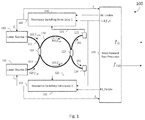
- FIG. 1 is a block diagram illustrating a resonator fiber optic gyroscope (RFOG) 100 of one embodiment of the present disclosure.
- RFOG 100 comprises a first laser source 110 and second laser source 112 each coupled to a fiber optic resonator 120 by at least one optical coupler 122.
- RFOG 100 further comprises a first resonance switching servo loop 130, a second resonance switching servo loop 132, and a feed-forward rate processor 135, each of which are discussed in greater detail below.
- laser source 110 outputs a first optical beam 101 of laser light that is coupled into resonator 120 by coupler 122 and travels around resonator 120 in a first direction.
- the first optical beam 101 is defined as traveling around resonator 120 in a counter-clockwise (CCW) direction.
- Laser source 112 outputs a second optical beam 102 of laser light that is coupled into resonator 120 by coupler 122 and travels around resonator 120 in a second direction that is opposite to the first direction traveled by optical beam 101.
- the second optical beam 102 is defined as traveling around resonator 120 in a clockwise (CW) direction.
- Laser sources 110 and 112 are each controlled by respective resonance switching servo loops 1 and 2 (shown at 130 and 132) to maintain the frequencies of optical beams 101 and 102 at resonance frequencies of the resonator 120.
- Laser source 110 launches optical beam 101 into resonator 120 at a specific optical frequency (shown in Figure 1 as ⁇ ccw). At that frequency, ⁇ ccw, optical beam 101 will exhibit a specific wavelength, ⁇ ccw (which for laser light can be a wavelength on the order of 1.5 microns, for example).
- optical beam 101 When optical beam 101 is tuned to a frequency ⁇ ccw such that exactly an integer multiple of wave lengths ⁇ ccw are propagating around resonator 120, then optical beam 101 is said to be operating at a resonant frequency of the resonator 120 (which can also be referred to as one of the resonant modes of the resonator 120). At this frequency, with each pass that optical beam 101 travels around the loop of resonator 120, the optical beam is in phase with its previous pass and the optical power from each pass accumulates to a peak resonant intensity. Any deviation in ⁇ ccw from a resonance frequency will cause optical power within resonator 120 to sum to less than the peak resonant intensity.
- the first laser source 110 and the second laser source 112 are controlled by their respective servo loops (130 and 132) to remain locked to different resonance modes with respect to each other. That is, if optical beam 101 is locked to a resonant frequency ⁇ o a (where an integer number, I, of wavelengths are propagating in the CCW direction around resonator 120), then optical beam 102 is locked to a resonant frequency ⁇ ob (where an integer number, J ⁇ I, of wavelengths are propagating in the CW direction around resonator 120).
- Adjacent resonant frequencies are separated from each other based on a function of the free spectral range (FSR) of resonator 120, a difference referred to herein as ⁇ FSR .
- FSR free spectral range
- ⁇ FSR free spectral range
- optical beam 101 is drivento a frequency ⁇ ccw that is equal to the frequency ⁇ o a corresponding to a first resonant mode M 1 .
- optical beam 102 is driven to a frequency ⁇ cw equal to the frequency fob corresponding to a second resonant mode M 2 .
- the frequency difference between the peak resonant intensity at mode M 1 and the peak resonant intensity at mode M 2 is equal to the ⁇ FSR .
- laser source 110 and laser source 112 operate at adjacent resonant modes M 1 , M 2 separated by 1 ⁇ FSR .
- additional embodiments are conceived as within the scope of the present disclosure where laser source 110 and laser source 112 are operated at frequencies M 1 , M 2 separated by other integer multiples of ⁇ FSR .
- the frequencyfccw of optical beam 101 is locked to a resonance frequency ⁇ oa by the first resonance switching servo loop 130 while the frequency ⁇ cw of optical beam 102 is locked to a resonance frequency ⁇ ob by the second resonance switching servo loop 132. In one embodiment, this is accomplished by operating servo loops 130 and 132 as frequency locked loops. More specifically, the CCW optical beam is frequency or phase modulated to interrogate the resonator. A portion of the CCW propagating optical beam 101 is coupled out of resonator 120 by an optical coupler 123 and delivered to a first photodetector 122, which measures the optical intensity of optical beam 101.
- photodetector 122 produces a resonance tracking signal 123, which is an electrical signal that varies as a function of the measured optical intensity.
- a resonance tracking signal 123 is an electrical signal that varies as a function of the measured optical intensity.
- the photodetector output will not have a frequency component at the modulation frequency.
- the photodetector output at the modulation frequency will be proportional to small average optical frequency deviations from the resonance frequency. Deviation from resonance frequency ⁇ oa produces a tracking error at the modulation frequency reflected in resonance tracking signal 123.
- First resonance switching servo loop 130 inputs the resonance tracking signal 123 at the modulation frequency and outputs a control signal 140 to laser source 110 that adjusts the frequency ⁇ ccw of optical beam 101 to drive the tracking error at the modulation frequency to zero (i.e., control signal 140 drives optical beam 101 to the desired resonance frequency).
- control signal 140 drives optical beam 101 to the desired resonance frequency.
- a portion of the CW propagating optical beam 102 is coupled out of resonator 120 by optical coupler 123 and delivered to a second photodetector 124, which measures the optical intensity of optical beam 102. From this measurement, photodetector 124 produces a resonance tracking signal 125, which is an electrical signal that varies as a function of the measured optical intensity.
- the resonance switching servo loops 130 and 132 are referred to as "resonance switching" because the embodiments described by present disclosure periodically swap the respective resonator modes used for optical beams 101 and 102. That is, after operating for a fixed period of time with optical beam 101 at resonance frequency ⁇ oa (Mode M 1 ) and optical beam 102 at resonance frequency ⁇ ob (Mode M 2 ), resonance switching servo loops 130 and 132 will switch optical beam 101 from resonance frequency ⁇ o a to resonance frequency fob while simultaneously switching optical beam 102 from resonance frequency fob to resonance frequency ⁇ oa.
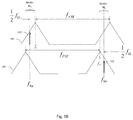
- the various resonance modes for light traveling in the CW direction shown by curve 182
- the CCW direction shown by curve 181
- the respective path lengths travelled by light in the CW and CCW directions will no longer be equal, exhibiting a phenomena known as the Sagnac effect.
- the distance that optical beam 101 must travel to complete one trip around resonator 120 increases in length, while the distance that optical beam 102 must travel to complete one trip around resonator 120 decreases in length.
- the number of wavelengths that fit within the CW and CCW paths become dissimilar, and therefore the resonance modes associated with each direction will no longer align with each other.
- the resonant frequency for the CCW direction 181 which optical beam 101 was locked to shifts from ⁇ oa (the non-rotation resonant frequency for resonance mode M 1 ) to ⁇ 1 , a shift of 1 ⁇ 2 ⁇ ⁇ caused by rotation.
- ⁇ ob the non-rotation resonant frequency for resonance mode M 2
- a shift of 1 ⁇ 2 ⁇ ⁇ caused by rotation For Figure 1B , the frequencies of optical beams 101 and 102 have remained unchanged from the zero rotational resonance frequencies ⁇ oa and ⁇ ob . In this case, a resonance tracking error signal is present until the resonance switching loop controls the laser frequencies two the new resonance frequencies to ⁇ 1 and ⁇ 2 .
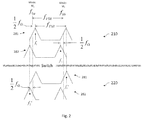
- operation of RFOG 100 during a first switching state is shown generally at 210 where optical beam 101 is locked to resonant mode M 1 and optical beam 102 is locked to the adjacent resonant mode M 2 .
- the frequency of resonance mode M 2 has shifted in the opposite direction from the initial resonant frequencyfob to a new resonant frequency ⁇ 2 (as shown generally at 282). This shift is also directly a function of the rate of rotation and equal to 1 ⁇ 2 ⁇ .
- resonance switching servo loops 130 and 132 will adjust and drive optical beams 101 and 102 to maintain them at these new respective resonant frequencies ⁇ 1 and ⁇ 2 .
- ⁇ ⁇ includes a measurement of the rotation rate ⁇ , but also includes a component of the FSR.
- the total length of resonator 120 will expand and contract with temperature and for that reason FSR is a variable element that will change with the temperature. For that reason, the ⁇ FSR cannot be readily accounted for to obtain ⁇ from ⁇ ⁇ .
- switching operation of RFOG 100 to the second switching state that swaps resonant modes between optical beam 101 and 102 leads to the development of a set of two independent linear equations with two unknowns, which permits solving for both ⁇ FSR and ⁇ ⁇ .
- RFOG 100 in the second switching state Operation of RFOG 100 in the second switching state is shown generally at 220 where optical beam 101 is now locked to resonant mode M 2 and optical beam 102 is locked to the adjacent resonant mode M 1 and the shifts in resonant frequencies in the CCW and CW directions due to rotation are shown respectively at 283 and 284
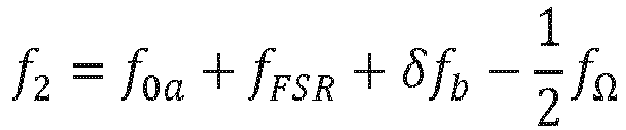
- calculation of ⁇ ⁇ + in the manner describe above by switching the optical beams 101 and 102 between resonant modes M 1 and M 2 also serves to produce a value of 2 ⁇ ⁇ from which the effects of lineshape asymmetry gradient error have been canceled.
- ⁇ a is the frequency shift in optical beam 101 due to lineshape asymmetry when optical beam 101 is locked to resonant mode M 1
- ⁇ ⁇ b is the frequency shift in optical beam 102 due to lineshape asymmetry when optical beam 102 is locked to resonant mode M 2 .
- resonance switching servo loop 130 and resonance switching servo loop 132 repeatedly cycle between the first switching state and the second switching state so that during the first half of each cycle laser source 110 is locked to resonance mode M 1 and laser source 112 is locked to resonance mode M 2 , and during the second half of each cycle laser source 110 is locked to resonance mode M 2 and laser source 112 is locked to resonance mode M 1 .
- resonance switching servo loop 130 outputs a control signal 140 equal to ⁇ 1 for the first half of each cycle, and equal to ⁇ 1 ' for the second half of each cycle.
- resonance switching servo loop 132 outputs a control signal 142 equal to ⁇ 2 for the first half of each cycle, and equal to ⁇ 2 ' for the second half of each cycle.
- control signal 140 and control signal 142 are also each provided to feed-forward rate processors 135, so that feed-forward rate processors 135 can calculate ⁇ ⁇ + and from that output rotation rate measurements ⁇ from rotation rate frequency value ⁇ ⁇ .
- feed-forward rate processor 135 may further utilize the values provided by control signal 140 and control signal 142 to calculate ⁇ ⁇ ⁇ and from that output FSR measurements ⁇ FSR .
- feed-forward rate processor 135 needs to continuously re-calculate ⁇ ⁇ + quickly enough to accommodate changes inFSR. Otherwise, if ⁇ ⁇ + is calculated from old data that does not represent current conditions, some fraction of FSR will enter into, and therefore corrupt, the rotation rate output.Resonant frequency switching needs to occur at a sufficiently high frequency so that FSR erroris canceled outfrom the rotation rate calculations. However, switching too frequently also has drawbacks. During the finite period of time in which the servos 130 and 132 are actually performing the switch between resonant modes M 1 and M 2 , the frequency data carried by control signal 140 and control signal 142 becomes corrupted and unusable.
- Increasing the resonance switching frequency therefore also increases the fraction of corrupted and unusable data sent to feed-forward rate processor 135 per each resonance switching cycle, decreasing the usable fraction of data that feed-forward rate processor 135 has to work with per switching cycle.
- a completely independent consideration is the rate at which RFOG 100 needs to output fresh rotation rate measurement samples to satisfy system design criteria.
- the measurement sample output rate will likely be many orders of magnitude faster than the optimal resonance switching frequency. For example, where it may be optimal based on expected temperature dynamics for the switching state to be switched once per second (i.e., 1 Hz), for navigation applications, RFOG 100 may be called on to provide rotation rate measurement samples at a frequency of 1kHz or greater.
- feed-forward rate processor 135 also employees the feed forward mechanism illustrated in Figure 3 .
- curve 310 is a plot of frequency ⁇ 1 of the first optical beam 101 verses time while it is alternatively locked to the two ccw resonances
- curve 320 is a plot of frequency ⁇ 2 of thesecond optical beam 102 verses timewhile it is alternatively locked to the two cw resonances.
- feed-forward rate processor 135 includes one or more digital signal processing units that calculate a first resonance frequency average ⁇ ⁇ 1 >based on the output of optical beam 101 from the resonator, and a second resonance frequency average ⁇ ⁇ 2 >based on the output of optical beam 102 from the resonator, for each half of a switching cycle.
- an average ⁇ ⁇ ⁇ > may be calculated that is equal to ⁇ 2 ⁇ FSR >, which is proportional to the average FSR of resonator 120 over the period of the full switching cycle 311. Because, FSR is expected to change with temperature, but not at a rate comparable to the rate at which RFOG 100 outputs rotation rate measurement samples, this ⁇ 2 ⁇ FSR > measured from the immediately prior switching cycle 311 is used by feed-forward rate processor 135 to cancel ⁇ FSR from current ⁇ 1 and ⁇ 2 resonant frequency measurements.
- the ⁇ 2 ⁇ FSR > calculated for a past resonance switching cycle is fed-forward to and applied to the high frequency present frequency measurements to compensate for FSR during the current switching cycle, until a new ⁇ 2 ⁇ FSR >is calculated for the current switching cycle.
- This new ⁇ 2 ⁇ FSR > will then be fed-forward feed-forward rate processor 135 for use to compensate for FSR for the next switching cycle.
- a previous full cycle of resonant frequency measurements comprises a first 1 ⁇ 2 cycle where optical beam 101 is locked to resonant mode M 1 and optical beam 102 is locked to resonant mode M 2 (shown at 312) and second 1 ⁇ 2 cycle where optical beam 101 is locked to resonant mode M 2 and optical beam 102 is locked to resonant mode M 1 (shown at 314).
- measurement samples resonant frequency switching states are indicated by the index reference "q" while the index "i" indicates resonant frequency ⁇ 1 , ⁇ 2 measurement samples produced by resonance switching servo loops 130 and 132.
- the higher frequency is represented by the lower of the two traces, consistent with the resonance frequency of mode M 2 being higher than the resonance frequency of mode M 1 .
- the average ⁇ ⁇ 1 > q-1 is the average of the measured resonant frequency ⁇ 1 values captured while optical beam 101 was locked to resonant mode M 2 during the full cycle 311 of resonant frequency measurements.
- the average ⁇ ⁇ 2 > q-1 is the average of the measured resonant frequency ⁇ 2 values captured while optical beam 102 was locked to resonant mode M 1 during the full cycle 310 of resonant frequency measurements.
- the average ⁇ ⁇ 1 > q-2 is the average of the resonant frequency ⁇ 1 values captured while optical beam 101 was locked to resonant mode M 1 during the full cycle 311 of resonant frequency measurements.
- the average ⁇ ⁇ 2 > q-2 is the average of the resonant frequency ⁇ 2 values captured while optical beam 102 was locked to resonant mode M 2 during the full cycle 311 of resonant frequency measurements. It should be noted that at 316, each of the resonant frequencies are flat-lined immediately after switching between modes M 1 and M 2 is initiated.
- Figure 4 is a flow chart illustrating one implementation of a feed-forward rotation rate processing method 400 implemented with an resonating fiber optic gyroscope.
- method 400 is implemented in combination with the feed-forward rate processor 135 of the RFOG 100 described herein.
- descriptions, options and alternatives described herein with respect to RFOG 100 or any of its component elements may be utilized in combination with elements of method 400 and vice versa .
- Method 400 begins at 410 with operating the resonating fiber optic gyroscope, for a first period of time, with a first optical beam locked to a first resonance mode M 1 of the optical resonator, and a second optical beam locked to a second resonance mode M 2 of the optical resonator, the second optical beam propagating around the optical resonator in a direction opposite to the first optical beam.
- the first resonance mode separated from the second resonance mode by a single FSR.
- the resonating fiber optic gyroscope comprises a pair of laser sources that each launch one of the optical beams into a fiber coil resonator.
- the frequency of the first laser source is locked to the first resonance mode M 1 by a feedback control signal produced from a first resonance switching servo loop.
- the frequency of the second laser source is locked to the second resonance mode M 2 by a feedback control signal produced from a second resonance switching servo loop.
- the first and second resonance switching servo loops are each coupled to respective first and second photo detectors that measure the optical power of the respective optical beams.
- the optical beams each have an optical phase modulation applied prior to reaching the resonator, and the first and second resonance switching servo loops demodulate the optical beams to further determine when the frequencies of the optical beams are locked to resonance modes of the resonator.
- the method proceeds to 420 with calculating, for the first period of time, a first resonance frequency measurement average based on the first optical beam output and a second resonance frequency measurement average for based on the second optical beam output.
- period 311 represents period of time for the last fully completed switching cycle where 312 is the 1 ⁇ 2 cycle time period in which the first optical beam is locked to resonance mode M 1 and the second optical beam is locked to resonance mode M 2 .
- the method 400 at block 420 calculates the first resonance frequency average ⁇ ⁇ 1 > q-2 , and the second resonance frequency average ⁇ ⁇ 2 > q-2 for the 1 ⁇ 2 cycle time period 312.
- the method proceeds to 430 with operating the resonating fiber optic gyroscope, for a second period of time following the first period of time, with the first optical beam locked to the second resonance mode M 2 of the optical resonator, and the second optical beam locked to the first resonance mode M 1 of the optical resonator.
- the resonating fiber optic gyroscope except that the first and second resonance switching servo loop have switched operation from a first switch state in block 410 to a second switch state in block 430. That is they have each swapped operating their respective laser sources between resonant modes M 1 and M 2 .
- the method proceeds to 440 with calculating, for the second period of time, a third resonance frequency average for the first optical beam, and a fourth resonance frequency average for the second optical beam.
- period 314 is the 1 ⁇ 2 cycle time period in which the first optical beam is locked to resonance mode M 2 and the second optical beam is locked to resonance mode M 1 .
- the method 400 at block 440 calculates the third resonance frequency average ⁇ ⁇ 1 > q-1 , and the fourth resonance frequency average ⁇ ⁇ 2 > q-1 for the 1 ⁇ 2 cycle time period 314.
- the method proceeds to 460 with generating a rotation rate measurement ⁇ ⁇ sample signal based on a function of a first resonance frequency measurement for the first optical beam captured after the second period of time, a second resonance frequency measurement for the second optical beam captured after the second period of time, and the free spectral range average.
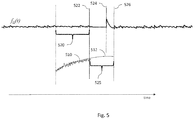
- feed-forward rate processor 135 applies an extrapolation to fill in for corrupted measurements, as illustrated in Figure 5 .
- feed-forward rate processor 135 calculates and stores into memory rotation rate measurements ⁇ ⁇ it also calculates a statistical curve fit510 over a pre-specified segment of valid ⁇ ⁇ data (shown at 520) occurring just before a resonant mode switch operation(shown at 522).
- the statistical curve fit 510 may be calculated as a linear average, a weighted average, a quadratic fit, or other curve fit.
- the first and second resonance switching servo loops 130 and 132 When the resonant mode switch is initiated (shown at 522), the first and second resonance switching servo loops 130 and 132 will unlock from tracking their respective resonant frequencies. At this point, the first and second resonance switching servo loops 130 and 132 will be reconfigured to swap resonant modes. The servo loops 130 and 132 are closed (shown at 524) and eventually lock onto their new respective resonant frequencies (shown at 526).
- FIG. 6 is a block diagram illustrating one example of an implementation of laser sources 110 and 112 shown in Figure 1 .
- laser source 110 is implemented by first slave laser 610 and laser source 112 is implemented by a second slave laser 612.
- RFOG 100 further comprises a third laser referred to as a master laser 680.
- mixer/controller 686 which may comprise an optical coupler.
- Mixer/controller 686 converts that beat note into an electrical signal.
- mixer/controller 686 calculates an error in beat note electrical signal and provides a control signal to slave laser 610 to control the frequency of the laser light output from slave laser 610, which forms optical beam 101.
- mixer/controller 688 which may comprise an optical coupler.
- Mixer/controller 688 converts that beat note into an electrical signal.
- mixer/controller 688 uses the resonance frequency ⁇ 2 output 142 from DDS2 684 in servo loop 132 as a reference, mixer/controller 688 calculates an error in beat note electrical signal and provides a control signal to slave laser 612 to control the frequency of the laser light output from slave laser 612, which forms optical beam 102.
- FIG. 7 is a block diagram illustrating at 700 oneexample design for implementing resonance switching servo loops 130 and 132 in combination with feed-forward rate processor 135. As such, the following description of elements with respect to Figure 7 are applicable to Figure 1 and vice versa .
- resonance switching servo loop 130 and 132 each comprises an analog to digitalconverter (ADC), a phase demodulator (Demod), and accumulator (Accum), a summer, a frequency switch ramp generator and a first laser source offset register.
- ADC analog to digitalconverter
- Demod phase demodulator
- Accum accumulator
- resonance switching servo loop 130 inputs resonance tracking signal 123 where it is digitized by ADC 712 and demodulated by demodulator 714, providing a digital error signal indicating the degree to which optical beam 101 is on resonance. If optical beam 101 is on resonance, then the error signal zeros out. Accumulator 716 adds the digital error signal to a register of previous error signal values. The result is a digital output proportional to ⁇ 1 that passed through summer 718 (discussed below) as the control signal 140.
- control signal 140 is a digital signal communicated to a first DDS (such as DDS 682, for example).
- This DDS converts the digital signal to an analog frequency reference control signal provided to laser source 110 to control the frequency of the optical beam 101.
- resonance switching servo loop 132 inputs resonance tracking signal 125 where it is digitized by ADC 732 and demodulated by demodulator 734, providing a digital error signal indicating the degree to which optical beam 102 is on resonance. If optical beam 102 is on resonance, then the error signal zeros out.
- Accumulator 736 adds the digital error signal to a register of previous error signal values. The result is a digital output proportional to ⁇ 2 passed through summer 738 (discussed below) as the control signal 142.
- control signal 142 is a digital signal communicated to a first DDS (such as DDS 684, for example).
- This DDS converts the digital signal to an analog frequency reference control signal provided to laser source 112 to control the frequency of the optical beam 102.
- the rotation rate measurement ⁇ ⁇ ,i may be generated at a sample rate many times faster than resonance switching period employed for calculating ⁇ ⁇ ⁇ > q- 1 .
- switching of the servo loops 130 and 132 between resonance modes is initiated within servo loops 130 and 132 by an RS-Enable signal which may be generated by feed-forward rate processor 135.
- an RS-Enable signal which may be generated by feed-forward rate processor 135.
- accumulator 716 is disabled, meaning that it ceases to further update its register, essentially unlocking optical beam 101 from its current resonant mode.
- the RS-Enable signal is also provided as an input to a frequency switch ramp generator 720 within resonance switching servo loop 130. The output of frequency switch ramp generator 720 is summed with the present value stored in accumulator 716 by summer 718.
- frequency switch ramp generator 720 When the RS-Enable signal is not active, the output of frequency switch ramp generator 720 is held constant at its terminal value and summer 718 passes the summed output of accumulator 716and ramp generator 720 as control signal 140. When the RS-Enable signal is activated, the accumulator 716 output is held constant and no longer controls the laser frequency, and the frequency switch ramp generator 720 produces a ramped output that is summed with the constant output of accumulator 716 and drives the control signal 140 to the next resonance mode. In one embodiment, to drive the control signal 140 to the next higher resonance mode, frequency switch ramp generator 720 ramps from aninitial value corresponding to the nominal lower resonance frequency toa final value that is the initial value +1 ⁇ FSR .
- frequency switch ramp generator 720 ramps from an initial value output to a final output of the initial value - 1 ⁇ FSR . Because the exact value of ⁇ FSR and the specific resonance frequency of the next resonance mode are both dynamic and not precisely known (because they change with temperature and the rotational acceleration of RFOG 100), frequency switch ramp generator 720 is also provided with an estimate of the current ⁇ FSR from the calculation of ⁇ ⁇ ⁇ > q -1 by block 754.
- resonance switching servo loop 130 will switch optical beam 101 approximately one ⁇ FSR , thus reducing the error that resonance switching servo loop 130 will need to servo out to lock optical beam 101 onto the new resonant mode.
- the frequency ramp generator 720 completes its frequency ramp, the RS-Enable signal is deactivated and accumulator 716 is enabled. Since frequency ramp generator ramps the laser frequency by approximately 1 ⁇ FSR , the accumulator 716 output is already very near the necessary value to maintain the optical beam 101 on resonance and thus quickly controls the optical beam 101 onto resonance.
- Resonance switching servo loop 132 responds to the RS-Enable signal to initiate switching in the exact same manner.
- accumulator 736 is disabled, meaning that it ceases to further update its register, essentially unlocking optical beam 102 from its current resonant mode.
- the RS-Enable signal is also provided as an input to a frequency switch ramp generator 740 within resonance switching servo loop 132.
- the output of frequency switch ramp generator 740 is summed with the output of accumulator 736 by summer 738.
- the output of frequency switch ramp generator 740 is heldconstant at its terminal value and summer738 passes the summed output of accumulator 736and ramp generator 740 as control signal 142.
- frequency switch ramp generator 740 When the RS-Enable signal is activated, the accumulator 736 output is held constant and no longer controls the laser frequency, and the frequency switch ramp generator 740 produces a ramped output that is summed with the constant output of accumulator736 and drives the control signal 142 to the next resonance mode.
- frequency switch ramp generator 740 to drive the control signal 142 to the next higher resonance mode, frequency switch ramp generator 740 ramps from an initial value corresponding to the nominal lower resonance frequency toa final value that is the initial value +1 ⁇ FSR .
- frequency switch ramp generator 740 ramps from an initial value output to a final output of the initial value -1 ⁇ FSR .
- frequency switch ramp generator 740 is also provided with an estimate of the current, ⁇ FSR from the calculation of ⁇ ⁇ ⁇ > q -1 by block 754.
- resonance switching servo loop 132 will switch optical beam 102 approximately one ⁇ FSR , thus reducing the error that resonance switching servo loop 132 will need to servo out to lock optical beam 102 onto the new resonant mode.
- the frequency ramp generator 740 completes its frequency ramp, the RS-Enable signal is deactivated and accumulator 736 is enabled.
- Activation of the RS-Enable signal is also utilized to trigger the replacement of corrupted rotation rate measurements ⁇ ⁇ with extrapolated values such as described above with respect to Figure 5 .
- an extrapolator 760within feed-forward rate processor 135 implements an algorithm that calculates the statistical curve fit 410 over the pre-specified segment of valid ⁇ ⁇ data 520 occurring just before the RS-Enable signal is activated to initiate the resonant mode switch operation (at 522 of Figure 5 ).
- the replace function 762 permits the valid ⁇ ⁇ data to flow through as the output of RFOG 100.
- the replace function 762 discards the corrupt ⁇ ⁇ data coming from block 754 and instead replaces that data with the extrapolated estimated of rotation rate ⁇ ⁇ calculated by extrapolator 760. That is, as long as the RS-Enable signal is activated, the rotation rate output of RFOG 100 will be based on the extrapolated estimated of rotation rate ⁇ ⁇ .
- the feed-forward rate processor 135 further may include an optional second extrapolator 764 within feed-forward rate processor 135 that implements an algorithm that calculates a statistical curve fit over a pre-specified segment of valid ⁇ FSR,i data occurring just before the RS-Enable signal is activated.
- the replace function 766 permits the valid ⁇ FSR,i data from block 756 to flow through as an output of RFOG 100.
- the replace function 766 discards corrupt ⁇ FSR , i data from block 756 and instead replaces that data with the extrapolated estimated of ⁇ FSR,i calculated by extrapolator 764. That is, as long as the RS-Enable signal is activated, the ⁇ FSR,i output of RFOG 100 will be based on the extrapolated estimated of ⁇ FSR,i .
- Example 1 includes a feed-forward rotation rate processing method for a resonating fiber optic gyroscope having an optical resonator, the method comprising: operating the resonating fiber optic gyroscope, for a first period of time, with a first optical beam locked to a first resonance mode M 1 of the optical resonator, and a second optical beam locked to a second resonance mode M 2 of the optical resonator, the second optical beam propagating around the optical resonator in a direction opposite to the first optical beam; calculating, for the first period of time, a first resonance frequency measurement average based on the first optical beam output and a second resonance frequency measurement average for based on the second optical beam output; operating the resonating fiber optic gyroscope, for a second period of time following the first period of time, with the first optical beam locked to the second resonance mode M 2 of the optical resonator, and the second optical beam locked to the first resonance mode M 1 of the optical resonator; calculating, for the second period
- Example 2 includes the method of example 1, wherein the first resonance mode M 1 and the second resonance mode M 2 are separated in frequency by one free spectral range (FSR).
- FSR free spectral range
- Example 3 includes the method of any of examples 1-2, wherein the first period of time and the second period of time are of equal time duration.
- Example 4 includes the method of any of examples 1-3, wherein the free spectral range average includes a measure of line shape asymmetry gradient error.
- Example 5 includes the method of any of examples 1-4, further comprising: generating the first optical beam with a first laser source controlled by a first resonance switching servo loop; and generating the second optical beam with a second laser source controlled by a second resonance switching servo loop.
- Example 6 includes the method of example 5, further comprising: ramping an output of the first resonance switching servo loop to switch the first optical beam from the first resonance mode M 1 to the second resonance mode M 2 based on the free spectral range average; and ramping an output of the second resonance switching servo loop to switch the second optical beam from the second resonance mode M 2 to the first resonance mode M 1 based on the free spectral range average.
- Example 9 includes the method of any of examples 1-8, further comprising: calculating a statistical curve fit over a pre-specified segment of valid rotation rate measurement frequency value ⁇ ⁇ sample data; and generating the rotation rate measurement frequency value ⁇ ⁇ sample signal from rotation rate data extrapolated from the statistical curve fit during a switching operation between the first period of time and the second period of time in which the first optical beam is switching between resonance mode M 1 and M 2 . and when the second optical beam is switching between resonance mode M 2 and M 1 .
- Example 10 includes a resonating fiber optic gyroscope system with feed-forward rotation rate processing, the system comprising: a fiber optic resonator; a first laser source and a second laser source each coupled to the fiber optic resonator, wherein the first laser source launches a first optical beam into the fiber optic resonator and the second laser source launches a second optical beam into the fiber optic resonator in a direction opposite to the first optical beam; a first resonance switching servo loop configured to lock the first optical beam to a first resonant mode M 1 of the fiber optic resonator during a first switching state, and lock the first optical beam to a second resonant mode M 2 of the fiber optic resonator during a second switching state; a second resonance switching servo loop configured to lock the second optical beam to the second resonant mode M 2 during the first switching state, and lock the second optical beam to the first resonant mode M 1 during the second switching state; a feed-forward rate processor coupled to the first resonance switching
- Example 11 includes the system of example 10, wherein the first resonance mode M 1 and the second resonance mode M 2 are separated in frequency by one free spectral range (FSR).
- FSR free spectral range
- Example 12 includes the system of any of examples 10-11, wherein the free spectral range average includes a measure of line shape asymmetry gradient error.
- Example 13 includes the system of any of examples 10-12, wherein the prior resonance switching cycle comprises: a first period of time with the first optical beam locked to the first resonance mode M 1 of the optical resonator, and the second optical beam locked to the second resonance mode M 2 of the optical resonator; and a second period of time following the first period of time, with the first optical beam locked to the second resonance mode M 2 of the optical resonator, and the second optical beam locked to the first resonance mode M 1 of the optical resonator; wherein the free spectral range average is calculated over the first period of time and the second period of time.
- Example 14 includes the system of example 13, wherein the first period of time and the second period of time are of equal time duration.
- Example 15 includes the system of any of examples 13-14, wherein the feed-forward rate processor calculates for the first period of time, a first resonance frequency average based on the first optical beam traveling in the fiber optic resonator and a second resonance frequency average based on the second optical beam traveling in the fiber optic resonator; and wherein the feed-forward rate processor calculates for the second period of time, a third resonance frequency average based on the first optical beam traveling in the fiber optic resonator, and a fourth resonance frequency average based on the second optical beam traveling in the r fiber optic resonator.
- Example 16 includes the system of example 15, wherein the feed-forward rate processor calculates the free spectral range average over the first period of time and the second period of time as a function of the first resonance frequency average, the second resonance frequency average, third resonance frequency average, and the fourth resonance frequency average.
- Example 17 includes the system of any of examples 10-16, wherein the feed-forward rate processor calculates a statistical curve fit over a pre-specified segment of valid rotation rate measurement frequency value ⁇ ⁇ sample data; and wherein the feed-forward rate processor generates the rotation rate measurement frequency value ⁇ ⁇ sample signal from rotation rate data extrapolated from the statistical curve fit during a switching operation in which the first optical beam is switched between resonance mode M 1 and M 2 , and in which the second optical beam is switched between resonance mode M 2 and M 1 .
- Example 19 includes the system of any of examples 10-18, wherein the first resonance switching servo loop comprises: a first frequency switch ramp generator that receives the free spectral range average from the feed-forward rate processor; wherein the frequency switch ramp generator ramps an output of the first resonance switching servo loop to switch the first optical beam from the first resonance mode M 1 to the second resonance mode M 2 based on the free spectral range average.
- the first resonance switching servo loop comprises: a first frequency switch ramp generator that receives the free spectral range average from the feed-forward rate processor; wherein the frequency switch ramp generator ramps an output of the first resonance switching servo loop to switch the first optical beam from the first resonance mode M 1 to the second resonance mode M 2 based on the free spectral range average.
- Example 20 includes the system of example 19, wherein the second resonance switching servo loop comprises: a second frequency switch ramp generator that receives the free spectral range average from the feed-forward rate processor; wherein the second frequency switch ramp generator ramps an output of the second resonance switching servo loop to switch the first optical beam from the second resonance mode M 2 to the first resonance mode M 1 based on the free spectral range average.
- the second resonance switching servo loop comprises: a second frequency switch ramp generator that receives the free spectral range average from the feed-forward rate processor; wherein the second frequency switch ramp generator ramps an output of the second resonance switching servo loop to switch the first optical beam from the second resonance mode M 2 to the first resonance mode M 1 based on the free spectral range average.
- system elements, method steps, or examples described throughout this disclosure may be implemented on one or more computer systems, field programmable gate array (FPGA), or similar devices comprising a processor executing code to realize those elements, processes, or examples, said code stored on a non-transient data storage device. Therefore other embodiments of the present disclosure may include elements comprising program instructions resident on computer readable media which when implemented by such computer systems, enable them to implement the embodiments described herein.
- computer readable media refers to tangible memory storage devices having non-transient physical forms.
- Non-transient physical forms may include computer memory devices, such as but not limited to punch cards, magnetic disk or tape, any optical data storage system, flash read only memory (ROM), non-volatile ROM, programmable ROM (PROM), erasable-programmable ROM (E-PROM), random access memory (RAM), or any other form of permanent, semi-permanent, or temporary memory storage system or device having a physical, tangible form.
- Program instructions include, but are not limited to computer-executable instructions executed by computer system processors and hardware description languages such as Very High Speed Integrated Circuit (VHSIC) Hardware Description Language (VHDL).
- VHSIC Very High Speed Integrated Circuit
- VHDL Hardware Description Language
Landscapes
- Physics & Mathematics (AREA)
- Engineering & Computer Science (AREA)
- Optics & Photonics (AREA)
- General Physics & Mathematics (AREA)
- Electromagnetism (AREA)
- Power Engineering (AREA)
- Radar, Positioning & Navigation (AREA)
- Remote Sensing (AREA)
- Gyroscopes (AREA)
Abstract
Description
- This invention was made with Government support under Government Contract No. HR0011-08-C-0019 awarded by DARPA. The Government has certain rights in the invention.
- The resonator fiber optic gyroscope (RFOG) is a promising contender for next generation navigation gyroscope. It has the potential to provide a navigation grade solution with the combination of low cost, small package size and weight. The RFOG uses at least two laser beams, at least one propagates around a resonator coil in the clockwise (CW) direction and the other in the counter-clockwise (CCW) direction. In the operation of a resonant fiber optic gyroscope (RFOG), it is desirable to lock the frequencies of the laser light sources to the resonance frequencies of the fiber optic ring resonator using high bandwidth electronic servos. It is also known that operating the CW and CCW laser beams on different resonance modes of the fiber optic ring resonator can suppress single direction optical backscatter errors that degrade gyro performance. However, this is an incomplete solution because operating the CW and CCW laser beams on different resonance modes also introduces the gyro resonator free spectral range (FSR) as a component of the rotation rate measurement, which introduces temperature sensitivity errors to the rotation measurement. Furthermore, resonator lineshape asymmetries, for example, from either polarization errors or from double optical back-reflections or double backscatter will introduce a resonance center detection error that will be different between resonance modes and therefore introduces a rotation sensing error with a complex dependence on temperature.
- For the reasons stated above and for other reasons stated below which will become apparent to those skilled in the art upon reading and understanding the specification, there is a need in the art for alternate systems and methods for providing resonance switching resonator fiber optic gyroscopes (RFOGs) with feed-forward processing.
- The Embodiments of the present invention provide methods and systems for providing resonance switching resonator fiber optic gyroscopes (RFOGs) with feed-forward processing and will be understood by reading and studying the following specification.
- In one embodiment, a resonating fiber optic gyroscope system with feed-forward rotation rate processing comprises: a fiber optic resonator; a first laser source and a second laser source each coupled to the fiber optic resonator, wherein the first laser source launches a first optical beam into the fiber optic resonator and the second laser source launches a second optical beam into the fiber optic resonator in a direction opposite to the first optical beam; a first resonance switching servo loop configured to lock the first optical beam to a first resonant mode M1 of the resonator during a first switching state, and lock the first optical beam to a second resonant mode M2 of the resonator during a second switching state; a second resonance switching servo loop configured to lock the second optical beam to the second resonant mode M2 during the first switching state, and lock the first resonant frequency of the first resonant mode M1 during the second switching state; a feed-forward rate processor coupled to the first resonance switching servo loop and the second resonance switching servo loop, wherein the feed-forward rate processor calculates a free spectral range average across a prior resonance switching cycle of resonant frequency measurements and applies the free spectral range average to current resonant frequency measurements to output a rotation rate measurement frequency value ƒΩ sample signal.
- Embodiments of the present invention can be more easily understood and further advantages and uses thereof more readily apparent, when considered in view of the description of the preferred embodiments and the following figures in which:
-
Figure 1 is a block diagram of a resonating fiber optic gyroscope system with feed-forward rotation rate processing of one embodiment of the present disclosure; -
Figures 1A and1B are diagrams illustrating resonant modes of resonator of a resonating fiber optic gyroscope system of one embodiment of the present disclosure; -
Figure 2 is a diagram illustrating resonant mode switching for a resonating fiber optic gyroscope system of one embodiment of the present disclosure; -
Figure 3 is a diagram illustrating feed-forward rotation rate processing of one embodiment of the present disclosure; -
Figure 4 is a flow chart illustrating a method of one embodiment of the present disclosure; -
Figure 5 is a diagram illustrating extrapolation of rotation rate data for one embodiment of the present disclosure; -
Figure 6 is a diagram illustrating implementation of two laser sources for a resonating fiber optic gyroscope system of one embodiment of the present disclosure; and -
Figure 7 is a diagram illustrating resonance switching servo loops in combination with a feed forward rate processor for a resonating fiber optic gyroscope system of one embodiment of the present disclosure. - In accordance with common practice, the various described features are not drawn to scale but are drawn to emphasize features relevant to the present invention. Reference characters denote like elements throughout figures and text.
- In the following detailed description, reference is made to the accompanying drawings that form a part hereof, and in which is shown by way of specific illustrative embodiments in which the invention may be practiced. These embodiments are described in sufficient detail to enable those skilled in the art to practice the invention, and it is to be understood that other embodiments may be utilized and that logical, mechanical and electrical changes may be made without departing from the scope of the present invention. The following detailed description is, therefore, not to be taken in a limiting sense.
- Embodiments of the present disclosure provide for resonator fiber optic gyroscope that utilize a combination of resonance switching and feed-forward data processing to produce measurements of the rotation rate frequency value, ƒΩ , and thus rotation rate (Ω)measurements, that correct for backscatter errors while also compensating for free spectral range errors and line shape asymmetry gradient due to double optical backscatter. With the embodiments presented herein, each of the two counter-propagating optical beams of the gyroscope are locked to a different resonant mode of the resonator for a fixed period of time, and then the frequencies of the optical beams are switched to swap resonant modes the beams are locked onto for a second period of time. Operating of the gyroscope continues by periodically alternating the optical beams between the two resonance modes. This operation provides sufficient information for the gyroscope to calculate a rotation rate frequency value ƒΩ that is free from both FSR and line shape asymmetry gradient error influences. The embodiments presented herein further provide for a feed-forward calculation mechanism that separates the measurement frequency at which the gyroscope can produce rotation rate frequency samples, and the frequency of switching between resonant modes so that each of these two frequency parameters may be independently established.
-
Figure 1 is a block diagram illustrating a resonator fiber optic gyroscope (RFOG) 100 of one embodiment of the present disclosure. RFOG 100 comprises afirst laser source 110 andsecond laser source 112 each coupled to a fiberoptic resonator 120 by at least oneoptical coupler 122.RFOG 100 further comprises a first resonanceswitching servo loop 130, a second resonanceswitching servo loop 132, and a feed-forward rate processor 135, each of which are discussed in greater detail below. - As shown in
Figure 1 ,laser source 110 outputs a firstoptical beam 101 of laser light that is coupled intoresonator 120 bycoupler 122 and travels aroundresonator 120 in a first direction. For the example ofFigure 1 , the firstoptical beam 101 is defined as traveling aroundresonator 120 in a counter-clockwise (CCW) direction.Laser source 112 outputs a secondoptical beam 102 of laser light that is coupled intoresonator 120 bycoupler 122 and travels aroundresonator 120 in a second direction that is opposite to the first direction traveled byoptical beam 101. For the example ofFigure 1 , the secondoptical beam 102 is defined as traveling aroundresonator 120 in a clockwise (CW) direction. -
Laser sources switching servo loops 1 and 2 (shown at 130 and 132) to maintain the frequencies ofoptical beams resonator 120. For example,Laser source 110 launchesoptical beam 101 intoresonator 120 at a specific optical frequency (shown inFigure 1 as ƒccw). At that frequency, ƒccw,optical beam 101 will exhibit a specific wavelength, λccw (which for laser light can be a wavelength on the order of 1.5 microns, for example). Whenoptical beam 101 is tuned to a frequency ƒccw such that exactly an integer multiple of wave lengths λccw are propagating aroundresonator 120, thenoptical beam 101 is said to be operating at a resonant frequency of the resonator 120 (which can also be referred to as one of the resonant modes of the resonator 120). At this frequency, with each pass thatoptical beam 101 travels around the loop ofresonator 120, the optical beam is in phase with its previous pass and the optical power from each pass accumulates to a peak resonant intensity. Any deviation in ƒccw from a resonance frequency will cause optical power withinresonator 120 to sum to less than the peak resonant intensity. - With embodiments of the present disclosure, the
first laser source 110 and thesecond laser source 112 are controlled by their respective servo loops (130 and 132) to remain locked to different resonance modes with respect to each other. That is, ifoptical beam 101 is locked to a resonant frequency ƒoa (where an integer number, I, of wavelengths are propagating in the CCW direction around resonator 120), thenoptical beam 102 is locked to a resonant frequency ƒob (where an integer number, J≠I, of wavelengths are propagating in the CW direction around resonator 120). Adjacent resonant frequencies are separated from each other based on a function of the free spectral range (FSR) ofresonator 120, a difference referred to herein as ƒ FSR. As such, when ƒoa is less than fob by exactly 1ƒ FSR, thenoptical beam 102 is said to be operating at the next higher resonant mode thanoptical beam 101, andoptical beam 101 is said to be operating at the next lower resonant mode thanoptical beam 102. Operation oflaser sources optical beams Figure 1A . As shown generally at 160,optical beam 101 is drivento a frequency ƒccw that is equal to the frequency ƒoa corresponding to a first resonant mode M1. As shown generally at 162,optical beam 102 is driven to a frequency ƒcw equal to the frequency fob corresponding to a second resonant mode M2. The frequency difference between the peak resonant intensity at mode M1 and the peak resonant intensity at mode M2 is equal to the ƒ FSR.For the examples illustrated in this disclosure,laser source 110 andlaser source 112 operate at adjacent resonant modes M1, M2 separated by 1ƒ FSR. However, it should be appreciated that additional embodiments are conceived as within the scope of the present disclosure wherelaser source 110 andlaser source 112 are operated at frequencies M1, M2 separated by other integer multiples of ƒ FSR. - As mentioned above, the frequencyfccw of
optical beam 101 is locked to a resonance frequency ƒoa by the first resonanceswitching servo loop 130 while the frequency ƒcw ofoptical beam 102 is locked to a resonance frequency ƒob by the second resonanceswitching servo loop 132. In one embodiment, this is accomplished by operatingservo loops optical beam 101 is coupled out ofresonator 120 by anoptical coupler 123 and delivered to afirst photodetector 122, which measures the optical intensity ofoptical beam 101. From this measurement,photodetector 122 produces aresonance tracking signal 123, which is an electrical signal that varies as a function of the measured optical intensity. When the average optical frequency of the CCW beam is on resonance the photodetector output will not have a frequency component at the modulation frequency. To first order, the photodetector output at the modulation frequency will be proportional to small average optical frequency deviations from the resonance frequency. Deviation from resonance frequency ƒoa produces a tracking error at the modulation frequency reflected inresonance tracking signal 123. First resonance switchingservo loop 130 inputs theresonance tracking signal 123 at the modulation frequency and outputs acontrol signal 140 tolaser source 110 that adjusts the frequency ƒccw ofoptical beam 101 to drive the tracking error at the modulation frequency to zero (i.e., control signal 140 drivesoptical beam 101 to the desired resonance frequency). In the same way, a portion of the CW propagatingoptical beam 102 is coupled out ofresonator 120 byoptical coupler 123 and delivered to asecond photodetector 124, which measures the optical intensity ofoptical beam 102. From this measurement,photodetector 124 produces aresonance tracking signal 125, which is an electrical signal that varies as a function of the measured optical intensity. When the average optical frequency of the CW beam is on resonance the photodetector output will not have a frequency component at the modulation frequency. To first order, the photodetector ouput at the modulation frequency will be proportional to small average optical frequency deviations from the resonance frequency. Deviation from resonance frequency ƒob produces a tracking errorat the modulation frequency reflected inresonance tracking signal 125. The second resonance switchingservo loop 132 inputs theresonance tracking signal 125 and outputs acontrol signal 142 tolaser source 112 that adjusts the frequency ƒcw ofoptical beam 102 to drive the tracking error at the modulation frequency to zero (i.e., control signal 142 drivesoptical beam 102 to the desired resonance frequency). The phase, or frequency modulation applied withinRFOG 100 prior toresonator 120 to facilitate detection of when each of the beams are at a resonance mode is described byU.S. Patent 7,362,443 which is incorporated herein by reference. - The resonance switching
servo loops optical beams optical beam 101 at resonance frequency ƒoa (Mode M1) andoptical beam 102 at resonance frequency ƒob (Mode M2), resonance switchingservo loops optical beam 101 from resonance frequency ƒoa to resonance frequency fob while simultaneously switchingoptical beam 102 from resonance frequency fob to resonance frequency ƒoa. Alternating each optical beam between different resonance modes in this manner further facilities mitigation of interference type backscatter error, errors caused by temperature induced variations in the FSR, and lineshape asymmetry gradient errors caused by double optical backscatter or back-reflections, as further described below. -
Figure 1A , discussed above, illustrates adjacent resonance modes foroptical beams resonator 120 is not undergoing rotation, the various resonance modes for light traveling in the CW direction (shown by curve 182) will align in frequency with the various resonance modes for light traveling in the CCW direction (shown by curve 181), as is indicated inFigure 1A . However, whenresonator 120 is experiencing rotation with respect to its sensing axis, the respective path lengths travelled by light in the CW and CCW directions will no longer be equal, exhibiting a phenomena known as the Sagnac effect. For example, if resonator begins rotating in the CCW direction, the distance thatoptical beam 101 must travel to complete one trip aroundresonator 120 increases in length, while the distance thatoptical beam 102 must travel to complete one trip aroundresonator 120 decreases in length. For a given frequency of light, the number of wavelengths that fit within the CW and CCW paths become dissimilar, and therefore the resonance modes associated with each direction will no longer align with each other. As shown inFigure 1B , the resonant frequency for theCCW direction 181 whichoptical beam 101 was locked to shifts from ƒ oa (the non-rotation resonant frequency for resonance mode M1) to ƒ 1, a shift of ½ƒΩ caused by rotation. The resonant frequency for theCW direction 182 whichoptical beam 102 was locked to shifts from ƒ ob (the non-rotation resonant frequency for resonance mode M2) to ƒ 2, a shift of ½ƒΩ caused by rotation. ForFigure 1B , the frequencies ofoptical beams - Referring to
Figure 2 , operation ofRFOG 100 during a first switching state is shown generally at 210 whereoptical beam 101 is locked to resonant mode M1 andoptical beam 102 is locked to the adjacent resonant mode M2. Due to rotation ofresonator 120, in the path traveled byoptical beam 101 the frequency of resonance mode M1 has shifted from the initial resonant frequency ƒoa to resonant frequency ƒ 1 (as shown generally at 281). This shift is directly a function of the rate of rotation and equal to ½ƒΩ. In the path traveled byoptical beam 102, the frequency of resonance mode M2 has shifted in the opposite direction from the initial resonant frequencyfob to a new resonant frequency ƒ 2(as shown generally at 282).This shift is also directly a function of the rate of rotation and equal to ½ƒΩ. In the manner described above, resonance switchingservo loops optical beams resonator 120 can be expressed as:


- Thus it is evident that Δƒ includes a measurement of the rotation rate ƒΩ, but also includes a component of the FSR. The total length of
resonator 120 will expand and contract with temperature and for that reason FSR is a variable element that will change with the temperature. For that reason, the ƒFSR cannot be readily accounted for to obtain ƒΩ from Δƒ. However, switching operation ofRFOG 100 to the second switching state that swaps resonant modes betweenoptical beam - Operation of
RFOG 100 in the second switching state is shown generally at 220 whereoptical beam 101 is now locked to resonant mode M2 andoptical beam 102 is locked to the adjacent resonant mode M1 and the shifts in resonant frequencies in the CCW and CW directions due to rotation are shown respectively at 283 and 284 In this state, the shifts in the resonance frequencies and their relationship to the rotation rate ofresonator 120 can be expressed as:


- By adding the equations for Δƒ and Δƒ':


- Advantageously, calculation of Δƒ + in the manner describe above by switching the
optical beams 

optical beam 101 due to lineshape asymmetry whenoptical beam 101 is locked to resonant mode M1, and δ ƒb is the frequency shift inoptical beam 102 due to lineshape asymmetry whenoptical beam 102 is locked to resonant mode M2. - The expressions for operation in the second switching state become:


- To facilitate the above calculations, resonance switching
servo loop 130 and resonance switchingservo loop 132 repeatedly cycle between the first switching state and the second switching state so that during the first half of eachcycle laser source 110 is locked to resonance mode M1 andlaser source 112 is locked to resonance mode M2, and during the second half of eachcycle laser source 110 is locked to resonance mode M2 andlaser source 112 is locked to resonance mode M1. Consistent with the above,resonance switchingservo loop 130 outputs acontrol signal 140 equal to ƒ 1 for the first half of each cycle, and equal to ƒ 1 ' for the second half of each cycle. Likewise, resonance switchingservo loop 132 outputs acontrol signal 142 equal to ƒ 2 for the first half of each cycle, and equal to ƒ 2' for the second half of each cycle. As shown inFigure 1 ,control signal 140 and control signal 142 are also each provided to feed-forward rate processors 135, so that feed-forward rate processors 135 can calculate Δƒ + and from that output rotation rate measurementsΩ from rotation rate frequency value ƒΩ . In some implementations, feed-forward rate processor 135 may further utilize the values provided bycontrol signal 140 and control signal 142 to calculate ΔƒΔ and from that output FSR measurements ƒFSR . - Because FSR changes with temperature, feed-
forward rate processor 135 needs to continuously re-calculate Δƒ + quickly enough to accommodate changes inFSR. Otherwise, if Δƒ + is calculated from old data that does not represent current conditions, some fraction of FSR will enter into, and therefore corrupt, the rotation rate output.Resonant frequency switching needs to occur at a sufficiently high frequency so that FSR erroris canceled outfrom the rotation rate calculations. However, switching too frequently also has drawbacks. During the finite period of time in which theservos control signal 140 andcontrol signal 142 becomes corrupted and unusable. Increasing the resonance switching frequency therefore also increases the fraction of corrupted and unusable data sent to feed-forward rate processor 135 per each resonance switching cycle, decreasing the usable fraction of data that feed-forward rate processor 135 has to work with per switching cycle. Further, a completely independent consideration is the rate at whichRFOG 100 needs to output fresh rotation rate measurement samples to satisfy system design criteria. The measurement sample output ratewill likely be many orders of magnitude faster than the optimal resonance switching frequency. For example, where it may be optimal based on expected temperature dynamics for the switching state to be switched once per second (i.e., 1 Hz), for navigation applications,RFOG 100 may be called on to provide rotation rate measurement samples at a frequency of 1kHz or greater. - In order to provide for a slower resonance switching frequency that does not limit
RFOG 100's sensing bandwidth, feed-forward rate processor 135 also employees the feed forward mechanism illustrated inFigure 3 . InFigure 3 ,curve 310 is a plot of frequency ƒ 1 of the firstoptical beam 101 verses time while it is alternatively locked to the two ccw resonances, whilecurve 320 is a plot of frequency ƒ 2 of thesecondoptical beam 102 verses timewhile it is alternatively locked to the two cw resonances. During each steady state time interval, 312, 314, and 318 (except during transient period 316)ƒ 1 and ƒ 2 are assumed to be locked to a resonance frequency of the resonator, so ƒ 1 and ƒ 2 are indicative of both the input beam frequencies and the measured ccw and cw resonator resonance frequencies, respectively. In one implementation, feed-forward rate processor 135 includes one or more digital signal processing units that calculate a first resonance frequency average <ƒ 1>based on the output ofoptical beam 101 from the resonator, and a second resonance frequency average <ƒ 2>based on the output ofoptical beam 102 from the resonator, for each half of a switching cycle. Using the difference between resonance frequency averages <ƒ 1>, <ƒ 2>, obtained from both a first and second half of a switching cycle, an average <Δƒ Δ> may be calculated that is equal to <2ƒ FSR>, which is proportional to the average FSR ofresonator 120 over the period of thefull switching cycle 311. Because, FSR is expected to change with temperature, but not at a rate comparable to the rate at whichRFOG 100 outputs rotation rate measurement samples, this <2ƒ FSR> measured from the immediatelyprior switching cycle 311 is used by feed-forward rate processor 135 to cancel ƒ FSR from current ƒ 1 and ƒ 2 resonant frequency measurements. That is, the <2ƒ FSR> calculated for a past resonance switching cycle is fed-forward to and applied to the high frequency present frequency measurements to compensate for FSR during the current switching cycle, until a new <2ƒ FSR>is calculated for the current switching cycle. This new <2ƒ FSR> will then be fed-forward feed-forward rate processor 135 for use to compensate for FSR for the next switching cycle. At any point during any half cycle (that is, regardless of the current switching state) a corrected current rotation rate frequency value ƒΩ measurement may be calculated by feed-forward rate processor 135 from:
servo loop 130 and resonance switchingservo loop 132, and <Δƒ Δ> is the fed-forward ƒ FSR error correction (which may also include a lineshape asymmetry gradient correction as explained above) calculated from a past switching cycle. - As shown generally at 311, a previous full cycle of resonant frequency measurements comprises a first ½ cycle where
optical beam 101 is locked to resonant mode M1 andoptical beam 102 is locked to resonant mode M2 (shown at 312) and second ½ cycle whereoptical beam 101 is locked to resonant mode M2 andoptical beam 102 is locked to resonant mode M1 (shown at 314). InFigure 3 , measurement samples resonant frequency switching states are indicated by the index reference "q" while the index "i" indicates resonant frequency ƒ 1, ƒ 2 measurement samples produced by resonance switchingservo loops Figure 3 , the higher frequency is represented by the lower of the two traces, consistent with the resonance frequency of mode M2 being higher than the resonance frequency of mode M1. Referring toFigure 3 at 314, the average <ƒ 1>q-1 is the average of the measured resonant frequency ƒ 1 values captured whileoptical beam 101 was locked to resonant mode M2 during thefull cycle 311 of resonant frequency measurements. The average <ƒ 2>q-1 is the average of the measured resonant frequency ƒ 2 values captured whileoptical beam 102 was locked to resonant mode M1 during thefull cycle 310 of resonant frequency measurements. Referring toFigure 3 at 312, the average <ƒ 1>q-2 is the average of the resonant frequency ƒ 1 values captured whileoptical beam 101 was locked to resonant mode M1 during thefull cycle 311 of resonant frequency measurements. The average <ƒ 2>q-2 is the average of the resonant frequency ƒ 2 values captured whileoptical beam 102 was locked to resonant mode M2 during thefull cycle 311 of resonant frequency measurements. It should be noted that at 316, each of the resonant frequencies are flat-lined immediately after switching between modes M1 and M2 is initiated. During these transient periods, the ƒ 1 values and ƒ 2 values are blanked out and unused so as not to affect the calculation of the <ƒ 1> and <ƒ 2> averages. The two half-cycles resonance switching cycle 311 from which a <Δƒ Δ> may be calculated as follows. From the first half cycle at 312:

- Subtracting the first from the second provides:

- This current estimate of the FSR is then fed-forward to apply to the current resonant frequency values ƒ 1,i and ƒ 2,i(shown at 318) from the
servos 
-
Figure 4 is a flow chart illustrating one implementation of a feed-forward rotationrate processing method 400 implemented with an resonating fiber optic gyroscope. In one embodiment,method 400 is implemented in combination with the feed-forward rate processor 135 of theRFOG 100 described herein. As such, descriptions, options and alternatives described herein with respect toRFOG 100 or any of its component elements may be utilized in combination with elements ofmethod 400 and vice versa.Method 400 begins at 410 with operating the resonating fiber optic gyroscope, for a first period of time, with a first optical beam locked to a first resonance mode M1 of the optical resonator, and a second optical beam locked to a second resonance mode M2 of the optical resonator, the second optical beam propagating around the optical resonator in a direction opposite to the first optical beam. In one embodiment, the first resonance mode separated from the second resonance mode by a single FSR. As described above, the resonating fiber optic gyroscope comprises a pair of laser sources that each launch one of the optical beams into a fiber coil resonator. The frequency of the first laser source is locked to the first resonance mode M1 by a feedback control signal produced from a first resonance switching servo loop. The frequency of the second laser source is locked to the second resonance mode M2 by a feedback control signal produced from a second resonance switching servo loop. The first and second resonance switching servo loops are each coupled to respective first and second photo detectors that measure the optical power of the respective optical beams. In some embodiments, the optical beams each have an optical phase modulation applied prior to reaching the resonator, and the first and second resonance switching servo loops demodulate the optical beams to further determine when the frequencies of the optical beams are locked to resonance modes of the resonator. - The method proceeds to 420 with calculating, for the first period of time, a first resonance frequency measurement average based on the first optical beam output and a second resonance frequency measurement average for based on the second optical beam output. For example, referring to
Figure 3 ,period 311 represents period of time for the last fully completed switching cycle where 312 is the ½ cycle time period in which the first optical beam is locked to resonance mode M1 and the second optical beam is locked to resonance mode M2. Themethod 400 atblock 420 calculates the first resonance frequency average < ƒ 1 >q-2, and the second resonance frequency average < ƒ 2 >q-2 for the ½cycle time period 312. - The method proceeds to 430 with operating the resonating fiber optic gyroscope, for a second period of time following the first period of time, with the first optical beam locked to the second resonance mode M2 of the optical resonator, and the second optical beam locked to the first resonance mode M1 of the optical resonator. Here, the resonating fiber optic gyroscope except that the first and second resonance switching servo loop have switched operation from a first switch state in
block 410 to a second switch state inblock 430. That is they have each swapped operating their respective laser sources between resonant modes M1 and M2. - The method proceeds to 440 with calculating, for the second period of time, a third resonance frequency average for the first optical beam, and a fourth resonance frequency average for the second optical beam. For example, referring to
Figure 3 ,period 314 is the ½ cycle time period in which the first optical beam is locked to resonance mode M2 and the second optical beam is locked to resonance mode M1. Themethod 400 atblock 440 calculates the third resonance frequency average < ƒ 1 >q-1, and the fourth resonance frequency average < ƒ 2 >q-1 for the ½cycle time period 314. - The method proceeds to 450 with calculating a free spectral range average over the first period of time and the second period of time as a function of the first resonance frequency average, the second resonance frequency average, third resonance frequency average, and the fourth resonance frequency average. For example, in one implementation, a free spectral range average for the resonator may be calculated by determining < ΔƒΔ > q-1 as follows:



- The method proceeds to 460 with generating a rotation rate measurement ƒΩ sample signal based on a function of a first resonance frequency measurement for the first optical beam captured after the second period of time, a second resonance frequency measurement for the second optical beam captured after the second period of time, and the free spectral range average.As shown above, in one implementation, the rotation rate measurement sample ƒΩ from:

- To address the issue of corrupted data during switching operations, in one implementation, feed-
forward rate processor 135 applies an extrapolation to fill in for corrupted measurements, as illustrated inFigure 5 . In one embodiment, as feed-forward rate processor 135 calculates and stores into memory rotation rate measurements ƒΩ it also calculates a statistical curve fit510 over a pre-specified segment of valid ƒΩ data (shown at 520) occurring just before a resonant mode switch operation(shown at 522). The statistical curve fit 510 may be calculated as a linear average, a weighted average, a quadratic fit, or other curve fit. When the resonant mode switch is initiated (shown at 522), the first and second resonance switchingservo loops servo loops servo loops servo loops control signals forward rate processor 135 from them would be invalid and unusable. Feed-forward rate processor 135, for thetime period 525 between switch initiation at 522 andservo loop relockedat 526, therefore discards its calculated values for rotation rate measurements ƒΩ and instead substitutes extrapolated values (shown at 512) calculated from the statistical curve fit510. -
Figure 6 is a block diagram illustrating one example of an implementation oflaser sources Figure 1 . InFigure 6 ,laser source 110 is implemented byfirst slave laser 610 andlaser source 112 is implemented by asecond slave laser 612. In this embodiment,RFOG 100 further comprises a third laser referred to as amaster laser 680. To generateoptical beam 101 at the desired frequency ƒ ccw, laser light frommaster laser 680 andslave laver 610 are mixed together at mixer/controller 686 (which may comprise an optical coupler). Within mixer/controller 686 a signal is developed having a beat note at the optical frequency difference between the two laser light beams. Mixer/controller 686 converts that beat note into an electrical signal. Using the resonance frequency ƒ 1output 140 fromDDS 1 682 inservo loop 130 as a reference, mixer/controller 686 calculates an error in beat note electrical signal and provides a control signal toslave laser 610 to control the frequency of the laser light output fromslave laser 610, which formsoptical beam 101. To generateoptical beam 102 at the desired frequency ƒ cw, laser light frommaster laser 680 andslave laver 612 are mixed together at mixer/controller 688 (which may comprise an optical coupler). Within mixer/controller 688 a signal is developed having a beat note at the optical frequency difference between the two laser light beams. Mixer/controller 688 converts that beat note into an electrical signal. Using the resonance frequency ƒ 2output 142 fromDDS2 684 inservo loop 132 as a reference, mixer/controller 688 calculates an error in beat note electrical signal and provides a control signal toslave laser 612 to control the frequency of the laser light output fromslave laser 612, which formsoptical beam 102. -
Figure 7 is a block diagram illustrating at 700 oneexample design for implementing resonance switchingservo loops forward rate processor 135. As such, the following description of elements with respect toFigure 7 are applicable toFigure 1 and vice versa. As shown inFigure 7 , in this implementation, resonance switchingservo loop servo loop 130 inputsresonance tracking signal 123 where it is digitized byADC 712 and demodulated bydemodulator 714, providing a digital error signal indicating the degree to whichoptical beam 101 is on resonance. Ifoptical beam 101 is on resonance, then the error signal zeros out.Accumulator 716 adds the digital error signal to a register of previous error signal values. The result is a digital output proportional to ƒ 1 that passed through summer 718 (discussed below) as thecontrol signal 140. In the embodiment shown inFigure 7 ,control signal 140 is a digital signal communicated to a first DDS (such asDDS 682, for example). This DDS converts the digital signal to an analog frequency reference control signal provided tolaser source 110 to control the frequency of theoptical beam 101. At the same time, resonance switchingservo loop 132 inputsresonance tracking signal 125 where it is digitized byADC 732 and demodulated bydemodulator 734, providing a digital error signal indicating the degree to whichoptical beam 102 is on resonance. Ifoptical beam 102 is on resonance, then the error signal zeros out.Accumulator 736 adds the digital error signal to a register of previous error signal values. The result is a digital output proportional to ƒ 2 passed through summer 738 (discussed below) as thecontrol signal 142. In the embodiment shown inFigure 7 ,control signal 142 is a digital signal communicated to a first DDS (such asDDS 684, for example). This DDS converts the digital signal to an analog frequency reference control signal provided tolaser source 112 to control the frequency of theoptical beam 102. - Feed-
forward rate processor 135 inputs the ƒ 1 and ƒ 2 values generated byservo loops signals forward rate processor 135 includes an averaging algorithm to calculate< ΔƒΔ > q-1, from which the free spectral range average for the immediately preceding switching period can be calculated using < ΔƒΔ > q-1=< Δƒ > q-1 -< Δƒ > q-2= < 2ƒFSR > as discussed above. Feed-forward rate processor 135 includes a frequency difference algorithm ƒ 1,i - ƒ 2,i, shown at 752 to take the difference between the currently generated resonant frequency measurement samples ƒ 1 and ƒ 2 . The rotation rate measurement sample ƒ Ω,i is then calculated at 754 using -f Ω,i = f 1,i -
Figure 3 and ƒ Ω,i is provided as an output fromRFOG 100. For the reasons discussed above, the rotation rate measurement ƒΩ,i may be generated at a sample rate many times faster than resonance switching period employed for calculating < ΔƒΔ > q-1. - In one embodiment, feed-
forward rate processor 135 may also optionally include an instantaneous ƒFSR measurement algorithm (shown at 756) based on therelationship 2 ƒFSR = ΔƒΔ = Δƒ' - Δƒ as discussed above, also provided as an output fromRFOG 100. - In the implementation shown in
Figure 7 , switching of theservo loops servo loops forward rate processor 135. Using resonance switchingservo loop 130 as an example, when the RS-Enable signal is activated,accumulator 716 is disabled, meaning that it ceases to further update its register, essentially unlockingoptical beam 101 from its current resonant mode. The RS-Enable signal is also provided as an input to a frequencyswitch ramp generator 720 within resonance switchingservo loop 130. The output of frequencyswitch ramp generator 720 is summed with the present value stored inaccumulator 716 bysummer 718. When the RS-Enable signal is not active, the output of frequencyswitch ramp generator 720 is held constant at its terminal value andsummer 718 passes the summed output of accumulator716and ramp generator 720 ascontrol signal 140. When the RS-Enable signal is activated, theaccumulator 716 output is held constant and no longer controls the laser frequency, and the frequencyswitch ramp generator 720 produces a ramped output that is summed with the constant output ofaccumulator 716 and drives thecontrol signal 140 to the next resonance mode. In one embodiment, to drive thecontrol signal 140 to the next higher resonance mode, frequencyswitch ramp generator 720 ramps from aninitial value corresponding to the nominal lower resonance frequency toa final value that is the initial value +1 ƒFSR. Similarly, to drive thecontrol signal 140 to the next lower resonance mode, frequencyswitch ramp generator 720 ramps from an initial value output to a final output of the initial value -1 ƒFSR. Because the exact value of ƒFSR and the specific resonance frequency of the next resonance mode are both dynamic and not precisely known (because they change with temperature and the rotational acceleration of RFOG 100), frequencyswitch ramp generator 720 is also provided with an estimate of the current ƒFSR from the calculation of < ΔƒΔ > q-1 byblock 754. That is, by rampingoptical beam 101 either

servo loop 130 will switchoptical beam 101 approximately one ƒFSR, thus reducing the error that resonance switchingservo loop 130 will need to servo out to lockoptical beam 101 onto the new resonant mode. When thefrequency ramp generator 720 completes its frequency ramp, the RS-Enable signal is deactivated andaccumulator 716 is enabled. Since frequency ramp generator ramps the laser frequency by approximately 1 ƒFSR, theaccumulator 716 output is already very near the necessary value to maintain theoptical beam 101 on resonance and thus quickly controls theoptical beam 101 onto resonance. - Resonance switching
servo loop 132 responds to the RS-Enable signal to initiate switching in the exact same manner. When the RS-Enable signal is activated,accumulator 736 is disabled, meaning that it ceases to further update its register, essentially unlockingoptical beam 102 from its current resonant mode. The RS-Enable signal is also provided as an input to a frequencyswitch ramp generator 740 within resonance switchingservo loop 132. The output of frequencyswitch ramp generator 740 is summed with the output ofaccumulator 736 bysummer 738. When the RS-Enable signal is not active, the output of frequencyswitch ramp generator 740 is heldconstant at its terminal value and summer738 passes the summed output of accumulator736and ramp generator 740 ascontrol signal 142. When the RS-Enable signal is activated, theaccumulator 736 output is held constant and no longer controls the laser frequency, and the frequencyswitch ramp generator 740 produces a ramped output that is summed with the constant output of accumulator736 and drives thecontrol signal 142 to the next resonance mode. In one embodiment, to drive thecontrol signal 142 to the next higher resonance mode, frequencyswitch ramp generator 740 ramps from an initial value corresponding to the nominal lower resonance frequency toa final value that is the initial value +1 ƒFSR. Similarly, to drive thecontrol signal 142 to the next lower resonance mode, frequencyswitch ramp generator 740 ramps from an initial value output to a final output of the initial value -1 ƒFSR .. Because the exact value of ƒFSR and the specific frequency of the next resonance mode are both dynamic and not precisely known (because the change with temperature and the rotational acceleration of RFOG 100), frequencyswitch ramp generator 740 is also provided with an estimate of the current, ƒFSR from the calculation of < ΔƒΔ > q-1 byblock 754. That is, by rampingoptical beam 102 either

servo loop 132 will switchoptical beam 102 approximately one ƒFSR, thus reducing the error that resonance switchingservo loop 132 will need to servo out to lockoptical beam 102 onto the new resonant mode.When thefrequency ramp generator 740 completes its frequency ramp, the RS-Enable signal is deactivated andaccumulator 736 is enabled. Since frequency ramp generator ramps the laser frequency by approximately 1 ƒFSR, theaccumulator 736 output is already very near the necessary value to maintain theoptical beam 101 on resonance and thus quickly controls theoptical beam 102 onto resonance.When RS-Enable is deactivated, resonance switchingservo loops - Activation of the RS-Enable signal is also utilized to trigger the replacement of corrupted rotation rate measurements ƒΩ with extrapolated values such as described above with respect to
Figure 5 . In one embodiment, an extrapolator 760within feed-forward rate processor 135implements an algorithm that calculates the statistical curve fit 410 over the pre-specified segment of valid ƒΩ data 520 occurring just before the RS-Enable signal is activated to initiate the resonant mode switch operation (at 522 ofFigure 5 ). When the RS-Enable signal is not activated, the replacefunction 762 permits the valid ƒΩ data to flow through as the output ofRFOG 100. When the RS-Enable signal is activated, the replacefunction 762 discards the corrupt ƒΩ data coming fromblock 754 and instead replaces that data with the extrapolated estimated of rotation rate ƒΩ calculated byextrapolator 760. That is, as long as the RS-Enable signal is activated, the rotation rate output ofRFOG 100 will be based on the extrapolated estimated of rotation rate ƒΩ . - For embodiments that also provide an instantaneous ƒFSR measurement algorithm (shown at 756), the feed-
forward rate processor 135 further may include an optionalsecond extrapolator 764 within feed-forward rate processor 135 that implements an algorithm that calculates a statistical curve fit over a pre-specified segment of valid ƒFSR,i data occurring just before the RS-Enable signal is activated. When the RS-Enable signal is not activated, the replace function 766permits the valid ƒFSR,i data fromblock 756 to flow through as an output ofRFOG 100. When the RS-Enable signal is activated, the replace function 766 discards corrupt ƒ FSR,i data fromblock 756 and instead replaces that data with the extrapolated estimated of ƒFSR,i calculated byextrapolator 764. That is, as long as the RS-Enable signal is activated, the ƒFSR,i output ofRFOG 100 will be based on the extrapolated estimated of ƒFSR,i. - Example 1 includes a feed-forward rotation rate processing method for a resonating fiber optic gyroscope having an optical resonator, the method comprising: operating the resonating fiber optic gyroscope, for a first period of time, with a first optical beam locked to a first resonance mode M1 of the optical resonator, and a second optical beam locked to a second resonance mode M2 of the optical resonator, the second optical beam propagating around the optical resonator in a direction opposite to the first optical beam; calculating, for the first period of time, a first resonance frequency measurement average based on the first optical beam output and a second resonance frequency measurement average for based on the second optical beam output; operating the resonating fiber optic gyroscope, for a second period of time following the first period of time, with the first optical beam locked to the second resonance mode M2 of the optical resonator, and the second optical beam locked to the first resonance mode M1 of the optical resonator; calculating, for the second period of time, a third resonance frequency average for the first optical beam, and a fourth resonance frequency average for the second optical beam; calculating a free spectral range average over the first period of time and the second period of time as a function of the first resonance frequency average, the second resonance frequency average, third resonance frequency average, and the fourth resonance frequency average; generating a rotation rate measurement frequency value ƒΩ sample signal based on a function of a first resonance frequency measurement for the first optical beam captured after the second period of time, a second resonance frequency measurement for the second optical beam captured after the second period of time, and the free spectral range average.
- Example 2 includes the method of example 1, wherein the first resonance mode M1 and the second resonance mode M2 are separated in frequency by one free spectral range (FSR).
- Example 3 includes the method of any of examples 1-2, wherein the first period of time and the second period of time are of equal time duration.
- Example 4 includes the method of any of examples 1-3, wherein the free spectral range average includes a measure of line shape asymmetry gradient error.
- Example 5 includes the method of any of examples 1-4, further comprising: generating the first optical beam with a first laser source controlled by a first resonance switching servo loop; and generating the second optical beam with a second laser source controlled by a second resonance switching servo loop.
- Example 6 includes the method of example 5, further comprising: ramping an output of the first resonance switching servo loop to switch the first optical beam from the first resonance mode M1 to the second resonance mode M2 based on the free spectral range average; and ramping an output of the second resonance switching servo loop to switch the second optical beam from the second resonance mode M2 to the first resonance mode M1 based on the free spectral range average.
- Example 7 includes the method of any of examples 1-6, wherein generating the rotation rate measurement ƒΩ sample signal further comprises calculating a rotation rate measurement ƒΩ from an equation equivalent to:


- Example 8 includes the method of example 7, wherein the
term 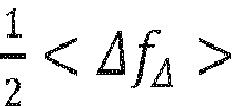



- Example 9 includes the method of any of examples 1-8, further comprising: calculating a statistical curve fit over a pre-specified segment of valid rotation rate measurement frequency value ƒΩ sample data; and generating the rotation rate measurement frequency value ƒΩ sample signal from rotation rate data extrapolated from the statistical curve fit during a switching operation between the first period of time and the second period of time in which the first optical beam is switching between resonance mode M1 and M2. and when the second optical beam is switching between resonance mode M2 and M1.
- Example 10 includes a resonating fiber optic gyroscope system with feed-forward rotation rate processing, the system comprising: a fiber optic resonator; a first laser source and a second laser source each coupled to the fiber optic resonator, wherein the first laser source launches a first optical beam into the fiber optic resonator and the second laser source launches a second optical beam into the fiber optic resonator in a direction opposite to the first optical beam; a first resonance switching servo loop configured to lock the first optical beam to a first resonant mode M1 of the fiber optic resonator during a first switching state, and lock the first optical beam to a second resonant mode M2 of the fiber optic resonator during a second switching state; a second resonance switching servo loop configured to lock the second optical beam to the second resonant mode M2 during the first switching state, and lock the second optical beam to the first resonant mode M1 during the second switching state; a feed-forward rate processor coupled to the first resonance switching servo loop and the second resonance switching servo loop, wherein the feed-forward rate processor calculates a free spectral range average across a prior resonance switching cycle of resonant frequency measurements and applies the free spectral range average to current resonant frequency measurements to output a rotation rate measurement frequency value ƒΩ sample signal.
- Example 11 includes the system of example 10, wherein the first resonance mode M1 and the second resonance mode M2 are separated in frequency by one free spectral range (FSR).
- Example 12 includes the system of any of examples 10-11, wherein the free spectral range average includes a measure of line shape asymmetry gradient error.
- Example 13 includes the system of any of examples 10-12, wherein the prior resonance switching cycle comprises: a first period of time with the first optical beam locked to the first resonance mode M1 of the optical resonator, and the second optical beam locked to the second resonance mode M2 of the optical resonator; and a second period of time following the first period of time, with the first optical beam locked to the second resonance mode M2 of the optical resonator, and the second optical beam locked to the first resonance mode M1 of the optical resonator; wherein the free spectral range average is calculated over the first period of time and the second period of time.
- Example 14 includes the system of example 13, wherein the first period of time and the second period of time are of equal time duration.
- Example 15 includes the system of any of examples 13-14, wherein the feed-forward rate processor calculates for the first period of time, a first resonance frequency average based on the first optical beam traveling in the fiber optic resonator and a second resonance frequency average based on the second optical beam traveling in the fiber optic resonator; and wherein the feed-forward rate processor calculates for the second period of time, a third resonance frequency average based on the first optical beam traveling in the fiber optic resonator, and a fourth resonance frequency average based on the second optical beam traveling in the r fiber optic resonator.
- Example 16 includes the system of example 15, wherein the feed-forward rate processor calculates the free spectral range average over the first period of time and the second period of time as a function of the first resonance frequency average, the second resonance frequency average, third resonance frequency average, and the fourth resonance frequency average.
- Example 17 includes the system of any of examples 10-16, wherein the feed-forward rate processor calculates a statistical curve fit over a pre-specified segment of valid rotation rate measurement frequency value ƒΩ sample data; and wherein the feed-forward rate processor generates the rotation rate measurement frequency value ƒΩ sample signal from rotation rate data extrapolated from the statistical curve fit during a switching operation in which the first optical beam is switched between resonance mode M1 and M2, and in which the second optical beam is switched between resonance mode M2 and M1.
- Example 18 includes the system of any of examples 10-17, wherein the feed-forward rate processor calculates the rotation rate measurement frequency value ƒΩ samples from an equation equivalent to:


- Example 19 includes the system of any of examples 10-18, wherein the first resonance switching servo loop comprises: a first frequency switch ramp generator that receives the free spectral range average from the feed-forward rate processor; wherein the frequency switch ramp generator ramps an output of the first resonance switching servo loop to switch the first optical beam from the first resonance mode M1 to the second resonance mode M2 based on the free spectral range average.
- Example 20 includes the system of example 19, wherein the second resonance switching servo loop comprises: a second frequency switch ramp generator that receives the free spectral range average from the feed-forward rate processor; wherein the second frequency switch ramp generator ramps an output of the second resonance switching servo loop to switch the first optical beam from the second resonance mode M2 to the first resonance mode M1 based on the free spectral range average.
- In various alternative embodiments, system elements, method steps, or examples described throughout this disclosure (such as the resonator switching servo loops or the feed-forward rate processor, or sub-parts thereof, for example) may be implemented on one or more computer systems, field programmable gate array (FPGA), or similar devices comprising a processor executing code to realize those elements, processes, or examples, said code stored on a non-transient data storage device. Therefore other embodiments of the present disclosure may include elements comprising program instructions resident on computer readable media which when implemented by such computer systems, enable them to implement the embodiments described herein. As used herein, the term "computer readable media" refers to tangible memory storage devices having non-transient physical forms. Such non-transient physical forms may include computer memory devices, such as but not limited to punch cards, magnetic disk or tape, any optical data storage system, flash read only memory (ROM), non-volatile ROM, programmable ROM (PROM), erasable-programmable ROM (E-PROM), random access memory (RAM), or any other form of permanent, semi-permanent, or temporary memory storage system or device having a physical, tangible form. Program instructions include, but are not limited to computer-executable instructions executed by computer system processors and hardware description languages such as Very High Speed Integrated Circuit (VHSIC) Hardware Description Language (VHDL).
- Although specific embodiments have been illustrated and described herein, it will be appreciated by those of ordinary skill in the art that any arrangement, which is calculated to achieve the same purpose, may be substituted for the specific embodiment shown. This application is intended to cover any adaptations or variations of the present invention. Therefore, it is manifestly intended that this invention be limited only by the claims and the equivalents thereof.
Claims (10)
- A feed-forward rotation rate processing method for a resonating fiber optic gyroscope (100) having an optical resonator (120), the method comprising:operating the resonating fiber optic gyroscope (100), for a first period of time, with a first optical beam (101) locked to a first resonance mode M1 of the optical resonator (120), and a second optical beam (102) locked to a second resonance mode M2 of the optical resonator (120), the second optical beam (102) propagating around the optical resonator (120) in a direction opposite to the first optical beam (101);calculating, for the first period of time, a first resonance frequency measurement average based on the first optical beam (101) output and a second resonance frequency measurement average for based on the second optical beam (102) output;operating the resonating fiber optic gyroscope (100), for a second period of time following the first period of time, with the first optical beam (101) locked to the second resonance mode M2 of the optical resonator (120), and the second optical beam (102) locked to the first resonance mode M1 of the optical resonator (120);calculating, for the second period of time, a third resonance frequency average for the first optical beam (101), and a fourth resonance frequency average for the second optical beam (102);calculating a free spectral range average over the first period of time and the second period of time as a function of the first resonance frequency average, the second resonance frequency average, third resonance frequency average, and the fourth resonance frequency average; andgenerating a rotation rate measurement frequency value ƒΩ sample signal based on a function of a first resonance frequency measurement for the first optical beam (101) captured after the second period of time, a second resonance frequency measurement for the second optical beam (102) captured after the second period of time, and the free spectral range average.
- The method of claim 1, further comprising:generating the first optical beam (101) with a first laser source (110) controlled by a first resonance switching servo loop (130); andgenerating the second optical beam (102) with a second laser source (112) controlled by a second resonance switching servo loop (132).
- The method of claim 5, further comprising:ramping an output of the first resonance switching servo loop (130) to switch the first optical beam (101) from the first resonance mode M1 to the second resonance mode M2 based on the free spectral range average; andramping an output of the second resonance switching servo loop (132) to switch the second optical beam (102) from the second resonance mode M2 to the first resonance mode M1 based on the free spectral range average.
- The method of claim 1, wherein generating the rotation rate measurement ƒΩ sample signal further comprises calculating a rotation rate measurement ƒΩ from an equation equivalent to:
 where ƒ 1 is a current resonant frequency measurement for the first optical beam (101),ƒ 2 is a current resonant frequency measurement for the second optical beam (102), and
- The method of claim 1, further comprising:calculating a statistical curve fit over a pre-specified segment of valid rotation rate measurement frequency value ƒΩ sample data; andgenerating the rotation rate measurement frequency value ƒΩ sample signal from rotation rate data extrapolated from the statistical curve fit during a switching operation between the first period of time and the second period of time in which the first optical beam (101) is switching between resonance mode M1 and M2. and when the second optical beam (102) is switching between resonance mode M2 and M1.
- A resonating fiber optic gyroscope (100)system with feed-forward rotation rate processing, the system comprising:a fiber optic resonator (120);a first laser source (110) and a second laser source (112) each coupled to the fiber optic resonator (120), wherein the first laser source (110) launches a first optical beam (101) into the fiber optic resonator (120) and the second laser source (112) launches a second optical beam (102) into the fiber optic resonator (120) in a direction opposite to the first optical beam (101);a first resonance switching servo loop (130) (130) configured to lock the first optical beam (101) to a first resonant mode M1 of the fiber optic resonator (120) during a first switching state, and lock the first optical beam (101) to a second resonant mode M2 of the fiber optic resonator (120) during a second switching state;a second resonance switching servo loop (132) configured to lock the second optical beam (102) to the second resonant mode M2 during the first switching state, and lock the second optical beam (102) to the first resonant mode M1 during the second switching state;a feed-forward rate processor (135) coupled to the first resonance switching servo loop (130) and the second resonance switching servo loop (132), wherein the feed-forward rate processor (135) calculates a free spectral range average across a prior resonance switching cycle of resonant frequency measurements and applies the free spectral range average to current resonant frequency measurements to output a rotation rate measurement frequency value ƒΩ sample signal.
- The system of claim 6, wherein the prior resonance switching cycle comprises:a first period of time with the first optical beam (101) locked to the first resonance mode M1 of the optical resonator, and thesecond optical beam (102) locked to the second resonance mode M2 of the optical resonator (120); anda second period of time following the first period of time, with the first optical beam (101) locked to the second resonance mode M2 of the optical resonator (120), and the second optical beam (102) locked to the first resonance mode M1 of the optical resonator (120);wherein the free spectral range average is calculated over the first period of time and the second period of time.
- The system of claim 6, wherein the feed-forward rate processor (135) calculates for the first period of time, a first resonance frequency average based on the first optical beam (101) traveling in the fiber optic resonator (120) and a second resonance frequency average based on thesecond optical beam (102) traveling in the fiber optic resonator (120);
wherein the feed-forward rate processor (135) calculates for the second period of time, a third resonance frequency average based on the first optical beam (101) traveling in the fiber optic resonator (120), and a fourth resonance frequency average based on thesecond optical beam (102)traveling in the fiber optic resonator (120); and
wherein the feed-forward rate processor (135) calculates the free spectral range average over the first period of time and the second period of time as a function of the first resonance frequency average, the second resonance frequency average, third resonance frequency average, and the fourth resonance frequency average. - The system of claim 6, wherein the feed-forward rate processor (135) calculates a statistical curve fit over a pre-specified segment of valid rotation rate measurement frequency value ƒΩ sample data; and
wherein the feed-forward rate processor (135) generates the rotation rate measurement frequency value ƒΩ sample signal from rotation rate data extrapolated from the statistical curve fit during a switching operation in which the first optical beam (101) is switched between resonance mode M1 and M2, and in which the second optical beam (102) is switched between resonance mode M2 and M1. - The system of claim 10, wherein the first resonance switching servo loop (130) comprises:a first frequency switch ramp generator (720) that receives the free spectral range average from the feed-forward rate processor (135);wherein the first frequency switch ramp generator (720) ramps an output of the first resonance switching servo loop (130) to switch the first optical beam (101) from the first resonance mode M1 to the second resonance mode M2 based on the free spectral range average; amd wherein the second resonance switching servo loop (132) comprises:a second frequency switch ramp generator (740) that receives the free spectral range average from the feed-forward rate processor (135);wherein the second frequency switch ramp generator (740) ramps an output of the second resonance switching servo loop (132) to switch the first optical beam (101) from the second resonance mode M2 to the first resonance mode M1 based on the free spectral range average.
Applications Claiming Priority (1)
| Application Number | Priority Date | Filing Date | Title |
|---|---|---|---|
| US14/708,928 US9772189B2 (en) | 2015-05-11 | 2015-05-11 | Systems and methods for resonance switching resonator fiber optic gyroscopes (RFOGs) with feed-forward processing |
Publications (2)
| Publication Number | Publication Date |
|---|---|
| EP3093618A1 true EP3093618A1 (en) | 2016-11-16 |
| EP3093618B1 EP3093618B1 (en) | 2020-07-22 |
Family
ID=55446711
Family Applications (1)
| Application Number | Title | Priority Date | Filing Date |
|---|---|---|---|
| EP16157963.6A Active EP3093618B1 (en) | 2015-05-11 | 2016-02-29 | Systems and methods for resonance switching resonator fiber optic gyroscopes (rfogs) with feed-forward processing |
Country Status (3)
| Country | Link |
|---|---|
| US (1) | US9772189B2 (en) |
| EP (1) | EP3093618B1 (en) |
| JP (1) | JP2016212085A (en) |
Cited By (4)
| Publication number | Priority date | Publication date | Assignee | Title |
|---|---|---|---|---|
| CN107024285A (en) * | 2017-04-28 | 2017-08-08 | 中国航空工业集团公司北京长城计量测试技术研究所 | A kind of full optical fiber laser frequency measuring equipment and method |
| EP3783311A1 (en) * | 2019-08-20 | 2021-02-24 | Honeywell International Inc. | Sideband heterodyne switching for resonator fiber optic gyroscopes (rfogs) |
| EP3786582A3 (en) * | 2019-07-23 | 2021-03-24 | Honeywell International Inc. | Systems and methods for correcting errors in gyroscopes |
| EP3945646A1 (en) * | 2020-07-27 | 2022-02-02 | Honeywell International Inc. | Injection locking resonator fiber optic gyroscope |
Families Citing this family (11)
| Publication number | Priority date | Publication date | Assignee | Title |
|---|---|---|---|---|
| GB201611046D0 (en) * | 2016-06-24 | 2016-08-10 | Npl Man Ltd | Optical resonator systems |
| US10175047B2 (en) | 2017-05-10 | 2019-01-08 | Honeywell International Inc. | Systems and methods for dynamic bias offset operation in resonator fiber optic gyroscope |
| FR3084148A1 (en) | 2018-07-19 | 2020-01-24 | Stmicroelectronics S.R.L. | ANNULAR OPTICAL RESONATOR DEVICE |
| US10837779B2 (en) | 2018-07-20 | 2020-11-17 | Honeywell International Inc. | Apparatus for enhanced beat note detection |
| US11002544B2 (en) | 2019-07-26 | 2021-05-11 | Honeywell International Inc. | RFOG resonance hopping |
| KR102206850B1 (en) * | 2019-10-28 | 2021-01-25 | 중앙대학교 산학협력단 | Ring resonator sensor based on multimode waveguide |
| US11196430B2 (en) | 2020-02-19 | 2021-12-07 | Honeywell International Inc. | High-bandwidth phase lock loop circuit with sideband rejection |
| US11181374B2 (en) | 2020-02-24 | 2021-11-23 | Honeywell International Inc. | Gyroscope with reduced bias errors due to resonance asymmetries |
| US11624614B1 (en) | 2020-08-04 | 2023-04-11 | Honeywell International Inc. | Reducing rotation sensing errors from laser source signal and modulation cross-talk |
| US12405111B2 (en) * | 2023-07-06 | 2025-09-02 | Honeywell International Inc. | Resonator optical gyroscopes with dual broadband light sources |
| US12516936B2 (en) | 2023-08-22 | 2026-01-06 | Honeywell International Inc. | Apparatus and method for enhanced beat note detection |
Citations (3)
| Publication number | Priority date | Publication date | Assignee | Title |
|---|---|---|---|---|
| US7362443B2 (en) | 2005-11-17 | 2008-04-22 | Honeywell International Inc. | Optical gyro with free space resonator and method for sensing inertial rotation rate |
| EP2333482A2 (en) * | 2009-12-13 | 2011-06-15 | Honeywell International Inc. | Light-phase-noise error reducer |
| EP2770298A2 (en) * | 2013-02-22 | 2014-08-27 | Honeywell International Inc. | Method and system for detecting optical ring resonator resonance frequencies and free spectral range to reduce the number of lasers in a resonator fiber optic gyroscope |
Family Cites Families (7)
| Publication number | Priority date | Publication date | Assignee | Title |
|---|---|---|---|---|
| US7372574B2 (en) | 2005-12-09 | 2008-05-13 | Honeywell International Inc. | System and method for stabilizing light sources in resonator gyro |
| US7933020B1 (en) | 2009-12-13 | 2011-04-26 | Honeywell International Inc. | System and method for reducing laser phase noise in a resonator fiber optic gyroscope |
| US8223341B2 (en) | 2010-05-28 | 2012-07-17 | Honeywell International Inc. | System and method for enhancing signal-to-noise ratio of a resonator fiber optic gyroscope |
| US8274659B2 (en) | 2010-08-30 | 2012-09-25 | Honeywell International Inc. | Resonator fiber optic gyroscopes with reduced rotation rate instability from back reflections |
| FR3011632B1 (en) * | 2013-10-04 | 2016-07-01 | Thales Sa | PASSIVE OPTICAL GYROMETER RESONANT TO THREE BEAMS |
| US9001336B1 (en) * | 2013-10-07 | 2015-04-07 | Honeywell International Inc. | Methods and apparatus of tracking/locking resonator free spectral range and its application in resonator fiber optic gyroscope |
| US9121708B1 (en) * | 2014-05-08 | 2015-09-01 | Honeywell International Inc. | Resonator fiber optic gyroscope without frequency overlap in sideband-heterodyne-detection modulations |
-
2015
- 2015-05-11 US US14/708,928 patent/US9772189B2/en active Active
-
2016
- 2016-02-29 EP EP16157963.6A patent/EP3093618B1/en active Active
- 2016-03-09 JP JP2016045727A patent/JP2016212085A/en active Pending
Patent Citations (3)
| Publication number | Priority date | Publication date | Assignee | Title |
|---|---|---|---|---|
| US7362443B2 (en) | 2005-11-17 | 2008-04-22 | Honeywell International Inc. | Optical gyro with free space resonator and method for sensing inertial rotation rate |
| EP2333482A2 (en) * | 2009-12-13 | 2011-06-15 | Honeywell International Inc. | Light-phase-noise error reducer |
| EP2770298A2 (en) * | 2013-02-22 | 2014-08-27 | Honeywell International Inc. | Method and system for detecting optical ring resonator resonance frequencies and free spectral range to reduce the number of lasers in a resonator fiber optic gyroscope |
Cited By (5)
| Publication number | Priority date | Publication date | Assignee | Title |
|---|---|---|---|---|
| CN107024285A (en) * | 2017-04-28 | 2017-08-08 | 中国航空工业集团公司北京长城计量测试技术研究所 | A kind of full optical fiber laser frequency measuring equipment and method |
| EP3786582A3 (en) * | 2019-07-23 | 2021-03-24 | Honeywell International Inc. | Systems and methods for correcting errors in gyroscopes |
| EP3783311A1 (en) * | 2019-08-20 | 2021-02-24 | Honeywell International Inc. | Sideband heterodyne switching for resonator fiber optic gyroscopes (rfogs) |
| EP3945646A1 (en) * | 2020-07-27 | 2022-02-02 | Honeywell International Inc. | Injection locking resonator fiber optic gyroscope |
| US11506495B2 (en) | 2020-07-27 | 2022-11-22 | Honeywell International Inc. | Injection locking resonator fiber optic gyroscope |
Also Published As
| Publication number | Publication date |
|---|---|
| JP2016212085A (en) | 2016-12-15 |
| EP3093618B1 (en) | 2020-07-22 |
| US9772189B2 (en) | 2017-09-26 |
| US20160334217A1 (en) | 2016-11-17 |
Similar Documents
| Publication | Publication Date | Title |
|---|---|---|
| EP3093618B1 (en) | Systems and methods for resonance switching resonator fiber optic gyroscopes (rfogs) with feed-forward processing | |
| JP5798639B2 (en) | Atomic beam gyroscope | |
| US8274659B2 (en) | Resonator fiber optic gyroscopes with reduced rotation rate instability from back reflections | |
| US9618362B2 (en) | Self-calibrating nuclear magnetic resonance (NMR) gyroscope system | |
| JP6404656B2 (en) | Method and apparatus for tracking / rocking the free spectral range of a resonator and its application to a resonator fiber optic gyroscope | |
| EP3752792B1 (en) | Velocity selective thermal atomic beam inertial sensor | |
| Wu et al. | Resonator fiber optic gyro with high backscatter-error suppression using two independent phase-locked lasers | |
| EP3786582A2 (en) | Systems and methods for correcting errors in gyroscopes | |
| US12352571B2 (en) | In-situ residual intensity noise measurement method and system | |
| US9097526B1 (en) | Systems and methods for a polarization matched resonator fiber optic gyroscope | |
| AU2020203005B2 (en) | Atomic interferometer system | |
| JP2012058240A (en) | Rfog having optical heterodyning for optical signal discrimination | |
| CN105547279B (en) | Gyro rate calculation for interferometric fiber optic gyroscope | |
| EP3869153B1 (en) | Gyroscope with reduced bias errors due to resonance asymmetries | |
| Pavlath | Challenges in the development of the IFOG | |
| RU2512598C1 (en) | Method of reducing precision readiness time of fibre-optic gyroscope | |
| SIREESHA et al. | COMPARATIVE ASSESSMENT OF GYRO PARAMETERS BASED ON RAMP (V2π) AND BIAS (Vπ/2) VOLTAGE VARIATIONS IN DCLIFOG SYSTEM | |
| Gilliam | Laser Frequency Stabilization for Atom Interferometry Applications | |
| Sato et al. | Digital closed-loop thermal atomic beam interferometer for high-bandwidth, wide-dynamic-range, and simultaneous absolute sensing of acceleration and rotation |
Legal Events
| Date | Code | Title | Description |
|---|---|---|---|
| PUAI | Public reference made under article 153(3) epc to a published international application that has entered the european phase |
Free format text: ORIGINAL CODE: 0009012 |
|
| 17P | Request for examination filed |
Effective date: 20160229 |
|
| AK | Designated contracting states |
Kind code of ref document: A1 Designated state(s): AL AT BE BG CH CY CZ DE DK EE ES FI FR GB GR HR HU IE IS IT LI LT LU LV MC MK MT NL NO PL PT RO RS SE SI SK SM TR |
|
| AX | Request for extension of the european patent |
Extension state: BA ME |
|
| STAA | Information on the status of an ep patent application or granted ep patent |
Free format text: STATUS: EXAMINATION IS IN PROGRESS |
|
| 17Q | First examination report despatched |
Effective date: 20180118 |
|
| GRAP | Despatch of communication of intention to grant a patent |
Free format text: ORIGINAL CODE: EPIDOSNIGR1 |
|
| STAA | Information on the status of an ep patent application or granted ep patent |
Free format text: STATUS: GRANT OF PATENT IS INTENDED |
|
| INTG | Intention to grant announced |
Effective date: 20200319 |
|
| RIN1 | Information on inventor provided before grant (corrected) |
Inventor name: HO, WAYMON Inventor name: SANDERS, GLEN A. Inventor name: STRANDJORD, LEE K. |
|
| GRAS | Grant fee paid |
Free format text: ORIGINAL CODE: EPIDOSNIGR3 |
|
| GRAA | (expected) grant |
Free format text: ORIGINAL CODE: 0009210 |
|
| STAA | Information on the status of an ep patent application or granted ep patent |
Free format text: STATUS: THE PATENT HAS BEEN GRANTED |
|
| AK | Designated contracting states |
Kind code of ref document: B1 Designated state(s): AL AT BE BG CH CY CZ DE DK EE ES FI FR GB GR HR HU IE IS IT LI LT LU LV MC MK MT NL NO PL PT RO RS SE SI SK SM TR |
|
| REG | Reference to a national code |
Ref country code: GB Ref legal event code: FG4D |
|
| REG | Reference to a national code |
Ref country code: CH Ref legal event code: EP |
|
| REG | Reference to a national code |
Ref country code: DE Ref legal event code: R096 Ref document number: 602016040261 Country of ref document: DE |
|
| REG | Reference to a national code |
Ref country code: AT Ref legal event code: REF Ref document number: 1293819 Country of ref document: AT Kind code of ref document: T Effective date: 20200815 |
|
| REG | Reference to a national code |
Ref country code: IE Ref legal event code: FG4D |
|
| REG | Reference to a national code |
Ref country code: LT Ref legal event code: MG4D |
|
| REG | Reference to a national code |
Ref country code: AT Ref legal event code: MK05 Ref document number: 1293819 Country of ref document: AT Kind code of ref document: T Effective date: 20200722 |
|
| PG25 | Lapsed in a contracting state [announced via postgrant information from national office to epo] |
Ref country code: FI Free format text: LAPSE BECAUSE OF FAILURE TO SUBMIT A TRANSLATION OF THE DESCRIPTION OR TO PAY THE FEE WITHIN THE PRESCRIBED TIME-LIMIT Effective date: 20200722 Ref country code: AT Free format text: LAPSE BECAUSE OF FAILURE TO SUBMIT A TRANSLATION OF THE DESCRIPTION OR TO PAY THE FEE WITHIN THE PRESCRIBED TIME-LIMIT Effective date: 20200722 Ref country code: NO Free format text: LAPSE BECAUSE OF FAILURE TO SUBMIT A TRANSLATION OF THE DESCRIPTION OR TO PAY THE FEE WITHIN THE PRESCRIBED TIME-LIMIT Effective date: 20201022 Ref country code: HR Free format text: LAPSE BECAUSE OF FAILURE TO SUBMIT A TRANSLATION OF THE DESCRIPTION OR TO PAY THE FEE WITHIN THE PRESCRIBED TIME-LIMIT Effective date: 20200722 Ref country code: GR Free format text: LAPSE BECAUSE OF FAILURE TO SUBMIT A TRANSLATION OF THE DESCRIPTION OR TO PAY THE FEE WITHIN THE PRESCRIBED TIME-LIMIT Effective date: 20201023 Ref country code: BG Free format text: LAPSE BECAUSE OF FAILURE TO SUBMIT A TRANSLATION OF THE DESCRIPTION OR TO PAY THE FEE WITHIN THE PRESCRIBED TIME-LIMIT Effective date: 20201022 Ref country code: SE Free format text: LAPSE BECAUSE OF FAILURE TO SUBMIT A TRANSLATION OF THE DESCRIPTION OR TO PAY THE FEE WITHIN THE PRESCRIBED TIME-LIMIT Effective date: 20200722 Ref country code: PT Free format text: LAPSE BECAUSE OF FAILURE TO SUBMIT A TRANSLATION OF THE DESCRIPTION OR TO PAY THE FEE WITHIN THE PRESCRIBED TIME-LIMIT Effective date: 20201123 Ref country code: LT Free format text: LAPSE BECAUSE OF FAILURE TO SUBMIT A TRANSLATION OF THE DESCRIPTION OR TO PAY THE FEE WITHIN THE PRESCRIBED TIME-LIMIT Effective date: 20200722 Ref country code: ES Free format text: LAPSE BECAUSE OF FAILURE TO SUBMIT A TRANSLATION OF THE DESCRIPTION OR TO PAY THE FEE WITHIN THE PRESCRIBED TIME-LIMIT Effective date: 20200722 |
|
| PG25 | Lapsed in a contracting state [announced via postgrant information from national office to epo] |
Ref country code: IS Free format text: LAPSE BECAUSE OF FAILURE TO SUBMIT A TRANSLATION OF THE DESCRIPTION OR TO PAY THE FEE WITHIN THE PRESCRIBED TIME-LIMIT Effective date: 20201122 Ref country code: PL Free format text: LAPSE BECAUSE OF FAILURE TO SUBMIT A TRANSLATION OF THE DESCRIPTION OR TO PAY THE FEE WITHIN THE PRESCRIBED TIME-LIMIT Effective date: 20200722 Ref country code: LV Free format text: LAPSE BECAUSE OF FAILURE TO SUBMIT A TRANSLATION OF THE DESCRIPTION OR TO PAY THE FEE WITHIN THE PRESCRIBED TIME-LIMIT Effective date: 20200722 Ref country code: RS Free format text: LAPSE BECAUSE OF FAILURE TO SUBMIT A TRANSLATION OF THE DESCRIPTION OR TO PAY THE FEE WITHIN THE PRESCRIBED TIME-LIMIT Effective date: 20200722 |
|
| PG25 | Lapsed in a contracting state [announced via postgrant information from national office to epo] |
Ref country code: NL Free format text: LAPSE BECAUSE OF FAILURE TO SUBMIT A TRANSLATION OF THE DESCRIPTION OR TO PAY THE FEE WITHIN THE PRESCRIBED TIME-LIMIT Effective date: 20200722 |
|
| REG | Reference to a national code |
Ref country code: DE Ref legal event code: R097 Ref document number: 602016040261 Country of ref document: DE |
|
| PG25 | Lapsed in a contracting state [announced via postgrant information from national office to epo] |
Ref country code: SM Free format text: LAPSE BECAUSE OF FAILURE TO SUBMIT A TRANSLATION OF THE DESCRIPTION OR TO PAY THE FEE WITHIN THE PRESCRIBED TIME-LIMIT Effective date: 20200722 Ref country code: RO Free format text: LAPSE BECAUSE OF FAILURE TO SUBMIT A TRANSLATION OF THE DESCRIPTION OR TO PAY THE FEE WITHIN THE PRESCRIBED TIME-LIMIT Effective date: 20200722 Ref country code: EE Free format text: LAPSE BECAUSE OF FAILURE TO SUBMIT A TRANSLATION OF THE DESCRIPTION OR TO PAY THE FEE WITHIN THE PRESCRIBED TIME-LIMIT Effective date: 20200722 Ref country code: IT Free format text: LAPSE BECAUSE OF FAILURE TO SUBMIT A TRANSLATION OF THE DESCRIPTION OR TO PAY THE FEE WITHIN THE PRESCRIBED TIME-LIMIT Effective date: 20200722 Ref country code: DK Free format text: LAPSE BECAUSE OF FAILURE TO SUBMIT A TRANSLATION OF THE DESCRIPTION OR TO PAY THE FEE WITHIN THE PRESCRIBED TIME-LIMIT Effective date: 20200722 Ref country code: CZ Free format text: LAPSE BECAUSE OF FAILURE TO SUBMIT A TRANSLATION OF THE DESCRIPTION OR TO PAY THE FEE WITHIN THE PRESCRIBED TIME-LIMIT Effective date: 20200722 |
|
| PLBE | No opposition filed within time limit |
Free format text: ORIGINAL CODE: 0009261 |
|
| STAA | Information on the status of an ep patent application or granted ep patent |
Free format text: STATUS: NO OPPOSITION FILED WITHIN TIME LIMIT |
|
| PG25 | Lapsed in a contracting state [announced via postgrant information from national office to epo] |
Ref country code: AL Free format text: LAPSE BECAUSE OF FAILURE TO SUBMIT A TRANSLATION OF THE DESCRIPTION OR TO PAY THE FEE WITHIN THE PRESCRIBED TIME-LIMIT Effective date: 20200722 |
|
| 26N | No opposition filed |
Effective date: 20210423 |
|
| PG25 | Lapsed in a contracting state [announced via postgrant information from national office to epo] |
Ref country code: SK Free format text: LAPSE BECAUSE OF FAILURE TO SUBMIT A TRANSLATION OF THE DESCRIPTION OR TO PAY THE FEE WITHIN THE PRESCRIBED TIME-LIMIT Effective date: 20200722 |
|
| PG25 | Lapsed in a contracting state [announced via postgrant information from national office to epo] |
Ref country code: SI Free format text: LAPSE BECAUSE OF FAILURE TO SUBMIT A TRANSLATION OF THE DESCRIPTION OR TO PAY THE FEE WITHIN THE PRESCRIBED TIME-LIMIT Effective date: 20200722 |
|
| REG | Reference to a national code |
Ref country code: DE Ref legal event code: R119 Ref document number: 602016040261 Country of ref document: DE |
|
| PG25 | Lapsed in a contracting state [announced via postgrant information from national office to epo] |
Ref country code: MC Free format text: LAPSE BECAUSE OF FAILURE TO SUBMIT A TRANSLATION OF THE DESCRIPTION OR TO PAY THE FEE WITHIN THE PRESCRIBED TIME-LIMIT Effective date: 20200722 |
|
| REG | Reference to a national code |
Ref country code: NL Ref legal event code: MP Effective date: 20200722 |
|
| GBPC | Gb: european patent ceased through non-payment of renewal fee |
Effective date: 20210228 |
|
| REG | Reference to a national code |
Ref country code: BE Ref legal event code: MM Effective date: 20210228 |
|
| PG25 | Lapsed in a contracting state [announced via postgrant information from national office to epo] |
Ref country code: CH Free format text: LAPSE BECAUSE OF NON-PAYMENT OF DUE FEES Effective date: 20210228 Ref country code: LU Free format text: LAPSE BECAUSE OF NON-PAYMENT OF DUE FEES Effective date: 20210228 Ref country code: LI Free format text: LAPSE BECAUSE OF NON-PAYMENT OF DUE FEES Effective date: 20210228 |
|
| PG25 | Lapsed in a contracting state [announced via postgrant information from national office to epo] |
Ref country code: DE Free format text: LAPSE BECAUSE OF NON-PAYMENT OF DUE FEES Effective date: 20210901 Ref country code: IE Free format text: LAPSE BECAUSE OF NON-PAYMENT OF DUE FEES Effective date: 20210228 Ref country code: GB Free format text: LAPSE BECAUSE OF NON-PAYMENT OF DUE FEES Effective date: 20210228 |
|
| PG25 | Lapsed in a contracting state [announced via postgrant information from national office to epo] |
Ref country code: BE Free format text: LAPSE BECAUSE OF NON-PAYMENT OF DUE FEES Effective date: 20210228 |
|
| PG25 | Lapsed in a contracting state [announced via postgrant information from national office to epo] |
Ref country code: HU Free format text: LAPSE BECAUSE OF FAILURE TO SUBMIT A TRANSLATION OF THE DESCRIPTION OR TO PAY THE FEE WITHIN THE PRESCRIBED TIME-LIMIT; INVALID AB INITIO Effective date: 20160229 |
|
| PG25 | Lapsed in a contracting state [announced via postgrant information from national office to epo] |
Ref country code: CY Free format text: LAPSE BECAUSE OF FAILURE TO SUBMIT A TRANSLATION OF THE DESCRIPTION OR TO PAY THE FEE WITHIN THE PRESCRIBED TIME-LIMIT Effective date: 20200722 |
|
| P01 | Opt-out of the competence of the unified patent court (upc) registered |
Effective date: 20230525 |
|
| PG25 | Lapsed in a contracting state [announced via postgrant information from national office to epo] |
Ref country code: MK Free format text: LAPSE BECAUSE OF FAILURE TO SUBMIT A TRANSLATION OF THE DESCRIPTION OR TO PAY THE FEE WITHIN THE PRESCRIBED TIME-LIMIT Effective date: 20200722 |
|
| PG25 | Lapsed in a contracting state [announced via postgrant information from national office to epo] |
Ref country code: MT Free format text: LAPSE BECAUSE OF FAILURE TO SUBMIT A TRANSLATION OF THE DESCRIPTION OR TO PAY THE FEE WITHIN THE PRESCRIBED TIME-LIMIT Effective date: 20200722 |
|
| PG25 | Lapsed in a contracting state [announced via postgrant information from national office to epo] |
Ref country code: TR Free format text: LAPSE BECAUSE OF FAILURE TO SUBMIT A TRANSLATION OF THE DESCRIPTION OR TO PAY THE FEE WITHIN THE PRESCRIBED TIME-LIMIT Effective date: 20200722 |
|
| PGFP | Annual fee paid to national office [announced via postgrant information from national office to epo] |
Ref country code: FR Payment date: 20260224 Year of fee payment: 11 |