EP3091479A1 - Fingerprint identification method and fingerprint identification device - Google Patents
Fingerprint identification method and fingerprint identification device Download PDFInfo
- Publication number
- EP3091479A1 EP3091479A1 EP14899701.8A EP14899701A EP3091479A1 EP 3091479 A1 EP3091479 A1 EP 3091479A1 EP 14899701 A EP14899701 A EP 14899701A EP 3091479 A1 EP3091479 A1 EP 3091479A1
- Authority
- EP
- European Patent Office
- Prior art keywords
- minutia
- region
- fingerprint
- statistical
- minutiae
- Prior art date
- Legal status (The legal status is an assumption and is not a legal conclusion. Google has not performed a legal analysis and makes no representation as to the accuracy of the status listed.)
- Granted
Links
Images


Classifications
-
- G—PHYSICS
- G06—COMPUTING OR CALCULATING; COUNTING
- G06V—IMAGE OR VIDEO RECOGNITION OR UNDERSTANDING
- G06V40/00—Recognition of biometric, human-related or animal-related patterns in image or video data
- G06V40/10—Human or animal bodies, e.g. vehicle occupants or pedestrians; Body parts, e.g. hands
- G06V40/12—Fingerprints or palmprints
- G06V40/1365—Matching; Classification
-
- G—PHYSICS
- G06—COMPUTING OR CALCULATING; COUNTING
- G06V—IMAGE OR VIDEO RECOGNITION OR UNDERSTANDING
- G06V40/00—Recognition of biometric, human-related or animal-related patterns in image or video data
- G06V40/10—Human or animal bodies, e.g. vehicle occupants or pedestrians; Body parts, e.g. hands
- G06V40/12—Fingerprints or palmprints
- G06V40/1347—Preprocessing; Feature extraction
- G06V40/1353—Extracting features related to minutiae or pores
-
- G—PHYSICS
- G06—COMPUTING OR CALCULATING; COUNTING
- G06F—ELECTRIC DIGITAL DATA PROCESSING
- G06F18/00—Pattern recognition
- G06F18/20—Analysing
- G06F18/22—Matching criteria, e.g. proximity measures
-
- G—PHYSICS
- G06—COMPUTING OR CALCULATING; COUNTING
- G06V—IMAGE OR VIDEO RECOGNITION OR UNDERSTANDING
- G06V10/00—Arrangements for image or video recognition or understanding
- G06V10/70—Arrangements for image or video recognition or understanding using pattern recognition or machine learning
- G06V10/74—Image or video pattern matching; Proximity measures in feature spaces
- G06V10/75—Organisation of the matching processes, e.g. simultaneous or sequential comparisons of image or video features; Coarse-fine approaches, e.g. multi-scale approaches; using context analysis; Selection of dictionaries
- G06V10/758—Involving statistics of pixels or of feature values, e.g. histogram matching
-
- G—PHYSICS
- G06—COMPUTING OR CALCULATING; COUNTING
- G06V—IMAGE OR VIDEO RECOGNITION OR UNDERSTANDING
- G06V10/00—Arrangements for image or video recognition or understanding
- G06V10/70—Arrangements for image or video recognition or understanding using pattern recognition or machine learning
- G06V10/74—Image or video pattern matching; Proximity measures in feature spaces
- G06V10/761—Proximity, similarity or dissimilarity measures
-
- G—PHYSICS
- G06—COMPUTING OR CALCULATING; COUNTING
- G06V—IMAGE OR VIDEO RECOGNITION OR UNDERSTANDING
- G06V40/00—Recognition of biometric, human-related or animal-related patterns in image or video data
- G06V40/10—Human or animal bodies, e.g. vehicle occupants or pedestrians; Body parts, e.g. hands
- G06V40/12—Fingerprints or palmprints
- G06V40/1365—Matching; Classification
- G06V40/1371—Matching features related to minutiae or pores
Definitions
- the present invention belongs to the field of biometric identification technologies, and in particular, to a method and an apparatus for fingerprint identification.
- a fingerprint minutia which includes fingerprint preprocessing, fingerprint minutia extracting, fingerprint registration and matching; where when a fingerprint minutia is extracted, in order to add information of the minutia, besides that a position and a direction of the minutia are recorded, three parameters which represent directions of three vertexes of a regular triangle taking the minutia as a center and a fixed value as a circumradius are added, so that a conventional expression structure of the minutia is [( x y ) ⁇ a ⁇ b ⁇ c ], where ⁇ a , ⁇ b , ⁇ c represent the directions of the three vertexes around the minutia respectively.
- a fingerprint is easy to distort and stability and specificity of the above-mentioned conventional expression of the minutia are not better enough, which causes that subsequent registration and matching are not accurate.
- An objective of embodiments of the present invention is to provide a method and an apparatus for fingerprint identification, intending to solve a problem of failing to express a minutia accurately when a fingerprint is distorted in an existing method for fingerprint identification.
- An embodiment of the present invention is implemented as a method for fingerprint identification, where the method includes the following steps:
- the extracting the minutia of the input fingerprint image by using the statistical method includes:
- the calculating the direction of the minutia by using the regional statistical information includes:
- the adding the descriptor with statistical significance for the minutiae includes:
- the performing the fingerprint matching according to the extracted minutia includes:
- the present invention also provides an apparatus for fingerprint identification, where the apparatus includes:
- the extracting module includes:
- the first calculating unit includes:
- the descriptor unit includes:
- the matching module includes:
- the direction of the minutia is calculated by using statistical information, the descriptor with statistical significance is added for the minutia, and during the matching process, calculation of the similarity of the minutia by using the descriptor and region matching by using information of the direction field and the gradient field of the overlapping region are added, therefore, instability and weak specificity of expression of fingerprint characteristics in a conventional algorithm are avoided, and accuracy of the fingerprint identification is improved.
- Embodiment 1 of the present invention provides a method for fingerprint identification. As shown in Fig. 2 , the method of embodiment 1 of the present invention includes the following steps.
- preprocessing of the fingerprint i.e., preprocessing the input fingerprint image before a practical application and transforming the input fingerprint image into a desired form, as shown in Fig. 3 , including steps:
- the fingerprint image obtained from preprocessing of the fingerprint in step S2 is a fingerprint form on which minutia extracting may be performed.
- the whole image includes a lot of useless information, so that some minutiae with a typical characteristic, i.e., characteristic points, need to be extracted from the fingerprint image by using a method of characteristic extracting.
- a minutia is a quite typical fingerprint characteristic point and it has many types, such as a bifurcation point, an endpoint and a singular point and the like.
- extracting methods are different. Taking an endpoint as an example, for extracting of the endpoint, as shown in Fig. 4 , change of a pixel value of a fingerprint image is used. In Fig.
- black pixel points are fingerprint lines of a fingerprint and white pixel points are background part. It may be seen from Fig. 4 that, point A is an endpoint, so that one of eight pixel points in the neighborhood of the point A has a pixel value of 0. Since the whole image is a binary (0 or 255) image, an absolute value of a difference between adjacent pixels within a whole template is 0 or 255. Based on the above case, it may be seen that, a sum of the absolute values of the differences between adjacent pixels within the whole template is 2*255. However, if it is not an endpoint, as shown in Fig. 5 , at least three pixel points with pixel value of 0 are included. Therefore, the endpoint of the image may be obtained by performing a statistics on a sum of differences between adjacent pixels within the neighborhood of each pixel point within the fingerprint image.
- An extracting of a bifurcation point may use a same extracting strategy as that of the endpoint. It may be found by an analysis that, an image pixel distribution within a neighborhood of the bifurcation point of the fingerprint image is shown in Fig. 6 , i.e., a bifurcation point where one line is bifurcated into three or more lines does not exist in a fingerprint of a person. It may be obtained by calculation that a sum of absolute values of differences between adjacent pixels within the neighborhood of A is 6*255, so that the bifurcation point may be obtained according to such property by traversing the whole image.
- a singular point of a fingerprint includes two types: a triangle point and a center point.
- the singular point of the fingerprint does not have a local pixel distribution property as that of the endpoint and the bifurcation point. Extracting of the singular point is obtained by calculating a surrounding direction field, which has been a mature method, and will not be repeated redundantly herein.
- embodiment 1 of the present invention expresses fingerprint characteristics in the following manner.
- Step S31 calculating a direction of a minutia by using regional statistical information.
- each minutia needs a stable direction.
- the so-called stable direction means a direction capable of representing a direction of the point.
- a conventional algorithm takes a gradient direction of a minutia as the direction of the minutia, but distortion of a fingerprint image will cause that change of a gradient of the minutia is quite obvious. Therefore, the direction of the minutia in the conventional method is not stable.
- a method employed in embodiment 1 of the present invention is regional statistics, i.e., performing a statistics on gradient directions within a certain region around the minutia according to a gradient field to represent the direction of the minutia, as shown in Fig. 8 , and the details are described as follows.
- Step S311 selecting a statistical region.
- a circle region may be selected as the statistical region, such as defining a circle region with a radius of 5 pixels and centered at a minutia, or another noncircular region may be selected as required.
- Step S312 calculating gradient directions of all minutiae within the statistical region.
- the direction of the minutia is obtained by calculating the directions of all minutiae within the region, i.e., calculating the gradient directions of all minutiae within the region.
- Step S313 determining weights within the statistical region. After the gradient directions of all minutiae within the statistical region are obtained, according to a statistical theory, a point which is farther from a minutia has less influence on the minutia; otherwise, the influence is greater. Therefore, weighting process is performed on information within the statistical region according to the principle, such as using Gaussian weighting, i.e., performing weighting on the gradient directions of minutiae within the statistical region by using a Gaussian distribution centered at the minutia and with a radius of 5 pixels.
- Gaussian weighting i.e., performing weighting on the gradient directions of minutiae within the statistical region by using a Gaussian distribution centered at the minutia and with a radius of 5 pixels.
- Step S314 performing a statistics on a gradient direction distribution within the statistical region.
- 360° is divided into six groups, i.e., 60° for each group, and then the gradient directions of all minutiae are counted in the six groups according to the gradient direction and weighted value of each minutia within the statistical region.
- the six groups of data represent statistical information of directions within the region.
- Step S315 performing an interpolation operation on gradient distribution information. After the statistical information is obtained, since each group is 60°, only a scope of a minutia direction is obtained. In order to obtain an accurate minutia direction, an interpolation operation may be performed on the direction data group by using an interpolation algorithm to obtain a continuous direction distribution function.
- Step S316 obtaining the minutia direction.
- a maximum value is obtained according to the obtained direction distribution function, and the maximum value is the direction of the minutia.
- Step S32 adding a descriptor with statistical significance for the minutia.
- Embodiment 1 of the present invention takes a four-quadrant gradient method as an example, as shown in Fig. 9 , and specific steps are as follow.
- Step S321 selecting a descriptor extracting region of a certain minutia.
- the extracting region may still employ a circular region, but it should be noted that an area of the circular region is larger than that of the region of the previous main gradient direction.
- Step S322 determining a regional four-quadrant according to the direction of the minutia determined in step S31.
- the circular region may be divided.
- a quadrant dividing schematic diagram is shown in Fig. 10 .
- Step S323 calculating gradient directions of all minutiae of the regional four-quadrant and performing an interpolation operation.
- a gradient direction of each point should subtract a main gradient direction of the minutia, which is to ensure relativity.
- the interpolation operation is performed on the gradient direction, and taking that the circular region radius are eight pixel cells as an example, the circular region is further divided firstly as shown in Fig. 11 .
- a dividing standard is that the circular region is divided according to concentric circles with radiuses of 1, 2, 3, 4, 5, 6 and 7 respectively. A point falling in the middle of the region needs to be interpolated on points of the adjacent two concentric circles.
- Step S324 performing a statistics on a gradient distribution within each quadrant.
- the statistics of the gradient distribution is performed on a region that a quadrant is divided and an interpolation is completed, and a statistics method is same as the method of the pervious statistics of a direction of a minutia.
- gradient direction distribution within all quadrants is recorded according to a sequence of 1, 2, 3, 4, and then the obtained gradient overall distribution forms a descriptor of the minutia.
- Step S325 normalizing the descriptor.
- a normalization processing may be performed on the descriptor, so as to obtain a final descriptor.
- W w 1 w 2 ... w n
- L l 1 l 2 ... l n
- Step S33 extracting a triangle vertex direction.
- embodiment 1 of the present invention may employ steps shown in Fig. 12 for matching.
- S41 calculating a similarity of a minutia with respect to a fingerprint template.
- the similarity of the minutia is determined comprehensively by using a mixture of multiple determination standards.
- the similarity of coordinate positions means that, if two images can be matched correctly after the images are transformed, same minutiae should exist in corresponding positions. That is to say, coordinates of the minutiae should be less than a certain value, so that similarity may be calculated according to a difference between the coordinates of the corresponding minutiae, i.e., calculating the difference of the coordinates of corresponding minutia pair.
- a score is determined according to a size of a difference, for example, it may be assumed that when the difference is 10, the score is 0, and when the difference is 9, the score is 1, and so on.
- a similarity of vertex directions around the descriptors is calculated.
- the above introduced calculation of directions of the minutiae is obtained by performing a statistics on gradient directions of all minutiae within a certain region, which has a strong stability, and a main direction of same minutiae shall be relocatable within a small range (considering distortion of a fingerprint image), so that the similarity may be calculated by calculating a difference of main gradient directions between the corresponding minutiae, and the implementation method is similar as the previous method.
- a statistics is performed on a total score of the above similarity to obtain the similarity of the minutia.
- step S402 is performed.
- the above matching algorithms are all based on a characteristic point of a minutia, i.e., a local characteristic point, and a biggest drawback of this method is too localized to matching by using global information, so that some inevitable mismatching may be increased.
- two images are not similar in general, however, it may be seen that matching is successful and local parts of the two images are exactly similar, and thus false accepting occurs.
- calculation of the similarity may be performed by taking the previous obtained gradient field and direction field as contents of the image. Firstly, an overlapping region of an input fingerprint image and a fingerprint template is calculated, and then a difference of the gradient field and a difference of the direction field of the overlapping region are calculated. Since an area of an overlapping region between the input image and a large splicing image can not be determined, the difference divides an overlapping pixel number to obtain an average difference, and the average difference may be taken as a standard of similarity of image contents.
- Fig. 13 The specific implementation is shown in Fig. 13 , which includes steps as follows.
- S431 firstly, transforming an input fingerprint according to a registration result.
- the result of registration is to obtain a rigid body transformation matrix H , and transformation is performed on the input fingerprint according to the matrix.
- x ′ y ′ 1 H x y 1 , where [ x y 1] T is an original homogeneous coordinate of the input fingerprint, and [ x ' y ' 1] T is a homogeneous coordinate obtained from transformation of the input fingerprint.
- the direction of the minutia is calculated by using statistical information, the descriptor with statistical significance is added for the minutia, and during the matching process, calculation of the similarity of the minutia by using the descriptor and region matching by using information of the direction field and the gradient field of the overlapping region are added, therefore, instability and weak specificity of expression of fingerprint characteristics in a conventional algorithm are avoided, and accuracy of the fingerprint identification is improved.
- Embodiment 2 of the present invention provides an apparatus for fingerprint identification. As shown in Fig. 14 , the apparatus of embodiment 2 of the present invention includes:
- the apparatus for fingerprint identification After the fingerprint image is input, the apparatus for fingerprint identification performs preprocessing on a fingerprint first. That is, preprocessing is performed on the input fingerprint image before a practical application, and the input fingerprint image is transformed into a desired form.
- the image field is first analyzed.
- the image field includes an intensity field, a gradient field and a direction field and the like.
- the so-called intensity field reflects information of brightness intensity of a certain point of a fingerprint image;
- the gradient illustrates a direction that a fingerprint line is steepest
- an amplitude of the gradient may illustrate a degree that the fingerprint line is steepest
- a direction of the gradient refers to a direction of the fingerprint line.
- Line information of the whole fingerprint may be obtained by calculating the gradient field of the fingerprint image.
- the direction field reflects an intensity that the fingerprint revolves around a center, which is a quite important physical parameter in the fingerprint image.
- the segmentation of the fingerprint image means that fingerprint part is extracted from the fingerprint image, i.e., segmenting a background from a foreground of the fingerprint. Since the intensity field and the gradient field of the image have been calculated in step S21, the background and the foreground of the fingerprint may be distinguished by analyzing the intensity field and the gradient field.
- Extracting preparation of a fingerprint image skeleton Extracting preparation of a fingerprint image skeleton.
- Thinning of the fingerprint image skeleton A general algorithm such as a thinning algorithm look-up table method or the like may be employed, and will not be repeated redundantly herein.
- the fingerprint image obtained from preprocessing of the fingerprint is a fingerprint form on which minutia extracting may be performed.
- the whole image includes a lot of useless information, so that some minutiae with a typical characteristic, i.e., characteristic points, need to be extracted from the fingerprint image by using a method of characteristic extracting.
- a minutia is a quite typical fingerprint characteristic point and it has many types, such as a bifurcation point, an endpoint and a singular point and the like.
- extracting methods are different. Taking an endpoint as an example, for extracting of the endpoint, as shown in Fig. 4 , change of a pixel value of a fingerprint image is used. In Fig.
- black pixel points are fingerprint lines of a fingerprint
- white pixel points are background part. It may be seen from Fig. 4 that, point A is an endpoint, so that one of eight pixel points in the neighborhood of the point A has a pixel value of 0. Since the whole image is a binary (0 or 255) image, an absolute value of a difference between adjacent pixels within a whole template is 0 or 255. Based on the above case, it may be seen that, a sum of the absolute values of the differences between adjacent pixels within the whole template is 2*255. However, if it is not an endpoint, as shown in Fig. 5 , at least three pixel points with pixel value of 0 are included. Therefore, the endpoint of the image may be obtained by performing a statistics on a sum of differences between adjacent pixels within the neighborhood of each pixel point within the fingerprint image.
- An extracting of a bifurcation point may use a same extracting strategy as that of the endpoint. It may be found by an analysis that, an image pixel distribution within a neighborhood of the bifurcation point of the fingerprint image is shown in Fig. 6 , i.e., a bifurcation point where one line is bifurcated into three or more lines does not exist in a fingerprint of a person. It may be obtained by calculation that a sum of absolute values of differences between adjacent pixels within the neighborhood of A is 6*255, so that the bifurcation point may be obtained according to such character by traversing the whole image.
- a singular point of a fingerprint includes two types: a triangle point and a center point.
- the singular point of the fingerprint does not have a local pixel distribution property as that of the endpoint and the bifurcation point. Extracting of the singular point is obtained by calculating a surrounding direction field, and will not be repeated redundantly herein.
- An extracting module 10 is configured to extract a minutia of an input fingerprint image by using a statistical method.
- the extracting module 10 includes a first calculating unit 11, configured to calculate a direction of the minutia by using regional statistical information; a descriptor unit 12, configured to add a descriptor with statistical significance for the minutia according to the direction of the minutia; and an extracting vertex direction unit 13, configured to extract a triangle vertex direction of the minutia.
- a first calculating unit 11 configured to calculate a direction of the minutia by using regional statistical information
- a descriptor unit 12 configured to add a descriptor with statistical significance for the minutia according to the direction of the minutia
- an extracting vertex direction unit 13 configured to extract a triangle vertex direction of the minutia.
- the first calculating unit 11 includes a first selecting subunit 111, configured to select a statistical region of a certain minutia; a calculating direction subunit 112, configured to calculate and weight gradient directions of all minutiae within the statistical region; a statistics subunit 113, configured to perform a statistics on a gradient direction distribution of all the minutiae within the statistical region according to the gradient directions and weighted values of all the minutiae within the statistical region; a first interpolation subunit 114, configured to perform an interpolation operation according to the gradient direction distribution to obtain a direction distribution function; and a first cycling subunit 115, configured to find a maximum of the direction distribution function to obtain a direction of the minutia, and return to the step to select a statistical region of a certain minutia until all minutiae of the input fingerprint image are traversed.
- a first selecting subunit 111 configured to select a statistical region of a certain minutia
- a calculating direction subunit 112 configured to calculate and weight gradient directions of all
- a descriptor unit 12 includes a second selecting subunit 121, configured to select a descriptor extracting region of a certain minutia; a determining subunit 122, configured to determine a regional four-quadrant according to the descriptor extracting region and a direction of the minutia; a second interpolation subunit 123, configured to calculate gradient directions of all minutiae of the regional four-quadrant and perform an interpolation operation; and a second cycling subunit 124, configured to perform a statistics on a gradient distribution of the regional four-quadrant after the interpolation operation, form a descriptor of the minutia, and return to the step to select a descriptor extracting region of a certain minutia until all minutiae of the input fingerprint image are traversed.
- each minutia needs a stable direction.
- the so-called stable direction means a direction capable of representing a direction of the point.
- a conventional algorithm takes a gradient direction of a minutia as the direction of the minutia, but distortion of a fingerprint image will cause that change of a gradient of the minutia is quite obvious. Therefore, the direction of the minutia in the conventional method is not stable.
- a method employed by the extracting module 10 is regional statistics, i.e., performing a statistics on gradient directions within a certain region around the minutia according to a gradient field to represent the direction of the minutia, and the details are described as follows.
- a first selecting subunit 111 selects a statistical region.
- a circle region may be selected as the statistical region, such as defining a circle region with a radius of 5 pixels and centered at a minutia, or another noncircular region may be selected as required.
- a calculating direction subunit 112 calculates directions of all minutiae within the statistical region. In order to obtain a gradient direction of a minutia, in embodiment 2 of the present invention, the direction of the minutia is obtained by calculating the directions of all minutiae within the region, i.e., calculating the gradient directions of all minutiae within the region.
- a statistics subunit 311 determines weights within the statistical region.
- a first interpolation subunit 114 performs a statistics on a gradient direction distribution within the statistical region.
- the first interpolation subunit 114 divides 360° into six groups, i.e., 60° for each group, and then the gradient directions of all minutiae are counted in the six groups according to the gradient direction and weighted value of each minutia within the statistical region.
- the six groups of data represent statistical information of directions within the region.
- a first cycling subunit 115 performs an interpolation operation on gradient distribution information. After the statistical information is obtained, since each group is 60°, only a scope of a minutia direction is obtained.
- the first cycling subunit 115 may perform an interpolation operation on the direction data group by using an interpolation algorithm to obtain a continuous direction distribution function, and then find a maximum value according to the obtained direction distribution function, and the maximum value is the direction of the minutia.
- a descriptor unit 12 adds the descriptor with statistical significance for the minutiae.
- Embodiment 2 of the present invention takes a four-quadrant gradient method as an example.
- the details include: a second selecting subunit 121 selects a descriptor extracting region of a certain minutia.
- the extracting region may still employ a circular region, but it should be noted that an area of the circular region is larger than that of the region of the previous main gradient direction.
- a determining subunit 122 determines a regional four-quadrant according to the direction of the minutia determined by the first calculating unit 11.
- the determining subunit 122 may divide the circular region according to the above obtained direction of the minutia.
- a quadrant dividing schematic diagram is shown in Fig. 10 .
- a second interpolation subunit 123 calculates gradient directions of all minutiae of the regional four-quadrant and performs an interpolation operation. It should be noted herein that a gradient direction of each point should subtract a main gradient direction of the minutia, which is to ensure relativity.
- the interpolation operation is performed on the gradient direction, and taking that the circular region radius are eight pixel cells as an example, the circular region is further divided firstly as shown in Fig. 11 .
- a dividing standard is that the circular region is divided according to concentric circles with radiuses of 1, 2, 3, 4, 5, 6 and 7 respectively. A point falling in the middle of the region needs to be interpolated on points of the adjacent two concentric circles.
- the statistics of the gradient distribution is performed by a second cycling subunit 124 on a region that a quadrant is divided and an interpolation is completed, and a statistics method is same as the method of the pervious statistics of a direction of a minutia.
- a statistics method is same as the method of the pervious statistics of a direction of a minutia.
- An extracting vertex direction unit 13 extracts a triangle vertex direction of the minutia.
- a matching module 20 performs fingerprint matching according to the extracted minutia to obtain a fingerprint identifying result.
- the matching module 20 includes a second calculating unit 21, configured to calculate a similarity of minutia; an adjusting unit 22, configured to adjust a fingerprint image when the similarity of the minutia meets a preset first threshold; a third calculating unit 23, configured to calculate a similarity of an overlapping region; and a determining unit 24, configured to determine that the matching is successful when the similarity of the overlapping region meets a preset second threshold.
- the matching module 20 may employ the following manner for matching.
- the second calculating unit 21 calculates a similarity of a minutia with respect to a fingerprint template.
- the similarity of coordinate positions means that, if two images can be matched correctly after the images are transformed, same minutiae should exist in corresponding positions. That is to say, coordinates of the minutiae should be less than a certain value, so that similarity may be calculated according to a difference between the coordinates of the corresponding minutiae, i.e., calculating the difference of the coordinates of corresponding minutia pair.
- a score is determined according to a size of a difference, for example, it may be assumed that when the difference is 10, the score is 0, and when the difference is 9, the score is 1, and so on.
- a similarity of vertex directions around the descriptors is calculated.
- the above introduced calculation of directions of the minutiae is obtained by performing a statistics on gradient directions of all minutiae within a certain region, which has a strong stability, and a main direction of same minutiae shall be relocatable within a small range (considering distortion of a fingerprint image), so that the similarity may be calculated by calculating a difference of main gradient directions between the corresponding minutiae, and the implementation method is similar as the previous method.
- a statistics is performed on a total score of the above similarity to obtain the similarity of the minutiae.
- the adjusting unit 22 adjusts the fingerprint according a preset transformation parameter.
- the third calculating unit 23 then calculates a similarity of an overlapping region.
- calculation of the similarity may be performed by taking the previous obtained gradient field and direction field as contents of the image. Firstly, an overlapping region of an input fingerprint image and a fingerprint template is calculated, and then a difference of the gradient field and a difference of direction field of the overlapping region are calculated. Since an area of an overlapping region between the input image and a large splicing image can not be determined, the difference divides an overlapping pixel number to obtain an average difference, and the average difference may be taken as a standard of similarity of image contents.
- the specific implementation of the third calculating unit 23 calculating a similarity of an overlapping region includes:
- a score with the highest similarity may be eventually obtained according to different registration schemes, which may be taken as a final score of the input fingerprint and the template fingerprint, so as to determine that the input fingerprint and the template fingerprint are capable of matching correctly, according to which a result of fingerprint identification is obtained.
- the direction of the minutia is calculated by using statistical information, the descriptor with statistical significance is added for the minutia, and during the matching process, calculation of the similarity of the minutia by using the descriptor and region matching by using information of the direction field and the gradient field of the overlapping region are added, therefore, instability and weak specificity of expression of fingerprint characteristics in a conventional algorithm are avoided, and accuracy of the fingerprint identification is improved.
- the direction of the minutia is calculated by using statistical information, the descriptor with statistical significance is added for the minutia, and during the matching process, calculation of the similarity of the minutia by using the descriptor and region matching by using information of the direction field and the gradient field of the overlapping region are added, therefore, instability and weak specificity of expression of fingerprint characteristics in a conventional algorithm are avoided, and accuracy of the fingerprint identification is improved.
Landscapes
- Engineering & Computer Science (AREA)
- Theoretical Computer Science (AREA)
- Computer Vision & Pattern Recognition (AREA)
- General Physics & Mathematics (AREA)
- Physics & Mathematics (AREA)
- Multimedia (AREA)
- Artificial Intelligence (AREA)
- Evolutionary Computation (AREA)
- Databases & Information Systems (AREA)
- Data Mining & Analysis (AREA)
- Medical Informatics (AREA)
- General Health & Medical Sciences (AREA)
- Computing Systems (AREA)
- Health & Medical Sciences (AREA)
- Human Computer Interaction (AREA)
- Software Systems (AREA)
- Life Sciences & Earth Sciences (AREA)
- Bioinformatics & Cheminformatics (AREA)
- Bioinformatics & Computational Biology (AREA)
- Evolutionary Biology (AREA)
- General Engineering & Computer Science (AREA)
- Collating Specific Patterns (AREA)
- Image Analysis (AREA)
Abstract
Description
- The present invention belongs to the field of biometric identification technologies, and in particular, to a method and an apparatus for fingerprint identification.
- With rapid development of science and technology and internet technology, some network resources are applied more frequently, personal information is increasingly input on the network, and leakage of the personal information has always been a problem to be solved. Biometric identification technology has attracted more and more attentions in recent years since a fingerprint has uniqueness and stability. A conventional method for fingerprint identification is as shown in
Fig. 1 , which includes fingerprint preprocessing, fingerprint minutia extracting, fingerprint registration and matching; where when a fingerprint minutia is extracted, in order to add information of the minutia, besides that a position and a direction of the minutia are recorded, three parameters which represent directions of three vertexes of a regular triangle taking the minutia as a center and a fixed value as a circumradius are added, so that a conventional expression structure of the minutia is [(x y) θa θb θc ], where θa, θb, θc represent the directions of the three vertexes around the minutia respectively. However, a fingerprint is easy to distort and stability and specificity of the above-mentioned conventional expression of the minutia are not better enough, which causes that subsequent registration and matching are not accurate. - An objective of embodiments of the present invention is to provide a method and an apparatus for fingerprint identification, intending to solve a problem of failing to express a minutia accurately when a fingerprint is distorted in an existing method for fingerprint identification.
- An embodiment of the present invention is implemented as a method for fingerprint identification, where the method includes the following steps:
- extracting a minutia of an input fingerprint image by using a statistical method; and
- performing fingerprint matching according to the extracted minutia to obtain a fingerprint identification result.
- Preferably, the extracting the minutia of the input fingerprint image by using the statistical method includes:
- calculating a direction of the minutia by using regional statistical information;
- adding a descriptor with statistical significance for the minutia according to the direction of the minutia; and
- extracting a triangle vertex direction of the minutia.
- Preferably, the calculating the direction of the minutia by using the regional statistical information includes:
- selecting a statistical region of a certain minutia;
- calculating and weighting gradient directions of all minutiae within the statistical region;
- performing a statistics on a gradient direction distribution of all the minutiae within the statistical region according to the gradient directions and weighted values of all the minutiae within the statistical region;
- performing an interpolation operation according to the gradient direction distribution to obtain a direction distribution function; and
- finding a maximum of the direction distribution function to obtain a direction of the minutia, and returning to the step of selecting a statistical region of a certain minutia until all minutiae of the input fingerprint image are traversed.
- Preferably, the adding the descriptor with statistical significance for the minutiae includes:
- selecting a descriptor extracting region of a certain minutia;
- determining a regional four-quadrant according to the descriptor extracting region and a direction of the minutia;
- calculating gradient directions of all minutiae of the regional four-quadrant and performing an interpolation operation; and
- performing a statistics on a gradient distribution of the regional four-quadrant after the interpolation operation, forming a descriptor of the minutia, and returning to the step of selecting a descriptor extracting region of a certain minutia until all minutiae of the input fingerprint image are traversed.
- Preferably, the performing the fingerprint matching according to the extracted minutia includes:
- calculating a similarity of the minutia;
- when the similarity of the minutia meets a preset first threshold, adjusting the fingerprint image;
- calculating a similarity of an overlapping region; and
- when the similarity of the overlapping region meets a preset second threshold, determining that the matching is successful.
- The present invention also provides an apparatus for fingerprint identification, where the apparatus includes:
- an extracting module, configured to extract a minutia of an input fingerprint image by using a statistical method; and
- a matching module, configured to perform fingerprint matching according to the extracted minutia to obtain a fingerprint identifying result.
- Preferably, the extracting module includes:
- a first calculating unit, configured to calculate a direction of the minutia by using regional statistical information;
- a descriptor unit, configured to add a descriptor with statistical significance for the minutia according to the direction of the minutia; and
- an extracting vertex direction unit, configured to extract a triangle vertex direction of the minutia.
- Preferably, the first calculating unit includes:
- a first selecting subunit, configured to select a statistical region of a certain minutia;
- a calculating direction subunit, configured to calculate and weight gradient directions of all minutiae within the statistical region;
- a statistics subunit, configured to perform a statistics on a gradient direction distribution of all the minutiae within the statistical region according to the gradient directions and weighted values of all the minutiae within the statistical region;
- a first interpolation subunit, configured to perform an interpolation operation according to the gradient direction distribution to obtain a direction distribution function; and
- a first cycling subunit, configured to find a maximum of the direction distribution function to obtain a direction of the minutia, and return to the step to select a statistical region of a certain minutia until all minutiae of the input fingerprint image are traversed.
- Preferably, the descriptor unit includes:
- a second selecting subunit, configured to select a descriptor extracting region of a certain minutia;
- a determining subunit, configured to determine a regional four-quadrant according to the descriptor extracting region and a direction of the minutia;
- a second interpolation subunit, configured to calculate gradient directions of all minutiae of the regional four-quadrant and perform an interpolation operation; and
- a second cycling subunit, configured to perform a statistics on a gradient distribution of the regional four-quadrant after the interpolation operation, form a descriptor of the minutia, and return to the step to select a descriptor extracting region of a certain minutia until all minutiae of the input fingerprint image are traversed.
- Preferably, the matching module includes:
- a second calculating unit, configured to calculate a similarity of minutia;
- an adjusting unit, configured to adjust the fingerprint image when the similarity of the minutia meets a preset first threshold;
- a third calculating unit, configured to calculate a similarity of an overlapping region; and
- a determining unit, configured to determine that the matching is successful when the similarity of the overlapping region meets a preset second threshold.
- According to the method of
embodiment 1 of the present invention, the direction of the minutia is calculated by using statistical information, the descriptor with statistical significance is added for the minutia, and during the matching process, calculation of the similarity of the minutia by using the descriptor and region matching by using information of the direction field and the gradient field of the overlapping region are added, therefore, instability and weak specificity of expression of fingerprint characteristics in a conventional algorithm are avoided, and accuracy of the fingerprint identification is improved. -
-
Fig. 1 is a flowchart of an existing method for fingerprint identification; -
Fig. 2 is a flowchart of a method for fingerprint identification according to a first embodiment of the present invention; -
Fig. 3 is a flowchart of fingerprint preprocessing in the method for fingerprint identification according to the first embodiment of the present invention; -
Fig. 4 is a schematic diagram of an endpoint in the method for fingerprint identification according to the first embodiment of the present invention; -
Fig. 5 is a schematic diagram of a non-endpoint minutia in the method for fingerprint identification according to the first embodiment of the present invention; -
Fig. 6 is a schematic diagram of a bifurcation point in the method for fingerprint identification according to the first embodiment of the present invention; -
Fig. 7 is a flowchart of an expression of fingerprint characteristic in the method for fingerprint identification according to the first embodiment of the present invention; -
Fig. 8 is a flowchart of calculating a direction of a minutia in the method for fingerprint identification according to the first embodiment of the present invention; -
Fig. 9 is a flowchart of adding a descriptor in the method for fingerprint identification according to the first embodiment of the present invention; -
Fig. 10 is a schematic diagram of division of a quadrant in the method for fingerprint identification according to the first embodiment of the present invention; -
Fig. 11 is a schematic diagram of dividing a regional four-quadrant in the method for fingerprint identification according to the first embodiment of the present invention; -
Fig. 12 is a flowchart of matching in the method for fingerprint identification according to the first embodiment of the present invention; -
Fig. 13 is a flowchart of a similarity of image content in the method for fingerprint identification according to the first embodiment of the present invention; -
Fig. 14 is a structural diagram of an apparatus for fingerprint identification according to a second embodiment of the present invention; -
Fig. 15 is a structural diagram of an extracting module in the apparatus for fingerprint identification according to the second embodiment of the present invention; -
Fig. 16 is a structural diagram of a first calculating unit in the apparatus for fingerprint identification according to the second embodiment of the present invention; -
Fig. 17 is a structural diagram of a descriptor unit in the apparatus for fingerprint identification according to the second embodiment of the present invention; -
Fig. 18 is a structural diagram of a matching module in the apparatus for fingerprint identification according to the second embodiment of the present invention. - In order to make objectives, technical solutions and advantages of the present invention clearer, a further detailed description on the present invention will be given below in combination with accompanying drawings and embodiments. It should be understood that, specific embodiments described herein are merely used for illustrating the present invention, rather than limiting the present invention.
-
Embodiment 1 of the present invention provides a method for fingerprint identification. As shown inFig. 2 , the method ofembodiment 1 of the present invention includes the following steps. - S1, inputting a fingerprint image.
- S2, preprocessing of the fingerprint, i.e., preprocessing the input fingerprint image before a practical application and transforming the input fingerprint image into a desired form, as shown in
Fig. 3 , including steps: - S21, calculation of an image field of the fingerprint.
In order to indentify a fingerprint part of the input image, the image field is first analyzed. The image field includes an intensity field, a gradient field and a direction field and the like. The so-called intensity field reflects information of brightness intensity of certain point of a fingerprint image; the so-called gradient field is a direction that a function increases in a fastest speed, where the gradient is a vector and an expression of the gradient may be expressed as:
In the fingerprint image, the gradient illustrates a direction that a fingerprint line is steepest, an amplitude of the gradient may illustrate a degree that the fingerprint line is steepest, and a direction of the gradient refers to a direction of the fingerprint line. Line information of the whole fingerprint may be obtained by calculating the gradient field of the fingerprint image. The direction field reflects an intensity that the fingerprint revolves around a center, which is a quite important physical parameter in the fingerprint image. - S22, segmentation of the fingerprint image.
The segmentation of the fingerprint image means that fingerprint part is extracted from the fingerprint image, i.e., segmenting a background from a foreground of the fingerprint. Since the intensity field and the gradient field of the image have been calculated in step S21, the background and the foreground of the fingerprint may be distinguished by analyzing the intensity field and the gradient field. - S23, extracting preparation of a fingerprint image skeleton.
The so-called extracting preparation of the fingerprint image skeleton means to perform binarize on the image. Since a pixel difference between a texture and the background of the fingerprint image is relatively distinct, we may select a threshold δ, and as for a pixel on the fingerprint image:
- S24, thinning of the fingerprint image skeleton.
A general algorithm such as a thinning algorithm look-up table method or the like may be employed, and will not be repeated redundantly herein. - S3, extracting a minutia of the input fingerprint image by using a statistical method.
- The fingerprint image obtained from preprocessing of the fingerprint in step S2 is a fingerprint form on which minutia extracting may be performed. However, the whole image includes a lot of useless information, so that some minutiae with a typical characteristic, i.e., characteristic points, need to be extracted from the fingerprint image by using a method of characteristic extracting. A minutia is a quite typical fingerprint characteristic point and it has many types, such as a bifurcation point, an endpoint and a singular point and the like. For different types of minutiae, extracting methods are different. Taking an endpoint as an example, for extracting of the endpoint, as shown in
Fig. 4 , change of a pixel value of a fingerprint image is used. InFig. 4 , black pixel points are fingerprint lines of a fingerprint and white pixel points are background part. It may be seen fromFig. 4 that, point A is an endpoint, so that one of eight pixel points in the neighborhood of the point A has a pixel value of 0. Since the whole image is a binary (0 or 255) image, an absolute value of a difference between adjacent pixels within a whole template is 0 or 255. Based on the above case, it may be seen that, a sum of the absolute values of the differences between adjacent pixels within the whole template is 2*255. However, if it is not an endpoint, as shown inFig. 5 , at least three pixel points with pixel value of 0 are included. Therefore, the endpoint of the image may be obtained by performing a statistics on a sum of differences between adjacent pixels within the neighborhood of each pixel point within the fingerprint image. - An extracting of a bifurcation point may use a same extracting strategy as that of the endpoint. It may be found by an analysis that, an image pixel distribution within a neighborhood of the bifurcation point of the fingerprint image is shown in
Fig. 6 , i.e., a bifurcation point where one line is bifurcated into three or more lines does not exist in a fingerprint of a person. It may be obtained by calculation that a sum of absolute values of differences between adjacent pixels within the neighborhood of A is 6*255, so that the bifurcation point may be obtained according to such property by traversing the whole image. - A singular point of a fingerprint includes two types: a triangle point and a center point. The singular point of the fingerprint does not have a local pixel distribution property as that of the endpoint and the bifurcation point. Extracting of the singular point is obtained by calculating a surrounding direction field, which has been a mature method, and will not be repeated redundantly herein.
- As shown in
Fig. 7 ,embodiment 1 of the present invention expresses fingerprint characteristics in the following manner. - Step S31, calculating a direction of a minutia by using regional statistical information. In order to extract a descriptor and determine rotation of a splicing process subsequently, each minutia needs a stable direction. The so-called stable direction means a direction capable of representing a direction of the point. A conventional algorithm takes a gradient direction of a minutia as the direction of the minutia, but distortion of a fingerprint image will cause that change of a gradient of the minutia is quite obvious. Therefore, the direction of the minutia in the conventional method is not stable. A method employed in
embodiment 1 of the present invention is regional statistics, i.e., performing a statistics on gradient directions within a certain region around the minutia according to a gradient field to represent the direction of the minutia, as shown inFig. 8 , and the details are described as follows. - Step S311, selecting a statistical region. A circle region may be selected as the statistical region, such as defining a circle region with a radius of 5 pixels and centered at a minutia, or another noncircular region may be selected as required.
- Step S312, calculating gradient directions of all minutiae within the statistical region. In order to obtain a gradient direction of a minutia, in
embodiment 1 of the present invention, the direction of the minutia is obtained by calculating the directions of all minutiae within the region, i.e., calculating the gradient directions of all minutiae within the region. - Step S313, determining weights within the statistical region. After the gradient directions of all minutiae within the statistical region are obtained, according to a statistical theory, a point which is farther from a minutia has less influence on the minutia; otherwise, the influence is greater. Therefore, weighting process is performed on information within the statistical region according to the principle, such as using Gaussian weighting, i.e., performing weighting on the gradient directions of minutiae within the statistical region by using a Gaussian distribution centered at the minutia and with a radius of 5 pixels.
- Step S314, performing a statistics on a gradient direction distribution within the statistical region. In order to perform the statistics on the gradient direction distribution within the statistical region, in
embodiment 1 of the present invention, 360° is divided into six groups, i.e., 60° for each group, and then the gradient directions of all minutiae are counted in the six groups according to the gradient direction and weighted value of each minutia within the statistical region. The six groups of data represent statistical information of directions within the region. - Step S315, performing an interpolation operation on gradient distribution information. After the statistical information is obtained, since each group is 60°, only a scope of a minutia direction is obtained. In order to obtain an accurate minutia direction, an interpolation operation may be performed on the direction data group by using an interpolation algorithm to obtain a continuous direction distribution function.
- Step S316, obtaining the minutia direction. A maximum value is obtained according to the obtained direction distribution function, and the maximum value is the direction of the minutia.
- Step S32, adding a descriptor with statistical significance for the minutia.
Embodiment 1 of the present invention takes a four-quadrant gradient method as an example, as shown inFig. 9 , and specific steps are as follow. - Step S321, selecting a descriptor extracting region of a certain minutia. The extracting region may still employ a circular region, but it should be noted that an area of the circular region is larger than that of the region of the previous main gradient direction.
- Step S322, determining a regional four-quadrant according to the direction of the minutia determined in step S31. According to the above obtained direction of the minutia, the circular region may be divided. The direction of the minutia is taken as a positive direction of a horizontal axis, the minutia is an origin, and then the circular region is divided into four quadrants according to a dividing method of a plane rectangular coordinate system, and a rotation equation is as follows:

Fig. 10 . - Step S323, calculating gradient directions of all minutiae of the regional four-quadrant and performing an interpolation operation. It should be noted herein that a gradient direction of each point should subtract a main gradient direction of the minutia, which is to ensure relativity. The interpolation operation is performed on the gradient direction, and taking that the circular region radius are eight pixel cells as an example, the circular region is further divided firstly as shown in
Fig. 11 . A dividing standard is that the circular region is divided according to concentric circles with radiuses of 1, 2, 3, 4, 5, 6 and 7 respectively. A point falling in the middle of the region needs to be interpolated on points of the adjacent two concentric circles. - Step S324, performing a statistics on a gradient distribution within each quadrant. The statistics of the gradient distribution is performed on a region that a quadrant is divided and an interpolation is completed, and a statistics method is same as the method of the pervious statistics of a direction of a minutia. After the gradient distribution of each quadrant is obtained, in accordance with the distribution of gradient direction within each quadrant, gradient direction distribution within all quadrants is recorded according to a sequence of 1, 2, 3, 4, and then the obtained gradient overall distribution forms a descriptor of the minutia.
- Step S325, normalizing the descriptor. For convenience of the lateral matching, a normalization processing may be performed on the descriptor, so as to obtain a final descriptor. Assuming a descriptor before the normalization processing is:


- Step S33, extracting a triangle vertex direction.
- S4, performing fingerprint matching according to the extracted minutia to obtain a fingerprint identification result. For similarity of two fingerprint images, there are two standards: minutia similarity and image content similarity. Therefore,
embodiment 1 of the present invention may employ steps shown inFig. 12 for matching. - S41, calculating a similarity of a minutia with respect to a fingerprint template. The similarity of the minutia is determined comprehensively by using a mixture of multiple determination standards. Firstly, similarity matching of descriptors is performed. It may be seen from the previous descriptor forming process that a descriptor is expressed in manner of a vector, so that an Euclidean distance may be used to calculate the similarity of descriptors of two minutiae, i.e.,


- S42, adjusting the fingerprint according a preset transformation parameter.
- S43, calculating a similarity of an overlapping region. The above matching algorithms are all based on a characteristic point of a minutia, i.e., a local characteristic point, and a biggest drawback of this method is too localized to matching by using global information, so that some inevitable mismatching may be increased. For example, two images are not similar in general, however, it may be seen that matching is successful and local parts of the two images are exactly similar, and thus false accepting occurs. As for such case, calculation of the similarity may be performed by taking the previous obtained gradient field and direction field as contents of the image. Firstly, an overlapping region of an input fingerprint image and a fingerprint template is calculated, and then a difference of the gradient field and a difference of the direction field of the overlapping region are calculated. Since an area of an overlapping region between the input image and a large splicing image can not be determined, the difference divides an overlapping pixel number to obtain an average difference, and the average difference may be taken as a standard of similarity of image contents.
- The specific implementation is shown in
Fig. 13 , which includes steps as follows. - S431, firstly, transforming an input fingerprint according to a registration result. The result of registration is to obtain a rigid body transformation matrix H, and transformation is performed on the input fingerprint according to the matrix.

- S432, calculating a field similarity of a gradient field of the overlapping region between the input fingerprint and the template fingerprint. A difference operation is performed on the gradient field of the overlapping region between a new fingerprint obtained from transformation and the template.

- S433, determining whether the similarity of the gradient field meets a threshold. It is determined that whether a result obtained from the above step meets the threshold, if yes, a next step is performed; if no, current matching is failed.
- S434, calculating a similarity of a direction field of the overlapping region between the input fingerprint and the template fingerprint, which is same as the calculation of the similarity of the gradient field, and determining whether the similarity of the direction field meets a threshold, if yes, continuing to next step; otherwise, current matching is failed.
- S435, finding a score with the highest similarity. Similarity scores of the gradient field and the direction field are added to obtain a final matching similarity score. Since the previous image registration process employs an exhaustive registration of minutiae, i.e., trying all possibilities of the matching, similarity scores in each registration scheme are obtained. A score with the highest similarity may be eventually obtained according to different registration schemes, which may be taken as a final score of the input fingerprint and the template fingerprint, so as to determine that the input fingerprint and the template fingerprint are capable of matching correctly, according to which a result of fingerprint identification is obtained.
- According to the method of
embodiment 1 of the present invention, the direction of the minutia is calculated by using statistical information, the descriptor with statistical significance is added for the minutia, and during the matching process, calculation of the similarity of the minutia by using the descriptor and region matching by using information of the direction field and the gradient field of the overlapping region are added, therefore, instability and weak specificity of expression of fingerprint characteristics in a conventional algorithm are avoided, and accuracy of the fingerprint identification is improved. -
Embodiment 2 of the present invention provides an apparatus for fingerprint identification. As shown inFig. 14 , the apparatus ofembodiment 2 of the present invention includes: - an extracting
module 10, configured to extract a minutia of an input fingerprint image by using a statistical method; and - a
matching module 20, configured to perform fingerprint matching according to the extracted minutia to obtain a fingerprint identifying result. - After the fingerprint image is input, the apparatus for fingerprint identification performs preprocessing on a fingerprint first. That is, preprocessing is performed on the input fingerprint image before a practical application, and the input fingerprint image is transformed into a desired form.
- The details include:
- calculation of an image field of the fingerprint.
- In order to indentify a fingerprint part of the input image, the image field is first analyzed. The image field includes an intensity field, a gradient field and a direction field and the like. The so-called intensity field reflects information of brightness intensity of a certain point of a fingerprint image; the so-called gradient field is a direction that a function increases in a fastest speed, where the gradient is a vector and an expression of the gradient may be expressed as:

- In the fingerprint image, the gradient illustrates a direction that a fingerprint line is steepest, an amplitude of the gradient may illustrate a degree that the fingerprint line is steepest, and a direction of the gradient refers to a direction of the fingerprint line. Line information of the whole fingerprint may be obtained by calculating the gradient field of the fingerprint image. The direction field reflects an intensity that the fingerprint revolves around a center, which is a quite important physical parameter in the fingerprint image.
- Segmentation of the fingerprint image.
- The segmentation of the fingerprint image means that fingerprint part is extracted from the fingerprint image, i.e., segmenting a background from a foreground of the fingerprint. Since the intensity field and the gradient field of the image have been calculated in step S21, the background and the foreground of the fingerprint may be distinguished by analyzing the intensity field and the gradient field.
- Extracting preparation of a fingerprint image skeleton.
- The so-called extracting preparation of the fingerprint image skeleton means to perform binarize on the image. Since a pixel difference between a texture and the background of the fingerprint image is relatively distinct, we may select a threshold δ, and as for a pixel on the fingerprint image:

- Thinning of the fingerprint image skeleton. A general algorithm such as a thinning algorithm look-up table method or the like may be employed, and will not be repeated redundantly herein.
- The fingerprint image obtained from preprocessing of the fingerprint is a fingerprint form on which minutia extracting may be performed. However, the whole image includes a lot of useless information, so that some minutiae with a typical characteristic, i.e., characteristic points, need to be extracted from the fingerprint image by using a method of characteristic extracting. A minutia is a quite typical fingerprint characteristic point and it has many types, such as a bifurcation point, an endpoint and a singular point and the like. For different types of minutiae, extracting methods are different. Taking an endpoint as an example, for extracting of the endpoint, as shown in
Fig. 4 , change of a pixel value of a fingerprint image is used. InFig. 4 , black pixel points are fingerprint lines of a fingerprint, and white pixel points are background part. It may be seen fromFig. 4 that, point A is an endpoint, so that one of eight pixel points in the neighborhood of the point A has a pixel value of 0. Since the whole image is a binary (0 or 255) image, an absolute value of a difference between adjacent pixels within a whole template is 0 or 255. Based on the above case, it may be seen that, a sum of the absolute values of the differences between adjacent pixels within the whole template is 2*255. However, if it is not an endpoint, as shown inFig. 5 , at least three pixel points with pixel value of 0 are included. Therefore, the endpoint of the image may be obtained by performing a statistics on a sum of differences between adjacent pixels within the neighborhood of each pixel point within the fingerprint image. - An extracting of a bifurcation point may use a same extracting strategy as that of the endpoint. It may be found by an analysis that, an image pixel distribution within a neighborhood of the bifurcation point of the fingerprint image is shown in
Fig. 6 , i.e., a bifurcation point where one line is bifurcated into three or more lines does not exist in a fingerprint of a person. It may be obtained by calculation that a sum of absolute values of differences between adjacent pixels within the neighborhood of A is 6*255, so that the bifurcation point may be obtained according to such character by traversing the whole image. - A singular point of a fingerprint includes two types: a triangle point and a center point. The singular point of the fingerprint does not have a local pixel distribution property as that of the endpoint and the bifurcation point. Extracting of the singular point is obtained by calculating a surrounding direction field, and will not be repeated redundantly herein.
- An extracting
module 10 is configured to extract a minutia of an input fingerprint image by using a statistical method. As shown inFig. 15 , the extractingmodule 10 includes a first calculatingunit 11, configured to calculate a direction of the minutia by using regional statistical information; adescriptor unit 12, configured to add a descriptor with statistical significance for the minutia according to the direction of the minutia; and an extractingvertex direction unit 13, configured to extract a triangle vertex direction of the minutia. As shown inFig. 16 , the first calculatingunit 11 includes a first selectingsubunit 111, configured to select a statistical region of a certain minutia; acalculating direction subunit 112, configured to calculate and weight gradient directions of all minutiae within the statistical region; astatistics subunit 113, configured to perform a statistics on a gradient direction distribution of all the minutiae within the statistical region according to the gradient directions and weighted values of all the minutiae within the statistical region; afirst interpolation subunit 114, configured to perform an interpolation operation according to the gradient direction distribution to obtain a direction distribution function; and afirst cycling subunit 115, configured to find a maximum of the direction distribution function to obtain a direction of the minutia, and return to the step to select a statistical region of a certain minutia until all minutiae of the input fingerprint image are traversed. As shown inFig. 17 , adescriptor unit 12 includes a second selectingsubunit 121, configured to select a descriptor extracting region of a certain minutia; a determiningsubunit 122, configured to determine a regional four-quadrant according to the descriptor extracting region and a direction of the minutia; asecond interpolation subunit 123, configured to calculate gradient directions of all minutiae of the regional four-quadrant and perform an interpolation operation; and asecond cycling subunit 124, configured to perform a statistics on a gradient distribution of the regional four-quadrant after the interpolation operation, form a descriptor of the minutia, and return to the step to select a descriptor extracting region of a certain minutia until all minutiae of the input fingerprint image are traversed. - In order to extract a descriptor and determine rotation of a splicing process subsequently, each minutia needs a stable direction. The so-called stable direction means a direction capable of representing a direction of the point. A conventional algorithm takes a gradient direction of a minutia as the direction of the minutia, but distortion of a fingerprint image will cause that change of a gradient of the minutia is quite obvious. Therefore, the direction of the minutia in the conventional method is not stable. In
embodiment 2 of the present invention, a method employed by the extractingmodule 10 is regional statistics, i.e., performing a statistics on gradient directions within a certain region around the minutia according to a gradient field to represent the direction of the minutia, and the details are described as follows.
a first selectingsubunit 111 selects a statistical region. A circle region may be selected as the statistical region, such as defining a circle region with a radius of 5 pixels and centered at a minutia, or another noncircular region may be selected as required. A calculatingdirection subunit 112 calculates directions of all minutiae within the statistical region. In order to obtain a gradient direction of a minutia, inembodiment 2 of the present invention, the direction of the minutia is obtained by calculating the directions of all minutiae within the region, i.e., calculating the gradient directions of all minutiae within the region. A statistics subunit 311 determines weights within the statistical region. After the gradient directions of all minutiae within the statistical region are obtained, according to a statistical theory, a point which is farther from a minutia has less influence on the minutia; otherwise, the influence is greater. Therefore, weighting process is performed on information within the statistical region by the statistics subunit 311 according to the principle, such as using Gaussian weighting, i.e., performing weighting on the gradient directions of minutiae within the statistical region by using a Gaussian distribution centered at the minutia and with a radius of 5 pixels. Afirst interpolation subunit 114 performs a statistics on a gradient direction distribution within the statistical region. In order to perform the statistics on the gradient direction distribution within the statistical region, thefirst interpolation subunit 114 divides 360° into six groups, i.e., 60° for each group, and then the gradient directions of all minutiae are counted in the six groups according to the gradient direction and weighted value of each minutia within the statistical region. The six groups of data represent statistical information of directions within the region. Afirst cycling subunit 115 performs an interpolation operation on gradient distribution information. After the statistical information is obtained, since each group is 60°, only a scope of a minutia direction is obtained. In order to obtain an accurate minutia direction, thefirst cycling subunit 115 may perform an interpolation operation on the direction data group by using an interpolation algorithm to obtain a continuous direction distribution function, and then find a maximum value according to the obtained direction distribution function, and the maximum value is the direction of the minutia. - A
descriptor unit 12 adds the descriptor with statistical significance for the minutiae.Embodiment 2 of the present invention takes a four-quadrant gradient method as an example. The details include: a second selectingsubunit 121 selects a descriptor extracting region of a certain minutia. The extracting region may still employ a circular region, but it should be noted that an area of the circular region is larger than that of the region of the previous main gradient direction. A determiningsubunit 122 determines a regional four-quadrant according to the direction of the minutia determined by the first calculatingunit 11. The determiningsubunit 122 may divide the circular region according to the above obtained direction of the minutia. The direction of the minutia is taken as a positive direction of a horizontal axis, the minutia is an origin, and then the circular region is divided into four quadrants according to a dividing method of a plane rectangular coordinate system, and a rotation equation is as follows:
Fig. 10 . - A
second interpolation subunit 123 calculates gradient directions of all minutiae of the regional four-quadrant and performs an interpolation operation. It should be noted herein that a gradient direction of each point should subtract a main gradient direction of the minutia, which is to ensure relativity. The interpolation operation is performed on the gradient direction, and taking that the circular region radius are eight pixel cells as an example, the circular region is further divided firstly as shown inFig. 11 . A dividing standard is that the circular region is divided according to concentric circles with radiuses of 1, 2, 3, 4, 5, 6 and 7 respectively. A point falling in the middle of the region needs to be interpolated on points of the adjacent two concentric circles. The statistics of the gradient distribution is performed by asecond cycling subunit 124 on a region that a quadrant is divided and an interpolation is completed, and a statistics method is same as the method of the pervious statistics of a direction of a minutia. After the gradient distribution of each quadrant is obtained, in accordance with the distribution of gradient direction within each quadrant, gradient direction distribution within all quadrants is recorded according to a sequence of 1, 2, 3, 4, and then the obtained gradient overall distribution forms a descriptor of the minutia. Thesecond cycling subunit 124 may normalize the descriptor. For convenience of the lateral matching, the normalization processing may be performed on the descriptor, so as to obtain a final descriptor. Assuming a descriptor before the normalization processing is:


- An extracting
vertex direction unit 13 extracts a triangle vertex direction of the minutia. - A
matching module 20 performs fingerprint matching according to the extracted minutia to obtain a fingerprint identifying result. As shown inFig. 18 , thematching module 20 includes a second calculatingunit 21, configured to calculate a similarity of minutia; an adjustingunit 22, configured to adjust a fingerprint image when the similarity of the minutia meets a preset first threshold; a third calculatingunit 23, configured to calculate a similarity of an overlapping region; and a determiningunit 24, configured to determine that the matching is successful when the similarity of the overlapping region meets a preset second threshold. - For similarity of two fingerprint images, there are two standards: minutia similarity and image content similarity. Therefore, the
matching module 20 may employ the following manner for matching. - The second calculating
unit 21 calculates a similarity of a minutia with respect to a fingerprint template. The similarity of the minutia is determined comprehensively by using a mixture of multiple determination standards. Firstly, similarity matching of descriptors is performed. It may be seen from the previous descriptor forming process that a descriptor is expressed in manner of a vector, so that an Euclidean distance may be used to calculate the similarity of descriptors of two minutiae, i.e.,

unit 22 adjusts the fingerprint according a preset transformation parameter. The third calculatingunit 23 then calculates a similarity of an overlapping region. Since all the above matching algorithms are based on a characteristic point of a minutia, i.e., a local characteristic points, and a biggest drawback of this method is too localized to matching by using global information, so that some inevitable mismatching may be increased. For example, two images are not similar in general, however, it may be seen that matching is successful and local parts of the two images are exactly similar, and thus false accepting occurs. As for such case, calculation of the similarity may be performed by taking the previous obtained gradient field and direction field as contents of the image. Firstly, an overlapping region of an input fingerprint image and a fingerprint template is calculated, and then a difference of the gradient field and a difference of direction field of the overlapping region are calculated. Since an area of an overlapping region between the input image and a large splicing image can not be determined, the difference divides an overlapping pixel number to obtain an average difference, and the average difference may be taken as a standard of similarity of image contents. - The specific implementation of the third calculating
unit 23 calculating a similarity of an overlapping region includes: - firstly, transforming an input fingerprint according to a registration result. The result of registration is to obtain a rigid body transformation matrix H, and transformation is performed on the input fingerprint according to the matrix.
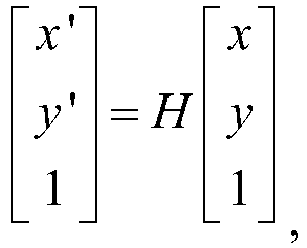
- Calculating a field similarity of a gradient field of the overlapping region between the input fingerprint and the template fingerprint. A difference operation is performed on the gradient field of the overlapping region between a new fingerprint obtained from transformation and the template.

- Determining whether the similarity of the direction field meets the threshold, if no, current matching is failed; if yes, a similarity of a direction field of the overlapping region between the input fingerprint and the template fingerprint is calculated, which is same as calculation of the similarity of the gradient field. It is determined that whether the similarity of the direction field meets the threshold, if no, current matching is failed; if yes, similarity scores of the gradient field and the direction field are added to obtain a final matching similarity score. Since the previous image registration process employs an exhaustive registration of minutiae, i.e., trying all possibilities of the matching, similarity scores in each registration scheme are obtained. A score with the highest similarity may be eventually obtained according to different registration schemes, which may be taken as a final score of the input fingerprint and the template fingerprint, so as to determine that the input fingerprint and the template fingerprint are capable of matching correctly, according to which a result of fingerprint identification is obtained.
- According to the apparatus of
embodiment 2 of the present invention, the direction of the minutia is calculated by using statistical information, the descriptor with statistical significance is added for the minutia, and during the matching process, calculation of the similarity of the minutia by using the descriptor and region matching by using information of the direction field and the gradient field of the overlapping region are added, therefore, instability and weak specificity of expression of fingerprint characteristics in a conventional algorithm are avoided, and accuracy of the fingerprint identification is improved. - The foregoing descriptions are merely preferred embodiments of the present invention, rather than limiting the present invention, and any modifications, equivalent substitutions, improvements and the like, made within the spirit and principle of the present invention, are all encompassed in the protection scope of the present invention.
- According to the method of
embodiment 1 of the present invention, the direction of the minutia is calculated by using statistical information, the descriptor with statistical significance is added for the minutia, and during the matching process, calculation of the similarity of the minutia by using the descriptor and region matching by using information of the direction field and the gradient field of the overlapping region are added, therefore, instability and weak specificity of expression of fingerprint characteristics in a conventional algorithm are avoided, and accuracy of the fingerprint identification is improved.
Claims (10)
- A method for fingerprint identification, wherein the method comprises the following steps:extracting a minutia of an input fingerprint image by using a statistical method; andperforming fingerprint matching according to the extracted minutia to obtain a fingerprint identification result.
- The method of claim 1, wherein the extracting the minutia of the input fingerprint image by using the statistical method comprises:calculating a direction of the minutia by using regional statistical information;adding a descriptor with statistical significance for the minutia according to the direction of the minutia; andextracting a triangle vertex direction of the minutia.
- The method of claim 2, wherein the calculating the direction of the minutia by using the regional statistical information comprises:selecting a statistical region of a certain minutia;calculating and weighting gradient directions of all minutiae within the statistical region;performing a statistics on a gradient direction distribution of all the minutiae within the statistical region according to the gradient directions and weighted values of all the minutiae within the statistical region;performing an interpolation operation according to the gradient direction distribution to obtain a direction distribution function; andfinding a maximum of the direction distribution function to obtain a direction of the minutia, and returning to the step of selecting a statistical region of a certain minutia until all minutiae of the input fingerprint image are traversed.
- The method of any of claims 1 to 3, wherein the adding the descriptor with statistical significance for the minutiae comprises:selecting a descriptor extracting region of a certain minutia;determining a regional four-quadrant according to the descriptor extracting region and a direction of the minutia;calculating gradient directions of all minutiae of the regional four-quadrant and performing an interpolation operation; andperforming a statistics on a gradient distribution of the regional four-quadrant after the interpolation operation, forming a descriptor of the minutia, and returning to the step of selecting a descriptor extracting region of a certain minutia until all minutiae of the input fingerprint image are traversed.
- The method of any of claims 1 to 3, wherein the performing the fingerprint matching according to the extracted minutia comprises:calculating a similarity of the minutia;when the similarity of the minutia meets a preset first threshold, adjusting the fingerprint image;calculating a similarity of an overlapping region; andwhen the similarity of the overlapping region meets a preset second threshold, determining that the matching is successful.
- An apparatus for fingerprint identification, wherein the apparatus comprises:an extracting module, configured to extract a minutia of an input fingerprint image by using a statistical method; anda matching module, configured to perform fingerprint matching according to the extracted minutia to obtain a fingerprint identifying result.
- The apparatus of claim 6, wherein the extracting module comprises:a first calculating unit, configured to calculate a direction of the minutia by using regional statistical information;a descriptor unit, configured to add a descriptor with statistical significance for the minutia according to the direction of the minutia; andan extracting vertex direction unit, configured to extract a triangle vertex direction of the minutia.
- The apparatus of claim 7, wherein the first calculating unit comprises:a first selecting subunit, configured to select a statistical region of a certain minutia;a calculating direction subunit, configured to calculate and weight gradient directions of all minutiae within the statistical region;a statistics subunit, configured to perform a statistics on a gradient direction distribution of all the minutiae within the statistical region according to the gradient directions and weighted values of all the minutiae within the statistical region;a first interpolation subunit, configured to perform an interpolation operation according to the gradient direction distribution to obtain a direction distribution function; anda first cycling subunit, configured to find a maximum of the direction distribution function to obtain a direction of the minutia, and return to the step to select a statistical region of a certain minutia until all minutiae of the input fingerprint image are traversed.
- The apparatus of any of claims 6 to 8, wherein the descriptor unit comprises:a second selecting subunit, configured to select a descriptor extracting region of a certain minutia;a determining subunit, configured to determine a regional four-quadrant according to the descriptor extracting region and a direction of the minutia;a second interpolation subunit, configured to calculate gradient directions of all minutiae of the regional four-quadrant and perform an interpolation operation; anda second cycling subunit, configured to perform a statistics on a gradient distribution of the regional four-quadrant after the interpolation operation, form a descriptor of the minutia, and return to the step to select a descriptor extracting region of a certain minutia until all minutiae of the input fingerprint image are traversed.
- The apparatus of any of claims 6 to 8, wherein the matching module comprises:a second calculating unit, configured to calculate a similarity of minutia;an adjusting unit, configured to adjust the fingerprint image when the similarity of the minutia meets a preset first threshold;a third calculating unit, configured to calculate a similarity of an overlapping region; anda determining unit, configured to determine that the matching is successful when the similarity of the overlapping region meets a preset second threshold.
Applications Claiming Priority (2)
| Application Number | Priority Date | Filing Date | Title |
|---|---|---|---|
| CN201410401491.0A CN104156707B (en) | 2014-08-14 | 2014-08-14 | Fingerprint identification method and its fingerprint identification device |
| PCT/CN2014/088491 WO2016023264A1 (en) | 2014-08-14 | 2014-10-13 | Fingerprint identification method and fingerprint identification device |
Publications (3)
| Publication Number | Publication Date |
|---|---|
| EP3091479A1 true EP3091479A1 (en) | 2016-11-09 |
| EP3091479A4 EP3091479A4 (en) | 2017-11-08 |
| EP3091479B1 EP3091479B1 (en) | 2019-09-25 |
Family
ID=51882204
Family Applications (1)
| Application Number | Title | Priority Date | Filing Date |
|---|---|---|---|
| EP14899701.8A Active EP3091479B1 (en) | 2014-08-14 | 2014-10-13 | Method and apparatus for fingerprint identification |
Country Status (5)
| Country | Link |
|---|---|
| US (1) | US9824258B2 (en) |
| EP (1) | EP3091479B1 (en) |
| KR (1) | KR101882894B1 (en) |
| CN (1) | CN104156707B (en) |
| WO (1) | WO2016023264A1 (en) |
Cited By (3)
| Publication number | Priority date | Publication date | Assignee | Title |
|---|---|---|---|---|
| CN107977653A (en) * | 2017-12-22 | 2018-05-01 | 云南大学 | The multiple dimensioned inflection point detection algorithm being combined with reference to complex filter and PI values |
| EP3258415A4 (en) * | 2015-02-13 | 2018-10-17 | BYD Company Limited | Fingerprint identification method and apparatus |
| SE543565C2 (en) * | 2019-11-06 | 2021-03-30 | Precise Biometrics Ab | A method and system for fingerprint verification and enrollment with secure storage of templates |
Families Citing this family (29)
| Publication number | Priority date | Publication date | Assignee | Title |
|---|---|---|---|---|
| CN104156707B (en) | 2014-08-14 | 2017-09-22 | 深圳市汇顶科技股份有限公司 | Fingerprint identification method and its fingerprint identification device |
| CN104463129B (en) * | 2014-12-17 | 2018-03-02 | 浙江维尔科技股份有限公司 | A kind of fingerprint register method and device |
| CN105205439B (en) * | 2015-02-13 | 2017-05-03 | 比亚迪股份有限公司 | Method for calculating area of fingerprint overlapping region and electronic device |
| US9971928B2 (en) * | 2015-02-27 | 2018-05-15 | Qualcomm Incorporated | Fingerprint verification system |
| CN104951760B (en) * | 2015-06-12 | 2018-04-10 | 南京信息工程大学 | A kind of fingerprint classification method based on field of direction minutiae point description |
| CN105138959A (en) * | 2015-07-28 | 2015-12-09 | 苏州南光电子科技有限公司 | Image processing based fingerprint matching and control method |
| KR101639986B1 (en) * | 2015-10-07 | 2016-07-15 | 크루셜텍 (주) | Fingerprint information processing method and apparatus for speed improvement of fingerprint registration and authentification |
| CN108491707B (en) | 2016-05-30 | 2020-01-14 | Oppo广东移动通信有限公司 | Unlocking control method, terminal equipment and medium product |
| CN106056081B (en) | 2016-05-30 | 2018-03-27 | 广东欧珀移动通信有限公司 | Unlocking control method and terminal equipment |
| CN107545217B (en) * | 2016-06-28 | 2021-07-30 | 比亚迪半导体股份有限公司 | Fingerprint matching method, fingerprint matching device and fingerprint identification chip |
| CN106250876B (en) * | 2016-08-19 | 2019-10-22 | 深圳市金立通信设备有限公司 | A kind of fingerprint identification method and terminal |
| CN106682622A (en) * | 2016-12-28 | 2017-05-17 | 大唐电信(成都)信息技术有限公司 | Fingerprint identification algorithm based on IC card |
| KR20180086087A (en) | 2017-01-20 | 2018-07-30 | 삼성전자주식회사 | Method for processing fingerprint information |
| CN107392847B (en) * | 2017-06-07 | 2021-01-22 | 西安电子科技大学 | Fingerprint image splicing method based on minutiae and distance images |
| CN107316027B (en) * | 2017-06-27 | 2020-05-15 | 倪燕平 | A shared device system and fingerprint identification method for shared devices |
| CN109598182B (en) * | 2017-09-30 | 2020-12-25 | 比亚迪股份有限公司 | Fingerprint comparison method and device |
| CN109145810A (en) * | 2018-08-17 | 2019-01-04 | 中控智慧科技股份有限公司 | Details in fingerprint point detecting method, device, equipment, system and storage medium |
| CN109446954A (en) * | 2018-10-17 | 2019-03-08 | 长安大学 | A kind of quick finger print matching method and device based on ultrashort two valued description |
| CN109829383B (en) * | 2018-12-29 | 2024-03-15 | 平安科技(深圳)有限公司 | Palmprint recognition method, palmprint recognition device and computer equipment |
| CN111695386B (en) * | 2019-03-15 | 2024-04-26 | 虹软科技股份有限公司 | Fingerprint image enhancement, fingerprint identification and application program starting method |
| CN112487867B (en) * | 2020-11-03 | 2024-04-12 | 杭州电子科技大学 | Visual constraint fingerprint identification method based on enhanced triangulation |
| CN112906705B (en) * | 2021-03-26 | 2023-01-13 | 北京邮电大学 | Image feature matching algorithm based on G-AKAZE |
| CN114663921B (en) * | 2022-03-03 | 2025-05-16 | 杭州远方光电信息股份有限公司 | A fingerprint orientation field reconstruction matching method |
| CN114926865A (en) * | 2022-05-07 | 2022-08-19 | 三星(中国)半导体有限公司 | Fingerprint identification method and device, electronic equipment and storage medium |
| CN114972507B (en) * | 2022-05-07 | 2026-03-06 | 北京易航远智科技有限公司 | Pose determination method, feature descriptor construction method and apparatus |
| CN116110083B (en) * | 2022-12-28 | 2026-03-24 | 泉州装备制造研究所 | A method, apparatus and electronic device for fingerprint minutiae annotation |
| CN116978072B (en) * | 2023-07-24 | 2026-06-05 | 杭州晟元数据安全技术股份有限公司 | A method for reducing fingerprint forgery using local features of ORB images |
| CN116959040B (en) * | 2023-08-09 | 2026-08-04 | 清华大学 | Fingerprint identification method and system based on fingerprint local representation |
| CN119649416A (en) * | 2025-02-20 | 2025-03-18 | 深圳市纽贝尔电子有限公司 | A fingerprint recognition method for access control verification based on biometric technology |
Family Cites Families (16)
| Publication number | Priority date | Publication date | Assignee | Title |
|---|---|---|---|---|
| US5613014A (en) * | 1994-10-12 | 1997-03-18 | Martin Marietta Corp. | Fingerprint matching system |
| US6546122B1 (en) * | 1999-07-29 | 2003-04-08 | Veridicom, Inc. | Method for combining fingerprint templates representing various sensed areas of a fingerprint to derive one fingerprint template representing the fingerprint |
| JP3952293B2 (en) * | 2003-01-06 | 2007-08-01 | ソニー株式会社 | Fingerprint verification apparatus and method, recording medium, and program |
| KR100617292B1 (en) * | 2003-11-14 | 2006-08-30 | 한국전자통신연구원 | Fingerprint recognition method and device |
| KR100698724B1 (en) * | 2005-06-21 | 2007-03-23 | 포스데이타 주식회사 | Singular point and center point extraction method of fingerprint image using ridge direction information |
| CN100385451C (en) * | 2005-08-11 | 2008-04-30 | 中国科学院自动化研究所 | Deformation Fingerprint Recognition Method Based on Local Triangular Structure Feature Set |
| CN101030246A (en) * | 2007-04-09 | 2007-09-05 | 黄东运 | Method for discriminating fingerprint |
| KR101430167B1 (en) * | 2007-12-14 | 2014-09-23 | 삼성전자주식회사 | Security system and method for security certification thereof, method for generating relative character information, terminal system, and smart card |
| CN101499130B (en) * | 2008-01-30 | 2012-06-27 | 深圳市普罗巴克科技股份有限公司 | Fingerprint recognition method and fingerprint recognition system |
| CN101515286B (en) * | 2009-04-03 | 2012-04-11 | 东南大学 | Image matching method based on image feature multi-level filtration |
| CN103020945B (en) * | 2011-09-21 | 2016-02-10 | 中国科学院电子学研究所 | A kind of remote sensing image registration method of Multiple Source Sensor |
| US8965069B2 (en) * | 2011-09-30 | 2015-02-24 | University Of Louisville Research Foundation, Inc. | Three dimensional minutiae extraction in three dimensional scans |
| CN102663401B (en) * | 2012-04-18 | 2013-11-20 | 哈尔滨工程大学 | Image characteristic extracting and describing method |
| GB2507539A (en) | 2012-11-02 | 2014-05-07 | Zwipe As | Matching sets of minutiae using local neighbourhoods |
| CN103425986B (en) * | 2013-08-31 | 2016-08-10 | 西安电子科技大学 | Mammary gland tumor image characteristic extracting method based on edge neighborhood weighting |
| CN104156707B (en) | 2014-08-14 | 2017-09-22 | 深圳市汇顶科技股份有限公司 | Fingerprint identification method and its fingerprint identification device |
-
2014
- 2014-08-14 CN CN201410401491.0A patent/CN104156707B/en active Active
- 2014-10-13 EP EP14899701.8A patent/EP3091479B1/en active Active
- 2014-10-13 WO PCT/CN2014/088491 patent/WO2016023264A1/en not_active Ceased
- 2014-10-13 KR KR1020167021522A patent/KR101882894B1/en active Active
-
2016
- 2016-07-06 US US15/202,574 patent/US9824258B2/en active Active
Cited By (3)
| Publication number | Priority date | Publication date | Assignee | Title |
|---|---|---|---|---|
| EP3258415A4 (en) * | 2015-02-13 | 2018-10-17 | BYD Company Limited | Fingerprint identification method and apparatus |
| CN107977653A (en) * | 2017-12-22 | 2018-05-01 | 云南大学 | The multiple dimensioned inflection point detection algorithm being combined with reference to complex filter and PI values |
| SE543565C2 (en) * | 2019-11-06 | 2021-03-30 | Precise Biometrics Ab | A method and system for fingerprint verification and enrollment with secure storage of templates |
Also Published As
| Publication number | Publication date |
|---|---|
| CN104156707B (en) | 2017-09-22 |
| WO2016023264A1 (en) | 2016-02-18 |
| US9824258B2 (en) | 2017-11-21 |
| US20160314338A1 (en) | 2016-10-27 |
| KR101882894B1 (en) | 2018-07-27 |
| KR20160106686A (en) | 2016-09-12 |
| EP3091479B1 (en) | 2019-09-25 |
| CN104156707A (en) | 2014-11-19 |
| EP3091479A4 (en) | 2017-11-08 |
Similar Documents
| Publication | Publication Date | Title |
|---|---|---|
| EP3091479B1 (en) | Method and apparatus for fingerprint identification | |
| Zhang et al. | A robust, real-time ellipse detector | |
| CN103093215B (en) | Human-eye positioning method and device | |
| Chen et al. | A highly accurate and computationally efficient approach for unconstrained iris segmentation | |
| CN104978012B (en) | One kind points to exchange method, apparatus and system | |
| CN103839042B (en) | Face identification method and face identification system | |
| Abate et al. | BIRD: Watershed based iris detection for mobile devices | |
| WO2016045215A1 (en) | Fingerprint image quality determination method and device | |
| CN105160303A (en) | Fingerprint identification method based on mixed matching | |
| CN105512599A (en) | Face identification method and face identification system | |
| CN105160686A (en) | Improved scale invariant feature transformation (SIFT) operator based low altitude multi-view remote-sensing image matching method | |
| CN103745207A (en) | Feature extraction method and device for human face identification | |
| CN108052912A (en) | A kind of three-dimensional face image recognition methods based on square Fourier descriptor | |
| CN106067172A (en) | A kind of underwater topography image based on suitability analysis slightly mates and mates, with essence, the method combined | |
| CN112686191B (en) | Living body anti-counterfeiting method, system, terminal and medium based on three-dimensional information of human face | |
| CN105320919A (en) | Human eye positioning method and apparatus | |
| CN109460768B (en) | Text detection and removal method for histopathology microscopic image | |
| CN106650616A (en) | Iris location method and visible light iris identification system | |
| CN109035285B (en) | Image boundary determining method and device, terminal and storage medium | |
| CN104134066B (en) | For the recognition methods of static signature | |
| CN103065315A (en) | Method, system and medical device of multiple atlas fusion | |
| Santos et al. | Detection of fundus lesions through a convolutional neural network in patients with diabetic retinopathy | |
| CN111612083A (en) | Finger vein identification method, device and equipment | |
| Xu et al. | Circle recognition and parameter measurement methods with the similarity constraint on the slope curve of the tangent lines to a contour | |
| Zhang et al. | Research on Multimodal 3D Face Recognition Method Based on Deep Learning. |
Legal Events
| Date | Code | Title | Description |
|---|---|---|---|
| PUAI | Public reference made under article 153(3) epc to a published international application that has entered the european phase |
Free format text: ORIGINAL CODE: 0009012 |
|
| 17P | Request for examination filed |
Effective date: 20160805 |
|
| AK | Designated contracting states |
Kind code of ref document: A1 Designated state(s): AL AT BE BG CH CY CZ DE DK EE ES FI FR GB GR HR HU IE IS IT LI LT LU LV MC MK MT NL NO PL PT RO RS SE SI SK SM TR |
|
| AX | Request for extension of the european patent |
Extension state: BA ME |
|
| RIC1 | Information provided on ipc code assigned before grant |
Ipc: G06K 9/62 20060101ALI20170630BHEP Ipc: G06K 9/00 20060101AFI20170630BHEP |
|
| RAP1 | Party data changed (applicant data changed or rights of an application transferred) |
Owner name: SHENZHEN GOODIX TECHNOLOGY CO., LTD. |
|
| A4 | Supplementary search report drawn up and despatched |
Effective date: 20171009 |
|
| RIC1 | Information provided on ipc code assigned before grant |
Ipc: G06K 9/62 20060101ALI20171003BHEP Ipc: G06K 9/00 20060101AFI20171003BHEP |
|
| DAX | Request for extension of the european patent (deleted) | ||
| GRAP | Despatch of communication of intention to grant a patent |
Free format text: ORIGINAL CODE: EPIDOSNIGR1 |
|
| STAA | Information on the status of an ep patent application or granted ep patent |
Free format text: STATUS: GRANT OF PATENT IS INTENDED |
|
| RIC1 | Information provided on ipc code assigned before grant |
Ipc: G06K 9/00 20060101AFI20190213BHEP Ipc: G06K 9/62 20060101ALI20190213BHEP |
|
| INTG | Intention to grant announced |
Effective date: 20190305 |
|
| GRAS | Grant fee paid |
Free format text: ORIGINAL CODE: EPIDOSNIGR3 |
|
| GRAA | (expected) grant |
Free format text: ORIGINAL CODE: 0009210 |
|
| STAA | Information on the status of an ep patent application or granted ep patent |
Free format text: STATUS: THE PATENT HAS BEEN GRANTED |
|
| AK | Designated contracting states |
Kind code of ref document: B1 Designated state(s): AL AT BE BG CH CY CZ DE DK EE ES FI FR GB GR HR HU IE IS IT LI LT LU LV MC MK MT NL NO PL PT RO RS SE SI SK SM TR |
|
| REG | Reference to a national code |
Ref country code: GB Ref legal event code: FG4D |
|
| REG | Reference to a national code |
Ref country code: CH Ref legal event code: EP |
|
| REG | Reference to a national code |
Ref country code: AT Ref legal event code: REF Ref document number: 1184553 Country of ref document: AT Kind code of ref document: T Effective date: 20191015 |
|
| REG | Reference to a national code |
Ref country code: IE Ref legal event code: FG4D |
|
| REG | Reference to a national code |
Ref country code: DE Ref legal event code: R096 Ref document number: 602014054415 Country of ref document: DE |
|
| REG | Reference to a national code |
Ref country code: NL Ref legal event code: MP Effective date: 20190925 |
|
| PG25 | Lapsed in a contracting state [announced via postgrant information from national office to epo] |
Ref country code: FI Free format text: LAPSE BECAUSE OF FAILURE TO SUBMIT A TRANSLATION OF THE DESCRIPTION OR TO PAY THE FEE WITHIN THE PRESCRIBED TIME-LIMIT Effective date: 20190925 Ref country code: LT Free format text: LAPSE BECAUSE OF FAILURE TO SUBMIT A TRANSLATION OF THE DESCRIPTION OR TO PAY THE FEE WITHIN THE PRESCRIBED TIME-LIMIT Effective date: 20190925 Ref country code: HR Free format text: LAPSE BECAUSE OF FAILURE TO SUBMIT A TRANSLATION OF THE DESCRIPTION OR TO PAY THE FEE WITHIN THE PRESCRIBED TIME-LIMIT Effective date: 20190925 Ref country code: SE Free format text: LAPSE BECAUSE OF FAILURE TO SUBMIT A TRANSLATION OF THE DESCRIPTION OR TO PAY THE FEE WITHIN THE PRESCRIBED TIME-LIMIT Effective date: 20190925 Ref country code: BG Free format text: LAPSE BECAUSE OF FAILURE TO SUBMIT A TRANSLATION OF THE DESCRIPTION OR TO PAY THE FEE WITHIN THE PRESCRIBED TIME-LIMIT Effective date: 20191225 Ref country code: NO Free format text: LAPSE BECAUSE OF FAILURE TO SUBMIT A TRANSLATION OF THE DESCRIPTION OR TO PAY THE FEE WITHIN THE PRESCRIBED TIME-LIMIT Effective date: 20191225 |
|
| REG | Reference to a national code |
Ref country code: LT Ref legal event code: MG4D |
|
| PG25 | Lapsed in a contracting state [announced via postgrant information from national office to epo] |
Ref country code: GR Free format text: LAPSE BECAUSE OF FAILURE TO SUBMIT A TRANSLATION OF THE DESCRIPTION OR TO PAY THE FEE WITHIN THE PRESCRIBED TIME-LIMIT Effective date: 20191226 Ref country code: LV Free format text: LAPSE BECAUSE OF FAILURE TO SUBMIT A TRANSLATION OF THE DESCRIPTION OR TO PAY THE FEE WITHIN THE PRESCRIBED TIME-LIMIT Effective date: 20190925 Ref country code: RS Free format text: LAPSE BECAUSE OF FAILURE TO SUBMIT A TRANSLATION OF THE DESCRIPTION OR TO PAY THE FEE WITHIN THE PRESCRIBED TIME-LIMIT Effective date: 20190925 |
|
| REG | Reference to a national code |
Ref country code: AT Ref legal event code: MK05 Ref document number: 1184553 Country of ref document: AT Kind code of ref document: T Effective date: 20190925 |
|
| PG25 | Lapsed in a contracting state [announced via postgrant information from national office to epo] |
Ref country code: IT Free format text: LAPSE BECAUSE OF FAILURE TO SUBMIT A TRANSLATION OF THE DESCRIPTION OR TO PAY THE FEE WITHIN THE PRESCRIBED TIME-LIMIT Effective date: 20190925 Ref country code: NL Free format text: LAPSE BECAUSE OF FAILURE TO SUBMIT A TRANSLATION OF THE DESCRIPTION OR TO PAY THE FEE WITHIN THE PRESCRIBED TIME-LIMIT Effective date: 20190925 Ref country code: EE Free format text: LAPSE BECAUSE OF FAILURE TO SUBMIT A TRANSLATION OF THE DESCRIPTION OR TO PAY THE FEE WITHIN THE PRESCRIBED TIME-LIMIT Effective date: 20190925 Ref country code: AT Free format text: LAPSE BECAUSE OF FAILURE TO SUBMIT A TRANSLATION OF THE DESCRIPTION OR TO PAY THE FEE WITHIN THE PRESCRIBED TIME-LIMIT Effective date: 20190925 Ref country code: RO Free format text: LAPSE BECAUSE OF FAILURE TO SUBMIT A TRANSLATION OF THE DESCRIPTION OR TO PAY THE FEE WITHIN THE PRESCRIBED TIME-LIMIT Effective date: 20190925 Ref country code: ES Free format text: LAPSE BECAUSE OF FAILURE TO SUBMIT A TRANSLATION OF THE DESCRIPTION OR TO PAY THE FEE WITHIN THE PRESCRIBED TIME-LIMIT Effective date: 20190925 Ref country code: PT Free format text: LAPSE BECAUSE OF FAILURE TO SUBMIT A TRANSLATION OF THE DESCRIPTION OR TO PAY THE FEE WITHIN THE PRESCRIBED TIME-LIMIT Effective date: 20200127 Ref country code: PL Free format text: LAPSE BECAUSE OF FAILURE TO SUBMIT A TRANSLATION OF THE DESCRIPTION OR TO PAY THE FEE WITHIN THE PRESCRIBED TIME-LIMIT Effective date: 20190925 Ref country code: AL Free format text: LAPSE BECAUSE OF FAILURE TO SUBMIT A TRANSLATION OF THE DESCRIPTION OR TO PAY THE FEE WITHIN THE PRESCRIBED TIME-LIMIT Effective date: 20190925 |
|
| PG25 | Lapsed in a contracting state [announced via postgrant information from national office to epo] |
Ref country code: SK Free format text: LAPSE BECAUSE OF FAILURE TO SUBMIT A TRANSLATION OF THE DESCRIPTION OR TO PAY THE FEE WITHIN THE PRESCRIBED TIME-LIMIT Effective date: 20190925 Ref country code: SM Free format text: LAPSE BECAUSE OF FAILURE TO SUBMIT A TRANSLATION OF THE DESCRIPTION OR TO PAY THE FEE WITHIN THE PRESCRIBED TIME-LIMIT Effective date: 20190925 Ref country code: IS Free format text: LAPSE BECAUSE OF FAILURE TO SUBMIT A TRANSLATION OF THE DESCRIPTION OR TO PAY THE FEE WITHIN THE PRESCRIBED TIME-LIMIT Effective date: 20200224 Ref country code: CZ Free format text: LAPSE BECAUSE OF FAILURE TO SUBMIT A TRANSLATION OF THE DESCRIPTION OR TO PAY THE FEE WITHIN THE PRESCRIBED TIME-LIMIT Effective date: 20190925 |
|
| REG | Reference to a national code |
Ref country code: CH Ref legal event code: PL |
|
| REG | Reference to a national code |
Ref country code: DE Ref legal event code: R097 Ref document number: 602014054415 Country of ref document: DE |
|
| PG2D | Information on lapse in contracting state deleted |
Ref country code: IS |
|
| PG25 | Lapsed in a contracting state [announced via postgrant information from national office to epo] |
Ref country code: LI Free format text: LAPSE BECAUSE OF NON-PAYMENT OF DUE FEES Effective date: 20191031 Ref country code: LU Free format text: LAPSE BECAUSE OF NON-PAYMENT OF DUE FEES Effective date: 20191013 Ref country code: DK Free format text: LAPSE BECAUSE OF FAILURE TO SUBMIT A TRANSLATION OF THE DESCRIPTION OR TO PAY THE FEE WITHIN THE PRESCRIBED TIME-LIMIT Effective date: 20190925 Ref country code: CH Free format text: LAPSE BECAUSE OF NON-PAYMENT OF DUE FEES Effective date: 20191031 Ref country code: IS Free format text: LAPSE BECAUSE OF FAILURE TO SUBMIT A TRANSLATION OF THE DESCRIPTION OR TO PAY THE FEE WITHIN THE PRESCRIBED TIME-LIMIT Effective date: 20200126 |
|
| PLBE | No opposition filed within time limit |
Free format text: ORIGINAL CODE: 0009261 |
|
| STAA | Information on the status of an ep patent application or granted ep patent |
Free format text: STATUS: NO OPPOSITION FILED WITHIN TIME LIMIT |
|
| REG | Reference to a national code |
Ref country code: BE Ref legal event code: MM Effective date: 20191031 |
|
| PG25 | Lapsed in a contracting state [announced via postgrant information from national office to epo] |
Ref country code: MC Free format text: LAPSE BECAUSE OF FAILURE TO SUBMIT A TRANSLATION OF THE DESCRIPTION OR TO PAY THE FEE WITHIN THE PRESCRIBED TIME-LIMIT Effective date: 20190925 Ref country code: BE Free format text: LAPSE BECAUSE OF NON-PAYMENT OF DUE FEES Effective date: 20191031 |
|
| 26N | No opposition filed |
Effective date: 20200626 |
|
| PG25 | Lapsed in a contracting state [announced via postgrant information from national office to epo] |
Ref country code: IE Free format text: LAPSE BECAUSE OF NON-PAYMENT OF DUE FEES Effective date: 20191013 Ref country code: FR Free format text: LAPSE BECAUSE OF NON-PAYMENT OF DUE FEES Effective date: 20191125 |
|
| PG25 | Lapsed in a contracting state [announced via postgrant information from national office to epo] |
Ref country code: SI Free format text: LAPSE BECAUSE OF FAILURE TO SUBMIT A TRANSLATION OF THE DESCRIPTION OR TO PAY THE FEE WITHIN THE PRESCRIBED TIME-LIMIT Effective date: 20190925 |
|
| PG25 | Lapsed in a contracting state [announced via postgrant information from national office to epo] |
Ref country code: CY Free format text: LAPSE BECAUSE OF FAILURE TO SUBMIT A TRANSLATION OF THE DESCRIPTION OR TO PAY THE FEE WITHIN THE PRESCRIBED TIME-LIMIT Effective date: 20190925 |
|
| PG25 | Lapsed in a contracting state [announced via postgrant information from national office to epo] |
Ref country code: HU Free format text: LAPSE BECAUSE OF FAILURE TO SUBMIT A TRANSLATION OF THE DESCRIPTION OR TO PAY THE FEE WITHIN THE PRESCRIBED TIME-LIMIT; INVALID AB INITIO Effective date: 20141013 Ref country code: MT Free format text: LAPSE BECAUSE OF FAILURE TO SUBMIT A TRANSLATION OF THE DESCRIPTION OR TO PAY THE FEE WITHIN THE PRESCRIBED TIME-LIMIT Effective date: 20190925 |
|
| REG | Reference to a national code |
Ref country code: DE Ref legal event code: R079 Ref document number: 602014054415 Country of ref document: DE Free format text: PREVIOUS MAIN CLASS: G06K0009000000 Ipc: G06V0010000000 |
|
| PG25 | Lapsed in a contracting state [announced via postgrant information from national office to epo] |
Ref country code: TR Free format text: LAPSE BECAUSE OF FAILURE TO SUBMIT A TRANSLATION OF THE DESCRIPTION OR TO PAY THE FEE WITHIN THE PRESCRIBED TIME-LIMIT Effective date: 20190925 |
|
| PG25 | Lapsed in a contracting state [announced via postgrant information from national office to epo] |
Ref country code: MK Free format text: LAPSE BECAUSE OF FAILURE TO SUBMIT A TRANSLATION OF THE DESCRIPTION OR TO PAY THE FEE WITHIN THE PRESCRIBED TIME-LIMIT Effective date: 20190925 |
|
| PGFP | Annual fee paid to national office [announced via postgrant information from national office to epo] |
Ref country code: GB Payment date: 20250925 Year of fee payment: 12 |
|
| PGFP | Annual fee paid to national office [announced via postgrant information from national office to epo] |
Ref country code: DE Payment date: 20250930 Year of fee payment: 12 |