EP3091013A1 - 1-(3-aminopropyl) substituted cyclic amine compounds, preparation method therefor, and pharmaceutical compositions and uses thereof - Google Patents
1-(3-aminopropyl) substituted cyclic amine compounds, preparation method therefor, and pharmaceutical compositions and uses thereof Download PDFInfo
- Publication number
- EP3091013A1 EP3091013A1 EP14877091.0A EP14877091A EP3091013A1 EP 3091013 A1 EP3091013 A1 EP 3091013A1 EP 14877091 A EP14877091 A EP 14877091A EP 3091013 A1 EP3091013 A1 EP 3091013A1
- Authority
- EP
- European Patent Office
- Prior art keywords
- compound
- straight
- group
- branched
- replace
- Prior art date
- Legal status (The legal status is an assumption and is not a legal conclusion. Google has not performed a legal analysis and makes no representation as to the accuracy of the status listed.)
- Granted
Links
- 0 C*CC(C1*CC*1)NC(*1*CC1)=* Chemical compound C*CC(C1*CC*1)NC(*1*CC1)=* 0.000 description 10
- BGRKDLVBPMCBJW-UHFFFAOYSA-N CC[n]1nncn1 Chemical compound CC[n]1nncn1 BGRKDLVBPMCBJW-UHFFFAOYSA-N 0.000 description 2
- KYRMPMCAOPMOIR-UHFFFAOYSA-N CCc1nnn[nH]1 Chemical compound CCc1nnn[nH]1 KYRMPMCAOPMOIR-UHFFFAOYSA-N 0.000 description 2
- XDTMQSROBMDMFD-UHFFFAOYSA-N C1CCCCC1 Chemical compound C1CCCCC1 XDTMQSROBMDMFD-UHFFFAOYSA-N 0.000 description 1
- PLWCSYVJSJAIRF-YTZNMQJJSA-N CC(C)C(N(CC1)Cc2c1[n](C1CC(CC3)N(CC[C@@H](c4c[s]cn4)NC(C)=O)C3C1)c(C)n2)=O Chemical compound CC(C)C(N(CC1)Cc2c1[n](C1CC(CC3)N(CC[C@@H](c4c[s]cn4)NC(C)=O)C3C1)c(C)n2)=O PLWCSYVJSJAIRF-YTZNMQJJSA-N 0.000 description 1
- WTCITIPJIRPJIM-FTKYIGPGSA-N CC(C)C(N(CC1)Cc2c1nc(C)[n]2C1CC(CC2)N(CC[C@@H](c3ccc(F)[s]3)NC(C)=O)C2C1)=O Chemical compound CC(C)C(N(CC1)Cc2c1nc(C)[n]2C1CC(CC2)N(CC[C@@H](c3ccc(F)[s]3)NC(C)=O)C2C1)=O WTCITIPJIRPJIM-FTKYIGPGSA-N 0.000 description 1
- PFYPOVSLPNNCIN-CLCOLTQESA-N CC(C)c1nnc(C)[n]1C1CC(CC2)N(CC/C(/c3ccc[s]3)=N/C(Cc3nnn[nH]3)=O)C2C1 Chemical compound CC(C)c1nnc(C)[n]1C1CC(CC2)N(CC/C(/c3ccc[s]3)=N/C(Cc3nnn[nH]3)=O)C2C1 PFYPOVSLPNNCIN-CLCOLTQESA-N 0.000 description 1
- XHPVHSOBTHKQIZ-YTZNMQJJSA-N CC(C)c1nnc(C)[n]1C1CC(CC2)N(CC[C@@H](c([s]3)ccc3Cl)NC(C(CC3)CCC3(F)F)=O)C2C1 Chemical compound CC(C)c1nnc(C)[n]1C1CC(CC2)N(CC[C@@H](c([s]3)ccc3Cl)NC(C(CC3)CCC3(F)F)=O)C2C1 XHPVHSOBTHKQIZ-YTZNMQJJSA-N 0.000 description 1
- QZQIAQCHNJHMCU-LFVBFMBRSA-N CC(C)c1nnc(C)[n]1C1CC(CC2)N(CC[C@@H](c([s]3)ccc3Cl)NC(C[n]3nncn3)=O)C2C1 Chemical compound CC(C)c1nnc(C)[n]1C1CC(CC2)N(CC[C@@H](c([s]3)ccc3Cl)NC(C[n]3nncn3)=O)C2C1 QZQIAQCHNJHMCU-LFVBFMBRSA-N 0.000 description 1
- SIKNPXBZULXSPI-DGGBHQDZSA-N CC(C)c1nnc(C)[n]1C1CC(CC2)N(CC[C@@H](c3c(C)c(C)c[s]3)NC(C(CC3)CCC3(F)F)=O)C2C1 Chemical compound CC(C)c1nnc(C)[n]1C1CC(CC2)N(CC[C@@H](c3c(C)c(C)c[s]3)NC(C(CC3)CCC3(F)F)=O)C2C1 SIKNPXBZULXSPI-DGGBHQDZSA-N 0.000 description 1
- OZHDBGMQRURYTI-DGGBHQDZSA-N CC(C)c1nnc(C)[n]1C1CC(CC2)N(CC[C@@H](c3c(C)cc(C)[s]3)NC(C(CC3)CCC3(F)F)=O)C2C1 Chemical compound CC(C)c1nnc(C)[n]1C1CC(CC2)N(CC[C@@H](c3c(C)cc(C)[s]3)NC(C(CC3)CCC3(F)F)=O)C2C1 OZHDBGMQRURYTI-DGGBHQDZSA-N 0.000 description 1
- WRHVGKXTALXBAH-DGGBHQDZSA-N CC(C)c1nnc(C)[n]1C1CC(CC2)N(CC[C@@H](c3cc(C(C)=O)c[s]3)NC(C(CC3)CCC3(F)F)=O)C2C1 Chemical compound CC(C)c1nnc(C)[n]1C1CC(CC2)N(CC[C@@H](c3cc(C(C)=O)c[s]3)NC(C(CC3)CCC3(F)F)=O)C2C1 WRHVGKXTALXBAH-DGGBHQDZSA-N 0.000 description 1
- WTVQPVLJOWZONI-DGGBHQDZSA-N CC(C)c1nnc(C)[n]1C1CC(CC2)N(CC[C@@H](c3cc(C)c[s]3)NC(C3CCCCC3)=O)C2C1 Chemical compound CC(C)c1nnc(C)[n]1C1CC(CC2)N(CC[C@@H](c3cc(C)c[s]3)NC(C3CCCCC3)=O)C2C1 WTVQPVLJOWZONI-DGGBHQDZSA-N 0.000 description 1
- HAOQBLPPOSQLRM-GJFGYCNFSA-N CC(C)c1nnc(C)[n]1C1CC(CC2)N(CC[C@@H](c3ccc(C#N)[s]3)NC(C[n]3nncn3)=O)C2C1 Chemical compound CC(C)c1nnc(C)[n]1C1CC(CC2)N(CC[C@@H](c3ccc(C#N)[s]3)NC(C[n]3nncn3)=O)C2C1 HAOQBLPPOSQLRM-GJFGYCNFSA-N 0.000 description 1
- IHMQPHDAUKUWER-JVLTXYAPSA-N CC(C)c1nnc(C)[n]1C1CC(CC2)N(CC[C@@H](c3ccc(C(NC)=O)[s]3)NC(C(CC3)CCC3(F)F)=O)C2C1 Chemical compound CC(C)c1nnc(C)[n]1C1CC(CC2)N(CC[C@@H](c3ccc(C(NC)=O)[s]3)NC(C(CC3)CCC3(F)F)=O)C2C1 IHMQPHDAUKUWER-JVLTXYAPSA-N 0.000 description 1
- BNWFVBYZJZHVLY-JVLTXYAPSA-N CC(C)c1nnc(C)[n]1C1CC(CC2)N(CC[C@@H](c3ccc(C(NC)=O)[s]3)NC(C3CCCC3)=O)C2C1 Chemical compound CC(C)c1nnc(C)[n]1C1CC(CC2)N(CC[C@@H](c3ccc(C(NC)=O)[s]3)NC(C3CCCC3)=O)C2C1 BNWFVBYZJZHVLY-JVLTXYAPSA-N 0.000 description 1
- XMUCXZCPULINRA-GVWQBGCGSA-N CC(C)c1nnc(C)[n]1C1CC(CC2)N(CC[C@@H](c3ccc(C(NC)=O)[s]3)NC(C3CCCCC3)=O)C2C1 Chemical compound CC(C)c1nnc(C)[n]1C1CC(CC2)N(CC[C@@H](c3ccc(C(NC)=O)[s]3)NC(C3CCCCC3)=O)C2C1 XMUCXZCPULINRA-GVWQBGCGSA-N 0.000 description 1
- XYBVBJPITRKZEP-WSXZXBBNSA-N CC(C)c1nnc(C)[n]1C1CC(CC2)N(CC[C@@H](c3ccc(C)[s]3)NC(Cc3nnn[nH]3)=O)C2C1 Chemical compound CC(C)c1nnc(C)[n]1C1CC(CC2)N(CC[C@@H](c3ccc(C)[s]3)NC(Cc3nnn[nH]3)=O)C2C1 XYBVBJPITRKZEP-WSXZXBBNSA-N 0.000 description 1
- JOKPYJKZNAPVSV-JVLTXYAPSA-N CC(C)c1nnc(C)[n]1C1CC(CC2)N(CC[C@@H](c3ccc(F)[s]3)NC(C3CCCCC3)=O)C2C1 Chemical compound CC(C)c1nnc(C)[n]1C1CC(CC2)N(CC[C@@H](c3ccc(F)[s]3)NC(C3CCCCC3)=O)C2C1 JOKPYJKZNAPVSV-JVLTXYAPSA-N 0.000 description 1
- KSZQWOSAROPXFU-GVWQBGCGSA-N CC(C)c1nnc(C)[n]1C1CC(CC2)N(CC[C@@H](c3ccc(NC(C)=O)[s]3)NC(C3CCCC3)=O)C2C1 Chemical compound CC(C)c1nnc(C)[n]1C1CC(CC2)N(CC[C@@H](c3ccc(NC(C)=O)[s]3)NC(C3CCCC3)=O)C2C1 KSZQWOSAROPXFU-GVWQBGCGSA-N 0.000 description 1
- SWYGIVFOKBWAOJ-DGGBHQDZSA-N CC(C)c1nnc(C)[n]1C1CC(CC2)N(CC[C@@H](c3ccc(NC(C)=O)[s]3)NC(C3CCCCC3)=O)C2C1 Chemical compound CC(C)c1nnc(C)[n]1C1CC(CC2)N(CC[C@@H](c3ccc(NC(C)=O)[s]3)NC(C3CCCCC3)=O)C2C1 SWYGIVFOKBWAOJ-DGGBHQDZSA-N 0.000 description 1
- NIEPIAGUFYHMJG-YTZNMQJJSA-N CC(C)c1nnc(C)[n]1C1CC(CC2)N(CC[C@@H](c3ccc([N+]([O-])=O)[s]3)NC(C3CCCC3)=O)C2C1 Chemical compound CC(C)c1nnc(C)[n]1C1CC(CC2)N(CC[C@@H](c3ccc([N+]([O-])=O)[s]3)NC(C3CCCC3)=O)C2C1 NIEPIAGUFYHMJG-YTZNMQJJSA-N 0.000 description 1
- YNBGIJVWMDWTHC-WSXZXBBNSA-N CC(C)c1nnc(C)[n]1C1CC(CC2)N(CC[C@@H](c3ccc[s]3)NC(C)=O)C2C1 Chemical compound CC(C)c1nnc(C)[n]1C1CC(CC2)N(CC[C@@H](c3ccc[s]3)NC(C)=O)C2C1 YNBGIJVWMDWTHC-WSXZXBBNSA-N 0.000 description 1
- IJCZILKQWXZDNI-GVWQBGCGSA-N CC(C)c1nnc(C)[n]1C1CC(CC2)N(CC[C@@H](c3ccc[s]3)NC(C3CCN(C)CC3)=O)C2C1 Chemical compound CC(C)c1nnc(C)[n]1C1CC(CC2)N(CC[C@@H](c3ccc[s]3)NC(C3CCN(C)CC3)=O)C2C1 IJCZILKQWXZDNI-GVWQBGCGSA-N 0.000 description 1
- PLOWHWBMSCJLLG-WSXZXBBNSA-N CC(C)c1nnc(C)[n]1C1CC(CC2)N(CC[C@@H](c3ccc[s]3)NC(C[n]3nncn3)=O)C2C1 Chemical compound CC(C)c1nnc(C)[n]1C1CC(CC2)N(CC[C@@H](c3ccc[s]3)NC(C[n]3nncn3)=O)C2C1 PLOWHWBMSCJLLG-WSXZXBBNSA-N 0.000 description 1
- LFZAGIJXANFPFN-SFHVURJKSA-N CC(C)c1nnc(C)[n]1C1CCN(CC[C@@H](c2ccc[s]2)NC(C)=O)CC1 Chemical compound CC(C)c1nnc(C)[n]1C1CCN(CC[C@@H](c2ccc[s]2)NC(C)=O)CC1 LFZAGIJXANFPFN-SFHVURJKSA-N 0.000 description 1
- AKGVTCKXLOPZDA-FNNAPWSISA-N CC(N[C@@H](CCN(C(CC1)C2)C1CC2[n]1c(CCN(C2)C(C)=O)c2nc1C)c1ccc(F)[s]1)=O Chemical compound CC(N[C@@H](CCN(C(CC1)C2)C1CC2[n]1c(CCN(C2)C(C)=O)c2nc1C)c1ccc(F)[s]1)=O AKGVTCKXLOPZDA-FNNAPWSISA-N 0.000 description 1
- DNLUWWPOKWMOMH-YTZNMQJJSA-N CC(N[C@@H](CCN(C(CC1)C2)C1CC2[n]1c(CCN(C2)C(C3CC3)=O)c2nc1C)c1ccc(F)[s]1)=O Chemical compound CC(N[C@@H](CCN(C(CC1)C2)C1CC2[n]1c(CCN(C2)C(C3CC3)=O)c2nc1C)c1ccc(F)[s]1)=O DNLUWWPOKWMOMH-YTZNMQJJSA-N 0.000 description 1
- IXHFKOGLDVGOJU-UHFFFAOYSA-N CC(c1c[s]c(C=O)c1)=O Chemical compound CC(c1c[s]c(C=O)c1)=O IXHFKOGLDVGOJU-UHFFFAOYSA-N 0.000 description 1
- NQWNJWZLWMCDOJ-UHFFFAOYSA-N Cc1c(C=O)[s]c(C)c1 Chemical compound Cc1c(C=O)[s]c(C)c1 NQWNJWZLWMCDOJ-UHFFFAOYSA-N 0.000 description 1
- BKJFHBZANQQLNO-UHFFFAOYSA-N Cc1c[s]c(C=O)c1C Chemical compound Cc1c[s]c(C=O)c1C BKJFHBZANQQLNO-UHFFFAOYSA-N 0.000 description 1
- GIWQSPITLQVMSG-UHFFFAOYSA-N Cc1ncc[n]1C Chemical compound Cc1ncc[n]1C GIWQSPITLQVMSG-UHFFFAOYSA-N 0.000 description 1
- VWYFITBWBRVBSW-UHFFFAOYSA-N O=Cc([s]1)ccc1Cl Chemical compound O=Cc([s]1)ccc1Cl VWYFITBWBRVBSW-UHFFFAOYSA-N 0.000 description 1
Classifications
-
- C—CHEMISTRY; METALLURGY
- C07—ORGANIC CHEMISTRY
- C07D—HETEROCYCLIC COMPOUNDS
- C07D519/00—Heterocyclic compounds containing more than one system of two or more relevant hetero rings condensed among themselves or condensed with a common carbocyclic ring system not provided for in groups C07D453/00 or C07D455/00
-
- C—CHEMISTRY; METALLURGY
- C07—ORGANIC CHEMISTRY
- C07D—HETEROCYCLIC COMPOUNDS
- C07D409/00—Heterocyclic compounds containing two or more hetero rings, at least one ring having sulfur atoms as the only ring hetero atoms
- C07D409/14—Heterocyclic compounds containing two or more hetero rings, at least one ring having sulfur atoms as the only ring hetero atoms containing three or more hetero rings
-
- A—HUMAN NECESSITIES
- A61—MEDICAL OR VETERINARY SCIENCE; HYGIENE
- A61K—PREPARATIONS FOR MEDICAL, DENTAL OR TOILETRY PURPOSES
- A61K31/00—Medicinal preparations containing organic active ingredients
- A61K31/33—Heterocyclic compounds
- A61K31/395—Heterocyclic compounds having nitrogen as a ring hetero atom, e.g. guanethidine or rifamycins
- A61K31/435—Heterocyclic compounds having nitrogen as a ring hetero atom, e.g. guanethidine or rifamycins having six-membered rings with one nitrogen as the only ring hetero atom
- A61K31/44—Non condensed pyridines; Hydrogenated derivatives thereof
- A61K31/445—Non condensed piperidines, e.g. piperocaine
- A61K31/4523—Non condensed piperidines, e.g. piperocaine containing further heterocyclic ring systems
- A61K31/454—Non condensed piperidines, e.g. piperocaine containing further heterocyclic ring systems containing a five-membered ring with nitrogen as a ring hetero atom, e.g. pimozide, domperidone
-
- A—HUMAN NECESSITIES
- A61—MEDICAL OR VETERINARY SCIENCE; HYGIENE
- A61K—PREPARATIONS FOR MEDICAL, DENTAL OR TOILETRY PURPOSES
- A61K31/00—Medicinal preparations containing organic active ingredients
- A61K31/33—Heterocyclic compounds
- A61K31/395—Heterocyclic compounds having nitrogen as a ring hetero atom, e.g. guanethidine or rifamycins
- A61K31/435—Heterocyclic compounds having nitrogen as a ring hetero atom, e.g. guanethidine or rifamycins having six-membered rings with one nitrogen as the only ring hetero atom
- A61K31/44—Non condensed pyridines; Hydrogenated derivatives thereof
- A61K31/445—Non condensed piperidines, e.g. piperocaine
- A61K31/4523—Non condensed piperidines, e.g. piperocaine containing further heterocyclic ring systems
- A61K31/4545—Non condensed piperidines, e.g. piperocaine containing further heterocyclic ring systems containing a six-membered ring with nitrogen as a ring hetero atom, e.g. pipamperone, anabasine
-
- A—HUMAN NECESSITIES
- A61—MEDICAL OR VETERINARY SCIENCE; HYGIENE
- A61K—PREPARATIONS FOR MEDICAL, DENTAL OR TOILETRY PURPOSES
- A61K31/00—Medicinal preparations containing organic active ingredients
- A61K31/33—Heterocyclic compounds
- A61K31/395—Heterocyclic compounds having nitrogen as a ring hetero atom, e.g. guanethidine or rifamycins
- A61K31/435—Heterocyclic compounds having nitrogen as a ring hetero atom, e.g. guanethidine or rifamycins having six-membered rings with one nitrogen as the only ring hetero atom
- A61K31/46—8-Azabicyclo [3.2.1] octane; Derivatives thereof, e.g. atropine, cocaine
-
- A—HUMAN NECESSITIES
- A61—MEDICAL OR VETERINARY SCIENCE; HYGIENE
- A61K—PREPARATIONS FOR MEDICAL, DENTAL OR TOILETRY PURPOSES
- A61K45/00—Medicinal preparations containing active ingredients not provided for in groups A61K31/00 - A61K41/00
- A61K45/06—Mixtures of active ingredients without chemical characterisation, e.g. antiphlogistics and cardiaca
-
- A—HUMAN NECESSITIES
- A61—MEDICAL OR VETERINARY SCIENCE; HYGIENE
- A61P—SPECIFIC THERAPEUTIC ACTIVITY OF CHEMICAL COMPOUNDS OR MEDICINAL PREPARATIONS
- A61P31/00—Antiinfectives, i.e. antibiotics, antiseptics, chemotherapeutics
- A61P31/12—Antivirals
- A61P31/14—Antivirals for RNA viruses
- A61P31/18—Antivirals for RNA viruses for HIV
-
- A—HUMAN NECESSITIES
- A61—MEDICAL OR VETERINARY SCIENCE; HYGIENE
- A61P—SPECIFIC THERAPEUTIC ACTIVITY OF CHEMICAL COMPOUNDS OR MEDICINAL PREPARATIONS
- A61P43/00—Drugs for specific purposes, not provided for in groups A61P1/00-A61P41/00
-
- C—CHEMISTRY; METALLURGY
- C07—ORGANIC CHEMISTRY
- C07D—HETEROCYCLIC COMPOUNDS
- C07D401/00—Heterocyclic compounds containing two or more hetero rings, having nitrogen atoms as the only ring hetero atoms, at least one ring being a six-membered ring with only one nitrogen atom
- C07D401/14—Heterocyclic compounds containing two or more hetero rings, having nitrogen atoms as the only ring hetero atoms, at least one ring being a six-membered ring with only one nitrogen atom containing three or more hetero rings
-
- C—CHEMISTRY; METALLURGY
- C07—ORGANIC CHEMISTRY
- C07D—HETEROCYCLIC COMPOUNDS
- C07D417/00—Heterocyclic compounds containing two or more hetero rings, at least one ring having nitrogen and sulfur atoms as the only ring hetero atoms, not provided for by group C07D415/00
- C07D417/14—Heterocyclic compounds containing two or more hetero rings, at least one ring having nitrogen and sulfur atoms as the only ring hetero atoms, not provided for by group C07D415/00 containing three or more hetero rings
-
- C—CHEMISTRY; METALLURGY
- C07—ORGANIC CHEMISTRY
- C07D—HETEROCYCLIC COMPOUNDS
- C07D451/00—Heterocyclic compounds containing 8-azabicyclo [3.2.1] octane, 9-azabicyclo [3.3.1] nonane, or 3-oxa-9-azatricyclo [3.3.1.0<2,4>] nonane ring systems, e.g. tropane or granatane alkaloids, scopolamine; Cyclic acetals thereof
- C07D451/02—Heterocyclic compounds containing 8-azabicyclo [3.2.1] octane, 9-azabicyclo [3.3.1] nonane, or 3-oxa-9-azatricyclo [3.3.1.0<2,4>] nonane ring systems, e.g. tropane or granatane alkaloids, scopolamine; Cyclic acetals thereof containing not further condensed 8-azabicyclo [3.2.1] octane or 3-oxa-9-azatricyclo [3.3.1.0<2,4>] nonane ring systems, e.g. tropane; Cyclic acetals thereof
- C07D451/04—Heterocyclic compounds containing 8-azabicyclo [3.2.1] octane, 9-azabicyclo [3.3.1] nonane, or 3-oxa-9-azatricyclo [3.3.1.0<2,4>] nonane ring systems, e.g. tropane or granatane alkaloids, scopolamine; Cyclic acetals thereof containing not further condensed 8-azabicyclo [3.2.1] octane or 3-oxa-9-azatricyclo [3.3.1.0<2,4>] nonane ring systems, e.g. tropane; Cyclic acetals thereof with hetero atoms directly attached in position 3 of the 8-azabicyclo [3.2.1] octane or in position 7 of the 3-oxa-9-azatricyclo [3.3.1.0<2,4>] nonane ring system
-
- A—HUMAN NECESSITIES
- A61—MEDICAL OR VETERINARY SCIENCE; HYGIENE
- A61K—PREPARATIONS FOR MEDICAL, DENTAL OR TOILETRY PURPOSES
- A61K2300/00—Mixtures or combinations of active ingredients, wherein at least one active ingredient is fully defined in groups A61K31/00 - A61K41/00
Definitions
- the present invention relates to the field of pharmaceutical chemistry and pharmacotherapeutics, particularly to 1-(3-aminopropyl) substituted cyclic amine compounds, preparation method thereof, pharmaceutical compositions containing such compounds and uses thereof.
- AIDS Acquired Immune Deficiency Syndrome
- WHO World Health Organization
- HIV human immunodeficiency virus
- a series of opportunistic infections and tumors are triggered, severe case of which can lead to death.
- WHO World Health Organization
- Chinese Center for Disease Control and Prevention estimated that there were 780000 HIV carriers and AIDS patients in China by the end of 2011, 48000 persons were newly infected and 28000 patients died. At present, China is facing high peak of AIDS morbidity and mortality.
- medicaments for treating AIDS in clinic are divided into following classes: reverse transcriptase inhibitors, including nucleoside reverse transcriptase inhibitors and non-nucleoside reverse transcriptase inhibitors; protease inhibitors; integrase inhibitors and entry inhibitors. Entry inhibitors can be divided into CCR5 antagonists, CXCR4 antagonists, adhesion inhibitors and fusion inhibitors according to different targets during the entry of HIV into host cells.
- HAART highly active antiretroviral therapy
- highly active antiretroviral therapy has largely reduced the mortality rate of HIV-infected patients.
- highly active antiretroviral therapy has largely reduced the mortality rate of HIV-infected patients.
- the dosage regimen of HAART is complex and drugs combination can cause long-term severe side effects. Therefore, the development of anti-HIV drugs having new action mechanisms has very important significance.
- Chemokines are a class of cytokines guiding directed migration of lymphocytes and have an important role in inflammation, tissue repair, immune surveillance, extravasation of white blood cells, tumorigenesis and embryonic development.
- Chemokines are proteins belonging to a small molecule cytokine family which currently have about 45 members. Their common features are that they have small molecular weight (about 8-10 kDa) and they contain four position-conserved cysteine (Cys) residues to ensure tertiary structure. According to whether other amino acid is contained between two Cys close to N-terminal, the family is divided into four categories: CC, CXC, CX3C and C chemokine. Wherein, CC chemokine and CXC chemokine are the most important two categories.
- chemokine receptor is named according to the characteristics of chemokine bound specifically (for example, if its ligand belongd to a CC chemokine subfamily, then it is named CCR).
- Chemokine receptors belong to the seven transmembrane G-protein coupled receptors (GPCR), are selectively expressed on the surface of target cells, wherein N-terminal thereof is outside the cell and C terminal is in the cell, and they contain seven very conservative transmembrane region consisting of ⁇ -helix. So far 19 chemokine receptors have been found. They are CCR1-11, CXCR1-6, XCR1, and CX3CR1. Modulators of chemokine receptor can be used in a variety of diseases, such as inflammatory or allergic diseases and the like.
- CD4 molecule on Th cell is essential for HIV invasion, but only CD4 is not enough to mediate fusion of HIV with cell.
- chemokine receptors involve in the HIV invasion process and are known as HIV coreceptors.
- Coreceptors can be divided into two categories. One is coreceptor CCR5 distributed on the surface of macrophages and involved in entrance of macrophage tropism (M-tropism) HIV into host cells. The other is coreceptor CCR4 distributed on the surface of T cell and involved in entrance of T cell tropism (T-tropism) HIV into host cells.
- M-tropism macrophage tropism
- T-tropism T cell tropism
- CCR5 can inhibit HIV infection by inhibiting the M-tropism HIV from entering into cells.
- benign results were obtained bu knockouting gene expressing CCR5 in mice.
- some studies indicate that the immune function of mouse can be changed in some models.
- CCR5 gene-deficient homozygous individuals and such individuals can well protect themselves from HIV infection without any other health problems.
- heterozygous individuals with only one CCR5 allele can obviously delay the progression of AIDS. Therefore, CCR5 can be used as a good anti-HIV target.
- Macromolecular CCR5 antagonist can bind specifically to the specific extracellular portion of CCR5 to produce inhibiting effects without major toxic effects, but it is unstable, easy to be digested and degraded, expensive, and can not be orally administrated nd even cause the body to produce antibody-induced immune response. Therefore, companies and research institutions have conducted a great deal of effective research on non-peptide small molecule CCR5 antagonist and developed a number of highly active small molecule CCR5 antagonists such as TAK-220, TBR652, Vicriviroc and Maraviroc (trade name Selzentry) approved for marketing by FDA in 2007.
- the object of the present invention is to provide 1-(3-aminopropyl) substituted cyclic amine compounds having CCR5 antagonist activity as represented by formula (I), pharmaceutically acceptable salts, enantiomers, diastereoisomers, racemates or mixtures thereof, and a method for synthesizing said 1-(3-aminopropyl) substituted cyclic amine compounds by using aromatic heterocyclic formaldehyde as raw material.
- a further object of the present invention is to provide a pharmaceutical composition comprising the above compounds.
- a further object of the present invention is to provide a use of above compound in the preparation of medicaments for the treatment of HIV infection.
- a 1-(3-aminopropyl) substituted cyclic amine compound of formula (I), a pharmaceutically acceptable salt, enantiomer, diastereoisomer, racemate or a mixture thereof is provided:
- 1-(3-aminopropyl) substituted cyclic amine compound of formula (I) is S configuration or R configuration, preferably, S configuration.
- R 12 is selected from a group consisting of a C1-C2 alkyl, a C1-C2 alkoxy, a hydroxy, an amino (NH 2 ) and a C1-C2 alkylamino.
- R 13 is selected from a group consisting of H and a C1-C2 straight or branched alkyl.
- R 2 is selected from the following groups unsubstituted or substituted with 1-3 substituents: a C1-C4 straight or branched alkyl, a C3-C7 cycloalkyl, a 4-7 membered heterocyclic group and a phenyl, wherein, said substituent is selected from a group consisting of a halogen, a hydroxy, a C1-C4 straight or branched alkyl, a C1-C4 straight or branched haloalkyl, a C1-C4 straight or branched alkoxy, a C1-C4 straight or branched alkylcarbonyl, a C1-C4 straight or branched haloalkoxy, a C1-C4 straight or branched alkylsulfonyl, a C1-C4 straight or branched alkylsulfonylcarbamoyl, a tetrazolyl, a tetra
- each of R 3 , R 4 and R 5 is independently selected from a group consisting of H, a C1-C4 straight or branched alkyl and a C3-C7 cycloalkyl; more preferably, each of R 3 , R 4 and R 5 is independently selected from a group consisting of H, a methyl, an ethyl, an n-propyl, an isopropyl, an n-butyl, a sec-butyl, a tertiary butyl, a cyclopropyl, a cyclobutyl, a cyclopentyl and a cyclohexyl; most preferably, each of R 3 , R 4 and R 5 is independently selected from a group consisting of H, a methyl, an ethyl, an n-propyl, an isopropyl, an n-butyl, a sec-butyl, a tert-butyl and
- R 6 is selected from a group consisting of H and a C1-C4 straight or branched alkyl, more preferably, R 6 is selected from a group consisting of H, a methyl and an ethyl.
- R 5 and R 6 can bind together with to form or
- a 1-(3-aminopropyl) substituted cyclic amine compound of formula (II), pharmaceutically acceptable salt, enantiomer, diastereoisomer, racemate or mixture thereof is provided: wherein the definitions of R 1 , R 2 , R 3 , R 4 , R 5 and W are described as those in formula (I).
- a 1-(3-aminopropyl) substituted cyclic amine compound of formula (III), pharmaceutically acceptable salt, enantiomer, diastereoisomer, racemate or mixture thereof is provided: wherein the definitions of R 1 , R 2 , R 3 , R 4 , R 5 , R 6 and W are described as thoese in formula I.
- each of R 1 , R 2 , R 3 , R 4 , R 5 , R 6 , R 7 , R 8 , R 9 , R 10 , R 11 , R 12 , R 13 , W and X in the compound of formula I of the present invention independently and preferably is the corresponding group in compounds 1-172 prepared in examples.
- halogen includes F, Cl, Br and I
- C3-C7 cycloalkyl refers to a cycloalkyl containing 3-7 carbon atoms on the ring, and includes (but not limited to) cyclopropyl, cyclobutyl, cyclopentyl, cyclohexyl and cycloheptyl
- C6-C12 aryl refers to a aromatic ring group containing 6-12 carbon atoms on the ring without heteroatom, and includes (but not limited to) phenyl and naphthyl
- 4-7 membered heterocyclic group refers to a nonaromatic cyclic group containing 4-7 atoms and at least one heteroatom which is selected from O, N or S on the ring, and includes (but not limited to) azetidinyl, tetrahydrofuranyl, piperazinyl, morpholinyl and piperidinyl
- 5-7 membered ring refers to a ring containing 5-7 atoms on the ring with or without a heteroatom which is selected from O, N or S, and includes 5-7 membered carbocycle (saturated or unsaturated ring containing only carbon atoms), 5-7 membered heteroaryl ring (aromatic ring containing 5-7 atoms and at least one heteroatom which is selected from O, N or S on the ring), and 5-7 membered heterocycle (nonaromatic ring containing 5-7 atoms and at least one heteroatom which is selected from O, N or S on the ring), and includes (but not limited to) benzene ring, cyclopentene ring, cyclohexene ring, cycloheptene ring, dioxole ring and the like.
- aryl As used herein, the terms “aryl”, “phenyl”, “phenoxy”, “heteroaryl”, “heteroaromatic ring” and “ heterocycle” include substituted or unsubstituted forms, wherein the substituted form may include, for example, 1 to 5 identical or different non-hydrogen substituents, and the representative substituent includes (but not limited to) C1-C4 alkyl, C3-C4 cycloalkyl, halogen (fluorine, chlorine, bromine or iodine), C1-C4 haloalkyl, or combinations thereof.
- C1-C4 straight or branched alkylamino includes mono- or di-substituted amino, and for di-substituted amino, alkyl substituents can be identical or different.
- Representative example includes (but not limited to) -NH(CH 3 ), -N(CH 3 ) 2 , -N(CH 3 )(C 2 H 5 ).
- 1-(3-aminopropyl) substituted cyclic amine compounds according to the present invention are preferably selected from any one of Compound 1-Compound 172 prepared in the Examples or pharmaceutically acceptable salts thereof.
- a method for preparing the 1-(3-aminopropyl) substituted cyclic amine compound of formula I is provided.
- the compound is prepared by using substituted pyridylaldehyde or substituted thiophene carboxaldehyde as raw material through step-wise Mannich reaction, removal of sulfinyl, BOC protection, ester reduction, oxidation, reductive amination, deprotection and condensation reaction.
- the method is carried out through the following process, wherein R 1 , R 2 , R 4 , R 5 , R 6 , X and W are defined as described above.
- the acid used in each step may be an organic or inorganic acid
- the organic acid may be acetic acid, trifluoroacetic acid, formic acid
- the inorganic acid may be hydrogen chloride, sulfuric acid or phosphoric acid
- the base may be inorganic or organic bases
- the inorganic base is selected from a group consisting of sodium carbonate, potassium carbonate, cesium carbonate, sodium bicarbonate, potassium phosphate, monopotassium phosphate, sodium hydroxide, lithium hydroxide and potassium hydroxide
- the organic base is selected from a group consisting of triethylamine, pyridine, diazabicyclo (DBU) and N,N-diisopropylethylamine (of DIPEA)
- the organic solvent may be selected from a group consisting of tetrahydrofuran (THF), acetonitrile, acetone, 1,4-dioxane, alcohols, diethyl ether, N,N-dimethylform
- a pharmaceutical composition comprising the 1-(3-aminopropyl) substituted cyclic amine compounds according to the present invention, a pharmaceutically acceptable salt, enantiomer, diastereoisomer, racemate or mixture thereof and optionally a pharmaceutically acceptable carrier.
- the pharmaceutical composition may be used in therapy in vivo and has biocompatibility.
- the pharmaceutical composition may be prepared into various forms depending on different route of administration.
- the pharmaceutical composition of the present invention may be used as CCR5 antagonist for treating HIV infection.
- the pharmaceutical composition of the present invention may be provided in various forms, such as tablet, capsule, powder, syrup, solution, suspension, aerosol etc., and may be present in a suitable solid or liquid carrier or diluent and suitable disinfectant container for injection or infusion.
- the pharmaceutical composition may also comprise odor, flavor, etc., and a desirable ratio is that the compound of formula I as active ingredient accounts for 65% or more based on the total weight, and the rest accounts for 0.5-40%, preferably 1-20%, or preferably is 1 to 10% of a pharmaceutically acceptable carrier, diluent or solution or a salt solution.
- the compound according to the present invention as described above may be clinically used to mammals including humans and animals by mouth, nose, skin, lung, or gastrointestinal tract, etc., and more preferably by mouth.
- Daily dose is preferably 0.01-200 mg/kg body weight, administered at once, or 0.01-100 mg/kg body weight in divided doses. No matter what administration method, optimal dose for an individual should be determined based on the specific treatment. Under normal conditions, a small dose is given at the beginning and the dose is gradually increased until the most suitable dose is found.
- a use of 1-(3-aminopropyl) substituted cyclic amine compound according to the present invention, a pharmaceutically acceptable salt, enantiomer, diastereoisomer, racemate or mixture thereof in the preparation of a medicament for treating CCR5-mediated disease is provided.
- a use of 1-(3-aminopropyl) substituted cyclic amine compound according to the present invention, a pharmaceutically acceptable salt, enantiomer, diastereoisomer, racemate or mixture thereof in the preparation of a medicament for treating HIV infection is provided.
- a method for treating the disease mediated by CCR5 comprises administering 1-(3-aminopropyl) substituted cyclic amine compound of the present invention, a pharmaceutically acceptable salt, enantiomer, diastereoisomer, racemate or mixture thereof or a pharmaceutical composition containing one of 1-(3-aminopropyl) substituted cyclic amine compound according to the present invention, a pharmaceutically acceptable salt, enantiomer, diastereoisomer, racemate or mixture thereof to a patient in need thereof.
- the disease mediated by CCR5 is HIV infection.
- NMR nuclear magnetic resonance
- TMS tetramethylsilane
- the chemical shift unit was ppm
- coupling constant unit was Hz.
- Mass spectra was measured by Finnigan MAT-711, MAT-95 and LCQ-DECA mass spectrometer and IonSpec4.7 Tesla mass spectrometer.
- Coumpound 1-3 (6.72g, 36.4mmol) was dissolved in 50 mL methanol, triethylamine (7.6mL, 54.6mmol) and di-tert-butyl dicarbonate (11.9g, 54.6mmol) were added successively and stirred at room temperature for 3 hours. The system was concentrated, extracted with ethyl acetate, washed with saturated sodium bicarbonate solution and brine, dried over anhydrous sodium sulfate, and concentrated to give a colorless oily product 1-4 (10.16 g, yield 98%), MS: 286.1 [M+H]+.
- compound 1-4 (285 mg, 1 mmol) was dissolved in 5 mL of anhydrous tetrahydrofuran, and 1.0 M solution of lithium aluminum hydride (1.1 mL, 1.1 mmol) was slowly added dropwise. The mixture was warmed to room temperature and stirred for 2 hours. The reaction was quenched with water, and the mixture was washed with 15% sodium hydroxide aqueous solution and filtered. Then the organic phase was washed with brine, dried over anhydrous sodium sulfate, and concentrated to give a colorless oily liquid.
- Example 2 According to the synthesis method of Example 1, acetic acid was used to replace 4,4-difluoro-cyclohexanecarboxylic acid in Example 1 to obtain compound 2.
- Example 1 According to the synthesis method of Example 1. Acetic acid was used to replace 4,4-difluoro-cyclohexanecarboxylic acid in Example 1 and compound 2f was used to replace If in Example 1 to obtain compound 4, MS: 416.2[M+H]+.
- N,N-diisopropylamine (1.13 mL, 8 mmol) was dissolved in 10 mL of tetrahydrofuran and 2.4 M n-butyl lithium solution (3.3 mL, 8 mmol) was slowly added dropwise under nitrogen. After reacting for 30 minutes, the mixture was cooled to -78 °C. Methyl acetate (0.58 g, 8 mmol) was added and reacted for 45 minutes. 2M solution of titanium triisopropoxide chloride (8 mL, 16 mmol) was added and reacted for 30 minutes. Then compound 2-2 (0.84 g, 4 mmol) was added and reacted for 3 hours.
- Example 5 According to the synthesis method of Example 5, Compound 2f was used to replace If in Example 5 and cyclopentanecarboxylic acid was used to replace 4,4-difluoro-cyclohexanecarboxylic acid in Example 5 to obtain compound 10, MS: 464.9[M+H]+.
- Example 5 According to the synthesis method of Example 5, Compound 1-1 was used to replace compound 2-1 in Example 5 and acetic acid was used to replace 4,4-difluoro-cyclohexanecarboxylic acid in Example 5 to obtain compound 11, MS: 390.2[M+H]+.
- Example 5 According to the synthesis method of Example 5, Compound 1-1 was used to replace compound 2-1 in Example 5, compound 2f was used to replace If in Example 5 and acetic acid was used to replace 4,4-difluoro-cyclohexanecarboxylic acid in Example 5 to obtain compound 12, MS: 416.2[M+H]+.
- Example 5 According to the synthesis method of Example 5, Compound 1-1 was used to replace compound 2-1 in Example 5, and cyclohexanecarboxylic acid was used to replace 4,4-difluoro-cyclohexane carboxylic acid in Example 5 to obtain compound 15, MS: 457.9[M+H]+.
- Example 5 According to the synthesis method of Example 5, Compound 1-1 was used to replace compound 2-1 in Example 5, compound 2f was used to replace If in Example 5 and cyclohexanecarboxylic acid was used to replace 4,4-difluoro-cyclohexanecarboxylic acid in Example 5 to obtain compound 16, MS: 483.9[M+H]+.
- Example 5 According to the synthesis method of Example 5, Compound 1-1 was used to replace compound 2-1 in Example 5, and cyclopentanecarboxylic acid was used to replace 4,4-difluoro-cyclohexane carboxylic acid in Example 5 to obtain compound 17, MS: 443.9[M+H]+.
- Example 5 According to the synthesis method of Example 5, Compound 1-1 was used to replace compound 2-1 in example 5, compound 2f was used to replace If in Example 5 and cyclopentanecarboxylic acid was used to replace 4,4-difluoro-cyclohexanecarboxylic acid in Example 5 to obtain compound 18, MS: 469.9[M+H]+.
- Example 5 According to the synthesis method of Example 5, Compound 1-1 was used to replace compound 2-1 in Example 5, compound 2f was used to replace If in Example 5 and 4-methylcyclohexane carboxylic acid was used to replace 4,4-difluoro-cyclohexanecarboxylic acid in Example 5 to obtain compound 19, MS: 511.9[M+H]+.
- Example 5 According to the synthesis method of Example 5, Compound 3-1 was used to replace compound 2-1 in Example 5, compound 2f was used to replace If in Example 5 and 4-methylcyclohexane carboxylic acid was used to replace 4,4-difluoro-cyclohexanecarboxylic acid in Example 5 to obtain compound 20, MS: 511.9[M+H]+.
- Example 5 According to the synthesis method of Example 5, Compound 3-1 was used to replace compound 2-1 in Example 5, compound 2f was used to replace If in Example 5 and cyclohexanecarboxylic acid was used to replace 4,4-difluoro-cyclohexanecarboxylic acid in Example 5 to obtain compound 24, MS: 483.9[M+H]+.
- Example 5 According to the synthesis method of Example 5, Compound 3-1 was used to replace compound 2-1 in Example 5, compound 2f was used to replace If in Example 5 and cyclopentanecarboxylic acid was used to replace 4,4-difluoro-cyclohexanecarboxylic acid in Example 5 to obtain compound 26, MS: 469.9[M+H]+.
- Example 5 According to the synthesis method of Example 5, Compound 5-1 was used to replace compound 2-1 in Example 5, compound 2f was used to replace If in Example 5 and acetic acid was used to replace 4,4-difluoro-cyclohexanecarboxylic acid in Example 5 to obtain compound 28, MS: 520.3[M+H]+.
- Example 5 According to the synthesis method of Example 5, Compound 5-1 was used to replace compound 2-1 in Example 5, and compound 2f was used to replace If in Example 5 to obtain compound 29, MS: 534.2[M+H]+. ⁇ 7.27 (d, 1H), 7.20 (d, 1H), 5.14 (m,1H), 3.91 (m, 1H), 3.03 (m, 1H), 2.52 (s, 3H), 2.40 (m,5H), 2.27-1.93 (m,12H), 1.93-1.62 (m, 9H), 1.32 (d, 6H).
- Example 5 According to the synthesis method of Example 5, Compound 5-1 was used to replace compound 2-1 in Example 5, compound 2f was used to replace If in Example 5 and cyclohexanecarboxylic acid was used to replace 4,4-difluoro-cyclohexanecarboxylic acid in Example 5 to obtain compound 30, MS: 498.2[M+H]+.
- Example 5 According to the synthesis method of Example 5, Compound 5-1 was used to replace compound 2-1 in Example 5, compound 2f was used to replace If in Example 5 and cyclopentanecarboxylic acid was used to replace 4,4-difluoro-cyclohexanecarboxylic acid in Example 5 to obtain compound 31, MS: 484.2[M+H]+.
- Example 5 According to the synthesis method of Example 5, Compound 5-1 was used to replace compound 2-1 in Example 5, compound 2f was used to replace If in Example 5 and benzoic acid was used to replace 4,4-difluoro-cyclohexanecarboxylic acid in Example 5 to obtain compound 32, MS: 492.2[M+H]+.
- Example 5 According to the synthesis method of Example 5, Compound 5-1 was used to replace compound 2-1 in Example 5, compound 2f was used to replace If in Example 5 and p -fluorophenylacetic acid was used to replace 4,4-difluoro-cyclohexanecarboxylic acid in Example 5 to obtain compound 33, MS: 524.2[M+H]+.
- Example 5 According to the synthesis method of Example 5, Compound 6-1 was used to replace compound 2-1 in Example 5, compound 2f was used to replace If in Example 5 and cyclohexanecarboxylic acid was used to replace 4,4-difluoro-cyclohexanecarboxylic acid in Example 5 to obtain compound 35, MS: 497.2[M+H]+.
- Example 5 According to the synthesis method of Example 5, Compound 6-1 was used to replace compound 2-1 in Example 5, compound 2f was used to replace If in Example 5 and cyclopentanecarboxylic acid was used to replace 4,4-difluoro-cyclohexanecarboxylic acid in Example 5 to obtain compound 36, MS: 483.2[M+H]+.
- Example 5 According to the synthesis method of Example 5, Compound 7-1 was used to replace compound 2-1 in Example 5, and compound 2f was used to replace If in Example 5 to obtain compound 37, MS: 538.2[M+H]+.
- Example 5 According to the synthesis method of Example 5, Compound 7-1 was used to replace compound 2-1 in Example 5, compound 2f was used to replace If in Example 5 and cyclohexanecarboxylic acid was used to replace 4,4-difluoro-cyclohexanecarboxylic acid in Example 5 to obtain compound 38, MS: 502.2[M+H]+.
- Example 5 According to the synthesis method of Example 5, Compound 7-1 was used to replace compound 2-1 in Example 5, compound 2f was used to replace If in Example 5 and cyclopentanecarboxylic acid was used to replace 4,4-difluoro-cyclohexanecarboxylic acid in Example 5 to obtain compound 39, MS: 488.2[M+H]+.
- Compound 9-2 (109mg, 0.2mmol) was dissolved in 1mL of methanol and 1mL 4M solution of HCl in dioxane was added and stirred for 2 hours at room temperature. The mixture was concentrated and dissolved in 1mL N,N-dimethylformamide, followed by adding triethylamine (30.3mg, 0.3mmol), acetic acid (49mg, 0.3mmol), benzotriazol-1-yloxy-tris(dimethylamino) phosphonium hexafluorophosphate (BOP) (126.5mg, 0.3 mmol), and stirred for 12 hours at room temperature.
- triethylamine 30.3mg, 0.3mmol
- acetic acid 49mg, 0.3mmol
- benzotriazol-1-yloxy-tris(dimethylamino) phosphonium hexafluorophosphate (BOP) (126.5mg, 0.3 mmol
- Example 5 According to the synthesis method of Example 5, Compound 8-1 was used to replace compound 2-1 in example 5, compound 2f was used to replace compound If in example 5 and cyclohexane carboxylic acid was used to replace 4,4-difluoro-cyclohexanecarboxylic acid in example 5 to obtain compound 53, MS: 484.9[M+H]+.
- Example 5 According to the synthesis method of Example 5, Compound 8-1 was used to replace compound 2-1 in Example 5, compound 2f was used to replace compound If in Example 5 and cyclopentane carboxylic acid was used to replace 4,4-difluoro-cyclohexanecarboxylic acid in Example 5 to obtain compound 54, MS: 470.9 [M+H]+.
- Example 5 According to the synthesis method of Example 5, Compound 10-1 was used to replace compound 2-1 in Example 5, compound 2f was used to replace compound If in Example 5 and cyclohexanecarboxylic acid was used to replace 4,4-difluoro-cyclohexanecarboxylic acid in Example 5 to obtain compound 56, MS: 484.9[M+H]+.
- Example 5 According to the synthesis method of Example 5, Compound 10-1 was used to replace compound 2-1 in Example 5, compound 2f was used to replace compound If in Example 5 and cyclopentanecarboxylic acid was used to replace 4,4-difluoro-cyclohexanecarboxylic acid in Example 5 to obtain compound 57, MS: 470.9[M+H]+.
- Example 5 According to the synthesis method of Example 5, Compound 11-1 was used to replace 2-1 in Example 5, compound 2f was used to replace If in Example 5 and cyclohexanecarboxylic acid was used to replace 4,4-difluoro-cyclohexanecarboxylic acid in Example 5 to obtain compound 65, MS: 512.2[M+H]+.
- Example 5 According to the synthesis method of Example 5, Compound 11-1 was used to replace 2-1 in Example 5, compound 2f was used to replace If in Example 5 and cyclopentanecarboxylic acid was used to replace 4,4-difluoro-cyclohexanecarboxylic acid in Example 5 to obtain compound 66, MS: 498.2[M+H]+.
- Example 5 According to the synthesis method of Example 5, Compound 12-1 was used to replace 2-1 in Example 5, compound 2f was used to replace If in Example 5 and cyclohexanecarboxylic acid was used to replace 4,4-difluoro-cyclohexanecarboxylic acid in Example 5 to obtain compound 68, MS: 529.2[M+H]+.
- Example 5 According to the synthesis method of Example 5, Compound 12-1 was used to replace 2-1 in Example 5, compound 2f was used to replace If in Example 5 and cyclopentanecarboxylic acid was used to replace 4,4-difluoro-cyclohexanecarboxylic acid in Example 5 to obtain compound 69, MS: 515.2[M+H]+.
- Example 5 According to the synthesis method of Example 5, Compound 13-1 was used to replace 2-1 in Example 5, compound 2f was used to replace If in Example 5 and cyclohexanecarboxylic acid was used to replace 4,4-difluoro-cyclohexanecarboxylic acid in Example 5 to obtain compound 71, MS: 509.2[M+H]+.
- Example 5 According to the synthesis method of Example 5, Compound 13-1 was used to replace 2-1 in Example 5, compound 2f was used to replace If in Example 5 and cyclopentanecarboxylic acid was used to replace 4,4-difluoro-cyclohexanecarboxylic acid in Example 5 to obtain compound 72, MS: 495.2[M+H]+.
- Example 5 According to the synthesis method of Example 5, Compound 14-1 was used to replace 2-1 in Example 5, compound 2f was used to replace If in Example 5 and cyclohexanecarboxylic acid was used to replace 4,4-difluoro-cyclohexanecarboxylic acid in Example 5 to obtain compound 74.
- Example 5 According to the synthesis method of Example 5, Compound 14-1 was used to replace 2-1 in Example 5, compound 2f was used to replace If in Example 5 and cyclopentanecarboxylic acid was used to replace 4,4-difluoro-cyclohexanecarboxylic acid in Example 5 to obtain compound 75, MS: 528.2[M+H]+.
- Example 5 According to the synthesis method of Example 5, Compound 15-1 was used to replace 2-1 in Example 5, compound 2f was used to replace If in Example 5 and cyclohexanecarboxylic acid was used to replace 4,4-difluoro-cyclohexanecarboxylic acid in Example 5 to obtain compound 77, MS: 528.2[M+H]+.
- Example 5 According to the synthesis method of Example 5, Compound 15-1 was used to replace 2-1 in Example 5, compound 2f was used to replace If in Example 5 and cyclopentanecarboxylic acid was used to replace 4,4-difluoro-cyclohexanecarboxylic acid in Example 5 to obtain compound 78, MS: 513.2[M+H]+.
- Example 5 According to the synthesis method of Example 5, Compound 16-1 was used to replace 2-1 in Example 5, compound 2f was used to replace If in Example 5 and cyclohexanecarboxylic acid was used to replace 4,4-difluoro-cyclohexanecarboxylic acid in Example 5 to obtain compound 80, MS: 526.2[M+H]+.
- Example 5 According to the synthesis method of Example 5, Compound 16-1 was used to replace 2-1 in Example 5, compound 2f was used to replace If in Example 5 and cyclopentanecarboxylic acid was used to replace 4,4-difluoro-cyclohexanecarboxylic acid in Example 5 to obtain compound 81, MS: 512.2[M+H]+.
- Example 5 According to the synthesis method of Example 5, Compound 17-1 was used to replace 2-1 in Example 5 and compound 2f was used to replace If in Example 5 to obtain compound 82.
- Example 5 According to the synthesis method of Example 5, Compound 17-1 was used to replace 2-1 in Example 5, compound 2f was used to replace If in Example 5 and cyclohexanecarboxylic acid was used to replace 4,4-difluoro-cyclohexanecarboxylic acid in Example 5 to obtain compound 83, MS: 527.2[M+H]+.
- Example 5 According to the synthesis method of Example 5, Compound 17-1 was used to replace 2-1 in Example 5, compound 2f was used to replace If in Example 5 and cyclopentanecarboxylic acid was used to replace 4,4-difluoro-cyclohexanecarboxylic acid in Example 5 to obtain compound 84, MS: 513.2[M+H]+.
- Example 5 According to the synthesis method of Example 5, Compound 18-1 was used to replace 2-1 in Example 5 and compound 2f was used to replace If in Example 5 to obtain compound 85, MS: 533.2[M+H]+.
- Example 5 According to the synthesis method of Example 5, Compound 18-1 was used to replace 2-1 in Example 5, compound 2f was used to replace If in Example 5 and cyclohexanecarboxylic acid was used to replace 4,4-difluoro-cyclohexanecarboxylic acid in Example 5 to obtain compound 86, MS: 498.2[M+H]+.
- Example 5 According to the synthesis method of Example 5, Compound 18-1 was used to replace 2-1 in Example 5, compound 2f was used to replace If in Example 5 and cyclopentanecarboxylic acid was used to replace 4,4-difluoro-cyclohexanecarboxylic acid in Example 5 to obtain compound 87, MS: 484.2[M+H]+.
- Example 5 According to the synthesis method of Example 5, Compound 19-1 was used to replace 2-1 in Example 5, compound 2f was used to replace If in Example 5 and cyclohexanecarboxylic acid was used to replace 4,4-difluoro-cyclohexanecarboxylic acid in Example 5 to obtain compound 89, MS: 542.2[M+H]+.
- Example 5 According to the synthesis method of Example 5, Compound 19-1 was used to replace compound 2-1 in Example 5, compound 2f was used to replace compound If in Example 5 and cyclopentanecarboxylic acid was used to replace 4,4-difluoro-cyclohexanecarboxylic acid in Example 5 to obtain compound 90, MS: 528.2[M+H]+.
- Example 5 According to the synthesis method of Example 5, Compound 20-1 was used to replace 2-1 in Example 5 and compound 2f was used to replace If in Example 5 to obtain compound 91, MS: 562.2[M+H]+.
- Example 5 According to the synthesis method of Example 5, Compound 20-1 was used to replace 2-1 in Example 5, compound 2f was used to replace If in Example 5 and cyclohexanecarboxylic acid was used to replace 4,4-difluoro-cyclohexanecarboxylic acid in Example 5 to obtain compound 92, MS: 526.2[M+H]+.
- Example 5 According to the synthesis method of Example 5, Compound 20-1 was used to replace 2-1 in Example 5, compound 2f was used to replace If in Example 5 and cyclopentanecarboxylic acid was used to replace 4,4-difluoro-cyclohexanecarboxylic acid in Example 5 to obtain compound 93, MS: 512.2[M+H]+.
- Example 5 According to the synthesis method of Example 5, Compound 21-1 was used to replace 2-1 in Example 5, compound 2f was used to replace If in Example 5 and cyclohexanecarboxylic acid was used to replace 4,4-difluoro-cyclohexanecarboxylic acid in Example 5 to obtain compound 95, MS: 512.2[M+H]+.
- Example 5 According to the synthesis method of Example 5, Compound 21-1 was used to replace 2-1 in Example 5, compound 2f was used to replace If in Example 5 and cyclopentanecarboxylic acid was used to replace 4,4-difluoro-cyclohexanecarboxylic acid in Example 5 to obtain compound 96, MS: 498.2[M+H]+.
- Example 5 According to the synthesis method of Example 5, Compound 22-1 was used to replace 2-1 in Example 5, compound 2f was used to replace If in Example 5 and cyclohexanecarboxylic acid was used to replace 4,4-difluoro-cyclohexanecarboxylic acid in Example 5 to obtain compound 98, MS: 512.2[M+H]+.
- Example 5 According to the synthesis method of Example 5, Compound 22-1 was used to replace 2-1 in Example 5, compound 2f was used to replace If in Example 5 and cyclopentanecarboxylic acid was used to replace 4,4-difluoro-cyclohexanecarboxylic acid in Example 5 to obtain compound 99, MS: 498.2[M+H]+.
- Example 5 According to the synthesis method of Example 5, Compound 23-1 was used to replace 2-1 in Example 5 and compound 2f was used to replace If in Example 5 to obtain compound 100, MS: 548.2[M+H]+.
- Example 5 According to the synthesis method of Example 5, Compound 23-1 was used to replace compound 2-1 in Example 5, compound 2f was used to replace compound If in Example 5 and cyclohexanecarboxylic acid was used to replace 4,4-difluoro-cyclohexanecarboxylic acid in Example 5 to obtain compound 101, MS: 512.2[M+H]+.
- Example 5 According to the synthesis method of Example 5, Compound 23-1 was used to replace compound 2-1 in Example 5, compound 2f was used to replace compound If in Example 5 and cyclopentanecarboxylic acid was used to replace 4,4-difluoro-cyclohexanecarboxylic acid in Example 5 to obtain compound 102, MS: 498.2[M+H]+.
- Example 5 According to the synthesis method of Example 5, Compound 24-1 was used to replace compound 2-1 in Example 5, compound 2f was used to replace compound If in Example 5 and cyclohexanecarboxylic acid was used to replace 4,4-difluoro-cyclohexanecarboxylic acid in Example 5 to obtain compound 104, MS: 526.2[M+H]+.
- Example 5 According to the synthesis method of Example 5, Compound 24-1 was used to replace compound 2-1 in Example 5, compound 2f was used to replace compound If in Example 5 and cyclopentanecarboxylic acid was used to replace 4,4-difluoro-cyclohexanecarboxylic acid in Example 5 to obtain compound 105, MS: 512.2[M+H]+.
- Example 5 According to the synthesis method of Example 5, Compound 25-1 was used to replace compound 2-1 in Example 5, compound 2f was used to replace compound If in Example 5 and cyclohexanecarboxylic acid was used to replace 4,4-difluoro-cyclohexanecarboxylic acid in Example 5 to obtain compound 106, MS: 524.2[M+H]+.
- Example 5 According to the synthesis method of Example 5, Compound 26-1 was used to replace compound 2-1 in Example 5, compound 2f was used to replace compound If in Example 5 and cyclohexanecarboxylic acid was used to replace 4,4-difluoro-cyclohexanecarboxylic acid in Example 5 to obtain compound 107, MS: 528.2[M+H]+.
- Example 5 According to the synthesis method of Example 5, Compound 27-1 was used to replace compound 2-1 in Example 5, compound 2f was used to replace compound If in Example 5 and cyclohexanecarboxylic acid was used to replace 4,4-difluoro-cyclohexanecarboxylic acid in Example 5 to obtain compound 108, MS: 514.2[M+H]+.
- Example 5 According to the synthesis method of Example 5, Compound 1-1 was used to replace compound 2-1 in Example 5, compound 2f was used to replace compound If in Example 5 and tetrahydropyran-4-carboxylic acid was used to replace 4,4-difluoro-cyclohexanecarboxylic acid in Example 5 to obtain compound 109, MS: 485.9[M+H]+.
- Example 5 According to the synthesis method of Example 5, Compound 1-1 was used to replace compound 2-1 in Example 5, compound 2f was used to replace compound If in Example 5 and 1-acetyl-4-piperidinecarboxylic acid was used to replace 4,4-difluoro-cyclohexanecarboxylic acid in Example 5 to obtain compound 110, MS: 527.3[M+H]+.
- Example 5 According to the synthesis method of Example 5, Compound 1-1 was used to replace compound 2-1 in Example 5, compound 2f was used to replace compound If in Example 5 and 1-methylpiperidine-4-carboxylic acid was used to replace 4,4-difluoro-cyclohexanecarboxylic acid in Example 5 to obtain compound 111, MS: 499.3[M+H]+.
- Example 5 According to the synthesis method of Example 5, Compound 28-1 was used to replace compound 2-1 in Example 5, compound 2f was used to replace compound If in Example 5 and cyclohexanecarboxylic acid was used to replace 4,4-difluoro-cyclohexanecarboxylic acid in Example 5 to obtain compound 113, MS: 518.26 [M+H]+.
- Example 5 According to the synthesis method of Example 5, Compound 28-1 was used to replace compound 2-1 in Example 5, compound 2f was used to replace compound If in Example 5 and cyclopentanecarboxylic acid was used to replace 4,4-difluoro-cyclohexanecarboxylic acid in Example 5 to obtain compound 114, MS: 504.25 [M+H]+.
- Example 5 According to the synthesis method of Example 5, Compound 29-1 was used to replace compound 2-1 in Example 5, compound 2f was used to replace compound If in Example 5 and cyclohexanecarboxylic acid was used to replace 4,4-difluoro-cyclohexanecarboxylic acid in Example 5 to obtain compound 116, MS: 485.30 [M+H]+.
- Example 5 According to the synthesis method of Example 5, Compound 29-1 was used to replace compound 2-1 in Example 5, compound 2f was used to replace compound If in Example 5 and cyclopentanecarboxylic acid was used to replace 4,4-difluoro-cyclohexanecarboxylic acid in Example 5 to obtain compound 117, MS: 471.28 [M+H]+.
- Example 5 According to the synthesis method of Example 5, Compound 30-1 was used to replace compound 2-1 in Example 5, compound 2f was used to replace compound If in Example 5 and cyclohexanecarboxylic acid was used to replace 4,4-difluoro-cyclohexanecarboxylic acid in Example 5 to obtain compound 138, MS: 541.32 [M+H]+.
- Example 5 According to the synthesis method of Example 5, Compound 30-1 was used to replace compound 2-1 in Example 5, compound 2f was used to replace compound If in Example 5 and cyclopentanecarboxylic acid was used to replace 4,4-difluoro-cyclohexanecarboxylic acid in Example 5 to obtain compound 139, MS: 527.31 [M+H]+.
- Example 5 According to the synthesis method of Example 5, Compound 31-1 was used to replace compound 2-1 in Example 5, compound 2f was used to replace compound If in Example 5 and cyclohexanecarboxylic acid was used to replace 4,4-difluoro-cyclohexanecarboxylic acid in Example 5 to obtain compound 141, MS: 541.32 [M+H]+.
- Example 5 According to the synthesis method of Example 5, Compound 31-1 was used to replace compound 2-1 in Example 5, compound 2f was used to replace compound If in Example 5 and cyclopentanecarboxylic acid was used to replace 4,4-difluoro-cyclohexanecarboxylic acid in Example 5 to obtain compound 142, MS: 527.31 [M+H]+.
- Example 5 According to the synthesis method of Example 5, Compound 1-1 was used to replace compound 2-1 in example 5, compound 2f was used to replace compound If in example 5 and 1-methylsulfonyl-4-piperidine carboxylic acid was used to replace 4,4-difluoro-cyclohexanecarboxylic acid in Example 5 to obtain compound 146, MS: 563.3[M+H]+.
- Example 5 According to the synthesis method of Example 5, Compound 5-1 was used to replace compound 2-1 in Example 5, compound 2f was used to replace compound If in Example 5 and 1-methylsulfonyl-4-piperidine carboxylic acid was used to replace 4,4-difluoro-cyclohexanecarboxylic acid in Example 5 to obtain compound 147, MS: 577.3[M+H]+.
- Example 5 According to the synthesis method of Example 5, Compound 27-1 was used to replace compound 2-1 in Example 5, compound 2f was used to replace compound If in Example 5 and 1-methylsulfonyl-4-piperidine carboxylic acid was used to replace 4,4-difluoro-cyclohexanecarboxylic acid in Example 5 to obtain compound 148, MS: 593.3[M+H]+.
- Example 5 According to the synthesis method of Example 5, Compound 13-1 was used to replace compound 2-1 in Example 5, compound 2f was used to replace compound If in Example 5 and 1-methylsulfonyl-4-piperidine carboxylic acid was used to replace 4,4-difluoro-cyclohexanecarboxylic acid in Example 5 to obtain compound 149, MS: 588.3[M+H]+.
- Example 5 According to the synthesis method of Example 5, Compound 28-1 was used to replace compound 2-1 in Example 5, compound 2f was used to replace compound If in Example 5 and 1-methylsulfonyl-4-piperidine carboxylic acid was used to replace 4,4-difluoro-cyclohexanecarboxylic acid in Example 5 to obtain compound 150, MS: 597.3[M+H]+.
- Example 5 According to the synthesis method of Example 5, Compound 7-1 was used to replace compound 2-1 in Example 5, compound 2f was used to replace compound If in Example 5 and 1-methylsulfonyl-4-piperidine carboxylic acid was used to replace 4,4-difluoro-cyclohexanecarboxylic acid in Example 5 to obtain compound 151, MS: 581.3[M+H]+.
- Example 5 According to the synthesis method of Example 5, Compound 1-1 was used to replace compound 2-1 in Example 5, compound 2f was used to replace compound If in Example 5 and 2-(2 H -tetrazol-2-yl)acetic acid was used to replace 4,4-difluoro-cyclohexanecarboxylic acid in Example 5 to obtain compound 152, MS: 484.3[M+H]+.
- Example 5 According to the synthesis method of Example 5, Compound 5-1 was used to replace compound 2-1 in Example 5, compound 2f was used to replace compound If in Example 5 and 2-(2 H -tetrazol-2-yl)acetic acid was used to replace 4,4-difluoro-cyclohexanecarboxylic acid in Example 5 to obtain compound 153, MS: 498.3[M+H]+.
- Example 5 According to the synthesis method of Example 5, Compound 27-1 was used to replace compound 2-1 in Example 5, compound 2f was used to replace compound If in Example 5 and 2-(2 H -tetrazol-2-yl)acetic acid was used to replace 4,4-difluoro-cyclohexanecarboxylic acid in Example 5 to obtain compound 154, MS: 514.3[M+H]+.
- Example 5 According to the synthesis method of Example 5, Compound 13-1 was used to replace compound 2-1 in Example 5, compound 2f was used to replace compound If in Example 5 and 2-(2 H -tetrazol-2-yl)acetic acid was used to replace 4,4-difluoro-cyclohexanecarboxylic acid in Example 5 to obtain compound 155, MS: 509.3[M+H]+.
- Example 5 According to the synthesis method of Example 5, Compound 28-1 was used to replace compound 2-1 in Example 5, compound 2f was used to replace compound If in Example 5 and 2-(2 H -tetrazol-2-yl)acetic acid was used to replace 4,4-difluoro-cyclohexanecarboxylic acid in Example 5 to obtain compound 156, MS: 518.3[M+H]+.
- Example 5 According to the synthesis method of Example 5, Compound 7-1 was used to replace compound 2-1 in Example 5, compound 2f was used to replace compound If in Example 5 and 2-(2 H -tetrazol-2-yl)acetic acid was used to replace 4,4-difluoro-cyclohexanecarboxylic acid in Example 5 to obtain compound 157, MS: 502.3[M+H]+.
- Example 5 According to the synthesis method of Example 5, Compound 1-1 was used to replace compound 2-1 in Example 5, compound 2f was used to replace compound If in Example 5 and 2-(1 H -tetrazol-5-yl)acetic acid was used to replace 4,4-difluoro-cyclohexanecarboxylic acid in Example 5 to obtain compound 158, MS: 484.3[M+H]+.
- Example 5 According to the synthesis method of Example 5, Compound 5-1 was used to replace compound 2-1 in Example 5, compound 2f was used to replace compound If in Example 5 and 2-(1 H -tetrazol-5-yl)acetic acid was used to replace 4,4-difluoro-cyclohexanecarboxylic acid in Example 5 to obtain compound 159, MS: 498.3[M+H]+.
- Example 5 According to the synthesis method of Example 5, Compound 27-1 was used to replace compound 2-1 in Example 5, compound 2f was used to replace compound If in Example 5 and 2-(1 H -tetrazol-5-yl)acetic acid was used to replace 4,4-difluoro-cyclohexanecarboxylic acid in Example 5 to obtain compound 160, MS: 514.3[M+H]+.
- Example 5 According to the synthesis method of Example 5, Compound 13-1 was used to replace compound 2-1 in Example 5, compound 2f was used to replace compound If in Example 5 and 2-(1 H -tetrazol-5-yl)acetic acid was used to replace 4,4-difluoro-cyclohexanecarboxylic acid in Example 5 to obtain compound 161, MS: 509.3[M+H]+.
- Example 5 According to the synthesis method of Example 5, Compound 28-1 was used to replace compound 2-1 in Example 5, compound 2f was used to replace compound If in Example 5 and 2-(1 H -tetrazol-5-yl)acetic acid was used to replace 4,4-difluoro-cyclohexanecarboxylic acid in Example 5 to obtain compound 162, MS: 518.3[M+H]+.
- Example 5 According to the synthesis method of Example 5, Compound 7-1 was used to replace compound 2-1 in Example 5, compound 2f was used to replace compound If in Example 5 and 2-(1 H -tetrazol-5-yl)acetic acid was used to replace 4,4-difluoro-cyclohexanecarboxylic acid in Example 5 to obtain compound 163, MS: 502.3[M+H]+.
- Example 5 According to the synthesis method of Example 5, Compound 1-1 was used to replace compound 2-1 in Example 5, compound 2f was used to replace compound If in Example 5 and 2-cyanoacetic acid was used to replace 4,4-difluoro-cyclohexanecarboxylic acid in Example 5 to obtain compound 164, MS: 441.3[M+H]+.
- Example 5 According to the synthesis method of Example 5, Compound 5-1 was used to replace compound 2-1 in Example 5, compound 2f was used to replace compound If in Example 5 and 2-cyanoacetic acid was used to replace 4,4-difluoro-cyclohexanecarboxylic acid in Example 5 to obtain compound 165, MS: 454.3[M+H]+.
- Example 5 According to the synthesis method of Example 5, Compound 27-1 was used to replace compound 2-1 in Example 5, compound 2f was used to replace compound If in Example 5 and 2-cyanoacetic acid was used to replace 4,4-difluoro-cyclohexanecarboxylic acid in Example 5 to obtain compound 166, MS: 471.3[M+H]+.
- Example 5 According to the synthesis method of Example 5, Compound 13-1 was used to replace compound 2-1 in Example 5, compound 2f was used to replace compound If in Example 5 and 2-cyanoacetic acid was used to replace 4,4-difluoro-cyclohexanecarboxylic acid in Example 5 to obtain compound 167, MS: 465.3[M+H]+.
- Example 5 According to the synthesis method of Example 5, Compound 28-1 was used to replace compound 2-1 in Example 5, compound 2f was used to replace compound If in Example 5 and 2-cyanoacetic acid was used to replace 4,4-difluoro-cyclohexanecarboxylic acid in Example 5 to obtain compound 167, MS: 465.3[M+H]+.
- Example 5 According to the synthesis method of Example 5, Compound 7-1 was used to replace compound 2-1 in Example 5, compound 2f was used to replace compound If in Example 5 and 2-cyanoacetic acid was used to replace 4,4-difluoro-cyclohexanecarboxylic acid in Example 5 to obtain compound 169, MS: 458.3[M+H]+.
- Example 5 According to the synthesis method of Example 5, Compound 32-1 was used to replace compound 2-1 in Example 5, compound 2f was used to replace compound If in Example 5 and cyclohexanecarboxylic acid was used to replace 4,4-difluoro-cyclohexanecarboxylic acid in Example 5 to obtain compound 170, MS: 542.2[M+H]+.
- Example 5 According to the synthesis method of Example 5, Compound 33-1 was used to replace compound 2-1 in Example 5, compound 2f was used to replace compound If in Example 5 and cyclohexanecarboxylic acid was used to replace 4,4-difluoro-cyclohexanecarboxylic acid in Example 5 to obtain compound 171, MS: 555.2[M+H]+.
- Example 5 According to the synthesis method of Example 5, Compound 1-1 was used to replace compound 2-1 in Example 5, compound 2f was used to replace compound If in Example 5 and 2-(1 H -tetrazol-1-yl)acetic acid was used to replace 4,4-difluoro-cyclohexanecarboxylic acid in Example 5 to obtain compound 172, MS: 484.3[M+H]+.
- Activation of the receptor can cause the activation of G ⁇ 16 protein, thereby activating phospholipase C (PLC) to generate IP3 and DAG by establishing CCR5 and Ga16 co-transfected cell line.
- IP3 can bind to IP3 receptors on the endoplasmic reticulum and mitochondria in a cell, which can cause the release of intracellular calcium.
- determination of changes in intracellular calcium can be used as a method to detect CCR5 activation state.
- Fluo-4/AM is a fluorescent probe indicator for calcium used to measure calcium ion. As a non-polar lipid-soluble compound, after it enters into cells, AM group is dissociated to release Fluo-4 under the effect of cell lipolysis enzyme.
- Fluo-4 is a polar molecule and not easy to go through the lipid bilayer membrane, therefore it can stay within the cells for a long time.
- the level of activated Ga protein can be reflected by measuring the excited fluorescence intensity. If the screened compound can activate CCR5, it can greatly increase the calcium flux reaction; on the contrary, if the screened compound can antagonize CCR5, it can greatly reduce calcium flux reaction.
- Tm value can be obtained by processing the data and graph with a mapping software and can be used to compare the difference of protein thermal stability under different conditions.
- Table 2 The results of effects of compounds on thermal stability of protein compound Tm (°C) compound Tm (°C) compound Tm (°C) 1 60.59 10 63.21 21 64.68 2 65.23 13 65.32 22 68.21 3 67.71 14 68.10 23 63.90 4 65.64 15 64.30 24 62.31 5 57.31 16 71.32 25 62.31 6 58.56 17 66.97 26 71.02 7 57.21 18 71.73 Maraviroc 72.17 8 60.61 19 69.20 9 61.32 20 70.27
- PBS Phosphate buffered saline
- Streptomycin sulfate HEPES (N-2 (2-Hydroxyothyl) piperazine-N'-(2-ethanesufonic acid)
- MTT MTT (3,(4,5-Dimethylthiazol-2-yl)-2,5-diphenyl tetrazolium bromide)
- Penicillin Glutamine
- 2-Mercaptoethanol RPMI-1640
- RPMI-1640 complete medium and fetal bovine serum (FBS).
- the virus was titrated according to the modified method of Johnson & Byington. Briefly, the HIV-1 stock solution was subject to four-fold dilution in a 96-well plate (ten gradients) sextuplicate for each gradient, while setting six control-wells. Into each well was added 100 ⁇ l (5 ⁇ 10 6 / ml) PHA-stimulated PBMC cells and final volume per well was 200 ⁇ l. The cells were cultured at 37°C with 5% CO 2 . On the third day, 100 ⁇ l of fresh RPMI-1640 complete medium was supplemented. On the seventh day, the infected supernatant was collected and lysed with 0.5% Triton X100. The p24 antigen was detected by ELISA and TCID 50 of virus was calculated according to Reed & Muench method (50% Tissue culture infection dose).
- the compound to be tested was subject to 5-fold dilution in a 96-well microtiter plate with RPMI-1640 or DMEM complete medium (containing 10% FBS) (Six dilution) triplicate for each dilution and 100 ⁇ l for each well. While wells not containing drugs were set as control.
- Into each well was added 100 ⁇ l of 4 ⁇ 10 5 /ml PM1, HOS-CD4-CCR5 cells or 100 ⁇ l of 5 ⁇ 10 6 / ml PHA stimulated PBMC.
- the cells were cultured at 37°C with 5% CO 2 for three days (PBMC cells were cultured for seven days and 100 ⁇ l of fresh RPMI-1640 complete medium was supplemented on the third day). Cytotoxicity was tested with MTT assay. OD values were measured by ELx800 microplate reader. The detection wavelength was 570nm, and the reference wavelength was 630nm. CC 50 values were calculated (50% Cytotoxic concentration).
- HOS-CD4-CCR5 cells were inoculated in 96-well plates with 100 ⁇ l for each well.
- the compound to be tested was subject to 5-fold dilution in 96-well microtiter plate with DMEM complete medium (containing 10% FBS). The starting concentration was 1 ⁇ M and six dilutions were obtained. Triplicate wells were set for each dilution and each well contained 100 ⁇ l mixture. While wells not containing drugs were set as control. The supernatant was removed and 100 ⁇ l of drug was added and incubated for 2h. Then 100 ⁇ l of HIV-1 SF162 and HIV-1 Ba-L were added to dilute supernatant.
- the cells were infected for 1h, free virus was washed out and drug with the same final concentration was added. MVC was used as positive control.
- the cells were cultured at 37°C with 5% CO 2 for three days. The supernatant was collected, lysed and inactivated with 0.5% Triton X-100. The inhibition effect of drug on HIV-1 replication was detected using p24 antigen capture ELISA method.
- the compound to be tested was subject to 5-fold dilution in 48-well plate with RPMI-1640 complete medium (containing 10% FBS). The starting concentration was 1 ⁇ M, six dilutions were obtained, and each well contained 200 ⁇ l mixture. While wells not containing drugs were set as control.
- Fetal calf serum Gibco, Cat#10099
- hygromycin B Invitrogen, Cat#B13871010
- FluxORTM assay kit Invitrogen, Cat#F0017
- 96-well plate Corning, Cat#3894
- positive control Dofetilide Cisapride and Maraviroc.
- mice Six healthy male rats with weight of 150-200 g were randomly divided into 2 groups with 3 rats for each group. The rats in each group were administrated by gavage or intravenous injection with compounds 14, 16, 17, 18, 22 and 29, respectively. The administration volume was 10 mL/kg and drug was formulated with DMSO/Tween 80/physiological saline (5: 5: 90, v/v/v). The rats were fasted for 12 h and can drink water ad libitum before test. 2 h after dosing, the rats ate together.
- Intragastric administration 0.25, 0.5, 1.0, 2.0, 4.0, 6.0, 8.0 and 24 h after administration.
- Intravenous administration 5 min, 0.25, 0.5, 1.0, 2.0, 4.0, 6.0, 8.0 and 24 h after administration.
- venous blood was taken from retrobulbar venous plexus of the rat and loaded into EDTA-2K anticoagulative tube. After centrifuged at 11000 rpm for 5 min, the plasma was separated and frozen at -20°C in a refrigerator.
- the concentration of each compound in rat plasma was determined by LC/MS/MS.
- the pharmacokinetic parameters after administration were calculated by using non-compartment model of WinNonlin 5.3 software (Pharsight Corporation, USA).
- AUC0-t is 7053 ng ⁇ h/ml. After dose-normalized, absolute bioavailability of 20 mg/kg of compound 14 administrated to rats through gavage is 7.85%.
- compound 16 After 20 mg/kg of compound 16 was administered to rats through gavage, Tmax (time for the plasma concentration reaching the peak concentration) is 0.25 h, the peak concentration Cmax is 631.3 ng/ml, the area below the curve of drug vs time AUC0-t is 1512.3 ng ⁇ h/ml, and the terminal elimination half-life t1/2 is 1.16 h. After 10 mg/kg of compound 16 was administered to rats through vein, AUC0-t is 5114.9 ng ⁇ h/ml.
- Tmax time for the plasma concentration reaching the peak concentration
- Cmax 690.4 ng/ml
- the area below the curve of drug vs time AUC0-t is 2801.1 ng ⁇ h/ml
- the terminal elimination half-life t1/2 is 2.05 h.
- AUC0-t is 1547.0 ng ⁇ h/ml.
- absolute bioavailability of 20 mg/kg of compound 18 administrated to rats through gavage is 90.5%.
- Tmax time for the plasma concentration reaching the peak concentration
- Cmax 306.4 ng/ml
- the area below the curve of drug vs time AUC0-t is 1206 ng ⁇ h/ml
- the terminal elimination half-life t1/2 is 1.55 h.
- AUC0-t is 4154 ng ⁇ h/ml.
- absolute bioavailability of 20 mg/kg of compound 22 administrated to rats through gavage to the rat is 14.5%.
- the Beagles in each group were administrated by gavage or intravenous injection with compound 22 of the present invention.
- the administration volume was 2 mL/kg and 1 mL/kg, respectively.
- the compound was suspended in 20% PEG400 (4: 96) for gavage and formulated in DMSO/Tween 80/physiological saline (5: 1: 94, v/v/v) for intravenous injection.
- the Beagles were fasted for 12 h and can drink water ad libitum before test. 2 h after dosing, all of Beagles ate together.
- Intragastric administration 0.25, 0.5, 1.0, 2.0, 4.0, 6.0, 8.0 and 24 h after administration.
- Intravenous administration 5 min, 0.25, 0.5, 1.0, 2.0, 4.0, 6.0, 8.0 and 24 h after administration.
- 0.6 ml venous blood was taken from limb venous and loaded into EDTA-2K anticoagulative tube. After centrifuged at 11000 rpm for 5 min, the plasma was separated and frozen at -20°C in a refrigerator.
- the concentration of compound 22 in plasma of Beagles was determined by LC/MS/MS.
- the pharmacokinetic parameters after administration were calculated by using non-compartment model of WinNonlin 5.3 software (Pharsight Corporation, USA).
- AUC 0-t 10877 ng ⁇ h/ml.
- absolute bioavailability of 15 mg/kg of compound 22 administrated through gavage to rats is 9.98%.
- TA98 and TA100 in non-metabolic activation (-S9) condition were determined.
- Table 12 The number of revertant colonies of Salmonella typhimurium TA98 and TA100 under compounds 18 and 22 (-S 9 ) Group and dose ( ⁇ g/dish) number of revertant colonies (Mean ⁇ SD) TA98 TA100 18 22 18 22 Negative control 24 ⁇ 2.5 24 ⁇ 2.5 105 ⁇ 5.5 105 ⁇ 5.5 1 24 ⁇ 5.0 23 ⁇ 3.2 116 ⁇ 9.0 107 ⁇ 16.7 3 23 ⁇ 2.6 24 ⁇ 3.6 96 ⁇ 10.0 109 ⁇ 9.3 10 20 ⁇ 2.3 23 ⁇ 2.6 95 ⁇ 13.1 112 ⁇ 10.7 30 19 ⁇ 1.5 21 ⁇ 5.2 100 ⁇ 8.3 90 ⁇ 11.0 100 15 ⁇ 4.6 23 ⁇ 6.7 88 ⁇ 0.6 97 ⁇ 4.6 300 20 ⁇ 4.2 23 ⁇ 6.5 91 ⁇ 18.2 102 ⁇ 2.9 1000 18 ⁇ 1.5 19 ⁇ 6.4 106 ⁇ 17.6 90 ⁇ 6.5 3000 21 ⁇ 1.5 22 ⁇ 5.0 108 ⁇ 6.9 86 ⁇ 13.1 5000 20 ⁇ 4.9 25 ⁇ 7.2 95 ⁇ 7.2 109 ⁇ 17.5 Positive control* 999 ⁇ 145.2 999 ⁇ 145.2 1231 ⁇ 146.1
- Example 8 Inhibition activity assay of different CYP450 enzyme subfamilies
- VividR CYP450 Screening Kits can be used to evaluate the effects on CYP450 subtypes (CYP1A2, CYP2D6, CYP2C9, CYP2C19, CYP3A4-T and CYP3A4-M) and the substrate VividR in the kit can be metabolizd to a product which can emit strong fluorescence in an aqueous solution by specific CYP450 enzymes.
- NOAEL Adverse Effect Level
Landscapes
- Chemical & Material Sciences (AREA)
- Health & Medical Sciences (AREA)
- Organic Chemistry (AREA)
- Life Sciences & Earth Sciences (AREA)
- Medicinal Chemistry (AREA)
- Veterinary Medicine (AREA)
- Public Health (AREA)
- General Health & Medical Sciences (AREA)
- Animal Behavior & Ethology (AREA)
- Pharmacology & Pharmacy (AREA)
- Epidemiology (AREA)
- Emergency Medicine (AREA)
- Virology (AREA)
- Nuclear Medicine, Radiotherapy & Molecular Imaging (AREA)
- Chemical Kinetics & Catalysis (AREA)
- General Chemical & Material Sciences (AREA)
- AIDS & HIV (AREA)
- Oncology (AREA)
- Communicable Diseases (AREA)
- Molecular Biology (AREA)
- Tropical Medicine & Parasitology (AREA)
- Engineering & Computer Science (AREA)
- Bioinformatics & Cheminformatics (AREA)
- Pharmaceuticals Containing Other Organic And Inorganic Compounds (AREA)
- Hydrogenated Pyridines (AREA)
- Plural Heterocyclic Compounds (AREA)
- Nitrogen Condensed Heterocyclic Rings (AREA)
- Nitrogen And Oxygen Or Sulfur-Condensed Heterocyclic Ring Systems (AREA)
- Organic Low-Molecular-Weight Compounds And Preparation Thereof (AREA)
Abstract
Description
- The present invention relates to the field of pharmaceutical chemistry and pharmacotherapeutics, particularly to 1-(3-aminopropyl) substituted cyclic amine compounds, preparation method thereof, pharmaceutical compositions containing such compounds and uses thereof.
- AIDS, Acquired Immune Deficiency Syndrome, is such a Syndrome that humans are infected with human immunodeficiency virus, HIV, followed by immunodeficiency and a series of opportunistic infections and tumors are triggered, severe case of which can lead to death. According to the World Health Organization (WHO), there were 34 million HIV carriers and AIDS patients in the world in 2011, 2.7 million persons were newly infected and 1.8 million patients died. Chinese Center for Disease Control and Prevention estimated that there were 780000 HIV carriers and AIDS patients in China by the end of 2011, 48000 persons were newly infected and 28000 patients died. At present, China is facing high peak of AIDS morbidity and mortality.
- At present, medicaments for treating AIDS in clinic are divided into following classes: reverse transcriptase inhibitors, including nucleoside reverse transcriptase inhibitors and non-nucleoside reverse transcriptase inhibitors; protease inhibitors; integrase inhibitors and entry inhibitors. Entry inhibitors can be divided into CCR5 antagonists, CXCR4 antagonists, adhesion inhibitors and fusion inhibitors according to different targets during the entry of HIV into host cells. So far the main therapy for the treatment of AIDS is highly active antiretroviral therapy (HAART) which advocates combination of several drugs acting on different stages of HIV replication to achieve effective anti-HIV effect. In the past decade, highly active antiretroviral therapy has largely reduced the mortality rate of HIV-infected patients. However, the dosage regimen of HAART is complex and drugs combination can cause long-term severe side effects. Therefore, the development of anti-HIV drugs having new action mechanisms has very important significance.
- Chemokines are a class of cytokines guiding directed migration of lymphocytes and have an important role in inflammation, tissue repair, immune surveillance, extravasation of white blood cells, tumorigenesis and embryonic development. Chemokines are proteins belonging to a small molecule cytokine family which currently have about 45 members. Their common features are that they have small molecular weight (about 8-10 kDa) and they contain four position-conserved cysteine (Cys) residues to ensure tertiary structure. According to whether other amino acid is contained between two Cys close to N-terminal, the family is divided into four categories: CC, CXC, CX3C and C chemokine. Wherein, CC chemokine and CXC chemokine are the most important two categories.
- The functions of chemokine are mediated by chemokine receptor in vivo. Currently, chemokine receptor is named according to the characteristics of chemokine bound specifically (for example, if its ligand belongd to a CC chemokine subfamily, then it is named CCR). Chemokine receptors belong to the seven transmembrane G-protein coupled receptors (GPCR), are selectively expressed on the surface of target cells, wherein N-terminal thereof is outside the cell and C terminal is in the cell, and they contain seven very conservative transmembrane region consisting of α -helix. So far 19 chemokine receptors have been found. They are CCR1-11, CXCR1-6, XCR1, and CX3CR1. Modulators of chemokine receptor can be used in a variety of diseases, such as inflammatory or allergic diseases and the like.
- Studies have shown that CD4 molecule on Th cell is essential for HIV invasion, but only CD4 is not enough to mediate fusion of HIV with cell. Further researches have found that chemokine receptors involve in the HIV invasion process and are known as HIV coreceptors. Coreceptors can be divided into two categories. One is coreceptor CCR5 distributed on the surface of macrophages and involved in entrance of macrophage tropism (M-tropism) HIV into host cells. The other is coreceptor CCR4 distributed on the surface of T cell and involved in entrance of T cell tropism (T-tropism) HIV into host cells. In the initial stages of infection, almost all HIV-1 subtypes use CCR5 as a coreceptor. Therefore, CCR5 plays a very important role in the HIV infection.
- It has been found in experimennts in vitro that chemokine RANTES, MIP-1α and MIP-1 β that can bind to CCR5 can inhibit HIV infection by inhibiting the M-tropism HIV from entering into cells. In the experiment, benign results were obtained bu knockouting gene expressing CCR5 in mice. However, some studies indicate that the immune function of mouse can be changed in some models. In 1996, it was reported that there are natural CCR5 gene-deficient homozygous individuals and such individuals can well protect themselves from HIV infection without any other health problems. Subsequently, it was found that compared with no CCR5 allele-deficient HIV-infected patients, heterozygous individuals with only one CCR5 allele can obviously delay the progression of AIDS. Therefore, CCR5 can be used as a good anti-HIV target.
- Macromolecular CCR5 antagonist can bind specifically to the specific extracellular portion of CCR5 to produce inhibiting effects without major toxic effects, but it is unstable, easy to be digested and degraded, expensive, and can not be orally administrated nd even cause the body to produce antibody-induced immune response. Therefore, companies and research institutions have conducted a great deal of effective research on non-peptide small molecule CCR5 antagonist and developed a number of highly active small molecule CCR5 antagonists such as TAK-220, TBR652, Vicriviroc and Maraviroc (trade name Selzentry) approved for marketing by FDA in 2007.
- In summary, there is an urgent need to develop compounds as CCR5 antagonist having potential drug use in the art.
- The object of the present invention is to provide 1-(3-aminopropyl) substituted cyclic amine compounds having CCR5 antagonist activity as represented by formula (I), pharmaceutically acceptable salts, enantiomers, diastereoisomers, racemates or mixtures thereof, and a method for synthesizing said 1-(3-aminopropyl) substituted cyclic amine compounds by using aromatic heterocyclic formaldehyde as raw material.
- A further object of the present invention is to provide a pharmaceutical composition comprising the above compounds.
- A further object of the present invention is to provide a use of above compound in the preparation of medicaments for the treatment of HIV infection.
- In one aspect of the present invention, a 1-(3-aminopropyl) substituted cyclic amine compound of formula (I), a pharmaceutically acceptable salt, enantiomer, diastereoisomer, racemate or a mixture thereof is provided:

- W is absent or -CH2CH2-; X is N or CR6;
- R1 is selected from a 5 to 7-membered heteroaryl unsubstituted or substituted with 1-3 substituents, wherein said heteroaryl contains 1 to 3 heteroatoms selected from oxygen, sulfur or nitrogen and each of said substituents is independently selected from a halogen, a C1-C4 straight or branched alkyl, a C1-C4 straight or branched haloalkyl, a C1-C4 straight or branched alkyloxy, a C1-C4 straight or branched haloalkoxy, -NR10R11, -C(=O)R12, a C1-C4 straight or branched alkanoyloxy, a cyano, a nitro and a hydroxy, or two adjacent substituents together with the attached carbon atom form a 5-7 membered ring;
- each of R10 and R11 is independently selected from a group consisting of H, a C1-C4 straight or branched alkyl and -C(=O)R13;
- R12 is selected from a group consisting of a C1-C4 straight or branched alkyl, a C1-C4 straight or branched alkyloxy, a hydroxyl, an amino (NH2) and a C1-C4 straight or branched alkylamino;
- R13 is selected from a group consisting of H and a C1-C4 straight or branched alkyl;
- R2 is selected from the following groups unsubstituted or substituted with 1-3 substituents: a C1-C6 straight or branched alkyl, a C3-C7 cycloalkyl, a 4 to 7-membered heterocyclic group, a C6-C12 aryl or a 5-7 membered heteroaryl; wherein, said substituent is selected from a group consisting of a halogen, a hydroxy, a C1-C4 straight or branched alkyl, a C1-C4 straight or branched haloalkyl, a C1-C4 straight or branched alkyloxy, a C1-C4 straight or branched alkyl carbonyl, a C1-C4 straight or branched haloalkoxy, a C1-C4 straight or branched alkylsulfonyl, a C1-C4 straight or branched alkylsulfonylcarbamoyl, a tetrazolyl, a cyano, a nitro, an amino, a carboxy, a phenyl and a phenoxy;
- each of R3, R4 and R5 is independently selected from a group consisting of a hydrogen, a C1-C6 straight or branched alkyl and a C3-C7 cycloalkyl;
- R6 is selected from a group consisting of H and a C1-C6 straight or branched alkyl; alternatively, R5 and R6 may bind together with


- R7 is selected from a group consisting of H, C(=O)R8, C(=O)OR8, C(=O)NR8R9, SO2R8 and the following groups substituted by 1-3 substituents: a C1-C6 straight or branched alkyl, a C3-C7 cycloalkyl, a 4 to 7-membered heterocyclic group, a benzyl, a C6-C12 aryl and a 5 to 7-membered heteroaryl; wherein said substituent is selected from a halogen, a hydroxy, a C1-C4 straight or branched alkyloxy, a C1-C4 straight or branched alkyl, a C1-C4 straight or branched haloalkyl, a C1-C4 straight or branched haloalkoxy, a cyano, a nitro, an amino and a carboxyl;
- each of R8 and R9 is independently selected from a group consisting of a hydrogen and the following groups unsubstituted or substituted with 1-3 substituents: a C1-C6 straight or branched alkyl, a C3-C7 cycloalkyl, a 4 to 7-membered heterocyclic group, a benzyl, a C6-C12 aryl and a 5-7 membered heteroaryl; wherein said substituent is selected from a group consisting of a halogen, a hydroxy, a C1-C4 straight or branched alkoxy, a C1-C4 straight or branched alkyl, a C1-C4 straight or branched haloalkyl, a C1-C4 straight or branched haloalkoxy, a cyano, a nitro, an amino, and a carboxyl.
- In another preferred embodiment, 1-(3-aminopropyl) substituted cyclic amine compound of formula (I) is S configuration or R configuration, preferably, S configuration.
- Preferably, R1 is selected from the following groups unsubstituted or substituted with 1-3 substituents:

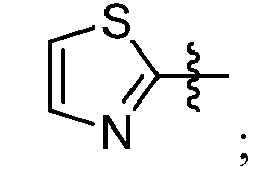
- Preferably, each of R10 and R11 is independently selected from a group consisting of H, a C1-C2 alkyl and -C(=O)R13.
- Preferably, R12 is selected from a group consisting of a C1-C2 alkyl, a C1-C2 alkoxy, a hydroxy, an amino (NH2) and a C1-C2 alkylamino.
- Preferably, R13 is selected from a group consisting of H and a C1-C2 straight or branched alkyl.
- Preferably, R2 is selected from the following groups unsubstituted or substituted with 1-3 substituents: a C1-C4 straight or branched alkyl, a C3-C7 cycloalkyl, a 4-7 membered heterocyclic group and a phenyl, wherein, said substituent is selected from a group consisting of a halogen, a hydroxy, a C1-C4 straight or branched alkyl, a C1-C4 straight or branched haloalkyl, a C1-C4 straight or branched alkoxy, a C1-C4 straight or branched alkylcarbonyl, a C1-C4 straight or branched haloalkoxy, a C1-C4 straight or branched alkylsulfonyl, a C1-C4 straight or branched alkylsulfonylcarbamoyl, a tetrazolyl, a cyano, a nitro, an amino, a carboxyl, a phenyl, a halophenyl, a phenoxy and a halophenoxy; more preferably, R2 is selected from a C1-C4 straight or branched alkyl, a cyclopropyl, a cyclobutyl, a cyclopentyl, a cyclohexyl, a tetrahydropyran-4-yl, a 1-methylpiperidin-4-yl, 1-acetylpiperidin-4-yl, 1-methylsulfonylpiperidin-4-yl,


- Preferably, each of R3, R4 and R5 is independently selected from a group consisting of H, a C1-C4 straight or branched alkyl and a C3-C7 cycloalkyl; more preferably, each of R3, R4 and R5 is independently selected from a group consisting of H, a methyl, an ethyl, an n-propyl, an isopropyl, an n-butyl, a sec-butyl, a tertiary butyl, a cyclopropyl, a cyclobutyl, a cyclopentyl and a cyclohexyl; most preferably, each of R3, R4 and R5 is independently selected from a group consisting of H, a methyl, an ethyl, an n-propyl, an isopropyl, an n-butyl, a sec-butyl, a tert-butyl and a cyclopropyl.
- Preferably, R6 is selected from a group consisting of H and a C1-C4 straight or branched alkyl, more preferably, R6 is selected from a group consisting of H, a methyl and an ethyl.
- Alternatively, R5 and R6 can bind together with


- Preferably, R7 is selected from a group consisting of H, C(=O)R8, C(=O)OR8, C(=O)NR8R9, SO2R8 and the following groups substituted with 1-3 substituents: a C1-C4 straight or branched alkyl, a C3-C7 cycloalkyl, a 4-7 membered heterocyclic group, a benzyl and a phenyl, wherein, said substituent is selected from a group consisting of a halogen, a hydroxy, a C1-C4 straight or branched alkoxy, a C1-C4 straight or branched alkyl, a C1-C4 straight or branched haloalkyl, a C1-C4 straight or branched haloalkoxy, a cyano, a nitro, an amino and a carboxyl; more preferably, R7 is selected from a group consisting of H, C(=O)R8 and SO2R8;
each of R8 and R9 is independently selected from a group consisting of H and the following groups unsubstituted or substituted with 1-3 substituents: a C1-C4 straight or branched alkyl, a C1-C4 straight or branched haloalkyl, a C3-C7 cycloalkyl, a 4-7 membered heterocyclic group, a benzyl, a phenyl and a 5-7 membered heteroaryl, wherein said substituent is selected from a group consisting of a halogen, a hydroxy, a C1-C4 straight or branched alkoxy, a C1-C4 straight or branched alkyl, a C1-C4 straight or branched haloalkyl, a C1-C4 straight or branched haloalkoxy, a cyano, a nitro, an amino and a carboxyl, preferably said substituent is selected from a group consisting of a halogen, a hydroxy, a methoxy, an ethoxy, a methyl, an ethyl, a trifluoromethyl, a trifluoromethoxy, a cyano, a nitro, an amino and a carboxyl; preferably, each of R8 and R9 is independently selected from a group consisting of H, a C1-C4 straight or branched alkyl, a C1-C4 straight or branched haloalkyl, a C3-C7 cycloalkyl, a benzyl and a phenyl; more preferably, each of R8 and R9 is independently selected from a group consisting of a methyl, an ethyl, an n-propyl, a cyclopropyl, an isopropyl, an n-butyl, a sec-butyl and a tert-butyl. - In a preferable embodiment, a 1-(3-aminopropyl) substituted cyclic amine compound of formula (II), pharmaceutically acceptable salt, enantiomer, diastereoisomer, racemate or mixture thereof is provided:

- In formula II, preferably, R1 is selected from the following groups unsubstituted or substituted with 1-3 substituents:


each of R10 and R11 is independently selected from a group consisting of H, a C1-C4 straight or branched alkyl and -C(=O)R13; preferably, each of R10 and R11 is independently selected from a group consisting of H, a C1-C2 alkyl and -C(=O)R13;
R12 is selected from a group consisting of a C1-C4 straight or branched alkyl, a C1-C4 straight or branched alkoxy, a hydroxy, an amino (NH2) and a C1-C4 straight or branched alkylamino; preferably, R12 is selected from a group consisting of a C1-C2 alkyl, a C1-C2 alkoxy, a hydroxy, an amino (NH2) and a C1-C2 alkylamino;
R13 is selected from a group consisting of H and a C1-C4 straight or branched alkyl; preferably, R13 is selected from a group consisting of H and a C1-C2 straight or branched alkyl;
R2 is selected from the following groups unsubstituted or substituted with 1-3 substituents: a phenyl, a C1-C4 straight or branched alkyl and a C3-C7 cycloalkyl, wherein said substituent is selected from a group consisting of a halogen, a hydroxy, a C1-C4 straight or branched alkyl, a C1-C4 straight or branched haloalkyl, a C1-C4 straight or branched alkoxy, a C1-C4 straight or branched alkylcarbonyl, a C1-C4 straight or branched haloalkoxy, a C1-C4 straight or branched alkylsulfonyl, a C1-C4 straight or branched alkylsulfonylcarbamoyl, a tetrazolyl, an amino, a phenyl, a halophenyl, a phenoxy and a halophenoxy; more preferably, R2 is selected from a group consisting of a methyl, an ethyl, a cyclopropyl, a cyclobutyl, a cyclopentyl, a cyclohexyl, tetrahydropyran-4-yl, 1-methylpiperidin-4-yl, 1-acetylpiperidin-4-yl, 1-methylsulfonylpiperidin-4-yl,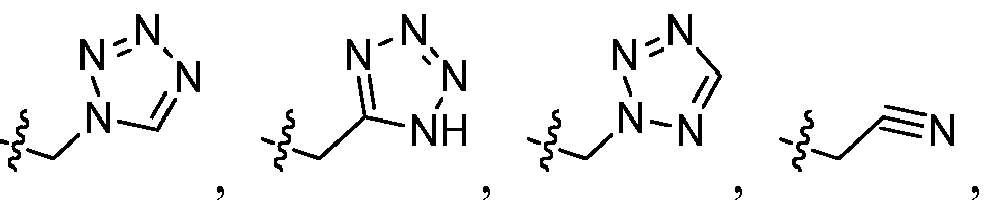
each of R3, R4 and R5 is independently selected from a group consisting of H and a C1-C4 straight or branched alkyl; more preferably, each of R3, R4 and R5 is independently selected from a group consisting of H, a methyl, an ethyl, an n-propyl, an isopropyl, an n-butyl, a sec-butyl and a tert-butyl; most preferably, each of R3, R4 and R5 is independently selected from a group consisting of H, a methyl, an ethyl, an n-propyl, and an isopropyl. - In another preferable embodiment, a 1-(3-aminopropyl) substituted cyclic amine compound of formula (III), pharmaceutically acceptable salt, enantiomer, diastereoisomer, racemate or mixture thereof is provided:

- In formula III, preferably, R1 is selected from the following groups unsubstituted or substituted with 1-3 substituents:


each of R10 and R11 is independently selected from a group consisting of H, a C1-C4 straight or branched alkyl and -C(=O)R13; preferably, each of R10 and R11 is independently selected from a group consisting of H, a C1-C2 alkyl and -C(=O)R13;
R12 is selected from a group consisting of a C1-C4 straight or branched alkyl, a C1-C4 straight or branched alkoxy, a hydroxy, an amino (NH2) and a C1-C4 straight or branched alkylamino; preferably, R12 is selected from a group consisting of a C1-C2 alkyl, a C1-C2 alkoxy, a hydroxy, an amino (NH2) and a C1-C2 alkylamino;
R13 is selected from a group consisting of H and a C1-C4 straight or branched alkyl; preferably, R13 is selected from a group consisting of H and a C1-C2 straight or branched alkyl;
R2 is selected from the following groups unsubstituted or substituted with 1-3 substituents: a C1-C4 straight or branched alkyl and a C3-C7 cycloalkyl, wherein said substituent is selected from a halogen, a hydroxy, a C1-C4 straight or branched alkyl, a C1-C4 straight or branched haloalkyl, a C1-C4 straight or branched alkoxy, a C1-C4 straight or branched alkylcarbonyl, a C1-C4 straight or branched haloalkoxy, a C1-C4 straight or branched alkylsulfonyl, a C1-C4 straight or branched alkylsulfonylcarbamoyl, a tetrazolyl, a cyano and an amino; more preferably, R2 is selected from a group consisting of a methyl, an ethyl, a cyclopropyl, a cyclobutyl, a cyclopentyl, a cyclohexyl, a tetrahydropyran-4-yl, 1-methylpiperidin-4-yl, 1-acetylpiperidin-4-yl, 1-methylsulfonylpiperidin-4-yl,
each of R3 and R4 is independently selected from a group consisting of H and a C1-C4 straight or branched alkyl; more preferably, each of R3 and R4 is independently selected from a group consisting of H, a methyl, an ethyl, an n-propyl, an isopropyl, an n-butyl, a sec-butyl and a tert-butyl; most preferably, each of R3 and R4 is independently selected from a group consisting of H, a methyl and an ethyl;
R5 and R6 can bind together with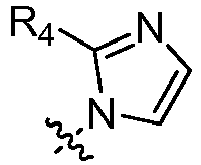

each of R8 and R9 is independently selected from a group consisting of H and the following groups unsubstituted or substituted with 1-3 substituents: a C1-C4 straight or branched alkyl, a C1-C4 straight or branched haloalkyl, a C3-C7 cycloalkyl and abenzyl, wherein said substituent is selected from a group consisting of a halogen, a hydroxy, a C1-C4 straight or branched alkoxy, a C1-C4 straight or branched alkyl, a C1-C4 straight or branched haloalkyl, a C1-C4 straight or branched haloalkoxy and an amino; preferably said substituent is selected from a group consisting of a halogen, a hydroxy, a methoxy, an ethoxy, a methyl, an ethyl, a trifluoromethyl, a trifluoromethoxy and an amino; preferably, each of R8 and R9 is independently selected from a group consisting of H, a C1-C4 straight or branched alkyl, a C1-C4 straight or branched haloalkyl and a C3-C7 cycloalkyl; more preferably, each of R8 and R9 is independently selected from a group consisting of a methyl, an ethyl, an n-propyl, a cyclopropyl, an isopropyl, an n-butyl, a sec-butyl and a tert-butyl. - In another preferable embodiment, each of R1, R2, R3, R4, R5, R6, R7, R8, R9, R10, R11, R12, R13, W and X in the compound of formula I of the present invention independently and preferably is the corresponding group in compounds 1-172 prepared in examples.
- The definitions in the present invention are listed as follows: halogen includes F, Cl, Br and I; C3-C7 cycloalkyl refers to a cycloalkyl containing 3-7 carbon atoms on the ring, and includes (but not limited to) cyclopropyl, cyclobutyl, cyclopentyl, cyclohexyl and cycloheptyl; C6-C12 aryl refers to a aromatic ring group containing 6-12 carbon atoms on the ring without heteroatom, and includes (but not limited to) phenyl and naphthyl; 4-7 membered heterocyclic group refers to a nonaromatic cyclic group containing 4-7 atoms and at least one heteroatom which is selected from O, N or S on the ring, and includes (but not limited to) azetidinyl, tetrahydrofuranyl, piperazinyl, morpholinyl and piperidinyl; 5-7membered heteroaryl refers to to an aromatic cyclic group containing 5-7 atoms and at least one heteroatom which is selected from O, N or S on the ring, and includes (but not limited to) thienyl, thiazolyl, pyridyl, furyl, pyrrolyl, pyrazolyl, imidazolyl, oxazolyl, pyrimidinyl and triazinyl. 5-7 membered ring refers to a ring containing 5-7 atoms on the ring with or without a heteroatom which is selected from O, N or S, and includes 5-7 membered carbocycle (saturated or unsaturated ring containing only carbon atoms), 5-7 membered heteroaryl ring (aromatic ring containing 5-7 atoms and at least one heteroatom which is selected from O, N or S on the ring), and 5-7 membered heterocycle (nonaromatic ring containing 5-7 atoms and at least one heteroatom which is selected from O, N or S on the ring), and includes (but not limited to) benzene ring, cyclopentene ring, cyclohexene ring, cycloheptene ring, dioxole ring and the like.
- As used herein, the terms "aryl", "phenyl", "phenoxy", "heteroaryl", "heteroaromatic ring" and " heterocycle" include substituted or unsubstituted forms, wherein the substituted form may include, for example, 1 to 5 identical or different non-hydrogen substituents, and the representative substituent includes (but not limited to) C1-C4 alkyl, C3-C4 cycloalkyl, halogen (fluorine, chlorine, bromine or iodine), C1-C4 haloalkyl, or combinations thereof.
- As used herein, the term "C1-C4 straight or branched alkylamino" includes mono- or di-substituted amino, and for di-substituted amino, alkyl substituents can be identical or different. Representative example includes (but not limited to) -NH(CH3), -N(CH3)2, -N(CH3)(C2H5).
- In particular, 1-(3-aminopropyl) substituted cyclic amine compounds according to the present invention are preferably selected from any one of Compound 1-Compound 172 prepared in the Examples or pharmaceutically acceptable salts thereof.
- In another acpect of the present invention, a method for preparing the 1-(3-aminopropyl) substituted cyclic amine compound of formula I is provided. The compound is prepared by using substituted pyridylaldehyde or substituted thiophene carboxaldehyde as raw material through step-wise Mannich reaction, removal of sulfinyl, BOC protection, ester reduction, oxidation, reductive amination, deprotection and condensation reaction. The method is carried out through the following process, wherein R1, R2, R4, R5, R6, X and W are defined as described above.

- 1) Sulfinylimine Compound B is obtained from Compound A through imidization.
As an example, compound A is dissolved in tetrahydrofuran, substituted tetrahydrofuran, methylene chloride or diethyl ether and stirred at room temperature, to which was sequentially added (R)- tert-butyl sulfinamide and tetraethyl titanate. After reacting for 3-6 hours under nitrogen protection, water is added and the filtrate is obtained through filtration. Sulfinylimine compound B is obtained by organic solvent extraction and column chromatography separation. - 2) Compound C is obtained from Sulfinylimine compound B through Mannich reaction.
As an example, N,N-diisopropylethylamine or triethylamine is dissolved in tetrahydrofuran, substituted tetrahydrofuran, methylene chloride or diethyl ether at -20-0°C, n-butyl lithium solution in hexane is added dropwise slowly under nitrogen. After reacting for 30 to 120 minutes, the mixture is cooled to -78°C and methyl acetate is added. After reacting for 30 to 120 minutes, a solution of chlorotitanium triisopropoxide is added. After reacting for 30 to 60 minutes, compound B is added. After reacting for 3-6 hours, the reaction is quenched with saturated ammonium chloride solution. The filtrate is obtained through filtration. Compound C is obtained by organic solvent extraction and column chromatography separation. - 3) Compound D is obtained from Compound C through removal of sulfinyl and BOC protection.
As an example, compound C is dissolved in methanol or ethanol, and an acid solution is added and stirred for 2-5 hours at room temperature. Upon concentration, the mixture is dissolved in dichloromethane or ethyl acetate, a base and di-tert-butyl dicarbonate are added and stirred for 2-5 hours at room temperature. The system is concentrated, extracted with an organic solvent and separated by column chromatography to give compound D. - 4) Compound E is obtained from Compound D through ester reduction and oxidation.
As one example, compound is dissolved in tetrahydrofuran, substituted tetrahydrofuran or diethyl ether at 0-20 °C, and a solution of lithium aluminum hydride is slowly added dropwise and stirred for 2-4 hours at room temperature. The reaction is quenched with water, washed with a basic solution and filtered. The organic phase is washed with saturated brine, dried and concentrated. The concentrate is dissolved in dichloromethane, and Dess-Martin periodinane (DMP) is added and stirred for 0.5-6 hours. A saturated solution of sodium bicarbonate is added, and compound E is obtained by the organic solvent extraction and column chromatographic separation. - 5) Compound F is obtained from Compound E and compound

As an example, compound E is dissolved in tetrahydrofuran, dichloromethane or 1,2-dichloroethane, and
- 6) Compound F is subjected to deprotection and condensation reaction with

As an example, compound F is dissolved in methanol or ethanol, and acid solution is added and stirred for 2-5 hours at room temperature. The reaction mixture is concentrated and dissolved in N,N-dimethylformamide. A base,
- In above method, the acid used in each step may be an organic or inorganic acid, the organic acid may be acetic acid, trifluoroacetic acid, formic acid, and the inorganic acid may be hydrogen chloride, sulfuric acid or phosphoric acid; the base may be inorganic or organic bases, the inorganic base is selected from a group consisting of sodium carbonate, potassium carbonate, cesium carbonate, sodium bicarbonate, potassium phosphate, monopotassium phosphate, sodium hydroxide, lithium hydroxide and potassium hydroxide, and the organic base is selected from a group consisting of triethylamine, pyridine, diazabicyclo (DBU) and N,N-diisopropylethylamine (of DIPEA); the organic solvent may be selected from a group consisting of tetrahydrofuran (THF), acetonitrile, acetone, 1,4-dioxane, alcohols, diethyl ether, N,N-dimethylformamide, ethylene glycol dimethyl ether, N,N-dimethylformamide (DMF) and dimethylsulfoxide (DMSO); and the condensing agent used in step 6) may be 1-ethyl-(3-dimethylaminopropyl)carbodiimide hydrochloride (EDCI), benzotriazole-1-yl oxy-tris(dimethylamino)phosphonium hexafluorophosphate (BOP), 2-(7-azobenzotriazole)- N,N,N',N'-tetramethyluronium hexafluorophosphate (HATU) or N,N'-dicyclohexyl carbodiimide (DCC) and the like.
- In another aspect of the invention, a pharmaceutical composition is provided comprising the 1-(3-aminopropyl) substituted cyclic amine compounds according to the present invention, a pharmaceutically acceptable salt, enantiomer, diastereoisomer, racemate or mixture thereof and optionally a pharmaceutically acceptable carrier. The pharmaceutical composition may be used in therapy in vivo and has biocompatibility. The pharmaceutical composition may be prepared into various forms depending on different route of administration. The pharmaceutical composition of the present invention may be used as CCR5 antagonist for treating HIV infection.
- The pharmaceutical composition of the present invention may be provided in various forms, such as tablet, capsule, powder, syrup, solution, suspension, aerosol etc., and may be present in a suitable solid or liquid carrier or diluent and suitable disinfectant container for injection or infusion. The pharmaceutical composition may also comprise odor, flavor, etc., and a desirable ratio is that the compound of formula I as active ingredient accounts for 65% or more based on the total weight, and the rest accounts for 0.5-40%, preferably 1-20%, or preferably is 1 to 10% of a pharmaceutically acceptable carrier, diluent or solution or a salt solution.
- The compound according to the present invention as described above may be clinically used to mammals including humans and animals by mouth, nose, skin, lung, or gastrointestinal tract, etc., and more preferably by mouth. Daily dose is preferably 0.01-200 mg/kg body weight, administered at once, or 0.01-100 mg/kg body weight in divided doses. No matter what administration method, optimal dose for an individual should be determined based on the specific treatment. Under normal conditions, a small dose is given at the beginning and the dose is gradually increased until the most suitable dose is found.
- In another aspect of the invention, a use of 1-(3-aminopropyl) substituted cyclic amine compound according to the present invention, a pharmaceutically acceptable salt, enantiomer, diastereoisomer, racemate or mixture thereof in the preparation of CCR5 antagonist is provided.
- In a further aspect of the present invention, a use of 1-(3-aminopropyl) substituted cyclic amine compound according to the present invention, a pharmaceutically acceptable salt, enantiomer, diastereoisomer, racemate or mixture thereof in the preparation of a medicament for treating CCR5-mediated disease is provided.
- In a further aspect of the present invention, a use of 1-(3-aminopropyl) substituted cyclic amine compound according to the present invention, a pharmaceutically acceptable salt, enantiomer, diastereoisomer, racemate or mixture thereof in the preparation of a medicament for treating HIV infection is provided.
- In a further aspect of the present invention, a method for treating the disease mediated by CCR5 is provided, which comprises administering 1-(3-aminopropyl) substituted cyclic amine compound of the present invention, a pharmaceutically acceptable salt, enantiomer, diastereoisomer, racemate or mixture thereof or a pharmaceutical composition containing one of 1-(3-aminopropyl) substituted cyclic amine compound according to the present invention, a pharmaceutically acceptable salt, enantiomer, diastereoisomer, racemate or mixture thereof to a patient in need thereof. In an embodiment, the disease mediated by CCR5 is HIV infection.
- The present invention will be further illustrated by the following examples. These examples are intended to illustrate the present invention, but not limit the invention in any way. Unless otherwise stated, all parameters as well as the rest of the description in examples are based on weight.
- For the experimental methods in the following examples without particular conditions, they are performed under routine conditions, such as conditions described in Sambrook et al., Molecular Cloning: A Laboratory Manual, New York: Cold Spring Harbor Laboratory Press, 1989, or as instructed by the manufacturer.
- Analysis data of the samples were measured by the following instruments. NMR was measured by GEMINI-300, Bruker AMX-400 and INVOA-600 nuclear magnetic resonance, wherein, TMS (tetramethylsilane) was used as an internal standard, the chemical shift unit was ppm, and coupling constant unit was Hz. Mass spectra was measured by Finnigan MAT-711, MAT-95 and LCQ-DECA mass spectrometer and IonSpec4.7 Tesla mass spectrometer.
- Column chromatography was carried out on 200-300 mesh silica gel (Qingdao Marine Chemical Plant). TLC silica gel plate was HSGF-254 thin layer chromatography prefabricated panel produced by Yantai Chemical Plant. The boiling range of petroleum ether was 60-90 °C. UV light was used and iodine cylinder was used for development. Unless otherwise indicated, the conventional reagents and pharmaceuticals used in the following examples were purchased from Sinopharm. The reagents and solvents used in the experiments are processed according to specific conditions.
-


- compound 1a (1.89 g, 10 mmol) was dissolved in 50mL of absolute ethanol, and potassium carbonate (2.76 g, 20 mmol) and hydroxylamine hydrochloride (1.04 g, 15 mmol) were added successively and stirred at room temperature for 6 hours. After the mixture was concentrated, water was added. Then the mixture was extracted with ethyl acetate, washed with saturated brine, dried over anhydrous sodium sulfate and concentrated to give white solids 1b (2.04 g, yield 100%), MS: 205.0 [M+H]+.
- Compound 1b (2.04 g, 10 mmmol) was dissolved in 50mL of anhydrous n-amyl alcohol and stirred at reflux, to which was added sodium (2.76 g, 120 mmol) in batches. The reaction was maintained for 2.5 hours. Then the reaction mixture was cooled, adjusted with 1M hydrochloric acid to PH 12 and extracted with water. The combined aqueous phase was adjusted with 1M sodium hydroxide to PH 8. Then the mixture was extracted by ethyl acetate, washed with saturated brine, dried over anhydrous sodium sulfate and concentrated to give colourless liquid 1c (1.71g, yield 90%), MS: 191.0[M+H]+.
- Compound 1c (1.90 g, 10 mmmol) was dissolved in 30mL of dichloromethane, and sodium carbonate (1.59g, 15mmol) was added and stirred at room temperature. Isobutyryl chloride (1.6 g, 15 mmol) was slowly added dropwise and the reaction was maintained for 2 hours. Then the reaction mixture was extracted by dichloromethane, washed with saturated brine, dried over anhydrous sodium sulfate and concentrated to give white solids 1d (2.60 g, yield 100%), MS: 191.0 [M + H] +.
- Compound 1d (1.30g, 5mmmol) was dissolved in 20 mL of dichloromethane and phosphorous pentachloride (1.248g, 5mmmol) was slowly added under ice-bath and stirred for 2 hours at room temperature. Then 5 mL of t-amyl alcohol and acetic hydrazide (0.74g, 10mmol) were added and stirred for 16 hours at room temperature. The mixture was concentrated and redissolved in 10 mL toluene and 10 mL dioxane. Then 32 mg p-toluenesulfonic acid was added. The reaction was refluxed for 5 hour and water was added. The mixture was adjusted to pH 8, extracted with dichloromethane, washed with saturated brine, dried over anhydrous sodium sulfate and separated by column chromatography to give white solids 1e (0.99g, yield 67%), MS: 299.0[M+H]+.
- Compound 1e (0.507g, 1.7mmol) was dissolved in 10 mL methanol and 20% palladium hydroxide (0.14g, 0.7mmol) and ammonium formate (0.535g, 8.5mmol) were added. The reaction mixture was stirred at reflux for 2.5 hours and then filtered. The reaction solution was concentrated and separated by column chromatography to give white solids If (0.336g, yield 95%), MS: 209.0[M+H]+.
- Compound 1-1 (2.00g, 17.83mmol) was dissolved in 5.5mL of ethanol, to which was successively added ammonium acetate (2.74g, 35.58mmol) and malonic acid (1.85g, 17.78mmol). The reaction was kept with stirring and refluxed for 7 hours. White turbidity appeared in the clear reaction solution. Then the reaction mixture was filtered and washed with hot ethanol (3x10 mL) to give white solids 1-2 (2.20g, yield 72%), MS: 172.0 [M + H] +.
- At room temperature, thionyl chloride (4.0 mL) was slowly added dropwise to a solution of 1-1 (8.55 g, 50.0 mmol) in anhydrous methanol (30.0 mL) with stirring, and the reaction was stirred at reflux for 16 hours. Analysis showed that the reaction was completed. Then the reaction mixture was concentrated and saturated potassium carbonate was added to the residue to adjust PH to 8. Then the mixture was extracted with ethyl acetate, washed with saturated brine, dried over anhydrous sodium sulfate and concentrated to give white solids 1-3 (8.78 g, yield 95%), MS: 185.9[M+H]+.
- Coumpound 1-3 (6.72g, 36.4mmol) was dissolved in 50 mL methanol, triethylamine (7.6mL, 54.6mmol) and di-tert-butyl dicarbonate (11.9g, 54.6mmol) were added successively and stirred at room temperature for 3 hours. The system was concentrated, extracted with ethyl acetate, washed with saturated sodium bicarbonate solution and brine, dried over anhydrous sodium sulfate, and concentrated to give a colorless oily product 1-4 (10.16 g, yield 98%), MS: 286.1 [M+H]+.
- Under ice-bath, compound 1-4 (285 mg, 1 mmol) was dissolved in 5 mL of anhydrous tetrahydrofuran, and 1.0 M solution of lithium aluminum hydride (1.1 mL, 1.1 mmol) was slowly added dropwise. The mixture was warmed to room temperature and stirred for 2 hours. The reaction was quenched with water, and the mixture was washed with 15% sodium hydroxide aqueous solution and filtered. Then the organic phase was washed with brine, dried over anhydrous sodium sulfate, and concentrated to give a colorless oily liquid. The colorless oily liquid was dissolved in dichloromethane (5mL), and Dess-Martin periodinane (466.4 mg, 1.1 mmol) was added and stirred for 2 hours. Then saturated sodium bicarbonate solution was added, and the mixture was extracted with dichloromethane, successively washed with saturated sodium bicarbonate solution and saturated brine, dried over anhydrous sodium sulfate, concentrated and separated by column chromatography to give colorless oily liquid 1-5 (156mg, yield 61%), MS: 256.1[M+H]+.
- Compound 1-5 (512 mg, 2 mmol) was dissolved in 5mL of dichloromethane, and compound If (468 mg, 2 mmol) and triacetoxy sodium borohydride (466 mg, 2.2 mmol) were successively added and stirred for 12 hours at room temperature. Water was added, and then the mixture was extracted by dichloromethane, washed with saturated brine, dried over anhydrous sodium sulfate, concentrated, and separated by column chromatography to give a pale yellow oily liquid 1-6 (664 mg, yield 70%), MS: 474.3[M+H]+.
- Compound 1-6 (47.4 mg, 0.1 mmol) was dissolved in 1mL of methanol, and 1mL solution of HCl in dioxane (4M) was added and stirred for 2 hours at room temperature. The reaction mixture was concentrated, dissolved in 1mL N,N-dimethylformamide, followed by adding triethylamine (28 µL, 0.2 mmol), 4,4-difluoro-cyclohexanecarboxylic acid (18 mg, 0.11 mmol), benzotriazole-1-yloxy-tris(dimethylamino) phosphonium hexafluorophosphate salt (BOP) (46.4 mg, 0.11 mmol) and stirred for 12 hours at room temperature. Water was added, then the mixture was extracted with ethyl acetate, washed with saturated brine, dried over anhydrous sodium sulfate, concentrated and separated by column chromatography to give white solids 1 (25.6 mg, yield 52%), MS: 494.3[M+H]+. 1H-NMR (400Hz, CDCl3): δ7.28 (t, 1H), 7.11 (d, 1H), 6.97 (d, 1H), 5.17 (m,1H), 3.90 (m, 1H), 3.00 (m, 1H), 2.50 (s, 3H), 2.43 (m,2H), 2.26-1.99 (m,10H), 1.99-1.61 (m, 9H), 1.34 (d, 6H).
-

- According to the synthesis method of Example 1, acetic acid was used to replace 4,4-difluoro-cyclohexanecarboxylic acid in Example 1 to obtain compound 2. MS: 390.2[M+H]+. 1H-NMR(400Hz, CDCl3): δ7.26 (t, 1H), 7.15 (d, 1H), 6.99 (d, 1H), 5.21 (m,1H), 3.95 (m, 1H), 3.10 (m, 1H), 2.51 (s, 3H), 2.43 (m,2H), 2.20-1.69 (m,14H), 1.35 (d, 6H).
-

- According to the synthesis method of compound If in Example 1, N- benzyltropinone was used to replace 1a in Example 1 to obtain compound 2f.
- According to the synthesis method of Example 1, compound 2f was used to replace If in Example 1 to obtain compound 3, MS: 520.3[M+H]+.1H-NMR(400Hz, CDCl3): δ7.27 (t, 1H), 7.14 (d, 1H), 6.95 (d, 1H), 5.14 (m,1H), 3.91 (m, 1H), 3.03 (m, 1H), 2.52 (s, 3H), 2.40 (m,2H), 2.27-1.93 (m,12H), 1.93-1.62 (m, 9H), 1.32 (d, 6H).
-
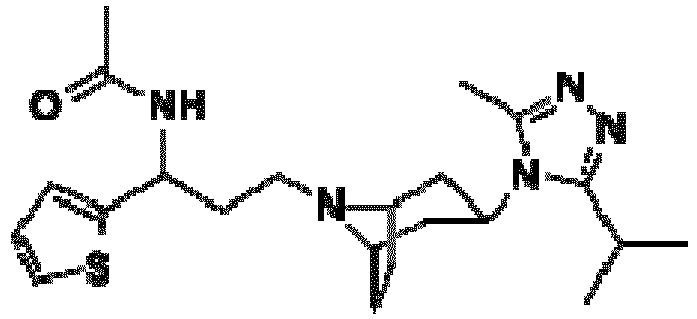
- According to the synthesis method of Example 1. Acetic acid was used to replace 4,4-difluoro-cyclohexanecarboxylic acid in Example 1 and compound 2f was used to replace If in Example 1 to obtain compound 4, MS: 416.2[M+H]+.1H-NMR(400Hz, CDCl3): δ7.23 (t, 1H), 7.15 (d, 1H), 6.99 (d, 1H), 5.21 (m,1H), 3.95 (m, 1H), 3.03 (m, 1H), 2.54 (s, 3H), 2.40 (m,2H), 2.25-1.67 (m,14H), 1.32 (d, 6H).
-

-

- Compound 2-1 (1.07g, 10mmol) was dissolved in tetrahydrofuran (20mL) and stirred at room temperature, to which was sequentially added (R)-tert-butyl sulfinamide (1.33g, 11mmol)) and tetraethyl titanate (4.56 g, 20mmol). Under nitrogen, the reaction was carried out for 3 hours. Then water was added, the mixture was filtered and the filtrate was extracted with ethyl acetate, washed with aturated brine, dried over anhydrous sodium sulfate, concentrated and separated by column chromatography to give a colorless liquid 2-2 (1.94g, yield 92%), MS: 211.2[M+H]+.
- At 0°C, N,N-diisopropylamine (1.13 mL, 8 mmol) was dissolved in 10 mL of tetrahydrofuran and 2.4 M n-butyl lithium solution (3.3 mL, 8 mmol) was slowly added dropwise under nitrogen. After reacting for 30 minutes, the mixture was cooled to -78 °C. Methyl acetate (0.58 g, 8 mmol) was added and reacted for 45 minutes. 2M solution of titanium triisopropoxide chloride (8 mL, 16 mmol) was added and reacted for 30 minutes. Then compound 2-2 (0.84 g, 4 mmol) was added and reacted for 3 hours. The reaction was quenched with saturated ammonium chloride solution, the mixture was filtered. The filtrate was extracted with ethyl acetate, washed with saturated brine, dried over anhydrous sodium sulfate, and concentrated and separated by column chromatography to give colourless liquid 2-3 (0.87 g, yield 74%), MS: 286.2[M+H]+.
- Compound 2-3 (2.85g, 10mmol) was dissolved in 20 mL of methanol, and 10 mL of 4 M HCl in dioxane was added and stirred for 2 hours at room temperature. The reaction mixture was concentrated, and then triethylamine (2.8mL, 20mmol) and di-tert-butyl dicarbonate (3.26g, 15mmol) were successively added and stirred at room temperature for 3 hours. The system was concentrated, extracted with ethyl acetate, washed with saturated sodium bicarbonate solution and saturated brine, dried over anhydrous sodium sulfate, concentrated and separated by column chromatography to give the product 2-4 (2.43g, yield 87%) as a colorless oil, MS: 281.1[M+H]+.
- Under ice-bath, compound 2-4 (280 mg, 1 mmol) was dissolved in 5 mL of dry tetrahydrofuran, 1.0 M solution of lithium aluminum hydride (1.1mL, 1.1mmol) was slowly added dropwise and then the mixture was warmed to room temperature and stirred for 2 hours. The reaction was quenched with water, washed with 15% aqueous solution of sodium hydroxide and filtered. The organic phase was washed with saturated brine, dried over anhydrous sodium sulfate and concentrated to give a colorless oily liquid. The colorless oily liquid was dissolved in dichloromethane (5 mL), and then Dess-Martin periodinane (466.4 mg, 1.1 mmol) was added and stirred for 2 hours. Then saturated sodium bicarbonate solution was added, and the mixture was extracted with dichloromethane, successively washed with saturated sodium bicarbonate solution and saturated brine, dried over anhydrous sodium sulfate, concentrated and separated by column chromatography to give a colorless oily liquid 2-5 (158 mg, yield 63%), MS: 251.1[M+H]+.
- Compound 2-5 (502 mg, 2 mmol) was dissolved in 5 mL of dichloromethane, and compound If (468 mg, 2 mmol) and sodium triacetoxyborohydride (466 mg, 2.2 mmol) were successively added and stirred for 12 hours at room temperature. Water was added, and then the mixture was extracted with dichloromethane, washed with saturated brine, dried over anhydrous sodium sulfate, concentrated and separated by column chromatography to give a pale yellow oily liquid 2-6 (686 mg, yield 71%), MS: 469.3[M+H]+.
- Compound 2-6 (46.8 mg, 0.1 mmol) was dissolved in 1mL of methanol, and then 1 mL of 4 M HCl in dioxane was added and stirred for 2 hours at room temperature. The mixture was concentrated and then dissolved in 1mL N,N-dimethylformamide, followed by successively adding triethylamine (28 µL, 0.2 mmol), 4,4-difluoro-cyclohexanecarboxylic acid (18 mg, 0.11 mmol), benzotriazol-1-yloxy-tris (dimethylamino) phosphonium hexafluorophosphate salt (BOP) (46.4 mg, 0.11 mmol). The mixture was stirred for 12 hours at room temperature, and then water was added. The mixture was extracted with ethyl acetate, washed with saturated brine, dried over anhydrous sodium sulfate, concentrated and separated by column chromatography (DCM:CH3OH = 8:1) to give white solids 5 (27.7 mg, yield 57%), MS: 89.3[M+H]+. 1H-NMR(400Hz, CDCl3): δ8.58 (s, 1H), 8.38 (d, 1H), 7.81 (d, 1H), 7.37 (t, 1H), 5.17 (m,1H), 3.90 (m, 1H), 3.00 (m, 1H), 2.50 (s, 3H), 2.43 (m,2H), 2.26-1.99 (m,10H), 1.99-1.61 (m, 9H), 1.34 (d, 6H).
-

- According to the synthesis method of Example 5, compound 2f was used to replace If in Example 5 to obtain compound 6, MS: 514.9[M+H]+. 1H-NMR(400Hz, CDCl3): δ8.57 (s, 1H), 8.39 (d, 1H), 7.80 (d, 1H), 7.37 (t, 1H), 5.17 (m,1H), 3.90 (m, 1H), 3.00 (m, 1H), 2.50 (s, 3H), 2.43 (m,2H), 2.27-1.96 (m,12H), 1.96-1.60 (m, 9H), 1.34 (d, 6H).
-

- According to the synthesis method of Example 5, cyclohexanecarboxylic acid was used to replace 4,4-difluoro-cyclohexanecarboxylic acid in Example 5 to obtain compound 7, MS: 453.0[M+H]+.1H-NMR(400Hz, CDCl3): δ8.59 (s, 1H), 8.37 (d, 1H), 7.80 (d, 1H), 7.35 (t, 1H), 5.17 (m,1H), 3.90 (m, 1H), 3.00 (m, 1H), 2.50 (s, 3H), 2.43 (m,2H), 2.26-1.99 (m,11H), 1.99-1.61 (m, 10H), 1.34 (d, 6H).
-

- According to the synthesis method of Eexample 5, Compound 2f was used to replace If in Example 5 and cyclohexanecarboxylic acid was used to replace 4,4-difluoro-cyclohexanecarboxylic acid in example 5 to obtain compound 8, MS: 479.0[M+H]+.1H-NMR(400Hz, CDCl3): δ8.59 (s, 1H), 8.48 (d, 1H), 7.86 (d, 1H), 7.38 (t, 1H), 5.17 (m,1H), 3.90 (m, 1H), 3.00 (m, 1H), 2.50 (s, 3H), 2.43 (m,2H), 2.27-1.96 (m,12H), 1.96-1.60 (m, 11H), 1.34 (d, 6H).
-

- According to the synthesis method of Example 5, cyclopentanecarboxylic acid was used to replace 4,4-difluoro-cyclohexanecarboxylic acid in Example 5 to obtain compound 9, MS: 439.0[M+H]+. 1H-NMR(400Hz, CDCl3): δ8.59 (s, 1H), 8.37 (d, 1H), 7.80 (d, 1H), 7.35 (t, 1H), 5.18 (m,1H), 3.91 (m, 1H), 3.02 (m, 1H), 2.53 (s, 3H), 2.40 (m,2H), 2.25-1.97 (m,10H), 1.97-1.60 (m, 9H), 1.33 (d, 6H).
-

- According to the synthesis method of Example 5, Compound 2f was used to replace If in Example 5 and cyclopentanecarboxylic acid was used to replace 4,4-difluoro-cyclohexanecarboxylic acid in Example 5 to obtain compound 10, MS: 464.9[M+H]+.1H-NMR(400Hz, CDCl3): δ8.59 (s, 1H), 8.48 (d, 1H), 7.86 (d, 1H), 7.38 (t, 1H), 5.16 (m,1H), 3.93 (m, 1H), 3.07 (m, 1H), 2.45 (s, 3H), 2.42 (m,2H), 2.27-1.96 (m,12H), 1.96-1.61 (m, 9H), 1.35 (d, 6H).
-

- According to the synthesis method of Example 5, Compound 1-1 was used to replace compound 2-1 in Example 5 and acetic acid was used to replace 4,4-difluoro-cyclohexanecarboxylic acid in Example 5 to obtain compound 11, MS: 390.2[M+H]+. 1H-NMR(400Hz, CDCl3): δ7.26 (t, 1H), 7.15 (d, 1H), 6.99 (d, 1H), 5.21 (m,1H), 3.95 (m, 1H), 3.10 (m, 1H), 2.51 (s, 3H), 2.43 (m,2H), 2.20-1.69 (m,14H), 1.35 (d, 6H).
-
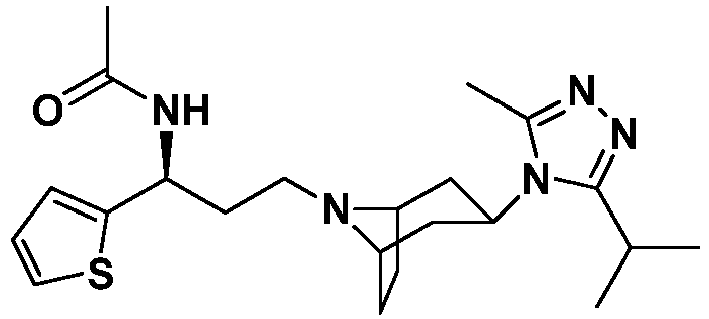
- According to the synthesis method of Example 5, Compound 1-1 was used to replace compound 2-1 in Example 5, compound 2f was used to replace If in Example 5 and acetic acid was used to replace 4,4-difluoro-cyclohexanecarboxylic acid in Example 5 to obtain compound 12, MS: 416.2[M+H]+. 1H-NMR(400Hz, CDCl3): δ7.23 (t, 1H), 7.15 (d, 1H), 6.99 (d, 1H), 5.21 (m,1H), 3.95 (m, 1H), 3.03 (m, 1H), 2.54 (s, 3H), 2.40 (m,2H), 2.25-1.67 (m,14H), 1.32 (d, 6H).
-

- According to the synthesis method of Example 5, compound 1-1 was used to replace compound 2-1 in Example 5 to obtain compound 13, MS: 493.9[M+H]+.1H-NMR(400Hz, CDCl3): δ7.27 (t, 1H), 7.13 (d, 1H), 6.95 (d, 1H), 5.19 (m,1H), 3.91 (m, 1H), 3.02 (m, 1H), 2.54(s, 3H), 2.43 (m,2H), 2.27-1.95 (m,10H), 1.95-1.61 (m, 9H), 1.34 (d, 6H).
-

- According to the synthesis method of Example 5, Compound 1-1 was used to replace compound 2-1 in Example 5 and compound 2f was used to replace If in Example 5 to obtain compound 14, MS: 520.0[M+H]+.1H-NMR(400Hz, CDCl3): δ7.27 (t, 1H), 7.14 (d, 1H), 6.95 (d, 1H), 5.14 (m,1H), 3.91 (m, 1H), 3.03 (m, 1H), 2.52 (s, 3H), 2.40 (m,2H), 2.27-1.93 (m,12H), 1.93-1.62 (m, 9H), 1.32 (d, 6H).
-

- According to the synthesis method of Example 5, Compound 1-1 was used to replace compound 2-1 in Example 5, and cyclohexanecarboxylic acid was used to replace 4,4-difluoro-cyclohexane carboxylic acid in Example 5 to obtain compound 15, MS: 457.9[M+H]+. 1H-NMR(400Hz, CDCl3): δ7.28 (t, 1H), 7.13 (d, 1H), 6.94 (d, 1H), 5.19 (m,1H), 3.91 (m, 1H), 3.02 (m, 1H), 2.54(s, 3H), 2.43 (m,2H), 2.26-1.93 (m,12H), 1.93-1.61 (m, 9H), 1.36 (d, 6H).
-

- According to the synthesis method of Example 5, Compound 1-1 was used to replace compound 2-1 in Example 5, compound 2f was used to replace If in Example 5 and cyclohexanecarboxylic acid was used to replace 4,4-difluoro-cyclohexanecarboxylic acid in Example 5 to obtain compound 16, MS: 483.9[M+H]+. 1H-NMR(400Hz, CDCl3): δ7.28 (t, 1H), 7.13 (d, 1H), 6.94 (d, 1H), 5.19 (m,1H), 3.91 (m, 1H), 3.02 (m, 1H), 2.54(s, 3H), 2.43 (m,2H), 2.26-1.93 (m,13H), 1.93-1.61 (m, 10H), 1.36 (d, 6H).
-

- According to the synthesis method of Example 5, Compound 1-1 was used to replace compound 2-1 in Example 5, and cyclopentanecarboxylic acid was used to replace 4,4-difluoro-cyclohexane carboxylic acid in Example 5 to obtain compound 17, MS: 443.9[M+H]+.1H-NMR(400Hz, CDCl3): δ7.27 (t, 1H), 7.13 (d, 1H), 6.95 (d, 1H), 5.19 (m,1H), 3.91 (m, 1H), 3.01 (m, 1H), 2.54(s, 3H), 2.43 (m,2H), 2.29-1.95 (m,10H), 1.95-1.61 (m, 9H), 1.33 (d, 6H).
-

- According to the synthesis method of Example 5. Compound 1-1 was used to replace compound 2-1 in example 5, compound 2f was used to replace If in Example 5 and cyclopentanecarboxylic acid was used to replace 4,4-difluoro-cyclohexanecarboxylic acid in Example 5 to obtain compound 18, MS: 469.9[M+H]+.1H-NMR(400Hz, CDCl3): δ7.25 (t, 1H), 7.13 (d, 1H), 6.97 (d, 1H), 5.19 (m,1H), 3.91 (m, 1H), 3.02 (m, 1H), 2.54(s, 3H), 2.43 (m,2H), 2.27-1.93 (m,11H), 1.93-1.61 (m, 10H), 1.35 (d, 6H).
-

- According to the synthesis method of Example 5, Compound 1-1 was used to replace compound 2-1 in Example 5, compound 2f was used to replace If in Example 5 and 4-methylcyclohexane carboxylic acid was used to replace 4,4-difluoro-cyclohexanecarboxylic acid in Example 5 to obtain compound 19, MS: 511.9[M+H]+.1H-NMR(400Hz, CDCl3): δ7.25 (t, 1H), 7.15 (d, 1H), 6.97 (d, 1H), 5.19 (m,1H), 3.91 (m, 1H), 3.02 (m, 1H), 2.54(s, 3H), 2.43 (m,2H), 2.29-1.93 (m,15H), 1.93-1.61 (m, 12H), 1.33 (d, 6H).
-

- According to the synthesis method of Example 5, Compound 3-1 was used to replace compound 2-1 in Example 5, compound 2f was used to replace If in Example 5 and 4-methylcyclohexane carboxylic acid was used to replace 4,4-difluoro-cyclohexanecarboxylic acid in Example 5 to obtain compound 20, MS: 511.9[M+H]+.1H-NMR(400Hz, CDCl3): δ7.25 (t, 1H), 7.15 (s, 1H), 6.97 (d, 1H), 5.19 (m,1H), 3.91 (m, 1H), 3.02 (m, 1H), 2.54(s, 3H), 2.43 (m,2H), 2.29-1.93 (m,15H), 1.93-1.61 (m, 12H), 1.33 (d, 6H).
-

- According to the synthesis method of Example 5, Compound 3-1 was used to replace compound 2-1 in Example 5 to obtain compound 21, MS: 493.9[M+H]+.1H-NMR(400Hz, CDCl3): δ7.26 (t, 1H), 7.15 (s, 1H), 6.97 (d, 1H), 5.17 (m,1H), 3.94 (m, 1H), 3.05 (m, 1H), 2.53(s, 3H), 2.43 (m,2H), 2.25-1.95 (m,10H), 1.95-1.61 (m, 9H), 1.34 (d, 6H).
-

- According to the synthesis method of Example 5, Compound 3-1 was used to replace compound 2-1 in Example 5, and compound 2f was used to replace If in Example 5 to obtain compound 22, MS: 520.0[M+H]+.1H-NMR(400Hz, CDCl3): δ7.26 (d, 1H), 7.14 (s, 1H), 6.95 (d, 1H), 5.14 (m,1H), 3.91 (m, 1H), 3.03 (m, 1H), 2.52 (s, 3H), 2.40 (m,2H), 2.28-1.93 (m,12H), 1.93-1.65 (m, 9H), 1.35 (d, 6H).
-

- According to the synthesis method of Example 5, Compound 3-1 was used to replace compound 2-1 in Example 5, and cyclohexanecarboxylic acid was used to replace 4,4-difluoro-cyclohexane carboxylic acid in Example 5 to obtain compound 23, MS: 457.9[M+H]+.1H-NMR(400Hz, CDCl3): δ7.27 (d, 1H), 7.13 (s, 1H), 6.94 (d, 1H), 5.19 (m,1H), 3.91 (m, 1H), 3.05 (m, 1H), 2.54(s, 3H), 2.43 (m,2H), 2.25-1.93 (m,12H), 1.93-1.61 (m, 9H), 1.35 (d, 6H).
-

- According to the synthesis method of Example 5, Compound 3-1 was used to replace compound 2-1 in Example 5, compound 2f was used to replace If in Example 5 and cyclohexanecarboxylic acid was used to replace 4,4-difluoro-cyclohexanecarboxylic acid in Example 5 to obtain compound 24, MS: 483.9[M+H]+.1H-NMR(400Hz, CDCl3): δ7.23 (d, 1H), 7.12 (s, 1H), 6.94 (d, 1H), 5.19 (m,1H), 3.91 (m, 1H), 3.02 (m, 1H), 2.54(s, 3H), 2.43 (m,2H), 2.27-1.93 (m,13H), 1.93-1.61 (m, 10H), 1.34 (d, 6H).
-

- According to the synthesis method of Example 5, Compound 3-1 was used to replace compound 2-1 in Example 5, and cyclopentanecarboxylic acid was used to replace 4,4-difluoro-cyclohexane carboxylic acid in Example 5 to obtain compound 25, MS: 443.9[M+H]+.1H-NMR(400Hz, CDCl3): δ7.27 (d, 1H), 7.13 (s, 1H), 6.95 (d, 1H), 5.19 (m,1H), 3.91 (m, 1H), 3.03 (m, 1H), 2.54(s, 3H), 2.43 (m,2H), 2.271.95 (m,10H), 1.95-1.61 (m, 9H), 1.33 (d, 6H).
-

- According to the synthesis method of Example 5, Compound 3-1 was used to replace compound 2-1 in Example 5, compound 2f was used to replace If in Example 5 and cyclopentanecarboxylic acid was used to replace 4,4-difluoro-cyclohexanecarboxylic acid in Example 5 to obtain compound 26, MS: 469.9[M+H]+.1H-NMR(400Hz, CDCl3): δ7.25 (d, 1H), 7.13 (s, 1H), 6.97 (d, 1H), 5.19 (m,1H), 3.91 (m, 1H), 3.02 (m, 1H), 2.54(s, 3H), 2.43 (m,2H), 2.25-1.93 (m,11H), 1.93-1.61 (m, 10H), 1.35 (d, 6H).
-

- According to the synthesis method of Example 5, Compound 4-1 was used to replace compound 2-1 in Example 5, and compound 2f was used to replace If in Example 5 to obtain compound 27, MS: 570.3[M+H]+.1H-NMR(400Hz, CDCl3): δ7.36 (d, 1H), δ7.26 (d, 2H), 7.14 (s, 1H), 6.95 (d, 1H), 5.14 (m,1H), 3.91 (m, 1H), 3.03 (m, 1H), 2.52 (s, 3H), 2.40 (m,2H), 2.28-1.93 (m,12H), 1.93-1.65 (m, 9H), 1.35 (d, 6H).
-
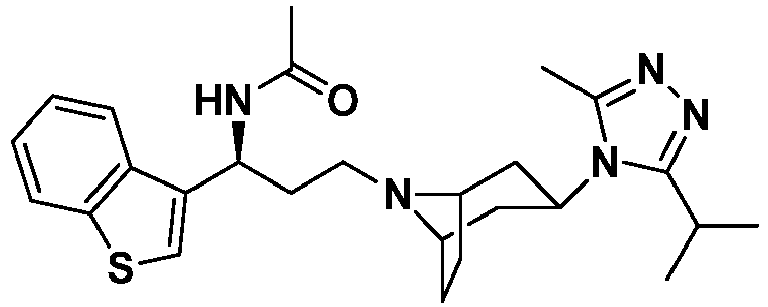
- According to the synthesis method of Example 5, Compound 5-1 was used to replace compound 2-1 in Example 5, compound 2f was used to replace If in Example 5 and acetic acid was used to replace 4,4-difluoro-cyclohexanecarboxylic acid in Example 5 to obtain compound 28, MS: 520.3[M+H]+.1H-NMR(400Hz, CDCl3): δ7.35 (d, 1H), δ7.23 (t, 2H), 7.15 (d, 1H), 6.99 (d, 1H), 5.21 (m,1H), 3.95 (m, 1H), 3.03 (m, 1H), 2.54 (s, 3H), 2.40 (m,2H), 2.25-1.67 (m,14H), 1.32 (d, 6H).
-

- According to the synthesis method of Example 5, Compound 5-1 was used to replace compound 2-1 in Example 5, and compound 2f was used to replace If in Example 5 to obtain compound 29, MS: 534.2[M+H]+.δ7.27 (d, 1H), 7.20 (d, 1H), 5.14 (m,1H), 3.91 (m, 1H), 3.03 (m, 1H), 2.52 (s, 3H), 2.40 (m,5H), 2.27-1.93 (m,12H), 1.93-1.62 (m, 9H), 1.32 (d, 6H).
-

- According to the synthesis method of Example 5, Compound 5-1 was used to replace compound 2-1 in Example 5, compound 2f was used to replace If in Example 5 and cyclohexanecarboxylic acid was used to replace 4,4-difluoro-cyclohexanecarboxylic acid in Example 5 to obtain compound 30, MS: 498.2[M+H]+.1H-NMR(400Hz, CDCl3): δ7.28 (d, 1H), 7.21 (d, 1H), 5.19 (m,1H), 3.91 (m, 1H), 3.02 (m, 1H), 2.54(s, 3H), 2.43 (m,5H), 2.26-1.93 (m,13H), 1.93-1.61 (m, 10H), 1.36 (d, 6H).
-

- According to the synthesis method of Example 5, Compound 5-1 was used to replace compound 2-1 in Example 5, compound 2f was used to replace If in Example 5 and cyclopentanecarboxylic acid was used to replace 4,4-difluoro-cyclohexanecarboxylic acid in Example 5 to obtain compound 31, MS: 484.2[M+H]+.1H-NMR(400Hz, CDCl3): δ7.25 (d, 1H), 7.17 (d, 1H), 5.19 (m,1H), 3.91 (m, 1H), 3.02 (m, 1H), 2.54(s, 3H), 2.43 (m,5H), 2.27-1.93 (m,11H), 1.93-1.61 (m, 10H), 1.35 (d, 6H).
-

- According to the synthesis method of Example 5, Compound 5-1 was used to replace compound 2-1 in Example 5, compound 2f was used to replace If in Example 5 and benzoic acid was used to replace 4,4-difluoro-cyclohexanecarboxylic acid in Example 5 to obtain compound 32, MS: 492.2[M+H]+.1H-NMR(400Hz, CDCl3): δ7.70 (d, 2H), 7.45 (d, 3H), 7.23 (t, 1H), 7.15 (d, 1H), 5.21 (m,1H), 3.95 (m, 1H), 3.03 (m, 1H), 2.54 (s, 3H), 2.40 (m,5H), 2.25-1.67 (m,11H), 1.32 (d, 6H).
-

- According to the synthesis method of Example 5, Compound 5-1 was used to replace compound 2-1 in Example 5, compound 2f was used to replace If in Example 5 and p-fluorophenylacetic acid was used to replace 4,4-difluoro-cyclohexanecarboxylic acid in Example 5 to obtain compound 33, MS: 524.2[M+H]+.1H-NMR(400Hz, CDCl3): δ7.50 (d, 2H), 7.35 (d, 2H), 7.23 (t, 1H), 7.15 (d, 1H), 5.21 (m,1H), 3.95 (m, 1H), 3.37 (s, 2H), 3.03 (m, 1H), 2.54 (s, 3H), 2.40 (m,5H), 2.25-1.67 (m,11H), 1.32 (d, 6H).
-

- According to the synthesis method of Example 5, Compound 6-1 was used to replace compound 2-1 in Example 5, and compound 2f was used to replace If in Example 5 to obtain compound 34, MS: 533.2[M+H]+.1H-NMR(400Hz, CDCl3): δ8.19 (d, 1H), 7.80 (d, 1H), 7.37 (t, 1H), 5.17 (m,1H), 3.90 (m, 1H), 3.00 (m, 1H), 2.50 (s, 3H), 2.43 (m,2H), 2.27-1.96 (m,12H), 1.96-1.60 (m, 9H), 1.34 (d, 6H).
-

- According to the synthesis method of Example 5, Compound 6-1 was used to replace compound 2-1 in Example 5, compound 2f was used to replace If in Example 5 and cyclohexanecarboxylic acid was used to replace 4,4-difluoro-cyclohexanecarboxylic acid in Example 5 to obtain compound 35, MS: 497.2[M+H]+.1H-NMR(400Hz, CDCl3): δ8.08 (d, 1H), 7.66 (d, 1H), 7.31 (t, 1H), 5.17 (m,1H), 3.90 (m, 1H), 3.00 (m, 1H), 2.50 (s, 3H), 2.43 (m,2H), 2.27-1.96 (m,12H), 1.96-1.60 (m, 11H), 1.34 (d, 6H).
-

- According to the synthesis method of Example 5, Compound 6-1 was used to replace compound 2-1 in Example 5, compound 2f was used to replace If in Example 5 and cyclopentanecarboxylic acid was used to replace 4,4-difluoro-cyclohexanecarboxylic acid in Example 5 to obtain compound 36, MS: 483.2[M+H]+.1H-NMR(400Hz, CDCl3): δ8.29 (s, 1H), δ7.86 (d, 1H), 7.48 (t, 1H), 5.16 (m,1H), 3.93 (m, 1H), 3.07 (m, 1H), 2.45 (s, 3H), 2.42 (m,2H), 2.27-1.96 (m,12H), 1.96-1.61 (m, 9H), 1.35 (d, 6H).
-

- According to the synthesis method of Example 5, Compound 7-1 was used to replace compound 2-1 in Example 5, and compound 2f was used to replace If in Example 5 to obtain compound 37, MS: 538.2[M+H]+.1H-NMR(400Hz, CDCl3): δ7.07 (d, 1H), 6.95 (d, 1H), 5.19 (m,1H), 3.91 (m, 1H), 3.02 (m, 1H), 2.54(s, 3H), 2.43 (m,2H), 2.27-1.95 (m,10H), 1.95-1.61 (m, 9H), 1.34 (d, 6H).
-

- According to the synthesis method of Example 5, Compound 7-1 was used to replace compound 2-1 in Example 5, compound 2f was used to replace If in Example 5 and cyclohexanecarboxylic acid was used to replace 4,4-difluoro-cyclohexanecarboxylic acid in Example 5 to obtain compound 38, MS: 502.2[M+H]+.1H-NMR(400Hz, CDCl3): δ7.13 (d, 1H), 6.94 (d, 1H), 5.19 (m,1H), 3.91 (m, 1H), 3.02 (m, 1H), 2.54(s, 3H), 2.43 (m,2H), 2.26-1.93 (m,13H), 1.93-1.61 (m, 10H), 1.36 (d, 6H).
-

- According to the synthesis method of Example 5, Compound 7-1 was used to replace compound 2-1 in Example 5, compound 2f was used to replace If in Example 5 and cyclopentanecarboxylic acid was used to replace 4,4-difluoro-cyclohexanecarboxylic acid in Example 5 to obtain compound 39, MS: 488.2[M+H]+.1H-NMR(400Hz, CDCl3): δ7.10 (d, 1H), 6.97 (d, 1H), 5.19 (m,1H), 3.91 (m, 1H), 3.02 (m, 1H), 2.54(s, 3H), 2.43 (m,2H), 2.27-1.93 (m,11H), 1.93-1.61 (m, 10H), 1.35 (d, 6H).
-

-


- Compound 3a (10.0g, 44.4mmol), benzylamine (4.85ml, 49.7mmol) and sodium triacetyl borohydride (14.11g, 66.6mmol) were dissolved in a mixed solvent of acetic acid and dichloromethane (1:9 v/v, 290 ml) and stirred for 16 hours at room temperature. After the solvent was removed by rotary evaporation, the residue was dissolved in ethyl acetate, washed with saturated sodium carbonate solution, dried over anhydrous magnesium sulfate, evaporated to dryness in vacuo and separated by column chromatography to give compound 3b (7.0g, 50%), MS: 317.2 [M+H]+.
- Compound 3b (7.0g, 22.2mmol), ammonium formate (7.0g, 111mmol), and 20% palladium hydroxide / carbon (0.7 g of) was dispersed in ethanol (200ml) and reacted for 2 hours at 50 °C. After cooled, the reaction solution was filtered by suction. Then the filtrate was subjected to rotary evaporation and column chromatography separation to give compound 3c (4.7g, 94%).
- Compound 3c (3.0g, 13.2mmol), 4-ethoxy-3-nitropyridine (2.7g, 13.2mmol) and DIPEA (1.89g, 14.6mmol) were dissolved in N-methylpyrrolidinone (5ml). The reaction mixture was heated to 120 °C for 18 hours. The reaction solution was cooled, extracted with ethyl acetate, washed with water, dried over magnesium sulfate, and concentrated. Then ether was added to precipitate solids, and compound 3d (1.5g, 33%) was obtained by suction filtration. MS: 347.2 [M + H] +.
- Compound 3d (4.4g, 12.6mmol) and iron powder (2.11g, 37.8mmol) were dissolved in acetic acid (50ml) and heated to 60 °C for 2 hours. Then acetic anhydride (8ml) was added and heated to 140 °C for 18 hours. After cooled, the reaction solution was filtered by suction. Then the filtrate was subjected to rotary evaporation and the residue was dispersed in dichloromethane (200ml) and water (200ml). The solution was adjusted with 2N sodium hydroxide to pH 9 and then filtered by suction. Then the filtrate was extracted with dichloromethane, dried over magnesium sulfate and evaporated to dryness in vacuo to give compound 3e (3.27g, 91%). MS: 285.1[M+H]+.
- Compound 3e (10g, 35.2mmol) was dissolved in ethanol (95ml) and water (5ml), and under nitrogen methyl chlorofonmate (3.3ml, 42.2mmol) was slowly added dropwise at -70°C. The mixture was stirred for 45 minutes and then sodium borohydride (4.0g, 105.7mmol) was added in batches. The mixture was slowly warmed to room temperature and crushed ice was added and stirred for another 10 minutes. Ethanol was removed by rotary evaporation and the residue was added to 2M aqueous hydrochloric acid (100ml) and washed with ethyl acetate. The aqueous layer was adjusted with solid potassium hydroxide to pH 9, extracted with dichloromethane, dried over magnesium sulfate and separated by column chromatography to give compound 3f(9g, 74%), MS: 345. 1 [M+H]+.
- Compound 3f(6.75g, 19.6mmol) was dissolved in ethanol (60ml) and 10% Pd/C (500mg) was added. The hydrogenation reaction was carried out at 50°C for 5 h. The reaction mixture was filtered by suction, and the filtrate was evaporated to dryness in vacuo and then separated by column chromatography to give compound 3g(6.2g, 91%), MS: 346.2[M+H]+.
- Compound 3g (10.58g, 30mmol) was dissolved in 2M sulfuric acid, and heated to 100°C for 18 hours. The solid potassium hydroxide was added to adjust pH to 11-12. The mixture was extracted with dichloromethane and separated by column chromatography to give compound 3h(7.4g, 80%), MS: 304.1[M+H]+.
- According to the synthesis method of compound 3h, 3-fluoro-4-nitropyridine N-oxide was used to replace 4-ethoxy-3-nitropyridine in the synthesis of compound 3h in Example 30..
- According to the synthesis method of compound 2-6, Compound 3-1 was used to replace compound 2-1 in Example 5, and compound 3h was used to replace If in Example 5 to obtain compound 9-2, MS: 545.3[M+H]+.
- Compound 9-2 (109mg, 0.2mmol) was dissolved in 1mL of methanol and 1mL 4M solution of HCl in dioxane was added and stirred for 2 hours at room temperature. The mixture was concentrated and dissolved in 1mL N,N-dimethylformamide, followed by adding triethylamine (30.3mg, 0.3mmol), acetic acid (49mg, 0.3mmol), benzotriazol-1-yloxy-tris(dimethylamino) phosphonium hexafluorophosphate (BOP) (126.5mg, 0.3 mmol), and stirred for 12 hours at room temperature. Water was added, and then the mixture was extracted with ethyl acetate, washed with saturated brine, dried over anhydrous sodium sulfate, concentrated and separated by column chromatography to give white solids 9-3 (56.7mg, yield 58%), MS: 487.2[M+H]+.
- Compound 9-3 (85mg, 0.17mmol) was dissolved in isopropanol (2ml) and 2M sodium hydroxide solution (3ml). The reaction mixture was heated at reflux for 48 hours, extracted with ethyl acetate, and separated by column chromatography to give compound 9-4 (55mg, 73%), MS: 429. 1 [M+H]+.
- Compound 9-4 (55mg, 0.13mmol) was dissolved in 4ml of tetrahydrofuran and triethylamine (17mg, 0.17mmol) was added. Then acetyl chloride (18mg, 0.17mmol) was added dropwise and stirred for 2 hours at room temperature.The mixture was extracted with ethyl acetate and separated by column chromatography to give compound 40(50mg, 91%), MS: 500.3[M+H]+. 1H-NMR (400Hz, CDCl3): δ7.25 (m,1H), 7.04 (m, 1H), 6.97 (m,1H), 5.17 (m, 1H), 4.65 (m,1H), 4.43 (m,2H), 4.09 (m,2H), 3.43(m,2H), 3.07(m,1H), 2.83-2.69 (m,5H), 2.51-2.39 (m,2H), 2.36-1.84 (m,6H), 1.69-1.53 (m, 4H).
-

- According to the synthesis method of compound 40, isobutyryl chloride was used to replace acetyl chloride in Example 40 to obtain compound 41, MS: 498.3[M+H]+.1H-NMR(400Hz, CDCl3): δ7.14 (m, 1H), 7.07 (m, 1H), 6.97 (m,1H), 5.17 (m, 1H), 4.65 (m,1H), 4.43 (m,2H), 4.09 (m,2H), 3.43(m,2H), 3.07(m,1H), 2.83-2.69 (m,2H), 2.51-2.39 (m,2H), 2.36-1.84 (m,6H), 1.69-1.53 (m, 4H), 1.13-1.06 (m,6H).
-

- According to the synthesis method of compound 40, 4,4-difluoro-cyclohexane carboxylic acid was used to replace acetic acid in Example 40 to obtain compound 42, MS: 574.3[M+H]+.1H-NMR(400Hz, CDCl3): δ7.14 (m, 1H), 7.07 (m, 1H), 6.97 (m,1H), 5.17 (m, 1H), 4.65 (m,1H), 4.43 (m,2H), 4.09 (m,2H), 3.43(m,2H), 3.07(m,1H), 2.83-2.69 (m,5H), 2.51-2.39 (m,2H), 2.36-1.84 (m,9H), 1.69-1.53 (m,9H).
-

- According to the synthesis method of compound 40, isobutyryl chloride was used to replace acetyl chloride in Example 40 and 4,4-difluoro-cyclohexanecarboxylic acid was used to replace acetic acid in Example 40 to obtain compound 43, MS: 602.3[M+H]+. 1H-NMR(400Hz, CDCl3): δ7.14 (m, 1H), 7.03 (m, 1H), 6.97 (m,1H), 5.17 (m, 1H), 4.65 (m,1H), 4.43 (m,2H), 4.09 (m,2H), 3.43(m,2H), 3.07(m,1H), 2.83-2.69 (m,2H), 2.51-2.39 (m,2H), 2.36-1.84 (m,8H), 1.69-1.53 (m, 10H), 1.13- 1.06 (m,6H).
-

- According to the synthesis method of compound 40, Compound 5-1 was used to replace 3-1 in Example 40 to obtain compound 44, MS: 470.3[M+H]+. 1H-NMR(400Hz, CDCl3): δ7.10 (d,1H), 7.04 (d, 1H), 5.17 (m, 1H), 4.65 (m,1H), 4.43 (m,2H), 4.09 (m,2H), 3.43(m,2H), 3.07(m,1H), 2.83-2.69 (m,5H), 2.51-2.39 (m,5H), 2.36-1.84 (m,6H), 1.59-1.30 (m, 4H).
-

- According to the synthesis method of compound 40, isobutyryl chloride was used to replace acetyl chloride in Example 40 and compound 5-1 was used to replace 3-1 in Example 40 to obtain compound 45, MS: 498.3[M+H]+.1H-NMR(400Hz, CDCl3): δ7.14 (d, 1H), 7.07 (d, 1H), 5.17 (m, 1H), 4.65 (m,1H), 4.43 (m,2H), 4.09 (m,2H), 3.43(m,2H), 3.07(m,1H), 2.83-2.69 (m,2H), 2.51-2.39 (m,5H), 2.36-1.84 (m,6H), 1.69-1.53 (m, 4H), 1.13-1.06 (m,6H).
-

- According to the synthesis method of compound 40, Cyclohexanecarboxylic acid was used to replace acetic acid in Example 40 and compound 5-1 was used to replace 3-1 in Example 40 to obtain compound 46, MS: 538.3[M+H]+.1H-NMR(400Hz, CDCl3): δ7.14 (d, 1H), 7.03 (d, 1H), 5.17 (m, 1H), 4.65 (m,1H), 4.43 (m,2H), 4.09 (m,2H), 3.43(m,2H), 3.07(m,1H), 2.83-2.69 (m,2H), 2.51-2.39 (m,5H), 2.36-1.84 (m,9H), 1.69-1.53 (m, 11H), 1.13-1.06 (m,6H).
-

- According to the synthesis method of compound 40, isobutyryl chloride was used to replace acetyl chloride in Example 40, compound 5-1 was used to replace 3-1 in Example 40 and cyclohexanecarboxylic acid was used to replace acetic acid in Example 40 to obtain compound 47, MS: 566.3[M+H]+.1H-NMR(400Hz, CDCl3): δ7.14 (d, 1H), 7.03 (d, 1H), 5.17 (m, 1H), 4.65 (m,1H), 4.43 (m,2H), 4.09 (m,2H), 3.43(m,2H), 3.07(m,1H), 2.83-2.69 (m,2H), 2.51-2.39 (m,2H), 2.36-1.84 (m,8H), 1.69-1.53 (m, 12H), 1.13-1.06 (m,6H).
-

- According to the synthesis method of compound 40, Compound 7-1 was used to replace 3-1 in Example 40 to obtain compound 48, MS: 488.3[M+H]+.1H-NMR(400Hz, CDCl3): δ7.10 (d,1H), 6.97 (d,1H), 5.17 (m, 1H), 4.65 (m,1H), 4.43 (m,2H), 4.09 (m,2H), 3.43(m,2H), 3.07(m,1H), 2.83-2.69 (m,5H), 2.51-2.39 (m,2H), 2.36-1.84 (m,6H), 1.59-1.30 (m, 4H).
-

- According to the synthesis method of compound 40, isobutyryl chloride was used to replace acetyl chloride in Example 40, and compound 7-1 was used to replace 3-1 in Example 40 to obtain compound 49, MS: 516.3[M+H]+.1H-NMR(400Hz, CDCl3): δ7.07 (d, 1H), 6.97 (d,1H), 5.17 (m, 1H), 4.65 (m,1H), 4.43 (m,2H), 4.09 (m,2H), 3.43(m,2H), 3.07(m,1H), 2.83-2.69 (m,2H), 2.51-2.39 (m,2H), 2.36-1.84 (m,6H), 1.69-1.53 (m, 4H), 1.13-1.06 (m,6H).
-

- According to the synthesis method of compound 40, Cyclohexanecarboxylic acid was used to replace acetic acid in Example 40, and compound 7-1 was used to replace 3-1 in Example 30 to obtain compound 50, MS: 556.3[M+H]+.1H-NMR(400Hz, CDCl3): δ7.03 (m, 1H), 6.97 (m,1H), 5.17 (m, 1H), 4.65 (m,1H), 4.43 (m,2H), 4.19 (m,2H), 3.63(m,2H), 3.27(m,1H), 2.83-2.69 (m,2H), 2.51-2.39 (m,2H), 2.36-1.84 (m,9H), 1.69-1.53 (m, 11H), 1.13-1.06 (m,6H).
-

- According to the synthesis method of compound 40, Cyclohexanecarboxylic acid was used to replace acetic acid in Example 40, compound 7-1 was used to replace 1-1 in Example 30 and isobutyryl chloride was used to replace acetyl chloride in Example 40 to obtain compound 51, MS: 584.3[M+H]+.1H-NMR(400Hz, CDCl3): δ7.05 (m, 1H), 6.97 (m,1H), 5.17 (m, 1H), 4.65 (m,1H), 4.43 (m,2H), 4.09 (m,2H), 3.43(m,2H), 3.07(m,1H), 2.85-2.69 (m,2H), 2.51-2.39 (m,2H), 2.36-1.84 (m,8H), 1.69-1.53 (m, 12H), 1.13-1.06 (m,6H).
-

- According to the synthesis method of Example 5, Compound 8-1 was used to replace compound 2-1 in Example 5 and compound 2f was used to replace compound If in Example 5 to obtain compound 52, MS: 520.9[M+H]+.1H-NMR(400Hz, CDCl3): δ8.27 (s, 1H), 7.14 (s, 1H), 5.14 (m,1H), 3.91 (m, 1H), 3.03 (m, 1H), 2.52 (s, 3H), 2.40 (m,2H), 2.27-1.93 (m,12H), 1.93-1.62 (m, 9H), 1.32 (d, 6H).
-

- According to the synthesis method of Example 5, Compound 8-1 was used to replace compound 2-1 in example 5, compound 2f was used to replace compound If in example 5 and cyclohexane carboxylic acid was used to replace 4,4-difluoro-cyclohexanecarboxylic acid in example 5 to obtain compound 53, MS: 484.9[M+H]+.1H-NMR(400Hz, CDCl3): δ8.28 (s, 1H), 7.23 (s, 1H), 5.19 (m,1H), 3.91 (m, 1H), 3.02 (m, 1H), 2.54(s, 3H), 2.43 (m,2H), 2.26-1.93 (m,13H), 1.93-1.61 (m, 10H), 1.36 (d, 6H).
-

- According to the synthesis method of Example 5, Compound 8-1 was used to replace compound 2-1 in Example 5, compound 2f was used to replace compound If in Example 5 and cyclopentane carboxylic acid was used to replace 4,4-difluoro-cyclohexanecarboxylic acid in Example 5 to obtain compound 54, MS: 470.9 [M+H]+. 1H-NMR (400Hz, CDCl3): δ8.25 (s, 1H), 7.33 (d, 1H), 5.19 (m,1H), 3.91 (m, 1H), 3.02 (m, 1H), 2.54(s, 3H), 2.43 (m,2H), 2.27-1.93 (m,11H), 1.93-1.61 (m, 10H), 1.35 (d, 6H).
-

- According to the synthesis method of Example 5, Compound 10-1 was used to replace compound 2-1 in Example 5, and compound 2f was used to replace compound If in Example 5 to obtain compound 55, MS: 520.9[M+H]+. 1H-NMR(400Hz, CDCl3): δ8.20 (s, 1H), 7.19 (s, 1H), 5.14 (m,1H), 3.91 (m, 1H), 3.03 (m, 1H), 2.52 (s, 3H), 2.40 (m,2H), 2.27-1.93 (m,12H), 1.93-1.62 (m, 9H), 1.32 (d, 6H).
-

- According to the synthesis method of Example 5, Compound 10-1 was used to replace compound 2-1 in Example 5, compound 2f was used to replace compound If in Example 5 and cyclohexanecarboxylic acid was used to replace 4,4-difluoro-cyclohexanecarboxylic acid in Example 5 to obtain compound 56, MS: 484.9[M+H]+. 1H-NMR(400Hz, CDCl3): δ8.18 (s, 1H), 7.23 (s, 1H), 5.19 (m,1H), 3.91 (m, 1H), 3.02 (m, 1H), 2.54(s, 3H), 2.43 (m,2H), 2.26-1.93 (m,13H), 1.93-1.61 (m, 10H), 1.36 (d, 6H).
-

- According to the synthesis method of Example 5, Compound 10-1 was used to replace compound 2-1 in Example 5, compound 2f was used to replace compound If in Example 5 and cyclopentanecarboxylic acid was used to replace 4,4-difluoro-cyclohexanecarboxylic acid in Example 5 to obtain compound 57, MS: 470.9[M+H]+. 1H-NMR(400Hz, CDCl3): δ8.20 (s, 1H), 7.33 (s, 1H), 5.19 (m,1H), 3.91 (m, 1H), 3.02 (m, 1H), 2.54(s, 3H), 2.43 (m,2H), 2.27-1.93 (m,11H), 1.93-1.61 (m, 10H), 1.35 (d, 6H).
-

- According to the synthesis method of compound 40, Compound 8-1 was used to replace compound 3-1 in Example 40 to obtain compound 58, MS: 471.3[M+H]+. 1H-NMR(400Hz, CDCl3): δ8.10 (s,1H), 7.17 (s,1H), 5.17 (m, 1H), 4.65 (m,1H), 4.43 (m,2H), 4.09 (m,2H), 3.43(m,2H), 3.07(m,1H), 2.83-2.69 (m,5H), 2.51-2.39 (m,2H), 2.36-1.84 (m,6H), 1.59-1.30 (m, 4H).
-

- According to the synthesis method of compound 40, Compound 8-1 was used to replace compound 3-1 in Example 40 and isobutyryl chloride was used to replace acetyl chloride in Example 40 to obtain compound 59, MS: 499.3[M+H]+. 1H-NMR(400Hz, CDCl3): δ7.87 (s, 1H), 7.07 (s,1H), 5.17 (m, 1H), 4.65 (m,1H), 4.43 (m,2H), 4.09 (m,2H), 3.43(m,2H), 3.07(m,1H), 2.83-2.69 (m,2H), 2.51-2.39 (m,2H), 2.36-1.84 (m,6H), 1.69-1.53 (m, 4H), 1.13-1.06 (m,6H).
-

- According to the synthesis method of compound 40, Compound 10-1 was used to replace compound 3-1 in Example 40 to obtain compound 60, MS: 471.3[M+H]+.1H-NMR(400Hz, CDCl3): δ8.13 (s,1H), 7.13 (s,1H), 5.17 (m, 1H), 4.65 (m,1H), 4.43 (m,2H), 4.09 (m,2H), 3.43(m,2H), 3.07(m,1H), 2.83-2.69 (m,5H), 2.51-2.39 (m,2H), 2.36-1.84 (m,6H), 1.59-1.30 (m, 4H).
-

- According to the synthesis method of compound 40, Compound 10-1 was used to replace compound 3-1 in Example 40 and isobutyryl chloride was used to replace acetyl chloride in Example 40 to obtain compound 61, MS: 499.3[M+H]+.1H-NMR(400Hz, CDCl3): δ8.07 (s, 1H), 7.37 (s,1H), 5.17 (m, 1H), 4.65 (m,1H), 4.43 (m,2H), 4.09 (m,2H), 3.43(m,2H), 3.07(m,1H), 2.83-2.69 (m,2H), 2.51-2.39 (m,2H), 2.36-1.84 (m,6H), 1.69-1.53 (m, 4H), 1.13-1.06 (m,6H).
-

- According to the synthesis method of compound 40, Compound 7-1 was used to replace compound 3-1 in Example 40, compound 4h was used to replace compound 3h in Example 40 and isobutyryl chloride was used to replace acetyl chloride in Example 40 to obtain compound 62, MS: 488.3[M+H]+.1H-NMR(400Hz, CDCl3): δ7.13 (d,1H), 7.03 (d,1H), 5.17 (m, 1H), 4.65 (m,1H), 4.43 (m,2H), 4.09 (m,2H), 3.43(m,2H), 3.07(m,1H), 2.83-2.69 (m,5H), 2.51-2.39 (m,2H), 2.36-1.84 (m,6H), 1.59-1.30 (m, 4H).
-

- According to the synthesis method of compound 40, Compound 7-1 was used to replace compound 3-1 in Example 40, and compound 4h was used to replace compound 3h in Example 40 to obtain compound 63, MS: 516.3[M+H]+.1H-NMR(400Hz, CDCl3): δ7.37 (d, 1H), 7.01 (d,1H), 5.17 (m, 1H), 4.65 (m,1H), 4.43 (m,2H), 4.09 (m,2H), 3.43(m,2H), 3.07(m,1H), 2.83-2.69 (m,2H), 2.51-2.39 (m,2H), 2.36-1.84 (m,6H), 1.69-1.53 (m, 4H), 1.13-1.06 (m,6H).
-

- According to the synthesis method of Example 5, Compound 11-1 was used to replace 2-1 in Example 5 and compound 2f was used to replace If in Example 5 to obtain compound 64, MS: 548.2[M+H]+.δ7.27 (d, 1H), 7.20 (d, 1H), 5.14 (m,1H), 3.91 (m, 1H), 3.03 (m, 1H), 2.52 (q, 2H), 2.40 (m,5H), 2.27-1.93 (m,12H), 1.93-1.62 (m, 9H), 1.32 (m, 9H).
-

- According to the synthesis method of Example 5, Compound 11-1 was used to replace 2-1 in Example 5, compound 2f was used to replace If in Example 5 and cyclohexanecarboxylic acid was used to replace 4,4-difluoro-cyclohexanecarboxylic acid in Example 5 to obtain compound 65, MS: 512.2[M+H]+.1H-NMR(400Hz, CDCl3): δ7.28 (d, 1H), 7.21 (d, 1H), 5.19 (m,1H), 3.91 (m, 1H), 3.02 (m, 1H), 2.54(q, 2H), 2.43 (m,5H), 2.26-1.93 (m,13H), 1.93-1.61 (m, 10H), 1.36 (m, 9H).
-

- According to the synthesis method of Example 5, Compound 11-1 was used to replace 2-1 in Example 5, compound 2f was used to replace If in Example 5 and cyclopentanecarboxylic acid was used to replace 4,4-difluoro-cyclohexanecarboxylic acid in Example 5 to obtain compound 66, MS: 498.2[M+H]+.1H-NMR(400Hz, CDCl3): δ7.25 (d, 1H), 7.17 (d, 1H), 5.19 (m,1H), 3.91 (m, 1H), 3.02 (m, 1H), 2.54(q, 2H), 2.43 (m,5H), 2.27-1.93 (m,11H), 1.93-1.61 (m, 10H), 1.35 (m, 9H).
-

- According to the synthesis method of Example 5, Compound 12-1 was used to replace 2-1 in Example 5 and compound 2f was used to replace If in Example 5 to obtain compound 67, MS: 565.2[M+H]+.1H-NMR(400Hz, CDCl3): δ7.97 (d, 1H), 7.05 (d, 1H), 5.19 (m,1H), 3.91 (m, 1H), 3.02 (m, 1H), 2.54(s, 3H), 2.43 (m,2H), 2.27-1.95 (m,10H), 1.95-1.61 (m, 9H), 1.34 (d, 6H).
-

- According to the synthesis method of Example 5, Compound 12-1 was used to replace 2-1 in Example 5, compound 2f was used to replace If in Example 5 and cyclohexanecarboxylic acid was used to replace 4,4-difluoro-cyclohexanecarboxylic acid in Example 5 to obtain compound 68, MS: 529.2[M+H]+.1H-NMR(400Hz, CDCl3): δ7.93 (d, 1H), 6.94 (d,1H), 5.19 (m,1H), 3.91 (m, 1H), 3.02 (m, 1H), 2.54(s, 3H), 2.43 (m,2H), 2.26-1.93 (m,13H), 1.93-1.61 (m, 10H), 1.36 (d, 6H).
-

- According to the synthesis method of Example 5, Compound 12-1 was used to replace 2-1 in Example 5, compound 2f was used to replace If in Example 5 and cyclopentanecarboxylic acid was used to replace 4,4-difluoro-cyclohexanecarboxylic acid in Example 5 to obtain compound 69, MS: 515.2[M+H]+.1H-NMR(400Hz, CDCl3): δ7.90 (d, 1H), 6.97 (d, 1H), 5.19 (m,1H), 3.91 (m, 1H), 3.02 (m, 1H), 2.54(s, 3H), 2.43 (m,2H), 2.27-1.93 (m,11H), 1.93-1.61 (m, 10H), 1.35 (d, 6H).
-

- According to the synthesis method of Example 5, Compound 13-1 was used to replace 2-1 in Example 5 and compound 2f was used to replace If in Example 5 to obtain compound 70, MS: 545.2[M+H]+.1H-NMR(400Hz, CDCl3): δ7.27 (d, 1H), 6.95 (d, 1H), 5.19 (m,1H), 3.91 (m, 1H), 3.02 (m, 1H), 2.54(s, 3H), 2.43 (m,2H), 2.27-1.95 (m,10H), 1.95-1.61 (m, 9H), 1.34 (d, 6H).
-

- According to the synthesis method of Example 5, Compound 13-1 was used to replace 2-1 in Example 5, compound 2f was used to replace If in Example 5 and cyclohexanecarboxylic acid was used to replace 4,4-difluoro-cyclohexanecarboxylic acid in Example 5 to obtain compound 71, MS: 509.2[M+H]+.1H-NMR(400Hz, CDCl3): δ7.33 (d, 1H), 6.94 (d, 1H), 5.19 (m,1H), 3.91 (m, 1H), 3.02 (m, 1H), 2.54(s, 3H), 2.43 (m,2H), 2.26-1.93 (m,13H), 1.93-1.61 (m, 10H), 1.36 (d, 6H).
-
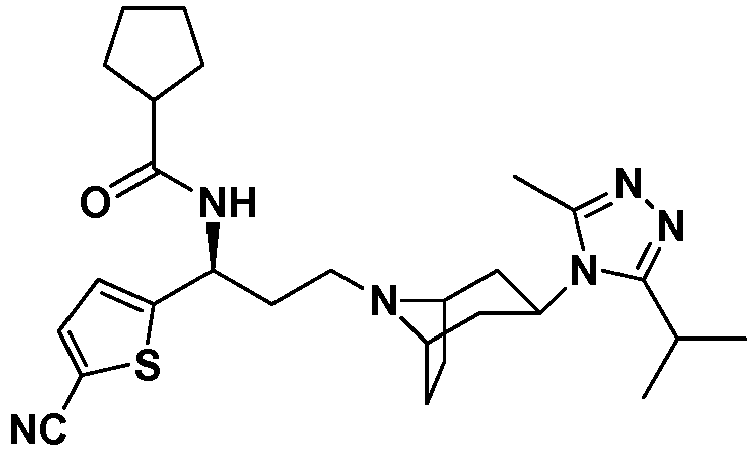
- According to the synthesis method of Example 5, Compound 13-1 was used to replace 2-1 in Example 5, compound 2f was used to replace If in Example 5 and cyclopentanecarboxylic acid was used to replace 4,4-difluoro-cyclohexanecarboxylic acid in Example 5 to obtain compound 72, MS: 495.2[M+H]+.1H-NMR(400Hz, CDCl3): δ7.30 (d, 1H), 6.97 (d, 1H), 5.19 (m,1H), 3.91 (m, 1H), 3.02 (m, 1H), 2.54(s, 3H), 2.43 (m,2H), 2.27-1.93 (m,11H), 1.93-1.61 (m, 10H), 1.35 (d, 6H).
-

- According to the synthesis method of Example 5, Compound 14-1 was used to replace 2-1 in Example 5 and compound 2f was used to replace If in Example 5 to obtain compound 73, MS: 578.2[M+H]+.1H-NMR(400Hz, CDCl3): δ7.77 (d, 1H), 6.95 (d, 1H), 5.19 (m,1H), 3.91 (m, 4H), 3.02 (m, 1H), 2.54(s, 3H), 2.43 (m,2H), 2.27-1.95 (m,10H), 1.95-1.61 (m, 9H), 1.34 (d, 6H).
- According to the synthesis method of Example 5, Compound 14-1 was used to replace 2-1 in Example 5, compound 2f was used to replace If in Example 5 and cyclohexanecarboxylic acid was used to replace 4,4-difluoro-cyclohexanecarboxylic acid in Example 5 to obtain compound 74.

- MS: 542.2[M+H]+.1H-NMR(400Hz, CDCl3): δ7.83 (d, 1H), 6.94 (d, 1H), 5.19 (m,1H), 3.91 (m, 4H), 3.02 (m, 1H), 2.54(s, 3H), 2.43 (m,2H), 2.26-1.93 (m,13H), 1.93-1.61 (m, 10H), 1.36 (d, 6H).
-

- According to the synthesis method of Example 5, Compound 14-1 was used to replace 2-1 in Example 5, compound 2f was used to replace If in Example 5 and cyclopentanecarboxylic acid was used to replace 4,4-difluoro-cyclohexanecarboxylic acid in Example 5 to obtain compound 75, MS: 528.2[M+H]+.1H-NMR(400Hz, CDCl3): δ7.80 (d, 1H), 6.97 (d, 1H), 5.19 (m,1H), 3.91 (m, 4H), 3.02 (m, 1H), 2.54(s, 3H), 2.43 (m,2H), 2.27-1.93 (m,11H), 1.93-1.61 (m, 10H), 1.35 (d, 6H).
-
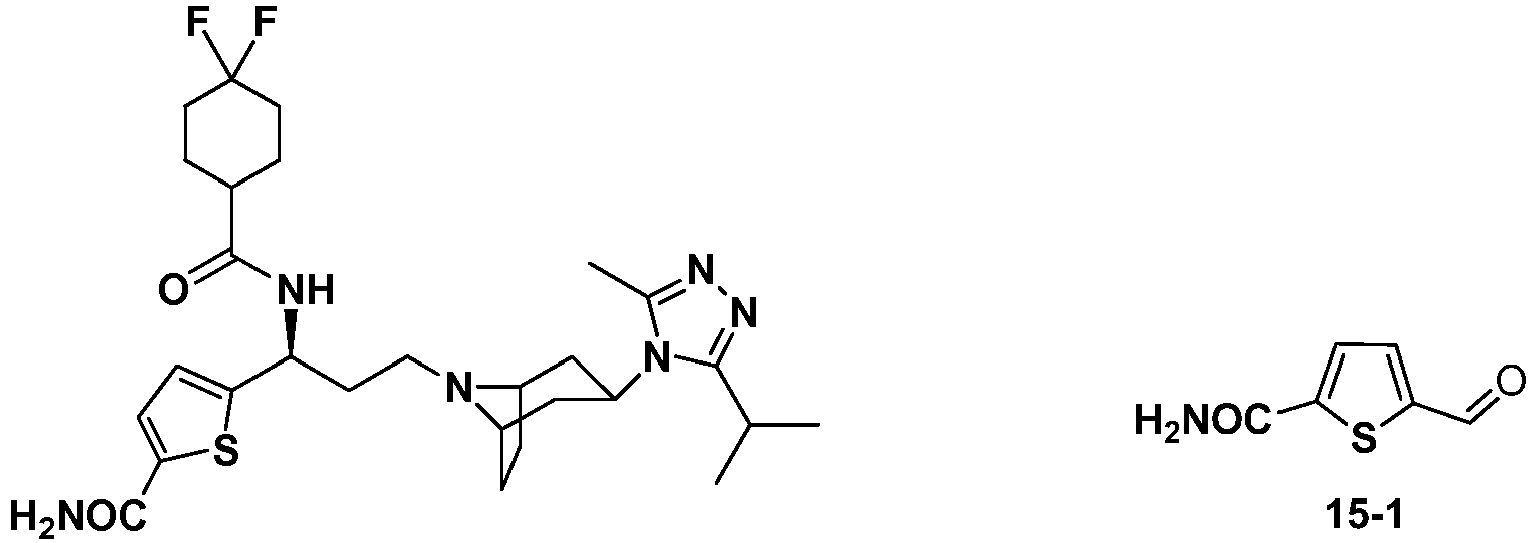
- According to the synthesis method of Example 5, Compound 15-1 was used to replace 2-1 in Example 5 and compound 2f was used to replace If in Example 5 to obtain compound 76, MS: 563.2[M+H]+.1H-NMR(400Hz, CDCl3): δ7.87 (d, 2H), 7.57 (d, 1H), 6.95 (d, 1H), 5.19 (m,1H), 3.91 (m, 1H), 3.02 (m, 1H), 2.54(s, 3H), 2.43 (m,2H), 2.27-1.95 (m,10H), 1.95-1.61 (m, 9H), 1.34 (d, 6H).
-

- According to the synthesis method of Example 5, Compound 15-1 was used to replace 2-1 in Example 5, compound 2f was used to replace If in Example 5 and cyclohexanecarboxylic acid was used to replace 4,4-difluoro-cyclohexanecarboxylic acid in Example 5 to obtain compound 77, MS: 528.2[M+H]+.1H-NMR(400Hz, CDCl3): δ7.87 (d, 2H), 7.63 (d, 1H), 6.94 (d, 1H), 5.19 (m,1H), 3.91 (m, 1H), 3.02 (m, 1H), 2.54(s, 3H), 2.43 (m,2H), 2.26-1.93 (m,13H), 1.93-1.61 (m, 10H), 1.36 (d, 6H).
-

- According to the synthesis method of Example 5, Compound 15-1 was used to replace 2-1 in Example 5, compound 2f was used to replace If in Example 5 and cyclopentanecarboxylic acid was used to replace 4,4-difluoro-cyclohexanecarboxylic acid in Example 5 to obtain compound 78, MS: 513.2[M+H]+.1H-NMR(400Hz, CDCl3): δ7.87 (d, 2H), 7.60 (d, 1H), 6.97 (d, 1H), 5.19 (m,1H), 3.91 (m, 1H), 3.02 (m, 1H), 2.54(s, 3H), 2.43 (m,2H), 2.27-1.93 (m,11H), 1.93-1.61 (m, 10H),1.35(d,6H).
-

- According to the synthesis method of Example 5, Compound 16-1 was used to replace 2-1 in Example 5 and compound 2f was used to replace If in Example 5 to obtain compound 79, MS: 562.2[M+H]+.1H-NMR(400Hz, CDCl3): δ7.27 (d, 1H), 6.95 (d, 1H), 5.19 (m,1H), 3.91 (m, 1H), 3.02 (m, 1H), 2.54(s, 3H), 2.43 (m,5H), 2.27-1.95 (m,10H), 1.95-1.61 (m, 9H), 1.34 (d, 6H).
-

- According to the synthesis method of Example 5, Compound 16-1 was used to replace 2-1 in Example 5, compound 2f was used to replace If in Example 5 and cyclohexanecarboxylic acid was used to replace 4,4-difluoro-cyclohexanecarboxylic acid in Example 5 to obtain compound 80, MS: 526.2[M+H]+.1H-NMR(400Hz, CDCl3): δ7.23 (d, 1H), 6.94 (d, 1H), 5.19 (m,1H), 3.91 (m, 1H), 3.02 (m, 1H), 2.54(s, 3H), 2.43 (m,5H), 2.26-1.93 (m,13H), 1.93-1.61 (m, 10H), 1.36 (d, 6H).
-

- According to the synthesis method of Example 5, Compound 16-1 was used to replace 2-1 in Example 5, compound 2f was used to replace If in Example 5 and cyclopentanecarboxylic acid was used to replace 4,4-difluoro-cyclohexanecarboxylic acid in Example 5 to obtain compound 81, MS: 512.2[M+H]+.1H-NMR(400Hz, CDCl3): δ7.20 (d, 1H), 6.97 (d, 1H), 5.19 (m,1H), 3.91 (m, 1H), 3.02 (m, 1H), 2.54(s, 3H), 2.43 (m,5H), 2.27-1.93 (m,11H), 1.93-1.61 (m, 10H), 1.35 (d, 6H).
- According to the synthesis method of Example 5, Compound 17-1 was used to replace 2-1 in Example 5 and compound 2f was used to replace If in Example 5 to obtain compound 82.

- MS: 562.2[M+H]+.1H-NMR(400Hz, CDCl3): δ8.10 (s, 1H), 7.07 (d, 1H), 6.95 (d, 1H), 5.19 (m,1H), 3.91 (m, 1H), 3.02 (m, 1H), 2.54(s, 3H), 2.43 (m,2H), 2.27-1.95 (m,10H), 1.95-1.61 (m, 9H), 1.34 (d, 6H).
-

- According to the synthesis method of Example 5, Compound 17-1 was used to replace 2-1 in Example 5, compound 2f was used to replace If in Example 5 and cyclohexanecarboxylic acid was used to replace 4,4-difluoro-cyclohexanecarboxylic acid in Example 5 to obtain compound 83, MS: 527.2[M+H]+.1H-NMR(400Hz, CDCl3): δ8.10 (s, 1H), 7.13 (d, 1H), 6.94 (d, 1H), 5.19 (m,1H), 3.91 (m, 1H), 3.02 (m, 1H), 2.54(s, 3H), 2.43 (m,2H), 2.26-1.93 (m,13H), 1.93-1.61 (m, 10H), 1.36 (d, 6H).
-

- According to the synthesis method of Example 5, Compound 17-1 was used to replace 2-1 in Example 5, compound 2f was used to replace If in Example 5 and cyclopentanecarboxylic acid was used to replace 4,4-difluoro-cyclohexanecarboxylic acid in Example 5 to obtain compound 84, MS: 513.2[M+H]+.1H-NMR(400Hz, CDCl3): δ8.10 (s, 1H), 7.10 (d, 1H), 6.97 (d, 1H), 5.19 (m,1H), 3.91 (m, 1H), 3.02 (m, 1H), 2.54(s, 3H), 2.43 (m,2H), 2.27-1.93 (m,11H), 1.93-1.61 (m, 10H),1.35(d,6H).
-

- According to the synthesis method of Example 5, Compound 18-1 was used to replace 2-1 in Example 5 and compound 2f was used to replace If in Example 5 to obtain compound 85, MS: 533.2[M+H]+.1H-NMR(400Hz, CDCl3): δ7.07 (s, 1H), 6.95 (s, 1H), 5.19 (m,1H), 3.91 (m, 1H), 3.02 (m, 1H), 2.54(s, 3H), 2.43 (m,5H), 2.27-1.95 (m,10H), 1.95-1.61 (m, 9H), 1.34 (d, 6H).
-

- According to the synthesis method of Example 5, Compound 18-1 was used to replace 2-1 in Example 5, compound 2f was used to replace If in Example 5 and cyclohexanecarboxylic acid was used to replace 4,4-difluoro-cyclohexanecarboxylic acid in Example 5 to obtain compound 86, MS: 498.2[M+H]+.1H-NMR(400Hz, CDCl3): δ7.13 (s, 1H), 6.94 (s, 1H), 5.19 (m,1H), 3.91 (m, 1H), 3.02 (m, 1H), 2.54(s, 3H), 2.43 (m,5H), 2.26-1.93 (m,13H), 1.93-1.61 (m, 10H), 1.36 (d, 6H).
-

- According to the synthesis method of Example 5, Compound 18-1 was used to replace 2-1 in Example 5, compound 2f was used to replace If in Example 5 and cyclopentanecarboxylic acid was used to replace 4,4-difluoro-cyclohexanecarboxylic acid in Example 5 to obtain compound 87, MS: 484.2[M+H]+.1H-NMR(400Hz, CDCl3): δ7.10 (s, 1H), 6.97 (s, 1H), 5.19 (m,1H), 3.91 (m, 1H), 3.02 (m, 1H), 2.54(s, 3H), 2.43 (m,5H), 2.27-1.93 (m,11H), 1.93-1.61 (m, 10H), 1.35 (d, 6H).
-
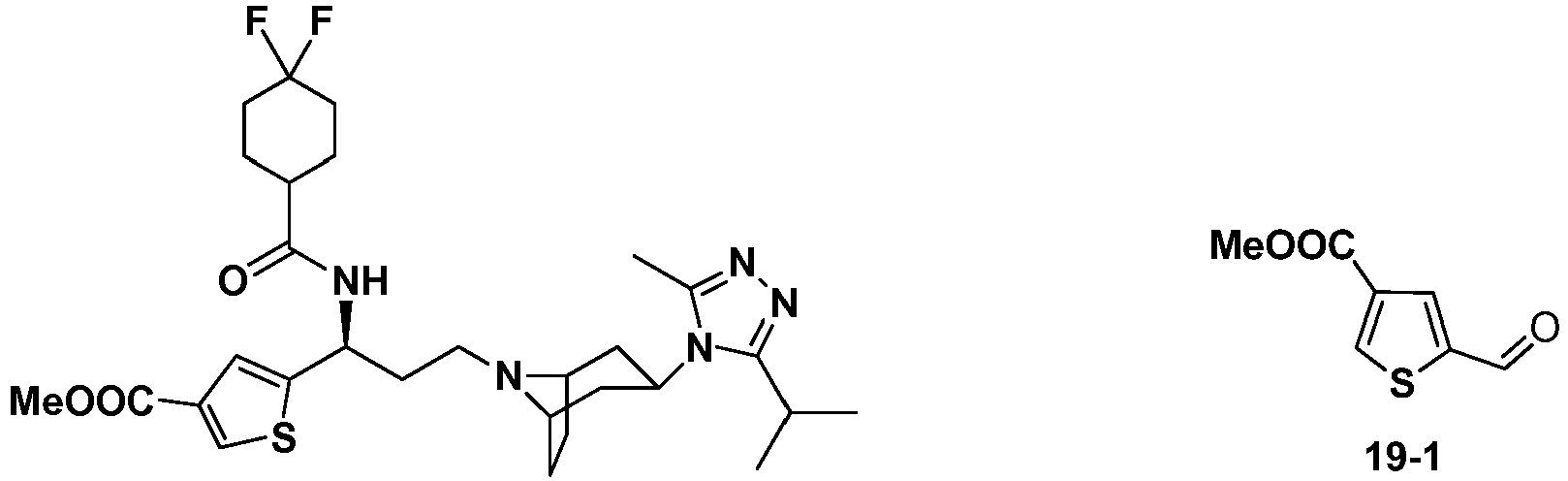
- According to the synthesis method of Example 5, Compound 19-1 was used to replace 2-1 in Example 5 and compound 2f was used to replace If in Example 5 to obtain compound 88, MS: 578.2[M+H]+.1H-NMR(400Hz, CDCl3): δ8.17 (s, 1H), 7.27 (s, 1H), 5.19 (m,1H), 3.91 (m, 4H), 3.02 (m, 1H), 2.54(s, 3H), 2.43 (m,2H), 2.27-1.95 (m,10H), 1.95-1.61 (m, 9H), 1.34 (d, 6H).
-

- According to the synthesis method of Example 5, Compound 19-1 was used to replace 2-1 in Example 5, compound 2f was used to replace If in Example 5 and cyclohexanecarboxylic acid was used to replace 4,4-difluoro-cyclohexanecarboxylic acid in Example 5 to obtain compound 89, MS: 542.2[M+H]+.1H-NMR(400Hz, CDCl3): δ8.13 (s, 1H), 7.26 (s, 1H), 5.19 (m,1H), 3.91 (m, 4H), 3.02 (m, 1H), 2.54(s, 3H), 2.43 (m,2H), 2.26-1.93 (m,13H), 1.93-1.61 (m, 10H), 1.36 (d, 6H).
-

- According to the synthesis method of Example 5, Compound 19-1 was used to replace compound 2-1 in Example 5, compound 2f was used to replace compound If in Example 5 and cyclopentanecarboxylic acid was used to replace 4,4-difluoro-cyclohexanecarboxylic acid in Example 5 to obtain compound 90, MS: 528.2[M+H]+.1H-NMR(400Hz, CDCl3): δ8.10 (s, 1H), 7.27 (s, 1H), 5.19 (m,1H), 3.91 (m, 4H), 3.02 (m, 1H), 2.54(s, 3H), 2.43 (m,2H), 2.27-1.93 (m,11H), 1.93-1.61 (m, 10H), 1.35 (d, 6H).
-

- According to the synthesis method of Example 5, Compound 20-1 was used to replace 2-1 in Example 5 and compound 2f was used to replace If in Example 5 to obtain compound 91, MS: 562.2[M+H]+.1H-NMR(400Hz, CDCl3): δ8.07 (s, 1H), 7.15 (s, 1H), 5.19 (m,1H), 3.91 (m, 1H), 3.02 (m, 1H), 2.54(s, 3H), 2.43 (m,5H), 2.27-1.95 (m,10H), 1.95-1.61 (m, 9H), 1.34 (d, 6H).
-

- According to the synthesis method of Example 5, Compound 20-1 was used to replace 2-1 in Example 5, compound 2f was used to replace If in Example 5 and cyclohexanecarboxylic acid was used to replace 4,4-difluoro-cyclohexanecarboxylic acid in Example 5 to obtain compound 92, MS: 526.2[M+H]+.1H-NMR(400Hz, CDCl3): δ8.13 (s, 1H), 7.14 (s, 1H), 5.19 (m,1H), 3.91 (m, 1H), 3.02 (m, 1H), 2.54(s, 3H), 2.43 (m,5H), 2.26-1.93 (m,13H), 1.93-1.61 (m, 10H), 1.36 (d, 6H).
-

- According to the synthesis method of Example 5, Compound 20-1 was used to replace 2-1 in Example 5, compound 2f was used to replace If in Example 5 and cyclopentanecarboxylic acid was used to replace 4,4-difluoro-cyclohexanecarboxylic acid in Example 5 to obtain compound 93, MS: 512.2[M+H]+.1H-NMR(400Hz, CDCl3): δ8.10 (s, 1H), 6.97 (s, 1H), 5.19 (m,1H), 3.91 (m, 1H), 3.02 (m, 1H), 2.54(s, 3H), 2.43 (m,5H), 2.27-1.93 (m,11H), 1.93-1.61 (m, 10H), 1.35 (d, 6H).
-
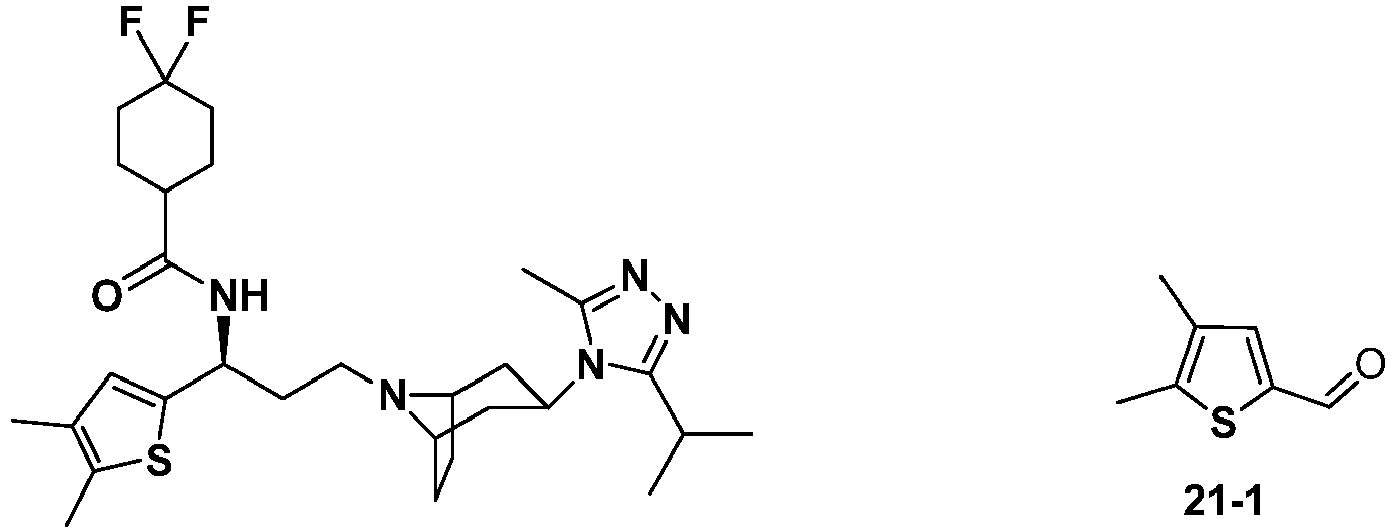
- According to the synthesis method of Example 5, Compound 21-1 was used to replace 2-1 in Example 5 and compound 2f was used to replace If in Example 5 to obtain compound 94, MS: 548.2[M+H]+.1H-NMR(400Hz, CDCl3): δ6.05 (s, 1H), 5.19 (m,1H), 3.91 (m, 1H), 3.02 (m, 1H), 2.54(s, 3H), 2.43 (m,2H), 2.25(s,6H), 2.17-1.95 (m,10H), 1.95-1.61 (m, 9H), 1.34 (d, 6H).
-
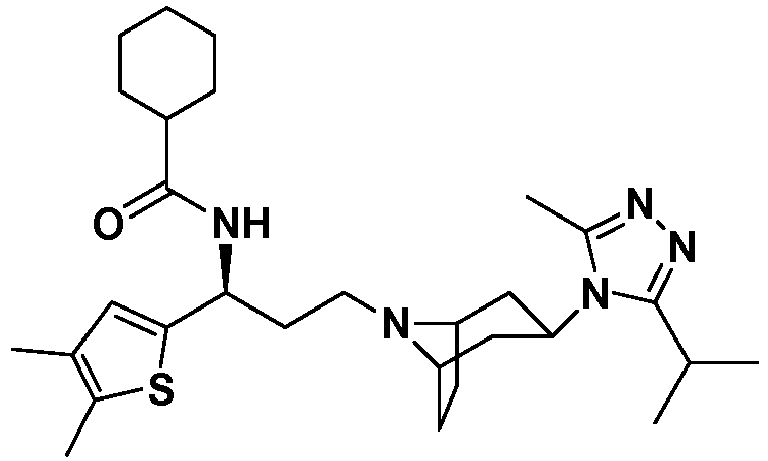
- According to the synthesis method of Example 5, Compound 21-1 was used to replace 2-1 in Example 5, compound 2f was used to replace If in Example 5 and cyclohexanecarboxylic acid was used to replace 4,4-difluoro-cyclohexanecarboxylic acid in Example 5 to obtain compound 95, MS: 512.2[M+H]+.1H-NMR(400Hz, CDCl3): δ6.04 (s, 1H), 5.19 (m,1H), 3.91 (m, 1H), 3.02 (m, 1H), 2.54(s, 3H), 2.43 (m,2H), 2.25(s,6H), 2.16-1.93 (m,13H), 1.93-1.61 (m, 10H), 1.36 (d, 6H).
-

- According to the synthesis method of Example 5, Compound 21-1 was used to replace 2-1 in Example 5, compound 2f was used to replace If in Example 5 and cyclopentanecarboxylic acid was used to replace 4,4-difluoro-cyclohexanecarboxylic acid in Example 5 to obtain compound 96, MS: 498.2[M+H]+.1H-NMR(400Hz, CDCl3): δ6.07 (s, 1H), 5.19 (m,1H), 3.91 (m, 1H), 3.02 (m, 1H), 2.54(s, 3H), 2.43 (m,2H), 2.25(s,6H), 2.17-1.93 (m,11H), 1.93-1.61 (m, 10H), 1.35 (d, 6H).
-

- According to the synthesis method of Example 5, Compound 22-1 was used to replace 2-1 in Example 5 and compound 2f was used to replace If in Example 5 to obtain compound 97, MS: 548.2[M+H]+.1H-NMR(400Hz, CDCl3): δ6.05 (d, 1H), 5.19 (m,1H), 3.91 (m, 1H), 3.02 (m, 1H), 2.54(s, 3H), 2.43 (m,2H), 2.25(s,6H), 2.17-1.95 (m,10H), 1.95-1.61 (m, 9H), 1.34 (d, 6H).
-

- According to the synthesis method of Example 5, Compound 22-1 was used to replace 2-1 in Example 5, compound 2f was used to replace If in Example 5 and cyclohexanecarboxylic acid was used to replace 4,4-difluoro-cyclohexanecarboxylic acid in Example 5 to obtain compound 98, MS: 512.2[M+H]+.1H-NMR(400Hz, CDCl3): δ6.04 (s, 1H), 5.19 (m,1H), 3.91 (m, 1H), 3.02 (m, 1H), 2.54(s, 3H), 2.43 (m,2H), 2.25(s,6H), 2.16-1.93 (m,13H), 1.93-1.61 (m, 10H), 1.36 (d, 6H).
-

- According to the synthesis method of Example 5, Compound 22-1 was used to replace 2-1 in Example 5, compound 2f was used to replace If in Example 5 and cyclopentanecarboxylic acid was used to replace 4,4-difluoro-cyclohexanecarboxylic acid in Example 5 to obtain compound 99, MS: 498.2[M+H]+.1H-NMR(400Hz, CDCl3): δ6.07 (s, 1H), 5.19 (m,1H), 3.91 (m, 1H), 3.02 (m, 1H), 2.54(s, 3H), 2.43 (m,2H), 2.25(s,6H), 2.17-1.93 (m,11H), 1.93-1.61 (m, 10H), 1.35 (d, 6H).
-

- According to the synthesis method of Example 5, Compound 23-1 was used to replace 2-1 in Example 5 and compound 2f was used to replace If in Example 5 to obtain compound 100, MS: 548.2[M+H]+.1H-NMR(400Hz, CDCl3): δ6.15 (s, 1H), 5.19 (m,1H), 3.91 (m, 1H), 3.02 (m, 1H), 2.54(s, 3H), 2.43 (m,2H), 2.29(s,6H), 2.17-1.95 (m,10H), 1.95-1.61 (m, 9H), 1.34 (d, 6H).
-
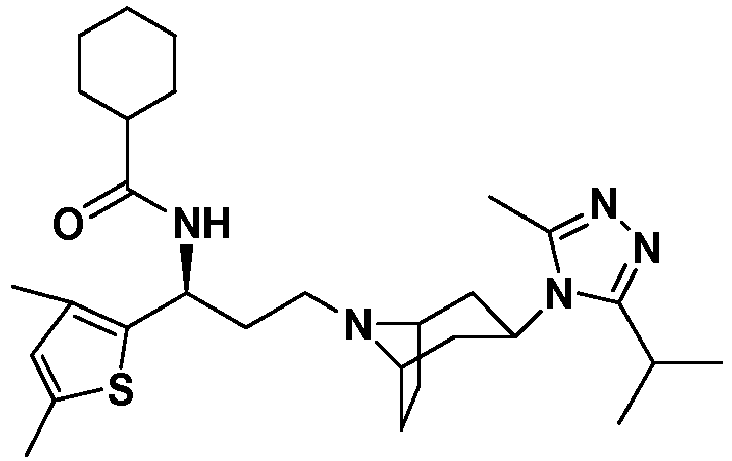
- According to the synthesis method of Example 5, Compound 23-1 was used to replace compound 2-1 in Example 5, compound 2f was used to replace compound If in Example 5 and cyclohexanecarboxylic acid was used to replace 4,4-difluoro-cyclohexanecarboxylic acid in Example 5 to obtain compound 101, MS: 512.2[M+H]+.1H-NMR(400Hz, CDCl3): δ6.14 (s, 1H), 5.19 (m,1H), 3.91 (m, 1H), 3.02 (m, 1H), 2.54(s, 3H), 2.43 (m,2H), 2.29(s,6H), 2.16-1.93 (m,13H), 1.93-1.61 (m, 10H), 1.36 (d, 6H).
-

- According to the synthesis method of Example 5, Compound 23-1 was used to replace compound 2-1 in Example 5, compound 2f was used to replace compound If in Example 5 and cyclopentanecarboxylic acid was used to replace 4,4-difluoro-cyclohexanecarboxylic acid in Example 5 to obtain compound 102, MS: 498.2[M+H]+.1H-NMR(400Hz, CDCl3): δ6.17 (s, 1H), 5.19 (m,1H), 3.91 (m, 1H), 3.02 (m, 1H), 2.54(s, 3H), 2.43 (m,2H), 2.29(s,6H), 2.17-1.93 (m,11H), 1.93-1.61 (m, 10H), 1.35 (d, 6H).
-

- According to the synthesis method of Example 5, Compound 24-1 was used to replace compound 2-1 in Example 5 and compound 2f was used to replace compound If in Example 5 to obtain compound 103, MS: 562.2[M+H]+.1H-NMR(400Hz, CDCl3): δ5.19 (m,1H), 3.91 (m, 1H), 3.02 (m, 1H), 2.54(s, 3H), 2.43 (m,2H), 2.26(s,9H), 2.17-1.95 (m,10H), 1.95-1.61 (m, 9H), 1.34 (d, 6H).
-

- According to the synthesis method of Example 5, Compound 24-1 was used to replace compound 2-1 in Example 5, compound 2f was used to replace compound If in Example 5 and cyclohexanecarboxylic acid was used to replace 4,4-difluoro-cyclohexanecarboxylic acid in Example 5 to obtain compound 104, MS: 526.2[M+H]+.1H-NMR(400Hz, CDCl3): δ5.19 (m,1H), 3.91 (m, 1H), 3.02 (m, 1H), 2.54(s, 3H), 2.43 (m,2H), 2.27(s,9H), 2.16-1.93 (m,13H), 1.93-1.61 (m, 10H), 1.36 (d, 6H).
-

- According to the synthesis method of Example 5, Compound 24-1 was used to replace compound 2-1 in Example 5, compound 2f was used to replace compound If in Example 5 and cyclopentanecarboxylic acid was used to replace 4,4-difluoro-cyclohexanecarboxylic acid in Example 5 to obtain compound 105, MS: 512.2[M+H]+.1H-NMR(400Hz, CDCl3): δ5.19 (m,1H), 3.91 (m, 1H), 3.02 (m, 1H), 2.54(s, 3H), 2.43 (m,2H), 2.29(s,9H), 2.17-1.93 (m,11H), 1.93-1.61 (m, 10H), 1.35 (d, 6H).
-
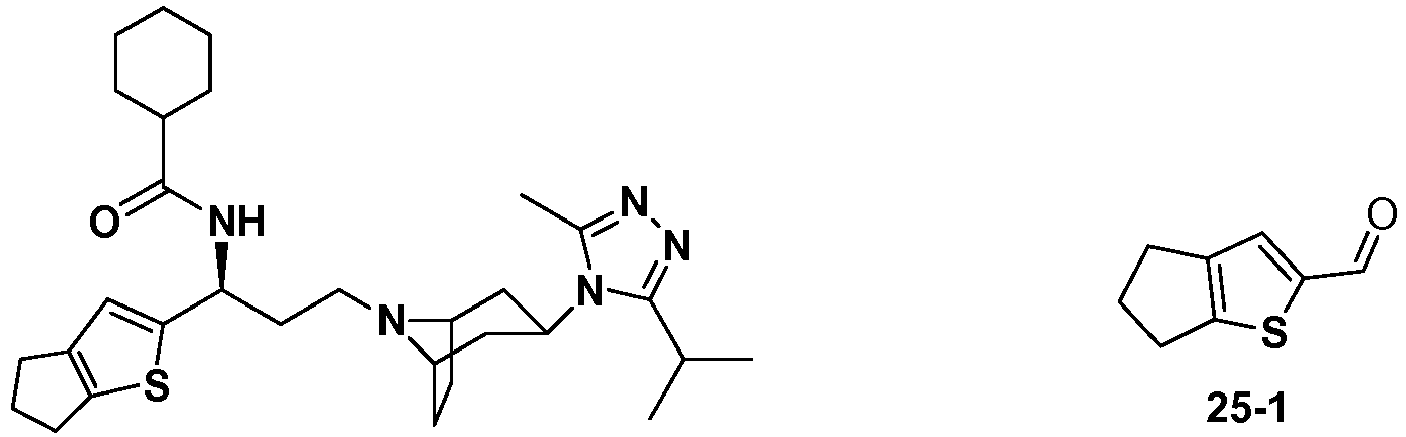
- According to the synthesis method of Example 5, Compound 25-1 was used to replace compound 2-1 in Example 5, compound 2f was used to replace compound If in Example 5 and cyclohexanecarboxylic acid was used to replace 4,4-difluoro-cyclohexanecarboxylic acid in Example 5 to obtain compound 106, MS: 524.2[M+H]+.1H-NMR(400Hz, CDCl3): δ6.83(s,1H), 5.19 (m,1H), 3.91 (m, 1H), 3.02 (m, 5H), 2.54(s, 3H), 2.43 (m,4H), 2.16-1.93 (m,13H), 1.93-1.61 (m, 10H), 1.36 (d, 6H).
-

- According to the synthesis method of Example 5, Compound 26-1 was used to replace compound 2-1 in Example 5, compound 2f was used to replace compound If in Example 5 and cyclohexanecarboxylic acid was used to replace 4,4-difluoro-cyclohexanecarboxylic acid in Example 5 to obtain compound 107, MS: 528.2[M+H]+. 1H-NMR(400Hz, CDCl3): δ6.03(s,2H), 5.79 (m,1H), 3.91 (m, 1H), 3.02 (m, 1H), 2.54(s, 3H), 2.43 (m,2H), 2.16-1.93 (m,13H), 1.93-1.61 (m, 10H), 1.36 (d, 6H).
-

- According to the synthesis method of Example 5, Compound 27-1 was used to replace compound 2-1 in Example 5, compound 2f was used to replace compound If in Example 5 and cyclohexanecarboxylic acid was used to replace 4,4-difluoro-cyclohexanecarboxylic acid in Example 5 to obtain compound 108, MS: 514.2[M+H]+.1H-NMR(400Hz, CDCl3): δ6.43(m,2H), 5.79 (m,1H), 3.91 (m, 1H), 3.02 (m, 1H), 2.54(s, 3H), 2.43 (m,5H), 2.16-1.93 (m,13H), 1.93-1.61 (m, 10H), 1.36 (d, 6H).
-

- According to the synthesis method of Example 5, Compound 1-1 was used to replace compound 2-1 in Example 5, compound 2f was used to replace compound If in Example 5 and tetrahydropyran-4-carboxylic acid was used to replace 4,4-difluoro-cyclohexanecarboxylic acid in Example 5 to obtain compound 109, MS: 485.9[M+H]+.1H-NMR(400Hz, CDCl3): δ7.28 (t, 1H), 7.13 (d, 1H), 6.94 (d, 1H), 5.19 (m,1H), 3.91 (m, 1H), 3.61 (m, 4H), 3.02 (m, 1H), 2.54(s, 3H), 2.43 (m,2H), 2.26-1.93 (m,13H), 1.93-1.61 (m, 6H), 1.36 (d, 6H).
-
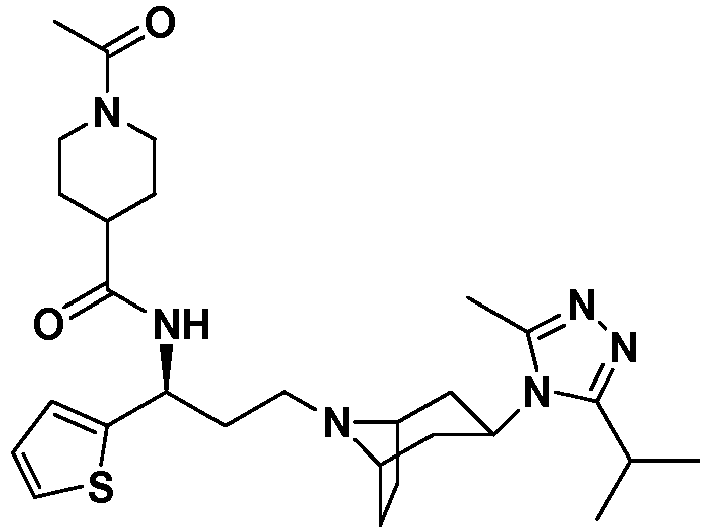
- According to the synthesis method of Example 5, Compound 1-1 was used to replace compound 2-1 in Example 5, compound 2f was used to replace compound If in Example 5 and 1-acetyl-4-piperidinecarboxylic acid was used to replace 4,4-difluoro-cyclohexanecarboxylic acid in Example 5 to obtain compound 110, MS: 527.3[M+H]+.1H-NMR(400Hz, CDCl3): δ7.28 (t, 1H), 7.13 (d, 1H), 6.94 (d, 1H), 5.19 (m,1H), 3.91 (m, 1H), 3.31 (m, 4H), 3.02 (m, 1H), 2.54(s, 3H), 2.43 (m,5H), 2.26-1.93 (m,13H), 1.93-1.61 (m, 6H), 1.36 (d, 6H).
-

- According to the synthesis method of Example 5, Compound 1-1 was used to replace compound 2-1 in Example 5, compound 2f was used to replace compound If in Example 5 and 1-methylpiperidine-4-carboxylic acid was used to replace 4,4-difluoro-cyclohexanecarboxylic acid in Example 5 to obtain compound 111, MS: 499.3[M+H]+.1H-NMR(400Hz, CDCl3): δ7.28 (t, 1H), 7.13 (d, 1H), 6.94 (d, 1H), 5.19 (m,1H), 3.91 (m, 1H), 3.02 (m, 1H), 2.51(m, 7H), 2.43 (m,5H), 2.26-1.93 (m,13H), 1.93-1.61 (m, 6H), 1.36 (d, 6H).
-

- According to the synthesis method of Example 5, Compound 28-1 was used to replace compound 2-1 in Example 5 and compound 2f was used to replace compound If in Example 5 to obtain compound 112, MS: 554.25[M+H]+.1H-NMR(400Hz, CDCl3): δ6.67 (m, 2H), 4.78 (m,1H), 3.70 (m, 1H), 3.18 (m, 1H), 2.38-2.43(m, 3H), 2.36 (s,3H), 1.40-1.82 (m,20H), 1.26 (d, 6H).
-

- According to the synthesis method of Example 5, Compound 28-1 was used to replace compound 2-1 in Example 5, compound 2f was used to replace compound If in Example 5 and cyclohexanecarboxylic acid was used to replace 4,4-difluoro-cyclohexanecarboxylic acid in Example 5 to obtain compound 113, MS: 518.26 [M+H]+.1H-NMR(400Hz, CDCl3): δ6.65-6.80 (m, 2H), 4.78 (m,1H), 3.72 (m, 1H), 3.20 (m, 1H), 2.31-2.45(m, 3H), 2.33 (s,3H), 1.44-1.82 (m,22H), 1.36 (d, 6H).
-
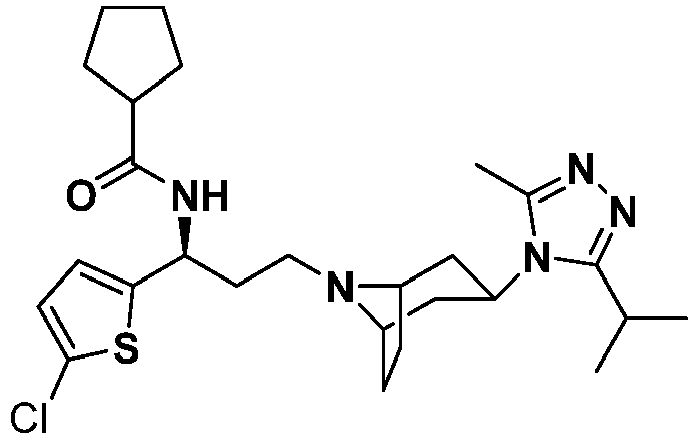
- According to the synthesis method of Example 5, Compound 28-1 was used to replace compound 2-1 in Example 5, compound 2f was used to replace compound If in Example 5 and cyclopentanecarboxylic acid was used to replace 4,4-difluoro-cyclohexanecarboxylic acid in Example 5 to obtain compound 114, MS: 504.25 [M+H]+.1H-NMR(400Hz, CDCl3): δ6.65-6.80 (m, 2H), 4.78 (m,1H), 3.72 (m, 1H), 3.20 (m, 1H), 2.31-2.45(m, 3H), 2.33 (s,3H), 1.44-1.82 (m,20H), 1.36 (d, 6H).
-

- According to the synthesis method of Example 5, Compound 29-1 was used to replace compound 2-1 in Example 5 and compound 2f was used to replace compound If in Example 5 to obtain compound 115, MS: 521.28 [M+H]+.1H-NMR(400Hz, CDCl3): δ7.67 (d, 1H), 7.20 (d, 1H), 4.78 (m,1H), 3.72 (m, 1H), 3.20 (m, 1H), 2.31-2.45(m, 3H), 2.36 (s,3H), 1.44-1.82 (m,20H), 1.36 (d, 6H).
-

- According to the synthesis method of Example 5, Compound 29-1 was used to replace compound 2-1 in Example 5, compound 2f was used to replace compound If in Example 5 and cyclohexanecarboxylic acid was used to replace 4,4-difluoro-cyclohexanecarboxylic acid in Example 5 to obtain compound 116, MS: 485.30 [M+H]+.1H-NMR(400Hz, CDCl3): δ7.65 (d, 1H), 7.23 (d, 1H), 4.74 (m,1H), 3.71 (m, 1H), 3.21 (m, 1H), 2.31-2.45(m, 3H), 2.33(s,3H), 1.34-1.83 (m,22H), 1.26 (d, 6H).
-

- According to the synthesis method of Example 5, Compound 29-1 was used to replace compound 2-1 in Example 5, compound 2f was used to replace compound If in Example 5 and cyclopentanecarboxylic acid was used to replace 4,4-difluoro-cyclohexanecarboxylic acid in Example 5 to obtain compound 117, MS: 471.28 [M+H]+.1H-NMR(400Hz, CDCl3): δ7.62 (d, 1H), 7.22 (d, 1H), 4.73 (m,1H), 3.74 (m, 1H), 3.22 (m, 1H), 2.31-2.45(m, 3H), 2.33 (s,3H), 1.44-1.82 (m,20H), 1.33 (d, 6H).
-

- According to the synthesis method of compound 40, Compound 29-1 was used to replace compound 3-1 in Example 40 to obtain compound 118, MS: 471.25 [M+H]+. 1H-NMR(400Hz, CDCl3): δ7.65 (d, 1H), 7.26 (d, 1H), 4.78 (t,1H), 4.38 (m,2H), 3.86 (m,2H), 3.74 (m, 1H), 2.66 (m, 2H), 2.53 (s, 3H), 2.43 (m, 2H), 2.32 (s, 3H), 1.44-2.12 (m, 15H).
-

- According to the synthesis method of compound 40, Compound 29-1 was used to replace compound 3-1 in Example 40 and methyl chloroformate was used to replace acetyl chloride in Example 40 to obtain compound 119, MS: 487.24 [M+H]+.1H-NMR(400Hz, CDCl3): δ7.65 (d, 1H), 7.26 (d, 1H), 4.78 (t,1H), 4.18 (m,2H), 3.76 (s, 3H),3.65-3.733 (m, 3H), 2.66 (m, 2H), 2.43 (m, 2H), 2.32 (s, 3H), 1.44-2.12 (m, 15H).
-

- According to the synthesis method of compound 40, Compound 29-1 was used to replace compound 3-1 in Example 40 and propionyl chloride was used to replace acetyl chloride in Example 40 to obtain compound 120, MS: 485.26 [M+H]+.1H-NMR(400Hz, CDCl3): δ7.65 (d, 1H), 7.26 (d, 1H), 4.78 (t,1H), 4.38 (m,2H), 3.86 (m,2H), 3.74 (m, 1H), 2.66 (m, 2H), 2.53 (s, 3H), 2.43 (m, 2H), 2.27(q, 2H), 1.44-2.12 (m, 15H), 1.21(t, 3H).
-

- According to the synthesis method of compound 40, Compound 29-1 was used to replace compound 3-1 in Example 40 and isobutyryl chloride was used to replace acetyl chloride in Example 40 to obtain compound 121, MS: 499.28 [M+H]+.1H-NMR(400Hz, CDCl3): δ7.65 (d, 1H), 7.26 (d, 1H), 4.78 (t,1H), 4.38 (m,2H), 3.86 (m,2H), 3.74 (m, 1H), 2.66-2.69 (m, 3H), 2.53 (s, 3H), 2.43 (m, 2H), 1.44-2.12 (m, 15H), 1.10(d, 6H).
-

- According to the synthesis method of compound 40, Compound 29-1 was used to replace compound 3-1 in Example 40 and cyclopropionyl chloride was used to replace acetyl chloride in Example 40 to obtain compound 122, MS: 497.26 [M+H]+.1H-NMR(400Hz, CDCl3): δ7.65 (d, 1H), 7.26 (d, 1H), 4.78 (t,1H), 4.38 (m,2H), 3.86 (m,2H), 3.74 (m, 1H), 2.66-2.69 (m, 2H), 2.53 (s, 3H), 2.43 (m, 2H), 1.44-2.12 (m, 16H), 0.53-0.78(m, 4H).
-

- According to the synthesis method of compound 40, Compound 29-1 was used to replace compound 3-1 in Example 40 and n-butyryl chloride was used to replace acetyl chloride in Example 40 to obtain compound 123, MS: 499.28 [M+H]+.1H-NMR(400Hz, CDCl3): δ7.65 (d, 1H), 7.26 (d, 1H), 4.78 (t,1H), 4.38 (m,2H), 3.86 (m,2H), 3.74 (m, 1H), 2.66-2.69 (m, 2H), 2.53 (s, 3H), 2.43 (m, 2H), 2.34(m, 2H), 1.44-2.12 (m, 17H), 0.96(t, 3H).
-

- According to the synthesis method of compound 40, Compound 29-1 was used to replace compound 3-1 in Example 40, propionic acid was used to replace acetic acid in Example 40 and n-butyryl chloride was used to replace acetyl chloride in Example 40 to obtain compound 124, MS: 485.26 [M+H]+.1H-NMR(400Hz, CDCl3): δ7.65 (d, 1H), 7.26 (d, 1H), 4.78 (t,1H), 4.38 (m,2H), 3.86 (m,2H), 3.74 (m, 1H), 2.66 (m, 2H), 2.53 (s, 3H), 2.43 (m, 2H), 2.32(s, 3H), 2.23(q, 2H), 1.44-1.96 (m, 12H), 1.11(t, 3H).
-

- According to the synthesis method of compound 40, Compound 28-1 was used to replace compound 3-1 in Example 40 to obtain compound 125, MS: 504.21 [M+H]+. 1H-NMR(400Hz, CDCl3): δ6.65 (d, 1H), 6.26 (d, 1H), 4.78 (t,1H), 4.38 (m,2H), 3.86 (m,2H), 3.74 (m, 1H), 2.66 (m, 2H), 2.53 (s, 3H), 2.43 (m, 2H), 2.32 (s, 3H), 1.44-2.12 (m, 15H).
-

- According to the synthesis method of compound 40, Compound 28-1 was used to replace compound 3-1 in Example 40 and methyl chloroformate was used to replace acetyl chloride in Example 40 to obtain compound 126, MS: 520.21 [M+H]+.1H-NMR(400Hz, CDCl3): δ6.45 (d, 1H), 6.16 (d, 1H), 4.78 (t,1H), 4.18 (m,2H), 3.76 (s, 3H),3.65-3.733 (m, 3H), 2.66 (m, 2H), 2.43 (m, 2H), 2.32 (s, 3H), 1.44-2.12 (m, 15H).
-

- According to the synthesis method of compound 40, Compound 28-1 was used to replace compound 3-1 in Example 40 and propionyl chloride was used to replace acetyl chloride in Example 40 to obtain compound 127, MS: 518.23 [M+H]+.1H-NMR(400Hz, CDCl3): δ6.45 (d, 1H), 6.16 (d, 1H), 4.78 (t,1H), 4.38 (m,2H), 3.86 (m,2H), 3.74 (m, 1H), 2.66 (m, 2H), 2.53 (s, 3H), 2.43 (m, 2H), 2.27(q, 2H), 1.44-2.12 (m, 15H), 1.21(t, 3H).
-

- According to the synthesis method of compound 40, Compound 28-1 was used to replace compound 3-1 in Example 40 and n-butyryl chloride was used to replace acetyl chloride in Example 40 to obtain compound 128, MS: 532.24 [M+H]+.1H-NMR(400Hz, CDCl3): δ6.48 (d, 1H), 6.12 (d, 1H), 4.78 (t,1H), 4.38 (m,2H), 3.86 (m,2H), 3.74 (m, 1H), 2.66-2.69 (m, 2H), 2.53 (s, 3H), 2.43 (m, 2H), 2.34(m, 2H), 1.44-2.12 (m, 17H), 0.96(t, 3H).
-

- According to the synthesis method of compound 40, Compound 28-1 was used to replace compound 3-1 in Example 40 and isobutyryl chloride was used to replace acetyl chloride in Example 40 to obtain compound 129, MS: 532.24 [M+H]+.1H-NMR(400Hz, CDCl3): δ6.48 (d, 1H), 6.12 (d, 1H), 4.78 (t,1H), 4.38 (m,2H), 3.86 (m,2H), 3.74 (m, 1H), 2.66-2.69 (m, 3H), 2.53 (s, 3H), 2.43 (m, 2H), 1.44-2.12 (m, 15H), 1.10(d, 6H).
-

- According to the synthesis method of compound 40, Compound 28-1 was used to replace compound 3-1 in Example 40 and cyclopropionyl chloride was used to replace acetyl chloride in Example 40 to obtain compound 130, MS: 530.23 [M+H]+.1H-NMR(400Hz, CDCl3): δ6.78 (d, 1H), 6.22 (d, 1H), 4.78 (t,1H), 4.38 (m,2H), 3.86 (m,2H), 3.74 (m, 1H), 2.66-2.69 (m, 2H), 2.53 (s, 3H), 2.43 (m, 2H), 1.44-2.12 (m, 16H), 0.53-0.78(m, 4H).
-

- According to the synthesis method of compound 40, Compound 7-1 was used to replace compound 3-1 in Example 40 to obtain compound 131, MS: 488.24 [M+H]+. 1H-NMR(400Hz, CDCl3): δ6.46 (m, 1H), 6.27 (m, 1H), 4.78 (t,1H), 4.38 (m,2H), 3.86 (m,2H), 3.74 (m, 1H), 2.66 (m, 2H), 2.53 (s, 3H), 2.43 (m, 2H), 2.32 (s, 3H), 1.44-2.12 (m, 15H).
-

- According to the synthesis method of compound 40, Compound 7-1 was used to replace compound 3-1 in Example 40 and cyclopropionyl chloride was used to replace acetyl chloride in Example 40 to obtain compound 132, MS: 514.26 [M+H]+.1H-NMR(400Hz, CDCl3): δ6.36 (m, 1H), 6.15 (m, 1H), 4.78 (t,1H), 4.38 (m,2H), 3.86 (m,2H), 3.74 (m, 1H), 2.66-2.69 (m, 2H), 2.53 (s, 3H), 2.43 (m, 2H), 1.44-2.12 (m, 16H), 0.53-0.78(m, 4H).
-

- According to the synthesis method of compound 40, Compound 7-1 was used to replace compound 3-1 in Example 40 and methyl chloroformate was used to replace acetyl chloride in Example 40 to obtain compound 133, MS: 504.24 [M+H]+.1H-NMR(400Hz, CDCl3): δ6.47 (m, 1H), 6.25 (m, 1H), 4.78 (t,1H), 4.18 (m,2H), 3.76 (s, 3H),3.65-3.733 (m, 3H), 2.66 (m, 2H), 2.43 (m, 2H), 2.32 (s, 3H), 1.44-2.12 (m, 15H).
-

- According to the synthesis method of compound 40, Compound 7-1 was used to replace compound 3-1 in Example 40 and propionyl chloride was used to replace acetyl chloride in Example 40 to obtain compound 134, MS: 502.26 [M+H]+.1H-NMR(400Hz, CDCl3): δ6.48 (m, 1H), 6.23 (m, 1H), 4.78 (t,1H), 4.38 (m,2H), 3.86 (m,2H), 3.74 (m, 1H), 2.66 (m, 2H), 2.53 (s, 3H), 2.43 (m, 2H), 2.27(q, 2H), 1.44-2.12 (m, 15H), 1.21(t, 3H).
-

- According to the synthesis method of compound 40, Compound 7-1 was used to replace compound 3-1 in Example 40 and isobutyryl chloride was used to replace acetyl chloride in Example 40 to obtain compound 135, MS: 516.27 [M+H]+.1H-NMR(400Hz, CDCl3): δ6.42 (m, 1H), 6.13 (m, 1H), 4.78 (t,1H), 4.38 (m,2H), 3.86 (m,2H), 3.74 (m, 1H), 2.66-2.69 (m, 3H), 2.53 (s, 3H), 2.43 (m, 2H), 1.44-2.12 (m, 15H), 1.10(d, 6H).
-

- According to the synthesis method of compound 40, Compound 7-1 was used to replace compound 3-1 in Example 40 and n-butyryl chloride was used to replace acetyl chloride in Example 40 to obtain compound 136, MS: 516.27 [M+H]+.1H-NMR(400Hz, CDCl3): δ6.41 (m, 1H), 6.12 (m, 1H), 4.78 (t,1H), 4.38 (m,2H), 3.86 (m,2H), 3.74 (m, 1H), 2.66-2.69 (m, 2H), 2.53 (s, 3H), 2.43 (m, 2H), 2.34(m, 2H), 1.44-2.12 (m, 17H), 0.96(t, 3H).
-

- According to the synthesis method of Example 5, Compound 30-1 was used to replace compound 2-1 in Example 5 and compound 2f was used to replace compound If in Example 5 to obtain compound 137, MS: 577.31 [M+H]+.1H-NMR(400Hz, CDCl3): δ7.32 (d, 1H), 7.07 (d, 1H), 4.74 (m,1H), 3.71 (m, 1H), 3.21 (m, 1H), 2.31-2.45(m, 6H), 2.33(s,3H), 1.34-1.83 (m,20H), 1.26 (d, 6H).
-

- According to the synthesis method of Example 5, Compound 30-1 was used to replace compound 2-1 in Example 5, compound 2f was used to replace compound If in Example 5 and cyclohexanecarboxylic acid was used to replace 4,4-difluoro-cyclohexanecarboxylic acid in Example 5 to obtain compound 138, MS: 541.32 [M+H]+.1H-NMR(400Hz, CDCl3): δ7.31 (d, 1H), 7.03 (d, 1H), 4.74 (m,1H), 3.71 (m, 1H), 3.21 (m, 1H), 2.36-2.43(m, 6H), 2.30(s,3H), 1.34-1.83 (m,22H), 1.26 (d, 6H).
-

- According to the synthesis method of Example 5, Compound 30-1 was used to replace compound 2-1 in Example 5, compound 2f was used to replace compound If in Example 5 and cyclopentanecarboxylic acid was used to replace 4,4-difluoro-cyclohexanecarboxylic acid in Example 5 to obtain compound 139, MS: 527.31 [M+H]+.1H-NMR(400Hz, CDCl3): δ7.31 (d, 1H), 7.03 (d, 1H), 4.74 (m,1H), 3.71 (m, 1H), 3.21 (m, 1H), 2.36-2.43(m, 6H), 2.26(s,3H), 1.34-1.83 (m,20H), 1.26 (d, 6H).
-

- According to the synthesis method of Example 5, Compound 31-1 was used to replace compound 2-1 in Example 5 and compound 2f was used to replace compound If in Example 5 to obtain compound 140, MS: 577.31 [M+H]+.1H-NMR(400Hz, CDCl3): δ8.26(d, 1H), 7.07 (d, 1H), 4.74 (m,1H), 3.71 (m, 1H), 3.21 (m, 1H), 2.86(s,3H), 2.39-2.45(m, 3H), 2.33(s,3H), 1.34-1.83 (m,20H), 1.26 (d, 6H).
-

- According to the synthesis method of Example 5, Compound 31-1 was used to replace compound 2-1 in Example 5, compound 2f was used to replace compound If in Example 5 and cyclohexanecarboxylic acid was used to replace 4,4-difluoro-cyclohexanecarboxylic acid in Example 5 to obtain compound 141, MS: 541.32 [M+H]+.1H-NMR(400Hz, CDCl3): δ8.14(d, 1H), 7.13 (d, 1H), 4.74 (m,1H), 3.71 (m, 1H), 3.21 (m, 1H), 2.86(s,3H), 2.39-2.45(m, 3H), 2.33(s,3H), 1.34-1.83 (m,22H), 1.26 (d, 6H).
-

- According to the synthesis method of Example 5, Compound 31-1 was used to replace compound 2-1 in Example 5, compound 2f was used to replace compound If in Example 5 and cyclopentanecarboxylic acid was used to replace 4,4-difluoro-cyclohexanecarboxylic acid in Example 5 to obtain compound 142, MS: 527.31 [M+H]+.1H-NMR(400Hz, CDCl3): δ8.36(d, 1H), 7.13 (d, 1H), 4.74 (m,1H), 3.71 (m, 1H), 3.21 (m, 1H), 2.86(s,3H), 2.39-2.45(m, 3H), 2.33(s,3H), 1.34-1.83 (m,20H), 1.26 (d, 6H).
-

- According to the synthesis method of compound 40, Compound 13-1 was used to replace compound 3-1 in Example 40 and isopropionyl chloride was used to replace acetyl chloride in Example 40 to obtain compound 143, MS: 523.28 [M+H]+.1H-NMR(400Hz, CDCl3): δ7.44 (m, 1H), 6.87 (m, 1H), 4.78 (t,1H), 4.38 (m,2H), 3.86 (m,2H), 3.74 (m, 1H), 2.66-2.69 (m, 3H), 2.53 (s, 3H), 2.43 (m, 2H), 1.44-2.12 (m, 15H), 1.10(d, 6H).
-

- According to the synthesis method of compound 40, Compound 13-1 was used to replace compound 3-1 in Example 40 to obtain compound 144, MS: 495.25 [M+H]+. 1H-NMR(400Hz, CDCl3): δ7.56 (m, 1H), 6.93 (m, 1H), 4.78 (t,1H), 4.38 (m,2H), 3.86 (m,2H), 3.74 (m, 1H), 2.66 (m, 2H), 2.53 (s, 3H), 2.43 (m, 2H), 2.32 (s, 3H), 1.44-2.12 (m, 15H).
-

- According to the synthesis method of compound 40, Compound 18-1 was used to replace compound 3-1 in Example 40 and isopropionyl chloride was used to replace acetyl chloride in Example 40 to obtain compound 145, MS: 512.30 [M+H]+.1H-NMR(400Hz, CDCl3): δ7.59 (m, 1H), 6.91 (m, 1H), 4.78 (t,1H), 4.38 (m,2H), 3.86 (m,2H), 3.74 (m, 1H), 2.66-2.69 (m, 3H), 2.53 (s, 3H), 2.43 (m, 2H), 1.44-2.12 (m, 15H), 1.10(d, 6H).
-

- According to the synthesis method of Example 5, Compound 1-1 was used to replace compound 2-1 in example 5, compound 2f was used to replace compound If in example 5 and 1-methylsulfonyl-4-piperidine carboxylic acid was used to replace 4,4-difluoro-cyclohexanecarboxylic acid in Example 5 to obtain compound 146, MS: 563.3[M+H]+.1H-NMR(400Hz, CDCl3): δ7.28 (t, 1H), 7.13 (d, 1H), 6.94 (d, 1H), 5.19 (m,1H), 3.91 (m, 1H), 3.31 (m, 4H), 3.02 (m, 1H), 2.54(s, 3H), 2.43 (m,5H), 2.26-1.93 (m,13H), 1.93-1.61 (m, 6H), 1.36 (d, 6H).
-

- According to the synthesis method of Example 5, Compound 5-1 was used to replace compound 2-1 in Example 5, compound 2f was used to replace compound If in Example 5 and 1-methylsulfonyl-4-piperidine carboxylic acid was used to replace 4,4-difluoro-cyclohexanecarboxylic acid in Example 5 to obtain compound 147, MS: 577.3[M+H]+.1H-NMR(400Hz, CDCl3): δ7.28 (t, 1H), 7.13 (d, 1H), 5.19 (m,1H), 3.91 (m, 1H), 3.31 (m, 4H), 3.02 (m, 1H), 2.54(s, 3H), 2.43 (m,5H), 2.36 (s,3H), 2.26-1.93 (m,13H), 1.93-1.61 (m, 6H), 1.36 (d, 6H).
-

- According to the synthesis method of Example 5, Compound 27-1 was used to replace compound 2-1 in Example 5, compound 2f was used to replace compound If in Example 5 and 1-methylsulfonyl-4-piperidine carboxylic acid was used to replace 4,4-difluoro-cyclohexanecarboxylic acid in Example 5 to obtain compound 148, MS: 593.3[M+H]+.1H-NMR(400Hz, CDCl3): δ7.28 (t, 1H), 7.13 (d, 1H) 5.19 (m,1H), 3.91 (m, 4H), 3.31 (m, 4H), 3.02 (m, 1H), 2.54(s, 3H), 2.43 (m,5H), 2.36 (s,3H), 2.26-1.93 (m,13H), 1.93-1.61 (m, 6H), 1.36 (d, 6H).
-
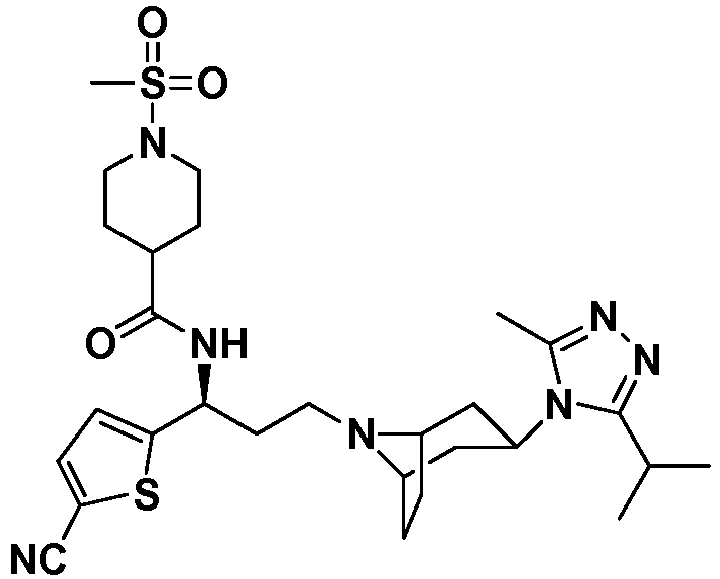
- According to the synthesis method of Example 5, Compound 13-1 was used to replace compound 2-1 in Example 5, compound 2f was used to replace compound If in Example 5 and 1-methylsulfonyl-4-piperidine carboxylic acid was used to replace 4,4-difluoro-cyclohexanecarboxylic acid in Example 5 to obtain compound 149, MS: 588.3[M+H]+.1H-NMR(400Hz, CDCl3): δ7.38 (t, 1H), 7.24 (d, 1H), 5.19 (m, 1H), 3.91 (m, 4H), 3.31 (m, 4H), 3.02 (m, 1H), 2.54(s, 3H), 2.43 (m,5H), 2.36 (s,3H), 2.26-1.93 (m,13H), 1.93-1.61 (m, 6H), 1.36 (d, 6H).
-

- According to the synthesis method of Example 5, Compound 28-1 was used to replace compound 2-1 in Example 5, compound 2f was used to replace compound If in Example 5 and 1-methylsulfonyl-4-piperidine carboxylic acid was used to replace 4,4-difluoro-cyclohexanecarboxylic acid in Example 5 to obtain compound 150, MS: 597.3[M+H]+.1H-NMR(400Hz, CDCl3): δ7.38 (t, 1H), 7.23 (d, 1H), 5.19 (m, 1H), 3.91 (m, 4H), 3.31 (m, 4H), 3.02 (m, 1H), 2.54(s, 3H), 2.43 (m,5H), 2.36 (s,3H), 2.26-1.93 (m,13H), 1.93-1.61 (m, 6H), 1.36 (d, 6H).
-

- According to the synthesis method of Example 5, Compound 7-1 was used to replace compound 2-1 in Example 5, compound 2f was used to replace compound If in Example 5 and 1-methylsulfonyl-4-piperidine carboxylic acid was used to replace 4,4-difluoro-cyclohexanecarboxylic acid in Example 5 to obtain compound 151, MS: 581.3[M+H]+.1H-NMR(400Hz, CDCl3): δ7.48 (t, 1H), 7.24 (d, 1H), 5.19 (m, 1H), 3.91 (m, 4H), 3.31 (m, 4H), 3.02 (m, 1H), 2.54(s, 3H), 2.43 (m,5H), 2.37 (s,3H), 2.26-1.93 (m,13H), 1.93-1.61 (m, 6H), 1.36 (d, 6H).
-

- According to the synthesis method of Example 5, Compound 1-1 was used to replace compound 2-1 in Example 5, compound 2f was used to replace compound If in Example 5 and 2-(2H-tetrazol-2-yl)acetic acid was used to replace 4,4-difluoro-cyclohexanecarboxylic acid in Example 5 to obtain compound 152, MS: 484.3[M+H]+.1H-NMR(400Hz, CDCl3): δ8.53 (s, 1H), 7.23 (t, 1H), 7.15 (d, 1H), 6.99 (d, 1H), 5.21 (m, 1H), 4.62 (s, 2H), 3.95 (m, 1H), 3.03 (m, 1H), 2.40 (m,2H), 2.25-1.67 (m,14H), 1.32 (d, 6H).
-
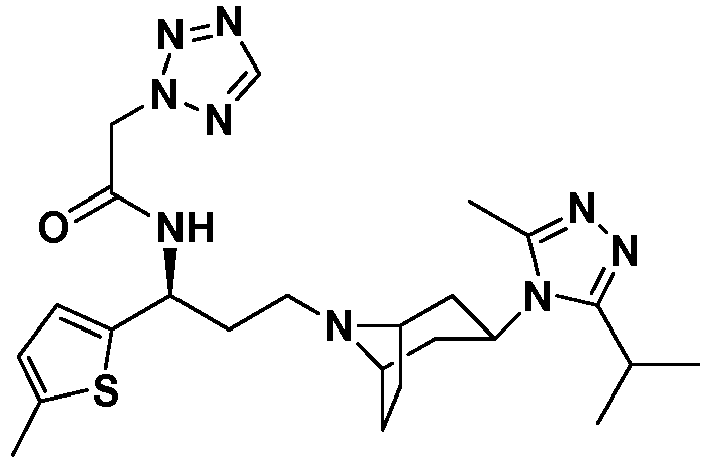
- According to the synthesis method of Example 5, Compound 5-1 was used to replace compound 2-1 in Example 5, compound 2f was used to replace compound If in Example 5 and 2-(2H-tetrazol-2-yl)acetic acid was used to replace 4,4-difluoro-cyclohexanecarboxylic acid in Example 5 to obtain compound 153, MS: 498.3[M+H]+.1H-NMR(400Hz, CDCl3): δ8.53 (s, 1H), 7.23 (t, 1H), 7.15 (d, 1H), 6.99 (d, 1H), 5.21 (m, 1H), 4.62 (s, 2H), 3.95 (m, 1H), 3.03 (m, 1H), 2.36 (s, 3H), 2.40 (m,2H), 2.25-1.67 (m,14H), 1.32 (d, 6H).
-

- According to the synthesis method of Example 5, Compound 27-1 was used to replace compound 2-1 in Example 5, compound 2f was used to replace compound If in Example 5 and 2-(2H-tetrazol-2-yl)acetic acid was used to replace 4,4-difluoro-cyclohexanecarboxylic acid in Example 5 to obtain compound 154, MS: 514.3[M+H]+.1H-NMR(400Hz, CDCl3): δ7.53 (s, 1H), 7.23 (t, 1H), 5.21 (m, 1H), 4.62 (s, 2H), 3.95 (m, 1H), 3.85 (s, 3H), 3.03 (m, 1H), 2.36 (s, 3H), 2.40 (m,2H), 2.25-1.67 (m,14H), 1.32 (d, 6H).
-

- According to the synthesis method of Example 5, Compound 13-1 was used to replace compound 2-1 in Example 5, compound 2f was used to replace compound If in Example 5 and 2-(2H-tetrazol-2-yl)acetic acid was used to replace 4,4-difluoro-cyclohexanecarboxylic acid in Example 5 to obtain compound 155, MS: 509.3[M+H]+.1H-NMR(400Hz, CDCl3): δ8.53 (s, 1H), 7.23 (t, 1H), 5.21 (m, 1H), 4.62 (s, 2H), 3.95 (m, 1H), 3.03 (m, 1H), 2.36 (s, 3H), 2.40 (m,2H), 2.25-1.67 (m,14H), 1.32 (d, 6H).
-

- According to the synthesis method of Example 5, Compound 28-1 was used to replace compound 2-1 in Example 5, compound 2f was used to replace compound If in Example 5 and 2-(2H-tetrazol-2-yl)acetic acid was used to replace 4,4-difluoro-cyclohexanecarboxylic acid in Example 5 to obtain compound 156, MS: 518.3[M+H]+.1H-NMR(400Hz, CDCl3): δ8.03 (s, 1H), 7.53 (t, 1H), 5.21 (m, 1H), 4.62 (s, 2H), 3.95 (m, 1H), 3.03 (m, 1H), 2.36 (s, 3H), 2.40 (m,2H), 2.25-1.67 (m,14H), 1.32 (d, 6H).
-

- According to the synthesis method of Example 5, Compound 7-1 was used to replace compound 2-1 in Example 5, compound 2f was used to replace compound If in Example 5 and 2-(2H-tetrazol-2-yl)acetic acid was used to replace 4,4-difluoro-cyclohexanecarboxylic acid in Example 5 to obtain compound 157, MS: 502.3[M+H]+.1H-NMR(400Hz, CDCl3): δ8.13 (s, 1H), 7.23 (t, 1H), 5.21 (m, 1H), 4.62 (s, 2H), 3.95 (m, 1H), 3.03 (m, 1H), 2.36 (s, 3H), 2.40 (m,2H), 2.25-1.67 (m,14H), 1.32 (d, 6H).
-

- According to the synthesis method of Example 5, Compound 1-1 was used to replace compound 2-1 in Example 5, compound 2f was used to replace compound If in Example 5 and 2-(1H-tetrazol-5-yl)acetic acid was used to replace 4,4-difluoro-cyclohexanecarboxylic acid in Example 5 to obtain compound 158, MS: 484.3[M+H]+.1H-NMR(400Hz, CDCl3): δ7.23 (t, 1H), 7.15 (d, 1H), 6.99 (d, 1H), 5.21 (m, 1H), 3.95 (m, 1H), 3.42 (s, 2H), 3.03 (m, 1H), 2.40 (m,2H), 2.25-1.67 (m,14H), 1.32 (d, 6H).
-

- According to the synthesis method of Example 5, Compound 5-1 was used to replace compound 2-1 in Example 5, compound 2f was used to replace compound If in Example 5 and 2-(1H-tetrazol-5-yl)acetic acid was used to replace 4,4-difluoro-cyclohexanecarboxylic acid in Example 5 to obtain compound 159, MS: 498.3[M+H]+.1H-NMR(400Hz, CDCl3): δ7.23 (t, 1H), 7.15 (d, 1H), 5.21 (m, 1H), 3.95 (m, 1H), 3.42 (s, 2H), 3.03 (m, 1H), 2.40 (m,2H), 2.36 (s,3H), 2.25-1.67 (m,14H), 1.32 (d, 6H).
-
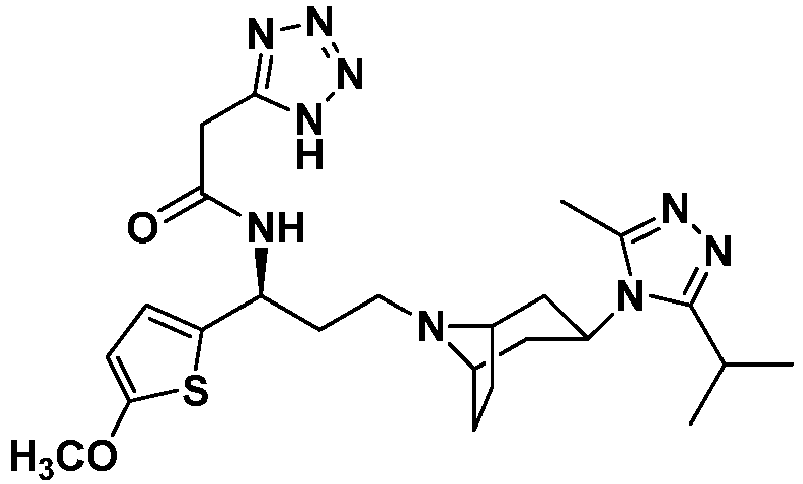
- According to the synthesis method of Example 5, Compound 27-1 was used to replace compound 2-1 in Example 5, compound 2f was used to replace compound If in Example 5 and 2-(1H-tetrazol-5-yl)acetic acid was used to replace 4,4-difluoro-cyclohexanecarboxylic acid in Example 5 to obtain compound 160, MS: 514.3[M+H]+.1H-NMR(400Hz, CDCl3): δ7.23 (t, 1H), 7.15 (d, 1H), 5.21 (m, 1H), 3.95 (m, 1H), 3.42 (s, 2H), 3.03 (m, 1H), 2.40 (m,2H), 2.25-1.67 (m,14H), 1.32 (d, 6H).
-

- According to the synthesis method of Example 5, Compound 13-1 was used to replace compound 2-1 in Example 5, compound 2f was used to replace compound If in Example 5 and 2-(1H-tetrazol-5-yl)acetic acid was used to replace 4,4-difluoro-cyclohexanecarboxylic acid in Example 5 to obtain compound 161, MS: 509.3[M+H]+.1H-NMR(400Hz, CDCl3): δ7.43 (t, 1H), 7.35 (d, 1H), 5.21 (m, 1H), 3.95 (m, 1H), 3.42 (s, 2H), 3.03 (m, 1H), 2.40 (m,2H), 2.25-1.67 (m,14H), 1.32 (d, 6H).
-

- According to the synthesis method of Example 5, Compound 28-1 was used to replace compound 2-1 in Example 5, compound 2f was used to replace compound If in Example 5 and 2-(1H-tetrazol-5-yl)acetic acid was used to replace 4,4-difluoro-cyclohexanecarboxylic acid in Example 5 to obtain compound 162, MS: 518.3[M+H]+.1H-NMR(400Hz, CDCl3): δ7.53 (t, 1H), 7.45 (d, 1H), 5.21 (m, 1H), 3.95 (m, 1H), 3.42 (s, 2H), 3.03 (m, 1H), 2.40 (m,2H), 2.25-1.67 (m,14H), 1.32 (d, 6H).
-
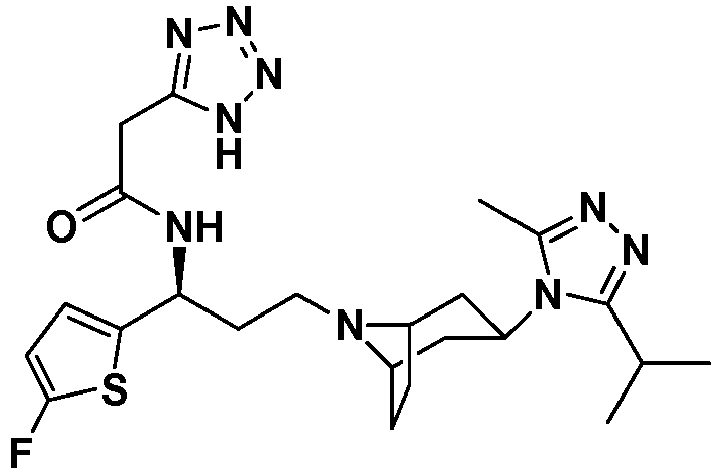
- According to the synthesis method of Example 5, Compound 7-1 was used to replace compound 2-1 in Example 5, compound 2f was used to replace compound If in Example 5 and 2-(1H-tetrazol-5-yl)acetic acid was used to replace 4,4-difluoro-cyclohexanecarboxylic acid in Example 5 to obtain compound 163, MS: 502.3[M+H]+.1H-NMR(400Hz, CDCl3): δ7.63 (t, 1H), 7.55 (d, 1H), 5.21 (m, 1H), 3.95 (m, 1H), 3.42 (s, 2H), 3.03 (m, 1H), 2.40 (m,2H), 2.25-1.67 (m,14H), 1.32 (d, 6H).
-

- According to the synthesis method of Example 5, Compound 1-1 was used to replace compound 2-1 in Example 5, compound 2f was used to replace compound If in Example 5 and 2-cyanoacetic acid was used to replace 4,4-difluoro-cyclohexanecarboxylic acid in Example 5 to obtain compound 164, MS: 441.3[M+H]+.1H-NMR(400Hz, CDCl3): δ7.23 (t, 1H), 7.15 (d, 1H), 6.99 (d, 1H), 5.21 (m, 1H), 3.95 (m, 1H), 3.32 (s, 2H), 3.03 (m, 1H), 2.40 (m,2H), 2.25-1.67 (m,14H), 1.32 (d, 6H).
-

- According to the synthesis method of Example 5, Compound 5-1 was used to replace compound 2-1 in Example 5, compound 2f was used to replace compound If in Example 5 and 2-cyanoacetic acid was used to replace 4,4-difluoro-cyclohexanecarboxylic acid in Example 5 to obtain compound 165, MS: 454.3[M+H]+.1H-NMR(400Hz, CDCl3): δ7.23 (t, 1H), 7.15 (d, 1H), 5.21 (m, 1H), 3.95 (m, 1H), 3.32 (s, 2H), 3.03 (m, 1H), 2.37 (s, 3H), 2.40 (m,2H), 2.25-1.67 (m,14H), 1.32 (d, 6H).
-

- According to the synthesis method of Example 5, Compound 27-1 was used to replace compound 2-1 in Example 5, compound 2f was used to replace compound If in Example 5 and 2-cyanoacetic acid was used to replace 4,4-difluoro-cyclohexanecarboxylic acid in Example 5 to obtain compound 166, MS: 471.3[M+H]+.1H-NMR(400Hz, CDCl3): δ7.23 (t, 1H), 7.15 (d, 1H), 5.21 (m, 1H), 3.95 (m, 1H), 3.87 (s, 3H), 3.32 (s, 2H), 3.03 (m, 1H), 2.40 (m,2H), 2.25-1.67 (m,14H), 1.32 (d, 6H).
-

- According to the synthesis method of Example 5, Compound 13-1 was used to replace compound 2-1 in Example 5, compound 2f was used to replace compound If in Example 5 and 2-cyanoacetic acid was used to replace 4,4-difluoro-cyclohexanecarboxylic acid in Example 5 to obtain compound 167, MS: 465.3[M+H]+.1H-NMR(400Hz, CDCl3): δ7.23 (t, 1H), 7.15 (d, 1H), 5.21 (m, 1H), 3.95 (m, 1H), 3.32 (s, 2H), 3.03 (m, 1H), 2.40 (m,2H), 2.25-1.67 (m,14H), 1.32 (d, 6H).
-

- According to the synthesis method of Example 5, Compound 28-1 was used to replace compound 2-1 in Example 5, compound 2f was used to replace compound If in Example 5 and 2-cyanoacetic acid was used to replace 4,4-difluoro-cyclohexanecarboxylic acid in Example 5 to obtain compound 167, MS: 465.3[M+H]+.1H-NMR(400Hz, CDCl3): δ7.43 (t, 1H), 7.35 (d, 1H), 5.21 (m, 1H), 3.95 (m, 1H), 3.32 (s, 2H), 3.03 (m, 1H), 2.40 (m,2H), 2.25-1.67 (m,14H), 1.32 (d, 6H).
-
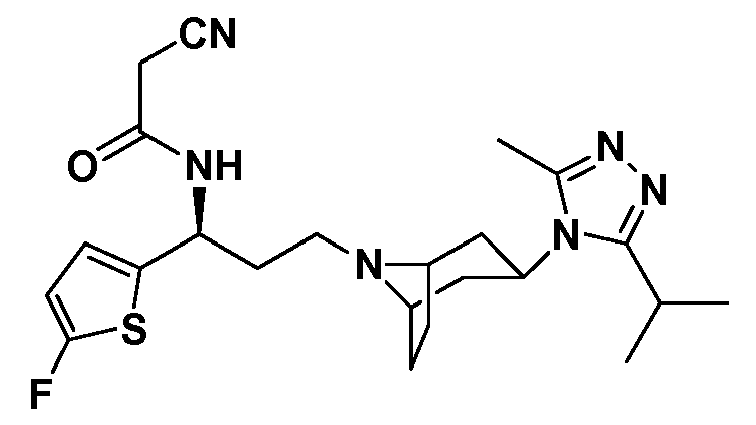
- According to the synthesis method of Example 5, Compound 7-1 was used to replace compound 2-1 in Example 5, compound 2f was used to replace compound If in Example 5 and 2-cyanoacetic acid was used to replace 4,4-difluoro-cyclohexanecarboxylic acid in Example 5 to obtain compound 169, MS: 458.3[M+H]+.1H-NMR(400Hz, CDCl3): δ7.48 (t, 1H), 7.37 (d, 1H), 5.21 (m, 1H), 3.95 (m, 1H), 3.32 (s, 2H), 3.03 (m, 1H), 2.40 (m,2H), 2.25-1.67 (m,14H), 1.32 (d, 6H).
-

- According to the synthesis method of Example 5, Compound 32-1 was used to replace compound 2-1 in Example 5, compound 2f was used to replace compound If in Example 5 and cyclohexanecarboxylic acid was used to replace 4,4-difluoro-cyclohexanecarboxylic acid in Example 5 to obtain compound 170, MS: 542.2[M+H]+.1H-NMR(400Hz, CDCl3): δ6.43(m,2H), 5.79 (m, 1H), 3.91 (m, 1H), 3.02 (m, 1H), 2.43 (m,5H), 2.28(s, 3H), 2.16-1.93 (m,13H), 1.93-1.61 (m, 10H), 1.36 (d, 6H).
-

- According to the synthesis method of Example 5, Compound 33-1 was used to replace compound 2-1 in Example 5, compound 2f was used to replace compound If in Example 5 and cyclohexanecarboxylic acid was used to replace 4,4-difluoro-cyclohexanecarboxylic acid in Example 5 to obtain compound 171, MS: 555.2[M+H]+.1H-NMR(400Hz, CDCl3): δ6.43(m,2H), 5.79 (m, 1H), 3.91 (m, 1H), 3.02 (m, 1H), 2.93(s, 6H), 2.85(s, 6H), 2.43 (m,5H), 2.16-1.93 (m,13H), 1.93-1.61 (m, 10H), 1.36 (d, 6H).
-

- According to the synthesis method of Example 5, Compound 1-1 was used to replace compound 2-1 in Example 5, compound 2f was used to replace compound If in Example 5 and 2-(1H-tetrazol-1-yl)acetic acid was used to replace 4,4-difluoro-cyclohexanecarboxylic acid in Example 5 to obtain compound 172, MS: 484.3[M+H]+.1H-NMR(400Hz, CDCl3): δ8.73 (s, 1H), 7.23 (t, 1H), 7.15 (d, 1H), 6.99 (d, 1H), 5.21 (m, 1H), 3.95 (m, 1H), 3.42 (s, 2H), 3.03 (m, 1H), 2.40 (m,2H), 2.25-1.67 (m,14H), 1.32 (d, 6H).
- Experiment apparatus: FlexStation II
- Experiment materials: HEK293/CCR5-Gα16 cell line, Fluo-4calcium dye (fluorescent-4 calcium ion dye) and FlexStation instrument.
- Experiment theory: Activation of the receptor can cause the activation of Gα16 protein, thereby activating phospholipase C (PLC) to generate IP3 and DAG by establishing CCR5 and Ga16 co-transfected cell line. IP3 can bind to IP3 receptors on the endoplasmic reticulum and mitochondria in a cell, which can cause the release of intracellular calcium. Thus, determination of changes in intracellular calcium can be used as a method to detect CCR5 activation state. Fluo-4/AM is a fluorescent probe indicator for calcium used to measure calcium ion. As a non-polar lipid-soluble compound, after it enters into cells, AM group is dissociated to release Fluo-4 under the effect of cell lipolysis enzyme. Fluo-4 is a polar molecule and not easy to go through the lipid bilayer membrane, therefore it can stay within the cells for a long time. Ultimately, the level of activated Ga protein can be reflected by measuring the excited fluorescence intensity. If the screened compound can activate CCR5, it can greatly increase the calcium flux reaction; on the contrary, if the screened compound can antagonize CCR5, it can greatly reduce calcium flux reaction.
- Experiment steps:
- 1. HEK293 cells which can stably express CCR5 were inoculated in a 96-well plate and incubated overnight.
- 2. The medium in each well into which cells were innoculated was removed and 40 µl/well of freshly prepared dye was added. The plate was placed in a 37°C incubator and incubated for 40 minutes at constant temperature.
- 3. The medicament to be determined was diluted with calcium buffer to eight concentration gradients, which is 1×10⁻⁴M, 1×10⁻⁵M, 1×10⁻⁶M, 1×10⁻⁷M, 1×10⁻⁸M, 1×10⁻⁹M, 1×10⁻¹⁰M, and 1×10-11M, respectively, and homogeneously mixed.
- 4. The dye was removed. Freshly prepared calcium buffer was used to wash for one time, 50 µl of calcium buffer was added.
- 5. FlexStation II was used for detection. 25 µl of calcium buffer containing the medicament to be determined was added automatically from the 15th second. The fluorescence value at 525 nm was read ultimately.
- Experiment results:
Table 1 The results from Calcium flux inhibition experiment of compounds compound CCR5 compound CCR5 compound CCR5 IC50 (nM) IC50 (nM) IC50 (nM) 1 36.56 39 1.412 139 12.32 2 32.57 42 15.90 140 13.73 3 1.953 43 8.340 141 8.36 4 15.04 64 4.628 142 9.55 5 29.68 65 1.625 143 13.89 6 6.904 66 2.015 144 8.53 7 35.23 70 9.45 145 13.32 8 21.92 73 8.23 146 1.75 9 79.34 88 9.26 147 2.48 10 36.56 112 10.37 148 3.42 13 3.397 113 8.14 149 7.89 14 2.334 114 9.27 150 2.22 15 9.222 115 10.32 151 3.45 16 2.234 116 15.57 152 7.98 17 2.547 117 16.13 153 13.45 18 3.733 118 16.87 154 23.14 19 21.52 119 4.77 155 8.23 20 5.145 120 27.72 156 9.85 21 11.89 121 32.32 157 1.23 22 1.051 122 24.52 158 14.86 23 27.26 123 12.13 159 8.76 24 44.61 124 11.25 160 1.34 25 37.85 125 12.19 161 8.36 26 5.063 126 21.97 162 1.85 27 11.42 127 22.94 163 13.32 28 68.02 128 17.52 164 7.38 29 7.282 129 14.2 165 8.29 30 24.04 130 18.51 166 6.54 31 9.763 131 6.57 167 7.98 32 8.354 132 22.2 168 1.54 33 25.01 133 1.785 169 6.32 34 143.4 134 22.13 170 1.38 35 270.4 135 8.279 171 1.64 36 31.78 136 22.13 172 9.385 37 9.334 137 8.23 Maraviroc 7.385 38 9.331 138 9.75 PF-232798 8.290 Note: The structures of PF-232798 and Maraviroc used as positive control compounds (similarly hereinafter) are as follows: 
- Experiment conclusion: It can be seen from the data in table 1 that all of the compounds have good calcium influx inhibition effects, wherein, compound 3, 6, 13, 14, 16, 17, 18, 20, 22, 26, 29, 39, 64, 65, 66, 119, 123, 124, 131, 133, 146, 147, 148, 150, 151, 157, 160, 162, 164, 166, 168, 169, 170, 171 and 172 are better than the positive control compounds, and compound 15, 21, 27, 31, 32, 37, 38, 135, 137, 138, 141, 142, 149, 152, 155, 156, 159, 161, 165 and 167 are comparable to the positive control compounds.
- Experimental theory: many cysteines are present in CCR5 protein sequence. Cysteines located in loop region form disulfide bonds to stabilize the tertiary structure of the protein. Some free cysteines in reduced state are located in the transmembrane region. Under excitation by incident light of 387 nm, the combination of free sulfhydryl and fluorescent dye CPM can emit excitation light of 436 nm. If the temperature is gradually increased artificially, the tertiary structure of the membrane protein gradually become loose as the temperature rises. The free sulfhydryls originally located in the transmembrane region expose and combine with the fluorescent dye. And then the detector will detect changes in signal enhancement. Therefore, the thermal stability of membrane proteins can be determined according to the temperature (Tm) at the midpoint of changes in signal intensity.
- Experimental steps: Upon preliminary purification, the obtained protein solution was transferred into a small concentration tube (100kd, 500ul) for concentration (1000 rcf, 12 min, 4 °C). After centrifugation, the concentration tube was taken out and flicked to prevent protein coagulation due to high local concentration. The final concentrated volume was about 50 µl. 117 µl of purified solution (volume is suitable to make the total volume up to 120 µl), 1 µl fluorescent dye cpm (in-house prepared) and 2 µl of concentrated protein solution (the amount of added protein is 3-5 µg according to the calculated concentration of the protein solution and the concentrated volume) were added to 2 ml Ependorf tube and incubated at room temperature for 20min. And then the mixture was added to the cuvette (Qwan) and put in the testing equipment Cary, wherein the surface of the frosted glass faced out. The temperature was set in the range of 4-90°C with 1°C increase per minute and the program was run. Tm value can be obtained by processing the data and graph with a mapping software and can be used to compare the difference of protein thermal stability under different conditions.
Table 2 The results of effects of compounds on thermal stability of protein compound Tm (°C) compound Tm (°C) compound Tm (°C) 1 60.59 10 63.21 21 64.68 2 65.23 13 65.32 22 68.21 3 67.71 14 68.10 23 63.90 4 65.64 15 64.30 24 62.31 5 57.31 16 71.32 25 62.31 6 58.56 17 66.97 26 71.02 7 57.21 18 71.73 Maraviroc 72.17 8 60.61 19 69.20 9 61.32 20 70.27 - It can be seen from table 2 that all compounds have good protein stability effect, wherein compound 16, 18, 20 and 26 are comparable with the positive control compound.
- Phosphate buffered saline (PBS), Streptomycin sulfate, HEPES (N-2 (2-Hydroxyothyl) piperazine-N'-(2-ethanesufonic acid), MTT (3,(4,5-Dimethylthiazol-2-yl)-2,5-diphenyl tetrazolium bromide), Penicillin, Glutamine, 2-Mercaptoethanol, RPMI-1640, RPMI-1640 complete medium and fetal bovine serum (FBS).
- The virus was titrated according to the modified method of Johnson & Byington. Briefly, the HIV-1 stock solution was subject to four-fold dilution in a 96-well plate (ten gradients) sextuplicate for each gradient, while setting six control-wells. Into each well was added 100 µl (5×10⁶/ ml) PHA-stimulated PBMC cells and final volume per well was 200 µl. The cells were cultured at 37°C with 5% CO2. On the third day, 100 µl of fresh RPMI-1640 complete medium was supplemented. On the seventh day, the infected supernatant was collected and lysed with 0.5% Triton X100. The p24 antigen was detected by ELISA and TCID50 of virus was calculated according to Reed & Muench method (50% Tissue culture infection dose).
- The compound to be tested was subject to 5-fold dilution in a 96-well microtiter plate with RPMI-1640 or DMEM complete medium (containing 10% FBS) (Six dilution) triplicate for each dilution and 100µl for each well. While wells not containing drugs were set as control. Into each well was added 100 µl of 4×10⁵/ml PM1, HOS-CD4-CCR5 cells or 100 µl of 5×10⁶/ ml PHA stimulated PBMC. The cells were cultured at 37°C with 5% CO2 for three days (PBMC cells were cultured for seven days and 100 µl of fresh RPMI-1640 complete medium was supplemented on the third day). Cytotoxicity was tested with MTT assay. OD values were measured by ELx800 microplate reader. The detection wavelength was 570nm, and the reference wavelength was 630nm. CC50 values were calculated (50% Cytotoxic concentration).
- On the day before the test, 1×10⁵/ml of HOS-CD4-CCR5 cells were inoculated in 96-well plates with 100 µl for each well. The compound to be tested was subject to 5-fold dilution in 96-well microtiter plate with DMEM complete medium (containing 10% FBS). The starting concentration was 1 µM and six dilutions were obtained. Triplicate wells were set for each dilution and each well contained 100µl mixture. While wells not containing drugs were set as control. The supernatant was removed and 100µl of drug was added and incubated for 2h. Then 100µl of HIV-1SF162 and HIV-1Ba-L were added to dilute supernatant. The cells were infected for 1h, free virus was washed out and drug with the same final concentration was added. MVC was used as positive control. The cells were cultured at 37°C with 5% CO2 for three days. The supernatant was collected, lysed and inactivated with 0.5% Triton X-100. The inhibition effect of drug on HIV-1 replication was detected using p24 antigen capture ELISA method.
- The compound to be tested was subject to 5-fold dilution in 48-well plate with RPMI-1640 complete medium (containing 10% FBS). The starting concentration was 1 µM, six dilutions were obtained, and each well contained 200µl mixture. While wells not containing drugs were set as control. Virus (MOI = 0.01) was added to 5×10⁶/ml of PBMC cells which have been stimulated by PHA for 72h. After homogeneously mixed, the mixture was immediately added to 48-well plate containing diluted drug and each well was added with 200 µl of mixture. MVC was used as positive control. The cells were cultured at 37°C with 5% CO2 for seven days (drug with the same concentration was added on the third day). The supernatant was collected, lysed and inactivated with 0.5% Triton X-100. The inhibition effect of drug on HIV-1 replication was detected using p24 antigen capture ELISA method.
-
Table 3 Inhibition activities of compounds on TZM-bl cells infected with HIV-1SF162 virus strain compound CC50(µg/mL) EC50(µg/mL) therapeutic index (TI) 1 >100 0.29 >340.14 2 >100 0.326 >306.75 3 >100 0.0024 >41666.67 4 42.761 1.46 29.29 6 >100 1.51 66.23 7 >100 2.34 50.31 8 >100 2.69 >37.17 9 >100 1.81 55.42 10 >100 1.42 >70.42 13 >100 0.18296 >1093.14 14 >200 0.00359 >55710.31 15 >200 0.31602 >632.87 16 >200 0.01179 >16963.53 17 >200 0.01295 >15444.02 18 >200 0.00123 >162601.63 19 85.74 0.00959 8940.56 20 69.68 0.00487 14308.01 21 >200 0.14993 >1333.96 22 >200 0.00153 >130718.95 23 >200 0.06001 >3332.78 25 >200 0.16801 >1190.41 26 >200 0.00558 >35842.29 27 96.141 0.511 188.14 28 >200 >40 - 29 >200 0.012 >16666.67 30 >200 0.060 >2150.54 31 >200 0.033 >5714.29 32 >200 >40 - 33 >200 0.147 >328.95 34 >200 >40 - 35 >200 >40 - 36 >200 >40 - 37 >200 0.647 >309.12 38 >200 2.610 >73.64 39 >200 1.020 >196.08 118 >200 0.669 >168.03 119 >200 0.738 >270.84 120 >200 0.831 >240.76 121 >200 0.328 >386.37 122 >200 0.690 >290.06 125 >200 0.286 >699.27 126 >200 0.091 >2207.68 127 >200 0.145 >1379.94 128 >200 0.174 >1150.82 129 >200 0.072 >1526.72 130 >200 0.053 >2562.98 131 >200 0.098 >1302.27 132 >200 0.097 >2063.25 133 >200 0.152 >1313.56 134 >200 0.113 >1772.41 135 >200 0.155 >1222.11 136 >200 0.011 >4834.51 Maraviroc >200 0.00814 24570 - Experimental conclusion: It can be seen from the data shown in the above tablethat for TZM-bl cells infected with HIV-1SF162 virus strain, compounds of the present invention exhibit lower cytotoxicity in vitro and higher therapeutic index, wherein compounds 3, 14, 18, 22 and 26 are better than positive control compound, and compounds 16, 17, 20 and 29 are comparable with the positive control compound.
Table 4 Inhibition activities of compounds on PBMC cells infected with HIV-1SF162 virus strain compound EC50 (ng/mL) CC50(µg/mL) therapeutic index (TI) 3 145.81 273.30 1874 14 1.58 267.79 169487 16 455.15 266.85 586.3 17 41.29 438.58 10621 18 92.74 345.12 3721 22 2.65 634.56 239456 29 5.05 >200 >39604 - Experimental conclusion: It can be seen from the data shown in the above table that for PBMC cells infected with HIV-1SF162 virus strain, compounds of the present invention exhibit lower cytotoxicity in vitro and higher therapeutic index, wherein compounds 14, 22 and 29 have relatively higher therapeutic index, and the therapeutic index of compound 22 even reaches 239456.
Table 5 Inhibition activities of compounds on PBMC cells infected with HIV-1KM018 virus strain compound EC50 (ng/mL) CC50(µg/mL) therapeutic index (TI) 3 15.66 273.30 17452.1 14 3.77 267.79 71031.8 16 554.66 266.85 481.1 17 >1000 438.58 <438.6 18 69.93 345.12 4935.2 22 5.33 634.56 119054.4 29 103.24 >200 1937.2 - Experimental conclusion: It can be seen from the date shown in the above table that for PBMC cells infected with HIV-1KM018 virus strain, compounds of the present invention have lower cytotoxicity in vitro and higher therapeutic index, wherein compounds 3, 14 and 22 have relatively higher therapeutic index, and the therapeutic index of compound 22 even reaches 119054.4.
Table 6 Inhibition activities of compounds on PBMC cells infected with HIV-1Ba-L virus strain compound EC50 (ng/mL) CC50(µg/mL) therapeutic index (TI) 3 91.25 273.30 3328.9 14 19.72 267.79 13579.6 16 364.55 266.85 1301.1 17 847.67 438.58 438.6 18 289.12 345.12 2266.5 22 5.13 634.56 123695.9 29 235.84 >200 818.3 - Experimental conclusion: It can be seen from the date shown in the above table that for PBMC cells infected with HIV-1Ba-L virus strain, compounds of the present invention have lower cytotoxicity in vitro and higher therapeutic index, wherein compounds 14 and 22 have relatively higher therapeutic index, and the therapeutic index of compound 22 even reach 123695.9.
Table 7 Inhibition activities of compounds on HOS-CD4+-CCR5 cells infected with HIV-1Ba-L virus strain compound EC50 (ng/mL) CC50(µg/mL) therapeutic index (TI) 3 17.15 334.35 19495 14 0.74 369.63 499500 16 10.46 343.09 32800 17 15.52 439.04 28288 18 3.40 506.78 149052 22 4.83 >800 >165631 29 21.87 >200 >9144 - Experimental conclusion: It can be seen from the data shown in the above table that for HOS-CD4+-CCR5 cells infected with HIV-1Ba-L virus strain, compounds of the present invention have lower cytotoxicity in vitro and higher therapeutic index, wherein compounds 14, 16, 17, 18 and 22 have relatively higher therapeutic index, and the therapeutic index of compound 14 even reach 499500.
Table 8 Inhibition activities of compounds on HOS-CD4+-CCR5 cells infected with HIV-1SF162 virus strain compound EC50 (ng/mL) CC50(µg/mL) therapeutic index (TI) 3 24.45 334.35 13674 14 13.06 369.63 28302 16 42.66 343.09 8042 17 50.86 439.04 8632 18 20.31 506.78 24952 22 9.15 >800 >87431 29 18.59 >200 >10758 - Experimental conclusion: It can be seen from the data shown in the above table that for PBMC cells infected with HIV-1Ba-L virus strain, compounds of the present invention have lower cytotoxicity in vitro and higher therapeutic index, wherein compounds 3, 14, 18, 22 and 29 have relatively higher therapeutic index, and the therapeutic index of compound 14 even reach 28302.
- Fetal calf serum (Gibco, Cat#10099), hygromycin B (Invitrogen, Cat#B13871010), FluxOR™ assay kit (Invitrogen, Cat#F0017), 96-well plate (Corning, Cat#3894), positive control Dofetilide, Cisapride and Maraviroc.
-
- 1. CHO-hERG cells which have been incubated overnight were added with sample buffer and incubated for 90 minutes at room temperature in darkness.
- 2. The sample buffer was removed and assay buffer was added.
- 3. The compound is added to the cell plate and incubated for 20 minutes in darkness.
- 4. Cell plate was placed into FDSS. The fluorescence signal was recorded every second for 10 seconds. Exciting buffer was added to the cells at the 10th second and the fluorescence signal was recorded every second for 180 seconds
- 5. Data were processed.
-
Table 9 Results of hERG inhibition activity assay for compounds compound IC50 (µM) compound IC50 (µM) compound IC50 (µM) 8 >40 22 10.58 103 3.47 12 9.45 26 3.51 107 >40 14 3.1 29 8.44 Dofetilide 0.09 16 3.02 43 1.36 Cisapride 0.19 18 1.89 65 0.84 Maraviroc 7.75 20 14.42 101 0.81 - Experiment conclusion: It can be seen from the data shown in the above table that compounds of the present invention have weaker hERG inhibition activity, wherein hERG inhibition activities of compounds 8, 12, 20, 22, 29 and 107 are better that those of positive control compounds.
- 1. Experiment steps:
- Six healthy male rats with weight of 150-200 g were randomly divided into 2 groups with 3 rats for each group. The rats in each group were administrated by gavage or intravenous injection with compounds 14, 16, 17, 18, 22 and 29, respectively. The administration volume was 10 mL/kg and drug was formulated with DMSO/Tween 80/physiological saline (5: 5: 90, v/v/v). The rats were fasted for 12 h and can drink water ad libitum before test. 2 h after dosing, the rats ate together.
- Intragastric administration: 0.25, 0.5, 1.0, 2.0, 4.0, 6.0, 8.0 and 24 h after administration.
- Intravenous administration: 5 min, 0.25, 0.5, 1.0, 2.0, 4.0, 6.0, 8.0 and 24 h after administration.
- At above time points, 0.3 ml of venous blood was taken from retrobulbar venous plexus of the rat and loaded into EDTA-2K anticoagulative tube. After centrifuged at 11000 rpm for 5 min, the plasma was separated and frozen at -20°C in a refrigerator.
- The concentration of each compound in rat plasma was determined by LC/MS/MS.
- The pharmacokinetic parameters after administration were calculated by using non-compartment model of WinNonlin 5.3 software (Pharsight Corporation, USA).
-
Table 10 Pharmacokinetic experiment results of rats in vivo compound Route Dose mg/kg T max h C max ng/mL AUC0-t ng/mL*h AUC0-∞ ng/mL*h MRT h t1/2 h CLz L/h/kg F % 14 gavage 20 4 266.2 1108 1190 3.33 2.12 / 7.85% vein 10 0.25 6841 7053 7055 0.71 0.77 1.42 / 16 gavage 20 0.25 631.3 1512.3 1512.3 2.11 1.16 / 14.8% vein 10 0.25 4316.7 5114.9 5114.9 0.79 0.31 1.96 / 17 gavage 20 0.5 121.8 347.9 364.5 2.31 1.78 / 46.6% vein 10 0.25 245.9 373.5 394.5 1.42 2.22 25.4 / 18 gavage 20 2 690.4 2801.1 3067.8 2.94 2.05 / 90.5% vein 10 0.25 771.1 1547.0 1602.5 1.98 1.81 6.24 / 22 gavage 20 2 306.4 1206 1259 2.55 1.55 / 14.5% vein 10 0.25 3778 4154 4162 0.84 1.00 2.40 / 29 gavage 20 2 580.2 1870.7 2790.3 4.79 32.84 / 40.1% vein 10 0.25 1692.5 2330.2 2330.2 2.29 1.60 4.29 / compound 14: After 20 mg/kg of compound 14 was administered to rats through gavage, Tmax (time for the plasma concentration reaching the peak concentration) is 4 h, the peak concentration Cmax is 266.2 ng/ml, the area below the curve of drug vs time AUC0-t is 1108 ng·h/ml, and the terminal elimination half-life t1/2 is 2.12 h. After 10 mg/kg of compound 14 was administered to rats through vein, AUC0-t is 7053 ng·h/ml. After dose-normalized, absolute bioavailability of 20 mg/kg of compound 14 administrated to rats through gavage is 7.85%.
compound 16: After 20 mg/kg of compound 16 was administered to rats through gavage, Tmax (time for the plasma concentration reaching the peak concentration) is 0.25 h, the peak concentration Cmax is 631.3 ng/ml, the area below the curve of drug vs time AUC0-t is 1512.3 ng·h/ml, and the terminal elimination half-life t1/2 is 1.16 h. After 10 mg/kg of compound 16 was administered to rats through vein, AUC0-t is 5114.9 ng·h/ml. After dose-normalized, absolute bioavailability of 20 mg/kg of compound 16 administrated to rats through gavage is 14.8%.
compound 17: After 20 mg/kg of compound 17 was administered to rats through gavage, Tmax (time for the plasma concentration reaching the peak concentration) is 0.5 h, the peak concentration Cmax is 121.8 ng/ml, the area below the curve of drug vs time AUC0-t is 347.9 ng·h/ml, and the terminal elimination half-life t1/2 is 1.78 h. After 10 mg/kg of compound 17 was administered to rats through vein, AUC0-t is 373.5 ng·h/ml. After dose-normalized, absolute bioavailability of 20 mg/kg of compound 17 administrated to rats through gavage is 46.6%.
compound 18: After 20 mg/kg of compound 18 was administered to rats through gavage, Tmax (time for the plasma concentration reaching the peak concentration) is 2 h, the peak concentration Cmax is 690.4 ng/ml, the area below the curve of drug vs time AUC0-t is 2801.1 ng·h/ml, and the terminal elimination half-life t1/2 is 2.05 h. After 10 mg/kg of compound 18 was administered to rats through vein, AUC0-t is 1547.0 ng·h/ml. After dose-normalized, absolute bioavailability of 20 mg/kg of compound 18 administrated to rats through gavage is 90.5%.
compound 22: After 20 mg/kg of compound 22 was administered to rats through gavage, Tmax (time for the plasma concentration reaching the peak concentration) is 2 h, the peak concentration Cmax is 306.4 ng/ml, the area below the curve of drug vs time AUC0-t is 1206 ng·h/ml, and the terminal elimination half-life t1/2 is 1.55 h. After 10 mg/kg of compound 22 was administered to rats through vein, AUC0-t is 4154 ng·h/ml. After dose-normalized, absolute bioavailability of 20 mg/kg of compound 22 administrated to rats through gavage to the rat is 14.5%.
compound 29: After 20 mg/kg of compound 29 was administered to rats through gavage, Tmax (time for the plasma concentration reaching the peak concentration) is 2 h, the peak concentration Cmax is 580.2 ng/ml, the area below the curve of drug vs time AUC0-t is 1870.7 ng·h/ml, and the terminal elimination half-life t1/2 is 32.84 h. After 10 mg/kg of compound 29 was administered to rats through vein, AUC0-t is 2330.2 ng·h/ml. After dose-normalized, absolute bioavailability of 20 mg/kg of compound 29 administrated to rats through gavage to the rat is 40.1%. - Experimental conclusion: It can be seem from the above test results that in the pharmacokinetic experiment of rats, compound 18 exhibits excellent absolute bioavailability which reach 90.5%; and compounds 17 and 29 exhibit good absolute bioavailability which reach 46.6% and 40.1%, respectively and is much higher than that of Mara Calvino MVC which has been marketed (only 5% bioavailability as reported).
- Six healthy male Beagles with the weight of 9-11 kg were randomly divided into 2 groups with 3 in each group. The Beagles in each group were administrated by gavage or intravenous injection with compound 22 of the present invention. The administration volume was 2 mL/kg and 1 mL/kg, respectively. The compound was suspended in 20% PEG400 (4: 96) for gavage and formulated in DMSO/Tween 80/physiological saline (5: 1: 94, v/v/v) for intravenous injection. The Beagles were fasted for 12 h and can drink water ad libitum before test. 2 h after dosing, all of Beagles ate together.
- Intragastric administration: 0.25, 0.5, 1.0, 2.0, 4.0, 6.0, 8.0 and 24 h after administration.
- Intravenous administration: 5 min, 0.25, 0.5, 1.0, 2.0, 4.0, 6.0, 8.0 and 24 h after administration.
- At above time points, 0.6 ml venous blood was taken from limb venous and loaded into EDTA-2K anticoagulative tube. After centrifuged at 11000 rpm for 5 min, the plasma was separated and frozen at -20°C in a refrigerator.
- The concentration of compound 22 in plasma of Beagles was determined by LC/MS/MS.
- The pharmacokinetic parameters after administration were calculated by using non-compartment model of WinNonlin 5.3 software (Pharsight Corporation, USA).
-
Table 11 Pharmacokinetic experiment results of compound in Beagles compound Route Dose mg/kg T max h C max ng/mL AUC0-t ng/mL*h AUC0-∞ ng/mL*h MRT h t1/2 h CLz L/h/kg F % 22 gavage 15 0.833 4613 5426 5520 2.11 3.89 / 9.98% vein 3 / / 10877 10889 1.65 1.73 0.278 / compound 22: After 15 mg/kg of compound 22 was administered to Beagles through gavage, Tmax (time for the plasma concentration in Beagles reaching the peak concentration) is 0.8333 h, the peak concentration Cmax is 4613 ng/ml, the area below the curve of drug vs time AUC0-t is 5426 ng·h/ml, and the terminal elimination half-life t1/2 is 3.89 h. After 3 mg/kg of compound 22 was administered to Beagles through vein, AUC0-t is 10877 ng·h/ml. After dose-normalized, absolute bioavailability of 15 mg/kg of compound 22 administrated through gavage to rats is 9.98%. - Experimental conclusion: It can be seem from the above test results that in the pharmacokinetic experiment of Beagles, compound 22 exhibits good absolute bioavailability.
- The mutagenic effects of compounds 18 and 22 of the present invention on Salmonella typhimurium strains TA98 and TA100 in non-metabolic activation (-S9) condition were determined. Two strains, TA98 and TA100 were chosen in bacterial reverse mutation assay for compounds 18 and 22. 9 doses containing 1, 3, 10, 30, 100, 300, 1000, 3000 and 5000 µg/dish, negative and positive controls were set in experiments. 3 dishes were used for each dose. The experiment was carried out under -S9 condition.
- Compounds 18 and 22 at each dose did not increase the number of revertant colonies of TA98 and TA100 and no significant bacteria toxicity was observed at each dose. It can be concluded that compounds 18 and 22 have no mutagenic effect on Salmonella typhimurium strains TA98 and TA100.
Table 12 The number of revertant colonies of Salmonella typhimurium TA98 and TA100 under compounds 18 and 22 (-S9) Group and dose (µg/dish) number of revertant colonies (Mean± SD) TA98 TA100 18 22 18 22 Negative control 24±2.5 24±2.5 105±5.5 105±5.5 1 24±5.0 23±3.2 116±9.0 107±16.7 3 23±2.6 24±3.6 96±10.0 109±9.3 10 20±2.3 23±2.6 95±13.1 112±10.7 30 19±1.5 21±5.2 100±8.3 90±11.0 100 15±4.6 23±6.7 88±0.6 97±4.6 300 20±4.2 23±6.5 91±18.2 102±2.9 1000 18±1.5 19±6.4 106±17.6 90±6.5 3000 21±1.5 22±5.0 108±6.9 86±13.1 5000 20±4.9 25±7.2 95±7.2 109±17.5 Positive control* 999±145.2 999±145.2 1231±146.1 1231±146.1 *TA98: 2-Nitroflucrene (20 µg/dish); TA100: Methyl methanesulfonate (1300 µg /dish) - Experimental conclusion: It can be seen from the above test results that compounds 18 and 22 have no mutagenic effect on Salmonella typhimurium strains TA98 and TA100 under the present experiment conditions.
- VividR CYP450 Screening Kits, and Envision 2101 multifunction microplate reader, etc.
- VividR CYP450 Screening Kits can be used to evaluate the effects on CYP450 subtypes (CYP1A2, CYP2D6, CYP2C9, CYP2C19, CYP3A4-T and CYP3A4-M) and the substrate VividR in the kit can be metabolizd to a product which can emit strong fluorescence in an aqueous solution by specific CYP450 enzymes.
-
- 1. The compounds to be tested and positive compound were added to corresponding wells and DMSO was added to control wells.
- 2. CYP450 enzyme was added to the compounds to be tested, positive compound and DMSO control wells. The enzyme dilution was used to replace enzyme and added to DMSO wells as test background. The mixture was vibrated and mixed for 1 minute, and then incubated at room temperature for 20 minutes.
- 3. NADP+ regeneration system and the substrate were added to initiate the reaction and incubated at room temperature for 60 minutes.
- 4. Envision 2101 multifunction microplate reader was used to record the fluorescence signal under the conditions of 480nm excitation and 530nm emission.
-

- Experimental conclusion: IC50 values of inhition activities of compounds 16, 17, 18, 22 and 29 on six subtypes of CYP450 are greater than 10 µM. The inhition activities of compounds are quite weak and better than that of Maraviroc.
- After compounds 18 and 22 of the present invention were administrated to SD rats through gavage for 4 consecutive days, the toxic reaction was preliminarily assessed to confirm the possible target organ of toxic reaction.
- Four dose groups containing 100 and 1000mg / kg of compound 18, 100 and 1000 mg/kg of compound 22 were set. One vehicle control group was set. Each group contained four rats including two male rats and two female rats. During the experiment stage, the animals were daily clinically observated. The body weight was regularly measured. On the 5th day, all animals were subject to pathological examination and gross anatomy.
- Compared with the animals in vehicle control group, the weight gain of some male and female animals in compound 18 (100 and 1000 mg/kg) and compound 22 (100 and 1000 mg/kg) dose group increased slowly or exhibited negative growth. Clinical observations, clinical pathology detection (hematology and serum biochemistry) and macroscopic morphological observation showed no significant drug-related changes.
- Experiment conclusion: In summary, under the conditions of this experiment, No Observed Adverse Effect Level (NOAEL) is 1000 mg/ kg for SD rats which have been administrated with compoumd 18 through gavage for 4 days, and NOAEL is 1000 mg/ kg for SD rats which have been administrated with compoumd 22 through gavage for 4 days. Thus, the compounds have good safety.
- All documents referred to in the present invention are incorporated by reference as if each reference is cited alone as a reference in the present application. In addition, it should be understood that after reading the teachings of the present invention described above, a skilled person in the art can make various changes or modifications of the invention, and these equivalent forms also fall into the scope as defined by the appended claims of the present application.
Claims (10)
- A compound of formula I, a pharmaceutically acceptable salt, enantiomer, diastereoisomer, racemate or mixture thereof,
 W is absent or -CH2CH2-;X is N or CR6;R1 is selected from a 5 to 7-membered heteroaryl unsubstituted or substituted with 1-3 substituents, wherein said heteroaryl contains 1 to 3 heteroatoms selected from oxygen, sulfur or nitrogen and each of said substituents is independently selected from a halogen, a C1-C4 straight or branched alkyl, a C1-C4 straight or branched haloalkyl, a C1-C4 straight or branched alkyloxy, a C1-C4 straight or branched chain haloalkoxy, -NR10R11, -C(=O)R12, a C1-C4 straight or branched alkanoyloxy, a cyano, a nitro and a hydroxy, or two adjacent substituents together with the attached carbon atom form a 5-7 membered ring;each of R10 and R11 is independently selected from a group consisting of H, a C1-C4 straight or branched alkyl and -C(=O)R13;R12 is selected from a group consisting of a C1-C4 straight or branched alkyl, a C1-C4 straight or branched alkyloxy, a hydroxyl, an amino (NH2) and a C1-C4 straight or branched alkylamino;R13 is selected from a group consisting of H and a C1-C4 straight or branched alkyl;R2 is selected from the following groups unsubstituted or substituted with 1-3 substituents: a C1-C6 straight or branched alkyl, a C3-C7 cycloalkyl, a 4 to 7-membered heterocyclic group, a C6-C12 aryl or a 5-7 membered heteroaryl; wherein, said substituent is selected from a group consisting of a halogen, a hydroxy, a C1-C4 straight or branched alkyl, a C1-C4 straight or branched haloalkyl, a C1-C4 straight or branched alkyloxy, a C1-C4 straight or branched alkyl carbonyl, a C1-C4 straight or branched haloalkoxy, a C1-C4 straight or branched alkylsulfonyl group, a C1-C4 straight or branched alkylsulfonylcarbamoyl, a tetrazolyl, a cyano, a nitro, an amino, a carboxy, a phenyl and a phenoxy;each of R3, R4 and R5 is independently selected from a group consisting of H, a C1-C6 straight or branched alkyl and a C3-C7 cycloalkyl;R6 is selected from a group consisting of H and a C1-C6 straight or branched alkyl; alternatively, R5 and R6 may bind together with

 R7 is selected from a group consisting of H, C(=O)R8, C(=O)OR8, C(=O)NR8R9, SO2R8 and the following groups substituted by 1-3 substituents: a C1-C6 straight or branched alkyl, a C3-C7 cycloalkyl, a 4 to 7-membered heterocyclic group, a benzyl, a C6-C12 aryl and a 5-7 membered heteroaryl; wherein said substituent is selected from a halogen, a hydroxy, a C1-C4 straight or branched alkyloxy, a C1-C4 straight or branched alkyl, a C1-C4 straight or branched haloalkyl, a C1-C4 straight or branched haloalkoxy, a cyano, a nitro, an amino and a carboxyl;each of R8 and R9 is independently selected from a group consisting of a hydrogen and the following groups unsubstituted or substituted with 1-3 substituents: a C1-C6 straight or branched alkyl, a C3-C7 cycloalkyl, a 4-7 membered heterocyclic group, a benzyl, a C6-C12 aryl and a 5-7 membered heteroaryl; wherein said substituent is selected from a group consisting of a halogen, a hydroxy, a C1-C4 straight or branched alkoxy, a C1-C4 straight or branched alkyl, a C1-C4 straight or branched haloalkyl, a C1-C4 straight or branched haloalkoxy, a cyano, a nitro, an amino, and a carboxyl.
 - The compound according to claim 1, a pharmaceutically acceptable salt, enantiomer, diastereoisomer, racemate or mixture thereof, wherein,
R1 is selected from the following groups unsubstituted or substituted with 1-3 substituents:
each of R10 and R11 is independently selected from a group consisting of H, a C1-C2 alkyl and -C(=O)R13;
R12 is selected from a group consisting of a C1-C2 alkyl, a C1-C2 alkoxy, a hydroxy, an amino (NH2) and a C1-C2 alkylamino;
R13 is selected from a group consisting of H and a C1-C2 straight or branched alkyl;
R2 is selected from the following groups unsubstituted or substituted with 1-3 substituents: a C1-C4 straight or branched alkyl, a C3-C7 cycloalkyl, a 4-7 membered heterocyclic group and a phenyl, wherein, said substituent is selected from a group consisting of a halogen, a hydroxy, a C1-C4 straight or branched alkyl, a C1-C4 straight or branched haloalkyl, a C1-C4 straight or branched alkoxy, a C1-C4 straight or branched alkylcarbonyl, a C1-C4 straight or branched haloalkoxy, a C1-C4 straight or branched alkylsulfonyl, a C1-C4 straight or branched alkylsulfonylcarbamoyl, a tetrazolyl, a cyano, a nitro, an amino, a carboxyl, a phenyl, a halophenyl, a phenoxy and a halophenoxy; more preferably, R2 is selected from a C1-C4 straight or branched alkyl, a cyclopropyl, a cyclobutyl, a cyclopentyl, a cyclohexyl, a tetrahydropyran-4-yl, a 1-methylpiperidin-4-yl, 1-acetylpiperidin-4-yl, 1-methylsulfonylpiperidin-4-yl,

each of R3, R4 and R5 is independently selected from a group consisting of H, a C1-C4 straight or branched alkyl and a C3-C7 cycloalkyl; more preferably, each of R3, R4 and R5 is independently selected from a group consisting of H, a methyl, an ethyl, an n-propyl, an isopropyl, an n-butyl, a sec-butyl, a tertiary butyl, a cyclopropyl, a cyclobutyl, a cyclopentyl and a cyclohexyl; most preferably, each of R3, R4 and R5 is independently selected from a group consisting of H, a methyl, an ethyl, an n-propyl, an isopropyl, an n-butyl, a sec-butyl, a tertiary butyl and a cyclopropyl;
R6 is selected from a group consisting of H and a C1-C4 straight or branched alkyl, more preferably R6 is selected from a group consisting of H, a methyl and an ethyl;
or R5 and R6 can bind together with

each of R8 and R9 is independently selected from a group consisting of H and the following groups unsubstituted or substituted with 1-3 substituents: a C1-C4 straight or branched alkyl, a C1-C4 straight or branched haloalkyl, a C3-C7 cycloalkyl, a 4-7 membered heterocyclic group, a benzyl, a phenyl and a 5-7 membered heteroaryl, wherein, said substituent is selected from a group consisting of a halogen, a hydroxy, a C1-C4 straight or branched alkoxy, a C1-C4 straight or branched alkyl, a C1-C4 straight or branched haloalkyl, a C1-C4 straight or branched haloalkoxy, a cyano, a nitro, an amino and a carboxyl, preferably from a group consisting of halogen, a hydroxy, a methoxy, an ethoxy, a methyl, an ethyl, a trifluoromethyl, a trifluoromethoxy, a cyano, a nitro, an amino and a carboxyl; preferably, each of R8 and R9 is independently selected from a group consisting of H, a C1-C4 straight or branched alkyl, a C1-C4 straight or branched haloalkyl, a C3-C7 cycloalkyl, a benzyl and a phenyl; more preferably, each of R8 and R9 is independently selected from a group consisting of a methyl, an ethyl, an n-propyl, a cyclopropyl, an isopropyl, an n-butyl, a sec-butyl and a tert-butyl. - The compound according to claim 1, a pharmaceutically acceptable salt, enantiomer, diastereoisomer, racemate or mixture thereof, wherein, the compound of formula I is selected from the following compounds:

- The compound according to claim 3, a pharmaceutically acceptable salt, enantiomer, diastereoisomer, racemate or mixture thereof, wherein,
in formula (II),
R1 is selected from the following groups unsubstituted or substituted with 1-3 substituents:
each of R10 and R11 is independently selected from a group consisting of H, a C1-C4 straight or branched alkyl and -C(=O)R13; preferably, each of R10 and R11 is independently selected from a group consisting of H, a C1-C2 alkyl and -C(=O)R13;
R12 is selected from a group consisting of a C1-C4 straight or branched alkyl, a C1-C4 straight or branched alkoxy, a hydroxy, an amino (NH2) and a C1-C4 straight or branched alkylamino; preferably, R12 is selected from a group consisting of a C1-C2 alkyl, a C1-C2 alkoxy, a hydroxy, an amino (NH2) and a C1-C2 alkylamino;
R13 is selected from a group consisting of H and a C1-C4 straight or branched alkyl; preferably, R13 is selected from a group consisting of H and a C1-C2 straight or branched alkyl;
R2 is selected from the following groups unsubstituted or substituted with 1-3 substituents: a phenyl, a C1-C4 straight or branched alkyl and a C3-C7 cycloalkyl, wherein, said substituent is selected from a group consisting of a halogen, a hydroxy, a C1-C4 straight or branched alkyl, a C1-C4 straight or branched haloalkyl, a C1-C4 straight or branched alkoxy, a C1-C4 straight or branched alkylcarbonyl, a C1-C4 straight or branched haloalkoxy, a C1-C4 straight or branched alkylsulfonyl, a C1-C4 straight or branched alkylsulfonylcarbamoyl, a tetrazolyl, an amino, a phenyl, a halophenyl, a phenoxy and a halophenoxy; more preferably, R2 is selected from a group consisting of a methyl, an ethyl, a cyclopropyl, a cyclobutyl, a cyclopentyl, a cyclohexyl, a tetrahydropyran-4-yl, 1-methylpiperidin-4-yl, 1-acetylpiperidin-4-yl, 1-methylsulfonylpiperidin-4-yl,
each of R3, R4 and R5 is independently selected from a group consisting of H and a C1-C4 straight or branched alkyl; more preferably, each of R3, R4 and R5 is independently selected from a group consisting of H and a methyl, an ethyl, an n-propyl, an isopropyl, an n-butyl, a sec-butyl and a tert-butyl; most preferably, each of R3, R4 and R5 is independently selected from a group consisting of H, a methyl, an ethyl, an n-propyl and an isopropyl;
in formula (III),
R1 is selected from the following groups unsubstituted or substituted with 1-3 substituents:
each of R10 and R11 is independently selected from a group consisting of H, a C1-C4 straight or branched alkyl and -C(=O)R13; preferably, each of R10 and R11 is independently selected from a group consisting of H, a C1-C2 alkyl and -C(=O)R13;
R12 is selected from a group consisting of a C1-C4 straight or branched alkyl, a C1-C4 straight or branched alkoxy, a hydroxy, an amino (NH2) and a C1-C4 straight or branched alkylamino; preferably, R12 is selected from a group consisting of a C1-C2 alkyl, a C1-C2 alkoxy, a hydroxy, an amino (NH2) and a C1-C2 alkylamino;
R13 is selected from a group consisting of H and a C1-C4 straight or branched alkyl; preferably, R13 is selected from a group consisting of H and a C1-C2 straight or branched alkyl;
R2 is selected from the following groups unsubstituted or substituted with 1-3 substituents: a C1-C4 straight or branched alkyl and a C3-C7 cycloalkyl, wherein, said substituent is selected from a halogen, a hydroxy, a C1-C4 straight or branched alkyl, a C1-C4 straight or branched haloalkyl, a C1-C4 straight or branched alkoxy, a C1-C4 straight or branched alkylcarbonyl, a C1-C4 straight or branched haloalkoxy, a C1-C4 straight or branched alkylsulfonyl, a C1-C4 straight or branched alkylsulfonylcarbamoyl, a tetrazolyl, a cyano and an amino; more preferably, R2 is selected from a group consisting of a methyl, an ethyl, a cyclopropyl, a cyclobutyl, a cyclopentyl, a cyclohexyl, a tetrahydropyran-4-yl, 1-methylpiperidin-4-yl, 1-acetylpiperidin-4-yl, 1-methylsulfonylpiperidin-4-yl,
each of R3 and R4 is independently selected from a group consisting of H and a C1-C4 straight or branched alkyl; more preferably, each of R3 and R4 is independently selected from a group consisting of H and a methyl, an ethyl, an n-propyl, an isopropyl, an n-butyl, a sec-butyl and a tert-butyl; most preferably, each of R3 and R4 is independently selected from a group consisting of H, a methyl and an ethyl;
R5 and R6 can bind together with

each of R8 and R9 is independently selected from a group consisting of H and the following groups unsubstituted or substituted with 1-3 substituents: a C1-C4 straight or branched alkyl, a C1-C4 straight or branched haloalkyl, a C3-C7 cycloalkyl and a benzyl, wherein, said substituent is selected from a group consisting of a halogen, a hydroxy, a C1-C4 straight or branched alkoxy, a C1-C4 straight or branched alkyl, a C1-C4 straight or branched haloalkyl, a C1-C4 straight or branched haloalkoxy and an amino; preferably from a group consisting of a halogen, a hydroxy, a methoxy, an ethoxy, a methyl, an ethyl, a trifluoromethyl, a trifluoromethoxy and an amino; preferably, each of R8 and R9 is independently selected from a group consisting of H, a C1-C4 straight or branched alkyl, a C1-C4 straight or branched haloalkyl and a C3-C7 cycloalkyl, more preferably, each of R8 and R9 is independently selected from a group consisting of a methyl, an ethyl, an n-propyl, a cyclopropyl, an isopropyl, an n-butyl, a sec-butyl and a tert-butyl. - The compound according to claim 1, a pharmaceutically acceptable salt, enantiomer, diastereoisomer, racemate or mixture thereof, wherein, the compound of formula (I) is selected from the following compounds:


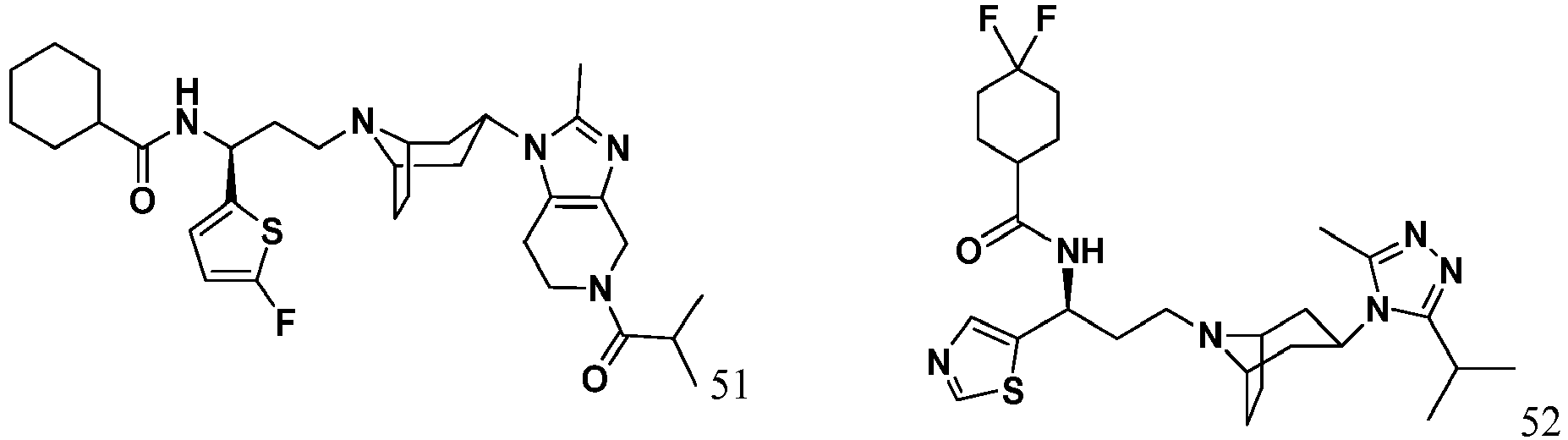


- A method for preparing a compound of formula I, wherein, the method includes the following steps:
 1) Sulfinylimine Compound B is obtained from Compound A throughimidization;2) Compound C is obtained from Sulfinylimine compound B through Mannich reaction;3) Compound D is obtained from Compound C through removal of sulfinyl and t-butyloxycarbonyl (BOC) protection;4) Compound E is obtained from Compound D through ester reduction and oxidation ;5) Compound F is obtained from Compound E and amination reaction;
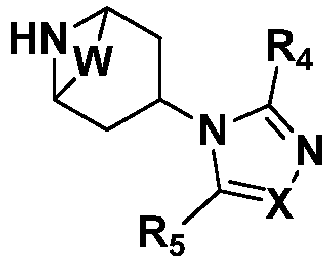 6) Compound F is subjected to deprotection and condensation reaction within each formula, R1, R2, R4, R5, R6, X and W are defined as those in claim 1.
- A pharmaceutical composition comprising one of the compound according to anyone of claims 1-5, a pharmaceutically acceptable salt, enantiomer, diastereoisomer, racemate or mixture thereof; and optionally a pharmaceutically acceptable carrier.
- Use of the compound according to anyone of claims 1-5, a pharmaceutically acceptable salt, enantiomer, diastereoisomer, racemate or mixture thereof in the preparation of a CCR5 antagonist.
- Use of the compound according to anyone of claims 1-5, a pharmaceutically acceptable salt, enantiomer, diastereoisomer, racemate or mixture thereof in the preparation of a medicament for treating CCR5-mediated disease.
- Use of the compound according to anyone of claims 1-5, a pharmaceutically acceptable salt, enantiomer, diastereoisomer, racemate or mixture thereof in the preparation of a medicament for treating HIV infection.
Applications Claiming Priority (2)
| Application Number | Priority Date | Filing Date | Title |
|---|---|---|---|
| CN201310746752.8A CN104744451A (en) | 2013-12-30 | 2013-12-30 | 1-(3-amino propyl) substituted cyclic amine compound as well as preparation method, pharmaceutical composition and use thereof |
| PCT/CN2014/095421 WO2015101265A1 (en) | 2013-12-30 | 2014-12-29 | 1-(3-aminopropyl) substituted cyclic amine compounds, preparation method therefor, and pharmaceutical compositions and uses thereof |
Publications (3)
| Publication Number | Publication Date |
|---|---|
| EP3091013A1 true EP3091013A1 (en) | 2016-11-09 |
| EP3091013A4 EP3091013A4 (en) | 2017-06-07 |
| EP3091013B1 EP3091013B1 (en) | 2018-08-08 |
Family
ID=53493233
Family Applications (1)
| Application Number | Title | Priority Date | Filing Date |
|---|---|---|---|
| EP14877091.0A Active EP3091013B1 (en) | 2013-12-30 | 2014-12-29 | 1-(3-aminopropyl) substituted cyclic amine compounds, preparation method therefor, and pharmaceutical compositions and uses thereof |
Country Status (10)
| Country | Link |
|---|---|
| US (1) | US10167299B2 (en) |
| EP (1) | EP3091013B1 (en) |
| JP (1) | JP6562926B2 (en) |
| KR (1) | KR101850142B1 (en) |
| CN (2) | CN104744451A (en) |
| AU (1) | AU2014375553B2 (en) |
| CA (1) | CA2935494C (en) |
| NZ (1) | NZ722727A (en) |
| RU (1) | RU2671179C2 (en) |
| WO (1) | WO2015101265A1 (en) |
Families Citing this family (3)
| Publication number | Priority date | Publication date | Assignee | Title |
|---|---|---|---|---|
| EP4003972A4 (en) * | 2019-07-23 | 2023-07-12 | Board of Regents, The University of Texas System | CX3CR1 BICYCLIC RECEPTOR AGONISTS |
| US11629196B2 (en) | 2020-04-27 | 2023-04-18 | Incelldx, Inc. | Method of treating SARS-CoV-2-associated hypercytokinemia by administering a human monoclonal antibody (PRO-140) that inhibits CCR5/CCL5 binding interactions |
| CN120131645A (en) * | 2023-12-13 | 2025-06-13 | 中国科学院上海药物研究所 | Uses of 1-(3-aminopropyl) substituted cyclic amine compounds |
Family Cites Families (7)
| Publication number | Priority date | Publication date | Assignee | Title |
|---|---|---|---|---|
| US7217714B1 (en) * | 1998-12-23 | 2007-05-15 | Agouron Pharmaceuticals, Inc. | CCR5 modulators |
| US6511994B2 (en) * | 2000-10-11 | 2003-01-28 | Merck & Co., Inc. | Modulators of CCR5 chemokine receptor activity |
| CA2573951A1 (en) * | 2003-07-18 | 2005-01-27 | Virochem Pharma Inc. | Spiro compounds and methods for the modulation of chemokine receptor activity |
| DK1761542T3 (en) * | 2004-06-09 | 2008-04-28 | Hoffmann La Roche | Octahydropyrrolo [3,4-C] pyrrole derivatives and their use as antiviral agents |
| WO2006136917A1 (en) * | 2005-06-22 | 2006-12-28 | Pfizer Limited | Triazolylpiperidine derivatives and use thereof in therapy |
| EP1963303A2 (en) * | 2005-12-08 | 2008-09-03 | Pfizer Limited | Chemical compounds |
| AU2012273125B2 (en) * | 2011-06-19 | 2017-05-25 | New York University | Leukotoxin E/D as a new anti-inflammatory agent and microbicide |
-
2013
- 2013-12-30 CN CN201310746752.8A patent/CN104744451A/en active Pending
-
2014
- 2014-12-29 NZ NZ722727A patent/NZ722727A/en unknown
- 2014-12-29 AU AU2014375553A patent/AU2014375553B2/en active Active
- 2014-12-29 WO PCT/CN2014/095421 patent/WO2015101265A1/en not_active Ceased
- 2014-12-29 RU RU2016130446A patent/RU2671179C2/en active
- 2014-12-29 JP JP2016543718A patent/JP6562926B2/en active Active
- 2014-12-29 US US15/109,101 patent/US10167299B2/en active Active
- 2014-12-29 CA CA2935494A patent/CA2935494C/en active Active
- 2014-12-29 KR KR1020167021099A patent/KR101850142B1/en active Active
- 2014-12-29 EP EP14877091.0A patent/EP3091013B1/en active Active
- 2014-12-29 CN CN201480071519.7A patent/CN105873924B/en active Active
Also Published As
| Publication number | Publication date |
|---|---|
| RU2671179C2 (en) | 2018-10-29 |
| AU2014375553A1 (en) | 2016-08-18 |
| WO2015101265A1 (en) | 2015-07-09 |
| US10167299B2 (en) | 2019-01-01 |
| JP2017501192A (en) | 2017-01-12 |
| AU2014375553B2 (en) | 2019-05-09 |
| CN105873924B (en) | 2019-11-01 |
| CN104744451A (en) | 2015-07-01 |
| KR20160101192A (en) | 2016-08-24 |
| CA2935494C (en) | 2021-03-30 |
| CN105873924A (en) | 2016-08-17 |
| RU2016130446A (en) | 2018-02-02 |
| EP3091013A4 (en) | 2017-06-07 |
| EP3091013B1 (en) | 2018-08-08 |
| JP6562926B2 (en) | 2019-08-21 |
| US20170044187A1 (en) | 2017-02-16 |
| KR101850142B1 (en) | 2018-04-19 |
| CA2935494A1 (en) | 2015-07-09 |
| NZ722727A (en) | 2020-07-31 |
Similar Documents
| Publication | Publication Date | Title |
|---|---|---|
| KR20030022371A (en) | The use of benzylideneaminoguanidines and hydroxyguanidines as melanocortin receptor ligands | |
| CN111788182B (en) | Antagonist of muscarinic acetylcholine receptor M4 | |
| WO2023042879A1 (en) | Bicyclic heterocyclic derivative having viral growth inhibitory activity and pharmaceutical composition containing same | |
| US10487087B2 (en) | Positive allosteric modulators of the GLP-1 receptor | |
| JP2021503443A (en) | Antagonist of muscarinic acetylcholine receptor M4 | |
| EP3697781B1 (en) | Antagonists of the muscarinic acetylcholine receptor m4 | |
| EA036432B1 (en) | Sulfonamide derivatives and pharmaceutical compositions containing same | |
| TW200838508A (en) | Chemical compounds | |
| CN108929307A (en) | A kind of isoindolone-imide ring -1,3- diketone -2- ene compound, its composition and purposes | |
| JP2020530451A (en) | Antagonist of muscarinic acetylcholine receptor M4 | |
| EP2382215B1 (en) | Derivatives of 2-pyridin-2-yl-pyrazol-3(2h)-one, preparation and therapeutic use thereof | |
| WO2023033098A1 (en) | Bicyclic nitrogen-containing heterocyclic derivative having virus growth inhibitory activity and pharmaceutical composition containing same | |
| EP3091013B1 (en) | 1-(3-aminopropyl) substituted cyclic amine compounds, preparation method therefor, and pharmaceutical compositions and uses thereof | |
| EP3939588A1 (en) | Uses of phosphodiesterase inhibitors | |
| EP2313412B1 (en) | Novel derivatives of pyrroloindole inhibitors of hsp90, compositions containing same, and use thereof | |
| US20240199640A1 (en) | Negative allosteric modulators of metabotropic glutamate receptor 2 | |
| JP4339679B2 (en) | Carboline derivatives as PDE5 inhibitors | |
| MX2007005730A (en) | System and method using enhanced authorization data to reduce travel-related transaction fraud. | |
| HK1227033A1 (en) | 1-(3-aminopropyl) substituted cyclic amine compounds, preparation method therefor, and pharmaceutical compositions and uses thereof | |
| HK1227033B (en) | 1-(3-aminopropyl) substituted cyclic amine compounds, preparation method therefor, and pharmaceutical compositions and uses thereof | |
| Jaiash et al. | Design, synthesis and biological evaluation of new pyrroloazepines with potential and selective antitumor activity | |
| KR101461554B1 (en) | [alpha], [beta] -unsaturated lactone derivatives and uses thereof | |
| CN114159445B (en) | Methods for screening small molecule drugs that inhibit novel coronavirus infection and their applications | |
| CN111217814A (en) | Bipiperidine derivative and application thereof as antitumor drug | |
| CN113861176A (en) | Flavivirus inhibitor |
Legal Events
| Date | Code | Title | Description |
|---|---|---|---|
| PUAI | Public reference made under article 153(3) epc to a published international application that has entered the european phase |
Free format text: ORIGINAL CODE: 0009012 |
|
| 17P | Request for examination filed |
Effective date: 20160729 |
|
| AK | Designated contracting states |
Kind code of ref document: A1 Designated state(s): AL AT BE BG CH CY CZ DE DK EE ES FI FR GB GR HR HU IE IS IT LI LT LU LV MC MK MT NL NO PL PT RO RS SE SI SK SM TR |
|
| AX | Request for extension of the european patent |
Extension state: BA ME |
|
| RAP1 | Party data changed (applicant data changed or rights of an application transferred) |
Owner name: SHANGHAI INSTITUTE OF MATERIA MEDICA, CHINESE ACAD |
|
| DAX | Request for extension of the european patent (deleted) | ||
| A4 | Supplementary search report drawn up and despatched |
Effective date: 20170509 |
|
| RIC1 | Information provided on ipc code assigned before grant |
Ipc: A61P 31/18 20060101ALI20170502BHEP Ipc: C07D 401/14 20060101ALI20170502BHEP Ipc: A61K 31/4545 20060101ALI20170502BHEP Ipc: C07D 409/14 20060101AFI20170502BHEP Ipc: C07D 519/00 20060101ALI20170502BHEP Ipc: A61K 31/454 20060101ALI20170502BHEP Ipc: C07D 451/04 20060101ALI20170502BHEP Ipc: A61K 31/46 20060101ALI20170502BHEP |
|
| REG | Reference to a national code |
Ref country code: HK Ref legal event code: DE Ref document number: 1227033 Country of ref document: HK |
|
| GRAP | Despatch of communication of intention to grant a patent |
Free format text: ORIGINAL CODE: EPIDOSNIGR1 |
|
| STAA | Information on the status of an ep patent application or granted ep patent |
Free format text: STATUS: GRANT OF PATENT IS INTENDED |
|
| INTG | Intention to grant announced |
Effective date: 20180219 |
|
| RAP1 | Party data changed (applicant data changed or rights of an application transferred) |
Owner name: SHANGHAI INSTITUTE OF MATERIA MEDICA, CHINESE ACAD |
|
| GRAS | Grant fee paid |
Free format text: ORIGINAL CODE: EPIDOSNIGR3 |
|
| GRAA | (expected) grant |
Free format text: ORIGINAL CODE: 0009210 |
|
| STAA | Information on the status of an ep patent application or granted ep patent |
Free format text: STATUS: THE PATENT HAS BEEN GRANTED |
|
| AK | Designated contracting states |
Kind code of ref document: B1 Designated state(s): AL AT BE BG CH CY CZ DE DK EE ES FI FR GB GR HR HU IE IS IT LI LT LU LV MC MK MT NL NO PL PT RO RS SE SI SK SM TR |
|
| REG | Reference to a national code |
Ref country code: GB Ref legal event code: FG4D |
|
| REG | Reference to a national code |
Ref country code: CH Ref legal event code: EP Ref country code: AT Ref legal event code: REF Ref document number: 1026835 Country of ref document: AT Kind code of ref document: T Effective date: 20180815 |
|
| REG | Reference to a national code |
Ref country code: CH Ref legal event code: NV Representative=s name: REUTELER AND CIE S.A., CH |
|
| REG | Reference to a national code |
Ref country code: IE Ref legal event code: FG4D |
|
| REG | Reference to a national code |
Ref country code: DE Ref legal event code: R096 Ref document number: 602014030242 Country of ref document: DE |
|
| REG | Reference to a national code |
Ref country code: NL Ref legal event code: FP |
|
| REG | Reference to a national code |
Ref country code: LT Ref legal event code: MG4D |
|
| REG | Reference to a national code |
Ref country code: AT Ref legal event code: MK05 Ref document number: 1026835 Country of ref document: AT Kind code of ref document: T Effective date: 20180808 |
|
| PG25 | Lapsed in a contracting state [announced via postgrant information from national office to epo] |
Ref country code: BG Free format text: LAPSE BECAUSE OF FAILURE TO SUBMIT A TRANSLATION OF THE DESCRIPTION OR TO PAY THE FEE WITHIN THE PRESCRIBED TIME-LIMIT Effective date: 20181108 Ref country code: LT Free format text: LAPSE BECAUSE OF FAILURE TO SUBMIT A TRANSLATION OF THE DESCRIPTION OR TO PAY THE FEE WITHIN THE PRESCRIBED TIME-LIMIT Effective date: 20180808 Ref country code: IS Free format text: LAPSE BECAUSE OF FAILURE TO SUBMIT A TRANSLATION OF THE DESCRIPTION OR TO PAY THE FEE WITHIN THE PRESCRIBED TIME-LIMIT Effective date: 20181208 Ref country code: PL Free format text: LAPSE BECAUSE OF FAILURE TO SUBMIT A TRANSLATION OF THE DESCRIPTION OR TO PAY THE FEE WITHIN THE PRESCRIBED TIME-LIMIT Effective date: 20180808 Ref country code: AT Free format text: LAPSE BECAUSE OF FAILURE TO SUBMIT A TRANSLATION OF THE DESCRIPTION OR TO PAY THE FEE WITHIN THE PRESCRIBED TIME-LIMIT Effective date: 20180808 Ref country code: SE Free format text: LAPSE BECAUSE OF FAILURE TO SUBMIT A TRANSLATION OF THE DESCRIPTION OR TO PAY THE FEE WITHIN THE PRESCRIBED TIME-LIMIT Effective date: 20180808 Ref country code: NO Free format text: LAPSE BECAUSE OF FAILURE TO SUBMIT A TRANSLATION OF THE DESCRIPTION OR TO PAY THE FEE WITHIN THE PRESCRIBED TIME-LIMIT Effective date: 20181108 Ref country code: FI Free format text: LAPSE BECAUSE OF FAILURE TO SUBMIT A TRANSLATION OF THE DESCRIPTION OR TO PAY THE FEE WITHIN THE PRESCRIBED TIME-LIMIT Effective date: 20180808 Ref country code: GR Free format text: LAPSE BECAUSE OF FAILURE TO SUBMIT A TRANSLATION OF THE DESCRIPTION OR TO PAY THE FEE WITHIN THE PRESCRIBED TIME-LIMIT Effective date: 20181109 Ref country code: RS Free format text: LAPSE BECAUSE OF FAILURE TO SUBMIT A TRANSLATION OF THE DESCRIPTION OR TO PAY THE FEE WITHIN THE PRESCRIBED TIME-LIMIT Effective date: 20180808 |
|
| PG25 | Lapsed in a contracting state [announced via postgrant information from national office to epo] |
Ref country code: HR Free format text: LAPSE BECAUSE OF FAILURE TO SUBMIT A TRANSLATION OF THE DESCRIPTION OR TO PAY THE FEE WITHIN THE PRESCRIBED TIME-LIMIT Effective date: 20180808 Ref country code: AL Free format text: LAPSE BECAUSE OF FAILURE TO SUBMIT A TRANSLATION OF THE DESCRIPTION OR TO PAY THE FEE WITHIN THE PRESCRIBED TIME-LIMIT Effective date: 20180808 Ref country code: LV Free format text: LAPSE BECAUSE OF FAILURE TO SUBMIT A TRANSLATION OF THE DESCRIPTION OR TO PAY THE FEE WITHIN THE PRESCRIBED TIME-LIMIT Effective date: 20180808 |
|
| PG25 | Lapsed in a contracting state [announced via postgrant information from national office to epo] |
Ref country code: CZ Free format text: LAPSE BECAUSE OF FAILURE TO SUBMIT A TRANSLATION OF THE DESCRIPTION OR TO PAY THE FEE WITHIN THE PRESCRIBED TIME-LIMIT Effective date: 20180808 Ref country code: RO Free format text: LAPSE BECAUSE OF FAILURE TO SUBMIT A TRANSLATION OF THE DESCRIPTION OR TO PAY THE FEE WITHIN THE PRESCRIBED TIME-LIMIT Effective date: 20180808 Ref country code: ES Free format text: LAPSE BECAUSE OF FAILURE TO SUBMIT A TRANSLATION OF THE DESCRIPTION OR TO PAY THE FEE WITHIN THE PRESCRIBED TIME-LIMIT Effective date: 20180808 |
|
| REG | Reference to a national code |
Ref country code: DE Ref legal event code: R097 Ref document number: 602014030242 Country of ref document: DE |
|
| PG25 | Lapsed in a contracting state [announced via postgrant information from national office to epo] |
Ref country code: SM Free format text: LAPSE BECAUSE OF FAILURE TO SUBMIT A TRANSLATION OF THE DESCRIPTION OR TO PAY THE FEE WITHIN THE PRESCRIBED TIME-LIMIT Effective date: 20180808 Ref country code: SK Free format text: LAPSE BECAUSE OF FAILURE TO SUBMIT A TRANSLATION OF THE DESCRIPTION OR TO PAY THE FEE WITHIN THE PRESCRIBED TIME-LIMIT Effective date: 20180808 Ref country code: DK Free format text: LAPSE BECAUSE OF FAILURE TO SUBMIT A TRANSLATION OF THE DESCRIPTION OR TO PAY THE FEE WITHIN THE PRESCRIBED TIME-LIMIT Effective date: 20180808 |
|
| PLBE | No opposition filed within time limit |
Free format text: ORIGINAL CODE: 0009261 |
|
| STAA | Information on the status of an ep patent application or granted ep patent |
Free format text: STATUS: NO OPPOSITION FILED WITHIN TIME LIMIT |
|
| 26N | No opposition filed |
Effective date: 20190509 |
|
| PG25 | Lapsed in a contracting state [announced via postgrant information from national office to epo] |
Ref country code: SI Free format text: LAPSE BECAUSE OF FAILURE TO SUBMIT A TRANSLATION OF THE DESCRIPTION OR TO PAY THE FEE WITHIN THE PRESCRIBED TIME-LIMIT Effective date: 20180808 Ref country code: MC Free format text: LAPSE BECAUSE OF FAILURE TO SUBMIT A TRANSLATION OF THE DESCRIPTION OR TO PAY THE FEE WITHIN THE PRESCRIBED TIME-LIMIT Effective date: 20180808 Ref country code: EE Free format text: LAPSE BECAUSE OF FAILURE TO SUBMIT A TRANSLATION OF THE DESCRIPTION OR TO PAY THE FEE WITHIN THE PRESCRIBED TIME-LIMIT Effective date: 20180808 Ref country code: LU Free format text: LAPSE BECAUSE OF NON-PAYMENT OF DUE FEES Effective date: 20181229 |
|
| REG | Reference to a national code |
Ref country code: BE Ref legal event code: MM Effective date: 20181231 |
|
| PG25 | Lapsed in a contracting state [announced via postgrant information from national office to epo] |
Ref country code: IE Free format text: LAPSE BECAUSE OF NON-PAYMENT OF DUE FEES Effective date: 20181229 |
|
| PG25 | Lapsed in a contracting state [announced via postgrant information from national office to epo] |
Ref country code: BE Free format text: LAPSE BECAUSE OF NON-PAYMENT OF DUE FEES Effective date: 20181231 |
|
| PG25 | Lapsed in a contracting state [announced via postgrant information from national office to epo] |
Ref country code: MT Free format text: LAPSE BECAUSE OF NON-PAYMENT OF DUE FEES Effective date: 20181229 |
|
| PG25 | Lapsed in a contracting state [announced via postgrant information from national office to epo] |
Ref country code: TR Free format text: LAPSE BECAUSE OF FAILURE TO SUBMIT A TRANSLATION OF THE DESCRIPTION OR TO PAY THE FEE WITHIN THE PRESCRIBED TIME-LIMIT Effective date: 20180808 |
|
| PG25 | Lapsed in a contracting state [announced via postgrant information from national office to epo] |
Ref country code: PT Free format text: LAPSE BECAUSE OF FAILURE TO SUBMIT A TRANSLATION OF THE DESCRIPTION OR TO PAY THE FEE WITHIN THE PRESCRIBED TIME-LIMIT Effective date: 20180808 |
|
| PG25 | Lapsed in a contracting state [announced via postgrant information from national office to epo] |
Ref country code: CY Free format text: LAPSE BECAUSE OF FAILURE TO SUBMIT A TRANSLATION OF THE DESCRIPTION OR TO PAY THE FEE WITHIN THE PRESCRIBED TIME-LIMIT Effective date: 20180808 Ref country code: MK Free format text: LAPSE BECAUSE OF NON-PAYMENT OF DUE FEES Effective date: 20180808 Ref country code: HU Free format text: LAPSE BECAUSE OF FAILURE TO SUBMIT A TRANSLATION OF THE DESCRIPTION OR TO PAY THE FEE WITHIN THE PRESCRIBED TIME-LIMIT; INVALID AB INITIO Effective date: 20141229 |
|
| P01 | Opt-out of the competence of the unified patent court (upc) registered |
Effective date: 20230517 |
|
| REG | Reference to a national code |
Ref country code: CH Ref legal event code: U11 Free format text: ST27 STATUS EVENT CODE: U-0-0-U10-U11 (AS PROVIDED BY THE NATIONAL OFFICE) Effective date: 20260101 |
|
| PGFP | Annual fee paid to national office [announced via postgrant information from national office to epo] |
Ref country code: GB Payment date: 20251219 Year of fee payment: 12 |
|
| PGFP | Annual fee paid to national office [announced via postgrant information from national office to epo] |
Ref country code: IT Payment date: 20251223 Year of fee payment: 12 |
|
| PGFP | Annual fee paid to national office [announced via postgrant information from national office to epo] |
Ref country code: FR Payment date: 20251223 Year of fee payment: 12 Ref country code: NL Payment date: 20251219 Year of fee payment: 12 |
|
| PGFP | Annual fee paid to national office [announced via postgrant information from national office to epo] |
Ref country code: DE Payment date: 20251230 Year of fee payment: 12 |
|
| PGFP | Annual fee paid to national office [announced via postgrant information from national office to epo] |
Ref country code: CH Payment date: 20260101 Year of fee payment: 12 |