EP3089983B1 - Water soluble crystallin salts of certain harringtonines unambiguously protonated on their alkaloid nitrogen and their use as chemotherapeutic drugs - Google Patents
Water soluble crystallin salts of certain harringtonines unambiguously protonated on their alkaloid nitrogen and their use as chemotherapeutic drugs Download PDFInfo
- Publication number
- EP3089983B1 EP3089983B1 EP14821671.6A EP14821671A EP3089983B1 EP 3089983 B1 EP3089983 B1 EP 3089983B1 EP 14821671 A EP14821671 A EP 14821671A EP 3089983 B1 EP3089983 B1 EP 3089983B1
- Authority
- EP
- European Patent Office
- Prior art keywords
- formula
- homoharringtonine
- hydrogen
- see
- salt
- Prior art date
- Legal status (The legal status is an assumption and is not a legal conclusion. Google has not performed a legal analysis and makes no representation as to the accuracy of the status listed.)
- Active
Links
- 0 CC(C*C[C@](CC(O*)=O)(C(O[C@@]([C@@]1CC=*)C(OC*=C)=C[C@]11*(C)(CC(CC=*)=C)C*C1)=O)I)(C(I)=C)O Chemical compound CC(C*C[C@](CC(O*)=O)(C(O[C@@]([C@@]1CC=*)C(OC*=C)=C[C@]11*(C)(CC(CC=*)=C)C*C1)=O)I)(C(I)=C)O 0.000 description 3
Images




















Classifications
-
- C—CHEMISTRY; METALLURGY
- C07—ORGANIC CHEMISTRY
- C07D—HETEROCYCLIC COMPOUNDS
- C07D491/00—Heterocyclic compounds containing in the condensed ring system both one or more rings having oxygen atoms as the only ring hetero atoms and one or more rings having nitrogen atoms as the only ring hetero atoms, not provided for by groups C07D451/00 - C07D459/00, C07D463/00, C07D477/00 or C07D489/00
- C07D491/12—Heterocyclic compounds containing in the condensed ring system both one or more rings having oxygen atoms as the only ring hetero atoms and one or more rings having nitrogen atoms as the only ring hetero atoms, not provided for by groups C07D451/00 - C07D459/00, C07D463/00, C07D477/00 or C07D489/00 in which the condensed system contains three hetero rings
- C07D491/14—Ortho-condensed systems
- C07D491/147—Ortho-condensed systems the condensed system containing one ring with oxygen as ring hetero atom and two rings with nitrogen as ring hetero atom
-
- A—HUMAN NECESSITIES
- A61—MEDICAL OR VETERINARY SCIENCE; HYGIENE
- A61P—SPECIFIC THERAPEUTIC ACTIVITY OF CHEMICAL COMPOUNDS OR MEDICINAL PREPARATIONS
- A61P35/00—Antineoplastic agents
-
- C—CHEMISTRY; METALLURGY
- C07—ORGANIC CHEMISTRY
- C07D—HETEROCYCLIC COMPOUNDS
- C07D491/00—Heterocyclic compounds containing in the condensed ring system both one or more rings having oxygen atoms as the only ring hetero atoms and one or more rings having nitrogen atoms as the only ring hetero atoms, not provided for by groups C07D451/00 - C07D459/00, C07D463/00, C07D477/00 or C07D489/00
- C07D491/12—Heterocyclic compounds containing in the condensed ring system both one or more rings having oxygen atoms as the only ring hetero atoms and one or more rings having nitrogen atoms as the only ring hetero atoms, not provided for by groups C07D451/00 - C07D459/00, C07D463/00, C07D477/00 or C07D489/00 in which the condensed system contains three hetero rings
- C07D491/14—Ortho-condensed systems
Definitions
- the present invention concerns crystalline salts of harringtonines, protonated on their alkaloid nitrogen, definite by their solid state analysis patterns, their process of preparation allowing their use as drug substance for blending alone or in combination in pharmaceutical composition useful for chemotherapy of cancer, parasit and viral diseases and/or as immuno-suppressive agents, particularily in using oral or parentheral modes of administration.
- cephalotaxine OMA/ HHT content in renewable parts of Cephalotaxus is about a few dozen of mg only per kilo of dry plant material. This characteristic, in despite of considerable efforts performed by the U.S. National Cancer Insitute, hampered clinical development of omacetaxine for more than thirty-years.
- JPR the discovering of a new hemi-synthetic process by one of us (JPR), allowed industrial production of homoharringtonine at the kilo scale [ref TL] and divided by 70 the need of rare plant material [ref Nicolini].
- omacetaxine is not a semi-synthetic derivative as indicated in some article published in literature (see scheme 1 and table1) [ref]. All denominations of omacetaxine (OMA) or homoharringtonine (HHT) included in this document are strictly equivalent .
- OMA omacetaxine
- HHT homoharringtonine
- INN International Non-proprietary Name
- OMA omacetaxine mepesuccinate
- Synribo (TEVA) and Myelostat (Oncopharm corporation) are trademark (Ref the Oncologist).
- Cephalotaxanes are particular alkaloids to date exclusively extracted from the Cephalotaxaceae family which exhibit the structural formula 1. Several substituants may be encountered on this core structure: hydroxyl, ether, acyloxy etc. The eventual presence of some additional double bound or intramolecular bridge achieve to definite cephalotaxanes. Cephalotaxines 2 are cephalotaxanes without acyloxy side-chain.
- Cephalotaxine 2a and drupacine 2b are example of cephalotaxines.
- Harringtonines 5 are particular cephalotaxanes formed by attachment of a branched a-hydroxyacyloxy side-chain at the 3-position of various cephalotaxines moieties.
- Cephalotaxines 2 and harringtonines 5 are examples of cephalotaxanes. Several dozen of cephalotaxanes have been isolated from various Cephalotaxus species. 4 is the generic formula of cephalotaxine esters [ref Takano].
- Harringtoids are semi-synthetic derivatives of harrintonines.
- Harringtonic acids are side-chain of harringtonines TABLE 1: NATURAL AND SEMI-SYNTHETIC ESTERS OF CEPHALOTAXINE # Trivial name R 2 R 3 R 4 Note # Activity* 5a harringtonine (CH 3 ) 2 COH-(CH 2 ) 2 - Me H (1) anticancer 5b homoharringtonine (CH 3 ) 2 COH-(CH 2 ) 3 - Me H (2) anticancer 5c norharringtonine (CH 3 ) 2 COH-CH 2 - Me H (3) none 5d deoxyharringtonine (CH 3 ) 2 CH-(CH 2 ) 2 - Me H (4) anticancer 5e bishomoharringtonine (CH 3 ) 2 COH-(CH 2 ) 4 - Me H (5) none 5f isoharringtonine (CH 3 ) 2 CH(CH 2 ) 2 - Me OH (6) none 5g neoharringtonine C 6 H 5 -CH 2 - Me H (7) cytotoxic 5h harringtonines R 2
- CML Chronic Myelogenous Leukemia
- WO 02/074314 discloses HHT salts in general, as well as crystalline HHT base, but no crystalline salts of HHT.
- the present invention aims to overcome the problems mentioned above. It also demonstrated that the absolute configuration in the deposited homoharringtonine Cambridge Structural Database seems to be the opposite of that commonly retained in the literature.
- the present invention aims to overcome the problems mentioned above, namely:
- the present invention thus concerns novel water soluble crystalline salts of homoharringtonine as described in the claims, and their use as new chemical entities for the formulation of new cancer chemotherapeutic agents, or immunosuppressive agents or antiparasitic agents, and to implement new processes for purification including enantiomeric and determine the absolute configuration of the series.
- the present invention further describes the preparation of crystalline salts of harringtonines as nitrogen-protonated form, stable and soluble in water and their use for the manufacture of pharmaceutical composition useful in the treatment of cancers, leukemias, immune disease and as reversal agents.
- the present invention describes an unambiguously proved method of protonation of harringtonines nitrogen.
- the present invention provides salts of harringtonines in the solid state, protonated on their alkaloid nitrogen, defined by their solid-state analysis patterns, their process of preparation from harringtonines and commercial organic acid allowing their use as drug substance for blending alone or in combination in pharmaceutical composition particularly useful for treatment of cancer in using oral mode of administration.
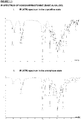
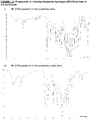
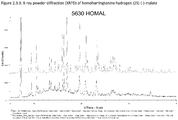
- a preferred embodiment of the invention is a crystalline homoharringtonine hydrogen 2S-malate having substantially the same IR spectrum, in the solid state as set out in figure 1.2 , the same single crystal X-ray diffractogram as set out in figure 2.3.1 and 2.3.2 , the same X-ray powder pattern as set out in figure 2.3.3 and the same DSC curve as set out in figure 3.2 .
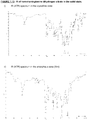
- a further preferred embodiment of the invention provides a crystalline homoharringtonine hydrogen 2R-malate having substantially the same IR spectrum, in the solid state as set out in figure 1.3 , the same single crystal X-ray diffractogram as set out in figure 2.4.1 and 2.4.2 , the same X-ray powder pattern as set out in figure 2.4.3 and the same DSC curve as set out in figure 3.3 .
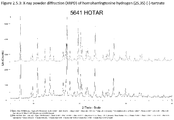
- a further preferred aspect of the invention is a crystalline homoharringtonine hydrogen (2S,3S)-tartrate having substantially the same IR spectrum, in the solid state as set out in figure 1.4 , the same single crystal X-ray diffractogram as set out in figure 2.5.1 and 2.5.2 , the same X-ray powder pattern as set out in figure 2.5.3 and the same DSC curve as set out in figure 3.4 .
- a further embodiment of the invention is a crystalline homoharringtonine hydrogen (2R,3R)-tartrate having substantially the same IR spectrum, in the solid state as set out in figure 1.5 , the same single crystal X-ray diffractogram as set out in figure 2.6.1 and 2.6.2 , the same X-ray powder pattern as set out in figure 2.6.3 and the same DSC curve as set out in figure 3.5 .
- another embodiment of the invention provides a crystalline homoharringtonine hydrogen (2S)-citramalate having substantially the same IR spectrum, in the solid state as set out in figure 1.6 , the same X-ray powder pattern as set out in figure 2.7.1 and the same DSC curve as set out in figure 3.6 .
- a preferred aspect of this invention is a crystalline homoharringtonine hydrogen (2R)-citramalate having substantially the same IR spectrum, in the solid state as set out in figure 1.7 , the same single crystal X-ray diffractogram as set out in figure 2.8.1 and 2.8.2 , the same X-ray powder pattern as set out in figure 2.8.3 and the same DSC curve as set out in figure 3.7 .
- Another preferred aspect of this invention provides a crystalline homoharringtonine hydrogen succinate having substantially the same IR spectrum, in the solid state as set out in figure 1.8 , and the same DSC curve as set out in figure 3.8 .
- a further preferred aspect of this invention is a crystalline homoharringtonine hydrogen itaconate having substantially the same IR spectrum, in the solid state as set out in figure 1.9 , the same single crystal X-ray diffractogram as set out in figure 2.9.1 and 2.9.2 and the same DSC curve as set out in figure 3.9 .
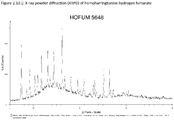
- a preferred aspect of this invention provides a crystalline homoharringtonine hydrogen fumarate having substantially the same IR spectrum, in the solid state as set out in figure 1.10 , the same X-ray powder pattern as set out in figure 2.10.1 and the same DSC curve as set out in figure 3.10 .
- Another aspect of the invention provides a crystalline homoharringtonine hydrogen tartronate having substantially the same IR spectrum, in the solid state as set out in figure 1.11 and the same DSC curve as set out in figure 3.11 .
- another embodiment provides a crystalline homoharringtonine hydrogen malonate having substantially the same IR spectrum, in the solid state as set out in figure 1.12 and the same DSC curve as set out in figure 3.12 .
- a preferred embodiment of this invention provides a crystalline homoharringtonine dihydrogen citrate having substantially the same IR spectrum, in the solid state as set out in figure 1.13 , the same single crystal X-ray diffractogram as set out in figure 2.11.1 and 2.11.2 , the same X-ray powder pattern as set out in figure 2.11.3 and the same DSC curve as set out in figure 3.13 .
- a preferred aspect of this invention provides a crystalline homoharringtonine hydrogen salicylate having substantially the same IR spectrum, in the solid state as set out in figure 1.14 , the same single crystal X-ray diffractogram as set out in figure 2.12.1 , 2.12.2 , 2.12.3 and 2.12.4 and the same DSC curve as set out in figure 3.14 .
- a preferred aspect of this invention provides a pharmaceutical composition
- a pharmaceutical composition comprising an effective amount of one of the salts of this invention, together with one or more pharmaceutical acceptable inactive components such as carriers, excipients, adjuvants or diluents.
- a preferred aspect of this invention provides a pharmaceutical dosage form dedicated to an oral mode of administration selected among, for example, capsules, dragees, emulsions, granules, pills, powders, solutions, suspensions, tablets, microemulsions, elixirs, syrups, tea or powders for reconstitution
- Another aspect of this invention provides a pharmaceutical dosage form dedicated to a subcutaneous mode of administration in non-acidic condition allowing a good locale tolerance
- Another aspect of the invention is the use of at least the solid form of one salt described in the invention for preparing the above pharmaceutical composition as (i) chemotherapeutic agent, (ii) enhancer of other chemotherapeutic agents (iii) after failure of other agents (iv) for inhibiting tumors growth in animal, (v) for inhibiting mammalian parasites, (vi) as immunosuppressive agent, or (vii) as reversal agent.
- a preferred embodiment of the invention describes the crystalline salts of the invention for use in a method for treating mammalian tumors which comprises oral administering to a mammal an antitumor effective amount of the solid form of a salt of the invention.
- the present invention further describes the crystalline salts of the invention for use in a method for treating mammalian tumors which comprises implantable pharmaceutical preparation administering to a mammal an antitumor effective amount of the solid form of at least one salt of the invention.
- the invention is also concerned with the use of solid form as defined above, for the preparation of pharmaceutical compositions for the treatment of cancer particularly, ovarian serous high-grade carcinoma including those resistant to existing therapy, breast cancer including triple negative breast carcinoma and eventually their metastasis, pancreatic cancer including ductal adenocarcinoma.
- the invention is also concerned with the use of solid form as defined above, for the preparation of pharmaceutical compositions for the treatment of leukemias particularly acute myeloid leukemia (AML), myelodysplastic syndrome (MDS) and myeloproliferative disorders including chronic myelogenous leukemia, polycythemia vera, essential thrombocythemia, myelosclerosis.
- AML acute myeloid leukemia
- MDS myelodysplastic syndrome
- myeloproliferative disorders including chronic myelogenous leukemia, polycythemia vera, essential thrombocythemia, myelosclerosis.
- Cation and anion components are dissolved separately in a solvent at a concentration close of saturation and at a temperature close of boiling then both solutions are mixed under stirring then slowly cooled and evaporated. After a period ranging from a few minutes up to several days, crystal salt is collected. A sample of the batch of crystals is kept suspended in its mother liquors for the subsequent X-ray diffraction analysis. The remainder of the batch was dried under vacuum for further solid characterization, comparative stability studies and drug formulation.
- Collected information atomic positions; unit cell composition; crystal packing anisotropic displacement parameters; bond lengths, dihedral and torsion angles, hydrogen bounding.
- the DSC analysis was performed using a Perkin Elmer DSC 4000 apparatus.
- the scan rate was 5 ° C / min and the scanning range of of temperature 40 to 230 ° C.
- the accurately weighed quantity was ranged from 1 to 3 mg. All operations were performed under nitrogen atmosphere.
- the measured values were the Onset, the Peak and the value of the free enthalpy variation.
- the eventual product decomposition and the vaporization of solvent crystallization (methanol and / or water) were recorded.
- the value of the change in free energy was given only as a guideline to assess the endothermicity or exotermicity of the transition.
- NMR spectra were recorded automatically on a Bruker Avance III spectrometer NanoBay - 400MHz (9.4 Tesla magnet) with a BBFO + probe and sampler 120 positions, allows for automatic mode NMR experiments one and two dimensions mainly for nuclei: 1H, 2H, 11B, 13C, 15N, 19F, 27Al, 31P, 119Sn or on Bruker Avance III - 600MHz spectrometer.
- Solubility in water at 25 ° C was measured semi-quantitatively at a threshold of 5 g per 100 mL. All the homoharringtonine salts described in the below examples, unless otherwise stated, are soluble at this threshold. Homoharringtonine base itself is soluble at a theshold mower than 0.1 g per mL
- Atomic coordinates, site occupancy (%) and equivalent isotropic displacement parameters ( A 2 x 10 3 ).
- U(eq) is defined as one third of the trace of the orthogonalized U ij tensor.
- Atom numbering of figure 2.2.1 corresponds to below table.
- Atom x y z occ.
- U(eq) C1 0.9387(2) 0.25439(15) 0.89639(14) 1 0.0374(5) H1 1.0075 0.2226 0.8823 1 0.045 C2 0.9724(2) 0.34995(16) 0.90497(14) 1 0.0390(5)
- C4 1.1150(2) 0.45761(19) 0.89130(17) 1 0.0494(6)
- C5 1.2096(4) 0.5829(2) 0.8960(3) 1 0.0862(12) H5A 1.2163 0.6192 0.8463 1 0.103 H5B 1.2695 0.5986 0.9342 1 0.103
- C6 1.0469(3) 0.51945(17) 0.92762(18) 1 0.0528(6)
- C7 0.9399(2)
- Atomic coordinates, site occupancy (%) and equivalent isotropic displacement parameters ( A 2 x 10 3 ).
- U(eq) is defined as one third of the trace of the orthogonalized U ij tensor.
- This ionic compound was obtained from commercial homoharringtonine (batch # 51H0092) mixed with commercial (2S)-(-)-malic acid (natural form) according to the general procedure in which the solvent was methanol, then isolated as a white prismatic solid mp 205.4-207.7°C from MeOH (measured by DSC, see figure 3.2 ). Several potentially acceptable crystals were kept suspended in their mother liquors for the subsequent X-ray diffraction analysis. (see below)
- IR Diamond ATR, film
- cm -1 3422, 2964, 1742, 1656, 1596, 1506, 1490, 1440, 1373, 1266, 1224, 1168, 1084, 1033, 929, 710, 615, 566, 509, 477, 0, 983, 943, 925, 862, 830, 796, 770, 756, 708, 691, 674, 650, 615, 589, 565, 541, 510. See figure 1.2
- Solubility in neutral water higher than 60 mg/mL
- Atomic coordinates, site occupancy (%) and equivalent isotropic displacement parameters ( A 2 x 10 3 ).
- U(eq) is defined as one third of the trace of the orthogonalized U ij tensor.
- Atom numbering of figure 2.3.1 corresponds to below table.
- Atom x y z occ.
- U(eq) C1 0.8902(5) 0.0603(4) 0.7067(3) 1 0.0450(15) H1 0.8742 0.0363 0.7521 1 0.054 C2 0.8846(5) 0.0175(4) 0.6464(3) 1 0.0405(13) C3 0.9163(5) 0.0678(4) 0.5821(3) 1 0.0412(14) H3 0.9896 0.0445 0.5606 1 0.049 C4 0.9359(4) 0.1614(4) 0.6109(3) 1 0.0355(13) H4 1.0189 0.1762 0.6007 1 0.043 C5 0.9255(5) 0.1528(4) 0.6934(3) 1 0.0391(13) C6 1.0363(5) 0.1790(5) 0.7327(3) 1 0.0501(16) H6A 1.0975 0.1343 0.7269 1 0.06 H6B 1.0662 0.2352 0.7148 1 0.06 C7 0.9996(6) 0.1865(5) 0.8099(3) 1 0.0584(18)
- the sample is pure and there is a very good match between the experimental pattern and the calculated pattern (for view of diagrams and experimental details, see figure 2.3.3 )
- This ionic compound was obtained from commercial homoharringtonine (batch # 51H0092) mixed with commercial (2R)- (+)-malic acid (unnatural form) according to the general procedure in which the solvent was methanol, then isolated as a white prismatic solid mp 205-208°C from MeOH (measured by DSC, see figure 3.3 ). Several potentially acceptable crystals were kept suspended in their mother liquors for the subsequent X-ray diffraction analysis. (see below).
- IR Diamond ATR, solid
- cm -1 3467, 3384, 2970, 2051, 1762, 1737, 1708, 1655, 1607, 1533, 1509, 1494, 1469, 1440, 1376, 1349, 1333, 1292, 1258, 1230, 1208, 1167, 1147, 1121, 1080, 1032, 985, 942, 926, 888, 865, 820, 771, 754, 717, 690, 675, 648, 616, 563, 542, 513, 476. See figure 1.3
- IR Diamond ATR, film
- Atomic coordinates, site occupancy (%) and equivalent isotropic displacement parameters ( A 2 x 10 3 ).
- U(eq) is defined as one third of the trace of the orthogonalized Uij tensor.
- Atom numbering of figure 2.4.1 corresponds to below table.
- Atom x y z occ.
- U(eq) C1 0.8742(2) 0.06078(16) 0.19603(12) 1 0.0184(5) H1 0.8565 0.0356 0.2395 1 0.022 C2 0.8762(2) 0.01795(16) 0.13644(13) 1 0.0188(5) C3 0.9050(2) 0.07250(16) 0.07486(11) 1 0.0170(5) H3 0.9806 0.0529 0.0538 1 0.02 C4 0.9198(2) 0.16514(15) 0.10526(11) 1 0.0162(5) H4 1.0039 0.1809 0.098 1 0.019 C5 0.9039(2) 0.15418(16) 0.18536(12) 1 0.0174(5) C6 1.0098(2) 0.18290(17) 0.22700(12) 1 0.0235(6) H6A 1.037 0.2405 0.2119 1 0.028 H6B 1.0752 0.1413 0.2222 1 0.028 C7 0.9654
- This ionic compound was obtained from commercial homoharringtonine (batch # 51H0092) mixed with commercial (2S,3S-(-)-tartaric acid (unnatural form) according to the general procedure, then isolated as a white prismatic solid mp 202-205°C (uncorrected) from MeOH. (198.1-203.9, measured by DSC, see figure 3.4 ). Several potentially acceptable crystals were kept suspended in their mother liquors for the subsequent X-ray diffraction analysis. (see below).
- IR Diamond ATR, solid
- cm -1 3502, 3048, 2971, 2884, 2051, 1981, 1765, 1736, 1656, 1592, 1506, 1490, 1432, 1375, 1348, 1321, 1295, 1265, 1227, 1205, 1165, 1147, 1111, 1081, 1031, 984, 939, 921, 887, 866, 831, 810, 727, 691, 675, 615, 564, 510, 477. See figure 1.4
- IR Diamond ATR, film
- Atomic coordinates, site occupancy (%) and equivalent isotropic displacement parameters ( A 2 x 10 3 ).
- U(eq) is defined as one third of the trace of the orthogonalized U ij tensor. Atom numbering of figure 2.5.1 corresponds to below table. Atom x y z occ.
- U(eq) C1 0.60365(16) 0.56010(10) 0.77843(9) 1 0.0207(3) H1 0.6286 0.5375 0.7338 1 0.025 C2 0.59199(16) 0.51759(10) 0.83901(9) 1 0.0204(3) C3 0.54863(14) 0.56685(9) 0.90214(8) 1 0.0173(3) H3 0.4655 0.5475 0.9185 1 0.021 C4 0.53958(14) 0.65545(9) 0.87170(8) 1 0.0159(3) H4 0.4499 0.6705 0.8739 1 0.019 C5 0.57198(15) 0.64844(10) 0.79030(9) 1 0.0176(3) C6 0.46897(15) 0.68171(10) 0.74191(8) 1 0.0209(3) H6
- Example 6 Preparation and analyses of homoharringtonine hydrogen (2R,3R)-tartrate (diastereomer of example 5)
- This ionic compound was obtained from commercial homoharringtonine (batch # 51H0092) mixed with commercial (+)-(2R,3R)-tartaric acid (batch #) according to the general procedure in which the solvent was methanol, then isolated as a white prismatic solid mp 206-208°C (uncorrected) from MeOH. (204.6-208.5, measured by DSC, see figure 3.5 ). Several potentially acceptable crystals were kept suspended in their mother liquors for the subsequent X-ray diffraction analysis. (see below).
- IR (Diamond ATR, solid) cm -1 3491, 3044, 2969, 1762, 1737, 1654, 1587, 1506, 1489, 1464, 1431, 1375, 1320, 1295, 1259, 1229, 1210, 1172, 1149, 1107, 1082, 1028, 984, 940, 924, 866, 819, 804, 735, 690, 616, 565, 512, 476. See figure 1.5
- IR Diamond ATR, film
- cm -1 3417, 2963, 1741, 1655, 1611, 1505, 1489, 1440, 1373, 1265, 1223, 1167, 1118, 1082, 1034, 983, 928, 769, 675, 614, 565, 510, 478, 0, 1031, 984, 939, 921, 887, 866, 831, 810, 727, 691, 675, 615, 564, 510. See figure 1.5
- Atomic coordinates, site occupancy (%) and equivalent isotropic displacement parameters ( A 2 x 10 3 ).
- U(eq) is defined as one third of the trace of the orthogonalized U ij tensor.
- Atom numbering of figure 2.6.1 corresponds to below table.
- Atom x y z occ.
- U(eq) C1 0.8908(2) 0.06521(13) 0.73105(13) 1 0.0187(5) H1 0.8694 0.0434 0.7763 1 0.022 C2 0.9037(2) 0.02207(13) 0.67131(13) 1 0.0194(5) C3 0.9421(2) 0.06998(13) 0.60762(12) 1 0.0170(5) H3 1.0267 0.0525 0.5907 1 0.02 C4 0.94749(19) 0.15799(13) 0.63555(12) 1 0.0149(5) H4 1.0376 0.1742 0.6331 1 0.018 C5 0.91467(19) 0.15286(12) 0.71688(12) 1 0.0164(5) C6 1.0130(2) 0.19306(14) 0.76376(13) 1 0.0210(5) H6A 1.0399 0.2449 0.7427 1 0.025 H6B 1.0873 0.1579 0.7691
- This ionic compound was obtained from commercial homoharringtonine (batch # 51H0092) mixed with commercial (2S)-citramalic acid according to the general procedure in which the solvent was methanol, then isolated as a white prismatic solid mp 195.9-198.9°C (measured by DSC, see figure 3.6 ). Several potentially acceptable crystals were kept suspended in their mother liquors for the subsequent X-ray diffraction analysis. (see below).
- IR Diamond ATR, solid
- cm -1 2965, 1759, 1739, 1710, 1651, 1506, 1489, 1371, 1341, 1225, 1162, 1079, 1033, 972, 944, 925, 885, 866, 830, 786, 714, 690, 643, 615, 584, 562, 511. See figure 1.6
- IR Diamond ATR, film
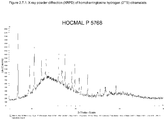
- the powder sample is well crystallised, with a peak width of 0.102° (2 ⁇ ) at 17.597° (2 ⁇ ) (for view of diagrams and experimental details, see figure 2.7.1 ).
- This ionic compound was obtained from commercial homoharringtonine (batch # 51H0092) mixed with commercial (2R)-citramalic acid according to the general procedure in which the solvent was methanol, then isolated as a white prismatic solid mp 202.7-204.7°C (measured by DSC, see figure 3.7 ). Several potentially acceptable crystals were kept suspended in their mother liquors for the subsequent X-ray diffraction analysis. (see below).
- IR Diamond ATR, solid
- cm -1 3681, 3512, 2969, 2845, 1764, 1740, 1707, 1652, 1605, 1513, 1495, 1469, 1440, 1369, 1332, 1292, 1260, 1227, 1204, 1167, 1147, 1124, 1080, 1048, 1033, 1023, 991, 971, 930, 885, 869, 824, 786, 753, 718, 689, 676, 644, 614, 564, 512, 475. See figure 1.7
- Atomic coordinates, site occupancy (%) and equivalent isotropic displacement parameters ( A 2 x 10 3 ).
- U(eq) is defined as one third of the trace of the orthogonalized Uij tensor.
- Atom numbering of figure 2.8.1 corresponds to below table.
- Atom x y z occ.
- U(eq) C1 0.11571(16) 0.05636(10) 0.26511(9) 1 0.0175(4)
- H1 0.1363 0.0342 0.2213 1 0.021 C2 0.09856(16) 0.01523(10) 0.32323(9) 1 0.0171(4)
- the sample was pure and well crystallised, with a peak width of 0.107 °(2 ⁇ ) at 16.992 °(2 ⁇ ). There was a very good match between the experimental pattern and the calculated pattern (for view of diagrams and experimental details, see figure 2.8.3 ).
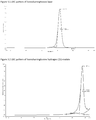
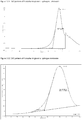
- This ionic compound was obtained from commercial homoharringtonine (batch # 51H0092) mixed with commercial succinic acid according to the general procedure in which the solvent was methanol, then isolated as a white prismatic solid mp 158.1-160.0°C (measured by DSC, see figure 3.8 ).
- This ionic compound was obtained from commercial homoharringtonine (batch # 51H0092) mixed with commercial itaconic acid (batch #) according to the general procedure in which the solvent was methanol, then isolated as a white prismatic solid mp 178.3-181.2°C (measured by DSC, see figure 3.9 ). Several potentially acceptable crystals were kept suspended in their mother liquors for the subsequent X-ray diffraction analysis. (see below).
- Atomic coordinates, site occupancy (%) and equivalent isotropic displacement parameters ( A 2 x 10 3 ).
- U(eq) is defined as one third of the trace of the orthogonalized Uij tensor.
- Atom numbering of figure 2.9.1 corresponds to below table.
- Atom x y z occ.
- U(eq) C1 0.4085(2) 0.94954(16) 0.28454(13) 1 0.0246(6) H1 0.3897 0.972 0.239 1 0.029 C2 0.4040(2) 0.99163(16) 0.34531(13) 1 0.0239(5) C3 0.4399(2) 0.94237(16) 0.40941(12) 1 0.0206(5) H3 0.5169 0.9646 0.4305 1 0.025 C4 0.4605(2) 0.85392(16) 0.38019(11) 1 0.0187(5) H4 0.548 0.8406 0.3893 1 0.022 C5 0.4471(2) 0.86236(16) 0.29702(12) 1 0.0216(5) C6 0.5613(2) 0.83684(18) 0.25641(12) 1 0.0244(6) H6A 0.5945 0.7845 0.2755 1 0.029 H6B 0.6247 0.8801 0.25
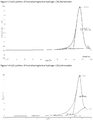
- This ionic compound was obtained from commercial homoharringtonine (batch # 51H0092) mixed with commercial fumaric acid (batch #) according to the general procedure in which the solvent was methanol, then isolated as a white prismatic solid mp 103.5-107.2°C (measured by DSC, see figure 3.10 ).
- the powder sample is well crystallised, with a peak width of 0.119° (2 ⁇ ) at 19.564° (2 ⁇ ) (for view of diagrams and experimental details, see figure 2.7.1 ).
- This ionic compound was obtained from commercial homoharringtonine (batch # 51H0092) mixed with commercial tartronic acid (batch #) according to the general procedure in which the solvent was methanol, then isolated as a white prismatic solid mp 163.1-167.6°C (measured by DSC, see figure 3.11 ).
- IR Diamond ATR, solid
- cm -1 3451, 2969, 2898, 2051, 1763, 1730, 1657, 1507, 1490, 1467, 1437, 1376, 1352, 1316, 1294, 1266, 1228, 1208, 1186, 1148, 1126, 1083, 1032, 1002, 985, 943, 927, 891, 866, 802, 753, 720, 690, 675, 652, 614, 563, 510, 477. See figure 1.11
- This ionic compound was obtained from commercial homoharringtonine (batch # 51H0092) mixed with commercial (2R)-citramalic acid according to the general procedure in which the solvent was methanol-d 4 , then isolated as a white prismatic solid mp 127.0-131.9°C (measured by DSC, see figure 3.12 ).
- This ionic compound was obtained from commercial homoharringtonine (batch # 51H0092) mixed with commercial citric acid (batch #) according to the general procedure in which the solvent was methanol, then isolated as a white prismatic solid mp 170.35-173.9°C (measured by DSC, see figure 3.13 ). Several potentially acceptable crystals were kept suspended in their mother liquors for the subsequent X-ray diffraction analysis. (see below).
- IR Diamond ATR, solid
- cm -1 2959, 1757, 1732, 1715, 1651, 1580, 1508, 1489, 1464, 1432, 1371, 1305, 1262, 1224, 1186, 1151, 1111, 1081, 1032, 985, 944, 922, 909, 864, 829, 806, 705, 690, 614, 581, 563, 510, 486. See figure 1.13
- Atomic coordinates, site occupancy (%) and equivalent isotropic displacement parameters ( A 2 x 10 3 ).
- U(eq) is defined as one third of the trace of the orthogonalized Uij tensor.
- Atom numbering of figure 2.11.1 corresponds to below table.
- Atom x y z occ.
- U(eq) C1 0.3491(2) 0.92951(11) 0.25699(11) 1 0.0149(4) H1 0.3259 0.9482 0.2129 1 0.018 C2 0.3729(2) 0.96852(11) 0.31322(11) 1 0.0152(4) C3 0.4025(2) 0.92636(11) 0.37724(10) 1 0.0138(4) H3 0.4934 0.9384 0.3953 1 0.017 C4 0.3993(2) 0.84827(11) 0.35162(11) 1 0.0119(4) H4 0.4942 0.8317 0.3535 1 0.014 C5 0.3638(2) 0.85222(11) 0.27257(11) 1 0.0136(4) C6 0.4667(2) 0.81449(12) 0.22685(11) 1 0.0176(5) H6A 0.4901 0.7677 0.2464 1 0.021 H6B 0.5492 0.8431 0.2224 1
- the powder sample is well crystallised, with a peak width of 0.127 °(2 ⁇ ) at 18.255 °(2 ⁇ ).
- the powder is constituted in major part by the expected sample referenced HOCIT 5776.
- the powder pattern reveals the presence of a second phase, with significant lines at 7.001 °(2 ⁇ ) and 12.317 °(2 ⁇ ) for example, not calculated from the structure determined with a single crystal (for view of diagrams and experimental details, see figure 2.11.3 ).
- This ionic compound was obtained from commercial homoharringtonine (batch # 51H0092) mixed with commercial salicylic acid (batch #) according to the general procedure in which the solvent was methanol, then isolated as a white prismatic solid mp 148.7-151.3°C (measured by DSC, see figure 3.14 ). Several potentially acceptable crystals were kept suspended in their mother liquors for the subsequent X-ray diffraction analysis. (see below).
- Atomic coordinates, site occupancy (%) and equivalent isotropic displacement parameters ( A 2 x 10 3 ).
- U(eq) is defined as one third of the trace of the orthogonalized Uij tensor.
- Atom numbering of figure 2.12.1 corresponds to below table.
- Atom x y z occ.
- U(eq) C1 -0.3818(4) 0.00999(17) 0.1577(4) 1 0.0196(9) H1 -0.3779 -0.0157 0.1054 1 0.024 C2 -0.3310(4) 0.00487(17) 0.2729(4) 1 0.0193(9)
- C3 -0.3588(4) 0.04946(17) 0.3333(4) 1 0.0186(9) H3 -0.4173 0.038 0.3682 1 0.022 C4 -0.4266(4) 0.08958(17) 0.2350(4) 1 0.0172(9) H4 -0.5126 0.0945 0.2325 1 0.021 C5 -0.4453(4) 0.06061(18) 0.1208(4) 1 0.0183(9)
Landscapes
- Chemical & Material Sciences (AREA)
- Organic Chemistry (AREA)
- Health & Medical Sciences (AREA)
- General Chemical & Material Sciences (AREA)
- Medicinal Chemistry (AREA)
- Nuclear Medicine, Radiotherapy & Molecular Imaging (AREA)
- Chemical Kinetics & Catalysis (AREA)
- Pharmacology & Pharmacy (AREA)
- Life Sciences & Earth Sciences (AREA)
- Animal Behavior & Ethology (AREA)
- General Health & Medical Sciences (AREA)
- Public Health (AREA)
- Veterinary Medicine (AREA)
- Pharmaceuticals Containing Other Organic And Inorganic Compounds (AREA)
- Nitrogen Condensed Heterocyclic Rings (AREA)
Description
- The present invention concerns crystalline salts of harringtonines, protonated on their alkaloid nitrogen, definite by their solid state analysis patterns, their process of preparation allowing their use as drug substance for blending alone or in combination in pharmaceutical composition useful for chemotherapy of cancer, parasit and viral diseases and/or as immuno-suppressive agents, particularily in using oral or parentheral modes of administration.
- Among harringtonines, omacetaxine D.C.I. (= OMA, formerly homoharringtonine = HHT) is a natural ester of cephalotaxine (see
scheme 1 and table 1), an alkaloid of Cephalotaxus harringtonia, a rare and endangered Asian conifer belonging to Cephalotaxaceae family. OMA/ HHT content in renewable parts of Cephalotaxus is about a few dozen of mg only per kilo of dry plant material. This characteristic, in despite of considerable efforts performed by the U.S. National Cancer Insitute, hampered clinical development of omacetaxine for more than thirty-years. In 1998, the discovering of a new hemi-synthetic process by one of us (JPR), allowed industrial production of homoharringtonine at the kilo scale [ref TL] and divided by 70 the need of rare plant material [ref Nicolini]. - It should be pointed out that chemical structure of hemi-synthetic omacetaxine is strictly identical to the natural one version: omacetaxine is not a semi-synthetic derivative as indicated in some article published in literature (see
scheme 1 and table1) [ref]. All denominations of omacetaxine (OMA) or homoharringtonine (HHT) included in this document are strictly equivalent. The sentence "omacetaxine is a semi-synthetic derivative of cephalotaxine" encountered in literature, is totally devoid of scientific significance: the semi-synthetic appellation suggests that a moiety of the molecule (cephalotaxine) would natural and that the other moiety (the side chain) would be unnatural (man designed) while the latter is strictly natural. When only a portion of a molecule was produced by synthesis, the process name is hemi-synthesis and the molecule is sometimes also called hemi-synthetic. - Initially, all above esters of cephalotaxine were discovered by U.S. teams [ref powel:] and a large development program was performed by the United States National Cancer Institute [ref suff]. In October 2012, the United States Food and Drug Administration (FDA) granted accelerated approval for omacetaxine mepesuccinate for the treatment of adult patients with chronic or accelerated phase chronic myeloid leukemia (CML) who failed to responde to two or more tyrosine kinase inhibitors (TKIs) [ref fda]. Since this approval, at least a hundred articles or reviews related to OMA/HHT were published in literature [ref pub med]. Definitive approval of OMA / HHT was granted in 2014. This occurred after a very long and tumultuous period of clinical development [kanta], including early clinical development of HHT and, to a lesser extent, its congeners harringtonine (HA) and deoxyharringtonine (DHA) in various institution in the U.S. and in China. Finally the successive involment of seven pharmaceutical companies (Vivorex/American Bioscience; Oncopharm; Stragen; Chemegenex; Cephalon; TEVA) dispatched in 5 countries occurred before aproval of omacetaxine! More than 50 clinical trials in USA, China and France involving more than 2000 patients.
- homoharringtonine / omacetaxine mepesuccinate / Synribo / Myelostat The INN (International Non-proprietary Name) "omacetaxine mepesuccinate" (OMA) is a name reserved for homoharringtonine HHT drug substance dedicated for pharmaceutical and medicinal use regardless its natural, hemi-synthetic or synthetic origin [formely named homoharringtonine]. Synribo (TEVA) and Myelostat (Oncopharm corporation) are trademark (Ref the Oncologist).
- Cephalotaxanes are particular alkaloids to date exclusively extracted from the
Cephalotaxaceae family which exhibit thestructural formula 1. Several substituants may be encountered on this core structure: hydroxyl, ether, acyloxy etc. The eventual presence of some additional double bound or intramolecular bridge achieve to definite cephalotaxanes.Cephalotaxines 2 are cephalotaxanes without acyloxy side-chain. - Cephalotaxine 2a and drupacine 2b are example of cephalotaxines. Harringtonines 5 are particular cephalotaxanes formed by attachment of a branched a-hydroxyacyloxy side-chain at the 3-position of various cephalotaxines moieties. Cephalotaxines 2 and
harringtonines 5, are examples of cephalotaxanes. Several dozen of cephalotaxanes have been isolated from various Cephalotaxus species. 4 is the generic formula of cephalotaxine esters [ref Takano]. - Harringtonines 5 (i. e. harringtonine = HA and homoharringtonine = HHT) are particular cephalotaxine esters. Cephalotaxine and its natural ester are gathered under the generic term of cephalotaxane.
- Harringtoids are semi-synthetic derivatives of harrintonines.
- Harringtonic acids are side-chain of harringtonines
TABLE 1: NATURAL AND SEMI-SYNTHETIC ESTERS OF CEPHALOTAXINE # Trivial name R2 R3 R4 Note # Activity* 5a harringtonine (CH3)2COH-(CH2)2- Me H (1) anticancer 5b homoharringtonine (CH3)2COH-(CH2)3- Me H (2) anticancer 5c norharringtonine (CH3)2COH-CH2 - Me H (3) none 5d deoxyharringtonine (CH3)2CH-(CH2)2- Me H (4) anticancer 5e bishomoharringtonine (CH3)2COH-(CH2)4- Me H (5) none 5f isoharringtonine (CH3)2CH(CH2)2- Me OH (6) none 5g neoharringtonine C6H5-CH2- Me H (7) cytotoxic 5h harringtonines R2- Me R4 (8) N/A 5i harringtoids R2- R3 R4 (9) cytotoxic *In cancer area, for definition of term see [Suffness et al in Journal of Natural Products 1982 ] CYTOTOXICITY is toxicity to tumor cells in culture; ANTITUMOR is in vivo activity in experimental systems; ANTINEOPLASTIC or ANTICANCER iare the reserved terms for reportied clinical trials data.
(1) The first cephatotaxine ester isolated from cephalotaxus harringtonia
(2) "Homo" means one more carbone than harringtonine; Named omacetaxine (D.C.I.) as active pharmaceutical ingredient
(3) "nor" means one more less carbone
- Two harringtonines are very promising drugs in the treatment of certain leukemia such as Chronic Myelogenous Leukemia (CML). Both homoharringtonine and harringtonine were used in human chemotherapy of leukemia for 30 years.
- We described here new highly purified crystallin forms of certain harringtonines but, surprisingly, crystalline salts of harringtonines have never been isolated and described in the literature. In particular,
WO 02/074314 - However, in spite of the progress recorded in production, purification and therapeutic use of homoharringtonine, several disadvantages persist.
- i) The cost of treatment for omacetaxine (Synribo) is prohibitive: $28,000 for induction, $14,000 for monthly treatments), this give about 180.000 $ per year, per patient [Kantarjian et al. Journal of Clinical Oncology, 2013, p3600; Hagop Kantarjian, personal communication]
- ii) The use of the parenteral route of administration even retards the development of this drug
- iii) Preparation of formulations for parenteral use is complicated by the use of lyophilization
- iv) Formation of non-crystallin salts of harringtonines does not give as accurately defined compound as crystallin salts
- v) There is some local intolerance to this product when administered subcutaneously
- vi) On the other hand, although it has been known for almost 40 years, there is still a slight doubt regarding the absolute configuration of this series of natural product
- The team Steitz [Journal of Molecular Biology (2009), 389(1), 146-156] recently demonstrated that homoharringtonine when in place in its active site was protonated in a neutral media, implying that alkloid nitrogen protonation is imperative condition for the manifestation of the activity of this ligand.
- In addition, the team of Takano et al [J. Org. Chem. 8251 (1997)] demonstrated experimentally that when the nitrogen lone pair of homoharringtonine was occupied by an oxygen atom, the cytotoxic activity was divided by a factor of at least 50. The authors conclude that "the nitrogen lone pair on the cephalotaxine skeleton appears to be essential for its activity".
- The above-mentioned team of Steitz showed that the absolute configuration of homoharringtonine deposited in the Cambridge Structural Database seems to be the opposite of that commonly adopted in the literature.
- The present invention aims to overcome the problems mentioned above. It also demonstrated that the absolute configuration in the deposited homoharringtonine Cambridge Structural Database seems to be the opposite of that commonly retained in the literature.
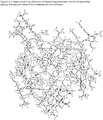
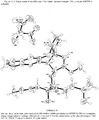
- The eight examples of single crystal X-ray diffraction of homoharringtonine salt exhibited in
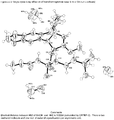
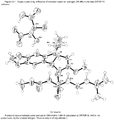
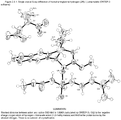
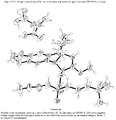
figure 2.3.1 ,2.4.1 ,2.5.1 ,2.6.1 ,2.8.1 ,2.9.1 ,2.11.1 and2.12.1 clearly indicate that the alkaloid moiety was efficiently protonated by the processes described in the present invention. Moreover, the shortest distance between said proton carried by the nitrogen is close to two angstroms, showing the reality of the formation of a salt and not a mere co-crystal.
- The present invention aims to overcome the problems mentioned above, namely:
- raise doubt on the absolute configuration of harringtonines
- provide a method of administration of harringtonines protonated on their nitrogen atom
- As detailed above, the fact that the real active form of harringtonines would be their nitrogen-protonated version was recently supported by the work of Seitz et al. and, indirectly by the work of Takano et al.
- The present invention thus concerns novel water soluble crystalline salts of homoharringtonine as described in the claims, and their use as new chemical entities for the formulation of new cancer chemotherapeutic agents, or immunosuppressive agents or antiparasitic agents, and to implement new processes for purification including enantiomeric and determine the absolute configuration of the series.
- The present invention further describes the preparation of crystalline salts of harringtonines as nitrogen-protonated form, stable and soluble in water and their use for the manufacture of pharmaceutical composition useful in the treatment of cancers, leukemias, immune disease and as reversal agents.
- The present invention describes an unambiguously proved method of protonation of harringtonines nitrogen.
- The present invention provides salts of harringtonines in the solid state, protonated on their alkaloid nitrogen, defined by their solid-state analysis patterns, their process of preparation from harringtonines and commercial organic acid allowing their use as drug substance for blending alone or in combination in pharmaceutical composition particularly useful for treatment of cancer in using oral mode of administration.
- A preferred embodiment of the invention is a crystalline homoharringtonine hydrogen 2S-malate having substantially the same IR spectrum, in the solid state as set out in
figure 1.2 , the same single crystal X-ray diffractogram as set out infigure 2.3.1 and2.3.2 , the same X-ray powder pattern as set out infigure 2.3.3 and the same DSC curve as set out infigure 3.2 . - A further preferred embodiment of the invention provides a crystalline homoharringtonine hydrogen 2R-malate having substantially the same IR spectrum, in the solid state as set out in
figure 1.3 , the same single crystal X-ray diffractogram as set out infigure 2.4.1 and2.4.2 , the same X-ray powder pattern as set out infigure 2.4.3 and the same DSC curve as set out infigure 3.3 . - A further preferred aspect of the invention is a crystalline homoharringtonine hydrogen (2S,3S)-tartrate having substantially the same IR spectrum, in the solid state as set out in
figure 1.4 , the same single crystal X-ray diffractogram as set out infigure 2.5.1 and2.5.2 , the same X-ray powder pattern as set out infigure 2.5.3 and the same DSC curve as set out infigure 3.4 . - Yet, a further embodiment of the invention is a crystalline homoharringtonine hydrogen (2R,3R)-tartrate having substantially the same IR spectrum, in the solid state as set out in
figure 1.5 , the same single crystal X-ray diffractogram as set out infigure 2.6.1 and2.6.2 , the same X-ray powder pattern as set out infigure 2.6.3 and the same DSC curve as set out infigure 3.5 . - Yet, another embodiment of the invention provides a crystalline homoharringtonine hydrogen (2S)-citramalate having substantially the same IR spectrum, in the solid state as set out in
figure 1.6 , the same X-ray powder pattern as set out infigure 2.7.1 and the same DSC curve as set out infigure 3.6 . - Yet, a preferred aspect of this invention is a crystalline homoharringtonine hydrogen (2R)-citramalate having substantially the same IR spectrum, in the solid state as set out in
figure 1.7 , the same single crystal X-ray diffractogram as set out infigure 2.8.1 and2.8.2 , the same X-ray powder pattern as set out infigure 2.8.3 and the same DSC curve as set out infigure 3.7 . - Yet, another preferred aspect of this invention provides a crystalline homoharringtonine hydrogen succinate having substantially the same IR spectrum, in the solid state as set out in
figure 1.8 , and the same DSC curve as set out infigure 3.8 . - Yet, a further preferred aspect of this invention is a crystalline homoharringtonine hydrogen itaconate having substantially the same IR spectrum, in the solid state as set out in
figure 1.9 , the same single crystal X-ray diffractogram as set out infigure 2.9.1 and2.9.2 and the same DSC curve as set out infigure 3.9 . - Yet, a preferred aspect of this invention provides a crystalline homoharringtonine hydrogen fumarate having substantially the same IR spectrum, in the solid state as set out in
figure 1.10 , the same X-ray powder pattern as set out infigure 2.10.1 and the same DSC curve as set out infigure 3.10 . - Yet, another aspect of the invention provides a crystalline homoharringtonine hydrogen tartronate having substantially the same IR spectrum, in the solid state as set out in
figure 1.11 and the same DSC curve as set out infigure 3.11 . - In addition, another embodiment provides a crystalline homoharringtonine hydrogen malonate having substantially the same IR spectrum, in the solid state as set out in
figure 1.12 and the same DSC curve as set out infigure 3.12 . - Moreover, a preferred embodiment of this invention provides a crystalline homoharringtonine dihydrogen citrate having substantially the same IR spectrum, in the solid state as set out in
figure 1.13 , the same single crystal X-ray diffractogram as set out infigure 2.11.1 and2.11.2 , the same X-ray powder pattern as set out infigure 2.11.3 and the same DSC curve as set out infigure 3.13 . - Also, a preferred aspect of this invention provides a crystalline homoharringtonine hydrogen salicylate having substantially the same IR spectrum, in the solid state as set out in
figure 1.14 , the same single crystal X-ray diffractogram as set out infigure 2.12.1 ,2.12.2 ,2.12.3 and2.12.4 and the same DSC curve as set out infigure 3.14 . - Yet, a preferred aspect of this invention provides a pharmaceutical composition comprising an effective amount of one of the salts of this invention, together with one or more pharmaceutical acceptable inactive components such as carriers, excipients, adjuvants or diluents.
- Yet, a preferred aspect of this invention provides a pharmaceutical dosage form dedicated to an oral mode of administration selected among, for example, capsules, dragees, emulsions, granules, pills, powders, solutions, suspensions, tablets, microemulsions, elixirs, syrups, tea or powders for reconstitution
- Yet, another aspect of this invention provides a pharmaceutical dosage form dedicated to a subcutaneous mode of administration in non-acidic condition allowing a good locale tolerance
- Another aspect of the invention is the use of at least the solid form of one salt described in the invention for preparing the above pharmaceutical composition as (i) chemotherapeutic agent, (ii) enhancer of other chemotherapeutic agents (iii) after failure of other agents (iv) for inhibiting tumors growth in animal, (v) for inhibiting mammalian parasites, (vi) as immunosuppressive agent, or (vii) as reversal agent.
- A preferred embodiment of the invention describes the crystalline salts of the invention for use in a method for treating mammalian tumors which comprises oral administering to a mammal an antitumor effective amount of the solid form of a salt of the invention.
- The present invention further describes the crystalline salts of the invention for use in a method for treating mammalian tumors which comprises implantable pharmaceutical preparation administering to a mammal an antitumor effective amount of the solid form of at least one salt of the invention.
- Yet, the invention is also concerned with the use of solid form as defined above, for the preparation of pharmaceutical compositions for the treatment of cancer particularly, ovarian serous high-grade carcinoma including those resistant to existing therapy, breast cancer including triple negative breast carcinoma and eventually their metastasis, pancreatic cancer including ductal adenocarcinoma.
- Finally, the invention is also concerned with the use of solid form as defined above, for the preparation of pharmaceutical compositions for the treatment of leukemias particularly acute myeloid leukemia (AML), myelodysplastic syndrome (MDS) and myeloproliferative disorders including chronic myelogenous leukemia, polycythemia vera, essential thrombocythemia, myelosclerosis.
- Cation and anion components are dissolved separately in a solvent at a concentration close of saturation and at a temperature close of boiling then both solutions are mixed under stirring then slowly cooled and evaporated. After a period ranging from a few minutes up to several days, crystal salt is collected. A sample of the batch of crystals is kept suspended in its mother liquors for the subsequent X-ray diffraction analysis. The remainder of the batch was dried under vacuum for further solid characterization, comparative stability studies and drug formulation.
- KappaCCD, Nonius diffractometer, Mo - Kα radiation (λ = 0.71073 Å). The structure was solved by direct methods using the SHELXS-97 program [Sheldrick G.M., Acta Cryst. A64 (2008), 112-122], and then refined with full-matrix least-square methods based on F 2 (SHELXL-2013) [Sheldrick G.M., (2013)] with the aid of the WINGX [L. J. Farrugia, J. Appl. Cryst., 2012, 45, 849-854] program. All non-hydrogen atoms were refined with anisotropic atomic displacement parameters. Except nitrogen and oxygen linked hydrogen atoms that were introduced in the structural model through Fourier difference maps analysis, H atoms were finally included in their calculated positions.
- Collected information: atomic positions; unit cell composition; crystal packing anisotropic displacement parameters; bond lengths, dihedral and torsion angles, hydrogen bounding.
- Original files with all parameters are includes on a CD and may be visualized and handled in using ORTEP-3 software (ORTEP = Oak Ridge Thermal-Ellipsoid Plot Program) available free of charge on the Internet:
http://www.chem.gla.ac.uk/∼louis/software/ortep3/ - Diagrams were measured on a Bruker AXS D8 Advance diffractometer, Bragg-Brentano geometry (θ-2 θ), CuK α = 1.5406 Å, 600 ms / pixel, rotation: 0.25 / sec. For each chart, the calculated patern from the single crystal structure, when available, is upped mentioned.
- The DSC analysis was performed using a
Perkin Elmer DSC 4000 apparatus. The scan rate was 5 ° C / min and the scanning range of oftemperature 40 to 230 ° C. The accurately weighed quantity was ranged from 1 to 3 mg. All operations were performed under nitrogen atmosphere. The measured values were the Onset, the Peak and the value of the free enthalpy variation. The eventual product decomposition and the vaporization of solvent crystallization (methanol and / or water) were recorded. The value of the change in free energy, was given only as a guideline to assess the endothermicity or exotermicity of the transition. - Melting points were measured manually for visual checking of the one determined with DSC. A Bücchi B-545 melting point apparatus was used and mp are uncorrected.
- All vibrational spectra were recorded on a Perkin Elmer
IR FT Spectrum 2 apparatus equipped with diamond ATR accessory that is to say using Attenuated Total Reflection technique. The crystalline solids were crushed directly by in situ compression on the diamond window and the amorphous state has been demonstrated by dissolving the product in deuterated methanol then generating the film by in situ evaporation on the diamond window. - NMR spectra were recorded automatically on a Bruker Avance III spectrometer NanoBay - 400MHz (9.4 Tesla magnet) with a BBFO + probe and
sampler 120 positions, allows for automatic mode NMR experiments one and two dimensions mainly for nuclei: 1H, 2H, 11B, 13C, 15N, 19F, 27Al, 31P, 119Sn or on Bruker Avance III - 600MHz spectrometer. - Dissolving salts for 13C NMR: 30 mg of compound were dissolved in 600 µL (5% m/V) of methanol D4 or deuterium oxyde (or both if specified)
- Water suppression: The irradiation technique known as 'watergate' (Selective pulse flanked by gradient pulses) was used for proton NMR in the presence of D2O and/or MOD4 as solvents.
- Routine experiments were performed on a Waters HPLC-MS-DAD coupled system (3100 pump, DAD 996 detector, 3100 mass detector).
- Solubility in water at 25 ° C was measured semi-quantitatively at a threshold of 5 g per 100 mL. All the homoharringtonine salts described in the below examples, unless otherwise stated, are soluble at this threshold. Homoharringtonine base itself is soluble at a theshold mower than 0.1 g per mL
-

- NMR spectra were performed in deuterated methanol for comparison with salt in the same solvent.
- By methanol recrystallisation of a commercial alkaloid from natural source, it results fine white prisms (mp 145-146°, by DSC, see
figure 3.1 ) used for all experiences. - 1 H NMR (400 MHz, Benzene-d 6 ) δ 6.54 (s, 1H), 6.46 (s, 1H), 6.21 - 6.12 (m, 1H), 5.47 (d, J = 1.4 Hz, 1H), 5.33 (d, J = 1.4 Hz, 1H), 4.67 (s, 1H), 3.43 (d, J = 9.8 Hz, 1H), 3.34 (s, 3H), 3.28 (s, 3H), 2.83 (td, J = 8.5, 4.5 Hz, 1H), 2.75 (dd, J = 11.5, 4.5 Hz, 1H), 2.55 (dd, J = 10.8, 7.5 Hz, 1H), 2.41 (dd, J = 16.2, 6.9 Hz, 2H), 2.23 - 2.11 (m, 2H), 1.78 (m, 1H), 1.67 - 1.56 (m, 2H), 1.48 (m, 5H), 1.34 - 1.19 (m, 2H), 1.04 (d, J = 6.7 Hz, 6H).
- 1 H NMR (300 MHz, Chloroform-d) δ 6.62 (s, 1H), 6.54 (s, 1H), 6.00 (d, J = 9.8 Hz, 1H), 5.87 (s, 2H), 5.05 (s, 1H), 3.78 (d, J = 9.8 Hz, 1H), 3.68 (s, 3H), 3.57 (s, 3H), 3.52 (s, 1H), 3.20 - 3.04 (m, 2H), 3.01 - 2.88 (m, 1H), 2.60 (t, J = 7.2 Hz, 1H), 2.38 (dd, J = 13.7, 6.3 Hz, 1H), 2.26 (d, J = 16.5 Hz, 1H), 2.10 - 1.97 (m, 1H), 1.91 (d, J = 16.5 Hz, 1H), 1.75 (s, 0H), 1.39 (dd, J = 13.5, 6.4 Hz, 5H), 1.19 (s, 7H).
- 1 H NMR (400 MHz, Methanol-d 4 )* δ 6.7 (s, 1H), 6.59 (s, 1H), 5.98 (dd, J = 9.8, 0.8 Hz, 1H), 5.89 (d, J = 1.2 Hz, 1H), 5.85 (d, J = 1.2 Hz, 1H), 5.22 (d, J = 0.8 Hz, 1H), 3.89 (d, J = 9.8 Hz, 1H), 3.70 (s, 3H), 3.55 (s, 3H), 3.20 (ddd, J = 14.1, 12.4, 7.9 Hz, 1H), 2.96 (m, 1H), 2.88 (m, 1H), 2.64 (dd, J = 11.4, 7.6 Hz, 1H), 2.44 (dd, J = 14.3, 6.8 Hz, 1H), 2.17 (d, J = 16.1 Hz, 1H), 2.03 (m, 1H), 1.95 (m, 1H), 1 .90 (d, J = 16.1 Hz, 1H), 1.49 - 1.30 (m, 5H), 1.25 (dd, J = 9.8, 5.8 Hz, 1H), 1.17 (s, 3H), 1.16 (s, 3H) .
- 13 C NMR (101 MHz, MeOD) δ 174.68, 171.76, 159.97, 148.21, 147.32, 134.49, 129.88, 114.02, 110.86, 102.10, 100.74, 76.03, 75.52, 72.14, 71.35, 58.04, 56.48, 54.60, 52.00, 49.64, 44.89, 44.15, 43.86, 40.87, 32.08, 29.27, 29.01, 20.82, 19.19.
- IR (KBr, solid), cm -1 3551.9, 3412.3, 3000.4, 2976.1, 2966.0, 2958.6, 2911.4, 2876.0, 2814.4, 2740.8, 1743.0, 1653.5, 1624.7, 1505.3, 1488.1, 1454.8, 1436.1, 1411.2, 1392.8, 1377.7, 1367.2, 1346.3, 1306.4, 1274.3, 1261.5, 1230.0, 1190.8, 1162.1, 1135.3, 1119.9, 1082.0, 1027.9, 1000.5, 932.1, 900.6, 879.3, 854.2, 827.3, 804.9, 795.2, 772.4, 762.9, 738.3, 705.7, 674.0, 661.4, 610.8, 556.7, 540.9, 522.1, 512.8, 503.3. See
figure 1.1 - From a suspension in its mother liquor, a suitable single crystal of size 0.5 x 0.4 x 0.4 mm was finally selected and implemented on the diffractometer.
Structural data: Empirical formula C 29 H 39 N 1 O 9 Formula weight 545.61 Temperature 293(2) K Wavelength 0.71073 Å Crystal system, space group orthorhombic, P 21 21 21Unit cell dimensions a = 11.9512(2) Å, α = 90 ° b = 15.2211(2) Å, β = 90 ° c = 15.9670(2) Å, γ = 90 ° Volume 2904.56(7) Å3 Z, Calculated density 4 , 1.248 (g.cm -1) Absorption coefficient 0.092 mm -1 F(000) 1168 Crystal size 0.5 x 0.4 x 0.4 mm Crystal color colourless Theta range for data collection 2.881 to 29.046 ° h_min, h_max -16, 16 k_min, k_max -20, 20 l_min, l_max -21, 21 Reflections collected / unique 35627 / 7642 [ a R(int) = 0.049] Reflections [I > 2σ] 5925 Completeness to theta_max 0.99 Absorption correction type none Refinement method Full-matrix least-squares on F 2 Data / restraints / parameters 7642 / 0 / 352 b Goodness-of-fit 1.034 Final R indices [I > 2σ] cR 1 = 0.0495, dwR 2 = 0.1256 R indices (all data) cR 1 = 0.0719, dwR 2 = 0.1411 Largest diff. peak and hole 0.284 and -0.203 e.Å-3 - Atomic coordinates, site occupancy (%) and equivalent isotropic displacement parameters (A 2 x 10³).
- U(eq) is defined as one third of the trace of the orthogonalized Uij tensor.
- Atom numbering of
figure 2.2.1 corresponds to below table.Atom x y z occ. U(eq) C1 0.9387(2) 0.25439(15) 0.89639(14) 1 0.0374(5) H1 1.0075 0.2226 0.8823 1 0.045 C2 0.9724(2) 0.34995(16) 0.90497(14) 1 0.0390(5) C3 1.0805(2) 0.37308(17) 0.87926(17) 1 0.0442(5) H3 1.1276 0.3319 0.8546 1 0.053 C4 1.1150(2) 0.45761(19) 0.89130(17) 1 0.0494(6) C5 1.2096(4) 0.5829(2) 0.8960(3) 1 0.0862(12) H5A 1.2163 0.6192 0.8463 1 0.103 H5B 1.2695 0.5986 0.9342 1 0.103 C6 1.0469(3) 0.51945(17) 0.92762(18) 1 0.0528(6) C7 0.9399(2) 0.49967(18) 0.95274(17) 1 0.0498(6) H7 0.8939 0.5421 0.9765 1 0.06 C8 0.9026(2) 0.41337(17) 0.94127(15) 1 0.0434(5) C9 0.7884(2) 0.38828(18) 0.97226(17) 1 0.0493(6) H9A 0.7497 0.3553 0.9291 1 0.059 H9B 0.7455 0.4411 0.9836 1 0.059 C10 0.7951(3) 0.3328(2) 1.05191(18) 1 0.0569(7) H10A 0.8046 0.3714 1.0997 1 0.068 H10B 0.7251 0.3014 1.0592 1 0.068 C11 0.8990(3) 0.2199(3) 1.12687(17) 1 0.0648(8) H11A 0.8277 0.1965 1.1455 1 0.078 H11B 0.9302 0.256 1.1711 1 0.078 C12 0.9767(5) 0.1482(3) 1.1039(2) 1 0.1012(16) H12A 1.0519 0.162 1.1227 1 0.121 H12B 0.9536 0.0937 1.1303 1 0.121 C13 0.9745(3) 0.1391(2) 1.0129(2) 1 0.0677(9) H13A 0.949 0.0808 0.9975 1 0.081 H13B 1.0488 0.148 0.99 1 0.081 C14 0.8927(2) 0.20973(17) 0.97856(14) 1 0.0426(5) C15 0.7844(2) 0.16871(17) 0.95088(16) 1 0.0457(5) H15 0.7362 0.1387 0.9865 1 0.055 C16 0.7655(2) 0.18031(16) 0.86960(15) 1 0.0407(5) C17 0.8541(2) 0.23162(15) 0.82622(14) 1 0.0374(5) H17 0.8905 0.1948 0.7839 1 0.045 C18 0.8201(2) 0.31714(16) 0.70344(14) 1 0.0415(5) C19 0.7614(2) 0.39953(17) 0.67082(15) 1 0.0470(6) C20 0.7996(3) 0.48109(18) 0.71967(18) 1 0.0574(7) H20A 0.7501 0.5295 0.7059 1 0.069 H20B 0.7916 0.4693 0.7791 1 0.069 C21 0.9168(4) 0.5087(2) 0.7031(2) 1 0.0712(10) C22 1.1000(4) 0.4595(4) 0.6716(3) 1 0.1074(16) H22A 1.1041 0.4831 0.6159 1 0.161 H22B 1.1425 0.4061 0.6745 1 0.161 H22C 1.1301 0.5014 0.7106 1 0.161 C23 0.6346(2) 0.38782(19) 0.67748(17) 1 0.0525(6) H23A 0.6135 0.3894 0.7361 1 0.063 H23B 0.5983 0.4369 0.6499 1 0.063 C24 0.5914(3) 0.3023(2) 0.6389(2) 1 0.0590(7) H24A 0.6233 0.2952 0.5834 1 0.071 H24B 0.6159 0.2531 0.6729 1 0.071 C25 0.4642(3) 0.3012(2) 0.6326(2) 1 0.0665(8) H25A 0.4338 0.3092 0.6884 1 0.08 H25B 0.4411 0.3513 0.5994 1 0.08 C26 0.4115(3) 0.2193(3) 0.5950(2) 1 0.0754(10) C27 0.2855(4) 0.2319(4) 0.5904(4) 1 0.1200(19) H27A 0.2691 0.2858 0.5617 1 0.18 H27B 0.2553 0.2343 0.6461 1 0.18 - From a suspension in its mother liquor, a suitable single crystal of size 0.43 x 0.29 x 0.18 mm was finally selected and implemented on the diffractometer.
Structural data Empirical formula C 31 H 49 N O 12 Extended formula C 29 H 39 N O 9, 2(CH 4O), H 2O Formula weight 627.71 Temperature 150(2) K Wavelength 0.71073 Å Crystal system, space group orthorhombic, P 21 21 21Unit cell dimensions a = 11.7738(10)ÅA, α = 90° b = 14.3907(13) Å, β = 90° c = 19.1368(15) Å, γ = 90° Volume 3242.4(5) Å3 Z, Calculated density 4, 1.286 (g.cm -1) Absorption coefficient 0.098 mm -1 F(000) 1352 Crystal size 0.43 x 0.29 x 0.18 mm Crystal color colourless Theta range for data collection 3.02 to 27.46 ° h_min, h_max -15, 13 k_min, k_max -18, 18 l_min, l_max -24, 19 Reflections collected / unique 16236 / 4103 [ a R(int) = 0.0334] Reflections [I > 2σ] 3764 Completeness to theta_max 0.99 Absorption correction type multi-scan Max. and min. transmission 0.982, 0.874 Refinement method Full-matrix least-squares on F 2 Data / restraints / parameters 4103 / 2 / 421 b Goodness-of-fit 1.031 Final R indices [I > 2σ] cR1 = 0.0346, dwR2 = 0.0871 R indices (all data) cR1 = 0.039, dwR2 = 0.09 Largest diff. peak and hole 0.259 and -0.2 e.Å-3 - Atomic coordinates, site occupancy (%) and equivalent isotropic displacement parameters (A 2 x 10³).
- U(eq) is defined as one third of the trace of the orthogonalized Uij tensor.
- Atom numbering of
figure 2.2.2 and2.2.3 corresponds to below table.

-

- This ionic compound was obtained from commercial homoharringtonine (batch # 51H0092) mixed with commercial (2S)-(-)-malic acid (natural form) according to the general procedure in which the solvent was methanol, then isolated as a white prismatic solid mp 205.4-207.7°C from MeOH (measured by DSC, see
figure 3.2 ). Several potentially acceptable crystals were kept suspended in their mother liquors for the subsequent X-ray diffraction analysis. (see below) - 1 H NMR (400 MHz, Methanol-d 4 )* δ 6.79 (s, 1H), 6.74 (s, 1H), 6.09 (dd, J = 9.6, 0.6 Hz, 1H), 5.96 (d, J = 1.1 Hz, 1H), 5.93 (d, J = 1.1 Hz, 1H), 5.33 (d, J = 0.6 Hz, 1H), 4.24 (dd, J = 7.4, 5.4 Hz, 1H), 4.16 (d, J = 9.6 Hz, 1H), 3.81 (s, 3H), 3.54 (s, 3H), 3.50 (dd, J = 9.5, 4.3 Hz, 1H), 3.42 - 3.32 (m, 1H), 3.21 - 3.10 (m, 1H), 2.76 (dd, J = 15.9, 5.5 Hz, 1H), 2.71 - 2.62 (m, 1H), 2.48 (dd, J = 15.8, 7.4 Hz, 1H), 2.26 - 2.05 (m, 4H), 1.94 (d, J = 16.1 Hz, 2H), 1.47 - 1.29 (m, 5H), 1.29 - 1.17 (m, 1H), 1.15 (s, 6H).
- 1 H NMR (600 MHz, Deuterium oxide)* δ 6.84 (s, 1H), 6.76 (s, 1H), 6.01 (dd, J = 9.6, 0.7 Hz, 1H), 5.95 (d, J = 1.0 Hz, 1H), 5.94 (d, J = 1.0 Hz, 1H), 5.34 (d, J = 0.6 Hz, 1H), 4.31 (dd, J = 8.2, 4.2 Hz, 1H), 4.19 (d, J = 9.6 Hz, 1H), 3.76 (s, 3H), 3.52 (s, 3H), 3.52 (m, 1H), 3.42 - 3.32 (m, 1H), 3.30 - 3.23 (m, 1H), 3.22 - 3.15 (m, 1H), 2.76 (dd, J = 16.0, 4.2 Hz, 1H), 2.74 - 2.68 (m, 1H), 2.57 (dd, J = 16.0, 8.2 Hz, 1H), 2.36 (d, J = 17.0 Hz,1H), 2.29 - 2.08 (m, 2H), 1.99 (d, J = 16.9 Hz, 1H), 1.97 - 1.89 (m, 1H), 1.45 - 1.37 (m, 2H), 1.36 - 1.26 (m, 3H), 1.12 (s, 6H), 1.12 - 1.02 (m, 1H).
- 13 C NMR APT* (101 MHz, MeOD) δ 179.23, 176.13, 174.23, 171.61, 165.05, 149.76, 148.75, 130.92, 126.86, 114.85, 111.80, 102.86, 96.12, 78.09, 76.08, 74.35, 71.27, 69.35, 59.01, 54.21, 53.27, 52.07, 48.94, 44.76, 44.06, 41.80, 40.88, 40.52, 29.25, 29.23, 29.17, 19.95, 19.09.
- 13 C NMR APT* (101 MHz, D 2 O) δ 178.97, 176.21, 174.23, 171.93, 162.88, 147.83, 146.74, 129.74, 125.22, 113.38, 111.12, 101.62, 95.52, 76.98, 75.25, 73.68, 71.34, 68.50, 58.41, 52.95, 52.24, 51.25, 47.58, 42.71, 42.54, 40.00, 39.18, 38.76, 27.69, 27.58, 27.47, 18.58, 17.68.
- *APT = Attached Proton Test
- IR (Diamond ATR, solid) cm-1 3404, 2969, 2601, 1981, 1758, 1736, 1712, 1657, 1525, 1505, 1490, 1468, 1435, 1374, 1353, 1265, 1226, 1188, 1148, 1080, 1032, 983, 943, 925, 862, 830, 796, 770, 756, 708, 691, 674, 650, 615, 589, 565, 541, 510, 477. See
figure 1.2 - IR (Diamond ATR, film)
cm figure 1.2 - Solubility in neutral water: higher than 60 mg/mL
- From a suspension in its mother liquor, a suitable single crystal of size 0.58 x 0.46 x 0.29 mm was finally selected and implemented on the diffractometer.
Structural data Empirical formula C33 H 45 N O 14 Extended formula C 29 H 40 N O 9, C 4 H 5O5 Formula weight 679.7 Temperature 150(2) K Wavelength 0.71073 Å Crystal system, space group orthorhombic, P 21 21 21Unit cell dimensions a = 11.488(2) Å, α = 90 ° b = 15.399(3) Å, β = 90 ° c = 18.825(4) Å, γ = 90 ° Volume 3330.2(11) Å3 Z, Calculated density 4, 1.356 (g.cm -1) Absorption coefficient 0.106 mm -1 F(000) 1448 Crystal size 0.58 x 0.46 x 0.29 mm Crystal color white Theta range for data collection 3.09 to 27.48 ° h_min, h_max -14, 14 k_min, k_max -19, 13 1_min, 1_max -18, 24 Reflections collected / unique 28567 / 4233 [ a R(int) = 0.1176] Reflections [I > 2σ] 2414 Completeness to theta_max 0.998 Absorption correction type multi-scan Max. and min. transmission 0.970, 0.688 Refinement method: Full-matrix least-squares on F 2 Data / restraints / parameters 4233 / 0 / 440 b Goodness-of-fit 1.038 Final R indices [I > 2σ]: cR1 = 0.0735, dwR2 = 0.1727 R indices (all data): cR1 = 0.1366, dwR2_= 0.2124 Largest diff. peak and hole 0.555 and -0.27 e.Å-3 - Atomic coordinates, site occupancy (%) and equivalent isotropic displacement parameters (A 2 x 10³).
- U(eq) is defined as one third of the trace of the orthogonalized Uij tensor.
- Atom numbering of
figure 2.3.1 corresponds to below table.Atom x y z occ. U(eq) C1 0.8902(5) 0.0603(4) 0.7067(3) 1 0.0450(15) H1 0.8742 0.0363 0.7521 1 0.054 C2 0.8846(5) 0.0175(4) 0.6464(3) 1 0.0405(13) C3 0.9163(5) 0.0678(4) 0.5821(3) 1 0.0412(14) H3 0.9896 0.0445 0.5606 1 0.049 C4 0.9359(4) 0.1614(4) 0.6109(3) 1 0.0355(13) H4 1.0189 0.1762 0.6007 1 0.043 C5 0.9255(5) 0.1528(4) 0.6934(3) 1 0.0391(13) C6 1.0363(5) 0.1790(5) 0.7327(3) 1 0.0501(16) H6A 1.0975 0.1343 0.7269 1 0.06 H6B 1.0662 0.2352 0.7148 1 0.06 C7 0.9996(6) 0.1865(5) 0.8099(3) 1 0.0584(18) H7A 1.0501 0.2277 0.836 1 0.07 H7B 1.0023 0.1293 0.8339 1 0.07 C8 0.8744(6) 0.2204(5) 0.8049(3) 1 0.0539(17) H8A 0.8215 0.1843 0.834 1 0.065 H8B 0.8701 0.2812 0.8219 1 0.065 N9 0.8411(4) 0.2153(4) 0.7276(3) 1 0.0432(12) H9 0.8561 0.2696 0.7081 1 0.052 C10 0.7137(5) 0.1984(5) 0.7172(3) 1 0.0496(16) H10A 0.6691 0.2495 0.7338 1 0.06 H10B 0.6904 0.148 0.7467 1 0.06 C11 0.6826(4) 0.1802(4) 0.6402(3) 1 0.0436(14) H11A 0.7034 0.1193 0.6287 1 0.052 H11B 0.5974 0.1864 0.6341 1 0.052 C12 0.7435(4) 0.2399(4) 0.5885(3) 1 0.0401(14) C13 0.8622(4) 0.2320(4) 0.5758(3) 1 0.0349(13) C14 0.9172(4) 0.2871(4) 0.5278(3) 1 0.0364(13) H14 0.9984 0.2823 0.5191 1 0.044 C15 0.8516(5) 0.3487(4) 0.4933(3) 1 0.0441(15) C16 0.7360(5) 0.3568(4) 0.5058(4) 1 0.0464(15) C17 0.6788(5) 0.3043(4) 0.5538(3) 1 0.0437(15) H17 0.598 0.3115 0.563 1 0.052 C18 0.7884(6) 0.4626(5) 0.4322(5) 1 0.076(2) H18A 0.8017 0.5203 0.4539 1 0.091 H18B 0.7749 0.4707 0.3807 1 0.091 C19 0.8154(7) -0.1118(5) 0.6969(4) 1 0.066(2) H19A 0.8787 -0.115 0.7317 1 0.099 H19B 0.7907 -0.1707 0.6841 1 0.099 H19C 0.7496 -0.0802 0.7175 1 0.099 C21 0.8355(4) 0.0154(4) 0.4745(3) 1 0.0382(13) C22 0.7306(5) 0.0234(4) 0.4248(3) 1 0.0412(14) C23 0.7103(5) 0.1202(4) 0.4059(3) 1 0.0379(13) H23A 0.6413 0.1246 0.3746 1 0.046 H23B 0.6932 0.1527 0.4501 1 0.046 C24 0.8129(5) 0.1618(4) 0.3693(3) 1 0.0409(14) C25 0.8695(6) 0.2717(5) 0.2887(4) 1 0.069(2) H25A 0.9088 0.31 0.3226 1 0.104 H25B 0.8353 0.3065 0.2505 1 0.104 H25C 0.9259 0.2308 0.2686 1 0.104 C31 0.6209(5) -0.0103(4) 0.4625(3) 1 0.0450(14) H31A 0.6041 0.028 0.5035 1 0.054 H31B 0.5544 -0.006 0.4293 1 0.054 C32 0.6293(5) -0.1031(4) 0.4889(4) 1 0.0491(16) H32A 0.6941 -0.108 0.5233 1 0.059 H32B 0.6462 -0.1422 0.4484 1 0.059 C33 0.5166(6) -0.1309(5) 0.5242(4) 1 0.0596(19) H33A 0.4518 -0.1174 0.4914 1 0.072 H33B 0.5056 -0.0947 0.5672 1 0.072 C34 0.5053(7) -0.2260(5) 0.5462(4) 1 0.069(2) C35 0.6051(10) -0.2507(6) 0.5911(5) 1 0.100(3) H35A 0.5942 -0.3101 0.6086 1 0.15 H35B 0.6107 -0.2108 0.6315 1 0.15 H35C 0.6769 -0.2477 0.563 1 0.15 C36 0.3912(10) -0.2401(7) 0.5849(6) 1 0.112(4) H36A 0.3267 -0.2205 0.5549 1 0.168 H36B 0.3914 -0.2069 0.6293 1 0.168 H36C 0.3818 -0.302 0.5955 1 0.168 O31 0.5016(6) -0.2752(4) 0.4798(3) 1 0.104(2) H31 0.4952 -0.3283 0.4889 1 0.156 O1 0.8553(4) -0.0674(3) 0.6348(2) 1 0.0543(11) O2 0.6901(4) 0.4222(3) 0.4640(3) 1 0.0625(13) O3 0.8872(4) 0.4087(3) 0.4432(2) 1 0.0560(13) O21 0.8226(3) 0.0660(2) 0.53083(19) 1 0.0371(9) O22 0.9152(3) -0.0342(3) 0.4646(2) 1 0.0507(11) O23 0.7478(3) -0.0256(3) 0.3627(2) 1 0.0426(10) H23 0.8145 -0.0155 0.3464 1 0.064 O24 0.9138(3) 0.1434(3) 0.3794(2) 1 0.0522(12) O25 0.7785(4) 0.2240(3) 0.3248(3) 1 0.0561(12) C51 0.8039(5) 0.4264(5) 0.7157(4) 1 0.0518(17) C52 0.7548(6) 0.5067(5) 0.6770(4) 1 0.0531(17) H52 0.7672 0.5593 0.7073 1 0.064 C53 0.6259(6) 0.4973(5) 0.6614(4) 1 0.060(2) H53A 0.606 0.5382 0.6226 1 0.072 H53B 0.6125 0.4379 0.6431 1 0.072 C54 0.5421(6) 0.5127(5) 0.7216(4) 1 0.065(2) O51 0.8885(4) 0.3887(3) 0.6897(3) 1 0.0557(12) O52 0.7540(6) 0.4053(4) 0.7716(3) 1 0.095(2) O53 0.8147(6) 0.5173(5) 0.6130(4) 1 0.100(2) H53 0.8805 0.4937 0.6161 1 0.15 O54 0.5697(6) 0.4866(5) 0.7821(3) 1 0.097(2) H54 0.5978 0.4363 0.7791 1 0.146 O55 0.4515(5) 0.5523(5) 0.7122(3) 1 0.110(3) - The sample is pure and there is a very good match between the experimental pattern and the calculated pattern (for view of diagrams and experimental details, see
figure 2.3.3 ) -

- This ionic compound was obtained from commercial homoharringtonine (batch # 51H0092) mixed with commercial (2R)- (+)-malic acid (unnatural form) according to the general procedure in which the solvent was methanol, then isolated as a white prismatic solid mp 205-208°C from MeOH (measured by DSC, see
figure 3.3 ). Several potentially acceptable crystals were kept suspended in their mother liquors for the subsequent X-ray diffraction analysis. (see below). - 1H NMR (400 MHz, Methanol-d 4)* δ 6.80 (s, 1H), 6.74 (s, 1H), 6.09 (d, J = 9.6 Hz, 1H), 5.97 (d, J = 1.0 Hz, 1H), 5.93 (d, J = 0.9 Hz, 1H), 5.33 (s, 1H), 4.26 (dd, J = 7.4, 5.5 Hz, 1H), 4.17 (d, J = 9.6 Hz, 1H), 3.81 (s, 3H), 3.55 (s, 3H), 3.53 (s, 1H), 3.34 (s, 2H), 3.22 - 3.12 (m, 1H), 2.77 (dd, J = 15.9, 5.4 Hz, 1H), 2.72 - 2.64 (m, 1H), 2.49 (dd, J = 15.9, 7.4 Hz, 1H), 2.29 - 2.05 (m, 4H), 1.95 (d, J = 16.1 Hz, 2H), 1.48 - 1.18 (m, 6H), 1.16 (s, 6H).
- 13C NMR APT* (101 MHz, Methanol-d 4) δ 179.21, 176.06, 174.25, 171.63, 165.07, 149.78, 148.77, 130.94, 126.88, 114.85, 111.80, 102.88, 96.10, 78.07, 76.09, 74.36, 71.28, 69.33, 59.00, 54.22, 53.31, 52.07, 44.77, 44.06, 41.76, 40.88, 40.54, 29.27, 29.22, 19.94, 19.10.
- *APT = Attached Proton Test
- IR (Diamond ATR, solid)
cm figure 1.3 - IR (Diamond ATR, film)
cm figure 1.3 - From a suspension in its mother liquor, a suitable single crystal of size 0.55 x 0.48 x 0.4 mm was finally selected and implemented on the diffractometer.
Structural data Empirical formula C 34 H 49 N O 15 Extended formula C 29 H 40 N O 9, C 4 H 5 O 5, CH 4O Formula weight 711.74 Temperature 150(2) K Wavelength 0.71073 Å Crystal system, space group orthorhombic, P 21 21 21Unit cell dimensions: a = 11.3958(8) Å, α = 90 ° b = 15.5163(16) Å, β = 90 ° c = 19.3680(16) Å, γ = 90 ° Volume 3424.7(5) Å3 Z, Calculated density 4, 1.38 (g.cm -1) Absorption coefficient 0.108 mm -1 F(000) 1520 Crystal size 0.55 x 0.48 x 0.4 mm Crystal color colourless Theta range for data collection 3.06 to 27.47 ° h_min, h_max -14, 14 k_min, k_max -20, 11 l_min, l_max -25, 14 Reflections collected / unique 14680 / 4317 [ a R(int) = 0.0515] Reflections [I > 2σ] 3608 Completeness to theta_max 0.989 Absorption correction type multi-scan Max. and min. transmission 0.958, 0.839 Refinement method: Full-matrix least-squares on F 2 Data / restraints / parameters 4317 / 0 / 474 b Goodness-of-fit 1.034 Final R indices [I > 2σ]: cR1 = 0.0397, dwR 2 = 0.0825 R indices (all data): cR1 = 0.0531, dwR2_= 0.0878 Largest diff. peak and hole 0.26 and -0.238 e.Å-3 - Atomic coordinates, site occupancy (%) and equivalent isotropic displacement parameters (A 2 x 10³).
- U(eq) is defined as one third of the trace of the orthogonalized Uij tensor.
- Atom numbering of
figure 2.4.1 corresponds to below table.Atom x y z occ. U(eq) C1 0.8742(2) 0.06078(16) 0.19603(12) 1 0.0184(5) H1 0.8565 0.0356 0.2395 1 0.022 C2 0.8762(2) 0.01795(16) 0.13644(13) 1 0.0188(5) C3 0.9050(2) 0.07250(16) 0.07486(11) 1 0.0170(5) H3 0.9806 0.0529 0.0538 1 0.02 C4 0.9198(2) 0.16514(15) 0.10526(11) 1 0.0162(5) H4 1.0039 0.1809 0.098 1 0.019 C5 0.9039(2) 0.15418(16) 0.18536(12) 1 0.0174(5) C6 1.0098(2) 0.18290(17) 0.22700(12) 1 0.0235(6) H6A 1.037 0.2405 0.2119 1 0.028 H6B 1.0752 0.1413 0.2222 1 0.028 C7 0.9654(3) 0.18574(18) 0.30140(13) 1 0.0267(6) H7A 1.0095 0.2288 0.3288 1 0.032 H7B 0.9732 0.1286 0.3237 1 0.032 C8 0.8361(3) 0.21154(17) 0.29473(12) 1 0.0238(6) H8A 0.7851 0.1693 0.3186 1 0.029 H8B 0.8226 0.2692 0.3151 1 0.029 N9 0.81061(19) 0.21246(14) 0.21739(10) 1 0.0176(4) H9 0.825(3) 0.269(2) 0.2017(17) 1 0.05 C10 0.6851(2) 0.19196(17) 0.20232(13) 1 0.0218(6) H10A 0.635 0.2391 0.2201 1 0.026 H10B 0.6631 0.1385 0.227 1 0.026 C11 0.6617(2) 0.18021(15) 0.12509(12) 1 0.0191(5) H11A 0.6845 0.121 0.1116 1 0.023 H11B 0.5764 0.1864 0.1166 1 0.023 C12 0.7267(2) 0.24357(15) 0.07984(12) 1 0.0173(5) C13 0.8483(2) 0.23587(15) 0.07084(11) 1 0.0158(5) C14 0.9095(2) 0.29500(15) 0.02929(12) 1 0.0183(5) H14 0.9918 0.2903 0.0226 1 0.022 C15 0.8457(2) 0.35990(16) -0.00131(12) 1 0.0200(5) C16 0.7266(2) 0.36742(16) 0.00808(13) 1 0.0208(5) C17 0.6642(2) 0.31099(15) 0.04811(12) 1 0.0188(5) H17 0.582 0.3171 0.0542 1 0.023 C18 0.7889(2) 0.4844(2) -0.04641(17) 1 0.0369(7) H18A 0.802 0.5311 -0.0125 1 0.044 H18B 0.7814 0.5104 -0.0929 1 0.044 C19 0.8404(3) -0.11951(17) 0.18391(15) 1 0.0307(6) H19A 0.912 -0.1207 0.2119 1 0.046 H19B 0.8203 -0.1782 0.1695 1 0.046 H19C 0.7759 -0.0954 0.2113 1 0.046 C21 0.8370(2) 0.02556(14) -0.03526(12) 1 0.0158(5) C22 0.7342(2) 0.02954(15) -0.08511(12) 1 0.0162(5) C23 0.7016(2) 0.12332(15) -0.10139(12) 1 0.0187(5) H23A 0.6336 0.1238 -0.1332 1 0.022 H23B 0.6773 0.1523 -0.0582 1 0.022 C24 0.8000(2) 0.17318(15) -0.13336(12) 1 0.0184(5) C25 0.8506(3) 0.2801(2) -0.21480(17) 1 0.0398(8) H25A 0.8814 0.321 -0.1808 1 0.06 H25B 0.8156 0.3119 -0.2534 1 0.06 H25C 0.9146 0.2438 -0.232 1 0.06 C31 0.6261(2) -0.01467(15) -0.05365(12) 1 0.0180(5) H31A 0.599 0.02 -0.0139 1 0.022 H31B 0.5625 -0.0146 -0.0885 1 0.022 C32 0.6456(2) -0.10722(15) -0.02934(12) 1 0.0181(5) H32A 0.7012 -0.1076 0.0099 1 0.022 H32B 0.6803 -0.1416 -0.0673 1 0.022 C33 0.5293(2) -0.14767(15) -0.00701(13) 1 0.0196(5) H33A 0.4777 -0.151 -0.048 1 0.024 H33B 0.4913 -0.1082 0.0264 1 0.024 C34 0.5349(2) -0.23726(16) 0.02570(12) 1 0.0202(5) C35 0.4125(2) -0.26450(18) 0.04804(15) 1 0.0280(6) H35A 0.4172 -0.3188 0.0737 1 0.042 H35B 0.363 -0.2724 0.0072 1 0.042 H35C 0.3785 -0.2198 0.0777 1 0.042 C36 0.5878(3) -0.30546(16) -0.02198(14) 1 0.0261(6) H36A 0.6674 -0.2881 -0.0353 1 0.039 H36B 0.5391 -0.3111 -0.0634 1 0.039 H36C 0.591 -0.3609 0.0022 1 0.039 O1 0.85935(16) -0.06660(11) 0.12358(9) 1 0.0246(4) O2 0.88492(17) 0.42476(12) -0.04504(10) 1 0.0291(5) HO2 0.832(3) -0.035(2) -0.1469(17) 1 0.05 O3 0.68491(16) 0.43735(12) -0.02943(10) 1 0.0313(5) O4 0.81179(14) 0.06809(10) 0.02407(8) 1 0.0175(4) O5 0.92726(15) -0.01197(11) -0.04651(9) 1 0.0229(4) O6 0.76585(17) -0.01235(11) -0.14790(8) 1 0.0213(4) O7 0.90141(17) 0.16881(12) -0.11593(10) 1 0.0289(4) O8 0.76172(16) 0.22615(12) -0.18254(10) 1 0.0294(5) O9 0.60916(17) -0.22805(12) 0.08630(9) 1 0.0220(4) HO9 0.624(3) -0.279(2) 0.1042(17) 1 0.05 C51 0.8226(2) 0.44762(17) 0.18302(13) 1 0.0236(6) C52 0.7112(2) 0.45571(16) 0.22623(13) 1 0.0224(6) H52 0.721 0.5059 0.2581 1 0.027 C53 0.6023(2) 0.47238(16) 0.18092(13) 1 0.0224(5) H53A 0.612 0.4418 0.1364 1 0.027 H53B 0.5323 0.4483 0.2042 1 0.027 C54 0.5820(2) 0.56740(17) 0.16673(12) 1 0.0207(5) O51 0.84243(18) 0.51249(12) 0.14213(10) 1 0.0327(5) O52 0.88827(16) 0.38509(12) 0.18781(10) 1 0.0289(4) O53 0.69947(19) 0.38065(13) 0.26660(10) 1 0.0341(5) H53 0.628(3) 0.377(2) 0.2833(17) 1 0.05 O54 0.48847(17) 0.60192(12) 0.18067(9) 1 0.0274(4) O55 0.67121(17) 0.60868(11) 0.14119(9) 1 0.0263(4) H55 0.757(3) 0.559(2) 0.1382(16) 1 0.05 C61 0.4392(3) 0.46918(18) 0.34036(15) 1 0.0321(7) H61A 0.3848 0.4648 0.3794 1 0.048 H61B 0.3981 0.4932 0.3003 1 0.048 H61C 0.5048 0.5069 0.3529 1 0.048 O62 0.4827(2) 0.38596(14) 0.32369(11) 1 0.0418(6) H62 0.457(3) 0.347(2) 0.3498(17) 1 0.05 - The sample was pure, there is no doubt that this is the correct phase. However there is a gap of certain diffraction lines, which would be associated with a variation of unit cell parameters. There may be a change in the rate of hydration for example, to cause such a phenomenon (for view of diagrams and experimental details, see
figure 2.4.3 ). -

- This ionic compound was obtained from commercial homoharringtonine (batch # 51H0092) mixed with commercial (2S,3S-(-)-tartaric acid (unnatural form) according to the general procedure, then isolated as a white prismatic solid mp 202-205°C (uncorrected) from MeOH. (198.1-203.9, measured by DSC, see
figure 3.4 ). Several potentially acceptable crystals were kept suspended in their mother liquors for the subsequent X-ray diffraction analysis. (see below). - 1 H NMR (400 MHz, Methanol-d 4 )* δ 6.81 (s, 1H), 6.75 (s, 1H), 6.10 (d, J = 9.5 Hz, 1H), 5.97 (d, J = 1.1 Hz, 1H), 5.94 (d, J = 1.1 Hz, 1H), 5.34 (s, 1H), 4.36 (s, 2H), 4.18 (d, J = 9.6 Hz, 1H), 3.82 (s, 3H), 3.55 (s, 3H), 2.24 (d, J = 16.2 Hz, 2H), 1.95 (d, J = 16.1 Hz, 1H), 1.16 (s, 6H).
- 13 C NMR APT* (101 MHz, Methanol-d4) δ 176.81, 174.28, 171.67, 165.24, 149.87, 148.85, 130.83, 126.76, 114.91, 111.89, 102.93, 96.04, 78.34, 76.13, 74.38, 74.10, 71.32, 59.10, 54.28, 53.22, 52.12, 44.80, 44.09, 40.91, 40.46, 29.20, 29.19, 19.95, 19.13.
- *APT = Attached Proton Test
- IR (Diamond ATR, solid)
cm figure 1.4 - IR (Diamond ATR, film)
cm figure 1.4 - From a suspension in its mother liquor, a suitable single crystal of size 0.35 x 0.28 x 0.19 mm was finally selected and implemented on the diffractometer.
Structural data Empirical formula 33 H 45 N O 15 Extended formula C 33 H 45 N 1 O 15 Formula weight 695.7 Temperature 150(2) K Wavelength 0.71073 Å Crystal system, space group orthorhombic, P 21 21 21Unit cell dimensions a = 10.7962(3) Å, α = 90 ° b = 16.3649(5) Å, β = 90 ° c = 18.6773(5) Å, γ = 90 ° Volume 3299.88(16) Å3 Z, Calculated density 4, 1.4 (g.cm -1) Absorption coefficient 0.111 mm -1 F(000) 1480 Crystal size 0.35 x 0.28 x 0.19 mm Crystal color colourless Theta range for data collection 3.12 to 27.48 ° h_min, h_max -14, 14 k_min, k_max -18, 21 I_min, I_max -23, 24 Reflections collected / unique 53493 / 4200 [ a R(int) = 0.0357] Reflections [I > 2σ] 4022 Completeness to theta_max 0.997 Absorption correction type multi-scan Max. and min. transmission 0.979, 0.921 Refinement method Full-matrix least-squares on F 2 Data / restraints / parameters 4200/0/464 b Goodness-of-fit 1.044 Final R indices [I > 2σ]: cR1 = 0.0289, dwR2 = 0.0766 R indices (all data): cR1 = 0.0308, dwR2 = 0.0781 Largest diff. peak and hole:0.245 and -0.156 e.Å-3 - Atomic coordinates, site occupancy (%) and equivalent isotropic displacement parameters (A 2 x 10³).
- U(eq) is defined as one third of the trace of the orthogonalized Uij tensor. Atom numbering of
figure 2.5.1 corresponds to below table.Atom x y z occ. U(eq) C1 0.60365(16) 0.56010(10) 0.77843(9) 1 0.0207(3) H1 0.6286 0.5375 0.7338 1 0.025 C2 0.59199(16) 0.51759(10) 0.83901(9) 1 0.0204(3) C3 0.54863(14) 0.56685(9) 0.90214(8) 1 0.0173(3) H3 0.4655 0.5475 0.9185 1 0.021 C4 0.53958(14) 0.65545(9) 0.87170(8) 1 0.0159(3) H4 0.4499 0.6705 0.8739 1 0.019 C5 0.57198(15) 0.64844(10) 0.79030(9) 1 0.0176(3) C6 0.46897(15) 0.68171(10) 0.74191(8) 1 0.0209(3) H6A 0.4358 0.7336 0.7612 1 0.025 H6B 0.4003 0.6418 0.738 1 0.025 C7 0.52972(18) 0.69568(12) 0.66864(9) 1 0.0279(4) H7A 0.4941 0.7444 0.6449 1 0.034 H7B 0.5177 0.6476 0.6372 1 0.034 C8 0.66784(17) 0.70863(10) 0.68489(9) 1 0.0232(3) H8A 0.7186 0.6657 0.6617 1 0.028 H8B 0.6957 0.7627 0.6674 1 0.028 N9 0.67903(13) 0.70357(8) 0.76564(7) 1 0.0175(3) H9 0.667(3) 0.7517(18) 0.7806(16) 1 0.05 C10 0.80715(16) 0.68107(11) 0.78842(9) 1 0.0233(3) H10A 0.8653 0.7246 0.7736 1 0.028 H10B 0.8321 0.6299 0.7641 1 0.028 C11 0.81574(15) 0.66918(10) 0.86982(9) 1 0.0211(3) H11A 0.7888 0.613 0.8818 1 0.025 H11B 0.9033 0.6749 0.8847 1 0.025 C12 0.73790(14) 0.72935(10) 0.91171(9) 1 0.0183(3) C13 0.60770(14) 0.72158(9) 0.91235(8) 1 0.0160(3) C14 0.53534(15) 0.77926(9) 0.94934(8) 1 0.0177(3) H14 0.4476 0.7753 0.9498 1 0.021 C15 0.59463(16) 0.84150(10) 0.98478(9) 1 0.0203(3) C16 0.72235(16) 0.84894(10) 0.98391(9) 1 0.0228(3) C17 0.79564(15) 0.79481(11) 0.94736(9) 1 0.0215(3) H17 0.8831 0.8013 0.9461 1 0.026 C18 0.64308(19) 0.95977(12) 1.03596(11) 1 0.0325(4) H18A 0.6364 1.0053 1.0012 1 0.039 H18B 0.6407 0.9827 1.085 1 0.039 C19 0.6668(2) 0.39314(10) 0.79407(10) 1 0.0279(4) H19A 0.7405 0.4221 0.7771 1 0.042 H19B 0.6068 0.3884 0.7549 1 0.042 H19C 0.6903 0.3384 0.8106 1 0.042 C21 0.60705(15) 0.51652(9) 1.01819(8) 1 0.0167(3) C22 0.72136(14) 0.50930(9) 1.06633(8) 1 0.0166(3) C23 0.77327(15) 0.59411(9) 1.08420(9) 1 0.0192(3) H23A 0.8471 0.5876 1.1151 1 0.023 H23B 0.8004 0.6208 1.0393 1 0.023 C24 0.68149(16) 0.64899(10) 1.12155(9) 1 0.0217(3) C25 0.6586(2) 0.76969(15) 1.18925(17) 1 0.0533(7) H25A 0.6067 0.7412 1.2243 1 0.08 H25B 0.6057 0.7964 1.1536 1 0.08 H25C 0.709 0.8109 1.2137 1 0.08 C31 0.82188(15) 0.46027(9) 1.02660(9) 1 0.0191(3) H31A 0.8479 0.4917 0.9839 1 0.023 H31B 0.8949 0.4551 1.0583 1 0.023 C32 0.78268(16) 0.37451(9) 1.00245(9) 1 0.0197(3) H32A 0.7604 0.3411 1.0447 1 0.024 H32B 0.709 0.3784 0.9711 1 0.024 C33 0.88905(17) 0.33394(10) 0.96190(10) 1 0.0233(3) H33A 0.9647 0.3386 0.9916 1 0.028 H33B 0.9038 0.3655 0.9175 1 0.028 C34 0.87253(17) 0.24391(10) 0.94135(9) 1 0.0230(3) C35 0.98538(19) 0.21661(13) 0.89846(13) 1 0.0370(5) H35A 0.9902 0.2482 0.854 1 0.055 H35B 0.9779 0.1584 0.8871 1 0.055 H35C 1.0605 0.2258 0.9268 1 0.055 C36 0.8548(2) 0.18850(12) 1.00617(11) 1 0.0385(5) H36A 0.8438 0.132 0.9901 1 0.058 H36B 0.7814 0.2059 1.0329 1 0.058 H36C 0.9279 0.192 1.0372 1 0.058 O1 0.61196(13) 0.43788(7) 0.85237(7) 1 0.0255(3) O2 0.54324(13) 0.90276(8) 1.02592(7) 1 0.0284(3) O3 0.75632(13) 0.91539(8) 1.02482(7) 1 0.0320(3) O4 0.63780(10) 0.56087(7) 0.95949(6) 1 0.0183(2) O5 0.50856(11) 0.48612(7) 1.02953(7) 1 0.0244(3) O6 0.69079(12) 0.46715(7) 1.13040(6) 1 0.0221(2) HO6 0.616(3) 0.4684(17) 1.1363(15) 1 0.05 O7 0.57142(13) 0.64049(9) 1.12151(10) 1 0.0408(4) O8 0.73882(13) 0.71156(8) 1.15402(8) 1 0.0352(3) O9 0.76355(13) 0.23916(8) 0.89708(8) 1 0.0302(3) HO9 0.751(3) 0.1897(18) 0.8886(15) 1 0.05 C51 0.69752(17) 1.00450(11) 0.84160(9) 1 0.0240(3) C52 0.75591(16) 0.92992(10) 0.80382(9) 1 0.0216(3) H52 0.8202 0.9054 0.8358 1 0.026 C53 0.81501(17) 0.95062(11) 0.73116(9) 1 0.0248(3) H53 0.7586 0.9885 0.7048 1 0.03 C54 0.94378(18) 0.99098(12) 0.73715(10) 1 0.0291(4) O51 0.76283(13) 1.06995(8) 0.84564(8) 1 0.0331(3) O52 0.59210(13) 0.99642(8) 0.86509(8) 1 0.0337(3) O53 0.65877(13) 0.87221(7) 0.79311(7) 1 0.0276(3) HO53 0.604(3) 0.8924(17) 0.8176(15) 1 0.05 O54 0.82858(17) 0.87829(10) 0.69067(9) 1 0.0424(4) HO54 0.905(3) 0.8812(18) 0.6760(15) 1 0.05 O55 1.02589(15) 0.96663(11) 0.69804(9) 1 0.0465(4) O56 0.95769(14) 1.05015(9) 0.78265(9) 1 0.0373(3) HO56 0.868(3) 1.0629(17) 0.8111(14) 1 0.05 - The sample was pure. There was a very good match between the experimental pattern and the calculated pattern (for view of diagrams and experimental details, see
figure 2.5.3 ). -

- This ionic compound was obtained from commercial homoharringtonine (batch # 51H0092) mixed with commercial (+)-(2R,3R)-tartaric acid (batch #) according to the general procedure in which the solvent was methanol, then isolated as a white prismatic solid mp 206-208°C (uncorrected) from MeOH. (204.6-208.5, measured by DSC, see
figure 3.5 ). Several potentially acceptable crystals were kept suspended in their mother liquors for the subsequent X-ray diffraction analysis. (see below). - 1H NMR (400 MHz, Methanol-d 4)* δ 6.80 (s, 1H), 6.75 (s, 1H), 6.10 (d, J = 9.7 Hz, 1H), 5.97 (d, J = 1.0 Hz, 1H), 5.94 (d, J = 1.1 Hz, 1H), 5.34 (s, 1H), 4.36 (s, 2H), 4.18 (d, J = 9.6 Hz, 1H), 3.82 (s, 3H), 3.55 (s, 3H), 3.44 - 3.32 (m, 2H), 3.28 - 3.16 (m, 1H), 2.69 (dd, J = 13.7, 5.9 Hz, 1H), 2.27 - 2.21 (m, 2H), 2.21 - 1.97 (m, 2H), 1.95 (d, J = 16.1 Hz, 1H), 1.49 - 1.18 (m, 6H), 1.16 (s, 6H).
- 13C NMR APT* (101 MHz, Methanol-d 4) δ 176.80, 174.24, 171.62, 165.20, 149.84, 148.83, 130.81, 126.73, 114.86, 111.85, 102.89, 96.00, 78.29, 76.09, 74.34, 74.07, 71.28, 59.05, 54.22, 53.18, 52.07, 44.76, 44.05, 40.87, 40.43, 29.23, 29.17, 29.15, 19.91, 19.10.
- *APT = Attached Proton Test
- IR (Diamond ATR, solid)
cm figure 1.5 - IR (Diamond ATR, film)
cm figure 1.5 - From a suspension in its mother liquor, a suitable single crystal of size 0.54 x 0.41 x 0.34 mm was finally selected and implemented on the diffractometer.
Structural data Empirical formula C 33 H 45 N O 15 Extended formula C 29 H 40 N O 9, C 4 H 5 O 6 Formula weight 695.7 Temperature 150(2) K Wavelength 0.71073 Å Crystal system, space group orthorhombic, P 21 21 21Unit cell dimensions: a = 10.6770(3) Å, α = 90 ° b = 16.6169(6) Å, β = 90 ° c = 18.7442(7) Å, γ = 90 ° Volume 3325.6(2) Å3 Z, Calculated density 4 , 1.39 (g.cm -1) Absorption coefficient 0.110 mm -1 F(000) 1480 Crystal size 0.54 x 0.41 x 0.34 mm Crystal color colourless Theta range for data collection 3.11 to 27.48 ° h_min, h_max -13, 10 k_min, k_max -21, 19 l_min, l_max -23, 15 Reflections collected / unique 15282 / 4165 [ a R(int) = 0.0328] Reflections [I > 2σ] 3523 Completeness to theta_max 0.979 Absorption correction type multi-scan Max. and min. transmission 0.963 , 0.891 Refinement method Full-matrix least-squares on F 2 Data / restraints / parameters 4165 / 0 / 458 b Goodness-of-fit 1.021 Final R indices [I > 2σ]: cR1 = 0.0368, dwR2 = 0.0759 R indices (all data): cR1 = 0.0498, dwR2_= 0.0816 Largest diff. peak and hole 0.23 and -0.195 e.Å-3 - Atomic coordinates, site occupancy (%) and equivalent isotropic displacement parameters (A 2 x 10³).
- U(eq) is defined as one third of the trace of the orthogonalized Uij tensor.
- Atom numbering of
figure 2.6.1 corresponds to below table.Atom x y z occ. U(eq) C1 0.8908(2) 0.06521(13) 0.73105(13) 1 0.0187(5) H1 0.8694 0.0434 0.7763 1 0.022 C2 0.9037(2) 0.02207(13) 0.67131(13) 1 0.0194(5) C3 0.9421(2) 0.06998(13) 0.60762(12) 1 0.0170(5) H3 1.0267 0.0525 0.5907 1 0.02 C4 0.94749(19) 0.15799(13) 0.63555(12) 1 0.0149(5) H4 1.0376 0.1742 0.6331 1 0.018 C5 0.91467(19) 0.15286(12) 0.71688(12) 1 0.0164(5) C6 1.0130(2) 0.19306(14) 0.76376(13) 1 0.0210(5) H6A 1.0399 0.2449 0.7427 1 0.025 H6B 1.0873 0.1579 0.7691 1 0.025 C7 0.9504(2) 0.20687(17) 0.83590(14) 1 0.0310(6) H7A 0.9805 0.2574 0.858 1 0.037 H7B 0.9677 0.1616 0.8688 1 0.037 C8 0.8100(2) 0.21218(14) 0.81897(12) 1 0.0218(5) H8A 0.7635 0.1686 0.8434 1 0.026 H8B 0.7756 0.2646 0.8345 1 0.026 N9 0.80013(17) 0.20331(11) 0.73928(10) 1 0.0167(4) H9 0.808(3) 0.2532(19) 0.7212(17) 1 0.05 C10 0.6742(2) 0.17363(14) 0.71581(13) 1 0.0212(5) H10A 0.609 0.2121 0.7316 1 0.025 H10B 0.6569 0.1211 0.7386 1 0.025 C11 0.6677(2) 0.16426(14) 0.63473(13) 1 0.0200(5) H11A 0.6969 0.1096 0.622 1 0.024 H11B 0.5792 0.1689 0.6196 1 0.024 C12 0.7446(2) 0.22516(13) 0.59340(13) 1 0.0178(5) C13 0.87646(19) 0.22060(12) 0.59378(12) 1 0.0142(5) C14 0.9478(2) 0.27752(13) 0.55633(12) 1 0.0176(5) H14 1.0367 0.2753 0.5567 1 0.021 C15 0.8861(2) 0.33632(13) 0.51922(13) 1 0.0188(5) C16 0.7568(2) 0.34102(14) 0.51918(13) 1 0.0229(5) C17 0.6842(2) 0.28758(13) 0.55610(13) 1 0.0210(5) H17 0.5955 0.2924 0.5566 1 0.025 C18 0.8325(3) 0.44907(16) 0.46298(16) 1 0.0358(7) H18A 0.8347 0.4683 0.413 1 0.043 H18B 0.8367 0.4963 0.4951 1 0.043 C19 0.8337(2) -0.10152(13) 0.71742(14) 1 0.0278(6) H19A 0.8918 -0.1024 0.7579 1 0.042 H19B 0.8166 -0.1568 0.702 1 0.042 H19C 0.7552 -0.0756 0.7319 1 0.042 C21 0.8802(2) 0.01342(12) 0.49504(13) 1 0.0172(5) C22 0.7657(2) 0.00350(13) 0.44714(12) 1 0.0171(5) C23 0.7075(2) 0.08447(12) 0.42747(13) 1 0.0185(5) H23A 0.637 0.0752 0.3942 1 0.022 H23B 0.6731 0.1097 0.4711 1 0.022 C24 0.7990(2) 0.14152(13) 0.39345(13) 1 0.0203(5) C25 0.8218(2) 0.26011(16) 0.32546(17) 1 0.0354(7) H25A 0.8661 0.2903 0.3626 1 0.053 H25B 0.7713 0.2972 0.2968 1 0.053 H25C 0.8828 0.2329 0.2947 1 0.053 C32 0.6115(2) -0.17869(13) 0.54608(14) 1 0.0218(5) H32A 0.5368 -0.179 0.5147 1 0.026 H32B 0.5885 -0.1491 0.59 1 0.026 C37 0.7146(2) -0.13192(12) 0.50853(13) 1 0.0197(5) H37A 0.7423 -0.1619 0.4657 1 0.024 H37B 0.7874 -0.1262 0.5409 1 0.024 C38 0.6679(2) -0.04831(12) 0.48638(13) 1 0.0192(5) H38A 0.6402 -0.0191 0.5296 1 0.023 H38B 0.594 -0.0549 0.455 1 0.023 C42 0.6411(2) -0.26590(13) 0.56665(13) 1 0.0214(5) C44 0.5296(2) -0.30128(16) 0.60626(15) 1 0.0310(6) H44A 0.5486 -0.3567 0.6205 1 0.047 H44B 0.456 -0.301 0.575 1 0.047 H44C 0.5122 -0.2689 0.6488 1 0.047 C45 0.6740(3) -0.31800(14) 0.50279(15) 1 0.0351(7) H45A 0.7474 -0.2955 0.4785 1 0.053 H45B 0.603 -0.3193 0.4697 1 0.053 H45C 0.6928 -0.3728 0.5189 1 0.053 O1 0.88885(17) -0.05711(9) 0.65947(9) 1 0.0254(4) O2 0.93569(16) 0.39596(10) 0.47637(9) 1 0.0273(4) O3 0.71970(17) 0.40404(11) 0.47595(10) 1 0.0334(4) O4 0.85067(13) 0.06035(9) 0.55137(8) 1 0.0176(3) O5 0.97892(14) -0.01899(9) 0.48520(9) 1 0.0250(4) O6 0.80450(16) -0.03582(10) 0.38304(9) 1 0.0231(4) HO6 0.878(3) -0.0464(19) 0.3873(17) 1 0.05 O7 0.91117(15) 0.13633(11) 0.39748(11) 1 0.0374(5) O8 0.74109(15) 0.20093(9) 0.35831(10) 1 0.0275(4) O9 0.74716(17) -0.26262(10) 0.61420(11) 1 0.0320(5) HO9 0.755(3) -0.307(2) 0.6285(18) 1 0.05 C51 0.5651(2) 0.49263(15) 0.76865(15) 1 0.0299(6) C52 0.6393(2) 0.42749(13) 0.72898(15) 1 0.0237(5) H52 0.6068 0.4235 0.6791 1 0.028 C53 0.7815(2) 0.44249(13) 0.72627(14) 1 0.022 H53 0.8101 0.4609 0.7744 1 0.026 C54 0.8215(2) 0.50558(14) 0.67017(14) 1 0.0241(5) O51 0.5872(2) 0.56776(10) 0.75398(12) 1 0.0416(5) HO51 0.663(3) 0.5688(18) 0.7178(18) 1 0.05 O52 0.48857(19) 0.47183(12) 0.81317(11) 1 0.0462(6) O53 0.61742(18) 0.35372(10) 0.76410(12) 1 0.0383(5) HO53 0.566(3) 0.361(2) 0.7939(18) 1 0.05 O54 0.84448(16) 0.36948(10) 0.70908(10) 1 0.0275(4) HO54 0.887(3) 0.3812(19) 0.6718(18) 1 0.05 O55 0.90625(17) 0.48767(11) 0.62938(10) 1 0.0342(4) O56 0.76291(16) 0.57314(9) 0.67107(11) 1 0.0323(4) - The sample was pure and there was a very good match between the experimental pattern and the calculated pattern (for view of diagrams and experimental details, see
figure 2.6.3 ). -
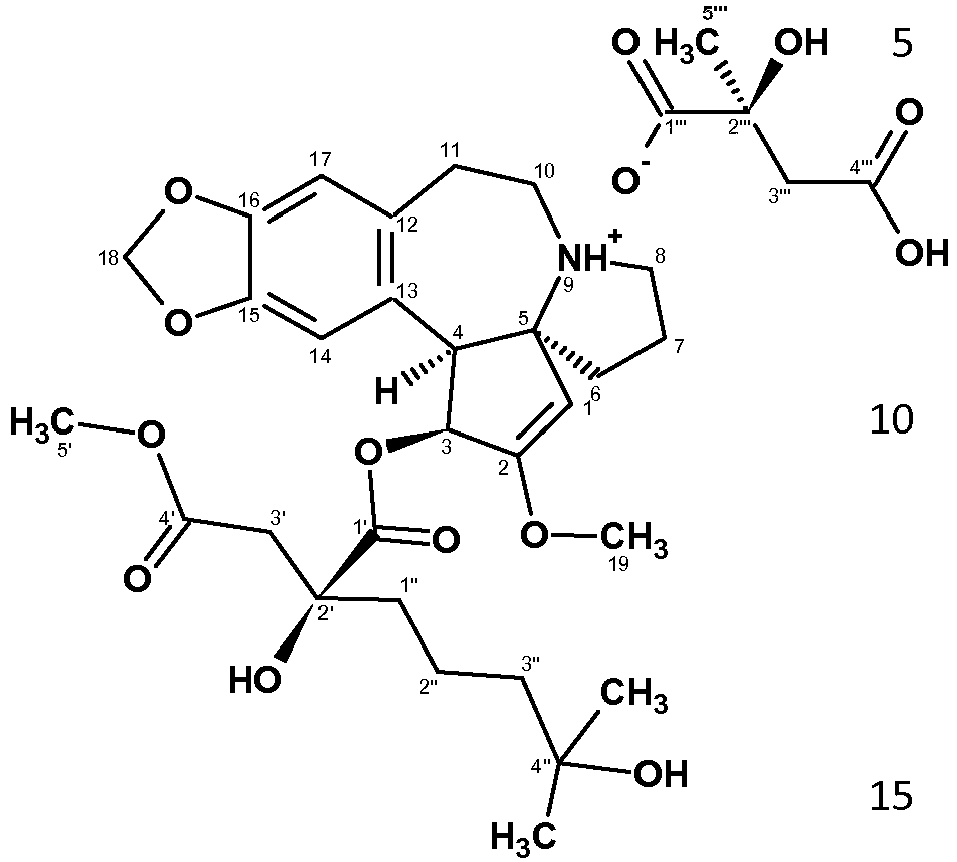
- This ionic compound was obtained from commercial homoharringtonine (batch # 51H0092) mixed with commercial (2S)-citramalic acid according to the general procedure in which the solvent was methanol, then isolated as a white prismatic solid mp 195.9-198.9°C (measured by DSC, see
figure 3.6 ). Several potentially acceptable crystals were kept suspended in their mother liquors for the subsequent X-ray diffraction analysis. (see below). - 1H NMR (400 MHz, Methanol-d 4)* δ 6.80 (s, 1H), 6.74 (s, 1H), 6.09 (d, J = 9.6 Hz, 1H), 5.96 (d, J = 0.9 Hz, 1H), 5.93 (d, J = 0.9 Hz, 1H), 5.33 (s, 1H), 4.17 (d, J = 9.6 Hz, 1H), 3.81 (s, 3H), 3.54 (s, 3H), 3.45 - 3.31 (m, 2H), 3.19 (dd, J = 10.6, 6.9 Hz, 1H), 2.70 (d, J = 15.7 Hz, 2H), 2.63 (d, J = 15.7 Hz, 1H), 2.26 - 2.12 (m, 4H), 1.94 (d, J = 16.1 Hz, 2H), 1.45 - 1.29 (m, 9H), 1.29 - 1.17 (m, 1H), 1.15 (s, 6H).
- 13C NMR (101 MHz, MeOD) δ 181.21, 176.08, 174.23, 171.62, 165.18, 149.81, 148.79, 130.84, 126.78, 114.87, 114.58, 111.53, 102.58, 95.71, 78.24, 76.08, 74.03, 73.18, 71.27, 58.75, 53.91, 52.90, 51.79, 48.63, 46.32, 44.47, 43.77, 40.59, 40.15, 28.94, 28.89, 28.87, 26.22, 19.62, 18.80.
- IR (Diamond ATR, solid)
cm figure 1.6 - IR (Diamond ATR, film)
cm figure 1.6 - The powder sample is well crystallised, with a peak width of 0.102° (2θ) at 17.597° (2θ) (for view of diagrams and experimental details, see
figure 2.7.1 ). -

- This ionic compound was obtained from commercial homoharringtonine (batch # 51H0092) mixed with commercial (2R)-citramalic acid according to the general procedure in which the solvent was methanol, then isolated as a white prismatic solid mp 202.7-204.7°C (measured by DSC, see
figure 3.7 ). Several potentially acceptable crystals were kept suspended in their mother liquors for the subsequent X-ray diffraction analysis. (see below). - 1H NMR (400 MHz, Methanol-d 4)* δ 6.79 (s, 1H), 6.74 (s, 1H), 6.08 (d, J = 9.6 Hz, 1H), 5.95 (d, J = 1.0 Hz, 1H), 5.93 (d, J = 1.0 Hz, 1H), 5.33 (s, 1H), 4.17 (d, J = 9.6 Hz, 1H), 3.81 (s, 3H), 3.54 (s, 3H), 3.43 - 3.31 (m, 2H), 3.22 - 3.14 (m, 1H), 2.73 - 2.66 (m, 2H), 2.63 (d, J = 15.7 Hz, 1H), 2.23 (d, J = 16.0 Hz, 2H), 2.19 (s, 1H), 1.94 (d, J = 16.1 Hz, 1H), 1.44 - 1.29 (m, 8H), 1.29 - 1.17 (m, 1H), 1.15 (s, 6H).
- 13C NMR APT* (101 MHz, Methanol-d 4) δ 181.21, 176.08, 174.23, 171.62, 165.18, 149.81, 148.79, 130.84, 126.78, 114.87, 111.82, 102.87, 96.00, 78.24, 76.08, 74.33, 73.18, 71.27, 59.04, 54.21, 53.20, 52.07, 48.94, 46.62, 44.76, 44.05, 40.87, 40.45, 29.23, 29.19, 29.17, 26.50, 19.92, 19.09.
- *APT = Attached Proton Test
- IR (Diamond ATR, solid)
cm figure 1.7 - IR (Diamond ATR, film)
cm figure 1.7 - From a suspension in its mother liquor, a suitable single crystal of size 0.44 x 0.32 x 0.16 mm was finally selected and implemented on the diffractometer.
Structural data Empirical formula C 34 H 47 N O14 Extended formula C 29 H 40 N O 9, C 5 H 7 O 5 Formula weight 693.73 Temperature 150(2) K Wavelength 0.71073 Å Crystal system, space group orthorhombic, P 21 21 21Unit cell dimensions a = 10.3550(3) Å, α = 90 ° b = 17.0899(6) Å, β = 90 ° c = 19.2854(7) Å, γ = 90 ° Volume 3412.9(2) Å3 Z, Calculated density 4 , 1.35 (g.cm -1) Absorption coefficient 0.105 mm -1 F(000) 1480 Crystal size 0.44 x 0.32 x 0.16 mm Crystal color colourless Theta range for data collection 3.09 to 27.48 ° h_min, h_max -13, 13 k_min, k_max -22, 20 I_min, I_max -19, 25 Reflections collected / unique 16497 / 7790 [ a R(int) = 0.0336] Reflections [I > 2σ] 6790 Completeness to theta_max 0.996 Absorption correction type multi-scan Max. and min. transmission 0.983, 0.880 Refinement method Full-matrix least-squares on F 2 Data / restraints / parameters 7790/0/462 b Goodness-of-fit 1.026 Final R indices [I > 2σ] cR1 = 0.0413, dwR2 = 0.0899 R indices (all data) cR1 = 0.0508, dwR2 = 0.0948 Largest diff. peak and hole 0.403 and -0.199 e.Å-3 - Atomic coordinates, site occupancy (%) and equivalent isotropic displacement parameters (A 2 x 10³).
- U(eq) is defined as one third of the trace of the orthogonalized Uij tensor.
- Atom numbering of
figure 2.8.1 corresponds to below table.Atom x y z occ. U(eq) C1 0.11571(16) 0.05636(10) 0.26511(9) 1 0.0175(4) H1 0.1363 0.0342 0.2213 1 0.021 C2 0.09856(16) 0.01523(10) 0.32323(9) 1 0.0171(4) C3 0.06120(16) 0.06351(11) 0.38472(9) 1 0.0162(3) H3 -0.0279 0.0492 0.4002 1 0.019 C4 0.06272(15) 0.14871(10) 0.35705(9) 1 0.0143(3) H4 -0.0287 0.1675 0.3589 1 0.017 C5 0.09821(15) 0.14231(10) 0.27823(9) 1 0.0159(4) C6 0.00002(16) 0.18455(11) 0.23179(9) 1 0.0195(4) H6A -0.0761 0.1508 0.2234 1 0.023 H6B -0.0293 0.2336 0.254 1 0.023 C7 0.06914(19) 0.20226(14) 0.16369(10) 1 0.0282(5) H7A 0.0457 0.255 0.1465 1 0.034 H7B 0.046 0.1632 0.1279 1 0.034 C8 0.21369(17) 0.19809(11) 0.18060(9) 1 0.0190(4) H8A 0.2545 0.153 0.1569 1 0.023 H8B 0.2581 0.2467 0.166 1 0.023 N9 0.22010(13) 0.18836(9) 0.25825(7) 1 0.0156(3) HN9 0.215(2) 0.2413(15) 0.2762(14) 1 0.05 C10 0.34708(16) 0.15611(11) 0.28115(9) 1 0.0187(4) H10A 0.4167 0.193 0.2681 1 0.022 H10B 0.3634 0.1059 0.2571 1 0.022 C11 0.35010(16) 0.14274(11) 0.35966(9) 1 0.0182(4) H11A 0.313 0.0906 0.3698 1 0.022 H11B 0.4411 0.1423 0.3753 1 0.022 C12 0.27690(16) 0.20378(10) 0.40075(9) 1 0.0161(3) C13 0.14095(15) 0.20673(10) 0.39833(9) 1 0.0142(3) C14 0.07316(17) 0.26533(10) 0.43397(9) 1 0.0168(4) H14 -0.0183 0.2688 0.4315 1 0.02 C15 0.14387(18) 0.31747(10) 0.47263(9) 1 0.0200(4) C16 0.27616(18) 0.31308(11) 0.47618(9) 1 0.0207(4) C17 0.34575(17) 0.25856(11) 0.43994(9) 1 0.0190(4) H17 0.4374 0.258 0.4414 1 0.023 C18 0.2137(2) 0.41952(12) 0.53342(11) 1 0.0334(5) H18A 0.2207 0.4679 0.5055 1 0.04 H18B 0.2103 0.4343 0.583 1 0.04 C19 0.1546(2) -0.10852(11) 0.27911(11) 1 0.0300(5) H19A 0.0911 -0.1088 0.2414 1 0.045 H19B 0.1691 -0.1622 0.2952 1 0.045 H19C 0.2361 -0.0864 0.2622 1 0.045 C21 0.11247(16) 0.01321(10) 0.49827(9) 1 0.0161(3) C22 0.22813(16) 0.00398(10) 0.54736(9) 1 0.0178(4) C23 0.29449(17) 0.08219(10) 0.56296(10) 1 0.0189(4) H23A 0.369 0.0729 0.594 1 0.023 H23B 0.3277 0.1048 0.5192 1 0.023 C24 0.20436(17) 0.13941(10) 0.59644(10) 1 0.0196(4) C25 0.18690(19) 0.25170(12) 0.66695(12) 1 0.0293(5) H25A 0.1478 0.2853 0.6315 1 0.044 H25B 0.2392 0.2837 0.6984 1 0.044 H25C 0.1187 0.2253 0.6933 1 0.044 C31 0.32662(17) -0.05075(11) 0.51274(10) 1 0.0204(4) H31A 0.361 -0.0244 0.4709 1 0.025 H31B 0.3997 -0.0586 0.5451 1 0.025 C32 0.27492(18) -0.13115(11) 0.49143(10) 1 0.0222(4) H32A 0.2495 -0.1609 0.5333 1 0.027 H32B 0.1973 -0.1245 0.462 1 0.027 C33 0.37715(18) -0.17662(11) 0.45161(11) 1 0.0248(4) H33A 0.4587 -0.1741 0.4783 1 0.03 H33B 0.3923 -0.1495 0.407 1 0.03 C34 0.34851(18) -0.26269(11) 0.43594(11) 1 0.0240(4) C36 0.4577(2) -0.29453(13) 0.39087(14) 1 0.0423(6) H36A 0.4411 -0.3497 0.3801 1 0.063 H36B 0.5397 -0.2899 0.4159 1 0.063 H36C 0.4623 -0.2644 0.3477 1 0.063 C35 0.3354(2) -0.31160(13) 0.50108(12) 1 0.0363(5) H35A 0.2616 -0.2929 0.5283 1 0.054 H35B 0.4144 -0.3071 0.5288 1 0.054 H35C 0.3216 -0.3665 0.4884 1 0.054 O1 0.10699(13) -0.06191(7) 0.33525(7) 1 0.0244(3) O2 0.32223(14) 0.37011(8) 0.52078(7) 1 0.0304(3) O3 0.09930(13) 0.37738(8) 0.51464(7) 1 0.0288(3) O4 0.15171(11) 0.05193(7) 0.44075(6) 1 0.0171(3) O5 0.00628(12) -0.01257(8) 0.50746(7) 1 0.0222(3) O6 0.18733(13) -0.03191(8) 0.60999(7) 1 0.0221(3) HO6 0.120(3) -0.0138(16) 0.6222(14) 1 0.05 O7 0.08889(13) 0.13801(9) 0.59158(9) 1 0.0357(4) O8 0.26816(12) 0.19381(8) 0.63389(7) 1 0.0243(3) O9 0.22961(14) -0.26485(9) 0.39752(9) 1 0.0348(4) HO9 0.203(3) -0.3138(17) 0.3982(14) 1 0.05 C51 0.17383(18) 0.50529(11) 0.36479(10) 1 0.0247(4) C52 0.31671(18) 0.48833(12) 0.35581(12) 1 0.0299(5) H52A 0.3411 0.4469 0.3892 1 0.036 H52B 0.3654 0.5361 0.3686 1 0.036 C53 0.36065(18) 0.46262(12) 0.28366(12) 1 0.0288(5) C54 0.2995(2) 0.51004(15) 0.22598(13) 1 0.0470(6) H54A 0.3131 0.5659 0.2348 1 0.071 H54B 0.2067 0.4991 0.2242 1 0.071 H54C 0.3392 0.4958 0.1816 1 0.071 C55 0.33695(18) 0.37452(11) 0.26995(10) 1 0.0243(4) O51 0.13621(14) 0.56592(9) 0.39014(9) 1 0.0361(4) O52 0.09277(13) 0.45011(9) 0.34618(8) 1 0.0300(3) HO52 0.147(2) 0.4107(15) 0.3218(14) 1 0.05 O53 0.49802(14) 0.47478(10) 0.28234(10) 1 0.0438(4) HO53 0.530(2) 0.4274(17) 0.2667(14) 1 0.05 O54 0.42729(14) 0.33586(9) 0.24647(8) 1 0.0368(4) O55 0.22436(12) 0.34821(8) 0.28413(7) 1 0.0261(3) - The sample was pure and well crystallised, with a peak width of 0.107 °(2θ) at 16.992 °(2θ). There was a very good match between the experimental pattern and the calculated pattern (for view of diagrams and experimental details, see
figure 2.8.3 ). -

- This ionic compound was obtained from commercial homoharringtonine (batch # 51H0092) mixed with commercial succinic acid according to the general procedure in which the solvent was methanol, then isolated as a white prismatic solid mp 158.1-160.0°C (measured by DSC, see
figure 3.8 ). - 1 H NMR (400 MHz, Methanol-d 4 )* δ 6.77 (s, 1H), 6.71 (s, 1H), 6.07 (dd, J = 9.6, 0.7 Hz, 1H), 5.95 (d, J = 1.1 Hz, 1H), 5.92 (d, J = 1.1 Hz, 1H), 5.31 (d, J = 0.6 Hz, 1H), 4.12 (d, J = 9.6 Hz, 1H), 3.79 (s, 3H), 3.54 (s, 3H), 2.49 (s, 4H), 2.22 (d, J = 16.2 Hz, 1H), 1.93 (d, J = 16.1 Hz, 2H), 1.15 (s, 6H).
- 13 C NMR APT* (101 MHz, D 2 O) δ 179.49, 174.22, 171.93, 162.89, 147.84, 146.75, 129.74, 125.23, 113.38, 111.12, 101.62, 95.53, 76.99, 75.26, 73.68, 71.33, 58.41, 52.95, 52.23, 51.27, 48.86, 47.58, 42.72, 42.55, 39.19, 38.77, 31.20, 27.59, 18.59, 17.69.
- *APT = Attached Proton Test
- IR (KBr, solid), cm -1 3571.1, 3375.3, 3083.4, 2964.4, 1755.4, 1736.7, 1661.8, 1575.5, 1504.8, 1489.7, 1375.0, 1346.3, 1326.1, 1267.2, 1227.1, 1188.3, 1151.7, 1083.4, 1034.7, 929.4, 859.4, 802.8, 758.1, 709.9, 658.9, 617.9, 561.2, 510.6. See
figure 1.8 -

- This ionic compound was obtained from commercial homoharringtonine (batch # 51H0092) mixed with commercial itaconic acid (batch #) according to the general procedure in which the solvent was methanol, then isolated as a white prismatic solid mp 178.3-181.2°C (measured by DSC, see
figure 3.9 ). Several potentially acceptable crystals were kept suspended in their mother liquors for the subsequent X-ray diffraction analysis. (see below). - 1H NMR (400 MHz, Methanol-d 4)* δ 6.78 (s, 1H), 6.72 (s, 1H), 6.08 (d, J = 9.6 Hz, 1H), 6.01 (d, J = 1.7 Hz, 1H), 5.95 (d, J = 1.1 Hz, 1H), 5.92 (d, J = 1.1 Hz, 1H), 5.51 (q, J = 1.2 Hz, 1H), 5.32 (s, 1H), 4.14 (d, J = 9.6 Hz, 1H), 3.80 (s, 3H), 3.54 (s, 3H), 3.51 - 3.42 (m, 1H), 3.25 - 3.07 (m, 2H), 2.72 - 2.60 (m, 1H), 2.26 - 2.20 (m, 2H), 2.20 - 2.07 (m, 2H), 1.94 (d, J = 16.1 Hz, 2H), 1.47 - 1.29 (m, 5H), 1.23 (d, J = 10.6 Hz, 1H), 1.15 (s, 6H).
- 13C NMR (101 MHz, MeOD)** δ 125.11, 114.53, 111.47, 102.52, 96.09, 74.12, 58.66, 53.95, 53.18, 48.70, 44.48, 43.78, 41.66, 40.59, 40.44, 29.12, 28.94, 28.87, 19.70, 18.81.
- **DEPT135: Distortionless Enhancement by Polarization Transfer (non-quaternary carbons only)
- IR (Diamond ATR, solid) cm-1 3473.2, 2968.4, 2899.8, 2564.7, 1760.7, 1733.5, 1657.6, 1569.7, 1506.4, 1488.9, 1436.1, 1374.9, 1348.9, 1264.2, 1240.7, 1226.2, 1185, 1168.8, 1149.8, 1112.1, 1082.4, 1043.1, 1032.9, 1022.2, 982, 928.1, 890, 866.7, 819.8, 772.1, 722.1, 690.1, 616.7, 543. See
figure 1.9 - IR (ATR, film) cm-1 3458.8, 2967, 1741.5, 1654.8, 1576.7, 1505.2, 1489.3, 1464.3, 1373.4, 1223.8, 1167, 1083.1, 1033.3, 933.6, 563.4. See
figure 1.9 - From a suspension in its mother liquor, a suitable single crystal of size 0.39 x 0.22 x 0.1 mm was finally selected and implemented on the diffractometer.
Structural data Empirical formula C 34 H 45 N O13 Extended formula C 29 H 40 N O 9, C 5 H 5 O 4 Formula weight 675.71 Temperature 150(2) K Wavelength 0.71073 Å Crystal system, space group orthorhombic, P 21 21 21Unit cell dimensions a = 10.9895(4) Å, α = 90 ° b = 16.1963(6) Å, β = 90 ° c = 18.7277(5) Å, γ = 90 ° Volume 3333.33(19) Å3 Z, Calculated density 4, 1.346 (g.cm -1) Absorption coefficient 0.103 mm -1 F(000) 1440 Crystal size 0.39 x 0.22 x 0.1 mm Crystal color colourless Theta range for data collection 3.12 to 27.48 ° h_min, h_max -11 , 14 k_min, k_max -13 , 20 I_min, I_max -16 , 24 Reflections collected / unique 15962 / 4207 [ a R(int) = 0.0449] Reflections [I > 2σ] 3444 Completeness to theta_max 0.986 Absorption correction type multi-scan Max. and min. transmission 0.990, 0.844 Refinement method: Full-matrix least-squares on F 2 Data / restraints / parameters 4207 / 0 / 446 b Goodness-of-fit 1.054 Final R indices [I > 2σ] cR1 = 0.0411, dwR2 = 0.0914 R indices (all data) cR1 = 0.0557, dwR2 = 0.0986 Largest diff. peak and hole 0.312 and -0.249 e.Å-3 - Atomic coordinates, site occupancy (%) and equivalent isotropic displacement parameters (A 2 x 10³).
- U(eq) is defined as one third of the trace of the orthogonalized Uij tensor.
- Atom numbering of
figure 2.9.1 corresponds to below table.Atom x y z occ. U(eq) C1 0.4085(2) 0.94954(16) 0.28454(13) 1 0.0246(6) H1 0.3897 0.972 0.239 1 0.029 C2 0.4040(2) 0.99163(16) 0.34531(13) 1 0.0239(5) C3 0.4399(2) 0.94237(16) 0.40941(12) 1 0.0206(5) H3 0.5169 0.9646 0.4305 1 0.025 C4 0.4605(2) 0.85392(16) 0.38019(11) 1 0.0187(5) H4 0.548 0.8406 0.3893 1 0.022 C5 0.4471(2) 0.86236(16) 0.29702(12) 1 0.0216(5) C6 0.5613(2) 0.83684(18) 0.25641(12) 1 0.0244(6) H6A 0.5945 0.7845 0.2755 1 0.029 H6B 0.6247 0.8801 0.2599 1 0.029 C7 0.5195(3) 0.8261(2) 0.17935(13) 1 0.0330(7) H7A 0.5696 0.7843 0.1544 1 0.04 H7B 0.5244 0.879 0.153 1 0.04 C8 0.3878(3) 0.7973(2) 0.18586(13) 1 0.0347(7) H8A 0.3332 0.8339 0.1582 1 0.042 H8B 0.3791 0.7402 0.1675 1 0.042 N9 0.35665(19) 0.80066(14) 0.26453(10) 1 0.0225(5) H9 0.3728 0.749 0.284 1 0.027 C10 0.2240(2) 0.81867(19) 0.27555(14) 1 0.0293(6) H10A 0.1752 0.7717 0.2576 1 0.035 H10B 0.2013 0.8683 0.2477 1 0.035 C11 0.1946(2) 0.83313(19) 0.35427(13) 1 0.0280(6) H11A 0.2153 0.8908 0.3668 1 0.034 H11B 0.1061 0.8258 0.3617 1 0.034 C12 0.2625(2) 0.77534(17) 0.40351(12) 1 0.0218(5) C13 0.3876(2) 0.78580(16) 0.41518(12) 1 0.0197(5) C14 0.4503(2) 0.73128(16) 0.45992(12) 1 0.0226(5) H14 0.5349 0.7378 0.4685 1 0.027 C15 0.3868(2) 0.66846(18) 0.49096(13) 1 0.0281(6) C16 0.2644(2) 0.65757(18) 0.47829(14) 1 0.0300(6) C17 0.1998(2) 0.70918(17) 0.43475(13) 1 0.0274(6) H17 0.1156 0.7006 0.426 1 0.033 C18 0.3315(3) 0.5504(2) 0.5409(2) 1 0.0595(10) H18A 0.3503 0.5025 0.5101 1 0.071 H18B 0.3207 0.5305 0.5905 1 0.071 C19 0.3222(3) 1.11383(18) 0.29761(14) 1 0.0333(7) H19A 0.2562 1.0809 0.277 1 0.05 H19B 0.3856 1.1225 0.2616 1 0.05 H19C 0.2902 1.1674 0.3132 1 0.05 C21 0.3633(2) 0.98532(16) 0.52334(12) 1 0.0193(5) C22 0.2491(2) 0.98238(16) 0.56983(12) 1 0.0210(5) C23 0.2120(2) 0.89286(16) 0.58578(12) 1 0.0225(5) H23A 0.1406 0.8932 0.618 1 0.027 H23B 0.1873 0.8659 0.5406 1 0.027 C24 0.3118(2) 0.84293(17) 0.61968(12) 1 0.0228(5) C25 0.3602(3) 0.7333(2) 0.69781(18) 1 0.0448(8) H25A 0.4231 0.7681 0.7195 1 0.067 H25B 0.3973 0.6974 0.6618 1 0.067 H25C 0.3218 0.6994 0.7348 1 0.067 C31 0.1446(2) 1.02575(17) 0.53105(13) 1 0.0239(5) H31A 0.1214 0.9918 0.4892 1 0.029 H31B 0.0735 1.0275 0.5635 1 0.029 C32 0.1704(2) 1.11351(17) 0.50526(13) 1 0.0272(6) H32A 0.1946 1.1483 0.5463 1 0.033 H32B 0.2387 1.1127 0.4708 1 0.033 C33 0.0585(3) 1.1503(2) 0.46982(16) 1 0.0367(7) H33A -0.0106 1.1443 0.5033 1 0.044 H33B 0.0395 1.1164 0.4272 1 0.044 C34 0.0638(3) 1.2404(2) 0.44632(14) 1 0.0348(7) C35 -0.0534(3) 1.2636(3) 0.4090(2) 1 0.0667(12) H35A -0.0642 1.2289 0.3667 1 0.1 H35B -0.0499 1.3217 0.3946 1 0.1 H35C -0.122 1.2554 0.4417 1 0.1 C36 0.0885(3) 1.2991(2) 0.50777(16) 1 0.0518(9) H36A 0.0919 1.3558 0.4897 1 0.078 H36B 0.1664 1.2849 0.5301 1 0.078 H36C 0.0232 1.2944 0.5432 1 0.078 O1 0.37336(17) 1.07063(11) 0.35827(9) 1 0.0295(4) O2 0.2228(2) 0.58991(14) 0.51681(12) 1 0.0481(6) O3 0.4284(2) 0.60914(13) 0.53788(11) 1 0.0427(5) O4 0.34267(14) 0.94422(11) 0.46170(8) 1 0.0201(4) O5 0.45495(15) 1.02085(12) 0.53858(9) 1 0.0266(4) O6 0.27352(16) 1.02392(12) 0.63524(9) 1 0.0251(4) HO6 0.342(3) 1.033(2) 0.6369(17) 1 0.05 O7 0.41851(16) 0.85198(13) 0.60753(11) 1 0.0356(5) O8 0.26888(16) 0.78534(13) 0.66423(11) 1 0.0366(5) O9 0.1644(2) 1.24749(16) 0.39741(12) 1 0.0513(6) HO9 0.160(3) 1.307(2) 0.3826(17) 1 0.05 C51 0.1037(3) 0.4553(2) 0.31090(15) 1 0.0388(7) C52 0.1159(3) 0.5480(2) 0.3010(2) 1 0.0512(9) H52A 0.0462 0.5679 0.2723 1 0.061 H52B 0.1112 0.5749 0.3484 1 0.061 C53 0.2325(3) 0.57416(19) 0.26485(16) 1 0.0403(8) C54 0.3464(3) 0.57891(18) 0.30905(13) 1 0.0285(6) C55 0.2404(5) 0.5906(2) 0.19500(19) 1 0.0747(14) H55A 0.3166 0.6049 0.1745 1 0.09 H55B 0.1697 0.5881 0.1659 1 0.09 O51 0.00971(18) 0.41958(16) 0.29455(13) 1 0.0529(6) O52 0.19701(19) 0.41745(13) 0.33812(11) 1 0.0377(5) HO52 0.262(3) 0.454(2) 0.3511(17) 1 0.05 O53 0.41850(17) 0.63675(12) 0.30044(10) 1 0.0344(5) O54 0.36137(17) 0.52002(13) 0.35372(10) 1 0.0346(5) -

- This ionic compound was obtained from commercial homoharringtonine (batch # 51H0092) mixed with commercial fumaric acid (batch #) according to the general procedure in which the solvent was methanol, then isolated as a white prismatic solid mp 103.5-107.2°C (measured by DSC, see
figure 3.10 ). - 1H NMR (400 MHz, Methanol-d 4)* δ 6.80 (s, 1H), 6.74 (s, 1H), 6.65 (s, 2H), 6.09 (d, J = 9.6 Hz, 1H), 5.96 (d, J = 0.9 Hz, 1H), 5.93 (d, J = 0.9 Hz, 1H), 5.33 (s, 1H), 4.17 (d, J = 9.6 Hz, 1H), 3.82 (s, 3H), 3.55 (s, 3H), 3.43 - 3.32 (m, 2H), 3.24 - 3.10 (m, 1H), 2.75 - 2.61 (m, 1H), 2.30 - 2.08 (m, 4H), 1.95 (d, J = 16.1 Hz, 2H), 1.47 - 1.30 (m, 5H), 1.16 (s, 6H).
- 13C NMR (101 MHz, MeOD)** δ 135.91, 114.59, 111.56, 102.57, 95.74, 74.03, 58.74, 53.89, 52.92, 51.79, 49.56, 48.62, 44.47, 43.77, 40.59, 40.16, 28.94, 28.90, 28.88, 19.64, 18.81.
- **DEPT135: Distortionless Enhancement by Polarization Transfer (non-quaternary carbons only)
- IR (ATR, solid), cm-1 3607.9, 3212.6, 2955.6, 1980.4, 1777.4, 1731.4, 1708.1, 1653.6, 1584.3, 1505.9, 1488.6, 1440.0, 1372.4, 1338.6, 1292.0, 1251.1, 1221.1, 1173.3, 1150.9, 1119.3, 1088.7, 1034.0, 982.0, 934.1, 903.3, 839.6, 790.3, 761.8, 646.0, 613.5, 563.6, 510.2. See
figure 1.10 - The powder sample is well crystallised, with a peak width of 0.119° (2θ) at 19.564° (2θ) (for view of diagrams and experimental details, see
figure 2.7.1 ). -

- This ionic compound was obtained from commercial homoharringtonine (batch # 51H0092) mixed with commercial tartronic acid (batch #) according to the general procedure in which the solvent was methanol, then isolated as a white prismatic solid mp 163.1-167.6°C (measured by DSC, see
figure 3.11 ). - 1H NMR (400 MHz, Methanol-d 4)* δ 6.80 (s, 1H), 6.75 (s, 1H), 6.09 (d, J = 9.6 Hz, 1H), 5.96 (d, J = 0.9 Hz, 1H), 5.94 (d, J = 0.9 Hz, 1H), 5.34 (s, 1H), 4.18 (d, J = 9.6 Hz, 1H), 3.82 (s, 3H), 3.54 (s, 3H), 2.69 (m, 1H), 2.22 (m, 4H), 2.04 - 1.91 (m, 2H), 1.47-1.29 (m, 5H), 1.23 (m, 1H), 1.15 (s, 6H).
- 13C NMR (101 MHz, MeOD)** δ 114.60, 111.55, 102.61, 95.67, 74.02, 58.77, 53.94, 52.86, 51.79, 48.67, 44.47, 43.77, 40.59, 40.10, 28.94, 28.88, 28.84, 19.63, 18.80.
- **DEPT135: Distortionless Enhancement by Polarization Transfer (non-quaternary carbons only)
- IR (Diamond ATR, solid)
cm figure 1.11 - IR (Diamond ATR, film)
cm figure 1.11 -

- This ionic compound was obtained from commercial homoharringtonine (batch # 51H0092) mixed with commercial (2R)-citramalic acid according to the general procedure in which the solvent was methanol-d4, then isolated as a white prismatic solid mp 127.0-131.9°C (measured by DSC, see
figure 3.12 ). - 1H NMR (400 MHz, Methanol-d 4)* δ 6.81 (s, 1H), 6.75 (s, 1H), 6.10 (d, J = 9.6 Hz, 1H), 5.97 (d, J = 1.1 Hz, 1H), 5.94 (d, J = 1.0 Hz, 1H), 5.34 (s, 1H), 4.18 (d, J = 9.6 Hz, 1H), 3.82 (s, 3H), 3.55 (s, 3H), 3.24 - 3.17 (m, 1H), 2.74 - 2.64 (m, 1H), 2.30 - 2.09 (m, 4H), 1.95 (d, J = 16.1 Hz, 2H), 1.48 - 1.30 (m, 5H), 1.16 (s, 6H).
- 13C NMR APT* (101 MHz, Methanol-d4) δ 174.83, 174.22, 171.62, 165.26, 149.82, 148.81, 130.79, 126.75, 114.88, 111.83, 102.90, 95.90, 78.32, 76.09, 74.30, 71.27, 59.04, 54.21, 53.18, 52.07, 48.94, 44.75, 44.05, 40.87, 40.42, 29.22, 29.17, 29.14, 19.91, 19.09. See
figure 1.12 - *APT = Attached Proton Test
- IR (Diamond ATR, solid) cm-1 3453.1, 2967.5, 2933.2, 2899.3, 1765.0, 1735.2, 1654.6, 1505.9, 1489.1, 1463.7, 1439.1, 1374.9, 1349.7, 1292.0, 1266.2, 1226.5, 1207.5, 1148.4, 1083.3, 1060.6, 1032.3, 1002.1, 985.4, 944.1, 925.5, 891.0, 858.5, 830.6, 797.6, 756.7, 721.5, 710.8, 690.8, 615.1, 565.1, 510.8, 498.3, 489.9, 478.9, 472.8. See
figure 1.12 -

- This ionic compound was obtained from commercial homoharringtonine (batch # 51H0092) mixed with commercial citric acid (batch #) according to the general procedure in which the solvent was methanol, then isolated as a white prismatic solid mp 170.35-173.9°C (measured by DSC, see
figure 3.13 ). Several potentially acceptable crystals were kept suspended in their mother liquors for the subsequent X-ray diffraction analysis. (see below). - 1H NMR (400 MHz, Methanol-d 4)* δ 6.80 (s, 1H), 6.75 (s, 1H), 6.09 (d, J = 9.6 Hz, 1H), 5.96 (s, 1H), 5.94 (s, 1H), 5.33 (s, 1H), 4.17 (d, J = 9.7 Hz, 1H), 3.81 (s, 3H), 3.54 (s, 3H), 2.79 (d, J = 15.4 Hz, 2H), 2.71 (d, J = 15.4 Hz, 2+1 H), 2.23 (d, J = 16.2 Hz, 1H), 1.95 (d, J = 16.1 Hz, 1H), 1.49 - 1.17 (m, 6H), 1.15 (s, 6H).
- 13C NMR APT*(101 MHz, Methanol-d 4) δ 179.22, 174.90, 174.22, 171.61, 165.22, 149.83, 148.81, 130.80, 126.75, 114.89, 111.84, 102.89, 95.97, 78.30, 76.09, 74.33, 74.01, 71.29, 59.05, 54.23, 53.21, 52.07, 48.95, 44.76, 44.06, 40.88, 40.44, 29.22, 29.18, 29.16, 19.92, 19.10.
- *APT = Attached Proton Test
- IR (Diamond ATR, solid)
cm figure 1.13 - IR (Diamond ATR, film)
cm figure 1.13 - From a suspension in its mother liquor, a suitable single crystal of size 0.58 x 0.36 x 0.28 mm was finally selected and implemented on the diffractometer.
Structural data Empirical formula C 36 H 51 N O 17 Extended formula C 29 H 40 N O 9, C 6 H 7 O 7, CH 4 O Formula weight 769.78 Temperature 150(2) K Wavelength 0.71073 Å Crystal system, space group orthorhombic, P 21 21 21Unit cell dimensions a = 9.9967(3) Å, α = 90 ° b = 18.8971(5) Å, β = 90 ° c = 19.2826(7) Å, γ = 90 ° Volume 3642.6(2) Å3 Z, Calculated density 4, 1.404 (g.cm -1) Absorption coefficient 0.112 mm -1 F(000) 1640 Crystal size 0.58 x 0.36 x 0.28 mm Crystal color colourless Theta range for data collection 2.94 to 27.48 ° h_min, h_max -12 , 12 k_min, k_max -20 , 24 I_min, I_max -25 , 13 Reflections collected / unique 18037 / 4637 [ a R(int) = 0.0424] Reflections [I > 2σ] 4165 Completeness to theta_max 0.998 Absorption correction type multi-scan Max. and min. transmission 0.969, 0.858 Refinement method Full-matrix least-squares on F 2 Data / restraints / parameters 4637 / 0 / 513 b Goodness-of-fit 1.032 Final R indices [I > 2σ] cR1 = 0.0367, dwR2 = 0.0851 R indices (all data) c R1 = 0.0427, dwR2 = 0.0884 Largest diff. peak and hole 0.289 and -0.214 e.Å-3 - Atomic coordinates, site occupancy (%) and equivalent isotropic displacement parameters (A 2 x 10³).
- U(eq) is defined as one third of the trace of the orthogonalized Uij tensor.
- Atom numbering of
figure 2.11.1 corresponds to below table.Atom x y z occ. U(eq) C1 0.3491(2) 0.92951(11) 0.25699(11) 1 0.0149(4) H1 0.3259 0.9482 0.2129 1 0.018 C2 0.3729(2) 0.96852(11) 0.31322(11) 1 0.0152(4) C3 0.4025(2) 0.92636(11) 0.37724(10) 1 0.0138(4) H3 0.4934 0.9384 0.3953 1 0.017 C4 0.3993(2) 0.84827(11) 0.35162(11) 1 0.0119(4) H4 0.4942 0.8317 0.3535 1 0.014 C5 0.3638(2) 0.85222(11) 0.27257(11) 1 0.0136(4) C6 0.4667(2) 0.81449(12) 0.22685(11) 1 0.0176(5) H6A 0.4901 0.7677 0.2464 1 0.021 H6B 0.5492 0.8431 0.2224 1 0.021 C7 0.3972(3) 0.80632(13) 0.15620(12) 1 0.0220(5) H7A 0.4181 0.8469 0.1256 1 0.026 H7B 0.4258 0.7621 0.133 1 0.026 C8 0.2475(3) 0.80407(12) 0.17319(11) 1 0.0212(5) H8A 0.2 0.8437 0.1504 1 0.025 H8B 0.2075 0.7589 0.1575 1 0.025 N9 0.2393(2) 0.81069(9) 0.25106(9) 1 0.0141(4) HN9 0.251(4) 0.7629(18) 0.2669(17) 1 0.05 C10 0.1057(2) 0.83634(12) 0.27463(11) 1 0.0172(5) H10A 0.0365 0.8014 0.2612 1 0.021 H10B 0.0848 0.8815 0.251 1 0.021 C11 0.1006(2) 0.84755(11) 0.35335(11) 1 0.0144(4) H11A 0.1348 0.8955 0.364 1 0.017 H11B 0.0062 0.8455 0.3686 1 0.017 C12 0.1806(2) 0.79388(11) 0.39455(11) 1 0.0130(4) C13 0.3209(2) 0.79563(10) 0.39455(11) 1 0.0118(4) C14 0.3947(2) 0.74640(11) 0.43291(11) 1 0.0141(4) H14 0.4897 0.7472 0.433 1 0.017 C15 0.3252(2) 0.69701(11) 0.47031(11) 1 0.0153(4) C16 0.1875(2) 0.69386(11) 0.46951(11) 1 0.0153(4) C17 0.1124(2) 0.74148(11) 0.43253(11) 1 0.0159(4) H17 0.0174 0.7392 0.4325 1 0.019 C18 0.2626(2) 0.59964(11) 0.52687(12) 1 0.0212(5) H18A 0.2671 0.5574 0.4966 1 0.025 H18B 0.2624 0.5837 0.5758 1 0.025 C19 0.3571(3) 1.07978(12) 0.25888(13) 1 0.0270(6) H19A 0.2638 1.0737 0.2445 1 0.041 H19B 0.4165 1.0631 0.2219 1 0.041 H19C 0.3746 1.13 0.2679 1 0.041 C21 0.3353(2) 0.98104(10) 0.48356(11) 1 0.0126(4) C22 0.2160(2) 0.99292(11) 0.53183(11) 1 0.0140(4) C23 0.1479(2) 0.92348(11) 0.55222(11) 1 0.0162(4) H23A 0.0747 0.9336 0.5854 1 0.019 H23B 0.1079 0.9015 0.5105 1 0.019 C24 0.2446(2) 0.87236(11) 0.58470(11) 1 0.0160(4) C25 0.2645(3) 0.77137(12) 0.65633(13) 1 0.0259(5) H25A 0.3417 0.7932 0.6792 1 0.039 H25B 0.2957 0.7397 0.6195 1 0.039 H25C 0.2129 0.7442 0.6904 1 0.039 C31 0.1157(2) 1.04230(11) 0.49544(12) 1 0.0172(5) H31A 0.0748 1.0168 0.4559 1 0.021 H31B 0.0433 1.0545 0.5284 1 0.021 C32 0.1792(2) 1.11061(11) 0.46873(12) 1 0.0195(5) H32A 0.2259 1.1006 0.4245 1 0.023 H32B 0.247 1.1269 0.5026 1 0.023 C33 0.0774(2) 1.16973(11) 0.45699(13) 1 0.0185(5) 33A 0.0362 1.1819 0.5021 1 0.022 H33B 0.0055 1.1515 0.4265 1 0.022 C34 0.1343(2) 1.23774(11) 0.42451(12) 1 0.0177(5) C35 0.1490(3) 1.23004(14) 0.34612(13) 1 0.0286(6) H35A 0.1813 1.2747 0.3264 1 0.043 H35B 0.062 1.2182 0.3257 1 0.043 H35C 0.2132 1.1923 0.3358 1 0.043 C36 0.2649(3) 1.26062(13) 0.45770(15) 1 0.0279(6) H36A 0.2555 1.26 0.5083 1 0.042 H36B 0.2874 1.3086 0.4423 1 0.042 H36C 0.3363 1.228 0.4439 1 0.042 O1 0.38145(18) 1.03942(8) 0.32111(8) 1 0.0215(4) O2 0.14401(17) 0.63966(8) 0.51222(8) 1 0.0216(4) O3 0.37524(16) 0.64530(8) 0.51409(8) 1 0.0188(3) O4 0.30170(15) 0.93996(7) 0.42992(8) 1 0.0145(3) O5 0.44249(16) 1.00917(8) 0.49151(8) 1 0.0177(3) O6 0.26234(18) 1.02640(8) 0.59345(8) 1 0.0185(3) HO6 0.345(4) 1.0383(18) 0.5906(18) 1 0.05 O7 0.36240(17) 0.87121(9) 0.57473(9) 1 0.0269(4) O8 0.18077(17) 0.82599(8) 0.62673(8) 1 0.0204(4) O9 0.03435(17) 1.29295(8) 0.43436(9) 1 0.0194(4) HO9 0.039(4) 1.3068(17) 0.4747(18) 1 0.047 C51 0.2081(2) 0.62031(12) 0.26814(12) 1 0.0197(5) C52 0.2431(2) 0.55356(11) 0.31079(11) 1 0.0165(4) C53 0.1183(2) 0.53099(11) 0.35211(12) 1 0.0196(5) H53A 0.1 0.5667 0.3885 1 0.023 H53B 0.0402 0.5298 0.3205 1 0.023 C54 0.1343(2) 0.45913(12) 0.38583(12) 1 0.0215(5) O51 0.2755(2) 0.67426(8) 0.28230(9) 1 0.0293(4) O52 0.11948(19) 0.61575(9) 0.22240(10) 1 0.0300(4) O53 0.34983(17) 0.57012(9) 0.35660(9) 1 0.0221(4) HO53 0.358(4) 0.6160(18) 0.3535(18) 1 0.05 O54 0.2279(2) 0.44156(10) 0.42120(12) 1 0.0433(6) O55 0.03274(18) 0.41626(9) 0.37134(8) 1 0.0204(4) HO55 0.044(4) 0.3790(18) 0.3902(18) 1 0.05 C60 0.2959(2) 0.49411(12) 0.26327(12) 1 0.0204(5) H60A 0.3642 0.5153 0.2324 1 0.025 H60B 0.3427 0.4594 0.2931 1 0.025 C61 0.1992(3) 0.45307(13) 0.21778(13) 1 0.0251(5) O62 0.0989(2) 0.48721(10) 0.18875(10) 1 0.0344(5) HO62 0.104(3) 0.5364(18) 0.2012(18) 1 0.05 O63 0.2167(2) 0.39075(9) 0.20666(11) 1 0.0381(5) O71 0.5434(2) 1.13984(10) 0.43673(10) 1 0.0321(4) HO71 0.498(4) 1.1011(18) 0.4527(18) 1 0.05 C72 0.6645(3) 1.11097(17) 0.41010(17) 1 0.0443(8) H72A 0.6436 1.0742 0.376 1 0.066 H72B 0.7165 1.0903 0.4481 1 0.066 H72C 0.7167 1.1485 0.3879 1 0.066 - The powder sample is well crystallised, with a peak width of 0.127 °(2θ) at 18.255 °(2θ). The powder is constituted in major part by the expected sample referenced
HOCIT 5776. However, the powder pattern reveals the presence of a second phase, with significant lines at 7.001 °(2θ) and 12.317 °(2θ) for example, not calculated from the structure determined with a single crystal (for view of diagrams and experimental details, seefigure 2.11.3 ). -

- This ionic compound was obtained from commercial homoharringtonine (batch # 51H0092) mixed with commercial salicylic acid (batch #) according to the general procedure in which the solvent was methanol, then isolated as a white prismatic solid mp 148.7-151.3°C (measured by DSC, see
figure 3.14 ). Several potentially acceptable crystals were kept suspended in their mother liquors for the subsequent X-ray diffraction analysis. (see below). - 1H NMR (400 MHz, Methanol-d 4)* δ 7.80 (dd, J = 7.7, 1.7 Hz, 1H), 7.26 (ddd, J = 8.8, 7.2, 1.8 Hz, 1H), 6.80 - 6.70 (m, 4H), 6.09 (d, J = 9.6 Hz, 1H), 5.92 (d, J = 1.0 Hz, 1H), 5.88 (d, J = 1.0 Hz, 1H), 5.33 (s, 1H), 4.17 (d, J = 9.6 Hz, 1H), 3.81 (s, 3H), 3.54 (s, 3H), 3.18 (dd, J = 11.0, 6.9 Hz, 1H), 2.71 - 2.62 (m, 1H), 2.28 - 2.08 (m, 4H), 1.95 (d, J = 16.1 Hz, 1H), 1.47 - 1.30 (m, 5H), 1.30 - 1.18 (m, 1H), 1.16 (s, 6H).
- 13C NMR (101 MHz, MeOD)** δ 133.50, 131.36, 118.66, 116.85, 114.49, 111.46, 102.48, 95.80, 74.04, 58.71, 53.86, 52.96, 51.78, 49.56, 48.62, 44.45, 43.75, 40.58, 40.24, 28.96, 28.94, 28.86, 19.65, 18.79.
- **DEPT135: Distortionless Enhancement by Polarization Transfer (non-quaternary carbons only)
- IR (Diamond ATR, solid) cm-1 2961.4, 2622.5, 1760.5, 1748, 1740.7, 1722.8, 1651.8, 1625.2, 1590.4, 1579.2, 1503.9, 1487.7, 1459.3, 1374, 1334.4, 1293.2, 1224.3, 1167.4, 1082.6, 1043.9, 1030.5, 995.4, 924.5, 890.7, 857.3, 832.8, 805.3, 763.6, 704.8, 666.2, 613.2, 565.6. See
figure 1.14 - IR (Diamond ATR, film) cm-1 3416.8, 2962.9, 2377.4, 2156.9, 1746.7, 1655.2, 1628.2, 1591.3, 1504.8, 1488.2, 1459.5, 1375.8, 1330.2, 1223.6, 1084.2, 1034.5, 930.1, 858.3, 807.3, 763.1, 705.4. See
figure 1.14 - From a suspension in its mother liquor, a small single crystal of size 0.15 x 0.11 x 0.04 mm was finally selected and implemented on the diffractometer.
Structural data Empirical formula C 72 H 94 N 2 O26 Extended formula 2(C 29 H 40 NO 9), 2(C 7 H 5 O 3), 2(H 2 O) Formula weight 1 1403.5 Temperature 150(2) K Wavelength 0.71073 Å Crystal system, space group monoclinic, P 21Unit cell dimensions a = 11.6871(3) Å, α = 90 ° b = 25.8294(6) Å, β = 114.6320(10) ° c = 12.6300(3) Å, γ = 90 ° Volume 3465.69(15) Å3 Z, Calculated density 2, 1.345 (g.cm -1) Absorption coefficient 0.102 mm -1 F(000) 1496 Crystal size 0.15 x 0.11 x 0.04 mm Crystal color colourless Theta range for data collection 2.96 to 27.48 ° h_min, h_max -15, 15 k_min, k_max -33, 33 I_min, I_max -11, 16 Reflections collected / unique 29505 / 8078 [ a R(int) = 0.0621] Reflections [I > 2σ] 6299 Completeness to theta_max 0.994 Absorption correction type multi-scan Max. and min. transmission 0.996, 0.886 Refinement method: Full-matrix least-squares on F 2 Data / restraints / parameters 8078 / 1 / 928 b Goodness-of-fit 1.076 Final R indices [/ > 2σ] cR1 = 0.0619, dwR2 = 0.121 R indices (all data) cR1 = 0.086, dwR2 = 0.1312 Largest diff. peak and hole 0.531 and -0.3 e.Å-3 - Atomic coordinates, site occupancy (%) and equivalent isotropic displacement parameters (A 2 x 10³).
- U(eq) is defined as one third of the trace of the orthogonalized Uij tensor.
- Atom numbering of
figure 2.12.1 corresponds to below table.Atom x y z occ. U(eq) C1 -0.3818(4) 0.00999(17) 0.1577(4) 1 0.0196(9) H1 -0.3779 -0.0157 0.1054 1 0.024 C2 -0.3310(4) 0.00487(17) 0.2729(4) 1 0.0193(9) C3 -0.3588(4) 0.04946(17) 0.3333(4) 1 0.0186(9) H3 -0.4173 0.038 0.3682 1 0.022 C4 -0.4266(4) 0.08958(17) 0.2350(4) 1 0.0172(9) H4 -0.5126 0.0945 0.2325 1 0.021 C5 -0.4453(4) 0.06061(18) 0.1208(4) 1 0.0183(9) C6 -0.5832(4) 0.0587(2) 0.0314(4) 1 0.0298(11 H6A -0.627 0.0292 0.0483 1 0.036 H6B -0.6271 0.091 0.0347 1 0.036 C7 -0.5836(6) 0.0525(3) -0.0867(5) 1 0.0523(19 H7A -0.6431 0.0772 -0.1428 1 0.063 H7B -0.6082 0.0169 -0.1162 1 0.063 C8 -0.4507(5) 0.0637(2) -0.0699(4) 1 0.0287(11 H8A -0.4066 0.0313 -0.0719 1 0.034 H8B -0.4502 0.0871 -0.1318 1 0.034 N9 -0.3883(4) 0.08909(15) 0.0468(3) 1 0.0179(8) HN9 -0.406(6) 0.119(3) 0.038(6) 1 0.0 C10 -0.2485(4) 0.08986(18) 0.0908(4) 1 0.0211(10 H10A -0.2248 0.1127 0.0402 1 0.025 H10B -0.2186 0.0545 0.0856 1 0.025 C11 -0.1831(4) 0.10881(17) 0.2165(4) 1 0.0176(9) H11A -0.1748 0.0794 0.2696 1 0.021 H11B -0.0973 0.1207 0.2312 1 0.021 C12 -0.2525(4) 0.15248(17) 0.2444(4) 1 0.0165(9) C13 -0.3674(4) 0.14288(17) 0.2526(4) 1 0.0151(9) C14 -0.4317(4) 0.18343(17) 0.2773(4) 1 0.0167(9) H14 -0.5087 0.1775 0.2838 1 0.0 C15 -0.3799(4) 0.23192(17) 0.2919(4) 1 0.0181(9) C16 -0.2683(4) 0.24154(17) 0.2810(4) 1 0.0179(9) C17 -0.2022(4) 0.20246(17) 0.2595(4) 1 0.0175(9) H17 -0.1243 0.209 0.2551 1 0.021 C18 -0.3495(5) 0.3174(2) 0.2989(6) 1 0.0342(13 H18A -0.3276 0.3447 0.3591 1 0.041 H18B -0.3985 0.3333 0.2218 1 0.041 C19 -0.2286(5) -0.07362(19) 0.2749(5) 1 0.0287(11 H19A -0.3051 -0.09 0.218 1 0.043 H19B -0.1753 -0.0999 0.329 1 0.043 H19C -0.1826 -0.0574 0.2342 1 0.043 C21 -0.2376(4) 0.07232(16) 0.5324(4) 1 0.0150(9) C22 -0.1193(4) 0.10173(17) 0.6134(4) 1 0.0181(9) C23 -0.1290(4) 0.15962(16) 0.5815(4) 1 0.0210(10 H23A -0.0436 0.1748 0.6184 1 0.025 H23B -0.1574 0.1625 0.4961 1 0.025 C24 -0.2154(4) 0.19169(17) 0.6156(4) 1 0.0191(9) C25 -0.4265(5) 0.2160(2) 0.5670(5) 1 0.0293(12 H25A -0.4225 0.2098 0.645 1 0.044 H25B -0.5115 0.2084 0.5085 1 0.044 H25C -0.4059 0.2523 0.5602 1 0.044 C31 -0.0033(4) 0.07965(17) 0.6007(4) 1 0.0186(9) H31A -0.0119 0.0866 0.5206 1 0.022 H31B 0.0725 0.0983 0.6551 1 0.022 C32 0.0168(4) 0.02207(17) 0.6244(4) 1 0.0219(10 H32A -0.059 0.003 0.5716 1 0.026 H32B 0.0297 0.0148 0.7056 1 0.026 C33 0.1312(4) 0.00353(17) 0.6058(4) 1 0.0203(10, H33A 0.2055 0.0237 0.6578 1 0.024 H33B 0.117 0.0115 0.5246 1 0.024 C34 0.1622(4) -0.05425(18) 0.6277(4) 1 0.0224(10) C35 0.0526(5) -0.0876(2) 0.5504(5) 1 0.0333(12) H35A 0.0218 -0.0755 0.4698 1 0.05 H35B -0.0153 -0.0853 0.5766 1 0.05 H35C 0.0803 -0.1237 0.555 1 0.05 C36 0.2022(6) -0.0690(2) 0.7544(5) 1 0.0418(14) H36A 0.2289 -0.1053 0.7657 1 0.063 H36B 0.1312 -0.0643 0.7756 1 0.063 H36C 0.2724 -0.0469 0.8038 1 0.063 O1 -0.2627(3) -0.03428(12) 0.3396(3) 1 0.0245(7) O2 -0.4215(3) 0.27736(13) 0.3215(3) 1 0.0295(8) O3 -0.2371(3) 0.29334(12) 0.3015(3) 1 0.0291(8) O4 -0.2456(3) 0.07096(12) 0.4237(3) 1 0.0193(7) O5 -0.3115(3) 0.05224(13) 0.5638(3) 1 0.0272(8) O6 -0.1014(3) 0.09442(13) 0.7304(3) 1 0.0232(7) H06 -0.159(6) 0.100(3) 0.736(6) 1 0.05 O7 -0.1806(3) 0.22291(14) 0.6937(3) 1 0.0343(9) O8 -0.3364(3) 0.18247(12) 0.5481(3) 1 0.0231(7) O9 0.2605(3) -0.06667(14) 0.5922(4) 1 0.0349(9) H09 0.319(6) -0.049(3) 0.633(6) 1 0.05 C41 -0.4061(4) 0.20979(18) -0.0709(4) 1 0.0185(9) C42 -0.4133(4) 0.26758(17) -0.0845(4) 1 0.0190(9) C43 -0.4734(4) 0.29825(18) -0.0317(4) 1 0.0236(10) C44 -0.4734(5) 0.3520(2) -0.0387(5) 1 0.0348(13) H44 -0.5137 0.3723 -0.0014 1 0.042 C45 -0.4139(5) 0.3755(2) -0.1008(5) 1 0.0361(13) H45 -0.4138 0.4122 -0.106 1 0.043 C46 -0.3542(5) 0.3463(2) -0.1557(5) 1 0.0320(12) H46 -0.3132 0.3627 -0.1977 1 0.038 C47 -0.3558(4) 0.2929(2) -0.1480(4) 1 0.0252(11) H47 -0.3169 0.2728 -0.1868 1 0.03 O41 -0.3392(3) 0.18505(13) -0.1087(3) 1 0.0267(8) O42 -0.4676(3) 0.18943(12) -0.0187(3) 1 0.0218(7) O43 -0.5327(4) 0.27633(14) 0.0297(4) 1 0.0331(9) H043 -0.525(6) 0.249(3) 0.031(6) 1 0.05 C51 0.0847(4) 0.26596(17) -0.0909(4) 1 0.0198(10) H51 0.0267 0.2505 -0.161 1 0.024 C52 0.1215(4) 0.31517(18) -0.0810(4) 1 0.0200(10) C53 0.2190(4) 0.32915(16) 0.0374(4) 1 0.0164(9) H53 0.3014 0.3357 0.0333 1 0.02 C54 0.2289(4) 0.27955(16) 0.1123(4) 1 0.0136(9) H54 0.3181 0.2674 0.1417 1 0.016 C55 0.1468(4) 0.23828(16) 0.0226(4) 1 0.0142(8) C56 0.2210(4) 0.18952(17) 0.0199(4) 1 0.0199(9) H56A 0.2763 0.1964 -0.0202 1 0.024 H56B 0.2728 0.1769 0.0997 1 0.024 C57 0.1175(4) 0.15039(18) -0.0484(4) 1 0.0243(10) H57A 0.0894 0.1551 -0.1334 1 0.029 H57B 0.148 0.1144 -0.0276 1 0.029 C58 0.0111(4) 0.16215(17) -0.0123(4) 1 0.0216(10) H58A 0.0026 0.134 0.0371 1 0.026 H58B -0.0697 0.166 -0.0817 1 0.026 N59 0.0475(3) 0.21301(14) 0.0560(3) 1 0.0161(8) HN59 0.088(5) 0.199(2) 0.139(5) 1 0.05 C60 -0.0649(4) 0.24526(18) 0.0388(4) 1 0.0199(10) H60A -0.1166 0.2267 0.0718 1 0.024 H60B -0.1165 0.2495 -0.0458 1 0.024 C61 -0.0319(4) 0.29898(18) 0.0951(4) 1 0.0188(9) H61A -0.0155 0.3225 0.0412 1 0.023 H61B -0.1057 0.3126 0.1056 1 0.023 C62 0.0809(4) 0.29972(16) 0.2115(4) 1 0.0143(9) C63 0.2020(4) 0.28854(16) 0.2193(4) 1 0.0135(8) C64 0.3049(4) 0.28691(17) 0.3276(4) 1 0.0156(9) H64 0.3865 0.2784 0.3338 1 0.019 C65 0.2853(4) 0.29777(17) 0.4240(4) 1 0.0179(9) C66 0.1677(4) 0.31120(17) 0.4167(4) 1 0.0197(10) C67 0.0638(4) 0.31097(16) 0.3130(4) 1 0.0188(9) H67 -0.0174 0.3182 0.3094 1 0.023 C68 0.3079(5) 0.3226(2) 0.6008(4) 1 0.0320(12) H68A 0.3372 0.3589 0.6181 1 0.038 H68B 0.3258 0.3046 0.6753 1 0.038 C69 -0.0155(6) 0.3400(2) -0.2692(5) 1 0.0428(15) H69A 0.014 0.314 -0.3086 1 0.064 H69B -0.0446 0.3707 -0.3186 1 0.064 H69C -0.0852 0.3256 -0.2545 1 0.064 C71 0.2427(4) 0.41910(16) 0.0877(4) 1 0.0159(9) C72 0.2104(5) 0.45689(17) 0.1661(5) 1 0.0244(11) C73 0.2446(5) 0.4339(2) 0.2868(4) 1 0.0288(11) H73A 0.2371 0.4613 0.3385 1 0.035 H73B 0.1834 0.4063 0.2808 1 0.035 C74 0.3766(5) 0.4115(2) 0.3417(4) 1 0.0286(11) C75 0.5447(5) 0.3850(3) 0.5159(5) 1 0.0448(15) H75A 0.5447 0.3514 0.4801 1 0.067 H75B 0.5651 0.3802 0.5988 1 0.067 H75C 0.6078 0.4076 0.5075 1 0.067 C81 0.0688(5) 0.46846(19) 0.1066(5) 1 0.0297(12) H81A 0.0225 0.4358 0.1018 1 0.036 H81B 0.0477 0.4926 0.1566 1 0.036 C82 0.0219(5) 0.4915(2) -0.0146(5) 1 0.0379(14) H82A 0.0717 0.477 -0.0546 1 0.045 H82B 0.0364 0.5294 -0.0077 1 0.045 C83 -0.1172(5) 0.4814(2) -0.0889(5) 1 0.0378(13) H83A -0.1271 0.4443 -0.111 1 0.045 H83B -0.1636 0.4874 -0.0399 1 0.045 C84 -0.1788(5) 0.5126(2) -0.1973(5) 1 0.0353(13) C85 -0.3125(6) 0.4957(3) -0.2704(6) 1 0.0532(17) H85A -0.3601 0.4953 -0.2222 1 0.08 H85B -0.3123 0.4609 -0.3012 1 0.08 H85C -0.352 0.52 -0.3352 1 0.08 C86 -0.1053(6) 0.5173(3) -0.2700(5) 1 0.0439(15) H86A -0.1535 0.5378 -0.3398 1 0.066 H86B -0.0895 0.4828 -0.2931 1 0.066 H86C -0.0248 0.5345 -0.2246 1 0.066 O51 0.0848(3) 0.35381(13) -0.1615(3) 1 0.0285(8) O52 0.3708(3) 0.29717(14) 0.5395(3) 1 0.0264(8) O53 0.1754(3) 0.32134(13) 0.5276(3) 1 0.0260(7) O54 0.1836(3) 0.37380(11) 0.0855(3) 1 0.0184(7) O55 0.3039(3) 0.42839(12) 0.0351(3) 1 0.0225(7) O56 0.2839(4) 0.50176(14) 0.1739(4) 1 0.0364(9) HO56 0.272(6) 0.531(3) 0.200(6) 1 0.05 O57 0.4356(3) 0.39631(15) 0.2885(3) 1 0.0382(9) O58 0.4187(4) 0.40908(16) 0.4575(3) 1 0.0409(10) O59 -0.1879(4) 0.56408(15) -0.1531(4) 1 0.0467(10) H59 -0.2274 0.5839 -0.2093 1 0.07 C91 0.2069(5) 0.15694(19) 0.3512(5) 1 0.0274(11) C92 0.2274(4) 0.16464(17) 0.4767(4) 1 0.0223(10) C93 0.1463(3) 0.19621(14) 0.5016(3) 1 0.0268(11) H93 0.0736 0.2099 0.4399 1 0.032 C94 0.1706(3) 0.20812(14) 0.6171(3) 1 0.0321(12) H94 0.1166 0.2309 0.6341 1 0.039 C95 0.2751(5) 0.1862(2) 0.7069(5) 1 0.0376(13) H95 0.2916 0.1937 0.7856 1 0.045 C96 0.3549(5) 0.1536(2) 0.6824(5) 1 0.0340(13) H96 0.4255 0.1386 0.7441 1 0.041 C97 0.3320(5) 0.1430(2) 0.5688(5) 1 0.0286(11) O91 0.1084(3) 0.17337(13) 0.2713(3) 1 0.0265(8) O92 0.2952(4) 0.13363(15) 0.3347(3) 1 0.0370(9) O93 0.4150(3) 0.11174(15) 0.5479(4) 1 0.0363(9) HO93 0.369(6) 0.114(3) 0.462(6) 1 0.05 OW1 0.4458(4) 0.01162(15) 0.6698(4) 1 0.0458(10) OW2 0.6810(3) 0.11024(14) 0.7538(3) 1 0.0318(8)
Claims (10)
- A crystalline harringtonine salt of formula 1,

 And R2 is H,exhibiting a protonated nitrogen seen in solid state analysiswherein the acid of formula AH is fumaric, maleic, citramalic, malic, malonic, tartaric, tartronic, succinic, itaconic or citric acid.
 - The crystalline harringtonine salt of claim 1 with malic acid as AH, wherein malic acid is of configuration 2S or 2R.
- The crystalline harringtonine salt of claim 1, wherein it is selected from
(3S,4S,5R,2'R)-homoharringtonine hydrogen (R)-malate of formula: or,

(3S,4S,5R,2'R)-homoharringtonine hydrogen (2"'S,3"'S)-tartrate of formula:
(3S,4S,5R,2'R)-homoharringtonine hydrogen (2"'R,3"'R)-tartrate of formula:

(3S,4S,5R,2'R)-homoharringtonine hydrogen fumarate of formula:
(3S,4S,5R,2'R)-homoharringtonine hydrogen tartronate of formula:

(3S,4S,5R,2'R)-homoharringtonine dihydrogen citrate of formula:
(3S,4S,5R,2'R)-homoharringtonine salicate of formula:
- The crystalline harrigtonine salt of any of claim 1 to 3 as a co-crystal.
- The cation (3S,4S,5R,2'R)-homoharringtoninium of formula:

- A method for preparing a crystalline harringtonine salt of any of claims 1 to 4, comprising reacting a cephalotaxine ester of formula 2,
 wherein R1 is of formula 3 as defined in claim 1, and R2 is H,with an acid of formula AH as defined in claim 1, in a crystallization solvent,wherein said salt has a water or alcohol solubility ranged from 5 mg/mL to 100 mg/mL.
 - A process of preparation and purification of a salt of any of claims 1 to 3 comprising:contacting a natural, hemi-synthetic or synthetic harringtonine or its semi-synthetic analog with a weak acid of formula AH as defined in claim 1 in suspension or in solution in a suitable non aqueous solvent, preferably an alcohol, or mixed at the solid state either at the amorphous state or at the crystalline state, thenrecrystallizing said salt in a suitable non aqueous solvent, preferably an alcohol,the said process being also, when repeated, a method of purification including enantiomeric.
- A pharmaceutical dosage form comprising a pharmaceutically acceptable carrier and a therapeutically effective amount of a crystalline harringtonine salt of any of claims 1 to 4.
- The pharmaceutical dosage form of claim 8, wherein it is a suitable for oral administration and selected from a capsule, a dragee, a granule, a pill, a powder, a suspension, a tablet or a powder for reconstitution.
- The pharmaceutical dosage form of claim 8 or 9 for use as drug for treating cancer including their metastasis, leukemia, lymphoma, parasitic disease, ocular proliferation and/or from immune disorder and/or from viral disease.
Applications Claiming Priority (3)
| Application Number | Priority Date | Filing Date | Title |
|---|---|---|---|
| US201361922248P | 2013-12-31 | 2013-12-31 | |
| US201461941723P | 2014-02-19 | 2014-02-19 | |
| PCT/EP2014/079456 WO2015101628A1 (en) | 2013-12-31 | 2014-12-30 | Water soluble crystallin salts of certain harringtonines unambiguously protonated on their alkaloid nitrogen and their use as chemotherapeutic drugs |
Publications (2)
| Publication Number | Publication Date |
|---|---|
| EP3089983A1 EP3089983A1 (en) | 2016-11-09 |
| EP3089983B1 true EP3089983B1 (en) | 2020-03-25 |
Family
ID=52278654
Family Applications (1)
| Application Number | Title | Priority Date | Filing Date |
|---|---|---|---|
| EP14821671.6A Active EP3089983B1 (en) | 2013-12-31 | 2014-12-30 | Water soluble crystallin salts of certain harringtonines unambiguously protonated on their alkaloid nitrogen and their use as chemotherapeutic drugs |
Country Status (4)
| Country | Link |
|---|---|
| US (2) | US10150776B2 (en) |
| EP (1) | EP3089983B1 (en) |
| TN (1) | TN2016000269A1 (en) |
| WO (1) | WO2015101628A1 (en) |
Families Citing this family (5)
| Publication number | Priority date | Publication date | Assignee | Title |
|---|---|---|---|---|
| WO2015162217A2 (en) * | 2014-04-23 | 2015-10-29 | Jean-Pierre Robin | Crystalline salts of cephalotaxine and their use for its purification including enantiomers |
| CN106866690B (en) * | 2015-12-10 | 2019-10-11 | 南开大学 | harringtonine alkaloids, their preparation method and use |
| FR3056108B1 (en) | 2016-09-22 | 2019-09-27 | Jean-Pierre Robin | USE OF HARRINGTONINS IN THE TREATMENT OF BREAST CANCER, IN PARTICULAR TRIPLE-NEGATIVE |
| EP3763715A1 (en) | 2019-07-11 | 2021-01-13 | Robin, Jean-Pierre | Harringtonines salts, in particular retinoates, their process of preparation and their uses in the treatment of leukemias, cancers, autoimmune, skin, alzheimer's and inflammatory bowel diseases and viral infections, combined with myelopoiesis stimulating agents |
| CN118382442B (en) * | 2022-07-07 | 2025-02-11 | 浙大城市学院 | Application of a homoharringtonine compound as a drug for the preparation of AIDS treatment drugs |
Family Cites Families (6)
| Publication number | Priority date | Publication date | Assignee | Title |
|---|---|---|---|---|
| FR2776292B1 (en) * | 1998-03-20 | 2004-09-10 | Oncopharm | CEPHALOTAXANES SUPPORTING THE SIDE CHAIN AND THEIR SYNTHESIS PROCESS |
| US20020128258A1 (en) * | 2001-03-09 | 2002-09-12 | Jean-Pierre Robin | Therapeutical method involving subcutaneous administration of drugs containing cephalotaxine derivatives |
| AU2002304338A1 (en) * | 2001-03-21 | 2002-10-03 | Oncopharm Corporation | Highly purified and crystalline form of harringtonine |
| US20040082565A1 (en) * | 2002-07-17 | 2004-04-29 | Chemgenex Therapeutics, Inc. | Formulations and methods of administration of cephalotaxines including homoharringtonine |
| WO2009148654A2 (en) | 2008-03-03 | 2009-12-10 | Sloan-Kettering Institute For Cancer Research | Cephalotaxus esters, methods of synthesis, and uses thereof |
| FR3056108B1 (en) * | 2016-09-22 | 2019-09-27 | Jean-Pierre Robin | USE OF HARRINGTONINS IN THE TREATMENT OF BREAST CANCER, IN PARTICULAR TRIPLE-NEGATIVE |
-
2014
- 2014-12-30 WO PCT/EP2014/079456 patent/WO2015101628A1/en not_active Ceased
- 2014-12-30 EP EP14821671.6A patent/EP3089983B1/en active Active
- 2014-12-30 TN TN2016000269A patent/TN2016000269A1/en unknown
- 2014-12-30 US US15/109,254 patent/US10150776B2/en active Active
-
2018
- 2018-11-14 US US16/191,007 patent/US20190161493A1/en not_active Abandoned
Non-Patent Citations (1)
| Title |
|---|
| CAIRA M R: "CRYSTALLINE POLYMORPHISM OF ORGANIC COMPOUNDS", TOPICS IN CURRENT CHEMISTRY, SPRINGER, BERLIN, DE, vol. 198, 1 January 1998 (1998-01-01), pages 163 - 208, XP001156954, ISSN: 0340-1022, DOI: 10.1007/3-540-69178-2_5 * |
Also Published As
| Publication number | Publication date |
|---|---|
| EP3089983A1 (en) | 2016-11-09 |
| US10150776B2 (en) | 2018-12-11 |
| WO2015101628A1 (en) | 2015-07-09 |
| US20160333023A1 (en) | 2016-11-17 |
| US20190161493A1 (en) | 2019-05-30 |
| TN2016000269A1 (en) | 2017-10-06 |
Similar Documents
| Publication | Publication Date | Title |
|---|---|---|
| US20190161493A1 (en) | Novel harringtonines salts in the crystalline state, their use for the purification of the corresponding drug substance and as chemotherapeutic agents given alone or combined with radiotherapy or as immunomodulating agents | |
| US10882845B2 (en) | Crystal form of deuterated AZD9291, preparation method therefor, and use thereof | |
| EP3297624B1 (en) | A pharmaceutical co-crystal and use thereof | |
| JP2013028630A (en) | Pharmaceutical composition comprising temozolomide ester | |
| WO2016210418A1 (en) | Pharmaceutical co-crystal composition and use thereof | |
| EP4342900B1 (en) | Sesquiterpene derivatives as well as pharmaceutical compositions thereof, preparation method therefor, and use thereof | |
| CN116143842A (en) | Cyclometallic iridium complexes of oxidized isoaporphyl alkaloids and N-heterocyclic carbene, and their synthesis methods and applications | |
| JP2004510778A (en) | Platinum complexes as antitumor agents | |
| JP2006504753A (en) | Dihydroartemisinin and dihydroartemicitene dimers as anticancer and antiinfectives | |
| Oliveira et al. | Indium (III) complexes with 2-acetylpyridine-derived thiosemicarbazones exhibit cytotoxic activity against human leukemia and solid tumor cell lines | |
| AU2017203817B2 (en) | Polymorphs of 2-(4-(2-(1-isopropyl-3-methyl-1H-1,2,4-triazol-5-yl)-5,6-dihydrobenzo[f]imidazo[1,2-d][1,4]oxazepin-9-yl)-1H-pyrazol-1-yl)-2-methylpropanamide, methods of production, and pharmaceutical uses thereof | |
| Galván-Hidalgo et al. | Synthesis and cytotoxic activity of dibutyltin complexes derived from pyridoxamine and salicylaldehydes | |
| WO2015128463A1 (en) | Water soluble salts of harringtonine and their pharmaceutical applications | |
| US20220017533A1 (en) | Crystalline forms of a mcl-1 inhibitor, a process for their preparation and pharmaceutical compositions containing them | |
| KR20260021641A (en) | Salt forms, crystal forms, and methods for preparing and using PLK1 kinase inhibitors | |
| WO2011158058A1 (en) | α-CRYSTALLINE FORM OF CARBABENZPYRIDE | |
| US9650403B2 (en) | Platinum (II) compound, preparation method therefor, and pharmaceutical composition and application thereof | |
| EP2072521A1 (en) | Octahedral metal (III) polypyridyl complexes and their use in prevention and treatment of cancer | |
| CN112645955A (en) | [1,2,4] triazolo [4,3-b ] pyridazine compound and preparation method and application thereof | |
| CN117777214B (en) | Naphthopyrimidine and fused azathose derivatives, their synthesis methods and applications | |
| EP2325163A1 (en) | Platinum complex and medical compound containing same | |
| US11661434B2 (en) | Phosphate of platinum compound and preparation method therefor | |
| DE3405611A1 (en) | (1,2-Diphenylethylenediamine)platinum(II) complex compounds | |
| HK40060606A (en) | New crystalline forms of a thienopyrimidine as mcl-1 inhibitor | |
| HK40060606B (en) | New crystalline forms of a thienopyrimidine as mcl-1 inhibitor |
Legal Events
| Date | Code | Title | Description |
|---|---|---|---|
| PUAI | Public reference made under article 153(3) epc to a published international application that has entered the european phase |
Free format text: ORIGINAL CODE: 0009012 |
|
| 17P | Request for examination filed |
Effective date: 20160722 |
|
| AK | Designated contracting states |
Kind code of ref document: A1 Designated state(s): AL AT BE BG CH CY CZ DE DK EE ES FI FR GB GR HR HU IE IS IT LI LT LU LV MC MK MT NL NO PL PT RO RS SE SI SK SM TR |
|
| AX | Request for extension of the european patent |
Extension state: BA ME |
|
| DAX | Request for extension of the european patent (deleted) | ||
| STAA | Information on the status of an ep patent application or granted ep patent |
Free format text: STATUS: EXAMINATION IS IN PROGRESS |
|
| 17Q | First examination report despatched |
Effective date: 20170508 |
|
| GRAJ | Information related to disapproval of communication of intention to grant by the applicant or resumption of examination proceedings by the epo deleted |
Free format text: ORIGINAL CODE: EPIDOSDIGR1 |
|
| GRAP | Despatch of communication of intention to grant a patent |
Free format text: ORIGINAL CODE: EPIDOSNIGR1 |
|
| GRAP | Despatch of communication of intention to grant a patent |
Free format text: ORIGINAL CODE: EPIDOSNIGR1 |
|
| STAA | Information on the status of an ep patent application or granted ep patent |
Free format text: STATUS: GRANT OF PATENT IS INTENDED |
|
| INTG | Intention to grant announced |
Effective date: 20191010 |
|
| RAP1 | Party data changed (applicant data changed or rights of an application transferred) |
Owner name: ROISNEL, THIERRY Owner name: BLANCHARD, JULIE Owner name: ROBIN, JEAN-PIERRE Owner name: BATAILLE, THIERRY Owner name: RADOSEVIC, NINA |
|
| RIN1 | Information on inventor provided before grant (corrected) |
Inventor name: RADOSEVIC, NINA Inventor name: ROISNEL, THIERRY Inventor name: ROBIN, JEAN-PIERRE Inventor name: BATAILLE, THIERRY Inventor name: BLANCHARD, JULIE |
|
| GRAS | Grant fee paid |
Free format text: ORIGINAL CODE: EPIDOSNIGR3 |
|
| GRAA | (expected) grant |
Free format text: ORIGINAL CODE: 0009210 |
|
| STAA | Information on the status of an ep patent application or granted ep patent |
Free format text: STATUS: THE PATENT HAS BEEN GRANTED |
|
| AK | Designated contracting states |
Kind code of ref document: B1 Designated state(s): AL AT BE BG CH CY CZ DE DK EE ES FI FR GB GR HR HU IE IS IT LI LT LU LV MC MK MT NL NO PL PT RO RS SE SI SK SM TR |
|
| REG | Reference to a national code |
Ref country code: GB Ref legal event code: FG4D |
|
| REG | Reference to a national code |
Ref country code: AT Ref legal event code: REF Ref document number: 1248419 Country of ref document: AT Kind code of ref document: T Effective date: 20200415 Ref country code: IE Ref legal event code: FG4D |
|
| REG | Reference to a national code |
Ref country code: DE Ref legal event code: R096 Ref document number: 602014062906 Country of ref document: DE |
|
| PG25 | Lapsed in a contracting state [announced via postgrant information from national office to epo] |
Ref country code: RS Free format text: LAPSE BECAUSE OF FAILURE TO SUBMIT A TRANSLATION OF THE DESCRIPTION OR TO PAY THE FEE WITHIN THE PRESCRIBED TIME-LIMIT Effective date: 20200325 Ref country code: NO Free format text: LAPSE BECAUSE OF FAILURE TO SUBMIT A TRANSLATION OF THE DESCRIPTION OR TO PAY THE FEE WITHIN THE PRESCRIBED TIME-LIMIT Effective date: 20200625 Ref country code: FI Free format text: LAPSE BECAUSE OF FAILURE TO SUBMIT A TRANSLATION OF THE DESCRIPTION OR TO PAY THE FEE WITHIN THE PRESCRIBED TIME-LIMIT Effective date: 20200325 |
|
| PG25 | Lapsed in a contracting state [announced via postgrant information from national office to epo] |
Ref country code: BG Free format text: LAPSE BECAUSE OF FAILURE TO SUBMIT A TRANSLATION OF THE DESCRIPTION OR TO PAY THE FEE WITHIN THE PRESCRIBED TIME-LIMIT Effective date: 20200625 Ref country code: GR Free format text: LAPSE BECAUSE OF FAILURE TO SUBMIT A TRANSLATION OF THE DESCRIPTION OR TO PAY THE FEE WITHIN THE PRESCRIBED TIME-LIMIT Effective date: 20200626 Ref country code: HR Free format text: LAPSE BECAUSE OF FAILURE TO SUBMIT A TRANSLATION OF THE DESCRIPTION OR TO PAY THE FEE WITHIN THE PRESCRIBED TIME-LIMIT Effective date: 20200325 Ref country code: SE Free format text: LAPSE BECAUSE OF FAILURE TO SUBMIT A TRANSLATION OF THE DESCRIPTION OR TO PAY THE FEE WITHIN THE PRESCRIBED TIME-LIMIT Effective date: 20200325 Ref country code: LV Free format text: LAPSE BECAUSE OF FAILURE TO SUBMIT A TRANSLATION OF THE DESCRIPTION OR TO PAY THE FEE WITHIN THE PRESCRIBED TIME-LIMIT Effective date: 20200325 |
|
| REG | Reference to a national code |
Ref country code: NL Ref legal event code: MP Effective date: 20200325 |
|
| REG | Reference to a national code |
Ref country code: LT Ref legal event code: MG4D |
|
| PG25 | Lapsed in a contracting state [announced via postgrant information from national office to epo] |
Ref country code: NL Free format text: LAPSE BECAUSE OF FAILURE TO SUBMIT A TRANSLATION OF THE DESCRIPTION OR TO PAY THE FEE WITHIN THE PRESCRIBED TIME-LIMIT Effective date: 20200325 |
|
| PG25 | Lapsed in a contracting state [announced via postgrant information from national office to epo] |
Ref country code: SK Free format text: LAPSE BECAUSE OF FAILURE TO SUBMIT A TRANSLATION OF THE DESCRIPTION OR TO PAY THE FEE WITHIN THE PRESCRIBED TIME-LIMIT Effective date: 20200325 Ref country code: IS Free format text: LAPSE BECAUSE OF FAILURE TO SUBMIT A TRANSLATION OF THE DESCRIPTION OR TO PAY THE FEE WITHIN THE PRESCRIBED TIME-LIMIT Effective date: 20200725 Ref country code: RO Free format text: LAPSE BECAUSE OF FAILURE TO SUBMIT A TRANSLATION OF THE DESCRIPTION OR TO PAY THE FEE WITHIN THE PRESCRIBED TIME-LIMIT Effective date: 20200325 Ref country code: CZ Free format text: LAPSE BECAUSE OF FAILURE TO SUBMIT A TRANSLATION OF THE DESCRIPTION OR TO PAY THE FEE WITHIN THE PRESCRIBED TIME-LIMIT Effective date: 20200325 Ref country code: PT Free format text: LAPSE BECAUSE OF FAILURE TO SUBMIT A TRANSLATION OF THE DESCRIPTION OR TO PAY THE FEE WITHIN THE PRESCRIBED TIME-LIMIT Effective date: 20200818 Ref country code: EE Free format text: LAPSE BECAUSE OF FAILURE TO SUBMIT A TRANSLATION OF THE DESCRIPTION OR TO PAY THE FEE WITHIN THE PRESCRIBED TIME-LIMIT Effective date: 20200325 Ref country code: LT Free format text: LAPSE BECAUSE OF FAILURE TO SUBMIT A TRANSLATION OF THE DESCRIPTION OR TO PAY THE FEE WITHIN THE PRESCRIBED TIME-LIMIT Effective date: 20200325 Ref country code: SM Free format text: LAPSE BECAUSE OF FAILURE TO SUBMIT A TRANSLATION OF THE DESCRIPTION OR TO PAY THE FEE WITHIN THE PRESCRIBED TIME-LIMIT Effective date: 20200325 |
|
| REG | Reference to a national code |
Ref country code: AT Ref legal event code: MK05 Ref document number: 1248419 Country of ref document: AT Kind code of ref document: T Effective date: 20200325 |
|
| REG | Reference to a national code |
Ref country code: DE Ref legal event code: R097 Ref document number: 602014062906 Country of ref document: DE |
|
| PG25 | Lapsed in a contracting state [announced via postgrant information from national office to epo] |
Ref country code: DK Free format text: LAPSE BECAUSE OF FAILURE TO SUBMIT A TRANSLATION OF THE DESCRIPTION OR TO PAY THE FEE WITHIN THE PRESCRIBED TIME-LIMIT Effective date: 20200325 Ref country code: IT Free format text: LAPSE BECAUSE OF FAILURE TO SUBMIT A TRANSLATION OF THE DESCRIPTION OR TO PAY THE FEE WITHIN THE PRESCRIBED TIME-LIMIT Effective date: 20200325 Ref country code: AT Free format text: LAPSE BECAUSE OF FAILURE TO SUBMIT A TRANSLATION OF THE DESCRIPTION OR TO PAY THE FEE WITHIN THE PRESCRIBED TIME-LIMIT Effective date: 20200325 Ref country code: ES Free format text: LAPSE BECAUSE OF FAILURE TO SUBMIT A TRANSLATION OF THE DESCRIPTION OR TO PAY THE FEE WITHIN THE PRESCRIBED TIME-LIMIT Effective date: 20200325 |
|
| PGFP | Annual fee paid to national office [announced via postgrant information from national office to epo] |
Ref country code: FR Payment date: 20201230 Year of fee payment: 7 |
|
| PLBE | No opposition filed within time limit |
Free format text: ORIGINAL CODE: 0009261 |
|
| STAA | Information on the status of an ep patent application or granted ep patent |
Free format text: STATUS: NO OPPOSITION FILED WITHIN TIME LIMIT |
|
| PG25 | Lapsed in a contracting state [announced via postgrant information from national office to epo] |
Ref country code: PL Free format text: LAPSE BECAUSE OF FAILURE TO SUBMIT A TRANSLATION OF THE DESCRIPTION OR TO PAY THE FEE WITHIN THE PRESCRIBED TIME-LIMIT Effective date: 20200325 |
|
| 26N | No opposition filed |
Effective date: 20210112 |
|
| PGFP | Annual fee paid to national office [announced via postgrant information from national office to epo] |
Ref country code: CH Payment date: 20210112 Year of fee payment: 7 |
|
| PG25 | Lapsed in a contracting state [announced via postgrant information from national office to epo] |
Ref country code: SI Free format text: LAPSE BECAUSE OF FAILURE TO SUBMIT A TRANSLATION OF THE DESCRIPTION OR TO PAY THE FEE WITHIN THE PRESCRIBED TIME-LIMIT Effective date: 20200325 |
|
| PGFP | Annual fee paid to national office [announced via postgrant information from national office to epo] |
Ref country code: GB Payment date: 20210112 Year of fee payment: 7 Ref country code: DE Payment date: 20210224 Year of fee payment: 7 |
|
| PG25 | Lapsed in a contracting state [announced via postgrant information from national office to epo] |
Ref country code: MC Free format text: LAPSE BECAUSE OF FAILURE TO SUBMIT A TRANSLATION OF THE DESCRIPTION OR TO PAY THE FEE WITHIN THE PRESCRIBED TIME-LIMIT Effective date: 20200325 |
|
| REG | Reference to a national code |
Ref country code: BE Ref legal event code: MM Effective date: 20201231 |
|
| PG25 | Lapsed in a contracting state [announced via postgrant information from national office to epo] |
Ref country code: LU Free format text: LAPSE BECAUSE OF NON-PAYMENT OF DUE FEES Effective date: 20201230 Ref country code: IE Free format text: LAPSE BECAUSE OF NON-PAYMENT OF DUE FEES Effective date: 20201230 |
|
| PG25 | Lapsed in a contracting state [announced via postgrant information from national office to epo] |
Ref country code: TR Free format text: LAPSE BECAUSE OF FAILURE TO SUBMIT A TRANSLATION OF THE DESCRIPTION OR TO PAY THE FEE WITHIN THE PRESCRIBED TIME-LIMIT Effective date: 20200325 Ref country code: MT Free format text: LAPSE BECAUSE OF FAILURE TO SUBMIT A TRANSLATION OF THE DESCRIPTION OR TO PAY THE FEE WITHIN THE PRESCRIBED TIME-LIMIT Effective date: 20200325 Ref country code: CY Free format text: LAPSE BECAUSE OF FAILURE TO SUBMIT A TRANSLATION OF THE DESCRIPTION OR TO PAY THE FEE WITHIN THE PRESCRIBED TIME-LIMIT Effective date: 20200325 |
|
| PG25 | Lapsed in a contracting state [announced via postgrant information from national office to epo] |
Ref country code: MK Free format text: LAPSE BECAUSE OF FAILURE TO SUBMIT A TRANSLATION OF THE DESCRIPTION OR TO PAY THE FEE WITHIN THE PRESCRIBED TIME-LIMIT Effective date: 20200325 Ref country code: AL Free format text: LAPSE BECAUSE OF FAILURE TO SUBMIT A TRANSLATION OF THE DESCRIPTION OR TO PAY THE FEE WITHIN THE PRESCRIBED TIME-LIMIT Effective date: 20200325 |
|
| REG | Reference to a national code |
Ref country code: DE Ref legal event code: R119 Ref document number: 602014062906 Country of ref document: DE |
|
| PG25 | Lapsed in a contracting state [announced via postgrant information from national office to epo] |
Ref country code: BE Free format text: LAPSE BECAUSE OF NON-PAYMENT OF DUE FEES Effective date: 20201231 |
|
| REG | Reference to a national code |
Ref country code: CH Ref legal event code: PL |
|
| GBPC | Gb: european patent ceased through non-payment of renewal fee |
Effective date: 20211230 |
|
| PG25 | Lapsed in a contracting state [announced via postgrant information from national office to epo] |
Ref country code: GB Free format text: LAPSE BECAUSE OF NON-PAYMENT OF DUE FEES Effective date: 20211230 Ref country code: DE Free format text: LAPSE BECAUSE OF NON-PAYMENT OF DUE FEES Effective date: 20220701 |
|
| PG25 | Lapsed in a contracting state [announced via postgrant information from national office to epo] |
Ref country code: FR Free format text: LAPSE BECAUSE OF NON-PAYMENT OF DUE FEES Effective date: 20211231 |
|
| PG25 | Lapsed in a contracting state [announced via postgrant information from national office to epo] |
Ref country code: LI Free format text: LAPSE BECAUSE OF NON-PAYMENT OF DUE FEES Effective date: 20211231 Ref country code: CH Free format text: LAPSE BECAUSE OF NON-PAYMENT OF DUE FEES Effective date: 20211231 |