EP3089587B1 - Synergistic fungicidal mixtures for fungal control in cereals - Google Patents
Synergistic fungicidal mixtures for fungal control in cereals Download PDFInfo
- Publication number
- EP3089587B1 EP3089587B1 EP14876277.6A EP14876277A EP3089587B1 EP 3089587 B1 EP3089587 B1 EP 3089587B1 EP 14876277 A EP14876277 A EP 14876277A EP 3089587 B1 EP3089587 B1 EP 3089587B1
- Authority
- EP
- European Patent Office
- Prior art keywords
- compound
- assays
- concentration ratio
- synergistic
- fluoxastrobin
- Prior art date
- Legal status (The legal status is an assumption and is not a legal conclusion. Google has not performed a legal analysis and makes no representation as to the accuracy of the status listed.)
- Active
Links
Classifications
-
- A—HUMAN NECESSITIES
- A01—AGRICULTURE; FORESTRY; ANIMAL HUSBANDRY; HUNTING; TRAPPING; FISHING
- A01N—PRESERVATION OF BODIES OF HUMANS OR ANIMALS OR PLANTS OR PARTS THEREOF; BIOCIDES, e.g. AS DISINFECTANTS, AS PESTICIDES OR AS HERBICIDES; PEST REPELLANTS OR ATTRACTANTS; PLANT GROWTH REGULATORS
- A01N43/00—Biocides, pest repellants or attractants, or plant growth regulators containing heterocyclic compounds
- A01N43/34—Biocides, pest repellants or attractants, or plant growth regulators containing heterocyclic compounds having rings with one nitrogen atom as the only ring hetero atom
- A01N43/40—Biocides, pest repellants or attractants, or plant growth regulators containing heterocyclic compounds having rings with one nitrogen atom as the only ring hetero atom six-membered rings
-
- A—HUMAN NECESSITIES
- A01—AGRICULTURE; FORESTRY; ANIMAL HUSBANDRY; HUNTING; TRAPPING; FISHING
- A01N—PRESERVATION OF BODIES OF HUMANS OR ANIMALS OR PLANTS OR PARTS THEREOF; BIOCIDES, e.g. AS DISINFECTANTS, AS PESTICIDES OR AS HERBICIDES; PEST REPELLANTS OR ATTRACTANTS; PLANT GROWTH REGULATORS
- A01N37/00—Biocides, pest repellants or attractants, or plant growth regulators containing organic compounds containing a carbon atom having three bonds to hetero atoms with at the most two bonds to halogen, e.g. carboxylic acids
- A01N37/42—Biocides, pest repellants or attractants, or plant growth regulators containing organic compounds containing a carbon atom having three bonds to hetero atoms with at the most two bonds to halogen, e.g. carboxylic acids containing within the same carbon skeleton a carboxylic group or a thio analogue, or a derivative thereof, and a carbon atom having only two bonds to hetero atoms with at the most one bond to halogen, e.g. keto-carboxylic acids
Definitions
- This disclosure concerns a synergistic fungicidal composition containing (a) a compound of Formula I, (3 S ,6 S ,7 R ,8 R )-8-benzyl-3-(3-((isobutyryloxy)methoxy)-4-methoxypicolinamido)-6-methyl-4,9-dioxo-1,5-dioxonan-7-yl isobutyrate, and (b) at least one fungicide selected from the group consisting of fluoxastrobin, trifloxystrobin, picoxystrobin, and benzovindiflupyr, , wherein the concentration ratio of (a) and (b) is a s specified in the attached claims, to provide control of any plant fungal pathogen.
- a compound of Formula I (3 S ,6 S ,7 R ,8 R )-8-benzyl-3-(3-((isobutyryloxy)methoxy)-4-methoxypicolinamido)-6-methyl-4,9
- Fungicides are compounds, of natural or synthetic origin, which act to protect plants against damage caused by fungi.
- Current methods of agriculture rely heavily on the use of fungicides. In fact, some crops cannot be grown usefully without the use of fungicides.
- Using fungicides allows a grower to increase the yield and the quality of the crop, and consequently, increase the value of the crop. In most situations, the increase in value of the crop is worth at least three times the cost of the use of the fungicide.
- Synergism occurs when the activity of two or more compounds exceeds the activities of the compounds when used alone.
- US 2011/0082160 A1 discloses synergistic fungicidal mixtures for fungal control in cereals.
- synergistic compositions comprising fungicidal compounds. It is a further object of this disclosure to provide processes that use these synergistic compositions.
- the synergistic compositions are capable of preventing or curing, or both, diseases caused by fungi of the classes Ascomycetes and Basidiomycetes.
- the synergistic compositions have improved efficacy against the Ascomycete and Basidiomycete pathogens, including leaf blotch and brown rust of wheat.
- synergistic compositions are provided along with methods for their use.
- a synergistic fungicidal mixture including a fungicidally effective amount of a compound of Formula I, and at least one fungicide as defined above.
- a fungicidal composition including a fungicidally effective amount of the fungicidal mixture and an agriculturally acceptable adjuvant or carrier.
- a method for the control and prevention of fungal attack on a plant including: applying a fungicidally effective amount of a compound of Formula I and at least one fungicide as defined above, wherein said effective amount is applied to at least one of the plant, an area adjacent to the plant, soil adapted to support growth of the plant, a root of the plant, foliage of the plant, and a seed adapted to produce the plant and the concentration ratio of the compound of Formula I and the at least one fungicide is as defined in the attached claims.
- the at least one strobilurin is selected from the group consisting of fluoxastrobin, trifloxystrobin, and picoxystrobin.
- the concentration ratio of Compound I to fluoxastrobin is between 1:156 and 52:1 in 1DP assays.
- the concentration ratio of Compound I to fluoxastrobin is between 1:1 and 1:52 in 3DC assays.
- the concentration ratio of Compound I to trifloxystrobin is between 1:625 and 52:1 in 1DP assays.
- the concentration ratio of Compound I to picoxystrobin is between 1:4 and 1:208 in 3DC assays.
- the concentration ratio of Compound I to benzovindiflupyr is between 1:39 and 16:1 in 1DP assays.
- the concentration ratio of Compound I to benzovindiflupyr is between 1:4 and 1:16 in 3DC assays.
- the present disclosure concerns a synergistic fungicidal mixture
- a synergistic fungicidal mixture comprising an fungicidally effective amount of (a) a compound of Formula I, (3 S ,6 S ,7 R ,8 R )-8-benzyl-3-(3-((isobutyryloxy)methoxy)-4-methoxypicolinamido)-6-methyl-4,9-dioxo-1,5-dioxonan-7-yl isobutyrate, and (b) at least one fungicide selected from the group consisting of fluoxastrobin, trifloxystrobin, picoxystrobin, and benzovindiflupyr, wherein the concentration ratio of (a) and (b) is as specified in the attached claims, to provide control of any plant fungal pathogen.
- fungicidally effective amount is an amount of an active ingredient or a synergistic fungicidal mixture that causes a "fungicidal effect,” i.e., kills or inhibits the plant disease for which control is desired.
- fluoxastrobin is the common name for ( E )- ⁇ 2-[6-(2-chlorophenoxy)-5-fluoropyrimidin-4-yloxy]phenyl ⁇ (5,6-dihydro-1,4,2-dioxazin-3-yl)methanone O -methyloxime and possesses the following structure:
- fluoxastrobin includes, but are not limited to, use as a foliar spray in cereals for control of Septoria leaf spot diseases ( Septoria tritici and Leptosphaeria nodorum ), rusts of wheat and barley ( Puccinia recondita, P. striiformis, P. hordei ), Helminthosporium diseases like Pyrenophora teres (net blotch of barley) and Pyrenophora tritici-repentis (tan spot).
- Septoria leaf spot diseases Septoria tritici and Leptosphaeria nodorum
- Puccinia recondita P. striiformis, P. hordei
- Helminthosporium diseases like Pyrenophora teres (net blotch of barley) and Pyrenophora tritici-repentis (tan spot).
- trifloxystrobin is the common name for methyl ( ⁇ E )- ⁇ -(methoxyimino)-2-[[[[(1 E )-1-[3-(trifluoromethyl)phenyl]ethylidene]amino]oxy]methyl]-benzeneacetate and possesses the following structure:
- Trifloxystrobin provides broad-spectrum control of a variety of fungal pathogens on a wide variety of fruits, vegetables, and crops.
- picoxystrobin is the common name for methyl ( E )-3-methoxy-2-[2-(6-trifluoromethyl-2-pyridyloxymethyl)phenyl]acrylate and possesses the following structure:
- picoxystrobin includes, but are not limited to, broad-spectrum disease control in cereals, including Mycosphaerella graminicola, Phaeosphaeria nodorum, Puccinia recondita (brown rust), Helminthosporium tritici-repentis (tan spot) and Blumeria graminis f.sp.
- tritici strobilurin-sensitive powdery mildew in wheat
- Helminthosporium teres net blotch
- Rhynchosporium secalis Rhynchosporium secalis
- Puccinia hordei brown rust
- Erysiphe graminis f.sp. hordei strobilurin-sensitive powdery mildew
- benzovindiflupyr is the common name for N -[(1 RS ,4 SR )-9-(dichloromethylene)-1,2,3,4-tetrahydro-1,4-methanonaphthalen-5-yl]-3-(difluoromethyl)-1-methylpyrazole-4-carboxamide and possesses the following structure:
- fungicidal activity is exemplified in Agrow Intelligence (https://www.agra-net.net/agra/agrow/databases/agrow-intelligence/).
- Exemplary uses of benzovindiflupyr include, but are not limited to, controlling a variety of pathogens such as Botrytis spp., Erysiphe spp., Rhizoctonia spp., Septoria spp., Phytophthora spp., Pythium spp., Phakospora pachyrhizi, and Puccinia recondita, in a range of crops including vines, cereals, soybeans, cotton, and fruit and vegetable crops.
- the concentration ratio of the compound of Formula I to fluoxastrobin at which the fungicidal effect is synergistic lies within the range of between 1:1 and 1:52 in 3DC assays and within the range of between 1:156 and 52:1 in 1DP assays.
- the concentration ratio of the compound of Formula I to trifloxystrobin at which the fungicidal effect is synergistic lies within the range of between 1:625 and 52:1 in 1DP assays.
- the concentration ratio of the compound of Formula I to picoxystrobin at which the fungicidal effect is synergistic lies within the range of between 1:4 and 1:208 in 3DC assays.
- the concentration ratio of the compound of Formula I to benzovindiflupyr at which the fungicidal effect is synergistic lies within the range of between 1:4 and 1:16 in 3DC assays and within the range of between 1:39 and 16:1 in 1DP assays.
- the rate at which the synergistic composition is applied will depend upon the particular type of fungus to be controlled, the degree of control required, and the timing and method of application.
- the composition of the disclosure can be applied at an application rate of between about 60 grams per hectare (g/ha) and about 850 g/ha based on the total amount of active ingredients in the composition.
- the synergistic composition comprising fluoxastrobin and the compound of Formula I is applied at a rate between about 110 g/ha and about 500 g/ha.
- Fluoxastrobin is applied at a rate between about 75 g/ha and about 200 g/ha and the compound of Formula I is applied at a rate between about 35 g/ha and about 300 g/ha.
- the synergistic composition comprising trifloxystrobin and the compound of Formula I is applied at a rate between about 85 g/ha and about 850 g/ha.
- Trifloxystrobin is applied at a rate between about 50 g/ha and about 550 g/ha and the compound of Formula I is applied at a rate between about 35 g/ha and about 300 g/ha.
- the synergistic composition comprising picoxystrobin and the compound of Formula I is applied at a rate between about 85 g/ha and about 550 g/ha.
- Picoxystrobin is applied at a rate between about 50 g/ha and about 250 g/ha and the compound of Formula I is applied at a rate between about 35 g/ha and about 300 g/ha.
- the synergistic composition comprising benzovindiflupyr and the compound of Formula I is applied at a rate between about 60 g/ha and about 600 g/ha.
- Benzovindiflupyr is applied at a rate between about 25 g/ha and about 300 g/ha and the compound of Formula I is applied at a rate between about 35 g/ha and about 300 g/ha.
- the components of the synergistic mixture of the present disclosure can be applied either separately or as part of a multipart fungicidal system.
- the synergistic mixture of the present disclosure can be applied in conjunction with one or more other fungicides to control a wider variety of undesirable diseases.
- the presently claimed compounds may be formulated with the other fungicide(s), tank mixed with the other fungicide(s) or applied sequentially with the other fungicide(s).
- Such other fungicides may include 2-(thiocyanatomethylthio)-benzothiazole, 2-phenylphenol, 8-hydroxyquinoline sulfate, ametoctradin, amisulbrom, antimycin, Ampelomyces quisqualis, azaconazole, azoxystrobin, Bacillus subtilis, Bacillus subtilis strain QST713, benalaxyl, benomyl, benthiavalicarb-isopropyl, benzylaminobenzene-sulfonate (BABS) salt, bicarbonates, biphenyl, bismerthiazol, bitertanol, bixafen, blasticidin-S, borax, Bordeaux mixture, boscalid, bromuconazole, bupirimate, calcium polysulfide, captafol, captan, carbendazim, carboxin, carpropamid, carvone, chlazafenone, chloroneb, chloro
- compositions of the present disclosure are preferably applied in the form of a formulation comprising a composition of (a) a compound of Formula I and (b) at least one fungicide selected from the group consisting of fluoxastrobin, trifloxystrobin, picoxystrobin, and benzovindiflupyr, together with a phytologically acceptable carrier.
- Concentrated formulations can be dispersed in water, or another liquid, for application, or formulations can be dust-like or granular, which can then be applied without further treatment.
- the formulations are prepared according to procedures which are conventional in the agricultural chemical art, but which are novel and important because of the presence therein of a synergistic composition.
- the formulations that are applied most often are aqueous suspensions or emulsions.
- Either such water-soluble, water-suspendable, or emulsifiable formulations are solids, usually known as wettable powders, or liquids, usually known as emulsifiable concentrates, aqueous suspensions, or suspension concentrates.
- the present disclosure contemplates all vehicles by which the synergistic compositions can be formulated for delivery and use as a fungicide.
- any material to which these synergistic compositions can be added may be used, provided they yield the desired utility without significant interference with the activity of these synergistic compositions as antifungal agents.
- Wettable powders which may be compacted to form water-dispersible granules, comprise an intimate mixture of the synergistic composition, a carrier, and agriculturally acceptable surfactants.
- concentration of the synergistic composition in the wettable powder is usually from about 10% to about 90% by weight, more preferably about 25% to about 75% by weight, based on the total weight of the formulation.
- the synergistic composition can be compounded with any of the finely divided solids, such as prophyllite, talc, chalk, gypsum, Fuller's earth, bentonite, attapulgite, starch, casein, gluten, montmorillonite clays, diatomaceous earths, purified silicates or the like.
- the finely divided carrier is ground or mixed with the synergistic composition in a volatile organic solvent.
- Effective surfactants comprising from about 0.5% to about 10% by weight of the wettable powder, include sulfonated lignins, naphthalenesulfonates, alkylbenzenesulfonates, alkyl sulfates, and non-ionic surfactants, such as ethylene oxide adducts of alkyl phenols.
- Emulsifiable concentrates of the synergistic composition comprise a convenient concentration, such as from about 10% to about 50% by weight, in a suitable liquid, based on the total weight of the emulsifiable concentrate formulation.
- the components of the synergistic compositions jointly or separately, are dissolved in a carrier, which is either a water-miscible solvent or a mixture of water-immiscible organic solvents, and emulsifiers.
- the concentrates may be diluted with water and oil to form spray mixtures in the form of oil-in-water emulsions.
- Useful organic solvents include aromatics, especially the high-boiling naphthalenic and olefinic portions of petroleum such as heavy aromatic naphtha. Other organic solvents may also be used, such as, for example, terpenic solvents, including rosin derivatives, aliphatic ketones, such as cyclohexanone, and complex alcohols, such as 2-ethoxyethanol.
- Emulsifiers which can be advantageously employed herein can be readily determined by those skilled in the art and include various nonionic, anionic, cationic and amphoteric emulsifiers, or a blend of two or more emulsifiers.
- nonionic emulsifiers useful in preparing the emulsifiable concentrates include the polyalkylene glycol ethers and condensation products of alkyl and aryl phenols, aliphatic alcohols, aliphatic amines or fatty acids with ethylene oxide, propylene oxides such as the ethoxylated alkyl phenols and carboxylic esters solubilized with the polyol or polyoxyalkylene.
- Cationic emulsifiers include quaternary ammonium compounds and fatty amine salts.
- Anionic emulsifiers include the oil-soluble salts (e.g., calcium) of alkylaryl sulfonic acids, oil-soluble salts or sulfated polyglycol ethers and appropriate salts of phosphated polyglycol ether.
- Mixtures of two or more organic liquids are also often suitably employed in the preparation of the emulsifiable concentrate.
- the preferred organic liquids are xylene, and propyl benzene fractions, with xylene being most preferred.
- the surface-active dispersing agents are usually employed in liquid formulations and in the amount of from 0.1 to 20 percent by weight of the combined weight of the dispersing agent with the synergistic compositions.
- the formulations can also contain other compatible additives, for example, plant growth regulators and other biologically active compounds used in agriculture.
- Aqueous suspensions comprise suspensions of one or more water-insoluble compounds, dispersed in an aqueous vehicle at a concentration in the range from about 5% to about 70% by weight, based on the total weight of the aqueous suspension formulation.
- Suspensions are prepared by finely grinding the components of the synergistic combination either together or separately, and vigorously mixing the ground material into a vehicle comprised of water and surfactants chosen from the same types discussed above. Other ingredients, such as inorganic salts and synthetic or natural gums, may also be added to increase the density and viscosity of the aqueous vehicle. It is often most effective to grind and mix at the same time by preparing the aqueous mixture and homogenizing it in an implement such as a sand mill, ball mill, or piston-type homogenizer.
- the synergistic composition may also be applied as a granular formulation, which is particularly useful for applications to the soil.
- Granular formulations usually contain from about 0.5% to about 10% by weight of the compounds, based on the total weight of the granular formulation, dispersed in a carrier which consists entirely or in large part of coarsely divided attapulgite, bentonite, diatomite, clay or a similar inexpensive substance.
- Such formulations are usually prepared by dissolving the synergistic composition in a suitable solvent and applying it to a granular carrier which has been preformed to the appropriate particle size, in the range of from about 0.5 to about 3 mm.
- Such formulations may also be prepared by making a dough or paste of the carrier and the synergistic composition, and crushing and drying to obtain the desired granular particle.
- Dusts containing the synergistic composition are prepared simply by intimately mixing the synergistic composition in powdered form with a suitable dusty agricultural carrier, such as, for example, kaolin clay, ground volcanic rock, and the like. Dusts can suitably contain from about 1% to about 10% by weight of the synergistic composition/carrier combination.
- a suitable dusty agricultural carrier such as, for example, kaolin clay, ground volcanic rock, and the like. Dusts can suitably contain from about 1% to about 10% by weight of the synergistic composition/carrier combination.
- the formulations may contain agriculturally acceptable adjuvant surfactants to enhance deposition, wetting and penetration of the synergistic composition onto the target crop and organism. These adjuvant surfactants may optionally be employed as a component of the formulation or as a tank mix.
- the amount of adjuvant surfactant will vary from about 0.01 percent to about 1.0 percent volume/volume (v/v) based on a spray-volume of water, preferably about 0.05 to about 0.5 percent.
- Suitable adjuvant surfactants include ethoxylated nonyl phenols, ethoxylated synthetic or natural alcohols, salts of the esters or sulfosuccinic acids, ethoxylated organosilicones, ethoxylated fatty amines and blends of surfactants with mineral or vegetable oils.
- the formulations may optionally include combinations that can comprise at least 1% by weight of one or more of the synergistic compositions with another pesticidal compound.
- additional pesticidal compounds may be fungicides, insecticides, nematocides, miticides, arthropodicides, bactericides or combinations thereof that are compatible with the synergistic compositions of the present disclosure in the medium selected for application, and not antagonistic to the activity of the present compounds.
- the other pesticidal compound is employed as a supplemental toxicant for the same or for a different pesticidal use.
- the pesticidal compound and the synergistic composition can generally be mixed together in a weight ratio of from about 1:100 to about 100:1.
- the present disclosure includes within its scope methods for the control or prevention of fungal attack. These methods comprise applying to the locus of the fungus, or to a locus in which the infestation is to be prevented (for example applying to wheat or barley plants), a fungicidally effective amount of the synergistic composition.
- the synergistic composition is suitable for treatment of various plants at fungicidal levels, while exhibiting low phytotoxicity.
- the synergistic composition is useful in a protectant or eradicant fashion.
- the synergistic composition is applied by any of a variety of known techniques, either as the synergistic composition or as a formulation comprising the synergistic composition.
- the synergistic compositions may be applied to the roots, seeds or foliage of plants for the control of various fungi, without damaging the commercial value of the plants.
- the synergistic composition is applied in the form of any of the generally used formulation types, for example, as solutions, dusts, wettable powders, flowable concentrates, or emulsifiable concentrates. These materials are conveniently applied in various known fashions.
- the synergistic composition has been found to have significant fungicidal effect, particularly for agricultural use.
- the synergistic composition is particularly effective for use with agricultural crops and horticultural plants, or with wood, paint, leather or carpet backing.
- the synergistic composition is effective in controlling a variety of undesirable fungi that infect useful plant crops.
- the synergistic composition may be used against a variety of Ascomycete and Basidiomycete fungi, including for example the following representative fungi species: wheat brown rust ( Puccinia recondita ; Bayer code PUCCRT); stripe rust of wheat ( Puccinia striiformis; Bayer code PUCCST); leaf blotch of wheat ( Mycosphaerella graminicola; anamorph: Septoria tritici; Bayer code SEPTTR); glume blotch of wheat ( Leptosphaeria nodorum; Bayer code LEPTNO; anamorph: Stagonospora nodorum ); spot blotch of barley ( Cochliobolus sativum; Bayer code COCHSA; anamorph: Helminthosporium sativum ); leaf spot of sugar beets ( Cercospora
- the synergistic compositions have a broad range of efficacy as a fungicide.
- the exact amount of the synergistic composition to be applied is dependent not only on the relative amounts of the components, but also on the particular action desired, the fungal species to be controlled, and the stage of growth thereof, as well as the part of the plant or other product to be contacted with the synergistic composition.
- formulations containing the synergistic composition may not be equally effective at similar concentrations or against the same fungal species.
- the synergistic compositions are effective in use with plants in a disease-inhibiting and phytologically acceptable amount.
- disease-inhibiting and phytologically acceptable amount refers to an amount of the synergistic composition that kills or inhibits the plant disease for which control is desired, but is not significantly toxic to the plant.
- concentration of synergistic composition required varies with the fungal disease to be controlled, the type of formulation employed, the method of application, the particular plant species, climate conditions, and the like.
- compositions can be applied to fungi or their locus by the use of conventional ground sprayers, granule applicators, and by other conventional means known to those skilled in the art.
- Treatments consisted of fungicide compounds of Formula I and at least one fungicide selected from the group consisting of fluoxastrobin, trifloxystrobin, picoxystrobin, and benzovindiflupyr, either used individually or as two-way mixture with compounds I.
- Spray solution Preparation active ingredients were dissolved in acetone as a stock solution and serial diluted four times. Final fungicide rates were obtained by mixing the stock solution diluted with 9 parts of water containing 110 parts per million (ppm) Triton X-100.
- Fungicide application twenty milliliter (mL) fungicide solutions were sprayed onto 12 pots of plants using an automated booth sprayer, which utilized two 6218-1/4 JAUPM spray nozzles operating at 20 pounds per square inch (psi) set at opposing angles to cover both leaf surfaces. Control plants were sprayed in the same manner with the solvent blank. Plants were inoculated 24 hr after fungicide application
- Table 1 Synergistic Interactions Of Compound I And Other Fungicides In 1 Day Protectant (1DP) Puccinia recondita (PUCCRT) Tests. Composition Rates (ppm)* PUCCRT* (%DC)* Synergism Factor* Observed* Expected* trifloxystrobin + Cmpd. I 6.25 + 1.56 99.61 90.00 1.11 trifloxystrobin + Cmpd. I 6.25 + 0.39 99.61 90.00 1.11 trifloxystrobin + Cmpd. I 6.25 + 0.10 99.61 90.00 1.11 trifloxystrobin + Cmpd.
Landscapes
- Life Sciences & Earth Sciences (AREA)
- Agronomy & Crop Science (AREA)
- Pest Control & Pesticides (AREA)
- Plant Pathology (AREA)
- Health & Medical Sciences (AREA)
- Engineering & Computer Science (AREA)
- Dentistry (AREA)
- General Health & Medical Sciences (AREA)
- Wood Science & Technology (AREA)
- Zoology (AREA)
- Environmental Sciences (AREA)
- Agricultural Chemicals And Associated Chemicals (AREA)
Description
- This application claims the benefit of
U.S. Provisional Patent Application Serial Nos. 61/922,588 61/922,653, both filed December 31, 2013 - This disclosure concerns a synergistic fungicidal composition containing (a) a compound of Formula I, (3S,6S,7R,8R)-8-benzyl-3-(3-((isobutyryloxy)methoxy)-4-methoxypicolinamido)-6-methyl-4,9-dioxo-1,5-dioxonan-7-yl isobutyrate, and (b) at least one fungicide selected from the group consisting of fluoxastrobin, trifloxystrobin, picoxystrobin, and benzovindiflupyr, , wherein the concentration ratio of (a) and (b) is a s specified in the attached claims, to provide control of any plant fungal pathogen.
- Fungicides are compounds, of natural or synthetic origin, which act to protect plants against damage caused by fungi. Current methods of agriculture rely heavily on the use of fungicides. In fact, some crops cannot be grown usefully without the use of fungicides. Using fungicides allows a grower to increase the yield and the quality of the crop, and consequently, increase the value of the crop. In most situations, the increase in value of the crop is worth at least three times the cost of the use of the fungicide.
- However, no one fungicide is useful in all situations and repeated usage of a single fungicide frequently leads to the development of resistance to that and related fungicides. Consequently, research is being conducted to produce fungicides and combinations of fungicides that are safer, that have better performance, that require lower dosages, that are easier to use, and that cost less.
- Synergism occurs when the activity of two or more compounds exceeds the activities of the compounds when used alone. For instance,
US 2011/0082160 A1 discloses synergistic fungicidal mixtures for fungal control in cereals. - It is an object of this disclosure to provide synergistic compositions comprising fungicidal compounds. It is a further object of this disclosure to provide processes that use these synergistic compositions. The synergistic compositions are capable of preventing or curing, or both, diseases caused by fungi of the classes Ascomycetes and Basidiomycetes. In addition, the synergistic compositions have improved efficacy against the Ascomycete and Basidiomycete pathogens, including leaf blotch and brown rust of wheat. In accordance with this disclosure, synergistic compositions are provided along with methods for their use.
- According to an exemplary embodiment of the present disclosure, a synergistic fungicidal mixture is provided including a fungicidally effective amount of a compound of Formula I, and at least one fungicide as defined above.
- According to another exemplary embodiment of the present disclosure, a fungicidal composition is provided including a fungicidally effective amount of the fungicidal mixture and an agriculturally acceptable adjuvant or carrier.
- According to yet another exemplary embodiment of the present disclosure, a method is provided for the control and prevention of fungal attack on a plant, the method including: applying a fungicidally effective amount of a compound of Formula I and at least one fungicide as defined above, wherein said effective amount is applied to at least one of the plant, an area adjacent to the plant, soil adapted to support growth of the plant, a root of the plant, foliage of the plant, and a seed adapted to produce the plant and the concentration ratio of the compound of Formula I and the at least one fungicide is as defined in the attached claims.
- In certain embodiments, the at least one strobilurin is selected from the group consisting of fluoxastrobin, trifloxystrobin, and picoxystrobin.
- In certain embodiments, the concentration ratio of Compound I to fluoxastrobin is between 1:156 and 52:1 in 1DP assays.
- In certain embodiments, the concentration ratio of Compound I to fluoxastrobin is between 1:1 and 1:52 in 3DC assays.
- In certain embodiments, the concentration ratio of Compound I to trifloxystrobin is between 1:625 and 52:1 in 1DP assays.
- In certain embodiments, the concentration ratio of Compound I to picoxystrobin is between 1:4 and 1:208 in 3DC assays.
- In certain embodiments, the concentration ratio of Compound I to benzovindiflupyr is between 1:39 and 16:1 in 1DP assays.
- In certain embodiments, the concentration ratio of Compound I to benzovindiflupyr is between 1:4 and 1:16 in 3DC assays.
- The present disclosure concerns a synergistic fungicidal mixture comprising an fungicidally effective amount of (a) a compound of Formula I, (3S,6S,7R,8R)-8-benzyl-3-(3-((isobutyryloxy)methoxy)-4-methoxypicolinamido)-6-methyl-4,9-dioxo-1,5-dioxonan-7-yl isobutyrate, and (b) at least one fungicide selected from the group consisting of fluoxastrobin, trifloxystrobin, picoxystrobin, and benzovindiflupyr, wherein the concentration ratio of (a) and (b) is as specified in the attached claims, to provide control of any plant fungal pathogen.
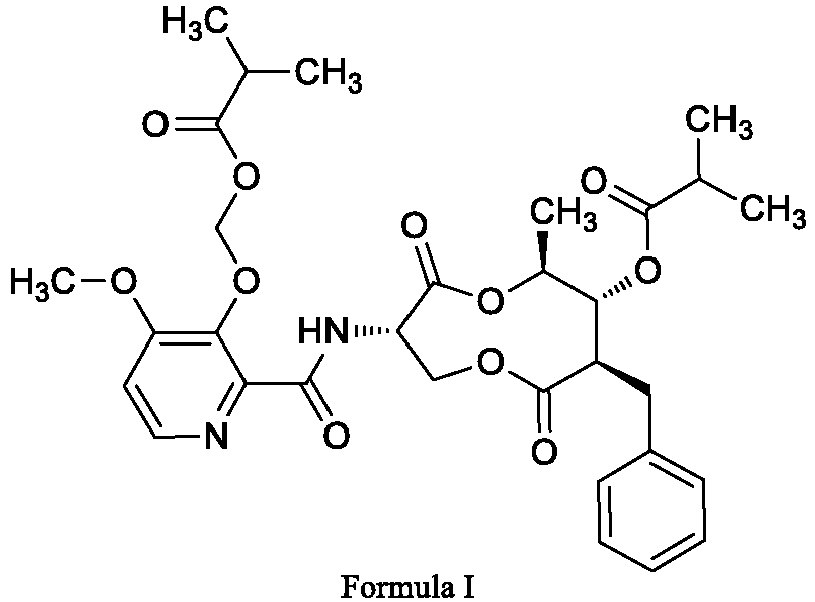
- As used herein, a "fungicidally effective amount" is an amount of an active ingredient or a synergistic fungicidal mixture that causes a "fungicidal effect," i.e., kills or inhibits the plant disease for which control is desired.
- As used herein, fluoxastrobin is the common name for (E)-{2-[6-(2-chlorophenoxy)-5-fluoropyrimidin-4-yloxy]phenyl}(5,6-dihydro-1,4,2-dioxazin-3-yl)methanone O-methyloxime and possesses the following structure:

- Its fungicidal activity is exemplified in The e-Pesticide Manual, Version 5.2, 2011. Exemplary uses of fluoxastrobin include, but are not limited to, use as a foliar spray in cereals for control of Septoria leaf spot diseases (Septoria tritici and Leptosphaeria nodorum), rusts of wheat and barley (Puccinia recondita, P. striiformis, P. hordei), Helminthosporium diseases like Pyrenophora teres (net blotch of barley) and Pyrenophora tritici-repentis (tan spot).
- As used herein, trifloxystrobin is the common name for methyl (αE)-α-(methoxyimino)-2-[[[[(1E)-1-[3-(trifluoromethyl)phenyl]ethylidene]amino]oxy]methyl]-benzeneacetate and possesses the following structure:

- Its fungicidal activity is described in The Pesticide Manual, Fifteenth Edition, 2009. Trifloxystrobin provides broad-spectrum control of a variety of fungal pathogens on a wide variety of fruits, vegetables, and crops.
- As used herein, picoxystrobin is the common name for methyl (E)-3-methoxy-2-[2-(6-trifluoromethyl-2-pyridyloxymethyl)phenyl]acrylate and possesses the following structure:

- Its fungicidal activity is described in The e-Pesticide Manual, Version 5.2, 2011 . Exemplary uses of picoxystrobin include, but are not limited to, broad-spectrum disease control in cereals, including Mycosphaerella graminicola, Phaeosphaeria nodorum, Puccinia recondita (brown rust), Helminthosporium tritici-repentis (tan spot) and Blumeria graminis f.sp. tritici (strobilurin-sensitive powdery mildew) in wheat; Helminthosporium teres (net blotch), Rhynchosporium secalis, Puccinia hordei (brown rust) and Erysiphe graminis f.sp. hordei (strobilurin-sensitive powdery mildew) in barley; Puccinia coronata and Helminthosporium avenae in oats; and Puccinia recondita and Rhynchosporium secalis in rye.
- As used herein, benzovindiflupyr is the common name for N-[(1RS,4SR)-9-(dichloromethylene)-1,2,3,4-tetrahydro-1,4-methanonaphthalen-5-yl]-3-(difluoromethyl)-1-methylpyrazole-4-carboxamide and possesses the following structure:

- Its fungicidal activity is exemplified in Agrow Intelligence (https://www.agra-net.net/agra/agrow/databases/agrow-intelligence/). Exemplary uses of benzovindiflupyr include, but are not limited to, controlling a variety of pathogens such as Botrytis spp., Erysiphe spp., Rhizoctonia spp., Septoria spp., Phytophthora spp., Pythium spp., Phakospora pachyrhizi, and Puccinia recondita, in a range of crops including vines, cereals, soybeans, cotton, and fruit and vegetable crops.
- In one embodiment, the concentration ratio of the compound of Formula I to fluoxastrobin at which the fungicidal effect is synergistic lies within the range of between 1:1 and 1:52 in 3DC assays and within the range of between 1:156 and 52:1 in 1DP assays.
- In one embodiment, the concentration ratio of the compound of Formula I to trifloxystrobin at which the fungicidal effect is synergistic lies within the range of between 1:625 and 52:1 in 1DP assays.
- In one embodiment, the concentration ratio of the compound of Formula I to picoxystrobin at which the fungicidal effect is synergistic lies within the range of between 1:4 and 1:208 in 3DC assays.
- In one embodiment, the concentration ratio of the compound of Formula I to benzovindiflupyr at which the fungicidal effect is synergistic lies within the range of between 1:4 and 1:16 in 3DC assays and within the range of between 1:39 and 16:1 in 1DP assays.
- The rate at which the synergistic composition is applied will depend upon the particular type of fungus to be controlled, the degree of control required, and the timing and method of application. In general, the composition of the disclosure can be applied at an application rate of between about 60 grams per hectare (g/ha) and about 850 g/ha based on the total amount of active ingredients in the composition.
- The synergistic composition comprising fluoxastrobin and the compound of Formula I is applied at a rate between about 110 g/ha and about 500 g/ha. Fluoxastrobin is applied at a rate between about 75 g/ha and about 200 g/ha and the compound of Formula I is applied at a rate between about 35 g/ha and about 300 g/ha.
- The synergistic composition comprising trifloxystrobin and the compound of Formula I is applied at a rate between about 85 g/ha and about 850 g/ha. Trifloxystrobin is applied at a rate between about 50 g/ha and about 550 g/ha and the compound of Formula I is applied at a rate between about 35 g/ha and about 300 g/ha.
- The synergistic composition comprising picoxystrobin and the compound of Formula I is applied at a rate between about 85 g/ha and about 550 g/ha. Picoxystrobin is applied at a rate between about 50 g/ha and about 250 g/ha and the compound of Formula I is applied at a rate between about 35 g/ha and about 300 g/ha.
- The synergistic composition comprising benzovindiflupyr and the compound of Formula I is applied at a rate between about 60 g/ha and about 600 g/ha. Benzovindiflupyr is applied at a rate between about 25 g/ha and about 300 g/ha and the compound of Formula I is applied at a rate between about 35 g/ha and about 300 g/ha.
- The components of the synergistic mixture of the present disclosure can be applied either separately or as part of a multipart fungicidal system.
- The synergistic mixture of the present disclosure can be applied in conjunction with one or more other fungicides to control a wider variety of undesirable diseases. When used in conjunction with other fungicide(s), the presently claimed compounds may be formulated with the other fungicide(s), tank mixed with the other fungicide(s) or applied sequentially with the other fungicide(s). Such other fungicides may include 2-(thiocyanatomethylthio)-benzothiazole, 2-phenylphenol, 8-hydroxyquinoline sulfate, ametoctradin, amisulbrom, antimycin, Ampelomyces quisqualis, azaconazole, azoxystrobin, Bacillus subtilis, Bacillus subtilis strain QST713, benalaxyl, benomyl, benthiavalicarb-isopropyl, benzylaminobenzene-sulfonate (BABS) salt, bicarbonates, biphenyl, bismerthiazol, bitertanol, bixafen, blasticidin-S, borax, Bordeaux mixture, boscalid, bromuconazole, bupirimate, calcium polysulfide, captafol, captan, carbendazim, carboxin, carpropamid, carvone, chlazafenone, chloroneb, chlorothalonil, chlozolinate, Coniothyrium minitans, copper hydroxide, copper octanoate, copper oxychloride, copper sulfate, copper sulfate (tribasic), cuprous oxide, cyazofamid, cyflufenamid, cymoxanil, cyproconazole, cyprodinil, dazomet, debacarb, diammonium ethylenebis-(dithiocarbamate), dichlofluanid, dichlorophen, diclocymet, diclomezine, dichloran, diethofencarb, difenoconazole, difenzoquat ion, diflumetorim, dimethomorph, dimoxystrobin, diniconazole, diniconazole-M, dinobuton, dinocap, diphenylamine, dithianon, dodemorph, dodemorph acetate, dodine, dodine free base, edifenphos, enestrobin, enestroburin, epoxiconazole, ethaboxam, ethoxyquin, etridiazole, famoxadone, fenamidone, fenarimol, fenbuconazole, fenfuram, fenhexamid, fenoxanil, fenpiclonil, fenpropidin, fenpropimorph, fenpyrazamine, fentin, fentin acetate, fentin hydroxide, ferbam, ferimzone, fluazinam, fludioxonil, flumorph, fluopicolide, fluopyram, fluoroimide, fluoxastrobin, fluquinconazole, flusilazole, flusulfamide, flutianil, flutolanil, flutriafol, fluxapyroxad, folpet, formaldehyde, fosetyl, fosetyl-aluminium, fuberidazole, furalaxyl, furametpyr, guazatine, guazatine acetates, GY-81, hexachlorobenzene, hexaconazole, hymexazol, imazalil, imazalil sulfate, imibenconazole, iminoctadine, iminoctadine triacetate, iminoctadine tris(albesilate), iodocarb, ipconazole, ipfenpyrazolone, iprobenfos, iprodione, iprovalicarb, isoprothiolane, isopyrazam, isotianil, kasugamycin, kasugamycin hydrochloride hydrate, kresoxim-methyl, laminarin, mancopper, mancozeb, mandipropamid, maneb, mefenoxam, mepanipyrim, mepronil, meptyl-dinocap, mercuric chloride, mercuric oxide, mercurous chloride, metalaxyl, metalaxyl-M, metam, metam-ammonium, metam-potassium, metam-sodium, metconazole, methasulfocarb, methyl iodide, methyl isothiocyanate, metiram, metominostrobin, metrafenone, mildiomycin, myclobutanil, nabam, nitrothal-isopropyl, nuarimol, octhilinone, ofurace, oleic acid (fatty acids), orysastrobin, oxadixyl, oxine-copper, oxpoconazole fumarate, oxycarboxin, pefurazoate, penconazole, pencycuron, penflufen, pentachlorophenol, pentachlorophenyl laurate, penthiopyrad, phenylmercury acetate, phosphonic acid, phthalide, picoxystrobin, polyoxin B, polyoxins, polyoxorim, potassium bicarbonate, potassium hydroxyquinoline sulfate, probenazole, prochloraz, procymidone, propamocarb, propamocarb hydrochloride, propiconazole, propineb, proquinazid, prothioconazole, pyraclostrobin, pyrametostrobin, pyraoxystrobin, pyrazophos, pyribencarb, pyributicarb, pyrifenox, pyrimethanil, pyriofenone, pyroquilon, quinoclamine, quinoxyfen, quintozene, Reynoutria sachalinensis extract, sedaxane, silthiofam, simeconazole, sodium 2-phenylphenoxide, sodium bicarbonate, sodium pentachlorophenoxide, spiroxamine, sulfur, SYP-Z048, tar oils, tebuconazole, tebufloquin, tecnazene, tetraconazole, thiabendazole, thifluzamide, thiophanate-methyl, thiram, tiadinil, tolclofos-methyl, tolylfluanid, triadimefon, triadimenol, triazoxide, tricyclazole, tridemorph, trifloxystrobin, triflumizole, triforine, triticonazole, validamycin, valifenalate, valiphenal, vinclozolin, zineb, ziram, zoxamide, Candida oleophila, Fusarium oxysporum, Gliocladium spp., Phlebiopsis gigantea, Streptomyces griseoviridis, Trichoderma spp., (RS)-N-(3,5-dichlorophenyl)-2-(methoxymethyl)-succinimide, 1,2-dichloropropane, 1,3-dichloro-1,1,3,3-tetrafluoroacetone hydrate, 1-chloro-2,4-dinitronaphthalene, 1-chloro-2-nitropropane, 2-(2-heptadecyl-2-imidazolin-1-yl)ethanol, 2,3-dihydro-5-phenyl-1,4-dithi-ine 1,1,4,4-tetraoxide, 2-methoxyethylmercury acetate, 2-methoxyethylmercury chloride, 2-methoxyethylmercury silicate, 3-(4-chlorophenyl)-5-methylrhodanine, 4-(2-nitroprop-1-enyl)phenyl thiocyanateme, ampropylfos, anilazine, azithiram, barium polysulfide, Bayer 32394, benodanil, benquinox, bentaluron, benzamacril; benzamacril-isobutyl, benzamorf, binapacryl, bis(methylmercury) sulfate, bis(tributyltin) oxide, buthiobate, cadmium calcium copper zinc chromate sulfate, carbamorph, CECA, chlobenthiazone, chloraniformethan, chlorfenazole, chlorquinox, climbazole, copper bis(3-phenylsalicylate), copper zinc chromate, cufraneb, cupric hydrazinium sulfate, cuprobam, cyclafuramid, cypendazole, cyprofuram, decafentin, dichlone, dichlozoline, diclobutrazol, dimethirimol, dinocton, dinosulfon, dinoterbon, dipyrithione, ditalimfos, dodicin, drazoxolon, EBP, ESBP, etaconazole, etem, ethirim, fenaminosulf, fenapanil, fenitropan, fluotrimazole, furcarbanil, furconazole, furconazole-cis, furmecyclox, furophanate, glyodine, griseofulvin, halacrinate, Hercules 3944, hexylthiofos, ICIA0858, isopamphos, isovaledione, mebenil, mecarbinzid, metazoxolon, methfuroxam, methylmercury dicyandiamide, metsulfovax, milneb, mucochloric anhydride, myclozolin, N-3,5-dichlorophenyl-succinimide, N-3-nitrophenylitaconimide, natamycin, N-ethylmercurio-4-toluenesulfonanilide, nickel bis(dimethyldithiocarbamate), OCH, phenylmercury dimethyldithiocarbamate, phenylmercury nitrate, phosdiphen, prothiocarb; prothiocarb hydrochloride, pyracarbolid, pyridinitril, pyroxychlor, pyroxyfur, quinacetol; quinacetol sulfate, quinazamid, quinconazole, rabenzazole, salicylanilide, SSF-109, sultropen, tecoram, thiadifluor, thicyofen, thiochlorfenphim, thiophanate, thioquinox, tioxymid, triamiphos, triarimol, triazbutil, trichlamide, urbacid, zarilamid, and any combinations thereof.
- The compositions of the present disclosure are preferably applied in the form of a formulation comprising a composition of (a) a compound of Formula I and (b) at least one fungicide selected from the group consisting of fluoxastrobin, trifloxystrobin, picoxystrobin, and benzovindiflupyr, together with a phytologically acceptable carrier.
- Concentrated formulations can be dispersed in water, or another liquid, for application, or formulations can be dust-like or granular, which can then be applied without further treatment. The formulations are prepared according to procedures which are conventional in the agricultural chemical art, but which are novel and important because of the presence therein of a synergistic composition.
- The formulations that are applied most often are aqueous suspensions or emulsions. Either such water-soluble, water-suspendable, or emulsifiable formulations are solids, usually known as wettable powders, or liquids, usually known as emulsifiable concentrates, aqueous suspensions, or suspension concentrates. The present disclosure contemplates all vehicles by which the synergistic compositions can be formulated for delivery and use as a fungicide.
- As will be readily appreciated, any material to which these synergistic compositions can be added may be used, provided they yield the desired utility without significant interference with the activity of these synergistic compositions as antifungal agents.
- Wettable powders, which may be compacted to form water-dispersible granules, comprise an intimate mixture of the synergistic composition, a carrier, and agriculturally acceptable surfactants. The concentration of the synergistic composition in the wettable powder is usually from about 10% to about 90% by weight, more preferably about 25% to about 75% by weight, based on the total weight of the formulation. In the preparation of wettable powder formulations, the synergistic composition can be compounded with any of the finely divided solids, such as prophyllite, talc, chalk, gypsum, Fuller's earth, bentonite, attapulgite, starch, casein, gluten, montmorillonite clays, diatomaceous earths, purified silicates or the like. In such operations, the finely divided carrier is ground or mixed with the synergistic composition in a volatile organic solvent. Effective surfactants, comprising from about 0.5% to about 10% by weight of the wettable powder, include sulfonated lignins, naphthalenesulfonates, alkylbenzenesulfonates, alkyl sulfates, and non-ionic surfactants, such as ethylene oxide adducts of alkyl phenols.
- Emulsifiable concentrates of the synergistic composition comprise a convenient concentration, such as from about 10% to about 50% by weight, in a suitable liquid, based on the total weight of the emulsifiable concentrate formulation. The components of the synergistic compositions, jointly or separately, are dissolved in a carrier, which is either a water-miscible solvent or a mixture of water-immiscible organic solvents, and emulsifiers. The concentrates may be diluted with water and oil to form spray mixtures in the form of oil-in-water emulsions. Useful organic solvents include aromatics, especially the high-boiling naphthalenic and olefinic portions of petroleum such as heavy aromatic naphtha. Other organic solvents may also be used, such as, for example, terpenic solvents, including rosin derivatives, aliphatic ketones, such as cyclohexanone, and complex alcohols, such as 2-ethoxyethanol.
- Emulsifiers which can be advantageously employed herein can be readily determined by those skilled in the art and include various nonionic, anionic, cationic and amphoteric emulsifiers, or a blend of two or more emulsifiers. Examples of nonionic emulsifiers useful in preparing the emulsifiable concentrates include the polyalkylene glycol ethers and condensation products of alkyl and aryl phenols, aliphatic alcohols, aliphatic amines or fatty acids with ethylene oxide, propylene oxides such as the ethoxylated alkyl phenols and carboxylic esters solubilized with the polyol or polyoxyalkylene. Cationic emulsifiers include quaternary ammonium compounds and fatty amine salts. Anionic emulsifiers include the oil-soluble salts (e.g., calcium) of alkylaryl sulfonic acids, oil-soluble salts or sulfated polyglycol ethers and appropriate salts of phosphated polyglycol ether.
- Representative organic liquids which can be employed in preparing the emulsifiable concentrates of the present disclosure are the aromatic liquids such as xylene, propyl benzene fractions, or mixed naphthalene fractions, mineral oils, substituted aromatic organic liquids such as dioctyl phthalate, kerosene, dialkyl amides of various fatty acids, particularly the dimethyl amides of fatty glycols and glycol derivatives such as the n-butyl ether, ethyl ether or methyl ether of diethylene glycol, and the methyl ether of triethylene glycol. Mixtures of two or more organic liquids are also often suitably employed in the preparation of the emulsifiable concentrate. The preferred organic liquids are xylene, and propyl benzene fractions, with xylene being most preferred. The surface-active dispersing agents are usually employed in liquid formulations and in the amount of from 0.1 to 20 percent by weight of the combined weight of the dispersing agent with the synergistic compositions. The formulations can also contain other compatible additives, for example, plant growth regulators and other biologically active compounds used in agriculture.
- Aqueous suspensions comprise suspensions of one or more water-insoluble compounds, dispersed in an aqueous vehicle at a concentration in the range from about 5% to about 70% by weight, based on the total weight of the aqueous suspension formulation. Suspensions are prepared by finely grinding the components of the synergistic combination either together or separately, and vigorously mixing the ground material into a vehicle comprised of water and surfactants chosen from the same types discussed above. Other ingredients, such as inorganic salts and synthetic or natural gums, may also be added to increase the density and viscosity of the aqueous vehicle. It is often most effective to grind and mix at the same time by preparing the aqueous mixture and homogenizing it in an implement such as a sand mill, ball mill, or piston-type homogenizer.
- The synergistic composition may also be applied as a granular formulation, which is particularly useful for applications to the soil. Granular formulations usually contain from about 0.5% to about 10% by weight of the compounds, based on the total weight of the granular formulation, dispersed in a carrier which consists entirely or in large part of coarsely divided attapulgite, bentonite, diatomite, clay or a similar inexpensive substance. Such formulations are usually prepared by dissolving the synergistic composition in a suitable solvent and applying it to a granular carrier which has been preformed to the appropriate particle size, in the range of from about 0.5 to about 3 mm. Such formulations may also be prepared by making a dough or paste of the carrier and the synergistic composition, and crushing and drying to obtain the desired granular particle.
- Dusts containing the synergistic composition are prepared simply by intimately mixing the synergistic composition in powdered form with a suitable dusty agricultural carrier, such as, for example, kaolin clay, ground volcanic rock, and the like. Dusts can suitably contain from about 1% to about 10% by weight of the synergistic composition/carrier combination.
- The formulations may contain agriculturally acceptable adjuvant surfactants to enhance deposition, wetting and penetration of the synergistic composition onto the target crop and organism. These adjuvant surfactants may optionally be employed as a component of the formulation or as a tank mix. The amount of adjuvant surfactant will vary from about 0.01 percent to about 1.0 percent volume/volume (v/v) based on a spray-volume of water, preferably about 0.05 to about 0.5 percent. Suitable adjuvant surfactants include ethoxylated nonyl phenols, ethoxylated synthetic or natural alcohols, salts of the esters or sulfosuccinic acids, ethoxylated organosilicones, ethoxylated fatty amines and blends of surfactants with mineral or vegetable oils.
- The formulations may optionally include combinations that can comprise at least 1% by weight of one or more of the synergistic compositions with another pesticidal compound. Such additional pesticidal compounds may be fungicides, insecticides, nematocides, miticides, arthropodicides, bactericides or combinations thereof that are compatible with the synergistic compositions of the present disclosure in the medium selected for application, and not antagonistic to the activity of the present compounds. Accordingly, in such embodiments the other pesticidal compound is employed as a supplemental toxicant for the same or for a different pesticidal use. The pesticidal compound and the synergistic composition can generally be mixed together in a weight ratio of from about 1:100 to about 100:1.
- The present disclosure includes within its scope methods for the control or prevention of fungal attack. These methods comprise applying to the locus of the fungus, or to a locus in which the infestation is to be prevented (for example applying to wheat or barley plants), a fungicidally effective amount of the synergistic composition. The synergistic composition is suitable for treatment of various plants at fungicidal levels, while exhibiting low phytotoxicity. The synergistic composition is useful in a protectant or eradicant fashion. The synergistic composition is applied by any of a variety of known techniques, either as the synergistic composition or as a formulation comprising the synergistic composition. For example, the synergistic compositions may be applied to the roots, seeds or foliage of plants for the control of various fungi, without damaging the commercial value of the plants. The synergistic composition is applied in the form of any of the generally used formulation types, for example, as solutions, dusts, wettable powders, flowable concentrates, or emulsifiable concentrates. These materials are conveniently applied in various known fashions.
- The synergistic composition has been found to have significant fungicidal effect, particularly for agricultural use. The synergistic composition is particularly effective for use with agricultural crops and horticultural plants, or with wood, paint, leather or carpet backing.
- In particular, the synergistic composition is effective in controlling a variety of undesirable fungi that infect useful plant crops. The synergistic composition may be used against a variety of Ascomycete and Basidiomycete fungi, including for example the following representative fungi species: wheat brown rust (Puccinia recondita; Bayer code PUCCRT); stripe rust of wheat (Puccinia striiformis; Bayer code PUCCST); leaf blotch of wheat (Mycosphaerella graminicola; anamorph: Septoria tritici; Bayer code SEPTTR); glume blotch of wheat (Leptosphaeria nodorum; Bayer code LEPTNO; anamorph: Stagonospora nodorum); spot blotch of barley (Cochliobolus sativum; Bayer code COCHSA; anamorph: Helminthosporium sativum); leaf spot of sugar beets (Cercospora beticola; Bayer code CERCBE); leaf spot of peanut (Mycosphaerella arachidis; Bayer code MYCOAR; anamorph: Cercospora arachidicola); cucumber anthracnose (Glomerella lagenarium; anamorph: Colletotrichum lagenarium; Bayer code COLLLA), and black sigatoka disease of banana (Mycosphaerella fijiensis; BAYER code MYCOFI). It will be understood by those in the art that the efficacy of the synergistic compositions for one or more of the foregoing fungi establishes the general utility of the synergistic compositions as fungicides.
- The synergistic compositions have a broad range of efficacy as a fungicide. The exact amount of the synergistic composition to be applied is dependent not only on the relative amounts of the components, but also on the particular action desired, the fungal species to be controlled, and the stage of growth thereof, as well as the part of the plant or other product to be contacted with the synergistic composition. Thus, formulations containing the synergistic composition may not be equally effective at similar concentrations or against the same fungal species.
- The synergistic compositions are effective in use with plants in a disease-inhibiting and phytologically acceptable amount. The term "disease-inhibiting and phytologically acceptable amount" refers to an amount of the synergistic composition that kills or inhibits the plant disease for which control is desired, but is not significantly toxic to the plant. The exact concentration of synergistic composition required varies with the fungal disease to be controlled, the type of formulation employed, the method of application, the particular plant species, climate conditions, and the like.
- The present compositions can be applied to fungi or their locus by the use of conventional ground sprayers, granule applicators, and by other conventional means known to those skilled in the art.
- The following examples are provided to further illustrate the disclosure. They are not meant to be construed as limiting the disclosure.
- Yuma wheat seedlings were grown as described above and inoculated with an aqueous spore suspension of Puccinia recondita 3 days prior to (3 days curative; 3DC) and 1 day after (1 day protectant; 1DP)fungicide treatment. After inoculation, plants were kept in 100% relative humidity for 24 hours (hr) in a dark dew room to allow spores to germinate and infect plants. The plants were then transferred to a greenhouse for disease to develop.
- Treatments consisted of fungicide compounds of Formula I and at least one fungicide selected from the group consisting of fluoxastrobin, trifloxystrobin, picoxystrobin, and benzovindiflupyr, either used individually or as two-way mixture with compounds I.
- Spray solution Preparation: active ingredients were dissolved in acetone as a stock solution and serial diluted four times. Final fungicide rates were obtained by mixing the stock solution diluted with 9 parts of water containing 110 parts per million (ppm) Triton X-100.
- Fungicide application: twenty milliliter (mL) fungicide solutions were sprayed onto 12 pots of plants using an automated booth sprayer, which utilized two 6218-1/4 JAUPM spray nozzles operating at 20 pounds per square inch (psi) set at opposing angles to cover both leaf surfaces. Control plants were sprayed in the same manner with the solvent blank. Plants were inoculated 24 hr after fungicide application
- Diseases assessment: infection levels were assessed visually and scored using 0 to 100 percent, 7 days after inoculation of rust. The percent disease control was calculated using the ratio of treated by untreated plants.
- Colby's equation was used to determine the fungicidal effects expected from the mixtures. (See Colby, S. R. Calculation of the synergistic and antagonistic response of herbicide combinations. Weeds 1967, 15, 20 - 22.)
- The following equation was used to calculate the expected activity of mixtures containing two active ingredients, A and B:

- A = observed efficacy of active component A at the same concentration as used in the mixture;
- B = observed efficacy of active component B at the same concentration as used in the mixture.
- Representative synergistic interactions are presented in the following Tables 1 - 2.
Table 1: Synergistic Interactions Of Compound I And Other Fungicides In 1 Day Protectant (1DP) Puccinia recondita (PUCCRT) Tests. Composition Rates (ppm)* PUCCRT* (%DC)* Synergism Factor* Observed* Expected* trifloxystrobin + Cmpd. I 6.25 + 1.56 99.61 90.00 1.11 trifloxystrobin + Cmpd. I 6.25 + 0.39 99.61 90.00 1.11 trifloxystrobin + Cmpd. I 6.25 + 0.10 99.61 90.00 1.11 trifloxystrobin + Cmpd. I 6.25 + 0.03 99.61 90.00 1.11 trifloxystrobin + Cmpd. I 6.25 + 0.01 100.00 90.00 1.11 trifloxystrobin + Cmpd. I 1.56 + 1.56 100.00 55.00 1.82 trifloxystrobin + Cmpd. I 1.56 + 0.39 100.00 55.00 1.82 trifloxystrobin + Cmpd. I 1.56 + 0.10 99.22 55.00 1.80 trifloxystrobin + Cmpd. I 1.56 + 0.03 99.22 55.00 1.80 trifloxystrobin + Cmpd. I 1.56 + 0.01 100.00 55.00 1.82 fluoxastrobin + Cmpd. I 1.56 + 1.56 99.61 41.00 2.43 fluoxastrobin + Cmpd. I 1.56 + 0.39 100.00 41.00 2.44 fluoxastrobin + Cmpd. I 1.56 + 0.10 99.61 41.00 2.43 fluoxastrobin + Cmpd. I 1.56 + 0.03 98.82 41.00 2.41 fluoxastrobin + Cmpd. I 1.56 + 0.01 99.61 41.00 2.43 fluoxastrobin + Cmpd. I 0.39 + 1.56 98.82 31.00 3.19 fluoxastrobin + Cmpd. I 0.39 + 0.39 90.59 31.00 2.92 fluoxastrobin + Cmpd. I 0.39 + 0.10 65.88 31.00 2.13 fluoxastrobin + Cmpd. I 0.39 + 0.03 62.75 31.00 2.02 fluoxastrobin + Cmpd. I 0.39 + 0.01 64.71 31.00 2.09 benzovindiflupyr + Cmpd. I 0.39 + 1.56 100.00 67.00 1.49 benzovindiflupyr + Cmpd. I 0.39 + 0.39 98.82 67.00 1.47 benzovindiflupyr + Cmpd. I 0.39 + 0.10 99.22 67.00 1.48 benzovindiflupyr + Cmpd. I 0.39 + 0.03 99.61 67.00 1.49 benzovindiflupyr + Cmpd. I 0.39 + 0.01 97.65 67.00 1.46 benzovindiflupyr + Cmpd. I 0.10 + 1.56 68.63 37.00 1.85 *PUCCRT = Wheat Brown Rust; Puccinia recondita
*%DC Observed = Percent disease control observed
*%DC Expected = Percent disease control expected
*ppm = Parts per million
*Synergism factor = (%DC Observed / %DC Expected); Values > 1.0 are synergistic.Table 2: Synergistic Interactions Of Compound I And Other Fungicides In 3 Day Curative (3DC) Puccinia recondita (PUCCRT) Tests. Composition Rates (ppm)* PUCCRT* (%DC)* Synergism Factor* Observed* Expected* picoxystrobin + Cmpd. I 6.25 + 1.56 74.51 53.00 1.41 picoxystrobin + Cmpd. I 6.25 + 0.39 64.71 53.00 1.22 picoxystrobin + Cmpd. I 6.25 + 0.03 62.75 53.00 1.18 fluoxastrobin + Cmpd. I 1.56 + 1.56 87.06 73.00 1.19 fluoxastrobin + Cmpd. I 1.56 + 0.39 90.20 73.00 1.24 fluoxastrobin + Cmpd. I 1.56 + 0.10 89.02 73.00 1.22 fluoxastrobin + Cmpd. I 1.56 + 0.03 90.98 73.00 1.25 benzovindiflupyr + Cmpd. I 6.25 + 1.56 90.20 73.00 1.24 benzovindiflupyr + Cmpd. I 6.25 + 0.39 82.35 73.00 1.13 *PUCCRT = Wheat Brown Rust; Puccinia recondita
*%DC Observed = Percent disease control observed
*%DC Expected = Percent disease control expected
*ppm = Parts per million
*Synergism factor = (%DC Observed / %DC Expected) ; Values > 1.0 are synergistic.
Claims (3)
- A synergistic fungicidal mixture, comprising:a fungicidally effective amount of a compound of Formula I:
 at least one fungicide selected from the group consisting of fluoxastrobin, trifloxystrobin, picoxystrobin, and benzovindiflupyr, wherein the concentration ratio of compound of Formula I to fluoxastrobin is between 1:156 and 52:1 in 1DP assays, the concentration ratio of Compound I to fluoxastrobin is between 1:1 and 1:52 in 3DC assays, the concentration ratio of Compound I to trifloxystrobin is between 1:625 and 52:1 in 1DP assays, the concentration ratio of Compound I to picoxystrobin is between 1:4 and 1:208 in 3DC assays, the concentration ratio of Compound I to benzovindiflupyr is between 1:39 and 16:1 in 1DP assays, and the concentration ratio of Compound I to benzovindiflupyr is between 1:4 and 1:16 in 3DC assays.
 - A fungicidal composition comprising a fungicidally effective amount of the fungicidal mixture of Claim 1 and an agriculturally acceptable adjuvant or carrier.
- A method for the control and prevention of fungal attack on a plant, the method comprising: applying a fungicidally effective amount of a compound of Formula I according to claim 1 and at least one fungicide selected from the group consisting of fluoxastrobin, trifloxystrobin, picoxystrobin, and benzovindiflupyr, wherein said effective amount is applied to at least one of the plant, an area adjacent to the plant, soil adapted to support growth of the plant, a root of the plant, foliage of the plant, and a seed adapted to produce the plant and the concentration ratio of compound of Formula I to fluoxastrobin is between 1:156 and 52:1 in 1DP assays, the concentration ratio of Compound I to fluoxastrobin is between 1:1 and 1:52 in 3DC assays, the concentration ratio of Compound I to trifloxystrobin is between 1:625 and 52:1 in 1DP assays, the concentration ratio of Compound I to picoxystrobin is between 1:4 and 1:208 in 3DC assays, the concentration ratio of Compound I to benzovindiflupyr is between 1:39 and 16:1 in 1DP assays, and the concentration ratio of Compound I to benzovindiflupyr is between 1:4 and 1:16 in 3DC assays.
Priority Applications (2)
| Application Number | Priority Date | Filing Date | Title |
|---|---|---|---|
| SI201431342T SI3089587T1 (en) | 2013-12-31 | 2014-12-29 | Synergistic fungicidal mixtures for fungal control in cereals |
| PL14876277T PL3089587T3 (en) | 2013-12-31 | 2014-12-29 | Synergistic fungicidal mixtures for fungal control in cereals |
Applications Claiming Priority (3)
| Application Number | Priority Date | Filing Date | Title |
|---|---|---|---|
| US201361922653P | 2013-12-31 | 2013-12-31 | |
| US201361922588P | 2013-12-31 | 2013-12-31 | |
| PCT/US2014/072602 WO2015103160A1 (en) | 2013-12-31 | 2014-12-29 | Synergistic fungicidal mixtures for fungal control in cereals |
Publications (3)
| Publication Number | Publication Date |
|---|---|
| EP3089587A1 EP3089587A1 (en) | 2016-11-09 |
| EP3089587A4 EP3089587A4 (en) | 2017-06-14 |
| EP3089587B1 true EP3089587B1 (en) | 2019-07-24 |
Family
ID=53480348
Family Applications (2)
| Application Number | Title | Priority Date | Filing Date |
|---|---|---|---|
| EP14876277.6A Active EP3089587B1 (en) | 2013-12-31 | 2014-12-29 | Synergistic fungicidal mixtures for fungal control in cereals |
| EP14876595.1A Withdrawn EP3089588A4 (en) | 2013-12-31 | 2014-12-29 | Synergistic fungicidal mixtures for fungal control in cereals |
Family Applications After (1)
| Application Number | Title | Priority Date | Filing Date |
|---|---|---|---|
| EP14876595.1A Withdrawn EP3089588A4 (en) | 2013-12-31 | 2014-12-29 | Synergistic fungicidal mixtures for fungal control in cereals |
Country Status (17)
| Country | Link |
|---|---|
| US (2) | US9271496B2 (en) |
| EP (2) | EP3089587B1 (en) |
| CN (2) | CN106061260A (en) |
| AU (2) | AU2014373922B2 (en) |
| BR (2) | BR102014032971B8 (en) |
| CA (2) | CA2933193A1 (en) |
| CL (4) | CL2016001635A1 (en) |
| DK (1) | DK3089587T3 (en) |
| ES (1) | ES2744911T3 (en) |
| HU (1) | HUE045696T2 (en) |
| IL (2) | IL246281B (en) |
| LT (1) | LT3089587T (en) |
| NZ (2) | NZ720916A (en) |
| PL (1) | PL3089587T3 (en) |
| PT (1) | PT3089587T (en) |
| SI (1) | SI3089587T1 (en) |
| WO (2) | WO2015103160A1 (en) |
Families Citing this family (33)
| Publication number | Priority date | Publication date | Assignee | Title |
|---|---|---|---|---|
| DK2485592T3 (en) | 2009-10-07 | 2016-09-05 | Dow Agrosciences Llc | Synergistic fungicidal compounds for mushrooms fight in cereals |
| LT2938191T (en) | 2012-12-28 | 2018-05-10 | Dow Agrosciences Llc | Synergistic fungicidal mixtures for fungal control in cereals |
| CA2894551A1 (en) | 2012-12-31 | 2014-07-03 | Dow Agrosciences Llc | Macrocyclic picolinamides as fungicides |
| EP3099170A4 (en) | 2013-12-26 | 2017-06-21 | Dow AgroSciences LLC | Use of macrocyclic picolinamides as fungicides |
| WO2015100181A1 (en) | 2013-12-26 | 2015-07-02 | Dow Agrosciences Llc | Macrocyclic picolinamide compounds with fungicidal activity |
| ES2744911T3 (en) | 2013-12-31 | 2020-02-26 | Dow Agrosciences Llc | Synergistic fungicide mixtures to fight against fungi in cereals |
| US20150322051A1 (en) | 2014-05-06 | 2015-11-12 | Dow Agrosciences Llc | Macrocyclic picolinamides as fungicides |
| WO2016007531A1 (en) | 2014-07-08 | 2016-01-14 | Dow Agrosciences Llc | Macrocyclic picolinamides as fungicides |
| CN106470982A (en) | 2014-07-08 | 2017-03-01 | 美国陶氏益农公司 | Big ring picolinamide as antifungal |
| US20160037774A1 (en) | 2014-08-08 | 2016-02-11 | Dow Agrosciences Llc | Synergistic fungicidal mixtures for fungal control in cereals |
| CN107205398B (en) | 2014-12-30 | 2020-08-21 | 美国陶氏益农公司 | Pyridinamide compounds with fungicidal activity |
| MX2017008418A (en) | 2014-12-30 | 2017-09-28 | Dow Agrosciences Llc | Picolinamides with fungicidal activity. |
| EP3808181A1 (en) | 2014-12-30 | 2021-04-21 | Dow AgroSciences LLC | Use of picolinamide compounds as fungicides |
| RU2704867C2 (en) | 2014-12-30 | 2019-10-31 | ДАУ АГРОСАЙЕНСИЗ ЭлЭлСи | Use of picolinamide compounds with fungicidal action |
| UA121763C2 (en) | 2014-12-30 | 2020-07-27 | Дау Аґросаєнсиз Елелсі | Fungicidal compositions |
| AU2015374379B2 (en) | 2014-12-30 | 2018-10-04 | Dow Agrosciences Llc | Picolinamides as fungicides |
| ES2842504T3 (en) * | 2015-12-30 | 2021-07-14 | Dow Agrosciences Llc | Fungal control of white mold |
| US20180055049A1 (en) * | 2016-08-26 | 2018-03-01 | Dow Agrosciences Llc | Use of pro-fungicides of uk-2a for control of brown rot diesease on stone and pome fruits |
| AR109429A1 (en) * | 2016-08-26 | 2018-11-28 | Dow Agrosciences Llc | USE OF UK-2A PROFUNGICIDES FOR RICE AÑUBLO CONTROL |
| US10231452B2 (en) | 2016-08-30 | 2019-03-19 | Dow Agrosciences Llc | Thiopicolinamide compounds with fungicidal activity |
| WO2018045010A1 (en) | 2016-08-30 | 2018-03-08 | Dow Agrosciences Llc | Pyrido-1,3-oxazine-2,4-dione compounds with fungicidal activity |
| US10173982B2 (en) | 2016-08-30 | 2019-01-08 | Dow Agrosciences Llc | Picolinamides as fungicides |
| US10111432B2 (en) | 2016-08-30 | 2018-10-30 | Dow Agrosciences Llc | Picolinamide N-oxide compounds with fungicidal activity |
| JP7175884B2 (en) | 2016-11-04 | 2022-11-21 | ユーピーエル リミテッド | combination of fungicides |
| BR102018000183B1 (en) | 2017-01-05 | 2023-04-25 | Dow Agrosciences Llc | PICOLINAMIDES, COMPOSITION FOR CONTROLLING A FUNGAL PATHOGEN, AND METHOD FOR CONTROLLING AND PREVENTING A FUNGAL ATTACK ON A PLANT |
| EA201991994A1 (en) | 2017-03-07 | 2020-01-30 | Юпл Лтд | FUNGICIDAL COMBINATIONS |
| CA3061572A1 (en) * | 2017-04-27 | 2018-11-01 | Upl Ltd | Fungicidal combinations comprising benzovindiflupyr andphenamacril, benzamacril, or a combination thereof |
| TW201842851A (en) | 2017-05-02 | 2018-12-16 | 美商陶氏農業科學公司 | Synergistic mixture for fungal control in cereals |
| TWI774761B (en) | 2017-05-02 | 2022-08-21 | 美商科迪華農業科技有限責任公司 | Synergistic mixtures for fungal control in cereals |
| CN110996665B (en) | 2017-05-02 | 2021-10-26 | 陶氏益农公司 | Use of acyclic picolinamides as fungicides against fungal diseases on turfgrass |
| BR102019004480B1 (en) | 2018-03-08 | 2023-03-28 | Dow Agrosciences Llc | PICOLINAMIDES AS FUNGICIDES |
| EP3866597A4 (en) | 2018-10-15 | 2022-06-29 | Corteva Agriscience LLC | Methods for sythesis of oxypicolinamides |
| US12281076B2 (en) | 2019-10-18 | 2025-04-22 | Corteva Agriscience Llc | Process for synthesis of picolinamides |
Family Cites Families (35)
| Publication number | Priority date | Publication date | Assignee | Title |
|---|---|---|---|---|
| DE4423612A1 (en) * | 1994-07-06 | 1996-01-11 | Basf Ag | 2 - [(Dihydro) pyrazolyl-3'-oxymethylene] anilides, process for their preparation and their use |
| EP1054011B1 (en) | 1998-02-06 | 2006-09-13 | Meiji Seika Kaisha Ltd. | Novel antifungal compounds and process for producing the same |
| CA2353627C (en) | 1998-11-04 | 2010-10-26 | Keiichi Imamura | Picolinamide derivative and harmful organism control agent comprising said picolinamide derivative as active component |
| US20020177578A1 (en) | 1999-07-20 | 2002-11-28 | Ricks Michael J. | Fungicidal heterocyclic aromatic amides and their compositions, methods of use and preparation |
| EP1516874B1 (en) | 1999-07-20 | 2015-08-19 | Dow AgroSciences LLC | Fungicidal heterocyclic aromatic amides and their compositions, methods of use and preparation |
| US6355660B1 (en) | 1999-07-20 | 2002-03-12 | Dow Agrosciences Llc | Fungicidal heterocyclic aromatic amides and their compositions, methods of use and preparation |
| CA2374995C (en) | 1999-07-20 | 2010-12-07 | Dow Agrosciences Llc | Fungicidal heterocyclic aromatic amides and their compositions, methods of use and preparation |
| CA2376275A1 (en) | 1999-08-20 | 2001-03-01 | Michael John Ricks | Fungicidal heterocyclic aromatic amides and their compositions, methods of use and preparation |
| US20050239873A1 (en) | 1999-08-20 | 2005-10-27 | Fred Hutchinson Cancer Research Center | 2 Methoxy antimycin a derivatives and methods of use |
| CA2453577A1 (en) | 2001-07-31 | 2003-02-13 | Richard Brewer Rogers | Reductive cleavage of the exocyclic ester of uk-2a or its derivatives and products formed therefrom |
| DE10144991A1 (en) | 2001-09-12 | 2003-03-27 | Basf Ag | Synergistic mixture of fungicides, useful in plant protection, comprise carbamate or phenylacetic acid derivative strobilurin compound, e.g. carbamates and/or phenylacetic acid derivatives and dithianon |
| WO2003031403A2 (en) | 2001-10-05 | 2003-04-17 | Dow Agrosciences Llc | Process to produce derivatives from uk-2a derivatives |
| AR037328A1 (en) | 2001-10-23 | 2004-11-03 | Dow Agrosciences Llc | COMPOSITE OF [7-BENCIL-2,6-DIOXO-1,5-DIOXONAN-3-IL] -4-METOXIPIRIDIN-2-CARBOXAMIDE, COMPOSITION THAT UNDERSTANDS AND METHOD THAT USES IT |
| DE10319591A1 (en) | 2003-05-02 | 2004-11-18 | Bayer Cropscience Ag | Drug combinations with nematicidal, insecticidal and fungicidal properties based on trifluorobutenyl compounds |
| BRPI0410548A (en) | 2003-05-28 | 2006-06-20 | Basf Ag | fungicidal mixture, fungicidal agent, process to combat harmful fungi, seeds, and use of compounds |
| DE10347090A1 (en) | 2003-10-10 | 2005-05-04 | Bayer Cropscience Ag | Synergistic fungicidal drug combinations |
| PT2205082E (en) | 2007-09-26 | 2012-05-02 | Basf Se | Ternary fungicidal compositions comprising boscalid and chlorothalonil |
| ES2552820T3 (en) | 2008-05-30 | 2015-12-02 | Dow Agrosciences Llc | Methods to combat QoI-resistant fungal pathogens |
| US8470840B2 (en) * | 2009-09-01 | 2013-06-25 | Dow Agrosciences, Llc. | Synergistic fungicidal compositions containing a 5-fluoropyrimidine derivative for fungal control in cereals |
| KR20120093264A (en) * | 2009-10-07 | 2012-08-22 | 다우 아그로사이언시즈 엘엘씨 | Synergistic fungicidal composition containing 5-fluorocytosine for fungal control in cereals |
| DK2485592T3 (en) * | 2009-10-07 | 2016-09-05 | Dow Agrosciences Llc | Synergistic fungicidal compounds for mushrooms fight in cereals |
| WO2011048120A1 (en) * | 2009-10-22 | 2011-04-28 | Syngenta Participations Ag | Synergistic fungicidal composition containing a n-2-(pyrazolyl) ethylphenylcarboxamide |
| EP2643300A1 (en) | 2010-11-24 | 2013-10-02 | Stemergie Biotechnology SA | Inhibitors of the activity of complex iii of the mitochondrial electron transport chain and use thereof for treating diseases |
| US8709458B2 (en) | 2010-12-16 | 2014-04-29 | Dow Agrosciences, Llc | Synergistic fungicidal interactions of 5-fluorocytosine and other fungicides |
| CN102210308A (en) | 2011-04-21 | 2011-10-12 | 陕西汤普森生物科技有限公司 | Pesticide composite containing picoxystrobin and triazole compound |
| TWI568721B (en) * | 2012-02-01 | 2017-02-01 | 杜邦股份有限公司 | Fungicide pyrazole mixture |
| EP2847187A4 (en) * | 2012-05-07 | 2015-10-28 | Dow Agrosciences Llc | Macrocycle picolinamides as fungicides |
| CN104470910B (en) | 2012-05-07 | 2017-03-29 | 陶氏益农公司 | As big 2 amide of ring pyridine of antifungal |
| DK2847188T3 (en) | 2012-05-07 | 2017-04-03 | Dow Agrosciences Llc | MACROCYCLIC PICOLINAMIDES AS FUNGICIDES |
| WO2013169661A1 (en) * | 2012-05-07 | 2013-11-14 | Dow Agrosciences Llp | Use of pro-fungicides of uk-2a for control of black sigatoka |
| LT2938191T (en) | 2012-12-28 | 2018-05-10 | Dow Agrosciences Llc | Synergistic fungicidal mixtures for fungal control in cereals |
| US9750248B2 (en) * | 2012-12-31 | 2017-09-05 | Dow Agrosciences Llc | Synergistic fungicidal compositions |
| CA2894551A1 (en) | 2012-12-31 | 2014-07-03 | Dow Agrosciences Llc | Macrocyclic picolinamides as fungicides |
| US9247742B2 (en) | 2012-12-31 | 2016-02-02 | Dow Agrosciences Llc | Synergistic fungicidal compositions |
| ES2744911T3 (en) * | 2013-12-31 | 2020-02-26 | Dow Agrosciences Llc | Synergistic fungicide mixtures to fight against fungi in cereals |
-
2014
- 2014-12-29 ES ES14876277T patent/ES2744911T3/en active Active
- 2014-12-29 US US14/585,068 patent/US9271496B2/en active Active
- 2014-12-29 WO PCT/US2014/072602 patent/WO2015103160A1/en not_active Ceased
- 2014-12-29 PT PT148762776T patent/PT3089587T/en unknown
- 2014-12-29 LT LTEP14876277.6T patent/LT3089587T/en unknown
- 2014-12-29 CA CA2933193A patent/CA2933193A1/en not_active Abandoned
- 2014-12-29 CN CN201480076571.1A patent/CN106061260A/en active Pending
- 2014-12-29 CA CA2933191A patent/CA2933191C/en active Active
- 2014-12-29 CN CN201480076570.7A patent/CN106061259B/en active Active
- 2014-12-29 AU AU2014373922A patent/AU2014373922B2/en active Active
- 2014-12-29 AU AU2014373921A patent/AU2014373921B2/en active Active
- 2014-12-29 WO PCT/US2014/072603 patent/WO2015103161A1/en not_active Ceased
- 2014-12-29 EP EP14876277.6A patent/EP3089587B1/en active Active
- 2014-12-29 NZ NZ720916A patent/NZ720916A/en unknown
- 2014-12-29 EP EP14876595.1A patent/EP3089588A4/en not_active Withdrawn
- 2014-12-29 NZ NZ720907A patent/NZ720907A/en unknown
- 2014-12-29 SI SI201431342T patent/SI3089587T1/en unknown
- 2014-12-29 HU HUE14876277A patent/HUE045696T2/en unknown
- 2014-12-29 PL PL14876277T patent/PL3089587T3/en unknown
- 2014-12-29 US US14/585,058 patent/US9918471B2/en active Active
- 2014-12-29 DK DK14876277T patent/DK3089587T3/en active
- 2014-12-30 BR BR102014032971A patent/BR102014032971B8/en active IP Right Grant
- 2014-12-30 BR BR102014032962A patent/BR102014032962A2/en not_active Application Discontinuation
-
2016
- 2016-06-16 IL IL246281A patent/IL246281B/en active IP Right Grant
- 2016-06-16 IL IL246282A patent/IL246282B/en active IP Right Grant
- 2016-06-24 CL CL2016001635A patent/CL2016001635A1/en unknown
- 2016-06-24 CL CL2016001636A patent/CL2016001636A1/en unknown
-
2018
- 2018-11-29 CL CL2018003393A patent/CL2018003393A1/en unknown
-
2020
- 2020-02-13 CL CL2020000372A patent/CL2020000372A1/en unknown
Non-Patent Citations (1)
| Title |
|---|
| None * |
Also Published As
Similar Documents
| Publication | Publication Date | Title |
|---|---|---|
| US9271496B2 (en) | Synergistic fungicidal mixtures for fungal control in cereals | |
| AU2015200857B2 (en) | Synergistic fungicidal mixtures for fungal control in cereals | |
| EP3091835B1 (en) | Synergistic fungicidal mixtures for fungal control in cereals | |
| AU2013369670B2 (en) | Synergistic fungicidal compositions | |
| US8470840B2 (en) | Synergistic fungicidal compositions containing a 5-fluoropyrimidine derivative for fungal control in cereals | |
| US20110082162A1 (en) | Synergistic fungicidal composition containing 5-fluorocytosine for fungal control in cereals | |
| EP3618624B1 (en) | Synergistic mixtures for fungal control in cereals | |
| CA2821240A1 (en) | Synergistic fungicidal interactions of 5-fluorocytosine and other fungicides | |
| US20120157486A1 (en) | Synergistic fungicidal interactions of aminopyrimidines and other fungicides | |
| AU2016381095B2 (en) | Fungal control of white mold |
Legal Events
| Date | Code | Title | Description |
|---|---|---|---|
| PUAI | Public reference made under article 153(3) epc to a published international application that has entered the european phase |
Free format text: ORIGINAL CODE: 0009012 |
|
| 17P | Request for examination filed |
Effective date: 20160629 |
|
| AK | Designated contracting states |
Kind code of ref document: A1 Designated state(s): AL AT BE BG CH CY CZ DE DK EE ES FI FR GB GR HR HU IE IS IT LI LT LU LV MC MK MT NL NO PL PT RO RS SE SI SK SM TR |
|
| AX | Request for extension of the european patent |
Extension state: BA ME |
|
| RIC1 | Information provided on ipc code assigned before grant |
Ipc: A01P 3/00 20060101ALI20161007BHEP Ipc: A01N 43/54 20060101ALI20161007BHEP Ipc: A01N 43/40 20060101AFI20161007BHEP |
|
| RIN1 | Information on inventor provided before grant (corrected) |
Inventor name: KEMMITT, GREG Inventor name: MATHIESON, TODD Inventor name: CORREA DA SILVA, OLAVO |
|
| DAX | Request for extension of the european patent (deleted) | ||
| A4 | Supplementary search report drawn up and despatched |
Effective date: 20170512 |
|
| RIC1 | Information provided on ipc code assigned before grant |
Ipc: A01P 3/00 20060101ALI20170508BHEP Ipc: A01N 43/40 20060101AFI20170508BHEP Ipc: A01N 43/54 20060101ALI20170508BHEP |
|
| STAA | Information on the status of an ep patent application or granted ep patent |
Free format text: STATUS: EXAMINATION IS IN PROGRESS |
|
| 17Q | First examination report despatched |
Effective date: 20180509 |
|
| GRAP | Despatch of communication of intention to grant a patent |
Free format text: ORIGINAL CODE: EPIDOSNIGR1 |
|
| STAA | Information on the status of an ep patent application or granted ep patent |
Free format text: STATUS: GRANT OF PATENT IS INTENDED |
|
| INTG | Intention to grant announced |
Effective date: 20190213 |
|
| GRAS | Grant fee paid |
Free format text: ORIGINAL CODE: EPIDOSNIGR3 |
|
| GRAA | (expected) grant |
Free format text: ORIGINAL CODE: 0009210 |
|
| STAA | Information on the status of an ep patent application or granted ep patent |
Free format text: STATUS: THE PATENT HAS BEEN GRANTED |
|
| AK | Designated contracting states |
Kind code of ref document: B1 Designated state(s): AL AT BE BG CH CY CZ DE DK EE ES FI FR GB GR HR HU IE IS IT LI LT LU LV MC MK MT NL NO PL PT RO RS SE SI SK SM TR |
|
| REG | Reference to a national code |
Ref country code: GB Ref legal event code: FG4D |
|
| REG | Reference to a national code |
Ref country code: CH Ref legal event code: EP Ref country code: CH Ref legal event code: NV Representative=s name: FIAMMENGHI-FIAMMENGHI, CH |
|
| REG | Reference to a national code |
Ref country code: DE Ref legal event code: R096 Ref document number: 602014050661 Country of ref document: DE |
|
| REG | Reference to a national code |
Ref country code: AT Ref legal event code: REF Ref document number: 1157084 Country of ref document: AT Kind code of ref document: T Effective date: 20190815 |
|
| REG | Reference to a national code |
Ref country code: IE Ref legal event code: FG4D |
|
| REG | Reference to a national code |
Ref country code: RO Ref legal event code: EPE |
|
| REG | Reference to a national code |
Ref country code: SE Ref legal event code: TRGR |
|
| REG | Reference to a national code |
Ref country code: NL Ref legal event code: FP |
|
| REG | Reference to a national code |
Ref country code: PT Ref legal event code: SC4A Ref document number: 3089587 Country of ref document: PT Date of ref document: 20191014 Kind code of ref document: T Free format text: AVAILABILITY OF NATIONAL TRANSLATION Effective date: 20190924 |
|
| REG | Reference to a national code |
Ref country code: DK Ref legal event code: T3 Effective date: 20191024 |
|
| REG | Reference to a national code |
Ref country code: SK Ref legal event code: T3 Ref document number: E 31969 Country of ref document: SK |
|
| REG | Reference to a national code |
Ref country code: EE Ref legal event code: FG4A Ref document number: E018034 Country of ref document: EE Effective date: 20190919 |
|
| REG | Reference to a national code |
Ref country code: GR Ref legal event code: EP Ref document number: 20190402703 Country of ref document: GR Effective date: 20191128 |
|
| REG | Reference to a national code |
Ref country code: HU Ref legal event code: AG4A Ref document number: E045696 Country of ref document: HU |
|
| PG25 | Lapsed in a contracting state [announced via postgrant information from national office to epo] |
Ref country code: HR Free format text: LAPSE BECAUSE OF FAILURE TO SUBMIT A TRANSLATION OF THE DESCRIPTION OR TO PAY THE FEE WITHIN THE PRESCRIBED TIME-LIMIT Effective date: 20190724 Ref country code: NO Free format text: LAPSE BECAUSE OF FAILURE TO SUBMIT A TRANSLATION OF THE DESCRIPTION OR TO PAY THE FEE WITHIN THE PRESCRIBED TIME-LIMIT Effective date: 20191024 |
|
| REG | Reference to a national code |
Ref country code: ES Ref legal event code: FG2A Ref document number: 2744911 Country of ref document: ES Kind code of ref document: T3 Effective date: 20200226 |
|
| PG25 | Lapsed in a contracting state [announced via postgrant information from national office to epo] |
Ref country code: AL Free format text: LAPSE BECAUSE OF FAILURE TO SUBMIT A TRANSLATION OF THE DESCRIPTION OR TO PAY THE FEE WITHIN THE PRESCRIBED TIME-LIMIT Effective date: 20190724 Ref country code: RS Free format text: LAPSE BECAUSE OF FAILURE TO SUBMIT A TRANSLATION OF THE DESCRIPTION OR TO PAY THE FEE WITHIN THE PRESCRIBED TIME-LIMIT Effective date: 20190724 Ref country code: IS Free format text: LAPSE BECAUSE OF FAILURE TO SUBMIT A TRANSLATION OF THE DESCRIPTION OR TO PAY THE FEE WITHIN THE PRESCRIBED TIME-LIMIT Effective date: 20191124 |
|
| PG25 | Lapsed in a contracting state [announced via postgrant information from national office to epo] |
Ref country code: SM Free format text: LAPSE BECAUSE OF FAILURE TO SUBMIT A TRANSLATION OF THE DESCRIPTION OR TO PAY THE FEE WITHIN THE PRESCRIBED TIME-LIMIT Effective date: 20190724 Ref country code: IS Free format text: LAPSE BECAUSE OF FAILURE TO SUBMIT A TRANSLATION OF THE DESCRIPTION OR TO PAY THE FEE WITHIN THE PRESCRIBED TIME-LIMIT Effective date: 20200224 |
|
| REG | Reference to a national code |
Ref country code: DE Ref legal event code: R097 Ref document number: 602014050661 Country of ref document: DE |
|
| PLBE | No opposition filed within time limit |
Free format text: ORIGINAL CODE: 0009261 |
|
| STAA | Information on the status of an ep patent application or granted ep patent |
Free format text: STATUS: NO OPPOSITION FILED WITHIN TIME LIMIT |
|
| PG2D | Information on lapse in contracting state deleted |
Ref country code: IS |
|
| 26N | No opposition filed |
Effective date: 20200603 |
|
| PG25 | Lapsed in a contracting state [announced via postgrant information from national office to epo] |
Ref country code: MC Free format text: LAPSE BECAUSE OF FAILURE TO SUBMIT A TRANSLATION OF THE DESCRIPTION OR TO PAY THE FEE WITHIN THE PRESCRIBED TIME-LIMIT Effective date: 20190724 |
|
| PG25 | Lapsed in a contracting state [announced via postgrant information from national office to epo] |
Ref country code: LU Free format text: LAPSE BECAUSE OF NON-PAYMENT OF DUE FEES Effective date: 20191229 |
|
| REG | Reference to a national code |
Ref country code: AT Ref legal event code: UEP Ref document number: 1157084 Country of ref document: AT Kind code of ref document: T Effective date: 20190724 |
|
| PG25 | Lapsed in a contracting state [announced via postgrant information from national office to epo] |
Ref country code: CY Free format text: LAPSE BECAUSE OF FAILURE TO SUBMIT A TRANSLATION OF THE DESCRIPTION OR TO PAY THE FEE WITHIN THE PRESCRIBED TIME-LIMIT Effective date: 20190724 |
|
| PG25 | Lapsed in a contracting state [announced via postgrant information from national office to epo] |
Ref country code: MT Free format text: LAPSE BECAUSE OF FAILURE TO SUBMIT A TRANSLATION OF THE DESCRIPTION OR TO PAY THE FEE WITHIN THE PRESCRIBED TIME-LIMIT Effective date: 20190724 |
|
| REG | Reference to a national code |
Ref country code: FI Ref legal event code: PCE Owner name: CORTEVA AGRISCIENCE LLC |
|
| REG | Reference to a national code |
Ref country code: DE Ref legal event code: R081 Ref document number: 602014050661 Country of ref document: DE Owner name: CORTEVA AGRISCIENCE LLC, INDIANAPOLIS, US Free format text: FORMER OWNER: DOW AGROSCIENCES LLC, INDIANAPOLIS, IND., US |
|
| REG | Reference to a national code |
Ref country code: NL Ref legal event code: HC Owner name: CORTEVA AGRISCIENCE LLC; US Free format text: DETAILS ASSIGNMENT: CHANGE OF OWNER(S), CHANGE OF OWNER(S) NAME; FORMER OWNER NAME: DOW AGROSCIENCES LLC Effective date: 20220127 |
|
| REG | Reference to a national code |
Ref country code: BE Ref legal event code: HC Owner name: CORTEVA AGRISCIENCE LLC; US Free format text: DETAILS ASSIGNMENT: CHANGE OF OWNER(S), CHANGE OF OWNER(S) NAME; FORMER OWNER NAME: DOW AGROSCIENCES LLC Effective date: 20211206 |
|
| REG | Reference to a national code |
Ref country code: HU Ref legal event code: HC9C Owner name: CORTEVA AGRISCIENCE LLC, US Free format text: FORMER OWNER(S): DOW AGROSCIENCES LLC, US |
|
| REG | Reference to a national code |
Ref country code: EE Ref legal event code: HC1A Ref document number: E018034 Country of ref document: EE |
|
| REG | Reference to a national code |
Ref country code: SK Ref legal event code: TC4A Ref document number: E 31969 Country of ref document: SK Owner name: CORTEVA AGRISCIENCE LLC, INDIANAPOLIS, IN 4626, US Effective date: 20220518 Ref country code: AT Ref legal event code: HC Ref document number: 1157084 Country of ref document: AT Kind code of ref document: T Owner name: CORTEVA AGRISCIENCE LLC, US Effective date: 20220426 |
|
| PG25 | Lapsed in a contracting state [announced via postgrant information from national office to epo] |
Ref country code: MK Free format text: LAPSE BECAUSE OF FAILURE TO SUBMIT A TRANSLATION OF THE DESCRIPTION OR TO PAY THE FEE WITHIN THE PRESCRIBED TIME-LIMIT Effective date: 20190724 |
|
| REG | Reference to a national code |
Ref country code: ES Ref legal event code: PC2A Owner name: CORTEVA AGRISCIENCE LLC Effective date: 20220830 |
|
| REG | Reference to a national code |
Ref country code: SI Ref legal event code: SP73 Owner name: CORTEVA AGRISCIENCE LLC; US Effective date: 20220726 |
|
| P01 | Opt-out of the competence of the unified patent court (upc) registered |
Effective date: 20230526 |
|
| PGFP | Annual fee paid to national office [announced via postgrant information from national office to epo] |
Ref country code: NL Payment date: 20251117 Year of fee payment: 12 |
|
| PGFP | Annual fee paid to national office [announced via postgrant information from national office to epo] |
Ref country code: PT Payment date: 20251126 Year of fee payment: 12 |
|
| REG | Reference to a national code |
Ref country code: CH Ref legal event code: U11 Free format text: ST27 STATUS EVENT CODE: U-0-0-U10-U11 (AS PROVIDED BY THE NATIONAL OFFICE) Effective date: 20260101 |
|
| PGFP | Annual fee paid to national office [announced via postgrant information from national office to epo] |
Ref country code: DE Payment date: 20251119 Year of fee payment: 12 |
|
| PGFP | Annual fee paid to national office [announced via postgrant information from national office to epo] |
Ref country code: GB Payment date: 20251215 Year of fee payment: 12 Ref country code: LT Payment date: 20251126 Year of fee payment: 12 |
|
| PGFP | Annual fee paid to national office [announced via postgrant information from national office to epo] |
Ref country code: AT Payment date: 20251113 Year of fee payment: 12 |
|
| PGFP | Annual fee paid to national office [announced via postgrant information from national office to epo] |
Ref country code: IT Payment date: 20251117 Year of fee payment: 12 Ref country code: FI Payment date: 20251113 Year of fee payment: 12 Ref country code: DK Payment date: 20251216 Year of fee payment: 12 |
|
| PGFP | Annual fee paid to national office [announced via postgrant information from national office to epo] |
Ref country code: HU Payment date: 20251205 Year of fee payment: 12 Ref country code: FR Payment date: 20251216 Year of fee payment: 12 |
|
| PGFP | Annual fee paid to national office [announced via postgrant information from national office to epo] |
Ref country code: GR Payment date: 20251113 Year of fee payment: 12 Ref country code: BE Payment date: 20251215 Year of fee payment: 12 Ref country code: TR Payment date: 20251128 Year of fee payment: 12 |
|
| PGFP | Annual fee paid to national office [announced via postgrant information from national office to epo] |
Ref country code: SE Payment date: 20251218 Year of fee payment: 12 |
|
| PGFP | Annual fee paid to national office [announced via postgrant information from national office to epo] |
Ref country code: IE Payment date: 20251211 Year of fee payment: 12 Ref country code: CZ Payment date: 20251202 Year of fee payment: 12 |
|
| PGFP | Annual fee paid to national office [announced via postgrant information from national office to epo] |
Ref country code: LV Payment date: 20251126 Year of fee payment: 12 |
|
| PGFP | Annual fee paid to national office [announced via postgrant information from national office to epo] |
Ref country code: PL Payment date: 20251126 Year of fee payment: 12 Ref country code: BG Payment date: 20251205 Year of fee payment: 12 |
|
| PGFP | Annual fee paid to national office [announced via postgrant information from national office to epo] |
Ref country code: EE Payment date: 20251201 Year of fee payment: 12 |
|
| PGFP | Annual fee paid to national office [announced via postgrant information from national office to epo] |
Ref country code: RO Payment date: 20251204 Year of fee payment: 12 Ref country code: SK Payment date: 20251202 Year of fee payment: 12 |
|
| PGFP | Annual fee paid to national office [announced via postgrant information from national office to epo] |
Ref country code: SI Payment date: 20251201 Year of fee payment: 12 |
|
| PGFP | Annual fee paid to national office [announced via postgrant information from national office to epo] |
Ref country code: ES Payment date: 20260115 Year of fee payment: 12 |
|
| PGFP | Annual fee paid to national office [announced via postgrant information from national office to epo] |
Ref country code: CH Payment date: 20260101 Year of fee payment: 12 |