EP3089407A1 - Method and apparatus for implementing a distributed interworking based on user equipment throughput - Google Patents
Method and apparatus for implementing a distributed interworking based on user equipment throughput Download PDFInfo
- Publication number
- EP3089407A1 EP3089407A1 EP16167313.2A EP16167313A EP3089407A1 EP 3089407 A1 EP3089407 A1 EP 3089407A1 EP 16167313 A EP16167313 A EP 16167313A EP 3089407 A1 EP3089407 A1 EP 3089407A1
- Authority
- EP
- European Patent Office
- Prior art keywords
- user equipment
- access point
- degradation
- throughput
- quality
- Prior art date
- Legal status (The legal status is an assumption and is not a legal conclusion. Google has not performed a legal analysis and makes no representation as to the accuracy of the status listed.)
- Withdrawn
Links
Images



Classifications
-
- H—ELECTRICITY
- H04—ELECTRIC COMMUNICATION TECHNIQUE
- H04W—WIRELESS COMMUNICATION NETWORKS
- H04W28/00—Network traffic management; Network resource management
- H04W28/02—Traffic management, e.g. flow control or congestion control
-
- H—ELECTRICITY
- H04—ELECTRIC COMMUNICATION TECHNIQUE
- H04W—WIRELESS COMMUNICATION NETWORKS
- H04W24/00—Supervisory, monitoring or testing arrangements
- H04W24/02—Arrangements for optimising operational condition
-
- H—ELECTRICITY
- H04—ELECTRIC COMMUNICATION TECHNIQUE
- H04L—TRANSMISSION OF DIGITAL INFORMATION, e.g. TELEGRAPHIC COMMUNICATION
- H04L45/00—Routing or path finding of packets in data switching networks
- H04L45/30—Routing of multiclass traffic
-
- H—ELECTRICITY
- H04—ELECTRIC COMMUNICATION TECHNIQUE
- H04W—WIRELESS COMMUNICATION NETWORKS
- H04W24/00—Supervisory, monitoring or testing arrangements
-
- H—ELECTRICITY
- H04—ELECTRIC COMMUNICATION TECHNIQUE
- H04W—WIRELESS COMMUNICATION NETWORKS
- H04W40/00—Communication routing or communication path finding
- H04W40/02—Communication route or path selection, e.g. power-based or shortest path routing
- H04W40/12—Communication route or path selection, e.g. power-based or shortest path routing based on transmission quality or channel quality
-
- H—ELECTRICITY
- H04—ELECTRIC COMMUNICATION TECHNIQUE
- H04W—WIRELESS COMMUNICATION NETWORKS
- H04W48/00—Access restriction; Network selection; Access point selection
- H04W48/16—Discovering, processing access restriction or access information
-
- H—ELECTRICITY
- H04—ELECTRIC COMMUNICATION TECHNIQUE
- H04W—WIRELESS COMMUNICATION NETWORKS
- H04W84/00—Network topologies
- H04W84/02—Hierarchically pre-organised networks, e.g. paging networks, cellular networks, WLAN [Wireless Local Area Network] or WLL [Wireless Local Loop]
- H04W84/04—Large scale networks; Deep hierarchical networks
- H04W84/042—Public Land Mobile systems, e.g. cellular systems
-
- H—ELECTRICITY
- H04—ELECTRIC COMMUNICATION TECHNIQUE
- H04W—WIRELESS COMMUNICATION NETWORKS
- H04W84/00—Network topologies
- H04W84/02—Hierarchically pre-organised networks, e.g. paging networks, cellular networks, WLAN [Wireless Local Area Network] or WLL [Wireless Local Loop]
- H04W84/10—Small scale networks; Flat hierarchical networks
- H04W84/12—WLAN [Wireless Local Area Networks]
Definitions
- Embodiments of the present invention relate to implementing a distributed interworking based on user equipment throughput.
- LTE Long-term Evolution
- 3GPP 3 rd Generation Partnership Project
- a method may include estimating, by a network node, a metric value relating to a first user equipment and an access point, without relying on actual data transmitted by the access point to the first user equipment.
- the method may also include estimating a quality degradation to at least one second user equipment if at least part of the traffic of the first user equipment is routed to the access point.
- the method may also include performing routing of at least part of the traffic of the first user equipment based on the estimated metric value and the estimated degradation.
- the estimating the metric value comprises estimating at least one of a throughput value, a user-quality metric, a quality-of-service metric, and a quality-of-experience metric, and the metric value is achievable by the first user equipment on the access point.
- the method may also include estimating whether activating radio aggregation between the network node and the access point, or routing from the network node to the access point, will provide sufficient benefit to the first user equipment.
- the method may also include adjusting a degradation threshold based on load information received from the access point.
- the network node comprises an evolved Node B
- the access point comprises a wireless-local-area-network access point.
- the network node estimates a received-signal-strength/quality threshold above which the first user equipment achieves a certain metric value with the access point.
- the certain metric value comprises a throughput that is higher than a current throughput experienced by the first user equipment.
- the performing the routing of at least part of the traffic of the first user equipment is performed if the estimated degradation to the at least one second user equipment is below a certain degradation threshold, and the certain degradation threshold is defined in terms of quality of service.
- an apparatus may include at least one processor.
- the apparatus may also include at least one memory including computer program code.
- the at least one memory and the computer program code may be configured, with the at least one processor, to cause the apparatus at least to estimate a metric value relating to a first user equipment and an access point, without relying on actual data transmitted by the access point to the first user equipment.
- the apparatus may also be caused to estimate a quality degradation to at least one second user equipment if at least part of the traffic of the first user equipment is routed to the access point.
- the apparatus may also be caused to perform routing of at least part of the traffic of the first user equipment based on the estimated metric value and the estimated degradation.
- the estimating the metric value comprises estimating at least one of a throughput value, a user-quality metric, a quality-of-service metric, and a quality-of-experience metric, and the metric value is achievable by the first user equipment on the access point.
- the apparatus is further caused to estimate whether activating radio aggregation between the apparatus and the access point, or routing from the apparatus to the access point, will provide sufficient benefit to the first user equipment.
- the apparatus is further caused to adjust a degradation threshold based on load information received from the access point.
- the apparatus comprises an evolved Node B, and the access point comprises a wireless-local-area-network access point.
- the network node estimates a received-signal-strength/quality threshold above which the first user equipment achieves a certain metric value with the access point.
- the certain metric value comprises a throughput that is higher than a current throughput experienced by the first user equipment.
- the performing the routing of at least part of the traffic of the first user equipment is performed if the estimated degradation to the at least one second user equipment is below a certain degradation threshold, and the certain degradation threshold is defined in terms of quality of service.
- a computer program product may be embodied on a non-transitory computer readable medium.
- the computer program product may be configured to control a processor to perform a method comprising estimating, by a network node, a metric value relating to a first user equipment and an access point, without relying on actual data transmitted by the access point to the first user equipment.
- the method may also include estimating a quality degradation to at least one second user equipment if at least part of the traffic of the first user equipment is routed to the access point.
- the method may also include performing routing of at least part of the traffic of the first user equipment based on the estimated metric value and the estimated degradation.
- the estimating the metric value comprises estimating at least one of a throughput value, a user-quality metric, a quality-of-service metric, and a quality-of-experience metric, and the metric value is achievable by the first user equipment on the access point.
- the computer program product is configured to control a processor to perform a method that also includes estimating whether activating radio aggregation between the network node and the access point, or routing from the network node to the access point, will provide sufficient benefit to the first user equipment.
- the method may also include adjusting a degradation threshold based on load information received from the access point.
- the network node comprises an evolved Node B
- the access point comprises a wireless-local-area-network access point.
- the network node estimates a received-signal-strength/quality threshold above which the first user equipment achieves a certain metric value with the access point.
- the certain metric value comprises a throughput that is higher than a current throughput experienced by the first user equipment.
- the performing the routing of at least part of the traffic of the first user equipment is performed if the estimated degradation to the at least one second user equipment is below a certain degradation threshold, and the certain degradation threshold is defined in terms of quality of service.
- a 3GPP work item (RP-132101) was recently finalized, and the designed feature enables a cellular network to trigger dynamic traffic offload and traffic onload (where the traffic is offloaded/onloaded to and from WLAN).
- the dynamically triggered traffic offload and traffic onload may be UE-driven and Radio-Access-Network-assisted (RAN-assisted).
- This work item also describes 3G-WLAN interworking.
- the onload / offload will occur if certain conditions relating to the RAN network and relating to the WLAN network are satisfied.
- the conditions may relate to, for example, measured cell loads and measured signal strengths of the RAN/WLAN networks.
- a UE is expected to evaluate actual measurement results against offload/onload threshold values that are provided by the RAN node. These threshold values may be provided to the UE as a part of RAN assistance information.
- Certain embodiments of the present invention may relate to a 3GPP RAN WG3 study item on multi-radio-access-technology (multi-RAT) joint coordination, particularly with respect to discussions on a standardized interface between WLAN and 3GPP RAN.
- multi-RAT multi-radio-access-technology
- the scope of the interface is limited to the retrieval of Wi-Fi control information.
- One method for implementing 3GPP/WLAN radio interworking relies on various thresholds.
- the various thresholds may be provided as a part of RAN assistance information.
- the thresholds may be used by the UE when evaluating offloading / onloading conditions.
- the thresholds may be used by the UE in accordance with RAN-defined rules or Access Network Discovery and Selection Function (ANDSF) rules. Both network selection (at the start of a new connection) and traffic routing (during an existing connection) may be supported and governed by these rules.
- “offload” generally describes an attempt to move traffic from 3GPP to WLAN.
- “onload” generally refers to an attempt to move traffic from WLAN to 3GPP.
- This network may be the radio access network (RAN).
- the above-mentioned thresholds may generally relate to the RAN (and WLAN) signal strength, signal quality, and load levels. Any threshold can be signalled to UEs in either IDLE and CONNECTED mode by using broadcast messages (via system information blocks (SIB)) from the RAN.
- SIB system information blocks
- UEs in CONNECTED mode can receive any of the thresholds via dedicated signalling (Radio-Resource-Control (RRC) signalling) as well.
- RRC Radio-Resource-Control
- the thresholds received via dedicated signalling may overwrite the thresholds received via SIBs. The overwriting may be performed in accordance with a validity timer, which may also be provided to UEs.
- TS 36.304 describes the conditions that the UEs have to evaluate, as described below:
- a method of implementing the above-mentioned RAN assistance thresholds in order to achieve controllable LTE-WLAN offloads, and in order to improve UE Quality-of-Service (QoS), has yet to be determined.
- Certain embodiments of the present invention implement the above-mentioned RAN assistance thresholds by allowing RAN to set the received-signal-strength-indication / received-signal-received-power (RSSI / RSRP) thresholds, with a goal of maximizing UE throughput.
- RSSI / RSRP received-signal-received-power
- certain embodiments of the present invention avoid offloading decisions which result in throughput degradation of the existing UEs (where the existing UEs are served by the WLAN AP to which the offloading is to occur for). Degradation of throughput for the existing UEs would trigger system instability and possibly trigger LTE-WLAN ping pongs. Specifically, as a consequence of an offloading, a consequent onload may be triggered. The same mechanism can also be applied to the determination of whether to activate aggregation or not for a given UE.
- Certain embodiments of the present invention are directed to a method for RAN to set throughput-based offload/onload thresholds.
- the throughput-based offload/onload thresholds may be set in order to trigger an offload / onload decision of CONNECTED UEs from 3GPP to WLAN.
- the thresholds may be set with the objective of maximizing the UE QoS/throughput for a user for which the decision/setting is made.
- the throughput-based offload/onload thresholds may also be set in order to avoid the degradation of the existing UEs (served on WLAN) above a controlled level when a new UE is offloaded to WLAN. Larger degradation (above the controlled level) would generally cause system instability.
- the offload of a UE may cause the onload of one of more among the existing UEs.
- the same throughput-based mechanism can be applied to decide whether aggregation operations between LTE and WLAN should be activated for a given UE in order to provide a sufficiently high throughput benefit. Before actually performing aggregation, determining that the aggregation will result in a high throughput benefit may be necessary because aggregation requires significant signalling overhead and additional UE power consumption.
- Fig. 1 illustrates LTE-WLAN interworking and aggregation mechanisms based on eNB throughput estimation, using information exchange between a WiFi Access Point and an LTE eNB.
- the principles illustrated by Fig. 1 may also be directed to 3G-WLAN interworking and aggregation.
- the method comprises the following features.
- One feature is to estimate a threshold received-signal-strength-indicator (RSSI) that should be measured for signals between a UE and an Access Point (AP) in order to achieve better throughput in WLAN within a certain configurable margin.
- This threshold may correspond to a minimum RSSI value that a UE should measure to an Access Point (AP) in order to achieve better throughput in WLAN within a certain configurable margin.
- RSSI received-signal-strength-indicator
- This threshold may also correspond to a minimum RSSI value that the UE should measure in order to achieve a certain fixed throughput value.
- the better throughput is achieved in consideration of all the existing users connected to that AP, compared to the throughput of the UE when being served in LTE.
- Another feature is to estimate the amount of degradation caused to the throughput of the existing UEs (associated to an AP) when a new UE is served as well by the AP.
- Another feature is to avoid offloading of a UE to an AP when degradation is above a certain threshold, where the offloading may possibly cause onloading of any of the existing UEs.
- the degradation threshold could be defined per QoS, and per access classes as well.
- the degradation threshold may be defined in terms of QoS, throughput, delay, latency, packet losses, or quality of experience. Another feature of certain embodiments of the present invention is to estimate whether activating aggregation between LTE and WLAN for a given UE will provide a sufficient benefit. Updated load information retrieved from the AP may be used at the eNB to adjust the degradation thresholds.
- the first use case refers to the activation of aggregation operations for the given UE.
- the second use case refers instead to the triggering of offloading for the given UE.
- the triggering may be based on Release 12 RSSI threshold-based WLAN radio interworking.
- Implementation of the proposed LTE/WLAN interworking algorithm includes the following details.
- the eNB receives traffic load information (possibly on request) from the WiFi APs within the eNB's coverage.
- the traffic load information may include: (1) Call-Admission-Control (CAC) related metric ( CACap ) along with a Maximum (theoretical) capacity of the AP (Cap), (2) a number of connected stations/terminals (STAs) to the serving AP ( Nsta ), and/or (3) the average downstream STA throughput (Wsta) served by the AP.
- CAC Call-Admission-Control
- the CACap may be assumed to be proportional to one minus the ratio of the (long term average) served AP traffic, Wtraff, and the maximum (theoretical) capacity of the AP , Cap : CAC ap ⁇ 1 ⁇ W traff C ap or W traff ⁇ C ap ⁇ 1 ⁇ CAC ap
- the eNB is capable of identifying the most suitable AP that a UE should connect to in the event of offloading / aggregation. In the case of aggregation, the UE may report UE RSSI towards the AP.
- the eNB estimates, periodically or on some event basis, the throughput, Wnew, that the UE would achieve, in the event that the UE is connected to the selected AP which already serves N STA , with served AP traffic, Wtraff, according to (1). Such an estimate is assumed to be possible on the basis of the considered information exchanged between the AP and the eNB as in step 1.
- W new PHY NEW N sta N sta + 1 2 ⁇ 1 W traff + 1 MA eff ⁇ PHY NEW ⁇ 1 , where: PHYnew is the Wi-Fi Physical throughput for the new STA.
- PHYnew is assumed to be known in case based on the UE reporting of RSSI according to (3) or (4).
- the expression (3)/(4) are assumed to incorporate the UE Wi-Fi capabilities such as standard version, MIMO support or multiband operation.
- MAeff is a WLAN medium access efficiency parameter.
- the parameter may need to be estimated from other information sources, for example, from a WLAN BSS load in combination with a type of WiFi (11g/n/ac) in use.
- this parameter can also be considered as a self-optimized network (SON) adaptation parameter, which can be adjusted based on the outcome of previous traffic steering decisions.
- SON self-optimized network
- Typical MAeff values may be in a range of 0.5 to 0.9 for 802.11 n/ac.
- the eNB determines, periodically or on some event basis, whether it is beneficial to perform either offloading to the AP or to activate aggregation with the AP.
- aggregation should be triggered when the UE can achieve a significant contribution to its current LTE throughput via the AP in order to justify the overhead caused by aggregation.
- the minimum level of the contribution, D tp ⁇ L ue is configurable based on the margin/delta value, where typically D tp > minD tp .
- the existing UEs connected to the AP do not degrade their throughput, W initial , below a certain configurable level, W initial ⁇ D W , where D W ⁇ 1.
- W initial ⁇ W traff N sta + 1 ⁇ C ap 1 ⁇ CAC ap N sta + 1 is the estimate of the current UE throughput that the existing UEs are being served over the AP.
- Dtp is a configurable parameter which describes the throughput margin/delta value as described above.
- This parameter could be configured according to the UE QoS, for example, QoS Class Identifier (QCI), Guaranteed Bit Rate (GBR), Allocation and Retention Priority (ARP), Subscriber profile ID (SPID), etc.
- Dw is a configurable parameter which describes the maximum allowed degradation for the existing UEs when the new UE is served additionally by the AP.
- This parameter could be configured according to the UE QoS, for example, QCI, GBR, ARP, SPID, etc.
- the eNB will start the preparation for aggregation with respect to the AP and send an RRC message to the UE informing about the activation of aggregation operations.
- Certain embodiments of the present invention provide QoS/throughput-based RAN control over the offloading, and offer RAN tools to be aware of and to mitigate degradation in the WLAN performance. Specifically, certain embodiments of the present invention allow RAN to set the RSSI offload thresholds with the goal of maximizing UE throughput. Also certain embodiments avoid the scenario where an offload decision results in throughput degradation of the existing UEs, which would trigger system instability and LTE-WLAN ping pongs. Ping pongs result, for example, when, after performing an offloading, a consequent onload is triggered. The same mechanism can be also applied to the determination of whether to activate aggregation or not for a given UE. A same mechanism (degradation-metric based mechanism) can be used to disable aggregation and/or to initiate onloading.
- the long term average downstream WiFi Medium Access Control (MAC) goodput for any of the STAs can be estimated.
- K ap and PHY l f RSS l MCS l
- MAeff is the medium access efficiency parameter, which depends on the WiFi standard in use (such as 802.11 g/n/ac), traffic load, and the associated air-interface signalling overheads.
- Kap is the total number of WiFi APs that operate on the same channel as the k-th AP.
- L is the total number of competing links (downstream and upstream data flows) from all APs and STAs operating on the same channel as the k-th AP (and its STAs).
- PHYl is the physical layer WiFi data rate on the l-th AP-STA link (downstream and upstream data flows) corresponding to an average RSS level on the link and a selected MCS. This mapping is generally vendor specific and would have to be available for the specific type(s) of WLAN APs used in the network.
- the STA MAC goodput estimate is given by: W sta ⁇ W traff N sta + 1 ⁇ C ap 1 ⁇ CAC ap N sta + 1 or else, when Wsta is available directly but not Nsta, then the number of connected STAs can be estimated with: N sta ⁇ W traff W sta ⁇ 1 ⁇ C ap 1 ⁇ CAC ap W sta ⁇ 1
- Fig. 2 illustrates a validity of the approximation used in expression (F) as a function of the Kap and Nsta parameters.
- Fig. 3 illustrates a flowchart of a method in accordance with certain embodiments of the invention.
- the method illustrated in Fig. 3 includes, at 310, estimating, by a network node, a metric value relating to a first user equipment and an access point, without relying on actual data transmitted by the access point to the first user equipment.
- the method also includes, at 320, estimating a quality degradation to at least one second user equipment if at least part of the traffic of the first user equipment is routed to the access point.
- the method also includes, at 330, performing routing of at least part of the traffic of the first user equipment based on the estimated metric value and the estimated degradation.
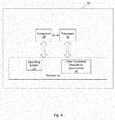
- Fig. 4 illustrates an apparatus in accordance with certain embodiments of the invention.
- the apparatus can be a user equipment, a base station, and/or an evolved Node B, for example.
- the apparatus can be a network node.
- Apparatus 10 can include a processor 22 for processing information and executing instructions or operations.
- Processor 22 can be any type of general or specific purpose processor. While a single processor 22 is shown in Fig. 4 , multiple processors can be utilized according to other embodiments.
- Processor 22 can also include one or more of general-purpose computers, special purpose computers, microprocessors, digital signal processors (DSPs), field-programmable gate arrays (FPGAs), application-specific integrated circuits (ASICs), and processors based on a multi-core processor architecture, as examples.
- DSPs digital signal processors
- FPGAs field-programmable gate arrays
- ASICs application-specific integrated circuits
- Apparatus 10 can further include a memory 14, coupled to processor 22, for storing information and instructions that can be executed by processor 22.
- Memory 14 can be one or more memories and of any type suitable to the local application environment, and can be implemented using any suitable volatile or nonvolatile data storage technology such as a semiconductor-based memory device, a magnetic memory device and system, an optical memory device and system, fixed memory, and removable memory.
- memory 14 include any combination of random access memory (RAM), read only memory (ROM), static storage such as a magnetic or optical disk, or any other type of non-transitory machine or computer readable media.
- the instructions stored in memory 14 can include program instructions or computer program code that, when executed by processor 22, enable the apparatus 10 to perform tasks as described herein.
- Apparatus 10 can also include one or more antennas (not shown) for transmitting and receiving signals and/or data to and from apparatus 10.
- Apparatus 10 can further include a transceiver 28 that modulates information on to a carrier waveform for transmission by the antenna(s) and demodulates information received via the antenna(s) for further processing by other elements of apparatus 10.
- transceiver 28 can be capable of transmitting and receiving signals or data directly.
- Processor 22 can perform functions associated with the operation of apparatus 10 including, without limitation, precoding of antenna gain/phase parameters, encoding and decoding of individual bits forming a communication message, formatting of information, and overall control of the apparatus 10, including processes related to management of communication resources.
- memory 14 can store software modules that provide functionality when executed by processor 22.
- the modules can include an operating system 15 that provides operating system functionality for apparatus 10.
- the memory can also store one or more functional modules 18, such as an application or program, to provide additional functionality for apparatus 10.
- the components of apparatus 10 can be implemented in hardware, or as any suitable combination of hardware and software.
- Apparatus 500 can be a network element/entity such as a base station and/or evolved Node B, for example.
- Apparatus 500 can include a first estimating unit 510 that estimates a metric value relating to a first user equipment and an access point, without relaying on actual data transmitted by the access point to the first user equipment.
- Apparatus 500 may also include a second estimating unit 520 that estimates a quality degradation to at least one second user equipment if at least part of the traffic of the first user equipment is routed to the access point.
- Apparatus 500 may also include a performing unit 530 that performs routing of at least part of the traffic of the first user equipment based on the estimated metric value and the estimated degradation.
Landscapes
- Engineering & Computer Science (AREA)
- Computer Networks & Wireless Communication (AREA)
- Signal Processing (AREA)
- Computer Security & Cryptography (AREA)
- Mobile Radio Communication Systems (AREA)
- Quality & Reliability (AREA)
- Physics & Mathematics (AREA)
- Electromagnetism (AREA)
Abstract
Description
- Embodiments of the present invention relate to implementing a distributed interworking based on user equipment throughput.
- Long-term Evolution (LTE) is a standard for wireless communication that seeks to provide improved speed and capacity for wireless communications by using new modulation/signal processing techniques. The standard was proposed by the 3rd Generation Partnership Project (3GPP), and is based upon previous network technologies. Since its inception, LTE has seen extensive deployment in a wide variety of contexts involving the communication of data.
- According to a first embodiment, a method may include estimating, by a network node, a metric value relating to a first user equipment and an access point, without relying on actual data transmitted by the access point to the first user equipment. The method may also include estimating a quality degradation to at least one second user equipment if at least part of the traffic of the first user equipment is routed to the access point. The method may also include performing routing of at least part of the traffic of the first user equipment based on the estimated metric value and the estimated degradation.
- In the method of the first embodiment, the estimating the metric value comprises estimating at least one of a throughput value, a user-quality metric, a quality-of-service metric, and a quality-of-experience metric, and the metric value is achievable by the first user equipment on the access point.
- In the method of the first embodiment, the method may also include estimating whether activating radio aggregation between the network node and the access point, or routing from the network node to the access point, will provide sufficient benefit to the first user equipment. The method may also include adjusting a degradation threshold based on load information received from the access point.
- In the method of the first embodiment, the network node comprises an evolved Node B, and the access point comprises a wireless-local-area-network access point.
- In the method of the first embodiment, the network node estimates a received-signal-strength/quality threshold above which the first user equipment achieves a certain metric value with the access point.
- In the method of the first embodiment, the certain metric value comprises a throughput that is higher than a current throughput experienced by the first user equipment.
- In the method of the first embodiment, the performing the routing of at least part of the traffic of the first user equipment is performed if the estimated degradation to the at least one second user equipment is below a certain degradation threshold, and the certain degradation threshold is defined in terms of quality of service.
- According to a second embodiment, an apparatus may include at least one processor. The apparatus may also include at least one memory including computer program code. The at least one memory and the computer program code may be configured, with the at least one processor, to cause the apparatus at least to estimate a metric value relating to a first user equipment and an access point, without relying on actual data transmitted by the access point to the first user equipment. The apparatus may also be caused to estimate a quality degradation to at least one second user equipment if at least part of the traffic of the first user equipment is routed to the access point. The apparatus may also be caused to perform routing of at least part of the traffic of the first user equipment based on the estimated metric value and the estimated degradation.
- In the apparatus of the second embodiment, the estimating the metric value comprises estimating at least one of a throughput value, a user-quality metric, a quality-of-service metric, and a quality-of-experience metric, and the metric value is achievable by the first user equipment on the access point.
- In the apparatus of the second embodiment, the apparatus is further caused to estimate whether activating radio aggregation between the apparatus and the access point, or routing from the apparatus to the access point, will provide sufficient benefit to the first user equipment. The apparatus is further caused to adjust a degradation threshold based on load information received from the access point.
- In the apparatus of the second embodiment, the apparatus comprises an evolved Node B, and the access point comprises a wireless-local-area-network access point.
- In the apparatus of the second embodiment, the network node estimates a received-signal-strength/quality threshold above which the first user equipment achieves a certain metric value with the access point.
- In the apparatus of the second embodiment, the certain metric value comprises a throughput that is higher than a current throughput experienced by the first user equipment.
- In the apparatus of the second embodiment, the performing the routing of at least part of the traffic of the first user equipment is performed if the estimated degradation to the at least one second user equipment is below a certain degradation threshold, and the certain degradation threshold is defined in terms of quality of service.
- According to a third embodiment, a computer program product may be embodied on a non-transitory computer readable medium. The computer program product may be configured to control a processor to perform a method comprising estimating, by a network node, a metric value relating to a first user equipment and an access point, without relying on actual data transmitted by the access point to the first user equipment. The method may also include estimating a quality degradation to at least one second user equipment if at least part of the traffic of the first user equipment is routed to the access point. The method may also include performing routing of at least part of the traffic of the first user equipment based on the estimated metric value and the estimated degradation.
- In the computer program product of the third embodiment, the estimating the metric value comprises estimating at least one of a throughput value, a user-quality metric, a quality-of-service metric, and a quality-of-experience metric, and the metric value is achievable by the first user equipment on the access point.
- In the computer program product of the third embodiment, the computer program product is configured to control a processor to perform a method that also includes estimating whether activating radio aggregation between the network node and the access point, or routing from the network node to the access point, will provide sufficient benefit to the first user equipment. The method may also include adjusting a degradation threshold based on load information received from the access point.
- In the computer program product of the third embodiment, the network node comprises an evolved Node B, and the access point comprises a wireless-local-area-network access point.
- In the computer program product of the third embodiment, the network node estimates a received-signal-strength/quality threshold above which the first user equipment achieves a certain metric value with the access point.
- In the computer program product of the third embodiment, the certain metric value comprises a throughput that is higher than a current throughput experienced by the first user equipment.
- In the computer program product of the third embodiment, the performing the routing of at least part of the traffic of the first user equipment is performed if the estimated degradation to the at least one second user equipment is below a certain degradation threshold, and the certain degradation threshold is defined in terms of quality of service.
- For proper understanding of the invention, reference should be made to the accompanying drawings, wherein:
-
Fig. 1 illustrates Long-Term-Evolution-Wireless-Local-Area Network (LTE-WLAN) interworking and aggregation mechanisms that are based on evolved Node B (eNB) throughput estimation, using information exchanged between a WiFi Access Point and an LTE eNB. -
Fig. 2 illustrates a validity of the approximation used in expression (F) as a function of Kap and Nsta parameters. -
Fig. 3 illustrates a flowchart of a method in accordance with certain embodiments of the invention. -
Fig. 4 illustrates an apparatus in accordance with certain embodiments of the invention. -
Fig. 5 illustrates an apparatus in accordance with certain embodiments of the invention. - Certain embodiments of the present invention relate to implementing an algorithm for distributed interworking between Long-Term-Evolution and Wireless-Local-Area-Network, where the algorithm is based on user equipment throughput. Certain embodiments of the present invention relate to implementing radio enhancements for 3GPP/WLAN interworking. The radio enhancements are directed at supporting improved network/operator-assisted/controlled connectivity over WLAN.
- A 3GPP work item (RP-132101) was recently finalized, and the designed feature enables a cellular network to trigger dynamic traffic offload and traffic onload (where the traffic is offloaded/onloaded to and from WLAN). The dynamically triggered traffic offload and traffic onload may be UE-driven and Radio-Access-Network-assisted (RAN-assisted). This work item also describes 3G-WLAN interworking.
- The onload / offload will occur if certain conditions relating to the RAN network and relating to the WLAN network are satisfied. The conditions may relate to, for example, measured cell loads and measured signal strengths of the RAN/WLAN networks. A UE is expected to evaluate actual measurement results against offload/onload threshold values that are provided by the RAN node. These threshold values may be provided to the UE as a part of RAN assistance information.
- The
Release 13 Work Item RP-150510 "LTE-WLAN Radio Level Integration and Interworking Enhancements" (from Intel) has been approved (in March 2015). This work item covers 2C/3C architectures based LTE-WLAN Radio Level Integration. Additionally, this work item also covers network-controlled LTE-WLAN Radio interworking solutions. - Certain embodiments of the present invention may relate to a 3GPP RAN WG3 study item on multi-radio-access-technology (multi-RAT) joint coordination, particularly with respect to discussions on a standardized interface between WLAN and 3GPP RAN. Currently, the scope of the interface is limited to the retrieval of Wi-Fi control information.
- One method for implementing 3GPP/WLAN radio interworking (as specified by RAN WG2/SA2 in Release 12) relies on various thresholds. The various thresholds may be provided as a part of RAN assistance information. The thresholds may be used by the UE when evaluating offloading / onloading conditions. For example, the thresholds may be used by the UE in accordance with RAN-defined rules or Access Network Discovery and Selection Function (ANDSF) rules. Both network selection (at the start of a new connection) and traffic routing (during an existing connection) may be supported and governed by these rules. In this context, "offload" generally describes an attempt to move traffic from 3GPP to WLAN. In contrast, "onload" generally refers to an attempt to move traffic from WLAN to 3GPP.
- The above terminology is based on the understanding that normal radio services will be handled through the network that the mobile operator has full control over. This network may be the radio access network (RAN). The above-mentioned thresholds may generally relate to the RAN (and WLAN) signal strength, signal quality, and load levels. Any threshold can be signalled to UEs in either IDLE and CONNECTED mode by using broadcast messages (via system information blocks (SIB)) from the RAN. In addition, UEs in CONNECTED mode can receive any of the thresholds via dedicated signalling (Radio-Resource-Control (RRC) signalling) as well. The thresholds received via dedicated signalling may overwrite the thresholds received via SIBs. The overwriting may be performed in accordance with a validity timer, which may also be provided to UEs.
- Technical Specification (TS) 36.304 describes the conditions that the UEs have to evaluate, as described below:
- The upper layers in the UE shall be notified (see TS 23.402 when and for which WLAN identifiers (part of the list in subclause 5.6.3) the following
conditions - 1. In the E-UTRAN serving cell:
- RSRPmeas < ThreshServingOffloadWLAN, LowP; or
- RSRQmeas < ThreshServingOffloadWLAN, LowQ;
- 2. In the target WLAN:
- ChannelUtilizationWLAN < ThreshChutilWLAN, Low; and
- BackhaulRateDIWLAN > ThreshBackhRateDLWLAN, High; and
- BackhaulRateUIWLAN > ThreshBackhRateULWLAN, High; and
- BeaconRSSI > ThreshBeaconRSSIWLAN, High;
- 1. In the E-UTRAN serving cell:
- The UE shall not consider the metrics for which a threshold has not been provided. The UE shall evaluate the E-UTRAN conditions on PCell only. If not all metrics related to the provided thresholds can be acquired for a WLAN BSS, the UE shall exclude that WLAN BSS from the evaluation of the above rule.
- The upper layers in the UE shall be notified (see TS 24.302 [28]) when the following
conditions - 3. In the source WLAN:
- ChannelUtilizationWLAN > ThreshChUtilWLAN, High; or
- BackhaulRateDIWLAN < ThreshBackhRateDLWLAN, Low; or
- BackhaulRateUIWLAN < ThreshBackhRateULWLAN, Low; or
- BeaconRSSI < ThreshBeaconRSSIWLAN, Low;
- 4. In the target E-UTRAN cell:
- RSRPmeas > ThreshServingOffloadWLAN, HighP; and
- RSRQmeas > ThreshServingOffloadWLAN, HighQ;
- 3. In the source WLAN:
- The UE shall not consider the metrics for which a threshold has not been provided. The UE shall evaluate the E-UTRAN conditions on PCell only.
- A method of implementing the above-mentioned RAN assistance thresholds in order to achieve controllable LTE-WLAN offloads, and in order to improve UE Quality-of-Service (QoS), has yet to be determined. Certain embodiments of the present invention implement the above-mentioned RAN assistance thresholds by allowing RAN to set the received-signal-strength-indication / received-signal-received-power (RSSI / RSRP) thresholds, with a goal of maximizing UE throughput.
- Also, certain embodiments of the present invention avoid offloading decisions which result in throughput degradation of the existing UEs (where the existing UEs are served by the WLAN AP to which the offloading is to occur for). Degradation of throughput for the existing UEs would trigger system instability and possibly trigger LTE-WLAN ping pongs. Specifically, as a consequence of an offloading, a consequent onload may be triggered. The same mechanism can also be applied to the determination of whether to activate aggregation or not for a given UE.
- Certain embodiments of the present invention are directed to a method for RAN to set throughput-based offload/onload thresholds. The throughput-based offload/onload thresholds may be set in order to trigger an offload / onload decision of CONNECTED UEs from 3GPP to WLAN. The thresholds may be set with the objective of maximizing the UE QoS/throughput for a user for which the decision/setting is made. The throughput-based offload/onload thresholds may also be set in order to avoid the degradation of the existing UEs (served on WLAN) above a controlled level when a new UE is offloaded to WLAN. Larger degradation (above the controlled level) would generally cause system instability. For example, the offload of a UE may cause the onload of one of more among the existing UEs. The same throughput-based mechanism can be applied to decide whether aggregation operations between LTE and WLAN should be activated for a given UE in order to provide a sufficiently high throughput benefit. Before actually performing aggregation, determining that the aggregation will result in a high throughput benefit may be necessary because aggregation requires significant signalling overhead and additional UE power consumption.
-
Fig. 1 illustrates LTE-WLAN interworking and aggregation mechanisms based on eNB throughput estimation, using information exchange between a WiFi Access Point and an LTE eNB. The principles illustrated byFig. 1 may also be directed to 3G-WLAN interworking and aggregation. The method comprises the following features. One feature is to estimate a threshold received-signal-strength-indicator (RSSI) that should be measured for signals between a UE and an Access Point (AP) in order to achieve better throughput in WLAN within a certain configurable margin. This threshold may correspond to a minimum RSSI value that a UE should measure to an Access Point (AP) in order to achieve better throughput in WLAN within a certain configurable margin. This threshold may also correspond to a minimum RSSI value that the UE should measure in order to achieve a certain fixed throughput value. The better throughput is achieved in consideration of all the existing users connected to that AP, compared to the throughput of the UE when being served in LTE. Another feature is to estimate the amount of degradation caused to the throughput of the existing UEs (associated to an AP) when a new UE is served as well by the AP. Another feature is to avoid offloading of a UE to an AP when degradation is above a certain threshold, where the offloading may possibly cause onloading of any of the existing UEs. The degradation threshold could be defined per QoS, and per access classes as well. The degradation threshold may be defined in terms of QoS, throughput, delay, latency, packet losses, or quality of experience. Another feature of certain embodiments of the present invention is to estimate whether activating aggregation between LTE and WLAN for a given UE will provide a sufficient benefit. Updated load information retrieved from the AP may be used at the eNB to adjust the degradation thresholds. - As described in more detail below, two use cases are identified: (1) an aggregation use case, and (2) an offloading use case. The first use case refers to the activation of aggregation operations for the given UE. The second use case refers instead to the triggering of offloading for the given UE. The triggering may be based on
Release 12 RSSI threshold-based WLAN radio interworking. Implementation of the proposed LTE/WLAN interworking algorithm (based on UE throughput) includes the following details. - The eNB receives traffic load information (possibly on request) from the WiFi APs within the eNB's coverage. The traffic load information may include: (1) Call-Admission-Control (CAC) related metric (CACap) along with a Maximum (theoretical) capacity of the AP (Cap), (2) a number of connected stations/terminals (STAs) to the serving AP (Nsta), and/or (3) the average downstream STA throughput (Wsta) served by the AP.
- The CACap may be assumed to be proportional to one minus the ratio of the (long term average) served AP traffic, Wtraff, and the maximum (theoretical) capacity

- The eNB is capable of identifying the most suitable AP that a UE should connect to in the event of offloading / aggregation. In the case of aggregation, the UE may report UE RSSI towards the AP.
- For a currently served LTE UE, the eNB estimates, periodically or on some event basis, the throughput, Wnew, that the UE would achieve, in the event that the UE is connected to the selected AP which already serves NSTA, with served AP traffic, Wtraff, according to (1). Such an estimate is assumed to be possible on the basis of the considered information exchanged between the AP and the eNB as in
step 1. A possible estimation algorithm is provided below.
- MAeff is a WLAN medium access efficiency parameter. The parameter may need to be estimated from other information sources, for example, from a WLAN BSS load in combination with a type of WiFi (11g/n/ac) in use. Alternatively, this parameter can also be considered as a self-optimized network (SON) adaptation parameter, which can be adjusted based on the outcome of previous traffic steering decisions. Typical MAeff values may be in a range of 0.5 to 0.9 for 802.11 n/ac.
- For a currently-served LTE UE, the eNB determines, periodically or on some event basis, whether it is beneficial to perform either offloading to the AP or to activate aggregation with the AP.
- With the offloading use case, offloading should be triggered only when: (1) the UE can achieve (in the AP) a throughput higher than the UE currently receives on LTE, Lue, for example, Lue · Dtp, where Dtp >= 1, and (2) the existing UEs connected to the AP do not degrade their throughput, Winitial, below a certain configurable level, Winitial · DW, where DW ≤ 1.
- With the aggregation use case, aggregation should be triggered when the UE can achieve a significant contribution to its current LTE throughput via the AP in order to justify the overhead caused by aggregation. The minimum level of the contribution, Dtp · Lue, is configurable based on the margin/delta value, where typically Dtp > minDtp . As above, the existing UEs connected to the AP do not degrade their throughput, Winitial, below a certain configurable level, Winitial · DW , where DW ≤ 1.
- The above objectives are met if the following condition is satisfied:

where Lue is the throughput that the UE currently receives on LTE. Winitial ≅
- For the offloading use case, if the PHYnew estimation according to (2) and (5) results in a value of the minimum WiFi RSS level (RSSmin) for the new STA feasible according to (3)/(4), and potentially also in a desired (pre-set) range, then the eNB provides to the target UE (via dedicated signalling) the new value for the
new Release 12 RSSI threshold, ThreshBeaconRSSIWLAN, High = RSSmin as derived according to (2), (3)/(4), and (5). - For the Aggregation use case: if (5) is fulfilled, the eNB will start the preparation for aggregation with respect to the AP and send an RRC message to the UE informing about the activation of aggregation operations.
- Certain embodiments of the present invention provide QoS/throughput-based RAN control over the offloading, and offer RAN tools to be aware of and to mitigate degradation in the WLAN performance. Specifically, certain embodiments of the present invention allow RAN to set the RSSI offload thresholds with the goal of maximizing UE throughput. Also certain embodiments avoid the scenario where an offload decision results in throughput degradation of the existing UEs, which would trigger system instability and LTE-WLAN ping pongs. Ping pongs result, for example, when, after performing an offloading, a consequent onload is triggered. The same mechanism can be also applied to the determination of whether to activate aggregation or not for a given UE. A same mechanism (degradation-metric based mechanism) can be used to disable aggregation and/or to initiate onloading.
- The following describes the detailed estimation performed by the eNB. The long term average downstream WiFi Medium Access Control (MAC) goodput for any of the STAs (served by the k-th AP) can be estimated. The long term average downstream WiFi MAC goodput may be estimated based on the assumption of full buffer downstream and upstream traffic, using the equations (3), (5), and (6), in


- MAeff is the medium access efficiency parameter, which depends on the WiFi standard in use (such as 802.11 g/n/ac), traffic load, and the associated air-interface signalling overheads. Kap is the total number of WiFi APs that operate on the same channel as the k-th AP. L is the total number of competing links (downstream and upstream data flows) from all APs and STAs operating on the same channel as the k-th AP (and its STAs). PHYl is the physical layer WiFi data rate on the l-th AP-STA link (downstream and upstream data flows) corresponding to an average RSS level on the link and a selected MCS. This mapping is generally vendor specific and would have to be available for the specific type(s) of WLAN APs used in the network.
- The approximations in (A) and (B) are valid under the general assumption that each of the Kap APs serves (on average) the same number of STAs, Nsta, and that the downstream and upstream links use the same physical layer WiFi data rate, PHYn.
- Additionally, from expressions (A) and (B) above, the following relationship may also be assumed:

- Therefore, if only the Nsta is available directly but Wsta is not available, then the STA MAC goodput estimate is given by:




Figure 2 , assuming Kap*Nsta » 1, thus:
-
Fig. 2 illustrates a validity of the approximation used in expression (F) as a function of the Kap and Nsta parameters. -
Fig. 3 illustrates a flowchart of a method in accordance with certain embodiments of the invention. The method illustrated inFig. 3 includes, at 310, estimating, by a network node, a metric value relating to a first user equipment and an access point, without relying on actual data transmitted by the access point to the first user equipment. The method also includes, at 320, estimating a quality degradation to at least one second user equipment if at least part of the traffic of the first user equipment is routed to the access point. The method also includes, at 330, performing routing of at least part of the traffic of the first user equipment based on the estimated metric value and the estimated degradation. -
Fig. 4 illustrates an apparatus in accordance with certain embodiments of the invention. In one embodiment, the apparatus can be a user equipment, a base station, and/or an evolved Node B, for example. The apparatus can be a network node.Apparatus 10 can include aprocessor 22 for processing information and executing instructions or operations.Processor 22 can be any type of general or specific purpose processor. While asingle processor 22 is shown inFig. 4 , multiple processors can be utilized according to other embodiments.Processor 22 can also include one or more of general-purpose computers, special purpose computers, microprocessors, digital signal processors (DSPs), field-programmable gate arrays (FPGAs), application-specific integrated circuits (ASICs), and processors based on a multi-core processor architecture, as examples. -
Apparatus 10 can further include amemory 14, coupled toprocessor 22, for storing information and instructions that can be executed byprocessor 22.Memory 14 can be one or more memories and of any type suitable to the local application environment, and can be implemented using any suitable volatile or nonvolatile data storage technology such as a semiconductor-based memory device, a magnetic memory device and system, an optical memory device and system, fixed memory, and removable memory. For example,memory 14 include any combination of random access memory (RAM), read only memory (ROM), static storage such as a magnetic or optical disk, or any other type of non-transitory machine or computer readable media. The instructions stored inmemory 14 can include program instructions or computer program code that, when executed byprocessor 22, enable theapparatus 10 to perform tasks as described herein. -
Apparatus 10 can also include one or more antennas (not shown) for transmitting and receiving signals and/or data to and fromapparatus 10.Apparatus 10 can further include atransceiver 28 that modulates information on to a carrier waveform for transmission by the antenna(s) and demodulates information received via the antenna(s) for further processing by other elements ofapparatus 10. In other embodiments,transceiver 28 can be capable of transmitting and receiving signals or data directly. -
Processor 22 can perform functions associated with the operation ofapparatus 10 including, without limitation, precoding of antenna gain/phase parameters, encoding and decoding of individual bits forming a communication message, formatting of information, and overall control of theapparatus 10, including processes related to management of communication resources. - In an embodiment,
memory 14 can store software modules that provide functionality when executed byprocessor 22. The modules can include anoperating system 15 that provides operating system functionality forapparatus 10. The memory can also store one or morefunctional modules 18, such as an application or program, to provide additional functionality forapparatus 10. The components ofapparatus 10 can be implemented in hardware, or as any suitable combination of hardware and software. -
Fig. 5 illustrates an apparatus in accordance with certain embodiments of the invention.Apparatus 500 can be a network element/entity such as a base station and/or evolved Node B, for example.Apparatus 500 can include afirst estimating unit 510 that estimates a metric value relating to a first user equipment and an access point, without relaying on actual data transmitted by the access point to the first user equipment.Apparatus 500 may also include asecond estimating unit 520 that estimates a quality degradation to at least one second user equipment if at least part of the traffic of the first user equipment is routed to the access point.Apparatus 500 may also include a performingunit 530 that performs routing of at least part of the traffic of the first user equipment based on the estimated metric value and the estimated degradation. - The described features, advantages, and characteristics of the invention can be combined in any suitable manner in one or more embodiments. One skilled in the relevant art will recognize that the invention can be practiced without one or more of the specific features or advantages of a particular embodiment. In other instances, additional features and advantages can be recognized in certain embodiments that may not be present in all embodiments of the invention. One having ordinary skill in the art will readily understand that the invention as discussed above may be practiced with steps in a different order, and/or with hardware elements in configurations which are different than those which are disclosed. Therefore, although the invention has been described based upon these preferred embodiments, it would be apparent to those of skill in the art that certain modifications, variations, and alternative constructions would be apparent, while remaining within the spirit and scope of the invention.
Claims (9)
- A method, comprising:estimating, by a network node, a metric value relating to a first user equipment and an access point, without relying on actual data transmitted by the access point to the first user equipment;estimating a quality degradation to at least one second user equipment if at least part of the traffic of the first user equipment is routed to the access point;performing routing of at least part of the traffic of the first user equipment based on the estimated metric value and the estimated degradation.
- The method according to claim 1, wherein the estimating the metric value comprises estimating at least one of a throughput value, a user-quality metric, a quality-of-service metric, and a quality-of-experience metric, and the metric value is achievable by the first user equipment on the access point.
- The method according to claim 1, further comprising:estimating whether activating radio aggregation between the network node and the access point, or routing from the network node to the access point, will provide sufficient benefit to the first user equipment; andadjusting a degradation threshold based on load information received from the access point.
- The method according to claim 1, wherein the network node comprises an evolved Node B, and the access point comprises a wireless-local-area-network access point.
- The method according to claim 1, wherein the network node estimates a received-signal-strength/quality threshold above which the first user equipment achieves a certain metric value with the access point.
- The method according to claim 5, wherein the certain metric value comprises a throughput that is higher than a current throughput experienced by the first user equipment.
- The method according to claim 1, wherein the performing the routing of at least part of the traffic of the first user equipment is performed if the estimated degradation to the at least one second user equipment is below a certain degradation threshold, and the certain degradation threshold is defined in terms of quality of service.
- An apparatus, comprising means for carrying out the method according to any one of claims 1 to 7.
- A computer program product for a computer, comprising software code portions for performing the steps of any of claims 1 to 7 when said product is run on the computer.
Applications Claiming Priority (1)
| Application Number | Priority Date | Filing Date | Title |
|---|---|---|---|
| US14/698,494 US9713036B2 (en) | 2015-04-28 | 2015-04-28 | Method and apparatus for implementing a distributed interworking based on user equipment throughput |
Publications (1)
| Publication Number | Publication Date |
|---|---|
| EP3089407A1 true EP3089407A1 (en) | 2016-11-02 |
Family
ID=56096900
Family Applications (1)
| Application Number | Title | Priority Date | Filing Date |
|---|---|---|---|
| EP16167313.2A Withdrawn EP3089407A1 (en) | 2015-04-28 | 2016-04-27 | Method and apparatus for implementing a distributed interworking based on user equipment throughput |
Country Status (3)
| Country | Link |
|---|---|
| US (1) | US9713036B2 (en) |
| EP (1) | EP3089407A1 (en) |
| CN (1) | CN106231611A (en) |
Families Citing this family (7)
| Publication number | Priority date | Publication date | Assignee | Title |
|---|---|---|---|---|
| US10070461B2 (en) | 2015-05-15 | 2018-09-04 | Mediatek Inc. | QoS provisioning for LTE-WLAN aggregation |
| EP3104661A3 (en) * | 2015-06-12 | 2017-03-22 | HTC Corporation | Device and method of handling lte-wlan aggregation |
| KR102461929B1 (en) * | 2015-09-25 | 2022-11-02 | 삼성전자주식회사 | Apparatus and method for receiving streaming service data in mobile communication system supporting a plurality of radio access interfaces |
| US10638391B2 (en) * | 2015-11-02 | 2020-04-28 | Telefonaktiebolaget Lm Ericsson (Publ) | Method and apparatus for controlling selection of the solution for WLAN and unlicensed spectrum usage |
| JP6952770B2 (en) * | 2016-11-11 | 2021-10-20 | 北京小米移動軟件有限公司Beijing Xiaomi Mobile Software Co.,Ltd. | Rate placement method, its equipment, programs and recording media |
| CN114125979B (en) * | 2017-08-10 | 2023-04-18 | Oppo广东移动通信有限公司 | Method and equipment for determining service path |
| US12464379B2 (en) | 2024-03-22 | 2025-11-04 | T-Mobile Usa, Inc. | Automatic user equipment degradation optimization |
Citations (4)
| Publication number | Priority date | Publication date | Assignee | Title |
|---|---|---|---|---|
| WO2008092849A1 (en) * | 2007-01-30 | 2008-08-07 | Nokia Siemens Networks Gmbh & Co. Kg | Method, system, network side equipment and user equipment for determining a route in a wireless communication network |
| US20130235728A1 (en) * | 2012-03-08 | 2013-09-12 | Khiem Le | Estimation of access quality in mobile communication systems |
| US20140369201A1 (en) * | 2011-10-03 | 2014-12-18 | Vivek Gupta | Multi-rat carrier aggregation for integrated wwan-wlan operation |
| US20150092553A1 (en) * | 2013-09-27 | 2015-04-02 | Intel IP Corporation | Systems, methods and devices for traffic offloading |
Family Cites Families (10)
| Publication number | Priority date | Publication date | Assignee | Title |
|---|---|---|---|---|
| US7885260B2 (en) * | 2007-11-20 | 2011-02-08 | Cisco Technology, Inc. | Determining packet forwarding information for packets sent from a protocol offload engine in a packet switching device |
| BR112012029719B1 (en) * | 2010-05-25 | 2021-03-16 | Headwater Research Llc | method to reduce congestion on a wireless cellular network |
| US8787303B2 (en) * | 2010-10-05 | 2014-07-22 | Cisco Technology, Inc. | Methods and apparatus for data traffic offloading at a router |
| US20130210422A1 (en) * | 2011-08-12 | 2013-08-15 | Interdigital Patent Holdings, Inc. | Systems and/or methods for providing mobility robustness in heterogeneous network and small cell deployments |
| US9203563B2 (en) * | 2012-07-02 | 2015-12-01 | Intel Corporation | Devices and methods for radio communication network guided traffic offload |
| JP2015534355A (en) * | 2012-09-14 | 2015-11-26 | インターデイジタル パテント ホールディングス インコーポレイテッド | Mobility control method for performing Wi-Fi offloading in a wireless system |
| JP6052026B2 (en) * | 2013-03-29 | 2016-12-27 | 富士通株式会社 | Route selection device, route selection method, and communication system |
| CN103391553A (en) * | 2013-06-27 | 2013-11-13 | 电子科技大学 | Flow unloading method based on reference signal received power (RSRP) |
| CN103532878B (en) * | 2013-09-26 | 2017-01-04 | 华为技术有限公司 | The processing method of packet and the management method of network traffics and device and system |
| US9763159B2 (en) * | 2014-04-23 | 2017-09-12 | Mediatek Singapore Pte. Ltd. | Dynamic algorithms for WLAN-cellular performance estimation, access selection, and traffic offload |
-
2015
- 2015-04-28 US US14/698,494 patent/US9713036B2/en not_active Expired - Fee Related
-
2016
- 2016-04-27 EP EP16167313.2A patent/EP3089407A1/en not_active Withdrawn
- 2016-04-28 CN CN201610545417.5A patent/CN106231611A/en active Pending
Patent Citations (4)
| Publication number | Priority date | Publication date | Assignee | Title |
|---|---|---|---|---|
| WO2008092849A1 (en) * | 2007-01-30 | 2008-08-07 | Nokia Siemens Networks Gmbh & Co. Kg | Method, system, network side equipment and user equipment for determining a route in a wireless communication network |
| US20140369201A1 (en) * | 2011-10-03 | 2014-12-18 | Vivek Gupta | Multi-rat carrier aggregation for integrated wwan-wlan operation |
| US20130235728A1 (en) * | 2012-03-08 | 2013-09-12 | Khiem Le | Estimation of access quality in mobile communication systems |
| US20150092553A1 (en) * | 2013-09-27 | 2015-04-02 | Intel IP Corporation | Systems, methods and devices for traffic offloading |
Non-Patent Citations (1)
| Title |
|---|
| "LTE-WLAN Radio Level Integration and Interworking Enhancements", THE RELEASE 13 WORK ITEM RP-150510, March 2015 (2015-03-01) |
Also Published As
| Publication number | Publication date |
|---|---|
| CN106231611A (en) | 2016-12-14 |
| US9713036B2 (en) | 2017-07-18 |
| US20160323779A1 (en) | 2016-11-03 |
Similar Documents
| Publication | Publication Date | Title |
|---|---|---|
| US9713036B2 (en) | Method and apparatus for implementing a distributed interworking based on user equipment throughput | |
| US10172079B2 (en) | Network selection control method and user terminal | |
| US10582448B2 (en) | Method for selecting available access network and user equipment | |
| US10945260B2 (en) | Methods and network nodes for enhanced radio resource deployment | |
| US9603068B2 (en) | Methods and devices for adjusting resource management procedures in heterogeneous communication networks | |
| CN111034272B (en) | Beam configuration indicating allowed beams during state transition or initial access | |
| US9369949B2 (en) | Methods and apparatus for WiFi quality estimation based on basic service set load and wide area network metrics | |
| EP3231224B1 (en) | Wireless local area network throughput estimation | |
| CN104125623B (en) | WLAN finds method, controller, user equipment and network access equipment | |
| US9843977B2 (en) | Avoiding mass migration of wireless communication devices from one access point to another | |
| US20160295465A1 (en) | A Node and Method For Managing a Data Flow Between Networks of Different Access Types | |
| US10701738B2 (en) | Data transmission method, user equipment, and base station | |
| KR102115807B1 (en) | Inter-RAT measurement reporting | |
| US20160234720A1 (en) | Wlan rate estimation | |
| JP6629428B2 (en) | Wireless local area network WLAN measurement and reporting method and related devices | |
| WO2016122369A1 (en) | Throughput reporting from wlan to a 3gpp network | |
| KR100836239B1 (en) | Overload control device and method | |
| EP3226614A1 (en) | Wireless terminal, communication system, and wireless base station | |
| US9742677B2 (en) | Methods and apparatus for managing communications network loading | |
| WO2015081990A1 (en) | Handover selection strategy for mitigating the hidden node problem | |
| US20150365875A1 (en) | Selecting a Radio Access Network Cell | |
| KR20200082371A (en) | Method and apparatus for load balancing based on call admission control |
Legal Events
| Date | Code | Title | Description |
|---|---|---|---|
| PUAI | Public reference made under article 153(3) epc to a published international application that has entered the european phase |
Free format text: ORIGINAL CODE: 0009012 |
|
| AK | Designated contracting states |
Kind code of ref document: A1 Designated state(s): AL AT BE BG CH CY CZ DE DK EE ES FI FR GB GR HR HU IE IS IT LI LT LU LV MC MK MT NL NO PL PT RO RS SE SI SK SM TR |
|
| AX | Request for extension of the european patent |
Extension state: BA ME |
|
| 17P | Request for examination filed |
Effective date: 20170502 |
|
| RBV | Designated contracting states (corrected) |
Designated state(s): AL AT BE BG CH CY CZ DE DK EE ES FI FR GB GR HR HU IE IS IT LI LT LU LV MC MK MT NL NO PL PT RO RS SE SI SK SM TR |
|
| STAA | Information on the status of an ep patent application or granted ep patent |
Free format text: STATUS: THE APPLICATION IS DEEMED TO BE WITHDRAWN |
|
| 18D | Application deemed to be withdrawn |
Effective date: 20181101 |