EP3089060A1 - A similarity-computation apparatus, a side effect determining apparatus and a system for calculating similarities between drugs and using the similarities to extrapolate side effects - Google Patents
A similarity-computation apparatus, a side effect determining apparatus and a system for calculating similarities between drugs and using the similarities to extrapolate side effects Download PDFInfo
- Publication number
- EP3089060A1 EP3089060A1 EP15198304.6A EP15198304A EP3089060A1 EP 3089060 A1 EP3089060 A1 EP 3089060A1 EP 15198304 A EP15198304 A EP 15198304A EP 3089060 A1 EP3089060 A1 EP 3089060A1
- Authority
- EP
- European Patent Office
- Prior art keywords
- drug
- similarity
- drugs
- data
- side effects
- Prior art date
- Legal status (The legal status is an assumption and is not a legal conclusion. Google has not performed a legal analysis and makes no representation as to the accuracy of the status listed.)
- Granted
Links
Images


Classifications
-
- G—PHYSICS
- G06—COMPUTING OR CALCULATING; COUNTING
- G06F—ELECTRIC DIGITAL DATA PROCESSING
- G06F16/00—Information retrieval; Database structures therefor; File system structures therefor
- G06F16/20—Information retrieval; Database structures therefor; File system structures therefor of structured data, e.g. relational data
- G06F16/28—Databases characterised by their database models, e.g. relational or object models
- G06F16/284—Relational databases
- G06F16/285—Clustering or classification
-
- G—PHYSICS
- G16—INFORMATION AND COMMUNICATION TECHNOLOGY [ICT] SPECIALLY ADAPTED FOR SPECIFIC APPLICATION FIELDS
- G16C—COMPUTATIONAL CHEMISTRY; CHEMOINFORMATICS; COMPUTATIONAL MATERIALS SCIENCE
- G16C20/00—Chemoinformatics, i.e. ICT specially adapted for the handling of physicochemical or structural data of chemical particles, elements, compounds or mixtures
- G16C20/30—Prediction of properties of chemical compounds, compositions or mixtures
-
- G—PHYSICS
- G16—INFORMATION AND COMMUNICATION TECHNOLOGY [ICT] SPECIALLY ADAPTED FOR SPECIFIC APPLICATION FIELDS
- G16C—COMPUTATIONAL CHEMISTRY; CHEMOINFORMATICS; COMPUTATIONAL MATERIALS SCIENCE
- G16C20/00—Chemoinformatics, i.e. ICT specially adapted for the handling of physicochemical or structural data of chemical particles, elements, compounds or mixtures
- G16C20/40—Searching chemical structures or physicochemical data
-
- G—PHYSICS
- G16—INFORMATION AND COMMUNICATION TECHNOLOGY [ICT] SPECIALLY ADAPTED FOR SPECIFIC APPLICATION FIELDS
- G16H—HEALTHCARE INFORMATICS, i.e. INFORMATION AND COMMUNICATION TECHNOLOGY [ICT] SPECIALLY ADAPTED FOR THE HANDLING OR PROCESSING OF MEDICAL OR HEALTHCARE DATA
- G16H10/00—ICT specially adapted for the handling or processing of patient-related medical or healthcare data
- G16H10/20—ICT specially adapted for the handling or processing of patient-related medical or healthcare data for electronic clinical trials or questionnaires
-
- G—PHYSICS
- G16—INFORMATION AND COMMUNICATION TECHNOLOGY [ICT] SPECIALLY ADAPTED FOR SPECIFIC APPLICATION FIELDS
- G16H—HEALTHCARE INFORMATICS, i.e. INFORMATION AND COMMUNICATION TECHNOLOGY [ICT] SPECIALLY ADAPTED FOR THE HANDLING OR PROCESSING OF MEDICAL OR HEALTHCARE DATA
- G16H10/00—ICT specially adapted for the handling or processing of patient-related medical or healthcare data
- G16H10/60—ICT specially adapted for the handling or processing of patient-related medical or healthcare data for patient-specific data, e.g. for electronic patient records
-
- G—PHYSICS
- G16—INFORMATION AND COMMUNICATION TECHNOLOGY [ICT] SPECIALLY ADAPTED FOR SPECIFIC APPLICATION FIELDS
- G16H—HEALTHCARE INFORMATICS, i.e. INFORMATION AND COMMUNICATION TECHNOLOGY [ICT] SPECIALLY ADAPTED FOR THE HANDLING OR PROCESSING OF MEDICAL OR HEALTHCARE DATA
- G16H70/00—ICT specially adapted for the handling or processing of medical references
- G16H70/40—ICT specially adapted for the handling or processing of medical references relating to drugs, e.g. their side effects or intended usage
-
- G—PHYSICS
- G16—INFORMATION AND COMMUNICATION TECHNOLOGY [ICT] SPECIALLY ADAPTED FOR SPECIFIC APPLICATION FIELDS
- G16H—HEALTHCARE INFORMATICS, i.e. INFORMATION AND COMMUNICATION TECHNOLOGY [ICT] SPECIALLY ADAPTED FOR THE HANDLING OR PROCESSING OF MEDICAL OR HEALTHCARE DATA
- G16H70/00—ICT specially adapted for the handling or processing of medical references
- G16H70/60—ICT specially adapted for the handling or processing of medical references relating to pathologies
Definitions
- the present invention relates to a method allowing early stage signalling of drug side effects using open data.
- the method can determine side effects potentially associated with drugs, by means of computing drug similarity based on intrinsic properties.
- the invention is in the field of Pharmacoinformatics and has applications throughout the world of medicine.
- Embodiments of the present invention try to overcome the above mentioned drawbacks, through a method that i) is an early detection method which utilises data available prior to market release, and/or ii) exploits low-cost data usage by utilising open access data and not relying on or requiring patient data and/or experimental trials, and/or iii) is capable of operating with incomplete data while allowing for the incremental integration of knowledge acquired through the drug manufacturing process and/or other stakeholders.
- a similarity-computation apparatus configured to use open data to compute similarities between drugs, the apparatus comprising: a data integration module configured to obtain data related to a set of drugs from a plurality of open data sources and to integrate the data to generate RDF triples; an RDF module configured to store an RDF graph of the RDF triples; and a similarity calculation module configured to retrieve a list of all the drugs present in the RDF graph and calculate the similarity of each drug with every other drug in the RDF graph.
- the set of drugs may correspond to a specific medical treatment or sub-group, omitting other drugs.
- RDF provides the connections between drugs for the method of invention embodiments to work.
- Data in other data formats such as relational databases, CSV files, JSON files, etc., can be used with a corresponding mapping to RDF.
- Invention embodiments use open data to provide drug similarity data from an integrated RDF graph, which can then be used in a similarity-computation apparatus (described later) to extrapolate side effects of a specified drug from other drugs.
- RDF Resource Description Framework
- RDF Resource Description Framework
- RDFS RDF Schema
- the triples provide for encoding of graph data by characterising the graph data as a plurality of subject-predicate-object expressions.
- the subject and object are graph nodes of the graph data, and as such are entities, objects, instances, or concepts
- the predicate is a representation of a relationship between the subject and the object.
- the predicate asserts something about the subject by providing a specified type of link to the object.
- the subject may denote a Web resource (for example, via a Unique Resource Identifier, URI), the predicate denote a particular trait, characteristic, or aspect of the resource, and the object denote an instance of that trait, characteristic, or aspect (perhaps another URI).
- URI Unique Resource Identifier
- a collection of triple statements intrinsically represents directional graph data.
- the RDF standard provides formalised structure for such triples.
- An RDF graph can be queried using the SPARQL Protocol and RDF Query Language (SPARQL).
- SPARQL SPARQL Protocol and R
- the data integration module is configured to allow integration of new data during runtime (that is after an initial set-up), and the RDF module is configured to add the new data to the RDF graph.
- the new data may be from existing data sources or from new data sources.
- the data sources do not necessarily need to be expressed in RDF initially; they can be converted into RDF using a mapping language.
- the source can be a relational database, a CSV (comma-separated value) file, a JSON (JavaScript Object Notation) file, etc..
- the data integration module may be configured to recognise alternative terms for the same drug and to class all the data associated with the alternative terms together as belonging to the same drug.
- the module may use ontology web language (OWL) to automatically process downloaded language, for example to define a "same as" relationship.
- OWL ontology web language
- the data integration module may be configured to use alternative names, synonyms and string distance measures to recognise alternative terms for the same drug.
- the data integration module may be configured to link together different instances of the same drug, for example by using a unique identifier. All these features taken together can allow successful integration of data from different sources.
- the data integration module may be configured to integrate data from one or more of drug property, side effects, drug classification and diseases databases.
- the list of databases can be expanded to include further databases.
- this uses RDF functionality to calculate similarity. For example, it may be configured to find a set of predicates and objects/subjects of RDF triples in which, for each drug, the drug is a subject or an object respectively and to generate a feature vector from the predicates and objects/subjects representing the features of the drug, wherein the similarity calculation module is further configured to calculate the similarity of each drug with every other drug in the RDF graph by comparison of the feature vectors of the two drugs.
- each of the n predicate and object/subject combinations can be viewed as a feature and the feature vector can be viewed as an n-dimensional vector.
- Any attribute of a drug can be used as a feature to compute the similarity including side effects (if any). If the method is applied over a new drug without any previous known side effects, the method will report new side effects just based on its chemical composition. If the method is applied to an existing drug with side effects, the method will report extra side effects. The method is designed to work with partial data.
- the similarity calculation module may be configured to calculate the similarity between two drugs by taking into account the number of intersecting features of the feature vectors, in which the predicate and the subject or object (which makes up the triple together with the drug) is the same for both drugs. Hence, in the triples being compared, the drugs are different but the predicate and third element (subject or object) in the triple are the same.
- the similarity calculation module may be configured to store the calculated similarities as drug-drug distances for the set of drugs in a similarity database to which the similarity-computation apparatus is connected.
- a side effect determining apparatus which uses the calculated similarities to look for potential side effects.
- the side effect determining apparatus may thus be configured to extrapolate side effects of a specified drug in a set of drugs from open data related to the set of drugs.
- the apparatus can comprise: a connection to a similarity database, the similarity database being configured to store similarity data derived from a plurality of open data sources, the similarity data providing drug similarity between each drug and every other drug in a set of drugs; a user interface configured to allow a user to specify a drug from the set of drugs; a neighbours ranking module configured to use the drug similarities to obtain nearest neighbours of the specified drug in terms of the similarities; and a side effects propagation module configured to collect known side effects from the nearest neighbours and to combine and rank the side effects according to their co-occurrence among the neighbours.
- the side effect determining apparatus does not rely on any side effects which may be indicated for the specified drug, but looks to the closest drugs to the specified drug, based on the similarity data, and propagates the side effects of these most similar drugs, using a ranking method.
- the similarity data may be provided as drug-drug distances in a vector space model in an n-dimensional space, and the neighbours ranking module may be configured to select k nearest neighbours on the basis of distances within the n-dimensional space.
- the side effects propagation module may be configured to compute the frequency of drug features occurring with each side effect found among the known side effects to build a correlation between each side effect and each drug feature.
- the drug features may include any of drug properties, drug classification and diseases, which are already included in the similarity data.
- the features used here can be the same as those used to compute the similarity data, or a sub-group of the features.
- the processing of the features is different here in the function applied. Clearly side effects are now the pivots.
- the side effect determining apparatus may comprise a notification module configured to issue a warning, alarm or notification with a list of side effects and/or if certain (for example more serious or specified) side effects are extrapolated.
- a system for calculating similarities between drugs and using the similarities to extrapolate side effects of a specified drug is effectively a combination of the similarity-computation apparatus and the side effect determining apparatus.
- a similarity-computation apparatus configured to use open data to compute similarities between drugs
- the similarity-computation apparatus comprising: a data integration module configured to obtain data related to a set of drugs from a plurality of open data sources and to integrate the data to generate RDF triples; an RDF module configured to store an RDF graph of the RDF triples; and a similarity calculation module configured to retrieve a list of all the drugs present in the RDF graph and to calculate the similarity of each drug with every other drug in the RDF graph, for storage in a similarity database; and a side effect determining apparatus configured to extrapolate side effects of a specified drug from open data related to the set of drugs, the side effect determining apparatus comprising: a connection to the similarity database; a user interface configured to allow a user to specify a drug from the set of drugs; a neighbours ranking module configured to use the drug similarities to obtain nearest neighbours of the specified drug in terms of the similarities; and a side effects propagation module configured to collect known side effects from the nearest neighbours
- any sub-features of the similarity-computation apparatus and the side effect determining apparatus may be incorporated into the system as initially described above.
- a method of using open data to compute similarities between drugs comprising: obtaining data related to a set of drugs from a plurality of open data sources; integrating the data to generate RDF triples; storing an RDF graph of the RDF triples; retrieving a list of all the drugs present in the RDF graph; and calculating the similarity of each drug with every other drug in the RDF graph.
- a method of extrapolating side effects of a specified drug from open data related to a set of drugs comprising: allowing user input specifying a drug from the set of drugs; obtaining nearest neighbours of the specified drug in terms of the similarities using a similarity database configured to store similarity data derived from a plurality of open data sources, the similarity data providing drug similarity between each drug and every other drug in the set of drugs; collecting known side effects from the nearest neighbours; and combining and ranking the side effects according to their co-occurrence among the neighbours.
- the two method aspects may be carried out by the same person or commercial entity, or by different people/commercial entities.
- the invention can be implemented in digital electronic circuitry, or in computer hardware, firmware, software, or in combinations of them.
- the invention can be implemented as a computer program or computer program product, i.e., a computer program tangibly embodied in an information carrier, e.g., in a machine-readable storage device or in a propagated signal, for execution by, or to control the operation of, one or more hardware modules.
- a computer program can be in the form of a stand-alone program, a computer program portion or more than one computer program and can be written in any form of programming language, including compiled or interpreted languages, and it can be deployed in any form, including as a stand-alone program or as a module, component, subroutine, or other unit suitable for use in a communication system environment.
- a computer program can be deployed to be executed on one module or on multiple modules at one site or distributed across multiple sites and interconnected by a communication network.
- Method steps of the invention can be performed by one or more programmable processors executing a computer program to perform functions of the invention by operating on input data and generating output.
- Apparatus of the invention can be implemented as programmed hardware or as special purpose logic circuitry, including e.g., an FPGA (field programmable gate array) or an ASIC (application-specific integrated circuit).
- processors suitable for the execution of a computer program include, by way of example, both general and special purpose microprocessors, and any one or more processors of any kind of digital computer.
- a processor will receive instructions and data from a read-only memory or a random access memory or both.
- the essential elements of a computer are a processor for executing instructions coupled to one or more memory devices for storing instructions and data.
- the apparatus is described as configured or arranged to carry out certain functions. This configuration or arrangement could be by use of hardware or middleware or any other suitable system. In preferred embodiments, the configuration or arrangement is by software.
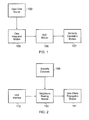
- FIG. 1 shows a block diagram of a similarity-computation apparatus according to a general embodiment of the present invention.
- the similarity-computation apparatus may be embodied as a server or a PC or another computing apparatus with connection via the internet. It comprises a data integration module 105, an RDF module 106 and a similarity calculation module 107.
- the similarity-computation apparatus also has access to one or more open data sources 100 (databases or more simple data stores).
- the similarity-computation apparatus may be directly or indirectly connected to the open data source(s) 100, through a suitable network connection (for example over the internet). Alternatively or additionally, the similarity-computation apparatus may comprise one or more local data sources.
- the open data source 100 may comprise one or more of: a drug profile database 101; and/or a side effect database 102; and/or a drug classification database 103; and/or a disease database.
- the similarity-computation apparatus uses open data to compute similarities between medicaments.
- the data integration module 105 obtains data, which relates to a set of two or more medicaments (for example, drugs), from the open data source 100.
- the data relating to the set of drugs is then integrated by the data integration module 105 to generate RDF triples for each of the drugs in the set of drugs.
- the data integration module 105 may also, when integrating the data, filter and/or join the data.
- the RDF triples relating the data for the set of drugs are then transferred to the RDF module 106.
- the RDF module 106 stores an RDF graph of the RDF triples generated by the data integration module 105.
- the similarity calculation module 107 uses the RDF graph stored on the RDF module 106 to retrieve a list of all the drugs that are contained in the RDF graph.
- the similarity calculation module 107 then calculates the similarity of the drugs contained in the set of drugs with the other drugs in the drug set. For example, for a set of drugs containing drugs A, B and C, the similarity calculation module 107 may calculate the similarity between drug A and drug B, the similarity between drug A and drug C, and the similarity between drug B and drug C. These calculated similarities can be stored in a similarity database 109 (not shown).
- FIG. 2 shows a block diagram of a side effect determining apparatus according to a general embodiment of the present invention.
- the side effect determining apparatus may be a server or a PC or another computing apparatus with connections via the internet. It comprises a user interface 112, a neighbours ranking module 110 and a side effects propagation module 111.
- the side effect determining apparatus also has access to one or more similarity databases 109.
- the side effect determining apparatus may be directly or indirectly connected to the similarity database(s) 109, through a suitable network connection. Alternatively or additionally, the side effect determining apparatus may further comprise one or more local similarity databases 109.
- the similarity database 109 is capable of storing similarity data relating to the similarity between each drug of a set of drugs and every other drug in the set.
- the side effect determining apparatus is capable of determining side effects (or potential/probable side effects) associated with a specified medicament (or drug).
- the user interface 112 allows a user to specify a particular drug from the set of two or more drugs.
- the specified drug is then transferred to the neighbours ranking module 110, which uses the similarity data stored in the similarity database 109 to obtain the drugs from the drug set that are the nearest neighbours of the specified drug in terms of similarities.
- the side effects propagation module 111 is then able to collect a list of known side effects from the selected nearest neighbours to the specified drug.
- the side effects in the list are combined and ranked by the side effects propagation module 111, according to their co-occurrence among the neighbour drugs. That is, the side effects that are more likely to be associated with the specified drug are ranked higher than those that are not.
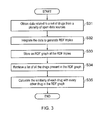
- FIG. 3 is a flow chart representing the method in the similarity-computation apparatus according to a general embodiment of the present invention.
- step S31 data relating to a set of two or more drugs is acquired from one or more open data sources.
- the acquired data is then integrated and RDF triples for the set of drugs are generated in step S32.
- An RDF graph of the RDF triples is stored in step S33, in order to be accessed in step S34 when calculating the similarity of each drug in the set of drugs with every other drug in the drug set in step S35.
- FIG. 4 is a flow chart representing the method in the side-effect determining apparatus according to a general embodiment of the present invention.
- a drug is specified, preferably by a user, from a set of two or more drugs.
- Drug similarities stored in a drug similarity database are then used in step S42 to determine the drugs from the drug set that are the nearest neighbours of the specified drug in terms of similarities.
- a list of known side effects of the nearest neighbour drugs to the specified drug are collected in step S43.
- the collected side effects are then combined and ranked in step S44 according to their co-occurrence among the neighbour drugs.
- the method of invention embodiments may be seen as two-fold: 1) a drug-centric view in which all data available for drugs is used to compute similarity between drugs; and 2) a side effect centric view where co-occurring side effects are used to determine occurrence probabilities of a side effect in other drugs.
- the former approach may be used to identify true positives side effects for a given drug, while the latter approach may be used for detecting false negatives in the data, i.e., side effects that have no possibility of being associated with certain drugs.
- This novel configuration allows the method herein presented with the filtering of noise in the output results, resulting in better prediction results.
- Linked Open Data is a paradigm in which linked data from a variety of sources is made available to applications, thus, for the purposes of this document, "Linked Data” and “Linked Open Data” or “LOD” may be used more or less interchangeably.
- embodiments of the present invention may also allow the feeding of other or newer data sources, such as side effect reports and biomedical literature. This may require the application of proper join and filtering processes.
- the signalling process can be compared with a recommender system, retrieving weighted warning (recommendations) for potential side effects (items) caused by a drug (users).
- the embodiments of the present invention take advantage of structured data in order to compute similarity between drugs that are used and to suggest potential side effects for a drug.
- Figure 5 shows a block diagram with information flows representing an example system/architecture for using Linked Data to discover drug side effects according to an embodiment of an aspect of the invention.
- the method has two stages: one stage (shown on the left side of Figure 5 ) that is, due to the processing time required, preferably executed offline in a suitable server machine to satisfy the query requirements; and a second stage (shown on the right side of Figure 5 ) that is preferably executed completely or partially online, allowing users to access and visualise detected signals or associations between drugs and side effects.
- the process can be separated into the three main blocks shown in Figure 5 and discussed below. These blocks are: (1) knowledge base construction, (2) similarity computation, and (3) side effect signalling.
- the present invention proposes a novel method for signal detection of drug side effects using Open Data.
- Known diverse initiatives focus on the transformation and publication of Life Sciences data using an open, exchangeable and flexible data format such as Resource Description Framework (RDF).
- RDF Resource Description Framework
- Linked Data builds upon RDF (used as data model), HTTP (used to transfer data via the Internet), and uniform resource identifier (URI) (used to identify resources) in order to publish data in a way that can be read automatically by computers.
- RDF Resource Description Framework
- HTTP used to transfer data via the Internet
- URI uniform resource identifier
- RDF is used as the data format to represent a graph which represents the underlying drug-related background knowledge sources.
- RDF is used as the data format to represent a graph which represents the underlying drug-related background knowledge sources.
- various data sources may be considered, such as, for example, drug profiles (101), side effect database (102), drug classification database (103), and/or disease database (104).
- the data sources are integrated by the Data Integration module (105), to later make them available through an RDF Graph (106) to be queried.
- the data sources used are not limited to the above listed examples and different public sources, such as post-market reports, can also be used in the present method to build an RDF Graph knowledge base. Due to the RDF flexibility, other un/structured sources containing drugs' properties (for example, chemical, biological, phenotypic information), side effects, drug classification, and diseases, can also be utilised.
- the initially mentioned sources are openly available to users, thus minimising the costs of data gathering and the overall method.
- FIG 6 shows an extended view of the interaction between the Data Integration module (105) and the RDF Graph module (106).
- the Data Integration module (105) is responsible for processing a data source (201) and for performing data integration with filtering in order to generate RDF triples.
- the RDF triples are then stored and indexed in an RDF store (204) for future querying.
- Data sources usually require a linkage process (203) to make the same entities accessible using a unique identifier. That is, if a drug contains alias names, the system needs to ensure that whatever alias is used, the drug identifier retrieved is the same. This avoids reference problems and keeps an acceptable integrity level in the data.
- the Similarity Calculation module (107) is the module responsible for computing drugs' similarity. First, the Similarity Calculation module (107) retrieves a list of all drugs present in the RDF Graph (106).
- An RDF Graph is a directed graph in which each edge is an RDF triple with a ( subject, predicate, object) structure and where the edge starts in the subject node and ends in the object node. Then, for each drug X in the list, the Similarity Calculation module (107) performs a query against the RDF Graph module (106) asking for the set of predicates (relations) where X is in a subject or an object position.
- the RDF graph is a directed graph, i.e., the edges have a direction and there exist incoming and outgoing edges.
- the query (X, ?, ?) is used for outgoing edges
- the query (?, ?, X) is used for incoming edges, respectively.
- Each drug is then associated to a feature vector extracted from the underlying RDF graph in 106. These features interact with the features of other drugs to compute a similarity between any given pair of drugs.
- the feature vectors and similarities for a pair of drugs may be generated as described below and with reference to Figure 7 .
- Figure 7 shows an RDF Graph for two drugs, known as resources in the RDF Graph domain.
- the similarity of the two drugs of the RDF graph shown in Figure 7 , a and b is to be calculated.
- a similarity metric based on the work described in R. Meymandpour and J. G. Davis, "Recommendations Using Linked Data," in PIKM t Maui, Hawaii, 2012. is used, however, any other suitable metric may be adapted in order to compute similarity between resources in an RDF graph.
- Resource a in Figure 7 has outgoing relations to resources c, e, and f with predicates l 1 , l 3 and l 4 , respectively. Also, it has incoming relations from the resource d with predicate l 2 . Then, A is defined as shown in Equation (1) below.
- B is defined as the set of features for the resource b, as shown in Equation (2).
- the Information Content (IC) of a set of features in Linked Data (LD) is then defined as the sum of the IC of each component in the vector.
- IC LD A ⁇ ⁇ a i ⁇ A IC a i
- ⁇ ( a i ) is the frequency of feature a i in the RDF graph and n is the maximum number of occurrences of a feature.
- dBank:DB03783 Phenacetin
- dBank:DB00316 Alcoholophen
- intersection contains the set of shared features. Note that neither A or B contains incoming edges, so the right side set of features is empty. For each feature its information content is then computed to get a final similarity score.
- Figure 9 shows a fine grained block chart for the similarity calculation module.
- the Similarity Method (503) gets a set of Feature Vectors (502) as input, which were previously generated from the underlying RDF Graph with Drugs' Information (501). Drug similarities are stored in the Drug Similarities Database (504) to be consumed during the online processing under a user's request.
- the drug similarities database represents a vector space model where each drug is represented as a dot in a n -dimensional space (where n is the cardinality of the feature vectors), and certain properties are satisfied.
- Figure 10 shows a small sample of this drugs space where the black dot denotes a selected drug, and the five connected non-filled dots are the top-5 more similar drugs, also called closest neighbours. This five plus one set of drugs conforms a neighbourhood where drugs are highly associated on the basis of their properties (for example, chemical, biological, or phenotypic information).
- k-Nearest Neighbours or k -NN
- k + 1 the size of the neighbourhood.
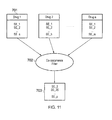
- Figure 11 depicts the Side Effects Propagation module (111) based on a side effect based approach.
- the system collects the already known side effects among all its k neighbours (represented by 701). Side effects are combined and ranked according to their co-occurrence among the neighbour drugs to determine the signal's weight. Side effects may also be ranked using different ranking methods, not limited to the one described here.
- the co-occurrence filter (702) computes the frequency of drug features occurring with each side effect. These features are used to build a normalised histogram of drug features for a given side effect. For example, the side effect abdominal pain occurs 271 times with known drugs, and only 5% of drugs that cause abdominal pain cure ventricular fibrillation; or 98% of drugs that cause abdominal pain contain chemical substructure 12. All these correlations can be expressed in a correlation matrix between all side effects and drug features. This correlation matrix is then used as a drug profile to rank side effects proposed by the neighbour drugs. The method herein described is therefore able to determine when a side effect is very unlikely to occur with the use of a given drug. For instance, using the profile matrix we could say that a drug manufactured to cure ventricular fibrillation that does not contain chemical substructure 12, and that targets the Q9NY47 protein is unlikely to cause abdominal pain.
- side effects are selected by the co-occurrence filter (702) as potentially significant for a given drug, and a signal is emitted for each one of the potential side effects (703) to perform further analysis.
- Table 1 Acute anaphylaxis Diarrhoea Pruritus Allergic cutaneous angiitis Dizziness Rash Chest pain Dyspepsia Renal failure Disorientation Dysuria Somnolence Dyspnoea Fatigue Stomatitis Cramp muscle Body temperature increased Sweating Nephrotic syndrome Fasciitis Thrombocytopenia Palpitations Flatulence Tinnitus Syncope Flushing Urticaria Necrotising fasciitis Gastritis Vertigo Hearing impaired Gastrointestinal haemorrhage Vomiting Agranulocytosis Hallucination Hepatic function abnormal Anaphylactic shock Headache Gastrointestinal perforation Anaemia Haematuria Renal impairment Haemolytic anaemia Haemor
- the co-occurrence filter helps to re-rank the side effects to give more importance to some side effects compared to others. Also, the same filter helps to discard certain side effects that are unlikely to occur with the consumption of Phenacetin.
- the filtered and weighted list of side effects is then ready to be visualized for a user under request using a suitable user interface, displaying the drug with the weighted signals.
- the low-cost method for early stage signalling of drug side effects described in the present invention permits different users to assess the hypotheses regarding the possible association of side effects to drugs.
- embodiments of the present invention try to overcome the drawbacks of the prior art through a method that meets one or more of the following criteria.
Landscapes
- Engineering & Computer Science (AREA)
- Health & Medical Sciences (AREA)
- Chemical & Material Sciences (AREA)
- Epidemiology (AREA)
- Public Health (AREA)
- Primary Health Care (AREA)
- Medical Informatics (AREA)
- General Health & Medical Sciences (AREA)
- Theoretical Computer Science (AREA)
- Crystallography & Structural Chemistry (AREA)
- Databases & Information Systems (AREA)
- Bioinformatics & Cheminformatics (AREA)
- Computing Systems (AREA)
- Bioinformatics & Computational Biology (AREA)
- Life Sciences & Earth Sciences (AREA)
- Data Mining & Analysis (AREA)
- Pharmacology & Pharmacy (AREA)
- Toxicology (AREA)
- Medicinal Chemistry (AREA)
- General Physics & Mathematics (AREA)
- Physics & Mathematics (AREA)
- General Engineering & Computer Science (AREA)
- Medical Treatment And Welfare Office Work (AREA)
- Information Retrieval, Db Structures And Fs Structures Therefor (AREA)
Abstract
Description
- The present invention relates to a method allowing early stage signalling of drug side effects using open data. The method can determine side effects potentially associated with drugs, by means of computing drug similarity based on intrinsic properties. The invention is in the field of Pharmacoinformatics and has applications throughout the world of medicine.
- Side effects are unintended or unwanted effects of using a drug (any substance (with the exception of food and water) that alters a body's function, for humans or animals) that occur along with the desired effects of the drug. Examples include agitation, headaches, wound infection and nausea. Pre-market drug trials and studies are often used to initially determine side effects associated with a drug. However, pre-market drug trials are, in general, expensive and risky. Despite such studies, numerous unknown side effects are reported after the market release of a drug (i.e. in a post-market period), which can, in many cases, cause substantial morbidity and even mortality. When such events occur, among other actions, the drug is removed from the market, which can hugely damage the image and reputation of a pharmaceutical company and cause legal issues. Thus, lower-cost systems to detect prematurely (i.e. in the early stage of drugs manufacture) drug side effects would help to minimise future costs, as well as avoiding risks to both pharmaceuticals and the general public.
- To cope with the inconclusiveness of the pre-market clinical trials, side effects are globally monitored after the release of a drug by organisations such as the Food and Drug Administration (FDA). These organisations collect reports on the side effects of drugs from multiple sources, such as patients, pharmacists, physicians, and pharmaceutical manufacturers. Moreover, regulatory governmental agencies have set up reporting systems that allow the general public to report unintended side effects of using a drug. Recently, software-based solutions have been employed in order to optimise the process and storage of any generated report from the public.
- Due to the cost and time required by the pre-clinical trials, many drugs are released with undiscovered side effects. For this reason, after a drug is released its side effects are mainly discovered by chance due to adverse patient reactions. More recently, attempts have been made to design techniques and methods that allow such events to be discovered prematurely, avoiding damage to patients. This has been done by using available data, such as historical reports, to try to determine causalities, inferences and correlations.
- Existing software systems that predict the occurrence of a side effect with the use of a certain drug(s) are mainly based on post-market data or generated after commercialisation. In this regard, such data may include: patient's data, adverse events reports from the general public, or post-marketing statistics. The systems require the availability of such data in order to operate. Despite this, existing methods have the following characteristics/drawbacks, which have been classified by the inventors into four groups, as follows:
- 1. "Post-Market" methods that require the release of a drug openly to the market in order to collect, after the release, medical feedback from stakeholders (for example, reporting agencies, patients). These methods mainly rely on statistical inference that is detected through adverse event incidents, i.e. after the side effect has been endured by patients. These methods can also contain a significant time lag between side effects being experienced and being reported to agencies. Moreover, to collect such feedback from a statistically significant sample requires a lot of time and effort, causing further delays and potentially endangering the general public.
- 2. "Patient data" based methods require the collection of personal and confidential data from patients. These methods are intrusive in nature and are high cost due to the different legal steps that are needed to acquire such data. These methods tend to be associated with very expensive clinical trials and patient monitoring, and are generally high-risk in case of undocumented uses of a drug.
- 3. "Small data" methods where side effects are predicted based on small dimension vectors of features extracted from a single drug. For example, these methods do not take into account characteristics of multiple drugs at the same time, and the side effects associated with those drugs.
- 4. "Complete data" methods in which a set of required characteristics (features) are needed for the method to operate. In these methods, each drug under question has to undergo thorough investigations in order to determine the intrinsic characteristics needed. In many scenarios, drug manufacturers and regulatory agencies may not have all these characteristics and thus predicting side effects would not be possible.
- Embodiments of the present invention try to overcome the above mentioned drawbacks, through a method that i) is an early detection method which utilises data available prior to market release, and/or ii) exploits low-cost data usage by utilising open access data and not relying on or requiring patient data and/or experimental trials, and/or iii) is capable of operating with incomplete data while allowing for the incremental integration of knowledge acquired through the drug manufacturing process and/or other stakeholders.
- According to an embodiment of one aspect of the invention, there is provided a similarity-computation apparatus configured to use open data to compute similarities between drugs, the apparatus comprising: a data integration module configured to obtain data related to a set of drugs from a plurality of open data sources and to integrate the data to generate RDF triples; an RDF module configured to store an RDF graph of the RDF triples; and a similarity calculation module configured to retrieve a list of all the drugs present in the RDF graph and calculate the similarity of each drug with every other drug in the RDF graph.
- Since the method learns from known side effects identified for drugs in the past, the more drugs the system contains the better. However, the set of drugs may correspond to a specific medical treatment or sub-group, omitting other drugs.
- RDF provides the connections between drugs for the method of invention embodiments to work. Data in other data formats, such as relational databases, CSV files, JSON files, etc., can be used with a corresponding mapping to RDF.
- Invention embodiments use open data to provide drug similarity data from an integrated RDF graph, which can then be used in a similarity-computation apparatus (described later) to extrapolate side effects of a specified drug from other drugs.
- RDF (Resource Description Framework) is a general method for conceptual description or modelling of information that is a standard for semantic networks. Standardising the modelling of information in a semantic network allows for interoperability between applications operating on a common semantic network. RDF maintains a vocabulary with unambiguous formal semantics, by providing the RDF Schema (RDFS) as a language for describing vocabularies in RDF.
- The triples provide for encoding of graph data by characterising the graph data as a plurality of subject-predicate-object expressions. In that context, the subject and object are graph nodes of the graph data, and as such are entities, objects, instances, or concepts, and the predicate is a representation of a relationship between the subject and the object. The predicate asserts something about the subject by providing a specified type of link to the object. For example, the subject may denote a Web resource (for example, via a Unique Resource Identifier, URI), the predicate denote a particular trait, characteristic, or aspect of the resource, and the object denote an instance of that trait, characteristic, or aspect (perhaps another URI). In other words, a collection of triple statements intrinsically represents directional graph data. The RDF standard provides formalised structure for such triples. An RDF graph can be queried using the SPARQL Protocol and RDF Query Language (SPARQL).
- Preferably, the data integration module is configured to allow integration of new data during runtime (that is after an initial set-up), and the RDF module is configured to add the new data to the RDF graph. The new data may be from existing data sources or from new data sources. The data sources do not necessarily need to be expressed in RDF initially; they can be converted into RDF using a mapping language. The source can be a relational database, a CSV (comma-separated value) file, a JSON (JavaScript Object Notation) file, etc..
- The data integration module may be configured to recognise alternative terms for the same drug and to class all the data associated with the alternative terms together as belonging to the same drug. For example, the module may use ontology web language (OWL) to automatically process downloaded language, for example to define a "same as" relationship.
- The data integration module may be configured to use alternative names, synonyms and string distance measures to recognise alternative terms for the same drug.
- Furthermore, the data integration module may be configured to link together different instances of the same drug, for example by using a unique identifier. All these features taken together can allow successful integration of data from different sources.
- For example, the data integration module may be configured to integrate data from one or more of drug property, side effects, drug classification and diseases databases. The list of databases can be expanded to include further databases.
- Turning to the similarity calculation module, this uses RDF functionality to calculate similarity. For example, it may be configured to find a set of predicates and objects/subjects of RDF triples in which, for each drug, the drug is a subject or an object respectively and to generate a feature vector from the predicates and objects/subjects representing the features of the drug, wherein the similarity calculation module is further configured to calculate the similarity of each drug with every other drug in the RDF graph by comparison of the feature vectors of the two drugs. In this context, each of the n predicate and object/subject combinations can be viewed as a feature and the feature vector can be viewed as an n-dimensional vector.
- Side effects can be included in the computation of similarities or not, they are not a requirement for the method to work. Any attribute of a drug can be used as a feature to compute the similarity including side effects (if any). If the method is applied over a new drug without any previous known side effects, the method will report new side effects just based on its chemical composition. If the method is applied to an existing drug with side effects, the method will report extra side effects. The method is designed to work with partial data.
- The similarity calculation module may be configured to calculate the similarity between two drugs by taking into account the number of intersecting features of the feature vectors, in which the predicate and the subject or object (which makes up the triple together with the drug) is the same for both drugs. Hence, in the triples being compared, the drugs are different but the predicate and third element (subject or object) in the triple are the same.
- The similarity calculation module may be configured to store the calculated similarities as drug-drug distances for the set of drugs in a similarity database to which the similarity-computation apparatus is connected.
- According to an embodiment of a further aspect of the invention, there is provided a side effect determining apparatus which uses the calculated similarities to look for potential side effects. The side effect determining apparatus may thus be configured to extrapolate side effects of a specified drug in a set of drugs from open data related to the set of drugs. The apparatus can comprise: a connection to a similarity database, the similarity database being configured to store similarity data derived from a plurality of open data sources, the similarity data providing drug similarity between each drug and every other drug in a set of drugs; a user interface configured to allow a user to specify a drug from the set of drugs; a neighbours ranking module configured to use the drug similarities to obtain nearest neighbours of the specified drug in terms of the similarities; and a side effects propagation module configured to collect known side effects from the nearest neighbours and to combine and rank the side effects according to their co-occurrence among the neighbours.
- Hence the side effect determining apparatus does not rely on any side effects which may be indicated for the specified drug, but looks to the closest drugs to the specified drug, based on the similarity data, and propagates the side effects of these most similar drugs, using a ranking method.
- The similarity data may be provided as drug-drug distances in a vector space model in an n-dimensional space, and the neighbours ranking module may be configured to select k nearest neighbours on the basis of distances within the n-dimensional space.
- The side effects propagation module may be configured to compute the frequency of drug features occurring with each side effect found among the known side effects to build a correlation between each side effect and each drug feature.
- For example, the drug features may include any of drug properties, drug classification and diseases, which are already included in the similarity data. The features used here can be the same as those used to compute the similarity data, or a sub-group of the features. The processing of the features is different here in the function applied. Clearly side effects are now the pivots.
- The side effect determining apparatus may comprise a notification module configured to issue a warning, alarm or notification with a list of side effects and/or if certain (for example more serious or specified) side effects are extrapolated.
- According to an embodiment of a still further aspect of the invention, there is provided a system for calculating similarities between drugs and using the similarities to extrapolate side effects of a specified drug. The system is effectively a combination of the similarity-computation apparatus and the side effect determining apparatus. It may thus comprise: a similarity-computation apparatus configured to use open data to compute similarities between drugs, the similarity-computation apparatus comprising: a data integration module configured to obtain data related to a set of drugs from a plurality of open data sources and to integrate the data to generate RDF triples; an RDF module configured to store an RDF graph of the RDF triples; and a similarity calculation module configured to retrieve a list of all the drugs present in the RDF graph and to calculate the similarity of each drug with every other drug in the RDF graph, for storage in a similarity database; and a side effect determining apparatus configured to extrapolate side effects of a specified drug from open data related to the set of drugs, the side effect determining apparatus comprising: a connection to the similarity database; a user interface configured to allow a user to specify a drug from the set of drugs; a neighbours ranking module configured to use the drug similarities to obtain nearest neighbours of the specified drug in terms of the similarities; and a side effects propagation module configured to collect known side effects from the nearest neighbours and to combine and rank the side effects according to their co-occurrence among the neighbours.
- Any sub-features of the similarity-computation apparatus and the side effect determining apparatus may be incorporated into the system as initially described above.
- According to an embodiment of a first method aspect of the invention, there is provided a method of using open data to compute similarities between drugs, the method comprising: obtaining data related to a set of drugs from a plurality of open data sources; integrating the data to generate RDF triples; storing an RDF graph of the RDF triples; retrieving a list of all the drugs present in the RDF graph; and calculating the similarity of each drug with every other drug in the RDF graph.
- According to an embodiment of a second method aspect of the invention, there is provided a method of extrapolating side effects of a specified drug from open data related to a set of drugs, the method comprising: allowing user input specifying a drug from the set of drugs; obtaining nearest neighbours of the specified drug in terms of the similarities using a similarity database configured to store similarity data derived from a plurality of open data sources, the similarity data providing drug similarity between each drug and every other drug in the set of drugs; collecting known side effects from the nearest neighbours; and combining and ranking the side effects according to their co-occurrence among the neighbours.
- The two method aspects may be carried out by the same person or commercial entity, or by different people/commercial entities.
- The invention can be implemented in digital electronic circuitry, or in computer hardware, firmware, software, or in combinations of them. The invention can be implemented as a computer program or computer program product, i.e., a computer program tangibly embodied in an information carrier, e.g., in a machine-readable storage device or in a propagated signal, for execution by, or to control the operation of, one or more hardware modules. A computer program can be in the form of a stand-alone program, a computer program portion or more than one computer program and can be written in any form of programming language, including compiled or interpreted languages, and it can be deployed in any form, including as a stand-alone program or as a module, component, subroutine, or other unit suitable for use in a communication system environment. A computer program can be deployed to be executed on one module or on multiple modules at one site or distributed across multiple sites and interconnected by a communication network.
- Method steps of the invention can be performed by one or more programmable processors executing a computer program to perform functions of the invention by operating on input data and generating output. Apparatus of the invention can be implemented as programmed hardware or as special purpose logic circuitry, including e.g., an FPGA (field programmable gate array) or an ASIC (application-specific integrated circuit).
- Processors suitable for the execution of a computer program include, by way of example, both general and special purpose microprocessors, and any one or more processors of any kind of digital computer. Generally, a processor will receive instructions and data from a read-only memory or a random access memory or both. The essential elements of a computer are a processor for executing instructions coupled to one or more memory devices for storing instructions and data.
- The invention is described in terms of particular embodiments. Other embodiments are within the scope of the following claims. For example, the steps of the invention can be performed in a different order and still achieve desirable results.
- The apparatus according to preferred embodiments is described as configured or arranged to carry out certain functions. This configuration or arrangement could be by use of hardware or middleware or any other suitable system. In preferred embodiments, the configuration or arrangement is by software.
- Elements of the invention have been described using terms such as "module". The skilled reader will appreciate that these terms and their equivalents may refer to parts of the system that are spatially separate but combine to serve the function defined. Equally, the same physical parts of the system may provide two or more of the functions defined.
- Features and sub-features of the system and apparatus aspects may be applied to the method aspects and vice versa
- Reference is made, by way of example only, to the accompanying drawings in which:
-
Figure 1 is an apparatus block diagram representing a similarity-computation apparatus according to a general embodiment of the invention; -
Figure 2 is an apparatus block diagram representing a side effect determining apparatus according to a general embodiment of the invention; -
Figure 3 is a flow chart of the method in the similarity-computation apparatus according to a general embodiment of the invention; -
Figure 4 is a flow chart of the method in the side effect determining apparatus according to a general embodiment of the invention; -
Figure 5 is a block/flow diagram representing an example system/architecture according to an embodiment of an aspect of the invention; -
Figure 6 is a block diagram showing the interaction between a Data Integration module and RDF Graph module according to an embodiment of an aspect of the invention; -
Figure 7 is a schematic diagram of an example RDF graph according to an embodiment of an aspect of the invention; -
Figure 8 is an example subset of relations for two drugs according to an embodiment of an aspect of the invention; -
Figure 9 is a block diagram of a Similarity Calculation module according to an embodiment of an aspect of the invention; -
Figure 10 is an example of a Drug Neighbours Ranking module according to an embodiment of an aspect of the invention; and -
Figure 11 is an example of a Side Effects Propagation module according to an embodiment of an aspect of the invention. -
Figure 1 shows a block diagram of a similarity-computation apparatus according to a general embodiment of the present invention. The similarity-computation apparatus may be embodied as a server or a PC or another computing apparatus with connection via the internet. It comprises adata integration module 105, anRDF module 106 and asimilarity calculation module 107. The similarity-computation apparatus also has access to one or more open data sources 100 (databases or more simple data stores). The similarity-computation apparatus may be directly or indirectly connected to the open data source(s) 100, through a suitable network connection (for example over the internet). Alternatively or additionally, the similarity-computation apparatus may comprise one or more local data sources. Theopen data source 100 may comprise one or more of: adrug profile database 101; and/or aside effect database 102; and/or adrug classification database 103; and/or a disease database. - The similarity-computation apparatus uses open data to compute similarities between medicaments. Firstly, the
data integration module 105 obtains data, which relates to a set of two or more medicaments (for example, drugs), from theopen data source 100. The data relating to the set of drugs is then integrated by thedata integration module 105 to generate RDF triples for each of the drugs in the set of drugs. Thedata integration module 105 may also, when integrating the data, filter and/or join the data. The RDF triples relating the data for the set of drugs are then transferred to theRDF module 106. - The
RDF module 106 stores an RDF graph of the RDF triples generated by thedata integration module 105. Thesimilarity calculation module 107 then uses the RDF graph stored on theRDF module 106 to retrieve a list of all the drugs that are contained in the RDF graph. Thesimilarity calculation module 107 then calculates the similarity of the drugs contained in the set of drugs with the other drugs in the drug set. For example, for a set of drugs containing drugs A, B and C, thesimilarity calculation module 107 may calculate the similarity between drug A and drug B, the similarity between drug A and drug C, and the similarity between drug B and drug C. These calculated similarities can be stored in a similarity database 109 (not shown). -
Figure 2 shows a block diagram of a side effect determining apparatus according to a general embodiment of the present invention. The side effect determining apparatus may be a server or a PC or another computing apparatus with connections via the internet. It comprises auser interface 112, aneighbours ranking module 110 and a sideeffects propagation module 111. The side effect determining apparatus also has access to one ormore similarity databases 109. The side effect determining apparatus may be directly or indirectly connected to the similarity database(s) 109, through a suitable network connection. Alternatively or additionally, the side effect determining apparatus may further comprise one or morelocal similarity databases 109. Thesimilarity database 109 is capable of storing similarity data relating to the similarity between each drug of a set of drugs and every other drug in the set. - The side effect determining apparatus is capable of determining side effects (or potential/probable side effects) associated with a specified medicament (or drug). The
user interface 112 allows a user to specify a particular drug from the set of two or more drugs. The specified drug is then transferred to theneighbours ranking module 110, which uses the similarity data stored in thesimilarity database 109 to obtain the drugs from the drug set that are the nearest neighbours of the specified drug in terms of similarities. - The side
effects propagation module 111 is then able to collect a list of known side effects from the selected nearest neighbours to the specified drug. The side effects in the list are combined and ranked by the sideeffects propagation module 111, according to their co-occurrence among the neighbour drugs. That is, the side effects that are more likely to be associated with the specified drug are ranked higher than those that are not. -
Figure 3 is a flow chart representing the method in the similarity-computation apparatus according to a general embodiment of the present invention. Firstly, in step S31 data relating to a set of two or more drugs is acquired from one or more open data sources. The acquired data is then integrated and RDF triples for the set of drugs are generated in step S32. An RDF graph of the RDF triples is stored in step S33, in order to be accessed in step S34 when calculating the similarity of each drug in the set of drugs with every other drug in the drug set in step S35. -
Figure 4 is a flow chart representing the method in the side-effect determining apparatus according to a general embodiment of the present invention. Firstly, in step S41 a drug is specified, preferably by a user, from a set of two or more drugs. Drug similarities stored in a drug similarity database are then used in step S42 to determine the drugs from the drug set that are the nearest neighbours of the specified drug in terms of similarities. Next, a list of known side effects of the nearest neighbour drugs to the specified drug are collected in step S43. The collected side effects are then combined and ranked in step S44 according to their co-occurrence among the neighbour drugs. - The method of invention embodiments may be seen as two-fold: 1) a drug-centric view in which all data available for drugs is used to compute similarity between drugs; and 2) a side effect centric view where co-occurring side effects are used to determine occurrence probabilities of a side effect in other drugs. The former approach may be used to identify true positives side effects for a given drug, while the latter approach may be used for detecting false negatives in the data, i.e., side effects that have no possibility of being associated with certain drugs. This novel configuration allows the method herein presented with the filtering of noise in the output results, resulting in better prediction results.
- Particular embodiments of the present invention described herein make use of knowledge, in the form of Linked Data (machine readable), for discovering unknown potential side effects of a drug. Notifications, alerts or warning signals may then be emitted or communicated as a result. Major initiatives and governments are publishing such data as open access data on the Web. Linked Open Data (LOD) is a paradigm in which linked data from a variety of sources is made available to applications, thus, for the purposes of this document, "Linked Data" and "Linked Open Data" or "LOD" may be used more or less interchangeably.
- This is in contrast to current approaches known in the art, which make use of data sources which are slower to gather, such as, for example, agencies reports, and/or intrusive personal patients' data, and/or risky patients' reaction reports. Furthermore, embodiments of the present invention may also allow the feeding of other or newer data sources, such as side effect reports and biomedical literature. This may require the application of proper join and filtering processes.
- The signalling process can be compared with a recommender system, retrieving weighted warning (recommendations) for potential side effects (items) caused by a drug (users). The embodiments of the present invention take advantage of structured data in order to compute similarity between drugs that are used and to suggest potential side effects for a drug.
-
Figure 5 shows a block diagram with information flows representing an example system/architecture for using Linked Data to discover drug side effects according to an embodiment of an aspect of the invention. In general, the method has two stages: one stage (shown on the left side ofFigure 5 ) that is, due to the processing time required, preferably executed offline in a suitable server machine to satisfy the query requirements; and a second stage (shown on the right side ofFigure 5 ) that is preferably executed completely or partially online, allowing users to access and visualise detected signals or associations between drugs and side effects. In terms of flow, the process can be separated into the three main blocks shown inFigure 5 and discussed below. These blocks are: (1) knowledge base construction, (2) similarity computation, and (3) side effect signalling. - The present invention proposes a novel method for signal detection of drug side effects using Open Data. Known diverse initiatives focus on the transformation and publication of Life Sciences data using an open, exchangeable and flexible data format such as Resource Description Framework (RDF). Linked Data builds upon RDF (used as data model), HTTP (used to transfer data via the Internet), and uniform resource identifier (URI) (used to identify resources) in order to publish data in a way that can be read automatically by computers.
- In a preferred embodiment of the invention, RDF is used as the data format to represent a graph which represents the underlying drug-related background knowledge sources. Despite the fact that some data sources are not originally published as RDF or are incomplete transformations, in this work a non-trivial data extraction, transformation and integration process was carried out. For instance, the same drug can be contained in different data sources with a different name or spelling, which makes it impossible to perform a direct string match. This problem is addressed by matching drugs and side effects' names, using a more complex matching which is based on alternative names and synonyms. To mention, two examples:
- 1)The inventors generated a more complete RDF dump from the Side Effect Resources Sider (www.sideeffects.embl.de/) by extending it with Automatic Taxonomy Construction, ATC taxonomy to generate a hierarchical outline, Medical Dictionary for Regulatory Activities (MedDRA) preferred terms, and frequency of the side effects extracted from their public website.
- 2) The inventors integrated drugs' names from the resource DrugBank (www.drugbank.ca/) with Sider, and side effects' names from Sider with Diseasome (www.diseasome.eu/), using alternative names (owl:sameAs relationship), synonyms, and string distance measures.
- As shown in
Figure 5 , various data sources may be considered, such as, for example, drug profiles (101), side effect database (102), drug classification database (103), and/or disease database (104). The data sources are integrated by the Data Integration module (105), to later make them available through an RDF Graph (106) to be queried. The data sources used are not limited to the above listed examples and different public sources, such as post-market reports, can also be used in the present method to build an RDF Graph knowledge base. Due to the RDF flexibility, other un/structured sources containing drugs' properties (for example, chemical, biological, phenotypic information), side effects, drug classification, and diseases, can also be utilised. The initially mentioned sources are openly available to users, thus minimising the costs of data gathering and the overall method. -
Figure 6 shows an extended view of the interaction between the Data Integration module (105) and the RDF Graph module (106). The Data Integration module (105) is responsible for processing a data source (201) and for performing data integration with filtering in order to generate RDF triples. The RDF triples are then stored and indexed in an RDF store (204) for future querying. Data sources usually require a linkage process (203) to make the same entities accessible using a unique identifier. That is, if a drug contains alias names, the system needs to ensure that whatever alias is used, the drug identifier retrieved is the same. This avoids reference problems and keeps an acceptable integrity level in the data. - The Similarity Calculation module (107) is the module responsible for computing drugs' similarity. First, the Similarity Calculation module (107) retrieves a list of all drugs present in the RDF Graph (106). An RDF Graph is a directed graph in which each edge is an RDF triple with a (subject, predicate, object) structure and where the edge starts in the subject node and ends in the object node. Then, for each drug X in the list, the Similarity Calculation module (107) performs a query against the RDF Graph module (106) asking for the set of predicates (relations) where X is in a subject or an object position. Formally, using a query by patterns we could represent these queries as (X, ?, ?) and (?, ?, X) for subject and object, respectively. From those predicates a set of features for drug X is generated, which is referred to as a feature vector.
- The RDF graph is a directed graph, i.e., the edges have a direction and there exist incoming and outgoing edges. Thus, the query (X, ?, ?) is used for outgoing edges, and the query (?, ?, X) is used for incoming edges, respectively.
- Each drug is then associated to a feature vector extracted from the underlying RDF graph in 106. These features interact with the features of other drugs to compute a similarity between any given pair of drugs. In a preferred embodiment, the feature vectors and similarities for a pair of drugs may be generated as described below and with reference to
Figure 7 . -
Figure 7 shows an RDF Graph for two drugs, known as resources in the RDF Graph domain. The similarity of the two drugs of the RDF graph shown inFigure 7 , a and b, is to be calculated. In this example, a similarity metric based on the work described in R. Meymandpour and J. G. Davis, "Recommendations Using Linked Data," in PIKMt Maui, Hawaii, 2012. is used, however, any other suitable metric may be adapted in order to compute similarity between resources in an RDF graph. - Let A be the set of features for the resource a, where A contains two sets: one set for outgoing and another for incoming edge relations, i.e. A = {{ outgoing }, { incoming. Resource a in
Figure 7 has outgoing relations to resources c, e, and f with predicates ℓ1, ℓ3 and ℓ4, respectively. Also, it has incoming relations from the resource d with predicate ℓ2. Then, A is defined as shown in Equation (1) below.
- Similarly, B is defined as the set of features for the resource b, as shown in Equation (2).

- Intuitively, the more elements a and b have in common, the more similar they are. This is consistent with the principles of feature-based metrics, where a higher level of shared features implies a higher similarity value. Thus, to compute the similarity between a pair of resources in the RDF graph we use the intersection between feature sets. For example, the intersection between A and B is given by Equation (3).

- In the associated prior art, "Recommendations Using Linked Data," similarity is defined using Information Theory methods to identify the significance of features based on their probabilities.

- The Information Content (IC) of a set of features in Linked Data (LD) is then defined as the sum of the IC of each component in the vector.

- For a component in the vector, its IC is computed as a normalized frequency score.

- Where ϕ( a i ) is the frequency of feature a i in the RDF graph and n is the maximum number of occurrences of a feature.
- Shown in
Figure 8 and discussed below is a detailed example for two drugs: Phenacetin (identified by dBank:DB03783) and Acetaminophen (identified by dBank:DB00316), with a subset of their relations including: label, brand name, dosage form, and target proteins. As can be seen inFigure 8 , drugs dBank:DB03783 (Phenacetin) and dBank:DB00316 (Acetaminophen) share some relations with the following literals and resources: "Humans and other mammals"@en, dBank:capsuleOral, dBank:liquidOral, dBank:analgesics,Non-narcotic, dBank:target-20. - The list of five relations shared by the two drugs is:
- dBank:affectedOrganism
- dBank:dossageForm (twice)
- dBank:drugCategory
- dBank:target
- Based on these relations the corresponding feature vectors can be computed, and a similarity score between dBank:DB03783 (Phenacetin) and dBank:DB00316 (Acetaminophen) determined.


- Thus, to get the similarity score between both drugs, the intersection between A and B needs to be computed, as shown in Equation 9.

- The intersection contains the set of shared features. Note that neither A or B contains incoming edges, so the right side set of features is empty. For each feature its information content is then computed to get a final similarity score.
- In summary,
Figure 9 shows a fine grained block chart for the similarity calculation module. The Similarity Method (503) gets a set of Feature Vectors (502) as input, which were previously generated from the underlying RDF Graph with Drugs' Information (501). Drug similarities are stored in the Drug Similarities Database (504) to be consumed during the online processing under a user's request. - Note that during the similarity calculation process (107 in
Figure 5 ) a series of drug-to-drug distances are computed and stored in the drug similarities database (109 inFigure 5 and 504 inFigure 9 ), which is later used during the online part of the system. - Conceptually, the drug similarities database represents a vector space model where each drug is represented as a dot in a n-dimensional space (where n is the cardinality of the feature vectors), and certain properties are satisfied.
Figure 10 shows a small sample of this drugs space where the black dot denotes a selected drug, and the five connected non-filled dots are the top-5 more similar drugs, also called closest neighbours. This five plus one set of drugs conforms a neighbourhood where drugs are highly associated on the basis of their properties (for example, chemical, biological, or phenotypic information). - In order to determine a neighbourhood, the well known k-Nearest Neighbours (or k-NN) algorithm is used over a drug in order to get the k nearest neighbours. Here the value of k + 1 represents the size of the neighbourhood.
-
Figure 11 depicts the Side Effects Propagation module (111) based on a side effect based approach. For a given drug, the system collects the already known side effects among all its k neighbours (represented by 701). Side effects are combined and ranked according to their co-occurrence among the neighbour drugs to determine the signal's weight. Side effects may also be ranked using different ranking methods, not limited to the one described here. - The co-occurrence filter (702) computes the frequency of drug features occurring with each side effect. These features are used to build a normalised histogram of drug features for a given side effect. For example, the side effect abdominal pain occurs 271 times with known drugs, and only 5% of drugs that cause abdominal pain cure ventricular fibrillation; or 98% of drugs that cause abdominal pain contain
chemical substructure 12. All these correlations can be expressed in a correlation matrix between all side effects and drug features. This correlation matrix is then used as a drug profile to rank side effects proposed by the neighbour drugs. The method herein described is therefore able to determine when a side effect is very unlikely to occur with the use of a given drug. For instance, using the profile matrix we could say that a drug manufactured to cure ventricular fibrillation that does not containchemical substructure 12, and that targets the Q9NY47 protein is unlikely to cause abdominal pain. - Thus, side effects are selected by the co-occurrence filter (702) as potentially significant for a given drug, and a signal is emitted for each one of the potential side effects (703) to perform further analysis.
- As an example, considering the extracted neighbourhood as discussed above and determining the side effects present in the top-5 neighbour drugs, the method can analyse the co-occurrences among the 5 drugs, to determine weights for the signals. A list of side effects is shown in Table 1 below.
Table 1 Acute anaphylaxis Diarrhoea Pruritus Allergic cutaneous angiitis Dizziness Rash Chest pain Dyspepsia Renal failure Disorientation Dysuria Somnolence Dyspnoea Fatigue Stomatitis Cramp muscle Body temperature increased Sweating Nephrotic syndrome Fasciitis Thrombocytopenia Palpitations Flatulence Tinnitus Syncope Flushing Urticaria Necrotising fasciitis Gastritis Vertigo Hearing impaired Gastrointestinal haemorrhage Vomiting Agranulocytosis Hallucination Hepatic function abnormal Anaphylactic shock Headache Gastrointestinal perforation Anaemia Haematuria Renal impairment Haemolytic anaemia Haemorrhage Vision blurred Angioedema Hepatitis Photosensitivity Anorexia Hypersensitivity Hypersensitive syndrome Asthenia Jaundice Visual disturbance Bronchospasm Nausea Gastrointestinal pain Cholestasis Nephritis Insomnia Confusional state Nephritis interstitial Constipation Nervousness Dermatitis Oedema Dermatitis exfoliative Proteinuria - The highest ranked side effects, the ones with the greater probabilities of occurring with the use of Phenacetin, are highlighted.
Table 2 1) Disorientation 9) Dizziness 2) Anaphylactic shock 1) Disorientation 3) Angioedema 2) Anaphylactic shock 4) Anorexia 5) Confusional state 5) Confusional state 6) Constipation 6) Constipation 3) Angioedema 7) Dermatitis 4) Anorexia 8) Diarrhoea 7) Dermatitis 9) Dizziness 8) Diarrhoea 10) Fatigue 10) Fatigue 11) Gastrointestinal haemorrhage 20) Somnolence 12) Haemorrhage 11) Gastrointestinal haemorrhage 13) Hypersensitivity 12) Haemorrhage 14) Jaundice 13) Hypersensitivity 15) Nausea 14) Jaundice 16) Nervousness 15) Nausea 17) Oedema 18) Pruritus 17) Oedema 19) Rash 18) Pruritus 20) Somnolence 21) Tinnitus 21) Tinnitus 22) Vomiting 22) Vomiting (a) (b) - Once the side effects are ranked, the co-occurrence filter helps to re-rank the side effects to give more importance to some side effects compared to others. Also, the same filter helps to discard certain side effects that are unlikely to occur with the consumption of Phenacetin. The filtered and weighted list of side effects is then ready to be visualized for a user under request using a suitable user interface, displaying the drug with the weighted signals.
- The precision of the method of invention embodiments can be measured in the following ways:
- 1. Discarding already known side effects (present in the knowledge base) for a drug; performing the described method to extract signals for side effects and comparing both lists to measure the ratio of recovered side effects.
- 2. Taking into consideration available labels in side effects, indicating when a side effect was discovered in a post-market stage or when it was discovered in a pre-market stage; discarding post-market side effects, precision can be measured on the basis of detecting the post-market data.
- The low-cost method for early stage signalling of drug side effects described in the present invention permits different users to assess the hypotheses regarding the possible association of side effects to drugs.
- As stated previously, embodiments of the present invention try to overcome the drawbacks of the prior art through a method that meets one or more of the following criteria.
- A. Is an early detection method that utilizes the data at hand prior to market release, making use of publicly available data from trustworthy sources such as, for example, DrugBank, Sider, and Diseasome at lower cost.
- B. Exploits low-cost data usage by utilising open access data and not relying on or requiring patient data and/or experimental trials. Open data allows the system to work and run the detection of adverse effects prior to market release and without patient data availability constraint.
- C. Is capable of operating with incomplete data while allowing for the incremental integration of knowledge acquired through the drug manufacturing process and/or other stakeholders. The methods do not require complete data to run the predictions and, thanks to RDF format, new data can be integrated without any extra cost.
Claims (15)
- A similarity-computation apparatus configured to use open data to compute similarities between drugs, the apparatus comprising:a data integration module configured to obtain data related to a set of drugs from a plurality of open data sources and to integrate the data to generate RDF triples;an RDF module configured to store an RDF graph of the RDF triples; anda similarity calculation module configured to retrieve a list of all the drugs present in the RDF graph and to calculate the similarity of each drug with every other drug in the RDF graph.
- A similarity-computation apparatus according to claim 1, wherein the data integration module is configured to allow integration of new data during runtime, and the RDF module is configured to add the new data to the RDF graph.
- A similarity-computation apparatus according to claim 1 or 2, wherein the data integration module is configured to recognise alternative terms for the same drug and to class all the data associated with the alternative terms together as belonging to the same drug and/or wherein the data integration module is configured to use alternative names, synonyms and string distance measures to recognise alternative terms for the same drug.
- A similarity-computation apparatus according to any of the preceding claims, wherein the data integration module is configured to link together different instances of the same drug using a unique identifier.
- A similarity-computation apparatus according to any of the preceding claims, wherein the data integration module is configured to integrate data from one or more of: drug property, side effects, drug classification and diseases databases.
- A similarity-computation apparatus according to any of the preceding claims, wherein the similarity calculation module is configured to find a set of predicates and objects/subjects of RDF triples in which, for each drug, the drug is a subject or an object respectively and to generate a feature vector from the predicates and objects/subjects representing the features of the drug, wherein the similarity calculation module is further configured to calculate the similarity of each drug with every other drug in the RDF graph by comparison of the feature vectors of the two drugs.
- A similarity-computation apparatus according to claim 6, wherein the similarity calculation module is configured to calculate the similarity between two drugs by taking into account the number of intersecting features of the feature vectors, in which the predicate and the subject or object is the same for both drugs, and/or wherein the similarity calculation module is configured to store the calculated similarities as drug-drug distances for the set of drugs in a similarity database to which the similarity-computation apparatus is connected.
- A side effect determining apparatus configured to extrapolate side effects of a specified drug in a set of drugs from open data related to the set of drugs, the apparatus comprising:a connection to a similarity database, the similarity database being configured to store similarity data derived from a plurality of open data sources, the similarity data providing drug similarity between each drug and every other drug in the set of drugs;a user interface configured to allow a user to specify a drug from the set of drugs;a neighbours ranking module configured to use the drug similarities to obtain nearest neighbours of the specified drug in terms of the similarities; anda side effects propagation module configured to collect known side effects from the nearest neighbours and to combine and rank the side effects according to their co-occurrence among the neighbours.
- A side effect determining apparatus according to claim 8, wherein the similarity data is provided as drug-drug distances in a vector space model in an n-dimensional space, and the neighbours ranking module is configured to select k nearest neighbours on the basis of distances within the n-dimensional space.
- A side effect determining apparatus according to claim 8 or 9, wherein the side effects propagation module is configured to compute the frequency of drug features occurring with each side effect found among the known side effects to build a correlation between each side effect and each drug feature.
- A side effect determining apparatus according to claim 10, wherein the drug features include any one or more of: drug properties, drug classification and diseases.
- A side effect determining apparatus according to any of claims 8 to 11, further comprising a notification module configured to issue a warning, alarm or notification with a list of side effects and/or if certain side effects are extrapolated.
- A system for calculating similarities between drugs and using the similarities to extrapolate side effects of a specified drug, the system comprising:a similarity-computation apparatus configured to use open data to compute similarities between drugs, with:a data integration module configured to obtain data related to a set of drugs from a plurality of open data sources and to integrate the data to generate RDF triples;an RDF module configured to store an RDF graph of the RDF triples; anda similarity calculation module configured to retrieve a list of all the drugs present in the RDF graph and to calculate the similarity of each drug with every other drug in the RDF graph, for storage in a similarity database; anda side effect determining apparatus configured to extrapolate side effects of a specified drug from open data related to the set of drugs, with:a connection to the similarity database;a user interface configured to allow a user to specify a drug from the set of drugs;a neighbours ranking module configured to use the drug similarities to obtain nearest neighbours of the specified drug in terms of the similarities; anda side effects propagation module configured to collect known side effects from the nearest neighbours and to combine and rank the side effects according to their co-occurrence among the neighbours.
- A method of using open data to compute similarities between drugs, the method comprising:obtaining data related to a set of drugs from a plurality of open data sources;integrating the data to generate RDF triples;storing an RDF graph of the RDF triples;retrieving a list of all the drugs present in the RDF graph; andcalculating the similarity of each drug with every other drug in the RDF graph.
- A method of extrapolating side effects of a specified drug from open data related to a set of drugs, the method comprising:allowing user input specifying a drug from the set of drugs;obtaining nearest neighbours of the specified drug in terms of the similarities using a similarity database configured to store similarity data derived from a plurality of open data sources, the similarity data providing drug similarity between each drug and every other drug in the set of drugs;collecting known side effects from the nearest neighbours; andcombining and ranking the side effects according to their co-occurrence among the neighbours.
Priority Applications (2)
| Application Number | Priority Date | Filing Date | Title |
|---|---|---|---|
| US15/087,902 US10963488B2 (en) | 2015-04-30 | 2016-03-31 | Similarity-computation apparatus, a side effect determining apparatus and a system for calculating similarities between drugs and using the similarities to extrapolate side effects |
| JP2016086990A JP6693252B2 (en) | 2015-04-30 | 2016-04-25 | Similarity calculation device, side effect determination device and system for calculating similarity of drugs and estimating side effects using the similarity |
Applications Claiming Priority (1)
| Application Number | Priority Date | Filing Date | Title |
|---|---|---|---|
| GB1507501.3A GB2537925A (en) | 2015-04-30 | 2015-04-30 | A similarity-computation apparatus, a side effect determining apparatus and a system for calculating similarities between drugs and using the similarities |
Publications (2)
| Publication Number | Publication Date |
|---|---|
| EP3089060A1 true EP3089060A1 (en) | 2016-11-02 |
| EP3089060B1 EP3089060B1 (en) | 2019-08-07 |
Family
ID=53489016
Family Applications (1)
| Application Number | Title | Priority Date | Filing Date |
|---|---|---|---|
| EP15198304.6A Active EP3089060B1 (en) | 2015-04-30 | 2015-12-07 | System for calculating similarities between drugs and using the similarities to extrapolate side effects |
Country Status (5)
| Country | Link |
|---|---|
| US (1) | US10963488B2 (en) |
| EP (1) | EP3089060B1 (en) |
| JP (1) | JP6693252B2 (en) |
| ES (1) | ES2753524T3 (en) |
| GB (1) | GB2537925A (en) |
Cited By (3)
| Publication number | Priority date | Publication date | Assignee | Title |
|---|---|---|---|---|
| DE202017006956U1 (en) | 2017-08-25 | 2019-02-26 | Klomfass Gierlings & Partner GbR (vertretungsberechtigter Gesellschafter: Michael Gierlings 40723 Hilden) | Device for laminating a substrate with a thermoplastic coating material |
| EP3640864A1 (en) * | 2018-10-18 | 2020-04-22 | Fujitsu Limited | A computer-implemented method and apparatus for inferring a property of a biomedical entity |
| WO2024021368A1 (en) * | 2022-07-26 | 2024-02-01 | 苏州科技大学 | Drug side effect prediction method based on restricted boltzmann machine with penalty regularization term |
Families Citing this family (16)
| Publication number | Priority date | Publication date | Assignee | Title |
|---|---|---|---|---|
| US11183285B2 (en) * | 2017-12-26 | 2021-11-23 | International Business Machines Corporation | Medication decision support |
| JP7087904B2 (en) | 2018-10-10 | 2022-06-21 | 富士通株式会社 | Node search method and node search program |
| KR102158066B1 (en) * | 2018-10-24 | 2020-09-21 | 가천대학교 산학협력단 | Method, Device, and Computer-Readable Medium for Optimizing Document Image |
| CN109637672B (en) * | 2018-11-28 | 2023-11-07 | 北京工业大学 | A prescription similarity calculation method based on drug effectiveness |
| CN111383725B (en) * | 2018-12-28 | 2023-04-28 | 国家食品药品监督管理总局药品评价中心 | Adverse reaction data identification method and device, electronic equipment and readable medium |
| US11152125B2 (en) * | 2019-06-06 | 2021-10-19 | International Business Machines Corporation | Automatic validation and enrichment of semantic relations between medical entities for drug discovery |
| CN110245217B (en) * | 2019-06-17 | 2022-07-22 | 京东方科技集团股份有限公司 | Medicine recommendation method and device and electronic equipment |
| WO2021064879A1 (en) * | 2019-10-01 | 2021-04-08 | 富士通株式会社 | Learning method, learning device, learning program, prediction method, prediction device, and prediction program |
| CN110797103A (en) * | 2019-10-28 | 2020-02-14 | 重庆亚德科技股份有限公司 | Reasonable medicine-taking monitoring system |
| JP7513254B2 (en) * | 2020-06-17 | 2024-07-09 | 国立大学法人 東京大学 | Information processing device, information processing method, and information processing program |
| KR102530114B1 (en) * | 2020-09-29 | 2023-05-08 | 가천대학교 산학협력단 | Method, System, and Computer-Readable Medium for Predicting Side Effects of Drugs based on Similarity Measurement |
| EP4239535A4 (en) | 2020-11-02 | 2023-12-20 | Fujitsu Limited | MACHINE LEARNING PROGRAM, INFERENCE PROGRAM, DEVICE AND METHOD |
| WO2022190215A1 (en) * | 2021-03-09 | 2022-09-15 | 富士通株式会社 | Machine learning program, prediction program, device, and method |
| CN113160879B (en) * | 2021-04-25 | 2023-11-28 | 上海基绪康生物科技有限公司 | Method for predicting drug repositioning through side effect based on network learning |
| US12561309B2 (en) | 2022-09-27 | 2026-02-24 | 342022, Inc. | Correlation of heterogenous models for causal inference |
| US20240104408A1 (en) * | 2022-09-27 | 2024-03-28 | 342022, Inc. | Causal inference on category and graph data stores |
Family Cites Families (12)
| Publication number | Priority date | Publication date | Assignee | Title |
|---|---|---|---|---|
| US7542961B2 (en) | 2001-05-02 | 2009-06-02 | Victor Gogolak | Method and system for analyzing drug adverse effects |
| US6789091B2 (en) | 2001-05-02 | 2004-09-07 | Victor Gogolak | Method and system for web-based analysis of drug adverse effects |
| US20080201172A1 (en) * | 2006-04-25 | 2008-08-21 | Mcnamar Richard T | Method, system and computer software for using an xbrl medical record for diagnosis, treatment, and insurance coverage |
| US8464951B2 (en) | 2009-10-29 | 2013-06-18 | Symbol Technologies, Inc. | Method and apparatus for monitoring an exit window of a scanner |
| US20110106807A1 (en) * | 2009-10-30 | 2011-05-05 | Janya, Inc | Systems and methods for information integration through context-based entity disambiguation |
| US8793208B2 (en) * | 2009-12-17 | 2014-07-29 | International Business Machines Corporation | Identifying common data objects representing solutions to a problem in different disciplines |
| JP5392120B2 (en) * | 2010-01-29 | 2014-01-22 | 富士通株式会社 | Information processing apparatus, determination program, and determination method |
| US8543422B2 (en) | 2011-04-04 | 2013-09-24 | International Business Machines Corporation | Personalized medical content recommendation |
| US20130144636A1 (en) | 2011-12-01 | 2013-06-06 | The Board of Trustees of the Leland Stanford, Junior, University | Method and System for Predicting Adverse Drug Reactions Using BioAssay Data |
| US9305267B2 (en) | 2012-01-10 | 2016-04-05 | The Board Of Trustees Of The Leland Stanford Junior University | Signal detection algorithms to identify drug effects and drug interactions |
| US20130268290A1 (en) * | 2012-04-02 | 2013-10-10 | David Jackson | Systems and methods for disease knowledge modeling |
| US20140379630A1 (en) | 2013-06-24 | 2014-12-25 | Microsoft Corporation | Discovering adverse health events via behavioral data |
-
2015
- 2015-04-30 GB GB1507501.3A patent/GB2537925A/en not_active Withdrawn
- 2015-12-07 EP EP15198304.6A patent/EP3089060B1/en active Active
- 2015-12-07 ES ES15198304T patent/ES2753524T3/en active Active
-
2016
- 2016-03-31 US US15/087,902 patent/US10963488B2/en active Active
- 2016-04-25 JP JP2016086990A patent/JP6693252B2/en active Active
Non-Patent Citations (6)
| Title |
|---|
| BIZER C.: "The Emerging Web of Linked Data", IEEE INTELLIGENT SYSTEMS, IEEE, US, vol. 24, no. 5, 1 September 2009 (2009-09-01), pages 87 - 92, XP011296343, ISSN: 1541-1672 * |
| PERLMAN L. ET AL: "Combining Drug and Gene Similarity Measures for Drug-Target Elucidation", JOURNAL OF COMPUTATIONAL BIOLOGY., vol. 18, no. 2, 1 February 2011 (2011-02-01), US, pages 133 - 145, XP055268458, ISSN: 1066-5277, DOI: 10.1089/cmb.2010.0213 * |
| QU X. A. ET AL: "Inferring novel disease indications for known drugs by semantically linking drug action and disease mechanism relationships", BMC BIOINFORMATICS, vol. 10, no. Suppl 5, 6 May 2009 (2009-05-06), GB, pages S4, XP055267676, ISSN: 1471-2105, DOI: 10.1186/1471-2105-10-S5-S4 * |
| R. MEYMANDPOUR; J. G. DAVIS: "Recommendations Using Linked Data", PIKA MAUI, 2012 |
| WILLIGHAGEN E. L. ET AL: "Linking Open Drug Data to Cheminformatics and Proteochemometrics", SWAT4LS-2009 - SEMANTIC WEB APPLICATIONS AND TOOLS FOR LIFE SCIENCES, 1 January 2010 (2010-01-01), XP055267705 * |
| WILLIGHAGEN E. L. ET AL: "The ChEMBL database as linked open data", JOURNAL OF CHEMINFORMATICS, BIOMED CENTRAL LTD, LONDON, UK, vol. 5, no. 1, 8 May 2013 (2013-05-08), pages 23, XP021155887, ISSN: 1758-2946, DOI: 10.1186/1758-2946-5-23 * |
Cited By (5)
| Publication number | Priority date | Publication date | Assignee | Title |
|---|---|---|---|---|
| DE202017006956U1 (en) | 2017-08-25 | 2019-02-26 | Klomfass Gierlings & Partner GbR (vertretungsberechtigter Gesellschafter: Michael Gierlings 40723 Hilden) | Device for laminating a substrate with a thermoplastic coating material |
| DE102017119576A1 (en) | 2017-08-25 | 2019-02-28 | Klomfass Gierlings & Partner GbR (vertretungsberechtigter Gesellschafter Michael Gierlings, 40723 Hilden) | Device for laminating a substrate with a thermoplastic coating material |
| EP3640864A1 (en) * | 2018-10-18 | 2020-04-22 | Fujitsu Limited | A computer-implemented method and apparatus for inferring a property of a biomedical entity |
| JP2020064626A (en) * | 2018-10-18 | 2020-04-23 | 富士通株式会社 | Computer-implemented method and apparatus for inferring properties of biological entities |
| WO2024021368A1 (en) * | 2022-07-26 | 2024-02-01 | 苏州科技大学 | Drug side effect prediction method based on restricted boltzmann machine with penalty regularization term |
Also Published As
| Publication number | Publication date |
|---|---|
| EP3089060B1 (en) | 2019-08-07 |
| GB201507501D0 (en) | 2015-06-17 |
| JP2016212853A (en) | 2016-12-15 |
| GB2537925A (en) | 2016-11-02 |
| ES2753524T3 (en) | 2020-04-13 |
| US20160321407A1 (en) | 2016-11-03 |
| JP6693252B2 (en) | 2020-05-13 |
| US10963488B2 (en) | 2021-03-30 |
Similar Documents
| Publication | Publication Date | Title |
|---|---|---|
| EP3089060B1 (en) | System for calculating similarities between drugs and using the similarities to extrapolate side effects | |
| US20210233658A1 (en) | Identifying Relevant Medical Data for Facilitating Accurate Medical Diagnosis | |
| Sa | Intelligent heart disease prediction system using data mining techniques | |
| Saadat et al. | Knowledge graph-based convolutional network coupled with sentiment analysis towards enhanced drug recommendation | |
| US20200265955A1 (en) | Identifying Valid Medical Data for Facilitating Accurate Medical Diagnosis | |
| JP2017199351A (en) | System and method for generating and verifying weighting relation between drug and adverse drug reaction | |
| US11527312B2 (en) | Clinical report retrieval and/or comparison | |
| Liu et al. | A machine learning–based fall risk assessment model for inpatients | |
| Sood et al. | A fog assisted cyber-physical framework for identifying and preventing coronary heart disease | |
| Chattopadhyay et al. | VIRDOCD: A VIRtual DOCtor to predict dengue fatality | |
| Lopez-Guede et al. | Lynx: automatic elderly behavior prediction in home telecare | |
| Mandal | Machine learning algorithms for the creation of clinical healthcare enterprise systems | |
| de Haan et al. | Discovering research hypotheses in social science using knowledge graph embeddings | |
| Sullivan | Introduction to data mining for the life sciences | |
| Ahmad | Mining health data for breast cancer diagnosis using machine learning | |
| Dongre et al. | MLtoGAI: Semantic Web based with Machine Learning for Enhanced Disease Prediction and Personalized Recommendations using Generative AI | |
| Raja | Explainable artificial intelligence-based diseases diagnosis from unstructured clinical data and decision making using blockchain technologies | |
| Sony et al. | Concept-based electronic health record retrieval system in healthcare IOT | |
| Xu et al. | Dr. right!: Embedding-based adaptively-weighted mixture multi-classification model for finding right doctors with healthcare experience data | |
| Abhilash et al. | Semantic association rules for data interestingness using domain ontology | |
| Colucci et al. | Logical comparison over RDF resources in bio-informatics | |
| Almofarreh | Towards an understanding of the semantic web opportunities, usages, affordances and challenges in health research | |
| Mežnar et al. | Link analysis meets ontologies: Are embeddings the answer? | |
| Guoping | Invariance Properties and Evaluation Metrics Derived from the Confusion Matrix in Multiclass Classification | |
| Chandra et al. | Mltogai: Semantic Web Based with Machine Learning for Enhanced Disease Prediction and Personalized Recommendations Using Generative Ai |
Legal Events
| Date | Code | Title | Description |
|---|---|---|---|
| PUAI | Public reference made under article 153(3) epc to a published international application that has entered the european phase |
Free format text: ORIGINAL CODE: 0009012 |
|
| AK | Designated contracting states |
Kind code of ref document: A1 Designated state(s): AL AT BE BG CH CY CZ DE DK EE ES FI FR GB GR HR HU IE IS IT LI LT LU LV MC MK MT NL NO PL PT RO RS SE SI SK SM TR |
|
| AX | Request for extension of the european patent |
Extension state: BA ME |
|
| STAA | Information on the status of an ep patent application or granted ep patent |
Free format text: STATUS: REQUEST FOR EXAMINATION WAS MADE |
|
| 17P | Request for examination filed |
Effective date: 20170220 |
|
| RBV | Designated contracting states (corrected) |
Designated state(s): AL AT BE BG CH CY CZ DE DK EE ES FI FR GB GR HR HU IE IS IT LI LT LU LV MC MK MT NL NO PL PT RO RS SE SI SK SM TR |
|
| STAA | Information on the status of an ep patent application or granted ep patent |
Free format text: STATUS: EXAMINATION IS IN PROGRESS |
|
| 17Q | First examination report despatched |
Effective date: 20180209 |
|
| RIC1 | Information provided on ipc code assigned before grant |
Ipc: G16H 10/20 20180101ALI20181210BHEP Ipc: G06F 19/00 20180101AFI20181210BHEP Ipc: G16H 10/60 20180101ALI20181210BHEP Ipc: G06F 17/30 20060101ALI20181210BHEP |
|
| REG | Reference to a national code |
Ref country code: DE Ref legal event code: R079 Ref document number: 602015035168 Country of ref document: DE Free format text: PREVIOUS MAIN CLASS: G06F0019000000 Ipc: G16H0010200000 |
|
| GRAP | Despatch of communication of intention to grant a patent |
Free format text: ORIGINAL CODE: EPIDOSNIGR1 |
|
| STAA | Information on the status of an ep patent application or granted ep patent |
Free format text: STATUS: GRANT OF PATENT IS INTENDED |
|
| INTG | Intention to grant announced |
Effective date: 20190301 |
|
| RIC1 | Information provided on ipc code assigned before grant |
Ipc: G16H 10/60 20180101ALI20190222BHEP Ipc: G16H 10/20 20180101AFI20190222BHEP |
|
| GRAS | Grant fee paid |
Free format text: ORIGINAL CODE: EPIDOSNIGR3 |
|
| GRAA | (expected) grant |
Free format text: ORIGINAL CODE: 0009210 |
|
| STAA | Information on the status of an ep patent application or granted ep patent |
Free format text: STATUS: THE PATENT HAS BEEN GRANTED |
|
| AK | Designated contracting states |
Kind code of ref document: B1 Designated state(s): AL AT BE BG CH CY CZ DE DK EE ES FI FR GB GR HR HU IE IS IT LI LT LU LV MC MK MT NL NO PL PT RO RS SE SI SK SM TR |
|
| REG | Reference to a national code |
Ref country code: GB Ref legal event code: FG4D |
|
| RIN1 | Information on inventor provided before grant (corrected) |
Inventor name: ABDELRAHMAN, AHMED Inventor name: MUNOZ JIMENEZ, EMIR FERNANDO Inventor name: NOVACEK, VIT Inventor name: VANDENBUSSCHE, PIERRE-YVES |
|
| REG | Reference to a national code |
Ref country code: CH Ref legal event code: EP Ref country code: AT Ref legal event code: REF Ref document number: 1165084 Country of ref document: AT Kind code of ref document: T Effective date: 20190815 |
|
| REG | Reference to a national code |
Ref country code: DE Ref legal event code: R096 Ref document number: 602015035168 Country of ref document: DE |
|
| REG | Reference to a national code |
Ref country code: IE Ref legal event code: FG4D |
|
| REG | Reference to a national code |
Ref country code: NL Ref legal event code: MP Effective date: 20190807 |
|
| REG | Reference to a national code |
Ref country code: LT Ref legal event code: MG4D |
|
| PG25 | Lapsed in a contracting state [announced via postgrant information from national office to epo] |
Ref country code: PT Free format text: LAPSE BECAUSE OF FAILURE TO SUBMIT A TRANSLATION OF THE DESCRIPTION OR TO PAY THE FEE WITHIN THE PRESCRIBED TIME-LIMIT Effective date: 20191209 Ref country code: FI Free format text: LAPSE BECAUSE OF FAILURE TO SUBMIT A TRANSLATION OF THE DESCRIPTION OR TO PAY THE FEE WITHIN THE PRESCRIBED TIME-LIMIT Effective date: 20190807 Ref country code: SE Free format text: LAPSE BECAUSE OF FAILURE TO SUBMIT A TRANSLATION OF THE DESCRIPTION OR TO PAY THE FEE WITHIN THE PRESCRIBED TIME-LIMIT Effective date: 20190807 Ref country code: LT Free format text: LAPSE BECAUSE OF FAILURE TO SUBMIT A TRANSLATION OF THE DESCRIPTION OR TO PAY THE FEE WITHIN THE PRESCRIBED TIME-LIMIT Effective date: 20190807 Ref country code: HR Free format text: LAPSE BECAUSE OF FAILURE TO SUBMIT A TRANSLATION OF THE DESCRIPTION OR TO PAY THE FEE WITHIN THE PRESCRIBED TIME-LIMIT Effective date: 20190807 Ref country code: NO Free format text: LAPSE BECAUSE OF FAILURE TO SUBMIT A TRANSLATION OF THE DESCRIPTION OR TO PAY THE FEE WITHIN THE PRESCRIBED TIME-LIMIT Effective date: 20191107 Ref country code: BG Free format text: LAPSE BECAUSE OF FAILURE TO SUBMIT A TRANSLATION OF THE DESCRIPTION OR TO PAY THE FEE WITHIN THE PRESCRIBED TIME-LIMIT Effective date: 20191107 Ref country code: NL Free format text: LAPSE BECAUSE OF FAILURE TO SUBMIT A TRANSLATION OF THE DESCRIPTION OR TO PAY THE FEE WITHIN THE PRESCRIBED TIME-LIMIT Effective date: 20190807 |
|
| REG | Reference to a national code |
Ref country code: AT Ref legal event code: MK05 Ref document number: 1165084 Country of ref document: AT Kind code of ref document: T Effective date: 20190807 |
|
| PG25 | Lapsed in a contracting state [announced via postgrant information from national office to epo] |
Ref country code: AL Free format text: LAPSE BECAUSE OF FAILURE TO SUBMIT A TRANSLATION OF THE DESCRIPTION OR TO PAY THE FEE WITHIN THE PRESCRIBED TIME-LIMIT Effective date: 20190807 Ref country code: LV Free format text: LAPSE BECAUSE OF FAILURE TO SUBMIT A TRANSLATION OF THE DESCRIPTION OR TO PAY THE FEE WITHIN THE PRESCRIBED TIME-LIMIT Effective date: 20190807 Ref country code: RS Free format text: LAPSE BECAUSE OF FAILURE TO SUBMIT A TRANSLATION OF THE DESCRIPTION OR TO PAY THE FEE WITHIN THE PRESCRIBED TIME-LIMIT Effective date: 20190807 Ref country code: GR Free format text: LAPSE BECAUSE OF FAILURE TO SUBMIT A TRANSLATION OF THE DESCRIPTION OR TO PAY THE FEE WITHIN THE PRESCRIBED TIME-LIMIT Effective date: 20191108 Ref country code: IS Free format text: LAPSE BECAUSE OF FAILURE TO SUBMIT A TRANSLATION OF THE DESCRIPTION OR TO PAY THE FEE WITHIN THE PRESCRIBED TIME-LIMIT Effective date: 20191207 |
|
| PG25 | Lapsed in a contracting state [announced via postgrant information from national office to epo] |
Ref country code: TR Free format text: LAPSE BECAUSE OF FAILURE TO SUBMIT A TRANSLATION OF THE DESCRIPTION OR TO PAY THE FEE WITHIN THE PRESCRIBED TIME-LIMIT Effective date: 20190807 |
|
| REG | Reference to a national code |
Ref country code: ES Ref legal event code: FG2A Ref document number: 2753524 Country of ref document: ES Kind code of ref document: T3 Effective date: 20200413 |
|
| PG25 | Lapsed in a contracting state [announced via postgrant information from national office to epo] |
Ref country code: RO Free format text: LAPSE BECAUSE OF FAILURE TO SUBMIT A TRANSLATION OF THE DESCRIPTION OR TO PAY THE FEE WITHIN THE PRESCRIBED TIME-LIMIT Effective date: 20190807 Ref country code: IT Free format text: LAPSE BECAUSE OF FAILURE TO SUBMIT A TRANSLATION OF THE DESCRIPTION OR TO PAY THE FEE WITHIN THE PRESCRIBED TIME-LIMIT Effective date: 20190807 Ref country code: DK Free format text: LAPSE BECAUSE OF FAILURE TO SUBMIT A TRANSLATION OF THE DESCRIPTION OR TO PAY THE FEE WITHIN THE PRESCRIBED TIME-LIMIT Effective date: 20190807 Ref country code: AT Free format text: LAPSE BECAUSE OF FAILURE TO SUBMIT A TRANSLATION OF THE DESCRIPTION OR TO PAY THE FEE WITHIN THE PRESCRIBED TIME-LIMIT Effective date: 20190807 Ref country code: PL Free format text: LAPSE BECAUSE OF FAILURE TO SUBMIT A TRANSLATION OF THE DESCRIPTION OR TO PAY THE FEE WITHIN THE PRESCRIBED TIME-LIMIT Effective date: 20190807 Ref country code: EE Free format text: LAPSE BECAUSE OF FAILURE TO SUBMIT A TRANSLATION OF THE DESCRIPTION OR TO PAY THE FEE WITHIN THE PRESCRIBED TIME-LIMIT Effective date: 20190807 |
|
| PG25 | Lapsed in a contracting state [announced via postgrant information from national office to epo] |
Ref country code: CZ Free format text: LAPSE BECAUSE OF FAILURE TO SUBMIT A TRANSLATION OF THE DESCRIPTION OR TO PAY THE FEE WITHIN THE PRESCRIBED TIME-LIMIT Effective date: 20190807 Ref country code: SM Free format text: LAPSE BECAUSE OF FAILURE TO SUBMIT A TRANSLATION OF THE DESCRIPTION OR TO PAY THE FEE WITHIN THE PRESCRIBED TIME-LIMIT Effective date: 20190807 Ref country code: IS Free format text: LAPSE BECAUSE OF FAILURE TO SUBMIT A TRANSLATION OF THE DESCRIPTION OR TO PAY THE FEE WITHIN THE PRESCRIBED TIME-LIMIT Effective date: 20200224 Ref country code: SK Free format text: LAPSE BECAUSE OF FAILURE TO SUBMIT A TRANSLATION OF THE DESCRIPTION OR TO PAY THE FEE WITHIN THE PRESCRIBED TIME-LIMIT Effective date: 20190807 |
|
| REG | Reference to a national code |
Ref country code: DE Ref legal event code: R097 Ref document number: 602015035168 Country of ref document: DE |
|
| REG | Reference to a national code |
Ref country code: DE Ref legal event code: R119 Ref document number: 602015035168 Country of ref document: DE |
|
| PLBE | No opposition filed within time limit |
Free format text: ORIGINAL CODE: 0009261 |
|
| STAA | Information on the status of an ep patent application or granted ep patent |
Free format text: STATUS: NO OPPOSITION FILED WITHIN TIME LIMIT |
|
| PG2D | Information on lapse in contracting state deleted |
Ref country code: IS |
|
| REG | Reference to a national code |
Ref country code: CH Ref legal event code: PL |
|
| 26N | No opposition filed |
Effective date: 20200603 |
|
| REG | Reference to a national code |
Ref country code: BE Ref legal event code: MM Effective date: 20191231 |
|
| PG25 | Lapsed in a contracting state [announced via postgrant information from national office to epo] |
Ref country code: MC Free format text: LAPSE BECAUSE OF FAILURE TO SUBMIT A TRANSLATION OF THE DESCRIPTION OR TO PAY THE FEE WITHIN THE PRESCRIBED TIME-LIMIT Effective date: 20190807 Ref country code: SI Free format text: LAPSE BECAUSE OF FAILURE TO SUBMIT A TRANSLATION OF THE DESCRIPTION OR TO PAY THE FEE WITHIN THE PRESCRIBED TIME-LIMIT Effective date: 20190807 |
|
| PG25 | Lapsed in a contracting state [announced via postgrant information from national office to epo] |
Ref country code: FR Free format text: LAPSE BECAUSE OF NON-PAYMENT OF DUE FEES Effective date: 20191231 Ref country code: LU Free format text: LAPSE BECAUSE OF NON-PAYMENT OF DUE FEES Effective date: 20191207 Ref country code: IE Free format text: LAPSE BECAUSE OF NON-PAYMENT OF DUE FEES Effective date: 20191207 Ref country code: DE Free format text: LAPSE BECAUSE OF NON-PAYMENT OF DUE FEES Effective date: 20200701 |
|
| PG25 | Lapsed in a contracting state [announced via postgrant information from national office to epo] |
Ref country code: CH Free format text: LAPSE BECAUSE OF NON-PAYMENT OF DUE FEES Effective date: 20191231 Ref country code: BE Free format text: LAPSE BECAUSE OF NON-PAYMENT OF DUE FEES Effective date: 20191231 Ref country code: LI Free format text: LAPSE BECAUSE OF NON-PAYMENT OF DUE FEES Effective date: 20191231 |
|
| PG25 | Lapsed in a contracting state [announced via postgrant information from national office to epo] |
Ref country code: CY Free format text: LAPSE BECAUSE OF FAILURE TO SUBMIT A TRANSLATION OF THE DESCRIPTION OR TO PAY THE FEE WITHIN THE PRESCRIBED TIME-LIMIT Effective date: 20190807 |
|
| PG25 | Lapsed in a contracting state [announced via postgrant information from national office to epo] |
Ref country code: HU Free format text: LAPSE BECAUSE OF FAILURE TO SUBMIT A TRANSLATION OF THE DESCRIPTION OR TO PAY THE FEE WITHIN THE PRESCRIBED TIME-LIMIT; INVALID AB INITIO Effective date: 20151207 Ref country code: MT Free format text: LAPSE BECAUSE OF FAILURE TO SUBMIT A TRANSLATION OF THE DESCRIPTION OR TO PAY THE FEE WITHIN THE PRESCRIBED TIME-LIMIT Effective date: 20190807 |
|
| PG25 | Lapsed in a contracting state [announced via postgrant information from national office to epo] |
Ref country code: MK Free format text: LAPSE BECAUSE OF FAILURE TO SUBMIT A TRANSLATION OF THE DESCRIPTION OR TO PAY THE FEE WITHIN THE PRESCRIBED TIME-LIMIT Effective date: 20190807 |
|
| PGFP | Annual fee paid to national office [announced via postgrant information from national office to epo] |
Ref country code: GB Payment date: 20251120 Year of fee payment: 11 |
|
| PGFP | Annual fee paid to national office [announced via postgrant information from national office to epo] |
Ref country code: ES Payment date: 20260102 Year of fee payment: 11 |