EP3088499A1 - Process for in situ synthesis dispersion of zno nanoparticles in oil - Google Patents
Process for in situ synthesis dispersion of zno nanoparticles in oil Download PDFInfo
- Publication number
- EP3088499A1 EP3088499A1 EP16150405.5A EP16150405A EP3088499A1 EP 3088499 A1 EP3088499 A1 EP 3088499A1 EP 16150405 A EP16150405 A EP 16150405A EP 3088499 A1 EP3088499 A1 EP 3088499A1
- Authority
- EP
- European Patent Office
- Prior art keywords
- zinc
- group
- layered
- mono
- oil
- Prior art date
- Legal status (The legal status is an assumption and is not a legal conclusion. Google has not performed a legal analysis and makes no representation as to the accuracy of the status listed.)
- Granted
Links
Images

Classifications
-
- C—CHEMISTRY; METALLURGY
- C10—PETROLEUM, GAS OR COKE INDUSTRIES; TECHNICAL GASES CONTAINING CARBON MONOXIDE; FUELS; LUBRICANTS; PEAT
- C10M—LUBRICATING COMPOSITIONS; USE OF CHEMICAL SUBSTANCES EITHER ALONE OR AS LUBRICATING INGREDIENTS IN A LUBRICATING COMPOSITION
- C10M141/00—Lubricating compositions characterised by the additive being a mixture of two or more compounds covered by more than one of the main groups C10M125/00 - C10M139/00, each of these compounds being essential
- C10M141/06—Lubricating compositions characterised by the additive being a mixture of two or more compounds covered by more than one of the main groups C10M125/00 - C10M139/00, each of these compounds being essential at least one of them being an organic nitrogen-containing compound
-
- C—CHEMISTRY; METALLURGY
- C10—PETROLEUM, GAS OR COKE INDUSTRIES; TECHNICAL GASES CONTAINING CARBON MONOXIDE; FUELS; LUBRICANTS; PEAT
- C10M—LUBRICATING COMPOSITIONS; USE OF CHEMICAL SUBSTANCES EITHER ALONE OR AS LUBRICATING INGREDIENTS IN A LUBRICATING COMPOSITION
- C10M125/00—Lubricating compositions characterised by the additive being an inorganic material
- C10M125/10—Metal oxides, hydroxides, carbonates or bicarbonates
-
- C—CHEMISTRY; METALLURGY
- C10—PETROLEUM, GAS OR COKE INDUSTRIES; TECHNICAL GASES CONTAINING CARBON MONOXIDE; FUELS; LUBRICANTS; PEAT
- C10M—LUBRICATING COMPOSITIONS; USE OF CHEMICAL SUBSTANCES EITHER ALONE OR AS LUBRICATING INGREDIENTS IN A LUBRICATING COMPOSITION
- C10M141/00—Lubricating compositions characterised by the additive being a mixture of two or more compounds covered by more than one of the main groups C10M125/00 - C10M139/00, each of these compounds being essential
- C10M141/02—Lubricating compositions characterised by the additive being a mixture of two or more compounds covered by more than one of the main groups C10M125/00 - C10M139/00, each of these compounds being essential at least one of them being an organic oxygen-containing compound
-
- C—CHEMISTRY; METALLURGY
- C10—PETROLEUM, GAS OR COKE INDUSTRIES; TECHNICAL GASES CONTAINING CARBON MONOXIDE; FUELS; LUBRICANTS; PEAT
- C10M—LUBRICATING COMPOSITIONS; USE OF CHEMICAL SUBSTANCES EITHER ALONE OR AS LUBRICATING INGREDIENTS IN A LUBRICATING COMPOSITION
- C10M161/00—Lubricating compositions characterised by the additive being a mixture of a macromolecular compound and a non-macromolecular compound, each of these compounds being essential
-
- B—PERFORMING OPERATIONS; TRANSPORTING
- B82—NANOTECHNOLOGY
- B82Y—SPECIFIC USES OR APPLICATIONS OF NANOSTRUCTURES; MEASUREMENT OR ANALYSIS OF NANOSTRUCTURES; MANUFACTURE OR TREATMENT OF NANOSTRUCTURES
- B82Y30/00—Nanotechnology for materials or surface science, e.g. nanocomposites
-
- C—CHEMISTRY; METALLURGY
- C10—PETROLEUM, GAS OR COKE INDUSTRIES; TECHNICAL GASES CONTAINING CARBON MONOXIDE; FUELS; LUBRICANTS; PEAT
- C10M—LUBRICATING COMPOSITIONS; USE OF CHEMICAL SUBSTANCES EITHER ALONE OR AS LUBRICATING INGREDIENTS IN A LUBRICATING COMPOSITION
- C10M2201/00—Inorganic compounds or elements as ingredients in lubricant compositions
- C10M2201/06—Metal compounds
- C10M2201/062—Oxides; Hydroxides; Carbonates or bicarbonates
-
- C—CHEMISTRY; METALLURGY
- C10—PETROLEUM, GAS OR COKE INDUSTRIES; TECHNICAL GASES CONTAINING CARBON MONOXIDE; FUELS; LUBRICANTS; PEAT
- C10M—LUBRICATING COMPOSITIONS; USE OF CHEMICAL SUBSTANCES EITHER ALONE OR AS LUBRICATING INGREDIENTS IN A LUBRICATING COMPOSITION
- C10M2201/00—Inorganic compounds or elements as ingredients in lubricant compositions
- C10M2201/085—Phosphorus oxides, acids or salts
-
- C—CHEMISTRY; METALLURGY
- C10—PETROLEUM, GAS OR COKE INDUSTRIES; TECHNICAL GASES CONTAINING CARBON MONOXIDE; FUELS; LUBRICANTS; PEAT
- C10M—LUBRICATING COMPOSITIONS; USE OF CHEMICAL SUBSTANCES EITHER ALONE OR AS LUBRICATING INGREDIENTS IN A LUBRICATING COMPOSITION
- C10M2203/00—Organic non-macromolecular hydrocarbon compounds and hydrocarbon fractions as ingredients in lubricant compositions
- C10M2203/10—Petroleum or coal fractions, e.g. tars, solvents, bitumen
- C10M2203/102—Aliphatic fractions
- C10M2203/1025—Aliphatic fractions used as base material
-
- C—CHEMISTRY; METALLURGY
- C10—PETROLEUM, GAS OR COKE INDUSTRIES; TECHNICAL GASES CONTAINING CARBON MONOXIDE; FUELS; LUBRICANTS; PEAT
- C10M—LUBRICATING COMPOSITIONS; USE OF CHEMICAL SUBSTANCES EITHER ALONE OR AS LUBRICATING INGREDIENTS IN A LUBRICATING COMPOSITION
- C10M2207/00—Organic non-macromolecular hydrocarbon compounds containing hydrogen, carbon and oxygen as ingredients in lubricant compositions
- C10M2207/02—Hydroxy compounds
- C10M2207/021—Hydroxy compounds having hydroxy groups bound to acyclic or cycloaliphatic carbon atoms
-
- C—CHEMISTRY; METALLURGY
- C10—PETROLEUM, GAS OR COKE INDUSTRIES; TECHNICAL GASES CONTAINING CARBON MONOXIDE; FUELS; LUBRICANTS; PEAT
- C10M—LUBRICATING COMPOSITIONS; USE OF CHEMICAL SUBSTANCES EITHER ALONE OR AS LUBRICATING INGREDIENTS IN A LUBRICATING COMPOSITION
- C10M2207/00—Organic non-macromolecular hydrocarbon compounds containing hydrogen, carbon and oxygen as ingredients in lubricant compositions
- C10M2207/10—Carboxylix acids; Neutral salts thereof
- C10M2207/12—Carboxylix acids; Neutral salts thereof having carboxyl groups bound to acyclic or cycloaliphatic carbon atoms
- C10M2207/125—Carboxylix acids; Neutral salts thereof having carboxyl groups bound to acyclic or cycloaliphatic carbon atoms having hydrocarbon chains of eight up to twenty-nine carbon atoms, i.e. fatty acids
- C10M2207/126—Carboxylix acids; Neutral salts thereof having carboxyl groups bound to acyclic or cycloaliphatic carbon atoms having hydrocarbon chains of eight up to twenty-nine carbon atoms, i.e. fatty acids monocarboxylic
-
- C—CHEMISTRY; METALLURGY
- C10—PETROLEUM, GAS OR COKE INDUSTRIES; TECHNICAL GASES CONTAINING CARBON MONOXIDE; FUELS; LUBRICANTS; PEAT
- C10M—LUBRICATING COMPOSITIONS; USE OF CHEMICAL SUBSTANCES EITHER ALONE OR AS LUBRICATING INGREDIENTS IN A LUBRICATING COMPOSITION
- C10M2207/00—Organic non-macromolecular hydrocarbon compounds containing hydrogen, carbon and oxygen as ingredients in lubricant compositions
- C10M2207/28—Esters
- C10M2207/287—Partial esters
- C10M2207/289—Partial esters containing free hydroxy groups
-
- C—CHEMISTRY; METALLURGY
- C10—PETROLEUM, GAS OR COKE INDUSTRIES; TECHNICAL GASES CONTAINING CARBON MONOXIDE; FUELS; LUBRICANTS; PEAT
- C10M—LUBRICATING COMPOSITIONS; USE OF CHEMICAL SUBSTANCES EITHER ALONE OR AS LUBRICATING INGREDIENTS IN A LUBRICATING COMPOSITION
- C10M2209/00—Organic macromolecular compounds containing oxygen as ingredients in lubricant compositions
- C10M2209/10—Macromolecular compoundss obtained otherwise than by reactions only involving carbon-to-carbon unsaturated bonds
- C10M2209/103—Polyethers, i.e. containing di- or higher polyoxyalkylene groups
-
- C—CHEMISTRY; METALLURGY
- C10—PETROLEUM, GAS OR COKE INDUSTRIES; TECHNICAL GASES CONTAINING CARBON MONOXIDE; FUELS; LUBRICANTS; PEAT
- C10M—LUBRICATING COMPOSITIONS; USE OF CHEMICAL SUBSTANCES EITHER ALONE OR AS LUBRICATING INGREDIENTS IN A LUBRICATING COMPOSITION
- C10M2209/00—Organic macromolecular compounds containing oxygen as ingredients in lubricant compositions
- C10M2209/10—Macromolecular compoundss obtained otherwise than by reactions only involving carbon-to-carbon unsaturated bonds
- C10M2209/103—Polyethers, i.e. containing di- or higher polyoxyalkylene groups
- C10M2209/104—Polyethers, i.e. containing di- or higher polyoxyalkylene groups of alkylene oxides containing two carbon atoms only
-
- C—CHEMISTRY; METALLURGY
- C10—PETROLEUM, GAS OR COKE INDUSTRIES; TECHNICAL GASES CONTAINING CARBON MONOXIDE; FUELS; LUBRICANTS; PEAT
- C10M—LUBRICATING COMPOSITIONS; USE OF CHEMICAL SUBSTANCES EITHER ALONE OR AS LUBRICATING INGREDIENTS IN A LUBRICATING COMPOSITION
- C10M2215/00—Organic non-macromolecular compounds containing nitrogen as ingredients in lubricant Compositions
- C10M2215/08—Amides [having hydrocarbon substituents containing less than thirty carbon atoms]
-
- C—CHEMISTRY; METALLURGY
- C10—PETROLEUM, GAS OR COKE INDUSTRIES; TECHNICAL GASES CONTAINING CARBON MONOXIDE; FUELS; LUBRICANTS; PEAT
- C10M—LUBRICATING COMPOSITIONS; USE OF CHEMICAL SUBSTANCES EITHER ALONE OR AS LUBRICATING INGREDIENTS IN A LUBRICATING COMPOSITION
- C10M2215/00—Organic non-macromolecular compounds containing nitrogen as ingredients in lubricant Compositions
- C10M2215/08—Amides [having hydrocarbon substituents containing less than thirty carbon atoms]
- C10M2215/082—Amides [having hydrocarbon substituents containing less than thirty carbon atoms] containing hydroxyl groups; Alkoxylated derivatives
-
- C—CHEMISTRY; METALLURGY
- C10—PETROLEUM, GAS OR COKE INDUSTRIES; TECHNICAL GASES CONTAINING CARBON MONOXIDE; FUELS; LUBRICANTS; PEAT
- C10M—LUBRICATING COMPOSITIONS; USE OF CHEMICAL SUBSTANCES EITHER ALONE OR AS LUBRICATING INGREDIENTS IN A LUBRICATING COMPOSITION
- C10M2215/00—Organic non-macromolecular compounds containing nitrogen as ingredients in lubricant Compositions
- C10M2215/24—Organic non-macromolecular compounds containing nitrogen as ingredients in lubricant Compositions having hydrocarbon substituents containing thirty or more carbon atoms, e.g. nitrogen derivatives of substituted succinic acid
- C10M2215/28—Amides; Imides
-
- C—CHEMISTRY; METALLURGY
- C10—PETROLEUM, GAS OR COKE INDUSTRIES; TECHNICAL GASES CONTAINING CARBON MONOXIDE; FUELS; LUBRICANTS; PEAT
- C10M—LUBRICATING COMPOSITIONS; USE OF CHEMICAL SUBSTANCES EITHER ALONE OR AS LUBRICATING INGREDIENTS IN A LUBRICATING COMPOSITION
- C10M2223/00—Organic non-macromolecular compounds containing phosphorus as ingredients in lubricant compositions
- C10M2223/02—Organic non-macromolecular compounds containing phosphorus as ingredients in lubricant compositions having no phosphorus-to-carbon bonds
- C10M2223/04—Phosphate esters
- C10M2223/047—Thioderivatives not containing metallic elements
-
- C—CHEMISTRY; METALLURGY
- C10—PETROLEUM, GAS OR COKE INDUSTRIES; TECHNICAL GASES CONTAINING CARBON MONOXIDE; FUELS; LUBRICANTS; PEAT
- C10N—INDEXING SCHEME ASSOCIATED WITH SUBCLASS C10M RELATING TO LUBRICATING COMPOSITIONS
- C10N2020/00—Specified physical or chemical properties or characteristics, i.e. function, of component of lubricating compositions
- C10N2020/01—Physico-chemical properties
- C10N2020/055—Particles related characteristics
- C10N2020/06—Particles of special shape or size
-
- C—CHEMISTRY; METALLURGY
- C10—PETROLEUM, GAS OR COKE INDUSTRIES; TECHNICAL GASES CONTAINING CARBON MONOXIDE; FUELS; LUBRICANTS; PEAT
- C10N—INDEXING SCHEME ASSOCIATED WITH SUBCLASS C10M RELATING TO LUBRICATING COMPOSITIONS
- C10N2030/00—Specified physical or chemical properties which is improved by the additive characterising the lubricating composition, e.g. multifunctional additives
-
- C—CHEMISTRY; METALLURGY
- C10—PETROLEUM, GAS OR COKE INDUSTRIES; TECHNICAL GASES CONTAINING CARBON MONOXIDE; FUELS; LUBRICANTS; PEAT
- C10N—INDEXING SCHEME ASSOCIATED WITH SUBCLASS C10M RELATING TO LUBRICATING COMPOSITIONS
- C10N2030/00—Specified physical or chemical properties which is improved by the additive characterising the lubricating composition, e.g. multifunctional additives
- C10N2030/06—Oiliness; Film-strength; Anti-wear; Resistance to extreme pressure
-
- C—CHEMISTRY; METALLURGY
- C10—PETROLEUM, GAS OR COKE INDUSTRIES; TECHNICAL GASES CONTAINING CARBON MONOXIDE; FUELS; LUBRICANTS; PEAT
- C10N—INDEXING SCHEME ASSOCIATED WITH SUBCLASS C10M RELATING TO LUBRICATING COMPOSITIONS
- C10N2030/00—Specified physical or chemical properties which is improved by the additive characterising the lubricating composition, e.g. multifunctional additives
- C10N2030/40—Low content or no content compositions
- C10N2030/42—Phosphor free or low phosphor content compositions
-
- C—CHEMISTRY; METALLURGY
- C10—PETROLEUM, GAS OR COKE INDUSTRIES; TECHNICAL GASES CONTAINING CARBON MONOXIDE; FUELS; LUBRICANTS; PEAT
- C10N—INDEXING SCHEME ASSOCIATED WITH SUBCLASS C10M RELATING TO LUBRICATING COMPOSITIONS
- C10N2030/00—Specified physical or chemical properties which is improved by the additive characterising the lubricating composition, e.g. multifunctional additives
- C10N2030/64—Environmental friendly compositions
-
- C—CHEMISTRY; METALLURGY
- C10—PETROLEUM, GAS OR COKE INDUSTRIES; TECHNICAL GASES CONTAINING CARBON MONOXIDE; FUELS; LUBRICANTS; PEAT
- C10N—INDEXING SCHEME ASSOCIATED WITH SUBCLASS C10M RELATING TO LUBRICATING COMPOSITIONS
- C10N2040/00—Specified use or application for which the lubricating composition is intended
- C10N2040/25—Internal-combustion engines
Definitions
- the present invention relates to a process for synthesizing dispersion of ZnO nanoparticles in an oil medium. Particularly, the invention relates to a process for in-situ synthesis of ZnO nanoparticles in an oil medium.
- the anti-wear (AW) and extreme pressure (EP) additives are mainly used for reducing friction and wear under boundary lubrication conditions. These additives are vital constituents of most lubricant formulations, under conditions of medium to high or extreme pressure, react with mating metal surfaces forming protective tribo-chemical layers. Thus the equipments are protected from wear and enabled to operate successfully under heavy loads.
- any chemical constituent, pure or impure, intended or not, that is formed or deposited during lubrication on the metal surface, and able to separate and prevent the opposing surfaces from direct contact could theoretically be construed as AW/EP agent. Therefore, the classic AW/EP additives are oil-soluble chemicals or components which react with the metal surface forming a film that withstands both compression and, to a degree, shear. Since reaction with the metal is of the essence, only elements that can form iron compounds are truly eligible for this task. That makes compounds of sulfur, phosphorus, chlorine (or other halogens) preferential choices.
- ZDDP zinc dithiophosphate
- MoDDP molybdenum dithiophosphate
- these additives provide effective wear protection and friction control on engine parts through formation of a glassy polyphosphates anti-wear film.
- these additives may have one or more disadvantages such as;
- ZDDP is not a mono-functional additive that provides only AW chemistry but has multifunctional properties providing anti-scuffing and anti-oxidation, all in one additive component.
- Such lubricant additives and/or compositions compatible with pollution control devices should also not adversely affect oil solubility, corrosion and darkening the color of the finished lubricant.
- nanoparticles With rapid development of nano-science and technology, nanoparticles have received considerable attention in recent years because of their special physical and chemical properties. Especially in the field of tribology, many kinds of inorganic nanoparticles have been successfully used in lubricating oils and greases to solve wear and friction problems.
- the dispersion of inorganic nanoparticles in lubricating oil is still a principal problem for application of nanomaterial additives.
- a surface modification technique is usually adopted to structure an organic layer on the surface of nanoparticles.
- greener nanomaterial additives with environmentally benign characteristics are strongly required.
- the present invention provides a process for preparing a dispersion of ZnO in an oil additive composition, wherein the process comprises the steps of:
- the hydrous or anhydrous form of zinc salt is selected from zinc acetate, zinc nitrate; zinc chloride; zinc sulfate; zinc hydroxide (hydrotalcite); zinc hydroxy carbonate or hydrozincite; zincite and wurtzite.
- the alcoholic solvent is selected from C 1 to C 3 alcohols.
- the ratio of zinc salt and the alcoholic solvent ranges from 0.05 to 15: 1 to 740.
- heating in step (a) is performed to 90°C in an autoclave or refluxing in a glass reactor.
- the washing in step (b) is performed twice with deionized water.
- the alcohol in step (c) is selected from C 1 -C 3 alcohols.
- the amount of the dispersant in the base oil ranges from 40-78%.
- the layered basic zinc salt is selected from layered basic zinc acetate, layered basic zinc nitrate; layered basic zinc chloride; layered basic zinc sulfate; layered zinc hydroxide (hydrotalcite); zinc hydroxy carbonate or hydrozincite; zincite and wurtzite.
- the dispersant is selected from PIB dispersants, Phosphorodithioic acid; Ethyl hexanoic acid or fatty acids like stearic, oleic acids; sorbitane mono oleate (SPAN 80); sorbitane mono laurate (SPAN 20); sorbitane mono stearate (SPAN 60); Tween 20 (polyoxyethylenesorbitane mono laurate); Tween 60 (polyoxyethylenesorbitane mono stearate); Tween 80 (polyoxyethylenesorbitane mono oleate); diethanolamide fatty acid and fatty acid mono glyceride.
- PIB dispersants Phosphorodithioic acid
- Ethyl hexanoic acid or fatty acids like stearic, oleic acids sorbitane mono oleate
- SPAN 80 sorbitane mono laurate
- SPAN 60 sorbitane mono stearate
- the base oil is a mineral oil selected from the group consisting of group I, group II, group III, group IV, group V and synthetic oils.
- the composition comprises a base oil, a dispersant and a dispersion of ZnO as obtained by the process as claimed in claim 1.
- the amount of the base oil in the composition ranges from 20 to 98.5.
- the amount of the dispersant in the composition ranges from 1.55 to 78.
- the amount of the ZnO ranges from 0.1 to 5.
- the layered basic zinc salt is selected from layered basic zinc acetate, layered basic zinc nitrate; layered basic zinc chloride; layered basic zinc sulfate; layered zinc hydroxide (hydrotalcite); zinc hydroxy carbonate or hydrozincite; zincite and wurtzite.
- the dispersant is selected from PIB dispersants, Phosphorodithioic acid; Ethyl hexanoic acid or fatty acids like stearic, oleic acids; sorbitane mono oleate (SPAN 80); sorbitane mono laurate (SPAN 20); sorbitane mono stearate (SPAN 60); Tween 20 (polyoxyethylenesorbitane mono laurate); Tween 60 (polyoxyethylenesorbitane mono stearate); Tween 80 (polyoxyethylenesorbitane mono oleate); diethanolamide fatty acid and fatty acid mono glyceride.
- PIB dispersants Phosphorodithioic acid
- Ethyl hexanoic acid or fatty acids like stearic, oleic acids sorbitane mono oleate
- SPAN 80 sorbitane mono laurate
- SPAN 60 sorbitane mono stearate
- the base oil is a mineral oil selected from the group consisting of group I, group II, group III, group IV, group V and synthetic oils.
- the present invention discloses aprocess for in situ synthesis of ZnO nanoparticles in a medium. Particularly, the present invention also discloses a process for in situ process for synthesizing ZnO nanoparticles in base oil.
- LBZ was prepared as per existing open literature procedures.
- LBZ was prepared by dissolving Zinc salt in an alcoholic solvent and heating to 90°C in an autoclave or refluxing in a glass reactor for 24 hours to obtain a white suspension. The product was centrifuged and washed twice with deionized water to precipitate LBZ.
- the present invention provides a method of synthesizing ZnO Nanoparticles by decomposing LBZ in an oil medium.
- LBZ as obtained in the first part was dispersed in a C1-C3 alcohol and added to base oil containing 40-60% of PIB dispersant. The mixture is refluxed to give a colloidal suspension.
- the suspension was evacuated at room temperature in a rotavapor setup and heated to 90°C to remove the alcohol solvent followed by heating to 140°C for 45 to 90 minutes for LBZ decomposition to give a clear dispersion of ZnO in the oil medium along with residual anions.
- the evolved during decomposition were removed through vacuum stripping.
- Acetic acid is obtained as by-product of vacuum stripping.
- the alcoholic solvent is selected from C1-C3 alcohols.
- the dispersant is selected from PIB dispersants, Phosphorodithioic acid; Ethyl hexanoic acid or fatty acids like stearic, oleic acids; sorbitane mono oleate (SPAN 80); sorbitane mono laurate (SPAN 20); sorbitane mono stearate (SPAN 60); Tween 20 (polyoxyethylenesorbitane mono laurate); Tween 60 (polyoxyethylenesorbitane mono stearate); Tween 80 (polyoxyethylenesorbitane mono oleate); diethanolamide fatty acid; fatty acid mono glyceride.
- layered basic zinc salt is selected from layered basic zinc acetate, layered basic zinc nitrate; layered basic zinc chloride; layered basic zinc sulfate; layered zinc hydroxide (hydrotalcite); zinc hydroxy carbonate or hydrozincite; zincite and wurtzite.
- base oil is group II base oil.
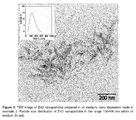
- TEM images of ZnO nanoparticles present in the oil medium are shown in Fig 1 and Fig 2 ;
- the suspension obtained from the example 1 was mixed with 10g of 2-ethyl hexanoic acid (EHA) and mixture was heated at 150°C under vacuum to remove the solvent and decomposing acetates.
- EHA 2-ethyl hexanoic acid
- the final product was clear and stable which could be dispersible in nonpolar medium like mineral oil.
- Span 80 sorbitane mono oleate
- Table 1 Dispersant (Wt%) Metal Concentration (ppm) WSD Zn (ZnO) 0 0 0.65 1.55 0 0.70 1.55 430 (534) 0.35 1.55 465 (578) 0.40 1.55 136$ (169) 0.50 1.55 182* (226) 0.45 1.55 500# (634) 0.35 1.55 250(312) 0.45 $Span-80 and *EHA stabilized samples from example 7; #ZDDP blend.
- the product was resuspended in isopropyl alcohol (100 ml) and slowly (over 20 minutes) mixed at 60°C with 50 g of Gr II base oil containing 100 g PIBSI based dispersant (M.W 1400) in a two neck round bottom flask.
- the reaction mixture were heated to reflux condition and transferred to a rotavapor flask to remove the solvent under vacuum at 90°C.
- the obtained mixture was heated further to 140°C under vacuum for another 45 minutes to give clear product containing Zn metal in the concentration of 1.85 Wt %.
- Comparative data for comparing the stability of ZnO prepared by ex situ preparation method and in situ preparation method according to the present invention and Heat-Cool-Heat cycle test data of ZnO prepared by ex situ preparation method and in situ preparation method according to the present invention Table 3: The storage stability and clarity of ex situ /mixing and in situ ZnO dispersion and accelerated stability between in situ and ex situ prepared ZnO dispersion. Storage stability for a week* Dispersion clarity* Accelerated Stability, Heat-Cool-Heat Cycle* Ex situ/ Mixing In situ Ex situ/Mixing In situ Ex situ In situ 2/1 5 1/1 5 2 5 *Rating given in 5 points scale; 5-excellent, 4- very good, 3- good, 2- fair, 1- below fair.
- the additive concentrate of the present invention is a greener or environmentally benign and would be compatible with depolluting systems or emission treatment system in the engine tail.
- Zn containing concentrate or oil composition would replace partially or completely organo S and P based ZDDP as an antiwear additive and thus it would be mixed with lubricant formulation where low SAPS are desired.
Landscapes
- Chemical & Material Sciences (AREA)
- Oil, Petroleum & Natural Gas (AREA)
- Chemical Kinetics & Catalysis (AREA)
- General Chemical & Material Sciences (AREA)
- Organic Chemistry (AREA)
- Inorganic Chemistry (AREA)
- Lubricants (AREA)
- Engineering & Computer Science (AREA)
Abstract
Description
- The present invention relates to a process for synthesizing dispersion of ZnO nanoparticles in an oil medium. Particularly, the invention relates to a process for in-situ synthesis of ZnO nanoparticles in an oil medium.
- The anti-wear (AW) and extreme pressure (EP) additives are mainly used for reducing friction and wear under boundary lubrication conditions. These additives are vital constituents of most lubricant formulations, under conditions of medium to high or extreme pressure, react with mating metal surfaces forming protective tribo-chemical layers. Thus the equipments are protected from wear and enabled to operate successfully under heavy loads.
- Generally, any chemical constituent, pure or impure, intended or not, that is formed or deposited during lubrication on the metal surface, and able to separate and prevent the opposing surfaces from direct contact could theoretically be construed as AW/EP agent. Therefore, the classic AW/EP additives are oil-soluble chemicals or components which react with the metal surface forming a film that withstands both compression and, to a degree, shear. Since reaction with the metal is of the essence, only elements that can form iron compounds are truly eligible for this task. That makes compounds of sulfur, phosphorus, chlorine (or other halogens) preferential choices.
- Traditionally, wear protection and friction modification by engine oil is provided by zinc dithiophosphate (ZDDP), molybdenum dithiophosphate (MoDDP) or other phosphorus compounds. These additives provide effective wear protection and friction control on engine parts through formation of a glassy polyphosphates anti-wear film. However, these additives may have one or more disadvantages such as;
- 1. copper and/or lead corrosion,
- 2. color darkening of the finished lubricant,
- 3. increased levels of sulfur and phosphorus in the finished lubricant.
- Among these disadvantages the level of phosphorus and sulfur in the engine oil is the most serious concern. This is because the deposition of phosphorus and sulfur species on automotive three way catalytic converters from lubricants has been known for some time to have a detrimental effect on poisoning the catalysts. Future generations of passenger car motor oils and heavy duty diesel engine oils require lower levels of phosphorus and sulfur in the finished oil in order to protect the pollution control devices. Hence the limits of phosphorus and sulfur levels in engine oil are reduced and supplemental forms of AW additives will be required to replace ZDDP. For example, current GF-4 motor oil specifications require a finished oil to contain less than 0.08 and 0.7 wt% phosphorus and sulfur, respectively and PC-10 motor oil specifications, the next generation heavy duty diesel engine oil, requires to contain less than 0.12 and 0.4 wt% phosphorus and sulfur, respectively. Certain molybdenum and organo zinc additives known in the industry contain phosphorus and sulfur at levels which reduce the effectiveness of pollution control devices.
- Much work has gone in to reducing the level of ZDDP in lubricants by increasing the use of known friction modifiers, other phosphorus free components or balancing the properties of many compounds but this is difficult because ZDDP is not a mono-functional additive that provides only AW chemistry but has multifunctional properties providing anti-scuffing and anti-oxidation, all in one additive component.
- In addition, it has complex interactions with other additives. Another approach is to modify the ZDDP molecule to have the same activity at lower concentrations by changing the alkyl group but a stable anti-wear ZDDP film cannot be formed by the modified ZDDP at low concentrations. Nevertheless, the ability to formulate with ashless dispersants would also benefit from the replacement of ZDDP chemistry. Ashless dispersants deteriorate the anti-wear performance of ZDDP because the amount of ZDDP adsorbed onto the metal surfaces is decreased by formation of complexes with ashless dispersants in oil. Therefore, lubricant additives and/or composition that delivers spectacular anti- friction and wear properties and as well as compatible with pollution control devices used for automotive and diesel engines are highly demanded.
- Such lubricant additives and/or compositions compatible with pollution control devices should also not adversely affect oil solubility, corrosion and darkening the color of the finished lubricant. With rapid development of nano-science and technology, nanoparticles have received considerable attention in recent years because of their special physical and chemical properties. Especially in the field of tribology, many kinds of inorganic nanoparticles have been successfully used in lubricating oils and greases to solve wear and friction problems. The dispersion of inorganic nanoparticles in lubricating oil is still a principal problem for application of nanomaterial additives. In order to obtain better dispersion, a surface modification technique is usually adopted to structure an organic layer on the surface of nanoparticles. As compared to the conventional additives either containing heavy metals like Zn, Mo and Pb etc., or too much sulfur and phosphorus, greener nanomaterial additives with environmentally benign characteristics are strongly required.
- Accordingly, the present invention provides a process for preparing a dispersion of ZnO in an oil additive composition, wherein the process comprises the steps of:
- a) dissolving a zinc salt in an alcoholic solvent and heating to 60- 120°C for 6-48h hours to obtain a suspension;
- b) centrifuging the suspension as obtained in step (a) and washing with deionized water to obtain a precipitate of layered base zinc (LBZ);
- c) dispersing the layered base zinc precipitate as obtained step (b) in an alcohol and adding to base oil containing a dispersant;
- d) refluxing the mixture to obtain a colloidal suspension;
- e) evacuating the colloidal suspension at room temperature and heating at 60-90°C, followed by heating to 45 to 120 minutes to obtain a dispersion of ZnO in the oil medium.
- In an embodiment of the present invention, the hydrous or anhydrous form of zinc salt is selected from zinc acetate, zinc nitrate; zinc chloride; zinc sulfate; zinc hydroxide (hydrotalcite); zinc hydroxy carbonate or hydrozincite; zincite and wurtzite.
In another embodiment of the present invention, the alcoholic solvent is selected from C1 to C3 alcohols. - In yet another embodiment of the present invention, the ratio of zinc salt and the alcoholic solvent ranges from 0.05 to 15: 1 to 740.
In still another embodiment of the present invention, heating in step (a) is performed to 90°C in an autoclave or refluxing in a glass reactor.
In further another embodiment of the present invention, the washing in step (b) is performed twice with deionized water.
In another embodiment of the present invention, the alcohol in step (c) is selected from C1-C3 alcohols.
In still another embodiment of the present invention, the amount of the dispersant in the base oil ranges from 40-78%.
In yet another embodiment of the present invention, the layered basic zinc salt is selected from layered basic zinc acetate, layered basic zinc nitrate; layered basic zinc chloride; layered basic zinc sulfate; layered zinc hydroxide (hydrotalcite); zinc hydroxy carbonate or hydrozincite; zincite and wurtzite. - In one another embodiment of the present invention, the dispersant is selected from PIB dispersants, Phosphorodithioic acid; Ethyl hexanoic acid or fatty acids like stearic, oleic acids; sorbitane mono oleate (SPAN 80); sorbitane mono laurate (SPAN 20); sorbitane mono stearate (SPAN 60); Tween 20 (polyoxyethylenesorbitane mono laurate); Tween 60 (polyoxyethylenesorbitane mono stearate); Tween 80 (polyoxyethylenesorbitane mono oleate); diethanolamide fatty acid and fatty acid mono glyceride.
- In still another embodiment of the present invention, the base oil is a mineral oil selected from the group consisting of group I, group II, group III, group IV, group V and synthetic oils.
- In yet another embodiment of the present invention, the composition comprises a base oil, a dispersant and a dispersion of ZnO as obtained by the process as claimed in claim 1.
- In further another embodiment of the present invention, the amount of the base oil in the composition ranges from 20 to 98.5.
- In another embodiment of the present invention, the amount of the dispersant in the composition ranges from 1.55 to 78.
- In one another embodiment of the present invention, the amount of the ZnO ranges from 0.1 to 5.
- In still another embodiment of the present invention, the layered basic zinc salt is selected from layered basic zinc acetate, layered basic zinc nitrate; layered basic zinc chloride; layered basic zinc sulfate; layered zinc hydroxide (hydrotalcite); zinc hydroxy carbonate or hydrozincite; zincite and wurtzite.
- In one another embodiment of the present invention, the dispersant is selected from PIB dispersants, Phosphorodithioic acid; Ethyl hexanoic acid or fatty acids like stearic, oleic acids; sorbitane mono oleate (SPAN 80); sorbitane mono laurate (SPAN 20); sorbitane mono stearate (SPAN 60); Tween 20 (polyoxyethylenesorbitane mono laurate); Tween 60 (polyoxyethylenesorbitane mono stearate); Tween 80 (polyoxyethylenesorbitane mono oleate); diethanolamide fatty acid and fatty acid mono glyceride.
- In another embodiment of the present invention, the base oil is a mineral oil selected from the group consisting of group I, group II, group III, group IV, group V and synthetic oils.
-
-
Fig. 1: Fig. 1 shows particle size distribution of ZnO nanoparticles in the range 100-400 nm. -
Fig. 2: Fig. 2 is high resolution image shows preferentially oriented lattice fringes of ZnO (Zincite phase; d=2.6033 Å; 2θ=34.422) whereas figure inset shows XRD of ZnO nanoparticles obtained by heating LBZA at 150°C for 6h. - The present invention discloses aprocess for in situ synthesis of ZnO nanoparticles in a medium. Particularly, the present invention also discloses a process for in situ process for synthesizing ZnO nanoparticles in base oil.
- It is well known that in the art that the decomposition of layered basic zinc (LBZ) yields flakes of porous nano ZnO. The present invention provides a two-part procedure comprising of steps discussed herein for synthesizing ZnO nanoparticles within oil medium.
- For the first part of the two-part procedure, LBZ was prepared as per existing open literature procedures. In an embodiment of the present invention, LBZ was prepared by dissolving Zinc salt in an alcoholic solvent and heating to 90°C in an autoclave or refluxing in a glass reactor for 24 hours to obtain a white suspension. The product was centrifuged and washed twice with deionized water to precipitate LBZ.
- For the second part, the present invention provides a method of synthesizing ZnO Nanoparticles by decomposing LBZ in an oil medium. LBZ as obtained in the first part was dispersed in a C1-C3 alcohol and added to base oil containing 40-60% of PIB dispersant. The mixture is refluxed to give a colloidal suspension. The suspension was evacuated at room temperature in a rotavapor setup and heated to 90°C to remove the alcohol solvent followed by heating to 140°C for 45 to 90 minutes for LBZ decomposition to give a clear dispersion of ZnO in the oil medium along with residual anions. The evolved during decomposition were removed through vacuum stripping. Acetic acid is obtained as by-product of vacuum stripping.
- In accordance with the present invention, the alcoholic solvent is selected from C1-C3 alcohols. In accordance with the present invention, the dispersant is selected from PIB dispersants, Phosphorodithioic acid; Ethyl hexanoic acid or fatty acids like stearic, oleic acids; sorbitane mono oleate (SPAN 80); sorbitane mono laurate (SPAN 20); sorbitane mono stearate (SPAN 60); Tween 20 (polyoxyethylenesorbitane mono laurate); Tween 60 (polyoxyethylenesorbitane mono stearate); Tween 80 (polyoxyethylenesorbitane mono oleate); diethanolamide fatty acid; fatty acid mono glyceride.
- In accordance with the present invention, layered basic zinc salt is selected from layered basic zinc acetate, layered basic zinc nitrate; layered basic zinc chloride; layered basic zinc sulfate; layered zinc hydroxide (hydrotalcite); zinc hydroxy carbonate or hydrozincite; zincite and wurtzite. In accordance with the present invention base oil is group II base oil.
- Having described the basic aspects of the present invention, the following non-limiting examples illustrate specific embodiment thereof.
- About 100 ml of liquor solution of zinc acetate dihydrate (Zn(CH3COO)2.2H2O) in the concentration 0.15 moles per cubic decimeter was charged in a round bottom flask fitted with a reflux condenser and heated for 24 h to give white precipitate. The precipitate was filtered and washed twice with distilled water to give fine white product layered basic zinc acetate (LBZA) of formula Zn5(OH)8(CH3COO)2.2H2O. The product was re-suspended in isopropyl alcohol (25 ml) for further use.
- To a 500 ml two neck round bottom flask containing 60g PIBSI dispersant and 16g group II base oil added the alcohol suspension prepared from the example 1 and heated to reflux condition. The colloidal product was transferred to rotavapor flask and solvent was stripped under vacuum at 90°C and then heated further to 140°C under vacuum to remove decomposing acetates to give clear stable product containing 1.45Wt% of Zn (metal content). The product could readily be dispersed in any mineral oil of lubricating viscosity.
- TEM images of ZnO nanoparticles present in the oil medium are shown in
Fig 1 andFig 2 ;
The product concentrate is free of any significant acidic components (Total Acid Number (TAN) = 0.657 mgKOH/g) when subjected to TAN determination as per ASTM D664. - To a 750 ml high pressure reactor (Parr Instruments) added 300 ml alcohol solution containing zinc acetate dehydrate (Zn(CH3COO)2.2H2O) in the concentration 0.05 moles per cubic decimeter and heated at 95°C for 24h to give highly viscous colloidal white precipitate. The product was washed thoroughly by centrifuge with distilled water for three times before being mixed with 50 ml isopropyl alcohol to give a colloidal suspension for further use.
- The suspension obtained from the example 1 was mixed with 10g of 2-ethyl hexanoic acid (EHA) and mixture was heated at 150°C under vacuum to remove the solvent and decomposing acetates. The final product was clear and stable which could be dispersible in nonpolar medium like mineral oil. Similarly Span 80 (sorbitane mono oleate) was also used in the place of EHA in another reaction run to give Span based metal dispersion.
- The product as per Example 2 was diluted with Gr II base oil to get ppm (parts per million) level of Zn concentration in final dispersion blends which were evaluated for antiwear performance in four ball tester (Falex wear test machine) at 348K; 15kg weight load (ASTM D4172). The tests were repeated two times (results with best precision were considered) and Wear Scar Diameter (WSD) results are summarized for neat base oil and blends in the below Table. WSD should be less for any good antiwear candidate.
Table 1: Dispersant (Wt%) Metal Concentration (ppm) WSD Zn (ZnO) 0 0 0.65 1.55 0 0.70 1.55 430 (534) 0.35 1.55 465 (578) 0.40 1.55 136$ (169) 0.50 1.55 182* (226) 0.45 1.55 500# (634) 0.35 1.55 250(312) 0.45 $Span-80 and
*EHA stabilized samples from example 7;
#ZDDP blend. - TAN value of above blends was not detectable as per ASTM D664 indicates no significant acid components present in these blends.
- About 500 ml of liquor solution of zinc acetate dihydrate (Zn(CH3COO)2.2H2O) in the concentration 0.15 moles per cubic decimeter was charged in a round bottom flask fitted with a reflux condenser and heated for 24 h to give white precipitate. The precipitate was filtered and washed twice with distilled water to give fine white product layered basic zinc acetate (LBZA) of formula Zn5(OH)8(CH3COO)2.2H2O. The product was resuspended in isopropyl alcohol (100 ml) and slowly (over 20 minutes) mixed at 60°C with 50 g of Gr II base oil containing 100 g PIBSI based dispersant (M.W 1400) in a two neck round bottom flask. The reaction mixture were heated to reflux condition and transferred to a rotavapor flask to remove the solvent under vacuum at 90°C. The obtained mixture was heated further to 140°C under vacuum for another 45 minutes to give clear product containing Zn metal in the concentration of 1.85 Wt %.
- The product was top treated with formulated marine oil to get ppm (parts per million) level of Zn concentration in final dispersion blends which were evaluated for antiwear performance in four ball tester (Falex wear test machine) at 348K; 40 kg load and weld load measurement. The tests were repeated two times (results with best precision were considered) and WSD results are summarized for formulated oil and top treated blends in the below Table.
Table 2: Sample Metal Concentration (ppm) Zn (ZnO) WSD (mm) Weld load (Kg) 1040 0 0.50 180 1040 500 (634) 0.50 180 -
- (a) 12g of Zinc acetate-di-hydrate, was mixed with 300 mL of methanol and the mixture was refluxed for 24h to give white precipitate, which was washed twice with distilled water. The obtained precipitate was dried at 70°C for 6h and then heated to 150°C for 6h. The final half white mass was mixed with requisite amount of PIB dispersant and group II base oil in a ratio 3.3 to 1, dispersant and Zn metal in a ratio 30 to 1 so as to obtain final Zn metal concentration 2.5 Wt% in the total concentrate. This method of making dispersion is Ex situ approach.
- (b) 0.31 g of commercial ZnO was mixed with required amount of PIB based dispersant and group II base oil to give final concentrate that contains 2.5 Wt% Zn. This method of making dispersion is Mixing approach.
-
- The concentrate prepared in the above example 7a was mixed with group II base oil to give final blend containing Zn metal concentration of 500 ppm and the blend was heated to 230°C soaked for 5 min at heating rate of 10-20K/min and cooling down normally to - 20°C then heated again to 230°C. This heat-cool-heat cycle was also performed for ZnO blend made from concentrate prepared via in situ method by example 2.
- Comparative data for comparing the stability of ZnO prepared by ex situ preparation method and in situ preparation method according to the present invention and Heat-Cool-Heat cycle test data of ZnO prepared by ex situ preparation method and in situ preparation method according to the present invention.
Table 3: The storage stability and clarity of ex situ/mixing and in situZnO dispersion and accelerated stability between in situ and ex situ prepared ZnO dispersion. Storage stability for a week* Dispersion clarity* Accelerated Stability, Heat-Cool-Heat Cycle* Ex situ/ Mixing In situ Ex situ/Mixing In situ Ex situ In situ 2/1 5 1/1 5 2 5 *Rating given in 5 points scale; 5-excellent, 4- very good, 3- good, 2- fair, 1- below fair. Table 4: Lattice spacing, d (Å) PXRD HRTEM Standard ZnO LBZ heated at 150°C/6h LBZ heated under vacuum in Oil 2.8143 2.8194 -- 2.6033 2.6069 2.5900 2.4759 2.4798 -- - The additive concentrate of the present invention is a greener or environmentally benign and would be compatible with depolluting systems or emission treatment system in the engine tail.
- Zn containing concentrate or oil composition would replace partially or completely organo S and P based ZDDP as an antiwear additive and thus it would be mixed with lubricant formulation where low SAPS are desired.
Claims (18)
- A process for in situ synthesis of dispersion of Zno nanoparticles in an oil additive composition, wherein the process comprises the steps of dissolving a zinc salt in an alcoholic solvent and heating to 60- 120°C for 6-48h hours to obtain a suspension;a) centrifuging the suspension as obtained in step (a) and washing with deionized water to obtain a precipitate of layered base zinc (LBZ);b) dispersing the layered base zinc precipitate as obtained step (b) in an alcohol and adding to base oil containing a dispersant;c) refluxing the mixture to obtain a colloidal suspension;evacuating the colloidal suspension at room temperature and heating at 60-90°C, followed by heating to 90-140°C for 45 to 120 minutes to obtain a dispersion of ZnO in the oil medium.
- The process as claimed in claim 1, wherein the zinc salt is selected from hydrous or anhydrous form of zinc salt, selected from zinc acetate, zinc nitrate, zinc chloride, zinc sulfate, zinc hydroxide (hydrotalcite), zinc hydroxy carbonate or hydrozincite,zincite and wurtzite.
- The process as claimed in claim 1, wherein the alcoholic solvent is selected from C1 to C3 alcohols.
- The process as claimed in claim 1, wherein the ratio of zinc salt and the alcoholic solvent ranges from 0.05 to 15 : 1 to 740.
- The process as claimed in claim 1, wherein heating in step (a) is performed to 90°C in an autoclave or refluxing in a glass reactor.
- The process as claimed in claim 1, wherein washing in step (b) is performed twice with deionized water.
- The process as claimed in claim 1, wherein the alcohol in step (c) is selected from C1-C3 alcohols.
- The process as claimed in claim 1, wherein the amount of the dispersant in the base oil ranges from 40-78%.
- The process as claimed in claim 1, wherein the layered basic zinc salt is selected from layered basic zinc acetate, layered basic zinc nitrate, layered basic zinc chloride, layered basic zinc sulfate, layered zinc hydroxide (hydrotalcite), zinc hydroxy carbonate or hydrozincite,zincite and wurtzite.
- The process as claimed in claim 1, wherein the dispersant is selected from PIB dispersants, Phosphorodithioic acid; Ethyl hexanoic acid or fatty acids like stearic, oleic acids,sorbitane mono oleate (SPAN 80),sorbitane mono laurate (SPAN 20),sorbitane mono stearate (SPAN 60), Tween 20 (polyoxyethylenesorbitane mono laurate), Tween 60 (polyoxyethylenesorbitane mono stearate), Tween 80 (polyoxyethylenesorbitane mono oleate),diethanolamide fatty acid and fatty acid mono glyceride.
- The process as claimed in claim 1, wherein the base oil is a mineral oil selected from the group consisting of group I, group II, group III, group IV, group V and synthetic oils.
- A lubricant oil composition, wherein the composition comprises a base oil, a dispersant and a dispersion of ZnO as obtained by the process as claimed in claim 1.
- The lubricant oil composition as claimed in claim 12, wherein the amount of the base oil in the composition ranges from 20 to 98.5.
- The lubricant oil composition as claimed in claim 12, wherein the amount of the dispersant in the composition ranges from 1.55 to 78.
- The lubricant oil composition as claimed in claim 12, wherein the amount of the ZnO ranges from 0.1 to 5.
- The lubricant oil composition as claimed in claim 12, wherein the layered basic zinc salt is selected from layered basic zinc acetate, layered basic zinc nitrate, layered basic zinc chloride, layered basic zinc sulfate, layered zinc hydroxide (hydrotalcite), zinc hydroxy carbonate or hydrozincite,zincite and wurtzite.
- The lubricant oil composition as claimed in claim 12, wherein the dispersant is selected from PIB dispersants, Phosphorodithioic acid, Ethyl hexanoic acid or fatty acids like stearic, oleic acids,sorbitane mono oleate (SPAN 80),sorbitane mono laurate (SPAN 20),sorbitane mono stearate (SPAN 60), Tween 20 (polyoxyethylenesorbitane mono laurate), Tween 60 (polyoxyethylenesorbitane mono stearate), Tween 80 (polyoxyethylenesorbitane mono oleate),diethanolamide fatty acid and fatty acid mono glyceride.
- The lubricant oil composition as claimed in claim 12, wherein the base oil is a mineral oil selected from the group consisting of group I, group II, group III, group IV, group V and synthetic oils.
Applications Claiming Priority (1)
| Application Number | Priority Date | Filing Date | Title |
|---|---|---|---|
| IN481MU2015 | 2015-02-14 |
Publications (2)
| Publication Number | Publication Date |
|---|---|
| EP3088499A1 true EP3088499A1 (en) | 2016-11-02 |
| EP3088499B1 EP3088499B1 (en) | 2023-05-31 |
Family
ID=56622054
Family Applications (1)
| Application Number | Title | Priority Date | Filing Date |
|---|---|---|---|
| EP16150405.5A Active EP3088499B1 (en) | 2015-02-14 | 2016-01-07 | Process for in situ synthesis dispersion of zno nanoparticles in oil |
Country Status (2)
| Country | Link |
|---|---|
| US (1) | US10059902B2 (en) |
| EP (1) | EP3088499B1 (en) |
Families Citing this family (4)
| Publication number | Priority date | Publication date | Assignee | Title |
|---|---|---|---|---|
| US10633609B2 (en) | 2017-05-16 | 2020-04-28 | Indian Oil Corporation Limited | Process for in-situ synthesis of dispersion ZnO—TiO2 nanoparticles in oil |
| CN111032836A (en) | 2017-07-14 | 2020-04-17 | 雪佛龙奥伦耐有限责任公司 | Lubricating oil composition containing sulfur-phosphorus-free zinc compound and method for preventing or reducing low speed pre-ignition in direct injection spark ignition engines |
| CN111607124B (en) * | 2020-05-21 | 2022-05-27 | 科迈特新材料有限公司 | Calcium-doped zinc-aluminum hydrotalcite-nano zinc oxide composite material and preparation method thereof |
| CN112175260B (en) * | 2020-10-16 | 2023-02-28 | 南京福斯特科技有限公司 | Zinc oxide master colloidal particle for rubber product and preparation method thereof |
Citations (3)
| Publication number | Priority date | Publication date | Assignee | Title |
|---|---|---|---|---|
| US20090042751A1 (en) * | 2007-08-11 | 2009-02-12 | Jagdish Narayan | Lubricant having nanoparticles and microparticles to enhance fuel efficiency, and a laser synthesis method to create dispersed nanoparticles |
| US20110130273A1 (en) * | 2008-07-18 | 2011-06-02 | Basf Se | Modified zinc oxide particles |
| WO2015008063A1 (en) * | 2013-07-16 | 2015-01-22 | Haydale Graphene Industries Plc | Preparation and use of zinc compounds |
Family Cites Families (19)
| Publication number | Priority date | Publication date | Assignee | Title |
|---|---|---|---|---|
| JPH0676588B2 (en) | 1988-07-20 | 1994-09-28 | 株式会社ヴァイオレット | Lubricating oil additive |
| CA2232312A1 (en) | 1998-03-13 | 1999-09-13 | Kanta Prasad Naithani | Titanium complex grease compositions having performance additivies and to a process and compositions thereof |
| DE19907704A1 (en) | 1999-02-23 | 2000-08-24 | Bayer Ag | Nano-scale precipitating zinc oxide used e.g. for protecting UV-sensitive organic polymers consists of particles having an average specified primary particle diameter |
| US20050124504A1 (en) * | 2002-07-26 | 2005-06-09 | Ashland Inc. | Lubricant and additive formulation |
| US7879774B2 (en) | 2004-07-19 | 2011-02-01 | Afton Chemical Corporation | Titanium-containing lubricating oil composition |
| TWI263675B (en) * | 2004-12-15 | 2006-10-11 | Ind Tech Res Inst | Process for preparing nanofluids with rotation packed bed reactor |
| WO2006105022A1 (en) | 2005-03-28 | 2006-10-05 | The Lubrizol Corporation | Titanium compounds and complexes as additives in lubricants |
| US7709423B2 (en) | 2005-11-16 | 2010-05-04 | Afton Chemical Corporation | Additives and lubricant formulations for providing friction modification |
| US7772167B2 (en) | 2006-12-06 | 2010-08-10 | Afton Chemical Corporation | Titanium-containing lubricating oil composition |
| US7776800B2 (en) | 2005-12-09 | 2010-08-17 | Afton Chemical Corporation | Titanium-containing lubricating oil composition |
| US7767632B2 (en) | 2005-12-22 | 2010-08-03 | Afton Chemical Corporation | Additives and lubricant formulations having improved antiwear properties |
| US20080236538A1 (en) | 2007-03-26 | 2008-10-02 | Lam William Y | Lubricating oil composition for improved oxidation, viscosity increase, oil consumption, and piston deposit control |
| US8048834B2 (en) | 2007-05-08 | 2011-11-01 | Afton Chemical Corporation | Additives and lubricant formulations for improved catalyst performance |
| US8278254B2 (en) | 2007-09-10 | 2012-10-02 | Afton Chemical Corporation | Additives and lubricant formulations having improved antiwear properties |
| JP5380453B2 (en) | 2007-09-26 | 2014-01-08 | ザ ルブリゾル コーポレイション | Titanium compounds and titanium complexes as additives in lubricants |
| US8791055B2 (en) | 2007-09-26 | 2014-07-29 | The Lubrizol Corporation | Titanium compounds and complexes as additives in lubricants |
| US8008237B2 (en) | 2008-06-18 | 2011-08-30 | Afton Chemical Corporation | Method for making a titanium-containing lubricant additive |
| CN102197119B (en) | 2008-10-23 | 2015-08-12 | 路博润公司 | Lubricating compositions containing metal carboxylates |
| US20110143980A1 (en) | 2009-12-15 | 2011-06-16 | Chevron Oronite Company Llc | Lubricating oil compositions containing titanium complexes |
-
2016
- 2016-01-07 EP EP16150405.5A patent/EP3088499B1/en active Active
- 2016-02-05 US US15/017,554 patent/US10059902B2/en active Active
Patent Citations (3)
| Publication number | Priority date | Publication date | Assignee | Title |
|---|---|---|---|---|
| US20090042751A1 (en) * | 2007-08-11 | 2009-02-12 | Jagdish Narayan | Lubricant having nanoparticles and microparticles to enhance fuel efficiency, and a laser synthesis method to create dispersed nanoparticles |
| US20110130273A1 (en) * | 2008-07-18 | 2011-06-02 | Basf Se | Modified zinc oxide particles |
| WO2015008063A1 (en) * | 2013-07-16 | 2015-01-22 | Haydale Graphene Industries Plc | Preparation and use of zinc compounds |
Non-Patent Citations (1)
| Title |
|---|
| SHAHNAZAR SHEIDA ET AL: "Enhancing lubricant properties by nanoparticle additives", INTERNATIONAL JOURNAL OF HYDROGEN ENERGY, ELSEVIER SCIENCE PUBLISHERS B.V., BARKING, GB, vol. 41, no. 4, 6 January 2016 (2016-01-06), pages 3153 - 3170, XP029396653, ISSN: 0360-3199, DOI: 10.1016/J.IJHYDENE.2015.12.040 * |
Also Published As
| Publication number | Publication date |
|---|---|
| US20160237373A1 (en) | 2016-08-18 |
| EP3088499B1 (en) | 2023-05-31 |
| US10059902B2 (en) | 2018-08-28 |
Similar Documents
| Publication | Publication Date | Title |
|---|---|---|
| EP3088499B1 (en) | Process for in situ synthesis dispersion of zno nanoparticles in oil | |
| Song et al. | Synthesis of monodispersed ZnAl2O4 nanoparticles and their tribology properties as lubricant additives | |
| EP3931289B1 (en) | Lithium-based grease and preparation method thereof | |
| KR102652365B1 (en) | Organometallic salt composition, method for producing same and lubricant addition composition | |
| JP2003528881A (en) | Fluorinated additives for lubricants | |
| Chen | Tribological properties of polytetrafluoroethylene, nano-titanium dioxide, and nano-silicon dioxide as additives in mixed oil-based titanium complex grease | |
| EP3702434A1 (en) | Lubricant composition and method for producing same | |
| JP2025166075A (en) | Friction and Wear Reducing Additives | |
| Oganesova et al. | Nanosized additives to lubricating materials | |
| EP3404085B1 (en) | Process for in-situ synthesis of dispersion zno-tio2 nanoparticles in oil | |
| Sato et al. | Synergistic enhancement of the lubrication performance of zinc dialkyldithiophosphate by coexistence with ionic liquid | |
| Ramakrishnan et al. | Investigation on tribological performance of NanoZnO and mixed oxide of Cu-Zn as additives in engine oil | |
| US20220259516A1 (en) | Polyphenol shelled nanoparticles lubricating composition and method | |
| CN115537247B (en) | Wear-resistant additive, wear-resistant lubricating oil and preparation method | |
| Malviya et al. | Task-specific boronium ionic liquids as ashless lubricant additives | |
| CN107446673B (en) | Special protective agent for automatic start-stop and preparation method thereof | |
| WO2024105947A1 (en) | Method for producing recovered oil composition and method for producing recovered industrial oil composition | |
| DE102021133469B3 (en) | Process for preparing lithium complex soap and lithium calcium complex soap greases | |
| Singh et al. | Brucea Javanica: A novel nonedible feedstock for bio‐based lubricant application with the effect of ZrO2 nanoparticles | |
| CN111234900B (en) | An oil-soluble copper-molybdenum-sulfur nanocluster and its preparation method and application | |
| Wang et al. | Controlled Synthesis of Mg Al-Layered Double Hydroxide as a High-Performance Additive of Bentonite Grease | |
| Hao et al. | Preparation, characterization, and tribological evaluation of triethanolamine monooleate-modified lanthanum borate nanoparticles | |
| Sun et al. | Sulfur-phosphorus-free organomolybdate and zinc dialkyl dithiophosphate as lubricant additives enhancing tribological performance and oxidation resistance | |
| KR101162700B1 (en) | Method of preparing copper-zinc colloidal particle in the base oils | |
| CN106699806A (en) | Low-impurity content zinc dialkyl dithiophosphate and preparation method and application thereof |
Legal Events
| Date | Code | Title | Description |
|---|---|---|---|
| PUAI | Public reference made under article 153(3) epc to a published international application that has entered the european phase |
Free format text: ORIGINAL CODE: 0009012 |
|
| 17P | Request for examination filed |
Effective date: 20160107 |
|
| AK | Designated contracting states |
Kind code of ref document: A1 Designated state(s): AL AT BE BG CH CY CZ DE DK EE ES FI FR GB GR HR HU IE IS IT LI LT LU LV MC MK MT NL NO PL PT RO RS SE SI SK SM TR |
|
| AX | Request for extension of the european patent |
Extension state: BA ME |
|
| STAA | Information on the status of an ep patent application or granted ep patent |
Free format text: STATUS: EXAMINATION IS IN PROGRESS |
|
| 17Q | First examination report despatched |
Effective date: 20190325 |
|
| GRAP | Despatch of communication of intention to grant a patent |
Free format text: ORIGINAL CODE: EPIDOSNIGR1 |
|
| STAA | Information on the status of an ep patent application or granted ep patent |
Free format text: STATUS: GRANT OF PATENT IS INTENDED |
|
| INTG | Intention to grant announced |
Effective date: 20230303 |
|
| GRAS | Grant fee paid |
Free format text: ORIGINAL CODE: EPIDOSNIGR3 |
|
| GRAA | (expected) grant |
Free format text: ORIGINAL CODE: 0009210 |
|
| STAA | Information on the status of an ep patent application or granted ep patent |
Free format text: STATUS: THE PATENT HAS BEEN GRANTED |
|
| AK | Designated contracting states |
Kind code of ref document: B1 Designated state(s): AL AT BE BG CH CY CZ DE DK EE ES FI FR GB GR HR HU IE IS IT LI LT LU LV MC MK MT NL NO PL PT RO RS SE SI SK SM TR |
|
| REG | Reference to a national code |
Ref country code: GB Ref legal event code: FG4D Ref country code: CH Ref legal event code: EP |
|
| REG | Reference to a national code |
Ref country code: AT Ref legal event code: REF Ref document number: 1570936 Country of ref document: AT Kind code of ref document: T Effective date: 20230615 Ref country code: DE Ref legal event code: R096 Ref document number: 602016079675 Country of ref document: DE |
|
| REG | Reference to a national code |
Ref country code: IE Ref legal event code: FG4D |
|
| P01 | Opt-out of the competence of the unified patent court (upc) registered |
Effective date: 20230706 |
|
| REG | Reference to a national code |
Ref country code: LT Ref legal event code: MG9D |
|
| REG | Reference to a national code |
Ref country code: NL Ref legal event code: MP Effective date: 20230531 |
|
| REG | Reference to a national code |
Ref country code: AT Ref legal event code: MK05 Ref document number: 1570936 Country of ref document: AT Kind code of ref document: T Effective date: 20230531 |
|
| PG25 | Lapsed in a contracting state [announced via postgrant information from national office to epo] |
Ref country code: SE Free format text: LAPSE BECAUSE OF FAILURE TO SUBMIT A TRANSLATION OF THE DESCRIPTION OR TO PAY THE FEE WITHIN THE PRESCRIBED TIME-LIMIT Effective date: 20230531 Ref country code: NO Free format text: LAPSE BECAUSE OF FAILURE TO SUBMIT A TRANSLATION OF THE DESCRIPTION OR TO PAY THE FEE WITHIN THE PRESCRIBED TIME-LIMIT Effective date: 20230831 Ref country code: ES Free format text: LAPSE BECAUSE OF FAILURE TO SUBMIT A TRANSLATION OF THE DESCRIPTION OR TO PAY THE FEE WITHIN THE PRESCRIBED TIME-LIMIT Effective date: 20230531 Ref country code: AT Free format text: LAPSE BECAUSE OF FAILURE TO SUBMIT A TRANSLATION OF THE DESCRIPTION OR TO PAY THE FEE WITHIN THE PRESCRIBED TIME-LIMIT Effective date: 20230531 |
|
| PG25 | Lapsed in a contracting state [announced via postgrant information from national office to epo] |
Ref country code: RS Free format text: LAPSE BECAUSE OF FAILURE TO SUBMIT A TRANSLATION OF THE DESCRIPTION OR TO PAY THE FEE WITHIN THE PRESCRIBED TIME-LIMIT Effective date: 20230531 Ref country code: PL Free format text: LAPSE BECAUSE OF FAILURE TO SUBMIT A TRANSLATION OF THE DESCRIPTION OR TO PAY THE FEE WITHIN THE PRESCRIBED TIME-LIMIT Effective date: 20230531 Ref country code: NL Free format text: LAPSE BECAUSE OF FAILURE TO SUBMIT A TRANSLATION OF THE DESCRIPTION OR TO PAY THE FEE WITHIN THE PRESCRIBED TIME-LIMIT Effective date: 20230531 Ref country code: LV Free format text: LAPSE BECAUSE OF FAILURE TO SUBMIT A TRANSLATION OF THE DESCRIPTION OR TO PAY THE FEE WITHIN THE PRESCRIBED TIME-LIMIT Effective date: 20230531 Ref country code: LT Free format text: LAPSE BECAUSE OF FAILURE TO SUBMIT A TRANSLATION OF THE DESCRIPTION OR TO PAY THE FEE WITHIN THE PRESCRIBED TIME-LIMIT Effective date: 20230531 Ref country code: IS Free format text: LAPSE BECAUSE OF FAILURE TO SUBMIT A TRANSLATION OF THE DESCRIPTION OR TO PAY THE FEE WITHIN THE PRESCRIBED TIME-LIMIT Effective date: 20230930 Ref country code: HR Free format text: LAPSE BECAUSE OF FAILURE TO SUBMIT A TRANSLATION OF THE DESCRIPTION OR TO PAY THE FEE WITHIN THE PRESCRIBED TIME-LIMIT Effective date: 20230531 Ref country code: GR Free format text: LAPSE BECAUSE OF FAILURE TO SUBMIT A TRANSLATION OF THE DESCRIPTION OR TO PAY THE FEE WITHIN THE PRESCRIBED TIME-LIMIT Effective date: 20230901 |
|
| PG25 | Lapsed in a contracting state [announced via postgrant information from national office to epo] |
Ref country code: FI Free format text: LAPSE BECAUSE OF FAILURE TO SUBMIT A TRANSLATION OF THE DESCRIPTION OR TO PAY THE FEE WITHIN THE PRESCRIBED TIME-LIMIT Effective date: 20230531 |
|
| PG25 | Lapsed in a contracting state [announced via postgrant information from national office to epo] |
Ref country code: SK Free format text: LAPSE BECAUSE OF FAILURE TO SUBMIT A TRANSLATION OF THE DESCRIPTION OR TO PAY THE FEE WITHIN THE PRESCRIBED TIME-LIMIT Effective date: 20230531 |
|
| PG25 | Lapsed in a contracting state [announced via postgrant information from national office to epo] |
Ref country code: SM Free format text: LAPSE BECAUSE OF FAILURE TO SUBMIT A TRANSLATION OF THE DESCRIPTION OR TO PAY THE FEE WITHIN THE PRESCRIBED TIME-LIMIT Effective date: 20230531 Ref country code: SK Free format text: LAPSE BECAUSE OF FAILURE TO SUBMIT A TRANSLATION OF THE DESCRIPTION OR TO PAY THE FEE WITHIN THE PRESCRIBED TIME-LIMIT Effective date: 20230531 Ref country code: RO Free format text: LAPSE BECAUSE OF FAILURE TO SUBMIT A TRANSLATION OF THE DESCRIPTION OR TO PAY THE FEE WITHIN THE PRESCRIBED TIME-LIMIT Effective date: 20230531 Ref country code: PT Free format text: LAPSE BECAUSE OF FAILURE TO SUBMIT A TRANSLATION OF THE DESCRIPTION OR TO PAY THE FEE WITHIN THE PRESCRIBED TIME-LIMIT Effective date: 20231002 Ref country code: EE Free format text: LAPSE BECAUSE OF FAILURE TO SUBMIT A TRANSLATION OF THE DESCRIPTION OR TO PAY THE FEE WITHIN THE PRESCRIBED TIME-LIMIT Effective date: 20230531 Ref country code: DK Free format text: LAPSE BECAUSE OF FAILURE TO SUBMIT A TRANSLATION OF THE DESCRIPTION OR TO PAY THE FEE WITHIN THE PRESCRIBED TIME-LIMIT Effective date: 20230531 Ref country code: CZ Free format text: LAPSE BECAUSE OF FAILURE TO SUBMIT A TRANSLATION OF THE DESCRIPTION OR TO PAY THE FEE WITHIN THE PRESCRIBED TIME-LIMIT Effective date: 20230531 |
|
| REG | Reference to a national code |
Ref country code: DE Ref legal event code: R097 Ref document number: 602016079675 Country of ref document: DE |
|
| PLBE | No opposition filed within time limit |
Free format text: ORIGINAL CODE: 0009261 |
|
| STAA | Information on the status of an ep patent application or granted ep patent |
Free format text: STATUS: NO OPPOSITION FILED WITHIN TIME LIMIT |
|
| PGFP | Annual fee paid to national office [announced via postgrant information from national office to epo] |
Ref country code: DE Payment date: 20240122 Year of fee payment: 9 Ref country code: GB Payment date: 20240119 Year of fee payment: 9 |
|
| PG25 | Lapsed in a contracting state [announced via postgrant information from national office to epo] |
Ref country code: SI Free format text: LAPSE BECAUSE OF FAILURE TO SUBMIT A TRANSLATION OF THE DESCRIPTION OR TO PAY THE FEE WITHIN THE PRESCRIBED TIME-LIMIT Effective date: 20230531 |
|
| 26N | No opposition filed |
Effective date: 20240301 |
|
| PG25 | Lapsed in a contracting state [announced via postgrant information from national office to epo] |
Ref country code: SI Free format text: LAPSE BECAUSE OF FAILURE TO SUBMIT A TRANSLATION OF THE DESCRIPTION OR TO PAY THE FEE WITHIN THE PRESCRIBED TIME-LIMIT Effective date: 20230531 Ref country code: IT Free format text: LAPSE BECAUSE OF FAILURE TO SUBMIT A TRANSLATION OF THE DESCRIPTION OR TO PAY THE FEE WITHIN THE PRESCRIBED TIME-LIMIT Effective date: 20230531 |
|
| PG25 | Lapsed in a contracting state [announced via postgrant information from national office to epo] |
Ref country code: MC Free format text: LAPSE BECAUSE OF FAILURE TO SUBMIT A TRANSLATION OF THE DESCRIPTION OR TO PAY THE FEE WITHIN THE PRESCRIBED TIME-LIMIT Effective date: 20230531 |
|
| PG25 | Lapsed in a contracting state [announced via postgrant information from national office to epo] |
Ref country code: MC Free format text: LAPSE BECAUSE OF FAILURE TO SUBMIT A TRANSLATION OF THE DESCRIPTION OR TO PAY THE FEE WITHIN THE PRESCRIBED TIME-LIMIT Effective date: 20230531 |
|
| REG | Reference to a national code |
Ref country code: CH Ref legal event code: PL |
|
| PG25 | Lapsed in a contracting state [announced via postgrant information from national office to epo] |
Ref country code: LU Free format text: LAPSE BECAUSE OF NON-PAYMENT OF DUE FEES Effective date: 20240107 |
|
| PG25 | Lapsed in a contracting state [announced via postgrant information from national office to epo] |
Ref country code: LU Free format text: LAPSE BECAUSE OF NON-PAYMENT OF DUE FEES Effective date: 20240107 |
|
| PG25 | Lapsed in a contracting state [announced via postgrant information from national office to epo] |
Ref country code: BE Free format text: LAPSE BECAUSE OF NON-PAYMENT OF DUE FEES Effective date: 20240131 |
|
| PG25 | Lapsed in a contracting state [announced via postgrant information from national office to epo] |
Ref country code: FR Free format text: LAPSE BECAUSE OF NON-PAYMENT OF DUE FEES Effective date: 20240131 |
|
| PG25 | Lapsed in a contracting state [announced via postgrant information from national office to epo] |
Ref country code: CH Free format text: LAPSE BECAUSE OF NON-PAYMENT OF DUE FEES Effective date: 20240131 |
|
| PG25 | Lapsed in a contracting state [announced via postgrant information from national office to epo] |
Ref country code: FR Free format text: LAPSE BECAUSE OF NON-PAYMENT OF DUE FEES Effective date: 20240131 Ref country code: CH Free format text: LAPSE BECAUSE OF NON-PAYMENT OF DUE FEES Effective date: 20240131 Ref country code: BE Free format text: LAPSE BECAUSE OF NON-PAYMENT OF DUE FEES Effective date: 20240131 |
|
| REG | Reference to a national code |
Ref country code: BE Ref legal event code: MM Effective date: 20240131 |
|
| PG25 | Lapsed in a contracting state [announced via postgrant information from national office to epo] |
Ref country code: BG Free format text: LAPSE BECAUSE OF FAILURE TO SUBMIT A TRANSLATION OF THE DESCRIPTION OR TO PAY THE FEE WITHIN THE PRESCRIBED TIME-LIMIT Effective date: 20230531 |
|
| PG25 | Lapsed in a contracting state [announced via postgrant information from national office to epo] |
Ref country code: BG Free format text: LAPSE BECAUSE OF FAILURE TO SUBMIT A TRANSLATION OF THE DESCRIPTION OR TO PAY THE FEE WITHIN THE PRESCRIBED TIME-LIMIT Effective date: 20230531 |
|
| PG25 | Lapsed in a contracting state [announced via postgrant information from national office to epo] |
Ref country code: IE Free format text: LAPSE BECAUSE OF NON-PAYMENT OF DUE FEES Effective date: 20240107 |
|
| PG25 | Lapsed in a contracting state [announced via postgrant information from national office to epo] |
Ref country code: IE Free format text: LAPSE BECAUSE OF NON-PAYMENT OF DUE FEES Effective date: 20240107 |
|
| REG | Reference to a national code |
Ref country code: DE Ref legal event code: R119 Ref document number: 602016079675 Country of ref document: DE |
|
| PG25 | Lapsed in a contracting state [announced via postgrant information from national office to epo] |
Ref country code: CY Free format text: LAPSE BECAUSE OF FAILURE TO SUBMIT A TRANSLATION OF THE DESCRIPTION OR TO PAY THE FEE WITHIN THE PRESCRIBED TIME-LIMIT; INVALID AB INITIO Effective date: 20160107 |
|
| PG25 | Lapsed in a contracting state [announced via postgrant information from national office to epo] |
Ref country code: HU Free format text: LAPSE BECAUSE OF FAILURE TO SUBMIT A TRANSLATION OF THE DESCRIPTION OR TO PAY THE FEE WITHIN THE PRESCRIBED TIME-LIMIT; INVALID AB INITIO Effective date: 20160107 |
|
| GBPC | Gb: european patent ceased through non-payment of renewal fee |
Effective date: 20250107 |
|
| PG25 | Lapsed in a contracting state [announced via postgrant information from national office to epo] |
Ref country code: DE Free format text: LAPSE BECAUSE OF NON-PAYMENT OF DUE FEES Effective date: 20250801 |
|
| PG25 | Lapsed in a contracting state [announced via postgrant information from national office to epo] |
Ref country code: GB Free format text: LAPSE BECAUSE OF NON-PAYMENT OF DUE FEES Effective date: 20250107 |
|
| PG25 | Lapsed in a contracting state [announced via postgrant information from national office to epo] |
Ref country code: TR Free format text: LAPSE BECAUSE OF FAILURE TO SUBMIT A TRANSLATION OF THE DESCRIPTION OR TO PAY THE FEE WITHIN THE PRESCRIBED TIME-LIMIT Effective date: 20230531 |