EP3088459A1 - Polypropylene composite - Google Patents
Polypropylene composite Download PDFInfo
- Publication number
- EP3088459A1 EP3088459A1 EP15165182.5A EP15165182A EP3088459A1 EP 3088459 A1 EP3088459 A1 EP 3088459A1 EP 15165182 A EP15165182 A EP 15165182A EP 3088459 A1 EP3088459 A1 EP 3088459A1
- Authority
- EP
- European Patent Office
- Prior art keywords
- polypropylene
- fiber reinforced
- iso
- heco
- composition according
- Prior art date
- Legal status (The legal status is an assumption and is not a legal conclusion. Google has not performed a legal analysis and makes no representation as to the accuracy of the status listed.)
- Granted
Links
Images


Classifications
-
- C—CHEMISTRY; METALLURGY
- C08—ORGANIC MACROMOLECULAR COMPOUNDS; THEIR PREPARATION OR CHEMICAL WORKING-UP; COMPOSITIONS BASED THEREON
- C08L—COMPOSITIONS OF MACROMOLECULAR COMPOUNDS
- C08L23/00—Compositions of homopolymers or copolymers of unsaturated aliphatic hydrocarbons having only one carbon-to-carbon double bond; Compositions of derivatives of such polymers
- C08L23/02—Compositions of homopolymers or copolymers of unsaturated aliphatic hydrocarbons having only one carbon-to-carbon double bond; Compositions of derivatives of such polymers not modified by chemical after-treatment
- C08L23/10—Homopolymers or copolymers of propene
- C08L23/12—Polypropene
-
- C—CHEMISTRY; METALLURGY
- C08—ORGANIC MACROMOLECULAR COMPOUNDS; THEIR PREPARATION OR CHEMICAL WORKING-UP; COMPOSITIONS BASED THEREON
- C08F—MACROMOLECULAR COMPOUNDS OBTAINED BY REACTIONS ONLY INVOLVING CARBON-TO-CARBON UNSATURATED BONDS
- C08F10/00—Homopolymers and copolymers of unsaturated aliphatic hydrocarbons having only one carbon-to-carbon double bond
- C08F10/04—Monomers containing three or four carbon atoms
- C08F10/06—Propene
-
- C—CHEMISTRY; METALLURGY
- C08—ORGANIC MACROMOLECULAR COMPOUNDS; THEIR PREPARATION OR CHEMICAL WORKING-UP; COMPOSITIONS BASED THEREON
- C08J—WORKING-UP; GENERAL PROCESSES OF COMPOUNDING; AFTER-TREATMENT NOT COVERED BY SUBCLASSES C08B, C08C, C08F, C08G or C08H
- C08J5/00—Manufacture of articles or shaped materials containing macromolecular substances
- C08J5/04—Reinforcing macromolecular compounds with loose or coherent fibrous material
- C08J5/046—Reinforcing macromolecular compounds with loose or coherent fibrous material with synthetic macromolecular fibrous material
-
- C—CHEMISTRY; METALLURGY
- C08—ORGANIC MACROMOLECULAR COMPOUNDS; THEIR PREPARATION OR CHEMICAL WORKING-UP; COMPOSITIONS BASED THEREON
- C08K—Use of inorganic or non-macromolecular organic substances as compounding ingredients
- C08K7/00—Use of ingredients characterised by shape
- C08K7/02—Fibres or whiskers
-
- C—CHEMISTRY; METALLURGY
- C08—ORGANIC MACROMOLECULAR COMPOUNDS; THEIR PREPARATION OR CHEMICAL WORKING-UP; COMPOSITIONS BASED THEREON
- C08L—COMPOSITIONS OF MACROMOLECULAR COMPOUNDS
- C08L23/00—Compositions of homopolymers or copolymers of unsaturated aliphatic hydrocarbons having only one carbon-to-carbon double bond; Compositions of derivatives of such polymers
- C08L23/02—Compositions of homopolymers or copolymers of unsaturated aliphatic hydrocarbons having only one carbon-to-carbon double bond; Compositions of derivatives of such polymers not modified by chemical after-treatment
- C08L23/10—Homopolymers or copolymers of propene
- C08L23/14—Copolymers of propene
- C08L23/142—Copolymers of propene at least partially crystalline copolymers of propene with other olefins
-
- C—CHEMISTRY; METALLURGY
- C08—ORGANIC MACROMOLECULAR COMPOUNDS; THEIR PREPARATION OR CHEMICAL WORKING-UP; COMPOSITIONS BASED THEREON
- C08L—COMPOSITIONS OF MACROMOLECULAR COMPOUNDS
- C08L23/00—Compositions of homopolymers or copolymers of unsaturated aliphatic hydrocarbons having only one carbon-to-carbon double bond; Compositions of derivatives of such polymers
- C08L23/02—Compositions of homopolymers or copolymers of unsaturated aliphatic hydrocarbons having only one carbon-to-carbon double bond; Compositions of derivatives of such polymers not modified by chemical after-treatment
- C08L23/16—Ethylene-propylene or ethylene-propylene-diene copolymers
-
- C—CHEMISTRY; METALLURGY
- C08—ORGANIC MACROMOLECULAR COMPOUNDS; THEIR PREPARATION OR CHEMICAL WORKING-UP; COMPOSITIONS BASED THEREON
- C08L—COMPOSITIONS OF MACROMOLECULAR COMPOUNDS
- C08L29/00—Compositions of homopolymers or copolymers of compounds having one or more unsaturated aliphatic radicals, each having only one carbon-to-carbon double bond, and at least one being terminated by an alcohol, ether, aldehydo, ketonic, acetal or ketal radical; Compositions of hydrolysed polymers of esters of unsaturated alcohols with saturated carboxylic acids; Compositions of derivatives of such polymers
- C08L29/02—Homopolymers or copolymers of unsaturated alcohols
- C08L29/04—Polyvinyl alcohol; Partially hydrolysed homopolymers or copolymers of esters of unsaturated alcohols with saturated carboxylic acids
-
- C—CHEMISTRY; METALLURGY
- C08—ORGANIC MACROMOLECULAR COMPOUNDS; THEIR PREPARATION OR CHEMICAL WORKING-UP; COMPOSITIONS BASED THEREON
- C08F—MACROMOLECULAR COMPOUNDS OBTAINED BY REACTIONS ONLY INVOLVING CARBON-TO-CARBON UNSATURATED BONDS
- C08F2500/00—Characteristics or properties of obtained polyolefins; Use thereof
- C08F2500/12—Melt flow index or melt flow ratio
-
- C—CHEMISTRY; METALLURGY
- C08—ORGANIC MACROMOLECULAR COMPOUNDS; THEIR PREPARATION OR CHEMICAL WORKING-UP; COMPOSITIONS BASED THEREON
- C08F—MACROMOLECULAR COMPOUNDS OBTAINED BY REACTIONS ONLY INVOLVING CARBON-TO-CARBON UNSATURATED BONDS
- C08F2500/00—Characteristics or properties of obtained polyolefins; Use thereof
- C08F2500/15—Isotactic
-
- C—CHEMISTRY; METALLURGY
- C08—ORGANIC MACROMOLECULAR COMPOUNDS; THEIR PREPARATION OR CHEMICAL WORKING-UP; COMPOSITIONS BASED THEREON
- C08J—WORKING-UP; GENERAL PROCESSES OF COMPOUNDING; AFTER-TREATMENT NOT COVERED BY SUBCLASSES C08B, C08C, C08F, C08G or C08H
- C08J2323/00—Characterised by the use of homopolymers or copolymers of unsaturated aliphatic hydrocarbons having only one carbon-to-carbon double bond; Derivatives of such polymers
- C08J2323/02—Characterised by the use of homopolymers or copolymers of unsaturated aliphatic hydrocarbons having only one carbon-to-carbon double bond; Derivatives of such polymers not modified by chemical after treatment
- C08J2323/10—Homopolymers or copolymers of propene
- C08J2323/12—Polypropene
-
- C—CHEMISTRY; METALLURGY
- C08—ORGANIC MACROMOLECULAR COMPOUNDS; THEIR PREPARATION OR CHEMICAL WORKING-UP; COMPOSITIONS BASED THEREON
- C08J—WORKING-UP; GENERAL PROCESSES OF COMPOUNDING; AFTER-TREATMENT NOT COVERED BY SUBCLASSES C08B, C08C, C08F, C08G or C08H
- C08J2423/00—Characterised by the use of homopolymers or copolymers of unsaturated aliphatic hydrocarbons having only one carbon-to-carbon double bond; Derivatives of such polymers
- C08J2423/26—Characterised by the use of homopolymers or copolymers of unsaturated aliphatic hydrocarbons having only one carbon-to-carbon double bond; Derivatives of such polymers modified by chemical after-treatment
-
- C—CHEMISTRY; METALLURGY
- C08—ORGANIC MACROMOLECULAR COMPOUNDS; THEIR PREPARATION OR CHEMICAL WORKING-UP; COMPOSITIONS BASED THEREON
- C08J—WORKING-UP; GENERAL PROCESSES OF COMPOUNDING; AFTER-TREATMENT NOT COVERED BY SUBCLASSES C08B, C08C, C08F, C08G or C08H
- C08J2429/00—Characterised by the use of homopolymers or copolymers of compounds having one or more unsaturated aliphatic radicals, each having only one carbon-to-carbon double bond, and at least one being terminated by an alcohol, ether, aldehydo, ketonic, acetal, or ketal radical; Hydrolysed polymers of esters of unsaturated alcohols with saturated carboxylic acids; Derivatives of such polymer
- C08J2429/02—Homopolymers or copolymers of unsaturated alcohols
- C08J2429/04—Polyvinyl alcohol; Partially hydrolysed homopolymers or copolymers of esters of unsaturated alcohols with saturated carboxylic acids
-
- C—CHEMISTRY; METALLURGY
- C08—ORGANIC MACROMOLECULAR COMPOUNDS; THEIR PREPARATION OR CHEMICAL WORKING-UP; COMPOSITIONS BASED THEREON
- C08K—Use of inorganic or non-macromolecular organic substances as compounding ingredients
- C08K2201/00—Specific properties of additives
- C08K2201/002—Physical properties
- C08K2201/003—Additives being defined by their diameter
-
- C—CHEMISTRY; METALLURGY
- C08—ORGANIC MACROMOLECULAR COMPOUNDS; THEIR PREPARATION OR CHEMICAL WORKING-UP; COMPOSITIONS BASED THEREON
- C08K—Use of inorganic or non-macromolecular organic substances as compounding ingredients
- C08K2201/00—Specific properties of additives
- C08K2201/002—Physical properties
- C08K2201/004—Additives being defined by their length
-
- C—CHEMISTRY; METALLURGY
- C08—ORGANIC MACROMOLECULAR COMPOUNDS; THEIR PREPARATION OR CHEMICAL WORKING-UP; COMPOSITIONS BASED THEREON
- C08L—COMPOSITIONS OF MACROMOLECULAR COMPOUNDS
- C08L2205/00—Polymer mixtures characterised by other features
- C08L2205/02—Polymer mixtures characterised by other features containing two or more polymers of the same C08L -group
-
- C—CHEMISTRY; METALLURGY
- C08—ORGANIC MACROMOLECULAR COMPOUNDS; THEIR PREPARATION OR CHEMICAL WORKING-UP; COMPOSITIONS BASED THEREON
- C08L—COMPOSITIONS OF MACROMOLECULAR COMPOUNDS
- C08L2205/00—Polymer mixtures characterised by other features
- C08L2205/03—Polymer mixtures characterised by other features containing three or more polymers in a blend
-
- C—CHEMISTRY; METALLURGY
- C08—ORGANIC MACROMOLECULAR COMPOUNDS; THEIR PREPARATION OR CHEMICAL WORKING-UP; COMPOSITIONS BASED THEREON
- C08L—COMPOSITIONS OF MACROMOLECULAR COMPOUNDS
- C08L2205/00—Polymer mixtures characterised by other features
- C08L2205/14—Polymer mixtures characterised by other features containing polymeric additives characterised by shape
- C08L2205/16—Fibres; Fibrils
Definitions
- the present invention is directed to a polyvinyl alcohol fiber reinforced polypropylene composition with excellent impact/stiffness balance as well as to its preparation and use.
- Polypropylene is a material used in a wide variety of technical fields, and reinforced polypropylenes have in particular gained relevance in fields previously exclusively relying on non-polymeric materials, in particular metals.
- engineering plastics have been and still are extensively replaced by polypropylene and polypropylene-based composites, mainly driven by the need to provide lightweight-solutions and to reduce costs.
- PP polypropylene
- GF glass-fibre
- PP/GF-composites One additional drawback of PP/GF-composites is the significant difference in modulus of the fibre and modulus of the matrix being especially critical in the non-linear irreversible deformation regime where PP shows plastic deformation whereas the glass fibre is still fully elastic. This not only limits ultimate tensile elongation but also affects toughness and instrumented puncture-performance.
- organic fibers for reinforcing polypropylene.
- Such organic fibers can be made of polyamide, polyester, polyimide, cellulose, polyvinyl alcohol, etc..
- PVA fibers have higher strength, elastic modulus, resistances to weather and chemicals, and adhesiveness than e.g. polyamide and polyester fibers and have developed unique uses mostly in industrial field, e.g. under the commercial name "Vinylon". In recent years these fibers have caught much attention as reinforcement fiber for cement as a substitute for asbestos fibers.
- the object of the present invention is to provide a fiber reinforced composition with excellent strain at break and at the same time excellent impact performance.
- the finding of the present invention is that a fiber reinforced material with excellent strain at break and at the same time excellent impact performance can be obtained with fibers embedded in a polypropylene matrix and not necessarily needing a coupling agent.
- the present invention is directed to a fiber reinforced polypropylene composition
- a fiber reinforced polypropylene composition comprising
- matrix in the meaning of the present invention is to be interpreted in its commonly accepted meaning, i.e. it refers to a continuous phase (in the present invention a continuous polymer phase) in which isolated or discrete particles such as fibers are dispersed.
- the matrix (M) is present in such an amount so as to form a continuous phase which can act as a matrix.
- the polypropylene (PP) of the matrix (M) is a propylene homopolymer (H-PP1) having a melt flow rate MFR 2 (230°C) measured according to ISO 1133 of from 1 to 500 g/10min, preferably of from 2 to 300 g/10min, still more preferably of from 5 to 100 g/10min and most preferably of from 8 to 80 g/10 min.
- H-PP1 propylene homopolymer
- the polypropylene (PP) of the matrix (M) is a heterophasic propylene copolymer (HECO) comprising a polypropylene matrix (M-HECO).
- HECO heterophasic propylene copolymer
- M-HECO polypropylene matrix
- the polypropylene matrix (M-HECO) is a propylene homopolymer (H-PP2), and dispersed therein is an elastomeric propylene copolymer (E) comprising units derived from propylene and ethylene and/or C 4 to C 8 ⁇ -olefin.
- heterophasic propylene copolymer HECO
- the polypropylene (PP), i.e. the propylene homopolymer (H-PP1) and/or the heterophasic propylene copolymer (HECO), has a melting temperature Tm of equal to or below 175 °C, more preferably of below 170 °C, like of equal or below 168 °C.
- Tm melting temperature
- the melting temperature ranges from 130 to 175 °C, more preferably ranges from 140 to 170 °C and most preferably ranges from 150 to 168 °C.
- the polypropylene (PP) is a propylene homopolymer (H-PP1).
- propylene homopolymer as used throughout the instant invention relates to a polypropylene that consists substantially, i.e. of more than 99.5 wt%, still more preferably of at least 99.7 wt%, like of at least 99.8 wt%, of propylene units. In a preferred embodiment only propylene units in the propylene homopolymer are detectable.
- the propylene homopolymer (H-PP1) has a melting temperature Tm in the range of 150 to 175 °C, more preferably in the range of 155 to 170 °C and most preferably in the range of 158 to 168 °C.
- the propylene homopolymer (H-PP1) is preferably an isotactic propylene homopolymer. Accordingly, it is appreciated that the polypropylene matrix (H-PP1) has a rather high isotactic pentad concentration, i.e. higher than 90 mol%, more preferably higher than 92 mol%, still more preferably higher than 93 mol% and yet more preferably higher than 95 mol%, like higher than 97 mol%.
- the propylene homopolymer (H-PP1) preferably has a xylene cold soluble content (XCS) of not more than 5 wt%, more preferably in the range of 0.1 to 3.5 wt%, still more preferably in the range of 0.5 to 3.0 wt%.
- XCS xylene cold soluble content
- the propylene homopolymer (H-PP1) may be produced in the presence of a single-site catalyst, e.g. a metallocene catalyst, or in the presence of a Ziegler-Natta catalyst.
- a single-site catalyst e.g. a metallocene catalyst
- a Ziegler-Natta catalyst e.g. a Ziegler-Natta catalyst
- the propylene homopolymer (H-PP1) is commercially available and known to the skilled person.
- the polypropylene (PP) is a heterophasic propylene copolymer (HECO).
- heterophasic propylene copolymer HECO
- heterophasic propylene copolymer comprises
- heterophenasic indicates that the elastomeric copolymer (E) is preferably (finely) dispersed at least in the polypropylene matrix (M-HECO) of the heterophasic propylene copolymer (HECO).
- the elastomeric copolymer (E) forms inclusions in the polypropylene matrix (M-HECO).
- the polypropylene matrix (M-HECO) contains (finely) dispersed inclusions being not part of the matrix and said inclusions contain the elastomeric copolymer (E).
- inclusion shall preferably indicate that the matrix and the inclusion form different phases within the heterophasic propylene copolymer (HECO), said inclusions are for instance visible by high resolution microscopy, like electron microscopy or scanning force microscopy.
- HECO heterophasic propylene copolymer
- the heterophasic propylene copolymer (HECO) preferably comprises as polymer components only the polypropylene matrix (M-HECO) and the elastomeric copolymer (E).
- the heterophasic propylene copolymer (HECO) may contain further additives but no other polymer in an amount exceeding 5 wt%, more preferably exceeding 3 wt%, like exceeding 1 wt%, based on the total heterophasic propylene copolymer (HECO), more preferably based on the polymers present in the heterophasic propylene copolymer (HECO).
- a heterophasic propylene copolymer as defined in the instant invention contains only a polypropylene matrix (M-HECO), an elastomeric copolymer (E) and optionally a polyethylene in amounts as mentioned in this paragraph.
- the elastomeric copolymer (E) is preferably an elastomeric ethylene copolymer (E1) and/or an elastomeric propylene copolymer (E2), the latter being preferred.
- heterophasic propylene copolymer comprises a polypropylene matrix (M-HECO) in which the elastomeric copolymer (E) is dispersed.
- the polypropylene matrix can be a propylene homopolymer (H-PP2) or a propylene copolymer (C-PP1).
- the propylene matrix is a propylene homopolymer (H-PP2).
- the polypropylene matrix (M-HECO) being a propylene homopolymer (H-PP2) is preferably an isotactic propylene homopolymer. Accordingly it is appreciated that the propylene homopolymer (H-PP2) has a rather high pentad concentration, i.e. higher than 90 mol%, more preferably higher than 92 mol%, still more preferably higher than 93 mol% and yet more preferably higher than 95 mol%, like higher than 99 mol%.
- the polypropylene matrix (M-HECO) being a propylene homopolymer (H-PP2) has a rather low xylene cold soluble (XCS) content, i.e. of not more than 3.5 wt%, preferably of not more than 3.0 wt%, like not more than 2.6 wt%, based on the total weight of the polypropylene matrix (M-HECO).
- XCS xylene cold soluble
- a preferred range is 0.5 to 3.0 wt%, more preferred 0.5 to 2.5 wt%, still more preferred 0.7 to 2.2 wt% and most preferred 0.7 to 2.0 wt%, based on the total weight of the propylene homopolymer (H-PP2).
- the polypropylene matrix is a propylene homopolymer (H-PP2) having a melt flow rate MFR2 (230 °C) from 1 to 500 g/10min, more preferably of from 2 to 300 g/10min, still more preferably of from 5 to 100 g/10min and most preferably of from 8 to 80 g/10 min.
- the propylene homopolymer (H-PP2) has a melting temperature Tm in the range of 150 to 175 °C, more preferably in the range of 155 to 170 °C and most preferably in the range of 158 to 168 °C.
- the second component of the heterophasic propylene copolymer (HECO) is the elastomeric copolymer (E).
- the elastomeric copolymer (E) can be an elastomeric ethylene copolymer (E1) and/or an elastomeric propylene copolymer (E2). In the following both elastomers are defined more precisely.
- the elastomeric ethylene copolymer (E1) comprises units derived from (i) ethylene and (ii) propylene and/or C 4 to C 20 ⁇ -olefins, preferably from (i) ethylene and (ii) selected from the group consisting of propylene, 1-butene, 1-hexene, and 1-octene.
- the ethylene content in the elastomeric ethylene copolymer (E1) is at least 50 wt%, more preferably at least 60 wt%.
- the elastomeric ethylene copolymer (E1) comprises 50.0 to 85.0 wt%, more preferably 60.0 to 78.0 wt%, units derivable from ethylene.
- elastomeric ethylene copolymer (E1) is preferably propylene and/or C 4 to C 20 ⁇ -olefins, like 1-butene, 1-hexene and 1-octene, the latter especially preferred. Accordingly in one specific embodiment elastomeric ethylene copolymer (E1) is an ethylene-1-octene polymer with the amounts given in this paragraph.
- the elastomeric propylene copolymer (E2) preferably comprises units derived from (i) propylene and (ii) ethylene and/or C 4 to C 8 ⁇ -olefin.
- the elastomeric propylene copolymer (E2) comprises, preferably consists of, units derivable from (i) propylene and (ii) ethylene and/or at least another C 4 to C 6 ⁇ -olefin, more preferably units derivable from (i) propylene and (ii) ethylene and at least another ⁇ -olefin selected form the group consisting of 1-butene, 1-pentene, 1-hexene, 1-heptene and 1-octene.
- the elastomeric propylene copolymer (E2) may additionally contain units derived from a non-conjugated diene, however it is preferred that the elastomeric propylene copolymer (E2) consists of units derivable from (i) propylene and (ii) ethylene and/or C 4 to C 8 ⁇ -olefins only.
- Suitable non-conjugated dienes include straight-chain and branched-chain acyclic dienes, such as 1,4-hexadiene, 1,5-hexadiene, 1,6-octadiene, 5-methyl-1, 4-hexadiene, 3,7-dimethyl-1,6-octadiene, 3,7-dimethyl-1,7-octadiene, and the mixed isomers of dihydromyrcene and dihydro-ocimene, and single ring alicyclic dienes such as 1,4-cyclohexadiene, 1,5-cyclooctadiene, 1,5-cyclododecadiene, 4-vinyl cyclohexene, 1-allyl-4-isopropylidene cyclohexane, 3-allyl cyclopentene, 4-cyclohexene and 1-isopropenyl-4-(4-butenyl) cyclohexane.
- Multi-ring alicyclic fused and bridged ring dienes are also suitable including tetrahydroindene, methyltetrahydroindene, dicyclopentadiene, bicyclo (2,2,1) hepta-2,5-diene, 2-methyl bicycloheptadiene, and alkenyl, alkylidene, cycloalkenyl and cycloalkylidene norbornenes, such as 5-methylene-2-norbornene, 5-isopropylidene norbornene, 5-(4-cyclopentenyl)-2-norbornene; and 5-cyclohexylidene-2-norbornene.
- Preferred non-conjugated dienes are 5-ethylidene-2-norbornene, 1,4-hexadiene and dicyclopentadiene.
- the elastomeric propylene copolymer (E2) comprises at least units derivable from propylene and ethylene and may comprise other units derivable from a further ⁇ -olefin as defined in the previous paragraph.
- the elastomeric propylene copolymer (E2) comprises units only derivable from propylene and ethylene and optionally a non-conjugated diene as defined in the previous paragraph, like 1,4-hexadiene.
- an ethylene propylene non-conjugated diene monomer polymer (EPDM) and/or an ethylene propylene rubber (EPR) as elastomeric propylene copolymer (E2) are especially preferred, the latter most preferred.
- the elastomeric propylene copolymer (E2) is an ethylene propylene rubber (EPR).
- the amount of propylene in the elastomeric propylene copolymer (E2) ranges from 50 to 75 wt%, more preferably 55 to 70 wt%.
- the elastomeric propylene copolymer (E2) comprises from 25 to 50 wt%, more preferably 30 to 45 wt%, units derivable from ethylene.
- the elastomeric propylene copolymer (E2) is an ethylene propylene non-conjugated diene monomer polymer (EPDM) or an ethylene propylene rubber (EPR), the latter especially preferred, with propylene and/or ethylene content as defined in this paragraph.
- heterophasic propylene copolymer comprises a propylene homopolymer (H-PP2) as the polypropylene matrix (M-HECO) and an ethylene propylene rubber (EPR) as the elastomeric propylene copolymer (E2).
- the heterophasic propylene copolymer has a melt flow rate MFR 2 (230 °C) of from 1 to 300 g/10 min, more preferably of from 2 to 100 g/10 min, still more preferably of from 3 to 80 g/10min, yet more preferably of from 4 to 40 g/10 min, like in the range of 5 to 30 g/10min.
- HECOs heterophasic propylene copolymers
- M-HECO polypropylene matrix
- E elastomeric copolymer
- M-HECO polypropylene matrix
- E elastomeric copolymer
- PVA fibers are well known in the art and are preferably produced by a wet spinning process or a dry spinning process.
- PVA itself is synthesized from acetylene [74-86-2] or ethylene [74-85-1] by reaction with acetic acid (and oxygen in the case of ethylene), in the presence of a catalyst such as zinc acetate, to form vinyl acetate [108-05-4] which is then polymerized in methanol.
- the polymer obtained is subjected to methanolysis with sodium hydroxide, whereby PVA precipitates from the methanol solution.
- PVA used for the manufacture of fiber generally has a degree of polymerization of not less than 1000, preferably not less than 1200 and more preferably not less than 1500. Most preferably the PVA has a degree of polymerization of around 1700, e.g. 1500 up to 2000. The degree of hydrolysis of the vinyl acetate is generally at least 99 mol%.
- the mechanical properties of PVA fibers vary depending on the conditions of fiber manufacture such as spinning process, drawing process, and acetalization conditions, and the manufacture conditions of raw material PVA.
- the PVA fibers can be in the form of (multi)filaments or staple fibers.
- PVA fibers are characterized by high strength, low elongation, and high modulus.
- Suitable PVA fibers preferably have a tenacity of at least 0.4 N/tex up to 1.7 N/tex, more preferably of at least 0.6 N/tex up to 1.4 N/tex and most preferably of at least 0.7 N/tex up to 1.0 N/tex.
- Such fibers preferably have a Young Modulus in the range of 3.0 up to 35.0 N/tex, preferably in the range of 10.0 to 30.0 N/tex and more preferably in the range of 15.0 to 25.0 N/tex (ISO 5079).
- PVA fibers being suitable for the present invention have a fiber length of 2.0 to 20 mm, preferably of 2.5 to 15 mm, more preferably from 3.0 to 10 mm and most preferably from 3.5 to 6.0 mm.
- the fiber average diameter of suitable PVA fibers is in the range of 10 to 20 ⁇ m, preferably in the range of 12 to 18 ⁇ m.
- PVA fibers being suitable for the present invention are furthermore surface treated with a so called sizing agent.
- a so called sizing agent This can be done with known methods, like for example immersing the fibers in a tank in which a sizing agent is placed, being nipped and then drying in a hot-air oven, or with a hot roller or a hot plate.
- Example of sizing agents include polyolefin resin, polyurethane resin, polyester resin, acrylic resin, epoxy resin, starch, vegetable oil, modified polyolefin.
- the amount of the sizing agent related to the polyvinyl alcohol fibers is within the common knowledge of an art skilled person and can be, for example in the range of is 0.1 to 10 parts by weight of the sizing agent with respect to 100 parts by weight of the polyvinyl alcohol fibers.
- a surface treating agent may be incorporated in the sizing agent to improve the wettability or adhesiveness between the polyvinyl alcohol fibers and the polypropylene composition.
- Examples of the surface treating agent include silane coupling agents, titanate coupling agents, aluminum coupling agents, chromium coupling agents, zirconium coupling agents, borane coupling agents, and preferred are silane coupling agents or titanate coupling agents, and more preferably silane coupling agents.
- the fiber reinforced polypropylene composition optionally may comprise a coupling agent (CA).
- CA coupling agent
- Suitable coupling agents are polar modified propylene homopolymers and copolymers, like copolymers of propylene with ethylene and or with other ⁇ -olefins, as they are highly compatible with the polymers of the fiber reinforced composition.
- modified polypropylenes containing groups deriving from polar compounds in particular selected from the group consisting of acid anhydrides, carboxylic acids, carboxylic acid derivatives, primary and secondary amines, hydroxyl compounds, oxazoline and epoxides.
- the said polar compounds are unsaturated cyclic anhydrides and their aliphatic diesters, and the diacid derivatives.
- CA coupling agent
- the modified polymer i.e. the coupling agent (CA)
- CA coupling agent
- the modified polymer can be produced in a simple manner by reactive extrusion of the polymer, for example with maleic anhydride in the presence of free radical generators (like organic peroxides), as disclosed for instance in EP 0 572 028 .
- the amounts of groups deriving from polar compounds in the modified polymer, i.e. the coupling agent (CA), are from 0.5 to 5.0 wt%, preferably from 0.5 to 4.0 wt%, and more preferably from 0.5 to 3.0 wt%.
- melt flow rate MFR2 230°C
- coupling agent CA
- the fiber reinforced polypropylene composition of the present invention therefore comprises
- the fiber reinforced polypropylene composition comprises
- the fiber reinforced polypropylene composition comprises
- the fiber reinforced polypropylene composition comprises
- the instant composition may additionally contain typical other additives useful for instance in the automobile sector, like carbon black, other pigments, antioxidants, UV stabilizers, nucleating agents, antistatic agents and slip agents, in amounts usual in the art, providing that the overall sum of (a), (b), (c) and other additive is 100.0 wt%.
- typical other additives useful for instance in the automobile sector like carbon black, other pigments, antioxidants, UV stabilizers, nucleating agents, antistatic agents and slip agents, in amounts usual in the art, providing that the overall sum of (a), (b), (c) and other additive is 100.0 wt%.
- the additives as stated above are added to the polypropylene (PP), which is either collected from the final reactor of the polymer production process or in case of heterophasic propylene copolymer (HECO) also to the polymer obtained by melt-mixing.
- PP polypropylene
- HECO heterophasic propylene copolymer
- these additives are mixed into the polypropylene (PP) or during the extrusion process in a one-step compounding process.
- a master batch may be formulated, wherein the polypropylene (PP) is first mixed with only some of the additives.
- a conventional compounding or blending apparatus e.g. a Banbury mixer, a 2-roll rubber mill, Buss-co-kneader or a twin screw extruder may be used.
- mixing is accomplished in a co-rotating twin screw extruder.
- the polymer materials recovered from the extruder are usually in the form of pellets. These pellets are then preferably further processed, e.g. by injection molding to generate articles and products of the inventive fiber reinforced composition.
- the fiber reinforced polypropylene composition according to the invention has the following properties:
- the fiber reinforced polypropylene composition according to the invention has a tensile strength measured at 23°C according to ISO 527-2 (cross head speed 50 mm/min) of at least 35 MPa, preferably of at least 40 MPa and more preferably of at least 50 MPa.
- the fiber reinforced polypropylene composition show an improved strain at break and tensile strength balance and additionally excellent impact performance.
- the polypropylene composition of the present invention is preferably used for the production of articles, especially automotive articles, like moulded automotive articles, preferably automotive injection moulded articles. Even more preferred is the use for the production of car interiors and exteriors, like bumpers, side trims, step assists, body panels, spoilers, dashboards, interior trims and the like.
- the current invention also provides (automotive) articles, like injection molded articles, comprising at least to 60 wt%, more preferably at least 80 wt%, yet more preferably at least 95 wt%, like consisting, of the inventive polypropylene composition.
- the present invention is especially directed to automotive articles, especially to car interiors and exteriors, like bumpers, side trims, step assists, body panels, spoilers, dashboards, interior trims and the like, comprising at least to 60 wt%, more preferably at least 80 wt%, yet more preferably at least 95 wt%, like consisting, of the inventive polypropylene composition.
- the present invention also relates to a process for the preparation of the fiber reinforced composition as described above, comprising the steps of adding
- the tensile strength and the tensile strain at break were measured at 23 °C according to ISO 527-2 (cross head speed 50 mm/min) using injection moulded specimens moulded at 230 °C according to ISO 527-2(1A), produced according to EN ISO 1873-2 (dog bone shape, 4 mm thickness).
- Charpy impact test The Charpy notched impact strength (NIS) was measured according to ISO 179-1eA:2000 at +23 °C, using injection-molded bar test specimens of 80x10x4 mm 3 prepared in accordance with ISO 1873-2:2007.
- HJ325MO a polypropylene homopolymer containing nucleating and antistatic additives, provided by Borealis. (CAS-No: 9003-07-0)
- This polymer is a CR (controlled rheology) grade with narrow molecular weight distribution, density of 905 kg/m 3 (ISO1183) and an MFR 2 of 50 g/10 min (230°C; 2.16 kg; ISO 1133); XS of 2.2 wt% and melting temperature of 164°C and a Charpy Notched Impact Strength at 23°C of 2.0 kJ/m 2
- BG055AI nucleated high crystallinity PP impact copolymer having an MFR (230°C/2,16kg) of 22 g/10min, an elastomer content of 18 wt% as determined by the content of xylene solubles (XS) and a density of 920 kg/m 3 .
- the polymer contains 2 wt% of talc, based on the total weight of the polymer.
- Tensile Strength [MPa] is 35 MPa, Charpy Notched Impact Strength at 23°C is 3.5 kJ/m 2 ; Tensile Strain at Break is 32%.
- GB205U is a commercially glass fibre reinforced composite of Borealis AG containing 20 wt% chemically coupled glass fibers embedded in a propylene homopolymer matrix, having an MFR 2 (230 °C) of 2.2 g/10min and a melting temperature of 166 °C.
- PP-compositions were produced using a parallel, co-rotating twin-screw extruder Brabender DSE20 (screw-diameter 20mm, length 40d) with four vertical ports at 0, 10, 20 and 30d which can be used for dosing and venting. All four downstream-zones were electrically heated and water-cooled.
- the extruder has two side-feeders at 11 and 22d. Polymer and additives were fed through vp1, vp2 and vp4 were used for atmospheric venting (vp3 remained closed). The fibres were fed through sp1 via the side-feeder.
- the standard compounding-melt-temperature was 190°C.
- Table 1 the composition of the Inventive Examples 1 to 5 (IE1 to IE5) can be seen: Table 1: IE1 IE2 IE3 IE4 IE5 Matrix (M) [ wt %] PP-H 78.0 90.0 80.0 70.0 PP-HECO 78.0 Fibers [ wt %] PVA-fiber 20.0 20.0 10.0 20.0 30.0 Tencel-fiber Coupling Agent (CA) [ wt %] Scona TPPP 2.0 2.0 0.0 0.0 0.0 0.0
- M Matrix
- CA Tencel-fiber Coupling Agent
- compositions of the invention i.e. the PVA-fiber reinforced PP compositions have an improved strain@break and tensile strength balance in combination with excellent impact performance, even if no coupling agent is used.
- compositions of the invention i.e. the PVA-fiber reinforced PP compositions over comparable compositions (using glass fibers) can be furthermore seen in the determined notched impact performance which is superior to conventional homo PP based GF composites.
Landscapes
- Chemical & Material Sciences (AREA)
- Medicinal Chemistry (AREA)
- Organic Chemistry (AREA)
- Polymers & Plastics (AREA)
- Health & Medical Sciences (AREA)
- Chemical Kinetics & Catalysis (AREA)
- Crystallography & Structural Chemistry (AREA)
- Materials Engineering (AREA)
- Manufacturing & Machinery (AREA)
- Engineering & Computer Science (AREA)
- Compositions Of Macromolecular Compounds (AREA)
- Reinforced Plastic Materials (AREA)
- Laminated Bodies (AREA)
Abstract
Description
- The present invention is directed to a polyvinyl alcohol fiber reinforced polypropylene composition with excellent impact/stiffness balance as well as to its preparation and use.
- Polypropylene is a material used in a wide variety of technical fields, and reinforced polypropylenes have in particular gained relevance in fields previously exclusively relying on non-polymeric materials, in particular metals. For example in automotive parts, engineering plastics have been and still are extensively replaced by polypropylene and polypropylene-based composites, mainly driven by the need to provide lightweight-solutions and to reduce costs.
- The addition of reinforcing fibres to polypropylene (PP) adds new design-parameters to polypropylene-based composites targeting the use of such materials in structural and semi-structural parts. Especially PP/glass-fibre (GF)-composites have found widespread use in such applications as they provide a unique combination of comparatively low cost and good stiffness and strength.
- The conversion (compounding and injection-moulding) of PP/GF-composites is demanding as it needs to respect the rigid glass-fibre's sensitivity to shear-induced fibre breakage reducing the aspect-ratio and thus the reinforcing potential of the fibres - overall, structure-property-processing correlations in PP/GF-composites tend to be complex.
- One additional drawback of PP/GF-composites is the significant difference in modulus of the fibre and modulus of the matrix being especially critical in the non-linear irreversible deformation regime where PP shows plastic deformation whereas the glass fibre is still fully elastic. This not only limits ultimate tensile elongation but also affects toughness and instrumented puncture-performance.
- Moreover, rigid fibres tend to break easily during processing, resulting in overall complex structure-property-processing correlations.
- There is additionally a need in the art to have fiber reinforced polypropylene (PP) grades combining an excellent impact/stiffness balance with an increased tenacity. A key parameter in this context is the strain at break (or elongation at break, εB) which normally is at a very low level, i.e. < 3.0% for PP/GF grades.
- As alternative to glass fibers it is known to use organic fibers for reinforcing polypropylene. Such organic fibers can be made of polyamide, polyester, polyimide, cellulose, polyvinyl alcohol, etc..
- It is further known that polyvinyl alcohol (PVA) fibers have higher strength, elastic modulus, resistances to weather and chemicals, and adhesiveness than e.g. polyamide and polyester fibers and have developed unique uses mostly in industrial field, e.g. under the commercial name "Vinylon". In recent years these fibers have caught much attention as reinforcement fiber for cement as a substitute for asbestos fibers.
- From
US 20100267888 it is further known to use such PVA fibers for incorporation into a polyolefin composition comprising a polyolefin and a modified polyolefin as coupling agent. It is stated that such PVA fiber containing polyolefin compositions have improved tensile strength and flexural strength. -
US 20100267888 is absolutely silent about the strain at break and about impact performance. - Accordingly, although much development work has been done in the field of fiber reinforced polypropylene compositions, there still remains the need for further improved fiber reinforced grades.
- Thus, the object of the present invention is to provide a fiber reinforced composition with excellent strain at break and at the same time excellent impact performance.
- The finding of the present invention is that a fiber reinforced material with excellent strain at break and at the same time excellent impact performance can be obtained with fibers embedded in a polypropylene matrix and not necessarily needing a coupling agent.
- Thus the present invention is directed to a fiber reinforced polypropylene composition comprising
- (a) 98.0 to 50.0 wt% of a matrix (M) comprising a polypropylene (PP),
- (b) 2.0 to 50.0 wt% of polyvinyl alcohol (PVA) fibers and
- (c) 0.0 to 5.0 wt% of a polar modified polypropylene as coupling agent (CA),
- (i) has a tensile strain at break measured at 23°C according to ISO 527-2 (
cross head speed 50 mm/min) of at least 8% and - (ii) a Charpy notched impact strength at 23 °C ISO 179-1 eA:2000 of at least 10.0 kJ/m2.
- The term "matrix" in the meaning of the present invention is to be interpreted in its commonly accepted meaning, i.e. it refers to a continuous phase (in the present invention a continuous polymer phase) in which isolated or discrete particles such as fibers are dispersed. The matrix (M) is present in such an amount so as to form a continuous phase which can act as a matrix.
- In one embodiment the polypropylene (PP) of the matrix (M) is a propylene homopolymer (H-PP1) having a melt flow rate MFR2 (230°C) measured according to ISO 1133 of from 1 to 500 g/10min, preferably of from 2 to 300 g/10min, still more preferably of from 5 to 100 g/10min and most preferably of from 8 to 80 g/10 min.
- According to another embodiment of the present invention, the polypropylene (PP) of the matrix (M) is a heterophasic propylene copolymer (HECO) comprising a polypropylene matrix (M-HECO). Preferably the polypropylene matrix (M-HECO) is a propylene homopolymer (H-PP2), and dispersed therein is an elastomeric propylene copolymer (E) comprising units derived from propylene and ethylene and/or C4 to C8 α-olefin.
- It is preferred that such a heterophasic propylene copolymer (HECO) has
- a) a xylene cold soluble content (XCS) measured according ISO 6427 (23 °C) in the range of 8.0 to 35 wt%, and/or
- b) a melt flow rate MFR2 (230 °C) measured according to ISO 1133 of from 1 to 300 g/10min, and/or
- c) a total ethylene and/or C4 to C8 α-olefin content of 5.0 to 25 wt%, based on the total weight of the heterophasic propylene copolymer (HECO).
- Preferably, the polypropylene (PP), i.e. the propylene homopolymer (H-PP1) and/or the heterophasic propylene copolymer (HECO), has a melting temperature Tm of equal to or below 175 °C, more preferably of below 170 °C, like of equal or below 168 °C. For example, the melting temperature ranges from 130 to 175 °C, more preferably ranges from 140 to 170 °C and most preferably ranges from 150 to 168 °C.
- As mentioned above, in one embodiment of the present invention, the polypropylene (PP) is a propylene homopolymer (H-PP1).
- The expression propylene homopolymer as used throughout the instant invention relates to a polypropylene that consists substantially, i.e. of more than 99.5 wt%, still more preferably of at least 99.7 wt%, like of at least 99.8 wt%, of propylene units. In a preferred embodiment only propylene units in the propylene homopolymer are detectable.
- Preferably, the propylene homopolymer (H-PP1) has a melting temperature Tm in the range of 150 to 175 °C, more preferably in the range of 155 to 170 °C and most preferably in the range of 158 to 168 °C.
- The propylene homopolymer (H-PP1) is preferably an isotactic propylene homopolymer. Accordingly, it is appreciated that the polypropylene matrix (H-PP1) has a rather high isotactic pentad concentration, i.e. higher than 90 mol%, more preferably higher than 92 mol%, still more preferably higher than 93 mol% and yet more preferably higher than 95 mol%, like higher than 97 mol%.
- Furthermore, the propylene homopolymer (H-PP1) preferably has a xylene cold soluble content (XCS) of not more than 5 wt%, more preferably in the range of 0.1 to 3.5 wt%, still more preferably in the range of 0.5 to 3.0 wt%.
- The propylene homopolymer (H-PP1) may be produced in the presence of a single-site catalyst, e.g. a metallocene catalyst, or in the presence of a Ziegler-Natta catalyst. The propylene homopolymer (H-PP1) is commercially available and known to the skilled person.
- In the other specific embodiment of the present invention, the polypropylene (PP) is a heterophasic propylene copolymer (HECO).
- In the following the heterophasic propylene copolymer (HECO) is defined in more detail.
- Preferably the heterophasic propylene copolymer (HECO) comprises
- a) a polypropylene matrix (M-HECO), and
- b) an elastomeric propylene or ethylene copolymer (E).
- The expression "heterophasic" indicates that the elastomeric copolymer (E) is preferably (finely) dispersed at least in the polypropylene matrix (M-HECO) of the heterophasic propylene copolymer (HECO). In other words the elastomeric copolymer (E) forms inclusions in the polypropylene matrix (M-HECO). Thus, the polypropylene matrix (M-HECO) contains (finely) dispersed inclusions being not part of the matrix and said inclusions contain the elastomeric copolymer (E). The term "inclusion" according to this invention shall preferably indicate that the matrix and the inclusion form different phases within the heterophasic propylene copolymer (HECO), said inclusions are for instance visible by high resolution microscopy, like electron microscopy or scanning force microscopy.
- Furthermore, the heterophasic propylene copolymer (HECO) preferably comprises as polymer components only the polypropylene matrix (M-HECO) and the elastomeric copolymer (E). In other words the heterophasic propylene copolymer (HECO) may contain further additives but no other polymer in an amount exceeding 5 wt%, more preferably exceeding 3 wt%, like exceeding 1 wt%, based on the total heterophasic propylene copolymer (HECO), more preferably based on the polymers present in the heterophasic propylene copolymer (HECO). One additional polymer which may be present in such low amounts is a polyethylene which is a reaction product obtained by the preparation of the heterophasic propylene copolymer (HECO). Accordingly, it is in particular appreciated that a heterophasic propylene copolymer (HECO) as defined in the instant invention contains only a polypropylene matrix (M-HECO), an elastomeric copolymer (E) and optionally a polyethylene in amounts as mentioned in this paragraph.
- The elastomeric copolymer (E) is preferably an elastomeric ethylene copolymer (E1) and/or an elastomeric propylene copolymer (E2), the latter being preferred.
- As explained above a heterophasic propylene copolymer (HECO) comprises a polypropylene matrix (M-HECO) in which the elastomeric copolymer (E) is dispersed.
- The polypropylene matrix (M-HECO) can be a propylene homopolymer (H-PP2) or a propylene copolymer (C-PP1).
- However, it is preferred that the propylene matrix (M-HECO) is a propylene homopolymer (H-PP2).
- The polypropylene matrix (M-HECO) being a propylene homopolymer (H-PP2) is preferably an isotactic propylene homopolymer. Accordingly it is appreciated that the propylene homopolymer (H-PP2) has a rather high pentad concentration, i.e. higher than 90 mol%, more preferably higher than 92 mol%, still more preferably higher than 93 mol% and yet more preferably higher than 95 mol%, like higher than 99 mol%.
- The polypropylene matrix (M-HECO) being a propylene homopolymer (H-PP2) has a rather low xylene cold soluble (XCS) content, i.e. of not more than 3.5 wt%, preferably of not more than 3.0 wt%, like not more than 2.6 wt%, based on the total weight of the polypropylene matrix (M-HECO). Thus, a preferred range is 0.5 to 3.0 wt%, more preferred 0.5 to 2.5 wt%, still more preferred 0.7 to 2.2 wt% and most preferred 0.7 to 2.0 wt%, based on the total weight of the propylene homopolymer (H-PP2).
- In one embodiment of the present invention, the polypropylene matrix (M-HECO) is a propylene homopolymer (H-PP2) having a melt flow rate MFR2 (230 °C) from 1 to 500 g/10min, more preferably of from 2 to 300 g/10min, still more preferably of from 5 to 100 g/10min and most preferably of from 8 to 80 g/10 min.
- Preferably, the propylene homopolymer (H-PP2) has a melting temperature Tm in the range of 150 to 175 °C, more preferably in the range of 155 to 170 °C and most preferably in the range of 158 to 168 °C.
- The second component of the heterophasic propylene copolymer (HECO) is the elastomeric copolymer (E). As mentioned above the elastomeric copolymer (E) can be an elastomeric ethylene copolymer (E1) and/or an elastomeric propylene copolymer (E2). In the following both elastomers are defined more precisely.
- Preferably the elastomeric ethylene copolymer (E1) comprises units derived from (i) ethylene and (ii) propylene and/or C4 to C20 α-olefins, preferably from (i) ethylene and (ii) selected from the group consisting of propylene, 1-butene, 1-hexene, and 1-octene. Preferably the ethylene content in the elastomeric ethylene copolymer (E1) is at least 50 wt%, more preferably at least 60 wt%. Thus in one preferred embodiment the elastomeric ethylene copolymer (E1) comprises 50.0 to 85.0 wt%, more preferably 60.0 to 78.0 wt%, units derivable from ethylene. The comonomers present in the elastomeric ethylene copolymer (E1) are preferably propylene and/or C4 to C20 α-olefins, like 1-butene, 1-hexene and 1-octene, the latter especially preferred. Accordingly in one specific embodiment elastomeric ethylene copolymer (E1) is an ethylene-1-octene polymer with the amounts given in this paragraph.
- In turn the elastomeric propylene copolymer (E2) preferably comprises units derived from (i) propylene and (ii) ethylene and/or C4 to C8 α-olefin. Accordingly the elastomeric propylene copolymer (E2) comprises, preferably consists of, units derivable from (i) propylene and (ii) ethylene and/or at least another C4 to C6 α-olefin, more preferably units derivable from (i) propylene and (ii) ethylene and at least another α-olefin selected form the group consisting of 1-butene, 1-pentene, 1-hexene, 1-heptene and 1-octene. The elastomeric propylene copolymer (E2) may additionally contain units derived from a non-conjugated diene, however it is preferred that the elastomeric propylene copolymer (E2) consists of units derivable from (i) propylene and (ii) ethylene and/or C4 to C8 α-olefins only.
- Suitable non-conjugated dienes, if used, include straight-chain and branched-chain acyclic dienes, such as 1,4-hexadiene, 1,5-hexadiene, 1,6-octadiene, 5-methyl-1, 4-hexadiene, 3,7-dimethyl-1,6-octadiene, 3,7-dimethyl-1,7-octadiene, and the mixed isomers of dihydromyrcene and dihydro-ocimene, and single ring alicyclic dienes such as 1,4-cyclohexadiene, 1,5-cyclooctadiene, 1,5-cyclododecadiene, 4-vinyl cyclohexene, 1-allyl-4-isopropylidene cyclohexane, 3-allyl cyclopentene, 4-cyclohexene and 1-isopropenyl-4-(4-butenyl) cyclohexane. Multi-ring alicyclic fused and bridged ring dienes are also suitable including tetrahydroindene, methyltetrahydroindene, dicyclopentadiene, bicyclo (2,2,1) hepta-2,5-diene, 2-methyl bicycloheptadiene, and alkenyl, alkylidene, cycloalkenyl and cycloalkylidene norbornenes, such as 5-methylene-2-norbornene, 5-isopropylidene norbornene, 5-(4-cyclopentenyl)-2-norbornene; and 5-cyclohexylidene-2-norbornene. Preferred non-conjugated dienes are 5-ethylidene-2-norbornene, 1,4-hexadiene and dicyclopentadiene.
- Accordingly, the elastomeric propylene copolymer (E2) comprises at least units derivable from propylene and ethylene and may comprise other units derivable from a further α-olefin as defined in the previous paragraph. However, it is in particular preferred that the elastomeric propylene copolymer (E2) comprises units only derivable from propylene and ethylene and optionally a non-conjugated diene as defined in the previous paragraph, like 1,4-hexadiene. Thus, an ethylene propylene non-conjugated diene monomer polymer (EPDM) and/or an ethylene propylene rubber (EPR) as elastomeric propylene copolymer (E2) are especially preferred, the latter most preferred.
- In one embodiment of the present invention, the elastomeric propylene copolymer (E2) is an ethylene propylene rubber (EPR).
- Preferably the amount of propylene in the elastomeric propylene copolymer (E2) ranges from 50 to 75 wt%, more preferably 55 to 70 wt%. Thus, in a specific embodiment the elastomeric propylene copolymer (E2) comprises from 25 to 50 wt%, more preferably 30 to 45 wt%, units derivable from ethylene. Preferably, the elastomeric propylene copolymer (E2) is an ethylene propylene non-conjugated diene monomer polymer (EPDM) or an ethylene propylene rubber (EPR), the latter especially preferred, with propylene and/or ethylene content as defined in this paragraph.
- It is especially preferred that heterophasic propylene copolymer (HECO) comprises a propylene homopolymer (H-PP2) as the polypropylene matrix (M-HECO) and an ethylene propylene rubber (EPR) as the elastomeric propylene copolymer (E2).
- Preferably, the heterophasic propylene copolymer (HECO) has a melt flow rate MFR2 (230 °C) of from 1 to 300 g/10 min, more preferably of from 2 to 100 g/10 min, still more preferably of from 3 to 80 g/10min, yet more preferably of from 4 to 40 g/10 min, like in the range of 5 to 30 g/10min.
- Such heterophasic propylene copolymers (HECOs) can be produced either by melt mixing of the polypropylene matrix (M-HECO) with the elastomeric copolymer (E) or in-situ by sequential polymerization as is known to an art skilled person, e.g. the matrix (M-HECO) being produced at least in one slurry reactor and subsequently the elastomeric copolymer (E) being produced at least in one gas phase reactor.
- PVA fibers are well known in the art and are preferably produced by a wet spinning process or a dry spinning process.
- PVA itself is synthesized from acetylene [74-86-2] or ethylene [74-85-1] by reaction with acetic acid (and oxygen in the case of ethylene), in the presence of a catalyst such as zinc acetate, to form vinyl acetate [108-05-4] which is then polymerized in methanol. The polymer obtained is subjected to methanolysis with sodium hydroxide, whereby PVA precipitates from the methanol solution.
- PVA used for the manufacture of fiber generally has a degree of polymerization of not less than 1000, preferably not less than 1200 and more preferably not less than 1500. Most preferably the PVA has a degree of polymerization of around 1700, e.g. 1500 up to 2000. The degree of hydrolysis of the vinyl acetate is generally at least 99 mol%.
- The mechanical properties of PVA fibers vary depending on the conditions of fiber manufacture such as spinning process, drawing process, and acetalization conditions, and the manufacture conditions of raw material PVA.
- The PVA fibers can be in the form of (multi)filaments or staple fibers.
- PVA fibers are characterized by high strength, low elongation, and high modulus.
- Suitable PVA fibers preferably have a tenacity of at least 0.4 N/tex up to 1.7 N/tex, more preferably of at least 0.6 N/tex up to 1.4 N/tex and most preferably of at least 0.7 N/tex up to 1.0 N/tex.
- Furthermore such fibers preferably have a Young Modulus in the range of 3.0 up to 35.0 N/tex, preferably in the range of 10.0 to 30.0 N/tex and more preferably in the range of 15.0 to 25.0 N/tex (ISO 5079).
- PVA fibers being suitable for the present invention have a fiber length of 2.0 to 20 mm, preferably of 2.5 to 15 mm, more preferably from 3.0 to 10 mm and most preferably from 3.5 to 6.0 mm.
- The fiber average diameter of suitable PVA fibers is in the range of 10 to 20 µm, preferably in the range of 12 to 18 µm.
- PVA fibers being suitable for the present invention are furthermore surface treated with a so called sizing agent. This can be done with known methods, like for example immersing the fibers in a tank in which a sizing agent is placed, being nipped and then drying in a hot-air oven, or with a hot roller or a hot plate.
- Example of sizing agents include polyolefin resin, polyurethane resin, polyester resin, acrylic resin, epoxy resin, starch, vegetable oil, modified polyolefin.
- The amount of the sizing agent related to the polyvinyl alcohol fibers is within the common knowledge of an art skilled person and can be, for example in the range of is 0.1 to 10 parts by weight of the sizing agent with respect to 100 parts by weight of the polyvinyl alcohol fibers.
- A surface treating agent may be incorporated in the sizing agent to improve the wettability or adhesiveness between the polyvinyl alcohol fibers and the polypropylene composition.
- Examples of the surface treating agent include silane coupling agents, titanate coupling agents, aluminum coupling agents, chromium coupling agents, zirconium coupling agents, borane coupling agents, and preferred are silane coupling agents or titanate coupling agents, and more preferably silane coupling agents.
- The fiber reinforced polypropylene composition optionally may comprise a coupling agent (CA).
- Suitable coupling agents (CA) are polar modified propylene homopolymers and copolymers, like copolymers of propylene with ethylene and or with other α-olefins, as they are highly compatible with the polymers of the fiber reinforced composition.
- Preference is given to modified polypropylenes containing groups deriving from polar compounds, in particular selected from the group consisting of acid anhydrides, carboxylic acids, carboxylic acid derivatives, primary and secondary amines, hydroxyl compounds, oxazoline and epoxides.
- Specific examples of the said polar compounds are unsaturated cyclic anhydrides and their aliphatic diesters, and the diacid derivatives. In particular, one can use maleic anhydride and compounds selected from C1 to C10 linear and branched dialkyl maleates, C1 to C10 linear and branched dialkyl fumarates, itaconic anhydride, C1 to C10 linear and branched itaconic acid dialkyl esters, maleic acid, fumaric acid, itaconic acid and mixtures thereof.
- Particular preference is given to using a propylene polymer grafted with maleic anhydride as the modified polymer, i.e. as the coupling agent (CA).
- The modified polymer, i.e. the coupling agent (CA), can be produced in a simple manner by reactive extrusion of the polymer, for example with maleic anhydride in the presence of free radical generators (like organic peroxides), as disclosed for instance in
EP 0 572 028 - The amounts of groups deriving from polar compounds in the modified polymer, i.e. the coupling agent (CA), are from 0.5 to 5.0 wt%, preferably from 0.5 to 4.0 wt%, and more preferably from 0.5 to 3.0 wt%.
- Preferred values of the melt flow rate MFR2 (230°C) for the modified polymer, i.e. for the coupling agent (CA), are from 1.0 to 500 g/10 min.
- The fiber reinforced polypropylene composition of the present invention therefore comprises
- (a) 98.0 to 50.0 wt% of a matrix (M) comprising a polypropylene (PP) as described above,
- (b) 2.0 to 50.0 wt% of polyvinyl alcohol (PVA) fibers, as described above and
- (c) 0.0 to 5.0 wt% of a polar modified polypropylene as coupling agent (CA),
based on the total weight of the fiber reinforced composition,
wherein the sum of (a), (b) and (c) is 100.0 wt%. - Preferably the fiber reinforced polypropylene composition comprises
- (a) 95.0 to 55.0 wt% of a matrix (M) comprising a polypropylene (PP) as described above,
- (b) 5.0 to 45.0 wt% of polyvinyl alcohol (PVA) fibers, as described above and
- (c) 0.0 to 2.5 wt% of a polar modified polypropylene as coupling agent (CA),
- More preferably the fiber reinforced polypropylene composition comprises
- (a) 92.0 to 60.0 wt% of a matrix (M) comprising a polypropylene (PP) as described above,
- (b) 8.0 to 40.0 wt% of polyvinyl alcohol (PVA) fibers, as described above and
- (c) 0.0 to 2.5 wt% of a polar modified polypropylene as coupling agent (CA),
- Most preferably the fiber reinforced polypropylene composition comprises
- (a) 90.0 to 65.0 wt% of a matrix (M) comprising a polypropylene (PP) as described above,
- (b) 10.0 to 35.0 wt% of polyvinyl alcohol (PVA) fibers, as described above and
- (c) 0.0 to 2.5 wt% of a polar modified polypropylene as coupling agent (CA),
- In addition to the above described components, the instant composition may additionally contain typical other additives useful for instance in the automobile sector, like carbon black, other pigments, antioxidants, UV stabilizers, nucleating agents, antistatic agents and slip agents, in amounts usual in the art, providing that the overall sum of (a), (b), (c) and other additive is 100.0 wt%.
- The additives as stated above are added to the polypropylene (PP), which is either collected from the final reactor of the polymer production process or in case of heterophasic propylene copolymer (HECO) also to the polymer obtained by melt-mixing.
- Preferably, these additives are mixed into the polypropylene (PP) or during the extrusion process in a one-step compounding process. Alternatively, a master batch may be formulated, wherein the polypropylene (PP) is first mixed with only some of the additives.
- For mixing the individual components of the instant fiber reinforced composition, a conventional compounding or blending apparatus, e.g. a Banbury mixer, a 2-roll rubber mill, Buss-co-kneader or a twin screw extruder may be used. Preferably, mixing is accomplished in a co-rotating twin screw extruder. The polymer materials recovered from the extruder are usually in the form of pellets. These pellets are then preferably further processed, e.g. by injection molding to generate articles and products of the inventive fiber reinforced composition.
- The fiber reinforced polypropylene composition according to the invention has the following properties:
- (i) a tensile strain at break measured at 23°C according to ISO 527-2 (
cross head speed 50 mm/min) of at least 8%, preferably of at least 10% and more preferably of at least 12% and - (ii) a Charpy notched impact strength at 23 °C ISO 179-1eA:2000 of at least 10.0 kJ/m2, preferably of at least 12 kJ/m2 and more preferably of at least 15 kJ/m2.
- Additionally the fiber reinforced polypropylene composition according to the invention has a tensile strength measured at 23°C according to ISO 527-2 (
cross head speed 50 mm/min) of at least 35 MPa, preferably of at least 40 MPa and more preferably of at least 50 MPa. Thus, the fiber reinforced polypropylene composition show an improved strain at break and tensile strength balance and additionally excellent impact performance. - The polypropylene composition of the present invention is preferably used for the production of articles, especially automotive articles, like moulded automotive articles, preferably automotive injection moulded articles. Even more preferred is the use for the production of car interiors and exteriors, like bumpers, side trims, step assists, body panels, spoilers, dashboards, interior trims and the like.
- The current invention also provides (automotive) articles, like injection molded articles, comprising at least to 60 wt%, more preferably at least 80 wt%, yet more preferably at least 95 wt%, like consisting, of the inventive polypropylene composition. Accordingly the present invention is especially directed to automotive articles, especially to car interiors and exteriors, like bumpers, side trims, step assists, body panels, spoilers, dashboards, interior trims and the like, comprising at least to 60 wt%, more preferably at least 80 wt%, yet more preferably at least 95 wt%, like consisting, of the inventive polypropylene composition.
- In addition, the present invention also relates to a process for the preparation of the fiber reinforced composition as described above, comprising the steps of adding
- (a) polypropylene (PP),
- (b) the polyvinyl alcohol (PVA) fibers , and
- (c) optionally the polar modified polypropylene as coupling agent (CA)
- The tensile strength and the tensile strain at break were measured at 23 °C according to ISO 527-2 (
cross head speed 50 mm/min) using injection moulded specimens moulded at 230 °C according to ISO 527-2(1A), produced according to EN ISO 1873-2 (dog bone shape, 4 mm thickness). - Charpy impact test: The Charpy notched impact strength (NIS) was measured according to ISO 179-1eA:2000 at +23 °C, using injection-molded bar test specimens of 80x10x4 mm3 prepared in accordance with ISO 1873-2:2007.
- HJ325MO: a polypropylene homopolymer containing nucleating and antistatic additives, provided by Borealis. (CAS-No: 9003-07-0)
- This polymer is a CR (controlled rheology) grade with narrow molecular weight distribution, density of 905 kg/m3 (ISO1183) and an MFR2 of 50 g/10 min (230°C; 2.16 kg; ISO 1133); XS of 2.2 wt% and melting temperature of 164°C and a Charpy Notched Impact Strength at 23°C of 2.0 kJ/m2
- BG055AI: nucleated high crystallinity PP impact copolymer having an MFR (230°C/2,16kg) of 22 g/10min, an elastomer content of 18 wt% as determined by the content of xylene solubles (XS) and a density of 920 kg/m3. The polymer contains 2 wt% of talc, based on the total weight of the polymer.
- Tensile Strength [MPa] is 35 MPa, Charpy Notched Impact Strength at 23°C is 3.5 kJ/m2; Tensile Strain at Break is 32%.
- Chopped PVA-fibres Mewlon 2000T-750F HM1 (High Modulus), fibre-length 4mm, tenacitity of 1 N/tex, Young Modulus of 21.5 N/tex with a specific surface-treatment for PP, supplied by Unitika
- commercial maleic anhydride functionalized polypropylene "Scona TPPP 8112FA" of Kometra GmbH, Germany with a density of 0.9 g/cm3, having an MFR2 (190°C; 2.16 kg) of 100 g/10min and an MAH content of 1.4 mol%.
- GB205U is a commercially glass fibre reinforced composite of Borealis AG containing 20 wt% chemically coupled glass fibers embedded in a propylene homopolymer matrix, having an MFR2 (230 °C) of 2.2 g/10min and a melting temperature of 166 °C.
- PP-compositions were produced using a parallel, co-rotating twin-screw extruder Brabender DSE20 (screw-diameter 20mm, length 40d) with four vertical ports at 0, 10, 20 and 30d which can be used for dosing and venting. All four downstream-zones were electrically heated and water-cooled. The extruder has two side-feeders at 11 and 22d. Polymer and additives were fed through vp1, vp2 and vp4 were used for atmospheric venting (vp3 remained closed).The fibres were fed through sp1 via the side-feeder.
- The standard compounding-melt-temperature was 190°C.
- A water-bath, cooled to about 15°C, and a
strand pelletizer Primo 50 by Rieter were used to granulate the melt extruded through a die with a diameter of 3.0 mm. All components were fed via Motan-Colortronic gravimetric dosing scales. Single screw scales were employed for the polymer and the MA-PP. The fibres were fed via a GBS-C twin screw system. - From Table 1 the composition of the Inventive Examples 1 to 5 (IE1 to IE5) can be seen:
Table 1: IE1 IE2 IE3 IE4 IE5 Matrix (M) [wt%] PP-H 78.0 90.0 80.0 70.0 PP-HECO 78.0 Fibers [wt%] PVA-fiber 20.0 20.0 10.0 20.0 30.0 Tencel-fiber Coupling Agent (CA) [wt%] Scona TPPP 2.0 2.0 0.0 0.0 0.0 - From Table 2 the properties of the Inventive Examples 1 to 5 (IE1 to IE5) and of Comparative Example 1 can be seen:
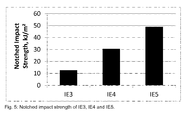
Table 2: IE1 IE2 IE3 IE4 IE5 CE1 Tensile Strength [MPa] 68 57 45 56 59 89 Tensile Strain at Break % 13.3 12.4 14.2 13.2 12.7 3.4 Charpy Notched (23°C) kJ/m2 29.8 16.9 12.7 30.4 48.9 10.5 - From this table and from
Figures 1 to 5 it can be clearly seen that the compositions of the invention, i.e. the PVA-fiber reinforced PP compositions have an improved strain@break and tensile strength balance in combination with excellent impact performance, even if no coupling agent is used. - The advantages of the compositions of the invention, i.e. the PVA-fiber reinforced PP compositions over comparable compositions (using glass fibers) can be furthermore seen in the determined notched impact performance which is superior to conventional homo PP based GF composites.
wherein the sum of (a), (b) and (c) is 100.0 wt% and wherein the composition
wherein the sum of (a), (b) and (c) is 100.0 wt%.
wherein the sum of (a), (b) and (c) is 100.0 wt%.
wherein the sum of (a), (b) and (c) is 100.0 wt%.
Claims (12)
- Fiber reinforced polypropylene composition comprising(a) 98.0 to 50.0 wt% of a matrix (M) comprising a polypropylene (PP),(b) 2.0 to 50.0 wt% of polyvinyl alcohol (PVA) fibers and(c) 0.0 to 5.0 wt% of a polar modified polypropylene as coupling agent (CA),based on the total weight of the fiber reinforced composition,
wherein the sum of (a), (b) and (c) is 100.0 wt% and wherein the composition(i) has a tensile strain at break measured at 23°C according to ISO 527-2 (cross head speed 50 mm/min) of at least 8% and(ii) a Charpy notched impact strength at 23 °C ISO 179-1 eA:2000 of at least 10.0 kJ/m2. - Fiber reinforced polypropylene composition according to claim 1, wherein the polypropylene (PP) of the matrix (M) is a propylene homopolymer (H-PP1) having(i) a melt flow rate MFR2 (230°C) measured according to ISO 1133 of from 1 to 500 g/10min,(ii) a melting temperature Tm in the range of 150 to 175°C,(iii) a isotactic pentad concentration of higher than 90 mol% and(iv) a xylene cold soluble content (XCS) of not more than 5 wt%,
- Fiber reinforced polypropylene composition according to claim 1, wherein the polypropylene (PP) of the matrix (M) is a heterophasic propylene copolymer (HECO) havinga) a xylene cold soluble content (XCS) measured according ISO 6427 (23°C) in the range of 8.0 to 35 wt%, and/orb) a melt flow rate MFR2 (230 °C) measured according to ISO 1133 of from 1 to 300 g/10min, and/orc) a total ethylene and/or C4 to C8 α-olefin content of 5.0 to 25 wt%, based on the total weight of the heterophasic propylene copolymer (HECO).
- Fiber reinforced polypropylene composition according to claim 3 wherein the heterophasic propylene copolymer (HECO) comprisesa) a polypropylene matrix (M-HECO), being a propylene homopolymer (H-PP2), andb) an elastomeric copolymer (E).
- Fiber reinforced polypropylene composition according to any of the preceding claims 1 to 4 wherein the polyvinyl alcohol (PVA) fibers have(i) a tenacity of at least 0.4 N/tex up to 1.7 N/tex,(ii) a fiber length of 2.0 to 20 mm and(ii) a fiber average diameter in the range of 10 to 20 µm.
- Fiber reinforced polypropylene composition according to any of the preceding claims 1 to 5 wherein the polar modified polypropylene as coupling agent (CA) is selected from the group of modified polypropylenes containing groups deriving from polar compounds selected from the group consisting of acid anhydrides, carboxylic acids, carboxylic acid derivatives, primary and secondary amines, hydroxyl compounds, oxazoline and epoxides.
- Fiber reinforced polypropylene composition according to claim 6, wherein the polar compounds are selected from maleic anhydride and compounds selected from C1 to C10 linear and branched dialkyl maleates, C1 to C10 linear and branched dialkyl fumarates, itaconic anhydride, C1 to C10 linear and branched itaconic acid dialkyl esters, maleic acid, fumaric acid, itaconic acid and mixtures thereof.
- Fiber reinforced polypropylene composition according to any of the preceding claims 1 to 7, wherein the composition has
has a tensile strain at break measured at 23°C according to ISO 527-2 (cross head speed 50 mm/min) of at least 10% and
(ii) a Charpy notched impact strength at 23 °C ISO 179-1 eA:2000 of at least 12.0 kJ/m2. - Fiber reinforced polypropylene composition according to any of the preceding claims 1 to 8 wherein the composition has a tensile strength measured at 23°C according to ISO 527-2 (cross head speed 50 mm/min) of at least 35 MPa, preferably of at least 40 MPa and more preferably of at least 50 MPa.
- Articles, comprising the polypropylene composition according to any of the preceding claims 1 to 9.
- Articles according to claim 10, being automotive articles selected from car interiors and exteriors, like bumpers, side trims, step assists, body panels, spoilers, dashboards, interior trims and the like, comprising at least to 60 wt%, more preferably at least 80 wt%, yet more preferably at least 95 wt%, like consisting, of the polypropylene composition.
- Process for the preparation of the fiber reinforced composition according to any of the
preceding claims 1 to 9. comprising the steps of adding(a) polypropylene (PP),(b) the polyvinyl alcohol (PVA) fibers , and(c) optionally the polar modified polypropylene as coupling agent (CA) to an extruder and extruding the same obtaining said fiber reinforced composition.
Priority Applications (14)
| Application Number | Priority Date | Filing Date | Title |
|---|---|---|---|
| EP15165182.5A EP3088459B1 (en) | 2015-04-27 | 2015-04-27 | Polypropylene composite |
| ES15165182T ES2837860T3 (en) | 2015-04-27 | 2015-04-27 | Polypropylene composite material |
| PL15165182T PL3088459T3 (en) | 2015-04-27 | 2015-04-27 | Polypropylene composite |
| UAA201711228A UA121238C2 (en) | 2015-04-27 | 2016-04-25 | Polypropylene composite |
| BR112017022525-5A BR112017022525A2 (en) | 2015-04-27 | 2016-04-25 | "fiber reinforced polypropylene composition, articles, and process for preparing a fiber reinforced composition" |
| KR1020177031901A KR101965525B1 (en) | 2015-04-27 | 2016-04-25 | Polypropylene composite |
| EA201700506A EA201700506A1 (en) | 2015-04-27 | 2016-04-25 | POLYPROPYLENE COMPOSITE |
| PCT/EP2016/059148 WO2016173976A1 (en) | 2015-04-27 | 2016-04-25 | Polypropylene composite |
| JP2017553884A JP2018515643A (en) | 2015-04-27 | 2016-04-25 | Polypropylene composite material |
| MX2017013539A MX2017013539A (en) | 2015-04-27 | 2016-04-25 | Polypropylene composite. |
| CA2982910A CA2982910C (en) | 2015-04-27 | 2016-04-25 | Polyvinyl alcohol fiber reinforced polypropylene composition |
| US15/566,588 US20180079875A1 (en) | 2015-04-27 | 2016-04-25 | Polypropylene composite |
| CN201680022411.8A CN107531964A (en) | 2015-04-27 | 2016-04-25 | Polypropylene Composite |
| CA3054539A CA3054539A1 (en) | 2015-04-27 | 2016-04-25 | Polyvinyl alcohol fiber reinforced polypropylene composition |
Applications Claiming Priority (1)
| Application Number | Priority Date | Filing Date | Title |
|---|---|---|---|
| EP15165182.5A EP3088459B1 (en) | 2015-04-27 | 2015-04-27 | Polypropylene composite |
Publications (2)
| Publication Number | Publication Date |
|---|---|
| EP3088459A1 true EP3088459A1 (en) | 2016-11-02 |
| EP3088459B1 EP3088459B1 (en) | 2020-11-04 |
Family
ID=53052683
Family Applications (1)
| Application Number | Title | Priority Date | Filing Date |
|---|---|---|---|
| EP15165182.5A Active EP3088459B1 (en) | 2015-04-27 | 2015-04-27 | Polypropylene composite |
Country Status (13)
| Country | Link |
|---|---|
| US (1) | US20180079875A1 (en) |
| EP (1) | EP3088459B1 (en) |
| JP (1) | JP2018515643A (en) |
| KR (1) | KR101965525B1 (en) |
| CN (1) | CN107531964A (en) |
| BR (1) | BR112017022525A2 (en) |
| CA (2) | CA3054539A1 (en) |
| EA (1) | EA201700506A1 (en) |
| ES (1) | ES2837860T3 (en) |
| MX (1) | MX2017013539A (en) |
| PL (1) | PL3088459T3 (en) |
| UA (1) | UA121238C2 (en) |
| WO (1) | WO2016173976A1 (en) |
Cited By (2)
| Publication number | Priority date | Publication date | Assignee | Title |
|---|---|---|---|---|
| EP3604425A1 (en) * | 2018-07-31 | 2020-02-05 | Borealis AG | Foamed polypropylene composition comprising polymeric fibers |
| US12486367B2 (en) | 2020-05-27 | 2025-12-02 | Borealis Ag | Reinforced polyolefin composition comprising recycled plastic material |
Families Citing this family (28)
| Publication number | Priority date | Publication date | Assignee | Title |
|---|---|---|---|---|
| US10472440B2 (en) * | 2016-09-02 | 2019-11-12 | University Of Guelph | Toughened polyolefin and biocarbon based light-weight biocomposites and method of making the same |
| EP3489297B1 (en) | 2017-11-28 | 2021-08-04 | Borealis AG | Polymer composition with improved paint adhesion |
| EP3489296B1 (en) | 2017-11-28 | 2021-09-01 | Borealis AG | Polymer composition with improved paint adhesion |
| ES2874060T3 (en) | 2017-12-05 | 2021-11-04 | Borealis Ag | Article comprising a fiber-reinforced polypropylene composition |
| EP3495422B1 (en) | 2017-12-05 | 2020-11-11 | Borealis AG | Fiber reinforced polypropylene composition |
| PT3502177T (en) | 2017-12-20 | 2020-03-17 | Borealis Ag | Polypropylene composition |
| KR102553655B1 (en) | 2018-04-16 | 2023-07-07 | 보레알리스 아게 | multilayer elements |
| CN110498973B (en) | 2018-05-16 | 2023-09-01 | 北欧化工公司 | Expanded polypropylene composition |
| EP3584089A1 (en) | 2018-06-19 | 2019-12-25 | Borealis AG | Polyolefin composition providing improved contrast of laser marks |
| WO2020025757A1 (en) | 2018-08-02 | 2020-02-06 | Borealis Ag | Process for polymerizing ethylene in a multi-stage polymerization process |
| WO2020064313A1 (en) | 2018-09-26 | 2020-04-02 | Borealis Ag | Propylene random copolymer for use in film applications |
| CN112638959B (en) | 2018-09-26 | 2023-05-02 | 博里利斯股份公司 | Propylene copolymers with excellent optical properties |
| US12404393B2 (en) | 2018-09-26 | 2025-09-02 | Borealis Ag | Propylene copolymer composition with excellent optical and mechanical properties |
| CA3107692C (en) | 2018-10-02 | 2023-10-17 | Borealis Ag | High speed cross-linking of grafted plastomers |
| ES2986692T3 (en) | 2018-10-02 | 2024-11-12 | Borealis Ag | Low-speed crosslinking catalyst for silane-grafted plastomers |
| KR102593923B1 (en) | 2018-12-20 | 2023-10-25 | 보레알리스 아게 | Biaxially oriented polypropylene film with improved breaking strength |
| JP7557284B2 (en) * | 2019-06-04 | 2024-09-27 | 長瀬産業株式会社 | Resin composition, method for producing said resin composition, and molded article using said resin composition |
| ES3053799T3 (en) | 2019-07-01 | 2026-01-26 | Borealis Gmbh | Pipe made of peroxide-crosslinked polyethylene of high uv stability |
| EP3994187A1 (en) | 2019-07-04 | 2022-05-11 | Borealis AG | Long-chain branched propylene polymer composition |
| EP3763777B1 (en) | 2019-07-08 | 2022-03-16 | Borealis AG | Aldehyde content reduction process and recycled polyolefin with low aldehyde content |
| KR102723723B1 (en) | 2019-08-19 | 2024-10-29 | 보레알리스 아게 | Polypropylene-polyethylene blends with improved properties |
| KR102268612B1 (en) * | 2019-10-28 | 2021-06-25 | 주식회사 삼양사 | Glass fiber-reinforced polypropylene composition with good surface properties and molded article comprising the same |
| WO2021144179A1 (en) | 2020-01-16 | 2021-07-22 | Borealis Ag | Process for avoiding phase separation during solution polymerization of ethylene-1-butene copolymers |
| CA3167398A1 (en) | 2020-01-16 | 2021-07-22 | Borealis Ag | Process for avoiding phase separation during solution polymerization of ethylene-1-octene copolymers |
| BR112022020713A2 (en) | 2020-04-17 | 2022-11-29 | Borealis Ag | BLOWN FILM |
| CN112358685A (en) * | 2020-11-11 | 2021-02-12 | 四川文诚管业有限公司 | Reinforced polypropylene double-wall corrugated pipe and production process thereof |
| CN113265103B (en) * | 2021-03-19 | 2022-12-23 | 河南联塑实业有限公司 | Low-permeability PPR composition and preparation method and application thereof |
| CN117924846B (en) * | 2024-01-31 | 2024-08-02 | 浙江珍视明眼健康产业有限公司 | Antibacterial glass fiber composite material and preparation method and application thereof |
Citations (5)
| Publication number | Priority date | Publication date | Assignee | Title |
|---|---|---|---|---|
| EP0572028A1 (en) | 1992-05-29 | 1993-12-01 | Montell North America Inc. | Concentrates suitable for the preparation of functionalized polyolefins and functionalization process using said concentrates |
| JP2008150414A (en) * | 2006-12-14 | 2008-07-03 | Kuraray Co Ltd | Lightweight fiber reinforced resin composition having excellent impact resistance and molded article comprising the same |
| US20100267888A1 (en) | 2007-12-05 | 2010-10-21 | Kuraray Co., Ltd. | Polyvinyl alcohol fiber-containing polyolefin resin composition and molded article thereof |
| US20110263738A1 (en) * | 2008-12-24 | 2011-10-27 | Kuraray Co., Ltd. | Expansion molded body and method for producing expansion molded body |
| WO2011152439A1 (en) * | 2010-06-03 | 2011-12-08 | ユニチカ株式会社 | Polyolefin resin composition pellets and moldings obtained therefrom |
Family Cites Families (11)
| Publication number | Priority date | Publication date | Assignee | Title |
|---|---|---|---|---|
| FR2796386B1 (en) * | 1999-07-15 | 2001-09-07 | Atofina | COMPOSITIONS BASED ON A COPOLYMER OF ETHYLENE AND VINYL ALCOHOL AND POLYPROPYLENE |
| JP2005213478A (en) * | 2004-02-02 | 2005-08-11 | Idemitsu Kosan Co Ltd | Polyolefin-based carbon fiber reinforced resin composition and molded article comprising the same |
| AU2008236152B2 (en) * | 2007-03-26 | 2012-06-14 | Kuraray Co., Ltd. | Polypropylene fiber, method of producing the same and utilization of the same |
| DE602007002200D1 (en) * | 2007-12-21 | 2009-10-08 | Borealis Tech Oy | Polypropylene composition having a crosslinkable dispersed phase with nanofiller-containing silanol groups |
| JP5650117B2 (en) * | 2009-09-09 | 2015-01-07 | 株式会社プライムポリマー | Carbon fiber reinforced resin composition |
| JP2012149247A (en) * | 2010-12-27 | 2012-08-09 | Unitika Ltd | Polypropylene resin composition, method of manufacturing the same, and molded article produced by molding the same |
| JP2012149246A (en) * | 2010-12-27 | 2012-08-09 | Unitika Ltd | Polypropylene resin composition, method of manufacturing the same, and molded article produced by molding the same |
| JP5465698B2 (en) * | 2011-07-04 | 2014-04-09 | 株式会社豊田中央研究所 | Long fiber reinforced composite resin composition and molded product thereof |
| JP2013082770A (en) * | 2011-10-06 | 2013-05-09 | Unitika Ltd | Polypropylene resin composition, method for producing the same, and molding obtained by molding the same |
| PL2834301T3 (en) * | 2012-04-04 | 2017-07-31 | Borealis Ag | High-flow fiber reinforced polypropylene composition |
| CN103665552A (en) * | 2013-12-03 | 2014-03-26 | 芜湖长鹏汽车零部件有限公司 | Polypropylene material for automobile interior trim parts and preparation method thereof |
-
2015
- 2015-04-27 EP EP15165182.5A patent/EP3088459B1/en active Active
- 2015-04-27 PL PL15165182T patent/PL3088459T3/en unknown
- 2015-04-27 ES ES15165182T patent/ES2837860T3/en active Active
-
2016
- 2016-04-25 US US15/566,588 patent/US20180079875A1/en not_active Abandoned
- 2016-04-25 MX MX2017013539A patent/MX2017013539A/en unknown
- 2016-04-25 CA CA3054539A patent/CA3054539A1/en not_active Abandoned
- 2016-04-25 BR BR112017022525-5A patent/BR112017022525A2/en not_active Application Discontinuation
- 2016-04-25 JP JP2017553884A patent/JP2018515643A/en active Pending
- 2016-04-25 EA EA201700506A patent/EA201700506A1/en unknown
- 2016-04-25 WO PCT/EP2016/059148 patent/WO2016173976A1/en not_active Ceased
- 2016-04-25 CN CN201680022411.8A patent/CN107531964A/en active Pending
- 2016-04-25 UA UAA201711228A patent/UA121238C2/en unknown
- 2016-04-25 KR KR1020177031901A patent/KR101965525B1/en not_active Expired - Fee Related
- 2016-04-25 CA CA2982910A patent/CA2982910C/en not_active Expired - Fee Related
Patent Citations (5)
| Publication number | Priority date | Publication date | Assignee | Title |
|---|---|---|---|---|
| EP0572028A1 (en) | 1992-05-29 | 1993-12-01 | Montell North America Inc. | Concentrates suitable for the preparation of functionalized polyolefins and functionalization process using said concentrates |
| JP2008150414A (en) * | 2006-12-14 | 2008-07-03 | Kuraray Co Ltd | Lightweight fiber reinforced resin composition having excellent impact resistance and molded article comprising the same |
| US20100267888A1 (en) | 2007-12-05 | 2010-10-21 | Kuraray Co., Ltd. | Polyvinyl alcohol fiber-containing polyolefin resin composition and molded article thereof |
| US20110263738A1 (en) * | 2008-12-24 | 2011-10-27 | Kuraray Co., Ltd. | Expansion molded body and method for producing expansion molded body |
| WO2011152439A1 (en) * | 2010-06-03 | 2011-12-08 | ユニチカ株式会社 | Polyolefin resin composition pellets and moldings obtained therefrom |
Cited By (6)
| Publication number | Priority date | Publication date | Assignee | Title |
|---|---|---|---|---|
| EP3604425A1 (en) * | 2018-07-31 | 2020-02-05 | Borealis AG | Foamed polypropylene composition comprising polymeric fibers |
| WO2020025605A1 (en) * | 2018-07-31 | 2020-02-06 | Borealis Ag | Foamed polypropylene composition comprising polymeric fibers |
| CN112513171A (en) * | 2018-07-31 | 2021-03-16 | 博里利斯股份公司 | Expanded polypropylene composition comprising polymer fibers |
| RU2764244C1 (en) * | 2018-07-31 | 2022-01-14 | Бореалис Аг | Composition of foamed polypropylene containing polymer fibers |
| US12269939B2 (en) | 2018-07-31 | 2025-04-08 | Borealis Ag | Foamed polypropylene composition comprising polymeric fibers |
| US12486367B2 (en) | 2020-05-27 | 2025-12-02 | Borealis Ag | Reinforced polyolefin composition comprising recycled plastic material |
Also Published As
| Publication number | Publication date |
|---|---|
| BR112017022525A2 (en) | 2018-07-10 |
| ES2837860T3 (en) | 2021-07-01 |
| US20180079875A1 (en) | 2018-03-22 |
| UA121238C2 (en) | 2020-04-27 |
| CN107531964A (en) | 2018-01-02 |
| CA3054539A1 (en) | 2016-11-03 |
| PL3088459T3 (en) | 2021-08-02 |
| EA201700506A1 (en) | 2018-03-30 |
| CA2982910C (en) | 2019-12-31 |
| MX2017013539A (en) | 2018-03-07 |
| CA2982910A1 (en) | 2016-11-03 |
| EP3088459B1 (en) | 2020-11-04 |
| WO2016173976A1 (en) | 2016-11-03 |
| KR20170134630A (en) | 2017-12-06 |
| KR101965525B1 (en) | 2019-04-03 |
| JP2018515643A (en) | 2018-06-14 |
Similar Documents
| Publication | Publication Date | Title |
|---|---|---|
| CA2982910C (en) | Polyvinyl alcohol fiber reinforced polypropylene composition | |
| CN110546198B (en) | PP-rich material composition with high rigidity and processability | |
| EP3165473B1 (en) | Polypropylene-polyethylene composition with improved flowability | |
| EP2551299B1 (en) | Lightweight polypropylene resin with superior surface characteristics for use in automotive interior applications | |
| US8519044B2 (en) | Glass fiber reinforced polypropylene | |
| US8912263B2 (en) | Propylene polymer compositions | |
| US10392498B2 (en) | Fiber reinforced polypropylene composition with high strain at break | |
| EP1824928B1 (en) | Novel propylene polymer blends | |
| EP1769029B1 (en) | Novel propylene polymer compositions | |
| WO2008039599A1 (en) | Thermoplastic elastomer compositions, methods of making and articles made from the same | |
| WO2014095846A1 (en) | Automotive compounds featuring low surface tack | |
| KR100574683B1 (en) | Resin composition for pipes excellent in flexibility and impact resistance |
Legal Events
| Date | Code | Title | Description |
|---|---|---|---|
| PUAI | Public reference made under article 153(3) epc to a published international application that has entered the european phase |
Free format text: ORIGINAL CODE: 0009012 |
|
| 17P | Request for examination filed |
Effective date: 20160725 |
|
| AK | Designated contracting states |
Kind code of ref document: A1 Designated state(s): AL AT BE BG CH CY CZ DE DK EE ES FI FR GB GR HR HU IE IS IT LI LT LU LV MC MK MT NL NO PL PT RO RS SE SI SK SM TR |
|
| AX | Request for extension of the european patent |
Extension state: BA ME |
|
| RIN1 | Information on inventor provided before grant (corrected) |
Inventor name: HAIDER, ANDREAS Inventor name: BRAUN, HERMANN Inventor name: JERABEK, MICHAEL Inventor name: LUMMERSTORFER, THOMAS Inventor name: SOBCZAK, LUKAS |
|
| STAA | Information on the status of an ep patent application or granted ep patent |
Free format text: STATUS: EXAMINATION IS IN PROGRESS |
|
| 17Q | First examination report despatched |
Effective date: 20180405 |
|
| GRAP | Despatch of communication of intention to grant a patent |
Free format text: ORIGINAL CODE: EPIDOSNIGR1 |
|
| STAA | Information on the status of an ep patent application or granted ep patent |
Free format text: STATUS: GRANT OF PATENT IS INTENDED |
|
| GRAJ | Information related to disapproval of communication of intention to grant by the applicant or resumption of examination proceedings by the epo deleted |
Free format text: ORIGINAL CODE: EPIDOSDIGR1 |
|
| STAA | Information on the status of an ep patent application or granted ep patent |
Free format text: STATUS: EXAMINATION IS IN PROGRESS |
|
| INTG | Intention to grant announced |
Effective date: 20200402 |
|
| GRAP | Despatch of communication of intention to grant a patent |
Free format text: ORIGINAL CODE: EPIDOSNIGR1 |
|
| STAA | Information on the status of an ep patent application or granted ep patent |
Free format text: STATUS: GRANT OF PATENT IS INTENDED |
|
| GRAJ | Information related to disapproval of communication of intention to grant by the applicant or resumption of examination proceedings by the epo deleted |
Free format text: ORIGINAL CODE: EPIDOSDIGR1 |
|
| GRAP | Despatch of communication of intention to grant a patent |
Free format text: ORIGINAL CODE: EPIDOSNIGR1 |
|
| GRAJ | Information related to disapproval of communication of intention to grant by the applicant or resumption of examination proceedings by the epo deleted |
Free format text: ORIGINAL CODE: EPIDOSDIGR1 |
|
| INTC | Intention to grant announced (deleted) | ||
| GRAJ | Information related to disapproval of communication of intention to grant by the applicant or resumption of examination proceedings by the epo deleted |
Free format text: ORIGINAL CODE: EPIDOSDIGR1 |
|
| GRAP | Despatch of communication of intention to grant a patent |
Free format text: ORIGINAL CODE: EPIDOSNIGR1 |
|
| STAA | Information on the status of an ep patent application or granted ep patent |
Free format text: STATUS: EXAMINATION IS IN PROGRESS |
|
| GRAP | Despatch of communication of intention to grant a patent |
Free format text: ORIGINAL CODE: EPIDOSNIGR1 |
|
| STAA | Information on the status of an ep patent application or granted ep patent |
Free format text: STATUS: GRANT OF PATENT IS INTENDED |
|
| INTG | Intention to grant announced |
Effective date: 20200515 |
|
| INTG | Intention to grant announced |
Effective date: 20200515 |
|
| INTG | Intention to grant announced |
Effective date: 20200528 |
|
| INTG | Intention to grant announced |
Effective date: 20200608 |
|
| GRAS | Grant fee paid |
Free format text: ORIGINAL CODE: EPIDOSNIGR3 |
|
| GRAA | (expected) grant |
Free format text: ORIGINAL CODE: 0009210 |
|
| STAA | Information on the status of an ep patent application or granted ep patent |
Free format text: STATUS: THE PATENT HAS BEEN GRANTED |
|
| AK | Designated contracting states |
Kind code of ref document: B1 Designated state(s): AL AT BE BG CH CY CZ DE DK EE ES FI FR GB GR HR HU IE IS IT LI LT LU LV MC MK MT NL NO PL PT RO RS SE SI SK SM TR |
|
| REG | Reference to a national code |
Ref country code: GB Ref legal event code: FG4D |
|
| REG | Reference to a national code |
Ref country code: CH Ref legal event code: EP |
|
| REG | Reference to a national code |
Ref country code: AT Ref legal event code: REF Ref document number: 1330787 Country of ref document: AT Kind code of ref document: T Effective date: 20201115 |
|
| REG | Reference to a national code |
Ref country code: IE Ref legal event code: FG4D |
|
| REG | Reference to a national code |
Ref country code: DE Ref legal event code: R096 Ref document number: 602015061388 Country of ref document: DE |
|
| REG | Reference to a national code |
Ref country code: SE Ref legal event code: TRGR |
|
| REG | Reference to a national code |
Ref country code: RO Ref legal event code: EPE |
|
| REG | Reference to a national code |
Ref country code: NL Ref legal event code: FP |
|
| REG | Reference to a national code |
Ref country code: SK Ref legal event code: T3 Ref document number: E 36167 Country of ref document: SK |
|
| REG | Reference to a national code |
Ref country code: AT Ref legal event code: MK05 Ref document number: 1330787 Country of ref document: AT Kind code of ref document: T Effective date: 20201104 |
|
| PG25 | Lapsed in a contracting state [announced via postgrant information from national office to epo] |
Ref country code: FI Free format text: LAPSE BECAUSE OF FAILURE TO SUBMIT A TRANSLATION OF THE DESCRIPTION OR TO PAY THE FEE WITHIN THE PRESCRIBED TIME-LIMIT Effective date: 20201104 Ref country code: RS Free format text: LAPSE BECAUSE OF FAILURE TO SUBMIT A TRANSLATION OF THE DESCRIPTION OR TO PAY THE FEE WITHIN THE PRESCRIBED TIME-LIMIT Effective date: 20201104 Ref country code: NO Free format text: LAPSE BECAUSE OF FAILURE TO SUBMIT A TRANSLATION OF THE DESCRIPTION OR TO PAY THE FEE WITHIN THE PRESCRIBED TIME-LIMIT Effective date: 20210204 Ref country code: PT Free format text: LAPSE BECAUSE OF FAILURE TO SUBMIT A TRANSLATION OF THE DESCRIPTION OR TO PAY THE FEE WITHIN THE PRESCRIBED TIME-LIMIT Effective date: 20210304 Ref country code: GR Free format text: LAPSE BECAUSE OF FAILURE TO SUBMIT A TRANSLATION OF THE DESCRIPTION OR TO PAY THE FEE WITHIN THE PRESCRIBED TIME-LIMIT Effective date: 20210205 |
|
| PG25 | Lapsed in a contracting state [announced via postgrant information from national office to epo] |
Ref country code: AT Free format text: LAPSE BECAUSE OF FAILURE TO SUBMIT A TRANSLATION OF THE DESCRIPTION OR TO PAY THE FEE WITHIN THE PRESCRIBED TIME-LIMIT Effective date: 20201104 Ref country code: BG Free format text: LAPSE BECAUSE OF FAILURE TO SUBMIT A TRANSLATION OF THE DESCRIPTION OR TO PAY THE FEE WITHIN THE PRESCRIBED TIME-LIMIT Effective date: 20210204 Ref country code: LV Free format text: LAPSE BECAUSE OF FAILURE TO SUBMIT A TRANSLATION OF THE DESCRIPTION OR TO PAY THE FEE WITHIN THE PRESCRIBED TIME-LIMIT Effective date: 20201104 Ref country code: IS Free format text: LAPSE BECAUSE OF FAILURE TO SUBMIT A TRANSLATION OF THE DESCRIPTION OR TO PAY THE FEE WITHIN THE PRESCRIBED TIME-LIMIT Effective date: 20210304 |
|
| REG | Reference to a national code |
Ref country code: LT Ref legal event code: MG9D |
|
| PG25 | Lapsed in a contracting state [announced via postgrant information from national office to epo] |
Ref country code: HR Free format text: LAPSE BECAUSE OF FAILURE TO SUBMIT A TRANSLATION OF THE DESCRIPTION OR TO PAY THE FEE WITHIN THE PRESCRIBED TIME-LIMIT Effective date: 20201104 |
|
| PG25 | Lapsed in a contracting state [announced via postgrant information from national office to epo] |
Ref country code: SM Free format text: LAPSE BECAUSE OF FAILURE TO SUBMIT A TRANSLATION OF THE DESCRIPTION OR TO PAY THE FEE WITHIN THE PRESCRIBED TIME-LIMIT Effective date: 20201104 Ref country code: LT Free format text: LAPSE BECAUSE OF FAILURE TO SUBMIT A TRANSLATION OF THE DESCRIPTION OR TO PAY THE FEE WITHIN THE PRESCRIBED TIME-LIMIT Effective date: 20201104 Ref country code: EE Free format text: LAPSE BECAUSE OF FAILURE TO SUBMIT A TRANSLATION OF THE DESCRIPTION OR TO PAY THE FEE WITHIN THE PRESCRIBED TIME-LIMIT Effective date: 20201104 |
|
| REG | Reference to a national code |
Ref country code: DE Ref legal event code: R097 Ref document number: 602015061388 Country of ref document: DE |
|
| PG25 | Lapsed in a contracting state [announced via postgrant information from national office to epo] |
Ref country code: DK Free format text: LAPSE BECAUSE OF FAILURE TO SUBMIT A TRANSLATION OF THE DESCRIPTION OR TO PAY THE FEE WITHIN THE PRESCRIBED TIME-LIMIT Effective date: 20201104 |
|
| PLBE | No opposition filed within time limit |
Free format text: ORIGINAL CODE: 0009261 |
|
| STAA | Information on the status of an ep patent application or granted ep patent |
Free format text: STATUS: NO OPPOSITION FILED WITHIN TIME LIMIT |
|
| 26N | No opposition filed |
Effective date: 20210805 |
|
| PG25 | Lapsed in a contracting state [announced via postgrant information from national office to epo] |
Ref country code: AL Free format text: LAPSE BECAUSE OF FAILURE TO SUBMIT A TRANSLATION OF THE DESCRIPTION OR TO PAY THE FEE WITHIN THE PRESCRIBED TIME-LIMIT Effective date: 20201104 |
|
| PG25 | Lapsed in a contracting state [announced via postgrant information from national office to epo] |
Ref country code: SI Free format text: LAPSE BECAUSE OF FAILURE TO SUBMIT A TRANSLATION OF THE DESCRIPTION OR TO PAY THE FEE WITHIN THE PRESCRIBED TIME-LIMIT Effective date: 20201104 Ref country code: MC Free format text: LAPSE BECAUSE OF FAILURE TO SUBMIT A TRANSLATION OF THE DESCRIPTION OR TO PAY THE FEE WITHIN THE PRESCRIBED TIME-LIMIT Effective date: 20201104 |
|
| PG25 | Lapsed in a contracting state [announced via postgrant information from national office to epo] |
Ref country code: LU Free format text: LAPSE BECAUSE OF NON-PAYMENT OF DUE FEES Effective date: 20210427 |
|
| PG25 | Lapsed in a contracting state [announced via postgrant information from national office to epo] |
Ref country code: CH Free format text: LAPSE BECAUSE OF NON-PAYMENT OF DUE FEES Effective date: 20210430 Ref country code: LI Free format text: LAPSE BECAUSE OF NON-PAYMENT OF DUE FEES Effective date: 20210430 |
|
| PG25 | Lapsed in a contracting state [announced via postgrant information from national office to epo] |
Ref country code: IE Free format text: LAPSE BECAUSE OF NON-PAYMENT OF DUE FEES Effective date: 20210427 |
|
| PG25 | Lapsed in a contracting state [announced via postgrant information from national office to epo] |
Ref country code: IS Free format text: LAPSE BECAUSE OF FAILURE TO SUBMIT A TRANSLATION OF THE DESCRIPTION OR TO PAY THE FEE WITHIN THE PRESCRIBED TIME-LIMIT Effective date: 20210304 |
|
| PG25 | Lapsed in a contracting state [announced via postgrant information from national office to epo] |
Ref country code: HU Free format text: LAPSE BECAUSE OF FAILURE TO SUBMIT A TRANSLATION OF THE DESCRIPTION OR TO PAY THE FEE WITHIN THE PRESCRIBED TIME-LIMIT; INVALID AB INITIO Effective date: 20150427 |
|
| PG25 | Lapsed in a contracting state [announced via postgrant information from national office to epo] |
Ref country code: CY Free format text: LAPSE BECAUSE OF FAILURE TO SUBMIT A TRANSLATION OF THE DESCRIPTION OR TO PAY THE FEE WITHIN THE PRESCRIBED TIME-LIMIT Effective date: 20201104 |
|
| P01 | Opt-out of the competence of the unified patent court (upc) registered |
Effective date: 20230602 |
|
| PG25 | Lapsed in a contracting state [announced via postgrant information from national office to epo] |
Ref country code: MK Free format text: LAPSE BECAUSE OF FAILURE TO SUBMIT A TRANSLATION OF THE DESCRIPTION OR TO PAY THE FEE WITHIN THE PRESCRIBED TIME-LIMIT Effective date: 20201104 |
|
| PGFP | Annual fee paid to national office [announced via postgrant information from national office to epo] |
Ref country code: SK Payment date: 20240423 Year of fee payment: 10 |
|
| PGFP | Annual fee paid to national office [announced via postgrant information from national office to epo] |
Ref country code: RO Payment date: 20240424 Year of fee payment: 10 |
|
| PGFP | Annual fee paid to national office [announced via postgrant information from national office to epo] |
Ref country code: PL Payment date: 20240419 Year of fee payment: 10 |
|
| PGFP | Annual fee paid to national office [announced via postgrant information from national office to epo] |
Ref country code: SE Payment date: 20240418 Year of fee payment: 10 |
|
| PG25 | Lapsed in a contracting state [announced via postgrant information from national office to epo] |
Ref country code: MT Free format text: LAPSE BECAUSE OF FAILURE TO SUBMIT A TRANSLATION OF THE DESCRIPTION OR TO PAY THE FEE WITHIN THE PRESCRIBED TIME-LIMIT Effective date: 20201104 |
|
| PGFP | Annual fee paid to national office [announced via postgrant information from national office to epo] |
Ref country code: NL Payment date: 20250418 Year of fee payment: 11 |
|
| PGFP | Annual fee paid to national office [announced via postgrant information from national office to epo] |
Ref country code: DE Payment date: 20250422 Year of fee payment: 11 |
|
| PGFP | Annual fee paid to national office [announced via postgrant information from national office to epo] |
Ref country code: ES Payment date: 20250529 Year of fee payment: 11 Ref country code: GB Payment date: 20250423 Year of fee payment: 11 |
|
| PGFP | Annual fee paid to national office [announced via postgrant information from national office to epo] |
Ref country code: BE Payment date: 20250418 Year of fee payment: 11 Ref country code: IT Payment date: 20250424 Year of fee payment: 11 |
|
| PGFP | Annual fee paid to national office [announced via postgrant information from national office to epo] |
Ref country code: FR Payment date: 20250425 Year of fee payment: 11 |
|
| PGFP | Annual fee paid to national office [announced via postgrant information from national office to epo] |
Ref country code: TR Payment date: 20250421 Year of fee payment: 11 |
|
| PGFP | Annual fee paid to national office [announced via postgrant information from national office to epo] |
Ref country code: CZ Payment date: 20250423 Year of fee payment: 11 |
|
| REG | Reference to a national code |
Ref country code: SE Ref legal event code: EUG |
|
| REG | Reference to a national code |
Ref country code: SK Ref legal event code: MM4A Ref document number: E 36167 Country of ref document: SK Effective date: 20250427 |
|
| PG25 | Lapsed in a contracting state [announced via postgrant information from national office to epo] |
Ref country code: SE Free format text: LAPSE BECAUSE OF NON-PAYMENT OF DUE FEES Effective date: 20250428 |
|
| PG25 | Lapsed in a contracting state [announced via postgrant information from national office to epo] |
Ref country code: SK Free format text: LAPSE BECAUSE OF NON-PAYMENT OF DUE FEES Effective date: 20250427 Ref country code: RO Free format text: LAPSE BECAUSE OF NON-PAYMENT OF DUE FEES Effective date: 20250427 |
|
| PG25 | Lapsed in a contracting state [announced via postgrant information from national office to epo] |
Ref country code: PL Free format text: LAPSE BECAUSE OF NON-PAYMENT OF DUE FEES Effective date: 20250427 |