EP3088356A1 - Noncovalent bond-modified carbon structure, and carbon structure/polymer composite comprising same - Google Patents
Noncovalent bond-modified carbon structure, and carbon structure/polymer composite comprising same Download PDFInfo
- Publication number
- EP3088356A1 EP3088356A1 EP14873935.2A EP14873935A EP3088356A1 EP 3088356 A1 EP3088356 A1 EP 3088356A1 EP 14873935 A EP14873935 A EP 14873935A EP 3088356 A1 EP3088356 A1 EP 3088356A1
- Authority
- EP
- European Patent Office
- Prior art keywords
- group
- carbon structure
- chemical formula
- modified carbon
- compound represented
- Prior art date
- Legal status (The legal status is an assumption and is not a legal conclusion. Google has not performed a legal analysis and makes no representation as to the accuracy of the status listed.)
- Withdrawn
Links
- OKTJSMMVPCPJKN-UHFFFAOYSA-N Carbon Chemical group [C] OKTJSMMVPCPJKN-UHFFFAOYSA-N 0.000 title claims abstract description 219
- 229920000642 polymer Polymers 0.000 title claims abstract description 73
- 239000002131 composite material Substances 0.000 title claims abstract description 36
- 229910052799 carbon Chemical group 0.000 title claims abstract description 32
- 150000001875 compounds Chemical class 0.000 claims abstract description 54
- 239000000126 substance Substances 0.000 claims abstract description 53
- 239000011159 matrix material Substances 0.000 claims abstract description 38
- 229910021389 graphene Inorganic materials 0.000 claims description 44
- 239000000725 suspension Substances 0.000 claims description 42
- 239000000203 mixture Substances 0.000 claims description 33
- 239000002064 nanoplatelet Substances 0.000 claims description 31
- 238000000034 method Methods 0.000 claims description 20
- 125000004435 hydrogen atom Chemical group [H]* 0.000 claims description 18
- 125000003277 amino group Chemical group 0.000 claims description 15
- 125000003178 carboxy group Chemical group [H]OC(*)=O 0.000 claims description 15
- 125000002887 hydroxy group Chemical group [H]O* 0.000 claims description 15
- 125000004178 (C1-C4) alkyl group Chemical group 0.000 claims description 14
- 239000007787 solid Substances 0.000 claims description 13
- 125000003118 aryl group Chemical group 0.000 claims description 12
- 229910052739 hydrogen Inorganic materials 0.000 claims description 12
- 239000001257 hydrogen Substances 0.000 claims description 12
- 239000002904 solvent Substances 0.000 claims description 10
- 125000005843 halogen group Chemical group 0.000 claims description 6
- 125000002178 anthracenyl group Chemical group C1(=CC=CC2=CC3=CC=CC=C3C=C12)* 0.000 claims description 4
- 125000006267 biphenyl group Chemical group 0.000 claims description 4
- 239000002041 carbon nanotube Substances 0.000 claims description 4
- 229910021393 carbon nanotube Inorganic materials 0.000 claims description 4
- 125000001624 naphthyl group Chemical group 0.000 claims description 4
- 125000001997 phenyl group Chemical group [H]C1=C([H])C([H])=C(*)C([H])=C1[H] 0.000 claims description 4
- 125000001725 pyrenyl group Chemical group 0.000 claims description 4
- XLYOFNOQVPJJNP-UHFFFAOYSA-N water Substances O XLYOFNOQVPJJNP-UHFFFAOYSA-N 0.000 claims description 4
- 230000001678 irradiating effect Effects 0.000 claims description 3
- 238000010298 pulverizing process Methods 0.000 claims description 3
- 238000003756 stirring Methods 0.000 claims description 3
- 125000001246 bromo group Chemical group Br* 0.000 claims description 2
- 125000001309 chloro group Chemical group Cl* 0.000 claims description 2
- 125000001495 ethyl group Chemical group [H]C([H])([H])C([H])([H])* 0.000 claims description 2
- 125000002496 methyl group Chemical group [H]C([H])([H])* 0.000 claims description 2
- 229910000831 Steel Inorganic materials 0.000 abstract description 23
- 239000010959 steel Substances 0.000 abstract description 23
- 239000006185 dispersion Substances 0.000 abstract description 14
- 239000011248 coating agent Substances 0.000 abstract description 13
- 238000000576 coating method Methods 0.000 abstract description 13
- 230000008901 benefit Effects 0.000 abstract description 8
- 230000008859 change Effects 0.000 abstract description 6
- 238000004519 manufacturing process Methods 0.000 abstract description 4
- 230000005855 radiation Effects 0.000 abstract description 4
- OKKJLVBELUTLKV-UHFFFAOYSA-N Methanol Chemical compound OC OKKJLVBELUTLKV-UHFFFAOYSA-N 0.000 description 12
- 239000002245 particle Substances 0.000 description 9
- 238000002360 preparation method Methods 0.000 description 8
- 125000000524 functional group Chemical group 0.000 description 7
- 239000008187 granular material Substances 0.000 description 6
- 125000000217 alkyl group Chemical group 0.000 description 5
- 238000002156 mixing Methods 0.000 description 5
- 230000008569 process Effects 0.000 description 5
- XEEYBQQBJWHFJM-UHFFFAOYSA-N Iron Chemical compound [Fe] XEEYBQQBJWHFJM-UHFFFAOYSA-N 0.000 description 4
- BAPJBEWLBFYGME-UHFFFAOYSA-N Methyl acrylate Chemical compound COC(=O)C=C BAPJBEWLBFYGME-UHFFFAOYSA-N 0.000 description 4
- 239000004952 Polyamide Substances 0.000 description 4
- -1 acryl Chemical group 0.000 description 4
- QVGXLLKOCUKJST-UHFFFAOYSA-N atomic oxygen Chemical compound [O] QVGXLLKOCUKJST-UHFFFAOYSA-N 0.000 description 4
- 229910002804 graphite Inorganic materials 0.000 description 4
- 239000010439 graphite Substances 0.000 description 4
- 229910052760 oxygen Inorganic materials 0.000 description 4
- 239000001301 oxygen Substances 0.000 description 4
- 229920002647 polyamide Polymers 0.000 description 4
- 229910001335 Galvanized steel Inorganic materials 0.000 description 3
- 239000008397 galvanized steel Substances 0.000 description 3
- 239000002356 single layer Substances 0.000 description 3
- SMZOUWXMTYCWNB-UHFFFAOYSA-N 2-(2-methoxy-5-methylphenyl)ethanamine Chemical compound COC1=CC=C(C)C=C1CCN SMZOUWXMTYCWNB-UHFFFAOYSA-N 0.000 description 2
- NIXOWILDQLNWCW-UHFFFAOYSA-N 2-Propenoic acid Natural products OC(=O)C=C NIXOWILDQLNWCW-UHFFFAOYSA-N 0.000 description 2
- HEDRZPFGACZZDS-UHFFFAOYSA-N Chloroform Chemical compound ClC(Cl)Cl HEDRZPFGACZZDS-UHFFFAOYSA-N 0.000 description 2
- RYGMFSIKBFXOCR-UHFFFAOYSA-N Copper Chemical compound [Cu] RYGMFSIKBFXOCR-UHFFFAOYSA-N 0.000 description 2
- LFQSCWFLJHTTHZ-UHFFFAOYSA-N Ethanol Chemical compound CCO LFQSCWFLJHTTHZ-UHFFFAOYSA-N 0.000 description 2
- JOYRKODLDBILNP-UHFFFAOYSA-N Ethyl urethane Chemical compound CCOC(N)=O JOYRKODLDBILNP-UHFFFAOYSA-N 0.000 description 2
- WOBHKFSMXKNTIM-UHFFFAOYSA-N Hydroxyethyl methacrylate Chemical compound CC(=C)C(=O)OCCO WOBHKFSMXKNTIM-UHFFFAOYSA-N 0.000 description 2
- FYYHWMGAXLPEAU-UHFFFAOYSA-N Magnesium Chemical compound [Mg] FYYHWMGAXLPEAU-UHFFFAOYSA-N 0.000 description 2
- PXHVJJICTQNCMI-UHFFFAOYSA-N Nickel Chemical compound [Ni] PXHVJJICTQNCMI-UHFFFAOYSA-N 0.000 description 2
- 239000004743 Polypropylene Substances 0.000 description 2
- 239000004793 Polystyrene Substances 0.000 description 2
- BLRPTPMANUNPDV-UHFFFAOYSA-N Silane Chemical compound [SiH4] BLRPTPMANUNPDV-UHFFFAOYSA-N 0.000 description 2
- RTAQQCXQSZGOHL-UHFFFAOYSA-N Titanium Chemical compound [Ti] RTAQQCXQSZGOHL-UHFFFAOYSA-N 0.000 description 2
- 238000005411 Van der Waals force Methods 0.000 description 2
- 229910052782 aluminium Inorganic materials 0.000 description 2
- XAGFODPZIPBFFR-UHFFFAOYSA-N aluminium Chemical compound [Al] XAGFODPZIPBFFR-UHFFFAOYSA-N 0.000 description 2
- 239000011203 carbon fibre reinforced carbon Substances 0.000 description 2
- 229920001577 copolymer Polymers 0.000 description 2
- 229910052802 copper Inorganic materials 0.000 description 2
- 239000010949 copper Substances 0.000 description 2
- 230000003111 delayed effect Effects 0.000 description 2
- 230000000694 effects Effects 0.000 description 2
- 239000003822 epoxy resin Substances 0.000 description 2
- 229910052742 iron Inorganic materials 0.000 description 2
- 229910052749 magnesium Inorganic materials 0.000 description 2
- 239000011777 magnesium Substances 0.000 description 2
- WPBNNNQJVZRUHP-UHFFFAOYSA-L manganese(2+);methyl n-[[2-(methoxycarbonylcarbamothioylamino)phenyl]carbamothioyl]carbamate;n-[2-(sulfidocarbothioylamino)ethyl]carbamodithioate Chemical compound [Mn+2].[S-]C(=S)NCCNC([S-])=S.COC(=O)NC(=S)NC1=CC=CC=C1NC(=S)NC(=O)OC WPBNNNQJVZRUHP-UHFFFAOYSA-L 0.000 description 2
- 239000012046 mixed solvent Substances 0.000 description 2
- 229920000058 polyacrylate Polymers 0.000 description 2
- 229920000647 polyepoxide Polymers 0.000 description 2
- 229920000728 polyester Polymers 0.000 description 2
- 229920000098 polyolefin Polymers 0.000 description 2
- 229920001155 polypropylene Polymers 0.000 description 2
- 229920002223 polystyrene Polymers 0.000 description 2
- 239000004814 polyurethane Substances 0.000 description 2
- 229920002635 polyurethane Polymers 0.000 description 2
- 239000000843 powder Substances 0.000 description 2
- 230000009467 reduction Effects 0.000 description 2
- 229920005989 resin Polymers 0.000 description 2
- 239000011347 resin Substances 0.000 description 2
- 229910000077 silane Inorganic materials 0.000 description 2
- 238000001179 sorption measurement Methods 0.000 description 2
- 239000010936 titanium Substances 0.000 description 2
- 229910052719 titanium Inorganic materials 0.000 description 2
- 229920002554 vinyl polymer Polymers 0.000 description 2
- 229910000838 Al alloy Inorganic materials 0.000 description 1
- VVQNEPGJFQJSBK-UHFFFAOYSA-N Methyl methacrylate Chemical compound COC(=O)C(C)=C VVQNEPGJFQJSBK-UHFFFAOYSA-N 0.000 description 1
- ZOKXTWBITQBERF-UHFFFAOYSA-N Molybdenum Chemical compound [Mo] ZOKXTWBITQBERF-UHFFFAOYSA-N 0.000 description 1
- XISPAYCAYWOKPH-UHFFFAOYSA-N NC1=CCC2=CCc3cccc4c3c2c1cc4 Chemical compound NC1=CCC2=CCc3cccc4c3c2c1cc4 XISPAYCAYWOKPH-UHFFFAOYSA-N 0.000 description 1
- BCDIYAIONAIKLH-UHFFFAOYSA-N OC(CCCc(cc1ccc2ccc3)cc4c1c2c3cc4)=O Chemical compound OC(CCCc(cc1ccc2ccc3)cc4c1c2c3cc4)=O BCDIYAIONAIKLH-UHFFFAOYSA-N 0.000 description 1
- RZRJYURCNBXIST-UHFFFAOYSA-N OC(c1ccc(cc2ccccc2c2)c2c1)=O Chemical compound OC(c1ccc(cc2ccccc2c2)c2c1)=O RZRJYURCNBXIST-UHFFFAOYSA-N 0.000 description 1
- 229910019142 PO4 Inorganic materials 0.000 description 1
- XUIMIQQOPSSXEZ-UHFFFAOYSA-N Silicon Chemical compound [Si] XUIMIQQOPSSXEZ-UHFFFAOYSA-N 0.000 description 1
- ATJFFYVFTNAWJD-UHFFFAOYSA-N Tin Chemical compound [Sn] ATJFFYVFTNAWJD-UHFFFAOYSA-N 0.000 description 1
- HCHKCACWOHOZIP-UHFFFAOYSA-N Zinc Chemical compound [Zn] HCHKCACWOHOZIP-UHFFFAOYSA-N 0.000 description 1
- 239000002253 acid Substances 0.000 description 1
- 239000003125 aqueous solvent Substances 0.000 description 1
- 125000005586 carbonic acid group Chemical group 0.000 description 1
- 238000005119 centrifugation Methods 0.000 description 1
- 239000010941 cobalt Substances 0.000 description 1
- 229910017052 cobalt Inorganic materials 0.000 description 1
- GUTLYIVDDKVIGB-UHFFFAOYSA-N cobalt atom Chemical compound [Co] GUTLYIVDDKVIGB-UHFFFAOYSA-N 0.000 description 1
- 239000010960 cold rolled steel Substances 0.000 description 1
- 239000012141 concentrate Substances 0.000 description 1
- 230000007547 defect Effects 0.000 description 1
- 238000011161 development Methods 0.000 description 1
- 238000003618 dip coating Methods 0.000 description 1
- 238000004821 distillation Methods 0.000 description 1
- 238000011156 evaluation Methods 0.000 description 1
- 238000002474 experimental method Methods 0.000 description 1
- 230000017525 heat dissipation Effects 0.000 description 1
- 230000002209 hydrophobic effect Effects 0.000 description 1
- 230000006872 improvement Effects 0.000 description 1
- 239000010410 layer Substances 0.000 description 1
- 239000000463 material Substances 0.000 description 1
- 230000005499 meniscus Effects 0.000 description 1
- 229910052750 molybdenum Inorganic materials 0.000 description 1
- 239000011733 molybdenum Substances 0.000 description 1
- 239000004570 mortar (masonry) Substances 0.000 description 1
- 239000002055 nanoplate Substances 0.000 description 1
- 229910021382 natural graphite Inorganic materials 0.000 description 1
- 229910052759 nickel Inorganic materials 0.000 description 1
- 239000003960 organic solvent Substances 0.000 description 1
- NBIIXXVUZAFLBC-UHFFFAOYSA-K phosphate Chemical compound [O-]P([O-])([O-])=O NBIIXXVUZAFLBC-UHFFFAOYSA-K 0.000 description 1
- 239000010452 phosphate Substances 0.000 description 1
- 230000000704 physical effect Effects 0.000 description 1
- 229920000307 polymer substrate Polymers 0.000 description 1
- 238000003825 pressing Methods 0.000 description 1
- 238000007639 printing Methods 0.000 description 1
- 238000012545 processing Methods 0.000 description 1
- 238000011160 research Methods 0.000 description 1
- 230000000630 rising effect Effects 0.000 description 1
- 239000010703 silicon Substances 0.000 description 1
- 229910052710 silicon Inorganic materials 0.000 description 1
- 238000004528 spin coating Methods 0.000 description 1
- 238000005507 spraying Methods 0.000 description 1
- 239000006228 supernatant Substances 0.000 description 1
- 238000004381 surface treatment Methods 0.000 description 1
- 229910052718 tin Inorganic materials 0.000 description 1
- 239000011135 tin Substances 0.000 description 1
- WFKWXMTUELFFGS-UHFFFAOYSA-N tungsten Chemical compound [W] WFKWXMTUELFFGS-UHFFFAOYSA-N 0.000 description 1
- 229910052721 tungsten Inorganic materials 0.000 description 1
- 239000010937 tungsten Substances 0.000 description 1
- 239000011701 zinc Substances 0.000 description 1
- 229910052725 zinc Inorganic materials 0.000 description 1
Images

Classifications
-
- C—CHEMISTRY; METALLURGY
- C09—DYES; PAINTS; POLISHES; NATURAL RESINS; ADHESIVES; COMPOSITIONS NOT OTHERWISE PROVIDED FOR; APPLICATIONS OF MATERIALS NOT OTHERWISE PROVIDED FOR
- C09D—COATING COMPOSITIONS, e.g. PAINTS, VARNISHES OR LACQUERS; FILLING PASTES; CHEMICAL PAINT OR INK REMOVERS; INKS; CORRECTING FLUIDS; WOODSTAINS; PASTES OR SOLIDS FOR COLOURING OR PRINTING; USE OF MATERIALS THEREFOR
- C09D17/00—Pigment pastes, e.g. for mixing in paints
- C09D17/004—Pigment pastes, e.g. for mixing in paints containing an inorganic pigment
-
- C—CHEMISTRY; METALLURGY
- C01—INORGANIC CHEMISTRY
- C01B—NON-METALLIC ELEMENTS; COMPOUNDS THEREOF; METALLOIDS OR COMPOUNDS THEREOF NOT COVERED BY SUBCLASS C01C
- C01B32/00—Carbon; Compounds thereof
- C01B32/15—Nano-sized carbon materials
- C01B32/18—Nanoonions; Nanoscrolls; Nanohorns; Nanocones; Nanowalls
-
- C—CHEMISTRY; METALLURGY
- C01—INORGANIC CHEMISTRY
- C01B—NON-METALLIC ELEMENTS; COMPOUNDS THEREOF; METALLOIDS OR COMPOUNDS THEREOF NOT COVERED BY SUBCLASS C01C
- C01B32/00—Carbon; Compounds thereof
- C01B32/15—Nano-sized carbon materials
-
- C—CHEMISTRY; METALLURGY
- C01—INORGANIC CHEMISTRY
- C01B—NON-METALLIC ELEMENTS; COMPOUNDS THEREOF; METALLOIDS OR COMPOUNDS THEREOF NOT COVERED BY SUBCLASS C01C
- C01B32/00—Carbon; Compounds thereof
- C01B32/15—Nano-sized carbon materials
- C01B32/158—Carbon nanotubes
- C01B32/168—After-treatment
- C01B32/174—Derivatisation; Solubilisation; Dispersion in solvents
-
- C—CHEMISTRY; METALLURGY
- C01—INORGANIC CHEMISTRY
- C01B—NON-METALLIC ELEMENTS; COMPOUNDS THEREOF; METALLOIDS OR COMPOUNDS THEREOF NOT COVERED BY SUBCLASS C01C
- C01B32/00—Carbon; Compounds thereof
- C01B32/15—Nano-sized carbon materials
- C01B32/182—Graphene
- C01B32/194—After-treatment
-
- C—CHEMISTRY; METALLURGY
- C08—ORGANIC MACROMOLECULAR COMPOUNDS; THEIR PREPARATION OR CHEMICAL WORKING-UP; COMPOSITIONS BASED THEREON
- C08J—WORKING-UP; GENERAL PROCESSES OF COMPOUNDING; AFTER-TREATMENT NOT COVERED BY SUBCLASSES C08B, C08C, C08F, C08G or C08H
- C08J3/00—Processes of treating or compounding macromolecular substances
- C08J3/20—Compounding polymers with additives, e.g. colouring
-
- C—CHEMISTRY; METALLURGY
- C08—ORGANIC MACROMOLECULAR COMPOUNDS; THEIR PREPARATION OR CHEMICAL WORKING-UP; COMPOSITIONS BASED THEREON
- C08K—Use of inorganic or non-macromolecular organic substances as compounding ingredients
- C08K9/00—Use of pretreated ingredients
- C08K9/04—Ingredients treated with organic substances
-
- C—CHEMISTRY; METALLURGY
- C09—DYES; PAINTS; POLISHES; NATURAL RESINS; ADHESIVES; COMPOSITIONS NOT OTHERWISE PROVIDED FOR; APPLICATIONS OF MATERIALS NOT OTHERWISE PROVIDED FOR
- C09D—COATING COMPOSITIONS, e.g. PAINTS, VARNISHES OR LACQUERS; FILLING PASTES; CHEMICAL PAINT OR INK REMOVERS; INKS; CORRECTING FLUIDS; WOODSTAINS; PASTES OR SOLIDS FOR COLOURING OR PRINTING; USE OF MATERIALS THEREFOR
- C09D17/00—Pigment pastes, e.g. for mixing in paints
- C09D17/001—Pigment pastes, e.g. for mixing in paints in aqueous medium
-
- C—CHEMISTRY; METALLURGY
- C09—DYES; PAINTS; POLISHES; NATURAL RESINS; ADHESIVES; COMPOSITIONS NOT OTHERWISE PROVIDED FOR; APPLICATIONS OF MATERIALS NOT OTHERWISE PROVIDED FOR
- C09D—COATING COMPOSITIONS, e.g. PAINTS, VARNISHES OR LACQUERS; FILLING PASTES; CHEMICAL PAINT OR INK REMOVERS; INKS; CORRECTING FLUIDS; WOODSTAINS; PASTES OR SOLIDS FOR COLOURING OR PRINTING; USE OF MATERIALS THEREFOR
- C09D5/00—Coating compositions, e.g. paints, varnishes or lacquers, characterised by their physical nature or the effects produced; Filling pastes
- C09D5/24—Electrically-conducting paints
-
- C—CHEMISTRY; METALLURGY
- C09—DYES; PAINTS; POLISHES; NATURAL RESINS; ADHESIVES; COMPOSITIONS NOT OTHERWISE PROVIDED FOR; APPLICATIONS OF MATERIALS NOT OTHERWISE PROVIDED FOR
- C09D—COATING COMPOSITIONS, e.g. PAINTS, VARNISHES OR LACQUERS; FILLING PASTES; CHEMICAL PAINT OR INK REMOVERS; INKS; CORRECTING FLUIDS; WOODSTAINS; PASTES OR SOLIDS FOR COLOURING OR PRINTING; USE OF MATERIALS THEREFOR
- C09D7/00—Features of coating compositions, not provided for in group C09D5/00; Processes for incorporating ingredients in coating compositions
- C09D7/40—Additives
- C09D7/60—Additives non-macromolecular
- C09D7/61—Additives non-macromolecular inorganic
- C09D7/62—Additives non-macromolecular inorganic modified by treatment with other compounds
-
- C—CHEMISTRY; METALLURGY
- C09—DYES; PAINTS; POLISHES; NATURAL RESINS; ADHESIVES; COMPOSITIONS NOT OTHERWISE PROVIDED FOR; APPLICATIONS OF MATERIALS NOT OTHERWISE PROVIDED FOR
- C09D—COATING COMPOSITIONS, e.g. PAINTS, VARNISHES OR LACQUERS; FILLING PASTES; CHEMICAL PAINT OR INK REMOVERS; INKS; CORRECTING FLUIDS; WOODSTAINS; PASTES OR SOLIDS FOR COLOURING OR PRINTING; USE OF MATERIALS THEREFOR
- C09D7/00—Features of coating compositions, not provided for in group C09D5/00; Processes for incorporating ingredients in coating compositions
- C09D7/40—Additives
- C09D7/70—Additives characterised by shape, e.g. fibres, flakes or microspheres
-
- C—CHEMISTRY; METALLURGY
- C09—DYES; PAINTS; POLISHES; NATURAL RESINS; ADHESIVES; COMPOSITIONS NOT OTHERWISE PROVIDED FOR; APPLICATIONS OF MATERIALS NOT OTHERWISE PROVIDED FOR
- C09K—MATERIALS FOR MISCELLANEOUS APPLICATIONS, NOT PROVIDED FOR ELSEWHERE
- C09K5/00—Heat-transfer, heat-exchange or heat-storage materials, e.g. refrigerants; Materials for the production of heat or cold by chemical reactions other than by combustion
- C09K5/08—Materials not undergoing a change of physical state when used
- C09K5/14—Solid materials, e.g. powdery or granular
-
- H—ELECTRICITY
- H01—ELECTRIC ELEMENTS
- H01B—CABLES; CONDUCTORS; INSULATORS; SELECTION OF MATERIALS FOR THEIR CONDUCTIVE, INSULATING OR DIELECTRIC PROPERTIES
- H01B1/00—Conductors or conductive bodies characterised by the conductive materials; Selection of materials as conductors
- H01B1/20—Conductive material dispersed in non-conductive organic material
- H01B1/24—Conductive material dispersed in non-conductive organic material the conductive material comprising carbon-silicon compounds, carbon or silicon
-
- B—PERFORMING OPERATIONS; TRANSPORTING
- B82—NANOTECHNOLOGY
- B82Y—SPECIFIC USES OR APPLICATIONS OF NANOSTRUCTURES; MEASUREMENT OR ANALYSIS OF NANOSTRUCTURES; MANUFACTURE OR TREATMENT OF NANOSTRUCTURES
- B82Y30/00—Nanotechnology for materials or surface science, e.g. nanocomposites
-
- B—PERFORMING OPERATIONS; TRANSPORTING
- B82—NANOTECHNOLOGY
- B82Y—SPECIFIC USES OR APPLICATIONS OF NANOSTRUCTURES; MEASUREMENT OR ANALYSIS OF NANOSTRUCTURES; MANUFACTURE OR TREATMENT OF NANOSTRUCTURES
- B82Y40/00—Manufacture or treatment of nanostructures
-
- C—CHEMISTRY; METALLURGY
- C08—ORGANIC MACROMOLECULAR COMPOUNDS; THEIR PREPARATION OR CHEMICAL WORKING-UP; COMPOSITIONS BASED THEREON
- C08J—WORKING-UP; GENERAL PROCESSES OF COMPOUNDING; AFTER-TREATMENT NOT COVERED BY SUBCLASSES C08B, C08C, C08F, C08G or C08H
- C08J2377/00—Characterised by the use of polyamides obtained by reactions forming a carboxylic amide link in the main chain; Derivatives of such polymers
-
- C—CHEMISTRY; METALLURGY
- C08—ORGANIC MACROMOLECULAR COMPOUNDS; THEIR PREPARATION OR CHEMICAL WORKING-UP; COMPOSITIONS BASED THEREON
- C08K—Use of inorganic or non-macromolecular organic substances as compounding ingredients
- C08K2201/00—Specific properties of additives
- C08K2201/001—Conductive additives
-
- C—CHEMISTRY; METALLURGY
- C08—ORGANIC MACROMOLECULAR COMPOUNDS; THEIR PREPARATION OR CHEMICAL WORKING-UP; COMPOSITIONS BASED THEREON
- C08K—Use of inorganic or non-macromolecular organic substances as compounding ingredients
- C08K2201/00—Specific properties of additives
- C08K2201/011—Nanostructured additives
-
- C—CHEMISTRY; METALLURGY
- C08—ORGANIC MACROMOLECULAR COMPOUNDS; THEIR PREPARATION OR CHEMICAL WORKING-UP; COMPOSITIONS BASED THEREON
- C08K—Use of inorganic or non-macromolecular organic substances as compounding ingredients
- C08K3/00—Use of inorganic substances as compounding ingredients
- C08K3/02—Elements
- C08K3/04—Carbon
- C08K3/042—Graphene or derivatives, e.g. graphene oxides
-
- Y—GENERAL TAGGING OF NEW TECHNOLOGICAL DEVELOPMENTS; GENERAL TAGGING OF CROSS-SECTIONAL TECHNOLOGIES SPANNING OVER SEVERAL SECTIONS OF THE IPC; TECHNICAL SUBJECTS COVERED BY FORMER USPC CROSS-REFERENCE ART COLLECTIONS [XRACs] AND DIGESTS
- Y10—TECHNICAL SUBJECTS COVERED BY FORMER USPC
- Y10S—TECHNICAL SUBJECTS COVERED BY FORMER USPC CROSS-REFERENCE ART COLLECTIONS [XRACs] AND DIGESTS
- Y10S977/00—Nanotechnology
- Y10S977/70—Nanostructure
- Y10S977/734—Fullerenes, i.e. graphene-based structures, such as nanohorns, nanococoons, nanoscrolls or fullerene-like structures, e.g. WS2 or MoS2 chalcogenide nanotubes, planar C3N4, etc.
-
- Y—GENERAL TAGGING OF NEW TECHNOLOGICAL DEVELOPMENTS; GENERAL TAGGING OF CROSS-SECTIONAL TECHNOLOGIES SPANNING OVER SEVERAL SECTIONS OF THE IPC; TECHNICAL SUBJECTS COVERED BY FORMER USPC CROSS-REFERENCE ART COLLECTIONS [XRACs] AND DIGESTS
- Y10—TECHNICAL SUBJECTS COVERED BY FORMER USPC
- Y10S—TECHNICAL SUBJECTS COVERED BY FORMER USPC CROSS-REFERENCE ART COLLECTIONS [XRACs] AND DIGESTS
- Y10S977/00—Nanotechnology
- Y10S977/84—Manufacture, treatment, or detection of nanostructure
- Y10S977/842—Manufacture, treatment, or detection of nanostructure for carbon nanotubes or fullerenes
- Y10S977/847—Surface modifications, e.g. functionalization, coating
-
- Y—GENERAL TAGGING OF NEW TECHNOLOGICAL DEVELOPMENTS; GENERAL TAGGING OF CROSS-SECTIONAL TECHNOLOGIES SPANNING OVER SEVERAL SECTIONS OF THE IPC; TECHNICAL SUBJECTS COVERED BY FORMER USPC CROSS-REFERENCE ART COLLECTIONS [XRACs] AND DIGESTS
- Y10—TECHNICAL SUBJECTS COVERED BY FORMER USPC
- Y10S—TECHNICAL SUBJECTS COVERED BY FORMER USPC CROSS-REFERENCE ART COLLECTIONS [XRACs] AND DIGESTS
- Y10S977/00—Nanotechnology
- Y10S977/902—Specified use of nanostructure
- Y10S977/932—Specified use of nanostructure for electronic or optoelectronic application
Definitions
- the present invention relates to a noncovalent bond-modified carbon structure in which a carbon structure can be uniformly dispersed in a polymer matrix and has excellent orientation when a cured coating film is formed, and a carbon structure/polymer composite including the same.
- Korean Unexamined Patent Application Publication No. 10-2010-0109258 discloses an electroconductive particle in which a polymer particle is coated with graphene by forming an ionic bond between the polymer particle modified with an ionic functional group and the graphene having a surface modified with an ionic functional group.
- Korean Unexamined Patent Application Publication No. 10-2013-0134446 discloses functionalized graphene including a functional group on a surface and a polymer-functionalized graphene composite including the same.
- An object of the present invention is to provide a carbon structure in which few properties are deteriorated, and dispersibility and compatibility are improved by minimizing deformation of an intrinsic structure of a carbon structure.
- Another object of the present invention is to provide a carbon structure/polymer composite including the carbon structure.
- the present invention provides a modified carbon structure which forms a noncovalent bond with a compound represented by the following Chemical Formula 1:
- the present invention provides a carbon structure/polymer composite including a polymer matrix and the noncovalent bond-modified carbon structure, and having a structure in which the carbon structure is dispersed in the polymer matrix.
- the present invention provides a method for preparing the carbon structure/polymer composite.
- a noncovalent bond-modified carbon structure has advantages of enabling the control of properties by controlling intervals between carbon structures according to the size and structure of a compound represented by Chemical Formula 1, which is inserted and adsorbed between the carbon structures, and enabling uniform dispersion in a polymer matrix without a change in intrinsic physical properties.
- a carbon structure/polymer composite including the modified carbon structure and a polymer matrix is simply manufactured and readily layered due to excellent orientation when forming a cured coating film, and thus can be useful for manufacturing a steel sheet having remarkable heat radiation, surface polarity, electrical properties and the like.
- parts by weight refers to a weight ratio
- graphene used herein is a combination of graphite and the suffix "-ene” which denotes a carbon double bond, and refers to a carbon structure having a monolayer structure arranged in a hexagonal honeycomb arrangement in a two-dimensional plane. That is, graphite has a structure in which carbon is stacked in a hexagonal honeycomb arrangement, but graphene has a monolayer structure in which a thin single sheet is thinly exfoliated from graphite.
- graphene nanoplatelet refers to short stacks of graphene, and is also referred to as an "expanded graphite nanoplate”.
- Graphene is in the form of a sheet having a thickness of about 0.2 nm and having a monolayer structure, but the graphene nanoplatelet is in the form of a particle having a thickness of about 1 to 25 nm or a granule as such graphene is layered.
- the graphene nanoplatelet has relatively excellent dispersibility compared to other carbon structures because the graphene nanoplatelet has a wide surface area, and has an advantage in low cost compared to large-surface area graphene because the graphene nanoplatelet is prepared from low cost natural graphite.
- the present invention provides a noncovalent bond-modified carbon structure, a carbon structure/polymer composite including the same, and a method for preparing the composite.
- the present invention provides a modified carbon structure which forms a noncovalent bond with a compound represented by the following Chemical Formula 1:
- X is one type selected from the group consisting of a phenyl group, a biphenyl group, a naphthyl group, an anthracenyl group, and a pyrenyl group, where, the phenyl group, the biphenyl group, the naphthyl group, the anthracenyl group, and the pyrenyl group may be unsubstituted or substituted with a methyl group, a ethyl group, a chloro group, a bromo group, a hydroxyl group, an amine group, or a carboxyl group; and o, p, q, and r are each independently integers ranging from 0 to 5, in which when p is 0, q is 0.
- a compound represented by Chemical Formula 1 according to the present invention may be any one of compounds represented by ⁇ Structure 1-1> to ⁇ Structure 1-10> of the following Table 1:
- a compound represented by Chemical Formula 1 according to the present invention may be any one of compounds represented by ⁇ Structure 2-1> to ⁇ Structure 2-10> of the following Table 2:
- a compound represented by Chemical Formula 1 according to the present invention may have a structure in which a C 1 to C 20 alkyl chain is connected to a C 6-20 aryl group (X).
- hydrophilic mono- to bi-functional groups such as a hydroxyl group, an amine group, a carboxyl group and the like may be bonded to the end of the alkyl chain.
- a double bond may be further included in the alkyl chain by introducing acrylic acid (AA), methyl acrylate (MA), methyl methacrylate (MMA), 2-hydroxyethyl methacrylate (2-HEMA) and the like as a linker.
- a compound represented by Chemical Formula 1 may enable a carbon structure to be dispersed more homogeneously in a polymer through a C 6-20 aryl group. Also, since an alkyl chain included in the compound is hydrophobic, dispersibility of a carbon structure with respect to an organic solvent may be improved. Furthermore, hydrophilic functional groups bonded to the end of the alkyl chain play a role in improving dispersibility of a carbon structure with respect to an aqueous solvent, and thus a double bond introduced into the alkyl chain may be used as a functional group of a chemical bond.
- 'modify' used herein means that a compound represented by Chemical Formula 1 is intercalated between carbon structures and is then adsorbed on the surface of carbon structures, and the carbon structures may have effects of adjusting intervals between the carbon structures and improving the dispersion force of carbon structures when modified.
- a carbon structure according to the present invention is modified by a compound represented by Chemical Formula 1 so that the dispersion force may be improved.
- the carbon structure is a graphene nanoplatelet having a structure in which graphene is layered, intervals between the graphene may be adjusted according to a size and structure of a compound represented by Chemical Formula 1 which is adsorbed on the surface of the carbon structure, and thus properties of the carbon structure may also be adjusted.
- carbon nanotubes CNT
- graphene graphene nanoplatelets
- a mixture thereof may be used as the carbon structure according to the present invention.
- non-oxidized graphene nanoplatelets may be used as the carbon structure.
- an oxygen (O) element content may be low.
- the oxygen (O) element content of graphene nanoplatelets may be 10.0% by weight or less (an carbon (C) element content: 90.0% by weight or more), and more specifically, 9.00% by weight or less, 8.00% by weight or less, 7.00% by weight or less, 6.00% by weight or less, or 5.00% by weight or less with respect to a total weight of graphene nanoplatelets.
- the mixture in which a suspension in which a carbon structure is dispersed is mixed with a solution in which a compound represented by Chemical Formula 1 is dissolved is subjected to ultrasonic wave irradiation or stirring.
- the suspension in which the carbon structure is dispersed is mixed with the solution in which the compound represented by Chemical Formula 1 is dissolved in the above-described step so that a compound of Chemical Formula 1 is intercalated between carbon structures and is adsorbed on a surface at the same time.
- the temperature of a prepared mixture is not particularly limited, but when prepared through ultrasonic wave irradiation, since a solvent of a suspension and a solution may be volatilized by increasing the temperature of the mixture, the mixture may be controlled at 60°C or less.
- the step of obtaining a modified carbon structure the compound represented by Chemical Formula 1 is intercalated and adsorbed to obtain the modified carbon structure
- the step may be performed through a step of obtaining a solid content of the modified carbon structure by concentrating a mixture; a step of pulverizing the solid content; and a step of adding the solid content or a polymer matrix into a solvent.
- the step of dispersing the modified carbon structure in the polymer matrix may be performed by ultrasonically irradiating or stirring a mixture of the modified carbon structure and a polymer matrix.
- a material of the steel sheet according to the present invention is not particularly limited, but specifically may be one or more selected from the group consisting of a cold rolled steel sheet; a galvanized steel sheet; a zinc-electroplated steel sheet; a hot dip galvanized steel sheet; an aluminum coated steel sheet; a plated steel sheet including cobalt, molybdenum, tungsten, nickel, titanium, aluminum, manganese, iron, magnesium, tin, copper, or a mixture thereof in a plated layer; an aluminum alloy plate in which silicon, copper, magnesium, iron, manganese, titanium, zinc, or a mixture thereof was added; a galvanized steel sheet applied with phosphate; and a hot rolled steel sheet.
- a thickness of the steel sheet may be properly selected according to applicable purposes and uses of the used steel sheet. Specifically, steel sheets are divided into thick plates exceeding 6 mm, medium plates which are in a range of 1 to 6 mm, and thin plates which are less than 1 mm according to their thicknesses. Such steel sheets are properly adopted in the present invention according to applicable purposes.
- the cured coating film may be formed by dip coating, spin coating, printing, meniscus coating, or spray coating, and additionally, may be prepared by a method for coating a surface conventionally used by one skilled in the art.
- a noncovalent bond-modified carbon structure has advantages of enabling the control of properties by controlling intervals between carbon structures according to the size and structure of a compound represented by Chemical Formula 1, which is inserted and adsorbed between the carbon structures, and enabling uniform dispersion in a polymer matrix without a change in intrinsic properties.
Landscapes
- Chemical & Material Sciences (AREA)
- Organic Chemistry (AREA)
- Engineering & Computer Science (AREA)
- Materials Engineering (AREA)
- Inorganic Chemistry (AREA)
- Life Sciences & Earth Sciences (AREA)
- Wood Science & Technology (AREA)
- Nanotechnology (AREA)
- Chemical Kinetics & Catalysis (AREA)
- Physics & Mathematics (AREA)
- Health & Medical Sciences (AREA)
- Medicinal Chemistry (AREA)
- Polymers & Plastics (AREA)
- Dispersion Chemistry (AREA)
- Spectroscopy & Molecular Physics (AREA)
- Combustion & Propulsion (AREA)
- Thermal Sciences (AREA)
- Carbon And Carbon Compounds (AREA)
- Compositions Of Macromolecular Compounds (AREA)
Abstract
Description
- The present invention relates to a noncovalent bond-modified carbon structure in which a carbon structure can be uniformly dispersed in a polymer matrix and has excellent orientation when a cured coating film is formed, and a carbon structure/polymer composite including the same.
- According to the advancement of industry, demand for special functional composite materials which greatly exceed general physicochemical characteristics of existing polymer composite materials has increased, and interest in carbon structure/polymer composite materials using carbon structures having excellent mechanical-electromagnetic properties is rising.
- Conventionally, research on carbon structure/polymer composite materials has progressed in directions related to improvement in mechanical properties of a polymer substrate, or to a field emission display (FED) using electromagnetic properties of a carbon structure. However, when a composite material is prepared, since a carbon structure is not uniformly dispersed but agglomerated in a polymer, there is a problem of intrinsic properties not being realized. For this reason, the commercialization thereof has been delayed and various studies have been conducted for improving dispersibility and compatibility of a carbon structure, results of which have been released in recent years.
- For example, Korean Unexamined Patent Application Publication No.
10-2010-0109258 10-2013-0134446 - However, the above techniques require many processing steps, and also, when a carbon structure is treated with acid or a surface thereof is modified with a specific functional group (meaning a functional group is bonded on the surface), since deformation of an intrinsic carbon-carbon double bond that is delocalized in an carbon structure accompanies the addition of an extra reaction site, intrinsic properties of a carbon structure are deteriorated, and thus there is a limit in which properties realized in composites are slight.
- Therefore, there is a pressing need for the development of a composite in which deformation of an intrinsic chemical structure of a carbon structure, that is, a carbon-carbon double bond that is delocalized is minimized, and thus excellent properties can be realized as well as preparation through a simple process is possible.
- An object of the present invention is to provide a carbon structure in which few properties are deteriorated, and dispersibility and compatibility are improved by minimizing deformation of an intrinsic structure of a carbon structure.
- Another object of the present invention is to provide a carbon structure/polymer composite including the carbon structure.
- Still another object of the present invention is to provide a method for preparing the carbon structure/polymer composite.
- For achieving the objects,
the present invention provides a modified carbon structure which forms a noncovalent bond with a compound represented by the following Chemical Formula 1:
- In Chemical Formula 1,
- X is a C6-20 aryl group;
- Y is hydrogen or a C1-4 alkyl group;
- Z is one type selected from the group consisting of hydrogen, a hydroxyl group, an amine group, and a carboxyl group;
- o, p, q, and r are each independently integers ranging from 0 to 10, in which when p is 0, q is 0; and
- any one or more among hydrogen atoms of X, Y, and Z are unsubstituted or substituted with a C1-4 alkyl group, a halogen group, a hydroxyl group, an amine group, or a carboxyl group.
- Also, the present invention provides a carbon structure/polymer composite including a polymer matrix and the noncovalent bond-modified carbon structure, and having a structure in which the carbon structure is dispersed in the polymer matrix.
- Furthermore, the present invention provides a method for preparing the carbon structure/polymer composite.
- According to the present invention, a noncovalent bond-modified carbon structure has advantages of enabling the control of properties by controlling intervals between carbon structures according to the size and structure of a compound represented by Chemical Formula 1, which is inserted and adsorbed between the carbon structures, and enabling uniform dispersion in a polymer matrix without a change in intrinsic physical properties. In addition, a carbon structure/polymer composite including the modified carbon structure and a polymer matrix is simply manufactured and readily layered due to excellent orientation when forming a cured coating film, and thus can be useful for manufacturing a steel sheet having remarkable heat radiation, surface polarity, electrical properties and the like.
-
-
FIG. 1 is an image in which a mixture state is captured right after a granule type graphene nanoplatelet (Grade H) suspension is mixed with compound solutions of Chemical Formula 1 prepared in Preparative Examples 1 to 4 and 6 to 8 in an exemplary embodiment: Here, A is a graphene nanoplatelet suspension, and B to H are mixtures in which the solutions prepared in Preparative Examples 1 to 4 and 6 to 8 are sequentially added to the graphene nanoplatelet suspension. -
FIG. 2 is an image in which a mixture state is captured after a granule type graphene nanoplatelet (Grade H) suspension is mixed with compound solutions of Chemical Formula 1 prepared in Preparative Examples 1 to 4 and 6 to 8 and then ultrasonic waves are irradiated in an exemplary embodiment: Here, A is a graphene nanoplatelet suspension, and B to H are mixtures in which the solutions prepared in Preparative Example 1 to 4 and 6 to 8 are sequentially added to the graphene nanoplatelet suspension. -
FIG. 3 is an image in which a mixture state is captured right after a granule/powder type graphene nanoplatelet (Grade C) suspension is mixed with compound solutions of Chemical Formula 1 prepared in Preparative Examples 1 to 4 and 6 to 8 in an exemplary embodiment: Here, A is a graphene nanoplatelet suspension, and B to H are mixtures in which the solutions prepared in Preparative Example 1 to 4 and 6 to 8 are sequentially added to the graphene nanoplatelet suspension. - As the present invention allows for various changes and numerous embodiments, particular embodiments will be illustrated in the drawings and described in detail in the detailed description.
- However, this is not intended to limit the present invention to specific embodiments, and it should be appreciated that all changes, equivalents, or substitutes within the spirit and technical scope of the present invention are included in the present invention.
- In the present invention, it should be appreciated that the terms "include" or "have" are merely intended to indicate that features, numbers, steps, operations, components, parts, or combinations thereof are present, and not intended to exclude a possibility that one or more other features, numbers, steps, operations, components, parts, or combinations thereof will be present or added.
- Also, drawings attached to the present specification should be understood to be magnified or reduced for the sake of convenience of the description.
- The term "parts by weight" used herein refers to a weight ratio.
- Also, the term "graphene" used herein is a combination of graphite and the suffix "-ene" which denotes a carbon double bond, and refers to a carbon structure having a monolayer structure arranged in a hexagonal honeycomb arrangement in a two-dimensional plane. That is, graphite has a structure in which carbon is stacked in a hexagonal honeycomb arrangement, but graphene has a monolayer structure in which a thin single sheet is thinly exfoliated from graphite.
- Furthermore, the term "graphene nanoplatelet" used herein refers to short stacks of graphene, and is also referred to as an "expanded graphite nanoplate". Graphene is in the form of a sheet having a thickness of about 0.2 nm and having a monolayer structure, but the graphene nanoplatelet is in the form of a particle having a thickness of about 1 to 25 nm or a granule as such graphene is layered. In addition, the graphene nanoplatelet has relatively excellent dispersibility compared to other carbon structures because the graphene nanoplatelet has a wide surface area, and has an advantage in low cost compared to large-surface area graphene because the graphene nanoplatelet is prepared from low cost natural graphite.
- The present invention provides a noncovalent bond-modified carbon structure, a carbon structure/polymer composite including the same, and a method for preparing the composite.
- In the field of the carbon structure/polymer composite material, when a composite material is prepared, to solve a problem of intrinsic properties not being realized since a carbon structure is not uniformly dispersed but agglomerated in a polymer, various studies have been conducted, but techniques developed until now have problems of a complex preparation process or deformation in a structure of a carbon structure is involved. Thus, properties deteriorate. As a result, the commercialization thereof has been delayed.
- To solve such problems, the present invention provides a modified carbon structure which forms a noncovalent bond with compounds including an aryl group and represented by Chemical Formula 1, and a carbon structure/polymer composite including the same. The carbon structure can be uniformly dispersed in a polymer matrix without a change in intrinsic properties of the carbon structure by forming a noncovalent bond with an aryl group of a compound represented by Chemical Formula 1. Also, a carbon structure/polymer composite including the carbon structure not only has excellent orientation and is well layered when a cured coating film is formed but also has a simplified preparation process. For this reason, the carbon structure/polymer composite can be easily used to realize properties such as a heat radiation property, a change in surface polarity, electrical properties and the like for a steel sheet.
- Hereinafter, the present invention will be described in detail.
- The present invention provides a modified carbon structure which forms a noncovalent bond with a compound represented by the following Chemical Formula 1:

- In Chemical Formula 1,
- X is a C6-20 aryl group;
- Y is hydrogen or a C1-4 alkyl group;
- Z is one type selected from the group consisting of hydrogen, a hydroxyl group, an amine group, and a carboxyl group;
- o, p, q, and r are each independently integers ranging from 0 to 10, in which when p is 0, q is 0; and
- any one or more among hydrogen atoms of X, Y, and Z is unsubstituted or substituted with a C1-4 alkyl group, a halogen group, a hydroxyl group, an amine group, or a carboxyl group.
- Specifically, X is one type selected from the group consisting of a phenyl group, a biphenyl group, a naphthyl group, an anthracenyl group, and a pyrenyl group,
where, the phenyl group, the biphenyl group, the naphthyl group, the anthracenyl group, and the pyrenyl group may be unsubstituted or substituted with a methyl group, a ethyl group, a chloro group, a bromo group, a hydroxyl group, an amine group, or a carboxyl group; and
o, p, q, and r are each independently integers ranging from 0 to 5,
in which when p is 0, q is 0. - More specifically, a compound represented by Chemical Formula 1 according to the present invention may be any one of compounds represented by <Structure 1-1> to <Structure 1-10> of the following Table 1:


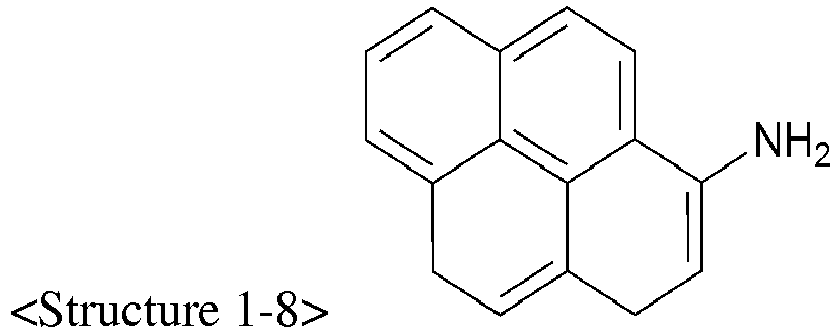


- Also, a compound represented by Chemical Formula 1 according to the present invention may be any one of compounds represented by <Structure 2-1> to <Structure 2-10> of the following Table 2:


- A compound represented by Chemical Formula 1 according to the present invention may have a structure in which a C1 to C20 alkyl chain is connected to a C6-20 aryl group (X). In this case, hydrophilic mono- to bi-functional groups such as a hydroxyl group, an amine group, a carboxyl group and the like may be bonded to the end of the alkyl chain. Also, a double bond may be further included in the alkyl chain by introducing acrylic acid (AA), methyl acrylate (MA), methyl methacrylate (MMA), 2-hydroxyethyl methacrylate (2-HEMA) and the like as a linker.
- A compound represented by Chemical Formula 1 may enable a carbon structure to be dispersed more homogeneously in a polymer through a C6-20 aryl group. Also, since an alkyl chain included in the compound is hydrophobic, dispersibility of a carbon structure with respect to an organic solvent may be improved. Furthermore, hydrophilic functional groups bonded to the end of the alkyl chain play a role in improving dispersibility of a carbon structure with respect to an aqueous solvent, and thus a double bond introduced into the alkyl chain may be used as a functional group of a chemical bond.
- The term 'modify' used herein means that a compound represented by Chemical Formula 1 is intercalated between carbon structures and is then adsorbed on the surface of carbon structures, and the carbon structures may have effects of adjusting intervals between the carbon structures and improving the dispersion force of carbon structures when modified.
- Generally, a carbon structure has advantages of having excellent physical and chemical stability, electrical conductivity, elasticity, strength, and thermal conductivity. However, despite such advantages, when dispersed, carbon structures are agglomerated by the Van der Waals force between carbon particles. As a result, intrinsic properties of carbon structures may not be used effectively.
- However, a modified carbon structure according to the present invention performs noncovalent adsorption in the form of a pi bond with an aryl group of a compound represented in Chemical Formula 1 and a hexagonal honeycomb structure composed of sp2 carbon of the surface of a carbon structure. That is, in a modified carbon structure according to the present invention, through noncovalent adsorption with an aryl group, polarizability of carbon structures and the Van der Waals force between particles of carbon structures may be weakened, and thus the cohesive force between particles of the carbon structures may be weakened, and as a result, the dispersion force may be improved.
- Specifically referring to
FIG. 3 , when in an exemplary embodiment, the dispersion force of a modified carbon structure according to the present invention is evaluated, and as a result, it can be seen that particles of carbon structures are not agglomerated but uniformly dispersed. - Also, a carbon structure according to the present invention is modified by a compound represented by Chemical Formula 1 so that the dispersion force may be improved. At the same time, when the carbon structure is a graphene nanoplatelet having a structure in which graphene is layered, intervals between the graphene may be adjusted according to a size and structure of a compound represented by Chemical Formula 1 which is adsorbed on the surface of the carbon structure, and thus properties of the carbon structure may also be adjusted.
- In this case, for example, carbon nanotubes (CNT), graphene, graphene nanoplatelets, or a mixture thereof may be used as the carbon structure according to the present invention. More specifically, non-oxidized graphene nanoplatelets may be used as the carbon structure.
- Oxidized graphene nanoplatelets have excellent dispersibility with respect to a hydrophilic solvent, but remarkably low electrical conductivity (3.7×10⁻⁷ S/cm). As a result, in the case of requiring electromagnetic properties, it is necessary to perform a process for reduction of the carbon structure. However, when non-oxidized graphene nanoplatelets are used as a carbon structure, a process for reduction of a carbon structure is excluded, and thus there are advantages of remarkably reducing a defect rate of a carbon structure as well as simplifying a process for preparing a carbon structure having a structure in which the carbon structure is dispersed in a polymer matrix.
- Here, since the graphene nanoplatelets are not oxidized, an oxygen (O) element content may be low. Specifically, the oxygen (O) element content of graphene nanoplatelets may be 10.0% by weight or less (an carbon (C) element content: 90.0% by weight or more), and more specifically, 9.00% by weight or less, 8.00% by weight or less, 7.00% by weight or less, 6.00% by weight or less, or 5.00% by weight or less with respect to a total weight of graphene nanoplatelets.
- Also, the modified carbon structure according to the present invention may have a structure in which a carbon structure is dispersed in a polymer matrix.
- In this case, the polymer matrix may be used without particular limitation as long as the polymer matrix does not affect a noncovalent bond between a surface of a modified carbon structure and a compound represented by Chemical Formula 1. Specifically, the polymer matrix may include one or more types of polymers selected from the group consisting of polyurethane, polyacrylate, a copolymer of urethane and an acryl, polyolefin, polystyrene, an epoxy resin, polyester, polypropylene, polyvinyl, polyamide, and a silane based resin.
- Further, the carbon structure according to the present invention may be included in an amount of 0.1 to 20 parts by weight with respect to 100 parts by weight of a polymer matrix.
- When the carbon structure according to the present invention is uniformly dispersed in a polymer matrix within the above range, not only mechanical strength but also electrical conductivity of a polymer matrix is effectively improved, and thus composites having excellent mechanical-electromagnetic properties may be prepared.
- Also, the present invention provides a method for preparing a carbon structure/polymer composite including:
- a step of preparing a mixture in which a suspension in which a carbon structure is dispersed is mixed with a solution in which a compound represented by the following Chemical Formula 1 is dissolved;
- a step of obtaining a modified carbon structure from the mixture; and
- a step of dispersing the modified carbon structure in a polymer matrix,
- wherein a concentration of the solution in which the compound represented by Chemical Formula 1 is dissolved is 0.1 to 5 M:

- In Chemical Formula 1,
- X is a C6-20 aryl group;
- Y is hydrogen or a C1-4 alkyl group;
- Z is one type selected from the group consisting of hydrogen, a hydroxyl group, an amine group, and a carboxyl group;
- o, p, q, and r are each independently integers ranging from 0 to 10, in which when p is 0, q is 0; and
- any one or more among hydrogen atoms of X, Y, and Z is unsubstituted or substituted with a C1-4 alkyl group, a halogen group, a hydroxyl group, an amine group, or a carboxyl group.
- Hereinafter, a method for preparing the carbon structure/polymer composite will be described in more detail step by step.
- First, in the step of preparing the mixture, the mixture in which a suspension in which a carbon structure is dispersed is mixed with a solution in which a compound represented by Chemical Formula 1 is dissolved is subjected to ultrasonic wave irradiation or stirring.
- Here, the suspension in which the carbon structure is dispersed is mixed with the solution in which the compound represented by Chemical Formula 1 is dissolved in the above-described step so that a compound of Chemical Formula 1 is intercalated between carbon structures and is adsorbed on a surface at the same time.
- In this case, a solvent used in a carbon structure suspension is not particularly limited as long as the carbon structure is easily dispersed. Specifically, water, a C1-4 alkyl alcohol, a mixture thereof and the like may be used. More specifically, methanol, ethanol, a mixed solvent of water and methanol (1:1 to 5, v/v) and the like may be used.
- Also, a concentration of the solution in which the compound represented by Chemical Formula 1 is dissolved may be 0.1 to 5 M, and more specifically 0.1 to 4 M; 0.1 to 3 M; 0.1 to 2 M; or 0.1 to 1 M. The solution in which the compound represented by Chemical Formula 1 according to the present invention is dissolved may increase efficiency of dispersing the carbon structure, within the above range, and may prevent the compound represented by Chemical Formula 1 from being precipitated due to supersaturation and overconsumption of a solvent.
- Further, the temperature of a prepared mixture is not particularly limited, but when prepared through ultrasonic wave irradiation, since a solvent of a suspension and a solution may be volatilized by increasing the temperature of the mixture, the mixture may be controlled at 60°C or less.
- Next, in the step of obtaining a modified carbon structure, the compound represented by Chemical Formula 1 is intercalated and adsorbed to obtain the modified carbon structure, the step may be performed through
a step of obtaining a solid content of the modified carbon structure by concentrating a mixture;
a step of pulverizing the solid content; and
a step of adding the solid content or a polymer matrix into a solvent. - In this case, the step of obtaining a solid content may be performed through distillation under reduced pressure, centrifugation and the like. Besides, any method which is conventionally used by one skilled in the art to concentrate a suspension may be used without particular limitation.
- Also, the step of pulverizing may be performed in order to reduce a particle size of an obtained solid content, and thus, dispersion of a pulverized carbon structure solid content may be remarkably improved with respect to a polymer matrix compared to that of a non-pulverized carbon structure solid content.
- Further, in the step of adding the solid content or the polymer matrix into the solvent, any one or more of the carbon structure and the polymer matrix is dispersed or dissolved in the solvent, may be performed in order to improve the operability of a subsequent process of dispersing the carbon structure in the polymer matrix.
- Next, the step of dispersing the modified carbon structure in the polymer matrix may be performed by ultrasonically irradiating or stirring a mixture of the modified carbon structure and a polymer matrix.
- In this case, the polymer matrix is not particularly limited as long as the polymer matrix does not affect a noncovalent bond of the carbon structure with the compound represented by Chemical Formula 1. Specifically, the polymer matrix may include one or more types of polymers selected from the group consisting of polyurethane, polyacrylate, a copolymer of urethane and an acryl, polyolefin, polystyrene, an epoxy resin, polyester, polypropylene, polyvinyl, polyamide, and a silane based resin.
- Also, the temperature of the mixture is not particularly limited, but when prepared through ultrasonic wave irradiation, since a solvent of a suspension and a solution may be volatilized by increasing the temperature of the mixture, the mixture may be controlled at 60°C or less.
- Meanwhile, in the present invention,
- a steel sheet; and
- a steel sheet formed on one side or both sides of the steel sheet, and having a cured coating film including a carbon structure/polymer composite are provided.
- A material of the steel sheet according to the present invention is not particularly limited, but specifically may be one or more selected from the group consisting of a cold rolled steel sheet; a galvanized steel sheet; a zinc-electroplated steel sheet; a hot dip galvanized steel sheet; an aluminum coated steel sheet; a plated steel sheet including cobalt, molybdenum, tungsten, nickel, titanium, aluminum, manganese, iron, magnesium, tin, copper, or a mixture thereof in a plated layer; an aluminum alloy plate in which silicon, copper, magnesium, iron, manganese, titanium, zinc, or a mixture thereof was added; a galvanized steel sheet applied with phosphate; and a hot rolled steel sheet.
- Also, a thickness of the steel sheet may be properly selected according to applicable purposes and uses of the used steel sheet. Specifically, steel sheets are divided into thick plates exceeding 6 mm, medium plates which are in a range of 1 to 6 mm, and thin plates which are less than 1 mm according to their thicknesses. Such steel sheets are properly adopted in the present invention according to applicable purposes.
- Further, a cured coating film formed on the steel sheet may include a carbon structure/polymer composite of the present invention. Since a carbon structure/polymer composite according to the present invention has two-dimensionally excellent orientation, and the cured coating film may be well layered on a surface of the steel sheet, in the surface of a steel sheet including the same, a heat dissipation property, surface polarity, electrical properties and the like may be readily realized. Here, thicknesses of cured coating films formed on one side or both sides of the steel sheet may be applied in various ways according to applicable purposes of the steel sheet.
- In addition, the cured coating film may be formed by dip coating, spin coating, printing, meniscus coating, or spray coating, and additionally, may be prepared by a method for coating a surface conventionally used by one skilled in the art.
- Hereinafter, the present invention will be described in more detail according to embodiment examples and an experimental example.
- However, the following embodiment examples and experimental example are merely presented to exemplify the present invention, and the content of the present invention is not limited to the following embodiment examples and experimental example.
- As shown in the following Table 1, a compound represented by Chemical Formula 1 was dissolved in methanol (20 mL) and a solution in which the compound of Chemical Formula 1 was dissolved was prepared. In this case, in the case of preparative Example 5, it was seen that the compound was precipitated due to supers aturation.
[Table 1] compound structure added amount (g) concentration of solution (M) Preparative Example 1 
0.00492 0.01 Preparative Example 2 0.00984 0.02 Preparative Example 3 0.01476 0.03 Preparative Example 4 0.02460 0.05 Preparative Example 5 0.04920 0.10 Preparative Example 6 
0.01152 0.02 Preparative Example 7 
0.00928 0.02 Preparative Example 8 
0.00868 0.02 - Graphene nanoplatelets used as a carbon structure were purchased from XG Sciences Co. in two forms including a granule type (Grade H, oxygen content: about 1% by weight or less, a specific surface area: 50 to 80 m2/g, and an average thickness: about 15 nm) and a granule/powder type (Grade C, oxygen content: about 8% by weight or less, a specific surface area: about 750 m2/g, and an average thickness: about 5 nm or less). Each of the graphene nanoplatelets was added in a mixed solvent of methanol/water (1/3, v/v) (10 mL) in an amount of 0.05 g, and then ultrasonic waves were irradiated for an hour and a half to prepare a carbon structure suspension.
- A noncovalent bond-modified carbon structure was prepared by mixing a solution prepared in Preparative Example 1 and a suspension (Grade H suspension) prepared in Preparative Example 9, and irradiating ultrasonic waves at 50 °C for 6 hours.
- As shown in the following Table 2, noncovalent bond-modified carbon structures were prepared by mixing solutions prepared in Preparative Examples 1 to 8 and suspensions prepared in Preparative Examples 9 and 10, and performing the same method as in Embodiment 1.
[Table 2] solution in which compound of Chemical Formula 1 is dissolved Carbonic acid structure suspension Embodiment Example 2 Preparative Example 2 Preparative Example 9 (Grade H suspension) Embodiment Example 3 Preparative Example 3 Preparative Example 9 (Grade H suspension) Embodiment Example 4 Preparative Example 4 Preparative Example 9 (Grade H suspension) Embodiment Example 5 Preparative Example 6 Preparative Example 9 (Grade H suspension) Embodiment Example 6 Preparative Example 7 Preparative Example 9 (Grade H suspension) Embodiment Example 7 Preparative Example 8 Preparative Example 9 (Grade H suspension) Embodiment Example 8 Preparative Example 1 Preparative Example 10 (Grade C suspension) Embodiment Example 9 Preparative Example 2 Preparative Example 10 (Grade C suspension) Embodiment Example 10 Preparative Example 3 Preparative Example 10 (Grade C suspension) Embodiment Example 11 Preparative Example 4 Preparative Example 10 (Grade C suspension) Embodiment Example 12 Preparative Example 6 Preparative Example 10 (Grade C suspension) Embodiment Example 13 Preparative Example 7 Preparative Example 10 (Grade C suspension) Embodiment Example 14 Preparative Example 8 Preparative Example 10 (Grade C suspension) - The modified graphene nanoplatelets prepared in Embodiment example 1 were dried under reduced pressure and then concentrated. A solid content obtained with the concentration was pulverized using a mortar, and polyamide (0.5 g, Mw=65,000) was dissolved in chloroform. A pulverized solid content was added in an amount of 5 parts by weight with respect to polyamide, and was ultrasonically treated at room temperature for 30 minutes to prepare a carbon structure solution having a structure in which a modified carbon structure was dispersed in a polymer matrix.
- A steel sheet was coated with a carbon structure solution prepared in Embodiment example 15 using a roll coater, and then cured to form a cured coating film having a thickness of 10 µm on one side of a steel sheet.
- To evaluate the dispersion force of a modified carbon structure according to the present invention, the following experiment was performed.
- In the process of modifying a carbon structure of Embodiment examples 1 to 14, the mixture state was observed with the naked eye right after mixing a carbon structure suspension and the solution in which the compound represented by Chemical Formula 1 was dissolved. Also, after ultrasonic wave was irradiated at 50 °C for 6 hours; 2 to 3 days pass; and 6 months pass, the mixture state was observed with the naked eye, results of which were shown in the following
FIGS. 1 to 3 . - As shown in
FIGS. 1 to 3 , it can be seen that the dispersion force of a noncovalent bond-modified carbon structure according to the present invention was improved. - More specifically, referring to
FIG. 1 , in mixtures of Embodiment examples 1 to 7, carbon structures were agglomerated right after mixing a suspension and a compound solution of Chemical Formula 1 in some cases, but over time, a carbon structure began to be suspended and dispersed at the same time, so that a solution was cloudy. Whereas, in a suspension to which the compound solution of Chemical Formula 1 is not added, all graphene nanoplatelets were precipitated, so that supernatant was clear. - In addition, referring
FIG. 2 , mixtures of Embodiment examples 1 to 7 were ultrasonically radiated at 50 °C for 6 hours. As a result, it was seen that, in mixtures of Embodiment examples 1, 4, 5, 6, and 7, the dispersion of graphene nanoplatelets was improved compared to a suspension to which the compound of Chemical Formula 1 was not added. Furthermore, it was seen that the 5 types of mixtures were maintained in a state of being homogeneously dispersed even after 2 to 3 days. Whereas, it was seen that all graphene nanoplatelets were precipitated after 24 hours when the compound of Chemical Formula 1 is not added. - Further, referring to
FIG. 3 , in mixtures of Embodiment examples 8 to 14, it was seen that graphene nanoplatelets were uniformly dispersed in a solution right after mixing a suspension and the compound solution of Chemical Formula 1. Also, the graphene nanoplatelets of Embodiment examples 8 to 14, although they may differ slightly depending on a mixed concentration of the compound represented by Chemical Formula 1, were maintained in a state of being uniformly dispersed in a solution even after 6 months. - Through such results, it can be seen that the dispersion force of a noncovalent bond-modified carbon structure according to the present invention is improved.
- Therefore, a noncovalent bond-modified carbon structure has advantages of enabling the control of properties by controlling intervals between carbon structures according to the size and structure of a compound represented by Chemical Formula 1, which is inserted and adsorbed between the carbon structures, and enabling uniform dispersion in a polymer matrix without a change in intrinsic properties.
- According to the present invention, a noncovalent bond-modified carbon structure has advantages of enabling the control of properties by controlling intervals between carbon structures according to the size and structure of a compound represented by Chemical formula 1, which is inserted and adsorbed between the carbon structures, and enabling uniform dispersion in a polymer matrix without a change in intrinsic properties. In addition, a carbon structure/polymer composite comprising the modified carbon structure and a polymer matrix is simply manufactured and readily layered due to excellent orientation when forming a cured coating film, and thus can be useful for manufacturing a steel sheet having remarkable heat radiation, surface polarity, electrical properties and the like.
Claims (11)
- A modified carbon structure which forms a noncovalent bond with a compound represented by the following Chemical Formula 1:
 X is a C6-20 aryl group;Y is hydrogen or a C1-4 alkyl group;Z is one type selected from the group consisting of hydrogen, a hydroxyl group, an amine group, and a carboxyl group;o, p, q, and r are each independently integers ranging from 0 to 10, in which when p is 0, q is 0; andany one or more among hydrogen atoms of X, Y, and Z are unsubstituted or substituted with a C1-4 alkyl group, a halogen group, a hydroxyl group, an amine group, or a carboxyl group.
 - The modified carbon structure according to claim 1,
wherein
X is one type selected from the group consisting of a phenyl group, a biphenyl group, a naphthyl group, an anthracenyl group, and a pyrenyl group,
the phenyl group, the biphenyl group, the naphthyl group, the anthracenyl group, and the pyrenyl group is capable of being unsubstituted or substituted with a methyl group, a ethyl group, a chloro group, a bromo group, a hydroxyl group, an amine group, or a carboxyl group;o, p, q, and r are each independently integers ranging from 0 to 5,in which when p is 0, q is 0. - The modified carbon structure according to claim 1,
wherein the compound represented by Chemical Formula 1 is any one of compounds represented by the following <Structure 1-1> to <Structure 1-10> :


- The modified carbon structure according to claim 1,
wherein the compound represented by Chemical Formula 1 is any one of compounds represented by the following <Structure 2-1> to <Structure 2-10>:
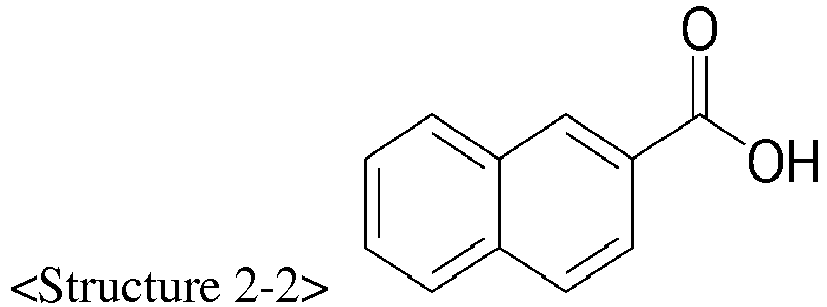


- The modified carbon structure according to claim 1,
wherein the carbon structure is one or more types selected from a group consisting of carbon nanotubes (CNT), graphene, and graphene nanoplatelets. - A carbon structure/polymer composite comprising:a polymer matrix; anda modified carbon structure which forms a noncovalent bond with a compound represented by the following Chemical Formula 1,wherein the carbon structure has a structure in which the carbon structure is dispersed in the polymer matrix, anda content of the carbon structure is 0.1 to 20 parts by weight with respect to 100 parts by weight of the polymer matrix:
 X is a C20 aryl group;Y is hydrogen or a C1-4 alkyl group;Z is one type selected from the group consisting of hydrogen, a hydroxyl group, an amine group, and a carboxyl group;o, p, q, and r are each independently integers ranging from 0 to 10, in which when p is 0, q is 0; andany one or more among hydrogen atoms of X, Y, and Z are unsubstituted or substituted with a C1-4 alkyl group, a halogen group, a hydroxyl group, an amine group, or a carboxyl group.
 - A method for preparing a carbon structure/polymer composite, comprising:a step of preparing a mixture in which a suspension in which a carbon structure is dispersed is mixed with a solution in which a compound represented by the following Chemical Formula 1 is dissolved;a step of obtaining a modified carbon structure from the mixture; anda step of dispersing the modified carbon structure in a polymer matrix,wherein a concentration of a solution in which the compound represented by Chemical Formula 1 is dissolved is 0.1 to 5 M:
 X is a C20 aryl group;Y is hydrogen or a C1-4 alkyl group;Z is one type selected from the group consisting of hydrogen, a hydroxyl group, an amine group, and a carboxyl group;o, p, q, and r are each independently integers ranging from 0 to 10, in which when p is 0, q is 0; andany one or more among hydrogen atoms of X, Y, and Z is unsubstituted or substituted with a C1-4 alkyl group, a halogen group, a hydroxyl group, an amine group, or a carboxyl group.
 - The method for preparing the carbon structure/polymer composite according to claim 7,
wherein the carbon structure of a carbon structure suspension is dispersed in one or more solvents selected from the group consisting of water and a C1-4 alkyl alcohol. - The method for preparing the carbon structure/polymer composite according to claim 7,
wherein the step of obtaining the modified carbon structure comprises:a step of obtaining a solid content of the modified carbon structure by concentrating a mixture;a step of pulverizing the solid content; anda step of adding the solid content or a polymer matrix into a solvent. - The method for preparing the carbon structure/polymer composite according to claim 7,
wherein any one or more steps of the step of preparing the mixture and the step of dispersing the modified carbon structure in the polymer matrix are performed by ultrasonically irradiating or stirring. - The method for preparing the carbon structure/polymer composite according to claim 10,
wherein ultrasonic wave irradiation is performed at 60°C or less.
Applications Claiming Priority (2)
| Application Number | Priority Date | Filing Date | Title |
|---|---|---|---|
| KR1020130162705A KR101624389B1 (en) | 2013-12-24 | 2013-12-24 | Non-covalent bond modified carbon structure and carbon structure/polymer composite containing the same |
| PCT/KR2014/012846 WO2015099462A1 (en) | 2013-12-24 | 2014-12-24 | Noncovalent bond-modified carbon structure, and carbon structure/polymer composite comprising same |
Publications (2)
| Publication Number | Publication Date |
|---|---|
| EP3088356A1 true EP3088356A1 (en) | 2016-11-02 |
| EP3088356A4 EP3088356A4 (en) | 2017-01-04 |
Family
ID=53479226
Family Applications (1)
| Application Number | Title | Priority Date | Filing Date |
|---|---|---|---|
| EP14873935.2A Withdrawn EP3088356A4 (en) | 2013-12-24 | 2014-12-24 | Noncovalent bond-modified carbon structure, and carbon structure/polymer composite comprising same |
Country Status (5)
| Country | Link |
|---|---|
| US (1) | US10544324B2 (en) |
| EP (1) | EP3088356A4 (en) |
| KR (1) | KR101624389B1 (en) |
| CN (1) | CN105849039B (en) |
| WO (1) | WO2015099462A1 (en) |
Cited By (1)
| Publication number | Priority date | Publication date | Assignee | Title |
|---|---|---|---|---|
| EP3428121A4 (en) * | 2016-03-09 | 2019-11-13 | Toray Industries, Inc. | SURFACE TREATED GRAPHENE, SURFACE-TREATED GRAPHENE DISPERSION FLUID / ORGANIC SOLVENT, SURFACE-TREATED GRAPHENE COMPOSITE PARTICLES / ELECTRODE ACTIVE MATERIAL, AND ELECTRODE PULP |
Families Citing this family (11)
| Publication number | Priority date | Publication date | Assignee | Title |
|---|---|---|---|---|
| US10049784B2 (en) * | 2015-10-07 | 2018-08-14 | King Fahd University Of Petroleum And Minerals | Nanocomposite films with conducting and insulating surfaces |
| WO2019126196A1 (en) | 2017-12-22 | 2019-06-27 | Lyten, Inc. | Structured composite materials |
| US11352481B2 (en) | 2018-02-28 | 2022-06-07 | Lyten, Inc. | Composite materials systems |
| US10472497B2 (en) | 2018-02-28 | 2019-11-12 | Lyten, Inc. | Composite materials systems containing carbon and resin |
| KR102174536B1 (en) * | 2019-05-21 | 2020-11-05 | 연세대학교 산학협력단 | Polyamide-carbon nanotube nanocomposite and method for manufacturing the same |
| US11489161B2 (en) | 2019-10-25 | 2022-11-01 | Lyten, Inc. | Powdered materials including carbonaceous structures for lithium-sulfur battery cathodes |
| US11309545B2 (en) | 2019-10-25 | 2022-04-19 | Lyten, Inc. | Carbonaceous materials for lithium-sulfur batteries |
| KR20230066951A (en) | 2021-11-08 | 2023-05-16 | 한국전기연구원 | Non-oxidized carbon nanotube dispersion using alkylamine, manufacturing method thereof, and conductive fiber using same |
| KR102943504B1 (en) | 2022-05-26 | 2026-03-24 | 한국전기연구원 | Non-oxidized carbon nanotube dispersion and method for manufacturing of the same |
| KR20240058334A (en) | 2022-10-26 | 2024-05-03 | 한국전기연구원 | Method for manufacturing non-oxidized carbon nanotube slurry for secondary battery active material coating, and on-oxidized carbon nanotube slurry manufactured by the same, and method for manufacturing active material coated with non-oxidized carbon nanotube slurry, and active material manufactured by the same |
| KR20250067603A (en) | 2023-11-08 | 2025-05-15 | 한국전기연구원 | Manufacturing of high-concentration non-oxidized carbon nanotube slurry using a cyclic process of high-shear dispersion and ultrasonic dispersion |
Family Cites Families (22)
| Publication number | Priority date | Publication date | Assignee | Title |
|---|---|---|---|---|
| US8029734B2 (en) * | 2001-03-29 | 2011-10-04 | The Board Of Trustees Of The Leland Stanford Junior University | Noncovalent sidewall functionalization of carbon nanotubes |
| US6905667B1 (en) * | 2002-05-02 | 2005-06-14 | Zyvex Corporation | Polymer and method for using the polymer for noncovalently functionalizing nanotubes |
| WO2005120823A2 (en) * | 2004-02-18 | 2005-12-22 | University Of Florida | Non-covalent bonding agent for carbon nanotube reinforced polymer composites |
| KR100713222B1 (en) | 2005-08-05 | 2007-05-02 | 한국과학기술연구원 | Carbon nanotubes modified with pyrene derivatives, high dielectric polymer / carbon nanotube composites using the same, and methods for their preparation |
| US20100137528A1 (en) * | 2006-08-29 | 2010-06-03 | Sample Jennifer L | Method for Functionalizing Nanotubes and Improved Polymer-Nanotube Composites Formed Using Same |
| WO2009023337A2 (en) * | 2007-05-17 | 2009-02-19 | University Of Florida Research Foundation, Inc. | Supramolecular polymers associative to carbon nanotubes |
| US20090068244A1 (en) * | 2007-09-12 | 2009-03-12 | Boston Scientific Scimed, Inc. | Polymeric/carbon composite materials for use in medical devices |
| US8343450B2 (en) * | 2007-10-09 | 2013-01-01 | Chemnano Materials, Ltd. | Functionalized carbon nanotubes, recovery of radionuclides and separation of actinides and lanthanides |
| KR101018334B1 (en) | 2009-03-31 | 2011-03-04 | 한국과학기술연구원 | Graphene Coated Electrically Conductive Fine Particles and Manufacturing Method Thereof |
| KR101098449B1 (en) | 2009-10-29 | 2011-12-23 | 주식회사 제이씨 | Dispersion method of carbon nanotube, device for dispersing carbon nanotube and carbon nanotube dispersion material obtained using the same |
| KR101135578B1 (en) * | 2009-11-30 | 2012-04-17 | 현대자동차주식회사 | Method of Increasing Hydrophilic property of Crystalline carbon using Surface modifier and Preparing method of Platinum Catalyst using the same |
| KR101537987B1 (en) * | 2010-08-11 | 2015-07-20 | 보드 오브 리전츠, 더 유니버시티 오브 텍사스 시스템 | Fabrication method of composite carbon nanotube fibers/yarns |
| US8476510B2 (en) * | 2010-11-03 | 2013-07-02 | Massachusetts Institute Of Technology | Compositions comprising and methods for forming functionalized carbon-based nanostructures |
| KR101403989B1 (en) * | 2010-11-09 | 2014-06-10 | 포항공과대학교 산학협력단 | Graphene coated steel and method for preparing thereof |
| FR2974314B1 (en) * | 2011-04-19 | 2013-05-10 | Snecma Propulsion Solide | PROCESS FOR THE PREPARATION OF A MONOLITHIC CATALYSIS ELEMENT COMPRISING A FIBROUS CARRIER AND THE MONOLITHIC ELEMENT OF CATALYSIS |
| KR101325530B1 (en) | 2011-10-06 | 2013-11-07 | 주식회사 케이씨씨 | Functionalized methods of high quality graphene using conjugated system |
| KR20130077780A (en) | 2011-12-29 | 2013-07-09 | 제일모직주식회사 | Complex of carbon nanotube and polyphenyl ether, method for preparing the same and article comprising the same |
| SG10201608939XA (en) * | 2012-04-26 | 2016-12-29 | Brewer Science Inc | Multifunctional alcohol dispersions of carbon nanotubes |
| TWI450821B (en) * | 2012-05-03 | 2014-09-01 | Taiwan Textile Res Inst | Transparent electrode with flexibility and method for manufacturing the same |
| KR20130134446A (en) | 2012-05-31 | 2013-12-10 | 한국생산기술연구원 | Functionalized graphene and polymer-functionalized graphene hybrid complex and the fabrication methods thereof |
| WO2014040275A1 (en) * | 2012-09-14 | 2014-03-20 | Empire Technology Development Llc | Graphene and carbon nanotube compositions |
| EP2939979B1 (en) * | 2012-12-28 | 2021-10-27 | Posco | Graphene-polymer coated steel sheet |
-
2013
- 2013-12-24 KR KR1020130162705A patent/KR101624389B1/en active Active
-
2014
- 2014-12-24 WO PCT/KR2014/012846 patent/WO2015099462A1/en not_active Ceased
- 2014-12-24 CN CN201480070845.6A patent/CN105849039B/en active Active
- 2014-12-24 US US15/108,267 patent/US10544324B2/en active Active
- 2014-12-24 EP EP14873935.2A patent/EP3088356A4/en not_active Withdrawn
Cited By (1)
| Publication number | Priority date | Publication date | Assignee | Title |
|---|---|---|---|---|
| EP3428121A4 (en) * | 2016-03-09 | 2019-11-13 | Toray Industries, Inc. | SURFACE TREATED GRAPHENE, SURFACE-TREATED GRAPHENE DISPERSION FLUID / ORGANIC SOLVENT, SURFACE-TREATED GRAPHENE COMPOSITE PARTICLES / ELECTRODE ACTIVE MATERIAL, AND ELECTRODE PULP |
Also Published As
| Publication number | Publication date |
|---|---|
| US20160326393A1 (en) | 2016-11-10 |
| EP3088356A4 (en) | 2017-01-04 |
| CN105849039B (en) | 2019-11-29 |
| US10544324B2 (en) | 2020-01-28 |
| KR101624389B1 (en) | 2016-05-25 |
| CN105849039A (en) | 2016-08-10 |
| KR20150074684A (en) | 2015-07-02 |
| WO2015099462A1 (en) | 2015-07-02 |
Similar Documents
| Publication | Publication Date | Title |
|---|---|---|
| US10544324B2 (en) | Noncovalent bond-modified carbon structure, and carbon structure/polymer composite comprising same | |
| CN105873858B (en) | Preparation method of graphene and dispersion composition of graphene | |
| Shen et al. | Bioinspired modification of h-BN for high thermal conductive composite films with aligned structure | |
| US10696790B2 (en) | Graphene dispersant and application thereof | |
| KR101389656B1 (en) | Carbon nanotube-containing composition, composite body, and their production methods | |
| CN102634276B (en) | Heavy-duty anticorrosive polyaniline coating and preparation method thereof | |
| EP3050844A1 (en) | Exfoliation of graphite with deep eutectic solvents | |
| CN104884383B (en) | Graphene oxide, graphene polymer complex | |
| EP3228592A1 (en) | Graphene dispersant and application thereof | |
| CN102390830B (en) | Method for preparing polyamide-amine in-situ intercalation graphene composite material | |
| Shan et al. | Preparation and infrared emissivity study of collagen-g-PMMA/In2O3 nanocomposite | |
| TWI579365B (en) | Conductive plastic | |
| Dao et al. | Water-dispersible graphene designed as a Pickering stabilizer for the suspension polymerization of poly (methyl methacrylate)/graphene core–shell microsphere exhibiting ultra-low percolation threshold of electrical conductivity | |
| Zhang et al. | Superior anticorrosion performance of well-dispersed MXene-polymer composite coatings enabled by covalent modification and ambient electron-beam curing | |
| Spyrou et al. | Towards novel multifunctional pillared nanostructures: Effective intercalation of adamantylamine in graphene oxide and smectite clays | |
| WO2013080843A1 (en) | Functional-group-modified carbon material, and method for producing same | |
| CN105642184A (en) | Graphene dispersant and applications thereof | |
| CN105645388A (en) | Graphene dispersant and applications thereof | |
| CN104384524A (en) | Method for preparing flake graphite single/multiple load precious metal nano particles | |
| CN107828309B (en) | Dispersion used for graphene anticorrosive paint and preparation method thereof | |
| Li et al. | Fabrication of graphene-coated poly (glycidyl methacrylate) microspheres by electrostatic interaction and their application in epoxy anticorrosion coatings | |
| WO2015099378A1 (en) | Graphene production method, and graphene dispersion composition | |
| CN105778571A (en) | Graphene composite slurry and preparation method thereof | |
| Deshmukh et al. | One-step green production of biocompatible functionalized few-layer graphene/boron nitride nanosheet hybrids using tannic acid-based liquid-phase exfoliation | |
| Bae et al. | Mussel-inspired dopamine-mediated graphene hybrid with silver nanoparticles for high performance electrochemical energy storage electrodes |
Legal Events
| Date | Code | Title | Description |
|---|---|---|---|
| PUAI | Public reference made under article 153(3) epc to a published international application that has entered the european phase |
Free format text: ORIGINAL CODE: 0009012 |
|
| 17P | Request for examination filed |
Effective date: 20160722 |
|
| AK | Designated contracting states |
Kind code of ref document: A1 Designated state(s): AL AT BE BG CH CY CZ DE DK EE ES FI FR GB GR HR HU IE IS IT LI LT LU LV MC MK MT NL NO PL PT RO RS SE SI SK SM TR |
|
| AX | Request for extension of the european patent |
Extension state: BA ME |
|
| A4 | Supplementary search report drawn up and despatched |
Effective date: 20161207 |
|
| RIC1 | Information provided on ipc code assigned before grant |
Ipc: C01B 31/02 00000000AFI20161201BHEP Ipc: H01B 1/24 20060101ALI20161201BHEP Ipc: C01B 31/04 00000000ALI20161201BHEP Ipc: C08J 3/20 20060101ALI20161201BHEP |
|
| DAX | Request for extension of the european patent (deleted) | ||
| 17Q | First examination report despatched |
Effective date: 20180212 |
|
| STAA | Information on the status of an ep patent application or granted ep patent |
Free format text: STATUS: THE APPLICATION IS DEEMED TO BE WITHDRAWN |
|
| 18D | Application deemed to be withdrawn |
Effective date: 20200226 |