EP3086616A2 - Device and method of handling cell reselection - Google Patents
Device and method of handling cell reselection Download PDFInfo
- Publication number
- EP3086616A2 EP3086616A2 EP16154037.2A EP16154037A EP3086616A2 EP 3086616 A2 EP3086616 A2 EP 3086616A2 EP 16154037 A EP16154037 A EP 16154037A EP 3086616 A2 EP3086616 A2 EP 3086616A2
- Authority
- EP
- European Patent Office
- Prior art keywords
- communication device
- cell
- measurement result
- storage unit
- time interval
- Prior art date
- Legal status (The legal status is an assumption and is not a legal conclusion. Google has not performed a legal analysis and makes no representation as to the accuracy of the status listed.)
- Ceased
Links
Images




Classifications
-
- H—ELECTRICITY
- H04—ELECTRIC COMMUNICATION TECHNIQUE
- H04J—MULTIPLEX COMMUNICATION
- H04J11/00—Orthogonal multiplex systems, e.g. using WALSH codes
-
- H—ELECTRICITY
- H04—ELECTRIC COMMUNICATION TECHNIQUE
- H04W—WIRELESS COMMUNICATION NETWORKS
- H04W36/00—Hand-off or reselection arrangements
- H04W36/0005—Control or signalling for completing the hand-off
- H04W36/0083—Determination of parameters used for hand-off, e.g. generation or modification of neighbour cell lists
- H04W36/00837—Determination of triggering parameters for hand-off
-
- H—ELECTRICITY
- H04—ELECTRIC COMMUNICATION TECHNIQUE
- H04W—WIRELESS COMMUNICATION NETWORKS
- H04W36/00—Hand-off or reselection arrangements
- H04W36/24—Reselection being triggered by specific parameters
- H04W36/30—Reselection being triggered by specific parameters by measured or perceived connection quality data
- H04W36/302—Reselection being triggered by specific parameters by measured or perceived connection quality data due to low signal strength
-
- H—ELECTRICITY
- H04—ELECTRIC COMMUNICATION TECHNIQUE
- H04W—WIRELESS COMMUNICATION NETWORKS
- H04W48/00—Access restriction; Network selection; Access point selection
- H04W48/16—Discovering, processing access restriction or access information
-
- H—ELECTRICITY
- H04—ELECTRIC COMMUNICATION TECHNIQUE
- H04W—WIRELESS COMMUNICATION NETWORKS
- H04W72/00—Local resource management
- H04W72/04—Wireless resource allocation
- H04W72/044—Wireless resource allocation based on the type of the allocated resource
- H04W72/0446—Resources in time domain, e.g. slots or frames
-
- H—ELECTRICITY
- H04—ELECTRIC COMMUNICATION TECHNIQUE
- H04W—WIRELESS COMMUNICATION NETWORKS
- H04W76/00—Connection management
- H04W76/20—Manipulation of established connections
- H04W76/28—Discontinuous transmission [DTX]; Discontinuous reception [DRX]
-
- H—ELECTRICITY
- H04—ELECTRIC COMMUNICATION TECHNIQUE
- H04W—WIRELESS COMMUNICATION NETWORKS
- H04W36/00—Hand-off or reselection arrangements
- H04W36/08—Reselecting an access point
-
- H—ELECTRICITY
- H04—ELECTRIC COMMUNICATION TECHNIQUE
- H04W—WIRELESS COMMUNICATION NETWORKS
- H04W48/00—Access restriction; Network selection; Access point selection
- H04W48/20—Selecting an access point
-
- H—ELECTRICITY
- H04—ELECTRIC COMMUNICATION TECHNIQUE
- H04W—WIRELESS COMMUNICATION NETWORKS
- H04W88/00—Devices specially adapted for wireless communication networks, e.g. terminals, base stations or access point devices
- H04W88/02—Terminal devices
Definitions
- the present invention relates to a communication device and a method of handling a cell reselection in a wireless communication system.
- LTE long-term evolution
- 3GPP 3rd Generation Partnership Project
- 3GPP Rel-8 3rd Generation Partnership Project
- 3GPP Rel-9 3rd Generation Partnership Project
- UMTS universal mobile telecommunication system
- the LTE system includes a new radio interface and a new radio network architecture that provides high data rate, low latency, packet optimization, and improved system capacity and coverage.
- a radio access network known as an evolved universal terrestrial radio access network (E-UTRAN) includes multiple evolved Node-Bs (eNBs) for communicating with multiple user equipments (UEs), and for communicating with a core network including a mobility management entity (MME), a serving gateway, etc., for Non-Access Stratum (NAS) control.
- E-UTRAN evolved universal terrestrial radio access network
- eNBs evolved Node-Bs
- MME mobility management entity
- serving gateway etc.
- NAS Non-Access Stratum
- LTE-advanced (LTE-A) system is an evolution of the LTE system.
- the LTE-A system targets faster switching between power states, improves performance at the coverage edge of an eNB, and includes advanced techniques, such as carrier aggregation (CA), coordinated multipoint (CoMP) transmissions/reception, uplink (UL) multiple-input multiple-output (UL-MIMO), etc.
- CA carrier aggregation
- CoMP coordinated multipoint
- UL-MIMO uplink
- the UE and the eNB must support standards developed for the LTE-A system, such as the 3GPP Rel-10 standard or later versions.
- the UE may measure cell(s) in each paging cycle to obtain a measurement result, when the UE is in an idle mode. Then, the UE may perform a cell reselection operation according to the measurement result.
- a time interval between time instants for obtaining two measurement results may be too long, when the UE uses an extended discontinuous reception (eDRX).
- eDRX extended discontinuous reception
- an eDRX cycle e.g., 5 minutes
- an original maximum paging cycle e.g., 2.56 seconds
- previous measurement results may be obtained 5 minutes ago, when the measurement result is obtained in the eDRX cycle.
- the previous measurement results may be useless or outdated for the cell reselection operation.
- the present invention therefore provides a communication device and a method for handling a cell reselection to solve the abovementioned problem.
- the claimed communication device for handling a cell reselection comprises a storage unit for storing instructions and a processing means coupled to the storage unit.
- the processing means is configured to execute the instructions stored in the storage unit.
- the instructions comprise performing a measurement on at least one cell one time in an extended discontinuous reception (eDRX) cycle to obtain a measurement result; stopping performing at least one layer filtering mechanism on the measurement result; and transmitting the measurement result to a network.
- eDRX extended discontinuous reception
- Fig. 1 is a schematic diagram of a wireless communication system 10 according to an example of the present invention.
- the wireless communication system 10 is briefly composed of a network and a plurality of communication devices.
- the network and the communication devices are simply utilized for illustrating the structure of the wireless communication system 10.
- the network can be a universal terrestrial radio access network (UTRAN) comprising at least one Node-B (NB) in a universal mobile telecommunications system (UMTS).
- UTRAN universal terrestrial radio access network
- NB Node-B
- UMTS universal mobile telecommunications system
- the network can be an evolved UTRAN (E-UTRAN) comprising at least one evolved NB (eNB) and/or at least one relay in a long term evolution (LTE) system, a LTE-Advanced (LTE-A) system or an evolution of the LTE-A system.
- E-UTRAN evolved UTRAN
- eNB evolved NB
- LTE-A LTE-Advanced
- LTE-A evolution of the LTE-A system.
- the network can also include both the UTRAN/E-UTRAN and a core network, wherein the core network includes network entities such as Mobility Management Entity (MME), Serving Gateway (S-GW), Packet Data Network (PDN) Gateway (P-GW), Self-Organizing Networks (SON) server and/or Radio Network Controller (RNC), etc.
- MME Mobility Management Entity
- S-GW Serving Gateway
- PDN Packet Data Network
- P-GW Packet Data Network Gateway
- SON Self-Organizing Networks
- RNC Radio Network Controller
- the network may be processed only by the UTRAN/E-UTRAN and decisions corresponding to the information are made at the UTRAN/E-UTRAN.
- the UTRAN/E-UTRAN may forward the information to the core network, and the decisions corresponding to the information are made at the core network after the core network processes the information.
- the information can be processed by both the UTRAN/E-UTRAN and the core network, and the decisions are made after coordination and/or cooperation are performed by the
- a communication device can be a user equipment (UE), a low cost device (e.g., machine type communication (MTC) device), a device-to-device (D2D) device, a mobile phone, a laptop, a tablet computer, an electronic book, a portable computer system, or combination thereof.
- the network and the communication device can be seen as a transmitter or a receiver according to direction (i.e., transmission direction), e.g., for an uplink (UL), the communication device is the transmitter and the network is the receiver, and for a downlink (DL), the network is the transmitter and the communication device is the receiver.
- direction i.e., transmission direction
- Fig. 2 is a schematic diagram of a communication device 20 according to an example of the present invention.
- the communication device 20 may be the communication device, the network NET1 and/or the network NET2 shown in Fig. 1 , but is not limited herein.
- the communication device 20 may include a processing means 200 such as a microprocessor or Application Specific Integrated Circuit (ASIC), a storage unit 210 and a communication interfacing unit 220.
- the storage unit 210 may be any data storage device that may store a program code 214, accessed and executed by the processing means 200.
- Examples of the storage unit 210 include but are not limited to a subscriber identity module (SIM), read-only memory (ROM), flash memory, random-access memory (RAM), Compact Disc Read-Only Memory (CD-ROM), digital versatile disc-ROM (DVD-ROM), Blu-ray Disc-ROM (BD-ROM), magnetic tape, hard disk, optical data storage device, non-volatile storage unit, non-transitory computer-readable medium (e.g., tangible media), etc.
- SIM subscriber identity module
- ROM read-only memory
- flash memory random-access memory
- RAM Compact Disc Read-Only Memory
- DVD-ROM digital versatile disc-ROM
- BD-ROM Blu-ray Disc-ROM
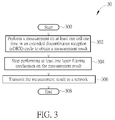
- Fig. 3 is a flowchart of process 30 according to an example of the present invention.
- the process 30 may be utilized in a communication device (e.g., UE) in Fig. 1 , to handle a cell reselection.
- the process 30 may be compiled into the program code 214 and includes the following steps:
- the communication device may perform a measurement on at least one cell one time in an eDRX cycle to obtain a measurement result.
- the communication device may stop performing at least one layer filtering mechanism on the measurement result.
- the communication device may transmit the measurement result to a network. That is, the at least one layer filtering mechanism may not be needed (e.g., used), after the measurement result is obtained (e.g., measured) in the eDRX cycle.
- the communication device does not wait for filtering multiple measurement results, and the measurement result may be transmitted immediately.
- the eDRX cycle in the process 30 may be greater than a predetermined time period.
- the eDRX cycle may be 5 minutes and the predetermined time period may be 10 seconds. That is, the effect of the long eDRX cycle on the measurement result can be avoided according to the process 30.
- the at least one layer filtering mechanism may include a layer 1 filtering mechanism and/or a layer 3 filtering mechanism. That is, the communication device may stop using the layer 1 filtering mechanism or the layer 3 filtering mechanism on the measurement result. The communication device may stop using both the layer 1 filtering mechanism and the layer 3 filtering mechanism on the measurement result.
- the communication device may stop performing the at least one layer filtering mechanism by setting a parameter filterCoefficient for the eDRX cycle to zero.
- the layer 3 filtering mechanism may be stopped by setting the parameter filterCoefficient k to zero in a filtering equation of the layer 3 filtering mechanism.
- the at least one cell in the process 30 may include a serving cell or at least one neighbor cell. Further, the at least one cell in the process 30 may include the serving cell and the at least one neighbor cell.
- the communication device may stop the at least one layer filtering mechanism such that the measurement result can be used efficiently for the cell reselection, when the measurement result is obtain in the eDRX cycle.
- the inefficient usage of the measurement result due to the long eDRX cycle for the cell reselection operation is solved.
- Fig. 4 is a flowchart of process 40 according to an example of the present invention.
- the process 40 may be utilized in a communication device (e.g., UE) in Fig. 1 , to handle a cell reselection.
- the process 40 may be compiled into the program code 214 and includes the following steps:
- the communication device may perform a measurement on a serving cell in an eDRX cycle to obtain a measurement result.
- the communication device may determine whether the measurement result fulfills a cell selection criterion.
- the communication device may measure at least one neighbor cell, if the measurement result is determined not to fulfill the cell selection criterion one time. That is, the at least one neighbor cell may be measured immediately, if a single measurement result of the serving cell does not fulfill the cell selection criterion one time.
- a single eDRX cycle is used for determining whether the measurement result fulfills the cell selection criterion.
- the eDRX cycle in the process 40 may be greater than a predetermined time period.
- the eDRX cycle may be 5 minutes and the predetermined time period may be 10 seconds. That is, the effect of the long eDRX cycle on the measurement result can be avoided according to the process 40.
- the communication device may determine whether the measurement result fulfills the cell selection criterion by setting a parameter N serv for the eDRX cycle to 1.
- the parameter N serv is a number of eDRX cycles. That is, a measurement result in a single eDRX cycle is used for determining whether the measurement result fulfills the cell selection criterion, and the communication device does no need to wait for multiple eDRX cycles.
- the cell selection criterion may include a cell selection criterion S.
- the communication device may measure the at least one neighbor cell, if the measurement result of the serving cell in the eDRX cycle does not fulfill the cell selection criterion.
- the inefficient usage of the measurement result due to the long eDRX cycle for the cell reselection operation is solved.
- Fig. 5 is a flowchart of process 50 according to an example of the present invention.
- the process 50 may be utilized in a communication device (e.g., UE) in Fig. 1 , to handle a cell reselection.
- the process 50 may be compiled into the program code 214 and includes the following steps:
- the communication device may perform a measurement on at least one neighbor cell in an eDRX cycle to obtain at least one measurement result of the at least one neighbor cell, when the communication device camps on (e.g., is served by) a serving cell.
- the communication device may delete at least one time interval for evaluating the at least one measurement result.
- the communication device may determine whether the at least one measurement result fulfills cell reselection criteria.
- the communication device may perform a cell reselection for transferring from the serving cell to a neighbor cell of the at least one neighbor cell, if a measurement result of the neighbor cell is determined to fulfill the cell reselection criteria. That is, the communication device may reselect the neighbor cell immediately, if the measurement result of the measured neighbor cell in the eDRX cycle fulfills the cell selection criteria.
- the eDRX cycle in the process 50 may be greater than a predetermined time period.
- the eDRX cycle may be 5 minutes and the predetermined time period may be 10 seconds. That is, the effect of the long eDRX cycle on the measurement result can be avoided according to the process 50.
- the at least one timer may include a time interval T reselection , a time interval T evaluate,E-UTRAN_Intra , a time interval T detect,EUTRAN_Intra , a time interval TreselectionRAT, a time interval T evaluate,E-UTRAN_Inter and/or a time interval T detect,EUTRAN_Inter .
- the communication device may delete the time interval T reselection , the time interval T evaluate,E-UTRAN_Intra, and the time interval T detect,EUTRAN_Intra in an intra-frequency cell reselection criteria.
- the communication device may delete the time interval T reselection RAT, the time interval T evaluate,E-UTRAN_Inter and the time interval T detect,EUTRAN_Inter in an inter-frequency cell reselection criteria.
- the communication device may reselect the neighbor cell immediately by deleting the abovementioned interval(s), if the measurement result of the serving cell in the eDRX cycle fulfills the cell reselection criteria.
- the inefficient usage of the measurement result because of the long eDRX cycle for the cell reselection operation is solved.
- Examples of the hardware may include analog circuit(s), digital circuit(s) and/or mixed circuit(s).
- the hardware may include ASIC(s), field programmable gate array(s) (FPGA(s)), programmable logic device(s), coupled hardware components or combination thereof.
- the hardware may include general-purpose processor(s), microprocessor(s), controller(s), digital signal processor(s) (DSP(s)) or combination thereof.
- Examples of the software may include set(s) of codes, set(s) of instructions and/or set(s) of functions retained (e.g., stored) in a storage unit, e.g., a computer-readable medium.
- the computer-readable medium may include SIM, ROM, flash memory, RAM, CD-ROM/DVD-ROM/BD-ROM, magnetic tape, hard disk, optical data storage device, non-volatile storage unit, or combination thereof.
- the computer-readable medium (e.g., storage unit) may be coupled to at least one processor internally (e.g., integrated) or externally (e.g., separated).
- the at least one processor which may include one or more modules may (e.g., be configured to) execute the software in the computer-readable medium.
- the set(s) of codes, the set(s) of instructions and/or the set(s) of functions may cause the at least one processor, the module(s), the hardware and/or the electronic system to perform the related steps.
- Examples of the electronic system may include a system on chip (SoC), system in package (SiP), a computer on module (CoM), a computer program product, an apparatus, a mobile phone, a laptop, a tablet computer, an electronic book or a portable computer system, and the communication device 20.
- SoC system on chip
- SiP system in package
- CoM computer on module
- a computer program product an apparatus, a mobile phone, a laptop, a tablet computer, an electronic book or a portable computer system, and the communication device 20.
- the present invention provides a device and a method for handling a cell reselection.
- the communication device does not perform at least one filtering mechanism for multiple measurement results, and transmits a single measurement result to a network immediately.
- a single eDRX cycle is used for determining whether the measurement result fulfills the cell selection criterion, and at least one neighbor cell may be measured immediately according to the determination.
- a single eDRX cycle is used for determining whether the measurement result fulfills the cell reselection criteria, and a cell reselection may be performed immediately according to the determination.
Landscapes
- Engineering & Computer Science (AREA)
- Computer Networks & Wireless Communication (AREA)
- Signal Processing (AREA)
- Computer Security & Cryptography (AREA)
- Mobile Radio Communication Systems (AREA)
Abstract
Description
- The present invention relates to a communication device and a method of handling a cell reselection in a wireless communication system.
- A long-term evolution (LTE) system supporting the 3rd Generation Partnership Project (3GPP) Rel-8 standard and/or the 3GPP Rel-9 standard are developed by the 3GPP as a successor of the universal mobile telecommunication system (UMTS) for further enhancing performance of the UMTS to satisfy increasing needs of users. The LTE system includes a new radio interface and a new radio network architecture that provides high data rate, low latency, packet optimization, and improved system capacity and coverage. In the LTE system, a radio access network known as an evolved universal terrestrial radio access network (E-UTRAN) includes multiple evolved Node-Bs (eNBs) for communicating with multiple user equipments (UEs), and for communicating with a core network including a mobility management entity (MME), a serving gateway, etc., for Non-Access Stratum (NAS) control.
- A LTE-advanced (LTE-A) system, as its name implies, is an evolution of the LTE system. The LTE-A system targets faster switching between power states, improves performance at the coverage edge of an eNB, and includes advanced techniques, such as carrier aggregation (CA), coordinated multipoint (CoMP) transmissions/reception, uplink (UL) multiple-input multiple-output (UL-MIMO), etc. For a UE and an eNB to communicate with each other in the LTE-A system, the UE and the eNB must support standards developed for the LTE-A system, such as the 3GPP Rel-10 standard or later versions.
- The UE may measure cell(s) in each paging cycle to obtain a measurement result, when the UE is in an idle mode. Then, the UE may perform a cell reselection operation according to the measurement result. However, a time interval between time instants for obtaining two measurement results may be too long, when the UE uses an extended discontinuous reception (eDRX). For example, an eDRX cycle (e.g., 5 minutes) may be greater than an original maximum paging cycle (e.g., 2.56 seconds). That is, previous measurement results may be obtained 5 minutes ago, when the measurement result is obtained in the eDRX cycle. Thus, the previous measurement results may be useless or outdated for the cell reselection operation.
- Thus, how to modify existing cell reselection operation is an important topic to be discussed.
- The present invention therefore provides a communication device and a method for handling a cell reselection to solve the abovementioned problem.
- This is achieved by a communication device and a network for handling a cell reselection according to the independent claims here below. The dependent claims pertain to corresponding further developments and improvements.
- As will be seen more clearly from the detailed description following below, the claimed communication device for handling a cell reselection comprises a storage unit for storing instructions and a processing means coupled to the storage unit. The processing means is configured to execute the instructions stored in the storage unit. The instructions comprise performing a measurement on at least one cell one time in an extended discontinuous reception (eDRX) cycle to obtain a measurement result; stopping performing at least one layer filtering mechanism on the measurement result; and transmitting the measurement result to a network.
-
-
Fig. 1 is a schematic diagram of a wireless communication system according to an example of the present invention. -
Fig. 2 is a schematic diagram of a communication device according to an example of the present invention. -
Fig. 3 is a flowchart of a process according to an example of the present invention. -
Fig. 4 is a flowchart of a process according to an example of the present invention. -
Fig. 5 is a flowchart of a process according to an example of the present invention. -
Fig. 1 is a schematic diagram of awireless communication system 10 according to an example of the present invention. Thewireless communication system 10 is briefly composed of a network and a plurality of communication devices. InFig. 1 , the network and the communication devices are simply utilized for illustrating the structure of thewireless communication system 10. Practically, the network can be a universal terrestrial radio access network (UTRAN) comprising at least one Node-B (NB) in a universal mobile telecommunications system (UMTS). In another example, the network can be an evolved UTRAN (E-UTRAN) comprising at least one evolved NB (eNB) and/or at least one relay in a long term evolution (LTE) system, a LTE-Advanced (LTE-A) system or an evolution of the LTE-A system. - Furthermore, the network can also include both the UTRAN/E-UTRAN and a core network, wherein the core network includes network entities such as Mobility Management Entity (MME), Serving Gateway (S-GW), Packet Data Network (PDN) Gateway (P-GW), Self-Organizing Networks (SON) server and/or Radio Network Controller (RNC), etc. In other words, after the network receives information transmitted by a communication device, the information may be processed only by the UTRAN/E-UTRAN and decisions corresponding to the information are made at the UTRAN/E-UTRAN. Alternatively, the UTRAN/E-UTRAN may forward the information to the core network, and the decisions corresponding to the information are made at the core network after the core network processes the information. In addition, the information can be processed by both the UTRAN/E-UTRAN and the core network, and the decisions are made after coordination and/or cooperation are performed by the UTRAN/E-UTRAN and the core network.
- A communication device can be a user equipment (UE), a low cost device (e.g., machine type communication (MTC) device), a device-to-device (D2D) device, a mobile phone, a laptop, a tablet computer, an electronic book, a portable computer system, or combination thereof. In addition, the network and the communication device can be seen as a transmitter or a receiver according to direction (i.e., transmission direction), e.g., for an uplink (UL), the communication device is the transmitter and the network is the receiver, and for a downlink (DL), the network is the transmitter and the communication device is the receiver.
-
Fig. 2 is a schematic diagram of acommunication device 20 according to an example of the present invention. Thecommunication device 20 may be the communication device, the network NET1 and/or the network NET2 shown inFig. 1 , but is not limited herein. Thecommunication device 20 may include a processing means 200 such as a microprocessor or Application Specific Integrated Circuit (ASIC), astorage unit 210 and acommunication interfacing unit 220. Thestorage unit 210 may be any data storage device that may store aprogram code 214, accessed and executed by the processing means 200. Examples of thestorage unit 210 include but are not limited to a subscriber identity module (SIM), read-only memory (ROM), flash memory, random-access memory (RAM), Compact Disc Read-Only Memory (CD-ROM), digital versatile disc-ROM (DVD-ROM), Blu-ray Disc-ROM (BD-ROM), magnetic tape, hard disk, optical data storage device, non-volatile storage unit, non-transitory computer-readable medium (e.g., tangible media), etc. Thecommunication interfacing unit 220 is preferably a transceiver and is used to transmit and receive signals (e.g., data, signals, messages and/or packets) according to processing results of the processing means 200. -
Fig. 3 is a flowchart ofprocess 30 according to an example of the present invention. Theprocess 30 may be utilized in a communication device (e.g., UE) inFig. 1 , to handle a cell reselection. Theprocess 30 may be compiled into theprogram code 214 and includes the following steps: - Step 300: Start.
- Step 302: Perform a measurement on at least one cell one time in an extended discontinuous reception (eDRX) cycle to obtain a measurement result.
- Step 304: Stop performing at least one layer filtering mechanism on the measurement result.
- Step 306: Transmit the measurement result to a network.
- Step 308: End.
- According to the
process 30, the communication device may perform a measurement on at least one cell one time in an eDRX cycle to obtain a measurement result. The communication device may stop performing at least one layer filtering mechanism on the measurement result. Then, the communication device may transmit the measurement result to a network. That is, the at least one layer filtering mechanism may not be needed (e.g., used), after the measurement result is obtained (e.g., measured) in the eDRX cycle. Thus, the communication device does not wait for filtering multiple measurement results, and the measurement result may be transmitted immediately. - Realization of the present invention is not limited to the above description. The following example may be applied to the
process 30. - In one example, the eDRX cycle in the
process 30 may be greater than a predetermined time period. For example, the eDRX cycle may be 5 minutes and the predetermined time period may be 10 seconds. That is, the effect of the long eDRX cycle on the measurement result can be avoided according to theprocess 30. In one example, the at least one layer filtering mechanism may include a layer 1 filtering mechanism and/or a layer 3 filtering mechanism. That is, the communication device may stop using the layer 1 filtering mechanism or the layer 3 filtering mechanism on the measurement result. The communication device may stop using both the layer 1 filtering mechanism and the layer 3 filtering mechanism on the measurement result. In one example, the communication device may stop performing the at least one layer filtering mechanism by setting a parameter filterCoefficient for the eDRX cycle to zero. For example, the layer 3 filtering mechanism may be stopped by setting the parameter filterCoefficient k to zero in a filtering equation of the layer 3 filtering mechanism. In one example, the at least one cell in theprocess 30 may include a serving cell or at least one neighbor cell. Further, the at least one cell in theprocess 30 may include the serving cell and the at least one neighbor cell. - As a result, according to the above description, the communication device may stop the at least one layer filtering mechanism such that the measurement result can be used efficiently for the cell reselection, when the measurement result is obtain in the eDRX cycle. Thus, the inefficient usage of the measurement result due to the long eDRX cycle for the cell reselection operation is solved.
-
Fig. 4 is a flowchart ofprocess 40 according to an example of the present invention. Theprocess 40 may be utilized in a communication device (e.g., UE) inFig. 1 , to handle a cell reselection. Theprocess 40 may be compiled into theprogram code 214 and includes the following steps: - Step 400: Start.
- Step 402: Perform a measurement on a serving cell in an eDRX cycle to obtain a measurement result.
- Step 404: Determine whether the measurement result fulfills a cell selection criterion.
- Step 406: Measure at least one neighbor cell, if the measurement result is determined not to fulfill the cell selection criterion one time.
- Step 408: End.
- According to the
process 40, the communication device may perform a measurement on a serving cell in an eDRX cycle to obtain a measurement result. The communication device may determine whether the measurement result fulfills a cell selection criterion. Then, the communication device may measure at least one neighbor cell, if the measurement result is determined not to fulfill the cell selection criterion one time. That is, the at least one neighbor cell may be measured immediately, if a single measurement result of the serving cell does not fulfill the cell selection criterion one time. In other words, a single eDRX cycle is used for determining whether the measurement result fulfills the cell selection criterion. - Realization of the present invention is not limited to the above description. The following example may be applied to the
process 40. - In one example, the eDRX cycle in the
process 40 may be greater than a predetermined time period. For example, the eDRX cycle may be 5 minutes and the predetermined time period may be 10 seconds. That is, the effect of the long eDRX cycle on the measurement result can be avoided according to theprocess 40. In one example, the communication device may determine whether the measurement result fulfills the cell selection criterion by setting a parameter Nserv for the eDRX cycle to 1. The parameter Nserv is a number of eDRX cycles. That is, a measurement result in a single eDRX cycle is used for determining whether the measurement result fulfills the cell selection criterion, and the communication device does no need to wait for multiple eDRX cycles. In one example, the cell selection criterion may include a cell selection criterion S. - As a result, according to the above description, the communication device may measure the at least one neighbor cell, if the measurement result of the serving cell in the eDRX cycle does not fulfill the cell selection criterion. Thus, the inefficient usage of the measurement result due to the long eDRX cycle for the cell reselection operation is solved.
-
Fig. 5 is a flowchart ofprocess 50 according to an example of the present invention. Theprocess 50 may be utilized in a communication device (e.g., UE) inFig. 1 , to handle a cell reselection. Theprocess 50 may be compiled into theprogram code 214 and includes the following steps: - Step 500: Start.
- Step 502: Perform a measurement on at least one neighbor cell in an eDRX cycle to obtain at least one measurement result of the at least one neighbor cell, when the communication device camps on a serving cell.
- Step 504: Delete at least one time interval for evaluating the at least one measurement result.
- Step 506: Determine whether the at least one measurement result fulfills a cell reselection criteria.
- Step 508: Perform a cell reselection for transferring from the serving cell to a neighbor cell of the at least one neighbor cell, if a measurement result of the neighbor cell is determined to fulfill the cell reselection criteria.
- Step 510: End.
- According to the
process 50, the communication device may perform a measurement on at least one neighbor cell in an eDRX cycle to obtain at least one measurement result of the at least one neighbor cell, when the communication device camps on (e.g., is served by) a serving cell. The communication device may delete at least one time interval for evaluating the at least one measurement result. Then, the communication device may determine whether the at least one measurement result fulfills cell reselection criteria. The communication device may perform a cell reselection for transferring from the serving cell to a neighbor cell of the at least one neighbor cell, if a measurement result of the neighbor cell is determined to fulfill the cell reselection criteria. That is, the communication device may reselect the neighbor cell immediately, if the measurement result of the measured neighbor cell in the eDRX cycle fulfills the cell selection criteria. - Realization of the present invention is not limited to the above description. The following example may be applied to the
process 50. - In one example, the eDRX cycle in the
process 50 may be greater than a predetermined time period. For example, the eDRX cycle may be 5 minutes and the predetermined time period may be 10 seconds. That is, the effect of the long eDRX cycle on the measurement result can be avoided according to theprocess 50. In one example, the at least one timer may include a time interval Treselection, a time interval Tevaluate,E-UTRAN_Intra, a time interval Tdetect,EUTRAN_Intra, a time interval TreselectionRAT, a time interval Tevaluate,E-UTRAN_Inter and/or a time interval Tdetect,EUTRAN_Inter. That is, the communication device may delete the time interval Treselection, the time interval Tevaluate,E-UTRAN_Intra, and the time interval Tdetect,EUTRAN_Intra in an intra-frequency cell reselection criteria. The communication device may delete the time interval TreselectionRAT, the time interval Tevaluate,E-UTRAN_Inter and the time interval Tdetect,EUTRAN_Inter in an inter-frequency cell reselection criteria. - As a result, according to the above description, the communication device may reselect the neighbor cell immediately by deleting the abovementioned interval(s), if the measurement result of the serving cell in the eDRX cycle fulfills the cell reselection criteria. Thus, the inefficient usage of the measurement result because of the long eDRX cycle for the cell reselection operation is solved.
- Those skilled in the art should readily make combinations, modifications and/or alterations on the abovementioned description and examples. The abovementioned description, steps and/or processes including suggested steps can be realized by means that could be hardware, software, firmware (known as a combination of a hardware device and computer instructions and data that reside as read-only software on the hardware device), an electronic system, or combination thereof. An example of the means may be the
communication device 20. - Examples of the hardware may include analog circuit(s), digital circuit(s) and/or mixed circuit(s). For example, the hardware may include ASIC(s), field programmable gate array(s) (FPGA(s)), programmable logic device(s), coupled hardware components or combination thereof. In another example, the hardware may include general-purpose processor(s), microprocessor(s), controller(s), digital signal processor(s) (DSP(s)) or combination thereof.
- Examples of the software may include set(s) of codes, set(s) of instructions and/or set(s) of functions retained (e.g., stored) in a storage unit, e.g., a computer-readable medium. The computer-readable medium may include SIM, ROM, flash memory, RAM, CD-ROM/DVD-ROM/BD-ROM, magnetic tape, hard disk, optical data storage device, non-volatile storage unit, or combination thereof. The computer-readable medium (e.g., storage unit) may be coupled to at least one processor internally (e.g., integrated) or externally (e.g., separated). The at least one processor which may include one or more modules may (e.g., be configured to) execute the software in the computer-readable medium. The set(s) of codes, the set(s) of instructions and/or the set(s) of functions may cause the at least one processor, the module(s), the hardware and/or the electronic system to perform the related steps.
- Examples of the electronic system may include a system on chip (SoC), system in package (SiP), a computer on module (CoM), a computer program product, an apparatus, a mobile phone, a laptop, a tablet computer, an electronic book or a portable computer system, and the
communication device 20. - To sum up, the present invention provides a device and a method for handling a cell reselection. The communication device does not perform at least one filtering mechanism for multiple measurement results, and transmits a single measurement result to a network immediately. A single eDRX cycle is used for determining whether the measurement result fulfills the cell selection criterion, and at least one neighbor cell may be measured immediately according to the determination. A single eDRX cycle is used for determining whether the measurement result fulfills the cell reselection criteria, and a cell reselection may be performed immediately according to the determination. Thus, the inefficient usage of a measurement result due to an eDRX cycle in the cell reselection operation is solved.
Claims (12)
- A communication device for handling a cell reselection, characterized by the communication device comprising:a storage unit, for storing instructions of:performing a measurement on at least one cell one time in an extended discontinuous reception (eDRX) cycle to obtain a measurement result (302);stopping performing at least one layer filtering mechanism on the measurement result (304); andtransmitting the measurement result to a network (306); anda processing means, coupled to the storage unit, configured to execute the instructions stored in the storage unit.
- The communication device of claim 1, wherein the eDRX cycle is greater than a predetermined time period.
- The communication device of any of claims 1-2, characterized in that the at least one layer filtering mechanism comprises a layer 1 filtering mechanism and/or a layer 3 filtering mechanism.
- The communication device of any of claims 1-3, characterized in that the communication device stops performing the at least one layer filtering mechanism by setting a parameter filterCoefficient for the eDRX cycle to zero.
- The communication device of any of claims 1-4, characterized in that the at least one cell comprises a serving cell and/or at least one neighbor cell.
- A communication device for handling a cell reselection, characterized by the communication device comprising:a storage unit, for storing instructions of:performing a measurement on a serving cell in an extended discontinuous reception (eDRX) cycle to obtain a measurement result (402);determining whether the measurement result fulfills a cell selection criterion (404); andmeasuring at least one neighbor cell, if the measurement result is determined not to fulfill the cell selection criterion one time (406); anda processing means, coupled to the storage unit, configured to execute the instructions stored in the storage unit.
- The communication device of claim 6, wherein the eDRX cycle is greater than a predetermined time period.
- The communication device of any of claims 6-7, characterized in that the communication device determines whether the measurement result fulfills the cell selection criterion by setting a parameter Nserv for the eDRX cycle to 1.
- The communication device of any of claims 6-8, characterized in that the cell selection criterion comprises a cell selection criterion S.
- A communication device for handling a cell reselection, characterized by the communication device comprising:a storage unit, for storing instructions of:performing a measurement on at least one neighbor cell in an extended discontinuous reception (eDRX) cycle to obtain at least one measurement result of the at least one neighbor cell, when the communication device camps on a serving cell (502);deleting at least one time interval for evaluating the at least one measurement result (504);determining whether the at least one measurement result fulfills a cell reselection criteria (506); andperforming a cell reselection for transferring from the serving cell to a neighbor cell of the at least one neighbor cell, if a measurement result of the neighbor cell is determined to fulfill the cell reselection criteria (508); anda processing means, coupled to the storage unit, configured to execute the instructions stored in the storage unit.
- The communication device of claim 10, characterized in that the eDRX cycle is greater than a predetermined time period.
- The communication device of any of claims 10-11, characterized in that the at least one time interval comprises a time interval Treselection, a time interval Tevaluate,E-UTRAN_Intra, a time interval Tdetect,EUTRAN_Intra, a time interval TreselectionRAT, a time interval Tevaluate,E-UTRAN_Inter and/or a time interval Tdetect,EUTRAN_Inter.
Applications Claiming Priority (2)
| Application Number | Priority Date | Filing Date | Title |
|---|---|---|---|
| US201562152030P | 2015-04-23 | 2015-04-23 | |
| US14/985,332 US9723652B2 (en) | 2015-04-23 | 2015-12-30 | Device and method of handling cell reselection |
Publications (2)
| Publication Number | Publication Date |
|---|---|
| EP3086616A2 true EP3086616A2 (en) | 2016-10-26 |
| EP3086616A3 EP3086616A3 (en) | 2016-11-16 |
Family
ID=55310693
Family Applications (1)
| Application Number | Title | Priority Date | Filing Date |
|---|---|---|---|
| EP16154037.2A Ceased EP3086616A3 (en) | 2015-04-23 | 2016-02-03 | Device and method of handling cell reselection |
Country Status (4)
| Country | Link |
|---|---|
| US (1) | US9723652B2 (en) |
| EP (1) | EP3086616A3 (en) |
| CN (1) | CN106068025B (en) |
| TW (1) | TWI599246B (en) |
Families Citing this family (3)
| Publication number | Priority date | Publication date | Assignee | Title |
|---|---|---|---|---|
| US20220038974A1 (en) * | 2018-10-31 | 2022-02-03 | Mediatek Singapore Pte. Ltd. | Inter-frequency cell reselection in new radio unlicensed |
| US11528644B2 (en) * | 2019-08-26 | 2022-12-13 | Acer Incorporated | Method of handling cell selection and related network device and mobile device |
| WO2022151259A1 (en) * | 2021-01-14 | 2022-07-21 | Zte Corporation | Method, device, and system for cell measurement in wireless networks |
Family Cites Families (7)
| Publication number | Priority date | Publication date | Assignee | Title |
|---|---|---|---|---|
| US7953376B2 (en) * | 2006-06-20 | 2011-05-31 | Nokia Corporation | Synchronization method for discontinuous transmissions in a communications network |
| AU2007353893B2 (en) * | 2007-05-23 | 2011-01-27 | Telefonaktiebolaget Lm Ericsson (Publ) | Method and arrangement for reducing battery power consumption of a user equipment |
| EP2359630B1 (en) * | 2008-09-30 | 2013-07-17 | Telefonaktiebolaget L M Ericsson (PUBL) | Methods and apparatuses for detecting radio link failure in a telecommunications system |
| EP2453595A1 (en) | 2010-11-10 | 2012-05-16 | Research In Motion Limited | Method and device for improved user equipment measurements and reporting |
| WO2011157159A2 (en) * | 2011-06-01 | 2011-12-22 | 华为技术有限公司 | Mixed discontinuous reception method, base station and user device |
| WO2013147665A1 (en) | 2012-03-26 | 2013-10-03 | Telefonaktiebolaget L M Ericsson (Publ) | A user equipment, a network node and methods therein for adjusting the length of a discontinuous reception cycle in a user equipment in a wireless communication system |
| WO2014175919A1 (en) * | 2013-04-26 | 2014-10-30 | Intel IP Corporation | Shared spectrum reassignment in a spectrum sharing context |
-
2015
- 2015-12-30 US US14/985,332 patent/US9723652B2/en active Active
-
2016
- 2016-02-03 EP EP16154037.2A patent/EP3086616A3/en not_active Ceased
- 2016-03-24 TW TW105109110A patent/TWI599246B/en active
- 2016-04-08 CN CN201610217438.4A patent/CN106068025B/en active Active
Non-Patent Citations (1)
| Title |
|---|
| None |
Also Published As
| Publication number | Publication date |
|---|---|
| US9723652B2 (en) | 2017-08-01 |
| TW201639394A (en) | 2016-11-01 |
| TWI599246B (en) | 2017-09-11 |
| EP3086616A3 (en) | 2016-11-16 |
| CN106068025B (en) | 2019-06-21 |
| CN106068025A (en) | 2016-11-02 |
| US20160316413A1 (en) | 2016-10-27 |
Similar Documents
| Publication | Publication Date | Title |
|---|---|---|
| US10514746B2 (en) | Device and method of handling power saving | |
| US9838960B2 (en) | Method of handling cell selection and related communication device | |
| US10194481B2 (en) | Device and method of handling radio resource control connection | |
| EP3236704B1 (en) | Device and method of handling device-to-device communication | |
| EP3094011A2 (en) | Device and method of reporting channel information according to beamforming | |
| EP2922366A2 (en) | Method of handling device-to-device operation | |
| US11871363B2 (en) | Device and method of handling power headroom report for multiple time intervals | |
| US20160073335A1 (en) | Device of Handling Selection of Public Land Mobile Network for Device-to-Device Communication | |
| US9717013B2 (en) | Device and method of handling measurement configuration | |
| US20170202021A1 (en) | Device and Method of Handling Transmission/Reception for Serving Cell | |
| EP3079399B1 (en) | Device and method of handling offload parameter according to cell selection | |
| US9723652B2 (en) | Device and method of handling cell reselection | |
| US10735172B2 (en) | Device and method of handling channel status information for unlicensed serving cell | |
| US20160135244A1 (en) | Device and Method of Handling Proximity Service | |
| US10477436B2 (en) | Device and method of handling transmission in unlicensed band | |
| US20160073251A1 (en) | Device of Handling Open Direct Discovery | |
| US9860805B2 (en) | Device of handling energy detection in unlicensed band | |
| US10225872B2 (en) | Device and method of handling device-to-device communication | |
| US10149289B2 (en) | Method of handling downlink-only carrier and related communication device | |
| EP3018833A1 (en) | Device of reporting control information |
Legal Events
| Date | Code | Title | Description |
|---|---|---|---|
| PUAI | Public reference made under article 153(3) epc to a published international application that has entered the european phase |
Free format text: ORIGINAL CODE: 0009012 |
|
| PUAL | Search report despatched |
Free format text: ORIGINAL CODE: 0009013 |
|
| AK | Designated contracting states |
Kind code of ref document: A2 Designated state(s): AL AT BE BG CH CY CZ DE DK EE ES FI FR GB GR HR HU IE IS IT LI LT LU LV MC MK MT NL NO PL PT RO RS SE SI SK SM TR |
|
| AX | Request for extension of the european patent |
Extension state: BA ME |
|
| AK | Designated contracting states |
Kind code of ref document: A3 Designated state(s): AL AT BE BG CH CY CZ DE DK EE ES FI FR GB GR HR HU IE IS IT LI LT LU LV MC MK MT NL NO PL PT RO RS SE SI SK SM TR |
|
| AX | Request for extension of the european patent |
Extension state: BA ME |
|
| RIC1 | Information provided on ipc code assigned before grant |
Ipc: H04W 36/08 20090101ALN20161011BHEP Ipc: H04W 76/04 20090101AFI20161011BHEP |
|
| STAA | Information on the status of an ep patent application or granted ep patent |
Free format text: STATUS: REQUEST FOR EXAMINATION WAS MADE |
|
| 17P | Request for examination filed |
Effective date: 20170511 |
|
| RBV | Designated contracting states (corrected) |
Designated state(s): AL AT BE BG CH CY CZ DE DK EE ES FI FR GB GR HR HU IE IS IT LI LT LU LV MC MK MT NL NO PL PT RO RS SE SI SK SM TR |
|
| STAA | Information on the status of an ep patent application or granted ep patent |
Free format text: STATUS: EXAMINATION IS IN PROGRESS |
|
| 17Q | First examination report despatched |
Effective date: 20190401 |
|
| STAA | Information on the status of an ep patent application or granted ep patent |
Free format text: STATUS: THE APPLICATION HAS BEEN REFUSED |
|
| 18R | Application refused |
Effective date: 20201106 |