EP3085703A1 - Use of thiol-containing scavengers for purification of antibody-drug conjugates - Google Patents
Use of thiol-containing scavengers for purification of antibody-drug conjugates Download PDFInfo
- Publication number
- EP3085703A1 EP3085703A1 EP15164169.3A EP15164169A EP3085703A1 EP 3085703 A1 EP3085703 A1 EP 3085703A1 EP 15164169 A EP15164169 A EP 15164169A EP 3085703 A1 EP3085703 A1 EP 3085703A1
- Authority
- EP
- European Patent Office
- Prior art keywords
- formula
- compound
- solsupp
- residue
- use according
- Prior art date
- Legal status (The legal status is an assumption and is not a legal conclusion. Google has not performed a legal analysis and makes no representation as to the accuracy of the status listed.)
- Withdrawn
Links
- 125000003396 thiol group Chemical class [H]S* 0.000 title abstract 2
- 229940049595 antibody-drug conjugate Drugs 0.000 title description 12
- 239000000611 antibody drug conjugate Substances 0.000 title description 11
- 238000000746 purification Methods 0.000 title description 6
- 239000003814 drug Substances 0.000 claims abstract description 22
- 229940079593 drug Drugs 0.000 claims abstract description 21
- 239000007787 solid Substances 0.000 claims abstract description 5
- 150000001875 compounds Chemical class 0.000 claims description 128
- VYPSYNLAJGMNEJ-UHFFFAOYSA-N Silicium dioxide Chemical compound O=[Si]=O VYPSYNLAJGMNEJ-UHFFFAOYSA-N 0.000 claims description 14
- 238000006243 chemical reaction Methods 0.000 claims description 9
- 235000018417 cysteine Nutrition 0.000 claims description 8
- XUJNEKJLAYXESH-UHFFFAOYSA-N cysteine Natural products SCC(N)C(O)=O XUJNEKJLAYXESH-UHFFFAOYSA-N 0.000 claims description 8
- PGLTVOMIXTUURA-UHFFFAOYSA-N iodoacetamide Chemical group NC(=O)CI PGLTVOMIXTUURA-UHFFFAOYSA-N 0.000 claims description 7
- 239000000377 silicon dioxide Substances 0.000 claims description 7
- 150000003457 sulfones Chemical group 0.000 claims description 7
- VHJLVAABSRFDPM-QWWZWVQMSA-N dithiothreitol Chemical compound SC[C@@H](O)[C@H](O)CS VHJLVAABSRFDPM-QWWZWVQMSA-N 0.000 claims description 6
- 229910052760 oxygen Inorganic materials 0.000 claims description 6
- 125000005413 thiopyridyl group Chemical group 0.000 claims description 6
- JUIKUQOUMZUFQT-UHFFFAOYSA-N 2-bromoacetamide Chemical group NC(=O)CBr JUIKUQOUMZUFQT-UHFFFAOYSA-N 0.000 claims description 5
- 229920000936 Agarose Polymers 0.000 claims description 5
- 239000004793 Polystyrene Substances 0.000 claims description 5
- 125000003046 allene group Chemical group 0.000 claims description 5
- 229920002223 polystyrene Polymers 0.000 claims description 5
- 235000018102 proteins Nutrition 0.000 claims description 4
- 102000004169 proteins and genes Human genes 0.000 claims description 4
- 108090000623 proteins and genes Proteins 0.000 claims description 4
- 229920000620 organic polymer Polymers 0.000 claims description 3
- 229920005989 resin Polymers 0.000 claims description 3
- 239000011347 resin Substances 0.000 claims description 3
- 125000004178 (C1-C4) alkyl group Chemical group 0.000 claims description 2
- 101100132433 Arabidopsis thaliana VIII-1 gene Proteins 0.000 claims description 2
- 101100459319 Arabidopsis thaliana VIII-2 gene Proteins 0.000 claims description 2
- 108010021625 Immunoglobulin Fragments Proteins 0.000 claims description 2
- 102000008394 Immunoglobulin Fragments Human genes 0.000 claims description 2
- 108090000765 processed proteins & peptides Proteins 0.000 claims description 2
- 229910052717 sulfur Inorganic materials 0.000 claims description 2
- 125000003944 tolyl group Chemical group 0.000 claims description 2
- 239000012535 impurity Substances 0.000 abstract description 8
- 230000021615 conjugation Effects 0.000 abstract description 6
- 239000000243 solution Substances 0.000 description 19
- 238000000034 method Methods 0.000 description 10
- 238000004007 reversed phase HPLC Methods 0.000 description 10
- 125000005647 linker group Chemical group 0.000 description 8
- 0 CCC(C)(C)NC(C)=* Chemical compound CCC(C)(C)NC(C)=* 0.000 description 7
- 239000002904 solvent Substances 0.000 description 7
- 235000001014 amino acid Nutrition 0.000 description 6
- 150000001413 amino acids Chemical class 0.000 description 6
- 229940127089 cytotoxic agent Drugs 0.000 description 5
- 239000002254 cytotoxic agent Substances 0.000 description 5
- 231100000599 cytotoxic agent Toxicity 0.000 description 5
- 239000002953 phosphate buffered saline Substances 0.000 description 5
- AOJJSUZBOXZQNB-TZSSRYMLSA-N Doxorubicin Chemical compound O([C@H]1C[C@@](O)(CC=2C(O)=C3C(=O)C=4C=CC=C(C=4C(=O)C3=C(O)C=21)OC)C(=O)CO)[C@H]1C[C@H](N)[C@H](O)[C@H](C)O1 AOJJSUZBOXZQNB-TZSSRYMLSA-N 0.000 description 4
- KFZMGEQAYNKOFK-UHFFFAOYSA-N Isopropanol Chemical compound CC(C)O KFZMGEQAYNKOFK-UHFFFAOYSA-N 0.000 description 4
- PWKSKIMOESPYIA-BYPYZUCNSA-N L-N-acetyl-Cysteine Chemical compound CC(=O)N[C@@H](CS)C(O)=O PWKSKIMOESPYIA-BYPYZUCNSA-N 0.000 description 4
- NWIBSHFKIJFRCO-WUDYKRTCSA-N Mytomycin Chemical compound C1N2C(C(C(C)=C(N)C3=O)=O)=C3[C@@H](COC(N)=O)[C@@]2(OC)[C@@H]2[C@H]1N2 NWIBSHFKIJFRCO-WUDYKRTCSA-N 0.000 description 4
- 229930012538 Paclitaxel Natural products 0.000 description 4
- 229960004308 acetylcysteine Drugs 0.000 description 4
- 125000003178 carboxy group Chemical group [H]OC(*)=O 0.000 description 4
- 238000004128 high performance liquid chromatography Methods 0.000 description 4
- 150000003573 thiols Chemical class 0.000 description 4
- WEVYAHXRMPXWCK-UHFFFAOYSA-N Acetonitrile Chemical compound CC#N WEVYAHXRMPXWCK-UHFFFAOYSA-N 0.000 description 3
- FXHOOIRPVKKKFG-UHFFFAOYSA-N N,N-Dimethylacetamide Chemical compound CN(C)C(C)=O FXHOOIRPVKKKFG-UHFFFAOYSA-N 0.000 description 3
- ZDZOTLJHXYCWBA-VCVYQWHSSA-N N-debenzoyl-N-(tert-butoxycarbonyl)-10-deacetyltaxol Chemical compound O([C@H]1[C@H]2[C@@](C([C@H](O)C3=C(C)[C@@H](OC(=O)[C@H](O)[C@@H](NC(=O)OC(C)(C)C)C=4C=CC=CC=4)C[C@]1(O)C3(C)C)=O)(C)[C@@H](O)C[C@H]1OC[C@]12OC(=O)C)C(=O)C1=CC=CC=C1 ZDZOTLJHXYCWBA-VCVYQWHSSA-N 0.000 description 3
- HEMHJVSKTPXQMS-UHFFFAOYSA-M Sodium hydroxide Chemical compound [OH-].[Na+] HEMHJVSKTPXQMS-UHFFFAOYSA-M 0.000 description 3
- 229940045799 anthracyclines and related substance Drugs 0.000 description 3
- 239000000872 buffer Substances 0.000 description 3
- 238000001514 detection method Methods 0.000 description 3
- 229960004679 doxorubicin Drugs 0.000 description 3
- 229910052751 metal Inorganic materials 0.000 description 3
- 239000002184 metal Substances 0.000 description 3
- 229960001592 paclitaxel Drugs 0.000 description 3
- 239000002516 radical scavenger Substances 0.000 description 3
- 238000003998 size exclusion chromatography high performance liquid chromatography Methods 0.000 description 3
- 238000001542 size-exclusion chromatography Methods 0.000 description 3
- RCINICONZNJXQF-MZXODVADSA-N taxol Chemical compound O([C@@H]1[C@@]2(C[C@@H](C(C)=C(C2(C)C)[C@H](C([C@]2(C)[C@@H](O)C[C@H]3OC[C@]3([C@H]21)OC(C)=O)=O)OC(=O)C)OC(=O)[C@H](O)[C@@H](NC(=O)C=1C=CC=CC=1)C=1C=CC=CC=1)O)C(=O)C1=CC=CC=C1 RCINICONZNJXQF-MZXODVADSA-N 0.000 description 3
- MYRTYDVEIRVNKP-UHFFFAOYSA-N 1,2-Divinylbenzene Chemical compound C=CC1=CC=CC=C1C=C MYRTYDVEIRVNKP-UHFFFAOYSA-N 0.000 description 2
- SVUOLADPCWQTTE-UHFFFAOYSA-N 1h-1,2-benzodiazepine Chemical compound N1N=CC=CC2=CC=CC=C12 SVUOLADPCWQTTE-UHFFFAOYSA-N 0.000 description 2
- 108010006654 Bleomycin Proteins 0.000 description 2
- XDTMQSROBMDMFD-UHFFFAOYSA-N Cyclohexane Chemical compound C1CCCCC1 XDTMQSROBMDMFD-UHFFFAOYSA-N 0.000 description 2
- UHDGCWIWMRVCDJ-CCXZUQQUSA-N Cytarabine Chemical compound O=C1N=C(N)C=CN1[C@H]1[C@@H](O)[C@H](O)[C@@H](CO)O1 UHDGCWIWMRVCDJ-CCXZUQQUSA-N 0.000 description 2
- XUJNEKJLAYXESH-REOHCLBHSA-N L-Cysteine Chemical compound SC[C@H](N)C(O)=O XUJNEKJLAYXESH-REOHCLBHSA-N 0.000 description 2
- 229930126263 Maytansine Natural products 0.000 description 2
- CYWYZPATXMKYJU-UHFFFAOYSA-N O=C1C=C2C=CC3=CC3=C2C2=C1C=CN2 Chemical compound O=C1C=C2C=CC3=CC3=C2C2=C1C=CN2 CYWYZPATXMKYJU-UHFFFAOYSA-N 0.000 description 2
- 101150058540 RAC1 gene Proteins 0.000 description 2
- 102100022122 Ras-related C3 botulinum toxin substrate 1 Human genes 0.000 description 2
- NLMBVBUNULOTNS-HOKPPMCLSA-N [4-[[(2s)-5-(carbamoylamino)-2-[[(2s)-2-[6-(2,5-dioxopyrrol-1-yl)hexanoylamino]-3-methylbutanoyl]amino]pentanoyl]amino]phenyl]methyl n-[(2s)-1-[[(2s)-1-[[(3r,4s,5s)-1-[(2s)-2-[(1r,2r)-3-[[(1s,2r)-1-hydroxy-1-phenylpropan-2-yl]amino]-1-methoxy-2-methyl-3-o Chemical compound C1([C@H](O)[C@@H](C)NC(=O)[C@H](C)[C@@H](OC)[C@@H]2CCCN2C(=O)C[C@H]([C@H]([C@@H](C)CC)N(C)C(=O)[C@@H](NC(=O)[C@H](C(C)C)N(C)C(=O)OCC=2C=CC(NC(=O)[C@H](CCCNC(N)=O)NC(=O)[C@@H](NC(=O)CCCCCN3C(C=CC3=O)=O)C(C)C)=CC=2)C(C)C)OC)=CC=CC=C1 NLMBVBUNULOTNS-HOKPPMCLSA-N 0.000 description 2
- 239000008186 active pharmaceutical agent Substances 0.000 description 2
- SHGAZHPCJJPHSC-YCNIQYBTSA-N all-trans-retinoic acid Chemical compound OC(=O)\C=C(/C)\C=C\C=C(/C)\C=C\C1=C(C)CCCC1(C)C SHGAZHPCJJPHSC-YCNIQYBTSA-N 0.000 description 2
- QTQUJRIHTSIVOF-UHFFFAOYSA-N amino(phenyl)methanol Chemical compound NC(O)C1=CC=CC=C1 QTQUJRIHTSIVOF-UHFFFAOYSA-N 0.000 description 2
- 239000002257 antimetastatic agent Substances 0.000 description 2
- 239000002246 antineoplastic agent Substances 0.000 description 2
- 108010044540 auristatin Proteins 0.000 description 2
- 229940049706 benzodiazepine Drugs 0.000 description 2
- OYVAGSVQBOHSSS-UAPAGMARSA-O bleomycin A2 Chemical class N([C@H](C(=O)N[C@H](C)[C@@H](O)[C@H](C)C(=O)N[C@@H]([C@H](O)C)C(=O)NCCC=1SC=C(N=1)C=1SC=C(N=1)C(=O)NCCC[S+](C)C)[C@@H](O[C@H]1[C@H]([C@@H](O)[C@H](O)[C@H](CO)O1)O[C@@H]1[C@H]([C@@H](OC(N)=O)[C@H](O)[C@@H](CO)O1)O)C=1N=CNC=1)C(=O)C1=NC([C@H](CC(N)=O)NC[C@H](N)C(N)=O)=NC(N)=C1C OYVAGSVQBOHSSS-UAPAGMARSA-O 0.000 description 2
- 230000000973 chemotherapeutic effect Effects 0.000 description 2
- 239000000562 conjugate Substances 0.000 description 2
- 231100000433 cytotoxic Toxicity 0.000 description 2
- 230000001472 cytotoxic effect Effects 0.000 description 2
- VQNATVDKACXKTF-XELLLNAOSA-N duocarmycin Chemical compound COC1=C(OC)C(OC)=C2NC(C(=O)N3C4=CC(=O)C5=C([C@@]64C[C@@H]6C3)C=C(N5)C(=O)OC)=CC2=C1 VQNATVDKACXKTF-XELLLNAOSA-N 0.000 description 2
- 229960005501 duocarmycin Drugs 0.000 description 2
- 229930184221 duocarmycin Natural products 0.000 description 2
- -1 ethylenedamine Chemical compound 0.000 description 2
- VJJPUSNTGOMMGY-MRVIYFEKSA-N etoposide Chemical compound COC1=C(O)C(OC)=CC([C@@H]2C3=CC=4OCOC=4C=C3[C@@H](O[C@H]3[C@@H]([C@@H](O)[C@@H]4O[C@H](C)OC[C@H]4O3)O)[C@@H]3[C@@H]2C(OC3)=O)=C1 VJJPUSNTGOMMGY-MRVIYFEKSA-N 0.000 description 2
- 229960005420 etoposide Drugs 0.000 description 2
- 239000003112 inhibitor Substances 0.000 description 2
- 150000002596 lactones Chemical class 0.000 description 2
- 239000000463 material Substances 0.000 description 2
- WKPWGQKGSOKKOO-RSFHAFMBSA-N maytansine Chemical compound CO[C@@H]([C@@]1(O)C[C@](OC(=O)N1)([C@H]([C@@H]1O[C@@]1(C)[C@@H](OC(=O)[C@H](C)N(C)C(C)=O)CC(=O)N1C)C)[H])\C=C\C=C(C)\CC2=CC(OC)=C(Cl)C1=C2 WKPWGQKGSOKKOO-RSFHAFMBSA-N 0.000 description 2
- GLVAUDGFNGKCSF-UHFFFAOYSA-N mercaptopurine Chemical compound S=C1NC=NC2=C1NC=N2 GLVAUDGFNGKCSF-UHFFFAOYSA-N 0.000 description 2
- 229960004857 mitomycin Drugs 0.000 description 2
- 239000002245 particle Substances 0.000 description 2
- YJGVMLPVUAXIQN-XVVDYKMHSA-N podophyllotoxin Chemical compound COC1=C(OC)C(OC)=CC([C@@H]2C3=CC=4OCOC=4C=C3[C@H](O)[C@@H]3[C@@H]2C(OC3)=O)=C1 YJGVMLPVUAXIQN-XVVDYKMHSA-N 0.000 description 2
- 239000011541 reaction mixture Substances 0.000 description 2
- 229930002330 retinoic acid Natural products 0.000 description 2
- 239000012064 sodium phosphate buffer Substances 0.000 description 2
- 125000006850 spacer group Chemical group 0.000 description 2
- 229940063683 taxotere Drugs 0.000 description 2
- 229960001727 tretinoin Drugs 0.000 description 2
- 229940121358 tyrosine kinase inhibitor Drugs 0.000 description 2
- 239000005483 tyrosine kinase inhibitor Substances 0.000 description 2
- HDTRYLNUVZCQOY-UHFFFAOYSA-N α-D-glucopyranosyl-α-D-glucopyranoside Natural products OC1C(O)C(O)C(CO)OC1OC1C(O)C(O)C(O)C(CO)O1 HDTRYLNUVZCQOY-UHFFFAOYSA-N 0.000 description 1
- MCEHFIXEKNKSRW-LBPRGKRZSA-N (2s)-2-[[3,5-dichloro-4-[(2,4-diaminopteridin-6-yl)methyl-methylamino]benzoyl]amino]pentanedioic acid Chemical compound C=1N=C2N=C(N)N=C(N)C2=NC=1CN(C)C1=C(Cl)C=C(C(=O)N[C@@H](CCC(O)=O)C(O)=O)C=C1Cl MCEHFIXEKNKSRW-LBPRGKRZSA-N 0.000 description 1
- QZNNVYOVQUKYSC-JEDNCBNOSA-N (2s)-2-amino-3-(1h-imidazol-5-yl)propanoic acid;hydron;chloride Chemical compound Cl.OC(=O)[C@@H](N)CC1=CN=CN1 QZNNVYOVQUKYSC-JEDNCBNOSA-N 0.000 description 1
- AXKGIPZJYUNAIW-UHFFFAOYSA-N (4-aminophenyl)methanol Chemical compound NC1=CC=C(CO)C=C1 AXKGIPZJYUNAIW-UHFFFAOYSA-N 0.000 description 1
- NDMPLJNOPCLANR-UHFFFAOYSA-N 3,4-dihydroxy-15-(4-hydroxy-18-methoxycarbonyl-5,18-seco-ibogamin-18-yl)-16-methoxy-1-methyl-6,7-didehydro-aspidospermidine-3-carboxylic acid methyl ester Natural products C1C(CC)(O)CC(CC2(C(=O)OC)C=3C(=CC4=C(C56C(C(C(O)C7(CC)C=CCN(C67)CC5)(O)C(=O)OC)N4C)C=3)OC)CN1CCC1=C2NC2=CC=CC=C12 NDMPLJNOPCLANR-UHFFFAOYSA-N 0.000 description 1
- PBVAJRFEEOIAGW-UHFFFAOYSA-N 3-[bis(2-carboxyethyl)phosphanyl]propanoic acid;hydrochloride Chemical compound Cl.OC(=O)CCP(CCC(O)=O)CCC(O)=O PBVAJRFEEOIAGW-UHFFFAOYSA-N 0.000 description 1
- IDWYWYMYFZSZEE-UHFFFAOYSA-N 3-ethylsulfanylpropane-1-thiol Chemical compound CCSCCCS IDWYWYMYFZSZEE-UHFFFAOYSA-N 0.000 description 1
- AOJJSUZBOXZQNB-VTZDEGQISA-N 4'-epidoxorubicin Chemical compound O([C@H]1C[C@@](O)(CC=2C(O)=C3C(=O)C=4C=CC=C(C=4C(=O)C3=C(O)C=21)OC)C(=O)CO)[C@H]1C[C@H](N)[C@@H](O)[C@H](C)O1 AOJJSUZBOXZQNB-VTZDEGQISA-N 0.000 description 1
- TVZGACDUOSZQKY-LBPRGKRZSA-N 4-aminofolic acid Chemical compound C1=NC2=NC(N)=NC(N)=C2N=C1CNC1=CC=C(C(=O)N[C@@H](CCC(O)=O)C(O)=O)C=C1 TVZGACDUOSZQKY-LBPRGKRZSA-N 0.000 description 1
- STQGQHZAVUOBTE-UHFFFAOYSA-N 7-Cyan-hept-2t-en-4,6-diinsaeure Natural products C1=2C(O)=C3C(=O)C=4C(OC)=CC=CC=4C(=O)C3=C(O)C=2CC(O)(C(C)=O)CC1OC1CC(N)C(O)C(C)O1 STQGQHZAVUOBTE-UHFFFAOYSA-N 0.000 description 1
- FUXVKZWTXQUGMW-FQEVSTJZSA-N 9-Aminocamptothecin Chemical compound C1=CC(N)=C2C=C(CN3C4=CC5=C(C3=O)COC(=O)[C@]5(O)CC)C4=NC2=C1 FUXVKZWTXQUGMW-FQEVSTJZSA-N 0.000 description 1
- DUFNTIXRKROTSN-UHFFFAOYSA-N CC(CC(S)=C)NC Chemical compound CC(CC(S)=C)NC DUFNTIXRKROTSN-UHFFFAOYSA-N 0.000 description 1
- CADCLILEXGYPCJ-UHFFFAOYSA-N CCCCNC(C=C=C)=O Chemical compound CCCCNC(C=C=C)=O CADCLILEXGYPCJ-UHFFFAOYSA-N 0.000 description 1
- KLWPJMFMVPTNCC-UHFFFAOYSA-N Camptothecin Natural products CCC1(O)C(=O)OCC2=C1C=C3C4Nc5ccccc5C=C4CN3C2=O KLWPJMFMVPTNCC-UHFFFAOYSA-N 0.000 description 1
- 239000012624 DNA alkylating agent Substances 0.000 description 1
- 239000012625 DNA intercalator Substances 0.000 description 1
- 108010092160 Dactinomycin Proteins 0.000 description 1
- AUGQEEXBDZWUJY-ZLJUKNTDSA-N Diacetoxyscirpenol Chemical compound C([C@]12[C@]3(C)[C@H](OC(C)=O)[C@@H](O)[C@H]1O[C@@H]1C=C(C)CC[C@@]13COC(=O)C)O2 AUGQEEXBDZWUJY-ZLJUKNTDSA-N 0.000 description 1
- AUGQEEXBDZWUJY-UHFFFAOYSA-N Diacetoxyscirpenol Natural products CC(=O)OCC12CCC(C)=CC1OC1C(O)C(OC(C)=O)C2(C)C11CO1 AUGQEEXBDZWUJY-UHFFFAOYSA-N 0.000 description 1
- HTIJFSOGRVMCQR-UHFFFAOYSA-N Epirubicin Natural products COc1cccc2C(=O)c3c(O)c4CC(O)(CC(OC5CC(N)C(=O)C(C)O5)c4c(O)c3C(=O)c12)C(=O)CO HTIJFSOGRVMCQR-UHFFFAOYSA-N 0.000 description 1
- 229930189413 Esperamicin Natural products 0.000 description 1
- IAYPIBMASNFSPL-UHFFFAOYSA-N Ethylene oxide Chemical compound C1CO1 IAYPIBMASNFSPL-UHFFFAOYSA-N 0.000 description 1
- GHASVSINZRGABV-UHFFFAOYSA-N Fluorouracil Chemical compound FC1=CNC(=O)NC1=O GHASVSINZRGABV-UHFFFAOYSA-N 0.000 description 1
- 235000014820 Galium aparine Nutrition 0.000 description 1
- 240000005702 Galium aparine Species 0.000 description 1
- QNAYBMKLOCPYGJ-REOHCLBHSA-N L-alanine Chemical compound C[C@H](N)C(O)=O QNAYBMKLOCPYGJ-REOHCLBHSA-N 0.000 description 1
- RHGKLRLOHDJJDR-BYPYZUCNSA-N L-citrulline Chemical compound NC(=O)NCCC[C@H]([NH3+])C([O-])=O RHGKLRLOHDJJDR-BYPYZUCNSA-N 0.000 description 1
- FBOZXECLQNJBKD-ZDUSSCGKSA-N L-methotrexate Chemical compound C=1N=C2N=C(N)N=C(N)C2=NC=1CN(C)C1=CC=C(C(=O)N[C@@H](CCC(O)=O)C(O)=O)C=C1 FBOZXECLQNJBKD-ZDUSSCGKSA-N 0.000 description 1
- COLNVLDHVKWLRT-QMMMGPOBSA-N L-phenylalanine Chemical compound OC(=O)[C@@H](N)CC1=CC=CC=C1 COLNVLDHVKWLRT-QMMMGPOBSA-N 0.000 description 1
- KZSNJWFQEVHDMF-BYPYZUCNSA-N L-valine Chemical compound CC(C)[C@H](N)C(O)=O KZSNJWFQEVHDMF-BYPYZUCNSA-N 0.000 description 1
- 239000005517 L01XE01 - Imatinib Substances 0.000 description 1
- LPGWZGMPDKDHEP-HLTPFJCJSA-N Leurosine Chemical compound C([C@]1([C@@H]2O1)CC)N(CCC=1C3=CC=CC=C3NC=11)C[C@H]2C[C@]1(C(=O)OC)C1=CC([C@]23[C@H]([C@@]([C@H](OC(C)=O)[C@]4(CC)C=CCN([C@H]34)CC2)(O)C(=O)OC)N2C)=C2C=C1OC LPGWZGMPDKDHEP-HLTPFJCJSA-N 0.000 description 1
- LPGWZGMPDKDHEP-GKWAKPNHSA-N Leurosine Natural products O=C(O[C@H]1[C@](O)(C(=O)OC)[C@@H]2N(C)c3c(cc(c(OC)c3)[C@]3(C(=O)OC)c4[nH]c5c(c4CCN4C[C@]6(CC)O[C@@H]6[C@H](C3)C4)cccc5)[C@@]32[C@H]2[C@@]1(CC)C=CCN2CC3)C LPGWZGMPDKDHEP-GKWAKPNHSA-N 0.000 description 1
- 229930192392 Mitomycin Natural products 0.000 description 1
- HYFMSAFINFJTFH-UHFFFAOYSA-N Mitomycin-A Natural products O=C1C(OC)=C(C)C(=O)C2=C1C(COC(N)=O)C1(OC)N2CC2NC21 HYFMSAFINFJTFH-UHFFFAOYSA-N 0.000 description 1
- FONIWJIDLJEJTL-UHFFFAOYSA-N N(8)-acetylspermidine Chemical compound CC(=O)NCCCCNCCCN FONIWJIDLJEJTL-UHFFFAOYSA-N 0.000 description 1
- DEFBCZWQLILOJF-UHFFFAOYSA-N NSC 23766 Chemical compound CCN(CC)CCCC(C)NC1=NC(C)=CC(NC=2C=C3C(N)=CC(C)=NC3=CC=2)=N1 DEFBCZWQLILOJF-UHFFFAOYSA-N 0.000 description 1
- RHGKLRLOHDJJDR-UHFFFAOYSA-N Ndelta-carbamoyl-DL-ornithine Natural products OC(=O)C(N)CCCNC(N)=O RHGKLRLOHDJJDR-UHFFFAOYSA-N 0.000 description 1
- 206010028980 Neoplasm Diseases 0.000 description 1
- 229920001213 Polysorbate 20 Polymers 0.000 description 1
- 108010084592 Saporins Proteins 0.000 description 1
- 229940123237 Taxane Drugs 0.000 description 1
- HDTRYLNUVZCQOY-WSWWMNSNSA-N Trehalose Natural products O[C@@H]1[C@@H](O)[C@@H](O)[C@@H](CO)O[C@@H]1O[C@@H]1[C@H](O)[C@@H](O)[C@@H](O)[C@@H](CO)O1 HDTRYLNUVZCQOY-WSWWMNSNSA-N 0.000 description 1
- KZSNJWFQEVHDMF-UHFFFAOYSA-N Valine Natural products CC(C)C(N)C(O)=O KZSNJWFQEVHDMF-UHFFFAOYSA-N 0.000 description 1
- JXLYSJRDGCGARV-WWYNWVTFSA-N Vinblastine Natural products O=C(O[C@H]1[C@](O)(C(=O)OC)[C@@H]2N(C)c3c(cc(c(OC)c3)[C@]3(C(=O)OC)c4[nH]c5c(c4CCN4C[C@](O)(CC)C[C@H](C3)C4)cccc5)[C@@]32[C@H]2[C@@]1(CC)C=CCN2CC3)C JXLYSJRDGCGARV-WWYNWVTFSA-N 0.000 description 1
- 241000863480 Vinca Species 0.000 description 1
- RBQJFBGSQDDJKT-YTHWRKCVSA-N [1-acetyloxy-5-[[(2s,3s,4s,6r)-3-hydroxy-2-methyl-6-[[(1s,3s)-3,5,12-trihydroxy-3-(2-hydroxyacetyl)-10-methoxy-6,11-dioxo-2,4-dihydro-1h-tetracen-1-yl]oxy]oxan-4-yl]amino]pentyl] acetate Chemical compound O([C@H]1C[C@@](O)(CC=2C(O)=C3C(=O)C=4C=CC=C(C=4C(=O)C3=C(O)C=21)OC)C(=O)CO)[C@H]1C[C@H](NCCCCC(OC(C)=O)OC(C)=O)[C@H](O)[C@H](C)O1 RBQJFBGSQDDJKT-YTHWRKCVSA-N 0.000 description 1
- IEDXPSOJFSVCKU-HOKPPMCLSA-N [4-[[(2S)-5-(carbamoylamino)-2-[[(2S)-2-[6-(2,5-dioxopyrrolidin-1-yl)hexanoylamino]-3-methylbutanoyl]amino]pentanoyl]amino]phenyl]methyl N-[(2S)-1-[[(2S)-1-[[(3R,4S,5S)-1-[(2S)-2-[(1R,2R)-3-[[(1S,2R)-1-hydroxy-1-phenylpropan-2-yl]amino]-1-methoxy-2-methyl-3-oxopropyl]pyrrolidin-1-yl]-3-methoxy-5-methyl-1-oxoheptan-4-yl]-methylamino]-3-methyl-1-oxobutan-2-yl]amino]-3-methyl-1-oxobutan-2-yl]-N-methylcarbamate Chemical compound CC[C@H](C)[C@@H]([C@@H](CC(=O)N1CCC[C@H]1[C@H](OC)[C@@H](C)C(=O)N[C@H](C)[C@@H](O)c1ccccc1)OC)N(C)C(=O)[C@@H](NC(=O)[C@H](C(C)C)N(C)C(=O)OCc1ccc(NC(=O)[C@H](CCCNC(N)=O)NC(=O)[C@@H](NC(=O)CCCCCN2C(=O)CCC2=O)C(C)C)cc1)C(C)C IEDXPSOJFSVCKU-HOKPPMCLSA-N 0.000 description 1
- 229930183665 actinomycin Natural products 0.000 description 1
- 235000004279 alanine Nutrition 0.000 description 1
- HDTRYLNUVZCQOY-LIZSDCNHSA-N alpha,alpha-trehalose Chemical compound O[C@@H]1[C@@H](O)[C@H](O)[C@@H](CO)O[C@@H]1O[C@@H]1[C@H](O)[C@@H](O)[C@H](O)[C@@H](CO)O1 HDTRYLNUVZCQOY-LIZSDCNHSA-N 0.000 description 1
- 125000006295 amino methylene group Chemical group [H]N(*)C([H])([H])* 0.000 description 1
- 229960003896 aminopterin Drugs 0.000 description 1
- 229940045696 antineoplastic drug podophyllotoxin derivative Drugs 0.000 description 1
- 239000012062 aqueous buffer Substances 0.000 description 1
- 239000011324 bead Substances 0.000 description 1
- 230000015572 biosynthetic process Effects 0.000 description 1
- 229960001561 bleomycin Drugs 0.000 description 1
- JUJWROOIHBZHMG-UHFFFAOYSA-N c1ccncc1 Chemical compound c1ccncc1 JUJWROOIHBZHMG-UHFFFAOYSA-N 0.000 description 1
- VSJKWCGYPAHWDS-FQEVSTJZSA-N camptothecin Chemical compound C1=CC=C2C=C(CN3C4=CC5=C(C3=O)COC(=O)[C@]5(O)CC)C4=NC2=C1 VSJKWCGYPAHWDS-FQEVSTJZSA-N 0.000 description 1
- 229940127093 camptothecin Drugs 0.000 description 1
- 201000011510 cancer Diseases 0.000 description 1
- 125000002915 carbonyl group Chemical group [*:2]C([*:1])=O 0.000 description 1
- 229930188550 carminomycin Natural products 0.000 description 1
- XREUEWVEMYWFFA-CSKJXFQVSA-N carminomycin Chemical compound C1[C@H](N)[C@H](O)[C@H](C)O[C@H]1O[C@@H]1C2=C(O)C(C(=O)C3=C(O)C=CC=C3C3=O)=C3C(O)=C2C[C@@](O)(C(C)=O)C1 XREUEWVEMYWFFA-CSKJXFQVSA-N 0.000 description 1
- XREUEWVEMYWFFA-UHFFFAOYSA-N carminomycin I Natural products C1C(N)C(O)C(C)OC1OC1C2=C(O)C(C(=O)C3=C(O)C=CC=C3C3=O)=C3C(O)=C2CC(O)(C(C)=O)C1 XREUEWVEMYWFFA-UHFFFAOYSA-N 0.000 description 1
- 229950001725 carubicin Drugs 0.000 description 1
- 239000003054 catalyst Substances 0.000 description 1
- 238000006555 catalytic reaction Methods 0.000 description 1
- 235000013477 citrulline Nutrition 0.000 description 1
- 229960002173 citrulline Drugs 0.000 description 1
- 230000000052 comparative effect Effects 0.000 description 1
- 230000001268 conjugating effect Effects 0.000 description 1
- 229960000684 cytarabine Drugs 0.000 description 1
- 229960000975 daunorubicin Drugs 0.000 description 1
- STQGQHZAVUOBTE-VGBVRHCVSA-N daunorubicin Chemical compound O([C@H]1C[C@@](O)(CC=2C(O)=C3C(=O)C=4C=CC=C(C=4C(=O)C3=C(O)C=21)OC)C(C)=O)[C@H]1C[C@H](N)[C@H](O)[C@H](C)O1 STQGQHZAVUOBTE-VGBVRHCVSA-N 0.000 description 1
- 230000004069 differentiation Effects 0.000 description 1
- 239000003166 dihydrofolate reductase inhibitor Substances 0.000 description 1
- LOKCTEFSRHRXRJ-UHFFFAOYSA-I dipotassium trisodium dihydrogen phosphate hydrogen phosphate dichloride Chemical compound P(=O)(O)(O)[O-].[K+].P(=O)(O)([O-])[O-].[Na+].[Na+].[Cl-].[K+].[Cl-].[Na+] LOKCTEFSRHRXRJ-UHFFFAOYSA-I 0.000 description 1
- BNIILDVGGAEEIG-UHFFFAOYSA-L disodium hydrogen phosphate Chemical compound [Na+].[Na+].OP([O-])([O-])=O BNIILDVGGAEEIG-UHFFFAOYSA-L 0.000 description 1
- 229910000397 disodium phosphate Inorganic materials 0.000 description 1
- VSJKWCGYPAHWDS-UHFFFAOYSA-N dl-camptothecin Natural products C1=CC=C2C=C(CN3C4=CC5=C(C3=O)COC(=O)C5(O)CC)C4=NC2=C1 VSJKWCGYPAHWDS-UHFFFAOYSA-N 0.000 description 1
- 239000003534 dna topoisomerase inhibitor Substances 0.000 description 1
- 229960003668 docetaxel Drugs 0.000 description 1
- 239000003480 eluent Substances 0.000 description 1
- 239000002532 enzyme inhibitor Substances 0.000 description 1
- YJGVMLPVUAXIQN-UHFFFAOYSA-N epipodophyllotoxin Natural products COC1=C(OC)C(OC)=CC(C2C3=CC=4OCOC=4C=C3C(O)C3C2C(OC3)=O)=C1 YJGVMLPVUAXIQN-UHFFFAOYSA-N 0.000 description 1
- 229960001904 epirubicin Drugs 0.000 description 1
- LJQQFQHBKUKHIS-WJHRIEJJSA-N esperamicin Chemical compound O1CC(NC(C)C)C(OC)CC1OC1C(O)C(NOC2OC(C)C(SC)C(O)C2)C(C)OC1OC1C(\C2=C/CSSSC)=C(NC(=O)OC)C(=O)C(OC3OC(C)C(O)C(OC(=O)C=4C(=CC(OC)=C(OC)C=4)NC(=O)C(=C)OC)C3)C2(O)C#C\C=C/C#C1 LJQQFQHBKUKHIS-WJHRIEJJSA-N 0.000 description 1
- LIQODXNTTZAGID-OCBXBXKTSA-N etoposide phosphate Chemical compound COC1=C(OP(O)(O)=O)C(OC)=CC([C@@H]2C3=CC=4OCOC=4C=C3[C@@H](O[C@H]3[C@@H]([C@@H](O)[C@@H]4O[C@H](C)OC[C@H]4O3)O)[C@@H]3[C@@H]2C(OC3)=O)=C1 LIQODXNTTZAGID-OCBXBXKTSA-N 0.000 description 1
- 229960000752 etoposide phosphate Drugs 0.000 description 1
- 238000001914 filtration Methods 0.000 description 1
- 229960002949 fluorouracil Drugs 0.000 description 1
- HNDVDQJCIGZPNO-UHFFFAOYSA-N histidine Natural products OC(=O)C(N)CC1=CN=CN1 HNDVDQJCIGZPNO-UHFFFAOYSA-N 0.000 description 1
- 238000004191 hydrophobic interaction chromatography Methods 0.000 description 1
- KTUFNOKKBVMGRW-UHFFFAOYSA-N imatinib Chemical compound C1CN(C)CCN1CC1=CC=C(C(=O)NC=2C=C(NC=3N=C(C=CN=3)C=3C=NC=CC=3)C(C)=CC=2)C=C1 KTUFNOKKBVMGRW-UHFFFAOYSA-N 0.000 description 1
- 229960002411 imatinib Drugs 0.000 description 1
- 239000000411 inducer Substances 0.000 description 1
- UWKQSNNFCGGAFS-XIFFEERXSA-N irinotecan Chemical compound C1=C2C(CC)=C3CN(C(C4=C([C@@](C(=O)OC4)(O)CC)C=4)=O)C=4C3=NC2=CC=C1OC(=O)N(CC1)CCC1N1CCCCC1 UWKQSNNFCGGAFS-XIFFEERXSA-N 0.000 description 1
- 229960004768 irinotecan Drugs 0.000 description 1
- 230000001788 irregular Effects 0.000 description 1
- SGDBTWWWUNNDEQ-LBPRGKRZSA-N melphalan Chemical compound OC(=O)[C@@H](N)CC1=CC=C(N(CCCl)CCCl)C=C1 SGDBTWWWUNNDEQ-LBPRGKRZSA-N 0.000 description 1
- 229960001924 melphalan Drugs 0.000 description 1
- 229960001428 mercaptopurine Drugs 0.000 description 1
- FBOZXECLQNJBKD-UHFFFAOYSA-N methotrexate Chemical compound C=1N=C2N=C(N)N=C(N)C2=NC=1CN(C)C1=CC=C(C(=O)NC(CCC(O)=O)C(O)=O)C=C1 FBOZXECLQNJBKD-UHFFFAOYSA-N 0.000 description 1
- 229960000485 methotrexate Drugs 0.000 description 1
- HYFMSAFINFJTFH-NGSRAFSJSA-N mitomycin A Chemical compound O=C1C(OC)=C(C)C(=O)C2=C1[C@@H](COC(N)=O)[C@]1(OC)N2C[C@@H]2N[C@@H]21 HYFMSAFINFJTFH-NGSRAFSJSA-N 0.000 description 1
- 239000000203 mixture Substances 0.000 description 1
- 125000000896 monocarboxylic acid group Chemical group 0.000 description 1
- KFIGICHILYTCJF-UHFFFAOYSA-N n'-methylethane-1,2-diamine Chemical compound CNCCN KFIGICHILYTCJF-UHFFFAOYSA-N 0.000 description 1
- KVKFRMCSXWQSNT-UHFFFAOYSA-N n,n'-dimethylethane-1,2-diamine Chemical compound CNCCNC KVKFRMCSXWQSNT-UHFFFAOYSA-N 0.000 description 1
- CTMCWCONSULRHO-UHQPFXKFSA-N nemorubicin Chemical compound C1CO[C@H](OC)CN1[C@@H]1[C@H](O)[C@H](C)O[C@@H](O[C@@H]2C3=C(O)C=4C(=O)C5=C(OC)C=CC=C5C(=O)C=4C(O)=C3C[C@](O)(C2)C(=O)CO)C1 CTMCWCONSULRHO-UHQPFXKFSA-N 0.000 description 1
- 229950010159 nemorubicin Drugs 0.000 description 1
- 125000004433 nitrogen atom Chemical group N* 0.000 description 1
- 239000002777 nucleoside Substances 0.000 description 1
- 125000003835 nucleoside group Chemical group 0.000 description 1
- 238000011275 oncology therapy Methods 0.000 description 1
- 235000008729 phenylalanine Nutrition 0.000 description 1
- COLNVLDHVKWLRT-UHFFFAOYSA-N phenylalanine Natural products OC(=O)C(N)CC1=CC=CC=C1 COLNVLDHVKWLRT-UHFFFAOYSA-N 0.000 description 1
- 229960001237 podophyllotoxin Drugs 0.000 description 1
- YVCVYCSAAZQOJI-UHFFFAOYSA-N podophyllotoxin Natural products COC1=C(O)C(OC)=CC(C2C3=CC=4OCOC=4C=C3C(O)C3C2C(OC3)=O)=C1 YVCVYCSAAZQOJI-UHFFFAOYSA-N 0.000 description 1
- 239000003600 podophyllotoxin derivative Substances 0.000 description 1
- 229920000193 polymethacrylate Polymers 0.000 description 1
- 239000000256 polyoxyethylene sorbitan monolaurate Substances 0.000 description 1
- 235000010486 polyoxyethylene sorbitan monolaurate Nutrition 0.000 description 1
- 229940068977 polysorbate 20 Drugs 0.000 description 1
- 239000011148 porous material Substances 0.000 description 1
- 239000008057 potassium phosphate buffer Substances 0.000 description 1
- 125000002924 primary amino group Chemical group [H]N([H])* 0.000 description 1
- CPNGPNLZQNNVQM-UHFFFAOYSA-N pteridine Chemical compound N1=CN=CC2=NC=CN=C21 CPNGPNLZQNNVQM-UHFFFAOYSA-N 0.000 description 1
- 238000010532 solid phase synthesis reaction Methods 0.000 description 1
- 241000894007 species Species 0.000 description 1
- 238000011272 standard treatment Methods 0.000 description 1
- 239000000126 substance Substances 0.000 description 1
- 238000006467 substitution reaction Methods 0.000 description 1
- 238000003786 synthesis reaction Methods 0.000 description 1
- 108700003774 talisomycin Proteins 0.000 description 1
- DKPFODGZWDEEBT-QFIAKTPHSA-N taxane Chemical class C([C@]1(C)CCC[C@@H](C)[C@H]1C1)C[C@H]2[C@H](C)CC[C@@H]1C2(C)C DKPFODGZWDEEBT-QFIAKTPHSA-N 0.000 description 1
- 150000004579 taxol derivatives Chemical class 0.000 description 1
- 239000003734 thymidylate synthase inhibitor Substances 0.000 description 1
- 229940044693 topoisomerase inhibitor Drugs 0.000 description 1
- 150000003852 triazoles Chemical class 0.000 description 1
- 235000014393 valine Nutrition 0.000 description 1
- 239000004474 valine Substances 0.000 description 1
- 229960003048 vinblastine Drugs 0.000 description 1
- JXLYSJRDGCGARV-XQKSVPLYSA-N vincaleukoblastine Chemical compound C([C@@H](C[C@]1(C(=O)OC)C=2C(=CC3=C([C@]45[C@H]([C@@]([C@H](OC(C)=O)[C@]6(CC)C=CCN([C@H]56)CC4)(O)C(=O)OC)N3C)C=2)OC)C[C@@](C2)(O)CC)N2CCC2=C1NC1=CC=CC=C21 JXLYSJRDGCGARV-XQKSVPLYSA-N 0.000 description 1
- 229960004528 vincristine Drugs 0.000 description 1
- OGWKCGZFUXNPDA-XQKSVPLYSA-N vincristine Chemical compound C([N@]1C[C@@H](C[C@]2(C(=O)OC)C=3C(=CC4=C([C@]56[C@H]([C@@]([C@H](OC(C)=O)[C@]7(CC)C=CCN([C@H]67)CC5)(O)C(=O)OC)N4C=O)C=3)OC)C[C@@](C1)(O)CC)CC1=C2NC2=CC=CC=C12 OGWKCGZFUXNPDA-XQKSVPLYSA-N 0.000 description 1
- OGWKCGZFUXNPDA-UHFFFAOYSA-N vincristine Natural products C1C(CC)(O)CC(CC2(C(=O)OC)C=3C(=CC4=C(C56C(C(C(OC(C)=O)C7(CC)C=CCN(C67)CC5)(O)C(=O)OC)N4C=O)C=3)OC)CN1CCC1=C2NC2=CC=CC=C12 OGWKCGZFUXNPDA-UHFFFAOYSA-N 0.000 description 1
- 229960004355 vindesine Drugs 0.000 description 1
- UGGWPQSBPIFKDZ-KOTLKJBCSA-N vindesine Chemical compound C([C@@H](C[C@]1(C(=O)OC)C=2C(=CC3=C([C@]45[C@H]([C@@]([C@H](O)[C@]6(CC)C=CCN([C@H]56)CC4)(O)C(N)=O)N3C)C=2)OC)C[C@@](C2)(O)CC)N2CCC2=C1N=C1[C]2C=CC=C1 UGGWPQSBPIFKDZ-KOTLKJBCSA-N 0.000 description 1
- XLYOFNOQVPJJNP-UHFFFAOYSA-N water Substances O XLYOFNOQVPJJNP-UHFFFAOYSA-N 0.000 description 1
- 239000003643 water by type Substances 0.000 description 1
Classifications
-
- C—CHEMISTRY; METALLURGY
- C07—ORGANIC CHEMISTRY
- C07K—PEPTIDES
- C07K1/00—General methods for the preparation of peptides, i.e. processes for the organic chemical preparation of peptides or proteins of any length
- C07K1/13—Labelling of peptides
-
- A—HUMAN NECESSITIES
- A61—MEDICAL OR VETERINARY SCIENCE; HYGIENE
- A61K—PREPARATIONS FOR MEDICAL, DENTAL OR TOILETRY PURPOSES
- A61K47/00—Medicinal preparations characterised by the non-active ingredients used, e.g. carriers or inert additives; Targeting or modifying agents chemically bound to the active ingredient
- A61K47/50—Medicinal preparations characterised by the non-active ingredients used, e.g. carriers or inert additives; Targeting or modifying agents chemically bound to the active ingredient the non-active ingredient being chemically bound to the active ingredient, e.g. polymer-drug conjugates
- A61K47/51—Medicinal preparations characterised by the non-active ingredients used, e.g. carriers or inert additives; Targeting or modifying agents chemically bound to the active ingredient the non-active ingredient being chemically bound to the active ingredient, e.g. polymer-drug conjugates the non-active ingredient being a modifying agent
- A61K47/68—Medicinal preparations characterised by the non-active ingredients used, e.g. carriers or inert additives; Targeting or modifying agents chemically bound to the active ingredient the non-active ingredient being chemically bound to the active ingredient, e.g. polymer-drug conjugates the non-active ingredient being a modifying agent the modifying agent being an antibody, an immunoglobulin or a fragment thereof, e.g. an Fc-fragment
-
- A—HUMAN NECESSITIES
- A61—MEDICAL OR VETERINARY SCIENCE; HYGIENE
- A61K—PREPARATIONS FOR MEDICAL, DENTAL OR TOILETRY PURPOSES
- A61K47/00—Medicinal preparations characterised by the non-active ingredients used, e.g. carriers or inert additives; Targeting or modifying agents chemically bound to the active ingredient
- A61K47/50—Medicinal preparations characterised by the non-active ingredients used, e.g. carriers or inert additives; Targeting or modifying agents chemically bound to the active ingredient the non-active ingredient being chemically bound to the active ingredient, e.g. polymer-drug conjugates
- A61K47/51—Medicinal preparations characterised by the non-active ingredients used, e.g. carriers or inert additives; Targeting or modifying agents chemically bound to the active ingredient the non-active ingredient being chemically bound to the active ingredient, e.g. polymer-drug conjugates the non-active ingredient being a modifying agent
- A61K47/68—Medicinal preparations characterised by the non-active ingredients used, e.g. carriers or inert additives; Targeting or modifying agents chemically bound to the active ingredient the non-active ingredient being chemically bound to the active ingredient, e.g. polymer-drug conjugates the non-active ingredient being a modifying agent the modifying agent being an antibody, an immunoglobulin or a fragment thereof, e.g. an Fc-fragment
- A61K47/6801—Drug-antibody or immunoglobulin conjugates defined by the pharmacologically or therapeutically active agent
- A61K47/6803—Drugs conjugated to an antibody or immunoglobulin, e.g. cisplatin-antibody conjugates
- A61K47/68031—Drugs conjugated to an antibody or immunoglobulin, e.g. cisplatin-antibody conjugates the drug being an auristatin
Definitions
- the invention discloses the use of thiol-containing scavengers immobilized on solid supports to separate unconjugated drug-related impurities after the conjugation of a drug to a biomolecule.
- Antibody-Drug Conjugates are compounds wherein an antibody is covalently connected to a drug. This covalent connection is done via a linker. Therefore in the so called conjugation reaction, when an ADC is prepared, a drug, which is covalently modified by a linker, is covalently connected to the antibody. The covalent connection that is formed in the conjugation reaction is formed between the linker and the antibody. Often free thiol residues of the antibody are used for this covalent connection. After the conjugation reaction, unreacted drug-linker is usually quenched by the addition of cysteine or N-acetylcysteine.
- the residual unconjugated drug-linker possibly quenched by the addition of cysteine or N-acetylcysteine, can be removed through purification on a size exclusion chromatography column ( P. J. Carter et al., Mol. Cancer Ther. 2006, 5, 1474-1482 ).
- the residual unconjugated drug-linker contributes to the so called unconjugated drug-related impurities, and the removal of these unconjugated drug-related impurities must be highly effective due to the high potency of the cytotoxic drugs used in ADCs.
- One disadvantage of this method is that removal of drug-related impurities from the ADC solution is not efficient enough. Residual amounts of unconjugated drug-related impurities are typically still present in the ADC solution after purification.
- Subject of the invention is the use of a compound THIOLSCAV for the removal of a compound DR after a reaction that covalently connects DR to a biomolecule;
- THIOLSCAV is a solid support SOLSUPP, SOLSUPP has SH residues; the SH residues are covalently connected to SOLSUPP via R1; or the SH residues are covalently connected to SOLSUPP; R1 are divalent connecting moieties covalently connecting a SH residue to SOLSUPP;
- THIOLSCAV is represented by the formula (TS); n5 is 0 or 1; the SH residues are covalently connected to SOLSUPP via R1 in case of n5 being 1; the SH residues are covalently connected to SOLSUPP in case of n5 being 0; DR is a pharmaceutically active drug DRU covalently connected to a linker.
- Further subject of the invention is a method for the removal of DR after a reaction that covalently connects DR to a biomolecule, the method comprises a step STEP2; in STEP2 a mixture MIXT is contacted with THIOLSCAV; MIXT is obtained by the reaction that covalently connects DR to a biomolecule.
- STEP2 Further subject of the invention is said method comprising STEP2; wherein the method comprises a further step, the step STEP1; STEP1 comprises a reaction REAC-DR-BIOMOL between DR and a biomolecule; REAC-DR-BIOMOL results in MIXT.
- STEP3 comprises separating MIXT from THIOLSCAV.
- THIOLSCAV is a thiol residue connected to SOLSUPP via R1 or directly.
- THIOLSCAV is known in the literature for its use as metal scavenger, for example for the removal of metal catalysts such as Pd after metal catalyzed reactions.
- THIOLSCAV is also known in the literature for its use in solid-phase synthesis.
- SOLSUPP is selected from the group consisting of silica, agarose, resin and organic polymer.
- An organic polymer is preferably polystyrene based.
- the polystyrene can be crosslinked, e.g. with divinylbenzene.
- Embodiments of SOLSUPP can have the form of fibres or beads.
- SOLSUPP can have a spherical or an irregular shape.
- SCAV The residue -(R1) n5 -SH of THIOLSCAV is called SCAV in the following, SCAV consists of the SH residue in case of n5 being 0, or of R1 and SH in case of n5 being 1.
- THIOLSCAV contains from 0.1 to 10 mmol, more preferably 0.1 to 5 mmol, of SCAV per g of THIOLSCAV; or THIOLSCAV contains from 0.1 to 50 micromol, more preferably from 0.1 to 35 micromol, of SCAV per mL of THIOLSCAV.
- THIOLSCAV is selected from the group consisting of compound of formula (I), compound of formula (II), compound of formula (III), compound of formula (IV), compound of formula (V), compound of formula (VI), compound of formula (VII-1), compound of formula (VIII), compound of formula (X-1), compound of formula (XI-1), cysteine covalently connected to SOLSUPP, dithiothreitol covalently connected to SOLSUPP, and thionicotinamid covalently connected to SOLSUPP; SOLSUPP -SH (XI-1)
- the cysteine covalently connected to SOLSUPP is covalently connected to SOLSUPP via its NH 2 -alpha residue or via its COOH-alpha residue.
- the dithiothreitol covalently connected to SOLSUPP is compound of formula (XII).
- the thionicotinamid covalently connected to SOLSUPP is compound of formula (XIII).
- R1 is selected from the group consisting of connecting moiety of formula (R1-1), connecting moiety of formula (R1-II), connecting moiety of formula (R1-III), connecting moiety of formula (R1-IV), connecting moiety of formula (R1-V), connecting moiety of formula (R1-VI), connecting moiety of formula (R1-VII-1), connecting moiety of formula (R1-VIII), connecting moiety of formula (R1-X-1), connecting moiety of formula (R1-XII), connecting moiety of formula (R1-CYS-C-1), connecting moiety of formula (R1-CYS-N-1), and connecting moiety of formula (R1-XIII); wherein
- THIOLSCAV is selected from the group consisting of compound of formula (1-1), compound of formula (1-2), compound of formula (1-3), compound of formula (1-4), compound of formula (1-5), compound of formula (1-6), compound of formula (1-7), compound of formula (II-1), compound of formula (II-2), compound of formula (III-1), compound of formula (IV-1), compound of formula (V-1), compound of formula (VI-1), compound of formula (VII-1), compound of formula (VIII-1), compound of formula (VIII-2), compound of formula (X-1), compound of formula (XI-1), compound of formula (XII-1), compound of formula (CYS-C-1), compound of formula (CYS-N-1), and compound of formula (XIII-1); with compound of formula (VII-1), compound of formula (X-1) and compound of formula (XI-1) as defined herein.
- SOLSUPP is silica or polystyrene in case of compound of formula (I), compound of formula (II), compound of formula (IV), and compound of formula (V), compound of formula (VI), dithiothreitol covalently connected to SOLSUPP, and thionicotinamid covalently connected to SOLSUPP;
- SOLSUPP is agarose in case of cysteine covalently connected to SOLSUPP; more preferably, SOLSUPP is silica in case of compound of formula (1-1), compound of formula (1-2), compound of formula (1-3), compound of formula (IV-1), and compound of formula (V-1);
- SOLSUPP is polystyrene in case of compound of formula (1-4), compound of formula (1-5), compound of formula (1-7), compound of formula (II-1), compound of formula (II-2), compound of formula (VI-1), compound of formula (XII-1), and compound of formula (XIII-1);
- SOLSUPP is agarose in case of cysteine covalent
- DR comprises a residue RESID
- RESID is selected from the group consisting of iodoacetamide residue, bromoacetamide residue, maleimido residue, the maleimido residue being unsubstituted or substituted by 1 or 2 substitutents selected from the group consisting of Br and thiopyridyl, allene residue, arylpropionitrile residue, and sulfone residue.
- the iodoacetamide residue has preferably the formula (IACRES); the bromoacetamide residue has preferably the formula (BRACRES); the allene residue has preferably the formula (ALLENRES); the arylpropionitrile residue has preferably the formula (ARPROPNIRES); the sulfone residue has preferably the formula (SULFONRES-I), the formula (SULFONRES-II) or the formula (SULFONRES-III); wherein (*) denotes the covalent bond from RESID to the remaining part of LIN; R3 is C 1-4 alkyl, Ph or tolyl.
- RESID is selected from the group consisting of iodoacetamide residue, bromoacetamide residue, maleimido residue, the maleimido residue being unsubstituted or substituted by 2 identical substitutents selected from the group consisting of Br and thiopyridyl, allene residue, arylpropionitrile residue, and sulfone residue; even more preferably, RESID has formula (BRACRES), formula (IACRES), formula (MALRES), formula (ALLENRES), formula (ARPROPNIRES), formula (SULFONRES-I), formula (SULFONRES-II) or formula (SULFONRES-III); wherein (*) denotes the covalent bond from RESID to the remaining part of LIN; R2 is H, Br, S-C 1-12 alkyl, S-Ph or S-pyridyl; with formula (BRACRES), formula (IACRES), formula (ALLENRES), formula (ARPROPNIRES), formula (SULF
- RESID has formula (IACRES), formula (MRES), formula (BRMRES), formula (THIOPYRMRES), or formula (SULFONRES).
- RESID is is selected from the group consisting of iodoacetamide residue, maleimido residue, the maleimido residue being unsubstituted or substituted be 1 or 2 substitutents selected from the group consisting of Br and thiopyridyl, and sulfone residue; more especially, RESID is selected from the group consisting of iodoacetamide residue, maleimido residue, the maleimido residue being unsubstituted or substituted be 2 identical substitutents selected from the group consisting of Br and thiopyridyl, and sulfone residue; even more especially, RESID is selected from the group consisting of maleimido residue, the maleimido residue being unsubstituted or substituted be 2 identical substitutents selected from the group consisting of Br and thiopyridyl; in particular, RESID has the formula (MRES).
- linker that comprises RESID, also with all the embodiments of RESID.
- the linker is called LIN herein.
- LIN can be any linker that is used for conjugating a biolomolecule to a drug.
- LIN is known in the literature, for example L. Ducry et al., Bioconjugate Chem. 2010, 21, 5-13 , or N. Jain et al., Pharm. Res. 2015 , doi:10.1007/s11095-015-1657-7.
- LIN is a linker that is used to conjugate an antibody to a drug in order to obtain an ADC.
- Typical components, from which LIN is build are amino acids and spacer groups, without limiting the invention to these components.
- Amino acids are typically selected from the group consisting of naturally occuring amino acids, H 2 N-(CH 2 ) n14 -COOH and H 2 N-CH 2 -cyclohexane-COOH; n14 is 2, 3, 4, 5, 6, 7, 8, 9 or 10; preferably, n14 is 3, 4, 5 or 6; more preferably, n14 is 3, 4 or 5; even more preferably, n14 is 3 or 5; especially, n14 is 5.
- Naturally occuring amino acids are preferably selected from the group consisting of valine, citrulline, phenylalanine and alanine.
- the amino acids are typically covalently connected in LIN to other components of LIN, to RESID and/or to DRU via their amino residue and their COOH residue.
- the N atom, that is displayed in some of the formulae of RESID and that is marked with the (*) and is connected to the remaining part of LIN, can stem from the other components of LIN.
- Spacer groups are typically based on ethylene oxide, aminobenzylalcohol, ethylenedamine, N-methylethylenediamine, N,N'-dimethylethylenediamine, carbonyl, hydrazide, or triazole.
- Typical components, from which LIN is build have formulae such as CH 2 -CH 2 -O, HN-Ph-CH 2 -O, N-Ph-CH 2 -O, HN-(CH 2 ) n14 -COOH, N-(CH 2 ) n14 -COOH, HN-CH 2 -cyclohexane-C(O), N- CH 2 -cyclohexane-C(O), N(CH 3 )-CH 2 -CH 2 -N(CH 3 ), CO and NH-N.
- the aminobenzylalcohol is p-aminobenzylalcohol.
- the cyclohexane derived amino acid has para substitution with regard to the aminomethylene residue and the C(O) residue.
- DR is selected from the group consisting of compound of formula (DR-I), compound of formula (DR-II), compound of formula (DR-III), compound of formula (DR-IV), compound of formula (DR-V), compound of formula (DR-VI), compound of formula (DR-VII), compound of formula (DR-VIII), compound of formula (DR-IX), compound of formula (DR-X), compound of formula (DR-XI), compound of formula (DR-XII) and compound of formula (DR-XIII); wherein DRU, RESID and n14 are as defined herein, also with all their embodiments; n15 is 0, 1, 2, 3, 4, 5, 6, 7, 8, 9 or 10; preferably, n15 is 1, 4, 5 or 7; more preferably, n15 is 1 in case of compound of formula (DR-V), n15 is 7 in case of compound of formula (DR-VI), n15 is 1 in case of compound of formula (DR-X), n15 is 4 in case of compound of formula (DR-XII) and n
- the biomolecule is a compound BIOMOL
- BIOLMOL is a protein
- BIOMOL is selected from the group consisting of monoclonal antibody, polyclonal antibody, antibody fragment, protein and peptide; even more preferably, BIOMOL is a monoclonal antibody.
- DRU is selected from the group consisting of cytotoxic agents, chemotherapeutic and antimetastatic agents.
- the chemotherapeutic and antimetastatic agents are selected from the group consisting of tyrosine kinase inhibitors and Rac1 inhibitors.
- tyrosine kinase inhibitors are selected from the group of active pharmaceutical ingredients (API) consisting of Imatinib, Lapatimib, Sunitimib, Nilotimib and Dasatimib.
- API active pharmaceutical ingredients
- Rac1 inhibitors is NSC 23766.
- cytotoxic agents are those used for cancer therapy.
- cytotoxic agents include, for example, the enzyme inhibitors such as the anthracycline family of drugs, the bleomycins, the cytotoxic nucleosides, dihydrofolate reductase inhibitors, differentiation inducers, DNA cleavers, DNA intercalators, DNA alkylating agents, diynenes, the mitomycins, the podophyllotoxins, the pteridine family of drugs, taxols, thymidylate synthase inhibitors, topoisomerase inhibitors, and the vinca drugs.
- the enzyme inhibitors such as the anthracycline family of drugs, the bleomycins, the cytotoxic nucleosides, dihydrofolate reductase inhibitors, differentiation inducers, DNA cleavers, DNA intercalators, DNA alkylating agents, diynenes, the mitomycins, the podophyllotoxins, the pteridine family of drugs,
- cytotoxic agents are selected from the group consisting of N8-acetyl spermidine, actinomycin, 9-amino camptothecin, aminopterin, anguidine, anthracycline, auristatin, benzodiazepine, bleomycin, calicheamycin, camptothecin (lactone or ring-opened form of the lactone), carminomycin, CC-1065, clofaribine, 1-(2-chloroethyl)-1,2-dimethanesulfonyl hydrazide, cyclopropabenzindol-4-one (CBI), cytarabine, cytosine arabinoside, daunorubicin, dichloromethotrexate, n-(5,5-diacetoxy-pentyl) doxorubicin, 1,8-dihydroxy-bicyclo[7.3.1] trideca-4-9-diene-2,6-d
- cytotoxic agents are selected from the group consisting of anthracycline, auristatin, benzodiazepine, calicheamycin, cyclopropabenzindol-4-one (CBI), doxorubicin, duocarmycin, maytansine, mitomycin C, taxol, and analogues and derivatives of these substances.
- THIOLSCAV are commercially available products, e.g. from PhosphonicS Ltd, UK, under section Pharmaceuticals; Johnson Matthey Plc, UK, tradenames Smopex®, QuadraPur®, QuadrSil®; SiliCycle Inc., CA, under tradename SiliaMetS®; Thermo Fisher Scientific Inc., US, under tradename Pierce®; SIGMA-ALDRICH Co., US, under tradenames QuadraSil®, QuadraPure®, and under sections MetalScavenger, Scavenger, Solid Supported Synthesis; Iris Biotech GmbH, DE; Bachem Holding AG, CH; or can be prepared according to known methods.
- vcMMAE is commercially available, e.g from Concortis Biosystems, Inc., USA, or from AstaTech, Inc., USA, and can be prepared according to known methods.
- NPR means non-porous resin, polymethacrylate base material with mean particle size 2,5 micrometer, purchased from Tosoh Bioscience LLC, US
- solvent A 50 mM sodium phosphate buffer
- solvent B 25% (v/v) isopropanol in 50 mM sodium phosphate buffer
- TSKgel® G3000SWXL 300 x 7.8 mm column (Silica based column with mean pore size of 250 Angstrom and mean particle size of 5 micrometer, purchased from Tosoh Bioscience LLC, US), eluent 10% (v/v) isopropanol in 0.2 M potassium phosphate buffer, 0.5 ml/min., detection at 280 nm.
- Samples are analyzed straight after they have been taken, or, if there is a delay, they are stored at-80 °C in between
- IgG1 antibody solution (2.0 ml; 0.32 micromol) was diluted with PBS buffer (2.0 ml) and the pH of the solution adjusted to 7.5 with a 0.5 M aq. Na 2 HPO 4 solution.
- a 10 mM aqueous tris(2-carboxyethyl)phosphine hydrochloride solution (Sigma-Aldrich C4706, 70 microliter; 0.70 micromol; 2.2 eq.) was added and the solution was stirred for 90 min. at 20 °C.
- a 10 mM vcMMAE solution in N,N-dimethylacetamide (190 microliter; 1.90 micormol; 6 eq.) was added and the solution was stirred for 30 min. at 20 °C. At this stage, the reaction mixture was split into two equal portions, portion A and portion B.
- Portion B was filtered three times over a SPM32d column and was then purified over a NAP-25 column, eluting once with PBS buffer.
- the ADC-containing fractions were pooled and analyzed:
Landscapes
- Health & Medical Sciences (AREA)
- Chemical & Material Sciences (AREA)
- Bioinformatics & Cheminformatics (AREA)
- Engineering & Computer Science (AREA)
- General Health & Medical Sciences (AREA)
- Life Sciences & Earth Sciences (AREA)
- Medicinal Chemistry (AREA)
- Organic Chemistry (AREA)
- Pharmacology & Pharmacy (AREA)
- Epidemiology (AREA)
- Animal Behavior & Ethology (AREA)
- Immunology (AREA)
- Public Health (AREA)
- Veterinary Medicine (AREA)
- Analytical Chemistry (AREA)
- Biophysics (AREA)
- Genetics & Genomics (AREA)
- Molecular Biology (AREA)
- Proteomics, Peptides & Aminoacids (AREA)
- Biochemistry (AREA)
- Medicinal Preparation (AREA)
Abstract
The invention discloses the use of thiol-containing scavengers immobilized on solid supports to separate unconjugated drug-related impurities after the conjugation of a drug to a biomolecule.
Description
- The invention discloses the use of thiol-containing scavengers immobilized on solid supports to separate unconjugated drug-related impurities after the conjugation of a drug to a biomolecule.
- Antibody-Drug Conjugates (ADC) are compounds wherein an antibody is covalently connected to a drug. This covalent connection is done via a linker. Therefore in the so called conjugation reaction, when an ADC is prepared, a drug, which is covalently modified by a linker, is covalently connected to the antibody. The covalent connection that is formed in the conjugation reaction is formed between the linker and the antibody. Often free thiol residues of the antibody are used for this covalent connection.
After the conjugation reaction, unreacted drug-linker is usually quenched by the addition of cysteine or N-acetylcysteine.
The residual unconjugated drug-linker, possibly quenched by the addition of cysteine or N-acetylcysteine, can be removed through purification on a size exclusion chromatography column (P. J. Carter et al., Mol. Cancer Ther. 2006, 5, 1474-1482).
The residual unconjugated drug-linker contributes to the so called unconjugated drug-related impurities, and the removal of these unconjugated drug-related impurities must be highly effective due to the high potency of the cytotoxic drugs used in ADCs. - One disadvantage of this method is that removal of drug-related impurities from the ADC solution is not efficient enough. Residual amounts of unconjugated drug-related impurities are typically still present in the ADC solution after purification.
- There was a need for a method allowing a more efficient removal of unconjugated drug, unconjugated drug-linker and drug-related impurities after the conjugation reaction.
- Unexpectedly the use of a solid-supported thiol residue as scavenger results in a method that removes unconjugated drug-related impurities more eficiently than the use of a size exclusion chromatography column.
-
- ADC
- Antibody-Drug Conjugate
- PBS
- phosphate-buffered saline
- vcMMAE
- maleimidocaproyl-valine-citrulline-p-aminobenzyloxycarbonyl-monomethylauristatin E, CAS 646502-53-6
- Subject of the invention is the use of a compound THIOLSCAV for the removal of a compound DR after a reaction that covalently connects DR to a biomolecule;
- THIOLSCAV is a solid support SOLSUPP, SOLSUPP has SH residues;
the SH residues are covalently connected to SOLSUPP via R1; or
the SH residues are covalently connected to SOLSUPP;
R1 are divalent connecting moieties covalently connecting a SH residue to SOLSUPP; - THIOLSCAV is represented by the formula (TS);

the SH residues are covalently connected to SOLSUPP via R1 in case of n5 being 1;
the SH residues are covalently connected to SOLSUPP in case of n5 being 0;
DR is a pharmaceutically active drug DRU covalently connected to a linker. - Further subject of the invention is a method for the removal of DR after a reaction that covalently connects DR to a biomolecule,
the method comprises a step STEP2;
in STEP2 a mixture MIXT is contacted with THIOLSCAV;
MIXT is obtained by the reaction that covalently connects DR to a biomolecule. - Further subject of the invention is said method comprising STEP2;
wherein the method comprises a further step, the step STEP1;
STEP1 comprises a reaction REAC-DR-BIOMOL between DR and a biomolecule;
REAC-DR-BIOMOL results in MIXT. - Preferably, after STEP2 a STEP3 is done, STEP3 comprises separating MIXT from THIOLSCAV.
- THIOLSCAV is a thiol residue connected to SOLSUPP via R1 or directly. THIOLSCAV is known in the literature for its use as metal scavenger, for example for the removal of metal catalysts such as Pd after metal catalyzed reactions. THIOLSCAV is also known in the literature for its use in solid-phase synthesis.
- Preferably, SOLSUPP is selected from the group consisting of silica, agarose, resin and organic polymer.
An organic polymer is preferably polystyrene based. The polystyrene can be crosslinked, e.g. with divinylbenzene. - Embodiments of SOLSUPP can have the form of fibres or beads. SOLSUPP can have a spherical or an irregular shape.
- The residue -(R1)n5-SH of THIOLSCAV is called SCAV in the following, SCAV consists of the SH residue in case of n5 being 0, or of R1 and SH in case of n5 being 1.
- Preferably, THIOLSCAV contains from 0.1 to 10 mmol, more preferably 0.1 to 5 mmol, of SCAV per g of THIOLSCAV; or
THIOLSCAV contains from 0.1 to 50 micromol, more preferably from 0.1 to 35 micromol, of SCAV per mL of THIOLSCAV. - Preferably, THIOLSCAV is selected from the group consisting of compound of formula (I), compound of formula (II), compound of formula (III), compound of formula (IV), compound of formula (V), compound of formula (VI), compound of formula (VII-1), compound of formula (VIII), compound of formula (X-1), compound of formula (XI-1), cysteine covalently connected to SOLSUPP, dithiothreitol covalently connected to SOLSUPP, and thionicotinamid covalently connected to SOLSUPP;
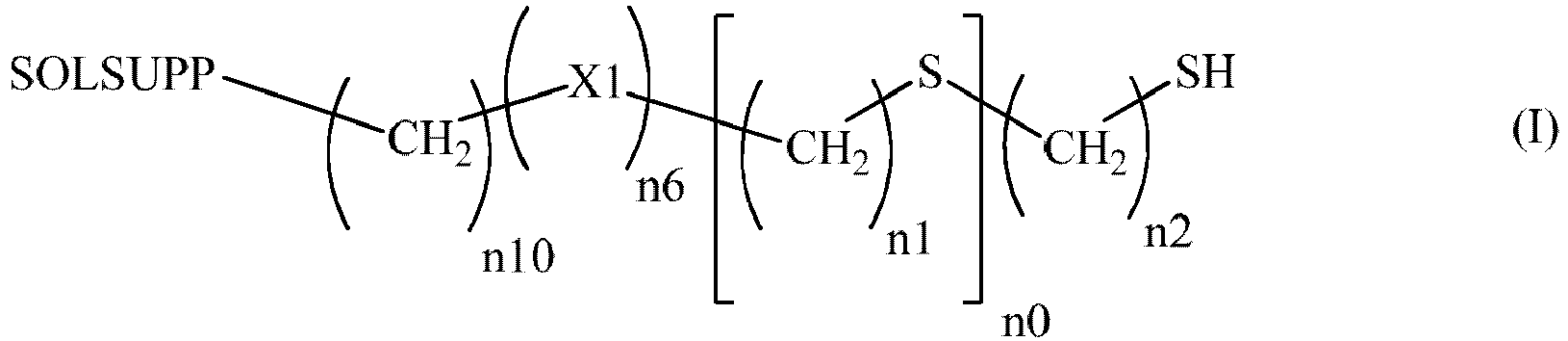


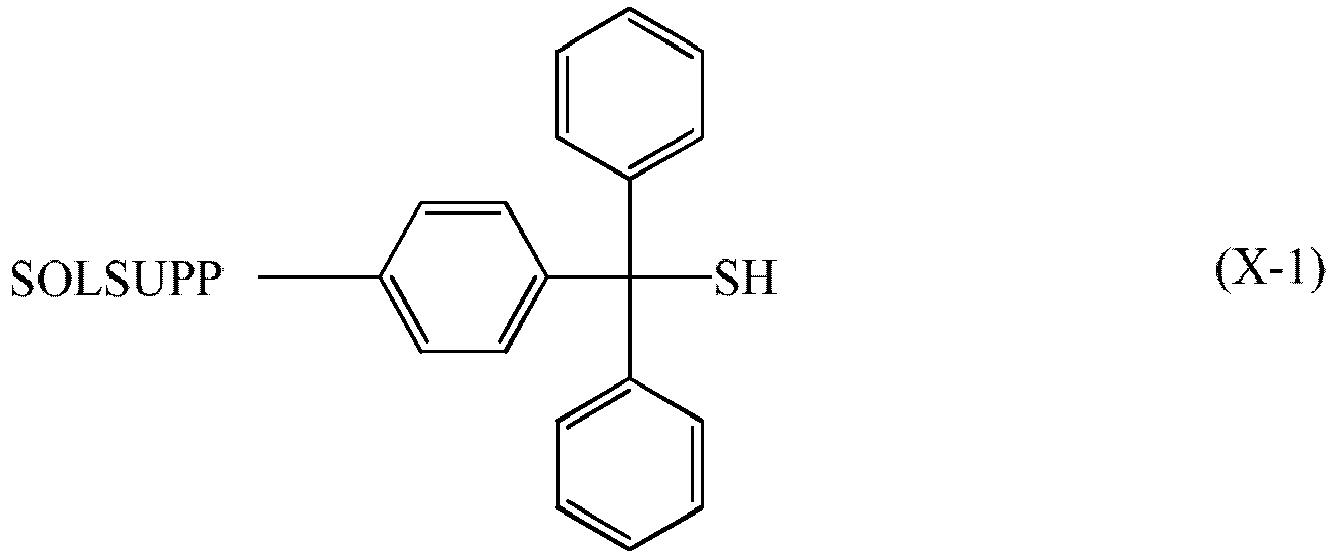
SOLSUPP -SH (XI-1)
- X1
- is NH, O or S;
- n0
- is 0, 1, 2, 3 or 4;
- n1
- is 2 or 3;
- n2
- is 2, 3 or 4;
- n3
- is 0, 1 or 2;
- n4
- is 0, 1, 2, 3, 4, 5, 6, 7, 8, 9, 10, 11, 12, 13, 14, 15, 16, 17, 18, 19, 20 or 21;
- n6
- is 0 or 1;
- n7
- is 0 or 1;
- n8
- is 2, 3 or 4;
- n9
- is 1, 2, 3 or 4;
- n10
- is 0 or 1;
- n11
- is 0 or 1;
- n12
- is 0 or 1;
- n13
- is 0 or 1.
- Preferably,
- X1
- is NH or O;
- n0
- is 0 or 1;
- n1
- is 2;
- n2
- is 2 or 3;
- n3
- is 1 or 2;
- n4
- is 4, 5, 6, 9, 10, 11, 14, 15, 16, 17, 18, 19, 20 or 21
- n6
- is 0 or 1;
- n7
- is 1;
- n8
- is 2;
- n9
- is 3;
- n10
- is 0 or 1;
- n11
- is 0 or 1;
- n12
- is 0 or 1;
- n13
- is 0 or 1.
- More preferably,
- X1
- is NH or O;
- n0
- is 0 or 1;
- n1
- is 2;
- n2
- is 2 or 3;
- n3
- is 1 or 2;
- n4
- is 5 or 10.
- n6
- is 0 or 1;
- n7
- is 1;
- n8
- is 2;
- n9
- is 3;
- n10
- is 0 or 1;
- n11
- is 1;
- n12
- is 1;
- n13
- is 1.
- Preferably, the cysteine covalently connected to SOLSUPP is covalently connected to SOLSUPP via its NH2-alpha residue or via its COOH-alpha residue.
- Preferably, the dithiothreitol covalently connected to SOLSUPP is compound of formula (XII).

- Preferably, the thionicotinamid covalently connected to SOLSUPP is compound of formula (XIII).

- Preferably, R1 is selected from the group consisting of connecting moiety of formula (R1-1), connecting moiety of formula (R1-II), connecting moiety of formula (R1-III), connecting moiety of formula (R1-IV), connecting moiety of formula (R1-V), connecting moiety of formula (R1-VI), connecting moiety of formula (R1-VII-1), connecting moiety of formula (R1-VIII), connecting moiety of formula (R1-X-1), connecting moiety of formula (R1-XII), connecting moiety of formula (R1-CYS-C-1), connecting moiety of formula (R1-CYS-N-1), and connecting moiety of formula (R1-XIII);


- (**) denotes the covalent bond to SOLSUPP;
- (***) denotes the covalent bond to the SH residue;
- X1, n0, n1, n2, n3, n4, n6, n7, n8, n9, n10, n11 and n12 are as defined herein, also with all their embodiments.
- Especially, THIOLSCAV is selected from the group consisting of compound of formula (1-1), compound of formula (1-2), compound of formula (1-3), compound of formula (1-4), compound of formula (1-5), compound of formula (1-6), compound of formula (1-7), compound of formula (II-1), compound of formula (II-2), compound of formula (III-1), compound of formula (IV-1), compound of formula (V-1), compound of formula (VI-1), compound of formula (VII-1), compound of formula (VIII-1), compound of formula (VIII-2), compound of formula (X-1), compound of formula (XI-1), compound of formula (XII-1), compound of formula (CYS-C-1), compound of formula (CYS-N-1), and compound of formula (XIII-1);





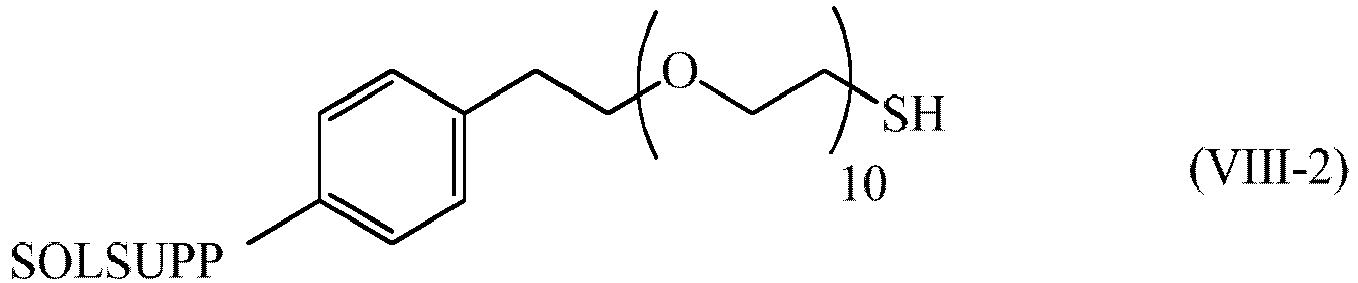


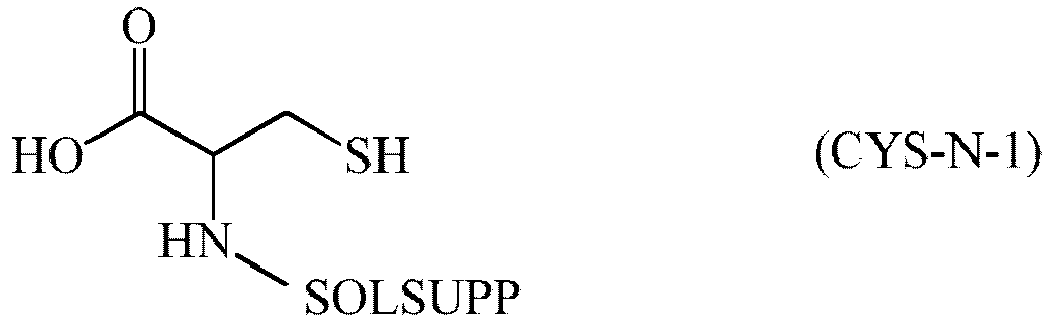

compound of formula (VII-1), compound of formula (X-1) and compound of formula (XI-1) as defined herein. - Preferably,
SOLSUPP is silica or polystyrene in case of compound of formula (I), compound of formula (II), compound of formula (IV), and compound of formula (V), compound of formula (VI), dithiothreitol covalently connected to SOLSUPP, and thionicotinamid covalently connected to SOLSUPP;
SOLSUPP is agarose in case of cysteine covalently connected to SOLSUPP;
more preferably,
SOLSUPP is silica in case of compound of formula (1-1), compound of formula (1-2), compound of formula (1-3), compound of formula (IV-1), and compound of formula (V-1);
SOLSUPP is polystyrene in case of compound of formula (1-4), compound of formula (1-5), compound of formula (1-7), compound of formula (II-1), compound of formula (II-2), compound of formula (VI-1), compound of formula (XII-1), and compound of formula (XIII-1);
SOLSUPP is agarose in case of cysteine covalently connected to SOLSUPP, compound of formula (CYS-C-1), and compound of formula (CYS-N-1). - Preferably, DR comprises a residue RESID, RESID is selected from the group consisting of iodoacetamide residue, bromoacetamide residue, maleimido residue, the maleimido residue being unsubstituted or substituted by 1 or 2 substitutents selected from the group consisting of Br and thiopyridyl, allene residue, arylpropionitrile residue, and sulfone residue.
- The iodoacetamide residue has preferably the formula (IACRES);
the bromoacetamide residue has preferably the formula (BRACRES);
the allene residue has preferably the formula (ALLENRES);
the arylpropionitrile residue has preferably the formula (ARPROPNIRES);
the sulfone residue has preferably the formula (SULFONRES-I), the formula (SULFONRES-II) or the formula (SULFONRES-III);


R3 is C1-4 alkyl, Ph or tolyl. - More preferably, RESID is selected from the group consisting of iodoacetamide residue, bromoacetamide residue, maleimido residue, the maleimido residue being unsubstituted or substituted by 2 identical substitutents selected from the group consisting of Br and thiopyridyl, allene residue, arylpropionitrile residue, and sulfone residue;
even more preferably, RESID has formula (BRACRES), formula (IACRES), formula (MALRES), formula (ALLENRES), formula (ARPROPNIRES), formula (SULFONRES-I), formula (SULFONRES-II) or formula (SULFONRES-III);
with formula (BRACRES), formula (IACRES), formula (ALLENRES), formula (ARPROPNIRES), formula (SULFONRES-I), formula (SULFONRES-II) formula
(SULFONRES-III) as defined herein, also with all their embodiments; preferably R2 is S-Ph or S-pyridyl;
preferably the S-pyridyl is
- Even more preferably, RESID has formula (IACRES), formula (MRES), formula (BRMRES), formula (THIOPYRMRES), or formula (SULFONRES).
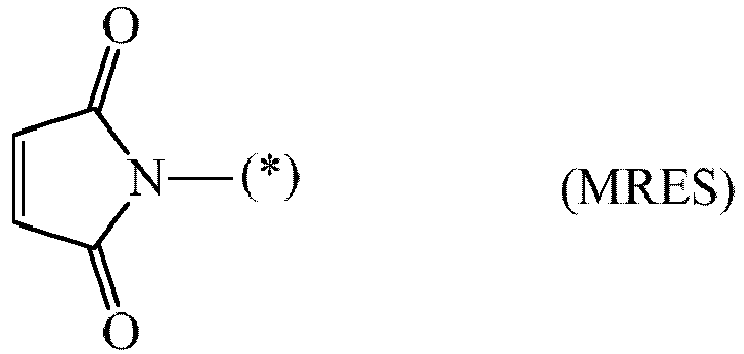


- Especially, RESID is is selected from the group consisting of iodoacetamide residue, maleimido residue, the maleimido residue being unsubstituted or substituted be 1 or 2 substitutents selected from the group consisting of Br and thiopyridyl, and sulfone residue;
more especially, RESID is selected from the group consisting of iodoacetamide residue, maleimido residue, the maleimido residue being unsubstituted or substituted be 2 identical substitutents selected from the group consisting of Br and thiopyridyl, and sulfone residue;
even more especially, RESID is selected from the group consisting of maleimido residue, the maleimido residue being unsubstituted or substituted be 2 identical substitutents selected from the group consisting of Br and thiopyridyl;
in particular, RESID has the formula (MRES). - Preferably, it is the linker that comprises RESID, also with all the embodiments of RESID. The linker is called LIN herein.
- LIN can be any linker that is used for conjugating a biolomolecule to a drug. LIN is known in the literature, for example L. Ducry et al., Bioconjugate Chem. 2010, 21, 5-13, or N. Jain et al., Pharm. Res. 2015, doi:10.1007/s11095-015-1657-7.
- Preferably, LIN is a linker that is used to conjugate an antibody to a drug in order to obtain an ADC.
Typical components, from which LIN is build, are amino acids and spacer groups, without limiting the invention to these components.
Amino acids are typically selected from the group consisting of naturally occuring amino acids, H2N-(CH2)n14-COOH and H2N-CH2-cyclohexane-COOH;
n14 is 2, 3, 4, 5, 6, 7, 8, 9 or 10;
preferably, n14 is 3, 4, 5 or 6;
more preferably, n14 is 3, 4 or 5;
even more preferably, n14 is 3 or 5;
especially, n14 is 5.
Naturally occuring amino acids are preferably selected from the group consisting of valine, citrulline, phenylalanine and alanine.
The amino acids are typically covalently connected in LIN to other components of LIN, to RESID and/or to DRU via their amino residue and their COOH residue.
The N atom, that is displayed in some of the formulae of RESID and that is marked with the (*) and is connected to the remaining part of LIN, can stem from the other components of LIN. - Spacer groups are typically based on ethylene oxide, aminobenzylalcohol, ethylenedamine, N-methylethylenediamine, N,N'-dimethylethylenediamine, carbonyl, hydrazide, or triazole.
Typical components, from which LIN is build, have formulae such as CH2-CH2-O, HN-Ph-CH2-O, N-Ph-CH2-O, HN-(CH2)n14-COOH, N-(CH2)n14-COOH, HN-CH2-cyclohexane-C(O), N- CH2-cyclohexane-C(O), N(CH3)-CH2-CH2-N(CH3), CO and NH-N. - Preferably, the aminobenzylalcohol is p-aminobenzylalcohol.
Preferably, the cyclohexane derived amino acid has para substitution with regard to the aminomethylene residue and the C(O) residue. - Preferably, DR is selected from the group consisting of compound of formula (DR-I), compound of formula (DR-II), compound of formula (DR-III), compound of formula (DR-IV), compound of formula (DR-V), compound of formula (DR-VI), compound of formula (DR-VII), compound of formula (DR-VIII), compound of formula (DR-IX), compound of formula (DR-X), compound of formula (DR-XI), compound of formula (DR-XII) and compound of formula (DR-XIII);


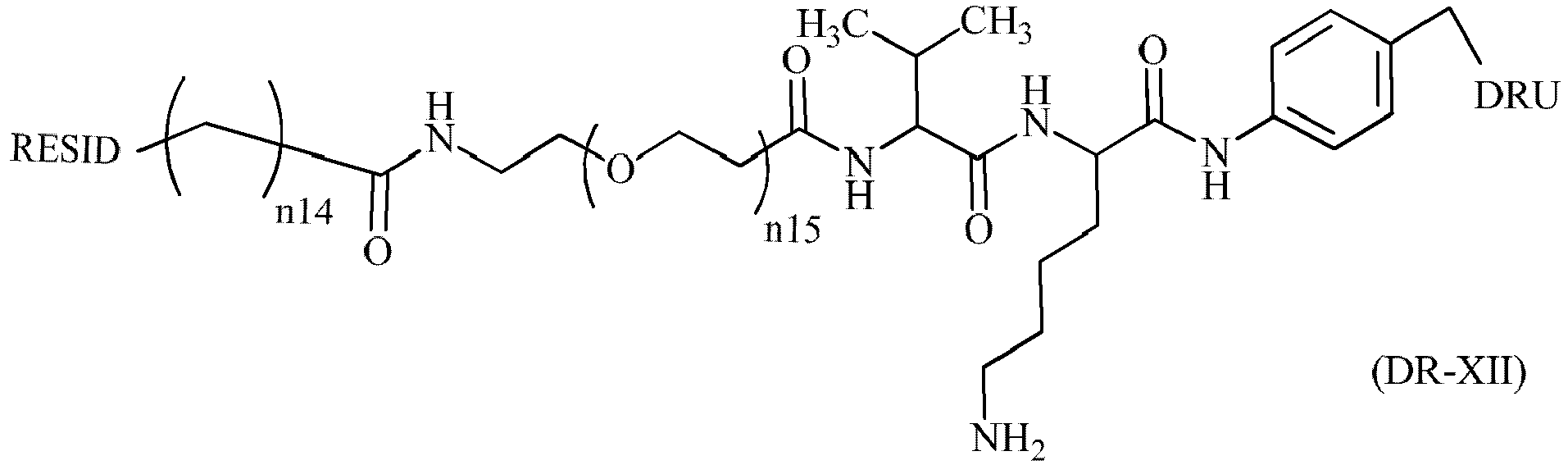

DRU, RESID and n14 are as defined herein, also with all their embodiments;
n15 is 0, 1, 2, 3, 4, 5, 6, 7, 8, 9 or 10;
preferably, n15 is 1, 4, 5 or 7;
more preferably,
n15 is 1 in case of compound of formula (DR-V),
n15 is 7 in case of compound of formula (DR-VI),
n15 is 1 in case of compound of formula (DR-X),
n15 is 4 in case of compound of formula (DR-XII) and
n15 is 1 in case of compound of formula (DR-XIII).
more prefererably, DR is selected from the group consisting of compound of formula (DR-M-I), compound of formula (DR-II), compound of formula (DR-III) and compound of formula (DR-IV). - Preferably, the biomolecule is a compound BIOMOL, and BIOLMOL is a protein;
more preferably, BIOMOL is selected from the group consisting of monoclonal antibody, polyclonal antibody, antibody fragment, protein and peptide;
even more preferably, BIOMOL is a monoclonal antibody. - Preferably, DRU is selected from the group consisting of cytotoxic agents, chemotherapeutic and antimetastatic agents.
- Preferably, the chemotherapeutic and antimetastatic agents are selected from the group consisting of tyrosine kinase inhibitors and Rac1 inhibitors.
- Preferably, tyrosine kinase inhibitors are selected from the group of active pharmaceutical ingredients (API) consisting of Imatinib, Lapatimib, Sunitimib, Nilotimib and Dasatimib.
- Preferably, Rac1 inhibitors is NSC 23766.
- Preferable cytotoxic agents are those used for cancer therapy.
Preferable classes of cytotoxic agents include, for example, the enzyme inhibitors such as the anthracycline family of drugs, the bleomycins, the cytotoxic nucleosides, dihydrofolate reductase inhibitors, differentiation inducers, DNA cleavers, DNA intercalators, DNA alkylating agents, diynenes, the mitomycins, the podophyllotoxins, the pteridine family of drugs, taxols, thymidylate synthase inhibitors, topoisomerase inhibitors, and the vinca drugs.
Preferable useful members of various classes of cytotoxic agents are selected from the group consisting of N8-acetyl spermidine, actinomycin, 9-amino camptothecin, aminopterin, anguidine, anthracycline, auristatin, benzodiazepine, bleomycin, calicheamycin, camptothecin (lactone or ring-opened form of the lactone), carminomycin, CC-1065, clofaribine, 1-(2-chloroethyl)-1,2-dimethanesulfonyl hydrazide, cyclopropabenzindol-4-one (CBI), cytarabine, cytosine arabinoside, daunorubicin, dichloromethotrexate, n-(5,5-diacetoxy-pentyl) doxorubicin, 1,8-dihydroxy-bicyclo[7.3.1] trideca-4-9-diene-2,6-diyne-13-one, difluoronucleosides, doxorubicin, duocarmycin, epirubicin, esperamicin, etoposide, 5-fluorouracil, irinotecan, leurosideine, leurosine, maytansine, melphalan, 6-mercaptopurine, methopterin, methotrexate, mitomycin A, mitomycin C, morpholine-doxorubicin, nemorubicin, podophyllotoxin and podophyllotoxin derivatives such as etoposide or etoposide phosphate, retinoic acid, saporin, tallysomycin, vinblastine, vincristine, vindesine, taxane, such as taxol or paclitaxel, taxotere or docetaxel, and taxotere retinoic acid, and analogues and derivatives thereof. - More preferable cytotoxic agents are selected from the group consisting of anthracycline, auristatin, benzodiazepine, calicheamycin, cyclopropabenzindol-4-one (CBI), doxorubicin, duocarmycin, maytansine, mitomycin C, taxol, and analogues and derivatives of these substances.
- THIOLSCAV are commercially available products, e.g. from PhosphonicS Ltd, UK, under section Pharmaceuticals; Johnson Matthey Plc, UK, tradenames Smopex®, QuadraPur®, QuadrSil®; SiliCycle Inc., CA, under tradename SiliaMetS®; Thermo Fisher Scientific Inc., US, under tradename Pierce®; SIGMA-ALDRICH Co., US, under tradenames QuadraSil®, QuadraPure®, and under sections MetalScavenger, Scavenger, Solid Supported Synthesis; Iris Biotech GmbH, DE; Bachem Holding AG, CH; or can be prepared according to known methods. vcMMAE is commercially available, e.g from Concortis Biosystems, Inc., USA, or from AstaTech, Inc., USA, and can be prepared according to known methods.
- TSK-gel® Butyl-NPR 4.6 mm x 35 mm column (NPR means non-porous resin, polymethacrylate base material with mean particle size 2,5 micrometer, purchased from Tosoh Bioscience LLC, US), solvent A: 50 mM sodium phosphate buffer, solvent B: 25% (v/v) isopropanol in 50 mM sodium phosphate buffer, gradient from 100% solvent A to 100% solvent B over 12 min., 0.8 ml/min, detection at 280 nm.
- Xterra® C18, 2.1 x 100 mm, 3.5 µm (purchased from Waters Corporation, US), solvent A: 0.1 % (v/v) TFA in water, solvent B: 0.1 % (v/v) TFA in acetonitrile, gradient from 25 to 100% solvent B over 28 min., 0.3-0.6 ml/min., detection at 214 nm.
- TSKgel® G3000SWXL 300 x 7.8 mm column (Silica based column with mean pore size of 250 Angstrom and mean particle size of 5 micrometer, purchased from Tosoh Bioscience LLC, US), eluent 10% (v/v) isopropanol in 0.2 M potassium phosphate buffer, 0.5 ml/min., detection at 280 nm.
- Samples are analyzed straight after they have been taken, or, if there is a delay, they are stored at-80 °C in between
-
- NAP-25 column
- GE Healthcare, 17-0852-02, pack of 50 columns
- SPM32d column
- 3-mercaptopropyl ethyl sulfide silica, 1 g cartridge from PhosphonicS Ltd, UK, containing 1.0 mmol thiol-functional residue/g
- IgG1 antibody solution
- from Lonza Ltd, CH, aqueous buffer of 4.38 mM histidine / histidine HCl, 150 mM trehalose, 0.0088% (w/v) polysorbate 20, pH 5.9
- The pH of an IgG1 antibody solution (5.0 ml, 0.86 micromol) was adjusted to 7.5 with a 0.1 M aq. NaOH solution. A 10 mM vcMMAE solution in N,N-dimethylacetamide (290 microliter; 2.90 micromol; 3.4 eq.) was added and the solution was stirred for 2 min. at 20 °C.
- A sample No 1 was taken and was analyzed by RP-HPLC.
- The remaining solution was filtered over a SPM32d column. A sample No 2 was taken and was analyzed by RP-HPLC.
- The remaining solution was filtered over the same SPM32d column. A sample No 3 was taken and was analyzed by RP-HPLC.
- The remaining solution was filtered over a SPM32d column. A sample No 4 was taken and was analyzed by RP-HPLC.Sample No Filtrations vcMMAE [micromol / liter] 1 0 266.385 2 1 0.066 3 2 0.003 4 3 < 0.001 - An IgG1 antibody solution (2.0 ml; 0.32 micromol) was diluted with PBS buffer (2.0 ml) and the pH of the solution adjusted to 7.5 with a 0.5 M aq. Na2HPO4 solution. A 10 mM aqueous tris(2-carboxyethyl)phosphine hydrochloride solution (Sigma-Aldrich C4706, 70 microliter; 0.70 micromol; 2.2 eq.) was added and the solution was stirred for 90 min. at 20 °C. A 10 mM vcMMAE solution in N,N-dimethylacetamide (190 microliter; 1.90 micormol; 6 eq.) was added and the solution was stirred for 30 min. at 20 °C. At this stage, the reaction mixture was split into two equal portions, portion A and portion B.
- To portion A, a 10 mM N-acetyl-cysteine solution in N,N-dimethylacetamide (207 microliter; 2.07 micromol; 13 eq.) was added and the solution stirred for 30 min. at 20 °C. The reaction mixture was purified over a NAP-25 column, eluting once with PBS buffer. The ADC-containing fractions were pooled and analyzed:
- purity (SEC-HPLC): 98.7 area%
- drug-to-antibody ratio (HIC-HPLC): 4.2
- N-acetyl-cystein-vcMMAE conjugate (RP-HPLC): 0.538 micromol / liter
- unconjugated vcMMAE (RP-HPLC): 0.004 micromol / liter
- Portion B was filtered three times over a SPM32d column and was then purified over a NAP-25 column, eluting once with PBS buffer. The ADC-containing fractions were pooled and analyzed:
- purity (SEC-HPLC): > 99.5 area%.
- drug-to-antibody ratio (HIC-HPLC): 4.1
- N-acetyl-cystein-vcMMAE (RP-HPLC): < 0.001 micromol / liter
- unconjugated vcMMAE (RP-HPLC): < 0.001 micromol / liter
- The results show that the standard treatment with N-acetyl-cysteine does not remove residual free MMAE species as effectively as the purification according to invention.
Claims (15)
- Use of a compound THIOLSCAV for the removal of a compound DR after a reaction that covalently connects DR to a biomolecule;
THIOLSCAV is a solid support SOLSUPP, SOLSUPP has SH residues;
the SH residues are covalently connected to SOLSUPP via R1; or
the SH residues are covalently connected to SOLSUPP;
R1 are divalent connecting moieties covalently connecting a SH residue to SOLSUPP;
THIOLSCAV is represented by the formula (TS);
the SH residues are covalently connected to SOLSUPP via R1 in case of n5 being 1;
the SH residues are covalently connected to SOLSUPP in case of n5 being 0;
DR is a pharmaceutically active drug DRU covalently connected to a linker. - Use according to claim 1, wherein
DR comprises a residue RESID, RESID is selected from the group consisting of iodoacetamide residue, bromoacetamide residue, maleimido residue, the maleimido residue being unsubstituted or substituted by 1 or 2 substitutents selected from the group consisting of Br and thiopyridyl, allene residue, arylpropionitrile residue, and sulfone residue. - Use according to claim 2, wherein
the iodoacetamide residue has preferably the formula (IACRES);
the bromoacetamide residue has preferably the formula (BRACRES);
the allene residue has preferably the formula (ALLENRES);
the arylpropionitrile residue has preferably the formula (ARPROPNIRES);
the sulfone residue has preferably the formula (SULFONRES-I), the formula (SULFONRES-II) or the formula (SULFONRES-III);


R3 is C1-4 alkyl, Ph or tolyl. - Use according to claim 2 or 3, wherein
RESID has formula (BRACRES), formula (IACRES), formula (MALRES), formula (ALLENRES), formula (ARPROPNIRES), formula (SULFONRES-I), formula (SULFONRES-II) or formula (SULFONRES-III);
with formula (BRACRES), formula (IACRES), formula (ALLENRES), formula (ARPROPNIRES), formula (SULFONRES-I), formula (SULFONRES-II) formula (SULFONRES-III) as defined in claim 3. - Use according to one or more of claims 2 to 4, wherein
the linker comprises RESID. - Use according to one or more of claims 1 to 5, wherein
the biomolecule is a compound BIOMOL, and BIOLMOL is a protein. - Use according to one or more of claims 1 to 6, wherein
BIOMOL is selected from the group consisting of monoclonal antibody, polyclonal antibody, antibody fragment, protein and peptide. - Use according to one or more of claims 1 to 7, wherein
BIOMOL is a monoclonal antibody. - Use according to one or more of claims 1 to 8, wherein
SOLSUPP is selected from the group consisting of silica, agarose, resin and organic polymer. - Use according to one or more of claims 1 to 9, wherein
THIOLSCAV is selected from the group consisting of compound of formula (I), compound of formula (II), compound of formula (III), compound of formula (IV), compound of formula (V), compound of formula (VI), compound of formula (VII-1), compound of formula (VIII), compound of formula (X-1), compound of formula (XI-1), cysteine covalently connected to SOLSUPP, dithiothreitol covalently connected to SOLSUPP, and thionicotinamid covalently connected to SOLSUPP;


SOLSUPP -SH (XI-1)
X1 is NH, O or S;n0 is 0, 1, 2, 3 or 4;n1 is 2 or 3;n2 is 2, 3 or 4;n3 is 0, 1 or 2;n4 is 0, 1, 2, 3, 4, 5, 6, 7, 8, 9, 10, 11, 12, 13, 14, 15, 16, 17, 18, 19, 20 or 21;n6 is 0 or 1;n7 is 0 or 1;n8 is 2, 3 or 4;n9 is 1, 2, 3 or 4;n10 is 0 or 1;n11 is 0 or 1;n12 is 0 or 1;n13 is 0 or 1. - Use according to claim 10, whereinX1 is NH or O;n0 is 0 or 1;n1 is 2;n2 is 2 or 3;n3 is 1 or 2;n4 is 4, 5, 6, 9, 10, 11, 14, 15, 16, 17, 18, 19, 20 or 21n6 is 0 or 1;n7 is 1;n8 is 2;n9 is 3;n10 is 0 or 1;n11 is 0 or 1;n12 is 0 or 1;n13 is 0 or 1.
- Use according to claim 10 or 11, wherein
the dithiothreitol covalently connected to SOLSUPP is compound of formula (XII).
- Use according to one or more of claims 10 to 12, wherein
the thionicotinamid covalently connected to SOLSUPP is compound of formula (XIII).
- Use according to one or more of claims 1 to 13, wherein
THIOLSCAV is selected from the group consisting of compound of formula (1-1), compound of formula (1-2), compound of formula (1-3), compound of formula (1-4), compound of formula (I-5), compound of formula (1-6), compound of formula (1-7), compound of formula (II-1), compound of formula (II-2), compound of formula (III-1), compound of formula (IV-1), compound of formula (V-1), compound of formula (VI-1), compound of formula (VII-1), compound of formula (VIII-1), compound of formula (VIII-2), compound of formula (X-1), compound of formula (XI-1), compound of formula (XII-1), compound of formula (CYS-C-1), compound of formula (CYS-N-1), and compound of formula (XIII-1);


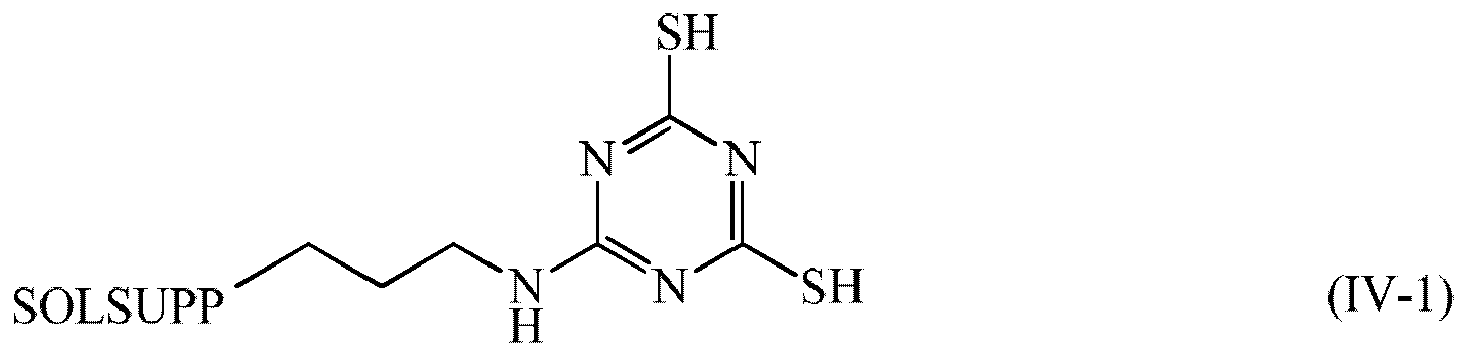


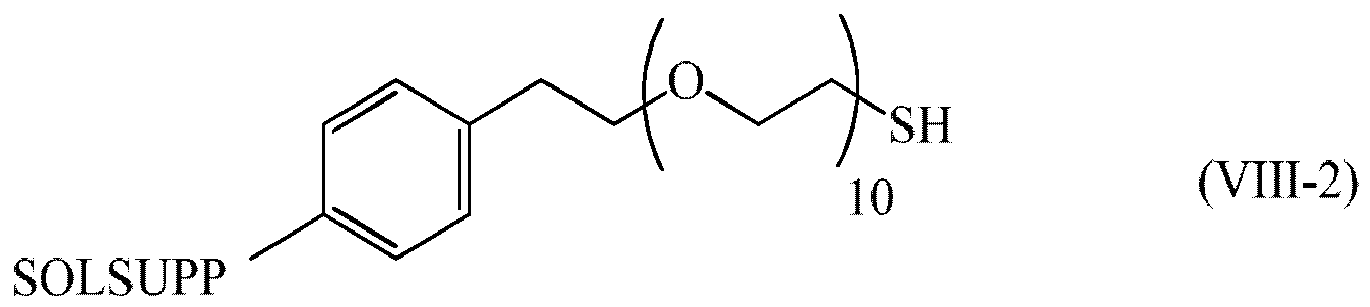

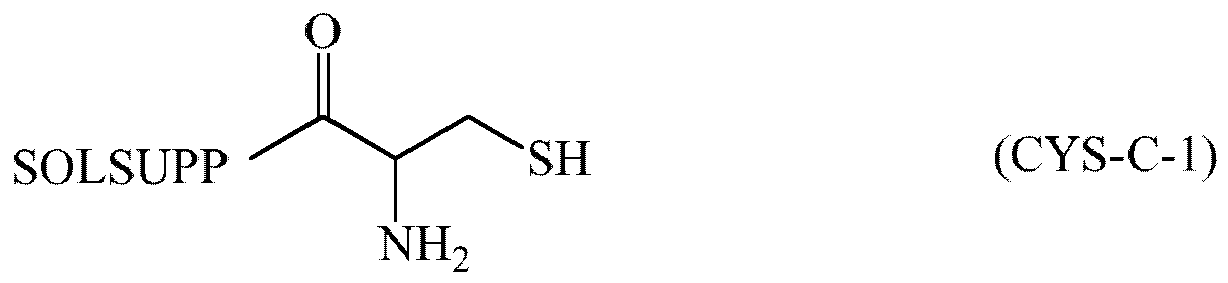


compound of formula (VII-1), compound of formula (X-1) and compound of formula (XI-1) as defined in claim 10. - Use according to one or more of claims 10 to 14, wherein
SOLSUPP is silica or polystyrene in case of compound of formula (I), compound of formula (II), compound of formula (IV), and compound of formula (V), compound of formula (VI), dithiothreitol covalently connected to SOLSUPP, and thionicotinamid covalently connected to SOLSUPP;
SOLSUPP is agarose in case of cysteine covalently connected to SOLSUPP.
Priority Applications (1)
| Application Number | Priority Date | Filing Date | Title |
|---|---|---|---|
| EP15164169.3A EP3085703A1 (en) | 2015-04-20 | 2015-04-20 | Use of thiol-containing scavengers for purification of antibody-drug conjugates |
Applications Claiming Priority (1)
| Application Number | Priority Date | Filing Date | Title |
|---|---|---|---|
| EP15164169.3A EP3085703A1 (en) | 2015-04-20 | 2015-04-20 | Use of thiol-containing scavengers for purification of antibody-drug conjugates |
Publications (1)
| Publication Number | Publication Date |
|---|---|
| EP3085703A1 true EP3085703A1 (en) | 2016-10-26 |
Family
ID=52997902
Family Applications (1)
| Application Number | Title | Priority Date | Filing Date |
|---|---|---|---|
| EP15164169.3A Withdrawn EP3085703A1 (en) | 2015-04-20 | 2015-04-20 | Use of thiol-containing scavengers for purification of antibody-drug conjugates |
Country Status (1)
| Country | Link |
|---|---|
| EP (1) | EP3085703A1 (en) |
Citations (1)
| Publication number | Priority date | Publication date | Assignee | Title |
|---|---|---|---|---|
| US20040039160A1 (en) * | 2000-06-14 | 2004-02-26 | Pickford Lesley B. | Prodrug compounds with an oligopeptide having an isoluecine residue |
-
2015
- 2015-04-20 EP EP15164169.3A patent/EP3085703A1/en not_active Withdrawn
Patent Citations (1)
| Publication number | Priority date | Publication date | Assignee | Title |
|---|---|---|---|---|
| US20040039160A1 (en) * | 2000-06-14 | 2004-02-26 | Pickford Lesley B. | Prodrug compounds with an oligopeptide having an isoluecine residue |
Non-Patent Citations (5)
| Title |
|---|
| ELSA WAGNER-ROUSSET ET AL: "Antibody-drug conjugate model fast characterization by LC-MS following IdeS proteolytic digestion", MABS, vol. 6, no. 1, 17 October 2013 (2013-10-17), pages 173 - 184, XP055214670, ISSN: 1942-0870, DOI: 10.4161/mabs.26773 * |
| L. DUCRY ET AL., BIOCONJUGATE CHEM., vol. 21, 2010, pages 5 - 13 |
| L. M. SMITH: "Potent cytotoxicity of an auristatin-containing antibody-drug conjugate targeting melanoma cells expressing melanotransferrin/p97", MOLECULAR CANCER THERAPEUTICS, vol. 5, no. 6, 1 June 2006 (2006-06-01), pages 1474 - 1482, XP055214665, ISSN: 1535-7163, DOI: 10.1158/1535-7163.MCT-06-0026 * |
| N. JAIN ET AL., PHARM. RES., 2015 |
| P. J. CARTER ET AL., MOL. CANCER THER., vol. 5, 2006, pages 1474 - 1482 |
Similar Documents
| Publication | Publication Date | Title |
|---|---|---|
| US12115228B2 (en) | Drug-conjugates, conjugation methods, and uses thereof | |
| US11285128B2 (en) | Homogenous antibody drug conjugates via enzymatic methods | |
| EP2678037B1 (en) | Branched linker for protein drug conjugates | |
| JP7789396B2 (en) | Means and methods for producing antibody-linker conjugates | |
| JP2004510702A (en) | Prodrug compounds having isoleucine | |
| US20190216819A1 (en) | Method of synthesising adcs using affinity resins | |
| JP2024539989A (en) | Methods for Producing Antibody-Linker Conjugates | |
| KR20230124684A (en) | Improved CD30 Targeting Antibody Drug Conjugates and Uses Thereof | |
| JP2023542910A (en) | Transglutaminase conjugation method using amino acid-based linkers | |
| EP3665161A1 (en) | New targeted cytotoxic ratjadone derivatives and conjugates thereof | |
| CN122028936A (en) | Antibody-drug conjugates |
Legal Events
| Date | Code | Title | Description |
|---|---|---|---|
| PUAI | Public reference made under article 153(3) epc to a published international application that has entered the european phase |
Free format text: ORIGINAL CODE: 0009012 |
|
| AK | Designated contracting states |
Kind code of ref document: A1 Designated state(s): AL AT BE BG CH CY CZ DE DK EE ES FI FR GB GR HR HU IE IS IT LI LT LU LV MC MK MT NL NO PL PT RO RS SE SI SK SM TR |
|
| AX | Request for extension of the european patent |
Extension state: BA ME |
|
| STAA | Information on the status of an ep patent application or granted ep patent |
Free format text: STATUS: THE APPLICATION HAS BEEN WITHDRAWN |
|
| 18W | Application withdrawn |
Effective date: 20161027 |