EP3084590B1 - Controlling access to a software application - Google Patents
Controlling access to a software application Download PDFInfo
- Publication number
- EP3084590B1 EP3084590B1 EP14871946.1A EP14871946A EP3084590B1 EP 3084590 B1 EP3084590 B1 EP 3084590B1 EP 14871946 A EP14871946 A EP 14871946A EP 3084590 B1 EP3084590 B1 EP 3084590B1
- Authority
- EP
- European Patent Office
- Prior art keywords
- policy machine
- policy
- role
- roles
- user
- Prior art date
- Legal status (The legal status is an assumption and is not a legal conclusion. Google has not performed a legal analysis and makes no representation as to the accuracy of the status listed.)
- Active
Links
Images




Classifications
-
- H—ELECTRICITY
- H04—ELECTRIC COMMUNICATION TECHNIQUE
- H04L—TRANSMISSION OF DIGITAL INFORMATION, e.g. TELEGRAPHIC COMMUNICATION
- H04L63/00—Network architectures or network communication protocols for network security
- H04L63/18—Network architectures or network communication protocols for network security using different networks or channels, e.g. using out of band channels
-
- G—PHYSICS
- G06—COMPUTING OR CALCULATING; COUNTING
- G06F—ELECTRIC DIGITAL DATA PROCESSING
- G06F21/00—Security arrangements for protecting computers, components thereof, programs or data against unauthorised activity
- G06F21/60—Protecting data
- G06F21/604—Tools and structures for managing or administering access control systems
-
- G—PHYSICS
- G06—COMPUTING OR CALCULATING; COUNTING
- G06F—ELECTRIC DIGITAL DATA PROCESSING
- G06F21/00—Security arrangements for protecting computers, components thereof, programs or data against unauthorised activity
- G06F21/60—Protecting data
- G06F21/62—Protecting access to data via a platform, e.g. using keys or access control rules
- G06F21/6218—Protecting access to data via a platform, e.g. using keys or access control rules to a system of files or objects, e.g. local or distributed file system or database
-
- H—ELECTRICITY
- H04—ELECTRIC COMMUNICATION TECHNIQUE
- H04L—TRANSMISSION OF DIGITAL INFORMATION, e.g. TELEGRAPHIC COMMUNICATION
- H04L63/00—Network architectures or network communication protocols for network security
- H04L63/10—Network architectures or network communication protocols for network security for controlling access to devices or network resources
-
- H—ELECTRICITY
- H04—ELECTRIC COMMUNICATION TECHNIQUE
- H04L—TRANSMISSION OF DIGITAL INFORMATION, e.g. TELEGRAPHIC COMMUNICATION
- H04L63/00—Network architectures or network communication protocols for network security
- H04L63/20—Network architectures or network communication protocols for network security for managing network security; network security policies in general
Definitions
- Software applications may be provided to users via a network.
- a networked application may be accessed by a user via a website over the Internet or other distributed network. Because the network over which communication with a networked application may occur may be public, proper access control is often needed, requiring a user in some cases to enter a username and password or other form of authentication and/or authorization.
- REST is an architectural standard for distributed systems. In REST, interactions between components are conceptualized as a series of stateless requests from a client to a server, each of which concerns a specific resource.
- Each service may make a variety of authentication (who am I?) and authorization (what am I allowed to do?) determinations. Despite their various and distributed nature, these determinations should be made in a consistent manner across the entire distributed platform. If individual services implement access control independently, an oversight may occur, and one or more communication routes that are exposed may be insufficiently protected.
- US 2002/026592 A1 relates to a method for automatic permission management in role-based access control (RBAC) systems.
- RBAC role-based access control
- XP002660001 by Ferraiolo et al. relates to role-based access control (RBAC): features and motivations.
- RBAC role-based access control
- DOI: 10.1145/344287.344301 relates to the NIST model for role-based access control (RBAC).
- One approach to controlling access in a distributed network may include using several services as part of a role-based access control system, which may comprise mapping of roles to permissions.
- a "policy machine” may be used to authorize a request in such a system.
- a policy machine is an access control framework that rigorously describes the set of authorized capabilities on a platform.
- a "privilege" or capability may be defined by a triad consisting of ⁇ user, operation, object>.
- There is a finite list of operations such as “read,” “write,” or “delete”; an object is a protected item such as a medical record.
- Bob Smith is authorized to delete medical_record_564 if and only if the capability ⁇ Bob Smith, delete, medical_record_564> can be derived from the policy machine.
- Operations may be organized into operation sets, overlapping collections of operations organized according to authorization rules.
- the NIST Policy Machine specification does not specify how to generate a policy machine, nor is it sufficient for use in a highly configurable implementation.
- the formalism in the NIST specification is intended to be applied to a broad variety of systems, and the specification provides only brief summaries of "administrative commands," which are pieces of business logic surrounding administrative operations.
- the specification does not express any particular constraints on this logic, and the logic is not represented within the policy state.
- the present invention In contrast to the NIST specification, the present invention generates a policy machine, for use in a highly configurable implementation, that expresses how different users may need different policies. It represents these policies using a type of formalism introduced by the NIST specification, which allows for easier code reuse and policy interoperability.
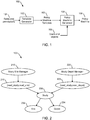
- FIG. 1 is a system 100 for generating a policy machine.
- System 100 includes template generator 102 that takes as inputs roles and permissions 101 and produces policy machine template 103.
- Policy machine template 103 is input to policy machine generator 104 along with users and objects 105 to generate policy machine 106.
- Roles and permissions 101 may be expressed as in Table 1: TABLE 1 Permission Role Read Study Read Site Read Depot Study Site Manager Yes Yes No Study Depot Manager Yes No Yes
- This policy describes which of three possible permissions is granted by each of two possible roles. Both a Study Site Manager and a Study Depot Manager can read information about a study, but only a Study Site Manager can read information about the sites involved in that study.
- FIG. 2 is a translation of Table 1 into a graphical version of policy machine template 103, which shows more clearly the study's relationships with other objects.
- Study Site Manager 210 has the permissions to read study and read site as shown in 215, while Study Depot Manager 220 has the permissions to read study and read depot as shown in 225.
- Study 230 mediates the Study Site Manager's permission on site 232 and the Study Depot Manager's permission on depot 234.
- the entity represented in Table 1 is a tabular example of policy machine template 103, but it is not a policy machine because it cannot in itself answer the question "Can Bob Smith delete medical_record_564 in (site) Bethlehem Medical in Study QRX?" It does not contain information about any of those three real-world entities, user, operation, and object. However, a policy machine template can be queried like a policy machine to retrieve policy configuration information. "Study Site Manager” can be treated as a user, and "Study,” “Site,” and “Depot” can be treated as objects.
- the question can be asked, "Can a Study Site Manager read information on a Site in a Study?” and the reply may be "yes,” while the question, "Can a Study Depot Manager read information on a Site in a Study?” can be answered "no.”
- Policy machine template 103 can then be used to build an actual policy machine.
- the policy machine starts out empty because there is no real-world data.
- the process governing the policy machine may receive information about users and objects 105 that a user, "Bob Smith,” has been granted the Study Site Manager role for a study named "Study QRX.”
- Policy machine template 103 is then used as a reference to add this information to the policy machine. Because Study Site Manager 210 can perform the operations in operation set 215 ( ⁇ read_study, read_site ⁇ ) on studies, that operation set can be copied into the policy machine, as shown in FIG. 3A .
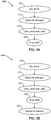
- FIG. 3A shows policy machine 306a after one role assignment - that of assigning Bob Smith 310 to Study Site Manager 210.
- Study Site Manager 210 could be considered a user in policy machine template 103 in FIG. 2 , but becomes a "user attribute" or "role” in FIG. 3A in policy machine terms.
- FIG. 3A shows the combination of the real-world data with the policy machine template to create a policy machine.
- Bob Smith has the Study Site Manager role on Study QRX 330 because of an external process, and the Study Site Manager role has the pictured operation set 215 because that is what that role has in the template.
- the process governing the policy machine may receive information about users and objects 105 that a site, "Bethlehem Medical,” has been added to Study QRX.
- the policy machine template shows that this relationship has relevance to the policy, so that relationship can now be incorporated into the policy machine.
- FIG. 3B shows policy machine 306b after the site has been added.
- the policy machine now conveys that Bob Smith can read information for Bethlehem Medical 332.
- the graphs in FIGS. 3A and 3B reference policy machine template 103, the template has not changed from its initial depiction in FIG. 2 .
- the template does not change in response to real-world information; it just conveys how to interpret the real-world information.
- the policy machine may grow into a large graph. If a user or role assignment is removed, the node may simply be deleted from the graph - there is no need to reference the policy machine template in that case.
- the policy machine will remain the same for now, and consider the case where, due to a change in policy, the policy machine template is changed, such that a Study Site Manager also has an update_site privilege.
- the relevant operation set 215 in the template 103 in FIG. 2 is altered as shown in FIG. 4A .
- This change in policy machine template 403 triggers a change in policy machine 306c itself. All operation sets that are derived from altered operation set 415 are then automatically altered to match, as shown in FIG. 4B .
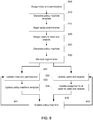
- FIG. 6 is a flowchart that illustrates how a policy machine may be generated, according to an embodiment of the present invention.
- roles and permissions may be assigned.
- the roles may be clinical trial roles such as principal investigator, clinical research associate (CRA), clinical research coordinator (CRC), study coordinator, site monitor, data manager, CRO manager; clinical quality manager, EDC study builder, programmer, biostatistician, patient informed consent specialist, patient recruitment specialist, R&D senior manager, vendor, pharmacovigilance specialist, etc.
- the assignments may be made by a company that offers the clinical trial software, so that there are default roles and permissions, or made by a sponsor or CRO, one role at a time, or a combination of the two.
- Embodiments of the invention may be used in applications other than clinical data - essentially any situation in which there are clearly-defined roles.
- IT information technology
- a system administrator has a high degree of permission to make changes to a computer system, but regular workers may have almost no permission vis-à-vis their computer or network.
- Another example is an employee directory in which the human resources manager, line manager, team lead, coworker, and employee each have different permission sets.
- a third example is a social networking site in which a user assigns its various contacts with different permission levels in order to control privacy. The assignments in each of these examples may be laid out in a table like Table 1.
- a policy machine template may be generated, such as policy machine template 103, shown in FIG. 2 .
- the preliminary actions for a clinical trial may begin, such as signing up sites and principal investigators, enrolling patients, purchasing access to and integrating with software, defining a randomization and blinding scheme, and others.
- users may be assigned to roles and objects, such as Study Site Manager and Study QRX ("objects" can be sites, studies, depots, etc.), and, as illustrated in FIGS. 3A and 3B , one or more policy machines may be generated as in operation 625.
- the graphs in FIGS. 2-5 may be represented using a directed acyclic graph.
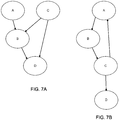
- a directed graph is a set of nodes and edges, with each edge corresponding to an ordered pair of nodes. As shown in FIG. 7A , two nodes A and B are considered “connected” if there exists a sequence of at least two nodes, starting with A and ending with B, such that each consecutive pair corresponds to an edge. This sequence is called a "path.”
- a directed graph is acyclic when there is no node that is connected to itself. In FIG. 7A , nodes A and C are connected to node B directly, and to node D through a path that includes B.
- Node C is also connected directly to node D, so that if node B were removed, node C would remain connected.
- This is a directed acyclic graph.
- the graph in FIG. 7B contains a cycle from node A to node B to node C to node A, and thus is not acyclic.
- users, objects, and operation sets may be nodes on a directed acyclic graph, as are two types of mediating nodes: user attributes, which correspond conceptually to roles, and object attributes, which can reflect any property of an object that is relevant to authorization, such as a unique identifier, a classification, or an association with another object.
- object attributes which can reflect any property of an object that is relevant to authorization, such as a unique identifier, a classification, or an association with another object.
- a capability ⁇ user, operation, object> can be derived if and only if an operation set ops exists such that:
- the graph in FIG. 8 represents one possible access state for a policy machine.
- user "u1,” represented by node 811
- This same operation set is connected to all three objects o1, o2, and o3, represented by nodes 815, 825, 835.
- User u1 thus has the capability to read each of those three objects.
- the path from u1 to the ⁇ Division, Project> operation set may be read as "u1 is part of Group 1, which is part of the Division, which is allowed to read each object belonging to any project.”
- the path from the operation set (node 833) to object o3 (node 835) may be read (working backwards) as "o3 is part of Project 2 (node 824), which is a Project, so o3 is subject to the ⁇ Division, Project> operation set.”
- the "w" ("write”) operation on an object is limited to users who are part of the Group that owns the Project that owns the object.
- the policy machine state may be adjusted using "administrative operations.” Access control for administrative operations may be represented using the same formalism as for other operations. This allows the policy machine to govern its own authorization.
- the present invention goes beyond the NIST specification to represent an abstract business rule (also called an abstract privilege, a role permission, or a configuration) of the form, "If a user has the role ⁇ role> on a resource of type ⁇ resource type>, that user can perform the operation ⁇ operation> on that resource's ⁇ resource association>.”
- an abstract business rule also called an abstract privilege, a role permission, or a configuration
- a client may wish to configure a study such that a user with the role "site inventory manager" for one of that study's study-sites can reorder any inventory item for that study-site.
- Such configuration option can be represented in an intuitive, accessible way, and may be honored within the policy machine whenever such a role assignment is made, or whenever an inventory item becomes associated with a study-site.
- the directed acyclic graph concept may not be sufficient in this situation.
- a policy graph the way to represent that a role assignment is subject to a particular rule is by connecting an element in it to a global object attribute shared by all such assignments. But this creates too much connectivity in the graph - it does not allow a distinction to be made between similar role assignments between different users to different objects.
- a configuration may be represented using a policy machine template that is not a part of the NIST policy machine.
- the nodes in the policy machine may be instances of the nodes in the policy machine template.
- FIG. 9 is a diagram of part of a policy machine template 903, according to an embodiment of the present invention. It represents the configuration, "A study administrator for a study may update the study-sites for that study.” The full graph would represent all of the authorization rules for a given configuration type.
- a configuration type is a collection of configurations (abstract privileges or role permissions). If two studies have the same access control policies (roles with the same name have the same permission set in both), it is said that they "share a configuration type” or that "study B cloned study A's configuration type.”
- the nodes in FIG. 9 are analogous to "classes" - the result of the study object being connected to a "study-sites" object attribute is that "a study can have study-sites.”
- instances of these nodes may be added to the policy machine. Their connections may be inferred programmatically from the connections in the policy machine template. Every node added to the policy machine is given a tag that matches it to a node in the template. If two nodes are connected in the template, the nodes with corresponding tags are connected in the policy machine. The coupling between a class and its instance may be persisted within the system, so that if the configuration changes, the policy machine state changes to match the configuration.
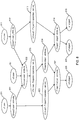
- FIG. 10 illustrates a policy state honoring a sample configuration of policy machine template 903 and its relation to policy machine 1006, according to an embodiment of the invention.
- This shows how a template may be used to generate a policy machine, providing functionality that goes beyond that which can be represented with a single directed acyclic graph.
- a graph database may be used, because of the policy machine formalism, using a NoSQL database for scalability.
- a directed acyclic graph can also be represented in a traditional relational database.
- FIG. 8 contains only the policy machine.
- the question, "What objects does User 1 have access to?” can be answered by starting at the "u1" node 811 and following all of the outgoing arrows, collecting every node with the ":object” label. Erasing every node that is not accessible by following outgoing arrows this way, results in a "subgraph” or "subtree” containing only the items of interest.
- the policy machine formalism is beneficial because users have the option to specify a single role on which to base access control decisions. Since each instance of a role assignment may be represented in the policy machine as its own node, the same capability determination may be made on it that would be made for a user node, in effect "chopping off' the root node of the user-permissions subtree and descending one level.
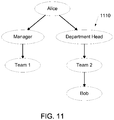
- FIG. 11 illustrates a simple case of subtrees being extracted from an authorization graph.
- a user Alice via her "Manager” and "Department Head” roles, has access to three hierarchically arranged objects, Team 1, Team 2, and Bob.
- the policy machine template may be configured through a user interface that may involve visualizations such as those in FIG. 10 .
- This interface may be aware of what operations are supported for each resource, the possible relations between each resource, and a default set of recommended operation sets for each of the roles.
- This configuration may be viewed or edited at any time, and may be "cloned” for new studies. Users may then be granted role assignments to objects via a user interface or service. The details of how these assignments "cascade" to child objects do not necessarily need to be exposed during this process. Generally, only one role assignment will be necessary at a time.
- the present invention has other attributes. It may allow users to be assigned different roles for different instances of the same resource type. A typical case is that a user is a principal investigator for one or more studies, but has no roles for other studies. In many cases, a user may also have a different role for another study.
- Embodiments of the invention maintain separate access control lists for different objects, which is known as horizontal access control.
- Embodiments of the invention may allow a single role assignment to be inherited by associated resources, such that a study-site can authorize based on a rule such as "a clinical study manager for a study-site's study can see attributes for that study-site.”
- Embodiments may support arbitrary levels of nesting for these associations with a scalable and extensible implementation.
- the present invention may be configurable on a resource-to-resource basis, by being able to provide a default configuration type that can be modified for different client divisions or different studies.
- a client may be able to configure access control through a web-based user interface without needing detailed information about the working of the underlying software application. Changes to the configuration of a live resource may take automatic effect on that resource, as was shown in FIG. 6 .
- the present invention may allow a user with multiple roles to limit the user's authorizations to those granted by one role. For example, a user with both the Principal Investigator and Clinical Research Associate roles may be able to choose to "act as" a Clinical Research Associate only, hiding actions that are granted to the user only via the Principal Investigator role.
- embodiments of the present invention have been described in terms of networked software applications, other embodiments of the present invention may involve standalone, single use, and/or single tenant software packages that may be presented to a user on a CD, a DVD, or a floppy disk, or via download to a standalone computer.
- users may be able to sign on to a kiosk that many users with various roles and permissions can access, and the access control policies of this invention may be used in this situation.
- aspects of the present invention may be embodied in the form of a system, a computer program product, or a method. Similarly, aspects of the present invention may be embodied as hardware, software or a combination of both. Aspects of the present invention may be embodied as a computer program product saved on one or more computer-readable media in the form of computer-readable program code embodied thereon.
- the computer-readable medium may be a computer-readable signal medium or a computer-readable storage medium.
- a computer-readable storage medium may be, for example, an electronic, optical, magnetic, electromagnetic, infrared, or semiconductor system, apparatus, or device, or any combination thereof.
- a computer-readable signal medium may include a propagated data signal with computer-readable program code embodied therein, for example, in baseband or as part of a carrier wave. Such a propagated signal may take any of a variety of forms, including, but not limited to, electromagnetic, optical, or any suitable combination thereof.
- a computer-readable signal medium may be any computer-readable medium that is not a computer-readable storage medium and that can communicate, propagate, or transport a program for use by or in connection with an instruction execution system, apparatus, or device.
- Computer program code in embodiments of the present invention may be written in any suitable programming language.
- the program code may execute on a single computer, or on a plurality of computers.
- the computer may include a processing unit in communication with a computer-usable medium, wherein the computer-usable medium contains a set of instructions, and wherein the processing unit is designed to carry out the set of instructions.
Landscapes
- Engineering & Computer Science (AREA)
- Computer Security & Cryptography (AREA)
- Computer Hardware Design (AREA)
- General Engineering & Computer Science (AREA)
- Theoretical Computer Science (AREA)
- Computing Systems (AREA)
- Computer Networks & Wireless Communication (AREA)
- Signal Processing (AREA)
- Health & Medical Sciences (AREA)
- Bioethics (AREA)
- General Health & Medical Sciences (AREA)
- Software Systems (AREA)
- Physics & Mathematics (AREA)
- General Physics & Mathematics (AREA)
- Automation & Control Theory (AREA)
- Databases & Information Systems (AREA)
- Storage Device Security (AREA)
- Stored Programmes (AREA)
- Management, Administration, Business Operations System, And Electronic Commerce (AREA)
Description
- Software applications may be provided to users via a network. A networked application may be accessed by a user via a website over the Internet or other distributed network. Because the network over which communication with a networked application may occur may be public, proper access control is often needed, requiring a user in some cases to enter a username and password or other form of authentication and/or authorization.
- Distributed computing often involves a collection of RESTful web services. (REST is an architectural standard for distributed systems. In REST, interactions between components are conceptualized as a series of stateless requests from a client to a server, each of which concerns a specific resource.) Each service may make a variety of authentication (who am I?) and authorization (what am I allowed to do?) determinations. Despite their various and distributed nature, these determinations should be made in a consistent manner across the entire distributed platform. If individual services implement access control independently, an oversight may occur, and one or more communication routes that are exposed may be insufficiently protected. One way of mitigating this problem is to use OWASP ASVS Access Control Requirements (see http://code.google.com/p/owasp-asvs/wiki/Verification_V4), which suggest using a centralized mechanism (including libraries that call external authorization services) to protect access to each type of protected resource.
-
US 2002/026592 A1 relates to a method for automatic permission management in role-based access control (RBAC) systems. - XP002660001 by Ferraiolo et al. relates to role-based access control (RBAC): features and motivations.
- DOI: 10.1145/344287.344301 relates to the NIST model for role-based access control (RBAC).
-
-
FIG. 1 is a block diagram of a system for generating a policy machine, according to an embodiment of the present invention; -
FIG. 2 is a graphical diagram of a policy machine template, according to an embodiment of the present invention; -
FIGS. 3A and 3B are graphical diagrams of partial policy machines illustrating users being assigned to roles and objects, according to embodiments of the present invention; -
FIG. 4A is a graphical diagram of an updated policy machine template, according to an embodiment of the present invention; -
FIG. 4B is a graphical diagram of an updated policy machine, according to an embodiment of the present invention; -
FIG. 5 is a diagram of a combination policy machine template and policy machine, according to an embodiment of the present invention; -
FIG. 6 is a flowchart illustrating how a policy machine may be generated, according to an embodiment of the present invention. -
FIGS. 7A and 7B are diagrams of a directed acyclic graph and a cyclic graph, respectively; -
FIG. 8 is a graphical diagram of an access state for a policy machine, as may be used in an embodiment of the present invention; -
FIG. 9 is a graphical diagram of part of a policy machine template, according to an embodiment of the present invention; -
FIG. 10 is a graphical diagram of a combination policy machine template and policy machine, according to an embodiment of the present invention; and. -
FIG. 11 is a graphical diagram of part of a policy machine to illustrate subtrees, according to an embodiment of the present invention; - Where considered appropriate, reference numerals may be repeated among the drawings to indicate corresponding or analogous elements. Moreover, some of the blocks depicted in the drawings may be combined into a single function.
- In the following detailed description, numerous specific details are set forth in order to provide a thorough understanding of embodiments of the invention. However, it will be understood by those of ordinary skill in the art that the embodiments of the present invention may be practiced without these specific details. In other instances, well-known methods, procedures, components, and circuits have not been described in detail so as not to obscure the present invention.
- One approach to controlling access in a distributed network may include using several services as part of a role-based access control system, which may comprise mapping of roles to permissions. A "policy machine" may be used to authorize a request in such a system.
- A policy machine is an access control framework that rigorously describes the set of authorized capabilities on a platform. In a policy machine, a "privilege" or capability may be defined by a triad consisting of <user, operation, object>. There is a finite list of operations such as "read," "write," or "delete"; an object is a protected item such as a medical record. For example, Bob Smith is authorized to delete medical_record_564 if and only if the capability <Bob Smith, delete, medical_record_564> can be derived from the policy machine. Operations may be organized into operation sets, overlapping collections of operations organized according to authorization rules.
- This access control architecture has been described in a U.S. National Institute of Standards and Technology ("NIST") Interagency Report (IR) called, "Policy Machine: Features, Architecture, and Specification," authored by David Ferraiolo, Serban Gavrila, and Wayne Jansen in December 2012. It is also being incorporated into a specification for using a policy machine approach developed by the NIST and other members of an ad hoc International Committee for Information Technology Standards (INCITS), proposed to be adopted by the American National Standards Institute.
- The NIST Policy Machine specification does not specify how to generate a policy machine, nor is it sufficient for use in a highly configurable implementation. The formalism in the NIST specification is intended to be applied to a broad variety of systems, and the specification provides only brief summaries of "administrative commands," which are pieces of business logic surrounding administrative operations. The specification does not express any particular constraints on this logic, and the logic is not represented within the policy state.
- In contrast to the NIST specification, the present invention generates a policy machine, for use in a highly configurable implementation, that expresses how different users may need different policies. It represents these policies using a type of formalism introduced by the NIST specification, which allows for easier code reuse and policy interoperability.
- Reference is now made to
FIG. 1 , which is asystem 100 for generating a policy machine.System 100 includestemplate generator 102 that takes as inputs roles andpermissions 101 and producespolicy machine template 103.Policy machine template 103 is input topolicy machine generator 104 along with users andobjects 105 to generatepolicy machine 106. - Roles and
permissions 101 may be expressed as in Table 1:TABLE 1 Permission Role Read Study Read Site Read Depot Study Site Manager Yes Yes No Study Depot Manager Yes No Yes - This policy describes which of three possible permissions is granted by each of two possible roles. Both a Study Site Manager and a Study Depot Manager can read information about a study, but only a Study Site Manager can read information about the sites involved in that study.
-
FIG. 2 is a translation of Table 1 into a graphical version ofpolicy machine template 103, which shows more clearly the study's relationships with other objects.Study Site Manager 210 has the permissions to read study and read site as shown in 215, while Study DepotManager 220 has the permissions to read study and read depot as shown in 225.Study 230 mediates the Study Site Manager's permission onsite 232 and the Study Depot Manager's permission ondepot 234. - The entity represented in Table 1 is a tabular example of
policy machine template 103, but it is not a policy machine because it cannot in itself answer the question "Can Bob Smith delete medical_record_564 in (site) Bethlehem Medical in Study QRX?" It does not contain information about any of those three real-world entities, user, operation, and object. However, a policy machine template can be queried like a policy machine to retrieve policy configuration information. "Study Site Manager" can be treated as a user, and "Study," "Site," and "Depot" can be treated as objects. According to the formalism, the question can be asked, "Can a Study Site Manager read information on a Site in a Study?" and the reply may be "yes," while the question, "Can a Study Depot Manager read information on a Site in a Study?" can be answered "no." -
Policy machine template 103 can then be used to build an actual policy machine. The policy machine starts out empty because there is no real-world data. Then, the process governing the policy machine may receive information about users and objects 105 that a user, "Bob Smith," has been granted the Study Site Manager role for a study named "Study QRX."Policy machine template 103 is then used as a reference to add this information to the policy machine. BecauseStudy Site Manager 210 can perform the operations in operation set 215 ({read_study, read_site}) on studies, that operation set can be copied into the policy machine, as shown inFIG. 3A . -
FIG. 3A showspolicy machine 306a after one role assignment - that of assigningBob Smith 310 toStudy Site Manager 210.Study Site Manager 210 could be considered a user inpolicy machine template 103 inFIG. 2 , but becomes a "user attribute" or "role" inFIG. 3A in policy machine terms.FIG. 3A shows the combination of the real-world data with the policy machine template to create a policy machine. Bob Smith has the Study Site Manager role onStudy QRX 330 because of an external process, and the Study Site Manager role has the pictured operation set 215 because that is what that role has in the template. - Next, the process governing the policy machine may receive information about users and objects 105 that a site, "Bethlehem Medical," has been added to Study QRX. The policy machine template shows that this relationship has relevance to the policy, so that relationship can now be incorporated into the policy machine.
-
FIG. 3B showspolicy machine 306b after the site has been added. The policy machine now conveys that Bob Smith can read information forBethlehem Medical 332. Even though the graphs inFIGS. 3A and 3B referencepolicy machine template 103, the template has not changed from its initial depiction inFIG. 2 . The template does not change in response to real-world information; it just conveys how to interpret the real-world information. - As more users, studies, sites, and depots are added, this process is repeated and the policy machine may grow into a large graph. If a user or role assignment is removed, the node may simply be deleted from the graph - there is no need to reference the policy machine template in that case.
- For ease of understanding, the policy machine will remain the same for now, and consider the case where, due to a change in policy, the policy machine template is changed, such that a Study Site Manager also has an update_site privilege. The relevant operation set 215 in the
template 103 inFIG. 2 is altered as shown inFIG. 4A . - This change in
policy machine template 403 triggers a change inpolicy machine 306c itself. All operation sets that are derived from altered operation set 415 are then automatically altered to match, as shown inFIG. 4B . - To make this update happen, the logical links between the corresponding elements in
policy machine template 403 and the policy machine should be maintained. These could be represented via dashed/dotted lines 511-514 on a graph as shown inFIG. 5 , although they are not connections in the sense of the policy machine formalism. That is, they are not assignments, or anything else with meaning within the policy machine. - To make the graph in
FIG. 5 as simple as possible, only one user is included. If more elements are added topolicy machine 306d on the right side ofFIG. 5 , more dotted lines would need to come from the policy machine template on the left side. For example, if multiple users existed with the Study Site Manager role, each would have a separate role node, each of which would be connected by a dotted line to StudySite Manager 210 inpolicy machine template 403. -
FIG. 6 is a flowchart that illustrates how a policy machine may be generated, according to an embodiment of the present invention. Inoperation 605, roles and permissions may be assigned. In the clinical data sphere, the roles may be clinical trial roles such as principal investigator, clinical research associate (CRA), clinical research coordinator (CRC), study coordinator, site monitor, data manager, CRO manager; clinical quality manager, EDC study builder, programmer, biostatistician, patient informed consent specialist, patient recruitment specialist, R&D senior manager, vendor, pharmacovigilance specialist, etc. The assignments may be made by a company that offers the clinical trial software, so that there are default roles and permissions, or made by a sponsor or CRO, one role at a time, or a combination of the two. Embodiments of the invention may be used in applications other than clinical data - essentially any situation in which there are clearly-defined roles. One example is in information technology (IT), in which a system administrator has a high degree of permission to make changes to a computer system, but regular workers may have almost no permission vis-à-vis their computer or network. Another example is an employee directory in which the human resources manager, line manager, team lead, coworker, and employee each have different permission sets. A third example is a social networking site in which a user assigns its various contacts with different permission levels in order to control privacy. The assignments in each of these examples may be laid out in a table like Table 1. - In
operation 610, a policy machine template may be generated, such aspolicy machine template 103, shown inFIG. 2 . Inoperation 615, the preliminary actions for a clinical trial may begin, such as signing up sites and principal investigators, enrolling patients, purchasing access to and integrating with software, defining a randomization and blinding scheme, and others. Inoperation 620, users may be assigned to roles and objects, such as Study Site Manager and Study QRX ("objects" can be sites, studies, depots, etc.), and, as illustrated inFIGS. 3A and 3B , one or more policy machines may be generated as inoperation 625. - It is envisioned that there will be updates to the roles and permissions as well as to the users and objects, such that the policy machine may not remain the same for the duration of a project, such as a clinical trial. In that case, logical links should be maintained in
operation 630 between corresponding elements in the policy machine template and the policy machine, as illustrated inFIG. 5 . If roles and/or permissions are updated inoperation 631, such as illustrated inFIG. 4A , then policy machine template should be updated as inoperation 633, as illustrated inFIG. 4B , and the policy machine should be updated as inoperation 640, as illustrated inFIG. 5 . Similarly, users and objects may be updated inoperation 632, then assignments of users to roles and objects may be performed inoperation 634, and the policy machine should be updated as inoperation 640. Such updates may occur recursively, as shown byarrows - Besides the operations shown in
FIG. 6 , other operations or series of operations may be used to generate policy machine templates and policy machines. Moreover, the actual order of the operations in the flowchart may not be critical. - The graphs in
FIGS. 2-5 , i.e., the policy machine templates and policy machines, may be represented using a directed acyclic graph. A directed graph is a set of nodes and edges, with each edge corresponding to an ordered pair of nodes. As shown inFIG. 7A , two nodes A and B are considered "connected" if there exists a sequence of at least two nodes, starting with A and ending with B, such that each consecutive pair corresponds to an edge. This sequence is called a "path." A directed graph is acyclic when there is no node that is connected to itself. InFIG. 7A , nodes A and C are connected to node B directly, and to node D through a path that includes B. Node C is also connected directly to node D, so that if node B were removed, node C would remain connected. This is a directed acyclic graph. The graph inFIG. 7B contains a cycle from node A to node B to node C to node A, and thus is not acyclic. - In the policy machine formalism, users, objects, and operation sets may be nodes on a directed acyclic graph, as are two types of mediating nodes: user attributes, which correspond conceptually to roles, and object attributes, which can reflect any property of an object that is relevant to authorization, such as a unique identifier, a classification, or an association with another object. In a basic version of a policy machine, a capability <user, operation, object> can be derived if and only if an operation set ops exists such that:
- 1. operation is an element of ops
- 2. user is connected to ops
- 3. ops is connected to object
- The graph in
FIG. 8 represents one possible access state for a policy machine. In this access state, user "u1," represented bynode 811, is connected to the <Division, Projects> operation set (node 833), which contains the "r" ("read") operation. This same operation set is connected to all three objects o1, o2, and o3, represented bynodes Group 1, which is part of the Division, which is allowed to read each object belonging to any project." The path from the operation set (node 833) to object o3 (node 835) may be read (working backwards) as "o3 is part of Project 2 (node 824), which is a Project, so o3 is subject to the <Division, Project> operation set." The "w" ("write") operation on an object is limited to users who are part of the Group that owns the Project that owns the object. User u2 (node 821) is connected to <Group2, Project2> (node 823), but not <Group1, Project1 > (node 813), which authorizes u2 to write to o3, but not to either of the other objects. User u1's write permissions are the inverse of u2's. User u3 (node 831) is not connected to any operation set containing "w," and thus has no write capability on any object. - The policy machine state may be adjusted using "administrative operations." Access control for administrative operations may be represented using the same formalism as for other operations. This allows the policy machine to govern its own authorization.
- The present invention goes beyond the NIST specification to represent an abstract business rule (also called an abstract privilege, a role permission, or a configuration) of the form, "If a user has the role <role> on a resource of type <resource type>, that user can perform the operation <operation> on that resource's <resource association>." For example, a client may wish to configure a study such that a user with the role "site inventory manager" for one of that study's study-sites can reorder any inventory item for that study-site. Such configuration option can be represented in an intuitive, accessible way, and may be honored within the policy machine whenever such a role assignment is made, or whenever an inventory item becomes associated with a study-site.
- The directed acyclic graph concept may not be sufficient in this situation. In a policy graph, the way to represent that a role assignment is subject to a particular rule is by connecting an element in it to a global object attribute shared by all such assignments. But this creates too much connectivity in the graph - it does not allow a distinction to be made between similar role assignments between different users to different objects.
- An embodiment of the present invention resolves this issue. In this implementation, a configuration may be represented using a policy machine template that is not a part of the NIST policy machine. Borrowing terminology from object-oriented programming, the nodes in the policy machine may be instances of the nodes in the policy machine template.
-
FIG. 9 is a diagram of part of apolicy machine template 903, according to an embodiment of the present invention. It represents the configuration, "A study administrator for a study may update the study-sites for that study." The full graph would represent all of the authorization rules for a given configuration type. A configuration type is a collection of configurations (abstract privileges or role permissions). If two studies have the same access control policies (roles with the same name have the same permission set in both), it is said that they "share a configuration type" or that "study B cloned study A's configuration type." The nodes inFIG. 9 are analogous to "classes" - the result of the study object being connected to a "study-sites" object attribute is that "a study can have study-sites." - When a user is assigned a study administrator role, instances of these nodes may be added to the policy machine. Their connections may be inferred programmatically from the connections in the policy machine template. Every node added to the policy machine is given a tag that matches it to a node in the template. If two nodes are connected in the template, the nodes with corresponding tags are connected in the policy machine. The coupling between a class and its instance may be persisted within the system, so that if the configuration changes, the policy machine state changes to match the configuration.
- This is shown in
FIG. 10 , which illustrates a policy state honoring a sample configuration ofpolicy machine template 903 and its relation topolicy machine 1006, according to an embodiment of the invention. This shows how a template may be used to generate a policy machine, providing functionality that goes beyond that which can be represented with a single directed acyclic graph. - For both the policy machine template and the policy machine itself, several persistence (non-volatile storage) options are available. A graph database may be used, because of the policy machine formalism, using a NoSQL database for scalability. A directed acyclic graph can also be represented in a traditional relational database. These choices may be made independently for the template and the machine, but it will likely be more expedient to re-use the same infrastructure for each.
- Various bulk query requirements may be conceptualized as representing "subtrees" of the runtime policy graph, created by picking a single node as the root and traversing all paths, stopping on nodes of a specified type, which are treated as leaves. This can be explained with reference to
FIG. 8 , which contains only the policy machine. InFIG. 8 , the question, "What objects doesUser 1 have access to?" can be answered by starting at the "u1"node 811 and following all of the outgoing arrows, collecting every node with the ":object" label. Erasing every node that is not accessible by following outgoing arrows this way, results in a "subgraph" or "subtree" containing only the items of interest. There has been extensive work on making such operations performant, i.e., there are many published algorithms and open-source software for finding these subgraphs quickly. - The policy machine formalism is beneficial because users have the option to specify a single role on which to base access control decisions. Since each instance of a role assignment may be represented in the policy machine as its own node, the same capability determination may be made on it that would be made for a user node, in effect "chopping off' the root node of the user-permissions subtree and descending one level. An example of this is shown in
FIG. 11 , which illustrates a simple case of subtrees being extracted from an authorization graph. In this figure, a user Alice, via her "Manager" and "Department Head" roles, has access to three hierarchically arranged objects,Team 1,Team 2, and Bob. To answer the question, "Which objects does Alice have access to in her Department Head role?," we look at the subtree descending from the node representing that role (subtree 1110). Because "Team 1" is not accessible via the Department Head node, it is not part ofsubtree 1110 and should not be visible to Alice when she is acting in her capacity as Department Head.Team 2 and its member Bob are accessible, and thus are part ofsubtree 1110. This illustrates that the policy machine formalism is sufficient to address a requirement that users with multiple roles be able to restrict their views to those granted by one role. - As part of the user experience for creating and managing configuration types, the policy machine template may be configured through a user interface that may involve visualizations such as those in
FIG. 10 . This interface may be aware of what operations are supported for each resource, the possible relations between each resource, and a default set of recommended operation sets for each of the roles. This configuration may be viewed or edited at any time, and may be "cloned" for new studies. Users may then be granted role assignments to objects via a user interface or service. The details of how these assignments "cascade" to child objects do not necessarily need to be exposed during this process. Generally, only one role assignment will be necessary at a time. - The present invention fulfills the access control requirements for each element of a distributed network, including client libraries that are compatible with all distributed network services. Embodiments of the present invention are role-based, because customers may define their authorization requirements by assigning roles to their users and permissions to those roles. Embodiments may incorporate both human and automated users by allowing some applications to take a restricted set of actions independently of users, and others to act on behalf of humans.
- The present invention has other attributes. It may allow users to be assigned different roles for different instances of the same resource type. A typical case is that a user is a principal investigator for one or more studies, but has no roles for other studies. In many cases, a user may also have a different role for another study. Embodiments of the invention maintain separate access control lists for different objects, which is known as horizontal access control. Embodiments of the invention may allow a single role assignment to be inherited by associated resources, such that a study-site can authorize based on a rule such as "a clinical study manager for a study-site's study can see attributes for that study-site." Embodiments may support arbitrary levels of nesting for these associations with a scalable and extensible implementation.
- The present invention may be configurable on a resource-to-resource basis, by being able to provide a default configuration type that can be modified for different client divisions or different studies. A client may be able to configure access control through a web-based user interface without needing detailed information about the working of the underlying software application. Changes to the configuration of a live resource may take automatic effect on that resource, as was shown in
FIG. 6 . - The present invention may allow a user with multiple roles to limit the user's authorizations to those granted by one role. For example, a user with both the Principal Investigator and Clinical Research Associate roles may be able to choose to "act as" a Clinical Research Associate only, hiding actions that are granted to the user only via the Principal Investigator role.
- The present invention may allow bulk queries. Thus, it may be possible to efficiently generate a list of resources to which a given operator (user, role, or app) has access, a list of operators who have access to a resource, and a list of permitted operations for a given operator/resource pair. The present invention may also be multi-tenant compatible in that no application is needed to grant unconditional trust to anything other than the central access control service.
- Although embodiments of the present invention have been described in terms of networked software applications, other embodiments of the present invention may involve standalone, single use, and/or single tenant software packages that may be presented to a user on a CD, a DVD, or a floppy disk, or via download to a standalone computer. In addition, users may be able to sign on to a kiosk that many users with various roles and permissions can access, and the access control policies of this invention may be used in this situation.
- Aspects of the present invention may be embodied in the form of a system, a computer program product, or a method. Similarly, aspects of the present invention may be embodied as hardware, software or a combination of both. Aspects of the present invention may be embodied as a computer program product saved on one or more computer-readable media in the form of computer-readable program code embodied thereon.
- For example, the computer-readable medium may be a computer-readable signal medium or a computer-readable storage medium. A computer-readable storage medium may be, for example, an electronic, optical, magnetic, electromagnetic, infrared, or semiconductor system, apparatus, or device, or any combination thereof.
- A computer-readable signal medium may include a propagated data signal with computer-readable program code embodied therein, for example, in baseband or as part of a carrier wave. Such a propagated signal may take any of a variety of forms, including, but not limited to, electromagnetic, optical, or any suitable combination thereof. A computer-readable signal medium may be any computer-readable medium that is not a computer-readable storage medium and that can communicate, propagate, or transport a program for use by or in connection with an instruction execution system, apparatus, or device.
- Computer program code in embodiments of the present invention may be written in any suitable programming language. The program code may execute on a single computer, or on a plurality of computers. The computer may include a processing unit in communication with a computer-usable medium, wherein the computer-usable medium contains a set of instructions, and wherein the processing unit is designed to carry out the set of instructions.
- The above discussion is meant to be illustrative of the principles and various embodiments of the present invention. Numerous variations and modifications will become apparent to those skilled in the art once the above disclosure is fully appreciated. It is intended that the following claims be interpreted to embrace all such variations and modifications.
Claims (14)
- A system (100) for controlling access to a software application, the system comprising
a policy machine template generator (102) for generating a policy machine template (103) based on roles and permissions assigned to said roles (101); and
a policy machine generator (104), coupled to the policy machine template generator, for generating a policy machine (106) based on users assigned to the roles and objects associated with the users (105),
wherein the policy machine is an access control framework represented using a directed acyclic graph,
wherein the users and the objects are nodes on the directed acyclic graph. - The system of claim 1, wherein the software application runs on a distributed network.
- The system of claim 1, wherein the roles comprise one selected from the group comprising: a clinical trial role and an information technology system role.
- The system of claim 1, wherein the objects comprise one selected from the group comprising: a clinical study, and a clinical study site.
- The system of claim 1, wherein access to a plurality of software applications is controlled.
- A method for controlling access to a software application, comprising:assigning at least one role and at least one permission to said role (605);generating a policy machine template based on the role and the permission (610);assigning at least one user to the role (620);generating a policy machine based on the user and objects associated with the user (625); andmaintaining at least one logical link between the policy machine template and the policy machine (630),wherein the policy machine is an access control framework represented using a directed acyclic graph,wherein the user and the objects are nodes on the directed acyclic graph.
- The method of claim 6, further comprising updating the policy machine template.
- The method of claim 7, further comprising updating the at least one role and at least one permission.
- The method of claim 6, further comprising updating the policy machine.
- The method of claim 9, further comprising updating the user and objects associated with the user.
- An apparatus for controlling access to a software application, comprising:a policy machine template (103) based on roles and permissions assigned to said roles (101); anda policy machine (106), coupled to the policy machine template and based on users assigned to the roles and objects associated with the users (105),wherein the policy machine is an access control framework represented as a directed acyclic graph,
wherein the users and the objects are nodes on the directed acyclic graph. - The apparatus of claim 11, wherein the software application runs on a distributed network.
- The apparatus of claim 11, wherein the roles comprise one selected from the group comprising: a clinical trial role, and an information technology system role.
- The apparatus of claim 11, wherein the objects comprise one selected from the group comprising: a clinical study, and a clinical study site.
Applications Claiming Priority (2)
| Application Number | Priority Date | Filing Date | Title |
|---|---|---|---|
| US14/134,019 US8875230B1 (en) | 2013-12-19 | 2013-12-19 | Controlling access to a software application |
| PCT/US2014/062176 WO2015094480A1 (en) | 2013-12-19 | 2014-10-24 | Controlling access to a software application |
Publications (3)
| Publication Number | Publication Date |
|---|---|
| EP3084590A1 EP3084590A1 (en) | 2016-10-26 |
| EP3084590A4 EP3084590A4 (en) | 2017-05-31 |
| EP3084590B1 true EP3084590B1 (en) | 2019-01-30 |
Family
ID=51752938
Family Applications (1)
| Application Number | Title | Priority Date | Filing Date |
|---|---|---|---|
| EP14871946.1A Active EP3084590B1 (en) | 2013-12-19 | 2014-10-24 | Controlling access to a software application |
Country Status (3)
| Country | Link |
|---|---|
| US (2) | US8875230B1 (en) |
| EP (1) | EP3084590B1 (en) |
| WO (1) | WO2015094480A1 (en) |
Families Citing this family (17)
| Publication number | Priority date | Publication date | Assignee | Title |
|---|---|---|---|---|
| US8875230B1 (en) * | 2013-12-19 | 2014-10-28 | Medidata Solutions, Inc. | Controlling access to a software application |
| US9641553B2 (en) * | 2015-09-25 | 2017-05-02 | Intel Corporation | Methods and apparatus to facilitate end-user defined policy management |
| US10205631B1 (en) * | 2015-10-30 | 2019-02-12 | Intuit Inc. | Distributing an access control service to local nodes |
| US10423914B2 (en) | 2016-07-08 | 2019-09-24 | International Business Machines Corporation | Industrial setup composition |
| CN111274587B (en) * | 2018-12-05 | 2023-10-03 | 北京嘀嘀无限科技发展有限公司 | System and method for controlling user access to objects |
| US11343251B2 (en) * | 2019-05-30 | 2022-05-24 | Saudi Arabian Oil Company | Secure authorization provisioning using variant profiles |
| US12347296B2 (en) | 2020-08-06 | 2025-07-01 | Saudi Arabian Oil Company | Emulated facility safety with correlated sound frequency modeling |
| US12340670B2 (en) | 2020-08-06 | 2025-06-24 | Saudi Arabian Oil Company | Emulated facility safety with embedded enhanced interface management |
| US11341830B2 (en) | 2020-08-06 | 2022-05-24 | Saudi Arabian Oil Company | Infrastructure construction digital integrated twin (ICDIT) |
| US11811771B2 (en) * | 2020-11-19 | 2023-11-07 | Tetrate.io | NGAC graph evaluations |
| US12499257B2 (en) * | 2020-11-19 | 2025-12-16 | Tetrate.io | Repeatable NGAC policy class structure |
| US12034727B2 (en) | 2020-12-10 | 2024-07-09 | Amazon Technologies, Inc. | Analysis of role reachability with transitive tags |
| US11757886B2 (en) * | 2020-12-10 | 2023-09-12 | Amazon Technologies, Inc. | Analysis of role reachability using policy complements |
| US11687053B2 (en) | 2021-03-08 | 2023-06-27 | Saudi Arabian Oil Company | Intelligent safety motor control center (ISMCC) |
| US12024985B2 (en) | 2022-03-24 | 2024-07-02 | Saudi Arabian Oil Company | Selective inflow control device, system, and method |
| US12615275B2 (en) | 2023-06-21 | 2026-04-28 | Saudi Arabian Oil Company | Method and system for integrated cybersecurity operations |
| US20240427743A1 (en) * | 2023-06-22 | 2024-12-26 | Wells Fargo Bank, N.A. | Cloud data pipeline orchestrator |
Family Cites Families (24)
| Publication number | Priority date | Publication date | Assignee | Title |
|---|---|---|---|---|
| US20020026592A1 (en) * | 2000-06-16 | 2002-02-28 | Vdg, Inc. | Method for automatic permission management in role-based access control systems |
| US7159125B2 (en) * | 2001-08-14 | 2007-01-02 | Endforce, Inc. | Policy engine for modular generation of policy for a flat, per-device database |
| GB2380566A (en) * | 2001-10-03 | 2003-04-09 | Hewlett Packard Co | Method and apparatus for validation of digital data to create evidence |
| US7546633B2 (en) * | 2002-10-25 | 2009-06-09 | Microsoft Corporation | Role-based authorization management framework |
| US20050138419A1 (en) * | 2003-12-19 | 2005-06-23 | Pratik Gupta | Automated role discovery |
| US7702758B2 (en) * | 2004-11-18 | 2010-04-20 | Oracle International Corporation | Method and apparatus for securely deploying and managing applications in a distributed computing infrastructure |
| EP1674960B1 (en) * | 2004-12-23 | 2011-10-05 | Sap Ag | Reverse engineering access control |
| US8381306B2 (en) * | 2006-05-30 | 2013-02-19 | Microsoft Corporation | Translating role-based access control policy to resource authorization policy |
| US20080005115A1 (en) * | 2006-06-30 | 2008-01-03 | International Business Machines Corporation | Methods and apparatus for scoped role-based access control |
| US8793781B2 (en) * | 2007-10-12 | 2014-07-29 | International Business Machines Corporation | Method and system for analyzing policies for compliance with a specified policy using a policy template |
| CN101441561B (en) * | 2007-11-23 | 2012-05-23 | 国际商业机器公司 | Method and device for generating service-oriented architecture strategy based on context model |
| US20090205018A1 (en) * | 2008-02-07 | 2009-08-13 | Ferraiolo David F | Method and system for the specification and enforcement of arbitrary attribute-based access control policies |
| US8042150B2 (en) * | 2008-12-08 | 2011-10-18 | Motorola Mobility, Inc. | Automatic generation of policies and roles for role based access control |
| US9886590B2 (en) * | 2009-07-23 | 2018-02-06 | Oracle International Corporation | Techniques for enforcing application environment based security policies using role based access control |
| US10074147B2 (en) * | 2010-06-16 | 2018-09-11 | Parexel International Corporation | Integrated clinical trial workflow system |
| US20120159566A1 (en) * | 2010-12-17 | 2012-06-21 | Sap Ag | Access control framework |
| KR20130028478A (en) * | 2011-09-09 | 2013-03-19 | 삼성전자주식회사 | Management server, host device, and method for management of application |
| US8863299B2 (en) * | 2012-01-06 | 2014-10-14 | Mobile Iron, Inc. | Secure virtual file management system |
| EP2631841B1 (en) * | 2012-02-27 | 2015-11-25 | Axiomatics AB | Provisioning authorization claims using attribute-based access-control policies |
| US8856735B2 (en) * | 2012-07-25 | 2014-10-07 | Oracle International Corporation | System and method of generating REST2REST services from WADL |
| US9165156B2 (en) * | 2012-12-03 | 2015-10-20 | Microsoft Technology Licensing, Llc | Role-based access control modeling and auditing system |
| US9137263B2 (en) * | 2013-01-04 | 2015-09-15 | International Business Machines Corporation | Generating role-based access control policies based on discovered risk-averse roles |
| US9396342B2 (en) * | 2013-01-15 | 2016-07-19 | International Business Machines Corporation | Role based authorization based on product content space |
| US8875230B1 (en) * | 2013-12-19 | 2014-10-28 | Medidata Solutions, Inc. | Controlling access to a software application |
-
2013
- 2013-12-19 US US14/134,019 patent/US8875230B1/en active Active
-
2014
- 2014-10-24 WO PCT/US2014/062176 patent/WO2015094480A1/en not_active Ceased
- 2014-10-24 EP EP14871946.1A patent/EP3084590B1/en active Active
- 2014-10-27 US US14/524,784 patent/US9467472B2/en active Active
Non-Patent Citations (1)
| Title |
|---|
| DAVID F FERRAIOLO ET AL: "Composing and combining policies under the policy machine", SACMAT 2005. PROCEEDINGS OF THE 10TH.ACM SYMPOSIUM ON ACCESS CONTROL MODELS AND TECHNOLOGIES; [PROCEEDINGS OF THE ACM SYMPOSIUM ON ACCESS CONTROL MODELS AND TECHNOLOGIES. SACMAT], NEW YORK, NY : ACM, US, 1 June 2005 (2005-06-01), pages 11 - 20, XP058137737, ISBN: 978-1-59593-045-3, DOI: 10.1145/1063979.1063982 * |
Also Published As
| Publication number | Publication date |
|---|---|
| EP3084590A1 (en) | 2016-10-26 |
| WO2015094480A1 (en) | 2015-06-25 |
| EP3084590A4 (en) | 2017-05-31 |
| US9467472B2 (en) | 2016-10-11 |
| US20150180901A1 (en) | 2015-06-25 |
| US8875230B1 (en) | 2014-10-28 |
Similar Documents
| Publication | Publication Date | Title |
|---|---|---|
| US8875230B1 (en) | Controlling access to a software application | |
| US11140166B2 (en) | Multi-tenant authorization | |
| KR102403480B1 (en) | Device policy manager | |
| US9537863B2 (en) | Data driven role based security | |
| US10447737B2 (en) | Delegating administration rights using application containers | |
| US8805882B2 (en) | Programmatically enabling user access to CRM secured field instances based on secured field instance settings | |
| EP4264445A1 (en) | System and method for controlling data using containers | |
| US20170257379A1 (en) | Policy management, enforcement, and audit for data security | |
| CN105917309A (en) | Determining the permissions of the first tenant with respect to the second tenant | |
| Silva et al. | A common API for delivering services over multi-vendor cloud resources | |
| US20120137360A1 (en) | System and method for access control and identity management | |
| Jin et al. | Role and attribute based collaborative administration of intra-tenant cloud iaas | |
| US20120216240A1 (en) | Providing data security through declarative modeling of queries | |
| CN107968763A (en) | group file management system and method | |
| CN118862035A (en) | A system integrating unified identity authentication and rights management | |
| CN103778364A (en) | Managing permission settings applied to applications | |
| CN110348184B (en) | Industrial cloud-based permission resource configuration method, system and storage medium | |
| Ghosh et al. | Securing loosely-coupled collaboration in cloud environment through dynamic detection and removal of access conflicts | |
| Madani et al. | A Collaborative Task Role Based Access Control Model. | |
| US20250094549A1 (en) | Compliant and auditable way for a user to perform an action without sufficient privileges | |
| CN103514412A (en) | Method and cloud server for constructing role-based access control system | |
| Prasanth | Cloud Computing: secure and scalable data access security models | |
| Madani et al. | Access control in a collaborative session in multi tenant environment | |
| Singh | AHCSABAC: Attribute value hierarchies and constraints specification in attribute-based access control | |
| Jemal | Managing Inventory: A study of databases and database management systems |
Legal Events
| Date | Code | Title | Description |
|---|---|---|---|
| PUAI | Public reference made under article 153(3) epc to a published international application that has entered the european phase |
Free format text: ORIGINAL CODE: 0009012 |
|
| 17P | Request for examination filed |
Effective date: 20160620 |
|
| AK | Designated contracting states |
Kind code of ref document: A1 Designated state(s): AL AT BE BG CH CY CZ DE DK EE ES FI FR GB GR HR HU IE IS IT LI LT LU LV MC MK MT NL NO PL PT RO RS SE SI SK SM TR |
|
| AX | Request for extension of the european patent |
Extension state: BA ME |
|
| DAX | Request for extension of the european patent (deleted) | ||
| A4 | Supplementary search report drawn up and despatched |
Effective date: 20170504 |
|
| RIC1 | Information provided on ipc code assigned before grant |
Ipc: G06F 21/60 20130101ALI20170427BHEP Ipc: G06F 9/06 20060101AFI20170427BHEP Ipc: H04L 29/06 20060101ALI20170427BHEP Ipc: G06F 21/62 20130101ALI20170427BHEP |
|
| GRAP | Despatch of communication of intention to grant a patent |
Free format text: ORIGINAL CODE: EPIDOSNIGR1 |
|
| STAA | Information on the status of an ep patent application or granted ep patent |
Free format text: STATUS: GRANT OF PATENT IS INTENDED |
|
| INTG | Intention to grant announced |
Effective date: 20180815 |
|
| GRAS | Grant fee paid |
Free format text: ORIGINAL CODE: EPIDOSNIGR3 |
|
| GRAA | (expected) grant |
Free format text: ORIGINAL CODE: 0009210 |
|
| STAA | Information on the status of an ep patent application or granted ep patent |
Free format text: STATUS: THE PATENT HAS BEEN GRANTED |
|
| AK | Designated contracting states |
Kind code of ref document: B1 Designated state(s): AL AT BE BG CH CY CZ DE DK EE ES FI FR GB GR HR HU IE IS IT LI LT LU LV MC MK MT NL NO PL PT RO RS SE SI SK SM TR |
|
| REG | Reference to a national code |
Ref country code: GB Ref legal event code: FG4D |
|
| REG | Reference to a national code |
Ref country code: CH Ref legal event code: EP |
|
| REG | Reference to a national code |
Ref country code: AT Ref legal event code: REF Ref document number: 1093798 Country of ref document: AT Kind code of ref document: T Effective date: 20190215 |
|
| REG | Reference to a national code |
Ref country code: IE Ref legal event code: FG4D |
|
| REG | Reference to a national code |
Ref country code: DE Ref legal event code: R096 Ref document number: 602014040594 Country of ref document: DE |
|
| REG | Reference to a national code |
Ref country code: NL Ref legal event code: FP |
|
| REG | Reference to a national code |
Ref country code: LT Ref legal event code: MG4D |
|
| PG25 | Lapsed in a contracting state [announced via postgrant information from national office to epo] |
Ref country code: FI Free format text: LAPSE BECAUSE OF FAILURE TO SUBMIT A TRANSLATION OF THE DESCRIPTION OR TO PAY THE FEE WITHIN THE PRESCRIBED TIME-LIMIT Effective date: 20190130 Ref country code: PT Free format text: LAPSE BECAUSE OF FAILURE TO SUBMIT A TRANSLATION OF THE DESCRIPTION OR TO PAY THE FEE WITHIN THE PRESCRIBED TIME-LIMIT Effective date: 20190530 Ref country code: NO Free format text: LAPSE BECAUSE OF FAILURE TO SUBMIT A TRANSLATION OF THE DESCRIPTION OR TO PAY THE FEE WITHIN THE PRESCRIBED TIME-LIMIT Effective date: 20190430 Ref country code: SE Free format text: LAPSE BECAUSE OF FAILURE TO SUBMIT A TRANSLATION OF THE DESCRIPTION OR TO PAY THE FEE WITHIN THE PRESCRIBED TIME-LIMIT Effective date: 20190130 Ref country code: LT Free format text: LAPSE BECAUSE OF FAILURE TO SUBMIT A TRANSLATION OF THE DESCRIPTION OR TO PAY THE FEE WITHIN THE PRESCRIBED TIME-LIMIT Effective date: 20190130 Ref country code: PL Free format text: LAPSE BECAUSE OF FAILURE TO SUBMIT A TRANSLATION OF THE DESCRIPTION OR TO PAY THE FEE WITHIN THE PRESCRIBED TIME-LIMIT Effective date: 20190130 Ref country code: ES Free format text: LAPSE BECAUSE OF FAILURE TO SUBMIT A TRANSLATION OF THE DESCRIPTION OR TO PAY THE FEE WITHIN THE PRESCRIBED TIME-LIMIT Effective date: 20190130 |
|
| REG | Reference to a national code |
Ref country code: AT Ref legal event code: MK05 Ref document number: 1093798 Country of ref document: AT Kind code of ref document: T Effective date: 20190130 |
|
| PG25 | Lapsed in a contracting state [announced via postgrant information from national office to epo] |
Ref country code: HR Free format text: LAPSE BECAUSE OF FAILURE TO SUBMIT A TRANSLATION OF THE DESCRIPTION OR TO PAY THE FEE WITHIN THE PRESCRIBED TIME-LIMIT Effective date: 20190130 Ref country code: GR Free format text: LAPSE BECAUSE OF FAILURE TO SUBMIT A TRANSLATION OF THE DESCRIPTION OR TO PAY THE FEE WITHIN THE PRESCRIBED TIME-LIMIT Effective date: 20190501 Ref country code: IS Free format text: LAPSE BECAUSE OF FAILURE TO SUBMIT A TRANSLATION OF THE DESCRIPTION OR TO PAY THE FEE WITHIN THE PRESCRIBED TIME-LIMIT Effective date: 20190530 Ref country code: LV Free format text: LAPSE BECAUSE OF FAILURE TO SUBMIT A TRANSLATION OF THE DESCRIPTION OR TO PAY THE FEE WITHIN THE PRESCRIBED TIME-LIMIT Effective date: 20190130 Ref country code: BG Free format text: LAPSE BECAUSE OF FAILURE TO SUBMIT A TRANSLATION OF THE DESCRIPTION OR TO PAY THE FEE WITHIN THE PRESCRIBED TIME-LIMIT Effective date: 20190430 Ref country code: RS Free format text: LAPSE BECAUSE OF FAILURE TO SUBMIT A TRANSLATION OF THE DESCRIPTION OR TO PAY THE FEE WITHIN THE PRESCRIBED TIME-LIMIT Effective date: 20190130 |
|
| PG25 | Lapsed in a contracting state [announced via postgrant information from national office to epo] |
Ref country code: SK Free format text: LAPSE BECAUSE OF FAILURE TO SUBMIT A TRANSLATION OF THE DESCRIPTION OR TO PAY THE FEE WITHIN THE PRESCRIBED TIME-LIMIT Effective date: 20190130 Ref country code: RO Free format text: LAPSE BECAUSE OF FAILURE TO SUBMIT A TRANSLATION OF THE DESCRIPTION OR TO PAY THE FEE WITHIN THE PRESCRIBED TIME-LIMIT Effective date: 20190130 Ref country code: DK Free format text: LAPSE BECAUSE OF FAILURE TO SUBMIT A TRANSLATION OF THE DESCRIPTION OR TO PAY THE FEE WITHIN THE PRESCRIBED TIME-LIMIT Effective date: 20190130 Ref country code: EE Free format text: LAPSE BECAUSE OF FAILURE TO SUBMIT A TRANSLATION OF THE DESCRIPTION OR TO PAY THE FEE WITHIN THE PRESCRIBED TIME-LIMIT Effective date: 20190130 Ref country code: IT Free format text: LAPSE BECAUSE OF FAILURE TO SUBMIT A TRANSLATION OF THE DESCRIPTION OR TO PAY THE FEE WITHIN THE PRESCRIBED TIME-LIMIT Effective date: 20190130 Ref country code: AL Free format text: LAPSE BECAUSE OF FAILURE TO SUBMIT A TRANSLATION OF THE DESCRIPTION OR TO PAY THE FEE WITHIN THE PRESCRIBED TIME-LIMIT Effective date: 20190130 Ref country code: CZ Free format text: LAPSE BECAUSE OF FAILURE TO SUBMIT A TRANSLATION OF THE DESCRIPTION OR TO PAY THE FEE WITHIN THE PRESCRIBED TIME-LIMIT Effective date: 20190130 |
|
| REG | Reference to a national code |
Ref country code: DE Ref legal event code: R097 Ref document number: 602014040594 Country of ref document: DE |
|
| PG25 | Lapsed in a contracting state [announced via postgrant information from national office to epo] |
Ref country code: SM Free format text: LAPSE BECAUSE OF FAILURE TO SUBMIT A TRANSLATION OF THE DESCRIPTION OR TO PAY THE FEE WITHIN THE PRESCRIBED TIME-LIMIT Effective date: 20190130 |
|
| PLBE | No opposition filed within time limit |
Free format text: ORIGINAL CODE: 0009261 |
|
| STAA | Information on the status of an ep patent application or granted ep patent |
Free format text: STATUS: NO OPPOSITION FILED WITHIN TIME LIMIT |
|
| PG25 | Lapsed in a contracting state [announced via postgrant information from national office to epo] |
Ref country code: AT Free format text: LAPSE BECAUSE OF FAILURE TO SUBMIT A TRANSLATION OF THE DESCRIPTION OR TO PAY THE FEE WITHIN THE PRESCRIBED TIME-LIMIT Effective date: 20190130 |
|
| 26N | No opposition filed |
Effective date: 20191031 |
|
| PG25 | Lapsed in a contracting state [announced via postgrant information from national office to epo] |
Ref country code: SI Free format text: LAPSE BECAUSE OF FAILURE TO SUBMIT A TRANSLATION OF THE DESCRIPTION OR TO PAY THE FEE WITHIN THE PRESCRIBED TIME-LIMIT Effective date: 20190130 |
|
| PG25 | Lapsed in a contracting state [announced via postgrant information from national office to epo] |
Ref country code: TR Free format text: LAPSE BECAUSE OF FAILURE TO SUBMIT A TRANSLATION OF THE DESCRIPTION OR TO PAY THE FEE WITHIN THE PRESCRIBED TIME-LIMIT Effective date: 20190130 |
|
| PG25 | Lapsed in a contracting state [announced via postgrant information from national office to epo] |
Ref country code: MC Free format text: LAPSE BECAUSE OF FAILURE TO SUBMIT A TRANSLATION OF THE DESCRIPTION OR TO PAY THE FEE WITHIN THE PRESCRIBED TIME-LIMIT Effective date: 20190130 |
|
| REG | Reference to a national code |
Ref country code: CH Ref legal event code: PL |
|
| PG25 | Lapsed in a contracting state [announced via postgrant information from national office to epo] |
Ref country code: LU Free format text: LAPSE BECAUSE OF NON-PAYMENT OF DUE FEES Effective date: 20191024 Ref country code: LI Free format text: LAPSE BECAUSE OF NON-PAYMENT OF DUE FEES Effective date: 20191031 Ref country code: CH Free format text: LAPSE BECAUSE OF NON-PAYMENT OF DUE FEES Effective date: 20191031 |
|
| REG | Reference to a national code |
Ref country code: BE Ref legal event code: MM Effective date: 20191031 |
|
| PG25 | Lapsed in a contracting state [announced via postgrant information from national office to epo] |
Ref country code: BE Free format text: LAPSE BECAUSE OF NON-PAYMENT OF DUE FEES Effective date: 20191031 |
|
| PG25 | Lapsed in a contracting state [announced via postgrant information from national office to epo] |
Ref country code: CY Free format text: LAPSE BECAUSE OF FAILURE TO SUBMIT A TRANSLATION OF THE DESCRIPTION OR TO PAY THE FEE WITHIN THE PRESCRIBED TIME-LIMIT Effective date: 20190130 |
|
| PG25 | Lapsed in a contracting state [announced via postgrant information from national office to epo] |
Ref country code: HU Free format text: LAPSE BECAUSE OF FAILURE TO SUBMIT A TRANSLATION OF THE DESCRIPTION OR TO PAY THE FEE WITHIN THE PRESCRIBED TIME-LIMIT; INVALID AB INITIO Effective date: 20141024 Ref country code: MT Free format text: LAPSE BECAUSE OF FAILURE TO SUBMIT A TRANSLATION OF THE DESCRIPTION OR TO PAY THE FEE WITHIN THE PRESCRIBED TIME-LIMIT Effective date: 20190130 |
|
| PG25 | Lapsed in a contracting state [announced via postgrant information from national office to epo] |
Ref country code: MK Free format text: LAPSE BECAUSE OF FAILURE TO SUBMIT A TRANSLATION OF THE DESCRIPTION OR TO PAY THE FEE WITHIN THE PRESCRIBED TIME-LIMIT Effective date: 20190130 |
|
| PGFP | Annual fee paid to national office [announced via postgrant information from national office to epo] |
Ref country code: NL Payment date: 20251026 Year of fee payment: 12 |
|
| PGFP | Annual fee paid to national office [announced via postgrant information from national office to epo] |
Ref country code: DE Payment date: 20251029 Year of fee payment: 12 |
|
| PGFP | Annual fee paid to national office [announced via postgrant information from national office to epo] |
Ref country code: GB Payment date: 20251027 Year of fee payment: 12 |
|
| PGFP | Annual fee paid to national office [announced via postgrant information from national office to epo] |
Ref country code: FR Payment date: 20251027 Year of fee payment: 12 |
|
| PGFP | Annual fee paid to national office [announced via postgrant information from national office to epo] |
Ref country code: IE Payment date: 20251027 Year of fee payment: 12 |