EP3083674B1 - Influenza-specific t-cell receptor and its uses in the detection, prevention and/or treatment of influenza - Google Patents
Influenza-specific t-cell receptor and its uses in the detection, prevention and/or treatment of influenza Download PDFInfo
- Publication number
- EP3083674B1 EP3083674B1 EP14830382.9A EP14830382A EP3083674B1 EP 3083674 B1 EP3083674 B1 EP 3083674B1 EP 14830382 A EP14830382 A EP 14830382A EP 3083674 B1 EP3083674 B1 EP 3083674B1
- Authority
- EP
- European Patent Office
- Prior art keywords
- cell receptor
- chain
- influenza
- cells
- seq
- Prior art date
- Legal status (The legal status is an assumption and is not a legal conclusion. Google has not performed a legal analysis and makes no representation as to the accuracy of the status listed.)
- Not-in-force
Links
- 108091008874 T cell receptors Proteins 0.000 title claims description 213
- 102000016266 T-Cell Antigen Receptors Human genes 0.000 title claims description 208
- 206010022000 influenza Diseases 0.000 title claims description 87
- 238000001514 detection method Methods 0.000 title claims description 8
- 230000002265 prevention Effects 0.000 title claims description 7
- 210000004027 cell Anatomy 0.000 claims description 76
- 108010087408 alpha-beta T-Cell Antigen Receptors Proteins 0.000 claims description 51
- 102000006707 alpha-beta T-Cell Antigen Receptors Human genes 0.000 claims description 51
- 210000001744 T-lymphocyte Anatomy 0.000 claims description 45
- 150000007523 nucleic acids Chemical class 0.000 claims description 36
- 108020004707 nucleic acids Proteins 0.000 claims description 35
- 102000039446 nucleic acids Human genes 0.000 claims description 35
- 210000004698 lymphocyte Anatomy 0.000 claims description 29
- 108010019670 Chimeric Antigen Receptors Proteins 0.000 claims description 28
- 241000712461 unidentified influenza virus Species 0.000 claims description 24
- 238000000034 method Methods 0.000 claims description 19
- 239000002773 nucleotide Substances 0.000 claims description 18
- 125000003729 nucleotide group Chemical group 0.000 claims description 18
- 238000004520 electroporation Methods 0.000 claims description 13
- 210000000822 natural killer cell Anatomy 0.000 claims description 12
- 230000004927 fusion Effects 0.000 claims description 10
- 238000000338 in vitro Methods 0.000 claims description 10
- 102000003812 Interleukin-15 Human genes 0.000 claims description 9
- 108090000172 Interleukin-15 Proteins 0.000 claims description 9
- 102000004127 Cytokines Human genes 0.000 claims description 7
- 108090000695 Cytokines Proteins 0.000 claims description 7
- 210000004369 blood Anatomy 0.000 claims description 6
- 239000008280 blood Substances 0.000 claims description 6
- 238000009169 immunotherapy Methods 0.000 claims description 6
- 230000002101 lytic effect Effects 0.000 claims description 6
- 239000008194 pharmaceutical composition Substances 0.000 claims description 6
- 238000010186 staining Methods 0.000 claims description 6
- 108010002350 Interleukin-2 Proteins 0.000 claims description 5
- 230000002068 genetic effect Effects 0.000 claims description 5
- 231100000765 toxin Toxicity 0.000 claims description 5
- 239000003053 toxin Substances 0.000 claims description 5
- 108700012359 toxins Proteins 0.000 claims description 5
- 108010087819 Fc receptors Proteins 0.000 claims description 4
- 102000009109 Fc receptors Human genes 0.000 claims description 4
- 230000000295 complement effect Effects 0.000 claims description 4
- 239000003814 drug Substances 0.000 claims description 4
- 230000003053 immunization Effects 0.000 claims description 4
- 238000002649 immunization Methods 0.000 claims description 4
- 239000002502 liposome Substances 0.000 claims description 4
- 210000000581 natural killer T-cell Anatomy 0.000 claims description 4
- 239000012096 transfection reagent Substances 0.000 claims description 4
- OTLLEIBWKHEHGU-UHFFFAOYSA-N 2-[5-[[5-(6-aminopurin-9-yl)-3,4-dihydroxyoxolan-2-yl]methoxy]-3,4-dihydroxy-6-(hydroxymethyl)oxan-2-yl]oxy-3,5-dihydroxy-4-phosphonooxyhexanedioic acid Chemical compound C1=NC=2C(N)=NC=NC=2N1C(C(C1O)O)OC1COC1C(CO)OC(OC(C(O)C(OP(O)(O)=O)C(O)C(O)=O)C(O)=O)C(O)C1O OTLLEIBWKHEHGU-UHFFFAOYSA-N 0.000 claims description 3
- 108700007698 Genetic Terminator Regions Proteins 0.000 claims description 3
- 108700033844 Pseudomonas aeruginosa toxA Proteins 0.000 claims description 3
- 231100000776 exotoxin Toxicity 0.000 claims description 3
- 239000002095 exotoxin Substances 0.000 claims description 3
- 239000000546 pharmaceutical excipient Substances 0.000 claims description 3
- 125000003275 alpha amino acid group Chemical group 0.000 claims 8
- 108090000765 processed proteins & peptides Proteins 0.000 description 36
- 150000001413 amino acids Chemical class 0.000 description 34
- 108090000623 proteins and genes Proteins 0.000 description 33
- 108010061181 influenza matrix peptide (58-66) Proteins 0.000 description 30
- 210000001151 cytotoxic T lymphocyte Anatomy 0.000 description 24
- 108020004414 DNA Proteins 0.000 description 19
- 241000282414 Homo sapiens Species 0.000 description 17
- 108020004999 messenger RNA Proteins 0.000 description 15
- 210000003819 peripheral blood mononuclear cell Anatomy 0.000 description 15
- 239000000427 antigen Substances 0.000 description 14
- 101100112922 Candida albicans CDR3 gene Proteins 0.000 description 13
- 108091007433 antigens Proteins 0.000 description 13
- 102000036639 antigens Human genes 0.000 description 13
- 102000004196 processed proteins & peptides Human genes 0.000 description 13
- 108091032973 (ribonucleotides)n+m Proteins 0.000 description 8
- 241000700605 Viruses Species 0.000 description 8
- 238000012546 transfer Methods 0.000 description 8
- 239000013598 vector Substances 0.000 description 8
- 208000015181 infectious disease Diseases 0.000 description 7
- 239000013603 viral vector Substances 0.000 description 7
- 108020005345 3' Untranslated Regions Proteins 0.000 description 6
- 108060003393 Granulin Proteins 0.000 description 6
- 102000004169 proteins and genes Human genes 0.000 description 6
- UCSJYZPVAKXKNQ-HZYVHMACSA-N streptomycin Chemical compound CN[C@H]1[C@H](O)[C@@H](O)[C@H](CO)O[C@H]1O[C@@H]1[C@](C=O)(O)[C@H](C)O[C@H]1O[C@@H]1[C@@H](NC(N)=N)[C@H](O)[C@@H](NC(N)=N)[C@H](O)[C@H]1O UCSJYZPVAKXKNQ-HZYVHMACSA-N 0.000 description 6
- 230000003612 virological effect Effects 0.000 description 6
- 238000011510 Elispot assay Methods 0.000 description 5
- 108700018351 Major Histocompatibility Complex Proteins 0.000 description 5
- 239000012980 RPMI-1640 medium Substances 0.000 description 5
- 230000004913 activation Effects 0.000 description 5
- 230000008707 rearrangement Effects 0.000 description 5
- 230000020382 suppression by virus of host antigen processing and presentation of peptide antigen via MHC class I Effects 0.000 description 5
- 238000013518 transcription Methods 0.000 description 5
- 230000035897 transcription Effects 0.000 description 5
- 108020004705 Codon Proteins 0.000 description 4
- 102000000588 Interleukin-2 Human genes 0.000 description 4
- 239000002299 complementary DNA Substances 0.000 description 4
- 238000003114 enzyme-linked immunosorbent spot assay Methods 0.000 description 4
- 238000001802 infusion Methods 0.000 description 4
- 238000005304 joining Methods 0.000 description 4
- 230000001177 retroviral effect Effects 0.000 description 4
- 102000008070 Interferon-gamma Human genes 0.000 description 3
- 108010074328 Interferon-gamma Proteins 0.000 description 3
- ZDXPYRJPNDTMRX-VKHMYHEASA-N L-glutamine Chemical compound OC(=O)[C@@H](N)CCC(N)=O ZDXPYRJPNDTMRX-VKHMYHEASA-N 0.000 description 3
- 229930182816 L-glutamine Natural products 0.000 description 3
- 241000124008 Mammalia Species 0.000 description 3
- OKKJLVBELUTLKV-UHFFFAOYSA-N Methanol Chemical compound OC OKKJLVBELUTLKV-UHFFFAOYSA-N 0.000 description 3
- 206010028980 Neoplasm Diseases 0.000 description 3
- 108091028043 Nucleic acid sequence Proteins 0.000 description 3
- 229930182555 Penicillin Natural products 0.000 description 3
- JGSARLDLIJGVTE-MBNYWOFBSA-N Penicillin G Chemical compound N([C@H]1[C@H]2SC([C@@H](N2C1=O)C(O)=O)(C)C)C(=O)CC1=CC=CC=C1 JGSARLDLIJGVTE-MBNYWOFBSA-N 0.000 description 3
- 108010065667 Viral Matrix Proteins Proteins 0.000 description 3
- 108010067390 Viral Proteins Proteins 0.000 description 3
- 210000000612 antigen-presenting cell Anatomy 0.000 description 3
- 238000013459 approach Methods 0.000 description 3
- 230000015572 biosynthetic process Effects 0.000 description 3
- 210000004899 c-terminal region Anatomy 0.000 description 3
- 230000006378 damage Effects 0.000 description 3
- 238000011161 development Methods 0.000 description 3
- 229940044627 gamma-interferon Drugs 0.000 description 3
- 238000001990 intravenous administration Methods 0.000 description 3
- 238000004519 manufacturing process Methods 0.000 description 3
- 239000011159 matrix material Substances 0.000 description 3
- 239000012528 membrane Substances 0.000 description 3
- 230000035772 mutation Effects 0.000 description 3
- 229940049954 penicillin Drugs 0.000 description 3
- 238000005215 recombination Methods 0.000 description 3
- 230000006798 recombination Effects 0.000 description 3
- 210000002345 respiratory system Anatomy 0.000 description 3
- 230000004044 response Effects 0.000 description 3
- 238000005507 spraying Methods 0.000 description 3
- 230000000638 stimulation Effects 0.000 description 3
- 229960005322 streptomycin Drugs 0.000 description 3
- 238000010361 transduction Methods 0.000 description 3
- 230000026683 transduction Effects 0.000 description 3
- 238000001890 transfection Methods 0.000 description 3
- 238000005406 washing Methods 0.000 description 3
- 102000040650 (ribonucleotides)n+m Human genes 0.000 description 2
- 210000004366 CD4-positive T-lymphocyte Anatomy 0.000 description 2
- 108010047041 Complementarity Determining Regions Proteins 0.000 description 2
- 102000053602 DNA Human genes 0.000 description 2
- 238000001712 DNA sequencing Methods 0.000 description 2
- IAZDPXIOMUYVGZ-UHFFFAOYSA-N Dimethylsulphoxide Chemical compound CS(C)=O IAZDPXIOMUYVGZ-UHFFFAOYSA-N 0.000 description 2
- 108090000288 Glycoproteins Proteins 0.000 description 2
- 102000003886 Glycoproteins Human genes 0.000 description 2
- 241000282412 Homo Species 0.000 description 2
- 108060003951 Immunoglobulin Proteins 0.000 description 2
- 102000043131 MHC class II family Human genes 0.000 description 2
- 108091054438 MHC class II family Proteins 0.000 description 2
- 241001465754 Metazoa Species 0.000 description 2
- 241001338644 Retinia Species 0.000 description 2
- 108700005077 Viral Genes Proteins 0.000 description 2
- 238000004458 analytical method Methods 0.000 description 2
- 230000000890 antigenic effect Effects 0.000 description 2
- 238000003556 assay Methods 0.000 description 2
- 206010064097 avian influenza Diseases 0.000 description 2
- 230000004071 biological effect Effects 0.000 description 2
- 230000001413 cellular effect Effects 0.000 description 2
- 238000007385 chemical modification Methods 0.000 description 2
- 108700010039 chimeric receptor Proteins 0.000 description 2
- 230000009089 cytolysis Effects 0.000 description 2
- 230000001419 dependent effect Effects 0.000 description 2
- 230000008030 elimination Effects 0.000 description 2
- 238000003379 elimination reaction Methods 0.000 description 2
- 239000013604 expression vector Substances 0.000 description 2
- GNBHRKFJIUUOQI-UHFFFAOYSA-N fluorescein Chemical compound O1C(=O)C2=CC=CC=C2C21C1=CC=C(O)C=C1OC1=CC(O)=CC=C21 GNBHRKFJIUUOQI-UHFFFAOYSA-N 0.000 description 2
- 230000005714 functional activity Effects 0.000 description 2
- 210000004475 gamma-delta t lymphocyte Anatomy 0.000 description 2
- 102000018358 immunoglobulin Human genes 0.000 description 2
- 230000005764 inhibitory process Effects 0.000 description 2
- 238000002347 injection Methods 0.000 description 2
- 239000007924 injection Substances 0.000 description 2
- 238000007918 intramuscular administration Methods 0.000 description 2
- 238000002955 isolation Methods 0.000 description 2
- 210000000265 leukocyte Anatomy 0.000 description 2
- 239000000463 material Substances 0.000 description 2
- 210000004877 mucosa Anatomy 0.000 description 2
- 108020003175 receptors Proteins 0.000 description 2
- 102000005962 receptors Human genes 0.000 description 2
- 230000028327 secretion Effects 0.000 description 2
- 238000013207 serial dilution Methods 0.000 description 2
- 210000002966 serum Anatomy 0.000 description 2
- 241000894007 species Species 0.000 description 2
- 238000007920 subcutaneous administration Methods 0.000 description 2
- 239000000758 substrate Substances 0.000 description 2
- 238000003786 synthesis reaction Methods 0.000 description 2
- 238000004448 titration Methods 0.000 description 2
- 238000013519 translation Methods 0.000 description 2
- 230000004614 tumor growth Effects 0.000 description 2
- 230000009385 viral infection Effects 0.000 description 2
- 101150084750 1 gene Proteins 0.000 description 1
- JKMHFZQWWAIEOD-UHFFFAOYSA-N 2-[4-(2-hydroxyethyl)piperazin-1-yl]ethanesulfonic acid Chemical compound OCC[NH+]1CCN(CCS([O-])(=O)=O)CC1 JKMHFZQWWAIEOD-UHFFFAOYSA-N 0.000 description 1
- WZRJTRPJURQBRM-UHFFFAOYSA-N 4-amino-n-(5-methyl-1,2-oxazol-3-yl)benzenesulfonamide;5-[(3,4,5-trimethoxyphenyl)methyl]pyrimidine-2,4-diamine Chemical compound O1C(C)=CC(NS(=O)(=O)C=2C=CC(N)=CC=2)=N1.COC1=C(OC)C(OC)=CC(CC=2C(=NC(N)=NC=2)N)=C1 WZRJTRPJURQBRM-UHFFFAOYSA-N 0.000 description 1
- OXEUETBFKVCRNP-UHFFFAOYSA-N 9-ethyl-3-carbazolamine Chemical compound NC1=CC=C2N(CC)C3=CC=CC=C3C2=C1 OXEUETBFKVCRNP-UHFFFAOYSA-N 0.000 description 1
- 241000271566 Aves Species 0.000 description 1
- 108090001008 Avidin Proteins 0.000 description 1
- 108091003079 Bovine Serum Albumin Proteins 0.000 description 1
- 101100495352 Candida albicans CDR4 gene Proteins 0.000 description 1
- 208000035473 Communicable disease Diseases 0.000 description 1
- 102000004190 Enzymes Human genes 0.000 description 1
- 108090000790 Enzymes Proteins 0.000 description 1
- 108700039691 Genetic Promoter Regions Proteins 0.000 description 1
- 102000018713 Histocompatibility Antigens Class II Human genes 0.000 description 1
- 108010027412 Histocompatibility Antigens Class II Proteins 0.000 description 1
- 101000679365 Homo sapiens Putative tyrosine-protein phosphatase TPTE Proteins 0.000 description 1
- 241000725303 Human immunodeficiency virus Species 0.000 description 1
- 241000713772 Human immunodeficiency virus 1 Species 0.000 description 1
- 108010054477 Immunoglobulin Fab Fragments Proteins 0.000 description 1
- 102000001706 Immunoglobulin Fab Fragments Human genes 0.000 description 1
- 102000013463 Immunoglobulin Light Chains Human genes 0.000 description 1
- 108010065825 Immunoglobulin Light Chains Proteins 0.000 description 1
- 241000712431 Influenza A virus Species 0.000 description 1
- 208000002979 Influenza in Birds Diseases 0.000 description 1
- 102100034343 Integrase Human genes 0.000 description 1
- 102000000704 Interleukin-7 Human genes 0.000 description 1
- 108010002586 Interleukin-7 Proteins 0.000 description 1
- 108091092195 Intron Proteins 0.000 description 1
- 101150008942 J gene Proteins 0.000 description 1
- 102000043129 MHC class I family Human genes 0.000 description 1
- 108091054437 MHC class I family Proteins 0.000 description 1
- 241000712045 Morbillivirus Species 0.000 description 1
- 239000000020 Nitrocellulose Substances 0.000 description 1
- -1 OKT 3 Substances 0.000 description 1
- 241000712464 Orthomyxoviridae Species 0.000 description 1
- 102000003992 Peroxidases Human genes 0.000 description 1
- 241000711902 Pneumovirus Species 0.000 description 1
- 229920001213 Polysorbate 20 Polymers 0.000 description 1
- 102100022578 Putative tyrosine-protein phosphatase TPTE Human genes 0.000 description 1
- 108010092799 RNA-directed DNA polymerase Proteins 0.000 description 1
- 108010081734 Ribonucleoproteins Proteins 0.000 description 1
- 102000004389 Ribonucleoproteins Human genes 0.000 description 1
- 101710172711 Structural protein Proteins 0.000 description 1
- 241000725681 Swine influenza virus Species 0.000 description 1
- 108700042075 T-Cell Receptor Genes Proteins 0.000 description 1
- 108700042076 T-Cell Receptor alpha Genes Proteins 0.000 description 1
- 101150117115 V gene Proteins 0.000 description 1
- 108010003533 Viral Envelope Proteins Proteins 0.000 description 1
- 208000036142 Viral infection Diseases 0.000 description 1
- 238000000246 agarose gel electrophoresis Methods 0.000 description 1
- 108700025316 aldesleukin Proteins 0.000 description 1
- 230000000735 allogeneic effect Effects 0.000 description 1
- 125000000539 amino acid group Chemical group 0.000 description 1
- 210000003719 b-lymphocyte Anatomy 0.000 description 1
- 150000003857 carboxamides Chemical group 0.000 description 1
- 238000004113 cell culture Methods 0.000 description 1
- 210000000170 cell membrane Anatomy 0.000 description 1
- 238000005119 centrifugation Methods 0.000 description 1
- 238000006243 chemical reaction Methods 0.000 description 1
- 239000003153 chemical reaction reagent Substances 0.000 description 1
- 238000010367 cloning Methods 0.000 description 1
- 230000009260 cross reactivity Effects 0.000 description 1
- 210000000805 cytoplasm Anatomy 0.000 description 1
- 210000005220 cytoplasmic tail Anatomy 0.000 description 1
- 230000007850 degeneration Effects 0.000 description 1
- 210000004443 dendritic cell Anatomy 0.000 description 1
- 238000000432 density-gradient centrifugation Methods 0.000 description 1
- 201000010099 disease Diseases 0.000 description 1
- 208000037265 diseases, disorders, signs and symptoms Diseases 0.000 description 1
- 239000012153 distilled water Substances 0.000 description 1
- 241001493065 dsRNA viruses Species 0.000 description 1
- 239000003623 enhancer Substances 0.000 description 1
- 239000013613 expression plasmid Substances 0.000 description 1
- 239000012091 fetal bovine serum Substances 0.000 description 1
- MHMNJMPURVTYEJ-UHFFFAOYSA-N fluorescein-5-isothiocyanate Chemical compound O1C(=O)C2=CC(N=C=S)=CC=C2C21C1=CC=C(O)C=C1OC1=CC(O)=CC=C21 MHMNJMPURVTYEJ-UHFFFAOYSA-N 0.000 description 1
- 230000006870 function Effects 0.000 description 1
- 238000001415 gene therapy Methods 0.000 description 1
- 210000002443 helper t lymphocyte Anatomy 0.000 description 1
- 239000000833 heterodimer Substances 0.000 description 1
- 210000005260 human cell Anatomy 0.000 description 1
- 108010007811 human immunodeficiency virus p17 gag peptide Proteins 0.000 description 1
- 230000028993 immune response Effects 0.000 description 1
- 210000000987 immune system Anatomy 0.000 description 1
- 238000011534 incubation Methods 0.000 description 1
- 229940100994 interleukin-7 Drugs 0.000 description 1
- 238000010255 intramuscular injection Methods 0.000 description 1
- 239000007927 intramuscular injection Substances 0.000 description 1
- 230000000670 limiting effect Effects 0.000 description 1
- 239000007788 liquid Substances 0.000 description 1
- 210000002540 macrophage Anatomy 0.000 description 1
- 210000004962 mammalian cell Anatomy 0.000 description 1
- 210000004779 membrane envelope Anatomy 0.000 description 1
- 239000003226 mitogen Substances 0.000 description 1
- 230000003472 neutralizing effect Effects 0.000 description 1
- 229920001220 nitrocellulos Polymers 0.000 description 1
- 238000005457 optimization Methods 0.000 description 1
- 230000036961 partial effect Effects 0.000 description 1
- 230000001717 pathogenic effect Effects 0.000 description 1
- 108040007629 peroxidase activity proteins Proteins 0.000 description 1
- 239000013612 plasmid Substances 0.000 description 1
- 235000010486 polyoxyethylene sorbitan monolaurate Nutrition 0.000 description 1
- 239000000256 polyoxyethylene sorbitan monolaurate Substances 0.000 description 1
- 235000020004 porter Nutrition 0.000 description 1
- 230000008569 process Effects 0.000 description 1
- 239000000047 product Substances 0.000 description 1
- 229940087463 proleukin Drugs 0.000 description 1
- 230000001105 regulatory effect Effects 0.000 description 1
- 230000000717 retained effect Effects 0.000 description 1
- 238000010839 reverse transcription Methods 0.000 description 1
- 239000011550 stock solution Substances 0.000 description 1
- 238000010254 subcutaneous injection Methods 0.000 description 1
- 239000007929 subcutaneous injection Substances 0.000 description 1
- 231100000617 superantigen Toxicity 0.000 description 1
- 239000006228 supernatant Substances 0.000 description 1
- 239000013589 supplement Substances 0.000 description 1
- 201000010740 swine influenza Diseases 0.000 description 1
- 208000024891 symptom Diseases 0.000 description 1
- 238000010257 thawing Methods 0.000 description 1
- 238000002560 therapeutic procedure Methods 0.000 description 1
- 229960005486 vaccine Drugs 0.000 description 1
- XLYOFNOQVPJJNP-UHFFFAOYSA-N water Chemical compound O XLYOFNOQVPJJNP-UHFFFAOYSA-N 0.000 description 1
Images



Classifications
-
- C—CHEMISTRY; METALLURGY
- C07—ORGANIC CHEMISTRY
- C07K—PEPTIDES
- C07K14/00—Peptides having more than 20 amino acids; Gastrins; Somatostatins; Melanotropins; Derivatives thereof
- C07K14/435—Peptides having more than 20 amino acids; Gastrins; Somatostatins; Melanotropins; Derivatives thereof from animals; from humans
- C07K14/705—Receptors; Cell surface antigens; Cell surface determinants
- C07K14/70503—Immunoglobulin superfamily
- C07K14/7051—T-cell receptor (TcR)-CD3 complex
-
- G—PHYSICS
- G01—MEASURING; TESTING
- G01N—INVESTIGATING OR ANALYSING MATERIALS BY DETERMINING THEIR CHEMICAL OR PHYSICAL PROPERTIES
- G01N33/00—Investigating or analysing materials by specific methods not covered by groups G01N1/00 - G01N31/00
- G01N33/48—Biological material, e.g. blood, urine; Haemocytometers
- G01N33/50—Chemical analysis of biological material, e.g. blood, urine; Testing involving biospecific ligand binding methods; Immunological testing
- G01N33/53—Immunoassay; Biospecific binding assay; Materials therefor
- G01N33/569—Immunoassay; Biospecific binding assay; Materials therefor for microorganisms, e.g. protozoa, bacteria, viruses
- G01N33/56983—Viruses
-
- A—HUMAN NECESSITIES
- A61—MEDICAL OR VETERINARY SCIENCE; HYGIENE
- A61K—PREPARATIONS FOR MEDICAL, DENTAL OR TOILETRY PURPOSES
- A61K38/00—Medicinal preparations containing peptides
-
- C—CHEMISTRY; METALLURGY
- C07—ORGANIC CHEMISTRY
- C07K—PEPTIDES
- C07K2319/00—Fusion polypeptide
- C07K2319/70—Fusion polypeptide containing domain for protein-protein interaction
-
- G—PHYSICS
- G01—MEASURING; TESTING
- G01N—INVESTIGATING OR ANALYSING MATERIALS BY DETERMINING THEIR CHEMICAL OR PHYSICAL PROPERTIES
- G01N2333/00—Assays involving biological materials from specific organisms or of a specific nature
- G01N2333/005—Assays involving biological materials from specific organisms or of a specific nature from viruses
- G01N2333/08—RNA viruses
- G01N2333/11—Orthomyxoviridae, e.g. influenza virus
Definitions
- the present invention relates to specific T-cell receptor ⁇ -chains, T-cell receptor ⁇ -chains and T-cell receptors comprising said T-cell receptor ⁇ -chain and/or ⁇ -chain.
- the invention relates to T-cell receptors and/or chains binding to the influenza matrix peptide GILGFVFTL (GL9 peptide) presented by Human Leukocyte antigen A2 (HLA-A2) molecules.
- the present invention further relates to soluble TCR constructs, chimeric TCRs, nucleic acids, expression constructs and cells comprising said TCR ⁇ -chain and/or ⁇ -chain or the respective TCR.
- the present invention further relates to the use of the TCR or the soluble TCR constructs or chimeric TCRs as a medicament, preferably in the detection, prevention and/or treatment of influenza.
- the present invention further relates to methods of detecting influenza.
- Influenza commonly known as “the flu” is an infectious disease of birds and mammals caused by RNA viruses of the family Orthomyxoviridae, the influenza viruses.
- Influenza viruses lead to perilous infections in humans. Aside of the known human influenza viruses there are numerous influenza viruses in animals with the potential to infect humans such as swine flu viruses or avian flu viruses. The immune system can prevent the infection by the generation of neutralizing antibodies, however due to their high mutation rate and high variability in their surface hemaggalutinin molecules influenza viruses can escape from the recognition by antibodies. Mutations in viral genes and reassorting of viral genes in infected cells are the major driving forces for the development of new influenza epidemics.
- cytotoxic T-cells play an important role in the control of influenza viruses. Although they cannot prevent the infection of a cell, they are crucial to the control of infection by the elimination of virus infected cells.
- Influenza-specific CD8+ T-cells recognize by their T-cell receptor usually 8 to 10 amino acid long peptides which are generated from viral proteins by cellular proteasomes within the cytoplasm of infected cells. After binding to HLA class I - molecules, the peptide/HLA-complexes are transported to the cell surface for presentation to CD8+ cytotoxic T-cells (CTL). The binding of the specific T-cell receptor of the CTL with the HLA-I/peptide - complex, leads to activation of the CTL with subsequent lysis of the infected cell by the CTL.
- the T-cell receptor of the HLA-class I-restricted CD8+ CTL consists of two proteins, the TCR alpha chain and the TCR-beta-chain. Both the TCR-alpha-chain and the TCR-beta-chain are formed from various gene segments, which are rearranged from a variety of variable gene segments at the TCR-alpha locus and the TCR-beta locus.
- the TCR-alpha chain consists of a variable (V) gene segment, a J (Joining) gene segment and a constant (C) gene segment.
- the TCR-beta chain consists of a variable (V) gene segment, a J (Joining) gene segment, a D (diversity) gene segment and a constant (C) gene segment.
- the individual TCR of individual T-cells is generated during the thymocyte development by recombination of gene segments.
- D-to-J recombination occurs first in the ⁇ chain of the TCR. This process can involve either the joining of the D ⁇ 1 gene segment to one of six J ⁇ 1 segments or the joining of the D ⁇ 2 gene segment to one of seven J ⁇ 2 segments.
- DJ recombination is followed (as above) with V ⁇ -to-D ⁇ J ⁇ rearrangements. All gene segments between the V ⁇ -D ⁇ -J ⁇ gene segments in the newly formed complex are deleted and the primary transcript is synthesized that incorporates the constant domain gene (V ⁇ -D ⁇ -J ⁇ -C ⁇ ).
- mRNA transcription splices out any intervening sequence and allows translation of the full length protein for the TCR C ⁇ chain.
- the rearrangement of the alpha ( ⁇ ) chain of the TCR follows ⁇ chain rearrangement, and resembles V-to-J rearrangement described for Ig light chains (see above).
- the diversity of the somatically rearranged TCRs is enhanced further by the introduction of additional nucleotides between the V and J gene segments of rearranged TCR-alpha genes.
- the rearrangement of TCR gene segments provide a diverse repertoire of approximately 10 18 different TCRs.
- the TCR-alpha-chain and the TCR-beta-chain pair after their synthesis to yield the ⁇ -TCR - heterodimer that is expressed on a majority of T cells.
- TCR T-cell receptor
- TCR T-cell receptors
- Verra et al. (2004) describe tumor growth inhibition by hTER-transduced T cells. Thereby, they describe CTLs which specifically recognize the influenza matrix protein 58-66 (GILGFVFTL) on HLA-A2-positive cells.
- Viral matrix proteins are structural proteins linking the viral envelope with the virus core. They play a crucial role in virus assembly, and interact with the RNP complex as well as with the viral membrane. They are found in Morbillivirus, Paramyxovirus, Orthomyxovirus and Pneumovirus.
- the M1 protein of the influenza virus is a viral matrix protein, showing affinity to the glycoproteins inserted in the host cell membrane on one side and affinity for the RNP complex molecules on the other side, which allows formation at the membrane of a complex made of the viral ribonucleoprotein at the inner side indirectly connected to the viral glycoproteins protruding from the membrane. This assembly complex will now bud out of the cell as new mature viruses. Viral matrix proteins, like many other viral proteins may exert different functions during the course of the infection.
- US 2006/0155115 A1 describes synthetic multivalent T-cell receptor complexes for binding to a MHC-peptide complex, which multivalent TCR complex comprises a plurality of TCRs specific for the MHC-peptide complex.
- the TCRs are refolded recombinant soluble TCRs.
- One of the TCRs described is specific for the epitope 58-66 of the influenza matrix protein in HLA-A2.
- WO 2012/038055 A1 describes tumor antigen-specific TCRs and T-cell epitopes.
- the TCRs which are directed against the human tumor antigen TPTE were cloned from CD4+ T cells, which recognize peptides with HLA-2.
- WO 2008/039818 A2 describes a modified TCR.
- WO 2007/131092 A2 discloses chimeric TCRs which are tumor-specific.
- Database EMBL AJ301443 discloses the Homo sapiens partial BV22S1J1.1 gene for T-cell receptor beta chain VJ region.
- WO 99/60120 A2 discloses among others a soluble TCR JM22z recognizing HLA-A2 MHC molecules presenting an immune dominant antigen consisting of amino acid residues 58-66 of the influenza matrix protein.
- a T-cell receptor comprising a T-cell receptor ⁇ -chain, wherein said T-cell receptor ⁇ -chain comprises the amino acid sequence of SEQ ID NO. 1 or the amino acid sequence of SEQ ID NO. 2.
- a T-cell receptor comprising a T-cell receptor ⁇ -chain, wherein said T-cell receptor ⁇ -chain comprises the amino acid sequence of SEQ ID NO. 3 or the amino acid sequence of SEQ ID NO. 4.
- a T-cell receptor comprising:
- sTCR soluble T-cell receptor
- a chimeric T-cell receptor comprising at least one of
- this object is solved by a nucleic acid encoding the T-cell receptor according to the present invention or encoding the soluble T-cell receptor construct according to the present invention or encoding the chimeric T-cell receptor according to the present invention.
- this object is solved by an expression construct for expressing the T-cell receptor or soluble T-cell receptor construct or chimeric T-cell receptor according to the present invention in a cell.
- this object is solved by a cell comprising the T-cell receptor or soluble T-cell receptor construct or chimeric T-cell receptor according to the present invention or the nucleic acid(s) of the present invention or the expression construct of the present invention.
- composition comprising one or more of:
- this object is solved by the ex vivo use of a T-cell receptor of the present invention, a chimeric T-cell receptor of the present invention, a nucleic acid of the present invention or an expression construct of the present invention for generating genetically modified lymphocytes.
- this object is solved by providing the T-cell receptor of the present invention, the soluble T-cell receptor construct of the present invention, the chimeric T-cell receptor of the present invention, the nucleic acid of the present invention, the expression construct of the present invention or the host cell of the present invention for use as a medicament.
- this object is solved by providing the T-cell receptor of the present invention, the soluble T-cell receptor construct of the present invention, the chimeric T-cell receptor of the present invention, the nucleic acid of the present invention, the expression construct of the present invention or the host cell of the present invention for use in the detection, prevention and/or treatment of influenza/influenza infections.
- this object is solved by a method of detecting influenza/influenza infections, comprising the in vitro staining of influenza-infected cells of a patient with the use of the soluble T-cell receptor construct according to the present invention, which is labelled, wherein the patients are HLA2-positive and wherein the patients are either infected with influenza or healthy.
- the invention relates to T-cell receptors and/or chains binding to the influenza matrix peptide GILGFVFTL (GL9 peptide) presented by Human Leukocyte antigen A2 (HLA-A2) molecules.
- GILGFVFTL GL9 peptide
- HLA-A2 Human Leukocyte antigen A2
- the present invention provides a T-cell receptor comprising an influenza-specific T-cell receptor ⁇ -chain and ⁇ -chain.
- T cells have a T cell receptor (TCR) existing as a complex of several proteins.
- the actual T cell receptor is composed of two separate peptide chains, which are produced from the independent T cell receptor alpha and beta (TCR ⁇ and TCR ⁇ ) genes and are called ⁇ - and ⁇ -TCR chains.
- ⁇ T cells gamma delta T cells
- TCR T cell receptor
- ⁇ T cells represent a small subset of T cells that possess a distinct T cell receptor (TCR) on their surface.
- TCR T cell receptor
- the TCR is made up of one ⁇ -chain and one ⁇ -chain. This group of T cells is much less common (2% of total T cells) than the ⁇ T cells.
- the structure of the T cell receptor is very similar to immunoglobulin Fab fragments, which are regions defined as the combined light and heavy chain of an antibody arm.
- Each chain of the TCR is a member of the immunoglobulin superfamily and possesses one N-terminal immunoglobulin (Ig)-variable (V) domain, one Ig-constant (C) domain, a transmembrane/cell membrane-spanning region, and a short cytoplasmic tail at the C-terminal end.
- variable region of a T cell receptor relates to the variable domains of the TCR chains.
- variable domain of both the TCR ⁇ -chain and ⁇ -chain have three hypervariable or complementarity determining regions (CDRs), whereas the variable region of the ⁇ -chain has an additional area of hypervariability (HV4) that does not normally contact antigen and therefore is not considered a CDR.
- CDR3 is the main CDR responsible for recognizing processed antigen, although CDR1 of the ⁇ -chain has also been shown to interact with the N-terminal part of the antigenic peptide, whereas CDR1 of the ⁇ -chain interacts with the C-terminal part of the peptide.
- CDR2 is thought to recognize the MHC.
- CDR4 of the ⁇ -chain is not thought to participate in antigen recognition, but has been shown to interact with superantigens.
- the first signal in activation of T cells is provided by binding of the T cell receptor to a short peptide presented by the major histocompatibility complex (MHC) on another cell.
- MHC major histocompatibility complex
- Virus-specific CD8+ T-cells recognize usually 8-10 amino acid long virus-derived peptides bound to MHC class I molecules presented on the surface of virus-infected cells.
- the viral peptides are derived from viral proteins which are processed by proteasomes within the cytoplasma of infected cells.
- the peptides presented to CD4+ T cells by MHC class II molecules are longer, as the ends of the binding cleft of the MHC class II molecule are open.
- CD4+ T-cells usually recognize peptide - MHC class II complexes on the surface of professional antigen presenting cell (APC) such as dendritic cells, B cells and macrophages.
- APC professional antigen presenting cell
- HLA A2+ human subjects can generate CTL against the HLA-A2-restricted epitope GILGFVFTL (GL9), which is located in the influenza matrix protein.
- GL9-specific CTL response is dominated by T cell receptors (TCRs) of the V ⁇ 17 clonotype (Lehner 1995), although other TCR V ⁇ clonotypes can be used for generation of GL9-specific TCR (Petrova 2012).
- V ⁇ 17clonotypes Despite the dominance of V ⁇ 17clonotypes, there is a polyclonal heterogeneity within TCR consisting of V ⁇ 17 clonotypes both with regard to the CDR3 sequence of the TCR ⁇ -chain and with regard to the use of TCR alpha V ⁇ clonotypes (Clute et al, 2010; Petrova 2012). Verra et al. (2004) describe tumor growth inhibition by hTER-transduced T cells. Thereby, they describe CTLs which specifically recognize the influenza matrix protein 58-66 (GILGFVFTL) on HLA-A2-positive cells.
- GILGFVFTL influenza matrix protein 58-66
- the inventors have now identified an influenza-specific TCR which specifically recognizes the GILGFVFTL epitope (SEQ ID NO. 9) which is highly conserved in all influenza viruses, including swine influenza viruses and avian influenza viruses (bird flu).
- the respective epitopes/peptides of the different influenza viruses are all recognized by the TCR of the present invention.
- the present invention provides a T-cell receptor comprising a T-cell receptor ⁇ -chain, wherein said T-cell receptor ⁇ -chain comprises or consists of the amino acid sequence of SEQ ID NO. 1 ( variable CDR3 ) or the amino acid sequence of SEQ ID NO. 2 ( full length ) .
- any variation of the TCR sequence provided that the biological activity is retained or "any variation of the TCR sequence provided that said variation retains its functional ability to bind to the GL9/HLA-A2-complex" as interchangeably used herein refers to amino acid sequences of the TCR chain(s)/receptor(s) of the present invention that retain their functional activity with regard to TCR recognition of the GL9 peptide bound to the HLA A2-molecule.
- biological activity refers to the recognition / binding of the GL9 peptide and its variants bound to HLA A2 by the TCR chain(s)/receptor(s) of the present invention.
- the T-cell receptor ⁇ -chain of the TCR comprises or consists of the amino acid sequence of SEQ ID NO. 2 ( full length ) .
- SEQ ID NO. 1 shows the amino acid sequence of the CDR3 variable region of the T-cell receptor ⁇ -chain which is mainly responsible for recognizing the specific influenza epitope: LNTNAGKSTFGDGTTLTVKP
- SEQ ID NO. 2 shows the full length amino acid sequence of the T-cell receptor ⁇ -chain (wherein SEQ ID NO. 1 is underlined):
- the present invention provides a T-cell receptor comprising a T-cell receptor ⁇ -chain, wherein said T-cell receptor ⁇ -chain comprises or consists of the amino acid sequence of SEQ ID NO. 3 ( variable CDR3 ) or the amino acid sequence of SEQ ID NO. 4 ( full length ) .
- the present invention provides a T-cell receptor comprising said T-cell receptor ⁇ -chain, wherein said T-cell receptor ⁇ -chain comprises or consists of the amino acid sequence of SEQ ID NO. 3 ( variable CDR3 ) .
- the T-cell receptor ⁇ -chain of the TCR comprises or consists of the amino acid sequence of SEQ ID NO. 4 ( full length ) .
- SEQ ID NO. 3 shows the amino acid sequence of the CDR3 variable region of the T-cell receptor ⁇ -chain which is mainly responsible for recognizing the specific influenza epitope: TSGTEAFFGQGTRLTVV
- SEQ ID NO. 4 shows the full length amino acid sequence of the T-cell receptor ⁇ -chain (wherein SEQ ID NO. 3 is underlined):
- the present invention provides a T-cell receptor comprising:
- the present invention provides a T-cell receptor comprising:
- Soluble TCR ( sTCR ) constructs
- the present invention provides soluble T-cell receptor (sTCR) constructs comprising the T-cell receptors of the present invention.
- Said soluble T-cell receptor (sTCR) constructs comprise
- the soluble T-cell receptor comprises furthermore labels, such as radionuclides, fluorophors (such as fluorescein), which are preferably covalently attached/coupled to the soluble TCR, such as to the fusion component(s) (2).
- labels such as radionuclides, fluorophors (such as fluorescein), which are preferably covalently attached/coupled to the soluble TCR, such as to the fusion component(s) (2).
- the soluble T-cell receptor comprises as fusion component (2) IL-15 multimers.
- soluble TCRs are, for example, described in WO 2008/143794 A1 and WO 2012/040323 A2 (both of Altor Bioscience Corp.).
- a soluble TCR can comprise as fusion component (2) IL-15 multimers, such as two IL-15 domains which are linked/bound together and wherein each IL-15 domain is bound to a T-cell receptor ⁇ -chain(s) and/or T-cell receptor ⁇ -chain(s) of the present invention.
- IL-15 multimers such as two IL-15 domains which are linked/bound together and wherein each IL-15 domain is bound to a T-cell receptor ⁇ -chain(s) and/or T-cell receptor ⁇ -chain(s) of the present invention.
- the soluble TCRs can comprise different of the fusion components (2), such as IL-15 and Fc domains. See for example, WO 2012/040323 A2 .
- TCR-alpha- and TCR-beta-chains can be solubilized by chemical modifications and linked covalently to each other and to other molecules such as Fc-receptors, cytokines and toxins (as decribed in Boulter et al, 2005; Lunde et al 2010).
- soluble TCR constructs are suitable to be directly used for the detection and destruction of influenza-infected cells without the need of T-cells. This can be achieved by application of soluble T-cell receptor constructs to patients by intravenous, subcutaneous or intramuscular infusion or injections, respectively, or by application to the mucosa of the respiratory tract by inhalation or by spraying.
- the present invention provides chimeric T-cell receptors comprising at least one of
- a chimeric TCR of the invention comprises the T-cell receptor ⁇ -chain as defined above and the T-cell receptor ⁇ -chain as defined above, which are fused to each other via a linker and which are furthermore fused to CD3-zeta chain(s).
- Preferred CD3-zeta chain(s) are the zeta-chain(s) of the human CD3 complex of the T-cell receptor.
- the chimeric TCRs can comprise further components.
- Chimeric T-cell receptors and chimeric antigen receptors are known in the art. See, for example, Han et al. 2013.
- the present invention provides a nucleic acid encoding the T-cell receptor according to the present invention.
- the nucleic acid comprises the nucleic acid encoding for the amino acid sequence of SEQ ID NO.1 and/or 3 or the nucleotide sequence of SEQ ID NO. 5 and/or 7 or their complementary sequence(s) or sequence(s) that have at least 80 % identity to the nucleotide sequence of SEQ ID NO. 5 or 7, more preferably at least 85 % identity, more preferably 90 % identity or 95 % identity or 99 % identity.
- the nucleic acid comprises or consists of nucleotide sequence(s) that have a difference in up to 7 nucleotides of the nucleotide sequence of SEQ ID NO. 5 and/or 7.
- SEQ ID NO. 5 shows the nucleotide sequence of the CDR3 variable region of the T-cell receptor ⁇ -chain which is mainly responsible for recognizing the specific influenza epitope: TTAACACCAATGCAGGCAAATCAACCTTTGGGGATGGGACTACGCTCACTGTGAAGCCAA
- SEQ ID NO. 7 shows the nucleotide sequence of the CDR3 variable region of the T-cell receptor ⁇ -chain which is mainly responsible for recognizing the specific influenza epitope: ATCGGGCACTGAAGCTTTCTTTGGACAAGGCACCAGACTCACAGTTGTA
- the nucleic acid comprises the nucleic acid encoding for the amino acid sequence of SEQ ID NO. 2 and/or 4 the nucleotide sequence of SEQ ID NO. 6 and/or 8 or their complementary sequence(s) or sequence(s) that have at least 80 % identity to the nucleotide sequence of SEQ ID NO. 6 or 8, more preferably at least 85 % identity, more preferably 90 % identity or 95 % identity or 99 % identity.
- SEQ ID NO. 6 shows the full length nucleotide sequence of the T-cell receptor ⁇ -chain (wherein SEQ ID NO. 5 is underlined):
- SEQ ID NO. 8 shows the full length nucleotide sequence of the T-cell receptor ⁇ -chain (wherein SEQ ID NO. 7 is underlined):
- the nucleotide sequences of SEQ ID NO. 7 and 8 are cDNA.
- the present invention provides a nucleic acid encoding the soluble T-cell receptor construct according to the present invention.
- the present invention provides a nucleic acid encoding the chimeric T-cell receptor according to the present invention.
- the nucleic acids according to this invention comprise DNA (such as dsDNA, ssDNA, cDNA), RNA (such as dsRNA, ssRNA, mRNA), combinations thereof or derivatives (such as PNA) thereof.
- the nucleic acid sequences of the present invention are codon-optimized for expression in mammalian cells, preferably for expression in human cells.
- Codon-optimization refers to the exchange in a sequence of interest of codons that are generally rare in highly expressed genes of a given species by codons that are generally frequent in highly expressed genes of such species, such codons encoding the same amino acids as the codons that are being exchanged.
- nucleotide sequences obtained due to the degeneration of the genetic code of the above nucleotide sequences are also the nucleotide sequences obtained due to the degeneration of the genetic code of the above nucleotide sequences.
- the present invention provides an expression construct for expressing the T-cell receptor according to the present invention in a cell.
- the present invention provides an expression construct for expressing the soluble T-cell receptor construct according to the present invention in a cell.
- the present invention provides an expression construct for expressing the chimeric T-cell receptor according to the present invention in a cell.
- the expression constructs further comprise promoter and terminator sequences.
- an "expression or gene construct” refers to a nucleic acid construct, usually an expression vector or plasmid, that is used to introduce a specific gene sequence into a target cell. Once the expression or gene construct is inside the cell, the protein that is encoded by the gene is produced by the cellular transcription and translation machinery.
- the expression or gene construct is designed to contain respective regulatory sequences that act as enhancer and promoter regions and lead to efficient transcription of the gene carried on the construct, including promoter and terminator sequences.
- the goal of a well-designed expression or gene construct is the production of large amounts of stable mRNA, and therefore proteins.
- suitable expression constructs are mRNA-constructs (Hofmann et al., 2011) or plasmids (as described in Nakazawa et al, 2011) that can be introduced into the cell by electroporation or by transfection reagents, such as liposomes.
- viral vectors such as retroviral vectors (as described in Verra et al, 2004; Porter et al, 2011) and lentiviral vectors (as described in Josef et al, 2008).
- Viral vectors containing TCR-encoding genes can infect lymphocytes and express functional TCR in infected lymphocytes.
- nucleic acids and/or in particular expression constructs of the invention are capable of directing the synthesis/expression of the TCRs of the invention in a suitable host cell.
- the present invention provides a cell comprising the T-cell receptor according to the present invention or the soluble T-cell receptor construct according to the present invention or the chimeric T-cell receptor of the invention or the nucleic acid(s) of the present invention or the expression construct of the present invention.
- the cell expresses the T cell-receptor of the present invention.
- the cell expresses the chimeric T-cell receptor according to the present invention.
- the cell is selected from lymphocytes including but not limited to CD8+ T alpha/beta - lymphocytes (CTLs), CD4+ T cells, natural killer (NK) cells, natural killer T (NKT) cells, gamma/delta-T-cells.
- CTLs CD8+ T alpha/beta - lymphocytes
- NK natural killer
- NKT natural killer T
- gamma/delta-T-cells gamma/delta-T-cells.
- influenza-specific TCR genes into (primary) T cells by e.g. viral vectors represents a promising means and method to generate influenza antigen-specific T cells.
- Adoptive transfer of such engineered T cells into hosts represents a promising approach for the immunotherapy of influenza.
- the present invention provides a pharmaceutical composition comprising one or more of:
- the present invention provides the ex vivo use of a T-cell receptor of the present invention, a chimeric T-cell receptor, a nucleic acid of the present invention or an expression construct of the present invention for generating genetically modified lymphocytes.
- the genetically modified lymphocytes are T cells, NK cells and/or NKT cells.
- the generated genetically modified lymphocytes preferably T cells and/or NK cells, are used for genetic immunization, preferably for preventing and/or treating influenza/influenza infections.
- influenza-specific TCR genes into (primary) T cells by e.g. viral vectors represents a promising means and method to generate influenza antigen-specific T cells.
- the chimeric T-cell receptor(s) of the present invention are used to generate genetically modified lymphocytes, preferably NK cells.
- the transfer of chimeric receptors containing the whole or parts of the influenza-specific TCR genes linked to the CD3zeta chain into primary NK cells by e.g. viral vectors represents a promising means and method to generate influenza antigen-specific NK cells.
- Adoptive transfer of such engineered NK cells into hosts represents a promising approach for the immunotherapy of influenza.
- the present invention provides the T-cell receptor of the present invention, the nucleic acid of the present invention, the expression construct of the present invention or the host cell of the present invention for use as a medicament.
- the present invention provides the T-cell receptor of the present invention, the nucleic acid of the present invention, the expression construct of the present invention or the host cell of the present invention for use in the prevention and/or treatment of influenza/influenza infections.
- the use comprises adoptive, target-cell specific immunotherapy or genetic immunization.
- the patients are HLA2-positive.
- the present invention describes a method of preventing and/or treating influenza/influenza infections.
- Said method comprises the steps of
- the subjects or patients can be HLA2-positive.
- the subjects or patients are either infected with influenza or healthy.
- the lymphocytes provided in step (a) can be T cells, NK cells and/or NKT cells, preferably CD8 + T cells.
- T cell receptors consisting of T cell receptor alpha and beta chains are used for transduction of T cells and NKT cells.
- the T-cell receptor or single TCR-alpha- and/or TCR-beta chains are provided as a chimeric receptor, where the TCR is for example linked to the CD3zeta chain. See, for example, Zhang et al. 2013.
- the lymphocytes provided in step (a) can be obtained from the subject or patient, such as from the blood or by lymphapheresis of allogeneic blood donors.
- step (c) can be carried out via electroporation of a nucleic acid described herein or of an expression construct described herein, or by transfection reagents, such as liposomes.
- the expression construct can be any expression construct.
- the method can further comprise the following step increasing the lytic ability of the genetically modified lymphocytes.
- step (c) The time at which said further step is carried out in the method depends on the expression vector or construct used and/or on the ex vivo introduction of step (c). Usually, it is preferred to activate the cells and then carry out the ex vivo introduction (see step (c)).
- the activation/increasing the lytic ability is carried out after the ex vivo introduction.
- the activation/increasing the lytic ability is carried out before the ex vivo introduction.
- the activation/increasing the lytic ability can be carried out before and after the ex vivo introduction.
- the lytic ability of the genetically modified lymphocytes can be activated in vitro by
- the present invention provides a method of detecting influenza/influenza infections, comprising the in vitro staining of influenza-infected cells with the use of the soluble T-cell receptor construct of the present invention.
- the soluble T-cell receptor constructs are applied to patients by intravenous, subcutaneous or intramuscular infusion or injections, respectively, or by application to the mucosa of the respiratory tract by inhalation or by spraying.
- Soluble T-cell receptor constructs can be applied to patients:
- Suitable dose ranges for application of soluble T-cell receptor constructs vary between 1 mg to 10 000 mg dependent on the application method and application site. Soluble T-cell receptors can bind to cells expressing GL9 peptides on their HLA-A2 molecules.
- the method of the invention is for detecting influenza/influenza infections, comprising the in vitro staining of influenza-virus infected cells by using the soluble T-cell receptor construct of the present invention which are is labelled.
- the label can be fluorophor(s) and/or radionuclide(s).
- Soluble T-cell receptors linked to fluorescent molecules such as fluorescein can be used to stain influenza virus infected cells in vitro.
- influenza virus infected cells are incubated in vitro with the soluble T-cell receptor constructs, and infected cells expressing HLA-A2/GL9-complexes on the cell surface can be detected according to their fluorescence by a Fluorescence activated cell sorter (FACS) or by microscope.
- FACS Fluorescence activated cell sorter
- the soluble TCR-constructs of the invention are suitable to be directly used for the detection and destruction of influenza-infected cells without the need of T-cells.
- the subjects or patients are HLA2-positive.
- the inventors have generated the Influenza matrix protein-specific TCR by isolating the TCR-encoding cDNA from an influenza specific CTL line that could recognize the HLA-A2-restricted influenza-matrix epitope GILGFVFTL (GL9).
- the CTL line was obtained by in vitro culture of peptide stimulated peripheral blood mononuclear cells derived from an HLA-A2 positive healthy subject.
- the whole mRNA was isolated from the CTL line, reverse-transcribed into cDNA and amplified with TCR-specific primers. After cloning of the TCR-alpha- and TCR-beta-chains, TCR-encoding mRNA was produced by in vitro transcription.
- TCR-electroporated T-cells The specificity of this TCR was demonstrated by electroporation of two mRNA-constructs encoding the TCR-alpha or the TCR-beta-chain of the influenza-specific TCR into T-cells from blood donors.
- the expression of the GILGFVFTL-specific TCR on the cell surface of electroporated T-cells could be proven by staining with a dextramer specific for the GILGFVFTL-peptide.
- the functional activity of TCR-electroporated T-cells could be demonstrated in gamma-IFN ELISPOT assays. In the ELISPOT assay, antigen-specific T-cells are detected via the secretion of gamma-IFN after stimulation with the cognate peptide.
- the GL9-epitope recognized by the TCR of the present invention is highly conserved between all mammal and avian influenza viruses. Because of the widespread animal reservoir of influenza viruses, there is an ongoing threat of the emergence of new highly pathogenic human influenza viruses that develop by mutations or reassortments of different mammal and avian influenza viruses. Gene therapy with genetic immunization via the transfer of the GL9-specific TCR could provide protection from new influenza viruses against which there is no vaccine yet available.
- the TCR-constructs of the present invention can be used both for therapy and prevention of influenza virus-infection in HLA-A2-positive patients. In Europe, approximately 40% of subjects are HLA-A2-postive.
- the TCR-constructs of the present invention can be used for treatment of patients already infected by influenza-viruses.
- the GL9-specific TCR can be transferred into lymphocytes, especially in CD8+ T-cells, via electroporation of lymphocytes with TCR-encoding mRNA- or DNA-constructs.
- the TCR can be transferred into lymphocytes using transfection reagents, such as liposomes or TCR-expressing viral vectors, such as retroviral or lentiviral vectors.
- transfection of the GL9-specific TCR into CD8+ T-cells and in to gamma-delta-T-cells generates CTL capable to kill influenza virus infected cells.
- the transfection of the GL9-specific TCR into CD4+ T-cells generates CD4+ helper T-cells which usually do not kill infected cells but which can improve the influenza-specific immune response by providing help through secretion of cytokines.
- the transfection of chimeric GL9-specific TCR linked to other molecules, such as the CD3zeta-chain can reprogram NK-cells for lysis of influenza virus infected cells.
- Transfer of GL9-specific TCR into lymphocytes of influenza-uninfected subjects can be used for protection from influenza infections.
- influenza-specific CTL can not prevent infection of cells by influenza viruses, they can control the spread of viral infection by elimination of infected cells. Thereby, they can prevent the development of clinical symptoms and diseases by influenza viruses.
- TCR-alpha- and TCR-beta-chains can be solubilized by chemical modifications and linked covalently to each other and to other molecules such as Fc-domains, cytokines, radionuclides and toxins (Boulter et al, 2005; Lunde et al 2010). These soluble TCR-constructs can directly be used for the detection and destruction of influenza-infected cells without the need of T-cells.
- PBMC Peripheral blood mononuclear cells
- FCS heat-inactivated fetal bovine serum
- ELISPOT ⁇ -Interferon enzyme-linked immunospot assays
- the Peptides IMP-GL9 (GILGFVFTL, SEQ ID NO. 9) and HIV-1 p17 SL9 (SLYNTVATL, SEQ ID NO. 10) were synthesized as C-terminal carboxamides (EMC Microcollections, Tubingen, Germany). Stock solutions of peptides were prepared in dimethyl sulfoxide (20 mg/ml, Merck, Darmstadt, Germany). For the assessment of the functional avidity of peptides by peptide titrations assays, peptides were added in serial dilutions ranging from 20 ⁇ g/ml to 1 ng/ml to ELISPOT plates and incubated with CD8+ T-cell lines for 18-48 hours.
- 96-well, nitrocellulose, filter-backed microtiter plates (MultiScreen®HTS Filter Plates, Millipore, Molsheim, France) were activated with 20 ⁇ l/well 70 % Methanol (Merck, Darmstadt, Germany), and after washing twice with PBS, the plates were coated with 50 ⁇ l of anti-human ⁇ -Interferon ( ⁇ -IFN) antibody 1-D1K (Mabtech, Sweden) at a concentration of 10 ⁇ g/ml. After this, the plates were washed four times with PBS and blocked with R5AB. The plates could be stored at -20 °C until they were used. After thawing the cells were added.
- ⁇ -IFN anti-human ⁇ -Interferon
- the generated T cells were stained with the SL9-specific MHC-Dextramer conjugated with PE (Immudex, Dako, Denmark), following the manufactures' instructions.
- 3 - 4 x 10 7 PBMC were cultured in 10 ml RPMI1640 with 1% human AB serum, 1% L-glutamine (2 mmol/l), penicillin (100 U/ml), and streptomycin (100 ⁇ g/ml) in a 60 mm cell culture dish overnight under standard conditions (37°C, 7% CO 2 ). Then, PBMC were harvested from the dishes and washed with pure RPMI1640 and with Optimem (Gibco Invitrogen, Germany) both at room temperature. For electroporation 0.5 - 1 x 10 7 PBMC were resuspended in a volume of 100 ⁇ l Optimem.
- TCR genes were amplified by PCR described by Birkholz et al. (Birkholz et al, 2009) using Advandage-Polymerase (BD, Heidelberg, Germany), 20 pmol 64T primer, and 20 pmol T7-capswitch primer (SEQ ID NO. 13) TTATACGACTCACTATAGGGAGGAAGCAGTGGTAACAACGCAGAGT (Birkholz et al, 2009).
- the following first TCR chain-specific PCR was done with TCR-specific primers specific for the TCR ⁇ -chain with 40 pmol SMARTarg AAGCAGTGGTAACAACGCAGAGTACG (SEQ ID NO. 14) and 20 pmol C ⁇ 3'UTR CTGTCTTACAATCTTGCAGATC (SEQ ID NO. 15); or specific for the TCR ⁇ -chain with SMARTarg, 20 pmol C ⁇ 1 3'UTR CCACTTCCAGGGCTGCCTTC (SEQ ID NO. 16), and 20 pmol C ⁇ 2 3'UTR TGACCTGGGATGGTTTTGGAGCTA (SEQ ID NO. 17).
- the amplified DNA was verified by DNA sequencing and identified via blast sequence search and alignment.
- the identified TCR chains were determined according to the nomenclature of Arden et al. (Arden et al. 1995) and Lefranc et al. (Lefranc et al. 2001).
- TCR chains were amplified by PCR using Pfunds-Polymerase (Genaxxon Bioscience GmbH, Ulm, Germany) and the following primer pairs with a concentration of 1 ⁇ g/ ⁇ l: ⁇ -chain: AV16s1_TRAV3 GAC TCTAGA TGGCCTCTGCACCCATC (SEQ ID NO. 18) and Calpha-XhoI CT CTCGAG CATCTTGCAGATCTCAGCTGGACCACA (SEQ ID NO. 19); ⁇ -chain: BV17s1_TRBV19 GAC TCTAGA TGAGCAACCAGGTGCTCT (SEQ ID NO. 20) and HCbeta1-XhoI/EcoRI (SEQ ID NO. 21) GGAATTC CTCGAG GGATCCCTGCCTTCAGAAATCCTTTCTC.
- PCR products were cloned into the RNA production vectors pGEM sigsurvivinDClamp (Bonehill et al, 2004) using the restriction sites XbaI and XhoI (underlined) introduced by the PCR primer (Birkholz et al, 2009). Every new construct was verified by DNA sequencing.
- In-vitro transcription was performed using mMESSAGE mMACHINE® T7 Ultra Kit (Applied Biosystems/Ambion, Texas, USA) according to the manufactures' instructions.
- the mRNA was purified using the PureLinkTM RNA Mini Kit (Invitrogen, Darmstadt, Germany) following the manufactures' protocol and the concentrations of mRNA was determined by spectrophotometrical analysis. RNA quality was verified by agarose gel electrophoresis and mRNA was stored at -80°C.
Landscapes
- Health & Medical Sciences (AREA)
- Life Sciences & Earth Sciences (AREA)
- Immunology (AREA)
- Chemical & Material Sciences (AREA)
- Molecular Biology (AREA)
- Organic Chemistry (AREA)
- Engineering & Computer Science (AREA)
- Medicinal Chemistry (AREA)
- Cell Biology (AREA)
- Biochemistry (AREA)
- General Health & Medical Sciences (AREA)
- Hematology (AREA)
- Virology (AREA)
- Urology & Nephrology (AREA)
- Biomedical Technology (AREA)
- Toxicology (AREA)
- Biophysics (AREA)
- Proteomics, Peptides & Aminoacids (AREA)
- Gastroenterology & Hepatology (AREA)
- Zoology (AREA)
- Genetics & Genomics (AREA)
- Biotechnology (AREA)
- Microbiology (AREA)
- Tropical Medicine & Parasitology (AREA)
- Food Science & Technology (AREA)
- Physics & Mathematics (AREA)
- Analytical Chemistry (AREA)
- General Physics & Mathematics (AREA)
- Pathology (AREA)
- Peptides Or Proteins (AREA)
- Micro-Organisms Or Cultivation Processes Thereof (AREA)
Description
- The present invention relates to specific T-cell receptor α-chains, T-cell receptor β-chains and T-cell receptors comprising said T-cell receptor α-chain and/or β-chain. In particular, the invention relates to T-cell receptors and/or chains binding to the influenza matrix peptide GILGFVFTL (GL9 peptide) presented by Human Leukocyte antigen A2 (HLA-A2) molecules. The present invention further relates to soluble TCR constructs, chimeric TCRs, nucleic acids, expression constructs and cells comprising said TCR α-chain and/or β-chain or the respective TCR. The present invention further relates to the use of the TCR or the soluble TCR constructs or chimeric TCRs as a medicament, preferably in the detection, prevention and/or treatment of influenza. The present invention further relates to methods of detecting influenza.
- Influenza, commonly known as "the flu", is an infectious disease of birds and mammals caused by RNA viruses of the family Orthomyxoviridae, the influenza viruses.
- Influenza viruses lead to perilous infections in humans. Aside of the known human influenza viruses there are numerous influenza viruses in animals with the potential to infect humans such as swine flu viruses or avian flu viruses. The immune system can prevent the infection by the generation of neutralizing antibodies, however due to their high mutation rate and high variability in their surface hemaggalutinin molecules influenza viruses can escape from the recognition by antibodies. Mutations in viral genes and reassorting of viral genes in infected cells are the major driving forces for the development of new influenza epidemics.
- Aside of antibodies, cytotoxic T-cells (CTL) play an important role in the control of influenza viruses. Although they cannot prevent the infection of a cell, they are crucial to the control of infection by the elimination of virus infected cells. Influenza-specific CD8+ T-cells recognize by their T-cell receptor usually 8 to 10 amino acid long peptides which are generated from viral proteins by cellular proteasomes within the cytoplasm of infected cells. After binding to HLA class I - molecules, the peptide/HLA-complexes are transported to the cell surface for presentation to CD8+ cytotoxic T-cells (CTL). The binding of the specific T-cell receptor of the CTL with the HLA-I/peptide - complex, leads to activation of the CTL with subsequent lysis of the infected cell by the CTL.
- The T-cell receptor of the HLA-class I-restricted CD8+ CTL consists of two proteins, the TCR alpha chain and the TCR-beta-chain. Both the TCR-alpha-chain and the TCR-beta-chain are formed from various gene segments, which are rearranged from a variety of variable gene segments at the TCR-alpha locus and the TCR-beta locus. The TCR-alpha chain consists of a variable (V) gene segment, a J (Joining) gene segment and a constant (C) gene segment. The TCR-beta chain consists of a variable (V) gene segment, a J (Joining) gene segment, a D (diversity) gene segment and a constant (C) gene segment.
- The individual TCR of individual T-cells is generated during the thymocyte development by recombination of gene segments. D-to-J recombination occurs first in the β chain of the TCR. This process can involve either the joining of the Dβ1 gene segment to one of six Jβ1 segments or the joining of the Dβ2 gene segment to one of seven Jβ2 segments. DJ recombination is followed (as above) with Vβ-to-DβJβ rearrangements. All gene segments between the Vβ-Dβ-Jβ gene segments in the newly formed complex are deleted and the primary transcript is synthesized that incorporates the constant domain gene (Vβ-Dβ-Jβ-Cβ). mRNA transcription splices out any intervening sequence and allows translation of the full length protein for the TCR Cβ chain.
- The rearrangement of the alpha (α) chain of the TCR follows β chain rearrangement, and resembles V-to-J rearrangement described for Ig light chains (see above). The diversity of the somatically rearranged TCRs is enhanced further by the introduction of additional nucleotides between the V and J gene segments of rearranged TCR-alpha genes. The rearrangement of TCR gene segments provide a diverse repertoire of approximately 1018 different TCRs. The TCR-alpha-chain and the TCR-beta-chain pair after their synthesis to yield the αβ-TCR - heterodimer that is expressed on a majority of T cells.
- The specificity of the recognition of the viral peptides is mainly determined by the CDR3-region of both the TCR-alpha and the TCR-beta chains. Each CTL usually expresses only a single functional T-cell receptor (TCR) that allows the recognition of only a single antigenic peptide. Dependent on the individual TCR sequence, TCRs can exhibit a certain cross-reactivity that may allow also the recognition of peptide variants to a certain degree.
- In the prior art influenza-specific T-cell receptors (TCR) are known (Berdien et al., 2013). Verra et al. (2004) describe tumor growth inhibition by hTER-transduced T cells. Thereby, they describe CTLs which specifically recognize the influenza matrix protein 58-66 (GILGFVFTL) on HLA-A2-positive cells.
- Viral matrix proteins are structural proteins linking the viral envelope with the virus core. They play a crucial role in virus assembly, and interact with the RNP complex as well as with the viral membrane. They are found in Morbillivirus, Paramyxovirus, Orthomyxovirus and Pneumovirus. The M1 protein of the influenza virus is a viral matrix protein, showing affinity to the glycoproteins inserted in the host cell membrane on one side and affinity for the RNP complex molecules on the other side, which allows formation at the membrane of a complex made of the viral ribonucleoprotein at the inner side indirectly connected to the viral glycoproteins protruding from the membrane. This assembly complex will now bud out of the cell as new mature viruses. Viral matrix proteins, like many other viral proteins may exert different functions during the course of the infection.
-
US 2006/0155115 A1 describes synthetic multivalent T-cell receptor complexes for binding to a MHC-peptide complex, which multivalent TCR complex comprises a plurality of TCRs specific for the MHC-peptide complex. The TCRs are refolded recombinant soluble TCRs. One of the TCRs described is specific for the epitope58-66 of the influenza matrix protein in HLA-A2. -
WO 2012/038055 A1 describes tumor antigen-specific TCRs and T-cell epitopes. The TCRs which are directed against the human tumor antigen TPTE were cloned from CD4+ T cells, which recognize peptides with HLA-2. -
WO 2008/039818 A2 describes a modified TCR.WO 2007/131092 A2 discloses chimeric TCRs which are tumor-specific. - Database EMBL AJ301443 discloses the Homo sapiens partial BV22S1J1.1 gene for T-cell receptor beta chain VJ region.
WO 99/60120 A2 - There is a need in the art for improved means and methods for detecting, preventing and/or treating influenza, in particular via influenza-antigen specific cells or by immunotherapy.
- The object is solved as claimed in the claims.
- According to the present invention this object is solved by a T-cell receptor comprising a T-cell receptor α-chain, wherein said T-cell receptor α-chain comprises the amino acid sequence of SEQ ID NO. 1 or the amino acid sequence of SEQ ID NO. 2.
- According to the present invention this object is solved by a T-cell receptor comprising a T-cell receptor β-chain, wherein said T-cell receptor β-chain comprises the amino acid sequence of SEQ ID NO. 3 or the amino acid sequence of SEQ ID NO. 4.
- According to the present invention this object is solved by a T-cell receptor comprising:
- (i) a T cell receptor α-chain comprising the amino acid sequence of SEQ ID NO. 1 or SEQ ID NO. 2, and
- (ii) a T-cell receptor β-chain comprising the amino acid sequence of SEQ ID NO. 3 or SEQ ID NO. 4.
- According to the present invention this object is solved by a soluble T-cell receptor (sTCR) construct comprising
- (1) at least one of the T-cell receptor α-chain(s) as defined in the present invention and/or the T-cell receptor β-chain(s) as defined in the present invention,
- preferably covalently linked to each other to form TCR heterodimers or multimers, and (2) fusion component(s)
- preferably selected from Fc receptors and/or Fc domains, cytokines, such as IL-2 or IL-15, toxins, such as exotoxin A, Pseudomonas exotoxin, antibodies, such as anti-CD3-antibodies, or combinations thereof,
- According to the present invention this object is solved by a chimeric T-cell receptor comprising at least one of
- the T-cell receptor α-chain(s) as defined in the present invention,
- the T-cell receptor β-chain(s) as defined in the present invention, or
- the T-cell receptor of the present invention,
- According to the present invention this object is solved by a nucleic acid encoding the T-cell receptor according to the present invention or encoding the soluble T-cell receptor construct according to the present invention or encoding the chimeric T-cell receptor according to the present invention.
- According to the present invention this object is solved by an expression construct for expressing the T-cell receptor or soluble T-cell receptor construct or chimeric T-cell receptor according to the present invention in a cell.
- According to the present invention this object is solved by a cell comprising the T-cell receptor or soluble T-cell receptor construct or chimeric T-cell receptor according to the present invention or the nucleic acid(s) of the present invention or the expression construct of the present invention.
- According to the present invention this object is solved by a pharmaceutical composition comprising one or more of:
- (i) the T-cell receptor of the present invention;
- (ii) the soluble T-cell receptor construct of the present invention;
- (iii) the chimeric T-cell receptor of the present invention;
- (iv) the nucleic acid(s) of the present invention or the expression construct of the present invention; and/or
- (v) the cell of the present invention,
- According to the present invention this object is solved by the ex vivo use of a T-cell receptor of the present invention, a chimeric T-cell receptor of the present invention, a nucleic acid of the present invention or an expression construct of the present invention for generating genetically modified lymphocytes.
- According to the present invention this object is solved by providing the T-cell receptor of the present invention, the soluble T-cell receptor construct of the present invention, the chimeric T-cell receptor of the present invention, the nucleic acid of the present invention, the expression construct of the present invention or the host cell of the present invention for use as a medicament.
- According to the present invention this object is solved by providing the T-cell receptor of the present invention, the soluble T-cell receptor construct of the present invention, the chimeric T-cell receptor of the present invention, the nucleic acid of the present invention, the expression construct of the present invention or the host cell of the present invention for use in the detection, prevention and/or treatment of influenza/influenza infections.
- According to the present invention this object is solved by a method of detecting influenza/influenza infections, comprising the in vitro staining of influenza-infected cells of a patient with the use of the soluble T-cell receptor construct according to the present invention, which is labelled, wherein the patients are HLA2-positive and wherein the patients are either infected with influenza or healthy.
- Before the present invention is described in more detail below, it is to be understood that this invention is not limited to the particular methodology, protocols and reagents described herein as these may vary. It is also to be understood that the terminology used herein is for the purpose of describing particular embodiments only, and is not intended to limit the scope of the present invention which will be limited only by the appended claims. Unless defined otherwise, all technical and scientific terms used herein have the same meanings as commonly understood by one of ordinary skill in the art.
- Concentrations, amounts, and other numerical data may be expressed or presented herein in a range format. It is to be understood that such a range format is used merely for convenience and brevity and thus should be interpreted flexibly to include not only the numerical values explicitly recited as the limits of the range, but also to include all the individual numerical values or sub-ranges encompassed within that range as if each numerical value and sub-range is explicitly recited. As an illustration, a numerical range of "1 to 4 amino acids" should be interpreted to include not only the explicitly recited values of 1 and 4 amino acids, but also include individual values and sub-ranges within the indicated range. Thus, included in this numerical range are individual values such as 1, 2, 3 and 4 and sub-ranges such as from 1 to 3 amino acids and 2 to 4 amino acids etc. This same principle applies to ranges reciting only one numerical value. Furthermore, such an interpretation should apply regardless of the breadth of the range or the characteristics being described.
- The invention relates to T-cell receptors and/or chains binding to the influenza matrix peptide GILGFVFTL (GL9 peptide) presented by Human Leukocyte antigen A2 (HLA-A2) molecules.
- As discussed above, the present invention provides a T-cell receptor comprising an influenza-specific T-cell receptor α-chain and β-chain.
- A majority of T cells have a T cell receptor (TCR) existing as a complex of several proteins. The actual T cell receptor is composed of two separate peptide chains, which are produced from the independent T cell receptor alpha and beta (TCR α and TCR β) genes and are called α- and β-TCR chains. γδ T cells (gamma delta T cells) represent a small subset of T cells that possess a distinct T cell receptor (TCR) on their surface. However, in γδ T cells, the TCR is made up of one γ-chain and one δ-chain. This group of T cells is much less common (2% of total T cells) than the αβ T cells.
- The structure of the T cell receptor is very similar to immunoglobulin Fab fragments, which are regions defined as the combined light and heavy chain of an antibody arm. Each chain of the TCR is a member of the immunoglobulin superfamily and possesses one N-terminal immunoglobulin (Ig)-variable (V) domain, one Ig-constant (C) domain, a transmembrane/cell membrane-spanning region, and a short cytoplasmic tail at the C-terminal end.
- According to the invention, the term "variable region of a T cell receptor" relates to the variable domains of the TCR chains.
- The variable domain of both the TCR α-chain and β-chain have three hypervariable or complementarity determining regions (CDRs), whereas the variable region of the β-chain has an additional area of hypervariability (HV4) that does not normally contact antigen and therefore is not considered a CDR. CDR3 is the main CDR responsible for recognizing processed antigen, although CDR1 of the α-chain has also been shown to interact with the N-terminal part of the antigenic peptide, whereas CDR1 of the β-chain interacts with the C-terminal part of the peptide. CDR2 is thought to recognize the MHC. CDR4 of the β-chain is not thought to participate in antigen recognition, but has been shown to interact with superantigens.
- The first signal in activation of T cells is provided by binding of the T cell receptor to a short peptide presented by the major histocompatibility complex (MHC) on another cell. This ensures that only a T cell with a TCR specific to that peptide is activated. Virus-specific CD8+ T-cells recognize usually 8-10 amino acid long virus-derived peptides bound to MHC class I molecules presented on the surface of virus-infected cells. The viral peptides are derived from viral proteins which are processed by proteasomes within the cytoplasma of infected cells. The peptides presented to CD4+ T cells by MHC class II molecules are longer, as the ends of the binding cleft of the MHC class II molecule are open. CD4+ T-cells usually recognize peptide - MHC class II complexes on the surface of professional antigen presenting cell (APC) such as dendritic cells, B cells and macrophages.
- HLA A2+ human subjects can generate CTL against the HLA-A2-restricted epitope GILGFVFTL (GL9), which is located in the influenza matrix protein. The GL9-specific CTL response is dominated by T cell receptors (TCRs) of the Vβ17 clonotype (Lehner 1995), although other TCR Vβ clonotypes can be used for generation of GL9-specific TCR (Petrova 2012). Despite the dominance of Vβ17clonotypes, there is a polyclonal heterogeneity within TCR consisting of Vβ17 clonotypes both with regard to the CDR3 sequence of the TCR β-chain and with regard to the use of TCR alpha Vα clonotypes (Clute et al, 2010; Petrova 2012). Verra et al. (2004) describe tumor growth inhibition by hTER-transduced T cells. Thereby, they describe CTLs which specifically recognize the influenza matrix protein 58-66 (GILGFVFTL) on HLA-A2-positive cells.
- The inventors have now identified an influenza-specific TCR which specifically recognizes the GILGFVFTL epitope (SEQ ID NO. 9) which is highly conserved in all influenza viruses, including swine influenza viruses and avian influenza viruses (bird flu). The respective epitopes/peptides of the different influenza viruses are all recognized by the TCR of the present invention.
- As discussed above, the present invention provides a T-cell receptor comprising a T-cell receptor α-chain,
wherein said T-cell receptor α-chain comprises or consists of the amino acid sequence of SEQ ID NO. 1 (variable CDR3) or the amino acid sequence of SEQ ID NO. 2 (full length). - The terms "any variation of the TCR sequence provided that the biological activity is retained" or "any variation of the TCR sequence provided that said variation retains its functional ability to bind to the GL9/HLA-A2-complex" as interchangeably used herein refers to amino acid sequences of the TCR chain(s)/receptor(s) of the present invention that retain their functional activity with regard to TCR recognition of the GL9 peptide bound to the HLA A2-molecule.
- The "biological activity", thus, refers to the recognition / binding of the GL9 peptide and its variants bound to HLA A2 by the TCR chain(s)/receptor(s) of the present invention.
- Preferably, the T-cell receptor α-chain of the TCR comprises or consists of the amino acid sequence of SEQ ID NO. 2 (full length).
- SEQ ID NO. 1 shows the amino acid sequence of the CDR3 variable region of the T-cell receptor α-chain which is mainly responsible for recognizing the specific influenza epitope: LNTNAGKSTFGDGTTLTVKP
SEQ ID NO. 2 shows the full length amino acid sequence of the T-cell receptor α-chain (wherein SEQ ID NO. 1 is underlined):
- As discussed above, the present invention provides a T-cell receptor comprising a T-cell receptor β-chain,
wherein said T-cell receptor β-chain comprises or consists of the amino acid sequence of SEQ ID NO. 3 (variable CDR3) or the amino acid sequence of SEQ ID NO. 4 (full length). - The present invention provides a T-cell receptor comprising said T-cell receptor β-chain, wherein said T-cell receptor β-chain comprises or consists of the amino acid sequence of SEQ ID NO. 3 (variable CDR3).
- Preferably, the T-cell receptor β-chain of the TCR comprises or consists of the amino acid sequence of SEQ ID NO. 4 (full length).
- SEQ ID NO. 3 shows the amino acid sequence of the CDR3 variable region of the T-cell receptor β-chain which is mainly responsible for recognizing the specific influenza epitope: TSGTEAFFGQGTRLTVV
- SEQ ID NO. 4 shows the full length amino acid sequence of the T-cell receptor β-chain (wherein SEQ ID NO. 3 is underlined):
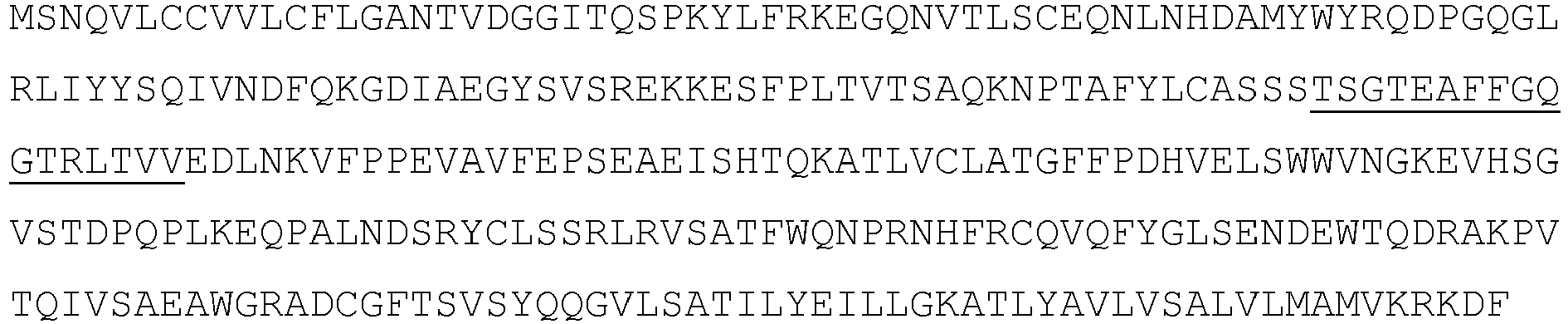
- As discussed above, the present invention provides a T-cell receptor comprising:
- (i) a T cell receptor α-chain comprising or consisting of the amino acid sequence of the amino acid sequence of LNTNAGKSTFGDGTTLTVKP (variable CDR3) (SEQ ID NO. 1) or SEQ ID NO. 2 (full length) and
- (ii) a T-cell receptor β-chain comprising or consisting of the amino acid sequence of TSGTEAFFGQGTRLTVV (variable CDR3) (SEQ ID NO. 3) or SEQ ID NO. 4 (full length).
- The present invention provides a T-cell receptor comprising:
- (i) a T cell receptor α-chain comprising the amino acid sequence of SEQ ID NO. 1 or SEQ ID NO. 2
and - (ii) a T-cell receptor β-chain comprising the amino acid sequence of SEQ ID NO. 3 or SEQ ID NO. 4.
- As discussed above, the present invention provides soluble T-cell receptor (sTCR) constructs comprising the T-cell receptors of the present invention.
- Said soluble T-cell receptor (sTCR) constructs comprise
- (1) at least one of the
- T-cell receptor α-chain(s) as defined above,
- T-cell receptor β-chain(s) as defined above,
- (2) fusion component(s)
preferably selected from- Fc receptors and/or Fc domains,
- cytokines, such as IL-2 or IL-15,
- toxins, such as exotoxin A, Pseudomonas exotoxin,
- antibodies, such as anti-CD3-antibodies
- or combinations thereof,
- Preferably, the soluble T-cell receptor comprises furthermore labels, such as radionuclides, fluorophors (such as fluorescein), which are preferably covalently attached/coupled to the soluble TCR, such as to the fusion component(s) (2).
- In one embodiment, the soluble T-cell receptor comprises as fusion component (2) IL-15 multimers. Such soluble TCRs are, for example, described in
WO 2008/143794 A1 andWO 2012/040323 A2 (both of Altor Bioscience Corp.). - For example, a soluble TCR can comprise as fusion component (2) IL-15 multimers, such as two IL-15 domains which are linked/bound together and wherein each IL-15 domain is bound to a T-cell receptor α-chain(s) and/or T-cell receptor β-chain(s) of the present invention.
- The soluble TCRs can comprise different of the fusion components (2), such as IL-15 and Fc domains. See for example,
WO 2012/040323 A2 . - TCR-alpha- and TCR-beta-chains can be solubilized by chemical modifications and linked covalently to each other and to other molecules such as Fc-receptors, cytokines and toxins (as decribed in Boulter et al, 2005; Lunde et al 2010).
- These soluble TCR constructs are suitable to be directly used for the detection and destruction of influenza-infected cells without the need of T-cells. This can be achieved by application of soluble T-cell receptor constructs to patients by intravenous, subcutaneous or intramuscular infusion or injections, respectively, or by application to the mucosa of the respiratory tract by inhalation or by spraying.
- As discussed above, the present invention provides chimeric T-cell receptors comprising at least one of
- the T-cell receptor α-chain(s) as defined above,
- the T-cell receptor β-chain(s) as defined above, or
- the T-cell receptor of the present invention,
- In one embodiment, a chimeric TCR of the invention comprises the T-cell receptor α-chain as defined above and the T-cell receptor β-chain as defined above, which are fused to each other via a linker and which are furthermore fused to CD3-zeta chain(s).
- Preferred CD3-zeta chain(s) are the zeta-chain(s) of the human CD3 complex of the T-cell receptor.
- The chimeric TCRs can comprise further components.
- Chimeric T-cell receptors and chimeric antigen receptors (CAR) are known in the art. See, for example, Han et al. 2013.
- As discussed above, the present invention provides a nucleic acid encoding the T-cell receptor according to the present invention.
- Preferably, the nucleic acid comprises
the nucleic acid encoding for the amino acid sequence of SEQ ID NO.1 and/or 3
or the nucleotide sequence of SEQ ID NO. 5 and/or 7
or their complementary sequence(s)
or sequence(s) that have at least 80 % identity to the nucleotide sequence of SEQ ID NO. 5 or 7, more preferably at least 85 % identity, more preferably 90 % identity or 95 % identity or 99 % identity. - In one embodiment, the nucleic acid comprises or consists of nucleotide sequence(s) that have a difference in up to 7 nucleotides of the nucleotide sequence of SEQ ID NO. 5 and/or 7.
- SEQ ID NO. 5 shows the nucleotide sequence of the CDR3 variable region of the T-cell receptor α-chain which is mainly responsible for recognizing the specific influenza epitope: TTAACACCAATGCAGGCAAATCAACCTTTGGGGATGGGACTACGCTCACTGTGAAGCCAA
- SEQ ID NO. 7 shows the nucleotide sequence of the CDR3 variable region of the T-cell receptor β-chain which is mainly responsible for recognizing the specific influenza epitope: ATCGGGCACTGAAGCTTTCTTTGGACAAGGCACCAGACTCACAGTTGTA
- In one embodiment, the nucleic acid comprises
the nucleic acid encoding for the amino acid sequence of SEQ ID NO. 2 and/or 4
the nucleotide sequence of SEQ ID NO. 6 and/or 8
or their complementary sequence(s)
or sequence(s) that have at least 80 % identity to the nucleotide sequence of SEQ ID NO. 6 or 8, more preferably at least 85 % identity, more preferably 90 % identity or 95 % identity or 99 % identity. - SEQ ID NO. 6 shows the full length nucleotide sequence of the T-cell receptor α-chain (wherein SEQ ID NO. 5 is underlined):

- SEQ ID NO. 8 shows the full length nucleotide sequence of the T-cell receptor β-chain (wherein SEQ ID NO. 7 is underlined):

- The nucleotide sequences of SEQ ID NO. 7 and 8 are cDNA.
- As discussed above, the present invention provides a nucleic acid encoding the soluble T-cell receptor construct according to the present invention.
- As discussed above, the present invention provides a nucleic acid encoding the chimeric T-cell receptor according to the present invention.
- The nucleic acids according to this invention comprise DNA (such as dsDNA, ssDNA, cDNA), RNA (such as dsRNA, ssRNA, mRNA), combinations thereof or derivatives (such as PNA) thereof.
- Preferably, the nucleic acid sequences of the present invention are codon-optimized for expression in mammalian cells, preferably for expression in human cells. Codon-optimization refers to the exchange in a sequence of interest of codons that are generally rare in highly expressed genes of a given species by codons that are generally frequent in highly expressed genes of such species, such codons encoding the same amino acids as the codons that are being exchanged.
- Within the scope of this invention are also the nucleotide sequences obtained due to the degeneration of the genetic code of the above nucleotide sequences.
- As discussed above, the present invention provides an expression construct for expressing the T-cell receptor according to the present invention in a cell.
- As discussed above, the present invention provides an expression construct for expressing the soluble T-cell receptor construct according to the present invention in a cell.
- As discussed above, the present invention provides an expression construct for expressing the chimeric T-cell receptor according to the present invention in a cell.
- Preferably, the expression constructs further comprise promoter and terminator sequences.
- An "expression or gene construct" (wherein both terms are used interchangeably throughout this specification) refers to a nucleic acid construct, usually an expression vector or plasmid, that is used to introduce a specific gene sequence into a target cell. Once the expression or gene construct is inside the cell, the protein that is encoded by the gene is produced by the cellular transcription and translation machinery. The expression or gene construct is designed to contain respective regulatory sequences that act as enhancer and promoter regions and lead to efficient transcription of the gene carried on the construct, including promoter and terminator sequences. The goal of a well-designed expression or gene construct is the production of large amounts of stable mRNA, and therefore proteins.
- The skilled artisan can select further suitable components of expression or gene constructs.
- Examples for suitable expression constructs are mRNA-constructs (Hofmann et al., 2011) or plasmids (as described in Nakazawa et al, 2011) that can be introduced into the cell by electroporation or by transfection reagents, such as liposomes. Further examples for suitable expression constructs are viral vectors, such as retroviral vectors (as described in Verra et al, 2004; Porter et al, 2011) and lentiviral vectors (as described in Josef et al, 2008). Viral vectors containing TCR-encoding genes can infect lymphocytes and express functional TCR in infected lymphocytes.
- The nucleic acids and/or in particular expression constructs of the invention are capable of directing the synthesis/expression of the TCRs of the invention in a suitable host cell.
- As discussed above, the present invention provides a cell comprising the T-cell receptor according to the present invention or the soluble T-cell receptor construct according to the present invention or the chimeric T-cell receptor of the invention or the nucleic acid(s) of the present invention or the expression construct of the present invention.
- Preferably, the cell expresses the T cell-receptor of the present invention.
- Preferably, the cell expresses the chimeric T-cell receptor according to the present invention.
- Preferably, the cell is selected from lymphocytes including but not limited to CD8+ T alpha/beta - lymphocytes (CTLs), CD4+ T cells, natural killer (NK) cells, natural killer T (NKT) cells, gamma/delta-T-cells.
- The transfer of influenza-specific TCR genes into (primary) T cells by e.g. viral vectors represents a promising means and method to generate influenza antigen-specific T cells. Adoptive transfer of such engineered T cells into hosts represents a promising approach for the immunotherapy of influenza.
- As discussed above, the present invention provides a pharmaceutical composition comprising one or more of:
- (i) the T-cell receptor of the present invention;
- (ii) the soluble T-cell receptor construct of the present invention;
- (iii) the chimeric T-cell receptor of the present invention;
- (iv) the nucleic acid(s) of the present invention or the expression construct of the present invention; and/or
- (v) the cell of the present invention,
- As discussed above, the present invention provides the ex vivo use of a T-cell receptor of the present invention, a chimeric T-cell receptor, a nucleic acid of the present invention or an expression construct of the present invention for generating genetically modified lymphocytes.
- Preferably the genetically modified lymphocytes are T cells, NK cells and/or NKT cells.
- In one embodiment, the generated genetically modified lymphocytes, preferably T cells and/or NK cells, are used for genetic immunization, preferably for preventing and/or treating influenza/influenza infections.
- The transfer of influenza-specific TCR genes into (primary) T cells by e.g. viral vectors represents a promising means and method to generate influenza antigen-specific T cells.
- Adoptive transfer of such engineered T cells into hosts represents a promising approach for the immunotherapy of influenza.
- In one embodiment, the chimeric T-cell receptor(s) of the present invention are used to generate genetically modified lymphocytes, preferably NK cells.
The transfer of chimeric receptors containing the whole or parts of the influenza-specific TCR genes linked to the CD3zeta chain into primary NK cells by e.g. viral vectors represents a promising means and method to generate influenza antigen-specific NK cells. Adoptive transfer of such engineered NK cells into hosts represents a promising approach for the immunotherapy of influenza. - As discussed above, the present invention provides the T-cell receptor of the present invention, the nucleic acid of the present invention, the expression construct of the present invention or the host cell of the present invention for use as a medicament.
- As discussed above, the present invention provides the T-cell receptor of the present invention, the nucleic acid of the present invention, the expression construct of the present invention or the host cell of the present invention for use in the prevention and/or treatment of influenza/influenza infections.
- Preferably, the use comprises adoptive, target-cell specific immunotherapy or genetic immunization.
- The patients are HLA2-positive.
- The present invention describes a method of preventing and/or treating influenza/influenza infections.
- Said method comprises the steps of
- (a) providing lymphocytes of a patient or a blood donor;
- (b) providing one or more of
- (i) a T-cell receptor chain or T-cell receptor described herein,
- (ii) a nucleic acid described herein,
- (iii) an expression construct described herein,
- (iv) a cell described herein, and
- (v) a pharmaceutical composition described herein,
- (c) ex vivo introduction of one or more of (i) to (v) of step (b) into the lymphocytes of step (a) and, thereby, obtaining genetically modified lymphocytes,
- (d) administering the genetically modified lymphocytes of step (c) to a subject or patient in need thereof.
- The subjects or patients can be HLA2-positive.
- The subjects or patients are either infected with influenza or healthy.
- The lymphocytes provided in step (a) can be T cells, NK cells and/or NKT cells, preferably CD8+ T cells.
- T cell receptors consisting of T cell receptor alpha and beta chains are used for transduction of T cells and NKT cells. For transduction of NK-cells, the T-cell receptor or single TCR-alpha- and/or TCR-beta chains are provided as a chimeric receptor, where the TCR is for example linked to the CD3zeta chain. See, for example, Zhang et al. 2013.
- The lymphocytes provided in step (a) can be obtained from the subject or patient, such as from the blood or by lymphapheresis of allogeneic blood donors.
- The ex vivo introduction in step (c) can be carried out via electroporation of a nucleic acid described herein or of an expression construct described herein, or by transfection reagents, such as liposomes.
- The expression construct can be
- an mRNA construct
- encoding the TCR-alpha - or TCR-beta chains; or
- a viral construct,
- preferably a lentiviral vector, retroviral vector, or other state of the art viral vector.
- The method can further comprise the following step
increasing the lytic ability of the genetically modified lymphocytes. - The time at which said further step is carried out in the method depends on the expression vector or construct used and/or on the ex vivo introduction of step (c). Usually, it is preferred to activate the cells and then carry out the ex vivo introduction (see step (c)).
- In an embodiment, where mRNA electroporation is used, the activation/increasing the lytic ability is carried out after the ex vivo introduction.
- For example, where retroviral vectors and transduction are used, the activation/increasing the lytic ability is carried out before the ex vivo introduction.
- For example, where lentiviral vectors are used, the activation/increasing the lytic ability can be carried out before and after the ex vivo introduction.
- The lytic ability of the genetically modified lymphocytes can be activated in vitro by
- mitogens, such as OKT 3, PHA and/or
- cytokines, such as Interleukin-2 (such as with doses of about 1 to 1000 U/ml) and/or Interleukin-7 (such as with doses of about 1 to 1000 U/l) and/or Interleukin-15.
- As discussed above, the present invention provides a method of detecting influenza/influenza infections, comprising the in vitro staining of influenza-infected cells with the use of the soluble T-cell receptor construct of the present invention.
- For example, the soluble T-cell receptor constructs are applied to patients by intravenous, subcutaneous or intramuscular infusion or injections, respectively, or by application to the mucosa of the respiratory tract by inhalation or by spraying.
- Soluble T-cell receptor constructs can be applied to patients:
- by intravenous infusions,
- by subcutaneous injection or infusion,
- by intramuscular injection,
- by inhalation or by spraying to the mucosal surfaces of the respiratory tract.
- Suitable dose ranges for application of soluble T-cell receptor constructs vary between 1 mg to 10 000 mg dependent on the application method and application site. Soluble T-cell receptors can bind to cells expressing GL9 peptides on their HLA-A2 molecules.
- According to the invention, the method of the invention is for detecting influenza/influenza infections, comprising the in vitro staining of influenza-virus infected cells by using the soluble T-cell receptor construct of the present invention which are is labelled.
- The label can be fluorophor(s) and/or radionuclide(s).
- Soluble T-cell receptors linked to fluorescent molecules such as fluorescein can be used to stain influenza virus infected cells in vitro. For this purpose, influenza virus infected cells are incubated in vitro with the soluble T-cell receptor constructs, and infected cells expressing HLA-A2/GL9-complexes on the cell surface can be detected according to their fluorescence by a Fluorescence activated cell sorter (FACS) or by microscope.
- The soluble TCR-constructs of the invention are suitable to be directly used for the detection and destruction of influenza-infected cells without the need of T-cells.
- The subjects or patients are HLA2-positive.
- The inventors have generated the Influenza matrix protein-specific TCR by isolating the TCR-encoding cDNA from an influenza specific CTL line that could recognize the HLA-A2-restricted influenza-matrix epitope GILGFVFTL (GL9). The CTL line was obtained by in vitro culture of peptide stimulated peripheral blood mononuclear cells derived from an HLA-A2 positive healthy subject. The whole mRNA was isolated from the CTL line, reverse-transcribed into cDNA and amplified with TCR-specific primers. After cloning of the TCR-alpha- and TCR-beta-chains, TCR-encoding mRNA was produced by in vitro transcription. The specificity of this TCR was demonstrated by electroporation of two mRNA-constructs encoding the TCR-alpha or the TCR-beta-chain of the influenza-specific TCR into T-cells from blood donors. The expression of the GILGFVFTL-specific TCR on the cell surface of electroporated T-cells could be proven by staining with a dextramer specific for the GILGFVFTL-peptide. The functional activity of TCR-electroporated T-cells could be demonstrated in gamma-IFN ELISPOT assays. In the ELISPOT assay, antigen-specific T-cells are detected via the secretion of gamma-IFN after stimulation with the cognate peptide.
- The GL9-epitope recognized by the TCR of the present invention is highly conserved between all mammal and avian influenza viruses. Because of the widespread animal reservoir of influenza viruses, there is an ongoing threat of the emergence of new highly pathogenic human influenza viruses that develop by mutations or reassortments of different mammal and avian influenza viruses. Gene therapy with genetic immunization via the transfer of the GL9-specific TCR could provide protection from new influenza viruses against which there is no vaccine yet available.
- The TCR-constructs of the present invention can be used both for therapy and prevention of influenza virus-infection in HLA-A2-positive patients. In Europe, approximately 40% of subjects are HLA-A2-postive.
- The TCR-constructs of the present invention can be used for treatment of patients already infected by influenza-viruses. The GL9-specific TCR can be transferred into lymphocytes, especially in CD8+ T-cells, via electroporation of lymphocytes with TCR-encoding mRNA- or DNA-constructs. Alternatively, the TCR can be transferred into lymphocytes using transfection reagents, such as liposomes or TCR-expressing viral vectors, such as retroviral or lentiviral vectors. The transfection of the GL9-specific TCR into CD8+ T-cells and in to gamma-delta-T-cells generates CTL capable to kill influenza virus infected cells. The transfection of the GL9-specific TCR into CD4+ T-cells generates CD4+ helper T-cells which usually do not kill infected cells but which can improve the influenza-specific immune response by providing help through secretion of cytokines. In addition, the transfection of chimeric GL9-specific TCR linked to other molecules, such as the CD3zeta-chain, can reprogram NK-cells for lysis of influenza virus infected cells.
- Transfer of GL9-specific TCR into lymphocytes of influenza-uninfected subjects can be used for protection from influenza infections. Although influenza-specific CTL can not prevent infection of cells by influenza viruses, they can control the spread of viral infection by elimination of infected cells. Thereby, they can prevent the development of clinical symptoms and diseases by influenza viruses.
- TCR-alpha- and TCR-beta-chains can be solubilized by chemical modifications and linked covalently to each other and to other molecules such as Fc-domains, cytokines, radionuclides and toxins (Boulter et al, 2005; Lunde et al 2010). These soluble TCR-constructs can directly be used for the detection and destruction of influenza-infected cells without the need of T-cells.
- The following examples and drawings illustrate the present invention without, however, limiting the same thereto.
-
-
Figure 1 . Stimulation of T cells.
Peripheral blood mononuclear cells (PBMC) of the blood donor EJ were electroporated with the influenza-specific T-cell receptor. The PBMC were then incubated with the HLA-A2-positive cell line T2 in a gamma-interferon-ELISPOT assay. The T2 cells were incubated with the influenza peptide IMP (GL9) or with the control peptide IV9. Mock are PBMC, which were electroporated without T-cell receptor genes. Shown is the number of cells which release gamma-interferon after contact with antigen (spot forming unit =SFU = number of the reactive T cells). As can be seen, the co-incubation of T2 cells which were incubated with the influenza IMP GL9-peptide, leads to a strong stimulation of T cells which were incubated with the influenza-specific T-cell receptor. -
Figure 2 . Peptide titration of the influenza GL9 peptide.
The T2 cell line was incubated with serial dilutions of the influenza GL9 peptide. Then, the T2 cells ware incubated in the gamma-Interferon-ELISPOT assay with lymphocytes, which were re-programmed via electroporation with influenza TCR-coding mRNA (TCR EP). Thereby, the T cells were recognized at peptide concentrations as low as 50 ng/ml. IV9 is a control peptide, which is not recognized. Mock EP are lymphocytes which were electroporated without mRNA and thus do not express the influenza TCR. -
Figure 3 . Sequence of the TCR alpha chain.
Nucleotide and amino acid sequence of the TCR alpha chain: Underlined is the CDR3 region containing the variable sequence, encoding for the specificity of the peptide (influenza epitope). -
Figure 4 . Sequence of the TCR beta chain.
Nucleotide and amino acid sequence of the TCR beta chain: Underlined is the CDR3 region containing the variable sequence, encoding for the specificity of the peptide (influenza epitope). - Peripheral blood mononuclear cells (PBMC) were obtained by Ficoll-Hypaque (Bio-Rad AG, Dreieich, Germany) density gradient centrifugation. For the generation of specific T cell lines, the PBMC were stimulated with the GL9 peptide at a final concentration of 6 µg/ml in 1 ml RPMI 1640 medium (Gibco Invitrogen, Karlsruhe, Germany) containing 10 % heat-inactivated fetal bovine serum (FCS) (PAN Biotech GmbH, Aidenbach, Germany), 1 % L-glutamine (2 mmol/l), penicillin (100 U/ml), streptomycin (100 µg/ml), Hepes (10 mmol/l) (Merck, Darmstadt, Germany) and 10 U/ml recombinant Interleukin-2 (Proleukin, Chiron, CA, USA). After 10 to 14 days, the outgrowing cells were tested for recognition of IMP-GL9 peptide. The specific CTL responses were analyzed by γ-Interferon enzyme-linked immunospot assays (ELISPOT). ELISPOT assays were conducted using R5AB media consisting of RPMI 1640 medium with supplements and 5 % heat-inactivated human AB-Serum (Sigma-Aldreich, Steinheim, Germany).
- The Peptides IMP-GL9 (GILGFVFTL, SEQ ID NO. 9) and HIV-1 p17 SL9 (SLYNTVATL, SEQ ID NO. 10) were synthesized as C-terminal carboxamides (EMC Microcollections, Tubingen, Germany). Stock solutions of peptides were prepared in dimethyl sulfoxide (20 mg/ml, Merck, Darmstadt, Germany). For the assessment of the functional avidity of peptides by peptide titrations assays, peptides were added in serial dilutions ranging from 20 µg/ml to 1 ng/ml to ELISPOT plates and incubated with CD8+ T-cell lines for 18-48 hours.
- 96-well, nitrocellulose, filter-backed microtiter plates (MultiScreen®HTS Filter Plates, Millipore, Molsheim, France) were activated with 20 µl/well 70 % Methanol (Merck, Darmstadt, Germany), and after washing twice with PBS, the plates were coated with 50 µl of anti-human γ-Interferon (γ-IFN) antibody 1-D1K (Mabtech, Stockholm, Sweden) at a concentration of 10 µg/ml. After this, the plates were washed four times with PBS and blocked with R5AB. The plates could be stored at -20 °C until they were used. After thawing the cells were added. Four hours after electoporation 1-1.5 x 10⁵ electroporated PBMC were analyzed in duplicates by ELISpot, while 0.5 x 10⁵ stimulated T cells per well were used for analysis of the peptide specific responses. Peptides were added directly to the wells at a final concentration of 20 µg/ml. In addition, EBV-transformed B-lymphoblastoid cell lines (B-LCL) incubated with IMP-GL9 peptide (100 µg/ml) were used as antigen presenting cells. HLA-A2 positive B-LCL were incubated for one hour at 37 °C in 7 % CO2, washed three times with PBS and 0.5 x 10⁵ B-LCL per well were added. The plates were incubated for 18-48 hours at 37 °C in 7 % CO2. After six washes with PBS containing 0.05 % Tween 20 (PBS-T0.05%), 100 µl biotinylated anti-human γ-IFN monoclonal antibody 7-B6-1 (Mabtech, Stockholm, Sweden) was incubated at a final concentration of 2 µg/ml for two hours at room temperature. After washing six times with PBS-T0.05%, 100 µl avidin/peroxidase substrate (Vectastain® ABC-Kit, Linaris, Wertheim, Germany) was added to each well, the plates were incubated for one to three hours at room temperature and then washed three times with PBS-T0.05% and three times with PBS. Finally 100 µl AEC substrate (3-amino-9-ethylcarbazole, Sigma-Aldrich, Germany) containing 0.01 % H2O2 was added as chromogen to each well. Spots developed within four minutes, and the reaction was stopped by washing the plates with distilled water. The plates were air-dried, and the spots were counted using the Elispot reader (AID, Strassberg, Germany).
- The generated T cells were stained with the SL9-specific MHC-Dextramer conjugated with PE (Immudex, Dako, Denmark), following the manufactures' instructions.
- In brief, 2-5 x 10⁵ T cells were washed with PBS containing 5 % heat-inactivated FCS and were centrifuged at 300x g for 5 minutes. The supernatant was removed, and the cells were resuspended in the remaining liquid. 10 µl of MHC Dextramer were added, mixed, and incubated for 10 minutes at room temperature. 5 µl of anti-CD8 antibody (Beckman Coulter, Krefeld, Germany), conjugated either with FITC, was added and incubated for 20 minutes at 4 °C. Afterwards, the cells were washed twice with PBS + 5 % FCS and resuspended in PBS. The measuring was done in a FACS cytometer (FACS Calibur, BD, Heidelberg, Germany). In addition, the cells were sorted in an Aria II FACS (BD, Heidelberg).
- After isolation of PBMC by density centrifugation, 3 - 4 x 10⁷ PBMC were cultured in 10 ml RPMI1640 with 1% human AB serum, 1% L-glutamine (2 mmol/l), penicillin (100 U/ml), and streptomycin (100 µg/ml) in a 60 mm cell culture dish overnight under standard conditions (37°C, 7% CO2). Then, PBMC were harvested from the dishes and washed with pure RPMI1640 and with Optimem (Gibco Invitrogen, Germany) both at room temperature. For electroporation 0.5 - 1 x 10⁷ PBMC were resuspended in a volume of 100 µl Optimem. 15 µg of each TCR-chain mRNA were transferred into a 4 mm cuvette (Peqlab, Erlangen, Germany). Electroporation was performed with a Genepulser Xcell (Bio-Rad, Munich, Germany) with following pulse conditions: square wave pulse, 500 V, 3 ms. Immediately after electroporation, the cells were transferred into prewarmed RPMI1640 with 1% human AB serum, 1% L-glutamine (2 mmol/l), penicillin (100 U/ml), and streptomycin (100 µg/ml). For mock electroporation, no mRNA was added to the cells before electroporation.
- Total RNA was isolated from GL9-specific CTL lines using the NucleoSpin® RNA II Kit (Machery-Nagel, Düren, Germany) according to the manufactures' instructions. Reverse transcription was conducted using the Superscript II Reverse transcriptase (Invitrogen, Darmstadt, Germany), 10 pmol of each
64T-primer CGATAAAAGCTCCGGGGATAACAGAT63VN V = A, G, C; N = A, C, G, T (SEQ ID NO. 11) block primer AAGCAGTGGTAACAACGCAGAGTACGCGG (SEQ ID NO. 12) - TCR genes were amplified by PCR described by Birkholz et al. (Birkholz et al, 2009) using Advandage-Polymerase (BD, Heidelberg, Germany),
20 pmol 64T primer, and20 pmol T7-capswitch primer (SEQ ID NO. 13)
(Birkholz et al, 2009). - The following first TCR chain-specific PCR was done with TCR-specific primers specific for the TCR α-chain with
40 pmol SMARTarg AAGCAGTGGTAACAACGCAGAGTACG (SEQ ID NO. 14) 20 pmol Cα 3'UTR CTGTCTTACAATCTTGCAGATC (SEQ ID NO. 15);
SMARTarg,20 pmol Cβ1 3'UTR CCACTTCCAGGGCTGCCTTC (SEQ ID NO. 16), 20 pmol Cβ2 3'UTR TGACCTGGGATGGTTTTGGAGCTA (SEQ ID NO. 17). - The amplified DNA was verified by DNA sequencing and identified via blast sequence search and alignment. The identified TCR chains were determined according to the nomenclature of Arden et al. (Arden et al. 1995) and Lefranc et al. (Lefranc et al. 2001).
- The identified TCR chains were amplified by PCR using Pfunds-Polymerase (Genaxxon Bioscience GmbH, Ulm, Germany) and the following primer pairs with a concentration of 1 µg/µl:
α-chain:AV16s1_TRAV3 GACTCTAGATGGCCTCTGCACCCATC (SEQ ID NO. 18) Calpha-XhoI CTCTCGAGCATCTTGCAGATCTCAGCTGGACCACA (SEQ ID NO. 19);
β-chain:BV17s1_TRBV19 GACTCTAGATGAGCAACCAGGTGCTCT (SEQ ID NO. 20) HCbeta1-XhoI/EcoRI (SEQ ID NO. 21) GGAATTCCTCGAGGGATCCCTGCCTTCAGAAATCCTTTCTC. - The PCR products were cloned into the RNA production vectors pGEMsigsurvivinDClamp (Bonehill et al, 2004) using the restriction sites XbaI and XhoI (underlined) introduced by the PCR primer (Birkholz et al, 2009). Every new construct was verified by DNA sequencing.
- In-vitro transcription was performed using mMESSAGE mMACHINE® T7 Ultra Kit (Applied Biosystems/Ambion, Texas, USA) according to the manufactures' instructions. The mRNA was purified using the PureLink™ RNA Mini Kit (Invitrogen, Darmstadt, Germany) following the manufactures' protocol and the concentrations of mRNA was determined by spectrophotometrical analysis. RNA quality was verified by agarose gel electrophoresis and mRNA was stored at -80°C.
- The features disclosed in the foregoing description, in the claims and/or in the accompanying drawings may, both separately and in any combination thereof, be material for realizing the invention in diverse forms thereof.
-
- Arden, B., et al., Human T-cell receptor variable gene segment families. Immunogenetics, 1995. 42(6): p. 455-500.
- Berdien B, Reinhard H, Meyer S, Spöck S, Kröger N, Atanackovic D, Fehse B. Influenza virus-specific TCR-transduced T cells as a model for adoptive immunotherapy. Hum Vaccin Immunother. 2013 Feb 21;9(6). [Epub ahead of print]
- Birkholz, K., et al., A fast and robust method to clone and functionally validate T-cell receptors. J Immunol Methods, 2009. 346(1-2): p. 45-54.
- Bonehill, A., et al., Messenger RNA-electroporated dendritic cells presenting MAGE-A3 simultaneously in HLA class I and class II molecules. J Immunol, 2004. 172(11): p. 6649-57.
- Boulter JM and Jakobsen BK. Stable, soluble, high-affinity, engineered T cell receptors: novel antibody-like proteins for specific targeting of peptide antigens. Clin Exp Immunol. 2005; 142(3): 454-460.
- Furuse Y, Suzuki A, Kamigaki T and Oshitani H. Evolution of the M gene of the influenza A virus in different host species: large-scale sequence analysis. Virology Journal 2009, 6:67 1743-422X-6-67
- Galina V. Petrova, Elena N. Naumova and Jack Gorski. The Polyclonal CD8 T Cell Response to Influenza M1 58-66 Generates a Fully Connected Network of Cross-Reactive Clonotypes to Structurally Related Peptides: A Paradigm for Memory Repertoire Coverage of Novel Epitopes or Escape Mutants. J Immunol 2011;
- Galina V. Petrova and Jack Gorski. Cross-reactive responses to modified M158-66 peptides by CD8+ T cells that use noncanonical BV genes can describe unknown repertoires. Eur. J. Immunol. 2012. 42: 3001-3008.
- Han EQ, Li XL, Wang CR, Li TF, Han SY. Chimeric antigen receptor-engineered T cells for cancer immunotherapy: progress and challenges. J Hematol Oncol. 2013 Jul 8;6:47.
- Heemskerk MHM, Hagedoorn RS, van der Hoorn MAWG, van der Veken LT, Hoogeboom M, Kester MGD, Willemze R, and Falkenburg JHF. Efficiency of T-cell receptor expression in dual-specific T cells is controlled by the intrinsic qualities of the TCR chains within the TCR-CD3 complex. Blood, 2007, VOL 109, p. 235-243.
- Hofmann, C., et al., Human T cells expressing two additional receptors (TETARs) specific for HIV-1 recognize both epitopes. Blood, 2011. 118(19): p. 5174-7
- Jeffrey Ishizuka, Guillaume B.E. ,Stewart-Jones, Anton van der Merwe, John I. Bell, Andrew J. McMichael and E. Yvonne Jones. The Structural Dynamics and Energetics of an Immunodominant T Cell Receptor Are Programmed by Its Vb Domain. Immunity 2008.Joseph A, Zheng JH, Follenzi A, DiLorenzo T, Sango K, Hyman J, Chen K, Piechocka-Trocha A, Brander C, Hooijberg E, Vignali DA, Walker BW and Goldstein H. Lentiviral Vectors Encoding Human Immunodeficiency Virus Type 1. (HIV-1)-Specific T-Cell Receptor Genes Efficiently Convert Peripheral Blood CD8 T Lymphocytes into Cytotoxic T Lymphocytes with Potent In Vitro and In Vivo HIV-1-Specific Inhibitory Activity. Journal of Virology, Mar. 2008, p. 3078-3089 Vol. 82, No. 6
- Lefranc, M.-P., G. Lefranc, The T cell receptor FactsBook 2001. Academic Press. ISBN:0124413528 2001.
- Linnemann C, Schumacher TNM and Bendle GM. T-Cell Receptor Gene Therapy: Critical Parameters for Clinical Success. Journal of Investigative Dermatology 2011, Vol. 131: 1806-1816.
- Lunde E, Løset GÅ, Bogen B, Sandlie I. Stabilizing mutations increase secretion of functional soluble TCR-Ig fusion proteins. BMC Biotechnology 2010, 10:61
- Nakazawa Y, Huye Le E, Salsman V S, Leen A M, Ahmed N, Rollins L, Dotti G, Gottschalk S M, Wilson M H and Rooney C M. PiggyBac-mediated Cancer Immunotherapy Using EBV-specific Cytotoxic T-cells Expressing HER2-specific Chimeric Antigen Receptor. Molecular therapy 2011 Dec;19(12):2133-43.
- Paul J. Lehner, Eddie C. Y. Wang, Paul A. H. Moss, Sheila Williams, Kaye Platt, Steven M. Friedman, John I. Bell, and Leszek K. Borysiewicz. Human HLA-A0201-restricted Cytotoxic T Lymphocyte Recognition of Influenza A Is Dominated by T Cells Bearing the V/317 Gene Segment. J Exp Med 1995.
- Porter DL, Levine BL, Kalos M, Bagg A, and June CH. Chimeric Antigen Receptor-ModifiedT Cells in Chronic Lymphoid Leukemia. N Engl J Med 2011;365:725-33.
- Shalyn C. Clute, Yuri N. Naumov, Levi B. Watkin, Nuray Aslan, John L. Sullivan, David A. Thorley-Lawson, Katherine Luzuriaga, Raymond M. Welsh, Roberto Puzone, Celada F, and Selin LK., Broad cross-reactive T cell receptor repertoires recognizing dissimilar Epstein-Barr and influenza A virus epitopes. J Immunol 2010.
- Verra NCV, Jorritsma A, Weijer K, Ruizendaal JJ., Voordouw A, Weder P, Hooijberg E, Schumacher TNM, Haanen JBAG. Spits H, and Luiten RM. Human Telomerase Reverse Transcriptase-Transduced Human Cytotoxic T Cells Suppress the Growth of Human Melanoma in Immunodeficient Mice. Cancer Research 64, 2153-2161, March 15, 2004
- Widjaja L, Krauss SL, Webby RJ, Xie T, and Webster RG. Matrix Gene of Influenza A Viruses Isolated from Wild Aquatic Birds: Ecology and Emergence of Influenza A Viruses Virol. 2004 August; 78(16): 8771-8779.
- Zhang G, Liu R, Zhu X, Wang L, Ma J, Han H, Wang X, Zhang G, He W, Wang W, Liu C, Li S, Sun M, Gao B. Retargeting NK-92 for anti-melanoma activity by a TCR-like single-domain antibody. Immunol Cell Biol. 2013 Nov;91(10):615-24. doi: 10.1038/icb.2013.45. Epub 2013 Oct 8.
-
- <110> Friedrich-Alexander Universität Erlangen-Nürnberg
- <120> Influenza-specific T-cell receptor and its uses in the detection, prevention and/or treatment of influenza
- <130> U30517WOEP
- <150>
EP 13 198 519.4
<151> 2013-12-19 - <160> 21
- <170> PatentIn version 3.5
- <210> 1
<211> 20
<212> PRT
<213> Homo sapiens - <400> 1

- <210> 2
<211> 275
<212> PRT
<213> Homo sapiens - <400> 2


- <210> 3
<211> 17
<212> PRT
<213> Homo sapiens - <400> 3

- <210> 4
<211> 308
<212> PRT
<213> Homo sapiens - <400> 4


- <210> 5
<211> 60
<212> DNA
<213> Homo sapiens - <400> 5
ttaacaccaa tgcaggcaaa tcaacctttg gggatgggac tacgctcact gtgaagccaa 60 - <210> 6
<211> 825
<212> DNA
<213> Homo sapiens - <400> 6


- <210> 7
<211> 51
<212> DNA
<213> Homo sapiens - <400> 7
acatcgggca ctgaagcttt ctttggacaa ggcaccagac tcacagttgt a 51 - <210> 8
<211> 924
<212> DNA
<213> Homo sapiens - <400> 8

- <210> 9
<211> 9
<212> PRT
<213> Influenza A virus - <400> 9

- <210> 10
<211> 9
<212> PRT
<213> Human immunodeficiency virus - <400> 10

- <210> 11
<211> 90
<212> DNA
<213> Artificial Sequence - <220>
<223> 64T-Primer with V = A, G, C; N = A, C, G, T - <220>
<221> misc_feature
<222> (90)..(90)
<223> n is a, c, g, or t - <400> 11

- <210> 12
<211> 29
<212> DNA
<213> Artificial Sequence - <220>
<223> Block primer - <400> 12
aagcagtggt aacaacgcag agtacgcgg 29 - <210> 13
<211> 46
<212> DNA
<213> Artificial Sequence - <220>
<223> T7-capswitch primer - <400> 13
ttatacgact cactataggg aggaagcagt ggtaacaacg cagagt 46 - <210> 14
<211> 26
<212> DNA
<213> Artificial Sequence - <220>
<223> SMARTarg primer - <400> 14
aagcagtggt aacaacgcag agtacg 26 - <210> 15
<211> 22
<212> DNA
<213> Artificial Sequence - <220>
<223> C alpha 3'UTR primer - <400> 15
ctgtcttaca atcttgcaga tc 22 - <210> 16
<211> 20
<212> DNA
<213> Artificial Sequence - <220>
<223> C beta 1 3'UTR primer - <400> 16
ccacttccag ggctgccttc 20 - <210> 17
<211> 24
<212> DNA
<213> Artificial Sequence - <220>
<223> C beta 2 3'UTR primer - <400> 17
tgacctggga tggttttgga gcta 24 - <210> 18
<211> 26
<212> DNA
<213> Artificial Sequence - <220>
<223> AV16s1_TRAV3 Primer - <400> 18
gactctagat ggcctctgca cccatc 26 - <210> 19
<211> 35
<212> DNA
<213> Artificial Sequence - <220>
<223> Calpha-XhoI primer - <400> 19
ctctcgagca tcttgcagat ctcagctgga ccaca 35 - <210> 20
<211> 27
<212> DNA
<213> Artificial Sequence - <220>
<223> BV17s1_TRBV19 primer - <400> 20
gactctagat gagcaaccag gtgctct 27 - <210> 21
<211> 41
<212> DNA
<213> Artificial Sequence - <220>
<223> HCbeta1-XhoI/EcoRI primer - <400> 21
ggaattcctc gagggatccc tgccttcaga aatcctttct c 41
Claims (15)
- A T-cell receptor comprising a T-cell receptor α-chain comprising the amino acid sequence of LNTNAGKSTFGDGTTLTVKP (SEQ ID NO. 1) or the amino acid sequence of SEQ ID NO. 2.
- A T-cell receptor comprising a T-cell receptor β-chain comprising the amino acid sequence of TSGTEAFFGQGTRLTVV (SEQ ID NO. 3) or the amino acid sequence of SEQ ID NO. 4.
- A T-cell receptor (TCR) comprising:(i) a T cell receptor α-chain comprising the amino acid sequence of SEQ ID NO. 1 or SEQ ID NO. 2
and(ii) a T-cell receptor β-chain comprising the amino acid sequence of SEQ ID NO. 3 or SEQ ID NO. 4. - A soluble T-cell receptor (sTCR) construct comprising(1) at least one of theT-cell receptor α-chain(s) as defined in claim 1, orT-cell receptor β-chain(s) as defined in claim 2,
preferably covalently linked to each other to form TCR heterodimers or multimers,
and(2) fusion component(s)wherein the at least one T-cell receptor chain (1) is bound to the fusion component(s) (2),
preferably selected fromFc receptors and/or Fc domains,cytokines, such as IL-2 or IL-15,toxins, such as exotoxin A, Pseudomonas exotoxin, antibodies, such as anti-CD3-antibodies,or combinations thereof,
wherein the soluble T-cell receptor comprises furthermore labels, such as radionuclides, fluorophors. - A chimeric T-cell receptor comprising
at least one of
the T-cell receptor α-chain(s) as defined in claim 1,
the T-cell receptor β-chain(s) as defined in claim 2, or
the T-cell receptor of claim 3,
wherein the TCR α-chain and/or the TCR β-chain is/are fused to CD3-zeta chain(s), preferably via a linker. - A nucleic acid encoding the T-cell receptor according to any one of claims 1 to 3 or encoding the soluble T-cell receptor construct according to claim 4 or encoding the chimeric T-cell receptor according to claim 5.
- The nucleic acid of claim 6, comprising
the nucleic acid encoding for the amino acid sequence of SEQ ID NO.1 and/or 3,
or the nucleotide sequence of SEQ ID NO. 5 and/or 7,
or their complementary sequence(s)
or sequence(s) that have at least 80 % identity to the nucleotide sequence of SEQ ID NO. 5, more preferably at least 85 % identity, more preferably 90 or 95 or 99 % identity,
and/or comprising
the nucleic acid encoding for the amino acid sequence of SEQ ID NO. 2 and/or 4,
the nucleotide sequence of SEQ ID NO. 6 and/or 8,
or their complementary sequence(s)
or sequence(s) that have at least 80 % identity to the nucleotide sequence of SEQ ID NO. 6 or 8, more preferably at least 85 % identity, more preferably 90 or 95 or 99 % identity. - An expression construct for expressing the T-cell receptor or soluble T-cell receptor construct or the chimeric T-cell receptor according to any one of claims 1 to 5, preferably further comprising promoter and terminator sequences.
- A cell comprising the T-cell receptor or soluble T-cell receptor construct or chimeric T-cell receptor according to any one of claims 1 to 5 or the nucleic acid(s) of claim 6 or 7 or the expression construct of claim 8,
preferably expressing the T cell-receptor or soluble T-cell receptor construct according or chimeric T-cell receptor to any one of claims 1 to 5,
which is preferably selected from lymphocytes including but not limited to CD8+ T alpha/beta - lymphocytes (CTLs), CD4+ T cells, natural killer (NK) cells, natural killer T (NKT) cells, gamma/delta-T-cells. - A pharmaceutical composition comprising one or more of:(i) the T-cell receptor of any one of claims 1 to 3;(ii) the soluble T-cell receptor construct of claim 4;(iii) the chimeric T-cell receptor of claim 5;(iv) the nucleic acid(s) of claim 6 or 7 or the expression construct of claim 8; and/or(v) the cell of claim 9,and, optionally, pharmaceutically excipient(s).
- Ex vivo use of a T-cell receptor of claims 1 to 3, a chimeric T-cell receptor of claim 5, a nucleic acid of claim 6 to 7 or an expression construct of claim 8 for generating genetically modified lymphocytes, preferably T cells, NK cells and/or NKT cells.
- The use of claim 11, comprising ex vivo introduction of one or more of (i) to (v), wherein (i) to (v) are:(i) a T-cell receptor of claims 1 to 3 or a chimeric T-cell receptor of claim 5,(ii) a nucleic acid of claim 6 or 7,(iii) an expression construct of claim 8,(iv) a cell of claim 9, and(v) a pharmaceutical composition of claim 10;into the lymphocytes of a patient or a blood donor, and, thereby, obtaining genetically modified lymphocytes,
wherein the patients are HLA2-positive and wherein the patients are either infected with influenza or healthy. - The use of claim 11 or 12, wherein the ex vivo introduction is carried out via electroporation or by transfection reagents, such as liposomes,
and/or wherein the use further comprises increasing the lytic ability of the genetically modified lymphocytes. - The T-cell receptor of claims 1 to 3, the soluble T-cell receptor construct of claim 4, the chimeric T-cell receptor of claim 5, the nucleic acid of claims 6 or 7, the expression construct of claim 8 or the host cell of claim 9 for use as a medicament,
preferably for use in the detection, prevention and/or treatment of influenza, influenza infections,
more preferably comprising the use of adoptive, target-cell specific immunotherapy or genetic immunization,
and wherein the patients are HLA2-positive. - A method of detecting influenza/influenza infections,
said method comprising the in vitro staining of influenza-virus infected cells by using the soluble T-cell receptor construct of claim 4 which is labelled,
wherein the patients are HLA2-positive and wherein the patients are either infected with influenza or healthy.
Priority Applications (1)
| Application Number | Priority Date | Filing Date | Title |
|---|---|---|---|
| EP14830382.9A EP3083674B1 (en) | 2013-12-19 | 2014-12-18 | Influenza-specific t-cell receptor and its uses in the detection, prevention and/or treatment of influenza |
Applications Claiming Priority (3)
| Application Number | Priority Date | Filing Date | Title |
|---|---|---|---|
| EP13198519 | 2013-12-19 | ||
| EP14830382.9A EP3083674B1 (en) | 2013-12-19 | 2014-12-18 | Influenza-specific t-cell receptor and its uses in the detection, prevention and/or treatment of influenza |
| PCT/EP2014/078502 WO2015091823A1 (en) | 2013-12-19 | 2014-12-18 | Influenza-specific t-cell receptor and its uses in the detection, prevention and/or treatment of influenza |
Publications (2)
| Publication Number | Publication Date |
|---|---|
| EP3083674A1 EP3083674A1 (en) | 2016-10-26 |
| EP3083674B1 true EP3083674B1 (en) | 2018-10-03 |
Family
ID=49886703
Family Applications (1)
| Application Number | Title | Priority Date | Filing Date |
|---|---|---|---|
| EP14830382.9A Not-in-force EP3083674B1 (en) | 2013-12-19 | 2014-12-18 | Influenza-specific t-cell receptor and its uses in the detection, prevention and/or treatment of influenza |
Country Status (3)
| Country | Link |
|---|---|
| US (1) | US10370427B2 (en) |
| EP (1) | EP3083674B1 (en) |
| WO (1) | WO2015091823A1 (en) |
Families Citing this family (4)
| Publication number | Priority date | Publication date | Assignee | Title |
|---|---|---|---|---|
| WO2017171631A1 (en) * | 2016-03-31 | 2017-10-05 | Lion Tcr Pte. Ltd. | Non-activated t cells expressing exogenous virus-specific t cell receptor (tcr) |
| US20200283497A1 (en) * | 2017-09-13 | 2020-09-10 | Biontech Cell & Gene Therapies Gmbh | Rna replicon for expressing at cell receptor or an artificial t cell receptor |
| WO2019222427A1 (en) * | 2018-05-16 | 2019-11-21 | Fred Hutchinson Cancer Research Center | Merkel cell polyomavirus t antigen-specific tcrs and uses thereof |
| CA3190987A1 (en) | 2020-08-10 | 2022-02-17 | Janssen Biotech, Inc. | Materials and methods for producing bioengineered virus specific lymphocytes |
Family Cites Families (4)
| Publication number | Priority date | Publication date | Assignee | Title |
|---|---|---|---|---|
| BR9910253A (en) * | 1998-05-19 | 2002-09-17 | Avidex Ltd | Soluble T Cell Receiver |
| AU2007248019B2 (en) * | 2006-05-03 | 2012-10-11 | Government Of The United States Of America, Represented By The Secretary, Department Of Health And Human Services | Chimeric T cell receptors and related materials and methods of use |
| WO2008039818A2 (en) | 2006-09-26 | 2008-04-03 | Government Of The United States Of America, Represented By The Secretary, Department Of Health And Human Services | Modified t cell receptors and related materials and methods |
| AU2011304728A1 (en) * | 2010-09-20 | 2013-03-14 | Biontech Ag | Antigen-specific T cell receptors and T cell epitopes |
-
2014
- 2014-12-18 US US15/106,292 patent/US10370427B2/en not_active Expired - Fee Related
- 2014-12-18 EP EP14830382.9A patent/EP3083674B1/en not_active Not-in-force
- 2014-12-18 WO PCT/EP2014/078502 patent/WO2015091823A1/en not_active Ceased
Non-Patent Citations (1)
| Title |
|---|
| None * |
Also Published As
| Publication number | Publication date |
|---|---|
| WO2015091823A1 (en) | 2015-06-25 |
| EP3083674A1 (en) | 2016-10-26 |
| US10370427B2 (en) | 2019-08-06 |
| US20160297864A1 (en) | 2016-10-13 |
Similar Documents
| Publication | Publication Date | Title |
|---|---|---|
| JP6664528B2 (en) | CLD18A2-targeted immune effector cells and methods for their preparation and use | |
| US12221465B2 (en) | Signaling and antigen-presenting bifunctional receptors (SABR) | |
| KR102488477B1 (en) | Cellular platform for rapid and comprehensive t-cell immunomonitoring | |
| CN111675765B (en) | Armed chimeric antigen receptor cell targeting coronavirus SPIKE, preparation method and application | |
| JP6580579B2 (en) | Methods and compositions for producing cells expressing a T cell receptor | |
| CN105368859B (en) | A kind of chimeric antigen receptor hCD87-CAR, lentivirus and plasmid carrying hCD87-CAR gene structure and application thereof | |
| TWI334442B (en) | Process for producing cytotoxic lymphocyte | |
| JP2017522859A (en) | T cell receptor specific for glypican 3 and its use for immunotherapy of hepatocellular carcinoma | |
| CN107708710A (en) | Smart CAR devices, DE CAR polypeptides, Side CAR and its use | |
| CN111743923A (en) | Therapeutic agents comprising isolated recombinant oncolytic adenovirus and immune cells and uses thereof | |
| KR20240005714A (en) | Peptides and engineered T cell receptors targeting SARS-COV-2 antigens and methods of use | |
| US10370427B2 (en) | Influenza-specific T-cell receptor and its uses in the detection, prevention and/or treatment of influenza | |
| CN113195528B (en) | Binding proteins specific for HA-1H and uses thereof | |
| CN115066433A (en) | Amplification enhancer and application thereof | |
| CN109957018A (en) | It is a kind of to target the single-chain antibody of CD22, Chimeric antigen receptor T cell and its preparation method and application | |
| CN109957023A (en) | It is a kind of to target the single-chain antibody of CD22, Chimeric antigen receptor T cell and its preparation method and application | |
| WO2021151038A1 (en) | Quantitative control of activity of engineered cells expressing universal immune receptors | |
| CN109957546A (en) | A kind of Chimeric antigen receptor T cell and its preparation method and application targeting CD317 | |
| CN110526987A (en) | Target Chimeric antigen receptor, the Chimeric antigen receptor T cell and its preparation method and application of CD133 | |
| CN109957020A (en) | It is a kind of to target the single-chain antibody of DR5, Chimeric antigen receptor T cell and its preparation method and application | |
| WO2021036245A1 (en) | Chimeric antigen receptor t cell carrying safety switch and targeting egfrvⅲ, and preparation method therefor and use thereof | |
| CN102046780A (en) | Method for production of transfected cell | |
| AU2019252878B2 (en) | Chimeric Notch receptors | |
| CN109957547A (en) | A kind of Chimeric antigen receptor T cell and its preparation method and application targeting CD317 | |
| CN109957017A (en) | A kind of single chain antibody targeting OX40, chimeric antigen receptor T cell and preparation method and application thereof |
Legal Events
| Date | Code | Title | Description |
|---|---|---|---|
| PUAI | Public reference made under article 153(3) epc to a published international application that has entered the european phase |
Free format text: ORIGINAL CODE: 0009012 |
|
| 17P | Request for examination filed |
Effective date: 20160621 |
|
| AK | Designated contracting states |
Kind code of ref document: A1 Designated state(s): AL AT BE BG CH CY CZ DE DK EE ES FI FR GB GR HR HU IE IS IT LI LT LU LV MC MK MT NL NO PL PT RO RS SE SI SK SM TR |
|
| AX | Request for extension of the european patent |
Extension state: BA ME |
|
| DAX | Request for extension of the european patent (deleted) | ||
| 17Q | First examination report despatched |
Effective date: 20170329 |
|
| RIC1 | Information provided on ipc code assigned before grant |
Ipc: C07K 14/725 20060101AFI20180315BHEP |
|
| GRAP | Despatch of communication of intention to grant a patent |
Free format text: ORIGINAL CODE: EPIDOSNIGR1 |
|
| INTG | Intention to grant announced |
Effective date: 20180423 |
|
| GRAS | Grant fee paid |
Free format text: ORIGINAL CODE: EPIDOSNIGR3 |
|
| GRAA | (expected) grant |
Free format text: ORIGINAL CODE: 0009210 |
|
| AK | Designated contracting states |
Kind code of ref document: B1 Designated state(s): AL AT BE BG CH CY CZ DE DK EE ES FI FR GB GR HR HU IE IS IT LI LT LU LV MC MK MT NL NO PL PT RO RS SE SI SK SM TR |
|
| REG | Reference to a national code |
Ref country code: GB Ref legal event code: FG4D |
|
| REG | Reference to a national code |
Ref country code: CH Ref legal event code: EP Ref country code: AT Ref legal event code: REF Ref document number: 1048481 Country of ref document: AT Kind code of ref document: T Effective date: 20181015 |
|
| REG | Reference to a national code |
Ref country code: CH Ref legal event code: NV Representative=s name: E. BLUM AND CO. AG PATENT- UND MARKENANWAELTE , CH Ref country code: DE Ref legal event code: R096 Ref document number: 602014033516 Country of ref document: DE Ref country code: IE Ref legal event code: FG4D |
|
| REG | Reference to a national code |
Ref country code: NL Ref legal event code: MP Effective date: 20181003 |
|
| REG | Reference to a national code |
Ref country code: LT Ref legal event code: MG4D |
|
| REG | Reference to a national code |
Ref country code: AT Ref legal event code: MK05 Ref document number: 1048481 Country of ref document: AT Kind code of ref document: T Effective date: 20181003 |
|
| PG25 | Lapsed in a contracting state [announced via postgrant information from national office to epo] |
Ref country code: NL Free format text: LAPSE BECAUSE OF FAILURE TO SUBMIT A TRANSLATION OF THE DESCRIPTION OR TO PAY THE FEE WITHIN THE PRESCRIBED TIME-LIMIT Effective date: 20181003 |
|
| PG25 | Lapsed in a contracting state [announced via postgrant information from national office to epo] |
Ref country code: ES Free format text: LAPSE BECAUSE OF FAILURE TO SUBMIT A TRANSLATION OF THE DESCRIPTION OR TO PAY THE FEE WITHIN THE PRESCRIBED TIME-LIMIT Effective date: 20181003 Ref country code: AT Free format text: LAPSE BECAUSE OF FAILURE TO SUBMIT A TRANSLATION OF THE DESCRIPTION OR TO PAY THE FEE WITHIN THE PRESCRIBED TIME-LIMIT Effective date: 20181003 Ref country code: LT Free format text: LAPSE BECAUSE OF FAILURE TO SUBMIT A TRANSLATION OF THE DESCRIPTION OR TO PAY THE FEE WITHIN THE PRESCRIBED TIME-LIMIT Effective date: 20181003 Ref country code: NO Free format text: LAPSE BECAUSE OF FAILURE TO SUBMIT A TRANSLATION OF THE DESCRIPTION OR TO PAY THE FEE WITHIN THE PRESCRIBED TIME-LIMIT Effective date: 20190103 Ref country code: CZ Free format text: LAPSE BECAUSE OF FAILURE TO SUBMIT A TRANSLATION OF THE DESCRIPTION OR TO PAY THE FEE WITHIN THE PRESCRIBED TIME-LIMIT Effective date: 20181003 Ref country code: IS Free format text: LAPSE BECAUSE OF FAILURE TO SUBMIT A TRANSLATION OF THE DESCRIPTION OR TO PAY THE FEE WITHIN THE PRESCRIBED TIME-LIMIT Effective date: 20190203 Ref country code: FI Free format text: LAPSE BECAUSE OF FAILURE TO SUBMIT A TRANSLATION OF THE DESCRIPTION OR TO PAY THE FEE WITHIN THE PRESCRIBED TIME-LIMIT Effective date: 20181003 Ref country code: BG Free format text: LAPSE BECAUSE OF FAILURE TO SUBMIT A TRANSLATION OF THE DESCRIPTION OR TO PAY THE FEE WITHIN THE PRESCRIBED TIME-LIMIT Effective date: 20190103 Ref country code: PL Free format text: LAPSE BECAUSE OF FAILURE TO SUBMIT A TRANSLATION OF THE DESCRIPTION OR TO PAY THE FEE WITHIN THE PRESCRIBED TIME-LIMIT Effective date: 20181003 Ref country code: HR Free format text: LAPSE BECAUSE OF FAILURE TO SUBMIT A TRANSLATION OF THE DESCRIPTION OR TO PAY THE FEE WITHIN THE PRESCRIBED TIME-LIMIT Effective date: 20181003 Ref country code: LV Free format text: LAPSE BECAUSE OF FAILURE TO SUBMIT A TRANSLATION OF THE DESCRIPTION OR TO PAY THE FEE WITHIN THE PRESCRIBED TIME-LIMIT Effective date: 20181003 |
|
| PG25 | Lapsed in a contracting state [announced via postgrant information from national office to epo] |
Ref country code: RS Free format text: LAPSE BECAUSE OF FAILURE TO SUBMIT A TRANSLATION OF THE DESCRIPTION OR TO PAY THE FEE WITHIN THE PRESCRIBED TIME-LIMIT Effective date: 20181003 Ref country code: GR Free format text: LAPSE BECAUSE OF FAILURE TO SUBMIT A TRANSLATION OF THE DESCRIPTION OR TO PAY THE FEE WITHIN THE PRESCRIBED TIME-LIMIT Effective date: 20190104 Ref country code: SE Free format text: LAPSE BECAUSE OF FAILURE TO SUBMIT A TRANSLATION OF THE DESCRIPTION OR TO PAY THE FEE WITHIN THE PRESCRIBED TIME-LIMIT Effective date: 20181003 Ref country code: AL Free format text: LAPSE BECAUSE OF FAILURE TO SUBMIT A TRANSLATION OF THE DESCRIPTION OR TO PAY THE FEE WITHIN THE PRESCRIBED TIME-LIMIT Effective date: 20181003 Ref country code: PT Free format text: LAPSE BECAUSE OF FAILURE TO SUBMIT A TRANSLATION OF THE DESCRIPTION OR TO PAY THE FEE WITHIN THE PRESCRIBED TIME-LIMIT Effective date: 20190203 |
|
| REG | Reference to a national code |
Ref country code: DE Ref legal event code: R097 Ref document number: 602014033516 Country of ref document: DE |
|
| PG25 | Lapsed in a contracting state [announced via postgrant information from national office to epo] |
Ref country code: DK Free format text: LAPSE BECAUSE OF FAILURE TO SUBMIT A TRANSLATION OF THE DESCRIPTION OR TO PAY THE FEE WITHIN THE PRESCRIBED TIME-LIMIT Effective date: 20181003 Ref country code: IT Free format text: LAPSE BECAUSE OF FAILURE TO SUBMIT A TRANSLATION OF THE DESCRIPTION OR TO PAY THE FEE WITHIN THE PRESCRIBED TIME-LIMIT Effective date: 20181003 |
|
| PLBE | No opposition filed within time limit |
Free format text: ORIGINAL CODE: 0009261 |
|
| STAA | Information on the status of an ep patent application or granted ep patent |
Free format text: STATUS: NO OPPOSITION FILED WITHIN TIME LIMIT |
|
| PG25 | Lapsed in a contracting state [announced via postgrant information from national office to epo] |
Ref country code: RO Free format text: LAPSE BECAUSE OF FAILURE TO SUBMIT A TRANSLATION OF THE DESCRIPTION OR TO PAY THE FEE WITHIN THE PRESCRIBED TIME-LIMIT Effective date: 20181003 Ref country code: SK Free format text: LAPSE BECAUSE OF FAILURE TO SUBMIT A TRANSLATION OF THE DESCRIPTION OR TO PAY THE FEE WITHIN THE PRESCRIBED TIME-LIMIT Effective date: 20181003 Ref country code: LU Free format text: LAPSE BECAUSE OF NON-PAYMENT OF DUE FEES Effective date: 20181218 Ref country code: MC Free format text: LAPSE BECAUSE OF FAILURE TO SUBMIT A TRANSLATION OF THE DESCRIPTION OR TO PAY THE FEE WITHIN THE PRESCRIBED TIME-LIMIT Effective date: 20181003 Ref country code: EE Free format text: LAPSE BECAUSE OF FAILURE TO SUBMIT A TRANSLATION OF THE DESCRIPTION OR TO PAY THE FEE WITHIN THE PRESCRIBED TIME-LIMIT Effective date: 20181003 Ref country code: SM Free format text: LAPSE BECAUSE OF FAILURE TO SUBMIT A TRANSLATION OF THE DESCRIPTION OR TO PAY THE FEE WITHIN THE PRESCRIBED TIME-LIMIT Effective date: 20181003 |
|
| 26N | No opposition filed |
Effective date: 20190704 |
|
| REG | Reference to a national code |
Ref country code: IE Ref legal event code: MM4A |
|
| REG | Reference to a national code |
Ref country code: BE Ref legal event code: MM Effective date: 20181231 |
|
| PG25 | Lapsed in a contracting state [announced via postgrant information from national office to epo] |
Ref country code: SI Free format text: LAPSE BECAUSE OF FAILURE TO SUBMIT A TRANSLATION OF THE DESCRIPTION OR TO PAY THE FEE WITHIN THE PRESCRIBED TIME-LIMIT Effective date: 20181003 Ref country code: IE Free format text: LAPSE BECAUSE OF NON-PAYMENT OF DUE FEES Effective date: 20181218 |
|
| PG25 | Lapsed in a contracting state [announced via postgrant information from national office to epo] |
Ref country code: BE Free format text: LAPSE BECAUSE OF NON-PAYMENT OF DUE FEES Effective date: 20181231 |
|
| PG25 | Lapsed in a contracting state [announced via postgrant information from national office to epo] |
Ref country code: MT Free format text: LAPSE BECAUSE OF NON-PAYMENT OF DUE FEES Effective date: 20181218 |
|
| PG25 | Lapsed in a contracting state [announced via postgrant information from national office to epo] |
Ref country code: TR Free format text: LAPSE BECAUSE OF FAILURE TO SUBMIT A TRANSLATION OF THE DESCRIPTION OR TO PAY THE FEE WITHIN THE PRESCRIBED TIME-LIMIT Effective date: 20181003 |
|
| PG25 | Lapsed in a contracting state [announced via postgrant information from national office to epo] |
Ref country code: HU Free format text: LAPSE BECAUSE OF FAILURE TO SUBMIT A TRANSLATION OF THE DESCRIPTION OR TO PAY THE FEE WITHIN THE PRESCRIBED TIME-LIMIT; INVALID AB INITIO Effective date: 20141218 Ref country code: MK Free format text: LAPSE BECAUSE OF NON-PAYMENT OF DUE FEES Effective date: 20181003 Ref country code: CY Free format text: LAPSE BECAUSE OF FAILURE TO SUBMIT A TRANSLATION OF THE DESCRIPTION OR TO PAY THE FEE WITHIN THE PRESCRIBED TIME-LIMIT Effective date: 20181003 |
|
| PGFP | Annual fee paid to national office [announced via postgrant information from national office to epo] |
Ref country code: GB Payment date: 20201209 Year of fee payment: 7 Ref country code: FR Payment date: 20201112 Year of fee payment: 7 Ref country code: DE Payment date: 20201208 Year of fee payment: 7 Ref country code: CH Payment date: 20201215 Year of fee payment: 7 |
|
| REG | Reference to a national code |
Ref country code: DE Ref legal event code: R119 Ref document number: 602014033516 Country of ref document: DE |
|
| REG | Reference to a national code |
Ref country code: CH Ref legal event code: PL |
|
| GBPC | Gb: european patent ceased through non-payment of renewal fee |
Effective date: 20211218 |
|
| PG25 | Lapsed in a contracting state [announced via postgrant information from national office to epo] |
Ref country code: GB Free format text: LAPSE BECAUSE OF NON-PAYMENT OF DUE FEES Effective date: 20211218 Ref country code: DE Free format text: LAPSE BECAUSE OF NON-PAYMENT OF DUE FEES Effective date: 20220701 |
|
| PG25 | Lapsed in a contracting state [announced via postgrant information from national office to epo] |
Ref country code: FR Free format text: LAPSE BECAUSE OF NON-PAYMENT OF DUE FEES Effective date: 20211231 |
|
| PG25 | Lapsed in a contracting state [announced via postgrant information from national office to epo] |
Ref country code: LI Free format text: LAPSE BECAUSE OF NON-PAYMENT OF DUE FEES Effective date: 20211231 Ref country code: CH Free format text: LAPSE BECAUSE OF NON-PAYMENT OF DUE FEES Effective date: 20211231 |