EP3083557B1 - Process for the preparation of 3-substituted (indol-1-yl)-acetic acid esters - Google Patents
Process for the preparation of 3-substituted (indol-1-yl)-acetic acid esters Download PDFInfo
- Publication number
- EP3083557B1 EP3083557B1 EP14814989.1A EP14814989A EP3083557B1 EP 3083557 B1 EP3083557 B1 EP 3083557B1 EP 14814989 A EP14814989 A EP 14814989A EP 3083557 B1 EP3083557 B1 EP 3083557B1
- Authority
- EP
- European Patent Office
- Prior art keywords
- methyl
- fluoro
- acetic acid
- indol
- methylindol
- Prior art date
- Legal status (The legal status is an assumption and is not a legal conclusion. Google has not performed a legal analysis and makes no representation as to the accuracy of the status listed.)
- Active
Links
- 0 Cc1c(Cc(cccn2)c2S(c2ccc(*)cc2)(=O)=O)c2cc(*)ccc2[n]1CC(O*)=O Chemical compound Cc1c(Cc(cccn2)c2S(c2ccc(*)cc2)(=O)=O)c2cc(*)ccc2[n]1CC(O*)=O 0.000 description 2
Classifications
-
- C—CHEMISTRY; METALLURGY
- C07—ORGANIC CHEMISTRY
- C07D—HETEROCYCLIC COMPOUNDS
- C07D209/00—Heterocyclic compounds containing five-membered rings, condensed with other rings, with one nitrogen atom as the only ring hetero atom
- C07D209/02—Heterocyclic compounds containing five-membered rings, condensed with other rings, with one nitrogen atom as the only ring hetero atom condensed with one carbocyclic ring
- C07D209/04—Indoles; Hydrogenated indoles
- C07D209/10—Indoles; Hydrogenated indoles with substituted hydrocarbon radicals attached to carbon atoms of the hetero ring
- C07D209/18—Radicals substituted by carbon atoms having three bonds to hetero atoms with at the most one bond to halogen, e.g. ester or nitrile radicals
-
- C—CHEMISTRY; METALLURGY
- C07—ORGANIC CHEMISTRY
- C07D—HETEROCYCLIC COMPOUNDS
- C07D401/00—Heterocyclic compounds containing two or more hetero rings, having nitrogen atoms as the only ring hetero atoms, at least one ring being a six-membered ring with only one nitrogen atom
- C07D401/02—Heterocyclic compounds containing two or more hetero rings, having nitrogen atoms as the only ring hetero atoms, at least one ring being a six-membered ring with only one nitrogen atom containing two hetero rings
- C07D401/06—Heterocyclic compounds containing two or more hetero rings, having nitrogen atoms as the only ring hetero atoms, at least one ring being a six-membered ring with only one nitrogen atom containing two hetero rings linked by a carbon chain containing only aliphatic carbon atoms
Definitions
- the present invention relates to a process for the preparation of (5-halo-2-methyl-indol-1-yl)-acetic acid esters substituted at the 3-position with a -CH 2 -aryl group and in particular to a high yielding process which is suitable for use on an industrial scale.
- WO2005/044260 relates to compounds which are CRTH2 antagonists and which are therefore useful in the treatment of diseases and conditions mediated by the activity of PGD 2 at the CRTH2 receptor. Similar compounds are described in WO2006/095183 , WO2008/012511 and WO2009/090414 . All of the compounds exemplified in these documents are 5-halo-2-methyl indole-1-acetic acid derivatives with a -CH 2 -aryl substituent at the 3-position. Several studies have been carried out on these compounds, including clinical trials in man, which have demonstrated that they are effective in treating allergic rhinitis and asthma, especially eosinophilic asthma and atopic asthma.
- indole acetic acid derivatives described in WO2005/044260 , WO2006/095183 , WO2008/012511 and WO2009/090414 can be obtained by hydrolysis of the equivalent alkyl or benzyl esters and such esters are also useful as prodrugs of the indole acetic acid compounds.
- Example 1 of WO2005/044260 ⁇ 3-[1-(4-chloro-phenyl)-ethyl]-5-fluoro-2-methyl-indol-1-yl ⁇ -acetic acid was prepared in the following steps:
- R can be hydrogen, halo, -CN, -C 1 -C 6 alkyl, - SOR 3' , -SO 2 R 3' , -SO 2 N(R 2' ) 2 , -N(R 2' ) 2 , -NR 2' C(O)R 3' , -CO 2 R 2' , -CONR 2' R 3' , -NO 2 , - OR 2' , -SR 2' -O(CH 2 ) p OR 2' , and -O(CH 2 ) p O(CH 2 ) q OR 2' wherein R 2' and R 3' are as defined for the structure shown above.
- R 2' and R 3' are as defined for the structure shown above.
- the document describes the synthesis of compounds in which R is H (Example 1), F (Example 2) or Cl (Example 3).
- Stage 2 was carried out in a single step by adding trifluoroacetic acid to a solution of the aldehyde, the indole ester and triethylsilane.
- this process was suitable for the laboratory scale preparation of the compounds, it has proved to be unsuitable for use on an industrial scale because of the instability of intermediate alcohols generated during Stage 2. What is more, this process proved to be completely unsuitable for the production of the compounds described in WO2009/090414 because the majority of the product obtained in each case was a bis-indolyl product arising from further alkylation of an alcohol intermediate of the Stage 2 process.
- the Stage 2 process was adapted and the process described in WO2009/090414 differs from that described in the earlier documents in that the Lewis acid used was trimethylsilyltrifluoromethanesulfonate (TMSOTf) rather than trifluoroacetic acid.
- TMSOTf trimethylsilyltrifluoromethanesulfonate
- the Stage 2 process described in WO2009/090414 is illustrated in greater detail in Scheme 2, in which R is as defined above in Scheme 1 and R is C 1 -C 6 alkyl or benzyl.
- WO2009/090414 The authors of WO2009/090414 were able to minimise amounts of this impurity by use of an aqueous work-up and by conducting the reaction at very high dilution. However, these solutions are not appropriate for an industrial scale process. In particular, the ratio of starting material to solvent used in the process described in WO2009/090414 is about 1:50 w/vol and dilutions of this order are simply not viable on an industrial scale.
- the inventors therefore attempted the Stage 2 reaction at concentrations of between about 1:10 and 1:15 w/vol using a number of alternative Lewis acids including trifluoroacetic acid, trifluoromethanesulfonic acid, boron trifluoride, aluminium trichloride and zinc dibromide.
- Lewis acids including trifluoroacetic acid, trifluoromethanesulfonic acid, boron trifluoride, aluminium trichloride and zinc dibromide.
- all of these Lewis acids either gave rise to an unacceptably high level of the bis-indolyl impurity shown above or to a gummy agglomerate of the intermediate alcohol similar to that obtained with TMSOTf.
- titanium tetrachloride TiCl 4
- step (i) when the reaction is conducted using TiCl 4 as the Lewis acid, the product of step (i) precipitates as a solid but forms a suspension rather than a gum and therefore does not agglomerate on the stirrer, even though the amount of solvent used is significantly lower than for processes employing trifluoroacetic acid or trimethylsilyl triflate. Furthermore, the amount of the bis-indolyl impurity which arises from the reaction of a further molecule of the compound of general formula (II) with the product of step (i), is kept to an acceptable level.
- the compound of general formula (II) reacts with the compound of general formula (III) in the presence of a Lewis acid to give an intermediate alcohol of general formula (IVa).
- the intermediate alcohol is in equilibrium with the intermediate of general formula (IVb), which can either react with a reducing agent to give the compound of general formula (I) or, alternatively, may react with an additional molecule of the compound of general formula (II) to give a bis-indolyl compound of general formula (IVc).
- the bis-indolyl compound of general formula (IVc) is in equilibrium with the intermediate of general formula (IVb) and therefore it has proved possible in some cases, for example using a non protic Lewis acid such as TMSOTf, to convert the bis-indolyl compound to the intermediates of general formula (IVb) and (IVa) and the starting material of formula (II) by the addition of a small amount of water, for example about 1 equivalent, at the end of the reduction.
- a non protic Lewis acid such as TMSOTf
- reaction may proceed via different intermediates instead of or in addition to the intermediates of general formula (IVa) and (IVb), perhaps resulting from the addition of CI- rather than OH-.
- possible intermediates may have the structure:
- X can be, for example Cl or a titanium based moiety.
- step (i) of the process of the invention is not clear but it is possible that the presence of alternative intermediates may be the reason that the product of step (i) forms a suspension rather than agglomerating on the stirrer as with other Lewis acids.
- this is a theory only and the effectiveness of the process of the invention is not dependent on its being correct.
- C 1 -C 6 alkyl refers to a straight or branched saturated hydrocarbon chain having one to six carbon atoms and optionally substituted with with one or more C 3 -C 7 cycloalkyl groups. Examples include methyl, ethyl, n-propyl, isopropyl, t-butyl, n-hexyl, methylenecyclopropyl, methylenecyclobutyl, and methylenecyclopentyl.
- C 1 -C 4 alkyl and “C 1 -C 18 alkyl” have similar meanings except that they contain from one to four and from one to eighteen carbon atoms respectively.
- C 3 -C 7 cycloalkyl refers to a saturated 3 to 7 membered carbocyclic ring. Examples of such groups include cyclopropyl, cyclobutyl, cyclopentyl and cyclohexyl.
- C 1 -C 4 alkylene in the context of the present specification refers to a disubstituted straight or branched saturated hydrocarbon chain having one to four carbon atoms.
- halo refers to fluoro, chloro, bromo or iodo.
- aryl in the context of the present specification refers to an aromatic ring system having from 5 to 14 ring carbon atoms and containing up to three rings. Examples of aryl groups are benzene and naphthalene.
- heteroaryl in the context of the specification refers to a ring system with aromatic character having from 5 to 14 ring atoms, at least one of which is a heteroatom selected from N, O and S, and containing up to three rings. Where a heteroaryl group contains more than one ring, not all rings must be fully aromatic in character. Rings which are not fully aromatic may be substituted with one or more oxo groups.
- heteroaryl groups include pyrrole, thiophene, thiazole, pyridine, pyrimidine, indole, benzofuran, benzimidazole, tetrahydroquinoline, indoline, quinoline, isoquinoline, quinoxaline, imidazo[1,2-a]pyridine and pyrazolo[1,5-a]pyridine.
- heterocyclyl in the context of the specification refers to a saturated ring system having from 4 to 8 ring atoms, at least one of which is a heteroatom selected from N, O and S and which may be optionally substituted by one or more oxo groups.
- heterocyclyl groups include azetidinyl, piperidinyl; tetrahydrofuranyl, tetrahydropyranyl, dioxanyl, thiomorpholinyl, 1,1-dioxo-1 ⁇ 6-thiomorpholinyl, morpholinyl, pyrrolyl, piperizinyl, azepanyl, 1,4-diazepanyl, 1,4-oxazepanyl and azocanyl.
- a chiral centre or another form of isomeric centre is present in a compound of the present invention, all forms of such isomer or isomers, including enantiomers and diastereoisomers, are intended to be covered herein.
- Compounds of the invention containing a chiral centre may be used as a racemic mixture, an enantiomerically enriched mixture, or the racemic mixture may be separated using well-known techniques and an individual enantiomer may be used alone.
- Suitable compounds which may be prepared by the process of the invention are those in which, independently or in any combination:
- R 2 is methyl or ethyl, especially ethyl.
- R 3 groups include optionally substituted quinoline, phenyl, naphthalene, thiophene, pyrrole or pyridine.
- R 3 is quinoline or isoquinoline, it is suitably unsubstituted or substituted with one or more halo substituents, especially fluoro.
- R 3 is phenyl, naphthalene, thiophene, pyrrole or pyridine, it may optionally have one or more substituents, with particularly suitable substituents including OR 4 , SO 2 R 4 or SO 2 YR 4 ; where R 4 and Y are as defined above.
- R 4 is C 1 -C 6 alkyl, a 4- to 6-membered cycloalkyl group, a 5- or 6-membered heterocyclyl group or phenyl, any of which may be substituted as defined above.
- R 3 When R 3 is pyridyl it is most suitably a 3-pyridyl moiety.
- Y when present, is a CH 2 moiety.
- R 4 group is generally unsubstituted or substituted with one or more substituents chosen from methyl and halo, particularly chloro or fluoro.
- R 4 group When R 3 is substituted with OR 4 , the R 4 group may be unsubstituted or substituted with one or more substituents chosen from halo, cyano, C 1 -C 4 alkyl and O(C 1 -C 4 alkyl).
- Particularly suitable compounds of formula (Ia) are those in which, independently or in combination:
- R 5 is hydrogen or halo, more suitably hydrogen, fluoro or chloro.
- Compounds of general formula (I) which may be prepared by the process of the invention include the C 1 -C 6 alkyl or benzyl esters of:
- Suitable solvents for the process include, in particular halogenated solvents, for example chlorinated solvents such as chloroform, 1,2-dichloroethane and especially dichloromethane.
- the ratio of the compound of general formula (II) to solvent is more suitably from 1:10 to 1:15, for example 1:10 to 1:12 and typically about 1:12 weight/volume.
- the solvent ratio refers to the total amount of solvent used in step (i) and includes for example, any solvent in which the titanium tetrachloride is added; any solvent in which the compounds of general formula (II) and general formula (III) are dissolved and any solvent added to the reaction vessel for washing or further dilution. Furthermore, it has been possible to optimise the reaction so that the purity of the product is at least 95% area or, when expressed in weight percentage terms, at least 95% w/w. The reaction was devised in order to give a product in which the amount of bis-indolyl impurity formed is ⁇ 5 % area by HPLC and in some cases ⁇ 2% area by HPLC.
- the inventors have obtained a product containing less than 0.5% w/w of the bis-indolyl impurity and less than 0.5% w/w of the alcohol intermediate.
- the yield is also greatly improved in comparison with previous processes for the preparations of these compounds; using the process of the invention, it has proved possible to obtain the product in a yield of at least about 75%. In some cases, the yield is even higher, for example at least about 80% or at least about 85%.
- One way of adjusting the amount of the bis-indolyl impurity in the final product is to adjust the molar ratio of titanium tetrachloride to the compound of formula (II). This is typically from 1:1 to 3:1, more usually from 1.1:1 to 2.5:1. It is advantageous from the point of view of cost to keep the amount of titanium tetrachloride to a minimum but it has been found that an increase in the stoichiometry of the titanium tetrachloride from 1.1:1 to 2:1 reduces the amount of bis-indolyl impurity formed from about 20% area to under 10% area. Therefore it is preferred that the molar ratio of titanium tetrachloride to compound of general formula (II) is from about 1.8:1 to 2.2:1, usually about 2:1.
- the amount of bis-indolyl impurity can also be reduced by conducting the reaction of step (i) at an appropriate temperature and then maintaining it at this temperature for an appropriate time after the addition of the compounds of formulae (II) and (III).
- the reaction is conducted at a temperature of -10 to 25°C, more usually at room temperature, for example about 20°C.
- the bis-indolyl impurity is in equilibrium with the intermediates and the starting material of general formula (II) and the inventors have found that at a temperature of 20°C the reverse reaction leading from the bis-indolyl impurity to the starting material and the intermediates is favoured such that after a prolonged period of stirring at a suitable temperature, in combination with a suitable stoichiometric ratio of TiCl 4 to compound of formula (II), the level of the bis-indolyl impurity can be reduced to ⁇ 5% area. In contrast, at 40°C a side reaction is observed which lowers the yield of the compound of general formula (I).
- the reaction mixture is maintained at 15-25°C, suitably at room temperature, for example 18-22°C and typically about 20°C, preferably with stirring, for about 10 to 24 hours, more usually 12 to 18 hours, for example about 15 hours.
- values for amounts of various compounds are expressed in terms of % area. This refers to the percentage of the area of the peak representing a particular molecule on an HPLC trace.
- the reduction step (ii) of the process may be carried out using any reducing agent capable of reducing a benzylic alcohol to the corresponding alkane, although triethylsilane has been found to be particularly suitable.
- reducing agent capable of reducing a benzylic alcohol to the corresponding alkane
- triethylsilane has been found to be particularly suitable.
- Other silane reducing agents could also be used, however or alternatively another reduction method, for example hydrogenation, typically using a metal catalyst such as palladium or platinum.
- the reduction may be carried out under an inert atmosphere such as nitrogen or argon.
- step (ii) when triethylsilane is used as the reducing agent in step (ii), it is added slowly to the mixture obtained from step (i) over a period of about 1 to 3 hours, typically about 2 hours.
- the molar ratio of reducing agent to compound of general formula (II) is from about 2:1 to 4:1, for example about 3:1.
- step (ii) may additionally include the step of:
- the temperature of the reaction mixture is reduced to about 0-5°C, following which water is added to the reaction mixture.
- the product may then be extracted into an organic solvent which may subsequently be removed by any appropriate means, for example distillation.
- the compound of formula (I) is an intermediate in the production of indole acetic acid derivatives which have pharmacological activity as CRTH2 antagonists and therefore in a further aspect the process of the invention includes the additional step of:
- Either acid or base hydrolysis of the compound of formula (I) may be used, although base hydrolysis is particularly suitable.
- hydrolysis will be conducted in aqueous solution using a strong base such as sodium, potassium or ammonium hydroxide.
- a strong base such as sodium, potassium or ammonium hydroxide.
- Potassium hydroxide is, however, particularly suitable.
- the base will be a 50% aqueous potassium hydroxide solution.
- the amount of base used is typically 1.5 to 4 molar equivalents of the compound of formula (I).
- the molar ratio of base: compound of formula (I) is about 2:1.
- Step (v) may be carried out at room temperature, for example 20 to 25°C.
- step (v) the product of step (v) can be obtained in a form which is sufficiently pure for use as a pharmaceutical, so that further purification is unnecessary.
- the process may include additional steps before step (i).
- the invention includes, before step (i), a process for the preparation of a compound of formula (II) comprising:
- the reaction may take place in the presence of a weak base such as potassium or caesium carbonate, more usually caesium carbonate, in a polar organic solvent such as acetonitrile.
- a weak base such as potassium or caesium carbonate, more usually caesium carbonate
- a polar organic solvent such as acetonitrile.
- the amount of solvent used is from 7 to 30 L of solvent per kg of 5-fluoro-2-methyl indole, more usually from 7 to 20 L, for example about 7 to 15 L and suitably about 10 L of solvent per kg of 5-fluoro-2-methyl indole.
- the reaction may be conducted at a temperature of from about 15 to 30°C, more usually 20-25°C over a time of 10 to 36 hours, typically 18 to 30 hours, for example about 24 hours and the progress of the reaction may be monitored, for example by a chromatography method such as gas chromatography (GC).
- a chromatography method such as gas chromatography (GC).
- the compound of formula (II) may be isolated and/or purified in order to remove impurities such as 5-fluoro-2-methyl indole and compound of formula (VI).
- the purification step (iii) may be sufficient.
- inorganic salts derived from the starting material of general formula (IV) is undesirable.
- Inorganic salts may be removed by washing the reaction mixture with water while maintaining the product of formula (II) in the organic phase.
- a solvent such as acetonitrile
- a final charge of 0.33 kg caesium carbonate is added (1.01 mol - 0.15 eq.) and 0.056 kg of ethyl bromoacetate (0.335 mol - 0.15 eq.) are added after 18 hours.
- the reaction mixture is maintained under agitation at 20-25 °C until the reaction is complete.
- 5 L of water is added to dissolve the inorganic salts.
- the agitation is maintained at 20-25°C until complete dissolution of the inorganic salts then the reaction mixture is allowed to separate.
- the organic phase is concentrated to approximately 3 L.
- Toluene (5 L) is added then the mixture is concentrated to approximately 3 L.
- Toluene (5 L) is added to the reaction mixture; which is then washed with water (3 L) to eliminate the residual salts and concentrated to approximately 3 L under vacuum. Expected Yield: 90 ⁇ 5%.
- the above method has been carried out with a batch size of up to 234 kg of 5-fluoro-2-methyl indole.
- the quantity of (5-fluoro-2- methylindol-1-yl)-acetic acid ethyl ester recovered was 337 kg, a yield of 91.3 %; which compared well with the expected yield of 90 ⁇ 5%.
- the main impurity generated in the reaction is the bis-indolyl product resulting from the condensation of the intermediate with a second equivalent of indole starting material.
- Results from the whole reaction, including the reduction step are shown below in Table 2. Results are provided for the reduction stage of the experiments (iii), (v) and (vi) shown in Table 1 above; together with additional experiments carried out using TMSOTf as the Lewis acid. All reactions were performed in 10-12 volumes of methylene chloride per mass of indole starting material apart from Experiment (ix), which was performed in 50 volumes. With the titanium chloride process, the viscosity of the reaction mixture increases during the reduction and it is therefore necessary to add the TES slowly to the reaction mixture.
- a reactor is charged with 1.612 kg of TiCl 4 (2 equivalents with respect to 5-fluoro-2-methyl-indole N-ethyl acetate) and 5 litres of dichloromethane.
- the vessel is cooled to 0 ⁇ 3°C.
- a solution of 1 kg 5-fluoro-2-methyl-indole N-ethyl acetate and 1.18 kg of 2-(4-fluorobenzenesulfonyl)-pyridine-3-carboxaldehyde (1.05 equiv.) in 6 litres of dichloromethane is prepared using another vessel and is added to the TiCl 4 solution over a period of 2 hours, keeping the temperature at 0 ⁇ 3°C (the formation of a precipitate is observed during the addition).
- the vessel is rinsed with 1litre of dichloromethane, which is then added to the reaction mixture.
- the mixture is heated up to 20 ⁇ 3°C and held at this temperature for 15 hours until completion of the reaction.
- the slurry is cooled to 0-5°C and 4 litres of water is added quickly, keeping the temperature below 20°C.
- the aqueous layer is separated and washed with 2 litres of dichloromethane.
- the organic layers are combined and washed with 3 litres of water, followed by an aqueous solution of sodium bicarbonate (9% w/w), until pH of the aqueous phase reaches 8.0 ⁇ 1.
- the objective at this point is to neutralise the HCl from the hydrolysis of titanium tetrachloride.
- the organic layer is dried by azeotropic distillation under atmospheric pressure.
- the dried solution is filtered into another vessel and the filtrate is concentrated to a residual volume of about 6 litres (6 vol).
- Ethanol (6 litres) is then added keeping the temperature above 50°C and the mixture is concentrated to a residual volume of about 6 litres.
- the product crystallizes during concentration.
- a further 2 litres of ethanol are added and the suspension is concentrated again to 6 litres. At the end of this step the temperature at the top of the distillation column is above 76°C.
- the suspension is cooled to 20 ⁇ 3°C and filtered.
- the wet cake is washed twice with 3 litres of ethanol at 20 ⁇ 3°C, air dried and transferred to a vacuum dryer.
- the reaction described above was carried out using 8kg 5-fluoro-2-methyl-indole N-ethyl acetate and 9.5kg of 2-(4-fluorobenzenesulfonyl)-pyridine-3-carboxaldehyde in 48 L dichloromethane which was added to 12.9kg of titanium tetrachloride in 40 L dichloromethane.
- the intermediate alcohol precipitated but the mixture did not become too thick and stirring remained efficient.
- the amount of triethylsilane used for the reduction was 12 kg.
- the product obtained may be converted to [5-Fluoro-3-( ⁇ 2-[(4-fluorobenzene)sulfonyl]pyridin-3-yl ⁇ methyl)-2-methylindol-1-yl]-acetic acid using the method set out in WO2009/090414 .
- Example 3 The method of Example 3 was repeated using 2-(benzenesulfonyl)-pyridine-3-carboxaldehyde as a starting material in place of 2-(4-fluorobenzenesulfonyl)-pyridine-3-carboxaldehyde. This may be prepared by the method set out in WO2009/090414 . The reaction was first conducted on an 11g scale of 2-(benzenesulfonyl)-pyridine-3-carboxaldehyde and was subsequently repeated on a 150g and a 230g scale. The method for the 150g scale experiment is as follows.
- Titanium tetrachloride (219.2g, 1.155 mol, Aldrich 99.9%) was dissolved in DCM (0.54L) and cooled to -5°C.
- a solution of 2-(benzenesulfonyl)-pyridine-3-carboxaldehyde (150.0g, 0.607 mol) and 5-fluoro-2-methyl-indole N-ethyl acetate (135.9g, 0.578 mol) in dichloromethane (0.81L) was added over 2 hours 10 minutes maintaining the temperature below 0°C (typically -1°C). The reaction was aged for a further 2 hours with the mixture developing into a thick slurry.
- the method of the present invention represents a significant improvement over methods described in earlier documents as it is generally applicable to many different indole acetic acid derivatives, which methods using TFA are not. Furthermore, the reaction may be carried out using a greatly reduced amount of solvent compared with methods employing TMSOTf as the Lewis acid and it is also higher yielding.
Landscapes
- Chemical & Material Sciences (AREA)
- Organic Chemistry (AREA)
- Indole Compounds (AREA)
- Plural Heterocyclic Compounds (AREA)
- Pharmaceuticals Containing Other Organic And Inorganic Compounds (AREA)
- Nitrogen Condensed Heterocyclic Rings (AREA)
Description
- The present invention relates to a process for the preparation of (5-halo-2-methyl-indol-1-yl)-acetic acid esters substituted at the 3-position with a -CH2-aryl group and in particular to a high yielding process which is suitable for use on an industrial scale.
-
WO2005/044260 relates to compounds which are CRTH2 antagonists and which are therefore useful in the treatment of diseases and conditions mediated by the activity of PGD2 at the CRTH2 receptor. Similar compounds are described inWO2006/095183 ,WO2008/012511 andWO2009/090414 . All of the compounds exemplified in these documents are 5-halo-2-methyl indole-1-acetic acid derivatives with a -CH2-aryl substituent at the 3-position. Several studies have been carried out on these compounds, including clinical trials in man, which have demonstrated that they are effective in treating allergic rhinitis and asthma, especially eosinophilic asthma and atopic asthma. - The indole acetic acid derivatives described in
WO2005/044260 ,WO2006/095183 ,WO2008/012511 andWO2009/090414 can be obtained by hydrolysis of the equivalent alkyl or benzyl esters and such esters are also useful as prodrugs of the indole acetic acid compounds. - According to Example 1 of
WO2005/044260 , {3-[1-(4-chloro-phenyl)-ethyl]-5-fluoro-2-methyl-indol-1-yl}-acetic acid was prepared in the following steps: - i. (5-fluoro-2-methyl-indol-1-yl)-acetic acid ethyl ester and 4-acetylchlorobenzene were reacted together in the presence of trifluoracetic acid and triethyl silane in the solvent 1,2-dichloroethane to give {3-[1-(4-chloro-phenyl)-ethyl]-5-fluoro-2-methyl-indol-1-yl}-acetic acid ethyl ester;
- ii. the ester was hydrolysed using lithium hydroxide in a mixed tetrahydrofuran and water solvent to give the product.
- Similar processes were used in
WO2006/095183 andWO2008/012511 .WO2009/090414 relates to compounds of the general formula:
- W is chloro or fluoro;
- R1 is phenyl optionally substituted with one or more substituents selected from halo, -CN, -C1-C6 alkyl, -SOR3', -SO2R3', -SO2N(R2')2, -N(R2')2, -NR2'C(O)R3', -CO2R2', - CONR2'R3', -NO2, -OR2', -SR2', -O(CH2)POR2', and -O(CH2)pO(CH2)qOR2' wherein each R2 is independently hydrogen, -C1-C6 alkyl, -C3-C8 cycloalkyl, aryl or heteroaryl;
- each R3' is independently, -C1-C6 alkyl, -C3-C8 cycloalkyl, aryl or heteroaryl;
- p and q are each independently an integer from 1 to 3.
- The process described in
WO2009/090414 for the synthesis of these compounds is set out in Scheme 1 below, where R can be hydrogen, halo, -CN, -C1-C6 alkyl, - SOR3', -SO2R3', -SO2N(R2')2, -N(R2')2, -NR2'C(O)R3', -CO2R2', -CONR2'R3', -NO2, - OR2', -SR2' -O(CH2)pOR2', and -O(CH2)pO(CH2)qOR2' wherein R2' and R3' are as defined for the structure shown above. In particular, the document describes the synthesis of compounds in which R is H (Example 1), F (Example 2) or Cl (Example 3).

- The route shown in Scheme 1 is essentially the same as the route used to prepare the compounds of
WO2005/044260 ,WO2006/095183 andWO2008/012511 . As can be seen from Scheme 1, the process has three stages and, in all cases, Stage 2 has proved to be particularly problematic. - In
WO2005/044260 ,WO2006/095183 andWO2008/012511 , Stage 2 was carried out in a single step by adding trifluoroacetic acid to a solution of the aldehyde, the indole ester and triethylsilane. However, although this process was suitable for the laboratory scale preparation of the compounds, it has proved to be unsuitable for use on an industrial scale because of the instability of intermediate alcohols generated during Stage 2. What is more, this process proved to be completely unsuitable for the production of the compounds described inWO2009/090414 because the majority of the product obtained in each case was a bis-indolyl product arising from further alkylation of an alcohol intermediate of the Stage 2 process. - Therefore, the Stage 2 process was adapted and the process described in
WO2009/090414 differs from that described in the earlier documents in that the Lewis acid used was trimethylsilyltrifluoromethanesulfonate (TMSOTf) rather than trifluoroacetic acid. The Stage 2 process described inWO2009/090414 is illustrated in greater detail in Scheme 2, in which R is as defined above in Scheme 1 and R is C1-C6 alkyl or benzyl.
- This process has been successfully used on a laboratory scale to produce the compounds described in
WO2009/090414 . However, attempts to scale up the process were less successful. - As with processes using other Lewis acids, the process set out in Scheme 2 tends to give rise to a bis-indolyl impurity of the formula:

- The authors of
WO2009/090414 were able to minimise amounts of this impurity by use of an aqueous work-up and by conducting the reaction at very high dilution. However, these solutions are not appropriate for an industrial scale process. In particular, the ratio of starting material to solvent used in the process described inWO2009/090414 is about 1:50 w/vol and dilutions of this order are simply not viable on an industrial scale. - When the inventors attempted to conduct the reaction at a more industrially acceptable concentration of between about 1:10 and 1:15 w/vol, it was found that the intermediate alcohol precipitated as a gummy material which agglomerated on the stirrer blade and which could lead to equipment damage at larger scales. At the higher dilution used in
WO2009/090414 , the insoluble intermediate alcohol was still present but did not agglomerate on the stirrer. - The inventors therefore attempted the Stage 2 reaction at concentrations of between about 1:10 and 1:15 w/vol using a number of alternative Lewis acids including trifluoroacetic acid, trifluoromethanesulfonic acid, boron trifluoride, aluminium trichloride and zinc dibromide. However, all of these Lewis acids either gave rise to an unacceptably high level of the bis-indolyl impurity shown above or to a gummy agglomerate of the intermediate alcohol similar to that obtained with TMSOTf. Surprisingly, however, the inventors have found that, unlike all of the other Lewis acids tested, titanium tetrachloride (TiCl4) did give acceptable results in the reductive alkylation stage.
- Therefore, in a first aspect of the invention there is provided a process for the preparation of a compound of general formula (I):

- wherein R1 is fluoro, chloro or bromo;
- R2 is C1-C6 alkyl or benzyl; and
- R3 is aryl or heteroaryl optionally substituted with one or more substituents selected from halo, OH, CN, R4, COR4, CH2R4, OR4, SR4, SO2R4 or SO2YR4;
- R4 is C1-C6 alkyl, C3-C8 cycloalkyl, heterocyclyl, aryl or heteroaryl, any of which may optionally be substituted with one or more substituents selected from halo, OH, CN, NO2, C1-C6 alkyl or O(C1-C6 alkyl); and
- Y is NH or a straight or branched C1-C4 alkylene chain;
- the process comprising:
- i. reacting a compound of general formula (II):
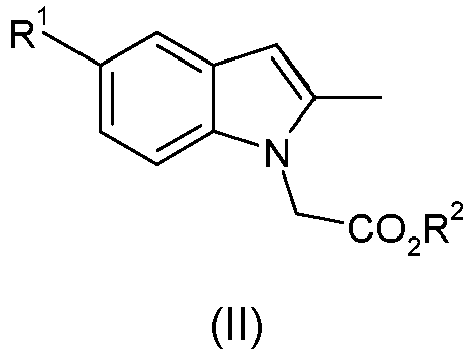
with a compound of general formula (III)
in a suitable solvent and in the presence of titanium tetrachloride, wherein the ratio of the compound of general formula (II) to solvent is from 1:8 to 1:20 weight/volume; and - ii. reacting the product of step (i) with a reducing agent to give a compound of general formula (I).
- i. reacting a compound of general formula (II):
- The inventors have found that when the reaction is conducted using TiCl4 as the Lewis acid, the product of step (i) precipitates as a solid but forms a suspension rather than a gum and therefore does not agglomerate on the stirrer, even though the amount of solvent used is significantly lower than for processes employing trifluoroacetic acid or trimethylsilyl triflate. Furthermore, the amount of the bis-indolyl impurity which arises from the reaction of a further molecule of the compound of general formula (II) with the product of step (i), is kept to an acceptable level. These findings were surprising as they differed from the results with the other Lewis acids tested.
- The inventors have attempted to rationalise the reasons for the success of TiCl4 as a Lewis acid for this process by considering more fully the reaction of the compound of general formula (II) with the compound of general formula (III).
- In the past, when the reaction has been conducted using a protic acid such as trifluoroacetic acid, it has been suggested that it proceeds via the reaction shown in Scheme 3..

- As explained above, the bis-indolyl compound (IVc) has proved to be a major product with the majority of Lewis acids, although the proportions of compounds of formulae (I) and (IVc) will vary depending upon the particular target compound of general formula (I).
- As shown in Scheme 3, the compound of general formula (II) reacts with the compound of general formula (III) in the presence of a Lewis acid to give an intermediate alcohol of general formula (IVa). The intermediate alcohol is in equilibrium with the intermediate of general formula (IVb), which can either react with a reducing agent to give the compound of general formula (I) or, alternatively, may react with an additional molecule of the compound of general formula (II) to give a bis-indolyl compound of general formula (IVc).
- The bis-indolyl compound of general formula (IVc) is in equilibrium with the intermediate of general formula (IVb) and therefore it has proved possible in some cases, for example using a non protic Lewis acid such as TMSOTf, to convert the bis-indolyl compound to the intermediates of general formula (IVb) and (IVa) and the starting material of formula (II) by the addition of a small amount of water, for example about 1 equivalent, at the end of the reduction.
- Surprisingly, however, when TiCl4 is used as the Lewis acid it is not necessary to add water to remove the bis-indolyl product and the inventors have therefore speculated that, the reaction may proceed via different intermediates instead of or in addition to the intermediates of general formula (IVa) and (IVb), perhaps resulting from the addition of CI- rather than OH-. Thus, possible intermediates may have the structure:
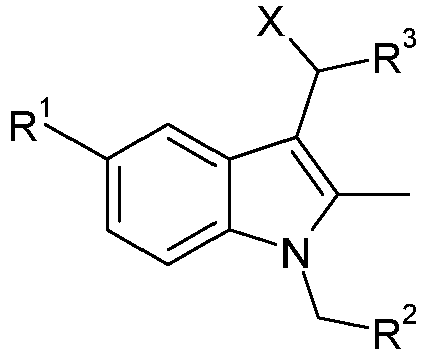
- Where X can be, for example Cl or a titanium based moiety.
- The product of step (i) of the process of the invention is not clear but it is possible that the presence of alternative intermediates may be the reason that the product of step (i) forms a suspension rather than agglomerating on the stirrer as with other Lewis acids. However, this is a theory only and the effectiveness of the process of the invention is not dependent on its being correct.
- In the present specification "C1-C6 alkyl" refers to a straight or branched saturated hydrocarbon chain having one to six carbon atoms and optionally substituted with with one or more C3-C7 cycloalkyl groups. Examples include methyl, ethyl, n-propyl, isopropyl, t-butyl, n-hexyl, methylenecyclopropyl, methylenecyclobutyl, and methylenecyclopentyl.
- "C1-C4 alkyl" and "C1-C18 alkyl" have similar meanings except that they contain from one to four and from one to eighteen carbon atoms respectively.
C3-C7 cycloalkyl refers to a saturated 3 to 7 membered carbocyclic ring. Examples of such groups include cyclopropyl, cyclobutyl, cyclopentyl and cyclohexyl. - The term "C1-C4 alkylene" in the context of the present specification refers to a disubstituted straight or branched saturated hydrocarbon chain having one to four carbon atoms.
- In the present specification, "halo" refers to fluoro, chloro, bromo or iodo.
- The term "aryl" in the context of the present specification refers to an aromatic ring system having from 5 to 14 ring carbon atoms and containing up to three rings. Examples of aryl groups are benzene and naphthalene.
- The term "heteroaryl" in the context of the specification refers to a ring system with aromatic character having from 5 to 14 ring atoms, at least one of which is a heteroatom selected from N, O and S, and containing up to three rings. Where a heteroaryl group contains more than one ring, not all rings must be fully aromatic in character. Rings which are not fully aromatic may be substituted with one or more oxo groups. Examples of heteroaryl groups include pyrrole, thiophene, thiazole, pyridine, pyrimidine, indole, benzofuran, benzimidazole, tetrahydroquinoline, indoline, quinoline, isoquinoline, quinoxaline, imidazo[1,2-a]pyridine and pyrazolo[1,5-a]pyridine.
- The term "heterocyclyl" in the context of the specification refers to a saturated ring system having from 4 to 8 ring atoms, at least one of which is a heteroatom selected from N, O and S and which may be optionally substituted by one or more oxo groups. Examples of heterocyclyl groups include azetidinyl, piperidinyl; tetrahydrofuranyl, tetrahydropyranyl, dioxanyl, thiomorpholinyl, 1,1-dioxo-1λ6-thiomorpholinyl, morpholinyl, pyrrolyl, piperizinyl, azepanyl, 1,4-diazepanyl, 1,4-oxazepanyl and azocanyl.
- If a chiral centre or another form of isomeric centre is present in a compound of the present invention, all forms of such isomer or isomers, including enantiomers and diastereoisomers, are intended to be covered herein. Compounds of the invention containing a chiral centre may be used as a racemic mixture, an enantiomerically enriched mixture, or the racemic mixture may be separated using well-known techniques and an individual enantiomer may be used alone.
- Suitable compounds which may be prepared by the process of the invention are those in which, independently or in any combination:
- R1 is fluoro;
- R2 is C1-C4 alkyl; and
- R3 is quinoline, quinoxaline, isoquinoline, thiazole, phenyl, naphthalene, thiophene, pyrrole or pyridine, any of which may optionally be substituted as set out above.
- More suitably, R2 is methyl or ethyl, especially ethyl.
- More typical R3 groups include optionally substituted quinoline, phenyl, naphthalene, thiophene, pyrrole or pyridine.
- When R3 is quinoline or isoquinoline, it is suitably unsubstituted or substituted with one or more halo substituents, especially fluoro.
- When R3 is phenyl, naphthalene, thiophene, pyrrole or pyridine, it may optionally have one or more substituents, with particularly suitable substituents including OR4, SO2R4 or SO2YR4; where R4 and Y are as defined above.
- Typically, in this case, R4 is C1-C6 alkyl, a 4- to 6-membered cycloalkyl group, a 5- or 6-membered heterocyclyl group or phenyl, any of which may be substituted as defined above.
- When R3 is pyridyl it is most suitably a 3-pyridyl moiety.
In more active compounds, Y, when present, is a CH2 moiety. - When R3 is substituted with SO2R4 or SO2YR4, the R4 group is generally unsubstituted or substituted with one or more substituents chosen from methyl and halo, particularly chloro or fluoro.
- When R3 is substituted with OR4, the R4 group may be unsubstituted or substituted with one or more substituents chosen from halo, cyano, C1-C4 alkyl and O(C1-C4 alkyl).
- The process of the present invention is particularly suitable for the preparation of compounds of formula (Ia):

- wherein R1 and R2 are as defined above for general formula (I);
- R5 is hydrogen halo, -CN, -C1-C6 alkyl, -SOR7, -SO2R7, -SO2N(R6)2, -N(R6)2,-NR6C(O)R7, -CO2R6, -CONR6R7, -NO2, -OR6, -SR6, -O(CH2)pOR6, and-O(CH2)pO(CH2)qOR6 wherein
- each R6 is independently hydrogen, -C1-C6 alkyl, -C3-C8 cycloalkyl, aryl or heteroaryl;
- each R7 is independently, -C1-C6 alkyl, -C3-C8 cycloalkyl, aryl or heteroaryl;
- p and q are each independently an integer from 1 to 3.
- Compounds of general formula (Ia) have proved particularly difficult to make, with attempts using TFA being not synthetically useful and the use of TMSOTf requiring very high dilution of the reaction mixture in order to give the desired product.
- Particularly suitable compounds of formula (Ia) are those in which, independently or in combination:
- R1 is fluoro; and
- R2 is C1-C4 alkyl, more usually methyl or ethyl and especially ethyl.
- Suitably, in compounds of formula (Ia), R5 is hydrogen or halo, more suitably hydrogen, fluoro or chloro.
- Compounds of general formula (I) which may be prepared by the process of the invention include the C1-C6 alkyl or benzyl esters of:
- {3-[1-(4-Chloro-phenyl)-ethyl]-5-fluoro-2-methyl-indol-1-yl}-acetic acid;
- {5-Fluoro-2-methyl-3-[1-(4-trifluoromethyl-phenyl)-ethyl]-indol-1-yl}-acetic acid;
- {3-[1-(4-tert-Butyl-phenyl)-ethyl]-5-fluoro-2-methyl-indol-1-yl}-acetic acid;
- {5-Fluoro-3-[1-(4-methanesulfonyl-phenyl)-ethyl]-2-methyl-indol-1-yl}-acetic acid;
- [5-Fluoro-2-methyl-3-(1-naphthalen-2-yl-ethyl)-indol-1-yl]-acetic acid;
- (5-Fluoro-2-methyl-3-quinolin-2-ylmethyl-indol-1-yl)-acetic acid;
- (5-Fluoro-2-methyl-3-naphthalen-2-ylmethyl-indol-1-yl)-acetic acid;
- [5-Fluoro-3-(8-hydroxyquinolin-2-ylmethyl)-2-methyl-indol-1-yl]-acetic acid;
- [5-Fluoro-2-methyl-3-(quinoxalin-2-ylmethyl)indol-1-yl]-acetic acid;
- [5-Fluoro-3-(4-methoxy-benzyl)-2-methyl-indol-1-yl]-acetic acid;
- [5-Fluoro-2-methyl-3-(1,3-thiazol-2-ylmethyl)indol-1-yl]-acetic acid;
- [3-(4-Chloro-benzyl)-5-fluoro-2-methyl-indol-1-yl]-acetic acid;
- [5-Fluoro-2-methyl-3-(4-trifluoromethyl-benzyl)-indol-1-yl]-acetic acid;
- [5-Fluoro-2-methyl-3-(4-tert-butyl-benzyl)-indol-1-yl]-acetic acid;
- {5-Fluoro-2-methyl-3-[(4-phenylphenyl)methyl]indol-1-yl}-acetic acid;
- [5-Fluoro-3-(4-methanesulfonyl-benzyl)-2-methyl-indol-1-yl]-acetic acid;
- {5-Fluoro-3-[(6-fluoroquinolin-2-yl)methyl]-2-methylindol-1-yl}-acetic acid;
- (2-Methyl-3-quinolin-2-ylmethyl-indol-1-yl)-acetic acid;
- (5-Chloro-2-methyl-3-quinolin-2-ylmethyl-indol-1-yl)-acetic acid;
- (3-{[1-(Benzenesulfonyl)pyrrol-2-yl]methyl}-5-fluoro-2-methylindol-1-yl)-acetic acid;
- [5-Fluoro-2-methyl-3-({1-[(4-methylbenzene)sulfonyl]pyrrol-2-yl}methyl)indol-1-yl]-acetic acid;
- [3-({1-[(2,4-Difluorobenzene)sulfonyl]pyrrol-2-yl}methyl)-5-fluoro-2-methylindol-1-yl]-acetic acid;
- (3-{[2-(Benzenesulfonyl)phenyl]methyl}-5-fluoro-2-methylindol-1-yl)-acetic acid; [3-({2-[(4-Chlorobenzene)sulfonyl]phenyl}methyl)-5-fluoro-2-methylindol-1-yl]-acetic acid;
- [5-Fluoro-3-({2-[(4-fluorobenzene)sulfonyl]phenyl}methyl)-2-methylindol-1-yl]-acetic acid;
- (3-{[2-(Benzenesulfonyl)pyridin-3-yl]methyl}-5-fluoro-2-methylindol-1-yl)-acetic acid; [5-Fluoro-3-({2-[(4-fluorobenzene)sulfonyl]pyridin-3-yl}methyl)-2-methylindol-1-yl]-acetic acid;
- [3-({2-[(4-Chlorobenzene)sulfonyl]pyridin-3-yl}methyl)-5-fluoro-2-methylindol-1-yl]-acetic acid;
- 2-(3-(4-(Benzylsulfonyl)benzyl)-5-fluoro-2-methyl-indol-1-yl)-acetic acid;
- 2-(3-(4-(4-Chlorobenzylsulfonyl)benzyl)-5-fluoro-2-methyl-indol-1-yl)-acetic acid;
- 2-(3-(3-(Benzylsulfonyl)benzyl)-5-fluoro-2-methyl-indol-1-yl)-acetic acid;
- 2-(5-Fluoro-3-(3-(4-fluorobenzylsulfonyl)benzyl)-2-methyl-indol-1-yl)-acetic acid;
- 2-(3-(2-(Benzylsulfonyl)benzyl)-5-fluoro-2-methyl-indol-1-yl)-acetic acid;
- 2-(3-(4-(4-Fluorobenzylsulfonyl)benzyl)-5-fluoro-2-methyl-indol-1-yl)-acetic acid;
- 2-(3-(2-(Cyclohexylsulfonyl)benzyl)-5-fluoro-2-methyl-indol-1-yl)-acetic acid;
- 2-(5-Fluoro-2-methyl-3-(2-(piperidin-1-ylsulfonyl)benzyl)-indol-1-yl)-acetic acid;
- 2-(3-(2-(Cyclopentylsulfonyl)benzyl)-5-fluoro-2-methyl-indol-1-yl)-acetic acid;
- 2-(5-Fluoro-2-methyl-3-(3-(piperidin-1-ylsulfonyl)benzyl)-indol-1-yl)-acetic acid;
- 2-(5-Fluoro-2-methyl-3-(2-(pyrrolidin-1-ylsulfonyl)benzyl)-indol-1-yl)-acetic acid;
- 2-(3-(4-(Cyclohexylsulfonyl)benzyl)-5-fluoro-2-methyl-indol-1-yl)-acetic acid;
- 2-(3-(4-(Cyclopentylsulfonyl)benzyl)-5-fluoro-2-methyl-indol-1-yl)-acetic acid;
- 2-(3-(2-(Cyclobutylsulfonyl)benzyl)-5-fluoro-2-methyl-indol-1-yl)-acetic acid;
- 2-(5-Fluoro-2-methyl-3-(3-(pyrrolidin-1-ylsulfonyl)benzyl)-indol-1-yl)-acetic acid acid;
- 2-(5-Fluoro-2-methyl-3-(4-(piperidin-1-ylsulfonyl)benzyl)-indol-1-yl)-acetic acid;
- [5-Fluoro-2-methyl-3-(2-phenoxybenzyl)-indol-1-yl]-acetic acid;
- [5-Fluoro-2-methyl-3-(2-(4-methoxyphenoxy)benzyl)-indol-1-yl]-acetic acid;
- [5-Fluoro-2-methyl-3-(2-(4-methylphenoxy)benzyl)-indol-1-yl]-acetic acid;
- [5-Fluoro-2-methyl-3-(2-(2,4-dichlorophenoxy)benzyl)-indol-1-yl]-acetic acid;
- [5-Fluoro-2-methyl-3-(2-(4-fluorophenoxy)benzyl)-indol-1-yl]-acetic acid;
- [5-Fluoro-2-methyl-3-(2-(3,4-difluorophenoxy)benzyl)-indol-1-yl]-acetic acid;
- [5-Fluoro-2-methyl-3-(2-(4-cyanophenoxy)benzyl)-indol-1-yl]-acetic acid;
- [5-Fluoro-2-methyl-3-(2-(4-chlorophenoxy)benzyl)-indol-1-yl]-acetic acid;
- [5-Fluoro-2-methyl-3-(2-(2-cyanophenoxy)benzyl)-indol-1-yl]-acetic acid;
- (5-Fluoro-2-methyl-3-{[2-(4-methylphenoxy)pyridin-3-yl]methyl}indol-1-yl)-acetic acid;
- {5-Fluoro-3-[(3-methanesulfonylnaphthalen-2-yl)methyl]-2-methylindol-1-yl}-acetic acid;
- {5-Fluoro-3-[(1-methanesulfonylnaphthalen-2-yl)methyl]-2-methylindol-1-yl}-acetic acid;
- {5-Fluoro-3-[(6-methanesulfonylnaphthalen-2-yl)methyl]-2-methylindol-1-yl}-acetic acid;
- [5-Fluoro-2-methyl-3-(quinolin-3-ylmethyl)indol-1-yl]-acetic acid;
- [5-Fluoro-2-methyl-3-(quinoxalin-6-ylmethyl)indol-1-yl]-acetic acid;
- [5-Fluoro-2-methyl-3-(quinolin-7-ylmethyl)indol-1-yl]-acetic acid;
- {5-Fluoro-3-[(6-methanesulfonylquinolin-2-yl)methyl]-2-methylindol-1-yl}-acetic acid;
- {5-Fluoro-3-[(4-methanesulfonylquinolin-2-yl)methyl]-2-methylindol-1-yl}-acetic acid;
- (5-Fluoro-2-methyl-3-{pyrazolo[1,5-a]pyridin-3-ylmethyl}indol-1-yl)-acetic acid;
- (5-Fluoro-3-{imidazo[1,2-a]pyridin-2-ylmethyl}-2-methylindol-1-yl)-acetic acid;
- (5-Fluoro-2-methyl-3-{[2-(methylsulfanyl)phenyl]methyl}indol-1-yl)-acetic acid;
- (5-Fluoro-2-methyl-3-{[3-(methylsulfanyl)phenyl]methyl}indol-1-yl)-acetic acid;
- (5-Fluoro-2-methyl-3-{[4-(ethylsulfanyl)phenyl]methyl}indol-1-yl)-acetic acid(3-{[4-(Ethylsulfanyl)phenyl]methyl}-5-fluoro-2-methylindol-1-yl)-acetic acid;
- (5-Fluoro-2-methyl-3-{[4-(n-propylsulfanyl)phenyl]methyl}indol-1-yl)-acetic acid;
- (5-Fluoro-2-methyl-3-{[4-(i-propylsulfanyl)phenyl]methyl}indol-1-yl)-acetic acid;
- (5-Fluoro-2-methyl-3-{[4-(t-butylsulfanyl)phenyl]methyl}indol-1-yl)-acetic acid;
- (5-Fluoro-2-methyl-3-{[4-(pentan-3-ylsulfanyl)phenyl]methyl}indol-1-yl)-acetic acid;
- [3-({4-[(Cyclopropylmethyl)sulfanyl]phenyl}methyl)-5-fluoro-2-methylindol-1-yl]-acetic acid;
- {3-[(4,4-Dimethyl-2,3-dihydro-1-benzothiopyran-6-yl)methyl]-5-fluoro-2-methylindol-1-yl}-acetic acid;
- (3-{[2-(Ethanesulfonyl)phenyl]methyll-5-fluoro-2-methylindol-1-yl)-acetic acid;
- (5-Fluoro-2-methyl-3-{[2-(propane-1-sulfonyl)phenyl]methyl}indol-1-yl)-acetic acid;
- (5-Fluoro-2-methyl-3-{[2-(propane-2-sulfonyl)phenyl]methyl}indol-1-yl)-acetic acid;
- (3-{[2-(Butane-1-sulfonyl)phenyl]methyl}-5-fluoro-2-methylindol-1-yl)-acetic acid;
- (3-{[2-(Butane-2-sulfonyl)phenyl]methyl}-5-fluoro-2-methylindol-1-yl)-acetic acid;
- (5-Fluoro-2-methyl-3-{[2-(2-methylpropane-2-sulfonyl)phenyl]methyl}indol-1-yl)-acetic acid;
- (5-Fluoro-2-methyl-3-{[2-(pentane-1-sulfonyl)phenyl]methyl}indol-1-yl)-acetic acid;
- (3-{[2-(Cyclopropylmethane)sulfonylphenyl]methyl}-5-fluoro-2-methylindol-1-yl)-acetic acid;
- (5-Fluoro-2-methyl-3-{[2-(propylsulfamoyl)phenyl]methyl}indol-1-yl)-acetic acid;
- (3-{[2-(Butylsulfamoyl)phenyl]methyl]-5-fluoro-2-methylindol-1-yl)-acetic acid;
- (5-Fluoro-2-methyl-3-{[3-(propylsulfamoyl)phenyl]methyl}indol-1-yl)-acetic acid;
- (3-{[3-(Butylsulfamoyl)phenyl]methyl}-5-fluoro-2-methylindol-1-yl)-acetic acid;
- (5-Fluoro-2-methyl-3-{[4-(trifluoromethane)sulfonylphenyl]methyl}indol-1-yl)-acetic acid;
- (3-{[4-(Ethanesulfonyl)phenyl]methyl}-5-fluoro-2-methylindol-1-yl)-acetic acid;
- (5-Fluoro-2-methyl-3-{[4-(propane-1-sulfonyl)phenyl]methyl}indol-1-yl)-acetic acid;
- (5-Fluoro-2-methyl-3-{[4-(propane-2-sulfonyl)phenyl]methyl}indol-1-yl)-acetic acid;
- (3-{[4-(Butane-1-sulfonyl)phenyl]methyl}-5-fluoro-2-methylindol-1-yl)-acetic acid;
- (5-Fluoro-2-methyl-3-{[4-(2-methylpropane-2-sulfonyl)phenyl]methyl}indol-1-yl)-acetic acid;
- (5-Fluoro-2-methyl-3-{[4-(pentane-1-sulfonyl)phenyl]methyl}indol-1-yl)-acetic acid;
- (5-Fluoro-2-methyl-3-{[4-(pentan-3-ylsulfonyl)phenyl]methyl}indol-1-yl)-acetic acid;
- [3-({4-[(Cyclopropylmethyl)sulfonyl]phenyl}methyl)-5-fluoro-2-methylindol-1-yl]-acetic acid;
- (5-Fluoro-2-methyl-3-{[4-(propylsulfamoyl)phenyl]methyl}indol-1-yl)-acetic acid;
- (3-{[4-(Butylsulfamoyl)phenyl]methyl}-5-fluoro-2-methylindol-1-yl)-acetic acid;
- (5-Fluoro-2-methyl-3-{[4-(trifluoromethoxy)phenyl]methyl}indol-1-yl)-acetic acid;
- (5-Fluoro-3-{[4-methanesulfonyl-3-(trifluoromethyl)phenyl]methyl}-2-methylindol-1-yl)-acetic acid;
- (5-Fluoro-3-{[4-methanesulfonyl-3-(trifluoromethoxy)phenyl]methyl}-2-methylindol-1-yl)-acetic acid;
- {5-Fluoro-3-[(5-methanesuIfonylthiophen-2-yl)methyl]-2-methylindol-1-yl}-acetic acid;
- {3-[(4,4-dimethyl-1,1-dioxo-2,3-dihydro-1λ6-benzothiopyran-6-yl)methyl]-5-fluoro-2-methylindol-1-yl}-acetic acid;
- [3-({1-[(4-Chlorobenzene)sulfonyl]pyrrol-2-yl}methyl)-5-fluoro-2-methylindol-1yl]-acetic acid;
- [5-Fluoro-3-({1-[(4-fluorobenzene)sulfonyl]pyrrol-2-yl}methyl)-2-methylindol-1-yl]-acetic acid;
- [5-Fluoro-3-({1-[(4-methoxybenzene)sulfonyl]pyrrol-2-yl}methyl)-2-methylindol-1-yl]-acetic acid;
- {3-[1-(2,4-Dichloro-benzenesulfonyl)pyrrol-2-ylmethyl]-5-fluoro-2-methyl-indol-1-yl}-acetic acid;
- [5-Fluoro-3-({1-[(4-methanesulfonylbenzene)sulfonyl]pyrrol-2-yl}methyl)-2-methylindol-1-yl]-acetic acid;
- {5-Fluoro-2-methyl-3-[(2-phenylphenyl)methyl]indol-1-yl}-acetic acid;
- (3-{[1-(Benzenesulfonyl)indol-2-yl]methyl}-5-fluoro-2-methylindol-1-yl)-acetic acid;
- (3-{[2-(4-Chlorophenyl)phenyl]methyl}-5-fluoro-2-methylindol-1-yl)-acetic acid;
- (5-Fluoro-2-methyl-3-{[2-(4-methylphenyl)phenyl]methyl}indol-1-yl)-acetic acid;
- {5-Fluoro-2-methyl-3-[(3-phenoxyphenyl)methyl]indol-1-yl}-acetic acid;
- [5-Fluoro-3-({4-[(4-fluorophenyl)carbonyl]-1-methylpyrrol-2-yl}methyl)-2-methylindol-1-yl]-acetic acid;
- {5-Fluoro-2-methyl-3-[(6-{[3-(trifluoromethyl)phenyl]methyl}pyridin-3-yl)methyl]indol-1-yl}-acetic acid;
- {5-Fluoro-2-methyl-3-[(3-phenoxythiophen-2-yl)methyl]indol-1-yl}-acetic acid;
- (3-{[2-(Benzenesulfonyl)-1,3-thiazol-5-yl]methyl}-5-fluoro-2-methyl}indol-1-yl)-acetic acid;
- {3-[(1-Benzylpyrazol-4-yl)methyl]-5-fluoro-2-methylindol-1-yl}-acetic acid;
- (3-{[5-(4-Chlorophenoxy)-1-methyl-3-(trifluoromethyl)pyrazol-4-yl]methyl}-5-fluoro-2-methylindol-1-yl)-acetic acid;
- [3-({5-[(4-Chlorobenzene)sulfonyl]furan-2-yl}methyl)-5-fluoro-2-methylindol-1-yl]-acetic acid;
- [3-({5-[(4-Chlorobenzene)sulfonyl]thiophen-2-yl}methyl)-5-fluoro-2-methylindol-1-yl]-acetic acid;
- [3-({3-[(4-Chlorobenzene)sulfonyl]thiophen-2-yl}methyl)-5-fluoro-2-methylindol-1-yl]-acetic acid;
- {3-[(2-Benzylphenyl)methyl]-5-fluoro-2-methylindol-1-yl}-acetic acid;
- with the ethyl esters of the above compounds being particularly suitable for preparation by this process.
- Among the compounds listed above, the process is particularly suitable for the preparation of esters of the compounds of general formula (Ia), namely the C1-C6 alkyl and benzyl esters of:
- (3-{[2-(Benzenesulfonyl)pyridin-3-yl]methyl}-5-fluoro-2-methylindol-1-yl)-acetic acid;
- [5-Fluoro-3-([2-[(4-fluorobenzene)sulfonyl]pyridin-3-yl}methyl)-2-methylindol-1-yl]-acetic acid;
- [3-({2-[(4-Chlorobenzene)sulfonyl]pyridin-3-yl}methyl)-5-fluoro-2-methylindol-1-yl]-acetic acid;
- and in particular the ethyl esters of these compounds.
- Suitable solvents for the process include, in particular halogenated solvents, for example chlorinated solvents such as chloroform, 1,2-dichloroethane and especially dichloromethane.
- The ratio of the compound of general formula (II) to solvent is more suitably from 1:10 to 1:15, for example 1:10 to 1:12 and typically about 1:12 weight/volume.
- The solvent ratio refers to the total amount of solvent used in step (i) and includes for example, any solvent in which the titanium tetrachloride is added; any solvent in which the compounds of general formula (II) and general formula (III) are dissolved and any solvent added to the reaction vessel for washing or further dilution. Furthermore, it has been possible to optimise the reaction so that the purity of the product is at least 95% area or, when expressed in weight percentage terms, at least 95% w/w. The reaction was devised in order to give a product in which the amount of bis-indolyl impurity formed is ≤5 % area by HPLC and in some cases ≤ 2% area by HPLC. The inventors have obtained a product containing less than 0.5% w/w of the bis-indolyl impurity and less than 0.5% w/w of the alcohol intermediate. The yield is also greatly improved in comparison with previous processes for the preparations of these compounds; using the process of the invention, it has proved possible to obtain the product in a yield of at least about 75%. In some cases, the yield is even higher, for example at least about 80% or at least about 85%.
- One way of adjusting the amount of the bis-indolyl impurity in the final product is to adjust the molar ratio of titanium tetrachloride to the compound of formula (II). This is typically from 1:1 to 3:1, more usually from 1.1:1 to 2.5:1. It is advantageous from the point of view of cost to keep the amount of titanium tetrachloride to a minimum but it has been found that an increase in the stoichiometry of the titanium tetrachloride from 1.1:1 to 2:1 reduces the amount of bis-indolyl impurity formed from about 20% area to under 10% area. Therefore it is preferred that the molar ratio of titanium tetrachloride to compound of general formula (II) is from about 1.8:1 to 2.2:1, usually about 2:1.
- The amount of bis-indolyl impurity can also be reduced by conducting the reaction of step (i) at an appropriate temperature and then maintaining it at this temperature for an appropriate time after the addition of the compounds of formulae (II) and (III).
- Typically, the reaction is conducted at a temperature of -10 to 25°C, more usually at room temperature, for example about 20°C. The bis-indolyl impurity is in equilibrium with the intermediates and the starting material of general formula (II) and the inventors have found that at a temperature of 20°C the reverse reaction leading from the bis-indolyl impurity to the starting material and the intermediates is favoured such that after a prolonged period of stirring at a suitable temperature, in combination with a suitable stoichiometric ratio of TiCl4 to compound of formula (II), the level of the bis-indolyl impurity can be reduced to ≤ 5% area. In contrast, at 40°C a side reaction is observed which lowers the yield of the compound of general formula (I).
- Suitably therefore, after the addition of the compounds of general formulae (II) and (III), the reaction mixture is maintained at 15-25°C, suitably at room temperature, for example 18-22°C and typically about 20°C, preferably with stirring, for about 10 to 24 hours, more usually 12 to 18 hours, for example about 15 hours.
- In the process described above, values for amounts of various compounds are expressed in terms of % area. This refers to the percentage of the area of the peak representing a particular molecule on an HPLC trace.
- The reduction step (ii) of the process may be carried out using any reducing agent capable of reducing a benzylic alcohol to the corresponding alkane, although triethylsilane has been found to be particularly suitable. Other silane reducing agents could also be used, however or alternatively another reduction method, for example hydrogenation, typically using a metal catalyst such as palladium or platinum. In this method, the reduction may be carried out under an inert atmosphere such as nitrogen or argon.
- Conveniently, when triethylsilane is used as the reducing agent in step (ii), it is added slowly to the mixture obtained from step (i) over a period of about 1 to 3 hours, typically about 2 hours. The molar ratio of reducing agent to compound of general formula (II) is from about 2:1 to 4:1, for example about 3:1.
- Reduction with triethyl silane requires acid conditions and this is provided by the titanium tetrachloride which remains in the reaction mixture after step (i). A further advantage of using TiCl4 as the Lewis acid is that during the reduction step (ii), bis-indolyl impurity remaining in the reaction mixture slowly reverts to the intermediate of general formula (IVb) which is, in turn, reduced to give the compound of formula (I).
- Once the reaction of step (ii) has proceeded to completion, the product of general formula (I) may be isolated. Therefore the process of the invention may additionally include the step of:
- (iii) isolating and purifying the compound of general formula (I).
- Suitably once the reduction has proceeded to completion, the temperature of the reaction mixture is reduced to about 0-5°C, following which water is added to the reaction mixture. The product may then be extracted into an organic solvent which may subsequently be removed by any appropriate means, for example distillation.
- As set out above, the compound of formula (I) is an intermediate in the production of indole acetic acid derivatives which have pharmacological activity as CRTH2 antagonists and therefore in a further aspect the process of the invention includes the additional step of:
- (iv) converting the compound of formula (I) to a compound of general formula (V):

- wherein R1 and R3 are as defined in general formula (I);
- the process comprising hydrolysing the compound of formula (I).
- Either acid or base hydrolysis of the compound of formula (I) may be used, although base hydrolysis is particularly suitable.
- Typically, hydrolysis will be conducted in aqueous solution using a strong base such as sodium, potassium or ammonium hydroxide. Potassium hydroxide is, however, particularly suitable. Suitably the base will be a 50% aqueous potassium hydroxide solution.
- The amount of base used is typically 1.5 to 4 molar equivalents of the compound of formula (I). Suitably, the molar ratio of base: compound of formula (I) is about 2:1.
- Step (v) may be carried out at room temperature, for example 20 to 25°C.
- It has been found that, following the improvements to Stage 2 accorded by the process of the invention, the product of step (v) can be obtained in a form which is sufficiently pure for use as a pharmaceutical, so that further purification is unnecessary.
- In order to obtain the starting material of general formula (II), the process may include additional steps before step (i).
- Therefore, in a further aspect, the invention includes, before step (i), a process for the preparation of a compound of formula (II) comprising:
- Reacting 5-fluoro-2-methyl indole with a compound of the formula (VI):
X-CH2-COOR1 (VI)
- The reaction may take place in the presence of a weak base such as potassium or caesium carbonate, more usually caesium carbonate, in a polar organic solvent such as acetonitrile.
- Suitably the amount of solvent used is from 7 to 30 L of solvent per kg of 5-fluoro-2-methyl indole, more usually from 7 to 20 L, for example about 7 to 15 L and suitably about 10 L of solvent per kg of 5-fluoro-2-methyl indole.
- The reaction may be conducted at a temperature of from about 15 to 30°C, more usually 20-25°C over a time of 10 to 36 hours, typically 18 to 30 hours, for example about 24 hours and the progress of the reaction may be monitored, for example by a chromatography method such as gas chromatography (GC).
- When the reaction is complete, the compound of formula (II) may be isolated and/or purified in order to remove impurities such as 5-fluoro-2-methyl indole and compound of formula (VI). Alternatively, the purification step (iii) may be sufficient.
- The presence of inorganic salts derived from the starting material of general formula (IV) is undesirable. Inorganic salts may be removed by washing the reaction mixture with water while maintaining the product of formula (II) in the organic phase. When a solvent such as acetonitrile is used as the reaction solvent, it may be advantageous to replace it at this stage with an alternative, less polar, solvent such as toluene.
- The invention will now be described in greater detail with reference to the examples.
- In the examples, the following abbreviations are used:
TFA Trifluoroacetic acid TES Triethyl silane Et Ethyl DCM dichloromethane IPC In process control TMSOTf Trimethylsilyl trifluoromethane sulfonate TLC Thin layer chromatography HPLC High performance liquid chromatography - In the examples set out below, and in the whole specification values for amounts of various compounds are expressed in terms of % area. This refers to the percentage of the area of the peak representing a particular molecule on an HPLC trace. Suitable HPLC methods may be developed by those of skill in the art.
- The HPLC parameters used in Comparative Example 4 and Example 5 are summarised in the table below.
HPLC Parameter Condition/Details Additional Information Detection Type/Wavelength UV@ 220 HM N/A Column Waters Eclipse XDB-C18 150mm x 4.6mm id 5µ Injection Volume 5µL N/A Flow Rate 1.5 mL/min N/A Run Time 15 minutes N/A Mobile Phase A 100% water N/A Mobile Phase B 0.1% Formic Acid N/A Mobile Phase C 100% Acetonitrile N/A Gradient System Starting Conditions 50:5:45 % A:B:C Time % A:B:C 5 50:5:45 10 15:5:80 12 15:5:80 14 50:5:45 Column Temperature 35°C N/A - Into a reaction mixture of 1.0 Kg of 5-fluoro-2-methylindole (1.0 eq., 6.70 mol) and 0.99 kg of caesium carbonate (3.02 mol - 0.45 eq.) with 9 L acetonitrile is added at 20-25°C over ∼12 h a solution of 1.34 kg ethylbromoacetate (8.04 mol - 1.2eq.) in 1L acetonitrile. Two additional charges of 0.99 kg caesium carbonate each are added after 4 hours and after 8 hours of reaction (3.02 mol - 0.45 eq.). A final charge of 0.33 kg caesium carbonate is added (1.01 mol - 0.15 eq.) and 0.056 kg of ethyl bromoacetate (0.335 mol - 0.15 eq.) are added after 18 hours. The reaction mixture is maintained under agitation at 20-25 °C until the reaction is complete. 5 L of water is added to dissolve the inorganic salts. The agitation is maintained at 20-25°C until complete dissolution of the inorganic salts then the reaction mixture is allowed to separate. The organic phase is concentrated to approximately 3 L. Toluene (5 L) is added then the mixture is concentrated to approximately 3 L. Toluene (5 L) is added to the reaction mixture; which is then washed with water (3 L) to eliminate the residual salts and concentrated to approximately 3 L under vacuum. Expected Yield: 90±5%.
- The above method has been carried out with a batch size of up to 234 kg of 5-fluoro-2-methyl indole.
- The quantity of (5-fluoro-2- methylindol-1-yl)-acetic acid ethyl ester recovered was 337 kg, a yield of 91.3 %; which compared well with the expected yield of 90±5%.
- The reaction between 2-(4-Fluorobenzenesulfonyl)-pyridine-3-carboxaldehyde and 5-fluoro-2-methyl-indole N-ethyl acetate proceeds in two steps according to the scheme set out below. 2-(4-Fluorobenzenesulfonyl)-pyridine-3-carboxaldehyde may be prepared as described in
WO2009/090414 .
- When conducted on a laboratory scale, the process described in
WO2009/090414 leads to good quality material with acceptable yield but the very high dilution (50 vol of methylene chloride) and high cost of trimethylsilyl trifluoromethanesulfonate TMSOTf) as the Lewis acid were not considered acceptable for larger scale production. - Trials using TMSOTf were performed at higher concentration (about 10 volumes solvent per mass of starting indole) but in these experiments, the intermediate alcohol precipitated as a gummy material that agglomerated on the stirrer blade. This could lead to equipment damage at larger scale. At higher dilution (50 volumes solvent per mass of starting indole), the insoluble material was still present but did not agglomerate on the stirrer.
- A screen was performed in order to determine whether other Lewis acids could be used instead of TMSOTf. TFA, Trifluoromethanesulfonic acid (triflic acid), BF3, AlCl3, ZnBr2 all led either to a high content of bis-indolyl impurity of the formula:

- The results of six representative experiments are presented in Table 1 below which summarises the HPLC profile (area %) of the major components of the reaction mixtures before the reduction step. All of the reactions were carried out in 10-12 volumes of methylene chloride per mass of indole starting material.
- The starting materials were introduced over 60-150 minutes at temperatures from - 10 to +20°C. Several Lewis acids were tested and results are shown for AlCl3, ZnBr2 and TiCl4.
Table 1 Expt . Addition time(1) Lewis Acid /eq Bis-indolyl (RRT 1,18) Alcohol(2) (RRT 0,75 + 0,95) Starting indole (RRT 0.78) Extent of reaction when sample taken (i) 60min / 0°C AlCl3 2 eq 55.1 28.2 ND End of addition of starting materials (ii) 60min / 0°C ZnBr2 2 eq 30.8 46.6 19.5 End of addition of starting materials (iii) 120 min / -10°C TiCl4 2 eq 10.8 85.8 0.1 a) Approximately halfway through addition of starting materials 9.6 83.3 0 b) End of addition of starting materials (iv) 90 min / 0°C TiCl4 1.1 eq 9.9 86.6 ND a) Approximately halfway through addition of starting materials 18.2 72.8 0 b) End of addition of starting materials +105 min aging at 20°C (v) 120min / 0°C TiCl4 2 eq 8.36 88.59 ND End of addition of starting materials (vi) 120 min / 20°C TiCl4 2 eq 10.4 86.2 ND a) End of addition of starting materials 4.6 89.8 0.1 b) 20 h after the addition of starting materials (1) i.e. time taken to add starting materials and reaction temperature upon dosing of a solution of the aldehyde and the indole onto the Lewis acid
(2) the HPLC chromatograms show two peaks that disappeared during the reduction step. The major one was identified as the alcohol by LC/MS. The value in the table is the sum of the area % of the two peaks. - When the results for experiments (i) and (ii) are compared with those for experiments (iii) to (vi) it can be seen that the amount of bis-indolyl impurity was significantly higher and the amount of alcohol was significantly lower using AlCl3 or ZnBr2 as the Lewis acid than when TiCl4 was used.
- The results of experiments (iii) (v) and (vi) show that varying the reaction temperature from -10 °C to 20°C had no significant impact on the analytical profile of the reaction mixture.
- In Exp. (iv), the stoichiometry of the titanium chloride was decreased from 2.0 to 1.1 and this led to the formation of a larger amount of bis-indolyl impurity (∼ 20 %).
- The reduction was performed with 3 equivalents of triethylsilane (TES) at room temperature.
- The main impurity generated in the reaction is the bis-indolyl product resulting from the condensation of the intermediate with a second equivalent of indole starting material.
- It is believed that, when a protic acid is used, the reaction proceeds as shown in Scheme 3 above, where the bis-indolyl impurity is in equilibrium with the alcohol. With some Lewis acids, particularly TMSOTf, the bis-indolyl impurity can be completely removed during the reduction step by the addition of water, which brings about reversion to the alcohol and indole starting material. However, this leads to a yield loss.
- When the reaction was conducted using TiCl4 as the Lewis acid, it was surprisingly found that under certain conditions the bis-indolyl product could be converted to the required product. This led the inventors to speculate that the reaction may proceed via one or more alternative intermediates instead of, or in addition to the alcohol. However, the nature of these intermediates has not been investigated at this time.
- Thus, during a stability study of the reaction mixture (Experiment vi) it was demonstrated that at 20 °C the reverse reaction leading from the bis-indolyl to an intermediate is favoured; leading after 24h of stirring to a level of bis-indolyl byproduct lower than 5 %. At 40 °C, a degradation of the alcohol is observed.
- Results from the whole reaction, including the reduction step are shown below in Table 2. Results are provided for the reduction stage of the experiments (iii), (v) and (vi) shown in Table 1 above; together with additional experiments carried out using TMSOTf as the Lewis acid. All reactions were performed in 10-12 volumes of methylene chloride per mass of indole starting material apart from Experiment (ix), which was performed in 50 volumes. With the titanium chloride process, the viscosity of the reaction mixture increases during the reduction and it is therefore necessary to add the TES slowly to the reaction mixture.
- Our results show that using TiCl4 or TMSOTf as a Lewis acid did not lead to a significant difference in the content of the bis-indolyl at the end of the reduction step.
- When TMSOTf is used, the addition of a small amount of water leads to the disappearance of the bis-indolyl impurity over a period of 1-3 hours and to the formation of the indole starting material and the required product. Thus, although the bis-indolyl impurity can be removed without difficulty, Table 2 shows that a decrease in yield of the required product and, an increase in the amount of starting indole is observed for Experiments (vii), (viii) and (ix) when compared to Experiments (iii), (v) and (vi).
- With titanium chloride as Lewis acid, the bis-indolyl slowly reverts to an intermediate, which is then reduced to the required product.
- The HPLC profile of the reaction mixture after reduction is similar or better if using titanium chloride instead of TMSOTf.
Table 2 Expt Additi on time(1) Lewis Acid /eq TES(2) Charging time/Temp Bis-indolyl RRT 1,18 Alcohol RRT 0,75 + 0,95 Prod Starting material RRT 0.78 When measured (iii) 120 min / -10°C TiCl4 2 eq 20 min / 0°C 10.8 85.8 ND 0.1 a) Approximately half way through addition 9.6 83.3 4.8 0 b) End of addition ND ND 92.1 4.8 c) after overnight stirring with TES (v) 120min / 0°C TiCl4 2 eq 110min 20°C 8.36 88.59 1.05 ND a) End addition of starting materials 2.74 93.29 2.109 ND b) Before TES charge = 23H at 20°C ND ND 94.0 1.17 c) TES 18H (vi) 120 min / 20°C TiCl4 2 eq 80 min / 20°C 10.4 86.2 1.2 ND a) End addition of starting materials 4.6 89.8 2.9 0.1 b) Before TES charge = 21H15 at 20°C 0.9 1.1 94.8 1.2 c) TES 4h15 (vii) 120min / 0°C TMSOTf 2 eq 2min / 0°C 13.1 ND 77.6 1.5 a) 1 h after TES addition 5.2 ND 83.5 4.8 b) 20 h after TES addition (viii) 100min / 0°C TMSOTf 2 eq 2min / 0°C 11.2 ND 76.6 1.3 a) 2h45 after TES charge 1.7 83.8 5.7 b) After 1.0 eq water (ix) 120min / 0°C TMSOTf 2 eq 2min / 0°C 11.5 ND 83 1.5 a) 1h after TES charge 0.1 ND 89.5 5.2 b) After 1.0 eq water (1) i.e. time taken to add starting materials and reaction mixture temperature of the dosing of a solution of the aldehyde and the indole onto the Lewis acid
(2) TES dosing time and reaction mixture temperature - A reactor is charged with 1.612 kg of TiCl4 (2 equivalents with respect to 5-fluoro-2-methyl-indole N-ethyl acetate) and 5 litres of dichloromethane. The vessel is cooled to 0±3°C. A solution of 1 kg 5-fluoro-2-methyl-indole N-ethyl acetate and 1.18 kg of 2-(4-fluorobenzenesulfonyl)-pyridine-3-carboxaldehyde (1.05 equiv.) in 6 litres of dichloromethane is prepared using another vessel and is added to the TiCl4 solution over a period of 2 hours, keeping the temperature at 0±3°C (the formation of a precipitate is observed during the addition). The vessel is rinsed with 1litre of dichloromethane, which is then added to the reaction mixture. The mixture is heated up to 20±3°C and held at this temperature for 15 hours until completion of the reaction.
- 1.483 kg of triethylsilane (3 equiv) is added to the mixture, at 20±3°C, over about 2 hours. The charging vessel and lines are rinsed with 0.5 litre of dichloromethane, which is added to the reaction and the slurry is maintained at 20±3°C for 4 hours until judged complete by HPLC.
- The slurry is cooled to 0-5°C and 4 litres of water is added quickly, keeping the temperature below 20°C. The aqueous layer is separated and washed with 2 litres of dichloromethane. The organic layers are combined and washed with 3 litres of water, followed by an aqueous solution of sodium bicarbonate (9% w/w), until pH of the aqueous phase reaches 8.0±1. The aqueous layer is discarded and the organic phase is further washed with 2 litres of water and the pH is checked (pH=8.0±1). The objective at this point is to neutralise the HCl from the hydrolysis of titanium tetrachloride.
- The organic layer is dried by azeotropic distillation under atmospheric pressure. The dried solution is filtered into another vessel and the filtrate is concentrated to a residual volume of about 6 litres (6 vol). Ethanol (6 litres) is then added keeping the temperature above 50°C and the mixture is concentrated to a residual volume of about 6 litres. The product crystallizes during concentration. A further 2 litres of ethanol are added and the suspension is concentrated again to 6 litres. At the end of this step the temperature at the top of the distillation column is above 76°C.
- The suspension is cooled to 20±3°C and filtered. The wet cake is washed twice with 3 litres of ethanol at 20±3°C, air dried and transferred to a vacuum dryer. The product is dried at 55°C under vacuum.
Yield = 85 ± 7%. - The reaction described above was carried out using 8kg 5-fluoro-2-methyl-indole N-ethyl acetate and 9.5kg of 2-(4-fluorobenzenesulfonyl)-pyridine-3-carboxaldehyde in 48 L dichloromethane which was added to 12.9kg of titanium tetrachloride in 40 L dichloromethane. During introduction of the starting materials, the intermediate alcohol precipitated but the mixture did not become too thick and stirring remained efficient. The amount of triethylsilane used for the reduction was 12 kg. The amount of [5-fluoro-3-({2-[(4-fluorobenzene)sulfonyl]pyridin-3-yl}methyl)-2-methylindol-1-yl]-acetic acid ethyl ester obtained was 13.8kg, an overall yield of 84.2%. The purity of the product was 99% area by HPLC or 96.1% w/w..
- A further pilot run was carried out using 7.7 kg 5-fluoro-2-methyl-indole N-ethyl acetate and 9.1 kg of 2-(4-fluorobenzenesulfonyl)-pyridine-3-carboxaldehyde in 46 L dichloromethane which was added to 12.4kg of titanium tetrachloride in 39 L dichloromethane. The amount of triethylsilane used in the reduction step was 11.4 kg.
13.5 kg (85.6 % yield) of product was obtained and analysis showed that the purity of the product was 99% area by HPLC or 98.2% w/w. - The process of the invention was therefore demonstrated to give a product with a yield which was consistently greater than 80% and of which the purity was consistently greater than 95% w/w.
- The product obtained may be converted to [5-Fluoro-3-({2-[(4-fluorobenzene)sulfonyl]pyridin-3-yl}methyl)-2-methylindol-1-yl]-acetic acid using the method set out in
WO2009/090414 . - Using a similar method to that set out in
WO2009/090414 , an experiment was conducted using TMSOTf as the Lewis acid for the coupling of 5-fluoro-2-methylindole N-ethyl acetate and 2-(benzenesulfonyl)-pyridine-3-carboxaldehyde, followed by reduction with TES. 2-(Benzenesulfonyl)-pyridine-3-carboxaldehyde was prepared according to the method similar to that set out inWO2009/090414 . - A solution of TMSOTf (31.0g, 0.139 mol) in dichloromethane (310mL) was cooled to -5°C under a nitrogen atmosphere. A solution of 5-fluoro-2-methyl-indole N-ethyl acetate (10.92g, 0.046mol) and 2-(benzenesulfonyl)-pyridine-3-carboxaldehyde (11.46g, 0.046mol) in dichloromethane (310mL) was added to the triflate solution over 40 min maintaining the temperature at 0°C. The reaction mixture was aged for a further 30 min, then triethylsilane (16.2g, 0.140 mol) was added and warmed to ambient temperature. Sodium bicarbonate solution (saturated, 225mL) was added, the phases separated and the organic phase was washed with water (100ml) then concentrated to dryness. Some supernatant liquid was removed from the oil by decantation and the residual oil was triturated with water (140mL) to produce a solid. The solid was dissolved in acetone (90mL) at 50°C and crystallized by the addition of water (35mL) at 0°C. The product was filtered and dried in a vacuum oven overnight to yield the desired product (14.7g, 68%). LC-MS analysis showed the product to be a single component.
- Because of the high dilution necessary and the low yield obtained using this method, an alternative synthesis was attempted using titanium tetrachloride as the Lewis acid rather than TMSOTf.
- The method of Example 3 was repeated using 2-(benzenesulfonyl)-pyridine-3-carboxaldehyde as a starting material in place of 2-(4-fluorobenzenesulfonyl)-pyridine-3-carboxaldehyde. This may be prepared by the method set out in
WO2009/090414 . The reaction was first conducted on an 11g scale of 2-(benzenesulfonyl)-pyridine-3-carboxaldehyde and was subsequently repeated on a 150g and a 230g scale. The method for the 150g scale experiment is as follows. - Titanium tetrachloride (219.2g, 1.155 mol, Aldrich 99.9%) was dissolved in DCM (0.54L) and cooled to -5°C. A solution of 2-(benzenesulfonyl)-pyridine-3-carboxaldehyde (150.0g, 0.607 mol) and 5-fluoro-2-methyl-indole N-ethyl acetate (135.9g, 0.578 mol) in dichloromethane (0.81L) was added over 2 hours 10 minutes maintaining the temperature below 0°C (typically -1°C). The reaction was aged for a further 2 hours with the mixture developing into a thick slurry. TLS (ethyl acetate/heptane 1:1) and LC-MS indicated complete consumption of starting materials. Triethylsilane (201.5g, 1.737 mol, Aldrich 99%) was added over 2 hours, maintaining the temperature at 20-25°C, then stirred at 20-25°C overnight. A darkening of the reaction mixture was observed during the addition of the reducing agent. The reaction mixture was cooled to 0-5°C and water (0.54L) was added maintaining the exotherm at <15°C. The solids dissolved during the water addition and the resulting aqueous and organic phases were separated. The organic phase was sequentially washed with water (0.70L), sodium bicarbonate (saturated 2 x 0.50L) and water (0.50L). The organic product solution was concentrated to half volume and ethanol (1.30L) was added resulting in crystallization of the product. The volume of the slurry was again concentrated to half volume and then diluted with additional ethanol (0.75L). The slurry was stirred for 1 hour at 20-25°C, filtered and the cake washed with ethanol (0.30L), then dried under vacuum at <40°C to give the product as a white solid (213.5g, 79% yield). HPLC analysis showed 99.6% area of the required product with three impurities at relative retention times of 0.15 (0.06%), 0.87 (0.08%) and 1.07 (0.25%).
- The method of the present invention represents a significant improvement over methods described in earlier documents as it is generally applicable to many different indole acetic acid derivatives, which methods using TFA are not. Furthermore, the reaction may be carried out using a greatly reduced amount of solvent compared with methods employing TMSOTf as the Lewis acid and it is also higher yielding.
Claims (15)
- A process for the preparation of a compound of general formula (I):
 wherein R1 is fluoro, chloro or bromo;R2 is C1-C6 alkyl or benzyl; andR3 is aryl or heteroaryl optionally substituted with one or more substituents selected from halo, OH, CN, R4, COR4, CH2R4, OR4, SR4, SO2R4 or SO2YR4;R4 is C1-C6 alkyl, C3-C8 cycloalkyl, heterocyclyl, aryl or heteroaryl, any of which may optionally be substituted with one or more substituents selected from halo, OH, CN, NO2, C1-C6 alkyl or O(C1-C6 alkyl); andY is NH or a straight or branched C1-C4 alkylene chain;the process comprising:i. reacting a compound of general formula (II):
with a compound of general formula (III)
in a suitable solvent and in the presence of titanium tetrachloride, wherein the ratio of the compound of general formula (II) to solvent is from 1:8 to 1:20 weight/volume; andii. reacting the product of step (i) with a reducing agent to give a compound of general formula (I). - A process as claimed in claim 1, wherein, in the compound of general formula (I), independently or in any combination:R1 is fluoro;R2 is C1-C4 alkyl, for example methyl or ethyl; andR3 is quinoline, quinoxaline, isoquinoline, thiazole, phenyl, naphthalene, thiophene,pyrrole or pyridine, any of which may optionally be substituted as set out in claim 1.
- A process as claimed in claim 1 or claim 2 wherein, in the compound of general formula (I), R3 is quinoline, isoquinoline, phenyl, naphthalene, thiophene, pyrrole or pyridine, any of which may optionally be substituted as set out in claim 1.
- A process as claimed in claim 4 wherein, in the compound of general formula (I):R3 is quinoline or isoquinoline, either of which is unsubstituted or substituted with one or more halo substituents; orR3 is phenyl, naphthalene, thiophene, pyrrole or pyridine, any of which is optionally substituted with one or more substituents, selected from OR4, SO2R4 or SO2YR4;where R4 and Y are as defined in claim 1.
- A process as claimed in claim 1 for the preparation of compounds of formula (Ia):
 wherein R1 and R2 are as defined in claim 1; andR5 is hydrogen halo, -CN, -C1-C6 alkyl, -SOR7, -SO2R7, -SO2N(R6)2, -N(R6)2,-NR6C(O)R7, -CO2R6, -CONR6R7, -NO2, -OR6, -SR6, -O(CH2)pOR6, and-O(CH2)pO(CH2)qOR6 whereineach R6 is independently hydrogen, -C1-C6 alkyl, -C3-C8 cycloalkyl, aryl or heteroaryl;each R7 is independently, -C1-C6 alkyl, -C3-C8 cycloalkyl, aryl or heteroaryl;p and q are each independently an integer from 1 to 3.
 - A process as claimed in claim 5 wherein, in the compound of general formula (Ia), independently or in combination:R1 is fluoro; andR2 is methyl or ethyl; andR5 is hydrogen, fluoro or chloro.
- A process as claimed in claim 1 for the preparation of a C1-C6 alkyl or benzyl ester of:(5-Fluoro-2-methyl-3-quinolin-2-ylmethyl-indol-1-yl)-acetic acid;(5-Fluoro-2-methyl-3-naphthalen-2-ylmethyl-indol-1-yl)-acetic acid;[5-Fluoro-3-(8-hydroxyquinolin-2-ylmethyl)-2-methyl-indol-1-yl]-acetic acid;[5-Fluoro-2-methyl-3-(quinoxalin-2-ylmethyl)indol-1-yl]-acetic acid;[5-Fluoro-3-(4-methoxy-benzyl)-2-methyl-indol-1-yl]-acetic acid;[5-Fluoro-2-methyl-3-(1,3-thiazol-2-ylmethyl)indol-1-yl]-acetic acid;[3-(4-Chloro-benzyl)-5-fluoro-2-methyl-indol-1-yl]-acetic acid;[5-Fluoro-2-methyl-3-(4-trifluoromethyl-benzyl)-indol-1-yl]-acetic acid;[5-Fluoro-2-methyl-3-(4-tert-butyl-benzyl)-indol-1-yl]-acetic acid;{5-Fluoro-2-methyl-3-[(4-phenylphenyl)methyl]indol-1-yl}-acetic acid;[5-Fluoro-3-(4-methanesulfonyl-benzyl)-2-methyl-indol-1-yl]-acetic acid;{5-Fluoro-3-[(6-fluoroquinolin-2-yl)methyl]-2-methylindol-1-yl}-acetic acid;(2-Methyl-3-quinolin-2-ylmethyl-indol-1-yl)-acetic acid;(5-Chloro-2-methyl-3-quinolin-2-ylmethyl-indol-1-yl)-acetic acid;(3-{[1-(Benzenesulfonyl)pyrrol-2-yl]methyl}-5-fluoro-2-methylindol-1-yl)-acetic acid;[5-Fluoro-2-methyl-3-({1-[(4-methylbenzene)sulfonyl]pyrrol-2-yl}methyl)indol-1-yl]-acetic acid;[3-({1-[(2,4-Difluorobenzene)sulfonyl]pyrrol-2-yl}methyl)-5-fluoro-2-methylindol-1-yl]-acetic acid;(3-{[2-(Benzenesulfonyl)phenyl]methyl}-5-fluoro-2-methylindol-1-yl)-acetic acid;[3-({2-[(4-Chlorobenzene)sulfonyl]phenyl}methyl)-5-fluoro-2-methylindol-1-yl]-acetic acid;[5-Fluoro-3-({2-[(4-fluorobenzene)sulfonyl]phenyl}methyl)-2-methylindol-1-yl]-acetic acid;(3-{[2-(Benzenesulfonyl)pyridin-3-yl]methyl}-5-fluoro-2-methylindol-1-yl)-acetic acid;[5-Fluoro-3-({2-[(4-fluorobenzene)sulfonyl]pyridin-3-yl}methyl)-2-methylindol-1-yl]-acetic acid;[3-({2-[(4-Chlorobenzene)sulfonyl]pyridin-3-yl}methyl)-5-fluoro-2-methylindol-1-yl]-acetic acid;2-(3-(2-(Cyclohexylsulfonyl)benzyl)-5-fluoro-2-methyl-indol-1-yl)-acetic acid;2-(5-Fluoro-2-methyl-3-(2-(piperidin-1-ylsulfonyl)benzyl)-indol-1-yl)-acetic acid;2-(3-(2-(Cyclopentylsulfonyl)benzyl)-5-fluoro-2-methyl-indol-1-yl)-acetic acid;2-(5-Fluoro-2-methyl-3-(3-(piperidin-1-ylsulfonyl)benzyl)-indol-1-yl)-acetic acid;2-(5-Fluoro-2-methyl-3-(2-(pyrrolidin-1-ylsulfonyl)benzyl)-indol-1-yl)-acetic acid;2-(3-(4-(Cyclohexylsulfonyl)benzyl)-5-fluoro-2-methyl-indol-1-yl)-acetic acid;2-(3-(4-(Cyclopentylsulfonyl)benzyl)-5-fluoro-2-methyl-indol-1-yl)-acetic acid;2-(3-(2-(Cyclobutylsulfonyl)benzyl)-5-fluoro-2-methyl-indol-1-yl)-acetic acid;2-(5-Fluoro-2-methyl-3-(3-(pyrrolidin-1-ylsulfonyl)benzyl)-indol-1-yl)-acetic acid acid;2-(5-Fluoro-2-methyl-3-(4-(piperidin-1-ylsulfonyl)benzyl)-indol-1-yl)-acetic acid;[5-Fluoro-2-methyl-3-(2-phenoxybenzyl)-indol-1-yl]-acetic acid;[5-Fluoro-2-methyl-3-(2-(4-methoxyphenoxy)benzyl)-indol-1-yl]-acetic acid;[5-Fluoro-2-methyl-3-(2-(4-methylphenoxy)benzyl)-indol-1-yl]-acetic acid;[5-Fluoro-2-methyl-3-(2-(2,4-dichlorophenoxy)benzyl)-indol-1-yl]-acetic acid;[5-Fluoro-2-methyl-3-(2-(4-fluorophenoxy)benzyl)-indol-1-yl]-acetic acid;[5-Fluoro-2-methyl-3-(2-(3,4-difluorophenoxy)benzyl)-indol-1-yl]-acetic acid;[5-Fluoro-2-methyl-3-(2-(4-cyanophenoxy)benzyl)-indol-1-yl]-acetic acid;[5-Fluoro-2-methyl-3-(2-(4-chlorophenoxy)benzyl)-indol-1-yl]-acetic acid;[5-Fluoro-2-methyl-3-(2-(2-cyanophenoxy)benzyl)-indol-1-yl]-acetic acid;(5-Fluoro-2-methyl-3-{[2-(4-methylphenoxy)pyridin-3-yl]methyl}indol-1-yl)-acetic acid;{5-Fluoro-3-[(3-methanesulfonylnaphthalen-2-yl)methyl]-2-methylindol-1-yl}-acetic acid;{5-Fluoro-3-[(1-methanesulfonylnaphthalen-2-yl)methyl]-2-methylindol-1-yl}-acetic acid;{5-Fluoro-3-[(6-methanesulfonylnaphthalen-2-yl)methyl]-2-methylindol-1-yl}-acetic acid;[5-Fluoro-2-methyl-3-(quinolin-3-ylmethyl)indol-1-yl]-acetic acid;[5-Fluoro-2-methyl-3-(quinoxalin-6-ylmethyl)indol-1-yl]-acetic acid;[5-Fluoro-2-methyl-3-(quinolin-7-ylmethyl)indol-1-yl]-acetic acid;{5-Fluoro-3-[(6-methanesulfonylquinolin-2-yl)methyl]-2-methylindol-1-yl}-acetic acid;{5-Fluoro-3-[(4-methanesulfonylquinolin-2-yl)methyl]-2-methylindol-1-yl}-acetic acid;(5-Fluoro-2-methyl-3-{pyrazolo[1,5-a]pyridin-3-ylmethyl}indol-1-yl)-acetic acid;(5-Fluoro-3-{imidazo[1,2-a]pyridin-2-ylmethyl}-2-methylindol-1-yl)-acetic acid;(5-Fluoro-2-methyl-3-{[2-(methylsulfanyl)phenyl]methyl}indol-1-yl)-acetic acid;(5-Fluoro-2-methyl-3-{[3-(methylsulfanyl)phenyl]methyl}indol-1-yl)-acetic acid;(5-Fluoro-2-methyl-3-{[4-(ethylsulfanyl)phenyl]methyl}indol-1-yl)-acetic add(3-{[4-(Ethylsulfanyl)phenyl]methyl}-5-fluoro-2-methylindol-1-yl)-acetic acid;(5-Fluoro-2-methyl-3-{[4-(n-propylsulfanyl)phenyl]methyl}indol-1-yl)-acetic acid;(5-Fluoro-2-methyl-3-{[4-(i-propylsulfanyl)phenyl]methyl}indol-1-yl)-acetic acid;(5-Fluoro-2-methyl-3-{[4-(t-butylsulfanyl)phenyl]methyl}indol-1-yl)-acetic acid;(5-Fluoro-2-methyl-3-{[4-(pentan-3-ylsulfanyl)phenyl]methyl}indol-1-yl)-acetic acid;[3-({4-[(Cyclopropylmethyl)sulfanyl]phenyl}methyl)-5-fluoro-2-methylindol-1-yl]-acetic acid;{3-[(4,4-Dimethyl-2,3-dihydro-1-benzothiopyran-6-yl)methyl]-5-fluoro-2-methylindol-1-yl}-acetic acid;(3-{[2-(Ethanesulfonyl)phenyl]methyl}-5-fluoro-2-methylindol-1-yl)-acetic acid;(5-Fluoro-2-methyl-3-{[2-(propane-1-sulfonyl)phenyl]methyl}indol-1-yl)-acetic acid;(5-Fluoro-2-methyl-3-{[2-(propane-2-sulfonyl)phenyl]methyl}indol-1-yl)-acetic acid;(3-{[2-(Butane-1-sulfonyl)phenyl]methyl}-5-fluoro-2-methylindol-1-yl)-acetic acid;(3-{[2-(Butane-2-sulfonyl)phenyl]methyl}-5-fluoro-2-methylindol-1-yl)-acetic acid;(5-Fluoro-2-methyl-3-{[2-(2-methylpropane-2-sulfonyl)phenyl]methyl}indol-1-yl)-acetic acid;(5-Fluoro-2-methyl-3-{[2-(pentane-1-sulfonyl)phenyl]methyl}indol-1-yl)-acetic acid;(3-{[2-(Cyclopropylmethane)sulfonylphenyl]methyl}-5-fluoro-2-methylindol-1-yl)-acetic acid;(5-Fluoro-2-methyl-3-{[2-(propylsulfamoyl)phenyl]methyl}indol-1-yl)-acetic acid;(3-{[2-(Butylsulfamoyl)phenyl]methyl}-5-fluoro-2-methylindol-1-yl)-acetic acid;(5-Fluoro-2-methyl-3-{[3-(propylsulfamoyl)phenyl]methyl}indol-1-yl)-acetic acid;(3-{[3-(Butylsulfamoyl)phenyl]methyl}-5-fluoro-2-methylindol-1-yl)-acetic acid;(5-Fluoro-2-methyl-3-{[4-(trifluoromethane)sulfonylphenyl]methyl}indol-1-yl)-acetic acid;(3-{[4-(Ethanesulfonyl)phenyl]methyl}-5-fluoro-2-methylindol-1-yl)-acetic acid;(5-Fluoro-2-methyl-3-{[4-(propane-1-sulfonyl)phenyl]methyl}indol-1-yl)-acetic acid;(5-Fluoro-2-methyl-3-{[4-(propane-2-sulfonyl)phenyl]methyl}indol-1-yl)-acetic acid;(3-{[4-(Butane-1-sulfonyl)phenyl]methyl}-5-fluoro-2-methylindol-1-yl)-acetic acid;(5-Fluoro-2-methyl-3-{[4-(2-methylpropane-2-sulfonyl)phenyl]methyl}indol-1-yl)-acetic acid;(5-Fluoro-2-methyl-3-{[4-(pentane-1-sulfonyl)phenyl]methyl}indol-1-yl)-acetic acid;(5-Fluoro-2-methyl-3-{[4-(pentan-3-ylsulfonyl)phenyl]methyl}indol-1-yl)-acetic acid;[3-({4-[(Cyclopropylmethyl)sulfonyl]phenyl}methyl)-5-fluoro-2-methylindol-1-yl]-acetic acid;(5-Fluoro-2-methyl-3-{[4-(propylsulfamoyl)phenyl]methyl}indol-1-yl)-acetic acid;(3-{[4-(Butylsulfamoyl)phenyl]methyl}-5-fluoro-2-methylindol-1-yl)-acetic acid;(5-Fluoro-2-methyl-3-{[4-(trifluoromethoxy)phenyl]methyl}indol-1-yl)-acetic acid;(5-Fluoro-3-{[4-methanesulfonyl-3-(trifluoromethyl)phenyl]methyl}-2-methylindol-1-yl)-acetic acid;(5-Fluoro-3-{[4-methanesulfonyl-3-(trifluoromethoxy)phenyl]methyl}-2-methylindol-1-yl)-acetic acid;{5-Fluoro-3-[(5-methanesulfonylthiophen-2-yl)methyl]-2-methylindol-1-yl}-acetic acid;{3-[(4,4-dimethyl-1,1-dioxo-2,3-dihydro-1λ6-benzothiopyran-6-yl)methyl]-5-fluoro-2-methylindol-1-yl}-acetic acid;[3-({1-[(4-Chlorobenzene)sulfonyl]pyrrol-2-yl}methyl)-5-fluoro-2-methylindol-1yl]-acetic acid;[5-Fluoro-3-({1-[(4-fluorobenzene)sulfonyl]pyrrol-2-yl}methyl)-2-methylindol-1-yl]-acetic acid;[5-Fluoro-3-({1-[(4-methoxybenzene)sulfonyl]pyrrol-2-yl}methyl)-2-methylindol-1-yl]-acetic acid;{3-[1-(2,4-Dichloro-benzenesulfonyl)pyrrol-2-ylmethyl]-5-fluoro-2-methyl-indol-1-yl}-acetic acid;[5-Fluoro-3-({1-[(4-methanesulfonylbenzene)sulfonyl]pyrrol-2-yl}methyl)-2-methylindol-1-yl]-acetic acid;{5-Fluoro-2-methyl-3-[(2-phenylphenyl)methyl]indol-1-yl}-acetic acid;(3-{[1-(Benzenesulfonyl)indol-2-yl]methyl}-5-fluoro-2-methylindol-1-yl)-acetic acid;(3-{[2-(4-Chlorophenyl)phenyl]methyl}-5-fluoro-2-methylindol-1-yl)-acetic acid;(5-Fluoro-2-methyl-3-{[2-(4-methylphenyl)phenyl]methyl}indol-1-yl)-acetic acid;{5-Fluoro-2-methyl-3-[(3-phenoxyphenyl)methyl]indol-1-yl}-acetic acid;[5-Fluoro-3-({4-[(4-fluorophenyl)carbonyl]-1-methylpyrrol-2-yl}methyl)-2-methylindol-1-yl]-acetic acid;{5-Fluoro-2-methyl-3-[(6-{[3-(trifluoromethyl)phenyl]methyl}pyridin-3-yl)methyl]indol-1-yl}-acetic acid;{5-Fluoro-2-methyl-3-[(3-phenoxythiophen-2-yl)methyl]indol-1-yl}-acetic acid;(3-{[2-(Benzenesulfonyl)-1,3-thiazol-5-yl]methyl}-5-fluoro-2-methylindol-1-yl)-acetic acid;{3-[(1-Benzylpyrazol-4-yl)methyl]-5-fluoro-2-methylindol-1-yl}-acetic acid;(3-{[5-(4-Chlorophenoxy)-1-methyl-3-(trifluoromethyl)pyrazol-4-yl]methyl}-5-fluoro-2-methylindol-1-yl)-acetic acid;[3-({5-[(4-Chlorobenzene)sulfonyl]furan-2-yl}methyl)-5-fluoro-2-methylindol-1-yl]-acetic acid;[3-({5-[(4-Chlorobenzene)sulfonyl]thiophen-2-yl}methyl)-5-fluoro-2-methylindol-1-yl]-acetic acid;[3-({3-[(4-Chlorobenzene)sulfonyl]thiophen-2-yl}methyl)-5-fluoro-2-methylindol-1-yl]-acetic acid;{3-[(2-Benzylphenyl)methyl]-5-fluoro-2-methylindol-1-yl}-acetic acid.
- A process as claimed in claim 1 for the preparation of a C1-C6 alkyl or benzyl ester of:(3-{[2-(Benzenesulfonyl)pyridin-3-yl]methyl}-5-fluoro-2-methylindol-1-yl)-acetic acid;[5-Fluoro-3-({2-[(4-fluorobenzene)sulfonyl]pyridin-3-yl}methyl)-2-methylindol-1-yl]-acetic acid.
- A process as claimed in any one of claims 1 to 10 wherein the solvent is a halogenated solvent such as dichloromethane.
- A process as claimed in any one of the preceding claims wherein the ratio of the compound of general formula (II) to solvent is from 1:10 to 1:12 weight/volume.
- A process as claimed in any one of the preceding claims wherein the molar ratio of titanium tetrachloride to the compound of formula (II) is from 1:1 to 3:1, for example about 1.8:1 to 2.2:1.
- A process as claimed in any one of the preceding claims wherein the reaction temperature of step (i) is -10 to 25°C; and/or
after the addition of the compounds of general formulae (II) and (III), the reaction mixture is stirred for about 12 to 18 hours. - A process as claimed in any one of the preceding claims wherein, in step (ii), the reduction is carried out using triethylsilane.
- A process as claimed in claim 13 wherein the molar ratio of triethylsilane to compound of general formula (II) is from about 2:1 to 4:1.
- A process as claimed in any one of the preceding claims further including one or more of the steps of:(iii) isolating and purifying the compound of general formula (I); and/or(iv) converting the compound of formula (I) to a compound of general formula (V):

before step (i), preparing a compound of formula (II) by a process comprising:Reacting 5-fluoro-2-methyl indole with a compound of the formula (VI):
X-CH2-COOR1 (VI)
where X is a leaving group and R1 is as defined for formula (I).
Priority Applications (3)
| Application Number | Priority Date | Filing Date | Title |
|---|---|---|---|
| HRP20180298TT HRP20180298T1 (en) | 2013-12-17 | 2014-12-12 | Process for the preparation of 3-substituted (indol-1-yl)-acetic acid esters |
| SI201430614T SI3083557T1 (en) | 2013-12-17 | 2014-12-12 | Process for the preparation of 3-substituted (indol-1-yl)-acetic acid esters |
| PL14814989T PL3083557T3 (en) | 2013-12-17 | 2014-12-12 | Process for the preparation of 3-substituted (indol-1-yl)-acetic acid esters |
Applications Claiming Priority (2)
| Application Number | Priority Date | Filing Date | Title |
|---|---|---|---|
| GBGB1322273.2A GB201322273D0 (en) | 2013-12-17 | 2013-12-17 | Process |
| PCT/GB2014/053686 WO2015092372A1 (en) | 2013-12-17 | 2014-12-12 | Process for the preparation of 3-substituted (indol-1-yl)-acetic acid esters |
Publications (2)
| Publication Number | Publication Date |
|---|---|
| EP3083557A1 EP3083557A1 (en) | 2016-10-26 |
| EP3083557B1 true EP3083557B1 (en) | 2017-11-29 |
Family
ID=50031022
Family Applications (1)
| Application Number | Title | Priority Date | Filing Date |
|---|---|---|---|
| EP14814989.1A Active EP3083557B1 (en) | 2013-12-17 | 2014-12-12 | Process for the preparation of 3-substituted (indol-1-yl)-acetic acid esters |
Country Status (16)
| Country | Link |
|---|---|
| US (1) | US9828359B2 (en) |
| EP (1) | EP3083557B1 (en) |
| JP (1) | JP6312179B2 (en) |
| DK (1) | DK3083557T3 (en) |
| ES (1) | ES2660467T3 (en) |
| GB (1) | GB201322273D0 (en) |
| HR (1) | HRP20180298T1 (en) |
| HU (1) | HUE036184T2 (en) |
| NO (1) | NO3083557T3 (en) |
| PL (1) | PL3083557T3 (en) |
| PT (1) | PT3083557T (en) |
| RU (1) | RU2676332C1 (en) |
| SI (1) | SI3083557T1 (en) |
| TR (1) | TR201802657T4 (en) |
| UA (1) | UA117849C2 (en) |
| WO (1) | WO2015092372A1 (en) |
Cited By (1)
| Publication number | Priority date | Publication date | Assignee | Title |
|---|---|---|---|---|
| WO2020136095A1 (en) | 2018-12-27 | 2020-07-02 | Chiesi Farmaceutici S.P.A. | Pharmaceutical composition comprising spherical agglomerates of timapiprant |
Families Citing this family (3)
| Publication number | Priority date | Publication date | Assignee | Title |
|---|---|---|---|---|
| GB201407820D0 (en) | 2014-05-02 | 2014-06-18 | Atopix Therapeutics Ltd | Polymorphic form |
| GB201407807D0 (en) | 2014-05-02 | 2014-06-18 | Atopix Therapeutics Ltd | Polymorphic form |
| ES2906887T3 (en) * | 2016-07-21 | 2022-04-20 | Chia Tai Tianqing Pharmaceutical Group Co Ltd | Indole derivative used as a CRTH2 inhibitor |
Family Cites Families (52)
| Publication number | Priority date | Publication date | Assignee | Title |
|---|---|---|---|---|
| US3489767A (en) | 1966-01-12 | 1970-01-13 | Sumitomo Chemical Co | 1-(phenylsulfonyl)-3-indolyl aliphatic acid derivatives |
| US3557142A (en) | 1968-02-20 | 1971-01-19 | Sterling Drug Inc | 4,5,6,7-tetrahydro-indole-lower-alkanoic acids and esters |
| BE790679A (en) | 1971-11-03 | 1973-04-27 | Ici Ltd | INDOLE DERIVATIVES |
| GB1407658A (en) | 1973-03-06 | 1975-09-24 | Ici Ltd | Process for the manufacture of indole derivatives |
| GB1460348A (en) | 1974-02-04 | 1977-01-06 | Ici Ltd | Quinazoline derivativesa |
| DK151884C (en) | 1979-03-07 | 1988-06-13 | Pfizer | METHOD OF ANALOGUE FOR THE PREPARATION OF 3- (1-IMIDAZOLYLALKYL) INCIDENTAL OR PHARMACEUTICAL ACCEPTABLE ACID ADDITION SALTS THEREOF |
| US4363912A (en) | 1980-12-15 | 1982-12-14 | Pfizer Inc. | Indole thromboxane synthetase inhibitors |
| US4966911A (en) | 1984-11-20 | 1990-10-30 | Washington Research Foundation | Immunoregulatory agents |
| GB8607294D0 (en) | 1985-04-17 | 1986-04-30 | Ici America Inc | Heterocyclic amide derivatives |
| WO1993012786A1 (en) | 1986-07-10 | 1993-07-08 | Howard Harry R Jr | Indolinone derivatives |
| US5236945A (en) | 1990-06-11 | 1993-08-17 | Pfizer Inc. | 1H-indazole-3-acetic acids as aldose reductase inhibitors |
| GB9122590D0 (en) | 1991-10-24 | 1991-12-04 | Lilly Industries Ltd | Pharmaceutical compounds |
| US5612360A (en) | 1992-06-03 | 1997-03-18 | Eli Lilly And Company | Angiotensin II antagonists |
| GB9317764D0 (en) | 1993-08-26 | 1993-10-13 | Pfizer Ltd | Therapeutic compound |
| US5641800A (en) | 1994-07-21 | 1997-06-24 | Eli Lilly And Company | 1H-indole-1-functional sPLA2 inhibitors |
| IL117208A0 (en) | 1995-02-23 | 1996-06-18 | Nissan Chemical Ind Ltd | Indole type thiazolidines |
| DE69734141T2 (en) | 1996-06-05 | 2006-07-13 | Bml Inc. | PROTEIN SPECIFIC FOR HUMAN TH2 CELLS, THEREFOR CODING GENE AND CORRESPONDING TRANSFORMANT, RECOMBINANT VECTOR AND MONOCLONAL ANTIBODIES |
| US6916841B2 (en) | 1998-02-25 | 2005-07-12 | Genetics Institute, Llc | Inhibitors of phospholipase enzymes |
| SK12742000A3 (en) | 1998-02-25 | 2001-05-10 | Genetics Institute, Inc. | Inhibitors of phospholipase enzymes |
| SK7522001A3 (en) | 1998-03-31 | 2002-02-05 | Inst For Pharm Discovery Inc | Substituted indolealkanoic acids |
| TNSN99224A1 (en) | 1998-12-01 | 2005-11-10 | Inst For Pharm Discovery Inc | METHODS OF REDUCING GLUCOSE AND TRIGLYCERIDE LEVELS IN SERUM AND FOR ANTIGENESIS SUPPRESSION USING INDOLEALKANOIC ACIDS |
| JP3486408B2 (en) | 1999-08-23 | 2004-01-13 | 株式会社ビー・エム・エル | For identifying the nature of a substance for the human prostaglandin D2 receptor |
| WO2001051489A2 (en) | 2000-01-14 | 2001-07-19 | The Institutes For Pharmaceutical Discovery, Llc | Methods for lowering uric acid levels |
| AU2001238718A1 (en) | 2000-03-02 | 2001-09-12 | The Institutes For Pharmaceutical Discovery, Llc | Compositions containing a substituted indolealkanoic acid and an angiotensin converting enzyme inhibitor |
| JP2001247570A (en) | 2000-03-08 | 2001-09-11 | Japan Tobacco Inc | Indoleacetic acid compound and method of producing the same |
| US6878522B2 (en) | 2000-07-07 | 2005-04-12 | Baiyong Li | Methods for the identification of compounds useful for the treatment of disease states mediated by prostaglandin D2 |
| SE0200356D0 (en) | 2002-02-05 | 2002-02-05 | Astrazeneca Ab | Novel use |
| SE0200411D0 (en) | 2002-02-05 | 2002-02-05 | Astrazeneca Ab | Novel use |
| WO2003097598A1 (en) | 2002-05-16 | 2003-11-27 | Shionogi & Co., Ltd. | Compound exhibiting pgd 2 receptor antagonism |
| WO2003097042A1 (en) | 2002-05-16 | 2003-11-27 | Shionogi & Co., Ltd. | Pgd2 receptor antagonist |
| SE0201635D0 (en) | 2002-05-30 | 2002-05-30 | Astrazeneca Ab | Novel compounds |
| TW200307542A (en) | 2002-05-30 | 2003-12-16 | Astrazeneca Ab | Novel compounds |
| DK1569899T3 (en) | 2002-12-10 | 2006-10-23 | Wyeth Corp | Substituted 3-alkyl and 3-arylalkyl-1H-indol-1-yl acetic acid derivatives as inhibitors of plasminogen activator inhibitor-1 (PAI-1) |
| NZ541234A (en) | 2002-12-20 | 2008-06-30 | Amgen Inc | Asthma and allergic inflammation modulators |
| JP2007508363A (en) | 2003-10-14 | 2007-04-05 | オキサジェン リミテッド | Compound having CRTH2 antagonist activity |
| GB0324763D0 (en) | 2003-10-23 | 2003-11-26 | Oxagen Ltd | Use of compounds in therapy |
| GB0504150D0 (en) * | 2005-03-01 | 2005-04-06 | Oxagen Ltd | Microcrystalline material |
| GB0505048D0 (en) * | 2005-03-11 | 2005-04-20 | Oxagen Ltd | Compounds with PGD antagonist activity |
| GB0605743D0 (en) | 2006-03-22 | 2006-05-03 | Oxagen Ltd | Salts with CRTH2 antagonist activity |
| WO2008012511A1 (en) * | 2006-07-22 | 2008-01-31 | Oxagen Limited | Compounds having crth2 antagonist activity |
| US20110124683A1 (en) | 2007-11-13 | 2011-05-26 | Oxagen Limited | Use of CRTH2 Antagonist Compounds |
| NZ585888A (en) * | 2007-12-14 | 2012-02-24 | Pulmagen Therapeutics Asthma Ltd | Indoles and their therapeutic use |
| RS53142B (en) | 2008-01-18 | 2014-06-30 | Atopix Therapeutics Limited | UNITS THAT HAVE ANTAGONISTIC ACTIVITY ON CRTH2 |
| US7750027B2 (en) | 2008-01-18 | 2010-07-06 | Oxagen Limited | Compounds having CRTH2 antagonist activity |
| US8168673B2 (en) | 2008-01-22 | 2012-05-01 | Oxagen Limited | Compounds having CRTH2 antagonist activity |
| US20100022613A1 (en) | 2008-01-22 | 2010-01-28 | Oxagen Limited | Compounds Having CRTH2 Antagonist Activity |
| WO2010142934A1 (en) * | 2009-06-12 | 2010-12-16 | Pulmagen Therapeutics (Asthma) Limited | Indole derivatives as ligands of crth2 receptors |
| WO2011055270A1 (en) * | 2009-11-04 | 2011-05-12 | Wyeth Llc | Indole based receptor crth2 antagonists |
| GB201103837D0 (en) | 2011-03-07 | 2011-04-20 | Oxagen Ltd | Amorphous (5-Fluoro-2-Methyl-3-Quinolin-2-Ylmethyl-Indol-1-Yl)-acetic acid |
| GB201121557D0 (en) | 2011-12-15 | 2012-01-25 | Oxagen Ltd | Process |
| GB201407807D0 (en) | 2014-05-02 | 2014-06-18 | Atopix Therapeutics Ltd | Polymorphic form |
| GB201407820D0 (en) | 2014-05-02 | 2014-06-18 | Atopix Therapeutics Ltd | Polymorphic form |
-
2013
- 2013-12-17 GB GBGB1322273.2A patent/GB201322273D0/en not_active Ceased
-
2014
- 2014-12-12 US US15/307,998 patent/US9828359B2/en not_active Expired - Fee Related
- 2014-12-12 HU HUE14814989A patent/HUE036184T2/en unknown
- 2014-12-12 UA UAA201607416A patent/UA117849C2/en unknown
- 2014-12-12 RU RU2016125326A patent/RU2676332C1/en active
- 2014-12-12 PL PL14814989T patent/PL3083557T3/en unknown
- 2014-12-12 DK DK14814989.1T patent/DK3083557T3/en active
- 2014-12-12 WO PCT/GB2014/053686 patent/WO2015092372A1/en not_active Ceased
- 2014-12-12 HR HRP20180298TT patent/HRP20180298T1/en unknown
- 2014-12-12 SI SI201430614T patent/SI3083557T1/en unknown
- 2014-12-12 JP JP2016560049A patent/JP6312179B2/en not_active Expired - Fee Related
- 2014-12-12 ES ES14814989.1T patent/ES2660467T3/en active Active
- 2014-12-12 TR TR2018/02657T patent/TR201802657T4/en unknown
- 2014-12-12 EP EP14814989.1A patent/EP3083557B1/en active Active
- 2014-12-12 NO NO14814989A patent/NO3083557T3/no unknown
- 2014-12-12 PT PT148149891T patent/PT3083557T/en unknown
Cited By (2)
| Publication number | Priority date | Publication date | Assignee | Title |
|---|---|---|---|---|
| WO2020136095A1 (en) | 2018-12-27 | 2020-07-02 | Chiesi Farmaceutici S.P.A. | Pharmaceutical composition comprising spherical agglomerates of timapiprant |
| WO2020136093A1 (en) | 2018-12-27 | 2020-07-02 | Chiesi Farmaceutici S.P.A. | Process for preparing spherical agglomerates of timapiprant |
Also Published As
| Publication number | Publication date |
|---|---|
| GB201322273D0 (en) | 2014-01-29 |
| EP3083557A1 (en) | 2016-10-26 |
| US20170305879A1 (en) | 2017-10-26 |
| SI3083557T1 (en) | 2018-04-30 |
| RU2676332C1 (en) | 2018-12-28 |
| US9828359B2 (en) | 2017-11-28 |
| NO3083557T3 (en) | 2018-04-28 |
| DK3083557T3 (en) | 2018-03-12 |
| UA117849C2 (en) | 2018-10-10 |
| PL3083557T3 (en) | 2018-05-30 |
| TR201802657T4 (en) | 2018-03-21 |
| PT3083557T (en) | 2018-03-05 |
| JP2017501222A (en) | 2017-01-12 |
| JP6312179B2 (en) | 2018-04-18 |
| ES2660467T3 (en) | 2018-03-22 |
| WO2015092372A1 (en) | 2015-06-25 |
| HUE036184T2 (en) | 2018-06-28 |
| HRP20180298T1 (en) | 2018-04-06 |
Similar Documents
| Publication | Publication Date | Title |
|---|---|---|
| JP7430297B2 (en) | Method for producing N-alkylamino acids and peptides containing N-alkylamino acids | |
| US20230008387A1 (en) | Process for the preparation of enantiomerically enriched 3-aminopiperidine | |
| WO2007058305A1 (en) | Process for production of cinnamamide derivative | |
| US9828359B2 (en) | Process for the preparation of 3-substituted (indol-1-yl)-acetic acid esters | |
| KR102018929B1 (en) | Process for the preparation of (5-fluoro-2-methyl-3-quinolin-2-ylmethyl-indol-1-yl)-acetic acid esters | |
| EP2435437A1 (en) | Processes for the preparation of substituted tetrahydro beta-carbolines | |
| HK1228910B (en) | Process for the preparation of 3-substituted (indol-1-yl)-acetic acid esters | |
| HK1228910A1 (en) | Process for the preparation of 3-substituted (indol-1-yl)-acetic acid esters | |
| US20090326244A1 (en) | Bisulfite purification of an alpha-keto amide | |
| WO2000029383A1 (en) | Crystalline forms of 3-(2,4-dichlorobenzyl)-2-methyl-n-(pentylsulfonyl)-3h-benzimidazole-5-carboxamide | |
| JP5654738B2 (en) | Process for producing epoxytriazole derivatives | |
| US20090111997A1 (en) | Method of Generating Amorphous Solid for Water-Insoluble Pharmaceuticals | |
| EP1907377B1 (en) | A process for the preparation of almotriptan | |
| CN117098762A (en) | Methods for preparing bicyclic ketone compounds | |
| CN117858866A (en) | Method for preparing tryptamine derivatives | |
| EP1963309A1 (en) | Method for producing metal salts of losartan | |
| NZ626732B2 (en) | Process for the preparation of (5-fluoro-2-methyl-3-quinolin-2-ylmethyl-indol-1-yl)-acetic acid esters | |
| KR20110083892A (en) | Method for preparing biphenyltetrazole compound for the treatment of hypertension using deprotection reaction |
Legal Events
| Date | Code | Title | Description |
|---|---|---|---|
| PUAI | Public reference made under article 153(3) epc to a published international application that has entered the european phase |
Free format text: ORIGINAL CODE: 0009012 |
|
| 17P | Request for examination filed |
Effective date: 20160718 |
|
| AK | Designated contracting states |
Kind code of ref document: A1 Designated state(s): AL AT BE BG CH CY CZ DE DK EE ES FI FR GB GR HR HU IE IS IT LI LT LU LV MC MK MT NL NO PL PT RO RS SE SI SK SM TR |
|
| AX | Request for extension of the european patent |
Extension state: BA ME |
|
| GRAP | Despatch of communication of intention to grant a patent |
Free format text: ORIGINAL CODE: EPIDOSNIGR1 |
|
| INTG | Intention to grant announced |
Effective date: 20170515 |
|
| GRAS | Grant fee paid |
Free format text: ORIGINAL CODE: EPIDOSNIGR3 |
|
| GRAJ | Information related to disapproval of communication of intention to grant by the applicant or resumption of examination proceedings by the epo deleted |
Free format text: ORIGINAL CODE: EPIDOSDIGR1 |
|
| GRAL | Information related to payment of fee for publishing/printing deleted |
Free format text: ORIGINAL CODE: EPIDOSDIGR3 |
|
| GRAR | Information related to intention to grant a patent recorded |
Free format text: ORIGINAL CODE: EPIDOSNIGR71 |
|
| INTC | Intention to grant announced (deleted) | ||
| GRAA | (expected) grant |
Free format text: ORIGINAL CODE: 0009210 |
|
| REG | Reference to a national code |
Ref country code: HK Ref legal event code: DE Ref document number: 1228910 Country of ref document: HK |
|
| INTG | Intention to grant announced |
Effective date: 20171018 |
|
| AK | Designated contracting states |
Kind code of ref document: B1 Designated state(s): AL AT BE BG CH CY CZ DE DK EE ES FI FR GB GR HR HU IE IS IT LI LT LU LV MC MK MT NL NO PL PT RO RS SE SI SK SM TR |
|
| AX | Request for extension of the european patent |
Extension state: BA ME |
|
| REG | Reference to a national code |
Ref country code: CH Ref legal event code: EP |
|
| REG | Reference to a national code |
Ref country code: AT Ref legal event code: REF Ref document number: 950247 Country of ref document: AT Kind code of ref document: T Effective date: 20171215 |
|
| REG | Reference to a national code |
Ref country code: IE Ref legal event code: FG4D |
|
| REG | Reference to a national code |
Ref country code: DE Ref legal event code: R096 Ref document number: 602014018028 Country of ref document: DE |
|
| REG | Reference to a national code |
Ref country code: HR Ref legal event code: TUEP Ref document number: P20180298 Country of ref document: HR |
|
| REG | Reference to a national code |
Ref country code: PT Ref legal event code: SC4A Ref document number: 3083557 Country of ref document: PT Date of ref document: 20180305 Kind code of ref document: T Free format text: AVAILABILITY OF NATIONAL TRANSLATION Effective date: 20180227 |
|
| REG | Reference to a national code |
Ref country code: DK Ref legal event code: T3 Effective date: 20180305 |
|
| REG | Reference to a national code |
Ref country code: NL Ref legal event code: FP |
|
| REG | Reference to a national code |
Ref country code: SE Ref legal event code: TRGR |
|
| REG | Reference to a national code |
Ref country code: ES Ref legal event code: FG2A Ref document number: 2660467 Country of ref document: ES Kind code of ref document: T3 Effective date: 20180322 |
|
| REG | Reference to a national code |
Ref country code: HR Ref legal event code: T1PR Ref document number: P20180298 Country of ref document: HR |
|
| REG | Reference to a national code |
Ref country code: LT Ref legal event code: MG4D |
|
| PG25 | Lapsed in a contracting state [announced via postgrant information from national office to epo] |
Ref country code: LT Free format text: LAPSE BECAUSE OF FAILURE TO SUBMIT A TRANSLATION OF THE DESCRIPTION OR TO PAY THE FEE WITHIN THE PRESCRIBED TIME-LIMIT Effective date: 20171129 |
|
| REG | Reference to a national code |
Ref country code: FR Ref legal event code: PLFP Year of fee payment: 4 |
|
| PG25 | Lapsed in a contracting state [announced via postgrant information from national office to epo] |
Ref country code: BG Free format text: LAPSE BECAUSE OF FAILURE TO SUBMIT A TRANSLATION OF THE DESCRIPTION OR TO PAY THE FEE WITHIN THE PRESCRIBED TIME-LIMIT Effective date: 20180228 Ref country code: LV Free format text: LAPSE BECAUSE OF FAILURE TO SUBMIT A TRANSLATION OF THE DESCRIPTION OR TO PAY THE FEE WITHIN THE PRESCRIBED TIME-LIMIT Effective date: 20171129 Ref country code: RS Free format text: LAPSE BECAUSE OF FAILURE TO SUBMIT A TRANSLATION OF THE DESCRIPTION OR TO PAY THE FEE WITHIN THE PRESCRIBED TIME-LIMIT Effective date: 20171129 |
|
| REG | Reference to a national code |
Ref country code: NO Ref legal event code: T2 Effective date: 20171129 |
|
| REG | Reference to a national code |
Ref country code: HU Ref legal event code: AG4A Ref document number: E036184 Country of ref document: HU |
|
| REG | Reference to a national code |
Ref country code: GR Ref legal event code: EP Ref document number: 20180400575 Country of ref document: GR Effective date: 20180627 |
|
| REG | Reference to a national code |
Ref country code: HK Ref legal event code: GR Ref document number: 1228910 Country of ref document: HK |
|
| PG25 | Lapsed in a contracting state [announced via postgrant information from national office to epo] |
Ref country code: EE Free format text: LAPSE BECAUSE OF FAILURE TO SUBMIT A TRANSLATION OF THE DESCRIPTION OR TO PAY THE FEE WITHIN THE PRESCRIBED TIME-LIMIT Effective date: 20171129 Ref country code: CY Free format text: LAPSE BECAUSE OF FAILURE TO SUBMIT A TRANSLATION OF THE DESCRIPTION OR TO PAY THE FEE WITHIN THE PRESCRIBED TIME-LIMIT Effective date: 20171129 |
|
| REG | Reference to a national code |
Ref country code: DE Ref legal event code: R097 Ref document number: 602014018028 Country of ref document: DE |
|
| PG25 | Lapsed in a contracting state [announced via postgrant information from national office to epo] |
Ref country code: RO Free format text: LAPSE BECAUSE OF FAILURE TO SUBMIT A TRANSLATION OF THE DESCRIPTION OR TO PAY THE FEE WITHIN THE PRESCRIBED TIME-LIMIT Effective date: 20171129 Ref country code: SM Free format text: LAPSE BECAUSE OF FAILURE TO SUBMIT A TRANSLATION OF THE DESCRIPTION OR TO PAY THE FEE WITHIN THE PRESCRIBED TIME-LIMIT Effective date: 20171129 |
|
| PG25 | Lapsed in a contracting state [announced via postgrant information from national office to epo] |
Ref country code: LU Free format text: LAPSE BECAUSE OF NON-PAYMENT OF DUE FEES Effective date: 20171212 Ref country code: MT Free format text: LAPSE BECAUSE OF NON-PAYMENT OF DUE FEES Effective date: 20171212 |
|
| PLBE | No opposition filed within time limit |
Free format text: ORIGINAL CODE: 0009261 |
|
| STAA | Information on the status of an ep patent application or granted ep patent |
Free format text: STATUS: NO OPPOSITION FILED WITHIN TIME LIMIT |
|
| 26N | No opposition filed |
Effective date: 20180830 |
|
| REG | Reference to a national code |
Ref country code: HR Ref legal event code: ODRP Ref document number: P20180298 Country of ref document: HR Payment date: 20181102 Year of fee payment: 5 |
|
| PG25 | Lapsed in a contracting state [announced via postgrant information from national office to epo] |
Ref country code: MC Free format text: LAPSE BECAUSE OF FAILURE TO SUBMIT A TRANSLATION OF THE DESCRIPTION OR TO PAY THE FEE WITHIN THE PRESCRIBED TIME-LIMIT Effective date: 20171129 |
|
| REG | Reference to a national code |
Ref country code: AT Ref legal event code: UEP Ref document number: 950247 Country of ref document: AT Kind code of ref document: T Effective date: 20171129 |
|
| PG25 | Lapsed in a contracting state [announced via postgrant information from national office to epo] |
Ref country code: MK Free format text: LAPSE BECAUSE OF FAILURE TO SUBMIT A TRANSLATION OF THE DESCRIPTION OR TO PAY THE FEE WITHIN THE PRESCRIBED TIME-LIMIT Effective date: 20171129 |
|
| REG | Reference to a national code |
Ref country code: HR Ref legal event code: ODRP Ref document number: P20180298 Country of ref document: HR Payment date: 20191121 Year of fee payment: 6 |
|
| PG25 | Lapsed in a contracting state [announced via postgrant information from national office to epo] |
Ref country code: AL Free format text: LAPSE BECAUSE OF FAILURE TO SUBMIT A TRANSLATION OF THE DESCRIPTION OR TO PAY THE FEE WITHIN THE PRESCRIBED TIME-LIMIT Effective date: 20171129 Ref country code: IS Free format text: LAPSE BECAUSE OF FAILURE TO SUBMIT A TRANSLATION OF THE DESCRIPTION OR TO PAY THE FEE WITHIN THE PRESCRIBED TIME-LIMIT Effective date: 20180329 |
|
| REG | Reference to a national code |
Ref country code: HR Ref legal event code: ODRP Ref document number: P20180298 Country of ref document: HR Payment date: 20201120 Year of fee payment: 7 |
|
| REG | Reference to a national code |
Ref country code: HR Ref legal event code: ODRP Ref document number: P20180298 Country of ref document: HR Payment date: 20211122 Year of fee payment: 8 |
|
| PGFP | Annual fee paid to national office [announced via postgrant information from national office to epo] |
Ref country code: AT Payment date: 20211119 Year of fee payment: 8 Ref country code: CZ Payment date: 20211130 Year of fee payment: 8 Ref country code: TR Payment date: 20211125 Year of fee payment: 8 Ref country code: SK Payment date: 20211119 Year of fee payment: 8 Ref country code: PT Payment date: 20211129 Year of fee payment: 8 Ref country code: SE Payment date: 20211227 Year of fee payment: 8 Ref country code: FI Payment date: 20211227 Year of fee payment: 8 Ref country code: FR Payment date: 20211227 Year of fee payment: 8 Ref country code: DK Payment date: 20211227 Year of fee payment: 8 Ref country code: DE Payment date: 20211227 Year of fee payment: 8 Ref country code: NO Payment date: 20211228 Year of fee payment: 8 Ref country code: HR Payment date: 20211122 Year of fee payment: 8 Ref country code: GB Payment date: 20211227 Year of fee payment: 8 Ref country code: IE Payment date: 20211227 Year of fee payment: 8 |
|
| PGFP | Annual fee paid to national office [announced via postgrant information from national office to epo] |
Ref country code: SI Payment date: 20211119 Year of fee payment: 8 Ref country code: IT Payment date: 20211221 Year of fee payment: 8 Ref country code: HU Payment date: 20211127 Year of fee payment: 8 Ref country code: GR Payment date: 20211230 Year of fee payment: 8 Ref country code: BE Payment date: 20211227 Year of fee payment: 8 |
|
| PGFP | Annual fee paid to national office [announced via postgrant information from national office to epo] |
Ref country code: PL Payment date: 20211119 Year of fee payment: 8 Ref country code: NL Payment date: 20211226 Year of fee payment: 8 |
|
| PGFP | Annual fee paid to national office [announced via postgrant information from national office to epo] |
Ref country code: CH Payment date: 20220104 Year of fee payment: 8 |
|
| PGFP | Annual fee paid to national office [announced via postgrant information from national office to epo] |
Ref country code: ES Payment date: 20220103 Year of fee payment: 8 |
|
| REG | Reference to a national code |
Ref country code: HR Ref legal event code: PBON Ref document number: P20180298 Country of ref document: HR Effective date: 20221212 |
|
| REG | Reference to a national code |
Ref country code: DE Ref legal event code: R119 Ref document number: 602014018028 Country of ref document: DE |
|
| REG | Reference to a national code |
Ref country code: NO Ref legal event code: MMEP Ref country code: DK Ref legal event code: EBP Effective date: 20221231 |
|
| REG | Reference to a national code |
Ref country code: SK Ref legal event code: MM4A Ref document number: E 27449 Country of ref document: SK Effective date: 20221212 |
|
| PG25 | Lapsed in a contracting state [announced via postgrant information from national office to epo] |
Ref country code: PT Free format text: LAPSE BECAUSE OF NON-PAYMENT OF DUE FEES Effective date: 20230612 Ref country code: CZ Free format text: LAPSE BECAUSE OF NON-PAYMENT OF DUE FEES Effective date: 20221212 |
|
| REG | Reference to a national code |
Ref country code: CH Ref legal event code: PL |
|
| REG | Reference to a national code |
Ref country code: SE Ref legal event code: EUG |
|
| REG | Reference to a national code |
Ref country code: NL Ref legal event code: MM Effective date: 20230101 |
|
| REG | Reference to a national code |
Ref country code: AT Ref legal event code: MM01 Ref document number: 950247 Country of ref document: AT Kind code of ref document: T Effective date: 20221212 |
|
| GBPC | Gb: european patent ceased through non-payment of renewal fee |
Effective date: 20221212 |
|
| REG | Reference to a national code |
Ref country code: BE Ref legal event code: MM Effective date: 20221231 |
|
| PG25 | Lapsed in a contracting state [announced via postgrant information from national office to epo] |
Ref country code: NL Free format text: LAPSE BECAUSE OF NON-PAYMENT OF DUE FEES Effective date: 20230101 |
|
| REG | Reference to a national code |
Ref country code: SI Ref legal event code: KO00 Effective date: 20230811 |
|
| PG25 | Lapsed in a contracting state [announced via postgrant information from national office to epo] |
Ref country code: SE Free format text: LAPSE BECAUSE OF NON-PAYMENT OF DUE FEES Effective date: 20221213 Ref country code: NO Free format text: LAPSE BECAUSE OF NON-PAYMENT OF DUE FEES Effective date: 20221231 Ref country code: LI Free format text: LAPSE BECAUSE OF NON-PAYMENT OF DUE FEES Effective date: 20221231 Ref country code: IE Free format text: LAPSE BECAUSE OF NON-PAYMENT OF DUE FEES Effective date: 20221212 Ref country code: GB Free format text: LAPSE BECAUSE OF NON-PAYMENT OF DUE FEES Effective date: 20221212 Ref country code: DE Free format text: LAPSE BECAUSE OF NON-PAYMENT OF DUE FEES Effective date: 20230701 Ref country code: CH Free format text: LAPSE BECAUSE OF NON-PAYMENT OF DUE FEES Effective date: 20221231 Ref country code: AT Free format text: LAPSE BECAUSE OF NON-PAYMENT OF DUE FEES Effective date: 20221212 |
|
| PG25 | Lapsed in a contracting state [announced via postgrant information from national office to epo] |
Ref country code: SK Free format text: LAPSE BECAUSE OF NON-PAYMENT OF DUE FEES Effective date: 20221212 Ref country code: SI Free format text: LAPSE BECAUSE OF NON-PAYMENT OF DUE FEES Effective date: 20221213 Ref country code: HU Free format text: LAPSE BECAUSE OF NON-PAYMENT OF DUE FEES Effective date: 20221213 Ref country code: HR Free format text: LAPSE BECAUSE OF NON-PAYMENT OF DUE FEES Effective date: 20221212 Ref country code: GR Free format text: LAPSE BECAUSE OF NON-PAYMENT OF DUE FEES Effective date: 20230705 Ref country code: FR Free format text: LAPSE BECAUSE OF NON-PAYMENT OF DUE FEES Effective date: 20221231 Ref country code: BE Free format text: LAPSE BECAUSE OF NON-PAYMENT OF DUE FEES Effective date: 20221231 |
|
| PG25 | Lapsed in a contracting state [announced via postgrant information from national office to epo] |
Ref country code: IT Free format text: LAPSE BECAUSE OF NON-PAYMENT OF DUE FEES Effective date: 20221212 Ref country code: DK Free format text: LAPSE BECAUSE OF NON-PAYMENT OF DUE FEES Effective date: 20221231 |
|
| REG | Reference to a national code |
Ref country code: ES Ref legal event code: FD2A Effective date: 20240202 |
|
| PG25 | Lapsed in a contracting state [announced via postgrant information from national office to epo] |
Ref country code: ES Free format text: LAPSE BECAUSE OF NON-PAYMENT OF DUE FEES Effective date: 20221213 |
|
| PG25 | Lapsed in a contracting state [announced via postgrant information from national office to epo] |
Ref country code: FI Free format text: LAPSE BECAUSE OF NON-PAYMENT OF DUE FEES Effective date: 20221212 Ref country code: ES Free format text: LAPSE BECAUSE OF NON-PAYMENT OF DUE FEES Effective date: 20221213 |
|
| PG25 | Lapsed in a contracting state [announced via postgrant information from national office to epo] |
Ref country code: PL Free format text: LAPSE BECAUSE OF NON-PAYMENT OF DUE FEES Effective date: 20221212 |