EP3078668A1 - Method for preparation of fluoro cyano compounds of the 15th group with a bronstedt acid - Google Patents
Method for preparation of fluoro cyano compounds of the 15th group with a bronstedt acid Download PDFInfo
- Publication number
- EP3078668A1 EP3078668A1 EP15162892.2A EP15162892A EP3078668A1 EP 3078668 A1 EP3078668 A1 EP 3078668A1 EP 15162892 A EP15162892 A EP 15162892A EP 3078668 A1 EP3078668 A1 EP 3078668A1
- Authority
- EP
- European Patent Office
- Prior art keywords
- group
- compound
- alkyl
- formula
- cat
- Prior art date
- Legal status (The legal status is an assumption and is not a legal conclusion. Google has not performed a legal analysis and makes no representation as to the accuracy of the status listed.)
- Withdrawn
Links
- 238000000034 method Methods 0.000 title claims abstract description 42
- 238000002360 preparation method Methods 0.000 title claims abstract description 20
- 239000002253 acid Substances 0.000 title abstract description 4
- 150000001875 compounds Chemical class 0.000 claims abstract description 92
- 150000001768 cations Chemical class 0.000 claims abstract description 40
- 238000006243 chemical reaction Methods 0.000 claims abstract description 24
- 229910052698 phosphorus Inorganic materials 0.000 claims abstract description 19
- LEIMLDGFXIOXMT-UHFFFAOYSA-N trimethylsilyl cyanide Chemical compound C[Si](C)(C)C#N LEIMLDGFXIOXMT-UHFFFAOYSA-N 0.000 claims abstract description 15
- 229910052787 antimony Inorganic materials 0.000 claims abstract description 13
- 230000000737 periodic effect Effects 0.000 claims abstract description 12
- 229910052797 bismuth Inorganic materials 0.000 claims abstract description 11
- 229910052785 arsenic Inorganic materials 0.000 claims abstract description 7
- -1 Oleum Chemical compound 0.000 claims description 65
- 239000000203 mixture Substances 0.000 claims description 60
- 229910052736 halogen Inorganic materials 0.000 claims description 48
- 150000002367 halogens Chemical group 0.000 claims description 48
- ZMZDMBWJUHKJPS-UHFFFAOYSA-N thiocyanic acid Chemical compound SC#N ZMZDMBWJUHKJPS-UHFFFAOYSA-N 0.000 claims description 30
- 229910021536 Zeolite Inorganic materials 0.000 claims description 24
- HNPSIPDUKPIQMN-UHFFFAOYSA-N dioxosilane;oxo(oxoalumanyloxy)alumane Chemical compound O=[Si]=O.O=[Al]O[Al]=O HNPSIPDUKPIQMN-UHFFFAOYSA-N 0.000 claims description 24
- 239000010457 zeolite Substances 0.000 claims description 24
- 125000001997 phenyl group Chemical group [H]C1=C([H])C([H])=C(*)C([H])=C1[H] 0.000 claims description 23
- 229910052731 fluorine Inorganic materials 0.000 claims description 20
- 125000006376 (C3-C10) cycloalkyl group Chemical group 0.000 claims description 19
- 229910052801 chlorine Inorganic materials 0.000 claims description 19
- 229910052739 hydrogen Inorganic materials 0.000 claims description 19
- 229910052794 bromium Inorganic materials 0.000 claims description 15
- 125000004108 n-butyl group Chemical group [H]C([H])([H])C([H])([H])C([H])([H])C([H])([H])* 0.000 claims description 15
- 125000000538 pentafluorophenyl group Chemical group FC1=C(F)C(F)=C(*)C(F)=C1F 0.000 claims description 15
- ITMCEJHCFYSIIV-UHFFFAOYSA-N triflic acid Chemical compound OS(=O)(=O)C(F)(F)F ITMCEJHCFYSIIV-UHFFFAOYSA-N 0.000 claims description 15
- 125000000008 (C1-C10) alkyl group Chemical group 0.000 claims description 14
- 125000003837 (C1-C20) alkyl group Chemical group 0.000 claims description 14
- 125000004178 (C1-C4) alkyl group Chemical group 0.000 claims description 13
- QGZKDVFQNNGYKY-UHFFFAOYSA-N Ammonia Chemical group N QGZKDVFQNNGYKY-UHFFFAOYSA-N 0.000 claims description 13
- 125000004123 n-propyl group Chemical group [H]C([H])([H])C([H])([H])C([H])([H])* 0.000 claims description 13
- QTBSBXVTEAMEQO-UHFFFAOYSA-N Acetic acid Chemical compound CC(O)=O QTBSBXVTEAMEQO-UHFFFAOYSA-N 0.000 claims description 12
- IJGRMHOSHXDMSA-UHFFFAOYSA-N Atomic nitrogen Chemical compound N#N IJGRMHOSHXDMSA-UHFFFAOYSA-N 0.000 claims description 12
- 125000000041 C6-C10 aryl group Chemical group 0.000 claims description 12
- 125000005010 perfluoroalkyl group Chemical group 0.000 claims description 12
- 125000004432 carbon atom Chemical group C* 0.000 claims description 10
- 125000003178 carboxy group Chemical group [H]OC(*)=O 0.000 claims description 10
- 229910052757 nitrogen Inorganic materials 0.000 claims description 10
- 238000005649 metathesis reaction Methods 0.000 claims description 9
- 125000000027 (C1-C10) alkoxy group Chemical group 0.000 claims description 8
- 125000003903 2-propenyl group Chemical group [H]C([*])([H])C([H])=C([H])[H] 0.000 claims description 8
- 229910052796 boron Inorganic materials 0.000 claims description 8
- 229910004770 HSO3F Inorganic materials 0.000 claims description 7
- AFVFQIVMOAPDHO-UHFFFAOYSA-N Methanesulfonic acid Chemical compound CS(O)(=O)=O AFVFQIVMOAPDHO-UHFFFAOYSA-N 0.000 claims description 7
- 229910006069 SO3H Inorganic materials 0.000 claims description 7
- QAOWNCQODCNURD-UHFFFAOYSA-N Sulfuric acid Chemical compound OS(O)(=O)=O QAOWNCQODCNURD-UHFFFAOYSA-N 0.000 claims description 7
- DTQVDTLACAAQTR-UHFFFAOYSA-N Trifluoroacetic acid Chemical compound OC(=O)C(F)(F)F DTQVDTLACAAQTR-UHFFFAOYSA-N 0.000 claims description 7
- 229910052782 aluminium Inorganic materials 0.000 claims description 7
- 125000001797 benzyl group Chemical group [H]C1=C([H])C([H])=C(C([H])=C1[H])C([H])([H])* 0.000 claims description 7
- 229910052733 gallium Inorganic materials 0.000 claims description 7
- ZRALSGWEFCBTJO-UHFFFAOYSA-O guanidinium Chemical compound NC(N)=[NH2+] ZRALSGWEFCBTJO-UHFFFAOYSA-O 0.000 claims description 7
- 229910052740 iodine Inorganic materials 0.000 claims description 7
- 125000004209 (C1-C8) alkyl group Chemical group 0.000 claims description 6
- 125000004648 C2-C8 alkenyl group Chemical group 0.000 claims description 6
- RAXXELZNTBOGNW-UHFFFAOYSA-O Imidazolium Chemical compound C1=C[NH+]=CN1 RAXXELZNTBOGNW-UHFFFAOYSA-O 0.000 claims description 6
- NBIIXXVUZAFLBC-UHFFFAOYSA-N Phosphoric acid Chemical compound OP(O)(O)=O NBIIXXVUZAFLBC-UHFFFAOYSA-N 0.000 claims description 6
- OAICVXFJPJFONN-UHFFFAOYSA-N Phosphorus Chemical compound [P] OAICVXFJPJFONN-UHFFFAOYSA-N 0.000 claims description 6
- 125000005842 heteroatom Chemical group 0.000 claims description 6
- 125000000623 heterocyclic group Chemical group 0.000 claims description 6
- LELOWRISYMNNSU-UHFFFAOYSA-N hydrogen cyanide Chemical compound N#C LELOWRISYMNNSU-UHFFFAOYSA-N 0.000 claims description 6
- 229910052747 lanthanoid Inorganic materials 0.000 claims description 6
- 150000002602 lanthanoids Chemical class 0.000 claims description 6
- 229920006395 saturated elastomer Polymers 0.000 claims description 6
- 150000002892 organic cations Chemical class 0.000 claims description 5
- NFBAXHOPROOJAW-UHFFFAOYSA-N phenindione Chemical class O=C1C2=CC=CC=C2C(=O)C1C1=CC=CC=C1 NFBAXHOPROOJAW-UHFFFAOYSA-N 0.000 claims description 5
- 125000001424 substituent group Chemical group 0.000 claims description 5
- 125000000229 (C1-C4)alkoxy group Chemical group 0.000 claims description 4
- BDAGIHXWWSANSR-UHFFFAOYSA-N Formic acid Chemical compound OC=O BDAGIHXWWSANSR-UHFFFAOYSA-N 0.000 claims description 4
- 239000002841 Lewis acid Substances 0.000 claims description 4
- UIIMBOGNXHQVGW-UHFFFAOYSA-M Sodium bicarbonate Chemical compound [Na+].OC([O-])=O UIIMBOGNXHQVGW-UHFFFAOYSA-M 0.000 claims description 4
- 229910052802 copper Inorganic materials 0.000 claims description 4
- 235000019253 formic acid Nutrition 0.000 claims description 4
- 229910052742 iron Inorganic materials 0.000 claims description 4
- 150000007517 lewis acids Chemical group 0.000 claims description 4
- QJGQUHMNIGDVPM-UHFFFAOYSA-N nitrogen group Chemical group [N] QJGQUHMNIGDVPM-UHFFFAOYSA-N 0.000 claims description 4
- 239000011574 phosphorus Substances 0.000 claims description 4
- CHKVPAROMQMJNQ-UHFFFAOYSA-M potassium bisulfate Chemical compound [K+].OS([O-])(=O)=O CHKVPAROMQMJNQ-UHFFFAOYSA-M 0.000 claims description 4
- 229910000343 potassium bisulfate Inorganic materials 0.000 claims description 4
- WBHQBSYUUJJSRZ-UHFFFAOYSA-M sodium bisulfate Chemical compound [Na+].OS([O-])(=O)=O WBHQBSYUUJJSRZ-UHFFFAOYSA-M 0.000 claims description 4
- 229910000342 sodium bisulfate Inorganic materials 0.000 claims description 4
- NRSYQLZFGDRLIX-UHFFFAOYSA-N 1,3-dioxol-1-ium Chemical compound C1=C[O+]=CO1 NRSYQLZFGDRLIX-UHFFFAOYSA-N 0.000 claims description 3
- RSEBUVRVKCANEP-UHFFFAOYSA-N 2-pyrroline Chemical compound C1CC=CN1 RSEBUVRVKCANEP-UHFFFAOYSA-N 0.000 claims description 3
- QGZKDVFQNNGYKY-UHFFFAOYSA-O Ammonium Chemical compound [NH4+] QGZKDVFQNNGYKY-UHFFFAOYSA-O 0.000 claims description 3
- NQRYJNQNLNOLGT-UHFFFAOYSA-O Piperidinium(1+) Chemical compound C1CC[NH2+]CC1 NQRYJNQNLNOLGT-UHFFFAOYSA-O 0.000 claims description 3
- KYQCOXFCLRTKLS-UHFFFAOYSA-N Pyrazine Chemical compound C1=CN=CC=N1 KYQCOXFCLRTKLS-UHFFFAOYSA-N 0.000 claims description 3
- WTKZEGDFNFYCGP-UHFFFAOYSA-O Pyrazolium Chemical compound C1=CN[NH+]=C1 WTKZEGDFNFYCGP-UHFFFAOYSA-O 0.000 claims description 3
- KAESVJOAVNADME-UHFFFAOYSA-N Pyrrole Chemical compound C=1C=CNC=1 KAESVJOAVNADME-UHFFFAOYSA-N 0.000 claims description 3
- RWRDLPDLKQPQOW-UHFFFAOYSA-O Pyrrolidinium ion Chemical compound C1CC[NH2+]C1 RWRDLPDLKQPQOW-UHFFFAOYSA-O 0.000 claims description 3
- NINIDFKCEFEMDL-UHFFFAOYSA-N Sulfur Chemical group [S] NINIDFKCEFEMDL-UHFFFAOYSA-N 0.000 claims description 3
- GLUUGHFHXGJENI-UHFFFAOYSA-O hydron piperazine Chemical compound [H+].C1CNCCN1 GLUUGHFHXGJENI-UHFFFAOYSA-O 0.000 claims description 3
- ZCQWOFVYLHDMMC-UHFFFAOYSA-O hydron;1,3-oxazole Chemical compound C1=COC=[NH+]1 ZCQWOFVYLHDMMC-UHFFFAOYSA-O 0.000 claims description 3
- CZPWVGJYEJSRLH-UHFFFAOYSA-O hydron;pyrimidine Chemical compound C1=CN=C[NH+]=C1 CZPWVGJYEJSRLH-UHFFFAOYSA-O 0.000 claims description 3
- YNAVUWVOSKDBBP-UHFFFAOYSA-O morpholinium Chemical compound [H+].C1COCCN1 YNAVUWVOSKDBBP-UHFFFAOYSA-O 0.000 claims description 3
- 229910052760 oxygen Inorganic materials 0.000 claims description 3
- XYFCBTPGUUZFHI-UHFFFAOYSA-O phosphonium Chemical compound [PH4+] XYFCBTPGUUZFHI-UHFFFAOYSA-O 0.000 claims description 3
- PBMFSQRYOILNGV-UHFFFAOYSA-N pyridazine Chemical compound C1=CC=NN=C1 PBMFSQRYOILNGV-UHFFFAOYSA-N 0.000 claims description 3
- JUJWROOIHBZHMG-UHFFFAOYSA-O pyridinium Chemical compound C1=CC=[NH+]C=C1 JUJWROOIHBZHMG-UHFFFAOYSA-O 0.000 claims description 3
- WVIICGIFSIBFOG-UHFFFAOYSA-N pyrylium Chemical compound C1=CC=[O+]C=C1 WVIICGIFSIBFOG-UHFFFAOYSA-N 0.000 claims description 3
- RWSOTUBLDIXVET-UHFFFAOYSA-O sulfonium Chemical compound [SH3+] RWSOTUBLDIXVET-UHFFFAOYSA-O 0.000 claims description 3
- 229910052717 sulfur Inorganic materials 0.000 claims description 3
- OKYDCMQQLGECPI-UHFFFAOYSA-N thiopyrylium Chemical compound C1=CC=[S+]C=C1 OKYDCMQQLGECPI-UHFFFAOYSA-N 0.000 claims description 3
- 125000001425 triazolyl group Chemical group 0.000 claims description 3
- 125000006552 (C3-C8) cycloalkyl group Chemical group 0.000 claims description 2
- SIKJAQJRHWYJAI-UHFFFAOYSA-O 1H-indol-1-ium Chemical compound C1=CC=C2[NH2+]C=CC2=C1 SIKJAQJRHWYJAI-UHFFFAOYSA-O 0.000 claims description 2
- KEQTWHPMSVAFDA-UHFFFAOYSA-N 2,3-dihydro-1h-pyrazole Chemical compound C1NNC=C1 KEQTWHPMSVAFDA-UHFFFAOYSA-N 0.000 claims description 2
- FDAYLTPAFBGXAB-UHFFFAOYSA-N 2-chloro-n,n-bis(2-chloroethyl)ethanamine Chemical compound ClCCN(CCCl)CCCl FDAYLTPAFBGXAB-UHFFFAOYSA-N 0.000 claims description 2
- 238000001321 HNCO Methods 0.000 claims description 2
- VEXZGXHMUGYJMC-UHFFFAOYSA-N Hydrochloric acid Chemical compound Cl VEXZGXHMUGYJMC-UHFFFAOYSA-N 0.000 claims description 2
- CPELXLSAUQHCOX-UHFFFAOYSA-N Hydrogen bromide Chemical compound Br CPELXLSAUQHCOX-UHFFFAOYSA-N 0.000 claims description 2
- OWIKHYCFFJSOEH-UHFFFAOYSA-N Isocyanic acid Chemical compound N=C=O OWIKHYCFFJSOEH-UHFFFAOYSA-N 0.000 claims description 2
- GRYLNZFGIOXLOG-UHFFFAOYSA-N Nitric acid Chemical compound O[N+]([O-])=O GRYLNZFGIOXLOG-UHFFFAOYSA-N 0.000 claims description 2
- LSNNMFCWUKXFEE-UHFFFAOYSA-N Sulfurous acid Chemical compound OS(O)=O LSNNMFCWUKXFEE-UHFFFAOYSA-N 0.000 claims description 2
- 239000005864 Sulphur Substances 0.000 claims description 2
- 229910052776 Thorium Inorganic materials 0.000 claims description 2
- 229910052768 actinide Inorganic materials 0.000 claims description 2
- 150000001255 actinides Chemical class 0.000 claims description 2
- 125000005073 adamantyl group Chemical group C12(CC3CC(CC(C1)C3)C2)* 0.000 claims description 2
- 229910052793 cadmium Inorganic materials 0.000 claims description 2
- 150000001767 cationic compounds Chemical class 0.000 claims description 2
- 229910052804 chromium Inorganic materials 0.000 claims description 2
- XLJMAIOERFSOGZ-UHFFFAOYSA-N cyanic acid Chemical compound OC#N XLJMAIOERFSOGZ-UHFFFAOYSA-N 0.000 claims description 2
- 125000004093 cyano group Chemical group *C#N 0.000 claims description 2
- MTNDZQHUAFNZQY-UHFFFAOYSA-N imidazoline Chemical compound C1CN=CN1 MTNDZQHUAFNZQY-UHFFFAOYSA-N 0.000 claims description 2
- 229910052738 indium Inorganic materials 0.000 claims description 2
- LPAGFVYQRIESJQ-UHFFFAOYSA-N indoline Chemical compound C1=CC=C2NCCC2=C1 LPAGFVYQRIESJQ-UHFFFAOYSA-N 0.000 claims description 2
- 229910001411 inorganic cation Inorganic materials 0.000 claims description 2
- GRHBQAYDJPGGLF-UHFFFAOYSA-N isothiocyanic acid Chemical compound N=C=S GRHBQAYDJPGGLF-UHFFFAOYSA-N 0.000 claims description 2
- 229910052748 manganese Inorganic materials 0.000 claims description 2
- 229910052753 mercury Inorganic materials 0.000 claims description 2
- 229910052758 niobium Inorganic materials 0.000 claims description 2
- 229910017604 nitric acid Inorganic materials 0.000 claims description 2
- 229910052763 palladium Inorganic materials 0.000 claims description 2
- XNQULTQRGBXLIA-UHFFFAOYSA-O phosphonic anhydride Chemical compound O[P+](O)=O XNQULTQRGBXLIA-UHFFFAOYSA-O 0.000 claims description 2
- 229910052697 platinum Inorganic materials 0.000 claims description 2
- 239000011736 potassium bicarbonate Substances 0.000 claims description 2
- 229910000028 potassium bicarbonate Inorganic materials 0.000 claims description 2
- TYJJADVDDVDEDZ-UHFFFAOYSA-M potassium hydrogencarbonate Chemical compound [K+].OC([O-])=O TYJJADVDDVDEDZ-UHFFFAOYSA-M 0.000 claims description 2
- XSCHRSMBECNVNS-UHFFFAOYSA-O quinoxalin-1-ium Chemical compound [NH+]1=CC=NC2=CC=CC=C21 XSCHRSMBECNVNS-UHFFFAOYSA-O 0.000 claims description 2
- CRDYSYOERSZTHZ-UHFFFAOYSA-N selenocyanic acid Chemical compound [SeH]C#N CRDYSYOERSZTHZ-UHFFFAOYSA-N 0.000 claims description 2
- 229910052710 silicon Inorganic materials 0.000 claims description 2
- 229910052709 silver Inorganic materials 0.000 claims description 2
- 229910000030 sodium bicarbonate Inorganic materials 0.000 claims description 2
- 229910052725 zinc Inorganic materials 0.000 claims description 2
- 125000001183 hydrocarbyl group Chemical group 0.000 claims 7
- VMJNTFXCTXAXTC-UHFFFAOYSA-N 2,2-difluoro-1,3-benzodioxole-5-carbonitrile Chemical group C1=C(C#N)C=C2OC(F)(F)OC2=C1 VMJNTFXCTXAXTC-UHFFFAOYSA-N 0.000 abstract description 2
- 125000002496 methyl group Chemical group [H]C([H])([H])* 0.000 description 42
- 150000001450 anions Chemical class 0.000 description 20
- YMWUJEATGCHHMB-UHFFFAOYSA-N Dichloromethane Chemical compound ClCCl YMWUJEATGCHHMB-UHFFFAOYSA-N 0.000 description 18
- 229910005267 GaCl3 Inorganic materials 0.000 description 17
- 229910005270 GaF3 Inorganic materials 0.000 description 17
- MHAJPDPJQMAIIY-UHFFFAOYSA-N Hydrogen peroxide Chemical compound OO MHAJPDPJQMAIIY-UHFFFAOYSA-N 0.000 description 17
- 229910003074 TiCl4 Inorganic materials 0.000 description 17
- 229910010342 TiF4 Inorganic materials 0.000 description 17
- UPWPDUACHOATKO-UHFFFAOYSA-K gallium trichloride Chemical compound Cl[Ga](Cl)Cl UPWPDUACHOATKO-UHFFFAOYSA-K 0.000 description 17
- XJDNKRIXUMDJCW-UHFFFAOYSA-J titanium tetrachloride Chemical compound Cl[Ti](Cl)(Cl)Cl XJDNKRIXUMDJCW-UHFFFAOYSA-J 0.000 description 17
- XROWMBWRMNHXMF-UHFFFAOYSA-J titanium tetrafluoride Chemical compound [F-].[F-].[F-].[F-].[Ti+4] XROWMBWRMNHXMF-UHFFFAOYSA-J 0.000 description 17
- 229910021630 Antimony pentafluoride Inorganic materials 0.000 description 16
- VBVBHWZYQGJZLR-UHFFFAOYSA-I antimony pentafluoride Chemical compound F[Sb](F)(F)(F)F VBVBHWZYQGJZLR-UHFFFAOYSA-I 0.000 description 16
- YMWUJEATGCHHMB-DICFDUPASA-N dichloromethane-d2 Chemical compound [2H]C([2H])(Cl)Cl YMWUJEATGCHHMB-DICFDUPASA-N 0.000 description 16
- UHZYTMXLRWXGPK-UHFFFAOYSA-N phosphorus pentachloride Chemical compound ClP(Cl)(Cl)(Cl)Cl UHZYTMXLRWXGPK-UHFFFAOYSA-N 0.000 description 16
- OBAJXDYVZBHCGT-UHFFFAOYSA-N tris(pentafluorophenyl)borane Chemical compound FC1=C(F)C(F)=C(F)C(F)=C1B(C=1C(=C(F)C(F)=C(F)C=1F)F)C1=C(F)C(F)=C(F)C(F)=C1F OBAJXDYVZBHCGT-UHFFFAOYSA-N 0.000 description 16
- LFAGQMCIGQNPJG-UHFFFAOYSA-N silver cyanide Chemical compound [Ag+].N#[C-] LFAGQMCIGQNPJG-UHFFFAOYSA-N 0.000 description 14
- BHHYHSUAOQUXJK-UHFFFAOYSA-L zinc fluoride Chemical compound F[Zn]F BHHYHSUAOQUXJK-UHFFFAOYSA-L 0.000 description 14
- OBCUTHMOOONNBS-UHFFFAOYSA-N phosphorus pentafluoride Chemical compound FP(F)(F)(F)F OBCUTHMOOONNBS-UHFFFAOYSA-N 0.000 description 12
- 229910003910 SiCl4 Inorganic materials 0.000 description 10
- 125000000217 alkyl group Chemical group 0.000 description 10
- VSCWAEJMTAWNJL-UHFFFAOYSA-K aluminium trichloride Chemical compound Cl[Al](Cl)Cl VSCWAEJMTAWNJL-UHFFFAOYSA-K 0.000 description 10
- 239000002608 ionic liquid Substances 0.000 description 10
- 150000003839 salts Chemical class 0.000 description 10
- FDNAPBUWERUEDA-UHFFFAOYSA-N silicon tetrachloride Chemical compound Cl[Si](Cl)(Cl)Cl FDNAPBUWERUEDA-UHFFFAOYSA-N 0.000 description 10
- 239000002904 solvent Substances 0.000 description 10
- XLYOFNOQVPJJNP-UHFFFAOYSA-N water Substances O XLYOFNOQVPJJNP-UHFFFAOYSA-N 0.000 description 10
- 238000004293 19F NMR spectroscopy Methods 0.000 description 9
- UXVMQQNJUSDDNG-UHFFFAOYSA-L Calcium chloride Chemical compound [Cl-].[Cl-].[Ca+2] UXVMQQNJUSDDNG-UHFFFAOYSA-L 0.000 description 9
- 229910021556 Chromium(III) chloride Inorganic materials 0.000 description 9
- 229910021578 Iron(III) chloride Inorganic materials 0.000 description 9
- 229910021380 Manganese Chloride Inorganic materials 0.000 description 9
- GLFNIEUTAYBVOC-UHFFFAOYSA-L Manganese chloride Chemical compound Cl[Mn]Cl GLFNIEUTAYBVOC-UHFFFAOYSA-L 0.000 description 9
- 150000001335 aliphatic alkanes Chemical class 0.000 description 9
- 239000001110 calcium chloride Substances 0.000 description 9
- 229910001628 calcium chloride Inorganic materials 0.000 description 9
- QSWDMMVNRMROPK-UHFFFAOYSA-K chromium(3+) trichloride Chemical compound [Cl-].[Cl-].[Cl-].[Cr+3] QSWDMMVNRMROPK-UHFFFAOYSA-K 0.000 description 9
- 239000011636 chromium(III) chloride Substances 0.000 description 9
- RBTARNINKXHZNM-UHFFFAOYSA-K iron trichloride Chemical compound Cl[Fe](Cl)Cl RBTARNINKXHZNM-UHFFFAOYSA-K 0.000 description 9
- 239000011565 manganese chloride Substances 0.000 description 9
- 239000011701 zinc Substances 0.000 description 9
- VNDYJBBGRKZCSX-UHFFFAOYSA-L zinc bromide Chemical compound Br[Zn]Br VNDYJBBGRKZCSX-UHFFFAOYSA-L 0.000 description 9
- 229910019804 NbCl5 Inorganic materials 0.000 description 8
- 239000003792 electrolyte Substances 0.000 description 8
- YHBDIEWMOMLKOO-UHFFFAOYSA-I pentachloroniobium Chemical compound Cl[Nb](Cl)(Cl)(Cl)Cl YHBDIEWMOMLKOO-UHFFFAOYSA-I 0.000 description 8
- 239000011698 potassium fluoride Substances 0.000 description 8
- 0 C*1(C)CN(*)CC1 Chemical compound C*1(C)CN(*)CC1 0.000 description 7
- 229910021591 Copper(I) chloride Inorganic materials 0.000 description 7
- 229910021592 Copper(II) chloride Inorganic materials 0.000 description 7
- 229910021174 PF5 Inorganic materials 0.000 description 7
- WEVYAHXRMPXWCK-FIBGUPNXSA-N acetonitrile-d3 Chemical compound [2H]C([2H])([2H])C#N WEVYAHXRMPXWCK-FIBGUPNXSA-N 0.000 description 7
- OXBLHERUFWYNTN-UHFFFAOYSA-M copper(I) chloride Chemical compound [Cu]Cl OXBLHERUFWYNTN-UHFFFAOYSA-M 0.000 description 7
- ORTQZVOHEJQUHG-UHFFFAOYSA-L copper(II) chloride Chemical compound Cl[Cu]Cl ORTQZVOHEJQUHG-UHFFFAOYSA-L 0.000 description 7
- 150000002430 hydrocarbons Chemical group 0.000 description 7
- 125000001495 ethyl group Chemical group [H]C([H])([H])C([H])([H])* 0.000 description 6
- 239000000047 product Substances 0.000 description 6
- 229910001494 silver tetrafluoroborate Inorganic materials 0.000 description 6
- 238000003756 stirring Methods 0.000 description 6
- 238000004679 31P NMR spectroscopy Methods 0.000 description 5
- 229910015844 BCl3 Inorganic materials 0.000 description 5
- BVKZGUZCCUSVTD-UHFFFAOYSA-M Bicarbonate Chemical compound OC([O-])=O BVKZGUZCCUSVTD-UHFFFAOYSA-M 0.000 description 5
- 229910021593 Copper(I) fluoride Inorganic materials 0.000 description 5
- 229910021594 Copper(II) fluoride Inorganic materials 0.000 description 5
- RTZKZFJDLAIYFH-UHFFFAOYSA-N Diethyl ether Chemical compound CCOCC RTZKZFJDLAIYFH-UHFFFAOYSA-N 0.000 description 5
- 229910018057 ScCl3 Inorganic materials 0.000 description 5
- 229910018096 ScF3 Inorganic materials 0.000 description 5
- QAOWNCQODCNURD-UHFFFAOYSA-L Sulfate Chemical compound [O-]S([O-])(=O)=O QAOWNCQODCNURD-UHFFFAOYSA-L 0.000 description 5
- 125000001931 aliphatic group Chemical group 0.000 description 5
- GUNJVIDCYZYFGV-UHFFFAOYSA-K antimony trifluoride Chemical compound F[Sb](F)F GUNJVIDCYZYFGV-UHFFFAOYSA-K 0.000 description 5
- 230000015572 biosynthetic process Effects 0.000 description 5
- GWFAVIIMQDUCRA-UHFFFAOYSA-L copper(ii) fluoride Chemical compound [F-].[F-].[Cu+2] GWFAVIIMQDUCRA-UHFFFAOYSA-L 0.000 description 5
- 125000000753 cycloalkyl group Chemical group 0.000 description 5
- QAOWNCQODCNURD-UHFFFAOYSA-M hydrogensulfate Chemical compound OS([O-])(=O)=O QAOWNCQODCNURD-UHFFFAOYSA-M 0.000 description 5
- 238000005259 measurement Methods 0.000 description 5
- 229910052751 metal Inorganic materials 0.000 description 5
- 239000002184 metal Substances 0.000 description 5
- OEKDNFRQVZLFBZ-UHFFFAOYSA-K scandium fluoride Chemical compound F[Sc](F)F OEKDNFRQVZLFBZ-UHFFFAOYSA-K 0.000 description 5
- 238000003786 synthesis reaction Methods 0.000 description 5
- FAQYAMRNWDIXMY-UHFFFAOYSA-N trichloroborane Chemical compound ClB(Cl)Cl FAQYAMRNWDIXMY-UHFFFAOYSA-N 0.000 description 5
- XKRFYHLGVUSROY-UHFFFAOYSA-N Argon Chemical compound [Ar] XKRFYHLGVUSROY-UHFFFAOYSA-N 0.000 description 4
- OKTJSMMVPCPJKN-UHFFFAOYSA-N Carbon Chemical group [C] OKTJSMMVPCPJKN-UHFFFAOYSA-N 0.000 description 4
- LFQSCWFLJHTTHZ-UHFFFAOYSA-N Ethanol Chemical compound CCO LFQSCWFLJHTTHZ-UHFFFAOYSA-N 0.000 description 4
- 229910021575 Iron(II) bromide Inorganic materials 0.000 description 4
- 229910021577 Iron(II) chloride Inorganic materials 0.000 description 4
- 229910021576 Iron(III) bromide Inorganic materials 0.000 description 4
- 229910021605 Palladium(II) bromide Inorganic materials 0.000 description 4
- 229910002666 PdCl2 Inorganic materials 0.000 description 4
- ATUOYWHBWRKTHZ-UHFFFAOYSA-N Propane Chemical compound CCC ATUOYWHBWRKTHZ-UHFFFAOYSA-N 0.000 description 4
- 229910018944 PtBr2 Inorganic materials 0.000 description 4
- 229910019032 PtCl2 Inorganic materials 0.000 description 4
- 125000002947 alkylene group Chemical group 0.000 description 4
- 238000004458 analytical method Methods 0.000 description 4
- 239000012300 argon atmosphere Substances 0.000 description 4
- 239000012298 atmosphere Substances 0.000 description 4
- 238000009835 boiling Methods 0.000 description 4
- WTEOIRVLGSZEPR-UHFFFAOYSA-N boron trifluoride Chemical compound FB(F)F WTEOIRVLGSZEPR-UHFFFAOYSA-N 0.000 description 4
- 238000000806 fluorine-19 nuclear magnetic resonance spectrum Methods 0.000 description 4
- 150000004820 halides Chemical class 0.000 description 4
- NMCUIPGRVMDVDB-UHFFFAOYSA-L iron dichloride Chemical compound Cl[Fe]Cl NMCUIPGRVMDVDB-UHFFFAOYSA-L 0.000 description 4
- GYCHYNMREWYSKH-UHFFFAOYSA-L iron(ii) bromide Chemical compound [Fe+2].[Br-].[Br-] GYCHYNMREWYSKH-UHFFFAOYSA-L 0.000 description 4
- VNWKTOKETHGBQD-UHFFFAOYSA-N methane Chemical compound C VNWKTOKETHGBQD-UHFFFAOYSA-N 0.000 description 4
- 239000012074 organic phase Substances 0.000 description 4
- PIBWKRNGBLPSSY-UHFFFAOYSA-L palladium(II) chloride Chemical compound Cl[Pd]Cl PIBWKRNGBLPSSY-UHFFFAOYSA-L 0.000 description 4
- INIOZDBICVTGEO-UHFFFAOYSA-L palladium(ii) bromide Chemical compound Br[Pd]Br INIOZDBICVTGEO-UHFFFAOYSA-L 0.000 description 4
- KGRJUMGAEQQVFK-UHFFFAOYSA-L platinum(2+);dibromide Chemical compound Br[Pt]Br KGRJUMGAEQQVFK-UHFFFAOYSA-L 0.000 description 4
- 239000000126 substance Substances 0.000 description 4
- FEONEKOZSGPOFN-UHFFFAOYSA-K tribromoiron Chemical compound Br[Fe](Br)Br FEONEKOZSGPOFN-UHFFFAOYSA-K 0.000 description 4
- 125000006273 (C1-C3) alkyl group Chemical group 0.000 description 3
- 125000006704 (C5-C6) cycloalkyl group Chemical group 0.000 description 3
- NJMWOUFKYKNWDW-UHFFFAOYSA-N 1-ethyl-3-methylimidazolium Chemical compound CCN1C=C[N+](C)=C1 NJMWOUFKYKNWDW-UHFFFAOYSA-N 0.000 description 3
- 238000005160 1H NMR spectroscopy Methods 0.000 description 3
- QTBSBXVTEAMEQO-UHFFFAOYSA-M Acetate Chemical compound CC([O-])=O QTBSBXVTEAMEQO-UHFFFAOYSA-M 0.000 description 3
- XEKOWRVHYACXOJ-UHFFFAOYSA-N Ethyl acetate Chemical compound CCOC(C)=O XEKOWRVHYACXOJ-UHFFFAOYSA-N 0.000 description 3
- 229910005143 FSO2 Inorganic materials 0.000 description 3
- HBBGRARXTFLTSG-UHFFFAOYSA-N Lithium ion Chemical compound [Li+] HBBGRARXTFLTSG-UHFFFAOYSA-N 0.000 description 3
- 229910002651 NO3 Inorganic materials 0.000 description 3
- NHNBFGGVMKEFGY-UHFFFAOYSA-N Nitrate Chemical compound [O-][N+]([O-])=O NHNBFGGVMKEFGY-UHFFFAOYSA-N 0.000 description 3
- 125000003545 alkoxy group Chemical group 0.000 description 3
- KWQLUUQBTAXYCB-UHFFFAOYSA-K antimony(3+);triiodide Chemical compound I[Sb](I)I KWQLUUQBTAXYCB-UHFFFAOYSA-K 0.000 description 3
- 238000001035 drying Methods 0.000 description 3
- 238000001704 evaporation Methods 0.000 description 3
- 230000008020 evaporation Effects 0.000 description 3
- 238000000605 extraction Methods 0.000 description 3
- 238000001914 filtration Methods 0.000 description 3
- 238000009472 formulation Methods 0.000 description 3
- 229940006487 lithium cation Drugs 0.000 description 3
- VLKZOEOYAKHREP-UHFFFAOYSA-N n-Hexane Chemical compound CCCCCC VLKZOEOYAKHREP-UHFFFAOYSA-N 0.000 description 3
- FAIAAWCVCHQXDN-UHFFFAOYSA-N phosphorus trichloride Chemical compound ClP(Cl)Cl FAIAAWCVCHQXDN-UHFFFAOYSA-N 0.000 description 3
- 239000007787 solid Substances 0.000 description 3
- 239000000725 suspension Substances 0.000 description 3
- 239000011592 zinc chloride Substances 0.000 description 3
- JIAARYAFYJHUJI-UHFFFAOYSA-L zinc dichloride Chemical compound [Cl-].[Cl-].[Zn+2] JIAARYAFYJHUJI-UHFFFAOYSA-L 0.000 description 3
- 125000006705 (C5-C7) cycloalkyl group Chemical group 0.000 description 2
- BMQZYMYBQZGEEY-UHFFFAOYSA-M 1-ethyl-3-methylimidazolium chloride Chemical compound [Cl-].CCN1C=C[N+](C)=C1 BMQZYMYBQZGEEY-UHFFFAOYSA-M 0.000 description 2
- 238000004009 13C{1H}-NMR spectroscopy Methods 0.000 description 2
- JDIIGWSSTNUWGK-UHFFFAOYSA-N 1h-imidazol-3-ium;chloride Chemical compound [Cl-].[NH2+]1C=CN=C1 JDIIGWSSTNUWGK-UHFFFAOYSA-N 0.000 description 2
- KLZUFWVZNOTSEM-UHFFFAOYSA-K Aluminium flouride Chemical compound F[Al](F)F KLZUFWVZNOTSEM-UHFFFAOYSA-K 0.000 description 2
- QPLDLSVMHZLSFG-UHFFFAOYSA-N Copper oxide Chemical compound [Cu]=O QPLDLSVMHZLSFG-UHFFFAOYSA-N 0.000 description 2
- 229910021589 Copper(I) bromide Inorganic materials 0.000 description 2
- OTMSDBZUPAUEDD-UHFFFAOYSA-N Ethane Chemical compound CC OTMSDBZUPAUEDD-UHFFFAOYSA-N 0.000 description 2
- XLYOFNOQVPJJNP-ZSJDYOACSA-N Heavy water Chemical compound [2H]O[2H] XLYOFNOQVPJJNP-ZSJDYOACSA-N 0.000 description 2
- CPLXHLVBOLITMK-UHFFFAOYSA-N Magnesium oxide Chemical compound [Mg]=O CPLXHLVBOLITMK-UHFFFAOYSA-N 0.000 description 2
- CSNNHWWHGAXBCP-UHFFFAOYSA-L Magnesium sulfate Chemical compound [Mg+2].[O-][S+2]([O-])([O-])[O-] CSNNHWWHGAXBCP-UHFFFAOYSA-L 0.000 description 2
- IMNFDUFMRHMDMM-UHFFFAOYSA-N N-Heptane Chemical compound CCCCCCC IMNFDUFMRHMDMM-UHFFFAOYSA-N 0.000 description 2
- 239000007832 Na2SO4 Substances 0.000 description 2
- 229910020667 PBr3 Inorganic materials 0.000 description 2
- 229910020656 PBr5 Inorganic materials 0.000 description 2
- 229910019142 PO4 Inorganic materials 0.000 description 2
- OFBQJSOFQDEBGM-UHFFFAOYSA-N Pentane Chemical compound CCCCC OFBQJSOFQDEBGM-UHFFFAOYSA-N 0.000 description 2
- 229910004014 SiF4 Inorganic materials 0.000 description 2
- VYPSYNLAJGMNEJ-UHFFFAOYSA-N Silicium dioxide Chemical compound O=[Si]=O VYPSYNLAJGMNEJ-UHFFFAOYSA-N 0.000 description 2
- CDBYLPFSWZWCQE-UHFFFAOYSA-L Sodium Carbonate Chemical compound [Na+].[Na+].[O-]C([O-])=O CDBYLPFSWZWCQE-UHFFFAOYSA-L 0.000 description 2
- PMZURENOXWZQFD-UHFFFAOYSA-L Sodium Sulfate Chemical compound [Na+].[Na+].[O-]S([O-])(=O)=O PMZURENOXWZQFD-UHFFFAOYSA-L 0.000 description 2
- HEDRZPFGACZZDS-MICDWDOJSA-N Trichloro(2H)methane Chemical compound [2H]C(Cl)(Cl)Cl HEDRZPFGACZZDS-MICDWDOJSA-N 0.000 description 2
- 125000003342 alkenyl group Chemical group 0.000 description 2
- 125000000304 alkynyl group Chemical group 0.000 description 2
- 239000007864 aqueous solution Substances 0.000 description 2
- 229910052786 argon Inorganic materials 0.000 description 2
- WPYMKLBDIGXBTP-UHFFFAOYSA-N benzoic acid Chemical compound OC(=O)C1=CC=CC=C1 WPYMKLBDIGXBTP-UHFFFAOYSA-N 0.000 description 2
- 230000002051 biphasic effect Effects 0.000 description 2
- ILAHWRKJUDSMFH-UHFFFAOYSA-N boron tribromide Chemical compound BrB(Br)Br ILAHWRKJUDSMFH-UHFFFAOYSA-N 0.000 description 2
- 239000007795 chemical reaction product Substances 0.000 description 2
- 238000004587 chromatography analysis Methods 0.000 description 2
- DOBRDRYODQBAMW-UHFFFAOYSA-N copper(i) cyanide Chemical compound [Cu+].N#[C-] DOBRDRYODQBAMW-UHFFFAOYSA-N 0.000 description 2
- QTMDXZNDVAMKGV-UHFFFAOYSA-L copper(ii) bromide Chemical compound [Cu+2].[Br-].[Br-] QTMDXZNDVAMKGV-UHFFFAOYSA-L 0.000 description 2
- 238000002425 crystallisation Methods 0.000 description 2
- 230000008025 crystallization Effects 0.000 description 2
- FBJPTDLYHBHSMW-UHFFFAOYSA-N cyano(fluoro)phosphinic acid Chemical compound OP(F)(=O)C#N FBJPTDLYHBHSMW-UHFFFAOYSA-N 0.000 description 2
- 238000000354 decomposition reaction Methods 0.000 description 2
- GUJOJGAPFQRJSV-UHFFFAOYSA-N dialuminum;dioxosilane;oxygen(2-);hydrate Chemical compound O.[O-2].[O-2].[O-2].[Al+3].[Al+3].O=[Si]=O.O=[Si]=O.O=[Si]=O.O=[Si]=O GUJOJGAPFQRJSV-UHFFFAOYSA-N 0.000 description 2
- GNTDGMZSJNCJKK-UHFFFAOYSA-N divanadium pentaoxide Chemical compound O=[V](=O)O[V](=O)=O GNTDGMZSJNCJKK-UHFFFAOYSA-N 0.000 description 2
- 239000000706 filtrate Substances 0.000 description 2
- 239000012025 fluorinating agent Substances 0.000 description 2
- 230000014509 gene expression Effects 0.000 description 2
- 238000010438 heat treatment Methods 0.000 description 2
- 239000011261 inert gas Substances 0.000 description 2
- 239000007788 liquid Substances 0.000 description 2
- KWGKDLIKAYFUFQ-UHFFFAOYSA-M lithium chloride Chemical compound [Li+].[Cl-] KWGKDLIKAYFUFQ-UHFFFAOYSA-M 0.000 description 2
- NUJOXMJBOLGQSY-UHFFFAOYSA-N manganese dioxide Chemical compound O=[Mn]=O NUJOXMJBOLGQSY-UHFFFAOYSA-N 0.000 description 2
- 230000008018 melting Effects 0.000 description 2
- 238000002844 melting Methods 0.000 description 2
- 229910044991 metal oxide Inorganic materials 0.000 description 2
- 150000004706 metal oxides Chemical class 0.000 description 2
- JKQOBWVOAYFWKG-UHFFFAOYSA-N molybdenum trioxide Chemical compound O=[Mo](=O)=O JKQOBWVOAYFWKG-UHFFFAOYSA-N 0.000 description 2
- 229910052756 noble gas Inorganic materials 0.000 description 2
- 230000005693 optoelectronics Effects 0.000 description 2
- IPNPIHIZVLFAFP-UHFFFAOYSA-N phosphorus tribromide Chemical compound BrP(Br)Br IPNPIHIZVLFAFP-UHFFFAOYSA-N 0.000 description 2
- 238000001394 phosphorus-31 nuclear magnetic resonance spectrum Methods 0.000 description 2
- BWHMMNNQKKPAPP-UHFFFAOYSA-L potassium carbonate Chemical compound [K+].[K+].[O-]C([O-])=O BWHMMNNQKKPAPP-UHFFFAOYSA-L 0.000 description 2
- 239000001294 propane Substances 0.000 description 2
- QQONPFPTGQHPMA-UHFFFAOYSA-N propylene Natural products CC=C QQONPFPTGQHPMA-UHFFFAOYSA-N 0.000 description 2
- 125000004805 propylene group Chemical group [H]C([H])([H])C([H])([*:1])C([H])([H])[*:2] 0.000 description 2
- 239000011541 reaction mixture Substances 0.000 description 2
- 230000035484 reaction time Effects 0.000 description 2
- ABTOQLMXBSRXSM-UHFFFAOYSA-N silicon tetrafluoride Chemical compound F[Si](F)(F)F ABTOQLMXBSRXSM-UHFFFAOYSA-N 0.000 description 2
- 229910052938 sodium sulfate Inorganic materials 0.000 description 2
- PNGLEYLFMHGIQO-UHFFFAOYSA-M sodium;3-(n-ethyl-3-methoxyanilino)-2-hydroxypropane-1-sulfonate;dihydrate Chemical compound O.O.[Na+].[O-]S(=O)(=O)CC(O)CN(CC)C1=CC=CC(OC)=C1 PNGLEYLFMHGIQO-UHFFFAOYSA-M 0.000 description 2
- 239000000243 solution Substances 0.000 description 2
- 238000001228 spectrum Methods 0.000 description 2
- 238000010561 standard procedure Methods 0.000 description 2
- DTMHTVJOHYTUHE-UHFFFAOYSA-N thiocyanogen Chemical compound N#CSSC#N DTMHTVJOHYTUHE-UHFFFAOYSA-N 0.000 description 2
- VZCYOOQTPOCHFL-UHFFFAOYSA-N trans-butenedioic acid Natural products OC(=O)C=CC(O)=O VZCYOOQTPOCHFL-UHFFFAOYSA-N 0.000 description 2
- 238000005406 washing Methods 0.000 description 2
- 125000006274 (C1-C3)alkoxy group Chemical group 0.000 description 1
- 125000004169 (C1-C6) alkyl group Chemical group 0.000 description 1
- 125000006656 (C2-C4) alkenyl group Chemical group 0.000 description 1
- 125000006650 (C2-C4) alkynyl group Chemical group 0.000 description 1
- 125000006018 1-methyl-ethenyl group Chemical group 0.000 description 1
- 229910015845 BBr3 Inorganic materials 0.000 description 1
- 229910015900 BF3 Inorganic materials 0.000 description 1
- 125000003860 C1-C20 alkoxy group Chemical group 0.000 description 1
- BLQACEVGODQGNP-UHFFFAOYSA-N CN1CN(CC=C)CC1 Chemical compound CN1CN(CC=C)CC1 BLQACEVGODQGNP-UHFFFAOYSA-N 0.000 description 1
- 229910021590 Copper(II) bromide Inorganic materials 0.000 description 1
- IAZDPXIOMUYVGZ-UHFFFAOYSA-N DMSO Substances CS(C)=O IAZDPXIOMUYVGZ-UHFFFAOYSA-N 0.000 description 1
- IAZDPXIOMUYVGZ-WFGJKAKNSA-N Dimethyl sulfoxide Chemical compound [2H]C([2H])([2H])S(=O)C([2H])([2H])[2H] IAZDPXIOMUYVGZ-WFGJKAKNSA-N 0.000 description 1
- 238000005033 Fourier transform infrared spectroscopy Methods 0.000 description 1
- WHXSMMKQMYFTQS-UHFFFAOYSA-N Lithium Chemical compound [Li] WHXSMMKQMYFTQS-UHFFFAOYSA-N 0.000 description 1
- 238000005481 NMR spectroscopy Methods 0.000 description 1
- 229910019787 NbF5 Inorganic materials 0.000 description 1
- 235000019502 Orange oil Nutrition 0.000 description 1
- MUBZPKHOEPUJKR-UHFFFAOYSA-N Oxalic acid Chemical compound OC(=O)C(O)=O MUBZPKHOEPUJKR-UHFFFAOYSA-N 0.000 description 1
- 206010034972 Photosensitivity reaction Diseases 0.000 description 1
- 239000004793 Polystyrene Substances 0.000 description 1
- 238000001069 Raman spectroscopy Methods 0.000 description 1
- 238000001237 Raman spectrum Methods 0.000 description 1
- 229910021607 Silver chloride Inorganic materials 0.000 description 1
- 239000000654 additive Substances 0.000 description 1
- 230000000996 additive effect Effects 0.000 description 1
- HSFWRNGVRCDJHI-UHFFFAOYSA-N alpha-acetylene Natural products C#C HSFWRNGVRCDJHI-UHFFFAOYSA-N 0.000 description 1
- PNEYBMLMFCGWSK-UHFFFAOYSA-N aluminium oxide Inorganic materials [O-2].[O-2].[O-2].[Al+3].[Al+3] PNEYBMLMFCGWSK-UHFFFAOYSA-N 0.000 description 1
- 150000001449 anionic compounds Chemical class 0.000 description 1
- 239000008346 aqueous phase Substances 0.000 description 1
- 125000003118 aryl group Chemical group 0.000 description 1
- QVGXLLKOCUKJST-UHFFFAOYSA-N atomic oxygen Chemical group [O] QVGXLLKOCUKJST-UHFFFAOYSA-N 0.000 description 1
- 239000000440 bentonite Substances 0.000 description 1
- 229910000278 bentonite Inorganic materials 0.000 description 1
- SVPXDRXYRYOSEX-UHFFFAOYSA-N bentoquatam Chemical compound O.O=[Si]=O.O=[Al]O[Al]=O SVPXDRXYRYOSEX-UHFFFAOYSA-N 0.000 description 1
- 235000010233 benzoic acid Nutrition 0.000 description 1
- 150000001559 benzoic acids Chemical class 0.000 description 1
- 239000006227 byproduct Substances 0.000 description 1
- 229910052799 carbon Inorganic materials 0.000 description 1
- 238000001460 carbon-13 nuclear magnetic resonance spectrum Methods 0.000 description 1
- 239000003054 catalyst Substances 0.000 description 1
- 238000006555 catalytic reaction Methods 0.000 description 1
- 239000003795 chemical substances by application Substances 0.000 description 1
- UBEWDCMIDFGDOO-UHFFFAOYSA-N cobalt(II,III) oxide Inorganic materials [O-2].[O-2].[O-2].[O-2].[Co+2].[Co+3].[Co+3] UBEWDCMIDFGDOO-UHFFFAOYSA-N 0.000 description 1
- 229910052681 coesite Inorganic materials 0.000 description 1
- 230000000052 comparative effect Effects 0.000 description 1
- LEKPFOXEZRZPGW-UHFFFAOYSA-N copper;dicyanide Chemical compound [Cu+2].N#[C-].N#[C-] LEKPFOXEZRZPGW-UHFFFAOYSA-N 0.000 description 1
- 229910052593 corundum Inorganic materials 0.000 description 1
- 230000008878 coupling Effects 0.000 description 1
- 238000010168 coupling process Methods 0.000 description 1
- 238000005859 coupling reaction Methods 0.000 description 1
- 229910052906 cristobalite Inorganic materials 0.000 description 1
- CPPKAGUPTKIMNP-UHFFFAOYSA-N cyanogen fluoride Chemical class FC#N CPPKAGUPTKIMNP-UHFFFAOYSA-N 0.000 description 1
- 125000001995 cyclobutyl group Chemical group [H]C1([H])C([H])([H])C([H])(*)C1([H])[H] 0.000 description 1
- 125000000582 cycloheptyl group Chemical group [H]C1([H])C([H])([H])C([H])([H])C([H])([H])C([H])(*)C([H])([H])C1([H])[H] 0.000 description 1
- 125000000113 cyclohexyl group Chemical group [H]C1([H])C([H])([H])C([H])([H])C([H])(*)C([H])([H])C1([H])[H] 0.000 description 1
- 125000006547 cyclononyl group Chemical group [H]C1([H])C([H])([H])C([H])([H])C([H])([H])C([H])([H])C([H])(*)C([H])([H])C([H])([H])C1([H])[H] 0.000 description 1
- 125000000640 cyclooctyl group Chemical group [H]C1([H])C([H])([H])C([H])([H])C([H])([H])C([H])(*)C([H])([H])C([H])([H])C1([H])[H] 0.000 description 1
- 125000001511 cyclopentyl group Chemical group [H]C1([H])C([H])([H])C([H])([H])C([H])(*)C1([H])[H] 0.000 description 1
- 125000001559 cyclopropyl group Chemical group [H]C1([H])C([H])([H])C1([H])* 0.000 description 1
- DEZRYPDIMOWBDS-UHFFFAOYSA-N dcm dichloromethane Chemical compound ClCCl.ClCCl DEZRYPDIMOWBDS-UHFFFAOYSA-N 0.000 description 1
- 229960004132 diethyl ether Drugs 0.000 description 1
- FXGFZZYDXMUETH-UHFFFAOYSA-L difluoroplatinum Chemical compound F[Pt]F FXGFZZYDXMUETH-UHFFFAOYSA-L 0.000 description 1
- 150000002118 epoxides Chemical class 0.000 description 1
- 125000002534 ethynyl group Chemical group [H]C#C* 0.000 description 1
- 239000012467 final product Substances 0.000 description 1
- 239000012530 fluid Substances 0.000 description 1
- CTIKAHQFRQTTAY-UHFFFAOYSA-N fluoro(trimethyl)silane Chemical compound C[Si](C)(C)F CTIKAHQFRQTTAY-UHFFFAOYSA-N 0.000 description 1
- VZCYOOQTPOCHFL-OWOJBTEDSA-L fumarate(2-) Chemical compound [O-]C(=O)\C=C\C([O-])=O VZCYOOQTPOCHFL-OWOJBTEDSA-L 0.000 description 1
- 150000004693 imidazolium salts Chemical class 0.000 description 1
- 230000003100 immobilizing effect Effects 0.000 description 1
- 239000012535 impurity Substances 0.000 description 1
- 238000002329 infrared spectrum Methods 0.000 description 1
- 229910001412 inorganic anion Inorganic materials 0.000 description 1
- 229910017053 inorganic salt Inorganic materials 0.000 description 1
- 150000002500 ions Chemical class 0.000 description 1
- JEIPFZHSYJVQDO-UHFFFAOYSA-N iron(III) oxide Inorganic materials O=[Fe]O[Fe]=O JEIPFZHSYJVQDO-UHFFFAOYSA-N 0.000 description 1
- FZGIHSNZYGFUGM-UHFFFAOYSA-L iron(ii) fluoride Chemical compound [F-].[F-].[Fe+2] FZGIHSNZYGFUGM-UHFFFAOYSA-L 0.000 description 1
- SHXXPRJOPFJRHA-UHFFFAOYSA-K iron(iii) fluoride Chemical compound F[Fe](F)F SHXXPRJOPFJRHA-UHFFFAOYSA-K 0.000 description 1
- 125000000959 isobutyl group Chemical group [H]C([H])([H])C([H])(C([H])([H])[H])C([H])([H])* 0.000 description 1
- 238000002955 isolation Methods 0.000 description 1
- 150000002531 isophthalic acids Chemical class 0.000 description 1
- 125000001449 isopropyl group Chemical group [H]C([H])([H])C([H])(*)C([H])([H])[H] 0.000 description 1
- 229910052744 lithium Inorganic materials 0.000 description 1
- 229910003002 lithium salt Inorganic materials 0.000 description 1
- 159000000002 lithium salts Chemical class 0.000 description 1
- 239000000314 lubricant Substances 0.000 description 1
- 229910052943 magnesium sulfate Inorganic materials 0.000 description 1
- VZCYOOQTPOCHFL-UPHRSURJSA-N maleic acid Chemical compound OC(=O)\C=C/C(O)=O VZCYOOQTPOCHFL-UPHRSURJSA-N 0.000 description 1
- 239000000463 material Substances 0.000 description 1
- 125000001280 n-hexyl group Chemical group C(CCCCC)* 0.000 description 1
- 125000000740 n-pentyl group Chemical group [H]C([H])([H])C([H])([H])C([H])([H])C([H])([H])C([H])([H])* 0.000 description 1
- 125000001624 naphthyl group Chemical group 0.000 description 1
- GNRSAWUEBMWBQH-UHFFFAOYSA-N nickel(II) oxide Inorganic materials [Ni]=O GNRSAWUEBMWBQH-UHFFFAOYSA-N 0.000 description 1
- 239000003921 oil Substances 0.000 description 1
- 235000019198 oils Nutrition 0.000 description 1
- ZQPPMHVWECSIRJ-KTKRTIGZSA-M oleate Chemical compound CCCCCCCC\C=C/CCCCCCCC([O-])=O ZQPPMHVWECSIRJ-KTKRTIGZSA-M 0.000 description 1
- 229940049964 oleate Drugs 0.000 description 1
- 239000010502 orange oil Substances 0.000 description 1
- 150000002891 organic anions Chemical class 0.000 description 1
- 239000001301 oxygen Chemical group 0.000 description 1
- XDASSWBZWFFNPX-UHFFFAOYSA-N palladium(ii) cyanide Chemical compound [Pd+2].N#[C-].N#[C-] XDASSWBZWFFNPX-UHFFFAOYSA-N 0.000 description 1
- AOLPZAHRYHXPLR-UHFFFAOYSA-I pentafluoroniobium Chemical compound F[Nb](F)(F)(F)F AOLPZAHRYHXPLR-UHFFFAOYSA-I 0.000 description 1
- 239000012071 phase Substances 0.000 description 1
- 239000003444 phase transfer catalyst Substances 0.000 description 1
- NBIIXXVUZAFLBC-UHFFFAOYSA-K phosphate Chemical compound [O-]P([O-])([O-])=O NBIIXXVUZAFLBC-UHFFFAOYSA-K 0.000 description 1
- 239000010452 phosphate Substances 0.000 description 1
- 125000005498 phthalate group Chemical class 0.000 description 1
- 150000003022 phthalic acids Chemical class 0.000 description 1
- 239000004014 plasticizer Substances 0.000 description 1
- 229920002223 polystyrene Polymers 0.000 description 1
- 229910000027 potassium carbonate Inorganic materials 0.000 description 1
- 239000002243 precursor Substances 0.000 description 1
- 125000001436 propyl group Chemical group [H]C([*])([H])C([H])([H])C([H])([H])[H] 0.000 description 1
- 230000001681 protective effect Effects 0.000 description 1
- 238000000425 proton nuclear magnetic resonance spectrum Methods 0.000 description 1
- 125000002914 sec-butyl group Chemical group [H]C([H])([H])C([H])([H])C([H])(*)C([H])([H])[H] 0.000 description 1
- 239000000377 silicon dioxide Substances 0.000 description 1
- HKZLPVFGJNLROG-UHFFFAOYSA-M silver monochloride Chemical compound [Cl-].[Ag+] HKZLPVFGJNLROG-UHFFFAOYSA-M 0.000 description 1
- 229910000029 sodium carbonate Inorganic materials 0.000 description 1
- 229910052682 stishovite Inorganic materials 0.000 description 1
- 238000006467 substitution reaction Methods 0.000 description 1
- 239000000758 substrate Substances 0.000 description 1
- 239000011593 sulfur Chemical group 0.000 description 1
- 239000004094 surface-active agent Substances 0.000 description 1
- 150000003504 terephthalic acids Chemical class 0.000 description 1
- 125000000999 tert-butyl group Chemical group [H]C([H])([H])C(*)(C([H])([H])[H])C([H])([H])[H] 0.000 description 1
- WHRNULOCNSKMGB-UHFFFAOYSA-N tetrahydrofuran thf Chemical compound C1CCOC1.C1CCOC1 WHRNULOCNSKMGB-UHFFFAOYSA-N 0.000 description 1
- 125000003944 tolyl group Chemical group 0.000 description 1
- 229910052905 tridymite Inorganic materials 0.000 description 1
- KOECRLKKXSXCPB-UHFFFAOYSA-K triiodobismuthane Chemical compound I[Bi](I)I KOECRLKKXSXCPB-UHFFFAOYSA-K 0.000 description 1
- POHPFVPVRKJHCR-UHFFFAOYSA-N tris(2,3,4,5,6-pentafluorophenyl)alumane Chemical compound FC1=C(F)C(F)=C(F)C(F)=C1[Al](C=1C(=C(F)C(F)=C(F)C=1F)F)C1=C(F)C(F)=C(F)C(F)=C1F POHPFVPVRKJHCR-UHFFFAOYSA-N 0.000 description 1
- 125000002221 trityl group Chemical group [H]C1=C([H])C([H])=C([H])C([H])=C1C([*])(C1=C(C(=C(C(=C1[H])[H])[H])[H])[H])C1=C([H])C([H])=C([H])C([H])=C1[H] 0.000 description 1
- ZNOKGRXACCSDPY-UHFFFAOYSA-N tungsten(VI) oxide Inorganic materials O=[W](=O)=O ZNOKGRXACCSDPY-UHFFFAOYSA-N 0.000 description 1
- 125000000391 vinyl group Chemical group [H]C([*])=C([H])[H] 0.000 description 1
- 229910001845 yogo sapphire Inorganic materials 0.000 description 1
Classifications
-
- C—CHEMISTRY; METALLURGY
- C07—ORGANIC CHEMISTRY
- C07F—ACYCLIC, CARBOCYCLIC OR HETEROCYCLIC COMPOUNDS CONTAINING ELEMENTS OTHER THAN CARBON, HYDROGEN, HALOGEN, OXYGEN, NITROGEN, SULFUR, SELENIUM OR TELLURIUM
- C07F9/00—Compounds containing elements of Groups 5 or 15 of the Periodic Table
- C07F9/02—Phosphorus compounds
- C07F9/28—Phosphorus compounds with one or more P—C bonds
- C07F9/535—Organo-phosphoranes
-
- C—CHEMISTRY; METALLURGY
- C07—ORGANIC CHEMISTRY
- C07C—ACYCLIC OR CARBOCYCLIC COMPOUNDS
- C07C209/00—Preparation of compounds containing amino groups bound to a carbon skeleton
- C07C209/68—Preparation of compounds containing amino groups bound to a carbon skeleton from amines, by reactions not involving amino groups, e.g. reduction of unsaturated amines, aromatisation, or substitution of the carbon skeleton
-
- C—CHEMISTRY; METALLURGY
- C07—ORGANIC CHEMISTRY
- C07C—ACYCLIC OR CARBOCYCLIC COMPOUNDS
- C07C211/00—Compounds containing amino groups bound to a carbon skeleton
- C07C211/62—Quaternary ammonium compounds
- C07C211/63—Quaternary ammonium compounds having quaternised nitrogen atoms bound to acyclic carbon atoms
-
- H—ELECTRICITY
- H01—ELECTRIC ELEMENTS
- H01B—CABLES; CONDUCTORS; INSULATORS; SELECTION OF MATERIALS FOR THEIR CONDUCTIVE, INSULATING OR DIELECTRIC PROPERTIES
- H01B1/00—Conductors or conductive bodies characterised by the conductive materials; Selection of materials as conductors
- H01B1/06—Conductors or conductive bodies characterised by the conductive materials; Selection of materials as conductors mainly consisting of other non-metallic substances
- H01B1/12—Conductors or conductive bodies characterised by the conductive materials; Selection of materials as conductors mainly consisting of other non-metallic substances organic substances
- H01B1/122—Ionic conductors
Definitions
- the invention discloses a method for preparation of fluoro cyano compounds of the 15th group of the periodic table with 1 to 5 cyano residues, represented by formula (I), [Cat n+ ][(Z 1 P 6-m (CN) m ) - ] n (I) by a reaction of compound of formula (A1) with trimethylsilylcyanide in the presence of a Bronstedt acid; [Cat n+ ][(Z 1 F 6 ) - ] n (A1) Cat n+ is a cation, Z 1 is P, As, Sb or Bi, m is an integer from 1 to 5 and n is 1, 2, 3 or 4.
- ionic liquid is usually used to refer to a salt which is liquid at temperatures below 100°C, in particular at room temperature.
- Such liquid salts typically comprise organic cations and organic or inorganic anions, and are described inter alia in P. Wasserscheid et al., Angew. Chem., 2000, 112, 3926-3945 .
- Ionic liquids have a series of interesting properties: Usually, they are thermally stable, relatively non-flammable and have a low vapor pressure. They show good solvability for numerous organic and inorganic substances. In addition, ionic liquids have interesting electrochemical properties, for example electrical conductivity which is often accompanied by a high electrochemical stability.
- ionic liquids can be used for example as solvent in synthesis, as electrolyte, as lubricant and as hydraulic fluid. Moreover they serve as phase-transfer catalyst, as extraction medium, as heat-transfer medium, as surface-active substance, as plasticizer, as conductive salt, organic salt or additive in electrochemical cells, as electrolyte, as component in electrolyte formulations, wherein such electrolyte formulation comprising an ionic liquid is preferably used in electrochemical and/or optoelectronic device such as a photovoltaic cell, a light emitting device, an electrochromic or photo-electrochromic device, an electrochemical sensor and/or biosensor, particularly preferred in a dye sensitized solar cell.
- electrochemical and/or optoelectronic device such as a photovoltaic cell, a light emitting device, an electrochromic or photo-electrochromic device, an electrochemical sensor and/or biosensor, particularly preferred in a dye sensitized solar cell.
- the preparation starts with imidazolium chloride and PCl 5 , then reaction with AgCN providing the respective imidazolium P(CN) 3 Cl 3 .
- a third step is necessary, that is reaction with AgBF 4 as fluorinating agent.
- a fourth step follows, addition of imidazolium chloride.
- US 2013/0089777 A1 discloses a material for use as an electrolyte comprising a lithium salt which comprises the following components (A1) and (B), or which comprises the following components (A1), (A2) and (B):
- Li P(CN) 3 F 3 is the only compound disclosed as substance. Its preparation starts with AgCN and PCl 3 providing P(CN) 3 , which is converted with LiCl and gaseous Cl 2 to Li P(CN) 3 (Cl) 3 , which is converted with AgBF 4 to Ag P(CN) 3 (F) 3 , which is converted with LiI to the desired Li P(CN) 3 (Cl) 3 .
- the only two electrolytes disclosed comprise a Li + cation, a trifluorotricyanophosphate anion and optionally a 1-ethyl-3-methylimidazolium cation.
- JP 2012 009158 A discloses an electrolyte useful in a lithium secondary battery comprising components (A1), (A2) and (B), with (A1) being a Lithium cation, (A2) being an organic cation and (B) being a cyanofluorophosphate-based anion represented by the general formula P(CN) n F 6-n , wherein n is an integer of 1 to 5.
- 1-ethyl-3-methylimidazolium trifluorotricyanophosphate is the only compound disclosed as substance. Its preparation is identical with the preparation disclosed in EP 2 410 601 A1 and starts with PCl 5 and 1-ethyl-3-methylimidazolium chloride, then reaction with AgCN providing 1-ethyl-3-methylimidazolium P(CN) 3 Cl 3 . In order to obtain the respective imidazolium P(CN) 3 F 3 , a third step is necessary, that is reaction with AgBF 4 as fluorinating agent, then a fourth step follows, addition of 1-ethyl-3-methylimidazolium chloride. The only one specific electrolyte disclosed contains a Li + cation, a 1-ethyl-3-methylimidazolium cation and a trifluorotricyanophosphate anion.
- JP 2012 248515 A discloses a metal salt useful for an electrode protective film forming agent, the metal salt comprises a component (A1) or a component (A2), and a component (B), (A1) being a monovalent metal cation (excluding a lithium cation), (A2) being a divalent metal cation and (B) being a cyanofluorophosphate type anion represented by the formula - P(CN) n F 6-n , wherein n is an integer of 1 to 5.
- the method should allow the preparation of the desired compounds in high yields and under mild conditions with respect to methods disclosed in the prior art.
- This object is achieved by a method using trimethylsilylcyanide as CN source and by doing the reaction in the presence of a Bronstedt acid. No Cl 2 , AgCN or AgBF 4 is required. Another advantage is that the reaction does not require mandatorily an extra solvent.
- the method has a reduced number of steps compared to the methods known from the prior art. In particular the method allows to start already with a salt of a hexafluoro anion of an element the 15th group of the periodic table having as cation the desired cation of the final product. Thereby the additional step of a metathesis reaction is no longer required.
- Subject of the invention is a method for the preparation of compound of formula (I); [Cat n+ ][(Z 1 F 6-m (CN) m ) - ] n (I) the method comprises a step STEP1; STEP1 comprises a reaction REAC1, wherein compound of formula (A1) [Cat n+ ][(Z 1 F 6 ) - ] n (A1) is reacted with trimethylsilylcyanide in the presence of a compound CATACID;
- Z 1 is P, also in connection with any of the embodiments disclosed in the specification.
- m is 2, 3, 4 or 5; more preferably, m is 3, 4 or 5; even more preferably, m is 3 or 4; also in connection with any of the embodiments disclosed in the specification.
- n is 1 or 2, also in connection with any of the embodiments disclosed in the specification.
- CATACID is selected from the group consisting of HF, HCl, HBr, H 2 SO 4 , NaHSO 4 , Oleum, KHSO 4 , H 3 PO 4 , HSO 3 F, HSO 3 Cl, CH 3 COOH, CF 3 COOH, C(Cl 3 )COOH, methansulfonic acid, HCOOH, AR-SO 3 H, C(OH)(COOH) 3 , CF 3 SO 3 H, HCN, HQ20(X1)4, polymolybdate, polytungstate, HQ21(X1) 6 , and mixtures thereof;
- CATACID is selected from the group consisting of HF, HCl, HBr, H 2 SO 4 , Oleum, H 3 PO 4 , HSO 3 F, HSO 3 Cl, CH 3 COOH, CF 3 COOH, methansulfonic acid, AR-SO 3 H, CF 3 SO 3 H, HCN, HQ20(X1)4, polymolybdate, polytungstate, and mixtures thereof;
- CATACID is selected from the group consisting of HF, HCl, H 2 SO 4 , Oleum, H 3 PO 4 , HSO 3 F, HSO 3 Cl, CH 3 COOH, CF 3 COOH, methansulfonic acid, AR-SO 3 H, CF 3 SO 3 H, HCN, HQ20(X1)4, and mixtures thereof;
- CATACID is selected from the group consisting of HF, HCl, H 2 SO 4 , Oleum, HSO 3 F, HSO 3 Cl, CF 3 COOH, methansulfonic acid, AR-SO 3 H, CF 3 SO 3 H, and mixtures thereof;
- CATACID is CF 3 SO 3 H.
- anion [(Z 1 F 6-m (CN) m ) - ] in formula (1) is preferably [(cis-PF 2 (CN) 4 ) - ].
- anion [(Z 1 F 6-m (CN) m ) - ] in formula (1) is preferably [(mer-PF 3 (CN) 3 ) - ].
- CatINORG n+ is a cation selected from the 1., 2., 3., 4., 5., 6., 7., 8., 9., 10., 11., 12., 13., 14. or 15. group of the periodic table or is a cation from the lanthanides or is NH 4 + ; more preferably, CatINORG n+ is a cation selected from the 1., 2., 4., 5., 6., 7., 8., 9., 10., 11., 12., 13., 14. or 15.
- CatINORG n+ is selected from the group consisting of Li + , Na + , K + , Rb + , Cs + , Be 2+ , Mg 2+ , Ca 2+ , Sr 2+ , Ba 2+ , Ti 4+ , Ti 3+ , Zr 4+ , Zr 3+ , Hf 4+ , Hf 3+ , V 4+ , V 3+ , V 2+ , Nb 4+ , Ta 4+ , Cr 3+ , Mo 4+ , Mo 3+ , Mo 2+ , W 4+ , W 3+ , W 2+ , Mn 4+ , Mn 3+ , Mn 2+ , Fe 4+ , Fe 3+ , Fe 2+ , Ru 4+ , Ru 3+ , Ru 2+ , Os 4+ , Os 3+ , Os 2+ ,
- n in CatInORG n+ is 1 or 2.
- CatORG n+ contains a heteroatom selected from the group consisting of nitrogen, phosphorus, sulfur and oxygen; more preferably, CatORG n+ contains a heteroatom selected from the group consisting of nitrogen and phosphorus.
- n in CatORG n+ is 1.
- CatORG n+ is selected from the group consisting of ammonium, phosphonium, sulfonium, pyrrolidinium, pyrrolinium, pyrrolium, pyrazolium, pyrazolinium, imidazolium, imidazolinium, triazolium, oxazolium, thiazolium, piperidinium, piperazinium, morpholinium, pyridinium, pyridazinium, pyrimidinium, pyrazinium, 1,3-dioxolium, pyrylium, thiopyrylium, quinoxalinium, indolinium, indolium, [(CH 3 ) 3 SiFSi(CH 3 ) 3 ] + , Ph 3 C + , and mixtures thereof; more preferably from the group consisting of ammonium, phosphonium, sulfonium, pyrrolidinium, pyrrolinium, pyrrolium, pyrazolium, pyr
- CatORG n+ is selected from the group consisting of [N(R20)(R21)(R22)R23] + , [P(R20)(R21)(R22)R23] + , [(CH 3 ) 3 SiFSi(CH 3 ) 3 ] + , Ph 3 C + , and mixtures thereof; wherein
- Cat n+ is a cation (Cat-Part1); cation (Cat-Part1) is CatINORG n+ or CatORG n+ , with CatINORG n+ selected from the group consisting of Li + , Na + , K + , NH 4 + , Ag + , Mg 2+ , Ca 2+ and Zn 2+ ; and with CatORG n+ selected from the group consisting of [NH(C 2 H 5 ) 3 ] + , [NH(C 3 H 7 ) 3 ] + , [NH(C 4 H 9 ) 3 ] + , [N(C 2 H 5 ) 4 ] + , [N(C 3 H 7 ) 4 ] + , [N(C 4 H 9 ) 4 ] + , [P(C 2 H 5 ) 4 ] + , [P(C 3 H 7 ) 4 ] + , [P(C 4 H 9 ) 4 ] + , [(CH 3 ) 3 Si
- compound of formula (I) is compound (Group-I)
- compound (Group-I) is selected from the group consisting of compound of formula (Ia) and compound of formula (Ib); [Cat n+ ][(cis-PF 2 (CN) 4 ) - ] n (Ia) [Cat n+ ][(mer-PF 3 (CN) 3 ) - ] n (Ib)
- Cat n+ and n are as defined above, also with all their embodiments, preferably Cat n+ is cation (Cat-Part1).
- compound of formula (I) is selected from the group consisting of compound of formula (1), compound of formula (2), compound of formula (2a), compound of formula (2b), compound of formula (3), compound of formula (4), compound of formula (4a), compound of formula (4b), and mixtures thereof.
- mol equivalents from 1 to 40 mol equivalents, more preferably 4 to 35 mol equivalents, even more preferably from 5 to 25 mol equivalents, especially from 5 to 15 mol equivalents, of trimethylsilylcyanide are used in REAC1, the mol equivalents being based on the molar amount of the anion [(Z 1 F 6 ) - ] of compound of formula (A1).
- the reaction temperatures of REAC1 is preferably from -75 to 150°C, more preferably from-50 to 120°C, more preferably from -50 to 100°C, even more preferably -50 to 80°C.
- reaction temperatures of REAC1 is preferably from -10 to 150°C, more preferably from -10 to 120°C, more preferably from 0 to 100°C, even more preferably 10 to 80°C.
- REAC1 can be done in a closed system and at the pressure caused by the chosen temperature.
- the reaction time of REAC1 is preferably from 15 min to 96 h, more preferably from 20 min to 84 h, even more preferably from 20 min to 72 h, especially from 20 min to 60 h.
- REAC1 is done under inert atmosphere.
- the inert atmosphere is achieved by the use if an inert gas preferably selected from the group consisting of argon, another noble gas, lower boiling alkane, nitrogen and mixtures thereof.
- the lower boiling alkane is preferably a C 1-3 alkane, i.e. methane, ethane or propane.
- compound of formula (I) can be isolated by standard methods such as evaporation of volatile components, extraction, washing, drying, concentration, crystallization, chromatography and any combination thereof, which are known per se to the person skilled in the art.
- the reaction product is treated with hydrogen peroxide, preferably with aqueous hydrogen peroxide.
- reaction product is mixed with aqueous hydrogen peroxide to provide a mixture MIXT.
- the concentration of the aqueous hydrogen peroxide is from 10 to 40 wt% hydrogen peroxide, the wt% based on the total weight of the aqueous hydrogen peroxide.
- mol equivalents from 1 to 30 mol equivalents, more preferably from 1 to 20 mol equivalents, of hydrogen peroxide are used, the mol equivalents being based on the molar amount of compound of formula (A1).
- MIXT is stirred for 5 min to 24 h, more preferably for 10 min to 20 h.
- MIXT is stirred at a temperature TEMPMIXT, TEMPMIXT is preferably from ambient temperature to 100°C.
- MIXT is preferably filtrated.
- the residue of the filtration is preferably washed with a solvent WASHMIXT, WASHMIXT is preferably water or an ether such as diethylether or dichloromethane.
- REAC1 can be done in the presence of a compound CAT;
- CAT is a Lewis Acid selected from the group consisting of Lewis Acids derived from, that is based on, the 1., 2., 3., 4., 5., 6., 7., 8., 9., 10., 11., 12., 13., 14., 15. and 16.
- CAT is selected from the group consisting of [(CH 3 ) 3 SiFSi(CH 3 ) 3 ][ANIO], Q1(R27) 3 , guanidinium[ANIO], (R26) 3 C[ANIO], adamantyl[ANIO], [(R24) 3 O][ANIO], [(R25) 3 Si][ANIO], Q2(R36)(R28) 3 , Q3(R29) 3 , Q4(R30) 5 , Q5(R32) 3 , Q6(R33) 2 , Q7(R31), Q8(R34) 2 , Q9(R35) 3 , Q10(R37) 2 , Q11(R38), zeolite and mixtures thereof; even more preferably, CAT is selected from the group consisting of [(CH 3 ) 3 SiFSi(CH 3 ) 3 ][ANIO], Q1(R27) 3 , guanidinium[ANIO], (R26) 3 C[ANI
- Q1 is B.
- R24 is C 1-4 alkyl; R25 is C 1-7 alkyl; R26 is selected from the group consisting of Ph and C 1-4 alkyl; R27 is selected from the group consisting of C 1-7 alkoxy, Cl, F, Br, C 1-7 alkyl and C 6 F 5 ; more preferably, R24 is C 1-3 alkyl; R25 is C 1-5 alkyl; R26 is selected from the group consisting of Ph and C 1-2 alkyl; R27 is selected from the group consisting of C 1-4 alkoxy, Cl, F, C 1-4 alkyl and C 6 F 5 ; even more preferably, R24 is methyl or ethyl; R25 is C 1-4 alkyl; R26 is Ph or methyl; R27 is selected from the group consisting of C 1-3 alkoxy, Cl, F, C 1-3 alkyl and C 6 F 5 .
- [ANIO] is [B(C 6 F 5 ) 4 ] or [PF 6 ].
- CAT is selected from the group consisting of [(CH 3 ) 3 SiFSi(CH 3 ) 3 ][B(C 6 F 5 ) 4 ], Si(Cl)(C 6 H 5 ) 3 , BF 3 , BCl 3 , B(C 6 F 5 ) 3 , AlCl 3 , GaF 3 , GaCl 3 , Ph 3 C[PF 6 ], SiCl 4 , TiF 4 , TiCl 4 , P(CN) 3 , SbF 3 , Bi(CN) 3 , PF 5 , PCl 5 , SbF 5 , NbCl 5 , CrCl 3 , FeCl 3 , MnCl 2 , AgCN, CuCl, CuCl 2 , ZnF 2 , CaCl 2 , KF, zeolite, and mixtures thereof; preferably, CAT is selected from the group consisting of [(CH 3 ) 3 SiFSi(CH 3 ) 3 ][B(C 6
- CAT is selected from the group consisting of (CH 3 ) 3 SiFSi(CH 3 ) 3 [B(C 6 F 5 ) 4 ], [Ph 3 C][PF 6 ], B(C 6 F 5 ) 3 and mixtures thereof; more preferably, CAT is [Ph 3 C][PF 6 ].
- CARR is a carrier conventionally used for immobilizing catalysts in heterogeneously catalyzed reactions; preferably, CARR is seleceted from the group consisting of epoxide, polystyrene, zeolite, activated carbon and metal oxide; said metal oxide is preferably selected from the group consisting of MnO 2 , Fe 2 O 3 , Co 3 O 4 , NiO, CuO, CuMnO 2 , MgO, Al 2 O 3 , SiO 2 , V 2 O 5 , MoO 3 , WO 3 and mixed oxides thereof.
- Zeolite can be any zeolite, preferably montmorrilonte or bentonite, more preferably Montmorillonite K10®, BASF, Germany (also available at Sigma Aldrich, CAS Number 1318-93-0).
- Compound of formula (A1) and CAT can be one and the same compound, therefore in one preferred embodiment, compound of formula (A1) is different from CAT; in another preferred embodiment, compound of formula (A1) is identical with CAT.
- mol equivalents Preferably, from 0.0001 to 40 mol equivalents, more preferably 0.001 to 35 mol equivalents, even more preferably from 0.005 to 25 mol equivalents, especially from 0.005 to 25 mol equivalents, more especially from 0.005 to 15 mol equivalents, even more especially from 0.005 to 5 mol equivalents, of CAT are used in REAC1, the mol equivalents being based on the combined molar amount of the anion [(Z 1 F 6 ) - ] of compound of formula (A1), CATACID and CAT.
- from 0.01 to 40 mol%, more preferably 0.1 to 35 mol%, even more preferably 0.1 to 25 mol%, especially from 0.5 to 15 mol%, more especially from 0.5 to 10 mol%, even more especially from 0.5 to 5 mol%, of CAT are used in REAC1, the mol% being based on the combined molar amount of the anion [(Z 1 F 6 ) - ] of compound of formula (A1), CATACID and CAT.
- CATACID from 0.01 to 40 mol%, more preferably 0.1 to 35 mol%, even more preferably 0.1 to 25 mol%, especially from 0.5 to 20 mol%, more especially from 0.5 to 10 mol%, even more especially from 0.5 to 5 mol%, of CATACID are used in REAC1, the mol% being based on the combined molar amount of the anion [(Z 1 F 6 ) - ] of compound of formula (A1), CATACID and, if present, CAT;
- the method comprises additionally to STEP1 a step STEP2, STEP2 is done after STEP1; STEP2 comprises a reaction REAC2, REAC2 is a metathesis reaction wherein cation Cat n+ in compound of formula (1) is exchanged for a cation different from Cat n+ ; compound of formula (I) having been prepared in STEP1; Cat n+ , n, compound of formula (I) and STEP1 are as defined above, also with all their embodiments.
- REAC2 is a metathesis reaction, also called a salt-exchange reaction.
- a metathesis reaction such as REAC2 a first cation in a first salt is exchanged for a second cation, said second cation coming from a second salt.
- REAC2 provides for the preparation of a compound of formula (I-Cat-r); [Cat-r r+ ] [(Z 1 F 6-m (CN) m ) - ]r (I-Cat-r)
- Cat-r r+ is exchanged for Cat-r r+ from a compound of formula (I-Cat-n); (Cat-r r+ ) t1 (AnINORG q- ) t2 (I-Cat-n)
- AnINORG q- is an anion selected from the group consisting of halide, OH - , CN - , sulfate, hydrogensulfate, nitrate, CO 3 2- , HCO 3 - , BF 4 - , PF 6 - , CF 3 SO 3 - , (CF 3 SO 2 ) 2 N - , (FSO 2 ) 2 N - , H 3 C-SO 3 - , H 3 C-CH 2 -SO 3 - , H 3 C-O-SO 3 - , H 3 C-CH 2 -O-SO 3 - , acetate, oleate, fumarate, maleate, oxalate, benzoate, N(CN) 2 - , and mixtures thereof; more preferably, AnINORG q- is an anion selected from the group consisting of Br , Cl - , OH - , CN , sulfate, hydrogens
- AnINORG q- is an anion selected from the group consisting of halide, OH - , CN - , OCN - , SCN - , N 3 - , sulfate, hydrogensulfate, nitrate, CO 3 2- , HCO 3 - , BF 4 - , PF 6 - , SbF 6 - , CF 3 SO 3 - , (CF 3 SO 2 ) 2 N - , (FSO 2 ) 2 N - , C 1-6 alkyl-SO 3 - , C 1-6 alkyl-O-SO 3 - , anions of C 1-20 monocarboxylic aliphatic acids, anions of C 2-6 dicarboxylic aliphatic acids, benzoate, phthalates, N(CN) 2 - , C(CN) 3 - , B(CN) 4 - , P(CN) 6 - , Sb(CN) 6 , Sb(
- r is 1 or 2.
- a compound of formula (I-Cat-r) with Cat-r r+ being CatORG n+ is prepared by exchange of a Cat n+ being a CatINORG n+ in compound of formula (I) for a CatORG n+ .
- CatORG n+ is provided in REAC2 preferably in form of a compound of formula (I-CatORG) (CatORG n+ ) q (AnINORG q- ) n (I-CatORG) wherein Cat n+ , n, CatORG n+ , CatINORG n+ , q and AnINORG q- are as defined above, also with all their embodiments.
- the cation different from Cat n+ is present in at least such a molar amount relative to the molar amount of Cat n+ as required for a stoichiometric exchange of said two cations; more preferably, compound of formula (I) and compound of formula (I-Cat-n) are present in at least such a molar amount relative to each other, that Cat n+ is stoichiometrically exchanged for Cat-r r+ ; even more preferably, the molar amount of compound of formula (I-Cat-n) is such, that from 1 to 1.5, even more preferably from 1 to 1.2, required equivalents of Cat-r r+ relative to the equivalents of Cat n+ are present.
- the reaction temperatures of REAC2 is preferably from 0 to 250 °C, more preferably from 10 to 200 °C, even more preferably from 10 to 150 °C, especially from 10 to 100°C, more especially from 10 to 50°C.
- the REAC2 is preferably carried out in a solvent SOLV2, SOLV2 is preferably selected from the group consisting of water, DCM, ethyl acetate, C 5-10 alkane, and mixtures thereof.
- C 5-10 alkane is preferably pentane, hexane or heptane.
- REAC2 is done in DCM or in a biphasic solvent system of water and DCM.
- REAC2 can also be carried out in the absence of a solvent or in a solvent in which the inorganic salt formed as side product is sparingly soluble or insoluble.
- the amount of solvent is preferably from 2 to 40 fold, more preferably from 3 to 20 fold, of the weight of compound of formula (I).
- REAC2 can be done in a closed system and at the pressure caused by the chosen temperature.
- the reaction time of REAC2 is preferably from 15 min to 96 h, more preferably from 15 min to 48 h, even more preferably from 15 min to 24 h.
- REAC2 is done under inert atmosphere.
- the inert atmosphere is achieved by the use if an inert gas preferably selected from the group consisting of argon, another noble gas, lower boiling alkane, nitrogen and mixtures thereof.
- the lower boiling alkane is preferably a C 1-3 alkane, i.e. methane, ethane or propane.
- compound of formula (I) can be isolated from the reaction mixture by standard methods such as filtration, evaporation of volatile components, extraction, washing, drying, concentration, crystallization, chromatography and any combination thereof, which are known per se to the person skilled in the art.
- the organic phase is preferably washed, preferably with water, then preferably dried, preferably with Na 2 SO 4 , K 2 CO 3 , CaCl 2 or MgSO 4 , and finally evaporated.
- the method of instant invention can comprise additionally to STEP1 a step STEP1-1, STEP1-1 is done after STEP1;
- STEP1-1 comprises a reaction REAC1-1, wherein compound of formula (I), obtained in STEP1, is reacted with trimethylsilylcyanide; preferably, REAC1-1 is done in the presence of CATACID, in the presence of CAT, or in the presence of both CATACID and CAT; with CAT and CATACID as defined above, also in all their embodiments.
- CATACID is commercially available compounds or can be prepared according to known methods.
- Compounds of formula (A1) are commercially available depending on the cation Cat n+ , e.g. [(n-Bu 4 )N][PF 6 ], [(n-Pr) 4 N][PF 6 ], K[PF 6 ] and Li[PF 6 ], as well as CAT are commercially available.
- Other compounds of formula (A1) with cations Cat n+ different from K + and (n-Bu 4 )N + can be prepared by conventional metathesis reaction, i.e. substitution of the respective cation K + or (n-Bu 4 )N + against another cation, or by reaction of hexafluorophosphoric acid with a respective compound, such as exemplified herein.
- IR-spectra were recorded on a Nicolet 380 FT-IR spectrometer. Measurements were done at ambient temperature.
- RAMAN-spectra were recorded on a LabRAM HR 800 Horiba Jobin YVON. Measurements were done at ambient temperature.
- TGA/DSC measurements were conducted on a Setaram Labsys TGA / DSC 1600. The measurements were carried out under argon atmosphere with a heating rate of 5 K per min, corrected via a blank measurement.
- Hexafluorophosphoric acid (10 mL, 55 wt% aqueous solution, 113 mmol) was mixed with destilled water (50 ml) and cooled to ca. 0 °C.
- n-Pr 3 N (21.6 ml, 113 mmol) was added dropwise to the mixture. After 15 min of stirring the resulting white solid was filtered and washed with water. The white solid was recrystallized from a hot mixture of water : ethanol (1:3). After drying in vacuo 30 g (92 %, 104 mmol) of [(n-Pr) 3 NH][PF 6 ] were obtained.
- the product contained more than 99 % of compound of formula (2) with around 97 % of compound of formula (2b) and 3 % of compound of formula (2a).
- the product contained less than 1% impurities of compound of formula (3).
- the product was a mixture of 96 % of compound of formula (4b) and 4 % of compound of formula (4a).
- DSC (10 K/min): T dec 210°C C/H/N Analysis % calc.
Landscapes
- Chemical & Material Sciences (AREA)
- Organic Chemistry (AREA)
- Health & Medical Sciences (AREA)
- Life Sciences & Earth Sciences (AREA)
- Biochemistry (AREA)
- General Health & Medical Sciences (AREA)
- Molecular Biology (AREA)
- Chemical Kinetics & Catalysis (AREA)
- Physics & Mathematics (AREA)
- Spectroscopy & Molecular Physics (AREA)
- Organic Low-Molecular-Weight Compounds And Preparation Thereof (AREA)
Abstract
The invention discloses a method for preparation of fluoro cyano compounds of the 15th group of the periodic table with 1 to 5 cyano residues, represented by formula (I),
[Catn+][(Z1F6-m(CN)m)-]n (I)
by a reaction of compound of formula (A1) with trimethylsilylcyanide in the presence of a Bronstedt acid;
[Catn+][(Z1F6)-]n (A1)
Catn+ is a cation, Z1 is P, As, Sb or Bi, m is an integer from 1 to 5 and n is 1, 2, 3 or 4.
Preferred compounds prepared by the claimed method are formulae (1)-(4b)
[Catn+][(Z1F6-m(CN)m)-]n (I)
by a reaction of compound of formula (A1) with trimethylsilylcyanide in the presence of a Bronstedt acid;
[Catn+][(Z1F6)-]n (A1)
Catn+ is a cation, Z1 is P, As, Sb or Bi, m is an integer from 1 to 5 and n is 1, 2, 3 or 4.
Preferred compounds prepared by the claimed method are formulae (1)-(4b)
Description
- The invention discloses a method for preparation of fluoro cyano compounds of the 15th group of the periodic table with 1 to 5 cyano residues, represented by formula (I),
[Catn+][(Z1P6-m(CN)m)-]n (I)
by a reaction of compound of formula (A1) with trimethylsilylcyanide in the presence of a Bronstedt acid;
[Catn+][(Z1F6)-]n (A1)
Catn+ is a cation, Z1 is P, As, Sb or Bi, m is an integer from 1 to 5 and n is 1, 2, 3 or 4. - The term "ionic liquid" (IL) is usually used to refer to a salt which is liquid at temperatures below 100°C, in particular at room temperature. Such liquid salts typically comprise organic cations and organic or inorganic anions, and are described inter alia in P. Wasserscheid et al., Angew. Chem., 2000, 112, 3926-3945.
- Ionic liquids have a series of interesting properties: Usually, they are thermally stable, relatively non-flammable and have a low vapor pressure. They show good solvability for numerous organic and inorganic substances. In addition, ionic liquids have interesting electrochemical properties, for example electrical conductivity which is often accompanied by a high electrochemical stability.
- These attributes give rise to many applications of ionic liquids: They can be used for example as solvent in synthesis, as electrolyte, as lubricant and as hydraulic fluid. Moreover they serve as phase-transfer catalyst, as extraction medium, as heat-transfer medium, as surface-active substance, as plasticizer, as conductive salt, organic salt or additive in electrochemical cells, as electrolyte, as component in electrolyte formulations, wherein such electrolyte formulation comprising an ionic liquid is preferably used in electrochemical and/or optoelectronic device such as a photovoltaic cell, a light emitting device, an electrochromic or photo-electrochromic device, an electrochemical sensor and/or biosensor, particularly preferred in a dye sensitized solar cell.
- Therefore, there is a fundamental need for ionic liquids having a variety of properties which open up additional opportunities for their use.
- K. B. Dillon et al., J. Chem. Soc., Chem. Commun., 1983, 1089-1090, mentions a trans-PF2(CN)4 anion, but the cation is not identified.
-
EP 2 410 601 A1 discloses ionic liquids comprising a cyan phosphate-based anion represented by the formula P(CN)nX6-n with X being halogen. Special emphasis is given to certain specific imidazolium salts of P(CN)3X3 with X being F or Cl, since all exemplified substances have n = 3 and are trichloro or tri flouro tricyanophosphates. The preparation starts with imidazolium chloride and PCl5, then reaction with AgCN providing the respective imidazolium P(CN)3Cl3. In order to obtain the respective imidazolium P(CN)3F3, a third step is necessary, that is reaction with AgBF4 as fluorinating agent. In example 4 even a fourth step follows, addition of imidazolium chloride. -
US 2013/0089777 A1 discloses a material for use as an electrolyte comprising a lithium salt which comprises the following components (A1) and (B), or which comprises the following components (A1), (A2) and (B): - (A1) a lithium cation;
- (A2) an organic cation;
- (B) a cyanofluorophosphate anion represented by the following general formula (J1):
-P(CN)nF6-n (J1)
wherein n is an integer of 1 to 5. - Li P(CN)3F3 is the only compound disclosed as substance. Its preparation starts with AgCN and PCl3 providing P(CN)3, which is converted with LiCl and gaseous Cl2 to Li P(CN)3(Cl)3, which is converted with AgBF4 to Ag P(CN)3(F)3, which is converted with LiI to the desired Li P(CN)3(Cl)3.
- The only two electrolytes disclosed comprise a Li+ cation, a trifluorotricyanophosphate anion and optionally a 1-ethyl-3-methylimidazolium cation.
-
JP 2012 009158 A - 1-ethyl-3-methylimidazolium trifluorotricyanophosphate is the only compound disclosed as substance. Its preparation is identical with the preparation disclosed in
EP 2 410 601 A1 and starts with PCl5 and 1-ethyl-3-methylimidazolium chloride, then reaction with AgCN providing 1-ethyl-3-methylimidazolium P(CN)3Cl3. In order to obtain the respective imidazolium P(CN)3F3, a third step is necessary, that is reaction with AgBF4 as fluorinating agent, then a fourth step follows, addition of 1-ethyl-3-methylimidazolium chloride. The only one specific electrolyte disclosed contains a Li+ cation, a 1-ethyl-3-methylimidazolium cation and a trifluorotricyanophosphate anion. -
JP 2012 248515 A - Only one embodiment is exemplified, which is Ag P(CN)3F3. Its preparation is identical with the initial preparation steps disclosed in
US 2013/0089777 A1 and starts with AgCN and PCl3 providing P(CN)3, which is converted with LiCl and gaseous Cl2 to Li P(CN)3(Cl)3, which is converted with AgBF4 to Ag P(CN)3(F)3. No example is disclosed for the embodiment component (A2), which is a divalent metal cation. - There was a need for a simplified method with high yield and satisfactory purity for the preparation of fluoro cyanide compounds of the 15th group of the periodic table with the anion having the general formula [(Z1F6-m(CN)m)-] with Z1 being P, As, Sb or Bi and m being 1, 2, 3, 4 or 5. The method should require as few steps as possible. The method should allow also the preparation of compounds with m being 1, 2, 4 or 5 and not only of compound with m being 3. The method should avoid the use of Cl2, AgCN or AgBF4. The method should provide stable compounds of said formula which can be used as ionic liquids or as precursors of ionic liquids and can be used e.g. in electrolyte formulations and in electrochemical or optoelectronic devices. These compounds should be able to be disposed of in an environmentally friendly manner after use.
- The method should allow the preparation of the desired compounds in high yields and under mild conditions with respect to methods disclosed in the prior art.
- This object is achieved by a method using trimethylsilylcyanide as CN source and by doing the reaction in the presence of a Bronstedt acid. No Cl2, AgCN or AgBF4 is required. Another advantage is that the reaction does not require mandatorily an extra solvent. The method has a reduced number of steps compared to the methods known from the prior art. In particular the method allows to start already with a salt of a hexafluoro anion of an element the 15th group of the periodic table having as cation the desired cation of the final product. Thereby the additional step of a metathesis reaction is no longer required. This is an advantage compared to the methods of prior art mentioned above, where always either AgBF4 or AgCN is needed and where in some cases even an additional step of metathesis is needed to provide the desired various salts with cations other than Li+ or Ag+. The method allows for the preparation not only of compounds with m = 3, but also for compounds with m = 1, 2, 4 or 5, and these compounds can be prepared specifically and individually, and not only as mixtures. The conditions of the reaction are milder than those disclosed in the methods of the prior art, the reaction can be done at lower temperature or in shorter time.
- In this text, the following meanings are used, if not otherwise stated:
- alkyl
- linear or branched alkyl;
- C1-q alkyl
- refers to any alkyl residue which contains from 1 to q carbon atoms; for example C1-6 alkyl encompasses inter alia methyl, ethyl, propyl, isopropyl, n-butyl, isobutyl, sec-butyl, tert-butyl, n-pentyl, isopentyl (3-methylbutyl), neopentyl (2,2-dimethylpropyl), n-hexyl and isohexyl (4-methylpentyl);
- C2-q alkenyl
- refers to an alkenyl residue which contains from 2 to q carbon atoms and contains at least one double bond, the carbon chain can be linear or branched; for example C2-4 alkenyl encompasses inter alia ethenyl, 1-methylethenyl, prop-1-enyl, prop-2-enyl, 2-methylprop-2-enyl and buta-1,3-dienyl;
- C2-q alkynyl
- refers to an alkynyl residue which contains from 2 to q carbon atoms and contains at least one triple bond, the carbon chain can be linear or branched; for example C2-4 alkynyl encompasses inter alia ethynyl, prop-1-ynyl and prop-2-ynyl;
- C6-10 aryl
- refers to an aryl residue which has from 6 to 10 carbon atoms and is unsubstituted or substituted by 1, 2, 3 or 4 identical or different substituents independently from each other selected from the group consisting of C1-4 alkyl and C1-4 alkoxy; for example C6-10 aryl encompasses inter alia phenyl, methylphenyl, methoxyphenyl, dimethylphenyl, ethylmethylphenyl, diethylphenyl and naphthyl;
- cyclic alkyl or cycloalkyl
- include cyclo and polycyclo, such as bicyclo or tricyclo, aliphatic residues;
- C3-q cycloalkyl
- refers to a cycloalkyl group having from 3 to q carbon atoms; for example C3-10 cycloalkyl encompasses inter alia cyclopropyl, cyclobutyl, cyclopentyl, cyclohexyl, cycloheptyl, cyclooctyl, cyclononyl and cyclodecyl;
- C1-q alkoxy
- refers to an linear or branched alkoxy group having from 1 to q carbon atoms; for example C1-20 alkoxy encompasses inter alia methoxy, ethoxy, propoxy, isopropoxy, n-butoxy, isobutoxy, sec-butoxy, tert-butoxy, pentyloxy, 1,4-dimethylpentyloxy, hexyloxy, heptyloxy, octyloxy, 1,5-dimethylhexyloxy, nonyloxy, decyloxy, 4-ethyl-1,5-dimethylhexyloxy, undecyloxy, dodecyloxy, tridecyloxy, tetradecyloxy and eicosyloxy;
- alkylene
- means a linear or branched alkylene group; e.g. propylene, and e.g. propylene can be connected via its C1 and C2 carbon atoms (a branched alkylene group), or via its C1 and C3 carbon atoms (linear alkylene group);
- DCM
- dichloromethane;
- EMIm
- 1-ethyl-3-methylimidazolium

- eq.
- molar equivalent;
- halide
- F- , Cl-, Br- or I- , preferably F- , Cl- or Br- , more preferably Cl-;
- halogen
- F, Cl, Br or I; preferably F, Cl or Br;
- IL
- ionic liquid;
- "linear" and "n-"
- are used synonymously with respect to the respective isomers of alkanes;
- RT
- room temperature, it is used synonymously with the expression ambient temperature;
- Tdec
- decomposition temperature;
- THF
- tetrahydrofuran;
- TMSCN
- (CH3)3SiCN, i.e. trimethylsilylcyanide;
- triflic acid
- trifluoromethanesulfonic acid, CF3SO3H;
- Trityl
- means the trityl cation, i.e. [Ph3C]+;
- The expressions dye sensitized solar cell and photosensitized solar cell are used synonymously.
- Subject of the invention is a method for the preparation of compound of formula (I);
[Catn+][(Z1F6-m(CN)m)-]n (I)
the method comprises a step STEP1;
STEP1 comprises a reaction REAC1, wherein compound of formula (A1)
[Catn+][(Z1F6)-]n (A1)
is reacted with trimethylsilylcyanide in the presence of a compound CATACID; - CATACID
- is selected from the group consisting of HF, HCl, HBr, HI, HNO3, H2SO3, H2SO4, NaHSO4, Oleum, KHSO4, NaHCO3, KHCO3, H3PO4, H3PO3, HSO3F, HSO3Cl, CH3COOH, CF3COOH, C(Cl3)COOH, methansulfonic acid, HCOOH, AR-COOH, AR-SO3H, C(OH)(COOH)3, CF3SO3H, HCN, HOCN, HSCN, HSeCN, HNCO, HNCS, HN3, HQ20(X1)4, polymolybdate, polytungstate, HQ21(X1)6, and mixtures thereof;
- AR
- is Phe or Phe substituted with 1, 2 or 3 identical or different residues selected from the group consisting of halogen and CH3;
- Q20
- is B, Al, Ga, In or Th;
- Q21
- is P, As, Sb or Bi;
- X1
- is halogen;
- Z1
- is selected from the group consisting of P, As, Sb and Bi;
- m
- is 1, 2, 3, 4 or 5;
- n
- is 1, 2, 3 or 4;
- Catn+
- is selected from the group consisting of inorganic cation CatINORGn+ and organic cation CatORGn+,
- CatINORGn+
- is a cation selected from the 1., 2., 3., 4., 5., 6., 7., 8., 9., 10., 11., 12., 13., 14., 15. or 16. group of the periodic table, or is a cation from the lanthanides or is a cation from the actinides or is NH4 +;
- CatORGn+
- is selected from the group consisting of CatORG-A+, CatORG-B+, CatORG-C+, [(CH3)3SiFSi(CH3)3]+, Ph3C+, guanidinium and (H2(R18)N-R16-N(R19)H2)2+;
- CatORG-A+
- is (WR2R3R4R5)+,
- W
- is a nitrogen or phosphorus; and
- (i)
- R2, R3, R4 and R5
- are identical or different and independently from each other selected from the group consisting of H, C1-20 alkyl, C1-20 perfluoroalkyl, C3-10 cycloalkyl and C6-10 aryl, with the proviso, that at least one of the residues R2, R3, R4 and R5 is not H; or
- (ii)
- R2 and R3
- together are a hydrocarbon chain and form together with W a 5- to 7-membered saturated or unsaturated heterocyclic ring,
- R4 and R5
- are identical or different and independently from each other selected from the group consisting of H, C1-20 alkyl, C1-20 perfluoroalkyl, C3-10 cycloalkyl and C6-10 aryl; or
- (iii)
- R2 and R3
- together are a hydrocarbon chain and form together with W, and R4 and R5 together are a hydrocarbon chain and form together with W, independently from each other, 5- to 7-membered saturated or unsaturated heterocyclic rings;
- X
- is nitrogen,
- R6 and R7
- together are a hydrocarbon chain and form together with X a 5- to 7-membered unsaturated heterocyclic ring in which X is connected by a single bond and a double bond to R6 and R7 respectively,
- R8
- is selected from the group consisting of H, C1-20 alkyl, C2-8 alkenyl, C1-20 perfluoroalkyl, C3-10 cycloalkyl or C6-10 aryl;
- Y
- is sulphur;
- (i)
- R9, R10 and R11
- are identical or different and independently from each other selected from the group consisting of H, C1-20 alkyl, C1-20 perfluoroalkyl, C3-10 cycloalkyl and C6-10 aryl; or
- (ii)
- R9 and R10
- together are a hydrocarbon chain and form together with Y a 5- to 7-membered saturated or unsaturated ring,
R11 is selected from the group consisting of H, C1-20 alkyl, C1-20 perfluoroalkyl, C3-10 cycloalkyl and C6-10 aryl;
- R16
- is selected from the group consisting of C2-8 alkylen, C3-8 cycloalkylen, phenylen, C(H)(phenyl), R17(-O-R17)n1;
- R17
- is selected from the group consisting of CH2-CH2, CH2-CH2-CH2, CH2-C(H)(CH3)-CH2, CH2-CH2-C(H)(CH3) and CH2-CH2-CH2-CH2;
- R18 and R19
- are identical or different and independently from each other selected from the group consisting of H, C1-8 alkyl, C3-8 cycloalkyl, phenyl and benzyl;
- n1
- is an integer from 1 to 20.
- Preferably, Z1 is P, also in connection with any of the embodiments disclosed in the specification.
- Preferably, m is 2, 3, 4 or 5;
more preferably, m is 3, 4 or 5;
even more preferably, m is 3 or 4;
also in connection with any of the embodiments disclosed in the specification. - Preferably, n is 1 or 2, also in connection with any of the embodiments disclosed in the specification.
- Preferably, CATACID is selected from the group consisting of HF, HCl, HBr, H2SO4, NaHSO4, Oleum, KHSO4, H3PO4, HSO3F, HSO3Cl, CH3COOH, CF3COOH, C(Cl3)COOH, methansulfonic acid, HCOOH, AR-SO3H, C(OH)(COOH)3, CF3SO3H, HCN, HQ20(X1)4, polymolybdate, polytungstate, HQ21(X1)6, and mixtures thereof;
- AR
- is Phe or Phe substituted with 1, 2 or 3 identical or different residues selected from the group consisting of halogen and CH3;
- Q20
- is B, Al or Ga;
- Q21
- is P, Sb or Bi;
- X1
- is F, Cl or Br.
- More preferably, CATACID is selected from the group consisting of HF, HCl, HBr, H2SO4, Oleum, H3PO4, HSO3F, HSO3Cl, CH3COOH, CF3COOH, methansulfonic acid, AR-SO3H, CF3SO3H, HCN, HQ20(X1)4, polymolybdate, polytungstate, and mixtures thereof;
- AR
- is Phe substituted with 1 residue selected from the group consisting of F, Cl and CH3;
- Q20
- is B, Al or Ga;
- X1
- is F, Cl or Br.
- Even more preferably, CATACID is selected from the group consisting of HF, HCl, H2SO4, Oleum, H3PO4, HSO3F, HSO3Cl, CH3COOH, CF3COOH, methansulfonic acid, AR-SO3H, CF3SO3H, HCN, HQ20(X1)4, and mixtures thereof;
- AR
- is Phe substituted with 1 residue selected from the group consisting of F, Cl and CH3;
- Q20
- is B, Al or Ga;
- X1
- isForCl.
- Especially, CATACID is selected from the group consisting of HF, HCl, H2SO4, Oleum, HSO3F, HSO3Cl, CF3COOH, methansulfonic acid, AR-SO3H, CF3SO3H, and mixtures thereof;
- AR
- is Phe substituted with CH3.
- More especially, CATACID is CF3SO3H.
- When m is 4, then anion [(Z1F6-m(CN)m)-] in formula (1) is preferably [(cis-PF2(CN)4)-].
- When m is 3, then anion [(Z1F6-m(CN)m)-] in formula (1) is preferably [(mer-PF3(CN)3)-].
- Preferably, CatINORGn+ is a cation selected from the 1., 2., 3., 4., 5., 6., 7., 8., 9., 10., 11., 12., 13., 14. or 15. group of the periodic table or is a cation from the lanthanides or is NH4 +;
more preferably, CatINORGn+ is a cation selected from the 1., 2., 4., 5., 6., 7., 8., 9., 10., 11., 12., 13., 14. or 15. group of the periodic table or is a cation from the lanthanides or NH4 +;
even more preferably, CatINORGn+ is selected from the group consisting of Li+, Na+, K+, Rb+, Cs+, Be2+, Mg2+, Ca2+, Sr2+, Ba2+, Ti4+, Ti3+, Zr4+, Zr3+, Hf4+, Hf3+, V4+, V3+, V2+, Nb4+, Ta4+, Cr3+, Mo4+, Mo3+, Mo2+, W4+, W3+, W2+, Mn4+, Mn3+, Mn2+, Fe4+, Fe3+, Fe2+, Ru4+, Ru3+, Ru2+, Os4+, Os3+, Os2+, Co4+, Co3+, Co2+, Rh4+, Rh3+, Ir4+, Ir3+, Ni4+, Ni3+, Ni2+, Pd4+, Pd1+, Pd2+, Pt4+, Pt3+, Pt2+, Cu4+, Cu3+, Cu2+, Cu+, Ag4+, Ag3+, Ag2+, Ag+, Au3+, Au2+, Au+, Zn2+, Zn+, Cd2+, Cd+, Hg2+, Hg+, B3+, Al3+, Ga3+, Ga+, In3+, In+, Tl3+, Tl+, Ge4+, Ge2+, Sn4+, Sn2+, Pb4+, Pb2+, As3+, Sb3+, Bi3+, Bi1+, La3+, Nb3+, Sm3+, Eu3+, Gd3+, and NH4 +;
especially, CatINORGn+ is selected from the group consisting of Li+, Na+, K+, Mg2+, Ca2+, Ti4+, Ti3+, Zr4+, Zr3+, V4+, V3+, V2+, Cr3+, Mo4+, Mo3+, Mo2+, W4+, W3+, W2+, Mn4+, Mn3+, Mn2+, Fe4+, Fe3+, Fe2+, Ru4+, Ru3+, Ru2+, Co4+, Co3+, Co2+, Rh4+, Rh3+, Ir4+, Ir3+, Ni4+, Ni3+, Ni2+, Pd4+, Pd3+, Pd2+, Pt4+, Pt3+, Pt2+, Cu4+, Cu3+, Cu2+, Cu+, Ag4+, Ag3+, Ag2+, Ag+, Zn2+, Zn+, Al3+, Ga3+, Ga+, In3+, In+, Sn4+,Sn2+, Pb4+, Pb2+, Sb3+, Nb3+, Sm3+, Eu3+, Gd3+, and NH4 +;
more especially, CatINORGn+ is selected from the group consisting of Li+, Na+, K+, Mg2+, Ca2+, Ti4+, V4+, V3+, V2+, Cr3+, Fe4+, Fe3+, Fe2+, Co4+, Co3+, Co2+, Cu4+, Cu3+, Cu2+, Cu+, Ag2+, Ag+, Zn2+, Zn+, Al3+, Sn4+,Sn2+, Pb4+, Pb2+, Sb3+, Eu3+, Gd3+, and NH4 +;
even more especially, CatINORGn+ is selected from the group consisting of Li+, Na+, K+, Mg2+, Ca2+, Ti4+, V4+, V3+, Cr3+, Fe4+, Fe3+, Fe2+, Co4+, Co3+, Co2+, Cu4+, Cu3+, Cu2+, Cu+, Ag+, Zn2+, Al3+, Sn4+,Sn2+, Pb4+, Pb2+, Gd3+, and NH4 +;
in particular, CatINORGn+ is selected from the group consisting of Li+, Na+, K+, NH4 +, Ag+, Mg2+, Ca2+, Zn2+ and Cu2+;
more in particular, CatINORGn+ is selected from the group consisting of Li+, Na+, K+, NH4 +, Ag+, Mg2+, Ca2+ and Zn2+;
even more in particular, CatINORGn+ is Li+, Na+, K+, Ag+, Mg2+, or Zn2+;
especially in particular, CatINORGn+ is Li+, K+, Ag+, Mg2+, or Zn2+. - Preferably, n in CatInORGn+ is 1 or 2.
- The term "where applicable" in the definition of CatORGn+ means, that any of the optional substituents of the residues R2 to R11 requires a respective site, and e.g. in case of R2 being a perfluorinated side chain no respective site is available any more for a substituent.
- Preferably, CatORGn+ contains a heteroatom selected from the group consisting of nitrogen, phosphorus, sulfur and oxygen;
more preferably, CatORGn+ contains a heteroatom selected from the group consisting of nitrogen and phosphorus. - Preferably,
- R16
- is selected from the group consisting of C2-6 alkylen, C5-6 cycloalkylen, phenylen, C(H)(phenyl), R17(-O-R17)n1;
- R17
- is selected from the group consisting of CH2-CH2, CH2-CH2-CH2 and CH2-CH2-CH2-CH2;
- R18 and R19
- are identical or different and independently from each other selected from the group consisting of H, C1-4 alkyl, C5-6 cycloalkyl, phenyl and benzyl;
- n1
- is an integer from 1 to 10; more preferably,
- R16
- is selected from the group consisting of C2-4 alkylen, C6 cycloalkylen, phenylen, C(H)(phenyl), R17(-O-R17)n1;
- R17
- is selected from the group consisting of CH2-CH2 and CH2-CH2-CH2;
- R18 and R19
- are identical and selected from the group consisting of H, C1-4 alkyl, C5-6 cycloalkyl, phenyl and benzyl;
- n1
- is an integer from 1 to 6;
even more preferably, for n being 2 CatORGn+ is (H2(R18)N-R16-N(R19)H2)2+; - R16
- is selected from the group consisting of C2-4 alkylen, phenylen and C(H)(phenyl);
- R18 and R19
- are identical and selected from the group consisting of H, C1-4 alkyl, C5-6 cycloalkyl, phenyl and benzyl;
- Preferably, n in CatORGn+ is 1.
- Preferably, CatORGn+ is selected from the group consisting of ammonium, phosphonium, sulfonium, pyrrolidinium, pyrrolinium, pyrrolium, pyrazolium, pyrazolinium, imidazolium, imidazolinium, triazolium, oxazolium, thiazolium, piperidinium, piperazinium, morpholinium, pyridinium, pyridazinium, pyrimidinium, pyrazinium, 1,3-dioxolium, pyrylium, thiopyrylium, quinoxalinium, indolinium, indolium, [(CH3)3SiFSi(CH3)3]+, Ph3C+, and mixtures thereof;
more preferably from the group consisting of ammonium, phosphonium, sulfonium, pyrrolidinium, pyrrolinium, pyrrolium, pyrazolium, imidazolium, triazolium, oxazolium, thiazolium, piperidinium, piperazinium, morpholinium, pyridinium, pyridazinium, pyrimidinium, pyrazinium, 1,3-dioxolium, pyrylium, thiopyrylium, [(CH3)3SiFSi(CH3)3]+, Ph3C+, and mixtures thereof. - More preferably, CatORGn+ is selected from the group consisting of


wherein - R20, R21, R23
- are identical or different and independently from each other selected from the group consisting of H, C1-20 alkyl, C3-10 cycloalkyl and allyl;
- R22
- is C1-20 alkyl, C3-10 cycloalkyl or allyl;
- R20, R21, R23
- are identical or different and independently from each other selected from the group consisting of H, C1-14 alkyl, C5-8 cycloalkyl and allyl;
- R22
- is C1-14 alkyl, C5-8 cycloalkyl or allyl;
- R20, R21, R23
- are identical or different and independently from each other selected from the group consisting of H, C1-8 alkyl, C5-7 cycloalkyl and allyl;
- R22
- is C1-8 alkyl, C5-7 cycloalkyl or allyl;
- In particular, Catn+ is a cation (Cat-Part1);
cation (Cat-Part1) is CatINORGn+ or CatORGn+,
with CatINORGn+ selected from the group consisting of Li+, Na+, K+, NH4 +, Ag+, Mg2+, Ca2+ and Zn2+;
and
with CatORGn+ selected from the group consisting of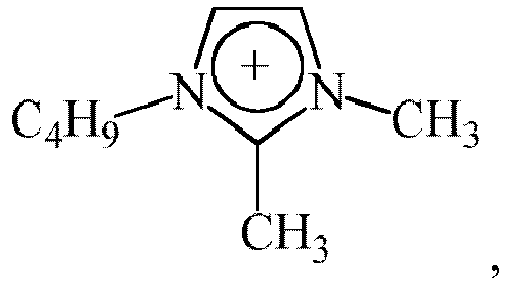


- Even more preferably, compound of formula (I) is compound (Group-I),
compound (Group-I) is selected from the group consisting of compound of formula (Ia) and compound of formula (Ib);
[Catn+][(cis-PF2(CN)4)-]n (Ia)
[Catn+][(mer-PF3(CN)3)-]n (Ib)
Catn+ and n are as defined above, also with all their embodiments, preferably Catn+ is cation (Cat-Part1). - In particular, compound of formula (I) is selected from the group consisting of compound of formula (1), compound of formula (2), compound of formula (2a), compound of formula (2b), compound of formula (3), compound of formula (4), compound of formula (4a), compound of formula (4b), and mixtures thereof.
[(n-Bu)4N][PF4(CN)2 (1)
[(n-Bu)4N][PF3(CN)3] (2)
[(n-Bu)4N][fac-PF3(CN)3] (2a)
[(n-Bu)4N][mer-PF3(CN)3] (2b)
[(n-Pr)3NH][PF4(CN)2] (3)
[(n-Pr)3NH][PF3(CN)3] (4)
[(n-Pr)3NH][fac-PF3(CN)3] (4a)
[(n-Pr)3NH][mer-PF3(CN)3] (4b)
- Preferably, from 1 to 40 mol equivalents, more preferably 4 to 35 mol equivalents, even more preferably from 5 to 25 mol equivalents, especially from 5 to 15 mol equivalents, of trimethylsilylcyanide are used in REAC1, the mol equivalents being based on the molar amount of the anion [(Z1F6)-] of compound of formula (A1).
- The reaction temperatures of REAC1 is preferably from -75 to 150°C, more preferably from-50 to 120°C, more preferably from -50 to 100°C, even more preferably -50 to 80°C.
- Another possible range of the reaction temperatures of REAC1 is preferably from -10 to 150°C, more preferably from -10 to 120°C, more preferably from 0 to 100°C, even more preferably 10 to 80°C.
- REAC1 can be done in a closed system and at the pressure caused by the chosen temperature.
- The reaction time of REAC1 is preferably from 15 min to 96 h, more preferably from 20 min to 84 h, even more preferably from 20 min to 72 h, especially from 20 min to 60 h.
- Preferably, REAC1 is done under inert atmosphere. Preferably, the inert atmosphere is achieved by the use if an inert gas preferably selected from the group consisting of argon, another noble gas, lower boiling alkane, nitrogen and mixtures thereof. The lower boiling alkane is preferably a C1-3 alkane, i.e. methane, ethane or propane.
- After the reaction, compound of formula (I) can be isolated by standard methods such as evaporation of volatile components, extraction, washing, drying, concentration, crystallization, chromatography and any combination thereof, which are known per se to the person skilled in the art.
- Preferably, after the reaction the reaction product is treated with hydrogen peroxide, preferably with aqueous hydrogen peroxide.
- More preferably for isolation, the reaction product is mixed with aqueous hydrogen peroxide to provide a mixture MIXT.
- Preferably, the concentration of the aqueous hydrogen peroxide is from 10 to 40 wt% hydrogen peroxide, the wt% based on the total weight of the aqueous hydrogen peroxide.
- Preferably, from 1 to 30 mol equivalents, more preferably from 1 to 20 mol equivalents, of hydrogen peroxide are used, the mol equivalents being based on the molar amount of compound of formula (A1).
- Preferably, MIXT is stirred for 5 min to 24 h, more preferably for 10 min to 20 h.
- Preferably, MIXT is stirred at a temperature TEMPMIXT, TEMPMIXT is preferably from ambient temperature to 100°C.
- After treatment with hydrogen peroxide, MIXT is preferably filtrated. The residue of the filtration is preferably washed with a solvent WASHMIXT, WASHMIXT is preferably water or an ether such as diethylether or dichloromethane.
- REAC1 can be done in the presence of a compound CAT;
CAT is a Lewis Acid selected from the group consisting of Lewis Acids derived from, that is based on, the 1., 2., 3., 4., 5., 6., 7., 8., 9., 10., 11., 12., 13., 14., 15. and 16. group of the periodic table, zeolite, guanidinium[ANIO] and mixtures thereof;
more preferably, CAT is selected from the group consisting of [(CH3)3SiFSi(CH3)3][ANIO], Q1(R27)3, guanidinium[ANIO], (R26)3C[ANIO], adamantyl[ANIO], [(R24)3O][ANIO], [(R25)3Si][ANIO], Q2(R36)(R28)3, Q3(R29)3, Q4(R30)5, Q5(R32)3, Q6(R33)2, Q7(R31), Q8(R34)2, Q9(R35)3, Q10(R37)2, Q11(R38), zeolite and mixtures thereof;
even more preferably, CAT is selected from the group consisting of [(CH3)3SiFSi(CH3)3][ANIO], Si(Cl)(C6H5)3, B(R27)3, Al(R27)3, GaF3, GaCl3, guanidinium[ANIO], (R26)3C[ANIO], [(R24)3O][ANIO], [(R25)3Si][ANIO], Si(R28)4, TiF4, TiCl4, Q3(halogen)3, Q3(CN)3, Q3(C1-4 alkyl)3, Q4(halogen)5, Q4(C1-10 alkyl)5, Cr(Cl)3, Fe(halogen)3, Mn(Cl)2, Fe(halogen)2, Pd(halogen)2, Pt(halogen)2, Pd(CN)2, Pt(CN)2, Pd(SCN)2, Pt(SCN)2, AgCl, AgCN, CuCl, CuCl2, CuF, CuBr, CuCN, CuF2, CuBr2, Cu(CN)2, ZnF2, ZnCl2, ZnBr2, Zn(CN)2, ScF3, ScCl3, ScBr3, LnF3, LnCl3, LnBr3, CaCl2, KF, zeolite and mixtures thereof;
especially, CAT is selected from the group consisting of [(CH3)3SiFSi(CH3)3][ANIO], Si(Cl)(C6H5)3, B(R27)3, Al(R27)3, GaF3, GaCl3, (R26)3C[ANIO], [(R24)3O][ANIO], [(R25)3Si][ANIO], Si(halogen)4, Si(C1-10 alkyl)4, TiF4, TiCl4, P(halogen)3, P(CN)3, Sb(halogen)3, Bi(halogen)3, Bi(CN)3, P(halogen)5, P(C1-10 alkyl)5, Sb(halogen)5, Nb(halogen)5, CrCl3, FeF3, FeCl3, FeBr3, MnCl2, FeF2, FeCl2, FeBr2, PdF2, PdCl2, PdBr2, PtF2, PtCl2, PtBr2, AgCN, CuCl, CuCl2, CuF, CuBr, CuCN, CuF2, ZnF2, ZnCl2, ZnBr2, Zn(CN)2, ScF3, ScCl3, LnF3, LnCl3, CaCl2, KF, zeolite and mixtures thereof;
more especially, CAT is selected from the group consisting of [(CH3)3SiFSi(CH3)3][ANIO], Si(Cl)(C6H5)3, BF3, BCl3, BBr3, B(C1-4 alkyl)3, B(C6F5)3, AlF3, AlCl3, Al(C1-4 alkyl)3, Al(C6F5)3, GaF3, GaCl3, (Ph)3C[ANIO], (CH3)3C[ANIO], [(C1-3 alkyl)3O][ANIO], [(C1-4 alkyl)3Si][ANIO], Si(halogen)4, Si(C1-10 alkyl)4, TiF4, TiCl4, P(halogen)3, P(CN)3, SbF3, SbI3, BiF3, BiI3, Bi(CN)3, P(halogen)5, SbF5, NbF5, NbCl5, CrCl3, FeCl3, FeBr3, MnCl2, FeCl2, FeBr2, PdCl2, PdBr2, PtCl2, PtBr2, AgCN, CuCl, CuCl2, CuF, CuF2, ZnF2, ZnCl2, ZnBr2, Zn(CN)2, ScF3, ScCl3, LnF3, LnCl3, CaCl2, KF, zeolite and mixtures thereof;
even more especially, CAT is selected from the group consisting of [(CH3)3SiFSi(CH3)3][ANIO], Si(Cl)(C6H5)3, BF3, BCl3, B(C1-4 alkyl)3, B(C6F5)3, AlCl3, GaF3, GaCl3, (Ph)3C[ANIO], (CH3)3C[ANIO], [(C1-4 alkyl)3Si][ANIO], SiF4, SiCl4, Si(C1-8 alkyl)4, TiF4, TiCl4, PCl3, PBr3, PI3, P(CN)3, SbF3, SbI3, Bi(CN)3, PF5, PCl5, PBr5, PI5, SbF5, NbCl5, CrCl3, FeCl3, FeBr3, MnCl2, FeCl2, FeBr2, PdCl2, PdBr2, PtCl2, PtBr2, AgCN, CuCl, CuCl2, CuF, CuF2, ZnF2, Zn(CN)2, ScF3, ScCl3, LnF3, LnCl3, CaCl2, KF, zeolite and mixtures thereof;
in particular, CAT is selected from the group consisting of [(CH3)3SiFSi(CH3)3][ANIO], Si(Cl)(C6H5)3, BF3, BCl3, B(C6F5)3, AlCl3, GaF3, GaCl3, Ph3C[ANIO], [(C1-4 alkyl)3Si][ANIO], SiF4, SiCl4, Si(C1-4 alkyl)4, TiF4, TiCl4, PCl3, PBr3, PI3, P(CN)3, SbF3, SbI3, Bi(CN)3, PF5, PCl5, PBr5, PI5, SbF5, NbCl5, CrCl3, FeCl3, FeBr3, MnCl2, FeCl2, FeBr2, PdCl2, PdBr2, PtCl2, PtBr2, AgCN, CuCl, CuCl2, CuF, CuF2, ZnF2, ScF3, ScCl3, LnF3, LnCl3, CaCl2, KF, zeolite and mixtures thereof;
more in particular, CAT is selected from the group consisting of [(CH3)3SiFSi(CH3)3][ANIO], Si(Cl)(C6H5)3, BF3, BCl3, B(C6F5)3, AlCl3, GaF3, GaCl3, Ph3C[ANIO], SiCl4, TiF4, TiCl4, P(CN)3, SbF3, Bi(CN)3, PF5, PCl5, SbF5, NbCl5, CrCl3, FeCl3, MnCl2, AgCN, CuCl, CuCl2, ZnF2, CaCl2, KF, zeolite and mixtures thereof;
even more in particular, CAT is selected from the group consisting of [(CH3)3SiFSi(CH3)3][ANIO], Si(Cl)(C6H5)3, BF3, B(C6F5)3 GaF3, GaCl3, Ph3C[ANIO], SiCl4, TiF4, TiCl4, P(CN)3, PF5, PCl5, SbF5, NbCl5, CrCl3, FeCl3, MnCl2, AgCN, CaCl2, KF, SiCl4, zeolite and mixtures thereof;
very even more in particular, CAT is selected from the group consisting of [(CH3)3SiFSi(CH3)3][ANIO], Si(Cl)(C6H5)3, BF3, B(C6F5)3 GaF3, GaCl3, Ph3C[ANIO], SiCl4, TiF4, TiCl4, P(CN)3, PF5, PCl5, SbF5, NbCl5, CrCl3, FeCl3, MnCl2, SiCl4, zeolite and mixtures thereof;
in a very preferred embodiment, CAT is selected from the group consisting of BF3, B(C6F5)3 GaF3, GaCl3, TiF4, TiCl4, PF5, PCl5, SbF5, [(CH3)3SiFSi(CH3)3] [ANIO], Ph3C[ANIO], SbF5, zeolite and mixtures thereof;
in a more very preferred embodiment, CAT is [(CH3)3SiFSi(CH3)3][ANIO], B(C6F5)3 GaF3, GaCl3, TiF4, TiCl4, PF5, PCl5, SbF5, Ph3C[ANIO], zeolite or mixtures thereof;
in an even more very preferred embodiment, CAT is [(CH3)3SiFSi(CH3)3][ANIO], B(C6F5)3 GaF3, GaCl3, TiF4, TiCl4, PF5, PCl5, SbF5, Ph3C[ANIO], zeolite or mixtures thereof;
in an especially very preferred embodiment, CAT is B(C6F5)3 GaF3, GaCl3, TiF4, TiCl4, PF5, PCl5, SbF5, Ph3C[ANIO], zeolite or mixtures thereof; - Q1
- is selected from the group consisting of B, Al and Ga;
- R27
- is selected from the group consisting of C1-10 alkoxy, halogen, C1-10 alkyl, CN, SCN and C6F5;
- R24
- is C1-10 alkyl;
- R25
- is C1-10 alkyl;
- R26
- is selected from the group consisting of CN, SCN, Ph and C1-10 alkyl;
- Q2
- is selected from the group consisting of Si and Ti;
- R28 and R36
- are identical or different and independently from each other selected from the group consisting of C1-10 alkoxy, halogen, C1-10 alkyl, CN, SCN and C6F5;
- Q3
- is selected from the group consisting of P, Sb and Bi;
- R29
- is selected from the group consisting of C1-10 alkoxy, halogen, CN, SCN, C1-10 alkyl and C6F5;
- Q4
- is selected from the group consisting of P, Sb and Nb;
- R30
- is selected from the group consisting of C1-10 alkoxy, halogen, CN, SCN, C1-10 alkyl and C6F5;
- Q5
- is selected from the group consisting of Cr and Fe;
- R32
- is selected from the group consisting of halogen, CN and SCN;
- Q6
- is selected from the group consisting of Mn, Fe, Pd and Pt;
- R33
- is selected from the group consisting of halogen, CN and SCN;
- Q7
- is Cu or Ag;
- R31
- is selected from the group consisting of halogen, CN and SCN;
- Q8
- is selected from the group consisting of Cu, Zn, Cd and Hg;
- R34
- is selected from the group consisting of halogen, CN, and SCN;
- Q9
- Sc or Ln;
- R35
- is selected from the group consisting of halogen, CN, and SCN;
- Q10
- Ca;
- R37
- is halogen;
- Q11
- K;
- R38
- is halogen;
- ANIO
- is selected from the group consisting of [P(R40)6-m1(R41)m1]-, [B(R42)4-m2(R43)m2]-, F-, Cl-, Br-, I-, CN- and SCN-;
- R40 and R41
- are identical of different in independently from each other selected from the group consisting of CN, SCN, F, Cl, Br and I;
- m1
- is 0, 1, 2, 3, 4 or 5;
- R42 and R43
- are identical of different in independently from each other selected from the group consisting of C6F5, CN, SCN, F, Cl, Br and I;
- m2
- is 0, 1, 2 or 3;
- Preferably,
Q1 is B. - Preferably,
R24 is C1-4 alkyl;
R25 is C1-7 alkyl;
R26 is selected from the group consisting of Ph and C1-4 alkyl;
R27 is selected from the group consisting of C1-7 alkoxy, Cl, F, Br, C1-7 alkyl and C6F5; more preferably,
R24 is C1-3 alkyl;
R25 is C1-5 alkyl;
R26 is selected from the group consisting of Ph and C1-2 alkyl;
R27 is selected from the group consisting of C1-4 alkoxy, Cl, F, C1-4 alkyl and C6F5; even more preferably,
R24 is methyl or ethyl;
R25 is C1-4 alkyl;
R26 is Ph or methyl;
R27 is selected from the group consisting of C1-3 alkoxy, Cl, F, C1-3 alkyl and C6F5. - Preferably, [ANIO] is [B(C6F5)4] or [PF6].
- In a special embodiments, CAT is selected from the group consisting of [(CH3)3SiFSi(CH3)3][B(C6F5)4], Si(Cl)(C6H5)3, BF3, BCl3, B(C6F5)3, AlCl3, GaF3, GaCl3, Ph3C[PF6], SiCl4, TiF4, TiCl4, P(CN)3, SbF3, Bi(CN)3, PF5, PCl5, SbF5, NbCl5, CrCl3, FeCl3, MnCl2, AgCN, CuCl, CuCl2, ZnF2, CaCl2, KF, zeolite, and mixtures thereof;
preferably, CAT is selected from the group consisting of [(CH3)3SiFSi(CH3)3][B(C6F5)4], Si(Cl)(C6H5)3, BF3, B(C6F5)3, GaF3, GaCl3, Ph3C[PF6], SiCl4, TiF4, TiCl4, P(CN)3, PF5, PCl5, SbF5, NbCl5, CrCl3, FeCl3, MnCl2, SiCl4, zeolite, and mixtures thereof;
more preferably, CAT is selected from the group consisting of [(CH3)3SiFSi(CH3)3][B(C6F5)4], BF3, B(C6F5)3 GaF3, GaCl3, Ph3C[PF6], TiF4, TiCl4, PF5, PCl5, SbF5, zeolite, and mixtures thereof;
even more preferably, CAT is [(CH3)3SiFSi(CH3)3][B(C6F5)4], B(C6F5)3 GaF3, GaCl3, TiF4, TiCl4, PF5, PCl5, SbF5, Ph3C[PF6], zeolite or mixtures thereof;
especially, CAT is B(C6F5)3, GaF3, GaCl3, TiF4, TiCl4, PF5, PCl5, SbF5, Ph3C[PF6], zeolite or mixtures thereof. - In another preferred embodiment, CAT is selected from the group consisting of (CH3)3SiFSi(CH3)3[B(C6F5)4], [Ph3C][PF6], B(C6F5)3 and mixtures thereof;
more preferably, CAT is [Ph3C][PF6]. - CAT can be used in immobilized form on a carrier CARR;
CARR is a carrier conventionally used for immobilizing catalysts in heterogeneously catalyzed reactions;
preferably, CARR is seleceted from the group consisting of epoxide, polystyrene, zeolite, activated carbon and metal oxide;
said metal oxide is preferably selected from the group consisting of MnO2, Fe2O3, Co3O4, NiO, CuO, CuMnO2, MgO, Al2O3, SiO2, V2O5, MoO3, WO3 and mixed oxides thereof. - Zeolite can be any zeolite, preferably montmorrilonte or bentonite, more preferably Montmorillonite K10®, BASF, Germany (also available at Sigma Aldrich, CAS Number 1318-93-0).
- Compound of formula (A1) and CAT can be one and the same compound, therefore in one preferred embodiment, compound of formula (A1) is different from CAT; in another preferred embodiment, compound of formula (A1) is identical with CAT.
- Preferably, from 0.0001 to 40 mol equivalents, more preferably 0.001 to 35 mol equivalents, even more preferably from 0.005 to 25 mol equivalents, especially from 0.005 to 25 mol equivalents, more especially from 0.005 to 15 mol equivalents, even more especially from 0.005 to 5 mol equivalents, of CAT are used in REAC1, the mol equivalents being based on the combined molar amount of the anion [(Z1F6)-] of compound of formula (A1), CATACID and CAT.
- In another preferable embodiment, from 0.01 to 40 mol%, more preferably 0.1 to 35 mol%, even more preferably 0.1 to 25 mol%, especially from 0.5 to 15 mol%, more especially from 0.5 to 10 mol%, even more especially from 0.5 to 5 mol%, of CAT are used in REAC1, the mol% being based on the combined molar amount of the anion [(Z1F6)-] of compound of formula (A1), CATACID and CAT.
- Preferably, from 0.01 to 40 mol%, more preferably 0.1 to 35 mol%, even more preferably 0.1 to 25 mol%, especially from 0.5 to 20 mol%, more especially from 0.5 to 10 mol%, even more especially from 0.5 to 5 mol%, of CATACID are used in REAC1, the mol% being based on the combined molar amount of the anion [(Z1F6)-] of compound of formula (A1), CATACID and, if present, CAT;
- Preferably, the method comprises additionally to STEP1 a step STEP2, STEP2 is done after STEP1;
STEP2 comprises a reaction REAC2, REAC2 is a metathesis reaction wherein cation Catn+ in compound of formula (1) is exchanged for a cation different from Catn+;
compound of formula (I) having been prepared in STEP1;
Catn+, n, compound of formula (I) and STEP1 are as defined above, also with all their embodiments. - REAC2 is a metathesis reaction, also called a salt-exchange reaction. In a metathesis reaction such as REAC2 a first cation in a first salt is exchanged for a second cation, said second cation coming from a second salt.
- Preferably, REAC2 provides for the preparation of a compound of formula (I-Cat-r);
[Cat-rr+] [(Z1F6-m(CN)m)-]r (I-Cat-r)
- Cat-rr+
- is selected from the group consisting of CatINORGn+ and CatORGn+ and is different from Catn+;
- r
- is 1, 2, 3 or 4;
- Preferably, in REAC2 Catn+ is exchanged for Cat-rr+ from a compound of formula (I-Cat-n);
(Cat-rr+)t1 (AnINORGq-)t2 (I-Cat-n)
- q
- is 1 or 2;
- t1
- is 1 or2;
- t2
- is 1, 2, 3 or 4;
when r is 1 and q is 1, then t1 is 1 and t2 is 1;
when r is 2 and q is 1, then t1 is 1 and t2 is 2;
when r is 3 and q is 1, then t1 is 1 and t2 is 3;
when r is 4 and q is 1, then t1 is 1 and t2 is 4;
when r is 1 and q is 2, then t1 is 2 and t2 is 1;
when r is 2 and q is 2, then t1 is 1 and t2 is 1;
when r is 3 and q is 2, then t1 is 2 and t2 is 3;
when r is 4 and q is 2, then t1 is 1 and t2 is 2; - Preferably, AnINORGq- is an anion selected from the group consisting of halide, OH-, CN-, sulfate, hydrogensulfate, nitrate, CO3 2-, HCO3 -, BF4 -, PF6 -, CF3SO3 -, (CF3SO2)2N-, (FSO2)2N-, H3C-SO3 -, H3C-CH2-SO3 -, H3C-O-SO3 -, H3C-CH2-O-SO3 -, acetate, oleate, fumarate, maleate, oxalate, benzoate, N(CN)2 -, and mixtures thereof;
more preferably, AnINORGq- is an anion selected from the group consisting of Br , Cl-, OH-, CN , sulfate, hydrogensulfate, CO3 2-, HCO3 -, acetate, and mixtures thereof;
even more preferably, AnINORGq- is an anion selected from the group consisting of Cl-, OH-, CN-, sulfate, hydrogensulfate, CO3 2-, HCO3 -, acetate, and mixtures thereof. - In another preferred embodiment, AnINORGq- is an anion selected from the group consisting of halide, OH-, CN-, OCN-, SCN-, N3 -, sulfate, hydrogensulfate, nitrate, CO3 2-, HCO3 -, BF4 -, PF6 -, SbF6 -, CF3SO3 -, (CF3SO2)2N-, (FSO2)2N-, C1-6 alkyl-SO3 -, C1-6 alkyl-O-SO3 -,

- Preferably, r is 1 or 2.
- In case of REAC2, preferably a compound of formula (I-Cat-r) with Cat-rr+ being CatORGn+ is prepared by exchange of a Catn+ being a CatINORGn+ in compound of formula (I) for a CatORGn+.
- Said CatORGn+ is provided in REAC2 preferably in form of a compound of formula (I-CatORG)
(CatORGn+)q(AnINORGq-)n (I-CatORG)
wherein
Catn+, n, CatORGn+, CatINORGn+, q and AnINORGq- are as defined above, also with all their embodiments. - Preferably, in REAC2 the cation different from Catn+, that is preferably Cat-rr+, is present in at least such a molar amount relative to the molar amount of Catn+ as required for a stoichiometric exchange of said two cations;
more preferably, compound of formula (I) and compound of formula (I-Cat-n) are present in at least such a molar amount relative to each other, that Catn+ is stoichiometrically exchanged for Cat-rr+;
even more preferably, the molar amount of compound of formula (I-Cat-n) is such, that from 1 to 1.5, even more preferably from 1 to 1.2, required equivalents of Cat-rr+ relative to the equivalents of Catn+ are present. - The reaction temperatures of REAC2 is preferably from 0 to 250 °C, more preferably from 10 to 200 °C, even more preferably from 10 to 150 °C, especially from 10 to 100°C, more especially from 10 to 50°C.
- The REAC2 is preferably carried out in a solvent SOLV2, SOLV2 is preferably selected from the group consisting of water, DCM, ethyl acetate, C5-10 alkane, and mixtures thereof. C5-10 alkane is preferably pentane, hexane or heptane.
- In a more preferred embodiment, REAC2 is done in DCM or in a biphasic solvent system of water and DCM.
- As an alternative, REAC2 can also be carried out in the absence of a solvent or in a solvent in which the inorganic salt formed as side product is sparingly soluble or insoluble. As a further alternative, it is also possible to carry out the reaction in an aqueous solution using an ion exchanger loaded with the desired cation Catn+.
- The amount of solvent is preferably from 2 to 40 fold, more preferably from 3 to 20 fold, of the weight of compound of formula (I).
- REAC2 can be done in a closed system and at the pressure caused by the chosen temperature.
- The reaction time of REAC2 is preferably from 15 min to 96 h, more preferably from 15 min to 48 h, even more preferably from 15 min to 24 h.
- Preferably, REAC2 is done under inert atmosphere. Preferably, the inert atmosphere is achieved by the use if an inert gas preferably selected from the group consisting of argon, another noble gas, lower boiling alkane, nitrogen and mixtures thereof. The lower boiling alkane is preferably a C1-3 alkane, i.e. methane, ethane or propane.
- Subsequent to REAC2 there can be a further metathesis reaction or further metathesis reactions.
- After REAC2, compound of formula (I) can be isolated from the reaction mixture by standard methods such as filtration, evaporation of volatile components, extraction, washing, drying, concentration, crystallization, chromatography and any combination thereof, which are known per se to the person skilled in the art.
- For example, when REAC2 was done in a biphasic solvent system of water and DCM, the aqueous and organic phases are separated, the organic phase is preferably washed, preferably with water, then preferably dried, preferably with Na2SO4, K2CO3, CaCl2 or MgSO4, and finally evaporated.
- Or as another example, when REAC2 was done in DCM and a suspension was formed, filtration and evaporation of the solvent will isolate the product.
- It is possible to use compound of formula (I), which was obtained by the method of instant invention, as substrate in a similar reaction with trimethylsilylcyanide.
- Therefore the method of instant invention can comprise additionally to STEP1 a step STEP1-1, STEP1-1 is done after STEP1;
STEP1-1 comprises a reaction REAC1-1, wherein compound of formula (I), obtained in STEP1, is reacted with trimethylsilylcyanide;
preferably, REAC1-1 is done in the presence of CATACID, in the presence of CAT, or in the presence of both CATACID and CAT;
with CAT and CATACID as defined above, also in all their embodiments. - CATACID is commercially available compounds or can be prepared according to known methods. Compounds of formula (A1) are commercially available depending on the cation Catn+, e.g. [(n-Bu4)N][PF6], [(n-Pr)4N][PF6], K[PF6] and Li[PF6], as well as CAT are commercially available. Other compounds of formula (A1) with cations Catn+ different from K+ and (n-Bu4)N+, and which are not commercially available, can be prepared by conventional metathesis reaction, i.e. substitution of the respective cation K+ or (n-Bu4)N+ against another cation, or by reaction of hexafluorophosphoric acid with a respective compound, such as exemplified herein.
- 1H, 13C, 19F and 31P NMR spectra were recorded on a Bruker AVANCE 300 and Bruker AVANCE 250 instruments in CD3CN, CDCl3, D6-DMSO, D2O or CD2Cl2. Chemical shifts are expressed in parts per million referred to TMS in case of 1H and 13C, C19FCl3 in case of 19F, and H3 31PO4 in case of 31P, and coupling constants (J) in Hertz. When a % value for the amount of compounds is stated based on NMR measurement, the % value represents an area-%, the area-% being based on the total area of peaks in the spectrum. In case of the individual amount of a component in a mixture the stated % value for the amount of the component in the mixture represents an area-%, this area-% being based on the combined area of peaks of all components of the mixture; if not stated otherwise.
- IR-spectra were recorded on a Nicolet 380 FT-IR spectrometer. Measurements were done at ambient temperature.
- RAMAN-spectra were recorded on a LabRAM HR 800 Horiba Jobin YVON. Measurements were done at ambient temperature.
- The C/H/N-analyses were measured on a C/H/N/S-Analysator (Thermoquest Flash EA 1112).
- Melting points and temperature of decomposition Tdec were measured on a DSC 823e from Mettler-Toledo. The calibration was carried out with the melting points of In (156.6 ± 0.3°C) and Zn (419.6 ± 0.7°C) with an heating rate of 5 K per min.
- TGA/DSC measurements were conducted on a Setaram Labsys TGA / DSC 1600. The measurements were carried out under argon atmosphere with a heating rate of 5 K per min, corrected via a blank measurement.
- A solution of [(n-Bu4)N]Br (41.91 g, 130 mmol) in 200 ml of CH2Cl2 was added to a solution of K[PF6] (23.93 g, 130 mmol) in 200 ml of H2O. After stirring for 24 h at ambient temperature the phases were separated. The organic phase was washed three times with 30 ml of water, dried over anhydrous Na2CO3 and filtered. The filtrate was concentrated on a rotary evaporator and [(n-Bu4)N][PF6] as a white solid was obtained. The product was recrystallized from hot ethanol and dried at 80°C in vacuo for 10 hours to yield 47.3 g (94%, 122 mmol).
DSC (10 K/min): m.p. = 250°C, Tdec = 388°C
C/H/N Analysis calc. % (found): C 49.60 (49.76), H 9.37 (9.28), N 3.61 (3.50)
1H NMR (25°C, CD3CN, 300.13 MHz, delta in ppm): 0.96 (t, 12H, CH3), 1.34 (m, 8H, CH3-CH2), 1.59 (m, 8H, CH2-CH2N), 3.06 (m, 8H, NCH2)
19F NMR (25°C, CD3CN, 300.13 MHz, delta in ppm): -73.0 (d, 6F, PF6, 1J(31P-19F) = 707 Hz)
31P NMR (25°C, CD3CN, 300.13 MHz, delta in ppm): -144.6 (sept, 1P, PF6, 1J(31P-19F) = 707 Hz)
IR (ATR, 32 scans, in cm-1): 2966 (m), 2937 (w), 2879 (w), 1472 (m), 1404 (w), 1386 (w), 1360 (w), 1350 (w), 1319 (w), 1260 (w), 1242 (w), 1165 (w), 1109 (w), 1070 (w), 1035 (w), 931 (w), 880 (m), 829 (s), 738 (m), 555 (s) - Hexafluorophosphoric acid (10 mL, 55 wt% aqueous solution, 113 mmol) was mixed with destilled water (50 ml) and cooled to ca. 0 °C. n-Pr3N (21.6 ml, 113 mmol) was added dropwise to the mixture. After 15 min of stirring the resulting white solid was filtered and washed with water. The white solid was recrystallized from a hot mixture of water : ethanol (1:3). After drying in vacuo 30 g (92 %, 104 mmol) of [(n-Pr)3NH][PF6] were obtained.
DSC (10 K/min): Tdec = 260 °C
C/H/N Analysis % calc. (found): C 37.37 (37.35) H 7.67 (7.62) N 4.84 (4.74)
1H NMR (300 K, CD2Cl2, 300.13 MHz, delta in ppm): 1.00 (t, 9H, CH3), 1.75 (m, 6H., CH2-CH3), 3.09 (m, 6H, NCH2), 6.11 (br, 1H, NH)
13C{1H} NMR (300 K, CD2Cl2, 75.47 MHz, delta in ppm): 10.9 (3C, s, CH3), 17.8 (s, 3C, CH2-CH3), 56.1 (s, 3C, NCH2)
19F NMR (300 K, CD2Cl2, 282.40 MHz, delta in ppm): -71.9 (d, 6F, 1J(19F-31P) = 712 Hz)
31P NMR (300 K, CD2Cl2, 121.49 MHz, delta in ppm): -144.3 (sept, 1P, 1J(31P-19F) = 713 Hz)
IR (25 °C, ATR, 64 scans, cm-1): 555 (s), 741 (m), 756 (s), 818 (s), 878 (m), 970 (w), 987 (w), 1045 (w), 1095 (w), 1244 (w), 1269 (w), 1414 (w), 1462 (w), 1475 (w), 2885 (w), 2945 (w) 2978 (w), 3221 (w)
Raman (25°C, 12 mW, 5 scans, cm-1): 312 (3), 469 (1), 741 (10), 822 (1), 920 (1), 1040 (4), 1091 (1), 1108 (1), 1314 (1), 1332 (1), 1456 (4), 2748 (1), 2885 (5), 2943 (6), 2982 (5) - [(n-Bu)4N][PF6] (811 mg, 2.09 mmol), prepared according to Preparation Description A, triflic acid (9 mol%, the mol% being based on the combined molar amount of [(n-Bu)4N][PF6] and triflic acid, 30 mg, 0.2 mmol) and (CH3)3SiCN (2.08 g, 21 mmol) were stirred under argon atmosphere at ambient temperatures. After 2 hours of stirring a 19F NMR and 31P spectra were measured. According to 19F NMR and 31P NMR spectrum the reaction mixture was a mixture of 50 % of compound of formula (1) and 50 % of compound of formula (2). After 53 hours of stirring another 19F NMR spectrum was measured. In accordance with the 19F NMR the product contained more than 99 % of compound of formula (2) with around 97 % of compound of formula (2b) and 3 % of compound of formula (2a).
19F NMR (300 K, CD3CN, 282.40 MHz, delta in ppm): -54.4 (dt, 2F, cis-PF4(CN)2, 1J(19F-31P) = 764 Hz), -41.6 (d, 3F, fac-PF3(CN)3, 1J(19F-31P) = 739 Hz), -41.3 (dt, 2F, cis-PF4(CN)2, 1J(19F-31P) = 712 Hz), -40.1 (dd, 2F, mer-PF3(CN)3, 1J(19F-31P) = 678 Hz), -31.4 (d, 4F, trans-PF4(CN)2, 1J(19F-31P) = 740 Hz), -9.9 (dt, 1F, mer-PF3(CN)3, 1J(149F-31P) = 777 Hz)
31P NMR (300 K, CD3CN, 121.49 MHz, delta in ppm): -170.8 (quin, 1P, trans-PF4(CN)2, 1J(31P-19F) = 738 Hz), -183.3 (tt, 1P, cis-PF4(CN)2, 1J(31P-19F) = 765 Hz, 1J(31P-19F) = 713), -207.5 (dt, 1P, mer-PF2(CN)3, 1J(31P-19F) = 685 Hz, 1J(31P-19F) = 780 Hz) - [(n-Pr)3NH][PF6] (2.66 g, 9.20 mmol), prepared according to Preparation Description B, triflic acid (17 mol%, the mol% being based on the combined molar amount of [(n-Pr)3NH][PF6] and triflic acid, 205 mg, 1.95 mmol) and (CH3)3SiCN (9.13 g, 92 mmol) were stirred under argon atmosphere at ambient temperatures for 2 h. The excess (CH3)3SiCN and any (CH3)3SiF were removed in vacuo resulting in a light brown oil, which was suspended in aqueous H2O2 (7 ml, 70 mmol, 30 wt%) and 10 ml dest. water. After stirring the suspension at ambient temperature for 15 h the suspension was extract two times with 30 ml dichloromethane. The separated organic phases were dried over anhydrous Na2SO4 and filtered. The filtrate was concentrated at a rotary evaporator and dried in vacuo for 15 hours to obtain 2.40 g (84 %, 7.73 mmol) of compound of formula (4) as an light orange oil.
- According to 19F and 31P NMR the product contained less than 1% impurities of compound of formula (3). The product was a mixture of 96 % of compound of formula (4b) and 4 % of compound of formula (4a).
DSC (10 K/min): Tdec = 210°C
C/H/N Analysis % calc. (found.): C 46.45 (46.22) H 7.15 (7.12) N 18.06 (17.37)
1H NMR (300 K, CD2Cl2, 250.13 MHz, delta in ppm): 1.06 (t, 9H, CH3), 1.78 (m, 6H., CH2-CH3), 3.07 (m, 6H, NCH2), 6.80 (br, 1H, NH)
13C{1H} NMR (300 K, CD2Cl2, 62.90 MHz, delta in ppm): 11.0 (3C, s, CH3), 17.9 (s, 3C, CH2-CH3), 55.9 (s, 3C, NCH2), 125.6 (ddt, 2C, mer-PF3(CN)3, 1J(13C-31P) = 260 Hz, 2J(13C-19F) = 80 Hz, 2J(13C-19F) = 53 Hz), 129.2 (ddt, 1C, mer-PF3(CN)3, 1J(13C-31P) = 180 Hz, 2J(13C-19F) = 35 Hz, 2J(13C-19F) = 19 Hz)
19F NMR (300 K, CD3CN, 282.40 MHz, delta in ppm):-41.6 (d, 3F, fac-PF3(CN)3, 1J(19F-31P) = 751 Hz, -39.7 (dd, 2F, mer-PF3(CN)3, 1J(19F-31P) = 690 Hz, -10.0 (dt, 1F, mer-PF3(CN)3, 1J(19F-31P) = 788 Hz
31P NMR (300 K, CD2Cl2, 101.25 MHz, delta in ppm): -224.2 (quar, 1P, fac-PF3(CN)3, 1J(31P-19F) = 740 Hz), -209.9 (dt, 1P, mer-PF2(CN)3, 1J(31P-19F) = 684 Hz, 1J(31P-19F) = 779 Hz, 1J(31P-13C) = 260, 1J(31P-13C) = 180)
IR (25 °C, ATR, 32 scans, cm-1): 552 (s), 596 (m), 640 (m), 683 (s), 754 (m), 793 (s), 829 (s), 982 (w), 1041 (w), 1093 (w), 1171 (w), 1240 (w), 1389 (w), 1427 (w), 1462 (w), 1473 (m), 2199 (w), 2208 (w), 2806 (w), 2885 (w), 2945 (w), 2976 (w), 3093 (w) - [(n-Bu)4N][PF6] (1.00 g, 2.58 mmol), prepared according to Preparation Description A, and (CH3)3SiCN (2.58 g, 26 mmol) were stirred under argon atmosphere at ambient temperature for 100 h.
- After stirring at ambient temperature for 100 h a 19F NMR spectrum was measured.
- In accordance to 19F NMR the product contained about 1% of compound of formula (5) and 99% of [(n-Bu)4N][PF6].
[(n-Bu)4N][PF5(CN)] (5)
19F NMR (25°C, d6-DMSO, 300.13 MHz, delta in ppm): -77.7 (dquin, 1F, PF5(CN), 1J(31P-19F) = 760 Hz), -73.4 (d, 6F, PF6, 1J(31P-19F) = 710 Hz), -49.4 (d, 4F, PF5(CN), 1J(31P-19F) = 741 Hz)
wherein
wherein
in any of said hydrocarbon chains formed by R2 and R3, by R4 and R5, by R6 and R7, and by R9 and R10, 1 or 2 carbon atoms of said hydrocarbon chains can be exchanged for 1 or 2 heteroatoms respectively, said one or two heteroatoms being selected from the group consisting of O, N and S; in case of an exchange for N, this N is unsubstituted or substituted by a residue selected from the group consisting of C1-8 alkyl, C3-10 cycloalkyl, C2-8 alkenyl and C1-8 perfluoroalkyl;


especially, CatORGn+ is selected from the group consisting of


more especially, CatORGn+ is selected from the group consisting of





R40 is selected from the group consisting of CN, SCN, F, Cl, Br and I;
R42 is selected from the group consisting of C6F5, CN, SCN, F, Cl, Br and I;
more preferably, ANIO is selected from the group consisting of P(R40)6 -, B(R42)4 -, F , Cl-, Br-, CN- and SCN-;
R40 is selected from the group consisting of CN, SCN, F, Cl and Br;
R42 is selected from the group consisting of C6F5, CN, SCN, F, Cl and Br.

Cat-rr+, r, CatINORGn+ and CatORGn+ are as defined above, also with all their embodiments.
Claims (15)
- Method for the preparation of compound of formula (I);
[Catn+] [(Z1F6-m(CN)m)-]n (I)
the method comprises a step STEP1;
STEP1 comprises a reaction REAC1, wherein compound of formula (A1)
[Catn+] [(Z1F6)-]n (A1)
is reacted with trimethylsilylcyanide in the presence of a compound CATACID;CATACID is selected from the group consisting of HF, HCl, HBr, HI, HNO3, H2SO3, H2SO4, NaHSO4, Oleum, KHSO4, NaHCO3, KHCO3, H3PO4, H3PO3, HSO3F, HSO3Cl, CH3COOH, CF3COOH, C(Cl3)COOH, methansulfonic acid, HCOOH, AR-COOH, AR-SO3H, C(OH)(COOH)3, CF3SO3H HCN, HOCN, HSCN, HSeCN, HNCO, HNCS, HN3, HQ20(X1)4, polymolybdate, polytungstate, HQ21(X1)6, and mixtures thereof;AR is Phe or Phe substituted with 1, 2 or 3 identical or different residues selected from the group consisting of halogen and CH3;Q20 is B, Al, Ga, In or Th;Q21 is P, As, Sb or Bi;X1 is halogen;Z1 is selected from the group consisting of P, As, Sb and Bi;m is 1, 2, 3, 4 or 5;n is 1, 2, 3 or 4;Catn+ is selected from the group consisting of inorganic cation CatINORGn+ and organic cation CatORGn+;CatINORGn+ is a cation selected from the 1., 2., 3., 4., 5., 6., 7., 8., 9., 10., 11., 12., 13., 14., 15. or 16. group of the periodic table, or is a cation from the lanthanides or is a cation from the actinides or is NH4 +;CatORGn+ is selected from the group consisting of CatORG-A+, CatORG-B+, CatORG-C+, [(CH3)3SiFSi(CH3)3]+, Ph3C+, guanidinium and (H2(R18)N-R16-N(R19)H2)2+;CatORG-A+ is (WR2R3R4R5)+,whereinW is a nitrogen or phosphorus; and(i) R2, R3, R4 and R5 are identical or different and independently from each other selected from the group consisting of H, C1-20 alkyl, C1-20 perfluoroalkyl, C3-10 cycloalkyl and C6-10 aryl, with the proviso, that at least one of the residues R2, R3, R4 and R5 is not H; or(ii) R2 and R3 together are a hydrocarbon chain and form together with W a 5- to 7-membered saturated or unsaturated heterocyclic ring,
R4 and R5 are identical or different and independently from each other selected from the group consisting of H, C1-20 alkyl, C1-20 perfluoroalkyl, C3-10 cycloalkyl and C6-10 aryl; or(iii) R2 and R3 together are a hydrocarbon chain and form together with W, and R4 and R5 together are a hydrocarbon chain and form together with W, independently from each other, 5- to 7-membered saturated or unsaturated heterocyclic rings;CatORG-B+ is (XR6R7R8)+,
whereinX is nitrogen,R6 and R7 together are a hydrocarbon chain and form together with X a 5- to 7-membered unsaturated heterocyclic ring in which X is connected by a single bond and a double bond to R6 and R7 respectively,R8 is selected from the group consisting of H, C1-20 alkyl, C2-8 alkenyl, C1-20 perfluoroalkyl, C3-10 cycloalkyl or C6-10 aryl;CatORG-C+ is (YR9R10R11)+,
whereinY is sulphur;(i) R9, R10 and R11 are identical or different and independently from each other selected from the group consisting of H, C1-20 alkyl, C1-20 perfluoroalkyl, C3-10 cycloalkyl and C6-10 aryl; or(ii) R9 and R10 together are a hydrocarbon chain and form together with Y a 5- to 7-membered saturated or unsaturated ring,the residues R2, R3, R4, R5, R6, R7, R8, R9, R10 and R11 are, independently from each other, unsubstituted or, where applicable, substituted by 1, 2, 3, 4, 5 or 6 substituents selected from the group consisting of C1-4 alkyl, C3-10 cycloalkyl, C2-8 alkenyl, phenyl, benzyl, halogen, cyano and C1-4 alkoxy;
R11 is selected from the group consisting of H, C1-20 alkyl, C1-20 perfluoroalkyl, C3-10 cycloalkyl and C6-10 aryl;
in any of said hydrocarbon chains formed by R2 and R3, by R4 and R5, by R6 and R7, and by R9 and RI0 1 or 2 carbon atoms of said hydrocarbon chains can be exchanged for 1 or 2 heteroatoms respectively, said one or two heteroatoms being selected from the group consisting of O, N and S; in case of an exchange for N, this N is unsubstituted or substituted by a residue selected from the group consisting of C1-8 alkyl, C3-10 cycloalkyl, C2-8 alkenyl and C1-8 perfluoroalkyl;R16 is selected from the group consisting of C2-8 alkylen, C3-8 cycloalkylen, phenylen, C(H)(phenyl), R17(-O-R17)n1;R17 is selected from the group consisting of CH2-CH2, CH2-CH2-CH2, CH2-C(H)(CH3)-CH2, CH2-CH2-C(H)(CH3) and CH2-CH2-CH2-CH2;R18 and R19 are identical or different and independently from each other selected from the group consisting of H, C1-8 alkyl, C3-8 cycloalkyl, phenyl and benzyl;n1 is an integer from 1 to 20. - Method according to claim 1, whereinZ1 is P.
- Method according to claim 1 or 2, wherein
m is 2, 3, 4 or 5. - Method according to one or more of claims 1 to 3, wherein
n is 1 or 2. - Method according to one or more of claims 1 to 4, whereinCATACID is selected from the group consisting of HF, HCl, HBr, H2SO4, NaHSO4, Oleum, KHSO4, H3PO4, HSO3F, HSO3Cl, CH3COOH, CF3COOH, C(Cl3)COOH, methansulfonic acid, HCOOH, AR-SO3H, C(OH)(COOH)3, CF3SO3H, HCN, HQ20(X1)4, polymolybdate, polytungstate, HQ21(X1)6, and mixtures thereof;AR is Phe or Phe substituted with 1, 2 or 3 identical or different residues selected from the group consisting of halogen and CH3;Q20 is B, Al or Ga;Q21 is P, Sb or Bi;X1 is F, Cl or Br.
- Method according to one or more of claims 1 to 5, wherein
CatINORGn+ is a cation selected from the 1., 2., 3., 4., 5., 6., 7., 8., 9., 10., 11., 12., 13., 14. or 15. group of the periodic table or is a cation from the lanthanides or is NH4 +. - Method according to one or more of claims 1 to 6, wherein
CatINORGn+ is a cation selected from the 1., 2., 4., 5., 6., 7., 8., 9., 10., 11., 12., 13., 14. or 15. group of the periodic table or is a cation from the lanthanides or NH4 +. - Method according to one or more of claims 1 to 7, wherein
CatINORGn+ is selected from the group consisting of Li+, Na+, K+, Rb+, Cs+, Be2+, Mg2+, Ca2+, Sr2+, Ba2+, Ti4+, Ti3+, Zr4+, Zr3+, Hf4+, Hf3+, V4+, V3+, V2+, Nb4+, Ta4+, Cr3+, Mo4+, Mo3+, Mo2+, W4+, W3+, W2+, Mn4+, Mn3+, Mn2+, Fe4+, Fe3+, Fe2+, Ru4+, Ru3+, Ru2+, Os4+, Os3+, Os2+, Co4+, Co3+, Co2+, Rh4+, Rh3+, Ir4+, Ir3+, Ni4+, Ni3+, Ni2+, Pd4+, Pd3+, Pd2+, Pt4+, Pt3+, Pt2+, Cu4+, Cu3+, Cu2+, Cu+, Ag4+, Ag3+, Ag2+, Ag+, Au3+, Au2+, Au+, Zn2+, Zn+, Cd2+, Cd+, Hg2+, Hg+, B3+, Al3+, Ga3+, Ga+, In3+, In+, Tl3+, Tl+, Ge4+, Ge2+, Sn4+, Sn2+, Pb4+, Pb2+, As3+, Sb3+, Bi3+, Bi1+, La3+, Nb3+, Sm3+, Eu3+, Gd3+, and NN4 +. - Method according to one or more of claims 1 to 8, wherein
CatORGn+ is selected from the group consisting of ammonium, phosphonium, sulfonium, pyrrolidinium, pyrrolinium, pyrrolium, pyrazolium, pyrazolinium, imidazolium, imidazolinium, triazolium, oxazolium, thiazolium, piperidinium, piperazinium, morpholinium, pyridinium, pyridazinium, pyrimidinium, pyrazinium, 1,3-dioxolium, pyrylium, thiopyrylium, quinoxalinium, indolinium, indolium, [(CH3)3SiFSi(CH3)3]+, Ph3C+, and mixtures thereof. - Method according to one or more of claims 1 to 9, wherein CatORGn+ is selected from the group consisting of


wherein
R20, R21, R23 are identical or different and independently from each other selected from the group consisting of H, C1-20 alkyl, C3-10 cycloalkyl and allyl;
R22 is C1-20 alkyl, C3-10 cycloalkyl or allyl. - Method according to one or more of claims 1 to 10, wherein
compound of formula (I) is compound (Group-I),
compound (Group-I) is selected from the group consisting of compound of formula (Ia) and compound of formula (Ib).
[Catn+][(cis-PF2(CN)4)-]n (Ia)
[Catn+] [(mer-PF3(CN)3)-]n (Ib)
- Method according to one or more of claims 1 to 11, wherein
compound of formula (I) is selected from the group consisting of compound of formula (1), compound of formula (2), compound of formula (2a), compound of formula (2b), compound of formula (3), compound of formula (4), compound of formula (4a), compound of formula (4b), and mixtures thereof.
[(n-Bu)4N][PF4(CN)2] (1)
[(n-Bu)4N][PF3(CN)3] (2)
[(n-Bu)4N][fac-PF3(CN)3] (2a)
[(n-Bu)4N][mer-PF3(CN)3] (2b)
[(n-Pr)3NH][PF4(CN)2] (3)
[(n-Pr)3NH][PF3(CN)3] (4)
[(n-Pr)3NH][fac-PF3(CN)3] (4a)
[(n-Pr)3NH][mer-PF3(CN)3] (4b)
- Method according to one or more of claims 1 to 12, wherein
REAC1 is done in the presence of a compound CAT;
CAT is a Lewis Acid selected from the group consisting of Lewis Acids derived from, that is based on, the 1., 2., 3., 4., 5., 6., 7., 8., 9., 10., 11., 12., 13., 14., 15. and 16. group of the periodic table, zeolite, guanidinium[ANIO] and mixtures thereof. - Method according to claim 13, wherein
CAT is selected from the group consisting of [(CH3)3SiFSi(CH3)3][ANIO], Q1(R27)3, guanidinium[ANIO], (R26)3C[ANIO], adamantyl[ANIO], [(R24)3O][ANIO], [(R25)3Si][ANIO], Q2(R36)(R28)3, Q3(R29)3, Q4(R30)5, Q5(R32)3, Q6(R33)2, Q7(R31), Q8(R34)2, Q9(R35)3, Q10(R37)2, Q11(R38), zeolite and mixtures thereof;Q1 is selected from the group consisting of B, A1 and Ga;R27 is selected from the group consisting of C1-10 alkoxy, halogen, C1-10 alkyl, CN, SCN and C6F5;R24 is C1-10 alkyl;R25 is C1-10 alkyl;R26 is selected from the group consisting of CN, SCN, Ph and C1-10 alkyl;Q2 is selected from the group consisting of Si and Ti;R28 and R36 are identical or different and independently from each other selected from the group consisting of C1-10 alkoxy, halogen, C1-10 alkyl, CN, SCN and C6F5;Q3 is selected from the group consisting of P, Sb and Bi;R29 is selected from the group consisting of C1-10 alkoxy, halogen, CN, SCN, C1-10 alkyl and C6F5;Q4 is selected from the group consisting of P, Sb and Nb;R30 is selected from the group consisting of C1-10 alkoxy, halogen, CN, SCN, C1-10 alkyl and C6F5;Q5 is selected from the group consisting of Cr and Fe;R32 is selected from the group consisting of halogen, CN and SCN;Q6 is selected from the group consisting of Mn, Fe, Pd and Pt;R33 is selected from the group consisting of halogen, CN and SCN;Q7 is Cu or Ag;R31 is selected from the group consisting of halogen, CN and SCN;Q8 is selected from the group consisting of Cu, Zn, Cd and Hg;R34 is selected from the group consisting of halogen, CN, and SCN;Q9 Sc or Ln;R35 is selected from the group consisting of halogen, CN, and SCN;Q10 Ca;R37 is halogen;Q11 K;R38 is halogen;ANIO is selected from the group consisting of [P(R40)6-m1(R41)m1]-, [B(R42)4-m2(R43)m2]-, F-, Cl-, Br-, I-, CN- and SCN-;R40 and R41 are identical of different in independently from each other selected from the group consisting of CN, SCN, F, Cl, Br and I;m1 is 0, 1, 2, 3, 4 or 5;R42 and R43 are identical of different in independently from each other selected from the group consisting of C6F5, CN, SCN, F, Cl, Br and I;m2 is 0, 1, 2 or 3. - Method according to one or more of claims 1 to 14, wherein
the method comprises additionally to STEP1 a step STEP2, STEP2 is done after STEP 1; STEP2 comprises a reaction REAC2, REAC2 is a metathesis reaction wherein cation Catn+ in compound of formula (I) is exchanged for a cation different from Catn+;
compound of formula (I) having been prepared in STEP 1.
Priority Applications (1)
| Application Number | Priority Date | Filing Date | Title |
|---|---|---|---|
| EP15162892.2A EP3078668A1 (en) | 2015-04-09 | 2015-04-09 | Method for preparation of fluoro cyano compounds of the 15th group with a bronstedt acid |
Applications Claiming Priority (1)
| Application Number | Priority Date | Filing Date | Title |
|---|---|---|---|
| EP15162892.2A EP3078668A1 (en) | 2015-04-09 | 2015-04-09 | Method for preparation of fluoro cyano compounds of the 15th group with a bronstedt acid |
Publications (1)
| Publication Number | Publication Date |
|---|---|
| EP3078668A1 true EP3078668A1 (en) | 2016-10-12 |
Family
ID=52828995
Family Applications (1)
| Application Number | Title | Priority Date | Filing Date |
|---|---|---|---|
| EP15162892.2A Withdrawn EP3078668A1 (en) | 2015-04-09 | 2015-04-09 | Method for preparation of fluoro cyano compounds of the 15th group with a bronstedt acid |
Country Status (1)
| Country | Link |
|---|---|
| EP (1) | EP3078668A1 (en) |
Citations (5)
| Publication number | Priority date | Publication date | Assignee | Title |
|---|---|---|---|---|
| JP2012009158A (en) | 2010-06-22 | 2012-01-12 | Nippon Synthetic Chem Ind Co Ltd:The | Electrolyte and lithium secondary battery using the same |
| EP2410601A1 (en) | 2009-03-18 | 2012-01-25 | The Nippon Synthetic Chemical Industry Co., Ltd. | Ionic liquid, electrolyte, lithium secondary battery comprising same, and process for producing ionic liquid |
| JP2012248515A (en) | 2011-05-31 | 2012-12-13 | Nippon Synthetic Chem Ind Co Ltd:The | Metal salt, electrode protection film forming agent, secondary battery electrolyte including the same, and secondary battery |
| US20130089777A1 (en) | 2010-06-22 | 2013-04-11 | The Nippon Synthetic Chemical Industry Co., Ltd. | Material for use as electrolyte, lithium secondary battery electrolyte, lithium secondary battery employing the same, and novel lithium salt |
| WO2014167035A1 (en) * | 2013-04-12 | 2014-10-16 | Lonza Ltd | Method for preparation of fluoro and chloro cyano compounds of the 15th group |
-
2015
- 2015-04-09 EP EP15162892.2A patent/EP3078668A1/en not_active Withdrawn
Patent Citations (6)
| Publication number | Priority date | Publication date | Assignee | Title |
|---|---|---|---|---|
| EP2410601A1 (en) | 2009-03-18 | 2012-01-25 | The Nippon Synthetic Chemical Industry Co., Ltd. | Ionic liquid, electrolyte, lithium secondary battery comprising same, and process for producing ionic liquid |
| JP2012009158A (en) | 2010-06-22 | 2012-01-12 | Nippon Synthetic Chem Ind Co Ltd:The | Electrolyte and lithium secondary battery using the same |
| US20130089777A1 (en) | 2010-06-22 | 2013-04-11 | The Nippon Synthetic Chemical Industry Co., Ltd. | Material for use as electrolyte, lithium secondary battery electrolyte, lithium secondary battery employing the same, and novel lithium salt |
| JP2012248515A (en) | 2011-05-31 | 2012-12-13 | Nippon Synthetic Chem Ind Co Ltd:The | Metal salt, electrode protection film forming agent, secondary battery electrolyte including the same, and secondary battery |
| WO2014167035A1 (en) * | 2013-04-12 | 2014-10-16 | Lonza Ltd | Method for preparation of fluoro and chloro cyano compounds of the 15th group |
| WO2014167034A2 (en) * | 2013-04-12 | 2014-10-16 | Lonza Ltd | Fluoro and chloro cyano compounds of the 15th group |
Non-Patent Citations (4)
| Title |
|---|
| JONAS BRESIEN ET AL: "Tetracyanido(difluorido)phosphates M + [PF 2 (CN) 4 ] -", ANGEWANDTE CHEMIE INTERNATIONAL EDITION, vol. 54, no. 15, 7 April 2015 (2015-04-07), pages 4474 - 4477, XP055214750, ISSN: 1433-7851, DOI: 10.1002/anie.201412209 * |
| JONAS BRESIEN: "Supporting Information Tetracyanido(difluorido)phosphates M + [PF 2 (CN) 4 ] SUPPORTING INFORMATION", 20 February 2015 (2015-02-20), XP055214850, Retrieved from the Internet <URL:http://onlinelibrary.wiley.com/doi/10.1002/anie.201412209/suppinfo> [retrieved on 20150921] * |
| K. B. DILLON ET AL., J. CHEM. SOC., CHEM. COMMUN., 1983, pages 1089 - 1090 |
| P. WASSERSCHEID ET AL., ANGEW. CHEM., vol. 112, 2000, pages 3926 - 3945 |
Similar Documents
| Publication | Publication Date | Title |
|---|---|---|
| US9458180B2 (en) | Method for preparation of cyano compounds of the 13th group with a lewis acid | |
| EP2257495B1 (en) | Sulfonylimide salt and method for producing the same | |
| CN102712661B (en) | Prepare the method for perfluoroalkyl cyano group borate or perfluoroalkyl cyano group fluoroborate | |
| JP5409351B2 (en) | Salts consisting of pentafluorophenylimide anions and their use as ionic liquids | |
| KR20140034256A (en) | Compounds containing hydrido-tricyano-borate anions | |
| CA2750448C (en) | Novel tricyanoborates | |
| KR20140050058A (en) | Compounds containing alkyl-cyano-borate or alkyl-cyano-fluoroborate anions | |
| WO2014167035A1 (en) | Method for preparation of fluoro and chloro cyano compounds of the 15th group | |
| WO2004106288A2 (en) | Ionic liquids containing guanidinium cations | |
| WO2003048078A2 (en) | Production of ionic liquids | |
| US8148443B2 (en) | Oxonium and sulfonium salts | |
| EP2772495A1 (en) | Method for preparation of tricyanidofluoroborates in 2 steps | |
| KR20130118322A (en) | Functionalized fluoroalkyl fluorophosphate salts | |
| EP1628952A1 (en) | Ionic liquid comprising uronium cations or thiouronium cations | |
| JP5985626B2 (en) | Compounds containing alkyl-alkoxy-cyano-borate anions | |
| WO2015067404A1 (en) | Method for preparation of fluoro cyano compounds of the 15th group with a lewis acid | |
| EP1773848B1 (en) | Salts containing alkoxytris (fluoroalkyl) borate anions | |
| WO2016162400A1 (en) | Method for preparation of cyano compounds of boron with a bronstedt acid | |
| US8101749B2 (en) | Process for the preparation of onium salts with a tetrafluoroborate anion having a reduced halide content | |
| RU2575352C2 (en) | Method of producing perfluoroalkylcyano- or perfluoroalkylcyanofluoroborates | |
| DE102016010488A1 (en) | Compounds with mono-, bis- and multiply charged weakly coordinating anions | |
| HK1163005B (en) | Tricyanoborates | |
| DE102004036299A1 (en) | New alkoxytris(fluoroalkyl)borate salts useful as ionic liquids, e.g. as electrolytes in batteries and capacitors |
Legal Events
| Date | Code | Title | Description |
|---|---|---|---|
| PUAI | Public reference made under article 153(3) epc to a published international application that has entered the european phase |
Free format text: ORIGINAL CODE: 0009012 |
|
| AK | Designated contracting states |
Kind code of ref document: A1 Designated state(s): AL AT BE BG CH CY CZ DE DK EE ES FI FR GB GR HR HU IE IS IT LI LT LU LV MC MK MT NL NO PL PT RO RS SE SI SK SM TR |
|
| AX | Request for extension of the european patent |
Extension state: BA ME |
|
| STAA | Information on the status of an ep patent application or granted ep patent |
Free format text: STATUS: THE APPLICATION HAS BEEN WITHDRAWN |
|
| 18W | Application withdrawn |
Effective date: 20161013 |