EP3076308A1 - Telecommunication method for handling a database query in a telecommunication system and telecommunication system - Google Patents
Telecommunication method for handling a database query in a telecommunication system and telecommunication system Download PDFInfo
- Publication number
- EP3076308A1 EP3076308A1 EP15161981.4A EP15161981A EP3076308A1 EP 3076308 A1 EP3076308 A1 EP 3076308A1 EP 15161981 A EP15161981 A EP 15161981A EP 3076308 A1 EP3076308 A1 EP 3076308A1
- Authority
- EP
- European Patent Office
- Prior art keywords
- database query
- data elements
- telecommunication
- database
- replicate
- Prior art date
- Legal status (The legal status is an assumption and is not a legal conclusion. Google has not performed a legal analysis and makes no representation as to the accuracy of the status listed.)
- Granted
Links
Images
Classifications
-
- H—ELECTRICITY
- H04—ELECTRIC COMMUNICATION TECHNIQUE
- H04L—TRANSMISSION OF DIGITAL INFORMATION, e.g. TELEGRAPHIC COMMUNICATION
- H04L67/00—Network arrangements or protocols for supporting network services or applications
- H04L67/50—Network services
- H04L67/60—Scheduling or organising the servicing of application requests, e.g. requests for application data transmissions using the analysis and optimisation of the required network resources
-
- G—PHYSICS
- G06—COMPUTING OR CALCULATING; COUNTING
- G06F—ELECTRIC DIGITAL DATA PROCESSING
- G06F16/00—Information retrieval; Database structures therefor; File system structures therefor
- G06F16/20—Information retrieval; Database structures therefor; File system structures therefor of structured data, e.g. relational data
- G06F16/24—Querying
- G06F16/245—Query processing
- G06F16/2457—Query processing with adaptation to user needs
- G06F16/24573—Query processing with adaptation to user needs using data annotations, e.g. user-defined metadata
-
- G—PHYSICS
- G06—COMPUTING OR CALCULATING; COUNTING
- G06F—ELECTRIC DIGITAL DATA PROCESSING
- G06F16/00—Information retrieval; Database structures therefor; File system structures therefor
- G06F16/20—Information retrieval; Database structures therefor; File system structures therefor of structured data, e.g. relational data
- G06F16/24—Querying
- G06F16/245—Query processing
- G06F16/2458—Special types of queries, e.g. statistical queries, fuzzy queries or distributed queries
- G06F16/2471—Distributed queries
-
- G—PHYSICS
- G06—COMPUTING OR CALCULATING; COUNTING
- G06F—ELECTRIC DIGITAL DATA PROCESSING
- G06F16/00—Information retrieval; Database structures therefor; File system structures therefor
- G06F16/20—Information retrieval; Database structures therefor; File system structures therefor of structured data, e.g. relational data
- G06F16/27—Replication, distribution or synchronisation of data between databases or within a distributed database system; Distributed database system architectures therefor
-
- G—PHYSICS
- G06—COMPUTING OR CALCULATING; COUNTING
- G06F—ELECTRIC DIGITAL DATA PROCESSING
- G06F40/00—Handling natural language data
- G06F40/10—Text processing
- G06F40/166—Editing, e.g. inserting or deleting
- G06F40/169—Annotation, e.g. comment data or footnotes
-
- H—ELECTRICITY
- H04—ELECTRIC COMMUNICATION TECHNIQUE
- H04L—TRANSMISSION OF DIGITAL INFORMATION, e.g. TELEGRAPHIC COMMUNICATION
- H04L67/00—Network arrangements or protocols for supporting network services or applications
- H04L67/01—Protocols
- H04L67/10—Protocols in which an application is distributed across nodes in the network
- H04L67/1097—Protocols in which an application is distributed across nodes in the network for distributed storage of data in networks, e.g. transport arrangements for network file system [NFS], storage area networks [SAN] or network attached storage [NAS]
Definitions
- the invention relates to a telecommunication method for handling a database query in a telecommunication system.
- UMTS universal mobile telecommunications systems
- LTE long-term evolution
- a UMTS network constitutes the third generation (3G) of cellular wireless networks.
- multimedia broadcast/multicast service (MBMS) is one of the evolving service concepts within the third generation networks.
- MBMS is a user service, which is a combination of both a broadcast service and a multicast service.
- Third generation partnership (3GPP) is working on establishing standards for multimedia/multicast services.
- Embodiments of the present invention can be freely combined with each other if they are not mutually exclusive.
- the invention relates to a telecommunication method for handling a database query in a telecommunication system.
- the telecommunication system comprises a master node and at least one slave node.
- the master node and the slave node may both be battery powered mobile telecommunication devices which are operable to communicate via a wireless telecommunications network.
- the master node comprises a first central processing unit and a first main memory wherein the first main memory comprises data elements.
- the slave node comprises a second central processing unit and a second main memory.
- the second main memory comprised in the slave node comprises a replicate version of a first set of the data elements comprised in the master node.
- the method for handling the database query then comprises the reception of the database query at the telecommunication system via a telecommunications network wherein the database query requires access to a second set of the data elements.
- the database query may be executed using replicate versions of data elements. In case the database query may be executed using replicate versions of the data elements the database query is then executed on the slave node in-memory using the second central data processing unit and second main memory. In case the database query may not be executed using replicate versions of the data elements the execution of the database query is then performed on the master node in-memory using the first central data processing unit and the first main memory.
- a replicate version of a data element is a copy of a data element which may soon be outdated as the data elements in the master node are continuously being accessed and especially altered.
- the data elements comprised in the main memory of the slave node are copies of former versions of the data elements comprised in the master node.
- a data element has to be understood as a digital machine readable element comprising information which may for example be arranged in the form of a table or a plurality of tables.
- a database query has to be understood as an abstract query for data comprised in a database which may also include an analysis of the comprised data.
- a processing engine may lead to a plurality of SELECT statements which subsequently have to be processed by the database.
- Embodiments may have the advantage that the processing load caused by executing a database query on the central processing unit of a node can be divided between the slave node and the master node.
- This dividing of processing load may for example be possible for database queries which require access to data elements whose up-to-dateness is not important for processing the database query.
- database queries referring to an analysis of the contents of the data elements may in some cases be executed on outdated data elements thereby giving the same result which would have been received if the database query was executed on the master node with the up to date data elements.
- a database query referring to an analysis of data may for example be directed towards determining the revenue of a company for a certain quarter in a certain region.
- the telecommunication system further comprises an application server wherein the application server comprises a plurality of engines for processing database queries. Each engine is adapted to process a predefined type of database query. For example there may be engines for processing analytic type database queries or other engines for processing search type database queries.
- the application server is further operatively coupled via the telecommunication network with the master node and the slave node.
- the method comprises determining a set of engines from the plurality of engines which are adapted to process database queries that may be executed using replicate versions of data elements. The determination whether the database query may be executed using replicate versions of data elements upon the reception of the database query at the telecommunication system is then conducted by determining a first engine from the plurality of engines which is adapted to process the database query.
- the database query is then processed by this first engine by the execution of the database query on the slave node.
- the database query is then processed by the first engine by the execution of the database query on the master node.
- Embodiments may have the advantage that the decision whether a database query may be executed on the slave node is simplified as the decision usually is based on determining the type of database access the database query requires. If for example a first engine comprised in the application server is adapted to only process analytic database queries it is possible to directly route all the database queries processed with this engine to the slave node.
- the first engine is further adapted to determine the second set of data elements which has to be accessed in order to execute the database query. Once the second set of data elements has been determined it is further determined whether the second set of data elements is comprised in the first set of data elements which is stored in the main memory of the slave node. In case the second set of data elements is comprised in the first set of data elements the first engine is adapted to process the database query by the execution of the database query on the slave node. However, in case the second set of data elements is not comprised in the first set of data elements the first engine is adapted to process the database query by the execution of the database query on the master node.
- Embodiments may have the advantage that prior to the execution of the database query it is determined whether all necessary data elements are in fact comprised in the slave node. It has to be noted that a database query requiring access to a plurality of data elements cannot be properly executed if some of the data elements are stored as replicate versions in the slave node and some are stored only as original versions in the master node. The overall data content of such a constellation may lead to erroneous results of the execution of the database query as the starting conditions are not the same for all individual database accesses conducted during execution of the database query.
- the method further comprises creating a log file upon said determination that the second set of data elements is not comprised in the first set of data elements.
- the log file then comprises information indicative of a third set of data elements wherein the third set of data elements comprises the data elements of the second set of data elements which are not comprised in the first set of data elements.
- Embodiments may have the advantage that a database administrator can easily see which data elements have to be provided as replicate versions in a slave node to fully use the potential of the database system by redirecting database queries to the slave node. If for example a database query in principle may be executed on the slave node using replicate versions of data elements, however cannot be executed on the slave node because not all necessary data elements are provided as replicate versions in the slave node, the database query cannot be executed on the slave node. However creating a log file allowing for a subsequent adaption of the contents of the slave node such that all subsequent database queries which may be executed on the slave node actually can be executed on the slave node as all necessary data elements are provided as replicate versions may enable a balancing of the processing load between master and slave node.
- the telecommunication system further comprises a database management entity wherein the database management entity is adapted to access the information comprised in the log file and create and store a replicate version of the third set of data elements in the main memory of the slave node.
- Embodiments may have the advantage that the previously described optimization of the database system by providing all necessary data elements in the slave node for execution of the database queries on the slave node can be conducted automatically. Thus it is not necessary to wait until a database administrator triggers the replication of the data elements instead the telecommunication system will update its slave node by itself.
- the execution of the database query employs a plurality of database views, wherein the database views comprise annotations.
- the annotation is indicative whether the database view can be executed using replicate versions of data elements. Determining whether the database query may be executed using replicate versions of data elements is then conducted by reading the annotations comprised in the views which are employed by the database query.
- the telecommunication system further comprises a mobile telecommunication device and a database server wherein the mobile telecommunication device and the database server are connected via the telecommunication network.
- the mobile telecommunication device comprises the slave node, a first telecommunication interface and a third central processing unit.
- the database server comprises the master node.
- the method comprises the reception of the database query via the first telecommunication interface at the mobile telecommunication device.
- the determination whether the database query may be executed using replicate versions of data elements is then conducted by the third central processing unit.
- the method comprises the execution of the database query on the slave node in-memory using the second central data processing unit and second main memory.
- the method further comprises the execution of the database query by forwarding the database query to the database server via the first telecommunication interface and in response to forwarding the database query to the database server, receiving a result of the database query from the database server via the first telecommunication interface.
- Embodiments may have the advantage that at least some of the database queries received at the mobile telecommunication device can be executed locally on the slave node comprised in the mobile telecommunication device. Thus it is not necessary to address the database server for processing the database query via the telecommunication network which may allow for saving battery power on the mobile telecommunication device.
- the master node further comprises access statistics for the data elements stored in the main memory of the master node wherein the access statistics comprise information for the data elements indicative of a rate of change for the data elements.
- the method then comprises determining the rate of change of a data element, determining whether the rate of change of the data element is below a predefined threshold and in case the rate of change of the data element is below the predefined threshold creating a replicate version of the data element and storing the replicate version of the data element in the main memory of the slave node.
- the predefined threshold may be chosen such that only such data elements are stored in the slave node, which are changed only at a very low rate thereby not having to be updated very often.
- the update traffic between the master node and the slave node can be reduced by creating replicate versions only of those data elements which are changed only rarely.
- the invention in another aspect relates to a telecommunication system comprising a master node and at least one slave node.
- the master node comprises a first central processing unit and a first main memory the first main memory comprising data elements.
- the slave node comprises a second central processing unit and a second main memory.
- the second main memory comprises a replicate version of a first set of data elements comprised in the first main memory of the master node.
- the telecommunication system is adapted to
- the invention relates to a computer program product which when executed on the telecommunication system, as described before, causes the telecommunication system to execute the method as described above.
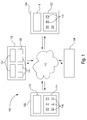
- Fig. 1 is a block diagram of a telecommunication system 100 like for example a mobile cellular network.
- the telecommunication system 100 comprises a master mobile telecommunication device, henceforth called “master telecommunication node” 102, a slave mobile telecommunication device, henceforth called “slave telecommunication node” 104 as well as an application server 106 and a management entity 108.
- the master node 102, the slave telecommunication node 104, the application server 106 and the database management entity 108 are coupled via a telecommunication network 110.
- the master telecommunication node 102 and the slave telecommunication node 104 are both battery powered mobile telecommunication devices like smartphone, PDAs, tablet computers, or other electronic devices capable of processing data and communicating data via a telecommunication network.
- battery powered mobile telecommunication devices like smartphone, PDAs, tablet computers, or other electronic devices capable of processing data and communicating data via a telecommunication network.
- other telecommunication devices are also possible.
- the master telecommunication node comprises a first central processing unit 112 and a first main memory 114 comprising data elements 116.
- the data elements 116 are denoted with A, B, C, D, E and F.
- the slave telecommunication node 104 is similar to the master telecommunication node 102. As such the slave telecommunication node 104 comprises a second central processing unit 118 and a second main memory 120.
- the second memory 120 comprises data elements 116 as well wherein the data elements 116 comprised in the second main memory 120 are replicate versions of the data elements 116 comprised in the main memory 114 of the master telecommunication node 102.
- the databases comprised within the master telecommunication node 102 and the slave telecommunication node 104 may both employ in-memory database techniques.
- the application server 106 comprises a plurality of engines 122 which are adapted to process predefined types of database queries. Further the application server 106 comprises a plurality of database views 124 and a log file 126. Introducing an application server 106 comprising a plurality of engines 122 for processing database queries may have the advantage that the mobile telecommunication devices 102, 104 comprised in the telecommunication system 100 do not have to provide data processing applications themselves. For example the database query received at the telecommunication system 100 may have to be translated or divided into a plurality of individual database accesses prior to the retrieval and/or processing of the data demanded by the database query. This may cause massive processing load on the mobile telecommunication device receiving and processing the database request.
- the application server 106 may for example be a stationary computer system, which is operable to translate the database query into smaller and easier to process subqueries or even SELECT statements which are directly executable on the databases comprised in the mobile telecommunication devices.
- the demands on the central processing units of the mobile telecommunication devices of the telecommunication system 100 as well as the energy consumption and thus battery lifetime for the mobile telecommunication devices may be reduced.
- the telecommunication network 110 may for example be a digital cellular telecommunication network.
- the telecommunication system 100 depicted in Fig. 1 handles an incoming database query.
- the database query may be received at the telecommunication system 100 for example at the master telecommunication node 102.
- the database query may then be forwarded to the application server 106 via the telecommunications network 110 and may then be evaluated by the application server 106.
- a database query may for example be a transaction-based (OLTP) or an analytics-based (OLAP) process, wherein for example one of the engines 122 is operable to process only OLAP processes.
- OTP transaction-based
- OLAP analytics-based
- the database views 124 can basically be understood as a predefined database query comprising a number of database commands like SELECT statements.
- the database views 124 which are called by the engine 122 processing the database query are then translated into SQL statements and processed by the central processing unit of for example the master telecommunication node 102.
- the master telecommunication node 102 and the slave telecommunication node 104 are mobile telecommunication devices within a telecommunication system 100.
- the processing units of mobile telecommunication devices cannot provide a performance comparable to the performance of a stationary computing device.
- the capabilities of the first central processing unit 112 comprised in the master telecommunication node 102 may cause a bottleneck when processing database queries only on a single mobile telecommunication device, in this case the master telecommunication node 102
- the performance of the telecommunication system 100 as a whole might however be increased by copying at least a subset of the data elements 116 stored in the first main memory 114 of the master telecommunication node 102 to the main memory 120 of a slave telecommunication node 104. It may then be possible to execute at least some database queries on the slave telecommunication node thereby achieving a load balancing between the master telecommunication node 102 and the slave telecommunication node 104.
- this synchronization can usually not be accomplished in real time. Further a high frequency of synchronization processes will cause a massive data traffic in the telecommunications network and will consume large amounts of energy which may lead to reduced lifetimes of the batteries comprised in the mobile telecommunication devices 102, 104 of the telecommunications system 100. As a result the data elements 116 comprised in the main memory 120 of the slave telecommunication node 104 will mostly be outdated versions of the data elements 116 comprised in the master telecommunication node 102. As not all database queries may be executed on outdated data elements 116 it has to be determined whether the database query received at the telecommunication system may be executed on the slave telecommunication node 104 or has to be executed on the master telecommunication node 102. For example it may be necessary to execute a database query on the master telecommunication node 102 because a database query is time critical or because business decisions have to be made based on the result of the database query.
- the database queries may be of an OLAP or OLTP type.
- OLAP OLTP
- Usually analysis processes work on highly aggregated transactional data and thus it is not of utmost importance that all records contributing to the analysis are covered. Further it is usually not necessary that all data processed by the analysis is up to date.
- the data processed during an analysis may contain a plurality of numerical values as transactional data which are linked for example with a certain process with a defined name as master data. A change of the master data, the name of the process, will not influence the general result of an analysis of the data. Thus this change in the data may be neglected and replicate versions of the data comprising an older version of the master data may be used for the analysis.
- an analysis process may refer to data collected a long time ago. As this data will most likely not be changed any more the execution of the analysis using a replicate version of this data will most likely yield the same result as an analysis executed on the most actual version of the data.
- each of the engines 122 is only designed to process a certain type of database query.
- an analytic engine which is only operable to process OLAP type database queries.
- these database queries may be executed on replicate tables it may be possible to design the analytic engine 122 such that all database queries processed by this engine 122 are directly executed on the slave telecommunication node 104 or are routed to the slave telecommunication node 104 by the first central processing unit 112 of the master telecommunication node 102.
- One way to forward database queries executed by the analytic engine 122 to the slave telecommunication node 104 may be to design the analytic engine 122 such that the SELECT statements created by the analytic engine 122 comprise a hint that the SELECT statement can be executed on the slave telecommunication node 104 using asynchronous replicates of the data elements 116.
- the central processing unit 112 may redirect the received SELECT statement to the slave telecommunication node 104 for processing by the second central processing unit 118.
- the first central processing unit 112 is not constrained to forward every SELECT statement comprising a hint for processing with replicates to the slave telecommunication node 104. Rather the first central processing unit 112 may decide whether or not to forward the SELECT statement to the slave telecommunication node 104 for example based on the current workload of the master telecommunication node 102.
- Another possibility to re-route the database queries processed by an engine 122 to the slave telecommunication node 104 without having to design the engine 122 to automatically include hints in SELECT statements may lie in the database views 124.
- the database views 124 may comprise annotations indicative of what a certain view 124 is intended to do or more precisely in which scenario type (analytics, search, transactional%) a view is used.
- the engines 122 for processing database queries may be designed to initially read the annotations of the views 124 they intend to use to execute the database query.
- the engines 122 may then decide whether the database query can be re-routed to the slave telecommunication node thereby relieving the first central processing unit 112 of the master telecommunication node 102 or whether the database query has to be executed on the master telecommunication node 102.
- the engine 122 processing the database query may decide to include a hint in the SELECT statement created for processing the database query as described above based on the annotation of the views 124 which are used in the corresponding SELECT statement.
- the first central processing unit 112 of the master telecommunication node 102 has to decide whether an incoming database query or SELECT statement can be rerouted to the slave telecommunication node 104 for processing. It may however also be possible to design the engines 122 such that they directly forward a SELECT statement for processing a database query either to the master telecommunication node 102 or to the slave telecommunication node 104.
- analytic engine 122 In analogy to the first approach concerning processing database queries by an analytic engine 122 it may also be possible to design the analytic engine 122 such that the SELECT statements for all database queries processed by the analytic engine 122 are directly forwarded to the slave telecommunication node without including a hint.
- the engines 122 may further be possible to design the engines 122 such that when using database views 124 for processing a database query, the engines 122 first read the annotations of the database views 124 and based on these annotations decide whether to directly forward the SELECT corresponding statement to the slave telecommunication node 104 or to the master telecommunication node 102.
- the rerouting or forwarding of database queries either to the master telecommunication node 102 or the slave telecommunication node 104 for processing as described above may have the advantage that the rate of synchronization for the contents of the first main memory 114 and the second main memory 120 can be kept at a low level while a load balancing between the plurality of mobile devices can still be accomplished.
- the traffic within the telecommunication network 110 as well as the power consumption of the individual nodes can be kept very low while the performance of the overall telecommunication system 100 remains at a high level. This is important especially for battery powered mobile devices like smartphones, tablet computers or PDAs.
- the second main memory 120 of the slave telecommunication node 104 may comprise only a subset of the data elements 116 comprised in the main memory 114 of the master telecommunication node 102.
- the database query cannot be executed on the slave telecommunication node 104 because the necessary data elements 116 are not comprised in the main memory 120 of the slave telecommunication node 104.
- the engines 122 may further be designed such that if they determine that a database query could have been executed on the slave telecommunication node, however cannot because the corresponding data elements 116 are missing in the main memory 120 of the slave telecommunication node 104, the engines 122 create or access a log file 126 and create an entry in the log file 126 indicating that some of the data elements 116 of the master telecommunication node 102 have to be replicated and stored in the main memory 120 of the slave telecommunication node 104. This log file 126 may then be accessed on a regular basis for example by a database administrator or in an automated fashion by a database management entity 108.
- the database management entity 108 may trigger the replication of the corresponding data elements 116. As a result a subsequent database query may then be executed on the slave telecommunication node 104 as the necessary data elements 116 will already be present in the main memory 120.
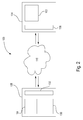
- Fig. 2 is a block diagram of another telecommunication system 100.
- the slave telecommunication node 104 is comprised in a mobile device 128.
- the mobile device 128 further comprises a third central processing unit 130 as well as a telecommunication interface 132.
- the master telecommunication node 102 is comprised in a database server 134.
- the database server 134 further comprises a second telecommunication interface 136.
- the mobile telecommunication device 128 and the database server 134 are connected via the telecommunication network 110.
- a database query may be received or created by the mobile telecommunication device 128. It may then be determined whether the database query can be executed on the slave telecommunication node 104 comprised in the mobile device 128. This determination may be conducted by the third central processing unit 130 of the mobile telecommunication device 128. In case the database query can be executed on the slave telecommunication node 104 the database query can be executed locally on the mobile device 128 without having to address a remote server via the network 110. Thus executing the database query locally may allow for savings of battery power of the mobile telecommunication device 128.
- the mobile device 128 may forward the database query via the first telecommunication interface 132 over network 110 to the database server 134.
- the database server 134 may then execute the database query on the master telecommunication node 102 and return the results of the database query via the second telecommunication interface 136 over the network 110 to the mobile device 128.
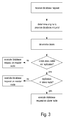
- Fig. 3 is a flow diagram of a telecommunication method for handling a database query.
- the database query is received at a telecommunication system 100 as described for example with reference to Fig. 1 .
- the engine 122 which is to process the database query determines the corresponding database views 124 which have to be addressed in order to execute the database query.
- these database views 124 may comprise information whether they can be executed on a replicate table.
- the engine 122 executes the database query on the master telecommunication node 102. If it is however determined that the database views 124 can be processed using replicate versions of data elements 116 it is subsequently determined whether the data elements 116 necessary for processing the database requests are in fact comprised in the main memory 120 of the slave telecommunication node 104. If it is determined that the necessary data elements 116 are not comprised in the main memory 120 of the slave telecommunication node 104 the database query is executed by the engine 122 using the master telecommunication node 102. Only if it is determined that all necessary data elements 116 for executing the database query are in fact comprised in the main memory 120 of the slave telecommunication node 104 the database query is executed on the slave telecommunication node 104.
- aspects of the present invention may be embodied as an apparatus, method or computer program product. Accordingly, aspects of the present invention may take the form of an entirely hardware embodiment, an entirely software embodiment (including firmware, resident software, micro-code, etc.) or an embodiment combining software and hardware aspects that may all generally be referred to herein as a "circuit,” “module” or “system.” Furthermore, aspects of the present invention may take the form of a computer program product embodied in one or more computer readable medium(s) having computer executable code embodied thereon.
- the computer readable medium may be a computer readable signal medium or a computer readable storage medium.
- a 'computer-readable storage medium' as used herein encompasses any tangible storage medium which may store instructions which are executable by a processor of a computing device.
- the computer-readable storage medium may be referred to as a computer-readable non-transitory storage medium.
- the computer-readable storage medium may also be referred to as a tangible computer readable medium.
- a computer-readable storage medium may also be able to store data which is able to be accessed by the processor of the computing device.
- Examples of computer-readable storage media include, but are not limited to: a floppy disk, a magnetic hard disk drive, a solid state hard disk, flash memory, a USB thumb drive, Random Access Memory (RAM), Read Only Memory (ROM), an optical disk, a magneto-optical disk, and the register file of the processor.
- Examples of optical disks include Compact Disks (CD) and Digital Versatile Disks (DVD), for example CD-ROM, CD-RW, CD-R, DVD-ROM, DVD-RW, or DVD-R disks.
- a 'telecommunication device' may be any of a device capable of processing and/or communication information via a telecommunications network, like mobile phones, smartphones, PDAs, tablet computers, laptops, computers, database systems, personal computers, smart watches, smart TVs and/or pagers.
- the term computer readable-storage medium also refers to various types of recording media capable of being accessed by the computer device via a network or communication link. For example a data may be retrieved over a modem, over the internet, or over a local area network.
- Computer executable code embodied on a computer readable medium may be transmitted using any appropriate medium, including but not limited to wireless, wireline, optical fiber cable, RF, etc., or any suitable combination of the foregoing.
- a computer readable signal medium may include a propagated data signal with computer executable code embodied therein, for example, in baseband or as part of a carrier wave. Such a propagated signal may take any of a variety of forms, including, but not limited to, electro-magnetic, optical, or any suitable combination thereof.
- a computer readable signal medium may be any computer readable medium that is not a computer readable storage medium and that can communicate, propagate, or transport a program for use by or in connection with an instruction execution system, apparatus, or device.
- 'Computer memory' or 'memory' is an example of a computer-readable storage medium.
- Computer memory is any memory which is directly accessible to a processor.
- 'Computer storage' or 'storage' is a further example of a computer-readable storage medium.
- Computer storage is any non-volatile computer-readable storage medium. In some embodiments computer storage may also be computer memory or vice versa.
- a 'database' as used herein encompasses a data file or repository which contains data that may be accessed by a processor.
- databases are, but are not limited to: a data file, a relational database, a file system folder containing data files, and a spreadsheet file.
- a 'processor' or 'processing unit' as used herein encompasses an electronic component which is able to execute a program or machine executable instruction or computer executable code.
- References to the computing device comprising "a processor" should be interpreted as possibly containing more than one processor or processing core.
- the processor may for instance be a multi-core processor.
- a processor may also refer to a collection of processors within a single computer system or distributed amongst multiple computer systems.
- the term device or computing device should also be interpreted to possibly refer to a portable or stationary computing device or collection or network of computing devices each comprising a processor or processors.
- the computer executable code may be executed by multiple processors that may be within the same computing device or which may even be distributed across multiple computing devices.
- Computer executable code may comprise machine executable instructions or a program which causes a processor to perform an aspect of the present invention.
- Computer executable code for carrying out operations for aspects of the present invention may be written in any combination of one or more programming languages, including an object oriented programming language such as Java, Smalltalk, C++ or the like and conventional procedural programming languages, such as the "C" programming language or similar programming languages and compiled into machine executable instructions.
- the computer executable code may be in the form of a high level language or in a pre-compiled form and be used in conjunction with an interpreter which generates the machine executable instructions on the fly.
- the computer executable code may execute entirely on the user's computer, partly on the user's computer, as a stand-alone software package, partly on the user's computer and partly on a remote computer or entirely on the remote computer or server.
- the remote computer may be connected to the user's computer through any type of network, including a local area network (LAN) or a wide area network (WAN), or the connection may be made to an external computer (for example, through the Internet using an Internet Service Provider).
- a 'telecommunications network' as used herein may be any of a cellular network like GSM, UMTS, LTE, WiMax, wide area networks (WAN), metropolitan area networks (MAN), local area networks (LAN), Internet area networks (IAN), campus area networks (CAN), or virtual private networks (VPN). Further the telecommunications network may be wireless and/or wire-based. A telecommunications network may also be the direct connection via cable or between two data processing entities or telecommunication devices.
- These computer program instructions may be provided to a processor of a general purpose computer, special purpose computer, or other programmable data processing apparatus to produce a machine, such that the instructions, which execute via the processor of the computer or other programmable data processing apparatus, create means for implementing the functions/acts specified in the flowchart and/or block diagram block or blocks.
- These computer program instructions may also be stored in a computer readable medium that can direct a computer, other programmable data processing apparatus, or other devices to function in a particular manner, such that the instructions stored in the computer readable medium produce an article of manufacture including instructions which implement the function/act specified in the flowchart and/or block diagram block or blocks.
- the computer program instructions may also be loaded onto a computer, other programmable data processing apparatus, or other devices to cause a series of operational steps to be performed on the computer, other programmable apparatus or other devices to produce a computer implemented process such that the instructions which execute on the computer or other programmable apparatus provide processes for implementing the functions/acts specified in the flowchart and/or block diagram block or blocks.
Landscapes
- Engineering & Computer Science (AREA)
- Theoretical Computer Science (AREA)
- Physics & Mathematics (AREA)
- Databases & Information Systems (AREA)
- General Engineering & Computer Science (AREA)
- General Physics & Mathematics (AREA)
- Data Mining & Analysis (AREA)
- Computational Linguistics (AREA)
- Signal Processing (AREA)
- Computer Networks & Wireless Communication (AREA)
- Library & Information Science (AREA)
- Fuzzy Systems (AREA)
- Mathematical Physics (AREA)
- Probability & Statistics with Applications (AREA)
- Software Systems (AREA)
- Computing Systems (AREA)
- Health & Medical Sciences (AREA)
- Artificial Intelligence (AREA)
- Audiology, Speech & Language Pathology (AREA)
- General Health & Medical Sciences (AREA)
- Information Retrieval, Db Structures And Fs Structures Therefor (AREA)
Abstract
- receiving the database query at the telecommunication system (100) via a telecommunication network (100), the database query requiring accessing a second set of the data elements (116),
- determining whether the database query may be executed using replicate versions of data elements (116),
- in case the database query may be executed using replicate versions of data elements (116), executing the database query on the slave node (104) in-memory using the second central data processing unit (118) and second main memory (120),
Description
- The invention relates to a telecommunication method for handling a database query in a telecommunication system.
- Currently, UMTS (universal mobile telecommunications systems) networks are worldwide being upgraded in order to provide data to user equipments (nodes or telecommunication devices) at high data rates. In order to ensure the competitiveness of UMTS for the next couple of years and beyond, concepts for UMTS long-term evolution (LTE) have been investigated. Objective is a high data rate, low latency and packet optimized radio access technology.
- A UMTS network constitutes the third generation (3G) of cellular wireless networks. Thereby, multimedia broadcast/multicast service (MBMS) is one of the evolving service concepts within the third generation networks. MBMS is a user service, which is a combination of both a broadcast service and a multicast service. Third generation partnership (3GPP) is working on establishing standards for multimedia/multicast services.
- However, in modern data processing applications for mobile telecommunication devices the amount of data processed for example per database query is thus ever increasing. This may lead to a massive processing load which in the worst case cannot be handled by the processing unit of a single mobile telecommunication device. An approach to overcome this deficiency of mobile telecommunication devices is to divide the workload between pluralities of telecommunication devices. In order to be able to redirect database queries to individual telecommunication devices it is necessary to provide basically the same data on the plurality of telecommunication devices. Thus the content of the database of one master mobile device has to be copied to the databases of a plurality of slave mobile devices in order to balance the workload between the plurality of mobile telecommunication devices.
- In course of the execution of a plurality of database queries in such a distributed telecommunication system, the contents of both the original (master) database and the replicate (slave) databases have to be synchronized as the contents for the databases may change over time. As this synchronization can almost never happen in real time, data inconsistencies between the master database and the slave database may occur. As a result not every database query may be redirected to the slave database node for processing. Further the synchronization of the data comprised in the plurality of mobile telecommunication devices may cause massive network traffic over wireless telecommunications networks and may further afflict the lifetime of the batteries comprised in the mobile telecommunication devices.
- It is an objective of the present invention to provide for an improved telecommunication method for handling a database query in a telecommunication system as well as a corresponding telecommunication system and computer program product as specified in the independent claims.
- Embodiments of the invention are given in the dependent claims.
- Embodiments of the present invention can be freely combined with each other if they are not mutually exclusive.
- In one aspect the invention relates to a telecommunication method for handling a database query in a telecommunication system. The telecommunication system comprises a master node and at least one slave node. The master node and the slave node may both be battery powered mobile telecommunication devices which are operable to communicate via a wireless telecommunications network. The master node comprises a first central processing unit and a first main memory wherein the first main memory comprises data elements. The slave node comprises a second central processing unit and a second main memory. The second main memory comprised in the slave node comprises a replicate version of a first set of the data elements comprised in the master node. The method for handling the database query then comprises the reception of the database query at the telecommunication system via a telecommunications network wherein the database query requires access to a second set of the data elements. Once the database query has been received it is then determined whether the database query may be executed using replicate versions of data elements. In case the database query may be executed using replicate versions of the data elements the database query is then executed on the slave node in-memory using the second central data processing unit and second main memory. In case the database query may not be executed using replicate versions of the data elements the execution of the database query is then performed on the master node in-memory using the first central data processing unit and the first main memory.
- As described here a replicate version of a data element is a copy of a data element which may soon be outdated as the data elements in the master node are continuously being accessed and especially altered. Thus the data elements comprised in the main memory of the slave node are copies of former versions of the data elements comprised in the master node. In the context of the present invention a data element has to be understood as a digital machine readable element comprising information which may for example be arranged in the form of a table or a plurality of tables.
- It has to be noted that herein a database query has to be understood as an abstract query for data comprised in a database which may also include an analysis of the comprised data. Thus the execution of a single database query for example by a processing engine may lead to a plurality of SELECT statements which subsequently have to be processed by the database.
- Embodiments may have the advantage that the processing load caused by executing a database query on the central processing unit of a node can be divided between the slave node and the master node. This dividing of processing load may for example be possible for database queries which require access to data elements whose up-to-dateness is not important for processing the database query. For example database queries referring to an analysis of the contents of the data elements may in some cases be executed on outdated data elements thereby giving the same result which would have been received if the database query was executed on the master node with the up to date data elements. A database query referring to an analysis of data may for example be directed towards determining the revenue of a company for a certain quarter in a certain region. As this data may have been collected a long time ago and will not or not likely be changed afterwards it is not necessary to execute the database query on the master node with the most actual data. It is however necessary for each database query to determine whether the database query may be executed using outdated data elements or whether the database query has to be executed on up to date data elements.
- In some embodiments the telecommunication system further comprises an application server wherein the application server comprises a plurality of engines for processing database queries. Each engine is adapted to process a predefined type of database query. For example there may be engines for processing analytic type database queries or other engines for processing search type database queries. The application server is further operatively coupled via the telecommunication network with the master node and the slave node. In this embodiment the method comprises determining a set of engines from the plurality of engines which are adapted to process database queries that may be executed using replicate versions of data elements. The determination whether the database query may be executed using replicate versions of data elements upon the reception of the database query at the telecommunication system is then conducted by determining a first engine from the plurality of engines which is adapted to process the database query. In case this first engine is comprised in the set of engines which has been determined before, the database query is then processed by this first engine by the execution of the database query on the slave node. In case the first engine is not comprised in the set of engines the database query is then processed by the first engine by the execution of the database query on the master node.
- Embodiments may have the advantage that the decision whether a database query may be executed on the slave node is simplified as the decision usually is based on determining the type of database access the database query requires. If for example a first engine comprised in the application server is adapted to only process analytic database queries it is possible to directly route all the database queries processed with this engine to the slave node.
- In some embodiments the first engine is further adapted to determine the second set of data elements which has to be accessed in order to execute the database query. Once the second set of data elements has been determined it is further determined whether the second set of data elements is comprised in the first set of data elements which is stored in the main memory of the slave node. In case the second set of data elements is comprised in the first set of data elements the first engine is adapted to process the database query by the execution of the database query on the slave node. However, in case the second set of data elements is not comprised in the first set of data elements the first engine is adapted to process the database query by the execution of the database query on the master node.
- Embodiments may have the advantage that prior to the execution of the database query it is determined whether all necessary data elements are in fact comprised in the slave node. It has to be noted that a database query requiring access to a plurality of data elements cannot be properly executed if some of the data elements are stored as replicate versions in the slave node and some are stored only as original versions in the master node. The overall data content of such a constellation may lead to erroneous results of the execution of the database query as the starting conditions are not the same for all individual database accesses conducted during execution of the database query.
- In some embodiments the method further comprises creating a log file upon said determination that the second set of data elements is not comprised in the first set of data elements. The log file then comprises information indicative of a third set of data elements wherein the third set of data elements comprises the data elements of the second set of data elements which are not comprised in the first set of data elements.
- Embodiments may have the advantage that a database administrator can easily see which data elements have to be provided as replicate versions in a slave node to fully use the potential of the database system by redirecting database queries to the slave node. If for example a database query in principle may be executed on the slave node using replicate versions of data elements, however cannot be executed on the slave node because not all necessary data elements are provided as replicate versions in the slave node, the database query cannot be executed on the slave node. However creating a log file allowing for a subsequent adaption of the contents of the slave node such that all subsequent database queries which may be executed on the slave node actually can be executed on the slave node as all necessary data elements are provided as replicate versions may enable a balancing of the processing load between master and slave node.
- In some embodiments the telecommunication system further comprises a database management entity wherein the database management entity is adapted to access the information comprised in the log file and create and store a replicate version of the third set of data elements in the main memory of the slave node.
- Embodiments may have the advantage that the previously described optimization of the database system by providing all necessary data elements in the slave node for execution of the database queries on the slave node can be conducted automatically. Thus it is not necessary to wait until a database administrator triggers the replication of the data elements instead the telecommunication system will update its slave node by itself.
- In some embodiments the execution of the database query employs a plurality of database views, wherein the database views comprise annotations. The annotation is indicative whether the database view can be executed using replicate versions of data elements. Determining whether the database query may be executed using replicate versions of data elements is then conducted by reading the annotations comprised in the views which are employed by the database query.
- In some embodiments the telecommunication system further comprises a mobile telecommunication device and a database server wherein the mobile telecommunication device and the database server are connected via the telecommunication network. The mobile telecommunication device comprises the slave node, a first telecommunication interface and a third central processing unit. The database server comprises the master node. In this embodiment the method comprises the reception of the database query via the first telecommunication interface at the mobile telecommunication device. The determination whether the database query may be executed using replicate versions of data elements is then conducted by the third central processing unit. In case the database query may be executed using replicate versions of the data elements the method comprises the execution of the database query on the slave node in-memory using the second central data processing unit and second main memory. In case the database query may not be executed using replicate versions of data elements the method further comprises the execution of the database query by forwarding the database query to the database server via the first telecommunication interface and in response to forwarding the database query to the database server, receiving a result of the database query from the database server via the first telecommunication interface.
- Embodiments may have the advantage that at least some of the database queries received at the mobile telecommunication device can be executed locally on the slave node comprised in the mobile telecommunication device. Thus it is not necessary to address the database server for processing the database query via the telecommunication network which may allow for saving battery power on the mobile telecommunication device.
- In some embodiments the master node further comprises access statistics for the data elements stored in the main memory of the master node wherein the access statistics comprise information for the data elements indicative of a rate of change for the data elements. The method then comprises determining the rate of change of a data element, determining whether the rate of change of the data element is below a predefined threshold and in case the rate of change of the data element is below the predefined threshold creating a replicate version of the data element and storing the replicate version of the data element in the main memory of the slave node.
- For example the predefined threshold may be chosen such that only such data elements are stored in the slave node, which are changed only at a very low rate thereby not having to be updated very often. As a result the update traffic between the master node and the slave node can be reduced by creating replicate versions only of those data elements which are changed only rarely.
- In another aspect the invention relates to a telecommunication system comprising a master node and at least one slave node. The master node comprises a first central processing unit and a first main memory the first main memory comprising data elements. The slave node comprises a second central processing unit and a second main memory. The second main memory comprises a replicate version of a first set of data elements comprised in the first main memory of the master node. The telecommunication system is adapted to
- receive the database query via a telecommunication network, the database query requiring accessing a second set of the data elements,
- determine whether the database query may be executed using replicate versions of the data elements,
- in case the database query may be executed using replicate versions of data elements, execute the database query on the slave node in-memory using the second central data processing unit and second main memory,
- in case the database query may not be executed using replicate versions of data elements execute the database query on the master node in-memory using the first central data processing unit and first main memory.
- In yet another aspect the invention relates to a computer program product which when executed on the telecommunication system, as described before, causes the telecommunication system to execute the method as described above.
- In the following embodiments of the invention are explained in greater detail by way of example only, making reference to the drawings in which:
- Fig. 1
- is a block diagram of a telecommunication system,
- Fig. 2
- is a block diagram of another telecommunication system, and
- Fig. 3
- is a flow diagram of the method for processing database queries.
- In the following similar elements are denoted by the same reference numerals.
-
Fig. 1 is a block diagram of atelecommunication system 100 like for example a mobile cellular network. Thetelecommunication system 100 comprises a master mobile telecommunication device, henceforth called "master telecommunication node" 102, a slave mobile telecommunication device, henceforth called "slave telecommunication node" 104 as well as anapplication server 106 and amanagement entity 108. Themaster node 102, theslave telecommunication node 104, theapplication server 106 and thedatabase management entity 108 are coupled via atelecommunication network 110. In the present example themaster telecommunication node 102 and theslave telecommunication node 104 are both battery powered mobile telecommunication devices like smartphone, PDAs, tablet computers, or other electronic devices capable of processing data and communicating data via a telecommunication network. However other telecommunication devices are also possible. - The master telecommunication node comprises a first
central processing unit 112 and a firstmain memory 114 comprisingdata elements 116. Thedata elements 116 are denoted with A, B, C, D, E and F. Theslave telecommunication node 104 is similar to themaster telecommunication node 102. As such theslave telecommunication node 104 comprises a secondcentral processing unit 118 and a secondmain memory 120. Thesecond memory 120 comprisesdata elements 116 as well wherein thedata elements 116 comprised in the secondmain memory 120 are replicate versions of thedata elements 116 comprised in themain memory 114 of themaster telecommunication node 102. The fact that thedata elements 116 comprised in themain memory 120 of theslave telecommunication node 104 is indicated by the letters A', B', C' and D'. Note that the data elements E and F comprised in themain memory 114 of themaster telecommunication node 102 are not comprised in themain memory 120 of theslave telecommunication node 104. - The databases comprised within the
master telecommunication node 102 and theslave telecommunication node 104 may both employ in-memory database techniques. - The
application server 106 comprises a plurality ofengines 122 which are adapted to process predefined types of database queries. Further theapplication server 106 comprises a plurality of database views 124 and alog file 126. Introducing anapplication server 106 comprising a plurality ofengines 122 for processing database queries may have the advantage that themobile telecommunication devices telecommunication system 100 do not have to provide data processing applications themselves. For example the database query received at thetelecommunication system 100 may have to be translated or divided into a plurality of individual database accesses prior to the retrieval and/or processing of the data demanded by the database query. This may cause massive processing load on the mobile telecommunication device receiving and processing the database request. In contrast thereto theapplication server 106 may for example be a stationary computer system, which is operable to translate the database query into smaller and easier to process subqueries or even SELECT statements which are directly executable on the databases comprised in the mobile telecommunication devices. Thus the demands on the central processing units of the mobile telecommunication devices of thetelecommunication system 100 as well as the energy consumption and thus battery lifetime for the mobile telecommunication devices may be reduced. - As described before the
master telecommunication node 102, theslave telecommunication node 104, theapplication server 106 and thedatabase management entity 108 are connected via atelecommunication network 110. Thetelecommunication network 110 may for example be a digital cellular telecommunication network. - In the following it will be described how the
telecommunication system 100 depicted inFig. 1 handles an incoming database query. For example the database query may be received at thetelecommunication system 100 for example at themaster telecommunication node 102. The database query may then be forwarded to theapplication server 106 via thetelecommunications network 110 and may then be evaluated by theapplication server 106. A database query may for example be a transaction-based (OLTP) or an analytics-based (OLAP) process, wherein for example one of theengines 122 is operable to process only OLAP processes. Usually one of theengines 122 would execute the database query for example by calling one or more of the database views 122 which are comprised in theapplication server 106 when formulating a SELECT statement for processing by the central processing unit of themaster telecommunication node 102 or theslave telecommunication node 104. The database views 124 can basically be understood as a predefined database query comprising a number of database commands like SELECT statements. The database views 124 which are called by theengine 122 processing the database query are then translated into SQL statements and processed by the central processing unit of for example themaster telecommunication node 102. - As the depicted in
Fig. 1 themaster telecommunication node 102 and theslave telecommunication node 104 are mobile telecommunication devices within atelecommunication system 100. Usually the processing units of mobile telecommunication devices cannot provide a performance comparable to the performance of a stationary computing device. As a result the capabilities of the firstcentral processing unit 112 comprised in themaster telecommunication node 102 may cause a bottleneck when processing database queries only on a single mobile telecommunication device, in this case themaster telecommunication node 102 The performance of thetelecommunication system 100 as a whole might however be increased by copying at least a subset of thedata elements 116 stored in the firstmain memory 114 of themaster telecommunication node 102 to themain memory 120 of aslave telecommunication node 104. It may then be possible to execute at least some database queries on the slave telecommunication node thereby achieving a load balancing between themaster telecommunication node 102 and theslave telecommunication node 104. However, some database queries do not only retrieve data from thedata elements 116 comprised in themain memory 114 of themaster telecommunication node 102 but also change the data comprised. In order to achieve the same results of a database query for both themaster telecommunication node 102 and theslave telecommunication node 104 it is necessary to synchronize thedata elements 116 comprised in the main memories of both themaster telecommunication node 102 and theslave telecommunication node 104. - However, this synchronization can usually not be accomplished in real time. Further a high frequency of synchronization processes will cause a massive data traffic in the telecommunications network and will consume large amounts of energy which may lead to reduced lifetimes of the batteries comprised in the
mobile telecommunication devices telecommunications system 100. As a result thedata elements 116 comprised in themain memory 120 of theslave telecommunication node 104 will mostly be outdated versions of thedata elements 116 comprised in themaster telecommunication node 102. As not all database queries may be executed onoutdated data elements 116 it has to be determined whether the database query received at the telecommunication system may be executed on theslave telecommunication node 104 or has to be executed on themaster telecommunication node 102. For example it may be necessary to execute a database query on themaster telecommunication node 102 because a database query is time critical or because business decisions have to be made based on the result of the database query. - As described before the database queries may be of an OLAP or OLTP type. Usually analysis processes work on highly aggregated transactional data and thus it is not of utmost importance that all records contributing to the analysis are covered. Further it is usually not necessary that all data processed by the analysis is up to date. For example the data processed during an analysis may contain a plurality of numerical values as transactional data which are linked for example with a certain process with a defined name as master data. A change of the master data, the name of the process, will not influence the general result of an analysis of the data. Thus this change in the data may be neglected and replicate versions of the data comprising an older version of the master data may be used for the analysis. Further an analysis process may refer to data collected a long time ago. As this data will most likely not be changed any more the execution of the analysis using a replicate version of this data will most likely yield the same result as an analysis executed on the most actual version of the data.
- Thus analysis processes are a candidate for working on an asynchronous replicate of the
data elements 116. Usually each of theengines 122 is only designed to process a certain type of database query. As such there may for example be an analytic engine which is only operable to process OLAP type database queries. As these database queries may be executed on replicate tables it may be possible to design theanalytic engine 122 such that all database queries processed by thisengine 122 are directly executed on theslave telecommunication node 104 or are routed to theslave telecommunication node 104 by the firstcentral processing unit 112 of themaster telecommunication node 102. - One way to forward database queries executed by the
analytic engine 122 to theslave telecommunication node 104 may be to design theanalytic engine 122 such that the SELECT statements created by theanalytic engine 122 comprise a hint that the SELECT statement can be executed on theslave telecommunication node 104 using asynchronous replicates of thedata elements 116. Once such a SELECT statement comprising a hint is received by the firstcentral processing unit 112 of themaster telecommunication node 102, thecentral processing unit 112 may redirect the received SELECT statement to theslave telecommunication node 104 for processing by the secondcentral processing unit 118. However the firstcentral processing unit 112 is not constrained to forward every SELECT statement comprising a hint for processing with replicates to theslave telecommunication node 104. Rather the firstcentral processing unit 112 may decide whether or not to forward the SELECT statement to theslave telecommunication node 104 for example based on the current workload of themaster telecommunication node 102. - Another possibility to re-route the database queries processed by an
engine 122 to theslave telecommunication node 104 without having to design theengine 122 to automatically include hints in SELECT statements may lie in the database views 124. For example the database views 124 may comprise annotations indicative of what acertain view 124 is intended to do or more precisely in which scenario type (analytics, search, transactional...) a view is used. As a result theengines 122 for processing database queries may be designed to initially read the annotations of theviews 124 they intend to use to execute the database query. Based on the contents of these annotations theengines 122 may then decide whether the database query can be re-routed to the slave telecommunication node thereby relieving the firstcentral processing unit 112 of themaster telecommunication node 102 or whether the database query has to be executed on themaster telecommunication node 102. Thus theengine 122 processing the database query may decide to include a hint in the SELECT statement created for processing the database query as described above based on the annotation of theviews 124 which are used in the corresponding SELECT statement. - In both approaches for rerouting database queries to the
slave telecommunication node 104 described above the firstcentral processing unit 112 of themaster telecommunication node 102 has to decide whether an incoming database query or SELECT statement can be rerouted to theslave telecommunication node 104 for processing. It may however also be possible to design theengines 122 such that they directly forward a SELECT statement for processing a database query either to themaster telecommunication node 102 or to theslave telecommunication node 104. In analogy to the first approach concerning processing database queries by ananalytic engine 122 it may also be possible to design theanalytic engine 122 such that the SELECT statements for all database queries processed by theanalytic engine 122 are directly forwarded to the slave telecommunication node without including a hint. - It may further be possible to design the
engines 122 such that when usingdatabase views 124 for processing a database query, theengines 122 first read the annotations of the database views 124 and based on these annotations decide whether to directly forward the SELECT corresponding statement to theslave telecommunication node 104 or to themaster telecommunication node 102. - The rerouting or forwarding of database queries either to the
master telecommunication node 102 or theslave telecommunication node 104 for processing as described above may have the advantage that the rate of synchronization for the contents of the firstmain memory 114 and the secondmain memory 120 can be kept at a low level while a load balancing between the plurality of mobile devices can still be accomplished. Thus the traffic within thetelecommunication network 110 as well as the power consumption of the individual nodes can be kept very low while the performance of theoverall telecommunication system 100 remains at a high level. This is important especially for battery powered mobile devices like smartphones, tablet computers or PDAs. - As described before the second
main memory 120 of theslave telecommunication node 104 may comprise only a subset of thedata elements 116 comprised in themain memory 114 of themaster telecommunication node 102. As a result the situation might occur that a database query is determined to be executable on theslave telecommunication node 104, however, the database query cannot be executed on theslave telecommunication node 104 because thenecessary data elements 116 are not comprised in themain memory 120 of theslave telecommunication node 104. Thus it may be necessary to design theengines 122 such that prior to routing a database query to one of the nodes theengine 122 first determines whether thenecessary data elements 116 are in fact comprised in the main memory of the corresponding node. This checking whether the correspondingdata elements 116 are provided in the main memory which shall be addressed may also be implemented in the database views 124. - As a database query may only be executed fully on replicate data elements or on original data elements the
engines 122 may further be designed such that if they determine that a database query could have been executed on the slave telecommunication node, however cannot because the correspondingdata elements 116 are missing in themain memory 120 of theslave telecommunication node 104, theengines 122 create or access alog file 126 and create an entry in thelog file 126 indicating that some of thedata elements 116 of themaster telecommunication node 102 have to be replicated and stored in themain memory 120 of theslave telecommunication node 104. Thislog file 126 may then be accessed on a regular basis for example by a database administrator or in an automated fashion by adatabase management entity 108. Upon determining that a number ofdata elements 116 have to be replicated and stored in themain memory 120 of theslave telecommunication node 104 thedatabase management entity 108 may trigger the replication of the correspondingdata elements 116. As a result a subsequent database query may then be executed on theslave telecommunication node 104 as thenecessary data elements 116 will already be present in themain memory 120. -
Fig. 2 is a block diagram of anothertelecommunication system 100. In thetelecommunication system 100 depicted inFig. 2 theslave telecommunication node 104 is comprised in amobile device 128. Themobile device 128 further comprises a thirdcentral processing unit 130 as well as atelecommunication interface 132. Themaster telecommunication node 102 is comprised in adatabase server 134. Thedatabase server 134 further comprises asecond telecommunication interface 136. Themobile telecommunication device 128 and thedatabase server 134 are connected via thetelecommunication network 110. - A database query may be received or created by the
mobile telecommunication device 128. It may then be determined whether the database query can be executed on theslave telecommunication node 104 comprised in themobile device 128. This determination may be conducted by the thirdcentral processing unit 130 of themobile telecommunication device 128. In case the database query can be executed on theslave telecommunication node 104 the database query can be executed locally on themobile device 128 without having to address a remote server via thenetwork 110. Thus executing the database query locally may allow for savings of battery power of themobile telecommunication device 128. - However, if it is determined that the database query cannot be executed on the
slave telecommunication node 104 themobile device 128 may forward the database query via thefirst telecommunication interface 132 overnetwork 110 to thedatabase server 134. Thedatabase server 134 may then execute the database query on themaster telecommunication node 102 and return the results of the database query via thesecond telecommunication interface 136 over thenetwork 110 to themobile device 128. -
Fig. 3 is a flow diagram of a telecommunication method for handling a database query. In a first method step the database query is received at atelecommunication system 100 as described for example with reference toFig. 1 . In a second step it is then determined whichengine 122 comprised in theapplication server 106 of thetelecommunication system 100 is operable to process the received database query. Theengine 122 which is to process the database query then determines the corresponding database views 124 which have to be addressed in order to execute the database query. As described before these database views 124 may comprise information whether they can be executed on a replicate table. Thus in a subsequent step it has to be decided whether thedatabase view 124 can use replicate versions ofdata elements 116. If it is determined that thedatabase view 124 cannot be executed using replicate versions ofdata elements 116 theengine 122 executes the database query on themaster telecommunication node 102. If it is however determined that the database views 124 can be processed using replicate versions ofdata elements 116 it is subsequently determined whether thedata elements 116 necessary for processing the database requests are in fact comprised in themain memory 120 of theslave telecommunication node 104. If it is determined that thenecessary data elements 116 are not comprised in themain memory 120 of theslave telecommunication node 104 the database query is executed by theengine 122 using themaster telecommunication node 102. Only if it is determined that allnecessary data elements 116 for executing the database query are in fact comprised in themain memory 120 of theslave telecommunication node 104 the database query is executed on theslave telecommunication node 104. - As will be appreciated by one skilled in the art, aspects of the present invention may be embodied as an apparatus, method or computer program product. Accordingly, aspects of the present invention may take the form of an entirely hardware embodiment, an entirely software embodiment (including firmware, resident software, micro-code, etc.) or an embodiment combining software and hardware aspects that may all generally be referred to herein as a "circuit," "module" or "system." Furthermore, aspects of the present invention may take the form of a computer program product embodied in one or more computer readable medium(s) having computer executable code embodied thereon.
- Any combination of one or more computer readable medium(s) may be utilized. The computer readable medium may be a computer readable signal medium or a computer readable storage medium. A 'computer-readable storage medium' as used herein encompasses any tangible storage medium which may store instructions which are executable by a processor of a computing device. The computer-readable storage medium may be referred to as a computer-readable non-transitory storage medium. The computer-readable storage medium may also be referred to as a tangible computer readable medium. In some embodiments, a computer-readable storage medium may also be able to store data which is able to be accessed by the processor of the computing device. Examples of computer-readable storage media include, but are not limited to: a floppy disk, a magnetic hard disk drive, a solid state hard disk, flash memory, a USB thumb drive, Random Access Memory (RAM), Read Only Memory (ROM), an optical disk, a magneto-optical disk, and the register file of the processor. Examples of optical disks include Compact Disks (CD) and Digital Versatile Disks (DVD), for example CD-ROM, CD-RW, CD-R, DVD-ROM, DVD-RW, or DVD-R disks. A 'telecommunication device' may be any of a device capable of processing and/or communication information via a telecommunications network, like mobile phones, smartphones, PDAs, tablet computers, laptops, computers, database systems, personal computers, smart watches, smart TVs and/or pagers. The term computer readable-storage medium also refers to various types of recording media capable of being accessed by the computer device via a network or communication link. For example a data may be retrieved over a modem, over the internet, or over a local area network. Computer executable code embodied on a computer readable medium may be transmitted using any appropriate medium, including but not limited to wireless, wireline, optical fiber cable, RF, etc., or any suitable combination of the foregoing.
- A computer readable signal medium may include a propagated data signal with computer executable code embodied therein, for example, in baseband or as part of a carrier wave. Such a propagated signal may take any of a variety of forms, including, but not limited to, electro-magnetic, optical, or any suitable combination thereof. A computer readable signal medium may be any computer readable medium that is not a computer readable storage medium and that can communicate, propagate, or transport a program for use by or in connection with an instruction execution system, apparatus, or device.
- 'Computer memory' or 'memory' is an example of a computer-readable storage medium. Computer memory is any memory which is directly accessible to a processor. 'Computer storage' or 'storage' is a further example of a computer-readable storage medium. Computer storage is any non-volatile computer-readable storage medium. In some embodiments computer storage may also be computer memory or vice versa.
- A 'database' as used herein encompasses a data file or repository which contains data that may be accessed by a processor. Examples of databases are, but are not limited to: a data file, a relational database, a file system folder containing data files, and a spreadsheet file.
- A 'processor' or 'processing unit' as used herein encompasses an electronic component which is able to execute a program or machine executable instruction or computer executable code. References to the computing device comprising "a processor" should be interpreted as possibly containing more than one processor or processing core. The processor may for instance be a multi-core processor. A processor may also refer to a collection of processors within a single computer system or distributed amongst multiple computer systems. The term device or computing device should also be interpreted to possibly refer to a portable or stationary computing device or collection or network of computing devices each comprising a processor or processors. The computer executable code may be executed by multiple processors that may be within the same computing device or which may even be distributed across multiple computing devices.
- Computer executable code may comprise machine executable instructions or a program which causes a processor to perform an aspect of the present invention. Computer executable code for carrying out operations for aspects of the present invention may be written in any combination of one or more programming languages, including an object oriented programming language such as Java, Smalltalk, C++ or the like and conventional procedural programming languages, such as the "C" programming language or similar programming languages and compiled into machine executable instructions. In some instances the computer executable code may be in the form of a high level language or in a pre-compiled form and be used in conjunction with an interpreter which generates the machine executable instructions on the fly.
- The computer executable code may execute entirely on the user's computer, partly on the user's computer, as a stand-alone software package, partly on the user's computer and partly on a remote computer or entirely on the remote computer or server. In the latter scenario, the remote computer may be connected to the user's computer through any type of network, including a local area network (LAN) or a wide area network (WAN), or the connection may be made to an external computer (for example, through the Internet using an Internet Service Provider). A 'telecommunications network' as used herein may be any of a cellular network like GSM, UMTS, LTE, WiMax, wide area networks (WAN), metropolitan area networks (MAN), local area networks (LAN), Internet area networks (IAN), campus area networks (CAN), or virtual private networks (VPN). Further the telecommunications network may be wireless and/or wire-based. A telecommunications network may also be the direct connection via cable or between two data processing entities or telecommunication devices.
- Aspects of the present invention are described with reference to flowchart illustrations and/or block diagrams of methods, apparatus (systems) and computer program products according to embodiments of the invention. It will be understood that each block or a portion of the blocks of the flowchart, illustrations, and/or block diagrams, can be implemented by computer program instructions in form of computer executable code when applicable. It is further under stood that, when not mutually exclusive, combinations of blocks in different flowcharts, illustrations, and/or block diagrams may be combined. These computer program instructions may be provided to a processor of a general purpose computer, special purpose computer, or other programmable data processing apparatus to produce a machine, such that the instructions, which execute via the processor of the computer or other programmable data processing apparatus, create means for implementing the functions/acts specified in the flowchart and/or block diagram block or blocks.
- These computer program instructions may also be stored in a computer readable medium that can direct a computer, other programmable data processing apparatus, or other devices to function in a particular manner, such that the instructions stored in the computer readable medium produce an article of manufacture including instructions which implement the function/act specified in the flowchart and/or block diagram block or blocks.
- The computer program instructions may also be loaded onto a computer, other programmable data processing apparatus, or other devices to cause a series of operational steps to be performed on the computer, other programmable apparatus or other devices to produce a computer implemented process such that the instructions which execute on the computer or other programmable apparatus provide processes for implementing the functions/acts specified in the flowchart and/or block diagram block or blocks.
-
- 100
- Telecommunication System
- 102
- Master Node
- 104
- Slave Node
- 106
- Application Server
- 108
- Database Management Entity
- 110
- Telecommunications Network
- 112
- First Central Processing Unit
- 114
- First Main Memory
- 116
- Data Element
- 118
- Second Central Processing Unit
- 120
- Second Main Memory
- 122
- Engine
- 124
- Database View
- 126
- Log File
- 128
- Mobile Telecommunication Device
- 130
- Third Central Processing Unit
- 132
- First Telecommunication Interface
- 134
- Database Server
- 136
- Second Telecommunication Interface
Claims (10)
- Telecommunication method for handling a database query in a telecommunication system (100), the telecommunication system (100) comprising a master node (102) and at least one slave node (104), wherein the master node (102) comprises a first central processing unit (112) and a first main memory (114), the first main memory (114) comprising data elements (116), wherein the slave node (104) comprises a second central processing unit (118) and a second main memory (120), the second main memory (120) comprising a replicate version of a first set of the data elements (116), the method comprising:- receiving the database query at the telecommunication system (100) via a telecommunication network (100), the database query requiring accessing a second set of the data elements (116),- determining whether the database query may be executed using replicate versions of data elements (116),- in case the database query may be executed using replicate versions of data elements (116), executing the database query on the slave node (104) in-memory using the second central data processing unit (118) and second main memory (120),- in case the database query may not be executed using replicate versions of data elements (116), executing the database query on the master node (102) in-memory using the first central data processing unit (112) and first main memory (114).
- The telecommunication method of claim 1, wherein the telecommunication system (100) further comprises an application server (106), wherein the application server (106) comprises a plurality of engines (122) for processing database queries, wherein each engine (122) is adapted to process a predefined type of database query, wherein the application server (106) is operatively coupled via the telecommunication network (110) with the master node (102) and the at least one slave node (104), the method comprising:- determining a set of engines (122) from the plurality of engines (122), which are adapted to process database queries that may be executed using replicate versions of data elements (116),- the determination whether the database query may be executed using replicate versions of data elements (116) upon receiving the database query at the telecommunication system (100), by determining a first engine (122) from the plurality of engines (122), which is adapted to process the database query,- in case the first engine (122) is comprised in the set of engines (122), processing the database query by the first engine (122) by the execution of the database query on the slave node (104),- in case the first engine (122) is not comprised in the set of engines (122), processing the database query by the first engine (122) by the execution of the database query on the master node (102).
- The telecommunication method of claim 2, wherein the first engine (122) is adapted to:- determine the second set of data elements (116) which has to be accessed in order to execute the database query,- determine whether the second set of data elements (116) is comprised in the first set of data elements (116),- in case the second set of data elements (116) is comprised in the first set of data elements (116), process the database query by the execution of the database query on the slave node (104),- in case the second set of data elements (116) is not comprised in the first set of data elements (116), process the database query by the execution of the database query on the master node (102).
- The telecommunication method of claim 3, further comprising creating a log file (126) upon said determination that the second set of data elements (116) is not comprised in the first set of data elements (116), the log file (126) comprising information indicative of a third set of data elements (116), the third set of data elements (116) comprising the data elements (116) of the second set of data elements (116) which are not comprised in the first set of data elements (116).
- The telecommunication method of claim 4, wherein the telecommunication system (100) further comprises a database management entity (108), wherein the database management entity (108) is adapted to:- access the information comprised in the log file (126),- create and store a replicate version of the third set of data elements (116) in the main memory (120) of the slave node (104).
- The telecommunication method of any of the preceding claims, wherein the execution of the database query employs a plurality of database views (124), wherein the database views (124) comprise an annotation, wherein the annotation is indicative whether the database view (124) can be executed using replicate versions of data elements (116), wherein determining whether the database query may be executed using replicate versions of data elements (116) is conducted by reading the annotations comprised in the database views (124) employed by the database query.
- The telecommunication method of any of the preceding claims, wherein the telecommunication system (100) further comprises a mobile telecommunication device (128) and a database server (134), wherein the mobile telecommunication device (128) and the database server (134) are connected via the telecommunication network (110), wherein the mobile telecommunication device (128) comprises the slave node (104), a first telecommunication interface (132) and a third central processing unit (130), wherein the database server (134) comprises the master node (102), the method comprising:- receiving via the first telecommunication interface (132) the database query at the mobile telecommunication device (128),- the determination whether the database query may be executed using replicate versions of data elements (116) by the third central processing unit (130),- in case the database query may be executed using replicate versions of data elements (116), the execution of the database query on the slave node (104) in-memory using the second central data processing unit (118) and second main memory (120),- in case the database query may not be executed using replicate versions of data elements (116), the execution of the database query by• forwarding the database query to the database server (134) via the first telecommunication interface (132),• in response to forwarding the database query to the database server (134) receiving a result of the database query from the database server (134) via the first telecommunication interface (132).
- The method of any of the preceding claims, wherein the master node (102) further comprises access statistics for the data elements (116) stored in the main memory (114) of the master node (102), the access statistics comprising information for the data elements (116) indicative of a rate of change for the data elements (116), wherein the method further comprises:- determining the rate of change of a data element (116),- determining whether the rate of change of the data element (116) is below a predefined threshold,- in case the rate of change of the data element (116) is below the predefined threshold, creating a replicate version of the data element (116) and storing the replicate version of the data element (116) in the main memory (120) of the slave node (104).
- A telecommunication system (100) comprising a master node (102) and at least one slave node (104), wherein the master node (102) comprises a first central processing unit (112) and a first main memory (114), the first main memory (114) comprising data elements (116), wherein the slave node (104) comprises a second central processing unit (118) and a second main memory (120), the second main memory (120) comprising a replicate version of a first set of the data elements (116), the telecommunication system (100) being adapted to:- receive the database query via a telecommunication network (110), the database query requiring accessing a second set of the data elements (116),- determine whether the database query may be executed using replicate versions of data elements (116),- in case the database query may be executed using replicate versions of data elements (116), execute the database query on the slave node (104) in-memory using the second central data processing (118) unit and second main memory (120),- in case the database query may not be executed using replicate versions of data elements (116), execute the database query on the master node (102) in-memory using the first central data processing unit (112) and first main memory (114).
- A computer program product comprising machine executable instructions for performing the method of any of the claims 1-8.
Priority Applications (2)
| Application Number | Priority Date | Filing Date | Title |
|---|---|---|---|
| EP15161981.4A EP3076308B1 (en) | 2015-03-31 | 2015-03-31 | Telecommunication method for handling a database query in a telecommunication system |
| US14/935,542 US20160294975A1 (en) | 2015-03-31 | 2015-11-09 | Telecommunication method for handling a database query in a telecommunication system and telecommunication system |
Applications Claiming Priority (1)
| Application Number | Priority Date | Filing Date | Title |
|---|---|---|---|
| EP15161981.4A EP3076308B1 (en) | 2015-03-31 | 2015-03-31 | Telecommunication method for handling a database query in a telecommunication system |
Publications (2)
| Publication Number | Publication Date |
|---|---|
| EP3076308A1 true EP3076308A1 (en) | 2016-10-05 |
| EP3076308B1 EP3076308B1 (en) | 2017-11-29 |
Family
ID=53039193
Family Applications (1)
| Application Number | Title | Priority Date | Filing Date |
|---|---|---|---|
| EP15161981.4A Active EP3076308B1 (en) | 2015-03-31 | 2015-03-31 | Telecommunication method for handling a database query in a telecommunication system |
Country Status (2)
| Country | Link |
|---|---|
| US (1) | US20160294975A1 (en) |
| EP (1) | EP3076308B1 (en) |
Cited By (1)
| Publication number | Priority date | Publication date | Assignee | Title |
|---|---|---|---|---|
| US20240211488A1 (en) * | 2022-12-22 | 2024-06-27 | Beijing Oceanbase Technology Co., Ltd. | Transaction commitment systems, methods, and apparatuses based on distributed database systems |
Families Citing this family (4)
| Publication number | Priority date | Publication date | Assignee | Title |
|---|---|---|---|---|
| CN110019274B (en) * | 2017-12-29 | 2023-09-26 | 阿里巴巴集团控股有限公司 | Database system and method and device for querying database |
| US11288285B2 (en) | 2019-11-13 | 2022-03-29 | Google Llc | System and method for switching from consistent database to an eventual consistent database replica in real time while preventing reads of past versions of the data |
| CN112181994B (en) * | 2020-11-04 | 2021-06-29 | 北京海联捷讯科技股份有限公司 | Method, device and medium for refreshing distributed memory database of operation and maintenance big data |
| US11593367B1 (en) * | 2021-09-29 | 2023-02-28 | Amazon Technologies, Inc. | Selecting between hydration-based scanning and stateless scale-out scanning to improve query performance |
Citations (1)
| Publication number | Priority date | Publication date | Assignee | Title |
|---|---|---|---|---|
| US20100257137A1 (en) * | 2007-07-23 | 2010-10-07 | Berta Isabel Escribano Bullon | Database system with multiple layer distribution |
Family Cites Families (3)
| Publication number | Priority date | Publication date | Assignee | Title |
|---|---|---|---|---|
| US7945581B2 (en) * | 2002-11-14 | 2011-05-17 | Lexisnexis Risk Data Management, Inc. | Global-results processing matrix for processing queries |
| US9053167B1 (en) * | 2013-06-19 | 2015-06-09 | Amazon Technologies, Inc. | Storage device selection for database partition replicas |
| US9934258B2 (en) * | 2014-03-31 | 2018-04-03 | Oracle International Corporation | Dynamic generation of database views and class objects for providing access to repository data |
-
2015
- 2015-03-31 EP EP15161981.4A patent/EP3076308B1/en active Active
- 2015-11-09 US US14/935,542 patent/US20160294975A1/en not_active Abandoned
Patent Citations (1)
| Publication number | Priority date | Publication date | Assignee | Title |
|---|---|---|---|---|
| US20100257137A1 (en) * | 2007-07-23 | 2010-10-07 | Berta Isabel Escribano Bullon | Database system with multiple layer distribution |
Non-Patent Citations (1)
| Title |
|---|
| CYPHERFOX: "In-memory database", 4 February 2015 (2015-02-04), XP055196273, Retrieved from the Internet <URL:https://en.wikipedia.org/w/index.php?title=In-memory_database&oldid=645610664> [retrieved on 20150616] * |
Cited By (1)
| Publication number | Priority date | Publication date | Assignee | Title |
|---|---|---|---|---|
| US20240211488A1 (en) * | 2022-12-22 | 2024-06-27 | Beijing Oceanbase Technology Co., Ltd. | Transaction commitment systems, methods, and apparatuses based on distributed database systems |
Also Published As
| Publication number | Publication date |
|---|---|
| EP3076308B1 (en) | 2017-11-29 |
| US20160294975A1 (en) | 2016-10-06 |
Similar Documents
| Publication | Publication Date | Title |
|---|---|---|
| US20220405284A1 (en) | Geo-scale analytics with bandwidth and regulatory constraints | |
| US12105632B2 (en) | Cache aware searching based on files of buckets | |
| US10152480B2 (en) | Archiving indexed data | |
| US9984129B2 (en) | Managing data searches using generation identifiers | |
| US12475082B2 (en) | System and method for synchronizing delete operations between primary and secondary databases | |
| EP3076308B1 (en) | Telecommunication method for handling a database query in a telecommunication system | |
| US11188552B2 (en) | Executing conditions with negation operators in analytical databases | |
| CN111475483A (en) | Database migration method and device and computing equipment | |
| CN109669925B (en) | Management method and device of unstructured data | |
| WO2018036549A1 (en) | Distributed database query method and device, and management system | |
| CN114064729B (en) | A data retrieval method, device, equipment and storage medium | |
| US20240061712A1 (en) | Method, apparatus, and system for creating training task on ai training platform, and medium | |
| US10169411B2 (en) | Forecasting query access plan obsolescence | |
| US11698911B2 (en) | System and methods for performing updated query requests in a system of multiple database engine | |
| US10824612B2 (en) | Key ticketing system with lock-free concurrency and versioning | |
| US9229969B2 (en) | Management of searches in a database system | |
| US11055266B2 (en) | Efficient key data store entry traversal and result generation | |
| CN119576943B (en) | Data index construction system, method, storage medium and electronic equipment | |
| US11929901B2 (en) | Infrastructure-agnostic performance of computation sequences | |
| US20180060388A1 (en) | Pre-applying a reduced version of a search query to limit the search scope | |
| US11797486B2 (en) | File de-duplication for a distributed database | |
| US20260099473A1 (en) | Efficient implementation of bitsets for dml statements | |
| EP4091066B1 (en) | Systems and methods for performing updated query requests in a system of multiple database engine | |
| KR102326121B1 (en) | Method and apparatus for text contents indexing | |
| US10552418B2 (en) | Optimization of first set of ordered items and delayed non-duplicated work queue |
Legal Events
| Date | Code | Title | Description |
|---|---|---|---|
| PUAI | Public reference made under article 153(3) epc to a published international application that has entered the european phase |
Free format text: ORIGINAL CODE: 0009012 |
|
| 17P | Request for examination filed |
Effective date: 20150922 |
|
| AK | Designated contracting states |
Kind code of ref document: A1 Designated state(s): AL AT BE BG CH CY CZ DE DK EE ES FI FR GB GR HR HU IE IS IT LI LT LU LV MC MK MT NL NO PL PT RO RS SE SI SK SM TR |
|
| AX | Request for extension of the european patent |
Extension state: BA ME |
|
| GRAP | Despatch of communication of intention to grant a patent |
Free format text: ORIGINAL CODE: EPIDOSNIGR1 |
|
| INTG | Intention to grant announced |
Effective date: 20170807 |
|
| GRAS | Grant fee paid |
Free format text: ORIGINAL CODE: EPIDOSNIGR3 |
|
| GRAA | (expected) grant |
Free format text: ORIGINAL CODE: 0009210 |
|
| AK | Designated contracting states |
Kind code of ref document: B1 Designated state(s): AL AT BE BG CH CY CZ DE DK EE ES FI FR GB GR HR HU IE IS IT LI LT LU LV MC MK MT NL NO PL PT RO RS SE SI SK SM TR |
|
| REG | Reference to a national code |
Ref country code: CH Ref legal event code: EP |
|
| REG | Reference to a national code |
Ref country code: AT Ref legal event code: REF Ref document number: 951014 Country of ref document: AT Kind code of ref document: T Effective date: 20171215 |
|
| REG | Reference to a national code |
Ref country code: IE Ref legal event code: FG4D |
|
| REG | Reference to a national code |
Ref country code: DE Ref legal event code: R096 Ref document number: 602015006259 Country of ref document: DE |
|
| REG | Reference to a national code |
Ref country code: FR Ref legal event code: PLFP Year of fee payment: 4 |
|
| REG | Reference to a national code |
Ref country code: NL Ref legal event code: MP Effective date: 20171129 |
|
| REG | Reference to a national code |
Ref country code: LT Ref legal event code: MG4D |
|
| REG | Reference to a national code |
Ref country code: AT Ref legal event code: MK05 Ref document number: 951014 Country of ref document: AT Kind code of ref document: T Effective date: 20171129 |
|
| PG25 | Lapsed in a contracting state [announced via postgrant information from national office to epo] |
Ref country code: LT Free format text: LAPSE BECAUSE OF FAILURE TO SUBMIT A TRANSLATION OF THE DESCRIPTION OR TO PAY THE FEE WITHIN THE PRESCRIBED TIME-LIMIT Effective date: 20171129 Ref country code: SE Free format text: LAPSE BECAUSE OF FAILURE TO SUBMIT A TRANSLATION OF THE DESCRIPTION OR TO PAY THE FEE WITHIN THE PRESCRIBED TIME-LIMIT Effective date: 20171129 Ref country code: ES Free format text: LAPSE BECAUSE OF FAILURE TO SUBMIT A TRANSLATION OF THE DESCRIPTION OR TO PAY THE FEE WITHIN THE PRESCRIBED TIME-LIMIT Effective date: 20171129 Ref country code: FI Free format text: LAPSE BECAUSE OF FAILURE TO SUBMIT A TRANSLATION OF THE DESCRIPTION OR TO PAY THE FEE WITHIN THE PRESCRIBED TIME-LIMIT Effective date: 20171129 Ref country code: NO Free format text: LAPSE BECAUSE OF FAILURE TO SUBMIT A TRANSLATION OF THE DESCRIPTION OR TO PAY THE FEE WITHIN THE PRESCRIBED TIME-LIMIT Effective date: 20180228 |
|
| PG25 | Lapsed in a contracting state [announced via postgrant information from national office to epo] |
Ref country code: HR Free format text: LAPSE BECAUSE OF FAILURE TO SUBMIT A TRANSLATION OF THE DESCRIPTION OR TO PAY THE FEE WITHIN THE PRESCRIBED TIME-LIMIT Effective date: 20171129 Ref country code: BG Free format text: LAPSE BECAUSE OF FAILURE TO SUBMIT A TRANSLATION OF THE DESCRIPTION OR TO PAY THE FEE WITHIN THE PRESCRIBED TIME-LIMIT Effective date: 20180228 Ref country code: LV Free format text: LAPSE BECAUSE OF FAILURE TO SUBMIT A TRANSLATION OF THE DESCRIPTION OR TO PAY THE FEE WITHIN THE PRESCRIBED TIME-LIMIT Effective date: 20171129 Ref country code: RS Free format text: LAPSE BECAUSE OF FAILURE TO SUBMIT A TRANSLATION OF THE DESCRIPTION OR TO PAY THE FEE WITHIN THE PRESCRIBED TIME-LIMIT Effective date: 20171129 Ref country code: GR Free format text: LAPSE BECAUSE OF FAILURE TO SUBMIT A TRANSLATION OF THE DESCRIPTION OR TO PAY THE FEE WITHIN THE PRESCRIBED TIME-LIMIT Effective date: 20180301 Ref country code: AT Free format text: LAPSE BECAUSE OF FAILURE TO SUBMIT A TRANSLATION OF THE DESCRIPTION OR TO PAY THE FEE WITHIN THE PRESCRIBED TIME-LIMIT Effective date: 20171129 |
|
| PG25 | Lapsed in a contracting state [announced via postgrant information from national office to epo] |
Ref country code: NL Free format text: LAPSE BECAUSE OF FAILURE TO SUBMIT A TRANSLATION OF THE DESCRIPTION OR TO PAY THE FEE WITHIN THE PRESCRIBED TIME-LIMIT Effective date: 20171129 |
|
| PG25 | Lapsed in a contracting state [announced via postgrant information from national office to epo] |
Ref country code: EE Free format text: LAPSE BECAUSE OF FAILURE TO SUBMIT A TRANSLATION OF THE DESCRIPTION OR TO PAY THE FEE WITHIN THE PRESCRIBED TIME-LIMIT Effective date: 20171129 Ref country code: CY Free format text: LAPSE BECAUSE OF FAILURE TO SUBMIT A TRANSLATION OF THE DESCRIPTION OR TO PAY THE FEE WITHIN THE PRESCRIBED TIME-LIMIT Effective date: 20171129 Ref country code: DK Free format text: LAPSE BECAUSE OF FAILURE TO SUBMIT A TRANSLATION OF THE DESCRIPTION OR TO PAY THE FEE WITHIN THE PRESCRIBED TIME-LIMIT Effective date: 20171129 Ref country code: SK Free format text: LAPSE BECAUSE OF FAILURE TO SUBMIT A TRANSLATION OF THE DESCRIPTION OR TO PAY THE FEE WITHIN THE PRESCRIBED TIME-LIMIT Effective date: 20171129 Ref country code: CZ Free format text: LAPSE BECAUSE OF FAILURE TO SUBMIT A TRANSLATION OF THE DESCRIPTION OR TO PAY THE FEE WITHIN THE PRESCRIBED TIME-LIMIT Effective date: 20171129 |
|
| REG | Reference to a national code |
Ref country code: DE Ref legal event code: R097 Ref document number: 602015006259 Country of ref document: DE |
|
| PG25 | Lapsed in a contracting state [announced via postgrant information from national office to epo] |
Ref country code: SM Free format text: LAPSE BECAUSE OF FAILURE TO SUBMIT A TRANSLATION OF THE DESCRIPTION OR TO PAY THE FEE WITHIN THE PRESCRIBED TIME-LIMIT Effective date: 20171129 Ref country code: PL Free format text: LAPSE BECAUSE OF FAILURE TO SUBMIT A TRANSLATION OF THE DESCRIPTION OR TO PAY THE FEE WITHIN THE PRESCRIBED TIME-LIMIT Effective date: 20171129 Ref country code: IT Free format text: LAPSE BECAUSE OF FAILURE TO SUBMIT A TRANSLATION OF THE DESCRIPTION OR TO PAY THE FEE WITHIN THE PRESCRIBED TIME-LIMIT Effective date: 20171129 Ref country code: RO Free format text: LAPSE BECAUSE OF FAILURE TO SUBMIT A TRANSLATION OF THE DESCRIPTION OR TO PAY THE FEE WITHIN THE PRESCRIBED TIME-LIMIT Effective date: 20171129 |
|
| PLBE | No opposition filed within time limit |
Free format text: ORIGINAL CODE: 0009261 |
|
| STAA | Information on the status of an ep patent application or granted ep patent |
Free format text: STATUS: NO OPPOSITION FILED WITHIN TIME LIMIT |
|
| REG | Reference to a national code |
Ref country code: CH Ref legal event code: PL |
|
| 26N | No opposition filed |
Effective date: 20180830 |
|
| REG | Reference to a national code |
Ref country code: DE Ref legal event code: R079 Ref document number: 602015006259 Country of ref document: DE Free format text: PREVIOUS MAIN CLASS: G06F0017300000 Ipc: G06F0016000000 |
|
| PG25 | Lapsed in a contracting state [announced via postgrant information from national office to epo] |
Ref country code: SI Free format text: LAPSE BECAUSE OF FAILURE TO SUBMIT A TRANSLATION OF THE DESCRIPTION OR TO PAY THE FEE WITHIN THE PRESCRIBED TIME-LIMIT Effective date: 20171129 Ref country code: MC Free format text: LAPSE BECAUSE OF FAILURE TO SUBMIT A TRANSLATION OF THE DESCRIPTION OR TO PAY THE FEE WITHIN THE PRESCRIBED TIME-LIMIT Effective date: 20171129 |
|
| REG | Reference to a national code |
Ref country code: BE Ref legal event code: MM Effective date: 20180331 |
|
| REG | Reference to a national code |
Ref country code: IE Ref legal event code: MM4A |
|
| PG25 | Lapsed in a contracting state [announced via postgrant information from national office to epo] |
Ref country code: LU Free format text: LAPSE BECAUSE OF NON-PAYMENT OF DUE FEES Effective date: 20180331 |
|
| PG25 | Lapsed in a contracting state [announced via postgrant information from national office to epo] |
Ref country code: IE Free format text: LAPSE BECAUSE OF NON-PAYMENT OF DUE FEES Effective date: 20180331 |
|
| PG25 | Lapsed in a contracting state [announced via postgrant information from national office to epo] |
Ref country code: BE Free format text: LAPSE BECAUSE OF NON-PAYMENT OF DUE FEES Effective date: 20180331 Ref country code: CH Free format text: LAPSE BECAUSE OF NON-PAYMENT OF DUE FEES Effective date: 20180331 Ref country code: LI Free format text: LAPSE BECAUSE OF NON-PAYMENT OF DUE FEES Effective date: 20180331 |
|
| PG25 | Lapsed in a contracting state [announced via postgrant information from national office to epo] |
Ref country code: MT Free format text: LAPSE BECAUSE OF NON-PAYMENT OF DUE FEES Effective date: 20180331 |
|
| PG25 | Lapsed in a contracting state [announced via postgrant information from national office to epo] |
Ref country code: TR Free format text: LAPSE BECAUSE OF FAILURE TO SUBMIT A TRANSLATION OF THE DESCRIPTION OR TO PAY THE FEE WITHIN THE PRESCRIBED TIME-LIMIT Effective date: 20171129 |
|
| PG25 | Lapsed in a contracting state [announced via postgrant information from national office to epo] |
Ref country code: PT Free format text: LAPSE BECAUSE OF FAILURE TO SUBMIT A TRANSLATION OF THE DESCRIPTION OR TO PAY THE FEE WITHIN THE PRESCRIBED TIME-LIMIT Effective date: 20171129 |
|
| PG25 | Lapsed in a contracting state [announced via postgrant information from national office to epo] |
Ref country code: MK Free format text: LAPSE BECAUSE OF NON-PAYMENT OF DUE FEES Effective date: 20171129 Ref country code: HU Free format text: LAPSE BECAUSE OF FAILURE TO SUBMIT A TRANSLATION OF THE DESCRIPTION OR TO PAY THE FEE WITHIN THE PRESCRIBED TIME-LIMIT; INVALID AB INITIO Effective date: 20150331 |
|
| PG25 | Lapsed in a contracting state [announced via postgrant information from national office to epo] |
Ref country code: AL Free format text: LAPSE BECAUSE OF FAILURE TO SUBMIT A TRANSLATION OF THE DESCRIPTION OR TO PAY THE FEE WITHIN THE PRESCRIBED TIME-LIMIT Effective date: 20171129 Ref country code: IS Free format text: LAPSE BECAUSE OF FAILURE TO SUBMIT A TRANSLATION OF THE DESCRIPTION OR TO PAY THE FEE WITHIN THE PRESCRIBED TIME-LIMIT Effective date: 20180329 |
|
| PGFP | Annual fee paid to national office [announced via postgrant information from national office to epo] |
Ref country code: GB Payment date: 20260324 Year of fee payment: 12 |
|
| PGFP | Annual fee paid to national office [announced via postgrant information from national office to epo] |
Ref country code: DE Payment date: 20260319 Year of fee payment: 12 |
|
| PGFP | Annual fee paid to national office [announced via postgrant information from national office to epo] |
Ref country code: FR Payment date: 20260320 Year of fee payment: 12 |