EP3076285A1 - Image processing system, image processing apparatus, instruction server, and program - Google Patents
Image processing system, image processing apparatus, instruction server, and program Download PDFInfo
- Publication number
- EP3076285A1 EP3076285A1 EP16160629.8A EP16160629A EP3076285A1 EP 3076285 A1 EP3076285 A1 EP 3076285A1 EP 16160629 A EP16160629 A EP 16160629A EP 3076285 A1 EP3076285 A1 EP 3076285A1
- Authority
- EP
- European Patent Office
- Prior art keywords
- image processing
- processing apparatus
- state
- packet
- session
- Prior art date
- Legal status (The legal status is an assumption and is not a legal conclusion. Google has not performed a legal analysis and makes no representation as to the accuracy of the status listed.)
- Granted
Links
Images









Classifications
-
- H—ELECTRICITY
- H04—ELECTRIC COMMUNICATION TECHNIQUE
- H04N—PICTORIAL COMMUNICATION, e.g. TELEVISION
- H04N1/00—Scanning, transmission or reproduction of documents or the like, e.g. facsimile transmission; Details thereof
- H04N1/00002—Diagnosis, testing or measuring; Detecting, analysing or monitoring not otherwise provided for
- H04N1/00071—Diagnosis, testing or measuring; Detecting, analysing or monitoring not otherwise provided for characterised by the action taken
- H04N1/00082—Adjusting or controlling
-
- H—ELECTRICITY
- H04—ELECTRIC COMMUNICATION TECHNIQUE
- H04N—PICTORIAL COMMUNICATION, e.g. TELEVISION
- H04N1/00—Scanning, transmission or reproduction of documents or the like, e.g. facsimile transmission; Details thereof
- H04N1/32—Circuits or arrangements for control or supervision between transmitter and receiver or between image input and image output device, e.g. between a still-image camera and its memory or between a still-image camera and a printer device
- H04N1/36—Circuits or arrangements for control or supervision between transmitter and receiver or between image input and image output device, e.g. between a still-image camera and its memory or between a still-image camera and a printer device for synchronising or phasing transmitter and receiver
-
- G—PHYSICS
- G06—COMPUTING OR CALCULATING; COUNTING
- G06F—ELECTRIC DIGITAL DATA PROCESSING
- G06F3/00—Input arrangements for transferring data to be processed into a form capable of being handled by the computer; Output arrangements for transferring data from processing unit to output unit, e.g. interface arrangements
- G06F3/12—Digital output to print unit, e.g. line printer, chain printer
- G06F3/1201—Dedicated interfaces to print systems
- G06F3/1202—Dedicated interfaces to print systems specifically adapted to achieve a particular effect
- G06F3/1203—Improving or facilitating administration, e.g. print management
-
- G—PHYSICS
- G06—COMPUTING OR CALCULATING; COUNTING
- G06F—ELECTRIC DIGITAL DATA PROCESSING
- G06F3/00—Input arrangements for transferring data to be processed into a form capable of being handled by the computer; Output arrangements for transferring data from processing unit to output unit, e.g. interface arrangements
- G06F3/12—Digital output to print unit, e.g. line printer, chain printer
- G06F3/1201—Dedicated interfaces to print systems
- G06F3/1202—Dedicated interfaces to print systems specifically adapted to achieve a particular effect
- G06F3/1218—Reducing or saving of used resources, e.g. avoiding waste of consumables or improving usage of hardware resources
- G06F3/1221—Reducing or saving of used resources, e.g. avoiding waste of consumables or improving usage of hardware resources with regard to power consumption
-
- G—PHYSICS
- G06—COMPUTING OR CALCULATING; COUNTING
- G06F—ELECTRIC DIGITAL DATA PROCESSING
- G06F3/00—Input arrangements for transferring data to be processed into a form capable of being handled by the computer; Output arrangements for transferring data from processing unit to output unit, e.g. interface arrangements
- G06F3/12—Digital output to print unit, e.g. line printer, chain printer
- G06F3/1201—Dedicated interfaces to print systems
- G06F3/1223—Dedicated interfaces to print systems specifically adapted to use a particular technique
- G06F3/1236—Connection management
-
- G—PHYSICS
- G06—COMPUTING OR CALCULATING; COUNTING
- G06F—ELECTRIC DIGITAL DATA PROCESSING
- G06F3/00—Input arrangements for transferring data to be processed into a form capable of being handled by the computer; Output arrangements for transferring data from processing unit to output unit, e.g. interface arrangements
- G06F3/12—Digital output to print unit, e.g. line printer, chain printer
- G06F3/1201—Dedicated interfaces to print systems
- G06F3/1278—Dedicated interfaces to print systems specifically adapted to adopt a particular infrastructure
- G06F3/1285—Remote printer device, e.g. being remote from client or server
- G06F3/1288—Remote printer device, e.g. being remote from client or server in client-server-printer device configuration
-
- H—ELECTRICITY
- H04—ELECTRIC COMMUNICATION TECHNIQUE
- H04L—TRANSMISSION OF DIGITAL INFORMATION, e.g. TELEGRAPHIC COMMUNICATION
- H04L41/00—Arrangements for maintenance, administration or management of data switching networks, e.g. of packet switching networks
- H04L41/08—Configuration management of networks or network elements
- H04L41/0803—Configuration setting
- H04L41/0823—Configuration setting characterised by the purposes of a change of settings, e.g. optimising configuration for enhancing reliability
-
- H—ELECTRICITY
- H04—ELECTRIC COMMUNICATION TECHNIQUE
- H04L—TRANSMISSION OF DIGITAL INFORMATION, e.g. TELEGRAPHIC COMMUNICATION
- H04L67/00—Network arrangements or protocols for supporting network services or applications
- H04L67/14—Session management
- H04L67/141—Setup of application sessions
-
- H—ELECTRICITY
- H04—ELECTRIC COMMUNICATION TECHNIQUE
- H04L—TRANSMISSION OF DIGITAL INFORMATION, e.g. TELEGRAPHIC COMMUNICATION
- H04L69/00—Network arrangements, protocols or services independent of the application payload and not provided for in the other groups of this subclass
- H04L69/28—Timers or timing mechanisms used in protocols
-
- H—ELECTRICITY
- H04—ELECTRIC COMMUNICATION TECHNIQUE
- H04N—PICTORIAL COMMUNICATION, e.g. TELEVISION
- H04N1/00—Scanning, transmission or reproduction of documents or the like, e.g. facsimile transmission; Details thereof
- H04N1/00127—Connection or combination of a still picture apparatus with another apparatus, e.g. for storage, processing or transmission of still picture signals or of information associated with a still picture
- H04N1/00204—Connection or combination of a still picture apparatus with another apparatus, e.g. for storage, processing or transmission of still picture signals or of information associated with a still picture with a digital computer or a digital computer system, e.g. an internet server
- H04N1/00206—Transmitting or receiving computer data via an image communication device, e.g. a facsimile transceiver
-
- H—ELECTRICITY
- H04—ELECTRIC COMMUNICATION TECHNIQUE
- H04N—PICTORIAL COMMUNICATION, e.g. TELEVISION
- H04N1/00—Scanning, transmission or reproduction of documents or the like, e.g. facsimile transmission; Details thereof
- H04N1/00127—Connection or combination of a still picture apparatus with another apparatus, e.g. for storage, processing or transmission of still picture signals or of information associated with a still picture
- H04N1/00204—Connection or combination of a still picture apparatus with another apparatus, e.g. for storage, processing or transmission of still picture signals or of information associated with a still picture with a digital computer or a digital computer system, e.g. an internet server
- H04N1/00209—Transmitting or receiving image data, e.g. facsimile data, via a computer, e.g. using e-mail, a computer network, the internet, I-fax
-
- H—ELECTRICITY
- H04—ELECTRIC COMMUNICATION TECHNIQUE
- H04N—PICTORIAL COMMUNICATION, e.g. TELEVISION
- H04N1/00—Scanning, transmission or reproduction of documents or the like, e.g. facsimile transmission; Details thereof
- H04N1/00127—Connection or combination of a still picture apparatus with another apparatus, e.g. for storage, processing or transmission of still picture signals or of information associated with a still picture
- H04N1/00204—Connection or combination of a still picture apparatus with another apparatus, e.g. for storage, processing or transmission of still picture signals or of information associated with a still picture with a digital computer or a digital computer system, e.g. an internet server
- H04N1/00244—Connection or combination of a still picture apparatus with another apparatus, e.g. for storage, processing or transmission of still picture signals or of information associated with a still picture with a digital computer or a digital computer system, e.g. an internet server with a server, e.g. an internet server
-
- H—ELECTRICITY
- H04—ELECTRIC COMMUNICATION TECHNIQUE
- H04N—PICTORIAL COMMUNICATION, e.g. TELEVISION
- H04N1/00—Scanning, transmission or reproduction of documents or the like, e.g. facsimile transmission; Details thereof
- H04N1/00885—Power supply means, e.g. arrangements for the control of power supply to the apparatus or components thereof
- H04N1/00888—Control thereof
- H04N1/00891—Switching on or off, e.g. for saving power when not in use
-
- H—ELECTRICITY
- H04—ELECTRIC COMMUNICATION TECHNIQUE
- H04N—PICTORIAL COMMUNICATION, e.g. TELEVISION
- H04N1/00—Scanning, transmission or reproduction of documents or the like, e.g. facsimile transmission; Details thereof
- H04N1/32—Circuits or arrangements for control or supervision between transmitter and receiver or between image input and image output device, e.g. between a still-image camera and its memory or between a still-image camera and a printer device
- H04N1/32561—Circuits or arrangements for control or supervision between transmitter and receiver or between image input and image output device, e.g. between a still-image camera and its memory or between a still-image camera and a printer device using a programmed control device, e.g. a microprocessor
-
- H—ELECTRICITY
- H04—ELECTRIC COMMUNICATION TECHNIQUE
- H04N—PICTORIAL COMMUNICATION, e.g. TELEVISION
- H04N1/00—Scanning, transmission or reproduction of documents or the like, e.g. facsimile transmission; Details thereof
- H04N1/32—Circuits or arrangements for control or supervision between transmitter and receiver or between image input and image output device, e.g. between a still-image camera and its memory or between a still-image camera and a printer device
- H04N1/32561—Circuits or arrangements for control or supervision between transmitter and receiver or between image input and image output device, e.g. between a still-image camera and its memory or between a still-image camera and a printer device using a programmed control device, e.g. a microprocessor
- H04N1/32571—Details of system components
-
- G—PHYSICS
- G06—COMPUTING OR CALCULATING; COUNTING
- G06F—ELECTRIC DIGITAL DATA PROCESSING
- G06F3/00—Input arrangements for transferring data to be processed into a form capable of being handled by the computer; Output arrangements for transferring data from processing unit to output unit, e.g. interface arrangements
- G06F3/12—Digital output to print unit, e.g. line printer, chain printer
- G06F3/1201—Dedicated interfaces to print systems
- G06F3/1223—Dedicated interfaces to print systems specifically adapted to use a particular technique
- G06F3/1229—Printer resources management or printer maintenance, e.g. device status, power levels
-
- H—ELECTRICITY
- H04—ELECTRIC COMMUNICATION TECHNIQUE
- H04L—TRANSMISSION OF DIGITAL INFORMATION, e.g. TELEGRAPHIC COMMUNICATION
- H04L63/00—Network architectures or network communication protocols for network security
- H04L63/02—Network architectures or network communication protocols for network security for separating internal from external traffic, e.g. firewalls
-
- H—ELECTRICITY
- H04—ELECTRIC COMMUNICATION TECHNIQUE
- H04L—TRANSMISSION OF DIGITAL INFORMATION, e.g. TELEGRAPHIC COMMUNICATION
- H04L67/00—Network arrangements or protocols for supporting network services or applications
- H04L67/14—Session management
- H04L67/143—Termination or inactivation of sessions, e.g. event-controlled end of session
- H04L67/145—Termination or inactivation of sessions, e.g. event-controlled end of session avoiding end of session, e.g. keep-alive, heartbeats, resumption message or wake-up for inactive or interrupted session
-
- H—ELECTRICITY
- H04—ELECTRIC COMMUNICATION TECHNIQUE
- H04N—PICTORIAL COMMUNICATION, e.g. TELEVISION
- H04N2201/00—Indexing scheme relating to scanning, transmission or reproduction of documents or the like, and to details thereof
- H04N2201/0077—Types of the still picture apparatus
- H04N2201/0094—Multifunctional device, i.e. a device capable of all of reading, reproducing, copying, facsimile transception, file transception
-
- Y—GENERAL TAGGING OF NEW TECHNOLOGICAL DEVELOPMENTS; GENERAL TAGGING OF CROSS-SECTIONAL TECHNOLOGIES SPANNING OVER SEVERAL SECTIONS OF THE IPC; TECHNICAL SUBJECTS COVERED BY FORMER USPC CROSS-REFERENCE ART COLLECTIONS [XRACs] AND DIGESTS
- Y02—TECHNOLOGIES OR APPLICATIONS FOR MITIGATION OR ADAPTATION AGAINST CLIMATE CHANGE
- Y02D—CLIMATE CHANGE MITIGATION TECHNOLOGIES IN INFORMATION AND COMMUNICATION TECHNOLOGIES [ICT], I.E. INFORMATION AND COMMUNICATION TECHNOLOGIES AIMING AT THE REDUCTION OF THEIR OWN ENERGY USE
- Y02D10/00—Energy efficient computing, e.g. low power processors, power management or thermal management
Definitions
- the present disclosure relates to an image processing system, an image processing apparatus, an instruction server, and a program, and particularly relates to: an image processing system including an image processing apparatus and an instruction server which is configured to transmit instruction information to the image processing apparatus; an image processing apparatus and an instruction server which are constituent apparatuses of such an image processing system; and a program executed by the image processing apparatus.
- an image processing apparatus such as MFP (MultiFunctional Peripheral) may receive instructions from an external apparatus such as instruction server.
- an image processing system including this image processing apparatus for example, is provided with a session server (for example, XMPP (Extensible Messaging and Presence Protocol) server) for setting up a session between the image processing apparatus and the instruction server.
- the instruction server remotely gives an instruction to the image processing apparatus via the session server.
- Japanese Laid-Open Patent Publication No. 2014-199998 discloses a communication system in which a server apparatus is provided between a remotely-controlled device and a remote control requesting device.
- the server apparatus includes: a first connecting unit configured to connect to both the remotely-controlled device and the remote control requesting device via a network, and establish a connection with the remote control requesting device; a connection maintaining unit configured to transmit, to the remote control requesting unit, a packet for maintaining the connection when a non-communication state of the connection continues for a predetermine time; and a disconnection detector configured to detect a packet stoppage state. When the disconnection detector detects the packet stoppage state, the connection maintaining unit shortens the "predetermined time."
- the time interval at which the packet for maintaining the session (connection) is transmitted is only shortened. Therefore, the number of times the packet is transmitted per unit time by the device which transmits the packet is only increased. Accordingly, the load on the device is only increased. Namely, in the case where the technique disclosed in Japanese Laid-Open Patent Publication No. 2014-199998 is applied to an image processing apparatus and the image processing apparatus transmits the packet for maintaining a session with the instruction server, the load on the image processing apparatus for maintaining the session could only be increased.
- an image processing system including: an image processing apparatus; an instruction server configured to transmit instruction information to the image processing apparatus via a router having a firewall function; and a session server configured to set up a session between the image processing apparatus and the instruction server.
- the image processing apparatus includes: state control means configured to control a state of the image processing apparatus to be one of a plurality of states including a normal state and a power saving state in which a power consumption is smaller than a power consumption in the normal state; packet transmission means configured to transmit to the session server a connection confirmation packet for a session between the image processing apparatus and the instruction server; and adjustment means configured to adjust a transmission interval of the packet transmitted by the packet transmission means, based on a connection state of the session between the instruction server and the image processing apparatus after connection confirmation, so that the transmission interval is within a session timeout period for the firewall function of the router.
- the state control means is configured to switch the state of the image processing apparatus to a state in which the packet transmission means can at least transmit a packet, in a case where the state of the image processing apparatus is the power saving state when a time specified by the transmission interval elapses from transmission of the packet by the packet transmission means.
- the adjustment means is configured to shorten the transmission interval in a case where the session between the image processing apparatus and the instruction server is connected, and to extend the transmission interval in a case where the session between the image processing apparatus and the instruction server is disconnected.
- the adjustment means is configured to decrease a value of a time by which the transmission interval is shortened or extended, in a case where a result which represents connection or disconnection of the session between the image processing apparatus and the instruction server is different from a result derived from preceding packet transmission.
- the adjustment means is configured to decrease, in a case where the number of times a result which represents connection or disconnection of the session between the image processing apparatus and the instruction server is different from a result derived from preceding packet transmission reaches a predetermined number of times, a value of a time by which the transmission interval is shortened or extended.
- the adjustment means is configured not to change a length of time by which the transmission interval is shortened or extended, in a case where the value of the time by which the transmission interval is shortened or extended reaches a predetermined value.
- the adjustment means is configured not to shorten or extend the transmission interval in a case where the value of the time by which the transmission interval is shortened or extended reaches a predetermined value.
- the adjustment means is configured to restart shortening or extension of the transmission interval on a condition that the value of the time by which the transmission interval is shortened or extended reaches a predetermined value and thereafter disconnection of the session between the image processing apparatus and the instruction server is detected.
- the state control means is configured to return the state of the image processing apparatus to the power saving state, in a case where the state control means switches the state of the image processing apparatus to the state in which the packet transmission means can at least transmit a packet and thereafter establishment of the session between the image processing apparatus and the instruction server is confirmed through packet transmission by the packet transmission means.
- the state control means is configured not to switch the state of the image processing apparatus to a state in which the packet transmission means can transmit a packet, in a case where the state control means controls the state of the image processing apparatus to be the power saving state in accordance with a predetermined schedule, even when the time specified by the transmission interval elapses from transmission of the packet by the packet transmission means.
- the packet transmission means is configured to transmit the packet to the session server only in a specific period rather than at the transmission interval, in a case where the specific period is set in which the state control means does not set the image processing apparatus in the power saving mode.
- the state control means is configured not to switch the state of the image processing apparatus to the state in which the packet transmission means can at least transmit a packet, in a case where the transmission interval reaches a predetermined lower limit, even when the state of the image processing apparatus is the power saving state, after elapse of a time specified by the transmission interval from transmission of the packet by the packet transmission means.
- the image processing apparatus is configured to further include device information acquisition means configured to execute a process of acquiring a TEC (Typical Electricity Consumption) value of the image processing apparatus, and the adjustment means is configured not to shorten the transmission interval any more, in a case where the transmission interval is less than an interval at which the TEC value is measured.
- TEC Typical Electricity Consumption
- the adjustment means is configured to synchronize a timing at which the TEC value is measured by the device information acquisition means, with a timing at which a packet is transmitted by the packet transmission means.
- the packet transmission means is configured to stop transmission of the packet in a case where the image processing apparatus is in a state in which the image processing apparatus cannot carry out an instruction specified by the instruction information.
- the state in which the image processing apparatus cannot carry out an instruction specified by the instruction information includes at least any one of: a state in which a firmware update process is executed in the image processing apparatus; a state in which a log acquisition process is executed in the image processing apparatus; a state in which control is executed in an administrator mode in the image processing apparatus; and a state in which the image processing apparatus executes image formation.
- the image processing system further includes a server group connectable with the image processing apparatus.
- the image processing apparatus is configured to transmit and receive data to and from the server group.
- the instruction server is configured to manage the server group.
- the image processing apparatus further includes server information acquisition means configured to issue an inquiry to the instruction server about whether or not a server available for carrying out an instruction specified by the instruction information is included in the server group.
- the packet transmission means is configured to stop transmission of the packet, in a case where the server information acquisition means acquires an answer from the instruction server, the answer indicating that a server available for carrying out an instruction specified by the instruction information is not included in the server group.
- an image processing apparatus includes: reception means configured to receive instruction information from an instruction server via a router having a firewall function; state control means configured to control a state of the image processing apparatus to be one of a plurality of states including a normal state and a power saving state in which a power consumption is smaller than a power consumption in the normal state; packet transmission means configured to transmit to a session server, which is configured to set up a session between the image processing apparatus and the instruction server, a connection confirmation packet for the session between the image processing apparatus and the instruction server; and adjustment means configured to adjust a transmission interval of the packet transmitted by the packet transmission means, based on a connection state of the session between the instruction server and the image processing apparatus after connection confirmation, so that the transmission interval is within a session timeout period for the firewall function of the router.
- the state control means is configured to switch the state of the image processing apparatus to a state in which the packet transmission means can at least transmit a packet, in a case where the state of the image processing apparatus is the power saving state when a time specified by the transmission interval elapses from transmission of the packet by the packet transmission means.
- the adjustment means is configured to shorten the transmission interval in a case where the session between the image processing apparatus and the instruction server is connected, and to extend the transmission interval in a case where the session between the image processing apparatus and the instruction server is disconnected.
- the adjustment means is configured to decrease a value of a time by which the transmission interval is shortened or extended, in a case where a result which represents connection or disconnection of the session between the image processing apparatus and the instruction server is different from a result derived from preceding packet transmission.
- the state control means is configured to return the state of the image processing apparatus to the power saving state, in a case where the state control means switches the state of the image processing apparatus to the state in which the packet transmission means can at least transmit a packet and thereafter establishment of the session between the image processing apparatus and the instruction server is confirmed through packet transmission by the packet transmission means.
- a program executed by a processor of an image processing apparatus configured to receive instruction information from an instruction server via a router having a firewall function.
- the program causes the processor to execute the steps of: controlling a state of the image processing apparatus to be one of a plurality of states including a normal state and a power saving state in which a power consumption is smaller than a power consumption in the normal state; transmitting, to a session server configured to set up a session between the image processing apparatus and the instruction server, a connection confirmation packet for the session between the image processing apparatus and the instruction server; adjusting a transmission interval of the connection confirmation packet, based on a connection state of the session between the instruction server and the image processing apparatus after connection confirmation, so that the transmission interval is within a session timeout period for the firewall function of the router; and switching the state of the image processing apparatus to a state in which at least the connection confirmation packet can be transmitted, in a case where the state of the image processing apparatus is the power saving state when a time specified by the transmission interval
- an instruction server configured to transmit instruction information to an image processing apparatus via a router having a firewall function.
- the instruction server includes: packet transmission means configured to transmit to a session server, which is configured to set up a session between the image processing apparatus and the instruction server, a connection confirmation packet for the session between the image processing apparatus and the instruction server; and adjustment means configured to adjust a transmission interval of the packet transmitted by the packet transmission means, based on a connection state of the session between the instruction server and the image processing apparatus after connection confirmation, so that the transmission interval is within a session timeout period for the firewall function of the router.
- Fig. 1 is a diagram showing an example of a configuration of an image processing system in a first embodiment of the present disclosure.
- the image processing system includes an MFP 100 which is an example of an image processing apparatus.
- MFP 100 communicates with an XMPP (Extensible Messaging and Presence Protocol) server 300 via a router 500 having a firewall function.
- MFP 100 communicates with various servers (a cloud server 600 and a server 700) including an instruction server 200, via XMPP server 300.
- Instruction server 200 is a server configured to transmit instruction information to MFP 100.
- Instruction server 200 is an exemplary instruction server.
- MFP 100 performs a process for establishing an XMPP session continuously with instruction server 200 so that MFP 100 can receive instruction information all the time from instruction server 200. More specifically, MFP 100 transmits to XMPP server 300 a packet for establishing a session with the instruction server.
- the packet transmission interval at which the packet is transmitted by the MFP is appropriately adjusted so that the interval is within a timeout period of the firewall function of router 500. Namely, for MFP 100, the packet transmission interval is shortened or extended as appropriate so that the interval is within the timeout period.
- MFP 100 When MFP 100 receives instruction information from instruction server 200, MFP 100 uses a group of servers provided separately from the aforementioned servers to implement a function specified by the instruction information.
- the group of servers includes a firmware distribution server (1) 910, a firmware distribution server (2) 920, a log acquisition server 930, a function counter acquisition server 940, a self-diagnosis-result acquisition server 950, and a remote panel server 960.
- the functions executed by MFP 100 using the group of servers will be described later herein (fourth embodiment).
- Fig. 1 Transmission of the instruction information from instruction server 200 to MFP 100 is illustrated in Fig. 1 following the arrows indicated by (1) to (4). Namely, as indicated by the arrow (1), firstly instruction server 200 makes a trigger request to XMPP server 300 for transmission of instruction information.
- XMPP server 300 transmits a trigger signal to MFP 100 as indicated by the arrow (2).
- MFP 100 issues an inquiry to instruction server 200 about the instruction information as indicated by the arrow (3).
- the inquiry is made in accordance with a protocol different from XMPP, such as HTTP. Together with the inquiry, a serial number and a ticket ID are transmitted from MFP 100 to instruction server 200.
- instruction server 200 transmits the instruction information to MFP 100 as indicated by the arrow (4).
- MFP 100 executes a process for implementing a function specified by the instruction information.
- An example of the function is downloading of specific firmware from firmware distribution server (1) 910.
- Fig. 2 is a diagram showing an example of a hardware configuration of MFP 100 included in the image processing system in the first embodiment.
- MFP 100 includes, as its main components, a CPU 101, a ROM (Read Only Memory) 102, a RAM (Random Access Memory) 103, an auxiliary storage device 104, a communication device 106, an operation panel 107, a scanner unit 108, and a printer unit 109.
- CPU 101, ROM 102, RAM 103, auxiliary storage device 104, communication device 106, operation panel 107, scanner unit 108, and printer unit 109 are connected to one another through an internal bus.
- CPU 101 is an example of a processor executing a process for overall control of the operation of MFP 100.
- ROM 102 stores various kinds of data including a program to be executed by CPU 101.
- RAM 103 functions as a work area when CPU 101 executes a program. In some cases, RAM 103 may temporarily store image data or the like read by scanner unit 108.
- Auxiliary storage device 104 stores various kinds of data such as address information and/or documents registered in MFP 100.
- the document data may be input via a network to MFP 100, or may be generated from an image read by scanner unit 108.
- Communication device 106 is a communication interface which functions when MFP 100 transmits/receives information to/from other devices.
- an example of the communication technology for communication device 106 is Bluetooth (registered trademark).
- the communication technology may be any of other wireless communication technologies or wired communication technologies.
- Operation panel 107 receives input of various kinds of information such as set value for the copy image quality or the copy sheet, and information for registering or selecting a destination of scanning (address information).
- the surface of operation panel 107 is provided with a liquid crystal display unit in which a touch panel is disposed, for example.
- Operation panel 107 displays details setting for MFP 100 for example.
- Scanner unit 108 scans a set original to generate image data of the original. Since a known method may be employed for generation of the image data by scanner unit 108, a detailed description thereof is not be given here.
- printer unit 109 converts image data read by scanner unit 108 or converts print data which is transmitted from an external image processing apparatus such as instruction server (WWW server) 200, into data suitable for printing, and then prints the image such as document, based on the converted data.
- WWW server instruction server
- any known technique may be employed.
- CPU 101 may execute an appropriate program to implement the operation of MFP 100 as disclosed herein.
- An example of the storage location of the program executed by CPU 101 is ROM 102.
- Another example thereof is auxiliary storage device 104.
- Still another example thereof is a storage medium attachable to and removable from MFP 100.
- the storage medium refers to a medium which stores data in a nonvolatile manner, such as CD-ROM (Compact Disc - Read Only Memory), DVD-ROM (Digital Versatile Disk - Read Only Memory), USB (Universal Serial Bus) memory, memory card, FD (Flexible Disk), hard disk, SSD (Solid State Drive), magnetic tape, cassette tape, MO (Magnetic Optical Disc), MD (Mini Disc), IC (Integrated Circuit) card (excluding memory card), optical card, mask ROM, EPROM, EEPROM (Electronically Erasable Progammable Read-Only Memory), for example.
- the program in the present disclosure may be a program causing necessary program modules, among program modules provided as a part of an operating system (OS) of a computer, to be called in a predetermined order and at a predetermined timing, to execute a process.
- OS operating system
- the program itself does not include the aforementioned modules, and the program is executed in cooperation with the OS.
- Such a program including no module may also be included in the program of the present disclosure.
- the program of the present disclosure may also be incorporated in a part of the other program, and accordingly provided.
- the program itself does not include modules which are included in the aforementioned other program, and the process is executed in cooperation with the other program.
- Such a program incorporated in the other program may also be included in the program of the present disclosure.
- a program product to be provided is installed in a program storage unit such as hard disk and executed.
- the program product includes a program itself and a recording medium on which the program is recorded.
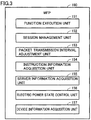
- Fig. 3 is a diagram showing a functional configuration of MFP 100. Each function of MFP 100 shown in Fig. 3 is implemented through execution of an appropriate program by CPU 101, for example.
- MFP 100 includes a function execution unit 151, a session management unit 152, a packet transmission interval adjustment unit 153, an instruction information acquisition unit 154, a server information acquisition unit 155, an electric power state control unit 156, and a device information acquisition unit 157.
- Function execution unit 151 executes a process for implementing a function specified by instruction information from instruction server 200. For example, when the function is downloading of firmware, CPU 101 transmits data for requesting transmission of firmware, to a server which is a destination of the firmware specified by the instruction information.
- Session management unit 152 manages establishment of a session with instruction server 200, for example. More specifically, in order to continue establishment of the session, for example, CPU 101 transmits a packet necessary for establishment of the session, at a predetermined packet transmission interval to XMPP server 300.
- Packet transmission interval adjustment unit 153 adjusts the aforementioned packet transmission interval. More specifically, packet transmission interval adjustment unit 153 transmits the packet and also determines whether or not a session with instruction server 200 is established. This determination is made based on for example whether or not a reply to the packet transmission is given from instruction server 200. In an example of control executed by packet transmission interval adjustment unit 153, the transmission interval is extended when it is determined that a session is established, and the transmission interval is shortened when it is determined that the session is disconnected.
- Instruction information acquisition unit 154 executes a process for acquiring instruction information from instruction server 200. More specifically, receiving a trigger from XMPP server 300 as described above with reference to Fig. 1 , instruction information acquisition unit 154 issues an inquiry to instruction server 200 about instruction information (arrow (3) in Fig. 1 ).
- Server information acquisition unit 155 acquires information about whether or not a server can be used for executing a function which is necessary for a function specified by the instruction information from instruction server 200. More specifically, as described above with reference to Fig. 1 , the function specified by the instruction information from instruction server 200 includes a function which requires at least one server in the server group (firmware distribution server (1) 910, firmware distribution server (2) 920, log acquisition server 930, function counter acquisition server 940, self-diagnosis-result acquisition server 950, and remote panel server 960). Server information acquisition unit 155 issues an inquiry to instruction server 200 about whether or not a server is available that is required by the function specified by the instruction information from instruction server 200.
- Electric power state control unit 156 controls the state of electric power of MFP 100.
- a plurality of states are set as states of electric power of MFP 100, including a normal electric power state in which electric power is supplied to enable all components in MFP 100 to operate, and a power-saving state in which the power consumption is smaller than that of the normal electric power state.
- Electric power state control unit 156 controls the state of electric power assumed by MFP 100. For example, electric power state control unit 156 sets MFP 100 to the normal electric power state when MFP 100 is activated. When no instruction is input for a certain time to operation panel 107, electric power state control unit 156 switches the normal electric power state to the power saving state.
- electric power state control unit 156 controls the state of electric power of MFP 100.
- An example of the schedule information is weekly timer. Based on the weekly timer, the state of electric power of MFP 100 may be switched to the power saving state when no operational instruction is given to operation panel 107 in a specific time frame on a specific day in a week. Based on the weekly timer, the state of electric power of MFP 100 may be kept in the normal electric power state in a specific time frame on a specific day in a week.
- Device information acquisition unit 157 executes a process for acquiring information about MFP 100, such as log and/or TEC value.
- the acquired information is stored for example in auxiliary storage device 104.
- Fig. 4 is a diagram showing a hardware configuration of instruction server 200.
- Instruction server 200 includes, as its main components, a CPU 201, a RAM 202, a storage device 203, a display 204, an input device 205, and a communication device 206.
- CPU 201, RAM 202, storage device 203, display 204, input device 205, and communication device 206 are connected to one another through an internal bus.
- CPU 201 is an example of a processor executing a process for controlling the overall operation of instruction server 200.
- RAM 202 functions as a work area when CPU 201 executes a process.
- Storage device 203 stores various kinds of data including a file of various programs such as server application program executed by CPU 201, and data used for execution of these programs.
- Storage device 203 is a medium which stores data in a nonvolatile manner, such as CD-ROM, DVD-ROM, USB memory, memory card, FD, hard disk, SSD, magnetic tape, cassette tape, MO, MD, IC card (excluding memory card), optical card, mask ROM, EPROM, EEPROM, for example.
- a program which is downloaded via a network may also be installed.
- Display 204 is a display device for displaying an image indicating the result of processing of a program executed by CPU 201.
- Input device 205 is implemented by buttons, a keyboard, a touch sensor, or the like, for entering various instructions to CPU 201.
- Communication device 206 is a communication interface which functions when instruction server 200 transmits/receives information to/from other devices such as MFP 100.
- Fig. 5 is a diagram for illustrating packet transmission by MFP 100 for maintaining a session with instruction server 200. As shown in Fig. 5 , a process regarding packet transmission from MFP 100 to XMPP server 300 includes the steps indicated by (1) to (4).
- MFP 100 transmits to router 500 a packet which is addressed to XMPP server 300.
- the packet is a packet for maintaining a session between MFP 100 and instruction server 200. This packet is transmitted at a given time interval.
- the time interval is also referred to as "packet transmission interval" herein.
- router 500 transmits the packet to XMPP server 300 in response to the aforementioned transmission of the packet from MFP 100 as indicated by (1).
- XMPP server 300 transmits to router 500 the result of packet transmission indicated by (2). This result indicates whether the session between MFP 100 and instruction server 200 is maintained or disconnected. After this, router 500 transmits to MFP 100 the result acquired from XMPP server 300.
- MFP 100 performs a process depending on the result acquired from router 500. More specifically, in the case where the result acquired from router 500 indicates the fact that "the session is maintained,” MFP 100 extends the aforementioned "packet transmission interval" ("EXTEND PACKET TRANSMISSION INTERVAL" in Fig. 5 ), for example. In contrast, in the case where the result acquired from router 500 indicates the fact that "the session is disconnected,” MFP 100 transmits via router 500 to XMPP server 300 information for newly establishing a session with instruction server 200 and further shortens the aforementioned "packet transmission interval" ("SHORTEN PACKET TRANSMISSION INTERVAL" in Fig. 5 ), for example.
- Figs. 6 to 8 are each a diagram for illustrating an overview of a process executed by MFP 100 in the first embodiment for adjusting the aforementioned "packet transmission interval."
- change of the packet transmission interval after packet transmission is indicated by a hatched arrow (referred to simply as “arrow” hereinafter). More specifically, a downward arrow represents shortening of the packet transmission interval and an upward arrow represents extension of the packet transmission interval.
- FIG. 6 shows a case where the initial value of the packet transmission interval which is set for MFP 100 is longer than the timeout period for the firewall function of router 500.
- the vertical axis represents the packet transmission interval and the horizontal axis represents the number of times the packet is transmitted.
- the initial value of the packet transmission interval for MFP 100 is represented by a broken line and the timeout period for the firewall function of router 500 is indicated by a broken line.
- the initial value of the packet transmission interval is longer than the timeout period of router 500.
- control is executed to make the packet transmission interval closer to the timeout period of router 500 and shorter than the timeout period. In the following, this control will more specifically be described.
- the leftmost arrow (downward) shown in Fig. 6 indicates that the packet transmission interval is shortened after the first packet transmission by MFP 100.
- the length of time by which the packet transmission interval is shortened is "correction value" for the packet transmission interval and corresponds to a predetermined value for MFP 100.
- the initial value of the packet transmission interval is longer than the timeout period of router 500. Therefore, there is a high possibility that the result of the first packet transmission indicates that the session between MFP 100 and instruction server 200 is disconnected. In the case where the result of the packet transmission indicates that the session is disconnected, MFP 100 shortens the packet transmission interval and instructs router 500 to establish a session with instruction server 200.
- the second leftmost arrow (downward) in Fig. 6 indicates that the packet transmission interval is further shortened by the aforementioned "correction value" after the second packet transmission. As seen from Fig. 6 , the packet transmission interval when the second packet transmission is done is still longer than the timeout period of router 500. In the case where the result of the second packet transmission indicates that the session is disconnected, MFP 100 shortens the packet transmission interval and instructs router 500 to establish a session with instruction server 200.
- the third arrow and the fourth arrow (both downward) from the leftmost one in Fig. 6 indicate that the packet transmission interval is further shortened by the "correction value" after the third packet transmission and the fourth packet transmission, respectively.
- the packet transmission interval when the third packet transmission and the fourth packet transmission are done is still longer than the timeout period of router 500.
- MFP 100 shortens the packet transmission interval and instructs router 500 to establish a session with instruction server 200.
- the fifth arrow (upward) from the leftmost one in Fig. 6 indicates that the packet transmission interval is extended after the fifth packet transmission.
- the shortening of the packet transmission interval after the fourth packet transmission causes the packet transmission interval to be shorter than the timeout period. Accordingly, the result of the fifth packet transmission may indicate that the session is maintained.
- MFP 100 only extends the packet transmission interval. Namely, it is unnecessary for MFP 100 at this time to instruct router 500 to establish a session with instruction server 200.
- the length of time by which the interval is extended is smaller than the foregoing correction value.
- the correction value for the latest packet transmission interval for MFP 100 may be smaller.
- the correction value for the packet transmission interval after the fifth packet transmission is smaller than the correction value for the packet transmission interval after the fourth packet transmission.
- the sixth arrow (downward) from the leftmost one in Fig. 6 indicates that the packet transmission interval is shortened after the sixth packet transmission.
- the extension of the packet transmission interval after the fifth packet transmission causes the packet transmission interval to be longer than the timeout period. Accordingly, the result of the sixth packet transmission is "session is disconnected.” In contrast, the result of the fifth packet transmission is "session is maintained.” Namely, the result of the sixth packet transmission is different from the result of the fifth packet transmission. Therefore, the correction value for the packet transmission interval after the sixth packet transmission is smaller than the correction value for the packet transmission interval after the fifth packet transmission.
- the seventh arrow (upward) from the leftmost one in Fig. 6 indicates that the packet transmission interval is extended after the seventh packet transmission. Since the result of the seventh packet transmission (session is maintained) differs from the result of the sixth packet transmission (session is disconnected), the correction value for the packet transmission interval after the seventh packet transmission is smaller than the correction value for the packet transmission interval after the sixth packet transmission.
- the eighth arrow (downward) from the leftmost one in Fig. 6 indicates that the packet transmission interval is shortened after the eighth packet transmission. Since the result of the eighth packet transmission (session is disconnected) differs from the result of the seventh packet transmission (session is maintained), the correction value for the packet transmission interval after the eighth packet transmission is smaller than the correction value for the packet transmission interval after the seventh packet transmission.
- the packet transmission interval is not changed. This is for the reason that the shortening of the packet transmission interval after the eighth packet transmission causes the correction value for the packet transmission interval to reach a predetermined lower limit and that the result of the eighth packet transmission is "session is maintained.” In the case where the correction value for the packet transmission interval (either extended or shortened) reaches the lower limit and the result of the following packet transmission is "session is maintained," the correction value for the packet transmission interval will not be changed any more. It is assumed that, in this state, the packet transmission interval of MFP 100 is close to the timeout period of the router and equal to or shorter than the timeout period.
- FIG. 7 shows a case where the initial value of the packet transmission interval which is set for MFP 100 is shorter than the timeout period for the firewall function of router 500.
- the leftmost arrow (upward) in Fig. 7 indicates that the packet transmission interval is extended by "correction value" after the first packet transmission.
- the second to fourth arrows (all upward) from the leftmost one in Fig. 7 indicate that the packet transmission interval is extended by "correction value" after the second packet transmission to the fourth packet transmission, respectively.
- the fifth arrow (downward) from the leftmost one in Fig. 7 indicates that the packet transmission interval is shortened after the fifth packet transmission.
- the "correction value" by which the interval is shortened is smaller than the "correction value” by which the packet transmission interval is extended after the first packet transmission to the fourth packet transmission. This is for the reason that the result of the fifth packet transmission (session is disconnected) differs from the result of the fourth packet transmission (session is maintained).
- the sixth to ninth arrows (upward, downward, upward, and downward, respectively) from the leftmost one in Fig. 7 indicate that the packet transmission interval is corrected (extended, shortened, extended, and shortened, respectively) after the sixth packet transmission to the ninth packet transmission, respectively.
- the shortening of the packet transmission interval after the ninth packet transmission causes the correction value to reach the lower limit, and the result of the ninth packet transmission indicates that the session is maintained. Accordingly, in this example, even when the packet transmission interval is changed after the tenth packet transmission, the correction value for the changed packet transmission interval is not changed.
- the packet transmission interval is adjusted to be closer to the timeout period and within the timeout period.
- the timeout period for the firewall function of router 500 is shortened at the time indicated by "TA.”
- the packet transmission interval is changed similarly to the example shown in Fig. 6 , until the time indicated by "TA" is reached.
- the packet transmission interval is changed and the timeout period of router 500 is shortened, the result of the packet transmission is "the session between MFP 100 and instruction server 200 is disconnected" and accordingly the packet transmission interval is shortened as indicated by the third arrow (downward) from the rightmost one in Fig. 8 .
- the packet transmission interval is shortened by a predetermined "lower limit.”
- the packet transmission interval is further changed twice before the result of packet transmission indicates "session is maintained."
- the change made twice is indicated by the second rightmost arrow (upward) and the rightmost arrow (downward) in Fig. 8 .
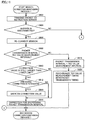
- Figs. 9 to 12 show a flowchart of a process executed for packet transmission by MFP 100 in the first embodiment.
- CPU 101 of MFP 100 determines in step S10 whether or not "packet transmission interval" has elapsed since the preceding packet transmission. After this, the control by CPU 101 remains in step S10 (NO in step S10) until CPU 101 determines that "packet transmission interval” has elapsed. When CPU 101 determines that "packet transmission interval” has elapsed (YES in S10), the control by CPU 101 proceeds to step S20. When the "packet transmission interval" has elapsed, the control proceeds to step S20 as well, even if the packet has not been transmitted yet.
- step S20 CPU 101 determines whether or not a CPU of MFP 100 (in the case where another CPU is mounted in MFP 100 in addition to CPU 101, the aforementioned CPU is CPU 101 or the other CPU, which is applied as well to the following steps S30 to S50) is performing an update process for firmware (hereinafter also referred to as "FW") of MFP 100.
- FW firmware
- step S30 CPU 101 determines whether or not the CPU of MFP 100 is performing a process for acquiring a log of MFP 100.
- CPU 101 determines that a log is being acquired (YES in step S30)
- the control by CPU 101 returns to step S10.
- CPU 101 determines that a log is not being acquired (NO in step S30)
- the control proceeds to step S40.
- step S40 CPU 101 determines whether or not the CPU of MFP 100 is performing control in an administrator mode.
- the administrator mode refers to a state in MFP 100 in which an administrator logs in. As an ID and a password for the administrator for example are input, the CPU of MFP 100 executes the control in the administrator mode. Under the control in the administrator mode, a special function for the administrator is performed.
- the special function includes for example reception of operation which is done for changing settings for MFP 100 (details which may be provided regarding the upper limit of the number of sheets to be printed by MFP 100 or regarding image processing by MFP 100, for example (color printing, display/output of confidential document)).
- the control by CPU 101 returns to step S10.
- the control proceeds to step S50.
- step S50 CPU 101 determines whether or not MFP 100 at this time is performing a print job.
- CPU 101 determines that MFP 100 is performing a print job (YES in step S50)
- the control by CPU 101 returns to step S10.
- the control proceeds to step S60 ( Fig. 10 ).
- the print job is one example of an image forming process by MFP 100.
- CPU 101 determines in step S60 whether or not a time frame for maintenance of MFP 100 is set for MFP 100. More specifically, auxiliary storage device 104 of MFP 100 stores a file specifying details of operation settings of MFP 100. In step S60, CPU 101 refers to this file to determine whether or not a time frame for maintenance is set. When CPU 101 determines that a time frame for maintenance is set (YES in step S60), the control by CPU 101 proceeds to step S70. In contrast, when CPU 101 determines that a time frame for maintenance is not set (NO in step S60), the control proceeds to step S90.
- step S70 CPU 101 determines whether or not the time when step S90 is performed is included in the time frame for maintenance. When CPU 101 determines that it is included in the time frame for maintenance (YES in step S70), the control by CPU 101 proceeds to step S80. In contrast, when CPU 101 determines that it is not included in the time frame for maintenance (NO in step S70), the control returns to step S10.
- step S80 CPU 101 performs "session connection maintaining process 1" which is a subroutine for packet transmission. This subroutine will be described later herein with reference to Figs. 11 and 12 . After the control in step S80, the control by CPU 101 returns to step S10.
- step S90 CPU 101 determines whether or not the state of electric power of MFP 100 is a state in which packet transmission is impossible. For example, when the electric power state of MFP 100 is a normal electric power state, MFP 100 can transmit a packet. However, when the electric power state of MFP 100 is a power saving state and the power saving state is a state in which electric power is not supplied to communication device 106, MFP 100 cannot transmit a packet.
- CPU 101 determines that the electric power state of MFP 100 is the state in which packet transmission is impossible (YES in step S90)
- the control by CPU 101 proceeds to step S100.
- CPU 100 determines that the electric power state of MFP 100 is the state in which packet transmission is possible (NO in step S90)
- the control proceeds to step S120.
- step S 100 CPU 101 determines whether or not the reason why MFP 100 has switched to the power saving state is the control by a weekly timer of schedule information stored in auxiliary storage device 104 as described above. More specifically, CPU 101 compares the schedule information with the current time and makes the determination in step S100. When CPU 101 determines that the power saving state is due to the weekly timer (YES in step S100), the control by CPU 101 proceeds to step S110. In contrast, when CPU 101 determines that the power saving state is not due to the weekly timer (NO in step S100), the control returns to step S10 ( Fig. 9 ).
- step S110 CPU 101 switches the electric power state of MFP 100 to a state in which a packet can be transmitted. For example, CPU 101 causes electric power to be supplied to communication device 106. The control then proceeds to step S120.
- step S120 CPU 101 performs "session connection maintaining process 1" which is a subroutine for packet transmission. This subroutine will be described later herein with reference to Figs. 11 and 12 . After this, the control proceeds to step S130.
- step S130 CPU 101 determines whether or not the control in step S120 is performed as a result of switching from the state in which packet transmission is impossible (whether or not it is performed after the control in step S110).
- CPU 101 determines that the control in step S120 is performed as a result of switching from the state in which packet transmission is impossible (YES in step S130)
- the control proceeds to step S140.
- CPU 101 determines that the control in step S120 is performed without switching of the electric power state ofMFP 100 (NO in step S130)
- the control returns to step S10 ( Fig. 9 ).
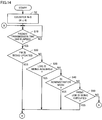
- step S802 of "session connection maintaining process 1" CPU 101 uses communication device 106 to transmit to XMPP server 300 a packet which is transmitted for confirming connection and which is addressed to the instruction server. After this, the control proceeds to step S804.
- step S804 CPU 101 determines whether or not a session with instruction server 200 is disconnected. For example, CPU 101 determines that a session with instruction server 200 is maintained when receiving information indicating that the session with instruction server 200 is maintained, within a certain time from transmission of the packet in step S802. CPU 101 determines that the session is disconnected when CPU 101 does not receive such information within the certain time. Then, when CPU 101 determines that the session is disconnected (YES in step S804), the control proceeds to step S806. In contrast, when CPU 101 determines that the session is maintained (NO in step S804), the control proceeds to step S822 ( Fig. 12 ).
- CPU 101 determines whether or not it receives information which indicates that the session with instruction server 200 is maintained within a certain time after the packet for confirming connection is transmitted, and accordingly determines the state of connection after the connection is confirmed.
- Transmission of the packet for confirming connection is an example of confirmation of connection.
- the state of connection is specified.
- step S806 CPU 101 transmits to XMPP server 300 via router 500 information for establishing a session again with instruction server 200. After this, the control proceeds to step S808.
- step S808 CPU 101 determines whether or not the packet transmission interval is longer than a TEC value measurement interval for MFP 100. Information which specifies the TEC value measurement interval is stored for example in auxiliary storage device 104. When CPU 101 determines that the packet transmission interval is longer than the TEC value measurement interval (YES in step S808), the control proceeds to step S810. In contrast, when CPU 101 determines that the packet transmission interval is equal to or less than the TEC value measurement interval (NO in step S808), the control proceeds to step S818.
- step S810 CPU 101 determines whether or not a correction value at the time for the packet transmission interval is still larger than a lower limit.
- the control proceeds to step S812.
- the control proceeds to step S816.
- step S812 CPU 101 determines whether or not the preceding correction of the packet transmission interval is "extension.”
- the packet transmission interval is corrected in step S816 and step S830 ( Fig. 12 ) described later herein. More specifically, the packet transmission interval is shortened in step S816 and the packet transmission interval is extended in step S830.
- "Preceding correction of the packet transmission interval” means the correction in step S816 or step S830 of the preceding process.
- step S814 CPU 101 shortens "correction value" for the packet transmission interval. After this, the control proceeds to step S816.
- step S816 CPU 101 shortens the packet transmission interval by "correction value” which is set at the time. CPU 101 ends “session connection maintaining process 1" and the control returns to Fig. 10 .
- the initial value of "correction value” is stored in auxiliary storage device 104.
- "Correction value” is shortened in step S814 and step S828 ( Fig. 12 ).
- step S818 CPU 101 sets the packet transmission interval equal to the length of the TEC value measurement interval. After this, the control proceeds to step S820.
- step S820 CPU 101 sets the timing at which the TEC value of MFP 100 is measured so that this timing is synchronized with the packet transmission timing. After this, CPU 101 ends "session connection maintaining process 1" and the control returns to Fig. 10 .
- step S822 CPU 101 determines whether or not the packet transmission interval is longer than the TEC value measurement interval of MFP 100.
- CPU 101 determines that the packet transmission interval is longer than the TEC value measurement interval (YES in step S822), the control proceeds to step S824.
- the control proceeds to step S832.
- step S824 CPU 101 determines whether or not the correction value at the time for the packet transmission interval is still larger than the lower limit.
- CPU 101 determines that the correction value is still larger than the lower limit (YES in step S824)
- the control proceeds to step S826.
- CPU 101 determines that the correction value is not still larger than the lower limit (NO in step S824)
- CPU 101 ends "session connection maintaining process 1" and the control returns to Fig. 10 . Namely, in the case where the fact that the session between MFP 100 and instruction server 200 is maintained is confirmed and "correction value" for the packet transmission interval has reached the lower limit, the packet transmission interval is not corrected after packet transmission.
- step S826 CPU 101 determines whether or not the preceding correction of the packet transmission interval is "shortening." "Preceding correction of the packet transmission interval" means the correction in step S816 or step S830 in the preceding process.
- the control proceeds to step S828.
- the control proceeds to step S830.
- step S828 CPU 101 shortens "correction value" for the packet transmission interval. After this, the control proceeds to step S830.
- step S830 CPU 101 extends the packet transmission interval by "correction value" which is set at the time. After this, CPU 101 ends "session connection maintaining process 1" and the control returns to Fig. 10 .
- step S832 CPU 101 sets the packet transmission interval equal to the length of the TEC value measurement interval. After this, the control proceeds to step S834.
- step S834 CPU 101 sets the timing at which the TEC value of MFP 100 is measured so that this timing is synchronized with the packet transmission timing.
- CPU 101 ends "session connection maintaining process 1" and the control returns to Fig. 10 .
- MFP 100 regularly transmits an existence confirmation (Keep Alive) packet to XMPP server 300 via router 500 in order to maintain the session with instruction server 200.
- the time interval at which MFP 100 transmits the packet is referred to as "packet transmission interval" herein.
- MFP 100 can extend the packet transmission interval and can also shorten the packet transmission interval. Thus, when the packet transmission interval is longer than the session timeout period for the firewall function of router 500, the packet transmission interval is shortened. More specifically, after transmitting the packet, MFP 100 determines whether or not the session is maintained. When MFP 100 determines that the session is disconnected, MFP 100 shortens the packet transmission interval (step S816 in Fig. 11 ). In contrast, when MFP 100 determines that the session is maintained, MFP 100 extends the packet transmission interval (step S830 in Fig. 12 ).
- the correction value by which the packet transmission interval is shortened or extended (the length of time by which the interval is shortened or extended) is shortened in the case where the result indicating that the session is maintained/disconnected that is given after the packet transmission differs from the result that is given after the preceding packet transmission (step S814 in Fig. 11 and step S828 in Fig. 12 ).
- MFP 100 does not extend the packet transmission interval (NO in step S824 in Fig. 12 ).
- the image processing apparatus transmits to the session server a packet for confirming whether or not a session with the instruction server is connected. Accordingly, the session between the image processing apparatus and the instruction server can more reliably be maintained.
- the packet transmission interval is adjusted to fall within the session timeout period for the firewall function of the router. Accordingly, it does not occur that the packet transmission interval is controlled to be only shortened. As long as the packet transmission interval falls within the session timeout period, the packet transmission interval may also be controlled to be extended. In this way, increase of the load on the image processing apparatus is kept minimum.
- An image processing system in a second embodiment has a similar configuration to that of the image processing system in the first embodiment. Characteristics of the image processing system in the second embodiment include a manner of changing "correction value" for correcting (extending or shortening) the packet transmission interval of MFP 100.
- the correction value for the interval correction at the time is shortened.
- each time the changed packet transmission interval becomes longer than or shorter than the timeout period the correction value for the interval correction at the time is shortened. This is indicated for example in Fig. 6 by the fifth arrow and the subsequent arrows from the leftmost one, among which the arrow located rightward is shorter, and also indicated in Fig. 7 by the fifth arrow and the subsequent arrows from the leftmost one, among which the arrow located rightward is shorter.
- Fig. 13 is a diagram for illustrating a manner of changing the correction value for correcting the packet transmission interval in the image processing system in the second embodiment.
- the hatched arrow shown in Fig. 13 represents change (extension or shortening) of the packet transmission interval after packet transmission, similarly to Fig. 6 and the like.
- the fourth arrow (downward) to the seventh arrow (upward) from the leftmost one are not identical in the direction of the arrow but identical in the length of the arrow.
- the eighth arrow (downward) from the leftmost one is shorter in length than the fourth to seventh arrows.
- the three arrows which are the 12th to 14th arrows from the leftmost one indicate that the packet transmission interval is corrected to be alternately shortened and extended three successive times.
- the timeout period of router 500 is shortened. Therefore, like the 14th correction, the 15th correction shortens the packet transmission interval. This is indicated by the fact that the 15th arrow from the leftmost one in Fig. 13 is directed downward like the 14th arrow in Fig. 13 .
- the count of the number of times for the 12th to 14th arrows, namely "three successive times,” is initialized.
- the 15th to 18th corrections cause the packet transmission interval to be changed to fall in or out of the timeout period four successive times. Based on this, the 19th correction shortens the correction value. This is indicated in Fig. 13 by the fact that immediately adjacent arrows of the 15th to 18th arrows are different in direction but identical in length, and that the 19th arrow is shorter in length than the 15th to 18th arrows.
- Figs. 14 to 17 show a flowchart of a process executed for packet transmission by MFP 100 in the second embodiment.
- the process shown in Fig. 14 to Fig. 15 corresponds to the process shown in Fig. 9 to Fig. 10 in the first embodiment.
- CPU 101 first sets the value of a counter N to zero in step S2.
- Counter N counts the number of successive times the packet transmission interval is changed to fall in or out of the timeout period as described above with reference to Fig. 13 .
- the upper limit of the count value of counter N is four.
- CPU 101 executes the control in step S10 and subsequent steps, similarly to the first embodiment.
- step S84 and step S124 in Fig. 15 CPU 101 in the second embodiment executes "session connection maintaining process 2" instead of “session connection maintaining process 1" (step S80 and step S120 in Fig. 10 ) in the first embodiment.
- "Session connection maintaining process 2" will be described later herein with reference to Figs. 16 and 17 .
- Figs. 16 and 17 show a flowchart of a subroutine of "session connection maintaining process 2."
- step S812 when CPU 101 in the first embodiment determines in step S812 that the preceding correction is "extension," CPU 101 shortens the correction value in step S814 and thereafter the control proceeds to step S816.
- CPU 101 executes the control in step S840 to step S848 instead of step S814.
- step S812 when CPU 101 determines in step S812 that the preceding correction is "extension" (YES in step S812), CPU 101 updates the count value of counter N by adding "1" in step S840. After this, the control proceeds to step S844. In contrast, when CPU 101 determines in step S812 that the preceding correction is not "extension" (NO in step S812), CPU 101 returns the count value of counter N to zero in step S842. After this, the control proceeds to step S844.
- step S844 CPU 101 determines whether the count value of counter N is still less than "4" or not. When CPU 101 determines that the count value is still less than "4" (YES in step S844), the control proceeds to step S816. In contrast, when CPU 101 determines that the count value has reached "4" (NO in step S844), the control proceeds to step S846.
- step S846 CPU 101 shortens the correction value for the packet transmission interval. After this, the control proceeds to step S848.
- step S848 CPU 101 returns the count value of counter N to zero. After this, the control proceeds to step S816.
- step S826 when CPU 101 in the first embodiment determines in step S826 that the preceding correction is "shortening," CPU 101 shortens the correction value in step S828 and the control proceeds to step S830.
- step S850 the control in step S850 to step S858 instead of step S828.
- step S826 determines in step S826 that the preceding correction is "shortening" (YES in step S826)
- CPU 101 updates the count value of counter N by adding "1" in step S850. After this, the control proceeds to step S854.
- CPU 101 determines in step S826 that the preceding correction is not "shortening" (NO in step S826)
- CPU 101 returns the count value of counter N to zero in step S852. After this, the control proceeds to step S854.
- step S854 CPU 101 determines whether the count value of counter N is still less than "4" or not. When CPU 101 determines that the count value is still less than "4" (YES in step S854), the control proceeds to step S830. In contrast, when CPU 101 determines that the count value has reached "4" (NO in step S854), the control proceeds to step S856.
- step S856 CPU 101 shortens the correction value for the packet transmission interval. After this, the control proceeds to step S858.
- step S858 CPU 101 returns the count value of counter N to zero. After this, the control proceeds to step S830.
- instruction server 200 transmits a packet for maintaining a session between MFP 100 and instruction server 200.
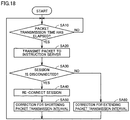
- Fig. 18 is a flowchart of a process executed by CPU 201 (see Fig. 4 ) of instruction server 200 in the third embodiment.
- CPU 201 determines in step SA10 whether or not the time which is defined as "packet transmission time" has elapsed since the preceding packet transmission.
- the control by CPU 201 remains in step SA10 (NO in step SA10) until CPU 201 determines that the packet transmission time has elapsed.
- the control proceeds to step SA20.
- step SA20 CPU 201 uses communication device 206 (see Fig. 4 ) to transmit the packet as described above to XMPP serer 300. After this, the control proceeds to step SA30.
- step SA30 CPU 201 determines whether or not a session between MFP 100 and instruction server 200 is disconnected. Like CPU 101 in step S804 ( Fig. 11 ), CPU 201 makes the determination in step SA30 based on whether or not it receives from MFP 100 a response to the packet transmission in step SA20, for example.
- CPU 201 determines that the session is disconnected (YES in step SA30)
- the control proceeds to step SA40.
- CPU 201 determines that the session is maintained (NO in step SA30)
- step S60 the control proceeds to step S60.
- step SA40 CPU 201 transmits to XMPP server 300 information for reconnecting the session between MFP 100 and instruction server 200. After this, the control proceeds to step SA50.
- step SA50 CPU 201 shortens the packet transmission interval and the control returns to step SA10.
- step SA60 CPU 201 extends the packet transmission interval and the control returns to step SA10.
- the packet transmission time is corrected after the packet is transmitted. More specifically, in the case where the session is disconnected, the packet transmission time is shortened (step SA50). In contrast, when the session is maintained, the packet transmission time is extended (step SA60).
- the correction value for the packet transmission time when the packet transmission time is corrected may be made shorter, as described above with reference to Fig. 6 for example, in the case where the packet transmission time is considered as being changed to fall in or out of the timeout period for the firewall function of router 500.
- MFP 100 uses a variety of servers such as firmware distribution server (1) 910 as shown in Fig. 1 to implement a function which is specified by instruction information from instruction server 200. In the case where there is no server which is accessible for implementing the function, MFP 100 does not transmit a packet for maintaining a session between MFP 100 and instruction server 200.
- Fig. 19 is a diagram showing a configuration of an image processing system in the fourth embodiment.
- the image processing system is deployed worldwide. More specifically, there is only one instruction server 200 and only one XMPP server 300 in the world. In contrast, respective server groups are installed in multiple regions (Japan, US, Europe (EU), China, and Oceania). MFP 100 is provided in each country (Japan, US, France, China, New Zealand, for example) which belongs to any of the multiple regions. MFP 100 provided in each country accesses the server group provided in the region to which the country belongs.
- MFPs 100 which are installed worldwide each set up a session with instruction server 200.
- the server group installed in each region is managed by instruction server 200.
- MFP 100 implements a function which is specified by instruction information received from instruction server 200.
- MFP 100 accesses a server which is a constituent server of the server group, as required.
- CPU 101 of MFP 100 issues an inquiry to instruction server 200 about whether or not a server can be used for implementing the function.
- CPU 101 analyzes for example the instruction information from instruction server 200 to thereby specify a function to be implemented by MFP 100, and specifies the type of server for implementing the function.
- CPU 101 issues an inquiry to instruction server 200 about whether or not it can access the specified server.
- CPU 101 stops transmission of a packet for maintaining the session between MFP 100 and instruction server 200.
- CPU 101 may restart transmission of a packet for maintaining the session.
- MFP 100 requests firmware distribution server (1) 910 and/or a firmware distribution server (2) 920 to provide downloading of firmware.
- firmware distribution server (1) 910 and/or firmware distribution server (2) 920 transmits to MFP 100 firmware to be executed by MFP 100.
- MFP 100 transfers a debug log to log acquisition server 930.
- Log acquisition server 930 accumulates the debug log.
- MFP 100 may read the debug log from log acquisition server 930.
- Still another example of the functions implemented through use of the server group is transfer of a count value (the number of times any of a variety of functions used by each MFP 100 is implemented (for example, the number of sheets of paper to which an image has been output by MFP 100)) of a function counter.
- MFP 100 includes a variety of function counters. MFP 100 transmits the count value of each function counter to function counter acquisition server 940.
- a further example of the functions implemented through use of the server group is transfer of a self-diagnosis result.
- MFP 100 transmits to self-diagnosis-result acquisition server 950 the result of diagnosis of the state (such as the amount of consumed toner) in MFP 100.
- MFP 100 causes a terminal which can communicate via remote panel server 960 to function as a remote panel. Namely MFP 100 receives operational instructions from the terminal and operates in accordance with the operational instructions.
- the image processing system of the present disclosure automatically optimizes the packet transmission interval depending on the environment of MFP 100.
- characteristic control details in the present disclosure will be described one by one.
- the packet transmission interval is corrected to be extended.
- the correction value for the packet transmission interval is decreased.
- the correction value for the packet transmission interval may be decreased.
- correction of the packet transmission interval is stopped. In the case where disconnection of a session is detected after the correction of the packet transmission interval is stopped, the correction is restarted.
- MFP 100 is switchable among a plurality of electric power states which are different in power consumption.
- the electric power states to be assumed by MFP 100 include an electric power state in which the power consumption is low to the extent that a module performing packet transmission does not operate.
- MFP 100 is switched to an electric power state at a level that allows the aforementioned module to operate, before the confirmation as to whether or not a session is connected. After this, whether or not a session is connected is confirmed.
- MFP 100 has been switched, due to a weekly timer, to an electric power state at a level that does not allow the module performing packet transmission to operate, MFP 100 is not switched to the electric power state at the level that allows the module to operate. This is for the reason that MFP 100 at this time has been switched to the state of low power consumption in accordance with a user's intention.
- MFP 100 measures the TEC value of MFP 100, it is necessary for MFP 100 to be in the same electric power state for a certain time. Therefore, when the packet transmission interval is smaller than the TEC value measurement interval, the packet transmission interval is set equal to the TEC value measurement interval, and packet transmission and TEC value measurement are done in synchronization with each other.
- a time frame (maintenance time frame) may be defined in which MFP 100 does not switch to the electric power state at the level that does not allow the module performing packet transmission to operate.
- MFP 100 may transmit a packet in this time frame to keep the session and thereby receive a remote instruction. Therefore, in the time period excluding the aforementioned time frame, it is unnecessary to maintain the session. Thus, in the time period excluding the aforementioned time frame, MFP 100 does not switch to the electric power state at the level that allows the module performing packet transmission to operate.
- a lower limit of the packet transmission interval may be set.
- the fact that the lower limit is set means that a user does not permit packet transmission at intervals shorter than the lower limit. Therefore, when the packet transmission interval reaches a lower limit, MFP 100 stops correction of the packet transmission interval.
- MFP 100 In the case where MFP 100 is in a state in which MFP 100 receives instruction information from instruction server 200 but MFP 100 cannot carry out the instruction, the function (such as packet transmission) for maintaining connection of a session is stopped until the aforementioned state is overcome. This is for the reason that it is necessary to maintain the session in such a case.
- An example of this state is a state in which FW (firmware) is being updated. This is for the reason that during FW update MFP 100 cannot perform other processes.
- Another example is a state in which a log is being acquired. This is for the reason that during log acquisition MFP 100 is acquiring the log for the current state and extra operations should not be performed by MFP 100.
- Still another example is a state in which MFP 100 is being in an administrator mode. This is for the reason that during operation by an administrator MFP 100 does not accept instructions for other operations.
- a further example is a state in which a print job is being performed. This is for the reason that deterioration of the printing performance due to packet transmission
Landscapes
- Engineering & Computer Science (AREA)
- Signal Processing (AREA)
- General Engineering & Computer Science (AREA)
- Theoretical Computer Science (AREA)
- Multimedia (AREA)
- Human Computer Interaction (AREA)
- General Physics & Mathematics (AREA)
- Physics & Mathematics (AREA)
- Computing Systems (AREA)
- Computer Networks & Wireless Communication (AREA)
- Microelectronics & Electronic Packaging (AREA)
- Computer Hardware Design (AREA)
- Computer Security & Cryptography (AREA)
- General Health & Medical Sciences (AREA)
- Biomedical Technology (AREA)
- Health & Medical Sciences (AREA)
- Facsimiles In General (AREA)
- Data Exchanges In Wide-Area Networks (AREA)
Abstract
Description
- The present disclosure relates to an image processing system, an image processing apparatus, an instruction server, and a program, and particularly relates to: an image processing system including an image processing apparatus and an instruction server which is configured to transmit instruction information to the image processing apparatus; an image processing apparatus and an instruction server which are constituent apparatuses of such an image processing system; and a program executed by the image processing apparatus.
- In these years, an image processing apparatus such as MFP (MultiFunctional Peripheral) may receive instructions from an external apparatus such as instruction server. In this case, an image processing system including this image processing apparatus, for example, is provided with a session server (for example, XMPP (Extensible Messaging and Presence Protocol) server) for setting up a session between the image processing apparatus and the instruction server. The instruction server remotely gives an instruction to the image processing apparatus via the session server.
- Regarding instructions remotely given to an apparatus, various techniques have been disclosed. For example, Japanese Laid-Open Patent Publication No.
2014-199998 - According to the technique disclosed in Japanese Laid-Open Patent Publication No.
2014-199998 2014-199998 - In view of the above circumstances, it is required to more reliably maintain a session between an image processing apparatus and an instruction server while keeping a minimum increase of the load on the image processing apparatus.
- According to an aspect of the present disclosure, there is provided an image processing system including: an image processing apparatus; an instruction server configured to transmit instruction information to the image processing apparatus via a router having a firewall function; and a session server configured to set up a session between the image processing apparatus and the instruction server. The image processing apparatus includes: state control means configured to control a state of the image processing apparatus to be one of a plurality of states including a normal state and a power saving state in which a power consumption is smaller than a power consumption in the normal state; packet transmission means configured to transmit to the session server a connection confirmation packet for a session between the image processing apparatus and the instruction server; and adjustment means configured to adjust a transmission interval of the packet transmitted by the packet transmission means, based on a connection state of the session between the instruction server and the image processing apparatus after connection confirmation, so that the transmission interval is within a session timeout period for the firewall function of the router. The state control means is configured to switch the state of the image processing apparatus to a state in which the packet transmission means can at least transmit a packet, in a case where the state of the image processing apparatus is the power saving state when a time specified by the transmission interval elapses from transmission of the packet by the packet transmission means.
- Preferably, the adjustment means is configured to shorten the transmission interval in a case where the session between the image processing apparatus and the instruction server is connected, and to extend the transmission interval in a case where the session between the image processing apparatus and the instruction server is disconnected.
- Preferably, the adjustment means is configured to decrease a value of a time by which the transmission interval is shortened or extended, in a case where a result which represents connection or disconnection of the session between the image processing apparatus and the instruction server is different from a result derived from preceding packet transmission.
- Preferably, the adjustment means is configured to decrease, in a case where the number of times a result which represents connection or disconnection of the session between the image processing apparatus and the instruction server is different from a result derived from preceding packet transmission reaches a predetermined number of times, a value of a time by which the transmission interval is shortened or extended.
- Preferably, the adjustment means is configured not to change a length of time by which the transmission interval is shortened or extended, in a case where the value of the time by which the transmission interval is shortened or extended reaches a predetermined value.
- Preferably, the adjustment means is configured not to shorten or extend the transmission interval in a case where the value of the time by which the transmission interval is shortened or extended reaches a predetermined value.
- Preferably, the adjustment means is configured to restart shortening or extension of the transmission interval on a condition that the value of the time by which the transmission interval is shortened or extended reaches a predetermined value and thereafter disconnection of the session between the image processing apparatus and the instruction server is detected.
- Preferably, the state control means is configured to return the state of the image processing apparatus to the power saving state, in a case where the state control means switches the state of the image processing apparatus to the state in which the packet transmission means can at least transmit a packet and thereafter establishment of the session between the image processing apparatus and the instruction server is confirmed through packet transmission by the packet transmission means.
- Preferably, the state control means is configured not to switch the state of the image processing apparatus to a state in which the packet transmission means can transmit a packet, in a case where the state control means controls the state of the image processing apparatus to be the power saving state in accordance with a predetermined schedule, even when the time specified by the transmission interval elapses from transmission of the packet by the packet transmission means.
- Preferably, the packet transmission means is configured to transmit the packet to the session server only in a specific period rather than at the transmission interval, in a case where the specific period is set in which the state control means does not set the image processing apparatus in the power saving mode.
- Preferably, the state control means is configured not to switch the state of the image processing apparatus to the state in which the packet transmission means can at least transmit a packet, in a case where the transmission interval reaches a predetermined lower limit, even when the state of the image processing apparatus is the power saving state, after elapse of a time specified by the transmission interval from transmission of the packet by the packet transmission means.
- Preferably, the image processing apparatus is configured to further include device information acquisition means configured to execute a process of acquiring a TEC (Typical Electricity Consumption) value of the image processing apparatus, and the adjustment means is configured not to shorten the transmission interval any more, in a case where the transmission interval is less than an interval at which the TEC value is measured.
- Preferably, the adjustment means is configured to synchronize a timing at which the TEC value is measured by the device information acquisition means, with a timing at which a packet is transmitted by the packet transmission means.
- Preferably, the packet transmission means is configured to stop transmission of the packet in a case where the image processing apparatus is in a state in which the image processing apparatus cannot carry out an instruction specified by the instruction information.
- Preferably, the state in which the image processing apparatus cannot carry out an instruction specified by the instruction information includes at least any one of: a state in which a firmware update process is executed in the image processing apparatus; a state in which a log acquisition process is executed in the image processing apparatus; a state in which control is executed in an administrator mode in the image processing apparatus; and a state in which the image processing apparatus executes image formation.
- Preferably, the image processing system further includes a server group connectable with the image processing apparatus. The image processing apparatus is configured to transmit and receive data to and from the server group. The instruction server is configured to manage the server group. The image processing apparatus further includes server information acquisition means configured to issue an inquiry to the instruction server about whether or not a server available for carrying out an instruction specified by the instruction information is included in the server group. The packet transmission means is configured to stop transmission of the packet, in a case where the server information acquisition means acquires an answer from the instruction server, the answer indicating that a server available for carrying out an instruction specified by the instruction information is not included in the server group.
- According to another aspect of the present disclosure, an image processing apparatus is provided. The image processing apparatus includes: reception means configured to receive instruction information from an instruction server via a router having a firewall function; state control means configured to control a state of the image processing apparatus to be one of a plurality of states including a normal state and a power saving state in which a power consumption is smaller than a power consumption in the normal state; packet transmission means configured to transmit to a session server, which is configured to set up a session between the image processing apparatus and the instruction server, a connection confirmation packet for the session between the image processing apparatus and the instruction server; and adjustment means configured to adjust a transmission interval of the packet transmitted by the packet transmission means, based on a connection state of the session between the instruction server and the image processing apparatus after connection confirmation, so that the transmission interval is within a session timeout period for the firewall function of the router. The state control means is configured to switch the state of the image processing apparatus to a state in which the packet transmission means can at least transmit a packet, in a case where the state of the image processing apparatus is the power saving state when a time specified by the transmission interval elapses from transmission of the packet by the packet transmission means.
- Preferably, the adjustment means is configured to shorten the transmission interval in a case where the session between the image processing apparatus and the instruction server is connected, and to extend the transmission interval in a case where the session between the image processing apparatus and the instruction server is disconnected.
- Preferably, the adjustment means is configured to decrease a value of a time by which the transmission interval is shortened or extended, in a case where a result which represents connection or disconnection of the session between the image processing apparatus and the instruction server is different from a result derived from preceding packet transmission.
- Preferably, the state control means is configured to return the state of the image processing apparatus to the power saving state, in a case where the state control means switches the state of the image processing apparatus to the state in which the packet transmission means can at least transmit a packet and thereafter establishment of the session between the image processing apparatus and the instruction server is confirmed through packet transmission by the packet transmission means.
- According to still another aspect of the present disclosure, there is provided a program executed by a processor of an image processing apparatus configured to receive instruction information from an instruction server via a router having a firewall function. The program causes the processor to execute the steps of: controlling a state of the image processing apparatus to be one of a plurality of states including a normal state and a power saving state in which a power consumption is smaller than a power consumption in the normal state; transmitting, to a session server configured to set up a session between the image processing apparatus and the instruction server, a connection confirmation packet for the session between the image processing apparatus and the instruction server; adjusting a transmission interval of the connection confirmation packet, based on a connection state of the session between the instruction server and the image processing apparatus after connection confirmation, so that the transmission interval is within a session timeout period for the firewall function of the router; and switching the state of the image processing apparatus to a state in which at least the connection confirmation packet can be transmitted, in a case where the state of the image processing apparatus is the power saving state when a time specified by the transmission interval elapses from transmission of the connection confirmation packet.
- According to a further aspect of the present disclosure, there is provided an instruction server configured to transmit instruction information to an image processing apparatus via a router having a firewall function. The instruction server includes: packet transmission means configured to transmit to a session server, which is configured to set up a session between the image processing apparatus and the instruction server, a connection confirmation packet for the session between the image processing apparatus and the instruction server; and adjustment means configured to adjust a transmission interval of the packet transmitted by the packet transmission means, based on a connection state of the session between the instruction server and the image processing apparatus after connection confirmation, so that the transmission interval is within a session timeout period for the firewall function of the router.
- The foregoing and other objects, features, aspects and advantages of the present invention will become more apparent from the following detailed description of the present invention when taken in conjunction with the accompanying drawings.
-
-
Fig. 1 is a diagram showing an example of a configuration of an image processing system in a first embodiment. -
Fig. 2 is a diagram showing an example of a hardware configuration of an MFP included in the image processing system in the first embodiment. -
Fig. 3 is a diagram showing a functional configuration of the MFP. -
Fig. 4 is a diagram showing a hardware configuration of an instruction server. -
Fig. 5 is a diagram for illustrating packet transmission by the MFP for maintaining a session with the instruction server. -
Fig. 6 is a diagram showing a state in which an initial value of a packet transmission interval which is set for the MFP is longer than a timeout period for a firewall function of a router. -
Fig. 7 is a diagram showing a state in which an initial value of a packet transmission interval which is set for the MFP is shorter than a timeout period for a firewall function of a router. -
Fig. 8 is a diagram for illustrating an overview of a process executed by the MFP in the first embodiment for adjusting "packet transmission interval." -
Figs. 9 to 12 show a flowchart of a process executed for packet transmission by the MFP in the first embodiment. -
Fig. 13 is a diagram for illustrating a manner of changing a correction value for correcting a packet transmission interval in an image processing system in a second embodiment. -
Fig. 14 is a flowchart of a process executed for packet transmission by an MFP in the second embodiment. -
Fig. 15 is a flowchart of a process executed for packet transmission by the MFP in the second embodiment. -
Figs. 16 and17 show a flowchart of a subroutine for "sessionconnection maintaining process 2." -
Fig. 18 is a flowchart of a process executed by CPU (Central Processing Unit) of an instruction server in a third embodiment. -
Fig. 19 is a diagram showing a configuration of an image processing system in a fourth embodiment. - In the following, embodiments of an image processing system will be described with reference to the drawings. In the following description, the same components and the same elements are denoted by the same reference characters. They are named identically and function identically. Therefore, a description of them will not be repeated herein.
-
Fig. 1 is a diagram showing an example of a configuration of an image processing system in a first embodiment of the present disclosure. - As shown in
Fig. 1 , the image processing system includes anMFP 100 which is an example of an image processing apparatus.MFP 100 communicates with an XMPP (Extensible Messaging and Presence Protocol)server 300 via arouter 500 having a firewall function.MFP 100 communicates with various servers (acloud server 600 and a server 700) including aninstruction server 200, viaXMPP server 300.Instruction server 200 is a server configured to transmit instruction information toMFP 100.Instruction server 200 is an exemplary instruction server. -
MFP 100 performs a process for establishing an XMPP session continuously withinstruction server 200 so thatMFP 100 can receive instruction information all the time frominstruction server 200. More specifically,MFP 100 transmits to XMPP server 300 a packet for establishing a session with the instruction server. - For
MFP 100, the packet transmission interval at which the packet is transmitted by the MFP is appropriately adjusted so that the interval is within a timeout period of the firewall function ofrouter 500. Namely, forMFP 100, the packet transmission interval is shortened or extended as appropriate so that the interval is within the timeout period. - When
MFP 100 receives instruction information frominstruction server 200,MFP 100 uses a group of servers provided separately from the aforementioned servers to implement a function specified by the instruction information. The group of servers includes a firmware distribution server (1) 910, a firmware distribution server (2) 920, alog acquisition server 930, a functioncounter acquisition server 940, a self-diagnosis-result acquisition server 950, and aremote panel server 960. The functions executed byMFP 100 using the group of servers will be described later herein (fourth embodiment). - Transmission of the instruction information from
instruction server 200 toMFP 100 is illustrated inFig. 1 following the arrows indicated by (1) to (4). Namely, as indicated by the arrow (1), firstlyinstruction server 200 makes a trigger request toXMPP server 300 for transmission of instruction information. - In response to the request indicated by arrow (1),
XMPP server 300 transmits a trigger signal toMFP 100 as indicated by the arrow (2). - In response to the trigger signal indicated by the arrow (2),
MFP 100 issues an inquiry toinstruction server 200 about the instruction information as indicated by the arrow (3). The inquiry is made in accordance with a protocol different from XMPP, such as HTTP. Together with the inquiry, a serial number and a ticket ID are transmitted fromMFP 100 toinstruction server 200. - In response to the inquiry indicated by the arrow (3),
instruction server 200 transmits the instruction information toMFP 100 as indicated by the arrow (4). Receiving the instruction information,MFP 100 executes a process for implementing a function specified by the instruction information. An example of the function is downloading of specific firmware from firmware distribution server (1) 910. -
Fig. 2 is a diagram showing an example of a hardware configuration ofMFP 100 included in the image processing system in the first embodiment. - As shown in
Fig. 2 ,MFP 100 includes, as its main components, aCPU 101, a ROM (Read Only Memory) 102, a RAM (Random Access Memory) 103, anauxiliary storage device 104, acommunication device 106, anoperation panel 107, ascanner unit 108, and aprinter unit 109.CPU 101,ROM 102,RAM 103,auxiliary storage device 104,communication device 106,operation panel 107,scanner unit 108, andprinter unit 109 are connected to one another through an internal bus. -
CPU 101 is an example of a processor executing a process for overall control of the operation ofMFP 100. -
ROM 102 stores various kinds of data including a program to be executed byCPU 101. -
RAM 103 functions as a work area whenCPU 101 executes a program. In some cases,RAM 103 may temporarily store image data or the like read byscanner unit 108. -
Auxiliary storage device 104 stores various kinds of data such as address information and/or documents registered inMFP 100. The document data may be input via a network toMFP 100, or may be generated from an image read byscanner unit 108. -
Communication device 106 is a communication interface which functions whenMFP 100 transmits/receives information to/from other devices. In the image processing system in the first embodiment, an example of the communication technology forcommunication device 106 is Bluetooth (registered trademark). The communication technology may be any of other wireless communication technologies or wired communication technologies. -
Operation panel 107 receives input of various kinds of information such as set value for the copy image quality or the copy sheet, and information for registering or selecting a destination of scanning (address information). The surface ofoperation panel 107 is provided with a liquid crystal display unit in which a touch panel is disposed, for example.Operation panel 107 displays details setting forMFP 100 for example. -
Scanner unit 108 scans a set original to generate image data of the original. Since a known method may be employed for generation of the image data byscanner unit 108, a detailed description thereof is not be given here. - By means of electrophotography, for example,
printer unit 109 converts image data read byscanner unit 108 or converts print data which is transmitted from an external image processing apparatus such as instruction server (WWW server) 200, into data suitable for printing, and then prints the image such as document, based on the converted data. For this printing, any known technique may be employed. -
CPU 101 may execute an appropriate program to implement the operation ofMFP 100 as disclosed herein. An example of the storage location of the program executed byCPU 101 isROM 102. Another example thereof isauxiliary storage device 104. Still another example thereof is a storage medium attachable to and removable fromMFP 100. The storage medium refers to a medium which stores data in a nonvolatile manner, such as CD-ROM (Compact Disc - Read Only Memory), DVD-ROM (Digital Versatile Disk - Read Only Memory), USB (Universal Serial Bus) memory, memory card, FD (Flexible Disk), hard disk, SSD (Solid State Drive), magnetic tape, cassette tape, MO (Magnetic Optical Disc), MD (Mini Disc), IC (Integrated Circuit) card (excluding memory card), optical card, mask ROM, EPROM, EEPROM (Electronically Erasable Progammable Read-Only Memory), for example. - The program in the present disclosure may be a program causing necessary program modules, among program modules provided as a part of an operating system (OS) of a computer, to be called in a predetermined order and at a predetermined timing, to execute a process. In this case, the program itself does not include the aforementioned modules, and the program is executed in cooperation with the OS. Such a program including no module may also be included in the program of the present disclosure.
- The program of the present disclosure may also be incorporated in a part of the other program, and accordingly provided. In this case as well, the program itself does not include modules which are included in the aforementioned other program, and the process is executed in cooperation with the other program. Such a program incorporated in the other program may also be included in the program of the present disclosure.
- A program product to be provided is installed in a program storage unit such as hard disk and executed. The program product includes a program itself and a recording medium on which the program is recorded.
-
Fig. 3 is a diagram showing a functional configuration ofMFP 100. Each function ofMFP 100 shown inFig. 3 is implemented through execution of an appropriate program byCPU 101, for example. - As shown in
Fig. 3 ,MFP 100 includes afunction execution unit 151, asession management unit 152, a packet transmissioninterval adjustment unit 153, an instructioninformation acquisition unit 154, a serverinformation acquisition unit 155, an electric powerstate control unit 156, and a deviceinformation acquisition unit 157. -
Function execution unit 151 executes a process for implementing a function specified by instruction information frominstruction server 200. For example, when the function is downloading of firmware,CPU 101 transmits data for requesting transmission of firmware, to a server which is a destination of the firmware specified by the instruction information. -
Session management unit 152 manages establishment of a session withinstruction server 200, for example. More specifically, in order to continue establishment of the session, for example,CPU 101 transmits a packet necessary for establishment of the session, at a predetermined packet transmission interval toXMPP server 300. - Packet transmission
interval adjustment unit 153 adjusts the aforementioned packet transmission interval. More specifically, packet transmissioninterval adjustment unit 153 transmits the packet and also determines whether or not a session withinstruction server 200 is established. This determination is made based on for example whether or not a reply to the packet transmission is given frominstruction server 200. In an example of control executed by packet transmissioninterval adjustment unit 153, the transmission interval is extended when it is determined that a session is established, and the transmission interval is shortened when it is determined that the session is disconnected. - Instruction
information acquisition unit 154 executes a process for acquiring instruction information frominstruction server 200. More specifically, receiving a trigger fromXMPP server 300 as described above with reference toFig. 1 , instructioninformation acquisition unit 154 issues an inquiry toinstruction server 200 about instruction information (arrow (3) inFig. 1 ). - Server
information acquisition unit 155 acquires information about whether or not a server can be used for executing a function which is necessary for a function specified by the instruction information frominstruction server 200. More specifically, as described above with reference toFig. 1 , the function specified by the instruction information frominstruction server 200 includes a function which requires at least one server in the server group (firmware distribution server (1) 910, firmware distribution server (2) 920,log acquisition server 930, functioncounter acquisition server 940, self-diagnosis-result acquisition server 950, and remote panel server 960). Serverinformation acquisition unit 155 issues an inquiry toinstruction server 200 about whether or not a server is available that is required by the function specified by the instruction information frominstruction server 200. - Electric power
state control unit 156 controls the state of electric power ofMFP 100. ForMFP 100, a plurality of states are set as states of electric power ofMFP 100, including a normal electric power state in which electric power is supplied to enable all components inMFP 100 to operate, and a power-saving state in which the power consumption is smaller than that of the normal electric power state. Electric powerstate control unit 156 controls the state of electric power assumed byMFP 100. For example, electric powerstate control unit 156 setsMFP 100 to the normal electric power state whenMFP 100 is activated. When no instruction is input for a certain time tooperation panel 107, electric powerstate control unit 156 switches the normal electric power state to the power saving state. Further, based on schedule information stored inauxiliary storage device 104, electric powerstate control unit 156 controls the state of electric power ofMFP 100. An example of the schedule information is weekly timer. Based on the weekly timer, the state of electric power ofMFP 100 may be switched to the power saving state when no operational instruction is given tooperation panel 107 in a specific time frame on a specific day in a week. Based on the weekly timer, the state of electric power ofMFP 100 may be kept in the normal electric power state in a specific time frame on a specific day in a week. - Device
information acquisition unit 157 executes a process for acquiring information aboutMFP 100, such as log and/or TEC value. The acquired information is stored for example inauxiliary storage device 104. -
Fig. 4 is a diagram showing a hardware configuration ofinstruction server 200. -
Instruction server 200 includes, as its main components, aCPU 201, aRAM 202, astorage device 203, adisplay 204, aninput device 205, and acommunication device 206.CPU 201,RAM 202,storage device 203,display 204,input device 205, andcommunication device 206 are connected to one another through an internal bus. -
CPU 201 is an example of a processor executing a process for controlling the overall operation ofinstruction server 200. -
RAM 202 functions as a work area whenCPU 201 executes a process. -
Storage device 203 stores various kinds of data including a file of various programs such as server application program executed byCPU 201, and data used for execution of these programs.Storage device 203 is a medium which stores data in a nonvolatile manner, such as CD-ROM, DVD-ROM, USB memory, memory card, FD, hard disk, SSD, magnetic tape, cassette tape, MO, MD, IC card (excluding memory card), optical card, mask ROM, EPROM, EEPROM, for example. Instorage device 203, a program which is downloaded via a network may also be installed. -
Display 204 is a display device for displaying an image indicating the result of processing of a program executed byCPU 201. -
Input device 205 is implemented by buttons, a keyboard, a touch sensor, or the like, for entering various instructions toCPU 201. -
Communication device 206 is a communication interface which functions wheninstruction server 200 transmits/receives information to/from other devices such asMFP 100. -
Fig. 5 is a diagram for illustrating packet transmission byMFP 100 for maintaining a session withinstruction server 200. As shown inFig. 5 , a process regarding packet transmission fromMFP 100 toXMPP server 300 includes the steps indicated by (1) to (4). - In the step indicated by (1),
MFP 100 transmits to router 500 a packet which is addressed toXMPP server 300. The packet is a packet for maintaining a session betweenMFP 100 andinstruction server 200. This packet is transmitted at a given time interval. The time interval is also referred to as "packet transmission interval" herein. - In the step indicated by (2),
router 500 transmits the packet toXMPP server 300 in response to the aforementioned transmission of the packet fromMFP 100 as indicated by (1). - In the step indicated by (3),
XMPP server 300 transmits torouter 500 the result of packet transmission indicated by (2). This result indicates whether the session betweenMFP 100 andinstruction server 200 is maintained or disconnected. After this,router 500 transmits toMFP 100 the result acquired fromXMPP server 300. - In the step indicated by (4),
MFP 100 performs a process depending on the result acquired fromrouter 500. More specifically, in the case where the result acquired fromrouter 500 indicates the fact that "the session is maintained,"MFP 100 extends the aforementioned "packet transmission interval" ("EXTEND PACKET TRANSMISSION INTERVAL" inFig. 5 ), for example. In contrast, in the case where the result acquired fromrouter 500 indicates the fact that "the session is disconnected,"MFP 100 transmits viarouter 500 toXMPP server 300 information for newly establishing a session withinstruction server 200 and further shortens the aforementioned "packet transmission interval" ("SHORTEN PACKET TRANSMISSION INTERVAL" inFig. 5 ), for example. -
Figs. 6 to 8 are each a diagram for illustrating an overview of a process executed byMFP 100 in the first embodiment for adjusting the aforementioned "packet transmission interval." InFigs. 6 to 8 , change of the packet transmission interval after packet transmission is indicated by a hatched arrow (referred to simply as "arrow" hereinafter). More specifically, a downward arrow represents shortening of the packet transmission interval and an upward arrow represents extension of the packet transmission interval. - Referring first to
Fig 6 , a manner of adjusting "packet transmission interval" will be described.Fig. 6 shows a case where the initial value of the packet transmission interval which is set forMFP 100 is longer than the timeout period for the firewall function ofrouter 500. - In the graph of
Fig. 6 , the vertical axis represents the packet transmission interval and the horizontal axis represents the number of times the packet is transmitted. InFig. 6 , the initial value of the packet transmission interval forMFP 100 is represented by a broken line and the timeout period for the firewall function ofrouter 500 is indicated by a broken line. In the example shown inFig. 6 , the initial value of the packet transmission interval is longer than the timeout period ofrouter 500. InMFP 100, control is executed to make the packet transmission interval closer to the timeout period ofrouter 500 and shorter than the timeout period. In the following, this control will more specifically be described. - The leftmost arrow (downward) shown in
Fig. 6 indicates that the packet transmission interval is shortened after the first packet transmission byMFP 100. The length of time by which the packet transmission interval is shortened is "correction value" for the packet transmission interval and corresponds to a predetermined value forMFP 100. As seen fromFig. 6 , the initial value of the packet transmission interval is longer than the timeout period ofrouter 500. Therefore, there is a high possibility that the result of the first packet transmission indicates that the session betweenMFP 100 andinstruction server 200 is disconnected. In the case where the result of the packet transmission indicates that the session is disconnected,MFP 100 shortens the packet transmission interval and instructsrouter 500 to establish a session withinstruction server 200. - The second leftmost arrow (downward) in
Fig. 6 indicates that the packet transmission interval is further shortened by the aforementioned "correction value" after the second packet transmission. As seen fromFig. 6 , the packet transmission interval when the second packet transmission is done is still longer than the timeout period ofrouter 500. In the case where the result of the second packet transmission indicates that the session is disconnected,MFP 100 shortens the packet transmission interval and instructsrouter 500 to establish a session withinstruction server 200. - The third arrow and the fourth arrow (both downward) from the leftmost one in
Fig. 6 indicate that the packet transmission interval is further shortened by the "correction value" after the third packet transmission and the fourth packet transmission, respectively. As seen fromFig. 6 , the packet transmission interval when the third packet transmission and the fourth packet transmission are done is still longer than the timeout period ofrouter 500. In the case where respective results of the third packet transmission and the fourth packet transmission each indicate that the session is disconnected,MFP 100 shortens the packet transmission interval and instructsrouter 500 to establish a session withinstruction server 200. - The fifth arrow (upward) from the leftmost one in
Fig. 6 indicates that the packet transmission interval is extended after the fifth packet transmission. As seen fromFig. 6 , the shortening of the packet transmission interval after the fourth packet transmission causes the packet transmission interval to be shorter than the timeout period. Accordingly, the result of the fifth packet transmission may indicate that the session is maintained. In the case where the result of the fifth packet transmission indicates that the session is maintained,MFP 100 only extends the packet transmission interval. Namely, it is unnecessary forMFP 100 at this time to instructrouter 500 to establish a session withinstruction server 200. The length of time by which the interval is extended is smaller than the foregoing correction value. In the case where the result of the present packet transmission is different from the result of the preceding packet transmission, the correction value for the latest packet transmission interval forMFP 100 may be smaller. In the case where the result of the fourth packet transmission is "session is disconnected" and the result of the fifth packet transmission is "session is maintained," the correction value for the packet transmission interval after the fifth packet transmission is smaller than the correction value for the packet transmission interval after the fourth packet transmission. - The sixth arrow (downward) from the leftmost one in
Fig. 6 indicates that the packet transmission interval is shortened after the sixth packet transmission. As seen fromFig. 6 , the extension of the packet transmission interval after the fifth packet transmission causes the packet transmission interval to be longer than the timeout period. Accordingly, the result of the sixth packet transmission is "session is disconnected." In contrast, the result of the fifth packet transmission is "session is maintained." Namely, the result of the sixth packet transmission is different from the result of the fifth packet transmission. Therefore, the correction value for the packet transmission interval after the sixth packet transmission is smaller than the correction value for the packet transmission interval after the fifth packet transmission. - The seventh arrow (upward) from the leftmost one in
Fig. 6 indicates that the packet transmission interval is extended after the seventh packet transmission. Since the result of the seventh packet transmission (session is maintained) differs from the result of the sixth packet transmission (session is disconnected), the correction value for the packet transmission interval after the seventh packet transmission is smaller than the correction value for the packet transmission interval after the sixth packet transmission. - The eighth arrow (downward) from the leftmost one in
Fig. 6 indicates that the packet transmission interval is shortened after the eighth packet transmission. Since the result of the eighth packet transmission (session is disconnected) differs from the result of the seventh packet transmission (session is maintained), the correction value for the packet transmission interval after the eighth packet transmission is smaller than the correction value for the packet transmission interval after the seventh packet transmission. - After the ninth packet transmission, the packet transmission interval is not changed. This is for the reason that the shortening of the packet transmission interval after the eighth packet transmission causes the correction value for the packet transmission interval to reach a predetermined lower limit and that the result of the eighth packet transmission is "session is maintained." In the case where the correction value for the packet transmission interval (either extended or shortened) reaches the lower limit and the result of the following packet transmission is "session is maintained," the correction value for the packet transmission interval will not be changed any more. It is assumed that, in this state, the packet transmission interval of
MFP 100 is close to the timeout period of the router and equal to or shorter than the timeout period. - Referring next to
Fig. 7 , another manner of adjusting "packet transmission interval" will be described.Fig. 7 shows a case where the initial value of the packet transmission interval which is set forMFP 100 is shorter than the timeout period for the firewall function ofrouter 500. - The leftmost arrow (upward) in
Fig. 7 indicates that the packet transmission interval is extended by "correction value" after the first packet transmission. - The second to fourth arrows (all upward) from the leftmost one in
Fig. 7 indicate that the packet transmission interval is extended by "correction value" after the second packet transmission to the fourth packet transmission, respectively. - The fifth arrow (downward) from the leftmost one in
Fig. 7 indicates that the packet transmission interval is shortened after the fifth packet transmission. The "correction value" by which the interval is shortened is smaller than the "correction value" by which the packet transmission interval is extended after the first packet transmission to the fourth packet transmission. This is for the reason that the result of the fifth packet transmission (session is disconnected) differs from the result of the fourth packet transmission (session is maintained). - The sixth to ninth arrows (upward, downward, upward, and downward, respectively) from the leftmost one in
Fig. 7 indicate that the packet transmission interval is corrected (extended, shortened, extended, and shortened, respectively) after the sixth packet transmission to the ninth packet transmission, respectively. - In the example shown in
Fig. 7 , the shortening of the packet transmission interval after the ninth packet transmission causes the correction value to reach the lower limit, and the result of the ninth packet transmission indicates that the session is maintained. Accordingly, in this example, even when the packet transmission interval is changed after the tenth packet transmission, the correction value for the changed packet transmission interval is not changed. - In the example shown in
Fig. 7 , in the case where the initial value of the packet transmission interval is considerably shorter than the timeout period ofrouter 500, the packet transmission interval is adjusted to be closer to the timeout period and within the timeout period. - In an example shown in
Fig. 8 , the timeout period for the firewall function ofrouter 500 is shortened at the time indicated by "TA." - More specifically, in the example shown in
Fig. 8 , the packet transmission interval is changed similarly to the example shown inFig. 6 , until the time indicated by "TA" is reached. As the packet transmission interval is changed and the timeout period ofrouter 500 is shortened, the result of the packet transmission is "the session betweenMFP 100 andinstruction server 200 is disconnected" and accordingly the packet transmission interval is shortened as indicated by the third arrow (downward) from the rightmost one inFig. 8 . At this time, the packet transmission interval is shortened by a predetermined "lower limit." - In the example shown in
Fig. 8 , after the packet transmission interval is changed by this lower limit, the packet transmission interval is further changed twice before the result of packet transmission indicates "session is maintained." The change made twice is indicated by the second rightmost arrow (upward) and the rightmost arrow (downward) inFig. 8 . -
Figs. 9 to 12 show a flowchart of a process executed for packet transmission byMFP 100 in the first embodiment. - Referring first to
Fig. 9 ,CPU 101 ofMFP 100 determines in step S10 whether or not "packet transmission interval" has elapsed since the preceding packet transmission. After this, the control byCPU 101 remains in step S10 (NO in step S10) untilCPU 101 determines that "packet transmission interval" has elapsed. WhenCPU 101 determines that "packet transmission interval" has elapsed (YES in S10), the control byCPU 101 proceeds to step S20. When the "packet transmission interval" has elapsed, the control proceeds to step S20 as well, even if the packet has not been transmitted yet. - In step S20,
CPU 101 determines whether or not a CPU of MFP 100 (in the case where another CPU is mounted inMFP 100 in addition toCPU 101, the aforementioned CPU isCPU 101 or the other CPU, which is applied as well to the following steps S30 to S50) is performing an update process for firmware (hereinafter also referred to as "FW") ofMFP 100. WhenCPU 101 determines that the FW is being updated (YES in step S20), the control byCPU 101 returns to step S10. In contrast, whenCPU 101 determines that the FW is not being updated (NO in step S20), the control proceeds to step S30. - In step S30,
CPU 101 determines whether or not the CPU ofMFP 100 is performing a process for acquiring a log ofMFP 100. WhenCPU 101 determines that a log is being acquired (YES in step S30), the control byCPU 101 returns to step S10. In contrast, whenCPU 101 determines that a log is not being acquired (NO in step S30), the control proceeds to step S40. - In step S40,
CPU 101 determines whether or not the CPU ofMFP 100 is performing control in an administrator mode. The administrator mode refers to a state inMFP 100 in which an administrator logs in. As an ID and a password for the administrator for example are input, the CPU ofMFP 100 executes the control in the administrator mode. Under the control in the administrator mode, a special function for the administrator is performed. The special function includes for example reception of operation which is done for changing settings for MFP 100 (details which may be provided regarding the upper limit of the number of sheets to be printed byMFP 100 or regarding image processing byMFP 100, for example (color printing, display/output of confidential document)). WhenCPU 101 determines that the administrator mode is being performed (YES in step S40), the control byCPU 101 returns to step S10. In contrast, whenCPU 101 determines that the administrator mode is not being performed (NO in step S40), the control proceeds to step S50. - In step S50,
CPU 101 determines whether or not MFP 100 at this time is performing a print job. WhenCPU 101 determines thatMFP 100 is performing a print job (YES in step S50), the control byCPU 101 returns to step S10. In contrast, whenCPU 101 determines thatMFP 100 is not performing a print job (NO in step S50), the control proceeds to step S60 (Fig. 10 ). The print job is one example of an image forming process byMFP 100. - Referring to
Fig. 10 ,CPU 101 determines in step S60 whether or not a time frame for maintenance ofMFP 100 is set forMFP 100. More specifically,auxiliary storage device 104 ofMFP 100 stores a file specifying details of operation settings ofMFP 100. In step S60,CPU 101 refers to this file to determine whether or not a time frame for maintenance is set. WhenCPU 101 determines that a time frame for maintenance is set (YES in step S60), the control byCPU 101 proceeds to step S70. In contrast, whenCPU 101 determines that a time frame for maintenance is not set (NO in step S60), the control proceeds to step S90. - In step S70,
CPU 101 determines whether or not the time when step S90 is performed is included in the time frame for maintenance. WhenCPU 101 determines that it is included in the time frame for maintenance (YES in step S70), the control byCPU 101 proceeds to step S80. In contrast, whenCPU 101 determines that it is not included in the time frame for maintenance (NO in step S70), the control returns to step S10. - In step S80,
CPU 101 performs "sessionconnection maintaining process 1" which is a subroutine for packet transmission. This subroutine will be described later herein with reference toFigs. 11 and12 . After the control in step S80, the control byCPU 101 returns to step S10. - In step S90,
CPU 101 determines whether or not the state of electric power ofMFP 100 is a state in which packet transmission is impossible. For example, when the electric power state ofMFP 100 is a normal electric power state,MFP 100 can transmit a packet. However, when the electric power state ofMFP 100 is a power saving state and the power saving state is a state in which electric power is not supplied tocommunication device 106,MFP 100 cannot transmit a packet. WhenCPU 101 determines that the electric power state ofMFP 100 is the state in which packet transmission is impossible (YES in step S90), the control byCPU 101 proceeds to step S100. In contrast, whenCPU 100 determines that the electric power state ofMFP 100 is the state in which packet transmission is possible (NO in step S90), the control proceeds to step S120. - In
step S 100,CPU 101 determines whether or not the reason whyMFP 100 has switched to the power saving state is the control by a weekly timer of schedule information stored inauxiliary storage device 104 as described above. More specifically,CPU 101 compares the schedule information with the current time and makes the determination in step S100. WhenCPU 101 determines that the power saving state is due to the weekly timer (YES in step S100), the control byCPU 101 proceeds to step S110. In contrast, whenCPU 101 determines that the power saving state is not due to the weekly timer (NO in step S100), the control returns to step S10 (Fig. 9 ). - In step S110,
CPU 101 switches the electric power state ofMFP 100 to a state in which a packet can be transmitted. For example,CPU 101 causes electric power to be supplied tocommunication device 106. The control then proceeds to step S120. - In step S120,
CPU 101 performs "sessionconnection maintaining process 1" which is a subroutine for packet transmission. This subroutine will be described later herein with reference toFigs. 11 and12 . After this, the control proceeds to step S130. - In step S130,
CPU 101 determines whether or not the control in step S120 is performed as a result of switching from the state in which packet transmission is impossible (whether or not it is performed after the control in step S110). WhenCPU 101 determines that the control in step S120 is performed as a result of switching from the state in which packet transmission is impossible (YES in step S130), the control proceeds to step S140. In contrast, whenCPU 101 determines that the control in step S120 is performed without switching of the electric power state ofMFP 100 (NO in step S130), the control returns to step S10 (Fig. 9 ). - Referring next to
Figs. 11 and12 , "sessionconnection maintaining process 1" which is a subroutine for packet transmission will be described. - Referring first to
Fig. 11 , in step S802 of "sessionconnection maintaining process 1,"CPU 101 usescommunication device 106 to transmit to XMPP server 300 a packet which is transmitted for confirming connection and which is addressed to the instruction server. After this, the control proceeds to step S804. - In step S804,
CPU 101 determines whether or not a session withinstruction server 200 is disconnected. For example,CPU 101 determines that a session withinstruction server 200 is maintained when receiving information indicating that the session withinstruction server 200 is maintained, within a certain time from transmission of the packet in step S802.CPU 101 determines that the session is disconnected whenCPU 101 does not receive such information within the certain time. Then, whenCPU 101 determines that the session is disconnected (YES in step S804), the control proceeds to step S806. In contrast, whenCPU 101 determines that the session is maintained (NO in step S804), the control proceeds to step S822 (Fig. 12 ). - In the present embodiment,
CPU 101 determines whether or not it receives information which indicates that the session withinstruction server 200 is maintained within a certain time after the packet for confirming connection is transmitted, and accordingly determines the state of connection after the connection is confirmed. Transmission of the packet for confirming connection is an example of confirmation of connection. Depending on whether or not the information is received within a certain time from transmission of the packet for confirming connection, the state of connection is specified. - In step S806,
CPU 101 transmits toXMPP server 300 viarouter 500 information for establishing a session again withinstruction server 200. After this, the control proceeds to step S808. - In step S808,
CPU 101 determines whether or not the packet transmission interval is longer than a TEC value measurement interval forMFP 100. Information which specifies the TEC value measurement interval is stored for example inauxiliary storage device 104. WhenCPU 101 determines that the packet transmission interval is longer than the TEC value measurement interval (YES in step S808), the control proceeds to step S810. In contrast, whenCPU 101 determines that the packet transmission interval is equal to or less than the TEC value measurement interval (NO in step S808), the control proceeds to step S818. - In step S810,
CPU 101 determines whether or not a correction value at the time for the packet transmission interval is still larger than a lower limit. WhenCPU 101 determines that the correction value is still larger than the lower limit (YES in step S810), the control proceeds to step S812. WhenCPU 101 determines that the correction value is not still larger than the lower limit (NO in step S810), the control proceeds to step S816. - In step S812,
CPU 101 determines whether or not the preceding correction of the packet transmission interval is "extension." In the process shown fromFigs. 11 to Fig. 12 , the packet transmission interval is corrected in step S816 and step S830 (Fig. 12 ) described later herein. More specifically, the packet transmission interval is shortened in step S816 and the packet transmission interval is extended in step S830. "Preceding correction of the packet transmission interval" means the correction in step S816 or step S830 of the preceding process. WhenCPU 101 determines that the preceding correction of the packet transmission interval is "extension" (YES in step S812), the control proceeds to step S814. In contrast, whenCPU 101 determines that the preceding correction of the packet transmission interval is not "extension" (the correction is "shortening"), the control proceeds to step S816. - In step S814,
CPU 101 shortens "correction value" for the packet transmission interval. After this, the control proceeds to step S816. - In step S816,
CPU 101 shortens the packet transmission interval by "correction value" which is set at the time.CPU 101 ends "sessionconnection maintaining process 1" and the control returns toFig. 10 . The initial value of "correction value" is stored inauxiliary storage device 104. "Correction value" is shortened in step S814 and step S828 (Fig. 12 ). - In step S818,
CPU 101 sets the packet transmission interval equal to the length of the TEC value measurement interval. After this, the control proceeds to step S820. - In step S820,
CPU 101 sets the timing at which the TEC value ofMFP 100 is measured so that this timing is synchronized with the packet transmission timing. After this,CPU 101 ends "sessionconnection maintaining process 1" and the control returns toFig. 10 . - Referring to
Fig. 12 , in step S822,CPU 101 determines whether or not the packet transmission interval is longer than the TEC value measurement interval ofMFP 100. WhenCPU 101 determines that the packet transmission interval is longer than the TEC value measurement interval (YES in step S822), the control proceeds to step S824. In contrast, whenCPU 101 determines that the packet transmission interval is equal to or less than the TEC value measurement interval (NO in step S822), the control proceeds to step S832. - In step S824,
CPU 101 determines whether or not the correction value at the time for the packet transmission interval is still larger than the lower limit. WhenCPU 101 determines that the correction value is still larger than the lower limit (YES in step S824), the control proceeds to step S826. In contrast, whenCPU 101 determines that the correction value is not still larger than the lower limit (NO in step S824),CPU 101 ends "sessionconnection maintaining process 1" and the control returns toFig. 10 . Namely, in the case where the fact that the session betweenMFP 100 andinstruction server 200 is maintained is confirmed and "correction value" for the packet transmission interval has reached the lower limit, the packet transmission interval is not corrected after packet transmission. - In step S826,
CPU 101 determines whether or not the preceding correction of the packet transmission interval is "shortening." "Preceding correction of the packet transmission interval" means the correction in step S816 or step S830 in the preceding process. WhenCPU 101 determines that the preceding correction of the packet transmission interval is "shortening" (YES in step S826), the control proceeds to step S828. In contrast, whenCPU 101 determines that the preceding correction of the packet transmission interval is not "shortening" (the correction is "extension"), the control proceeds to step S830. - In step S828,
CPU 101 shortens "correction value" for the packet transmission interval. After this, the control proceeds to step S830. - In step S830,
CPU 101 extends the packet transmission interval by "correction value" which is set at the time. After this,CPU 101 ends "sessionconnection maintaining process 1" and the control returns toFig. 10 . - In step S832,
CPU 101 sets the packet transmission interval equal to the length of the TEC value measurement interval. After this, the control proceeds to step S834. - In step S834,
CPU 101 sets the timing at which the TEC value ofMFP 100 is measured so that this timing is synchronized with the packet transmission timing.CPU 101 ends "sessionconnection maintaining process 1" and the control returns toFig. 10 . - In the first embodiment as described above,
MFP 100 regularly transmits an existence confirmation (Keep Alive) packet toXMPP server 300 viarouter 500 in order to maintain the session withinstruction server 200. The time interval at whichMFP 100 transmits the packet is referred to as "packet transmission interval" herein. - As described above with reference chiefly to
Figs. 6 and7 ,MFP 100 can extend the packet transmission interval and can also shorten the packet transmission interval. Thus, when the packet transmission interval is longer than the session timeout period for the firewall function ofrouter 500, the packet transmission interval is shortened. More specifically, after transmitting the packet,MFP 100 determines whether or not the session is maintained. WhenMFP 100 determines that the session is disconnected,MFP 100 shortens the packet transmission interval (step S816 inFig. 11 ). In contrast, whenMFP 100 determines that the session is maintained,MFP 100 extends the packet transmission interval (step S830 inFig. 12 ). - The correction value by which the packet transmission interval is shortened or extended (the length of time by which the interval is shortened or extended) is shortened in the case where the result indicating that the session is maintained/disconnected that is given after the packet transmission differs from the result that is given after the preceding packet transmission (step S814 in
Fig. 11 and step S828 inFig. 12 ). In the case where the correction value for the packet transmission interval has shortened to the lower limit even when it is determined after the packet transmission that the session is maintained,MFP 100 does not extend the packet transmission interval (NO in step S824 inFig. 12 ). - According to the present disclosure, the image processing apparatus transmits to the session server a packet for confirming whether or not a session with the instruction server is connected. Accordingly, the session between the image processing apparatus and the instruction server can more reliably be maintained. The packet transmission interval is adjusted to fall within the session timeout period for the firewall function of the router. Accordingly, it does not occur that the packet transmission interval is controlled to be only shortened. As long as the packet transmission interval falls within the session timeout period, the packet transmission interval may also be controlled to be extended. In this way, increase of the load on the image processing apparatus is kept minimum.
- An image processing system in a second embodiment has a similar configuration to that of the image processing system in the first embodiment. Characteristics of the image processing system in the second embodiment include a manner of changing "correction value" for correcting (extending or shortening) the packet transmission interval of
MFP 100. - In the image processing system in the first embodiment, as the number of times the packet transmission interval is corrected (extended or shortened) increases and change of the packet transmission interval causes the packet transmission interval to fall in or out of the timeout period of
router 500, the correction value for the interval correction at the time is shortened. In the first embodiment, each time the changed packet transmission interval becomes longer than or shorter than the timeout period, the correction value for the interval correction at the time is shortened. This is indicated for example inFig. 6 by the fifth arrow and the subsequent arrows from the leftmost one, among which the arrow located rightward is shorter, and also indicated inFig. 7 by the fifth arrow and the subsequent arrows from the leftmost one, among which the arrow located rightward is shorter. - In the image processing system in the second embodiment, the correction value is shortened on the condition that the number of times change of the packet transmission interval causes the packet transmission interval to fall in or out of the timeout period reaches a predetermined number of times (four times for example).
Fig. 13 is a diagram for illustrating a manner of changing the correction value for correcting the packet transmission interval in the image processing system in the second embodiment. The hatched arrow shown inFig. 13 represents change (extension or shortening) of the packet transmission interval after packet transmission, similarly toFig. 6 and the like. - In
Fig. 13 , the fourth arrow (downward) to the seventh arrow (upward) from the leftmost one are not identical in the direction of the arrow but identical in the length of the arrow. The eighth arrow (downward) from the leftmost one is shorter in length than the fourth to seventh arrows. This means that the correction value is not changed until the packet transmission interval is corrected to be shortened and extended alternately four successive times although the change of the packet transmission interval causes the packet transmission interval to fall in or out of the timeout period. After the packet transmission interval is alternately shortened and extended four successive times, the correction value is shortened. - In the case where change of the packet transmission interval does not cause the packet transmission interval to fall in or out of the timeout period, before the number of successive times the packet transmission interval is changed to fall in or out of the timeout period reaches a predetermined number of times, the count of the times with respect to the predetermined number of times is initialized.
- More specifically, the three arrows which are the 12th to 14th arrows from the leftmost one indicate that the packet transmission interval is corrected to be alternately shortened and extended three successive times. However, the timeout period of
router 500 is shortened. Therefore, like the 14th correction, the 15th correction shortens the packet transmission interval. This is indicated by the fact that the 15th arrow from the leftmost one inFig. 13 is directed downward like the 14th arrow inFig. 13 . At this time, the count of the number of times for the 12th to 14th arrows, namely "three successive times," is initialized. - Namely in the example in
Fig. 13 , the 15th to 18th corrections cause the packet transmission interval to be changed to fall in or out of the timeout period four successive times. Based on this, the 19th correction shortens the correction value. This is indicated inFig. 13 by the fact that immediately adjacent arrows of the 15th to 18th arrows are different in direction but identical in length, and that the 19th arrow is shorter in length than the 15th to 18th arrows. -
Figs. 14 to 17 show a flowchart of a process executed for packet transmission byMFP 100 in the second embodiment. - The process shown in
Fig. 14 to Fig. 15 corresponds to the process shown inFig. 9 to Fig. 10 in the first embodiment. In the process shown inFig. 14 ,CPU 101 first sets the value of a counter N to zero in step S2. Counter N counts the number of successive times the packet transmission interval is changed to fall in or out of the timeout period as described above with reference toFig. 13 . The upper limit of the count value of counter N is four. After executing the control in step S2,CPU 101 executes the control in step S10 and subsequent steps, similarly to the first embodiment. - As shown in step S84 and step S124 in
Fig. 15 ,CPU 101 in the second embodiment executes "sessionconnection maintaining process 2" instead of "sessionconnection maintaining process 1" (step S80 and step S120 inFig. 10 ) in the first embodiment. "Sessionconnection maintaining process 2" will be described later herein with reference toFigs. 16 and17 .Figs. 16 and17 show a flowchart of a subroutine of "sessionconnection maintaining process 2." - As described above with reference to
Fig. 11 , whenCPU 101 in the first embodiment determines in step S812 that the preceding correction is "extension,"CPU 101 shortens the correction value in step S814 and thereafter the control proceeds to step S816. - In contrast, in the second embodiment as shown in
Fig. 16 ,CPU 101 executes the control in step S840 to step S848 instead of step S814. - Namely, when
CPU 101 determines in step S812 that the preceding correction is "extension" (YES in step S812),CPU 101 updates the count value of counter N by adding "1" in step S840. After this, the control proceeds to step S844. In contrast, whenCPU 101 determines in step S812 that the preceding correction is not "extension" (NO in step S812),CPU 101 returns the count value of counter N to zero in step S842. After this, the control proceeds to step S844. - In step S844,
CPU 101 determines whether the count value of counter N is still less than "4" or not. WhenCPU 101 determines that the count value is still less than "4" (YES in step S844), the control proceeds to step S816. In contrast, whenCPU 101 determines that the count value has reached "4" (NO in step S844), the control proceeds to step S846. - In step S846,
CPU 101 shortens the correction value for the packet transmission interval. After this, the control proceeds to step S848. - In step S848,
CPU 101 returns the count value of counter N to zero. After this, the control proceeds to step S816. - As described above with reference to
Fig. 12 , whenCPU 101 in the first embodiment determines in step S826 that the preceding correction is "shortening,"CPU 101 shortens the correction value in step S828 and the control proceeds to step S830. In contrast, in the second embodiment as shown inFig. 17 ,CPU 101 executes the control in step S850 to step S858 instead of step S828. - Namely, when
CPU 101 determines in step S826 that the preceding correction is "shortening" (YES in step S826),CPU 101 updates the count value of counter N by adding "1" in step S850. After this, the control proceeds to step S854. In contrast, whenCPU 101 determines in step S826 that the preceding correction is not "shortening" (NO in step S826),CPU 101 returns the count value of counter N to zero in step S852. After this, the control proceeds to step S854. - In step S854,
CPU 101 determines whether the count value of counter N is still less than "4" or not. WhenCPU 101 determines that the count value is still less than "4" (YES in step S854), the control proceeds to step S830. In contrast, whenCPU 101 determines that the count value has reached "4" (NO in step S854), the control proceeds to step S856. - In step S856,
CPU 101 shortens the correction value for the packet transmission interval. After this, the control proceeds to step S858. - In step S858,
CPU 101 returns the count value of counter N to zero. After this, the control proceeds to step S830. - In an image processing system in a third embodiment,
instruction server 200 transmits a packet for maintaining a session betweenMFP 100 andinstruction server 200.Fig. 18 is a flowchart of a process executed by CPU 201 (seeFig. 4 ) ofinstruction server 200 in the third embodiment. - Referring to
Fig. 18 ,CPU 201 determines in step SA10 whether or not the time which is defined as "packet transmission time" has elapsed since the preceding packet transmission. The control byCPU 201 remains in step SA10 (NO in step SA10) untilCPU 201 determines that the packet transmission time has elapsed. WhenCPU 201 determines that the packet transmission time has elapsed (YES in step SA10), the control proceeds to step SA20. - In step SA20,
CPU 201 uses communication device 206 (seeFig. 4 ) to transmit the packet as described above toXMPP serer 300. After this, the control proceeds to step SA30. - In step SA30,
CPU 201 determines whether or not a session betweenMFP 100 andinstruction server 200 is disconnected. LikeCPU 101 in step S804 (Fig. 11 ),CPU 201 makes the determination in step SA30 based on whether or not it receives from MFP 100 a response to the packet transmission in step SA20, for example. WhenCPU 201 determines that the session is disconnected (YES in step SA30), the control proceeds to step SA40. In contrast, whenCPU 201 determines that the session is maintained (NO in step SA30), the control proceeds to step S60. - In step SA40,
CPU 201 transmits toXMPP server 300 information for reconnecting the session betweenMFP 100 andinstruction server 200. After this, the control proceeds to step SA50. - In step SA50,
CPU 201 shortens the packet transmission interval and the control returns to step SA10. - In contrast, in step SA60,
CPU 201 extends the packet transmission interval and the control returns to step SA10. - In the above-described third embodiment, the packet transmission time is corrected after the packet is transmitted. More specifically, in the case where the session is disconnected, the packet transmission time is shortened (step SA50). In contrast, when the session is maintained, the packet transmission time is extended (step SA60).
- The correction value for the packet transmission time when the packet transmission time is corrected (shortened/extended) may be made shorter, as described above with reference to
Fig. 6 for example, in the case where the packet transmission time is considered as being changed to fall in or out of the timeout period for the firewall function ofrouter 500. - In a fourth embodiment,
MFP 100 uses a variety of servers such as firmware distribution server (1) 910 as shown inFig. 1 to implement a function which is specified by instruction information frominstruction server 200. In the case where there is no server which is accessible for implementing the function,MFP 100 does not transmit a packet for maintaining a session betweenMFP 100 andinstruction server 200. -
Fig. 19 is a diagram showing a configuration of an image processing system in the fourth embodiment. In the example shown inFig. 19 , the image processing system is deployed worldwide. More specifically, there is only oneinstruction server 200 and only oneXMPP server 300 in the world. In contrast, respective server groups are installed in multiple regions (Japan, US, Europe (EU), China, and Oceania).MFP 100 is provided in each country (Japan, US, France, China, New Zealand, for example) which belongs to any of the multiple regions.MFP 100 provided in each country accesses the server group provided in the region to which the country belongs. - In the image processing system in the fourth embodiment,
MFPs 100 which are installed worldwide each set up a session withinstruction server 200. The server group installed in each region is managed byinstruction server 200.MFP 100 implements a function which is specified by instruction information received frominstruction server 200. In order to implement this function,MFP 100 accesses a server which is a constituent server of the server group, as required. It should be noted thatCPU 101 ofMFP 100 issues an inquiry toinstruction server 200 about whether or not a server can be used for implementing the function. In this case,CPU 101 analyzes for example the instruction information frominstruction server 200 to thereby specify a function to be implemented byMFP 100, and specifies the type of server for implementing the function.CPU 101 issues an inquiry toinstruction server 200 about whether or not it can access the specified server. When an answer made byinstruction server 200 to the inquiry is that the access is impossible,CPU 101 stops transmission of a packet for maintaining the session betweenMFP 100 andinstruction server 200. In response to operation or the like ofoperation panel 107, for example,CPU 101 may restart transmission of a packet for maintaining the session. - Specific examples of the functions of
MFP 100 specified by the instruction information frominstruction server 200 in the image processing system will be described in the following. - An example of the functions implemented through use of the server group is downloading of firmware. More specifically,
MFP 100 requests firmware distribution server (1) 910 and/or a firmware distribution server (2) 920 to provide downloading of firmware. In response to the request, firmware distribution server (1) 910 and/or firmware distribution server (2) 920 transmits toMFP 100 firmware to be executed byMFP 100. - Another example of the functions implemented through use of the server group is transfer of a debug log. More specifically,
MFP 100 transfers a debug log to logacquisition server 930. Logacquisition server 930 accumulates the debug log. Following an instruction or the like from a user,MFP 100 may read the debug log fromlog acquisition server 930. - Still another example of the functions implemented through use of the server group is transfer of a count value (the number of times any of a variety of functions used by each
MFP 100 is implemented (for example, the number of sheets of paper to which an image has been output by MFP 100)) of a function counter.MFP 100 includes a variety of function counters.MFP 100 transmits the count value of each function counter to functioncounter acquisition server 940. - A further example of the functions implemented through use of the server group is transfer of a self-diagnosis result.
MFP 100 transmits to self-diagnosis-result acquisition server 950 the result of diagnosis of the state (such as the amount of consumed toner) inMFP 100. - A further example of the functions implemented through use of the server group is use of a remote panel.
MFP 100 causes a terminal which can communicate viaremote panel server 960 to function as a remote panel. NamelyMFP 100 receives operational instructions from the terminal and operates in accordance with the operational instructions. - As described above in connection with each embodiment, the image processing system of the present disclosure automatically optimizes the packet transmission interval depending on the environment of
MFP 100. In the following, characteristic control details in the present disclosure will be described one by one. - In the case where the result of confirmation as to whether or not a session is connected is that the session is disconnected, the session is re-connected and the packet transmission interval is corrected to be shortened.
- In the case where the result of confirmation as to whether or not a session is connected is that the session is connected, the packet transmission interval is corrected to be extended.
- In the case where the result of confirmation as to whether or not a session is connected differs from the result of the preceding confirmation, the correction value for the packet transmission interval is decreased. On the condition that the number of times the result of confirmation as to whether or not a session is connected differs from the result of the preceding confirmation reaches a predetermined number of times, the correction value for the packet transmission interval may be decreased.
- In the case where the correction value for the packet transmission interval reaches a lower limit, increase/decrease of the correction value is stopped.
- In the case where it is confirmed that a session is connected and the correction value for the packet transmission interval reaches a lower limit, correction of the packet transmission interval is stopped. In the case where disconnection of a session is detected after the correction of the packet transmission interval is stopped, the correction is restarted.
-
MFP 100 is switchable among a plurality of electric power states which are different in power consumption. The electric power states to be assumed byMFP 100 include an electric power state in which the power consumption is low to the extent that a module performing packet transmission does not operate. In the case whereMFP 100 is in this electric power state of low power consumption,MFP 100 is switched to an electric power state at a level that allows the aforementioned module to operate, before the confirmation as to whether or not a session is connected. After this, whether or not a session is connected is confirmed. It should be noted that in the case whereMFP 100 has been switched, due to a weekly timer, to an electric power state at a level that does not allow the module performing packet transmission to operate,MFP 100 is not switched to the electric power state at the level that allows the module to operate. This is for the reason that MFP 100 at this time has been switched to the state of low power consumption in accordance with a user's intention. - When
MFP 100 measures the TEC value ofMFP 100, it is necessary forMFP 100 to be in the same electric power state for a certain time. Therefore, when the packet transmission interval is smaller than the TEC value measurement interval, the packet transmission interval is set equal to the TEC value measurement interval, and packet transmission and TEC value measurement are done in synchronization with each other. - For
MFP 100, a time frame (maintenance time frame) may be defined in whichMFP 100 does not switch to the electric power state at the level that does not allow the module performing packet transmission to operate. In the case where this time frame is defined,MFP 100 may transmit a packet in this time frame to keep the session and thereby receive a remote instruction. Therefore, in the time period excluding the aforementioned time frame, it is unnecessary to maintain the session. Thus, in the time period excluding the aforementioned time frame,MFP 100 does not switch to the electric power state at the level that allows the module performing packet transmission to operate. - A lower limit of the packet transmission interval may be set. The fact that the lower limit is set means that a user does not permit packet transmission at intervals shorter than the lower limit. Therefore, when the packet transmission interval reaches a lower limit,
MFP 100 stops correction of the packet transmission interval. - In the case where
MFP 100 is in a state in whichMFP 100 receives instruction information frominstruction server 200 butMFP 100 cannot carry out the instruction, the function (such as packet transmission) for maintaining connection of a session is stopped until the aforementioned state is overcome. This is for the reason that it is necessary to maintain the session in such a case. An example of this state is a state in which FW (firmware) is being updated. This is for the reason that duringFW update MFP 100 cannot perform other processes. Another example is a state in which a log is being acquired. This is for the reason that duringlog acquisition MFP 100 is acquiring the log for the current state and extra operations should not be performed byMFP 100. Still another example is a state in whichMFP 100 is being in an administrator mode. This is for the reason that during operation by anadministrator MFP 100 does not accept instructions for other operations. A further example is a state in which a print job is being performed. This is for the reason that deterioration of the printing performance due to packet transmission should be avoided. - Although the present invention has been described and illustrated in detail, it is clearly understood that the same is by way of illustration and example only and is not to be taken by way of limitation, the scope of the present invention being interpreted by the terms of the appended claims.
Claims (22)
- An image processing system comprising:an image processing apparatus (100);an instruction server (200) configured to transmit instruction information to the image processing apparatus (100) via a router having a firewall function; anda session server (300) configured to set up a session between the image processing apparatus and the instruction server,the image processing apparatus (100) including:state control means (156) configured to control a state of the image processing apparatus to be one of a plurality of states including a normal state and a power saving state in which a power consumption is smaller than a power consumption in the normal state;packet transmission means (152) configured to transmit to the session server a connection confirmation packet for a session between the image processing apparatus and the instruction server; andadjustment means (153) configured to adjust a transmission interval of the packet transmitted by the packet transmission means (152), based on a connection state of the session between the instruction server and the image processing apparatus after connection confirmation, so that the transmission interval is within a session timeout period for the firewall function of the router,the state control means (156) being configured to switch the state of the image processing apparatus (100) to a state in which the packet transmission means (152) can at least transmit a packet, in a case where the state of the image processing apparatus (100) is the power saving state when a time specified by the transmission interval elapses from transmission of the packet by the packet transmission means (152).
- The image processing system according to claim 1, wherein
the adjustment means (153) is configured to
shorten the transmission interval in a case where the session between the image processing apparatus (100) and the instruction server (200) is connected, and
extend the transmission interval in a case where the session between the image processing apparatus (100) and the instruction server (200) is disconnected. - The image processing system according to claim 2, wherein the adjustment means (153) is configured to decrease a value of a time by which the transmission interval is shortened or extended, in a case where a result which represents connection or disconnection of the session between the image processing apparatus (100) and the instruction server (200) is different from a result derived from preceding packet transmission.
- The image processing system according to claim 2, wherein the adjustment means (153) is configured, in a case where the number of times a result which represents connection or disconnection of the session between the image processing apparatus (100) and the instruction server (200) is different from a result derived from preceding packet transmission reaches a predetermined number of times, to decrease a value of a time by which the transmission interval is shortened or extended subsequently.
- The image processing system according to claim 3 or 4, wherein the adjustment means (153) is configured not to change a length of time by which the transmission interval is shortened or extended, in a case where the value of the time by which the transmission interval is shortened or extended reaches a predetermined value.
- The image processing system according to claim 3 or 4, wherein the adjustment means (153) is configured not to shorten or extend the transmission interval in a case where the value of the time by which the transmission interval is shortened or extended reaches a predetermined value.
- The image processing system according to claim 6, wherein the adjustment means (153) is configured to restart shortening or extension of the transmission interval on a condition that the value of the time by which the transmission interval is shortened or extended reaches a predetermined value and thereafter disconnection of the session between the image processing apparatus (100) and the instruction server (200) is detected.
- The image processing system according to any one of claims 1 to 7,
wherein the state control means (156) is configured to return the state of the image processing apparatus (100) to the power saving state, in a case where the state control means switches the state of the image processing apparatus (100) to the state in which the packet transmission means (152) can at least transmit a packet and thereafter establishment of the session between the image processing apparatus (100) and the instruction server (200) is confirmed through packet transmission by the packet transmission means (152). - The image processing system according to any one of claims 1 to 8,
wherein the state control means (156) is configured not to switch the state of the image processing apparatus (100) to a state in which the packet transmission means (152) can transmit a packet, in a case where the state control means controls the state of the image processing apparatus (100) to be the power saving state in accordance with a predetermined schedule, even when the time specified by the transmission interval elapses from transmission of the packet by the packet transmission means (152). - The image processing system according to any one of claims 1 to 9,
wherein the packet transmission means (152) is configured to transmit the packet to the session server only in a specific period rather than at the transmission interval, in a case where the specific period is set in which the state control means (156) does not set the image processing apparatus (100) in the power saving mode. - The image processing system according to any one of claims 1 to 10,
wherein the state control means (156) is configured not to switch the state of the image processing apparatus (100) to the state in which the packet transmission means (152) can at least transmit a packet, in a case where the transmission interval reaches a predetermined lower limit, even when the state of the image processing apparatus (100) is the power saving state, after elapse of a time specified by the transmission interval from transmission of the packet by the packet transmission means (152). - The image processing system according to any one of claims 1 to 9,
wherein
the image processing apparatus (100) is configured to further include device information acquisition means (157) configured to execute a process of acquiring a TEC (Typical Electricity Consumption) value of the image processing apparatus (100), and
the adjustment means (153) is configured not to shorten the transmission interval any more, in a case where the transmission interval is less than an interval at which the TEC value is measured. - The image processing system according to claim 12, wherein the adjustment means (153) is configured to synchronize a timing at which the TEC value is measured by the device information acquisition means, with a timing at which a packet is transmitted by the packet transmission means (152).
- The image processing system according to any one of claims 1 to 13,
wherein the packet transmission means (152) is configured to stop transmission of the packet in a case where the image processing apparatus (100) is in a state in which the image processing apparatus cannot carry out an instruction specified by the instruction information. - The image processing system according to claim 14, wherein the state in which the image processing apparatus cannot carry out an instruction specified by the instruction information includes at least any one of:a state in which a firmware update process is executed in the image processing apparatus (100);a state in which a log acquisition process is executed in the image processing apparatus (100);a state in which control is executed in an administrator mode in the image processing apparatus (100); anda state in which the image processing apparatus (100) executes image formation.
- The image processing system according to any one of claims 1 to 15, further comprising a server group (910, 920, 930, 940, 950) connectable with the image processing apparatus (100), wherein
the image processing apparatus (100) is configured to transmit and receive data to and from the server group,
the instruction server (200) is configured to manage the server group,
the image processing apparatus (100) further includes server information acquisition means (155) configured to issue an inquiry to the instruction server (200) about whether or not a server available for carrying out an instruction specified by the instruction information is included in the server group, and
the packet transmission means (152) is configured to stop transmission of the packet, in a case where the server information acquisition means acquires an answer from the instruction server (200), the answer indicating that a server available for carrying out an instruction specified by the instruction information is not included in the server group. - An image processing apparatus (100), comprising:reception means (106) configured to receive instruction information from an instruction server via a router having a firewall function;state control means (156) configured to control a state of the image processing apparatus (100) to be one of a plurality of states including a normal state and a power saving state in which a power consumption is smaller than a power consumption in the normal state;packet transmission means (152) configured to transmit to a session server, which is configured to set up a session between the image processing apparatus (100) and the instruction server, a connection confirmation packet for the session between the image processing apparatus and the instruction server; andadjustment means (153) configured to adjust a transmission interval of the packet transmitted by the packet transmission means (152), based on a connection state of the session between the instruction server and the image processing apparatus after connection confirmation, so that the transmission interval is within a session timeout period for the firewall function of the router,the state control means (156) being configured to switch the state of the image processing apparatus (100) to a state in which the packet transmission means (152) can at least transmit a packet, in a case where the state of the image processing apparatus (100) is the power saving state when a time specified by the transmission interval elapses from transmission of the packet by the packet transmission means (152).
- The image processing apparatus (100) according to claim 17, wherein
the adjustment means (153) is configured toshorten the transmission interval in a case where the session between the image processing apparatus (100) and the instruction server (200) is connected, andextend the transmission interval in a case where the session between the image processing apparatus (100) and the instruction server (200) is disconnected. - The image processing apparatus (100) according to claim 18, wherein the adjustment means (153) is configured to decrease a value of a time by which the transmission interval is shortened or extended, in a case where a result which represents connection or disconnection of the session between the image processing apparatus (100) and the instruction server is different from a result derived from preceding packet transmission.
- The image processing apparatus (100) according to any one of claims 17 to 19, wherein the state control means (156) is configured to return the state of the image processing apparatus (100) to the power saving state, in a case where the state control means switches the state of the image processing apparatus (100) to the state in which the packet transmission means (152) can at least transmit a packet and thereafter establishment of the session between the image processing apparatus (100) and the instruction server is confirmed through packet transmission by the packet transmission means (152).
- A program executed by a processor (101) of an image processing apparatus (100) configured to receive instruction information from an instruction server via a router having a firewall function,
the program causing the processor (101) to execute the steps of:controlling a state of the image processing apparatus (100) to be one of a plurality of states including a normal state and a power saving state in which a power consumption is smaller than a power consumption in the normal state;transmitting, to a session server configured to set up a session between the image processing apparatus (100) and the instruction server, a connection confirmation packet for the session between the image processing apparatus and the instruction server;adjusting a transmission interval of the connection confirmation packet, based on a connection state of the session between the instruction server and the image processing apparatus after connection confirmation, so that the transmission interval is within a session timeout period for the firewall function of the router; andswitching the state of the image processing apparatus (100) to a state in which at least the connection confirmation packet can be transmitted, in a case where the state of the image processing apparatus (100) is the power saving state when a time specified by the transmission interval elapses from transmission of the connection confirmation packet. - An instruction server (200) configured to transmit instruction information to an image processing apparatus (100) via a router having a firewall function, comprising:packet transmission means (206) configured to transmit to a session server, which is configured to set up a session between the image processing apparatus (100) and the instruction server, a connection confirmation packet for the session between the image processing apparatus and the instruction server; andadjustment means (201) configured to adjust a transmission interval of the packet transmitted by the packet transmission means (206), based on a connection state of the session between the instruction server and the image processing apparatus after connection confirmation, so that the transmission interval is within a session timeout period for the firewall function of the router.
Applications Claiming Priority (1)
| Application Number | Priority Date | Filing Date | Title |
|---|---|---|---|
| JP2015062425A JP6319152B2 (en) | 2015-03-25 | 2015-03-25 | Image processing system, image processing apparatus, instruction server, and program |
Publications (2)
| Publication Number | Publication Date |
|---|---|
| EP3076285A1 true EP3076285A1 (en) | 2016-10-05 |
| EP3076285B1 EP3076285B1 (en) | 2021-06-30 |
Family
ID=55808347
Family Applications (1)
| Application Number | Title | Priority Date | Filing Date |
|---|---|---|---|
| EP16160629.8A Active EP3076285B1 (en) | 2015-03-25 | 2016-03-16 | Image processing system, image processing apparatus, instruction server, and program |
Country Status (4)
| Country | Link |
|---|---|
| US (1) | US9979855B2 (en) |
| EP (1) | EP3076285B1 (en) |
| JP (1) | JP6319152B2 (en) |
| CN (1) | CN106027837B (en) |
Cited By (2)
| Publication number | Priority date | Publication date | Assignee | Title |
|---|---|---|---|---|
| EP3422667A1 (en) * | 2017-06-30 | 2019-01-02 | Kyocera Document Solutions Inc. | Remote communication system |
| WO2019103269A1 (en) | 2017-11-21 | 2019-05-31 | Hp Printing Korea Co., Ltd. | Response delay time determination to maintain long polling connection |
Families Citing this family (8)
| Publication number | Priority date | Publication date | Assignee | Title |
|---|---|---|---|---|
| JP6724716B2 (en) * | 2016-10-25 | 2020-07-15 | セイコーエプソン株式会社 | Monitoring device, monitoring method, and monitoring program |
| JP6963212B2 (en) * | 2017-09-28 | 2021-11-05 | 京セラドキュメントソリューションズ株式会社 | Management system, image forming device and program for image forming device |
| JP6981292B2 (en) * | 2018-02-14 | 2021-12-15 | 株式会社リコー | Print system, job list provision method, print server device and program |
| KR102356790B1 (en) * | 2018-03-20 | 2022-01-27 | 삼성에스디에스 주식회사 | Wireless communication device providing two-way communication with low power consumption |
| CN108599993A (en) * | 2018-03-23 | 2018-09-28 | 四川斐讯信息技术有限公司 | A kind of acquisition methods and system of the access information of wireless terminal |
| JP7304039B2 (en) * | 2019-04-01 | 2023-07-06 | e-Janネットワークス株式会社 | Communications system |
| WO2020202442A1 (en) * | 2019-04-01 | 2020-10-08 | e-Janネットワークス株式会社 | Communication system, information providing device, program, and information providing method |
| JP7338435B2 (en) * | 2019-11-29 | 2023-09-05 | ブラザー工業株式会社 | COMMUNICATION DEVICE AND COMPUTER PROGRAM FOR COMMUNICATION DEVICE |
Citations (2)
| Publication number | Priority date | Publication date | Assignee | Title |
|---|---|---|---|---|
| JP2014199998A (en) | 2013-03-29 | 2014-10-23 | 株式会社東芝 | Communication control device, server device, communication system, and program |
| WO2014200631A1 (en) * | 2013-06-11 | 2014-12-18 | Seven Networks, Inc. | Optimizing keepalive and other background traffic in a wireless network |
Family Cites Families (6)
| Publication number | Priority date | Publication date | Assignee | Title |
|---|---|---|---|---|
| JP2003018235A (en) * | 2001-06-29 | 2003-01-17 | Canon Inc | Communication system, communication method, and control program |
| US8566625B2 (en) * | 2011-07-01 | 2013-10-22 | Intel Corporation | System and method for determining transmitting frequency to maintain remote application server connectivity |
| JP5810761B2 (en) | 2011-09-01 | 2015-11-11 | セイコーエプソン株式会社 | Process control server and process control method |
| US20130212413A1 (en) * | 2012-01-07 | 2013-08-15 | Acer Cloud Technology, Inc. | Cloud Remote Wakeup |
| JP6059037B2 (en) * | 2012-03-02 | 2017-01-11 | キヤノン株式会社 | COMMUNICATION SYSTEM, CLIENT DEVICE, SERVER DEVICE, COMMUNICATION METHOD, AND PROGRAM |
| JP2014007495A (en) * | 2012-06-22 | 2014-01-16 | Canon Inc | Communication apparatus, communication control method, and program |
-
2015
- 2015-03-25 JP JP2015062425A patent/JP6319152B2/en active Active
-
2016
- 2016-03-16 EP EP16160629.8A patent/EP3076285B1/en active Active
- 2016-03-23 US US15/078,272 patent/US9979855B2/en active Active
- 2016-03-24 CN CN201610173344.1A patent/CN106027837B/en active Active
Patent Citations (2)
| Publication number | Priority date | Publication date | Assignee | Title |
|---|---|---|---|---|
| JP2014199998A (en) | 2013-03-29 | 2014-10-23 | 株式会社東芝 | Communication control device, server device, communication system, and program |
| WO2014200631A1 (en) * | 2013-06-11 | 2014-12-18 | Seven Networks, Inc. | Optimizing keepalive and other background traffic in a wireless network |
Cited By (6)
| Publication number | Priority date | Publication date | Assignee | Title |
|---|---|---|---|---|
| EP3422667A1 (en) * | 2017-06-30 | 2019-01-02 | Kyocera Document Solutions Inc. | Remote communication system |
| CN109218380A (en) * | 2017-06-30 | 2019-01-15 | 京瓷办公信息系统株式会社 | Telecommunication system |
| CN109218380B (en) * | 2017-06-30 | 2021-02-26 | 京瓷办公信息系统株式会社 | Remote communication system |
| WO2019103269A1 (en) | 2017-11-21 | 2019-05-31 | Hp Printing Korea Co., Ltd. | Response delay time determination to maintain long polling connection |
| EP3692707A4 (en) * | 2017-11-21 | 2021-08-25 | Hewlett-Packard Development Company, L.P. | Response delay time determination to maintain long polling connection |
| US11317002B2 (en) | 2017-11-21 | 2022-04-26 | Hewlett-Packard Development Company, L.P. | Response delay time determination to maintain long polling connection |
Also Published As
| Publication number | Publication date |
|---|---|
| JP2016181877A (en) | 2016-10-13 |
| EP3076285B1 (en) | 2021-06-30 |
| US9979855B2 (en) | 2018-05-22 |
| JP6319152B2 (en) | 2018-05-09 |
| US20160286079A1 (en) | 2016-09-29 |
| CN106027837A (en) | 2016-10-12 |
| CN106027837B (en) | 2018-12-04 |
Similar Documents
| Publication | Publication Date | Title |
|---|---|---|
| EP3076285B1 (en) | Image processing system, image processing apparatus, instruction server, and program | |
| US20220217242A1 (en) | Apparatus, method of controlling the same, and storage medium | |
| US9811294B2 (en) | Relay device, image forming apparatus, relay method, and non-transitory computer-readable recording medium encoded with relay program | |
| JP4660597B2 (en) | Image forming apparatus | |
| US9497298B2 (en) | Information processing apparatus, network interface device, control method therefor, and storage medium | |
| JP5909896B2 (en) | Printing apparatus, printing system, and printing method | |
| JP5772807B2 (en) | Printing system, image forming apparatus, proxy response method, and program | |
| US9535485B2 (en) | Image processing apparatus, method for controlling the same and storage medium | |
| US9377838B2 (en) | Data processing apparatus and power saving control method when transiting to a power saving state | |
| EP2787430B1 (en) | Image processing system | |
| US20210168212A1 (en) | Communication device and non-transitory computer-readable medium storing computer-readable instructions for communication device | |
| JP2017022655A (en) | Information transmitter, control method, and program | |
| JP2015173370A (en) | Gateway device | |
| JP2012227730A (en) | Communication device | |
| JP2018121250A (en) | Information processing apparatus and communication system | |
| US10334521B2 (en) | Information processing device that controls wireless network function to reduce power consumption, and recording medium therefor | |
| JP2020031392A (en) | Communication device, control method therefor, and program | |
| JP6463163B2 (en) | COMMUNICATION DEVICE, ITS CONTROL METHOD, AND PROGRAM | |
| JP4716931B2 (en) | Image processing device | |
| JP6319219B2 (en) | Image forming apparatus and power saving system | |
| JP2014119877A (en) | Information processing device, control method of information processing device, and program | |
| JP6406520B2 (en) | Electronic equipment and power control program | |
| JP2017156624A (en) | Printing apparatus, control method therefor, and program | |
| JP2007180617A (en) | Network adaptor | |
| JP2007088570A (en) | Network adapter |
Legal Events
| Date | Code | Title | Description |
|---|---|---|---|
| PUAI | Public reference made under article 153(3) epc to a published international application that has entered the european phase |
Free format text: ORIGINAL CODE: 0009012 |
|
| AK | Designated contracting states |
Kind code of ref document: A1 Designated state(s): AL AT BE BG CH CY CZ DE DK EE ES FI FR GB GR HR HU IE IS IT LI LT LU LV MC MK MT NL NO PL PT RO RS SE SI SK SM TR |
|
| AX | Request for extension of the european patent |
Extension state: BA ME |
|
| STAA | Information on the status of an ep patent application or granted ep patent |
Free format text: STATUS: REQUEST FOR EXAMINATION WAS MADE |
|
| 17P | Request for examination filed |
Effective date: 20170403 |
|
| RBV | Designated contracting states (corrected) |
Designated state(s): AL AT BE BG CH CY CZ DE DK EE ES FI FR GB GR HR HU IE IS IT LI LT LU LV MC MK MT NL NO PL PT RO RS SE SI SK SM TR |
|
| STAA | Information on the status of an ep patent application or granted ep patent |
Free format text: STATUS: EXAMINATION IS IN PROGRESS |
|
| 17Q | First examination report despatched |
Effective date: 20190621 |
|
| GRAP | Despatch of communication of intention to grant a patent |
Free format text: ORIGINAL CODE: EPIDOSNIGR1 |
|
| STAA | Information on the status of an ep patent application or granted ep patent |
Free format text: STATUS: GRANT OF PATENT IS INTENDED |
|
| INTG | Intention to grant announced |
Effective date: 20210318 |
|
| GRAS | Grant fee paid |
Free format text: ORIGINAL CODE: EPIDOSNIGR3 |
|
| GRAA | (expected) grant |
Free format text: ORIGINAL CODE: 0009210 |
|
| STAA | Information on the status of an ep patent application or granted ep patent |
Free format text: STATUS: THE PATENT HAS BEEN GRANTED |
|
| AK | Designated contracting states |
Kind code of ref document: B1 Designated state(s): AL AT BE BG CH CY CZ DE DK EE ES FI FR GB GR HR HU IE IS IT LI LT LU LV MC MK MT NL NO PL PT RO RS SE SI SK SM TR |
|
| REG | Reference to a national code |
Ref country code: CH Ref legal event code: EP |
|
| REG | Reference to a national code |
Ref country code: AT Ref legal event code: REF Ref document number: 1406959 Country of ref document: AT Kind code of ref document: T Effective date: 20210715 |
|
| REG | Reference to a national code |
Ref country code: DE Ref legal event code: R096 Ref document number: 602016059872 Country of ref document: DE |
|
| REG | Reference to a national code |
Ref country code: IE Ref legal event code: FG4D |
|
| REG | Reference to a national code |
Ref country code: LT Ref legal event code: MG9D |
|
| PG25 | Lapsed in a contracting state [announced via postgrant information from national office to epo] |
Ref country code: BG Free format text: LAPSE BECAUSE OF FAILURE TO SUBMIT A TRANSLATION OF THE DESCRIPTION OR TO PAY THE FEE WITHIN THE PRESCRIBED TIME-LIMIT Effective date: 20210930 Ref country code: HR Free format text: LAPSE BECAUSE OF FAILURE TO SUBMIT A TRANSLATION OF THE DESCRIPTION OR TO PAY THE FEE WITHIN THE PRESCRIBED TIME-LIMIT Effective date: 20210630 Ref country code: FI Free format text: LAPSE BECAUSE OF FAILURE TO SUBMIT A TRANSLATION OF THE DESCRIPTION OR TO PAY THE FEE WITHIN THE PRESCRIBED TIME-LIMIT Effective date: 20210630 |
|
| REG | Reference to a national code |
Ref country code: NL Ref legal event code: MP Effective date: 20210630 |
|
| REG | Reference to a national code |
Ref country code: AT Ref legal event code: MK05 Ref document number: 1406959 Country of ref document: AT Kind code of ref document: T Effective date: 20210630 |
|
| PG25 | Lapsed in a contracting state [announced via postgrant information from national office to epo] |
Ref country code: GR Free format text: LAPSE BECAUSE OF FAILURE TO SUBMIT A TRANSLATION OF THE DESCRIPTION OR TO PAY THE FEE WITHIN THE PRESCRIBED TIME-LIMIT Effective date: 20211001 Ref country code: LV Free format text: LAPSE BECAUSE OF FAILURE TO SUBMIT A TRANSLATION OF THE DESCRIPTION OR TO PAY THE FEE WITHIN THE PRESCRIBED TIME-LIMIT Effective date: 20210630 Ref country code: NO Free format text: LAPSE BECAUSE OF FAILURE TO SUBMIT A TRANSLATION OF THE DESCRIPTION OR TO PAY THE FEE WITHIN THE PRESCRIBED TIME-LIMIT Effective date: 20210930 Ref country code: RS Free format text: LAPSE BECAUSE OF FAILURE TO SUBMIT A TRANSLATION OF THE DESCRIPTION OR TO PAY THE FEE WITHIN THE PRESCRIBED TIME-LIMIT Effective date: 20210630 Ref country code: SE Free format text: LAPSE BECAUSE OF FAILURE TO SUBMIT A TRANSLATION OF THE DESCRIPTION OR TO PAY THE FEE WITHIN THE PRESCRIBED TIME-LIMIT Effective date: 20210630 |
|
| PG25 | Lapsed in a contracting state [announced via postgrant information from national office to epo] |
Ref country code: RO Free format text: LAPSE BECAUSE OF FAILURE TO SUBMIT A TRANSLATION OF THE DESCRIPTION OR TO PAY THE FEE WITHIN THE PRESCRIBED TIME-LIMIT Effective date: 20210630 Ref country code: PT Free format text: LAPSE BECAUSE OF FAILURE TO SUBMIT A TRANSLATION OF THE DESCRIPTION OR TO PAY THE FEE WITHIN THE PRESCRIBED TIME-LIMIT Effective date: 20211102 Ref country code: NL Free format text: LAPSE BECAUSE OF FAILURE TO SUBMIT A TRANSLATION OF THE DESCRIPTION OR TO PAY THE FEE WITHIN THE PRESCRIBED TIME-LIMIT Effective date: 20210630 Ref country code: ES Free format text: LAPSE BECAUSE OF FAILURE TO SUBMIT A TRANSLATION OF THE DESCRIPTION OR TO PAY THE FEE WITHIN THE PRESCRIBED TIME-LIMIT Effective date: 20210630 Ref country code: AT Free format text: LAPSE BECAUSE OF FAILURE TO SUBMIT A TRANSLATION OF THE DESCRIPTION OR TO PAY THE FEE WITHIN THE PRESCRIBED TIME-LIMIT Effective date: 20210630 Ref country code: CZ Free format text: LAPSE BECAUSE OF FAILURE TO SUBMIT A TRANSLATION OF THE DESCRIPTION OR TO PAY THE FEE WITHIN THE PRESCRIBED TIME-LIMIT Effective date: 20210630 Ref country code: EE Free format text: LAPSE BECAUSE OF FAILURE TO SUBMIT A TRANSLATION OF THE DESCRIPTION OR TO PAY THE FEE WITHIN THE PRESCRIBED TIME-LIMIT Effective date: 20210630 Ref country code: SK Free format text: LAPSE BECAUSE OF FAILURE TO SUBMIT A TRANSLATION OF THE DESCRIPTION OR TO PAY THE FEE WITHIN THE PRESCRIBED TIME-LIMIT Effective date: 20210630 Ref country code: SM Free format text: LAPSE BECAUSE OF FAILURE TO SUBMIT A TRANSLATION OF THE DESCRIPTION OR TO PAY THE FEE WITHIN THE PRESCRIBED TIME-LIMIT Effective date: 20210630 |
|
| PG25 | Lapsed in a contracting state [announced via postgrant information from national office to epo] |
Ref country code: PL Free format text: LAPSE BECAUSE OF FAILURE TO SUBMIT A TRANSLATION OF THE DESCRIPTION OR TO PAY THE FEE WITHIN THE PRESCRIBED TIME-LIMIT Effective date: 20210630 |
|
| REG | Reference to a national code |
Ref country code: DE Ref legal event code: R097 Ref document number: 602016059872 Country of ref document: DE |
|
| PG25 | Lapsed in a contracting state [announced via postgrant information from national office to epo] |
Ref country code: DK Free format text: LAPSE BECAUSE OF FAILURE TO SUBMIT A TRANSLATION OF THE DESCRIPTION OR TO PAY THE FEE WITHIN THE PRESCRIBED TIME-LIMIT Effective date: 20210630 |
|
| PLBE | No opposition filed within time limit |
Free format text: ORIGINAL CODE: 0009261 |
|
| STAA | Information on the status of an ep patent application or granted ep patent |
Free format text: STATUS: NO OPPOSITION FILED WITHIN TIME LIMIT |
|
| PG25 | Lapsed in a contracting state [announced via postgrant information from national office to epo] |
Ref country code: AL Free format text: LAPSE BECAUSE OF FAILURE TO SUBMIT A TRANSLATION OF THE DESCRIPTION OR TO PAY THE FEE WITHIN THE PRESCRIBED TIME-LIMIT Effective date: 20210630 |
|
| 26N | No opposition filed |
Effective date: 20220331 |
|
| PG25 | Lapsed in a contracting state [announced via postgrant information from national office to epo] |
Ref country code: IT Free format text: LAPSE BECAUSE OF FAILURE TO SUBMIT A TRANSLATION OF THE DESCRIPTION OR TO PAY THE FEE WITHIN THE PRESCRIBED TIME-LIMIT Effective date: 20210630 |
|
| PG25 | Lapsed in a contracting state [announced via postgrant information from national office to epo] |
Ref country code: MC Free format text: LAPSE BECAUSE OF FAILURE TO SUBMIT A TRANSLATION OF THE DESCRIPTION OR TO PAY THE FEE WITHIN THE PRESCRIBED TIME-LIMIT Effective date: 20210630 |
|
| REG | Reference to a national code |
Ref country code: CH Ref legal event code: PL |
|
| REG | Reference to a national code |
Ref country code: BE Ref legal event code: MM Effective date: 20220331 |
|
| PG25 | Lapsed in a contracting state [announced via postgrant information from national office to epo] |
Ref country code: LU Free format text: LAPSE BECAUSE OF NON-PAYMENT OF DUE FEES Effective date: 20220316 Ref country code: LI Free format text: LAPSE BECAUSE OF NON-PAYMENT OF DUE FEES Effective date: 20220331 Ref country code: IE Free format text: LAPSE BECAUSE OF NON-PAYMENT OF DUE FEES Effective date: 20220316 Ref country code: CH Free format text: LAPSE BECAUSE OF NON-PAYMENT OF DUE FEES Effective date: 20220331 |
|
| PG25 | Lapsed in a contracting state [announced via postgrant information from national office to epo] |
Ref country code: BE Free format text: LAPSE BECAUSE OF NON-PAYMENT OF DUE FEES Effective date: 20220331 |
|
| PG25 | Lapsed in a contracting state [announced via postgrant information from national office to epo] |
Ref country code: LT Free format text: LAPSE BECAUSE OF FAILURE TO SUBMIT A TRANSLATION OF THE DESCRIPTION OR TO PAY THE FEE WITHIN THE PRESCRIBED TIME-LIMIT Effective date: 20210630 |
|
| P01 | Opt-out of the competence of the unified patent court (upc) registered |
Effective date: 20230510 |
|
| PG25 | Lapsed in a contracting state [announced via postgrant information from national office to epo] |
Ref country code: HU Free format text: LAPSE BECAUSE OF FAILURE TO SUBMIT A TRANSLATION OF THE DESCRIPTION OR TO PAY THE FEE WITHIN THE PRESCRIBED TIME-LIMIT; INVALID AB INITIO Effective date: 20160316 |
|
| PG25 | Lapsed in a contracting state [announced via postgrant information from national office to epo] |
Ref country code: MK Free format text: LAPSE BECAUSE OF FAILURE TO SUBMIT A TRANSLATION OF THE DESCRIPTION OR TO PAY THE FEE WITHIN THE PRESCRIBED TIME-LIMIT Effective date: 20210630 Ref country code: CY Free format text: LAPSE BECAUSE OF FAILURE TO SUBMIT A TRANSLATION OF THE DESCRIPTION OR TO PAY THE FEE WITHIN THE PRESCRIBED TIME-LIMIT Effective date: 20210630 |
|
| PG25 | Lapsed in a contracting state [announced via postgrant information from national office to epo] |
Ref country code: MT Free format text: LAPSE BECAUSE OF FAILURE TO SUBMIT A TRANSLATION OF THE DESCRIPTION OR TO PAY THE FEE WITHIN THE PRESCRIBED TIME-LIMIT Effective date: 20210630 |
|
| PG25 | Lapsed in a contracting state [announced via postgrant information from national office to epo] |
Ref country code: TR Free format text: LAPSE BECAUSE OF FAILURE TO SUBMIT A TRANSLATION OF THE DESCRIPTION OR TO PAY THE FEE WITHIN THE PRESCRIBED TIME-LIMIT Effective date: 20210630 |
|
| PGFP | Annual fee paid to national office [announced via postgrant information from national office to epo] |
Ref country code: FR Payment date: 20251231 Year of fee payment: 11 |
|
| PGFP | Annual fee paid to national office [announced via postgrant information from national office to epo] |
Ref country code: GB Payment date: 20260106 Year of fee payment: 11 |
|
| PGFP | Annual fee paid to national office [announced via postgrant information from national office to epo] |
Ref country code: DE Payment date: 20260102 Year of fee payment: 11 |