EP3074887B1 - Parallel access to data in a distributed file system - Google Patents
Parallel access to data in a distributed file system Download PDFInfo
- Publication number
- EP3074887B1 EP3074887B1 EP14810094.4A EP14810094A EP3074887B1 EP 3074887 B1 EP3074887 B1 EP 3074887B1 EP 14810094 A EP14810094 A EP 14810094A EP 3074887 B1 EP3074887 B1 EP 3074887B1
- Authority
- EP
- European Patent Office
- Prior art keywords
- processes
- data
- processing system
- distributed processing
- distributed
- Prior art date
- Legal status (The legal status is an assumption and is not a legal conclusion. Google has not performed a legal analysis and makes no representation as to the accuracy of the status listed.)
- Active
Links
Images


Classifications
-
- G—PHYSICS
- G06—COMPUTING OR CALCULATING; COUNTING
- G06F—ELECTRIC DIGITAL DATA PROCESSING
- G06F9/00—Arrangements for program control, e.g. control units
- G06F9/06—Arrangements for program control, e.g. control units using stored programs, i.e. using an internal store of processing equipment to receive or retain programs
- G06F9/46—Multiprogramming arrangements
- G06F9/50—Allocation of resources, e.g. of the central processing unit [CPU]
- G06F9/5005—Allocation of resources, e.g. of the central processing unit [CPU] to service a request
- G06F9/5011—Allocation of resources, e.g. of the central processing unit [CPU] to service a request the resources being hardware resources other than CPUs, Servers and Terminals
-
- G—PHYSICS
- G06—COMPUTING OR CALCULATING; COUNTING
- G06F—ELECTRIC DIGITAL DATA PROCESSING
- G06F16/00—Information retrieval; Database structures therefor; File system structures therefor
- G06F16/10—File systems; File servers
- G06F16/18—File system types
- G06F16/182—Distributed file systems
-
- G—PHYSICS
- G06—COMPUTING OR CALCULATING; COUNTING
- G06F—ELECTRIC DIGITAL DATA PROCESSING
- G06F16/00—Information retrieval; Database structures therefor; File system structures therefor
- G06F16/10—File systems; File servers
- G06F16/18—File system types
- G06F16/1858—Parallel file systems, i.e. file systems supporting multiple processors
-
- G—PHYSICS
- G06—COMPUTING OR CALCULATING; COUNTING
- G06F—ELECTRIC DIGITAL DATA PROCESSING
- G06F16/00—Information retrieval; Database structures therefor; File system structures therefor
- G06F16/20—Information retrieval; Database structures therefor; File system structures therefor of structured data, e.g. relational data
- G06F16/24—Querying
- G06F16/245—Query processing
- G06F16/2458—Special types of queries, e.g. statistical queries, fuzzy queries or distributed queries
- G06F16/2471—Distributed queries
Definitions
- This invention relates to parallel access to data in a distributed file system.
- HDFS Hadoop Distributed File System
- datanodes nodes
- Each file is generally distributed over multiple nodes.
- a directory for the file system is maintained by a set of nodes (“namenodes"). This directory can be used to identify the locations of the distributed blocks for each named file in the filesystem.
- a MapReduce program includes a Map procedure that performs filtering and sorting (such as sorting students by first name into queues, one queue for each name) and a Reduce procedure that performs a summary operation (such as counting the number of students in each queue, yielding name frequencies).
- a user of the system specifies the Map and Reduce procedures, but does not necessarily determine the number of instances (or invocations) of each procedure (i.e., "processes") or the nodes on which they execute.
- MapReduce System also called “infrastructure”, “framework”
- a MapReduce system can schedule execution of instances of Map or Reduce procedures with an awareness of the data location.
- the HDFS is an example of a distributed filesystem 110
- the Hadoop framework is an example of a distributed processing system, such that a set of map procedures 24 execute on processors 122 in parallel to process parts 14 of a distributed file and store output files 16 in the filesystem 110.
- a set of reduce procedures 26 process the outputs of the map procedures to produce output files 18 completing the MapReduce execution.
- HDFS provides a filesystem command (hadoop fs -cat file ) which passes the content of the file to the standard output and potentially streamed to a process or server where the contents may be processed in parallel.
- Another approach to providing data from a distributed filesystem to an application, for instance to a database engine, is to implement the application within or tightly coupled to the filesystem.
- an approach can be limited to processing using a specific application, and does not necessarily benefit from advances in implementations of the application that are not ported into the filesystem.
- US2011276962 discloses receiving an untrusted application at a data center including one or more processing modules and providing a native processing environment.
- the untrusted application includes a data parallel pipeline. Secured processing environments are used to execute the untrusted application.
- a new approach to parallel extraction of data from a distributed filesystem provides parallel access to one or more named units (e.g., files) in the filesystem by creating multiple parallel data streams such that all the data of the desired units is partitioned over the multiple streams.
- the multiple streams form multiple inputs to a parallel implementation of a computation system, such as a graph-based computation system, dataflow-based system, and/or a (e.g., relational) database system.
- One implementation of the approach makes use of a supervisory or manager function of the file storage system that accepts a specification of one or more named units (e.g., files) in the file system and a specification of a set of destinations for the content of the specified units.
- the supervisory function then creates multiple executing instances of an extraction procedure. Each instance of the extraction procedure is configured by the supervisory function to access a part of the desired content, and is configured to transfer that content to one of the set of specified destinations, for example, using a data streaming (e.g., TCP streams, local named pipes, etc.).
- a data streaming e.g., TCP streams, local named pipes, etc.
- the supervisory function also receives other information such as a desired number of (or limits on) instances of the extraction procedures, particular computational procedures to execute on the extracted content before transmission to the destinations, or information regarding desired locations (e.g., nodes) at which the extraction procedures are to be hosted.
- the set of destinations has a name
- each extraction procedure is configured with a way to access (e.g., a network address of) a shared "broker”.
- the extraction procedure communicates with the broker, which provides a specific location (e.g., a network address) to the destination of the content from the requesting extraction process.
- One implementation of the extraction procedure makes use of a standard Map function (e.g., with no Reduce stage).
- a standard supervisory function determines where to execute instances of the Map and the segments of the desired files that are processed by the Map.
- the specific procedure performed by the map e.g., a user specified output filter of the Map
- instances of the processes that are consumers or potential consumers of the extracted content execute on the same computation nodes that are available to host the extraction procedures, and a decision process implemented by the broker may attempt to co-locate the extraction procedures and the consumers of the data extracted by the extraction procedures, thereby permitting local transfer of the content for processing (e.g., through in-memory messaging, UNIX named pipes, etc.).
- the broker selects destinations for the extracted data from each extraction procedure, for instance, by selecting a destination process that is co-located on a same computation node as the extraction procedure.
- certain processing may be efficiently implemented within or tightly linked with the extraction procedures.
- certain data filtering, format restructuring, or in some cases certain aggregation tasks may be hosted within the extraction procedure.
- One or more aspects of the approach address the technical problem of efficient access to data stored in a distributed filesystem.
- a technical solution of invoking multiple instances of an extraction procedure (e.g., under the control of supervisor or manager), each providing a stream of data to a computation system, permits the multiple instances of the extraction procedure to have efficient parallel access to the data.
- This solution has a technical advantage of avoiding a bottleneck in extraction of the data, for example using a native filesystem command (e.g., the "hadoop fs -cat file” command).
- a native filesystem command e.g., the "hadoop fs -cat file” command.
- One or more aspects provide computational advantages over a conventional Hadoop system.
- Hadoop works on a MapReduce paradigm where the outputs of the Map jobs as well as the outputs of the Reduce jobs are written to files. While this is highly parallel, is suffers from input/output challenges due to multiple file writes. Ordinarily, this is tolerated because of the benefits of parallelism that people get with Hadoop. Nevertheless, the benefits of parallelism can be achieved without the input/output cost by the approaches described herein.
- efficiency is achieved by intercepting the output of the Map jobs in parallel and, without writing those results to files and instead transmitting them via TCP/IP to a parallel operating system that is capable of processing the data in parallel.
- MapReduce is relatively inflexible and not nimble, and does not join well with other databases, and by bringing the data out of the MapReduce paradigm, additional flexibility, interoperability, efficiency, speed, etc. can be obtained.
- a computing system 100 includes a distributed file system 110, a distributed processing system 120, and also includes or has access to a computation system 130.
- a file system 110 of this type is a Hadoop Distributed File System (HDFS)
- the distributed processing system 120 is the Hadoop framework, but it should be understood that the approaches described herein are not limited to use in conjunction with a HDFS.
- the distributed file system 110 includes storage for a number of named units, which are referred to below as "files" without intending to connote particular attributes with the word "file.”
- the names of the files may include paths that reference containing units, such as folders.
- each file may have portions of it stored on different data storages 112 (e.g., disk subsystems) of the file system.
- the approaches described above make use of a Hadoop framework to cause execution of copies of map procedures 124 in parallel on processors 122, such that the map procedures 124 efficiently access parts 114 of a named filed in the Hadoop filesystem.
- the map procedures 124 are configured to stream data determined from the file parts 114 directly to a computation system 130 in multiple separate stream without requiring intermediate data to be stored in the Hadoop filesystem.
- the Hadoop system can determine the number of and appropriate processors 122 on which to execute the map procedures 124 should execute, thereby providing efficient access to the parts 114. In such implementations, because the data is passed directly from the map procedures, the reduce procedures can be omitted. Note that the description below is not limited to the implementations that make use of a Hadoop infrastructure.
- One function that is supported by the computing system 100 is a parallel extraction of the contents of one or a collection of named units in the file system 110 for processing in the computation system 130.
- the computation system 130 has the capability of receiving and processing multiple streams of data more efficiently than if all the data were passed through a single stream.
- these streams make use of TCP/IP based sessions over a local area network, and other forms of data transfer (e.g., using Unix named pipes) are used in other examples.
- the reference to the data being transferred as "streams” should be understood in its generality, and not to connote any particular mode of data transfer (e.g., "streaming").
- a representative named unit is represented in FIG. 2 as having parts 114 resident in multiple of the data storages 112.
- the parallel extraction function provides a transfer of data in these parts 114 to processes 134 in the computation system 130.
- each process 134 may be able to access one or more data streams. So in some cases, there may be a one-to-one correspondence between parts 114 of the data and processes 134, but more generally there may be a many-to-one relationship between the parts and the processes.
- a named unit stored in the distributed file system 110 is made up of a set of subunits, which for the sake of description are referred to here as "records" without intending to connote particular characteristics to these subunits.
- Each part 114 of the named unit in the file system is made up of one or more of these records.
- these records are treated as being unordered. However, the records may be ordered being associated with (e.g., stored in conjunction with the records) record numbers that can be used to reconstruct the order for the entire file.
- the distributed processing system 120 has a number of separate processors 122 (e.g., physical or virtual computation nodes, servers, and/or other units providing computation services). Each processor has access to one or more of the data storages 112 (e.g., physical or logical disks, multiple disk subsystems, etc.). In general, a particular processor 122 can access one or more of the data storages 112 more efficiently than others. For example, a processor 122 may be able to access a storage 112 that has a local data connection to that processor more efficiently than it is able to access a storage 112 that requires the data to be transferred over a local area network.
- processors 122 e.g., physical or virtual computation nodes, servers, and/or other units providing computation services.
- Each processor has access to one or more of the data storages 112 (e.g., physical or logical disks, multiple disk subsystems, etc.).
- a particular processor 122 can access one or more of the data storages 112 more efficiently than others.
- an extraction process 124 (e.g., an operating system process or a computation unit within an operating system process) is executed on each or multiple of the processors 122 of the distributed processing system. Each process accesses one or more parts 114 of the file to be extracted, and contents of that part (e.g., the records) pass over data connection to one of the processes 134 of the computation system 130.
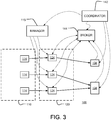
- FIG. 3 shows the procedures and other component that are used to coordinate establishing connections between the processes 124 (e.g., Hadoop map procedures) and processes 134, where data provided by the processes 124 is further processed.
- the dotted lines illustrate paths of control communication used in establishing the connections.
- a coordinator 142 is responsible for causing the processing by a number of processes 134 of data for a particular file or file collection that is resident in the distributed file system 110.
- the coordinator 142 causes the processes 134 to be invoked (e.g., as operating system processes or other computation units within operating system processes).
- the coordinator 142 also passes information to each invoked process 134 so that that process can contact a broker 144, and each invoked process 134 passes information, including information about its location (e.g., identification of the processor hosting the process), to the broker.
- the broker 144 is also invoked by the coordinator 142, or the functions of the coordinator 142 and broker 144 are combined into one unit.
- the coordinator 142 then communicates to a manager 115 of the distributed file system 110 and associated processing system 120.
- the coordinator 142 passes the name of the file or file collection to be processed, as well as the location of the broker 144, to the manager 115.
- the coordinator 142 identifies (e.g., by name, code) to the manager 115 the procedure to be invoked on the processors 120 to extract the parts of the named file.
- the manager 115 determines where the parts 114 (see FIG. 1 ) of the named file are resident, and based on this determines on which processors 120 (see FIG. 1 ) to invoke the procedure as one of the processes 124.
- the invoked processes 124 are informed at the time they are invoked or through subsequent communication with the manager 115 as to how to contact the broker 144.
- Each process 124 contacts the broker requesting information, such as an address, at which to contact one of the processes 134 that will receive the data.
- the broker selects one of processes 134 according to the location of the process, for example, to reduce communication overhead in the data transfer from the requesting extraction process 124 and the receiving process 134 (e.g., by co-locating the processes on one processor), and sends the address information for the selected processes 134 back to the extraction process 124.
- the processes 124 then contacts the process 134 to establish the data connection.
- the functions of an explicit broker 144 is not necessary in all implementations.
- the processes 124 can use a network broadcast approach to invite processes 134 to respond to form the connections, and the processes 134 can respond individually, or coordinate as a group to respond to the processes 124 to form the connections.
- the manager 115 is implemented as a native part of a MapReduce System.
- the coordinator 142 (which is not native to the MapReduce System) specifies the file name and a Map function to execute, without specifying a corresponding Reduce processing.
- the manager 115 follows conventional MapReduce processing to orchestrate the execution of the specified Map function as the processes 124 according to its awareness of the locations of the parts of the named file in the filesystem.
- the specification of the Map function incorporates the information necessary for each instance of the Map function to communicate with the broker 144, and thereby forms the data connection with a process 134 of the computation system 130.
- the distributed processing system 120 and the computation system 130 are not necessarily hosted on different computer processing nodes.
- a common set of processors e.g., processing nodes, servers
- an efficient data passing approach can be used, for example, using Unix named pipes, message passing through shared memory, etc.
- the extraction processes may be implemented in Java as separate tasks within a Java Virtual Machine (JVM) while a process 134 may be implemented as an operating system process, for example, implemented in C or C++.
- JVM Java Virtual Machine
- the computation system 130 may have various forms.
- the system implements a dataflow graph that include vertices (representing data processing components) connected by directed links (representing flows of work elements, i.e., data) between the vertices.
- vertices representing data processing components
- directed links representing flows of work elements, i.e., data
- U.S. Publication No. 2007/0011668 titled "Managing Parameters for Graph-Based Applications”
- a system for executing such graph-based computations is described in U.S. Patent 5,966,072 , titled “EXECUTING COMPUTATIONS EXPRESSED AS GRAPHS,”.
- the processes 134 may implement a subset of the components of the dataflow graph, and provide outputs to yet other components.
- a dataflow graph may include a component that is configured to execute in parallel with multiple instances of that component executing on different computation nodes.
- Each of the processes 134 may be executing as one of the instances of a parallel component that reads data from the distributed processing system 120.
- the processes 134 may form part of a database system.
- the parts 114 of a file may represent parts of a database table, and the processes 134 are configured to process a database table in parallel, for example, as part of executing a query involving one or more tables.
- the function of the manager 115 is combined with the coordinator 142, and optionally the functions of the extraction processes 124 and destination processes 134 may be combined.
- the coordinator/manager uses the name of the file or file collection to access a catalog in the distributed file system to determine the storages 112 on which the parts of those files are stored, and optionally to determine the record structure of the data in those files.
- the coordinator/manager then invokes the extraction procedures 124, or combine extraction and processing procedures on the appropriate processors selected in the same or similar manner as described above for the manager 115.
- the same named file or file collection is first processed to build and store an index of records in the file.
- the coordinator/manager wishes to extract a subset of the records matching a query
- the index is read in and the extraction procedures are invoked on the processors so that less than the whole file or file collection needs to be read, for example, reading only the matching records of the file or file collection, thereby increasing the efficiency of the extraction function.
- processors are not necessarily implemented as operating system processes (e.g., executed in a Unix environment with an exec() system call).
- Alternatives include lightweight processes (e.g., threads) within a context of an operating system process, applications executing with a virtual machine environment (e.g., Java applications or applets executing with a Java Virtual Machine (JVM)), tasks explicitly scheduled within the context of a process without the use of operating system primitives such as threads, or virtual machines executing within a context of hypervisors.
- Java applications or applets executing with a Java Virtual Machine (JVM)
- JVM Java Virtual Machine
- the processes 124 executed in the distributed processing system 120 are not necessarily limited to transfer of data between the filesystem 110 and the computation system 130. In some examples, these processes are further configured (e.g., by the coordinator 142, see FIG. 2 ) to perform certain computations on the data. For example, the each process 124 may extract and/or transform fields of records from retrieved from the filesystem.
- the software may include procedures in one or more computer programs that execute on one or more programmed or programmable computing system (which may be of various architectures such as distributed, client/server, or grid) each including at least one processor, at least one data storage system (including volatile and/or non-volatile memory and/or storage elements), at least one user interface (for receiving input using at least one input device or port, and for providing output using at least one output device or port).
- the software may include one or more modules of a larger program, for example, that provides services related to the design, configuration, and execution of dataflow graphs.
- the modules of the program e.g., elements of a dataflow graph
- the software may be provided on a tangible, non-transitory medium, such as a CD-ROM or other computer-readable medium (e.g., readable by a general or special purpose computing system or device), or delivered (e.g., encoded in a propagated signal) over a communication medium of a network to a tangible, non-transitory medium of a computing system where it is executed.
- Some or all of the processing may be performed on a special purpose computer, or using special-purpose hardware, such as coprocessors or field-programmable gate arrays (FPGAs) or dedicated, application-specific integrated circuits (ASICs).
- the processing may be implemented in a distributed manner in which different parts of the computation specified by the software are performed by different computing elements.
- Each such computer program is preferably stored on or downloaded to a computer-readable storage medium (e.g., solid state memory or media, or magnetic or optical media) of a storage device accessible by a general or special purpose programmable computer, for configuring and operating the computer when the storage device medium is read by the computer to perform the processing described herein.
- a computer-readable storage medium e.g., solid state memory or media, or magnetic or optical media
- the inventive system may also be considered to be implemented as a tangible, non-transitory medium, configured with a computer program, where the medium so configured causes a computer to operate in a specific and predefined manner to perform one or more of the processing steps described herein.
Landscapes
- Engineering & Computer Science (AREA)
- Theoretical Computer Science (AREA)
- Physics & Mathematics (AREA)
- General Engineering & Computer Science (AREA)
- General Physics & Mathematics (AREA)
- Databases & Information Systems (AREA)
- Software Systems (AREA)
- Data Mining & Analysis (AREA)
- Fuzzy Systems (AREA)
- Mathematical Physics (AREA)
- Probability & Statistics with Applications (AREA)
- Computational Linguistics (AREA)
- Information Retrieval, Db Structures And Fs Structures Therefor (AREA)
- Computer And Data Communications (AREA)
- User Interface Of Digital Computer (AREA)
- Computer Hardware Design (AREA)
- Quality & Reliability (AREA)
Description
- This invention relates to parallel access to data in a distributed file system.
- An example of a distributed file system is the Hadoop Distributed File System (HDFS). HDFS is a distributed, scalable, and portable file system written in Java. The HDFS has a set of nodes ("datanodes") that hold data for the files in the file system, and can server up blocks of the files over a data network. Each file is generally distributed over multiple nodes. A directory for the file system is maintained by a set of nodes ("namenodes"). This directory can be used to identify the locations of the distributed blocks for each named file in the filesystem.
- Referring to
FIGS. 1A-B , one way of processing data in a distributed file system, for example in the HDFS, is using a MapReduce programming model. Generally, a MapReduce program includes a Map procedure that performs filtering and sorting (such as sorting students by first name into queues, one queue for each name) and a Reduce procedure that performs a summary operation (such as counting the number of students in each queue, yielding name frequencies). A user of the system specifies the Map and Reduce procedures, but does not necessarily determine the number of instances (or invocations) of each procedure (i.e., "processes") or the nodes on which they execute. Rather, a "MapReduce System" (also called "infrastructure", "framework") orchestrates by marshaling a set of distributed nodes, running the various tasks (e.g., the Map and Reduce procedures and associated communication) in parallel, managing all communications and data transfers between the various parts of the system, providing for redundancy and failures, and overall management of the whole process. A MapReduce system can schedule execution of instances of Map or Reduce procedures with an awareness of the data location. InFIG. 1A , the HDFS is an example of adistributed filesystem 110 and the Hadoop framework is an example of a distributed processing system, such that a set ofmap procedures 24 execute onprocessors 122 in parallel to processparts 14 of a distributed file andstore output files 16 in thefilesystem 110. InFIG. 1B a set of reduceprocedures 26 process the outputs of the map procedures to produceoutput files 18 completing the MapReduce execution. - Although there are computational advantages that can be gained using a distributed file system that is integrated with a MapReduce system, access to data for processing with other programming paradigms can be inefficient. For example, extraction of data may result in a bottleneck, for example, passing all the data for a file through a single data stream, even if the processing of the data is itself parallel. For example, the HDFS provides a filesystem command (hadoop fs -catfile) which passes the content of the file to the standard output and potentially streamed to a process or server where the contents may be processed in parallel.
- One approach to avoiding this type of bottleneck is to explicitly divide large files into separate named parts (i.e., with individual entries in the directory), and then cause each part to be extracted in a separate stream. However, such approaches may have disadvantages, for instance, requiring a prior decision as to the number of parts, and potential suboptimal selection of nodes on which to extract the parts, for example, because the named parts are themselves distributed.
- Another approach to providing data from a distributed filesystem to an application, for instance to a database engine, is to implement the application within or tightly coupled to the filesystem. However, such an approach can be limited to processing using a specific application, and does not necessarily benefit from advances in implementations of the application that are not ported into the filesystem.
-
US2011276962 discloses receiving an untrusted application at a data center including one or more processing modules and providing a native processing environment. The untrusted application includes a data parallel pipeline. Secured processing environments are used to execute the untrusted application. - Shrideep Pallickara et al, "Granules: A lightweight, streaming runtime for cloud computing with support for Map-Reduce", IEEE INTERNATIONAL CONFERENCE ON CLUSTER COMPUTING AND WORKSHOPS, 2009, pages 1-10 discloses executing map/reduce procedures concurrently in a distributed/cloud architecture.
- In one aspect, in general, a new approach to parallel extraction of data from a distributed filesystem provides parallel access to one or more named units (e.g., files) in the filesystem by creating multiple parallel data streams such that all the data of the desired units is partitioned over the multiple streams. In some examples, the multiple streams form multiple inputs to a parallel implementation of a computation system, such as a graph-based computation system, dataflow-based system, and/or a (e.g., relational) database system.
- One implementation of the approach makes use of a supervisory or manager function of the file storage system that accepts a specification of one or more named units (e.g., files) in the file system and a specification of a set of destinations for the content of the specified units. The supervisory function then creates multiple executing instances of an extraction procedure. Each instance of the extraction procedure is configured by the supervisory function to access a part of the desired content, and is configured to transfer that content to one of the set of specified destinations, for example, using a data streaming (e.g., TCP streams, local named pipes, etc.). In some examples, the supervisory function also receives other information such as a desired number of (or limits on) instances of the extraction procedures, particular computational procedures to execute on the extracted content before transmission to the destinations, or information regarding desired locations (e.g., nodes) at which the extraction procedures are to be hosted.
- A variety of approaches can be used to specify the set of destinations and to establish the connections between the extraction procedures and the consumers of the data from those procedures. In one example, the set of destinations has a name, and each extraction procedure is configured with a way to access (e.g., a network address of) a shared "broker". Before transferring data, the extraction procedure communicates with the broker, which provides a specific location (e.g., a network address) to the destination of the content from the requesting extraction process.
- One implementation of the extraction procedure makes use of a standard Map function (e.g., with no Reduce stage). A standard supervisory function determines where to execute instances of the Map and the segments of the desired files that are processed by the Map. The specific procedure performed by the map (e.g., a user specified output filter of the Map) then streams the content to the desired destination rather than causing it to be stored on the file system.
- In some versions of the system, instances of the processes that are consumers or potential consumers of the extracted content execute on the same computation nodes that are available to host the extraction procedures, and a decision process implemented by the broker may attempt to co-locate the extraction procedures and the consumers of the data extracted by the extraction procedures, thereby permitting local transfer of the content for processing (e.g., through in-memory messaging, UNIX named pipes, etc.). In some such versions, the broker selects destinations for the extracted data from each extraction procedure, for instance, by selecting a destination process that is co-located on a same computation node as the extraction procedure.
- In some implementations, certain processing may be efficiently implemented within or tightly linked with the extraction procedures. For example, certain data filtering, format restructuring, or in some cases certain aggregation tasks, may be hosted within the extraction procedure.
- According to a first aspect, there is provided a method for processing data according to
claim 1. - In another aspect, there is provided software stored on a non-transitory computer-readable medium, for processing data according to the method of claim 13.
- In another aspect, there is provided a system for processing data according to
claim 14. - One or more aspects of the approach address the technical problem of efficient access to data stored in a distributed filesystem. A technical solution of invoking multiple instances of an extraction procedure (e.g., under the control of supervisor or manager), each providing a stream of data to a computation system, permits the multiple instances of the extraction procedure to have efficient parallel access to the data. This solution has a technical advantage of avoiding a bottleneck in extraction of the data, for example using a native filesystem command (e.g., the "hadoop fs -cat file" command). By avoiding the bottleneck, it can be feasible to perform data processing in a separate computation system, thereby not being limited to the forms of computation (e.g., MapReduce) that may be available on the filesystem.
- One or more aspects provide computational advantages over a conventional Hadoop system. Ordinarily, Hadoop works on a MapReduce paradigm where the outputs of the Map jobs as well as the outputs of the Reduce jobs are written to files. While this is highly parallel, is suffers from input/output challenges due to multiple file writes. Ordinarily, this is tolerated because of the benefits of parallelism that people get with Hadoop. Nevertheless, the benefits of parallelism can be achieved without the input/output cost by the approaches described herein. In some examples, efficiency is achieved by intercepting the output of the Map jobs in parallel and, without writing those results to files and instead transmitting them via TCP/IP to a parallel operating system that is capable of processing the data in parallel. Such a method thereby achieves both parallel speed and no file input/output cost. Another benefit is that MapReduce is relatively inflexible and not nimble, and does not join well with other databases, and by bringing the data out of the MapReduce paradigm, additional flexibility, interoperability, efficiency, speed, etc. can be obtained.
- Other features and advantages of the invention will become apparent from the following description, and from the claims.
-
-
FIGS 1A and1B are block diagrams illustrating map and reduce operations, respectively. -
FIG. 2 is a block diagram of a system for providing parallel access to a distributed file system. -
FIG. 3 is a block diagram of the system that illustrates control communication for establishing the parallel access to the filesystem. - Referring to
FIG. 2 , acomputing system 100 includes a distributedfile system 110, a distributedprocessing system 120, and also includes or has access to acomputation system 130. One example of afile system 110 of this type is a Hadoop Distributed File System (HDFS), and the distributedprocessing system 120 is the Hadoop framework, but it should be understood that the approaches described herein are not limited to use in conjunction with a HDFS. The distributedfile system 110 includes storage for a number of named units, which are referred to below as "files" without intending to connote particular attributes with the word "file." In general, the names of the files may include paths that reference containing units, such as folders. In general, each file may have portions of it stored on different data storages 112 (e.g., disk subsystems) of the file system. - In some implementations, the approaches described above make use of a Hadoop framework to cause execution of copies of
map procedures 124 in parallel onprocessors 122, such that themap procedures 124 efficiently accessparts 114 of a named filed in the Hadoop filesystem. However, rather than using the Hadoop framework to cause the map procedures to store intermediate files in the Hadoop filesystem, in a manner as illustrated inFIG. 1A , for further processing in a reduce phase in a manner illustrated inFIG. 1B , themap procedures 124 are configured to stream data determined from thefile parts 114 directly to acomputation system 130 in multiple separate stream without requiring intermediate data to be stored in the Hadoop filesystem. The Hadoop system can determine the number of andappropriate processors 122 on which to execute themap procedures 124 should execute, thereby providing efficient access to theparts 114. In such implementations, because the data is passed directly from the map procedures, the reduce procedures can be omitted. Note that the description below is not limited to the implementations that make use of a Hadoop infrastructure. - One function that is supported by the
computing system 100 is a parallel extraction of the contents of one or a collection of named units in thefile system 110 for processing in thecomputation system 130. In general, thecomputation system 130 has the capability of receiving and processing multiple streams of data more efficiently than if all the data were passed through a single stream. In some examples, these streams make use of TCP/IP based sessions over a local area network, and other forms of data transfer (e.g., using Unix named pipes) are used in other examples. Note that the reference to the data being transferred as "streams" should be understood in its generality, and not to connote any particular mode of data transfer (e.g., "streaming"). - A representative named unit is represented in
FIG. 2 as havingparts 114 resident in multiple of the data storages 112. The parallel extraction function provides a transfer of data in theseparts 114 toprocesses 134 in thecomputation system 130. For example, eachprocess 134 may be able to access one or more data streams. So in some cases, there may be a one-to-one correspondence betweenparts 114 of the data and processes 134, but more generally there may be a many-to-one relationship between the parts and the processes. In some embodiments, a named unit stored in the distributedfile system 110 is made up of a set of subunits, which for the sake of description are referred to here as "records" without intending to connote particular characteristics to these subunits. Eachpart 114 of the named unit in the file system is made up of one or more of these records. In the discussion below, these records are treated as being unordered. However, the records may be ordered being associated with (e.g., stored in conjunction with the records) record numbers that can be used to reconstruct the order for the entire file. - The distributed
processing system 120 has a number of separate processors 122 (e.g., physical or virtual computation nodes, servers, and/or other units providing computation services). Each processor has access to one or more of the data storages 112 (e.g., physical or logical disks, multiple disk subsystems, etc.). In general, aparticular processor 122 can access one or more of the data storages 112 more efficiently than others. For example, aprocessor 122 may be able to access astorage 112 that has a local data connection to that processor more efficiently than it is able to access astorage 112 that requires the data to be transferred over a local area network. During performance of the extraction function, an extraction process 124 (e.g., an operating system process or a computation unit within an operating system process) is executed on each or multiple of theprocessors 122 of the distributed processing system. Each process accesses one ormore parts 114 of the file to be extracted, and contents of that part (e.g., the records) pass over data connection to one of theprocesses 134 of thecomputation system 130. - Referring to
FIG. 3 , an embodiment of the parallel extraction function makes use of a number of elements that coordinate the invocation of processes involved in the extraction process and aid in the establishing of data connections between these processes.FIG. 3 shows the procedures and other component that are used to coordinate establishing connections between the processes 124 (e.g., Hadoop map procedures) and processes 134, where data provided by theprocesses 124 is further processed. The dotted lines illustrate paths of control communication used in establishing the connections. In this embodiment, acoordinator 142 is responsible for causing the processing by a number ofprocesses 134 of data for a particular file or file collection that is resident in the distributedfile system 110. Thecoordinator 142 causes theprocesses 134 to be invoked (e.g., as operating system processes or other computation units within operating system processes). Thecoordinator 142 also passes information to each invokedprocess 134 so that that process can contact abroker 144, and each invokedprocess 134 passes information, including information about its location (e.g., identification of the processor hosting the process), to the broker. In some implementation, thebroker 144 is also invoked by thecoordinator 142, or the functions of thecoordinator 142 andbroker 144 are combined into one unit. Thecoordinator 142 then communicates to amanager 115 of the distributedfile system 110 and associatedprocessing system 120. Thecoordinator 142 passes the name of the file or file collection to be processed, as well as the location of thebroker 144, to themanager 115. - At this time, or in a prior configuration, the
coordinator 142 identifies (e.g., by name, code) to themanager 115 the procedure to be invoked on theprocessors 120 to extract the parts of the named file. Themanager 115 determines where the parts 114 (seeFIG. 1 ) of the named file are resident, and based on this determines on which processors 120 (seeFIG. 1 ) to invoke the procedure as one of theprocesses 124. The invoked processes 124 are informed at the time they are invoked or through subsequent communication with themanager 115 as to how to contact thebroker 144. Eachprocess 124 contacts the broker requesting information, such as an address, at which to contact one of theprocesses 134 that will receive the data. In at least some implementations, the broker selects one ofprocesses 134 according to the location of the process, for example, to reduce communication overhead in the data transfer from the requestingextraction process 124 and the receiving process 134 (e.g., by co-locating the processes on one processor), and sends the address information for the selectedprocesses 134 back to theextraction process 124. Theprocesses 124 then contacts theprocess 134 to establish the data connection. - At this point the data connections between the data storages 112, the
processes 124, and theprocesses 134, (shown in bold lines inFIG. 2 ) are established, and theprocesses 124 begin to transfer data in parallel from the distributedfile system 110 to theprocesses 134 of thecomputation system 130. - Note that the function of an
explicit broker 144 is not necessary in all implementations. For example, theprocesses 124 can use a network broadcast approach to inviteprocesses 134 to respond to form the connections, and theprocesses 134 can respond individually, or coordinate as a group to respond to theprocesses 124 to form the connections. - In one specific implementation in which the distributed file system is a Hadoop Distributed File System (HDFS), the
manager 115 is implemented as a native part of a MapReduce System. In this implementation, the coordinator 142 (which is not native to the MapReduce System) specifies the file name and a Map function to execute, without specifying a corresponding Reduce processing. Themanager 115 follows conventional MapReduce processing to orchestrate the execution of the specified Map function as theprocesses 124 according to its awareness of the locations of the parts of the named file in the filesystem. The specification of the Map function incorporates the information necessary for each instance of the Map function to communicate with thebroker 144, and thereby forms the data connection with aprocess 134 of thecomputation system 130. - It should be understood that the distributed
processing system 120 and thecomputation system 130 are not necessarily hosted on different computer processing nodes. For example, as introduced above, a common set of processors (e.g., processing nodes, servers) may be used by themanager 115 to host theprocesses 124, and be used by thecoordinator 142 to host theprocesses 134, which actually process the data. In some examples, when the communication between aprocess 124 and aprocess 134 does not pass between nodes, an efficient data passing approach can be used, for example, using Unix named pipes, message passing through shared memory, etc. Note that usingseparate extraction processes 124 andprocesses 134 which receive the data permits different types of software to be executed while maintaining efficient communication between them. For example, the extraction processes may be implemented in Java as separate tasks within a Java Virtual Machine (JVM) while aprocess 134 may be implemented as an operating system process, for example, implemented in C or C++. - The
computation system 130 may have various forms. As one example, the system implements a dataflow graph that include vertices (representing data processing components) connected by directed links (representing flows of work elements, i.e., data) between the vertices. For example, such an environment is described in more detail inU.S. Publication No. 2007/0011668 , titled "Managing Parameters for Graph-Based Applications,". A system for executing such graph-based computations is described inU.S. Patent 5,966,072 , titled "EXECUTING COMPUTATIONS EXPRESSED AS GRAPHS,". In this example, theprocesses 134 may implement a subset of the components of the dataflow graph, and provide outputs to yet other components. For example, a dataflow graph may include a component that is configured to execute in parallel with multiple instances of that component executing on different computation nodes. Each of theprocesses 134 may be executing as one of the instances of a parallel component that reads data from the distributedprocessing system 120. - As other examples, the
processes 134 may form part of a database system. For example, theparts 114 of a file may represent parts of a database table, and theprocesses 134 are configured to process a database table in parallel, for example, as part of executing a query involving one or more tables. - In some implementations, the function of the
manager 115 is combined with thecoordinator 142, and optionally the functions of the extraction processes 124 and destination processes 134 may be combined. In one such implementation, the coordinator/manager uses the name of the file or file collection to access a catalog in the distributed file system to determine thestorages 112 on which the parts of those files are stored, and optionally to determine the record structure of the data in those files. The coordinator/manager then invokes theextraction procedures 124, or combine extraction and processing procedures on the appropriate processors selected in the same or similar manner as described above for themanager 115. In some implementations, the same named file or file collection is first processed to build and store an index of records in the file. Later, when the coordinator/manager wishes to extract a subset of the records matching a query, the index is read in and the extraction procedures are invoked on the processors so that less than the whole file or file collection needs to be read, for example, reading only the matching records of the file or file collection, thereby increasing the efficiency of the extraction function. - Note that there are many alternatives for implementation of the approaches described above. In particular, the components that are referred to as "processes" are not necessarily implemented as operating system processes (e.g., executed in a Unix environment with an exec() system call). Alternatives include lightweight processes (e.g., threads) within a context of an operating system process, applications executing with a virtual machine environment (e.g., Java applications or applets executing with a Java Virtual Machine (JVM)), tasks explicitly scheduled within the context of a process without the use of operating system primitives such as threads, or virtual machines executing within a context of hypervisors.
- In some embodiments, the
processes 124 executed in the distributedprocessing system 120 are not necessarily limited to transfer of data between thefilesystem 110 and thecomputation system 130. In some examples, these processes are further configured (e.g., by thecoordinator 142, seeFIG. 2 ) to perform certain computations on the data. For example, the eachprocess 124 may extract and/or transform fields of records from retrieved from the filesystem. - The approach described above can be implemented using a computing system executing suitable software. For example, the software may include procedures in one or more computer programs that execute on one or more programmed or programmable computing system (which may be of various architectures such as distributed, client/server, or grid) each including at least one processor, at least one data storage system (including volatile and/or non-volatile memory and/or storage elements), at least one user interface (for receiving input using at least one input device or port, and for providing output using at least one output device or port). The software may include one or more modules of a larger program, for example, that provides services related to the design, configuration, and execution of dataflow graphs. The modules of the program (e.g., elements of a dataflow graph) can be implemented as data structures or other organized data conforming to a data model stored in a data repository.
- The software may be provided on a tangible, non-transitory medium, such as a CD-ROM or other computer-readable medium (e.g., readable by a general or special purpose computing system or device), or delivered (e.g., encoded in a propagated signal) over a communication medium of a network to a tangible, non-transitory medium of a computing system where it is executed. Some or all of the processing may be performed on a special purpose computer, or using special-purpose hardware, such as coprocessors or field-programmable gate arrays (FPGAs) or dedicated, application-specific integrated circuits (ASICs). The processing may be implemented in a distributed manner in which different parts of the computation specified by the software are performed by different computing elements. Each such computer program is preferably stored on or downloaded to a computer-readable storage medium (e.g., solid state memory or media, or magnetic or optical media) of a storage device accessible by a general or special purpose programmable computer, for configuring and operating the computer when the storage device medium is read by the computer to perform the processing described herein. The inventive system may also be considered to be implemented as a tangible, non-transitory medium, configured with a computer program, where the medium so configured causes a computer to operate in a specific and predefined manner to perform one or more of the processing steps described herein.
- A number of embodiments of the invention have been described. Nevertheless, it is to be understood that the foregoing description is intended to illustrate and not to limit the scope of the invention, which is defined by the scope of the following claims Additionally, some of the steps described above may be order independent, and thus can be performed in an order different from that described.
Claims (14)
- A method for processing data, the method including:receiving by a distributed processing system (120) implementing a map-reduce data processing framework, a first specification of one or more named files (114) having portions stored on different data storage elements in a distributed filesystem (110) of the distributed processing system (120), the distributed processing system configured to invoke a first type of software processes, the first type of software being a map-reduce data processing framework native to the distributed processing system;receiving by the distributed processing system (120) a second specification specifying one or more destination processes (134) on a computation system (130) separate from the distributed processing system, the one or more destination processes (134), invoked according to a second type of software processes different from the first type, map-reduce data processing framework, software processes native to distributed processing system, to receive and process multiple streams of data through respective data connections established according to the second specification;invoking a first plurality of extraction processes (124) on the distributed processing system (120), each extraction process of the first plurality of extraction processes being of the first type of the processes for the distributed processing system and executing an instance (124) of a map procedure of the map-reduce data processing framework to establish a data connection with one of the different storage elements (112) of the distributed filesystem (110) for accessing a corresponding part (114) of the one or more named files in the distributed filesystem according to the first specification;using the second specification specifying the one or more destination processes to establish a plurality of data connections between the executing instances (124) of the map procedure on the distributed processing system (120) and the computation system (130), at least one data connection being formed between each of the one or more destinations processes (134) of the computation system (130) and the first plurality of extraction processes (124) of the distributed processing system (120) ;passing data of the one more more named files concurrently over the plurality of data connections from the distributed processing system (120) to the computation system (130) via the multiple streams; andprocessing the received data in the computation system (130).
- The method of claim 1 wherein passing the data concurrently includes extracting the data from the filesystem (110) by the processes of the first plurality of processes (124), and transmitting the extracted data from said processes (124) to the computation system (130) without further storage in the distributed file system (110).
- The method of claim 1 wherein accepting the first specification of the one or more named files includes accepting a text filename of the one or more named files.
- The method of claim 1 wherein the parts (114) of the one or more named files are unnamed.
- The method of claim 1 wherein accepting the second specification for establishing the data connections includes accepting a specification of a broker (144) and forming the data connections includes each process of the first plurality of processes (124) communicating with the broker (144) to determine a further specification for establishing a data connection with the computation system (130).
- The method of claim 1 wherein accepting the second specification for establishing the data connections includes accepting a specification for a broadcast to the computation system (130).
- The method of claim 1 wherein the computation system (130) includes a second plurality of processes (134), and wherein forming the data connection between each process of the first plurality of processes (124) and the computation system (130) includes forming data connections between the processes of the first plurality of processes (124) and processes of the second plurality of processes (134), and wherein the method further includes invoking the processes of the second plurality of processes (134) of the computation system (130).
- The method of claim 7 wherein at least some of the first plurality of processes (124) and some of the second plurality of processes (134) are executed on a common set of processors (122).
- The method of claim 7 wherein forming the data connection between each process of the first plurality of processes (124) and the computation system (130) includes forming separate data connections between each process of the first plurality of processes (124) and a respective process of the second plurality of processes (134).
- The method of claim 1 wherein the distributed processing system (120) and the computation system (130) use distinct computing resources coupled over a data network, or the distributed processing system and the computation system share computing resources.
- The method of claim 1, wherein invoking the first plurality of extraction processes (124) on the distributed processing system (120) includes invoking the first plurality of extraction processes based on the first specification and second specification from a coordinator system (142) that is non-native to the distributed processing system (120).
- The method of claim 1, wherein using the second specification to establish the plurality of data connections includes selecting a particular destination process, from the one or more destination processes (134), to connect to a respective executing instance of the map procedure based on location information, provided in the second specification, identifying location of a processor executing the particular destination process so that communication overhead to transfer data between the executing instances (124) of the map procedure and the one or more destination processes (134) is reduced.
- A computer readable medium having recorded thereon a computer-readable program comprising code means adapted to perform a method according to any of claims 1 to 12.
- A system (100) for processing data, the system including:a distributed processing system (120) that includes a distributed filesystem (110); anda computation system (130) separate from the distributed processing system (120);wherein the distributed processing system (120) is configured to perform a method according to any of claims 1-12.
Applications Claiming Priority (2)
| Application Number | Priority Date | Filing Date | Title |
|---|---|---|---|
| US14/090,434 US10776325B2 (en) | 2013-11-26 | 2013-11-26 | Parallel access to data in a distributed file system |
| PCT/US2014/066781 WO2015080962A1 (en) | 2013-11-26 | 2014-11-21 | Parallel access to data in a distributed file system |
Publications (2)
| Publication Number | Publication Date |
|---|---|
| EP3074887A1 EP3074887A1 (en) | 2016-10-05 |
| EP3074887B1 true EP3074887B1 (en) | 2021-01-06 |
Family
ID=52021459
Family Applications (1)
| Application Number | Title | Priority Date | Filing Date |
|---|---|---|---|
| EP14810094.4A Active EP3074887B1 (en) | 2013-11-26 | 2014-11-21 | Parallel access to data in a distributed file system |
Country Status (8)
| Country | Link |
|---|---|
| US (2) | US10776325B2 (en) |
| EP (1) | EP3074887B1 (en) |
| JP (1) | JP6580566B2 (en) |
| KR (1) | KR102361156B1 (en) |
| CN (1) | CN105765578B (en) |
| AU (2) | AU2014354970B2 (en) |
| CA (1) | CA2929618C (en) |
| WO (1) | WO2015080962A1 (en) |
Families Citing this family (15)
| Publication number | Priority date | Publication date | Assignee | Title |
|---|---|---|---|---|
| US7590620B1 (en) * | 2004-06-18 | 2009-09-15 | Google Inc. | System and method for analyzing data records |
| US10776325B2 (en) | 2013-11-26 | 2020-09-15 | Ab Initio Technology Llc | Parallel access to data in a distributed file system |
| US10325032B2 (en) | 2014-02-19 | 2019-06-18 | Snowflake Inc. | Resource provisioning systems and methods |
| US9607073B2 (en) | 2014-04-17 | 2017-03-28 | Ab Initio Technology Llc | Processing data from multiple sources |
| US10013443B2 (en) * | 2015-06-25 | 2018-07-03 | Bank Of America Corporation | Comparing data stores using hash sums on disparate parallel systems |
| TWI547822B (en) * | 2015-07-06 | 2016-09-01 | 緯創資通股份有限公司 | Data processing method and system |
| US10506016B2 (en) | 2016-05-19 | 2019-12-10 | Oracle International Corporation | Graph analytic engine that implements efficient transparent remote access over representational state transfer |
| CN106383738B (en) * | 2016-09-30 | 2019-10-11 | 北京百度网讯科技有限公司 | Task Processing Method and Distributed Computing Framework |
| US10318355B2 (en) | 2017-01-24 | 2019-06-11 | Oracle International Corporation | Distributed graph processing system featuring interactive remote control mechanism including task cancellation |
| US10534657B2 (en) | 2017-05-30 | 2020-01-14 | Oracle International Corporation | Distributed graph processing system that adopts a faster data loading technique that requires low degree of communication |
| US9934287B1 (en) | 2017-07-25 | 2018-04-03 | Capital One Services, Llc | Systems and methods for expedited large file processing |
| CN107885779A (en) * | 2017-10-12 | 2018-04-06 | 北京人大金仓信息技术股份有限公司 | A kind of method of Spark concurrent accesses MPP databases |
| US11360983B2 (en) * | 2019-03-01 | 2022-06-14 | Hitachi Vantara Llc | Techniques for processing of data in motion |
| US11436003B2 (en) * | 2019-03-26 | 2022-09-06 | Flowfinity Wireless, Inc. | Non-stop internet-of-things (IoT) controllers |
| US11461130B2 (en) | 2020-05-26 | 2022-10-04 | Oracle International Corporation | Methodology for fast and seamless task cancelation and error handling in distributed processing of large graph data |
Citations (1)
| Publication number | Priority date | Publication date | Assignee | Title |
|---|---|---|---|---|
| US20070011668A1 (en) * | 2005-06-27 | 2007-01-11 | Wholey J S | Managing parameters for graph-based computations |
Family Cites Families (51)
| Publication number | Priority date | Publication date | Assignee | Title |
|---|---|---|---|---|
| US5226159A (en) * | 1989-05-15 | 1993-07-06 | International Business Machines Corporation | File lock management in a distributed data processing system |
| US6446070B1 (en) * | 1998-02-26 | 2002-09-03 | Sun Microsystems, Inc. | Method and apparatus for dynamic distributed computing over a network |
| US5966072A (en) * | 1996-07-02 | 1999-10-12 | Ab Initio Software Corporation | Executing computations expressed as graphs |
| US6237009B1 (en) | 1996-10-11 | 2001-05-22 | Sun Microsystems, Inc. | Lease renewal service |
| US5897638A (en) * | 1997-06-16 | 1999-04-27 | Ab Initio Software Corporation | Parallel virtual file system |
| CN1292118A (en) | 1998-02-26 | 2001-04-18 | 太阳微系统公司 | Method and device for dynamic distributed computing on network |
| US6389420B1 (en) * | 1999-09-30 | 2002-05-14 | Emc Corporation | File manager providing distributed locking and metadata management for shared data access by clients relinquishing locks after time period expiration |
| US7587467B2 (en) * | 1999-12-02 | 2009-09-08 | Western Digital Technologies, Inc. | Managed peer-to-peer applications, systems and methods for distributed data access and storage |
| US7146524B2 (en) * | 2001-08-03 | 2006-12-05 | Isilon Systems, Inc. | Systems and methods for providing a distributed file system incorporating a virtual hot spare |
| US7200747B2 (en) * | 2001-10-31 | 2007-04-03 | Hewlett-Packard Development Company, L.P. | System for ensuring data privacy and user differentiation in a distributed file system |
| US7487353B2 (en) * | 2004-05-20 | 2009-02-03 | International Business Machines Corporation | System, method and program for protecting communication |
| US7315926B2 (en) * | 2004-09-21 | 2008-01-01 | Emc Corporation | Lock management for concurrent access to a single file from multiple data mover computers |
| US8775647B2 (en) * | 2007-12-10 | 2014-07-08 | Deluxe Media Inc. | Method and system for use in coordinating multimedia devices |
| KR100907533B1 (en) * | 2007-12-17 | 2009-07-14 | 한국전자통신연구원 | Distributed Distributed Processing Systems and Methods |
| JP5557430B2 (en) * | 2008-04-11 | 2014-07-23 | 日東電工株式会社 | PROTON CONDUCTIVE POLYMER ELECTROLYTE MEMBRANE, PROCESS FOR PRODUCING THE SAME, MEMBRANE-ELECTRODE ASSEMBLY USING THE SAME, AND POLYMER ELECTROLYTE FUEL CELL |
| CN101398771B (en) | 2008-11-18 | 2010-08-18 | 中国科学院软件研究所 | Distributed system access control method based on component and access control system |
| US8966112B1 (en) * | 2009-11-30 | 2015-02-24 | Dell Software Inc. | Network protocol proxy |
| KR101285078B1 (en) * | 2009-12-17 | 2013-07-17 | 한국전자통신연구원 | Distributed parallel processing system and method based on incremental MapReduce on data stream |
| US20120259983A1 (en) | 2009-12-18 | 2012-10-11 | Nec Corporation | Distributed processing management server, distributed system, distributed processing management program and distributed processing management method |
| US8539192B2 (en) | 2010-01-08 | 2013-09-17 | International Business Machines Corporation | Execution of dataflow jobs |
| US8918388B1 (en) | 2010-02-26 | 2014-12-23 | Turn Inc. | Custom data warehouse on top of mapreduce |
| US9805101B2 (en) * | 2010-02-26 | 2017-10-31 | Ebay Inc. | Parallel data stream processing system |
| US8386621B2 (en) * | 2010-03-12 | 2013-02-26 | Netflix, Inc. | Parallel streaming |
| US8555265B2 (en) * | 2010-05-04 | 2013-10-08 | Google Inc. | Parallel processing of data |
| US9495427B2 (en) | 2010-06-04 | 2016-11-15 | Yale University | Processing of data using a database system in communication with a data processing framework |
| US8751682B2 (en) * | 2010-09-27 | 2014-06-10 | Z124 | Data transfer using high speed connection, high integrity connection, and descriptor |
| US20120239612A1 (en) | 2011-01-25 | 2012-09-20 | Muthian George | User defined functions for data loading |
| KR101231294B1 (en) * | 2011-05-31 | 2013-02-07 | 삼성에스디에스 주식회사 | Stream Controlling Method and Apparatus for Parallel Receiving of Data |
| US8954568B2 (en) | 2011-07-21 | 2015-02-10 | Yahoo! Inc. | Method and system for building an elastic cloud web server farm |
| US8356050B1 (en) | 2011-11-21 | 2013-01-15 | Yahoo! Inc. | Method or system for spilling in query environments |
| US9172608B2 (en) | 2012-02-07 | 2015-10-27 | Cloudera, Inc. | Centralized configuration and monitoring of a distributed computing cluster |
| JP5966404B2 (en) | 2012-02-14 | 2016-08-10 | 日本電気株式会社 | Distributed file access device, distributed file access system, distributed file access method, and distributed file access program |
| US9268590B2 (en) | 2012-02-29 | 2016-02-23 | Vmware, Inc. | Provisioning a cluster of distributed computing platform based on placement strategy |
| US9195684B2 (en) | 2012-03-02 | 2015-11-24 | Cleversafe, Inc. | Redundant task execution in a distributed storage and task network |
| US9367601B2 (en) | 2012-03-26 | 2016-06-14 | Duke University | Cost-based optimization of configuration parameters and cluster sizing for hadoop |
| US9158843B1 (en) | 2012-03-30 | 2015-10-13 | Emc Corporation | Addressing mechanism for data at world wide scale |
| US9081772B1 (en) * | 2012-04-26 | 2015-07-14 | Pivotal Software, Inc. | Method and apparatus for acid validation within a distributed relational database under controlled concurrent workloads |
| US20130325814A1 (en) | 2012-05-30 | 2013-12-05 | Spectra Logic Corporation | System and method for archive in a distributed file system |
| US9235446B2 (en) * | 2012-06-22 | 2016-01-12 | Microsoft Technology Licensing, Llc | Parallel computing execution plan optimization |
| US9201638B2 (en) | 2012-08-07 | 2015-12-01 | Nec Laboratories America, Inc. | Compiler-guided software accelerator for iterative HADOOP® jobs |
| KR101245994B1 (en) * | 2012-08-31 | 2013-03-20 | 케이씨씨시큐리티주식회사 | Parallel distributed processing system and method |
| CN103714073B (en) | 2012-09-29 | 2017-04-12 | 国际商业机器公司 | Method and device for querying data |
| US8805835B2 (en) * | 2012-12-20 | 2014-08-12 | Clipcard Inc. | Systems and methods for integrated management of large data sets |
| US10476915B2 (en) * | 2013-02-04 | 2019-11-12 | Oracle International Corporation | Real-time communication signaling gateway |
| US9342557B2 (en) | 2013-03-13 | 2016-05-17 | Cloudera, Inc. | Low latency query engine for Apache Hadoop |
| US9292373B2 (en) | 2013-03-15 | 2016-03-22 | International Business Machines Corporation | Query rewrites for data-intensive applications in presence of run-time errors |
| US9113299B2 (en) * | 2013-05-17 | 2015-08-18 | Xerox Corporation | Method and apparatus for automatic mobile endpoint device configuration management based on user status or activity |
| CN103441996B (en) | 2013-08-16 | 2016-09-28 | 上海理工大学 | The method and system of concurrent transmission file |
| US10133800B2 (en) | 2013-09-11 | 2018-11-20 | Microsoft Technology Licensing, Llc | Processing datasets with a DBMS engine |
| US20150127691A1 (en) * | 2013-11-01 | 2015-05-07 | Cognitive Electronics, Inc. | Efficient implementations for mapreduce systems |
| US10776325B2 (en) | 2013-11-26 | 2020-09-15 | Ab Initio Technology Llc | Parallel access to data in a distributed file system |
-
2013
- 2013-11-26 US US14/090,434 patent/US10776325B2/en active Active
-
2014
- 2014-11-21 AU AU2014354970A patent/AU2014354970B2/en active Active
- 2014-11-21 WO PCT/US2014/066781 patent/WO2015080962A1/en not_active Ceased
- 2014-11-21 KR KR1020167016421A patent/KR102361156B1/en active Active
- 2014-11-21 EP EP14810094.4A patent/EP3074887B1/en active Active
- 2014-11-21 CN CN201480064544.2A patent/CN105765578B/en active Active
- 2014-11-21 JP JP2016530184A patent/JP6580566B2/en active Active
- 2014-11-21 CA CA2929618A patent/CA2929618C/en active Active
-
2020
- 2020-08-10 AU AU2020217330A patent/AU2020217330B2/en active Active
- 2020-08-31 US US17/007,368 patent/US11599509B2/en active Active
Patent Citations (1)
| Publication number | Priority date | Publication date | Assignee | Title |
|---|---|---|---|---|
| US20070011668A1 (en) * | 2005-06-27 | 2007-01-11 | Wholey J S | Managing parameters for graph-based computations |
Non-Patent Citations (1)
| Title |
|---|
| SHRIDEEP PALLICKARA ET AL: "Granules: A lightweight, streaming runtime for cloud computing with support, for Map-Reduce", CLUSTER COMPUTING AND WORKSHOPS, 2009. CLUSTER '09. IEEE INTERNATIONAL CONFERENCE ON, IEEE, PISCATAWAY, NJ, USA, 31 August 2009 (2009-08-31), pages 1 - 10, XP031547952, ISBN: 978-1-4244-5011-4 * |
Also Published As
| Publication number | Publication date |
|---|---|
| US20150149503A1 (en) | 2015-05-28 |
| US11599509B2 (en) | 2023-03-07 |
| CA2929618A1 (en) | 2015-06-04 |
| KR20160090840A (en) | 2016-08-01 |
| AU2020217330A1 (en) | 2020-09-03 |
| AU2014354970A1 (en) | 2016-05-26 |
| CA2929618C (en) | 2022-09-27 |
| AU2014354970B2 (en) | 2020-05-21 |
| WO2015080962A1 (en) | 2015-06-04 |
| KR102361156B1 (en) | 2022-02-09 |
| CN105765578A (en) | 2016-07-13 |
| AU2020217330B2 (en) | 2022-03-03 |
| CN105765578B (en) | 2020-04-17 |
| US10776325B2 (en) | 2020-09-15 |
| JP2017506373A (en) | 2017-03-02 |
| EP3074887A1 (en) | 2016-10-05 |
| US20210089503A1 (en) | 2021-03-25 |
| JP6580566B2 (en) | 2019-09-25 |
Similar Documents
| Publication | Publication Date | Title |
|---|---|---|
| AU2020217330B2 (en) | Parallel access to data in a distributed file system | |
| JP7210713B2 (en) | Efficient State Maintenance of Execution Environments in On-Demand Code Execution Systems | |
| US11403308B2 (en) | Processing data from multiple sources | |
| US8572236B2 (en) | Distributing services in graph-based computations | |
| US10853356B1 (en) | Persistent metadata catalog | |
| US10462262B2 (en) | Middleware abstraction layer (MAL) | |
| US12225092B2 (en) | Dynamically routing code for executing | |
| US20220377154A1 (en) | Distributed data stream programming and processing | |
| US11757959B2 (en) | Dynamic data stream processing for Apache Kafka using GraphQL | |
| Sharma et al. | Introduction to apache pulsar | |
| Chawla et al. | Implementing microservices | |
| HK1225118A1 (en) | Parallel access to data in a distributed file system | |
| HK1225118B (en) | Parallel access to data in a distributed file system | |
| US12321769B1 (en) | Incremental snapshots of state information in an on-demand network code execution system | |
| Luu | Spark Streaming | |
| Milosevic et al. | Processing of Business Intelligence using Hadoop Framework | |
| Sileika | Distributed message processing system | |
| Vilensten et al. | Aggregating and utilizing sensor data | |
| Cushing | Data-centric computing on distributed resources | |
| Yin et al. | The Optimization and Improvement of MapReduce in Web Data Mining |
Legal Events
| Date | Code | Title | Description |
|---|---|---|---|
| PUAI | Public reference made under article 153(3) epc to a published international application that has entered the european phase |
Free format text: ORIGINAL CODE: 0009012 |
|
| 17P | Request for examination filed |
Effective date: 20160504 |
|
| AK | Designated contracting states |
Kind code of ref document: A1 Designated state(s): AL AT BE BG CH CY CZ DE DK EE ES FI FR GB GR HR HU IE IS IT LI LT LU LV MC MK MT NL NO PL PT RO RS SE SI SK SM TR |
|
| AX | Request for extension of the european patent |
Extension state: BA ME |
|
| DAX | Request for extension of the european patent (deleted) | ||
| STAA | Information on the status of an ep patent application or granted ep patent |
Free format text: STATUS: EXAMINATION IS IN PROGRESS |
|
| 17Q | First examination report despatched |
Effective date: 20190109 |
|
| REG | Reference to a national code |
Ref country code: DE Ref legal event code: R079 Ref document number: 602014074038 Country of ref document: DE Free format text: PREVIOUS MAIN CLASS: G06F0017300000 Ipc: G06F0016000000 |
|
| GRAP | Despatch of communication of intention to grant a patent |
Free format text: ORIGINAL CODE: EPIDOSNIGR1 |
|
| STAA | Information on the status of an ep patent application or granted ep patent |
Free format text: STATUS: GRANT OF PATENT IS INTENDED |
|
| RIC1 | Information provided on ipc code assigned before grant |
Ipc: G06F 16/00 20190101AFI20200901BHEP Ipc: G06F 16/182 20190101ALI20200901BHEP Ipc: G06F 9/50 20060101ALI20200901BHEP Ipc: G06F 16/18 20190101ALI20200901BHEP |
|
| INTG | Intention to grant announced |
Effective date: 20200930 |
|
| GRAS | Grant fee paid |
Free format text: ORIGINAL CODE: EPIDOSNIGR3 |
|
| GRAA | (expected) grant |
Free format text: ORIGINAL CODE: 0009210 |
|
| STAA | Information on the status of an ep patent application or granted ep patent |
Free format text: STATUS: THE PATENT HAS BEEN GRANTED |
|
| AK | Designated contracting states |
Kind code of ref document: B1 Designated state(s): AL AT BE BG CH CY CZ DE DK EE ES FI FR GB GR HR HU IE IS IT LI LT LU LV MC MK MT NL NO PL PT RO RS SE SI SK SM TR |
|
| REG | Reference to a national code |
Ref country code: GB Ref legal event code: FG4D |
|
| REG | Reference to a national code |
Ref country code: AT Ref legal event code: REF Ref document number: 1353104 Country of ref document: AT Kind code of ref document: T Effective date: 20210115 Ref country code: CH Ref legal event code: EP |
|
| REG | Reference to a national code |
Ref country code: DE Ref legal event code: R096 Ref document number: 602014074038 Country of ref document: DE |
|
| REG | Reference to a national code |
Ref country code: IE Ref legal event code: FG4D |
|
| REG | Reference to a national code |
Ref country code: NL Ref legal event code: MP Effective date: 20210106 |
|
| REG | Reference to a national code |
Ref country code: AT Ref legal event code: MK05 Ref document number: 1353104 Country of ref document: AT Kind code of ref document: T Effective date: 20210106 |
|
| REG | Reference to a national code |
Ref country code: LT Ref legal event code: MG9D |
|
| PG25 | Lapsed in a contracting state [announced via postgrant information from national office to epo] |
Ref country code: GR Free format text: LAPSE BECAUSE OF FAILURE TO SUBMIT A TRANSLATION OF THE DESCRIPTION OR TO PAY THE FEE WITHIN THE PRESCRIBED TIME-LIMIT Effective date: 20210407 Ref country code: FI Free format text: LAPSE BECAUSE OF FAILURE TO SUBMIT A TRANSLATION OF THE DESCRIPTION OR TO PAY THE FEE WITHIN THE PRESCRIBED TIME-LIMIT Effective date: 20210106 Ref country code: HR Free format text: LAPSE BECAUSE OF FAILURE TO SUBMIT A TRANSLATION OF THE DESCRIPTION OR TO PAY THE FEE WITHIN THE PRESCRIBED TIME-LIMIT Effective date: 20210106 Ref country code: PT Free format text: LAPSE BECAUSE OF FAILURE TO SUBMIT A TRANSLATION OF THE DESCRIPTION OR TO PAY THE FEE WITHIN THE PRESCRIBED TIME-LIMIT Effective date: 20210506 Ref country code: LT Free format text: LAPSE BECAUSE OF FAILURE TO SUBMIT A TRANSLATION OF THE DESCRIPTION OR TO PAY THE FEE WITHIN THE PRESCRIBED TIME-LIMIT Effective date: 20210106 Ref country code: BG Free format text: LAPSE BECAUSE OF FAILURE TO SUBMIT A TRANSLATION OF THE DESCRIPTION OR TO PAY THE FEE WITHIN THE PRESCRIBED TIME-LIMIT Effective date: 20210406 Ref country code: NL Free format text: LAPSE BECAUSE OF FAILURE TO SUBMIT A TRANSLATION OF THE DESCRIPTION OR TO PAY THE FEE WITHIN THE PRESCRIBED TIME-LIMIT Effective date: 20210106 Ref country code: NO Free format text: LAPSE BECAUSE OF FAILURE TO SUBMIT A TRANSLATION OF THE DESCRIPTION OR TO PAY THE FEE WITHIN THE PRESCRIBED TIME-LIMIT Effective date: 20210406 |
|
| PG25 | Lapsed in a contracting state [announced via postgrant information from national office to epo] |
Ref country code: PL Free format text: LAPSE BECAUSE OF FAILURE TO SUBMIT A TRANSLATION OF THE DESCRIPTION OR TO PAY THE FEE WITHIN THE PRESCRIBED TIME-LIMIT Effective date: 20210106 Ref country code: LV Free format text: LAPSE BECAUSE OF FAILURE TO SUBMIT A TRANSLATION OF THE DESCRIPTION OR TO PAY THE FEE WITHIN THE PRESCRIBED TIME-LIMIT Effective date: 20210106 Ref country code: RS Free format text: LAPSE BECAUSE OF FAILURE TO SUBMIT A TRANSLATION OF THE DESCRIPTION OR TO PAY THE FEE WITHIN THE PRESCRIBED TIME-LIMIT Effective date: 20210106 Ref country code: AT Free format text: LAPSE BECAUSE OF FAILURE TO SUBMIT A TRANSLATION OF THE DESCRIPTION OR TO PAY THE FEE WITHIN THE PRESCRIBED TIME-LIMIT Effective date: 20210106 Ref country code: SE Free format text: LAPSE BECAUSE OF FAILURE TO SUBMIT A TRANSLATION OF THE DESCRIPTION OR TO PAY THE FEE WITHIN THE PRESCRIBED TIME-LIMIT Effective date: 20210106 |
|
| PG25 | Lapsed in a contracting state [announced via postgrant information from national office to epo] |
Ref country code: IS Free format text: LAPSE BECAUSE OF FAILURE TO SUBMIT A TRANSLATION OF THE DESCRIPTION OR TO PAY THE FEE WITHIN THE PRESCRIBED TIME-LIMIT Effective date: 20210506 |
|
| REG | Reference to a national code |
Ref country code: DE Ref legal event code: R097 Ref document number: 602014074038 Country of ref document: DE |
|
| PG25 | Lapsed in a contracting state [announced via postgrant information from national office to epo] |
Ref country code: SM Free format text: LAPSE BECAUSE OF FAILURE TO SUBMIT A TRANSLATION OF THE DESCRIPTION OR TO PAY THE FEE WITHIN THE PRESCRIBED TIME-LIMIT Effective date: 20210106 Ref country code: CZ Free format text: LAPSE BECAUSE OF FAILURE TO SUBMIT A TRANSLATION OF THE DESCRIPTION OR TO PAY THE FEE WITHIN THE PRESCRIBED TIME-LIMIT Effective date: 20210106 Ref country code: EE Free format text: LAPSE BECAUSE OF FAILURE TO SUBMIT A TRANSLATION OF THE DESCRIPTION OR TO PAY THE FEE WITHIN THE PRESCRIBED TIME-LIMIT Effective date: 20210106 |
|
| PLBE | No opposition filed within time limit |
Free format text: ORIGINAL CODE: 0009261 |
|
| STAA | Information on the status of an ep patent application or granted ep patent |
Free format text: STATUS: NO OPPOSITION FILED WITHIN TIME LIMIT |
|
| PG25 | Lapsed in a contracting state [announced via postgrant information from national office to epo] |
Ref country code: SK Free format text: LAPSE BECAUSE OF FAILURE TO SUBMIT A TRANSLATION OF THE DESCRIPTION OR TO PAY THE FEE WITHIN THE PRESCRIBED TIME-LIMIT Effective date: 20210106 Ref country code: RO Free format text: LAPSE BECAUSE OF FAILURE TO SUBMIT A TRANSLATION OF THE DESCRIPTION OR TO PAY THE FEE WITHIN THE PRESCRIBED TIME-LIMIT Effective date: 20210106 Ref country code: DK Free format text: LAPSE BECAUSE OF FAILURE TO SUBMIT A TRANSLATION OF THE DESCRIPTION OR TO PAY THE FEE WITHIN THE PRESCRIBED TIME-LIMIT Effective date: 20210106 Ref country code: ES Free format text: LAPSE BECAUSE OF FAILURE TO SUBMIT A TRANSLATION OF THE DESCRIPTION OR TO PAY THE FEE WITHIN THE PRESCRIBED TIME-LIMIT Effective date: 20210106 |
|
| 26N | No opposition filed |
Effective date: 20211007 |
|
| PG25 | Lapsed in a contracting state [announced via postgrant information from national office to epo] |
Ref country code: AL Free format text: LAPSE BECAUSE OF FAILURE TO SUBMIT A TRANSLATION OF THE DESCRIPTION OR TO PAY THE FEE WITHIN THE PRESCRIBED TIME-LIMIT Effective date: 20210106 |
|
| PG25 | Lapsed in a contracting state [announced via postgrant information from national office to epo] |
Ref country code: SI Free format text: LAPSE BECAUSE OF FAILURE TO SUBMIT A TRANSLATION OF THE DESCRIPTION OR TO PAY THE FEE WITHIN THE PRESCRIBED TIME-LIMIT Effective date: 20210106 |
|
| PG25 | Lapsed in a contracting state [announced via postgrant information from national office to epo] |
Ref country code: IT Free format text: LAPSE BECAUSE OF FAILURE TO SUBMIT A TRANSLATION OF THE DESCRIPTION OR TO PAY THE FEE WITHIN THE PRESCRIBED TIME-LIMIT Effective date: 20210106 |
|
| PG25 | Lapsed in a contracting state [announced via postgrant information from national office to epo] |
Ref country code: IS Free format text: LAPSE BECAUSE OF FAILURE TO SUBMIT A TRANSLATION OF THE DESCRIPTION OR TO PAY THE FEE WITHIN THE PRESCRIBED TIME-LIMIT Effective date: 20210506 |
|
| PG25 | Lapsed in a contracting state [announced via postgrant information from national office to epo] |
Ref country code: MC Free format text: LAPSE BECAUSE OF FAILURE TO SUBMIT A TRANSLATION OF THE DESCRIPTION OR TO PAY THE FEE WITHIN THE PRESCRIBED TIME-LIMIT Effective date: 20210106 |
|
| REG | Reference to a national code |
Ref country code: CH Ref legal event code: PL |
|
| PG25 | Lapsed in a contracting state [announced via postgrant information from national office to epo] |
Ref country code: LU Free format text: LAPSE BECAUSE OF NON-PAYMENT OF DUE FEES Effective date: 20211121 Ref country code: BE Free format text: LAPSE BECAUSE OF NON-PAYMENT OF DUE FEES Effective date: 20211130 |
|
| REG | Reference to a national code |
Ref country code: BE Ref legal event code: MM Effective date: 20211130 |
|
| PG25 | Lapsed in a contracting state [announced via postgrant information from national office to epo] |
Ref country code: LI Free format text: LAPSE BECAUSE OF NON-PAYMENT OF DUE FEES Effective date: 20211130 Ref country code: CH Free format text: LAPSE BECAUSE OF NON-PAYMENT OF DUE FEES Effective date: 20211130 |
|
| PG25 | Lapsed in a contracting state [announced via postgrant information from national office to epo] |
Ref country code: IE Free format text: LAPSE BECAUSE OF NON-PAYMENT OF DUE FEES Effective date: 20211121 |
|
| PG25 | Lapsed in a contracting state [announced via postgrant information from national office to epo] |
Ref country code: HU Free format text: LAPSE BECAUSE OF FAILURE TO SUBMIT A TRANSLATION OF THE DESCRIPTION OR TO PAY THE FEE WITHIN THE PRESCRIBED TIME-LIMIT; INVALID AB INITIO Effective date: 20141121 |
|
| P01 | Opt-out of the competence of the unified patent court (upc) registered |
Effective date: 20230519 |
|
| PG25 | Lapsed in a contracting state [announced via postgrant information from national office to epo] |
Ref country code: CY Free format text: LAPSE BECAUSE OF FAILURE TO SUBMIT A TRANSLATION OF THE DESCRIPTION OR TO PAY THE FEE WITHIN THE PRESCRIBED TIME-LIMIT Effective date: 20210106 |
|
| PG25 | Lapsed in a contracting state [announced via postgrant information from national office to epo] |
Ref country code: MK Free format text: LAPSE BECAUSE OF FAILURE TO SUBMIT A TRANSLATION OF THE DESCRIPTION OR TO PAY THE FEE WITHIN THE PRESCRIBED TIME-LIMIT Effective date: 20210106 |
|
| PG25 | Lapsed in a contracting state [announced via postgrant information from national office to epo] |
Ref country code: TR Free format text: LAPSE BECAUSE OF FAILURE TO SUBMIT A TRANSLATION OF THE DESCRIPTION OR TO PAY THE FEE WITHIN THE PRESCRIBED TIME-LIMIT Effective date: 20210106 |
|
| PG25 | Lapsed in a contracting state [announced via postgrant information from national office to epo] |
Ref country code: MT Free format text: LAPSE BECAUSE OF FAILURE TO SUBMIT A TRANSLATION OF THE DESCRIPTION OR TO PAY THE FEE WITHIN THE PRESCRIBED TIME-LIMIT Effective date: 20210106 |
|
| PGFP | Annual fee paid to national office [announced via postgrant information from national office to epo] |
Ref country code: DE Payment date: 20251128 Year of fee payment: 12 |
|
| PGFP | Annual fee paid to national office [announced via postgrant information from national office to epo] |
Ref country code: GB Payment date: 20251127 Year of fee payment: 12 |
|
| PGFP | Annual fee paid to national office [announced via postgrant information from national office to epo] |
Ref country code: FR Payment date: 20251125 Year of fee payment: 12 |