EP3074380B1 - Process for preparing isocyanate homopolymers containing uretdione groups - Google Patents
Process for preparing isocyanate homopolymers containing uretdione groups Download PDFInfo
- Publication number
- EP3074380B1 EP3074380B1 EP14866006.1A EP14866006A EP3074380B1 EP 3074380 B1 EP3074380 B1 EP 3074380B1 EP 14866006 A EP14866006 A EP 14866006A EP 3074380 B1 EP3074380 B1 EP 3074380B1
- Authority
- EP
- European Patent Office
- Prior art keywords
- isocyanate
- diisocyanate
- process according
- catalysts
- mol
- Prior art date
- Legal status (The legal status is an assumption and is not a legal conclusion. Google has not performed a legal analysis and makes no representation as to the accuracy of the status listed.)
- Active
Links
Classifications
-
- C—CHEMISTRY; METALLURGY
- C07—ORGANIC CHEMISTRY
- C07D—HETEROCYCLIC COMPOUNDS
- C07D229/00—Heterocyclic compounds containing rings of less than five members having two nitrogen atoms as the only ring hetero atoms
-
- C—CHEMISTRY; METALLURGY
- C08—ORGANIC MACROMOLECULAR COMPOUNDS; THEIR PREPARATION OR CHEMICAL WORKING-UP; COMPOSITIONS BASED THEREON
- C08G—MACROMOLECULAR COMPOUNDS OBTAINED OTHERWISE THAN BY REACTIONS ONLY INVOLVING UNSATURATED CARBON-TO-CARBON BONDS
- C08G18/00—Polymeric products of isocyanates or isothiocyanates
- C08G18/02—Polymeric products of isocyanates or isothiocyanates of isocyanates or isothiocyanates only
- C08G18/027—Polymeric products of isocyanates or isothiocyanates of isocyanates or isothiocyanates only the polymeric products containing urethodione groups
-
- C—CHEMISTRY; METALLURGY
- C07—ORGANIC CHEMISTRY
- C07F—ACYCLIC, CARBOCYCLIC OR HETEROCYCLIC COMPOUNDS CONTAINING ELEMENTS OTHER THAN CARBON, HYDROGEN, HALOGEN, OXYGEN, NITROGEN, SULFUR, SELENIUM OR TELLURIUM
- C07F9/00—Compounds containing elements of Groups 5 or 15 of the Periodic Table
- C07F9/02—Phosphorus compounds
- C07F9/28—Phosphorus compounds with one or more P—C bonds
- C07F9/54—Quaternary phosphonium compounds
- C07F9/5407—Acyclic saturated phosphonium compounds
- C07F9/5414—Acyclic saturated phosphonium compounds substituted by B, Si, P or a metal
-
- C—CHEMISTRY; METALLURGY
- C08—ORGANIC MACROMOLECULAR COMPOUNDS; THEIR PREPARATION OR CHEMICAL WORKING-UP; COMPOSITIONS BASED THEREON
- C08G—MACROMOLECULAR COMPOUNDS OBTAINED OTHERWISE THAN BY REACTIONS ONLY INVOLVING UNSATURATED CARBON-TO-CARBON BONDS
- C08G18/00—Polymeric products of isocyanates or isothiocyanates
- C08G18/06—Polymeric products of isocyanates or isothiocyanates with compounds having active hydrogen
- C08G18/08—Processes
- C08G18/16—Catalysts
- C08G18/166—Catalysts not provided for in the groups C08G18/18 - C08G18/26
- C08G18/168—Organic compounds
Definitions
- the present invention relates to a process for preparing isocyanate homopolymers with a high uretdione group content.
- Isocyanate homopolymers containing uretdione groups have a particularly low viscosity, thus, as crosslinkers, they have relatively good applicabilities in coating compositions with low solvent and a high solid content.
- Catalysts reported in patents mainly include tertiary phosphine compounds, boron trifluoride compounds, and pyridine compounds.
- DE 1670720 discloses a process for preparing isocyanate homopolymers containing uretdione groups by using at least one aliphatically substituted tertiary phosphine or boron trifluoride compound.
- the isocyanate homopolymers obtained by this process have a relatively high uretdione content, however, the conversion rate thereof is low.
- the preparation of polyisocyanates containing uretdione groups are disclosed in CN 1502605 and CN 1660792 , in both of which the catalysts used are tertiary phosphines containing cycloalkyl substituent or directly phosphorus-attached cycloalkyl substituent.
- the imperfection lies in that the content of uretdione group highly depends on the conversion rate in the preparation of isocyanate homopolymers containing uretdione groups.
- isocyanate homopolymers with a high uretdione group content can be only obtained under the condition of relatively low conversion rate of isocyanate. Accordingly, a large amount of unreacted raw isocyanate monomers are required to be recovered in the product separation stage, thereby rendering a high processing energy cost.
- US 8134014 discloses a process for preparing polyisocyanates containing uretdione group, in which the catalysts used are aminopyridine compounds substituted by fused ring(s).
- the prepared isocyanate homopolymers have a relatively high uretdione group content, and there is no special limitation on the applicable isocyanates.
- the pyridine compounds used tend to color the products. As a result, there is still a need of developing specific processes, wherein the contents of uretdione groups are high with less dependence on the conversion rate of raw isocyanates, and the chromaticity of products as well as the cost of processing energy is low.
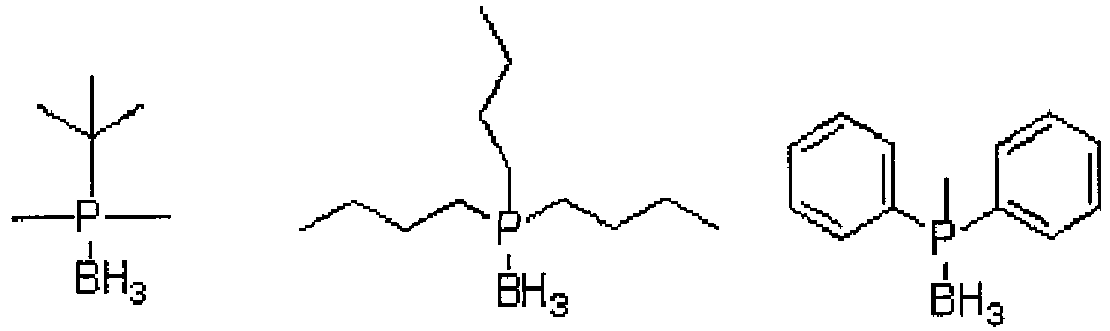
- the phosphinoboron compound catalysts of formula (I) in the present invention are preferably selected from one, two or more of the following catalysts:
- the raw isocyanate monomer of the present invention is selected from one of the following compounds: aliphatic isocyanate, cycloaliphatic isocyanate or aromatic isocyanate; wherein the isocyanate having a NCO functionality ⁇ 2.
- the raw isocyanate monomers of the present invention are preferably selected from one of the following compounds: tetramethylene-1,4-diisocyanate, pentamethylene-1,5-diisocyanate, hexamethylene-1,6-diisocyanate, lysine diisocyanate, isophorone diisocyanate, trimethylhexamethylene diisocyanate, dicyclohexylmethane diisocyanate, norbornane dimethylene isocyanate, diphenylmethane diisocyanate, toluene diisocyanate or p-phenyl diisocyanate. More preferably, they are selected from hexamethylene-1,6-diisocyanate or isophorone diisocyanate.
- the homopolymerization reaction is terminated by using catalyst poisons.
- the catalyst poisons can be the known alkylating agents including dimethyl sulphate, methyl p-toluenesulphonate etc.; or phosphate esters including dimethyl phosphate, diethyl phosphate, di-n-butyl phosphate and so on.
- the mole ratio of the catalyst poison to the catalyst is 1:1-2:1; preferably 1:1-1.2:1.
- the phosphinoboron compound catalysts of formula (I) according to the present invention with a molecule of isocyanate can firstly form a transition state of four-membered ring structure having the structure of formula II, and further activate the carbon atom of NCO function group in the raw isocyanates, thereby rendering more liable to bond with another molecule of isocyanate, and can further result in a transition state as a six-membered ring structure of formula III.
- transition state of the six-membered ring Since the transition state of the six-membered ring is relatively stable, its ratio is higher than every other intermediate transition state during the polymerization process of isocyanates (during the polymerization process, there are transition states of nine-membered rings for forming isocyanurate and iminooxadiazindione, i.e. formulae IV and V), it is the primary intermediate transition state. Accordingly, after the catalysts of the transition states of formulae III, IV and V are removed, the uretdione, isocyanurate and iminooxadiazindione are obtained, respectively, wherein the uretdione accounts for the main part.
- the mole ratio of uretdione-containing polymers to the sum of other polymer components (i.e. the sum of polyisocyanates and polyiminooxadiazindione) in the resulted polyisocyanate homopolymers in the examples and the comparative examples is denoted as U/O.
- Catalysts involved in the examples of the present invention are selected from:
- catalyst a was purchased from Sigma-Aldrich; catalyst b was prepared according to the process of the reference ( Tetrahedron, 2009, 65, 6410-6415 ); catalyst c, d and f were prepared in accordance with the method described in the reference ( J. Am. Chem. Soc, 1990, 112, 5244-5252 ); catalyst e was prepared according to the process of the reference ( Tetrahedron, 2009, 65, 6410-6415 ).
- the catalysts in the comparative examples were selected from g and h with the following structures reported in the patent documents, i.e. CN 1502605 and CN 101450928 , respectively:
- the process is similar to example 1, except using 0.12 mol catalyst g in catalyzing the homopolymerization reaction and 0.14 mol diethyl phosphate in terminating the reaction.
- the prepared HDI homopolymer When a combination of several catalysts of the present invention was applied, the prepared HDI homopolymer have a lower chromaticity; and the increase of chromaticity is obviously smaller when the conversion rate increases from 20% to 60%.
Landscapes
- Chemical & Material Sciences (AREA)
- Organic Chemistry (AREA)
- Health & Medical Sciences (AREA)
- Chemical Kinetics & Catalysis (AREA)
- Medicinal Chemistry (AREA)
- Polymers & Plastics (AREA)
- Life Sciences & Earth Sciences (AREA)
- Biochemistry (AREA)
- General Health & Medical Sciences (AREA)
- Molecular Biology (AREA)
- Polyurethanes Or Polyureas (AREA)
- Organic Low-Molecular-Weight Compounds And Preparation Thereof (AREA)
Description
- The present invention relates to a process for preparing isocyanate homopolymers with a high uretdione group content.
- Isocyanate homopolymers containing uretdione groups have a particularly low viscosity, thus, as crosslinkers, they have relatively good applicabilities in coating compositions with low solvent and a high solid content.
- The key in preparation of isocyanate homopolymers with a high uretdione group content is to select catalysts. Catalysts reported in patents mainly include tertiary phosphine compounds, boron trifluoride compounds, and pyridine compounds.
-
DE 1670720 discloses a process for preparing isocyanate homopolymers containing uretdione groups by using at least one aliphatically substituted tertiary phosphine or boron trifluoride compound. The isocyanate homopolymers obtained by this process have a relatively high uretdione content, however, the conversion rate thereof is low. - The preparation of polyisocyanates containing uretdione groups are disclosed in
CN 1502605 andCN 1660792 , in both of which the catalysts used are tertiary phosphines containing cycloalkyl substituent or directly phosphorus-attached cycloalkyl substituent. The imperfection lies in that the content of uretdione group highly depends on the conversion rate in the preparation of isocyanate homopolymers containing uretdione groups. In another word, isocyanate homopolymers with a high uretdione group content can be only obtained under the condition of relatively low conversion rate of isocyanate. Accordingly, a large amount of unreacted raw isocyanate monomers are required to be recovered in the product separation stage, thereby rendering a high processing energy cost. -
US 8134014 discloses a process for preparing polyisocyanates containing uretdione group, in which the catalysts used are aminopyridine compounds substituted by fused ring(s). The prepared isocyanate homopolymers have a relatively high uretdione group content, and there is no special limitation on the applicable isocyanates. However, the pyridine compounds used tend to color the products. As a result, there is still a need of developing specific processes, wherein the contents of uretdione groups are high with less dependence on the conversion rate of raw isocyanates, and the chromaticity of products as well as the cost of processing energy is low. - The object of present invention is to provide a process for preparing isocyanate homopolymers containing uretdione groups, in which the phosphinoboron compounds are used as catalysts to catalyze isocyanate homopolymerization, thereby preparing isocyanate homopolymers containing uretdione groups. The isocyanate homopolymers obtained in this process have a high uretdione group content, with an obvious ameliorated dependence on the convention rate of the raw isocyanates, and the chromaticity of products is low as well as the cost of processing energy is prominently reduced.
- In order to achieve the aforementioned purposes, the present invention adopts the following technical solutions:
- A process for preparing isocyanate homopolymers containing uretdione groups, which includes:
- in the presence of catalysts, homopolymerizing at least one kind of the raw isocyanates to prepare isocyanate homopolymers containing uretdione groups, wherein the catalysts are phosphinoboron compounds with the structure of formula (I):

- wherein the term "optionally substituted" refers to the group can be substituted by single or multiple substituent(s) selected from C1-C10 alkyl group, C1-C10 alkoxyl group, C6-C12 aryl group or C7-C15 aralkyl group; or unsubstituted.
- in the presence of catalysts, homopolymerizing at least one kind of the raw isocyanates to prepare isocyanate homopolymers containing uretdione groups, wherein the catalysts are phosphinoboron compounds with the structure of formula (I):
- Preferably, R1, R2 and R3 are independently selected from methyl, linear or branched C3-C20 alkyl group, alkyl-substituted C3-C20 cycloalkyl group, alkyl-substituted C7-C15 aralkyl group, alkyl-substituted C6-C12 aryl group or alkoxyl-substituted C6-C12 aryl group; wherein, the alkyl substituents are selected from C1-C10 linear or branched alkyl group, and the alkoxyl substituents are selected from C1-C10 alkoxyl group.
- More preferably, R1, R2 and R3 are independently selected from methyl, n-butyl, tert-butyl, cyclopropyl, cyclohexyl, phenyl or methoxyphenyl.
- The phosphinoboron compound catalysts of formula (I) in the present invention are preferably selected from one, two or more of the following catalysts:

- The raw isocyanate monomer of the present invention is selected from one of the following compounds: aliphatic isocyanate, cycloaliphatic isocyanate or aromatic isocyanate; wherein the isocyanate having a NCO functionality ≥2.
- For instance, the raw isocyanate monomers of the present invention are preferably selected from one of the following compounds: tetramethylene-1,4-diisocyanate, pentamethylene-1,5-diisocyanate, hexamethylene-1,6-diisocyanate, lysine diisocyanate, isophorone diisocyanate, trimethylhexamethylene diisocyanate, dicyclohexylmethane diisocyanate, norbornane dimethylene isocyanate, diphenylmethane diisocyanate, toluene diisocyanate or p-phenyl diisocyanate. More preferably, they are selected from hexamethylene-1,6-diisocyanate or isophorone diisocyanate.
- The amount of phosphinoboron compound catalyst in accordance with formula (I) used in the present invention is 0.1-4 mol% of the amount of raw isocyanate monomer, preferably is 0.5-2 mol%, based on the mole amount of raw isocyanate monomers.
- The phosphinoboron compound catalysts of formula (I) in the present invention can be used solely or as a formulated solution, wherein the concentration of the formulated solution is 0.5-5 mol/L, preferably 2-4 mol/L; and the solvents used in formulating the solution are free of the active hydrogen; preferably, one, two or more of halogenated hydrocarbons, aromatic hydrocarbons or ethers; more preferably, one, two or more of dichloromethane, tetrahydrofuran, methylbenzene, dimethylbenzene or chlorobenzene.
- In the present invention, the temperature of the homopolymerization reaction of the raw isocyanate monomers is 20-120 °C, preferably, 50-100 °C.
- In the process of the present invention, when the conversion rate of isocyanates reaches 20%-60% (based on the mass of raw isocyanate monomers), the homopolymerization reaction is terminated by using catalyst poisons. The catalyst poisons can be the known alkylating agents including dimethyl sulphate, methyl p-toluenesulphonate etc.; or phosphate esters including dimethyl phosphate, diethyl phosphate, di-n-butyl phosphate and so on. The mole ratio of the catalyst poison to the catalyst is 1:1-2:1; preferably 1:1-1.2:1.
- At a suitable temperature, the phosphinoboron compound catalysts of formula (I) according to the present invention with a molecule of isocyanate can firstly form a transition state of four-membered ring structure having the structure of formula II, and further activate the carbon atom of NCO function group in the raw isocyanates, thereby rendering more liable to bond with another molecule of isocyanate, and can further result in a transition state as a six-membered ring structure of formula III. Since the transition state of the six-membered ring is relatively stable, its ratio is higher than every other intermediate transition state during the polymerization process of isocyanates (during the polymerization process, there are transition states of nine-membered rings for forming isocyanurate and iminooxadiazindione, i.e. formulae IV and V), it is the primary intermediate transition state. Accordingly, after the catalysts of the transition states of formulae III, IV and V are removed, the uretdione, isocyanurate and iminooxadiazindione are obtained, respectively, wherein the uretdione accounts for the main part.
- In order to illustrate clearly, the homopolymerization process is described in the following formulae, wherein OCN-R-NCO denotes the raw isocyanate monomer, CAT represents the catalysts with the structure of formula (I).

- According to the process of the present invention, using the phosphinoboron compounds of the present invention as catalysts can effectively catalyze the homopolymerization reaction of raw isocyanate monomers to prepare polyisocyanates with a high uretdione group content. Compared with the preparation processes by using the catalysts in the art, the process of the present invention achieves a higher conversion rate of raw isocyanates as well as a higher uretdione content in the product. Meanwhile, lower chromaticity can be obtained via preparing the polyisocyanates by using phosphinoboron compounds of formula (I) according to the present invention as catalysts.
- The process provided by the present invention would be further illustrated by the following embodiments, but the present invention is not limited to these embodiments.
- Gel chromatography (LC-20AD/RID-10A, columns: MZ-Gel SDplus 10E3A 5 µm (8.0×300mm), MZ-Gel SDplus 500A 5 µm (8.0×300mm), MZ-Gel SDplus 100A 5 µm (8.0×300mm) in series, Shimadzu; mobile phase: tetrahydrofuran; flow rate: 1.0 mL/min; retention time: 40 min, column temperature: 35 °C) is applied to quantify the isocyanate monomers, which is used as a monitoring manner to determine the reaction conversion rate (based on the mass of raw isocyanate monomers).
- The mole ratio of uretdione-containing polymers to the sum of other polymer components (i.e. the sum of polyisocyanates and polyiminooxadiazindione) in the resulted polyisocyanate homopolymers in the examples and the comparative examples is denoted as U/O. The measurement of U/O value referenced to the method described in
CN101289427 , wherein the 13C-NMR is applied. The instrument used is Bruker 400MHz, the concentration of sample is 50% (CDCl3 solution), testing condition is 100 MHz, relaxation time: 4 sec, 2000 scans/min, δ=77.0ppm of CDCl3 is taken as the reference of chemical shift. - BYK LCS III is chosen as a colorimeter, with 50 mm sample cell, pure water (0 Hazen) is used as a reference.
- All reactant solutions are under an atmosphere of dry nitrogen before the reaction starts to the addition of catalysts and during the whole reaction process, unless specifically noted otherwise.
- Catalysts involved in the examples of the present invention are selected from:


- Wherein catalyst a was purchased from Sigma-Aldrich; catalyst b was prepared according to the process of the reference (Tetrahedron, 2009, 65, 6410-6415); catalyst c, d and f were prepared in accordance with the method described in the reference (J. Am. Chem. Soc, 1990, 112, 5244-5252); catalyst e was prepared according to the process of the reference (Tetrahedron, 2009, 65, 6410-6415).
- For example, the process for preparing catalyst b was as follows:
- 1) At room temperature, 100 ml CH2Cl2 and 10 mmol tertiary phosphine were added into a 250 mL three necked flask under the nitrogen atmosphere, and the reactants were started to stir;
- 2) The reaction was stirred for 10 min before adding 100ml BH3SMe2 solution (1mol/L in SMe2), then stirred for 24 h at room temperature;
- 3) 50 ml saturated ammonium chloride solution was added in the flask, after stirring for 10 min, all of the solution in the flask was poured into a separatory funnel containing 100 ml pure water, and extracted with CH2Cl2 for three times. The organic phase was washed with saturated sodium bicarbonate solution, and dried with dry magnesium sulfate for 24 h;
- 4) The solution was vacuum filtrated to remove the solid magnesium sulfate after dryness, then the filtrate was concentrated with a rotary evaporator;
- 5) After concentrating, the solution was separated and purified by silica-gel column chromatography using CH2Cl2 as a eluent;
- 6) The resulted 7 mmol solid catalyst b was formulated into an 0.5 mol/L of CH2Cl2 solution for use.
- The catalysts in the comparative examples were selected from g and h with the following structures reported in the patent documents, i.e.
CN 1502605 andCN 101450928 , respectively:
- The general experimental steps of examples 1-6 are as follows:
To a four-necked flask containing 1680g (10 mol) hexamethylene-1,6-diisocyanate (HDI) at 55 °C was added a certain amount of catalysts with stirring, and timing was started. During the reaction, the temperature was maintained between 55 °C and 65 °C, the HDI was quantified by the gel chromatography to monitor the conversion rate of reaction. Once the required conversion rate was achieved, a certain amount of terminating agent was added to cease the reaction. After the reaction was finished, separation was conducted and a light colored HDI homopolymer with a high uretdione content was obtained. Detail conditions are listed in table 1.Table 1 Experimental Conditions of Examples 1-6 Catalyst Catalyst Amount (based on the amount of HDI, mol%) Using Condition Solution and Concentration (mol/L) Terminating Agent Amount of Terminating Agent (mol) Example 1 a 0.1 Solid - diethyl phosphate 0.01 Example 2 b 0.5 Solution 5 (dichloromethane) 0.05 Example 3 c 1 Solution 4 (dichloromethane) 0.12 Example 4 d 2 Solution 2 (tetrahydrofuran) 0.24 Example 5 e 2 Solid - 0.20 Example 6 f 3 Solution 0.5 (tetrahydrofuran) 0.30 - Referring to the process of
CN 1502605 , the process is similar to example 1, except using 0.12 mol catalyst g in catalyzing the homopolymerization reaction and 0.14 mol diethyl phosphate in terminating the reaction. - Referring to the process of
CN 101450928 , the process is similar to example 1, except using 0.24 mol catalyst h in catalyzing the homopolymerization reaction and 0.24 mol diethyl phosphate in terminating the reaction.
- All content ratios of uretdione to other polymer components (U/O values) in the HDI homopolymers prepared by the catalysts (examples 1-6) of the present invention are totally higher than those of the comparative examples; furthermore, as the conversion rate increases from 20% to 60%, the decrease of U/O value is obviously smaller than those in the comparative examples.

- Chromaticities of the homopolymers prepared by the catalysts (examples 1-6) of the present invention are obviously lower than those of the comparative examples; furthermore, as the conversion rate increases from 20% to 60%, the increase of chromaticity in examples is obviously smaller than those in the comparative examples.
- The general experimental steps of examples 7-12 are as follows:
To a four-necked flask containing 2222g (10 mol) isophorone diisocyanate (IPDI) at 70 °C was added a certain amount of catalysts with stirring, and timing was started. During the reaction, the temperature was maintained between 70 °C and 100 °C, the IPDI was quantified by the gel chromatography to monitor the conversion rate of reaction. Once the required conversion rate was achieved, a certain amount of terminating agent was added to cease the reaction. After the reaction was finished, separation was conducted and a light colored IPDI homopolymer with a high uretdione content was obtained. Detail conditions are listed in table 4.Table 4 Experimental Conditions of Examples 7-12 Catalyst Catalyst Amount (based on the amount of IPDI, mol%) Using Condition Solution and Concentration (mol/L) Terminating Agent Amount of Terminating Agent (mol) Example 7 a 0.5 Solid - diethyl phosphate 0.06 Example 8 b 1 Solution 5 (dichloromethane) 0.12 Example 9 c 2 Solution 4 (dichloromethane) 0.24 Example 10 d 2 Solution 2 (tetrahydrofuran) 0.24 Example 11 e 3 Solid - 0.30 Example 12 f 4 Solution 0.5 (tetrahydrofuran) 0.40 - Referring to the process of
CN 101450928 , the process is similar to example 7, except using 0.35 mol catalyst h in catalyzing the homopolymerization reaction and 0.35 mol dimethyl phosphate in terminating the reaction..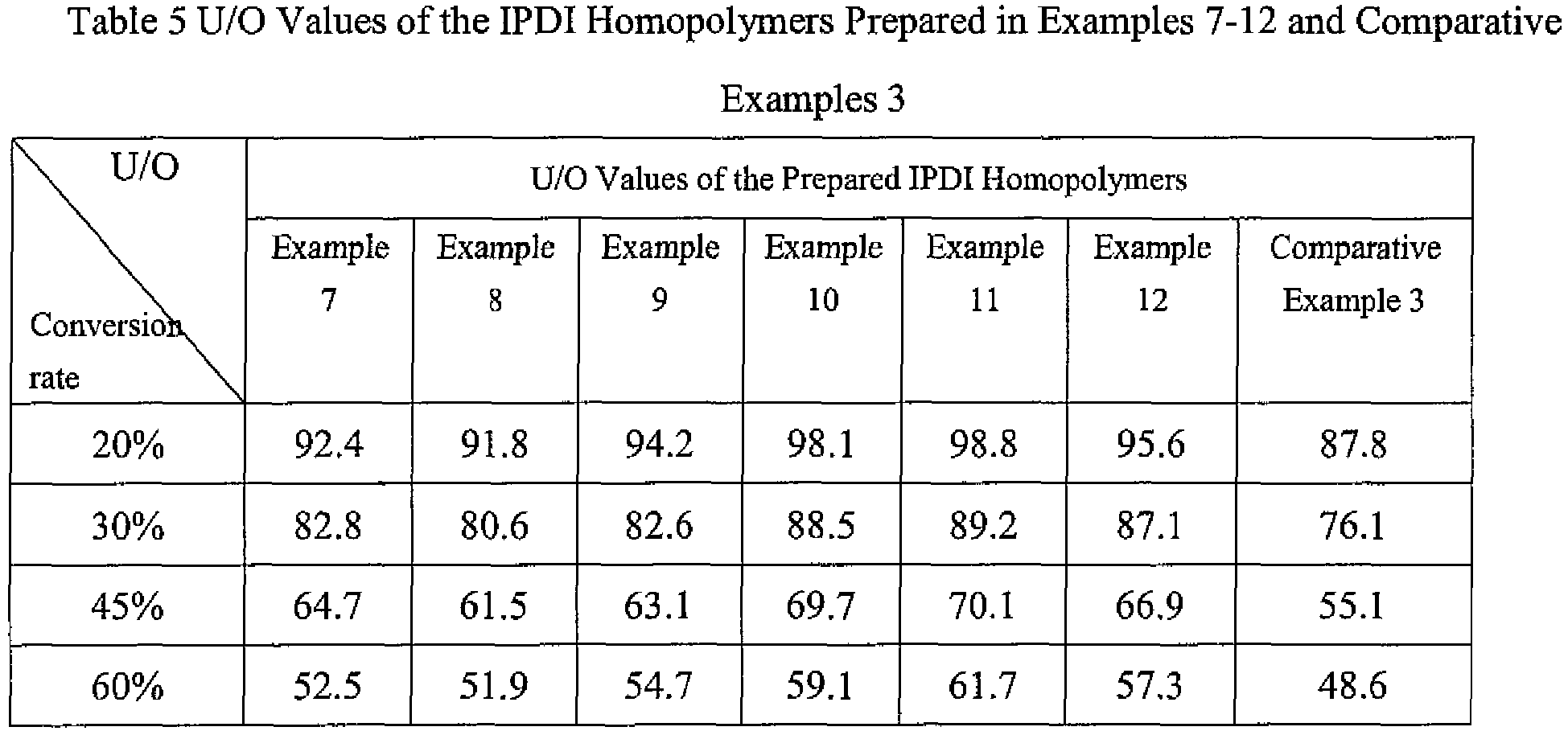


- 0.01 mol Catalyst a and 0.1 mol catalyst e were added into 25 ml dichloromethane, after totally dissolved, prepare a mixed-catalyst-solution m for later use. 1680 g (10 mol) Hexamethylene-1,6-diisocyanate (HDI) was placed in a four-necked flask at 60 °C with stirring, and timing was started. During the reaction, the temperature was maintained between 60 °C to 67 °C, the HDI was quantified with gel chromatography to monitor the conversion rate of reaction. Once the required conversion was achieved, 0.12 mol diethyl phosphate was added to terminate the reaction. After the reaction was finished, separation was conducted and a light colored HDI homopolymer with a high uretdione content was obtained.
Table 7 U/O Values and Product's Chromaticity of the HDI Homopolymers Prepared in Example 13 Conversion Rate of HDI U/O Value Product's Chromaticity/Hazen 20% 56.1 22 30% 45.8 25 45% 36.5 28 60% 23.9 32 - When a combination of several catalysts of the present invention was applied, the prepared HDI homopolymer have a lower chromaticity; and the increase of chromaticity is obviously smaller when the conversion rate increases from 20% to 60%.
Claims (10)
- A process for preparing isocyanate homopolymers containing uretdione groups comprising:in the presence of catalysts, homopolymerizing the raw isocyanate monomers to prepare isocyanate homopolymers containing uretdione groups, wherein the catalysts are phosphinoboron compounds of the structure of formula (I):

- The process according to claim 1, wherein the phosphinoboron compound catalysts of formula (I) are one, two or more selected from the following catalysts:


- The process according to claim 1 or 2, wherein the raw isocyanate monomer is selected from one of the following compounds: aliphatic isocyanate, cycloaliphatic isocyanate or aromatic isocyanate; wherein the isocyanate having a NCO functionality >2.
- The process according to claim 3, wherein the isocyanates are selected from the following compounds: tetramethylene-1,4-diisocyanate, pentamethylene-1,5-diisocyanate, hexamethylene-1,6-diisocyanate, lysine diisocyanate, isophorone diisocyanate, trimethylhexamethylene diisocyanate, dicyclohexylmethane diisocyanate, norbornane dimethylene isocyanate, diphenylmethane diisocyanate, toluene diisocyanate or p-phenyl diisocyanate; preferably, the isocyanate is selected from hexamethylene-1,6-diisocyanate or isophorone diisocyanate.
- The process according to claim 1, wherein the amount of phosphinoboron compound catalysts of formula (I) is 0.1-4 mol%, preferably 0.5-2 mol%, based on the amount of raw isocyanate monomers.
- The process according to claim 1 or 5, wherein the phosphinoboron compound catalysts of formula (I) are used solely or as a formulated solution, wherein the concentration of the solution is 0.5-5 mol/L, preferably, 2-4 mol/L.
- The process according to claim 6, wherein the solvents used in formulating the solution from the phosphinoboron compound catalysts are free of the active hydrogen, preferably one, two or more of halogenated hydrocarbons, aromatic hydrocarbons or ethers; more preferably one, two or more of dichloromethane, tetrahydrofuran, methylbenzene, dimethylbenzene or chlorobenzene.
- The process according to claim 1, wherein the temperature of homopolymerization reaction is 20-120 °C; preferably, 50-100 °C.
- The process according to claim 1, wherein, when the conversion rate of homopolymerization reaction reaches 20% - 60% based on the mass of raw isocyanate monomers, catalyst poisons are used to terminate the homopolymerization reaction.
- The process according to claim 9, wherein the catalyst poisons are alkylating agents or phosphate esters, where a mole ratio of the catalyst poison to the phosphinoboron compound catalyst is 1:1-2:1; preferably, 1:1-1.2:1.
Applications Claiming Priority (2)
| Application Number | Priority Date | Filing Date | Title |
|---|---|---|---|
| CN201310608843.5A CN103613540B (en) | 2013-11-26 | 2013-11-26 | Method for preparing urethodione group-containing diisocyanate homopolymer |
| PCT/CN2014/072798 WO2015078116A1 (en) | 2013-11-26 | 2014-03-03 | Process for preparing isocyanate homopolymers containing uretdione groups |
Publications (3)
| Publication Number | Publication Date |
|---|---|
| EP3074380A1 EP3074380A1 (en) | 2016-10-05 |
| EP3074380A4 EP3074380A4 (en) | 2017-08-02 |
| EP3074380B1 true EP3074380B1 (en) | 2018-04-25 |
Family
ID=50164270
Family Applications (1)
| Application Number | Title | Priority Date | Filing Date |
|---|---|---|---|
| EP14866006.1A Active EP3074380B1 (en) | 2013-11-26 | 2014-03-03 | Process for preparing isocyanate homopolymers containing uretdione groups |
Country Status (6)
| Country | Link |
|---|---|
| US (1) | US9518142B2 (en) |
| EP (1) | EP3074380B1 (en) |
| JP (1) | JP6266782B2 (en) |
| KR (1) | KR101785950B1 (en) |
| CN (1) | CN103613540B (en) |
| WO (1) | WO2015078116A1 (en) |
Families Citing this family (5)
| Publication number | Priority date | Publication date | Assignee | Title |
|---|---|---|---|---|
| CN103613540B (en) * | 2013-11-26 | 2015-03-11 | 万华化学(宁波)有限公司 | Method for preparing urethodione group-containing diisocyanate homopolymer |
| CN110372846B (en) * | 2019-07-15 | 2021-06-25 | 万华化学集团股份有限公司 | A kind of preparation method of polyisocyanate containing uretdione group with stable color value |
| CN111040101B (en) * | 2019-12-23 | 2021-09-07 | 万华化学集团股份有限公司 | Color value-stable polyisocyanate containing uretdione group and preparation method thereof |
| CN111747867B (en) * | 2020-06-28 | 2022-08-02 | 万华化学(宁波)有限公司 | Preparation method of low-color-number low-VOC (volatile organic compounds) modified isocyanate |
| CN114588939B (en) * | 2020-12-03 | 2024-05-03 | 万华化学集团股份有限公司 | Catalyst and method for preparing iminooxadiazinedione-containing polyisocyanate |
Family Cites Families (12)
| Publication number | Priority date | Publication date | Assignee | Title |
|---|---|---|---|---|
| DE1670720A1 (en) | 1966-07-21 | 1971-01-14 | Bayer Ag | Process for the preparation of aliphatically substituted uretdiones |
| DE3227779A1 (en) * | 1982-07-24 | 1984-01-26 | Chemische Werke Hüls AG, 4370 Marl | NEW ISOCYANATO URETDIONE AND A METHOD FOR THE PRODUCTION THEREOF |
| JP2000264943A (en) * | 1999-03-18 | 2000-09-26 | Mitsui Chemicals Inc | New prepolymer |
| DE10254878A1 (en) | 2002-11-25 | 2004-06-03 | Bayer Ag | Production of polyisocyanates containing uretdione groups |
| EP1426393A3 (en) * | 2002-12-05 | 2009-11-04 | Bayer MaterialScience AG | Low monomer urethdione-groups containing polyisocyanates |
| DE10354544A1 (en) * | 2003-11-21 | 2005-06-23 | Bayer Materialscience Ag | Preparation of uretdione group-containing polyisocyanates |
| DE102007018015A1 (en) * | 2007-04-17 | 2008-10-23 | Bayer Materialscience Ag | Preparation of uretdione group-containing polyisocyanates |
| DE102007058487A1 (en) | 2007-12-04 | 2009-06-10 | Bayer Materialscience Ag | Preparation of uretdione polyisocyanates |
| JP5350767B2 (en) * | 2008-12-15 | 2013-11-27 | 日本化学工業株式会社 | Novel phosphine borane compound and method for producing the same, and method for producing hydrogen-phosphine borane compound |
| JP5465584B2 (en) | 2010-04-09 | 2014-04-09 | 日本化学工業株式会社 | Method for producing pyrazine derivative |
| CN102942525B (en) * | 2012-11-01 | 2014-08-06 | 万华化学集团股份有限公司 | Method for preparing polyisocyanate containing uretidione group |
| CN103613540B (en) | 2013-11-26 | 2015-03-11 | 万华化学(宁波)有限公司 | Method for preparing urethodione group-containing diisocyanate homopolymer |
-
2013
- 2013-11-26 CN CN201310608843.5A patent/CN103613540B/en active Active
-
2014
- 2014-03-03 KR KR1020167003783A patent/KR101785950B1/en active Active
- 2014-03-03 EP EP14866006.1A patent/EP3074380B1/en active Active
- 2014-03-03 JP JP2016535307A patent/JP6266782B2/en active Active
- 2014-03-03 WO PCT/CN2014/072798 patent/WO2015078116A1/en not_active Ceased
- 2014-03-03 US US14/907,153 patent/US9518142B2/en active Active
Non-Patent Citations (1)
| Title |
|---|
| None * |
Also Published As
| Publication number | Publication date |
|---|---|
| EP3074380A4 (en) | 2017-08-02 |
| CN103613540B (en) | 2015-03-11 |
| JP6266782B2 (en) | 2018-01-24 |
| JP2016535146A (en) | 2016-11-10 |
| KR20160031535A (en) | 2016-03-22 |
| US9518142B2 (en) | 2016-12-13 |
| KR101785950B1 (en) | 2017-11-15 |
| US20160159964A1 (en) | 2016-06-09 |
| CN103613540A (en) | 2014-03-05 |
| EP3074380A1 (en) | 2016-10-05 |
| WO2015078116A1 (en) | 2015-06-04 |
Similar Documents
| Publication | Publication Date | Title |
|---|---|---|
| US9518142B2 (en) | Process for preparing isocyanate homopolymers containing uretdione groups | |
| EP1378530B1 (en) | Process for producing TDI trimers having a low monomer content | |
| CN110372846B (en) | A kind of preparation method of polyisocyanate containing uretdione group with stable color value | |
| EP4056619A1 (en) | Storage-stable polyisocyanate composition and preparation method | |
| CA2023635A1 (en) | Solutions of isocyanurate polyisocyanates in coatings solvents and a process for their production | |
| EP2100885A1 (en) | Production of trimeric polyisocyanates | |
| CN102964566B (en) | Method for preparing polyisocyanate containing formimidoyl oxadiazine diketone | |
| CA2488071C (en) | Preparation of polyisocyanates containing uretdione groups | |
| US20230203067A1 (en) | Production process for amino alcoholates | |
| EP0351873B1 (en) | Process for the preparation of polyisocyanate | |
| Guo et al. | Synthesis of polyisocyanurate prepolymer and the resulting flexible elastomers with tunable mechanical properties | |
| CN102942525B (en) | Method for preparing polyisocyanate containing uretidione group | |
| EP1399494B1 (en) | Method for the dimerisation of isophorone diisocyanate | |
| JP2009137961A (en) | Production of uretdione polyisocyanate | |
| CN104479103A (en) | Polyurethane curing agent having high functionality, preparation method and use thereof | |
| EP3569624A1 (en) | Method for the production of polyisocyanates comprising isocyanurate groups and their use | |
| JP2003524642A (en) | Method for obtaining slightly colored branched polyisocyanate and composition obtained | |
| EP1960448A1 (en) | Process for preparing polyisocyanates containing carbodiimide and/or uretonimine groups | |
| CN115894167B (en) | Preparation method of deuterated chloroform | |
| CN107434774B (en) | Method for synthesizing diphenylmethane dicarbamic acid ester from phenyl carbamate | |
| US20190031579A1 (en) | Method for producing alkyl substituted benzene | |
| EP4628519A1 (en) | Organogermanium(iv) carboxylates and mixtures of germanium carboxylates with organic acid anhydrides as catalysts | |
| EP4067403B1 (en) | Blocked isocyanate, thermosetting composition and cured product | |
| SU1735330A1 (en) | Isocyanate compound for heat-stable polyurethanes and method of its production | |
| Kurosawa et al. | Evidence for C C coupling between two mutually cis carbon ligands, η3-crotyl and aryl in organopalladium (II) complexes |
Legal Events
| Date | Code | Title | Description |
|---|---|---|---|
| PUAI | Public reference made under article 153(3) epc to a published international application that has entered the european phase |
Free format text: ORIGINAL CODE: 0009012 |
|
| 17P | Request for examination filed |
Effective date: 20160105 |
|
| AK | Designated contracting states |
Kind code of ref document: A1 Designated state(s): AL AT BE BG CH CY CZ DE DK EE ES FI FR GB GR HR HU IE IS IT LI LT LU LV MC MK MT NL NO PL PT RO RS SE SI SK SM TR |
|
| AX | Request for extension of the european patent |
Extension state: BA ME |
|
| DAX | Request for extension of the european patent (deleted) | ||
| RAP1 | Party data changed (applicant data changed or rights of an application transferred) |
Owner name: WANHUA CHEMICAL GROUP CO., LTD. |
|
| A4 | Supplementary search report drawn up and despatched |
Effective date: 20170703 |
|
| RIC1 | Information provided on ipc code assigned before grant |
Ipc: C07D 229/00 20060101AFI20170627BHEP Ipc: C07D 251/30 20060101ALI20170627BHEP Ipc: C07D 273/04 20060101ALI20170627BHEP |
|
| GRAP | Despatch of communication of intention to grant a patent |
Free format text: ORIGINAL CODE: EPIDOSNIGR1 |
|
| STAA | Information on the status of an ep patent application or granted ep patent |
Free format text: STATUS: GRANT OF PATENT IS INTENDED |
|
| INTG | Intention to grant announced |
Effective date: 20171214 |
|
| GRAA | (expected) grant |
Free format text: ORIGINAL CODE: 0009210 |
|
| GRAS | Grant fee paid |
Free format text: ORIGINAL CODE: EPIDOSNIGR3 |
|
| STAA | Information on the status of an ep patent application or granted ep patent |
Free format text: STATUS: THE PATENT HAS BEEN GRANTED |
|
| AK | Designated contracting states |
Kind code of ref document: B1 Designated state(s): AL AT BE BG CH CY CZ DE DK EE ES FI FR GB GR HR HU IE IS IT LI LT LU LV MC MK MT NL NO PL PT RO RS SE SI SK SM TR |
|
| REG | Reference to a national code |
Ref country code: GB Ref legal event code: FG4D |
|
| REG | Reference to a national code |
Ref country code: CH Ref legal event code: EP |
|
| REG | Reference to a national code |
Ref country code: AT Ref legal event code: REF Ref document number: 992725 Country of ref document: AT Kind code of ref document: T Effective date: 20180515 |
|
| REG | Reference to a national code |
Ref country code: IE Ref legal event code: FG4D Ref country code: NL Ref legal event code: FP |
|
| REG | Reference to a national code |
Ref country code: DE Ref legal event code: R096 Ref document number: 602014024687 Country of ref document: DE |
|
| REG | Reference to a national code |
Ref country code: LT Ref legal event code: MG4D |
|
| PG25 | Lapsed in a contracting state [announced via postgrant information from national office to epo] |
Ref country code: NO Free format text: LAPSE BECAUSE OF FAILURE TO SUBMIT A TRANSLATION OF THE DESCRIPTION OR TO PAY THE FEE WITHIN THE PRESCRIBED TIME-LIMIT Effective date: 20180725 Ref country code: BG Free format text: LAPSE BECAUSE OF FAILURE TO SUBMIT A TRANSLATION OF THE DESCRIPTION OR TO PAY THE FEE WITHIN THE PRESCRIBED TIME-LIMIT Effective date: 20180725 Ref country code: FI Free format text: LAPSE BECAUSE OF FAILURE TO SUBMIT A TRANSLATION OF THE DESCRIPTION OR TO PAY THE FEE WITHIN THE PRESCRIBED TIME-LIMIT Effective date: 20180425 Ref country code: SE Free format text: LAPSE BECAUSE OF FAILURE TO SUBMIT A TRANSLATION OF THE DESCRIPTION OR TO PAY THE FEE WITHIN THE PRESCRIBED TIME-LIMIT Effective date: 20180425 Ref country code: PL Free format text: LAPSE BECAUSE OF FAILURE TO SUBMIT A TRANSLATION OF THE DESCRIPTION OR TO PAY THE FEE WITHIN THE PRESCRIBED TIME-LIMIT Effective date: 20180425 Ref country code: LT Free format text: LAPSE BECAUSE OF FAILURE TO SUBMIT A TRANSLATION OF THE DESCRIPTION OR TO PAY THE FEE WITHIN THE PRESCRIBED TIME-LIMIT Effective date: 20180425 Ref country code: ES Free format text: LAPSE BECAUSE OF FAILURE TO SUBMIT A TRANSLATION OF THE DESCRIPTION OR TO PAY THE FEE WITHIN THE PRESCRIBED TIME-LIMIT Effective date: 20180425 |
|
| PG25 | Lapsed in a contracting state [announced via postgrant information from national office to epo] |
Ref country code: HR Free format text: LAPSE BECAUSE OF FAILURE TO SUBMIT A TRANSLATION OF THE DESCRIPTION OR TO PAY THE FEE WITHIN THE PRESCRIBED TIME-LIMIT Effective date: 20180425 Ref country code: RS Free format text: LAPSE BECAUSE OF FAILURE TO SUBMIT A TRANSLATION OF THE DESCRIPTION OR TO PAY THE FEE WITHIN THE PRESCRIBED TIME-LIMIT Effective date: 20180425 Ref country code: LV Free format text: LAPSE BECAUSE OF FAILURE TO SUBMIT A TRANSLATION OF THE DESCRIPTION OR TO PAY THE FEE WITHIN THE PRESCRIBED TIME-LIMIT Effective date: 20180425 Ref country code: GR Free format text: LAPSE BECAUSE OF FAILURE TO SUBMIT A TRANSLATION OF THE DESCRIPTION OR TO PAY THE FEE WITHIN THE PRESCRIBED TIME-LIMIT Effective date: 20180726 |
|
| REG | Reference to a national code |
Ref country code: AT Ref legal event code: MK05 Ref document number: 992725 Country of ref document: AT Kind code of ref document: T Effective date: 20180425 |
|
| PG25 | Lapsed in a contracting state [announced via postgrant information from national office to epo] |
Ref country code: PT Free format text: LAPSE BECAUSE OF FAILURE TO SUBMIT A TRANSLATION OF THE DESCRIPTION OR TO PAY THE FEE WITHIN THE PRESCRIBED TIME-LIMIT Effective date: 20180827 |
|
| REG | Reference to a national code |
Ref country code: DE Ref legal event code: R097 Ref document number: 602014024687 Country of ref document: DE |
|
| PG25 | Lapsed in a contracting state [announced via postgrant information from national office to epo] |
Ref country code: CZ Free format text: LAPSE BECAUSE OF FAILURE TO SUBMIT A TRANSLATION OF THE DESCRIPTION OR TO PAY THE FEE WITHIN THE PRESCRIBED TIME-LIMIT Effective date: 20180425 Ref country code: DK Free format text: LAPSE BECAUSE OF FAILURE TO SUBMIT A TRANSLATION OF THE DESCRIPTION OR TO PAY THE FEE WITHIN THE PRESCRIBED TIME-LIMIT Effective date: 20180425 Ref country code: AT Free format text: LAPSE BECAUSE OF FAILURE TO SUBMIT A TRANSLATION OF THE DESCRIPTION OR TO PAY THE FEE WITHIN THE PRESCRIBED TIME-LIMIT Effective date: 20180425 Ref country code: RO Free format text: LAPSE BECAUSE OF FAILURE TO SUBMIT A TRANSLATION OF THE DESCRIPTION OR TO PAY THE FEE WITHIN THE PRESCRIBED TIME-LIMIT Effective date: 20180425 Ref country code: EE Free format text: LAPSE BECAUSE OF FAILURE TO SUBMIT A TRANSLATION OF THE DESCRIPTION OR TO PAY THE FEE WITHIN THE PRESCRIBED TIME-LIMIT Effective date: 20180425 Ref country code: SK Free format text: LAPSE BECAUSE OF FAILURE TO SUBMIT A TRANSLATION OF THE DESCRIPTION OR TO PAY THE FEE WITHIN THE PRESCRIBED TIME-LIMIT Effective date: 20180425 |
|
| PG25 | Lapsed in a contracting state [announced via postgrant information from national office to epo] |
Ref country code: SM Free format text: LAPSE BECAUSE OF FAILURE TO SUBMIT A TRANSLATION OF THE DESCRIPTION OR TO PAY THE FEE WITHIN THE PRESCRIBED TIME-LIMIT Effective date: 20180425 |
|
| PLBE | No opposition filed within time limit |
Free format text: ORIGINAL CODE: 0009261 |
|
| STAA | Information on the status of an ep patent application or granted ep patent |
Free format text: STATUS: NO OPPOSITION FILED WITHIN TIME LIMIT |
|
| 26N | No opposition filed |
Effective date: 20190128 |
|
| PG25 | Lapsed in a contracting state [announced via postgrant information from national office to epo] |
Ref country code: SI Free format text: LAPSE BECAUSE OF FAILURE TO SUBMIT A TRANSLATION OF THE DESCRIPTION OR TO PAY THE FEE WITHIN THE PRESCRIBED TIME-LIMIT Effective date: 20180425 |
|
| PG25 | Lapsed in a contracting state [announced via postgrant information from national office to epo] |
Ref country code: MC Free format text: LAPSE BECAUSE OF FAILURE TO SUBMIT A TRANSLATION OF THE DESCRIPTION OR TO PAY THE FEE WITHIN THE PRESCRIBED TIME-LIMIT Effective date: 20180425 |
|
| REG | Reference to a national code |
Ref country code: CH Ref legal event code: PL |
|
| PG25 | Lapsed in a contracting state [announced via postgrant information from national office to epo] |
Ref country code: LU Free format text: LAPSE BECAUSE OF NON-PAYMENT OF DUE FEES Effective date: 20190303 Ref country code: AL Free format text: LAPSE BECAUSE OF FAILURE TO SUBMIT A TRANSLATION OF THE DESCRIPTION OR TO PAY THE FEE WITHIN THE PRESCRIBED TIME-LIMIT Effective date: 20180425 |
|
| REG | Reference to a national code |
Ref country code: BE Ref legal event code: MM Effective date: 20190331 |
|
| PG25 | Lapsed in a contracting state [announced via postgrant information from national office to epo] |
Ref country code: CH Free format text: LAPSE BECAUSE OF NON-PAYMENT OF DUE FEES Effective date: 20190331 Ref country code: LI Free format text: LAPSE BECAUSE OF NON-PAYMENT OF DUE FEES Effective date: 20190331 Ref country code: IE Free format text: LAPSE BECAUSE OF NON-PAYMENT OF DUE FEES Effective date: 20190303 |
|
| PG25 | Lapsed in a contracting state [announced via postgrant information from national office to epo] |
Ref country code: BE Free format text: LAPSE BECAUSE OF NON-PAYMENT OF DUE FEES Effective date: 20190331 |
|
| PG25 | Lapsed in a contracting state [announced via postgrant information from national office to epo] |
Ref country code: TR Free format text: LAPSE BECAUSE OF FAILURE TO SUBMIT A TRANSLATION OF THE DESCRIPTION OR TO PAY THE FEE WITHIN THE PRESCRIBED TIME-LIMIT Effective date: 20180425 |
|
| PG25 | Lapsed in a contracting state [announced via postgrant information from national office to epo] |
Ref country code: MT Free format text: LAPSE BECAUSE OF NON-PAYMENT OF DUE FEES Effective date: 20190303 |
|
| PG25 | Lapsed in a contracting state [announced via postgrant information from national office to epo] |
Ref country code: CY Free format text: LAPSE BECAUSE OF FAILURE TO SUBMIT A TRANSLATION OF THE DESCRIPTION OR TO PAY THE FEE WITHIN THE PRESCRIBED TIME-LIMIT Effective date: 20180425 |
|
| PG25 | Lapsed in a contracting state [announced via postgrant information from national office to epo] |
Ref country code: IS Free format text: LAPSE BECAUSE OF FAILURE TO SUBMIT A TRANSLATION OF THE DESCRIPTION OR TO PAY THE FEE WITHIN THE PRESCRIBED TIME-LIMIT Effective date: 20180825 |
|
| PG25 | Lapsed in a contracting state [announced via postgrant information from national office to epo] |
Ref country code: HU Free format text: LAPSE BECAUSE OF FAILURE TO SUBMIT A TRANSLATION OF THE DESCRIPTION OR TO PAY THE FEE WITHIN THE PRESCRIBED TIME-LIMIT; INVALID AB INITIO Effective date: 20140303 |
|
| PG25 | Lapsed in a contracting state [announced via postgrant information from national office to epo] |
Ref country code: MK Free format text: LAPSE BECAUSE OF FAILURE TO SUBMIT A TRANSLATION OF THE DESCRIPTION OR TO PAY THE FEE WITHIN THE PRESCRIBED TIME-LIMIT Effective date: 20180425 |
|
| PGFP | Annual fee paid to national office [announced via postgrant information from national office to epo] |
Ref country code: NL Payment date: 20260226 Year of fee payment: 13 |
|
| PGFP | Annual fee paid to national office [announced via postgrant information from national office to epo] |
Ref country code: GB Payment date: 20260323 Year of fee payment: 13 |
|
| PGFP | Annual fee paid to national office [announced via postgrant information from national office to epo] |
Ref country code: DE Payment date: 20260313 Year of fee payment: 13 |
|
| PGFP | Annual fee paid to national office [announced via postgrant information from national office to epo] |
Ref country code: IT Payment date: 20260310 Year of fee payment: 13 |
|
| PGFP | Annual fee paid to national office [announced via postgrant information from national office to epo] |
Ref country code: FR Payment date: 20260330 Year of fee payment: 13 |