EP3072895B1 - Phillygenol sulphate and derivative thereof, and preparation method and application thereof - Google Patents
Phillygenol sulphate and derivative thereof, and preparation method and application thereof Download PDFInfo
- Publication number
- EP3072895B1 EP3072895B1 EP14861789.7A EP14861789A EP3072895B1 EP 3072895 B1 EP3072895 B1 EP 3072895B1 EP 14861789 A EP14861789 A EP 14861789A EP 3072895 B1 EP3072895 B1 EP 3072895B1
- Authority
- EP
- European Patent Office
- Prior art keywords
- phillygenin
- phillygenol
- group
- sulphate
- virus
- Prior art date
- Legal status (The legal status is an assumption and is not a legal conclusion. Google has not performed a legal analysis and makes no representation as to the accuracy of the status listed.)
- Active
Links
Images


Classifications
-
- C—CHEMISTRY; METALLURGY
- C07—ORGANIC CHEMISTRY
- C07D—HETEROCYCLIC COMPOUNDS
- C07D403/00—Heterocyclic compounds containing two or more hetero rings, having nitrogen atoms as the only ring hetero atoms, not provided for by group C07D401/00
- C07D403/02—Heterocyclic compounds containing two or more hetero rings, having nitrogen atoms as the only ring hetero atoms, not provided for by group C07D401/00 containing two hetero rings
- C07D403/04—Heterocyclic compounds containing two or more hetero rings, having nitrogen atoms as the only ring hetero atoms, not provided for by group C07D401/00 containing two hetero rings directly linked by a ring-member-to-ring-member bond
-
- C—CHEMISTRY; METALLURGY
- C07—ORGANIC CHEMISTRY
- C07D—HETEROCYCLIC COMPOUNDS
- C07D493/00—Heterocyclic compounds containing oxygen atoms as the only ring hetero atoms in the condensed system
- C07D493/02—Heterocyclic compounds containing oxygen atoms as the only ring hetero atoms in the condensed system in which the condensed system contains two hetero rings
- C07D493/04—Ortho-condensed systems
-
- A—HUMAN NECESSITIES
- A61—MEDICAL OR VETERINARY SCIENCE; HYGIENE
- A61K—PREPARATIONS FOR MEDICAL, DENTAL OR TOILETRY PURPOSES
- A61K31/00—Medicinal preparations containing organic active ingredients
- A61K31/33—Heterocyclic compounds
- A61K31/335—Heterocyclic compounds having oxygen as the only ring hetero atom, e.g. fungichromin
- A61K31/34—Heterocyclic compounds having oxygen as the only ring hetero atom, e.g. fungichromin having five-membered rings with one oxygen as the only ring hetero atom, e.g. isosorbide
-
- A—HUMAN NECESSITIES
- A61—MEDICAL OR VETERINARY SCIENCE; HYGIENE
- A61P—SPECIFIC THERAPEUTIC ACTIVITY OF CHEMICAL COMPOUNDS OR MEDICINAL PREPARATIONS
- A61P31/00—Antiinfectives, i.e. antibiotics, antiseptics, chemotherapeutics
- A61P31/12—Antivirals
-
- A—HUMAN NECESSITIES
- A61—MEDICAL OR VETERINARY SCIENCE; HYGIENE
- A61P—SPECIFIC THERAPEUTIC ACTIVITY OF CHEMICAL COMPOUNDS OR MEDICINAL PREPARATIONS
- A61P31/00—Antiinfectives, i.e. antibiotics, antiseptics, chemotherapeutics
- A61P31/12—Antivirals
- A61P31/14—Antivirals for RNA viruses
-
- A—HUMAN NECESSITIES
- A61—MEDICAL OR VETERINARY SCIENCE; HYGIENE
- A61P—SPECIFIC THERAPEUTIC ACTIVITY OF CHEMICAL COMPOUNDS OR MEDICINAL PREPARATIONS
- A61P31/00—Antiinfectives, i.e. antibiotics, antiseptics, chemotherapeutics
- A61P31/12—Antivirals
- A61P31/14—Antivirals for RNA viruses
- A61P31/16—Antivirals for RNA viruses for influenza or rhinoviruses
-
- A—HUMAN NECESSITIES
- A61—MEDICAL OR VETERINARY SCIENCE; HYGIENE
- A61P—SPECIFIC THERAPEUTIC ACTIVITY OF CHEMICAL COMPOUNDS OR MEDICINAL PREPARATIONS
- A61P31/00—Antiinfectives, i.e. antibiotics, antiseptics, chemotherapeutics
- A61P31/12—Antivirals
- A61P31/20—Antivirals for DNA viruses
- A61P31/22—Antivirals for DNA viruses for herpes viruses
Definitions
- the present invention belongs to the field of medicinal chemistry, and in particular relates to a phillygenin sulphate and a preparation method thereof, as well as pharmacological effects of such derivatives in terms of viral resistance.
- Phillygenin, as an aglycon part of forsythin, is a main active component of Forsythia suspensa of the genus Forsythia in the family Oleaceae and has a structure as represented below. Modem pharmacological researches show that phillygenin has antiviral, antioxidant, lowering blood lipid scavenging free radical, antibacterial, antitumor, anti-inflammatory effect.
- Phillygenin has unstable molecules which is prone to oxidized and easy to change the configuration in an acidic environment.
- Researches simulating forsythin metabolism through rat enteric bacteria discover that forsythin is easily metabolized by intestinal flora into a new metabolite.
- the technical problem to be solved by the present invention is to prepare a phillygenin sulphate by chemical synthetic method.
- the present invention provides a phillygenin sulphate.
- the present invention also provides a method for preparing a phillygenin sulphate, and is suitable for industrial scale-up production.
- the present invention provides a phillygenin sulphate as represented by the following chemical structural formula, wherein R is H, Na + , K + , NH 4 + , tetramethyl ammonium, tetraethyl ammonium, methyl amino, dimethylamino, trimethylamino, triethylamino, diethylamino, ethylamino, ethanolamino, diethanolamino, piperidyl, piperazinyl or pyrazinyl.
- the present invention provides a pharmaceutical composition which comprises the phillygenin sulphate of the present invention and pharmaceutically acceptable excipients.
- the pharmaceutically acceptable excipients refer to non-toxic solid, semi-solid or liquid fillers, diluents, carriers, pH regulators, ionic strength regulators, slow-release or controlled-release agent, wrapping material or other pharmaceutical excipients.
- the used carrier may be adapted to corresponding drug administration mode, can use the excipients which are well known to those skilled in the art to formulated into injections, freeze-dried powder (for injection), sprays, oral solutions, oral suspensions, tablets, capsules, enteric tablets, pills, powders, granules, sustained-release or delayed-release preparations.
- the phillygenin sulphate of the first aspect of the present invention are preferred and administered by injection or through digestive tract, therefore the pharmaceutical composition of the present invention is preferably injections or preparations administered through digestive tract, i.e., the auxiliary materials suitable for being formulated into injections or preparations administered through digestive tract are particularly preferred, wherein "administration through digestive tract” refers herein to an approach of administrating drug preparations through the digestive tracts of patients , comprising oral administration, intragastric administration, enema administration, preferably oral administration, for example, excipients which are well known to those skilled in the art can be used to formulate into oral solutions, oral suspensions, tablets, capsules, enteric tablets, pills, powders, granules, sustained-release or delayed-release preparations; wherein the injection preparations are mainly injections and powder-injections.
- the present invention provides a preparation method of the phillygenin sulphate of the first aspect of the invention comprising the following sequentially performed steps
- the organic solvent in step 1) is selected from one of pyridine, N,N-dimethylmethylformamide, N,N-dimethylacetamide or dichloromethane.
- the sulphating agent is added to the phillygenol solution at 0-5°C.
- the sulphating agent is added to the phillygenol solution at 0°C, and stirred uniformly.
- the sulphating agent is selected from a chlorosulphonic acid, a sulphur trioxide-triethylamine complex, a sulphur trioxide-pyridine complex or a sulphur trioxide-trimethylamine complex, and preferably the chlorosulphonic acid.
- the molar ratio of the phillygenol in the phillygenol solution to the sulphating agent is 1:1-10, and preferably 1:2.
- the temperature of the esterification reaction in step 2) is 0-110°C.
- the reaction temperature of the esterification reaction performed on the phillygenol and chlorosulphonic acid is 0-10°C, and preferably 10°C; the reaction temperature of the esterification reaction performed on the phillygenol and the sulphur trioxide-triethylamine complex, the sulphur trioxide-pyridine complex or the sulphur trioxide-trimethylamine complex is 100-110°C.
- the method further includes cooling the mixture of the esterification reaction, and then adding a base to adjust the pH value of the mixture to 8-10.
- the pH value in step 3) is preferably 10; the base is selected from an organic base or an inorganic base.
- the inorganic base is selected from one of sodium carbonate, potassium carbonate, sodium bicarbonate, potassium bicarbonate, sodium hydroxide, potassium hydroxide or aqueous ammonia, and preferably sodium hydroxide, potassium hydroxide solution or aqueous ammonia;
- the organic base is selected from tetramethyl ammonium, tetraethyl ammonium, methyl amine, dimethyl amine, trimethyl amine, triethyl amine, diethyl amine, ethyl amine, ethanol amine, diethanol amine, piperidine, piperazine or pyrazine.
- the product mixture liquid is separated by using silica gel column chromatography in step 4).
- the silica gel is GF254 silica gel.
- the present invention provides an antiviral drug characterized by containing a phillygenin sulphate as described herein.
- the anti-viral drugs are selected from anti-influenza drugs, anti-parainfluenza drugs, anti-respiratory syncytial virus drugs, anti-herpes simplex virus type-I drugs, and anti-coxsackievirus A16 drugs.
- the preparation method of the phillygenin sulphate of the present invention is easy to control, is high in comprehensive yield of product, and is suitable for industrial mass production; the phillygenin sulphate of the present invention have significant antiviral effect, and the inhibition efficacy to virus reaches more than 80%; results of in-vivo antiviral tests show that the phillygenin sulphate have relatively significant inhibition effects on influenza virus and parainfluenza virus as well as the mice viral pneumonia caused thereby, can significantly reduce pulmonary index and hemagglutination titer, and also make significant improvements in pulmonary histopathology.
- the phillygenin sodium sulphate (3 g) is a white solid, which is soluble in water and ethanol. After being spread on a TLC plate (with the chromatographic solution being chloroform/methanol 10: 1, and Rf being 0.4), it shows a purple-red color by spraying 10% of H 2 SO 4 -ethanol reagent. In an ESI-MS spectrum, m/z[M-Na] - is 451, molecular weight is 474.
- the phillygenin potassium sulphate (3 g) is a white solid, which is soluble in water and ethanol. After being spread on a TLC plate (with the chromatographic solution being chloroform/methanol 10: 1, and Rf being 0.4), it shows a purple-red color by spraying 10% of H 2 SO 4 -ethanol reagent. In ESI-MS spectrum, m/z[M-K] - is 451, and the molecular weight is 490.
- the 13 C-NMR (125 MHz, d 6 -DMSO) of compound 2 is as follows: ⁇ (ppm):150.99 (C-3"), 148.97 (C-3'), 148.10 (C-4"), 142.51 (C-4'), 137.20 (C-1"), 131.73 (C-1'), 121.33 (C-5'), 118.09 (C-6'), 118.06 (C-6"), 112.09 (C-5"), 110.95 (C-2'), 110.00 (C-2"), 87.23 (C-2), 81.76 (C-6), 70.87 (C-8), 69.44 (C-4), 56.21 (C-OCH 3 ), 55.99 (C-OCH 3 ), 54.52 (C-OCH 3 ), 53.37 (C-1), 49.78 (C-5) ppm.
- Phillygenin ammonium sulphate (3 g) is a white solid, which is soluble in water and ethanol. After being spread on a TLC plate (with the chromatographic solution being chloroform/methanol 10: 1, and Rf being 0.4), it shows a purple-red color by spraying 10% of H 2 SO 4 -ethanol reagent. In ESI-MS spectrum, m/z[M-NH 4 ] - is 451, and the molecular weight is 469.
- the 13 C-NMR (125 MHz, d 6 -DMSO) of compound 3 is as follows: ⁇ (ppm):150.99 (C-3"), 148.97 (C-3'), 148.10 (C-4"), 142.51 (C-4'), 137.20 (C-1"), 131.73 (C-1'), 121.32 (C-5'), 118.09 (C-6'), 118.06 (C-6"), 112.09 (C-5"), 110.94 (C-2'), 110.00 (C-2"), 87.22 (C-2), 81.76 (C-6), 70.87 (C-8), 69.44 (C-4), 56.21 (C-OCH 3 ), 55.99 (C-OCH 3 ), 54.52 (C-OCH 3 ), 53.37 (C-1), 49.78 (C-5) ppm.
- Phillygenin ammonium sulphate (3 g) is a white solid, which is soluble in water and ethanol. After being spread on a TLC board (with the chromatographic solution being chloroform/methanol 10: 1, and Rf being 0.4), it shows a purple-red color by spraying 10% of H 2 SO 4 -ethanol reagent. In ESI-MS spectrum, m/z[M-NH 4 ] - is 451, and the molecular weight is 469.
- the 13 C-NMR (125 MHz, d6-DMSO) of compound 3 is as follows: ⁇ (ppm):150.99 (C-3"), 148.97 (C-3'), 148.10 (C-4"), 142.51 (C-4'), 137.20 (C-1"), 131.73 (C-1'), 121.32 (C-5'), 118.09 (C-6'), 118.06 (C-6"), 112.09 (C-5"), 110.94 (C-2'), 110.00 (C-2"), 87.22 (C-2), 81.76 (C-6), 70.87 (C-8), 69.44 (C-4), 56.21 (C-OCH 3 ), 55.99 (C-OCH 3 ), 54.52 (C-OCH 3 ), 53.37 (C-1), 49.78 (C-5) ppm.
- Phillygenin potassium sulphate (3 g) is a white solid, which is soluble in water and ethanol. After being spread on a TLC board (with the chromatographic solution being chloroform/methanol 10: 1, and Rf being 0.4), it shows a purple-red color by spraying 10% of H 2 SO 4 -ethanol reagent. In ESI-MS spectrum, m/z[M-K]' is 451, and the molecular weight is 490.
- the 13 C-NMR (125MHz, d 6 -DMSO) of compound 2 is as follows: ⁇ (ppm):150.99 (C-3"), 148.97 (C-3'), 148.10 (C-4"), 142.51 (C-4'), 137.20 (C-1"), 131.73 (C-1'), 121.33 (C-5'), 118.09 (C-6'), 118.06 (C-6"), 112.09 (C-5"), 110.95 (C-2'), 110.00 (C-2"), 87.23 (C-2), 81.76 (C-6), 70.87 (C-8), 69.44 (C-4), 56.21 (C-OCH 3 ), 55.99 (C-OCH 3 ), 54.52 (C-OCH 3 ), 53.37 (C-1), 49.78 (C-5) ppm.
- Phillygenin potassium sulphate (3 g) is a white solid, which is soluble in water and ethanol. After being spread on a TLC board (with the chromatographic solution being chloroform/methanol 10: 1, and Rf being 0.4), it shows a purple-red color by spraying 10% of H 2 SO 4 -ethanol reagent. In ESI-MS spectrum, m/z[M-K] - is 451, and the molecular weight is 490.
- the 13 C-NMR (125MHz, d 6 -DMSO) of compound 2 is as follows: ⁇ (ppm):150.99 (C-3"), 148.97 (C-3'), 148.10 (C-4"), 142.51 (C-4'), 137.20 (C-1"), 131.73 (C-1'), 121.33 (C-5'), 118.09 (C-6'), 118.06 (C-6"), 112.09 (C-5"), 110.95 (C-2'), 110.00 (C-2"), 87.23 (C-2), 81.76 (C-6), 70.87 (C-8), 69.44 (C-4), 56.21 (C-OCH 3 ), 55.99 (C-OCH 3 ), 54.52 (C-OCH 3 ), 53.37 (C-1), 49.78 (C-5) ppm.
- Test example 1 Test of antiviral activities of the phillygenin sulphate
- Vero cell strain of Vero cell African green monkey kidney cell
- College of Basic Medical Sciences of Jilin University is preserved by College of Basic Medical Sciences of Jilin University.
- Vero cell is subcultured for 1-2d, and made into slices, the boundary line is clear; when the stereo perception and the diopter are strong, treated with trypsin, when there are needle-like wells on the cell surface, the digestive juice is absorbed completely, a few milliliters of culture broth is taken to disperse cells which are then counted and diluted with the culture broth (DMEM containing 10% of fetal bovine serum) to about 5 ⁇ 10 7 /L, and inoculated in a 96-well culture plate until the cells are grown into a monolayer.
- DMEM containing 10% of fetal bovine serum
- Cytotoxicity test drugs are diluted according to the concentrations indicated in Table 1 for the determination of cytotoxicity.
- each well is 0.2ml, there are 6 duplicate wells for each concentration, 6 wells for normal control (normal control group without adding drugs) and 6 wells for blank control (culture medium) are additionally provided, those are placed in an 5% CO 2 incubator at 37°C for culturing, observing CPE with an inverted microscope every day and recording.
- DMEM fetal bovine serum
- viruses are diluted by a 10-fold decrement to have different dilutions of 10 -1 , 10 -2 , 10 -3 ,10 -4 ,10 -5 and 10 -6 , and are sequentially inoculated in the monolayer Vero cell 96-well culture plate, 100 ⁇ L for each well, 6 wells for each dilution, and meanwhile, a normal cell control group is provided. It is incubated in 5% CO 2 at 37°C for 2h, the virus liquid is discarded, then 100 ⁇ L of cell maintenance solution is added to each well, and cultured in 5% CO 2 at 37°C.
- a culture plate covered with a monolayer cells is adopted, the culture broth is sucked and discarded, cells are inoculated at an amount of virus attacks corresponding to 100TCID 50 , and absorbed in a 5% CO 2 incubator at 37°C for 2h, various liquids with specific concentrations (about the maximum non-toxic concentration) are added, 6 duplicate wells are provided for culture as for each concentration, 200 ⁇ L/well.
- Ribavirin injection and oseltamivir phosphate are provided as a positive drug control group, and a normal control group (adding no virus and drug) and a virus control group (adding virus but no drug) are provided, impact of the drug on the virus-induced CPE is observed.
- ER% (the average OD value in the drug treated group-the average OD value in the virus control group)/(the average OD value in the cell control group-the average OD value in the virus control group) ⁇ 100%
- the effective rates of phillygenin sodium sulphate, phillygenin potassium sulphate, and phillygenin ammonium sulphate in inhibiting influenza virus, parainfluenza virus, coxsackie virus (CoxA16) are all greater than 90%, and compared with the virus control group, the differences are statistically significant;
- the inhibition rates for respiratory syncytial virus RSV and herpes simplex virus type-I (HSV-I) are both greater than 80%, the effective rates are both higher than 80%, and compared with the virus control group, the differences are statistically significant; and therapeutic effects of the three phillygenin sulphates on the aforementioned viruses are superior to the trends of the ribavirin and the oseltamivir phosphate.
- Kunming mice are provided by Norman Bethune Health Science Center of Jilin University, Medicinal animal No. 10-5219.
- the influenza virus and parainfluenza virus are diluted by a 10-fold decrement into virus liquids with concentrations of 10 -1 , 10 -2 , 10 -3 , 10 -4 and 10 -5 .
- 120 Kunming mice are obtained, 60 of which are provided for the influenza virus group and the remaining 60 are provided for the parainfluenza virus group, and are randomly divided into 6 groups separately; The mice are lightly anesthetized with ether, and are infected nasally with virus liquids having different dilutions at 0.03mL/mouse. Meanwhile blank control is set, and the virus liquids is replaced with saline. Death and survival are regarded as the observational indexes, observation is performed every day for 14 days after infection.
- the virus liquid LD 50 is calculated by using a Karber method.
- mice 360 four weeks old mice are adopted to perform two tests. 180 mice are adopted and randomly divided into 18 groups (10 for each group) for test of determining lung index and lung index inhibition rate of phillygenin sulphates to the mice infected by the influenza virus. The remaining 180 mice are adopted and randomly divided into 18 groups (10 for each group) for a test of determining lung suspension virus hemagglutination titer of phillygenin sulphates.
- a degreasing cotton is placed in a 200 ⁇ 300mL beaker, in which a suitable amount of ether (just for making cotton wet) is added, the beaker containing the degreasing cotton is inverted upside down, the mice are extremely excited when anesthetized therein, and are made to lie on their backs when clearly weak, the mice are infected nasally with 15LD 50 influenza virus and parainfluenza virus at 0.03ml/nostril, and the virus suspension is replaced with normal saline in the normal control group.
- a suitable amount of ether just for making cotton wet
- Conventional intragastric administration is carried out respectively for phillygenin sodium sulphate and phillygenin potassium sulphate drug groups and ribavirin control group one day before infection.
- the high, medium and low administration dosages of the phillygenin sodium sulphate and phillygenin potassium sulphate are 13.0 mg/kg, 6.5 mg/kg and 3.25 mg/kg respectively, and the administration dosage of ribavirin positive drug is 58.5 mg/kg.
- the administration is performed once a day for five consecutive days.
- the virus control group is drenched with normal saline of the same volume.
- mice lungs are respectively taken in the fifth day after treatment, and are ground into homogenate by a homogenizer at a low temperature; the homogenate is diluted into 10% of lung tissue suspension with normal saline; centrifugation is performed to obtain a supernatant, which is double diluted and dripped to a titration plate with 0.2 ml/well; 0.2 ml of 1% chicken erythrocyte suspension is added into each hole and mixed well; the titration plate is placed in a room-temperature environment for 30 minutes to observe and record hemagglutination titers. The end point appears when erythrocyte is agglutinated to be (++), and its titer is expressed by the suspension dilution multiple.
- mice lungs are respectively taken in the fifth day after treatment; general pathological changes of their viscera are observed by naked eyes and are recorded.
- the lungs are cleaned by rinsing with normal saline and moisture thereon is sucked up by using filter paper; a portion of the lung is fixed with 10% formaldehyde, paraffin-embedded, sliced and HE-strained; observation and photographing are performed under a microscope.
- Kunming mice in the experiment groups are respectively infected nasally with 30 ⁇ L of influenza virus and parainfluenza virus liquids of different concentrations; in the third day of infection, all of the mice in the first three groups (10 -1 group, 10 -2 group and 10 -3 group based on virus concentrations) experience disease symptoms of different degrees: pilomotor fur, trembling, decreased appetite and so on; in the fifth day, the mice stumble; in the sixth day, the mice in the group of the highest virus concentration begin to die, and death occurs successively in the remaining groups in the seventh day after infection. After the observation of 14 days is complete, the mortality of mice of each group is counted, the results of which are shown in Tables 3 and 4.
- the average lung index result shows that: compared with the infection model group, the lung indexes of the normal control group, the drug groups with various concentrations and the ribavirin group decrease significantly (P ⁇ 0.05); when the concentration of the phillygenin sulphate is within the range from 3.25 to 13.0 mg/kg/d, a certain protective effect is achieved, and all lung indexes decrease significantly; although the decrease in the high dosage group of phillygenin sulphate is more significant when compared with other two groups, there are no significant differences among various groups upon comparison (P>0.05). The medium and high dosage groups of phillygenin sulphates are superior to the ribavirin group (P>0.05).
- the lung tissue hemagglutination titers (InX) of the infection model group are respectively 32.33 and 33.86, after treatment with the phillygenin sulphate of different concentrations for 5 days, the lung tissue virus hemagglutination titers both decrease to some extent; as compared with the infection model group, the difference is significant, (P ⁇ 0.05).
- the virus hemagglutination titers of the high, medium, and low dosage groups of phillygenin sulphates are all higher than that of the ribavirin group, the differences are significant (P ⁇ 0.05); upon comparison, the hemagglutination titer of the high dosage group of phillygenin sulphates is significantly different from those of the other two groups (P ⁇ 0.05), as shown in Table 10.
- mice in the influenza virus and parainfluenza virus pneumonia model group are mostly congested, suffered from edema lesion; some the lung turn out to be consolidation areas with dark brown appearance, the seriously affected ones appear brownish red hemorrhagic focuses.
- the interstitial lung such as bronchi, bronchioles and alveolar walls, are suffered from congestion, edema and lymphocytes, mononuclear cell infiltration, alveolar wall widening, and inflammatory reaction of pulmonary alveoli.
- the general pathological changes of the lungs of each group of mice are significantly reduced, and some of the lung tissues are normal in shape and structure; compared with the infection model group, the alveolar septum is thinner, the infiltration number of the mononuclear cells of the alveolar wall and bronchiole wall is less, there is no leakage in the cavity, and the lesions are significantly reduced.
- the medium and high dosage groups of the phillygenin sulphate in treating parainfluenza virus pneumonia have significantly thinner alveolar septum, less infiltration number of mononuclear cells, no leakage in the cavity, and significantly reduced lesions.
- Fig. 1 The mouse lung tissue pathological slice microscopic examination results of the influenza virus pneumonia model are shown in Fig. 1; Fig. 1A shows the lung tissue of a normal mouse; Fig. 1B shows the lung tissue of an influenza virus pneumonia mouse; Fig. 1C shows the lung tissue of the mouse of the influenza virus pneumonia mouse model after being treated with positive drug ribavirin; Fig. ID shows the lung tissue of the mouse of the influenza virus pneumonia mouse model after being treated with high-dosage phillygenin sulphates; Fig. 1E shows the lung tissue of the mouse of the influenza virus pneumonia mouse model after being treated with medium-dosage phillygenin sulphates; Fig. 1F shows the lung tissue of the mouse of the influenza virus pneumonia mouse model after being treated with low-dosage phillygenin sulphates.
- Fig. 2 The mouse lung tissue pathological slice microscopic examination results of the parainfluenza virus pneumonia model are shown in Fig. 2;
- Fig. 2A shows the lung tissue of a normal mouse;
- Fig. 2B shows the lung tissue of a parainfluenza virus pneumonia mouse;
- Fig. 2C shows the lung tissue of the mouse of the parainfluenza virus pneumonia mouse model after being treated with positive drug ribavirin;
- Fig. 2D shows the lung tissue of the mouse of the influenza virus pneumonia mouse model after being treated with high-dosage phillygenin sulphates;
- Fig. 2E shows the lung tissue of the mouse of the parainfluenza virus pneumonia mouse model after being treated with medium-dosage phillygenin sulphates;
- Fig. 2F shows the lung tissue of the mouse of the parainfluenza virus pneumonia mouse model after being treated with low-dosage phillygenin sulphates.
- phillygenin sulphates (phillygenin sodium sulphate and phillygenin potassium sulphate) have relatively significant inhibition effects on influenza virus and parainfluenza virus as well as the mice viral pneumonia caused thereby at a dosage range of 3.25 mg/kg/d to 13 mg/kg/d, can significantly reduce the lung index and hemagglutination titer thereof, also significantly improve the pulmonary tissue pathology and have significant difference as compared with the model control group.
Landscapes
- Health & Medical Sciences (AREA)
- Chemical & Material Sciences (AREA)
- Organic Chemistry (AREA)
- Life Sciences & Earth Sciences (AREA)
- Virology (AREA)
- Pharmacology & Pharmacy (AREA)
- Veterinary Medicine (AREA)
- Public Health (AREA)
- General Health & Medical Sciences (AREA)
- Medicinal Chemistry (AREA)
- Animal Behavior & Ethology (AREA)
- Chemical Kinetics & Catalysis (AREA)
- Nuclear Medicine, Radiotherapy & Molecular Imaging (AREA)
- General Chemical & Material Sciences (AREA)
- Oncology (AREA)
- Communicable Diseases (AREA)
- Molecular Biology (AREA)
- Epidemiology (AREA)
- Pulmonology (AREA)
- Engineering & Computer Science (AREA)
- Biotechnology (AREA)
- Pharmaceuticals Containing Other Organic And Inorganic Compounds (AREA)
- Heterocyclic Carbon Compounds Containing A Hetero Ring Having Oxygen Or Sulfur (AREA)
- Steroid Compounds (AREA)
Description
- The present invention belongs to the field of medicinal chemistry, and in particular relates to a phillygenin sulphate and a preparation method thereof, as well as pharmacological effects of such derivatives in terms of viral resistance.
- Phillygenin, as an aglycon part of forsythin, is a main active component of Forsythia suspensa of the genus Forsythia in the family Oleaceae and has a structure as represented below. Modem pharmacological researches show that phillygenin has antiviral, antioxidant, lowering blood lipid scavenging free radical, antibacterial, antitumor, anti-inflammatory effect.

- Phillygenin has unstable molecules which is prone to oxidized and easy to change the configuration in an acidic environment. Researches simulating forsythin metabolism through rat enteric bacteria discover that forsythin is easily metabolized by intestinal flora into a new metabolite.
- Researches on metabolism of phenolic structural drugs discover that drugs with the structural of phenolic hydroxylare easily metabolized by in-vivo sulphatases into phenol sulphate derivatives and have good activity. For example, daidzein sulphate derivatives, edaravone sulphate derivatives, genistein sulphate derivatives, resveratrol sulphate derivatives. Therefore, we have designed sulphate derivatives of phillygenin and carried out chemical synthesis and pharmacological studies.
- Each of Yun-Xia et al, European Journal of Drug Metabolism and Pharmacokinetics, vol 34, no 2, June 2009, 79-83 and Xia Wang et al, Integrative Biology, vol 5, no 2, 31 October 2012, 351-371 discloses phillygenin derivatives and their use in therapy.
- The technical problem to be solved by the present invention is to prepare a phillygenin sulphate by chemical synthetic method. The present invention provides a phillygenin sulphate. In addition, the present invention also provides a method for preparing a phillygenin sulphate, and is suitable for industrial scale-up production.
- From a first aspect the present invention provides a phillygenin sulphate as represented by the following chemical structural formula,

- From a second aspect the present invention provides a pharmaceutical composition which comprises the phillygenin sulphate of the present invention and pharmaceutically acceptable excipients.
- Herein, the pharmaceutically acceptable excipients refer to non-toxic solid, semi-solid or liquid fillers, diluents, carriers, pH regulators, ionic strength regulators, slow-release or controlled-release agent, wrapping material or other pharmaceutical excipients. The used carrier may be adapted to corresponding drug administration mode, can use the excipients which are well known to those skilled in the art to formulated into injections, freeze-dried powder (for injection), sprays, oral solutions, oral suspensions, tablets, capsules, enteric tablets, pills, powders, granules, sustained-release or delayed-release preparations. The phillygenin sulphate of the first aspect of the present invention are preferred and administered by injection or through digestive tract, therefore the pharmaceutical composition of the present invention is preferably injections or preparations administered through digestive tract, i.e., the auxiliary materials suitable for being formulated into injections or preparations administered through digestive tract are particularly preferred, wherein "administration through digestive tract" refers herein to an approach of administrating drug preparations through the digestive tracts of patients , comprising oral administration, intragastric administration, enema administration, preferably oral administration, for example, excipients which are well known to those skilled in the art can be used to formulate into oral solutions, oral suspensions, tablets, capsules, enteric tablets, pills, powders, granules, sustained-release or delayed-release preparations; wherein the injection preparations are mainly injections and powder-injections.
- From a third aspect the present invention provides a preparation method of the phillygenin sulphate of the first aspect of the invention comprising the following sequentially performed steps
- 1) dissolving a phillygenol in an organic solvent to obtain a phillygenol solution, wherein the phillygenol is represented by the following chemical structural formula:

- 2) first adding a sulfating agent into the phillygenol solution and mixing well; and then, carrying out an esterification reaction to obtain a product mixture liquid;
- 3) adding a base to adjust the pH value of the mixture liquid to 8-10; and
- 4) separating and purifying the mixture liquid to obtain the final product.
- Preferably the organic solvent in step 1) is selected from one of pyridine, N,N-dimethylmethylformamide, N,N-dimethylacetamide or dichloromethane.
- Preferably the sulphating agent is added to the phillygenol solution at 0-5°C.
- In particular, the sulphating agent is added to the phillygenol solution at 0°C, and stirred uniformly.
- In particular, the sulphating agent is selected from a chlorosulphonic acid, a sulphur trioxide-triethylamine complex, a sulphur trioxide-pyridine complex or a sulphur trioxide-trimethylamine complex, and preferably the chlorosulphonic acid.
- In particular, the molar ratio of the phillygenol in the phillygenol solution to the sulphating agent is 1:1-10, and preferably 1:2.
- Preferably the temperature of the esterification reaction in step 2) is 0-110°C.
- In particular, the reaction temperature of the esterification reaction performed on the phillygenol and chlorosulphonic acid is 0-10°C, and preferably 10°C; the reaction temperature of the esterification reaction performed on the phillygenol and the sulphur trioxide-triethylamine complex, the sulphur trioxide-pyridine complex or the sulphur trioxide-trimethylamine complex is 100-110°C.
- In particular, after the esterification reaction performed on the phillygenol and the sulphur trioxide-triethylamine complex, the sulphur trioxide-pyridine complex or the sulphur trioxide-trimethylamine complex, the method further includes cooling the mixture of the esterification reaction, and then adding a base to adjust the pH value of the mixture to 8-10.
- Particularly the mixture of the esterification reaction is cooled to the room temperature (10-30°C).
- Preferably the pH value in step 3) is preferably 10; the base is selected from an organic base or an inorganic base.
- In particular, the inorganic base is selected from one of sodium carbonate, potassium carbonate, sodium bicarbonate, potassium bicarbonate, sodium hydroxide, potassium hydroxide or aqueous ammonia, and preferably sodium hydroxide, potassium hydroxide solution or aqueous ammonia; the organic base is selected from tetramethyl ammonium, tetraethyl ammonium, methyl amine, dimethyl amine, trimethyl amine, triethyl amine, diethyl amine, ethyl amine, ethanol amine, diethanol amine, piperidine, piperazine or pyrazine.
- Preferably the product mixture liquid is separated by using silica gel column chromatography in step 4).
- In particular, the silica gel is GF254 silica gel.
- From a fourth aspect the present invention provides an antiviral drug characterized by containing a phillygenin sulphate as described herein.
- Preferably the anti-viral drugs are selected from anti-influenza drugs, anti-parainfluenza drugs, anti-respiratory syncytial virus drugs, anti-herpes simplex virus type-I drugs, and anti-coxsackievirus A16 drugs.
- The advantages of the present invention are as follows: the preparation method of the phillygenin sulphate of the present invention is easy to control, is high in comprehensive yield of product, and is suitable for industrial mass production; the phillygenin sulphate of the present invention have significant antiviral effect, and the inhibition efficacy to virus reaches more than 80%; results of in-vivo antiviral tests show that the phillygenin sulphate have relatively significant inhibition effects on influenza virus and parainfluenza virus as well as the mice viral pneumonia caused thereby, can significantly reduce pulmonary index and hemagglutination titer, and also make significant improvements in pulmonary histopathology.
-
Fig. 1 is a microscopic examination image of influenza virus pneumonia model mice pulmonary tissue pathological section; and -
Fig. 2 is a microscopic examination image of parainfluenza virus pneumonia model mice pulmonary tissue pathological section. - The present invention is further described through the following embodiments. However, these embodiments are only meant for illustration, and should not be construed as any limitation to the scope of the present invention. In addition, the reagents and raw materials in the embodiments can all be commercially available, if not mentioned, reference may be made to organic synthesis guide, guideline of drug regulatory administration and corresponding manufacturers' instructions to equipment and reagents and so on.
-
- 1. Phillygenol (4 g, 10.75 mmol) is added into 180 ml of dried anhydrous pyridine, and stirring is carried out for dissolving, to obtain a phillygenol solution;
- 2. Under the condition of an ice bath, dichloromethane solution of chlorosulphonic acid (1.4 ml, about 21.5 mmol) is dropwise added into the phillygenol solution, stirring is performed at the same time, and the speed of dropwise addition is 1 drop (about 50 ul/drop)/2 s, i.e., the molar ratio of the phillygenol to the chlorosulphonic acid in the present embodiment is 1:2.
- 3. After completion of the dropwise addition, under a stirring condition, temperature is raised and maintained at 10°C, and esterification reaction is carried out;
- 4. Under the condition of maintaining temperature at 10°C, esterification reaction is completed, upon reaction for 1 h, methanol solution (5 ml) of sodium hydroxide is added to adjust the pH value to 10, the reaction mixture is subsequently distilled with a reduced pressure to remove solvent, then, sample is loaded on GF254 silica gel column chromatography, the eluent is a mixture liquid of chloroform and methanol, wherein the volumetric ratio of the chloroform to the methanol is 9:1. A phillygenin sodium sulphate (compound 1) is obtained by means of silica gel column chromatography.
- The phillygenin sodium sulphate (3 g) is a white solid, which is soluble in water and ethanol. After being spread on a TLC plate (with the chromatographic solution being chloroform/methanol 10: 1, and Rf being 0.4), it shows a purple-red color by spraying 10% of H2SO4-ethanol reagent. In an ESI-MS spectrum, m/z[M-Na]- is 451, molecular weight is 474.
- The 1H-NMR (600 MHz, d6-DMSO) of compound 1 is as follows:
δ (ppm):7.4 (1H, d, J=8.4Hz, H-), 6.9 (5H, m, Ar-H), 4.8 (1H, d, J=4.8Hz, H-6), 4.38 (H, d, J=6.6Hz, H-8), 4.10 (1H, d, J=9.0Hz, H-2), 3.75 (12H, d, J=8.4Hz, H-8,4, O-CH3), 3.11 (1H, t, J=8.1Hz, H-5), 2.85 (1H, d, J=7.2Hz, H-1); - The 13C-NMR (150 MHz, d6-DMSO) of compound 1 is as follows:
δ (ppm):150.99 (C-3"), 148.97 (C-3'), 148.10 (C-4"), 142.51 (C-4'), 137.20 (C-1"), 131.73 (C-1'), 121.33 (C-5'), 118.09 (C-6'), 118.06 (C-6"), 112.09 (C-5"), 110.94 (C-2'), 110.00 (C-2"), 87.22 (C-2), 81.76 (C-6), 70.87 (C-8), 69.44 (C-4), 56.23 (C-OCH3), 55.99 (C-OCH3), 54.54 (C-OCH3), 53.37 (C-1), 49.78 (C-5) ppm - According to the testing data of ESI-MS, 1H-NMR and 13C-NMR, it is determined that the molecular formula of compound 1 is: C21H23O9SNa, and the structural formula is:

-
- 1. Phillygenol (4 g, 10.75 mmol) is added into 180 ml of dried anhydrous pyridine, and stirring is carried out for dissolving, to obtain a phillygenol solution;
- 2. Under the condition of an ice bath, dichloromethane solution of chlorosulphonic acid (1.4 ml, about 21.5 mmol) is dropwise added into the phillygenol solution; stirring is performed at the same time, and the speed of the dropwise addition is 1 drop (about 50 ul/drop)/2 s, i.e., the molar ratio of the phillygenol to the chlorosulphonic acid in the present embodiment is 1:2.
- 3. After completion of the dropwise addition, under a stirring condition, temperature is raised and maintained at 10°C, and esterification reaction is carried out;
- 4. Under the condition of maintaining temperature at 10°C, esterification reaction is completed, upon reaction for 1 h, methanol solution (5 ml) of potassium hydroxide is added to adjust the pH value to 10, the reaction mixture is subsequently distilled with a reduced pressure to remove solvent, then, sample is loaded on GF254 silica gel column chromatography, the eluent is a mixture liquid of chloroform and methanol, wherein the volumetric ratio of the chloroform to the methanol is 9:1. A phillygenin potassium sulphate (compound 2) is obtained by means of silica gel column chromatography.
- The phillygenin potassium sulphate (3 g) is a white solid, which is soluble in water and ethanol. After being spread on a TLC plate (with the chromatographic solution being chloroform/methanol 10: 1, and Rf being 0.4), it shows a purple-red color by spraying 10% of H2SO4-ethanol reagent. In ESI-MS spectrum, m/z[M-K]- is 451, and the molecular weight is 490.
- The 1H-NMR (600 MHz, d6-DMSO) of compound 2 is as follows:
δ (ppm):7.4 (1H, d, J=8.4Hz, H-), 6.9 (5H, m, Ar-H), 4.8 (1H, d, J=4.8Hz, H-6), 4.38 (H, d, J=6.6Hz, H-8), 4.10 (1H, d, J=9.0Hz, H-2), 3.75 (12H, d, J=8.4Hz, H-8,4, O-CH3), 3.10 (1H, t, J=8.1Hz, H-5), 2.84 (1H, d, J=7.2Hz, H-1); - The 13C-NMR (125 MHz, d6-DMSO) of compound 2 is as follows:
δ (ppm):150.99 (C-3"), 148.97 (C-3'), 148.10 (C-4"), 142.51 (C-4'), 137.20 (C-1"), 131.73 (C-1'), 121.33 (C-5'), 118.09 (C-6'), 118.06 (C-6"), 112.09 (C-5"), 110.95 (C-2'), 110.00 (C-2"), 87.23 (C-2), 81.76 (C-6), 70.87 (C-8), 69.44 (C-4), 56.21 (C-OCH3), 55.99 (C-OCH3), 54.52 (C-OCH3), 53.37 (C-1), 49.78 (C-5) ppm. - According to the testing data of ESI-MS, 1H-NMR and 13C-NMR, it is determined that the molecular formula of compound 2 is: C21H23O9SK; and the structural formula is:

-
- 1. Phillygenol (4 g, 10.75 mmol) is added into 180 ml of dried anhydrous pyridine, and stirring is carried out for dissolving, to obtain a phillygenol solution;
- 2. Under the condition of an ice bath, a dichloromethane solution of chlorosulphonic acid (1.4 ml, about 21.5 mmol) is dropwise added into the phillygenol solution; stirring is performed at the same time, and the speed of the dropwise addition is 1 drop (about 50 ul/drop)/2 s, i.e., the molar ratio of the phillygenol to the chlorosulphonic acid in the present embodiment is 1:2.
- 3. After completion of the dropwise addition, under a stirring condition, temperature is raised and maintained at 10°C, and esterification reaction is carried out;
- 4. Under the condition of maintaining temperature at 10°C, esterification reaction is completed, upon reaction for 1 h, ammonia water (5 ml) is added to adjust the pH value to 8, the reaction mixture is subsequently distilled with a reduced pressure to remove solvent, then, sample is loaded on GF254 silica gel column chromatography, the eluent is a mixture liquid of chloroform and methanol, wherein the volumetric ratio of the chloroform to the methanol is 9:1. A phillygenin ammonium sulphate (compound 3) is obtained by means of silica gel column chromatography.
- Phillygenin ammonium sulphate (3 g) is a white solid, which is soluble in water and ethanol. After being spread on a TLC plate (with the chromatographic solution being chloroform/methanol 10: 1, and Rf being 0.4), it shows a purple-red color by spraying 10% of H2SO4-ethanol reagent. In ESI-MS spectrum, m/z[M-NH4]- is 451, and the molecular weight is 469.
- The 1H-NMR (600 MHz, d6-DMSO) of compound 3 is as follows:
δ (ppm):7.4 (1H, d, J=8.4Hz, H-), 6.9 (5H, m, Ar-H), 4.8 (1H, d, J=4.8Hz, H-6), 4.38 (H, d, J=6.6Hz, H-8), 4.10 (1H, d, J=9.0Hz, H-2), 3.75 (12H, d, J=8.4Hz, H-8,4, O-CH3), 3.12 (1H, t, J=8.1Hz, H-5), 2.86 (1H, d, J=7.2Hz, H-1); - The 13C-NMR (125 MHz, d6-DMSO) of compound 3 is as follows:
δ (ppm):150.99 (C-3"), 148.97 (C-3'), 148.10 (C-4"), 142.51 (C-4'), 137.20 (C-1"), 131.73 (C-1'), 121.32 (C-5'), 118.09 (C-6'), 118.06 (C-6"), 112.09 (C-5"), 110.94 (C-2'), 110.00 (C-2"), 87.22 (C-2), 81.76 (C-6), 70.87 (C-8), 69.44 (C-4), 56.21 (C-OCH3), 55.99 (C-OCH3), 54.52 (C-OCH3), 53.37 (C-1), 49.78 (C-5) ppm. - According to the testing data of ESI-MS, 1H-NMR and 13C-NMR, it is determined that the molecular formula of compound 3 is: C21H27NO9S; and the structural formula is:

-
- 1. Phillygenol (4 g, 10.75 mmol) is added into 180 ml of dried anhydrous N,N-dimethylformamide, and stirring is carried out for dissolving, to obtain a phillygenol solution;
- 2. Under the condition of an ice bath, dichloromethane solution containing sulphur trioxide triethylamine compound (3.89 g, about 21.5 mmol) is dropwise added into the phillygenol solution; stirring is performed at the same time, and the speed of the dropwise addition is 1 drop (about 50 ul/drop)/2 s, i.e., the molar ratio of the phillygenol to the sulphur trioxide triethylamine compound in the present embodiment is 1:2.
- 3. After completion of the dropwise addition, under a stirring condition, temperature is raised and maintained at 110°C, and esterification reaction is carried out;
- 4. Under the condition of maintaining temperature at 110°C, esterification reaction is completed, upon reaction for 1 h, the temperature is reduced to room temperature, ammonia water (5 ml) is added to adjust the pH value to 8, the reaction mixture is subsequently distilled with a reduced pressure to remove solvent, then, sample is loaded on GF254 silica gel column chromatography, the eluent is a mixture liquid of chloroform and methanol, wherein the volumetric ratio of the chloroform to the methanol is 9:1. A phillygenin ammonium sulphate (compound 3) is obtained by means of silica gel column chromatography.
- Phillygenin ammonium sulphate (3 g) is a white solid, which is soluble in water and ethanol. After being spread on a TLC board (with the chromatographic solution being chloroform/methanol 10: 1, and Rf being 0.4), it shows a purple-red color by spraying 10% of H2SO4-ethanol reagent. In ESI-MS spectrum, m/z[M-NH4]- is 451, and the molecular weight is 469.
- The 1H-NMR (600 MHz, d6-DMSO) of compound 3 is as follows:
δ (ppm):7.4 (1H, d, J=8.4Hz, H-), 6.9 (5H, m, Ar-H), 4.8 (1H, d, J=4.8Hz, H-6), 4.38 (H, d, J=6.6Hz, H-8), 4.10 (1H, d, J=9.0Hz, H-2), 3.75 (12H, d, J=8.4Hz, H-8,4, O-CH3), 3.12 (1H, t, J=8.1Hz, H-5), 2.86 (1H, d, J=7.2Hz, H-1); - The 13C-NMR (125 MHz, d6-DMSO) of compound 3 is as follows:
δ (ppm):150.99 (C-3"), 148.97 (C-3'), 148.10 (C-4"), 142.51 (C-4'), 137.20 (C-1"), 131.73 (C-1'), 121.32 (C-5'), 118.09 (C-6'), 118.06 (C-6"), 112.09 (C-5"), 110.94 (C-2'), 110.00 (C-2"), 87.22 (C-2), 81.76 (C-6), 70.87 (C-8), 69.44 (C-4), 56.21 (C-OCH3), 55.99 (C-OCH3), 54.52 (C-OCH3), 53.37 (C-1), 49.78 (C-5) ppm. - According to the testing data of ESI-MS, 1H-NMR and 13C-NMR, it is determined that the molecular formula of compound 3 is: C21H27NO9S; and the structural formula is:

-
- 1. Phillygenol (4 g, 10.75 mmol) is added into 180 ml of dried anhydrous N,N-dimethylformamide, and stirring is carried out for dissolving, to obtain a phillygenol solution;
- 2. Under the condition of an ice bath, a dichloromethane solution containing sulphur trioxide pyridine compound (3.68 g, about 21.5 mmol) is dropwise added into the phillygenol solution; stirring is performed at the same time, and the speed of the dropwise addition is 1 drop (about 50 ul/drop)/2 s, i.e., the molar ratio of the phillygenol to the sulphur trioxide pyridine compound in the present embodiment is 1:2.
- 3. After completion of the dropwise addition, under a stirring condition, temperature is raised and maintained at 110°C, and esterification reaction is carried out;
- 4. Under the condition of maintaining temperature at 110°C, esterification reaction is completed, upon reaction for 1 h, the temperature is reduced to room temperature, a methanol solution of potassium hydroxide (5 ml) is added to adjust the pH value to 8, the reaction mixture is subsequently distilled with a reduced pressure to remove solvent, then, sample is loaded on GF254 silica gel column chromatography, the eluent is a mixture liquid of chloroform and methanol, wherein the volumetric ratio of the chloroform to the methanol is 9:1. A phillygenin potassium sulphate (compound 2) is obtained by means of silica gel column chromatography.
- Phillygenin potassium sulphate (3 g) is a white solid, which is soluble in water and ethanol. After being spread on a TLC board (with the chromatographic solution being chloroform/methanol 10: 1, and Rf being 0.4), it shows a purple-red color by spraying 10% of H2SO4-ethanol reagent. In ESI-MS spectrum, m/z[M-K]' is 451, and the molecular weight is 490.
- The 1H-NMR (600 MHz, d6-DMSO) of compound 2 is as follows:
δ (ppm):7.4 (1H, d, J=8.4Hz, H-), 6.9 (5H, m, Ar-H), 4.8 (1H, d, J=4.8Hz, H-6), 4.38 (H, d, J=6.6Hz, H-8), 4.10 (1H, d, J=9.0Hz, H-2), 3.75 (12H, d, J=8.4Hz, H-8,4, O-CH3), 3.10 (1H, t, J=8.1Hz, H-5), 2.84 (1H, d, J=7.2Hz, H-1); - The 13C-NMR (125MHz, d6-DMSO) of compound 2 is as follows:
δ (ppm):150.99 (C-3"), 148.97 (C-3'), 148.10 (C-4"), 142.51 (C-4'), 137.20 (C-1"), 131.73 (C-1'), 121.33 (C-5'), 118.09 (C-6'), 118.06 (C-6"), 112.09 (C-5"), 110.95 (C-2'), 110.00 (C-2"), 87.23 (C-2), 81.76 (C-6), 70.87 (C-8), 69.44 (C-4), 56.21 (C-OCH3), 55.99 (C-OCH3), 54.52 (C-OCH3), 53.37 (C-1), 49.78 (C-5) ppm. - According to the testing data of ESI-MS, 1H-NMR and 13C-NMR, it is determined that the molecular formula of compound 2 is: C21H23O9SK; the structural formula is:

-
- 1. Phillygenol (4 g, 10.75 mmol) is added into 180 ml of dried anhydrous N,N-dimethylformamide, and stirring is carried out for dissolving, to obtain a phillygenol solution;
- 2. Under the condition of an ice bath, a dichloromethane solution containing sulphur trioxide trimethylamine compound (2.99 g, about 21.5 mmol) is dropwise added into the phillygenol solution; stirring is performed at the same time, and the speed of the dropwise addition is 1 drop (about 50 ul/drop)/2 s, i.e., the molar ratio of the phillygenol to the sulphur trioxide trimethylamine compound in the present embodiment is 1:2.
- 3. After completion of the dropwise addition, under a stirring condition, temperature is raised and maintained at 100°C, and esterification reaction is carried out;
- 4. Under the condition of maintaining temperature at 100°C, esterification reaction is completed, upon reaction for 1 h, the temperature is reduced to room temperature, a methanol solution of potassium hydroxide (5 ml) is added to adjust the pH value to 8, the reaction mixture is subsequently distilled with a reduced pressure to remove solvent, then, sample is loaded on GF254 silica gel column chromatography, the eluent is a mixture liquid of chloroform and methanol, wherein the volumetric ratio of the chloroform to the methanol is 9:1. A phillygenin potassium sulphate (compound 2) is obtained by means of silica gel column chromatography.
- Phillygenin potassium sulphate (3 g) is a white solid, which is soluble in water and ethanol. After being spread on a TLC board (with the chromatographic solution being chloroform/methanol 10: 1, and Rf being 0.4), it shows a purple-red color by spraying 10% of H2SO4-ethanol reagent. In ESI-MS spectrum, m/z[M-K]- is 451, and the molecular weight is 490.
- The 1H-NMR (600 MHz, d6-DMSO) of compound 2 is as follows:
δ (ppm):7.4 (1H, d, J=8.4Hz, H-), 6.9 (5H, m, Ar-H), 4.8 (1H, d, J=4.8Hz, H-6), 4.38 (H, d, J=6.6Hz, H-8), 4.10 (1H, d, J=9.0Hz, H-2), 3.75 (12H, d, J=8.4Hz, H-8,4, O-CH3), 3.10 (1H, t, J=8.1Hz, H-5), 2.84 (1H, d, J=7.2Hz, H-1); - The 13C-NMR (125MHz, d6-DMSO) of compound 2 is as follows:
δ (ppm):150.99 (C-3"), 148.97 (C-3'), 148.10 (C-4"), 142.51 (C-4'), 137.20 (C-1"), 131.73 (C-1'), 121.33 (C-5'), 118.09 (C-6'), 118.06 (C-6"), 112.09 (C-5"), 110.95 (C-2'), 110.00 (C-2"), 87.23 (C-2), 81.76 (C-6), 70.87 (C-8), 69.44 (C-4), 56.21 (C-OCH3), 55.99 (C-OCH3), 54.52 (C-OCH3), 53.37 (C-1), 49.78 (C-5) ppm. - According to the testing data of ESI-MS, 1H-NMR and 13C-NMR, it is determined that the molecular formula of compound 2 is: C21H23O9SK; the structural formula is:

-
- 1) Phillygenin sulphates: phillygenin sodium sulphate, phillygenin potassium sulphate and phillygenin ammonium sulphate, which are all white powder and produced by Dalian Fusheng Natural Medicinal Development Co. Ltd., and measured respectively by two high performance liquid chromatography detectors, i.e., ultraviolet detector and evaporative light-scattering detector, through the area normalization method; and the purities thereof are 99.9%, 99.5% and 99.2% respectively.
- 2) Ribavirin injection, which is a colorless and transparent liquid produced by Henan Runhong Pharmaceutical Co., ltd., and the product lot number is: 1206261, and the national medicine permission number is: H19993553; its concentration is 100 mg/ml and taken as the positive control drug in the present test.
- 3) Oseltamivir phosphate, which is produced by the National Institute for the Control of Pharmaceutical and Biological Products. The product lot number is: 101096-200901; The Oseltamivir phosphate is taken as the positive control drug in the present test, with every injection being 100 mg. The above-mentioned drugs are all dissolved with purified water, filtered, sterilized, subpackaged, and stored at 4°C for standby application; all of them are drugs to be tested in the present test.
- Cell strain of Vero cell (African green monkey kidney cell) is preserved by College of Basic Medical Sciences of Jilin University.
-
- 1) Influenza virus, purchased from Virology Institute of Chinese Academy of Preventive Medicine.
- 2) Parainfluenza virus, purchased from Virology Institute of Chinese Academy of Preventive Medicine.
- 3) Respiratory syncytial virus (RSV), purchased from Virology Institute of Chinese Academy of Preventive Medicine.
- 4) Coxsackievirus B3(CVB3) strain, derived from America and preserved by the teaching and research office.
- 5) Coxsackievirus A16 (CoxA16) strain, given by Sendai National Hospital of Japan as a present and preserved by the teaching and research office.
- 6) Enterovirus EV71 strain, given by Sendai National Hospital of Japan as a present and preserved by the teaching and research office.
- 7) Adenovirus (AdV), derived from pediatric laboratory of The First Hospital of Norman Bethune Health Science Center of JiLin University.
- 8) Herpes simplex virus type-I (HSV-1), purchased from The National Institute for the Control of Pharmaceutical and Biological Products.
-
Biological safety cabinet BHC-1300IIA/B3, AIRTECH CO2 Incubator MCO-18AIC, SANYO Inverted microscope CKX41, OLYMPUS Electronic analytical balance AR1140/C, DHAUS Culture medium DMEM, HyClone Fetal bovine serum HyClone Trypsin Gibco MTT Sigma DMSO Tianjin Beilian Fine Chemicals Development Co., Ltd - Vero cell is subcultured for 1-2d, and made into slices, the boundary line is clear; when the stereo perception and the diopter are strong, treated with trypsin, when there are needle-like wells on the cell surface, the digestive juice is absorbed completely, a few milliliters of culture broth is taken to disperse cells which are then counted and diluted with the culture broth (DMEM containing 10% of fetal bovine serum) to about 5×10⁷/L, and inoculated in a 96-well culture plate until the cells are grown into a monolayer.
- Cytotoxicity test: drugs are diluted according to the concentrations indicated in Table 1 for the determination of cytotoxicity.

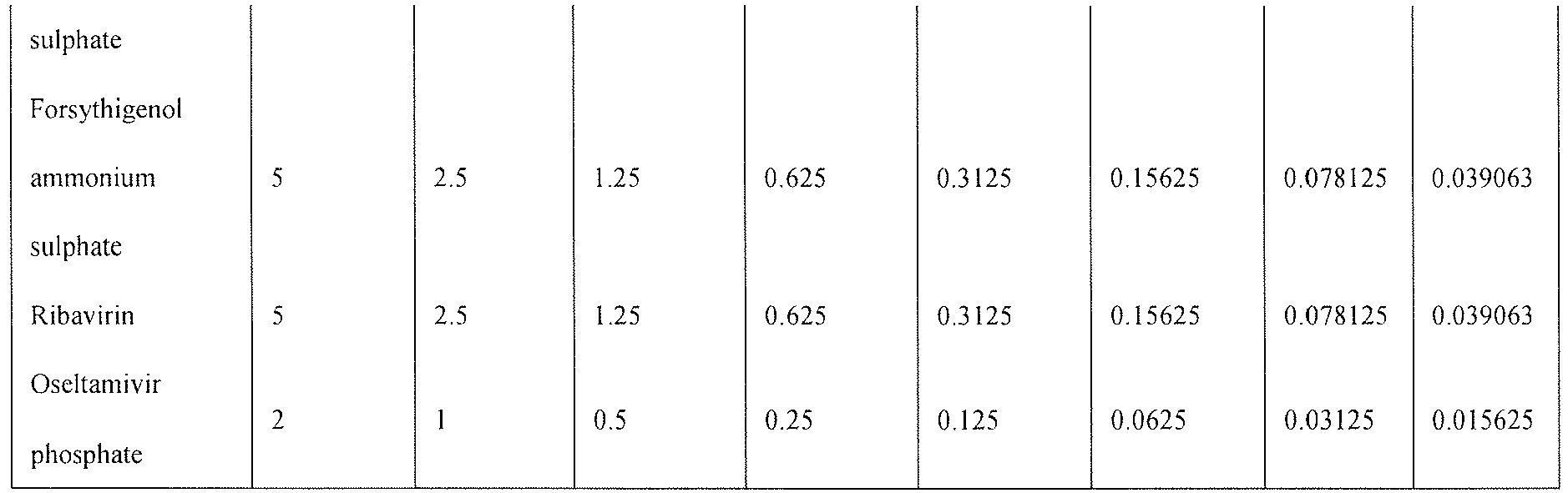
- The aforementioned drugs which are diluted with a maintenance solution (DMEM containing 2% of fetal bovine serum) to different concentrations are dropwise added to the Vero monolayer cell, each well is 0.2ml, there are 6 duplicate wells for each concentration, 6 wells for normal control (normal control group without adding drugs) and 6 wells for blank control (culture medium) are additionally provided, those are placed in an 5% CO2 incubator at 37°C for culturing, observing CPE with an inverted microscope every day and recording. After 72 h, 20µL (5 mg·mL-1) of MTT solution is added in each well, and continues to be incubated for 4 h, the culture broth in each well is sucked and discarded, 100µL of DMSO is added in each well, and is shaken for 5 min, measuring the OD value at 492 nm to calculate cell survival rate. In SPSS 18.0 statistical software, the cell survival rate is subjected to Probit regression analysis to calculate the maximum non-toxic concentration (TC0) and half toxic concentration (TC50) of the drug on the Vero cell.
- Various viruses are diluted by a 10-fold decrement to have different dilutions of 10-1, 10-2, 10-3,10-4,10-5 and 10-6, and are sequentially inoculated in the monolayer Vero cell 96-well culture plate, 100µL for each well, 6 wells for each dilution, and meanwhile, a normal cell control group is provided. It is incubated in 5% CO2 at 37°C for 2h, the virus liquid is discarded, then 100µL of cell maintenance solution is added to each well, and cultured in 5% CO2 at 37°C. The cytopathic results are observed under the microscope from the 3rd day on, results are determined on the 7th-8th day and recording well, such that the highest dilution is taken as the end point where 50% of the cell wells occur a positive lesion, and the virus titer is calculated by using a karber method.

- TCID50: 50% histocyte infection dose
- XM: logarithm of the highest concentration dilution of virus
- d: logarithm of dilution coefficient (multiple)
- ∑pi: the sum of the each dilution lesion percentage.
- A culture plate covered with a monolayer cells is adopted, the culture broth is sucked and discarded, cells are inoculated at an amount of virus attacks corresponding to 100TCID50, and absorbed in a 5% CO2 incubator at 37°C for 2h, various liquids with specific concentrations (about the maximum non-toxic concentration) are added, 6 duplicate wells are provided for culture as for each concentration, 200µL/well. Ribavirin injection and oseltamivir phosphate are provided as a positive drug control group, and a normal control group (adding no virus and drug) and a virus control group (adding virus but no drug) are provided, impact of the drug on the virus-induced CPE is observed. After 72h, the OD value is measured under 492nm wavelength by using an MTT colorimetric method to calculate the antiviral effective rate (ER%) of the drug. In SPSS 18.0 statistical software, significant differences among the antiviral efficiencies of the various drugs are compared by using an ANOVA method. ER%=(the average OD value in the drug treated group-the average OD value in the virus control group)/(the average OD value in the cell control group-the average OD value in the virus control group)×100%
-


- The maximum non-toxic concentrations (TC0), half toxic concentrations (TC50) of the drugs on the Vero cells and concentrations used for drug antiviral test are shown in Table 2.

- For the effective rates of the drugs in resisting various viruses and results of ANOVA-method one-way analysis of variance, see Table 3 for details.

- As shown in the results of Table 3, the effective rates of phillygenin sodium sulphate, phillygenin potassium sulphate, and phillygenin ammonium sulphate in inhibiting influenza virus, parainfluenza virus, coxsackie virus (CoxA16) are all greater than 90%, and compared with the virus control group, the differences are statistically significant; the inhibition rates for respiratory syncytial virus RSV and herpes simplex virus type-I (HSV-I) are both greater than 80%, the effective rates are both higher than 80%, and compared with the virus control group, the differences are statistically significant; and therapeutic effects of the three phillygenin sulphates on the aforementioned viruses are superior to the trends of the ribavirin and the oseltamivir phosphate.
- Kunming mice are provided by Norman Bethune Health Science Center of Jilin University, Medicinal animal No. 10-5219.
-
Main experimental instruments Instrument name Model Manufacturer Quantitative PCR Instrument 7300 ABI PCR Instrument ES-60J Shenyang Longteng Electronic Weighing Instrument Co., Ltd. Electronic Analytical Balance FA1004 Shenyang Longteng Co., Ltd. CO2 Incubator HG303-5 Nanjing Experimental Instrument Factory Super-clean Bench SW-CJ-IF Suzhou Antai Air Tech Co., Ltd. Inverted microscope CKX41 Olympus Instrument -80°C ultra-low temperature freezer TECON-5082 Australia Water bath oscillator HZS-H Harbin Donglian Co., Ltd. Microplate reader TECAN A-5082 Australia Spectrophotometer 7550 model Japan - The influenza virus and parainfluenza virus (cell lysate) are diluted by a 10-fold decrement into virus liquids with concentrations of 10-1, 10-2, 10-3, 10-4 and 10-5. 120 Kunming mice are obtained, 60 of which are provided for the influenza virus group and the remaining 60 are provided for the parainfluenza virus group, and are randomly divided into 6 groups separately; The mice are lightly anesthetized with ether, and are infected nasally with virus liquids having different dilutions at 0.03mL/mouse. Meanwhile blank control is set, and the virus liquids is replaced with saline. Death and survival are regarded as the observational indexes, observation is performed every day for 14 days after infection. Those died within 24h of infection are nonspecific death and are not counted up, the virus liquid LD50 is calculated by using a Karber method. The calculation formula is:

- 360 four weeks old mice are adopted to perform two tests. 180 mice are adopted and randomly divided into 18 groups (10 for each group) for test of determining lung index and lung index inhibition rate of phillygenin sulphates to the mice infected by the influenza virus. The remaining 180 mice are adopted and randomly divided into 18 groups (10 for each group) for a test of determining lung suspension virus hemagglutination titer of phillygenin sulphates.
- A degreasing cotton is placed in a 200∼300mL beaker, in which a suitable amount of ether (just for making cotton wet) is added, the beaker containing the degreasing cotton is inverted upside down, the mice are extremely excited when anesthetized therein, and are made to lie on their backs when clearly weak, the mice are infected nasally with 15LD50 influenza virus and parainfluenza virus at 0.03ml/nostril, and the virus suspension is replaced with normal saline in the normal control group.
- Conventional intragastric administration is carried out respectively for phillygenin sodium sulphate and phillygenin potassium sulphate drug groups and ribavirin control group one day before infection. The high, medium and low administration dosages of the phillygenin sodium sulphate and phillygenin potassium sulphate are 13.0 mg/kg, 6.5 mg/kg and 3.25 mg/kg respectively, and the administration dosage of ribavirin positive drug is 58.5 mg/kg. The administration is performed once a day for five consecutive days. The virus control group is drenched with normal saline of the same volume.
- In the fifth day after drugs are administered by mice, the mice are inhibited from drinking water for 8 hours first; then, after the mice are weighed, their eyes are moved and said animals are killed by bleeding; their chest cavities are opened to take out total lungs, which are washed using normal saline twice, and sucking up the moisture on the surfaces of the lungs by using filter paper; then the lungs are weighed by using an electronic balance, and the lung index and the lung index inhibition rate are calculated according to the following equations:


- Various groups of mice lungs are respectively taken in the fifth day after treatment, and are ground into homogenate by a homogenizer at a low temperature; the homogenate is diluted into 10% of lung tissue suspension with normal saline; centrifugation is performed to obtain a supernatant, which is double diluted and dripped to a titration plate with 0.2 ml/well; 0.2 ml of 1% chicken erythrocyte suspension is added into each hole and mixed well; the titration plate is placed in a room-temperature environment for 30 minutes to observe and record hemagglutination titers. The end point appears when erythrocyte is agglutinated to be (++), and its titer is expressed by the suspension dilution multiple.
- Various mice lungs are respectively taken in the fifth day after treatment; general pathological changes of their viscera are observed by naked eyes and are recorded. The lungs are cleaned by rinsing with normal saline and moisture thereon is sucked up by using filter paper; a portion of the lung is fixed with 10% formaldehyde, paraffin-embedded, sliced and HE-strained; observation and photographing are performed under a microscope.
- Kunming mice in the experiment groups are respectively infected nasally with 30 µL of influenza virus and parainfluenza virus liquids of different concentrations; in the third day of infection, all of the mice in the first three groups (10-1 group, 10-2 group and 10-3 group based on virus concentrations) experience disease symptoms of different degrees: pilomotor fur, trembling, decreased appetite and so on; in the fifth day, the mice stumble; in the sixth day, the mice in the group of the highest virus concentration begin to die, and death occurs successively in the remaining groups in the seventh day after infection. After the observation of 14 days is complete, the mortality of mice of each group is counted, the results of which are shown in Tables 3 and 4. By calculation, of the influenza virus is a dilution 10-2.9, and of the parainfluenza virus is a dilution 10-2.5.
Table 3 Statistics of test results of median lethal dose of influenza virus Influenza virus group Cumulative mortality Cumulative survival Cumulative mortality rate 10-1 group 9 1 90% 10-2 group 7 3 70% 10-3 group 4 6 40% 10-4 group 3 7 30% 10-5 group 1 9 10% Blank group 0 10 0% 
Table 4 Statistics of test results of median lethal dose of parainfluenza virus Parainfluenza virus group Cumulative mortality Cumulative survival Cumulative mortality rate 10-1 group 8 2 80% 10-2 group 6 4 60% 10-3 group 4 6 40% 10-4 group 2 8 20% 10-5 group 0 10 0% Blank group 0 10 0% 
- After mice are infected with influenza virus and parainfluenza virus, the average lung index result shows that: compared with the infection model group, the lung indexes of the normal control group, the drug groups with various concentrations and the ribavirin group decrease significantly (P<0.05); when the concentration of the phillygenin sulphate is within the range from 3.25 to 13.0 mg/kg/d, a certain protective effect is achieved, and all lung indexes decrease significantly; although the decrease in the high dosage group of phillygenin sulphate is more significant when compared with other two groups, there are no significant differences among various groups upon comparison (P>0.05). The medium and high dosage groups of phillygenin sulphates are superior to the ribavirin group (P>0.05). For results, see Tables 5 and 6.
Table 5 Impact of phillygenin sulphates on the lung index of influenza virus infected mice and the lung index inhibition rate Groups Number of animals Drug dosage (mg/kg/d) Lung index ( X ±S)Lung index inhibition rate (%) P value P value Normal control group 10 0 1.274±0.107 - *<0.05 #>0.05 Virus control group 10 0 1.488±0.088 - #<0.05 Ribavirin group 10 58.5 1.282±.064 13.84 *<0.05 Phillygenin sodium sulphate high dosage group 10 13.0 1.1809±.057 20.73 *<0.05 #>0.05 Phillygenin sodium sulphate medium dosage group 10 6.5 1.264±0.051 15.03 *<0.05 #>0.05 Phillygenin sodium sulphate low dosage group 10 3.25 1.344±0.035 9.69 *<0.05 #>0.05 Phillygenin potassium sulphate high dosage group 10 13.0 1.190±0.061 20.03 *<0.05 #>0.05 Phillygenin potassium sulphate medium dosage group 10 6.5 1.262±0.058 15.22 *<0.05 #>0.05 Phillygenin potassium sulphate low dosage group 10 3.25 1.343±0.044 9.77 *<0.05 #>0.05 * represents comparison with the virus control group; # represents comparison with the ribavirin group Table 6 impact of phillygenin sulphates on the lung index of parainfluenza virus infected mice and the lung index inhibition rate Groups Number of animals drug dose (mg/kg/d) Lung index ( X ±S)Lung index inhibition rate (%) P value P value Normal control group 10 0 1.312±0.046 - *<0.05 #>0.05 Virus control group 10 0 1.598±0.071 - #<0.05 Ribavirin group 10 58.5 1.392±0.070 12.89 *<0.05 Phillygenin sodium sulphate high dosage group 10 13.0 1.331±0.073 16.73 *<0.05 #>0.05 Phillygenin sodium sulphate medium dosage group 10 6.5 1.303±0.062 18.46 *<0.05 #>0.05 Phillygenin sodium sulphate low dosage group 10 3.25 1.311±0.049 17.96 *<0.05 #>0.05 Phillygenin potassium sulphate high dosage group 10 13.0 1.308±0.085 18.13 *<0.05 #>0.05 Phillygenin potassium sulphate medium dosage group 10 6.5 1.286±0.078 19.55 *<0.05 #>0.05 Phillygenin potassium sulphate low dosage group 10 3.25 1.259±0.041 17.10 *<0.05 #>0.05 * represents comparison with the virus control group; # represents comparison with the ribavirin group - After mice are infected with the influenza virus and parainfluenza virus, the lung tissue hemagglutination titers (InX) of the infection model group are respectively 32.33 and 33.86, after treatment with the phillygenin sulphate of different concentrations for 5 days, the lung tissue virus hemagglutination titers both decrease to some extent; as compared with the infection model group, the difference is significant, (P<0.05). As compared with the ribavirin group, the virus hemagglutination titers of the high, medium, and low dosage groups of phillygenin sulphates are all higher than that of the ribavirin group, the differences are significant (P<0.05); upon comparison, the hemagglutination titer of the high dosage group of phillygenin sulphates is significantly different from those of the other two groups (P<0.05), as shown in Table 10. Upon comparison, there is no significant difference between the high dosage group of phillygenin sulphates and the ribavirin group of the parainfluenza virus infected mice (P>0.05), the medium and low dosage groups of phillygenin sulphates are both superior to the ribavirin group, the differences are significant (P<0.05); upon comparison, the hemagglutination titer of the high dosage group of phillygenin sulphates is significantly different from that of the low dosage group of phillygenin sulphates (P>0.05), as shown in Tables 7 and 8.
Table 7 Impact of phillygenin sulphates on the lung suspension hemagglutination titer of the influenza virus infected mice Groups Number of animals Drug dose (mg/kg/d) Hemagglutination titer (InX) P value P value Normal control group 10 0 0 *<0.05 *<0.05 Virus control group 10 0 32.33±1.187 #<0.05 Ribavirin group 10 58.5 21.13±0.986 *<0.05 Phillygenin sodium sulphate high dosage group 10 13.0 20.07±0.646 *<0.05 #<0.05 Phillygenin sodium sulphate medium dosage group 10 6.5 21.29±0.504 *<0.05 #<0.05 Phillygenin sodium sulphate low dosage group 10 3.25 23.93±.392 *<0.05 #<0.05 Phillygenin potassium sulphate high dosage group 10 13.0 19.95±0.595 *<0.05 #<0.05 Phillygenin potassium sulphate medium dosage group 10 6.5 21.06±0.515 *<0.05 #<0.05 Phillygenin potassium sulphate low dosage group 10 3.25 22.11±1.012 *<0.05 #<0.05 * represents comparison with the virus control group; # represents comparison with the ribavirin group Table 8 Impact of phillygenin sulphates on the lung suspension hemagglutination titer of the parainfluenza virus infected mice Groups Number of animals Drug dose (mg/kg/d) Hemagglutination titer (InX) P value P value Normal control group 10 0 0 *<0.05 *<0.05 Virus control group 10 0 33.86±1.264 #<0.05 Ribavirin group 10 58.5 26.73±1.193 *<0.05 Phillygenin sodium sulphate high dosage group 10 13.0 19.82±0.981 *<0.05 #>0.05 Phillygenin sodium sulphate medium dosage group 10 6.5 21.01±0.614 *<0.05 #<0.05 Phillygenin sodium sulphate low dosage group 10 3.25 23.26±0.991 *<0.05 #<0.05 Phillygenin potassium sulphate high dosage group 10 13.0 20.91±0.825 *<0.05 #>0.05 Phillygenin potassium sulphate medium dosage group 10 6.5 22.05±0.829 *<0.05 #<0.05 Phillygenin potassium sulphate low dosage group 10 3.25 23.88±0.953 *<0.05 #<0.05 * represents comparison with the virus control group; # represents comparison with the ribavirin group - The lungs of the mice in the influenza virus and parainfluenza virus pneumonia model group are mostly congested, suffered from edema lesion; some the lung turn out to be consolidation areas with dark brown appearance, the seriously affected ones appear brownish red hemorrhagic focuses. Microscopically, it can be seen that the interstitial lung, such as bronchi, bronchioles and alveolar walls, are suffered from congestion, edema and lymphocytes, mononuclear cell infiltration, alveolar wall widening, and inflammatory reaction of pulmonary alveoli. After the influenza virus and parainfluenza virus pneumonia mice models are treated with the phillygenin sulphate, the general pathological changes of the lungs of each group of mice are significantly reduced, and some of the lung tissues are normal in shape and structure; compared with the infection model group, the alveolar septum is thinner, the infiltration number of the mononuclear cells of the alveolar wall and bronchiole wall is less, there is no leakage in the cavity, and the lesions are significantly reduced. As compared with the infection model group, the medium and high dosage groups of the phillygenin sulphate in treating parainfluenza virus pneumonia have significantly thinner alveolar septum, less infiltration number of mononuclear cells, no leakage in the cavity, and significantly reduced lesions.
- The mouse lung tissue pathological slice microscopic examination results of the influenza virus pneumonia model are shown in
Fig. 1; Fig. 1A shows the lung tissue of a normal mouse;Fig. 1B shows the lung tissue of an influenza virus pneumonia mouse;Fig. 1C shows the lung tissue of the mouse of the influenza virus pneumonia mouse model after being treated with positive drug ribavirin; Fig. ID shows the lung tissue of the mouse of the influenza virus pneumonia mouse model after being treated with high-dosage phillygenin sulphates;Fig. 1E shows the lung tissue of the mouse of the influenza virus pneumonia mouse model after being treated with medium-dosage phillygenin sulphates;Fig. 1F shows the lung tissue of the mouse of the influenza virus pneumonia mouse model after being treated with low-dosage phillygenin sulphates. - The mouse lung tissue pathological slice microscopic examination results of the parainfluenza virus pneumonia model are shown in
Fig. 2; Fig. 2A shows the lung tissue of a normal mouse;Fig. 2B shows the lung tissue of a parainfluenza virus pneumonia mouse;Fig. 2C shows the lung tissue of the mouse of the parainfluenza virus pneumonia mouse model after being treated with positive drug ribavirin;Fig. 2D shows the lung tissue of the mouse of the influenza virus pneumonia mouse model after being treated with high-dosage phillygenin sulphates;Fig. 2E shows the lung tissue of the mouse of the parainfluenza virus pneumonia mouse model after being treated with medium-dosage phillygenin sulphates;Fig. 2F shows the lung tissue of the mouse of the parainfluenza virus pneumonia mouse model after being treated with low-dosage phillygenin sulphates. - In vivo antiviral test results show that the phillygenin sulphates (phillygenin sodium sulphate and phillygenin potassium sulphate) have relatively significant inhibition effects on influenza virus and parainfluenza virus as well as the mice viral pneumonia caused thereby at a dosage range of 3.25 mg/kg/d to 13 mg/kg/d, can significantly reduce the lung index and hemagglutination titer thereof, also significantly improve the pulmonary tissue pathology and have significant difference as compared with the model control group.
Claims (10)
- A phillygenin sulphate as represented by the following chemical structural formula,

- A preparation method of the phillygenin sulphate according to claim 1, comprising the following sequentially performed steps1) dissolving a phillygenol in an organic solvent to obtain a phillygenol solution, wherein the phillygenol is represented by the following chemical structural formula:
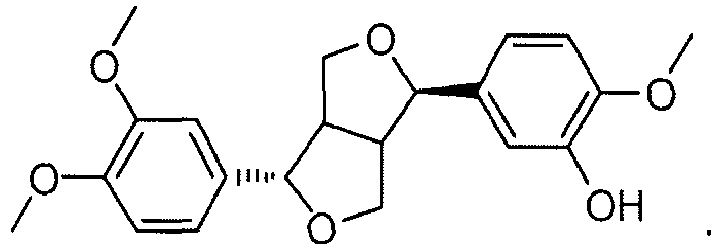 2) first adding a sulfating agent into the phillygenol solution and mixing well; and then, carrying out an esterification reaction to obtain a product mixture liquid;3) adding a base to adjust the pH value of the mixture liquid to 8-10; and4) separating and purifying the mixture liquid to obtain the final product.
 - The preparation method according to claim 2, wherein the sulfating agent in step 2) is selected from the group consisting of chlorosulfonic acid, sulfur trioxide-triethylamine complex, sulfur trioxide-pyridine complex and sulfur trioxide-trimethylamine complex.
- The preparation method according to claim 2 or 3, wherein the base in step 3) is selected from the group consisting of organic base and inorganic base.
- The preparation method according to claim 2 or 3, wherein the organic solvent in step 1) is selected from the group consisting of pyridine, N,N-dimethylformamide, N,N-dimethylacetamide and dichloromethane.
- The preparation method according to claim 2 or 3, wherein the sulfating agent is added in the phillygenol solution at a temperature of 0-5°C in step 2).
- The preparation method according to claim 2 or 3, wherein a molar ratio of the phillygenol in the phillygenol solution to the sulfating agent added into the phillygenol solution in step 2) is 1:1-10.
- Use of the phillygenin sulphate according to claim 1 for the manufacture of antiviral drugs.
- The use according to claim 8, wherein the antiviral drugs are selected from the group consisting of anti-influenza drugs, anti-parainfluenza drugs, anti-respiratory syncytial virus drugs, anti-herpes simplex virus type-I drugs and anti-coxsackievirus A16 drugs.
- An antiviral drug characterized by containing a phillygenin sulphate according to claim 1.
Applications Claiming Priority (2)
| Application Number | Priority Date | Filing Date | Title |
|---|---|---|---|
| CN201310580801.5A CN104650108B (en) | 2013-11-18 | 2013-11-18 | Phillygenol sulfate and derivatives thereof, and preparing method and applications of the phillygenol sulfate and the derivatives thereof |
| PCT/CN2014/090465 WO2015070724A1 (en) | 2013-11-18 | 2014-11-06 | Phillygenol sulphate and derivative thereof, and preparation method and application thereof |
Publications (3)
| Publication Number | Publication Date |
|---|---|
| EP3072895A1 EP3072895A1 (en) | 2016-09-28 |
| EP3072895A4 EP3072895A4 (en) | 2017-05-31 |
| EP3072895B1 true EP3072895B1 (en) | 2019-08-07 |
Family
ID=53056758
Family Applications (1)
| Application Number | Title | Priority Date | Filing Date |
|---|---|---|---|
| EP14861789.7A Active EP3072895B1 (en) | 2013-11-18 | 2014-11-06 | Phillygenol sulphate and derivative thereof, and preparation method and application thereof |
Country Status (10)
| Country | Link |
|---|---|
| US (1) | US9670224B2 (en) |
| EP (1) | EP3072895B1 (en) |
| JP (1) | JP6466444B2 (en) |
| KR (1) | KR101850902B1 (en) |
| CN (1) | CN104650108B (en) |
| AU (1) | AU2014350785B2 (en) |
| CA (1) | CA2930338C (en) |
| ES (1) | ES2749611T3 (en) |
| RU (1) | RU2642784C2 (en) |
| WO (1) | WO2015070724A1 (en) |
Families Citing this family (7)
| Publication number | Priority date | Publication date | Assignee | Title |
|---|---|---|---|---|
| JP6500051B2 (en) * | 2017-03-17 | 2019-04-10 | 哲丸 村田 | Tissue processing method |
| CN108752362B (en) * | 2018-08-06 | 2020-07-28 | 鲁南制药集团股份有限公司 | Forsythiagenin methanol compound, crystal form A and preparation method thereof |
| CN113368121A (en) * | 2020-03-09 | 2021-09-10 | 吉林亚泰制药股份有限公司 | Anti-coronavirus phillyrin and phillygenin composition |
| CN116196321A (en) * | 2021-12-01 | 2023-06-02 | 盖鑫 | Application and preparation of bisepoxylignanoid compound and antiviral composition |
| CN114990054B (en) * | 2022-07-22 | 2023-07-21 | 成都艾伟孚生物科技有限公司 | Sperm washing fertilization liquid for auxiliary reproduction |
| CN115974730B (en) * | 2023-01-06 | 2026-03-10 | 湖南大学 | Methods for synthesizing organic sulfates from persulfate |
| WO2025237860A1 (en) | 2024-05-15 | 2025-11-20 | Bayer Aktiengesellschaft | Herbicidal 4-hydroxy-hexahydrofuro[3,4-b]furan derivatives |
Family Cites Families (4)
| Publication number | Priority date | Publication date | Assignee | Title |
|---|---|---|---|---|
| ES2142773B1 (en) * | 1998-10-07 | 2001-01-01 | Lacer Sa | ISOSORBIDA MONONITRATE DERIVATIVES AND THEIR EMPLOYMENT AS VASODILATATING AGENTS WITH DECREASED TOLERANCE. |
| CN101537046A (en) * | 2008-03-21 | 2009-09-23 | 河南大学 | Blood lipid-lowing active fractions of forsythia suspensa and preparation method and use of same |
| CN101974047A (en) * | 2010-07-26 | 2011-02-16 | 南京泽朗农业发展有限公司 | Method for extracting forsythin from weeping forsythia leaves |
| EP2517574B1 (en) | 2011-04-29 | 2015-11-11 | Symrise AG | Specific vanillyl lignanes and their use as taste enhancers |
-
2013
- 2013-11-18 CN CN201310580801.5A patent/CN104650108B/en active Active
-
2014
- 2014-11-06 AU AU2014350785A patent/AU2014350785B2/en not_active Ceased
- 2014-11-06 JP JP2016530837A patent/JP6466444B2/en not_active Expired - Fee Related
- 2014-11-06 WO PCT/CN2014/090465 patent/WO2015070724A1/en not_active Ceased
- 2014-11-06 ES ES14861789T patent/ES2749611T3/en active Active
- 2014-11-06 US US15/036,613 patent/US9670224B2/en active Active
- 2014-11-06 EP EP14861789.7A patent/EP3072895B1/en active Active
- 2014-11-06 CA CA2930338A patent/CA2930338C/en active Active
- 2014-11-06 KR KR1020167015984A patent/KR101850902B1/en not_active Expired - Fee Related
- 2014-11-06 RU RU2016124221A patent/RU2642784C2/en active
Non-Patent Citations (1)
| Title |
|---|
| None * |
Also Published As
| Publication number | Publication date |
|---|---|
| EP3072895A4 (en) | 2017-05-31 |
| WO2015070724A1 (en) | 2015-05-21 |
| CN104650108A (en) | 2015-05-27 |
| US20160355524A1 (en) | 2016-12-08 |
| ES2749611T3 (en) | 2020-03-23 |
| RU2016124221A (en) | 2017-12-25 |
| KR101850902B1 (en) | 2018-04-20 |
| AU2014350785A1 (en) | 2016-06-09 |
| CA2930338A1 (en) | 2015-05-21 |
| RU2642784C2 (en) | 2018-01-26 |
| CA2930338C (en) | 2018-08-21 |
| JP2016537359A (en) | 2016-12-01 |
| JP6466444B2 (en) | 2019-02-06 |
| EP3072895A1 (en) | 2016-09-28 |
| US9670224B2 (en) | 2017-06-06 |
| KR20160085886A (en) | 2016-07-18 |
| AU2014350785B2 (en) | 2017-09-14 |
| CN104650108B (en) | 2017-05-24 |
Similar Documents
| Publication | Publication Date | Title |
|---|---|---|
| US9670224B2 (en) | Forsythiaside sulfate and derivatives thereof, preparation method and application thereof | |
| KR101925133B1 (en) | Phillygenin ibuprofen ester, preparation method therefor, and applications thereof | |
| JP2016537359A5 (en) | Filigenin sulfate, its derivatives, its preparation and its use | |
| US10407455B2 (en) | Phillygenin glucuronic acid derivative as well as preparation method and application thereof | |
| WO2016101733A1 (en) | Phillygenin glucuronic acid derivative, and preparation method and use thereof | |
| US10400004B2 (en) | Chemical synthesis method of phillyrin | |
| CN103156840B (en) | Once preparation method of composite of 17-hydrogen-9-dehydro-andrographolidume-3-sodium (or potassium) disulfate and 17-hydrogen-9-dehydro-andrographolidume-3, 19-sodium (or potassium) disulfate, and purposes of prepared medicine | |
| CN105331653B (en) | Method for preparing antiviral drug forsythiaside | |
| CN103159711B (en) | Once preparation method of composite of 17-hydrogen-9-dehydro-andrographolidume-3, 19-sodium (or potassium) disulfate and 17-hydrogen-9-dehydro-andrographolidume-19-sodium (or potassium) disulfate, and purposes of prepared medicine | |
| CN103156841A (en) | Compound of 17-hydrogen-9-dehydrogenation andrographolide-3-sulphate sodium (or potassium) and 17-hydrogen-9-dehydrogenation andrographolide-19-sulphate sodium (or potassium) and preparation drug purposes thereof |
Legal Events
| Date | Code | Title | Description |
|---|---|---|---|
| PUAI | Public reference made under article 153(3) epc to a published international application that has entered the european phase |
Free format text: ORIGINAL CODE: 0009012 |
|
| 17P | Request for examination filed |
Effective date: 20160513 |
|
| AK | Designated contracting states |
Kind code of ref document: A1 Designated state(s): AL AT BE BG CH CY CZ DE DK EE ES FI FR GB GR HR HU IE IS IT LI LT LU LV MC MK MT NL NO PL PT RO RS SE SI SK SM TR |
|
| AX | Request for extension of the european patent |
Extension state: BA ME |
|
| DAX | Request for extension of the european patent (deleted) | ||
| A4 | Supplementary search report drawn up and despatched |
Effective date: 20170502 |
|
| RIC1 | Information provided on ipc code assigned before grant |
Ipc: A61P 31/22 20060101ALI20170424BHEP Ipc: C07D 493/04 20060101AFI20170424BHEP Ipc: A61P 31/16 20060101ALI20170424BHEP Ipc: A61P 31/14 20060101ALI20170424BHEP Ipc: A61K 31/34 20060101ALI20170424BHEP |
|
| STAA | Information on the status of an ep patent application or granted ep patent |
Free format text: STATUS: EXAMINATION IS IN PROGRESS |
|
| 17Q | First examination report despatched |
Effective date: 20180308 |
|
| GRAP | Despatch of communication of intention to grant a patent |
Free format text: ORIGINAL CODE: EPIDOSNIGR1 |
|
| STAA | Information on the status of an ep patent application or granted ep patent |
Free format text: STATUS: GRANT OF PATENT IS INTENDED |
|
| INTG | Intention to grant announced |
Effective date: 20190320 |
|
| GRAS | Grant fee paid |
Free format text: ORIGINAL CODE: EPIDOSNIGR3 |
|
| GRAA | (expected) grant |
Free format text: ORIGINAL CODE: 0009210 |
|
| STAA | Information on the status of an ep patent application or granted ep patent |
Free format text: STATUS: THE PATENT HAS BEEN GRANTED |
|
| AK | Designated contracting states |
Kind code of ref document: B1 Designated state(s): AL AT BE BG CH CY CZ DE DK EE ES FI FR GB GR HR HU IE IS IT LI LT LU LV MC MK MT NL NO PL PT RO RS SE SI SK SM TR |
|
| REG | Reference to a national code |
Ref country code: GB Ref legal event code: FG4D |
|
| REG | Reference to a national code |
Ref country code: CH Ref legal event code: EP Ref country code: CH Ref legal event code: NV Representative=s name: RIEDERER HASLER AND PARTNER PATENTANWAELTE AG, CH Ref country code: AT Ref legal event code: REF Ref document number: 1163676 Country of ref document: AT Kind code of ref document: T Effective date: 20190815 |
|
| REG | Reference to a national code |
Ref country code: DE Ref legal event code: R096 Ref document number: 602014051526 Country of ref document: DE |
|
| REG | Reference to a national code |
Ref country code: IE Ref legal event code: FG4D |
|
| REG | Reference to a national code |
Ref country code: SE Ref legal event code: TRGR |
|
| REG | Reference to a national code |
Ref country code: NL Ref legal event code: FP |
|
| REG | Reference to a national code |
Ref country code: LT Ref legal event code: MG4D |
|
| PG25 | Lapsed in a contracting state [announced via postgrant information from national office to epo] |
Ref country code: BG Free format text: LAPSE BECAUSE OF FAILURE TO SUBMIT A TRANSLATION OF THE DESCRIPTION OR TO PAY THE FEE WITHIN THE PRESCRIBED TIME-LIMIT Effective date: 20191107 Ref country code: NO Free format text: LAPSE BECAUSE OF FAILURE TO SUBMIT A TRANSLATION OF THE DESCRIPTION OR TO PAY THE FEE WITHIN THE PRESCRIBED TIME-LIMIT Effective date: 20191107 Ref country code: LT Free format text: LAPSE BECAUSE OF FAILURE TO SUBMIT A TRANSLATION OF THE DESCRIPTION OR TO PAY THE FEE WITHIN THE PRESCRIBED TIME-LIMIT Effective date: 20190807 Ref country code: FI Free format text: LAPSE BECAUSE OF FAILURE TO SUBMIT A TRANSLATION OF THE DESCRIPTION OR TO PAY THE FEE WITHIN THE PRESCRIBED TIME-LIMIT Effective date: 20190807 Ref country code: PT Free format text: LAPSE BECAUSE OF FAILURE TO SUBMIT A TRANSLATION OF THE DESCRIPTION OR TO PAY THE FEE WITHIN THE PRESCRIBED TIME-LIMIT Effective date: 20191209 Ref country code: HR Free format text: LAPSE BECAUSE OF FAILURE TO SUBMIT A TRANSLATION OF THE DESCRIPTION OR TO PAY THE FEE WITHIN THE PRESCRIBED TIME-LIMIT Effective date: 20190807 |
|
| REG | Reference to a national code |
Ref country code: AT Ref legal event code: MK05 Ref document number: 1163676 Country of ref document: AT Kind code of ref document: T Effective date: 20190807 |
|
| PG25 | Lapsed in a contracting state [announced via postgrant information from national office to epo] |
Ref country code: LV Free format text: LAPSE BECAUSE OF FAILURE TO SUBMIT A TRANSLATION OF THE DESCRIPTION OR TO PAY THE FEE WITHIN THE PRESCRIBED TIME-LIMIT Effective date: 20190807 Ref country code: GR Free format text: LAPSE BECAUSE OF FAILURE TO SUBMIT A TRANSLATION OF THE DESCRIPTION OR TO PAY THE FEE WITHIN THE PRESCRIBED TIME-LIMIT Effective date: 20191108 Ref country code: AL Free format text: LAPSE BECAUSE OF FAILURE TO SUBMIT A TRANSLATION OF THE DESCRIPTION OR TO PAY THE FEE WITHIN THE PRESCRIBED TIME-LIMIT Effective date: 20190807 Ref country code: IS Free format text: LAPSE BECAUSE OF FAILURE TO SUBMIT A TRANSLATION OF THE DESCRIPTION OR TO PAY THE FEE WITHIN THE PRESCRIBED TIME-LIMIT Effective date: 20191207 Ref country code: RS Free format text: LAPSE BECAUSE OF FAILURE TO SUBMIT A TRANSLATION OF THE DESCRIPTION OR TO PAY THE FEE WITHIN THE PRESCRIBED TIME-LIMIT Effective date: 20190807 |
|
| REG | Reference to a national code |
Ref country code: ES Ref legal event code: FG2A Ref document number: 2749611 Country of ref document: ES Kind code of ref document: T3 Effective date: 20200323 |
|
| PG25 | Lapsed in a contracting state [announced via postgrant information from national office to epo] |
Ref country code: TR Free format text: LAPSE BECAUSE OF FAILURE TO SUBMIT A TRANSLATION OF THE DESCRIPTION OR TO PAY THE FEE WITHIN THE PRESCRIBED TIME-LIMIT Effective date: 20190807 |
|
| PG25 | Lapsed in a contracting state [announced via postgrant information from national office to epo] |
Ref country code: AT Free format text: LAPSE BECAUSE OF FAILURE TO SUBMIT A TRANSLATION OF THE DESCRIPTION OR TO PAY THE FEE WITHIN THE PRESCRIBED TIME-LIMIT Effective date: 20190807 Ref country code: DK Free format text: LAPSE BECAUSE OF FAILURE TO SUBMIT A TRANSLATION OF THE DESCRIPTION OR TO PAY THE FEE WITHIN THE PRESCRIBED TIME-LIMIT Effective date: 20190807 Ref country code: EE Free format text: LAPSE BECAUSE OF FAILURE TO SUBMIT A TRANSLATION OF THE DESCRIPTION OR TO PAY THE FEE WITHIN THE PRESCRIBED TIME-LIMIT Effective date: 20190807 Ref country code: PL Free format text: LAPSE BECAUSE OF FAILURE TO SUBMIT A TRANSLATION OF THE DESCRIPTION OR TO PAY THE FEE WITHIN THE PRESCRIBED TIME-LIMIT Effective date: 20190807 Ref country code: RO Free format text: LAPSE BECAUSE OF FAILURE TO SUBMIT A TRANSLATION OF THE DESCRIPTION OR TO PAY THE FEE WITHIN THE PRESCRIBED TIME-LIMIT Effective date: 20190807 |
|
| PG25 | Lapsed in a contracting state [announced via postgrant information from national office to epo] |
Ref country code: CZ Free format text: LAPSE BECAUSE OF FAILURE TO SUBMIT A TRANSLATION OF THE DESCRIPTION OR TO PAY THE FEE WITHIN THE PRESCRIBED TIME-LIMIT Effective date: 20190807 Ref country code: SK Free format text: LAPSE BECAUSE OF FAILURE TO SUBMIT A TRANSLATION OF THE DESCRIPTION OR TO PAY THE FEE WITHIN THE PRESCRIBED TIME-LIMIT Effective date: 20190807 Ref country code: IS Free format text: LAPSE BECAUSE OF FAILURE TO SUBMIT A TRANSLATION OF THE DESCRIPTION OR TO PAY THE FEE WITHIN THE PRESCRIBED TIME-LIMIT Effective date: 20200224 Ref country code: SM Free format text: LAPSE BECAUSE OF FAILURE TO SUBMIT A TRANSLATION OF THE DESCRIPTION OR TO PAY THE FEE WITHIN THE PRESCRIBED TIME-LIMIT Effective date: 20190807 |
|
| REG | Reference to a national code |
Ref country code: DE Ref legal event code: R097 Ref document number: 602014051526 Country of ref document: DE |
|
| PLBE | No opposition filed within time limit |
Free format text: ORIGINAL CODE: 0009261 |
|
| STAA | Information on the status of an ep patent application or granted ep patent |
Free format text: STATUS: NO OPPOSITION FILED WITHIN TIME LIMIT |
|
| PG2D | Information on lapse in contracting state deleted |
Ref country code: IS |
|
| PG25 | Lapsed in a contracting state [announced via postgrant information from national office to epo] |
Ref country code: LU Free format text: LAPSE BECAUSE OF NON-PAYMENT OF DUE FEES Effective date: 20191106 Ref country code: MC Free format text: LAPSE BECAUSE OF FAILURE TO SUBMIT A TRANSLATION OF THE DESCRIPTION OR TO PAY THE FEE WITHIN THE PRESCRIBED TIME-LIMIT Effective date: 20190807 |
|
| 26N | No opposition filed |
Effective date: 20200603 |
|
| REG | Reference to a national code |
Ref country code: BE Ref legal event code: MM Effective date: 20191130 |
|
| PG25 | Lapsed in a contracting state [announced via postgrant information from national office to epo] |
Ref country code: SI Free format text: LAPSE BECAUSE OF FAILURE TO SUBMIT A TRANSLATION OF THE DESCRIPTION OR TO PAY THE FEE WITHIN THE PRESCRIBED TIME-LIMIT Effective date: 20190807 |
|
| PG25 | Lapsed in a contracting state [announced via postgrant information from national office to epo] |
Ref country code: IE Free format text: LAPSE BECAUSE OF NON-PAYMENT OF DUE FEES Effective date: 20191106 |
|
| PG25 | Lapsed in a contracting state [announced via postgrant information from national office to epo] |
Ref country code: BE Free format text: LAPSE BECAUSE OF NON-PAYMENT OF DUE FEES Effective date: 20191130 |
|
| PG25 | Lapsed in a contracting state [announced via postgrant information from national office to epo] |
Ref country code: CY Free format text: LAPSE BECAUSE OF FAILURE TO SUBMIT A TRANSLATION OF THE DESCRIPTION OR TO PAY THE FEE WITHIN THE PRESCRIBED TIME-LIMIT Effective date: 20190807 |
|
| PG25 | Lapsed in a contracting state [announced via postgrant information from national office to epo] |
Ref country code: MT Free format text: LAPSE BECAUSE OF FAILURE TO SUBMIT A TRANSLATION OF THE DESCRIPTION OR TO PAY THE FEE WITHIN THE PRESCRIBED TIME-LIMIT Effective date: 20190807 Ref country code: HU Free format text: LAPSE BECAUSE OF FAILURE TO SUBMIT A TRANSLATION OF THE DESCRIPTION OR TO PAY THE FEE WITHIN THE PRESCRIBED TIME-LIMIT; INVALID AB INITIO Effective date: 20141106 |
|
| PG25 | Lapsed in a contracting state [announced via postgrant information from national office to epo] |
Ref country code: MK Free format text: LAPSE BECAUSE OF FAILURE TO SUBMIT A TRANSLATION OF THE DESCRIPTION OR TO PAY THE FEE WITHIN THE PRESCRIBED TIME-LIMIT Effective date: 20190807 |
|
| PGFP | Annual fee paid to national office [announced via postgrant information from national office to epo] |
Ref country code: SE Payment date: 20221130 Year of fee payment: 9 Ref country code: NL Payment date: 20221128 Year of fee payment: 9 |
|
| PGFP | Annual fee paid to national office [announced via postgrant information from national office to epo] |
Ref country code: CH Payment date: 20221129 Year of fee payment: 9 |
|
| PGFP | Annual fee paid to national office [announced via postgrant information from national office to epo] |
Ref country code: ES Payment date: 20231206 Year of fee payment: 10 |
|
| REG | Reference to a national code |
Ref country code: CH Ref legal event code: PL |
|
| REG | Reference to a national code |
Ref country code: SE Ref legal event code: EUG |
|
| REG | Reference to a national code |
Ref country code: NL Ref legal event code: MM Effective date: 20231201 |
|
| PG25 | Lapsed in a contracting state [announced via postgrant information from national office to epo] |
Ref country code: CH Free format text: LAPSE BECAUSE OF NON-PAYMENT OF DUE FEES Effective date: 20231130 |
|
| PG25 | Lapsed in a contracting state [announced via postgrant information from national office to epo] |
Ref country code: CH Free format text: LAPSE BECAUSE OF NON-PAYMENT OF DUE FEES Effective date: 20231130 |
|
| PG25 | Lapsed in a contracting state [announced via postgrant information from national office to epo] |
Ref country code: SE Free format text: LAPSE BECAUSE OF NON-PAYMENT OF DUE FEES Effective date: 20231107 |
|
| PG25 | Lapsed in a contracting state [announced via postgrant information from national office to epo] |
Ref country code: NL Free format text: LAPSE BECAUSE OF NON-PAYMENT OF DUE FEES Effective date: 20231201 |
|
| PG25 | Lapsed in a contracting state [announced via postgrant information from national office to epo] |
Ref country code: NL Free format text: LAPSE BECAUSE OF NON-PAYMENT OF DUE FEES Effective date: 20231201 |
|
| PGFP | Annual fee paid to national office [announced via postgrant information from national office to epo] |
Ref country code: DE Payment date: 20241129 Year of fee payment: 11 |
|
| PGFP | Annual fee paid to national office [announced via postgrant information from national office to epo] |
Ref country code: GB Payment date: 20241129 Year of fee payment: 11 |
|
| PGFP | Annual fee paid to national office [announced via postgrant information from national office to epo] |
Ref country code: FR Payment date: 20241127 Year of fee payment: 11 |
|
| PGFP | Annual fee paid to national office [announced via postgrant information from national office to epo] |
Ref country code: IT Payment date: 20241126 Year of fee payment: 11 |
|
| REG | Reference to a national code |
Ref country code: ES Ref legal event code: FD2A Effective date: 20251230 |
|
| PG25 | Lapsed in a contracting state [announced via postgrant information from national office to epo] |
Ref country code: ES Free format text: LAPSE BECAUSE OF NON-PAYMENT OF DUE FEES Effective date: 20241107 |