EP3072685A1 - Stretchable laminate, and article including same - Google Patents
Stretchable laminate, and article including same Download PDFInfo
- Publication number
- EP3072685A1 EP3072685A1 EP15836841.5A EP15836841A EP3072685A1 EP 3072685 A1 EP3072685 A1 EP 3072685A1 EP 15836841 A EP15836841 A EP 15836841A EP 3072685 A1 EP3072685 A1 EP 3072685A1
- Authority
- EP
- European Patent Office
- Prior art keywords
- elastomer
- olefin
- sensitive adhesive
- hot
- layer
- Prior art date
- Legal status (The legal status is an assumption and is not a legal conclusion. Google has not performed a legal analysis and makes no representation as to the accuracy of the status listed.)
- Granted
Links
Images


Classifications
-
- B—PERFORMING OPERATIONS; TRANSPORTING
- B32—LAYERED PRODUCTS
- B32B—LAYERED PRODUCTS, i.e. PRODUCTS BUILT-UP OF STRATA OF FLAT OR NON-FLAT, e.g. CELLULAR OR HONEYCOMB, FORM
- B32B25/00—Layered products comprising a layer of natural or synthetic rubber
- B32B25/10—Layered products comprising a layer of natural or synthetic rubber next to a fibrous or filamentary layer
-
- A—HUMAN NECESSITIES
- A61—MEDICAL OR VETERINARY SCIENCE; HYGIENE
- A61F—FILTERS IMPLANTABLE INTO BLOOD VESSELS; PROSTHESES; DEVICES PROVIDING PATENCY TO, OR PREVENTING COLLAPSING OF, TUBULAR STRUCTURES OF THE BODY, e.g. STENTS; ORTHOPAEDIC, NURSING OR CONTRACEPTIVE DEVICES; FOMENTATION; TREATMENT OR PROTECTION OF EYES OR EARS; BANDAGES, DRESSINGS OR ABSORBENT PADS; FIRST-AID KITS
- A61F13/00—Bandages or dressings; Absorbent pads
- A61F13/15—Absorbent pads, e.g. sanitary towels, swabs or tampons for external or internal application to the body; Supporting or fastening means therefor; Tampon applicators
- A61F13/45—Absorbent pads, e.g. sanitary towels, swabs or tampons for external or internal application to the body; Supporting or fastening means therefor; Tampon applicators characterised by the shape
- A61F13/49—Absorbent pads, e.g. sanitary towels, swabs or tampons for external or internal application to the body; Supporting or fastening means therefor; Tampon applicators characterised by the shape specially adapted to be worn around the waist, e.g. diapers, nappies
- A61F13/49007—Form-fitting, self-adjusting disposable diapers
- A61F13/49009—Form-fitting, self-adjusting disposable diapers with elastic means
- A61F13/4902—Form-fitting, self-adjusting disposable diapers with elastic means characterised by the elastic material
-
- B—PERFORMING OPERATIONS; TRANSPORTING
- B32—LAYERED PRODUCTS
- B32B—LAYERED PRODUCTS, i.e. PRODUCTS BUILT-UP OF STRATA OF FLAT OR NON-FLAT, e.g. CELLULAR OR HONEYCOMB, FORM
- B32B27/00—Layered products comprising a layer of synthetic resin
- B32B27/32—Layered products comprising a layer of synthetic resin comprising polyolefins
-
- B—PERFORMING OPERATIONS; TRANSPORTING
- B32—LAYERED PRODUCTS
- B32B—LAYERED PRODUCTS, i.e. PRODUCTS BUILT-UP OF STRATA OF FLAT OR NON-FLAT, e.g. CELLULAR OR HONEYCOMB, FORM
- B32B5/00—Layered products characterised by the non- homogeneity or physical structure, i.e. comprising a fibrous, filamentary, particulate or foam layer; Layered products characterised by having a layer differing constitutionally or physically in different parts
- B32B5/02—Layered products characterised by the non- homogeneity or physical structure, i.e. comprising a fibrous, filamentary, particulate or foam layer; Layered products characterised by having a layer differing constitutionally or physically in different parts characterised by structural features of a fibrous or filamentary layer
- B32B5/022—Non-woven fabric
-
- B—PERFORMING OPERATIONS; TRANSPORTING
- B32—LAYERED PRODUCTS
- B32B—LAYERED PRODUCTS, i.e. PRODUCTS BUILT-UP OF STRATA OF FLAT OR NON-FLAT, e.g. CELLULAR OR HONEYCOMB, FORM
- B32B7/00—Layered products characterised by the relation between layers; Layered products characterised by the relative orientation of features between layers, or by the relative values of a measurable parameter between layers, i.e. products comprising layers having different physical, chemical or physicochemical properties; Layered products characterised by the interconnection of layers
- B32B7/04—Interconnection of layers
- B32B7/12—Interconnection of layers using interposed adhesives or interposed materials with bonding properties
-
- C—CHEMISTRY; METALLURGY
- C09—DYES; PAINTS; POLISHES; NATURAL RESINS; ADHESIVES; COMPOSITIONS NOT OTHERWISE PROVIDED FOR; APPLICATIONS OF MATERIALS NOT OTHERWISE PROVIDED FOR
- C09J—ADHESIVES; NON-MECHANICAL ASPECTS OF ADHESIVE PROCESSES IN GENERAL; ADHESIVE PROCESSES NOT PROVIDED FOR ELSEWHERE; USE OF MATERIALS AS ADHESIVES
- C09J123/00—Adhesives based on homopolymers or copolymers of unsaturated aliphatic hydrocarbons having only one carbon-to-carbon double bond; Adhesives based on derivatives of such polymers
-
- B—PERFORMING OPERATIONS; TRANSPORTING
- B32—LAYERED PRODUCTS
- B32B—LAYERED PRODUCTS, i.e. PRODUCTS BUILT-UP OF STRATA OF FLAT OR NON-FLAT, e.g. CELLULAR OR HONEYCOMB, FORM
- B32B2250/00—Layers arrangement
- B32B2250/02—2 layers
-
- B—PERFORMING OPERATIONS; TRANSPORTING
- B32—LAYERED PRODUCTS
- B32B—LAYERED PRODUCTS, i.e. PRODUCTS BUILT-UP OF STRATA OF FLAT OR NON-FLAT, e.g. CELLULAR OR HONEYCOMB, FORM
- B32B2250/00—Layers arrangement
- B32B2250/03—3 layers
-
- B—PERFORMING OPERATIONS; TRANSPORTING
- B32—LAYERED PRODUCTS
- B32B—LAYERED PRODUCTS, i.e. PRODUCTS BUILT-UP OF STRATA OF FLAT OR NON-FLAT, e.g. CELLULAR OR HONEYCOMB, FORM
- B32B2250/00—Layers arrangement
- B32B2250/24—All layers being polymeric
- B32B2250/242—All polymers belonging to those covered by group B32B27/32
-
- B—PERFORMING OPERATIONS; TRANSPORTING
- B32—LAYERED PRODUCTS
- B32B—LAYERED PRODUCTS, i.e. PRODUCTS BUILT-UP OF STRATA OF FLAT OR NON-FLAT, e.g. CELLULAR OR HONEYCOMB, FORM
- B32B2250/00—Layers arrangement
- B32B2250/40—Symmetrical or sandwich layers, e.g. ABA, ABCBA, ABCCBA
-
- B—PERFORMING OPERATIONS; TRANSPORTING
- B32—LAYERED PRODUCTS
- B32B—LAYERED PRODUCTS, i.e. PRODUCTS BUILT-UP OF STRATA OF FLAT OR NON-FLAT, e.g. CELLULAR OR HONEYCOMB, FORM
- B32B2255/00—Coating on the layer surface
-
- B—PERFORMING OPERATIONS; TRANSPORTING
- B32—LAYERED PRODUCTS
- B32B—LAYERED PRODUCTS, i.e. PRODUCTS BUILT-UP OF STRATA OF FLAT OR NON-FLAT, e.g. CELLULAR OR HONEYCOMB, FORM
- B32B2274/00—Thermoplastic elastomer material
-
- B—PERFORMING OPERATIONS; TRANSPORTING
- B32—LAYERED PRODUCTS
- B32B—LAYERED PRODUCTS, i.e. PRODUCTS BUILT-UP OF STRATA OF FLAT OR NON-FLAT, e.g. CELLULAR OR HONEYCOMB, FORM
- B32B2307/00—Properties of the layers or laminate
- B32B2307/50—Properties of the layers or laminate having particular mechanical properties
- B32B2307/51—Elastic
Definitions
- the present invention relates to a stretchable laminate and an article including the stretchable laminate.
- a stretchable laminate including an elastomer layer and a non-woven fabric layer arranged on at least one side of the elastomer layer has been proposed.
- the elastomer layer and the non-woven fabric layer are generally bonded onto each other with an adhesive or a pressure-sensitive adhesive.
- the present invention has been made to solve the problem of the related art, and an object of the present invention is to provide a stretchable laminate including an elastomer layer and a non-woven fabric layer arranged on at least one side of the elastomer layer, in which interlayer delamination does not occur between the elastomer layer and the non-woven fabric layer even when a load is applied onto a surface, on which the elastomer layer and the non-woven fabric layer are bonded onto each other, in a substantially perpendicular direction.
- Another object of the present invention is to provide an article including such stretchable laminate.
- a stretchable laminate according to one embodiment of the present invention includes: an elastomer layer; and a non-woven fabric layer arranged on at least one side of the elastomer layer, the stretchable laminate further including a hot-melt pressure-sensitive adhesive between the elastomer layer and the non-woven fabric layer, the hot-melt pressure-sensitive adhesive containing an olefin component.
- the olefin component includes an olefin-based polymer.
- a content of the olefin-based polymer in the hot-melt pressure-sensitive adhesive is from 20 wt% to 70 wt%.
- the content of the olefin-based polymer in the hot-melt pressure-sensitive adhesive is from 35 wt% to 60 wt%.
- the olefin-based polymer includes at least one kind selected from an olefin-based elastomer and a 1-butene copolymer.
- the olefin-based polymer includes the 1-butene copolymer as an essential component.
- a content of the 1-butene copolymer in the hot-melt pressure-sensitive adhesive is from 20 wt% to 70 wt%.
- the content of the 1-butene copolymer in the hot-melt pressure-sensitive adhesive is from 35 wt% to 60 wt%.
- the olefin-based elastomer includes an ⁇ -olefin-based elastomer.
- the ⁇ -olefin-based elastomer includes at least one kind selected from an ethylene-based elastomer, a propylene-based elastomer, and a 1-butene-based elastomer.
- the ⁇ -olefin-based elastomer includes a propylene-based elastomer as an essential component.
- the hot-melt pressure-sensitive adhesive has a non-woven fabric adhesive strength.at an angle of 90° and a peel rate of 300 mm/min of 190 g/25 mm or more, the non-woven fabric adhesive strength being an adhesive strength with respect to a spunbond non-woven fabric for a diaper back sheet made of 100% polypropylene (19 g/m 2 ).
- the hot-melt pressure-sensitive adhesive has a non-woven fabric adhesive strength at an angle of 90° and a peel rate of 300 mm/min of 240 g/25 mm or more, the non-woven fabric adhesive strength being an adhesive strength with respect to a spunbond non-woven fabric for a diaper back sheet made of 100% polypropylene (19 g/m 2 ).
- the hot-melt pressure-sensitive adhesive includes a tackifier.
- a content of the tackifier in the hot-melt pressure-sensitive adhesive is from 20 wt% to 70 wt%.
- the content of the tackifier in the hot-melt pressure-sensitive adhesive is from 35 wt% to 55 wt%.
- the elastomer layer includes an olefin-based elastomer.
- the olef in-based elastomer includes an ⁇ -olefin-based elastomer.
- the ⁇ -olefin-based elastomer includes at least one kind selected from an ethylene-based elastomer, a propylene-based elastomer, and a 1-butene-based elastomer.
- An article according to one embodiment of the present invention includes the stretchable laminate according to the one embodiment of the present invention.
- the stretchable laminate including an elastomer layer and a non-woven fabric layer arranged on at least one side of the elastomer layer, in which interlayer delamination does not occur between the elastomer layer and the non-woven fabric layer even when a load is applied onto a surface, on which the elastomer layer and the non-woven fabric layer are bonded onto each other, in a substantially perpendicular direction
- the article including such stretchable laminate can be provided.
- a stretchable laminate of the present invention is a stretchable laminate including a non-woven fabric layer on at least one side of an elastomer layer.
- the stretchable laminate of the present invention may include any appropriate other layer to the extent that the effects of the present invention are not impaired as long as the stretchable laminate includes a non-woven fabric layer on at least one side of the elastomer layer.
- the number of such any appropriate other layers may be only one, or may be two or more.
- FIG. 1 is a schematic sectional view of a stretchable laminate according to a preferred embodiment of the present invention.
- a stretchable laminate 100 illustrated in FIG. 1 includes an elastomer layer 10 and a non-woven fabric layer 20 arranged only on one side of the elastomer layer 10.
- the stretchable laminate 100 illustrated in FIG. 1 includes a hot-melt pressure-sensitive adhesive 30 between the elastomer layer 10 and the non-woven fabric layer 20.
- the hot-melt pressure-sensitive adhesive 30 is illustrated so as to be present in the whole region between the elastomer layer 10 and the non-woven fabric layer 20, but the hot-melt pressure-sensitive adhesive 30 may be present in part of a region between the elastomer layer 10 and the non-woven fabric layer 20.
- FIG. 2 is a schematic cross-sectional view of another stretchable laminate according to a preferred embodiment of the present invention.
- a stretchable laminate 100 illustrated in FIG. 2 includes the elastomer layer 10, a non-woven fabric layer 20a arranged on one side of the elastomer layer 10, and a non-woven fabric layer 20b arranged on the elastomer layer 10 on an opposite side to the non-woven fabric layer 20a.
- the stretchable laminate 100 illustrated in FIG. 2 includes a hot-melt pressure-sensitive adhesive 30a between the elastomer layer 10 and the non-woven fabric layer 20a, and includes a hot-melt pressure-sensitive adhesive 30b between the elastomer layer 10 and the non-woven fabric layer 20b.
- FIG. 1 is a schematic cross-sectional view of another stretchable laminate according to a preferred embodiment of the present invention.
- a stretchable laminate 100 illustrated in FIG. 2 includes the elastomer layer 10, a non-woven fabric layer 20a arranged on one side of the elast
- the hot-melt pressure-sensitive adhesive 30a is illustrated so as to be present in the whole region between the elastomer layer 10 and the non-woven fabric layer 20a, but the hot-melt pressure-sensitive adhesive 30a may be present in part of a region between the elastomer layer 10 and the non-woven fabric layer 20a.
- the hot-melt pressure-sensitive adhesive 30b is illustrated so as to be present in the whole region between the elastomer layer 10 and the non-woven fabric layer 20b, but the hot-melt pressure-sensitive adhesive 30b may be present in part of a region between the elastomer layer 10 and the non-woven fabric layer 20b.
- the thickness of the stretchable laminate of the present invention varies depending on the thickness of the elastomer layer or the thickness of the non-woven fabric layer and is preferably from 1.0 mm to 0.1 mm, more preferably from 0.8 mm to 0. 15 mm, still more preferably from 0.6 mm to 0.15 mm, particularly preferably from 0.5 mm to 0.2 mm, most preferably from 0.45 mm to 0.2 mm.
- the laminate can be easily used as a material used in articles such as sanitary articles, for example, diapers and masks.
- any appropriate elastomer layer may be adopted to the extent that the effects of the present invention are not impaired.
- an elastomer resin serving as a main component in such elastomer layer there are given, for example, an olef in-based elastomer, a styrene-based elastomer, a vinyl chloride-based elastomer, a urethane-based elastomer, an ester-based elastomer, and an amide-based elastomer.
- the content of the elastomer resin serving as a main component in the elastomer layer is preferably from 50 wt% to 100 wt%, more preferably from 70 wt% to 100 wt%, still more preferably from 90 wt% to 100 wt%, particularly preferably from 95 wt% to 100 wt%, most preferably from 98 wt% to 100 wt%.
- the elastomer layer can exhibit a sufficient elastomer characteristic.
- the number of the elastomer layers may be one, or may be two or more.
- the elastomer layer has a three-layer structure, for example, it is preferred that the three-layer structure include an intermediate layer in which two or more kinds of elastomers are blended and two surface layers in which the same kinds of elastomers as the elastomers included in the intermediate layer are used.
- the elastomer resin serving as a main component in the elastomer layer is preferably an olefin-based elastomer.
- the olefin-based elastomer is adopted as the elastomer resin, the heat stability is enhanced compared to any other elastomer resin (for example, a styrene-based elastomer), and hence, for example, heat deterioration during film formation in producing the stretchable laminate of the present invention can be suppressed.
- the storage stability is enhanced compared to any other elastomer resin (for example, a styrene-based elastomer), and hence fluctuation of values for physical properties during storage of the stretchable laminate of the present invention can be suppressed.
- a styrene-based elastomer for example, a styrene-based elastomer
- the steps in production of the elastomer layer can be simplified, and hence processing cost can be reduced.
- the other elastomer resin for example, a styrene-based elastomer
- several kinds of styrene-based elastomers need to be blended with one another in order to control values for physical properties, which needs to prepare a master batch.
- extrusion molding can be performed by using fewer kinds of resins in production of the elastomer layer, which can obviate the need to prepare a master batch.
- the olefin-based elastomer when adopted as the elastomer resin, one kind of the olefin-based elastomers may be used alone, or two or more kinds thereof may be used as a blend.
- olefin-based elastomer examples include an olefin block copolymer, an olefin random copolymer, an ethylene copolymer, a propylene copolymer, an ethylene olefin block copolymer, a propylene olefin block copolymer, an ethylene olefin random copolymer, a propylene olefin random copolymer, an ethylene propylene random copolymer, an ethylene (1-butene) random copolymer, an ethylene (1-pentene) olefin block copolymer, an ethylene (1-hexene) random copolymer, an ethylene (1-heptene) olefin block copolymer, an ethylene (1-octene) olefin block copolymer, an ethylene (1-nonene) olefin block copolymer, an ethylene (1-decene)
- the olefin-based elastomer which may be adopted as the elastomer resin has a density of preferably from 0.890 g/cm 3 to 0.830 g/cm 3 , more preferably from 0.888 g/cm 3 to 0.835 g/cm 3 , still more preferably from 0.886 g/cm 3 to 0.835 g/cm 3 , particularly preferably from 0.885 g/cm 3 to 0.840 g/cm 3 , most preferably from 0.885 g/cm 3 to 0.845 g/cm 3 .
- a stretchable laminate having more excellent fittability can be provided, and the heat stability is further enhanced compared to any other elastomer resin (for example, a styrene-based elastomer), and hence, for example, heat deterioration during film formation in producing the stretchable laminate of the present invention can be further suppressed.
- the storage stability is further enhanced compared to any other elastomer resin (for example, a styrene-based elastomer), and hence fluctuation of values for physical properties during storage of the stretchable laminate of the present invention can be further suppressed.
- the steps in production of the elastomer layer can be further simplified, and hence processing cost can be further reduced.
- the olefin-based elastomer which may be adopted as the elastomer resin has a MFR at 230°C and 2.16 kgf of preferably from 1.0 g/10 min to 25. 0 g/10 min, more preferably from 2.0 g/10 min to 23.0 g/10 min, still more preferably from 2.0 g/10 min to 21.0 g/10 min, particularly preferably from 2.0 g/10 min to 20.0 g/10 min, most preferably from 2.0 g/10 min to 19.0 g/10 min.
- a stretchable laminate having more excellent fittability can be provided, and the heat stability is further enhanced compared to any other elastomer resin (for example, a styrene-based elastomer), and hence, for example, heat deterioration during film formation in producing the stretchable laminate of the present invention can be further suppressed.
- the storage stability is further enhanced compared to any other elastomer resin (for example, a styrene-based elastomer), and hence fluctuation of values for physical properties during storage of the stretchable laminate of the present invention can be further suppressed.
- the steps in production of the elastomer layer can be further simplified, and hence processing cost can be further reduced.
- the olefin-based elastomer which may be adopted as the elastomer resin is specifically preferably an ⁇ -olef in-based elastomer. That is, the ⁇ -olefin-based elastomer is a copolymer of two or more kinds of ⁇ -olefins and has elastomer characteristics. Among such ⁇ -olefin-based elastomers, at least one kind selected from an ethylene-based elastomer, a propylene-based elastomer, and a 1-butene-based elastomer is more preferred.
- ⁇ -olefin-based elastomer When such ⁇ -olefin-based elastomer is adopted as the olefin-based elastomer, a stretchable laminate having more excellent fittability can be provided, and the heat stability is further enhanced compared to any other elastomer resin (for example, a styrene-based elastomer),and hence,for example,heat deterioration during film formation in producing the stretchable laminate of the present invention can be further suppressed.
- the storage stability is further enhanced compared to any other elastomer resin (for example, a styrene-based elastomer), and hence fluctuation of values for physical properties during storage of the stretchable laminate of the present invention can be further suppressed.
- the steps in production of the elastomer layer can be further simplified, and hence processing cost can be further reduced.
- a propylene-based elastomer is particularly preferred.
- the propylene-based elastomer is adopted as the olefin-based elastomer, a stretchable laminate having extremely excellent fittability can be provided, and the heat stability is further enhanced compared to any other elastomer resin (for example, a styrene-based elastomer), and hence, for example, heat deterioration during film formation in producing the stretchable laminate of the present invention can be further suppressed.
- the storage stability is further enhanced compared to any other elastomer resin (for example, a styrene-based elastomer), and hence fluctuation of values for physical properties during storage of the stretchable laminate of the present invention can be further suppressed.
- the steps in production of the elastomer layer can be further simplified, and hence processing cost can be further reduced.
- the ⁇ -olefin-based elastomer as described above is also available as a commercial product.
- commercial product examples include some products in the "TAFMER” (trademark) series (such as TAFMER PN-3560) manufactured by Mitsui Chemicals, Inc., and some products in the "Vistamaxx” (trademark) series (such as Vistamaxx 3000, Vistamaxx 6202, and Vistamaxx 7010) manufactured by Exxon Mobil Corporation.
- the ⁇ -olef in-based elastomer which may be adopted as the elastomer resin is preferably produced by using a metallocene catalyst.
- a stretchable laminate having extremely excellent fittability can be provided, and the heat stability is further enhanced compared to any other elastomer resin (for example, a styrene-based elastomer), and hence, for example, heat deterioration during film formation in producing the stretchable laminate of the present invention can be further suppressed.
- the storage stability is further enhanced compared to any other elastomer resin (for example, a styrene-based elastomer), and hence fluctuation of values for physical properties during storage of the stretchable laminate of the present invention can be further suppressed.
- the steps in production of the elastomer layer can be further simplified, and hence processing cost can be further reduced.
- the elastomer layer may contain any appropriate other component to the extent that the effects of the present invention are not impaired.
- other component include any other polymer, a tackifier, a plasticizer, an antidegradant, a pigment, a dye, an antioxidant, an antistatic agent, a lubricant, a blowing agent, a heat stabilizer, a light stabilizer, an inorganic filler, and an organic filler.
- the number of kinds of those components may be only one, or may be two or more.
- the content of the other component in the elastomer layer is preferably 10 wt% or less, more preferably 7 wt% or less, still more preferably 5 wt% or less, particularly preferably 2 wt% or less, most preferably 1 wt% or less.
- the thickness of the elastomer layer is preferably from 200 ⁇ m to 20 ⁇ m, more preferably from 160 ⁇ m to 30 ⁇ m, still more preferably from 140 ⁇ m to 30 ⁇ m, particularly preferably from 120 ⁇ m to 30 ⁇ m, most preferably from 100 ⁇ m to 30 ⁇ m.
- a stretchable laminate having more excellent fittability can be provided.
- any appropriate non-woven fabric layer may be adopted as the non-woven fabric layer to the extent that the effects of the present invention are not impaired.
- the number of kinds of non-woven fabrics forming the non-woven fabric layer may be only one, or may be two or more.
- non-woven fabric forming the non-woven fabric layer examples include a spunbond non-woven web, a raised non-woven fabric (such as a non-woven fabric obtained by a thermal bonding method, a bonding joining method, or a spunlace method), a melt-blown non-woven web, a spunlace non-woven web, a spunbond melt-blown spunbond non-woven web, a spunbond melt-blown melt-blown spunbond non-woven web, an unjoined non-woven web, an electrospun non-woven web, a flashspun non-woven web (such as TYVEKTM of DuPont), and a carded non-woven fabric.
- a spunbond non-woven web such as a thermal bonding method, a bonding joining method, or a spunlace method
- melt-blown non-woven web such as a non-woven fabric obtained by a thermal bonding method, a bonding joining method, or a spunlace method
- melt-blown non-woven web such as a non-woven fabric obtained by
- the non-woven fabric forming the non-woven fabric layer may contain polyolefin fibers, such as polypropylene, polyethylene, polyester, polyamide, polyurethane, an elastomer, rayon, cellulose, acryl, copolymers thereof, blends thereof, or mixtures thereof.
- polyolefin fibers such as polypropylene, polyethylene, polyester, polyamide, polyurethane, an elastomer, rayon, cellulose, acryl, copolymers thereof, blends thereof, or mixtures thereof.
- the non-woven fabric forming the non-woven fabric layer may contain a fiber which has a uniform structure and may contain a two-component structure, such as a sheath/core structure, a side-by-side structure, a sea-island structure, or any other two-component structure.
- a two-component structure such as a sheath/core structure, a side-by-side structure, a sea-island structure, or any other two-component structure.
- Detailed descriptions of the non-woven fabric can be found in, for example, " Nonwoven Fabric Primer and Reference Sampler, "E.A. Vaughn, Association of the Nonwoven Fabrics Industry, third edition (1992 ).
- the basis amount of the non-woven fabric forming the non-woven fabric layer is preferably 150 gsm or less, more preferably 100 gsm or less, still more preferably 50 gsm or less, particularly preferably from 10 gsm to 30 gsm.
- the stretchable laminate of the present invention includes the hot-melt pressure-sensitive adhesive between the elastomer layer and the non-woven fabric layer.
- the hot-melt pressure-sensitive adhesive is used, the need to add a tackifier as a component of the elastomer layer is reduced, and hence, for example, the extrusion stability is enhanced, a problem of adhesion of the tackifier to a forming roll can be suppressed, and a problem of contamination of the production line by volatile matter contamination or the like caused by the tackifier can be suppressed.
- the hot-melt pressure-sensitive adhesive When the hot-melt pressure-sensitive adhesive is used for bonding the elastomer layer and the non-woven fabric layer, the hot-melt pressure-sensitive adhesive may be present over the whole surface of the non-woven fabric layer or may be present in part of the surface of the non-woven fabric layer. When the hot-melt pressure-sensitive adhesive is present in part of the surface of the non-woven fabric layer, the hot-melt pressure-sensitive adhesive is preferably present so as to include at least an end portion of the non-woven fabric layer.
- the hot-melt pressure-sensitive adhesive 30 may be present in a striped manner or in a dotted manner on the non-woven fabric layer 20 in a flow direction of the production line.
- the hot-melt pressure-sensitive adhesive is present in a striped manner, portions in which the hot-melt pressure-sensitive adhesive is present and portions in which the hot-melt pressure-sensitive adhesive is absent are formed in a striped manner, and therefore, particularly in a direction perpendicular to the stripe pattern (in the direction of the arrow in FIG. 3 ), the stretchability of the stretchable laminate can be further enhanced.
- the hot-melt pressure-sensitive adhesive contains an olefin component.
- a stretchable laminate including an elastomer layer and a non-woven fabric layer arranged on at least one side of the elastomer layer, in which interlayer delamination does not occur between the elastomer layer and the non-woven fabric layer even in the case where a load is applied onto a surface, on which the elastomer layer and the non-woven fabric layer are bonded onto each other, in a substantially perpendicular direction, can be provided.
- the number of kinds of the olefin components in the hot-melt pressure-sensitive adhesive may be only one, or may be two or more.
- the content of the olefin component in the hot-melt pressure-sensitive adhesive is preferably from 20 wt% to 70 wt%, more preferably from 25 wt% to 65 wt%, still more preferably from 30 wt% to 65 wt%, particularly preferably from 35 wt% to 60 wt% from the viewpoint of enabling the effects of the present invention to be further exhibited.
- the hot-melt pressure-sensitive adhesive may contain any appropriate other component to the extent that the effects of the present invention are not impaired as long as the hot-melt pressure-sensitive adhesive contains an olefin component.
- examples of such other component include liquid paraffin, a tackifier, an antioxidant, a UV absorber, a light stabilizer, and a fluorescence agent.
- at least one kind selected from liquid paraffin, a tackifier, and an antioxidant is preferably contained in the hot-melt pressure-sensitive adhesive from the viewpoint of enabling the effects of the present invention to be further exhibited.
- the number of kinds of such other components may be only one, or may be two or more.
- the tackifier is effective for improving a pressure-sensitive adhesive strength.
- the content of the tackifier in the hot-melt pressure-sensitive adhesive is preferably from 20 wt% to 70 wt%, more preferably from 25 wt% to 65 wt%, still more preferably from 30 wt% to 60 wt%, particularly preferably from 35 wt% to 55 wt% from the viewpoint of enabling the effects of the present invention to be further exhibited.
- the tackifier examples include a hydrocarbon-based tackifier, a terpene-based tackifier, a rosin-based tackifier, a phenol-based tackifier, an epoxy-based tackifier, a polyamide-based tackifier, an elastomer-based tackifier, and a ketone-based tackifier.
- the number of kinds of the tackifiers may be only one, or may be two or more.
- hydrocarbon-based tackifier examples include an aliphatic hydrocarbon resin, an aromatic hydrocarbon resin (such as a xylene resin), an aliphatic cyclic hydrocarbon resin, an aliphatic/aromatic petroleum resin (such as a styrene-olefin-based copolymer), an aliphatic/alicyclic petroleum resin, a hydrogenated hydrocarbon resin, a coumarone-based resin, and a coumarone-indene-based resin.
- aromatic hydrocarbon resin such as a xylene resin
- an aliphatic cyclic hydrocarbon resin such as a xylene resin
- an aliphatic/aromatic petroleum resin such as a styrene-olefin-based copolymer
- an aliphatic/alicyclic petroleum resin such as a hydrogenated hydrocarbon resin, a coumarone-based resin, and a coumarone-indene-based resin.
- terpene-based tackifier examples include: terpene-based resins, such as an ⁇ -pinene polymer and a ⁇ -pinene polymer; and modified terpene-based resins (such as a terpene-phenol-based resin, a styrene-modified terpene-based resin, and a hydrogenated terpene-based resin) each obtained by subjecting a terpene-based resin to modification (such as phenol modification, aromatic modification, or hydrogenation modification).
- modification such as phenol modification, aromatic modification, or hydrogenation modification
- rosin-based tackifier examples include: unmodified rosins (raw rosins), such as gum rosin and wood rosin; modified rosins (such as a hydrogenated rosin, a disproportionated rosin, a polymerized rosin, and any other chemically modified rosin) each obtained by subjecting an unmodified rosin to modification, such as hydrogenation, disproportionation, or polymerization; and other various rosin derivatives.
- unmodified rosins raw rosins
- modified rosins such as a hydrogenated rosin, a disproportionated rosin, a polymerized rosin, and any other chemically modified rosin
- modification such as hydrogenation, disproportionation, or polymerization
- other various rosin derivatives such as hydrogenation, disproportionation, or polymerization
- phenol-based tackifier is a resol-type or novolac-type alkylphenol.
- the tackifier may be a product commercially available as a blend product of an olefin resin and a thermoplastic elastomer.
- olefin component contained in the hot-melt pressure-sensitive adhesive is an olefin-based polymer.
- olefin-based polymer is also available as a commercial product.
- commercial product include some products in the "VISTAMAXX” (trademark) series (such as VISTAMAXX 6202, VISTAMAXX 7010, and VISTAMAXX 7050) manufactured by ExxonMobil Corporation and some products in the "REXtac” (trademark) series (such as REXTAC RT2788) manufactured by REXtac, LLC.
- the content of the olefin-based polymer in the hot-melt pressure-sensitive adhesive is preferably from 20 wt% to 70 wt%, more preferably from 25 wt% to 65 wt%, still more preferably from 30 wt% to 65 wt%, particularly preferably from 35 wt% to 60 wt% from the viewpoint of enabling the effects of the present invention to be further exhibited.
- the hot-melt pressure-sensitive adhesive contains an olefin-based polymer
- the number of kinds of the olefin-based polymers may be only one, or may be two or more.
- the olefin-based polymer examples include an olefin-based elastomer, a1-butene copolymer, and an ethylene-propylene copolymer.
- the olefin-based polymer is preferably an olefin-based elastomer or a 1-butene copolymer, more preferably a 1-butene copolymer from the viewpoint of enabling the effects of the present invention to be further exhibited.
- the olef in-based polymer include at least one kind selected from an olefin-based elastomer and a 1-butene copolymer, and it is more preferred that the olef in-based polymer include a 1-butene copolymer as an essential component and may further include an olefin-based elastomer.
- the content of the 1-butene copolymer in the hot-melt pressure-sensitive adhesive is preferably from 20 wt% to 70 wt%, more preferably from 25 wt% to 65 wt%, still more preferably from 30 wt% to 65 wt%, particularly preferably from 35 wt% to 60 wt% from the viewpoint of enabling the effects of the present invention to be further exhibited.
- any appropriate olefin-based elastomer maybe adopted to the extent that the effects of the present invention are not impaired.
- examples of such olefin-based elastomer include an ⁇ -olefin-based elastomer, a propylene-1-butene compolymer, and an ethylene-propylene copolymer.
- an ⁇ -olefin-based elastomer is preferred.
- the number of kinds of the olefin-based elastomers may be only one, or may be two or more.
- a preferred example of the ⁇ -olefin-based elastomer is at least one kind selected from an ethylene-based elastomer, a propylene-based elastomer, and a 1-butene-based elastomer. Of those, a propylene-based elastomer is preferred from the viewpoint of enabling the effects of the present invention to be further exhibited.
- the ⁇ -olefin-based elastomer include at least one kind selected from an ethylene-based elastomer, a propylene-based elastomer, and a 1-butene-based elastomer, and it is more preferred that the ⁇ -olefin-based elastomer include a propylene-based elastomer as an essential component and may further include an ethylene-based elastomer or a 1-butene-based elastomer.
- the ⁇ -olefin-based elastomer is also available as a commercial product.
- commercial product include some products in the "TAFMER” (trademark) series (such as TAFMER PN-3560) manufactured by Mitsui Chemicals, Inc. and some products in the "VISTAMAXX” (trademark) series (such as VISTAMAXX 3000, VISTAMAXX 6202, VISTAMAXX 7010, andVISTAMAXX 7.050) manufactured by ExxonMobil Corporation.
- any appropriate 1-butene copolymer maybe adopted to the extent that the effects of the present invention are not impaired.
- Examples of such 1-butene copolymer include an ethylene/1-butene copolymer and a propylene/1-butene copolymer. Of those, a propylene/1-butene copolymer is preferred from the viewpoint of enabling the effects of the present invention to be further exhibited.
- the number of kinds of the 1-butene copolymers may be only one, or may be two or more.
- the 1-butene copolymer is also available as a commercial product.
- Examples of such commercial product include some products in the "Rextac” (trademark) series (such as REXTAC RT2788) manufactured by REXtac, LLC.
- the hot-melt pressure-sensitive adhesive in the stretchable laminate of the present invention has a non-woven fabric adhesive strength described later (adhesive strength with respect to a spunbond non-woven fabric for a diaper back sheet made of 100% polypropylene (19 g/m 2 ) at an angle of 90° and a peel rate of 300 mm/min) of preferably 190 g/25 mm or more, more preferably 220 g/25 mm or more, still more preferably 240 g/25 mm or more, yet still more preferably 260 g/25 mm or more, even yet still more preferably 280 g/25 mm or more, even yet still more preferably 300 g/25 mm or more, even yet still more preferably 320 g/25 mm or more, particularly preferably 340 g/25 mm or more, most preferably 350 g/25 mm or more.
- a non-woven fabric adhesive strength described later adheresive strength with respect to a spunbond non-woven fabric for a diaper back
- the upper limit value of the non-woven fabric adhesive strength is preferably 10,000 g/25 mm, more preferably 5,000 g/25 mm, still more preferably 1,000 g/25 mm, yet still more preferably 800 g/25 mm, particularly preferably 600 g/25 mm, most preferably 500 g/25 mm.
- a stretchable laminate including an elastomer layer and a non-woven fabric layer arranged on at least one side of the elastomer layer, in which interlayer delamination does not occur between the elastomer layer and the non-woven fabric layer even when a load is applied onto a surface, on which the elastomer layer and the non-woven fabric layer are bonded onto each other, in a substantially perpendicular direction, can be provided.
- the elastomer layer and the non-woven fabric layer are directly laminated with each other (for example, FIG. 1 and FIG. 2 ), and hence the elastomer layer and the non-woven fabric layer need to be bonded onto each other.
- Examples of such bonding method include : (1) a method involving laminating an elastomer layer formed by extrusion molding from a T-die of an extruder and a non-woven fabric layer separately fed from a rolled body; (2) a method involving laminating an elastomer layer and a non-woven fabric layer by co-extrusion; (3) a method involving bonding an elastomer layer and a non-woven fabric layer, which are prepared separately, with an adhesive; (4) a method involving forming a non-woven fabric layer on an elastomer layer, which has been formed by any appropriate method, by a melt-blown method or the like; and (5) thermally laminating or ultrasonically welding an elastomer layer and a non-woven fabric layer.
- the hot-melt pressure-sensitive adhesive is preferably used for bonding the elastomer layer and the non-woven fabric layer onto each other.
- the non-woven fabric layer separately fed from a rolled body may be coated with the hot-melt pressure-sensitive adhesive before being laminated with the elastomer layer.
- the stretchable laminate of the present invention can be subjected to treatments referred to as pre-extension treatment and activation treatment after laminating the elastomer layer and the non-woven fabric layer.
- extension treatment is performed in a width direction of the stretchable laminate or treatment in which a fiber structure of part of the region of the non-woven fabric layer is mechanically broken can be performed.
- the stretchable laminate can be elongated by a smaller force.
- the stretchable laminate of the present invention can be used in any appropriate article in which the effects of the present invention can be effectively utilized. That is, the article of the present invention includes the stretchable laminate of the present invention.
- a typical example of such article is a sanitary article. Examples of such sanitary article include a diaper (particularly an ear portion of a disposable diaper), a supporter, and a mask.
- a sheet obtained by applying a prepared hot-melt pressure-sensitive adhesive onto an OPP film (35 ⁇ m) at 15 g/m 2 was cut into a size of 25 mm in width, and the resultant sheet was compressively bonded onto a spunbond non-woven fabric for a diaper back sheet made of 100% polypropylene (19 g/m 2 ) by two reciprocations under a load of 1 kg.
- the resultant was left to stand still at room temperature for 10 minutes after the compressive bonding, and an adhesive strength was measured at an angle of 90° and a peel rate of 300 mm/min.
- a sheet obtained by applying the hot-melt pressure-sensitive adhesive onto an OPP film (35 ⁇ m) at 15 g/m 2 was cut into a size of 25 mm in width.
- the resultant sheet was bonded onto each of the non-woven fabric surfaces (one surface side, whole surface applied portion) of the stretchable laminates produced in Examples and Comparative Examples with a width of 25 mm and a length of 15 mm and compressively bonded thereonto by two reciprocations under a load of 1 kg.
- the resultant was left to stand still at room temperature for 10 minutes after the compressive bonding, and then left to stand still for 30 minutes under an environment of 40°C.
- the resultant was cut into a size of 50 mm in width in a film CD direction and set on a retention ability testing machine so that a load of 1 kg was applied to the OPP film side.
- the case where a peeling (delamination) phenomenon occurred and the sheet fell after 2 hours was defined as NG, and the case where no delamination and falling occurred was defined as OK.
- an elastomer layer (hereinafter sometimes referred to as elastic film) was formed by extrusion molding by extruding three layers in two types (A layer/B layer/A layer) through the use of a T-die molding machine.
- the extrusion temperatures were set under the following conditions.
- a hot-melt pressure-sensitive adhesive was applied onto a bonded side of the non-woven fabric so as to alternately have a portion (A) in which the hot-melt pressure-sensitive adhesive had been applied onto the whole surface (7 g/m 2 ) with a width of 30 mm and a portion (B) in which the hot-melt pressure-sensitive adhesive was applied in a striped manner (pressure-sensitive adhesive width: 1 mm, interval: 1 mm) (15 g/m 2 ) with a width of 41 mm.
- the resultant elastic film (1) andhot-melt pressure-sensitive adhesive (1) were subjected to the above-mentioned ⁇ Forming Conditions>, and a portion (A) in which the hot-melt pressure-sensitive adhesive had been applied onto the whole surface (7 g/m 2 ) with a width of 30 mm was cut at the middle to provide a stretchable laminate (1) having two portions (A1) and (A2), in which the hot-melt pressure-sensitive adhesive had been applied onto the whole surface (7 g/m 2 ) with a width of 15 mm from both ends, and a portion (B), in which the hot-melt pressure-sensitive adhesive had been applied (15 g/m 2 ) between the (A1) and the (A2) with a width of 41 mm in a striped manner (pressure-sensitive adhesive width: 1 mm, interval: 1 mm), on both surfaces of the elastic film.
- the resultant elastic film (2) and hot-melt pressure-sensitive adhesive (2) were subjected to the above-mentioned ⁇ Forming Conditions>, and a portion (A) in which the hot-melt pressure-sensitive adhesive had been applied onto the whole surface (7 g/m 2 ) with a width of 30 mm was cut at the middle to provide a stretchable laminate (2) having two portions (A1) and (A2), in which the hot-melt pressure-sensitive adhesive had been applied onto the whole surface (7 g/m 2 ) with a width of 15 mm from both ends, and a portion (B), in which the hot-melt pressure-sensitive adhesive had been applied (15 g/m 2 ) between the (A1) and the (A2) with a width of 41 mm in a striped manner (pressure-sensitive adhesive width: 1 mm, interval: 1 mm), on both surfaces of the elastic film.
- the resultant elastic film (3) and hot-melt pressure-sensitive adhesive (3) were subjected to the above-mentioned ⁇ Forming Conditions>, and a portion (A) in which the hot-melt pressure-sensitive adhesive had been applied onto the whole surface (7 g/m 2 ) with a width of 30 mm was cut at the middle to provide a stretchable laminate (3) having two portions (A1) and (A2), in which the hot-melt pressure-sensitive adhesive had been applied onto the whole surface (7 g/m 2 ) with a width of 15 mm from both ends, and a portion (B), in which the hot-melt pressure-sensitive adhesive had been applied (15 g/m 2 ) between the (A1) and the (A2) with a width of 41 mm in a striped manner (pressure-sensitive adhesive width: 1 mm, interval: 1 mm), on both surfaces of the elastic film.
- the resultant elastic film (4) and hot-melt pressure-sensitive adhesive (4) were subjected to the above-mentioned ⁇ Forming Conditions>, and a portion (A) in which the hot-melt pressure-sensitive adhesive had been applied onto the whole surface (7 g/m 2 ) with a width of 30 mm was cut at the middle to provide a stretchable laminate (4) having two portions (A1) and (A2), in which the hot-melt pressure-sensitive adhesive had been applied onto the whole surface (7 g/m 2 ) with a width of 15 mm from both ends, and a portion (B), in which the hot-melt pressure-sensitive adhesive had been applied (15 g/m 2 ) between the (A1) and the (A2) with a width of 41 mm in a striped manner (pressure-sensitive adhesive width: 1 mm, interval: 1 mm), on both surfaces of the elastic film.
- Table 1 and Table 2 The results are shown in Table 1 and Table 2.
- the resultant elastic film (5) and hot-melt pressure-sensitive adhesive (5) were subjected to the above-mentioned ⁇ Forming Conditions>, and a portion (A) in which the hot-melt pressure-sensitive adhesive had been applied onto the whole surface (7 g/m 2 ) with a width of 30 mm was cut at the middle to provide a stretchable laminate (5) having two portions (A1) and (A2), in which the hot-melt pressure-sensitive adhesive had been applied onto the whole surface (7 g/m 2 ) with a width of 15 mm from both ends, and a portion (B), in which the hot-melt pressure-sensitive adhesive had been applied (15 g/m 2 ) between the (A1) and the (A2) with a width of 41 mm in a striped manner (pressure-sensitive adhesive width: 1 mm, interval: 1 mm), on both surfaces of the elastic film.
- the resultant elastic film (6) andhot-meltpressure-sensitive adhesive (6) were subjected to the above-mentioned ⁇ Forming Conditions>, and a portion (A) in which the hot-melt pressure-sensitive adhesive had been applied onto the whole surface (7 g/m 2 ) with a width of 30 mm was cut at the middle to provide a stretchable laminate (6) having two portions (A1) and (A2), in which the hot-melt pressure-sensitive adhesive had been applied onto the whole surface (7 g/m 2 ) with a width of 15 mm from both ends, and a portion (B), in which the hot-melt pressure-sensitive adhesive had been applied (15 g/m 2 ) between the (A1) and the (A2) with a width of 41 mm in a striped manner (pressure-sensitive adhesive width: 1 mm, interval: 1 mm), on both surfaces of the elastic film.
- the resultant elastic film (7) and hot-melt pressure-sensitive adhesive (7) were subjected to the above-mentioned ⁇ Forming Conditions>, and a portion (A) in which the hot-melt pressure-sensitive adhesive had been applied onto the whole surface (7 g/m 2 ) with a width of 30 mm was cut at the middle to provide a stretchable laminate (7) having two portions (A1) and (A2), in which the hot-melt pressure-sensitive adhesive had been applied onto the whole surface (7 g/m 2 ) with a width of 15 mm from both ends, and a portion (B), in which the hot-melt pressure-sensitive adhesive had been applied (15 g/m 2 ) between the (A1) and the (A2) with a width of 41 mm in a striped manner (pressure-sensitive adhesive width: 1 mm, interval: 1 mm), on both surfaces of the elastic film.
- the resultant elastic film (8) and hot-melt pressure-sensitive adhesive (8) were subjected to the above-mentioned ⁇ Forming Conditions>, and a portion (A) in which the hot-melt pressure-sensitive adhesive had been applied onto the whole surface (7 g/m 2 ) with a width of 30 mm was cut at the middle to provide a stretchable laminate (8) having two portions (A1) and (A2), in which the hot-melt pressure-sensitive adhesive had been applied onto the whole surface (7 g/m 2 ) with a width of 15 mm from both ends, and a portion (B), in which the hot-melt pressure-sensitive adhesive had been applied (15 g/m 2 ) between the (A1) and the (A2) with a width of 41 mm in a striped manner (pressure-sensitive adhesive width: 1 mm, interval: 1 mm), on both surfaces of the elastic film.
- a stretchable laminate (C1) was obtained in the same manner as in Example 1 except that a hot-melt pressure-sensitive adhesive (C1) obtained by blending 213 parts of an SIS-based resin (manufactured by Kraton Performance Polymers Inc., trade name: Kraton D1165 PT), 619 parts of a tackifier (manufactured by Kolon Industries, Inc., trade name: SUKOREZ SU-100S), 84 parts of liquid paraffin (manufactured by Petro yag, trade name: White Oil Pharma Oyster 259), and 10 parts of an antioxidant (manufactured by BASF Japan Co., Ltd. , trade name: Irganox 1010) was used instead of the hot-melt pressure-sensitive adhesive (1).
- SIS-based resin manufactured by Kraton Performance Polymers Inc., trade name: Kraton D1165 PT
- a tackifier manufactured by Kolon Industries, Inc., trade name: SUKOREZ SU-100S
- a stretchable laminate (C2) was obtained in the same manner as in Example 2 except that a hot-melt pressure-sensitive adhesive (C2) obtained by blending 25 parts of an SIS-based resin (manufactured by Kraton Performance Polymers Inc., trade name: Kraton D1119), 189 parts of an SIS-based resin (manufactured by Kraton Performance Polymers Inc., trade name: Kraton D1161), 619 parts of a tackifier (manufactured by Kolon Industries, Inc., trade name: SUKOREZ SU-100S), 34 parts of liquid paraffin (manufactured by Petro yag, trade name: White Oil Pharma Oyster 259), 9 parts of an antioxidant (manufactured by BASF Japan Co., Ltd., trade name: Irganox 1010), and 50 parts of polyisobutylene (PIB manufactured by Ineos Group Limited, trade name: Indopol H-300) was used instead of the hot-melt pressure-sensitive adhesive (2).
- a stretchable laminate (C3) was obtained in the same manner as in Example 3 except that a hot-melt pressure-sensitive adhesive (C3) obtained by blending 100 parts of an SIS-based resin (manufactured by Kraton Performance Polymers Inc., trade name: Kraton D1160 BT), 113 parts of an SIS-based resin (manufactured by Kraton Performance Polymers Inc., trade name: Kraton D1161), 619 parts of a tackifier (manufactured by Eastman Chemical Company, trade name: Eastotac H-100W), 34 parts of liquid paraffin (manufactured by Petro yag, trade name: White Oil Pharma Oyster 259), 9 parts of an antioxidant (manufactured by BASF Japan Co., Ltd., trade name: Irganox 1010), and 50 parts of polyisobutylene (PIB manufactured by Ineos Group Limited, trade name: Indopol H-300) was used instead of the hot-melt pressure-sensitive adhesive (3).
- a stretchable laminate (C4) was obtained in the same manner as in Example 4 except that a hot-melt pressure-sensitive adhesive (C4) obtained by blending 100 parts of an SIS-based resin (manufactured by Kraton Performance Polymers Inc., trade name: Kraton D1160 BT), 113 parts of an SIS-based resin (manufactured by Kraton Performance Polymers Inc., trade name: Kraton D1162), 619 parts of a tackifier (manufactured by Eastman Chemical Company, trade name: Eastotac H-100W), 34 parts of liquid paraffin (manufactured by Petro yag, trade name: White Oil Pharma Oyster 259), 9 parts of an antioxidant (manufactured by BASF Japan Co., Ltd., trade name: Irganox 1010), and 50 parts of polyisobutylene (PIB manufactured by Ineos Group Limited, trade name: Indopol H-300) was used instead of the hot-melt pressure-sensitive adhesive (4).
- a stretchable laminate (C5) was obtained in the same manner as in Example 5 except that a hot-melt pressure-sensitive adhesive (C5) obtained by blending 100 parts of an SIS-based resin (manufactured by Kraton Performance Polymers Inc., trade name: Kraton D1160 BT), 113 parts of an SIS-based resin (manufactured by Kraton Performance Polymers Inc., trade name: Kraton D1162), 619 parts of a tackifier (manufactured by Eastman Chemical Company, trade name: Eastotac H-100W), 120 parts of liquid paraffin (manufactured by Petro yag, trade name: White Oil Pharma Oyster 259), and 9 parts of an antioxidant (manufactured by BASF Japan Co., Ltd., trade name: Irganox 1010) was used instead of the hot-melt pressure-sensitive adhesive (5).
- SIS-based resin manufactured by Kraton Performance Polymers Inc., trade name: Kraton D1160 BT
- a stretchable laminate (C6) was obtained in the same manner as in Example 6 except that a hot-melt pressure-sensitive adhesive (C6) obtained by blending 100 parts of an SIS-based resin (manufactured by Kraton Performance Polymers Inc., trade name: Kraton D1160 BT), 113 parts of an SIS-based resin (manufactured by Kraton Performance Polymers Inc., trade name: Kraton D1165 PT), 619 parts of a tackifier (manufactured by Eastman Chemical Company, trade name: Eastotac H-100W), 120 parts of liquid paraffin (manufactured by Petro yag, trade name: White Oil Pharma Oyster 259), and 9 parts of an antioxidant (manufactured by BASF Japan Co. , Ltd., trade name: Irganox 1010) was used instead of the hot-melt pressure-sensitive adhesive (6).
- SIS-based resin manufactured by Kraton Performance Polymers Inc., trade name: Kraton D1160
- a stretchable laminate (C7) was obtained in the same manner as in Example 7 except that a hot-melt pressure-sensitive adhesive (C7) obtained by blending 100 parts of an SIS-based resin (manufactured by Kraton Performance Polymers Inc., trade name: Kraton D1160 BT), 113 parts of an SIS-based resin (manufactured by Kraton Performance Polymers Inc., trade name: Kraton D1161), 619 parts of a tackifier (manufactured by Eastman Chemical Company, trade name: Eastotac H-100W), 120 parts of liquid paraffin (manufactured by Petro yag, trade name: White Oil Pharma Oyster 259), and 9 parts of an antioxidant (manufactured by BASF Japan Co., Ltd., trade name: Irganox 1010) was used instead of the hot-melt pressure-sensitive adhesive (7).
- SIS-based resin manufactured by Kraton Performance Polymers Inc., trade name: Kraton D1160 BT
- a stretchable laminate (C8) was obtained in the same manner as in Example 8 except that a hot-melt pressure-sensitive adhesive (C8) obtained by blending 100 parts of an SIS-based resin (manufactured by Kraton Performance Polymers Inc., trade name: Kraton D1160 BT), 113 parts of an SIS-based resin (manufactured by Kraton Performance Polymers Inc., trade name: Kraton D1161), 619 parts of a tackifier (manufacturedbyArakawa Chemical Industries, Ltd., trade name: ARKON P-140), 120 parts of liquid paraffin (manufactured by Petro yag, trade name: White Oil Pharma Oyster 259), and 9 parts of an antioxidant (manufactured by BASF Japan Co., Ltd., trade name: Irganox 1010) was used instead of the hot-melt pressure-sensitive adhesive (8).
- a hot-melt pressure-sensitive adhesive C8 obtained by blending 100 parts of an SIS-based resin (manu
- the stretchable laminate of the present invention may be used in any appropriate article in which the effects of the present invention can be effectively utilized. That is, the article of the present invention includes the stretchable laminate of the present invention.
- a typical example of such article is a sanitary article. Examples of such sanitary article include a diaper (particularly, an ear portion of a disposable diaper), a supporter, and a mask.
Landscapes
- Health & Medical Sciences (AREA)
- Engineering & Computer Science (AREA)
- Biomedical Technology (AREA)
- Organic Chemistry (AREA)
- Chemical & Material Sciences (AREA)
- Epidemiology (AREA)
- Textile Engineering (AREA)
- Heart & Thoracic Surgery (AREA)
- Vascular Medicine (AREA)
- Life Sciences & Earth Sciences (AREA)
- Animal Behavior & Ethology (AREA)
- General Health & Medical Sciences (AREA)
- Public Health (AREA)
- Veterinary Medicine (AREA)
- Laminated Bodies (AREA)
Abstract
Description
- The present invention relates to a stretchable laminate and an article including the stretchable laminate.
- Various stretchable laminates are proposed for materials for articles such as sanitary articles, for example, diapers and masks (see, for example, Patent Literatures 1 and 2).
- As such materials, a stretchable laminate including an elastomer layer and a non-woven fabric layer arranged on at least one side of the elastomer layer has been proposed. In such stretchable laminate, the elastomer layer and the non-woven fabric layer are generally bonded onto each other with an adhesive or a pressure-sensitive adhesive.
- However, in the related-art stretchable laminate including an elastomer layer and a non-woven fabric layer arranged on at least one side of the elastomer layer, there is a problem in that interlayer delamination may occur between the elastomer layer and the non-woven fabric layer when a load is applied onto a surface, on which the elastomer layer and the non-woven fabric layer are bonded onto each other, in a substantially perpendicular direction.
-
- [PTL 1]
JP 2012-187857 A - [PTL 2]
JP 3830818 B2 - The present invention has been made to solve the problem of the related art, and an object of the present invention is to provide a stretchable laminate including an elastomer layer and a non-woven fabric layer arranged on at least one side of the elastomer layer, in which interlayer delamination does not occur between the elastomer layer and the non-woven fabric layer even when a load is applied onto a surface, on which the elastomer layer and the non-woven fabric layer are bonded onto each other, in a substantially perpendicular direction. Another object of the present invention is to provide an article including such stretchable laminate.
- A stretchable laminate according to one embodiment of the present invention includes: an elastomer layer; and a non-woven fabric layer arranged on at least one side of the elastomer layer,
the stretchable laminate further including a hot-melt pressure-sensitive adhesive between the elastomer layer and the non-woven fabric layer,
the hot-melt pressure-sensitive adhesive containing an olefin component. - In a preferred embodiment, the olefin component includes an olefin-based polymer.
- In a preferred embodiment, a content of the olefin-based polymer in the hot-melt pressure-sensitive adhesive is from 20 wt% to 70 wt%.
- In a preferred embodiment, the content of the olefin-based polymer in the hot-melt pressure-sensitive adhesive is from 35 wt% to 60 wt%.
- In a preferred embodiment, the olefin-based polymer includes at least one kind selected from an olefin-based elastomer and a 1-butene copolymer.
- In a preferred embodiment, the olefin-based polymer includes the 1-butene copolymer as an essential component.
- In a preferred embodiment, a content of the 1-butene copolymer in the hot-melt pressure-sensitive adhesive is from 20 wt% to 70 wt%.
- In a preferred embodiment, the content of the 1-butene copolymer in the hot-melt pressure-sensitive adhesive is from 35 wt% to 60 wt%.
- In a preferred embodiment, the olefin-based elastomer includes an α-olefin-based elastomer.
- In a preferred embodiment, the α-olefin-based elastomer includes at least one kind selected from an ethylene-based elastomer, a propylene-based elastomer, and a 1-butene-based elastomer.
- In a preferred embodiment, the α-olefin-based elastomer includes a propylene-based elastomer as an essential component.
- In a preferred embodiment, the hot-melt pressure-sensitive adhesive has a non-woven fabric adhesive strength.at an angle of 90° and a peel rate of 300 mm/min of 190 g/25 mm or more, the non-woven fabric adhesive strength being an adhesive strength with respect to a spunbond non-woven fabric for a diaper back sheet made of 100% polypropylene (19 g/m2).
- In a preferred embodiment, the hot-melt pressure-sensitive adhesive has a non-woven fabric adhesive strength at an angle of 90° and a peel rate of 300 mm/min of 240 g/25 mm or more, the non-woven fabric adhesive strength being an adhesive strength with respect to a spunbond non-woven fabric for a diaper back sheet made of 100% polypropylene (19 g/m2).
- In a preferred embodiment, the hot-melt pressure-sensitive adhesive includes a tackifier.
- In a preferred embodiment, a content of the tackifier in the hot-melt pressure-sensitive adhesive is from 20 wt% to 70 wt%.
- In a preferred embodiment, the content of the tackifier in the hot-melt pressure-sensitive adhesive is from 35 wt% to 55 wt%.
- In a preferred embodiment, the elastomer layer includes an olefin-based elastomer.
- In a preferred embodiment, the olef in-based elastomer includes an α-olefin-based elastomer.
- In a preferred embodiment, the α-olefin-based elastomer includes at least one kind selected from an ethylene-based elastomer, a propylene-based elastomer, and a 1-butene-based elastomer.
- An article according to one embodiment of the present invention includes the stretchable laminate according to the one embodiment of the present invention.
- According to the present invention, the stretchable laminate including an elastomer layer and a non-woven fabric layer arranged on at least one side of the elastomer layer, in which interlayer delamination does not occur between the elastomer layer and the non-woven fabric layer even when a load is applied onto a surface, on which the elastomer layer and the non-woven fabric layer are bonded onto each other, in a substantially perpendicular direction can be provided. Further, the article including such stretchable laminate can be provided.
-
-
FIG. 1 is a schematic cross-sectional view of a stretchable laminate according to a preferred embodiment of the present invention. -
FIG. 2 is a schematic view for illustrating another stretchable laminate according to a preferred embodiment of the present invention. -
FIG. 3 is a schematic view of a state in which a non-woven fabric is coated with a hot-melt pressure-sensitive adhesive in a striped manner in a flow direction of a production line as viewed from a top surface thereof. - A stretchable laminate of the present invention is a stretchable laminate including a non-woven fabric layer on at least one side of an elastomer layer. The stretchable laminate of the present invention may include any appropriate other layer to the extent that the effects of the present invention are not impaired as long as the stretchable laminate includes a non-woven fabric layer on at least one side of the elastomer layer. The number of such any appropriate other layers may be only one, or may be two or more.
-
FIG. 1 is a schematic sectional view of a stretchable laminate according to a preferred embodiment of the present invention. Astretchable laminate 100 illustrated inFIG. 1 includes anelastomer layer 10 and anon-woven fabric layer 20 arranged only on one side of theelastomer layer 10. Thestretchable laminate 100 illustrated inFIG. 1 includes a hot-melt pressure-sensitive adhesive 30 between theelastomer layer 10 and the non-wovenfabric layer 20. InFIG. 1 , the hot-melt pressure-sensitive adhesive 30 is illustrated so as to be present in the whole region between theelastomer layer 10 and thenon-woven fabric layer 20, but the hot-melt pressure-sensitive adhesive 30 may be present in part of a region between theelastomer layer 10 and the non-wovenfabric layer 20. -
FIG. 2 is a schematic cross-sectional view of another stretchable laminate according to a preferred embodiment of the present invention. Astretchable laminate 100 illustrated inFIG. 2 includes theelastomer layer 10, anon-woven fabric layer 20a arranged on one side of theelastomer layer 10, and anon-woven fabric layer 20b arranged on theelastomer layer 10 on an opposite side to thenon-woven fabric layer 20a. Thestretchable laminate 100 illustrated inFIG. 2 includes a hot-melt pressure-sensitive adhesive 30a between theelastomer layer 10 and the non-wovenfabric layer 20a, and includes a hot-melt pressure-sensitive adhesive 30b between theelastomer layer 10 and the non-wovenfabric layer 20b. InFIG. 2 , the hot-melt pressure-sensitive adhesive 30a is illustrated so as to be present in the whole region between theelastomer layer 10 and thenon-woven fabric layer 20a, but the hot-melt pressure-sensitive adhesive 30a may be present in part of a region between theelastomer layer 10 and the non-wovenfabric layer 20a. Further, similarly, inFIG. 2 , the hot-melt pressure-sensitive adhesive 30b is illustrated so as to be present in the whole region between theelastomer layer 10 and thenon-woven fabric layer 20b, but the hot-melt pressure-sensitive adhesive 30b may be present in part of a region between theelastomer layer 10 and the non-wovenfabric layer 20b. - The thickness of the stretchable laminate of the present invention varies depending on the thickness of the elastomer layer or the thickness of the non-woven fabric layer and is preferably from 1.0 mm to 0.1 mm, more preferably from 0.8 mm to 0. 15 mm, still more preferably from 0.6 mm to 0.15 mm, particularly preferably from 0.5 mm to 0.2 mm, most preferably from 0.45 mm to 0.2 mm. When the thickness of the stretchable laminate of the present invention falls within such range, the laminate can be easily used as a material used in articles such as sanitary articles, for example, diapers and masks.
- As the elastomer layer, any appropriate elastomer layer may be adopted to the extent that the effects of the present invention are not impaired. As an elastomer resin serving as a main component in such elastomer layer, there are given, for example, an olef in-based elastomer, a styrene-based elastomer, a vinyl chloride-based elastomer, a urethane-based elastomer, an ester-based elastomer, and an amide-based elastomer.
- The content of the elastomer resin serving as a main component in the elastomer layer is preferably from 50 wt% to 100 wt%, more preferably from 70 wt% to 100 wt%, still more preferably from 90 wt% to 100 wt%, particularly preferably from 95 wt% to 100 wt%, most preferably from 98 wt% to 100 wt%. When the content of the elastomer resin serving as a main component in the elastomer layer falls within the range described above, the elastomer layer can exhibit a sufficient elastomer characteristic.
- The number of the elastomer layers may be one, or may be two or more. When the elastomer layer has a three-layer structure, for example, it is preferred that the three-layer structure include an intermediate layer in which two or more kinds of elastomers are blended and two surface layers in which the same kinds of elastomers as the elastomers included in the intermediate layer are used.
- In the present invention, the elastomer resin serving as a main component in the elastomer layer is preferably an olefin-based elastomer. When the olefin-based elastomer is adopted as the elastomer resin, the heat stability is enhanced compared to any other elastomer resin (for example, a styrene-based elastomer), and hence, for example, heat deterioration during film formation in producing the stretchable laminate of the present invention can be suppressed. In addition, when the olefin-based elastomer is adopted as the elastomer resin, the storage stability is enhanced compared to any other elastomer resin (for example, a styrene-based elastomer), and hence fluctuation of values for physical properties during storage of the stretchable laminate of the present invention can be suppressed.
- In the present invention, when the olefin-based elastomer is adopted as the elastomer resin, the steps in production of the elastomer layer can be simplified, and hence processing cost can be reduced. This is, for example, because when the other elastomer resin (for example, a styrene-based elastomer) is adopted as the elastomer resin, several kinds of styrene-based elastomers need to be blended with one another in order to control values for physical properties, which needs to prepare a master batch. When the olefin-based elastomer is adopted as the elastomer resin, extrusion molding can be performed by using fewer kinds of resins in production of the elastomer layer, which can obviate the need to prepare a master batch.
- In the present invention, when the olefin-based elastomer is adopted as the elastomer resin, one kind of the olefin-based elastomers may be used alone, or two or more kinds thereof may be used as a blend.
- Examples of the olefin-based elastomer include an olefin block copolymer, an olefin random copolymer, an ethylene copolymer, a propylene copolymer, an ethylene olefin block copolymer, a propylene olefin block copolymer, an ethylene olefin random copolymer, a propylene olefin random copolymer, an ethylene propylene random copolymer, an ethylene (1-butene) random copolymer, an ethylene (1-pentene) olefin block copolymer, an ethylene (1-hexene) random copolymer, an ethylene (1-heptene) olefin block copolymer, an ethylene (1-octene) olefin block copolymer, an ethylene (1-nonene) olefin block copolymer, an ethylene (1-decene) olefin block copolymer, a propylene ethylene olefin block copolymer, an ethylene (α-olefin) copolymer, an ethylene (α-olefin) random copolymer, an ethylene (α-olefin) block copolymer, and combinations thereof.
- In the present invention, the olefin-based elastomer which may be adopted as the elastomer resin has a density of preferably from 0.890 g/cm3 to 0.830 g/cm3, more preferably from 0.888 g/cm3 to 0.835 g/cm3, still more preferably from 0.886 g/cm3 to 0.835 g/cm3, particularly preferably from 0.885 g/cm3 to 0.840 g/cm3, most preferably from 0.885 g/cm3 to 0.845 g/cm3. When the olefin-based elastomer whose density falls within the range described above is adopted, a stretchable laminate having more excellent fittability can be provided, and the heat stability is further enhanced compared to any other elastomer resin (for example, a styrene-based elastomer), and hence, for example, heat deterioration during film formation in producing the stretchable laminate of the present invention can be further suppressed. Inaddition, the storage stability is further enhanced compared to any other elastomer resin (for example, a styrene-based elastomer), and hence fluctuation of values for physical properties during storage of the stretchable laminate of the present invention can be further suppressed. Further, the steps in production of the elastomer layer can be further simplified, and hence processing cost can be further reduced.
- In the present invention, the olefin-based elastomer which may be adopted as the elastomer resin has a MFR at 230°C and 2.16 kgf of preferably from 1.0 g/10 min to 25. 0 g/10 min, more preferably from 2.0 g/10 min to 23.0 g/10 min, still more preferably from 2.0 g/10 min to 21.0 g/10 min, particularly preferably from 2.0 g/10 min to 20.0 g/10 min, most preferably from 2.0 g/10 min to 19.0 g/10 min. When the olefin-based elastomer whose MFR falls within the range described above is adopted, a stretchable laminate having more excellent fittability can be provided, and the heat stability is further enhanced compared to any other elastomer resin (for example, a styrene-based elastomer), and hence, for example, heat deterioration during film formation in producing the stretchable laminate of the present invention can be further suppressed. In addition, the storage stability is further enhanced compared to any other elastomer resin (for example, a styrene-based elastomer), and hence fluctuation of values for physical properties during storage of the stretchable laminate of the present invention can be further suppressed. Further, the steps in production of the elastomer layer can be further simplified, and hence processing cost can be further reduced.
- In the present invention, the olefin-based elastomer which may be adopted as the elastomer resin is specifically preferably an α-olef in-based elastomer. That is, the α-olefin-based elastomer is a copolymer of two or more kinds of α-olefins and has elastomer characteristics. Among such α-olefin-based elastomers, at least one kind selected from an ethylene-based elastomer, a propylene-based elastomer, and a 1-butene-based elastomer is more preferred. When such α-olefin-based elastomer is adopted as the olefin-based elastomer, a stretchable laminate having more excellent fittability can be provided, and the heat stability is further enhanced compared to any other elastomer resin (for example, a styrene-based elastomer),and hence,for example,heat deterioration during film formation in producing the stretchable laminate of the present invention can be further suppressed. In addition, the storage stability is further enhanced compared to any other elastomer resin (for example, a styrene-based elastomer), and hence fluctuation of values for physical properties during storage of the stretchable laminate of the present invention can be further suppressed. Further, the steps in production of the elastomer layer can be further simplified, and hence processing cost can be further reduced.
- In the present invention, among the α-olefin-based elastomers which may be adopted as the elastomer resin, a propylene-based elastomer is particularly preferred. When the propylene-based elastomer is adopted as the olefin-based elastomer, a stretchable laminate having extremely excellent fittability can be provided, and the heat stability is further enhanced compared to any other elastomer resin (for example, a styrene-based elastomer), and hence, for example, heat deterioration during film formation in producing the stretchable laminate of the present invention can be further suppressed. In addition, the storage stability is further enhanced compared to any other elastomer resin (for example, a styrene-based elastomer), and hence fluctuation of values for physical properties during storage of the stretchable laminate of the present invention can be further suppressed. Further, the steps in production of the elastomer layer can be further simplified, and hence processing cost can be further reduced.
- The α-olefin-based elastomer as described above is also available as a commercial product. Examples of such commercial product include some products in the "TAFMER" (trademark) series (such as TAFMER PN-3560) manufactured by Mitsui Chemicals, Inc., and some products in the "Vistamaxx" (trademark) series (such as Vistamaxx 3000, Vistamaxx 6202, and Vistamaxx 7010) manufactured by Exxon Mobil Corporation.
- In the present invention, the α-olef in-based elastomer which may be adopted as the elastomer resin is preferably produced by using a metallocene catalyst. In the α-olefin-based elastomer produced by using a metallocene catalyst, a stretchable laminate having extremely excellent fittability can be provided, and the heat stability is further enhanced compared to any other elastomer resin (for example, a styrene-based elastomer), and hence, for example, heat deterioration during film formation in producing the stretchable laminate of the present invention can be further suppressed. In addition, the storage stability is further enhanced compared to any other elastomer resin (for example, a styrene-based elastomer), and hence fluctuation of values for physical properties during storage of the stretchable laminate of the present invention can be further suppressed. Further, the steps in production of the elastomer layer can be further simplified, and hence processing cost can be further reduced.
- The elastomer layer may contain any appropriate other component to the extent that the effects of the present invention are not impaired. Examples of such other component include any other polymer, a tackifier, a plasticizer, an antidegradant, a pigment, a dye, an antioxidant, an antistatic agent, a lubricant, a blowing agent, a heat stabilizer, a light stabilizer, an inorganic filler, and an organic filler. The number of kinds of those components may be only one, or may be two or more. The content of the other component in the elastomer layer is preferably 10 wt% or less, more preferably 7 wt% or less, still more preferably 5 wt% or less, particularly preferably 2 wt% or less, most preferably 1 wt% or less.
- The thickness of the elastomer layer is preferably from 200 µm to 20 µm, more preferably from 160 µm to 30 µm, still more preferably from 140 µm to 30 µm, particularly preferably from 120 µm to 30 µm, most preferably from 100 µm to 30 µm. When the thickness of the elastomer layer falls within such range, a stretchable laminate having more excellent fittability can be provided.
- Any appropriate non-woven fabric layer may be adopted as the non-woven fabric layer to the extent that the effects of the present invention are not impaired. The number of kinds of non-woven fabrics forming the non-woven fabric layer may be only one, or may be two or more.
- Examples of the non-woven fabric forming the non-woven fabric layer include a spunbond non-woven web, a raised non-woven fabric (such as a non-woven fabric obtained by a thermal bonding method, a bonding joining method, or a spunlace method), a melt-blown non-woven web, a spunlace non-woven web, a spunbond melt-blown spunbond non-woven web, a spunbond melt-blown melt-blown spunbond non-woven web, an unjoined non-woven web, an electrospun non-woven web, a flashspun non-woven web (such as TYVEKTM of DuPont), and a carded non-woven fabric.
- The non-woven fabric forming the non-woven fabric layer may contain polyolefin fibers, such as polypropylene, polyethylene, polyester, polyamide, polyurethane, an elastomer, rayon, cellulose, acryl, copolymers thereof, blends thereof, or mixtures thereof.
- The non-woven fabric forming the non-woven fabric layer may contain a fiber which has a uniform structure and may contain a two-component structure, such as a sheath/core structure, a side-by-side structure, a sea-island structure, or any other two-component structure. Detailed descriptions of the non-woven fabric can be found in, for example, "Nonwoven Fabric Primer and Reference Sampler, "E.A. Vaughn, Association of the Nonwoven Fabrics Industry, third edition (1992).
- The basis amount of the non-woven fabric forming the non-woven fabric layer is preferably 150 gsm or less, more preferably 100 gsm or less, still more preferably 50 gsm or less, particularly preferably from 10 gsm to 30 gsm.
- The stretchable laminate of the present invention includes the hot-melt pressure-sensitive adhesive between the elastomer layer and the non-woven fabric layer. When the hot-melt pressure-sensitive adhesive is used, the need to add a tackifier as a component of the elastomer layer is reduced, and hence, for example, the extrusion stability is enhanced, a problem of adhesion of the tackifier to a forming roll can be suppressed, and a problem of contamination of the production line by volatile matter contamination or the like caused by the tackifier can be suppressed.
- When the hot-melt pressure-sensitive adhesive is used for bonding the elastomer layer and the non-woven fabric layer, the hot-melt pressure-sensitive adhesive may be present over the whole surface of the non-woven fabric layer or may be present in part of the surface of the non-woven fabric layer. When the hot-melt pressure-sensitive adhesive is present in part of the surface of the non-woven fabric layer, the hot-melt pressure-sensitive adhesive is preferably present so as to include at least an end portion of the non-woven fabric layer.
- When the hot-melt pressure-sensitive adhesive is used for bonding the elastomer layer and the non-woven fabric layer, for example, as illustrated in
FIG. 3 , the hot-melt pressure-sensitive adhesive 30 may be present in a striped manner or in a dotted manner on thenon-woven fabric layer 20 in a flow direction of the production line. When the hot-melt pressure-sensitive adhesive is present in a striped manner, portions in which the hot-melt pressure-sensitive adhesive is present and portions in which the hot-melt pressure-sensitive adhesive is absent are formed in a striped manner, and therefore, particularly in a direction perpendicular to the stripe pattern (in the direction of the arrow inFIG. 3 ), the stretchability of the stretchable laminate can be further enhanced. - The hot-melt pressure-sensitive adhesive contains an olefin component. When the hot-melt pressure-sensitive adhesive contains the olefin component, a stretchable laminate including an elastomer layer and a non-woven fabric layer arranged on at least one side of the elastomer layer, in which interlayer delamination does not occur between the elastomer layer and the non-woven fabric layer even in the case where a load is applied onto a surface, on which the elastomer layer and the non-woven fabric layer are bonded onto each other, in a substantially perpendicular direction, can be provided.
- The number of kinds of the olefin components in the hot-melt pressure-sensitive adhesive may be only one, or may be two or more.
- The content of the olefin component in the hot-melt pressure-sensitive adhesive is preferably from 20 wt% to 70 wt%, more preferably from 25 wt% to 65 wt%, still more preferably from 30 wt% to 65 wt%, particularly preferably from 35 wt% to 60 wt% from the viewpoint of enabling the effects of the present invention to be further exhibited.
- The hot-melt pressure-sensitive adhesive may contain any appropriate other component to the extent that the effects of the present invention are not impaired as long as the hot-melt pressure-sensitive adhesive contains an olefin component. Examples of such other component include liquid paraffin, a tackifier, an antioxidant, a UV absorber, a light stabilizer, and a fluorescence agent. Among such other components, at least one kind selected from liquid paraffin, a tackifier, and an antioxidant is preferably contained in the hot-melt pressure-sensitive adhesive from the viewpoint of enabling the effects of the present invention to be further exhibited. The number of kinds of such other components may be only one, or may be two or more.
- The tackifier is effective for improving a pressure-sensitive adhesive strength. When the hot-melt pressure-sensitive adhesive contains the tackifier, the content of the tackifier in the hot-melt pressure-sensitive adhesive is preferably from 20 wt% to 70 wt%, more preferably from 25 wt% to 65 wt%, still more preferably from 30 wt% to 60 wt%, particularly preferably from 35 wt% to 55 wt% from the viewpoint of enabling the effects of the present invention to be further exhibited.
- Examples of the tackifier include a hydrocarbon-based tackifier, a terpene-based tackifier, a rosin-based tackifier, a phenol-based tackifier, an epoxy-based tackifier, a polyamide-based tackifier, an elastomer-based tackifier, and a ketone-based tackifier. The number of kinds of the tackifiers may be only one, or may be two or more.
- Examples of the hydrocarbon-based tackifier include an aliphatic hydrocarbon resin, an aromatic hydrocarbon resin (such as a xylene resin), an aliphatic cyclic hydrocarbon resin, an aliphatic/aromatic petroleum resin (such as a styrene-olefin-based copolymer), an aliphatic/alicyclic petroleum resin, a hydrogenated hydrocarbon resin, a coumarone-based resin, and a coumarone-indene-based resin.
- Examples of the terpene-based tackifier include: terpene-based resins, such as an α-pinene polymer and a β-pinene polymer; and modified terpene-based resins (such as a terpene-phenol-based resin, a styrene-modified terpene-based resin, and a hydrogenated terpene-based resin) each obtained by subjecting a terpene-based resin to modification (such as phenol modification, aromatic modification, or hydrogenation modification).
- Examples of the rosin-based tackifier include: unmodified rosins (raw rosins), such as gum rosin and wood rosin; modified rosins (such as a hydrogenated rosin, a disproportionated rosin, a polymerized rosin, and any other chemically modified rosin) each obtained by subjecting an unmodified rosin to modification, such as hydrogenation, disproportionation, or polymerization; and other various rosin derivatives.
- An example of the phenol-based tackifier is a resol-type or novolac-type alkylphenol.
- The tackifier may be a product commercially available as a blend product of an olefin resin and a thermoplastic elastomer.
- An example of the olefin component contained in the hot-melt pressure-sensitive adhesive is an olefin-based polymer. Such olefin-based polymer is also available as a commercial product. Examples of such commercial product include some products in the "VISTAMAXX" (trademark) series (such as VISTAMAXX 6202, VISTAMAXX 7010, and VISTAMAXX 7050) manufactured by ExxonMobil Corporation and some products in the "REXtac" (trademark) series (such as REXTAC RT2788) manufactured by REXtac, LLC.
- When the hot-melt pressure-sensitive adhesive contains an olefin-based polymer, the content of the olefin-based polymer in the hot-melt pressure-sensitive adhesive is preferably from 20 wt% to 70 wt%, more preferably from 25 wt% to 65 wt%, still more preferably from 30 wt% to 65 wt%, particularly preferably from 35 wt% to 60 wt% from the viewpoint of enabling the effects of the present invention to be further exhibited.
- When the hot-melt pressure-sensitive adhesive contains an olefin-based polymer, the number of kinds of the olefin-based polymers may be only one, or may be two or more.
- Examples of the olefin-based polymer include an olefin-based elastomer, a1-butene copolymer, and an ethylene-propylene copolymer. The olefin-based polymer is preferably an olefin-based elastomer or a 1-butene copolymer, more preferably a 1-butene copolymer from the viewpoint of enabling the effects of the present invention to be further exhibited. That is, it is preferred that the olef in-based polymer include at least one kind selected from an olefin-based elastomer and a 1-butene copolymer, and it is more preferred that the olef in-based polymer include a 1-butene copolymer as an essential component and may further include an olefin-based elastomer. When the olefin-based polymer includes a 1-tubene copolymer as an essential component, the content of the 1-butene copolymer in the hot-melt pressure-sensitive adhesive is preferably from 20 wt% to 70 wt%, more preferably from 25 wt% to 65 wt%, still more preferably from 30 wt% to 65 wt%, particularly preferably from 35 wt% to 60 wt% from the viewpoint of enabling the effects of the present invention to be further exhibited.
- As the olefin-based elastomer, any appropriate olefin-based elastomer maybe adopted to the extent that the effects of the present invention are not impaired. Examples of such olefin-based elastomer include an α-olefin-based elastomer, a propylene-1-butene compolymer, and an ethylene-propylene copolymer. Of those, from the viewpoint of enabling the effects of the present invention to be further exhibited, an α-olefin-based elastomer is preferred. The number of kinds of the olefin-based elastomers may be only one, or may be two or more.
- A preferred example of the α-olefin-based elastomer is at least one kind selected from an ethylene-based elastomer, a propylene-based elastomer, and a 1-butene-based elastomer. Of those, a propylene-based elastomer is preferred from the viewpoint of enabling the effects of the present invention to be further exhibited. That is, it is preferred that the α-olefin-based elastomer include at least one kind selected from an ethylene-based elastomer, a propylene-based elastomer, and a 1-butene-based elastomer, and it is more preferred that the α-olefin-based elastomer include a propylene-based elastomer as an essential component and may further include an ethylene-based elastomer or a 1-butene-based elastomer.
- The α-olefin-based elastomer is also available as a commercial product. Examples of such commercial product include some products in the "TAFMER" (trademark) series (such as TAFMER PN-3560) manufactured by Mitsui Chemicals, Inc. and some products in the "VISTAMAXX" (trademark) series (such as VISTAMAXX 3000, VISTAMAXX 6202, VISTAMAXX 7010, andVISTAMAXX 7.050) manufactured by ExxonMobil Corporation.
- As the 1-butene copolymer, any appropriate 1-butene copolymer maybe adopted to the extent that the effects of the present invention are not impaired. Examples of such 1-butene copolymer include an ethylene/1-butene copolymer and a propylene/1-butene copolymer. Of those, a propylene/1-butene copolymer is preferred from the viewpoint of enabling the effects of the present invention to be further exhibited. The number of kinds of the 1-butene copolymers may be only one, or may be two or more.
- The 1-butene copolymer is also available as a commercial product. Examples of such commercial product include some products in the "Rextac" (trademark) series (such as REXTAC RT2788) manufactured by REXtac, LLC.
- The hot-melt pressure-sensitive adhesive in the stretchable laminate of the present invention has a non-woven fabric adhesive strength described later (adhesive strength with respect to a spunbond non-woven fabric for a diaper back sheet made of 100% polypropylene (19 g/m2) at an angle of 90° and a peel rate of 300 mm/min) of preferably 190 g/25 mm or more, more preferably 220 g/25 mm or more, still more preferably 240 g/25 mm or more, yet still more preferably 260 g/25 mm or more, even yet still more preferably 280 g/25 mm or more, even yet still more preferably 300 g/25 mm or more, even yet still more preferably 320 g/25 mm or more, particularly preferably 340 g/25 mm or more, most preferably 350 g/25 mm or more. The upper limit value of the non-woven fabric adhesive strength is preferably 10,000 g/25 mm, more preferably 5,000 g/25 mm, still more preferably 1,000 g/25 mm, yet still more preferably 800 g/25 mm, particularly preferably 600 g/25 mm, most preferably 500 g/25 mm. When the non-woven fabric adhesive strength is adjusted within the range described above, a stretchable laminate including an elastomer layer and a non-woven fabric layer arranged on at least one side of the elastomer layer, in which interlayer delamination does not occur between the elastomer layer and the non-woven fabric layer even when a load is applied onto a surface, on which the elastomer layer and the non-woven fabric layer are bonded onto each other, in a substantially perpendicular direction, can be provided.
- In production of the stretchable laminate of the present invention, the elastomer layer and the non-woven fabric layer are directly laminated with each other (for example,
FIG. 1 andFIG. 2 ), and hence the elastomer layer and the non-woven fabric layer need to be bonded onto each other. Examples of such bonding method include : (1) a method involving laminating an elastomer layer formed by extrusion molding from a T-die of an extruder and a non-woven fabric layer separately fed from a rolled body; (2) a method involving laminating an elastomer layer and a non-woven fabric layer by co-extrusion; (3) a method involving bonding an elastomer layer and a non-woven fabric layer, which are prepared separately, with an adhesive; (4) a method involving forming a non-woven fabric layer on an elastomer layer, which has been formed by any appropriate method, by a melt-blown method or the like; and (5) thermally laminating or ultrasonically welding an elastomer layer and a non-woven fabric layer. - In production of the stretchable laminate of the present invention, the hot-melt pressure-sensitive adhesive is preferably used for bonding the elastomer layer and the non-woven fabric layer onto each other. For example, in the case of applying the method (1) described above, the non-woven fabric layer separately fed from a rolled body may be coated with the hot-melt pressure-sensitive adhesive before being laminated with the elastomer layer.
- The stretchable laminate of the present invention can be subjected to treatments referred to as pre-extension treatment and activation treatment after laminating the elastomer layer and the non-woven fabric layer. Specifically, extension treatment is performed in a width direction of the stretchable laminate or treatment in which a fiber structure of part of the region of the non-woven fabric layer is mechanically broken can be performed. When such treatments are performed, the stretchable laminate can be elongated by a smaller force.
- The stretchable laminate of the present invention can be used in any appropriate article in which the effects of the present invention can be effectively utilized. That is, the article of the present invention includes the stretchable laminate of the present invention. A typical example of such article is a sanitary article. Examples of such sanitary article include a diaper (particularly an ear portion of a disposable diaper), a supporter, and a mask.
- The present invention is hereinafter specifically described by way of Examples. However, the present invention is by no means limited by these Examples. In Examples and the like, test and evaluation methods are as described below. In addition, "part(s) " means "part (s) by weight" and "%" means "wt%" unless otherwise stated.
- A sheet obtained by applying a prepared hot-melt pressure-sensitive adhesive onto an OPP film (35 µm) at 15 g/m2 was cut into a size of 25 mm in width, and the resultant sheet was compressively bonded onto a spunbond non-woven fabric for a diaper back sheet made of 100% polypropylene (19 g/m2) by two reciprocations under a load of 1 kg. The resultant was left to stand still at room temperature for 10 minutes after the compressive bonding, and an adhesive strength was measured at an angle of 90° and a peel rate of 300 mm/min.
- 667 parts of a propylene/1-butene copolymer (manufactured by REXtac, LLC, trade name: REXTAC RT2788), 520 parts of a tackifier (manufactured by Kolon Industries, Inc., trade name: SUKOREZ SU-100S), 100 parts of liquid paraffin (manufactured by Petro yag, trade name: White Oil Pharma Oyster 259), and 13 parts of an antioxidant (manufactured by BASF Japan Co., Ltd., trade name: Irganox 1010) were blended to provide a hot-melt pressure-sensitive adhesive. A sheet obtained by applying the hot-melt pressure-sensitive adhesive onto an OPP film (35 µm) at 15 g/m2 was cut into a size of 25 mm in width. The resultant sheet was bonded onto each of the non-woven fabric surfaces (one surface side, whole surface applied portion) of the stretchable laminates produced in Examples and Comparative Examples with a width of 25 mm and a length of 15 mm and compressively bonded thereonto by two reciprocations under a load of 1 kg. The resultant was left to stand still at room temperature for 10 minutes after the compressive bonding, and then left to stand still for 30 minutes under an environment of 40°C. The resultant was cut into a size of 50 mm in width in a film CD direction and set on a retention ability testing machine so that a load of 1 kg was applied to the OPP film side. The case where a peeling (delamination) phenomenon occurred and the sheet fell after 2 hours was defined as NG, and the case where no delamination and falling occurred was defined as OK.
- In Examples and Comparative Examples, an elastomer layer (hereinafter sometimes referred to as elastic film) was formed by extrusion molding by extruding three layers in two types (A layer/B layer/A layer) through the use of a T-die molding machine. The extrusion temperatures were set under the following conditions.
- A layer: 200°C
- B layer: 200°C
- Die temperature: 200°C
- A non-woven fabric (PP carded type, basis amount=24 gsm) was bonded onto both surfaces of the elastic film extruded from the T-die through use of a roll to provide a stretchable laminate. In this case, a hot-melt pressure-sensitive adhesive was applied onto a bonded side of the non-woven fabric so as to alternately have a portion (A) in which the hot-melt pressure-sensitive adhesive had been applied onto the whole surface (7 g/m2) with a width of 30 mm and a portion (B) in which the hot-melt pressure-sensitive adhesive was applied in a striped manner (pressure-sensitive adhesive width: 1 mm, interval: 1 mm) (15 g/m2) with a width of 41 mm.
- 100 wt% of an olefin-based resin (manufactured by Exxon Mobil Corporation, trade name: Vistamaxx 6202) was loaded into A layer in an extrusion machine and a formulation of 65 wt% of an olefin-based resin (manufactured by Exxon Mobil Corporation, trade name: Vistamaxx 6202), 30 wt% of an olefin-based resin (manufactured by Mitsui Chemicals, Inc., trade name: TAFMER PN-3560), and 5 wt% of a white pigment (titanium oxide manufactured by Dupont, trade name: Ti-Pure R103) was loaded into B layer in the extrusion machine to extrude an elastic film (1) having the construction of A layer/B layer/A layer=6.75 µm/31.5 µm/6.75 µm in total of 45 µm.
- Next, 667 parts of a propylene/1-butene copolymer (manufactured by REXtac, LLC, trade name: REXTAC RT2788), 520 parts of a tackifier (manufactured by Kolon Industries, Inc., trade name: SUKOREZ SU-100S), 100 parts of liquid paraffin (manufactured by Petro yag, trade name: White Oil Pharma Oyster 259), and 13 parts of an antioxidant (manufactured by BASF Japan Co. , Ltd. , trade name: Irganox 1010) were blended to provide a hot-melt pressure-sensitive adhesive (1).
- The resultant elastic film (1) andhot-melt pressure-sensitive adhesive (1) were subjected to the above-mentioned <Forming Conditions>, and a portion (A) in which the hot-melt pressure-sensitive adhesive had been applied onto the whole surface (7 g/m2) with a width of 30 mm was cut at the middle to provide a stretchable laminate (1) having two portions (A1) and (A2), in which the hot-melt pressure-sensitive adhesive had been applied onto the whole surface (7 g/m2) with a width of 15 mm from both ends, and a portion (B), in which the hot-melt pressure-sensitive adhesive had been applied (15 g/m2) between the (A1) and the (A2) with a width of 41 mm in a striped manner (pressure-sensitive adhesive width: 1 mm, interval: 1 mm), on both surfaces of the elastic film.
- The results are shown in Table 1 and Table 2.
- An elastic film (2) was extruded in the same manner as in Example 1.
- Next, 100 parts of a propylene-based elastomer (manufactured by Exxon Mobil Corporation, trade name: Vistamaxx 6202), 517 parts of a propylene/1-butene copolymer (manufactured by REXtac, LLC, trade name: REXTAC RT2788), 520 parts of a tackifier (manufactured by Exxon Mobil Corporation, trade name: Escorez 5400), 150 parts of liquid paraffin (manufactured by Petro yag, trade name: White Oil Pharma Oyster 259), and 13 parts of an antioxidant (manufactured by BASF Japan Co., Ltd., trade name: Irganox 1010) were blended to provide a hot-melt pressure-sensitive adhesive (2).
- The resultant elastic film (2) and hot-melt pressure-sensitive adhesive (2) were subjected to the above-mentioned <Forming Conditions>, and a portion (A) in which the hot-melt pressure-sensitive adhesive had been applied onto the whole surface (7 g/m2) with a width of 30 mm was cut at the middle to provide a stretchable laminate (2) having two portions (A1) and (A2), in which the hot-melt pressure-sensitive adhesive had been applied onto the whole surface (7 g/m2) with a width of 15 mm from both ends, and a portion (B), in which the hot-melt pressure-sensitive adhesive had been applied (15 g/m2) between the (A1) and the (A2) with a width of 41 mm in a striped manner (pressure-sensitive adhesive width: 1 mm, interval: 1 mm), on both surfaces of the elastic film.
- The results are shown in Table 1 and Table 2.
- A formulation of 50 wt% of an olefin-based resin (manufactured by Exxon Mobil Corporation, trade name: Vistamaxx 6202) and 50 wt% of an olefin-based resin (manufactured by Mitsui Chemicals, Inc., trade name: TAFMER PN-3560, density=0.866 g/cm3, MFR=6.0 g/10 min) was loaded into A layer in an extrusion machine and a formulation of 45 wt% of an olefin-based resin (manufactured by Exxon Mobil Corporation, trade name: Vistamaxx 3000), 50 wt% of an olefin-based resin (manufactured by Mitsui Chemicals, Inc., trade name: TAFMER PN-3560), and 5 wt% of a white pigment (titanium oxide manufactured by Dupont, trade name: Ti-Pure R103) was loaded into B layer in the extrusion machine to extrude an elastic film (3) having the construction of A layer/B layer/A layer=6.75 µm/31.5 µm/6.75 µm in total of 45 µm.
- Next, 100 parts of a propylene-based elastomer (manufactured by Exxon Mobil Corporation, trade name: Vistamaxx 7050), 517 parts of a propylene/1-butene copolymer (manufactured by REXtac, LLC, trade name: REXTAC RT2730), 520 parts of a tackifier (manufactured by Exxon Mobil Corporation, trade name: Escorez 5400), 150 parts of liquid paraffin (manufactured by Petro yag, trade name: White Oil Pharma Oyster 259), and 13 parts of an antioxidant (manufactured by BASF Japan Co., Ltd., trade name: Irganox 1010) were blended to provide a hot-melt pressure-sensitive adhesive (3).
- The resultant elastic film (3) and hot-melt pressure-sensitive adhesive (3) were subjected to the above-mentioned <Forming Conditions>, and a portion (A) in which the hot-melt pressure-sensitive adhesive had been applied onto the whole surface (7 g/m2) with a width of 30 mm was cut at the middle to provide a stretchable laminate (3) having two portions (A1) and (A2), in which the hot-melt pressure-sensitive adhesive had been applied onto the whole surface (7 g/m2) with a width of 15 mm from both ends, and a portion (B), in which the hot-melt pressure-sensitive adhesive had been applied (15 g/m2) between the (A1) and the (A2) with a width of 41 mm in a striped manner (pressure-sensitive adhesive width: 1 mm, interval: 1 mm), on both surfaces of the elastic film.
- The results are shown in Table 1 and Table 2.
- A formulation of 50 wt% of an olefin-based resin (manufactured by Exxon Mobil Corporation, trade name: Vistamaxx 6202) and 50 wt% of an olefin-based resin (manufactured by Mitsui Chemicals, Inc., trade name: TAFMER PN-3560, density=0.866 g/cm3, MFR=6.0 g/10 min) was loaded into A layer in an extrusion machine and a formulation of 25 wt% of an olefin-based resin (manufactured by Exxon Mobil Corporation, trade name: Vistamaxx 3000), 70 wt% of an olefin-based resin (manufactured by Mitsui Chemicals, Inc., trade name: TAFMER PN-3560), and 5 wt% of a white pigment (titanium oxide manufactured by Dupont, trade name: Ti-Pure R103) was loaded into B layer in the extrusion machine to extrude an elastic film (4) having the construction of A layer/B layer/A layer=6.75 µm/31.5 µm/6.75 µm in total of 45 µm.
- Next, 100 parts of a propylene-based elastomer (manufactured by Exxon Mobil Corporation, trade name: Vistamaxx 7050), 517 parts of a propylene/1-butene copolymer (manufactured by REXtac, LLC, trade name: REXTAC RT2788), 520 parts of a tackifier (manufactured by Exxon Mobil Corporation, trade name: Escorez 5400), 150 parts of liquid paraffin (manufactured by Petro yag, trade name: White Oil Pharma Oyster 259), and 13 parts of an antioxidant (manufactured by BASF Japan Co., Ltd., trade name: Irganox 1010) were blended to provide a hot-melt pressure-sensitive adhesive (4).
- The resultant elastic film (4) and hot-melt pressure-sensitive adhesive (4) were subjected to the above-mentioned <Forming Conditions>, and a portion (A) in which the hot-melt pressure-sensitive adhesive had been applied onto the whole surface (7 g/m2) with a width of 30 mm was cut at the middle to provide a stretchable laminate (4) having two portions (A1) and (A2), in which the hot-melt pressure-sensitive adhesive had been applied onto the whole surface (7 g/m2) with a width of 15 mm from both ends, and a portion (B), in which the hot-melt pressure-sensitive adhesive had been applied (15 g/m2) between the (A1) and the (A2) with a width of 41 mm in a striped manner (pressure-sensitive adhesive width: 1 mm, interval: 1 mm), on both surfaces of the elastic film. The results are shown in Table 1 and Table 2.
- 100 wt% of an olefin-based resin (manufactured by Exxon Mobil Corporation, trade name: Vistamaxx 7010) was loaded into A layer in an extrusion machine and a formulation of 45 wt% of an olef in-based resin (manufactured by Exxon Mobil Corporation, trade name: Vistamaxx 3000), 50 wt% of an olefin-based resin (manufactured by Mitsui Chemicals, Inc., trade name: TAFMER PN-3560), and 5 wt% of a white pigment (titanium oxide manufactured by Dupont, trade name: Ti-Pure R103) was loaded into B layer in the extrusion machine to extrude an elastic film (5) having the construction of A layer/B layer/A layer=6.75 µm/31.5 µm/6.75 µm in total of 45 µm.
- Next, 55 parts of a propylene-based elastomer (manufactured by Exxon Mobil Corporation, trade name: Vistamaxx 7050), 562 parts of a propylene/1-butene copolymer (manufactured by REXtac, LLC, trade name: REXTAC RT2788), 520 parts of a tackifier (manufactured by Exxon Mobil Corporation, trade name: Escorez 5400), 150 parts of liquid paraffin (manufactured by Petro yag, trade name: White Oil Pharma Oyster 259), and 13 parts of an antioxidant (manufactured by BASF Japan Co., Ltd., trade name: Irganox 1010) were blended to provide a hot-melt pressure-sensitive adhesive (5).
- The resultant elastic film (5) and hot-melt pressure-sensitive adhesive (5) were subjected to the above-mentioned <Forming Conditions>, and a portion (A) in which the hot-melt pressure-sensitive adhesive had been applied onto the whole surface (7 g/m2) with a width of 30 mm was cut at the middle to provide a stretchable laminate (5) having two portions (A1) and (A2), in which the hot-melt pressure-sensitive adhesive had been applied onto the whole surface (7 g/m2) with a width of 15 mm from both ends, and a portion (B), in which the hot-melt pressure-sensitive adhesive had been applied (15 g/m2) between the (A1) and the (A2) with a width of 41 mm in a striped manner (pressure-sensitive adhesive width: 1 mm, interval: 1 mm), on both surfaces of the elastic film.
- The results are shown in Table 1 and Table 2.
- 100 wt% of an olefin-based resin (manufactured by Exxon Mobil Corporation, trade name: Vistamaxx 7010) was loaded into A layer in an extrusion machine and a formulation of 25 wt% of an olef in-based resin (manufactured by Exxon Mobil Corporation, trade name: Vistamaxx 3000), 70 wt% of an olefin-based resin (manufactured by Mitsui Chemicals, Inc., trade name: TAFMER PN-3560), and 5 wt% of a white pigment (titanium oxide manufactured by Dupont, trade name: Ti-Pure R103) was loaded into B layer in the extrusion machine to extrude an elastic film (6) having the construction of A layer/B layer/A layer=6.75 µm/31.5 µm/6.75 µm in total of 45 µm.
- Next, 400 parts of a propylene/1-butene copolymer (manufactured by REXtac, LLC, trade name: REXTAC RT2788), 267 parts of a propylene/1-butene copolymer (manufactured by REXtac, LLC, trade name: REXTAC RT2730), 520 parts of a tackifier (manufactured by Exxon Mobil Corporation, trade name: Escorez 5400), 100 parts of liquid paraffin (manufactured by Petro yag, trade name: White Oil Pharma Oyster 259), and 13 parts of an antioxidant (manufactured by BASF Japan Co., Ltd., trade name: Irganox 1010) were blended to provide a hot-melt pressure-sensitive adhesive (6).
- The resultant elastic film (6) andhot-meltpressure-sensitive adhesive (6) were subjected to the above-mentioned <Forming Conditions>, and a portion (A) in which the hot-melt pressure-sensitive adhesive had been applied onto the whole surface (7 g/m2) with a width of 30 mm was cut at the middle to provide a stretchable laminate (6) having two portions (A1) and (A2), in which the hot-melt pressure-sensitive adhesive had been applied onto the whole surface (7 g/m2) with a width of 15 mm from both ends, and a portion (B), in which the hot-melt pressure-sensitive adhesive had been applied (15 g/m2) between the (A1) and the (A2) with a width of 41 mm in a striped manner (pressure-sensitive adhesive width: 1 mm, interval: 1 mm), on both surfaces of the elastic film.
- The results are shown in Table 1 and Table 2.
- 100 wt% of an olefin-based resin (manufactured by Exxon Mobil Corporation, trade name: Vistamaxx 7010) was loaded into A layer in an extrusion machine and a formulation of 50 wt% of an SIS-based resin (manufactured by Zeon Corporation, trade name: Quintac 3399), 45 wt% of an SBS-based resin (manufactured by Kraton Performance Polymers Inc., trade name: Kraton D1191), and 5 wt% of a white pigment (titanium oxide manufactured by Dupont, trade name: Ti-Pure R103) was loaded into B layer in the extrusion machine to extrude an elastic film (7) having the construction of A layer/B layer/A layer=6.75 µm/31.5 µm/6.75 µm in total of 45 µm.
- Next, 300 parts of a propylene/1-butene copolymer (manufactured by REXtac, LLC, trade name: REXTAC RT2788), 267 parts of a propylene/1-butene copolymer (manufactured by REXtac, LLC, trade name: REXTAC RT2730), 100 parts of a propylene-based elastomer (manufactured by Exxon Mobil Corporation, trade name: Vistamaxx 7050), 520 parts of a tackifier (manufactured by Exxon Mobil Corporation, trade name: Escorez 5400), 100 parts of liquid paraffin (manufactured by Petro yag, trade name: White Oil Pharma Oyster 259), and 13 parts of an antioxidant (manufactured by BASF Japan Co., Ltd. , tradename: Irgahox 1010) were blended to provide a hot-melt pressure-sensitive adhesive (7).
- The resultant elastic film (7) and hot-melt pressure-sensitive adhesive (7) were subjected to the above-mentioned <Forming Conditions>, and a portion (A) in which the hot-melt pressure-sensitive adhesive had been applied onto the whole surface (7 g/m2) with a width of 30 mm was cut at the middle to provide a stretchable laminate (7) having two portions (A1) and (A2), in which the hot-melt pressure-sensitive adhesive had been applied onto the whole surface (7 g/m2) with a width of 15 mm from both ends, and a portion (B), in which the hot-melt pressure-sensitive adhesive had been applied (15 g/m2) between the (A1) and the (A2) with a width of 41 mm in a striped manner (pressure-sensitive adhesive width: 1 mm, interval: 1 mm), on both surfaces of the elastic film.
- The results are shown in Table 1 and Table 2.
- 100 wt% of an olefin-based resin (manufactured by Exxon Mobil Corporation, trade name: Vistamaxx 7010) was loaded into A layer in an extrusion machine and a formulation of 25 wt% of an SIS-based resin (manufactured by Zeon Corporation, trade name: Quintac 3399), 70 wt% of an SBS-based resin (manufactured by Kraton Performance Polymers Inc., trade name: Kraton D1191), and 5 wt% of a white pigment (titanium oxide manufactured by Dupont, trade name: Ti-Pure R103) was loaded into B layer in the extrusion machine to extrude an elastic film (8) having the construction of A layer/B layer/A layer=6.75 µm/31.5 µm/6.75 µm in total of 45 µm.
- Next, 300 parts of a propylene/1-butene copolymer (manufactured by REXtac, LLC, trade name: REXTAC RT2788), 217 parts of a propylene/1-butene copolymer (manufactured by REXtac, LLC, trade name: REXTAC RT2730), 100 parts of a propylene-based elastomer (manufactured by Exxon Mobil Corporation, trade name: Vistamaxx 7050), 520 parts of a tackifier (manufactured by Exxon Mobil Corporation, trade name: Escorez 5400), 150 parts of liquid paraffin (manufactured by Petro yag, trade name: White Oil Pharma Oyster 259), and 13 parts of an antioxidant (manufactured by BASF Japan Co. , Ltd. , tradename: Irganox 1010) were blended to provide a hot-melt pressure-sensitive adhesive (8).
- The resultant elastic film (8) and hot-melt pressure-sensitive adhesive (8) were subjected to the above-mentioned <Forming Conditions>, and a portion (A) in which the hot-melt pressure-sensitive adhesive had been applied onto the whole surface (7 g/m2) with a width of 30 mm was cut at the middle to provide a stretchable laminate (8) having two portions (A1) and (A2), in which the hot-melt pressure-sensitive adhesive had been applied onto the whole surface (7 g/m2) with a width of 15 mm from both ends, and a portion (B), in which the hot-melt pressure-sensitive adhesive had been applied (15 g/m2) between the (A1) and the (A2) with a width of 41 mm in a striped manner (pressure-sensitive adhesive width: 1 mm, interval: 1 mm), on both surfaces of the elastic film.
- The results are shown in Table 1 and Table 2.
- A stretchable laminate (C1) was obtained in the same manner as in Example 1 except that a hot-melt pressure-sensitive adhesive (C1) obtained by blending 213 parts of an SIS-based resin (manufactured by Kraton Performance Polymers Inc., trade name: Kraton D1165 PT), 619 parts of a tackifier (manufactured by Kolon Industries, Inc., trade name: SUKOREZ SU-100S), 84 parts of liquid paraffin (manufactured by Petro yag, trade name: White Oil Pharma Oyster 259), and 10 parts of an antioxidant (manufactured by BASF Japan Co., Ltd. , trade name: Irganox 1010) was used instead of the hot-melt pressure-sensitive adhesive (1).
- The results are shown in Table 3 and Table 4.
- A stretchable laminate (C2) was obtained in the same manner as in Example 2 except that a hot-melt pressure-sensitive adhesive (C2) obtained by blending 25 parts of an SIS-based resin (manufactured by Kraton Performance Polymers Inc., trade name: Kraton D1119), 189 parts of an SIS-based resin (manufactured by Kraton Performance Polymers Inc., trade name: Kraton D1161), 619 parts of a tackifier (manufactured by Kolon Industries, Inc., trade name: SUKOREZ SU-100S), 34 parts of liquid paraffin (manufactured by Petro yag, trade name: White Oil Pharma Oyster 259), 9 parts of an antioxidant (manufactured by BASF Japan Co., Ltd., trade name: Irganox 1010), and 50 parts of polyisobutylene (PIB manufactured by Ineos Group Limited, trade name: Indopol H-300) was used instead of the hot-melt pressure-sensitive adhesive (2).
- The results are shown in Table 3 and Table 4.
- A stretchable laminate (C3) was obtained in the same manner as in Example 3 except that a hot-melt pressure-sensitive adhesive (C3) obtained by blending 100 parts of an SIS-based resin (manufactured by Kraton Performance Polymers Inc., trade name: Kraton D1160 BT), 113 parts of an SIS-based resin (manufactured by Kraton Performance Polymers Inc., trade name: Kraton D1161), 619 parts of a tackifier (manufactured by Eastman Chemical Company, trade name: Eastotac H-100W), 34 parts of liquid paraffin (manufactured by Petro yag, trade name: White Oil Pharma Oyster 259), 9 parts of an antioxidant (manufactured by BASF Japan Co., Ltd., trade name: Irganox 1010), and 50 parts of polyisobutylene (PIB manufactured by Ineos Group Limited, trade name: Indopol H-300) was used instead of the hot-melt pressure-sensitive adhesive (3).
- The results are shown in Table 3 and Table 4.
- A stretchable laminate (C4) was obtained in the same manner as in Example 4 except that a hot-melt pressure-sensitive adhesive (C4) obtained by blending 100 parts of an SIS-based resin (manufactured by Kraton Performance Polymers Inc., trade name: Kraton D1160 BT), 113 parts of an SIS-based resin (manufactured by Kraton Performance Polymers Inc., trade name: Kraton D1162), 619 parts of a tackifier (manufactured by Eastman Chemical Company, trade name: Eastotac H-100W), 34 parts of liquid paraffin (manufactured by Petro yag, trade name: White Oil Pharma Oyster 259), 9 parts of an antioxidant (manufactured by BASF Japan Co., Ltd., trade name: Irganox 1010), and 50 parts of polyisobutylene (PIB manufactured by Ineos Group Limited, trade name: Indopol H-300) was used instead of the hot-melt pressure-sensitive adhesive (4).
- The results are shown in Table 3 and Table 4.
- A stretchable laminate (C5) was obtained in the same manner as in Example 5 except that a hot-melt pressure-sensitive adhesive (C5) obtained by blending 100 parts of an SIS-based resin (manufactured by Kraton Performance Polymers Inc., trade name: Kraton D1160 BT), 113 parts of an SIS-based resin (manufactured by Kraton Performance Polymers Inc., trade name: Kraton D1162), 619 parts of a tackifier (manufactured by Eastman Chemical Company, trade name: Eastotac H-100W), 120 parts of liquid paraffin (manufactured by Petro yag, trade name: White Oil Pharma Oyster 259), and 9 parts of an antioxidant (manufactured by BASF Japan Co., Ltd., trade name: Irganox 1010) was used instead of the hot-melt pressure-sensitive adhesive (5).
- The results are shown in Table 3 and Table 4.
- A stretchable laminate (C6) was obtained in the same manner as in Example 6 except that a hot-melt pressure-sensitive adhesive (C6) obtained by blending 100 parts of an SIS-based resin (manufactured by Kraton Performance Polymers Inc., trade name: Kraton D1160 BT), 113 parts of an SIS-based resin (manufactured by Kraton Performance Polymers Inc., trade name: Kraton D1165 PT), 619 parts of a tackifier (manufactured by Eastman Chemical Company, trade name: Eastotac H-100W), 120 parts of liquid paraffin (manufactured by Petro yag, trade name: White Oil Pharma Oyster 259), and 9 parts of an antioxidant (manufactured by BASF Japan Co. , Ltd., trade name: Irganox 1010) was used instead of the hot-melt pressure-sensitive adhesive (6).
- The results are shown in Table 3 and Table 4.
- A stretchable laminate (C7) was obtained in the same manner as in Example 7 except that a hot-melt pressure-sensitive adhesive (C7) obtained by blending 100 parts of an SIS-based resin (manufactured by Kraton Performance Polymers Inc., trade name: Kraton D1160 BT), 113 parts of an SIS-based resin (manufactured by Kraton Performance Polymers Inc., trade name: Kraton D1161), 619 parts of a tackifier (manufactured by Eastman Chemical Company, trade name: Eastotac H-100W), 120 parts of liquid paraffin (manufactured by Petro yag, trade name: White Oil Pharma Oyster 259), and 9 parts of an antioxidant (manufactured by BASF Japan Co., Ltd., trade name: Irganox 1010) was used instead of the hot-melt pressure-sensitive adhesive (7).
- The results are shown in Table 3 and Table 4.
- A stretchable laminate (C8) was obtained in the same manner as in Example 8 except that a hot-melt pressure-sensitive adhesive (C8) obtained by blending 100 parts of an SIS-based resin (manufactured by Kraton Performance Polymers Inc., trade name: Kraton D1160 BT), 113 parts of an SIS-based resin (manufactured by Kraton Performance Polymers Inc., trade name: Kraton D1161), 619 parts of a tackifier (manufacturedbyArakawa Chemical Industries, Ltd., trade name: ARKON P-140), 120 parts of liquid paraffin (manufactured by Petro yag, trade name: White Oil Pharma Oyster 259), and 9 parts of an antioxidant (manufactured by BASF Japan Co., Ltd., trade name: Irganox 1010) was used instead of the hot-melt pressure-sensitive adhesive (8).
- The results are shown in Table 3 and Table 4.
[Table 1] Example 1 2 3 4 5 6 7 8 A layer resin (1) Vistamaxx 6202 Vistamaxx 6202 Vistamaxx 6202 Vistamaxx 6202 Vistamaxx 7010 Vistamaxx 7010 Vistamaxx 7010 Vistamaxx 7010 A layer resin (2) - - Tafmer PN-3560 Tafmer PN-3560 - - - - B layer resin (1) Vistamaxx 6202 Vistamaxx 6202 Vistamaxx 3000 Vistamaxx 3000 Vistamaxx 3000 Vistamaxx 3000 Quintac 3399 Quintac 3399 B layer resin (2) Tafmer PN-3560 Tafmer PN-3560 Tafmer PN-3560 Tafmer PN-3560 Tafmer PN-3560 Tafmer PN-3560 Kraton D1191 Kraton D1191 B layer resin (3) TiO2 TiO2 TiO2 TiO2 TiO2 TiO2 TiO2 TiO2 A layer formulation (1)/(2) 100/0 100/0 50/50 50/50 100/0 100/0 100/0 100/0 B layer formulation (1)/(2)/(3) 65/30/5 65/30/5 45/50/5 25/75/5 45/50/5 25/75/5 50/45/5 25/75/5 A/B/A thickness µm 6.75/31.5/6. 75 6.75/31.5/6. 75 6.75/31.5/6. 75 6.75/31.5/6. 75 6.75/31.5/6. 75 6.75/31.5/6. 75 6.75/31.5/6. 75 6.75/31.5/6. 75 Total thickness of elastic film µm 45 45 45 45 45 45 45 45 Kind of hot-melt pressure-sens itive adhesive Olefin 1 Olefin 2 Olefin 3 Olefin 4 Olefin 5 Olefin 6 Olefin 7 Olefin 8 Type of non-woven fabric Carded 24 g/m2 Carded 24 g/m2 Carded 24 g/m2 Carded 24 g/m2 Carded 24 g/m2 Carded 24 g/m2 Carded 24 g/m2 Carded 24 g/m2 PP non-woven fabric adhesive strength (90° peeling) g/2 5 mm 423 350 356 367 326 246 388 343 40°C retention ability test Presence/abse nce of delamination OK/ NG OK OK OK OK OK OK OK OK 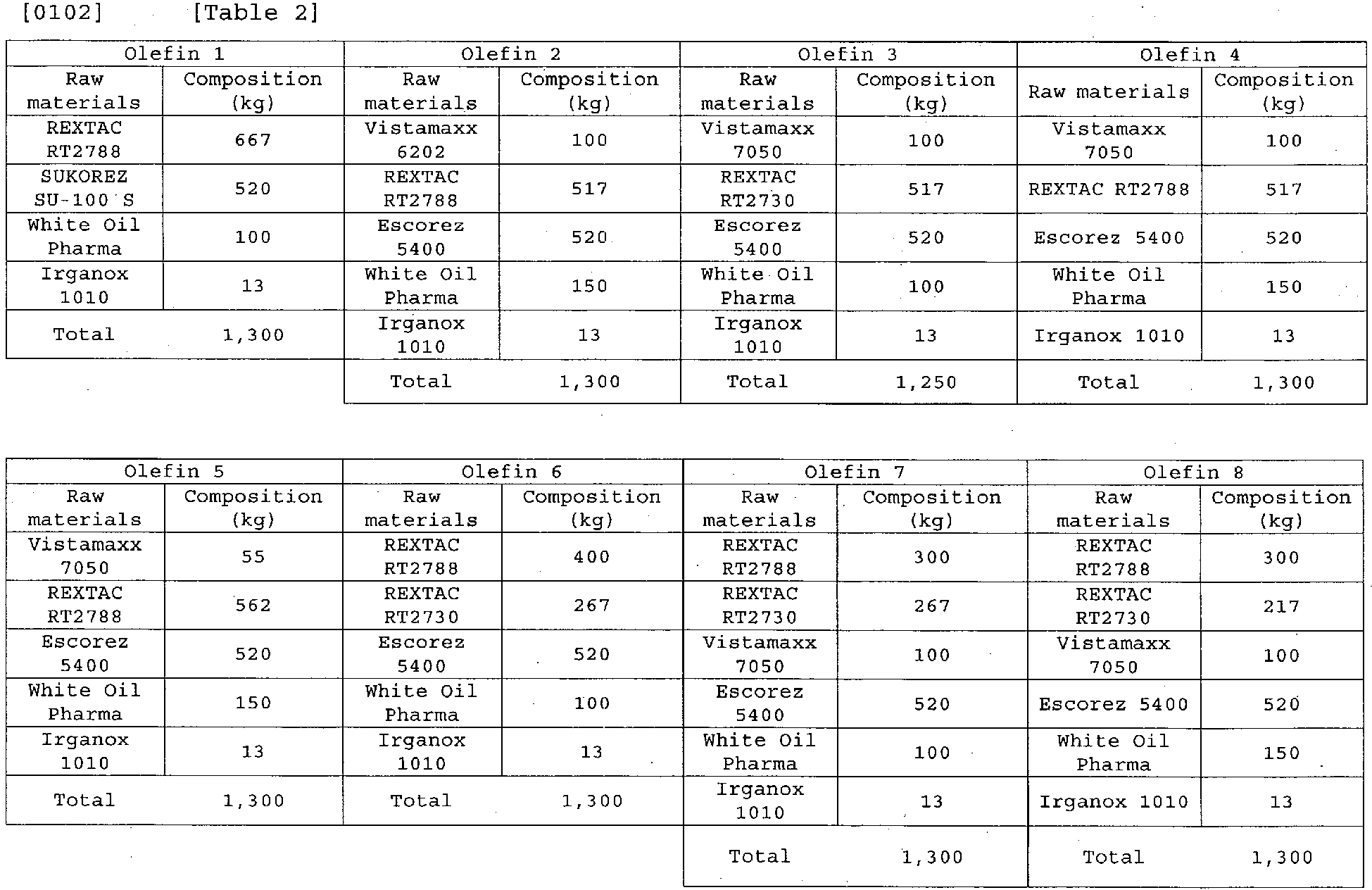
[Table 3] Comparative Example 1 2 3 4 5 6 7 8 A layer resin (1) Vistamaxx 6202 ← ← ← Vistamaxx 7010 Vistamaxx 7010 Vistamaxx 7010 Vistamaxx 7010 A layer resin (2) - - Tafmer PN-3560 ← - - - - B layer resin (1) Vistamaxx 6202 ← Vistamaxx 3000 ← ← ← Quintac 3399 ← B layer resin (2) Tafmer PN-3560 ← ← ← ← ← Kraton D1191 ← B layer resin (3) TiO2 ← ← ← ← ← ← ← A layer formulation (1) / (2) 100/0 100/0 50/50 50/50 100/0 100/0 100/0 100/0 B layer formulation (1)/(2)/(3) 65/30/5 ← 45/50/5 25/75/5 45/50/5 25/75/5 50/45/5 25/75/5 A/B/A thickness µm 6.75/31.5/6.7 5 6.75/31.5/6.7 5 6.75/31.5/6.7 5 6.75/31.5/6.7 5 6.75/31.5/6.7 5 6.75/31.5/6.7 5 6.75/31.5/6.7 5 6.75/31.5/6.7 5 Total thickness of elastic film µm 45 45 45 45 45 45 45 45 Kind of hot-melt pressure-sensiti ve adhesive Styrene 1 Styrene 2 Styrene 3 Styrene 4 Styrene 5 Styrene 6 Styrene 7 Styrene 8 Type of non-woven fabric Carded 24 g/m2 Carded 24 g/m2 Carded 24 g/m2 Carded 24 g/m2 Carded 24 g/m2 Carded 24 g/m2 Carded 24 g/m2 Carded 24 g/m2 PP non-woven fabric adhesive strength (90° peeling) g/2 5 mm 71 77 106 25 100 185 174 6 40°C retention ability test Presence/absence of delamination OK/ NG NG NG NG NG NG NG NG NG 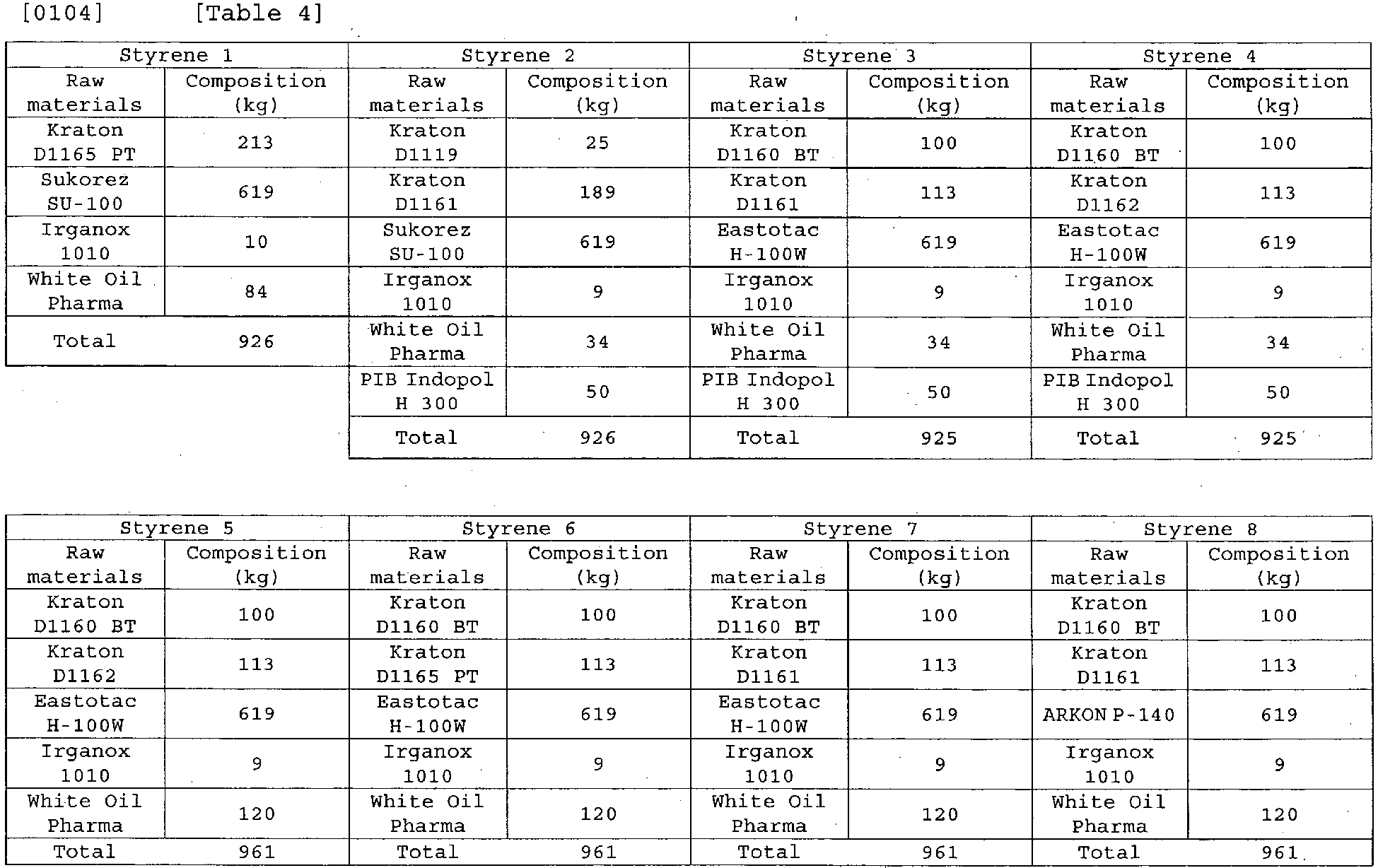
- The stretchable laminate of the present invention may be used in any appropriate article in which the effects of the present invention can be effectively utilized. That is, the article of the present invention includes the stretchable laminate of the present invention. A typical example of such article is a sanitary article. Examples of such sanitary article include a diaper (particularly, an ear portion of a disposable diaper), a supporter, and a mask.
-
- 100
- stretchable laminate
- 10
- elastomer layer
- 20
- non-woven fabric layer
- 20a
- non-woven fabric layer
- 20b
- non-woven fabric layer
- 30
- hot-melt pressure-sensitive adhesive
- 30a
- hot-melt pressure-sensitive adhesive
- 30b
- hot-melt pressure-sensitive adhesive
Claims (20)
- A stretchable laminate, comprising:an elastomer layer; anda non-woven fabric layer arranged on at least one side of the elastomer layer,the stretchable laminate further comprising a hot-melt pressure-sensitive adhesive between the elastomer layer and the non-woven fabric layer,the hot-melt pressure-sensitive adhesive containing an olefin component.
- The stretchable laminate according to claim 1, wherein the olefin component comprises an olefin-based polymer.
- The stretchable laminate according to claim 2, wherein a content of the olefin-based polymer in the hot-melt pressure-sensitive adhesive is from 20 wt% to 70 wt%.
- The stretchable laminate according to claim 3, wherein the content of the olefin-based polymer in the hot-melt pressure-sensitive adhesive is from 35 wt% to 60 wt%.
- The stretchable laminate according to claim 2, wherein the olefin-based polymer comprises at least one kind selected from an olefin-based elastomer and a 1-butene copolymer.
- The stretchable laminate according to claim 5, wherein the olefin-based polymer comprises the 1-butene copolymer as an essential component.
- The stretchable laminate according to claim 6, wherein a content of the 1-butene copolymer in the hot-melt pressure-sensitive adhesive is from 20 wt% to 70 wt%.
- The stretchable laminate according to claim 7, wherein the content of the 1-butene copolymer in the hot-melt pressure-sensitive adhesive is from 35 wt% to 60 wt%.
- The stretchable laminate according to claim 5, wherein the olefin-based elastomer comprises an α-olefin-based elastomer.
- The stretchable laminate according to claim 9, wherein the α-olefin-based elastomer comprises at least one kind selected from an ethylene-based elastomer, a propylene-based elastomer, and a 1-butene-based elastomer.
- The stretchable laminate according to claim 10, wherein the α-olefin-based elastomer comprises the propylene-based elastomer as an essential component.
- The stretchable laminate according to claim 1, wherein the hot-melt pressure-sensitive adhesive has anon-woven fabric adhesive strength at an angle of 90° and a peel rate of 300 mm/min of 190 g/25 mm or more, the non-woven fabric adhesive strength being an adhesive strength with respect to a spunbond non-woven fabric for a diaper back sheet made of 100% polypropylene (19 g/m2).
- The stretchable laminate according to claim 12, wherein the hot-melt pressure-sensitive adhesive has a non-woven fabric adhesive strength at an angle of 90° and a peel rate of 300 mm/min of 240 g/25 mm or more, the non-woven fabric adhesive strength being an adhesive strength with respect to a spunbond non-woven fabric for a diaper back sheet made of 100% polypropylene (19 g/m2).
- The stretchable laminate according to claim 1, wherein the hot-melt pressure-sensitive adhesive comprises a tackifier.
- The stretchable laminate according to claim 14, wherein a content of the tackifier in the hot-melt pressure-sensitive adhesive is from 20 wt% to 70 wt%.
- The stretchable laminate according to claim 15, wherein the content of the tackifier in the hot-melt pressure-sensitive adhesive is from 35 wt% to 55 wt%.
- The stretchable laminate according to claim 1, wherein the elastomer layer comprises an olefin-based elastomer.
- The stretchable laminate according to claim 17, wherein the olefin-based elastomer comprises an α-olefin-based elastomer.
- The stretchable laminate according to claim 18, wherein the α-olefin-based elastomer comprises at least one kind selected from an ethylene-based elastomer, a propylene-based elastomer, and a 1-butene-based elastomer.
- An article, comprising the stretchable laminate of claim 1.
Applications Claiming Priority (4)
| Application Number | Priority Date | Filing Date | Title |
|---|---|---|---|
| JP2014171312 | 2014-08-26 | ||
| JP2015128993 | 2015-06-26 | ||
| JP2015160253A JP6673653B2 (en) | 2014-08-26 | 2015-08-17 | Stretchable laminate and articles containing it |
| PCT/JP2015/073104 WO2016031622A1 (en) | 2014-08-26 | 2015-08-18 | Stretchable laminate, and article including same |
Publications (3)
| Publication Number | Publication Date |
|---|---|
| EP3072685A1 true EP3072685A1 (en) | 2016-09-28 |
| EP3072685A4 EP3072685A4 (en) | 2017-07-26 |
| EP3072685B1 EP3072685B1 (en) | 2024-04-10 |
Family
ID=55399518
Family Applications (1)
| Application Number | Title | Priority Date | Filing Date |
|---|---|---|---|
| EP15836841.5A Active EP3072685B1 (en) | 2014-08-26 | 2015-08-18 | Stretchable laminate, and article including same |
Country Status (5)
| Country | Link |
|---|---|
| EP (1) | EP3072685B1 (en) |
| CN (1) | CN105848889A (en) |
| PL (1) | PL3072685T3 (en) |
| TW (1) | TW201612002A (en) |
| WO (1) | WO2016031622A1 (en) |
Cited By (1)
| Publication number | Priority date | Publication date | Assignee | Title |
|---|---|---|---|---|
| WO2020212906A1 (en) * | 2019-04-17 | 2020-10-22 | Nitto Denko Corporation | Elastic laminate |
Families Citing this family (4)
| Publication number | Priority date | Publication date | Assignee | Title |
|---|---|---|---|---|
| TWI656974B (en) * | 2017-03-10 | 2019-04-21 | 台灣科德寶寶翎不織布股份有限公司 | Manufacturing method of elastic nonwoven fabric substrate |
| JP6891288B2 (en) * | 2017-10-03 | 2021-06-18 | 株式会社Moresco | Adhesive composition |
| PL3960442T3 (en) * | 2019-04-26 | 2024-09-23 | Nitto Denko Corporation | Stretchable laminate and method for manufacturing same |
| CN111890759B (en) * | 2020-08-19 | 2023-03-28 | 浙江中谷塑业有限公司 | Elastic non-woven fabric and preparation method and application thereof |
Family Cites Families (9)
| Publication number | Priority date | Publication date | Assignee | Title |
|---|---|---|---|---|
| US6329468B1 (en) * | 2000-01-21 | 2001-12-11 | Bostik Findley, Inc. | Hot melt adhesive based on semicrystalline flexible polyolefins |
| US7067585B2 (en) * | 2002-10-28 | 2006-06-27 | Bostik, Inc. | Hot melt adhesive composition based on a random copolymer of isotactic polypropylene |
| US20050054779A1 (en) * | 2003-09-05 | 2005-03-10 | Peiguang Zhou | Stretchable hot-melt adhesive composition with temperature resistance |
| US20070088116A1 (en) * | 2005-10-14 | 2007-04-19 | Fabienne Abba | Low application temperature hot melt adhesive |
| EP2242465B1 (en) * | 2008-01-24 | 2014-10-01 | Clopay Plastic Products Company, Inc. | Elastomeric materials |
| US8226626B2 (en) * | 2009-04-08 | 2012-07-24 | The Procter & Gamble Company | Stretchable laminates of nonwoven web(s) and elastic film |
| AU2010275394B2 (en) * | 2009-07-24 | 2015-06-18 | Bostik, Inc. | Hot melt adhesive based on olefin block copolymers |
| US8859094B2 (en) * | 2012-11-09 | 2014-10-14 | The Procter & Gamble Company | Combination of elastomeric film composition and adhesive for a stretch laminate |
| JP6321928B2 (en) * | 2013-07-18 | 2018-05-09 | 日東電工株式会社 | Stretchable laminate and article containing the same |
-
2015
- 2015-08-18 PL PL15836841.5T patent/PL3072685T3/en unknown
- 2015-08-18 WO PCT/JP2015/073104 patent/WO2016031622A1/en not_active Ceased
- 2015-08-18 EP EP15836841.5A patent/EP3072685B1/en active Active
- 2015-08-18 CN CN201580003374.1A patent/CN105848889A/en active Pending
- 2015-08-25 TW TW104127748A patent/TW201612002A/en unknown
Cited By (2)
| Publication number | Priority date | Publication date | Assignee | Title |
|---|---|---|---|---|
| WO2020212906A1 (en) * | 2019-04-17 | 2020-10-22 | Nitto Denko Corporation | Elastic laminate |
| US12515439B2 (en) | 2019-04-17 | 2026-01-06 | Nitto Denko Corporation | Elastic laminate |
Also Published As
| Publication number | Publication date |
|---|---|
| WO2016031622A1 (en) | 2016-03-03 |
| TW201612002A (en) | 2016-04-01 |
| CN105848889A (en) | 2016-08-10 |
| EP3072685B1 (en) | 2024-04-10 |
| EP3072685A4 (en) | 2017-07-26 |
| PL3072685T3 (en) | 2024-08-05 |
Similar Documents
| Publication | Publication Date | Title |
|---|---|---|
| EP3078489B1 (en) | Elastic laminate and article containing same | |
| EP3187333B1 (en) | Stretchable laminate, and article including same | |
| EP3315572B1 (en) | Hot-melt pressure-sensitive adhesive, stretchable laminate, and article | |
| EP3023247B1 (en) | Stretchable laminate and article containing same | |
| EP3560704B1 (en) | Stretchable film, stretchable laminate and article comprising same | |
| EP3072685B1 (en) | Stretchable laminate, and article including same | |
| EP3045311A1 (en) | Stretchable member and article including same | |
| US20170157888A1 (en) | Stretchable laminate, and article including same | |
| EP3284595B1 (en) | Expanding/contracting laminate and product including same | |
| US12515439B2 (en) | Elastic laminate |
Legal Events
| Date | Code | Title | Description |
|---|---|---|---|
| PUAI | Public reference made under article 153(3) epc to a published international application that has entered the european phase |
Free format text: ORIGINAL CODE: 0009012 |
|
| 17P | Request for examination filed |
Effective date: 20160525 |
|
| AK | Designated contracting states |
Kind code of ref document: A1 Designated state(s): AL AT BE BG CH CY CZ DE DK EE ES FI FR GB GR HR HU IE IS IT LI LT LU LV MC MK MT NL NO PL PT RO RS SE SI SK SM TR |
|
| AX | Request for extension of the european patent |
Extension state: BA ME |
|
| A4 | Supplementary search report drawn up and despatched |
Effective date: 20170626 |
|
| RIC1 | Information provided on ipc code assigned before grant |
Ipc: B32B 27/32 20060101ALI20170620BHEP Ipc: B32B 5/02 20060101ALI20170620BHEP Ipc: C09J 123/00 20060101ALI20170620BHEP Ipc: B32B 7/12 20060101ALI20170620BHEP Ipc: A61F 13/49 20060101ALI20170620BHEP Ipc: B32B 25/10 20060101AFI20170620BHEP |
|
| DAV | Request for validation of the european patent (deleted) | ||
| DAX | Request for extension of the european patent (deleted) | ||
| STAA | Information on the status of an ep patent application or granted ep patent |
Free format text: STATUS: EXAMINATION IS IN PROGRESS |
|
| 17Q | First examination report despatched |
Effective date: 20190611 |
|
| GRAP | Despatch of communication of intention to grant a patent |
Free format text: ORIGINAL CODE: EPIDOSNIGR1 |
|
| STAA | Information on the status of an ep patent application or granted ep patent |
Free format text: STATUS: GRANT OF PATENT IS INTENDED |
|
| INTG | Intention to grant announced |
Effective date: 20231201 |
|
| GRAS | Grant fee paid |
Free format text: ORIGINAL CODE: EPIDOSNIGR3 |
|
| GRAA | (expected) grant |
Free format text: ORIGINAL CODE: 0009210 |
|
| STAA | Information on the status of an ep patent application or granted ep patent |
Free format text: STATUS: THE PATENT HAS BEEN GRANTED |
|
| P01 | Opt-out of the competence of the unified patent court (upc) registered |
Effective date: 20240202 |
|
| AK | Designated contracting states |
Kind code of ref document: B1 Designated state(s): AL AT BE BG CH CY CZ DE DK EE ES FI FR GB GR HR HU IE IS IT LI LT LU LV MC MK MT NL NO PL PT RO RS SE SI SK SM TR |
|
| REG | Reference to a national code |
Ref country code: GB Ref legal event code: FG4D |
|
| REG | Reference to a national code |
Ref country code: CH Ref legal event code: EP |
|
| REG | Reference to a national code |
Ref country code: DE Ref legal event code: R096 Ref document number: 602015088280 Country of ref document: DE |
|
| REG | Reference to a national code |
Ref country code: IE Ref legal event code: FG4D |
|
| REG | Reference to a national code |
Ref country code: SE Ref legal event code: TRGR |
|
| REG | Reference to a national code |
Ref country code: LT Ref legal event code: MG9D |
|
| REG | Reference to a national code |
Ref country code: NL Ref legal event code: MP Effective date: 20240410 |
|
| REG | Reference to a national code |
Ref country code: AT Ref legal event code: MK05 Ref document number: 1674544 Country of ref document: AT Kind code of ref document: T Effective date: 20240410 |
|
| PG25 | Lapsed in a contracting state [announced via postgrant information from national office to epo] |
Ref country code: NL Free format text: LAPSE BECAUSE OF FAILURE TO SUBMIT A TRANSLATION OF THE DESCRIPTION OR TO PAY THE FEE WITHIN THE PRESCRIBED TIME-LIMIT Effective date: 20240410 |
|
| PG25 | Lapsed in a contracting state [announced via postgrant information from national office to epo] |
Ref country code: NL Free format text: LAPSE BECAUSE OF FAILURE TO SUBMIT A TRANSLATION OF THE DESCRIPTION OR TO PAY THE FEE WITHIN THE PRESCRIBED TIME-LIMIT Effective date: 20240410 |
|
| PG25 | Lapsed in a contracting state [announced via postgrant information from national office to epo] |
Ref country code: IS Free format text: LAPSE BECAUSE OF FAILURE TO SUBMIT A TRANSLATION OF THE DESCRIPTION OR TO PAY THE FEE WITHIN THE PRESCRIBED TIME-LIMIT Effective date: 20240810 |
|
| PG25 | Lapsed in a contracting state [announced via postgrant information from national office to epo] |
Ref country code: BG Free format text: LAPSE BECAUSE OF FAILURE TO SUBMIT A TRANSLATION OF THE DESCRIPTION OR TO PAY THE FEE WITHIN THE PRESCRIBED TIME-LIMIT Effective date: 20240410 |
|
| PG25 | Lapsed in a contracting state [announced via postgrant information from national office to epo] |
Ref country code: FI Free format text: LAPSE BECAUSE OF FAILURE TO SUBMIT A TRANSLATION OF THE DESCRIPTION OR TO PAY THE FEE WITHIN THE PRESCRIBED TIME-LIMIT Effective date: 20240410 Ref country code: HR Free format text: LAPSE BECAUSE OF FAILURE TO SUBMIT A TRANSLATION OF THE DESCRIPTION OR TO PAY THE FEE WITHIN THE PRESCRIBED TIME-LIMIT Effective date: 20240410 |
|
| PG25 | Lapsed in a contracting state [announced via postgrant information from national office to epo] |
Ref country code: GR Free format text: LAPSE BECAUSE OF FAILURE TO SUBMIT A TRANSLATION OF THE DESCRIPTION OR TO PAY THE FEE WITHIN THE PRESCRIBED TIME-LIMIT Effective date: 20240711 |
|
| PG25 | Lapsed in a contracting state [announced via postgrant information from national office to epo] |
Ref country code: PT Free format text: LAPSE BECAUSE OF FAILURE TO SUBMIT A TRANSLATION OF THE DESCRIPTION OR TO PAY THE FEE WITHIN THE PRESCRIBED TIME-LIMIT Effective date: 20240812 |
|
| PG25 | Lapsed in a contracting state [announced via postgrant information from national office to epo] |
Ref country code: ES Free format text: LAPSE BECAUSE OF FAILURE TO SUBMIT A TRANSLATION OF THE DESCRIPTION OR TO PAY THE FEE WITHIN THE PRESCRIBED TIME-LIMIT Effective date: 20240410 |
|
| PG25 | Lapsed in a contracting state [announced via postgrant information from national office to epo] |
Ref country code: AT Free format text: LAPSE BECAUSE OF FAILURE TO SUBMIT A TRANSLATION OF THE DESCRIPTION OR TO PAY THE FEE WITHIN THE PRESCRIBED TIME-LIMIT Effective date: 20240410 |
|
| PG25 | Lapsed in a contracting state [announced via postgrant information from national office to epo] |
Ref country code: LV Free format text: LAPSE BECAUSE OF FAILURE TO SUBMIT A TRANSLATION OF THE DESCRIPTION OR TO PAY THE FEE WITHIN THE PRESCRIBED TIME-LIMIT Effective date: 20240410 |
|
| PG25 | Lapsed in a contracting state [announced via postgrant information from national office to epo] |
Ref country code: PT Free format text: LAPSE BECAUSE OF FAILURE TO SUBMIT A TRANSLATION OF THE DESCRIPTION OR TO PAY THE FEE WITHIN THE PRESCRIBED TIME-LIMIT Effective date: 20240812 Ref country code: NO Free format text: LAPSE BECAUSE OF FAILURE TO SUBMIT A TRANSLATION OF THE DESCRIPTION OR TO PAY THE FEE WITHIN THE PRESCRIBED TIME-LIMIT Effective date: 20240710 Ref country code: LV Free format text: LAPSE BECAUSE OF FAILURE TO SUBMIT A TRANSLATION OF THE DESCRIPTION OR TO PAY THE FEE WITHIN THE PRESCRIBED TIME-LIMIT Effective date: 20240410 Ref country code: IS Free format text: LAPSE BECAUSE OF FAILURE TO SUBMIT A TRANSLATION OF THE DESCRIPTION OR TO PAY THE FEE WITHIN THE PRESCRIBED TIME-LIMIT Effective date: 20240810 Ref country code: HR Free format text: LAPSE BECAUSE OF FAILURE TO SUBMIT A TRANSLATION OF THE DESCRIPTION OR TO PAY THE FEE WITHIN THE PRESCRIBED TIME-LIMIT Effective date: 20240410 Ref country code: GR Free format text: LAPSE BECAUSE OF FAILURE TO SUBMIT A TRANSLATION OF THE DESCRIPTION OR TO PAY THE FEE WITHIN THE PRESCRIBED TIME-LIMIT Effective date: 20240711 Ref country code: FI Free format text: LAPSE BECAUSE OF FAILURE TO SUBMIT A TRANSLATION OF THE DESCRIPTION OR TO PAY THE FEE WITHIN THE PRESCRIBED TIME-LIMIT Effective date: 20240410 Ref country code: ES Free format text: LAPSE BECAUSE OF FAILURE TO SUBMIT A TRANSLATION OF THE DESCRIPTION OR TO PAY THE FEE WITHIN THE PRESCRIBED TIME-LIMIT Effective date: 20240410 Ref country code: BG Free format text: LAPSE BECAUSE OF FAILURE TO SUBMIT A TRANSLATION OF THE DESCRIPTION OR TO PAY THE FEE WITHIN THE PRESCRIBED TIME-LIMIT Effective date: 20240410 Ref country code: AT Free format text: LAPSE BECAUSE OF FAILURE TO SUBMIT A TRANSLATION OF THE DESCRIPTION OR TO PAY THE FEE WITHIN THE PRESCRIBED TIME-LIMIT Effective date: 20240410 Ref country code: RS Free format text: LAPSE BECAUSE OF FAILURE TO SUBMIT A TRANSLATION OF THE DESCRIPTION OR TO PAY THE FEE WITHIN THE PRESCRIBED TIME-LIMIT Effective date: 20240710 |
|
| REG | Reference to a national code |
Ref country code: DE Ref legal event code: R097 Ref document number: 602015088280 Country of ref document: DE |
|
| PG25 | Lapsed in a contracting state [announced via postgrant information from national office to epo] |
Ref country code: DK Free format text: LAPSE BECAUSE OF FAILURE TO SUBMIT A TRANSLATION OF THE DESCRIPTION OR TO PAY THE FEE WITHIN THE PRESCRIBED TIME-LIMIT Effective date: 20240410 |
|
| PG25 | Lapsed in a contracting state [announced via postgrant information from national office to epo] |
Ref country code: EE Free format text: LAPSE BECAUSE OF FAILURE TO SUBMIT A TRANSLATION OF THE DESCRIPTION OR TO PAY THE FEE WITHIN THE PRESCRIBED TIME-LIMIT Effective date: 20240410 |
|
| PG25 | Lapsed in a contracting state [announced via postgrant information from national office to epo] |
Ref country code: RO Free format text: LAPSE BECAUSE OF FAILURE TO SUBMIT A TRANSLATION OF THE DESCRIPTION OR TO PAY THE FEE WITHIN THE PRESCRIBED TIME-LIMIT Effective date: 20240410 Ref country code: SK Free format text: LAPSE BECAUSE OF FAILURE TO SUBMIT A TRANSLATION OF THE DESCRIPTION OR TO PAY THE FEE WITHIN THE PRESCRIBED TIME-LIMIT Effective date: 20240410 |
|
| PG25 | Lapsed in a contracting state [announced via postgrant information from national office to epo] |
Ref country code: SM Free format text: LAPSE BECAUSE OF FAILURE TO SUBMIT A TRANSLATION OF THE DESCRIPTION OR TO PAY THE FEE WITHIN THE PRESCRIBED TIME-LIMIT Effective date: 20240410 |
|
| PG25 | Lapsed in a contracting state [announced via postgrant information from national office to epo] |
Ref country code: SM Free format text: LAPSE BECAUSE OF FAILURE TO SUBMIT A TRANSLATION OF THE DESCRIPTION OR TO PAY THE FEE WITHIN THE PRESCRIBED TIME-LIMIT Effective date: 20240410 Ref country code: SK Free format text: LAPSE BECAUSE OF FAILURE TO SUBMIT A TRANSLATION OF THE DESCRIPTION OR TO PAY THE FEE WITHIN THE PRESCRIBED TIME-LIMIT Effective date: 20240410 Ref country code: RO Free format text: LAPSE BECAUSE OF FAILURE TO SUBMIT A TRANSLATION OF THE DESCRIPTION OR TO PAY THE FEE WITHIN THE PRESCRIBED TIME-LIMIT Effective date: 20240410 Ref country code: EE Free format text: LAPSE BECAUSE OF FAILURE TO SUBMIT A TRANSLATION OF THE DESCRIPTION OR TO PAY THE FEE WITHIN THE PRESCRIBED TIME-LIMIT Effective date: 20240410 Ref country code: DK Free format text: LAPSE BECAUSE OF FAILURE TO SUBMIT A TRANSLATION OF THE DESCRIPTION OR TO PAY THE FEE WITHIN THE PRESCRIBED TIME-LIMIT Effective date: 20240410 |
|
| PG25 | Lapsed in a contracting state [announced via postgrant information from national office to epo] |
Ref country code: IT Free format text: LAPSE BECAUSE OF FAILURE TO SUBMIT A TRANSLATION OF THE DESCRIPTION OR TO PAY THE FEE WITHIN THE PRESCRIBED TIME-LIMIT Effective date: 20240410 |
|
| PLBE | No opposition filed within time limit |
Free format text: ORIGINAL CODE: 0009261 |
|
| STAA | Information on the status of an ep patent application or granted ep patent |
Free format text: STATUS: NO OPPOSITION FILED WITHIN TIME LIMIT |
|
| 26N | No opposition filed |
Effective date: 20250113 |
|
| REG | Reference to a national code |
Ref country code: CH Ref legal event code: PL |
|
| PG25 | Lapsed in a contracting state [announced via postgrant information from national office to epo] |
Ref country code: LU Free format text: LAPSE BECAUSE OF NON-PAYMENT OF DUE FEES Effective date: 20240818 |
|
| GBPC | Gb: european patent ceased through non-payment of renewal fee |
Effective date: 20240818 |
|
| PG25 | Lapsed in a contracting state [announced via postgrant information from national office to epo] |
Ref country code: SI Free format text: LAPSE BECAUSE OF FAILURE TO SUBMIT A TRANSLATION OF THE DESCRIPTION OR TO PAY THE FEE WITHIN THE PRESCRIBED TIME-LIMIT Effective date: 20240410 Ref country code: MC Free format text: LAPSE BECAUSE OF FAILURE TO SUBMIT A TRANSLATION OF THE DESCRIPTION OR TO PAY THE FEE WITHIN THE PRESCRIBED TIME-LIMIT Effective date: 20240410 Ref country code: CH Free format text: LAPSE BECAUSE OF NON-PAYMENT OF DUE FEES Effective date: 20240831 |
|
| PG25 | Lapsed in a contracting state [announced via postgrant information from national office to epo] |
Ref country code: GB Free format text: LAPSE BECAUSE OF NON-PAYMENT OF DUE FEES Effective date: 20240818 |
|
| PG25 | Lapsed in a contracting state [announced via postgrant information from national office to epo] |
Ref country code: IE Free format text: LAPSE BECAUSE OF NON-PAYMENT OF DUE FEES Effective date: 20240818 |
|
| PGFP | Annual fee paid to national office [announced via postgrant information from national office to epo] |
Ref country code: DE Payment date: 20250702 Year of fee payment: 11 |
|
| PGFP | Annual fee paid to national office [announced via postgrant information from national office to epo] |
Ref country code: TR Payment date: 20250801 Year of fee payment: 11 Ref country code: PL Payment date: 20250714 Year of fee payment: 11 |
|
| PGFP | Annual fee paid to national office [announced via postgrant information from national office to epo] |
Ref country code: BE Payment date: 20250703 Year of fee payment: 11 |
|
| PGFP | Annual fee paid to national office [announced via postgrant information from national office to epo] |
Ref country code: FR Payment date: 20250703 Year of fee payment: 11 |
|
| PGFP | Annual fee paid to national office [announced via postgrant information from national office to epo] |
Ref country code: SE Payment date: 20250702 Year of fee payment: 11 |
|
| PGFP | Annual fee paid to national office [announced via postgrant information from national office to epo] |
Ref country code: CZ Payment date: 20250730 Year of fee payment: 11 |
|
| PG25 | Lapsed in a contracting state [announced via postgrant information from national office to epo] |
Ref country code: CY Free format text: LAPSE BECAUSE OF FAILURE TO SUBMIT A TRANSLATION OF THE DESCRIPTION OR TO PAY THE FEE WITHIN THE PRESCRIBED TIME-LIMIT; INVALID AB INITIO Effective date: 20150818 |
|
| PG25 | Lapsed in a contracting state [announced via postgrant information from national office to epo] |
Ref country code: HU Free format text: LAPSE BECAUSE OF FAILURE TO SUBMIT A TRANSLATION OF THE DESCRIPTION OR TO PAY THE FEE WITHIN THE PRESCRIBED TIME-LIMIT; INVALID AB INITIO Effective date: 20150818 |