EP3072524A1 - Probiotic therapies for autism - Google Patents
Probiotic therapies for autism Download PDFInfo
- Publication number
- EP3072524A1 EP3072524A1 EP16164727.6A EP16164727A EP3072524A1 EP 3072524 A1 EP3072524 A1 EP 3072524A1 EP 16164727 A EP16164727 A EP 16164727A EP 3072524 A1 EP3072524 A1 EP 3072524A1
- Authority
- EP
- European Patent Office
- Prior art keywords
- composition
- individual
- behavioral
- reducing
- anxiety
- Prior art date
- Legal status (The legal status is an assumption and is not a legal conclusion. Google has not performed a legal analysis and makes no representation as to the accuracy of the status listed.)
- Granted
Links
Images



Classifications
-
- A—HUMAN NECESSITIES
- A61—MEDICAL OR VETERINARY SCIENCE; HYGIENE
- A61K—PREPARATIONS FOR MEDICAL, DENTAL OR TOILETRY PURPOSES
- A61K35/00—Medicinal preparations containing materials or reaction products thereof with undetermined constitution
- A61K35/66—Microorganisms or materials therefrom
- A61K35/74—Bacteria
- A61K35/741—Probiotics
-
- A—HUMAN NECESSITIES
- A61—MEDICAL OR VETERINARY SCIENCE; HYGIENE
- A61P—SPECIFIC THERAPEUTIC ACTIVITY OF CHEMICAL COMPOUNDS OR MEDICINAL PREPARATIONS
- A61P25/00—Drugs for disorders of the nervous system
-
- A—HUMAN NECESSITIES
- A61—MEDICAL OR VETERINARY SCIENCE; HYGIENE
- A61P—SPECIFIC THERAPEUTIC ACTIVITY OF CHEMICAL COMPOUNDS OR MEDICINAL PREPARATIONS
- A61P25/00—Drugs for disorders of the nervous system
- A61P25/18—Antipsychotics, i.e. neuroleptics; Drugs for mania or schizophrenia
-
- A—HUMAN NECESSITIES
- A61—MEDICAL OR VETERINARY SCIENCE; HYGIENE
- A61P—SPECIFIC THERAPEUTIC ACTIVITY OF CHEMICAL COMPOUNDS OR MEDICINAL PREPARATIONS
- A61P25/00—Drugs for disorders of the nervous system
- A61P25/20—Hypnotics; Sedatives
-
- A—HUMAN NECESSITIES
- A61—MEDICAL OR VETERINARY SCIENCE; HYGIENE
- A61P—SPECIFIC THERAPEUTIC ACTIVITY OF CHEMICAL COMPOUNDS OR MEDICINAL PREPARATIONS
- A61P25/00—Drugs for disorders of the nervous system
- A61P25/22—Anxiolytics
-
- A—HUMAN NECESSITIES
- A61—MEDICAL OR VETERINARY SCIENCE; HYGIENE
- A61K—PREPARATIONS FOR MEDICAL, DENTAL OR TOILETRY PURPOSES
- A61K35/00—Medicinal preparations containing materials or reaction products thereof with undetermined constitution
- A61K2035/11—Medicinal preparations comprising living procariotic cells
Definitions
- the invention relates to probiotic and probiotic-based compositions and a method of using them. More particularly, it relates to the use of Bacteroides fragilis or related bacteria to improve the mental behavior of individuals suffering from autism, autism spectrum disorders (ASD) and/or conditions with related symptoms such as anxiety.
- ASD autism spectrum disorders
- ASDs Autism spectrum disorders
- GI gastrointestinal
- a method of improving behavioral performance in an individual comprising, identifying an individual in need of treatment, and providing such an individual a composition comprising bacteria within the genus Bacteroides , whereby the individual shows improved behavioral performance.
- the individual in need of treatment suffers from anxiety, autism, ASD or a mental condition with some of the symptoms of ASD.
- the bacteria is selected from a group consisting of B. fragilis, B. theta, B. vulgatus, and B. faecalis.
- the bacteria is a mixture of several different species members within the genus Bacteroides .
- a probiotic composition for improving behavioral performance comprising bacteria within the genus Bacteroides , whereby the individual shows improved behavioral performance.
- a neutraceutical for improving behavioral performance in individuals comprising bacteria within the genus Bacteroides , whereby the individual shows improved behavioral performance.
- a pharmaceutical composition comprising bacteria within the genus Bacteroides , and a pharmaceutically acceptable carrier, whereby the composition improves behavioral performance.
- the pharmaceutical composition further comprises another pharmaceutical or compound used to treat the behavioral performance, wherein the pharmaceutical or compound does not comprise any other bacteria.
- the term "effective dose” is an amount that results in a reduction, inhibition or prevention of the behavioral disorder/abnormality/symptoms in the individual.
- the amount of B. fragilis, or other probiotic required to achieve this can be determined by a person of skill in the art.
- the term "individual” as used herein includes a single biological organism wherein inflammation can occur including but not limited to animals and in particular higher animals and in particular vertebrates such as mammals and in particular human beings.
- condition/disorder/symptom or "behavioral abnormality” or as used herein means symptoms expressed by an individual with a mental disorder, such as but not limited to anxiety, autism, autism spectrum disorders, Fragile X, Rett syndrome, tuberous sclerosis, obsessive compulsive disorder, attention deficit disorder or schizophrenia.
- a mental disorder such as but not limited to anxiety, autism, autism spectrum disorders, Fragile X, Rett syndrome, tuberous sclerosis, obsessive compulsive disorder, attention deficit disorder or schizophrenia.
- the aforementioned symptoms are some of those exhibited by the MIA offspring.
- the term "individual in need of the treatment” means a person expressing or suffering from one or more of the behavioral disorder/symptoms mentioned above. An appropriately qualified person is able to identify such an individual in need of treatment using standard behavioral testing protocols/guidelines. The same behavioral testing protocols/guidelines can also be used to determine whether there is improvement to the individual's disorder/symptoms; and determine the most effective dose of the B. fragilis cell to give to an individual in need of the treatment.
- improvement in behavioral performance means a prevention or reduction in the severity or frequency, to whatever extent, of one or more of the above behavioral disorder/symptoms/abnormalities expressed by the individual. The improvement is either observed by the individual taking the treatment themselves or by another person (medical or otherwise).
- treatment indicates any activity that is part of a medical (prescribed by the physician) or non-medically approved (i.e. non-prescription including but not limited to vitamins, herbs; supplements; probiotics etc.) care that deals with a condition/symptom as described above.
- prevention indicates any activity that reduces the burden of the individual later expressing those behavioral symptoms. This takes place at primary, secondary and tertiary prevention levels, wherein: a) primary prevention avoids the development of symptoms/disorder/condition; b) secondary prevention activities are aimed at early stages of the condition/disorder/symptom treatment, thereby increasing opportunities for interventions to prevent progression of the condition/disorder/symptom and emergence of symptoms; and c) tertiary prevention reduces the negative impact of an already established condition/disorder/symptom by restoring function and reducing any condition/disorder/symptom or related complications.
- Pharmaceutically acceptable or appropriate carriers can be, but not limited to, organic or inorganic, solid or liquid excipient which is suitable for the selected mode of application such as oral application or injection, and administered in the form of a conventional pharmaceutical preparation.
- a conventional pharmaceutical preparation includes solid such as tablets, granules, powders, capsules, and liquid such as solution, emulsion, suspension and the like.
- Said carrier includes starch, lactose, glucose, sucrose, dextrine, cellulose, paraffin, fatty acid glyceride, water, alcohol, gum arabic and the like. If necessary, auxiliary, stabilizer, emulsifier, lubricant, binder, pH adjustor controller, isotonic agent and other conventional additives may be added.
- the pharmaceutically acceptable or appropriate carrier may well include other compounds known to be beneficial to an impaired situation of the GI tract, (e.g., antioxidants, such as Vitamin C, Vitamin E, Selenium or Zinc); or a food composition.
- the food composition can be, but is not limited to, milk, yoghurt, curd, cheese, fermented milks, milk based fermented products, ice-creams, fermented cereal based products, milk based powders, infant formulae, tablets, liquid bacterial suspensions, dried oral supplement, or wet oral supplement.
- nutraceutical as used herein means a food stuff (as a fortified food or a dietary supplement) that provides health benefits. Nutraceutical foods are not subject to the same testing and regulations as pharmaceutical drugs.
- probiotic as used herein means live microorganisms, which, when administered in adequate amounts, confer a health benefit on the host.
- the probiotics may be available in foods and dietary supplements (for example, but not limited to capsules, tablets, and powders). Examples of foods containing the probiotic are yogurt, fermented and unfermented milk, miso, tempeh, and some juices and soy beverages.
- extract indicates either the insoluble material or soluble material obtained from the B. fragilis or related species using various chemical, immunological, biochemical or physical procedures known to those of skill in the art, including but not limited to, precipitation, centrifugation, filtering, column chromatography, and detergent lysis.
- whole cell lysate refers to the fraction obtained when the B.fragilis or related species are lysed using detergent or other chemical or physical means.
- nucleic acid molecules refers to materials as they are found in nature and not manipulated by man.
- polypeptides refers to materials as they are found in nature and not manipulated by man.
- isolated when used in connection biological materials such as nucleic acid molecules, polypeptides, bacterial cells, host cells, bacterial cells/strains and the like, refers to the isolated or purified aforementioned materials, where these materials do not occur naturally and/or where they have markedly different or distinctive characteristics compared to those found in the native material.
- non-denatured refers to when the bacterial is frozen in a media and then undergoes a freeze-drying process.
- Such non-denatured bacteria can be mixed with other substances/compounds/carriers/additives and given in forms of a pill, tablet, or liquid to individuals in need of behavioral improvement.
- the non-denatured bacteria can also be mixed into foods (cookies, yogurt; milk etc.).
- the Patterson laboratory developed a mouse model that has both construct and face validity for autism, MIA (maternal immune activation) (reviewed in Patterson, 2011). This is based on epidemiological evidence that viral or bacterial infection during pregnancy increases the risk for ASD in the offspring (Atladottir et al., 2010). In this animal model, pregnant mice that receive a respiratory infection at mid-gestation, or that receive the double-stranded RNA viral mimic, poly(I:C), produce offspring with a series of abnormal behaviors, including the hallmark symptoms of repetitive/compulsive behaviors, and deficits in social interaction and communication (Patterson, 2011).
- MIA offspring display a specific neuropathology that is common in ASD, spatially restricted deficits in Purkinje cells (Patterson, 2011). Recently, the collaboration between the laboratories of Sarkis Mazmanian and Paul Patterson has discovered that the MIA offspring exhibit abnormalities in the immune system and the gastrointestinal tract. Most importantly, some of the ASD-like behavioral symptoms can be corrected or prevented by manipulating the microbiota of the MIA offspring. This treatment is based on prior work by the Mazmanian group showing the efficacy of B.fragilis treatment in several GI and systemic inflammatory disorders (Round et al., 2009, 2010).
- the open field test is a test of anxiety under mildly stressful conditions, and ASD subjects exhibit enhanced anxiety under such circumstances.
- the offspring are tested in the open field to determine the effects of B.fragilis and a number of other bacterial species on anxiety behavior.
- Groups of pregnant mice (n>3) are treated on E12.5 with poly(I:C) to induce MIA, or saline as the control (Smith et al., 2007).
- Immediately upon weaning the offspring are colonized with one of the bacteria shown (given in food) or not, for one week.
- Mice are placed in a brightly lit open box, and activity is recorded by a video camera and analyzed using Ethovision software (Noldus). The number of entries into, and the time spent in, the center of the arena are measured.
- MIA offspring spend less time in the center of the open field and enter it less often than control offspring, indicating increased anxiety ( Fig. 1 ).
- Treatment with B.fragilis and other Bacteroides species prevents the abnormal behavior in the MIA offspring, indicating that this probiotic treatment lowers anxiety in normal animals as well as in the ASD model mice.
- the non- Bacteroides species, E.rioselis is not able to prevent anxiety in the MIA offspring.
- the colons of adult MIA and control offspring were prepared for histology and stained with H & E. As illustrated in Fig. 2 , there is a very significant cellular infiltration in MIA offspring. This was seen in 4 out of 5 MIA mice examined. In contrast, this type of infiltration was seen in only 1 out of 5 control mice. The identity of the cells infiltrating the colon is being examined.
- Lymphocytes in GI-associated, mesenteric lymph nodes from offspring of MIA mothers display elevated cytokine release upon stimulation.
- lymphocytes associated with the GI tract mesenteric lymph nodes were dissected from adult offspring of control mothers, offspring of MIA mothers treated with poly(I:C), and offspring of MIA mothers treated with IL-6.
- CD4+ cells were isolated and treated in culture with PMA and ionomycin. Supernatants were assayed for IL-6 (not shown) and IL-17 ( Fig. 3 ). On both days assayed, the lymphocytes from MIA offspring display higher cytokine release than controls.
- GI epithelial barrier function can be tested by gavaging the mouse with a labeled dextran that is large enough such that it does not normally leak through the barrier in significant amounts.
- DSS dextran sodium sulfate
- the labeled dextran probe does leak into the circulation ( Fig. 5 ). This is the positive control for "leaky gut", a symptom found in a large subset of ASD children.
- the adult MIA offspring also display very significant levels of leaky gut, and this can be prevented by post-weaning treatment with all of the Bacteroides species tested, but not with the non- Bacteroides , E. faecalis ( Fig. 5 ).
- the efficacy of probiotic therapy in the GI tract corresponds with the specificity of the behavioral therapy.
- the similarities between the MIA model and the respective human disorders including the cardinal behavioral symptoms of ASD and neuropathology characteristic of ASD, and behavior and neuropathology characteristic of schizophrenia, which both share the maternal infection risk factor; reviewed in Patterson, 2011
- individuals in need of treatment could be given B.fragilis or related bacteria in a capsule, pill, neutraceutical, or other probiotic form, and the individual would show signs of improved behavioral performance.
- the effective dose for such an individual could be determined easily by the individual undergoing the treatment themselves or by another individual. For instance, the individuals themselves could determine whether their symptoms of anxiety were improved upon taking the appropriate amount of the probiotic.
- the individuals in need of such treatment could take the probiotic when needed or prior to the time they expect an occurrence of the behavioral abnormality would occur, for instance, when the individual believes the upcoming day would be stressful.
Landscapes
- Health & Medical Sciences (AREA)
- Life Sciences & Earth Sciences (AREA)
- Pharmacology & Pharmacy (AREA)
- Veterinary Medicine (AREA)
- Public Health (AREA)
- Chemical & Material Sciences (AREA)
- General Health & Medical Sciences (AREA)
- Animal Behavior & Ethology (AREA)
- Medicinal Chemistry (AREA)
- Engineering & Computer Science (AREA)
- Bioinformatics & Cheminformatics (AREA)
- Mycology (AREA)
- Microbiology (AREA)
- Neurosurgery (AREA)
- Chemical Kinetics & Catalysis (AREA)
- Organic Chemistry (AREA)
- Neurology (AREA)
- Biomedical Technology (AREA)
- Nuclear Medicine, Radiotherapy & Molecular Imaging (AREA)
- General Chemical & Material Sciences (AREA)
- Epidemiology (AREA)
- Molecular Biology (AREA)
- Anesthesiology (AREA)
- Psychiatry (AREA)
- Medicines Containing Material From Animals Or Micro-Organisms (AREA)
- Coloring Foods And Improving Nutritive Qualities (AREA)
- Micro-Organisms Or Cultivation Processes Thereof (AREA)
- Measuring Or Testing Involving Enzymes Or Micro-Organisms (AREA)
- Medicines That Contain Protein Lipid Enzymes And Other Medicines (AREA)
- Medicinal Preparation (AREA)
- Medicines Containing Plant Substances (AREA)
Abstract
Description
- This application claims the benefit of Provisional Patent Applications Nos.
61/391,004, filed on October 7, 2010 61/472,963 filed on April 7, 2011 - The invention relates to probiotic and probiotic-based compositions and a method of using them. More particularly, it relates to the use of Bacteroides fragilis or related bacteria to improve the mental behavior of individuals suffering from autism, autism spectrum disorders (ASD) and/or conditions with related symptoms such as anxiety.
- Autism spectrum disorders (ASDs) are complex neurodevelopmental disabilities characterized by repetitive/stereotypic behaviors and deficits in communication and social interaction. Recent studies highlight striking neural and peripheral immune dysregulation in autistic individuals. Moreover, a significant subset of ASD children exhibit gastrointestinal (GI) complications, including increased intestinal permeability and altered composition of intestinal microbiota. Furthermore, antibiotic treatment and restricted diets are reported to improve behavioral symptoms in some ASD children (reviewed by Buie et al., 2010).
- In one embodiment, a method of improving behavioral performance in an individual is provided comprising, identifying an individual in need of treatment, and providing such an individual a composition comprising bacteria within the genus Bacteroides, whereby the individual shows improved behavioral performance.
- In an embodiment of paragraph [0005], the individual in need of treatment suffers from anxiety, autism, ASD or a mental condition with some of the symptoms of ASD.
- In another embodiment of paragraph [0005], the bacteria is selected from a group consisting of B. fragilis, B. theta, B. vulgatus, and B. faecalis.
- In yet another embodiment of paragraph [0005], the bacteria is a mixture of several different species members within the genus Bacteroides.
- In another embodiment, a probiotic composition for improving behavioral performance is provided comprising bacteria within the genus Bacteroides, whereby the individual shows improved behavioral performance.
- In yet another embodiment, a neutraceutical for improving behavioral performance in individuals is provided comprising bacteria within the genus Bacteroides, whereby the individual shows improved behavioral performance.
- In another embodiment, a pharmaceutical composition is provided comprising bacteria within the genus Bacteroides, and a pharmaceutically acceptable carrier, whereby the composition improves behavioral performance.
- In another embodiment of paragraph [0011], the pharmaceutical composition further comprises another pharmaceutical or compound used to treat the behavioral performance, wherein the pharmaceutical or compound does not comprise any other bacteria.
-
-
Figure 1 shows that MIA offspring exhibit elevated anxiety in the open field test and that this can be alleviated by probiotic treatment. B. fragilis, or other bacterial species were given in food for 1 week post-weaning (weaning is at 3 weeks of age). -
Figure 2 shows histological evidence that adult MIA offspring exhibit greater inflammatory cell infiltration of their colons. The inset shows a magnified view of an inflammatory cell aggregate. -
Figure 3 shows elevated IL-17 levels in lymphocytes of MIA offspring. In this case, MIA was induced in the pregnant mice by treatment with either poly(I:C) or a single injection of recombinant IL-6. The cytokine IL-6 was previously shown to induce the same ASD-like symptoms in the resulting offspring as maternal poly(I:C) injection (Smith et al., 2007). -
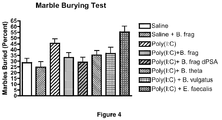
Figure 4 shows that MIA offspring exhibit elevated levels of stereotyped/repetitive behavior in the marble burying tests, and that this can be normalized by probiotic treatment with certain bacteria. Adult offspring of saline- and poly(I:C)-injected mothers were tested for the percent of marbles buried in a 10 min period. B.fragilis and related species colonization at weaning prevents development of repetitive and compulsive behaviors compared to MIA offspring without the probiotic. Student's t-test: *p<0.05 **p<0.01. n= 14-20 animals per trial. -
Figure 5 shows the extent of dextran probe leakage into the circulation of MIA offspring given one of several types of bacterial species. Most important is the finding that MIA display a "leaky gut" syndrome and that B. fragilis and the other Bacteriodes species tested can prevent this disorder. - The term "effective dose" is an amount that results in a reduction, inhibition or prevention of the behavioral disorder/abnormality/symptoms in the individual. The amount of B. fragilis, or other probiotic required to achieve this can be determined by a person of skill in the art.
- The term "individual" as used herein includes a single biological organism wherein inflammation can occur including but not limited to animals and in particular higher animals and in particular vertebrates such as mammals and in particular human beings.
- The term "condition/disorder/symptom" or "behavioral abnormality" or as used herein means symptoms expressed by an individual with a mental disorder, such as but not limited to anxiety, autism, autism spectrum disorders, Fragile X, Rett syndrome, tuberous sclerosis, obsessive compulsive disorder, attention deficit disorder or schizophrenia. The aforementioned symptoms are some of those exhibited by the MIA offspring.
- The term "individual in need of the treatment" means a person expressing or suffering from one or more of the behavioral disorder/symptoms mentioned above. An appropriately qualified person is able to identify such an individual in need of treatment using standard behavioral testing protocols/guidelines. The same behavioral testing protocols/guidelines can also be used to determine whether there is improvement to the individual's disorder/symptoms; and determine the most effective dose of the B. fragilis cell to give to an individual in need of the treatment.
- The term "improvement in behavioral performance" as used herein means a prevention or reduction in the severity or frequency, to whatever extent, of one or more of the above behavioral disorder/symptoms/abnormalities expressed by the individual. The improvement is either observed by the individual taking the treatment themselves or by another person (medical or otherwise).
- The term "treatment" as used herein indicates any activity that is part of a medical (prescribed by the physician) or non-medically approved (i.e. non-prescription including but not limited to vitamins, herbs; supplements; probiotics etc.) care that deals with a condition/symptom as described above.
- The term "prevention" as used herein indicates any activity that reduces the burden of the individual later expressing those behavioral symptoms. This takes place at primary, secondary and tertiary prevention levels, wherein: a) primary prevention avoids the development of symptoms/disorder/condition; b) secondary prevention activities are aimed at early stages of the condition/disorder/symptom treatment, thereby increasing opportunities for interventions to prevent progression of the condition/disorder/symptom and emergence of symptoms; and c) tertiary prevention reduces the negative impact of an already established condition/disorder/symptom by restoring function and reducing any condition/disorder/symptom or related complications.
- Pharmaceutically acceptable or appropriate carriers can be, but not limited to, organic or inorganic, solid or liquid excipient which is suitable for the selected mode of application such as oral application or injection, and administered in the form of a conventional pharmaceutical preparation. Such preparation includes solid such as tablets, granules, powders, capsules, and liquid such as solution, emulsion, suspension and the like. Said carrier includes starch, lactose, glucose, sucrose, dextrine, cellulose, paraffin, fatty acid glyceride, water, alcohol, gum arabic and the like. If necessary, auxiliary, stabilizer, emulsifier, lubricant, binder, pH adjustor controller, isotonic agent and other conventional additives may be added.
- The pharmaceutically acceptable or appropriate carrier may well include other compounds known to be beneficial to an impaired situation of the GI tract, (e.g., antioxidants, such as Vitamin C, Vitamin E, Selenium or Zinc); or a food composition. The food composition can be, but is not limited to, milk, yoghurt, curd, cheese, fermented milks, milk based fermented products, ice-creams, fermented cereal based products, milk based powders, infant formulae, tablets, liquid bacterial suspensions, dried oral supplement, or wet oral supplement.
- The term "neutraceutical" as used herein means a food stuff (as a fortified food or a dietary supplement) that provides health benefits. Nutraceutical foods are not subject to the same testing and regulations as pharmaceutical drugs.
- The term "probiotic" as used herein means live microorganisms, which, when administered in adequate amounts, confer a health benefit on the host. The probiotics may be available in foods and dietary supplements (for example, but not limited to capsules, tablets, and powders). Examples of foods containing the probiotic are yogurt, fermented and unfermented milk, miso, tempeh, and some juices and soy beverages.
- The term "extract" as used herein indicates either the insoluble material or soluble material obtained from the B. fragilis or related species using various chemical, immunological, biochemical or physical procedures known to those of skill in the art, including but not limited to, precipitation, centrifugation, filtering, column chromatography, and detergent lysis.
- The term "whole cell lysate" refers to the fraction obtained when the B.fragilis or related species are lysed using detergent or other chemical or physical means.
- The term "native" when used in connection with biological materials such as nucleic acid molecules, polypeptides, host cells, bacterial cells/strains and the like, refers to materials as they are found in nature and not manipulated by man.
- The term "isolated" when used in connection biological materials such as nucleic acid molecules, polypeptides, bacterial cells, host cells, bacterial cells/strains and the like, refers to the isolated or purified aforementioned materials, where these materials do not occur naturally and/or where they have markedly different or distinctive characteristics compared to those found in the native material.
- The term "non-denatured" is used herein refers to when the bacterial is frozen in a media and then undergoes a freeze-drying process. Such non-denatured bacteria can be mixed with other substances/compounds/carriers/additives and given in forms of a pill, tablet, or liquid to individuals in need of behavioral improvement. The non-denatured bacteria can also be mixed into foods (cookies, yogurt; milk etc.).
- The term "conventional pharmaceuticals or compounds" as used herein in the context of "other conventional pharmaceuticals or compounds used to treat behavioral disorder/symptoms refers to those pharmaceuticals or compounds that persons of skill in the art (including but not limited to physicians) conventionally use to treat the above mentioned condition/disorder/symptom" or "behavioral abnormality.
- The term "related" as used herein in the context of "B.fragilis and related species" refers to the other species under the genus Bacteroides (or otherwise), that were shown to have a positive effects on behaviors such as those tested here.
- The Patterson laboratory developed a mouse model that has both construct and face validity for autism, MIA (maternal immune activation) (reviewed in Patterson, 2011). This is based on epidemiological evidence that viral or bacterial infection during pregnancy increases the risk for ASD in the offspring (Atladottir et al., 2010). In this animal model, pregnant mice that receive a respiratory infection at mid-gestation, or that receive the double-stranded RNA viral mimic, poly(I:C), produce offspring with a series of abnormal behaviors, including the hallmark symptoms of repetitive/compulsive behaviors, and deficits in social interaction and communication (Patterson, 2011). Moreover, MIA offspring display a specific neuropathology that is common in ASD, spatially restricted deficits in Purkinje cells (Patterson, 2011). Recently, the collaboration between the laboratories of Sarkis Mazmanian and Paul Patterson has discovered that the MIA offspring exhibit abnormalities in the immune system and the gastrointestinal tract. Most importantly, some of the ASD-like behavioral symptoms can be corrected or prevented by manipulating the microbiota of the MIA offspring. This treatment is based on prior work by the Mazmanian group showing the efficacy of B.fragilis treatment in several GI and systemic inflammatory disorders (Round et al., 2009, 2010).
- The open field test is a test of anxiety under mildly stressful conditions, and ASD subjects exhibit enhanced anxiety under such circumstances. The offspring are tested in the open field to determine the effects of B.fragilis and a number of other bacterial species on anxiety behavior. Groups of pregnant mice (n>3) are treated on E12.5 with poly(I:C) to induce MIA, or saline as the control (Smith et al., 2007). Immediately upon weaning the offspring are colonized with one of the bacteria shown (given in food) or not, for one week. Mice are placed in a brightly lit open box, and activity is recorded by a video camera and analyzed using Ethovision software (Noldus). The number of entries into, and the time spent in, the center of the arena are measured. As expected, MIA offspring spend less time in the center of the open field and enter it less often than control offspring, indicating increased anxiety (
Fig. 1 ). Treatment with B.fragilis and other Bacteroides species prevents the abnormal behavior in the MIA offspring, indicating that this probiotic treatment lowers anxiety in normal animals as well as in the ASD model mice. In contrast, the non-Bacteroides species, E. facaelis, is not able to prevent anxiety in the MIA offspring. Thus, there is specificity among the bacterial species tested. (the differences cited are significant at p<.05 and .01) - The colons of adult MIA and control offspring were prepared for histology and stained with H & E. As illustrated in
Fig. 2 , there is a very significant cellular infiltration in MIA offspring. This was seen in 4 out of 5 MIA mice examined. In contrast, this type of infiltration was seen in only 1 out of 5 control mice. The identity of the cells infiltrating the colon is being examined. - To assess the activation state of lymphocytes associated with the GI tract, mesenteric lymph nodes were dissected from adult offspring of control mothers, offspring of MIA mothers treated with poly(I:C), and offspring of MIA mothers treated with IL-6. CD4+ cells were isolated and treated in culture with PMA and ionomycin. Supernatants were assayed for IL-6 (not shown) and IL-17 (
Fig. 3 ). On both days assayed, the lymphocytes from MIA offspring display higher cytokine release than controls. - One of the tests used to assay stereotyped, repetitive/compulsive behavior in rodents is marble burying. Animals are placed in a cage with a series of marbles located on top of the bedding. The number of marbles buried in a given period is measured to quantify this repetitive behavior. We find that MIA offspring bury many more marbles than controls (
Fig. 4 saline vs. poly(I:C)). Remarkably, MIA offspring treated with B. fragilis or other Bacteroides species do not display this ASD-like symptom (Fig. 4 ). Moreover, as in the open field test, treatment with the non-Bacteroides species, E. facaelis, does not prevent anxiety in the MIA offspring. (The differences cited are significant at p<.05) - Since Bacteroides species can prevent behavioral ASD-like abnormalities in the MIA offspring, and these offspring display GI pathology, it was of interest to ask if the probiotics also prevent the GI symptoms. GI epithelial barrier function can be tested by gavaging the mouse with a labeled dextran that is large enough such that it does not normally leak through the barrier in significant amounts. When barrier function is compromised as by gavaging with dextran sodium sulfate (DSS), the labeled dextran probe does leak into the circulation (
Fig. 5 ). This is the positive control for "leaky gut", a symptom found in a large subset of ASD children. Importantly, the adult MIA offspring also display very significant levels of leaky gut, and this can be prevented by post-weaning treatment with all of the Bacteroides species tested, but not with the non-Bacteroides, E. faecalis (Fig. 5 ). Thus, the efficacy of probiotic therapy in the GI tract corresponds with the specificity of the behavioral therapy. - Given the above results, the similarities between the MIA model and the respective human disorders (including the cardinal behavioral symptoms of ASD and neuropathology characteristic of ASD, and behavior and neuropathology characteristic of schizophrenia, which both share the maternal infection risk factor; reviewed in Patterson, 2011), we would expect that individuals in need of treatment could be given B.fragilis or related bacteria in a capsule, pill, neutraceutical, or other probiotic form, and the individual would show signs of improved behavioral performance. The effective dose for such an individual could be determined easily by the individual undergoing the treatment themselves or by another individual. For instance, the individuals themselves could determine whether their symptoms of anxiety were improved upon taking the appropriate amount of the probiotic. The individuals in need of such treatment could take the probiotic when needed or prior to the time they expect an occurrence of the behavioral abnormality would occur, for instance, when the individual believes the upcoming day would be stressful.
-
- a. A method of improving behavioral performance in an individual comprising, identifying an individual in need of treatment, and providing such an individual a composition comprising bacteria within the genus Bacteroides, whereby the individual shows improved behavioral performance.
- b. The method of clause a, wherein the individual in need of treatment suffers from anxiety, autism, ASD or a mental condition with some of the symptoms of ASD.
- c. The method of clause a, wherein the bacteria is selected from a group consisting of B. fragilis, B. theta, B. vulgatus, and B. faecalis.
- d. The method of clause a, wherein the bacteria is a mixture of several different species members within the genus Bacteroides.
- e. The method of clause a, wherein the improved behavioral performance is determined by standard behavioral testing.
- f. A probiotic composition for improving behavioral performance, comprising bacteria within the genus Bacteroides, whereby the individual shows improved behavioral performance.
- g. The method of clause a, wherein the bacteria is selected from a group consisting of B. fragilis, B. theta, B. vulgatus, and B. faecalis.
- h. A neutraceutical for improving behavioral performance in individuals, comprising bacteria within the genus Bacteroides, whereby the individual shows improved behavioral performance.
- i. The method of clause a, wherein the bacteria is selected from a group consisting of B. fragilis, B. theta, B. vulgatus, and B. faecalis.
- j. A pharmaceutical composition, comprising bacteria within the genus Bacteroides, and a pharmaceutically acceptable carrier, whereby the composition improves behavioral performance.
- k. The pharmaceutical composition of clause i, further comprising another pharmaceutical or compound used to treat the behavioral performance, wherein the pharmaceutical or compound does not comprise any other bacteria.
- The following references are hereby incorporated by reference in their entirety:
- Atladottir, H.O., Thorsen, P., Ostergaard, L., Schendel, D.E., Lemcke, S., Abdallah, M., Parner, E.T. 2010. Maternal infection requiring hospitalization during pregnancy and autism spectrum disorders. J Autism Devel Dis 40:1423-1430.
- Buie, T., D. B. Campbell, G. J. Fuchs, 3rd, G. T. Furuta, J. Levy, J. Vandewater, A. H. Whitaker, D. Atkins, M. L. Bauman, A. L. Beaudet, E. G. Carr, M. D. Gershon, S. L. Hyman, P. Jirapinyo, H. Jyonouchi, K. Kooros, R. Kushak, P. Levitt, S. E. Levy, J. D. Lewis, K. F. Murray, M. R. Natowicz, A. Sabra, B. K. Wershil, S. C. Weston, L. Zeltzer, and H. Winter. 2010. Evaluation, diagnosis, and treatment of gastrointestinal disorders in individuals with ASDs: a consensus report. Pediatrics 125 Suppl 1:S1 .
- Patterson, P. H. 2011. Modeling features of autism in animals. Pediatric Res 69:34R-40R.
- Round, J. L., and S. K. Mazmanian. 2009. The gut microbiota shapes intestinal immune responses during health and disease. Nat Rev Immunol 9:313 .
- Round, J. L., R. M. O'Connell, and S. K. Mazmanian. 2010. Coordination of tolerogenic immune responses by the commensal microbiota. J Autoimmun 34:J220 .
- Smith, S. E., J. Li, K. Garbett, K. Mimics, and P. H. Patterson. 2007. Maternal immune activation alters fetal brain development through interleukin-6. J Neurosci 27:10695 .
Claims (13)
- A composition comprising a single Bacteroides bacteria species for use in reducing one or more behavioral abnormalities in an individual suffering from a neurodevelopmental disability.
- The composition for use of claim 1, wherein the one or more behavioral abnormalities comprise stereotyped behaviors, repetitive behaviors, compulsive behaviors, deficits in social interaction, deficits in communication, and/or anxiety behaviors.
- The composition for use of claim 1, wherein the neurodevelopmental disability is anxiety, autism, autism spectrum disorders (ASD), a mental condition with some of the symptoms of ASD, Fragile X, Rett syndrome, tuberous sclerosis, obsessive compulsive disorder, attention deficit disorder, or schizophrenia.
- The composition for use of claim 1, wherein the single Bacteroides bacteria species is B. fragilis, B. theta, or B. vulgatus.
- The composition for use of claim 1, wherein the individual displays leaky gut.
- The composition for use of claim 5, wherein the composition is further for use in reducing the level of leaky gut in the individual.
- The composition for use of claim 1, wherein reducing one or more behavioral abnormalities comprises reducing anxiety level.
- The composition for use of claim 1, wherein reducing one or more behavioral abnormalities comprises reducing repetitive behavior.
- The composition for use of claim 1, wherein a reduction in one or more behavioral abnormalities is determined by standard behavioral testing.
- The composition for use of any one of claims 1 to 9, wherein the composition is a probiotic composition.
- The composition for use of any one of claims 1 to 9, wherein the composition is a neutraceutical composition.
- The composition for use of any one of claims 1 to 9, wherein the composition is a pharmaceutical composition, comprising a pharmaceutically acceptable carrier.
- The composition for use of claim 12, wherein the composition is in the form of a capsule or a pill.
Priority Applications (5)
| Application Number | Priority Date | Filing Date | Title |
|---|---|---|---|
| PL16164727T PL3072524T3 (en) | 2010-10-07 | 2011-10-06 | Probiotic therapies for autism |
| SI201131441T SI3072524T1 (en) | 2010-10-07 | 2011-10-06 | Probiotic anti-autism therapy |
| RS20180344A RS57006B1 (en) | 2010-10-07 | 2011-10-06 | Probiotic therapies for autism |
| SM20180226T SMT201800226T1 (en) | 2010-10-07 | 2011-10-06 | Probiotic therapies for autism |
| HRP20180559TT HRP20180559T1 (en) | 2010-10-07 | 2018-04-06 | PROBIOTIC THERAPY FOR AUTISM |
Applications Claiming Priority (3)
| Application Number | Priority Date | Filing Date | Title |
|---|---|---|---|
| US39100410P | 2010-10-07 | 2010-10-07 | |
| US201161472963P | 2011-04-07 | 2011-04-07 | |
| EP11831629.8A EP2624863B1 (en) | 2010-10-07 | 2011-10-06 | Probiotic therapies for autism |
Related Parent Applications (1)
| Application Number | Title | Priority Date | Filing Date |
|---|---|---|---|
| EP11831629.8A Division EP2624863B1 (en) | 2010-10-07 | 2011-10-06 | Probiotic therapies for autism |
Publications (2)
| Publication Number | Publication Date |
|---|---|
| EP3072524A1 true EP3072524A1 (en) | 2016-09-28 |
| EP3072524B1 EP3072524B1 (en) | 2018-01-17 |
Family
ID=45925310
Family Applications (2)
| Application Number | Title | Priority Date | Filing Date |
|---|---|---|---|
| EP16164727.6A Active EP3072524B1 (en) | 2010-10-07 | 2011-10-06 | Probiotic therapies for autism |
| EP11831629.8A Not-in-force EP2624863B1 (en) | 2010-10-07 | 2011-10-06 | Probiotic therapies for autism |
Family Applications After (1)
| Application Number | Title | Priority Date | Filing Date |
|---|---|---|---|
| EP11831629.8A Not-in-force EP2624863B1 (en) | 2010-10-07 | 2011-10-06 | Probiotic therapies for autism |
Country Status (16)
| Country | Link |
|---|---|
| US (3) | US9452189B2 (en) |
| EP (2) | EP3072524B1 (en) |
| JP (2) | JP5931884B2 (en) |
| CA (1) | CA2813606C (en) |
| CY (1) | CY1120119T1 (en) |
| DK (1) | DK3072524T3 (en) |
| ES (2) | ES2581843T3 (en) |
| HR (1) | HRP20180559T1 (en) |
| HU (1) | HUE038600T2 (en) |
| LT (1) | LT3072524T (en) |
| PL (1) | PL3072524T3 (en) |
| PT (1) | PT3072524T (en) |
| RS (1) | RS57006B1 (en) |
| SI (1) | SI3072524T1 (en) |
| SM (1) | SMT201800226T1 (en) |
| WO (1) | WO2012048152A2 (en) |
Cited By (5)
| Publication number | Priority date | Publication date | Assignee | Title |
|---|---|---|---|---|
| US10111914B2 (en) | 2014-10-30 | 2018-10-30 | California Institute Of Technology | Compositions and methods comprising bacteria for improving behavior in neurodevelopmental disorders |
| US10124025B2 (en) | 2014-10-30 | 2018-11-13 | California Institute Of Technology | Compositions and methods comprising bacteria for improving behavior in neurodevelopmental disorders |
| US10220089B2 (en) | 2012-08-29 | 2019-03-05 | California Institute Of Technology | Diagnosis and treatment of autism spectrum disorder |
| US11147792B2 (en) | 2017-05-15 | 2021-10-19 | Axial Therapeutics, Inc. | Inhibitors of microbially induced amyloid |
| EP4527396A1 (en) | 2023-09-22 | 2025-03-26 | Igen Biolab Group AG | Therapeutic use of a postbiotic composition for psychiatric disorders |
Families Citing this family (45)
| Publication number | Priority date | Publication date | Assignee | Title |
|---|---|---|---|---|
| AUPQ899700A0 (en) | 2000-07-25 | 2000-08-17 | Borody, Thomas Julius | Probiotic recolonisation therapy |
| US20110002965A1 (en) * | 2007-11-09 | 2011-01-06 | Round June L | Immunomodulating compounds and related compositions and methods |
| EP2217250A4 (en) | 2007-11-09 | 2011-01-05 | California Inst Of Techn | IMMUNOREGULATORY COMPOUNDS AND RELATED COMPOSITIONS AND METHODS |
| HUE040658T2 (en) | 2010-04-07 | 2019-03-28 | California Inst Of Techn | Vehicle for delivering a compound to a mucous membrane and related compositions, methods and systems |
| US20110287048A1 (en) | 2010-05-20 | 2011-11-24 | Round June L | Antigen Specific Tregs and related compositions, methods and systems |
| KR102435108B1 (en) | 2010-08-04 | 2022-08-22 | 핀치 테라퓨틱스 홀딩스 엘엘씨 | Compositions for fecal floral transplantation and methods for making and using them and devices for delivering them |
| HUE038600T2 (en) | 2010-10-07 | 2018-10-29 | California Inst Of Techn | Probiotic therapies for autism |
| CN103561752B (en) | 2011-03-09 | 2016-04-20 | 明尼苏达大学评议会 | Compositions and methods for transplanting colonic microbiota |
| EP2731617A4 (en) | 2011-07-12 | 2015-07-01 | Brigham & Womens Hospital | LIPID-CONTAINING PSA COMPOSITIONS, METHODS OF ISOLATION AND METHODS OF USING SAME |
| EP2764090B1 (en) | 2011-10-03 | 2017-12-13 | California Institute of Technology | Generation of psa-only producing mutant strain |
| WO2013176774A1 (en) | 2012-05-25 | 2013-11-28 | Arizona Board Of Regents | Microbiome markers and therapies for autism spectrum disorders |
| WO2014182966A1 (en) | 2013-05-10 | 2014-11-13 | California Institute Of Technology | Probiotic prevention and treatment of colon cancer |
| JP6234331B2 (en) * | 2014-06-13 | 2017-11-22 | 森永乳業株式会社 | Schizophrenia treatment |
| WO2016069792A1 (en) * | 2014-10-30 | 2016-05-06 | California Institute Of Technology | Compositions and methods comprising bacteria for improving behavior in neurodevelopmental disorders |
| JP6611156B2 (en) * | 2015-01-30 | 2019-11-27 | 史郎 栃谷 | Production method of animal model of behavioral abnormalities caused by maternal intestinal bacterial disturbance during pregnancy and its use |
| CA2985827A1 (en) | 2015-05-14 | 2016-11-17 | Crestovo Holdings Llc | Compositions for fecal floral transplantation and methods for making and using them and devices for delivering them |
| NZ776366A (en) | 2015-05-22 | 2023-02-24 | Univ Minnesota | Methods for treating autism spectrum disorder and associated symptoms |
| US11331335B2 (en) | 2015-06-10 | 2022-05-17 | California Institute Of Technology | Sepsis treatment and related compositions methods and systems |
| JP6918365B2 (en) | 2015-08-19 | 2021-08-11 | プレジデント アンド フェローズ オブ ハーバード カレッジ | Lipidized PSA Compositions and Methods |
| WO2017160711A1 (en) | 2016-03-14 | 2017-09-21 | Holobiome, Inc. | Modulation of the gut microbiome to treat mental disorders or diseases of the central nervous system |
| CN109642904A (en) | 2016-05-23 | 2019-04-16 | 加州理工学院 | Intestines micropopulation is adjusted to treat Neurodegenerative conditions |
| US20170360848A1 (en) * | 2016-06-15 | 2017-12-21 | Arizona Board Of Regents On Behalf Of Arizona State University | Methods for treating autism spectrum disorder and associated symptoms |
| US10849936B2 (en) | 2016-07-01 | 2020-12-01 | Regents Of The University Of Minnesota | Compositions and methods for C. difficile treatment |
| US11491181B2 (en) | 2016-07-15 | 2022-11-08 | President And Fellows Of Harvard College | Glycolipid compositions and methods of use |
| US20180036352A1 (en) | 2016-08-03 | 2018-02-08 | Crestovo Holdings Llc | Methods for treating ulcerative colitis |
| JP2018047146A (en) * | 2016-09-23 | 2018-03-29 | 株式会社三共 | Slot machine |
| JP2018047144A (en) * | 2016-09-23 | 2018-03-29 | 株式会社三共 | Slot machine |
| US10092601B2 (en) | 2016-10-11 | 2018-10-09 | Crestovo Holdings Llc | Compositions and methods for treating multiple sclerosis and related disorders |
| US11026978B2 (en) | 2016-10-11 | 2021-06-08 | Finch Therapeutics Holdings Llc | Compositions and methods for treating multiple sclerosis and related disorders |
| WO2018071536A1 (en) | 2016-10-11 | 2018-04-19 | Crestovo Holdings Llc | Compositions and methods for treating primary sclerosing cholangitis and related disorders |
| US11040073B2 (en) | 2017-04-05 | 2021-06-22 | Finch Therapeutics Holdings Llc | Compositions and methods for treating diverticulitis and related disorders |
| CA3058818A1 (en) | 2017-04-05 | 2018-10-11 | Crestovo Holdings Llc | Compositions and methods for treating parkinson's disease (pd) and related disorders |
| US10695386B2 (en) | 2017-05-11 | 2020-06-30 | Shayne K. Morris | Skin microbiome colonizer formulations and methods for use |
| CA3064773A1 (en) | 2017-05-26 | 2018-11-29 | Crestovo Holdings Llc | Lyophilized compositions comprising fecal microbe-based therapeutic agents and methods for making and using same |
| CA3072032A1 (en) | 2017-08-07 | 2019-02-14 | Finch Therapeutics, Inc. | Compositions and methods for maintaining and restoring a healthy gut barrier |
| US11291696B2 (en) | 2018-04-11 | 2022-04-05 | Shayne Morris | Pairing probiotics and prebiotics, methods for growth and use, separately and in combination |
| US11168299B2 (en) | 2018-04-11 | 2021-11-09 | Shayne Morris | Pairing probiotics and prebiotics, methods for growth and use, separately and in combination |
| US11166990B2 (en) | 2018-07-13 | 2021-11-09 | Finch Therapeutics Holdings Llc | Methods and compositions for treating ulcerative colitis |
| US12144834B2 (en) | 2018-09-13 | 2024-11-19 | Xbiome Inc. | Methods and compositions for treating gastrointestinal and inflammatory disorders |
| CA3114423A1 (en) | 2018-09-27 | 2020-04-02 | Finch Therapeutics Holdings Llc | Compositions and methods for treating epilepsy and related disorders |
| JP7269568B2 (en) | 2019-07-12 | 2023-05-09 | コンビ株式会社 | Composition for ameliorating or preventing anxiety disorders and/or mood disorders |
| CA3147629A1 (en) | 2019-07-19 | 2021-01-28 | Finch Therapeutics Holdings Llc. | Methods and products for treatment of gastrointestinal disorders |
| CN118434419A (en) * | 2021-12-21 | 2024-08-02 | 国立大学法人大阪大学 | Use of opioids for the treatment of autism spectrum disorders |
| CN114699423B (en) * | 2022-02-16 | 2023-06-23 | 广州知易生物科技有限公司 | Application of capsular polysaccharide extract of bacteroides fragilis in preparation of medicines for preventing and treating schizophrenia |
| CN114699424B (en) * | 2022-02-16 | 2023-07-18 | 广州知易生物科技有限公司 | New application of bacteroides fragilis zwitterionic capsular polysaccharide and/or modified zwitterionic capsular polysaccharide |
Citations (3)
| Publication number | Priority date | Publication date | Assignee | Title |
|---|---|---|---|---|
| WO2002007741A1 (en) * | 2000-07-25 | 2002-01-31 | Borody Thomas J | Probiotic recolonisation therapy |
| US20020013270A1 (en) * | 2000-06-05 | 2002-01-31 | Bolte Ellen R. | Method for treating a mental disorder |
| US20040170617A1 (en) * | 2000-06-05 | 2004-09-02 | Finegold Sydney M. | Method of treating diseases associated with abnormal gastrointestinal flora |
Family Cites Families (30)
| Publication number | Priority date | Publication date | Assignee | Title |
|---|---|---|---|---|
| US5443826A (en) | 1988-08-02 | 1995-08-22 | Borody; Thomas J. | Treatment of gastro-intestinal disorders with a fecal composition or a composition of bacteroides and E. Coli |
| AUPM864894A0 (en) * | 1994-10-07 | 1994-11-03 | Borody, Thomas Julius | Treatment of bowel-dependent neurological disorders |
| US5951977A (en) | 1997-10-14 | 1999-09-14 | The United States Of America, As Represented By The Secretary Of Agriculture | Competitive exclusion culture for swine |
| US7041814B1 (en) | 1998-02-18 | 2006-05-09 | Genome Therapeutics Corporation | Nucleic acid and amino acid sequences relating to Enterobacter cloacae for diagnostics and therapeutics |
| CN1160079C (en) | 1998-03-11 | 2004-08-04 | 格勒兰制药株式会社 | Foaming enteric-coated preparations |
| US20040005304A1 (en) * | 2002-07-08 | 2004-01-08 | Mak Wood, Inc. | Novel compositions and methods for treating neurological disorders and associated gastrointestinal conditions |
| US7749509B2 (en) | 2003-08-29 | 2010-07-06 | Cobb And Company, Llp | Treatment of autism using probiotic composition |
| US20060177424A1 (en) | 2003-08-29 | 2006-08-10 | Cobb Mark L | Treatment of disease states and adverse physiological conditions utilizing anti-fungal compositions |
| US8192733B2 (en) | 2003-08-29 | 2012-06-05 | Cobb & Associates | Probiotic composition useful for dietary augmentation and/or combating disease states and adverse physiological conditions |
| US7731976B2 (en) | 2003-08-29 | 2010-06-08 | Cobb And Company, Llp | Treatment of irritable bowel syndrome using probiotic composition |
| CA2586334A1 (en) | 2004-11-16 | 2006-06-08 | Neurochem (International) Limited | Compounds for the treatment of cns and amyloid associated diseases |
| US20100233312A9 (en) | 2005-04-11 | 2010-09-16 | The Procter & Gamble Company | Compositions comprising probiotic and sweetener components |
| CA2740434C (en) | 2007-10-26 | 2017-11-07 | Brenda E. Moore | Probiotic compositions and methods for inducing and supporting weight loss |
| EP3018122B1 (en) | 2007-11-06 | 2018-10-10 | BioElectron Technology Corporation | 4-(p-quinonyl)-2-hydroxybutanamide derivatives for treatment of mitochondrial diseases |
| US20110118135A1 (en) | 2008-01-09 | 2011-05-19 | State Matthew W | Mutations in Contaction Associated Protein 2 (CNTNAP2) are Associated with Increased Risk for Ideopathic Autism |
| US9050276B2 (en) | 2009-06-16 | 2015-06-09 | The Trustees Of Columbia University In The City Of New York | Autism-associated biomarkers and uses thereof |
| US20110081320A1 (en) | 2009-10-06 | 2011-04-07 | Nubiome, Inc. | Treatment/Cure of Autoimmune Disease |
| CA2797787C (en) | 2010-04-29 | 2019-07-09 | Wisconsin Alumni Research Foundation | Metabolic biomarkers of autism |
| US9707207B2 (en) | 2010-05-26 | 2017-07-18 | The United States Of America As Represented By The Department Of Veterans Affairs | Method for diagnosing, preventing, and treating neurological diseases |
| WO2011153226A2 (en) | 2010-06-01 | 2011-12-08 | Moore Research Enterprises Llc | Cellular constituents from bacteroides, compositions thereof, and therapeutic methods employing bacteroides or cellular constituents thereof |
| US20130115257A1 (en) | 2010-07-08 | 2013-05-09 | Katholieke Universiteit Leuven | Compositions and methods for removal or destruction of amyloid fibril or amyloid adhesin comprising aggregates |
| HUE038600T2 (en) | 2010-10-07 | 2018-10-29 | California Inst Of Techn | Probiotic therapies for autism |
| US20120237482A1 (en) | 2011-03-18 | 2012-09-20 | Juan Rodriguez | Methods for treatment of neurological disorders by modulation of microglial activation |
| EP2785828B1 (en) | 2011-12-01 | 2020-04-08 | The University of Tokyo | Human-derived bacteria that induce proliferation or accumulation of regulatory t cells |
| US9511100B2 (en) | 2013-06-05 | 2016-12-06 | Rebiotix, Inc. | Microbiota restoration therapy (MRT), compositions and methods of manufacture |
| CA2966363A1 (en) | 2014-10-30 | 2016-05-06 | California Institute Of Technology | Compositions and methods comprising bacteria for improving behavior in neurodevelopmental disorders |
| WO2016069792A1 (en) | 2014-10-30 | 2016-05-06 | California Institute Of Technology | Compositions and methods comprising bacteria for improving behavior in neurodevelopmental disorders |
| CN107106616A (en) | 2014-10-30 | 2017-08-29 | 加利福尼亚技术学院 | The composition and method of bacterium including improvement neurodevelopmental disorder behavior |
| NZ776366A (en) | 2015-05-22 | 2023-02-24 | Univ Minnesota | Methods for treating autism spectrum disorder and associated symptoms |
| US10200089B2 (en) | 2017-06-07 | 2019-02-05 | General Electric Company | Sensor system and method |
-
2011
- 2011-10-06 HU HUE16164727A patent/HUE038600T2/en unknown
- 2011-10-06 CA CA2813606A patent/CA2813606C/en active Active
- 2011-10-06 EP EP16164727.6A patent/EP3072524B1/en active Active
- 2011-10-06 ES ES11831629.8T patent/ES2581843T3/en active Active
- 2011-10-06 JP JP2013532955A patent/JP5931884B2/en not_active Expired - Fee Related
- 2011-10-06 LT LTEP16164727.6T patent/LT3072524T/en unknown
- 2011-10-06 US US13/267,748 patent/US9452189B2/en active Active
- 2011-10-06 SI SI201131441T patent/SI3072524T1/en unknown
- 2011-10-06 SM SM20180226T patent/SMT201800226T1/en unknown
- 2011-10-06 RS RS20180344A patent/RS57006B1/en unknown
- 2011-10-06 PT PT161647276T patent/PT3072524T/en unknown
- 2011-10-06 DK DK16164727.6T patent/DK3072524T3/en active
- 2011-10-06 PL PL16164727T patent/PL3072524T3/en unknown
- 2011-10-06 WO PCT/US2011/055159 patent/WO2012048152A2/en not_active Ceased
- 2011-10-06 ES ES16164727.6T patent/ES2662412T3/en active Active
- 2011-10-06 EP EP11831629.8A patent/EP2624863B1/en not_active Not-in-force
-
2016
- 2016-04-27 JP JP2016088694A patent/JP6177379B2/en not_active Expired - Fee Related
- 2016-08-29 US US15/249,870 patent/US20160375065A1/en not_active Abandoned
-
2018
- 2018-04-03 CY CY20181100369T patent/CY1120119T1/en unknown
- 2018-04-06 HR HRP20180559TT patent/HRP20180559T1/en unknown
-
2020
- 2020-07-22 US US16/935,837 patent/US11896629B2/en active Active
Patent Citations (3)
| Publication number | Priority date | Publication date | Assignee | Title |
|---|---|---|---|---|
| US20020013270A1 (en) * | 2000-06-05 | 2002-01-31 | Bolte Ellen R. | Method for treating a mental disorder |
| US20040170617A1 (en) * | 2000-06-05 | 2004-09-02 | Finegold Sydney M. | Method of treating diseases associated with abnormal gastrointestinal flora |
| WO2002007741A1 (en) * | 2000-07-25 | 2002-01-31 | Borody Thomas J | Probiotic recolonisation therapy |
Non-Patent Citations (8)
| Title |
|---|
| ATLADOTTIR, H.O.; THORSEN, P.; OSTERGAARD, L.; SCHENDEL, D.E.; LEMCKE, S.; ABDALLAH, M.; PARNER, E.T.: "Maternal infection requiring hospitalization during pregnancy and autism spectrum disorders", JAUTISM DEVEL DIS, vol. 40, 2010, pages 1423 - 1430, XP019861883, DOI: doi:10.1007/s10803-010-1006-y |
| BUIE, T.; D. B. CAMPBELL; G. J. FUCHS, 3RD; G. T. FURUTA; J. LEVY; J. VANDEWATER; A. H. WHITAKER; D. ATKINS; M. L. BAUMAN; A. L. B: "Evaluation, diagnosis, and treatment of gastrointestinal disorders in individuals with ASDs: a consensus report", PEDIATRICS, vol. 125, no. 1, 2010, pages S1 |
| ELAINE Y. HSIAO ET AL: "Microbiota Modulate Behavioral and Physiological Abnormalities Associated with Neurodevelopmental Disorders", CELL, vol. 155, no. 7, 1 December 2013 (2013-12-01), pages 1451 - 1463, XP055103211, ISSN: 0092-8674, DOI: 10.1016/j.cell.2013.11.024 * |
| PATTERSON, P. H.: "Modeling features of autism in animals.", PEDIATRIC RES, vol. 69, 2011, pages 34R - 40R |
| ROUND, J. L.; R. M. O'CONNELL; S. K. MAZMANIAN: "Coordination oftolerogenic immune responses by the commensal microbiota", JAUTOIMMUN, vol. 34, 2010, pages J220, XP026939960, DOI: doi:10.1016/j.jaut.2009.11.007 |
| ROUND, J. L.; S. K. MAZMANIAN: "The gut microbiota shapes intestinal immune responses during health and disease", NAT REV IMMUNOL, vol. 9, 2009, pages 313, XP055252815, DOI: doi:10.1038/nri2515 |
| SMITH, S. E.; J. LI; K. GARBETT; K. MIRNICS; P. H. PATTERSON: "Maternal immune activation alters fetal brain development through interleukin-6", J NEUROSCI, vol. 27, 2007, pages 10695, XP055044947, DOI: doi:10.1523/JNEUROSCI.2178-07.2007 |
| SYDNEY M. FINEGOLD ET AL: "Pyrosequencing study of fecal microflora of autistic and control children", ANAEROBE, vol. 16, no. 4, 1 August 2010 (2010-08-01), pages 444 - 453, XP055103220, ISSN: 1075-9964, DOI: 10.1016/j.anaerobe.2010.06.008 * |
Cited By (11)
| Publication number | Priority date | Publication date | Assignee | Title |
|---|---|---|---|---|
| US10220089B2 (en) | 2012-08-29 | 2019-03-05 | California Institute Of Technology | Diagnosis and treatment of autism spectrum disorder |
| US11052151B2 (en) | 2012-08-29 | 2021-07-06 | California Institute Of Technology | Diagnosis and treatment of autism spectrum disorder |
| US10111914B2 (en) | 2014-10-30 | 2018-10-30 | California Institute Of Technology | Compositions and methods comprising bacteria for improving behavior in neurodevelopmental disorders |
| US10124025B2 (en) | 2014-10-30 | 2018-11-13 | California Institute Of Technology | Compositions and methods comprising bacteria for improving behavior in neurodevelopmental disorders |
| US10675310B2 (en) | 2014-10-30 | 2020-06-09 | California Institute Of Technology | Compositions and methods comprising bacteria for improving behavior in neurodevelopmental disorders |
| US11202809B2 (en) | 2014-10-30 | 2021-12-21 | California Institute Of Technology | Compositions and methods comprising bacteria for improving behavior in neurodevelopmental disorders |
| US11672837B2 (en) | 2014-10-30 | 2023-06-13 | California Institute Of Technology | Compositions and methods comprising bacteria for improving behavior in neurodevelopmental disorders |
| US12128075B2 (en) | 2014-10-30 | 2024-10-29 | California Institute Of Technology | Compositions and methods comprising bacteria for improving behavior in neurodevelopmental disorders |
| US11147792B2 (en) | 2017-05-15 | 2021-10-19 | Axial Therapeutics, Inc. | Inhibitors of microbially induced amyloid |
| US11744820B2 (en) | 2017-05-15 | 2023-09-05 | Axial Therapeutics, Inc. | Inhibitors of microbially induced amyloid |
| EP4527396A1 (en) | 2023-09-22 | 2025-03-26 | Igen Biolab Group AG | Therapeutic use of a postbiotic composition for psychiatric disorders |
Also Published As
| Publication number | Publication date |
|---|---|
| EP3072524B1 (en) | 2018-01-17 |
| EP2624863B1 (en) | 2016-04-20 |
| US11896629B2 (en) | 2024-02-13 |
| LT3072524T (en) | 2018-03-26 |
| US9452189B2 (en) | 2016-09-27 |
| DK3072524T3 (en) | 2018-04-09 |
| PL3072524T3 (en) | 2018-06-29 |
| JP2016185959A (en) | 2016-10-27 |
| RS57006B1 (en) | 2018-05-31 |
| CA2813606C (en) | 2019-01-22 |
| WO2012048152A2 (en) | 2012-04-12 |
| EP2624863A4 (en) | 2014-04-02 |
| CY1120119T1 (en) | 2018-12-12 |
| CA2813606A1 (en) | 2012-04-12 |
| JP5931884B2 (en) | 2016-06-08 |
| EP2624863A2 (en) | 2013-08-14 |
| ES2581843T3 (en) | 2016-09-07 |
| PT3072524T (en) | 2018-04-23 |
| US20120087895A1 (en) | 2012-04-12 |
| JP2013544780A (en) | 2013-12-19 |
| US20160375065A1 (en) | 2016-12-29 |
| HUE038600T2 (en) | 2018-10-29 |
| US20210000888A1 (en) | 2021-01-07 |
| HRP20180559T1 (en) | 2018-06-01 |
| SMT201800226T1 (en) | 2018-07-17 |
| SI3072524T1 (en) | 2018-04-30 |
| JP6177379B2 (en) | 2017-08-09 |
| ES2662412T3 (en) | 2018-04-06 |
| WO2012048152A3 (en) | 2012-06-21 |
Similar Documents
| Publication | Publication Date | Title |
|---|---|---|
| US11896629B2 (en) | Probiotic therapies for treating Rett syndrome | |
| Yao et al. | The role of microbiota in infant health: from early life to adulthood | |
| He et al. | Lactobacillus reuteri reduces the severity of experimental autoimmune encephalomyelitis in mice by modulating gut microbiota | |
| Fung | The microbiota-immune axis as a central mediator of gut-brain communication | |
| Gray et al. | The maternal diet, gut bacteria, and bacterial metabolites during pregnancy influence offspring asthma | |
| Critchfield et al. | The potential role of probiotics in the management of childhood autism spectrum disorders | |
| Cheng et al. | Loading ceftriaxone, vancomycin, and Bifidobacteria bifidum TMC3115 to neonatal mice could differently and consequently affect intestinal microbiota and immunity in adulthood | |
| US20230048705A1 (en) | Use of probiotics in the treatment and/or prevention of atopic dermatitis | |
| Hajiagha et al. | Gut microbiota and human body interactions; its impact on health: a review | |
| Ren et al. | Immunomodulatory effect of Bifidobacterium breve on experimental allergic rhinitis in BALB/c mice | |
| Graversen et al. | Short-term amoxicillin-induced perturbation of the gut microbiota promotes acute intestinal immune regulation in brown Norway rats | |
| Lei et al. | Screening of probiotic Lactobacilli with potential anti-allergic activity based on hyaluronidase inhibition and degranulation of RBL-2H3 cells in vitro | |
| KR20220080104A (en) | Compositions and methods for treating autism spectrum disorders | |
| Wang et al. | The impact of prebiotics, probiotics and synbiotics on the prevention and treatment of atopic dermatitis in children: an umbrella meta-analysis | |
| Gøbel et al. | Probiotics to young children with atopic dermatitis: A randomized placebo-controlled trial | |
| Wang et al. | Investigation of gut microbiota changes and allergic inflammation of mice with milk protein-induced allergic enteritis | |
| HK1229218A1 (en) | Probiotic therapies for autism | |
| HK1229218B (en) | Probiotic therapies for autism | |
| Pan et al. | Does constipation affect the effectiveness of washed microbiota transplantation in treating autism spectrum disorders? | |
| Özer et al. | Autism Spectrum Disorder, Microbiota And Nutritional Therapy Approaches | |
| Alkhammash | DETECTION OF GUT MICROBIOME FOR PATIENTS WITH TYPE 2 DIABETES MELLITUS IN MAKKAH ALMUKRAMAH REGION | |
| Hebert | Mom’s diet matters: effects of mouse maternal prebiotic intake on the offspring brain and behaviour | |
| Halabi | The microbiome and intestinal mucosal immunity: a therapeutic target to alleviate neuroinflammation in autism spectrum disorders | |
| CN121450463A (en) | Microbial inoculum based on synergistic effect of bifidobacterium pseudolongum and bifidobacterium animalis and application | |
| Meng | The Role of the Probiotic Bifidobacterium animalis subsp. lactis on Systemic Immune Function in Healthy Adults |
Legal Events
| Date | Code | Title | Description |
|---|---|---|---|
| PUAI | Public reference made under article 153(3) epc to a published international application that has entered the european phase |
Free format text: ORIGINAL CODE: 0009012 |
|
| AC | Divisional application: reference to earlier application |
Ref document number: 2624863 Country of ref document: EP Kind code of ref document: P |
|
| AK | Designated contracting states |
Kind code of ref document: A1 Designated state(s): AL AT BE BG CH CY CZ DE DK EE ES FI FR GB GR HR HU IE IS IT LI LT LU LV MC MK MT NL NO PL PT RO RS SE SI SK SM TR |
|
| STAA | Information on the status of an ep patent application or granted ep patent |
Free format text: STATUS: REQUEST FOR EXAMINATION WAS MADE |
|
| 17P | Request for examination filed |
Effective date: 20170327 |
|
| RBV | Designated contracting states (corrected) |
Designated state(s): AL AT BE BG CH CY CZ DE DK EE ES FI FR GB GR HR HU IE IS IT LI LT LU LV MC MK MT NL NO PL PT RO RS SE SI SK SM TR |
|
| GRAP | Despatch of communication of intention to grant a patent |
Free format text: ORIGINAL CODE: EPIDOSNIGR1 |
|
| STAA | Information on the status of an ep patent application or granted ep patent |
Free format text: STATUS: GRANT OF PATENT IS INTENDED |
|
| INTG | Intention to grant announced |
Effective date: 20170626 |
|
| GRAS | Grant fee paid |
Free format text: ORIGINAL CODE: EPIDOSNIGR3 |
|
| REG | Reference to a national code |
Ref country code: HK Ref legal event code: DE Ref document number: 1229218 Country of ref document: HK |
|
| GRAA | (expected) grant |
Free format text: ORIGINAL CODE: 0009210 |
|
| STAA | Information on the status of an ep patent application or granted ep patent |
Free format text: STATUS: THE PATENT HAS BEEN GRANTED |
|
| AC | Divisional application: reference to earlier application |
Ref document number: 2624863 Country of ref document: EP Kind code of ref document: P |
|
| AK | Designated contracting states |
Kind code of ref document: B1 Designated state(s): AL AT BE BG CH CY CZ DE DK EE ES FI FR GB GR HR HU IE IS IT LI LT LU LV MC MK MT NL NO PL PT RO RS SE SI SK SM TR |
|
| REG | Reference to a national code |
Ref country code: GB Ref legal event code: FG4D |
|
| REG | Reference to a national code |
Ref country code: CH Ref legal event code: EP |
|
| REG | Reference to a national code |
Ref country code: IE Ref legal event code: FG4D |
|
| REG | Reference to a national code |
Ref country code: AT Ref legal event code: REF Ref document number: 963966 Country of ref document: AT Kind code of ref document: T Effective date: 20180215 |
|
| REG | Reference to a national code |
Ref country code: DE Ref legal event code: R096 Ref document number: 602011045222 Country of ref document: DE |
|
| REG | Reference to a national code |
Ref country code: CH Ref legal event code: NV Representative=s name: MURGITROYD AND COMPANY, CH |
|
| REG | Reference to a national code |
Ref country code: RO Ref legal event code: EPE |
|
| REG | Reference to a national code |
Ref country code: HR Ref legal event code: TUEP Ref document number: P20180559 Country of ref document: HR Ref country code: ES Ref legal event code: FG2A Ref document number: 2662412 Country of ref document: ES Kind code of ref document: T3 Effective date: 20180406 |
|
| REG | Reference to a national code |
Ref country code: DK Ref legal event code: T3 Effective date: 20180405 |
|
| REG | Reference to a national code |
Ref country code: SE Ref legal event code: TRGR |
|
| REG | Reference to a national code |
Ref country code: NL Ref legal event code: FP |
|
| REG | Reference to a national code |
Ref country code: PT Ref legal event code: SC4A Ref document number: 3072524 Country of ref document: PT Date of ref document: 20180423 Kind code of ref document: T Free format text: AVAILABILITY OF NATIONAL TRANSLATION Effective date: 20180413 |
|
| REG | Reference to a national code |
Ref country code: EE Ref legal event code: FG4A Ref document number: E015184 Country of ref document: EE Effective date: 20180327 |
|
| REG | Reference to a national code |
Ref country code: HR Ref legal event code: T1PR Ref document number: P20180559 Country of ref document: HR |
|
| REG | Reference to a national code |
Ref country code: NO Ref legal event code: T2 Effective date: 20180117 |
|
| REG | Reference to a national code |
Ref country code: SK Ref legal event code: T3 Ref document number: E 26752 Country of ref document: SK |
|
| REG | Reference to a national code |
Ref country code: HK Ref legal event code: GR Ref document number: 1229218 Country of ref document: HK |
|
| REG | Reference to a national code |
Ref country code: GR Ref legal event code: EP Ref document number: 20180400844 Country of ref document: GR Effective date: 20180829 |
|
| REG | Reference to a national code |
Ref country code: DE Ref legal event code: R097 Ref document number: 602011045222 Country of ref document: DE |
|
| REG | Reference to a national code |
Ref country code: FR Ref legal event code: PLFP Year of fee payment: 8 |
|
| REG | Reference to a national code |
Ref country code: HU Ref legal event code: AG4A Ref document number: E038600 Country of ref document: HU |
|
| PLBE | No opposition filed within time limit |
Free format text: ORIGINAL CODE: 0009261 |
|
| STAA | Information on the status of an ep patent application or granted ep patent |
Free format text: STATUS: NO OPPOSITION FILED WITHIN TIME LIMIT |
|
| 26N | No opposition filed |
Effective date: 20181018 |
|
| REG | Reference to a national code |
Ref country code: HR Ref legal event code: ODRP Ref document number: P20180559 Country of ref document: HR Payment date: 20190926 Year of fee payment: 9 |
|
| PGFP | Annual fee paid to national office [announced via postgrant information from national office to epo] |
Ref country code: LU Payment date: 20190927 Year of fee payment: 9 |
|
| PGFP | Annual fee paid to national office [announced via postgrant information from national office to epo] |
Ref country code: RS Payment date: 20190926 Year of fee payment: 9 |
|
| PGFP | Annual fee paid to national office [announced via postgrant information from national office to epo] |
Ref country code: MT Payment date: 20190930 Year of fee payment: 9 |
|
| PGFP | Annual fee paid to national office [announced via postgrant information from national office to epo] |
Ref country code: CZ Payment date: 20191004 Year of fee payment: 9 |
|
| PGFP | Annual fee paid to national office [announced via postgrant information from national office to epo] |
Ref country code: SM Payment date: 20191029 Year of fee payment: 9 Ref country code: LV Payment date: 20191008 Year of fee payment: 9 |
|
| PGFP | Annual fee paid to national office [announced via postgrant information from national office to epo] |
Ref country code: CY Payment date: 20191003 Year of fee payment: 9 |
|
| REG | Reference to a national code |
Ref country code: HR Ref legal event code: ODRP Ref document number: P20180559 Country of ref document: HR Payment date: 20200924 Year of fee payment: 10 |
|
| PGFP | Annual fee paid to national office [announced via postgrant information from national office to epo] |
Ref country code: LT Payment date: 20200924 Year of fee payment: 10 Ref country code: IS Payment date: 20200923 Year of fee payment: 10 Ref country code: EE Payment date: 20200923 Year of fee payment: 10 Ref country code: SK Payment date: 20200923 Year of fee payment: 10 Ref country code: MC Payment date: 20200924 Year of fee payment: 10 |
|
| PGFP | Annual fee paid to national office [announced via postgrant information from national office to epo] |
Ref country code: MK Payment date: 20200923 Year of fee payment: 10 |
|
| PGFP | Annual fee paid to national office [announced via postgrant information from national office to epo] |
Ref country code: HR Payment date: 20200924 Year of fee payment: 10 Ref country code: TR Payment date: 20201005 Year of fee payment: 10 |
|
| PGFP | Annual fee paid to national office [announced via postgrant information from national office to epo] |
Ref country code: GR Payment date: 20201030 Year of fee payment: 10 Ref country code: BG Payment date: 20201015 Year of fee payment: 10 |
|
| PGFP | Annual fee paid to national office [announced via postgrant information from national office to epo] |
Ref country code: SI Payment date: 20201005 Year of fee payment: 10 |
|
| PG25 | Lapsed in a contracting state [announced via postgrant information from national office to epo] |
Ref country code: CZ Free format text: LAPSE BECAUSE OF NON-PAYMENT OF DUE FEES Effective date: 20201006 |
|
| PG25 | Lapsed in a contracting state [announced via postgrant information from national office to epo] |
Ref country code: LU Free format text: LAPSE BECAUSE OF NON-PAYMENT OF DUE FEES Effective date: 20201006 |
|
| PG25 | Lapsed in a contracting state [announced via postgrant information from national office to epo] |
Ref country code: SM Free format text: LAPSE BECAUSE OF NON-PAYMENT OF DUE FEES Effective date: 20210521 Ref country code: CY Free format text: LAPSE BECAUSE OF NON-PAYMENT OF DUE FEES Effective date: 20201006 |
|
| PG25 | Lapsed in a contracting state [announced via postgrant information from national office to epo] |
Ref country code: LV Free format text: LAPSE BECAUSE OF NON-PAYMENT OF DUE FEES Effective date: 20201006 |
|
| PG25 | Lapsed in a contracting state [announced via postgrant information from national office to epo] |
Ref country code: RS Free format text: LAPSE BECAUSE OF NON-PAYMENT OF DUE FEES Effective date: 20201006 |
|
| REG | Reference to a national code |
Ref country code: AT Ref legal event code: UEP Ref document number: 963966 Country of ref document: AT Kind code of ref document: T Effective date: 20180117 |
|
| REG | Reference to a national code |
Ref country code: LT Ref legal event code: MM4D Effective date: 20211006 |
|
| REG | Reference to a national code |
Ref country code: EE Ref legal event code: MM4A Ref document number: E015184 Country of ref document: EE Effective date: 20211031 Ref country code: HR Ref legal event code: PBON Ref document number: P20180559 Country of ref document: HR Effective date: 20211006 |
|
| REG | Reference to a national code |
Ref country code: SK Ref legal event code: MM4A Ref document number: E 26752 Country of ref document: SK Effective date: 20211006 |
|
| PG25 | Lapsed in a contracting state [announced via postgrant information from national office to epo] |
Ref country code: MT Free format text: LAPSE BECAUSE OF NON-PAYMENT OF DUE FEES Effective date: 20201006 Ref country code: MC Free format text: LAPSE BECAUSE OF NON-PAYMENT OF DUE FEES Effective date: 20211102 |
|
| PG25 | Lapsed in a contracting state [announced via postgrant information from national office to epo] |
Ref country code: SK Free format text: LAPSE BECAUSE OF NON-PAYMENT OF DUE FEES Effective date: 20211006 Ref country code: LT Free format text: LAPSE BECAUSE OF NON-PAYMENT OF DUE FEES Effective date: 20211006 Ref country code: HR Free format text: LAPSE BECAUSE OF NON-PAYMENT OF DUE FEES Effective date: 20211006 Ref country code: EE Free format text: LAPSE BECAUSE OF NON-PAYMENT OF DUE FEES Effective date: 20211031 Ref country code: BG Free format text: LAPSE BECAUSE OF NON-PAYMENT OF DUE FEES Effective date: 20220430 |
|
| PG25 | Lapsed in a contracting state [announced via postgrant information from national office to epo] |
Ref country code: SI Free format text: LAPSE BECAUSE OF NON-PAYMENT OF DUE FEES Effective date: 20211007 Ref country code: GR Free format text: LAPSE BECAUSE OF NON-PAYMENT OF DUE FEES Effective date: 20220506 |
|
| PG25 | Lapsed in a contracting state [announced via postgrant information from national office to epo] |
Ref country code: AL Free format text: LAPSE BECAUSE OF NON-PAYMENT OF DUE FEES Effective date: 20211006 |
|
| PGFP | Annual fee paid to national office [announced via postgrant information from national office to epo] |
Ref country code: PT Payment date: 20230925 Year of fee payment: 13 Ref country code: PL Payment date: 20230928 Year of fee payment: 13 Ref country code: NL Payment date: 20231016 Year of fee payment: 13 |
|
| PGFP | Annual fee paid to national office [announced via postgrant information from national office to epo] |
Ref country code: GB Payment date: 20231024 Year of fee payment: 13 |
|
| PGFP | Annual fee paid to national office [announced via postgrant information from national office to epo] |
Ref country code: ES Payment date: 20231107 Year of fee payment: 13 |
|
| PGFP | Annual fee paid to national office [announced via postgrant information from national office to epo] |
Ref country code: SE Payment date: 20231027 Year of fee payment: 13 Ref country code: RO Payment date: 20231002 Year of fee payment: 13 Ref country code: NO Payment date: 20231023 Year of fee payment: 13 Ref country code: IT Payment date: 20231023 Year of fee payment: 13 Ref country code: IE Payment date: 20231026 Year of fee payment: 13 Ref country code: HU Payment date: 20231010 Year of fee payment: 13 Ref country code: FR Payment date: 20231023 Year of fee payment: 13 Ref country code: FI Payment date: 20231023 Year of fee payment: 13 Ref country code: DK Payment date: 20231026 Year of fee payment: 13 Ref country code: DE Payment date: 20231123 Year of fee payment: 13 Ref country code: CH Payment date: 20231102 Year of fee payment: 13 Ref country code: AT Payment date: 20231024 Year of fee payment: 13 |
|
| PGFP | Annual fee paid to national office [announced via postgrant information from national office to epo] |
Ref country code: BE Payment date: 20231016 Year of fee payment: 13 |
|
| PG25 | Lapsed in a contracting state [announced via postgrant information from national office to epo] |
Ref country code: TR Free format text: LAPSE BECAUSE OF NON-PAYMENT OF DUE FEES Effective date: 20211006 |
|
| REG | Reference to a national code |
Ref country code: DE Ref legal event code: R119 Ref document number: 602011045222 Country of ref document: DE |
|
| REG | Reference to a national code |
Ref country code: DK Ref legal event code: EBP Effective date: 20241031 |
|
| REG | Reference to a national code |
Ref country code: CH Ref legal event code: PL |
|
| REG | Reference to a national code |
Ref country code: SE Ref legal event code: EUG |
|
| REG | Reference to a national code |
Ref country code: NL Ref legal event code: MM Effective date: 20241101 |
|
| REG | Reference to a national code |
Ref country code: AT Ref legal event code: MM01 Ref document number: 963966 Country of ref document: AT Kind code of ref document: T Effective date: 20241006 |
|
| GBPC | Gb: european patent ceased through non-payment of renewal fee |
Effective date: 20241006 |
|
| PG25 | Lapsed in a contracting state [announced via postgrant information from national office to epo] |
Ref country code: FI Free format text: LAPSE BECAUSE OF NON-PAYMENT OF DUE FEES Effective date: 20241006 |
|
| PG25 | Lapsed in a contracting state [announced via postgrant information from national office to epo] |
Ref country code: DE Free format text: LAPSE BECAUSE OF NON-PAYMENT OF DUE FEES Effective date: 20250501 |
|
| PG25 | Lapsed in a contracting state [announced via postgrant information from national office to epo] |
Ref country code: GB Free format text: LAPSE BECAUSE OF NON-PAYMENT OF DUE FEES Effective date: 20241006 |
|
| PG25 | Lapsed in a contracting state [announced via postgrant information from national office to epo] |
Ref country code: NO Free format text: LAPSE BECAUSE OF NON-PAYMENT OF DUE FEES Effective date: 20241031 Ref country code: HU Free format text: LAPSE BECAUSE OF NON-PAYMENT OF DUE FEES Effective date: 20241007 |
|
| PG25 | Lapsed in a contracting state [announced via postgrant information from national office to epo] |
Ref country code: NL Free format text: LAPSE BECAUSE OF NON-PAYMENT OF DUE FEES Effective date: 20241101 Ref country code: BE Free format text: LAPSE BECAUSE OF NON-PAYMENT OF DUE FEES Effective date: 20241031 |
|
| PG25 | Lapsed in a contracting state [announced via postgrant information from national office to epo] |
Ref country code: PT Free format text: LAPSE BECAUSE OF NON-PAYMENT OF DUE FEES Effective date: 20250407 |
|
| PG25 | Lapsed in a contracting state [announced via postgrant information from national office to epo] |
Ref country code: FR Free format text: LAPSE BECAUSE OF NON-PAYMENT OF DUE FEES Effective date: 20241031 |
|
| PG25 | Lapsed in a contracting state [announced via postgrant information from national office to epo] |
Ref country code: CH Free format text: LAPSE BECAUSE OF NON-PAYMENT OF DUE FEES Effective date: 20241031 |
|
| PG25 | Lapsed in a contracting state [announced via postgrant information from national office to epo] |
Ref country code: RO Free format text: LAPSE BECAUSE OF NON-PAYMENT OF DUE FEES Effective date: 20241006 Ref country code: AT Free format text: LAPSE BECAUSE OF NON-PAYMENT OF DUE FEES Effective date: 20241006 |
|
| REG | Reference to a national code |
Ref country code: BE Ref legal event code: MM Effective date: 20241031 |
|
| PG25 | Lapsed in a contracting state [announced via postgrant information from national office to epo] |
Ref country code: DK Free format text: LAPSE BECAUSE OF NON-PAYMENT OF DUE FEES Effective date: 20241031 |
|
| PG25 | Lapsed in a contracting state [announced via postgrant information from national office to epo] |
Ref country code: SE Free format text: LAPSE BECAUSE OF NON-PAYMENT OF DUE FEES Effective date: 20241007 Ref country code: IT Free format text: LAPSE BECAUSE OF NON-PAYMENT OF DUE FEES Effective date: 20241006 |
|
| PG25 | Lapsed in a contracting state [announced via postgrant information from national office to epo] |
Ref country code: IS Free format text: LAPSE BECAUSE OF NON-PAYMENT OF DUE FEES Effective date: 20220505 |
|
| PG25 | Lapsed in a contracting state [announced via postgrant information from national office to epo] |
Ref country code: IE Free format text: LAPSE BECAUSE OF NON-PAYMENT OF DUE FEES Effective date: 20241006 |
|
| REG | Reference to a national code |
Ref country code: ES Ref legal event code: FD2A Effective date: 20251127 |
|
| PG25 | Lapsed in a contracting state [announced via postgrant information from national office to epo] |
Ref country code: ES Free format text: LAPSE BECAUSE OF NON-PAYMENT OF DUE FEES Effective date: 20241007 |