EP3072500A1 - Cosmetic product comprising water-insoluble sponge impregnated with cosmetic composition having ultraviolet ray blocking function - Google Patents
Cosmetic product comprising water-insoluble sponge impregnated with cosmetic composition having ultraviolet ray blocking function Download PDFInfo
- Publication number
- EP3072500A1 EP3072500A1 EP15851616.1A EP15851616A EP3072500A1 EP 3072500 A1 EP3072500 A1 EP 3072500A1 EP 15851616 A EP15851616 A EP 15851616A EP 3072500 A1 EP3072500 A1 EP 3072500A1
- Authority
- EP
- European Patent Office
- Prior art keywords
- cosmetic composition
- blocking agent
- water
- less
- water insoluble
- Prior art date
- Legal status (The legal status is an assumption and is not a legal conclusion. Google has not performed a legal analysis and makes no representation as to the accuracy of the status listed.)
- Granted
Links
Images
Classifications
-
- A—HUMAN NECESSITIES
- A61—MEDICAL OR VETERINARY SCIENCE; HYGIENE
- A61K—PREPARATIONS FOR MEDICAL, DENTAL OR TOILETRY PURPOSES
- A61K8/00—Cosmetics or similar toiletry preparations
- A61K8/02—Cosmetics or similar toiletry preparations characterised by special physical form
- A61K8/04—Dispersions; Emulsions
-
- A—HUMAN NECESSITIES
- A61—MEDICAL OR VETERINARY SCIENCE; HYGIENE
- A61K—PREPARATIONS FOR MEDICAL, DENTAL OR TOILETRY PURPOSES
- A61K8/00—Cosmetics or similar toiletry preparations
- A61K8/02—Cosmetics or similar toiletry preparations characterised by special physical form
- A61K8/0208—Tissues; Wipes; Patches
-
- A—HUMAN NECESSITIES
- A61—MEDICAL OR VETERINARY SCIENCE; HYGIENE
- A61K—PREPARATIONS FOR MEDICAL, DENTAL OR TOILETRY PURPOSES
- A61K8/00—Cosmetics or similar toiletry preparations
- A61K8/02—Cosmetics or similar toiletry preparations characterised by special physical form
- A61K8/04—Dispersions; Emulsions
- A61K8/06—Emulsions
- A61K8/064—Water-in-oil emulsions, e.g. Water-in-silicone emulsions
-
- A—HUMAN NECESSITIES
- A61—MEDICAL OR VETERINARY SCIENCE; HYGIENE
- A61K—PREPARATIONS FOR MEDICAL, DENTAL OR TOILETRY PURPOSES
- A61K8/00—Cosmetics or similar toiletry preparations
- A61K8/02—Cosmetics or similar toiletry preparations characterised by special physical form
- A61K8/11—Encapsulated compositions
-
- A—HUMAN NECESSITIES
- A61—MEDICAL OR VETERINARY SCIENCE; HYGIENE
- A61K—PREPARATIONS FOR MEDICAL, DENTAL OR TOILETRY PURPOSES
- A61K8/00—Cosmetics or similar toiletry preparations
- A61K8/18—Cosmetics or similar toiletry preparations characterised by the composition
- A61K8/19—Cosmetics or similar toiletry preparations characterised by the composition containing inorganic ingredients
- A61K8/29—Titanium; Compounds thereof
-
- A—HUMAN NECESSITIES
- A61—MEDICAL OR VETERINARY SCIENCE; HYGIENE
- A61K—PREPARATIONS FOR MEDICAL, DENTAL OR TOILETRY PURPOSES
- A61K8/00—Cosmetics or similar toiletry preparations
- A61K8/18—Cosmetics or similar toiletry preparations characterised by the composition
- A61K8/30—Cosmetics or similar toiletry preparations characterised by the composition containing organic compounds
- A61K8/33—Cosmetics or similar toiletry preparations characterised by the composition containing organic compounds containing oxygen
- A61K8/34—Alcohols
- A61K8/345—Alcohols containing more than one hydroxy group
-
- A—HUMAN NECESSITIES
- A61—MEDICAL OR VETERINARY SCIENCE; HYGIENE
- A61K—PREPARATIONS FOR MEDICAL, DENTAL OR TOILETRY PURPOSES
- A61K8/00—Cosmetics or similar toiletry preparations
- A61K8/18—Cosmetics or similar toiletry preparations characterised by the composition
- A61K8/30—Cosmetics or similar toiletry preparations characterised by the composition containing organic compounds
- A61K8/33—Cosmetics or similar toiletry preparations characterised by the composition containing organic compounds containing oxygen
- A61K8/37—Esters of carboxylic acids
-
- A—HUMAN NECESSITIES
- A61—MEDICAL OR VETERINARY SCIENCE; HYGIENE
- A61K—PREPARATIONS FOR MEDICAL, DENTAL OR TOILETRY PURPOSES
- A61K8/00—Cosmetics or similar toiletry preparations
- A61K8/18—Cosmetics or similar toiletry preparations characterised by the composition
- A61K8/30—Cosmetics or similar toiletry preparations characterised by the composition containing organic compounds
- A61K8/33—Cosmetics or similar toiletry preparations characterised by the composition containing organic compounds containing oxygen
- A61K8/37—Esters of carboxylic acids
- A61K8/375—Esters of carboxylic acids the alcohol moiety containing more than one hydroxy group
-
- A—HUMAN NECESSITIES
- A61—MEDICAL OR VETERINARY SCIENCE; HYGIENE
- A61K—PREPARATIONS FOR MEDICAL, DENTAL OR TOILETRY PURPOSES
- A61K8/00—Cosmetics or similar toiletry preparations
- A61K8/18—Cosmetics or similar toiletry preparations characterised by the composition
- A61K8/30—Cosmetics or similar toiletry preparations characterised by the composition containing organic compounds
- A61K8/40—Cosmetics or similar toiletry preparations characterised by the composition containing organic compounds containing nitrogen
- A61K8/41—Amines
-
- A—HUMAN NECESSITIES
- A61—MEDICAL OR VETERINARY SCIENCE; HYGIENE
- A61K—PREPARATIONS FOR MEDICAL, DENTAL OR TOILETRY PURPOSES
- A61K8/00—Cosmetics or similar toiletry preparations
- A61K8/18—Cosmetics or similar toiletry preparations characterised by the composition
- A61K8/30—Cosmetics or similar toiletry preparations characterised by the composition containing organic compounds
- A61K8/49—Cosmetics or similar toiletry preparations characterised by the composition containing organic compounds containing heterocyclic compounds
- A61K8/494—Cosmetics or similar toiletry preparations characterised by the composition containing organic compounds containing heterocyclic compounds with more than one nitrogen as the only hetero atom
- A61K8/4946—Imidazoles or their condensed derivatives, e.g. benzimidazoles
-
- A—HUMAN NECESSITIES
- A61—MEDICAL OR VETERINARY SCIENCE; HYGIENE
- A61K—PREPARATIONS FOR MEDICAL, DENTAL OR TOILETRY PURPOSES
- A61K8/00—Cosmetics or similar toiletry preparations
- A61K8/18—Cosmetics or similar toiletry preparations characterised by the composition
- A61K8/72—Cosmetics or similar toiletry preparations characterised by the composition containing organic macromolecular compounds
- A61K8/81—Cosmetics or similar toiletry preparations characterised by the composition containing organic macromolecular compounds obtained by reactions involving only carbon-to-carbon unsaturated bonds
- A61K8/8105—Compositions of homopolymers or copolymers of unsaturated aliphatic hydrocarbons having only one carbon-to-carbon double bond; Compositions of derivatives of such polymers
- A61K8/8111—Homopolymers or copolymers of aliphatic olefines, e.g. polyethylene, polyisobutene; Compositions of derivatives of such polymers
-
- A—HUMAN NECESSITIES
- A61—MEDICAL OR VETERINARY SCIENCE; HYGIENE
- A61K—PREPARATIONS FOR MEDICAL, DENTAL OR TOILETRY PURPOSES
- A61K8/00—Cosmetics or similar toiletry preparations
- A61K8/18—Cosmetics or similar toiletry preparations characterised by the composition
- A61K8/72—Cosmetics or similar toiletry preparations characterised by the composition containing organic macromolecular compounds
- A61K8/84—Cosmetics or similar toiletry preparations characterised by the composition containing organic macromolecular compounds obtained by reactions otherwise than those involving only carbon-carbon unsaturated bonds
- A61K8/89—Polysiloxanes
- A61K8/891—Polysiloxanes saturated, e.g. dimethicone, phenyl trimethicone, C24-C28 methicone or stearyl dimethicone
-
- A—HUMAN NECESSITIES
- A61—MEDICAL OR VETERINARY SCIENCE; HYGIENE
- A61Q—SPECIFIC USE OF COSMETICS OR SIMILAR TOILETRY PREPARATIONS
- A61Q17/00—Barrier preparations; Preparations brought into direct contact with the skin for affording protection against external influences, e.g. sunlight, X-rays or other harmful rays, corrosive materials, bacteria or insect stings
- A61Q17/04—Topical preparations for affording protection against sunlight or other radiation; Topical sun tanning preparations
-
- A—HUMAN NECESSITIES
- A61—MEDICAL OR VETERINARY SCIENCE; HYGIENE
- A61K—PREPARATIONS FOR MEDICAL, DENTAL OR TOILETRY PURPOSES
- A61K2800/00—Properties of cosmetic compositions or active ingredients thereof or formulation aids used therein and process related aspects
- A61K2800/40—Chemical, physico-chemical or functional or structural properties of particular ingredients
- A61K2800/42—Colour properties
- A61K2800/43—Pigments; Dyes
-
- A—HUMAN NECESSITIES
- A61—MEDICAL OR VETERINARY SCIENCE; HYGIENE
- A61K—PREPARATIONS FOR MEDICAL, DENTAL OR TOILETRY PURPOSES
- A61K2800/00—Properties of cosmetic compositions or active ingredients thereof or formulation aids used therein and process related aspects
- A61K2800/40—Chemical, physico-chemical or functional or structural properties of particular ingredients
- A61K2800/48—Thickener, Thickening system
-
- A—HUMAN NECESSITIES
- A61—MEDICAL OR VETERINARY SCIENCE; HYGIENE
- A61K—PREPARATIONS FOR MEDICAL, DENTAL OR TOILETRY PURPOSES
- A61K2800/00—Properties of cosmetic compositions or active ingredients thereof or formulation aids used therein and process related aspects
- A61K2800/40—Chemical, physico-chemical or functional or structural properties of particular ingredients
- A61K2800/52—Stabilizers
- A61K2800/524—Preservatives
-
- A—HUMAN NECESSITIES
- A61—MEDICAL OR VETERINARY SCIENCE; HYGIENE
- A61K—PREPARATIONS FOR MEDICAL, DENTAL OR TOILETRY PURPOSES
- A61K2800/00—Properties of cosmetic compositions or active ingredients thereof or formulation aids used therein and process related aspects
- A61K2800/80—Process related aspects concerning the preparation of the cosmetic composition or the storage or application thereof
- A61K2800/87—Application Devices; Containers; Packaging
-
- A—HUMAN NECESSITIES
- A61—MEDICAL OR VETERINARY SCIENCE; HYGIENE
- A61Q—SPECIFIC USE OF COSMETICS OR SIMILAR TOILETRY PREPARATIONS
- A61Q1/00—Make-up preparations; Body powders; Preparations for removing make-up
- A61Q1/02—Preparations containing skin colorants, e.g. pigments
Definitions
- the present disclosure relates to a cosmetic composition having an excellent ultraviolet (UV) blocking function that is impregnated in a water insoluble sponge. More particularly, to address and solve a reduction problem of a UV blocking effect based on the total content of a UV blocking agent included in a cosmetic composition impregnated in a water insoluble sponge, the present disclosure relates to a cosmetic composition having an excellent UV blocking effect and cosmetics including the cosmetic composition impregnated in a water insoluble sponge.
- UV ultraviolet
- UV rays act as a main cause of erythema, edema, freckles, and skin cancers on the skin.
- development of products that protect the skin from UV rays is being needed.
- the desire to protect the skin from daily UV radiation is increasing, and with the increasing people doing leisure activities such as ski, golf, and open water swimming, the demand for skin protection from UV rays is increasing, and to meet the demand, many studies are being conducted.
- UV rays are classified into three regions according to the wavelength; 200-290 nm wavelength as UV C (UVC), 290-320 nm wavelength as UV B (UVB), and 320-400 nm wavelength as UV A (UVA).
- UVC is filtered before reaching the earth's surface through the ozone layer, and UVB penetrates through the epidermis of the skin, causing erythema, freckles, and edema.
- UVA penetrates through the dermis of the skin, causing skin cancers, wrinkles, and acceleration of the production of melanin, inducing skin aging and skin irritation.
- UVA The long wavelength UV (UVA) plays its role in modification of protein in the dermis layer, hemotelangiosis and destruction of nucleic acid (DNA), causing accelerated skin aging, so the skin should be protected from UVA.
- UV-B most of the middle wavelength UV (UV-B) is absorbed in the epidermis part of the skin and affects the epidermis quickly, causing sunburns, so UV-B is found harmful.
- UV-B most of the middle wavelength UV (UV-B) is absorbed in the epidermis part of the skin and affects the epidermis quickly, causing sunburns, so UV-B is found harmful.
- the skin is exposed to the long wavelength UV all the year round, but because there is no subjective symptom, the skin gradually ages in unconscious manner.
- liquid-type cosmetics are highly preferred due to good performance of application or feeling upon usage, but have disadvantages - inconvenience caused by spreading and rubbing it in hands to use and portability restriction.
- cosmetics convenient to use and carry with have been developed in which a liquid-type cosmetic composition in low viscosity emulsion formulation is impregnated in a water insoluble sponge produced by foaming styrene-butadiene rubber (SBR), butadiene rubber (BR), acrylonitrile-butadiene rubber (NBR), ABS, polyethylene (PE), polyvinyl alcohol (PVA), ethylene vinyl acetate (EVA), polyurethane (PU), and among them, cosmetics impregnated in a polyurethane sponge are being widely used.
- SBR styrene-butadiene rubber
- BR butadiene rubber
- NBR acrylonitrile-butadiene rubber
- ABS polyethylene
- PE polyvinyl alcohol
- EVA ethylene vinyl acetate
- PU poly
- the inventors attempted to impart a UV blocking function to a cosmetic composition impregnated in a water insoluble sponge, but the inventors found that when a cosmetic composition having a UV blocking function is impregnated into a water insoluble sponge, there is a problem with an actual sun protection factor/grade that is lower than expected from the total amount of the UV blocking agent included in the cosmetic composition.
- the inventors identified the cause of the problem - the oil soluble organic UV blocking agent in direct contact with the water insoluble sponge is adsorbed to the water insoluble sponge, and as a result, the UV blocking agent is not delivered at the same concentration as before impregnation.
- the present disclosure is directed to providing a cosmetic composition in which by selecting the composition of the ultraviolet (UV) blocking agent and/or the phase of the cosmetic composition to prevent the adsorption of an oil soluble organic UV blocking agent to a water insoluble sponge, the imparted UV blocking function is thereby fully exerted, an excellent UV blocking function (SPF 30 or above, PA++ or above) is exerted and a whitening problem is eliminated, and cosmetics including the cosmetic composition impregnated in the water insoluble sponge and a method for preparing the cosmetic composition and/or cosmetics.
- UV ultraviolet
- the present disclosure is directed to providing a cosmetic composition including a UV blocking agent, wherein the cosmetic composition is impregnated in a water insoluble sponge, and an oil soluble organic UV blocking agent is substantially absent in the external phase of the cosmetic composition or an oil soluble organic UV blocking agent is present in the external phase but not impregnated in the water insoluble sponge.
- the cosmetic composition having SPF 30 or above and PA++ or above.
- the cosmetic composition wherein the UV blocking agent is an inorganic UV blocking agent.
- the cosmetic composition wherein the UV blocking agent is at least one of the following:
- the cosmetic composition of which the formulation is oil-in-water type or multiple emulsions, and the oil soluble organic UV blocking agent is present outside the external phase of the cosmetic composition.
- the cosmetic composition wherein the water insoluble sponge is formed of a hydrophobic monomer polymer including styrene-butadiene rubber (SBR), butadiene rubber (BR), acrylonitrile rubber (NR) or acrylonitrile-butadiene rubber (NBR).
- SBR styrene-butadiene rubber
- BR butadiene rubber
- NR acrylonitrile rubber
- NBR acrylonitrile-butadiene rubber
- the present disclosure is directed to providing cosmetics including a water insoluble sponge and a cosmetic composition impregnated in the water insoluble sponge, wherein the cosmetic composition includes a UV blocking agent, and an oil soluble organic UV blocking agent is substantially absent in the external phase or an oil soluble organic UV blocking agent is present in the external phase but not adsorbed to the water insoluble sponge.
- the cosmetics including the water insoluble sponge and the cosmetic composition impregnated in the water insoluble sponge, wherein the cosmetic composition includes at least one of the following organic UV blocking agents:
- the cosmetics wherein the cosmetic composition further includes an inorganic UV blocking agent.
- the cosmetics wherein the formulation of the cosmetic composition is a single water phase, an oil-in-water type emulsion, or multiple emulsions in which the external phase is water.
- the cosmetics wherein the water insoluble sponge is formed of a hydrophobic monomer polymer including styrene-butadiene rubber (SBR), butadiene rubber (BR), acrylonitrile rubber (NR) or acrylonitrile-butadiene rubber (NBR).
- SBR styrene-butadiene rubber
- BR butadiene rubber
- NR acrylonitrile rubber
- NBR acrylonitrile-butadiene rubber
- the present disclosure provides a cosmetic composition having a composition and/or phase for preventing the adsorption of an oil soluble organic ultraviolet (UV) blocking agent to a water insoluble sponge.
- UV oil soluble organic ultraviolet
- the present disclosure provides a cosmetic composition including a UV blocking agent, in which the cosmetic composition is impregnated in a water insoluble sponge, an oil soluble organic UV blocking agent is substantially absent in the external phase of the cosmetic composition, or an oil soluble organic UV blocking agent is present in the external phase but not impregnated in the water insoluble sponge, thereby producing an excellent UV blocking effect, preferably with SPF 30 or above and PA++ or above.
- the present disclosure provides a method for preparing the cosmetic composition.
- the present disclosure provides cosmetics including a water insoluble sponge and a cosmetic composition impregnated in the water insoluble sponge, in which an oil soluble organic UV blocking agent is substantially absent in the external phase of the cosmetic composition, or an oil soluble organic UV blocking agent is present in the external phase but not impregnated in the water insoluble sponge, thereby desirably producing an excellent UV blocking effect, preferably with SPF 30 or above and PA++ or above.
- the present disclosure provides a method for producing the cosmetics.
- the cosmetic composition according to the present disclosure includes a UV blocking agent.
- UV blocking agent includes any component capable of blocking UV rays that reach on the skin by scattering, reflection, or absorption, for example, an inorganic UV blocking agent, an organic UV blocking agent, and mixtures thereof.
- the cosmetic composition according to the present disclosure may include an organic UV blocking agent, an inorganic UV blocking agent, or mixtures thereof.
- the organic UV blocking agent has advantages - it has a UV absorption effect and is less sensitive to whitening, and the organic UV blocking agent can be divided into oil soluble, water soluble, oil dispersible, and water dispersible organic UV blocking agents.
- the oil soluble or oil dispersible organic UV blocking agent includes, but is not limited to, 4-methylbenzylidene camphor, disodiumphenyldibenzimidazole tetrasulfonate, diethylhexyl butamido triazone, methylene bis-benzotriazolyl tetramethylbutylphenol, ethylhexyl dimethyl paba, terephthalylidene dicamphor sulfonic acid and its salts, glyceryl paba, drometrizole, drometrizole trisiloxane, digalloyl trioleate, 3-(4-methylbenzylidene)-camphor, methylantranylate, bisethyl
- the inorganic UV blocking agent has UV scattering and reflection effects but is sensitive to whitening.
- the inorganic UV blocking agent includes, but is not limited to, titanium dioxide, zinc oxide, zirconium oxide, and calcium cerium oxide.
- UV blocking agents other than the oil soluble organic UV blocking agent included in the cosmetic composition of the present disclosure may be optimally selected by those skilled in the art in selecting the type/dispersibility (e.g. including water soluble or water dispersible organic UV blocking agents, organic UV blocking agents with inversion from water insoluble to water soluble or water dispersible, or inorganic UV blocking agents), the amount or position in the cosmetic composition irrespective of adsorption to the water insoluble sponge.
- type/dispersibility e.g. including water soluble or water dispersible organic UV blocking agents, organic UV blocking agents with inversion from water insoluble to water soluble or water dispersible, or inorganic UV blocking agents
- any UV blocking agent may be present outside the external phase, for example, any UV blocking agent generally used in the art irrespective of the type/dispersibility/water ⁇ oil soluble of the UV blocking agent (e.g. including oil soluble or oil dispersible organic UV blocking agents, water soluble or water dispersible organic UV blocking agents, organic UV blocking agents with inversion from water insoluble to water soluble or water dispersible or inorganic UV blocking agent, that is, even including oil soluble or oil dispersible organic UV blocking agents) and the amount of the UV blocking agent.
- any UV blocking agent generally used in the art irrespective of the type/dispersibility/water ⁇ oil soluble of the UV blocking agent (e.g. including oil soluble or oil dispersible organic UV blocking agents, water soluble or water dispersible organic UV blocking agents, organic UV blocking agents with inversion from water insoluble to water soluble or water dispersible or inorganic UV blocking agent, that is, even including oil soluble or oil dispersible organic UV blocking agents) and the amount of the UV blocking agent.
- any UV blocking agent including oil soluble organic UV blocking agents in the 'oil phase (O 1 )' of oil-in-water-in-oil (O 1 /W/O 2 ) type or water-in-oil-in-water (W/O 1 /W) type is available.
- impregnated material refers to manipulation for permeation, and can be interchangeably used with the terms penetration, adhesion, and absorption commonly used in the art, and more specifically, refers to a state in which the water insoluble sponge contains the cosmetic composition.
- the degree of release, desorption, separation or discharge of the impregnated material (the cosmetic composition) (from the water insoluble sponge) is limited by the physical pressure (e.g., 3 bar or less) applied to apply the cosmetic composition to the skin.
- the physical pressure generally applied to apply the cosmetic composition to the skin may be applied using a hand or tool (e.g. a puff).
- the term "adsorption” as used herein refers to adhesion, combination, binding, or concentration of a material, and more specifically, refers to adhesion, combination, binding, or concentration of the oil soluble organic UV blocking agent to the water insoluble sponge, and accordingly, refers to that the adsorbed state (of the oil soluble organic UV blocking agent to the water insoluble sponge) is maintained by the physical pressure (e.g., 3 bar or less) generally applied to apply the cosmetic composition to the skin and the material adsorbed by the physical pressure (the oil soluble organic UV blocking agent) is not released, desorbed, separated or discharged (from the water insoluble sponge).
- the physical pressure generally applied to apply the cosmetic composition to the skin may be applied using a hand or tool (e.g. a puff).
- the oil soluble organic UV blocking agent may be substantially absent in the external phase of the cosmetic composition according to the present disclosure.
- an emulsion refers to a part having the largest direct contact surface with the water insoluble sponge when the cosmetic composition is impregnated in the water insoluble sponge.
- the corresponding single phase serves as the external phase
- the external phase in a water-in-oil type emulsion, the external phase is oil
- the external phase in an oil-in-water type emulsion, the external phase is water
- multiple emulsions are defined as '(X)/(X)n/Y' (the 'X, Y' may be water phase or oil phase, and the water phase is shortened to 'W' and the oil phase is shortened to 'O'.
- the 'Y' corresponds to the external phase, and for example, the external phase of the oil-in-water-in-oil (O 1 /W/O 2 ) type is'oil (O 2 )'.
- substantially absent refers to that the amount present in the external phase of the cosmetic composition is less than 10 wt%, less than 9 wt%, less than 8 wt%, less than 7 wt%, less than 6 wt%, less than 5 wt%, less than 4 wt%, less than 3 wt%, less than 2 wt%, less than 1 wt%, less than 0.5 wt%, less than 0.05 wt%, less than 0.0005 wt%, or most preferably less than 0.00001 wt% per the total weight included in the cosmetic composition.
- the amount of the oil soluble organic UV blocking agent included in the external phase of the cosmetic composition according to the present disclosure may be less than 10 wt%, less than 9 wt%, less than 8 wt%, less than 7 wt%, less than 6 wt%, less than 5 wt%, less than 4 wt%, less than 3 wt%, less than 2 wt%, less than 1 wt%, less than 0.5 wt%, less than 0.05 wt%, less than 0.0005 wt%, or most preferably less than 0.00001 wt% per the total amount of the organic UV blocking agent included in the cosmetic composition.
- the term may cover the case where only an inorganic UV blocking agent is present as the UV blocking agent in the external phase and an organic UV blocking agent is absent.
- the term may cover the case where only a water soluble, water dispersible organic UV blocking agent is present as the UV blocking agent in the external phase and an oil soluble organic UV blocking agent is absent.
- the oil soluble organic UV blocking agent non-adsorbed to the water insoluble sponge may be present in the external phase of the cosmetic composition according to the present disclosure.
- non-adsorbed refers to that a value calculated by 'the weight of the (oil soluble organic) UV blocking agent adsorbed to the water insoluble sponge'/'the weight of the (oil soluble organic) UV blocking agent included in the external phase of the cosmetic composition' x 100 (%) is less than 10 wt%, less than 9 wt%, less than 8 wt%, less than 7 wt%, less than 6 wt%, less than 5 wt%, less than 4 wt%, less than 3 wt%, less than 2 wt%, less than 1 wt%, less than 0.5 wt%, less than 0.05 wt%, less than 0.0005 wt%, or most preferably less than 0.00001 wt%, and the (oil soluble organic) UV blocking agent refers to at least one (oil soluble organic) UV blocking agent included in the cosmetic composition.
- oil soluble organic UV blocking agent present in the external phase and non-adsorbed to the water insoluble sponge may be embodied by the phase control of the cosmetic composition and/or selection of the composition of the oil soluble organic UV blocking agent.
- the external phase of the cosmetic composition when the external phase of the cosmetic composition consists of water phase, the effect of the present disclosure can be achieved.
- the formulation of the cosmetic composition in which the external phase is water may include, for example, single water phase (water phase alone), oil-in-water type, or multiple emulsions ('(X)/(X)n/Y') in which Y is water phase (i.e., multiple emulsions in which the external phase is water) as described above.
- the oil soluble organic UV blocking agent present in the water external phase is preferably water soluble or water dispersible ones or those with inversion to water soluble or water dispersible, and if it is oil soluble or oil dispersible, those modified to be dispersible in water by a method such as encapsulation are desirable.
- oil soluble organic UV blocking agents modified to be non-adsorbed to the water insoluble sponge are available.
- modification includes all chemical or physical modifications of the organic UV blocking agent, but may include, for example, methods which prevent a direct contact between the oil soluble organic UV blocking agent present in the external phase and the water insoluble sponge (e.g. encapsulation of the oil soluble organic UV blocking agent), or methods which bring the oil soluble organic UV blocking agent and the water insoluble sponge into contact with each other while not causing an adsorption reaction (e.g. modification of compound structure and modification to water soluble ⁇ water dispersible).
- the cosmetic composition includes:
- the cosmetic composition may further include an inorganic UV blocking agent.
- the cosmetic composition according to the present disclosure has an excellent UV blocking effect, preferably with a sun protection factor (SPF) of 30 or above and/or a protection factor of UVA (PFA) of 4 or above, the protection grade of UVA (PA) ++ or above. Also, the cosmetic composition is scarcely sensitive to whitening.
- SPF sun protection factor
- PFA protection factor of UVA
- PA protection grade of UVA
- the "sun protection factor (SPF)” stands for an indicator of how effectively products that offer protection against UVB block UVB rays, and is a value obtained by dividing a minimum erythema dose obtained by application of a UV protection product by a minimum erythema dose obtained by non-application of a UV protection product.
- the "minimum erythema dose (MED)” refers to a minimum dose of UV radiation required to induce erythema over the whole radiation area within the range of 16-24 hours after UVB radiation onto the human skin.
- the sun protection factor measurement method including test subject selection, test sites, minimum erythema dose measurement at unprotected region, minimum erythema dose measurement at protected region, light source selection, standard sample, an applied amount, definition of applied area and radiation region, light amount increment, sun protection factor calculation, and sun protection factor labeling method, conforms to Appendix 3, Chapter 2, Sun protection factor (SPF) measurement method in ⁇ Regulation on examination of functional cosmetics ⁇ of the notification of Korea's Ministry of Food and Drug Safety No. 2013-28, effective from April 5, 2013.
- SPF Sun protection factor
- the "protection factor of UVA (PFA)” stands for an indicator of how effectively products that offer protection against UVA block UVA rays, and is a value obtained by dividing a minimal persistent pigment darkening dose obtained by applying a UV protection product by a minimal persistent pigment darkening dose obtained by non-application of a UV protection product.
- the "minimal persistent pigment darkening dose (MPPD)” refers to a minimum dose of UV radiation required to perceive slight darkening over the whole radiation area within the range of 2 ⁇ 4 hours after UVA radiation onto the human skin.
- MPPD minimal persistent pigment darkening dose
- PF protection grade of UVA
- PFA 2 or above is marked with PA, and PFA between 2 and 4 (not including 4) is also referred to as PA+, PFA between 4 and 8 (not including 8) is also referred to as PA++, and PFA 8 or above is also referred to as PA+++ (However, the premise is that the figures to the right of the decimal point is discarded from the PFA value to make it an integer).
- the protection factor of UVA measurement method including test subject selection, test subject selection, test sites, minimal persistent pigment darkening dose measurement before testing, minimal persistent pigment darkening dose measurement at protected and unprotected regions, light source selection, standard sample, an applied amount, definition of applied area and radiation region, light amount increment, and protection factor of UVA calculation, conforms to Appendix 3, Chapter 4, Protection factor of UVA measurement method of the notification of ⁇ Regulation on examination of functional cosmetics ⁇ No. 2013-28, effective from April 5, 2013.
- the cosmetic composition according to the present disclosure has an excellent UV blocking effect and is scarcely sensitive to whitening, and for example, the inorganic UV blocking agent included in the cosmetic composition according to the present disclosure is present in 15 wt% or less, 14 wt% or less, 13 wt% or less, 12 wt% or less, 11 wt% or less, 10 wt% or less, 9 wt% or less, 8wt% or less, 7 wt% or less, 6 wt% or less, 5 wt% or less, 4 wt% or less, 3 wt% or less, 2 wt% or less, or 1 wt% or less per the total weight of the cosmetic composition. If the inorganic UV blocking agent is present more than 15 wt% per the total weight of the cosmetic composition, a whitening phenomenon will be problematic.
- the cosmetic composition according to the present disclosure may further include mixtures of pigments, antioxidants, activators, moisturizers, pharmaceuticals, metal ion sequestrants, polyalcohols, preservatives, and flavoring that can be easily made by those skilled in the art without departing from the inhibitory effect for adsorption to the water insoluble sponge, if necessary.
- the preparation of the cosmetic composition according to the present disclosure may conform to a general method known in the art in consideration of the type, amount and formulation of the components.
- the impregnation of the cosmetic composition according to the present disclosure into the water insoluble sponge may conform to a general method known in the art in consideration of the type and amount of the components included in the cosmetic composition, the formulation of the cosmetic composition, or the type of the water insoluble sponge.
- the cosmetic composition includes, but is not limited to, for example, makeup primer, makeup base, foundation, skin cover, lipstick, lip gloss, face powder, lip liner pencil, eye brow pencil, eye shadow, cheek color, compact powder, twin cake, pact, powder pact, eye brow, eye shadow, concealer, blusher, powder foundation or airless.
- the water insoluble sponge according to the present disclosure includes, without limitation, those generally used in the art for cosmetic composition impregnation, for example, those obtained by foaming a polymer such as styrene-butadiene rubber (SBR), butadiene rubber (BR), acrylonitrile rubber (NR), acrylonitrile-butadiene rubber (NBR), acrylonitrile-butadiene styrene (ABS), polyethylene (PE), polyvinyl alcohol (PVA), ethylene vinyl acetate (EVA), and polyurethane (PU).
- SBR styrene-butadiene rubber
- BR butadiene rubber
- NR acrylonitrile rubber
- NBR acrylonitrile-butadiene rubber
- ABS acrylonitrile-butadiene styrene
- PE polyethylene
- PVA polyvinyl alcohol
- EVA ethylene vinyl acetate
- PU polyurethane
- the water insoluble sponge obtained by foaming a hydrophobic monomer polymer that has a noticeably superior inhibitory effect for adsorption of the cosmetic composition to the water insoluble sponge according to the present disclosure
- the hydrophobic monomer polymer includes, for example, styrene-butadiene rubber (SBR), butadiene rubber (BR), acrylonitrile-butadiene rubber (NBR), and polyurethane (PU).
- a process of impregnating the cosmetic composition according to the present disclosure into the water insoluble sponge may conform to a general method known in the art.
- the present disclosure provides cosmetics including a water insoluble sponge and a cosmetic composition impregnated in the water insoluble sponge.
- the cosmetic composition impregnated in the water insoluble sponge includes:
- the cosmetic composition may further include an inorganic UV blocking agent.
- the cosmetics according to the present disclosure may include an additional element (e.g. a puff) that can be suitably added by those skilled in the art.
- an additional element e.g. a puff
- the cosmetic composition having an ultraviolet (UV) blocking function prevents the adsorption of the UV blocking agent to the water insoluble sponge even when impregnated in the water insoluble sponge, there are provided cosmetics that fully exert an expected UV blocking effect (sun protection factor/grade) from the UV blocking agent included in the cosmetic composition.
- UV ultraviolet
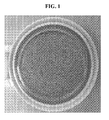
- FIG. 1 illustrates cosmetics including foundation impregnated in a water insoluble sponge.
- Water-in-oil type foundations were prepared with the components and amounts described in the following table 1.
- water-in-oil type foundation was prepared, including an oil soluble organic UV blocking agent (ethylhexylmethoxycinnamate (EHMC), isoamyl-P-methoxycinnamate (IAMC), ethylhexylsalicylate (EHS)) and an inorganic UV blocking agent (titanium dioxide), while in example 1 and example 2, water-in-oil type foundations were prepared, including a water soluble organic UV blocking agent (phenylbenzimidazolsulfonic acid (PBSA)) and an inorganic UV blocking agent (titanium dioxide).
- EHMC oil soluble organic UV blocking agent
- IAMC isoamyl-P-methoxycinnamate
- EHS ethylhexylsalicylate
- titanium dioxide inorganic UV blocking agent
- water-in-oil type foundations were prepared, including a water soluble organic UV blocking agent (phenylbenzimidazolsulfonic acid
- the water-in-oil type foundations were prepared as below: Oil phase components and a thickening agent were put in an oil phase tank and heated to 80°C to turn into a uniform state, and pigments were added and dispersed. Water phase components were put in a water phase tank and heated to 80°C to completely dissolve the raw materials, and then were added to the oil phase tank containing the dispersed pigments, followed by emulsification using a homo mixer to prepare a low viscosity UV blocking emulsion.
- a 40 ml stabilization container was filled with the contents and kept at a 25 °C chamber for one day or longer, and after operation of Brookfield LVII viscometer at 30 rpm for 1 minute using spindle 4, when viscosity was measured at 25 °C, the viscosity was found to be 4,000 cps.
- each sponge in which the foundations of comparative examples 1-2 and examples 1-2 were impregnated was squeezed by hands to collect the foundation.
- each of the foundation before impregnation into the sponge and the foundation collected from the sponge was dissolved in solvent and tested using an ultraviolet absorption spectrometer according to liquid chromatography to determine a peak area AT of ethylhexylmethoxycinnamate (EHMC), phenylbenzimidazolsulfonic acid (PBSA), ethylhexylsalicylate (EHS), and isoamyl P-methoxycinnamate (IAMC) and a peak area As of a reference standard, and a changed value before and after impregnation was analyzed.
- EHMC ethylhexylmethoxycinnamate
- PBSA phenylbenzimidazolsulfonic acid
- EHS ethylhexylsalicylate
- IAMC isoamyl P-methoxycinnamate
- each of the foundations of comparative examples 1-2 and examples 1-2 was uniformly applied to artificial skin (vitroskin) using the impregnated sponges, and after being left behind for 10 minutes, SPF and PFA values were measured using a sun protection factor measuring instrument (SPF-290S).
- the cosmetic composition having an ultraviolet (UV) blocking function prevents the adsorption of the UV blocking agent to the water insoluble sponge even when impregnated in the water insoluble sponge, there are provided cosmetics that fully exert an expected UV blocking effect (sun protection factor/grade) from the UV blocking agent included in the cosmetic composition.
- UV ultraviolet
Landscapes
- Health & Medical Sciences (AREA)
- Life Sciences & Earth Sciences (AREA)
- Animal Behavior & Ethology (AREA)
- Veterinary Medicine (AREA)
- Public Health (AREA)
- General Health & Medical Sciences (AREA)
- Birds (AREA)
- Epidemiology (AREA)
- Chemical & Material Sciences (AREA)
- Emergency Medicine (AREA)
- Dermatology (AREA)
- Dispersion Chemistry (AREA)
- Engineering & Computer Science (AREA)
- Biomedical Technology (AREA)
- Inorganic Chemistry (AREA)
- Oil, Petroleum & Natural Gas (AREA)
- Cosmetics (AREA)
Abstract
Description
- The present disclosure relates to a cosmetic composition having an excellent ultraviolet (UV) blocking function that is impregnated in a water insoluble sponge. More particularly, to address and solve a reduction problem of a UV blocking effect based on the total content of a UV blocking agent included in a cosmetic composition impregnated in a water insoluble sponge, the present disclosure relates to a cosmetic composition having an excellent UV blocking effect and cosmetics including the cosmetic composition impregnated in a water insoluble sponge.
- The present application claims priority to Korean Patent Application No.
10-2015-0004142 10-2015-0013647 10-2015-0109816 - Recently, as the ozone layer is deteriorating due to the environmental pollution, exposure to ultraviolet (UV) rays is getting intense, and UV rays act as a main cause of erythema, edema, freckles, and skin cancers on the skin. More recently, development of products that protect the skin from UV rays is being needed. Particularly, with the growing affluence in life, the desire to protect the skin from daily UV radiation is increasing, and with the increasing people doing leisure activities such as ski, golf, and open water swimming, the demand for skin protection from UV rays is increasing, and to meet the demand, many studies are being conducted.
- Generally, UV rays are classified into three regions according to the wavelength; 200-290 nm wavelength as UV C (UVC), 290-320 nm wavelength as UV B (UVB), and 320-400 nm wavelength as UV A (UVA). Among them, UVC is filtered before reaching the earth's surface through the ozone layer, and UVB penetrates through the epidermis of the skin, causing erythema, freckles, and edema. It is known that UVA penetrates through the dermis of the skin, causing skin cancers, wrinkles, and acceleration of the production of melanin, inducing skin aging and skin irritation.
- The long wavelength UV (UVA) plays its role in modification of protein in the dermis layer, hemotelangiosis and destruction of nucleic acid (DNA), causing accelerated skin aging, so the skin should be protected from UVA. On the other hand, most of the middle wavelength UV (UV-B) is absorbed in the epidermis part of the skin and affects the epidermis quickly, causing sunburns, so UV-B is found harmful. The skin is exposed to the long wavelength UV all the year round, but because there is no subjective symptom, the skin gradually ages in unconscious manner.
- Since the danger of the exposure to sunlight was reported, people's interest in UV protection products has increased, and to keep up with the trend, products having a variety of sun protection factors (SPF) and protection grades of UVA (PA) are being released.
- On the other hand, in relation to the formulation of cosmetics, liquid-type cosmetics are highly preferred due to good performance of application or feeling upon usage, but have disadvantages - inconvenience caused by spreading and rubbing it in hands to use and portability restriction. To solve the problem, cosmetics convenient to use and carry with have been developed in which a liquid-type cosmetic composition in low viscosity emulsion formulation is impregnated in a water insoluble sponge produced by foaming styrene-butadiene rubber (SBR), butadiene rubber (BR), acrylonitrile-butadiene rubber (NBR), ABS, polyethylene (PE), polyvinyl alcohol (PVA), ethylene vinyl acetate (EVA), polyurethane (PU), and among them, cosmetics impregnated in a polyurethane sponge are being widely used.
- In these circumstances, the inventors attempted to impart a UV blocking function to a cosmetic composition impregnated in a water insoluble sponge, but the inventors found that when a cosmetic composition having a UV blocking function is impregnated into a water insoluble sponge, there is a problem with an actual sun protection factor/grade that is lower than expected from the total amount of the UV blocking agent included in the cosmetic composition.
- Further, the inventors identified the cause of the problem - the oil soluble organic UV blocking agent in direct contact with the water insoluble sponge is adsorbed to the water insoluble sponge, and as a result, the UV blocking agent is not delivered at the same concentration as before impregnation.
- The present disclosure is directed to providing a cosmetic composition in which by selecting the composition of the ultraviolet (UV) blocking agent and/or the phase of the cosmetic composition to prevent the adsorption of an oil soluble organic UV blocking agent to a water insoluble sponge, the imparted UV blocking function is thereby fully exerted, an excellent UV blocking function (SPF 30 or above, PA++ or above) is exerted and a whitening problem is eliminated, and cosmetics including the cosmetic composition impregnated in the water insoluble sponge and a method for preparing the cosmetic composition and/or cosmetics.
- More specifically, the present disclosure is directed to providing a cosmetic composition including a UV blocking agent, wherein the cosmetic composition is impregnated in a water insoluble sponge, and an oil soluble organic UV blocking agent is substantially absent in the external phase of the cosmetic composition or an oil soluble organic UV blocking agent is present in the external phase but not impregnated in the water insoluble sponge.
- Also, there is provided the cosmetic composition having SPF 30 or above and PA++ or above.
- Also, there is provided the cosmetic composition wherein the UV blocking agent is an inorganic UV blocking agent.
- Also, there is provided the cosmetic composition wherein the UV blocking agent is at least one of the following:
- (a) a water soluble or water dispersible organic UV blocking agent;
- (b) an organic UV blocking agent with inversion from water insoluble to water soluble or water dispersible; and
- (b) an encapsulated organic UV blocking agent.
- Also, there is provided the cosmetic composition of which the formulation is oil-in-water type or multiple emulsions, and the oil soluble organic UV blocking agent is present outside the external phase of the cosmetic composition.
- Also, there is provided the cosmetic composition wherein the water insoluble sponge is formed of a hydrophobic monomer polymer including styrene-butadiene rubber (SBR), butadiene rubber (BR), acrylonitrile rubber (NR) or acrylonitrile-butadiene rubber (NBR).
- Also, there is provided the cosmetic composition which is foundation.
- Further, the present disclosure is directed to providing cosmetics including a water insoluble sponge and a cosmetic composition impregnated in the water insoluble sponge, wherein the cosmetic composition includes a UV blocking agent, and an oil soluble organic UV blocking agent is substantially absent in the external phase or an oil soluble organic UV blocking agent is present in the external phase but not adsorbed to the water insoluble sponge.
- Also, there are provided the cosmetics including the water insoluble sponge and the cosmetic composition impregnated in the water insoluble sponge, wherein the cosmetic composition includes at least one of the following organic UV blocking agents:
- (a) a water soluble or water dispersible organic UV blocking agent;
- (b) an organic UV blocking agent with inversion from water insoluble to water soluble or water dispersible; and
- (b) an encapsulated organic UV blocking agent, and
- Also, there are provided the cosmetics wherein the cosmetic composition further includes an inorganic UV blocking agent.
- Also, there are provided the cosmetics wherein the formulation of the cosmetic composition is a single water phase, an oil-in-water type emulsion, or multiple emulsions in which the external phase is water.
- Also, there are provided the cosmetics wherein the water insoluble sponge is formed of a hydrophobic monomer polymer including styrene-butadiene rubber (SBR), butadiene rubber (BR), acrylonitrile rubber (NR) or acrylonitrile-butadiene rubber (NBR).
- Also, there are provided the cosmetics wherein the cosmetic composition is foundation.
- To achieve the above object, the present disclosure provides a cosmetic composition having a composition and/or phase for preventing the adsorption of an oil soluble organic ultraviolet (UV) blocking agent to a water insoluble sponge.
- More specifically, the present disclosure provides a cosmetic composition including a UV blocking agent, in which the cosmetic composition is impregnated in a water insoluble sponge, an oil soluble organic UV blocking agent is substantially absent in the external phase of the cosmetic composition, or an oil soluble organic UV blocking agent is present in the external phase but not impregnated in the water insoluble sponge, thereby producing an excellent UV blocking effect, preferably with SPF 30 or above and PA++ or above. In addition, the present disclosure provides a method for preparing the cosmetic composition.
- Also, the present disclosure provides cosmetics including a water insoluble sponge and a cosmetic composition impregnated in the water insoluble sponge, in which an oil soluble organic UV blocking agent is substantially absent in the external phase of the cosmetic composition, or an oil soluble organic UV blocking agent is present in the external phase but not impregnated in the water insoluble sponge, thereby desirably producing an excellent UV blocking effect, preferably with SPF 30 or above and PA++ or above. In addition, the present disclosure provides a method for producing the cosmetics.
- The cosmetic composition according to the present disclosure includes a UV blocking agent.
- The term "UV blocking agent" as used herein includes any component capable of blocking UV rays that reach on the skin by scattering, reflection, or absorption, for example, an inorganic UV blocking agent, an organic UV blocking agent, and mixtures thereof.
- Thus, the cosmetic composition according to the present disclosure may include an organic UV blocking agent, an inorganic UV blocking agent, or mixtures thereof.
- The organic UV blocking agent has advantages - it has a UV absorption effect and is less sensitive to whitening, and the organic UV blocking agent can be divided into oil soluble, water soluble, oil dispersible, and water dispersible organic UV blocking agents. For example, the oil soluble or oil dispersible organic UV blocking agent includes, but is not limited to, 4-methylbenzylidene camphor, disodiumphenyldibenzimidazole tetrasulfonate, diethylhexyl butamido triazone, methylene bis-benzotriazolyl tetramethylbutylphenol, ethylhexyl dimethyl paba, terephthalylidene dicamphor sulfonic acid and its salts, glyceryl paba, drometrizole, drometrizole trisiloxane, digalloyl trioleate, 3-(4-methylbenzylidene)-camphor, methylantranylate, bisethylhexyloxyphenolmethoxyphenyltriazine, diethylaminohydroxybenzoylhexylbenzoate, benzophenone-3, benzophenone-4, benzophenone-8, butylmethoxydibenzoylmethane, cinoxate, ethylhexyltriazone, octylmethoxycinnamate, octocrylene, octyl dimethyl paba, octyl salicylate, oxybenzone, cinoxate, octyltriazone, ethylhexylmethoxycinnamate, ethylhexylsalicylate, para aminobenzoic acid, homosalate, isoamyl-P-methoxycinnamate, bisethylhexyloxyphenolmethoxyphenyltriazine, and polysilicone-15, and the water soluble or water dispersible organic UV blocking agent includes, but is not limited to, 2-phenylbenzimidazole-5-sulfonic acid.
- Also, the inorganic UV blocking agent has UV scattering and reflection effects but is sensitive to whitening. For example, the inorganic UV blocking agent includes, but is not limited to, titanium dioxide, zinc oxide, zirconium oxide, and calcium cerium oxide.
- The inventors explained, in the cosmetic composition according to the present disclosure, the reason that the imparted UV blocking function is not fully exerted is because the oil soluble organic UV blocking agent is adsorbed to the water insoluble sponge, and they attempted to solve the problem through the control of the amount or morphology of the oil soluble organic UV blocking agent in the external phase of the cosmetic composition.
- Accordingly, UV blocking agents other than the oil soluble organic UV blocking agent included in the cosmetic composition of the present disclosure may be optimally selected by those skilled in the art in selecting the type/dispersibility (e.g. including water soluble or water dispersible organic UV blocking agents, organic UV blocking agents with inversion from water insoluble to water soluble or water dispersible, or inorganic UV blocking agents), the amount or position in the cosmetic composition irrespective of adsorption to the water insoluble sponge.
- Also, in the cosmetic composition according to the present disclosure, any UV blocking agent may be present outside the external phase, for example, any UV blocking agent generally used in the art irrespective of the type/dispersibility/water·oil soluble of the UV blocking agent (e.g. including oil soluble or oil dispersible organic UV blocking agents, water soluble or water dispersible organic UV blocking agents, organic UV blocking agents with inversion from water insoluble to water soluble or water dispersible or inorganic UV blocking agent, that is, even including oil soluble or oil dispersible organic UV blocking agents) and the amount of the UV blocking agent. For example, any UV blocking agent including oil soluble organic UV blocking agents in the 'oil phase (O1)' of oil-in-water-in-oil (O1/W/O2) type or water-in-oil-in-water (W/O1/W) type is available.
- The term "impregnation" as used herein refers to manipulation for permeation, and can be interchangeably used with the terms penetration, adhesion, and absorption commonly used in the art, and more specifically, refers to a state in which the water insoluble sponge contains the cosmetic composition. However, the degree of release, desorption, separation or discharge of the impregnated material (the cosmetic composition) (from the water insoluble sponge) is limited by the physical pressure (e.g., 3 bar or less) applied to apply the cosmetic composition to the skin. The physical pressure generally applied to apply the cosmetic composition to the skin may be applied using a hand or tool (e.g. a puff).
- The term "adsorption" as used herein refers to adhesion, combination, binding, or concentration of a material, and more specifically, refers to adhesion, combination, binding, or concentration of the oil soluble organic UV blocking agent to the water insoluble sponge, and accordingly, refers to that the adsorbed state (of the oil soluble organic UV blocking agent to the water insoluble sponge) is maintained by the physical pressure (e.g., 3 bar or less) generally applied to apply the cosmetic composition to the skin and the material adsorbed by the physical pressure (the oil soluble organic UV blocking agent) is not released, desorbed, separated or discharged (from the water insoluble sponge). The physical pressure generally applied to apply the cosmetic composition to the skin may be applied using a hand or tool (e.g. a puff).
- In one embodiment, the oil soluble organic UV blocking agent may be substantially absent in the external phase of the cosmetic composition according to the present disclosure.
- The term "external phase" as used herein refers to a part having the largest direct contact surface with the water insoluble sponge when the cosmetic composition is impregnated in the water insoluble sponge. For example, when an emulsion consists of a single phase (i.e., a single water phase or a single oil phase), the corresponding single phase serves as the external phase, and in a water-in-oil type emulsion, the external phase is oil, and in an oil-in-water type emulsion, the external phase is water, and when multiple emulsions are defined as '(X)/(X)n/Y' (the 'X, Y' may be water phase or oil phase, and the water phase is shortened to 'W' and the oil phase is shortened to 'O'. 'n' is larger than or equal to 1), the 'Y' corresponds to the external phase, and for example, the external phase of the oil-in-water-in-oil (O1/W/O2) type is'oil (O2)'.
- The term "substantially absent" as used herein refers to that the amount present in the external phase of the cosmetic composition is less than 10 wt%, less than 9 wt%, less than 8 wt%, less than 7 wt%, less than 6 wt%, less than 5 wt%, less than 4 wt%, less than 3 wt%, less than 2 wt%, less than 1 wt%, less than 0.5 wt%, less than 0.05 wt%, less than 0.0005 wt%, or most preferably less than 0.00001 wt% per the total weight included in the cosmetic composition. For example, the amount of the oil soluble organic UV blocking agent included in the external phase of the cosmetic composition according to the present disclosure may be less than 10 wt%, less than 9 wt%, less than 8 wt%, less than 7 wt%, less than 6 wt%, less than 5 wt%, less than 4 wt%, less than 3 wt%, less than 2 wt%, less than 1 wt%, less than 0.5 wt%, less than 0.05 wt%, less than 0.0005 wt%, or most preferably less than 0.00001 wt% per the total amount of the organic UV blocking agent included in the cosmetic composition. For example, in the cosmetic composition according to the present disclosure, the term may cover the case where only an inorganic UV blocking agent is present as the UV blocking agent in the external phase and an organic UV blocking agent is absent. For example, in the cosmetic composition according to the present disclosure, the term may cover the case where only a water soluble, water dispersible organic UV blocking agent is present as the UV blocking agent in the external phase and an oil soluble organic UV blocking agent is absent.
- In another embodiment, the oil soluble organic UV blocking agent non-adsorbed to the water insoluble sponge may be present in the external phase of the cosmetic composition according to the present disclosure.
- The term "non-adsorbed" as used herein refers to that a value calculated by 'the weight of the (oil soluble organic) UV blocking agent adsorbed to the water insoluble sponge'/'the weight of the (oil soluble organic) UV blocking agent included in the external phase of the cosmetic composition' x 100 (%) is less than 10 wt%, less than 9 wt%, less than 8 wt%, less than 7 wt%, less than 6 wt%, less than 5 wt%, less than 4 wt%, less than 3 wt%, less than 2 wt%, less than 1 wt%, less than 0.5 wt%, less than 0.05 wt%, less than 0.0005 wt%, or most preferably less than 0.00001 wt%, and the (oil soluble organic) UV blocking agent refers to at least one (oil soluble organic) UV blocking agent included in the cosmetic composition.
- The "oil soluble organic UV blocking agent present in the external phase and non-adsorbed to the water insoluble sponge" according to the present disclosure may be embodied by the phase control of the cosmetic composition and/or selection of the composition of the oil soluble organic UV blocking agent.
- More specifically, in selecting the phase of the cosmetic composition, when the external phase of the cosmetic composition consists of water phase, the effect of the present disclosure can be achieved. The formulation of the cosmetic composition in which the external phase is water may include, for example, single water phase (water phase alone), oil-in-water type, or multiple emulsions ('(X)/(X)n/Y') in which Y is water phase (i.e., multiple emulsions in which the external phase is water) as described above. When the external phase of the cosmetic composition is water, the oil soluble organic UV blocking agent present in the water external phase is preferably water soluble or water dispersible ones or those with inversion to water soluble or water dispersible, and if it is oil soluble or oil dispersible, those modified to be dispersible in water by a method such as encapsulation are desirable.
- Also, in selecting the composition of the oil soluble organic UV blocking agent included in the cosmetic composition, oil soluble organic UV blocking agents modified to be non-adsorbed to the water insoluble sponge are available.
- The term "modification" as used herein includes all chemical or physical modifications of the organic UV blocking agent, but may include, for example, methods which prevent a direct contact between the oil soluble organic UV blocking agent present in the external phase and the water insoluble sponge (e.g. encapsulation of the oil soluble organic UV blocking agent), or methods which bring the oil soluble organic UV blocking agent and the water insoluble sponge into contact with each other while not causing an adsorption reaction (e.g. modification of compound structure and modification to water soluble·water dispersible).
- According to an embodiment of the present disclosure, the cosmetic composition includes:
- at least one of the following organic UV blocking agents:
- (a) a water soluble or water dispersible organic UV blocking agent;
- (b) an organic UV blocking agent with inversion from water insoluble to water soluble or water dispersible; and
- (c) an encapsulated organic UV blocking agent, and
- the oil soluble organic UV blocking agent is present less than 50%, less than 40%, less than 30%, less than 20%, less than 10%, less than 9 wt%, less than 8 wt%, less than 7 wt%, less than 6 wt%, less than 5 wt%, less than 4 wt%, less than 3 wt%, less than 2 wt%, less than 1 wt%, less than 0.5 wt%, less than 0.05 wt%, less than 0.0005 wt%, or most preferably less than 0.00001 wt% per the total weight of the organic UV blocking agent included in the cosmetic composition.
- Also, optionally, the cosmetic composition may further include an inorganic UV blocking agent.
- The cosmetic composition according to the present disclosure has an excellent UV blocking effect, preferably with a sun protection factor (SPF) of 30 or above and/or a protection factor of UVA (PFA) of 4 or above, the protection grade of UVA (PA) ++ or above. Also, the cosmetic composition is scarcely sensitive to whitening.
- The "sun protection factor (SPF)" stands for an indicator of how effectively products that offer protection against UVB block UVB rays, and is a value obtained by dividing a minimum erythema dose obtained by application of a UV protection product by a minimum erythema dose obtained by non-application of a UV protection product. The "minimum erythema dose (MED)" refers to a minimum dose of UV radiation required to induce erythema over the whole radiation area within the range of 16-24 hours after UVB radiation onto the human skin. The sun protection factor measurement method including test subject selection, test sites, minimum erythema dose measurement at unprotected region, minimum erythema dose measurement at protected region, light source selection, standard sample, an applied amount, definition of applied area and radiation region, light amount increment, sun protection factor calculation, and sun protection factor labeling method, conforms to Appendix 3, Chapter 2, Sun protection factor (SPF) measurement method in ┌Regulation on examination of functional cosmetics┘ of the notification of Korea's Ministry of Food and Drug Safety No. 2013-28, effective from April 5, 2013.
- The "protection factor of UVA (PFA)" stands for an indicator of how effectively products that offer protection against UVA block UVA rays, and is a value obtained by dividing a minimal persistent pigment darkening dose obtained by applying a UV protection product by a minimal persistent pigment darkening dose obtained by non-application of a UV protection product. The "minimal persistent pigment darkening dose (MPPD)" refers to a minimum dose of UV radiation required to perceive slight darkening over the whole radiation area within the range of 2∼4 hours after UVA radiation onto the human skin. Also, the "protection grade of UVA (PF)" stands for the degree of UVA protection. PFA 2 or above is marked with PA, and PFA between 2 and 4 (not including 4) is also referred to as PA+, PFA between 4 and 8 (not including 8) is also referred to as PA++, and PFA 8 or above is also referred to as PA+++ (However, the premise is that the figures to the right of the decimal point is discarded from the PFA value to make it an integer). The protection factor of UVA measurement method, including test subject selection, test subject selection, test sites, minimal persistent pigment darkening dose measurement before testing, minimal persistent pigment darkening dose measurement at protected and unprotected regions, light source selection, standard sample, an applied amount, definition of applied area and radiation region, light amount increment, and protection factor of UVA calculation, conforms to Appendix 3, Chapter 4, Protection factor of UVA measurement method of the notification of ┌Regulation on examination of functional cosmetics┘ No. 2013-28, effective from April 5, 2013.
- The cosmetic composition according to the present disclosure has an excellent UV blocking effect and is scarcely sensitive to whitening, and for example, the inorganic UV blocking agent included in the cosmetic composition according to the present disclosure is present in 15 wt% or less, 14 wt% or less, 13 wt% or less, 12 wt% or less, 11 wt% or less, 10 wt% or less, 9 wt% or less, 8wt% or less, 7 wt% or less, 6 wt% or less, 5 wt% or less, 4 wt% or less, 3 wt% or less, 2 wt% or less, or 1 wt% or less per the total weight of the cosmetic composition. If the inorganic UV blocking agent is present more than 15 wt% per the total weight of the cosmetic composition, a whitening phenomenon will be problematic.
- The cosmetic composition according to the present disclosure may further include mixtures of pigments, antioxidants, activators, moisturizers, pharmaceuticals, metal ion sequestrants, polyalcohols, preservatives, and flavoring that can be easily made by those skilled in the art without departing from the inhibitory effect for adsorption to the water insoluble sponge, if necessary.
- The preparation of the cosmetic composition according to the present disclosure may conform to a general method known in the art in consideration of the type, amount and formulation of the components.
- Also, the impregnation of the cosmetic composition according to the present disclosure into the water insoluble sponge may conform to a general method known in the art in consideration of the type and amount of the components included in the cosmetic composition, the formulation of the cosmetic composition, or the type of the water insoluble sponge.
- The cosmetic composition (or cosmetics) according to the present disclosure includes, but is not limited to, for example, makeup primer, makeup base, foundation, skin cover, lipstick, lip gloss, face powder, lip liner pencil, eye brow pencil, eye shadow, cheek color, compact powder, twin cake, pact, powder pact, eye brow, eye shadow, concealer, blusher, powder foundation or airless.
- The water insoluble sponge according to the present disclosure includes, without limitation, those generally used in the art for cosmetic composition impregnation, for example, those obtained by foaming a polymer such as styrene-butadiene rubber (SBR), butadiene rubber (BR), acrylonitrile rubber (NR), acrylonitrile-butadiene rubber (NBR), acrylonitrile-butadiene styrene (ABS), polyethylene (PE), polyvinyl alcohol (PVA), ethylene vinyl acetate (EVA), and polyurethane (PU).
- It may be the water insoluble sponge obtained by foaming a hydrophobic monomer polymer that has a noticeably superior inhibitory effect for adsorption of the cosmetic composition to the water insoluble sponge according to the present disclosure, and the hydrophobic monomer polymer includes, for example, styrene-butadiene rubber (SBR), butadiene rubber (BR), acrylonitrile-butadiene rubber (NBR), and polyurethane (PU).
- A process of impregnating the cosmetic composition according to the present disclosure into the water insoluble sponge may conform to a general method known in the art.
- The present disclosure provides cosmetics including a water insoluble sponge and a cosmetic composition impregnated in the water insoluble sponge.
- The description of the water insoluble sponge and the cosmetic composition impregnated therein is replaced with the above description to avoid an overlap.
- Particularly, according to an embodiment, the cosmetic composition impregnated in the water insoluble sponge includes:
- at least one of the following organic UV blocking agents:
- (a) a water soluble or water dispersible organic UV blocking agent;
- (b) an organic UV blocking agent with inversion from water insoluble to water soluble or water dispersible; and
- (c) an encapsulated organic UV blocking agent, and
- the oil soluble organic UV blocking agent is present less than 50%, less than 40%, less than 30%, less than 20%, less than 10%, less than 9 wt%, less than 8 wt%, less than 7 wt%, less than 6 wt%, less than 5 wt%, less than 4 wt%, less than 3 wt%, less than 2 wt%, less than 1 wt%, less than 0.5 wt%, less than 0.05 wt%, less than 0.0005 wt%, or most preferably less than 0.00001 wt% per the total weight of the organic UV blocking agent included in the cosmetic composition.
- Also, optionally, the cosmetic composition may further include an inorganic UV blocking agent.
- In addition to the water insoluble sponge and the cosmetic composition impregnated therein, the cosmetics according to the present disclosure may include an additional element (e.g. a puff) that can be suitably added by those skilled in the art.
- Because the cosmetic composition having an ultraviolet (UV) blocking function according to the present disclosure prevents the adsorption of the UV blocking agent to the water insoluble sponge even when impregnated in the water insoluble sponge, there are provided cosmetics that fully exert an expected UV blocking effect (sun protection factor/grade) from the UV blocking agent included in the cosmetic composition.
-
FIG. 1 illustrates cosmetics including foundation impregnated in a water insoluble sponge. - Hereinafter, the present disclosure will be described in detail with reference to examples and embodiments to aid in understanding the present disclosure. However, the examples and embodiments according to the present disclosure may be modified in many different forms, and the scope of the present disclosure shall not be construed as being limited to the examples and embodiments mentioned below. The examples and embodiments of the present disclosure are provided to help one having ordinary skill in the art understand the present disclosure more fully.
- Water-in-oil type foundations were prepared with the components and amounts described in the following table 1.
- In comparative example 1, water-in-oil type foundation was prepared, including an oil soluble organic UV blocking agent (ethylhexylmethoxycinnamate (EHMC), isoamyl-P-methoxycinnamate (IAMC), ethylhexylsalicylate (EHS)) and an inorganic UV blocking agent (titanium dioxide), while in example 1 and example 2, water-in-oil type foundations were prepared, including a water soluble organic UV blocking agent (phenylbenzimidazolsulfonic acid (PBSA)) and an inorganic UV blocking agent (titanium dioxide).
- The water-in-oil type foundations were prepared as below:
Oil phase components and a thickening agent were put in an oil phase tank and heated to 80°C to turn into a uniform state, and pigments were added and dispersed. Water phase components were put in a water phase tank and heated to 80°C to completely dissolve the raw materials, and then were added to the oil phase tank containing the dispersed pigments, followed by emulsification using a homo mixer to prepare a low viscosity UV blocking emulsion. A 40 ml stabilization container was filled with the contents and kept at a 25 °C chamber for one day or longer, and after operation of Brookfield LVII viscometer at 30 rpm for 1 minute using spindle 4, when viscosity was measured at 25 °C, the viscosity was found to be 4,000 cps.[Table 1] Classification Name of raw material Amount (g) Composition example 1 Composition example 2 Example 1 Example 2 Oil phase component Cyclopentasiloxane 17.0 20.0 25.0 25.0 Phenyl trimethicone 10.0 10.0 10.0 10.0 Caprylic/capric triglyceride 2.0 2.0 2.0 2.0 Dimethicone 2.0 2.0 2.0 2.0 Ethylhexylmethoxycinnamate 7.5 7.5 0.0 0.0 PEG-10 dimethicone 3.0 3.0 3.0 3.0 Isoamyl-P-methoxycinnamate 0.5 0.5 0.0 0.0 Ethylhexylsalicylate 3.0 3.0 0.0 0.0 Sorbitan sesquioleate 1.0 1.0 1.0 1.0 Thickening agent Disteardimonium hectorite Optimum amount Optimum amount Optimum amount Optimum amount Pigment Titanium dioxide (for UV blocking) 8.0 4.0 4.0 8.0 Titanium dioxide (pigment grade) 7.0 7.0 11.0 7.0 Mica 2.0 2.0 2.0 2.0 Yellow iron oxide 0.9 0.9 0.9 0.9 Red iron oxide 0.2 0.2 0.2 0.2 Black iron oxide 0.1 0.1 0.1 0.1 Water phase Water to 100 to 100 to 100 to 100 Dipropylene glycol 5.0 5.0 5.0 5.0 Salt 1.0 1.0 1.0 1.0 Tromethamine 0.0 0.0 2.5 2.5 Phenylbenzimidazole sulfonic acid 0.0 0.0 4.0 4.0 - 15 g of each foundation of comparative examples 1-2 and examples 1-2 was impregnated in SBR, NBR, and PU, and kept at a 25° chamber for one day or longer. After removal of foundation not impregnated in the sponge surface, the following process was performed.
- First, each sponge in which the foundations of comparative examples 1-2 and examples 1-2 were impregnated was squeezed by hands to collect the foundation.
- According to the functional cosmetics standard and testing method (KFCC) of the notification of Ministry of Food and Drug Safety No. 2013-28, each of the foundation before impregnation into the sponge and the foundation collected from the sponge was dissolved in solvent and tested using an ultraviolet absorption spectrometer according to liquid chromatography to determine a peak area AT of ethylhexylmethoxycinnamate (EHMC), phenylbenzimidazolsulfonic acid (PBSA), ethylhexylsalicylate (EHS), and isoamyl P-methoxycinnamate (IAMC) and a peak area As of a reference standard, and a changed value before and after impregnation was analyzed.


- The results are as shown in Table 2 (comparative example1) and Table 3 (example 1).
[Table 2] Sponge EHMC IAMC EHS PBSA Amount applied (g) Impregnation (%) Amount applied (g) Impregnation (%) Amount applied (g) Impregnation (%) Amount applied (g) Impregnation (%) before after before after before after before after SBR 7.5 100.7 60.5 0.5 102.6 78.3 3.0 105.7 71.5 - - - NBR 70.4 82.1 77.2 - PU 95.1 93.3 94.6 - [Table 3] Sponge EHMC IAMC EHS PBSA Amount applied (g) Impregnation (%) Amount applied (g) Impregnation (%) Amount applied (g) Impregnation (%) Amount applied (g) Impregnation (%) before after before after before after before after SBR - - - - - - - - - 4 101.3 98.8 NBR - - - 102.5 PU - - - 100.6 - Also, each of the foundations of comparative examples 1-2 and examples 1-2 was uniformly applied to artificial skin (vitroskin) using the impregnated sponges, and after being left behind for 10 minutes, SPF and PFA values were measured using a sun protection factor measuring instrument (SPF-290S).
- The results are as shown in Table 4 (in-vitro SPF and in-vitro PFA values of comparative examples 1-2 and examples 1-2).
[Table 4] Comparative example 1 Comparative example 2 Example 1 Example 2 SPF PFA SPF PFA SPF PFA SPF PFA Before impregnation 53.0 9.2 34.4 4.3 33.4 4.6 57.8 9.5 SBR 37.3 6.4 18.6 3.2 32.9 4.3 56.4 9.1 NBR 42.8 7.2 21.5 3.3 34.1 4.6 56.7 9.4 PU 50.3 8.6 28.3 3.7 33.2 4.5 57.3 9.2 - As a result of the adsorption test of the UV blocking agent to the water insoluble sponge, it could be seen that when the oil soluble organic UV blocking agent such as ethylhexylmethoxycinnamate, isoamyl-P-methoxycinnamate and ethylhexylsalicylate is present in oil phase (comparative examples 1-2), the collected amount greatly reduced due to the adsorption to the water insoluble sponge, resulting in a significant reduction in sun protection factor, and it could be seen that the main component amount is less than 90% that is below the standard under the UV blocking functional cosmetics Act, causing a legal problem to occur. In contrast, it was found that when the water soluble or water dispersible UV blocking agent such as phenylbenzimidazolsulfonic acid is used (examples 1-2), it was not adsorbed to the water insoluble sponge and was detected well. In addition, it could be seen that an excellent UV blocking effect with SPF of 30 or above and PFA of 4 or above was produced.
- In the case of the water insoluble sponge, adsorption of the UV blocking agent greatly took place in SBR or NBR, and in the case of PU, adsorption of the UV blocking agent took place but the degree of adsorption was relatively low as compared to SBR or NBR, and when impregnation into the SBR or NBR sponge, a higher UV blocking effect could be obtained.
- Because the cosmetic composition having an ultraviolet (UV) blocking function according to the present disclosure prevents the adsorption of the UV blocking agent to the water insoluble sponge even when impregnated in the water insoluble sponge, there are provided cosmetics that fully exert an expected UV blocking effect (sun protection factor/grade) from the UV blocking agent included in the cosmetic composition.
Claims (9)
- A cosmetic composition comprising:an ultraviolet (UV) blocking agent,wherein the cosmetic composition is impregnated in a water insoluble sponge, and an oil soluble organic UV blocking agent is substantially absent in the external phase of the cosmetic composition or an oil soluble organic UV blocking agent is present in the external phase but not impregnated in the water insoluble sponge.
- The cosmetic composition according to claim 1, wherein the cosmetic composition has a sun protection factor (SPF) of 30 or above and protection grade of UVA (PA) ++ or above.
- The cosmetic composition according to claim 1, wherein the UV blocking agent is an inorganic UV blocking agent.
- The cosmetic composition according to claim 1, wherein the UV blocking agent is at least one of the following:(a) a water soluble or water dispersible organic UV blocking agent;(b) an organic UV blocking agent with inversion from water insoluble to water soluble or water dispersible; and(c) an encapsulated organic UV blocking agent.
- The cosmetic composition according to claim 1, wherein the formulation of the cosmetic composition is a single water phase, an oil-in-water type emulsion or multiple emulsions in which the external phase is water.
- The cosmetic composition according to claim 1, wherein the formulation of the cosmetic composition is oil-in-water type or multiple emulsions, and the oil soluble organic UV blocking agent is present outside the external phase of the cosmetic composition.
- The cosmetic composition according to claim 1, wherein the water insoluble sponge is formed of a hydrophobic monomer polymer including styrene-butadiene rubber (SBR), butadiene rubber (BR), acrylonitrile rubber (NR) or acrylonitrile-butadiene rubber (NBR).
- The cosmetic composition according to claim 1, wherein the cosmetic composition is foundation.
- Cosmetics comprising a water insoluble sponge and a cosmetic composition impregnated in the water insoluble sponge,
wherein the cosmetic composition includes a UV blocking agent, and an oil soluble organic UV blocking agent is substantially absent in the external phase or an oil soluble organic UV blocking agent is present in the external phase but not adsorbed to the water insoluble sponge.
Priority Applications (1)
| Application Number | Priority Date | Filing Date | Title |
|---|---|---|---|
| PL15851616T PL3072500T3 (en) | 2015-01-12 | 2015-08-12 | Cosmetic product comprising water-insoluble sponge impregnated with cosmetic composition having ultraviolet ray blocking function |
Applications Claiming Priority (4)
| Application Number | Priority Date | Filing Date | Title |
|---|---|---|---|
| KR1020150004142A KR101542917B1 (en) | 2015-01-12 | 2015-01-12 | Cosmetics of water insoluble sponge containing cosmetic compositions of sunscreen function |
| KR20150013647 | 2015-01-28 | ||
| KR1020150109816A KR20160092899A (en) | 2015-01-28 | 2015-08-04 | Cosmetics of water insoluble sponge containing cosmetic compositions of sunscreen function |
| PCT/KR2015/008461 WO2016114466A1 (en) | 2015-01-12 | 2015-08-12 | Cosmetic product comprising water-insoluble sponge impregnated with cosmetic composition having ultraviolet ray blocking function |
Publications (3)
| Publication Number | Publication Date |
|---|---|
| EP3072500A1 true EP3072500A1 (en) | 2016-09-28 |
| EP3072500A4 EP3072500A4 (en) | 2017-10-18 |
| EP3072500B1 EP3072500B1 (en) | 2019-07-10 |
Family
ID=56737831
Family Applications (1)
| Application Number | Title | Priority Date | Filing Date |
|---|---|---|---|
| EP15851616.1A Active EP3072500B1 (en) | 2015-01-12 | 2015-08-12 | Cosmetic product comprising water-insoluble sponge impregnated with cosmetic composition having ultraviolet ray blocking function |
Country Status (6)
| Country | Link |
|---|---|
| US (1) | US20160331648A1 (en) |
| EP (1) | EP3072500B1 (en) |
| JP (1) | JP6742258B2 (en) |
| CN (2) | CN108904301B (en) |
| PL (1) | PL3072500T3 (en) |
| SG (1) | SG11201705650VA (en) |
Cited By (1)
| Publication number | Priority date | Publication date | Assignee | Title |
|---|---|---|---|---|
| US11000463B2 (en) | 2017-03-03 | 2021-05-11 | Shiseido Company, Ltd. | Cosmetic including liquid cosmetic impregnated into impregnated body |
Families Citing this family (3)
| Publication number | Priority date | Publication date | Assignee | Title |
|---|---|---|---|---|
| CN121666224A (en) | 2023-08-10 | 2026-03-13 | 花王株式会社 | Water-in-oil emulsion composition |
| TW202513038A (en) | 2023-08-10 | 2025-04-01 | 日商花王股份有限公司 | Water-in-oil emulsion |
| CN119125390B (en) * | 2024-11-13 | 2025-02-18 | 浙江省质量科学研究院 | Skin migration amount measuring method and application of 20 organophosphorus flame retardants in cosmetic sponge |
Family Cites Families (19)
| Publication number | Priority date | Publication date | Assignee | Title |
|---|---|---|---|---|
| US1549276A (en) * | 1922-12-01 | 1925-08-11 | Ernest W Loesser | Vanity case |
| LU87394A1 (en) * | 1988-11-22 | 1990-06-12 | Oreal | SALTS OF VERSATILE METALS OF SULPHONATED BENZYLIDENE-CAMPHOR DERIVATIVES AND THEIR USE FOR PROTECTING SKIN AGAINST ULTRAVIOLET RADIATION |
| JPH07101847A (en) * | 1993-09-30 | 1995-04-18 | Shiseido Co Ltd | Emulsion composition |
| WO2002085965A1 (en) * | 2001-03-09 | 2002-10-31 | Henkel Kommanditgesellschaft Auf Aktien | Cosmetic sponges |
| JP4898011B2 (en) * | 2001-03-28 | 2012-03-14 | 株式会社コーセー | Oil-in-water emulsified cosmetic |
| US7053034B2 (en) * | 2002-04-10 | 2006-05-30 | Salvona, Llc | Targeted controlled delivery compositions activated by changes in pH or salt concentration |
| FR2872034B1 (en) * | 2004-06-28 | 2006-09-01 | Oreal | FINE OIL-IN-WATER EMULSION CONTAINING A HYDROPHILIC FILTER |
| US20050287088A1 (en) * | 2004-06-28 | 2005-12-29 | L'oreal | Fine oil-in-water emulsion containing a hydrophilic screening agent |
| US20060177395A1 (en) * | 2004-12-20 | 2006-08-10 | L'oreal | Sunscreen compositions comprising hydrophilic UV-screening agents and hydroxyalkylurea compounds |
| US20060210612A1 (en) * | 2005-02-09 | 2006-09-21 | L'oreal | Make-up-removing article |
| FR2912647B1 (en) * | 2007-02-21 | 2009-12-18 | Oreal | IMPREGNATED WIPE OF A THICK EMULSION. |
| KR101129755B1 (en) * | 2009-11-23 | 2012-03-23 | (주)아모레퍼시픽 | Composition for blocking ultraviolet c |
| JP4834775B2 (en) * | 2010-03-04 | 2011-12-14 | 株式会社 資生堂 | Sunscreen composition |
| KR101257628B1 (en) * | 2011-03-24 | 2013-04-29 | (주)아모레퍼시픽 | Cosmetics comprising cosmetic composition impregnated in urethane foam |
| JP2013053073A (en) * | 2011-08-31 | 2013-03-21 | Kose Corp | Cosmetic |
| JP6470042B2 (en) * | 2012-03-05 | 2019-02-13 | 大塚製薬株式会社 | Sunscreen composition |
| TWI658837B (en) * | 2012-04-12 | 2019-05-11 | 愛茉莉太平洋股份有限公司 | Foam having improved feeling of use |
| SG11201406395VA (en) * | 2012-04-13 | 2014-11-27 | Amorepacific Corp | Cosmetic composition carrier comprising foams |
| WO2014003480A1 (en) * | 2012-06-29 | 2014-01-03 | (주)아모레퍼시픽 | Cosmetic composition container comprising application sponge |
-
2015
- 2015-08-12 SG SG11201705650VA patent/SG11201705650VA/en unknown
- 2015-08-12 US US15/033,048 patent/US20160331648A1/en not_active Abandoned
- 2015-08-12 EP EP15851616.1A patent/EP3072500B1/en active Active
- 2015-08-12 PL PL15851616T patent/PL3072500T3/en unknown
- 2015-11-13 CN CN201810827796.6A patent/CN108904301B/en active Active
- 2015-11-13 CN CN201510778244.7A patent/CN105997533B/en active Active
-
2017
- 2017-02-28 JP JP2017036134A patent/JP6742258B2/en active Active
Cited By (2)
| Publication number | Priority date | Publication date | Assignee | Title |
|---|---|---|---|---|
| US11000463B2 (en) | 2017-03-03 | 2021-05-11 | Shiseido Company, Ltd. | Cosmetic including liquid cosmetic impregnated into impregnated body |
| TWI767998B (en) * | 2017-03-03 | 2022-06-21 | 日商資生堂股份有限公司 | cosmetic |
Also Published As
| Publication number | Publication date |
|---|---|
| CN108904301A (en) | 2018-11-30 |
| EP3072500A4 (en) | 2017-10-18 |
| JP2017088631A (en) | 2017-05-25 |
| US20160331648A1 (en) | 2016-11-17 |
| CN105997533A (en) | 2016-10-12 |
| PL3072500T3 (en) | 2019-11-29 |
| CN108904301B (en) | 2021-07-23 |
| JP6742258B2 (en) | 2020-08-19 |
| SG11201705650VA (en) | 2017-08-30 |
| EP3072500B1 (en) | 2019-07-10 |
| CN105997533B (en) | 2018-08-24 |
Similar Documents
| Publication | Publication Date | Title |
|---|---|---|
| KR101551370B1 (en) | Cosmetic composition for uv-protecting prepared being impregnated in a sponge foam | |
| EP2921157B1 (en) | Coated titanium dioxide to reduce whitening effect on skin | |
| CA2718712C (en) | Cosmetic product comprising uv-blocking cosmetic composition impregnated into expanded urethane foam | |
| KR102656734B1 (en) | Sunscreen composition | |
| EP2939710A1 (en) | Method to reduce substantivity of cloth staining caused by sunscreens | |
| EP3318245B1 (en) | Uv-blocking cosmetic composition | |
| KR20120065982A (en) | Uv blocking cosmetic composition prepared by being impregnated in urethane foam | |
| EP3072500B1 (en) | Cosmetic product comprising water-insoluble sponge impregnated with cosmetic composition having ultraviolet ray blocking function | |
| EP3593864A2 (en) | Sunscreen compositions with improved water resistance of uva sunscreen active agents | |
| EP3195849A1 (en) | Uv blocking functional composite powder prepared by doubly coating inorganic powder with inorganic uv blocking agent and organic uv absorber, and uv blocking cosmetic composition using same | |
| KR102092297B1 (en) | Cosmetics of water insoluble sponge containing cosmetic compositions of sunscreen function | |
| CN105188653B (en) | Cosmetic or dermatological compositions comprising merocyanines and lipophilic benzotriazole UV-screening agents and/or bis-resorcinol-based triazine compounds | |
| JP6113871B2 (en) | Cosmetics in which a water-insoluble sponge is impregnated with a cosmetic composition having an ultraviolet blocking function | |
| KR101542917B1 (en) | Cosmetics of water insoluble sponge containing cosmetic compositions of sunscreen function | |
| KR101781571B1 (en) | Cosmetic composition for sun screening | |
| EP3079649B1 (en) | Composite particles comprising a metal-doped inorganic uv filter, and compositions containing them | |
| WO2025137034A1 (en) | Color skin compositions containing bis-ethylhexyloxyphenol methoxyphenyl triazine and coloring agent | |
| HK1261303B (en) | Cosmetics of water insoluble sponge containing cosmetic compositions of sunscreen function | |
| HK1261303A1 (en) | Cosmetics of water insoluble sponge containing cosmetic compositions of sunscreen function | |
| HK1230917B (en) | Cosmetics of water insoluble sponge containing cosmetic compositions of sunscreen function | |
| HK1230917A1 (en) | Cosmetics of water insoluble sponge containing cosmetic compositions of sunscreen function | |
| KR20250082745A (en) | Cosmetic composition for sunscreen containing hispidol, an aurone compound with anti-aging activity | |
| KR20160086728A (en) | Cosmetics of water insoluble sponge containing cosmetic compositions of sunscreen function | |
| IT202300016143A1 (en) | COSMETIC KIT AND METHOD FOR SUN PROTECTION | |
| Couteau et al. | About suncare products |
Legal Events
| Date | Code | Title | Description |
|---|---|---|---|
| PUAI | Public reference made under article 153(3) epc to a published international application that has entered the european phase |
Free format text: ORIGINAL CODE: 0009012 |
|
| 17P | Request for examination filed |
Effective date: 20160422 |
|
| AK | Designated contracting states |
Kind code of ref document: A1 Designated state(s): AL AT BE BG CH CY CZ DE DK EE ES FI FR GB GR HR HU IE IS IT LI LT LU LV MC MK MT NL NO PL PT RO RS SE SI SK SM TR |
|
| AX | Request for extension of the european patent |
Extension state: BA ME |
|
| A4 | Supplementary search report drawn up and despatched |
Effective date: 20170918 |
|
| RIC1 | Information provided on ipc code assigned before grant |
Ipc: A61K 8/02 20060101ALI20170911BHEP Ipc: A61K 8/49 20060101ALI20170911BHEP Ipc: A61K 8/29 20060101ALI20170911BHEP Ipc: A61Q 1/02 20060101ALI20170911BHEP Ipc: A61K 8/37 20060101ALI20170911BHEP Ipc: A61Q 17/04 20060101ALI20170911BHEP Ipc: A61K 8/04 20060101ALI20170911BHEP Ipc: A61K 8/40 20060101AFI20170911BHEP Ipc: A61K 8/81 20060101ALI20170911BHEP Ipc: A61Q 19/00 20060101ALI20170911BHEP |
|
| DAV | Request for validation of the european patent (deleted) | ||
| DAX | Request for extension of the european patent (deleted) | ||
| STAA | Information on the status of an ep patent application or granted ep patent |
Free format text: STATUS: EXAMINATION IS IN PROGRESS |
|
| 17Q | First examination report despatched |
Effective date: 20180711 |
|
| REG | Reference to a national code |
Ref country code: DE Ref legal event code: R079 Ref document number: 602015033723 Country of ref document: DE Free format text: PREVIOUS MAIN CLASS: A61K0008400000 Ipc: A61Q0017040000 |
|
| GRAP | Despatch of communication of intention to grant a patent |
Free format text: ORIGINAL CODE: EPIDOSNIGR1 |
|
| STAA | Information on the status of an ep patent application or granted ep patent |
Free format text: STATUS: GRANT OF PATENT IS INTENDED |
|
| RIC1 | Information provided on ipc code assigned before grant |
Ipc: A61K 8/37 20060101ALI20190307BHEP Ipc: A61K 8/02 20060101ALI20190307BHEP Ipc: A61K 8/49 20060101ALI20190307BHEP Ipc: A61K 8/06 20060101ALI20190307BHEP Ipc: A61Q 1/02 20060101ALI20190307BHEP Ipc: A61Q 17/04 20060101AFI20190307BHEP Ipc: A61K 8/81 20060101ALI20190307BHEP Ipc: A61K 8/29 20060101ALI20190307BHEP |
|
| INTG | Intention to grant announced |
Effective date: 20190409 |
|
| GRAS | Grant fee paid |
Free format text: ORIGINAL CODE: EPIDOSNIGR3 |
|
| GRAA | (expected) grant |
Free format text: ORIGINAL CODE: 0009210 |
|
| STAA | Information on the status of an ep patent application or granted ep patent |
Free format text: STATUS: THE PATENT HAS BEEN GRANTED |
|
| AK | Designated contracting states |
Kind code of ref document: B1 Designated state(s): AL AT BE BG CH CY CZ DE DK EE ES FI FR GB GR HR HU IE IS IT LI LT LU LV MC MK MT NL NO PL PT RO RS SE SI SK SM TR |
|
| REG | Reference to a national code |
Ref country code: GB Ref legal event code: FG4D |
|
| REG | Reference to a national code |
Ref country code: CH Ref legal event code: EP Ref country code: AT Ref legal event code: REF Ref document number: 1152896 Country of ref document: AT Kind code of ref document: T Effective date: 20190715 |
|
| REG | Reference to a national code |
Ref country code: DE Ref legal event code: R096 Ref document number: 602015033723 Country of ref document: DE |
|
| REG | Reference to a national code |
Ref country code: IE Ref legal event code: FG4D |
|
| REG | Reference to a national code |
Ref country code: NL Ref legal event code: FP |
|
| REG | Reference to a national code |
Ref country code: LT Ref legal event code: MG4D |
|
| REG | Reference to a national code |
Ref country code: AT Ref legal event code: MK05 Ref document number: 1152896 Country of ref document: AT Kind code of ref document: T Effective date: 20190710 |
|
| PG25 | Lapsed in a contracting state [announced via postgrant information from national office to epo] |
Ref country code: NO Free format text: LAPSE BECAUSE OF FAILURE TO SUBMIT A TRANSLATION OF THE DESCRIPTION OR TO PAY THE FEE WITHIN THE PRESCRIBED TIME-LIMIT Effective date: 20191010 Ref country code: BG Free format text: LAPSE BECAUSE OF FAILURE TO SUBMIT A TRANSLATION OF THE DESCRIPTION OR TO PAY THE FEE WITHIN THE PRESCRIBED TIME-LIMIT Effective date: 20191010 Ref country code: PT Free format text: LAPSE BECAUSE OF FAILURE TO SUBMIT A TRANSLATION OF THE DESCRIPTION OR TO PAY THE FEE WITHIN THE PRESCRIBED TIME-LIMIT Effective date: 20191111 Ref country code: SE Free format text: LAPSE BECAUSE OF FAILURE TO SUBMIT A TRANSLATION OF THE DESCRIPTION OR TO PAY THE FEE WITHIN THE PRESCRIBED TIME-LIMIT Effective date: 20190710 Ref country code: LT Free format text: LAPSE BECAUSE OF FAILURE TO SUBMIT A TRANSLATION OF THE DESCRIPTION OR TO PAY THE FEE WITHIN THE PRESCRIBED TIME-LIMIT Effective date: 20190710 Ref country code: HR Free format text: LAPSE BECAUSE OF FAILURE TO SUBMIT A TRANSLATION OF THE DESCRIPTION OR TO PAY THE FEE WITHIN THE PRESCRIBED TIME-LIMIT Effective date: 20190710 Ref country code: FI Free format text: LAPSE BECAUSE OF FAILURE TO SUBMIT A TRANSLATION OF THE DESCRIPTION OR TO PAY THE FEE WITHIN THE PRESCRIBED TIME-LIMIT Effective date: 20190710 Ref country code: AT Free format text: LAPSE BECAUSE OF FAILURE TO SUBMIT A TRANSLATION OF THE DESCRIPTION OR TO PAY THE FEE WITHIN THE PRESCRIBED TIME-LIMIT Effective date: 20190710 |
|
| PG25 | Lapsed in a contracting state [announced via postgrant information from national office to epo] |
Ref country code: ES Free format text: LAPSE BECAUSE OF FAILURE TO SUBMIT A TRANSLATION OF THE DESCRIPTION OR TO PAY THE FEE WITHIN THE PRESCRIBED TIME-LIMIT Effective date: 20190710 Ref country code: GR Free format text: LAPSE BECAUSE OF FAILURE TO SUBMIT A TRANSLATION OF THE DESCRIPTION OR TO PAY THE FEE WITHIN THE PRESCRIBED TIME-LIMIT Effective date: 20191011 Ref country code: LV Free format text: LAPSE BECAUSE OF FAILURE TO SUBMIT A TRANSLATION OF THE DESCRIPTION OR TO PAY THE FEE WITHIN THE PRESCRIBED TIME-LIMIT Effective date: 20190710 Ref country code: RS Free format text: LAPSE BECAUSE OF FAILURE TO SUBMIT A TRANSLATION OF THE DESCRIPTION OR TO PAY THE FEE WITHIN THE PRESCRIBED TIME-LIMIT Effective date: 20190710 Ref country code: IS Free format text: LAPSE BECAUSE OF FAILURE TO SUBMIT A TRANSLATION OF THE DESCRIPTION OR TO PAY THE FEE WITHIN THE PRESCRIBED TIME-LIMIT Effective date: 20191110 Ref country code: AL Free format text: LAPSE BECAUSE OF FAILURE TO SUBMIT A TRANSLATION OF THE DESCRIPTION OR TO PAY THE FEE WITHIN THE PRESCRIBED TIME-LIMIT Effective date: 20190710 |
|
| PG25 | Lapsed in a contracting state [announced via postgrant information from national office to epo] |
Ref country code: TR Free format text: LAPSE BECAUSE OF FAILURE TO SUBMIT A TRANSLATION OF THE DESCRIPTION OR TO PAY THE FEE WITHIN THE PRESCRIBED TIME-LIMIT Effective date: 20190710 |
|
| PG25 | Lapsed in a contracting state [announced via postgrant information from national office to epo] |
Ref country code: RO Free format text: LAPSE BECAUSE OF FAILURE TO SUBMIT A TRANSLATION OF THE DESCRIPTION OR TO PAY THE FEE WITHIN THE PRESCRIBED TIME-LIMIT Effective date: 20190710 Ref country code: EE Free format text: LAPSE BECAUSE OF FAILURE TO SUBMIT A TRANSLATION OF THE DESCRIPTION OR TO PAY THE FEE WITHIN THE PRESCRIBED TIME-LIMIT Effective date: 20190710 Ref country code: DK Free format text: LAPSE BECAUSE OF FAILURE TO SUBMIT A TRANSLATION OF THE DESCRIPTION OR TO PAY THE FEE WITHIN THE PRESCRIBED TIME-LIMIT Effective date: 20190710 |
|
| PG25 | Lapsed in a contracting state [announced via postgrant information from national office to epo] |
Ref country code: MC Free format text: LAPSE BECAUSE OF FAILURE TO SUBMIT A TRANSLATION OF THE DESCRIPTION OR TO PAY THE FEE WITHIN THE PRESCRIBED TIME-LIMIT Effective date: 20190710 Ref country code: IS Free format text: LAPSE BECAUSE OF FAILURE TO SUBMIT A TRANSLATION OF THE DESCRIPTION OR TO PAY THE FEE WITHIN THE PRESCRIBED TIME-LIMIT Effective date: 20200224 Ref country code: LI Free format text: LAPSE BECAUSE OF NON-PAYMENT OF DUE FEES Effective date: 20190831 Ref country code: CH Free format text: LAPSE BECAUSE OF NON-PAYMENT OF DUE FEES Effective date: 20190831 Ref country code: SK Free format text: LAPSE BECAUSE OF FAILURE TO SUBMIT A TRANSLATION OF THE DESCRIPTION OR TO PAY THE FEE WITHIN THE PRESCRIBED TIME-LIMIT Effective date: 20190710 Ref country code: SM Free format text: LAPSE BECAUSE OF FAILURE TO SUBMIT A TRANSLATION OF THE DESCRIPTION OR TO PAY THE FEE WITHIN THE PRESCRIBED TIME-LIMIT Effective date: 20190710 Ref country code: LU Free format text: LAPSE BECAUSE OF NON-PAYMENT OF DUE FEES Effective date: 20190812 Ref country code: CZ Free format text: LAPSE BECAUSE OF FAILURE TO SUBMIT A TRANSLATION OF THE DESCRIPTION OR TO PAY THE FEE WITHIN THE PRESCRIBED TIME-LIMIT Effective date: 20190710 |
|
| REG | Reference to a national code |
Ref country code: BE Ref legal event code: MM Effective date: 20190831 |
|
| REG | Reference to a national code |
Ref country code: DE Ref legal event code: R097 Ref document number: 602015033723 Country of ref document: DE |
|
| PLBE | No opposition filed within time limit |
Free format text: ORIGINAL CODE: 0009261 |
|
| STAA | Information on the status of an ep patent application or granted ep patent |
Free format text: STATUS: NO OPPOSITION FILED WITHIN TIME LIMIT |
|
| PG2D | Information on lapse in contracting state deleted |
Ref country code: IS |
|
| PG25 | Lapsed in a contracting state [announced via postgrant information from national office to epo] |
Ref country code: IE Free format text: LAPSE BECAUSE OF NON-PAYMENT OF DUE FEES Effective date: 20190812 |
|
| 26N | No opposition filed |
Effective date: 20200603 |
|
| PG25 | Lapsed in a contracting state [announced via postgrant information from national office to epo] |
Ref country code: BE Free format text: LAPSE BECAUSE OF NON-PAYMENT OF DUE FEES Effective date: 20190831 Ref country code: SI Free format text: LAPSE BECAUSE OF FAILURE TO SUBMIT A TRANSLATION OF THE DESCRIPTION OR TO PAY THE FEE WITHIN THE PRESCRIBED TIME-LIMIT Effective date: 20190710 |
|
| GBPC | Gb: european patent ceased through non-payment of renewal fee |
Effective date: 20191010 |
|
| PG25 | Lapsed in a contracting state [announced via postgrant information from national office to epo] |
Ref country code: GB Free format text: LAPSE BECAUSE OF NON-PAYMENT OF DUE FEES Effective date: 20191010 |
|
| PG25 | Lapsed in a contracting state [announced via postgrant information from national office to epo] |
Ref country code: CY Free format text: LAPSE BECAUSE OF FAILURE TO SUBMIT A TRANSLATION OF THE DESCRIPTION OR TO PAY THE FEE WITHIN THE PRESCRIBED TIME-LIMIT Effective date: 20190710 |
|
| PG25 | Lapsed in a contracting state [announced via postgrant information from national office to epo] |
Ref country code: HU Free format text: LAPSE BECAUSE OF FAILURE TO SUBMIT A TRANSLATION OF THE DESCRIPTION OR TO PAY THE FEE WITHIN THE PRESCRIBED TIME-LIMIT; INVALID AB INITIO Effective date: 20150812 Ref country code: MT Free format text: LAPSE BECAUSE OF FAILURE TO SUBMIT A TRANSLATION OF THE DESCRIPTION OR TO PAY THE FEE WITHIN THE PRESCRIBED TIME-LIMIT Effective date: 20190710 |
|
| REG | Reference to a national code |
Ref country code: DE Ref legal event code: R082 Ref document number: 602015033723 Country of ref document: DE Representative=s name: ZACCO LEGAL RECHTSANWALTSGESELLSCHAFT MBH, DE |
|
| PG25 | Lapsed in a contracting state [announced via postgrant information from national office to epo] |
Ref country code: MK Free format text: LAPSE BECAUSE OF FAILURE TO SUBMIT A TRANSLATION OF THE DESCRIPTION OR TO PAY THE FEE WITHIN THE PRESCRIBED TIME-LIMIT Effective date: 20190710 |
|
| PGFP | Annual fee paid to national office [announced via postgrant information from national office to epo] |
Ref country code: PL Payment date: 20250626 Year of fee payment: 11 |
|
| PGFP | Annual fee paid to national office [announced via postgrant information from national office to epo] |
Ref country code: NL Payment date: 20250623 Year of fee payment: 11 |
|
| PGFP | Annual fee paid to national office [announced via postgrant information from national office to epo] |
Ref country code: FR Payment date: 20250624 Year of fee payment: 11 |
|
| REG | Reference to a national code |
Ref country code: DE Ref legal event code: R082 Ref document number: 602015033723 Country of ref document: DE |
|
| PGFP | Annual fee paid to national office [announced via postgrant information from national office to epo] |
Ref country code: DE Payment date: 20250624 Year of fee payment: 11 |
|
| PGFP | Annual fee paid to national office [announced via postgrant information from national office to epo] |
Ref country code: IT Payment date: 20250624 Year of fee payment: 11 |