EP3071583B1 - Dehydrogenative silylation, hydrosilylation and crosslinking using cobalt catalysts - Google Patents
Dehydrogenative silylation, hydrosilylation and crosslinking using cobalt catalysts Download PDFInfo
- Publication number
- EP3071583B1 EP3071583B1 EP14815498.2A EP14815498A EP3071583B1 EP 3071583 B1 EP3071583 B1 EP 3071583B1 EP 14815498 A EP14815498 A EP 14815498A EP 3071583 B1 EP3071583 B1 EP 3071583B1
- Authority
- EP
- European Patent Office
- Prior art keywords
- substituted
- alkyl
- group
- cycloalkyl
- chosen
- Prior art date
- Legal status (The legal status is an assumption and is not a legal conclusion. Google has not performed a legal analysis and makes no representation as to the accuracy of the status listed.)
- Not-in-force
Links
- 239000003054 catalyst Substances 0.000 title claims description 62
- 238000006459 hydrosilylation reaction Methods 0.000 title description 38
- 238000010542 dehydrogenative silylation reaction Methods 0.000 title description 31
- 229910017052 cobalt Inorganic materials 0.000 title description 8
- 239000010941 cobalt Substances 0.000 title description 8
- 238000004132 cross linking Methods 0.000 title description 7
- GUTLYIVDDKVIGB-UHFFFAOYSA-N cobalt atom Chemical compound [Co] GUTLYIVDDKVIGB-UHFFFAOYSA-N 0.000 title description 6
- 239000000203 mixture Substances 0.000 claims description 69
- RTZKZFJDLAIYFH-UHFFFAOYSA-N Diethyl ether Chemical compound CCOCC RTZKZFJDLAIYFH-UHFFFAOYSA-N 0.000 claims description 61
- 238000000034 method Methods 0.000 claims description 50
- BLRPTPMANUNPDV-UHFFFAOYSA-N Silane Chemical compound [SiH4] BLRPTPMANUNPDV-UHFFFAOYSA-N 0.000 claims description 40
- 125000003118 aryl group Chemical group 0.000 claims description 38
- 230000008569 process Effects 0.000 claims description 36
- 238000006243 chemical reaction Methods 0.000 claims description 34
- -1 vinyl siloxane Chemical class 0.000 claims description 33
- 150000001336 alkenes Chemical class 0.000 claims description 29
- 125000000753 cycloalkyl group Chemical group 0.000 claims description 28
- 125000005842 heteroatom Chemical group 0.000 claims description 28
- 125000000547 substituted alkyl group Chemical group 0.000 claims description 28
- 150000001875 compounds Chemical class 0.000 claims description 27
- 125000006702 (C1-C18) alkyl group Chemical group 0.000 claims description 26
- 125000003107 substituted aryl group Chemical group 0.000 claims description 25
- 125000001183 hydrocarbyl group Chemical group 0.000 claims description 24
- 125000002496 methyl group Chemical group [H]C([H])([H])* 0.000 claims description 24
- 125000001424 substituent group Chemical group 0.000 claims description 24
- VYPSYNLAJGMNEJ-UHFFFAOYSA-N Silicium dioxide Chemical compound O=[Si]=O VYPSYNLAJGMNEJ-UHFFFAOYSA-N 0.000 claims description 23
- 239000001257 hydrogen Substances 0.000 claims description 22
- 229910052739 hydrogen Inorganic materials 0.000 claims description 22
- 229920000570 polyether Polymers 0.000 claims description 20
- 125000004435 hydrogen atom Chemical group [H]* 0.000 claims description 19
- JRZJOMJEPLMPRA-UHFFFAOYSA-N olefin Natural products CCCCCCCC=C JRZJOMJEPLMPRA-UHFFFAOYSA-N 0.000 claims description 18
- 239000004721 Polyphenylene oxide Substances 0.000 claims description 14
- 125000001495 ethyl group Chemical group [H]C([H])([H])C([H])([H])* 0.000 claims description 14
- 125000005346 substituted cycloalkyl group Chemical group 0.000 claims description 14
- 239000002904 solvent Substances 0.000 claims description 13
- 125000003903 2-propenyl group Chemical group [H]C([*])([H])C([H])=C([H])[H] 0.000 claims description 12
- 125000004432 carbon atom Chemical group C* 0.000 claims description 11
- 229920000642 polymer Polymers 0.000 claims description 11
- 125000000008 (C1-C10) alkyl group Chemical group 0.000 claims description 10
- VXNZUUAINFGPBY-UHFFFAOYSA-N 1-Butene Chemical compound CCC=C VXNZUUAINFGPBY-UHFFFAOYSA-N 0.000 claims description 10
- 125000004122 cyclic group Chemical group 0.000 claims description 10
- 229920001296 polysiloxane Polymers 0.000 claims description 10
- 125000000391 vinyl group Chemical group [H]C([*])=C([H])[H] 0.000 claims description 10
- 229910000077 silane Inorganic materials 0.000 claims description 9
- 229920002554 vinyl polymer Polymers 0.000 claims description 9
- 229910020388 SiO1/2 Inorganic materials 0.000 claims description 8
- PPBRXRYQALVLMV-UHFFFAOYSA-N Styrene Chemical compound C=CC1=CC=CC=C1 PPBRXRYQALVLMV-UHFFFAOYSA-N 0.000 claims description 8
- HGCIXCUEYOPUTN-UHFFFAOYSA-N cyclohexene Chemical compound C1CCC=CC1 HGCIXCUEYOPUTN-UHFFFAOYSA-N 0.000 claims description 8
- 229910052799 carbon Inorganic materials 0.000 claims description 7
- 150000002430 hydrocarbons Chemical group 0.000 claims description 7
- 229920006395 saturated elastomer Polymers 0.000 claims description 7
- LIKMAJRDDDTEIG-UHFFFAOYSA-N 1-hexene Chemical compound CCCCC=C LIKMAJRDDDTEIG-UHFFFAOYSA-N 0.000 claims description 6
- OKTJSMMVPCPJKN-UHFFFAOYSA-N Carbon Chemical compound [C] OKTJSMMVPCPJKN-UHFFFAOYSA-N 0.000 claims description 6
- TWRXJAOTZQYOKJ-UHFFFAOYSA-L Magnesium chloride Chemical compound [Mg+2].[Cl-].[Cl-] TWRXJAOTZQYOKJ-UHFFFAOYSA-L 0.000 claims description 6
- MCMNRKCIXSYSNV-UHFFFAOYSA-N Zirconium dioxide Chemical compound O=[Zr]=O MCMNRKCIXSYSNV-UHFFFAOYSA-N 0.000 claims description 6
- 150000001412 amines Chemical class 0.000 claims description 6
- 239000012298 atmosphere Substances 0.000 claims description 6
- 125000000113 cyclohexyl group Chemical group [H]C1([H])C([H])([H])C([H])([H])C([H])(*)C([H])([H])C1([H])[H] 0.000 claims description 6
- LPIQUOYDBNQMRZ-UHFFFAOYSA-N cyclopentene Chemical compound C1CC=CC1 LPIQUOYDBNQMRZ-UHFFFAOYSA-N 0.000 claims description 6
- 125000000524 functional group Chemical group 0.000 claims description 6
- 125000005394 methallyl group Chemical group 0.000 claims description 6
- CCCMONHAUSKTEQ-UHFFFAOYSA-N octadec-1-ene Chemical compound CCCCCCCCCCCCCCCCC=C CCCMONHAUSKTEQ-UHFFFAOYSA-N 0.000 claims description 6
- QQONPFPTGQHPMA-UHFFFAOYSA-N propylene Natural products CC=C QQONPFPTGQHPMA-UHFFFAOYSA-N 0.000 claims description 6
- 125000004805 propylene group Chemical group [H]C([H])([H])C([H])([*:1])C([H])([H])[*:2] 0.000 claims description 6
- 125000002877 alkyl aryl group Chemical group 0.000 claims description 5
- 125000003710 aryl alkyl group Chemical group 0.000 claims description 5
- 125000000325 methylidene group Chemical group [H]C([H])=* 0.000 claims description 5
- 229920000098 polyolefin Polymers 0.000 claims description 5
- ZQDPJFUHLCOCRG-UHFFFAOYSA-N 3-hexene Chemical compound CCC=CCC ZQDPJFUHLCOCRG-UHFFFAOYSA-N 0.000 claims description 4
- 229910004726 HSiO3/2 Inorganic materials 0.000 claims description 4
- UFHFLCQGNIYNRP-UHFFFAOYSA-N Hydrogen Chemical compound [H][H] UFHFLCQGNIYNRP-UHFFFAOYSA-N 0.000 claims description 4
- 239000005062 Polybutadiene Substances 0.000 claims description 4
- 229910020447 SiO2/2 Inorganic materials 0.000 claims description 4
- 229910020487 SiO3/2 Inorganic materials 0.000 claims description 4
- 229910020485 SiO4/2 Inorganic materials 0.000 claims description 4
- 150000001345 alkine derivatives Chemical class 0.000 claims description 4
- 239000011243 crosslinked material Substances 0.000 claims description 4
- 150000002148 esters Chemical class 0.000 claims description 4
- GBCKRQRXNXQQPW-UHFFFAOYSA-N n,n-dimethylprop-2-en-1-amine Chemical compound CN(C)CC=C GBCKRQRXNXQQPW-UHFFFAOYSA-N 0.000 claims description 4
- 125000000962 organic group Chemical group 0.000 claims description 4
- 229920002857 polybutadiene Polymers 0.000 claims description 4
- 229920001195 polyisoprene Polymers 0.000 claims description 4
- 239000000377 silicon dioxide Substances 0.000 claims description 4
- WRIDQFICGBMAFQ-UHFFFAOYSA-N (E)-8-Octadecenoic acid Natural products CCCCCCCCCC=CCCCCCCC(O)=O WRIDQFICGBMAFQ-UHFFFAOYSA-N 0.000 claims description 3
- LQJBNNIYVWPHFW-UHFFFAOYSA-N 20:1omega9c fatty acid Natural products CCCCCCCCCCC=CCCCCCCCC(O)=O LQJBNNIYVWPHFW-UHFFFAOYSA-N 0.000 claims description 3
- GLUPFQMLFXGTNL-UHFFFAOYSA-N 3-methyloct-1-ene Chemical compound CCCCCC(C)C=C GLUPFQMLFXGTNL-UHFFFAOYSA-N 0.000 claims description 3
- UNUVUYPEOAILGM-UHFFFAOYSA-N 4-ethenylbicyclo[2.2.1]heptane Chemical compound C1CC2CCC1(C=C)C2 UNUVUYPEOAILGM-UHFFFAOYSA-N 0.000 claims description 3
- INYHZQLKOKTDAI-UHFFFAOYSA-N 5-ethenylbicyclo[2.2.1]hept-2-ene Chemical compound C1C2C(C=C)CC1C=C2 INYHZQLKOKTDAI-UHFFFAOYSA-N 0.000 claims description 3
- QSBYPNXLFMSGKH-UHFFFAOYSA-N 9-Heptadecensaeure Natural products CCCCCCCC=CCCCCCCCC(O)=O QSBYPNXLFMSGKH-UHFFFAOYSA-N 0.000 claims description 3
- 229920002943 EPDM rubber Polymers 0.000 claims description 3
- VQTUBCCKSQIDNK-UHFFFAOYSA-N Isobutene Chemical group CC(C)=C VQTUBCCKSQIDNK-UHFFFAOYSA-N 0.000 claims description 3
- CERQOIWHTDAKMF-UHFFFAOYSA-M Methacrylate Chemical compound CC(=C)C([O-])=O CERQOIWHTDAKMF-UHFFFAOYSA-M 0.000 claims description 3
- ZQPPMHVWECSIRJ-UHFFFAOYSA-N Oleic acid Natural products CCCCCCCCC=CCCCCCCCC(O)=O ZQPPMHVWECSIRJ-UHFFFAOYSA-N 0.000 claims description 3
- 239000005642 Oleic acid Substances 0.000 claims description 3
- 239000004698 Polyethylene Substances 0.000 claims description 3
- 239000004743 Polypropylene Substances 0.000 claims description 3
- 239000004793 Polystyrene Substances 0.000 claims description 3
- 150000001252 acrylic acid derivatives Chemical class 0.000 claims description 3
- PNEYBMLMFCGWSK-UHFFFAOYSA-N aluminium oxide Inorganic materials [O-2].[O-2].[O-2].[Al+3].[Al+3] PNEYBMLMFCGWSK-UHFFFAOYSA-N 0.000 claims description 3
- 150000008378 aryl ethers Chemical class 0.000 claims description 3
- 150000001925 cycloalkenes Chemical class 0.000 claims description 3
- QYDYPVFESGNLHU-UHFFFAOYSA-N elaidic acid methyl ester Natural products CCCCCCCCC=CCCCCCCCC(=O)OC QYDYPVFESGNLHU-UHFFFAOYSA-N 0.000 claims description 3
- QXJSBBXBKPUZAA-UHFFFAOYSA-N isooleic acid Natural products CCCCCCCC=CCCCCCCCCC(O)=O QXJSBBXBKPUZAA-UHFFFAOYSA-N 0.000 claims description 3
- 229910001629 magnesium chloride Inorganic materials 0.000 claims description 3
- QYDYPVFESGNLHU-KHPPLWFESA-N methyl oleate Chemical compound CCCCCCCC\C=C/CCCCCCCC(=O)OC QYDYPVFESGNLHU-KHPPLWFESA-N 0.000 claims description 3
- 229940073769 methyl oleate Drugs 0.000 claims description 3
- JFNLZVQOOSMTJK-KNVOCYPGSA-N norbornene Chemical compound C1[C@@H]2CC[C@H]1C=C2 JFNLZVQOOSMTJK-KNVOCYPGSA-N 0.000 claims description 3
- ZQPPMHVWECSIRJ-KTKRTIGZSA-N oleic acid Chemical compound CCCCCCCC\C=C/CCCCCCCC(O)=O ZQPPMHVWECSIRJ-KTKRTIGZSA-N 0.000 claims description 3
- RGSFGYAAUTVSQA-UHFFFAOYSA-N pentamethylene Natural products C1CCCC1 RGSFGYAAUTVSQA-UHFFFAOYSA-N 0.000 claims description 3
- 229920001467 poly(styrenesulfonates) Polymers 0.000 claims description 3
- 229920000573 polyethylene Polymers 0.000 claims description 3
- 229920001155 polypropylene Polymers 0.000 claims description 3
- 229920002223 polystyrene Polymers 0.000 claims description 3
- 235000021122 unsaturated fatty acids Nutrition 0.000 claims description 3
- 150000004670 unsaturated fatty acids Chemical class 0.000 claims description 3
- OYHQOLUKZRVURQ-NTGFUMLPSA-N (9Z,12Z)-9,10,12,13-tetratritiooctadeca-9,12-dienoic acid Chemical compound C(CCCCCCC\C(=C(/C\C(=C(/CCCCC)\[3H])\[3H])\[3H])\[3H])(=O)O OYHQOLUKZRVURQ-NTGFUMLPSA-N 0.000 claims description 2
- 150000002170 ethers Chemical class 0.000 claims description 2
- 150000008282 halocarbons Chemical class 0.000 claims description 2
- 229930195733 hydrocarbon Natural products 0.000 claims description 2
- 125000001475 halogen functional group Chemical group 0.000 claims 8
- 239000000047 product Substances 0.000 description 72
- KWKAKUADMBZCLK-UHFFFAOYSA-N 1-octene Chemical compound CCCCCCC=C KWKAKUADMBZCLK-UHFFFAOYSA-N 0.000 description 38
- IJGRMHOSHXDMSA-UHFFFAOYSA-N Atomic nitrogen Chemical compound N#N IJGRMHOSHXDMSA-UHFFFAOYSA-N 0.000 description 38
- VLKZOEOYAKHREP-UHFFFAOYSA-N n-Hexane Chemical compound CCCCCC VLKZOEOYAKHREP-UHFFFAOYSA-N 0.000 description 33
- 238000005160 1H NMR spectroscopy Methods 0.000 description 26
- HEDRZPFGACZZDS-MICDWDOJSA-N Trichloro(2H)methane Chemical compound [2H]C(Cl)(Cl)Cl HEDRZPFGACZZDS-MICDWDOJSA-N 0.000 description 21
- QQQSFSZALRVCSZ-UHFFFAOYSA-N triethoxysilane Chemical compound CCO[SiH](OCC)OCC QQQSFSZALRVCSZ-UHFFFAOYSA-N 0.000 description 21
- TVMXDCGIABBOFY-UHFFFAOYSA-N n-Octanol Natural products CCCCCCCC TVMXDCGIABBOFY-UHFFFAOYSA-N 0.000 description 19
- 229910052757 nitrogen Inorganic materials 0.000 description 19
- 239000000243 solution Substances 0.000 description 16
- YXFVVABEGXRONW-UHFFFAOYSA-N Toluene Chemical compound CC1=CC=CC=C1 YXFVVABEGXRONW-UHFFFAOYSA-N 0.000 description 15
- UHOVQNZJYSORNB-MZWXYZOWSA-N benzene-d6 Chemical compound [2H]C1=C([2H])C([2H])=C([2H])C([2H])=C1[2H] UHOVQNZJYSORNB-MZWXYZOWSA-N 0.000 description 15
- 238000001644 13C nuclear magnetic resonance spectroscopy Methods 0.000 description 14
- JUJWROOIHBZHMG-UHFFFAOYSA-N Pyridine Chemical compound C1=CC=NC=C1 JUJWROOIHBZHMG-UHFFFAOYSA-N 0.000 description 13
- 230000015572 biosynthetic process Effects 0.000 description 13
- 238000006884 silylation reaction Methods 0.000 description 13
- 239000011541 reaction mixture Substances 0.000 description 12
- 239000000741 silica gel Substances 0.000 description 12
- 229910002027 silica gel Inorganic materials 0.000 description 12
- 239000003446 ligand Substances 0.000 description 11
- OFBQJSOFQDEBGM-UHFFFAOYSA-N Pentane Chemical compound CCCCC OFBQJSOFQDEBGM-UHFFFAOYSA-N 0.000 description 10
- UHOVQNZJYSORNB-UHFFFAOYSA-N Benzene Chemical compound C1=CC=CC=C1 UHOVQNZJYSORNB-UHFFFAOYSA-N 0.000 description 9
- RMRFFCXPLWYOOY-UHFFFAOYSA-N allyl radical Chemical compound [CH2]C=C RMRFFCXPLWYOOY-UHFFFAOYSA-N 0.000 description 9
- 125000005843 halogen group Chemical group 0.000 description 9
- 150000004756 silanes Chemical class 0.000 description 9
- 239000000725 suspension Substances 0.000 description 8
- 238000003786 synthesis reaction Methods 0.000 description 8
- 239000003039 volatile agent Substances 0.000 description 8
- 229960004132 diethyl ether Drugs 0.000 description 7
- 239000011203 carbon fibre reinforced carbon Substances 0.000 description 6
- 238000012512 characterization method Methods 0.000 description 6
- 150000004696 coordination complex Chemical class 0.000 description 6
- 238000004983 proton decoupled 13C NMR spectroscopy Methods 0.000 description 6
- UMJSCPRVCHMLSP-UHFFFAOYSA-N pyridine Natural products COC1=CC=CN=C1 UMJSCPRVCHMLSP-UHFFFAOYSA-N 0.000 description 6
- 125000000217 alkyl group Chemical group 0.000 description 5
- 229910052751 metal Inorganic materials 0.000 description 5
- 239000002184 metal Substances 0.000 description 5
- 125000002524 organometallic group Chemical group 0.000 description 5
- BASFCYQUMIYNBI-UHFFFAOYSA-N platinum Chemical compound [Pt] BASFCYQUMIYNBI-UHFFFAOYSA-N 0.000 description 5
- UKRDPEFKFJNXQM-UHFFFAOYSA-N vinylsilane Chemical class [SiH3]C=C UKRDPEFKFJNXQM-UHFFFAOYSA-N 0.000 description 5
- XEEYBQQBJWHFJM-UHFFFAOYSA-N Iron Chemical compound [Fe] XEEYBQQBJWHFJM-UHFFFAOYSA-N 0.000 description 4
- 230000008859 change Effects 0.000 description 4
- 239000007795 chemical reaction product Substances 0.000 description 4
- 239000003153 chemical reaction reagent Substances 0.000 description 4
- 150000001868 cobalt Chemical class 0.000 description 4
- 239000012043 crude product Substances 0.000 description 4
- 238000005984 hydrogenation reaction Methods 0.000 description 4
- 239000000463 material Substances 0.000 description 4
- 239000010970 precious metal Substances 0.000 description 4
- 229910052703 rhodium Inorganic materials 0.000 description 4
- 239000010948 rhodium Substances 0.000 description 4
- 238000001228 spectrum Methods 0.000 description 4
- 239000000758 substrate Substances 0.000 description 4
- 101150041968 CDC13 gene Proteins 0.000 description 3
- XUIMIQQOPSSXEZ-UHFFFAOYSA-N Silicon Chemical compound [Si] XUIMIQQOPSSXEZ-UHFFFAOYSA-N 0.000 description 3
- 125000003342 alkenyl group Chemical group 0.000 description 3
- 238000004458 analytical method Methods 0.000 description 3
- 230000003197 catalytic effect Effects 0.000 description 3
- 238000000576 coating method Methods 0.000 description 3
- 239000000412 dendrimer Substances 0.000 description 3
- 229920000736 dendritic polymer Polymers 0.000 description 3
- 229910000071 diazene Inorganic materials 0.000 description 3
- 230000000694 effects Effects 0.000 description 3
- GCSJLQSCSDMKTP-UHFFFAOYSA-N ethenyl(trimethyl)silane Chemical compound C[Si](C)(C)C=C GCSJLQSCSDMKTP-UHFFFAOYSA-N 0.000 description 3
- 238000006317 isomerization reaction Methods 0.000 description 3
- KVWLUDFGXDFFON-UHFFFAOYSA-N lithium;methanidyl(trimethyl)silane Chemical compound [Li+].C[Si](C)(C)[CH2-] KVWLUDFGXDFFON-UHFFFAOYSA-N 0.000 description 3
- 125000001997 phenyl group Chemical group [H]C1=C([H])C([H])=C(*)C([H])=C1[H] 0.000 description 3
- 238000001953 recrystallisation Methods 0.000 description 3
- MHOVAHRLVXNVSD-UHFFFAOYSA-N rhodium atom Chemical compound [Rh] MHOVAHRLVXNVSD-UHFFFAOYSA-N 0.000 description 3
- 239000010703 silicon Substances 0.000 description 3
- 229910052710 silicon Inorganic materials 0.000 description 3
- 239000007787 solid Substances 0.000 description 3
- 239000000126 substance Substances 0.000 description 3
- 239000006228 supernatant Substances 0.000 description 3
- CRSBERNSMYQZNG-UHFFFAOYSA-N 1-dodecene Chemical compound CCCCCCCCCCC=C CRSBERNSMYQZNG-UHFFFAOYSA-N 0.000 description 2
- IVHZIUZQMOBVHT-UHFFFAOYSA-N 2-dimethylsilylethyl(trimethyl)silane Chemical compound C[SiH](C)CC[Si](C)(C)C IVHZIUZQMOBVHT-UHFFFAOYSA-N 0.000 description 2
- PAYRUJLWNCNPSJ-UHFFFAOYSA-N Aniline Chemical compound NC1=CC=CC=C1 PAYRUJLWNCNPSJ-UHFFFAOYSA-N 0.000 description 2
- XKRFYHLGVUSROY-UHFFFAOYSA-N Argon Chemical compound [Ar] XKRFYHLGVUSROY-UHFFFAOYSA-N 0.000 description 2
- CPELXLSAUQHCOX-UHFFFAOYSA-M Bromide Chemical compound [Br-] CPELXLSAUQHCOX-UHFFFAOYSA-M 0.000 description 2
- VEXZGXHMUGYJMC-UHFFFAOYSA-M Chloride anion Chemical compound [Cl-] VEXZGXHMUGYJMC-UHFFFAOYSA-M 0.000 description 2
- 239000012190 activator Substances 0.000 description 2
- 239000000853 adhesive Substances 0.000 description 2
- 230000001070 adhesive effect Effects 0.000 description 2
- 230000002776 aggregation Effects 0.000 description 2
- 229910052783 alkali metal Inorganic materials 0.000 description 2
- 125000000304 alkynyl group Chemical group 0.000 description 2
- 150000001450 anions Chemical class 0.000 description 2
- 150000004945 aromatic hydrocarbons Chemical class 0.000 description 2
- 125000000484 butyl group Chemical group [H]C([*])([H])C([H])([H])C([H])([H])C([H])([H])[H] 0.000 description 2
- CREMABGTGYGIQB-UHFFFAOYSA-N carbon carbon Chemical compound C.C CREMABGTGYGIQB-UHFFFAOYSA-N 0.000 description 2
- 239000012018 catalyst precursor Substances 0.000 description 2
- 125000001309 chloro group Chemical group Cl* 0.000 description 2
- UOPTZAYKABCBRQ-UHFFFAOYSA-N cobalt pyridine Chemical compound [Co].c1ccncc1.c1ccncc1 UOPTZAYKABCBRQ-UHFFFAOYSA-N 0.000 description 2
- PLTOVEJYEUZSKT-UHFFFAOYSA-N cobalt;pyridine Chemical class [Co].C1=CC=NC=C1 PLTOVEJYEUZSKT-UHFFFAOYSA-N 0.000 description 2
- RAABOESOVLLHRU-UHFFFAOYSA-N diazene Chemical compound N=N RAABOESOVLLHRU-UHFFFAOYSA-N 0.000 description 2
- FTNHSYOSVXCLEF-UHFFFAOYSA-N dimethylsilyloxy-dimethyl-(2-trimethylsilylethyl)silane Chemical compound C[SiH](C)O[Si](C)(C)CC[Si](C)(C)C FTNHSYOSVXCLEF-UHFFFAOYSA-N 0.000 description 2
- 239000012530 fluid Substances 0.000 description 2
- 238000001879 gelation Methods 0.000 description 2
- 125000001072 heteroaryl group Chemical group 0.000 description 2
- 239000002815 homogeneous catalyst Substances 0.000 description 2
- 125000002887 hydroxy group Chemical group [H]O* 0.000 description 2
- 238000011065 in-situ storage Methods 0.000 description 2
- 229910052742 iron Inorganic materials 0.000 description 2
- 239000007788 liquid Substances 0.000 description 2
- 238000011068 loading method Methods 0.000 description 2
- 125000001624 naphthyl group Chemical group 0.000 description 2
- 230000003647 oxidation Effects 0.000 description 2
- 238000007254 oxidation reaction Methods 0.000 description 2
- 239000002245 particle Substances 0.000 description 2
- 229910052697 platinum Inorganic materials 0.000 description 2
- 125000001436 propyl group Chemical group [H]C([*])([H])C([H])([H])C([H])([H])[H] 0.000 description 2
- 238000007152 ring opening metathesis polymerisation reaction Methods 0.000 description 2
- 239000000565 sealant Substances 0.000 description 2
- 125000003808 silyl group Chemical group [H][Si]([H])([H])[*] 0.000 description 2
- 238000006467 substitution reaction Methods 0.000 description 2
- 239000004094 surface-active agent Substances 0.000 description 2
- NVDQZXHTAKVYMH-UHFFFAOYSA-N triethoxy(1-trimethylsilylethyl)silane Chemical compound CCO[Si](OCC)(OCC)C(C)[Si](C)(C)C NVDQZXHTAKVYMH-UHFFFAOYSA-N 0.000 description 2
- OISMAZJJMNGUGL-UHFFFAOYSA-N triethoxy(2-trimethylsilylethyl)silane Chemical compound CCO[Si](OCC)(OCC)CC[Si](C)(C)C OISMAZJJMNGUGL-UHFFFAOYSA-N 0.000 description 2
- LRHQDXGAKDFNDJ-UHFFFAOYSA-N trimethyl-[2-[methyl-bis(trimethylsilyloxy)silyl]ethyl]silane Chemical compound C[Si](C)(C)CC[Si](C)(O[Si](C)(C)C)O[Si](C)(C)C LRHQDXGAKDFNDJ-UHFFFAOYSA-N 0.000 description 2
- 239000004711 α-olefin Substances 0.000 description 2
- GGQQNYXPYWCUHG-RMTFUQJTSA-N (3e,6e)-deca-3,6-diene Chemical compound CCC\C=C\C\C=C\CC GGQQNYXPYWCUHG-RMTFUQJTSA-N 0.000 description 1
- 125000006657 (C1-C10) hydrocarbyl group Chemical group 0.000 description 1
- 125000003837 (C1-C20) alkyl group Chemical group 0.000 description 1
- 125000003161 (C1-C6) alkylene group Chemical group 0.000 description 1
- WPWHSFAFEBZWBB-UHFFFAOYSA-N 1-butyl radical Chemical compound [CH2]CCC WPWHSFAFEBZWBB-UHFFFAOYSA-N 0.000 description 1
- BEZVGIHGZPLGBL-UHFFFAOYSA-N 2,6-diacetylpyridine Chemical compound CC(=O)C1=CC=CC(C(C)=O)=N1 BEZVGIHGZPLGBL-UHFFFAOYSA-N 0.000 description 1
- 125000001494 2-propynyl group Chemical group [H]C#CC([H])([H])* 0.000 description 1
- ZCYVEMRRCGMTRW-UHFFFAOYSA-N 7553-56-2 Chemical compound [I] ZCYVEMRRCGMTRW-UHFFFAOYSA-N 0.000 description 1
- WKBOTKDWSSQWDR-UHFFFAOYSA-N Bromine atom Chemical compound [Br] WKBOTKDWSSQWDR-UHFFFAOYSA-N 0.000 description 1
- 0 C*(C(c1cccc2*1*(*N=N)*(C1CCCCC1)=C2N)=C)=C Chemical compound C*(C(c1cccc2*1*(*N=N)*(C1CCCCC1)=C2N)=C)=C 0.000 description 1
- UAEPNZWRGJTJPN-UHFFFAOYSA-N CC1CCCCC1 Chemical compound CC1CCCCC1 UAEPNZWRGJTJPN-UHFFFAOYSA-N 0.000 description 1
- ZAMOUSCENKQFHK-UHFFFAOYSA-N Chlorine atom Chemical compound [Cl] ZAMOUSCENKQFHK-UHFFFAOYSA-N 0.000 description 1
- 229910021580 Cobalt(II) chloride Inorganic materials 0.000 description 1
- SNRUBQQJIBEYMU-UHFFFAOYSA-N Dodecane Natural products CCCCCCCCCCCC SNRUBQQJIBEYMU-UHFFFAOYSA-N 0.000 description 1
- 229910017147 Fe(CO)5 Inorganic materials 0.000 description 1
- PXGOKWXKJXAPGV-UHFFFAOYSA-N Fluorine Chemical compound FF PXGOKWXKJXAPGV-UHFFFAOYSA-N 0.000 description 1
- 238000007341 Heck reaction Methods 0.000 description 1
- 229910010084 LiAlH4 Inorganic materials 0.000 description 1
- OYHQOLUKZRVURQ-HZJYTTRNSA-N Linoleic acid Chemical compound CCCCC\C=C/C\C=C/CCCCCCCC(O)=O OYHQOLUKZRVURQ-HZJYTTRNSA-N 0.000 description 1
- 238000005481 NMR spectroscopy Methods 0.000 description 1
- OAICVXFJPJFONN-UHFFFAOYSA-N Phosphorus Chemical compound [P] OAICVXFJPJFONN-UHFFFAOYSA-N 0.000 description 1
- 229920005830 Polyurethane Foam Polymers 0.000 description 1
- 241000872198 Serjania polyphylla Species 0.000 description 1
- NINIDFKCEFEMDL-UHFFFAOYSA-N Sulfur Chemical compound [S] NINIDFKCEFEMDL-UHFFFAOYSA-N 0.000 description 1
- 239000002253 acid Substances 0.000 description 1
- 150000007513 acids Chemical class 0.000 description 1
- 125000002252 acyl group Chemical group 0.000 description 1
- 238000005054 agglomeration Methods 0.000 description 1
- 238000004220 aggregation Methods 0.000 description 1
- 125000001931 aliphatic group Chemical group 0.000 description 1
- 150000001338 aliphatic hydrocarbons Chemical class 0.000 description 1
- 150000001340 alkali metals Chemical class 0.000 description 1
- 125000002947 alkylene group Chemical group 0.000 description 1
- MDFFNEOEWAXZRQ-UHFFFAOYSA-N aminyl Chemical compound [NH2] MDFFNEOEWAXZRQ-UHFFFAOYSA-N 0.000 description 1
- 125000000129 anionic group Chemical group 0.000 description 1
- 229910052786 argon Inorganic materials 0.000 description 1
- 238000007080 aromatic substitution reaction Methods 0.000 description 1
- 125000000732 arylene group Chemical group 0.000 description 1
- QVGXLLKOCUKJST-UHFFFAOYSA-N atomic oxygen Chemical compound [O] QVGXLLKOCUKJST-UHFFFAOYSA-N 0.000 description 1
- 239000002585 base Substances 0.000 description 1
- 125000001797 benzyl group Chemical group [H]C1=C([H])C([H])=C(C([H])=C1[H])C([H])([H])* 0.000 description 1
- GDTBXPJZTBHREO-UHFFFAOYSA-N bromine Substances BrBr GDTBXPJZTBHREO-UHFFFAOYSA-N 0.000 description 1
- 229910052794 bromium Inorganic materials 0.000 description 1
- 125000001246 bromo group Chemical group Br* 0.000 description 1
- 244000309464 bull Species 0.000 description 1
- 150000001721 carbon Chemical group 0.000 description 1
- 238000001460 carbon-13 nuclear magnetic resonance spectrum Methods 0.000 description 1
- 125000003178 carboxy group Chemical group [H]OC(*)=O 0.000 description 1
- 239000012159 carrier gas Substances 0.000 description 1
- 239000003638 chemical reducing agent Substances 0.000 description 1
- 239000000460 chlorine Substances 0.000 description 1
- 229910052801 chlorine Inorganic materials 0.000 description 1
- 238000004587 chromatography analysis Methods 0.000 description 1
- 239000011248 coating agent Substances 0.000 description 1
- 150000004700 cobalt complex Chemical class 0.000 description 1
- WBHPMBPSGWSPBK-UHFFFAOYSA-N cobalt;pyridine-2,3-diimine Chemical compound [Co].N=C1C=CC=NC1=N WBHPMBPSGWSPBK-UHFFFAOYSA-N 0.000 description 1
- 239000000084 colloidal system Substances 0.000 description 1
- 239000012230 colorless oil Substances 0.000 description 1
- 238000009833 condensation Methods 0.000 description 1
- 230000005494 condensation Effects 0.000 description 1
- 238000007796 conventional method Methods 0.000 description 1
- 238000001816 cooling Methods 0.000 description 1
- 229920001577 copolymer Polymers 0.000 description 1
- 125000006165 cyclic alkyl group Chemical group 0.000 description 1
- 125000002993 cycloalkylene group Chemical group 0.000 description 1
- 125000000640 cyclooctyl group Chemical group [H]C1([H])C([H])([H])C([H])([H])C([H])([H])C([H])(*)C([H])([H])C([H])([H])C1([H])[H] 0.000 description 1
- QLSPZKGJDKBESW-UHFFFAOYSA-N cyclopenta-1,3-diene;iron Chemical class [Fe].C1C=CC=C1 QLSPZKGJDKBESW-UHFFFAOYSA-N 0.000 description 1
- TXTIQNFPKKQNTP-UHFFFAOYSA-N diethoxymethyl(prop-2-enyl)silane Chemical compound CCOC(OCC)[SiH2]CC=C TXTIQNFPKKQNTP-UHFFFAOYSA-N 0.000 description 1
- JNMDNRWEORQINW-UHFFFAOYSA-N diethoxymethyl(propyl)silane Chemical compound CCC[SiH2]C(OCC)OCC JNMDNRWEORQINW-UHFFFAOYSA-N 0.000 description 1
- 230000003292 diminished effect Effects 0.000 description 1
- KPUWHANPEXNPJT-UHFFFAOYSA-N disiloxane Chemical class [SiH3]O[SiH3] KPUWHANPEXNPJT-UHFFFAOYSA-N 0.000 description 1
- 238000007323 disproportionation reaction Methods 0.000 description 1
- 238000009826 distribution Methods 0.000 description 1
- 229940069096 dodecene Drugs 0.000 description 1
- 125000003438 dodecyl group Chemical group [H]C([H])([H])C([H])([H])C([H])([H])C([H])([H])C([H])([H])C([H])([H])C([H])([H])C([H])([H])C([H])([H])C([H])([H])C([H])([H])C([H])([H])* 0.000 description 1
- 239000003480 eluent Substances 0.000 description 1
- 238000005516 engineering process Methods 0.000 description 1
- ZMKOJNOAFRBHTG-UHFFFAOYSA-N ethenyl(ethenylsilyloxy)silane Chemical class C=C[SiH2]O[SiH2]C=C ZMKOJNOAFRBHTG-UHFFFAOYSA-N 0.000 description 1
- 229940052303 ethers for general anesthesia Drugs 0.000 description 1
- 238000001914 filtration Methods 0.000 description 1
- 238000003818 flash chromatography Methods 0.000 description 1
- 229910052731 fluorine Inorganic materials 0.000 description 1
- 239000011737 fluorine Substances 0.000 description 1
- 125000001153 fluoro group Chemical group F* 0.000 description 1
- 238000009472 formulation Methods 0.000 description 1
- 239000012634 fragment Substances 0.000 description 1
- 239000007789 gas Substances 0.000 description 1
- 238000010438 heat treatment Methods 0.000 description 1
- 239000001307 helium Substances 0.000 description 1
- 229910052734 helium Inorganic materials 0.000 description 1
- SWQJXJOGLNCZEY-UHFFFAOYSA-N helium atom Chemical compound [He] SWQJXJOGLNCZEY-UHFFFAOYSA-N 0.000 description 1
- 239000002638 heterogeneous catalyst Substances 0.000 description 1
- 150000004678 hydrides Chemical class 0.000 description 1
- 125000000743 hydrocarbylene group Chemical group 0.000 description 1
- 125000002312 hydrocarbylidene group Chemical group 0.000 description 1
- 150000002466 imines Chemical class 0.000 description 1
- 125000001841 imino group Chemical group [H]N=* 0.000 description 1
- 238000002347 injection Methods 0.000 description 1
- 239000007924 injection Substances 0.000 description 1
- 229940030980 inova Drugs 0.000 description 1
- 239000011630 iodine Substances 0.000 description 1
- 229910052740 iodine Inorganic materials 0.000 description 1
- 125000002346 iodo group Chemical group I* 0.000 description 1
- 150000002503 iridium Chemical class 0.000 description 1
- 229910052741 iridium Inorganic materials 0.000 description 1
- GKOZUEZYRPOHIO-UHFFFAOYSA-N iridium atom Chemical compound [Ir] GKOZUEZYRPOHIO-UHFFFAOYSA-N 0.000 description 1
- WHJXGGISJBFSJJ-UHFFFAOYSA-N iron;pyridine Chemical compound [Fe].C1=CC=NC=C1 WHJXGGISJBFSJJ-UHFFFAOYSA-N 0.000 description 1
- 125000000959 isobutyl group Chemical group [H]C([H])([H])C([H])(C([H])([H])[H])C([H])([H])* 0.000 description 1
- 125000001449 isopropyl group Chemical group [H]C([H])([H])C([H])(*)C([H])([H])[H] 0.000 description 1
- 235000020778 linoleic acid Nutrition 0.000 description 1
- OYHQOLUKZRVURQ-IXWMQOLASA-N linoleic acid Natural products CCCCC\C=C/C\C=C\CCCCCCCC(O)=O OYHQOLUKZRVURQ-IXWMQOLASA-N 0.000 description 1
- 239000012280 lithium aluminium hydride Substances 0.000 description 1
- 238000007885 magnetic separation Methods 0.000 description 1
- 238000004519 manufacturing process Methods 0.000 description 1
- 229910001507 metal halide Inorganic materials 0.000 description 1
- 150000005309 metal halides Chemical class 0.000 description 1
- DVSDBMFJEQPWNO-UHFFFAOYSA-N methyllithium Chemical compound C[Li] DVSDBMFJEQPWNO-UHFFFAOYSA-N 0.000 description 1
- 229910000510 noble metal Inorganic materials 0.000 description 1
- UMIPWJGWASORKV-UHFFFAOYSA-N oct-1-yne Chemical compound CCCCCCC#C UMIPWJGWASORKV-UHFFFAOYSA-N 0.000 description 1
- 239000003921 oil Substances 0.000 description 1
- 150000002894 organic compounds Chemical class 0.000 description 1
- 229920000620 organic polymer Polymers 0.000 description 1
- 125000001181 organosilyl group Chemical group [SiH3]* 0.000 description 1
- 239000001301 oxygen Substances 0.000 description 1
- 229910052760 oxygen Inorganic materials 0.000 description 1
- 239000013500 performance material Substances 0.000 description 1
- 125000000286 phenylethyl group Chemical group [H]C1=C([H])C([H])=C(C([H])=C1[H])C([H])([H])C([H])([H])* 0.000 description 1
- 239000011574 phosphorus Substances 0.000 description 1
- 229910052698 phosphorus Inorganic materials 0.000 description 1
- 238000006116 polymerization reaction Methods 0.000 description 1
- 239000011496 polyurethane foam Substances 0.000 description 1
- 239000011148 porous material Substances 0.000 description 1
- 239000012041 precatalyst Substances 0.000 description 1
- 239000002244 precipitate Substances 0.000 description 1
- 238000001556 precipitation Methods 0.000 description 1
- 238000002360 preparation method Methods 0.000 description 1
- 125000004368 propenyl group Chemical group C(=CC)* 0.000 description 1
- 238000000425 proton nuclear magnetic resonance spectrum Methods 0.000 description 1
- 150000003222 pyridines Chemical class 0.000 description 1
- 239000000376 reactant Substances 0.000 description 1
- 230000009467 reduction Effects 0.000 description 1
- 230000011664 signaling Effects 0.000 description 1
- 229940024463 silicone emollient and protective product Drugs 0.000 description 1
- 229920002379 silicone rubber Polymers 0.000 description 1
- 230000000087 stabilizing effect Effects 0.000 description 1
- 125000004079 stearyl group Chemical group [H]C([*])([H])C([H])([H])C([H])([H])C([H])([H])C([H])([H])C([H])([H])C([H])([H])C([H])([H])C([H])([H])C([H])([H])C([H])([H])C([H])([H])C([H])([H])C([H])([H])C([H])([H])C([H])([H])C([H])([H])C([H])([H])[H] 0.000 description 1
- 238000003756 stirring Methods 0.000 description 1
- 239000011593 sulfur Substances 0.000 description 1
- 229910052717 sulfur Inorganic materials 0.000 description 1
- CZDYPVPMEAXLPK-UHFFFAOYSA-N tetramethylsilane Chemical compound C[Si](C)(C)C CZDYPVPMEAXLPK-UHFFFAOYSA-N 0.000 description 1
- 125000003944 tolyl group Chemical group 0.000 description 1
- 229910052723 transition metal Inorganic materials 0.000 description 1
- 150000003624 transition metals Chemical class 0.000 description 1
- 125000004665 trialkylsilyl group Chemical group 0.000 description 1
- UMFJXASDGBJDEB-UHFFFAOYSA-N triethoxy(prop-2-enyl)silane Chemical compound CCO[Si](CC=C)(OCC)OCC UMFJXASDGBJDEB-UHFFFAOYSA-N 0.000 description 1
- NBXZNTLFQLUFES-UHFFFAOYSA-N triethoxy(propyl)silane Chemical compound CCC[Si](OCC)(OCC)OCC NBXZNTLFQLUFES-UHFFFAOYSA-N 0.000 description 1
- FUNSYVXJFYOYLQ-UHFFFAOYSA-N trimethyl-[1-[methyl-bis(trimethylsilyloxy)silyl]ethyl]silane Chemical compound CC([Si](C)(C)C)[Si](C)(O[Si](C)(C)C)O[Si](C)(C)C FUNSYVXJFYOYLQ-UHFFFAOYSA-N 0.000 description 1
- NHEKFZGYTDILJU-UHFFFAOYSA-N trimethyl-[prop-2-enylsilyl(trimethylsilyloxy)methoxy]silane Chemical compound C[Si](C)(C)OC(O[Si](C)(C)C)[SiH2]CC=C NHEKFZGYTDILJU-UHFFFAOYSA-N 0.000 description 1
- ZQTYRTSKQFQYPQ-UHFFFAOYSA-N trisiloxane Chemical compound [SiH3]O[SiH2]O[SiH3] ZQTYRTSKQFQYPQ-UHFFFAOYSA-N 0.000 description 1
- 229920006305 unsaturated polyester Polymers 0.000 description 1
- 125000005023 xylyl group Chemical group 0.000 description 1
Classifications
-
- C—CHEMISTRY; METALLURGY
- C07—ORGANIC CHEMISTRY
- C07F—ACYCLIC, CARBOCYCLIC OR HETEROCYCLIC COMPOUNDS CONTAINING ELEMENTS OTHER THAN CARBON, HYDROGEN, HALOGEN, OXYGEN, NITROGEN, SULFUR, SELENIUM OR TELLURIUM
- C07F15/00—Compounds containing elements of Groups 8, 9, 10 or 18 of the Periodic Table
- C07F15/06—Cobalt compounds
-
- C—CHEMISTRY; METALLURGY
- C07—ORGANIC CHEMISTRY
- C07F—ACYCLIC, CARBOCYCLIC OR HETEROCYCLIC COMPOUNDS CONTAINING ELEMENTS OTHER THAN CARBON, HYDROGEN, HALOGEN, OXYGEN, NITROGEN, SULFUR, SELENIUM OR TELLURIUM
- C07F7/00—Compounds containing elements of Groups 4 or 14 of the Periodic Table
- C07F7/02—Silicon compounds
- C07F7/08—Compounds having one or more C—Si linkages
- C07F7/0834—Compounds having one or more O-Si linkage
- C07F7/0838—Compounds with one or more Si-O-Si sequences
-
- C—CHEMISTRY; METALLURGY
- C07—ORGANIC CHEMISTRY
- C07F—ACYCLIC, CARBOCYCLIC OR HETEROCYCLIC COMPOUNDS CONTAINING ELEMENTS OTHER THAN CARBON, HYDROGEN, HALOGEN, OXYGEN, NITROGEN, SULFUR, SELENIUM OR TELLURIUM
- C07F7/00—Compounds containing elements of Groups 4 or 14 of the Periodic Table
- C07F7/02—Silicon compounds
- C07F7/08—Compounds having one or more C—Si linkages
- C07F7/0834—Compounds having one or more O-Si linkage
- C07F7/0838—Compounds with one or more Si-O-Si sequences
- C07F7/0872—Preparation and treatment thereof
- C07F7/0876—Reactions involving the formation of bonds to a Si atom of a Si-O-Si sequence other than a bond of the Si-O-Si linkage
- C07F7/0878—Si-C bond
- C07F7/0879—Hydrosilylation reactions
-
- C—CHEMISTRY; METALLURGY
- C07—ORGANIC CHEMISTRY
- C07F—ACYCLIC, CARBOCYCLIC OR HETEROCYCLIC COMPOUNDS CONTAINING ELEMENTS OTHER THAN CARBON, HYDROGEN, HALOGEN, OXYGEN, NITROGEN, SULFUR, SELENIUM OR TELLURIUM
- C07F7/00—Compounds containing elements of Groups 4 or 14 of the Periodic Table
- C07F7/02—Silicon compounds
- C07F7/08—Compounds having one or more C—Si linkages
- C07F7/18—Compounds having one or more C—Si linkages as well as one or more C—O—Si linkages
- C07F7/1804—Compounds having Si-O-C linkages
-
- C—CHEMISTRY; METALLURGY
- C07—ORGANIC CHEMISTRY
- C07F—ACYCLIC, CARBOCYCLIC OR HETEROCYCLIC COMPOUNDS CONTAINING ELEMENTS OTHER THAN CARBON, HYDROGEN, HALOGEN, OXYGEN, NITROGEN, SULFUR, SELENIUM OR TELLURIUM
- C07F7/00—Compounds containing elements of Groups 4 or 14 of the Periodic Table
- C07F7/02—Silicon compounds
- C07F7/08—Compounds having one or more C—Si linkages
- C07F7/18—Compounds having one or more C—Si linkages as well as one or more C—O—Si linkages
- C07F7/1804—Compounds having Si-O-C linkages
- C07F7/1872—Preparation; Treatments not provided for in C07F7/20
- C07F7/1876—Preparation; Treatments not provided for in C07F7/20 by reactions involving the formation of Si-C linkages
Definitions
- This invention relates generally to transition metal-containing compounds, more specifically to cobalt complexes containing pyridine di-imine ligands and their use as efficient dehydrogenative silylation and crosslinking catalysts.
- Hydrosilylation chemistry typically involving a reaction between a silyl hydride and an unsaturated organic group, is the basis for synthetic routes to produce commercial silicone-based products like silicone surfactants, silicone fluids and silanes as well as many addition cured products like sealants, adhesives, and silicone-based coating products. See, for example, US Patent Application Publication 2011/0009573A1 to Delis et al.
- Typical hydrosilylation reactions use precious metal catalysts to catalyze the addition of a silyl-hydride (Si-H) to an unsaturated group, such as an olefin. In these reactions, the resulting product is a silyl-substituted, saturated compound.
- This reaction termed a dehydrogenative silylation, has potential uses in the synthesis of new silicone materials, such as silanes, silicone fluids, crosslinked silicone elastomers, and silylated or silicone-crosslinked organic polymers such as polyolefins, unsaturated polyesters, and the like.
- US Patent No. 3,775,452 discloses a platinum complex containing unsaturated siloxanes as ligands. This type of catalyst is known as Karstedt's catalyst.
- Other exemplary platinum-based hydrosilylation catalysts that have been described in the literature include Ashby's catalyst as disclosed in US Patent No. 3,159,601 , Lamoreaux's catalyst as disclosed in US Patent No. 3,220,972 , and Speier's catalyst as disclosed in Speier, J.L, Webster J.A. and Barnes G.H., J. Am. Chem. Soc. 79, 974 (1957 ).
- Fe(CO) 5 there are examples of the use of Fe(CO) 5 to promote limited hydrosilylations and dehydrogenative silylations.
- the use of Fe3(CO) 12 was also found to exhibit dehydrogenative silylation in the reaction of Et 3 SiH and styrene. ( Kakiuchi, F.; Tanaka, Y.; Chatani, N.; Murai, S. J.
- a rhodium complex was found to give low to moderate yields of allyl-silanes and vinyl silanes. ( Doyle, M.P.; Devora G. A.; Nevadov, A. O.; High, K. G. Organometallics, 1992, 11, 540-555 ). An iridium complex was also found to give vinyl silanes in good yields. ( Falck, J. R.; Lu, B, J. Org Chem, 2010, 75, 1701-1705 .) Allyl silanes could be prepared in high yields using a rhodium complex ( Mitsudo, T.; Watanabe, Y.; Hori, Y. Bull. Chem. Soc. Jpn.
- Vinyl silanes could be prepared through the use of a rhodium catalyst ( Murai, S.; Kakiuchi, F.; Nogami, K.; Chatani, N.; Seki, Y. Organometallics, 1993, 12, 4748-4750 ).
- Dehydrogenative silylation was found to occur when iridium complexes were used ( Oro, L. A.; Fernandez, M. J.; Esteruelas, M. A.; Jiminez, M. S. J. Mol. Catalysis, 1986, 37, 151-156 and Oro, L. A.; Fernandez, M. J.; Esteruelas, M. A.; Jiminez, M.
- Vinyl silanes could also be produced using ruthenium complexes ( Murai, S.; Seki, Y.; Takeshita, K.; Kawamoto, K.; Sonoda, N. J. Org. Chem. 1986, 51, 3890-3895 .).
- US Patent No. 5,955,555 discloses the synthesis of certain iron or cobalt pyridine di-imine (PDI) complexes bearing two ionic ligands. The preferred anions are chloride, bromide and tetrafluoroborate.
- US Patent No. 7,442,819 discloses iron and cobalt complexes of certain tricyclic ligands containing a "pyridine" ring substituted with two imino groups.
- US Patent Nos. 6,461,994 , 6,657,026 and 7,148,304 disclose several catalyst systems containing certain transitional metal-PDI complexes.
- US Patent No. 7,053,020 discloses a catalyst system containing, inter alia, one or more bisarylimino pyridine iron or cobalt catalyst.
- WO 2015/077302 A1 describes cobalt complexes containing pyridine di-imine ligands and chelating alkenyl-modified silyl ligands and their use as hydrosilylation and/or dehydrogenative silylation and crosslinking catalysts.
- WO 2015/023328 A1 discloses reusable homogeneous cobalt pyridine diimine catalysts for dehydrogenative silylation and tandem dehydrogenative -silylation-hydrogenation.
- homogeneous metal catalysts suffer from the drawback that following consumption of the first charge of substrates, the catalytically active metal is lost to aggregation and agglomeration whereby its catalytic properties are substantially diminished via colloid formation or precipitation. This is a costly loss, especially for noble metals such as Pt.
- Heterogeneous catalysts are used to alleviate this problem but have limited use for polymers and also have lower activity than homogeneous counterparts. For example, it is well-known in the art and in the hydrosilylation industry that the two primary homogeneous catalysts, Speier's and Karstedt's, often lose activity after catalyzing a charge of olefin and silyl- or siloxyhydride reaction. If one charge of the homogeneous catalyst could be re-used for multiple charges of substrates, then catalyst and process cost advantages would be significant.
- the present invention is directed to a process for producing a silylated product comprising reacting a mixture comprising (a) an unsaturated compound containing at least one unsaturated functional group, (b) a silyl hydride containing at least one silylhydride functional group, and (c) a catalyst, optionally in the presence of a solvent, to produce a dehydrogenative silylated product, a hydrosilylated product, or a combination of a dehydrogenative silylated product and a hydrosilylated product, wherein the catalyst is a complex of the Formula (I);
- R 8 is CH 3 .
- R 6 and R 7 are independently chosen from a C1-C10 alkyl or a C1-10 cycloalkyl. In one embodiment, R 6 and R 7 are the same, chosen from either methyl, ethyl or cyclohexyl.
- R 8 is methyl; R 6 and R 7 are independently chosen from a C1-C10 alkyl or a C1-10 cycloalkyl, and R 2 , R 3 , and R 4 are each hydrogen.
- the catalyst is chosen from: and or a combination of two or more thereof.
- component (a) is chosen from an olefin, a cycloalkene, an unsaturated polyether, a vinyl-functional alkyl-capped allyl or methallyl polyether, a vinyl-functional cycloalkyl-capped allyl or methallyl polyether, an alkyl-capped terminally unsaturated amine, a cycloalkyl-capped terminally unsaturated amine, an alkyne, a terminally unsaturated acrylate or methacrylate, an unsaturated aryl ether, a vinyl-functionalized polymer or oligomer, a vinyl-functionalized silane, a vinyl-functionalized silicone, an unsaturated fatty acid, an unsaturated ester, or a combination of two or more thereof.
- component (b) is chosen from a compound of the formula R a SiH 4-a , (RO) a SiH 4-a , HSiR a (OR) 3-a , R 3 Si(CH 2 ) f (SiR 2 O) k SiR 2 H, (RO) 3 Si(CH 2 ) f (SiR 2 O) k SiR 2 H, Q u T v T p H D w D H x M H y M z , R 3 Si(CH 2 R) x SiOSiR 2 (OSiR 2 ) y OSiR 2 H, or combinations of two or more thereof where each occurrence of R is independently a C1-C18 alkyl, a C1-C18 cycloalkyl, a C1-C18 substituted alkyl, a C1-C18 substituted cycloalkyl, wherein R optionally contains at least one heteroatom, each occurrence of a independently has a value from 0 to 3, f
- an M H represents HR' 2 SiO 1/2
- T H represents HSiO 3/2
- D H represents R'HSiO 2/2
- each occurrence of R' is independently C1-C18 alkyl, a C1-C18 cycloalkyl, C1-C18 substituted alkyl, a C1-C18 substituted cycloalkyl, wherein R' optionally contains at least one heteroatom
- x is 1-8
- y is 0-10, wherein the term substituted means containing one or more substituents, chosen from a halo or an ether including -OR 9 wherein R 9 is hydrocarbyl.
- the catalyst is present in an amount of from 0.01 mole percent to 10 mole percent based on the molar quantity of the unsaturated compound to be reacted.
- the process is conducted at a temperature of between 0 °C and 300 °C.
- the complex is immobilized on a support, chosen from carbon, silica, alumina, MgCl 2 , zirconia, polyethylene, polypropylene, polystyrene, poly(aminostyrene), sulfonated polystyrene, or a combination of two or more thereof.
- a support chosen from carbon, silica, alumina, MgCl 2 , zirconia, polyethylene, polypropylene, polystyrene, poly(aminostyrene), sulfonated polystyrene, or a combination of two or more thereof.
- the present invention provides a process for producing a crosslinked material, comprising reacting a mixture comprising (a) a silyl-hydride containing polymer, (b) a mono-unsaturated olefin or an unsaturated polyolefin, or combinations thereof and (c) a catalyst, optionally in the presence of a solvent, in order to produce the crosslinked material, wherein the catalyst is a complex of the Formula (I):
- the reaction is conducted under an inert atmosphere.
- the reaction is conducted in the presence of a solvent selected from the group consisting of hydrocarbons, halogenated hydrocarbons, ethers, and combinations thereof.
- the reaction is carried out at a temperature of 0° C. to 300° C.
- the catalyst is present in an amount of from 0.1 mol % to 5 mol %.
- the invention relates to cobalt complexes containing pyridine di-imine ligands and their use as efficient dehydrogenative silylation, hydrosilylation, and crosslinking catalysts.
- a complex of the Formulae (I) or (II) wherein Co may be in any valence or oxidation state (e.g., +1, +2, or +3) for use in said dehydrogenative silylation, hydrosilylation, and crosslinking reactions.
- a class of cobalt pyridine di-imine complexes has been found that are capable of dehydrogenative silylation and/or hydrosilylation reactions.
- alkyl herein is meant to include straight, branched and cyclic alkyl groups. Specific and non-limiting examples of alkyls include, but are not limited to, methyl, ethyl, propyl, isobutyl and cyclohexyl.
- substituted alkyl herein is meant an alkyl group that contains one or more substituent groups that are inert under the process conditions to which the compound containing these groups is subjected.
- the substituent groups also do not substantially or deleteriously interfere with the process.
- aryl herein is meant a non-limiting group of any aromatic hydrocarbon from which one hydrogen atom has been removed.
- An aryl may have one or more aromatic rings, which may be fused, connected by single bonds or other groups.
- Specific and non-limiting examples of aryls include, but are not limited to, tolyl, xylyl, phenyl and naphthalenyl.
- substituted aryl herein is meant an aromatic group substituted as set forth in the above definition of “substituted alkyl.” Similar to an aryl, a substituted aryl may have one or more aromatic rings, which may be fused, connected by single bonds or other groups; however, when the substituted aryl has a heteroaromatic ring, the free valence in the substituted aryl group can be to a heteroatom (such as nitrogen) of the heteroaromatic ring instead of a carbon. If not otherwise stated, it is preferred that substituted aryl groups herein contain 1 to about 30 carbon atoms.
- alkenyl herein is meant any straight, branched, or cyclic alkenyl group containing one or more carbon-carbon double bonds, where the point of substitution can be either a carbon-carbon double bond or elsewhere in the group.
- alkenyls include, but are not limited to, vinyl, propenyl, allyl, methallyl, ethylidenyl norbornane.
- alkynyl is meant any straight, branched, or cyclic alkynyl group containing one or more carbon-carbon triple bonds, where the point of substitution can be either at a carbon-carbon triple bond or elsewhere in the group.
- unsaturated is meant one or more double or triple bonds. In one embodiment, it refers to carbon-carbon double or triple bonds.
- inert substituent herein is meant a group other than hydrocarbyl or substituted hydrocarbyl, which is inert under the process conditions to which the compound containing the group is subjected.
- the inert substituents also do not substantially or deleteriously interfere with any process described herein that the compound in which they are present may take part in.
- examples of inert substituents include halo (fluoro, chloro, bromo, and iodo), ether such as -OR 9 wherein R 9 is hydrocarbyl or substituted hydrocarbyl.
- hetero atoms herein is meant any of the Group 13-17 elements except carbon, and can include for example oxygen, nitrogen, silicon, sulfur, phosphorus, fluorine, chlorine, bromine, and iodine.
- olefin herein is meant any aliphatic or aromatic hydrocarbon also containing one or more aliphatic carbon-carbon unsaturations. Such olefins may be linear, branched or cyclic and may be substituted with heteroatoms as described above, with the proviso that the substituents do not interfere substantially or deleteriously with the course of the desired reaction to produce the dehydrogenatively silylated and/or hydrosilylated product.
- the present invention is directed to a process for producing a dehydrogenatively silylated and/or hydrosilylated product comprising reacting a mixture comprising (a) an unsaturated compound containing at least one unsaturated functional group, (b) a silyl hydride containing at least one silylhydride functional group, and (c) a catalyst, optionally in the presence of a solvent, in order to produce the dehydrogenative silylated product, and/or hydrosilylated product wherein the catalyst is a complex of the Formula (I); wherein
- L is CH 2 SiR 8 3 where each R 8 is independently a C1-10 alkyl or aryl group optionally containing at least one heteroatom.
- R 8 is a methyl group (Me).
- R 6 and R 7 are C1-C10 alkyl.
- suitable groups for R 6 and R 7 include, but are not limited to, methyl, ethyl, propyl, butyl, or cyclohexyl, etc.
- suitable compounds include: and
- the catalyst is generated in-situ by contacting a catalyst precursor with an activator in the presence of a liquid medium containing at least one component selected from the group consisting of a solvent, the silyl hydride, the compound containing at least one unsaturated group, and combinations thereof, wherein the catalyst precursor is represented by structural Formula II wherein
- the activator is an alkali metal alkyl of the formula MCH 2 SiR 8 3 , where M is an alkali metal.
- the catalysts can be prepared by reacting a PDI ligand with a metal halide, such as CoCl 2 as disclosed in US Patent Application Publication 2011/0009573A1 .
- a metal halide such as CoCl 2 as disclosed in US Patent Application Publication 2011/0009573A1 .
- the PDI ligands are produced through condensation of an appropriate amine or aniline with 2,6-diacetylpyridine and its derivatives. If desired, the PDI ligands can be further modified by known aromatic substitution chemistry.
- the catalysts can be unsupported or immobilized on a support material, for example, carbon, silica, alumina, MgCl 2 or zirconia, or on a polymer or prepolymer, for example polyethylene, polypropylene, polystyrene, poly(aminostyrene), or sulfonated polystyrene.
- a support material for example, carbon, silica, alumina, MgCl 2 or zirconia
- a polymer or prepolymer for example polyethylene, polypropylene, polystyrene, poly(aminostyrene), or sulfonated polystyrene.
- the metal complexes can also be supported on dendrimers.
- At least one of R 1 to R 9 of the metal complexes, preferably R 6 has a functional group that is effective to covalently bond to the support.
- exemplary functional groups include but are not limited to SH, COOH, NH 2 or OH groups.
- silica supported catalyst may be prepared via Ring-Opening Metathesis Polymerization (ROMP) technology as discussed in the literature, for example Macromol. Chem. Phys. 2001, 202, No. 5, pages 645-653 ; Journal of Chromatography A, 1025 (2003) 65-71 .
- REP Ring-Opening Metathesis Polymerization
- the unsaturated compound containing at least one unsaturated functional group utilized in the process of the invention can be a compound having one, two, three, or more unsaturations.
- unsaturated compounds include an olefin, a cycloalkene, unsaturated polyethers such as an alkyl-capped allyl polyether, a vinyl-functional alkyl-capped allyl or methallyl polyether, an alkyl-capped terminally unsaturated amine, an alkyne, terminally unsaturated acrylate or methacrylate, unsaturated aryl ether, vinyl-functionalized polymer or oligomer, vinyl-functionalized silane, vinyl-functionalized silicone, unsaturated fatty acids, unsaturated esters, and combinations thereof.
- unsaturated polyethers such as an alkyl-capped allyl polyether, a vinyl-functional alkyl-capped allyl or methallyl polyether, an alkyl-capped terminally unsaturated amine, an alkyne, terminally
- R 12 is hydrogen, vinyl, or a polyether capping group of from 1 to 8 carbon atoms such as the alkyl groups: CH 3 , n-C 4 H 9 , t-C 4 H 9 or i-C 8 H 17 , the acyl groups such as CH 3 COO, t-C 4 H 9 COO, the beta-ketoester group such as CH 3 C(O)CH 2 C(O)O, or a trialkylsilyl group.
- R 11 and R 13 are monovalent hydrocarbon groups such as the C1 - C20 alkyl groups, for example, methyl, ethyl, isopropyl, 2-ethylhexyl, dodecyl and stearyl, or the aryl groups, for example, phenyl and naphthyl, or the alkaryl or aralkyl groups, for example, benzyl, phenylethyl and nonylphenyl, or the cycloalkyl groups, for example, cyclohexyl and cyclooctyl.
- R 13 may also be hydrogen.
- Methyl is the most preferred R 11 and R 13 groups.
- Each occurrence of z is 0 to 100 inclusive and each occurrence of w is 0 to 100 inclusive. Preferred values of z and w are 1 to 50 inclusive.
- preferred unsaturated compounds useful in the process of the present invention include N,N-dimethylallyl amine, allyloxy-substituted polyethers, propylene, 1-butene, 1-hexene, styrene,, vinylnorbornane, 5-vinyl-norbornene, long-chain, linear alpha olefins such as 1-octadecene, internal olefins such as cyclopentene, cyclohexene, norbornene, and 3-hexene, branched olefins such as isobutylene and 3-methyl-1-octene, unsaturated polyolefins, e.g., polybutadiene, polyisoprene and EPDM, unsaturated acids or esters such as oleic acid, linoleic acid and methyl oleate, a vinyl siloxane of the Formula VI and combinations thereof, wherein Formula VI is wherein each
- n is 0-500, 1-250, 50-150, etc.
- numerical values may be combined to form new and non-disclosed ranges.
- internal olefin means an olefin group not located at a chain or branch terminus, such as 3-hexene.
- the silyl hydride employed in the reaction is not particularly limited. It can be any compound selected from the group consisting of R a SiH 4-a , (RO) a SiH 4-a , Q u T v T p H D w D H x M H y M z , and combinations thereof.
- the silyl hydride can contain linear, branched or cyclic structures, or combinations thereof.
- each occurrence of R is independently C1-C18 alkyl, C1-C 18 substituted alkyl, wherein R optionally contains at least one heteroatom, each occurrence of a independently has a value from 0 to 3, each of p, u, v, y and z independently has a value from 0 to 20, w and x are from 0 to 500, provided that p + x + y equals 1 to 500 and the valences of the all the elements in the silyl hydride are satisfied.
- p, u, v, y, and z are from 0 to 10
- w and x are from 0 to 100, wherein p+ x + y equals 1 to 100.
- an "M” group represents a monofunctional group of formula R' 3 SiO 1/2
- a "D” group represents a difunctional group of formula R' 2 SiO 2/2
- a "T” group represents a trifunctional group of formula R'SiO 3/2
- a "Q” group represents a tetrafunctional group of formula SiO 4/2
- an "M H " group represents HR' 2 SiO 1/2
- a "T H " represents HSiO 3/2
- a "D H “ group represents R'HSiO 2
- Each occurrence of R' is independently C1-C18 alkyl, C1-C18 substituted alkyl, wherein R' optionally contains at least one heteroatom.
- silyl hydrides containing at least one silylhydride functional group include R a SiH 4-a , (RO) a SiH 4-a , HSiR a (OR) 3-a , R 3 Si(CH 2 ) f (SiR 2 O) k SiR 2 H, (RO) 3 Si(CH 2 ) f (SiR 2 O) k SiR 2 H, Q u T v T p H D w D H x M H y M z, , and combinations thereof, wherein Q is SiO 4/2 , T is R'SiO 3/2 T H is HSiO 3/2 D is R' 2 SiO 2/2 , D H is R'HSiO 2/2 , M H is HR' 2 SiO 1/2 , M is R' 3 SiO 1/2 , each occurrence of R and R' is independently C1-C18 alkyl, C1-C18 substituted alkyl, aryl, or substituted aryl, wherein R and R' optional
- the instant invention also provides hydrosilylation with hydridosiloxanes comprising carbosiloxane linkages (for example, Si-CH 2 -Si-O-SiH, Si-CH 2 -CH 2 -Si-O-SiH or Si-arylene-Si-O-SiH).
- Carbosiloxanes contain both the -Si-(hydrocarbylene)-Si- and -Si-O-Si- functionalities, where hydrocarbylene represents a substituted or unsubstituted, divalent alkylene, cycloalkylene or arylene group.
- the synthesis of carbosiloxanes is disclosed in U.S. Patent No. 7,259,220 ; U.S.
- Patent No. 7,326,761 and U.S. Patent No. 7,507,775 all of which are incorporated herein in their entirety by reference.
- An exemplary formula for hydridosiloxanes with carbosiloxane linkages is R 3 Si(CH 2 R) x SiOSiR 2 (OSiR 2 ) y OSiR 2 H, wherein each occurrence of R is independently a monovalent alkyl, cycloalkyl or aryl group.
- R is independently C1-C18 alkyl, C1-C18 substituted alkyl, aryl, or substituted aryl.
- R is chosen from methyl, ethyl, cyclohexyl or phenyl.
- R in the hydridosiloxane with carbosiloxane linkages independently may also be H.
- the subscript x has a value of 1-8
- y has a value from zero to 10 and is preferably zero to 4.
- a specific example of a hydridocarbosiloxane is (CH 3 ) 3 SiCH 2 CH 2 Si(CH 3 ) 2 OSi(CH 3 ) 2 H.
- Effective catalyst usage for dehydrogenative silylation ranges from 0.01 mole percent to 10 mole percent based on the molar quantity of the alkene to be reacted.
- the catalyst level is 0.01 mole percent to 10 mole percent, 0.05 mole percent to 7.5 mole percent, 0.1 to 5 mole percent, 0.5 to 2.5 mole percent, even 1 to 2 mole percent.
- Reaction may be run at temperatures from about 0°C up to 300°C, depending on the thermal stability of the alkene, silyl hydride and the specific pyridine diimine complex. Temperatures in the range, 20 - 100°C, have been found to effective for most reactions. Heating of reaction mixtures can be done using conventional methods as well as with microwave devices.
- the dehydrogenative silylation and/or hydrosilylation reactions of this invention can be run at subatmospheric and suprastmospheric pressures. Typically, pressures from about 1 atmosphere (0.1 MPa) to about 200 atmospheres (20 MPa), preferably to about 50 atmospheres (5.0 MPa), are suitable. Higher pressures are effective with volatile and/or less reactive alkenes which require confinement to enable high conversions.
- reactors can be used in the process of this invention. Selection is determined by factors such as the volatility of the reagents and products. Continuously stirred batch reactors are conveniently used when the reagents are liquid at ambient and reaction temperature. These reactors can also be operated with a continuous input of reagents and continuous withdrawal of dehydrogenatively silylated reaction product.
- cobalt pyridinediimine catalyst can be placed in an autoclave reactor, or supported in a catalyst basket therein, and the reagents charged and maintained at the selected temperature and pressure to effect the dehydrogenative silylation and/or hydrosilylation.
- the catalysts used in the invention are useful for catalyzing dehydrogenative silylation and/or hydrosilylation reactions.
- An example is shown in the reaction scheme below.
- the reactions are typically facile at ambient temperatures and pressures, but can also be run at lower or higher temperatures (0 to 300°C) or pressures (ambient to 205 atmospheres, (0.1 - 20.5 MPa)).
- a range of unsaturated compounds can be used in this reaction, such as N,N-dimethylallyl amine, allyloxy-substituted polyethers, cyclohexene, and linear alpha olefins (i.e., 1-butene, 1-octene, 1-dodecene, etc.).
- a singly-unsaturated olefin may be used to crosslink silyl-hydride containing polymers.
- an unsaturated siloxane polymer may be used in a hydrosilylation reaction to produce a cross-linked product.
- a variety of new materials can be produced by this method by varying the hydride polymer and length of the olefin used for the crosslinking.
- the catalysts used in the process of the invention have utility in the preparation of useful silicone products, including, but not limited to, coatings, for example release coatings, room temperature vulcanizates, sealants, adhesives, products for agricultural and personal care applications, and silicone surfactants for stabilizing polyurethane foams.
- dehydrogenative silylation and/or hydrosilylation may be carried out on any of a number of unsaturated polyolefins, such as polybutadiene, polyisoprene or EPDM-type copolymers, to either functionalize these commercially important polymers with silyl groups or crosslink them via the use of hydrosiloxanes containing multiple SiH groups at lower temperatures than conventionally used. This offers the potential to extend the application of these already valuable materials in newer commercially useful areas.
- unsaturated polyolefins such as polybutadiene, polyisoprene or EPDM-type copolymers
- the catalysts are useful for dehydrogenative silylation and/or hydrosilylation of a composition containing a silyl hydride and a compound having at least one unsaturated group.
- the process includes contacting the composition with a metal complex of the catalyst, either supported or unsupported, to cause the silyl hydride to react with the compound having at least one unsaturated group to produce a dehydrogenative silylation and/or hydrosilylation product, which may contain the metal complex catalyst.
- the dehydrogenative silylation and/or hydrosilylation reaction can be conducted optionally in the presence of a solvent.
- the metal complex can be removed from the reaction product by magnetic separation and/or filtration.
- These reactions may be performed neat, or diluted in an appropriate solvent. Typical solvents include benzene, toluene, diethyl ether, etc. It is preferred that the reaction is performed under an inert atmosphere.
- the catalyst can be generated in-situ by reduction using an appropriate reducing agent.
- the silylhydride can be added to a mixture containing the metal complex and the unsaturated olefin.
- the unsaturated olefin can be added to a mixture containing the metal complex and the silylhydride.
- a mixture of silylhydride and unsaturated olefin can be added to a mixture of metal complex, silylhydride and unsaturated olefin. It will be appreciated that the first mixtures in the above embodiments may be heated or preliminarily reacted prior to addition of the remaining components.
- the catalyst complexes of the invention are efficient and selective in catalyzing dehydrogenative silylation and/or hydrosilylation reactions.
- the reaction products are essentially free of unreacted alkyl-capped allyl polyether and its isomerization products.
- the reaction products do not contain the unreacted alkyl-capped allyl polyether and its isomerization products.
- the dehydrogenatively silylated and/or hydrosilylated product is essentially free of internal addition products and isomerization products of the unsaturated amine compound.
- essentially free is meant no more than 10 wt%, preferably 5 wt% based on the total weight of the hydrosilylation product.
- Essentially free of internal addition products is meant that silicon is added to the terminal carbon.
- GC analyses were performed using a Shimadzu GC-2010 gas chromatograph equipped with a Shimadzu AOC-20s autosampler and a Shimadzu SHRXI-5MS capillary column (15m x 250 ⁇ m).
- the instrument was set to an injection volume of 1 ⁇ L, an inlet split ratio of 20:1, and inlet and detector temperatures of 250°C and 275°C, respectively.
- UHP-grade helium was used as carrier gas with a flow rate of 1.82 mL/min.
- the temperature program used for all the analyses is as follows: 60 °C, 1 min; 15 °C/min to 250 °C, 2 min.
- a scintillation vial was charged with 0.350 g (1.097 mmol) of Me APDICoCl 2 and approximately 14 mL of THF. The suspension was chilled at -35 °C for 20 minutes. To this suspension was then added dropwise a THF solution of (trimethylsilyl)methyllithium (0.207 g in 3 mL THF), during which time a solution color change to purple was observed. The reaction mixture was stirred at room temperature overnight, after which the volatiles were removed in vacuo. The residue was extracted with diethyl ether, filtered through Celite, and concentrated.
- a scintillation vial was charged with 0.134 g (0.386 mmol) of Et APDICoCl 2 and approximately 10 mL of THF. The suspension was chilled at -35 °C for 20 minutes. To this suspension was then added dropwise a THF solution of (trimethylsilyl)methyllithium (0.073 g in 1 mL THF), during which time a solution color change to purple was observed. The reaction mixture was stirred at room temperature overnight, after which the volatiles were removed in vacuo. The residue was extracted with toluene, filtered through Celite, and concentrated.
- a scintillation vial was charged with 0.280 g (0.667 mmol) of Cy APDICoCl ( Bowman, A. C.; Milsmann, C.; Bill, E.; Lobkovsky, E.; Weyhermüller, T.; Wieghardt, K.; Chirik, P. J. Inorg. Chem. 2010, 49, 6110-6123 ) and approximately 14 mL of diethyl ether. The suspension was chilled at -35 °C for 20 minutes.
- a scintillation vial was charged with 0.100 g (0.891 mmol) of 1-octene and 0.002 g (0.004 mmol) Cy APDICoNs (0.5 mol %), 0.891 mmol of silane (0.146 g (EtO) 3 SiH, 0.198 g of MD H M or 0.104 g of Et 3 SiH) was then added to the mixture and the reaction was stirred at room temperature for desired amount of time. The product mixture was quenched by exposure to air.
- the product mixture was filtered through a plug of silica gel (Fluka® high-purity grade, pore size 60 , 230-400 mesh particle size, 40-63 ⁇ m particle size, for flash chromatography) and eluted with hexane.
- the crude product mixture was analyzed by GC. Volatiles were then removed from the crude mixture product and the resulting mixture was analyzed by 1 H and 13 C NMR spectroscopy.
- a scintillation vial was charged with 0.100 g (0.891 mmol) of 1-octene and approximately 0.001 g (0.004 mmol) Me APDICoNs (0.5 mol %), 0.891 mmol of silane (0.146 g (EtO) 3 SiH, 0.198 g of MD H M or 0.104 g of Et 3 SiH) was then added to the mixture and the reaction was stirred at room temperature for desired amount of time. The product mixture was quenched by exposure to air. The product mixture was filtered through silica gel and eluted with hexane. The product mixture was directly injected to GC. The resulting solution was dried under vacuum and the remaining residue was analyzed by 1 H and 13 C NMR spectroscopy. The yields are based on conversion of 1-octene.
- a scintillation vial was charged with 0.100 g (0.891 mmol) of 1-octene and approximately 0.001 g (0.004 mmol) Me APDICoNs (0.5 mol %).
- 2-(trimethylsilyl)ethyldimethylsilane (0.143 g, 0.891 mmol) was then added to the mixture and the reaction was stirred at room temperature for 1 hour, after which the mixture was quenched by exposure to air.
- the product mixture was filtered through silica gel and eluted with hexane.
- the crude product mixture was analyzed by GC. Volatiles were then removed from the crude product mixture and the residue was analyzed by 1 H and 13 C NMR spectroscopy.
- a scintillation vial was charged with 0.400 g (3.56 mmol) of 1-octene and 100 ⁇ L of a 16 mM toluene solution of Me APDICoNs. Then to the mixture was added 0.586 g of (EtO) 3 SiH dropwise over a period of 20 seconds and the resulting reaction mixture was stirred at room temperature for 80 minutes. The product mixture was quenched by exposure to air. The product mixture was filtered through silica gel and eluted with hexane. The product mixture was analyzed by GC.
- a scintillation vial was charged with 0.400 g (3.56 mmol) of 1-octene and 200 ⁇ L of a 4 mM toluene solution of Me APDICoNs. Then to the mixture was added 0.586 g of (EtO) 3 SiH dropwise over a period of 20 seconds and the resulting reaction mixture was stirred at 60 °C for 3 hours. The product mixture was quenched by exposure to air. The product mixture was filtered through silica gel and eluted with hexane. The product mixture was analyzed by GC.
- a scintillation vial was charged with 3.000 g of mixture of M vi D 120 M vi (SL6100) and MD 15 D H 30 M (SL6020) (in 1:2 molar ratio). Then to the mixture was added 20 ⁇ L of a 4 mM toluene solution of Me APDICoNs (10 ppm Co). The reaction mixture was then stirred at room temperature. Complete gelation was achieved in 1 hour. When the reaction was performed at 80 °C, complete gelation occurred within 1 minute.
- the products were identified as a mixture of anti-Markovnikov and Markovnikov hydrosilylation by their characteristic proton signals (a multiplet at 0.75 ppm for Anti-Markovnikov product; a doublet at 1.3 ppm for Markovnikov product)
- a scintillation vial was charged with 0.279 g of Y10227 (6.88% vinyl content) and approximately 0.001 g of Me APDICoNs (0.004 mmol, 1 mol %), (EtO) 3 SiH (0.075 g, 0.457 mmol) was then added and the reaction mixture was stirred at 50 °C for 1 hour. The product mixture was quenched by exposure to air. The product mixture was filtered through silica gel and eluted with hexane. The product mixture was analyzed by 1 H NMR spectroscopy.
- the 1 H NMR (benzene- d 6 ) spectrum contained no olefinic peaks, and characteristic alpha-Si methylene CH 2 signals were observed at 0.71 ppm indicating formation of Anti-Markovnikov hydrosilylation product.
- a scintillation vial was charged with 0.089 g (0.891 mmol) of trimethyl(vinyl)silane and 0.004 mmol (0.5 mol %) of cobalt catalyst (0.002 g of Cy APDICoNs, 0.002 g of Et APDICoNs or 0.001 g of Me APDICoNs), 0.891 mmol of silane (0.146 g of (EtO) 3 SiH or 0.198 g of MD H M) was then added to the mixture and the reaction was stirred at room temperature for desired amount of time. The product mixture was quenched by exposure to air.
- the product is a mixture of triethoxy(2-(trimethylsilyl)ethyl)silane and triethoxy(1-(trimethylsilyl)ethyl)silane in 57:43 ratio.
- the product is a mixture of 1,1,1,3,5,5,5-heptamethyl-3-(2-(trimethylsilyl)ethyl)trisiloxane, ( E )-l,1,1,3,5,5,5-heptamethyl-3-(2-(trimethylsilyl)vinyl)trisiloxane and 1,1,1,3,5,5,5-heptamethyl-3-(1-(trimethylsilyl)ethyl)trisiloxane in 84:8:8 ratio.
- Example 36A-36C Silylation of propylene with different silanes using ( Mes PDI)CoCH3.
Landscapes
- Chemical & Material Sciences (AREA)
- Organic Chemistry (AREA)
- Chemical Kinetics & Catalysis (AREA)
- Low-Molecular Organic Synthesis Reactions Using Catalysts (AREA)
- Organic Low-Molecular-Weight Compounds And Preparation Thereof (AREA)
- Catalysts (AREA)
Description
- This invention relates generally to transition metal-containing compounds, more specifically to cobalt complexes containing pyridine di-imine ligands and their use as efficient dehydrogenative silylation and crosslinking catalysts.
- Hydrosilylation chemistry, typically involving a reaction between a silyl hydride and an unsaturated organic group, is the basis for synthetic routes to produce commercial silicone-based products like silicone surfactants, silicone fluids and silanes as well as many addition cured products like sealants, adhesives, and silicone-based coating products. See, for example,
US Patent Application Publication 2011/0009573A1 to Delis et al. Typical hydrosilylation reactions use precious metal catalysts to catalyze the addition of a silyl-hydride (Si-H) to an unsaturated group, such as an olefin. In these reactions, the resulting product is a silyl-substituted, saturated compound. In most of these cases, the addition of the silyl group proceeds in an anti-Markovnikov manner, i.e., to the less substituted carbon atom of the unsaturated group. Most precious metal catalyzed hydrosilylations only work well with terminally unsaturated olefins, as internal unsaturations are generally non-reactive or only poorly reactive. There are currently only limited methods for the general hydrosilylation of olefins where after the addition of the Si-H group there still remains an unsaturation in the original substrate. This reaction, termed a dehydrogenative silylation, has potential uses in the synthesis of new silicone materials, such as silanes, silicone fluids, crosslinked silicone elastomers, and silylated or silicone-crosslinked organic polymers such as polyolefins, unsaturated polyesters, and the like. - Various precious metal catalysts are known in the art. For example,
US Patent No. 3,775,452 discloses a platinum complex containing unsaturated siloxanes as ligands. This type of catalyst is known as Karstedt's catalyst. Other exemplary platinum-based hydrosilylation catalysts that have been described in the literature include Ashby's catalyst as disclosed inUS Patent No. 3,159,601 , Lamoreaux's catalyst as disclosed inUS Patent No. 3,220,972 , and Speier's catalyst as disclosed in Speier, J.L, Webster J.A. and Barnes G.H., J. Am. Chem. Soc. 79, 974 (1957). - There are examples of the use of Fe(CO)5 to promote limited hydrosilylations and dehydrogenative silylations. (See Nesmeyanov, A. N.; Freidlina, R. Kh.; Chukovskaya, E. C.; Petrova, R. G.; Belyavsky, A. B. Tetrahedron 1962, 17, 61 and Marciniec, B.; Majchrzak, M. Inorg. Chem. Commun. 2000, 3, 371). The use of Fe3(CO)12 was also found to exhibit dehydrogenative silylation in the reaction of Et3SiH and styrene. (Kakiuchi, F.; Tanaka, Y.; Chatani, N.; Murai, S. J. Organomet.Chem. 1993, 456, 45). Also, several cyclopentadiene iron complexes have been used to varying degrees of success, with the work of Nakazawa, et al showing interesting intramolecular dehydrogenative silylation/hydrogenation when used with 1,3-di-vinyldisiloxanes. (Roman N Naumov, Masumi Itazaki, Masahiro Kamitani, and Hiroshi Nakazawa, Journal of the American Chemical Society, 2012, Volume 134, Issue 2, Pages 804-807).
- A rhodium complex was found to give low to moderate yields of allyl-silanes and vinyl silanes. (Doyle, M.P.; Devora G. A.; Nevadov, A. O.; High, K. G. Organometallics, 1992, 11, 540-555). An iridium complex was also found to give vinyl silanes in good yields. (Falck, J. R.; Lu, B, J. Org Chem, 2010, 75, 1701-1705.) Allyl silanes could be prepared in high yields using a rhodium complex (Mitsudo, T.; Watanabe, Y.; Hori, Y. Bull. Chem. Soc. Jpn. 1988, 61, 3011-3013). Vinyl silanes could be prepared through the use of a rhodium catalyst (Murai, S.; Kakiuchi, F.; Nogami, K.; Chatani, N.; Seki, Y. Organometallics, 1993, 12, 4748-4750). Dehydrogenative silylation was found to occur when iridium complexes were used (Oro, L. A.; Fernandez, M. J.; Esteruelas, M. A.; Jiminez, M. S. J. Mol. Catalysis, 1986, 37, 151-156 and Oro, L. A.; Fernandez, M. J.; Esteruelas, M. A.; Jiminez, M. S. Organometallics, 1986, 5, 1519-1520). Vinyl silanes could also be produced using ruthenium complexes (Murai, S.; Seki, Y.; Takeshita, K.; Kawamoto, K.; Sonoda, N. J. Org. Chem. 1986, 51, 3890-3895.).
- A palladium-catalyzed silyl-Heck reaction was recently reported to result in the formation of allyl-silanes and vinyl silanes (McAtee JR, et al., Angewandte Chemie, International Edition in English (March 1, 2012); McAtee, JR et al., J. Am. Chem. Soc. 2014, 136, 10166).
-
US Patent No. 5,955,555 discloses the synthesis of certain iron or cobalt pyridine di-imine (PDI) complexes bearing two ionic ligands. The preferred anions are chloride, bromide and tetrafluoroborate.US Patent No. 7,442,819 discloses iron and cobalt complexes of certain tricyclic ligands containing a "pyridine" ring substituted with two imino groups.US Patent Nos. 6,461,994 ,6,657,026 and7,148,304 disclose several catalyst systems containing certain transitional metal-PDI complexes.US Patent No. 7,053,020 discloses a catalyst system containing, inter alia, one or more bisarylimino pyridine iron or cobalt catalyst. Chirik et al describe bisarylimino pyridine cobalt complexes with anionic ligands (Inorg. Chem. 2010, 49, 6110 and JACS. 2010, 132, 1676.) However, the catalysts and catalyst systems disclosed in these references are described for use in the context of olefin hydrogenation, polymerizations and/or oligomerisations, not in the context of dehydrogenative silylation reactions. Pyridine(di)imine cobalt methyl complexes with N-alkyl substituents have been reported to give mixtures of hydrosilylation and dehydrogenative silylation products when reacted with silylhydrides and excess olefin (Atienza, C. C. H. A, PhD thesis (2013), Princeton University). Certain derivatives of pyridine(di)imine cobalt methyl complexes with N-alkyl substituents have proven challenging to synthesize thus necessitating the production of pre-catalysts such as pyridine(di)imine cobalt neosilyl complexes.
US 2011/0009565 A1 discloses metal-terpyridine complexes and their use in hydrosilylation reactions. There are also known olefin hydrogenation reactions using diimine pyridine complexes of Co and Rh (Knijnenburg Q, et al., J. Mol. Catal. A: Chem. 2005, 232, 151).WO 2015/077302 A1 describes cobalt complexes containing pyridine di-imine ligands and chelating alkenyl-modified silyl ligands and their use as hydrosilylation and/or dehydrogenative silylation and crosslinking catalysts.WO 2015/023328 A1 discloses reusable homogeneous cobalt pyridine diimine catalysts for dehydrogenative silylation and tandem dehydrogenative -silylation-hydrogenation. - There is a continuing need in the silylation industry for non-precious metal-based catalysts that are effective for efficiently catalyzing dehydrogenative silylations and/or hydrosilylation. The present invention provides one answer to that need.
- Further, many industrially important homogeneous metal catalysts suffer from the drawback that following consumption of the first charge of substrates, the catalytically active metal is lost to aggregation and agglomeration whereby its catalytic properties are substantially diminished via colloid formation or precipitation. This is a costly loss, especially for noble metals such as Pt. Heterogeneous catalysts are used to alleviate this problem but have limited use for polymers and also have lower activity than homogeneous counterparts. For example, it is well-known in the art and in the hydrosilylation industry that the two primary homogeneous catalysts, Speier's and Karstedt's, often lose activity after catalyzing a charge of olefin and silyl- or siloxyhydride reaction. If one charge of the homogeneous catalyst could be re-used for multiple charges of substrates, then catalyst and process cost advantages would be significant.
- In one aspect, the present invention is directed to a process for producing a silylated product comprising reacting a mixture comprising (a) an unsaturated compound containing at least one unsaturated functional group, (b) a silyl hydride containing at least one silylhydride functional group, and (c) a catalyst, optionally in the presence of a solvent, to produce a dehydrogenative silylated product, a hydrosilylated product, or a combination of a dehydrogenative silylated product and a hydrosilylated product, wherein the catalyst is a complex of the Formula (I);

- wherein each occurrence of R1, R2, R3, R4, and R5 is independently hydrogen, a C1-C18 alkyl, a C1-C18 cycloalkyl, a C1-C18 substituted alkyl, a C1-C18 substituted cycloalkyl, an aryl, a substituted aryl, or an inert substituent chosen from a halo or an ether including -OR9 wherein R9 is hydrocarbyl or substituted hydrocarbyl, R1-R5, other than hydrogen, optionally contain at least one heteroatom, wherein the term substituted means containing one or more substituents, chosen from a halo or an ether including -OR9 wherein R9 is hydrocarbyl;
- each occurrence of R6 and R7 is independently a C1-C18 alkyl, a C1-C18 cycloalkyl, a C1-C 18 substituted alkyl, a C1-C18 substituted cycloalkyl, an aryl, or a substituted aryl, wherein R6 and R7 optionally contain at least one heteroatom, wherein the term substituted means containing one or more substituents, chosen from a halo or an ether including -OR9 wherein R9 is hydrocarbyl;
- optionally any two of R1, R2, R3, R4, R5, R6, and R7 vicinal to one another taken together may form a ring being an unsubstituted, saturated, or unsaturated cyclic structure, and
- L is CH2SiR8 3 where each occurrence of R8 is independently a C1-10 alkyl, a C1-10 cycloalkyl or an aryl group, where R8 optionally contains at least one heteroatom.
- In one embodiment, R8 is CH3.
- In one embodiment, R6 and R7 are independently chosen from a C1-C10 alkyl or a C1-10 cycloalkyl. In one embodiment, R6 and R7 are the same, chosen from either methyl, ethyl or cyclohexyl.
- In one embodiment, R8 is methyl; R6 and R7 are independently chosen from a C1-C10 alkyl or a C1-10 cycloalkyl, and R2, R3, and R4 are each hydrogen.
- In one embodiment, the catalyst is chosen from:


- In one embodiment, component (a) is chosen from an olefin, a cycloalkene, an unsaturated polyether, a vinyl-functional alkyl-capped allyl or methallyl polyether, a vinyl-functional cycloalkyl-capped allyl or methallyl polyether, an alkyl-capped terminally unsaturated amine, a cycloalkyl-capped terminally unsaturated amine, an alkyne, a terminally unsaturated acrylate or methacrylate, an unsaturated aryl ether, a vinyl-functionalized polymer or oligomer, a vinyl-functionalized silane, a vinyl-functionalized silicone, an unsaturated fatty acid, an unsaturated ester, or a combination of two or more thereof.
- In one embodiment, component (a) is chosen from a compound of the formula:
R10(OCH2CH2)z(OCH2CHR11)w-OR12;
R12O(CHR11CH2O)w(CH2CH2O)z-CR132-C≡C-CR13 2-(OCH2CH2)z(OCH2CHR11)wR12;
H2C=CR11CH2O(CH2CH2O)z(CH2CHR11)wCH2CR13=CH2;
or a combination of two or more thereof, wherein R10 is chosen from an unsaturated organic group containing from 2 to 10 carbon atoms; R12 is chosen from hydrogen, a vinyl group, or a polyether capping group of from 1 to 8 carbon atoms; each occurrence of R11 is independently chosen from a monovalent hydrocarbon group having 1-20 carbon atoms, an aryl group, an alkaryl, an aralkyl, a cycloalkyl group; each occurrence of R13 is independently chosen from hydrogen, a monovalent hydrocarbon group having 1-20 carbon atoms, an aryl group, an alkaryl group, an aralkyl group, or a cycloalkyl group; each occurrence of z is 0 to 100 inclusive; and, each occurrence of w is 0 to 100 inclusive, or component (a) is chosen from N,N-dimethylallyl amine, allyloxy-substituted polyethers, propylene, 1-butene, 1-hexene, styrene,, vinylnorbornane, 5-vinyl-norbornene, 1-octadecene, cyclopentene, cyclohexene, norbornene, 3-hexene, isobutylene, 3-methyl-1-octene, polybutadiene, polyisoprene, EPDM, oleic acid, linoleic acid, methyl oleate, a vinyl siloxane of the Formula VI,
- In one embodiment, component (b) is chosen from a compound of the formula RaSiH4-a, (RO)aSiH4-a, HSiRa(OR)3-a, R3Si(CH2)f(SiR2O)kSiR2H, (RO)3Si(CH2)f(SiR2O)kSiR2H, QuTvTp HDwDH xMH yMz, R3Si(CH2R)xSiOSiR2(OSiR2)yOSiR2H, or combinations of two or more thereof where each occurrence of R is independently a C1-C18 alkyl, a C1-C18 cycloalkyl, a C1-C18 substituted alkyl, a C1-C18 substituted cycloalkyl, wherein R optionally contains at least one heteroatom, each occurrence of a independently has a value from 0 to 3, f has a value of 1 to 8, k has a value of 1 to 11, each of p, u, v, y and z independently has a value from 0 to 20, w and x are from 0 to 3000, provided that p + x + y equals 1 to 1000 and the valences of the all the elements in the silyl hydride are satisfied, M represents a monofunctional group of formula R'3SiO1/2, D represents a difunctional group of formula R'2SiO2/2, T represents a trifunctional group of formula R'SiO3/2, Q represents a tetrafunctional group of formula SiO4/2. an MH represents HR'2SiO1/2 , TH represents HSiO3/2, and DH represents R'HSiO2/2; each occurrence of R' is independently C1-C18 alkyl, a C1-C18 cycloalkyl, C1-C18 substituted alkyl, a C1-C18 substituted cycloalkyl, wherein R' optionally contains at least one heteroatom; x is 1-8, and y is 0-10, wherein the term substituted means containing one or more substituents, chosen from a halo or an ether including -OR9 wherein R9 is hydrocarbyl.
- In one embodiment, the catalyst is present in an amount of from 0.01 mole percent to 10 mole percent based on the molar quantity of the unsaturated compound to be reacted.
- In one embodiment, the process is conducted at a temperature of between 0 °C and 300 °C.
- In one embodiment, the complex is immobilized on a support, chosen from carbon, silica, alumina, MgCl2, zirconia, polyethylene, polypropylene, polystyrene, poly(aminostyrene), sulfonated polystyrene, or a combination of two or more thereof.
- In one aspect, the present invention provides a process for producing a crosslinked material, comprising reacting a mixture comprising (a) a silyl-hydride containing polymer, (b) a mono-unsaturated olefin or an unsaturated polyolefin, or combinations thereof and (c) a catalyst, optionally in the presence of a solvent, in order to produce the crosslinked material, wherein the catalyst is a complex of the Formula (I):

- wherein each occurrence of R1, R2, R3, R4, and R5 is independently hydrogen, a C1-C18 alkyl, a C1-C18 cycloalkyl, a C1-C18 substituted alkyl, a C1-C18 substituted cycloalkyl, an aryl, a substituted aryl, or an inert substituent chosen from a halo or an ether including -OR9 wherein R9 is hydrocarbyl or substituted hydrocarbyl, wherein R1-R5, other than hydrogen, optionally contain at least one heteroatom, wherein the term substituted means containing one or more substituents, chosen from a halo or an ether including -OR9 wherein R9 is hydrocarbyl;
- each occurrence of R6 and R7 is independently a C1-C18 alkyl, a C1-C18 cycloalkyl, a C1-C18 substituted alkyl, a C1-C18 substituted cycloalkyl, aryl or substituted aryl, wherein R6 and R7 optionally contain at least one heteroatom, wherein the term substituted means containing one or more substituents, chosen from a halo or an ether including -OR9 wherein R9 is hydrocarbyl;
- optionally any two of R1, R2, R3, R4, R5, R6, and R7 vicinal to one another taken together may form a ring being an unsubstituted, saturated, or unsaturated cyclic structure, and
- L is CH2SiR8 3 where each R8 is independently a C1-10 alkyl, a C1-10 cycloalkyl, or aryl group optionally containing at least one heteroatom.
- In one embodiment, the reaction is conducted under an inert atmosphere.
- In one embodiment, the reaction is conducted in the presence of a solvent selected from the group consisting of hydrocarbons, halogenated hydrocarbons, ethers, and combinations thereof.
- In one embodiment, the reaction is carried out at a temperature of 0° C. to 300° C.
- In one embodiment, the catalyst is present in an amount of from 0.1 mol % to 5 mol %.
- The invention relates to cobalt complexes containing pyridine di-imine ligands and their use as efficient dehydrogenative silylation, hydrosilylation, and crosslinking catalysts. There is described herein a complex of the Formulae (I) or (II), wherein Co may be in any valence or oxidation state (e.g., +1, +2, or +3) for use in said dehydrogenative silylation, hydrosilylation, and crosslinking reactions. In particular, according to one embodiment of the invention, a class of cobalt pyridine di-imine complexes has been found that are capable of dehydrogenative silylation and/or hydrosilylation reactions.
- By "alkyl" herein is meant to include straight, branched and cyclic alkyl groups. Specific and non-limiting examples of alkyls include, but are not limited to, methyl, ethyl, propyl, isobutyl and cyclohexyl.
- By "substituted alkyl" herein is meant an alkyl group that contains one or more substituent groups that are inert under the process conditions to which the compound containing these groups is subjected. The substituent groups also do not substantially or deleteriously interfere with the process.
- By "aryl" herein is meant a non-limiting group of any aromatic hydrocarbon from which one hydrogen atom has been removed. An aryl may have one or more aromatic rings, which may be fused, connected by single bonds or other groups. Specific and non-limiting examples of aryls include, but are not limited to, tolyl, xylyl, phenyl and naphthalenyl.
- By "substituted aryl" herein is meant an aromatic group substituted as set forth in the above definition of "substituted alkyl." Similar to an aryl, a substituted aryl may have one or more aromatic rings, which may be fused, connected by single bonds or other groups; however, when the substituted aryl has a heteroaromatic ring, the free valence in the substituted aryl group can be to a heteroatom (such as nitrogen) of the heteroaromatic ring instead of a carbon. If not otherwise stated, it is preferred that substituted aryl groups herein contain 1 to about 30 carbon atoms.
- By "alkenyl" herein is meant any straight, branched, or cyclic alkenyl group containing one or more carbon-carbon double bonds, where the point of substitution can be either a carbon-carbon double bond or elsewhere in the group. Specific and non-limiting examples of alkenyls include, but are not limited to, vinyl, propenyl, allyl, methallyl, ethylidenyl norbornane.
- By "alkynyl" is meant any straight, branched, or cyclic alkynyl group containing one or more carbon-carbon triple bonds, where the point of substitution can be either at a carbon-carbon triple bond or elsewhere in the group.
- By "unsaturated" is meant one or more double or triple bonds. In one embodiment, it refers to carbon-carbon double or triple bonds.
- By "inert substituent" herein is meant a group other than hydrocarbyl or substituted hydrocarbyl, which is inert under the process conditions to which the compound containing the group is subjected. The inert substituents also do not substantially or deleteriously interfere with any process described herein that the compound in which they are present may take part in. Examples of inert substituents include halo (fluoro, chloro, bromo, and iodo), ether such as -OR9 wherein R9 is hydrocarbyl or substituted hydrocarbyl.
- By "hetero atoms" herein is meant any of the Group 13-17 elements except carbon, and can include for example oxygen, nitrogen, silicon, sulfur, phosphorus, fluorine, chlorine, bromine, and iodine.
- By "olefin" herein is meant any aliphatic or aromatic hydrocarbon also containing one or more aliphatic carbon-carbon unsaturations. Such olefins may be linear, branched or cyclic and may be substituted with heteroatoms as described above, with the proviso that the substituents do not interfere substantially or deleteriously with the course of the desired reaction to produce the dehydrogenatively silylated and/or hydrosilylated product. In one embodiment, the unsaturated compound useful as a reactant in the dehydrogenative silylation/hydrosilylation is an organic compound having the structural group, R2C=C-CHR, where R is an organic fragment or hydrogen.
- As indicated above, the present invention is directed to a process for producing a dehydrogenatively silylated and/or hydrosilylated product comprising reacting a mixture comprising (a) an unsaturated compound containing at least one unsaturated functional group, (b) a silyl hydride containing at least one silylhydride functional group, and (c) a catalyst, optionally in the presence of a solvent, in order to produce the dehydrogenative silylated product, and/or hydrosilylated product wherein the catalyst is a complex of the Formula (I);

- each occurrence of R1, R2, R3, R4, and R5 is independently hydrogen, C1-C18 alkyl, C1-C18 substituted alkyl, aryl, substituted aryl, or an inert substituent, wherein R1-R5, other than hydrogen, optionally contain at least one heteroatom;
- each occurrence of R6 and R7 is independently C1-C18 alkyl, C1-C18 substituted alkyl, aryl or substituted aryl, wherein R6 and R7 optionally contain at least one heteroatom;
- optionally any two of R1, R2, R3, R4, R5, R6 and R7 vicinal to one another taken together may form a ring being an unsubstituted, saturated, or unsaturated cyclic structure; and L hydroxyl, chloride, bromide, or a C1-C18 alkyl, C1-C18 substituted alkyl, aryl, or substituted aryl group, or component (a) wherein L optionally contains at least one heteroatom.
- In one embodiment, L is CH2SiR8 3 where each R8 is independently a C1-10 alkyl or aryl group optionally containing at least one heteroatom. In one embodiment, R8 is a methyl group (Me).
- The catalyst utilized in the process of the present invention is illustrated in Formula (I) above wherein Co is in any valence or oxidation state (e.g., +1, +2, or +3). In one embodiment, at least one of R6 and R7 is a C1-C10 alkyl. Examples of suitable groups for R6 and R7 include, but are not limited to, methyl, ethyl, propyl, butyl, or cyclohexyl, etc. Non-limiting examples of suitable compounds include:


- Various methods can be used to prepare the catalyst utilized in the process of the present invention. In one embodiment, the catalyst is generated in-situ by contacting a catalyst precursor with an activator in the presence of a liquid medium containing at least one component selected from the group consisting of a solvent, the silyl hydride, the compound containing at least one unsaturated group, and combinations thereof, wherein the catalyst precursor is represented by structural Formula II

- each occurrence of R1, R2, R3, R4, and R5 is independently hydrogen, C1-C18 alkyl, C1-C18 substituted alkyl, aryl, substituted aryl, or an inert substituent, wherein R1-R5, other than hydrogen, optionally contain at least one heteroatom;
- each occurrence of R6 and R7 is independently C1-C18 alkyl, C1-C18 substituted alkyl, aryl or substituted aryl, wherein R6 and R7 optionally contain at least one heteroatom;
- optionally any two of R1, R2, R3, R4, R5, R6 and R7 vicinal to one another taken together may form a ring being an unsubstituted, saturated, or unsaturated cyclic structure; and
- X is an anion selected from the group consisting of F-, Cl-, Br-, I-, CF3R40SO3 - or R50COO-, wherein R40 is a covalent bond or a C1-C6 alkylene group, and R50 is a C1-C10 hydrocarbyl group.
- The activator is an alkali metal alkyl of the formula MCH2SiR8 3, where M is an alkali metal.
- The methods to prepare the catalysts are known to a person skilled in the field. For example, the catalysts can be prepared by reacting a PDI ligand with a metal halide, such as CoCl2 as disclosed in
US Patent Application Publication 2011/0009573A1 . Typically, the PDI ligands are produced through condensation of an appropriate amine or aniline with 2,6-diacetylpyridine and its derivatives. If desired, the PDI ligands can be further modified by known aromatic substitution chemistry. - In the process of the invention, the catalysts can be unsupported or immobilized on a support material, for example, carbon, silica, alumina, MgCl2 or zirconia, or on a polymer or prepolymer, for example polyethylene, polypropylene, polystyrene, poly(aminostyrene), or sulfonated polystyrene. The metal complexes can also be supported on dendrimers.
- In some embodiments, for the purposes of attaching the metal complexes of the invention to a support, it is desirable that at least one of R1 to R9 of the metal complexes, preferably R6, has a functional group that is effective to covalently bond to the support. Exemplary functional groups include but are not limited to SH, COOH, NH2 or OH groups.
- In one embodiment, silica supported catalyst may be prepared via Ring-Opening Metathesis Polymerization (ROMP) technology as discussed in the literature, for example Macromol. Chem. Phys. 2001, 202, No. 5, pages 645-653; Journal of Chromatography A, 1025 (2003) 65-71.
- One way to immobilize catalysts on the surface of dendrimers is by the reaction of Si-Cl bonded parent dendrimers and functionalized PDI in the presence of a base is as illustrated by Kim et al. in Journal of Organometallic Chemistry 673 (2003) 77-83.
- The unsaturated compound containing at least one unsaturated functional group utilized in the process of the invention can be a compound having one, two, three, or more unsaturations. Examples of such unsaturated compounds include an olefin, a cycloalkene, unsaturated polyethers such as an alkyl-capped allyl polyether, a vinyl-functional alkyl-capped allyl or methallyl polyether, an alkyl-capped terminally unsaturated amine, an alkyne, terminally unsaturated acrylate or methacrylate, unsaturated aryl ether, vinyl-functionalized polymer or oligomer, vinyl-functionalized silane, vinyl-functionalized silicone, unsaturated fatty acids, unsaturated esters, and combinations thereof.
- Unsaturated polyethers suitable for the dehydrogenative silylation reaction preferably are polyoxyalkylenes having the general formula:
R10(OCH2CH2)z(OCH2CHR11)w-OR12 (Formula III)
or
R12O(CHR11CH2O)w(CH2CH2O)z-CR13 2-C≡C-CR13 2-(OCH2CH2)z(OCH2CHR11)wR12 (Formula IV)
or
H2C=CR11CHzO(CH2CH2O)z(CH2CHR11)wCH2CR13=CH2 (Formula V)
wherein R10 denotes an unsaturated organic group containing from 2 to 10 carbon atoms such as allyl, methylallyl , propargyl or 3-pentynyl. When the unsaturation is olefinic, it is desirably terminal to facilitate smooth dehydrogenative silylation and/or hydrosilylation. However, when the unsaturation is a triple bond, it may be internal. R12 is hydrogen, vinyl, or a polyether capping group of from 1 to 8 carbon atoms such as the alkyl groups: CH3, n-C4H9, t-C4H9 or i-C8H17, the acyl groups such as CH3COO, t-C4H9COO, the beta-ketoester group such as CH3C(O)CH2C(O)O, or a trialkylsilyl group. R11 and R13 are monovalent hydrocarbon groups such as the C1 - C20 alkyl groups, for example, methyl, ethyl, isopropyl, 2-ethylhexyl, dodecyl and stearyl, or the aryl groups, for example, phenyl and naphthyl, or the alkaryl or aralkyl groups, for example, benzyl, phenylethyl and nonylphenyl, or the cycloalkyl groups, for example, cyclohexyl and cyclooctyl. R13 may also be hydrogen. Methyl is the most preferred R11 and R13 groups. Each occurrence of z is 0 to 100 inclusive and each occurrence of w is 0 to 100 inclusive. Preferred values of z and w are 1 to 50 inclusive. - Specific examples of preferred unsaturated compounds useful in the process of the present invention include N,N-dimethylallyl amine, allyloxy-substituted polyethers, propylene, 1-butene, 1-hexene, styrene,, vinylnorbornane, 5-vinyl-norbornene, long-chain, linear alpha olefins such as 1-octadecene, internal olefins such as cyclopentene, cyclohexene, norbornene, and 3-hexene, branched olefins such as isobutylene and 3-methyl-1-octene, unsaturated polyolefins, e.g., polybutadiene, polyisoprene and EPDM, unsaturated acids or esters such as oleic acid, linoleic acid and methyl oleate, a vinyl siloxane of the Formula VI and combinations thereof, wherein Formula VI is

- The silyl hydride employed in the reaction is not particularly limited. It can be any compound selected from the group consisting of RaSiH4-a, (RO)aSiH4-a, QuTvTp HDwDH xMH yMz, and combinations thereof. The silyl hydride can contain linear, branched or cyclic structures, or combinations thereof. As used herein, each occurrence of R is independently C1-C18 alkyl, C1-C 18 substituted alkyl, wherein R optionally contains at least one heteroatom, each occurrence of a independently has a value from 0 to 3, each of p, u, v, y and z independently has a value from 0 to 20, w and x are from 0 to 500, provided that p + x + y equals 1 to 500 and the valences of the all the elements in the silyl hydride are satisfied. Preferably, p, u, v, y, and z are from 0 to 10, w and x are from 0 to 100, wherein p+ x + y equals 1 to 100.
- As used herein , an "M" group represents a monofunctional group of formula R'3 SiO1/2, a "D" group represents a difunctional group of formula R'2SiO2/2, a "T" group represents a trifunctional group of formula R'SiO3/2, and a "Q" group represents a tetrafunctional group of formula SiO4/2, an "MH" group represents HR'2SiO1/2, a "TH" represents HSiO3/2, and a "DH" group represents R'HSiO2 Each occurrence of R' is independently C1-C18 alkyl, C1-C18 substituted alkyl, wherein R' optionally contains at least one heteroatom.
- Examples of silyl hydrides containing at least one silylhydride functional group include RaSiH4-a, (RO)aSiH4-a, HSiRa(OR)3-a, R3Si(CH2)f(SiR2O)kSiR2H, (RO)3Si(CH2)f(SiR2O)kSiR2H, QuTvTp HDwDH xMH yMz,, and combinations thereof, wherein Q is SiO4/2, T is R'SiO3/2 TH is HSiO3/2 D is R'2SiO2/2, DH is R'HSiO2/2, MH is HR'2SiO1/2, M is R'3SiO1/2, each occurrence of R and R' is independently C1-C18 alkyl, C1-C18 substituted alkyl, aryl, or substituted aryl, wherein R and R' optionally contain at least one heteroatom, each occurrence of a independently has a value from 1 to 3 (with the proviso that the silicon remains tetravalent), f has a value of 1 to 8, k has a value of 1 to 11, g has a value of from 1 to 3, p is from 0 to 20, u is from 0 to 20, v is from 0 to 20, w is from 0 to 1000, x is from 0 to 1000, y is from 0 to 20, and z is from 0 to 20, provided that p+ x + y equals 1 to 3000, and the valences of the all the elements in the silyl hydride are satisfied. In the above formulations, p, u, v, y, and z may also be from 0 to 10, w and x may be from 0 to 100, wherein p + x + y equals 1 to 100.
- The instant invention also provides hydrosilylation with hydridosiloxanes comprising carbosiloxane linkages (for example, Si-CH2-Si-O-SiH, Si-CH2-CH2-Si-O-SiH or Si-arylene-Si-O-SiH). Carbosiloxanes contain both the -Si-(hydrocarbylene)-Si- and -Si-O-Si- functionalities, where hydrocarbylene represents a substituted or unsubstituted, divalent alkylene, cycloalkylene or arylene group. The synthesis of carbosiloxanes is disclosed in
U.S. Patent No. 7,259,220 ;U.S. Patent No. 7,326,761 andU.S. Patent No. 7,507,775 all of which are incorporated herein in their entirety by reference. An exemplary formula for hydridosiloxanes with carbosiloxane linkages is R3Si(CH2R)xSiOSiR2(OSiR2)yOSiR2H, wherein each occurrence of R is independently a monovalent alkyl, cycloalkyl or aryl group. In one embodiment, R is independently C1-C18 alkyl, C1-C18 substituted alkyl, aryl, or substituted aryl. In one embodiment, R is chosen from methyl, ethyl, cyclohexyl or phenyl. Additionally, R in the hydridosiloxane with carbosiloxane linkages, independently may also be H. The subscript x has a value of 1-8, y has a value from zero to 10 and is preferably zero to 4. A specific example of a hydridocarbosiloxane is (CH3)3SiCH2CH2Si(CH3)2OSi(CH3)2H. - In one embodiment, the silyl hydride has one of the following structures:
R15 a(R16O)bSiH (Formula VII)


- Effective catalyst usage for dehydrogenative silylation ranges from 0.01 mole percent to 10 mole percent based on the molar quantity of the alkene to be reacted. In one embodiment, the catalyst level is 0.01 mole percent to 10 mole percent, 0.05 mole percent to 7.5 mole percent, 0.1 to 5 mole percent, 0.5 to 2.5 mole percent, even 1 to 2 mole percent. Reaction may be run at temperatures from about 0°C up to 300°C, depending on the thermal stability of the alkene, silyl hydride and the specific pyridine diimine complex. Temperatures in the range, 20 - 100°C, have been found to effective for most reactions. Heating of reaction mixtures can be done using conventional methods as well as with microwave devices.
- The dehydrogenative silylation and/or hydrosilylation reactions of this invention can be run at subatmospheric and suprastmospheric pressures. Typically, pressures from about 1 atmosphere (0.1 MPa) to about 200 atmospheres (20 MPa), preferably to about 50 atmospheres (5.0 MPa), are suitable. Higher pressures are effective with volatile and/or less reactive alkenes which require confinement to enable high conversions.
- A variety of reactors can be used in the process of this invention. Selection is determined by factors such as the volatility of the reagents and products. Continuously stirred batch reactors are conveniently used when the reagents are liquid at ambient and reaction temperature. These reactors can also be operated with a continuous input of reagents and continuous withdrawal of dehydrogenatively silylated reaction product.
- With gaseous or volatile olefins and silanes, fluidized-bed reactors, fixed-bed reactors and autoclave reactors can be more appropriate. Alternatively, the cobalt pyridinediimine catalyst can be placed in an autoclave reactor, or supported in a catalyst basket therein, and the reagents charged and maintained at the selected temperature and pressure to effect the dehydrogenative silylation and/or hydrosilylation.
- The catalysts used in the invention are useful for catalyzing dehydrogenative silylation and/or hydrosilylation reactions. An example is shown in the reaction scheme below.

- The reactions are typically facile at ambient temperatures and pressures, but can also be run at lower or higher temperatures (0 to 300°C) or pressures (ambient to 205 atmospheres, (0.1 - 20.5 MPa)). A range of unsaturated compounds can be used in this reaction, such as N,N-dimethylallyl amine, allyloxy-substituted polyethers, cyclohexene, and linear alpha olefins (i.e., 1-butene, 1-octene, 1-dodecene, etc.).
- Because the double bond of an alkene is preserved during the dehydrogenative silylation reaction employing these cobalt catalysts, a singly-unsaturated olefin may be used to crosslink silyl-hydride containing polymers. Alternatively, an unsaturated siloxane polymer may be used in a hydrosilylation reaction to produce a cross-linked product. A variety of new materials can be produced by this method by varying the hydride polymer and length of the olefin used for the crosslinking. Accordingly, the catalysts used in the process of the invention have utility in the preparation of useful silicone products, including, but not limited to, coatings, for example release coatings, room temperature vulcanizates, sealants, adhesives, products for agricultural and personal care applications, and silicone surfactants for stabilizing polyurethane foams.
- Furthermore, the dehydrogenative silylation and/or hydrosilylation may be carried out on any of a number of unsaturated polyolefins, such as polybutadiene, polyisoprene or EPDM-type copolymers, to either functionalize these commercially important polymers with silyl groups or crosslink them via the use of hydrosiloxanes containing multiple SiH groups at lower temperatures than conventionally used. This offers the potential to extend the application of these already valuable materials in newer commercially useful areas.
- In one embodiment, the catalysts are useful for dehydrogenative silylation and/or hydrosilylation of a composition containing a silyl hydride and a compound having at least one unsaturated group. The process includes contacting the composition with a metal complex of the catalyst, either supported or unsupported, to cause the silyl hydride to react with the compound having at least one unsaturated group to produce a dehydrogenative silylation and/or hydrosilylation product, which may contain the metal complex catalyst. The dehydrogenative silylation and/or hydrosilylation reaction can be conducted optionally in the presence of a solvent. If desired, when the dehydrogenative silylation and/or hydrosilylation reaction is completed, the metal complex can be removed from the reaction product by magnetic separation and/or filtration. These reactions may be performed neat, or diluted in an appropriate solvent. Typical solvents include benzene, toluene, diethyl ether, etc. It is preferred that the reaction is performed under an inert atmosphere. The catalyst can be generated in-situ by reduction using an appropriate reducing agent.
- The manner or order in which the respective components for carrying out the process are added to one another is not particularly limited and can be chosen as desired. In one embodiment, the silylhydride can be added to a mixture containing the metal complex and the unsaturated olefin. In another embodiment, the unsaturated olefin can be added to a mixture containing the metal complex and the silylhydride. In still another embodiment, a mixture of silylhydride and unsaturated olefin can be added to a mixture of metal complex, silylhydride and unsaturated olefin. It will be appreciated that the first mixtures in the above embodiments may be heated or preliminarily reacted prior to addition of the remaining components.
- The catalyst complexes of the invention are efficient and selective in catalyzing dehydrogenative silylation and/or hydrosilylation reactions. For example, when the catalyst complexes of the invention are employed in the dehydrogenative silylation and/or hydrosilylation of an alkyl-capped allyl polyether or a compound containing an unsaturated group, the reaction products are essentially free of unreacted alkyl-capped allyl polyether and its isomerization products. In one embodiment, the reaction products do not contain the unreacted alkyl-capped allyl polyether and its isomerization products. Further, when the compound containing an unsaturated group is an unsaturated amine compound, the dehydrogenatively silylated and/or hydrosilylated product is essentially free of internal addition products and isomerization products of the unsaturated amine compound. As used herein, "essentially free" is meant no more than 10 wt%, preferably 5 wt% based on the total weight of the hydrosilylation product. "Essentially free of internal addition products" is meant that silicon is added to the terminal carbon.
- The following examples are intended to illustrate, but in no way limit the scope of the present invention. All parts and percentages are by weight and all temperatures are in degrees Celsius unless explicitly stated otherwise. All the publications and the US patents referred to in the application are hereby incorporated by reference in their entireties.
- All air- and moisture-sensitive manipulations were carried out using standard vacuum line, Schlenk (Argon), and cannula techniques or in an MBraun inert atmosphere dry box containing an atmosphere of purified nitrogen. Solvents for air- and moisture-sensitive manipulations were initially dried and deoxygenated using literature procedures described in Pangborn, A. B.; Giardello, M. A.; Grubbs, R. H.; Rosen, R. K.; Timmers, F. J. Organometallics 1996, 15, 1518. SilForce® SL6100 (MviD120Mvi), SilForce® SL6020 (MD15DH 30M) were acquired from Momentive Performance Materials and dried under high vacuum for 12 hours before use.
- All silanes and alkene substrates are dried over CaH2 or LiAlH4, then distilled under vacuum and stored under N2. 1H NMR spectra were recorded on Bruker AVANCE 300, Varian Inova 400 and Bruker AVANCE 500 spectrometers operating at 300.13, 399.78, and 500.62 MHz, respectively. 13C NMR spectra were either recorded on a Bruker 500 spectrometer operating at 125.853 MHz. All 1H and 13C NMR chemical shifts are reported relative to SiMe4 using the 1H (residual) and 13C chemical shifts of the solvent as a secondary standard. GC analyses were performed using a Shimadzu GC-2010 gas chromatograph equipped with a Shimadzu AOC-20s autosampler and a Shimadzu SHRXI-5MS capillary column (15m x 250µm). The instrument was set to an injection volume of 1 µL, an inlet split ratio of 20:1, and inlet and detector temperatures of 250°C and 275°C, respectively. UHP-grade helium was used as carrier gas with a flow rate of 1.82 mL/min. The temperature program used for all the analyses is as follows: 60 °C, 1 min; 15 °C/min to 250 °C, 2 min.
- Catalyst loadings in the following text are reported in mol% of the cobalt complex (molCo complex / mololefin x 100).
- This procedure is based upon that used for the synthesis of MeAPDICoNs (vide supra) In a nitrogen-filled drybox, a scintillation vial was charged with 0.078 g (0.244 mmol) of MeAPDICoCl2 and approximately 8 mL of THF. The suspension was chilled at -35 °C for 20 minutes. To this suspension was then added dropwise a diethyl ether solution of methyllithium (1.60 M in diethyl ether, 0.306 mL), during which time a solution color change to black with concomitant formation of dark precipitate was observed. The reaction mixture was stirred at room temperature for 3 hours, after which the volatiles were removed in vacuo. The residue contained a complex mixture of unidentified cobalt-containing products. Notably no evidence for the formation of the expected MeAPDICoMe was found.

- In a nitrogen-filled drybox, a scintillation vial was charged with 0.350 g (1.097 mmol) of MeAPDICoCl2 and approximately 14 mL of THF. The suspension was chilled at -35 °C for 20 minutes. To this suspension was then added dropwise a THF solution of (trimethylsilyl)methyllithium (0.207 g in 3 mL THF), during which time a solution color change to purple was observed. The reaction mixture was stirred at room temperature overnight, after which the volatiles were removed in vacuo. The residue was extracted with diethyl ether, filtered through Celite, and concentrated. Layering the supernatant with pentane and recrystallization at -35 °C yielded 0.155 g (42%) of a purple solid identified as MeAPDICoNs. 1H NMR (benzene-d6 , 23 °C): δ = 9.83 (t, 8 Hz, 1H), 7.21 (d, 8 Hz, 2H), 3.98 (s, 6H), 1.22 (s, 2H), -0.11 (s, 9H), -0.57 (s, 6H). 13C NMR (benzene-d 6,23 °C): δ = 165.29, 152.49, 122.43, 114.04, 48.25, 30.25, 20.95, 3.39.

- In a nitrogen-filled drybox, a scintillation vial was charged with 0.134 g (0.386 mmol) of EtAPDICoCl2 and approximately 10 mL of THF. The suspension was chilled at -35 °C for 20 minutes. To this suspension was then added dropwise a THF solution of (trimethylsilyl)methyllithium (0.073 g in 1 mL THF), during which time a solution color change to purple was observed. The reaction mixture was stirred at room temperature overnight, after which the volatiles were removed in vacuo. The residue was extracted with toluene, filtered through Celite, and concentrated. Layering the supernatant with pentane and recrystallization at -35 °C yielded 0.093 g (66.3%) of a purple solid identified as EtAPDICoNs. 1H NMR (benzene-d 6, 23 °C): δ = 9.80 (t, 8 Hz, 1H), 7.28 (d, 8 Hz, 2H), 5.21 (q, 7 Hz, 4H), 1.70 (t, 7 Hz, 6H), 1.17 (s, 2H), -0.13 (s, 9H), -0.37 (s, 6H). 13C NMR (benzene-d6 , 23 °C): δ = 162.77, 152.73, 122.55, 114.03, 53.59, 20.29, 12.52, 3.31, 0.05.

- In a nitrogen-filled drybox, a scintillation vial was charged with 0.280 g (0.667 mmol) of CyAPDICoCl (Bowman, A. C.; Milsmann, C.; Bill, E.; Lobkovsky, E.; Weyhermüller, T.; Wieghardt, K.; Chirik, P. J. Inorg. Chem. 2010, 49, 6110-6123) and approximately 14 mL of diethyl ether. The suspension was chilled at -35 °C for 20 minutes. To this suspension was then added dropwise a diethyl ether solution of (trimethylsilyl)methyllithium (0.066 g in 3 mL diethylether), during which time a solution color change from orange to purple was observed. The reaction mixture was stirred at room temperature for 1 hour, after which time the mixture was filtered through Celite, and concentrated. Layering the supernatant with pentane and recrystallization at -35 °C yielded 0.250 g (79%) of a purple solid identified as CyAPDICoNs. 1H NMR (benzene-d 6, 23 °C): δ = 9.68 (t, 8 Hz, 1H), 7.43 (d, 8 Hz, 2H), 6.93 (br, 2H), 4.27 (m, 2H), 3.15-1.18 (m, 20H), -0.01 (s, 6H), -0.45 (s, 9H). 13C NMR (benzene-d 6, 23 °C): δ = 158.84, 144.50, 128.13, 109.13, 70.56, 26.23, 25.99, 21.49, 2.18.

- In a nitrogen-filled drybox, a scintillation vial was charged with 0.100 g (0.891 mmol) of 1-octene and 0.002 g (0.004 mmol) CyAPDICoNs (0.5 mol %), 0.891 mmol of silane (0.146 g (EtO)3SiH, 0.198 g of MDHM or 0.104 g of Et3SiH) was then added to the mixture and the reaction was stirred at room temperature for desired amount of time. The product mixture was quenched by exposure to air. The product mixture was filtered through a plug of silica gel (Fluka® high-purity grade, pore size 60 , 230-400 mesh particle size, 40-63 µm particle size, for flash chromatography) and eluted with hexane. The crude product mixture was analyzed by GC. Volatiles were then removed from the crude mixture product and the resulting mixture was analyzed by 1H and 13C NMR spectroscopy.


- In a nitrogen-filled drybox, a scintillation vial was charged with 0.100 g (0.891 mmol) of 1-octene and 0.002 g (0.004 mmol) EtAPDICoNs (0.5 mol %), 0.891 mmol of silane (0.146 g (EtO)3SiH, 0.198 g of MDHM or 0.104 g of Et3SiH) was then added to the mixture and the reaction was stirred at room temperature for desired amount of time. The product mixture was quenched by exposure to air. The product mixture was filtered through silica gel and eluted with hexane. The product mixture was directly injected to GC. The resulting solution was dried under vacuum and the remaining residue was analyzed by 1H and 13C NMR spectroscopy. The yields are based on conversion of 1-octene.

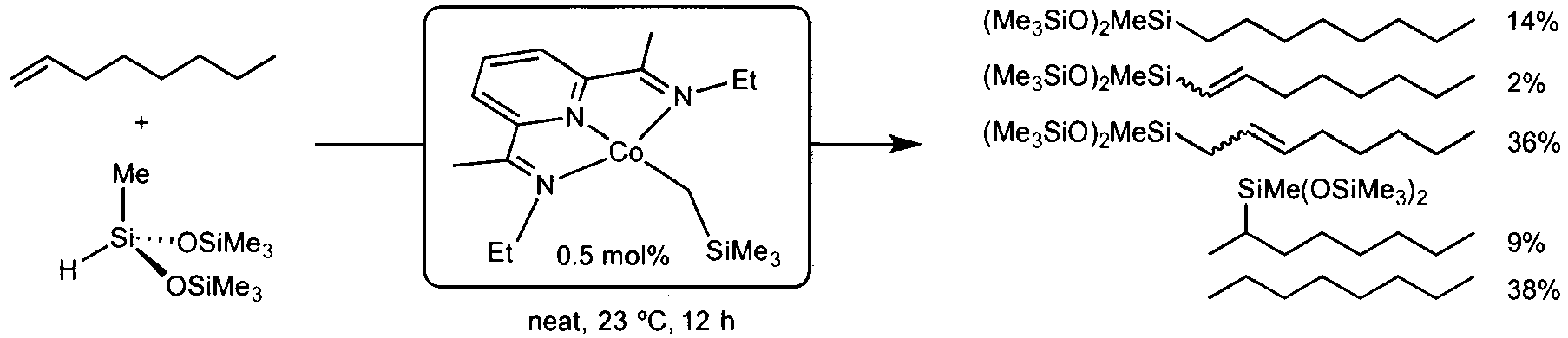

- In a nitrogen-filled drybox, a scintillation vial was charged with 0.100 g (0.891 mmol) of 1-octene and approximately 0.001 g (0.004 mmol) MeAPDICoNs (0.5 mol %), 0.891 mmol of silane (0.146 g (EtO)3SiH, 0.198 g of MDHM or 0.104 g of Et3SiH) was then added to the mixture and the reaction was stirred at room temperature for desired amount of time. The product mixture was quenched by exposure to air. The product mixture was filtered through silica gel and eluted with hexane. The product mixture was directly injected to GC. The resulting solution was dried under vacuum and the remaining residue was analyzed by 1H and 13C NMR spectroscopy. The yields are based on conversion of 1-octene.


- In a nitrogen-filled drybox, a scintillation vial was charged with 0.100 g (0.891 mmol) of 1-octene and approximately 0.001 g (0.004 mmol) MeAPDICoNs (0.5 mol %). 1-(2-trimethylsilylethyl)-1,1,3,3-tetramethyldisiloxane (0.209 g, 0.891 mmol) was then added to the mixture and the reaction was stirred at room temperature for 1 hour, after which the mixture was quenched by exposure to air. The product mixture was filtered through silica gel and eluted with hexane. The crude product mixture was analyzed by GC. Volatiles were then removed from the crude mixture product and the resulting mixture was analyzed by 1H and 13C NMR spectroscopy.

- In a nitrogen-filled drybox, a scintillation vial was charged with 0.100 g (0.891 mmol) of 1-octene and approximately 0.001 g (0.004 mmol) MeAPDICoNs (0.5 mol %). 2-(trimethylsilyl)ethyldimethylsilane (0.143 g, 0.891 mmol) was then added to the mixture and the reaction was stirred at room temperature for 1 hour, after which the mixture was quenched by exposure to air. The product mixture was filtered through silica gel and eluted with hexane. The crude product mixture was analyzed by GC. Volatiles were then removed from the crude product mixture and the residue was analyzed by 1H and 13C NMR spectroscopy.
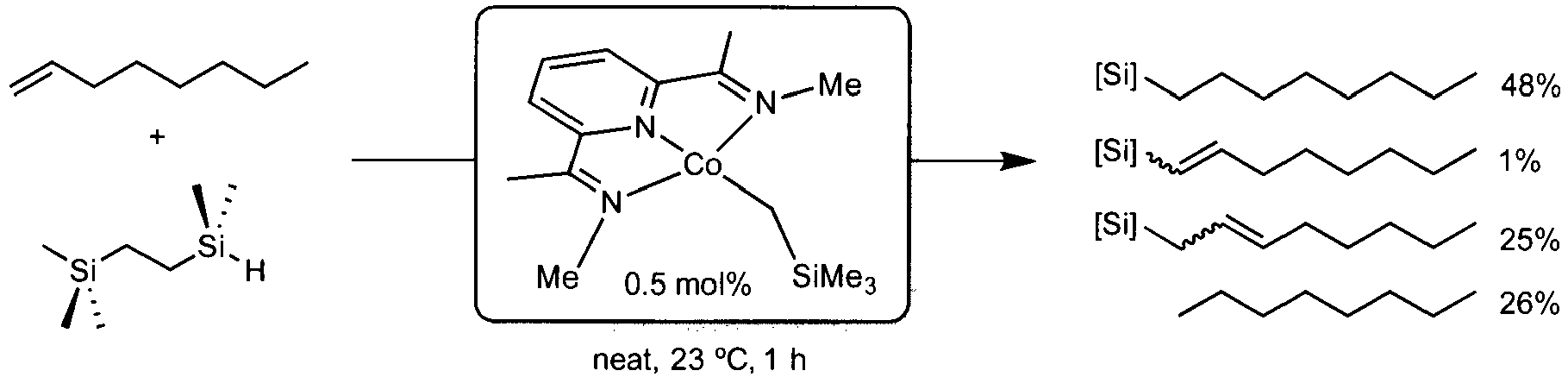
- In a nitrogen-filled drybox, a scintillation vial was charged with 0.400 g (3.56 mmol) of 1-octene and 100 µL of a 16 mM toluene solution of MeAPDICoNs. Then to the mixture was added 0.586 g of (EtO)3SiH dropwise over a period of 20 seconds and the resulting reaction mixture was stirred at room temperature for 80 minutes. The product mixture was quenched by exposure to air. The product mixture was filtered through silica gel and eluted with hexane. The product mixture was analyzed by GC.

- In a nitrogen-filled drybox, a scintillation vial was charged with 0.400 g (3.56 mmol) of 1-octene and 200 µL of a 4 mM toluene solution of MeAPDICoNs. Then to the mixture was added 0.586 g of (EtO)3SiH dropwise over a period of 20 seconds and the resulting reaction mixture was stirred at 60 °C for 3 hours. The product mixture was quenched by exposure to air. The product mixture was filtered through silica gel and eluted with hexane. The product mixture was analyzed by GC.
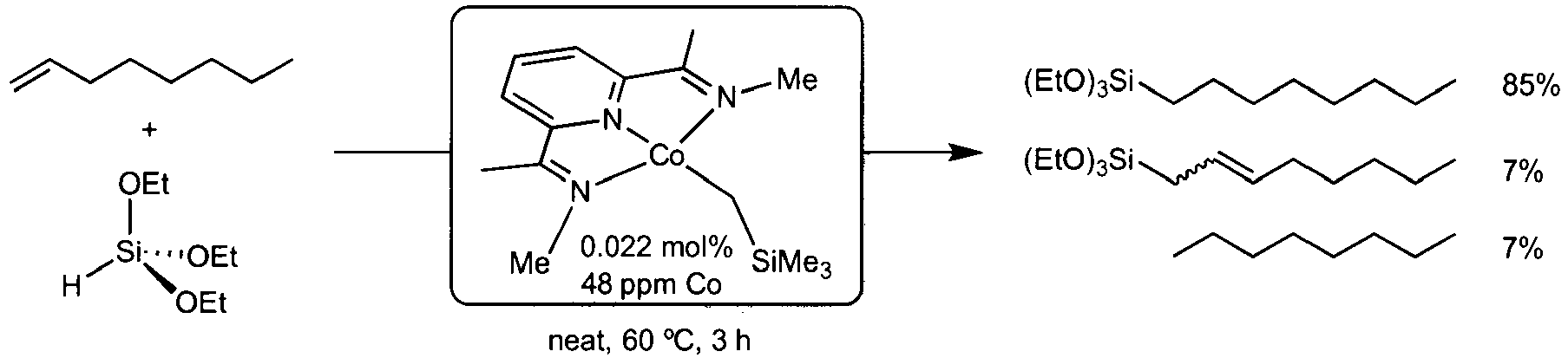
- In a nitrogen-filled drybox, a scintillation vial was charged with 3.000 g of mixture of MviD120Mvi (SL6100) and MD15DH 30M (SL6020) (in 1:2 molar ratio). Then to the mixture was added 20 µL of a 4 mM toluene solution of MeAPDICoNs (10 ppm Co). The reaction mixture was then stirred at room temperature. Complete gelation was achieved in 1 hour. When the reaction was performed at 80 °C, complete gelation occurred within 1 minute.
- In a nitrogen-filled drybox, a scintillation vial was charged with 0.100 g (0.891 mmol) of 1-octene, 0.500 g benzene and approximately 0.001 g (0.004 mmol) MeAPDICoNs, MD15DH 30M (0.091 g) was then added and the reaction mixture was stirred at room temperature for 1 hour. The product mixture was quenched by exposure to air. The product mixture was filtered through silica gel and eluted with hexane. The product mixture was analyzed by 1H NMR spectroscopy. The 1H NMR (benzene-d 6) spectrum of the product mixture revealed vinyl proton signals at 5.5-6.0 ppm, characteristic of dehydrogenative silylation.

- In a nitrogen-filled drybox, a scintillation vial was charged with 1.000 g of MviD120Mvi (SL6100), 0.500 g benzene and approximately 0.001 g (0.004 mmol) MeAPDICoNs, MDHM (0.200 g, 0.891 mmol) was then added and the reaction mixture was stirred at room temperature for 1 hour. The product mixture was quenched by exposure to air. The product mixture was filtered through silica gel and eluted with hexane. The product mixture was analyzed by 1H NMR spectroscopy. The 1H NMR (benzene-d 6) spectrum of the product mixture contained no vinyl proton signals, signaling hydrosilylation products. The products were identified as a mixture of anti-Markovnikov and Markovnikov hydrosilylation by their characteristic proton signals (a multiplet at 0.75 ppm for Anti-Markovnikov product; a doublet at 1.3 ppm for Markovnikov product)

- In a nitrogen-filled drybox, a scintillation vial was charged with 0.279 g of Y10227 (6.88% vinyl content) and approximately 0.001 g of MeAPDICoNs (0.004 mmol, 1 mol %), (EtO)3SiH (0.075 g, 0.457 mmol) was then added and the reaction mixture was stirred at 50 °C for 1 hour. The product mixture was quenched by exposure to air. The product mixture was filtered through silica gel and eluted with hexane. The product mixture was analyzed by 1H NMR spectroscopy. The 1H NMR (benzene-d 6) spectrum contained no olefinic peaks, and characteristic alpha-Si methylene CH2 signals were observed at 0.71 ppm indicating formation of Anti-Markovnikov hydrosilylation product.

- In a nitrogen-filled drybox, a scintillation vial was charged with 0.089 g (0.891 mmol) of trimethyl(vinyl)silane and 0.004 mmol (0.5 mol %) of cobalt catalyst (0.002 g of CyAPDICoNs, 0.002 g of EtAPDICoNs or 0.001 g of MeAPDICoNs), 0.891 mmol of silane (0.146 g of (EtO)3SiH or 0.198 g of MDHM) was then added to the mixture and the reaction was stirred at room temperature for desired amount of time. The product mixture was quenched by exposure to air. The product mixture was filtered through silica gel and eluted with hexane. The resulting solution was dried under vacuum and the remaining residue was analyzed by 1H and 13C NMR spectroscopy.

[Co] [Si]-H A B C MeAPDICoNs (EtO)3SiH 0 57 43 MDHM 0 76 24 EtAPDICoNs (EtO)3SiH 0 33 67 MDHM 1 60 39 CyAPDICoNs (EtO)3SiH 0 3 97 MDHM 8 84 8 
[Co] t (95% conv.) [Si] [Si]'-H A B C D MeAPDICoNs 1 h SiMe(OSiMe3)2 (EtO)3SiH 38.5 - 61.5 - 1 h SiMe(OSiMe3)2 MDHM 23 - 77 - 1 h Si(OEt)3 (EtO)3SiH 8.5 - 91.5 - 1 h Si(OEt)3 MDHM 40 - 60 - CyAPDICoNs 1 h SiMe(OSiMe3)2 (EtO)3SiH 72 - 27 1 12 h SiMe(OSiMe3)2 MDHM 2.5 16 30 51.5 1 h Si(OEt)3 (EtO)3SiH - 43 - 57 12 h Si(OEt)3 MDHM 14 - 85 1 - According to the general procedure described above, the product is a mixture of triethoxy(2-(trimethylsilyl)ethyl)silane and triethoxy(1-(trimethylsilyl)ethyl)silane in 57:43 ratio.
- Characterization for triethoxy(2-(trimethylsilyl)ethyl)silane: 1H NMR (benzene-d 6, 23 °C): δ = 3.81 (q, 7 Hz, 6H), 1.17 (t, 7 Hz, 9H), 0.76-0.64 (m, 4H), -0.02 (s, 9H); 13C NMR (benzene-d 6, 23 °C): δ = 58.56, 18.64, 8.28, 3.39, -2.15
- Characterization for triethoxy(1-(trimethylsilyl)ethyl)silane: 1H NMR (benzene-d 6, 23 °C): δ = 3.77 (q, 7 Hz, 6H), 1.15 (t, 7 Hz, 9H), 0.20 (s, 9H), 0.06 (q, 7 Hz, 1H); 13C NMR (benzene-d 6, 23 °C): δ = 58.57, 18.69, 8.75, 3.82, -1.10

- According to the general procedure described above, the product is a mixture of 1,1,1,3,5,5,5-heptamethyl-3-(2-(trimethylsilyl)ethyl)trisiloxane, (E)-l,1,1,3,5,5,5-heptamethyl-3-(2-(trimethylsilyl)vinyl)trisiloxane and 1,1,1,3,5,5,5-heptamethyl-3-(1-(trimethylsilyl)ethyl)trisiloxane in 84:8:8 ratio.
- Characterization of 1,1,1,3,5,5,5-heptamethyl-3-(2-(trimethylsilyl)ethyl)trisiloxane: 1H NMR (benzene-d 6, 23 °C): δ = 0.56-0.42 (m, 4H), 0.30-0.10 (m, br, 30H); 13C NMR (benzene-d 6, 23 °C): δ = 10.11, 8.42, 2.14, -0.76, -2.00.

- To a scintillation vial equipped with stir bar under nitrogen was added MeAPDICoNs (0.003 g) followed by triethoxysilane (0.149 g) and 1-octyne (100 mg, 1.00 equiv.). The vial was sealed with a cap and heated to 80 °C in an oil bath for 3 hours. After cooling to ambient temperature, the resulting dark reaction mixture was exposed to air to destroy remaining catalyst. The volatiles were removed with a stream of air and the resulting residue was diluted with a solution of 5% ethyl ether in pentane and passed through a small column of silica gel, eluting with additional 5% ether in pentane solution (5 mL). The resulting clear, colorless eluent was concentrated to give the product mixture as a clear, colorless oil (237 mg, 95%). Analysis of the product by both 1H and 13C NMR established the product ratio shown below. All spectra are in accordance with the literature values (Bo, G. D.; Berthon-Gelloz, G.; Tinant, B.; Marko, 1. E. Organometallics 2006, 25, 1881.)

- This reaction was carried out in a manner similar to the silylation of 1-butene using 0.11 mmol of silane (0.025 g of MDHM, 0.018 g of (EtO)3SiH or 0.015 g of (OEt)2CH3SiH) 0.001 g (0.002 mmol) of (MesPDI)CoCH3 and 5.6 mmol (50 equiv) of propylene. The non-volatiles were analyzed by NMR spectroscopy.
Table 12. Product Distribution for the Silylation of Propylene. Silane [Si]-allyl [Si]-propyl Disproportionation Product Ex 36A: MDHM 82% 18% None Ex 36B: TES 40% 20% 40% Ex 36C: Me(OEt)2SiH 60% 30% 10% - 3-bis(trimethylsiloxy)methylsilyl-1-propene. 1H NMR (CDC13): δ = 0.03 (s, 3H, (OTMS)2SiCH 3), 0.09 (s, 18H, OSi(CH 3)3), 1.49 (d, J = 8.1 Hz, 2H, SiCH2 CH=CH), 4.86 (d, J = 6.3 Hz, 1H, CH2CH=C(H)H), 4.88 (d, J = 15 Hz, 1H, CH2CH=C(H)H), 5.77 (m, 1H, CH2CH=CH2). 13C {1H} NMR (CDCl3): δ = -0.77 ((OTMS)2SiCH3), 1.97 (OSi(CH3)3), 25.82 (SiCH2CH=CH), 113.72 (CH2CH=CH2), 134.28 (CH2 CH=CH2).
- 1-bis(trimethylsiloxy)methylsilyipropane. 1H NMR (CDCl3): δ = 0.00 (s, 3H, (OTMS)2SiCH 3), 0.09 (s, 18H, OSi(CH3 )3), 0.46 (m, 2H, SiCH2 CH2CH3), 0.95 (t, 3H, SiCH2CH2CH3 ), 1.36 (m, 2H, SiCH2CH2 CH3). 13C {1H} NMR (CDCl3): δ = -0.07 ((OTMS)2SiCH3), 1.97 (OSi(CH3)3), 16.75 (SiCH2 CH2CH3), 18.05 (SiCH2CH2 CH3), 20.37 (SiCH2CH2CH3).
- 3-triethoxysilyl-1-propene. 1H NMR (CDCl3): δ = 1.22 (t, 9H, OCH2CH3 ), 1.67 (d, 2H, SiCH2 CH=CH), 3.84 (q, 6H, OCH 2CH3), 4.90-5.05 (d, 2H, CH2CH=CH2 ), 5.81 (m, 1H, CH2CH=CH2). 13C {1H} NMR (CDCl3): δ = 18.36 (OCH2 CH3), 19.34 (SiCH2CH=CH), 58.73 (OCH2CH3), 114.85 (CH2CH=CH2), 132.80 (CH2CH=CH2).
- 1-triethoxysilylpropane. 1H NMR (CDCl3): δ = 0.63 (m, 2H, SiCH2 CH2CH3), 0.97 (t, 3H, SiCH2 CH2CH3), 1.22 (t, 9H, OCH2CH 3), 1.45 (m, 2H, SiCH2 CH2CH3), 3.84 (q, 6H, OCH 2CH3). 13C {1H} NMR (CDC13): δ = 10.94 (SiCH2CH2CH3), 12.92 (SiCH2CH2CH3), 16.50 (SiCH2CH2CH3), 18.43 (OCH2 CH3), 58.40 (OCH2CH3).
- 3-diethoxymethylsilyl-1-propene. 1H NMR (CDCl3): δ = 0.11 (s, 3H, SiCH3 ), 1.19 (t, 6H, OCH2CH3 ), 1.63 (d, 2H, SiCH2 CH=CH), 3.76 (q, 4H, OCH2CH3 ), 4.88 (d, 1H, CH2CH=C(H)H), 4.93 (d, 1H, CH2CH=C(H)H), 5.80 (m, 1H, CH2CH=CH2). 13C {1H} NMR (CDC13): δ = -5.19 (SiCH3), 18.44 (OCH2 CH3), 21.92 (SiCH2CH=CH), 58.41 (OCH2CH3), 114.45 (CH2CH=CH2), 133.36 (CH2CH=CH2).
- 1-diethoxymethylsilylpropane: 1H NMR (CDCl3): δ = 0.08 (s, 3H, SiCH3 ), 0.59 (m, 2H, SiCH2 CH2CH3), 0.94 (t, 3H, SiCH2 CH2CH3), 1.19 (t, 6H, OCH2CH3 ), 1.38 (m, 2H, SiCH2CH2 CH3), 3.76 (q, 4H, OCH2 CH3). 13C {1H} NMR (CDCl3): δ = -4.76 (SiCH3), 16.37 (SiCH2CH2CH3), 16.53 (SiCH2 CH2CH3), 18.07 (SiCH2CH2 CH3), 18.50 (OCH2 CH3), 58.13 (OCH2CH3).
- While the above description contains many specifics, these specifics should not be construed as limitations on the scope of the invention, but merely as exemplifications of preferred embodiments thereof. Those skilled in the art will envision many other possible variations that are within the scope of the invention as defined by the claims appended hereto.
Claims (17)
- A process for producing a silylated product comprising reacting a mixture comprising (a) an unsaturated compound containing at least one unsaturated functional group, (b) a silyl hydride containing at least one silylhydride functional group, and (c) a catalyst, optionally in the presence of a solvent, to produce a dehydrogenative silylated product, a hydrosilylated product, or a combination of a dehydrogenative silylated product and a hydrosilylated product, wherein the catalyst is a complex of the Formula (I);
 wherein each occurrence of R1, R2, R3, R4, and R5 is independently hydrogen, a C1-C18 alkyl, a C1-C18 cycloalkyl, a C1-C18 substituted alkyl, a C1-C18 substituted cycloalkyl, an aryl, a substituted aryl, or an inert substituent chosen from a halo or an ether including -OR9 wherein R9 is hydrocarbyl or substituted hydrocarbyl, R1-R5, other than hydrogen, optionally contain at least one heteroatom, wherein the term substituted means containing one or more substituents, chosen from a halo or an ether including -OR9 wherein R9 is hydrocarbyl;each occurrence of R6 and R7 is independently a C1-C18 alkyl, a C1-C18 cycloalkyl, a C1-C18 substituted alkyl, a C1-C18 substituted cycloalkyl, an aryl, or a substituted aryl, wherein R6 and R7 optionally contain at least one heteroatom, wherein the term substituted means containing one or more substituents, chosen from a halo or an ether including -OR9 wherein R9 is hydrocarbyl;optionally any two of R1, R2, R3, R4, R5, R6, and R7 vicinal to one another taken together may form a ring being an unsubstituted, saturated, or unsaturated cyclic structure, andL is CH2SiR8 3 where each occurrence of R8 is independently a C1-10 alkyl, a C1-C10 cycloalkyl or an aryl group, where R8 optionally contains at least one heteroatom.
 - The process of claim 1, wherein R8 is CH3.
- The process of claim 1, wherein R6 and R7 are independently chosen from a C1-C10 alkyl or a C1 to C10 cycloalkyl.
- The process of claim 3, wherein R6 and R7 are the same, chosen from either methyl, ethyl or cyclohexyl.
- The process of claim 1, wherein R8 is methyl; R6 and R7 are independently chosen from a C1-C10 alkyl or C1-C10 cycloalkyl, and R2, R3, and R4 are each hydrogen.
- The process of claim 1, wherein the catalyst is chosen from:


- The process of any of claims 1-6, wherein component (a) is chosen from an olefin, a cycloalkene, an unsaturated polyether, a vinyl-functional alkyl-capped allyl or methallyl polyether, a vinyl-functional cycloalkyl-capped allyl or methallyl polyether, an alkyl-capped terminally unsaturated amine, a cycloalkyl-capped terminally unsaturated amine, an alkyne, a terminally unsaturated acrylate or methacrylate, an unsaturated aryl ether, a vinyl-functionalized polymer or oligomer, a vinyl-functionalized silane, a vinyl-functionalized silicone, an unsaturated fatty acid, an unsaturated ester, or a combination of two or more thereof.
- The process of any of claims 1-7, wherein component (a) is chosen from a compound of the formula:
R10(OCH2CH2)z(OCH2CHR11)w-OR12;
R12O(CHR11CH2O)w(CH2CH2O)z-CR13 2-C≡C-CR13 2-(OCH2CH2)z(OCH2CHR11)wR12;
H2C=CR11CH2O(CH2CH2O)z(CH2CHR1)wCH2CR13=CH2;
or a combination of two or more thereof, wherein R10 is chosen from an unsaturated organic group containing from 2 to 10 carbon atoms; R12 is chosen from hydrogen, a vinyl group, or a polyether capping group of from 1 to 8 carbon atoms; each occurrence of R11 is independently chosen from a monovalent hydrocarbon group having 1-20 carbon atoms, an aryl group, an alkaryl, an aralkyl, a cycloalkyl group; each occurrence of R13 is independently chosen from hydrogen, a monovalent hydrocarbon group having 1-20 carbon atoms, an aryl group, an alkaryl group, an aralkyl group, or a cycloalkyl group; each occurrence of z is 0 to 100 inclusive; and, each occurrence of w is 0 to 100 inclusive; or,
wherein component (a) is chosen from N,N-dimethylallyl amine, allyloxy-substituted polyethers, propylene, 1-butene, 1-hexene, styrene,, vinylnorbornane, 5-vinyl-norbornene, 1-octadecene, cyclopentene, cyclohexene, norbornene, 3-hexene, isobutylene, 3-methyl-1-octene, polybutadiene, polyisoprene, EPDM, oleic acid, linoleic acid, methyl oleate, a vinyl siloxane of the Formula (VI),
- The process of any of claims 1-8, wherein component (b) is chosen from a compound of the formula RaSiH4-a, (RO)aSiH4-a, HSiRa(OR)3-a, R3Si(CH2)f(SiR2O)kSiR2H, (RO)3Si(CH2)f(SiR2O)kSiR2H, QuTvTp HDwDH xMH yMz , R3Si(CH2R)xSiOSiR2(OSiR2)yOSiR2H, or combinations of two or more thereof where each occurrence of R is independently a C1-C18 alkyl, a C1-C18 cycloalkyl, a C1-C18 substituted alkyl, a C1-C18 substituted cycloalkyl, wherein R optionally contains at least one heteroatom, each occurrence of a independently has a value from 0 to 3, f has a value of 1 to 8, k has a value of 1 to 11, each of p, u, v, y and z independently has a value from 0 to 20, w and x are from 0 to 3000, provided that p + x + y equals 1 to 1000 and the valences of the all the elements in the silyl hydride are satisfied, M represents a monofunctional group of formula R'3SiO1/2, D represents a difunctional group of formula R'2SiO2/2, T represents a trifunctional group of formula R'SiO3/2, Q represents a tetrafunctional group of formula SiO4/2, an MH represents HR'2SiO1/2, TH represents HSiO3/2, and DH represents R'HSiO2/2; each occurrence of R' is independently C1-C18 alkyl, C1-C18 cycloalkyl, C1-C18 substituted alkyl, C1-C18 substituted cycloalkyl, wherein R' optionally contains at least one heteroatom; x is 1-8, and y is 0-10, wherein the term substituted means containing one or more substituents, chosen from a halo or an ether including -OR9 wherein R9 is hydrocarbyl.
- The process of any of claims 1-9, wherein the catalyst is present in an amount of from 0.01 mole percent to 10 mole percent based on the molar quantity of the unsaturated compound to be reacted.
- The process of any of claims 1-10, wherein the process is conducted at a temperature of between 0 °C and 300 °C.
- The process of any of claims 1-11, wherein the complex is immobilized on a support, chosen from carbon, silica, alumina, MgCl2, zirconia, polyethylene, polypropylene, polystyrene, poly(aminostyrene), sulfonated polystyrene, or a combination of two or more thereof.
- A process for producing a crosslinked material, comprising reacting a mixture comprising (a) a silyl-hydride containing polymer, (b) a mono-unsaturated olefin or an unsaturated polyolefin, or combinations thereof and (c) a catalyst, optionally in the presence of a solvent, in order to produce the crosslinked material, wherein the catalyst is a complex of the Formula (I):
 wherein each occurrence of R1, R2, R3, R4, and R5 is independently hydrogen, a C1-C18 alkyl, a C1-C18 cycloalkyl, a C1-C18 substituted alkyl, a C1-C18 substituted cycloalkyl, an aryl, a substituted aryl, or an inert substituent chosen from a halo or an ether including -OR9 wherein R9 is hydrocarbyl or substituted hydrocarbyl, wherein R1-R5, other than hydrogen, optionally contain at least one heteroatom, wherein the term substituted means containing one or more substituents, chosen from a halo or an ether including -OR9 wherein R9 is hydrocarbyl;each occurrence of R6 and R7 is independently a C1-C18 alkyl, a C1-C18 cycloalkyl, a C1-C18 substituted alkyl, a C1-C18 substituted cycloalkyl, aryl or substituted aryl, wherein R6 and R7 optionally contain at least one heteroatom, wherein the term substituted means containing one or more substituents, chosen from a halo or an ether including -OR9 wherein R9 is hydrocarbyl;optionally any two of R1, R2, R3, R4, R5, R6, and R7 vicinal to one another taken together may form a ring being an unsubstituted, saturated, or unsaturated cyclic structure, andL is CH2SiR8 3 where each R8 is independently a C1-10 alkyl, a C1-C18 cycloalkyl, or aryl group optionally containing at least one heteroatom.
 - The process of claim 13 wherein the reaction is conducted under an inert atmosphere.
- The process of any of claims 13-14, wherein the reaction is conducted in the presence of a solvent selected from the group consisting of hydrocarbons, halogenated hydrocarbons, ethers, and combinations thereof.
- The process of any of claims 13-15, wherein the reaction is carried out at a temperature of 0° C. to 300° C.
- The process of any of claims 13-16, wherein the catalyst is present in an amount of from 0.1 mol % to 5 mol %.
Applications Claiming Priority (3)
| Application Number | Priority Date | Filing Date | Title |
|---|---|---|---|
| US201361906210P | 2013-11-19 | 2013-11-19 | |
| US14/270,710 US9447125B2 (en) | 2012-08-16 | 2014-05-06 | Reusable homogeneous cobalt pyridine diimine catalysts for dehydrogenative silylation and tandem dehydrogenative-silylation-hydrogenation |
| PCT/US2014/066338 WO2015077298A1 (en) | 2013-11-19 | 2014-11-19 | Dehydrogenative silylation, hydrosilylation and crosslinking using cobalt catalysts |
Publications (2)
| Publication Number | Publication Date |
|---|---|
| EP3071583A1 EP3071583A1 (en) | 2016-09-28 |
| EP3071583B1 true EP3071583B1 (en) | 2018-05-09 |
Family
ID=52130808
Family Applications (1)
| Application Number | Title | Priority Date | Filing Date |
|---|---|---|---|
| EP14815498.2A Not-in-force EP3071583B1 (en) | 2013-11-19 | 2014-11-19 | Dehydrogenative silylation, hydrosilylation and crosslinking using cobalt catalysts |
Country Status (5)
| Country | Link |
|---|---|
| EP (1) | EP3071583B1 (en) |
| JP (1) | JP2016537377A (en) |
| CN (1) | CN106414469A (en) |
| TW (1) | TW201524604A (en) |
| WO (1) | WO2015077298A1 (en) |
Families Citing this family (3)
| Publication number | Priority date | Publication date | Assignee | Title |
|---|---|---|---|---|
| WO2015171881A1 (en) * | 2014-05-08 | 2015-11-12 | Momentive Performance Materials Inc. | Dialkyl cobalt catalysts and their use for hydrosilylation and dehydrogenative silylation |
| CN108359038B (en) * | 2017-01-26 | 2020-10-23 | 中国石油化工股份有限公司 | Copolymerization method of ethylene and terminal alkenyl silane/siloxane |
| EP3655157A1 (en) | 2017-07-17 | 2020-05-27 | Dow Silicones Corporation | Catalyst and related methods involving hydrosilylation and dehydrogenative silylation |
Citations (2)
| Publication number | Priority date | Publication date | Assignee | Title |
|---|---|---|---|---|
| WO2015023328A1 (en) * | 2013-08-14 | 2015-02-19 | Momentive Performance Materials Inc. | Reusable homogeneous cobalt pyridine dimine catalysts for dehydrogenative silylation and tandem dehydrogenative-silylation-hydrogenation |
| WO2015077302A1 (en) * | 2013-11-19 | 2015-05-28 | Momentive Performance Materials Inc. | Cobalt catalysts and their use for hydrosilylation and dehydrogenative silylation |
Family Cites Families (13)
| Publication number | Priority date | Publication date | Assignee | Title |
|---|---|---|---|---|
| US3159601A (en) | 1962-07-02 | 1964-12-01 | Gen Electric | Platinum-olefin complex catalyzed addition of hydrogen- and alkenyl-substituted siloxanes |
| US3220972A (en) | 1962-07-02 | 1965-11-30 | Gen Electric | Organosilicon process using a chloroplatinic acid reaction product as the catalyst |
| US3775452A (en) | 1971-04-28 | 1973-11-27 | Gen Electric | Platinum complexes of unsaturated siloxanes and platinum containing organopolysiloxanes |
| IL129929A0 (en) | 1996-12-17 | 2000-02-29 | Du Pont | Polymerization of ethylene with specific iron or cobalt complexes novel pyridinebis (imines) and novel complexes of pyridinebis(imines) with iron and cobalt |
| ES2229683T3 (en) | 1998-03-12 | 2005-04-16 | Bp Chemicals Limited | POLYMERIZATION CATALYSTS. |
| GB9819847D0 (en) | 1998-09-12 | 1998-11-04 | Bp Chem Int Ltd | Novel compounds |
| AU2003293320A1 (en) | 2002-09-25 | 2004-05-13 | Shell Internationale Research Maatschappij B.V. | Catalyst systems for ethylene oligomerisation to linear alpha olefins |
| WO2006010065A2 (en) | 2004-07-09 | 2006-01-26 | E.I. Dupont De Nemours And Company | Catalysts for olefin polymerization or oligomerization |
| US7507775B2 (en) | 2005-10-13 | 2009-03-24 | Momentive Performance Materials Inc. | Hydrolysis resistant organomodified disiloxane surfactants |
| US7259220B1 (en) | 2006-07-13 | 2007-08-21 | General Electric Company | Selective hydrosilylation method |
| US8236915B2 (en) | 2009-07-10 | 2012-08-07 | Momentive Performance Materials Inc. | Hydrosilylation catalysts |
| US8415443B2 (en) * | 2009-07-10 | 2013-04-09 | Momentive Performance Materials Inc. | Hydrosilylation catalysts |
| US9447125B2 (en) * | 2012-08-16 | 2016-09-20 | Momentive Performance Materials Inc. | Reusable homogeneous cobalt pyridine diimine catalysts for dehydrogenative silylation and tandem dehydrogenative-silylation-hydrogenation |
-
2014
- 2014-11-19 JP JP2016532097A patent/JP2016537377A/en active Pending
- 2014-11-19 EP EP14815498.2A patent/EP3071583B1/en not_active Not-in-force
- 2014-11-19 CN CN201480073589.6A patent/CN106414469A/en active Pending
- 2014-11-19 TW TW103140145A patent/TW201524604A/en unknown
- 2014-11-19 WO PCT/US2014/066338 patent/WO2015077298A1/en not_active Ceased
Patent Citations (2)
| Publication number | Priority date | Publication date | Assignee | Title |
|---|---|---|---|---|
| WO2015023328A1 (en) * | 2013-08-14 | 2015-02-19 | Momentive Performance Materials Inc. | Reusable homogeneous cobalt pyridine dimine catalysts for dehydrogenative silylation and tandem dehydrogenative-silylation-hydrogenation |
| WO2015077302A1 (en) * | 2013-11-19 | 2015-05-28 | Momentive Performance Materials Inc. | Cobalt catalysts and their use for hydrosilylation and dehydrogenative silylation |
Also Published As
| Publication number | Publication date |
|---|---|
| JP2016537377A (en) | 2016-12-01 |
| TW201524604A (en) | 2015-07-01 |
| EP3071583A1 (en) | 2016-09-28 |
| CN106414469A (en) | 2017-02-15 |
| WO2015077298A1 (en) | 2015-05-28 |
Similar Documents
| Publication | Publication Date | Title |
|---|---|---|
| US9371340B2 (en) | Dehydrogenative silylation, hydrosilylation and crosslinking using cobalt catalysts | |
| EP2698201B1 (en) | Dehydrogenative silylation and crosslinking using cobalt catalysts | |
| US8415443B2 (en) | Hydrosilylation catalysts | |
| EP3071584B1 (en) | Cobalt catalysts and their use for hydrosilylation and dehydrogenative silylation | |
| US9447125B2 (en) | Reusable homogeneous cobalt pyridine diimine catalysts for dehydrogenative silylation and tandem dehydrogenative-silylation-hydrogenation | |
| US9381506B2 (en) | Cobalt catalysts and their use for hydrosilylation and dehydrogenative silylation | |
| KR20140116100A (en) | Non-precious metal-based hydrosilylation catalysts | |
| EP3071585B1 (en) | Cobalt catalysts and their use for hydrosilylation and dehydrogenative silylation | |
| EP3590596B1 (en) | Catalyst for hydrosilylation reaction, hydrogenation reaction, and hydrosilane reduction reaction | |
| US20180334470A1 (en) | Dialkyl cobalt catalysts and their use for hydrosilylation and dehydrogenative silylation | |
| WO2015023328A1 (en) | Reusable homogeneous cobalt pyridine dimine catalysts for dehydrogenative silylation and tandem dehydrogenative-silylation-hydrogenation | |
| JP2017171661A (en) | Dehydrogenative silylation and crosslinking using cobalt catalyst | |
| WO2015077298A1 (en) | Dehydrogenative silylation, hydrosilylation and crosslinking using cobalt catalysts |
Legal Events
| Date | Code | Title | Description |
|---|---|---|---|
| PUAI | Public reference made under article 153(3) epc to a published international application that has entered the european phase |
Free format text: ORIGINAL CODE: 0009012 |
|
| 17P | Request for examination filed |
Effective date: 20160602 |
|
| AK | Designated contracting states |
Kind code of ref document: A1 Designated state(s): AL AT BE BG CH CY CZ DE DK EE ES FI FR GB GR HR HU IE IS IT LI LT LU LV MC MK MT NL NO PL PT RO RS SE SI SK SM TR |
|
| AX | Request for extension of the european patent |
Extension state: BA ME |
|
| DAX | Request for extension of the european patent (deleted) | ||
| 17Q | First examination report despatched |
Effective date: 20170823 |
|
| GRAP | Despatch of communication of intention to grant a patent |
Free format text: ORIGINAL CODE: EPIDOSNIGR1 |
|
| INTG | Intention to grant announced |
Effective date: 20171130 |
|
| GRAS | Grant fee paid |
Free format text: ORIGINAL CODE: EPIDOSNIGR3 |
|
| GRAA | (expected) grant |
Free format text: ORIGINAL CODE: 0009210 |
|
| AK | Designated contracting states |
Kind code of ref document: B1 Designated state(s): AL AT BE BG CH CY CZ DE DK EE ES FI FR GB GR HR HU IE IS IT LI LT LU LV MC MK MT NL NO PL PT RO RS SE SI SK SM TR |
|
| REG | Reference to a national code |
Ref country code: GB Ref legal event code: FG4D |
|
| REG | Reference to a national code |
Ref country code: CH Ref legal event code: EP Ref country code: AT Ref legal event code: REF Ref document number: 997508 Country of ref document: AT Kind code of ref document: T Effective date: 20180515 |
|
| REG | Reference to a national code |
Ref country code: IE Ref legal event code: FG4D |
|
| REG | Reference to a national code |
Ref country code: DE Ref legal event code: R096 Ref document number: 602014025374 Country of ref document: DE |
|
| REG | Reference to a national code |
Ref country code: NL Ref legal event code: MP Effective date: 20180509 |
|
| REG | Reference to a national code |
Ref country code: LT Ref legal event code: MG4D |
|
| PG25 | Lapsed in a contracting state [announced via postgrant information from national office to epo] |
Ref country code: ES Free format text: LAPSE BECAUSE OF FAILURE TO SUBMIT A TRANSLATION OF THE DESCRIPTION OR TO PAY THE FEE WITHIN THE PRESCRIBED TIME-LIMIT Effective date: 20180509 Ref country code: SE Free format text: LAPSE BECAUSE OF FAILURE TO SUBMIT A TRANSLATION OF THE DESCRIPTION OR TO PAY THE FEE WITHIN THE PRESCRIBED TIME-LIMIT Effective date: 20180509 Ref country code: BG Free format text: LAPSE BECAUSE OF FAILURE TO SUBMIT A TRANSLATION OF THE DESCRIPTION OR TO PAY THE FEE WITHIN THE PRESCRIBED TIME-LIMIT Effective date: 20180809 Ref country code: FI Free format text: LAPSE BECAUSE OF FAILURE TO SUBMIT A TRANSLATION OF THE DESCRIPTION OR TO PAY THE FEE WITHIN THE PRESCRIBED TIME-LIMIT Effective date: 20180509 Ref country code: NO Free format text: LAPSE BECAUSE OF FAILURE TO SUBMIT A TRANSLATION OF THE DESCRIPTION OR TO PAY THE FEE WITHIN THE PRESCRIBED TIME-LIMIT Effective date: 20180809 Ref country code: LT Free format text: LAPSE BECAUSE OF FAILURE TO SUBMIT A TRANSLATION OF THE DESCRIPTION OR TO PAY THE FEE WITHIN THE PRESCRIBED TIME-LIMIT Effective date: 20180509 |
|
| PG25 | Lapsed in a contracting state [announced via postgrant information from national office to epo] |
Ref country code: HR Free format text: LAPSE BECAUSE OF FAILURE TO SUBMIT A TRANSLATION OF THE DESCRIPTION OR TO PAY THE FEE WITHIN THE PRESCRIBED TIME-LIMIT Effective date: 20180509 Ref country code: LV Free format text: LAPSE BECAUSE OF FAILURE TO SUBMIT A TRANSLATION OF THE DESCRIPTION OR TO PAY THE FEE WITHIN THE PRESCRIBED TIME-LIMIT Effective date: 20180509 Ref country code: RS Free format text: LAPSE BECAUSE OF FAILURE TO SUBMIT A TRANSLATION OF THE DESCRIPTION OR TO PAY THE FEE WITHIN THE PRESCRIBED TIME-LIMIT Effective date: 20180509 Ref country code: NL Free format text: LAPSE BECAUSE OF FAILURE TO SUBMIT A TRANSLATION OF THE DESCRIPTION OR TO PAY THE FEE WITHIN THE PRESCRIBED TIME-LIMIT Effective date: 20180509 Ref country code: GR Free format text: LAPSE BECAUSE OF FAILURE TO SUBMIT A TRANSLATION OF THE DESCRIPTION OR TO PAY THE FEE WITHIN THE PRESCRIBED TIME-LIMIT Effective date: 20180810 |
|
| REG | Reference to a national code |
Ref country code: AT Ref legal event code: MK05 Ref document number: 997508 Country of ref document: AT Kind code of ref document: T Effective date: 20180509 |
|
| PG25 | Lapsed in a contracting state [announced via postgrant information from national office to epo] |
Ref country code: RO Free format text: LAPSE BECAUSE OF FAILURE TO SUBMIT A TRANSLATION OF THE DESCRIPTION OR TO PAY THE FEE WITHIN THE PRESCRIBED TIME-LIMIT Effective date: 20180509 Ref country code: CZ Free format text: LAPSE BECAUSE OF FAILURE TO SUBMIT A TRANSLATION OF THE DESCRIPTION OR TO PAY THE FEE WITHIN THE PRESCRIBED TIME-LIMIT Effective date: 20180509 Ref country code: EE Free format text: LAPSE BECAUSE OF FAILURE TO SUBMIT A TRANSLATION OF THE DESCRIPTION OR TO PAY THE FEE WITHIN THE PRESCRIBED TIME-LIMIT Effective date: 20180509 Ref country code: PL Free format text: LAPSE BECAUSE OF FAILURE TO SUBMIT A TRANSLATION OF THE DESCRIPTION OR TO PAY THE FEE WITHIN THE PRESCRIBED TIME-LIMIT Effective date: 20180509 Ref country code: AT Free format text: LAPSE BECAUSE OF FAILURE TO SUBMIT A TRANSLATION OF THE DESCRIPTION OR TO PAY THE FEE WITHIN THE PRESCRIBED TIME-LIMIT Effective date: 20180509 Ref country code: SK Free format text: LAPSE BECAUSE OF FAILURE TO SUBMIT A TRANSLATION OF THE DESCRIPTION OR TO PAY THE FEE WITHIN THE PRESCRIBED TIME-LIMIT Effective date: 20180509 Ref country code: DK Free format text: LAPSE BECAUSE OF FAILURE TO SUBMIT A TRANSLATION OF THE DESCRIPTION OR TO PAY THE FEE WITHIN THE PRESCRIBED TIME-LIMIT Effective date: 20180509 |
|
| REG | Reference to a national code |
Ref country code: DE Ref legal event code: R097 Ref document number: 602014025374 Country of ref document: DE |
|
| PG25 | Lapsed in a contracting state [announced via postgrant information from national office to epo] |
Ref country code: SM Free format text: LAPSE BECAUSE OF FAILURE TO SUBMIT A TRANSLATION OF THE DESCRIPTION OR TO PAY THE FEE WITHIN THE PRESCRIBED TIME-LIMIT Effective date: 20180509 |
|
| PLBE | No opposition filed within time limit |
Free format text: ORIGINAL CODE: 0009261 |
|
| STAA | Information on the status of an ep patent application or granted ep patent |
Free format text: STATUS: NO OPPOSITION FILED WITHIN TIME LIMIT |
|
| 26N | No opposition filed |
Effective date: 20190212 |
|
| PG25 | Lapsed in a contracting state [announced via postgrant information from national office to epo] |
Ref country code: SI Free format text: LAPSE BECAUSE OF FAILURE TO SUBMIT A TRANSLATION OF THE DESCRIPTION OR TO PAY THE FEE WITHIN THE PRESCRIBED TIME-LIMIT Effective date: 20180509 |
|
| REG | Reference to a national code |
Ref country code: DE Ref legal event code: R119 Ref document number: 602014025374 Country of ref document: DE |
|
| REG | Reference to a national code |
Ref country code: CH Ref legal event code: PL |
|
| GBPC | Gb: european patent ceased through non-payment of renewal fee |
Effective date: 20181119 |
|
| PG25 | Lapsed in a contracting state [announced via postgrant information from national office to epo] |
Ref country code: LU Free format text: LAPSE BECAUSE OF NON-PAYMENT OF DUE FEES Effective date: 20181119 Ref country code: MC Free format text: LAPSE BECAUSE OF FAILURE TO SUBMIT A TRANSLATION OF THE DESCRIPTION OR TO PAY THE FEE WITHIN THE PRESCRIBED TIME-LIMIT Effective date: 20180509 |
|
| REG | Reference to a national code |
Ref country code: BE Ref legal event code: MM Effective date: 20181130 |
|
| REG | Reference to a national code |
Ref country code: IE Ref legal event code: MM4A |
|
| PG25 | Lapsed in a contracting state [announced via postgrant information from national office to epo] |
Ref country code: LI Free format text: LAPSE BECAUSE OF NON-PAYMENT OF DUE FEES Effective date: 20181130 Ref country code: CH Free format text: LAPSE BECAUSE OF NON-PAYMENT OF DUE FEES Effective date: 20181130 |
|
| PG25 | Lapsed in a contracting state [announced via postgrant information from national office to epo] |
Ref country code: IE Free format text: LAPSE BECAUSE OF NON-PAYMENT OF DUE FEES Effective date: 20181119 Ref country code: DE Free format text: LAPSE BECAUSE OF NON-PAYMENT OF DUE FEES Effective date: 20190601 Ref country code: FR Free format text: LAPSE BECAUSE OF NON-PAYMENT OF DUE FEES Effective date: 20181130 Ref country code: IT Free format text: LAPSE BECAUSE OF NON-PAYMENT OF DUE FEES Effective date: 20181119 |
|
| PG25 | Lapsed in a contracting state [announced via postgrant information from national office to epo] |
Ref country code: BE Free format text: LAPSE BECAUSE OF NON-PAYMENT OF DUE FEES Effective date: 20181130 Ref country code: AL Free format text: LAPSE BECAUSE OF FAILURE TO SUBMIT A TRANSLATION OF THE DESCRIPTION OR TO PAY THE FEE WITHIN THE PRESCRIBED TIME-LIMIT Effective date: 20180509 |
|
| PG25 | Lapsed in a contracting state [announced via postgrant information from national office to epo] |
Ref country code: GB Free format text: LAPSE BECAUSE OF NON-PAYMENT OF DUE FEES Effective date: 20181119 |
|
| PG25 | Lapsed in a contracting state [announced via postgrant information from national office to epo] |
Ref country code: MT Free format text: LAPSE BECAUSE OF NON-PAYMENT OF DUE FEES Effective date: 20181119 |
|
| PG25 | Lapsed in a contracting state [announced via postgrant information from national office to epo] |
Ref country code: TR Free format text: LAPSE BECAUSE OF FAILURE TO SUBMIT A TRANSLATION OF THE DESCRIPTION OR TO PAY THE FEE WITHIN THE PRESCRIBED TIME-LIMIT Effective date: 20180509 |
|
| PG25 | Lapsed in a contracting state [announced via postgrant information from national office to epo] |
Ref country code: PT Free format text: LAPSE BECAUSE OF FAILURE TO SUBMIT A TRANSLATION OF THE DESCRIPTION OR TO PAY THE FEE WITHIN THE PRESCRIBED TIME-LIMIT Effective date: 20180509 |
|
| PG25 | Lapsed in a contracting state [announced via postgrant information from national office to epo] |
Ref country code: HU Free format text: LAPSE BECAUSE OF FAILURE TO SUBMIT A TRANSLATION OF THE DESCRIPTION OR TO PAY THE FEE WITHIN THE PRESCRIBED TIME-LIMIT; INVALID AB INITIO Effective date: 20141119 Ref country code: CY Free format text: LAPSE BECAUSE OF FAILURE TO SUBMIT A TRANSLATION OF THE DESCRIPTION OR TO PAY THE FEE WITHIN THE PRESCRIBED TIME-LIMIT Effective date: 20180509 Ref country code: MK Free format text: LAPSE BECAUSE OF NON-PAYMENT OF DUE FEES Effective date: 20180509 |
|
| PG25 | Lapsed in a contracting state [announced via postgrant information from national office to epo] |
Ref country code: IS Free format text: LAPSE BECAUSE OF FAILURE TO SUBMIT A TRANSLATION OF THE DESCRIPTION OR TO PAY THE FEE WITHIN THE PRESCRIBED TIME-LIMIT Effective date: 20180909 |