EP3070472A1 - Flocculant composition comprising ligand functionalized polymers - Google Patents
Flocculant composition comprising ligand functionalized polymers Download PDFInfo
- Publication number
- EP3070472A1 EP3070472A1 EP16166778.7A EP16166778A EP3070472A1 EP 3070472 A1 EP3070472 A1 EP 3070472A1 EP 16166778 A EP16166778 A EP 16166778A EP 3070472 A1 EP3070472 A1 EP 3070472A1
- Authority
- EP
- European Patent Office
- Prior art keywords
- alkyl
- hetero
- polymer
- monomer units
- ligand
- Prior art date
- Legal status (The legal status is an assumption and is not a legal conclusion. Google has not performed a legal analysis and makes no representation as to the accuracy of the status listed.)
- Granted
Links
Images

Classifications
-
- C—CHEMISTRY; METALLURGY
- C08—ORGANIC MACROMOLECULAR COMPOUNDS; THEIR PREPARATION OR CHEMICAL WORKING-UP; COMPOSITIONS BASED THEREON
- C08F—MACROMOLECULAR COMPOUNDS OBTAINED BY REACTIONS ONLY INVOLVING CARBON-TO-CARBON UNSATURATED BONDS
- C08F16/00—Homopolymers and copolymers of compounds having one or more unsaturated aliphatic radicals, each having only one carbon-to-carbon double bond, and at least one being terminated by an alcohol, ether, aldehydo, ketonic, acetal or ketal radical
-
- B—PERFORMING OPERATIONS; TRANSPORTING
- B01—PHYSICAL OR CHEMICAL PROCESSES OR APPARATUS IN GENERAL
- B01D—SEPARATION
- B01D15/00—Separating processes involving the treatment of liquids with solid sorbents; Apparatus therefor
-
- C—CHEMISTRY; METALLURGY
- C08—ORGANIC MACROMOLECULAR COMPOUNDS; THEIR PREPARATION OR CHEMICAL WORKING-UP; COMPOSITIONS BASED THEREON
- C08F—MACROMOLECULAR COMPOUNDS OBTAINED BY REACTIONS ONLY INVOLVING CARBON-TO-CARBON UNSATURATED BONDS
- C08F20/00—Homopolymers and copolymers of compounds having one or more unsaturated aliphatic radicals, each having only one carbon-to-carbon double bond, and only one being terminated by only one carboxyl radical or a salt, anhydride, ester, amide, imide or nitrile thereof
-
- C—CHEMISTRY; METALLURGY
- C08—ORGANIC MACROMOLECULAR COMPOUNDS; THEIR PREPARATION OR CHEMICAL WORKING-UP; COMPOSITIONS BASED THEREON
- C08F—MACROMOLECULAR COMPOUNDS OBTAINED BY REACTIONS ONLY INVOLVING CARBON-TO-CARBON UNSATURATED BONDS
- C08F220/00—Copolymers of compounds having one or more unsaturated aliphatic radicals, each having only one carbon-to-carbon double bond, and only one being terminated by only one carboxyl radical or a salt, anhydride ester, amide, imide or nitrile thereof
- C08F220/02—Monocarboxylic acids having less than ten carbon atoms; Derivatives thereof
- C08F220/52—Amides or imides
- C08F220/54—Amides, e.g. N,N-dimethylacrylamide or N-isopropylacrylamide
- C08F220/56—Acrylamide; Methacrylamide
-
- C—CHEMISTRY; METALLURGY
- C08—ORGANIC MACROMOLECULAR COMPOUNDS; THEIR PREPARATION OR CHEMICAL WORKING-UP; COMPOSITIONS BASED THEREON
- C08F—MACROMOLECULAR COMPOUNDS OBTAINED BY REACTIONS ONLY INVOLVING CARBON-TO-CARBON UNSATURATED BONDS
- C08F26/00—Homopolymers and copolymers of compounds having one or more unsaturated aliphatic radicals, each having only one carbon-to-carbon double bond, and at least one being terminated by a single or double bond to nitrogen or by a heterocyclic ring containing nitrogen
- C08F26/02—Homopolymers and copolymers of compounds having one or more unsaturated aliphatic radicals, each having only one carbon-to-carbon double bond, and at least one being terminated by a single or double bond to nitrogen or by a heterocyclic ring containing nitrogen by a single or double bond to nitrogen
-
- C—CHEMISTRY; METALLURGY
- C08—ORGANIC MACROMOLECULAR COMPOUNDS; THEIR PREPARATION OR CHEMICAL WORKING-UP; COMPOSITIONS BASED THEREON
- C08G—MACROMOLECULAR COMPOUNDS OBTAINED OTHERWISE THAN BY REACTIONS ONLY INVOLVING UNSATURATED CARBON-TO-CARBON BONDS
- C08G73/00—Macromolecular compounds obtained by reactions forming a linkage containing nitrogen with or without oxygen or carbon in the main chain of the macromolecule, not provided for in groups C08G12/00 - C08G71/00
-
- G—PHYSICS
- G01—MEASURING; TESTING
- G01N—INVESTIGATING OR ANALYSING MATERIALS BY DETERMINING THEIR CHEMICAL OR PHYSICAL PROPERTIES
- G01N33/00—Investigating or analysing materials by specific methods not covered by groups G01N1/00 - G01N31/00
- G01N33/48—Biological material, e.g. blood, urine; Haemocytometers
- G01N33/50—Chemical analysis of biological material, e.g. blood, urine; Testing involving biospecific ligand binding methods; Immunological testing
- G01N33/53—Immunoassay; Biospecific binding assay; Materials therefor
- G01N33/543—Immunoassay; Biospecific binding assay; Materials therefor with an insoluble carrier for immobilising immunochemicals
-
- G—PHYSICS
- G01—MEASURING; TESTING
- G01N—INVESTIGATING OR ANALYSING MATERIALS BY DETERMINING THEIR CHEMICAL OR PHYSICAL PROPERTIES
- G01N33/00—Investigating or analysing materials by specific methods not covered by groups G01N1/00 - G01N31/00
- G01N33/48—Biological material, e.g. blood, urine; Haemocytometers
- G01N33/50—Chemical analysis of biological material, e.g. blood, urine; Testing involving biospecific ligand binding methods; Immunological testing
- G01N33/53—Immunoassay; Biospecific binding assay; Materials therefor
- G01N33/543—Immunoassay; Biospecific binding assay; Materials therefor with an insoluble carrier for immobilising immunochemicals
- G01N33/54393—Improving reaction conditions or stability, e.g. by coating or irradiation of surface, by reduction of non-specific binding, by promotion of specific binding
-
- G—PHYSICS
- G01—MEASURING; TESTING
- G01N—INVESTIGATING OR ANALYSING MATERIALS BY DETERMINING THEIR CHEMICAL OR PHYSICAL PROPERTIES
- G01N33/00—Investigating or analysing materials by specific methods not covered by groups G01N1/00 - G01N31/00
- G01N33/48—Biological material, e.g. blood, urine; Haemocytometers
- G01N33/50—Chemical analysis of biological material, e.g. blood, urine; Testing involving biospecific ligand binding methods; Immunological testing
- G01N33/53—Immunoassay; Biospecific binding assay; Materials therefor
- G01N33/569—Immunoassay; Biospecific binding assay; Materials therefor for microorganisms, e.g. protozoa, bacteria, viruses
-
- Y—GENERAL TAGGING OF NEW TECHNOLOGICAL DEVELOPMENTS; GENERAL TAGGING OF CROSS-SECTIONAL TECHNOLOGIES SPANNING OVER SEVERAL SECTIONS OF THE IPC; TECHNICAL SUBJECTS COVERED BY FORMER USPC CROSS-REFERENCE ART COLLECTIONS [XRACs] AND DIGESTS
- Y10—TECHNICAL SUBJECTS COVERED BY FORMER USPC
- Y10T—TECHNICAL SUBJECTS COVERED BY FORMER US CLASSIFICATION
- Y10T428/00—Stock material or miscellaneous articles
- Y10T428/12—All metal or with adjacent metals
- Y10T428/12229—Intermediate article [e.g., blank, etc.]
- Y10T428/12264—Intermediate article [e.g., blank, etc.] having outward flange, gripping means or interlocking feature
-
- Y—GENERAL TAGGING OF NEW TECHNOLOGICAL DEVELOPMENTS; GENERAL TAGGING OF CROSS-SECTIONAL TECHNOLOGIES SPANNING OVER SEVERAL SECTIONS OF THE IPC; TECHNICAL SUBJECTS COVERED BY FORMER USPC CROSS-REFERENCE ART COLLECTIONS [XRACs] AND DIGESTS
- Y10—TECHNICAL SUBJECTS COVERED BY FORMER USPC
- Y10T—TECHNICAL SUBJECTS COVERED BY FORMER US CLASSIFICATION
- Y10T428/00—Stock material or miscellaneous articles
- Y10T428/249921—Web or sheet containing structurally defined element or component
- Y10T428/249953—Composite having voids in a component [e.g., porous, cellular, etc.]
- Y10T428/249987—With nonvoid component of specified composition
- Y10T428/249991—Synthetic resin or natural rubbers
Definitions
- the present disclosure relates to ligand-functionalized polymers, and methods for preparing the same.
- the functionalized polymers are useful in selectively binding and removing biological materials, such as viruses, from biological samples.
- Detection, quantification, isolation and purification of target biomaterials such as viruses and biomacromolecules (including constituents or products of living cells, for example, proteins, carbohydrates, lipids, and nucleic acids) have long been objectives of investigators. Detection and quantification are important diagnostically, for example, as indicators of various physiological conditions such as diseases. Isolation and purification of biomacromolecules are important for therapeutic uses and in biomedical research.
- Biomacromolecules such as enzymes which are a special class of proteins capable of catalyzing chemical reactions are also useful industrially; enzymes have been isolated, purified, and then utilized for the production of sweeteners, antibiotics, and a variety of organic compounds such as ethanol, acetic acid, lysine, aspartic acid, and biologically useful products such as antibodies and steroids.
- ionic polymers especially cationic polymers
- ionic polymers have been used to modify filtration media to enhance the removal of impurities from process streams in depth filtration or membrane absorber type applications.
- the effectiveness of these flocculants is typically reduced as the conductivity of the media being processed increases, i.e. as the salt content increases.
- Chromatographic separation and purification operations can be performed on biological product mixtures, based on the interchange of a solute between a moving phase, which can be a gas or liquid, and a stationary phase. Separation of various solutes of the solution mixture is accomplished because of varying binding interactions of each solute with the stationary phase; stronger binding interactions generally result in longer retention times when subjected to the dissociation or displacement effects of a mobile phase compared to solutes which interact less strongly and, in this fashion, separation and purification can be effected.
- Polymeric resins are widely used for the separation and purification of various target compounds.
- polymeric resins can be used to purify or separate a target compound based on the presence of an ionic group, based on the size of the target compound, based on a hydrophobic interaction, based on an affinity interaction, or based on the formation of a covalent bond.
- polymeric substrates having enhanced affinity for viruses to allow selective removal from a biological sample.
- ligand functionalized membranes that overcome limitations in diffusion and binding, and that may be operated at high throughput and at lower pressure drops.
- the present invention is directed to ligand-functionalized polymers, and methods of making the same. More specifically, the ligand-functionalized polymer includes a base polymer, having carbonyl functional groups, which has been modified to provide grafted ligand groups having the requisite affinity for binding neutral or negatively charged biomaterials, such as cells, cell debris, bacteria, spores, viruses, nucleic acids, and proteins.
- the ligand-functionalized polymer may be used as a flocculant whereby a biological sample, such as a cell culture fluid, is contacted causing negative and/or neutral species to bind to the polymer and precipitate from the solution or suspension.
- a base substrate such as a microporous membrane or a particle, may be coated with the ligand-functionalized polymer.
- the ligand-functionalized polymer may be grafted to the surface of a base substrate.
- the ligand functionalized polymer may be described as the reaction product of a carbonyl-functional polymer, such as diacetone (meth)acrylate (co)polymer, and a ligand compound of Formula I: wherein
- Methods of making a ligand functionalized substrate are provided.
- the method comprises reacting a carbonyl-functional polymer with the ligand compound of Formula I, optionally in the presence of an acid catalyst.
- a functionalized polymer having grafted pendent ligand groups, said ligand groups of Formula II: wherein
- the group of Formula II is the linkage formed between the terminal amine of the ligand compound of Formula I and the carbonyl group of the carbonyl-functional polymer.
- the " ⁇ " represents a covalent bond or an organic linking group interposed between the ligand group and polymer chain.
- a reducing agent such as sodium cyanoborohydride
- (meth)acrylic is inclusive of both methacrylic and acrylic.
- alkyl or “alkylene” includes straight-chained, branched, and cyclic alkyl groups and includes both unsubstituted and substituted alkyl groups. Unless otherwise indicated, the alkyl groups typically contain from 1 to 20 carbon atoms.
- alkyl examples include, but are not limited to, methyl, ethyl, n-propyl, n-butyl, n-pentyl, isobutyl, t-butyl, isopropyl, n-octyl, n-heptyl, ethylhexyl, cyclopentyl, cyclohexyl, cycloheptyl, adamantyl, and norbornyl, and the like. Unless otherwise noted, alkyl groups may be mono- or polyvalent.
- aryl or “arylene” is an aromatic group containing 5-12 ring atoms and can contain optional fused rings, which may be saturated, unsaturated, or aromatic.
- Examples of an aryl groups include phenyl, naphthyl, biphenyl, phenanthryl, and anthracyl.
- Heteroaryl is aryl containing 1-3 heteroatoms such as nitrogen, oxygen, or sulfur and can contain fused rings. Some examples of heteroaryl groups are pyridyl, furanyl, pyrrolyl, thienyl, thiazolyl, oxazolyl, imidazolyl, indolyl, benzofuranyl, and benzthiazolyl. Unless otherwise noted, aryl and heteroaryl groups may be mono- or polyvalent.
- Figure 1 is a plot of the bovine serum albumin precipitation data of Example 1-5.
- ligand-functionalized polymers which have enhanced affinity, especially in high ionic strength media, for neutral or negatively charged biological materials such as host cell proteins, DNA, RNA, viruses, and other microorganisms.
- the affinity for such biomaterials allows positively charged materials, such as antibodies, to be purified, as they are not bound to the ligand functional groups.
- the ligand functionalized substrate allows the selective capture or binding of target biomaterials by the ligand groups, while other materials, lacking the affinity for the ligand groups are passed.
- the ligand functionalized polymer is used as a flocculant to selectively bind target biomaterials, precipitate them from solution, and the precipitated adduct subsequently separated.
- the base polymer comprises a carbonyl-functional (co)polymer; i.e. a polymer having aldehyde or ketone groups, typically pendent from the polymer chain.
- the polymers comprise polymerized monomer units of an ethylenically unsaturated monomer having a carbonyl group, preferably a ketone group, or copolymerized monomer units of an ethylenically unsaturated monomer and carbon monoxide (Carbon monoxide copolymers).
- the carbonyl-functional (co)polymer is selected from the group consisting of; carbon monoxide, acrolein, vinyl methyl ketone, vinyl ethyl ketone, vinyl isobutyl ketone, isopropenyl methyl ketone, vinyl phenyl ketone, diacetone (meth)acrylamide, acetonyl acrylate, acetoacetoxyethyl (meth)acrylate, and diacetone (meth)acrylate (co)polymers.
- An example of a carbon monoxide containing copolymer is ELVALOYTM 741, a terpolymer of ethylene/vinyl acetate/carbon monoxide.
- the polymer may be a copolymer of the carbonyl-functional monomer units.
- the carbonyl functional polymer may further comprise ethylenically unsaturated hydrophilic monomer units, and/or hydrophobic monomer units.
- the copolymer in some embodiments, may be a crosslinked copolymer.
- the carbonyl functional copolymer may further comprise comonomer units having more than one ethylenically unsaturated groups.
- hydrophilic monomers are those polymerizable monomers having a water miscibility (water in monomer) of at least 1 wt.%, preferably at least 5 weight % without reaching a cloud point, and contain no functional groups that would interfere with the binding of biological substances to the ligand group.
- the copolymer may comprise 0 to 90 wt.% of such monomer units in the monomer solution. When present, the polymer generally comprises 1 to 90 wt.% of such of such monomer units based on 100 wt.% total monomer.
- the hydrophilic groups of the hydrophilic monomers may be neutral, have a positive charge, a negative charge, or a combination thereof.
- the ionic group can be neutral or charged depending on the pH conditions.
- This class of monomers is typically used to impart a desired hydrophilicity, i.e. water solubility or dispersibility to the copolymer.
- These comonomers are typically used to impart a desired water solubility/dispersibility of the ligand functionalized copolymer.
- a negatively charged comonomer may be included as long as it is in small enough amounts that it doesn't interfere with the ligand binding interaction.
- the addition of a hydrophilic monomer having a positive charge at the selected pH may allow selective binding and flocculation of viruses while repelling positively charged biological materials such as antibodies.
- Some exemplary ionic monomers that are capable of providing a positive charge are amino (meth)acrylates or amino (meth)acrylamides of Formula IV or quaternary ammonium salts thereof.
- the counter ions of the quaternary ammonium salts are often halides, sulfates, phosphates, nitrates, and the like.
- both R 8 groups are hydrogen.
- one R 8 group is hydrogen and the other is an alkyl having 1 to 10, 1 to 6, or 1 to 4 carbon atoms.
- at least one of R 8 groups is a hydroxy alkyl or an amino alkyl that have 1 to 10, 1 to 6, or 1 to 4 carbon atoms with the hydroxy or amino group being positioned on any of the carbon atoms of the alkyl group.
- the R 8 groups combine with the nitrogen atom to which they are attached to form a heterocyclic group.
- the heterocyclic group includes at least one nitrogen atom and can contain other heteroatoms such as oxygen or sulfur. Exemplary heterocyclic groups include, but are not limited to imidazolyl.
- the heterocyclic group can be fused to an additional ring such as a benzene, cyclohexene, or cyclohexane.
- additional ring such as a benzene, cyclohexene, or cyclohexane.
- exemplary heterocyclic groups fused to an additional ring include, but are not limited to, benzoimidazolyl.
- Exemplary amino acrylates include N,N-dialkylaminoalkyl (meth)acrylates such as, for example, N,N-dimethylaminoethyl(meth)acrylate, N,N-dimethylaminoethylacrylate, N,N-diethylaminoethylacrylate, N,N-dimethylaminopropyl(meth)acrylate, N-tert-butylaminopropyl(meth)acrylate, and the like.
- N,N-dialkylaminoalkyl (meth)acrylates such as, for example, N,N-dimethylaminoethyl(meth)acrylate, N,N-dimethylaminoethylacrylate, N,N-diethylaminoethylacrylate, N,N-dimethylaminopropyl(meth)acrylate, N-tert-butylaminopropyl(meth)acrylate, and the like
- Exemplary amino (meth)acrylamides include, for example, N-(3-aminopropyl)methacrylamide, N-(3-aminopropyl)acrylamide, N-[3-(dimethylamino)propyl]methacrylamide, N-[3-(dimethylamino)propyl]acrylamide, N-(3-imidazolylpropyl)methacrylamide, N-(3-imidazolylpropyl)acrylamide, N-(2-imidazolylethyl)methacrylamide, N-(1,1-dimethyl-3-imidazolylpropyl)methacrylamide, N-(1,1-dimethyl-3-imidazolylpropyl)acrylamide, N-(3-benzimidazolylpropyl)acrylamide, and N-(3-benzimidazolylpropyl)methacrylamide.
- Exemplary quaternary salts of the monomers of Formula IV include, but are not limited to, (meth)acrylamidoalkyltrimethylammonium salts (e.g. 3-methacrylamidopropyltrimethylammonium chloride and 3-acrylamidopropyltrimethylammonium chloride) and (meth)acryloxyalkyltrimethylammonium salts (e.g. 2-acryloxyethyltrimethylammonium chloride, 2-methacryloxyethyltrimethylammonium chloride, 3-methacryloxy-2-hydroxypropyltrimethylammonium chloride, 3-acryloxy-2-hydroxypropyltrimethylammonium chloride, and 2-acryloxyethyltrimethylammonium methyl sulfate).
- (meth)acrylamidoalkyltrimethylammonium salts e.g. 3-methacrylamidopropyltrimethylammonium chloride and 3-acrylamidopropyltrimethylammonium chloride
- dialkylaminoalkylamine adducts of alkenylazlactones e.g. 2-(diethylamino)ethylamine, (2-aminoethyl)trimethylammonium chloride, and 3-(dimethylamino)propylamine adducts of vinyldimethylazlactone
- diallylamine monomers e.g. diallylammonium chloride and diallyldimethylammonium chloride.
- the second hydrophilic monomer may have an acrylate group, or other ethylenically unsaturated groups, and a poly(alkylene oxide) group; e.g. monoacrylated poly(alkylene oxide compounds, where the terminus is a hydroxy group, or an alkyl ether group.
- the poly(alkylene oxide) group (depicted as -(CH(R 3 )-CH 2 -O) n -) is a poly(ethylene oxide) (co)polymer.
- the poly(alkylene oxide) group is a poly(ethylene oxide-co-propylene oxide) copolymer.
- Such copolymers may be block copolymers, random copolymers, or gradient copolymers.
- hydrophilic monomers include but are not limited to acrylic acid; methacrylic acid; 2-acrylamido-2-methyl-1-propanesulfonic acid; 2-hydroxyethyl (meth)acrylate; N-vinylpyrrolidone; N-vinylcaprolactam; acrylamide; mono- or di-N-alkyl substituted acrylamide; t-butyl acrylamide; dimethylacrylamide; N-octyl acrylamide; poly(alkoxyalkyl) (meth)acrylates including 2-(2-ethoxyethoxy)ethyl (meth)acrylate, 2-ethoxyethyl (meth)acrylate, 2-methoxyethoxyethyl (meth)acrylate, 2-methoxyethyl methacrylate, polyethylene glycol mono(meth)acrylates; alkyl vinyl ethers, including vinyl methyl ether; and mixtures thereof.
- Preferred hydrophilic monomers include those selected from the group consisting of di
- the copolymer may further comprise hydrophobic monomer units, in amounts that do not deleteriously affect the binding performance of the ligand polymer, and the water dispersibility thereof.
- the polymer generally comprises 1 to 20 wt.% of such monomer units based on 100 wt.% total monomer.
- hydrophobic monomers include alkyl acrylate esters and amides, exemplified by straight-chain, cyclic, and branched-chain isomers of alkyl esters containing C 1 - C 30 alkyl groups and mono- or dialkyl acrylamides containing C 1 - C 30 alkyl groups.
- alkyl acrylate esters include: methyl acrylate, ethyl acrylate, n-propyl acrylate, n-butyl acrylate, iso-amyl acrylate, n-hexyl acrylate, n-heptyl acrylate, isobornyl acrylate, n-octyl acrylate, iso-octyl acrylate, 2-ethylhexyl acrylate, iso-nonyl acrylate, decyl acrylate, undecyl acrylate, dodecyl acrylate, lauryl acrylate, tridecyl acrylate, and tetradecyl acrylate.
- alkyl acrylamides include mono- and diacrylamides having pentyl, hexyl, heptyl, isobornyl, octyl, 2-ethylhexyl, iso-nonyl, decyl, undecyl, dodecyl, tridecyl, and tetradecyl groups may be used.
- the corresponding methacrylate esters may be used.
- hydrophobic monomers further include vinyl monomers such as vinyl acetate, styrenes, and alkyl vinyl ethers, maleic anhydride and polyfunctional monomers.
- the ligand functional polymer may be prepared by condensation of the carbonyl functional (co)polymer with a ligand compound of Formula I: Wherein
- pendent ligand groups will be of the formula:
- the reaction may be illustrated as follows: -(M CO ) w -(M Hydrophil ) x -(M hydrophob ) z - ⁇ -(M Lig ) y -(M Hydrophil ) x --(M hydrophob ) z -(M CO ) w* -, where
- the ligand functional polymer may be prepared by polymerizing a monomer of the formula: VI wherein
- the monomer of Formula VI may be copolymerized with the hydrophilic monomers previously described.
- the ligand functional polymer may be prepared by polymerizing a monomer of Formula VII.
- the monomer of Formula VII may be copolymerized with the hydrophilic monomers previously described.
- the disclosure further provides a functionalized substrate comprising a base substrate and a grafted or ungrafted coating of the ligand functionalized polymer thereon.
- the base substrate is a porous base substrate having interstitial and outer surfaces.
- the base substrate may be formed from any suitable metallic, thermoplastic, or thermoset material.
- the material may be an organic or inorganic polymeric material.
- Suitable organic polymeric materials include, but are not limited to, poly(meth)acrylates, poly(meth)acrylamides, polyolefins, poly(isoprenes), poly(butadienes), fluorinated polymers, chlorinated polymers, polyamides, polyimides, polyethers, poly(ether sulfones), poly(sulfones), poly(vinyl acetates), copolymers of vinyl acetate, such as poly(ethylene)-co-poly(vinyl alcohol), poly(phosphazenes), poly(vinyl esters), poly(vinyl ethers), poly(vinyl alcohols), and poly(carbonates).
- Suitable inorganic polymeric materials include, but are not limited to, quartz, silica, glass, diatomaceous earth, and ceramic materials.
- Suitable polyolefins include, but are not limited to, poly(ethylene), poly(propylene), poly(1-butene), copolymers of ethylene and propylene, alpha olefin copolymers (such as copolymers of ethylene or propylene with 1-butene, 1-hexene, 1-octene, and 1-decene), poly(ethylene- co -1-butene) and poly(ethylene- co -1-butene- co- 1-hexene).
- Suitable fluorinated polymers include, but are not limited to, poly(vinyl fluoride), poly(vinylidene fluoride), copolymers of vinylidene fluoride (such as poly(vinylidene fluoride- co -hexafluoropropylene), and copolymers of chlorotrifluoroethylene (such as poly(ethylene- co -chlorotrifluoroethylene).
- Suitable polyamides include, but are not limited to, poly(iminoadipoyliminohexamethylene), poly(iminoadipoyliminodecamethylene), and polycaprolactam.
- Suitable polyimides include, but are not limited to, poly(pyromellitimide).
- Suitable poly(ether sulfones) include, but are not limited to, poly(diphenylether sulfone) and poly(diphenylsulfone-co-diphenylene oxide sulfone).
- Suitable copolymers of vinyl acetate include, but are not limited to, poly(ethylene- co -vinyl acetate) and such copolymers in which at least some of the acetate groups have been hydrolyzed to afford various poly(vinyl alcohols).
- the base substrate may be in any form such as particles, fibers, films or sheets. Suitable particles include, but are not limited to, magnetic particles, organic particles, inorganic particles, and porous and nonporous particles. Preferably the base substrate is porous. Suitable porous base substrates include, but are not limited to, porous particles, porous membranes, porous nonwoven webs, and porous fibers.
- the porous base substrate is formed from propylene homo- or copolymers, most preferably propylene homopolymers.
- Polypropylene polymers are often a material of choice for porous articles, such as nonwovens and microporous films, due to properties such as non-toxicity, inertness, low cost, and the ease with which it can be extruded, molded, and formed into articles.
- the porous base substrate has an average pore size that is typically greater than about 0.2 micrometers in order to minimize size exclusion separations, minimize diffusion constraints and maximize surface area and separation based on binding of a target molecule.
- the pore size is in the range of 0.1 to 10 micrometers, preferably 0.5 to 3 micrometers and most preferably 0.8 to 2 micrometers when used for binding of viruses. The efficiency of binding other target molecules may confer different optimal ranges.
- Suitable porous base substrates include, but are not limited to, porous and microporous membranes, particles, nonwoven webs, and fibers.
- the porous base substrate is a microporous membrane such as a thermally-induced phase separation (TIPS) membrane.
- TIPS membranes are often prepared by forming a homogenous solution of a thermoplastic material and a second material above the melting point of the thermoplastic material. Upon cooling, the thermoplastic material crystallizes and phase separates from the second material. The crystallized thermoplastic material is often stretched. The second material is optionally removed either before or after stretching.
- Microporous membrane are further disclosed in U.S. Patent Nos.
- microporous film can be prepared from ethylene-vinyl alcohol copolymers as described in U.S. Patent No. 5,962,544 (Waller ).
- TIPS membranes comprise poly(vinylidene fluoride) (PVDF), polyolefins such as polyethylene homo- or copolymers or polypropylene homo- or copolymers, vinyl-containing polymers or copolymers such as ethylene-vinyl alcohol copolymers and butadiene-containing polymers or copolymers, and acrylate-containing polymers or copolymers.
- PVDF poly(vinylidene fluoride)
- PVDF poly(vinylidene fluoride)
- PVDF poly(vinylidene fluoride)
- PVDF poly(vinylidene fluoride)
- PVDF poly(vinylidene fluoride)
- PVDF polyolefins
- vinyl-containing polymers or copolymers such as ethylene-vinyl alcohol copolymers and butadiene-containing polymers or copolymers
- acrylate-containing polymers or copolymers acrylate-containing polymers or copolymers.
- the porous bases substrate comprises a nylon microporous film or sheet, such as those described in U.S. Patent Nos. 6,056,529 (Meyering et al. ), 6,267,916 (Meyering et al. ), 6,413,070 (Meyering et al. ), 6,776,940 (Meyering et al. ), 3,876,738 (Marinacchio et al. ), 3,928,517, 4,707,265 (Knight et al. ), and 5,458,782 (Hou et al. ).
- a nylon microporous film or sheet such as those described in U.S. Patent Nos. 6,056,529 (Meyering et al. ), 6,267,916 (Meyering et al. ), 6,413,070 (Meyering et al. ), 6,776,940 (Meyering et al. ), 3,876,738 (Marinacchio e
- the porous base substrate is a nonwoven web which may include nonwoven webs manufactured by any of the commonly known processes for producing nonwoven webs.
- nonwoven web refers to a fabric that has a structure of individual fibers or filaments which are randomly and/or unidirectionally interlaid in a mat-like fashion.
- the fibrous nonwoven web can be made by wet laid, carded, air laid, spunlaced, spunbonding or melt-blowing techniques or combinations thereof.
- Spunbonded fibers are typically small diameter fibers that are formed by extruding molten thermoplastic polymer as filaments from a plurality of fine, usually circular capillaries of a spinneret with the diameter of the extruded fibers being rapidly reduced.
- Meltblown fibers are typically formed by extruding the molten thermoplastic material through a plurality of fine, usually circular, die capillaries as molten threads or filaments into a high velocity, usually heated gas (e.g. air) stream which attenuates the filaments of molten thermoplastic material to reduce their diameter.
- heated gas e.g. air
- meltblown fibers are carried by the high velocity gas stream and are deposited on a collecting surface to from a web of randomly disbursed meltblown fibers.
- Any of the non-woven webs may be made from a single type of fiber or two or more fibers that differ in the type of thermoplastic polymer and/or thickness.
- the base substrate may have a coating of the ligand functional (co)polymer on a surface thereon.
- Useful coating techniques include applying a solution or dispersion of the (co)polymer, optionally including a crosslinker, onto the base substrate. Polymer application is generally followed by evaporating the solvent to form the polymer coating. Coating methods include the techniques commonly known as dip, spray, knife, bar, slot, slide, die, roll, or gravure coating. Coating quality generally depends on mixture uniformity, the quality of the deposited liquid layer, and the process used to dry or cure the liquid layer.
- the carbonyl functional (co)polymer is first coated on the base substrate and subsequently reacted with the ligand compound of Formula I.
- Useful crosslinkers for the coating operation in these instances include carbonyl reactive compounds such as polyamines, polyhydrazines, and polyhydrazides.
- the ligand functional (co)polymer itself is coated on the base substrate.
- Useful crosslinkers in these instances include amine reactive compounds such as bis- and polyepoxides, polycarboxylic acids and their derivatives (e.g., acid chlorides), polyisocyanates, and formaldehyde-based crosslinkers such as hydroxymethyl and alkoxymethyl functional crosslinkers, such as those dervided from urea or melamine.
- the ligand functional copolymer is coated on the base substrate by polyelectrolyte layer-by-layer coating techniques, such as those described in EP 472,990 .
- the ligand-functional polymer may be grafted to the surface of the base substrate; i.e. a covalent bond is formed between the ligand functional polymer and the polymer base substrate.
- the covalent bond may be formed by displacement, condensation or free radical methods. The nature of the grafting depends on the type of polymer used for the base substrate.
- the base polymer has carbonyl-reactive functional groups, such as amines on the surface thereof. These surface functional groups may react with extant carbonyl functional groups on the ligand functional polymer.
- the surface of the substrate may be provided with amine-reactive functional groups, such as halide, epoxy, ester, isocyanate groups, that can react with the guanidino groups of the ligand functionalized polymer.
- the polymer may be grafted to the surface of a substrate by ionizing radiation-initiated graft polymerization of a monomer such as those of Formulas VI or VII, optionally with other hydrophilic or hydrophobic monomers previously described.
- a carbonyl functional monomer may be grafted to the surface of a substrate by ionizing radiation-initiated graft polymerization, followed by functionalization by reaction with a ligand compound of Formula I.
- the surface of the substrate may be free radically functionalized with a grafting monomer having a free-radically polymerizable group and a second functional group reactive with the ligand functional polymer.
- a grafting monomer having a free-radically polymerizable group and a second functional group reactive with the ligand functional polymer.
- Such monomers may include isocyanatoethyl (meth)acrylate or glycidyl (meth)acrylate.
- the grafting monomers can graft (i.e. forming a covalent bond) to the surface of the base substrate when exposed to an ionizing radiation preferably e-beam or gamma radiation. That is, reaction of (meth)acryloyl groups of the grafting monomers with the surface of the porous base substrate in the presence of the ionizing radiation results in the reaction of ethylenically unsaturated free-radically polymerizable groups being directly grafted to the base substrate via the acrylate group, and further provides the surface of the substrate with a reactive functional groups that may be subsequently reacted with the ligand functional polymer.
- an ionizing radiation preferably e-beam or gamma radiation.
- the methods of the present disclosure involve the irradiation of porous or nonporous substrate surfaces with ionizing radiation to prepare free radical reaction sites on such surfaces upon which the functional monomers are grafted.
- the functional groups of the functional monomers then allow the ligand functional polymer to be grafted to the surface of the substrate.
- "Ionizing radiation” means radiation of a sufficient dosage and energy to cause the formation of free radical reaction sites on the surface(s) of the base substrate.
- Ionizing radiation may include beta, gamma, electron-beam, x-ray and other electromagnetic radiation.
- corona radiation can be sufficiently high energy radiation. The radiation is sufficiently high energy, that when absorbed by the surfaces of the base substrate, sufficient energy is transferred to that support to result in the cleavage of chemical bonds in that support and the resultant formation of a free radical site on the support.
- the method of grafting (or coating) a ligand functionalized polymer to the surface of the substrate alters the original nature of the base substrate, as the substrate bears a grafted or ungrafted coating of the ligand functional polymer.
- the present invention enables the formation of ligand functionalized polymer substrates having many of the advantages of a base substrate (e.g., mechanical and thermal stability, porosity), but with enhanced affinity for biological species such as viruses, resulting from the monomers and steps used to form a given functionalized substrate.
- porous substrates having a coating of ligand-functionalized polymer are particularly suited as filter media, for the selective binding and removal of contaminating proteins, cells, cell debris, microbes, nucleic acids, and/or viruses from biological samples.
- the present disclosure further provides a method for the removal of target biological species from a biological sample by contacting the sample with the ligand polymer functionalized substrate as described herein.
- the ligand functionalized (co)polymer (either the polymer per se, or a substrate having a coating thereof) is useful for the purification of biological or other fluid samples comprising biologically derived species (biological species).
- biological species include, but are not limited to, cells, cell debris, proteins, nucleic acids, endotoxins, and viruses.
- Cells and cell debris include those derived from archaea, bacteria, and eucaryota.
- Bacteria include, but are not limited to, Gram-negatives such as Pseudomonas species, Escherichia coli , Helicobacter pylori , and Serratia marcesens ; Gram-positives such as Staphylococcus species, Enterococcus species, Clostridium species, Bacillus species, and Lactobacillus species; bacteria that do not stain traditionally by Gram's method such as Mycobacterium species, and non-vegetative forms of bacteria such as spores.
- Gram-negatives such as Pseudomonas species, Escherichia coli , Helicobacter pylori , and Serratia marcesens
- Gram-positives such as Staphylococcus species, Enterococcus species, Clostridium species, Bacillus species, and Lactobacillus species
- bacteria that do not stain traditionally by Gram's method such as Mycobacterium species, and non-vegetative forms of bacteria such as
- Eucaryota include, but are not limited to, animal cells, algae, hybridoma cells, stem cells, cancer cells, plant cells, fungal hyphae, fungal spores, yeast cells, parasites, parasitic oocysts, insect cells, and helminthes.
- Proteins include, but are not limited to, natural proteins, recombinant proteins, enzymes, and host cell proteins.
- Viruses include, but are not limited to, enveloped species such as Herpesviruses, Poxviruses, Adenoviruses, Papovaviruses, Coronaviruses, retroviruses such as HIV, and Plasmaviridae; and non-enveloped species such as Caliciviridae, Corticoviridae, Myoviridae, and Picornaviridae.
- enveloped species such as Herpesviruses, Poxviruses, Adenoviruses, Papovaviruses, Coronaviruses, retroviruses such as HIV, and Plasmaviridae
- non-enveloped species such as Caliciviridae, Corticoviridae, Myoviridae, and Picornaviridae.
- the biological species being removed from the fluid is the object of the purification.
- a recombinant protein or enzyme may be prepared in cell culture, the (co)polymer can be added to flocculate the protein or enzyme, and the precipitate can be separated as the first step in the purification process for the protein or enzyme.
- the (co)polymer or a substrate with a coating thereof may be used to capture microorganisms from a fluid as the first step in a process of concentrating, enumerating, and/or identifying the microorganisms.
- the biological species being removed from the fluid is a contaminant that must be removed prior to additional processing steps for the fluid.
- the polymer can be used as a flocculant to facilitate the removal of cells and cell debris from a cell culture or fermentation broth prior to, subsequent to, or in place of a centrifuge or depth filtration operation.
- the (co)polymer can be used to flocculate cells in a cell culture broth prior to centrifugation, and thereby improve the efficiency with which the centrifugation process separates the cell mass from the liquid centrate.
- the ligand functional (co)polymers, or substrates having a coating thereof are useful under conditions of high salt concentration or high ionic strength , i.e., they are "salt tolerant".
- salt is meant to include all low molecular weight ionic species which contribute to the conductivity of the solution.
- the importance of utility of the ligand functional (co)polymers in the presence of salt is that many process solutions used in biopharmaceutical or enzyme manufacture have conductivities in the range of 15-30 mS/cm (approximately 150-300 mM salt) or more. Salt tolerance can be measured in comparison to that of the conventional quaternary amine or Q ligand (e.g. trimethylammonium ligand), whose primarily electrostatic interactions with many biological species rapidly deteriorates at conductivities three- to six-fold less than the target range.
- Q ligand e.g. trimethylammonium ligand
- membranes derivatized with the conventional Q ligand exhibit a drop in ⁇ X174 viral clearance from a six log-reduction value (LRV) to a one (1) LRV in going from 0 to 50 mM NaCl (ca. 5-6 mS/cm conductivity).
- Viruses such as ⁇ X174 which have pIs close to 7 (are neutral or near-neutral) are extremely difficult to remove from process streams. Similar problems are observed when attempting to remove other biological species from process fluids. For example, when attempting to remove positively charged proteins such as host cell proteins through the use of filtration devices functionalized with conventional Q ligands, the process fluid may have to be diluted two-fold or more in order to reduce the conductivity to an acceptable range. This is expensive and dramatically increases the overall processing time.
- the amount of ligand functional (co)polymer that is added relative to the amount of sample can vary over a wide range. Generally, the amount added will produce a final concentration of (co)polymer in the mixture of from about 0.01 micrograms/mL to about 5000 micrograms/mL.
- the optimal amount of (co)polymer added will depend upon the concentration of the species one desires to flocculate. Typically, the amount of polymer relative to the amount of species being flocculated will be in the range of 0.01% to 100% by weight, preferably 0.05%-30% by weight, more preferably about 0.1%-10% by weight. The optimal amount is readily assessed by challenging the sample with a series of polymer concentrations as is well known in the art.
- the biological sample is contacted with the ligand functionalized polymer (either the polymer per se, or a substrate having a coating thereof) for a time sufficient to interact and form a complex with the target biological species disposed (dissolved or suspended) in the solution when the solution comprises from 0 to about 50 mM salt, preferably when the solution comprises from 0 to about 150 mM salt, more preferably when the solution comprises from 0 to about 300 mM salt or higher, such that the concentration of the target biological species remaining disposed in the solution is less than 50% of its original concentration.
- the ligand functionalized polymer either the polymer per se, or a substrate having a coating thereof
- the solution is contacted with the ligand functionalized polymer for a time sufficient to interact and form a complex with the target biological species disposed in the solution when the solution comprises from 0 to about 50 mM salt, preferably when the solution comprises from 0 to about 150 mM salt, more preferably when the solution comprises from 0 to about 300 mM salt or higher, such that the concentration of the target biological species remaining disposed in the solution is less than 10% of its original concentration.
- the solution is contacted with the ligand functionalized polymer for a time sufficient to interact and form a complex with the target biological species disposed in the solution when the solution comprises from 0 to about 50 mM salt, preferably when the solution comprises from 0 to about 150 mM salt, more preferably when the solution comprises from 0 to about 300 mM salt or higher, such that the concentration of the target biological species remaining disposed in the solution is less than 1% of its original concentration.
- the ligand functionalized (co)polymer being positively charged in aqueous media, will bind near neutral or negatively charged species to the ligand functional group of Formula II while other species (e.g., positively charged proteins such as monoclonal antibodies) will be excluded or repelled from the ligand functionalized substrate.
- the substrate may be directly or indirectly grafted with one or more ionic monomers.
- the ligand functionalized polymer may comprise grafted ionic groups that are positively charged at the selected pH of the biological sample solution to enhance electrostatic charge repulsion of proteins, such as monoclonal antibodies, many of which are charged positive at neutral pH, and ligand functional groups of Formula II to provide salt tolerance.
- the ligand functionalized polymer and coated substrate containing the bound biological species are disposable.
- the binding of the biological species to the ligand functionalized polymer is preferably essentially irreversible because there is no need to recover the bound biological species. Nonetheless, if desired, one can reverse the binding of biological species by increasing the ionic strength or changing the pH of an eluting solution.
- the substrate, having a grafted or ungrafted coating of the ligand functionalized polymer may be any previously described, but is preferably a microporous membrane.
- the membrane pore size desired is from 0.1 to 10 ⁇ m, preferably 0.5 to 3 micrometers and most preferably 0.8 to 2 micrometers.
- a membrane with a high surface area for the internal pore structure is desired, which typically corresponds to fine pore sizes. However, if the pore size is too small, then the membrane tends to plug with fine particulates present in the sample solution.
- a filter element comprising one or more layers of the porous, ligand functionalized polymer coated substrate.
- the individual layers may be the same or different, and may have layers of different porosity, and degree of grafting by the aforementioned grafting monomers.
- the filter element may further comprise an upstream prefilter layer and downstream support layer.
- the individual filter elements may be planar or pleated as desired.
- suitable prefilter and support layer materials include any suitable porous membranes of polypropylene, polyester, polyamide, resin-bonded or binder-free fibers (e.g., glass fibers), and other synthetics (woven and non-woven fleece structures); sintered materials such as polyolefins, metals, and ceramics; yarns; special filter papers (e.g., mixtures of fibers, cellulose, polyolefins, and binders); polymer membranes; and others.
- a filter cartridge including the above-described filter element.
- a filter assembly comprising the filter elements and a filter housing.
- this invention relates to a method of capture or removal of a target biological species comprising the steps of:
- Diacetone acrylamide 40 grams
- ethanol 60 grams
- VAZO 67 0.2 gram
- the mixture was purged with a slow stream of nitrogen gas for 5 minutes, sealed, and then tumbled in a water bath equilibrated to 55°C for 24 hours to convert the monomer to polymer.
- a portion of this polymer solution (4.07 grams) was diluted with methanol (16.48 grams) and mixed with aminoguanidine hydrochloride (1.08 grams, TCI America, Portland, OR).
- Trifluoroacetic acid (4 drops) was added as catalyst, and the solution was mixed for 2 hours at ambient temperature.
- IR and 1 H-NMR analyses confirmed the formation of poly(diacetoneacrylamide guanylhydrazone) (polymer 1).
- polymers 2-5 were prepared by converting 20, 40, 60, and 80% of the repeat units to guanylhydrazone functionality.
- Copolymers of dimethylacrylamide and diacetoneacrylamide were prepared in methanol solution by the procedure described in Example 1.
- the copolymers, containing 20, 40, 60, 80 and 0% by weight dimethylacrylamide, were reacted with aminoguanidine by the procedure described in Example 1 except that concentrated hydrochloric acid was used as catalyst instead of trifluoroacetic acid, to produce the corresponding guanylhydrazone copolymers 6-10 .
- BSA bovine serum albumin
- MOPS buffer 4-moipholinepropanesulfonic acid
- pH 7.5 pH 7.5
- BSA solutions were prepared containing various concentrations of sodium chloride according to the following Table 1: Table 1 [NaCl] BSA solution 5M NaCl MOPS buffer (mM, final) (mL) ( ⁇ L) ( ⁇ L) 0 10 0 500 50 10 100 400 100 10 200 300 150 10 300 200 200 10 400 100 250 10 500 0
- Solutions of the polymers from Examples 1-5 were diluted with deionized water to 1% solids by weight and adjusted to pH 7.
- a 5 mL polypropylene centrifuge tube was charged with 2.0 mL of BSA solution, followed by 125 ⁇ L of diluted polymer solution. The centrifuge tube was sealed and tumbled end over end for 30 minutes, then centrifuged at 2000 rcf for 10 minutes.
- a BSA standard solution was prepared by mixing 2 mL of original BSA solution with 125 ⁇ L of MOPS buffer. A serial 1:1 dilution was performed to provide a total of 7 BSA standards. These seven standards were pipetted (200 ⁇ L) in triplicate into wells of a 96-well microtitration plate, along with triplicate samples of the supernates from each polymeric flocculant being evaluated. Three wells containing DI water as a blank were also included.
- the plate was analyzed using a SpectraMAX 250 Microplate Spectrophotometer System (Molecular Devices Corp, Sunnyvale, CA) using a wavelength of 293 nm. Comparison of the absorptions of the flocculant solutions to those of the standards provided a measure of the percentage of BSA precipitated.
- MAPTAC 160 grams of a 50% by weight solution in water, from Aldrich, Milwaukee, WI
- ethanol 40 grams
- sodium persulfate 0.4 gram
- MAPTAC 160 grams of a 50% by weight solution in water, from Aldrich, Milwaukee, WI
- ethanol 40 grams
- sodium persulfate 0.4 gram
- the mixture was purged with a slow stream of nitrogen gas for 10 minutes, sealed, and then tumbled in a water bath equilibrated to 55°C for 24 hours to convert the monomer to polymer.
- This polymer solution was diluted with deionized water (80 grams) and ethanol (40 grams) and mixed well.
- a sample for evaluation as a flocculant was prepared by dilution of a portion of this polymer to 1% solids by weight with deionized water, pH 7.
- a BSA precipitation test was conducted as described in Example 11, and the pMAPTAC was found to be a good flocculator at 0 mM NaCl, but it left 42%, 73%, and 100% of the BSA in solution at 50 mM, 100 mM, and 150 mM NaCl, respectively.
- Aqueous suspensions of ⁇ X174 bacteriophage (ca. 10 9 pfu/mL) were prepared in 10 mM TRIS((hydroxymethyl)aminomethane) pH 8.0 containing 0, 50 mM, and 150 mM NaCl.
- Aqueous solutions of flocculator polymers were prepared in DI water, pH 7, at 0.001% polymer by weight. 16 ⁇ L of polymer solution were added to a 2mL sample of bacteriophage suspension in a centrifuge tube. The tube was sealed, vortexed, and rotated end-over-end for 2 hours.
- the tubes were then centrifuged at 3000 rcf for 10 minutes, and the resultant suspensions were filtered through a 0.45 micron sterile syringe filter (GHP Acrodisc, Pall Life Sciences). A 10-fold dilution series was prepared.
- Poly(vinylmethylketone) (1.0 gram, from Scientific Polymer Products, Ontario, New York) was dissolved in 4 grams of ethyl acetate. To this solution was added methanol (5 grams), aminoguanidine hydrochloride (1.58 grams), and concentrated hydrochloric acid (1 drop). The mixture was mixed for 1 hour, followed by the addition of methanol (5 grams) and deionized water (5 grams) to produce an orange-colored solution. Infrared and NMR analysis confirmed the conversion to the guanylhydrazone polymer. The polymer was diluted to 1% solids by weight with deionized water, pH 7. for evaluation as a BSA precipitant. This polymer showed >50% BSA precipitation up to 250 mM NaCl concentration.
- Copolymers of DADMAC with diacetoneacrylamide by procedures similar to that described in Comparative Example 2.
- Solutions of these copolymers and of pDADMAC were prepared at 1% by weight in deionized water (pH 7) and evaluated in the BSA precipitation test. These flocculants displayed 0%, 30%, 62%, and 92% BSA precipitation at 100 mM NaCl for Comparative Example 2, Ex. 14, Ex. 15, and Ex. 16, respectively.
- a Geobacillus stearothermophilus purified spore suspension was provided by 3M consisting of approximately 1.4% by weight cell debris and spores.
- Test samples of broth containing 0, 100, 200, and 300 mM NaCl were prepared by a procedure similar to that described in Example 11. Solutions of polymers were prepared at 1.0% solids in DI water, pH 7, from the modified polymers of Examples 1, 6, and 8. A 1:4dilution series of each of these polymers was prepared to provide a total of 6 polymer concentrations. Then 2 mL of broth sample was mixed with 0.5 mL of polymer solution, and the mixture was tumbled for 30 minutes, then centrifuged at 200 rcf for 5 minutes.
- Example 20 A sample of Comparative Example 4 was reacted with aminoguanidine hydrochloride by a procedure similar to that of Example 6 to convert all of the diacetoneacrylamide units to guanylhydrazone units (Example 20).
- a 50:50 w/w copolymer of DADMAC with diacetoneacrylamide was prepared by a procedure similar to that described in Comparative Example 2.
- a solution of this copolymer in methanol (1.32 grams of 30% solids solution) was diluted to 2% solids with deionized water, mixed with diaminoguanidine hydrochloride (74 milligrams) and concentrated hydrochloric acid (1 drop), and allowed to react at room temperature overnight to form the bis-guanylhydrazone copolymer.
- the solution was adjusted to pH 7 and diluted to 1% solids with DI water. This polymer exhibited good flocculation of BSA in solutions containing up to 250 mM sodium chloride.
- Diacetoneacrylamide (33.8 grams), methanol (400 mL), and aminoguanidine hydrochloride (22.1 grams) were placed in a 1 L round bottom flask and stirred magnetically until a homogeneous solution had formed. Trifluoroacetic acid (0.5 mL) was added and the mixture was stirred overnight at ambient temperature. The reaction mixture was concentrated on a rotary evaporator to produce a light yellow oil which crystallized on standing. Diethyl ether (250 mL) was added and the crystalline mass was broken up, filtered, washed with additional ether, and dried under vacuum for 3 hours to give the corresponding guanylhydrazone hydrochloride monomer (53.5 grams, 95.7% yield).
- This monomer (10 grams) was mixed with deionized water (23 grams), methanol (7 grams), and 2,2'-azobis(2-imidazolin-2-yl)propane (0.2 grams, from WAKO, Osaka, Japan). The mixture was purged with nitrogen gas for 15 minutes, then polymerized at 60°C for 24 hours as described in Example 1. This polymer displayed flocculation properties identical to those of Example 1.
- a polypropylene spun bond/melt blown/spun bond (SMS) nonwoven (50 gsm basis weight) was coated with the polymer of Example 1 in a layer-by-layer process.
- Three coating baths were prepared: Coating Bath #1: 1% wt/wt polyethylenimine (70,000 M n ) in isopropyl alcohol; Coating Bath #2: 0.5% wt/wt poly(2-acrylamido-2-methyl-1-propanesulfonic acid, sodium salt) in deionized water; Coating Bath #3: 1% wt/wt polymer of Example 1 in deionized water.
- the following coating sequence was conducted (5 minute residence time in each bath) with a 5 minute rinse with deionized water after each coating layer was applied: #1, #2, #1, #2, #3, #2, #3, #2, and #3. After drying at room temperature overnight, a 16 mm diameter disk was cut from the coated web. This disk was placed in a 5 mL centrifuge tube, 2 mL of a Clostridium sporogenes spore suspension (with and without added sodium chloride) was added, and the mixture tumbled at room temperature for 30 minutes. The UV absorbance of the supernatant solution was measured at 640 nm and compared to the absorbance prior to contact with the disk, and indicated 46% and 58% removal of spores at 0 and 250 mM sodium chloride concentrations, respectively.
- Aminosilane coated glass microscope slides (obtained from Newcomer Supply, Middleton,WI) were dip coated, in sequence, with coating solution #2 from Example 23, rinsed with deionized water, coating solution #3 from Example 23, rinsed with deionized water, and dried at room temperature. The coated slides could then be used to capture bacteria or spores from aqueous media for enumeration or for identification. A control aminosilane slide coated with only coating solution #2 was found to bind almost no bacteria or spores.
- a diacetoneacrylamide solution was prepared at 10% by weight in isopropanol.
- Several sheet substrates (ca. 4 inches by 6 inches), both membrane and non-woven, as listed in the table below, were placed in polyethylene bags (Ziploc TM, S C Johnson, Racine, WI).
- the substrates were completely wetted with the diacetoneacrylamide solution.
- the excess solution was removed by zipping the bags shut and running over the bags with a rubber roller.
- the pooled excess solutions were removed with a paper towel.
- the bags were then vacuum-packed into Foodsaver TM bags.
- the bags were deliberately not purged of oxygen so as to minimize solvent evaporation.
- the samples were placed in an aluminum tote and exposed for 1 hour to Co-60 y radiation.
- the dose exposure corresponded to 5 kGy.
- the samples were taken out of the bags and washed with copious amounts of water to remove any traces of homopolymer. The completely washed samples were then air dried.
- the diacetoneacrylamide grafted membranes were then converted to guanylhydrazone functional membranes.
- An aminoguanidine solution was prepared by dissolving 65 grams in 1 liter of methanol, and adding trifluoroacetic acid (2.25 mL). Each membrane was placed in a 500 mL polyethylene bottle, 100 mL of the aminoguanidine solution was added, the bottles were sealed, and the mixtures were placed on a roller at room temperature overnight. Excess solution was removed, and the membranes were washed extensively with deionized water and dried.
- Bovine serum albumin solution (BSA, Sigma Aldrich) was prepared to a concentration of 0.75 mg/ml in 25 mM TRIS buffer, pH 8.0 (tris(hydroxymethyl)aminomethane, Sigma). 4.5 ml of the BSA solution was pipetted into each centrifuge tube, the tubes were capped, and the tubes were tumbled overnight. The supernatant solutions were analyzed by a UV-VIS spectrometer at 279 nm with background correction applied at 325 nm. Static binding capacities for the samples were found to be between 1 and 4 mg/mL. Analyses of the ungrafted substrates displayed binding capacities of ⁇ 0.2 mg/mL.
- Example 25 Polyvinylidene fluoride membrane, 2 ⁇ m nominal pore size
- Example 26 Nylon 6 melt-blown non-woven web
- Example 27 Nylon 66 membrane, single reinforced layer nylon three zone membrane, nominal pore size 1.8 ⁇ m
- Example 28 Polypropylene non-woven web, sold as 3M DoodledusterTM cloth
- a 60 gsm nylon 6 meltblown nonwoven substrate with a 4.3 um effective fiber diameter and sample size of about 30 cm X 43 cm (1290 cm 2 or 200 square inches) was purged of air and inserted into Ziploc bags in a glove box under nitrogen atmosphere (less than 20 ppm oxygen) and sealed.
- the Ziploc bag was then removed from the glove box, and irradiated to a dose level of 60 kGy (kilogray) by passing it through the electron beam.
- the bag was returned to the N 2 atmosphere-controlled glove box.
- the Ziplock bag was opened and the nonwoven substrate was imbibed by pouring 150 grams of a nitrogen purged imbibing solution comprising; 17% diacetone acrylamide monomer, 10% polyethylene glycol with hydroxy end groups, average molecular weight 4,600 g/mole (PEG 4600), 1.0% Sartomer SR-550 PEG-acrylate and 72% water by weight inside the Ziploc bag with the nonwoven substrate.
- the nonwoven is kept flat and is completely and evenly saturated with a slight excess of grafting solution.
- the Ziploc bag is sealed.
- the Ziploc bag remains inside of the nitrogen filled glove box to allow sufficient time for all of the grafting monomer to graft-polymerize by free radical reaction with the nonwoven substrate.
- the grafted nylon nonwoven sample was removed from the glovebox and the Ziploc bag and the grafted nonwoven was washed three times by soaking in 2 liters of fresh DI water (to remove the PEG and any unreacted monomer) and then air dried to ambient conditions.
- a solution of aminoguanidine (92 grams) and concentrated hydrochloric acid (3.45 mL) in deionized water (1500 mL total solution volume) was prepared.
- a sheet of the grafted nonwoven (ca. 12 cm x 40 cm) was placed in a 1 gallon plastic jar.
- a portion (500 mL) of aminoguanidine solution was added to the jar, which was then sealed and placed on a roller for overnight reaction at room temperature.
- the excess aminoguanidine solution was decanted, the derivatized nonwoven sheet was rinsed under a stream or deionized water for 15 minutes, and the sheet then allowed to air dry at room temperature.
- a 24 mm diameter disk was cut from the coated web.
- This disk was placed in a 5 mL centrifuge tube, 4.5 mL of a Bovine serum albumin (BSA) solution (ca. 3 mg/mL in 25 mM TRIS, pH 8.0) was added, and the mixture tumbled at room temperature overnight.
- BSA Bovine serum albumin
- the UV absorbance of the supernatant solution was measured at 279 nm and compared to the absorbance prior to contact with the disk to determine the static binding capacity for BSA.
- the functionalized nonwoven was found to absorb 152 mg of BSA per gram of web.
- the ligand functional polymers of the invention consistently displayed good flocculating ability in the presence of sodium chloride concentrations in excess of 50 mM.
Landscapes
- Health & Medical Sciences (AREA)
- Chemical & Material Sciences (AREA)
- Life Sciences & Earth Sciences (AREA)
- Immunology (AREA)
- Engineering & Computer Science (AREA)
- Chemical Kinetics & Catalysis (AREA)
- Medicinal Chemistry (AREA)
- Molecular Biology (AREA)
- Biomedical Technology (AREA)
- Urology & Nephrology (AREA)
- Hematology (AREA)
- Analytical Chemistry (AREA)
- Polymers & Plastics (AREA)
- Organic Chemistry (AREA)
- Microbiology (AREA)
- General Physics & Mathematics (AREA)
- Food Science & Technology (AREA)
- Physics & Mathematics (AREA)
- Biotechnology (AREA)
- Biochemistry (AREA)
- General Health & Medical Sciences (AREA)
- Cell Biology (AREA)
- Pathology (AREA)
- Tropical Medicine & Parasitology (AREA)
- Virology (AREA)
- Addition Polymer Or Copolymer, Post-Treatments, Or Chemical Modifications (AREA)
- Solid-Sorbent Or Filter-Aiding Compositions (AREA)
- Separation Using Semi-Permeable Membranes (AREA)
Abstract
Description
- The present disclosure relates to ligand-functionalized polymers, and methods for preparing the same. The functionalized polymers are useful in selectively binding and removing biological materials, such as viruses, from biological samples.
- Detection, quantification, isolation and purification of target biomaterials, such as viruses and biomacromolecules (including constituents or products of living cells, for example, proteins, carbohydrates, lipids, and nucleic acids) have long been objectives of investigators. Detection and quantification are important diagnostically, for example, as indicators of various physiological conditions such as diseases. Isolation and purification of biomacromolecules are important for therapeutic uses and in biomedical research. Biomacromolecules such as enzymes which are a special class of proteins capable of catalyzing chemical reactions are also useful industrially; enzymes have been isolated, purified, and then utilized for the production of sweeteners, antibiotics, and a variety of organic compounds such as ethanol, acetic acid, lysine, aspartic acid, and biologically useful products such as antibodies and steroids.
- In their native state in vivo, structures and corresponding biological activities of these biomacromolecules are maintained generally within fairly narrow ranges of pH and ionic strength. Consequently, any separation and purification operation must take such factors into account in order for the resultant, processed biomacromolecule to have potency.
- The use of certain ionic polymers, especially cationic polymers, for the flocculation of cell and/or cell debris, as well as for the precipitation of proteins, is known. Similarly, ionic polymers have been used to modify filtration media to enhance the removal of impurities from process streams in depth filtration or membrane absorber type applications. The effectiveness of these flocculants is typically reduced as the conductivity of the media being processed increases, i.e. as the salt content increases. There is a need in the art for polymeric materials with increased affinity for biological species under high ionic strength conditions.
- Chromatographic separation and purification operations can be performed on biological product mixtures, based on the interchange of a solute between a moving phase, which can be a gas or liquid, and a stationary phase. Separation of various solutes of the solution mixture is accomplished because of varying binding interactions of each solute with the stationary phase; stronger binding interactions generally result in longer retention times when subjected to the dissociation or displacement effects of a mobile phase compared to solutes which interact less strongly and, in this fashion, separation and purification can be effected.
- Most current capture or purification chromatography is done via conventional column techniques. These techniques have severe bottlenecking issues in downstream purification, as the throughput using this technology is low. Attempts to alleviate these issues include increasing the diameter of the chromatography column, but this in turn creates challenges due to difficulties of packing the columns effectively and reproducibly. Larger column diameters also increase the occurrence of problematic channeling. Also, in a conventional chromatographic column, the absorption operation is shut down when a breakthrough of the desired product above a specific level is detected. This causes the dynamic or effective capacity of the adsorption media to be significantly less than the overall or static capacity. This reduction in effectiveness has severe economic consequences, given the high cost of some chromatographic resins.
- Polymeric resins are widely used for the separation and purification of various target compounds. For example, polymeric resins can be used to purify or separate a target compound based on the presence of an ionic group, based on the size of the target compound, based on a hydrophobic interaction, based on an affinity interaction, or based on the formation of a covalent bond. There is a need in the art for polymeric substrates having enhanced affinity for viruses to allow selective removal from a biological sample. There is further need in the art for ligand functionalized membranes that overcome limitations in diffusion and binding, and that may be operated at high throughput and at lower pressure drops.
- The present invention is directed to ligand-functionalized polymers, and methods of making the same. More specifically, the ligand-functionalized polymer includes a base polymer, having carbonyl functional groups, which has been modified to provide grafted ligand groups having the requisite affinity for binding neutral or negatively charged biomaterials, such as cells, cell debris, bacteria, spores, viruses, nucleic acids, and proteins.
- In some embodiments, the ligand-functionalized polymer may be used as a flocculant whereby a biological sample, such as a cell culture fluid, is contacted causing negative and/or neutral species to bind to the polymer and precipitate from the solution or suspension. In another embodiment, a base substrate, such as a microporous membrane or a particle, may be coated with the ligand-functionalized polymer. In another embodiment, the ligand-functionalized polymer may be grafted to the surface of a base substrate.
- The ligand functionalized polymer may be described as the reaction product of a carbonyl-functional polymer, such as diacetone (meth)acrylate (co)polymer, and a ligand compound of Formula I:

- R2 is a covalent bond, a C2 to C12 alkylene, a C5-C12 (hetero)arylene,

- R9 is C2 to C12 alkylene or C5-C12 (hetero)arylene,
- each R3 is independently H, -OH, C1-C12 alkyl, or C5-C12 (hetero)aryl, preferably H or C1-C4 alkyl,
- R4 is H, C1-C12 alkyl, C5-C12 (hetero)aryl, or -N(R3)2, preferably H, or C1-C4 alkyl.
- Methods of making a ligand functionalized substrate are provided. In some embodiments, the method comprises reacting a carbonyl-functional polymer with the ligand compound of Formula I, optionally in the presence of an acid catalyst.
- A functionalized polymer is provided having grafted pendent ligand groups, said ligand groups of Formula II:

- R1 is H , C1-C12 alkyl, or C5-C12 (hetero)aryl, preferably C1-C12 alkyl;
- R2 is a covalent bond, a C2 to C12 alkylene, or a C5-C12 (hetero)arylene,

- R9 is C2 to C12 alkylene or C5-C12 (hetero)arylene,
- each R3 is independently H, -OH, C1-C12 alkyl, or C5-C12 (hetero)aryl, preferably H or C1-C4 alkyl,
- R4 is H, C1-C12 alkyl, C5-C12 (hetero)aryl, or -N(R3)2, preferably H, or C1-C4 alkyl.
- It will be recognized that the

- In other embodiments, ligand functional polymer may be prepared in which the imine linking group (∼∼C(R1)=N- is reduced to an amine linking group (∼∼CH(R1)-NH-. This may be effected by treating the extant ligand functional polymer with a reducing agent, such as sodium cyanoborohydride, or the reduction may be effected in situ by added the reducing agent to the reaction mixture of the carbonyl functional polymer and the compound of Formula I.
- In this application, (meth)acrylic is inclusive of both methacrylic and acrylic.
- As used herein, "alkyl" or "alkylene" includes straight-chained, branched, and cyclic alkyl groups and includes both unsubstituted and substituted alkyl groups. Unless otherwise indicated, the alkyl groups typically contain from 1 to 20 carbon atoms. Examples of "alkyl" as used herein include, but are not limited to, methyl, ethyl, n-propyl, n-butyl, n-pentyl, isobutyl, t-butyl, isopropyl, n-octyl, n-heptyl, ethylhexyl, cyclopentyl, cyclohexyl, cycloheptyl, adamantyl, and norbornyl, and the like. Unless otherwise noted, alkyl groups may be mono- or polyvalent.
- As used herein, "aryl" or "arylene" is an aromatic group containing 5-12 ring atoms and can contain optional fused rings, which may be saturated, unsaturated, or aromatic. Examples of an aryl groups include phenyl, naphthyl, biphenyl, phenanthryl, and anthracyl. Heteroaryl is aryl containing 1-3 heteroatoms such as nitrogen, oxygen, or sulfur and can contain fused rings. Some examples of heteroaryl groups are pyridyl, furanyl, pyrrolyl, thienyl, thiazolyl, oxazolyl, imidazolyl, indolyl, benzofuranyl, and benzthiazolyl. Unless otherwise noted, aryl and heteroaryl groups may be mono- or polyvalent.
-
Figure 1 is a plot of the bovine serum albumin precipitation data of Example 1-5. - In the article and methods of this invention, ligand-functionalized polymers are provided which have enhanced affinity, especially in high ionic strength media, for neutral or negatively charged biological materials such as host cell proteins, DNA, RNA, viruses, and other microorganisms. The affinity for such biomaterials allows positively charged materials, such as antibodies, to be purified, as they are not bound to the ligand functional groups. The ligand functionalized substrate allows the selective capture or binding of target biomaterials by the ligand groups, while other materials, lacking the affinity for the ligand groups are passed. In some embodiments the ligand functionalized polymer is used as a flocculant to selectively bind target biomaterials, precipitate them from solution, and the precipitated adduct subsequently separated.
- The base polymer comprises a carbonyl-functional (co)polymer; i.e. a polymer having aldehyde or ketone groups, typically pendent from the polymer chain. The polymers comprise polymerized monomer units of an ethylenically unsaturated monomer having a carbonyl group, preferably a ketone group, or copolymerized monomer units of an ethylenically unsaturated monomer and carbon monoxide (Carbon monoxide copolymers).
- Generally, the carbonyl-functional (co)polymer is selected from the group consisting of; carbon monoxide, acrolein, vinyl methyl ketone, vinyl ethyl ketone, vinyl isobutyl ketone, isopropenyl methyl ketone, vinyl phenyl ketone, diacetone (meth)acrylamide, acetonyl acrylate, acetoacetoxyethyl (meth)acrylate, and diacetone (meth)acrylate (co)polymers. An example of a carbon monoxide containing copolymer is ELVALOY™ 741, a terpolymer of ethylene/vinyl acetate/carbon monoxide.
- The polymer may be a copolymer of the carbonyl-functional monomer units. In particular, the carbonyl functional polymer may further comprise ethylenically unsaturated hydrophilic monomer units, and/or hydrophobic monomer units. The copolymer, in some embodiments, may be a crosslinked copolymer. In particular, the carbonyl functional copolymer may further comprise comonomer units having more than one ethylenically unsaturated groups.
- As used herein "hydrophilic monomers" are those polymerizable monomers having a water miscibility (water in monomer) of at least 1 wt.%, preferably at least 5 weight % without reaching a cloud point, and contain no functional groups that would interfere with the binding of biological substances to the ligand group. The copolymer may comprise 0 to 90 wt.% of such monomer units in the monomer solution. When present, the polymer generally comprises 1 to 90 wt.% of such of such monomer units based on 100 wt.% total monomer.
- The hydrophilic groups of the hydrophilic monomers may be neutral, have a positive charge, a negative charge, or a combination thereof. With some suitable ionic monomers, the ionic group can be neutral or charged depending on the pH conditions. This class of monomers is typically used to impart a desired hydrophilicity, i.e. water solubility or dispersibility to the copolymer. These comonomers are typically used to impart a desired water solubility/dispersibility of the ligand functionalized copolymer. A negatively charged comonomer may be included as long as it is in small enough amounts that it doesn't interfere with the ligand binding interaction. In applications for viral capture, the addition of a hydrophilic monomer having a positive charge at the selected pH may allow selective binding and flocculation of viruses while repelling positively charged biological materials such as antibodies.
- Some exemplary ionic monomers that are capable of providing a positive charge are amino (meth)acrylates or amino (meth)acrylamides of Formula IV or quaternary ammonium salts thereof. The counter ions of the quaternary ammonium salts are often halides, sulfates, phosphates, nitrates, and the like.

- where X is -O- or -NR3-;
- R7 is independently H or CH3,
- R6 is a C2 to C10 alkylene, preferably C2-C6.
- Each R8 is independently hydrogen, alkyl, hydroxyalkyl (i.e. an alkyl substituted with a hydroxy), or aminoalkyl (i.e. an alkyl substituted with an amino). Alternatively, the two R8 groups taken together with the nitrogen atom to which they are attached can form a heterocyclic group that is aromatic, partially unsaturated (i.e. unsaturated but not aromatic), or saturated, wherein the heterocyclic group can optionally be fused to a second ring that is aromatic (e.g. benzene), partially unsaturated (e.g. cyclohexene), or saturated (e.g. cyclohexane).
- It will be understood with respect to Formula IV that the depicted (meth)acrylate group may be replaced by another ethylenically unsaturated group of reduced reactivity, such as methacrylate, (meth)acrylamide, vinyl, vinyloxy, allyl, allyloxy, and acetylenyl.
- In some embodiments of Formula IV, both R8 groups are hydrogen. In other embodiments, one R8 group is hydrogen and the other is an alkyl having 1 to 10, 1 to 6, or 1 to 4 carbon atoms. In still other embodiments, at least one of R8 groups is a hydroxy alkyl or an amino alkyl that have 1 to 10, 1 to 6, or 1 to 4 carbon atoms with the hydroxy or amino group being positioned on any of the carbon atoms of the alkyl group. In yet other embodiments, the R8 groups combine with the nitrogen atom to which they are attached to form a heterocyclic group. The heterocyclic group includes at least one nitrogen atom and can contain other heteroatoms such as oxygen or sulfur. Exemplary heterocyclic groups include, but are not limited to imidazolyl. The heterocyclic group can be fused to an additional ring such as a benzene, cyclohexene, or cyclohexane. Exemplary heterocyclic groups fused to an additional ring include, but are not limited to, benzoimidazolyl.
- Exemplary amino acrylates (i.e. X in Formula IV is oxy) include N,N-dialkylaminoalkyl (meth)acrylates such as, for example, N,N-dimethylaminoethyl(meth)acrylate, N,N-dimethylaminoethylacrylate, N,N-diethylaminoethylacrylate, N,N-dimethylaminopropyl(meth)acrylate, N-tert-butylaminopropyl(meth)acrylate, and the like.
- Exemplary amino (meth)acrylamides (i.e. X in Formula IV is -NR3-) include, for example, N-(3-aminopropyl)methacrylamide, N-(3-aminopropyl)acrylamide, N-[3-(dimethylamino)propyl]methacrylamide, N-[3-(dimethylamino)propyl]acrylamide, N-(3-imidazolylpropyl)methacrylamide, N-(3-imidazolylpropyl)acrylamide, N-(2-imidazolylethyl)methacrylamide, N-(1,1-dimethyl-3-imidazolylpropyl)methacrylamide, N-(1,1-dimethyl-3-imidazolylpropyl)acrylamide, N-(3-benzimidazolylpropyl)acrylamide, and N-(3-benzimidazolylpropyl)methacrylamide.
- Exemplary quaternary salts of the monomers of Formula IV include, but are not limited to, (meth)acrylamidoalkyltrimethylammonium salts (e.g. 3-methacrylamidopropyltrimethylammonium chloride and 3-acrylamidopropyltrimethylammonium chloride) and (meth)acryloxyalkyltrimethylammonium salts (e.g. 2-acryloxyethyltrimethylammonium chloride, 2-methacryloxyethyltrimethylammonium chloride, 3-methacryloxy-2-hydroxypropyltrimethylammonium chloride, 3-acryloxy-2-hydroxypropyltrimethylammonium chloride, and 2-acryloxyethyltrimethylammonium methyl sulfate).
- Other monomers that can provide positively charged groups to the polymer include the dialkylaminoalkylamine adducts of alkenylazlactones (e.g. 2-(diethylamino)ethylamine, (2-aminoethyl)trimethylammonium chloride, and 3-(dimethylamino)propylamine adducts of vinyldimethylazlactone) and diallylamine monomers (e.g. diallylammonium chloride and diallyldimethylammonium chloride).
- In some preferred embodiments, the second hydrophilic monomer may have an acrylate group, or other ethylenically unsaturated groups, and a poly(alkylene oxide) group; e.g. monoacrylated poly(alkylene oxide compounds, where the terminus is a hydroxy group, or an alkyl ether group. Such monomers are of the general formula:
R3-O-(CH(R3)-CH2-O)n-C(O)-C(R3)=CH2, V,
wherein each R3 is independently H or C1-C4 alkyl, and n is at least 2. - In one embodiment, the poly(alkylene oxide) group (depicted as -(CH(R3)-CH2-O)n-) is a poly(ethylene oxide) (co)polymer. In another embodiment, the poly(alkylene oxide) group is a poly(ethylene oxide-co-propylene oxide) copolymer. Such copolymers may be block copolymers, random copolymers, or gradient copolymers.
- Other representative examples of suitable hydrophilic monomers include but are not limited to acrylic acid; methacrylic acid; 2-acrylamido-2-methyl-1-propanesulfonic acid; 2-hydroxyethyl (meth)acrylate; N-vinylpyrrolidone; N-vinylcaprolactam; acrylamide; mono- or di-N-alkyl substituted acrylamide; t-butyl acrylamide; dimethylacrylamide; N-octyl acrylamide; poly(alkoxyalkyl) (meth)acrylates including 2-(2-ethoxyethoxy)ethyl (meth)acrylate, 2-ethoxyethyl (meth)acrylate, 2-methoxyethoxyethyl (meth)acrylate, 2-methoxyethyl methacrylate, polyethylene glycol mono(meth)acrylates; alkyl vinyl ethers, including vinyl methyl ether; and mixtures thereof. Preferred hydrophilic monomers include those selected from the group consisting of dimethylacrylamide, 2-hydroxyethyl (meth)acrylate and N-vinylpyrrolidinone.
- The copolymer may further comprise hydrophobic monomer units, in amounts that do not deleteriously affect the binding performance of the ligand polymer, and the water dispersibility thereof. When present, the polymer generally comprises 1 to 20 wt.% of such monomer units based on 100 wt.% total monomer.
- Useful classes of hydrophobic monomers include alkyl acrylate esters and amides, exemplified by straight-chain, cyclic, and branched-chain isomers of alkyl esters containing C1 - C30 alkyl groups and mono- or dialkyl acrylamides containing C1 - C30 alkyl groups. Useful specific examples of alkyl acrylate esters include: methyl acrylate, ethyl acrylate, n-propyl acrylate, n-butyl acrylate, iso-amyl acrylate, n-hexyl acrylate, n-heptyl acrylate, isobornyl acrylate, n-octyl acrylate, iso-octyl acrylate, 2-ethylhexyl acrylate, iso-nonyl acrylate, decyl acrylate, undecyl acrylate, dodecyl acrylate, lauryl acrylate, tridecyl acrylate, and tetradecyl acrylate. Useful specific examples of alkyl acrylamides include mono- and diacrylamides having pentyl, hexyl, heptyl, isobornyl, octyl, 2-ethylhexyl, iso-nonyl, decyl, undecyl, dodecyl, tridecyl, and tetradecyl groups may be used. The corresponding methacrylate esters may be used.
- Useful classes of hydrophobic monomers further include vinyl monomers such as vinyl acetate, styrenes, and alkyl vinyl ethers, maleic anhydride and polyfunctional monomers.
- The ligand functional polymer may be prepared by condensation of the carbonyl functional (co)polymer with a ligand compound of Formula I:

- R2 is a covalent bond, a C2 to C12 alkylene, a C5-C12 (hetero)arylene,

- R9 is C2 to C12 alkylene or C5-C12 (hetero)arylene,
- each R3 is independently H, -OH, C1-C12 alkyl, or C5-C12 (hetero)aryl, preferably H or C1-C4 alkyl,
- R4 is H, C1-C12 alkyl, C5-C12 (hetero)aryl, or -N(R3)2, preferably H, or C1-C4 alkyl.
- The resulting polymer will have pendent guanidinyl groups of the formula:

- R1 is H, C1-C12 alkyl, or C5-C12 (hetero)aryl,
- R2 is a covalent bond, a C2 to C12 alkylene, a C5-C12 (hetero)arylene,
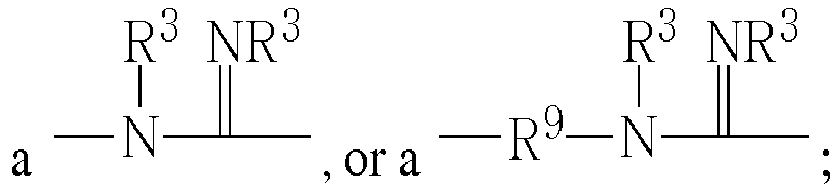
- R9 is C2 to C12 alkylene or C5-C12 (hetero)arylene,
- each R3 is independently H, -OH, C1-C12 alkyl, or C5-C12 (hetero)aryl, preferably H or C1-C4 alkyl,
- R4 is H, C1-C12 alkyl, C5-C12 (hetero)aryl, or -N(R3)2, preferably H, or C1-C4 alkyl.
- More particularly, the pendent ligand groups will be of the formula:

- R9 is C2 to C12 alkylene or C5-C12 (hetero)arylene,
- each R3 is independently H, -OH, C1-C12 alkyl, or C5-C12 (hetero)aryl, preferably H or C1-C4 alkyl,
- R4 is H, C1-C12 alkyl, C5-C12 (hetero)aryl, or -N(R3)2, preferably H, or C1-C4 alkyl.
- The reaction may be illustrated as follows:
-(MCO)w-(MHydrophil)x-(Mhydrophob)z-→-(MLig)y-(MHydrophil)x--(Mhydrophob)z-(MCO)w*-,
where - -(MCO)w are carbonyl functional monomer units having "w" polymerized monomer units,
- -(MHydrophil)x- are hydrophilic monomer units having "x" polymerized monomer units,
- -(Mhydrophob)z- are hydrophobic monomer units having "z" polymerized monomer units (MLig)y are ligand functional monomer units having "y" polymerized monomer units, where y is less than or equal to w; i.e. all or a portion of the carbonyl groups are functionalized by the ligand compound of Formula I. The w, x and z subscripts correspond to the weight ranges of the monomers used: w may comprise 10 to 100 wt.% of the monomer mixture, x may comprise 0 to 90 wt.% of the monomer mixture, and z may comprise 0 to 20 wt. % of the monomer mixture. "y" indicates the number of carbonyl functional groups functionalized with the ligand groups, and w* indicates the number of unfunctionalized carbonyl groups.
- Alternatively to functionalizing the carbonyl functional polymer with a ligand compound of formula I, the ligand functional polymer may be prepared by polymerizing a monomer of the formula:

- R1 is H, C1-C12 alkyl, or C5-C12 (hetero)aryl,
- R2 is a covalent bond, a C2 to C12 alkylene, a C5-C12 (hetero)arylene,

- R9 is C2 to C12 alkylene or C5-C12 (hetero)arylene,
- each R3 is independently H, -OH, C1-C12 alkyl, or C5-C12 (hetero)aryl, preferably H or C1-C4 alkyl,
- R4 is H, C1-C12 alkyl, C5-C12 (hetero)aryl, or -N(R3)2, preferably H, or C1-C4 alkyl.
- X is -O- or -NR3-
- R6 is a C2 to C12 alkylene, and
- R7 is H or CH3.
- The monomer of Formula VI may be copolymerized with the hydrophilic monomers previously described.
- Alternatively, the ligand functional polymer may be prepared by polymerizing a monomer of Formula VII. The monomer of Formula VII may be copolymerized with the hydrophilic monomers previously described.

- R1 is H, C1-C12 alkyl, or C5-C12 (hetero)aryl,
- R2 is a covalent bond, a C2 to C12 alkylene, a C5-C12 (hetero)arylene,

- R9 is C2 to C12 alkylene or C5-C12 (hetero)arylene,
- each R3 is independently H, -OH, C1-C12 alkyl, or C5-C12 (hetero)aryl, preferably H or C1-C4 alkyl,
- R4 is H, C1-C12 alkyl, C5-C12 (hetero)aryl, or -N(R3)2, preferably H, or C1-C4 alkyl, and R7 is H or CH3.
- The disclosure further provides a functionalized substrate comprising a base substrate and a grafted or ungrafted coating of the ligand functionalized polymer thereon. Preferably the base substrate is a porous base substrate having interstitial and outer surfaces.
- The base substrate may be formed from any suitable metallic, thermoplastic, or thermoset material. The material may be an organic or inorganic polymeric material. Suitable organic polymeric materials include, but are not limited to, poly(meth)acrylates, poly(meth)acrylamides, polyolefins, poly(isoprenes), poly(butadienes), fluorinated polymers, chlorinated polymers, polyamides, polyimides, polyethers, poly(ether sulfones), poly(sulfones), poly(vinyl acetates), copolymers of vinyl acetate, such as poly(ethylene)-co-poly(vinyl alcohol), poly(phosphazenes), poly(vinyl esters), poly(vinyl ethers), poly(vinyl alcohols), and poly(carbonates). Suitable inorganic polymeric materials include, but are not limited to, quartz, silica, glass, diatomaceous earth, and ceramic materials.
- Suitable polyolefins include, but are not limited to, poly(ethylene), poly(propylene), poly(1-butene), copolymers of ethylene and propylene, alpha olefin copolymers (such as copolymers of ethylene or propylene with 1-butene, 1-hexene, 1-octene, and 1-decene), poly(ethylene-co-1-butene) and poly(ethylene-co-1-butene-co-1-hexene).
- Suitable fluorinated polymers include, but are not limited to, poly(vinyl fluoride), poly(vinylidene fluoride), copolymers of vinylidene fluoride (such as poly(vinylidene fluoride-co-hexafluoropropylene), and copolymers of chlorotrifluoroethylene (such as poly(ethylene-co-chlorotrifluoroethylene).
- Suitable polyamides include, but are not limited to, poly(iminoadipoyliminohexamethylene), poly(iminoadipoyliminodecamethylene), and polycaprolactam. Suitable polyimides include, but are not limited to, poly(pyromellitimide).
- Suitable poly(ether sulfones) include, but are not limited to, poly(diphenylether sulfone) and poly(diphenylsulfone-co-diphenylene oxide sulfone).
- Suitable copolymers of vinyl acetate include, but are not limited to, poly(ethylene-co-vinyl acetate) and such copolymers in which at least some of the acetate groups have been hydrolyzed to afford various poly(vinyl alcohols).
- The base substrate may be in any form such as particles, fibers, films or sheets. Suitable particles include, but are not limited to, magnetic particles, organic particles, inorganic particles, and porous and nonporous particles. Preferably the base substrate is porous. Suitable porous base substrates include, but are not limited to, porous particles, porous membranes, porous nonwoven webs, and porous fibers.
- In some embodiments, the porous base substrate is formed from propylene homo- or copolymers, most preferably propylene homopolymers. Polypropylene polymers are often a material of choice for porous articles, such as nonwovens and microporous films, due to properties such as non-toxicity, inertness, low cost, and the ease with which it can be extruded, molded, and formed into articles.
- In many embodiments, the porous base substrate has an average pore size that is typically greater than about 0.2 micrometers in order to minimize size exclusion separations, minimize diffusion constraints and maximize surface area and separation based on binding of a target molecule. Generally, the pore size is in the range of 0.1 to 10 micrometers, preferably 0.5 to 3 micrometers and most preferably 0.8 to 2 micrometers when used for binding of viruses. The efficiency of binding other target molecules may confer different optimal ranges.
- Suitable porous base substrates include, but are not limited to, porous and microporous membranes, particles, nonwoven webs, and fibers. In some embodiments, the porous base substrate is a microporous membrane such as a thermally-induced phase separation (TIPS) membrane. TIPS membranes are often prepared by forming a homogenous solution of a thermoplastic material and a second material above the melting point of the thermoplastic material. Upon cooling, the thermoplastic material crystallizes and phase separates from the second material. The crystallized thermoplastic material is often stretched. The second material is optionally removed either before or after stretching. Microporous membrane are further disclosed in
U.S. Patent Nos. 4,539,256 (Shipman ),4,726,989 (Mrozinski ),4,867,881 (Kinzer ),5,120,594 (Mrozinski ),5,260,360 (Mrozinski et al. ), and5,962,544 (Waller ), all of which are assigned to 3M Company (St. Paul, MN). Further, the microporous film can be prepared from ethylene-vinyl alcohol copolymers as described inU.S. Patent No. 5,962,544 (Waller ). - Some exemplary TIPS membranes comprise poly(vinylidene fluoride) (PVDF), polyolefins such as polyethylene homo- or copolymers or polypropylene homo- or copolymers, vinyl-containing polymers or copolymers such as ethylene-vinyl alcohol copolymers and butadiene-containing polymers or copolymers, and acrylate-containing polymers or copolymers. For some applications, a TIPS membrane comprising PVDF is particularly desirable. TIPS membranes comprising PVDF are further described in
U.S. 7,338,692 (Smith et al. ). - In another exemplary embodiment the porous bases substrate comprises a nylon microporous film or sheet, such as those described in
U.S. Patent Nos. 6,056,529 (Meyering et al. ),6,267,916 (Meyering et al. ),6,413,070 (Meyering et al. ),6,776,940 (Meyering et al. ),3,876,738 (Marinacchio et al. ),3,928,517, 4,707,265 (Knight et al. 5,458,782 (Hou et al. ). - In other embodiments, the porous base substrate is a nonwoven web which may include nonwoven webs manufactured by any of the commonly known processes for producing nonwoven webs. As used herein, the term "nonwoven web" refers to a fabric that has a structure of individual fibers or filaments which are randomly and/or unidirectionally interlaid in a mat-like fashion.
- For example, the fibrous nonwoven web can be made by wet laid, carded, air laid, spunlaced, spunbonding or melt-blowing techniques or combinations thereof. Spunbonded fibers are typically small diameter fibers that are formed by extruding molten thermoplastic polymer as filaments from a plurality of fine, usually circular capillaries of a spinneret with the diameter of the extruded fibers being rapidly reduced. Meltblown fibers are typically formed by extruding the molten thermoplastic material through a plurality of fine, usually circular, die capillaries as molten threads or filaments into a high velocity, usually heated gas (e.g. air) stream which attenuates the filaments of molten thermoplastic material to reduce their diameter. Thereafter, the meltblown fibers are carried by the high velocity gas stream and are deposited on a collecting surface to from a web of randomly disbursed meltblown fibers. Any of the non-woven webs may be made from a single type of fiber or two or more fibers that differ in the type of thermoplastic polymer and/or thickness.
- Further details on the manufacturing method of non-woven webs of this invention may be found in Wente, Superfine Thermoplastic Fibers, 48 INDUS. ENG. CHEM. 1342(1956), or in Wente et al., Manufacture Of Superfine Organic Fibers, (Naval Research Laboratories Report No. 4364, 1954).
- In one embodiment the base substrate may have a coating of the ligand functional (co)polymer on a surface thereon. Useful coating techniques include applying a solution or dispersion of the (co)polymer, optionally including a crosslinker, onto the base substrate. Polymer application is generally followed by evaporating the solvent to form the polymer coating. Coating methods include the techniques commonly known as dip, spray, knife, bar, slot, slide, die, roll, or gravure coating. Coating quality generally depends on mixture uniformity, the quality of the deposited liquid layer, and the process used to dry or cure the liquid layer.
- In some embodiments, the carbonyl functional (co)polymer is first coated on the base substrate and subsequently reacted with the ligand compound of Formula I. Useful crosslinkers for the coating operation in these instances include carbonyl reactive compounds such as polyamines, polyhydrazines, and polyhydrazides.
- In other embodiments, the ligand functional (co)polymer itself is coated on the base substrate. Useful crosslinkers in these instances include amine reactive compounds such as bis- and polyepoxides, polycarboxylic acids and their derivatives (e.g., acid chlorides), polyisocyanates, and formaldehyde-based crosslinkers such as hydroxymethyl and alkoxymethyl functional crosslinkers, such as those dervided from urea or melamine.
- In other embodiments, the ligand functional copolymer is coated on the base substrate by polyelectrolyte layer-by-layer coating techniques, such as those described in
EP 472,990 - In another embodiment, the ligand-functional polymer may be grafted to the surface of the base substrate; i.e. a covalent bond is formed between the ligand functional polymer and the polymer base substrate. The covalent bond may be formed by displacement, condensation or free radical methods. The nature of the grafting depends on the type of polymer used for the base substrate.
- In some embodiments, the base polymer has carbonyl-reactive functional groups, such as amines on the surface thereof. These surface functional groups may react with extant carbonyl functional groups on the ligand functional polymer. In another embodiment, the surface of the substrate may be provided with amine-reactive functional groups, such as halide, epoxy, ester, isocyanate groups, that can react with the guanidino groups of the ligand functionalized polymer.
- In some embodiments the polymer may be grafted to the surface of a substrate by ionizing radiation-initiated graft polymerization of a monomer such as those of Formulas VI or VII, optionally with other hydrophilic or hydrophobic monomers previously described. Alternatively, a carbonyl functional monomer may be grafted to the surface of a substrate by ionizing radiation-initiated graft polymerization, followed by functionalization by reaction with a ligand compound of Formula I.
- In some embodiments, the surface of the substrate may be free radically functionalized with a grafting monomer having a free-radically polymerizable group and a second functional group reactive with the ligand functional polymer. Such monomers may include isocyanatoethyl (meth)acrylate or glycidyl (meth)acrylate.
- The grafting monomers can graft (i.e. forming a covalent bond) to the surface of the base substrate when exposed to an ionizing radiation preferably e-beam or gamma radiation. That is, reaction of (meth)acryloyl groups of the grafting monomers with the surface of the porous base substrate in the presence of the ionizing radiation results in the reaction of ethylenically unsaturated free-radically polymerizable groups being directly grafted to the base substrate via the acrylate group, and further provides the surface of the substrate with a reactive functional groups that may be subsequently reacted with the ligand functional polymer.
- The methods of the present disclosure involve the irradiation of porous or nonporous substrate surfaces with ionizing radiation to prepare free radical reaction sites on such surfaces upon which the functional monomers are grafted. The functional groups of the functional monomers then allow the ligand functional polymer to be grafted to the surface of the substrate. "Ionizing radiation" means radiation of a sufficient dosage and energy to cause the formation of free radical reaction sites on the surface(s) of the base substrate. Ionizing radiation may include beta, gamma, electron-beam, x-ray and other electromagnetic radiation. In some instances, corona radiation can be sufficiently high energy radiation. The radiation is sufficiently high energy, that when absorbed by the surfaces of the base substrate, sufficient energy is transferred to that support to result in the cleavage of chemical bonds in that support and the resultant formation of a free radical site on the support.
- The method of grafting (or coating) a ligand functionalized polymer to the surface of the substrate alters the original nature of the base substrate, as the substrate bears a grafted or ungrafted coating of the ligand functional polymer. The present invention enables the formation of ligand functionalized polymer substrates having many of the advantages of a base substrate (e.g., mechanical and thermal stability, porosity), but with enhanced affinity for biological species such as viruses, resulting from the monomers and steps used to form a given functionalized substrate.
- The porous substrates having a coating of ligand-functionalized polymer are particularly suited as filter media, for the selective binding and removal of contaminating proteins, cells, cell debris, microbes, nucleic acids, and/or viruses from biological samples. The present disclosure further provides a method for the removal of target biological species from a biological sample by contacting the sample with the ligand polymer functionalized substrate as described herein.
- The ligand functionalized (co)polymer (either the polymer per se, or a substrate having a coating thereof) is useful for the purification of biological or other fluid samples comprising biologically derived species (biological species). Biological species include, but are not limited to, cells, cell debris, proteins, nucleic acids, endotoxins, and viruses. Cells and cell debris include those derived from archaea, bacteria, and eucaryota. Bacteria include, but are not limited to, Gram-negatives such as Pseudomonas species, Escherichia coli, Helicobacter pylori, and Serratia marcesens; Gram-positives such as Staphylococcus species, Enterococcus species, Clostridium species, Bacillus species, and Lactobacillus species; bacteria that do not stain traditionally by Gram's method such as Mycobacterium species, and non-vegetative forms of bacteria such as spores. Eucaryota include, but are not limited to, animal cells, algae, hybridoma cells, stem cells, cancer cells, plant cells, fungal hyphae, fungal spores, yeast cells, parasites, parasitic oocysts, insect cells, and helminthes. Proteins, include, but are not limited to, natural proteins, recombinant proteins, enzymes, and host cell proteins. Viruses include, but are not limited to, enveloped species such as Herpesviruses, Poxviruses, Adenoviruses, Papovaviruses, Coronaviruses, retroviruses such as HIV, and Plasmaviridae; and non-enveloped species such as Caliciviridae, Corticoviridae, Myoviridae, and Picornaviridae.
- In some embodiments, the biological species being removed from the fluid is the object of the purification. For example, a recombinant protein or enzyme may be prepared in cell culture, the (co)polymer can be added to flocculate the protein or enzyme, and the precipitate can be separated as the first step in the purification process for the protein or enzyme. In another example, the (co)polymer or a substrate with a coating thereof, may be used to capture microorganisms from a fluid as the first step in a process of concentrating, enumerating, and/or identifying the microorganisms.
- In other embodiments, the biological species being removed from the fluid is a contaminant that must be removed prior to additional processing steps for the fluid. The polymer can be used as a flocculant to facilitate the removal of cells and cell debris from a cell culture or fermentation broth prior to, subsequent to, or in place of a centrifuge or depth filtration operation. For example, the (co)polymer can be used to flocculate cells in a cell culture broth prior to centrifugation, and thereby improve the efficiency with which the centrifugation process separates the cell mass from the liquid centrate. Alternatively, it can be added to the liquid centrate after a centrifugation step to flocculate suspended cell debris and dissolved host cell proteins and nucleic acids, thereby increasing the efficiency of a subsequent depth filtration step. It can be used to flocculate or precipitate suspended bacteria, viruses, or other microorganisms. It can be used to precipitate either desired or contaminating proteins or nucleic acids from solution. Significantly, the ligand functional (co)polymers, or substrates having a coating thereof, are useful under conditions of high salt concentration or high ionic strength , i.e., they are "salt tolerant". The term "salt" is meant to include all low molecular weight ionic species which contribute to the conductivity of the solution. The importance of utility of the ligand functional (co)polymers in the presence of salt is that many process solutions used in biopharmaceutical or enzyme manufacture have conductivities in the range of 15-30 mS/cm (approximately 150-300 mM salt) or more. Salt tolerance can be measured in comparison to that of the conventional quaternary amine or Q ligand (e.g. trimethylammonium ligand), whose primarily electrostatic interactions with many biological species rapidly deteriorates at conductivities three- to six-fold less than the target range. For example, membranes derivatized with the conventional Q ligand exhibit a drop in ϕX174 viral clearance from a six log-reduction value (LRV) to a one (1) LRV in going from 0 to 50 mM NaCl (ca. 5-6 mS/cm conductivity). Viruses such as ϕX174 which have pIs close to 7 (are neutral or near-neutral) are extremely difficult to remove from process streams. Similar problems are observed when attempting to remove other biological species from process fluids. For example, when attempting to remove positively charged proteins such as host cell proteins through the use of filtration devices functionalized with conventional Q ligands, the process fluid may have to be diluted two-fold or more in order to reduce the conductivity to an acceptable range. This is expensive and dramatically increases the overall processing time.
- When used as a flocculant, the amount of ligand functional (co)polymer that is added relative to the amount of sample can vary over a wide range. Generally, the amount added will produce a final concentration of (co)polymer in the mixture of from about 0.01 micrograms/mL to about 5000 micrograms/mL. The optimal amount of (co)polymer added will depend upon the concentration of the species one desires to flocculate. Typically, the amount of polymer relative to the amount of species being flocculated will be in the range of 0.01% to 100% by weight, preferably 0.05%-30% by weight, more preferably about 0.1%-10% by weight. The optimal amount is readily assessed by challenging the sample with a series of polymer concentrations as is well known in the art. While the above concentration ranges are typical, one skilled in the art will realize that other ranges may work in some instances. Flocculation efficiency also depends upon the physical and chemical characteristics of the species being flocculated. For example, we have found that optimal flocculation of the near neutral virus ϕX174 from aqueous suspension occurs at a polymer to virus weight ratio of about 800-1000%.
- The biological sample is contacted with the ligand functionalized polymer (either the polymer per se, or a substrate having a coating thereof) for a time sufficient to interact and form a complex with the target biological species disposed (dissolved or suspended) in the solution when the solution comprises from 0 to about 50 mM salt, preferably when the solution comprises from 0 to about 150 mM salt, more preferably when the solution comprises from 0 to about 300 mM salt or higher, such that the concentration of the target biological species remaining disposed in the solution is less than 50% of its original concentration. It is more preferred that the solution is contacted with the ligand functionalized polymer for a time sufficient to interact and form a complex with the target biological species disposed in the solution when the solution comprises from 0 to about 50 mM salt, preferably when the solution comprises from 0 to about 150 mM salt, more preferably when the solution comprises from 0 to about 300 mM salt or higher, such that the concentration of the target biological species remaining disposed in the solution is less than 10% of its original concentration. It is still more preferred that the solution is contacted with the ligand functionalized polymer for a time sufficient to interact and form a complex with the target biological species disposed in the solution when the solution comprises from 0 to about 50 mM salt, preferably when the solution comprises from 0 to about 150 mM salt, more preferably when the solution comprises from 0 to about 300 mM salt or higher, such that the concentration of the target biological species remaining disposed in the solution is less than 1% of its original concentration.
- In many embodiments the ligand functionalized (co)polymer, being positively charged in aqueous media, will bind near neutral or negatively charged species to the ligand functional group of Formula II while other species (e.g., positively charged proteins such as monoclonal antibodies) will be excluded or repelled from the ligand functionalized substrate. In addition, as previously described, the substrate may be directly or indirectly grafted with one or more ionic monomers. In particular, the ligand functionalized polymer may comprise grafted ionic groups that are positively charged at the selected pH of the biological sample solution to enhance electrostatic charge repulsion of proteins, such as monoclonal antibodies, many of which are charged positive at neutral pH, and ligand functional groups of Formula II to provide salt tolerance.
- In some embodiments the ligand functionalized polymer and coated substrate containing the bound biological species are disposable. In such embodiments, the binding of the biological species to the ligand functionalized polymer is preferably essentially irreversible because there is no need to recover the bound biological species. Nonetheless, if desired, one can reverse the binding of biological species by increasing the ionic strength or changing the pH of an eluting solution.
- The substrate, having a grafted or ungrafted coating of the ligand functionalized polymer may be any previously described, but is preferably a microporous membrane. The membrane pore size desired is from 0.1 to 10 µm, preferably 0.5 to 3 micrometers and most preferably 0.8 to 2 micrometers. A membrane with a high surface area for the internal pore structure is desired, which typically corresponds to fine pore sizes. However, if the pore size is too small, then the membrane tends to plug with fine particulates present in the sample solution.
- If desired, efficiency of binding and capture may be improved by using a plurality of stacked, ligand functionalized polymer coated porous membranes as a filter element. Thus the present disclosure provides a filter element comprising one or more layers of the porous, ligand functionalized polymer coated substrate. The individual layers may be the same or different, and may have layers of different porosity, and degree of grafting by the aforementioned grafting monomers. The filter element may further comprise an upstream prefilter layer and downstream support layer. The individual filter elements may be planar or pleated as desired.
- Examples of suitable prefilter and support layer materials include any suitable porous membranes of polypropylene, polyester, polyamide, resin-bonded or binder-free fibers (e.g., glass fibers), and other synthetics (woven and non-woven fleece structures); sintered materials such as polyolefins, metals, and ceramics; yarns; special filter papers (e.g., mixtures of fibers, cellulose, polyolefins, and binders); polymer membranes; and others.
- In another embodiment, there is provided a filter cartridge including the above-described filter element. In yet another embodiment, there is provided a filter assembly comprising the filter elements and a filter housing. In a further embodiment, this invention relates to a method of capture or removal of a target biological species comprising the steps of:
- a) providing the filter element comprising one of more layers of the ligand functionalized base substrate of this disclosure, and
- b) allowing a moving biological solution containing a target biological species to impinge upon the upstream surface of the filter element for a time sufficient to effect binding of a target biological species.
- The present invention is described above and further illustrated below by way of examples, which are not to be construed in any way as imposing limitations upon the scope of the invention. On the contrary, it is to be clearly understood that resort may be had to various other embodiments, modifications, and equivalents thereof which, after reading the description herein, may suggest themselves to those skilled in the art without departing from the spirit of the present invention and/or the scope of the appended claims.
- Diacetone acrylamide (40 grams), ethanol (60 grams) and VAZO 67 (0.2 gram) were charged to an 8 ounce glass bottle. The mixture was purged with a slow stream of nitrogen gas for 5 minutes, sealed, and then tumbled in a water bath equilibrated to 55°C for 24 hours to convert the monomer to polymer. A portion of this polymer solution (4.07 grams) was diluted with methanol (16.48 grams) and mixed with aminoguanidine hydrochloride (1.08 grams, TCI America, Portland, OR). Trifluoroacetic acid (4 drops) was added as catalyst, and the solution was mixed for 2 hours at ambient temperature. IR and 1H-NMR analyses confirmed the formation of poly(diacetoneacrylamide guanylhydrazone) (polymer 1).
- By similar procedures, polymers 2-5 were prepared by converting 20, 40, 60, and 80% of the repeat units to guanylhydrazone functionality.
- Copolymers of dimethylacrylamide and diacetoneacrylamide were prepared in methanol solution by the procedure described in Example 1. The copolymers, containing 20, 40, 60, 80 and 0% by weight dimethylacrylamide, were reacted with aminoguanidine by the procedure described in Example 1 except that concentrated hydrochloric acid was used as catalyst instead of trifluoroacetic acid, to produce the corresponding guanylhydrazone copolymers 6-10.
- Guanylhydrazone polymers 1-5 were assayed for BSA precipitation according to the following procedure. Results are shown in
Figure 1 . - A solution of bovine serum albumin (BSA, Sigma-Aldrich) was prepared in 10 mM MOPS buffer (4-moipholinepropanesulfonic acid), pH 7.5, and determined to have a concentration of BSA of 4.0 mg/mL. A series of BSA solutions were prepared containing various concentrations of sodium chloride according to the following Table 1:
Table 1 [NaCl] BSA solution 5M NaCl MOPS buffer (mM, final) (mL) (µL) (µL) 0 10 0 500 50 10 100 400 100 10 200 300 150 10 300 200 200 10 400 100 250 10 500 0 - Solutions of the polymers from Examples 1-5 were diluted with deionized water to 1% solids by weight and adjusted to pH 7.
- A 5 mL polypropylene centrifuge tube was charged with 2.0 mL of BSA solution, followed by 125 µL of diluted polymer solution. The centrifuge tube was sealed and tumbled end over end for 30 minutes, then centrifuged at 2000 rcf for 10 minutes. A BSA standard solution was prepared by mixing 2 mL of original BSA solution with 125 µL of MOPS buffer. A serial 1:1 dilution was performed to provide a total of 7 BSA standards. These seven standards were pipetted (200 µL) in triplicate into wells of a 96-well microtitration plate, along with triplicate samples of the supernates from each polymeric flocculant being evaluated. Three wells containing DI water as a blank were also included. The plate was analyzed using a
SpectraMAX 250 Microplate Spectrophotometer System (Molecular Devices Corp, Sunnyvale, CA) using a wavelength of 293 nm. Comparison of the absorptions of the flocculant solutions to those of the standards provided a measure of the percentage of BSA precipitated. - MAPTAC (160 grams of a 50% by weight solution in water, from Aldrich, Milwaukee, WI), ethanol (40 grams) and sodium persulfate (0.4 gram) were charged to a 16 ounce glass bottle. The mixture was purged with a slow stream of nitrogen gas for 10 minutes, sealed, and then tumbled in a water bath equilibrated to 55°C for 24 hours to convert the monomer to polymer. This polymer solution was diluted with deionized water (80 grams) and ethanol (40 grams) and mixed well. A sample for evaluation as a flocculant was prepared by dilution of a portion of this polymer to 1% solids by weight with deionized water, pH 7. A BSA precipitation test was conducted as described in Example 11, and the pMAPTAC was found to be a good flocculator at 0 mM NaCl, but it left 42%, 73%, and 100% of the BSA in solution at 50 mM, 100 mM, and 150 mM NaCl, respectively.
- Aqueous suspensions of ϕX174 bacteriophage (ca. 109 pfu/mL) were prepared in 10 mM TRIS((hydroxymethyl)aminomethane) pH 8.0 containing 0, 50 mM, and 150 mM NaCl. Aqueous solutions of flocculator polymers were prepared in DI water, pH 7, at 0.001% polymer by weight. 16 µL of polymer solution were added to a 2mL sample of bacteriophage suspension in a centrifuge tube. The tube was sealed, vortexed, and rotated end-over-end for 2 hours. The tubes were then centrifuged at 3000 rcf for 10 minutes, and the resultant suspensions were filtered through a 0.45 micron sterile syringe filter (GHP Acrodisc, Pall Life Sciences). A 10-fold dilution series was prepared.
- One mL of each dilution was mixed with 1 mL E. coli culture (grown to an optical density of 0.3-0.6 when measured at 550 nm). After waiting 5 minutes, a sterile pipet was used to mix 4.5 mL TSA Top agar with the dilution/E. coli mixture and plated on TSB plates. After the top agar had solidified, the plates were inverted and placed in a 37°C incubator overnight. Plates were then removed from the incubator and ϕX174 plaques were counted and recorded. A dilution series of the original virus suspension was also evaluated in a similar manner. Comparison of the results allowed estimation of the LRV (log reduction in viral load) as a result of the flocculant treatment. Results for several polymers are listed in the following Table 2:
Table 2 Polymer ϕX174 LRV Example 1 (0 NaCl) 4.9 Example 1 (50mM NaCl) 2.5 Example 1 (150mM NaCl) 2.9 Comparative Example 1 (0 NaCl) 6.3 Comparative Example 1 (50mM NaCl) 0.1 Comparative Example 1 (150mM NaCl)
Example 13.0.5 - Poly(vinylmethylketone) (1.0 gram, from Scientific Polymer Products, Ontario, New York) was dissolved in 4 grams of ethyl acetate. To this solution was added methanol (5 grams), aminoguanidine hydrochloride (1.58 grams), and concentrated hydrochloric acid (1 drop). The mixture was mixed for 1 hour, followed by the addition of methanol (5 grams) and deionized water (5 grams) to produce an orange-colored solution. Infrared and NMR analysis confirmed the conversion to the guanylhydrazone polymer. The polymer was diluted to 1% solids by weight with deionized water, pH 7. for evaluation as a BSA precipitant. This polymer showed >50% BSA precipitation up to 250 mM NaCl concentration.
- To a 1 liter, 3-necked round bottom flask equipped with an overhead stirrer, condenser, heating mantle, thermocouple, and nitrogen inlet was charged DADMAC (105.6 grams of a 65% solids aqueous solution, from Aldrich, Milwaukee, WI), tetrasodium ethylenediaminetetraacetic acid (6 µL of a 20% solution by weight in deionized water), deionized water (121.8 grams), and 2,2'-azobis(2-amidinopropane) dihydrochloride (1.74 grams). Stirring was begun and the mixture purged with a slow stream of nitrogen gas for 15 minutes. The temperature of the stirring mixture was then slowly raised to 60°C over one hour, then maintained at that temperature for an additional 24 hours. NMR analysis confirmed the formation of the expected polymer.
- Copolymers of DADMAC with diacetoneacrylamide by procedures similar to that described in Comparative Example 2. The copolymers, containing 20, 40, and 80% by weight diacetoneacrylamide, were reacted with aminoguanidine by the procedure described in Example 1, to produce the corresponding 20, 40, and 80% guanylhydrazone copolymers 14-16, respectively. Solutions of these copolymers and of pDADMAC were prepared at 1% by weight in deionized water (pH 7) and evaluated in the BSA precipitation test. These flocculants displayed 0%, 30%, 62%, and 92% BSA precipitation at 100 mM NaCl for Comparative Example 2, Ex. 14, Ex. 15, and Ex. 16, respectively.
- A Geobacillus stearothermophilus purified spore suspension was provided by 3M consisting of approximately 1.4% by weight cell debris and spores. Test samples of broth containing 0, 100, 200, and 300 mM NaCl were prepared by a procedure similar to that described in Example 11. Solutions of polymers were prepared at 1.0% solids in DI water, pH 7, from the modified polymers of Examples 1, 6, and 8. A 1:4dilution series of each of these polymers was prepared to provide a total of 6 polymer concentrations. Then 2 mL of broth sample was mixed with 0.5 mL of polymer solution, and the mixture was tumbled for 30 minutes, then centrifuged at 200 rcf for 5 minutes. Standards were prepared by mixing 2 mL of broth with 0.5 mL of DI water, carrying the mixture through the same mixing/centrifugation procedure, then preparing a 2-fold serial dilution (6 samples) from the supernate. Supernatants from the test solutions and from the standards were pipetted into a 96-well microtitration plate and assayed by absorbance measurement at 650 nm. Comparison of the absorptions of the flocculant solutions to those of the standards provided a measure of the flocculation efficiencies. Results are presented in the following Table 3:
Table 3 % Turbidity Removed Polymer (w/v %) (µg/ml) 0 mM NaCl 100 mM NaCl 200 mM NaCl 300 mM NaCl Example 1 0.2 2000 54.7 95.9 98.9 98.7 " 0.05 500 99.5 97.8 98.1 98.6 " 0.0125 125 95.7 97.0 95.0 92.1 " 0.003125 31.25 82.2 83.9 81.5 78.6 " 0.000781 7.81 76.6 73.5 71.5 68.0 " 0.000195 1.95 34 22.4 17.9 15.3 Example 6 0.2 2000 0.0 0.0 0.0 0.0 " 0.05 500 101.3 45.5 21.9 24.8 " 0.0125 125 96.8 97.7 97.8 98.5 " 0.003125 31.25 83.5 82.1 81.6 78.5 " 0.000781 7.81 70.9 76.5 66.4 52.2 " 0.000195 1.95 25.8 28 24.4 17.5 Example 8 0.2 2000 0.0 0.0 0.0 0.0 " 0.05 500 53.4 42.2 9.8 10.5 " 0.0125 125 90.0 74.2 14.6 37.9 " 0.003125 31.25 98.6 88.5 58.7 55.1 " 0.000781 7.81 80.0 75.1 67.7 56.3 " 0.000195 1.95 70.4 68.2 64.5 40.8 - A 20:80 w/w copolymer of N,N-dimethylaminopropylacrylamide (DMAPAm) and diacetoneacrylamide (Comparative Example 3) was prepared in methanol solution by the procedure described in Example 1.
- A sample of this polymer solution was diluted to 20% solids by adding more methanol, and enough butyl bromide was added to alkylate 50% of the DMAPAm units of the copolymer (Comparative Example 4).
- Samples of Comparative Example 3 polymer solution were reacted with aminoguanidine hydrochloride by a procedure similar to that of Example 6 to produce copolymers in which 50% and 100% of the diacetoneacrylamide units were converted to guanylhydrazone units, respectively (Examples 18 and 19).
- A sample of Comparative Example 4 was reacted with aminoguanidine hydrochloride by a procedure similar to that of Example 6 to convert all of the diacetoneacrylamide units to guanylhydrazone units (Example 20).
- Samples of each of the above examples were diluted to 1% solids with deionized water, adjusted to pH 7, and evaluated for BSA precipitation (Table 4)
Table 4 [NaCl] % BSA Precipitated (mM) Comp. 3 Comp. 4 Ex. 18 Ex. 19 Ex.20 50 0 0 62 89 93 150 0 0 28 47 86 250 0 1 14 18 75 - Similar copolymers were prepared by alkylation with dimethylsulfate, benzyl bromide and dodecylbromide, respectively, followed by conversion of the keto groups to guanylhydrazones. When tested for BSA precipitation, a synergistic effect was again observed for alkylation plus guanylation.
- A 50:50 w/w copolymer of DADMAC with diacetoneacrylamide was prepared by a procedure similar to that described in Comparative Example 2. A solution of this copolymer in methanol (1.32 grams of 30% solids solution) was diluted to 2% solids with deionized water, mixed with diaminoguanidine hydrochloride (74 milligrams) and concentrated hydrochloric acid (1 drop), and allowed to react at room temperature overnight to form the bis-guanylhydrazone copolymer. The solution was adjusted to pH 7 and diluted to 1% solids with DI water. This polymer exhibited good flocculation of BSA in solutions containing up to 250 mM sodium chloride.
- Diacetoneacrylamide (33.8 grams), methanol (400 mL), and aminoguanidine hydrochloride (22.1 grams) were placed in a 1 L round bottom flask and stirred magnetically until a homogeneous solution had formed. Trifluoroacetic acid (0.5 mL) was added and the mixture was stirred overnight at ambient temperature. The reaction mixture was concentrated on a rotary evaporator to produce a light yellow oil which crystallized on standing. Diethyl ether (250 mL) was added and the crystalline mass was broken up, filtered, washed with additional ether, and dried under vacuum for 3 hours to give the corresponding guanylhydrazone hydrochloride monomer (53.5 grams, 95.7% yield). This monomer (10 grams) was mixed with deionized water (23 grams), methanol (7 grams), and 2,2'-azobis(2-imidazolin-2-yl)propane (0.2 grams, from WAKO, Osaka, Japan). The mixture was purged with nitrogen gas for 15 minutes, then polymerized at 60°C for 24 hours as described in Example 1. This polymer displayed flocculation properties identical to those of Example 1.
- A polypropylene spun bond/melt blown/spun bond (SMS) nonwoven (50 gsm basis weight) was coated with the polymer of Example 1 in a layer-by-layer process. Three coating baths were prepared:
Coating Bath #1: 1% wt/wt polyethylenimine (70,000 Mn) in isopropyl alcohol; Coating Bath #2: 0.5% wt/wt poly(2-acrylamido-2-methyl-1-propanesulfonic acid, sodium salt) in deionized water; Coating Bath #3: 1% wt/wt polymer of Example 1 in deionized water. - Aminosilane coated glass microscope slides (obtained from Newcomer Supply, Middleton,WI) were dip coated, in sequence, with
coating solution # 2 from Example 23, rinsed with deionized water,coating solution # 3 from Example 23, rinsed with deionized water, and dried at room temperature. The coated slides could then be used to capture bacteria or spores from aqueous media for enumeration or for identification. A control aminosilane slide coated with onlycoating solution # 2 was found to bind almost no bacteria or spores. - A diacetoneacrylamide solution was prepared at 10% by weight in isopropanol. Several sheet substrates (ca. 4 inches by 6 inches), both membrane and non-woven, as listed in the table below, were placed in polyethylene bags (Ziploc ™, S C Johnson, Racine, WI). Using a disposable pipette, the substrates were completely wetted with the diacetoneacrylamide solution. The excess solution was removed by zipping the bags shut and running over the bags with a rubber roller. The pooled excess solutions were removed with a paper towel. The bags were then vacuum-packed into Foodsaver ™ bags. The bags were deliberately not purged of oxygen so as to minimize solvent evaporation. The samples were placed in an aluminum tote and exposed for 1 hour to Co-60 y radiation. The dose exposure corresponded to 5 kGy. The samples were taken out of the bags and washed with copious amounts of water to remove any traces of homopolymer. The completely washed samples were then air dried.
- The diacetoneacrylamide grafted membranes were then converted to guanylhydrazone functional membranes. An aminoguanidine solution was prepared by dissolving 65 grams in 1 liter of methanol, and adding trifluoroacetic acid (2.25 mL). Each membrane was placed in a 500 mL polyethylene bottle, 100 mL of the aminoguanidine solution was added, the bottles were sealed, and the mixtures were placed on a roller at room temperature overnight. Excess solution was removed, and the membranes were washed extensively with deionized water and dried.
- 24 mm disks were punched out of the sheets and placed in a centrifuge tube. Bovine serum albumin solution (BSA, Sigma Aldrich) was prepared to a concentration of 0.75 mg/ml in 25 mM TRIS buffer, pH 8.0 (tris(hydroxymethyl)aminomethane, Sigma). 4.5 ml of the BSA solution was pipetted into each centrifuge tube, the tubes were capped, and the tubes were tumbled overnight. The supernatant solutions were analyzed by a UV-VIS spectrometer at 279 nm with background correction applied at 325 nm. Static binding capacities for the samples were found to be between 1 and 4 mg/mL. Analyses of the ungrafted substrates displayed binding capacities of < 0.2 mg/mL.
Table Substrate Example 25 Polyvinylidene fluoride membrane, 2 µm nominal pore size Example 26 Nylon 6 melt-blown non-woven web Example 27 Nylon 66 membrane, single reinforced layer nylon three zone membrane, nominal pore size 1.8 µm Example 28 Polypropylene non-woven web, sold as 3M Doodleduster™ cloth - A 60 gsm nylon 6 meltblown nonwoven substrate with a 4.3 um effective fiber diameter and sample size of about 30 cm X 43 cm (1290 cm2 or 200 square inches) was purged of air and inserted into Ziploc bags in a glove box under nitrogen atmosphere (less than 20 ppm oxygen) and sealed. The Ziploc bag was then removed from the glove box, and irradiated to a dose level of 60 kGy (kilogray) by passing it through the electron beam. The bag was returned to the N2 atmosphere-controlled glove box.
- The Ziplock bag was opened and the nonwoven substrate was imbibed by pouring 150 grams of a nitrogen purged imbibing solution comprising; 17% diacetone acrylamide monomer, 10% polyethylene glycol with hydroxy end groups, average molecular weight 4,600 g/mole (PEG 4600), 1.0% Sartomer SR-550 PEG-acrylate and 72% water by weight inside the Ziploc bag with the nonwoven substrate. The nonwoven is kept flat and is completely and evenly saturated with a slight excess of grafting solution. The Ziploc bag is sealed. The Ziploc bag remains inside of the nitrogen filled glove box to allow sufficient time for all of the grafting monomer to graft-polymerize by free radical reaction with the nonwoven substrate. After a minimum of 6 hrs or as long as about 18 hrs (overnight), the grafted nylon nonwoven sample was removed from the glovebox and the Ziploc bag and the grafted nonwoven was washed three times by soaking in 2 liters of fresh DI water (to remove the PEG and any unreacted monomer) and then air dried to ambient conditions.
- A solution of aminoguanidine (92 grams) and concentrated hydrochloric acid (3.45 mL) in deionized water (1500 mL total solution volume) was prepared. A sheet of the grafted nonwoven (ca. 12 cm x 40 cm) was placed in a 1 gallon plastic jar. A portion (500 mL) of aminoguanidine solution was added to the jar, which was then sealed and placed on a roller for overnight reaction at room temperature. The excess aminoguanidine solution was decanted, the derivatized nonwoven sheet was rinsed under a stream or deionized water for 15 minutes, and the sheet then allowed to air dry at room temperature. A 24 mm diameter disk was cut from the coated web. This disk was placed in a 5 mL centrifuge tube, 4.5 mL of a Bovine serum albumin (BSA) solution (ca. 3 mg/mL in 25 mM TRIS, pH 8.0) was added, and the mixture tumbled at room temperature overnight. The UV absorbance of the supernatant solution was measured at 279 nm and compared to the absorbance prior to contact with the disk to determine the static binding capacity for BSA. The functionalized nonwoven was found to absorb 152 mg of BSA per gram of web.
- Using standard microbiological procedures, cultures of the following were prepared:
- a) Bacillus atrophaeous (spores and cell debris)
- b) Clostridium sporogenes (spores)
- c) Escherichia coli (cells and cell debris)
- d) Chinese hamster ovary (CHO) cells
- e) Baker's yeast
- When flocculation experiments were conducted similarly to those described in Example 17 on these mixtures, the ligand functional polymers of the invention consistently displayed good flocculating ability in the presence of sodium chloride concentrations in excess of 50 mM.
- Aminoguanidine hydrochloride (1.11 grams), methanol (15 grams), and acetoacetoxyethyl methacrylate (2.2 grams) were stirred at room temperature and monitored periodically by NMR. After stirring for 21 hours, NMR confirmed complete conversion of the methacrylate monomer to the corresponding guanylhydrazone hydrochloride
-
- 1. A ligand-functionalized polymer comprising a carbonyl-functional (co)polymer functionalized with pendent guanidinyl groups.
- 2. The ligand-functionalized polymer of
embodiment 1 wherein the pendent guanidinyl groups are of the formula:
- R1 is H , C1-C12 alkyl, or C5-C12 (hetero)aryl,
- R2 is a covalent bond, a C2 to C12 alkylene, or a C5-C12 (hetero)arylene,

- R9 is C2 to C12 alkylene or C5-C12 (hetero)arylene,
- each R3 is independently H, -OH, C1-C12 alkyl, or C5-C12 (hetero)aryl,
- each R4 is H, C1-C12 alkyl, C5-C12 (hetero)aryl, or -N(R3)2.
- 3. The ligand-functionalized polymer of
embodiment 1 wherein the pendent guanidinyl groups are of the formula: wherein
- R1 is H , C1-C12 alkyl, or C5-C12 (hetero)aryl,
- R9 is C2 to C12 alkylene or C5-C12 (hetero)arylene,
- each R3 is independently H, -OH, C1-C12 alkyl, or C5-C12 (hetero)aryl,
- each R4 is H, C1-C12 alkyl, C5-C12 (hetero)aryl, or -N(R3)2, preferably H, or C1-C4 alkyl.
- R5 is a divalent alkylene.
- 4. The ligand-functionalized polymer of
embodiment 1 wherein the carbonyl-functional (co)polymer is selected from the group consisting of; acrolein, vinyl methyl ketone, vinyl ethyl ketone, vinyl isobutyl ketone, diacetone (meth)acrylamide, acetonyl acrylate, carbon monoxide copolymer, and diacetone (meth)acrylate (co)polymers. - 5. The ligand-functionalized polymer of
embodiment 2 comprising polymerized monomer units of the formula:
- R1 is H, C1-C12 alkyl, or C5-C12 (hetero)aryl,
- R2 is a covalent bond, a C2 to C12 alkylene, or a C5-C12 (hetero)arylene,

- R9 is C2 to C12 alkylene or C5-C12 (hetero)arylene,
- each R3 is independently H, -OH, C1-C12 alkyl, or C5-C12 (hetero)aryl,
- R4 is H, C1-C12 alkyl, C5-C12 (hetero)aryl, or -N(R3)2,
- X is -O- or -NR3-
- R6 is a C2 to C12 alkylene, and
- R7 is H or CH3.
- 6. The ligand-functionalized polymer of
embodiment 2 comprising polymerized monomer units of the formula:
- R1 is H, C1-C12 alkyl, or C5-C12 (hetero)aryl,
- R2 is a covalent bond, a C2 to C12 alkylene, or a C5-C12 (hetero)arylene,

- R9 is C2 to C12 alkylene or C5-C12 (hetero)arylene,
- each R3 is independently H, C1-C12 alkyl, or C5-C12 (hetero)aryl, preferably H or C1-C4 alkyl,
- R4 is H, C1-C12 alkyl, C5-C12 (hetero)aryl, or -N(R3)2, preferably H, or C1-C4 alkyl, and
- R2 is H or CH3.
- 7. The ligand-functionalized polymer of
embodiment 4 further comprising hydrophilic monomer units. - 8. The ligand-functionalized polymer of
embodiment 2 of the formula:
-(MLig)y-(MHydrophil)x--(Mhydrophob)z-(MCO)w*-,
where- -(MCO)w are carbonyl functional monomer units having "w" polymerized monomer units,
- -(MHydrophil)x- are hydrophilic monomer units having "x" polymerized monomer units,
- -(Mhydrophob)z- are hydrophobic monomer units having "z" polymerized monomer units
- (MLig)y are ligand functional monomer units having "y" polymerized monomer units,
- y is 10 to 100 wt.% of the monomer units;
- x is 0 to 90 wt.% of the monomer units; and
- w* may be comprise 0 to 90 wt.% of the monomer units, and
- z is 0 to 20 wt.%, based on 100wt.% total monomers.
- 9. A polymeric flocculent comprising the ligand-functionalized polymer of
embodiment 1. - 10. A functionalized substrate comprising a base substrate having the ligand-functionalized polymer of
embodiment 1 on a surface thereof. - 11. The functionalized substrate of embodiment 10 wherein the ligand-functionalized polymer is coated on the substrate.
- 12. The functionalized substrate of embodiment 10 wherein the ligand-functionalized polymer is grafted on the substrate.
- 13. The functionalized substrate of embodiment 10 wherein the base substrate is porous.
- 14. The functionalized substrate of embodiment 13 wherein the porous base substrate is a microporous base substrate.
- 15. The functionalized substrate of embodiment 13 wherein the porous base substrate is a nonwoven web.
- 16. A method of separating a biological species from a fluid comprising contacting the fluid with the functionalized substrate of embodiment 10 whereby a complex comprising the functionalized substrate and the biological species is formed, and separating the complex.
- 17. The method of embodiment 16 wherein the biological species are selected from cells, cell debris, viruses, proteins, nucleic acids, and endotoxins.
- 18. The method of embodiment 16 where the functionalized substrate is selected from a particle, a fiber, a film, or a sheet.
- 19. The method of embodiment 16 where the functionalized substrate is a woven or nonwoven web.
- 20. A method of separating a biological species from a fluid comprising: contacting the fluid with the polymer of
embodiment 1 whereby a precipitate or complex comprising the polymer and the biological species is formed, and separating the precipitate or complex. - 21. The method of embodiment 20 wherein the biological species is selected from cells, cell debris, viruses, proteins, nucleic acids, and endotoxins.
- 22. The method of embodiment 21 wherein the cells are selected from archaea, bacteria, and eucaryota.
- 23. The method of embodiment 20 wherein the biological fluid is derived from a cell culture or fermentation process.
- 24. The method of embodiment 20 wherein the fluid comprises a solution of a purified protein or enzyme after separating the precipitate.
- 25. The method of embodiment 20 wherein the separated precipitate comprises a purified protein or enzyme.
- 26. The method of embodiment 20 wherein the fluid has a salt content of at least 50 millimolar.
- 27. The method of embodiment 20 wherein the fluid has a salt content of at least 100 millimolar.
Claims (9)
- A polymeric flocculent comprising ligand-functionalized polymer comprising a carbonyl-functional (co)polymer functionalized with pendent guanidinyl groups.
- The polymeric flocculent of claim 1 wherein the pendent guanidinyl groups are of the formula:
 R1 is H, C1-C12 alkyl, or C5-C12 (hetero)aryl,R2 is a covalent bond, a C2 to C12 alkylene, or a C5-C12 (hetero)arylene,
 R9 is C2 to C12 alkylene or C5-C12 (hetero)arylene,each R3 is independently H, -OH, C1-C12 alkyl, or C5-C12 (hetero)aryl,each R4 is H, C1-C12 alkyl, C5-C12 (hetero)aryl, or -N(R3)2.
 - The polymeric flocculent of claim 1 comprising polymerized monomer units of the formula:
 R1 is H, C1-C12 alkyl, or C5-C12 (hetero)aryl,R2 is a covalent bond, a C2 to C12 alkylene, or a C5-C12 (hetero)arylene,
 R9 is C2 to C12 alkylene or C5-C12 (hetero)arylene,each R3 is independently H, C1-C12 alkyl, or C5-C12 (hetero)aryl, preferably H or C1-C4 alkyl,R4 is H, C1-C12 alkyl, C5-C12 (hetero)aryl, or -N(R3)2, preferably H, or C1-C4 alkyl, andR7 is H or CH3.
 - The polymeric flocculent of claim 1 wherein the carbonyl-functional (co)polymer is selected from the group consisting of acrolein, vinyl methyl ketone, vinyl ethyl ketone, vinyl isobutyl ketone, diacetone (meth)acrylamide, acetonyl acrylate, carbon monoxide copolymer, and diacetone (meth)acrylate (co)polymers.
- The polymeric flocculent of claim 1 of the formula:
-(MLig)y-(MHydrophil)x--(Mhydrophob)z-(MCO)w*-,
where-(MCO)w are carbonyl functional monomer units having "w" polymerized monomer units,-(MHydrophil)x- are hydrophilic monomer units having "x" polymerized monomer units,-(Mhydrophob)z- are hydrophobic monomer units having "z" polymerized monomer units(MLig)y are ligand functional monomer units having "y" polymerized monomer units,y is 10 to 100 wt.% of the monomer units;x is 0 to 90 wt.% of the monomer units; andw* may be comprise 0 to 90 wt.% of the monomer units, andz is 0 to 20 wt.%, based on 100 wt.% total monomers. - A method of separating a biological species from a fluid comprising contacting the fluid with the polymeric flocculent of claim 1 whereby a complex comprising the polymeric flocculent and the biological species is formed, and separating the complex precipitate.
- The method of claim 6 wherein the separated precipitate comprises a purified protein or enzyme.
- The method of claim 6 wherein the biological species are selected from cells, cell debris, viruses, proteins, nucleic acids, and endotoxins.
- The method of claim 6 wherein the fluid has a salt content of at least 50 millimolar.
Applications Claiming Priority (3)
| Application Number | Priority Date | Filing Date | Title |
|---|---|---|---|
| US30574010P | 2010-02-18 | 2010-02-18 | |
| US12/986,485 US8377672B2 (en) | 2010-02-18 | 2011-01-07 | Ligand functionalized polymers |
| EP11705402.3A EP2537028B1 (en) | 2010-02-18 | 2011-02-16 | Ligand functionalized polymers |
Related Parent Applications (1)
| Application Number | Title | Priority Date | Filing Date |
|---|---|---|---|
| EP11705402.3A Division EP2537028B1 (en) | 2010-02-18 | 2011-02-16 | Ligand functionalized polymers |
Publications (2)
| Publication Number | Publication Date |
|---|---|
| EP3070472A1 true EP3070472A1 (en) | 2016-09-21 |
| EP3070472B1 EP3070472B1 (en) | 2018-05-23 |
Family
ID=44369907
Family Applications (2)
| Application Number | Title | Priority Date | Filing Date |
|---|---|---|---|
| EP16166778.7A Active EP3070472B1 (en) | 2010-02-18 | 2011-02-16 | Flocculant composition comprising ligand functionalized polymers |
| EP11705402.3A Active EP2537028B1 (en) | 2010-02-18 | 2011-02-16 | Ligand functionalized polymers |
Family Applications After (1)
| Application Number | Title | Priority Date | Filing Date |
|---|---|---|---|
| EP11705402.3A Active EP2537028B1 (en) | 2010-02-18 | 2011-02-16 | Ligand functionalized polymers |
Country Status (5)
| Country | Link |
|---|---|
| US (3) | US8377672B2 (en) |
| EP (2) | EP3070472B1 (en) |
| KR (1) | KR101808356B1 (en) |
| CN (1) | CN102893152B (en) |
| WO (1) | WO2011103106A1 (en) |
Cited By (1)
| Publication number | Priority date | Publication date | Assignee | Title |
|---|---|---|---|---|
| PL441751A1 (en) * | 2022-07-17 | 2024-01-22 | Uniwersytet Jagielloński | New cationic polymers with selective fungicidal properties |
Families Citing this family (28)
| Publication number | Priority date | Publication date | Assignee | Title |
|---|---|---|---|---|
| JP2011523965A (en) * | 2008-05-30 | 2011-08-25 | スリーエム イノベイティブ プロパティズ カンパニー | Ligand functionalized substrate |
| US8377672B2 (en) * | 2010-02-18 | 2013-02-19 | 3M Innovative Properties Company | Ligand functionalized polymers |
| BR112012021943B1 (en) | 2010-03-03 | 2021-09-28 | 3M Innovative Properties Company | METHOD OF SEPARATION OF A TARGET BIOLOGICAL SPECIES FROM A FLUID |
| US9272246B2 (en) | 2011-03-28 | 2016-03-01 | 3M Innovative Properties Company | Ligand functional substrates |
| US20140155589A1 (en) * | 2011-07-26 | 2014-06-05 | Kurashiki Boseki Kabushiki Kaisha | Inhibitory fiber against virulence factors production and method for producing same |
| WO2013184366A1 (en) | 2012-06-05 | 2013-12-12 | 3M Innovative Properties Company | Graft copolymer functionalized article |
| EP2812091B1 (en) | 2012-09-17 | 2021-03-10 | W.R. Grace & CO. - CONN. | Chromatography media and devices |
| EP2811983B1 (en) * | 2012-09-17 | 2019-05-01 | W.R. Grace & CO. - CONN. | Functionalized particulate support material and methods of making and using the same |
| JP2016503486A (en) | 2012-09-27 | 2016-02-04 | スリーエム イノベイティブ プロパティズ カンパニー | Ligand graft substrate |
| WO2014209798A1 (en) * | 2013-06-28 | 2014-12-31 | 3M Innovative Properties Company | Wipe with a guanidinyl-containing polymer |
| JP6576335B2 (en) * | 2013-10-03 | 2019-09-18 | スリーエム イノベイティブ プロパティズ カンパニー | Ligand functionalized substrate with improved binding capacity |
| ES2887110T3 (en) | 2014-01-16 | 2021-12-21 | Grace W R & Co | Affinity Chromatography Media and Chromatography Devices |
| PL3137209T3 (en) | 2014-05-02 | 2023-01-02 | W.R. Grace & Co. - Conn. | Functionalized support material and methods of making and using functionalized support material |
| US10173973B2 (en) | 2014-06-10 | 2019-01-08 | Mitsubishi Gas Chemical Company, Inc. | Alkylidene aminoguanidine and salt thereof, modifying composition, modified rubber for tire, rubber composition for tire, and tire |
| US10562997B2 (en) | 2015-03-24 | 2020-02-18 | 3M Innovative Properties Company | Method of purifying a biological composition and article therefor |
| KR102566292B1 (en) | 2015-06-05 | 2023-08-10 | 더블유.알. 그레이스 앤드 캄파니-콘. | Adsorbent bioprocessing clarifiers and methods of making and using the same |
| CN105175588B (en) * | 2015-09-16 | 2018-09-18 | 天津科技大学 | A kind of preparation method of polyguanidine base ionic liquid material for phosphoeptide enrichment |
| CN107746446B (en) * | 2016-10-14 | 2021-03-19 | 中国石油大学(华东) | A kind of preparation method of terpolymer amphoteric polyacrylamide |
| CN107746378A (en) * | 2016-10-14 | 2018-03-02 | 中国石油大学(华东) | A kind of polymerizable quaternaries cation monomer and preparation method thereof |
| WO2018128965A1 (en) | 2017-01-04 | 2018-07-12 | 3M Innovative Properties Company | Methods of removing spores |
| EP3565522A4 (en) | 2017-01-04 | 2020-10-21 | 3M Innovative Properties Company | METHOD FOR REMOVING SPORES |
| CN106731005B (en) * | 2017-02-27 | 2018-12-25 | 福州大学 | A kind of organic polymer integral post of specific recognition ochratoxin and preparation method thereof |
| US11421261B2 (en) | 2017-12-19 | 2022-08-23 | 3M Innovative Properties Company | Methods to detect microorganisms |
| JP7126440B2 (en) * | 2017-12-28 | 2022-08-26 | 花王株式会社 | mask |
| US12172153B2 (en) * | 2018-02-27 | 2024-12-24 | Life Technologies Corporation | Flocculant functionalized separation media |
| US12485364B2 (en) | 2018-08-10 | 2025-12-02 | Clemson University Research Foundation | Multi-modal ion-exchange membranes for rapid separations |
| US20240059731A1 (en) * | 2019-11-27 | 2024-02-22 | 3M Innovative Properties Company | Method for Biomaterial Purification and Kits Thereof |
| CN116789897B (en) * | 2023-06-16 | 2025-12-26 | 中国石油化工股份有限公司 | A cement-based self-healing material, its preparation method and application |
Citations (23)
| Publication number | Priority date | Publication date | Assignee | Title |
|---|---|---|---|---|
| US3876738A (en) | 1973-07-18 | 1975-04-08 | Amf Inc | Process for producing microporous films and products |
| US3928517A (en) | 1973-12-26 | 1975-12-23 | Amf Inc | Quench bath regeneration system for microporous film production |
| US4539256A (en) | 1982-09-09 | 1985-09-03 | Minnesota Mining And Manufacturing Co. | Microporous sheet material, method of making and articles made therewith |
| US4707265A (en) | 1981-12-18 | 1987-11-17 | Cuno Incorporated | Reinforced microporous membrane |
| US4726989A (en) | 1986-12-11 | 1988-02-23 | Minnesota Mining And Manufacturing | Microporous materials incorporating a nucleating agent and methods for making same |
| US4867881A (en) | 1987-09-14 | 1989-09-19 | Minnesota Minning And Manufacturing Company | Orientied microporous film |
| EP0472990A2 (en) | 1990-08-25 | 1992-03-04 | Bayer Ag | Mono or multilayer deposits on a substrat and process for making them |
| US5120594A (en) | 1989-11-20 | 1992-06-09 | Minnesota Mining And Manufacturing Company | Microporous polyolefin shaped articles with patterned surface areas of different porosity |
| US5200471A (en) * | 1990-11-05 | 1993-04-06 | Minnesota Mining And Manufacturing Company | Biomolecules covalently immobilized with a high bound specific biological activity and method of preparing same |
| US5260360A (en) | 1991-10-18 | 1993-11-09 | Minnesota Mining And Manufacturing Company | Oil, water and sweat repellent microporous membrane materials |
| US5458782A (en) | 1994-01-07 | 1995-10-17 | Cuno Incorporated | Hydrolytically stable nylon membrane |
| US5962544A (en) | 1995-12-07 | 1999-10-05 | 3M | Microporous materials of ethylene-vinyl alcohol copolymer and methods for making same |
| US6056529A (en) | 1998-02-11 | 2000-05-02 | Cuno, Inc. | Systems for producing a plurality of different microporous phase inversion membrane each having any one of a plurality of different pore sizes from a single master dope batch |
| US6413070B1 (en) | 1997-04-11 | 2002-07-02 | Cuno Incorporated | System for manufacturing reinforced three-zone microporous membrane |
| WO2008008872A2 (en) * | 2006-07-14 | 2008-01-17 | Wisconsin Alumni Research Foundation | Adsorptive membranes for trapping viruses |
| US7338692B2 (en) | 2003-09-12 | 2008-03-04 | 3M Innovative Properties Company | Microporous PVDF films |
| WO2008153744A2 (en) * | 2007-05-23 | 2008-12-18 | Ventana Medical Systems, Inc. | Polymeric carriers for immunohistochemistry and in situ hybridization |
| EP2027921A2 (en) * | 2007-08-14 | 2009-02-25 | Millipore Corporation | Media for membrane ion exchange chromatography based on polymeric primary amines, sorption device containing that media, and chromatography scheme and purification method using the same. |
| WO2009146321A1 (en) * | 2008-05-30 | 2009-12-03 | 3M Innovative Properties Company | Ligand functionalized substrates |
| WO2009148869A1 (en) * | 2008-05-30 | 2009-12-10 | 3M Innovative Properties Company | Method of making ligand functionalized substrates |
| WO2010033794A1 (en) * | 2008-09-19 | 2010-03-25 | 3M Innovative Properties Company | Ligand graft functionalized substrates |
| WO2011109151A1 (en) * | 2010-03-03 | 2011-09-09 | 3M Innovative Properties Company | Ligand guanidinyl functionalized polymers |
| EP2537028B1 (en) * | 2010-02-18 | 2016-04-27 | 3M Innovative Properties Company | Ligand functionalized polymers |
Family Cites Families (169)
| Publication number | Priority date | Publication date | Assignee | Title |
|---|---|---|---|---|
| US1529256A (en) | 1924-11-11 | 1925-03-10 | Bethlehem Foundry & Machine Co | Rabble and rabble arm for metallurgical furnaces |
| US2945006A (en) * | 1959-03-05 | 1960-07-12 | Eastman Kodak Co | Reaction products of carbonyl containing polymers and aminoguanidine that are usefulas mordants |
| US3849241A (en) | 1968-12-23 | 1974-11-19 | Exxon Research Engineering Co | Non-woven mats by melt blowing |
| GB1381263A (en) * | 1971-01-11 | 1975-01-22 | Agfa Gevaert | Polymeric mordanting agents for anionic compounds |
| US3746622A (en) * | 1971-05-12 | 1973-07-17 | Xerox Corp | Composition and process |
| CA1073648A (en) | 1976-08-02 | 1980-03-18 | Edward R. Hauser | Web of blended microfibers and crimped bulking fibers |
| US4140662A (en) * | 1977-03-25 | 1979-02-20 | Ortho Diagnostics, Inc. | Attachment of proteins to inert particles |
| US4157418A (en) | 1978-02-08 | 1979-06-05 | Minnesota Mining And Manufacturing Company | Acrylic functional aminocarboxylic acids and derivatives as components of pressure sensitive adhesives |
| US4346142A (en) | 1979-09-04 | 1982-08-24 | Celanese Corporation | Hydrophilic monomer treated microporous films and process |
| US5075342A (en) | 1980-08-08 | 1991-12-24 | Japan Atomic Energy Research Institute | Process for producing an ion exchange membrane by grafting non ion-selective monomers onto a ion exchange |
| US4339473A (en) | 1980-08-28 | 1982-07-13 | Rai Research Corporation | Gamma radiation grafting process for preparing separator membranes for electrochemical cells |
| US4473474A (en) | 1980-10-27 | 1984-09-25 | Amf Inc. | Charge modified microporous membrane, process for charge modifying said membrane and process for filtration of fluid |
| US4340057A (en) | 1980-12-24 | 1982-07-20 | S. C. Johnson & Son, Inc. | Radiation induced graft polymerization |
| US4734208A (en) | 1981-10-19 | 1988-03-29 | Pall Corporation | Charge-modified microfiber filter sheets |
| DE3146913C2 (en) | 1981-11-26 | 1983-10-06 | C.A. Weidmueller Gmbh & Co, 4930 Detmold | Cross connector |
| UST103601I4 (en) | 1981-12-28 | 1983-11-01 | Process for preparation of microporous membranes of controlled flow characteristics | |
| US4563388A (en) | 1983-03-28 | 1986-01-07 | Minnesota Mining And Manufacturing Company | Polyolefin substrate coated with acrylic-type normally tacky and pressure-sensitive adhesive and a method of making same |
| US4618533A (en) | 1984-11-30 | 1986-10-21 | Millipore Corporation | Porous membrane having hydrophilic surface and process |
| US4985298A (en) | 1984-12-31 | 1991-01-15 | Minnesota Mining And Manufacturing Company | Absorbent nonwoven webs |
| JPS62262705A (en) | 1986-05-07 | 1987-11-14 | Agency Of Ind Science & Technol | Hydrophilic porous membrane, its production and serum separator using said membrane |
| JPS62298405A (en) | 1986-06-17 | 1987-12-25 | Asahi Chem Ind Co Ltd | Microporous membrane made of graft polymer |
| JPS63240902A (en) | 1987-03-30 | 1988-10-06 | Asahi Chem Ind Co Ltd | Treating method |
| US6387379B1 (en) | 1987-04-10 | 2002-05-14 | University Of Florida | Biofunctional surface modified ocular implants, surgical instruments, medical devices, prostheses, contact lenses and the like |
| US4773903A (en) | 1987-06-02 | 1988-09-27 | The Procter & Gamble Co. | Composite absorbent structures |
| US4837067A (en) | 1987-06-08 | 1989-06-06 | Minnesota Mining And Manufacturing Company | Nonwoven thermal insulating batts |
| JPH0829234B2 (en) | 1987-07-27 | 1996-03-27 | 旭化成工業株式会社 | Hydrophilic microporous membrane |
| AU629203B2 (en) | 1988-03-23 | 1992-10-01 | E.I. Du Pont De Nemours And Company | Low coefficient of friction surface |
| CA1314666C (en) | 1988-06-13 | 1993-03-23 | Kazuo Toyomoto | Selectively ion-adsorptive, porous membrane |
| US4936934A (en) | 1988-08-08 | 1990-06-26 | Accurate Products Co. | Process and apparatus for collecting nonwoven web |
| DE3829766A1 (en) | 1988-09-01 | 1990-03-22 | Akzo Gmbh | METHOD FOR PRODUCING MEMBRANES |
| JP2749094B2 (en) | 1989-01-13 | 1998-05-13 | 日本原子力研究所 | Method for producing multifunctional filtration membrane having iminodiacetic acid group |
| US5202025A (en) | 1989-04-12 | 1993-04-13 | Terumo Kabushiki Kaisha | Porous membrane and method for preparing the same |
| US4981730A (en) | 1989-05-19 | 1991-01-01 | Man-Gill Chemical Company | Low VOC aqueous coating compositions and coated substrates |
| US5061751A (en) | 1989-06-02 | 1991-10-29 | Exxon Chemical Patents Inc. | Vinylpyrrolidone grafted polyolefins in polymer blends and composites |
| JP2874029B2 (en) | 1989-06-21 | 1999-03-24 | テルモ株式会社 | Medical material, method for producing the same, and medical instrument using the same |
| US5180492A (en) | 1989-07-21 | 1993-01-19 | Terumo Kabushiki Kaisha | Hydrophilic porous material sterilizable with gamma-ray |
| US4944879A (en) | 1989-07-27 | 1990-07-31 | Millipore Corporation | Membrane having hydrophilic surface |
| US5006247A (en) | 1989-08-15 | 1991-04-09 | Minnesota Mining And Manufacturing Company | Asymmetric porous polyamide membranes |
| US5160627A (en) | 1990-10-17 | 1992-11-03 | Hoechst Celanese Corporation | Process for making microporous membranes having gel-filled pores, and separations methods using such membranes |
| US5804263A (en) | 1990-10-24 | 1998-09-08 | University Of Florida Research Foundation, Inc. | Combined plasma and gamma radiation polymerization method for modifying surfaces |
| US5443727A (en) | 1990-10-30 | 1995-08-22 | Minnesota Mining And Manufacturing Company | Articles having a polymeric shell and method for preparing same |
| US5214117A (en) | 1990-12-20 | 1993-05-25 | Phillips Petroleum Company | Grafted copolymers highly absorbent to aqueous electrolyte solutions |
| US5206326A (en) | 1991-03-07 | 1993-04-27 | Phillips Petroleum Company | Grafted copolymers highly absorbent to aqueous electrolyte solutions |
| US5217798A (en) | 1991-05-07 | 1993-06-08 | National Starch And Chemical Investment Holding Corporation | Water sensitive hot melt adhesives for nonwoven applications |
| US6743878B2 (en) | 1991-07-05 | 2004-06-01 | Biocompatibles Uk Limited | Polymeric surface coatings |
| GB9118597D0 (en) | 1991-08-30 | 1991-10-16 | Biocompatibles Ltd | Polymer treatments |
| US5209849A (en) | 1992-04-24 | 1993-05-11 | Gelman Sciences Inc. | Hydrophilic microporous polyolefin membrane |
| US5344701A (en) | 1992-06-09 | 1994-09-06 | Minnesota Mining And Manufacturing Company | Porous supports having azlactone-functional surfaces |
| US5906734A (en) | 1992-06-19 | 1999-05-25 | Biosepra Inc. | Passivated porous polymer supports and methods for the preparation and use of same |
| US5547576A (en) | 1992-07-06 | 1996-08-20 | Terumo Kabushiki Kaisha | Pathogenic substance removing material and a blood filter containing the material |
| US5648400A (en) | 1992-08-04 | 1997-07-15 | Japan Atomic Energy Research Inst. | Process for producing polymeric electrolyte complex and ion-exchange resin |
| FR2694842B1 (en) | 1992-08-11 | 1994-09-30 | Accumulateurs Fixes | Grafted microporous separator for an electrochemical generator and its manufacturing process. |
| WO1994009046A1 (en) | 1992-10-13 | 1994-04-28 | Essex Specialty Products, Inc. | Polyurethane sealant compositions |
| US5308641A (en) | 1993-01-19 | 1994-05-03 | Medtronic, Inc. | Biocompatibility of solid surfaces |
| US5229172A (en) | 1993-01-19 | 1993-07-20 | Medtronic, Inc. | Modification of polymeric surface by graft polymerization |
| US5750245A (en) | 1993-01-29 | 1998-05-12 | Minnesota Mining And Manufacturing Company | Thermally induced phase separated azlactone membrane |
| DK0684958T3 (en) * | 1993-02-17 | 1998-10-19 | Btg Int Ltd | Polymers containing guanidino groups for use in therapy |
| US5589269A (en) | 1993-03-12 | 1996-12-31 | Minnesota Mining And Manufacturing Company | Ink receptive sheet |
| US5342688A (en) * | 1993-03-12 | 1994-08-30 | Minnesota Mining And Manufacturing Company | Ink-receptive sheet |
| US5282971A (en) | 1993-05-11 | 1994-02-01 | Pall Corporation | Positively charged polyvinylidene fluoride membrane |
| US5350805A (en) | 1993-06-10 | 1994-09-27 | Koch Membrane Systems, Inc. | Epoxide-direct grafted halogenated vinyl polymers |
| US5627217A (en) | 1993-06-29 | 1997-05-06 | Minnesota Mining And Manufacturing Company | Interfacial polymerization in a porous substrate and substrates functionalized with photochemical groups |
| TW328535B (en) | 1993-07-02 | 1998-03-21 | Novartis Ag | Functional photoinitiators and their manufacture |
| US5506279A (en) | 1993-10-13 | 1996-04-09 | Minnesota Mining And Manufacturing Company | Acrylamido functional disubstituted acetyl aryl ketone photoinitiators |
| CA2128296A1 (en) | 1993-12-22 | 1995-06-23 | Peter John Degen | Polyvinylidene fluoride membrane |
| US5531900A (en) | 1994-07-07 | 1996-07-02 | University Of Arizona | Modification of polyvinylidene fluoride membrane and method of filtering |
| US5582907A (en) | 1994-07-28 | 1996-12-10 | Pall Corporation | Melt-blown fibrous web |
| KR970704849A (en) | 1994-07-29 | 1997-09-06 | 워렌 리차드 보비 | Acrylic syrup which can be cured with crosslinked viscoelastic material |
| JPH08290066A (en) | 1995-04-24 | 1996-11-05 | Nisshin Flour Milling Co Ltd | Functional membrane and manufacture thereof |
| US5607475A (en) | 1995-08-22 | 1997-03-04 | Medtronic, Inc. | Biocompatible medical article and method |
| US5912274A (en) | 1995-09-22 | 1999-06-15 | Colgate-Palmolive Company | Antiplaque oral composition and method |
| US6509098B1 (en) | 1995-11-17 | 2003-01-21 | Massachusetts Institute Of Technology | Poly(ethylene oxide) coated surfaces |
| US5925552A (en) | 1996-04-25 | 1999-07-20 | Medtronic, Inc. | Method for attachment of biomolecules to medical devices surfaces |
| US6033719A (en) | 1996-04-25 | 2000-03-07 | Medtronic, Inc. | Method for covalent attachment of biomolecules to surfaces of medical devices |
| US5914182A (en) | 1996-06-03 | 1999-06-22 | Gore Hybrid Technologies, Inc. | Materials and methods for the immobilization of bioactive species onto polymeric substrates |
| EP0814116A1 (en) | 1996-06-19 | 1997-12-29 | Hüls Aktiengesellschaft | Hydrophilic coating of polymeric substrate surfaces |
| JPH1085572A (en) | 1996-09-13 | 1998-04-07 | Toto Ltd | Filtration membrane and method for producing filtration membrane |
| US6258276B1 (en) | 1996-10-18 | 2001-07-10 | Mcmaster University | Microporous membranes and uses thereof |
| EP0860213A3 (en) | 1997-01-03 | 2002-10-16 | Therapol SA | Bioactive coating on surfaces |
| JP3485234B2 (en) | 1997-04-04 | 2004-01-13 | 株式会社荏原製作所 | Anion exchanger, method for producing the same, and chemical filter |
| US6264044B1 (en) | 1997-04-11 | 2001-07-24 | Cuno, Inc. | Reinforced, three zone microporous membrane |
| DE19727554A1 (en) | 1997-06-28 | 1999-01-07 | Huels Chemische Werke Ag | Process for hydrophilizing the surface of polymeric substrates using a macroinitiator as a primer |
| US6039872A (en) | 1997-10-27 | 2000-03-21 | Pall Corporation | Hydrophilic membrane |
| US6220843B1 (en) | 1998-03-13 | 2001-04-24 | Nordson Corporation | Segmented die for applying hot melt adhesives or other polymer melts |
| GB9814394D0 (en) | 1998-07-03 | 1998-09-02 | Scimat Ltd | A gas filter element |
| WO2000009797A1 (en) | 1998-08-12 | 2000-02-24 | Ebara Corporation | Base material for radiation graft polymerization and raw material for filter |
| US6287730B1 (en) | 1998-08-14 | 2001-09-11 | Celgard Inc. | Hydrophilic polyolefin having a coating containing a surfactant and an EVOH copolymer |
| EP1146945B1 (en) | 1998-08-17 | 2007-02-21 | 3M Innovative Properties Company | Edge seal for filter cartridge |
| US6712966B1 (en) | 1999-02-04 | 2004-03-30 | Cuno Incorporated | Graded particle-size retention filter medium for cell-type filter unit |
| US6939466B2 (en) | 1998-08-17 | 2005-09-06 | Cuno Incorporated | Graded particle-size retention filter medium for fluid filtration unit with improved edge seal |
| EP1117468B1 (en) | 1998-10-05 | 2003-03-19 | Cuno Incorporated | Filter and method of filtering a fluid |
| US6632518B1 (en) | 1998-10-14 | 2003-10-14 | E. I. Du Pont De Nemours And Company | Fluoropolymer film structures and laminates produced therefrom |
| US6159318A (en) | 1998-10-21 | 2000-12-12 | Aaf International, Inc. | Method for forming fibrous filter media, filter units and product |
| JP5042408B2 (en) | 1999-01-07 | 2012-10-03 | スリーエム イノベーティブ プロパティーズ カンパニー | Pleated filter element |
| ATE260697T1 (en) | 1999-03-17 | 2004-03-15 | Foster Miller Inc | SENSITIVE GELS AND METHODS OF USE THEREOF |
| US6280853B1 (en) | 1999-06-10 | 2001-08-28 | The Dow Chemical Company | Composite membrane with polyalkylene oxide modified polyamide surface |
| SG87814A1 (en) | 1999-06-29 | 2002-04-16 | Univ Singapore | Method for low temperature lamination of metals to polyimides |
| US6521011B1 (en) | 1999-07-15 | 2003-02-18 | 3M Innovative Properties Company | Self-supporting pleated filter and method of making same |
| AU770404B2 (en) | 1999-09-22 | 2004-02-19 | Surmodics, Inc. | Water-soluble coating agents bearing initiator groups and coating process |
| WO2001024790A1 (en) | 1999-10-06 | 2001-04-12 | Kurokawa, Kiyoshi | Agents for relieving carbonyl stress |
| JP3708398B2 (en) | 1999-10-21 | 2005-10-19 | 株式会社荏原製作所 | Functional separation material |
| JP4064046B2 (en) | 1999-10-21 | 2008-03-19 | 株式会社荏原製作所 | Organic polymer material, method for producing the same, and heavy metal ion removing agent composed thereof |
| WO2001040448A1 (en) | 1999-12-02 | 2001-06-07 | The General Hospital Corporation | Methods for removal, purification, and concentration of viruses, and methods of therapy based thereupon |
| AU1731801A (en) | 1999-12-10 | 2001-06-18 | Oji-Yuka Synthetic Paper Co., Ltd. | Porous resin film |
| US6458269B1 (en) | 2000-04-20 | 2002-10-01 | Cuno Incorporated | Keyed filter assembly |
| US6660376B1 (en) | 2000-06-06 | 2003-12-09 | H. B. Fuller Licensing & Financing Inc. | Method of bonding permeable substrates with hot melt moisture cure adhesive having low viscosity and high green strength |
| JP2002001886A (en) | 2000-06-09 | 2002-01-08 | Three M Innovative Properties Co | Fluoroplastic material sheet made possible to be adhered, adhesive fluoroplastic material sheet, and adhesion method and adhesion structure of fluoroplastic material sheet |
| US6448301B1 (en) | 2000-09-08 | 2002-09-10 | 3M Innovative Properties Company | Crosslinkable polymeric compositions and use thereof |
| DE10049267B4 (en) * | 2000-09-28 | 2005-06-02 | Mpb Cologne Gmbh Molecular Plant & Protein Biotechnology | Method for producing or increasing resistance in organisms to biotic stress factors |
| CN1468278A (en) | 2000-10-05 | 2004-01-14 | �ն��о������ | UV-Assisted Graft Polymerization on PES and PSF Membranes |
| AU2002214877A1 (en) | 2000-11-13 | 2002-05-21 | Mcmaster University | Gas separation device |
| JP4786122B2 (en) | 2000-12-22 | 2011-10-05 | ジーイー・オズモニクス・インコーポレイテッド | Cross flow filter media and cartridge |
| US6632470B2 (en) | 2001-01-31 | 2003-10-14 | Percardia | Methods for surface modification |
| JP4170762B2 (en) | 2001-02-09 | 2008-10-22 | 冷化工業株式会社 | Functional particles, manufacturing method thereof, and plasma processing method |
| US6596167B2 (en) | 2001-03-26 | 2003-07-22 | Koch Membrane Systems, Inc. | Hydrophilic hollow fiber ultrafiltration membranes that include a hydrophobic polymer and a method of making these membranes |
| WO2003008011A1 (en) | 2001-04-27 | 2003-01-30 | Millipore Corporation | Crosslinked multipolymer coating |
| JP2002371471A (en) | 2001-06-11 | 2002-12-26 | Showa Denko Kk | Porous substrate comprising hydrophilic polyolefin resin and method for producing the same |
| US7247370B2 (en) | 2001-07-20 | 2007-07-24 | Mcmaster University | Asymmetric gel-filled microporous membranes |
| US6506847B1 (en) | 2001-08-08 | 2003-01-14 | Basell Poliolefine Italia S.P.A. | Controlling the molecular weight of graft copolymers using polymerizable chain transfer agents |
| US7094469B2 (en) | 2001-08-28 | 2006-08-22 | Mykrolis Corporation | Porous or non-porous substrate coated with an immobilized polymeric composition having sulfonyl groups and hydrophilic functional groups and process |
| US6878419B2 (en) | 2001-12-14 | 2005-04-12 | 3M Innovative Properties Co. | Plasma treatment of porous materials |
| US7204997B2 (en) | 2002-01-29 | 2007-04-17 | Supratek Pharma Inc. | Responsive microgel and methods related thereto |
| JP4020247B2 (en) | 2002-04-11 | 2007-12-12 | 財団法人理工学振興会 | Polymer graft substrate manufacturing method |
| CA2485259A1 (en) | 2002-05-07 | 2003-11-20 | Mcmaster University | Microcapsules containing biomedical materials |
| US7073671B2 (en) | 2002-06-07 | 2006-07-11 | Millipore Corporation | Microporous membrane substrate having caustic stable, low protein binding surface |
| DE10229073C1 (en) | 2002-06-28 | 2003-12-18 | Contitech Luftfedersyst Gmbh | The assembly for the continuous production of reinforced tubular blanks has coupled mandrels to be coated with the rubber/plastics and reinforcement layers, to be separated and stripped for vulcanizing free of the mandrels |
| JP2004073943A (en) | 2002-08-13 | 2004-03-11 | Asahi Kasei Chemicals Corp | Enzyme-immobilized membrane |
| JP5014576B2 (en) | 2002-09-03 | 2012-08-29 | ワットマン リミテッド | Porous composite membrane and method for producing the same |
| DE60329922D1 (en) | 2002-09-17 | 2009-12-17 | Du Pont | EXTREMELY LIQUID, UNIQUE FABRIC |
| US6828386B2 (en) | 2002-09-20 | 2004-12-07 | Ballard Power Systems Inc. | Process for preparing graft copolymers and membranes formed therefrom |
| AU2003301399B2 (en) | 2002-10-18 | 2006-07-06 | Asahi Kasei Medical Co., Ltd. | Microporous hydrophilic membrane |
| FR2846970B1 (en) | 2002-11-08 | 2006-08-11 | Desarrollo Del Grafting S L | METHOD FOR SURFACE TREATMENT BY PHOTOPOLYMERIZATION TO OBTAIN BIOCIDAL PROPERTIES |
| US20040116026A1 (en) | 2002-12-05 | 2004-06-17 | Filter Materials, Inc. | Charged synthetic nonwoven filtration media and method for producing same |
| KR101113201B1 (en) | 2003-02-19 | 2012-04-12 | 나트릭스 세퍼레이션즈, 인코포레이티드 | Composite materials comprising supported porous gels |
| US20070042015A1 (en) | 2003-02-20 | 2007-02-22 | Berry Leslie R | Coating composition for polymeric surfaces comprising serpin or serpin derivatives |
| US7067058B2 (en) | 2003-04-01 | 2006-06-27 | 3M Innovative Properties Company | Hydrophilic membrane and process for making the same |
| US7086732B2 (en) * | 2003-07-28 | 2006-08-08 | Hewlett-Packard Development Company, L.P. | Porous fusible inkjet media with fusible core-shell colorant-receiving layer |
| SE0302827D0 (en) | 2003-10-23 | 2003-10-23 | Amersham Biosciences Ab | Method for synthesis of acrylamide derivatives |
| US7169933B2 (en) | 2003-11-14 | 2007-01-30 | 3M Innovative Properties Company | N-sulfonylaminocarbonyl containing compounds |
| US7361767B2 (en) | 2003-11-14 | 2008-04-22 | 3M Innovative Properties Company | N-sulfonyldicarboximide containing tethering compounds |
| US7374416B2 (en) | 2003-11-21 | 2008-05-20 | Kimberly-Clark Worldwide, Inc. | Apparatus and method for controlled width extrusion of filamentary curtain |
| JP2007517802A (en) | 2003-12-30 | 2007-07-05 | スリーエム イノベイティブ プロパティズ カンパニー | Substrate and compound bound thereto |
| US7658994B2 (en) | 2003-12-30 | 2010-02-09 | 3M Innovative Properties Company | Substrates and compounds bonded thereto |
| US7402678B2 (en) | 2004-12-17 | 2008-07-22 | 3M Innovative Properties Company | Multifunctional amine capture agents |
| WO2005097304A1 (en) | 2004-04-08 | 2005-10-20 | Mcmaster University | Membrane stacks |
| US7604746B2 (en) | 2004-04-27 | 2009-10-20 | Mcmaster University | Pervaporation composite membranes |
| CA2564413C (en) | 2004-06-07 | 2013-10-01 | Mcmaster University | Stable composite material comprising supported porous gels |
| TWI323462B (en) | 2004-07-02 | 2010-04-11 | Koltek Inc | Operating method for dynamic random access memory |
| MX2007001821A (en) | 2004-08-13 | 2007-07-16 | Univ Mcmaster | Composite material comprising a non-crosslinked gel polymer. |
| BRPI0516161A (en) | 2004-09-30 | 2008-08-26 | Univ Mcmaster | composite material and filtration apparatus |
| EP1796822A4 (en) | 2004-10-06 | 2008-09-17 | Res Foundation Suny | FILTRATION MEDIA HIGH FLOW DENSITY AND LOW POLLUTION |
| AU2005295757A1 (en) | 2004-10-15 | 2006-04-27 | 3M Innovative Properties Company | Pleated multi-layer filter media and cartridge |
| US7235122B2 (en) | 2004-11-08 | 2007-06-26 | E. I. Du Pont De Nemours And Company | Filtration media for filtering particulate material from gas streams |
| DE102005005852A1 (en) | 2005-02-08 | 2006-08-10 | Carl Freudenberg Kg | Nonwoven fabric, fiber and electrochemical cell |
| US7727434B2 (en) | 2005-08-16 | 2010-06-01 | General Electric Company | Membranes and methods of treating membranes |
| US7170739B1 (en) | 2005-09-30 | 2007-01-30 | E.I. Du Pont De Nemours And Company | Electrochemical double layer capacitors including improved nanofiber separators |
| US7112389B1 (en) | 2005-09-30 | 2006-09-26 | E. I. Du Pont De Nemours And Company | Batteries including improved fine fiber separators |
| EP1968792B1 (en) | 2005-12-30 | 2013-12-11 | 3M Innovative Properties Company | Functionalized substrates |
| EP2021289B1 (en) | 2006-03-22 | 2011-12-14 | 3M Innovative Properties Company | Use of a filter medium |
| RU2474585C2 (en) | 2007-01-22 | 2013-02-10 | Дженентек, Инк. | Precipitating and purifying proteins with polyelectrolytes |
| JP5082038B2 (en) | 2007-03-23 | 2012-11-28 | 独立行政法人日本原子力研究開発機構 | Graft-polymerized functional nonwoven fabric filter and method for producing the same |
| US20090020472A1 (en) | 2007-07-19 | 2009-01-22 | 3M Innovative Properties Company | Pleated filter |
| EP2036930A1 (en) | 2007-09-12 | 2009-03-18 | Institut National De La Recherche Agronomique (Inra) | Copolymer-grafted polyolefin substrate having antimicrobial properties and method for grafting |
| US20090098359A1 (en) | 2007-10-11 | 2009-04-16 | Waller Jr Clinton P | Hydrophilic porous substrates |
| US20110226691A1 (en) | 2007-12-21 | 2011-09-22 | Lucas Jeffrey A | Filter device |
| EP2247372A4 (en) | 2007-12-27 | 2013-12-04 | 3M Innovative Properties Co | Method for making a functionalized membrane |
| US7917368B2 (en) | 2008-02-25 | 2011-03-29 | Mitsubishi Electric Research Laboratories, Inc. | Method for interacting with users of speech recognition systems |
| DE102008055821A1 (en) | 2008-04-14 | 2009-10-15 | Sartorius Stedim Biotech Gmbh | Cellulose hydrate membrane, process for its preparation and use thereof |
| BRPI1011747A2 (en) | 2009-06-23 | 2018-02-27 | 3M Innovative Properties Co | functionalized nonwoven article. |
-
2011
- 2011-01-07 US US12/986,485 patent/US8377672B2/en active Active
- 2011-02-16 KR KR1020127023810A patent/KR101808356B1/en not_active Expired - Fee Related
- 2011-02-16 CN CN201180010195.2A patent/CN102893152B/en active Active
- 2011-02-16 EP EP16166778.7A patent/EP3070472B1/en active Active
- 2011-02-16 WO PCT/US2011/024960 patent/WO2011103106A1/en not_active Ceased
- 2011-02-16 EP EP11705402.3A patent/EP2537028B1/en active Active
-
2013
- 2013-01-23 US US13/748,373 patent/US8945896B2/en active Active
-
2015
- 2015-01-20 US US14/600,117 patent/US9296847B2/en active Active
Patent Citations (25)
| Publication number | Priority date | Publication date | Assignee | Title |
|---|---|---|---|---|
| US3876738A (en) | 1973-07-18 | 1975-04-08 | Amf Inc | Process for producing microporous films and products |
| US3928517A (en) | 1973-12-26 | 1975-12-23 | Amf Inc | Quench bath regeneration system for microporous film production |
| US4707265A (en) | 1981-12-18 | 1987-11-17 | Cuno Incorporated | Reinforced microporous membrane |
| US4539256A (en) | 1982-09-09 | 1985-09-03 | Minnesota Mining And Manufacturing Co. | Microporous sheet material, method of making and articles made therewith |
| US4726989A (en) | 1986-12-11 | 1988-02-23 | Minnesota Mining And Manufacturing | Microporous materials incorporating a nucleating agent and methods for making same |
| US4867881A (en) | 1987-09-14 | 1989-09-19 | Minnesota Minning And Manufacturing Company | Orientied microporous film |
| US5120594A (en) | 1989-11-20 | 1992-06-09 | Minnesota Mining And Manufacturing Company | Microporous polyolefin shaped articles with patterned surface areas of different porosity |
| EP0472990A2 (en) | 1990-08-25 | 1992-03-04 | Bayer Ag | Mono or multilayer deposits on a substrat and process for making them |
| US5200471A (en) * | 1990-11-05 | 1993-04-06 | Minnesota Mining And Manufacturing Company | Biomolecules covalently immobilized with a high bound specific biological activity and method of preparing same |
| US5260360A (en) | 1991-10-18 | 1993-11-09 | Minnesota Mining And Manufacturing Company | Oil, water and sweat repellent microporous membrane materials |
| US5458782A (en) | 1994-01-07 | 1995-10-17 | Cuno Incorporated | Hydrolytically stable nylon membrane |
| US5962544A (en) | 1995-12-07 | 1999-10-05 | 3M | Microporous materials of ethylene-vinyl alcohol copolymer and methods for making same |
| US6413070B1 (en) | 1997-04-11 | 2002-07-02 | Cuno Incorporated | System for manufacturing reinforced three-zone microporous membrane |
| US6776940B2 (en) | 1997-04-11 | 2004-08-17 | Cuno Incorporated | Process for making a three-zone microporous membrane |
| US6056529A (en) | 1998-02-11 | 2000-05-02 | Cuno, Inc. | Systems for producing a plurality of different microporous phase inversion membrane each having any one of a plurality of different pore sizes from a single master dope batch |
| US6267916B1 (en) | 1998-02-11 | 2001-07-31 | Cuno, Inc. | Process of making microporous phase inversion membranes |
| US7338692B2 (en) | 2003-09-12 | 2008-03-04 | 3M Innovative Properties Company | Microporous PVDF films |
| WO2008008872A2 (en) * | 2006-07-14 | 2008-01-17 | Wisconsin Alumni Research Foundation | Adsorptive membranes for trapping viruses |
| WO2008153744A2 (en) * | 2007-05-23 | 2008-12-18 | Ventana Medical Systems, Inc. | Polymeric carriers for immunohistochemistry and in situ hybridization |
| EP2027921A2 (en) * | 2007-08-14 | 2009-02-25 | Millipore Corporation | Media for membrane ion exchange chromatography based on polymeric primary amines, sorption device containing that media, and chromatography scheme and purification method using the same. |
| WO2009146321A1 (en) * | 2008-05-30 | 2009-12-03 | 3M Innovative Properties Company | Ligand functionalized substrates |
| WO2009148869A1 (en) * | 2008-05-30 | 2009-12-10 | 3M Innovative Properties Company | Method of making ligand functionalized substrates |
| WO2010033794A1 (en) * | 2008-09-19 | 2010-03-25 | 3M Innovative Properties Company | Ligand graft functionalized substrates |
| EP2537028B1 (en) * | 2010-02-18 | 2016-04-27 | 3M Innovative Properties Company | Ligand functionalized polymers |
| WO2011109151A1 (en) * | 2010-03-03 | 2011-09-09 | 3M Innovative Properties Company | Ligand guanidinyl functionalized polymers |
Cited By (2)
| Publication number | Priority date | Publication date | Assignee | Title |
|---|---|---|---|---|
| PL441751A1 (en) * | 2022-07-17 | 2024-01-22 | Uniwersytet Jagielloński | New cationic polymers with selective fungicidal properties |
| PL249275B1 (en) * | 2022-07-17 | 2026-03-16 | Univ Jagiellonski | Cationic polymer with antifungal properties |
Also Published As
| Publication number | Publication date |
|---|---|
| US20150166703A1 (en) | 2015-06-18 |
| WO2011103106A1 (en) | 2011-08-25 |
| EP2537028A1 (en) | 2012-12-26 |
| KR101808356B1 (en) | 2018-01-18 |
| KR20130009771A (en) | 2013-01-23 |
| US20130137158A1 (en) | 2013-05-30 |
| EP2537028B1 (en) | 2016-04-27 |
| US8377672B2 (en) | 2013-02-19 |
| EP3070472B1 (en) | 2018-05-23 |
| US9296847B2 (en) | 2016-03-29 |
| CN102893152A (en) | 2013-01-23 |
| US20110201078A1 (en) | 2011-08-18 |
| CN102893152B (en) | 2015-12-16 |
| US8945896B2 (en) | 2015-02-03 |
Similar Documents
| Publication | Publication Date | Title |
|---|---|---|
| US9296847B2 (en) | Ligand functionalized polymers | |
| US10526366B2 (en) | Ligand functionalized polymers | |
| US9981244B2 (en) | Ligand grafted substrates | |
| Ali | 111111111111111111111111111111111111111111111111111111111111111111111111 II uii IIi | |
| US20240010674A1 (en) | A filtration unit and a method for biomaterial purification | |
| WO2021105864A1 (en) | Method for biomaterial purification and kits thereof | |
| US20230227496A1 (en) | Flow-through processes and devices for purifying a target molecule |
Legal Events
| Date | Code | Title | Description |
|---|---|---|---|
| PUAI | Public reference made under article 153(3) epc to a published international application that has entered the european phase |
Free format text: ORIGINAL CODE: 0009012 |
|
| AC | Divisional application: reference to earlier application |
Ref document number: 2537028 Country of ref document: EP Kind code of ref document: P |
|
| AK | Designated contracting states |
Kind code of ref document: A1 Designated state(s): AL AT BE BG CH CY CZ DE DK EE ES FI FR GB GR HR HU IE IS IT LI LT LU LV MC MK MT NL NO PL PT RO RS SE SI SK SM TR |
|
| STAA | Information on the status of an ep patent application or granted ep patent |
Free format text: STATUS: REQUEST FOR EXAMINATION WAS MADE |
|
| 17P | Request for examination filed |
Effective date: 20170224 |
|
| RBV | Designated contracting states (corrected) |
Designated state(s): AL AT BE BG CH CY CZ DE DK EE ES FI FR GB GR HR HU IE IS IT LI LT LU LV MC MK MT NL NO PL PT RO RS SE SI SK SM TR |
|
| GRAP | Despatch of communication of intention to grant a patent |
Free format text: ORIGINAL CODE: EPIDOSNIGR1 |
|
| STAA | Information on the status of an ep patent application or granted ep patent |
Free format text: STATUS: GRANT OF PATENT IS INTENDED |
|
| INTG | Intention to grant announced |
Effective date: 20170630 |
|
| GRAS | Grant fee paid |
Free format text: ORIGINAL CODE: EPIDOSNIGR3 |
|
| GRAJ | Information related to disapproval of communication of intention to grant by the applicant or resumption of examination proceedings by the epo deleted |
Free format text: ORIGINAL CODE: EPIDOSDIGR1 |
|
| GRAL | Information related to payment of fee for publishing/printing deleted |
Free format text: ORIGINAL CODE: EPIDOSDIGR3 |
|
| STAA | Information on the status of an ep patent application or granted ep patent |
Free format text: STATUS: REQUEST FOR EXAMINATION WAS MADE |
|
| GRAP | Despatch of communication of intention to grant a patent |
Free format text: ORIGINAL CODE: EPIDOSNIGR1 |
|
| STAA | Information on the status of an ep patent application or granted ep patent |
Free format text: STATUS: GRANT OF PATENT IS INTENDED |
|
| INTG | Intention to grant announced |
Effective date: 20171201 |
|
| GRAA | (expected) grant |
Free format text: ORIGINAL CODE: 0009210 |
|
| STAA | Information on the status of an ep patent application or granted ep patent |
Free format text: STATUS: THE PATENT HAS BEEN GRANTED |
|
| AC | Divisional application: reference to earlier application |
Ref document number: 2537028 Country of ref document: EP Kind code of ref document: P |
|
| AK | Designated contracting states |
Kind code of ref document: B1 Designated state(s): AL AT BE BG CH CY CZ DE DK EE ES FI FR GB GR HR HU IE IS IT LI LT LU LV MC MK MT NL NO PL PT RO RS SE SI SK SM TR |
|
| REG | Reference to a national code |
Ref country code: GB Ref legal event code: FG4D |
|
| REG | Reference to a national code |
Ref country code: CH Ref legal event code: EP |
|
| REG | Reference to a national code |
Ref country code: IE Ref legal event code: FG4D |
|
| REG | Reference to a national code |
Ref country code: AT Ref legal event code: REF Ref document number: 1001928 Country of ref document: AT Kind code of ref document: T Effective date: 20180615 |
|
| REG | Reference to a national code |
Ref country code: DE Ref legal event code: R096 Ref document number: 602011048704 Country of ref document: DE |
|
| REG | Reference to a national code |
Ref country code: NL Ref legal event code: MP Effective date: 20180523 |
|
| REG | Reference to a national code |
Ref country code: LT Ref legal event code: MG4D |
|
| PG25 | Lapsed in a contracting state [announced via postgrant information from national office to epo] |
Ref country code: LT Free format text: LAPSE BECAUSE OF FAILURE TO SUBMIT A TRANSLATION OF THE DESCRIPTION OR TO PAY THE FEE WITHIN THE PRESCRIBED TIME-LIMIT Effective date: 20180523 Ref country code: FI Free format text: LAPSE BECAUSE OF FAILURE TO SUBMIT A TRANSLATION OF THE DESCRIPTION OR TO PAY THE FEE WITHIN THE PRESCRIBED TIME-LIMIT Effective date: 20180523 Ref country code: ES Free format text: LAPSE BECAUSE OF FAILURE TO SUBMIT A TRANSLATION OF THE DESCRIPTION OR TO PAY THE FEE WITHIN THE PRESCRIBED TIME-LIMIT Effective date: 20180523 Ref country code: NO Free format text: LAPSE BECAUSE OF FAILURE TO SUBMIT A TRANSLATION OF THE DESCRIPTION OR TO PAY THE FEE WITHIN THE PRESCRIBED TIME-LIMIT Effective date: 20180823 Ref country code: SE Free format text: LAPSE BECAUSE OF FAILURE TO SUBMIT A TRANSLATION OF THE DESCRIPTION OR TO PAY THE FEE WITHIN THE PRESCRIBED TIME-LIMIT Effective date: 20180523 Ref country code: BG Free format text: LAPSE BECAUSE OF FAILURE TO SUBMIT A TRANSLATION OF THE DESCRIPTION OR TO PAY THE FEE WITHIN THE PRESCRIBED TIME-LIMIT Effective date: 20180823 |
|
| PG25 | Lapsed in a contracting state [announced via postgrant information from national office to epo] |
Ref country code: NL Free format text: LAPSE BECAUSE OF FAILURE TO SUBMIT A TRANSLATION OF THE DESCRIPTION OR TO PAY THE FEE WITHIN THE PRESCRIBED TIME-LIMIT Effective date: 20180523 Ref country code: RS Free format text: LAPSE BECAUSE OF FAILURE TO SUBMIT A TRANSLATION OF THE DESCRIPTION OR TO PAY THE FEE WITHIN THE PRESCRIBED TIME-LIMIT Effective date: 20180523 Ref country code: LV Free format text: LAPSE BECAUSE OF FAILURE TO SUBMIT A TRANSLATION OF THE DESCRIPTION OR TO PAY THE FEE WITHIN THE PRESCRIBED TIME-LIMIT Effective date: 20180523 Ref country code: GR Free format text: LAPSE BECAUSE OF FAILURE TO SUBMIT A TRANSLATION OF THE DESCRIPTION OR TO PAY THE FEE WITHIN THE PRESCRIBED TIME-LIMIT Effective date: 20180824 Ref country code: HR Free format text: LAPSE BECAUSE OF FAILURE TO SUBMIT A TRANSLATION OF THE DESCRIPTION OR TO PAY THE FEE WITHIN THE PRESCRIBED TIME-LIMIT Effective date: 20180523 |
|
| REG | Reference to a national code |
Ref country code: AT Ref legal event code: MK05 Ref document number: 1001928 Country of ref document: AT Kind code of ref document: T Effective date: 20180523 |
|
| PG25 | Lapsed in a contracting state [announced via postgrant information from national office to epo] |
Ref country code: AT Free format text: LAPSE BECAUSE OF FAILURE TO SUBMIT A TRANSLATION OF THE DESCRIPTION OR TO PAY THE FEE WITHIN THE PRESCRIBED TIME-LIMIT Effective date: 20180523 Ref country code: EE Free format text: LAPSE BECAUSE OF FAILURE TO SUBMIT A TRANSLATION OF THE DESCRIPTION OR TO PAY THE FEE WITHIN THE PRESCRIBED TIME-LIMIT Effective date: 20180523 Ref country code: DK Free format text: LAPSE BECAUSE OF FAILURE TO SUBMIT A TRANSLATION OF THE DESCRIPTION OR TO PAY THE FEE WITHIN THE PRESCRIBED TIME-LIMIT Effective date: 20180523 Ref country code: SK Free format text: LAPSE BECAUSE OF FAILURE TO SUBMIT A TRANSLATION OF THE DESCRIPTION OR TO PAY THE FEE WITHIN THE PRESCRIBED TIME-LIMIT Effective date: 20180523 Ref country code: RO Free format text: LAPSE BECAUSE OF FAILURE TO SUBMIT A TRANSLATION OF THE DESCRIPTION OR TO PAY THE FEE WITHIN THE PRESCRIBED TIME-LIMIT Effective date: 20180523 Ref country code: PL Free format text: LAPSE BECAUSE OF FAILURE TO SUBMIT A TRANSLATION OF THE DESCRIPTION OR TO PAY THE FEE WITHIN THE PRESCRIBED TIME-LIMIT Effective date: 20180523 Ref country code: CZ Free format text: LAPSE BECAUSE OF FAILURE TO SUBMIT A TRANSLATION OF THE DESCRIPTION OR TO PAY THE FEE WITHIN THE PRESCRIBED TIME-LIMIT Effective date: 20180523 |
|
| REG | Reference to a national code |
Ref country code: DE Ref legal event code: R097 Ref document number: 602011048704 Country of ref document: DE |
|
| PG25 | Lapsed in a contracting state [announced via postgrant information from national office to epo] |
Ref country code: IT Free format text: LAPSE BECAUSE OF FAILURE TO SUBMIT A TRANSLATION OF THE DESCRIPTION OR TO PAY THE FEE WITHIN THE PRESCRIBED TIME-LIMIT Effective date: 20180523 Ref country code: SM Free format text: LAPSE BECAUSE OF FAILURE TO SUBMIT A TRANSLATION OF THE DESCRIPTION OR TO PAY THE FEE WITHIN THE PRESCRIBED TIME-LIMIT Effective date: 20180523 |
|
| PLBE | No opposition filed within time limit |
Free format text: ORIGINAL CODE: 0009261 |
|
| STAA | Information on the status of an ep patent application or granted ep patent |
Free format text: STATUS: NO OPPOSITION FILED WITHIN TIME LIMIT |
|
| 26N | No opposition filed |
Effective date: 20190226 |
|
| PG25 | Lapsed in a contracting state [announced via postgrant information from national office to epo] |
Ref country code: SI Free format text: LAPSE BECAUSE OF FAILURE TO SUBMIT A TRANSLATION OF THE DESCRIPTION OR TO PAY THE FEE WITHIN THE PRESCRIBED TIME-LIMIT Effective date: 20180523 |
|
| REG | Reference to a national code |
Ref country code: CH Ref legal event code: PL |
|
| GBPC | Gb: european patent ceased through non-payment of renewal fee |
Effective date: 20190216 |
|
| PG25 | Lapsed in a contracting state [announced via postgrant information from national office to epo] |
Ref country code: LU Free format text: LAPSE BECAUSE OF NON-PAYMENT OF DUE FEES Effective date: 20190216 Ref country code: MC Free format text: LAPSE BECAUSE OF FAILURE TO SUBMIT A TRANSLATION OF THE DESCRIPTION OR TO PAY THE FEE WITHIN THE PRESCRIBED TIME-LIMIT Effective date: 20180523 |
|
| REG | Reference to a national code |
Ref country code: BE Ref legal event code: MM Effective date: 20190228 |
|
| REG | Reference to a national code |
Ref country code: IE Ref legal event code: MM4A |
|
| PG25 | Lapsed in a contracting state [announced via postgrant information from national office to epo] |
Ref country code: AL Free format text: LAPSE BECAUSE OF FAILURE TO SUBMIT A TRANSLATION OF THE DESCRIPTION OR TO PAY THE FEE WITHIN THE PRESCRIBED TIME-LIMIT Effective date: 20180523 |
|
| PG25 | Lapsed in a contracting state [announced via postgrant information from national office to epo] |
Ref country code: CH Free format text: LAPSE BECAUSE OF NON-PAYMENT OF DUE FEES Effective date: 20190228 Ref country code: LI Free format text: LAPSE BECAUSE OF NON-PAYMENT OF DUE FEES Effective date: 20190228 |
|
| PG25 | Lapsed in a contracting state [announced via postgrant information from national office to epo] |
Ref country code: GB Free format text: LAPSE BECAUSE OF NON-PAYMENT OF DUE FEES Effective date: 20190216 Ref country code: IE Free format text: LAPSE BECAUSE OF NON-PAYMENT OF DUE FEES Effective date: 20190216 |
|
| PG25 | Lapsed in a contracting state [announced via postgrant information from national office to epo] |
Ref country code: FR Free format text: LAPSE BECAUSE OF NON-PAYMENT OF DUE FEES Effective date: 20190228 Ref country code: BE Free format text: LAPSE BECAUSE OF NON-PAYMENT OF DUE FEES Effective date: 20190228 |
|
| PG25 | Lapsed in a contracting state [announced via postgrant information from national office to epo] |
Ref country code: TR Free format text: LAPSE BECAUSE OF FAILURE TO SUBMIT A TRANSLATION OF THE DESCRIPTION OR TO PAY THE FEE WITHIN THE PRESCRIBED TIME-LIMIT Effective date: 20180523 |
|
| PG25 | Lapsed in a contracting state [announced via postgrant information from national office to epo] |
Ref country code: MT Free format text: LAPSE BECAUSE OF NON-PAYMENT OF DUE FEES Effective date: 20190216 Ref country code: PT Free format text: LAPSE BECAUSE OF FAILURE TO SUBMIT A TRANSLATION OF THE DESCRIPTION OR TO PAY THE FEE WITHIN THE PRESCRIBED TIME-LIMIT Effective date: 20180924 |
|
| PG25 | Lapsed in a contracting state [announced via postgrant information from national office to epo] |
Ref country code: CY Free format text: LAPSE BECAUSE OF FAILURE TO SUBMIT A TRANSLATION OF THE DESCRIPTION OR TO PAY THE FEE WITHIN THE PRESCRIBED TIME-LIMIT Effective date: 20180523 |
|
| PG25 | Lapsed in a contracting state [announced via postgrant information from national office to epo] |
Ref country code: IS Free format text: LAPSE BECAUSE OF FAILURE TO SUBMIT A TRANSLATION OF THE DESCRIPTION OR TO PAY THE FEE WITHIN THE PRESCRIBED TIME-LIMIT Effective date: 20180923 |
|
| PG25 | Lapsed in a contracting state [announced via postgrant information from national office to epo] |
Ref country code: HU Free format text: LAPSE BECAUSE OF FAILURE TO SUBMIT A TRANSLATION OF THE DESCRIPTION OR TO PAY THE FEE WITHIN THE PRESCRIBED TIME-LIMIT; INVALID AB INITIO Effective date: 20110216 |
|
| PG25 | Lapsed in a contracting state [announced via postgrant information from national office to epo] |
Ref country code: MK Free format text: LAPSE BECAUSE OF FAILURE TO SUBMIT A TRANSLATION OF THE DESCRIPTION OR TO PAY THE FEE WITHIN THE PRESCRIBED TIME-LIMIT Effective date: 20180523 |
|
| P01 | Opt-out of the competence of the unified patent court (upc) registered |
Effective date: 20230530 |
|
| REG | Reference to a national code |
Ref country code: DE Ref legal event code: R081 Ref document number: 602011048704 Country of ref document: DE Owner name: SOLVENTUM INTELLECTUAL PROPERTIES CO. (N.D.GES, US Free format text: FORMER OWNER: 3M INNOVATIVE PROPERTIES COMPANY, SAINT PAUL, MINN., US |
|
| PGFP | Annual fee paid to national office [announced via postgrant information from national office to epo] |
Ref country code: DE Payment date: 20260113 Year of fee payment: 16 |