EP3069784A1 - Flue gas separation membrane comprising thermally rearranged poly(benzoxazole-imide) copolymer having cross-linked structure, and preparation method therefor - Google Patents
Flue gas separation membrane comprising thermally rearranged poly(benzoxazole-imide) copolymer having cross-linked structure, and preparation method therefor Download PDFInfo
- Publication number
- EP3069784A1 EP3069784A1 EP14861736.8A EP14861736A EP3069784A1 EP 3069784 A1 EP3069784 A1 EP 3069784A1 EP 14861736 A EP14861736 A EP 14861736A EP 3069784 A1 EP3069784 A1 EP 3069784A1
- Authority
- EP
- European Patent Office
- Prior art keywords
- copolymer
- membrane
- benzoxazole
- imide
- crosslinked
- Prior art date
- Legal status (The legal status is an assumption and is not a legal conclusion. Google has not performed a legal analysis and makes no representation as to the accuracy of the status listed.)
- Granted
Links
- 0 CC(C)(C)*(C(*1)Oc2c1cccc2)=* Chemical compound CC(C)(C)*(C(*1)Oc2c1cccc2)=* 0.000 description 2
Images


Classifications
-
- H—ELECTRICITY
- H04—ELECTRIC COMMUNICATION TECHNIQUE
- H04W—WIRELESS COMMUNICATION NETWORKS
- H04W88/00—Devices specially adapted for wireless communication networks, e.g. terminals, base stations or access point devices
- H04W88/18—Service support devices; Network management devices
-
- B—PERFORMING OPERATIONS; TRANSPORTING
- B01—PHYSICAL OR CHEMICAL PROCESSES OR APPARATUS IN GENERAL
- B01D—SEPARATION
- B01D53/00—Separation of gases or vapours; Recovering vapours of volatile solvents from gases; Chemical or biological purification of waste gases, e.g. engine exhaust gases, smoke, fumes, flue gases, aerosols
- B01D53/22—Separation of gases or vapours; Recovering vapours of volatile solvents from gases; Chemical or biological purification of waste gases, e.g. engine exhaust gases, smoke, fumes, flue gases, aerosols by diffusion
- B01D53/228—Separation of gases or vapours; Recovering vapours of volatile solvents from gases; Chemical or biological purification of waste gases, e.g. engine exhaust gases, smoke, fumes, flue gases, aerosols by diffusion characterised by specific membranes
-
- B—PERFORMING OPERATIONS; TRANSPORTING
- B01—PHYSICAL OR CHEMICAL PROCESSES OR APPARATUS IN GENERAL
- B01D—SEPARATION
- B01D67/00—Processes specially adapted for manufacturing semi-permeable membranes for separation processes or apparatus
- B01D67/0002—Organic membrane manufacture
- B01D67/0006—Organic membrane manufacture by chemical reactions
-
- B—PERFORMING OPERATIONS; TRANSPORTING
- B01—PHYSICAL OR CHEMICAL PROCESSES OR APPARATUS IN GENERAL
- B01D—SEPARATION
- B01D71/00—Semi-permeable membranes for separation processes or apparatus characterised by the material; Manufacturing processes specially adapted therefor
- B01D71/06—Organic material
- B01D71/58—Other polymers having nitrogen in the main chain, with or without oxygen or carbon only
- B01D71/62—Polycondensates having nitrogen-containing heterocyclic rings in the main chain
- B01D71/64—Polyimides; Polyamide-imides; Polyester-imides; Polyamide acids or similar polyimide precursors
-
- B—PERFORMING OPERATIONS; TRANSPORTING
- B01—PHYSICAL OR CHEMICAL PROCESSES OR APPARATUS IN GENERAL
- B01D—SEPARATION
- B01D71/00—Semi-permeable membranes for separation processes or apparatus characterised by the material; Manufacturing processes specially adapted therefor
- B01D71/06—Organic material
- B01D71/76—Macromolecular material not specifically provided for in a single one of groups B01D71/08 - B01D71/74
-
- C—CHEMISTRY; METALLURGY
- C08—ORGANIC MACROMOLECULAR COMPOUNDS; THEIR PREPARATION OR CHEMICAL WORKING-UP; COMPOSITIONS BASED THEREON
- C08G—MACROMOLECULAR COMPOUNDS OBTAINED OTHERWISE THAN BY REACTIONS ONLY INVOLVING UNSATURATED CARBON-TO-CARBON BONDS
- C08G73/00—Macromolecular compounds obtained by reactions forming a linkage containing nitrogen with or without oxygen or carbon in the main chain of the macromolecule, not provided for in groups C08G12/00 - C08G71/00
- C08G73/06—Polycondensates having nitrogen-containing heterocyclic rings in the main chain of the macromolecule
- C08G73/22—Polybenzoxazoles
-
- C—CHEMISTRY; METALLURGY
- C08—ORGANIC MACROMOLECULAR COMPOUNDS; THEIR PREPARATION OR CHEMICAL WORKING-UP; COMPOSITIONS BASED THEREON
- C08J—WORKING-UP; GENERAL PROCESSES OF COMPOUNDING; AFTER-TREATMENT NOT COVERED BY SUBCLASSES C08B, C08C, C08F, C08G or C08H
- C08J3/00—Processes of treating or compounding macromolecular substances
- C08J3/24—Crosslinking, e.g. vulcanising, of macromolecules
- C08J3/247—Heating methods
-
- H—ELECTRICITY
- H04—ELECTRIC COMMUNICATION TECHNIQUE
- H04B—TRANSMISSION
- H04B1/00—Details of transmission systems, not covered by a single one of groups H04B3/00 - H04B13/00; Details of transmission systems not characterised by the medium used for transmission
- H04B1/69—Spread spectrum techniques
- H04B1/707—Spread spectrum techniques using direct sequence modulation
- H04B1/7097—Interference-related aspects
- H04B1/7103—Interference-related aspects the interference being multiple access interference
- H04B1/7107—Subtractive interference cancellation
-
- B—PERFORMING OPERATIONS; TRANSPORTING
- B01—PHYSICAL OR CHEMICAL PROCESSES OR APPARATUS IN GENERAL
- B01D—SEPARATION
- B01D2323/00—Details relating to membrane preparation
- B01D2323/30—Cross-linking
-
- C—CHEMISTRY; METALLURGY
- C08—ORGANIC MACROMOLECULAR COMPOUNDS; THEIR PREPARATION OR CHEMICAL WORKING-UP; COMPOSITIONS BASED THEREON
- C08J—WORKING-UP; GENERAL PROCESSES OF COMPOUNDING; AFTER-TREATMENT NOT COVERED BY SUBCLASSES C08B, C08C, C08F, C08G or C08H
- C08J2379/00—Characterised by the use of macromolecular compounds obtained by reactions forming in the main chain of the macromolecule a linkage containing nitrogen with or without oxygen, or carbon only, not provided for in groups C08J2361/00 - C08J2377/00
- C08J2379/04—Polycondensates having nitrogen-containing heterocyclic rings in the main chain; Polyhydrazides; Polyamide acids or similar polyimide precursors
- C08J2379/08—Polyimides; Polyester-imides; Polyamide-imides; Polyamide acids or similar polyimide precursors
Definitions
- the present disclosure relates to a membrane for flue gas separation containing a crosslinked, thermally rearranged poly(benzoxazole-co-imide) copolymer and a method for preparing the same. More particularly, it relates to a membrane for flue gas separation containing a crosslinked, thermally rearranged poly(benzoxazole-co-imide) copolymer prepared simply by heat-treating a membrane prepared from an o-hydroxypolyimide copolymer having carboxylic acid groups such that thermal crosslinking and thermal rearrangement occur simultaneously or a membrane for flue gas separation containing a crosslinked, thermally rearranged poly(benzoxazole-co-imide) copolymer having a benzoxazole group content of less than 80% in the polymer chain, prepared from transesterification crosslinking of an o-hydroxypolyimide copolymer having carboxylic acid groups and a diol-based compound followed by thermal rearrangement, and a method for preparing the same
- microporous organic polymers which can adsorb small gas molecules and exhibit improved diffusion capacity
- microporous organic polymers which can adsorb small gas molecules and exhibit improved diffusion capacity
- the inventors of the present disclosure also reported that introduction of benzoxazole groups to the hydroxypolyimide copolymer membrane through thermal rearrangement leads to increased rigidity of the polymer chain, thereby improving gas separation performance owing to increased free volume.
- the content of the benzoxazole groups introduced into the polymer chain is 80% or higher, the resulting membrane may break easily and exhibit poor mechanical properties because it is too hard.
- a large-area membrane may exhibit unsatisfactory gas permeability and selectivity owing to shrinkage caused by release of a large quantity of CO 2 during the thermal rearrangement (non-patent document 2).
- a polybenzoxazole membrane prepared by thermally rearranging a blend membrane of polyimide having hydroxyl groups at ortho positions and poly(styrene sulfonate) at 300-650 oC exhibits up to about 95% improved carbon dioxide/methane (CO 2 /CH 4 ) selectivity as compared to the polybenzoxazole membrane prepared by thermally rearranging hydroxypolyimide not containing poly(styrene sulfonate).
- polyimides having hydroxyl groups at ortho positions were synthesized using various methods including solution thermal imidization, solid state thermal imidization, chemical imidization, etc. and polybenzoxazole membranes were prepared by thermally rearranging them.
- the resulting membrane is for use as a separation membrane for dehydration of ethanol or other organic solvents utilizing its superior separation characteristics derived from its peculiar porous structure, not as a gas separation membrane (patent document 2).
- a thermally rearranged polybenzoxazole membrane can be obtained by synthesizing a polyimide membrane having hydroxyl and carboxylic acid groups in the polyimide repeat unit through solution thermal imidization and then simply heat-treating the same.
- a polybenzoxazole membrane having a crosslinked structure with a benzoxazole group content of less than 80% in the polymer chain which is prepared by synthesizing a copolymer having hydroxyl and carboxylic acid groups in the polyimide repeat unit and having a hydroxypolyimide content of less than 80% in the polyimide repeat unit by solution thermal imidization followed by chemical crosslinking and then thermal rearrangement, or chemical crosslinking and thermal rearrangement at the same time, exhibits remarkably improved separation performance as a gas separation membrane due to superior mechanical and thermal properties.
- the present disclosure is directed to providing a membrane for flue gas separation containing a crosslinked, thermally rearranged poly(benzoxazole-co-imide) copolymer, which exhibits superior gas permeability and selectivity, and a method for preparing the same.
- the present disclosure is also directed to providing a membrane for flue gas separation containing a crosslinked, thermally rearranged poly(benzoxazole-co-imide) copolymer having a benzoxazole group content of less than 80% in the polymer chain, which exhibits superior mechanical and thermal properties, decreased membrane area shrinkage and high gas permeability and selectivity, and a method for preparing the same.
- the present disclosure provides a method for preparing a crosslinked, thermally rearranged poly(benzoxazole-co-imide) copolymer membrane for flue gas separation, including:
- the acid dianhydride in i) may be represented by General Formula 1: wherein Ar is an aromatic ring group selected from a substituted or unsubstituted tetravalent C 6 -C 24 arylene group and a substituted or unsubstituted tetravalent C 4 -C 24 heterocyclic ring group, wherein the aromatic ring group exists on its own, forms a condensed ring with each other, or is linked with each other by a single bond, O, S, CO, SO 2 , Si(CH 3 ) 2 , (CH 2 ) p (1 ⁇ p ⁇ 10), (CF 2 ) q (1 ⁇ q ⁇ 10), C(CH 3 ) 2 , C(CF 3 ) 2 or CO-NH.
- Ar is an aromatic ring group selected from a substituted or unsubstituted tetravalent C 6 -C 24 arylene group and a substituted or unsubstituted tetravalent C 4 -C 24 hetero
- the o-hydroxydiamine in i) may be represented by General Formula 2: wherein Q is a single bond, O, S, CO, SO 2 , Si(CH 3 ) 2 , (CH 2 ) p (1 ⁇ (1 ⁇ 10), (CF 2 ) q (1 ⁇ q ⁇ 10), C(CH 3 ) 2 , C(CF 3 ) 2 , CO-NH, C(CH 3 )(CF 3 ) or a substituted or unsubstituted phenylene group.
- Q is a single bond, O, S, CO, SO 2 , Si(CH 3 ) 2 , (CH 2 ) p (1 ⁇ (1 ⁇ 10), (CF 2 ) q (1 ⁇ q ⁇ 10), C(CH 3 ) 2 , C(CF 3 ) 2 , CO-NH, C(CH 3 )(CF 3 ) or a substituted or unsubstituted phenylene group.
- the azeotropic thermal imidization in i) may be conducted by adding toluene or xylene to the polyamic acid solution and stirring the mixture at 180-200 oC for 6-12 hours.
- the heat treatment in iii) may be conducted by raising temperature to 350-450 oC at a rate of 1-20 oC/min under high-purity inert gas atmosphere and maintaining the temperature for 0.1-3 hours.
- the present disclosure provides a crosslinked, thermally rearranged poly(benzoxazole-co-imide) copolymer membrane for flue gas separation prepared by the preparation method.
- the membrane may have a repeat unit represented by Chemical Formula 1: wherein
- the membrane may have a d -spacing of 0.62-0.67 nm.
- the membrane may have a density of 1.38-1.43 g/cm 3 .
- the membrane may have an average pore diameter d 3 of 4.0 ⁇ and an average pore diameter d 4 of 8.6 ⁇ .
- the present disclosure provides a membrane for flue gas separation containing a crosslinked, thermally rearranged poly(benzoxazole-co-imide) copolymer having a repeat unit represented by Chemical Formula 2: wherein
- the membrane for flue gas separation containing a crosslinked, thermally rearranged poly(benzoxazole-co-imide) copolymer may have a d -spacing of 6.67-6.79 ⁇ .
- the membrane for flue gas separation containing a crosslinked, thermally rearranged poly(benzoxazole-co-imide) copolymer may have a density of 1.38-1.43 g/cm 3 .
- the present disclosure provides a method for preparing the membrane for flue gas separation containing a crosslinked, thermally rearranged poly(benzoxazole-co-imide) copolymer having a repeat unit represented by Chemical Formula 2, including:
- the acid dianhydride in I) may be represented by General Formula 3: wherein Ar 1 is an aromatic ring group selected from a substituted or unsubstituted tetravalent C 6 -C 24 arylene group and a substituted or unsubstituted tetravalent C 4 -C 24 heterocyclic ring group, wherein the aromatic ring group exists on its own, forms a condensed ring with each other, or is linked with each other by a single bond, O, S, CO, SO 2 , Si(CH 3 ) 2 , (CH 2 ) p (1 ⁇ p ⁇ 10), (CF 2 ) q (1 ⁇ q ⁇ 10), C(CH 3 ) 2 , C(CF 3 ) 2 or CO-NH.
- Ar 1 is an aromatic ring group selected from a substituted or unsubstituted tetravalent C 6 -C 24 arylene group and a substituted or unsubstituted tetravalent C 4 -C 24
- the o-hydroxydiamine in I) may be represented by General Formula 2.
- the aromatic diamine in I) may be represented by General Formula 4: ⁇ General Formula 4> H 2 N-Ar 2 -NH 2 wherein Ar 2 is an aromatic ring group selected from a substituted or unsubstituted divalent C 6 -C 24 arylene group and a substituted or unsubstituted divalent C 4 -C 24 heterocyclic ring group, wherein the aromatic ring group exists on its own, forms a condensed ring with each other, or is linked with each other by a single bond, O, S, CO, SO 2 , Si(CH 3 ) 2 , (CH 2 ) p (1 ⁇ p ⁇ 10), (CF 2 ) q (1 ⁇ q ⁇ 10), C(CH 3 ) 2 , C(CF 3 ) 2 or CO-NH.
- Ar 2 is an aromatic ring group selected from a substituted or unsubstituted divalent C 6 -C 24 arylene group and a substituted or unsubstituted divalent C 4
- the azeotropic thermal imidization in I) may be conducted by adding toluene or xylene to the polyamic acid solution and stirring the mixture at 180-200 oC for 6-12 hours.
- the diol in II) may be selected from a group consisting of ethylene glycol, propylene glycol, 1,4-butylene glycol, 1,3-propanediol, 1,2-butanediol, 1,3-butanediol and benzenedimethanol.
- the monoesterification in II) may be conducted by reacting the copolymer of I) with an excess diol corresponding to 50 or more equivalents of the carboxylic acid groups in the copolymer at 140-160 oC for 18-24 hours in the presence of a p-toluenesulfonic acid catalyst.
- the transesterification crosslinking in III) may be conducted by heat-treating the copolymer at 200-250 oC for 18-24 hours in vacuo.
- the thermal rearrangement in IV) may be conducted by raising temperature to 350-450 oC at a rate of 1-20 oC/min under high-purity inert gas atmosphere and maintaining the temperature for 0.1-3 hours.
- the present disclosure provides a method for preparing the membrane for flue gas separation containing a crosslinked, thermally rearranged poly(benzoxazole-co-imide) copolymer having a repeat unit represented by Chemical Formula 2, including:
- the acid dianhydride in a) may be represented by General Formula 3.
- the o-hydroxydiamine in a) may be represented by General Formula 2.
- the aromatic diamine in a) may be represented by General Formula 4.
- the azeotropic thermal imidization in a) may be conducted by adding toluene or xylene to the polyamic acid solution and stirring the mixture at 180-200 oC for 6-12 hours.
- the heat treatment in c) may be conducted by raising temperature to 350-450 oC at a rate of 1-20 oC/min under high-purity inert gas atmosphere and maintaining the temperature for 0.1-3 hours.
- the membrane for flue gas separation containing a crosslinked, thermally rearranged poly(benzoxazole-co-imide) copolymer having a repeat unit represented by Chemical Formula 2 prepared by the method including a) through c) may have a d -spacing of 6.39-6.57 ⁇ .
- the membrane for flue gas separation containing a crosslinked, thermally rearranged poly(benzoxazole-co-imide) copolymer having a repeat unit represented by Chemical Formula 2 prepared by the method including a) through c) may have a density of 1.38-1.41 g/cm 3 .
- a crosslinked, thermally rearranged poly(benzoxazole-co-imide) copolymer membrane for flue gas separation can be prepared simply through heat treatment without requiring a complicated process such as chemical crosslinking, UV irradiation, etc. for forming a crosslinked structure and a membrane for flue gas separation prepared therefrom exhibits superior permeability and selectivity. Also, the method is applicable to commercial-scale production because the preparation process is simple.
- the membrane for flue gas separation containing the novel crosslinked, thermally rearranged poly(benzoxazole-co-imide) copolymer according to the present disclosure which has a benzoxazole group content of less than 80% in the polymer chain, allows small molecules to penetrate and diffuse because the polymer chain is less packed and provides a larger space. Furthermore, since it exhibits superior mechanical and thermal properties, decreased membrane area shrinkage and high gas permeability and selectivity, it exhibits excellent gas separation performance.
- flue gas refers to a gas emitted as a result of partial or complete combustion of hydrocarbon fuels. It contains carbon dioxide, water vapor and nitrogen and often contains one or more of hydrogen, oxygen and carbon monoxide as well as a small quantity of pollutants that may affect the global environment, including nitrogen oxides, sulfur oxides and particulate matter.
- the present disclosure provides a membrane for separating the flue gas and a method for preparing the same.
- a crosslinked, thermally rearranged poly(benzoxazole-co-imide) copolymer membrane for flue gas separation prepared according to the present disclosure is based on synthesis of polyimide from imidization of polyamic acid obtained by reacting an acid dianhydride with a diamine.
- functional groups such as carboxylic acid groups in the repeat unit.
- structural change from polyimide to polybenzoxazole occurs as the functional group such as a hydroxyl group at the ortho position of the aromatic imide ring attacks the carbonyl group of the imide ring to form a carboxy-benzoxazole intermediate and decarboxylation occurs through thermal rearrangement.
- a crosslinked, thermally rearranged poly(benzoxazole-co-imide) copolymer membrane for flue gas separation is prepared through a simple process.
- the present disclosure provides a method for preparing a crosslinked, thermally rearranged poly(benzoxazole-co-imide) copolymer membrane for flue gas separation, including:
- polyamic acid has to be obtained by reacting an acid dianhydride with a diamine.
- a compound represented by General Formula 1 is used as the acid dianhydride.
- Ar is an aromatic ring group selected from a substituted or unsubstituted tetravalent C 6 -C 24 arylene group and a substituted or unsubstituted tetravalent C 4 -C 24 heterocyclic ring group, wherein the aromatic ring group exists on its own, forms a condensed ring with each other, or is linked with each other by a single bond, O, S, CO, SO 2 , Si(CH 3 ) 2 , (CH 2 ) p (1 ⁇ (1 ⁇ 10), (CF 2 ) q (1 ⁇ q ⁇ 10), C(CH 3 ) 2 , C(CF 3 ) 2 or CO-NH.
- the acid dianhydride as a monomer for synthesizing polyimide is not particularly limited as long as it is one represented by General Formula 1. Specifically, 4,4'-(hexafluoroisopropylidene)diphthalic anhydride (6FDA) having fluorine groups may be used when considering that the thermal and chemical properties of the synthesized polyimide can be further improved.
- 6FDA hexafluoroisopropylidene)diphthalic anhydride
- a compound represented by General Formula 2 is used as an o-hydroxydiamine for synthesizing the o-hydroxypolyimide.
- Q is a single bond, O, S, CO, SO 2 , Si(CH 3 ) 2 , (CH 2 ) p (1 ⁇ p ⁇ 10), (CF 2 ) q (1 ⁇ q ⁇ 10), C(CH 3 ) 2 , C(CF 3 ) 2 , CO-NH, C(CH 3 )(CF 3 ) or a substituted or unsubstituted phenylene group.
- the o-hydroxydiamine is not particularly limited as long as it is one represented by General Formula 2. Specifically, 2,2-bis(3-amino-4-hydroxyphenyl)hexafluoropropane (bisAPAF) having fluorine groups may be used when considering that the thermal and chemical properties of the synthesized polyimide can be further improved.
- bisAPAF 2,2-bis(3-amino-4-hydroxyphenyl)hexafluoropropane
- the o-hydroxypolyimide copolymer having carboxylic acid groups may be synthesized by reacting the acid dianhydride of General Formula 1 and the o-hydroxydiamine of General Formula 2 together with the 3,5-diaminobenzoic acid as a comonomer.
- a polyamic acid solution is obtained by dissolving the acid dianhydride of General Formula 1, the o-hydroxydiamine of General Formula 2 and 3,5-diaminobenzoic acid in an organic solvent such as N-methylpryrrolidone (NMP) and stirring and then an o-hydroxypolyimide copolymer having carboxylic acid groups represented by Structural Formula 1 is synthesized through azeotropic thermal imidization.
- NMP N-methylpryrrolidone
- the azeotropic thermal imidization may be conducted by adding toluene or xylene to the polyamic acid solution and stirring the mixture at 180-200 oC for 6-12 hours. During the azeotropic thermal imidization, water released as an imide ring is formed is separated as an azeotropic mixture with the toluene or xylene.
- an o-hydroxypolyimide copolymer membrane having carboxylic acid groups is obtained by dissolving the o-hydroxypolyimide copolymer having carboxylic acid groups represented by Structural Formula 1 synthesized in i) in an organic solvent such as N-methylpryrrolidone (NMP) and casting the resulting polymer solution on a glass plate.
- NMP N-methylpryrrolidone
- a crosslinked, thermally rearranged poly(benzoxazole-co-imide) copolymer membrane for flue gas separation having a repeat unit represented by Chemical Formula 1 is prepared as a final target product simply by heat-treating the membrane obtained in ii).
- the heat treatment may be conducted by raising temperature to 350-450 oC at a rate of 1-20 oC/min under high-purity inert gas atmosphere and maintaining the temperature for 0.1-3 hours.
- the present disclosure also provides a membrane for flue gas separation containing a crosslinked, thermally rearranged poly(benzoxazole-co-imide) copolymer having a repeat unit represented by Chemical Formula 2: wherein
- the poly(benzoxazole-co-imide) copolymer having a repeat unit represented by Chemical Formula 2 is based on synthesis of polyimide from imidization of polyamic acid obtained by reacting an acid dianhydride with a diamine.
- a polyimide copolymer structure derived from a diamine compound having functional groups such as carboxylic acid groups is necessary.
- Structural change to thermally rearranged polybenzoxazole occurs as the functional group such as a hydroxyl group at the ortho position of the aromatic imide ring attacks the carbonyl group of the imide ring to form a carboxy-benzoxazole intermediate and decarboxylation occurs through heat treatment.
- the content of the benzoxazole groups in the polymer chain of the thermally rearranged poly(benzoxazole-co-imide) copolymer is 80% or higher, a membrane prepared therefrom may break easily and exhibit poor mechanical properties because it is too hard. Also, a large-area membrane may exhibit unsatisfactory gas permeability and selectivity owing to shrinkage caused by release of a large quantity of CO 2 during the thermal rearrangement. Therefore, in the present disclosure, the content of the benzoxazole groups in the polymer chain is decreased to less than 80%, more specifically 50% or below.
- an inexpensive aromatic diamine is used as a comonomer to synthesize a terpolymer precursor wherein a new polyimide structural unit is introduced into the polymer chain, so that the content of the benzoxazole groups in the polymer chain of the target product, or the thermally rearranged poly(benzoxazole-co-imide) copolymer, is less than 80%.
- the present disclosure provides a method for preparing the membrane for flue gas separation containing a crosslinked, thermally rearranged poly(benzoxazole-co-imide) copolymer having a repeat unit represented by Chemical Formula 2, including:
- polyamic acid has to be obtained by reacting an acid dianhydride with a diamine.
- a compound represented by General Formula 3 is used as the acid dianhydride.
- Ar 1 is an aromatic ring group selected from a substituted or unsubstituted tetravalent C 6 -C 24 arylene group and a substituted or unsubstituted tetravalent C 4 -C 24 heterocyclic ring group, wherein the aromatic ring group exists on its own, forms a condensed ring with each other, or is linked with each other by a single bond, O, S, CO, SO 2 , Si(CH 3 ) 2 , (CH 2 ) p (1 ⁇ (1 ⁇ 10), (CF 2 ) q (1 ⁇ q ⁇ 10), C(CH 3 ) 2 , C(CF 3 ) 2 or CO-NH.
- the acid dianhydride as a monomer for synthesizing polyimide is not particularly limited as long as it is one represented by General Formula 3. Specifically, 4,4'-(hexafluoroisopropylidene)diphthalic anhydride (6FDA) having fluorine groups may be used when considering that the thermal and chemical properties of the synthesized polyimide can be further improved.
- 6FDA hexafluoroisopropylidene)diphthalic anhydride
- a compound represented by General Formula 2 is used as an o-hydroxydiamine for synthesizing the o-hydroxypolyimide.
- Q is a single bond, O, S, CO, SO 2 , Si(CH 3 ) 2 , (CH 2 ) p (1 ⁇ p ⁇ 10), (CF 2 ) q (1 ⁇ q ⁇ 10), C(CH 3 ) 2 , C(CF 3 ) 2 , CO-NH, C(CH 3 )(CF 3 ) or a substituted or unsubstituted phenylene group.
- the o-hydroxydiamine is not particularly limited as long as it is one represented by General Formula 2. Specifically, 3,3-dihydroxybenzidine (HAB) may be used when considering the easiness of reaction.
- HAB 3,3-dihydroxybenzidine
- an aromatic diamine represented by General Formula 4 is used as a comonomer and reacted with the acid dianhydride of General Formula 3 to introduce a polyimide structural unit into the copolymer.
- General Formula 4 H 2 N-Ar 2 -NH 2
- Ar 2 is an aromatic ring group selected from a substituted or unsubstituted divalent C 6 -C 24 arylene group and a substituted or unsubstituted divalent C 4 -C 24 heterocyclic ring group, wherein the aromatic ring group exists on its own, forms a condensed ring with each other, or is linked with each other by a single bond, O, S, CO, SO 2 , Si(CH 3 ) 2 , (CH 2 ) p (1 ⁇ 10), (CF 2 ) q (1 ⁇ q ⁇ 10), C(CH 3 ) 2 , C(CF 3 ) 2 or CO-NH.
- the aromatic diamine is not particularly limited as long as it is one represented by General Formula 4. Specifically, an inexpensive one may be used when considering the cost of large-scale production. More specifically, 2,4,6-trimethylphenylenediamine (DAM) may be used.
- DAM 2,4,6-trimethylphenylenediamine
- DABA 3,5-diaminobenzoic acid
- a terpolymer having a repeat unit consisting of an o-hydroxypolyimide structural unit, a polyimide structural unit and a polyimide structural unit having carboxylic acid groups may be synthesized by reacting the acid dianhydride of General Formula 3, the o-hydroxydiamine of General Formula 2 and the aromatic diamine of General Formula 4 and 3,5-diaminobenzoic acid (DABA), as comonomers, and, as a result, the content of the o-hydroxypolyimide structural unit, which is thermally rearrange to polybenzoxazole in the following heat treatment process, may be controlled to less than 80%.
- DABA 3,5-diaminobenzoic acid
- a polyamic acid solution is obtained by dissolving the acid dianhydride of General Formula 3, the o-hydroxydiamine of General Formula 2, the aromatic diamine of General Formula 4 and 3,5-diaminobenzoic acid (DABA) in an organic solvent such as N-methylpryrrolidone (NMP) and stirring and then an o-hydroxypolyimide copolymer having carboxylic acid groups represented by Structural Formula 2 is synthesized through azeotropic thermal imidization.
- NMP N-methylpryrrolidone
- the azeotropic thermal imidization may be conducted by adding toluene or xylene to the polyamic acid solution and stirring the mixture at 180-200 oC for 6-12 hours. During the azeotropic thermal imidization, water released as an imide ring is formed is separated as an azeotropic mixture with the toluene or xylene.
- a monoesterified o-hydroxypolyimide copolymer represented by Structural Formula 3 is synthesized by reacting the polyimide copolymer of I) with a diol.
- the diol may be selected from a group consisting of ethylene glycol, propylene glycol, 1,4-butylene glycol, 1,3-propanediol, 1,2-butanediol, 1,3-butanediol and benzenedimethanol. More specifically, 1,4-butylene glycol may be used, although not being limited thereto.
- the monoesterification in II) may be conducted by reacting the polyimide copolymer represented by Structural Formula 2 with an excess diol corresponding to 50 or more equivalents of the carboxylic acid groups in the copolymer at 140-160 oC for 18-24 hours in the presence of a p-toluenesulfonic acid catalyst.
- a crosslinked o-hydroxypolyimide copolymer membrane represented by Structural Formula 4 is synthesized by casting a polymer solution obtained by dissolving the monoesterified o-hydroxypolyimide copolymer represented by Structural Formula 3 of II) in an organic solvent such as N-methylpryrrolidone (NMP) and transesterification crosslinking the same.
- NMP N-methylpryrrolidone
- the transesterification crosslinking may be conducted by heat-treating the copolymer at 200-250 oC for 18-24 hours in vacuo.
- a membrane for flue gas separation containing a crosslinked, thermally rearranged poly(benzoxazole-co-imide) copolymer having a repeat unit represented by Chemical Formula 2 is prepared as a final target product simply by thermally rearranging the crosslinked o-hydroxypolyimide copolymer membrane represented by Structural Formula 4 of III).
- the thermal rearrangement may be conducted by raising temperature to 350-450 oC at a rate of 1-20 oC/min under high-purity inert gas atmosphere and maintaining the temperature for 0.1-3 hours.
- the present disclosure provides a method for preparing the membrane for flue gas separation containing a crosslinked, thermally rearranged poly(benzoxazole-co-imide) copolymer having a repeat unit represented by Chemical Formula 2 simply through heat treatment without requiring a complicated process such as chemical crosslinking, UV irradiation, etc.
- the present disclosure provides a method for preparing a membrane for flue gas separation containing a crosslinked, thermally rearranged poly(benzoxazole-co-imide) copolymer having a repeat unit represented by Chemical Formula 2, including:
- polyamic acid has to be obtained by reacting an acid dianhydride with a diamine.
- a compound represented by General Formula 3 is used as the acid dianhydride.
- Ar 1 is an aromatic ring group selected from a substituted or unsubstituted tetravalent C 6 -C 24 arylene group and a substituted or unsubstituted tetravalent C 4 -C 24 heterocyclic ring group, wherein the aromatic ring group exists on its own, forms a condensed ring with each other, or is linked with each other by a single bond, O, S, CO, SO 2 , Si(CH 3 ) 2 , (CH 2 ) p (1 ⁇ p ⁇ 10), (CF 2 ) q (1 ⁇ q ⁇ 10), C(CH 3 ) 2 , C(CF 3 ) 2 or CO-NH.
- the acid dianhydride as a monomer for synthesizing polyimide is not particularly limited as long as it is one represented by General Formula 3. Specifically, 4,4'-(hexafluoroisopropylidene)diphthalic anhydride (6FDA) having fluorine groups may be used when considering that the thermal and chemical properties of the synthesized polyimide can be further improved.
- 6FDA hexafluoroisopropylidene)diphthalic anhydride
- a compound represented by General Formula 2 is used as an o-hydroxydiamine for synthesizing the o-hydroxypolyimide.
- Q is a single bond, O, S, CO, SO 2 , Si(CH 3 ) 2 , (CH 2 ) p (1 ⁇ p ⁇ 10), (CF 2 ) q (1 ⁇ q ⁇ 10), C(CH 3 ) 2 , C(CF 3 ) 2 , CO-NH, C(CH 3 )(CF 3 ) or a substituted or unsubstituted phenylene group.
- the o-hydroxydiamine is not particularly limited as long as it is one represented by General Formula 2. Specifically, 3,3-dihydroxybenzidine (HAB) may be used when considering the easiness of reaction.
- HAB 3,3-dihydroxybenzidine
- an aromatic diamine represented by General Formula 4 is used as a comonomer and reacted with the acid dianhydride of General Formula 3 to introduce a polyimide structural unit into the copolymer.
- General Formula 4 H 2 N-Ar 2 -NH 2
- Ar 2 is an aromatic ring group selected from a substituted or unsubstituted divalent C 6 -C 24 arylene group and a substituted or unsubstituted divalent C 4 -C 24 heterocyclic ring group, wherein the aromatic ring group exists on its own, forms a condensed ring with each other, or is linked with each other by a single bond, O, S, CO, SO 2 , Si(CH 3 ) 2 , (CH 2 ) p (1 ⁇ p ⁇ 10), (CF 2 ) q (1 ⁇ q ⁇ 10), C(CH 3 ) 2 , C(CF 3 ) 2 or CO-NH.
- the aromatic diamine is not particularly limited as long as it is one represented by General Formula 4. Specifically, an inexpensive one may be used when considering the cost of large-scale production. More specifically, 2,4,6-trimethylphenylenediamine (DAM) may be used.
- DAM 2,4,6-trimethylphenylenediamine
- DABA 3,5-diaminobenzoic acid
- a terpolymer having a repeat unit consisting of an o-hydroxypolyimide structural unit, a polyimide structural unit and a polyimide structural unit having carboxylic acid groups may be synthesized by reacting the acid dianhydride of General Formula 3, the o-hydroxydiamine of General Formula 2 and the aromatic diamine of General Formula 4 and 3,5-diaminobenzoic acid (DABA), as comonomers, and, as a result, the content of the o-hydroxypolyimide structural unit, which is thermally rearrange to polybenzoxazole in the following heat treatment process, may be controlled to less than 80%.
- DABA 3,5-diaminobenzoic acid
- a polyamic acid solution is obtained by dissolving the acid dianhydride of General Formula 3, the o-hydroxydiamine of General Formula 2, the aromatic diamine of General Formula 4 and 3,5-diaminobenzoic acid (DABA) in an organic solvent such as N-methylpryrrolidone (NMP) and stirring and then an o-hydroxypolyimide copolymer having carboxylic acid groups represented by Structural Formula 2 is synthesized through azeotropic thermal imidization.
- NMP N-methylpryrrolidone
- the azeotropic thermal imidization may be conducted by adding toluene or xylene to the polyamic acid solution and stirring the mixture at 180-200 oC for 6-12 hours. During the azeotropic thermal imidization, water released as an imide ring is formed is separated as an azeotropic mixture with the toluene or xylene.
- an o-hydroxypolyimide copolymer membrane having carboxylic acid groups is obtained by dissolving the o-hydroxypolyimide copolymer having carboxylic acid groups represented by Structural Formula 2 of a) in an organic solvent such as N-methylpryrrolidone (NMP) and casting the resulting polymer solution on a glass plate.
- NMP N-methylpryrrolidone
- a membrane for flue gas separation containing the crosslinked, thermally rearranged poly(benzoxazole-co-imide) copolymer having a repeat unit represented by Chemical Formula 2 is prepared as a final target product simply by heat-treating the membrane obtained in b).
- the heat treatment may be conducted by raising temperature to 350-450 oC at a rate of 1-20 oC/min under high-purity inert gas atmosphere and maintaining the temperature for 0.1-3 hours.
- a defectless film obtained in Membrane Preparation Examples 1-6 was cut to a size of 3 cm x 3 cm and placed between quartz plates to prevent film damage due to temperature increase in a muffle furnace.
- the sample was heated to 450 oC at a rate of 5 oC/min under high-purity argon gas atmosphere and maintained at the temperature for 1 hour.
- An uncrosslinked, thermally rearranged poly(benzoxazole-co-imide) copolymer membrane was prepared by heat-treating the HPIMPD-5 obtained in Reference Example 2 in the same manner as in Example 1 and was named as PBOMPD-5.
- HAB 3,3-dihydroxybenzidine
- DAM 2,4,6-trimethylphenylenediamine
- DABA 3,5-diaminobenzoic acid
- 6FDA 4,4'-(hexafluoroisopropylidene)diphthalic anhydride
- the resulting copolymer solution was cooled to room temperature, added to distilled water, washed several times to remove unreacted 1,4-butylene glycol and dried in a vacuum oven at 70 oC for 24 hours to synthesize a monoesterified o-hydroxypolyimide copolymer represented by Chemical Formula 6.
- a 15 wt% solution was prepared by dissolving the monoesterified o-hydroxypolyimide copolymer obtained in Synthesis Examples 12-16 in NMP, casted on a glass plate and maintained in a vacuum oven at 100 oC, 150 oC, 200 oC and 250 oC for an hour, respectively, to evaporate NMP and then slowly heated to 250 C. Then, crosslinked o-hydroxypolyimide copolymer membranes represented by Chemical Formula 7 were synthesized by conducting transesterification crosslinking by heat-treating the resulting copolymer films at 250 oC for 24 hours in vacuo.
- a defectless film obtained in Synthesis Examples 17-21 was cut to a size of 3 cm x 3 cm and placed between quartz plates to prevent film damage due to temperature increase in a muffle furnace.
- the sample was heated to 450 oC at a rate of 5 oC/min under high-purity argon gas atmosphere and maintained at the temperature for 1 hour. After the heat treatment, the muffle furnace was slowly cooled to room temperature at a rate lower than 10 oC/min to prepare a crosslinked, thermally rearranged poly(benzoxazole-co-imide) copolymer membrane represented by Chemical Formula 8.
- a 15 wt% solution was prepared by dissolving the o-hydroxypolyimide copolymer having carboxylic acid groups synthesized in Synthesis Examples 7-11 in NMP and casted on a glass plate. Then, o-hydroxypolyimide copolymer membranes having carboxylic acid groups were obtained by evaporating remaining NMP and drying in a vacuum oven at 100 oC, 150 oC, 200 oC and 250 oC for an hour, respectively, which were then heat-treated in the same manner as in Examples 7-11 to prepare crosslinked, thermally rearranged poly(benzoxazole-co-imide) copolymer membranes.
- a crosslinked, thermally rearranged poly(benzoxazole-co-imide) copolymer membrane lacking a polyimide structural unit derived from an aromatic diamine, represented by Chemical Formula 10, was prepared according to the same procedures of Synthesis Examples 7, 12 and 17, using 9.5 mmol of 2,2-bis(3-amino-4-hydroxyphenyl)hexafluoropropane (bisAPAF) as o-hydroxydiamine, 0.5 mmol of DABA and 10 mmol of 6FDA and not using the comonomer DABA.
- bisAPAF 2,2-bis(3-amino-4-hydroxyphenyl)hexafluoropropane
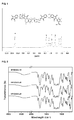
- Fig. 1 shows the 1 H-NMR spectrum of the o-hydroxypolyimide copolymer having carboxylic acid groups synthesized in Synthesis Example 4 among the synthesis examples of o-hydroxypolyimide copolymers having carboxylic acid groups according to the present disclosure.
- the characteristic hydrogen peak in the repeat unit observed from the 1 H-NMR spectrum confirms the synthesis of the o-hydroxypolyimide copolymer having carboxylic acid groups.
- Fig. 2 shows the ATR-FTIR spectra of HPIDABA-15, HPIDABA-20 and HPIDABA-25 membranes prepared according to Membrane Preparation Examples 4-6 among the membrane preparation examples of o-hydroxypolyimide copolymer membranes having carboxylic acid groups according to the present disclosure. As seen from Fig.
- Fig. 3 shows the ATR-FTIR spectra of the crosslinked, thermally rearranged poly(benzoxazole-co-imide) copolymer membranes prepared by heat treatment only according to Examples 2-6 and a conventional polybenzoxazole (PBO) membrane.
- PBO polybenzoxazole
- the density and d -spacing of the samples prepared according to Membrane Preparation Examples 1-6, Examples 1-6, Reference Example 2 and Comparative Example 1 are given in Table 2.
- the d -spacing of the crosslinked, thermally rearranged poly(benzoxazole-co-imide) copolymer membranes according to Examples 1-6 was 0.62-0.67 nm, which was longer than those of the hydroxypolyimide copolymer membranes according to Membrane Preparation Examples 1-6 prior to thermal rearrangement (0.54-0.57 nm), the hydroxypolyimide copolymer membrane not containing DABA according to Reference Example 2 prior to thermal rearrangement (0.53 nm) and the uncrosslinked, thermally rearranged poly(benzoxazole-co-imide) copolymer membrane according to Comparative Example 1 (0.59 nm).
- the crosslinked, thermally rearranged poly(benzoxazole-co-imide) copolymer membrane prepared according to the present disclosure has less packed polymer chains and a larger space, it allows small molecules to penetrate and diffuse and can be used as a membrane for flue gas separation.
- Fig. 4 and Fig. 5 show a result of testing weight loss of the HPIDABA-5 and HPIDABA-25 according to Membrane Preparation Examples 2 and 6 and the HPI and HPIMPD-5 according to Reference Examples 1 and 2 caused by decarboxylation during the preparation of the thermally rearranged polybenzoxazole, using a thermogravimetric analyzer (TGA).
- TGA thermogravimetric analyzer
- Other thermal properties including the change in glass transition temperature are given in Table 3.
- a distinct weight loss peak is observed at 370-450 oC, which is below the typical polymer chain degradation temperature of 500-600 oC.
- release of CO 2 was confirmed by mass spectroscopy, which menas that thermal rearrangement occurs.
- the thermal rearrangement temperature is affected by the fluidity of the polymer chains, which in turn is affected by the degree of crosslinking. This is also confirmed by the change in glass transition temperature and the change in the temperature at the maximum thermal rearrangement to PBO, given in Table 3.
- the crosslinked, thermally rearranged poly(benzoxazole-co-imide) copolymer membranes PBODABA-Y according to the present disclosure have two o-Ps liftetimes T 3 and T 4 , suggesting that two kinds of pores exist in the membrane.
- T 3 ⁇ 1.2 ns
- T 4 ⁇ 4 ns
- the average pore diameter d 3 of the PBODABA-15, PBODABA-20 and PBODABA-25 and the average pore diameter d 4 of the PBODABA-5, PBODABA-10, PBODABA-15, PBODABA-20 and PBODABA-25 were larger than the average pore diameter of the PBOMPD-5 prepared according to Comparative Example 1.
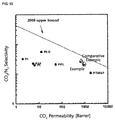
- the crosslinked, thermally rearranged poly(benzoxazole-co-imide) copolymer membranes PBODABA-Y prepared according to Examples 1-6 show relatively higher permeability and selectivity than the uncrosslinked, thermally rearranged poly(benzoxazole-co-imide) copolymer membrane PBOMPD-5 prepared according to Comparative Example 1.
- the gas permeability of glassy polymers is greatly dependent on the distribution of free volume elements. It was confirmed that the permeability coefficient of the PBODABA-Y membranes is higher than that of the PBOMPD-5 membrane, which agrees with the larger pore size confirmed by the PALS analysis.
- the PBOMPD-5 membranes according to the present disclosure could overcome the permeability-selectivity tradeoff relationship owing to superior permeability and selectivity.
- the CO 2 selectivity was maintained high even with the very high permeability of 615 Barrer.
- a crosslinked, thermally rearranged poly(benzoxazole-co-imide) copolymer membrane for flue gas separation may be prepared simply through heat treatment without requiring a complicated process such as chemical crosslinking, UV irradiation, etc. for forming the crosslinked structure and a membrane for flue gas separation prepared therefrom is applicable to large-scale production due to superior permeability and selectivity and a simple preparation process.
- Fig. 6 shows the ATR-FTIR spectra of poly(benzoxazole-co-imide) copolymer membranes obtained by thermally rearranging the copolymer obtained in Synthesis Example 17 at various heat treatment temperatures.
- the broad hydroxypolyimide O-H stretching vibration peak around 3580 cm -1 disappears gradually as the heat treatment temperature is raised from 375 oC to 450 oC, which suggests the progress of thermal rearrangement to polybenzoxazole.
- the appearance of the polybenzoxazole C N peak (1550 cm -1 ) and the characteristic CO peak (1062 cm -1 ), which were not observed at the heat treatment temperature 300 oC, as the heat treatment temperature is raised from 375 oC to 450 oC confirms the thermal rearrangement to polybenzoxazole.
- the polyimide C O stretching vibration peaks observed at 1784 cm -1 and 1725 cm -1 confirms the thermal stability of the aromatic imide ring even at the high heat treatment temperature of 450 oC. Therefore, the heat treatment for the thermal rearrangement of hydroxypolyimide to polybenzoxazole according to the present disclosure may be conducted at 350-450 oC, specifically 375-450 oC.
- the d -spacing of the crosslinked, thermally rearranged poly(benzoxazole-co-imide) copolymer membranes according to Examples 7-11 and Examples 12-16 were 6.67-6.79 ⁇ and 6.39-6.57 ⁇ , respectively, longer than that of the uncrosslinked, thermally rearranged poly(benzoxazole-co-imide) copolymer membrane according to Comparative Example 2 (6.37 ⁇ ) and the crosslinked, thermally rearranged poly(benzoxazole-co-imide) copolymer membrane lacking a polyimide structural unit derived from an aromatic diamine according to Comparative Example 3 (6.20 ⁇ ).
- the crosslinked, thermally rearranged poly(benzoxazole-co-imide) copolymer membrane prepared according to the present disclosure has less packed polymer chains and a larger space, it allows small molecules to penetrate and diffuse and can be used as a membrane for flue gas separation.
- the samples prepared according to Examples 7-16 showed superior mechanical properties when compared with the samples prepared according to Comparative Examples 2-3, with 2 times or stronger tensile strength and 4 times or higher elongation.
- the samples of Examples 7-16 showed less membrane area shrinkage as compared to the samples of Comparative Examples 2-3, it is expected that large-area membranes can be produced in large scale according to the present disclosure.
- the crosslinked, thermally rearranged poly(benzoxazole-co-imide) copolymer membrane for flue gas separation prepared according to the present disclosure is prepared from a terpolymer having a repeat unit consisting of an o-hydroxypolyimide structural unit, a polyimide structural unit and a polyimide structural unit having carboxylic acid groups
- the target product i.e. the crosslinked, thermally rearranged poly(benzoxazole-co-imide) copolymer membrane for flue gas separation
- the target product i.e. the crosslinked, thermally rearranged poly(benzoxazole-co-imide) copolymer membrane for flue gas separation
- Fig. 7 and Fig. 8 show the gas separation performance of the copolymer membranes according to Examples 7-11 for CO 2 /CH 4 and CO 2 /N 2 mixture gases and Fig. 9 and Fig. 10 show the gas separation performance of the copolymer membranes according to Examples 12-16 for CO 2 /CH 4 and CO 2 /N 2 mixture gases.
- Gas permeability and selectivity were compared with those of a commercially available gas separation membrane. Since the crosslinked, thermally rearranged poly(benzoxazole-co-imide) copolymer membranes prepared according to Examples 7-16 exhibit remarkably high CO 2 permeability and comparable CO 2 selectivity over CH 4 and N 2 when compared with the commercially available gas separation membrane, they exhibit superior gas separation performance.
- the membrane for flue gas separation containing the novel crosslinked, thermally rearranged poly(benzoxazole-co-imide) copolymer wherein the content of the benzoxazole groups in the polymer chain is less than 80% according to the present disclosure exhibits superior mechanical and thermal properties, decreased membrane area shrinkage and excellent gas separation performance with superior gas permeability and selectivity.
- the membrane for flue gas separation containing the novel crosslinked, thermally rearranged poly(benzoxazole-co-imide) copolymer wherein the content of the benzoxazole groups in the polymer chain is less than 80% can be prepared simply through heat treatment without requiring a complicated process such as chemical crosslinking, UV irradiation, etc. for forming the crosslinked structure and thus the preparation process is simple and economical, the present disclosure is applicable to large-scale production.
Landscapes
- Chemical & Material Sciences (AREA)
- Chemical Kinetics & Catalysis (AREA)
- Engineering & Computer Science (AREA)
- Medicinal Chemistry (AREA)
- Polymers & Plastics (AREA)
- Organic Chemistry (AREA)
- Health & Medical Sciences (AREA)
- Computer Networks & Wireless Communication (AREA)
- Signal Processing (AREA)
- Analytical Chemistry (AREA)
- General Chemical & Material Sciences (AREA)
- Oil, Petroleum & Natural Gas (AREA)
- Manufacturing & Machinery (AREA)
- Macromolecular Compounds Obtained By Forming Nitrogen-Containing Linkages In General (AREA)
- Separation Using Semi-Permeable Membranes (AREA)
Abstract
Description
- The present disclosure relates to a membrane for flue gas separation containing a crosslinked, thermally rearranged poly(benzoxazole-co-imide) copolymer and a method for preparing the same. More particularly, it relates to a membrane for flue gas separation containing a crosslinked, thermally rearranged poly(benzoxazole-co-imide) copolymer prepared simply by heat-treating a membrane prepared from an o-hydroxypolyimide copolymer having carboxylic acid groups such that thermal crosslinking and thermal rearrangement occur simultaneously or a membrane for flue gas separation containing a crosslinked, thermally rearranged poly(benzoxazole-co-imide) copolymer having a benzoxazole group content of less than 80% in the polymer chain, prepared from transesterification crosslinking of an o-hydroxypolyimide copolymer having carboxylic acid groups and a diol-based compound followed by thermal rearrangement, and a method for preparing the same.
- Recently, membrane-based gas separation is drawing attentions as a rapidly growing separation technology. Gas separation using membranes has many advantages over the existing separation processes, including high-level process availability, low energy consumption and low operation cost. Particularly, there have been many basic researches on organic polymer membranes since 1980s. However, the traditional polymer exhibits relatively low material transport rate because it has few micropores.
- In contrast, polymers having high level of free volume, known as microporous organic polymers, which can adsorb small gas molecules and exhibit improved diffusion capacity, are emerging as leading candidates in separation processes. Therefore, based on the fact that microporous polymers having a rigid ladder-like structure that prevents effective packing of the polymer chain exhibit relatively high gas permeability and selectivity, various researches are being conducted to develop organic polymers that can be used for gas separation membranes.
- For example, efforts are being actively made to use rigid, glassy, pre-aromatic organic polymers exhibiting superior thermal, mechanical and chemical properties such as polybenzoxazole, polybenzimidazole, polybenzothiazole, etc. as gas separation membranes. However, because these organic polymers are mostly hardly soluble in general organic solvents, it is difficult to prepare membranes by the simple and practical solvent casting method. Recently, the inventors of the present disclosure reported that a polybenzoxazole membrane prepared by thermally rearranging polyimide having hydroxyl groups at ortho positions exhibits 10-100 times higher carbon dioxide permeability as compared to the existing polybenzoxazole membrane prepared by the solvent casting method. However, the carbon dioxide/methane (CO2/CH4) selectivity is still comparable to that of the existing commercially available cellulose acetate and needs to be improved (non-patent document 1).
- The inventors of the present disclosure also reported that introduction of benzoxazole groups to the hydroxypolyimide copolymer membrane through thermal rearrangement leads to increased rigidity of the polymer chain, thereby improving gas separation performance owing to increased free volume. However, if the content of the benzoxazole groups introduced into the polymer chain is 80% or higher, the resulting membrane may break easily and exhibit poor mechanical properties because it is too hard. Also, a large-area membrane may exhibit unsatisfactory gas permeability and selectivity owing to shrinkage caused by release of a large quantity of CO2 during the thermal rearrangement (non-patent document 2).
- Also, it was reported that a polybenzoxazole membrane prepared by thermally rearranging a blend membrane of polyimide having hydroxyl groups at ortho positions and poly(styrene sulfonate) at 300-650 ºC exhibits up to about 95% improved carbon dioxide/methane (CO2/CH4) selectivity as compared to the polybenzoxazole membrane prepared by thermally rearranging hydroxypolyimide not containing poly(styrene sulfonate). However, since a method of synthesizing the polyimide as a precursor for preparing the polybenzoxazole membrane is not specified, the fact that the free volume element and gas separation performance of the thermally rearranged polybenzoxazole membrane can vary depending on the imidization method of the hydroxypolyimide, i.e., solution thermal imidization, azeotropic thermal imidization, solid state thermal imidization or chemical imidization, is not considered at all (patent document 1).
- In consideration of the fact that the properties of thermally rearranged polybenzoxazole are affected by the synthesis method of the aromatic polyimide, polyimides having hydroxyl groups at ortho positions were synthesized using various methods including solution thermal imidization, solid state thermal imidization, chemical imidization, etc. and polybenzoxazole membranes were prepared by thermally rearranging them. However, the resulting membrane is for use as a separation membrane for dehydration of ethanol or other organic solvents utilizing its superior separation characteristics derived from its peculiar porous structure, not as a gas separation membrane (patent document 2).
- Also, it was reported that a polybenzoxazole membrane prepared by synthesizing polyimide having hydroxyl groups at ortho positions by chemical imidization followed by thermal rearrangement and UV irradiation to form a crosslinked structure exhibits improved selectivity. However, because the polyimide is prepared by chemical imidization, not by thermal imidization, the resulting thermally rearranged polybenzoxazole membrane still has relatively low carbon dioxide permeability. In addition, the process is disadvantageous in that a UV radiating apparatus has to be used to form the crosslinked structure (patent document 3).
- Noting that the mechanical properties, membrane area shrinkage and gas transportation behavior of a thermally rearranged polybenzoxazole membrane are determined by the imidization method of polyimide, the benzoxazole group content in the polymer chain and the crosslinked structure of the polymer chain, the inventors of the present disclosure have found out that a crosslinked, thermally rearranged polybenzoxazole membrane can be obtained by synthesizing a polyimide membrane having hydroxyl and carboxylic acid groups in the polyimide repeat unit through solution thermal imidization and then simply heat-treating the same.
- Also, they have found out that a polybenzoxazole membrane having a crosslinked structure with a benzoxazole group content of less than 80% in the polymer chain, which is prepared by synthesizing a copolymer having hydroxyl and carboxylic acid groups in the polyimide repeat unit and having a hydroxypolyimide content of less than 80% in the polyimide repeat unit by solution thermal imidization followed by chemical crosslinking and then thermal rearrangement, or chemical crosslinking and thermal rearrangement at the same time, exhibits remarkably improved separation performance as a gas separation membrane due to superior mechanical and thermal properties.
-
-
Patent document 1Korean Patent Publication No. 10-2012-0100920 -
Patent document 2 US Patent Publication No.US 2012/0305484 . - Patent document 3
Japanese Patent Publication No. 2012-521871 -
- Non-patent
document 1 Y.M. Lee et al., Science 318, 254-258 (2007). - Non-patent
document 2 Y.M. Lee et al., J. Membr. Science 350, 301-309 (2010). - The present disclosure is directed to providing a membrane for flue gas separation containing a crosslinked, thermally rearranged poly(benzoxazole-co-imide) copolymer, which exhibits superior gas permeability and selectivity, and a method for preparing the same.
- The present disclosure is also directed to providing a membrane for flue gas separation containing a crosslinked, thermally rearranged poly(benzoxazole-co-imide) copolymer having a benzoxazole group content of less than 80% in the polymer chain, which exhibits superior mechanical and thermal properties, decreased membrane area shrinkage and high gas permeability and selectivity, and a method for preparing the same.
- In an aspect, the present disclosure provides a method for preparing a crosslinked, thermally rearranged poly(benzoxazole-co-imide) copolymer membrane for flue gas separation, including:
- i) obtaining a polyamic acid solution by reacting an acid dianhydride, an o-hydroxydiamine and 3,5-diaminobenzoic acid, as a comonomer, and synthesizing an o-hydroxypolyimide copolymer having carboxylic acid groups through azeotropic thermal imidization;
- ii) preparing a membrane by dissolving the o-hydroxypolyimide copolymer having carboxylic acid groups synthesized in i) in an organic solvent and casting the same; and
- iii) heat-treating the membrane obtained in ii).
- The acid dianhydride in i) may be represented by General Formula 1:

- The o-hydroxydiamine in i) may be represented by General Formula 2:

- The azeotropic thermal imidization in i) may be conducted by adding toluene or xylene to the polyamic acid solution and stirring the mixture at 180-200 ºC for 6-12 hours.
- The heat treatment in iii) may be conducted by raising temperature to 350-450 ºC at a rate of 1-20 ºC/min under high-purity inert gas atmosphere and maintaining the temperature for 0.1-3 hours.
- In another aspect, the present disclosure provides a crosslinked, thermally rearranged poly(benzoxazole-co-imide) copolymer membrane for flue gas separation prepared by the preparation method.
- The membrane may have a repeat unit represented by Chemical Formula 1:

- Ar is an aromatic ring group selected from a substituted or unsubstituted tetravalent C6-C24 arylene group and a substituted or unsubstituted tetravalent C4-C24 heterocyclic ring group, wherein the aromatic ring group exists on its own, forms a condensed ring with each other, or is linked with each other by a single bond, O, S, CO, SO2, Si(CH3)2, (CH2)p (1 ≤ p ≤ 10), (CF2)q (1 ≤ q ≤10), C(CH3)2, C(CF3)2 or CO-NH,
- Q is a single bond, O, S, CO, SO2, Si(CH3)2, (CH2)p (1 ≤ p ≤ 10), (CF2)q (1 ≤ q ≤ 10), C(CH3)2, C(CF3)2, CO-NH, C(CH3)(CF3) or a substituted or unsubstituted phenylene group, and
- x and y are molar fractions in the repeat unit, satisfying 0.75 ≤ x ≤0.975, 0.025 ≤ y ≤ 0.25 and x + y = 1.
- The membrane may have a d-spacing of 0.62-0.67 nm.
- The membrane may have a density of 1.38-1.43 g/cm3.
- The membrane may have an average pore diameter d3 of 4.0 Â and an average pore diameter d4 of 8.6 Å.
- In another aspect, the present disclosure provides a membrane for flue gas separation containing a crosslinked, thermally rearranged poly(benzoxazole-co-imide) copolymer having a repeat unit represented by Chemical Formula 2:

- Ar1 is an aromatic ring group selected from a substituted or unsubstituted tetravalent C6-C24 arylene group and a substituted or unsubstituted tetravalent C4-C24 heterocyclic ring group, wherein the aromatic ring group exists on its own, forms a condensed ring with each other, or is linked with each other by a single bond, O, S, CO, SO2, Si(CH3)2, (CH2)p (1 ≤ p≤ 10), (CF2)q (1 ≤ q ≤10), C(CH3)2, C(CF3)2 or CO-NH,
- Q is a single bond, O, S, CO, SO2, Si(CH3)2, (CH2)p (1 ≤ p ≤ 10), (CF2)q (1 ≤ q ≤ 10), C(CH3)2, C(CF3)2, CO-NH, C(CH3)(CF3) or a substituted or unsubstituted phenylene group,
- Ar2 is an aromatic ring group selected from a substituted or unsubstituted divalent C6-C24 arylene group and a substituted or unsubstituted divalent C4-C24 heterocyclic ring group, wherein the aromatic ring group exists on its own, forms a condensed ring with each other, or is linked with each other by a single bond, O, S, CO, SO2, Si(CH3)2, (CH2)p (1 ≤ p ≤ 10), (CF2)q (1 ≤ q ≤10), C(CH3)2, C(CF3)2 or CO-NH, and
- x, y and z are molar fractions in the repeat unit, satisfying x < 0.8 and x + y + z = 1, except for the case where x, y or z is 0.
- The membrane for flue gas separation containing a crosslinked, thermally rearranged poly(benzoxazole-co-imide) copolymer may have a d-spacing of 6.67-6.79 Å.
- The membrane for flue gas separation containing a crosslinked, thermally rearranged poly(benzoxazole-co-imide) copolymer may have a density of 1.38-1.43 g/cm3.
- In another aspect, the present disclosure provides a method for preparing the membrane for flue gas separation containing a crosslinked, thermally rearranged poly(benzoxazole-co-imide) copolymer having a repeat unit represented by Chemical Formula 2, including:
- I) obtaining a polyamic acid solution by reacting an acid dianhydride, an o-hydroxydiamine and an aromatic diamine and 3,5-diaminobenzoic acid, as comonomers, and synthesizing an o-hydroxypolyimide copolymer having carboxylic acid groups through azeotropic thermal imidization;
- II) synthesizing a monoesterified o-hydroxypolyimide copolymer by reacting the polyimide copolymer of I) with a diol;
- III) synthesizing a crosslinked o-hydroxypolyimide copolymer membrane by casting a polymer solution obtained by dissolving the monoesterified o-hydroxypolyimide copolymer of II) in an organic solvent and transesterification crosslinking the same; and
- IV) thermally rearranging the crosslinked o-hydroxypolyimide copolymer membrane of III).
- The acid dianhydride in I) may be represented by General Formula 3:

- The o-hydroxydiamine in I) may be represented by
General Formula 2. - The aromatic diamine in I) may be represented by General Formula 4:
<General Formula 4> H2N-Ar2-NH2
wherein Ar2 is an aromatic ring group selected from a substituted or unsubstituted divalent C6-C24 arylene group and a substituted or unsubstituted divalent C4-C24 heterocyclic ring group, wherein the aromatic ring group exists on its own, forms a condensed ring with each other, or is linked with each other by a single bond, O, S, CO, SO2, Si(CH3)2, (CH2)p (1 ≤ p ≤ 10), (CF2)q (1 ≤ q ≤ 10), C(CH3)2, C(CF3)2 or CO-NH. - The azeotropic thermal imidization in I) may be conducted by adding toluene or xylene to the polyamic acid solution and stirring the mixture at 180-200 ºC for 6-12 hours.
- The diol in II) may be selected from a group consisting of ethylene glycol, propylene glycol, 1,4-butylene glycol, 1,3-propanediol, 1,2-butanediol, 1,3-butanediol and benzenedimethanol.
- The monoesterification in II) may be conducted by reacting the copolymer of I) with an excess diol corresponding to 50 or more equivalents of the carboxylic acid groups in the copolymer at 140-160 ºC for 18-24 hours in the presence of a p-toluenesulfonic acid catalyst.
- The transesterification crosslinking in III) may be conducted by heat-treating the copolymer at 200-250 ºC for 18-24 hours in vacuo.
- The thermal rearrangement in IV) may be conducted by raising temperature to 350-450 ºC at a rate of 1-20 ºC/min under high-purity inert gas atmosphere and maintaining the temperature for 0.1-3 hours.
- In another aspect, the present disclosure provides a method for preparing the membrane for flue gas separation containing a crosslinked, thermally rearranged poly(benzoxazole-co-imide) copolymer having a repeat unit represented by
Chemical Formula 2, including: - a) obtaining a polyamic acid solution by reacting an acid dianhydride, an o-hydroxydiamine and an aromatic diamine and 3,5-diaminobenzoic acid, as comonomers, and synthesizing an o-hydroxypolyimide copolymer having carboxylic acid groups through azeotropic imidization;
- b) preparing a membrane by dissolving the o-hydroxypolyimide copolymer having carboxylic acid groups synthesized in a) in an organic solvent and casting the same; and
- c) heat-treating the membrane obtained in b).
- The acid dianhydride in a) may be represented by General Formula 3.
- The o-hydroxydiamine in a) may be represented by
General Formula 2. - The aromatic diamine in a) may be represented by General Formula 4.
- The azeotropic thermal imidization in a) may be conducted by adding toluene or xylene to the polyamic acid solution and stirring the mixture at 180-200 ºC for 6-12 hours.
- The heat treatment in c) may be conducted by raising temperature to 350-450 ºC at a rate of 1-20 ºC/min under high-purity inert gas atmosphere and maintaining the temperature for 0.1-3 hours.
- The membrane for flue gas separation containing a crosslinked, thermally rearranged poly(benzoxazole-co-imide) copolymer having a repeat unit represented by
Chemical Formula 2 prepared by the method including a) through c) may have a d-spacing of 6.39-6.57 Å. - The membrane for flue gas separation containing a crosslinked, thermally rearranged poly(benzoxazole-co-imide) copolymer having a repeat unit represented by
Chemical Formula 2 prepared by the method including a) through c) may have a density of 1.38-1.41 g/cm3. - In accordance with the present disclosure, a crosslinked, thermally rearranged poly(benzoxazole-co-imide) copolymer membrane for flue gas separation can be prepared simply through heat treatment without requiring a complicated process such as chemical crosslinking, UV irradiation, etc. for forming a crosslinked structure and a membrane for flue gas separation prepared therefrom exhibits superior permeability and selectivity. Also, the method is applicable to commercial-scale production because the preparation process is simple.
- In addition, the membrane for flue gas separation containing the novel crosslinked, thermally rearranged poly(benzoxazole-co-imide) copolymer according to the present disclosure, which has a benzoxazole group content of less than 80% in the polymer chain, allows small molecules to penetrate and diffuse because the polymer chain is less packed and provides a larger space. Furthermore, since it exhibits superior mechanical and thermal properties, decreased membrane area shrinkage and high gas permeability and selectivity, it exhibits excellent gas separation performance.
-
-
Fig. 1 shows a 1H-NMR spectrum of HPIDABA-15 synthesized according to Synthesis Example 4. -
Fig. 2 shows ATR-FTIR spectra of HPIDABA-15, HPIDABA-20 and HPIDABA-25 membranes prepared according to Membrane Preparation Examples 4-6. -
Fig. 3 shows ATR-FTIR spectra of crosslinked, thermally rearranged poly(benzoxazole-co-imide) copolymer membranes prepared according to Examples 2-6. -
Fig. 4 shows thermogravimetric-mass spectroscopic (TG-MS) graphs showing thermal weight loss behaviors of a HPIDABA-25 membrane prepared according to Membrane Preparation Example 6. -
Fig. 5 shows TGA and DTG graphs of HPIDABA-5 and HPIDABA-25 membranes prepared according to Membrane Preparation Examples 2 and 6, a HPI membrane prepared according to Reference Example 1 and a HPIMPD-5 membrane prepared according to Reference Example 2. -
Fig. 6 shows ATR-FTIR spectra of a poly(benzoxazole-co-imide) copolymer prepared in Synthesis Example 17, obtained after thermal rearrangement at different temperatures. -
Fig. 7 shows CO2 permeability and selectivity of poly(benzoxazole-co-imide) copolymer membranes prepared according to Examples 7-11 and Comparative Examples 2-3 for a CO2/CH4 mixture gas. -
Fig. 8 shows CO2 permeability and selectivity of poly(benzoxazole-co-imide) copolymer membranes prepared according to Examples 7-11 and Comparative Examples 2-3 for a CO2/N2 mixture gas. -
Fig. 9 shows CO2 permeability and selectivity of poly(benzoxazole-co-imide) copolymer membranes prepared according to Examples 12-16 and Comparative Examples 2-3 for a CO2/CH4 mixture gas. -
Fig. 10 shows CO2 permeability and selectivity of poly(benzoxazole-co-imide) copolymer membranes prepared according to Examples 12-16 and Comparative Examples 2-3 for a CO2/N2 mixture gas. - In the present disclosure, flue gas refers to a gas emitted as a result of partial or complete combustion of hydrocarbon fuels. It contains carbon dioxide, water vapor and nitrogen and often contains one or more of hydrogen, oxygen and carbon monoxide as well as a small quantity of pollutants that may affect the global environment, including nitrogen oxides, sulfur oxides and particulate matter. The present disclosure provides a membrane for separating the flue gas and a method for preparing the same.
- A crosslinked, thermally rearranged poly(benzoxazole-co-imide) copolymer membrane for flue gas separation prepared according to the present disclosure is based on synthesis of polyimide from imidization of polyamic acid obtained by reacting an acid dianhydride with a diamine. In order to form a crosslinked structure of polymer chains with heat treatment only, there should be functional groups such as carboxylic acid groups in the repeat unit. During the heat treatment, structural change from polyimide to polybenzoxazole occurs as the functional group such as a hydroxyl group at the ortho position of the aromatic imide ring attacks the carbonyl group of the imide ring to form a carboxy-benzoxazole intermediate and decarboxylation occurs through thermal rearrangement. As such, according to the present disclosure, a crosslinked, thermally rearranged poly(benzoxazole-co-imide) copolymer membrane for flue gas separation is prepared through a simple process.
- That is to say, the present disclosure provides a method for preparing a crosslinked, thermally rearranged poly(benzoxazole-co-imide) copolymer membrane for flue gas separation, including:
- i) obtaining a polyamic acid solution by reacting an acid dianhydride, an o-hydroxydiamine and 3,5-diaminobenzoic acid, as a comonomer, and synthesizing an o-hydroxypolyimide copolymer having carboxylic acid groups through azeotropic thermal imidization;
- ii) preparing a membrane by dissolving the o-hydroxypolyimide copolymer having carboxylic acid groups synthesized in i) in an organic solvent and casting the same; and
- iii) heat-treating the membrane obtained in ii).
- In general, to synthesize polyimide, polyamic acid has to be obtained by reacting an acid dianhydride with a diamine. In the present disclosure, a compound represented by
General Formula 1 is used as the acid dianhydride.
- In
General Formula 1, Ar is an aromatic ring group selected from a substituted or unsubstituted tetravalent C6-C24 arylene group and a substituted or unsubstituted tetravalent C4-C24 heterocyclic ring group, wherein the aromatic ring group exists on its own, forms a condensed ring with each other, or is linked with each other by a single bond, O, S, CO, SO2, Si(CH3)2, (CH2)p (1 ≤ (1 ≤ 10), (CF2)q (1 ≤ q ≤ 10), C(CH3)2, C(CF3)2 or CO-NH. - The acid dianhydride as a monomer for synthesizing polyimide is not particularly limited as long as it is one represented by
General Formula 1. Specifically, 4,4'-(hexafluoroisopropylidene)diphthalic anhydride (6FDA) having fluorine groups may be used when considering that the thermal and chemical properties of the synthesized polyimide can be further improved. - And, in the present disclosure, in consideration of the fact that a polybenzoxazole unit can be introduced by thermally rearranging the o-hydroxypolyimide to obtain the poly(benzoxazole-co-imide) copolymer structure, a compound represented by
General Formula 2 is used as an o-hydroxydiamine for synthesizing the o-hydroxypolyimide.
- In
General Formula 2, Q is a single bond, O, S, CO, SO2, Si(CH3)2, (CH2)p (1 ≤ p ≤ 10), (CF2)q (1 ≤ q ≤ 10), C(CH3)2, C(CF3)2, CO-NH, C(CH3)(CF3) or a substituted or unsubstituted phenylene group. - The o-hydroxydiamine is not particularly limited as long as it is one represented by
General Formula 2. Specifically, 2,2-bis(3-amino-4-hydroxyphenyl)hexafluoropropane (bisAPAF) having fluorine groups may be used when considering that the thermal and chemical properties of the synthesized polyimide can be further improved. - In order to form a crosslinked structure of polymer chains with heat treatment only, without requiring a complicated process such as chemical crosslinking, UV irradiation, etc., there should be functional groups such as carboxylic acid groups in the repeat unit. Therefore, in the present disclosure, the o-hydroxypolyimide copolymer having carboxylic acid groups may be synthesized by reacting the acid dianhydride of
General Formula 1 and the o-hydroxydiamine ofGeneral Formula 2 together with the 3,5-diaminobenzoic acid as a comonomer. - That is to say, in i), a polyamic acid solution is obtained by dissolving the acid dianhydride of
General Formula 1, the o-hydroxydiamine ofGeneral Formula 2 and 3,5-diaminobenzoic acid in an organic solvent such as N-methylpryrrolidone (NMP) and stirring and then an o-hydroxypolyimide copolymer having carboxylic acid groups represented byStructural Formula 1 is synthesized through azeotropic thermal imidization.

- In
Structural Formula 1, Ar and Q are the same as defined inGeneral Formulas - The azeotropic thermal imidization may be conducted by adding toluene or xylene to the polyamic acid solution and stirring the mixture at 180-200 ºC for 6-12 hours. During the azeotropic thermal imidization, water released as an imide ring is formed is separated as an azeotropic mixture with the toluene or xylene.
- Then, in ii), an o-hydroxypolyimide copolymer membrane having carboxylic acid groups is obtained by dissolving the o-hydroxypolyimide copolymer having carboxylic acid groups represented by
Structural Formula 1 synthesized in i) in an organic solvent such as N-methylpryrrolidone (NMP) and casting the resulting polymer solution on a glass plate. - Finally, a crosslinked, thermally rearranged poly(benzoxazole-co-imide) copolymer membrane for flue gas separation having a repeat unit represented by
Chemical Formula 1 is prepared as a final target product simply by heat-treating the membrane obtained in ii).

- In
Chemical Formula 1, - Ar is an aromatic ring group selected from a substituted or unsubstituted tetravalent C6-C24 arylene group and a substituted or unsubstituted tetravalent C4-C24 heterocyclic ring group, wherein the aromatic ring group exists on its own, forms a condensed ring with each other, or is linked with each other by a single bond, O, S, CO, SO2, Si(CH3)2, (CH2)p (1 ≤ p ≤ 10), (CF2)q (1 ≤ q ≤10), C(CH3)2, C(CF3)2 or CO-NH,
- Q is a single bond, O, S, CO, SO2, Si(CH3)2, (CH2)p (1 ≤ p ≤ 10), (CF2)q (1 ≤ q ≤ 10), C(CH3)2, C(CF3)2, CO-NH, C(CH3)(CF3) or a substituted or unsubstituted phenylene group, and
- x and y are molar fractions in the repeat unit, satisfying 0.75 ≤ x ≤0.975, 0.025 ≤ y ≤ 0.25 and x + y = 1.
- The heat treatment may be conducted by raising temperature to 350-450 ºC at a rate of 1-20 ºC/min under high-purity inert gas atmosphere and maintaining the temperature for 0.1-3 hours.
- The present disclosure also provides a membrane for flue gas separation containing a crosslinked, thermally rearranged poly(benzoxazole-co-imide) copolymer having a repeat unit represented by Chemical Formula 2:

- Ar1 is an aromatic ring group selected from a substituted or unsubstituted tetravalent C6-C24 arylene group and a substituted or unsubstituted tetravalent C4-C24 heterocyclic ring group, wherein the aromatic ring group exists on its own, forms a condensed ring with each other, or is linked with each other by a single bond, O, S, CO, SO2, Si(CH3)2, (CH2)p (1 ≤ p ≤ 10), (CF2)q (1 ≤ q ≤ 10), C(CH3)2, C(CF3)2 or CO-NH,
- Q is a single bond, O, S, CO, SO2, Si(CH3)2, (CH2)p (1 ≤ p ≤ 10), (CF2)q (1 ≤ q ≤ 10), C(CH3)2, C(CF3)2, CO-NH, C(CH3)(CF3) or a substituted or unsubstituted phenylene group,
- Ar2 is an aromatic ring group selected from a substituted or unsubstituted divalent C6-C24 arylene group and a substituted or unsubstituted divalent C4-C24 heterocyclic ring group, wherein the aromatic ring group exists on its own, forms a condensed ring with each other, or is linked with each other by a single bond, O, S, CO, SO2, Si(CH3)2, (CH2)p (1 ≤ p ≤ 10), (CF2)q (1 ≤ q ≤ 10), C(CH3)2, C(CF3)2 or CO-NH, and
- x, y and z are molar fractions in the repeat unit, satisfying x < 0.8 and x + y + z = 1, except for the case where x, y or z is 0.
- The poly(benzoxazole-co-imide) copolymer having a repeat unit represented by
Chemical Formula 2 is based on synthesis of polyimide from imidization of polyamic acid obtained by reacting an acid dianhydride with a diamine. In order to form the covalently bonded crosslinked structure shown inChemical Formula 2, a polyimide copolymer structure derived from a diamine compound having functional groups such as carboxylic acid groups is necessary. Structural change to thermally rearranged polybenzoxazole occurs as the functional group such as a hydroxyl group at the ortho position of the aromatic imide ring attacks the carbonyl group of the imide ring to form a carboxy-benzoxazole intermediate and decarboxylation occurs through heat treatment. - If the content of the benzoxazole groups in the polymer chain of the thermally rearranged poly(benzoxazole-co-imide) copolymer is 80% or higher, a membrane prepared therefrom may break easily and exhibit poor mechanical properties because it is too hard. Also, a large-area membrane may exhibit unsatisfactory gas permeability and selectivity owing to shrinkage caused by release of a large quantity of CO2 during the thermal rearrangement. Therefore, in the present disclosure, the content of the benzoxazole groups in the polymer chain is decreased to less than 80%, more specifically 50% or below.
- Accordingly, in the present disclosure, when synthesizing the o-hydroxypolyimide copolymer having carboxylic acid groups, which is a precursor to the thermally rearranged poly(benzoxazole-co-imide) copolymer, an inexpensive aromatic diamine is used as a comonomer to synthesize a terpolymer precursor wherein a new polyimide structural unit is introduced into the polymer chain, so that the content of the benzoxazole groups in the polymer chain of the target product, or the thermally rearranged poly(benzoxazole-co-imide) copolymer, is less than 80%. As a result, a membrane for flue gas separation containing a crosslinked, thermally rearranged poly(benzoxazole-co-imide) copolymer having a repeat unit represented by
Chemical Formula 2, wherein the content of the benzoxazole groups in the polymer chain is less than 80%, is prepared following a multi-step synthetic route as described below. - That is to say, the present disclosure provides a method for preparing the membrane for flue gas separation containing a crosslinked, thermally rearranged poly(benzoxazole-co-imide) copolymer having a repeat unit represented by
Chemical Formula 2, including: - I) obtaining a polyamic acid solution by reacting an acid dianhydride, an o-hydroxydiamine and an aromatic diamine and 3,5-diaminobenzoic acid, as comonomers, and synthesizing an o-hydroxypolyimide copolymer having carboxylic acid groups through azeotropic thermal imidization;
- II) synthesizing a monoesterified o-hydroxypolyimide copolymer by reacting the polyimide copolymer of I) with a diol;
- III) synthesizing a crosslinked o-hydroxypolyimide copolymer by transesterification crosslinking the monoesterified o-hydroxypolyimide copolymer of II); and
- IV) thermally rearranging the crosslinked o-hydroxypolyimide copolymer of III).
- In general, to synthesize polyimide, polyamic acid has to be obtained by reacting an acid dianhydride with a diamine. In the present disclosure, a compound represented by General Formula 3 is used as the acid dianhydride.

- In General Formula 3, Ar1 is an aromatic ring group selected from a substituted or unsubstituted tetravalent C6-C24 arylene group and a substituted or unsubstituted tetravalent C4-C24 heterocyclic ring group, wherein the aromatic ring group exists on its own, forms a condensed ring with each other, or is linked with each other by a single bond, O, S, CO, SO2, Si(CH3)2, (CH2)p (1 ≤ (1 ≤ 10), (CF2)q (1 ≤ q ≤ 10), C(CH3)2, C(CF3)2 or CO-NH.
- The acid dianhydride as a monomer for synthesizing polyimide is not particularly limited as long as it is one represented by General Formula 3. Specifically, 4,4'-(hexafluoroisopropylidene)diphthalic anhydride (6FDA) having fluorine groups may be used when considering that the thermal and chemical properties of the synthesized polyimide can be further improved.
- And, in the present disclosure, in consideration of the fact that a polybenzoxazole unit can be introduced by thermally rearranging the o-hydroxypolyimide to obtain the poly(benzoxazole-co-imide) copolymer structure, a compound represented by
General Formula 2 is used as an o-hydroxydiamine for synthesizing the o-hydroxypolyimide.

- In
General Formula 2, Q is a single bond, O, S, CO, SO2, Si(CH3)2, (CH2)p (1 ≤ p ≤ 10), (CF2)q (1 ≤ q ≤ 10), C(CH3)2, C(CF3)2, CO-NH, C(CH3)(CF3) or a substituted or unsubstituted phenylene group. - The o-hydroxydiamine is not particularly limited as long as it is one represented by
General Formula 2. Specifically, 3,3-dihydroxybenzidine (HAB) may be used when considering the easiness of reaction. - And, in the present disclosure, an aromatic diamine represented by General Formula 4 is used as a comonomer and reacted with the acid dianhydride of General Formula 3 to introduce a polyimide structural unit into the copolymer.
<General Formula 4> H2N-Ar2-NH2
- In General Formula 4, Ar2 is an aromatic ring group selected from a substituted or unsubstituted divalent C6-C24 arylene group and a substituted or unsubstituted divalent C4-C24 heterocyclic ring group, wherein the aromatic ring group exists on its own, forms a condensed ring with each other, or is linked with each other by a single bond, O, S, CO, SO2, Si(CH3)2, (CH2)p (1 ≤ 10), (CF2)q (1 ≤ q ≤ 10), C(CH3)2, C(CF3)2 or CO-NH.
- The aromatic diamine is not particularly limited as long as it is one represented by General Formula 4. Specifically, an inexpensive one may be used when considering the cost of large-scale production. More specifically, 2,4,6-trimethylphenylenediamine (DAM) may be used.
- In addition, since there should be functional groups such as carboxylic acid groups in the repeat unit to provide a covalently bonded crosslinked structure, in the present disclosure, 3,5-diaminobenzoic acid (DABA) is used as another comonomer and reacted with the acid dianhydride of General Formula 3 to introduce another polyimide structural unit having carboxylic acid groups into the copolymer.
- Accordingly, in I), a terpolymer having a repeat unit consisting of an o-hydroxypolyimide structural unit, a polyimide structural unit and a polyimide structural unit having carboxylic acid groups may be synthesized by reacting the acid dianhydride of General Formula 3, the o-hydroxydiamine of
General Formula 2 and the aromatic diamine of General Formula 4 and 3,5-diaminobenzoic acid (DABA), as comonomers, and, as a result, the content of the o-hydroxypolyimide structural unit, which is thermally rearrange to polybenzoxazole in the following heat treatment process, may be controlled to less than 80%. - That is to say, in I), a polyamic acid solution is obtained by dissolving the acid dianhydride of General Formula 3, the o-hydroxydiamine of
General Formula 2, the aromatic diamine of General Formula 4 and 3,5-diaminobenzoic acid (DABA) in an organic solvent such as N-methylpryrrolidone (NMP) and stirring and then an o-hydroxypolyimide copolymer having carboxylic acid groups represented byStructural Formula 2 is synthesized through azeotropic thermal imidization.
- In
Structural Formula 2, Arl, Ar2 and Q are the same as defined inGeneral Formulas 3, 4 and 2 and x, y and z are molar fractions in the repeat unit, satisfying x < 0.8 and x + y + z = 1, except for the case where x, y or z is 0. - The azeotropic thermal imidization may be conducted by adding toluene or xylene to the polyamic acid solution and stirring the mixture at 180-200 ºC for 6-12 hours. During the azeotropic thermal imidization, water released as an imide ring is formed is separated as an azeotropic mixture with the toluene or xylene.
- Then, a monoesterified o-hydroxypolyimide copolymer represented by Structural Formula 3 is synthesized by reacting the polyimide copolymer of I) with a diol.

- In Structural Formula 3, Arl, Q, Ar2, x, y and z are the same as defined in
Structural Formula 2. - The diol may be selected from a group consisting of ethylene glycol, propylene glycol, 1,4-butylene glycol, 1,3-propanediol, 1,2-butanediol, 1,3-butanediol and benzenedimethanol. More specifically, 1,4-butylene glycol may be used, although not being limited thereto.
- The monoesterification in II) may be conducted by reacting the polyimide copolymer represented by
Structural Formula 2 with an excess diol corresponding to 50 or more equivalents of the carboxylic acid groups in the copolymer at 140-160 ºC for 18-24 hours in the presence of a p-toluenesulfonic acid catalyst. - Then, a crosslinked o-hydroxypolyimide copolymer membrane represented by Structural Formula 4 is synthesized by casting a polymer solution obtained by dissolving the monoesterified o-hydroxypolyimide copolymer represented by Structural Formula 3 of II) in an organic solvent such as N-methylpryrrolidone (NMP) and transesterification crosslinking the same.

- In Structural Formula 4, Arl, Q, Ar2, x, y and z are the same as defined in
Structural Formula 2. - The transesterification crosslinking may be conducted by heat-treating the copolymer at 200-250 ºC for 18-24 hours in vacuo.
- Finally, a membrane for flue gas separation containing a crosslinked, thermally rearranged poly(benzoxazole-co-imide) copolymer having a repeat unit represented by
Chemical Formula 2 is prepared as a final target product simply by thermally rearranging the crosslinked o-hydroxypolyimide copolymer membrane represented by Structural Formula 4 of III). - The thermal rearrangement may be conducted by raising temperature to 350-450 ºC at a rate of 1-20 ºC/min under high-purity inert gas atmosphere and maintaining the temperature for 0.1-3 hours.
- In addition, the present disclosure provides a method for preparing the membrane for flue gas separation containing a crosslinked, thermally rearranged poly(benzoxazole-co-imide) copolymer having a repeat unit represented by
Chemical Formula 2 simply through heat treatment without requiring a complicated process such as chemical crosslinking, UV irradiation, etc. - That is to say, the present disclosure provides a method for preparing a membrane for flue gas separation containing a crosslinked, thermally rearranged poly(benzoxazole-co-imide) copolymer having a repeat unit represented by
Chemical Formula 2, including: - a) obtaining a polyamic acid solution by reacting an acid dianhydride, an o-hydroxydiamine and an aromatic diamine and 3,5-diaminobenzoic acid, as comonomers, and synthesizing an o-hydroxypolyimide copolymer having carboxylic acid groups through azeotropic imidization;
- b) preparing a membrane by dissolving the o-hydroxypolyimide copolymer having carboxylic acid groups synthesized in a) in an organic solvent and casting the same; and
- c) heat-treating the membrane obtained in b).
- In general, to synthesize polyimide, polyamic acid has to be obtained by reacting an acid dianhydride with a diamine. In the present disclosure, a compound represented by General Formula 3 is used as the acid dianhydride.

- In General Formula 3, Ar1 is an aromatic ring group selected from a substituted or unsubstituted tetravalent C6-C24 arylene group and a substituted or unsubstituted tetravalent C4-C24 heterocyclic ring group, wherein the aromatic ring group exists on its own, forms a condensed ring with each other, or is linked with each other by a single bond, O, S, CO, SO2, Si(CH3)2, (CH2)p (1 ≤ p ≤ 10), (CF2)q (1 ≤ q ≤ 10), C(CH3)2, C(CF3)2 or CO-NH.
- The acid dianhydride as a monomer for synthesizing polyimide is not particularly limited as long as it is one represented by General Formula 3. Specifically, 4,4'-(hexafluoroisopropylidene)diphthalic anhydride (6FDA) having fluorine groups may be used when considering that the thermal and chemical properties of the synthesized polyimide can be further improved.
- And, in the present disclosure, in consideration of the fact that a polybenzoxazole unit can be introduced by thermally rearranging the o-hydroxypolyimide to obtain the poly(benzoxazole-co-imide) copolymer structure, a compound represented by
General Formula 2 is used as an o-hydroxydiamine for synthesizing the o-hydroxypolyimide.

- In
General Formula 2, Q is a single bond, O, S, CO, SO2, Si(CH3)2, (CH2)p (1 ≤ p ≤ 10), (CF2)q (1 ≤ q ≤ 10), C(CH3)2, C(CF3)2, CO-NH, C(CH3)(CF3) or a substituted or unsubstituted phenylene group. - The o-hydroxydiamine is not particularly limited as long as it is one represented by
General Formula 2. Specifically, 3,3-dihydroxybenzidine (HAB) may be used when considering the easiness of reaction. - And, in the present disclosure, an aromatic diamine represented by General Formula 4 is used as a comonomer and reacted with the acid dianhydride of General Formula 3 to introduce a polyimide structural unit into the copolymer.
<General Formula 4> H2N-Ar2-NH2
- In General Formula 4, Ar2 is an aromatic ring group selected from a substituted or unsubstituted divalent C6-C24 arylene group and a substituted or unsubstituted divalent C4-C24 heterocyclic ring group, wherein the aromatic ring group exists on its own, forms a condensed ring with each other, or is linked with each other by a single bond, O, S, CO, SO2, Si(CH3)2, (CH2)p (1 ≤ p ≤ 10), (CF2)q (1 ≤ q ≤ 10), C(CH3)2, C(CF3)2 or CO-NH.
- The aromatic diamine is not particularly limited as long as it is one represented by General Formula 4. Specifically, an inexpensive one may be used when considering the cost of large-scale production. More specifically, 2,4,6-trimethylphenylenediamine (DAM) may be used.
- In order to form a crosslinked structure of polymer chains with heat treatment only, without requiring a complicated process such as chemical crosslinking, UV irradiation, etc., there should be functional groups such as carboxylic acid groups in the repeat unit. Therefore, in the present disclosure, 3,5-diaminobenzoic acid (DABA) is used as another comonomer and reacted with the acid dianhydride of General Formula 3 to introduce another polyimide structural unit having carboxylic acid groups into the copolymer.
- Accordingly, in a), a terpolymer having a repeat unit consisting of an o-hydroxypolyimide structural unit, a polyimide structural unit and a polyimide structural unit having carboxylic acid groups may be synthesized by reacting the acid dianhydride of General Formula 3, the o-hydroxydiamine of
General Formula 2 and the aromatic diamine of General Formula 4 and 3,5-diaminobenzoic acid (DABA), as comonomers, and, as a result, the content of the o-hydroxypolyimide structural unit, which is thermally rearrange to polybenzoxazole in the following heat treatment process, may be controlled to less than 80%. - That is to say, in a), a polyamic acid solution is obtained by dissolving the acid dianhydride of General Formula 3, the o-hydroxydiamine of
General Formula 2, the aromatic diamine of General Formula 4 and 3,5-diaminobenzoic acid (DABA) in an organic solvent such as N-methylpryrrolidone (NMP) and stirring and then an o-hydroxypolyimide copolymer having carboxylic acid groups represented byStructural Formula 2 is synthesized through azeotropic thermal imidization.

- In
Structural Formula 2, Arl, Ar2 and Q are the same as defined inGeneral Formulas 3, 4 and 2 and x, y and z are molar fractions in the repeat unit, satisfying x < 0.8 and x + y + z = 1, except for the case where x, y or z is 0. - The azeotropic thermal imidization may be conducted by adding toluene or xylene to the polyamic acid solution and stirring the mixture at 180-200 ºC for 6-12 hours. During the azeotropic thermal imidization, water released as an imide ring is formed is separated as an azeotropic mixture with the toluene or xylene.
- Then, in b), an o-hydroxypolyimide copolymer membrane having carboxylic acid groups is obtained by dissolving the o-hydroxypolyimide copolymer having carboxylic acid groups represented by
Structural Formula 2 of a) in an organic solvent such as N-methylpryrrolidone (NMP) and casting the resulting polymer solution on a glass plate. - Finally, a membrane for flue gas separation containing the crosslinked, thermally rearranged poly(benzoxazole-co-imide) copolymer having a repeat unit represented by
Chemical Formula 2 is prepared as a final target product simply by heat-treating the membrane obtained in b). - The heat treatment may be conducted by raising temperature to 350-450 ºC at a rate of 1-20 ºC/min under high-purity inert gas atmosphere and maintaining the temperature for 0.1-3 hours.
- Hereinafter, examples for preparing the crosslinked, thermally rearranged poly(benzoxazole-co-imide) copolymer membrane for flue gas separation and the membrane for flue gas separation containing a crosslinked, thermally rearranged poly(benzoxazole-co-imide) copolymer having a repeat unit represented by
Chemical Formula 2 wherein the content of the benzoxazole groups in the polymer chain is less than 80% according to the present disclosure are described in detail referring to the attached drawings. - 9.75 mmol of 2,2-bis(3-amino-4-hydroxyphenyl)hexafluoropropane (bisAPAF) and 0.25 mmol of 3,5-diaminobenzoic acid (DABA) were dissolved in 10 mL of anhydrous NMP. After cooling to 0 ºC, 10 mmol of 4,4'-(hexafluoroisopropylidene)diphthalic anhydride (6FDA) dissolved in 10 mL of anhydrous NMP was added thereto. The reaction mixture was stirred at 0 ºC for 15 minutes and then was allowed to stand at room temperature overnight to obtain a viscous polyamic acid solution. Subsequently, after adding 20 mL of o-xylene to the polyamic acid solution, imidization was conducted by heating the mixture 180 ºC for 6 hours while stirring vigorously. During the process, water released as an imide ring was formed was separated as an azeotropic mixture with xylene. The obtained brown solution was cooled to room temperature, added to distilled water, washed several times with warm water and dried in a convection oven at 120 ºC for 12 hours to synthesize an o-hydroxypolyimide copolymer having carboxylic acid groups represented by Chemical Formula 3, which was named as HPIDABA-2.5.

- In Chemical Formula 3 x and y are molar fractions in the repeat unit, satisfying x = 0.975 and y = 0.025.
- The synthesis of the o-hydroxypolyimide copolymer having carboxylic acid groups represented by Chemical Formula 3 in Synthesis Example 1 was confirmed by the following 1H-NMR and FT-IR data.
- 1H-NMR (300 MHz, DMSO-d 6, ppm): 13.50 (s, -COOH), 10.41 (s, -OH), 8.10 (d, Har, J = 8.0 Hz), 7.92 (d, Har, J = 8.0 Hz), 7.85 (s, Har), 7.80 (s, Har), 7.71 (s, Har), 7.47 (s, Har), 7.20 (d, Har, J= 8.3 Hz), 7.04 (d, Har, J= 8.3 Hz). FT-IR (film) : v (O-H) at 3400 cm-1, v (C=O) at 1786 and 1716 cm-1, Ar (C-C) at 1619, 1519 cm-1, imide v (C-N) at 1377 cm-1, (C-F) at 1299-1135 cm-1, imide (C-N-C) at 1102 and 720 cm-1.
- 9.5 mmol, 9.0 mmol, 8.5 mmol, 8.0 mmol or 7.5 mmol of bisAPAF and 0.5 mmol, 1.0 mmol, 1.5 mmol, 2.0 mmol or 2.5 mmol of DABA was used to synthesize o-hydroxypolyimide copolymers having carboxylic acid groups with different molar fractions x and y in the repeat unit, which were named as HPIDABA-Y (Y is the molar fraction (percent) of the diamine DABA introduced into the repeat unit; Y = 5, 10, 15, 20,25).
- A 15 wt% solution was prepared by dissolving the HPIDABA-Y (Y = 2.5, 5, 10, 15, 20, 25) synthesized in Synthesis Examples 1-6 in NMP and casted on a glass plate. Then, o-hydroxypolyimide copolymer membranes having carboxylic acid groups were obtained by evaporating remaining NMP and drying in a vacuum oven at 100 ºC, 150 ºC, 200 ºC and 250 ºC for an hour, respectively, which were named in the same manner as in Synthesis Examples 1-6.
- A defectless film obtained in Membrane Preparation Examples 1-6 was cut to a size of 3 cm x 3 cm and placed between quartz plates to prevent film damage due to temperature increase in a muffle furnace. The sample was heated to 450 ºC at a rate of 5 ºC/min under high-purity argon gas atmosphere and maintained at the temperature for 1 hour. After the heat treatment, the muffle furnace was slowly cooled to room temperature at a rate lower than 10 ºC/min to prepare a crosslinked, thermally rearranged poly(benzoxazole-co-imide) copolymer membrane represented by Chemical Formula 4, which was named as PBODABA-Y (Y = 2.5, 5, 10, 15, 20, 25).

- In Chemical Formula 4, x = 0.975, 0.95, 0.9, 0.85, 0.8 or 0.75 and y = 0.025, 0.05, 0.1, 0.15, 0.2 or 0.25.
- An o-hydroxypolyimide homopolymer not having carboxylic acid groups was synthesized in the same manner as in Synthesis Example 1, except that only 10 mmol of bisAPAF and 10 mmol of 6FDA were used as reactants without using DABA. Then, a membrane was prepared according to Membrane Preparation Example 1 and was named as HPI.
- An o-hydroxypolyimide copolymer not having carboxylic acid groups was synthesized in the same manner as in Synthesis Example 1, except that only 9.5 mmol of bisAPAF, 0.5 mmol of m-phenylenediamine and 10 mmol of 6FDA were used as reactants without using DABA. Then, a membrane was prepared according to Membrane Preparation Example 1 and was named as HPIMPD-5.
- An uncrosslinked, thermally rearranged poly(benzoxazole-co-imide) copolymer membrane was prepared by heat-treating the HPIMPD-5 obtained in Reference Example 2 in the same manner as in Example 1 and was named as PBOMPD-5.
- 5.0 mmol of 3,3-dihydroxybenzidine (HAB), 4.5 mmol of 2,4,6-trimethylphenylenediamine (DAM) and 0.5 mmol of 3,5-diaminobenzoic acid (DABA) were dissolved in 10 mL of anhydrous NMP. After cooling to 0 ºC, 10 mmol of 4,4'-(hexafluoroisopropylidene)diphthalic anhydride (6FDA) dissolved in 10 mL of anhydrous NMP was added thereto. The reaction mixture was stirred at 0 ºC for 15 minutes and then was allowed to stand at room temperature overnight to obtain a viscous polyamic acid solution. Subsequently, after adding 20 mL of o-xylene to the polyamic acid solution, imidization was conducted by heating the mixture 180 ºC for 6 hours while stirring vigorously. During the process, water released as an imide ring was formed was separated as an azeotropic mixture with xylene. The obtained brown solution was cooled to room temperature, added to distilled water, washed several times with warm water and dried in a convection oven at 120 ºC for 12 hours to synthesize an o-hydroxypolyimide copolymer having carboxylic acid groups represented by
Chemical Formula 5.
- In
Chemical Formula 5, x, y and z are molar fractions in the repeat unit, satisfying x = 0.5, y = 0.45 and z = 0.05. - The synthesis of the o-hydroxypolyimide copolymer having carboxylic acid groups represented by
Chemical Formula 5 in Synthesis Example 7 was confirmed by the following FT-IR data. - v (O-H) at 3460 cm-1, (C-H) at 2920 and 2980 cm-1, v (C=O) at 1784 and 1725 cm-1, Ar (C-C) at 1619 and 1573 cm-1, imide v (C-N) at 1359 cm-1, (C-F) at 1295-1140 cm-1, imide (C-N-C) at 1099 cm-1.
- o-Hydroxypolyimide copolymer having carboxylic acid groups were synthesized in the same manner as in Synthesis Example 7, except that the amount (mmol) of the reactants HAB, DAM and DABA was varied as described in Table 1 to change the molar fractions x, y and z in the repeat unit variously.
[Table 1] HAB DAM DABA x y z Synthesis Example 8 5.0 4.0 1.0 0.5 0.4 0.1 Synthesis Example 9 5.0 3.0 2.0 0.5 0.3 0.2 Synthesis Example 10 4.5 5.0 0.5 0.45 0.5 0.05 Synthesis Example 11 4.0 5.5 0.5 0.4 0.55 0.05 - 1.0 g of the o-hydroxypolyimide copolymer having carboxylic acid groups obtained in Synthesis Examples 7-11 was dissolved in 10 mL of NMP in a 3-bulb flask equipped with a condenser while continuously purging with nitrogen.
Excess 1,4-butylene glycol corresponding to 50 or more equivalents of the carboxylic acid groups was added to the resulting solution. Subsequently, after adding 5 mg of a p-toluenesulfonic acid catalyst under nitrogen atmosphere, monoesterification was conducted at 140 ºC for 18 hours. After the monoesterification was completed, the resulting copolymer solution was cooled to room temperature, added to distilled water, washed several times to remove unreacted 1,4-butylene glycol and dried in a vacuum oven at 70 ºC for 24 hours to synthesize a monoesterified o-hydroxypolyimide copolymer represented by Chemical Formula 6.
- In Chemical Formula 6 x, y and z are the same as defined in Synthesis Examples 7-11.
- A 15 wt% solution was prepared by dissolving the monoesterified o-hydroxypolyimide copolymer obtained in Synthesis Examples 12-16 in NMP, casted on a glass plate and maintained in a vacuum oven at 100 ºC, 150 ºC, 200 ºC and 250 ºC for an hour, respectively, to evaporate NMP and then slowly heated to 250 C. Then, crosslinked o-hydroxypolyimide copolymer membranes represented by Chemical Formula 7 were synthesized by conducting transesterification crosslinking by heat-treating the resulting copolymer films at 250 ºC for 24 hours in vacuo.

- In Chemical Formula 7 x, y and z are the same as defined in Chemical Formula 6.
- The synthesis of the crosslinked o-hydroxypolyimide copolymers represented by Chemical Formula 7 in Synthesis Examples 17-21 was confirmed by the following FT-IR data.
- v (O-H) at 3465 cm-1, (C-H) at 2950 and 2970 cm-1, v (C=O) at 1789 and 1712 cm-1, Ar (C-C) at 1619 and 1573 cm-1, imide v (C-N) at 1362 cm-1, (C-F) at 1295-1140 cm-1, imide (C-N-C) at 1097 cm-1.
- A defectless film obtained in Synthesis Examples 17-21 was cut to a size of 3 cm x 3 cm and placed between quartz plates to prevent film damage due to temperature increase in a muffle furnace. The sample was heated to 450 ºC at a rate of 5 ºC/min under high-purity argon gas atmosphere and maintained at the temperature for 1 hour. After the heat treatment, the muffle furnace was slowly cooled to room temperature at a rate lower than 10 ºC/min to prepare a crosslinked, thermally rearranged poly(benzoxazole-co-imide) copolymer membrane represented by Chemical Formula 8.

- In Chemical Formula 8, x, y and z are the same as defined in Chemical Formula 6.
- The synthesis of the crosslinked, thermally rearranged poly(benzoxazole-co-imide) copolymer represented by Chemical Formula 8 in Examples 7-11 was confirmed by the following FT-IR data.
- v (O-H) at 3507 cm-1, (C-H) at 2920 and 2980 cm-1, v (C=O) at 1784 and 1725 cm-1, Ar (C-C) at 1619 and 1598 cm-1, imide v (C-N) at 1359 cm-1, (C-F) at 1295-1140 cm-1, imide (C-N-C) at 1099 cm-1, benzoxazole (C=N) at 1550 cm-1, benzoxazole (C-O) at 1062 cm-1.
- A 15 wt% solution was prepared by dissolving the o-hydroxypolyimide copolymer having carboxylic acid groups synthesized in Synthesis Examples 7-11 in NMP and casted on a glass plate. Then, o-hydroxypolyimide copolymer membranes having carboxylic acid groups were obtained by evaporating remaining NMP and drying in a vacuum oven at 100 ºC, 150 ºC, 200 ºC and 250 ºC for an hour, respectively, which were then heat-treated in the same manner as in Examples 7-11 to prepare crosslinked, thermally rearranged poly(benzoxazole-co-imide) copolymer membranes.
- An uncrosslinked, thermally rearranged poly(benzoxazole-co-imide) copolymer membrane represented by Chemical Formula 9 was prepared according to the same procedures of Synthesis Examples 7, 12 and 17, using 5 mmol of HAB, 5 mmol of DAM and 10 mmol of 6FDA and not using the comonomer DABA.

- In Chemical Formula 9, x = 0.5 and y = 0.5.
- A crosslinked, thermally rearranged poly(benzoxazole-co-imide) copolymer membrane lacking a polyimide structural unit derived from an aromatic diamine, represented by
Chemical Formula 10, was prepared according to the same procedures of Synthesis Examples 7, 12 and 17, using 9.5 mmol of 2,2-bis(3-amino-4-hydroxyphenyl)hexafluoropropane (bisAPAF) as o-hydroxydiamine, 0.5 mmol of DABA and 10 mmol of 6FDA and not using the comonomer DABA.

- In Chemical Formula 7, x = 0.95 and y = 0.05.
-
Fig. 1 shows the 1H-NMR spectrum of the o-hydroxypolyimide copolymer having carboxylic acid groups synthesized in Synthesis Example 4 among the synthesis examples of o-hydroxypolyimide copolymers having carboxylic acid groups according to the present disclosure. The characteristic hydrogen peak in the repeat unit observed from the 1H-NMR spectrum confirms the synthesis of the o-hydroxypolyimide copolymer having carboxylic acid groups. -
Fig. 2 shows the ATR-FTIR spectra of HPIDABA-15, HPIDABA-20 and HPIDABA-25 membranes prepared according to Membrane Preparation Examples 4-6 among the membrane preparation examples of o-hydroxypolyimide copolymer membranes having carboxylic acid groups according to the present disclosure. As seen fromFig. 2 , the characteristic peaks such as the broad O-H stretching vibration peak around 3400 cm-1, the C=O stretching vibration peaks at 1786 cm-1 and 1716 cm-1, the aromatic C-C absorption peaks at 1619 cm-1 and 1519 cm-1, the imide C-N stretching vibration peak around 1377 cm-1, the C-F absorption peak at 1299-1135 cm-1 and the imide C-N-C absorption peak around 1102 cm-1 confirm the synthesis of the o-hydroxypolyimide copolymer having carboxylic acid groups. -
Fig. 3 shows the ATR-FTIR spectra of the crosslinked, thermally rearranged poly(benzoxazole-co-imide) copolymer membranes prepared by heat treatment only according to Examples 2-6 and a conventional polybenzoxazole (PBO) membrane. The disappearance of the O-H stretching peak around 3400 cm-1 and the appearance of two distinct peaks around 1476 cm-1 and 1014 cm-1 attributable to a benzoxazole ring confirm the formation of a benzoxazole ring during the heat treatment. In addition, the presence of the absorption band characteristic of an imide ring confirms that the aromatic imide ring is thermally stable even under the heat treatment at 450 ºC. - The density and d-spacing of the samples prepared according to Membrane Preparation Examples 1-6, Examples 1-6, Reference Example 2 and Comparative Example 1 are given in Table 2. The d-spacing of the crosslinked, thermally rearranged poly(benzoxazole-co-imide) copolymer membranes according to Examples 1-6 was 0.62-0.67 nm, which was longer than those of the hydroxypolyimide copolymer membranes according to Membrane Preparation Examples 1-6 prior to thermal rearrangement (0.54-0.57 nm), the hydroxypolyimide copolymer membrane not containing DABA according to Reference Example 2 prior to thermal rearrangement (0.53 nm) and the uncrosslinked, thermally rearranged poly(benzoxazole-co-imide) copolymer membrane according to Comparative Example 1 (0.59 nm). Accordingly, it was confirmed that the average interchain distance increased remarkably, which is in good agreement with the fact that the density of the thermally rearranged poly(benzoxazole-co-imide) copolymer membrane (1.38-1.43 g/cm3) was significantly decreased as compared to that of the hydroxypolyimide copolymer membrane prior to thermal rearrangement (1.50-1.52 g/cm3).
[Table 2] Samples Density (g/cm3) d-spacing (nm) HPIDABA-2.5 1.51 0.54 HPIDABA-5 1.52 0.55 HPIDABA-10 1.51 0.55 HPIDABA-15 1.51 0.54 HPIDABA-20 1.52 0.57 HPIDABA-25 1.50 0.55 PBODABA-2.5 1.41 0.62 PBODABA-5 1.42 0.62 PBODABA-10 1.40 0.66 PBODABA-15 1.38 0.67 PBODABA-20 1.38 0.66 PBODABA-25 1.43 0.65 HPIMPD-5 1.50 0.53 PBOMPD-5 1.45 0.59 - Accordingly, since the crosslinked, thermally rearranged poly(benzoxazole-co-imide) copolymer membrane prepared according to the present disclosure has less packed polymer chains and a larger space, it allows small molecules to penetrate and diffuse and can be used as a membrane for flue gas separation.
-
Fig. 4 andFig. 5 show a result of testing weight loss of the HPIDABA-5 and HPIDABA-25 according to Membrane Preparation Examples 2 and 6 and the HPI and HPIMPD-5 according to Reference Examples 1 and 2 caused by decarboxylation during the preparation of the thermally rearranged polybenzoxazole, using a thermogravimetric analyzer (TGA). Other thermal properties including the change in glass transition temperature are given in Table 3. - In
Fig. 4 , a distinct weight loss peak is observed at 370-450 ºC, which is below the typical polymer chain degradation temperature of 500-600 ºC. During this first weight loss, release of CO2 was confirmed by mass spectroscopy, which menas that thermal rearrangement occurs. In addition, it can be clearly seen fromFig. 5 that the thermal rearrangement temperature is affected by the fluidity of the polymer chains, which in turn is affected by the degree of crosslinking. This is also confirmed by the change in glass transition temperature and the change in the temperature at the maximum thermal rearrangement to PBO, given in Table 3.[Table 3] Samples Tg a (ºC) TTR b (ºC) DABA CO2 weight lossc (%) Thermal rearrangement CO2 weight lossd (%) Total CO2 weight lossd (%) Total CO2 weight losse (%) HPI 300 407 - 11.36 11.36 11.25 HPIDABA-2.5 308 410 0.20 11.08 11.28 11.04 HPIDABA-5 305 417 0.39 10.79 11.18 11.04 HPIDABA-10 313 426 0.78 10.22 11.00 8.98 HPIDABA-15 314 430 1.18 9.66 10.84 8.87 HPIDABA-20 314 423 1.57 9.09 10.66 9.98 HPIDABA-25 300 429 1.96 8.52 10.48 8.80 HPIMPD-5 280 400 - 10.79 10.79 10.78 a Midpoint temperature scanned during 2nd DSC scanning at a heating rate of 20 ºC/min under nitrogen atmosphere.
b Temperature at maximum weight loss or maximum thermal rearrangement to PBO.
c Theoretical CO2 weight loss corresponding to removal of DABA carboxylic acid groups.
d Theoretical CO2 weight loss corresponding to thermal rearrangement.
e CO2 weight loss measured during first stage in TGA. - In addition, the free volume size and distribution of the crosslinked, thermally rearranged poly(benzoxazole-co-imide) copolymer membranes PBODABA-5, PBODABA-10, PBODABA-15, PBODABA-20 and PBODABA-25 prepared according to Examples 1-6 and the uncrosslinked, thermally rearranged poly(benzoxazole-co-imide) copolymer membrane PBOMPD-5 prepared according to Comparative Example 1 were quantitatively analyzed by positron annihilation lifetime spectroscopy (PALS). The result is given in Table 4.
[Table 4] Samples T3 (ns) I3 (%) T4 (ns) I4 (%) Pore diameter d3 (Å) Pore diameter d4 (Å) PBOMPD-5 1.118± 0.144 7.223± 0.936 3.750± 0.046 12.987 ±0.369 3.69±0.86 8.20±0.11 PBODABA-5 1.097± 0.112 7.040± 0.813 4.034± 0.041 12.316 ±0.746 3.63±0.68 8.52±0.09 PBODABA-10 1.073± 0.054 6.165± 0.416 4.146± 0.030 10.342 ±0.097 3.55±0.33 8.64±0.06 PBODABA-15 1.194± 0.053 6.655± 0.733 4.332± 0.011 11.942 ±0.387 3.91 ±0.30 8.84±0.02 PBODABA-20 1.155± 0.107 6.689± 0.770 4.198± 0.056 10.919 ±0.332 3.80±0.62 8.69±0.12 PBODABA-25 1.205± 0.121 6.257± 0.875 3.987± 0.037 11.887 ±0.375 3.94±0.67 8.47±0.08 - As can be seen from Table 4, the crosslinked, thermally rearranged poly(benzoxazole-co-imide) copolymer membranes PBODABA-Y according to the present disclosure have two o-Ps liftetimes T3 and T4, suggesting that two kinds of pores exist in the membrane. From the PALS analysis, ultramicropores having an average pore diameter d3 of 4 Å, corresponding to T3 = ∼1.2 ns, and micropores having an average pore diameter d4 of 8.6 Å, corresponding to T4 = ∼4 ns, were identified. The average pore diameter d3 of the PBODABA-15, PBODABA-20 and PBODABA-25 and the average pore diameter d4 of the PBODABA-5, PBODABA-10, PBODABA-15, PBODABA-20 and PBODABA-25 were larger than the average pore diameter of the PBOMPD-5 prepared according to Comparative Example 1.
- Also, the permeability and selectivity of the crosslinked, thermally rearranged poly(benzoxazole-co-imide) copolymer membranes PBODABA-Y prepared according to Examples 1-6 and the uncrosslinked, thermally rearranged poly(benzoxazole-co-imide) copolymer membrane PBOMPD-5 prepared according to Comparative Example 1 for various gases were measured to evaluate gas separation performance. The result is given in Tables 5 and 6.
[Table 5] Samples Gas permeability (Barrer)a He H2 CO2 O2 N2 CH4 PBODABA-2.5 328 387 415 72 17 10.8 PBODABA-5 422 540 600 115 28.1 18.6 PBODABA-10 359 440 514 94 21.5 13.7 PBODABA-15 398 522 615 117 28.8 19.6 PBODABA-20 382 481 521 97.4 24.0 15.3 PBODABA-25 342 446 498 95 24.7 17.3 PBOMPD-5 427 469 358 82.5 20.5 13.0 a1 Barrer = 10-10 cm3 (STP) cm / (s cm2 cmHg). [Table 6] Samples Selectivityb O2/N2 CO2/N2 CO2/CH4 CO2/H2 H2/CH4 N2/CH4 PBODABA-2.5 4.2 24.4 38.4 1.1 35.8 1.6 PBODABA-5 4.1 21.3 32.3 1.1 29.0 1.5 PBODABA-10 4.4 23.9 37.5 1.2 32.1 1.6 XTR-PBOI-15 4.1 21.3 31.4 1.2 26.6 1.5 PBODABA-20 4.1 21.7 34.1 1.1 31.4 1.6 PBODABA-25 3.9 20.2 28.8 1.1 29.1 1.4 PBOMPD-5 4.0 17.4 27.3 0.8 35.8 1.6 b Selectivity: ratio of permeabilities of two gases. - As seen from Tables 5 and 6, the crosslinked, thermally rearranged poly(benzoxazole-co-imide) copolymer membranes PBODABA-Y prepared according to Examples 1-6 show relatively higher permeability and selectivity than the uncrosslinked, thermally rearranged poly(benzoxazole-co-imide) copolymer membrane PBOMPD-5 prepared according to Comparative Example 1. In general, it is known that the gas permeability of glassy polymers is greatly dependent on the distribution of free volume elements. It was confirmed that the permeability coefficient of the PBODABA-Y membranes is higher than that of the PBOMPD-5 membrane, which agrees with the larger pore size confirmed by the PALS analysis.
- The PBOMPD-5 membranes according to the present disclosure could overcome the permeability-selectivity tradeoff relationship owing to superior permeability and selectivity. In particular, for the CO2/CH4 mixture gas, the CO2 selectivity was maintained high even with the very high permeability of 615 Barrer.
- Accordingly, in accordance with the preparation method of the present disclosure, a crosslinked, thermally rearranged poly(benzoxazole-co-imide) copolymer membrane for flue gas separation may be prepared simply through heat treatment without requiring a complicated process such as chemical crosslinking, UV irradiation, etc. for forming the crosslinked structure and a membrane for flue gas separation prepared therefrom is applicable to large-scale production due to superior permeability and selectivity and a simple preparation process.
-
Fig. 6 shows the ATR-FTIR spectra of poly(benzoxazole-co-imide) copolymer membranes obtained by thermally rearranging the copolymer obtained in Synthesis Example 17 at various heat treatment temperatures. As seen fromFig. 6 , the broad hydroxypolyimide O-H stretching vibration peak around 3580 cm-1 disappears gradually as the heat treatment temperature is raised from 375 ºC to 450 ºC, which suggests the progress of thermal rearrangement to polybenzoxazole. Also, the appearance of the polybenzoxazole C=N peak (1550 cm-1) and the characteristic CO peak (1062 cm-1), which were not observed at theheat treatment temperature 300 ºC, as the heat treatment temperature is raised from 375 ºC to 450 ºC confirms the thermal rearrangement to polybenzoxazole. In addition, the polyimide C=O stretching vibration peaks observed at 1784 cm-1 and 1725 cm-1 confirms the thermal stability of the aromatic imide ring even at the high heat treatment temperature of 450 ºC. Therefore, the heat treatment for the thermal rearrangement of hydroxypolyimide to polybenzoxazole according to the present disclosure may be conducted at 350-450 ºC, specifically 375-450 ºC. - The d-spacing and density of the samples prepared according to Examples 7-16 and Comparative Examples 2-3 are given in Table 7.
[Table 7] Samples d-spacing (Å) Density (g/cm3) Example 7 6.67 1.38 Example 8 6.74 1.40 Example 9 6.79 1.40 Example 10 6.70 1.42 Example 11 6.72 1.43 Example 12 6.52 1.40 Example 13 6.57 1.41 Example 14 6.39 1.39 Example 15 6.53 1.38 Example 16 6.55 1.40 Comparative Example 2 6.37 1.41 Comparative Example 3 6.20 1.43 - As seen from Table 7, the d-spacing of the crosslinked, thermally rearranged poly(benzoxazole-co-imide) copolymer membranes according to Examples 7-11 and Examples 12-16 were 6.67-6.79 Å and 6.39-6.57 Å, respectively, longer than that of the uncrosslinked, thermally rearranged poly(benzoxazole-co-imide) copolymer membrane according to Comparative Example 2 (6.37 Å) and the crosslinked, thermally rearranged poly(benzoxazole-co-imide) copolymer membrane lacking a polyimide structural unit derived from an aromatic diamine according to Comparative Example 3 (6.20 Å). Accordingly, it was confirmed that the average interchain distance increased, which is in good agreement with the fact that the density of the crosslinked, thermally rearranged poly(benzoxazole-co-imide) copolymer membranes according to Examples 7-11 and Examples 12-16 (1.38-1.43 g/cm3 and 1.38-1.41 g/cm3, respectively) was significantly decreased as compared to that of the thermally rearranged poly(benzoxazole-co-imide) copolymer membranes according to Comparative Examples 2-3. Accordingly, since the crosslinked, thermally rearranged poly(benzoxazole-co-imide) copolymer membrane prepared according to the present disclosure has less packed polymer chains and a larger space, it allows small molecules to penetrate and diffuse and can be used as a membrane for flue gas separation.
- The mechanical and thermal properties and membrane area shrinkage during thermal rearrangement of the samples prepared according to Examples 7-16 and Comparative Examples 2-3 are given in Table 8.
[Table 8] Samples Tensile strength (Mpa) Elongation (%) Shrinkage (%) TTR a (ºC) Tg b (ºC) Example 7 98 20 13 407 398 Example 8 106 22 12 426 402 Example 9 107 22 11 430 405 Example 10 79 16 12 412 402 Example 11 98 20 12 415 410 Example 12 99 24 15 413 398 Example 13 96 21 12 430 405 Example 14 90 19 11 435 410 Example 15 94 20 12 420 390 Example 16 100 18 12 423 388 Comparative Example 2 38 6 16 445 385 Comparative Example 3 45 5 20 412 305 a Highest temperature at which thermal rearrangement occurs.
b Glass transition temperature. - As seen from Table 8, the samples prepared according to Examples 7-16 showed superior mechanical properties when compared with the samples prepared according to Comparative Examples 2-3, with 2 times or stronger tensile strength and 4 times or higher elongation. In particular, since the samples of Examples 7-16 showed less membrane area shrinkage as compared to the samples of Comparative Examples 2-3, it is expected that large-area membranes can be produced in large scale according to the present disclosure.
- Since the crosslinked, thermally rearranged poly(benzoxazole-co-imide) copolymer membrane for flue gas separation prepared according to the present disclosure is prepared from a terpolymer having a repeat unit consisting of an o-hydroxypolyimide structural unit, a polyimide structural unit and a polyimide structural unit having carboxylic acid groups, the target product, i.e. the crosslinked, thermally rearranged poly(benzoxazole-co-imide) copolymer membrane for flue gas separation, has the content of the benzoxazole groups in the polymer chain of less than 80%. Accordingly, it exhibits superior mechanical properties and less membrane area shrinkage as compared to an uncrosslinked, thermally rearranged poly(benzoxazole-co-imide) copolymer membrane prepared from a biopolymer having a repeat unit consisting of an o-hydroxypolyimide structural unit and a polyimide structural unit or a crosslinked, thermally rearranged poly(benzoxazole-co-imide) copolymer membrane lacking a polyimide structural unit derived from an aromatic diamine, whose content of the benzoxazole groups in the polymer chain is 80% or higher.
- In addition, the superior thermal properties of the samples prepared according to Examples 7-16 as compared to the samples prepared according to Comparative Examples 2-3 is confirmed by the highest temperature at which thermal rearrangement occurs and glass transition temperature described in Table 8.
- The permeability of the samples prepared according to Examples 7-16 and the samples prepared according to Comparative Examples 2-3 for various gases was measured to evaluate gas separation performance. The result is given in Table 9.
[Table 9] Samples Gas permeability (Barrer)a He H2 O2 N2 CH4 CO2 Example 7 412 679 166 45 41 855 Example 8 330 505 117 36 31 620 Example 9 300 498 100 32 28 540 Example 10 425 690 172 48 42 900 Example 11 428 700 181 50 45 936 Example 12 421 679 183 53 46 901 Example 13 345 554 124 33 26 679 Example 14 450 699 193 48 46 980 Example 15 430 680 185 41 40 910 Example 16 440 700 201 42 41 950 Comparative Example 2 372 552 120 32 24 676 Comparative Example 3 446 603 133 30 20 746 a 1 Barrer = 10-10 cm3 (STP) cm / (s cm2 cmHg). - From Table 9, it can be seen that the crosslinked, thermally rearranged poly(benzoxazole-co-imide) copolymer membranes prepared according to Examples 7-11 exhibit high permeability for almost all the gases when compared with the thermally rearranged poly(benzoxazole-co-imide) copolymer membranes prepared according to Comparative Examples 2-3.
-
Fig. 7 andFig. 8 show the gas separation performance of the copolymer membranes according to Examples 7-11 for CO2/CH4 and CO2/N2 mixture gases andFig. 9 andFig. 10 show the gas separation performance of the copolymer membranes according to Examples 12-16 for CO2/CH4 and CO2/N2 mixture gases. Gas permeability and selectivity were compared with those of a commercially available gas separation membrane. Since the crosslinked, thermally rearranged poly(benzoxazole-co-imide) copolymer membranes prepared according to Examples 7-16 exhibit remarkably high CO2 permeability and comparable CO2 selectivity over CH4 and N2 when compared with the commercially available gas separation membrane, they exhibit superior gas separation performance. - Accordingly, the membrane for flue gas separation containing the novel crosslinked, thermally rearranged poly(benzoxazole-co-imide) copolymer wherein the content of the benzoxazole groups in the polymer chain is less than 80% according to the present disclosure exhibits superior mechanical and thermal properties, decreased membrane area shrinkage and excellent gas separation performance with superior gas permeability and selectivity.
- In addition, since the membrane for flue gas separation containing the novel crosslinked, thermally rearranged poly(benzoxazole-co-imide) copolymer wherein the content of the benzoxazole groups in the polymer chain is less than 80% can be prepared simply through heat treatment without requiring a complicated process such as chemical crosslinking, UV irradiation, etc. for forming the crosslinked structure and thus the preparation process is simple and economical, the present disclosure is applicable to large-scale production.
Claims (30)
- A method for preparing a crosslinked, thermally rearranged poly(benzoxazole-co-imide) copolymer membrane for flue gas separation, comprising:i) obtaining a polyamic acid solution by reacting an acid dianhydride, an o-hydroxydiamine and 3,5-diaminobenzoic acid, as a comonomer, and synthesizing an o-hydroxypolyimide copolymer having carboxylic acid groups through azeotropic thermal imidization;ii) preparing a membrane by dissolving the o-hydroxypolyimide copolymer having carboxylic acid groups synthesized in i) in an organic solvent and casting the same; andiii) heat-treating the membrane obtained in ii).
- The method for preparing a crosslinked, thermally rearranged poly(benzoxazole-co-imide) copolymer membrane for flue gas separation according to claim 1, wherein the acid dianhydride in i) is represented by General Formula 1:

- The method for preparing a crosslinked, thermally rearranged poly(benzoxazole-co-imide) copolymer membrane for flue gas separation according to claim 1, wherein the o-hydroxydiamine in i) is represented by General Formula 2:

- The method for preparing a crosslinked, thermally rearranged poly(benzoxazole-co-imide) copolymer membrane for flue gas separation according to claim 1, wherein the azeotropic thermal imidization in i) is conducted by adding toluene or xylene to the polyamic acid solution and stirring the mixture at 180-200 ºC for 6-12 hours.
- The method for preparing a crosslinked, thermally rearranged poly(benzoxazole-co-imide) copolymer membrane for flue gas separation according to claim 1, wherein the heat treatment in iii) is conducted by raising temperature to 350-450 ºC at a rate of 1-20 ºC/min under high-purity inert gas atmosphere and maintaining the temperature for 0.1-3 hours.
- A crosslinked, thermally rearranged poly(benzoxazole-co-imide) copolymer membrane for flue gas separation prepared by the preparation method according to any of claims 1 to 5.
- The crosslinked, thermally rearranged poly(benzoxazole-co-imide) copolymer membrane for flue gas separation according to claim 6, wherein the membrane has a repeat unit represented by Chemical Formula 1:

 Ar is an aromatic ring group selected from a substituted or unsubstituted tetravalent C6-C24 arylene group and a substituted or unsubstituted tetravalent C4-C24 heterocyclic ring group, wherein the aromatic ring group exists on its own, forms a condensed ring with each other, or is linked with each other by a single bond, O, S, CO, SO2, Si(CH3)2, (CH2)p (1 ≤ p ≤ 10), (CF2)q (1 ≤ q ≤ 10), C(CH3)2, C(CF3)2 or CO-NH,Q is a single bond, O, S, CO, SO2, Si(CH3)2, (CH2)p (1 ≤ p ≤ 10), (CF2)q (1 ≤ q ≤ 10), C(CH3)2, C(CF3)2, CO-NH, C(CH3)(CF3) or a substituted or unsubstituted phenylene group, andx and y are molar fractions in the repeat unit, satisfying 0.75 ≤ x ≤ 0.975, 0.025 ≤ y ≤ 0.25 and x + y = 1.
 - The crosslinked, thermally rearranged poly(benzoxazole-co-imide) copolymer membrane for flue gas separation according to claim 7, wherein the membrane has a d-spacing of 0.62-0.67 nm.
- The crosslinked, thermally rearranged poly(benzoxazole-co-imide) copolymer membrane for gas separation according to claim 7, wherein the membrane has a density of 1.38-1.43 g/cm3.
- The crosslinked, thermally rearranged poly(benzoxazole-co-imide) copolymer membrane for flue gas separation according to claim 7, wherein the membrane has an average pore diameter d3 of 4.0 Å and an average pore diameter d4 of 8.6 Å.
- A membrane for flue gas separation comprising a crosslinked, thermally rearranged poly(benzoxazole-co-imide) copolymer having a repeat unit represented by Chemical Formula 2:
 Ar1 is an aromatic ring group selected from a substituted or unsubstituted tetravalent C6-C24 arylene group and a substituted or unsubstituted tetravalent C4-C24 heterocyclic ring group, wherein the aromatic ring group exists on its own, forms a condensed ring with each other, or is linked with each other by a single bond, O, S, CO, SO2, Si(CH3)2, (CH2)p (1 ≤ p ≤ 10), (CF2)q (1 ≤ q ≤ 10), C(CH3)2, C(CF3)2 or CO-NH,Q is a single bond, O, S, CO, SO2, Si(CH3)2, (CH2)p (1 ≤ p ≤ 10), (CF2)q (1 ≤ q ≤ 10), C(CH3)2, C(CF3)2, CO-NH, C(CH3)(CF3) or a substituted or unsubstituted phenylene group,Ar2 is an aromatic ring group selected from a substituted or unsubstituted divalent C6-C24 arylene group and a substituted or unsubstituted divalent C4-C24 heterocyclic ring group, wherein the aromatic ring group exists on its own, forms a condensed ring with each other, or is linked with each other by a single bond, O, S, CO, SO2, Si(CH3)2, (CH2)p (1 ≤ p ≤ 10), (CF2)q (1 ≤ q ≤ 10), C(CH3)2, C(CF3)2 or CO-NH, andx, y and z are molar fractions in the repeat unit, satisfying x < 0.8 and x + y + z = 1, except for the case where x, y or z is 0.
 - The membrane for flue gas separation comprising a crosslinked, thermally rearranged poly(benzoxazole-co-imide) copolymer according to claim 11, wherein the copolymer has a d-spacing of 6.67-6.79 Å.
- The membrane for flue gas separation comprising a crosslinked, thermally rearranged poly(benzoxazole-co-imide) copolymer according to claim 11, wherein the copolymer has a density of 1.38-1.43 g/cm3.
- A method for preparing the membrane for flue gas separation comprising a crosslinked, thermally rearranged poly(benzoxazole-co-imide) copolymer having a repeat unit represented by Chemical Formula 2 according to claim 11, comprising:I) obtaining a polyamic acid solution by reacting an acid dianhydride, an o-hydroxydiamine and an aromatic diamine and 3,5-diaminobenzoic acid, as comonomers, and synthesizing an o-hydroxypolyimide copolymer having carboxylic acid groups through azeotropic thermal imidization;II) synthesizing a monoesterified o-hydroxypolyimide copolymer by reacting the polyimide copolymer of I) with a diol;III) synthesizing a crosslinked o-hydroxypolyimide copolymer membrane by casting a polymer solution obtained by dissolving the monoesterified o-hydroxypolyimide copolymer of II) in an organic solvent and transesterification crosslinking the same; andIV) thermally rearranging the crosslinked o-hydroxypolyimide copolymer membrane of III).
- The method for preparing the membrane for flue gas separation comprising a crosslinked, thermally rearranged poly(benzoxazole-co-imide) copolymer having a repeat unit represented by Chemical Formula 2 according to claim 11, according to claim 14, wherein the acid dianhydride in I) is represented by General Formula 3:

- The method for preparing the membrane for flue gas separation comprising a crosslinked, thermally rearranged poly(benzoxazole-co-imide) copolymer having a repeat unit represented by Chemical Formula 2 according to claim 11, according to claim 14, wherein the o-hydroxydiamine in I) is represented by General Formula 2:

- The method for preparing the membrane for flue gas separation comprising a crosslinked, thermally rearranged poly(benzoxazole-co-imide) copolymer having a repeat unit represented by Chemical Formula 2 according to claim 11, according to claim 14, wherein the aromatic diamine in I) is represented by General Formula 4:
<General Formula 4> H2N-Ar2-NH2
wherein Ar2 is an aromatic ring group selected from a substituted or unsubstituted divalent C6-C24 arylene group and a substituted or unsubstituted divalent C4-C24 heterocyclic ring group, wherein the aromatic ring group exists on its own, forms a condensed ring with each other, or is linked with each other by a single bond, O, S, CO, SO2, Si(CH3)2, (CH2)p (1 ≤ p ≤ 10), (CF2)q (1 ≤ q ≤ 10), C(CH3)2, C(CF3)2 or CO-NH. - The method for preparing the membrane for flue gas separation comprising a crosslinked, thermally rearranged poly(benzoxazole-co-imide) copolymer having a repeat unit represented by Chemical Formula 2 according to claim 11, according to claim 14, wherein the azeotropic thermal imidization in I) is conducted by adding toluene or xylene to the polyamic acid solution and stirring the mixture at 180-200 ºC for 6-12 hours.
- The method for preparing the membrane for flue gas separation comprising a crosslinked, thermally rearranged poly(benzoxazole-co-imide) copolymer having a repeat unit represented by Chemical Formula 2 according to claim 11, according to claim 14, wherein the diol in II) is selected from a group consisting of ethylene glycol, propylene glycol, 1,4-butylene glycol, 1,3-propanediol, 1,2-butanediol, 1,3-butanediol and benzenedimethanol.
- The method for preparing the membrane for flue gas separation comprising a crosslinked, thermally rearranged poly(benzoxazole-co-imide) copolymer having a repeat unit represented by Chemical Formula 2 according to claim 11, according to claim 14, wherein the monoesterification in II) is conducted by reacting the copolymer of I) with an excess diol corresponding to 50 or more equivalents of the carboxylic acid groups in the copolymer at 140-160 ºC for 18-24 hours in the presence of a p-toluenesulfonic acid catalyst.
- The method for preparing the membrane for flue gas separation comprising a crosslinked, thermally rearranged poly(benzoxazole-co-imide) copolymer having a repeat unit represented by Chemical Formula 2 according to claim 11, according to claim 14, wherein the transesterification crosslinking in III) is conducted by heat-treating the copolymer at 200-250 ºC for 18-24 hours in vacuo.
- The method for preparing the membrane for flue gas separation comprising a crosslinked, thermally rearranged poly(benzoxazole-co-imide) copolymer having a repeat unit represented by Chemical Formula 2 according to claim 11, according to claim 14, wherein the thermal rearrangement in IV) is conducted by raising temperature to 350-450 ºC at a rate of 1-20 ºC/min under high-purity inert gas atmosphere and maintaining the temperature for 0.1-3 hours.
- A method for preparing the membrane for flue gas separation comprising a crosslinked, thermally rearranged poly(benzoxazole-co-imide) copolymer having a repeat unit represented by Chemical Formula 2 according to claim 11, comprising:a) obtaining a polyamic acid solution by reacting an acid dianhydride, an o-hydroxydiamine and an aromatic diamine and 3,5-diaminobenzoic acid, as comonomers, and synthesizing an o-hydroxypolyimide copolymer having carboxylic acid groups through azeotropic imidization;b) preparing a membrane by dissolving the o-hydroxypolyimide copolymer having carboxylic acid groups synthesized in a) in an organic solvent and casting the same; andc) heat-treating the membrane obtained in b).
- The method for preparing the membrane for flue gas separation comprising a crosslinked, thermally rearranged poly(benzoxazole-co-imide) copolymer having a repeat unit represented by Chemical Formula 2 according to claim 11, according to claim 23, wherein the acid dianhydride in a) is represented by General Formula 3:

- The method for preparing the membrane for flue gas separation comprising a crosslinked, thermally rearranged poly(benzoxazole-co-imide) copolymer having a repeat unit represented by Chemical Formula 2 according to claim 11, according to claim 23, wherein the o-hydroxydiamine in a) is represented by General Formula 2:

- The method for preparing the membrane for flue gas separation comprising a crosslinked, thermally rearranged poly(benzoxazole-co-imide) copolymer having a repeat unit represented by Chemical Formula 2 according to claim 11, according to claim 23, wherein the aromatic diamine in a) is represented by General Formula 4:
<General Formula 4> H2N-Ar2—NH2
wherein Ar2 is an aromatic ring group selected from a substituted or unsubstituted divalent C6-C24 arylene group and a substituted or unsubstituted divalent C4-C24 heterocyclic ring group, wherein the aromatic ring group exists on its own, forms a condensed ring with each other, or is linked with each other by a single bond, O, S, CO, SO2, Si(CH3)2, (CH2)p (1 ≤ p ≤ 10), (CF2)q (1 ≤ q ≤ 10), C(CH3)2, C(CF3)2 or CO-NH. - The method for preparing the membrane for flue gas separation comprising a crosslinked, thermally rearranged poly(benzoxazole-co-imide) copolymer having a repeat unit represented by Chemical Formula 2 according to claim 11, according to claim 23, wherein the azeotropic thermal imidization in a) is conducted by adding toluene or xylene to the polyamic acid solution and stirring the mixture at 180-200 ºC for 6-12 hours.
- The method for preparing the membrane for flue gas separation comprising a crosslinked, thermally rearranged poly(benzoxazole-co-imide) copolymer having a repeat unit represented by Chemical Formula 2 according to claim 11, according to claim 23, wherein the heat treatment in c) is conducted by raising temperature to 350-450 ºC at a rate of 1-20 ºC/min under high-purity inert gas atmosphere and maintaining the temperature for 0.1-3 hours.
- The method for preparing the membrane for flue gas separation comprising a crosslinked, thermally rearranged poly(benzoxazole-co-imide) copolymer having a repeat unit represented by Chemical Formula 2 according to claim 11, according to claim 23, wherein the membrane for flue gas separation has a d-spacing of 6.39-6.57 Å.
- The method for preparing the membrane for flue gas separation comprising a crosslinked, thermally rearranged poly(benzoxazole-co-imide) copolymer having a repeat unit represented by Chemical Formula 2 according to claim 11, according to claim 23, wherein the gas separation membrane (a membrane for flue gas separation is excluded) has a density of 1.38-1.41 g/cm3.
Applications Claiming Priority (4)
| Application Number | Priority Date | Filing Date | Title |
|---|---|---|---|
| KR1020130139396A KR101557326B1 (en) | 2013-11-15 | 2013-11-15 | Method for preparation of crosslinked thermally rearranged poly(benzoxazole-co-imide) membranes for flue gas separation and membranes for flue gas separation prepared thereby |
| KR1020130139217A KR101572512B1 (en) | 2013-11-15 | 2013-11-15 | Method for preparation of crosslinked thermally rearranged poly(benzoxazole-co-imide) membranes for flue gas separation and membranes for flue gas separation prepared thereby |
| KR1020130139389A KR101557363B1 (en) | 2013-11-15 | 2013-11-15 | Membranes for flue gas separation comprising crosslinked thermally rearranged poly(benzoxazole-co-imide) and preparation method thereof |
| PCT/KR2014/010537 WO2015072694A1 (en) | 2013-11-15 | 2014-11-05 | Flue gas separation membrane comprising thermally rearranged poly(benzoxazole-imide) copolymer having cross-linked structure, and preparation method therefor |
Publications (3)
| Publication Number | Publication Date |
|---|---|
| EP3069784A1 true EP3069784A1 (en) | 2016-09-21 |
| EP3069784A4 EP3069784A4 (en) | 2017-07-05 |
| EP3069784B1 EP3069784B1 (en) | 2020-01-08 |
Family
ID=53057589
Family Applications (1)
| Application Number | Title | Priority Date | Filing Date |
|---|---|---|---|
| EP14861736.8A Active EP3069784B1 (en) | 2013-11-15 | 2014-11-05 | Flue gas separation membrane comprising thermally rearranged poly(benzoxazole-imide) copolymer having cross-linked structure, and preparation method therefor |
Country Status (5)
| Country | Link |
|---|---|
| US (1) | US10040034B2 (en) |
| EP (1) | EP3069784B1 (en) |
| CN (1) | CN105848768B (en) |
| CA (1) | CA2930848C (en) |
| WO (1) | WO2015072694A1 (en) |
Families Citing this family (2)
| Publication number | Priority date | Publication date | Assignee | Title |
|---|---|---|---|---|
| US10035109B2 (en) * | 2013-11-15 | 2018-07-31 | Iucf-Hyu (Industry-University Cooperation Foundation Hanyang University) | Crosslinked, thermally rearranged poly(benzoxazole-co-imide), gas separation membranes comprising the same and preparation method thereof |
| CN113996193A (en) * | 2021-11-15 | 2022-02-01 | 南京工业大学 | Copolyimide membrane, preparation method and application thereof in helium purification |
Family Cites Families (14)
| Publication number | Priority date | Publication date | Assignee | Title |
|---|---|---|---|---|
| US4087409A (en) * | 1966-11-07 | 1978-05-02 | Monsanto Company | Ordered heterocyclic copolymers |
| US20030126990A1 (en) * | 2001-12-20 | 2003-07-10 | Koros William J. | Crosslinked and crosslinkable hollow fiber membrane and method of making same |
| JP2004231875A (en) | 2003-01-31 | 2004-08-19 | Toyobo Co Ltd | Polybenzoxazole film and method for producing the same |
| KR100932765B1 (en) | 2008-02-28 | 2009-12-21 | 한양대학교 산학협력단 | Polyimide-polybenzoxazole copolymer, preparation method thereof, and gas separation membrane comprising the same |
| CA2640545A1 (en) * | 2008-05-19 | 2009-11-19 | Industry-University Cooperation Foundation, Hanyang University | Polyimides dope composition, preparation method of hollow fiber using the same and hollow fiber prepared therefrom |
| KR101392124B1 (en) * | 2009-03-27 | 2014-05-07 | 유오피 엘엘씨 | High performance cross-linked polybenzoxazole or polybenzothiazole polymer membranes |
| US8127937B2 (en) | 2009-03-27 | 2012-03-06 | Uop Llc | High performance cross-linked polybenzoxazole and polybenzothiazole polymer membranes |
| US8132677B2 (en) * | 2009-03-27 | 2012-03-13 | Uop Llc | Polymer membranes prepared from aromatic polyimide membranes by thermal treating and UV crosslinking |
| JP5530448B2 (en) * | 2009-08-26 | 2014-06-25 | イビデン株式会社 | Gas separation membrane |
| US7810652B2 (en) | 2009-09-25 | 2010-10-12 | Uop Llc | Method to improve the selectivity of polybenzoxazole membranes |
| WO2012166153A1 (en) | 2011-06-03 | 2012-12-06 | Board Of Regents, The University Of Texas Systems | Thermally rearranged (tr) polymers as membranes for ethanol dehydration |
| KR101466918B1 (en) * | 2013-07-01 | 2014-12-04 | 한양대학교 산학협력단 | Membranes for flue gas separation comprising crosslinked thermally rearranged poly(benzoxazole-co-imide) and preparation method thereof |
| US9126152B2 (en) * | 2013-09-27 | 2015-09-08 | Uop Llc | Polybenzoxazole membranes from self-cross-linkable aromatic polyimide membranes |
| US10035109B2 (en) * | 2013-11-15 | 2018-07-31 | Iucf-Hyu (Industry-University Cooperation Foundation Hanyang University) | Crosslinked, thermally rearranged poly(benzoxazole-co-imide), gas separation membranes comprising the same and preparation method thereof |
-
2014
- 2014-11-05 CA CA2930848A patent/CA2930848C/en not_active Expired - Fee Related
- 2014-11-05 WO PCT/KR2014/010537 patent/WO2015072694A1/en not_active Ceased
- 2014-11-05 EP EP14861736.8A patent/EP3069784B1/en active Active
- 2014-11-05 CN CN201480062703.5A patent/CN105848768B/en not_active Expired - Fee Related
- 2014-11-05 US US15/036,727 patent/US10040034B2/en not_active Expired - Fee Related
Also Published As
| Publication number | Publication date |
|---|---|
| WO2015072694A1 (en) | 2015-05-21 |
| CA2930848C (en) | 2020-01-14 |
| CA2930848A1 (en) | 2015-05-21 |
| US20160296893A1 (en) | 2016-10-13 |
| US10040034B2 (en) | 2018-08-07 |
| EP3069784A4 (en) | 2017-07-05 |
| EP3069784B1 (en) | 2020-01-08 |
| CN105848768A (en) | 2016-08-10 |
| CN105848768B (en) | 2019-02-15 |
Similar Documents
| Publication | Publication Date | Title |
|---|---|---|
| KR101466918B1 (en) | Membranes for flue gas separation comprising crosslinked thermally rearranged poly(benzoxazole-co-imide) and preparation method thereof | |
| KR100932765B1 (en) | Polyimide-polybenzoxazole copolymer, preparation method thereof, and gas separation membrane comprising the same | |
| CA2950829C (en) | Method of producing a thermally rearranged pbx, thermally rearranged pbx and membrane | |
| US8642722B2 (en) | Preparation method of polybenzimidazole | |
| EP3070113A1 (en) | Thermally rearranged poly(benzoxazole-imide) copolymer having cross-linked structure, gas separation membrane comprising same and preparation method therefor | |
| KR101552517B1 (en) | Crosslinked thermally rearranged poly(benzoxazole-co-imide), gas separation membranes comprising the same and preparation method thereof | |
| KR101523263B1 (en) | Polyimide-poly(ethylene glycol) copolymer membrane for separating carbon dioxide and method of manufacturing the same | |
| EP3069784B1 (en) | Flue gas separation membrane comprising thermally rearranged poly(benzoxazole-imide) copolymer having cross-linked structure, and preparation method therefor | |
| KR101599898B1 (en) | Method for preparation of crosslinked thermally rearranged poly(benzoxazole-co-imide) for gas separation and gas separation membranes prepared thereby | |
| US9440197B2 (en) | Crosslinked thermally rearranged poly(benzoxazole-co-imide), gas separation membranes comprising the same and preparation method thereof | |
| US10537859B2 (en) | Gas separation membrane, gas separation module, gas separation device, gas separation method, and polyimide compound | |
| KR101572512B1 (en) | Method for preparation of crosslinked thermally rearranged poly(benzoxazole-co-imide) membranes for flue gas separation and membranes for flue gas separation prepared thereby | |
| KR20150144848A (en) | Gas separation membrane for oxygen gas and nitrogen gas, and the method for preparing thereof | |
| KR101772647B1 (en) | Crosslinked thermally rearranged poly(benzoxazole-co-imide), gas separation membranes comprising the same and preparation method thereof | |
| KR101557363B1 (en) | Membranes for flue gas separation comprising crosslinked thermally rearranged poly(benzoxazole-co-imide) and preparation method thereof | |
| KR20160103810A (en) | Crosslinked thermally rearranged poly(benzoxazole-co-imide) hollow fiber membrane for flue gas separation and preparation method thereof | |
| CA2666035C (en) | Method of preparing polybenzimidazole | |
| KR101557326B1 (en) | Method for preparation of crosslinked thermally rearranged poly(benzoxazole-co-imide) membranes for flue gas separation and membranes for flue gas separation prepared thereby | |
| KR101389543B1 (en) | Preparation method of polybenzimidazole | |
| RU2710422C1 (en) | Polymer gas-separation membrane and method of its production |
Legal Events
| Date | Code | Title | Description |
|---|---|---|---|
| PUAI | Public reference made under article 153(3) epc to a published international application that has entered the european phase |
Free format text: ORIGINAL CODE: 0009012 |
|
| 17P | Request for examination filed |
Effective date: 20160527 |
|
| AK | Designated contracting states |
Kind code of ref document: A1 Designated state(s): AL AT BE BG CH CY CZ DE DK EE ES FI FR GB GR HR HU IE IS IT LI LT LU LV MC MK MT NL NO PL PT RO RS SE SI SK SM TR |
|
| AX | Request for extension of the european patent |
Extension state: BA ME |
|
| DAX | Request for extension of the european patent (deleted) | ||
| A4 | Supplementary search report drawn up and despatched |
Effective date: 20170607 |
|
| RIC1 | Information provided on ipc code assigned before grant |
Ipc: B01D 71/64 20060101AFI20170530BHEP |
|
| STAA | Information on the status of an ep patent application or granted ep patent |
Free format text: STATUS: EXAMINATION IS IN PROGRESS |
|
| 17Q | First examination report despatched |
Effective date: 20180619 |
|
| GRAP | Despatch of communication of intention to grant a patent |
Free format text: ORIGINAL CODE: EPIDOSNIGR1 |
|
| STAA | Information on the status of an ep patent application or granted ep patent |
Free format text: STATUS: GRANT OF PATENT IS INTENDED |
|
| INTG | Intention to grant announced |
Effective date: 20190703 |
|
| GRAS | Grant fee paid |
Free format text: ORIGINAL CODE: EPIDOSNIGR3 |
|
| GRAA | (expected) grant |
Free format text: ORIGINAL CODE: 0009210 |
|
| STAA | Information on the status of an ep patent application or granted ep patent |
Free format text: STATUS: THE PATENT HAS BEEN GRANTED |
|
| AK | Designated contracting states |
Kind code of ref document: B1 Designated state(s): AL AT BE BG CH CY CZ DE DK EE ES FI FR GB GR HR HU IE IS IT LI LT LU LV MC MK MT NL NO PL PT RO RS SE SI SK SM TR |
|
| REG | Reference to a national code |
Ref country code: GB Ref legal event code: FG4D |
|
| REG | Reference to a national code |
Ref country code: CH Ref legal event code: EP |
|
| REG | Reference to a national code |
Ref country code: DE Ref legal event code: R096 Ref document number: 602014059871 Country of ref document: DE |
|
| REG | Reference to a national code |
Ref country code: IE Ref legal event code: FG4D |
|
| REG | Reference to a national code |
Ref country code: AT Ref legal event code: REF Ref document number: 1221997 Country of ref document: AT Kind code of ref document: T Effective date: 20200215 |
|
| REG | Reference to a national code |
Ref country code: NL Ref legal event code: MP Effective date: 20200108 |
|
| REG | Reference to a national code |
Ref country code: LT Ref legal event code: MG4D |
|
| PG25 | Lapsed in a contracting state [announced via postgrant information from national office to epo] |
Ref country code: NL Free format text: LAPSE BECAUSE OF FAILURE TO SUBMIT A TRANSLATION OF THE DESCRIPTION OR TO PAY THE FEE WITHIN THE PRESCRIBED TIME-LIMIT Effective date: 20200108 Ref country code: LT Free format text: LAPSE BECAUSE OF FAILURE TO SUBMIT A TRANSLATION OF THE DESCRIPTION OR TO PAY THE FEE WITHIN THE PRESCRIBED TIME-LIMIT Effective date: 20200108 Ref country code: NO Free format text: LAPSE BECAUSE OF FAILURE TO SUBMIT A TRANSLATION OF THE DESCRIPTION OR TO PAY THE FEE WITHIN THE PRESCRIBED TIME-LIMIT Effective date: 20200408 Ref country code: FI Free format text: LAPSE BECAUSE OF FAILURE TO SUBMIT A TRANSLATION OF THE DESCRIPTION OR TO PAY THE FEE WITHIN THE PRESCRIBED TIME-LIMIT Effective date: 20200108 Ref country code: PT Free format text: LAPSE BECAUSE OF FAILURE TO SUBMIT A TRANSLATION OF THE DESCRIPTION OR TO PAY THE FEE WITHIN THE PRESCRIBED TIME-LIMIT Effective date: 20200531 Ref country code: RS Free format text: LAPSE BECAUSE OF FAILURE TO SUBMIT A TRANSLATION OF THE DESCRIPTION OR TO PAY THE FEE WITHIN THE PRESCRIBED TIME-LIMIT Effective date: 20200108 |
|
| PG25 | Lapsed in a contracting state [announced via postgrant information from national office to epo] |
Ref country code: IS Free format text: LAPSE BECAUSE OF FAILURE TO SUBMIT A TRANSLATION OF THE DESCRIPTION OR TO PAY THE FEE WITHIN THE PRESCRIBED TIME-LIMIT Effective date: 20200508 Ref country code: GR Free format text: LAPSE BECAUSE OF FAILURE TO SUBMIT A TRANSLATION OF THE DESCRIPTION OR TO PAY THE FEE WITHIN THE PRESCRIBED TIME-LIMIT Effective date: 20200409 Ref country code: HR Free format text: LAPSE BECAUSE OF FAILURE TO SUBMIT A TRANSLATION OF THE DESCRIPTION OR TO PAY THE FEE WITHIN THE PRESCRIBED TIME-LIMIT Effective date: 20200108 Ref country code: LV Free format text: LAPSE BECAUSE OF FAILURE TO SUBMIT A TRANSLATION OF THE DESCRIPTION OR TO PAY THE FEE WITHIN THE PRESCRIBED TIME-LIMIT Effective date: 20200108 Ref country code: SE Free format text: LAPSE BECAUSE OF FAILURE TO SUBMIT A TRANSLATION OF THE DESCRIPTION OR TO PAY THE FEE WITHIN THE PRESCRIBED TIME-LIMIT Effective date: 20200108 Ref country code: BG Free format text: LAPSE BECAUSE OF FAILURE TO SUBMIT A TRANSLATION OF THE DESCRIPTION OR TO PAY THE FEE WITHIN THE PRESCRIBED TIME-LIMIT Effective date: 20200408 |
|
| REG | Reference to a national code |
Ref country code: DE Ref legal event code: R097 Ref document number: 602014059871 Country of ref document: DE |
|
| PG25 | Lapsed in a contracting state [announced via postgrant information from national office to epo] |
Ref country code: ES Free format text: LAPSE BECAUSE OF FAILURE TO SUBMIT A TRANSLATION OF THE DESCRIPTION OR TO PAY THE FEE WITHIN THE PRESCRIBED TIME-LIMIT Effective date: 20200108 Ref country code: DK Free format text: LAPSE BECAUSE OF FAILURE TO SUBMIT A TRANSLATION OF THE DESCRIPTION OR TO PAY THE FEE WITHIN THE PRESCRIBED TIME-LIMIT Effective date: 20200108 Ref country code: SM Free format text: LAPSE BECAUSE OF FAILURE TO SUBMIT A TRANSLATION OF THE DESCRIPTION OR TO PAY THE FEE WITHIN THE PRESCRIBED TIME-LIMIT Effective date: 20200108 Ref country code: EE Free format text: LAPSE BECAUSE OF FAILURE TO SUBMIT A TRANSLATION OF THE DESCRIPTION OR TO PAY THE FEE WITHIN THE PRESCRIBED TIME-LIMIT Effective date: 20200108 Ref country code: RO Free format text: LAPSE BECAUSE OF FAILURE TO SUBMIT A TRANSLATION OF THE DESCRIPTION OR TO PAY THE FEE WITHIN THE PRESCRIBED TIME-LIMIT Effective date: 20200108 Ref country code: CZ Free format text: LAPSE BECAUSE OF FAILURE TO SUBMIT A TRANSLATION OF THE DESCRIPTION OR TO PAY THE FEE WITHIN THE PRESCRIBED TIME-LIMIT Effective date: 20200108 Ref country code: SK Free format text: LAPSE BECAUSE OF FAILURE TO SUBMIT A TRANSLATION OF THE DESCRIPTION OR TO PAY THE FEE WITHIN THE PRESCRIBED TIME-LIMIT Effective date: 20200108 |
|
| PLBE | No opposition filed within time limit |
Free format text: ORIGINAL CODE: 0009261 |
|
| STAA | Information on the status of an ep patent application or granted ep patent |
Free format text: STATUS: NO OPPOSITION FILED WITHIN TIME LIMIT |
|
| REG | Reference to a national code |
Ref country code: AT Ref legal event code: MK05 Ref document number: 1221997 Country of ref document: AT Kind code of ref document: T Effective date: 20200108 |
|
| 26N | No opposition filed |
Effective date: 20201009 |
|
| PG25 | Lapsed in a contracting state [announced via postgrant information from national office to epo] |
Ref country code: IT Free format text: LAPSE BECAUSE OF FAILURE TO SUBMIT A TRANSLATION OF THE DESCRIPTION OR TO PAY THE FEE WITHIN THE PRESCRIBED TIME-LIMIT Effective date: 20200108 Ref country code: AT Free format text: LAPSE BECAUSE OF FAILURE TO SUBMIT A TRANSLATION OF THE DESCRIPTION OR TO PAY THE FEE WITHIN THE PRESCRIBED TIME-LIMIT Effective date: 20200108 |
|
| PG25 | Lapsed in a contracting state [announced via postgrant information from national office to epo] |
Ref country code: PL Free format text: LAPSE BECAUSE OF FAILURE TO SUBMIT A TRANSLATION OF THE DESCRIPTION OR TO PAY THE FEE WITHIN THE PRESCRIBED TIME-LIMIT Effective date: 20200108 Ref country code: SI Free format text: LAPSE BECAUSE OF FAILURE TO SUBMIT A TRANSLATION OF THE DESCRIPTION OR TO PAY THE FEE WITHIN THE PRESCRIBED TIME-LIMIT Effective date: 20200108 |
|
| REG | Reference to a national code |
Ref country code: DE Ref legal event code: R119 Ref document number: 602014059871 Country of ref document: DE |
|
| PG25 | Lapsed in a contracting state [announced via postgrant information from national office to epo] |
Ref country code: MC Free format text: LAPSE BECAUSE OF FAILURE TO SUBMIT A TRANSLATION OF THE DESCRIPTION OR TO PAY THE FEE WITHIN THE PRESCRIBED TIME-LIMIT Effective date: 20200108 |
|
| REG | Reference to a national code |
Ref country code: CH Ref legal event code: PL |
|
| GBPC | Gb: european patent ceased through non-payment of renewal fee |
Effective date: 20201105 |
|
| PG25 | Lapsed in a contracting state [announced via postgrant information from national office to epo] |
Ref country code: LU Free format text: LAPSE BECAUSE OF NON-PAYMENT OF DUE FEES Effective date: 20201105 |
|
| REG | Reference to a national code |
Ref country code: BE Ref legal event code: MM Effective date: 20201130 |
|
| PG25 | Lapsed in a contracting state [announced via postgrant information from national office to epo] |
Ref country code: CH Free format text: LAPSE BECAUSE OF NON-PAYMENT OF DUE FEES Effective date: 20201130 Ref country code: LI Free format text: LAPSE BECAUSE OF NON-PAYMENT OF DUE FEES Effective date: 20201130 |
|
| PG25 | Lapsed in a contracting state [announced via postgrant information from national office to epo] |
Ref country code: FR Free format text: LAPSE BECAUSE OF NON-PAYMENT OF DUE FEES Effective date: 20201130 Ref country code: IE Free format text: LAPSE BECAUSE OF NON-PAYMENT OF DUE FEES Effective date: 20201105 |
|
| PG25 | Lapsed in a contracting state [announced via postgrant information from national office to epo] |
Ref country code: GB Free format text: LAPSE BECAUSE OF NON-PAYMENT OF DUE FEES Effective date: 20201105 Ref country code: DE Free format text: LAPSE BECAUSE OF NON-PAYMENT OF DUE FEES Effective date: 20210601 |
|
| PG25 | Lapsed in a contracting state [announced via postgrant information from national office to epo] |
Ref country code: TR Free format text: LAPSE BECAUSE OF FAILURE TO SUBMIT A TRANSLATION OF THE DESCRIPTION OR TO PAY THE FEE WITHIN THE PRESCRIBED TIME-LIMIT Effective date: 20200108 Ref country code: MT Free format text: LAPSE BECAUSE OF FAILURE TO SUBMIT A TRANSLATION OF THE DESCRIPTION OR TO PAY THE FEE WITHIN THE PRESCRIBED TIME-LIMIT Effective date: 20200108 Ref country code: CY Free format text: LAPSE BECAUSE OF FAILURE TO SUBMIT A TRANSLATION OF THE DESCRIPTION OR TO PAY THE FEE WITHIN THE PRESCRIBED TIME-LIMIT Effective date: 20200108 |
|
| PG25 | Lapsed in a contracting state [announced via postgrant information from national office to epo] |
Ref country code: MK Free format text: LAPSE BECAUSE OF FAILURE TO SUBMIT A TRANSLATION OF THE DESCRIPTION OR TO PAY THE FEE WITHIN THE PRESCRIBED TIME-LIMIT Effective date: 20200108 Ref country code: AL Free format text: LAPSE BECAUSE OF FAILURE TO SUBMIT A TRANSLATION OF THE DESCRIPTION OR TO PAY THE FEE WITHIN THE PRESCRIBED TIME-LIMIT Effective date: 20200108 |
|
| PG25 | Lapsed in a contracting state [announced via postgrant information from national office to epo] |
Ref country code: BE Free format text: LAPSE BECAUSE OF NON-PAYMENT OF DUE FEES Effective date: 20201130 |