EP3068355B1 - Ophthalmic laser device - Google Patents
Ophthalmic laser device Download PDFInfo
- Publication number
- EP3068355B1 EP3068355B1 EP14833607.6A EP14833607A EP3068355B1 EP 3068355 B1 EP3068355 B1 EP 3068355B1 EP 14833607 A EP14833607 A EP 14833607A EP 3068355 B1 EP3068355 B1 EP 3068355B1
- Authority
- EP
- European Patent Office
- Prior art keywords
- algorithm
- bubbles
- energy
- laser
- bubble
- Prior art date
- Legal status (The legal status is an assumption and is not a legal conclusion. Google has not performed a legal analysis and makes no representation as to the accuracy of the status listed.)
- Active
Links
Images



Classifications
-
- A—HUMAN NECESSITIES
- A61—MEDICAL OR VETERINARY SCIENCE; HYGIENE
- A61F—FILTERS IMPLANTABLE INTO BLOOD VESSELS; PROSTHESES; DEVICES PROVIDING PATENCY TO, OR PREVENTING COLLAPSING OF, TUBULAR STRUCTURES OF THE BODY, e.g. STENTS; ORTHOPAEDIC, NURSING OR CONTRACEPTIVE DEVICES; FOMENTATION; TREATMENT OR PROTECTION OF EYES OR EARS; BANDAGES, DRESSINGS OR ABSORBENT PADS; FIRST-AID KITS
- A61F9/00—Methods or devices for treatment of the eyes; Devices for putting in contact-lenses; Devices to correct squinting; Apparatus to guide the blind; Protective devices for the eyes, carried on the body or in the hand
- A61F9/007—Methods or devices for eye surgery
- A61F9/008—Methods or devices for eye surgery using laser
- A61F9/00821—Methods or devices for eye surgery using laser for coagulation
-
- A—HUMAN NECESSITIES
- A61—MEDICAL OR VETERINARY SCIENCE; HYGIENE
- A61F—FILTERS IMPLANTABLE INTO BLOOD VESSELS; PROSTHESES; DEVICES PROVIDING PATENCY TO, OR PREVENTING COLLAPSING OF, TUBULAR STRUCTURES OF THE BODY, e.g. STENTS; ORTHOPAEDIC, NURSING OR CONTRACEPTIVE DEVICES; FOMENTATION; TREATMENT OR PROTECTION OF EYES OR EARS; BANDAGES, DRESSINGS OR ABSORBENT PADS; FIRST-AID KITS
- A61F9/00—Methods or devices for treatment of the eyes; Devices for putting in contact-lenses; Devices to correct squinting; Apparatus to guide the blind; Protective devices for the eyes, carried on the body or in the hand
- A61F9/007—Methods or devices for eye surgery
- A61F9/008—Methods or devices for eye surgery using laser
- A61F2009/00844—Feedback systems
-
- A—HUMAN NECESSITIES
- A61—MEDICAL OR VETERINARY SCIENCE; HYGIENE
- A61F—FILTERS IMPLANTABLE INTO BLOOD VESSELS; PROSTHESES; DEVICES PROVIDING PATENCY TO, OR PREVENTING COLLAPSING OF, TUBULAR STRUCTURES OF THE BODY, e.g. STENTS; ORTHOPAEDIC, NURSING OR CONTRACEPTIVE DEVICES; FOMENTATION; TREATMENT OR PROTECTION OF EYES OR EARS; BANDAGES, DRESSINGS OR ABSORBENT PADS; FIRST-AID KITS
- A61F9/00—Methods or devices for treatment of the eyes; Devices for putting in contact-lenses; Devices to correct squinting; Apparatus to guide the blind; Protective devices for the eyes, carried on the body or in the hand
- A61F9/007—Methods or devices for eye surgery
- A61F9/008—Methods or devices for eye surgery using laser
- A61F2009/00861—Methods or devices for eye surgery using laser adapted for treatment at a particular location
- A61F2009/00868—Ciliary muscles or trabecular meshwork
-
- A—HUMAN NECESSITIES
- A61—MEDICAL OR VETERINARY SCIENCE; HYGIENE
- A61F—FILTERS IMPLANTABLE INTO BLOOD VESSELS; PROSTHESES; DEVICES PROVIDING PATENCY TO, OR PREVENTING COLLAPSING OF, TUBULAR STRUCTURES OF THE BODY, e.g. STENTS; ORTHOPAEDIC, NURSING OR CONTRACEPTIVE DEVICES; FOMENTATION; TREATMENT OR PROTECTION OF EYES OR EARS; BANDAGES, DRESSINGS OR ABSORBENT PADS; FIRST-AID KITS
- A61F9/00—Methods or devices for treatment of the eyes; Devices for putting in contact-lenses; Devices to correct squinting; Apparatus to guide the blind; Protective devices for the eyes, carried on the body or in the hand
- A61F9/007—Methods or devices for eye surgery
- A61F9/008—Methods or devices for eye surgery using laser
- A61F2009/00885—Methods or devices for eye surgery using laser for treating a particular disease
- A61F2009/00891—Glaucoma
Definitions
- the present invention is a device for performing therapeutic procedure of selective laser trabeculoplasty for treatment of open-angle glaucoma which allows autonomous adjustment of energy values of the device and thus more effective operation procedure.
- the present invention belongs to the field of devices for performing selective laser trabeculoplasty, more precisely to the field of systems for adjustment of laser pulse energy with the help of automatic detection of trabecular bubble formation on the patient's eye in the therapeutic device itself, which allows setting of optimal laser pulse energy during procedure.
- Devices wherein the bubble formation is measured and the laser settings adapted accordingly are discussed for example in WO 01/91661 .
- the technical problem which is solved by the present invention, is how to allow adjustment of laser pulse energy, with the help of automatic detection of trabecular bubble formation on the patient's eye, in the therapeutic device for selective laser trabeculoplasty itself, which would enable adjusting of the optimal energy of laser pulses during procedure.
- Automatic adjusting of laser pulse energy would allow autonomous functioning of the device, which would also increase the ability to perform operation procedures closer to the threshold for trabecular bubble formation, consequently leading to higher operation reproducibility.
- the problem of bubble detection including their size, number, speed and direction, which are formed at energies that exceed the threshold for trabecular bubble formation during glaucoma operation with SLT method, and consequently regulation and choice of energy values of laser pulses, should be solved in a relatively easy, inexpensive and technically reliable way.
- Glaucoma is a common eye disease, in which the optic nerve is injured on the site, where it exits the eye. Due to these injuries sight irreversibly deteriorates.
- the frequency of glaucoma increases with age; at the age of 80 more than 4% of population suffer from glaucoma.
- the optic nerve defect in glaucoma is most commonly associated with ocular hypertension, which occurs due to hampered outflow of aqueous humour through the trabecular tissue. If the eye pressure is too high, the optic nerve is mechanically damaged, which consequently leads to nerve fibre necrosis. Costs for medical treatment with medicaments are very high; therefore a need for different solutions has emerged.
- the treatment technique with lasers is known as laser trabeculoplasty. It was discovered by Latina and is described in patent US5549596 , owned by The General Hospital Corporation. Latina described the use of pulsed, frequency-doubled Nd:YAG laser for laser trabeculoplasty.
- SLT Selective laser trabeculoplasty
- ALT argon laser trabeculoplasty
- ALT argon laser trabeculoplasty
- ALT argon laser trabeculoplasty
- the SLT method can be used more than once. This method does not cause coagulation of trabecular tissue, while selective absorption in melanin stimulates and facilitates drainage of aqueous humour. Due to selective mode of action when illuminating trabecular tissue, there are no visual changes in the tissue after application of a laser pulse, however, formation of trabecular bubbles can be observed, when the energy threshold for their formation is exceeded. Hence, operation protocol is closely linked with this energy threshold as will be described in more detail below.
- Operation protocol of selective laser trabeculoplasty when using existing commercially available solutions, is performed as follows.
- the doctor starts with the operation at low laser energy (typically 0.8 mJ) with pulses, which are shorter than 5 ns and have a wavelength of 532 nm. Then, the energy is increased until the doctor visually recognizes formation of trabecular bubbles through a binocular. When bubbles are detected, the operating doctor lowers laser energy just below the threshold for formation of trabecular bubbles. In this way the doctor subjectively regulates laser pulse energy during operation.
- Patent EP1540403 discloses a laser system, which combines functions of two devices, a photodisruptor and a laser device for selective laser trabeculoplasty, in one device. This solution does not allow automatic detection of trabecular bubble formation and adjustment of laser pulse energy during operation.
- Patent EP1377243 discloses an optical laser system, which allows execution of retina photocoagulation and laser trabeculoplasty, but does not enable control and automatic regulation of laser pulse energy during operation.
- Patent S122509 discloses an optical system for selective laser trabeculoplasty, which ensures a homogenous density of energy and a sharp edge of a laser pulse point on the target. Also this solution does not solve the problem of regulation and selection of energy values of laser pulses during operation.
- the present invention differs from known solutions in that it solves the problem of adjusting laser parameters in selective laser trabeculoplasty with the help of automatic detection of trabecular bubble formation on the patient's eye.
- This solution allows automatic adjustment of laser pulse energy and at the same time unburdens the doctor, who can devote more attention to the operation, which is not the case in the above mentioned known solutions.
- the present invention allows higher reproducibility of the whole procedure, as autonomous functioning of the device enables execution of procedures closer to the threshold for trabecular bubble formation, thereby making it more reproducible.
- the essence of the ophthalmic laser device according to the invention is that the device includes an imaging system, which serves as the basis for automatic detection of trabecular bubbles during selective laser trabeculoplasty operation, and a processor system, which together with integrated algorithms analyses images, recognizes formation of trabecular bubbles during operation and triggers automatic regulation of laser pulse energy value.
- an imaging system which serves as the basis for automatic detection of trabecular bubbles during selective laser trabeculoplasty operation
- a processor system which together with integrated algorithms analyses images, recognizes formation of trabecular bubbles during operation and triggers automatic regulation of laser pulse energy value.
- the ophthalmic laser device allows, regardless of the used elements or algorithm types, detection of air bubbles, their size, number, speed and direction, which are formed at energies that exceed the threshold for trabecular bubble formation during operation of glaucoma with SLT method, on the basis of which the device warns the doctor or in autonomous mode reacts with an appropriate adjustment of variable attenuation filter settings.
- Autonomy to which the device may itself decide to increase or decrease the selected energy, should be limited to few steps of increase or decrease of energy value. Typically, a step of energy increase or decrease is 0.1 mJ.
- Ophthalmic laser device with automatic detection of trabecular bubbles in patient's eye 8 has an integrated imaging system 2 in the device 1 for selective laser trabeculoplasty itself, the system 2 being integrated via the beam splitter 5 before binocular 6.
- the processor system 3 is included, which together with the algorithm 11 processes images from system 2 and based on the predefined algorithm 12 for adjustment of laser pulses energy controls the variable attenuation filter 7.
- the slit lamp 4 of the described device has the ability of short-term functioning or emitting pulses with typical durations of 100 ms at increased illumination, respectively.
- the interval of increased illumination is triggered together with the laser pulse and enables the imaging system 2 to capture high-quality sequential shots, which serve as the basis for further processing, with a typical capture of five consecutive images. In this way, additional illumination is not distracting nor for the patient nor for the doctor.
- the imaging system 2 may be any device whose purpose is to take image via an optical sensor (commercial / industrial cameras, digital cameras, SLR cameras, etc.).
- the method of functioning of the whole device is as follows: in accordance with classic operative protocol trabecular bubbles occur at the point of too high laser pulse energy.
- the imaging system 2 takes images during operation, which may contain trabecular bubbles, and forwards it to the algorithm 11 for recognition of trabecular bubble formation. Based on received images the algorithm 11 obtains information about existence, size, speed and direction of bubbles and forwards this information to the algorithm 12 for adjustment of laser pulse energy.
- the algorithm 12 then sends a signal to the variable attenuation filter 7, which decreases the laser pulse energy to an appropriate level based on the size and/or number of bubbles, or increases the laser pulse energy in case trabecular bubbles have not been formed, respectively.
- Image processing and variable attenuation filter 7 setting is executed in less than 0.33 s, which allows autonomous functioning of the device at activation with highest frequency of 3 Hz. It is important to point out that the autonomous function of the device relates only to selection of laser pulse energy and not to activation of laser source 9, which is performed by the doctor 13. In case autonomous function of the device has been switched off, the laser pulse energy can be also adjusted by the doctor 13 based on his own judgment or based on information received from the algorithm 12 for adjustment of laser pulse energy.
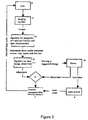
- a block diagram representing the method of functioning of the device is shown in figure 2 .
- the algorithm 11 for recognition of trabecular bubbles and their characteristics which takes images from the imaging system 2 and then from a sequence of images or from one image, in case of stationary bubbles, selects shapes similar to bubbles, if they exist, as shown in figure 4 .
- the algorithm 11 then proceeds with image processing and gains data from obtained images about bubble number, size, speed and direction of movement. Speed, shape and size are three of the most important criteria about existence of trabecular bubbles.
- the output parameter of algorithm 11 is information about existence of bubbles, their size and number.
- algorithm 11 searches for differences in three consecutive images, which are first transformed into 1-bit, black and white images. Algorithm 11 adds up the differences of 1-bit images and gains information about objects, which have moved. Then, the algorithm 11 collects at least two 1-bit images of movements ( figure 4 ) and on the basis of pre-set criteria determines whether images contain bubbles or not. Pre-set criteria are shape, speed and size of bubble (object). In case bubble exists and has been recognized, the algorithm 11 classifies bubbles as small or big depending on their size and speed.
- Algorithm 11 for bubble recognition then forwards information about bubble existence, their number and size to the algorithm 12 for adjustment of laser pulse energy, which on the basis of predefined values together with the variable attenuation filter 7 appropriately decreases or increases the laser pulse energy.
- Typical change of energy value is 0.1 mJ, wherein the step change depends on the size and number of formed trabecular bubbles. In this way autonomous functioning of laser pulse energy setting is enabled based on the algorithm 11 for bubble recognition and the algorithm 12 for laser pulse energy adjustment.
- FIG. 3 An embodiment example of the algorithm 12 for adjustment of energy in autonomous functioning of the therapeutic laser device for selective laser trabeculoplasty is shown on figure 3 .
- the algorithm 12 sets the starting laser pulse energy at 0.8 mJ. The doctor can, based on his subjective judgment, manually select other starting value of laser pulse energy.
- the algorithm 11 for recognition of trabecular bubbles sends information about existence and characteristics of bubbles into the algorithm 12 for adjustment of laser pulse energy.
- the algorithm 12 determines whether bubbles are first or second class bubbles. If bubbles are first class bubbles, the pulse energy is decreased for 0.05 mJ, while in case bubbles are second class bubbles the pulse energy is decreased for 0.1 mJ.
- the bubble class is determined based on bubble number, size, speed and direction.
- a first class bubble is when the algorithm 11 for recognition of trabecular bubbles recognizes only one bubble.
- a second class bubble is when the algorithm 11 recognizes several bubbles or when a larger bubble is formed. If there are no bubbles, the algorithm 11 checks whether pulse energy during individual operation procedure has already been decreased. If energy was already decreased, the algorithm adjusts it in case bubbles were not formed in the last two consecutive pulses. The energy of the second consecutive pulse is in this case increased for 0.05 mJ. If laser pulse energy during operation procedure was not decreased, algorithm first checks if the current energy is lower than 1.1 mJ. This limitation of the highest energy is set based on the fact that typical energies, when performing SLT operations, do not exceed 1.2 mJ. If pulse energy is lower than 1.1 mJ, the algorithm increases energy for 0.1 mJ for the next laser pulse.
- the algorithm 12 does not autonomously adjust the energy, but only warns the doctor that the energy threshold has been reached and that a manual increase of laser pulse energy is suggested. Pulse energy is adjusted with the help of the variable attenuation filter 7.
- the described algorithm enables that the doctor performs SLT procedure close to the threshold for trabecular bubble formation. In this way, the described procedure unburdens the doctor, increases the reproducibility of operation and improves treatment effectiveness.
- Ophthalmic laser device may have two cameras for taking images, which allow presentation of a three-dimensional image of taken images, which serves as additional information for the algorithm 11 for image recognition, and allows optimization of the whole algorithm and consequently more precise control of the variable attenuation filter 7, which decreases or increases laser pulse energy.
- the ophthalmic laser device with the imaging system which through the beam splitter takes images from the optical axis of a biomicroscope, with the help of the pre-set algorithm, enables automatic detection of bubble formation during operation procedures in a patient's eye.
- the design of this device allows autonomous adjustment of energy values of laser pulses on the basis of taken images during operations in ophthalmology.
Landscapes
- Health & Medical Sciences (AREA)
- Ophthalmology & Optometry (AREA)
- Heart & Thoracic Surgery (AREA)
- Vascular Medicine (AREA)
- Optics & Photonics (AREA)
- Surgery (AREA)
- Engineering & Computer Science (AREA)
- Biomedical Technology (AREA)
- Physics & Mathematics (AREA)
- Nuclear Medicine, Radiotherapy & Molecular Imaging (AREA)
- Life Sciences & Earth Sciences (AREA)
- Animal Behavior & Ethology (AREA)
- General Health & Medical Sciences (AREA)
- Public Health (AREA)
- Veterinary Medicine (AREA)
- Laser Surgery Devices (AREA)
Description
- The present invention is a device for performing therapeutic procedure of selective laser trabeculoplasty for treatment of open-angle glaucoma which allows autonomous adjustment of energy values of the device and thus more effective operation procedure.
- The present invention belongs to the field of devices for performing selective laser trabeculoplasty, more precisely to the field of systems for adjustment of laser pulse energy with the help of automatic detection of trabecular bubble formation on the patient's eye in the therapeutic device itself, which allows setting of optimal laser pulse energy during procedure. Devices wherein the bubble formation is measured and the laser settings adapted accordingly are discussed for example in
WO 01/91661 - The technical problem, which is solved by the present invention, is how to allow adjustment of laser pulse energy, with the help of automatic detection of trabecular bubble formation on the patient's eye, in the therapeutic device for selective laser trabeculoplasty itself, which would enable adjusting of the optimal energy of laser pulses during procedure. Automatic adjusting of laser pulse energy would allow autonomous functioning of the device, which would also increase the ability to perform operation procedures closer to the threshold for trabecular bubble formation, consequently leading to higher operation reproducibility. The problem of bubble detection, including their size, number, speed and direction, which are formed at energies that exceed the threshold for trabecular bubble formation during glaucoma operation with SLT method, and consequently regulation and choice of energy values of laser pulses, should be solved in a relatively easy, inexpensive and technically reliable way.
- Glaucoma is a common eye disease, in which the optic nerve is injured on the site, where it exits the eye. Due to these injuries sight irreversibly deteriorates. The frequency of glaucoma increases with age; at the age of 80 more than 4% of population suffer from glaucoma. The optic nerve defect in glaucoma is most commonly associated with ocular hypertension, which occurs due to hampered outflow of aqueous humour through the trabecular tissue. If the eye pressure is too high, the optic nerve is mechanically damaged, which consequently leads to nerve fibre necrosis. Costs for medical treatment with medicaments are very high; therefore a need for different solutions has emerged. The treatment technique with lasers is known as laser trabeculoplasty. It was discovered by Latina and is described in patent
US5549596 , owned by The General Hospital Corporation. Latina described the use of pulsed, frequency-doubled Nd:YAG laser for laser trabeculoplasty. - Selective laser trabeculoplasty (hereinafter SLT) is an improvement of an older technique called argon laser trabeculoplasty (ALT). Argon laser trabeculoplasty causes permanent coagulation damage (due to thermal effects) and can therefore be used only once in each eye. The SLT method, on the other hand, can be used more than once. This method does not cause coagulation of trabecular tissue, while selective absorption in melanin stimulates and facilitates drainage of aqueous humour. Due to selective mode of action when illuminating trabecular tissue, there are no visual changes in the tissue after application of a laser pulse, however, formation of trabecular bubbles can be observed, when the energy threshold for their formation is exceeded. Hence, operation protocol is closely linked with this energy threshold as will be described in more detail below.
- Operation protocol of selective laser trabeculoplasty, when using existing commercially available solutions, is performed as follows. The doctor starts with the operation at low laser energy (typically 0.8 mJ) with pulses, which are shorter than 5 ns and have a wavelength of 532 nm. Then, the energy is increased until the doctor visually recognizes formation of trabecular bubbles through a binocular. When bubbles are detected, the operating doctor lowers laser energy just below the threshold for formation of trabecular bubbles. In this way the doctor subjectively regulates laser pulse energy during operation.
- Known devices require that the operating doctor visually and subjectively recognizes formation of trabecular bubbles and on the basis of this subjective judgment adjusts the laser pulse energy on his own.
- Patent
EP1540403 discloses a laser system, which combines functions of two devices, a photodisruptor and a laser device for selective laser trabeculoplasty, in one device. This solution does not allow automatic detection of trabecular bubble formation and adjustment of laser pulse energy during operation. - Patent
EP1377243 discloses an optical laser system, which allows execution of retina photocoagulation and laser trabeculoplasty, but does not enable control and automatic regulation of laser pulse energy during operation. - Patent S122509 discloses an optical system for selective laser trabeculoplasty, which ensures a homogenous density of energy and a sharp edge of a laser pulse point on the target. Also this solution does not solve the problem of regulation and selection of energy values of laser pulses during operation.
- The present invention differs from known solutions in that it solves the problem of adjusting laser parameters in selective laser trabeculoplasty with the help of automatic detection of trabecular bubble formation on the patient's eye. This solution allows automatic adjustment of laser pulse energy and at the same time unburdens the doctor, who can devote more attention to the operation, which is not the case in the above mentioned known solutions. In addition, the present invention allows higher reproducibility of the whole procedure, as autonomous functioning of the device enables execution of procedures closer to the threshold for trabecular bubble formation, thereby making it more reproducible.
- The essence of the ophthalmic laser device according to the invention is that the device includes an imaging system, which serves as the basis for automatic detection of trabecular bubbles during selective laser trabeculoplasty operation, and a processor system, which together with integrated algorithms analyses images, recognizes formation of trabecular bubbles during operation and triggers automatic regulation of laser pulse energy value. The invention is defined in the claims, other embodiments being merely exemplary. For a further understanding of the present invention, reference should be made to the following detailed disclosure based on an embodiment of ophthalmic laser device for selective laser trabeculoplasty, taken in conjunction with the accompanying figures, which show:
-
Figure 1 - Schematic drawing of the ophthalmic laser device -
Figure 2 - Block diagram of the feedback loop -
Figure 3 - Algorithm for autonomous adjustment of laser pulse energy -
Figure 4 - Image of air bubbles - The ophthalmic laser device according to the present invention allows, regardless of the used elements or algorithm types, detection of air bubbles, their size, number, speed and direction, which are formed at energies that exceed the threshold for trabecular bubble formation during operation of glaucoma with SLT method, on the basis of which the device warns the doctor or in autonomous mode reacts with an appropriate adjustment of variable attenuation filter settings. Autonomy, to which the device may itself decide to increase or decrease the selected energy, should be limited to few steps of increase or decrease of energy value. Typically, a step of energy increase or decrease is 0.1 mJ.
- Ophthalmic laser device with automatic detection of trabecular bubbles in patient's
eye 8 has anintegrated imaging system 2 in thedevice 1 for selective laser trabeculoplasty itself, thesystem 2 being integrated via thebeam splitter 5 before binocular 6. In thedevice 1 for selective laser trabeculoplasty theprocessor system 3 is included, which together with the algorithm 11 processes images fromsystem 2 and based on the predefined algorithm 12 for adjustment of laser pulses energy controls thevariable attenuation filter 7. Aslit lamp 4, which is a part of thedevice 1, functions as an illumination device, which illuminates the trabecular tissue during procedure with SLT so that it allows thedoctor 13 sufficient tissue visibility and at the same time sufficient visibility of pilot beam, with which the point of laser pulse application is selected. When taking images the important key is sufficient illumination, therefore theslit lamp 4 of the described device has the ability of short-term functioning or emitting pulses with typical durations of 100 ms at increased illumination, respectively. The interval of increased illumination is triggered together with the laser pulse and enables theimaging system 2 to capture high-quality sequential shots, which serve as the basis for further processing, with a typical capture of five consecutive images. In this way, additional illumination is not distracting nor for the patient nor for the doctor. Theimaging system 2 may be any device whose purpose is to take image via an optical sensor (commercial / industrial cameras, digital cameras, SLR cameras, etc.). - The method of functioning of the whole device is as follows: in accordance with classic operative protocol trabecular bubbles occur at the point of too high laser pulse energy. The
imaging system 2 takes images during operation, which may contain trabecular bubbles, and forwards it to the algorithm 11 for recognition of trabecular bubble formation. Based on received images the algorithm 11 obtains information about existence, size, speed and direction of bubbles and forwards this information to the algorithm 12 for adjustment of laser pulse energy. The algorithm 12 then sends a signal to thevariable attenuation filter 7, which decreases the laser pulse energy to an appropriate level based on the size and/or number of bubbles, or increases the laser pulse energy in case trabecular bubbles have not been formed, respectively. Image processing andvariable attenuation filter 7 setting is executed in less than 0.33 s, which allows autonomous functioning of the device at activation with highest frequency of 3 Hz. It is important to point out that the autonomous function of the device relates only to selection of laser pulse energy and not to activation oflaser source 9, which is performed by thedoctor 13. In case autonomous function of the device has been switched off, the laser pulse energy can be also adjusted by thedoctor 13 based on his own judgment or based on information received from the algorithm 12 for adjustment of laser pulse energy. - A block diagram representing the method of functioning of the device is shown in
figure 2 . After a performed laser pulse recognition of bubble formation is executed with the algorithm 11 for recognition of trabecular bubbles and their characteristics, which takes images from theimaging system 2 and then from a sequence of images or from one image, in case of stationary bubbles, selects shapes similar to bubbles, if they exist, as shown infigure 4 . The algorithm 11 then proceeds with image processing and gains data from obtained images about bubble number, size, speed and direction of movement. Speed, shape and size are three of the most important criteria about existence of trabecular bubbles. The output parameter of algorithm 11 is information about existence of bubbles, their size and number. An example of how algorithm 11 works is that algorithm 11 searches for differences in three consecutive images, which are first transformed into 1-bit, black and white images. Algorithm 11 adds up the differences of 1-bit images and gains information about objects, which have moved. Then, the algorithm 11 collects at least two 1-bit images of movements (figure 4 ) and on the basis of pre-set criteria determines whether images contain bubbles or not. Pre-set criteria are shape, speed and size of bubble (object). In case bubble exists and has been recognized, the algorithm 11 classifies bubbles as small or big depending on their size and speed. Algorithm 11 for bubble recognition then forwards information about bubble existence, their number and size to the algorithm 12 for adjustment of laser pulse energy, which on the basis of predefined values together with thevariable attenuation filter 7 appropriately decreases or increases the laser pulse energy. Typical change of energy value is 0.1 mJ, wherein the step change depends on the size and number of formed trabecular bubbles. In this way autonomous functioning of laser pulse energy setting is enabled based on the algorithm 11 for bubble recognition and the algorithm 12 for laser pulse energy adjustment. - An embodiment example of the algorithm 12 for adjustment of energy in autonomous functioning of the therapeutic laser device for selective laser trabeculoplasty is shown on
figure 3 . During initialization the algorithm 12 sets the starting laser pulse energy at 0.8 mJ. The doctor can, based on his subjective judgment, manually select other starting value of laser pulse energy. After each executed laser pulse the algorithm 11 for recognition of trabecular bubbles sends information about existence and characteristics of bubbles into the algorithm 12 for adjustment of laser pulse energy. In case bubbles exist, the algorithm 12 determines whether bubbles are first or second class bubbles. If bubbles are first class bubbles, the pulse energy is decreased for 0.05 mJ, while in case bubbles are second class bubbles the pulse energy is decreased for 0.1 mJ. The bubble class is determined based on bubble number, size, speed and direction. A first class bubble is when the algorithm 11 for recognition of trabecular bubbles recognizes only one bubble. On the other hand, a second class bubble is when the algorithm 11 recognizes several bubbles or when a larger bubble is formed. If there are no bubbles, the algorithm 11 checks whether pulse energy during individual operation procedure has already been decreased. If energy was already decreased, the algorithm adjusts it in case bubbles were not formed in the last two consecutive pulses. The energy of the second consecutive pulse is in this case increased for 0.05 mJ. If laser pulse energy during operation procedure was not decreased, algorithm first checks if the current energy is lower than 1.1 mJ. This limitation of the highest energy is set based on the fact that typical energies, when performing SLT operations, do not exceed 1.2 mJ. If pulse energy is lower than 1.1 mJ, the algorithm increases energy for 0.1 mJ for the next laser pulse. - Otherwise, the algorithm 12 does not autonomously adjust the energy, but only warns the doctor that the energy threshold has been reached and that a manual increase of laser pulse energy is suggested. Pulse energy is adjusted with the help of the
variable attenuation filter 7. - The described algorithm enables that the doctor performs SLT procedure close to the threshold for trabecular bubble formation. In this way, the described procedure unburdens the doctor, increases the reproducibility of operation and improves treatment effectiveness.
- Ophthalmic laser device may have two cameras for taking images, which allow presentation of a three-dimensional image of taken images, which serves as additional information for the algorithm 11 for image recognition, and allows optimization of the whole algorithm and consequently more precise control of the
variable attenuation filter 7, which decreases or increases laser pulse energy. - The ophthalmic laser device with the imaging system, which through the beam splitter takes images from the optical axis of a biomicroscope, with the help of the pre-set algorithm, enables automatic detection of bubble formation during operation procedures in a patient's eye. The design of this device allows autonomous adjustment of energy values of laser pulses on the basis of taken images during operations in ophthalmology.
Claims (11)
- An ophthalmic laser device for performing selective laser trabeculoplasty, which comprises:- a laser source (9) providing laser pulses,- a beam splitter (5) for directing a part of an image from an optical axis (10),- a slit lamp (4) for illumination of trabecular tissue,- a binocular (6),characterized in that- the device further comprises:- an imaging system (2) integrated via the beam splitter (5) before the binocular (6),- a processor system (3),- an algorithm (11),- a predefined algorithm (12), and- a variable attenuation filter (7) for regulation of laser pulse energy,wherein the ophthalmic laser device is adapted to enable automatic detection of trabecular bubbles formation based on images taken by the imaging system (2) and analysed by the processor system (3), and wherein the processor system (3) and the predefined algorithm (12) based on the received images from the system (2) and the algorithm (11), are adapted to cause the ophthalmic laser device to control the variable attenuation filter (7), which is adapted to decrease or increase laser pulse energy.
- The ophthalmic laser device according to claim 1, being adapted to detect number, size, speed and direction of movement of trabecular bubbles, which serves as an input information for decreasing or increasing the laser pulse energy.
- The ophthalmic laser device according to claim 1 and claim 2, characterized in that, in addition to autonomous adjustment of laser energy, the device also includes a mode of action in which the device warns the doctor about existing trabecular bubbles and their characteristics.
- The ophthalmic laser device according to claims 1 to 3, characterized in that in addition to autonomous adjustment of laser energy the device also includes a mode of action, in which the device suggests to the doctor an appropriate output laser energy based on existing trabecular bubbles and their characteristics.
- The ophthalmic laser device according to claims 1 to 4, characterized in that the integrated slit lamp (4) is adapted to enable short-term functioning or emitting pulses with typical duration of 100 ms, which is triggered together with the laser pulse for reaching of an optimal contrast between a trabecular bubble and the surrounding tissue in order to take high quality images.
- The ophthalmic laser device according to claims 1 to 5, characterized in that, the integrated imaging system (2) includes two cameras for imaging, which allow presenting a three-dimensional image of taken images and allow additional information for the algorithm (11) for image recognition.
- The ophthalmic laser device according to claims 1 to 6, characterized in that, the laser pulse energy can be adjusted autonomously by the device or manually by the user.
- The ophthalmic laser device according to any of the preceding claims, characterized in that the processor system (3) is adapted to cause the ophthalmic laser device to execute the following steps:- after triggering the laser pulse, the recognition of bubble formation is performed by an algorithm (11) based on images from an imaging system (2)- the algorithm (11) determines shapes similar to bubbles, in case they exist and determines their number, size, direction and speed of movement;- speed, shape and sufficient size are three criteria for deciding whether trabecular bubble exists;- the algorithm (11) forwards information about bubbles to the predefined algorithm (12) for regulation of laser pulse energy, the output information being bubble existence, their size and number.
- The ophthalmic laser device according to claim 8, characterized in that- the algorithm (11) is adapted to analyse more images taken by the imaging system (2) and to search for differences between consecutive images, which have been transformed into 1-bit, black and white images;- that the algorithm (11) is adapted to add up differences of 1-bit images and thereby to gain information about objects that have moved;- that the algorithm (11) is then adapted to select at least two 1-bit images of movement and based on pre-set criteria to determine whether imaged shapes are bubbles;- that the pre-set criteria are shape, speed and size of bubble (object);- that in case a bubble is recognized, the algorithm (11) determines whether the bubble is small or large based on its size and speed.
- The ophthalmic laser device according to claim 8 and claim 9, characterized in that the algorithm (11) for bubble recognition is adapted to forward information about bubble existence and their characteristics to the predefined algorithm (12), which based on predefined values with the help of a variable attenuation filter (7) appropriately decreases or increases laser pulse energy.
- The ophthalmic laser device according to claim 10, characterized in that the processor system (3) is adapted to cause the ophthalmic laser device to execute the following steps:- after each executed laser pulse the algorithm (11) sends information existence and characteristics of bubbles to the algorithm (12) for adjustment of laser pulse energy;- that in case bubbles exist, the algorithm (12) determines whether bubbles are first or second class bubbles based on bubble number, size, speed and direction;- that for first class bubbles, which means that only one bubble is present, the pulse energy is decreased for 0.05 mJ,- that for second class bubbles, which means that more bubbles are present, the pulse energy is decreased for 0.1 mJ;- that in case of no bubbles, the algorithm (11) checks whether pulse energy during individual operation procedure has already been decreased;- that in case energy was already decreased, the algorithm adjusts it in case bubbles were not formed in the last two consecutive pulses and the energy of the second consecutive pulse is in this case increased for 0.05 mJ;- that in case the laser pulse energy during operation procedure has not been decreased, the algorithm (12) first checks if the current energy is lower than 1.1 mJ;- that in case the pulse energy is lower than 1.1 mJ, the algorithm increases energy for 0.1 mJ for the next laser pulse; and- in case the current energy is 1.1 mJ, the algorithm (12) does not autonomously adjust the energy, but only warns the doctor that the energy threshold has been reached and that a manual increase of laser pulse energy is suggested.
Priority Applications (1)
| Application Number | Priority Date | Filing Date | Title |
|---|---|---|---|
| SI201430492T SI3068355T1 (en) | 2013-11-11 | 2014-11-11 | Ophthalmic laser device |
Applications Claiming Priority (2)
| Application Number | Priority Date | Filing Date | Title |
|---|---|---|---|
| SI201300379A SI24527A (en) | 2013-11-11 | 2013-11-11 | Ophthalmologic laser device |
| PCT/SI2014/000064 WO2015069197A1 (en) | 2013-11-11 | 2014-11-11 | Ophthalmic laser device |
Publications (2)
| Publication Number | Publication Date |
|---|---|
| EP3068355A1 EP3068355A1 (en) | 2016-09-21 |
| EP3068355B1 true EP3068355B1 (en) | 2017-10-11 |
Family
ID=52450547
Family Applications (1)
| Application Number | Title | Priority Date | Filing Date |
|---|---|---|---|
| EP14833607.6A Active EP3068355B1 (en) | 2013-11-11 | 2014-11-11 | Ophthalmic laser device |
Country Status (3)
| Country | Link |
|---|---|
| EP (1) | EP3068355B1 (en) |
| SI (2) | SI24527A (en) |
| WO (1) | WO2015069197A1 (en) |
Families Citing this family (9)
| Publication number | Priority date | Publication date | Assignee | Title |
|---|---|---|---|---|
| CN103025282B (en) | 2010-05-10 | 2015-03-11 | 特拉维夫大学拉玛特有限公司 | System for treating glaucoma by directing electromagnetic energy to the limbal area of an eye |
| US11771596B2 (en) | 2010-05-10 | 2023-10-03 | Ramot At Tel-Aviv University Ltd. | System and method for treating an eye |
| DE102017007837A1 (en) * | 2017-08-18 | 2019-02-21 | Thomas Samland | Non-lethal agent |
| WO2020008323A1 (en) | 2018-07-02 | 2020-01-09 | Belkin Laser Ltd. | Direct selective laser trabeculoplasty |
| FR3086164A1 (en) * | 2018-09-20 | 2020-03-27 | Keranova | METHOD AND DEVICE FOR DETERMINING A MINIMUM LASER ENERGY VALUE NECESSARY TO FORM A GAS BUBBLE |
| JP7448973B2 (en) | 2018-10-28 | 2024-03-13 | ベルキン ヴィジョン リミテッド | Direct selective laser trabeculoplasty protection |
| AU2021311097B2 (en) | 2020-07-19 | 2024-02-01 | Belkin Vision Ltd. | Automated capsulotomy |
| US12564517B2 (en) | 2020-10-26 | 2026-03-03 | Belvin Vision Ltd. | Avoiding blood vessels during direct selective laser trabeculoplasty |
| US12611101B2 (en) | 2022-10-11 | 2026-04-28 | Belkin Vision Ltd. | Gonioscopic laser surgery |
Family Cites Families (7)
| Publication number | Priority date | Publication date | Assignee | Title |
|---|---|---|---|---|
| US5549596A (en) | 1993-07-07 | 1996-08-27 | The General Hospital Corporation | Selective laser targeting of pigmented ocular cells |
| WO2001091661A1 (en) * | 2000-06-01 | 2001-12-06 | The General Hospital Corporation | Selective photocoagulation |
| AUPR442101A0 (en) | 2001-04-12 | 2001-05-17 | Taracan Pty Ltd | Laser photocoagulator |
| AU2002951467A0 (en) | 2002-09-18 | 2002-10-03 | Ellex Medical Pty Ltd | Ophthalmic laser |
| SI22509A (en) | 2007-04-11 | 2008-10-31 | Optotek D.O.O. | Optical system for selective laser trabeculoplastics |
| RU2424785C2 (en) * | 2009-10-13 | 2011-07-27 | Федеральное государственное учреждение "Межотраслевой научно-технический комплекс "Микрохирургия глаза" имени академика С.Н. Федорова Федерального агентства по высокотехнологичной медицинской помощи" | Selective laser trabeculoplasty |
| WO2013095695A1 (en) * | 2011-04-10 | 2013-06-27 | Vanessa Vera | Systems and methods to deliver laser pulses into the eye |
-
2013
- 2013-11-11 SI SI201300379A patent/SI24527A/en not_active IP Right Cessation
-
2014
- 2014-11-11 WO PCT/SI2014/000064 patent/WO2015069197A1/en not_active Ceased
- 2014-11-11 EP EP14833607.6A patent/EP3068355B1/en active Active
- 2014-11-11 SI SI201430492T patent/SI3068355T1/en unknown
Non-Patent Citations (1)
| Title |
|---|
| None * |
Also Published As
| Publication number | Publication date |
|---|---|
| EP3068355A1 (en) | 2016-09-21 |
| SI3068355T1 (en) | 2018-01-31 |
| SI24527A (en) | 2015-05-29 |
| WO2015069197A1 (en) | 2015-05-14 |
Similar Documents
| Publication | Publication Date | Title |
|---|---|---|
| WO2015069197A1 (en) | Ophthalmic laser device | |
| US20250248851A1 (en) | Arrangement for the oct-based laser vitreolysis | |
| US10363172B2 (en) | Ophthalmic laser treatment apparatus | |
| US20240139033A1 (en) | Arrangement for laser vitreolysis | |
| JP4427327B2 (en) | Non-perforated leaky surgery | |
| EP3448336B1 (en) | Automated intraocular pressure tamponade | |
| EP2968001B1 (en) | Varying a numerical aperture of a laser during lens fragmentation in cataract surgery | |
| EP2838481B1 (en) | Surgical laser unit with variable modes of operation | |
| KR20180021692A (en) | Ophthalmic Laser Surgery Equipment for Orthopedic Corneal Correction | |
| JP2003532483A (en) | Non-perforated filtration surgery | |
| CN113473950A (en) | Automatic laser iridotomy | |
| US20250186258A1 (en) | Producing cuts in the interior of the eye | |
| US8066696B2 (en) | Ophthalmic laser treatment apparatus | |
| WO2017064574A1 (en) | Photocoagulation with closed-loop control | |
| US20240041654A1 (en) | Assembly for laser treatment of ocular opacities | |
| US20230320899A1 (en) | Control apparatus, control method, program, and ophthalmic surgical system | |
| JP7099849B2 (en) | Ophthalmic laser system | |
| US11850187B2 (en) | Method for determining a current position of an eye of a patient based on a purkinje image | |
| KR101442714B1 (en) | Apparatus and method for extracting cornea endothelium | |
| HK40054309A (en) | Automated laser iridotomy |
Legal Events
| Date | Code | Title | Description |
|---|---|---|---|
| PUAI | Public reference made under article 153(3) epc to a published international application that has entered the european phase |
Free format text: ORIGINAL CODE: 0009012 |
|
| 17P | Request for examination filed |
Effective date: 20160510 |
|
| AK | Designated contracting states |
Kind code of ref document: A1 Designated state(s): AL AT BE BG CH CY CZ DE DK EE ES FI FR GB GR HR HU IE IS IT LI LT LU LV MC MK MT NL NO PL PT RO RS SE SI SK SM TR |
|
| AX | Request for extension of the european patent |
Extension state: BA ME |
|
| DAX | Request for extension of the european patent (deleted) | ||
| GRAP | Despatch of communication of intention to grant a patent |
Free format text: ORIGINAL CODE: EPIDOSNIGR1 |
|
| INTG | Intention to grant announced |
Effective date: 20170727 |
|
| GRAS | Grant fee paid |
Free format text: ORIGINAL CODE: EPIDOSNIGR3 |
|
| GRAA | (expected) grant |
Free format text: ORIGINAL CODE: 0009210 |
|
| AK | Designated contracting states |
Kind code of ref document: B1 Designated state(s): AL AT BE BG CH CY CZ DE DK EE ES FI FR GB GR HR HU IE IS IT LI LT LU LV MC MK MT NL NO PL PT RO RS SE SI SK SM TR |
|
| REG | Reference to a national code |
Ref country code: GB Ref legal event code: FG4D |
|
| REG | Reference to a national code |
Ref country code: CH Ref legal event code: EP |
|
| REG | Reference to a national code |
Ref country code: IE Ref legal event code: FG4D |
|
| REG | Reference to a national code |
Ref country code: AT Ref legal event code: REF Ref document number: 935378 Country of ref document: AT Kind code of ref document: T Effective date: 20171115 |
|
| REG | Reference to a national code |
Ref country code: DE Ref legal event code: R096 Ref document number: 602014015822 Country of ref document: DE |
|
| REG | Reference to a national code |
Ref country code: FR Ref legal event code: PLFP Year of fee payment: 4 |
|
| REG | Reference to a national code |
Ref country code: NL Ref legal event code: MP Effective date: 20171011 |
|
| REG | Reference to a national code |
Ref country code: LT Ref legal event code: MG4D |
|
| REG | Reference to a national code |
Ref country code: AT Ref legal event code: MK05 Ref document number: 935378 Country of ref document: AT Kind code of ref document: T Effective date: 20171011 |
|
| PG25 | Lapsed in a contracting state [announced via postgrant information from national office to epo] |
Ref country code: NL Free format text: LAPSE BECAUSE OF FAILURE TO SUBMIT A TRANSLATION OF THE DESCRIPTION OR TO PAY THE FEE WITHIN THE PRESCRIBED TIME-LIMIT Effective date: 20171011 |
|
| PG25 | Lapsed in a contracting state [announced via postgrant information from national office to epo] |
Ref country code: NO Free format text: LAPSE BECAUSE OF FAILURE TO SUBMIT A TRANSLATION OF THE DESCRIPTION OR TO PAY THE FEE WITHIN THE PRESCRIBED TIME-LIMIT Effective date: 20180111 Ref country code: ES Free format text: LAPSE BECAUSE OF FAILURE TO SUBMIT A TRANSLATION OF THE DESCRIPTION OR TO PAY THE FEE WITHIN THE PRESCRIBED TIME-LIMIT Effective date: 20171011 Ref country code: LT Free format text: LAPSE BECAUSE OF FAILURE TO SUBMIT A TRANSLATION OF THE DESCRIPTION OR TO PAY THE FEE WITHIN THE PRESCRIBED TIME-LIMIT Effective date: 20171011 Ref country code: FI Free format text: LAPSE BECAUSE OF FAILURE TO SUBMIT A TRANSLATION OF THE DESCRIPTION OR TO PAY THE FEE WITHIN THE PRESCRIBED TIME-LIMIT Effective date: 20171011 Ref country code: SE Free format text: LAPSE BECAUSE OF FAILURE TO SUBMIT A TRANSLATION OF THE DESCRIPTION OR TO PAY THE FEE WITHIN THE PRESCRIBED TIME-LIMIT Effective date: 20171011 |
|
| PG25 | Lapsed in a contracting state [announced via postgrant information from national office to epo] |
Ref country code: HR Free format text: LAPSE BECAUSE OF FAILURE TO SUBMIT A TRANSLATION OF THE DESCRIPTION OR TO PAY THE FEE WITHIN THE PRESCRIBED TIME-LIMIT Effective date: 20171011 Ref country code: IS Free format text: LAPSE BECAUSE OF FAILURE TO SUBMIT A TRANSLATION OF THE DESCRIPTION OR TO PAY THE FEE WITHIN THE PRESCRIBED TIME-LIMIT Effective date: 20180211 Ref country code: BG Free format text: LAPSE BECAUSE OF FAILURE TO SUBMIT A TRANSLATION OF THE DESCRIPTION OR TO PAY THE FEE WITHIN THE PRESCRIBED TIME-LIMIT Effective date: 20180111 Ref country code: LV Free format text: LAPSE BECAUSE OF FAILURE TO SUBMIT A TRANSLATION OF THE DESCRIPTION OR TO PAY THE FEE WITHIN THE PRESCRIBED TIME-LIMIT Effective date: 20171011 Ref country code: AT Free format text: LAPSE BECAUSE OF FAILURE TO SUBMIT A TRANSLATION OF THE DESCRIPTION OR TO PAY THE FEE WITHIN THE PRESCRIBED TIME-LIMIT Effective date: 20171011 Ref country code: GR Free format text: LAPSE BECAUSE OF FAILURE TO SUBMIT A TRANSLATION OF THE DESCRIPTION OR TO PAY THE FEE WITHIN THE PRESCRIBED TIME-LIMIT Effective date: 20180112 Ref country code: RS Free format text: LAPSE BECAUSE OF FAILURE TO SUBMIT A TRANSLATION OF THE DESCRIPTION OR TO PAY THE FEE WITHIN THE PRESCRIBED TIME-LIMIT Effective date: 20171011 |
|
| REG | Reference to a national code |
Ref country code: DE Ref legal event code: R097 Ref document number: 602014015822 Country of ref document: DE |
|
| PG25 | Lapsed in a contracting state [announced via postgrant information from national office to epo] |
Ref country code: CZ Free format text: LAPSE BECAUSE OF FAILURE TO SUBMIT A TRANSLATION OF THE DESCRIPTION OR TO PAY THE FEE WITHIN THE PRESCRIBED TIME-LIMIT Effective date: 20171011 Ref country code: SK Free format text: LAPSE BECAUSE OF FAILURE TO SUBMIT A TRANSLATION OF THE DESCRIPTION OR TO PAY THE FEE WITHIN THE PRESCRIBED TIME-LIMIT Effective date: 20171011 Ref country code: LI Free format text: LAPSE BECAUSE OF NON-PAYMENT OF DUE FEES Effective date: 20171130 Ref country code: DK Free format text: LAPSE BECAUSE OF FAILURE TO SUBMIT A TRANSLATION OF THE DESCRIPTION OR TO PAY THE FEE WITHIN THE PRESCRIBED TIME-LIMIT Effective date: 20171011 Ref country code: CH Free format text: LAPSE BECAUSE OF NON-PAYMENT OF DUE FEES Effective date: 20171130 Ref country code: EE Free format text: LAPSE BECAUSE OF FAILURE TO SUBMIT A TRANSLATION OF THE DESCRIPTION OR TO PAY THE FEE WITHIN THE PRESCRIBED TIME-LIMIT Effective date: 20171011 Ref country code: MC Free format text: LAPSE BECAUSE OF FAILURE TO SUBMIT A TRANSLATION OF THE DESCRIPTION OR TO PAY THE FEE WITHIN THE PRESCRIBED TIME-LIMIT Effective date: 20171011 |
|
| PLBE | No opposition filed within time limit |
Free format text: ORIGINAL CODE: 0009261 |
|
| STAA | Information on the status of an ep patent application or granted ep patent |
Free format text: STATUS: NO OPPOSITION FILED WITHIN TIME LIMIT |
|
| PG25 | Lapsed in a contracting state [announced via postgrant information from national office to epo] |
Ref country code: LU Free format text: LAPSE BECAUSE OF NON-PAYMENT OF DUE FEES Effective date: 20171111 Ref country code: IT Free format text: LAPSE BECAUSE OF FAILURE TO SUBMIT A TRANSLATION OF THE DESCRIPTION OR TO PAY THE FEE WITHIN THE PRESCRIBED TIME-LIMIT Effective date: 20171011 Ref country code: RO Free format text: LAPSE BECAUSE OF FAILURE TO SUBMIT A TRANSLATION OF THE DESCRIPTION OR TO PAY THE FEE WITHIN THE PRESCRIBED TIME-LIMIT Effective date: 20171011 Ref country code: SM Free format text: LAPSE BECAUSE OF FAILURE TO SUBMIT A TRANSLATION OF THE DESCRIPTION OR TO PAY THE FEE WITHIN THE PRESCRIBED TIME-LIMIT Effective date: 20171011 Ref country code: PL Free format text: LAPSE BECAUSE OF FAILURE TO SUBMIT A TRANSLATION OF THE DESCRIPTION OR TO PAY THE FEE WITHIN THE PRESCRIBED TIME-LIMIT Effective date: 20171011 |
|
| REG | Reference to a national code |
Ref country code: BE Ref legal event code: MM Effective date: 20171130 |
|
| REG | Reference to a national code |
Ref country code: IE Ref legal event code: MM4A |
|
| 26N | No opposition filed |
Effective date: 20180712 |
|
| PG25 | Lapsed in a contracting state [announced via postgrant information from national office to epo] |
Ref country code: MT Free format text: LAPSE BECAUSE OF NON-PAYMENT OF DUE FEES Effective date: 20171111 |
|
| PG25 | Lapsed in a contracting state [announced via postgrant information from national office to epo] |
Ref country code: IE Free format text: LAPSE BECAUSE OF NON-PAYMENT OF DUE FEES Effective date: 20171111 |
|
| PG25 | Lapsed in a contracting state [announced via postgrant information from national office to epo] |
Ref country code: BE Free format text: LAPSE BECAUSE OF NON-PAYMENT OF DUE FEES Effective date: 20171130 |
|
| PG25 | Lapsed in a contracting state [announced via postgrant information from national office to epo] |
Ref country code: HU Free format text: LAPSE BECAUSE OF FAILURE TO SUBMIT A TRANSLATION OF THE DESCRIPTION OR TO PAY THE FEE WITHIN THE PRESCRIBED TIME-LIMIT; INVALID AB INITIO Effective date: 20141111 |
|
| GBPC | Gb: european patent ceased through non-payment of renewal fee |
Effective date: 20181111 |
|
| PG25 | Lapsed in a contracting state [announced via postgrant information from national office to epo] |
Ref country code: CY Free format text: LAPSE BECAUSE OF FAILURE TO SUBMIT A TRANSLATION OF THE DESCRIPTION OR TO PAY THE FEE WITHIN THE PRESCRIBED TIME-LIMIT Effective date: 20171011 |
|
| PG25 | Lapsed in a contracting state [announced via postgrant information from national office to epo] |
Ref country code: MK Free format text: LAPSE BECAUSE OF FAILURE TO SUBMIT A TRANSLATION OF THE DESCRIPTION OR TO PAY THE FEE WITHIN THE PRESCRIBED TIME-LIMIT Effective date: 20171011 |
|
| PG25 | Lapsed in a contracting state [announced via postgrant information from national office to epo] |
Ref country code: GB Free format text: LAPSE BECAUSE OF NON-PAYMENT OF DUE FEES Effective date: 20181111 |
|
| PG25 | Lapsed in a contracting state [announced via postgrant information from national office to epo] |
Ref country code: TR Free format text: LAPSE BECAUSE OF FAILURE TO SUBMIT A TRANSLATION OF THE DESCRIPTION OR TO PAY THE FEE WITHIN THE PRESCRIBED TIME-LIMIT Effective date: 20171011 |
|
| PG25 | Lapsed in a contracting state [announced via postgrant information from national office to epo] |
Ref country code: PT Free format text: LAPSE BECAUSE OF FAILURE TO SUBMIT A TRANSLATION OF THE DESCRIPTION OR TO PAY THE FEE WITHIN THE PRESCRIBED TIME-LIMIT Effective date: 20171011 |
|
| PG25 | Lapsed in a contracting state [announced via postgrant information from national office to epo] |
Ref country code: AL Free format text: LAPSE BECAUSE OF FAILURE TO SUBMIT A TRANSLATION OF THE DESCRIPTION OR TO PAY THE FEE WITHIN THE PRESCRIBED TIME-LIMIT Effective date: 20171011 |
|
| PGFP | Annual fee paid to national office [announced via postgrant information from national office to epo] |
Ref country code: DE Payment date: 20251117 Year of fee payment: 12 |
|
| PGFP | Annual fee paid to national office [announced via postgrant information from national office to epo] |
Ref country code: FR Payment date: 20251127 Year of fee payment: 12 |
|
| PGFP | Annual fee paid to national office [announced via postgrant information from national office to epo] |
Ref country code: SI Payment date: 20251110 Year of fee payment: 12 |