EP3068104A1 - Sharing method and system for media file - Google Patents
Sharing method and system for media file Download PDFInfo
- Publication number
- EP3068104A1 EP3068104A1 EP14812703.8A EP14812703A EP3068104A1 EP 3068104 A1 EP3068104 A1 EP 3068104A1 EP 14812703 A EP14812703 A EP 14812703A EP 3068104 A1 EP3068104 A1 EP 3068104A1
- Authority
- EP
- European Patent Office
- Prior art keywords
- media file
- sharing
- slave device
- master device
- lan
- Prior art date
- Legal status (The legal status is an assumption and is not a legal conclusion. Google has not performed a legal analysis and makes no representation as to the accuracy of the status listed.)
- Granted
Links
Images


Classifications
-
- H—ELECTRICITY
- H04—ELECTRIC COMMUNICATION TECHNIQUE
- H04W—WIRELESS COMMUNICATION NETWORKS
- H04W4/00—Services specially adapted for wireless communication networks; Facilities therefor
- H04W4/80—Services using short range communication, e.g. near-field communication [NFC], radio-frequency identification [RFID] or low energy communication
-
- H—ELECTRICITY
- H04—ELECTRIC COMMUNICATION TECHNIQUE
- H04B—TRANSMISSION
- H04B5/00—Near-field transmission systems, e.g. inductive or capacitive transmission systems
- H04B5/20—Near-field transmission systems, e.g. inductive or capacitive transmission systems characterised by the transmission technique; characterised by the transmission medium
- H04B5/24—Inductive coupling
-
- H—ELECTRICITY
- H04—ELECTRIC COMMUNICATION TECHNIQUE
- H04L—TRANSMISSION OF DIGITAL INFORMATION, e.g. TELEGRAPHIC COMMUNICATION
- H04L12/00—Data switching networks
- H04L12/28—Data switching networks characterised by path configuration, e.g. LAN [Local Area Networks] or WAN [Wide Area Networks]
- H04L12/2803—Home automation networks
- H04L12/2807—Exchanging configuration information on appliance services in a home automation network
- H04L12/2809—Exchanging configuration information on appliance services in a home automation network indicating that an appliance service is present in a home automation network
-
- H—ELECTRICITY
- H04—ELECTRIC COMMUNICATION TECHNIQUE
- H04L—TRANSMISSION OF DIGITAL INFORMATION, e.g. TELEGRAPHIC COMMUNICATION
- H04L12/00—Data switching networks
- H04L12/28—Data switching networks characterised by path configuration, e.g. LAN [Local Area Networks] or WAN [Wide Area Networks]
- H04L12/2803—Home automation networks
- H04L12/2807—Exchanging configuration information on appliance services in a home automation network
- H04L12/2812—Exchanging configuration information on appliance services in a home automation network describing content present in a home automation network, e.g. audio video content
-
- H—ELECTRICITY
- H04—ELECTRIC COMMUNICATION TECHNIQUE
- H04L—TRANSMISSION OF DIGITAL INFORMATION, e.g. TELEGRAPHIC COMMUNICATION
- H04L65/00—Network arrangements, protocols or services for supporting real-time applications in data packet communication
- H04L65/60—Network streaming of media packets
-
- H—ELECTRICITY
- H04—ELECTRIC COMMUNICATION TECHNIQUE
- H04W—WIRELESS COMMUNICATION NETWORKS
- H04W76/00—Connection management
- H04W76/10—Connection setup
- H04W76/14—Direct-mode setup
-
- H—ELECTRICITY
- H04—ELECTRIC COMMUNICATION TECHNIQUE
- H04L—TRANSMISSION OF DIGITAL INFORMATION, e.g. TELEGRAPHIC COMMUNICATION
- H04L12/00—Data switching networks
- H04L12/28—Data switching networks characterised by path configuration, e.g. LAN [Local Area Networks] or WAN [Wide Area Networks]
- H04L12/2803—Home automation networks
- H04L2012/2847—Home automation networks characterised by the type of home appliance used
- H04L2012/2849—Audio/video appliances
-
- H—ELECTRICITY
- H04—ELECTRIC COMMUNICATION TECHNIQUE
- H04W—WIRELESS COMMUNICATION NETWORKS
- H04W84/00—Network topologies
- H04W84/02—Hierarchically pre-organised networks, e.g. paging networks, cellular networks, WLAN [Wireless Local Area Network] or WLL [Wireless Local Loop]
- H04W84/10—Small scale networks; Flat hierarchical networks
- H04W84/12—WLAN [Wireless Local Area Networks]
-
- H—ELECTRICITY
- H04—ELECTRIC COMMUNICATION TECHNIQUE
- H04W—WIRELESS COMMUNICATION NETWORKS
- H04W84/00—Network topologies
- H04W84/18—Self-organising networks, e.g. ad-hoc networks or sensor networks
- H04W84/20—Leader-follower arrangements
Definitions
- the present disclosure generally relates to the technical field of digital living network technologies, and more particularly, to a media file sharing method and a media file sharing system.
- the DLNA Digital Living Network Alliance
- a wireless network such as a local area network (LAN) so as to achieve unlimited sharing of media files.
- various kinds of playing devices such as mobile phones, computers and TV sets can intelligently communicate media files with each other so that entertainment and cooperation among a plurality of persons can be achieved through in-time sharing of screens of the playing devices.
- the user needs to activate and log into the wireless network and the DLNA application to search for the media file to be shared through browsing multiple layers of operation catalogues, search for slave devices that are in a connected state through the wireless network,, select and connect to one of the slave devices that can be shared, create a connection therebetween and then operate the catalogues several times to acquire the shared media file. Therefore, the method for sharing a media file by means of the conventional DLNA technology is rather complex in operation, and tends to cause errors in the user's operations.
- the main technical problem to be solved by the present disclosure is to provide a media file sharing method and a media file sharing system that can achieve sharing of a file quickly through very simple operations and at a high accuracy.
- a technical solution adopted by the present disclosure is to provide a media file sharing method, which comprises: presetting and saving a local area network (LAN), a DLNA application and a media file that are default during a sharing process, wherein the LAN is a WiFi network; establishing a sharing pair relationship between a master device and a slave device in the DLNA application; generating an NFC triggering label embedded in the master device according to the LAN, the DLNA application, the media file and the sharing pair relationship; activating the NFC triggering label by the master device through an NFC sensing operation; the master device and the slave device logging into the LAN and the DLNA application that are default according to the NFC triggering label and completing the sharing pairing according to the sharing pair relationship; receiving the media file from the master device by the slave device and completing processing of the media file, wherein the master device and the slave device both have a display screen respectively, and the step of completing processing of the media file by the slave device comprises: an operation
- the step of establishing a sharing pair relationship between a master device and a slave device in the DLNA application comprises: acquiring a slave device that is in a connected state from the DLNA application; and matching a type of the slave device with a type of a media file to be shared by the master device, and establishing the sharing pair relationship between the master device and the slave device after the matching is successful.
- the sharing method further comprises: matching the type of the slave device with the type of the media file, and finishing the processing of the media file if the matching is successful; and giving a piece of alert information if the matching fails so as to prompt that the slave device is not able to identify the media file.
- a media file sharing method which comprises: presetting and saving a local area network (LAN), a DLNA application and a media file that are default during a sharing process; establishing a sharing pair relationship between a master device and a slave device in the DLNA application; generating an NFC triggering label embedded in the master device according to the LAN, the DLNA application, the media file and the sharing pair relationship; activating the NFC triggering label by the master device through an NFC sensing operation; the master device and the slave device logging into the LAN and the DLNA application that are default according to the NFC triggering label and completing the sharing pairing according to the sharing pair relationship; and receiving the media file from the master device by the slave device and completing the processing of the media file.
- LAN local area network
- DLNA application a media file that are default during a sharing process
- the step of establishing a sharing pair relationship between a master device and a slave device in the DLNA application comprises: acquiring a slave device that is in a connected state from the DLNA application; and matching a type of the slave device with a type of a media file to be shared by the master device, and establishing the sharing pair relationship between the master device and the slave device after the matching is successful.
- the master device and the slave device both have a display screen respectively
- the step of completing the processing of the media file by the slave device comprises: displaying an operation interface for controlling a displaying content of a display screen of the slave device on the display screen of the master device so that the media file is processed by the master device; or displaying the operation interface on the display screen of the slave device so that the media file is processed by the slave device.
- the sharing method further comprises: matching the type of the slave device with the type of the media file, and finishing the processing of the media file if the matching is successful; and giving a piece of alert information if the matching fails so as to prompt that the slave device is not able to identify the media file.
- the LAN is a WiFi network
- the master device is a mobile phone and the slave device is a TV set
- the master device is a TV set and the slave device is a mobile phone.
- a further technical solution adopted by the present disclosure is to provide a media file sharing system, which comprises a master device and a slave device.
- the master device comprises a first sharing setting module, a first touch sensing module and a sharing transmission module
- the slave device comprises a second sharing setting module, a second touch sensing module, a receiving module and a processing module.
- the first sharing setting module and the second touch sensing module are configured to preset and save a local area network (LAN), a DLNA application and a media file, which are default during a sharing process, in the master device and the slave device respectively, and establish a sharing pair relationship between the master device and the slave device in the DLNA application, and generate an NFC triggering label embedded in the master device according to the LAN, the DLNA application, the media file and the sharing pair relationship.
- the first touch sensing module and the second touch sensing module are configured to activate the NFC triggering label embedded in the master device through an NFC sensing operation so that the master device and the slave device log into the LAN and the DLNA application that are default according to the NFC triggering label and complete the sharing pairing according to the sharing pair relationship.
- the sharing transmission module is configured to transmit the media file to be shared to the receiving module so that the processing module completes the processing of the media file.
- the first sharing setting module is further configured to acquire a slave device that is in a connected state from the DLNA application, and match a type of the slave device with a type of a media file to be shared by the master device so as to establish the sharing pair relationship between the master device and the slave device after the matching is successful.
- the master device is provided with a first display screen
- the slave device is provided with a second display screen
- the first display screen is configured to display an operation interface for controlling a displaying content of the second display screen so that the media file is processed by the master device.
- the master device further comprises a prompting module
- the processing module is configured to match the type of the slave device with the type of the media file
- the prompting module is configured to inform the master device if the matching is successful and gives a piece of alert information to the master device if the matching fails so as to prompt that the slave device is not able to process the media file.
- the LAN is a WiFi network
- the master device is a mobile phone and the slave device is a TV set
- the master device is a TV set and the slave device is a mobile phone.
- the present disclosure has the following benefits: as compared to the prior art, the present disclosure presets an LAN, a DLNA application, a media file and a sharing pair relationship between a master device and a slave device for use in a sharing process, and generates an NFC triggering label embedded in the master device accordingly, so when a sharing process is needed, the master device and the slave device can automatically log into the LAN and the DLNA application that are default, complete the sharing pairing, and automatically transmit and process the media file therebetween by simply activating the NFC triggering label through an NFC sensing operation. Thereby, sharing of the media file can be achieved simply, quickly, and accurately.
- the present disclosure mainly provides a media file sharing method.
- This method mainly generates an NFC triggering label according to an LAN, a DLNA application, a media file to be shared and a sharing pair relationship between a master device and a slave device during a sharing process in advance, and by simply triggering or activating the NFC triggering label through an NFC sensing operation during the subsequent sharing process, the master device and the slave device can automatically call their respective background programs to log into the LAN and the DLNA application that are default and automatically transmit the media file after the sharing pairing is completed. Thereby, sharing of a media file can be achieved simply, quickly, and accurately.
- FIG. 1 is a flowchart diagram of a media file sharing method according to a first embodiment of the present disclosure. As shown in FIG. 1 , the sharing method of this embodiment mainly comprises the following steps:
- the LAN is preferably a WiFi network
- the master device is a mobile phone and the slave device is a TV set
- the master device is a TV set and the slave device is a mobile phone.
- the master device and the slave device are not limited to a mobile phone or a TV set, and may be any terminal device that has a DLNA access function, including various playing and processing devices such as a PAD, a PC computer, a sound box, a portable communication device and etc.
- the LAN that is preset and stored preferably comprises such information as the name, the account, the password, the MAC address of the pairing device of the LAN, and so on.
- the DLNA application preferably comprises the name of the DLNA application and the name information of each of the devices connected therein; and the media file preferably comprises such information as the file name, the file format, the memory size occupied by the file, or the like information of the media file to be shared.
- Step S12 establishing a sharing pair relationship between the master device and the slave device in the DLNA application.
- the method of establishing the sharing pair relationship is preferably the following: the user predetermines that the master device and the slave device that performs the media file sharing are both devices that can be connected in the default DLNA application, and then directly defines the sharing pair relationship therebetween through manual input.
- the sharing pair relationship may also be established in the following way: the user activates the wireless network access function of the master device in advance, and then searches for and logs into the LAN and the DLNA application in the step S11.
- an underlying service component of the DLNA application automatically adds the master device into the DLNA sharing device group in the DLNA application, and acquires therefrom the information of all available DLNA devices (i.e., the slave devices) that are in a connected state to form a shortcut list.
- the shortcut list comprises the name and a corresponding icon of each of the slave devices.
- the user selects a slave device from the shortcut list, and the master device automatically matches a type of the slave device with a type (i.e., a file format) of a media file to be shared to determine whether the slave device can process the media file. If the determination result is "yes” (i.e., if the matching is successful), then the sharing pair relationship between the master device and the slave device is established; and if the determination result is "no", then the user is prompted to select another slave device, and the process continues until the matching is successful. Or, the user directly selects a slave device manually according to the type of the media file to be shared and will not perform the matching process to establish the sharing pair relationship.
- a type i.e., a file format
- Step S13 generating an NFC triggering label embedded in the master device according to the LAN, the DLNA application, the media file and the sharing pair relationship.
- the NFC triggering label is preferably embodied as a data packet.
- the name of the LAN is china.net
- the name of the DLNA application is ce.dlna
- the name of the media file to be shared is wispro.rmvb
- the sharing pair relationship refers to the pairing between the master device no.a and the slave device no.b
- the data packet generated may be china.net-ce.dlna-wispro.rmvb-no.a-no.b.
- each of the aforesaid names may also be transformed into corresponding codes.
- an NFC triggering label may be set to comprise one or more data packets as long as each data packet comprises the LAN, the DLNA application, the media file and the information of the master device and the slave device that have the sharing pair relationship therebetween. Furthermore, in other embodiments, the NFC triggering label may also be set in the slave device.
- Step S14 activating the NFC triggering label by the master device through an NFC sensing operation.
- the NFC sensing operation of this embodiment is specifically embodied as a contact-type or a close-distance contact-less inductive card swiping action between the master device and the slave device, that is, a fool-style card swiping operation in the conventional sense.
- Step S15 the master device and the slave device logging into the LAN and the DLNA application that are default according to the NFC triggering label and completing the sharing pairing according to the sharing pair relationship.
- the master device and the slave device will activate their respective network access functions respectively to search for and log into the LAN and the DLNA application that are default in the NFC triggering label; and once the master device has found the slave device through searching according to the preset sharing pair relationship in the DLNA application, the pairing is completed.
- the sharing pair relationship in this embodiment actually refers to the fact that the master device and the slave device can perform the media file sharing in a same DLNA application.
- Step S16 receiving the media file from the master device by the slave device and completing processing of the media file.
- this embodiment still needs to match the type of the slave device with the type of the media file after the media file from the master device is received by the slave device in order to further guarantee that the shared media file can be processed by the slave device.
- the media file is processed if the matching is successful, and if the matching fails, preferably a piece of alert information is given to prompt the user that the slave device cannot identify the media file so that the user can select another slave device.
- the process of processing the media file preferably comprises: an operation interface for controlling a displaying content of a display screen of the slave device and the previewing information are displayed on the display screen of the master device, a processing instruction is transmitted through the operation interface displayed, and the slave device responds to the processing instruction of the master device so that the media file is processed by the master device.
- the operation interface is displayed on the display screen of the slave device so that the media file is processed by the slave device.
- the processing of the media file comprises such operations as playing, pausing, deleting, fast forward, rewinding, switching to a previous/next media file for playing, skipping to a certain playing position to continue the playing, increasing the volume or decreasing the volume and etc.
- this embodiment generates the NFC triggering label by combining the NFC sensing technology with the DLNA application technology and presetting the default LAN, the DLNA application, the media file and the sharing pair relationship between the master device and the slave device during the sharing process.
- the transmission of the media file can be automatically completed only through a simple card swiping action, thus achieving sharing of a media file simply, quickly and accurately.
- the present disclosure further provides a media file sharing method according to a second embodiment, which is described on the basis of the first embodiment. This embodiment differs from the first embodiment in the following respects.
- the media file is not preset in the step S11, and correspondingly the NFC triggering label generated in the step S 13 does not have such information as the name of the media file either.
- the slave device receives the media file through use of such near field or far field communication technologies as wireless network transmission, Bluetooth data transmission, or infrared transmission instead of receiving the media file from the master device through the near field communication transmission during the NFC sensing operation as in the first embodiment.
- this embodiment may allow the user to, after one time of NFC sensing operation, select different media files for purpose of sharing flexibly multiple times. Therefore, generating a corresponding NFC triggering label in advance before each time of sharing is avoided and the operation becomes easier.
- the present disclosure further provides a media file sharing method according to a third embodiment, which is described on the basis of the first embodiment.
- the process of generating the NFC triggering label is as shown in FIG. 2 and mainly comprises the following steps:
- the user activates the wireless network access function of the master device through a setting interface (e.g., one-touch sharing setting interface).
- a setting interface e.g., one-touch sharing setting interface.
- Step S22 presetting and saving a DLNA application and a slave device that are default during the sharing process.
- the user After having confirmed to connect the master device to the LAN, the user inputs in, through a manual setting interface, such information as the name of the DLNA application and the name of the slave device that are selected in advance for use in the sharing.
- Step S23 verifying whether the information of the default slave device is correct.
- the master device After having been connected to the LAN, the master device begins to search for the slave device preset in the step S22 through a related application program or an underlying service component in the DLNA application, and, after the slave device is obtained through searching, acquires such information as the LAN and the DLNA application that are set by the slave device.
- Step S24 generating an NFC triggering label.
- the slave device If it is verified that the slave device has the same information such as the LAN and the DLNA application as the master device, then it is determined that the information of the slave device is correct and the slave device and the master device have a sharing pair relationship therebetween. Then, the master device generates the NFC triggering label comprising information of the LAN, the DLNA application, the media file, and the master device and the slave device.
- Step S25 presetting and saving information of the LAN and the DLNA application of the slave device.
- the user will re-set such information as the LAN, the DLNA application and etc. of the slave device through the setting interface of the slave device and perform the step S23 again until the NFC triggering label is generated.
- the present disclosure further provides a media file sharing method according to a fourth embodiment, which is described on the basis of the first embodiment.
- the process of performing a media file sharing according to an NFC triggering label is as shown in FIG. 3 and mainly comprises the following steps:
- the master device adopts an active read mode
- the slave device adopts a passive read mode
- Step S32 verifying whether the default LAN has been activated.
- Step S33 if it is verified that the default LAN has not been activated, then initiating a request for connecting to the default LAN until the master device and the slave device are both connected into the LAN.
- Step S34 verifying whether the default DLNA application has been activated.
- Step S35 if it is verified that the default DLNA application has not been activated, then activating the default DLNA application until the master device and the slave device are both joined into the DLNA application.
- Step S36 after the NFC triggering label is activated in the step S32, acquiring all the slave devices that are currently available in the DLNA application.
- Step S37 after the step S34 and the step S36, searching for the slave device that has the sharing pair relationship.
- Step S38 transmitting the media file to be shared.
- this embodiment transmits the file according to the standard DLNA protocol of the prior art, and preferably adopts the 802.11 connection in the Connectivity layer and adopts the V1.0 portion of the UPnPAV protocol in the media management and control layer.
- Step S39 verifying whether the media file can be processed by the slave device.
- whether the media file can be processed means whether the slave device can perform one or more of such operations as identifying, decoding, playing on the media file transmitted from the master device.
- Step S40 if it is verified that the media file can be processed, then completing the processing of the media file by the slave device.
- Step S41 if it is verified that the media file can not be processed by the slave device, then inquiring whether the user is to select a next media file to be shared or select a next slave device, or inquiring whether the user is to close the DLNA application and the activated LAN.
- Step S42 continuing to perform the step S38 if the user selects another media file or slave device after the step S41.
- Step S43 closing the DLNA application, existing from the DLNA connection that has been established and closing the LAN if the user selects to close the LAN after the step S41 and after the processing of the media file is completed by the slave device in the step S40.
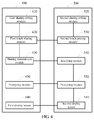
- the sharing system comprises a master device 400 and a slave device 500;
- the master device 400 of this embodiment comprises a first sharing setting module 410, a first touch sensing module 420, a sharing transmission module 430, a first display screen 440, and a prompting module 450;
- the slave device 500 comprises a second display screen 510, a second sharing setting module 520, a second touch sensing module 530, a receiving module 540 and a processing module 550.
- the first sharing setting module 410 is configured to preset and save an LAN, a DLNA application and a media file that are default during a sharing process in the master device 400.
- the second sharing setting module 520 is configured to preset and save the LAN, the DLNA application and the media file that are default during the sharing process in the slave device 500.
- the first sharing setting module 410 is further configured to acquire the slave device 500 that is in a connected state from the DLNA application, and match a type of the slave device 500 with a type of a media file to be shared by the master device 400 so as to establish the sharing pair relationship between the master device and the slave device after the matching is successful.
- an NFC triggering label embedded in the master device 400 is generated according to the LAN, the DLNA application, the media file and the sharing pair relationship.
- the first touch sensing module 420 and the second touch sensing module 530 are configured to activate the NFC triggering label embedded in the master device 400 through an NFC sensing operation so that the master device 400 and the slave device 500 log into the LAN and the DLNA application that are default according to the NFC triggering label and complete the sharing pairing according to the sharing pair relationship.
- the sharing transmission module 430 is configured to transmit the media file to be shared to the receiving module 540 of the slave device 500 so that the processing module 550 of the slave device 500 completes the processing of the media file.
- the processing module 550 matches the type of the media file received by the receiving module 540 with the type of the slave device 500
- the prompting module 450 is configured to inform the master device 400 if the matching is successful and gives a piece of alert information to the master device 400 if the matching fails so as to prompt that the slave device 500 cannot process the media file.
- the second display screen 510 of the slave device 500 may play such multimedia files as an audio, a video or the like under the control of the processing module 550, and the first display screen 440 is configured to display an operation interface for controlling a displaying content of the second display screen 510 so that the media file is processed by the master device 400.
- the processing of the media file comprises such operations as playing, pausing, deleting, fast forward, rewinding, switching to a previous/next media file for playing, skipping to a certain playing position to continue the playing, increasing the volume or decreasing the volume and etc.
- the LAN is a WiFi network
- the master device 400 is preferably a mobile phone and the slave device 500 is preferably a TV set
- the master device 400 is preferably a TV set and the slave device 500 is preferably a mobile phone.
- the division of the individual modules of the master device 400 and the slave device 500 described in this embodiment only represents a division of logical functions, and there may be other division manners in practical implementations. For example, a number of modules may be combined or may be integrated into another system, or some features may be omitted or may not be performed. Furthermore, mutual coupling or communication connections between the modules may be achieved via a plurality of interfaces, or in an electrical way or some other way.
- the aforesaid functional modules may be or may not be physical blocks, may be co-located at a same site or be distributed in a plurality of network units, and may be implemented either in the form of hardware or in the form of software function blocks.
- the objective of the present disclosure can be achieved by optionally using parts of or all of the modules depending on the actual need.
- the present disclosure presets an LAN, a DLNA application, a media file and a sharing pair relationship between a master device and a slave device for use in a sharing process, and generates an NFC triggering label embedded in the master device accordingly, so when a sharing process is needed, the master device and the slave device can automatically log into the LAN and the DLNA application that are default, complete the sharing pairing, and automatically transmit and process the media file therebetween by simply activating the NFC triggering label through an NFC sensing operation.
- sharing of the media file can be achieved simply, quickly, and accurately.
Landscapes
- Engineering & Computer Science (AREA)
- Computer Networks & Wireless Communication (AREA)
- Signal Processing (AREA)
- Automation & Control Theory (AREA)
- Multimedia (AREA)
- Mobile Radio Communication Systems (AREA)
- Telephone Function (AREA)
- Telephonic Communication Services (AREA)
- Two-Way Televisions, Distribution Of Moving Picture Or The Like (AREA)
Abstract
Description
- The present disclosure generally relates to the technical field of digital living network technologies, and more particularly, to a media file sharing method and a media file sharing system.
- The DLNA (Digital Living Network Alliance) technology is a kind of network information technology that is intended to allow a plurality of kinds of playing devices to interconnect and communicate with each other via a wireless network such as a local area network (LAN) so as to achieve unlimited sharing of media files. By means of the DLNA technology, various kinds of playing devices such as mobile phones, computers and TV sets can intelligently communicate media files with each other so that entertainment and cooperation among a plurality of persons can be achieved through in-time sharing of screens of the playing devices.
- In the prior art, when a media file is to be shared between a master device and a slave device through use of the DLNA technology, the user needs to activate and log into the wireless network and the DLNA application to search for the media file to be shared through browsing multiple layers of operation catalogues, search for slave devices that are in a connected state through the wireless network,, select and connect to one of the slave devices that can be shared, create a connection therebetween and then operate the catalogues several times to acquire the shared media file. Therefore, the method for sharing a media file by means of the conventional DLNA technology is rather complex in operation, and tends to cause errors in the user's operations.
- Accordingly, there is a need to provide a media file sharing method and a media file sharing system that can solve the aforesaid problems.
- The main technical problem to be solved by the present disclosure is to provide a media file sharing method and a media file sharing system that can achieve sharing of a file quickly through very simple operations and at a high accuracy.
- To solve the aforesaid technical problem, a technical solution adopted by the present disclosure is to provide a media file sharing method, which comprises: presetting and saving a local area network (LAN), a DLNA application and a media file that are default during a sharing process, wherein the LAN is a WiFi network; establishing a sharing pair relationship between a master device and a slave device in the DLNA application; generating an NFC triggering label embedded in the master device according to the LAN, the DLNA application, the media file and the sharing pair relationship; activating the NFC triggering label by the master device through an NFC sensing operation; the master device and the slave device logging into the LAN and the DLNA application that are default according to the NFC triggering label and completing the sharing pairing according to the sharing pair relationship; receiving the media file from the master device by the slave device and completing processing of the media file, wherein the master device and the slave device both have a display screen respectively, and the step of completing processing of the media file by the slave device comprises: an operation interface for controlling a displaying content of the display screen of the slave device is displayed on the display screen of the master device so that the media file is processed by the master device; or the operation interface is displayed on the display screen of the slave device so that the media file is processed by the slave device; the master device is a mobile phone and the slave device is a TV set, or the master device is a TV set and the slave device is a mobile phone.
- Preferably, the step of establishing a sharing pair relationship between a master device and a slave device in the DLNA application comprises: acquiring a slave device that is in a connected state from the DLNA application; and matching a type of the slave device with a type of a media file to be shared by the master device, and establishing the sharing pair relationship between the master device and the slave device after the matching is successful.
- Preferably, between the step of receiving the media file from the master device by the slave device and the step of completing processing of the media file, the sharing method further comprises: matching the type of the slave device with the type of the media file, and finishing the processing of the media file if the matching is successful; and giving a piece of alert information if the matching fails so as to prompt that the slave device is not able to identify the media file.
- To solve the aforesaid technical problem, another technical solution adopted by the present disclosure is to provide a media file sharing method, which comprises: presetting and saving a local area network (LAN), a DLNA application and a media file that are default during a sharing process; establishing a sharing pair relationship between a master device and a slave device in the DLNA application; generating an NFC triggering label embedded in the master device according to the LAN, the DLNA application, the media file and the sharing pair relationship; activating the NFC triggering label by the master device through an NFC sensing operation; the master device and the slave device logging into the LAN and the DLNA application that are default according to the NFC triggering label and completing the sharing pairing according to the sharing pair relationship; and receiving the media file from the master device by the slave device and completing the processing of the media file.
- Preferably, the step of establishing a sharing pair relationship between a master device and a slave device in the DLNA application comprises: acquiring a slave device that is in a connected state from the DLNA application; and matching a type of the slave device with a type of a media file to be shared by the master device, and establishing the sharing pair relationship between the master device and the slave device after the matching is successful.
- Preferably, the master device and the slave device both have a display screen respectively, and the step of completing the processing of the media file by the slave device comprises: displaying an operation interface for controlling a displaying content of a display screen of the slave device on the display screen of the master device so that the media file is processed by the master device; or displaying the operation interface on the display screen of the slave device so that the media file is processed by the slave device.
- Preferably, between the step of receiving the media file from the master device by the slave device and the step of completing processing of the media file, the sharing method further comprises: matching the type of the slave device with the type of the media file, and finishing the processing of the media file if the matching is successful; and giving a piece of alert information if the matching fails so as to prompt that the slave device is not able to identify the media file.
- Preferably, the LAN is a WiFi network, the master device is a mobile phone and the slave device is a TV set, or the master device is a TV set and the slave device is a mobile phone.
- To solve the aforesaid technical problem, a further technical solution adopted by the present disclosure is to provide a media file sharing system, which comprises a master device and a slave device. The master device comprises a first sharing setting module, a first touch sensing module and a sharing transmission module, and the slave device comprises a second sharing setting module, a second touch sensing module, a receiving module and a processing module. The first sharing setting module and the second touch sensing module are configured to preset and save a local area network (LAN), a DLNA application and a media file, which are default during a sharing process, in the master device and the slave device respectively, and establish a sharing pair relationship between the master device and the slave device in the DLNA application, and generate an NFC triggering label embedded in the master device according to the LAN, the DLNA application, the media file and the sharing pair relationship. The first touch sensing module and the second touch sensing module are configured to activate the NFC triggering label embedded in the master device through an NFC sensing operation so that the master device and the slave device log into the LAN and the DLNA application that are default according to the NFC triggering label and complete the sharing pairing according to the sharing pair relationship. The sharing transmission module is configured to transmit the media file to be shared to the receiving module so that the processing module completes the processing of the media file.
- Preferably, the first sharing setting module is further configured to acquire a slave device that is in a connected state from the DLNA application, and match a type of the slave device with a type of a media file to be shared by the master device so as to establish the sharing pair relationship between the master device and the slave device after the matching is successful.
- Preferably, the master device is provided with a first display screen, the slave device is provided with a second display screen, the first display screen is configured to display an operation interface for controlling a displaying content of the second display screen so that the media file is processed by the master device.
- Preferably, the master device further comprises a prompting module, the processing module is configured to match the type of the slave device with the type of the media file, and the prompting module is configured to inform the master device if the matching is successful and gives a piece of alert information to the master device if the matching fails so as to prompt that the slave device is not able to process the media file.
- Preferably, the LAN is a WiFi network, the master device is a mobile phone and the slave device is a TV set, or the master device is a TV set and the slave device is a mobile phone.
- The present disclosure has the following benefits: as compared to the prior art, the present disclosure presets an LAN, a DLNA application, a media file and a sharing pair relationship between a master device and a slave device for use in a sharing process, and generates an NFC triggering label embedded in the master device accordingly, so when a sharing process is needed, the master device and the slave device can automatically log into the LAN and the DLNA application that are default, complete the sharing pairing, and automatically transmit and process the media file therebetween by simply activating the NFC triggering label through an NFC sensing operation. Thereby, sharing of the media file can be achieved simply, quickly, and accurately.
-
-
FIG. 1 is a flowchart diagram of a media file sharing method according to a first embodiment of the present disclosure; -
FIG. 2 is a flowchart diagram of a step of generating an NFC triggering label in a media file sharing method according to a third embodiment of the present disclosure; -
FIG. 3 is a flowchart diagram of a step of sharing a media file in a media file sharing method according to a fourth embodiment of the present disclosure; and -
FIG. 4 is a block diagram illustrating principles of an embodiment of a media file sharing system of the present disclosure. - The present disclosure mainly provides a media file sharing method. This method mainly generates an NFC triggering label according to an LAN, a DLNA application, a media file to be shared and a sharing pair relationship between a master device and a slave device during a sharing process in advance, and by simply triggering or activating the NFC triggering label through an NFC sensing operation during the subsequent sharing process, the master device and the slave device can automatically call their respective background programs to log into the LAN and the DLNA application that are default and automatically transmit the media file after the sharing pairing is completed. Thereby, sharing of a media file can be achieved simply, quickly, and accurately.
- The present disclosure will be detailed with reference to
FIGs. 1∼4 and embodiments thereof. -
FIG. 1 is a flowchart diagram of a media file sharing method according to a first embodiment of the present disclosure. As shown inFIG. 1 , the sharing method of this embodiment mainly comprises the following steps: - Step S11: presetting and saving an LAN, a DLNA application and a media file that are default during a sharing process.
- In this embodiment, the LAN is preferably a WiFi network, the master device is a mobile phone and the slave device is a TV set, or the master device is a TV set and the slave device is a mobile phone. Of course, the master device and the slave device are not limited to a mobile phone or a TV set, and may be any terminal device that has a DLNA access function, including various playing and processing devices such as a PAD, a PC computer, a sound box, a portable communication device and etc.
- The LAN that is preset and stored preferably comprises such information as the name, the account, the password, the MAC address of the pairing device of the LAN, and so on. The DLNA application preferably comprises the name of the DLNA application and the name information of each of the devices connected therein; and the media file preferably comprises such information as the file name, the file format, the memory size occupied by the file, or the like information of the media file to be shared.
- Step S12: establishing a sharing pair relationship between the master device and the slave device in the DLNA application.
- In this embodiment, the method of establishing the sharing pair relationship is preferably the following: the user predetermines that the master device and the slave device that performs the media file sharing are both devices that can be connected in the default DLNA application, and then directly defines the sharing pair relationship therebetween through manual input.
- In other embodiments, the sharing pair relationship may also be established in the following way: the user activates the wireless network access function of the master device in advance, and then searches for and logs into the LAN and the DLNA application in the step S11. In this case, an underlying service component of the DLNA application automatically adds the master device into the DLNA sharing device group in the DLNA application, and acquires therefrom the information of all available DLNA devices (i.e., the slave devices) that are in a connected state to form a shortcut list. The shortcut list comprises the name and a corresponding icon of each of the slave devices.
- Afterwards, the user selects a slave device from the shortcut list, and the master device automatically matches a type of the slave device with a type (i.e., a file format) of a media file to be shared to determine whether the slave device can process the media file. If the determination result is "yes" (i.e., if the matching is successful), then the sharing pair relationship between the master device and the slave device is established; and if the determination result is "no", then the user is prompted to select another slave device, and the process continues until the matching is successful. Or, the user directly selects a slave device manually according to the type of the media file to be shared and will not perform the matching process to establish the sharing pair relationship.
- Step S13: generating an NFC triggering label embedded in the master device according to the LAN, the DLNA application, the media file and the sharing pair relationship.
- In this embodiment, the NFC triggering label is preferably embodied as a data packet. For example, the name of the LAN is china.net, the name of the DLNA application is ce.dlna, the name of the media file to be shared is wispro.rmvb, the sharing pair relationship refers to the pairing between the master device no.a and the slave device no.b, and thus the data packet generated may be china.net-ce.dlna-wispro.rmvb-no.a-no.b. Of course, each of the aforesaid names may also be transformed into corresponding codes. For example, china.net corresponds to the code 001, ce.dlna corresponds to the code 002, wispro.rmvb corresponds to the code 003, no.a corresponds to the code 004, and no.b corresponds to the code 005, and thus the data packet generated is 001002003004005006. It should be appreciated that, the aforesaid example is only for purpose of description rather than to limit the present disclosure; and other limitations may be made depending on the actual need, for example, the corresponding order of each of the names in the data packet may be adjusted in other ways.
- Furthermore, when a media file of the master device is to be shared to a plurality of slave devices in this embodiment, an NFC triggering label may be set to comprise one or more data packets as long as each data packet comprises the LAN, the DLNA application, the media file and the information of the master device and the slave device that have the sharing pair relationship therebetween. Furthermore, in other embodiments, the NFC triggering label may also be set in the slave device.
- Step S14: activating the NFC triggering label by the master device through an NFC sensing operation.
- The NFC sensing operation of this embodiment is specifically embodied as a contact-type or a close-distance contact-less inductive card swiping action between the master device and the slave device, that is, a fool-style card swiping operation in the conventional sense.
- Step S15: the master device and the slave device logging into the LAN and the DLNA application that are default according to the NFC triggering label and completing the sharing pairing according to the sharing pair relationship.
- After the NFC triggering label is activated, the master device and the slave device will activate their respective network access functions respectively to search for and log into the LAN and the DLNA application that are default in the NFC triggering label; and once the master device has found the slave device through searching according to the preset sharing pair relationship in the DLNA application, the pairing is completed. The sharing pair relationship in this embodiment actually refers to the fact that the master device and the slave device can perform the media file sharing in a same DLNA application.
- Step S16: receiving the media file from the master device by the slave device and completing processing of the media file.
- Although the master device has matched the type of the media file with the type of the slave device in the step S12, this embodiment still needs to match the type of the slave device with the type of the media file after the media file from the master device is received by the slave device in order to further guarantee that the shared media file can be processed by the slave device. The media file is processed if the matching is successful, and if the matching fails, preferably a piece of alert information is given to prompt the user that the slave device cannot identify the media file so that the user can select another slave device.
- Furthermore, when the master device and the slave device of this embodiment both have a display screen, the process of processing the media file preferably comprises: an operation interface for controlling a displaying content of a display screen of the slave device and the previewing information are displayed on the display screen of the master device, a processing instruction is transmitted through the operation interface displayed, and the slave device responds to the processing instruction of the master device so that the media file is processed by the master device. Alternatively, the operation interface is displayed on the display screen of the slave device so that the media file is processed by the slave device. In this embodiment, the processing of the media file comprises such operations as playing, pausing, deleting, fast forward, rewinding, switching to a previous/next media file for playing, skipping to a certain playing position to continue the playing, increasing the volume or decreasing the volume and etc.
- Accordingly, this embodiment generates the NFC triggering label by combining the NFC sensing technology with the DLNA application technology and presetting the default LAN, the DLNA application, the media file and the sharing pair relationship between the master device and the slave device during the sharing process. Thereby, the transmission of the media file can be automatically completed only through a simple card swiping action, thus achieving sharing of a media file simply, quickly and accurately.
- The present disclosure further provides a media file sharing method according to a second embodiment, which is described on the basis of the first embodiment. This embodiment differs from the first embodiment in the following respects.
- The media file is not preset in the step S11, and correspondingly the NFC triggering label generated in the
step S 13 does not have such information as the name of the media file either. In the step S16, the slave device receives the media file through use of such near field or far field communication technologies as wireless network transmission, Bluetooth data transmission, or infrared transmission instead of receiving the media file from the master device through the near field communication transmission during the NFC sensing operation as in the first embodiment. - Accordingly, this embodiment may allow the user to, after one time of NFC sensing operation, select different media files for purpose of sharing flexibly multiple times. Therefore, generating a corresponding NFC triggering label in advance before each time of sharing is avoided and the operation becomes easier.
- The present disclosure further provides a media file sharing method according to a third embodiment, which is described on the basis of the first embodiment. In this embodiment, the process of generating the NFC triggering label is as shown in
FIG. 2 and mainly comprises the following steps: - Step S21: searching for and selecting a default LAN during a sharing process.
- The user activates the wireless network access function of the master device through a setting interface (e.g., one-touch sharing setting interface). After a series of preparation steps before accessing the network such as searching for a current network, determining whether the network operates normally, and inquiring whether to connect to the network immediately, all LANs currently available are searched and displayed so that the user selects one LAN therefrom and connects the master device to this LAN.
- Step S22: presetting and saving a DLNA application and a slave device that are default during the sharing process.
- After having confirmed to connect the master device to the LAN, the user inputs in, through a manual setting interface, such information as the name of the DLNA application and the name of the slave device that are selected in advance for use in the sharing.
- Step S23: verifying whether the information of the default slave device is correct.
- After having been connected to the LAN, the master device begins to search for the slave device preset in the step S22 through a related application program or an underlying service component in the DLNA application, and, after the slave device is obtained through searching, acquires such information as the LAN and the DLNA application that are set by the slave device.
- Step S24: generating an NFC triggering label.
- If it is verified that the slave device has the same information such as the LAN and the DLNA application as the master device, then it is determined that the information of the slave device is correct and the slave device and the master device have a sharing pair relationship therebetween. Then, the master device generates the NFC triggering label comprising information of the LAN, the DLNA application, the media file, and the master device and the slave device.
- Step S25: presetting and saving information of the LAN and the DLNA application of the slave device.
- If it is verified that at least one of such information as the LAN, the DLNA application and etc. that are set by the slave device is different from that of the master device, then it is determined that the information of the slave device is incorrect and the slave device and the master device do not have the sharing pair relationship therebetween. In this case, the user will re-set such information as the LAN, the DLNA application and etc. of the slave device through the setting interface of the slave device and perform the step S23 again until the NFC triggering label is generated.
- The present disclosure further provides a media file sharing method according to a fourth embodiment, which is described on the basis of the first embodiment. In this embodiment, the process of performing a media file sharing according to an NFC triggering label is as shown in
FIG. 3 and mainly comprises the following steps: - Step S31: activating the NFC triggering label through an NFC sensing operation.
- During the triggering process, the master device adopts an active read mode, and the slave device adopts a passive read mode.
- Step S32: verifying whether the default LAN has been activated.
- Step S33: if it is verified that the default LAN has not been activated, then initiating a request for connecting to the default LAN until the master device and the slave device are both connected into the LAN.
- Step S34: verifying whether the default DLNA application has been activated.
- Step S35: if it is verified that the default DLNA application has not been activated, then activating the default DLNA application until the master device and the slave device are both joined into the DLNA application.
- Step S36: after the NFC triggering label is activated in the step S32, acquiring all the slave devices that are currently available in the DLNA application.
- Step S37: after the step S34 and the step S36, searching for the slave device that has the sharing pair relationship.
- Step S38: transmitting the media file to be shared.
- Specifically, this embodiment transmits the file according to the standard DLNA protocol of the prior art, and preferably adopts the 802.11 connection in the Connectivity layer and adopts the V1.0 portion of the UPnPAV protocol in the media management and control layer.
- Step S39: verifying whether the media file can be processed by the slave device.
- In this embodiment, whether the media file can be processed means whether the slave device can perform one or more of such operations as identifying, decoding, playing on the media file transmitted from the master device.
- Step S40: if it is verified that the media file can be processed, then completing the processing of the media file by the slave device.
- Step S41: if it is verified that the media file can not be processed by the slave device, then inquiring whether the user is to select a next media file to be shared or select a next slave device, or inquiring whether the user is to close the DLNA application and the activated LAN.
- Step S42: continuing to perform the step S38 if the user selects another media file or slave device after the step S41.
- Step S43: closing the DLNA application, existing from the DLNA connection that has been established and closing the LAN if the user selects to close the LAN after the step S41 and after the processing of the media file is completed by the slave device in the step S40.
- It should be appreciated that, some of the technical features of the embodiments disclosed above in the present disclosure can be modified or combined by those skilled in the art as needed.
- The present disclosure further provides a media file sharing system. As shown in
FIG. 4 , the sharing system comprises amaster device 400 and aslave device 500; themaster device 400 of this embodiment comprises a firstsharing setting module 410, a firsttouch sensing module 420, a sharingtransmission module 430, afirst display screen 440, and aprompting module 450; and theslave device 500 comprises asecond display screen 510, a secondsharing setting module 520, a secondtouch sensing module 530, a receivingmodule 540 and aprocessing module 550. - Specifically, the first
sharing setting module 410 is configured to preset and save an LAN, a DLNA application and a media file that are default during a sharing process in themaster device 400. The secondsharing setting module 520 is configured to preset and save the LAN, the DLNA application and the media file that are default during the sharing process in theslave device 500. The firstsharing setting module 410 is further configured to acquire theslave device 500 that is in a connected state from the DLNA application, and match a type of theslave device 500 with a type of a media file to be shared by themaster device 400 so as to establish the sharing pair relationship between the master device and the slave device after the matching is successful. Afterwards, an NFC triggering label embedded in themaster device 400 is generated according to the LAN, the DLNA application, the media file and the sharing pair relationship. - The first
touch sensing module 420 and the secondtouch sensing module 530 are configured to activate the NFC triggering label embedded in themaster device 400 through an NFC sensing operation so that themaster device 400 and theslave device 500 log into the LAN and the DLNA application that are default according to the NFC triggering label and complete the sharing pairing according to the sharing pair relationship. - The sharing
transmission module 430 is configured to transmit the media file to be shared to the receivingmodule 540 of theslave device 500 so that theprocessing module 550 of theslave device 500 completes the processing of the media file. Specifically, theprocessing module 550 matches the type of the media file received by the receivingmodule 540 with the type of theslave device 500, and the promptingmodule 450 is configured to inform themaster device 400 if the matching is successful and gives a piece of alert information to themaster device 400 if the matching fails so as to prompt that theslave device 500 cannot process the media file. - Furthermore, the
second display screen 510 of theslave device 500 may play such multimedia files as an audio, a video or the like under the control of theprocessing module 550, and thefirst display screen 440 is configured to display an operation interface for controlling a displaying content of thesecond display screen 510 so that the media file is processed by themaster device 400. Specifically, the processing of the media file comprises such operations as playing, pausing, deleting, fast forward, rewinding, switching to a previous/next media file for playing, skipping to a certain playing position to continue the playing, increasing the volume or decreasing the volume and etc. - In this embodiment, the LAN is a WiFi network, the
master device 400 is preferably a mobile phone and theslave device 500 is preferably a TV set, or themaster device 400 is preferably a TV set and theslave device 500 is preferably a mobile phone. Furthermore, for the specific operation processes of themaster device 400 and theslave device 500 of this embodiment, reference may be made to the method embodiment described above, and the same benefits can be obtained, so they will not be further described herein. - It should be understood that, the division of the individual modules of the
master device 400 and theslave device 500 described in this embodiment only represents a division of logical functions, and there may be other division manners in practical implementations. For example, a number of modules may be combined or may be integrated into another system, or some features may be omitted or may not be performed. Furthermore, mutual coupling or communication connections between the modules may be achieved via a plurality of interfaces, or in an electrical way or some other way. - As integral components of the
master device 400 and theslave device 500, the aforesaid functional modules may be or may not be physical blocks, may be co-located at a same site or be distributed in a plurality of network units, and may be implemented either in the form of hardware or in the form of software function blocks. The objective of the present disclosure can be achieved by optionally using parts of or all of the modules depending on the actual need. - According to the above descriptions, the present disclosure presets an LAN, a DLNA application, a media file and a sharing pair relationship between a master device and a slave device for use in a sharing process, and generates an NFC triggering label embedded in the master device accordingly, so when a sharing process is needed, the master device and the slave device can automatically log into the LAN and the DLNA application that are default, complete the sharing pairing, and automatically transmit and process the media file therebetween by simply activating the NFC triggering label through an NFC sensing operation. Thereby, sharing of the media file can be achieved simply, quickly, and accurately.
- What described above are only the embodiments of the present disclosure, but are not intended to limit the scope of the present disclosure. Any equivalent structures or equivalent process flow modifications that are made according to the specification and the attached drawings of the present disclosure, or any direct or indirect applications of the present disclosure in other related technical fields shall all be covered within the scope of the present disclosure.
Claims (13)
- A media file sharing method, comprising:presetting and saving a local area network (LAN), a DLNA application and a media file that are default during a sharing process, wherein the LAN is a WiFi network;establishing a sharing pair relationship between a master device and a slave device in the DLNA application;generating an NFC triggering label embedded in the master device according to the LAN, the DLNA application, the media file and the sharing pair relationship;activating the NFC triggering label by the master device through an NFC sensing operation;the master device and the slave device logging into the LAN and the DLNA application that are default according to the NFC triggering label and completing the sharing pairing according to the sharing pair relationship;receiving the media file from the master device by the slave device and completing processing of the media file, wherein the master device and the slave device both have a display screen respectively, an operation interface for controlling a displaying content of the display screen of the slave device is displayed on the display screen of the master device so that the media file is processed by the master device; or the operation interface is displayed on the display screen of the slave device so that the media file is processed by the slave device;wherein the master device is a mobile phone and the slave device is a TV set, or the master device is a TV set and the slave device is a mobile phone.
- The sharing method of claim 1, wherein the step of establishing a sharing pair relationship between a master device and a slave device in the DLNA application comprises:acquiring a slave device that is in a connected state from the DLNA application; andmatching a type of the slave device with a type of a media file to be shared by the master device, and establishing the sharing pair relationship between the master device and the slave device after the matching is successful.
- The sharing method of claim 1, between the step of receiving the media file from the master device by the slave device and the step of completing processing of the media file, the sharing method further comprises:matching the type of the slave device with the type of the media file, and finishing the processing of the media file if the matching is successful; andgiving a piece of alert information if the matching fails so as to prompt that the slave device is not able to identify the media file.
- A media file sharing method, comprising:presetting and saving a local area network (LAN), a DLNA application and a media file that are default during a sharing process;establishing a sharing pair relationship between a master device and a slave device in the DLNA application;generating an NFC triggering label embedded in the master device according to the LAN, the DLNA application, the media file and the sharing pair relationship;activating the NFC triggering label by the master device through an NFC sensing operation;the master device and the slave device logging into the LAN and the DLNA application that are default according to the NFC triggering label and completing the sharing pairing according to the sharing pair relationship; andreceiving the media file from the master device by the slave device and completing the processing of the media file.
- The sharing method of claim 4, wherein the step of establishing a sharing pair relationship between a master device and a slave device in the DLNA application comprises:acquiring a slave device that is in a connected state from the DLNA application; andmatching a type of the slave device with a type of a media file to be shared by the master device, and establishing the sharing pair relationship between the master device and the slave device after the matching is successful.
- The sharing method of claim 4, wherein the master device and the slave device both have a display screen respectively, and the step of completing the processing of the media file by the slave device comprises:displaying an operation interface for controlling a displaying content of a display screen of the slave device on the display screen of the master device so that the media file is processed by the master device; ordisplaying the operation interface on the display screen of the slave device so that the media file is processed by the slave device.
- The sharing method of claim 6, between the step of receiving the media file from the master device by the slave device and the step of completing processing of the media file, the sharing method further comprises:matching the type of the slave device with the type of the media file, and finishing the processing of the media file if the matching is successful; andgiving a piece of alert information if the matching fails so as to prompt that the slave device is not able to identify the media file.
- The sharing method of claim 4, wherein the LAN is a WiFi network, the master device is a mobile phone and the slave device is a TV set, or the master device is a TV set and the slave device is a mobile phone.
- A media file sharing system, comprising a master device and a slave device, wherein the master device comprises a first sharing setting module, a first touch sensing module and a sharing transmission module, and the slave device comprises a second sharing setting module, a second touch sensing module, a receiving module and a processing module,
the first sharing setting module and the second touch sensing module are configured to preset and save a local area network (LAN), a DLNA application and a media file, which are default during a sharing process, in the master device and the slave device respectively, and establish a sharing pair relationship between the master device and the slave device in the DLNA application, and generate an NFC triggering label embedded in the master device according to the LAN, the DLNA application, the media file and the sharing pair relationship;
the first touch sensing module and the second touch sensing module are configured to activate the NFC triggering label embedded in the master device through an NFC sensing operation so that the master device and the slave device log into the LAN and the DLNA application that are default according to the NFC triggering label and complete the sharing pairing according to the sharing pair relationship; and
the sharing transmission module is configured to transmit the media file to be shared to the receiving module so that the processing module completes the processing of the media file. - The sharing system of claim 9, wherein the first sharing setting module is further configured to acquire a slave device that is in a connected state from the DLNA application, and match a type of the slave device with a type of a media file to be shared by the master device so as to establish the sharing pair relationship between the master device and the slave device after the matching is successful.
- The sharing system of claim 9, wherein the master device is provided with a first display screen, the slave device is provided with a second display screen, the first display screen is configured to display an operation interface for controlling a displaying content of the second display screen so that the media file is processed by the master device.
- The sharing system of claim 11, wherein the master device further comprises a prompting module, the processing module is configured to match the type of the slave device with the type of the media file, and the prompting module is configured to inform the master device if the matching is successful and gives a piece of alert information to the master device if the matching fails so as to prompt that the slave device is not able to process the media file.
- The sharing system of claim 9, wherein the LAN is a WiFi network, the master device is a mobile phone and the slave device is a TV set, or the master device is a TV set and the slave device is a mobile phone.
Applications Claiming Priority (2)
| Application Number | Priority Date | Filing Date | Title |
|---|---|---|---|
| CN201310539605.3A CN103595775B (en) | 2013-11-04 | 2013-11-04 | The sharing method and system of media file |
| PCT/CN2014/074730 WO2015062203A1 (en) | 2013-11-04 | 2014-04-03 | Sharing method and system for media file |
Publications (3)
| Publication Number | Publication Date |
|---|---|
| EP3068104A1 true EP3068104A1 (en) | 2016-09-14 |
| EP3068104A4 EP3068104A4 (en) | 2017-06-07 |
| EP3068104B1 EP3068104B1 (en) | 2018-05-23 |
Family
ID=50085755
Family Applications (1)
| Application Number | Title | Priority Date | Filing Date |
|---|---|---|---|
| EP14812703.8A Active EP3068104B1 (en) | 2013-11-04 | 2014-04-03 | Sharing method and system for media file |
Country Status (5)
| Country | Link |
|---|---|
| US (1) | US9615195B2 (en) |
| EP (1) | EP3068104B1 (en) |
| CN (1) | CN103595775B (en) |
| ES (1) | ES2672745T3 (en) |
| WO (1) | WO2015062203A1 (en) |
Families Citing this family (12)
| Publication number | Priority date | Publication date | Assignee | Title |
|---|---|---|---|---|
| CN103595775B (en) * | 2013-11-04 | 2018-01-19 | 惠州Tcl移动通信有限公司 | The sharing method and system of media file |
| CN104092664B (en) | 2014-06-18 | 2018-01-19 | 惠州Tcl移动通信有限公司 | A kind of multimedia resource management method, Cloud Server and electronic equipment |
| CN105163399B (en) * | 2015-08-19 | 2020-03-20 | 北京字节跳动网络技术有限公司 | Data sharing method and device |
| CN105142098B (en) * | 2015-08-19 | 2019-10-25 | 北京字节跳动网络技术有限公司 | A kind of data sharing method and device |
| CN107566870B (en) * | 2017-08-04 | 2019-12-24 | 咪咕视讯科技有限公司 | A multimedia processing method, remote controller and storage medium |
| CN112351412B (en) * | 2019-08-06 | 2025-03-11 | 华为技术有限公司 | Content continuation method, system and electronic device |
| CN110958475A (en) | 2019-10-30 | 2020-04-03 | 华为终端有限公司 | Cross-device content projection method and electronic device |
| CN111565382B (en) * | 2020-04-30 | 2023-10-27 | 维沃移动通信有限公司 | Transmission methods and electronic equipment |
| CN113873480B (en) * | 2020-06-30 | 2024-04-09 | 荣耀终端有限公司 | Interactive control method, device, terminal and storage medium |
| CN112565843A (en) * | 2020-12-02 | 2021-03-26 | 广州朗国电子科技有限公司 | Projection screen control method, device, all-in-one machine and storage medium based on DLNA |
| CN114765758B (en) * | 2021-01-04 | 2025-10-10 | 北京小米移动软件有限公司 | Media file sharing method, media file sharing device and storage medium |
| CN114911399B (en) * | 2022-05-06 | 2025-01-28 | 北京字跳网络技术有限公司 | Information display method, device, equipment and storage medium |
Family Cites Families (17)
| Publication number | Priority date | Publication date | Assignee | Title |
|---|---|---|---|---|
| WO2006115842A2 (en) * | 2005-04-22 | 2006-11-02 | Kaplan, Mark, Mitchell | Rfid and magnetic swipe initiated mobile download |
| US7624417B2 (en) * | 2006-01-27 | 2009-11-24 | Robin Dua | Method and system for accessing media content via the internet |
| CN101202977B (en) * | 2006-12-14 | 2012-05-23 | 英华达(上海)电子有限公司 | method and terminal for realizing information sharing in mobile communication |
| CN102741849B (en) | 2010-09-07 | 2016-03-16 | 松下电器产业株式会社 | Cause in misdiagnosis pick-up unit and cause in misdiagnosis detection method |
| KR101750898B1 (en) * | 2010-12-06 | 2017-06-26 | 엘지전자 주식회사 | Mobile terminal and control method therof |
| KR101807286B1 (en) * | 2011-02-11 | 2017-12-08 | 삼성전자주식회사 | Method and apparatus for performing function in mobile terminal using short range communication |
| KR101857563B1 (en) | 2011-05-11 | 2018-05-15 | 삼성전자 주식회사 | Method and apparatus for data sharing of between different network electronic devices |
| KR101850825B1 (en) | 2011-07-20 | 2018-05-31 | 엘지전자 주식회사 | Mobile terminal and control method therof |
| US9847888B2 (en) * | 2011-08-29 | 2017-12-19 | Google Technology Holdings LLC | Controlling content access and related actions on a DLNA network |
| CN102315864B (en) * | 2011-09-07 | 2015-11-25 | 百度在线网络技术(北京)有限公司 | For the method and apparatus of mobile device Point-to-Point Data Transmission |
| CN103188628B (en) * | 2011-12-28 | 2016-03-30 | 三星电子(中国)研发中心 | For mobile terminal and the method thereof of shared personal electric information |
| CN103200378A (en) * | 2012-01-10 | 2013-07-10 | 宏碁股份有限公司 | Wireless display system, remote controller and communication method thereof |
| CN102710986A (en) * | 2012-05-07 | 2012-10-03 | Tcl集团股份有限公司 | Mobile phone audio and video playing method, mobile phone and playing device |
| CN102932412B (en) * | 2012-09-26 | 2016-02-03 | 华为终端有限公司 | Document transmission method and system, main control device |
| CN103051361B (en) * | 2013-01-05 | 2015-11-25 | 努比亚技术有限公司 | Near field communication system and mobile terminal thereof, method of attachment |
| CN103327387A (en) * | 2013-06-24 | 2013-09-25 | 深圳Tcl新技术有限公司 | Television remote control method and system |
| CN103595775B (en) * | 2013-11-04 | 2018-01-19 | 惠州Tcl移动通信有限公司 | The sharing method and system of media file |
-
2013
- 2013-11-04 CN CN201310539605.3A patent/CN103595775B/en active Active
-
2014
- 2014-04-03 US US14/432,617 patent/US9615195B2/en active Active
- 2014-04-03 EP EP14812703.8A patent/EP3068104B1/en active Active
- 2014-04-03 ES ES14812703.8T patent/ES2672745T3/en active Active
- 2014-04-03 WO PCT/CN2014/074730 patent/WO2015062203A1/en not_active Ceased
Also Published As
| Publication number | Publication date |
|---|---|
| EP3068104B1 (en) | 2018-05-23 |
| US20160057563A1 (en) | 2016-02-25 |
| WO2015062203A1 (en) | 2015-05-07 |
| EP3068104A4 (en) | 2017-06-07 |
| ES2672745T3 (en) | 2018-06-15 |
| CN103595775B (en) | 2018-01-19 |
| CN103595775A (en) | 2014-02-19 |
| US9615195B2 (en) | 2017-04-04 |
Similar Documents
| Publication | Publication Date | Title |
|---|---|---|
| EP3068104B1 (en) | Sharing method and system for media file | |
| CN101882366B (en) | Remote control signal learning and processing by a host device and accessory | |
| US10845974B2 (en) | Terminal device and method of controlling same | |
| US9125002B2 (en) | Apparatus and method for connecting with bluetooth device in portable terminal | |
| US9369945B2 (en) | Wireless network system and wireless communication method for switching a wireless network mode | |
| KR20140124304A (en) | Controlling Method for Communication and Electronic Device supporting the same | |
| EP3169086A1 (en) | Connection method for multimedia playing device, master device, control terminal, and system | |
| US20140121786A1 (en) | Smart gateway, smart home system and smart remote control method thereof | |
| CN103561315B (en) | The method, apparatus and system of a kind of multi-screen interactive | |
| EP3944584B1 (en) | Method supporting wireless access to storage device, and mobile routing hotspot device | |
| JP6282785B2 (en) | Target function starting method, apparatus, system, program, and recording medium | |
| CN103051361B (en) | Near field communication system and mobile terminal thereof, method of attachment | |
| CN104854816A (en) | Apparatus and method for content backup in home network system | |
| CN103327645A (en) | Method and device for connecting network | |
| JP2017526099A5 (en) | ||
| CN113552808A (en) | A kind of electronic household equipment distribution network method, electronic household equipment and mobile terminal | |
| CN106648396A (en) | Unlocking method and apparatus for mobile terminal | |
| US20130326077A1 (en) | Method for connecting a remote network and system for connecting a remote network | |
| CN103327387A (en) | Television remote control method and system | |
| KR20150067876A (en) | display appratus and user terminal device and method for communicating the same | |
| EP3171608B1 (en) | Playing device grouping control method and user terminal | |
| EP2933957B1 (en) | Method and mobile terminal for displaying dlna equipment | |
| CN105207813A (en) | Intelligent equipment sorting method and apparatus | |
| KR101239097B1 (en) | Video display apparatus sharing personal setting information of moving terminal and the sharing method | |
| KR102258490B1 (en) | Electronic apparatus and method for shareing wireless network access infromation in electronic apparatus |
Legal Events
| Date | Code | Title | Description |
|---|---|---|---|
| PUAI | Public reference made under article 153(3) epc to a published international application that has entered the european phase |
Free format text: ORIGINAL CODE: 0009012 |
|
| 17P | Request for examination filed |
Effective date: 20160511 |
|
| AK | Designated contracting states |
Kind code of ref document: A1 Designated state(s): AL AT BE BG CH CY CZ DE DK EE ES FI FR GB GR HR HU IE IS IT LI LT LU LV MC MK MT NL NO PL PT RO RS SE SI SK SM TR |
|
| AX | Request for extension of the european patent |
Extension state: BA ME |
|
| DAX | Request for extension of the european patent (deleted) | ||
| A4 | Supplementary search report drawn up and despatched |
Effective date: 20170509 |
|
| RIC1 | Information provided on ipc code assigned before grant |
Ipc: H04L 12/28 20060101ALI20170502BHEP Ipc: H04L 29/08 20060101AFI20170502BHEP |
|
| RIC1 | Information provided on ipc code assigned before grant |
Ipc: H04L 12/28 20060101ALI20171031BHEP Ipc: H04W 76/02 20090101ALI20171031BHEP Ipc: H04W 4/00 20090101ALI20171031BHEP Ipc: H04W 84/20 20090101ALI20171031BHEP Ipc: H04L 29/08 20060101AFI20171031BHEP Ipc: H04W 84/12 20090101ALI20171031BHEP |
|
| GRAP | Despatch of communication of intention to grant a patent |
Free format text: ORIGINAL CODE: EPIDOSNIGR1 |
|
| STAA | Information on the status of an ep patent application or granted ep patent |
Free format text: STATUS: GRANT OF PATENT IS INTENDED |
|
| INTG | Intention to grant announced |
Effective date: 20180104 |
|
| GRAS | Grant fee paid |
Free format text: ORIGINAL CODE: EPIDOSNIGR3 |
|
| GRAA | (expected) grant |
Free format text: ORIGINAL CODE: 0009210 |
|
| STAA | Information on the status of an ep patent application or granted ep patent |
Free format text: STATUS: THE PATENT HAS BEEN GRANTED |
|
| AK | Designated contracting states |
Kind code of ref document: B1 Designated state(s): AL AT BE BG CH CY CZ DE DK EE ES FI FR GB GR HR HU IE IS IT LI LT LU LV MC MK MT NL NO PL PT RO RS SE SI SK SM TR |
|
| REG | Reference to a national code |
Ref country code: GB Ref legal event code: FG4D |
|
| REG | Reference to a national code |
Ref country code: CH Ref legal event code: EP |
|
| REG | Reference to a national code |
Ref country code: IE Ref legal event code: FG4D |
|
| REG | Reference to a national code |
Ref country code: ES Ref legal event code: FG2A Ref document number: 2672745 Country of ref document: ES Kind code of ref document: T3 Effective date: 20180615 Ref country code: AT Ref legal event code: REF Ref document number: 1002447 Country of ref document: AT Kind code of ref document: T Effective date: 20180615 |
|
| REG | Reference to a national code |
Ref country code: DE Ref legal event code: R096 Ref document number: 602014025939 Country of ref document: DE |
|
| REG | Reference to a national code |
Ref country code: NL Ref legal event code: MP Effective date: 20180523 |
|
| REG | Reference to a national code |
Ref country code: LT Ref legal event code: MG4D |
|
| PG25 | Lapsed in a contracting state [announced via postgrant information from national office to epo] |
Ref country code: FI Free format text: LAPSE BECAUSE OF FAILURE TO SUBMIT A TRANSLATION OF THE DESCRIPTION OR TO PAY THE FEE WITHIN THE PRESCRIBED TIME-LIMIT Effective date: 20180523 Ref country code: BG Free format text: LAPSE BECAUSE OF FAILURE TO SUBMIT A TRANSLATION OF THE DESCRIPTION OR TO PAY THE FEE WITHIN THE PRESCRIBED TIME-LIMIT Effective date: 20180823 Ref country code: NO Free format text: LAPSE BECAUSE OF FAILURE TO SUBMIT A TRANSLATION OF THE DESCRIPTION OR TO PAY THE FEE WITHIN THE PRESCRIBED TIME-LIMIT Effective date: 20180823 Ref country code: SE Free format text: LAPSE BECAUSE OF FAILURE TO SUBMIT A TRANSLATION OF THE DESCRIPTION OR TO PAY THE FEE WITHIN THE PRESCRIBED TIME-LIMIT Effective date: 20180523 Ref country code: LT Free format text: LAPSE BECAUSE OF FAILURE TO SUBMIT A TRANSLATION OF THE DESCRIPTION OR TO PAY THE FEE WITHIN THE PRESCRIBED TIME-LIMIT Effective date: 20180523 |
|
| PG25 | Lapsed in a contracting state [announced via postgrant information from national office to epo] |
Ref country code: NL Free format text: LAPSE BECAUSE OF FAILURE TO SUBMIT A TRANSLATION OF THE DESCRIPTION OR TO PAY THE FEE WITHIN THE PRESCRIBED TIME-LIMIT Effective date: 20180523 Ref country code: RS Free format text: LAPSE BECAUSE OF FAILURE TO SUBMIT A TRANSLATION OF THE DESCRIPTION OR TO PAY THE FEE WITHIN THE PRESCRIBED TIME-LIMIT Effective date: 20180523 Ref country code: HR Free format text: LAPSE BECAUSE OF FAILURE TO SUBMIT A TRANSLATION OF THE DESCRIPTION OR TO PAY THE FEE WITHIN THE PRESCRIBED TIME-LIMIT Effective date: 20180523 Ref country code: GR Free format text: LAPSE BECAUSE OF FAILURE TO SUBMIT A TRANSLATION OF THE DESCRIPTION OR TO PAY THE FEE WITHIN THE PRESCRIBED TIME-LIMIT Effective date: 20180824 Ref country code: LV Free format text: LAPSE BECAUSE OF FAILURE TO SUBMIT A TRANSLATION OF THE DESCRIPTION OR TO PAY THE FEE WITHIN THE PRESCRIBED TIME-LIMIT Effective date: 20180523 |
|
| REG | Reference to a national code |
Ref country code: AT Ref legal event code: MK05 Ref document number: 1002447 Country of ref document: AT Kind code of ref document: T Effective date: 20180523 |
|
| PG25 | Lapsed in a contracting state [announced via postgrant information from national office to epo] |
Ref country code: SK Free format text: LAPSE BECAUSE OF FAILURE TO SUBMIT A TRANSLATION OF THE DESCRIPTION OR TO PAY THE FEE WITHIN THE PRESCRIBED TIME-LIMIT Effective date: 20180523 Ref country code: RO Free format text: LAPSE BECAUSE OF FAILURE TO SUBMIT A TRANSLATION OF THE DESCRIPTION OR TO PAY THE FEE WITHIN THE PRESCRIBED TIME-LIMIT Effective date: 20180523 Ref country code: AT Free format text: LAPSE BECAUSE OF FAILURE TO SUBMIT A TRANSLATION OF THE DESCRIPTION OR TO PAY THE FEE WITHIN THE PRESCRIBED TIME-LIMIT Effective date: 20180523 Ref country code: DK Free format text: LAPSE BECAUSE OF FAILURE TO SUBMIT A TRANSLATION OF THE DESCRIPTION OR TO PAY THE FEE WITHIN THE PRESCRIBED TIME-LIMIT Effective date: 20180523 Ref country code: EE Free format text: LAPSE BECAUSE OF FAILURE TO SUBMIT A TRANSLATION OF THE DESCRIPTION OR TO PAY THE FEE WITHIN THE PRESCRIBED TIME-LIMIT Effective date: 20180523 Ref country code: CZ Free format text: LAPSE BECAUSE OF FAILURE TO SUBMIT A TRANSLATION OF THE DESCRIPTION OR TO PAY THE FEE WITHIN THE PRESCRIBED TIME-LIMIT Effective date: 20180523 Ref country code: PL Free format text: LAPSE BECAUSE OF FAILURE TO SUBMIT A TRANSLATION OF THE DESCRIPTION OR TO PAY THE FEE WITHIN THE PRESCRIBED TIME-LIMIT Effective date: 20180523 |
|
| REG | Reference to a national code |
Ref country code: CH Ref legal event code: PK Free format text: BERICHTIGUNGEN |
|
| RIC2 | Information provided on ipc code assigned after grant |
Ipc: H04W 4/00 20180101ALI20171031BHEP Ipc: H04W 84/12 20090101ALI20171031BHEP Ipc: H04W 76/02 20090101ALI20171031BHEP Ipc: H04L 12/28 20060101ALI20171031BHEP Ipc: H04L 29/08 20060101AFI20171031BHEP Ipc: H04W 84/20 20090101ALI20171031BHEP |
|
| REG | Reference to a national code |
Ref country code: DE Ref legal event code: R097 Ref document number: 602014025939 Country of ref document: DE |
|
| PG25 | Lapsed in a contracting state [announced via postgrant information from national office to epo] |
Ref country code: SM Free format text: LAPSE BECAUSE OF FAILURE TO SUBMIT A TRANSLATION OF THE DESCRIPTION OR TO PAY THE FEE WITHIN THE PRESCRIBED TIME-LIMIT Effective date: 20180523 |
|
| PLBE | No opposition filed within time limit |
Free format text: ORIGINAL CODE: 0009261 |
|
| STAA | Information on the status of an ep patent application or granted ep patent |
Free format text: STATUS: NO OPPOSITION FILED WITHIN TIME LIMIT |
|
| 26N | No opposition filed |
Effective date: 20190226 |
|
| PG25 | Lapsed in a contracting state [announced via postgrant information from national office to epo] |
Ref country code: SI Free format text: LAPSE BECAUSE OF FAILURE TO SUBMIT A TRANSLATION OF THE DESCRIPTION OR TO PAY THE FEE WITHIN THE PRESCRIBED TIME-LIMIT Effective date: 20180523 |
|
| PG25 | Lapsed in a contracting state [announced via postgrant information from national office to epo] |
Ref country code: AL Free format text: LAPSE BECAUSE OF FAILURE TO SUBMIT A TRANSLATION OF THE DESCRIPTION OR TO PAY THE FEE WITHIN THE PRESCRIBED TIME-LIMIT Effective date: 20180523 |
|
| REG | Reference to a national code |
Ref country code: CH Ref legal event code: PL |
|
| REG | Reference to a national code |
Ref country code: BE Ref legal event code: MM Effective date: 20190430 |
|
| PG25 | Lapsed in a contracting state [announced via postgrant information from national office to epo] |
Ref country code: LU Free format text: LAPSE BECAUSE OF NON-PAYMENT OF DUE FEES Effective date: 20190403 Ref country code: MC Free format text: LAPSE BECAUSE OF FAILURE TO SUBMIT A TRANSLATION OF THE DESCRIPTION OR TO PAY THE FEE WITHIN THE PRESCRIBED TIME-LIMIT Effective date: 20180523 |
|
| PG25 | Lapsed in a contracting state [announced via postgrant information from national office to epo] |
Ref country code: LI Free format text: LAPSE BECAUSE OF NON-PAYMENT OF DUE FEES Effective date: 20190430 Ref country code: CH Free format text: LAPSE BECAUSE OF NON-PAYMENT OF DUE FEES Effective date: 20190430 |
|
| PG25 | Lapsed in a contracting state [announced via postgrant information from national office to epo] |
Ref country code: BE Free format text: LAPSE BECAUSE OF NON-PAYMENT OF DUE FEES Effective date: 20190430 |
|
| PG25 | Lapsed in a contracting state [announced via postgrant information from national office to epo] |
Ref country code: TR Free format text: LAPSE BECAUSE OF FAILURE TO SUBMIT A TRANSLATION OF THE DESCRIPTION OR TO PAY THE FEE WITHIN THE PRESCRIBED TIME-LIMIT Effective date: 20180523 |
|
| PG25 | Lapsed in a contracting state [announced via postgrant information from national office to epo] |
Ref country code: IE Free format text: LAPSE BECAUSE OF NON-PAYMENT OF DUE FEES Effective date: 20190403 |
|
| PG25 | Lapsed in a contracting state [announced via postgrant information from national office to epo] |
Ref country code: PT Free format text: LAPSE BECAUSE OF FAILURE TO SUBMIT A TRANSLATION OF THE DESCRIPTION OR TO PAY THE FEE WITHIN THE PRESCRIBED TIME-LIMIT Effective date: 20180924 |
|
| PG25 | Lapsed in a contracting state [announced via postgrant information from national office to epo] |
Ref country code: CY Free format text: LAPSE BECAUSE OF FAILURE TO SUBMIT A TRANSLATION OF THE DESCRIPTION OR TO PAY THE FEE WITHIN THE PRESCRIBED TIME-LIMIT Effective date: 20180523 |
|
| PG25 | Lapsed in a contracting state [announced via postgrant information from national office to epo] |
Ref country code: IS Free format text: LAPSE BECAUSE OF FAILURE TO SUBMIT A TRANSLATION OF THE DESCRIPTION OR TO PAY THE FEE WITHIN THE PRESCRIBED TIME-LIMIT Effective date: 20180923 |
|
| PG25 | Lapsed in a contracting state [announced via postgrant information from national office to epo] |
Ref country code: MT Free format text: LAPSE BECAUSE OF FAILURE TO SUBMIT A TRANSLATION OF THE DESCRIPTION OR TO PAY THE FEE WITHIN THE PRESCRIBED TIME-LIMIT Effective date: 20180523 Ref country code: HU Free format text: LAPSE BECAUSE OF FAILURE TO SUBMIT A TRANSLATION OF THE DESCRIPTION OR TO PAY THE FEE WITHIN THE PRESCRIBED TIME-LIMIT; INVALID AB INITIO Effective date: 20140403 |
|
| REG | Reference to a national code |
Ref country code: DE Ref legal event code: R079 Ref document number: 602014025939 Country of ref document: DE Free format text: PREVIOUS MAIN CLASS: H04L0029080000 Ipc: H04L0065000000 |
|
| PG25 | Lapsed in a contracting state [announced via postgrant information from national office to epo] |
Ref country code: MK Free format text: LAPSE BECAUSE OF FAILURE TO SUBMIT A TRANSLATION OF THE DESCRIPTION OR TO PAY THE FEE WITHIN THE PRESCRIBED TIME-LIMIT Effective date: 20180523 |
|
| P01 | Opt-out of the competence of the unified patent court (upc) registered |
Effective date: 20230530 |
|
| PGFP | Annual fee paid to national office [announced via postgrant information from national office to epo] |
Ref country code: DE Payment date: 20250422 Year of fee payment: 12 |
|
| PGFP | Annual fee paid to national office [announced via postgrant information from national office to epo] |
Ref country code: ES Payment date: 20250529 Year of fee payment: 12 |
|
| PGFP | Annual fee paid to national office [announced via postgrant information from national office to epo] |
Ref country code: IT Payment date: 20250424 Year of fee payment: 12 |
|
| PGFP | Annual fee paid to national office [announced via postgrant information from national office to epo] |
Ref country code: FR Payment date: 20250425 Year of fee payment: 12 |
|
| PGFP | Annual fee paid to national office [announced via postgrant information from national office to epo] |
Ref country code: GB Payment date: 20260306 Year of fee payment: 13 |