EP3067324B1 - Method for the preparation of electrodes of boron-doped nanocrystalline diamond - Google Patents
Method for the preparation of electrodes of boron-doped nanocrystalline diamond Download PDFInfo
- Publication number
- EP3067324B1 EP3067324B1 EP15460008.4A EP15460008A EP3067324B1 EP 3067324 B1 EP3067324 B1 EP 3067324B1 EP 15460008 A EP15460008 A EP 15460008A EP 3067324 B1 EP3067324 B1 EP 3067324B1
- Authority
- EP
- European Patent Office
- Prior art keywords
- electrode
- diamond
- layer
- electrodes
- boron
- Prior art date
- Legal status (The legal status is an assumption and is not a legal conclusion. Google has not performed a legal analysis and makes no representation as to the accuracy of the status listed.)
- Active
Links
Images
Classifications
-
- C—CHEMISTRY; METALLURGY
- C02—TREATMENT OF WATER, WASTE WATER, SEWAGE, OR SLUDGE
- C02F—TREATMENT OF WATER, WASTE WATER, SEWAGE, OR SLUDGE
- C02F1/00—Treatment of water, waste water, or sewage
- C02F1/46—Treatment of water, waste water, or sewage by electrochemical methods
- C02F1/461—Treatment of water, waste water, or sewage by electrochemical methods by electrolysis
- C02F1/46104—Devices therefor; Their operating or servicing
- C02F1/46109—Electrodes
-
- C—CHEMISTRY; METALLURGY
- C02—TREATMENT OF WATER, WASTE WATER, SEWAGE, OR SLUDGE
- C02F—TREATMENT OF WATER, WASTE WATER, SEWAGE, OR SLUDGE
- C02F1/00—Treatment of water, waste water, or sewage
- C02F1/46—Treatment of water, waste water, or sewage by electrochemical methods
- C02F1/461—Treatment of water, waste water, or sewage by electrochemical methods by electrolysis
- C02F1/467—Treatment of water, waste water, or sewage by electrochemical methods by electrolysis by electrochemical disinfection; by electrooxydation or by electroreduction
- C02F1/4672—Treatment of water, waste water, or sewage by electrochemical methods by electrolysis by electrochemical disinfection; by electrooxydation or by electroreduction by electrooxydation
-
- C—CHEMISTRY; METALLURGY
- C25—ELECTROLYTIC OR ELECTROPHORETIC PROCESSES; APPARATUS THEREFOR
- C25B—ELECTROLYTIC OR ELECTROPHORETIC PROCESSES FOR THE PRODUCTION OF COMPOUNDS OR NON-METALS; APPARATUS THEREFOR
- C25B11/00—Electrodes; Manufacture thereof not otherwise provided for
- C25B11/04—Electrodes; Manufacture thereof not otherwise provided for characterised by the material
- C25B11/051—Electrodes formed of electrocatalysts on a substrate or carrier
- C25B11/073—Electrodes formed of electrocatalysts on a substrate or carrier characterised by the electrocatalyst material
- C25B11/075—Electrodes formed of electrocatalysts on a substrate or carrier characterised by the electrocatalyst material consisting of a single catalytic element or catalytic compound
-
- C—CHEMISTRY; METALLURGY
- C02—TREATMENT OF WATER, WASTE WATER, SEWAGE, OR SLUDGE
- C02F—TREATMENT OF WATER, WASTE WATER, SEWAGE, OR SLUDGE
- C02F1/00—Treatment of water, waste water, or sewage
- C02F1/46—Treatment of water, waste water, or sewage by electrochemical methods
- C02F1/461—Treatment of water, waste water, or sewage by electrochemical methods by electrolysis
- C02F1/46104—Devices therefor; Their operating or servicing
- C02F1/46109—Electrodes
- C02F2001/46133—Electrodes characterised by the material
- C02F2001/46138—Electrodes comprising a substrate and a coating
- C02F2001/46147—Diamond coating
-
- C—CHEMISTRY; METALLURGY
- C02—TREATMENT OF WATER, WASTE WATER, SEWAGE, OR SLUDGE
- C02F—TREATMENT OF WATER, WASTE WATER, SEWAGE, OR SLUDGE
- C02F2101/00—Nature of the contaminant
- C02F2101/30—Organic compounds
- C02F2101/34—Organic compounds containing oxygen
- C02F2101/345—Phenols
Definitions
- the invention relates to a method for the preparation of electrodes of boron-doped nanocrystalline diamond.
- US Patent 7520980 discloses a bioreactor system for microbiological treatment of aquatic waste comprising at least one highly elastic substrate providing an environment for biomass growth, wherein the substrate includes a large number of threads and synthetic fibres with appropriate parameters and appropriately arranged relative to each other.
- European Application EP 2641877 discloses a method for treating a fluid stream with waste liquid containing organic substances, including contacting this stream with biomass located in a bioreactor, and appropriate treatment of streams flowing from the bioreactor, taking into account, among others, a membrane filtration unit and an extraction step
- US Patent 7135115 discloses a method for treating waste liquid with the use of a membrane bioreactor which produces excessive biological sludge and processes water components. This is achieved by extraction of biological sludge and appropriate treatment of dehydrated effluent.
- US 8268169 describes a system and a method for water treatment, taking into account the use of a hydrodynamic separator for removing most of suspended solids.
- AOP advanced oxidation processes
- Fenton process EP 1473278 A1 , CN 102503000 A , CN 102139938 B
- IV photocatalytic oxidation on titanium oxide
- UV radiation in combination ozone or hydrogen peroxide
- these techniques exhibit a high degree of purification, they are, on the other hand, very energy-intensive, require the addition of chemicals, and also require considerable financial outlays.
- Another method of purifying water from hardly biodegradable compounds includes electrochemical techniques. These methods use electrodes of lead, iridium and rutile oxides, which may contaminate the environment with these metals in the process of electrolysis. They are consumable electrodes, and the process using the electrodes known from the prior art is very energy-intensive, which greatly limits their applications. Therefore, development of new electrodes is essential to solve the problems associated with the use of known electrodes.
- Document CN 101671085 discloses the use of a membrane electrode of boron-doped diamond in electrochemical purification of waste water contaminated with organic compounds.
- the electrode operates in the environment of microwaves which, among others, activate the electrode of boron-doped diamond.
- the process uses microwaves which heat the waste water, which further increases the power consumption and generates unpleasant odours through the evaporation of contaminants. This further complicates the device structure, and thus increases the cost of its purchase and operation.
- CN 102765783 discloses a method for purifying waste water with the use of electrode coated with boron-doped diamond and microwaves which increase the efficiency of the reaction mineralising the organic compounds which constitute water contamination. This process also uses microwaves which heat the waste water, which further increases power consumption and generates unpleasant odours through the evaporation of contaminants. This further complicates the device structure, and thus increases the cost of its purchase and operation.
- US Application 20090169815 discloses a method for manufacturing a diamond electrode including roughening the surface of the electrode shaft with sand blowing, etching the roughened surface and applying a diamond layer on the electrode shaft, wherein etching, which is not an oxidative process, is conducted so that more than 5 ⁇ m of material of the electrode shaft is removed.
- the process requires the use of harmful, concentrated acids, e.g. HF.
- Sandblasting of the diamond electrode introduces defects in the form of graphite inclusions, thus deteriorating the activity of the electrode and the disposal efficiency.
- US Patent 5961719 discloses a method and a device for applying diamond coatings on a non-diamond substrate, such as e.g. a silicone plate.
- the method is limited to silicon substrates which are not suitable for scalable process of disposal, and the electrode made by this method is characterised by a low mechanical resistance.
- a high voltage applied to Mo electrode is used to nucleate the diamond, which will cause Mo sputtering, (Mo) metallic inclusions in the diamond material.
- the method described in CN 1341774 relates to the manufacture of electrodes coated with a conductive boron-doped diamond coating.
- the method is limited to silicon substrates which are not suitable for scalable process of disposal, and are characterised by a low mechanical resistance.
- the method according to the invention does not allow for the manufacture of electrodes with a large surface or on metallic substrates, moreover, extremely expensive trimethylborane is used as a dopant - 3-4 more expensive than diborane.
- EP Application 2077344 discloses a method for applying a diamond layer on a graphite substrate using the CVD (Chemical Vapor Deposition) process, in which a step of pre-treating the graphite substrate takes place before the CVD process.
- the method according to EP 2077344 includes: cleaning the surface under reduced pressure, at a temperature above 500°C, in the environment of an etching gas, mechanical removal of loose particles, nucleation of very small diamond particles on the substrate surface, and degasification under reduced pressure for the removal of adsorbed hydrocarbons and air, at a temperature above 500°C.
- the process is carried out on graphite substrates which are not as mechanically and chemically stable as metallic or glass substrates.
- the layers synthesised by this method will have graphite inclusions deteriorating electrochemical parameters of the electrode, which makes the electrode less stable.
- Document DE 12009048108 discloses a method for applying a diamond layer with crystals having a particle size of the order of micrometres, characterised in that the surface of the crystals is eroded by electro-etching so that the effective surface of the diamond coating is increased at least 1.5 times.
- the large grain size of the diamond electrode introduces graphite inclusions between edges, thus deteriorating its activity and disposal efficiency.
- the etching process requires the use of harmful, concentrated acids and forms intergranular defects, which increases the disposal efficiency but shortens the electrode life.
- Document EP1748958 discloses diamond coated electrode having a multi-layer diamond coating manufactured by HFCVD (Hot Filament Chemical Vapor Deposition) method.
- HFCVD Hot Filament Chemical Vapor Deposition
- the high-temperature filament is used for making atomic hydrogen efficient in the diamond layers deposition, also as the boron source the expensive trimethylborane is used as a dopant - 3-4 more expensive than diborane.
- the manufacturing method is energy and time consuming, the deposition process taking around 40 hours.
- US 2006/175953 A1 discloses a process for the production of a multi-layer microcrystalline electrically conductive diamond electrode by using diborane as dopant in CVD process with hydrogen rich microwave plasma.
- the aim of the invention is to provide a new method for the preparation of electrodes of boron-doped nanocrystalline diamond (B-NCD), which leads to electrodes of high electrochemical activity, extended life in reactive environments, higher adsorption of organic matter, and lower power consumption as compared to electrodes known in the prior art.
- B-NCD boron-doped nanocrystalline diamond
- Another aim of the invention is to improve the disposal efficiency for toxic substances or hardly biodegradable chemical substances through the use of the electrode manufactured by the method according to the invention.
- B-NCD boron-doped nanocrystalline diamond
- the object of the invention is a method for the preparation of electrodes of boron-doped nanocrystalline diamond B-NCD with multi-layer diamond coating, characterised in that it consist of the following steps:
- the step b) is carried out through nucleation by spin-coating.
- the step b) is carried out through nucleation by dip-coating.
- electrodes in the form of long and thin cylinders can be prepared.
- the method according to the invention differs from the prior art methods for the preparation of electrodes of boron-doped nanocrystalline diamond in that the steps of the method according to the invention are selected so as to form a multi-layer composite coating comprising nanodiamonds, wherein parameters of the CVD process, especially partial pressure of working gases, working pressure (of the process), substrate/process temperature and microwave power in a particular way affect characteristics of the electrode obtained by the process according to the invention. Pressure affects the purity and the size of crystals, temperature has an influence on the content of sp 3 and the size of crystals, and microwave power affects the content of sp 3 and the growth kinetics.
- the step c) during application of an adhesive diamond layer in the CVD process the hydrogen rich microwave plasma is used.
- Nanodiamonds known from the prior art have a size of above 1 ⁇ m, and the electrodes according to the invention below 300 nm.
- the potential electrochemical activity of the electrode, and therefore its sensitivity in the process of detection of toxic substances and the efficiency in the processes of disposal of these substances were increased.
- the electrode manufactured according to the invention with multi-layer diamond coating is doped with boron at the level of 10 16 -10 21 /cm -3 , it means that in one cubic centimetre of the electrode there are 10 16 -10 21 of boron donors, wherein the content of sp 3 phase is not lower than 70%.
- the resistance of the working layer is in the range of 2kOhm-30mOhm with a limit of detection at the level of 10 -6 - 10 -9 M.
- the electrodes prepared by the method according to the invention can be used to detect and dispose of toxic and hardly biodegradable chemical substances.
- B-NCD is the most efficient semiconductor material to be used in the manufacture of electrochemical sensors and electrodes for the mineralisation of dangerous contaminations: pesticides, surfactants and antibiotics, as well as waste from animal husbandry.
- the B-NCD structure allows for effectively carrying out the oxidation reaction, which leads to the mineralisation of hardly biodegradable contaminations. This is possible because of a wide electrochemical window and a high chemical resistance.
- a great advantage of B-NCD electrodes is their ability to generate high concentrations of hydroxyl radicals.
- Detection of toxic substances with the use of the electrode prepared by the method according the invention consists in recognising such a substance by a characteristic peak of oxidation at a given potential. It is also possible to modify the surface of the diamond electrode in order to obtain selectivity for a given group/chemical compound.
- the electrodes prepared by the method according to the invention are characterised by a similar electrochemical activity, as shown in current-voltage curves.
- the electrode was prepared according to the following procedure:
- the substrate of titanium plate (ASTM Grade 1,99.5%) is subjected to an ultrasonic bath lasting 5 min in acetone, followed by washing in isopropanol and drying under a nitrogen stream.
- the layer of nanodiamond nuclei is applied with the use of a solution containing:
- Nucleation by Spin Coating is used for flat surfaces with a size of 5- 50 mm.
- the entire surface of the substrate is covered with a solution prepared as described above.
- An excess of the solution is removed by spin coating for 60 s at a speed of 5000 rpm.
- the substrate is dried for 10 minutes in air at room temperature.
- This step of the method is carried out in a device for microwave plasma enhanced chemical vapor deposition (MW-PECVD).
- MW-PECVD microwave plasma enhanced chemical vapor deposition
- the adhesive diamond layer is applied by subjecting a previously prepared substrate, with a layer of nanodiamond nuclei applied, to the activity of a hydrogen rich microwave plasma contains 4% by volume of methane and 5000 ppm by volume of boron supplied by diborane precursor.
- a hydrogen rich microwave plasma contains 4% by volume of methane and 5000 ppm by volume of boron supplied by diborane precursor.
- the nucleated electrode substrate is heated to 500°C and the pressure of 6,7 kPa (50 torr) and the constant flow of hydrogen of 3,34 x 10 -6 m 3 /s (200 sccm) are maintained.
- the process is carried out for 30 minutes with the use of microwaves at a frequency of 2.45 GHz and with a power of 1300 W.
- This step of the method is performed with the use of the CVD process.
- the working electrode layer is applied by subjecting a previously prepared substrate with an adhesive layer to the activity a hydrogen rich microwave plasma contains 1% by volume of methane and 5000 ppm by volume of boron supplied by diborane precursor.
- a hydrogen rich microwave plasma contains 1% by volume of methane and 5000 ppm by volume of boron supplied by diborane precursor.
- the substrate with an adhesive layer is heated to 700°C and the pressure of 6,7 kPa (50 torr) and the constant flow of gas of 5,1 x 10 -6 m 3 /s (300 sccm) are maintained.
- the process is carried out for 6 h with the use of microwaves at a frequency of 2.45 GHz and with a power of 1300 W.
- Hydrogenation of the working layer of the B-NCD electrode is carried out by subjecting a previously prepared electrode to the activity of a hydrogen rich microwave plasma.
- the electrode is heated to 700°C and the pressure of 5,3 kPa (40 torr) and the constant flow of hydrogen of 5,1 x 10 -6 m 3 /s (300 sccm) are maintained.
- the process is carried out for 10 min with the use of microwaves at a frequency of 2.45 GHz and with a power of 1300 W.
- the electrode was prepared according to the following procedure:
- the substrate of titanium (ASTM Grade 1, 99.5%) is subjected to an ultrasonic bath lasting 5 min in acetone, followed by washing in isopropanol and drying under a nitrogen stream.
- the layer of nanodiamond nuclei is applied with the use of a solution containing:
- nucleation by dip coating is used for flat substrates above 50 mm and substrates of different shapes, including in particular long, thin rods and pipes with diameters up to 50 mm.
- the nucleated substrate is secured to a stepper motor and dipped in a solution prepared as described above at a speed of 10 cm/min, and after full dipping of the substrate, it is taken out at the same speed. The process is repeated three times. Subsequently, the substrate is dried for 10 minutes in air at room temperature.
- This step of the method is carried out in a device for microwave plasma enhanced chemical vapor deposition (MW-PECVD).
- MW-PECVD microwave plasma enhanced chemical vapor deposition
- the adhesive diamond layer is applied by subjecting a previously prepared electrode, with a layer of nanodiamond nuclei applied, to the activity of a hydrogen rich microwave plasma contains 4% by volume of methane and 5000 ppm by volume of boron supplied by diborane.
- a hydrogen rich microwave plasma contains 4% by volume of methane and 5000 ppm by volume of boron supplied by diborane.
- the nucleated electrode substrate is heated to 500°C and the pressure of 50 torr and the constant flow of hydrogen of 200 sccm are maintained.
- the process is carried out for 30 min with the use of microwaves at a frequency of 2.45 GHz and with a power of 1300 W.
- This step of the method is performed with the use of the CVD process.
- the working electrode layer is applied by subjecting a previously prepared substrate with an adhesive layer to the activity of hydrogen rich microwave plasma contains 1% by volume of methane and 5000 ppm by volume of boron supplied by diborane precursor.
- the substrate with an adhesive layer is heated to 700°C and the pressure of 50 torr and the constant flow of gas of 300 sccm are maintained.
- the process is carried out for 6 h with the use of microwaves at a frequency of 2.45 GHz and with a power of 1300 W.
- Hydrogenation of the working layer of the B-NCD electrode is carried out by subjecting a previously prepared electrode to the activity of microwave hydrogen plasma.
- the electrode is heated to 500°C and the pressure of 40 torr and the constant flow of hydrogen of 300 sccm are maintained.
- the process is carried out for 10 min with the use of microwaves at a frequency of 2.45 GHz and with a power of 1300 W.
- a diamond electrode in the form of a plate on a titanium substrate with a size of 4 cm 2 was placed, then the tank was fed with 200 ml of an aqueous solution with a content of 1000 mg/l of phenol in 0.5 M Na 2 SO 4 , after which an electrolysis at a current density of 100 mA / cm 2 was carried out for 30 minutes.
- a commercially available microcrystalline diamond electrode with an average particle size of 1 micrometer in the form of a monocrystalline silicon plate with a size of 4 cm 2 was placed, then the tank was fed with 200 ml of an aqueous solution with a content of 1000 mg/l of phenol in 0.5 M Na 2 SO 4 , after which an electrolysis at a current density of 100 mA / cm 2 was carried out for 90 minutes.
- the electrode obtained by the method according to the invention exhibits:
- a diamond electrode in the form of a titanium rod having a diameter of 1 cm and a length of 5 cm was placed, then the tank was fed with 1500 ml of an aqueous solution with a content of 1000 mg/l of phenol in 0.5 M Na 2 SO 4 , after which an electrolysis at a current density of 100 mA/cm 2 was carried out for 60 minutes.
- a commercially available microcrystalline diamond electrode with an average particle size of 1 micrometer in the form of a monocrystalline silicon plate with a size of 4 cm 2 was placed, then the tank was fed with 200 ml of an aqueous solution with a content of 1000 mg/l of phenol in 0.5 M Na 2 SO 4 , after which an electrolysis at a constant current and at a current density of 100 mA / cm 2 was carried out for 90 minutes.
- the electrode obtained by the method according to the invention exhibits:
Landscapes
- Chemical & Material Sciences (AREA)
- Organic Chemistry (AREA)
- Electrochemistry (AREA)
- Engineering & Computer Science (AREA)
- Chemical Kinetics & Catalysis (AREA)
- General Chemical & Material Sciences (AREA)
- Life Sciences & Earth Sciences (AREA)
- Hydrology & Water Resources (AREA)
- Environmental & Geological Engineering (AREA)
- Water Supply & Treatment (AREA)
- Materials Engineering (AREA)
- Metallurgy (AREA)
- Carbon And Carbon Compounds (AREA)
Description
- The invention relates to a method for the preparation of electrodes of boron-doped nanocrystalline diamond.
- At present, on the market, there are several available technologies for the purification of water contaminated by hardly biodegradable compounds. These technologies can be divided into: biological purification, advanced oxidation processes (AOP), electrochemical oxidation with the use of electrodes other than those of diamond and combustion.
- The most popular method is biological purification which is well researched and relatively cheap. Thus, e.g.,
US Patent 7520980 discloses a bioreactor system for microbiological treatment of aquatic waste comprising at least one highly elastic substrate providing an environment for biomass growth, wherein the substrate includes a large number of threads and synthetic fibres with appropriate parameters and appropriately arranged relative to each other. European ApplicationEP 2641877 discloses a method for treating a fluid stream with waste liquid containing organic substances, including contacting this stream with biomass located in a bioreactor, and appropriate treatment of streams flowing from the bioreactor, taking into account, among others, a membrane filtration unit and an extraction stepUS Patent 7135115 discloses a method for treating waste liquid with the use of a membrane bioreactor which produces excessive biological sludge and processes water components. This is achieved by extraction of biological sludge and appropriate treatment of dehydrated effluent.US 8268169 describes a system and a method for water treatment, taking into account the use of a hydrodynamic separator for removing most of suspended solids. - The disadvantage of the biological treatment of water contaminated with hardly biodegradable compounds is the time required for the purification, as well as the inability to remove all the compounds contained in the water being purified. Furthermore, some substances can cause death of microorganisms, which results in additional costs and stops the whole process. For this reason, additional techniques for purification are required, which complicates and increases the cost of the whole process.
- Another group of techniques is constituted by the so-called advanced oxidation processes (AOP). They are physicochemical methods using strong oxidising potential of radicals, and in particular of the hydroxyl radical. The most common techniques are various modifications of the Fenton process (
EP 1473278 A1 ,CN 102503000 A ,CN 102139938 B ), photocatalytic oxidation on titanium oxide (IV) (CN 103523888 A ,EP 1686095 A1 ) and the use of UV radiation in combination ozone or hydrogen peroxide (EP 2158164 B1 ,US 20100133202 A1 ). Although these techniques exhibit a high degree of purification, they are, on the other hand, very energy-intensive, require the addition of chemicals, and also require considerable financial outlays. - The most primitive technique (as described in Introduction to Hazardous Waste Incineration, 2nd Etition, J. J. Santoleri, J. Reynolds, L. Theodore, 2000) for disposing of difficult chemical wastes consists in concentrating, evaporating and finally combustion thereof. This technique allows for disposing of troublesome contaminants but it is very expensive and increasingly obsolete. Furthermore, this method does not lead to the complete mineralisation of waste, and secondary waste (e.g. phenols) is formed as a result of conducting it.
- Another method of purifying water from hardly biodegradable compounds includes electrochemical techniques. These methods use electrodes of lead, iridium and rutile oxides, which may contaminate the environment with these metals in the process of electrolysis. They are consumable electrodes, and the process using the electrodes known from the prior art is very energy-intensive, which greatly limits their applications. Therefore, development of new electrodes is essential to solve the problems associated with the use of known electrodes.
- In the prior art, methods for purifying waste water with the use of diamond electrodes are known. Document
CN 101671085 discloses the use of a membrane electrode of boron-doped diamond in electrochemical purification of waste water contaminated with organic compounds. The electrode operates in the environment of microwaves which, among others, activate the electrode of boron-doped diamond. The process uses microwaves which heat the waste water, which further increases the power consumption and generates unpleasant odours through the evaporation of contaminants. This further complicates the device structure, and thus increases the cost of its purchase and operation. -
CN 102765783 discloses a method for purifying waste water with the use of electrode coated with boron-doped diamond and microwaves which increase the efficiency of the reaction mineralising the organic compounds which constitute water contamination. This process also uses microwaves which heat the waste water, which further increases power consumption and generates unpleasant odours through the evaporation of contaminants. This further complicates the device structure, and thus increases the cost of its purchase and operation. - Methods for the preparation of diamond electrodes used in waste water purification methods are known in the art. Specifically,
US Application 20090169815 discloses a method for manufacturing a diamond electrode including roughening the surface of the electrode shaft with sand blowing, etching the roughened surface and applying a diamond layer on the electrode shaft, wherein etching, which is not an oxidative process, is conducted so that more than 5 µm of material of the electrode shaft is removed. The process requires the use of harmful, concentrated acids, e.g. HF. Sandblasting of the diamond electrode introduces defects in the form of graphite inclusions, thus deteriorating the activity of the electrode and the disposal efficiency. -
US Patent 5961719 discloses a method and a device for applying diamond coatings on a non-diamond substrate, such as e.g. a silicone plate. The method is limited to silicon substrates which are not suitable for scalable process of disposal, and the electrode made by this method is characterised by a low mechanical resistance. In the method according toUS Patent 5961719 , a high voltage applied to Mo electrode is used to nucleate the diamond, which will cause Mo sputtering, (Mo) metallic inclusions in the diamond material. - The method described in
CN 1341774 relates to the manufacture of electrodes coated with a conductive boron-doped diamond coating. The method is limited to silicon substrates which are not suitable for scalable process of disposal, and are characterised by a low mechanical resistance. The method according to the invention does not allow for the manufacture of electrodes with a large surface or on metallic substrates, moreover, extremely expensive trimethylborane is used as a dopant - 3-4 more expensive than diborane. -
EP Application 2077344 discloses a method for applying a diamond layer on a graphite substrate using the CVD (Chemical Vapor Deposition) process, in which a step of pre-treating the graphite substrate takes place before the CVD process. The method according toEP 2077344 includes: cleaning the surface under reduced pressure, at a temperature above 500°C, in the environment of an etching gas, mechanical removal of loose particles, nucleation of very small diamond particles on the substrate surface, and degasification under reduced pressure for the removal of adsorbed hydrocarbons and air, at a temperature above 500°C. The process is carried out on graphite substrates which are not as mechanically and chemically stable as metallic or glass substrates. The layers synthesised by this method will have graphite inclusions deteriorating electrochemical parameters of the electrode, which makes the electrode less stable. - Document
DE 12009048108 , in turn, discloses a method for applying a diamond layer with crystals having a particle size of the order of micrometres, characterised in that the surface of the crystals is eroded by electro-etching so that the effective surface of the diamond coating is increased at least 1.5 times. The large grain size of the diamond electrode introduces graphite inclusions between edges, thus deteriorating its activity and disposal efficiency. The etching process requires the use of harmful, concentrated acids and forms intergranular defects, which increases the disposal efficiency but shortens the electrode life. - Document
EP1748958 discloses diamond coated electrode having a multi-layer diamond coating manufactured by HFCVD (Hot Filament Chemical Vapor Deposition) method. In the HFCVD method, the high-temperature filament is used for making atomic hydrogen efficient in the diamond layers deposition, also as the boron source the expensive trimethylborane is used as a dopant - 3-4 more expensive than diborane. The manufacturing method is energy and time consuming, the deposition process taking around 40 hours.US 2006/175953 A1 discloses a process for the production of a multi-layer microcrystalline electrically conductive diamond electrode by using diborane as dopant in CVD process with hydrogen rich microwave plasma. - Disadvantages of the prior art methods for the preparation of electrodes are: intergranular defects, metallic inclusions, limited amount of substrate types, contaminations with oxygen and hydrogen, low adhesion on water-repellent substrates.
- The aim of the invention is to provide a new method for the preparation of electrodes of boron-doped nanocrystalline diamond (B-NCD), which leads to electrodes of high electrochemical activity, extended life in reactive environments, higher adsorption of organic matter, and lower power consumption as compared to electrodes known in the prior art.
- Another aim of the invention is to improve the disposal efficiency for toxic substances or hardly biodegradable chemical substances through the use of the electrode manufactured by the method according to the invention.
- Unexpectedly, it turned out that the selection of parameters for the process for the manufacture of electrodes of boron-doped nanocrystalline diamond (B-NCD) allows for obtaining electrodes with desired properties and solves the problems associated with obtaining the electrodes.
- The object of the invention is a method for the preparation of electrodes of boron-doped nanocrystalline diamond B-NCD with multi-layer diamond coating, characterised in that it consist of the following steps:
- a) Preparation of a substrate by subjecting a titanium plate in an ultrasonic bath lasting 5 minutes in acetone, followed by washing in isopropanol and drying under a nitrogen stream;
- b) Application of a first diamond layer of a thickness of the order of 5-20 nm, containing crystals of the nanodiamond obtained by detonation with a size of 2-15 nm, in the form of nanodiamond nuclei by spin-coating or dip-coating, wherein the density of nanodiamond nuclei is not lower than 1010/cm2 with the use of a solution containing: 0,25% of nanodiamond with average grain size 10 nm, 0,5% of polyvinyl alcohol and dimethyl sulfoxide as a solvent;
- c) Application of an adhesive diamond layer in the CVD (Chemical Vapor Deposition) process, wherein the nucleated electrode substrate from step b) is heated up to 500 °C under conditions that a hydrogen rich microwave plasma contains 4% by volume of methane and 5000 ppm by volume of boron supplied by as diborane precursor (B2H6), wherein the pressure of 6,7 kPa (50 torr) and the constant flow of hydrogen of 3,34 x 10⁻⁶ m3/s (200 sccm) are maintained and the process is carried out for 30-60 minutes with the use of microwaves at a frequency of 2,45 GHz and with a power of 1300 W;
- a) Application of a working electrode layer in the CVD (Chemical Vapor Deposition) process, wherein the electrode substrate from step c) is heated up to 700°C under conditions that the hydrogen rich microwave plasma contains 1% by volume of methane and 5000 ppm by volume of boron supplied as diborane precursor (B2H6), wherein the pressure of 6,7 kPa (50 torr) and the constant flow of gas of 5,1 x 10⁻⁶ m3/s (300 sccm) are maintained and the process is carried out for 6 hours with the use of microwaves at a frequency of 2,45 GHZ and with the power of 1300 W;
- b) Hydrogenation of the working layer by heating the electrode obtained from step d) to 700 °C with the presence of a hydrogen rich microwave plasma, the pressure is 5,3 kPa (40 torr) and the constant flow of hydrogen is 5,1 x 10⁻⁶ m3/s (300 sccm), wherein the process is carried out for 10 minutes with the use of microwaves at a frequency of 2,45 GHz and with the power of 1300 W.
- Preferably, in the method according to the invention, for flat substrates with a size of 5-50 mm the step b) is carried out through nucleation by spin-coating.
- Preferably, in the method according to the invention, for substrates of different shapes, with a size above 50 mm the step b) is carried out through nucleation by dip-coating. In particular, with the method according to the invention, electrodes in the form of long and thin cylinders can be prepared.
- The method according to the invention differs from the prior art methods for the preparation of electrodes of boron-doped nanocrystalline diamond in that the steps of the method according to the invention are selected so as to form a multi-layer composite coating comprising nanodiamonds, wherein parameters of the CVD process, especially partial pressure of working gases, working pressure (of the process), substrate/process temperature and microwave power in a particular way affect characteristics of the electrode obtained by the process according to the invention. Pressure affects the purity and the size of crystals, temperature has an influence on the content of sp3 and the size of crystals, and microwave power affects the content of sp3 and the growth kinetics.
- In the method, according to the invention the step c), during application of an adhesive diamond layer in the CVD process the hydrogen rich microwave plasma is used.
- Therefore, in the method according to the invention, a layer containing nanodiamonds is obtained with a much smaller crystal size than in electrodes manufactured by the methods known in the prior art. Nanodiamonds known from the prior art have a size of above 1µm, and the electrodes according to the invention below 300 nm. As a result, the potential electrochemical activity of the electrode, and therefore its sensitivity in the process of detection of toxic substances and the efficiency in the processes of disposal of these substances were increased.
- The electrode manufactured according to the invention with multi-layer diamond coating is doped with boron at the level of 1016-1021 /cm-3, it means that in one cubic centimetre of the electrode there are 1016-1021 of boron donors, wherein the content of sp3 phase is not lower than 70%.
- Preferably, for the electrode manufactured according to the invention the resistance of the working layer is in the range of 2kOhm-30mOhm with a limit of detection at the level of 10-6 - 10-9M.
- The electrodes prepared by the method according to the invention can be used to detect and dispose of toxic and hardly biodegradable chemical substances.
- B-NCD is the most efficient semiconductor material to be used in the manufacture of electrochemical sensors and electrodes for the mineralisation of dangerous contaminations: pesticides, surfactants and antibiotics, as well as waste from animal husbandry. The B-NCD structure allows for effectively carrying out the oxidation reaction, which leads to the mineralisation of hardly biodegradable contaminations. This is possible because of a wide electrochemical window and a high chemical resistance. A great advantage of B-NCD electrodes is their ability to generate high concentrations of hydroxyl radicals.
- Detection of toxic substances with the use of the electrode prepared by the method according the invention consists in recognising such a substance by a characteristic peak of oxidation at a given potential. It is also possible to modify the surface of the diamond electrode in order to obtain selectivity for a given group/chemical compound.
- The solution according to the invention has advantages in the form of:
-
- The method allows for covering large surfaces of substrates, among others, selected from the group of: metals, silicon, glass, graphite, glassy carbon (up to 8 inches in diameter),
- The B-NCD electrodes prepared according to the method are biocompatible, so they can be used in medicine and bio applications, e.g. in DNA biosensors, toxin, heavy metal sensors,
- The B-NCD electrodes prepared according to the method can be easily recalibrated using potentials in the range of -2V- + 3V to working electrodes or to detectors and sensors,
- The B-NCD electrodes prepared according to the method are suitable for operation in extreme chemical conditions, exhibit a high durability in harsh environmental conditions, i.e. in both acidic and basic environments, can work effectively at temperatures up to 500°C.
- The B-NCD electrodes prepared according to the method are dedicated to hardly biodegradable substances (plant protection products, alkaloids, infectious materials and others, more specifically they allow for the disposal of, among others, phenol, polycyclic aromatic compounds, naphthalene, polychlorinated biphenyls (PBF), dyes, biphenyls, antibiotics, pesticides),
- The ability to generate high concentrations of active hydroxyl radicals, which results in that the process using the electrode prepared by the method according to the invention is ecological.
-
- Power consumption 10x lower compared to conventional boron-doped diamond (BDD) electrodes (0.2 - 2 A cm-2), while maintaining the same efficiency,
- Chemical inertness, and thus long life (counted in years) of B-NCD electrode in contrast to conventional BDD electrodes which need to be replaced more frequently (days, months),
- Simultaneous disposal of chemical substances and elimination of microbes, which reduces the outlay (one set instead of two),
- During the process for the preparation of the electrode, hydrogen and light hydrocarbons are formed as a byproduct.
-
- The use of the CVD process in microwave plasma minimises the amount of metal contaminants in the process for the manufacture of the diamond electrode,
- The use of diborane (B2H6) allows for effective doping with boron without contamination derived from oxygen,
- The use of PVA-enriched nanodiamond suspension allows the nucleation of substrates with low wettability
-
- The material from which the B-NCD electrodes are made is inert for the environment in comparison with Ir2O, PbO2, SnO2, IrO2-Ta2O5, RuO2-IrO2 electrodes, known from the prior art, which cause the precipitation of these toxic metals to the environment, and is biocompatible.
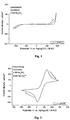
- The electrodes prepared by the method according to the invention, depending on their size, are characterised by a similar electrochemical activity, as shown in current-voltage curves.
-
Fig. 1 shows current-voltage curves of the background current of cyclic voltammetry - in 0.5 M Na2SO4 (electrochemical potential window) for boron-doped nanocrystalline diamond electrodes prepared by the method according to the invention of Examples 1 and 2. Scan rate = 100 mV/s. -
Fig. 2 shows current-voltage curves of cyclic voltammetry - for 5 mM Fe(CN)6 /3-/4 in 0.5 M Na2SO4 for boron-doped nanocrystalline diamond electrodes prepared by the method according to the invention of Examples 1 and 2. Scan rate = 100 mV/s. - The invention is explained in detail in the following examples.
- The electrode was prepared according to the following procedure:
- The substrate of titanium plate (ASTM Grade 1,99.5%) is subjected to an ultrasonic bath lasting 5 min in acetone, followed by washing in isopropanol and drying under a nitrogen stream.
- A nucleating layer of a thickness of the order of 5-20 nm, containing crystals of the nanodiamond obtained by detonation, with a size of 2-15 nm (average grain size 10 nm), is used. Density of nanodiamond nuclei is not lower than 1010/cm2 in relation to the substrate surface.
- The layer of nanodiamond nuclei is applied with the use of a solution containing:
- nanodiamond 0.25%, average grain size 10 nm,
- polyvinyl alcohol (PVA) 0.5%
- solvent: dimethyl sulfoxide (DMSO).
- Nucleation by Spin Coating is used for flat surfaces with a size of 5- 50 mm. In this process, the entire surface of the substrate is covered with a solution prepared as described above. An excess of the solution is removed by spin coating for 60 s at a speed of 5000 rpm. Subsequently, the substrate is dried for 10 minutes in air at room temperature.
- This step of the method is carried out in a device for microwave plasma enhanced chemical vapor deposition (MW-PECVD).
- The adhesive diamond layer is applied by subjecting a previously prepared substrate, with a layer of nanodiamond nuclei applied, to the activity of a hydrogen rich microwave plasma contains 4% by volume of methane and 5000 ppm by volume of boron supplied by diborane precursor. For this purpose, the nucleated electrode substrate is heated to 500°C and the pressure of 6,7 kPa (50 torr) and the constant flow of hydrogen of 3,34 x 10⁻⁶ m3/s (200 sccm) are maintained. The process is carried out for 30 minutes with the use of microwaves at a frequency of 2.45 GHz and with a power of 1300 W.
- This step of the method is performed with the use of the CVD process.
- The working electrode layer is applied by subjecting a previously prepared substrate with an adhesive layer to the activity a hydrogen rich microwave plasma contains 1% by volume of methane and 5000 ppm by volume of boron supplied by diborane precursor. For this purpose, the substrate with an adhesive layer is heated to 700°C and the pressure of 6,7 kPa (50 torr) and the constant flow of gas of 5,1 x 10⁻⁶ m3/s (300 sccm) are maintained. The process is carried out for 6 h with the use of microwaves at a frequency of 2.45 GHz and with a power of 1300 W.
- Hydrogenation of the working layer of the B-NCD electrode is carried out by subjecting a previously prepared electrode to the activity of a hydrogen rich microwave plasma. For this purpose, the electrode is heated to 700°C and the pressure of 5,3 kPa (40 torr) and the constant flow of hydrogen of 5,1 x 10⁻⁶ m3/s (300 sccm) are maintained.
- The process is carried out for 10 min with the use of microwaves at a frequency of 2.45 GHz and with a power of 1300 W.
- The electrode was prepared according to the following procedure:
- The substrate of titanium (ASTM Grade 1, 99.5%) is subjected to an ultrasonic bath lasting 5 min in acetone, followed by washing in isopropanol and drying under a nitrogen stream.
- A nucleating layer of a thickness of the order of 5-20 nm, containing grains of the nanodiamond obtained by detonation, with a size of 2-15 nm (average grain size 10 nm), is used. Density of nanodiamond nuclei is not lower than 1010/cm2 in relation to the substrate surface.
- The layer of nanodiamond nuclei is applied with the use of a solution containing:
- nanodiamond 0.25%, average grain size 10 nm,
- polyvinyl alcohol (PVA) 0.5%
- solvent: dimethyl sulfoxide (DMSO).
- For flat substrates above 50 mm and substrates of different shapes, including in particular long, thin rods and pipes with diameters up to 50 mm, nucleation by dip coating is used. The nucleated substrate is secured to a stepper motor and dipped in a solution prepared as described above at a speed of 10 cm/min, and after full dipping of the substrate, it is taken out at the same speed. The process is repeated three times. Subsequently, the substrate is dried for 10 minutes in air at room temperature.
- This step of the method is carried out in a device for microwave plasma enhanced chemical vapor deposition (MW-PECVD).
- The adhesive diamond layer is applied by subjecting a previously prepared electrode, with a layer of nanodiamond nuclei applied, to the activity of a hydrogen rich microwave plasma contains 4% by volume of methane and 5000 ppm by volume of boron supplied by diborane. precursor For this purpose, the nucleated electrode substrate is heated to 500°C and the pressure of 50 torr and the constant flow of hydrogen of 200 sccm are maintained. The process is carried out for 30 min with the use of microwaves at a frequency of 2.45 GHz and with a power of 1300 W.
- This step of the method is performed with the use of the CVD process.
- The working electrode layer is applied by subjecting a previously prepared substrate with an adhesive layer to the activity of hydrogen rich microwave plasma contains 1% by volume of methane and 5000 ppm by volume of boron supplied by diborane precursor. For this purpose, the substrate with an adhesive layer is heated to 700°C and the pressure of 50 torr and the constant flow of gas of 300 sccm are maintained. The process is carried out for 6 h with the use of microwaves at a frequency of 2.45 GHz and with a power of 1300 W.
- Hydrogenation of the working layer of the B-NCD electrode is carried out by subjecting a previously prepared electrode to the activity of microwave hydrogen plasma. For this purpose, the electrode is heated to 500°C and the pressure of 40 torr and the constant flow of hydrogen of 300 sccm are maintained. The process is carried out for 10 min with the use of microwaves at a frequency of 2.45 GHz and with a power of 1300 W.
- The use of the electrode of boron-doped nanocrystalline diamond B-NCD, prepared according to Example 1, for the removal of phenol.
- In the electrolyser cell, a diamond electrode in the form of a plate on a titanium substrate with a size of 4 cm2 was placed, then the tank was fed with 200 ml of an aqueous solution with a content of 1000 mg/l of phenol in 0.5 M Na2SO4, after which an electrolysis at a current density of 100 mA / cm2 was carried out for 30 minutes.
- Quantitative analysis of the final concentration of phenol, after the electrolysis, revealed the presence of phenol at the level of 2%. Power consumption was 4.5 kW/h/m3.
- In an electrolyser cell, a commercially available microcrystalline diamond electrode with an average particle size of 1 micrometer in the form of a monocrystalline silicon plate with a size of 4 cm2 was placed, then the tank was fed with 200 ml of an aqueous solution with a content of 1000 mg/l of phenol in 0.5 M Na2SO4, after which an electrolysis at a current density of 100 mA / cm2 was carried out for 90 minutes.
- Quantitative analysis of the final concentration of phenol, after the electrolysis, revealed the presence of phenol at the level of 8% of phenol. Power consumption was 16.5 kW/h/m3.
- Conclusions: the electrode obtained by the method according to the invention exhibits:
- Improvement of the disposal efficiency by 6%
- Shortening of the reaction time by 60 minutes (by 2/3)
- Reduction in power consumption by 2/3
- The use of the electrode of boron-doped nanocrystalline diamond B-NCD, prepared according to Example 2, for the removal of phenol.
- In an electrolyser cell, a diamond electrode in the form of a titanium rod having a diameter of 1 cm and a length of 5 cm was placed, then the tank was fed with 1500 ml of an aqueous solution with a content of 1000 mg/l of phenol in 0.5 M Na2SO4, after which an electrolysis at a current density of 100 mA/cm2 was carried out for 60 minutes.
- Quantitative analysis of the final concentration of phenol, after the electrolysis, revealed the presence of phenol at the level of 5% of phenol. Power consumption was 9 kW/h/m3.
- In an electrolyser cell, a commercially available microcrystalline diamond electrode with an average particle size of 1 micrometer in the form of a monocrystalline silicon plate with a size of 4 cm2 was placed, then the tank was fed with 200 ml of an aqueous solution with a content of 1000 mg/l of phenol in 0.5 M Na2SO4, after which an electrolysis at a constant current and at a current density of 100 mA / cm2 was carried out for 90 minutes.
- Quantitative analysis of the final concentration of phenol, after the electrolysis, revealed the presence of phenol at the level of 8% of phenol. Power consumption was 16.5 kW/h/m3.
- Conclusions: the electrode obtained by the method according to the invention exhibits:
- It allows for the reduction of the electrolyser cell by using electrodes with shapes other than planar.
- Improvement of the disposal efficiency by 3%
- Shortening of the reaction time by 30 minutes (by 1/3)
- Reduction in power consumption by 1/3
Claims (3)
- A method for the preparation of electrodes of boron-doped nanocrystalline diamond B-NCD with multi-layer diamond coating, characterised in that it consists of the following steps:a) Preparation of a substrate by subjecting a titanium plate in an ultrasonic bath lasting 5 minutes in acetone, followed by washing in isopropanol and drying under a nitrogen stream;b) Application of a first diamond layer of a thickness of the order of 5-20 nm, containing crystals of the nanodiamond obtained by detonation with a size of 2-15 nm, in the form of a nanodiamond nuclei with density of the nanodiamond nuclei in relation to the substrate surface not lower than 1010/cm2, with the use of a solution containing: 0,25% of nanodiamond with average grain size 10 nm, 0,5% of polyvinyl alcohol and dimethyl sulfoxide as a solvent;c) Application of an adhesive diamond layer in the CVD (Chemical Vapor Deposition) process, wherein the nucleated electrode substrate from step b) is heated up to 500 °C under conditions that a hydrogen rich microwave plasma contains 4% by volume of methane and 5000 ppm by volume of boron supplied as diborane precursor (B2H6), wherein the pressure of 6,7 kPa (50 torr) and the constant flow of hydrogen of 3,34 x 10⁻⁶m3/s (200 sccm) are maintained and the process is carried out for 30 minutes with the use of microwaves at a frequency of 2,45 GHz and with a power of 1300 W;d) Application of a working electrode layer in the CVD (Chemical Vapor Deposition) process, wherein the electrode substrate from step c) is heated up to 700°C under conditions that the hydrogen rich microwave plasma contains 1% by volume of methane and 5000 ppm by volume of boron supplied as diborane precursor (B2H6), wherein the pressure of 6,7 kPa (50 torr) and the constant flow of gas of 5,1 x 10⁻⁶ m3/s (300 sccm) are maintained and the process is carried out for 6 hours with the use of microwaves at a frequency of 2,45 GHZ and with the power of 1300 W;e) Hydrogenation of the working layer by heating the electrode obtained from step d) to 700 °C with the presence of a hydrogen rich microwave plasma, the pressure is 5,3 kPa (40 torr) and the constant flow of hydrogen is 5,1 x 10⁻⁶ m3/s (300 sccm), wherein the process is carried out for 10 minutes with the use of microwaves at a frequency of 2,45 GHz and with the power of 1300 W.
- The method according to claim 1, characterised in that for flat substrates with a size of 5-50 mm the step b) is carried out through nucleation by spin-coating.
- The method according to claim 1, characterised in that for substrates of different shapes, with a size above 50 mm the step b) is carried out through nucleation by dip-coating.
Priority Applications (1)
| Application Number | Priority Date | Filing Date | Title |
|---|---|---|---|
| EP15460008.4A EP3067324B1 (en) | 2015-03-11 | 2015-03-11 | Method for the preparation of electrodes of boron-doped nanocrystalline diamond |
Applications Claiming Priority (1)
| Application Number | Priority Date | Filing Date | Title |
|---|---|---|---|
| EP15460008.4A EP3067324B1 (en) | 2015-03-11 | 2015-03-11 | Method for the preparation of electrodes of boron-doped nanocrystalline diamond |
Publications (2)
| Publication Number | Publication Date |
|---|---|
| EP3067324A1 EP3067324A1 (en) | 2016-09-14 |
| EP3067324B1 true EP3067324B1 (en) | 2019-09-18 |
Family
ID=52875089
Family Applications (1)
| Application Number | Title | Priority Date | Filing Date |
|---|---|---|---|
| EP15460008.4A Active EP3067324B1 (en) | 2015-03-11 | 2015-03-11 | Method for the preparation of electrodes of boron-doped nanocrystalline diamond |
Country Status (1)
| Country | Link |
|---|---|
| EP (1) | EP3067324B1 (en) |
Cited By (1)
| Publication number | Priority date | Publication date | Assignee | Title |
|---|---|---|---|---|
| EP3712107A4 (en) * | 2017-11-16 | 2021-08-18 | Daicel Corporation | CAPACITOR ELECTRODE MATERIAL |
Families Citing this family (8)
| Publication number | Priority date | Publication date | Assignee | Title |
|---|---|---|---|---|
| CN106587656A (en) * | 2016-12-14 | 2017-04-26 | 郑州人造金刚石及制品工程技术研究中心有限公司 | Novel high wear-resisting glass and preparation method thereof |
| CN106865728B (en) * | 2017-03-14 | 2019-07-19 | 东莞市年氢态食品科技有限公司 | Method and equipment for producing hydrogen-rich water |
| CN111334779B (en) * | 2018-12-18 | 2023-08-15 | 深圳先进技术研究院 | Boron-doped diamond film and preparation method thereof, oil-water separation element, water treatment electrode and preparation method thereof, and water treatment device |
| CN110127881A (en) * | 2019-05-31 | 2019-08-16 | 山东省科学院海洋仪器仪表研究所 | A kind of diamond thin purifier and its preparation method and application |
| CN111646633B (en) * | 2020-05-11 | 2022-11-04 | 南京岱蒙特科技有限公司 | A high-efficiency and energy-saving three-dimensional electrode organic water treatment system and method for treating water |
| CN114656120B (en) * | 2022-04-14 | 2023-01-03 | 江南大学 | Electrochemical dehydration method for excess sludge |
| CN115595620B (en) * | 2022-09-06 | 2025-11-21 | 湖南新锋科技有限公司 | Preparation method and application of diamond-ruthenium oxide doped composite coating electrode |
| CN119020760A (en) * | 2024-08-19 | 2024-11-26 | 天津大学 | Boron-doped diamond and method for treating water pollution |
Citations (2)
| Publication number | Priority date | Publication date | Assignee | Title |
|---|---|---|---|---|
| US20080070049A1 (en) * | 2006-09-11 | 2008-03-20 | The Hong Kong University Of Science And Technology | Method for making a highly stable diamond film on a subtrate |
| US20080268150A1 (en) * | 2003-08-07 | 2008-10-30 | Ebara Corporation | Method of Coating for Diamond Electrode |
Family Cites Families (19)
| Publication number | Priority date | Publication date | Assignee | Title |
|---|---|---|---|---|
| GB2300425A (en) | 1995-05-01 | 1996-11-06 | Kobe Steel Europ Ltd | Nucleation of diamond films using an electrode |
| CN1341774A (en) | 2001-08-09 | 2002-03-27 | 中国科学院上海光学精密机械研究所 | Conductive diamond thin film for electrode and preparation method thereof |
| US7534296B2 (en) * | 2002-01-11 | 2009-05-19 | Board Of Trustees Of Michigan State University | Electrically conductive diamond electrodes |
| FR2844784B1 (en) | 2002-09-24 | 2004-11-05 | Ondeo Degremont | METHOD FOR TREATING WASTEWATER WITH MEMBRANE BIO-REACTOR |
| AT412470B (en) | 2003-04-30 | 2005-03-25 | Dauser Industrieanlagen Und Ab | METHOD FOR CLEANING WASTE WATER |
| DE102004025669A1 (en) * | 2004-05-21 | 2005-12-15 | Diaccon Gmbh | Functional CVD diamond layers on large area substrates |
| US7520980B2 (en) | 2004-12-13 | 2009-04-21 | Aquarius Environmental Technologies Ltd. | Bioreactor system for multi-stage biological wastewater treatment |
| EP1686095A1 (en) | 2005-01-31 | 2006-08-02 | Universidad Católica de la Santisima Concepción | Photocatalytic reactor with a modular configuration and advanced oxidation process for purifying and disinfecting wastewater from aquaculture |
| ITSA20070020A1 (en) | 2007-05-24 | 2008-11-25 | Uiversita Degli Studi Di Saler | HIGH EFFICIENCY PHOTO-FENTON HETEROGENEOUS PROCESS FOR DEGRADATION OF ORGANIC POLLUTANTS. |
| DE502007005577D1 (en) | 2007-12-21 | 2010-12-16 | Condias Gmbh | Method of applying a diamond layer to a graphite substrate |
| EP2072641B1 (en) | 2007-12-21 | 2016-02-17 | Condias Gmbh | Diamond electrode and method for its production |
| DE102009048108B3 (en) | 2009-10-01 | 2011-05-05 | Condias Gmbh | Method for the treatment of a diamond electrode applying with crystals in a grain size in micrometer range, comprises fissuring the surface of the diamond crystals through an electrochemical etching process |
| CN101671085A (en) | 2009-10-15 | 2010-03-17 | 同济大学 | Microwave electrochemical method for processing waste water and devices thereof |
| US8268169B2 (en) | 2010-12-20 | 2012-09-18 | Palo Alto Research Center Incorporated | Membrane bioreactor (MBR) and moving bed bioreactor (MBBR) configurations for wastewater treatment |
| CN102139938B (en) | 2011-02-23 | 2012-07-04 | 南京赛佳环保实业有限公司 | Electro-Fenton reaction waste water treatment equipment |
| CN102765783A (en) | 2011-05-03 | 2012-11-07 | 同济大学 | Microwave electro-Fenton method for processing organic wastewater and device thereof |
| CN102503000A (en) | 2011-12-07 | 2012-06-20 | 山东华泰纸业股份有限公司 | Wastewater treatment process adopting Fenton reaction |
| ES2588777T3 (en) | 2012-03-20 | 2016-11-04 | Veolia Water Solutions & Technologies Support | Method for treating a waste stream using a bioreactor and a filter membrane |
| CN103523888A (en) | 2013-10-13 | 2014-01-22 | 陕西盛迈石油有限公司 | Titanium dioxide wastewater treatment method |
-
2015
- 2015-03-11 EP EP15460008.4A patent/EP3067324B1/en active Active
Patent Citations (2)
| Publication number | Priority date | Publication date | Assignee | Title |
|---|---|---|---|---|
| US20080268150A1 (en) * | 2003-08-07 | 2008-10-30 | Ebara Corporation | Method of Coating for Diamond Electrode |
| US20080070049A1 (en) * | 2006-09-11 | 2008-03-20 | The Hong Kong University Of Science And Technology | Method for making a highly stable diamond film on a subtrate |
Cited By (1)
| Publication number | Priority date | Publication date | Assignee | Title |
|---|---|---|---|---|
| EP3712107A4 (en) * | 2017-11-16 | 2021-08-18 | Daicel Corporation | CAPACITOR ELECTRODE MATERIAL |
Also Published As
| Publication number | Publication date |
|---|---|
| EP3067324A1 (en) | 2016-09-14 |
Similar Documents
| Publication | Publication Date | Title |
|---|---|---|
| EP3067324A1 (en) | Method for the preparation of electrodes of boron-doped nanocrystalline diamond, an electrode prepared by this method and a use thereof | |
| Brosler et al. | In-house vs. commercial boron-doped diamond electrodes for electrochemical degradation of water pollutants: A critical review | |
| Tröster et al. | Electrochemical advanced oxidation process for water treatment using DiaChem® electrodes | |
| Li et al. | Photocatalytic degradation of lignin on synthesized Ag–AgCl/ZnO nanorods under solar light and preliminary trials for methane fermentation | |
| Niu et al. | Intermediate accumulation and toxicity reduction during the selective photoelectrochemical process of atrazine in complex water bodies | |
| EP4034500B1 (en) | Process for doping graphene with nitrogen and sulfur by reducing graphene oxide with microorganisms, nitrogen- and sulfur-doped graphene thus obtained and its use | |
| CN111635067B (en) | Ultraviolet-assisted ultrasonic coupling electrocatalytic oxidation water treatment system and water treatment method | |
| CN115748232B (en) | Super-hydrophobic low-adhesion material with photo-thermal photocatalysis synergistic effect, preparation method and application thereof | |
| CN113019417A (en) | B-doped g-C3N4/BiVO4Photocatalyst and preparation and application thereof | |
| CN103111286A (en) | Novel nano-composite visible light catalyst and preparation method thereof | |
| EP0766647B1 (en) | Photoelectrochemical reactor | |
| WO2017192057A1 (en) | Modified porous coatings and a modular device for air treatment containing modified porous coatings. | |
| US11433375B2 (en) | Photocatalytic carbon filter | |
| Fryda et al. | Applications of DIACHEM® electrodes in electrolytic water treatment | |
| Joy et al. | Nanophotocatalytic treatment of seawater using TiO2 immobilized and suspension system under solar irradiation | |
| WO2011066632A1 (en) | Cylindrical electrochemical cell with doped coaxial diamond anode produced by deposition of diamond-bearing films on mechanically resistant cylindrical substrates, for use in aqueous solution purification processes | |
| CN102864435A (en) | Method for preparing composite type millipore filtration membrane for filtering organic waste water | |
| Žener et al. | Removal of 18 bisphenols co-present in aqueous media by effectively immobilized titania photocatalyst | |
| KR101466914B1 (en) | Method for Manufacturing Titanium Dioxide Nanotube Photocatalyst and water treatment apparatus Using the Same | |
| Bo et al. | Synthesis of Au nanoparticles decorated carbon nanotubes as an electrochemical sensor for phenol determination in petrochemical wastewater | |
| Kusworo et al. | Performance of PVDF-La dope TiO2 membrane photocatalytic under visible light irradiation for produced water treatment | |
| CN106587458B (en) | A kind of sewage purification method of glow discharge electrolytic titanium dioxide solution | |
| CN117945512B (en) | An electrochemical tubular ceramic membrane for treating high-salt organic wastewater and its preparation method | |
| Zhang et al. | Anaerobic biodegradation of wastewater discharged from a chemical synthesis-based pharmaceutical company | |
| Brosler et al. | boron-doped diamond electrodes for electrochemical degradation of water pollutants: A critical |
Legal Events
| Date | Code | Title | Description |
|---|---|---|---|
| PUAI | Public reference made under article 153(3) epc to a published international application that has entered the european phase |
Free format text: ORIGINAL CODE: 0009012 |
|
| 17P | Request for examination filed |
Effective date: 20150407 |
|
| AK | Designated contracting states |
Kind code of ref document: A1 Designated state(s): AL AT BE BG CH CY CZ DE DK EE ES FI FR GB GR HR HU IE IS IT LI LT LU LV MC MK MT NL NO PL PT RO RS SE SI SK SM TR |
|
| AX | Request for extension of the european patent |
Extension state: BA ME |
|
| STAA | Information on the status of an ep patent application or granted ep patent |
Free format text: STATUS: REQUEST FOR EXAMINATION WAS MADE |
|
| STAA | Information on the status of an ep patent application or granted ep patent |
Free format text: STATUS: EXAMINATION IS IN PROGRESS |
|
| 17Q | First examination report despatched |
Effective date: 20180208 |
|
| GRAP | Despatch of communication of intention to grant a patent |
Free format text: ORIGINAL CODE: EPIDOSNIGR1 |
|
| STAA | Information on the status of an ep patent application or granted ep patent |
Free format text: STATUS: GRANT OF PATENT IS INTENDED |
|
| RIC1 | Information provided on ipc code assigned before grant |
Ipc: C02F 1/467 20060101ALN20190308BHEP Ipc: C02F 101/34 20060101ALN20190308BHEP Ipc: C25B 11/04 20060101ALI20190308BHEP Ipc: C02F 1/461 20060101AFI20190308BHEP |
|
| RIC1 | Information provided on ipc code assigned before grant |
Ipc: C02F 1/467 20060101ALN20190326BHEP Ipc: C02F 1/461 20060101AFI20190326BHEP Ipc: C02F 101/34 20060101ALN20190326BHEP Ipc: C25B 11/04 20060101ALI20190326BHEP |
|
| INTG | Intention to grant announced |
Effective date: 20190411 |
|
| GRAS | Grant fee paid |
Free format text: ORIGINAL CODE: EPIDOSNIGR3 |
|
| GRAA | (expected) grant |
Free format text: ORIGINAL CODE: 0009210 |
|
| STAA | Information on the status of an ep patent application or granted ep patent |
Free format text: STATUS: THE PATENT HAS BEEN GRANTED |
|
| AK | Designated contracting states |
Kind code of ref document: B1 Designated state(s): AL AT BE BG CH CY CZ DE DK EE ES FI FR GB GR HR HU IE IS IT LI LT LU LV MC MK MT NL NO PL PT RO RS SE SI SK SM TR |
|
| REG | Reference to a national code |
Ref country code: GB Ref legal event code: FG4D |
|
| REG | Reference to a national code |
Ref country code: CH Ref legal event code: EP |
|
| REG | Reference to a national code |
Ref country code: DE Ref legal event code: R096 Ref document number: 602015038160 Country of ref document: DE |
|
| REG | Reference to a national code |
Ref country code: AT Ref legal event code: REF Ref document number: 1181086 Country of ref document: AT Kind code of ref document: T Effective date: 20191015 |
|
| REG | Reference to a national code |
Ref country code: IE Ref legal event code: FG4D |
|
| REG | Reference to a national code |
Ref country code: NL Ref legal event code: MP Effective date: 20190918 |
|
| PG25 | Lapsed in a contracting state [announced via postgrant information from national office to epo] |
Ref country code: LT Free format text: LAPSE BECAUSE OF FAILURE TO SUBMIT A TRANSLATION OF THE DESCRIPTION OR TO PAY THE FEE WITHIN THE PRESCRIBED TIME-LIMIT Effective date: 20190918 Ref country code: HR Free format text: LAPSE BECAUSE OF FAILURE TO SUBMIT A TRANSLATION OF THE DESCRIPTION OR TO PAY THE FEE WITHIN THE PRESCRIBED TIME-LIMIT Effective date: 20190918 Ref country code: BG Free format text: LAPSE BECAUSE OF FAILURE TO SUBMIT A TRANSLATION OF THE DESCRIPTION OR TO PAY THE FEE WITHIN THE PRESCRIBED TIME-LIMIT Effective date: 20191218 Ref country code: SE Free format text: LAPSE BECAUSE OF FAILURE TO SUBMIT A TRANSLATION OF THE DESCRIPTION OR TO PAY THE FEE WITHIN THE PRESCRIBED TIME-LIMIT Effective date: 20190918 Ref country code: NO Free format text: LAPSE BECAUSE OF FAILURE TO SUBMIT A TRANSLATION OF THE DESCRIPTION OR TO PAY THE FEE WITHIN THE PRESCRIBED TIME-LIMIT Effective date: 20191218 Ref country code: FI Free format text: LAPSE BECAUSE OF FAILURE TO SUBMIT A TRANSLATION OF THE DESCRIPTION OR TO PAY THE FEE WITHIN THE PRESCRIBED TIME-LIMIT Effective date: 20190918 |
|
| REG | Reference to a national code |
Ref country code: LT Ref legal event code: MG4D |
|
| PG25 | Lapsed in a contracting state [announced via postgrant information from national office to epo] |
Ref country code: RS Free format text: LAPSE BECAUSE OF FAILURE TO SUBMIT A TRANSLATION OF THE DESCRIPTION OR TO PAY THE FEE WITHIN THE PRESCRIBED TIME-LIMIT Effective date: 20190918 Ref country code: GR Free format text: LAPSE BECAUSE OF FAILURE TO SUBMIT A TRANSLATION OF THE DESCRIPTION OR TO PAY THE FEE WITHIN THE PRESCRIBED TIME-LIMIT Effective date: 20191219 Ref country code: LV Free format text: LAPSE BECAUSE OF FAILURE TO SUBMIT A TRANSLATION OF THE DESCRIPTION OR TO PAY THE FEE WITHIN THE PRESCRIBED TIME-LIMIT Effective date: 20190918 Ref country code: AL Free format text: LAPSE BECAUSE OF FAILURE TO SUBMIT A TRANSLATION OF THE DESCRIPTION OR TO PAY THE FEE WITHIN THE PRESCRIBED TIME-LIMIT Effective date: 20190918 |
|
| REG | Reference to a national code |
Ref country code: AT Ref legal event code: MK05 Ref document number: 1181086 Country of ref document: AT Kind code of ref document: T Effective date: 20190918 |
|
| PG25 | Lapsed in a contracting state [announced via postgrant information from national office to epo] |
Ref country code: IT Free format text: LAPSE BECAUSE OF FAILURE TO SUBMIT A TRANSLATION OF THE DESCRIPTION OR TO PAY THE FEE WITHIN THE PRESCRIBED TIME-LIMIT Effective date: 20190918 Ref country code: RO Free format text: LAPSE BECAUSE OF FAILURE TO SUBMIT A TRANSLATION OF THE DESCRIPTION OR TO PAY THE FEE WITHIN THE PRESCRIBED TIME-LIMIT Effective date: 20190918 Ref country code: EE Free format text: LAPSE BECAUSE OF FAILURE TO SUBMIT A TRANSLATION OF THE DESCRIPTION OR TO PAY THE FEE WITHIN THE PRESCRIBED TIME-LIMIT Effective date: 20190918 Ref country code: AT Free format text: LAPSE BECAUSE OF FAILURE TO SUBMIT A TRANSLATION OF THE DESCRIPTION OR TO PAY THE FEE WITHIN THE PRESCRIBED TIME-LIMIT Effective date: 20190918 Ref country code: NL Free format text: LAPSE BECAUSE OF FAILURE TO SUBMIT A TRANSLATION OF THE DESCRIPTION OR TO PAY THE FEE WITHIN THE PRESCRIBED TIME-LIMIT Effective date: 20190918 Ref country code: ES Free format text: LAPSE BECAUSE OF FAILURE TO SUBMIT A TRANSLATION OF THE DESCRIPTION OR TO PAY THE FEE WITHIN THE PRESCRIBED TIME-LIMIT Effective date: 20190918 Ref country code: PT Free format text: LAPSE BECAUSE OF FAILURE TO SUBMIT A TRANSLATION OF THE DESCRIPTION OR TO PAY THE FEE WITHIN THE PRESCRIBED TIME-LIMIT Effective date: 20200120 Ref country code: PL Free format text: LAPSE BECAUSE OF FAILURE TO SUBMIT A TRANSLATION OF THE DESCRIPTION OR TO PAY THE FEE WITHIN THE PRESCRIBED TIME-LIMIT Effective date: 20190918 |
|
| PGFP | Annual fee paid to national office [announced via postgrant information from national office to epo] |
Ref country code: DE Payment date: 20200320 Year of fee payment: 6 Ref country code: GB Payment date: 20200323 Year of fee payment: 6 |
|
| PG25 | Lapsed in a contracting state [announced via postgrant information from national office to epo] |
Ref country code: IS Free format text: LAPSE BECAUSE OF FAILURE TO SUBMIT A TRANSLATION OF THE DESCRIPTION OR TO PAY THE FEE WITHIN THE PRESCRIBED TIME-LIMIT Effective date: 20200224 Ref country code: SK Free format text: LAPSE BECAUSE OF FAILURE TO SUBMIT A TRANSLATION OF THE DESCRIPTION OR TO PAY THE FEE WITHIN THE PRESCRIBED TIME-LIMIT Effective date: 20190918 Ref country code: SM Free format text: LAPSE BECAUSE OF FAILURE TO SUBMIT A TRANSLATION OF THE DESCRIPTION OR TO PAY THE FEE WITHIN THE PRESCRIBED TIME-LIMIT Effective date: 20190918 Ref country code: CZ Free format text: LAPSE BECAUSE OF FAILURE TO SUBMIT A TRANSLATION OF THE DESCRIPTION OR TO PAY THE FEE WITHIN THE PRESCRIBED TIME-LIMIT Effective date: 20190918 |
|
| REG | Reference to a national code |
Ref country code: DE Ref legal event code: R097 Ref document number: 602015038160 Country of ref document: DE |
|
| PGFP | Annual fee paid to national office [announced via postgrant information from national office to epo] |
Ref country code: FR Payment date: 20200320 Year of fee payment: 6 |
|
| PLBE | No opposition filed within time limit |
Free format text: ORIGINAL CODE: 0009261 |
|
| STAA | Information on the status of an ep patent application or granted ep patent |
Free format text: STATUS: NO OPPOSITION FILED WITHIN TIME LIMIT |
|
| PG2D | Information on lapse in contracting state deleted |
Ref country code: IS |
|
| PG25 | Lapsed in a contracting state [announced via postgrant information from national office to epo] |
Ref country code: DK Free format text: LAPSE BECAUSE OF FAILURE TO SUBMIT A TRANSLATION OF THE DESCRIPTION OR TO PAY THE FEE WITHIN THE PRESCRIBED TIME-LIMIT Effective date: 20190918 Ref country code: IS Free format text: LAPSE BECAUSE OF FAILURE TO SUBMIT A TRANSLATION OF THE DESCRIPTION OR TO PAY THE FEE WITHIN THE PRESCRIBED TIME-LIMIT Effective date: 20200119 |
|
| 26N | No opposition filed |
Effective date: 20200619 |
|
| PG25 | Lapsed in a contracting state [announced via postgrant information from national office to epo] |
Ref country code: SI Free format text: LAPSE BECAUSE OF FAILURE TO SUBMIT A TRANSLATION OF THE DESCRIPTION OR TO PAY THE FEE WITHIN THE PRESCRIBED TIME-LIMIT Effective date: 20190918 |
|
| PG25 | Lapsed in a contracting state [announced via postgrant information from national office to epo] |
Ref country code: MC Free format text: LAPSE BECAUSE OF FAILURE TO SUBMIT A TRANSLATION OF THE DESCRIPTION OR TO PAY THE FEE WITHIN THE PRESCRIBED TIME-LIMIT Effective date: 20190918 |
|
| REG | Reference to a national code |
Ref country code: CH Ref legal event code: PL |
|
| REG | Reference to a national code |
Ref country code: BE Ref legal event code: MM Effective date: 20200331 |
|
| PG25 | Lapsed in a contracting state [announced via postgrant information from national office to epo] |
Ref country code: LU Free format text: LAPSE BECAUSE OF NON-PAYMENT OF DUE FEES Effective date: 20200311 |
|
| PG25 | Lapsed in a contracting state [announced via postgrant information from national office to epo] |
Ref country code: CH Free format text: LAPSE BECAUSE OF NON-PAYMENT OF DUE FEES Effective date: 20200331 Ref country code: LI Free format text: LAPSE BECAUSE OF NON-PAYMENT OF DUE FEES Effective date: 20200331 Ref country code: IE Free format text: LAPSE BECAUSE OF NON-PAYMENT OF DUE FEES Effective date: 20200311 |
|
| PG25 | Lapsed in a contracting state [announced via postgrant information from national office to epo] |
Ref country code: BE Free format text: LAPSE BECAUSE OF NON-PAYMENT OF DUE FEES Effective date: 20200331 |
|
| REG | Reference to a national code |
Ref country code: DE Ref legal event code: R119 Ref document number: 602015038160 Country of ref document: DE |
|
| GBPC | Gb: european patent ceased through non-payment of renewal fee |
Effective date: 20210311 |
|
| PG25 | Lapsed in a contracting state [announced via postgrant information from national office to epo] |
Ref country code: FR Free format text: LAPSE BECAUSE OF NON-PAYMENT OF DUE FEES Effective date: 20210331 Ref country code: GB Free format text: LAPSE BECAUSE OF NON-PAYMENT OF DUE FEES Effective date: 20210311 Ref country code: DE Free format text: LAPSE BECAUSE OF NON-PAYMENT OF DUE FEES Effective date: 20211001 |
|
| PG25 | Lapsed in a contracting state [announced via postgrant information from national office to epo] |
Ref country code: TR Free format text: LAPSE BECAUSE OF FAILURE TO SUBMIT A TRANSLATION OF THE DESCRIPTION OR TO PAY THE FEE WITHIN THE PRESCRIBED TIME-LIMIT Effective date: 20190918 Ref country code: MT Free format text: LAPSE BECAUSE OF FAILURE TO SUBMIT A TRANSLATION OF THE DESCRIPTION OR TO PAY THE FEE WITHIN THE PRESCRIBED TIME-LIMIT Effective date: 20190918 Ref country code: CY Free format text: LAPSE BECAUSE OF FAILURE TO SUBMIT A TRANSLATION OF THE DESCRIPTION OR TO PAY THE FEE WITHIN THE PRESCRIBED TIME-LIMIT Effective date: 20190918 |
|
| PG25 | Lapsed in a contracting state [announced via postgrant information from national office to epo] |
Ref country code: MK Free format text: LAPSE BECAUSE OF FAILURE TO SUBMIT A TRANSLATION OF THE DESCRIPTION OR TO PAY THE FEE WITHIN THE PRESCRIBED TIME-LIMIT Effective date: 20190918 |