EP3065256A1 - Battery system for mobile workstation - Google Patents
Battery system for mobile workstation Download PDFInfo
- Publication number
- EP3065256A1 EP3065256A1 EP15192784.5A EP15192784A EP3065256A1 EP 3065256 A1 EP3065256 A1 EP 3065256A1 EP 15192784 A EP15192784 A EP 15192784A EP 3065256 A1 EP3065256 A1 EP 3065256A1
- Authority
- EP
- European Patent Office
- Prior art keywords
- battery
- battery system
- sections
- post
- main body
- Prior art date
- Legal status (The legal status is an assumption and is not a legal conclusion. Google has not performed a legal analysis and makes no representation as to the accuracy of the status listed.)
- Withdrawn
Links
Images




Classifications
-
- A—HUMAN NECESSITIES
- A61—MEDICAL OR VETERINARY SCIENCE; HYGIENE
- A61G—TRANSPORT, PERSONAL CONVEYANCES, OR ACCOMMODATION SPECIALLY ADAPTED FOR PATIENTS OR DISABLED PERSONS; OPERATING TABLES OR CHAIRS; CHAIRS FOR DENTISTRY; FUNERAL DEVICES
- A61G12/00—Accommodation for nursing, e.g. in hospitals, not covered by groups A61G1/00 - A61G11/00, e.g. trolleys for transport of medicaments or food; Prescription lists
- A61G12/002—Supply appliances, e.g. columns for gas, fluid, electricity supply
- A61G12/008—Supply appliances, e.g. columns for gas, fluid, electricity supply mounted on a mobile base, e.g. on a trolley
-
- F—MECHANICAL ENGINEERING; LIGHTING; HEATING; WEAPONS; BLASTING
- F16—ENGINEERING ELEMENTS AND UNITS; GENERAL MEASURES FOR PRODUCING AND MAINTAINING EFFECTIVE FUNCTIONING OF MACHINES OR INSTALLATIONS; THERMAL INSULATION IN GENERAL
- F16M—FRAMES, CASINGS OR BEDS OF ENGINES, MACHINES OR APPARATUS, NOT SPECIFIC TO ENGINES, MACHINES OR APPARATUS PROVIDED FOR ELSEWHERE; STANDS; SUPPORTS
- F16M13/00—Other supports for positioning apparatus or articles; Means for steadying hand-held apparatus or articles
- F16M13/02—Other supports for positioning apparatus or articles; Means for steadying hand-held apparatus or articles for supporting on, or attaching to, an object, e.g. tree, gate, window-frame, cycle
- F16M13/022—Other supports for positioning apparatus or articles; Means for steadying hand-held apparatus or articles for supporting on, or attaching to, an object, e.g. tree, gate, window-frame, cycle repositionable
-
- H—ELECTRICITY
- H01—ELECTRIC ELEMENTS
- H01M—PROCESSES OR MEANS, e.g. BATTERIES, FOR THE DIRECT CONVERSION OF CHEMICAL ENERGY INTO ELECTRICAL ENERGY
- H01M10/00—Secondary cells; Manufacture thereof
- H01M10/60—Heating or cooling; Temperature control
- H01M10/61—Types of temperature control
- H01M10/613—Cooling or keeping cold
-
- H—ELECTRICITY
- H01—ELECTRIC ELEMENTS
- H01M—PROCESSES OR MEANS, e.g. BATTERIES, FOR THE DIRECT CONVERSION OF CHEMICAL ENERGY INTO ELECTRICAL ENERGY
- H01M10/00—Secondary cells; Manufacture thereof
- H01M10/60—Heating or cooling; Temperature control
- H01M10/62—Heating or cooling; Temperature control specially adapted for specific applications
- H01M10/623—Portable devices, e.g. mobile telephones, cameras or pacemakers
-
- H—ELECTRICITY
- H01—ELECTRIC ELEMENTS
- H01M—PROCESSES OR MEANS, e.g. BATTERIES, FOR THE DIRECT CONVERSION OF CHEMICAL ENERGY INTO ELECTRICAL ENERGY
- H01M10/00—Secondary cells; Manufacture thereof
- H01M10/60—Heating or cooling; Temperature control
- H01M10/65—Means for temperature control structurally associated with the cells
- H01M10/655—Solid structures for heat exchange or heat conduction
- H01M10/6551—Surfaces specially adapted for heat dissipation or radiation, e.g. fins or coatings
-
- H—ELECTRICITY
- H01—ELECTRIC ELEMENTS
- H01M—PROCESSES OR MEANS, e.g. BATTERIES, FOR THE DIRECT CONVERSION OF CHEMICAL ENERGY INTO ELECTRICAL ENERGY
- H01M10/00—Secondary cells; Manufacture thereof
- H01M10/60—Heating or cooling; Temperature control
- H01M10/66—Heat-exchange relationships between the cells and other systems, e.g. central heating systems or fuel cells
-
- H—ELECTRICITY
- H01—ELECTRIC ELEMENTS
- H01M—PROCESSES OR MEANS, e.g. BATTERIES, FOR THE DIRECT CONVERSION OF CHEMICAL ENERGY INTO ELECTRICAL ENERGY
- H01M50/00—Constructional details or processes of manufacture of the non-active parts of electrochemical cells other than fuel cells, e.g. hybrid cells
- H01M50/20—Mountings; Secondary casings or frames; Racks, modules or packs; Suspension devices; Shock absorbers; Transport or carrying devices; Holders
- H01M50/244—Secondary casings; Racks; Suspension devices; Carrying devices; Holders characterised by their mounting method
-
- H—ELECTRICITY
- H01—ELECTRIC ELEMENTS
- H01M—PROCESSES OR MEANS, e.g. BATTERIES, FOR THE DIRECT CONVERSION OF CHEMICAL ENERGY INTO ELECTRICAL ENERGY
- H01M50/00—Constructional details or processes of manufacture of the non-active parts of electrochemical cells other than fuel cells, e.g. hybrid cells
- H01M50/20—Mountings; Secondary casings or frames; Racks, modules or packs; Suspension devices; Shock absorbers; Transport or carrying devices; Holders
- H01M50/247—Mountings; Secondary casings or frames; Racks, modules or packs; Suspension devices; Shock absorbers; Transport or carrying devices; Holders specially adapted for portable devices, e.g. mobile phones, computers, hand tools or pacemakers
-
- H—ELECTRICITY
- H02—GENERATION; CONVERSION OR DISTRIBUTION OF ELECTRIC POWER
- H02J—ELECTRIC POWER NETWORKS; CIRCUIT ARRANGEMENTS OR SYSTEMS FOR SUPPLYING OR DISTRIBUTING ELECTRIC POWER; SYSTEMS FOR STORING ELECTRIC ENERGY
- H02J7/00—Circuit arrangements for charging or discharging batteries or for supplying loads from batteries
- H02J7/70—Circuit arrangements for charging or discharging batteries or for supplying loads from batteries characterised by the mechanical construction
-
- H—ELECTRICITY
- H02—GENERATION; CONVERSION OR DISTRIBUTION OF ELECTRIC POWER
- H02J—ELECTRIC POWER NETWORKS; CIRCUIT ARRANGEMENTS OR SYSTEMS FOR SUPPLYING OR DISTRIBUTING ELECTRIC POWER; SYSTEMS FOR STORING ELECTRIC ENERGY
- H02J7/00—Circuit arrangements for charging or discharging batteries or for supplying loads from batteries
- H02J7/70—Circuit arrangements for charging or discharging batteries or for supplying loads from batteries characterised by the mechanical construction
- H02J7/731—Circuit arrangements for charging or discharging batteries or for supplying loads from batteries characterised by the mechanical construction specially adapted for holding portable devices containing batteries
-
- H—ELECTRICITY
- H01—ELECTRIC ELEMENTS
- H01M—PROCESSES OR MEANS, e.g. BATTERIES, FOR THE DIRECT CONVERSION OF CHEMICAL ENERGY INTO ELECTRICAL ENERGY
- H01M10/00—Secondary cells; Manufacture thereof
- H01M10/42—Methods or arrangements for servicing or maintenance of secondary cells or secondary half-cells
- H01M10/48—Accumulators combined with arrangements for measuring, testing or indicating the condition of cells, e.g. the level or density of the electrolyte
- H01M10/482—Accumulators combined with arrangements for measuring, testing or indicating the condition of cells, e.g. the level or density of the electrolyte for several batteries or cells simultaneously or sequentially
-
- H—ELECTRICITY
- H01—ELECTRIC ELEMENTS
- H01M—PROCESSES OR MEANS, e.g. BATTERIES, FOR THE DIRECT CONVERSION OF CHEMICAL ENERGY INTO ELECTRICAL ENERGY
- H01M2220/00—Batteries for particular applications
- H01M2220/30—Batteries in portable systems, e.g. mobile phone, laptop
-
- Y—GENERAL TAGGING OF NEW TECHNOLOGICAL DEVELOPMENTS; GENERAL TAGGING OF CROSS-SECTIONAL TECHNOLOGIES SPANNING OVER SEVERAL SECTIONS OF THE IPC; TECHNICAL SUBJECTS COVERED BY FORMER USPC CROSS-REFERENCE ART COLLECTIONS [XRACs] AND DIGESTS
- Y02—TECHNOLOGIES OR APPLICATIONS FOR MITIGATION OR ADAPTATION AGAINST CLIMATE CHANGE
- Y02E—REDUCTION OF GREENHOUSE GAS [GHG] EMISSIONS, RELATED TO ENERGY GENERATION, TRANSMISSION OR DISTRIBUTION
- Y02E60/00—Enabling technologies; Technologies with a potential or indirect contribution to GHG emissions mitigation
- Y02E60/10—Energy storage using batteries
Definitions
- a first aspect of the invention provides a retro-fit battery system for attachment to a mobile workstation having a generally upright post, the battery system comprising a main body shaped so as to locate around at least part of the perimeter of a generally upright post and having a means of removable attachment to said post, wherein the main body further comprises at least one battery docking mount to which a battery can be detachably connected, an electrical outlet and a control system for providing electrical energy from the battery to the electrical outlet.
- the main body may have inner and outer sides, the inner side being that which is shaped to locate around the post perimeter and the outer side being that having the at least one battery mounting.
- First and second battery docking mounts may be provided on the main body.
- the control system may be configured automatically to switch connection between one of the docking mounts and the other in the event that the amount of energy detected in a connected battery is at or below a predetermined level.
- each battery docking mount and/or the control system may be provided as modular unit(s) which removably locate within a respective bracket provided on the outer side of the main body.
- the means of removable attachment of the battery system to a post may comprise a mechanical protrusion shaped to engage within a complementary groove on the post in a tongue-and-groove like manner.
- Each of the first and second body sections may be shaped so that, when in the closed position, they define an enclosed internal channel that in use surrounds the post.
- At least one of the body sections may comprise a venting aperture extending from the interior to the exterior.
- the at least one venting aperture may be angled so as to extend downwardly from the interior to the exterior.
- the at least one venting aperture may be positioned towards the base of the system, and wherein a drainage aperture is provided in a base wall, in the region of the venting aperture.
- a second aspect of the invention provides a retro-fit battery system for attachment to a mobile workstation having a generally upright post, the battery system comprising a main body formed of first and second sections hingedly attached along a first axis and defining between the sections a channel at least partially shaped to correspond substantially to the outer shape of a workstation post, the first and second sections being configured so as to move between open and closed positions to enable the battery system to be located around and to grip a post, one or more of the sections being arranged to carry on the exterior at least one battery docking unit and a control system associated with delivering electrical energy to and/or from the battery.
- a third aspect of the invention provides a method of retro-fitting a battery system according to previous definitions, comprising the steps of:
- Embodiments herein relate to portable power systems for retrofitting to non-powered mobile workstations of the type comprising a wheeled base and an upright pole.
- the power systems can however be retrofitted to any unit having an upright which can be of any cross-sectional shape.
- Figure 2 shows a first embodiment power system 7 configured to detachably retrofit to the pole 1 shown in Figure 1 .
- the power system 7 comprises a three-sided body defining an inner channel 15 dimensioned to locate snugly around a major part of the extrusion, as indicated in Figure 3 which shows the two parts inter-connected.
- the three sides comprise outer walls 9, 13 and an intermediate wall 11.
- a generally T-shaped tab or tongue 17 is provided, extending into the channel 15 from the centre of the intermediate wall 11 and is shaped and positioned so as to snugly fit inside the vertical channel 3 by means of a tongue-and-groove fit, which can be a friction fit.
- each outer wall 9, 13 carries a series of integrally-formed vertical blades, generally indicated 10, which serve as heat sink elements.
- the cross-sectional profile of the heat sink elements 10 is arranged such that the footprint conforms substantially to that of the pole exterior around which it is to be located, but does not touch the pole in order to isolate the power system 7 electrically from the pole in the event of failure.
- each outer wall 9, 13 On the external side of each outer wall 9, 13 is provided a channel defined by opposed lateral walls 20 upstanding from the outer wall. Within each lateral wall 20 is a vertical slot 21. The channels in-between the walls 20 provide regions within which a modular battery docking unit 23 is slidably inserted, with correspondingly-shaped edges of said docking unit locating within the slots 21.
- the exposed face 24 of each battery docking unit 23 reveals external battery terminals 25 (not visible in the Figure) and a docking mechanism 26 for the detachable connection of a rechargeable battery. This mechanism is conventional.
- the intermediate wall 11 similarly provides an external channel defined by opposed walls 27 each having a slot 28 on the inner sides to which a modular control unit 29 can be inserted (and which can be removed for repair and replacement as and when required) in a manner similar to the battery docking units 23.
- the control unit 29 is configured such that it is connected to the battery docking units 23 via leads on one side.
- Figure 3a shows in plan view the power system 7 connected to the extrusion 1 with the tongue 17 engaged within the channel 3.
- Figure 3b is the same view, with a cover 32 fixed over the battery docking units 23 and the control unit 29, and carries connector sockets 31 to which the control unit is connected by leads.
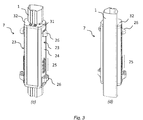
- Figures 3c and 3d show in perspective view the power system 7 when connected around the extrusion, when viewed from opposite sides.
- control unit 29 provides control functionality for the battery docking units 23, including the regulation of d.c. electricity to and from connected batteries, and optionally, intelligent functions.
- an intelligent function is the provision of so-called 'hot swapping' whereby a switch is made automatically between the different battery docking units 23 when the charge from the current connected battery is detected as being at or below a threshold.
- Another example is the authentication of connected batteries, in situations whereby the batteries are so-called 'intelligent batteries' comprising a microprocessor which identifies itself to the control unit as being valid or invalid. This prevents potentially hazardous situations resulting from the use of non-compliant batteries.
- the docking units 23 can comprise microprocessors in order to authenticate themselves to the batteries.
- the power system 7 provides a neat, portable and convenient unit that combines in this case two battery docking units 23, the associated control unit 29, and input and output sockets 31 in a single, self-contained unit that can be retro-fitted to the pole 1 of a non-powered workstation without specialist skill or tools.
- the battery docking units 23 and control unit 29, as well as the upper and lower casings are substantially sealed and can be cleaned by wiping.
- the power system 7 can be released and replaced quickly in the event of a fault.
- the modular nature of the battery docking units 23 and control unit 29 similarly allows quick diagnostics and replacement, if needed.
- Alternative mechanisms of attaching the power system 7 to the pole 1 can be used, for example using a magnet on the power system.
- the power system 37 comprises a main body that in use is configured to completely surround a pole 35 in such a way as to clamp onto it, as shown particularly in Figures 4c and 4d .
- This power system 37 is configured to carry modular docking units 123 and a modular control unit 129 in a manner identical to that of the first embodiment, i.e. by providing on the exterior a series of regions defined by grooved, upstanding walls, within which the modules are slidably located.
- the configuration and functionality of the docking units 123 and control unit 129, as well as the manner in which batteries can be connected to the docking units, is identical to that described previously.
- Each of the first and second sections 39, 41 has an upper covering wall 39', 41' which substantially corresponds in shape to the cross-sectional profile of the respective section, capping-off the interior space.
- one of the upper walls 39' includes a pair of apertures 54 within which are located connectors 45 to which external leads can be connected to carry electricity to/from the power system 37.
- end cap walls 39', 41' including the underside ones, snap-fit onto their respective sections 39, 41.
- Each upper wall 39', 41' has a peripheral wall 42 in which is provided at least one aperture 51 which communicates with the internal space of the respective section when connected.
- Each aperture 51 provides a vent through which heat from inside can escape.
- just one venting aperture 51 may be provided.
- multiple vents 51 are provided. Vents are also provided in the underside end-cap walls.
- a cylindrical mount 55 is provided for holding one end of an internal hinge rod, the other end being connected within another mount on the opposite, lower end-cap wall.
- Curved interior walls 57, 58 on each of the end cap walls 39', 41' define a circular wall when in the closed position, as shown in Figure 6 , which closely conforms to that of the pole 35.
- the curved walls 57, 58 can be covered, coated or formed of a resilient substance, e.g. a rubber O-ring to help grip the pole 35 in position. Any mechanism or means of friction fitting can be employed for this purpose.
- Figure 7a shows in section one of the apertures 51 in the upper end-cap wall 39'.
- the aperture 51 is angled so that it extends upwardly from between the exterior and interior sides of the peripheral wall 42. The purpose of this is to allow venting but prevent contaminants or liquid (e.g. when the unit is being wiped clean) entering the interior of the power system 37.
- Figure 7b shows in section one of the apertures 51' in a corresponding lower end-cap 62. In this case, a further aperture 55 is provided in the base wall 63.
- the aperture 51' is angled downwards from between the exterior and interior sides of the peripheral wall, towards the further aperture 55 which acts as a drain for any liquid entering the interior.
- Figures 8a and 8b show in cross-section the body sections 39, 41 in closed and opened positions, respectively.
- the first body section 39 is formed by two interconnected metal extrusions, generally indicated 70, 72.
- the interconnection is made by correspondingly-shaped vertical channels 73.
- a battery docking unit 123 and the control unit 129 are each shown in position within exterior channels in the same manner as the first embodiment.
- the inner surface of each extrusion wall carries a series of integrally-formed vertical blades, generally indicated 77, which serve as heat sink elements.
- the cross-sectional profile of the heat sink elements 77 is arranged such that the internal radius conforms substantially to that of the pole exterior around which it is to be located, but does not touch the pole in order to isolate the power system 37 electrically from the pole in the event of failure.
- each body section 101, 102 has a cut 115 exposing a hollow interior section.
- the cuts 115 enable cabling associated with one docking unit 109 to pass to the other; the electronic control system (not shown) may for example be located within one interior section and therefore cabling from the other section can pass through the opposed cuts 115 to connect to the control system.
- the cuts 115 are generally T shaped, either side of a central channel.
Landscapes
- Engineering & Computer Science (AREA)
- Chemical & Material Sciences (AREA)
- Chemical Kinetics & Catalysis (AREA)
- Electrochemistry (AREA)
- General Chemical & Material Sciences (AREA)
- Manufacturing & Machinery (AREA)
- Life Sciences & Earth Sciences (AREA)
- Biophysics (AREA)
- Power Engineering (AREA)
- Computer Hardware Design (AREA)
- General Engineering & Computer Science (AREA)
- Health & Medical Sciences (AREA)
- Nursing (AREA)
- Animal Behavior & Ethology (AREA)
- General Health & Medical Sciences (AREA)
- Public Health (AREA)
- Veterinary Medicine (AREA)
- Mechanical Engineering (AREA)
- Battery Mounting, Suspending (AREA)
Abstract
A retro-fit battery system for attachment to a mobile workstation having a generally upright post. The battery system comprises a main body shaped so as to locate around at least part of the perimeter of a generally upright post and having a means of removable attachment to said post, wherein the main body further comprises at least one battery docking mount to which a battery can be detachably connected, an electrical outlet and a control system for providing electrical energy from the battery to the electrical outlet.
Description
- The present invention relates to a battery system for a mobile workstation, particularly, though not exclusively, a mobile medical cart.
- Mobile workstations are desirable in various settings, typically comprising a vertical support post, mounted on a wheeled base and a tray or platform mounted on top of the post for supporting electronic equipment. Sometimes the post will itself will directly support the equipment. In healthcare environments, for example, the electronic equipment may comprise medical equipment, computing equipment or entertainment equipment.
- Such workstations may be 'powered' by an on-board a battery system, permanently mounted to the pole. The battery system comprises one or more battery docking brackets to which rechargeable batteries can be removably attached. Each battery can be detached and recharged remotely from the battery system, or charged in-situ by plugging a mains lead from the system into a mains supply. When charged, a battery supplies power to the electronic equipment using a cable that passes from the battery interface upwards to one or more connectors near the tray or platform. Where two or more batteries are provided, so-called hot-swapping can occur, whereby when one battery is depleted, another battery with sufficient charge is automatically used. Non-powered mobile workstations still exist in many settings and, where powered workstations are required, the old ones are discarded to be replaced by powered ones at significant cost.
- A first aspect of the invention provides a retro-fit battery system for attachment to a mobile workstation having a generally upright post, the battery system comprising a main body shaped so as to locate around at least part of the perimeter of a generally upright post and having a means of removable attachment to said post, wherein the main body further comprises at least one battery docking mount to which a battery can be detachably connected, an electrical outlet and a control system for providing electrical energy from the battery to the electrical outlet.
- The main body may have inner and outer sides, the inner side being that which is shaped to locate around the post perimeter and the outer side being that having the at least one battery mounting.
- First and second battery docking mounts may be provided on the main body.
- The control system may be configured automatically to switch connection between one of the docking mounts and the other in the event that the amount of energy detected in a connected battery is at or below a predetermined level.
- The or each battery docking mount and/or the control system may be provided as modular unit(s) which removably locate within a respective bracket provided on the outer side of the main body. The means of removable attachment of the battery system to a post may comprise a mechanical protrusion shaped to engage within a complementary groove on the post in a tongue-and-groove like manner.
- The main body may be formed of first and second body sections, one being rotatable relative to the other about a first axis between open and closed positions so that, in use, the two sections when open can be positioned around an upright post and then closed to grip the post to provide the means of removable attachment.
- Each of the first and second body sections may be shaped so that, when in the closed position, they define an enclosed internal channel that in use surrounds the post.
- One or more heat sink elements may be provided on an internal wall of at least one body section so that, when in the closed position, the heat sink elements will be close to, or touch, a post around which the system is located in use. A plurality of heat sink elements may be provided on internal wall(s) of the body sections, the cross-sectional profile of the heat sink elements being such that they conform closely with the radius of the post around which the system is located in use.
- At least one of the body sections may comprise a venting aperture extending from the interior to the exterior. The at least one venting aperture may be angled so as to extend downwardly from the interior to the exterior. The at least one venting aperture may be positioned towards the base of the system, and wherein a drainage aperture is provided in a base wall, in the region of the venting aperture.
- A second aspect of the invention provides a retro-fit battery system for attachment to a mobile workstation having a generally upright post, the battery system comprising a main body formed of first and second sections hingedly attached along a first axis and defining between the sections a channel at least partially shaped to correspond substantially to the outer shape of a workstation post, the first and second sections being configured so as to move between open and closed positions to enable the battery system to be located around and to grip a post, one or more of the sections being arranged to carry on the exterior at least one battery docking unit and a control system associated with delivering electrical energy to and/or from the battery.
- A third aspect of the invention provides a method of retro-fitting a battery system according to previous definitions, comprising the steps of:
- positioning the first and second sections to the open position;
- locating the first and second sections around the post of a workstation; and
- positioning the first and second sections to the closed position.
- The invention will now be described by way of example only with reference to the accompanying diagrammatic drawings in which:-
-
Figure 1 is a cross-sectional diagram of a known workstation pole, which is useful for understanding an embodiment of the invention; -
Figure 2 is a cross-sectional diagram of a first embodiment portable power system according to the invention, for retro-fitting onto theFigure 1 pole; -
Figures 3a and 3b are respective cross-sectional and plan view diagrams of theFigure 2 power system when connected to theFigure 1 pole; -
Figures 3c and 3d are respective front and rear perspective view diagrams of theFigure 2 power system when connected to theFigure 1 pole; -
Figures 4a to 4d are perspective views of a second embodiment portable power system according to the invention; -
Figure 5 is a rear perspective view of part of an upper covering wall of theFigure 4 system; -
Figure 6 is a plan view of upper covering walls of theFigure 4 system; -
Figures 7a and 7b are schematic views of upper and lower parts of theFigure 4 system; -
Figures 8a and8b are cross-sectional views of theFigure 4 system in open and closed configurations; -
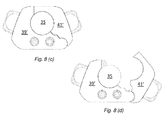
Figures 8c and 8d are top plan views of theFigure 4 system in closed and open configurations; -
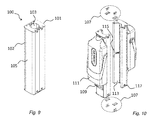
Figure 9 is a perspective view of a third embodiment portable power system according to the invention; -
Figure 10 is an exploded perspective view of theFigure 9 embodiment; -
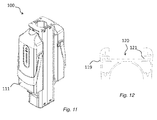
Figure 11 is a perspective view of theFigure 9 embodiment with battery modules attached; -
Figure 12 is a top plan view of an extrusion which forms part of theFigure 9 embodiment; -
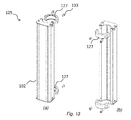
Figures 13a and 13b are front and rear perspective views of a fourth embodiment portable power system according to the invention; -
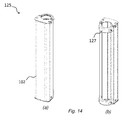
Figures 14a and 14b are front and rear perspective views of theFigure 13 embodiment with attachments connected; and -
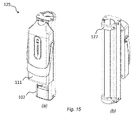
Figures 15a and 15b are front and rear perspective views of theFigure 13 embodiment with a battery module attached. - Embodiments herein relate to portable power systems for retrofitting to non-powered mobile workstations of the type comprising a wheeled base and an upright pole.
- The power systems can however be retrofitted to any unit having an upright which can be of any cross-sectional shape.
- Referring to
Figure 1 , the cross-section of aworkstation pole 1 comprises a metal extrusion which has a vertical channel generally indicated 3. This represents the pole of a known medical workstation. -
Figure 2 shows a firstembodiment power system 7 configured to detachably retrofit to thepole 1 shown inFigure 1 . - The
power system 7 comprises a three-sided body defining aninner channel 15 dimensioned to locate snugly around a major part of the extrusion, as indicated inFigure 3 which shows the two parts inter-connected. The three sides compriseouter walls 9, 13 and anintermediate wall 11. A generally T-shaped tab ortongue 17 is provided, extending into thechannel 15 from the centre of theintermediate wall 11 and is shaped and positioned so as to snugly fit inside thevertical channel 3 by means of a tongue-and-groove fit, which can be a friction fit. - The inner surface of each
outer wall 9, 13 carries a series of integrally-formed vertical blades, generally indicated 10, which serve as heat sink elements. The cross-sectional profile of theheat sink elements 10 is arranged such that the footprint conforms substantially to that of the pole exterior around which it is to be located, but does not touch the pole in order to isolate thepower system 7 electrically from the pole in the event of failure. - On the external side of each
outer wall 9, 13 is provided a channel defined by opposedlateral walls 20 upstanding from the outer wall. Within eachlateral wall 20 is avertical slot 21. The channels in-between thewalls 20 provide regions within which a modularbattery docking unit 23 is slidably inserted, with correspondingly-shaped edges of said docking unit locating within theslots 21. The exposedface 24 of eachbattery docking unit 23 reveals external battery terminals 25 (not visible in the Figure) and adocking mechanism 26 for the detachable connection of a rechargeable battery. This mechanism is conventional. - The
intermediate wall 11 similarly provides an external channel defined byopposed walls 27 each having aslot 28 on the inner sides to which amodular control unit 29 can be inserted (and which can be removed for repair and replacement as and when required) in a manner similar to thebattery docking units 23. Thecontrol unit 29 is configured such that it is connected to thebattery docking units 23 via leads on one side. -
Figure 3a shows in plan view thepower system 7 connected to theextrusion 1 with thetongue 17 engaged within thechannel 3.Figure 3b is the same view, with acover 32 fixed over thebattery docking units 23 and thecontrol unit 29, and carriesconnector sockets 31 to which the control unit is connected by leads. -
Figures 3c and 3d show in perspective view thepower system 7 when connected around the extrusion, when viewed from opposite sides. - Separate connectors in use connect to the
sockets 31, one for the delivery of electricity to components being used on the workstation, and another for USB data. - It will be appreciated that the
control unit 29 provides control functionality for thebattery docking units 23, including the regulation of d.c. electricity to and from connected batteries, and optionally, intelligent functions. One example of an intelligent function is the provision of so-called 'hot swapping' whereby a switch is made automatically between the differentbattery docking units 23 when the charge from the current connected battery is detected as being at or below a threshold. Another example is the authentication of connected batteries, in situations whereby the batteries are so-called 'intelligent batteries' comprising a microprocessor which identifies itself to the control unit as being valid or invalid. This prevents potentially hazardous situations resulting from the use of non-compliant batteries. Similarly, thedocking units 23 can comprise microprocessors in order to authenticate themselves to the batteries. - Thus, the
power system 7 provides a neat, portable and convenient unit that combines in this case twobattery docking units 23, the associatedcontrol unit 29, and input andoutput sockets 31 in a single, self-contained unit that can be retro-fitted to thepole 1 of a non-powered workstation without specialist skill or tools. Thebattery docking units 23 andcontrol unit 29, as well as the upper and lower casings are substantially sealed and can be cleaned by wiping. Thepower system 7 can be released and replaced quickly in the event of a fault. The modular nature of thebattery docking units 23 andcontrol unit 29 similarly allows quick diagnostics and replacement, if needed. Alternative mechanisms of attaching thepower system 7 to thepole 1 can be used, for example using a magnet on the power system. - A second
embodiment power system 37 will now be described with reference toFigures 4 to 8 . - Referring to
Figures 4a to 4c , thepower system 37 comprises a main body that in use is configured to completely surround apole 35 in such a way as to clamp onto it, as shown particularly inFigures 4c and 4d . - The body is formed of first and
second sections sections sections Figures 4a and 4b , placed around thepole 35, and then closed at which time the dimensions of an interior channel provide a friction fit to the pole, e.g. using an O-ring at the upper and lower ends. - This
power system 37 is configured to carrymodular docking units 123 and amodular control unit 129 in a manner identical to that of the first embodiment, i.e. by providing on the exterior a series of regions defined by grooved, upstanding walls, within which the modules are slidably located. The configuration and functionality of thedocking units 123 andcontrol unit 129, as well as the manner in which batteries can be connected to the docking units, is identical to that described previously. - Each of the first and
second sections Figures 5 and 6 , one of the upper walls 39' includes a pair ofapertures 54 within which are locatedconnectors 45 to which external leads can be connected to carry electricity to/from thepower system 37. - Similar end-cap walls (not visible) are provided on the underside of the first and
second sections - The end cap walls 39', 41', including the underside ones, snap-fit onto their
respective sections - Each upper wall 39', 41' has a
peripheral wall 42 in which is provided at least oneaperture 51 which communicates with the internal space of the respective section when connected. Eachaperture 51 provides a vent through which heat from inside can escape. In some embodiments, just one ventingaperture 51 may be provided. In the present case,multiple vents 51 are provided. Vents are also provided in the underside end-cap walls. - Referring to
Figures 5 and 6 , acylindrical mount 55 is provided for holding one end of an internal hinge rod, the other end being connected within another mount on the opposite, lower end-cap wall. Curvedinterior walls Figure 6 , which closely conforms to that of thepole 35. Thecurved walls pole 35 in position. Any mechanism or means of friction fitting can be employed for this purpose. - The geometry of the venting
apertures 51 will be now explained in greater detail with reference toFigures 7a and 7b. Figure 7a shows in section one of theapertures 51 in the upper end-cap wall 39'. Theaperture 51 is angled so that it extends upwardly from between the exterior and interior sides of theperipheral wall 42. The purpose of this is to allow venting but prevent contaminants or liquid (e.g. when the unit is being wiped clean) entering the interior of thepower system 37.Figure 7b shows in section one of the apertures 51' in a corresponding lower end-cap 62. In this case, afurther aperture 55 is provided in thebase wall 63. The aperture 51' is angled downwards from between the exterior and interior sides of the peripheral wall, towards thefurther aperture 55 which acts as a drain for any liquid entering the interior. -
Figures 8a and8b show in cross-section thebody sections - It will be seen that the
first body section 39 is formed by two interconnected metal extrusions, generally indicated 70, 72. The interconnection is made by correspondingly-shapedvertical channels 73. Abattery docking unit 123 and thecontrol unit 129 are each shown in position within exterior channels in the same manner as the first embodiment. The inner surface of each extrusion wall carries a series of integrally-formed vertical blades, generally indicated 77, which serve as heat sink elements. The cross-sectional profile of theheat sink elements 77 is arranged such that the internal radius conforms substantially to that of the pole exterior around which it is to be located, but does not touch the pole in order to isolate thepower system 37 electrically from the pole in the event of failure. - The
second body section 41 is formed by a single metal extrusion, which has ahole 80 formed at one end through which passes the hinge rod along axis X-X. Abattery docking unit 123 is shown in position within the exterior channel in the same manner as the first embodiment. The inner surface of this extrusion also carries a series of integrally-formedvertical metal blades 77 which are heat sink elements. Again, the cross-sectional profile of saidelements 77 is such that they define an internal radius substantially similar to that of the pole exterior. - As is more clearly seen in
Figure 8b , when in the closed position, theheat sink elements 77 are close to thepole 35, serving to dissipate heat from the interior of thepower unit 37. -
Figures 8c and 8d show in plan view from above thebody sections - Similar technical advantages apply to the second
embodiment power unit 37 as for the first embodiment. - A third
embodiment power system 100 will now be described with reference toFigures 9 to 12 . Referring toFigures 9 and 10 , thepower system 100 comprises separate first andsecond body sections interior channel 103. Theinterior channel 103 is formed by U-shaped interior recesses on eachbody section body sections - Each
body section Figure 9 ) on which is mounted amodular docking unit 109 onto which arechargeable battery 111 can be removably mounted; eachdocking unit 109 has the appearance and functionality of the docking units previously described. Tworechargeable batteries 111 can therefore be supported as before, with control circuitry provided as before to manage supply and switching as before. - As shown particularly in
Figure 10 , thebody sections metal plates 107, two at the top and two at the bottom. Eachplate 107 is generally rectangular with an arcuate inner edge that conforms with thechannel 103. Eachplate 107 has a pair of holes that overlie a pair of screw holes within thebody section channel 103. - The
interior wall 113 of eachbody section cut 115 exposing a hollow interior section. Thecuts 115 enable cabling associated with onedocking unit 109 to pass to the other; the electronic control system (not shown) may for example be located within one interior section and therefore cabling from the other section can pass through theopposed cuts 115 to connect to the control system. Thecuts 115 are generally T shaped, either side of a central channel. - Venting apertures or
slots 117 are provided at the top and bottom of eachbody section -
Figure 11 shows thebody sections battery modules 11 mounted. -
Figure 12 shows in plan view ametal extrusion 119 which forms the main part of each body section, herebody section 102. The rear part is anopen channel 120 to permit thedocking mechanism 109 to locate therewithin and has the same arrangement and geometry as that described with reference toFigure 2 , in terms of both the walls and docking mechanism which slidably locates within theslots 121. - The third embodiment has advantages in that each
body section - A fourth
embodiment power system 125 will now be described with reference toFigures 13 to 15 . In this case, only one body section, herebody section 102, is employed for a singlebattery docking mechanism 109. Thebody section 102 is connected around a pole using a pair ofsemi-circular attachments 127 which screw into the interior face of the body section using screws 129. Theattachments 127 can also be used to attach accessories such as baskets, handles and the like. - It will be appreciated that the above described embodiments are purely illustrative and are not limiting on the scope of the invention. Other variations and modifications will be apparent to persons skilled in the art upon reading the present application.
- Moreover, the disclosure of the present application should be understood to include any novel features or any novel combination of features either explicitly or implicitly disclosed herein or any generalization thereof and during the prosecution of the present application or of any application derived therefrom, new claims may be formulated to cover any such features and/or combination of such features.
Claims (18)
- A retro-fit battery system for attachment to a mobile workstation having a generally upright post, the battery system comprising a main body shaped so as to locate around at least part of the perimeter of a generally upright post and having a means of removable attachment to said post, wherein the main body further comprises at least one battery docking mount to which a battery can be detachably connected, an electrical outlet and a control system for providing electrical energy from the battery to the electrical outlet.
- A battery system according to claim 1, wherein the main body has inner and outer sides, the inner side being that which is shaped to locate around the post perimeter and the outer side being that having the at least one battery mounting.
- A battery system according to claim 1 or claim 2, wherein first and second battery docking mounts are provided on the main body.
- A battery system according to claim 3, wherein the control system is configured automatically to switch connection between one of the docking mounts and the other in the event that the amount of energy detected in a connected battery is at or below a predetermined level.
- A battery system according to any preceding claim, wherein the or each battery docking mount and/or the control system is or are provided as modular unit(s) which removably locate within a respective bracket provided on the outer side of the main body.
- A battery system according to any preceding claim, wherein the means of removable attachment of the battery system to a post comprises a mechanical protrusion shaped to engage within a complementary groove on the post in a tongue-and-groove like manner.
- A battery system according to any of claims 1 to 6, wherein the main body is formed of first and second body sections, one being rotatable relative to the another about a first axis between open and closed positions so that, in use, the two sections when open can be positioned around an upright post and then closed to grip the post to provide the means of removable attachment.
- A battery system according to claim 7, wherein each of the first and second body sections is shaped so that, when in the closed position, they define an enclosed internal channel that in use surrounds the post.
- A battery system according to claim 7 or claim 8, wherein one or more heat sink elements is or are provided on an internal wall of at least one body section so that, when in the closed position, the heat sink elements will be close to a post around which the system is located in use.
- A battery system according to claim 9, wherein a plurality of heat sink elements are provided on internal wall(s) of the body sections, the cross-sectional profile of the heat sink elements being such that they conform closely with the radius of the post around which the system is located in use.
- A battery system according to any of claims 1 to 6, wherein the main body is formed of first and second separate, substantially identical, body sections, each having an interior channel that in use surrounds part of the pole and which, when connected, surround the pole.
- A battery system according to claim 11, wherein an interior wall of each body section has an aperture or cut into a hollow interior chamber to enable, in use, cabling or the like to pass from within one body section to the other.
- A battery system according to any of claims 7 to 12, wherein at least one of the body sections comprises a venting aperture extending from the interior to the exterior.
- A battery system according to claim 13, wherein the at least one venting aperture is angled so as to extend downwardly from the interior to the exterior.
- A battery system according to claim 13, wherein the at least one venting aperture is positioned towards the base of the system, and wherein a drainage aperture is provided in a base wall, in the region of the venting aperture.
- A retro-fit battery system for attachment to a mobile workstation having a generally upright post, the battery system comprising a main body formed of first and second separate and substantially identical sections, each section having an arcuate inner wall so that, when connected the sections define a substantially circular interior channel that in use surround the post, each section carrying a battery docking unit on an exterior wall and having a slot on an interior wall through which cabling can pass from the docking units between the sections.
- A retro-fit battery system for attachment to a mobile workstation having a generally upright post, the battery system comprising a main body formed of first and second sections hingedly attached along a first axis and defining between the sections a channel at least partially shaped to correspond substantially to the outer shape of a workstation post, the first and second sections being configured so as to move between open and closed positions to enable the battery system to be located around and to grip a post, one or more of the sections being arranged to carry on the exterior at least one battery docking unit and a control system associated with delivering electrical energy to and/or from the battery.
- A method of retro-fitting a battery system according to any of claims 7 to 17, comprising the steps of:- positioning the first and second sections to the open position;- locating the first and second sections around the post of a workstation; and- positioning the first and second sections to the closed position.
Applications Claiming Priority (1)
| Application Number | Priority Date | Filing Date | Title |
|---|---|---|---|
| GBGB1419533.3A GB201419533D0 (en) | 2014-11-03 | 2014-11-03 | Battery system for a mobile workstation |
Publications (1)
| Publication Number | Publication Date |
|---|---|
| EP3065256A1 true EP3065256A1 (en) | 2016-09-07 |
Family
ID=52118603
Family Applications (1)
| Application Number | Title | Priority Date | Filing Date |
|---|---|---|---|
| EP15192784.5A Withdrawn EP3065256A1 (en) | 2014-11-03 | 2015-11-03 | Battery system for mobile workstation |
Country Status (3)
| Country | Link |
|---|---|
| US (1) | US10230079B2 (en) |
| EP (1) | EP3065256A1 (en) |
| GB (2) | GB201419533D0 (en) |
Cited By (2)
| Publication number | Priority date | Publication date | Assignee | Title |
|---|---|---|---|---|
| WO2018119724A1 (en) * | 2016-12-28 | 2018-07-05 | 深圳市大疆灵眸科技有限公司 | Power source module of cradle head, battery assembly and cradle head |
| CN109792017A (en) * | 2017-04-20 | 2019-05-21 | 深圳市大疆创新科技有限公司 | Battery mounting structure and electronic device |
Families Citing this family (6)
| Publication number | Priority date | Publication date | Assignee | Title |
|---|---|---|---|---|
| EP3635924B1 (en) | 2017-05-11 | 2025-09-03 | Analog Devices International Unlimited Company | Digital modulation scheme for data transfer |
| CN110809912A (en) | 2018-03-02 | 2020-02-18 | 爱格升公司 | Power system for mobile workstation |
| JPWO2020213034A1 (en) * | 2019-04-15 | 2021-10-21 | 三菱電機株式会社 | Sensor device |
| US11223227B1 (en) * | 2019-07-03 | 2022-01-11 | Capsa Solutions Llc | Medical cart providing data continuity |
| CN114583350B (en) * | 2022-03-17 | 2024-01-30 | 安徽汉星综合能源有限公司 | Battery PACK case with automatic high temperature socket replacement function |
| CN120073207B (en) * | 2025-04-25 | 2025-08-12 | 江苏智泰新能源科技有限公司 | A low-altitude economical battery module power supply station |
Citations (4)
| Publication number | Priority date | Publication date | Assignee | Title |
|---|---|---|---|---|
| EP0822135A2 (en) * | 1996-07-31 | 1998-02-04 | Yamaha Hatsudoki Kabushiki Kaisha | Electric motor-oparated bicycle |
| WO2004029492A1 (en) * | 2002-09-25 | 2004-04-08 | Pma Ag | Pipe clip |
| US20090086043A1 (en) * | 2006-02-09 | 2009-04-02 | Karl Frederick Scheucher | Lightweight cordless security camera |
| WO2014153467A2 (en) * | 2013-03-20 | 2014-09-25 | Mark Ross | Workstation power system |
Family Cites Families (6)
| Publication number | Priority date | Publication date | Assignee | Title |
|---|---|---|---|---|
| US3878387A (en) | 1974-06-24 | 1975-04-15 | U S Bike Lite Inc | Bicycle signal system |
| JP4189936B2 (en) | 1999-05-25 | 2008-12-03 | 本田技研工業株式会社 | Electric assist bicycle |
| US9711868B2 (en) * | 2009-01-30 | 2017-07-18 | Karl Frederick Scheucher | In-building-communication apparatus and method |
| US8338985B2 (en) | 2009-04-17 | 2012-12-25 | Anton/Bauer, Inc. | Intelligent battery system |
| GB2501496B (en) * | 2012-04-24 | 2015-06-03 | Modern Times Ltd | Electrically assisted cycle kit |
| CN202884776U (en) * | 2012-09-28 | 2013-04-17 | 龙岩市鑫珍金能源科技有限公司 | Solar energy street lamp |
-
2014
- 2014-11-03 GB GBGB1419533.3A patent/GB201419533D0/en not_active Ceased
-
2015
- 2015-11-03 US US14/931,382 patent/US10230079B2/en active Active
- 2015-11-03 EP EP15192784.5A patent/EP3065256A1/en not_active Withdrawn
- 2015-11-03 GB GB1519413.7A patent/GB2532139B/en active Active
Patent Citations (4)
| Publication number | Priority date | Publication date | Assignee | Title |
|---|---|---|---|---|
| EP0822135A2 (en) * | 1996-07-31 | 1998-02-04 | Yamaha Hatsudoki Kabushiki Kaisha | Electric motor-oparated bicycle |
| WO2004029492A1 (en) * | 2002-09-25 | 2004-04-08 | Pma Ag | Pipe clip |
| US20090086043A1 (en) * | 2006-02-09 | 2009-04-02 | Karl Frederick Scheucher | Lightweight cordless security camera |
| WO2014153467A2 (en) * | 2013-03-20 | 2014-09-25 | Mark Ross | Workstation power system |
Cited By (2)
| Publication number | Priority date | Publication date | Assignee | Title |
|---|---|---|---|---|
| WO2018119724A1 (en) * | 2016-12-28 | 2018-07-05 | 深圳市大疆灵眸科技有限公司 | Power source module of cradle head, battery assembly and cradle head |
| CN109792017A (en) * | 2017-04-20 | 2019-05-21 | 深圳市大疆创新科技有限公司 | Battery mounting structure and electronic device |
Also Published As
| Publication number | Publication date |
|---|---|
| GB2532139A (en) | 2016-05-11 |
| GB201519413D0 (en) | 2015-12-16 |
| GB2532139B (en) | 2020-05-13 |
| US20160126513A1 (en) | 2016-05-05 |
| US10230079B2 (en) | 2019-03-12 |
| GB201419533D0 (en) | 2014-12-17 |
Similar Documents
| Publication | Publication Date | Title |
|---|---|---|
| US10230079B2 (en) | Battery system for mobile workstation | |
| US9343916B2 (en) | Modular charging device | |
| ES2947090T3 (en) | Electric scooter with removable battery pack | |
| MXPA04001671A (en) | Battery accessible modules for rack mount systems. | |
| EP2731166B1 (en) | Rack for an energy storage system | |
| AU2015202106B2 (en) | Vacuum cleaner | |
| US20170165386A1 (en) | Mobile electronic device storage and charging cabinet having sterilization function | |
| EP2880505B1 (en) | Cart with cable management system | |
| WO2008048380B1 (en) | A portable electric workstation | |
| WO2006091750A2 (en) | Power supplies, methods of installing power supplies, power distribution systems and methods of installing power distribution systems | |
| CN107925254A (en) | Charging cradles for telecommunication equipment and electronic watches | |
| JP7104146B2 (en) | Mounting brackets, battery assemblies with mounting brackets, and power storage systems | |
| WO2021075868A1 (en) | Blade shaver cradle | |
| US8742720B2 (en) | Charging station | |
| US7963797B2 (en) | Console for medical supply | |
| US6842334B2 (en) | Portable diagnostic apparatus for computer components and systems and method of using same | |
| CN104813755B (en) | Power system including dependent accessories and method of use thereof | |
| US20150088232A1 (en) | Irradiation device with ergonomic adaptation options | |
| AU2006313366A1 (en) | Console with two vertical support tubes | |
| CN204761098U (en) | Portable breathing machine external power supply and breathing machine | |
| AU2009275386B2 (en) | Method and apparatus for facilitating cable terminations of rack mounted equipment | |
| CN102131534B (en) | life support system | |
| CN105288768B (en) | Life-support system | |
| CN217010077U (en) | Waterproof dehydrating unit of switch board | |
| CN219643260U (en) | Panel structure and mobile power supply with same |
Legal Events
| Date | Code | Title | Description |
|---|---|---|---|
| PUAI | Public reference made under article 153(3) epc to a published international application that has entered the european phase |
Free format text: ORIGINAL CODE: 0009012 |
|
| AK | Designated contracting states |
Kind code of ref document: A1 Designated state(s): AL AT BE BG CH CY CZ DE DK EE ES FI FR GB GR HR HU IE IS IT LI LT LU LV MC MK MT NL NO PL PT RO RS SE SI SK SM TR |
|
| AX | Request for extension of the european patent |
Extension state: BA ME |
|
| STAA | Information on the status of an ep patent application or granted ep patent |
Free format text: STATUS: THE APPLICATION HAS BEEN PUBLISHED |
|
| STAA | Information on the status of an ep patent application or granted ep patent |
Free format text: STATUS: THE APPLICATION IS DEEMED TO BE WITHDRAWN |
|
| 18D | Application deemed to be withdrawn |
Effective date: 20170308 |