EP3064586B1 - Mildew resistance gene in Kalanchoe - Google Patents
Mildew resistance gene in Kalanchoe Download PDFInfo
- Publication number
- EP3064586B1 EP3064586B1 EP15157519.8A EP15157519A EP3064586B1 EP 3064586 B1 EP3064586 B1 EP 3064586B1 EP 15157519 A EP15157519 A EP 15157519A EP 3064586 B1 EP3064586 B1 EP 3064586B1
- Authority
- EP
- European Patent Office
- Prior art keywords
- kalanchoe
- sxm
- mildew
- nucleic acid
- plant
- Prior art date
- Legal status (The legal status is an assumption and is not a legal conclusion. Google has not performed a legal analysis and makes no representation as to the accuracy of the status listed.)
- Active
Links
Images


Classifications
-
- C—CHEMISTRY; METALLURGY
- C12—BIOCHEMISTRY; BEER; SPIRITS; WINE; VINEGAR; MICROBIOLOGY; ENZYMOLOGY; MUTATION OR GENETIC ENGINEERING
- C12N—MICROORGANISMS OR ENZYMES; COMPOSITIONS THEREOF; PROPAGATING, PRESERVING, OR MAINTAINING MICROORGANISMS; MUTATION OR GENETIC ENGINEERING; CULTURE MEDIA
- C12N9/00—Enzymes; Proenzymes; Compositions thereof; Processes for preparing, activating, inhibiting, separating or purifying enzymes
- C12N9/14—Hydrolases (3)
- C12N9/16—Hydrolases (3) acting on ester bonds (3.1)
-
- A—HUMAN NECESSITIES
- A01—AGRICULTURE; FORESTRY; ANIMAL HUSBANDRY; HUNTING; TRAPPING; FISHING
- A01H—NEW PLANTS OR NON-TRANSGENIC PROCESSES FOR OBTAINING THEM; PLANT REPRODUCTION BY TISSUE CULTURE TECHNIQUES
- A01H1/00—Processes for modifying genotypes ; Plants characterised by associated natural traits
- A01H1/04—Processes of selection involving genotypic or phenotypic markers; Methods of using phenotypic markers for selection
- A01H1/045—Processes of selection involving genotypic or phenotypic markers; Methods of using phenotypic markers for selection using molecular markers
-
- A—HUMAN NECESSITIES
- A01—AGRICULTURE; FORESTRY; ANIMAL HUSBANDRY; HUNTING; TRAPPING; FISHING
- A01H—NEW PLANTS OR NON-TRANSGENIC PROCESSES FOR OBTAINING THEM; PLANT REPRODUCTION BY TISSUE CULTURE TECHNIQUES
- A01H5/00—Angiosperms, i.e. flowering plants, characterised by their plant parts; Angiosperms characterised otherwise than by their botanic taxonomy
- A01H5/02—Flowers
-
- A—HUMAN NECESSITIES
- A01—AGRICULTURE; FORESTRY; ANIMAL HUSBANDRY; HUNTING; TRAPPING; FISHING
- A01H—NEW PLANTS OR NON-TRANSGENIC PROCESSES FOR OBTAINING THEM; PLANT REPRODUCTION BY TISSUE CULTURE TECHNIQUES
- A01H6/00—Angiosperms, i.e. flowering plants, characterised by their botanic taxonomy
- A01H6/32—Crassulaceae
-
- A—HUMAN NECESSITIES
- A01—AGRICULTURE; FORESTRY; ANIMAL HUSBANDRY; HUNTING; TRAPPING; FISHING
- A01H—NEW PLANTS OR NON-TRANSGENIC PROCESSES FOR OBTAINING THEM; PLANT REPRODUCTION BY TISSUE CULTURE TECHNIQUES
- A01H6/00—Angiosperms, i.e. flowering plants, characterised by their botanic taxonomy
- A01H6/32—Crassulaceae
- A01H6/324—Kalanchoe
-
- C—CHEMISTRY; METALLURGY
- C12—BIOCHEMISTRY; BEER; SPIRITS; WINE; VINEGAR; MICROBIOLOGY; ENZYMOLOGY; MUTATION OR GENETIC ENGINEERING
- C12N—MICROORGANISMS OR ENZYMES; COMPOSITIONS THEREOF; PROPAGATING, PRESERVING, OR MAINTAINING MICROORGANISMS; MUTATION OR GENETIC ENGINEERING; CULTURE MEDIA
- C12N15/00—Mutation or genetic engineering; DNA or RNA concerning genetic engineering, vectors, e.g. plasmids, or their isolation, preparation or purification; Use of hosts therefor
- C12N15/09—Recombinant DNA-technology
- C12N15/63—Introduction of foreign genetic material using vectors; Vectors; Use of hosts therefor; Regulation of expression
- C12N15/79—Vectors or expression systems specially adapted for eukaryotic hosts
- C12N15/82—Vectors or expression systems specially adapted for eukaryotic hosts for plant cells, e.g. plant artificial chromosomes (PACs)
- C12N15/8241—Phenotypically and genetically modified plants via recombinant DNA technology
- C12N15/8261—Phenotypically and genetically modified plants via recombinant DNA technology with agronomic (input) traits, e.g. crop yield
- C12N15/8271—Phenotypically and genetically modified plants via recombinant DNA technology with agronomic (input) traits, e.g. crop yield for stress resistance, e.g. heavy metal resistance
- C12N15/8279—Phenotypically and genetically modified plants via recombinant DNA technology with agronomic (input) traits, e.g. crop yield for stress resistance, e.g. heavy metal resistance for biotic stress resistance, pathogen resistance, disease resistance
- C12N15/8282—Phenotypically and genetically modified plants via recombinant DNA technology with agronomic (input) traits, e.g. crop yield for stress resistance, e.g. heavy metal resistance for biotic stress resistance, pathogen resistance, disease resistance for fungal resistance
-
- C—CHEMISTRY; METALLURGY
- C12—BIOCHEMISTRY; BEER; SPIRITS; WINE; VINEGAR; MICROBIOLOGY; ENZYMOLOGY; MUTATION OR GENETIC ENGINEERING
- C12Y—ENZYMES
- C12Y301/00—Hydrolases acting on ester bonds (3.1)
- C12Y301/02—Thioester hydrolases (3.1.2)
Definitions
- the present invention relates to proteins capable of providing a mildew resistant phenotype, or mildew resistance, to plants belonging to the Kalanchoe genus.
- the present mildew resistance is preferably a resistance against mildew infections wherein Oidium kalanchoeae is the causative pathogen.
- the present invention also relates to nucleic acid sequences, or cDNA sequences, and genes encoding the present proteins.
- the present invention further relates to use of the present proteins, nucleic acid sequences and genes for selecting mildew resistant Kalanchoe plants, such as Oidium kalanchoeae resistant Kalanchoe plants, and to mildew resistant Kalanchoe plants, such as Oidium kalanchoeae resistant Kalanchoe plants, comprising the present proteins, mRNA forms of the present cDNAs or the present genes.
- Kalanchoe is a genus of about 125 species of tropical, succulent flowering plants in the family Crassulaceae. Only one species of this genus is known to originate from the Americas, 56 from southern & eastern Africa and 60 species from Madagascar. Kalanchoe plants are also found in south-eastern Asia and China.
- Kalanchoe adelae Known species belonging to the Kalanchoe genus are Kalanchoe adelae ; Kalanchoe arborescens, Kalanchoe beauverdii, Kalanchoe beharensis, Kalanchoe bentii, Kalanchoe blossfeldiana, Kalanchoe bouvetii, Kalanchoe bracteata, Kalanchoe campanulata, Kalanchoe crenata, Kalanchoe crundallii, Kalanchoe daigremontiana, Kalanchoe delagoensis, Kalanchoe dinklagei, Kalanchoe eriophylla, Kalanchoe farinacea, Kalanchoe fedtschenkoi, Kalanchoe figuereidoi, Kalanchoe flammea, Kalanchoe gastonis, Kalanchoe glaucescens, Kalanchoe gracilipes, Kalanchoe grandidieri, Kalanchoe grandiflora, Kal
- Kalanchoe thyrsiflora dissecta, Kalanchoe thyrsiflora, Kalanchoe tomentosa, Kalanchoe tubiflora, Kalanchoe uniflora, Kalanchoe velutina and Kalanchoe viguieri.
- Kalanchoe plants are shrubs or perennial herbaceous plants, but a few are annual or biennial.
- the largest plant, Kalanchoe beharensis from Madagascar can reach 6 meters but most species are less than 1 meter.
- Kalanchoe plants are characterized by opening their flowers through growing new cells on the inner surface of the petals to force them outwards and on the outside of the petals to close them.
- Kalanchoe plants are generally cultivated as ornamental houseplants and rock or succulent garden plants. Kalanchoe plans are popular because of their ease of propagation, low water requirements, and wide variety of flower colors typically borne in clusters well above the vegetative growth.
- the section Bryophyllum - formerly an independent genus - contains species such as the "Air plant” Kalanchoe pinnata. In these plants, new individuals develop vegetatively as plantlets, also known as bulbils or gemmae, at indents along the leaves. These young plants eventually drop off and root. No males have been found in species of this genus which does flower and produce seeds and is commonly designated as the Mother of Thousands.
- Kalanchoe species In common with other Crassulaceae (such as the genera Tylecodon, Cotyledon and Adromischus), some Kalanchoe species contain bufadienolide cardiac glycosides which can cause cardiac poisoning, particularly in grazing animals. This is a particular problem in the native range of many Kalanchoe species in the Karoo region of South Africa, where the resulting animal disease is known as krimpsiekte (shrinking disease) or cotyledonosis. Similar poisonings have also occurred in Australia.
- krimpsiekte shrinking disease
- cotyledonosis Similar poisonings have also occurred in Australia.
- Kalanchoe species have been used to treat ailments such as infections, rheumatism and inflammation. Kalanchoe extracts also have immunosuppressive effects. Kalanchoe pinnata has been recorded in Trinidad and Tobago as being used as a traditional treatment for hypertension.
- Mildew disease manifests itself as a thin, superficial, usually whitish growth consisting of minute hyphae (fungal filaments) produced especially on living plants.
- mildew is a disease generally caused a by fungus belonging to the order Erysiphales.
- the name 'mildew' can also be used more generally to mean mold growth.
- mildew is also designated as powdery mildew and the terms mildew and powdery mildew are interchangeably used herein.
- Kalanchoe is especially susceptible to mildew. Although mildew generally is not harmful to the growth of the plant, it does cause the plant to become unsightly and unattractive and thereby incurring significant economical losses for plant breeders.
- the primary symptom of a mildew infection in Kalanchoe is the presence of a white talcum powder-like growth on leaves, buds, stems, new shoots and flowers. Mildew fungi prefer to infect young, tender leaves but will infect older leaves as well. Other symptoms associated with mildew include leaf yellowing, leaf necrosis, leaf rolling, distortion of leaves and premature leaf drop. Kalanchoe infected with mildew often become stunted. A severe mildew infection can eventually cover the entire plant. Preventing a mildew infection can be accomplished through cultural control methods or fungicides.
- Oidium kalanchoeae Oidium kalanchoeae is also designated Oidium kalanchoes or Oidium calanchoeae.
- the above object is met by the present invention through providing proteins of protein of SEQ ID No. 2.
- the protein described herein can be designated as a ROK-1 protein for being the first protein identified providing mildew resistance and especially resistance to the mildew pathogen Oidium kalanchoeae.
- proteins comprising one or more amino acid substitutions, deletions or insertions in amino acids 1 to 50 of SEQ ID No. 1.
- the present inventors have surprisingly discovered that the present mildew resistant phenotype, such as resistance to the mildew pathogen Oidium kalanchoeae, is especially provided through modification of the N-terminal region of SEQ ID No. 1.
- amino acid substitutions at position 22 and/or position 23 of SEQ ID No. 1 such as substitution of the amino acid threonine at position 22 and/or 23 of SEQ ID No. 1, for example substitution of the amino acid threonine with the amino acid alanine at position 22 and/or 23 of SEQ ID No. 1.
- amino acid sequence of the present protein is the amino acid sequence as shown in SEQ ID No. 2.
- proteins comprising the amino acid sequence motif "PATAAEST".
- a protein not providing mildew resistance comprises, for example, the amino acid sequence motif "PATTTEST”.
- the present Kalanchoe plant is selected from the group consisting of Kalanchoe adelae, Kalanchoe arborescens, Kalanchoe beauverdii, Kalanchoe beharensis, Kalanchoe bentii, Kalanchoe blossfeldiana, Kalanchoe bouvetii, Kalanchoe bracteata, Kalanchoe campanulata, Kalanchoe crenata, Kalanchoe crundallii, Kalanchoe daigremontiana, Kalanchoe delagoensis, Kalanchoe dinklagei, Kalanchoe eriophylla, Kalanchoe farinacea, Kalanchoe fedtschenkoi, Kalanchoe figuereidoi, Kalanchoe flammea, Kalanchoe gastonis, Kalanchoe glaucescens, Kalanchoe gracilipes, Kalanchoe grandidieri, Kalanchoe
- Kalanchoe thyrsiflora preferably decorative flowering Kalanchoe plants selected from the group consisting of K. blossfeldiana, K. laciniata, K. rotundifolia, K. aromatica, K. pubescens, K. grandiflora, K. citrina, K. ambolensis, K. faustii, K. schumacherii, K. pritwitzii, K. flammea, K. figueredoi, K. rauhii, K.
- the present invention relates to nucleic acid sequences encoding the present protein.
- the present invention relates to genes capable of being transcribed into the present nucleic acid sequences and the present proteins. Accordingly, the present invention encompasses genes capable of, under appropriate conditions, being a template for transcribing mRNA which mRNA is subsequently translated into the present protein sequences.
- the present invention relates to the use of the present proteins, nucleic acid sequences or genes for selecting a mildew resistant Kalanchoe plant.
- selection can comprise the identification, preferably in an early stage of development, of mildew resistant Kalanchoe plants, such as Oidium kalanchoeae resistant Kalanchoe plants by, for example, hybridization, PCR, ELISA, restriction analysis or Northern/Southern blots thereby facilitating the breeding process of existing and new Kalanchoe plants.
- Kalanchoe adelae Kalanchoe arborescens, Kalanchoe beauverdii, Kalanchoe beharensis, Kalanchoe bentii, Kalanchoe blossfeldiana, Kalanchoe bouvetii, Kalanchoe bracteata, Kalanchoe campanulata, Kalanchoe crenata, Kalanchoe crundallii, Kalanchoe daigremontiana, Kalanchoe delagoensis, Kalanchoe dinklagei, Kalanchoe eriophylla, Kalanchoe farinacea, Kalanchoe fedtschenkoi, Kalanchoe figuereidoi, Kalanchoe flammea, Kalanchoe gastonis, Kalanchoe glaucescens, Kalanchoe gracilipes, Kalanchoe grandidieri, Kalanchoe grandiflor
- Kalanchoe thyrsiflora Kalanchoe tomentosa, Kalanchoe tubiflora, Kalanchoe uniflora, Kalanchoe velutina and Kalanchoe viguieri ; more preferably decorative flowering Kalanchoe plants selected from the group consisting of K. blossfeldiana, K. laciniata, K. rotundifolia, K. aromatica, K. pubescens, K. grandiflora, K. citrina, K. ambolensis, K. faustii, K. schumacherii, K. pritwitzii, K. flammea, K. figueredoi, K. rauhii, K.
- the t plants, protoplasts or plant parts can be selected from, or obtained from, a plant selected from the group consisting of Kalanchoe adelae, Kalanchoe arborescens, Kalanchoe beauverdii, Kalanchoe beharensis, Kalanchoe bentii, Kalanchoe blossfeldiana, Kalanchoe bouvetii, Kalanchoe bracteata, Kalanchoe campanulata, Kalanchoe crenata, Kalanchoe crundallii, Kalanchoe daigremontiana, Kalanchoe delagoensis, Kalanchoe dinklagei, Kalanchoe eriophylla, Kalanchoe farinacea, Kalanchoe fedtschenkoi, Kalanchoe figuereidoi, Kalanchoe flammea, Kalanchoe gastonis, Kalanchoe
- Kalanchoe thyrsiflora preferably decorative flowering Kalanchoe plants selected from the group consisting of K. blossfeldiana, K. laciniata, K. rotundifolia, K. aromatica, K. pubescens, K. grandiflora, K. citrina, K. ambolensis, K. faustii, K. schumacherii, K. pritwitzii, K. flammea, K. figueredoi, K. rauhii, K.
- the infected plants were grown for approximately 4 weeks under the following conditions: temperature: day 20°C/ night 18 °C; relative humidity: day 60%/ night 80%; day length: 20 hours (artificial light with an intensity between 1000 and 2000 lux). Then the plants were visually scored for mildew susceptibility/resistance on a scale of 1 to 9 whereby 1 denoted completely mildew susceptible and 9 completely mildew resistant (no visible infection).
- Table 1 Analysis of a segregating population of the present mildew resistance phenotype wherein 1 denotes minimal mildew resistance or the absence thereof and 9 denotes maximal mildew resistance.
Landscapes
- Life Sciences & Earth Sciences (AREA)
- Health & Medical Sciences (AREA)
- Genetics & Genomics (AREA)
- Chemical & Material Sciences (AREA)
- Organic Chemistry (AREA)
- Developmental Biology & Embryology (AREA)
- Botany (AREA)
- Environmental Sciences (AREA)
- Engineering & Computer Science (AREA)
- Zoology (AREA)
- Wood Science & Technology (AREA)
- Bioinformatics & Cheminformatics (AREA)
- General Health & Medical Sciences (AREA)
- Physiology (AREA)
- General Engineering & Computer Science (AREA)
- Biochemistry (AREA)
- Natural Medicines & Medicinal Plants (AREA)
- Molecular Biology (AREA)
- Biotechnology (AREA)
- Biomedical Technology (AREA)
- Microbiology (AREA)
- Physics & Mathematics (AREA)
- Medicinal Chemistry (AREA)
- Spectroscopy & Molecular Physics (AREA)
- Plant Pathology (AREA)
- Biophysics (AREA)
- Cell Biology (AREA)
- Breeding Of Plants And Reproduction By Means Of Culturing (AREA)
- Micro-Organisms Or Cultivation Processes Thereof (AREA)
- Agricultural Chemicals And Associated Chemicals (AREA)
- Enzymes And Modification Thereof (AREA)
- Peptides Or Proteins (AREA)
Description
- The present invention relates to proteins capable of providing a mildew resistant phenotype, or mildew resistance, to plants belonging to the Kalanchoe genus. The present mildew resistance is preferably a resistance against mildew infections wherein Oidium kalanchoeae is the causative pathogen. The present invention also relates to nucleic acid sequences, or cDNA sequences, and genes encoding the present proteins. The present invention further relates to use of the present proteins, nucleic acid sequences and genes for selecting mildew resistant Kalanchoe plants, such as Oidium kalanchoeae resistant Kalanchoe plants, and to mildew resistant Kalanchoe plants, such as Oidium kalanchoeae resistant Kalanchoe plants, comprising the present proteins, mRNA forms of the present cDNAs or the present genes.
- Kalanchoe is a genus of about 125 species of tropical, succulent flowering plants in the family Crassulaceae. Only one species of this genus is known to originate from the Americas, 56 from southern & eastern Africa and 60 species from Madagascar. Kalanchoe plants are also found in south-eastern Asia and China.
- Known species belonging to the Kalanchoe genus are Kalanchoe adelae; Kalanchoe arborescens, Kalanchoe beauverdii, Kalanchoe beharensis, Kalanchoe bentii, Kalanchoe blossfeldiana, Kalanchoe bouvetii, Kalanchoe bracteata, Kalanchoe campanulata, Kalanchoe crenata, Kalanchoe crundallii, Kalanchoe daigremontiana, Kalanchoe delagoensis, Kalanchoe dinklagei, Kalanchoe eriophylla, Kalanchoe farinacea, Kalanchoe fedtschenkoi, Kalanchoe figuereidoi, Kalanchoe flammea, Kalanchoe gastonis, Kalanchoe glaucescens, Kalanchoe gracilipes, Kalanchoe grandidieri, Kalanchoe grandiflora, Kalanchoe hildebrantii, Kalanchoe jongmansii, Kalanchoe kewensis, Kalanchoe laciniata, Kalanchoe laetivirens, Kalanchoe lateritia, Kalanchoe laxiflora, Kalanchoe linearifolia, Kalanchoe longiflora, Kalanchoe luciae, Kalanchoe macrochlamys, Kalanchoe manginii, Kalanchoe marnieriana, Kalanchoe marmorata, Kalanchoe millottii, Kalanchoe miniata, Kalanchoe nyikae, Kalanchoe obtusa, Kalanchoe orgyalis, Kalanchoe peltata, Kalanchoe petitiana, Kalanchoe pinnata, Kalanchoe porphyrocalyx, Kalanchoe prolifera, Kalanchoe pubescens, Kalanchoe pumila, Kalanchoe quartiniana, Kalanchoe rhombopilosa, Kalanchoe robusta, Kalanchoe rolandi, Kalanchoe rosei, Kalanchoe rotundifolia, Kalanchoe schizophylla, Kalanchoe serrata, Kalanchoe sexangularis, Kalanchoe streptantha, Kalanchoe suarezensis, Kalanchoe synsepala, Kalanchoe synsepala f. dissecta, Kalanchoe thyrsiflora, Kalanchoe tomentosa, Kalanchoe tubiflora, Kalanchoe uniflora, Kalanchoe velutina and Kalanchoe viguieri.
- Most Kalanchoe plants are shrubs or perennial herbaceous plants, but a few are annual or biennial. The largest plant, Kalanchoe beharensis from Madagascar can reach 6 meters but most species are less than 1 meter. Kalanchoe plants are characterized by opening their flowers through growing new cells on the inner surface of the petals to force them outwards and on the outside of the petals to close them.
- Kalanchoe plants are generally cultivated as ornamental houseplants and rock or succulent garden plants. Kalanchoe plans are popular because of their ease of propagation, low water requirements, and wide variety of flower colors typically borne in clusters well above the vegetative growth. The section Bryophyllum - formerly an independent genus - contains species such as the "Air plant" Kalanchoe pinnata. In these plants, new individuals develop vegetatively as plantlets, also known as bulbils or gemmae, at indents along the leaves. These young plants eventually drop off and root. No males have been found in species of this genus which does flower and produce seeds and is commonly designated as the Mother of Thousands.
- In common with other Crassulaceae (such as the genera Tylecodon, Cotyledon and Adromischus), some Kalanchoe species contain bufadienolide cardiac glycosides which can cause cardiac poisoning, particularly in grazing animals. This is a particular problem in the native range of many Kalanchoe species in the Karoo region of South Africa, where the resulting animal disease is known as krimpsiekte (shrinking disease) or cotyledonosis. Similar poisonings have also occurred in Australia.
- In traditional medicine, Kalanchoe species have been used to treat ailments such as infections, rheumatism and inflammation. Kalanchoe extracts also have immunosuppressive effects. Kalanchoe pinnata has been recorded in Trinidad and Tobago as being used as a traditional treatment for hypertension.
- Mildew disease manifests itself as a thin, superficial, usually whitish growth consisting of minute hyphae (fungal filaments) produced especially on living plants. In horticulture, mildew is a disease generally caused a by fungus belonging to the order Erysiphales. The name 'mildew' can also be used more generally to mean mold growth. In the art, mildew is also designated as powdery mildew and the terms mildew and powdery mildew are interchangeably used herein.
- Kalanchoe is especially susceptible to mildew. Although mildew generally is not harmful to the growth of the plant, it does cause the plant to become unsightly and unattractive and thereby incurring significant economical losses for plant breeders.
- The primary symptom of a mildew infection in Kalanchoe is the presence of a white talcum powder-like growth on leaves, buds, stems, new shoots and flowers. Mildew fungi prefer to infect young, tender leaves but will infect older leaves as well. Other symptoms associated with mildew include leaf yellowing, leaf necrosis, leaf rolling, distortion of leaves and premature leaf drop. Kalanchoe infected with mildew often become stunted. A severe mildew infection can eventually cover the entire plant. Preventing a mildew infection can be accomplished through cultural control methods or fungicides.
- Both culture based methods and fungicides to control mildew in Kalanchoe have disadvantages. For example, culture based methods are not practical for commercial growth and culture of Kalanchoe plants and the disadvantages of fungicides are commonly known such as their impact on the environment and the development of resistant mildew pathogens due to selective pressure by the fungicide.
- Considering the economical impact of a mildew infection, there is a continuing need in the art of Kalanchoe breeding for mildew resistant Kalanchoe plants and especially Kalanchoe plants being resistant tot the mildew pathogen Oidium kalanchoeae. In the art, Oidium kalanchoeae, Oidium kalanchoeae is also designated Oidium kalanchoes or Oidium calanchoeae.
- It is an object of the present invention to provide providing mildew, or powdery mildew, resistance genes encoding mildew resistance providing thioesterase or thioesterase-like proteins.
- Specifically, the above object, amongst other objects and according to a first aspect, is met by the present invention through providing proteins of protein of SEQ ID No. 2.
- The protein described herein can be designated as a ROK-1 protein for being the first protein identified providing mildew resistance and especially resistance to the mildew pathogen Oidium kalanchoeae.
- The present increased mildew resistance, and especially the present resistance to Oidium kalanchoeae, is observed irrespective whether the encoding genes are homozygously or heterozygously present.
- Disclosed are proteins comprising one or more amino acid substitutions, deletions or insertions in
amino acids 1 to 50 of SEQ ID No. 1. The present inventors have surprisingly discovered that the present mildew resistant phenotype, such as resistance to the mildew pathogen Oidium kalanchoeae, is especially provided through modification of the N-terminal region of SEQ ID No. 1. Disclosed are amino acid substitutions at position 22 and/or position 23 of SEQ ID No. 1 such as substitution of the amino acid threonine at position 22 and/or 23 of SEQ ID No. 1, for example substitution of the amino acid threonine with the amino acid alanine at position 22 and/or 23 of SEQ ID No. 1. - According to the present invention, the amino acid sequence of the present protein is the amino acid sequence as shown in SEQ ID No. 2.
- Disclosed are proteins comprising the amino acid sequence motif "PATAAEST". In comparison, a protein not providing mildew resistance comprises, for example, the amino acid sequence motif "PATTTEST".
- According to a preferred embodiment of this first aspect of the present invention, the present Kalanchoe plant is selected from the group consisting of Kalanchoe adelae, Kalanchoe arborescens, Kalanchoe beauverdii, Kalanchoe beharensis, Kalanchoe bentii, Kalanchoe blossfeldiana, Kalanchoe bouvetii, Kalanchoe bracteata, Kalanchoe campanulata, Kalanchoe crenata, Kalanchoe crundallii, Kalanchoe daigremontiana, Kalanchoe delagoensis, Kalanchoe dinklagei, Kalanchoe eriophylla, Kalanchoe farinacea, Kalanchoe fedtschenkoi, Kalanchoe figuereidoi, Kalanchoe flammea, Kalanchoe gastonis, Kalanchoe glaucescens, Kalanchoe gracilipes, Kalanchoe grandidieri, Kalanchoe grandiflora, Kalanchoe hildebrantii, Kalanchoe jongmansii, Kalanchoe kewensis, Kalanchoe laciniata, Kalanchoe laetivirens, Kalanchoe lateritia, Kalanchoe laxiflora, Kalanchoe linearifolia, Kalanchoe longiflora, Kalanchoe luciae, Kalanchoe macrochlamys, Kalanchoe manginii, Kalanchoe marnieriana, Kalanchoe marmorata, Kalanchoe millottii, Kalanchoe miniata, Kalanchoe nyikae, Kalanchoe obtusa, Kalanchoe orgyalis, Kalanchoe peltata, Kalanchoe petitiana, Kalanchoe pinnata, Kalanchoe porphyrocalyx, Kalanchoe prolifera, Kalanchoe pubescens, Kalanchoe pumila, Kalanchoe quartiniana, Kalanchoe rhombopilosa, Kalanchoe robusta, Kalanchoe rolandi, Kalanchoe rosei, Kalanchoe rotundifolia, Kalanchoe schizophylla, Kalanchoe serrata, Kalanchoe sexangularis, Kalanchoe streptantha, Kalanchoe suarezensis, Kalanchoe synsepala, Kalanchoe synsepala f. dissecta, Kalanchoe thyrsiflora, Kalanchoe tomentosa, Kalanchoe tubiflora, Kalanchoe uniflora, Kalanchoe velutina and Kalanchoe viguieri; preferably decorative flowering Kalanchoe plants selected from the group consisting of K. blossfeldiana, K. laciniata, K. rotundifolia, K. aromatica, K. pubescens, K. grandiflora, K. citrina, K. ambolensis, K. faustii, K. schumacherii, K. pritwitzii, K. flammea, K. figueredoi, K. rauhii, K. obtusa, K. pumila, K. marmorata, K. porphyrocalux, K. jongmansii, K. pinnata, K. diagremontiana, K. gracilipes, K. campanulata, K. latisepela, K. coccinea, K. fedtschenkoi, K. tubiflora, K. decumbens, K. manginii, K. orgyalis, K. crenata, K. tomentosa and hybrids thereof.
- According to a second aspect, the present invention relates to nucleic acid sequences encoding the present protein.
- According to a third aspect, the present invention relates to genes capable of being transcribed into the present nucleic acid sequences and the present proteins. Accordingly, the present invention encompasses genes capable of, under appropriate conditions, being a template for transcribing mRNA which mRNA is subsequently translated into the present protein sequences.
- According to a fourth aspect, the present invention relates to the use of the present proteins, nucleic acid sequences or genes for selecting a mildew resistant Kalanchoe plant. Such selection can comprise the identification, preferably in an early stage of development, of mildew resistant Kalanchoe plants, such as Oidium kalanchoeae resistant Kalanchoe plants by, for example, hybridization, PCR, ELISA, restriction analysis or Northern/Southern blots thereby facilitating the breeding process of existing and new Kalanchoe plants.
- The present use is preferably used for the selection of mildew resistant Kalanchoe plants selected from the group consisting of Kalanchoe adelae, Kalanchoe arborescens, Kalanchoe beauverdii, Kalanchoe beharensis, Kalanchoe bentii, Kalanchoe blossfeldiana, Kalanchoe bouvetii, Kalanchoe bracteata, Kalanchoe campanulata, Kalanchoe crenata, Kalanchoe crundallii, Kalanchoe daigremontiana, Kalanchoe delagoensis, Kalanchoe dinklagei, Kalanchoe eriophylla, Kalanchoe farinacea, Kalanchoe fedtschenkoi, Kalanchoe figuereidoi, Kalanchoe flammea, Kalanchoe gastonis, Kalanchoe glaucescens, Kalanchoe gracilipes, Kalanchoe grandidieri, Kalanchoe grandiflora, Kalanchoe hildebrantii, Kalanchoe jongmansii, Kalanchoe kewensis, Kalanchoe laciniata, Kalanchoe laetivirens, Kalanchoe lateritia, Kalanchoe laxiflora, Kalanchoe linearifolia, Kalanchoe longiflora, Kalanchoe luciae, Kalanchoe macrochlamys, Kalanchoe manginii, Kalanchoe marnieriana, Kalanchoe marmorata, Kalanchoe millottii, Kalanchoe miniata, Kalanchoe nyikae, Kalanchoe obtusa, Kalanchoe orgyalis, Kalanchoe peltata, Kalanchoe petitiana, Kalanchoe pinnata, Kalanchoe porphyrocalyx, Kalanchoe prolifera, Kalanchoe pubescens, Kalanchoe pumila, Kalanchoe quartiniana, Kalanchoe rhombopilosa, Kalanchoe robusta, Kalanchoe rolandi, Kalanchoe rosei, Kalanchoe rotundifolia, Kalanchoe schizophylla, Kalanchoe serrata, Kalanchoe sexangularis, Kalanchoe streptantha, Kalanchoe suarezensis, Kalanchoe synsepala, Kalanchoe synsepala f. dissecta, Kalanchoe thyrsiflora, Kalanchoe tomentosa, Kalanchoe tubiflora, Kalanchoe uniflora, Kalanchoe velutina and Kalanchoe viguieri; more preferably decorative flowering Kalanchoe plants selected from the group consisting of K. blossfeldiana, K. laciniata, K. rotundifolia, K. aromatica, K. pubescens, K. grandiflora, K. citrina, K. ambolensis, K. faustii, K. schumacherii, K. pritwitzii, K. flammea, K. figueredoi, K. rauhii, K. obtusa, K. pumila, K. marmorata, K. porphyrocalux, K. jongmansii, K. pinnata, K. diagremontiana, K. gracilipes, K. campanulata, K. latisepela, K. coccinea, K. fedtschenkoi, K. tubiflora, K. decumbens, K. manginii, K. orgyalis, K. crenata, K. tomentosa and hybrids thereof.
- Disclosed are plants, protoplasts or plant parts comprising the present proteins, the present nucleic acid sequences or the present genes. The t plants, protoplasts or plant parts can be selected from, or obtained from, a plant selected from the group consisting of Kalanchoe adelae, Kalanchoe arborescens, Kalanchoe beauverdii, Kalanchoe beharensis, Kalanchoe bentii, Kalanchoe blossfeldiana, Kalanchoe bouvetii, Kalanchoe bracteata, Kalanchoe campanulata, Kalanchoe crenata, Kalanchoe crundallii, Kalanchoe daigremontiana, Kalanchoe delagoensis, Kalanchoe dinklagei, Kalanchoe eriophylla, Kalanchoe farinacea, Kalanchoe fedtschenkoi, Kalanchoe figuereidoi, Kalanchoe flammea, Kalanchoe gastonis, Kalanchoe glaucescens, Kalanchoe gracilipes, Kalanchoe grandidieri, Kalanchoe grandiflora, Kalanchoe hildebrantii, Kalanchoe jongmansii, Kalanchoe kewensis, Kalanchoe laciniata, Kalanchoe laetivirens, Kalanchoe lateritia, Kalanchoe laxiflora, Kalanchoe linearifolia, Kalanchoe longiflora, Kalanchoe luciae, Kalanchoe macrochlamys, Kalanchoe manginii, Kalanchoe marnieriana, Kalanchoe marmorata, Kalanchoe millottii, Kalanchoe miniata, Kalanchoe nyikae, Kalanchoe obtusa, Kalanchoe orgyalis, Kalanchoe peltata, Kalanchoe petitiana, Kalanchoe pinnata, Kalanchoe porphyrocalyx, Kalanchoe prolifera, Kalanchoe pubescens, Kalanchoe pumila, Kalanchoe quartiniana, Kalanchoe rhombopilosa, Kalanchoe robusta, Kalanchoe rolandi, Kalanchoe rosei, Kalanchoe rotundifolia, Kalanchoe schizophylla, Kalanchoe serrata, Kalanchoe sexangularis, Kalanchoe streptantha, Kalanchoe suarezensis, Kalanchoe synsepala, Kalanchoe synsepala f. dissecta, Kalanchoe thyrsiflora, Kalanchoe tomentosa, Kalanchoe tubiflora, Kalanchoe uniflora, Kalanchoe velutina and Kalanchoe viguieri; preferably decorative flowering Kalanchoe plants selected from the group consisting of K. blossfeldiana, K. laciniata, K. rotundifolia, K. aromatica, K. pubescens, K. grandiflora, K. citrina, K. ambolensis, K. faustii, K. schumacherii, K. pritwitzii, K. flammea, K. figueredoi, K. rauhii, K. obtusa, K. pumila, K. marmorata, K. porphyrocalux, K. jongmansii, K. pinnata, K. diagremontiana, K. gracilipes, K. campanulata, K. latisepela, K. coccinea, K. fedtschenkoi, K. tubiflora, K. decumbens, K. manginii, K. orgyalis, K. crenata, K. tomentosa and hybrids thereof.
- The present invention will be further detailed in the example below of especially preferred embodiments of the present invention. In the example, reference is made to figures wherein:
- Figure 1:
- shows an alignment of a thioesterase protein according to the present invention providing mildew resistance (upper sequence) and the thioesterase protein of SEQ ID No.1 (bottom sequence). The consensus sequence between the two proteins is shown in the middle line;
- Figure 2:
- shows a boxplot of the present mildew resistance in relation to the nucleotide sequences found at position at positions 64 (SNP_14) and 67 (SNP_17) of SEQ ID No. 3 in homozygous and heterozygous form. For position 67, the non-coding nucleotides are shown, i.e. C/C; T/C and T/T instead of the coding nucleotides G/G; A/G; A/A, respectively.
- An Oidium kalanchoeae mildew resistant Kalanchoe blossfeldiana parent plant of which representative seeds were deposited at NCIMB Ferguson Building, Craibstone Estate, Bucksburn, Aberdeen AB21 9YA, United Kingdom under deposit number NCIMB 42379 on March 2, 2015, was crossed with a mildew susceptible Kalanchoe blossfeldiana plant and a segregating progeny was obtained. Progeny was assayed for Oidium kalanchoeae resistance by infecting plants of approximately 4 weeks old with Oidium kalanchoeae. Subsequently, the infected plants were grown for approximately 4 weeks under the following conditions:
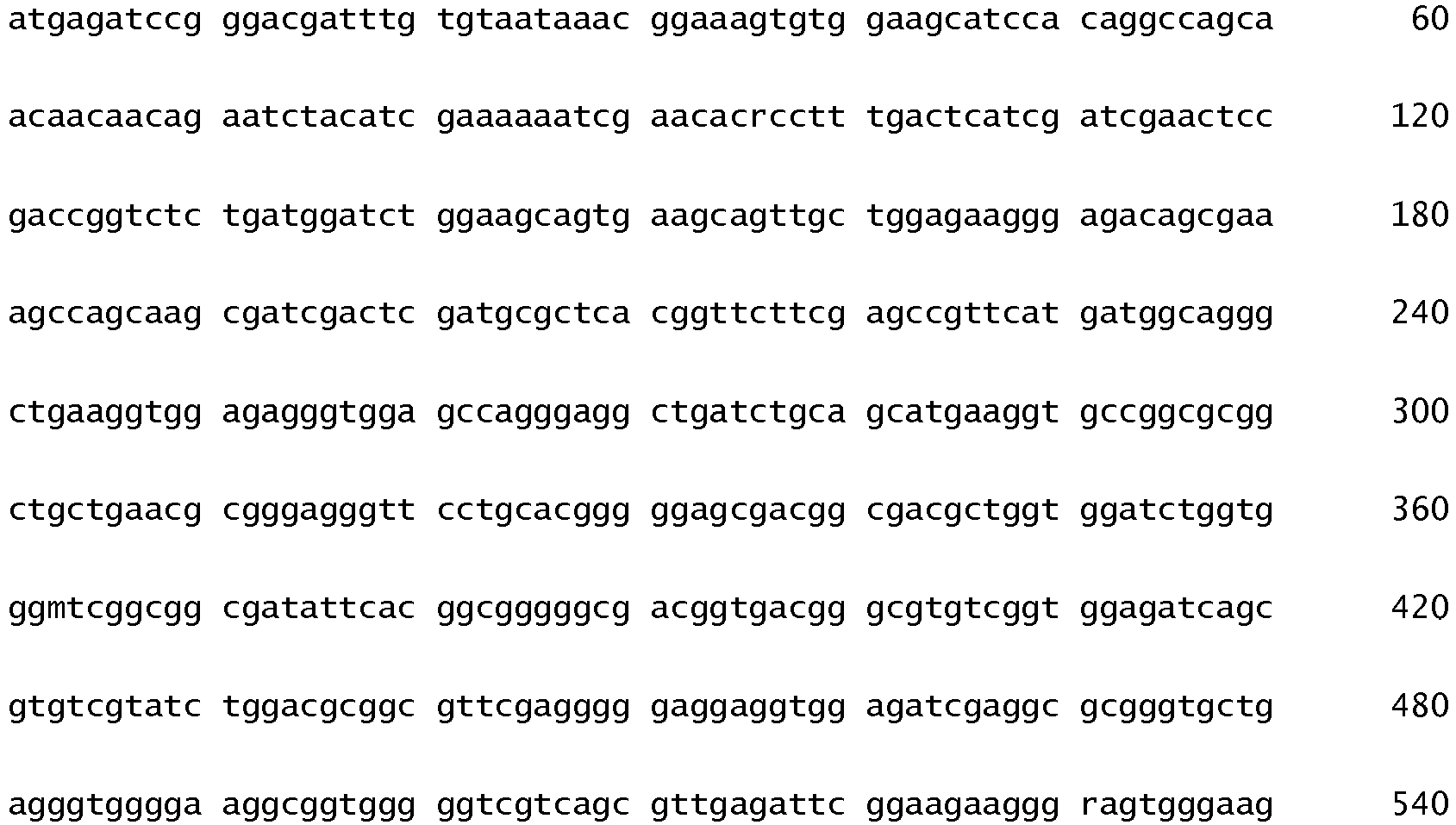
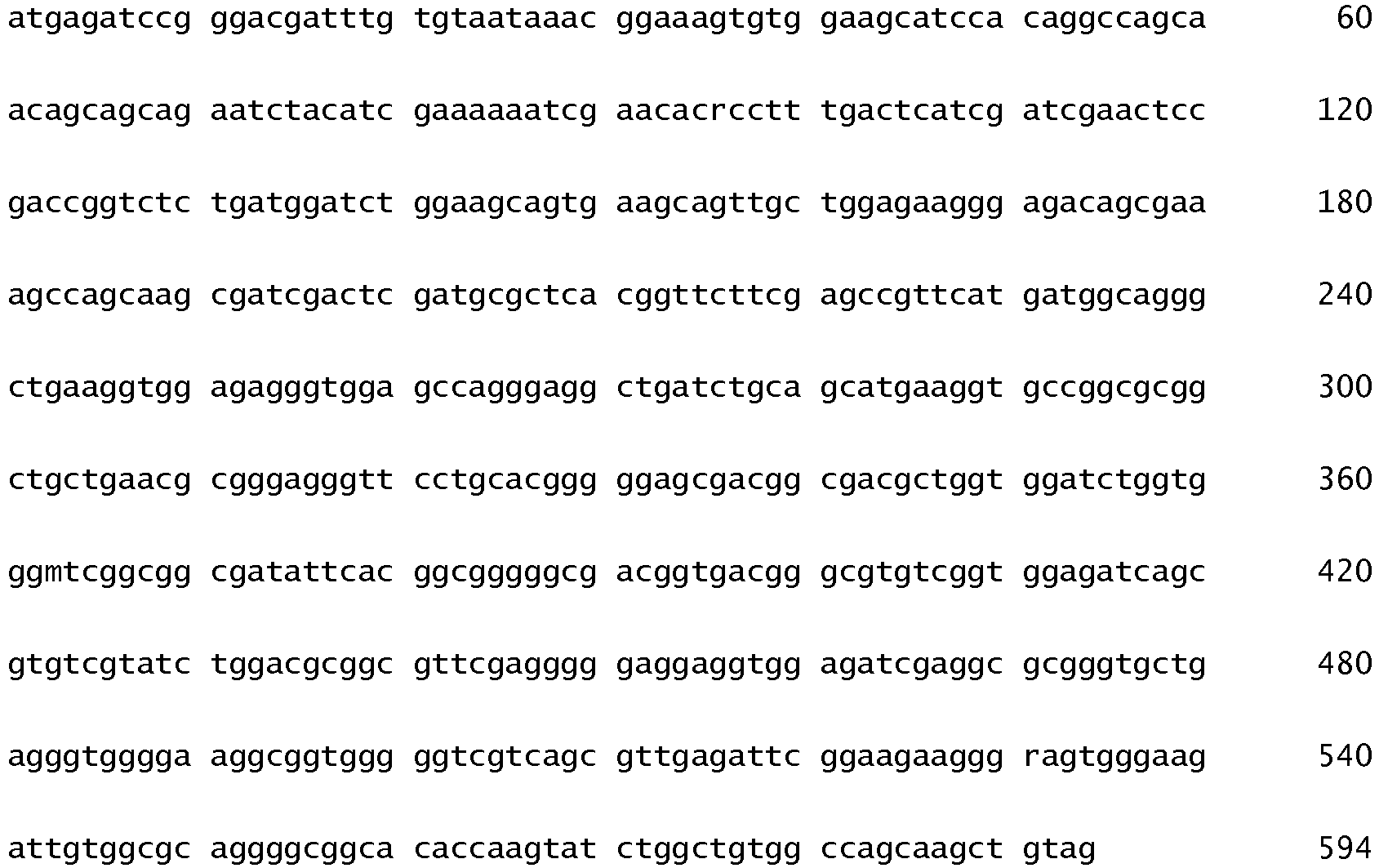
temperature: day 20°C/ night 18 °C; relative humidity: day 60%/ night 80%;day length: 20 hours (artificial light with an intensity between 1000 and 2000 lux). - Analysis of the progeny showed that the observed mildew resistant phenotype correlated with two nucleotide substitutions at positions 64 and 67 of the coding sequence of a gene encoding a thioesterase protein or thioesterase-like protein. As depicted in
Figure 1 , both nucleotide substitutions resulted in amino acid substitutions in the N-terminal region of the thioesterase protein or thioesterase-like protein. - The analysis of the mildew phenotype in the above segregating population is summarized in Table 1 below and
Figure 2 .Table 1: Analysis of a segregating population of the present mildew resistance phenotype wherein 1 denotes minimal mildew resistance or the absence thereof and 9 denotes maximal mildew resistance. Plant Phenotype score SNP_14 SNP_17_RC Ka-SxM-100 1,00 A/A T/T Ka-SxM-084 1,00 A/A T/T Ka-SxM-024 1,00 A/A T/T Ka-SxM-064 1,00 A/A T/T Ka-SxM-073 1,17 A/A T/T Ka-SxM-126 1,17 A/A T/T Ka-SxM-004 1,17 A/A T/T Ka-SxM-086 1,17 A/A T/T Ka-SxM-079 1,17 A/A T/T Ka-SxM-026 1,33 A/A T/T Ka-SxM-020 1,33 A/A T/T Ka-SxM-136 1,33 A/A T/T Ka-SxM-069 1,33 A/A T/T Ka-SxM-078 1,33 A/A T/T Ka-SxM-087 1,33 A/A T/T Ka-SxM-072 1,33 A/A T/T Ka-SxM-027 1,50 A/A T/T Ka-SxM-081 1,83 A/A T/C Ka-SxM-012 1,83 A/A T/T Ka-SxM-062 1,83 A/A T/T Ka-SxM-044 2,00 A/A T/T Ka-SxM-052 2,17 A/A T/T Ka-SxM-082 2,33 A/A T/T Ka-SxM-092 2,50 A/A T/T Ka-SxM-061 2,50 A/A T/T Ka-SxM-075 2,83 A/A T/T Ka-SxM-050 3,00 A/A T/T Ka-SxM-090 3,00 A/A T/T Ka-SxM-053 3,00 A/A T/T Ka-SxM-113 3,00 A/A T/T Ka-SxM-008 3,00 A/A T/T Ka-SxM-080 3,00 A/A T/T Ka-SxM-028 3,17 A/A T/T Ka-SxM-013 3,50 A/A T/T Ka-SxM-037 3,50 A/A T/T Ka-SxM-022 4,00 A/A T/T Ka-SxM-068 4,83 A/A T/T Ka-SxM-046 4,83 G/G C/C Ka-SxM-030 5,17 A/A T/T Ka-SxM-014 5,33 A/A T/T Ka-SxM-106 5,50 A/A T/T Ka-SxM-060 5,67 Undetermined Undetermined Ka-SxM-066 5,83 G/A T/C Ka-SxM-114 6,00 G/A T/C Ka-SxM-009 6,33 A/A T/T Ka-SxM-041 6,33 G/G C/C Ka-SxM-038 6,83 G/G C/C Ka-SxM-065 7,00 G/A T/C Ka-SxM-067 7,00 G/A T/C Ka-SxM-029 7,00 G/A T/C Ka-SxM-007 7,00 G/A T/C Ka-SxM-049 7,17 G/A T/C Ka-SxM-051 7,17 G/A T/C Ka-SxM-005 7,17 G/G C/C Ka-SxM-040 7,17 G/A T/C Ka-SxM-033 7,33 G/A T/C Ka-SxM-074 7,33 G/G C/C Ka-SxM-019 7,33 G/A T/C Ka-SxM-094 7,33 G/A T/C Ka-SxM-139 7,33 A/A T/T Ka-SxM-056 7,33 G/G C/C Ka-SxM-042 7,50 G/A T/C Ka-SxM-138 7,50 G/A T/C Ka-SxM-077 7,50 G/G C/C Ka-SxM-054 7,50 G/A T/C Ka-SxM-001 7,67 G/G C/C Ka-SxM-018 7,67 G/A T/C Ka-SxM-034 7,67 Undetermined T/C Ka-SxM-071 7,67 A/A T/T Ka-SxM-057 7,83 G/G C/C Ka-SxM-058 7,83 G/G Undetermined Ka-SxM-036 7,83 G/G C/C Ka-SxM-045 7,83 G/G C/C Ka-SxM-117 7,83 G/A T/C Ka-SxM-117 7,83 G/A T/C Ka-SxM-017 8,00 G/A T/C Ka-SxM-089 8,00 G/A T/C Ka-SxM-003 8,00 G/A T/C Ka-SxM-043 8,00 G/A T/C Ka-SxM-076 8,00 G/A T/C Ka-SxM-023 8,00 G/A T/C Ka-SxM-031 8,17 G/G C/C Ka-SxM-035 8,33 G/A T/C Ka-SxM-032 8,33 G/A T/C Ka-SxM-048 8,50 G/A T/C -
- <110> DNA GREEN GROUP B.V.
- <120> MILDEW RESISTANCE GENE IN KALANCHOE
- <130> 4/2RG78/7
- <160> 6
- <170> PatentIn version 3.5
- <210> 1
<211> 197
<212> PRT
<213> Kalanchoe blossfeldiana - <400> 1


- <210> 2
<211> 197
<212> PRT
<213> Kalanchoe blossfeldiana - <400> 2


- <210> 3
<211> 594
<212> DNA
<213> Kalanchoe blossfeldiana - <400> 3

- <210> 4
<211> 594
<212> DNA
<213> Kalanchoe blossfeldiana - <400> 4

- <210> 5
<211> 594
<212> DNA
<213> Kalanchoe blossfeldiana - <400> 5


- <210> 6
<211> 594
<212> DNA
<213> Kalanchoe blossfeldiana - <400> 6
Claims (6)
- Protein comprising SEQ ID No. 2.
- Nucleic acid encoding a protein according to claim 1.
- Gene capable of being transcribed into a nucleic acid sequence according to claim 2 or encoding a protein according to claim 1.
- Use of a protein according to claim 1 or a nucleic acid sequence according to claim 2 or a gene according to claim 3 for selecting a mildew resistant Kalanchoe plant, preferably an Oidium kalanchoeae resistant Kalanchoe plant.
- Use according to claim 4, wherein said Kalanchoe plant is selected from the group consisting of Kalanchoe adelae, Kalanchoe arborescens, Kalanchoe beauverdii, Kalanchoe beharensis, Kalanchoe bentii, Kalanchoe blossfeldiana, Kalanchoe bouvetii, Kalanchoe bracteata, Kalanchoe campanulata, Kalanchoe crenata, Kalanchoe crundallii, Kalanchoe daigremontiana, Kalanchoe delagoensis, Kalanchoe dinklagei, Kalanchoe eriophylla, Kalanchoe farinacea, Kalanchoe fedtschenkoi, Kalanchoe figuereidoi, Kalanchoe flammea, Kalanchoe gastonis, Kalanchoe glaucescens, Kalanchoe gracilipes, Kalanchoe grandidieri, Kalanchoe grandiflora, Kalanchoe hildebrantii, Kalanchoe jongmansii, Kalanchoe kewensis, Kalanchoe laciniata, Kalanchoe laetivirens, Kalanchoe lateritia, Kalanchoe laxiflora, Kalanchoe linearifolia, Kalanchoe longiflora, Kalanchoe luciae, Kalanchoe macrochlamys, Kalanchoe manginii, Kalanchoe marnieriana, Kalanchoe marmorata, Kalanchoe millottii, Kalanchoe miniata, Kalanchoe nyikae, Kalanchoe obtusa, Kalanchoe orgyalis, Kalanchoe peltata, Kalanchoe petitiana, Kalanchoe pinnata, Kalanchoe porphyrocalyx, Kalanchoe prolifera, Kalanchoe pubescens, Kalanchoe pumila, Kalanchoe quartiniana, Kalanchoe rhombopilosa, Kalanchoe robusta, Kalanchoe rolandi, Kalanchoe rosei, Kalanchoe rotundifolia, Kalanchoe schizophylla, Kalanchoe serrata, Kalanchoe sexangularis, Kalanchoe streptantha, Kalanchoe suarezensis, Kalanchoe synsepala, Kalanchoe synsepala f. dissecta, Kalanchoe thyrsiflora, Kalanchoe tomentosa, Kalanchoe tubiflora, Kalanchoe uniflora, Kalanchoe velutina and Kalanchoe viguieri; preferably decorative flowering Kalanchoe plants selected from the group consisting of K. blossfeldiana, K. laciniata, K. rotundifolia, K. aromatica, K. pubescens, K. grandiflora, K. citrina, K. ambolensis, K. faustii, K. schumacherii, K. pritwitzii, K. flammea, K. figueredoi, K. rauhii, K. obtusa, K. pumila, K. marmorata, K. porphyrocalux, K. jongmansii, K. pinnata, K. diagremontiana, K. gracilipes, K. campanulata, K. latisepela, K. coccinea, K. fedtschenkoi, K. tubiflora, K. decumbens, K. manginii, K. orgyalis, K. crenata, K. tomentosa and hybrids thereof.
- Use of a protein according to claim 1 or a nucleic acid sequence according to claim 2 or a gene according to claim 3 for development of a molecular marker indicative of, or associated with, mildew resistance, preferably said resistance is resistance against the pathogen Oidium kalanchoeae.
Priority Applications (10)
| Application Number | Priority Date | Filing Date | Title |
|---|---|---|---|
| ES15157519T ES2914151T3 (en) | 2015-03-04 | 2015-03-04 | Mold resistance gene in Kalanchoe |
| EP15157519.8A EP3064586B1 (en) | 2015-03-04 | 2015-03-04 | Mildew resistance gene in Kalanchoe |
| DK15157519.8T DK3064586T3 (en) | 2015-03-04 | 2015-03-04 | Genes with mildew resistance in Kalanchoe |
| TW105105423A TWI687433B (en) | 2015-03-04 | 2016-02-24 | Mildew resistance gene in kalanchoe |
| BR112017018966-6A BR112017018966B1 (en) | 2015-03-04 | 2016-02-29 | Application of a nucleic acid sequence for identification of Kalanchoe plants resistant to Oidium kalanchoeae |
| CN201680012606.4A CN107429239A (en) | 2015-03-04 | 2016-02-29 | Mycotic Resistance Genes in Kalanchoe |
| CA2976991A CA2976991C (en) | 2015-03-04 | 2016-02-29 | Mildew resistance gene in kalanchoe |
| US15/553,199 US10815466B2 (en) | 2015-03-04 | 2016-02-29 | Mildew resistance gene in kalanchoe |
| PCT/EP2016/054220 WO2016139178A1 (en) | 2015-03-04 | 2016-02-29 | Mildew resistance gene in kalanchoe |
| JP2017564798A JP7117106B2 (en) | 2015-03-04 | 2016-02-29 | Powdery mildew resistance gene in Kalanchoe |
Applications Claiming Priority (1)
| Application Number | Priority Date | Filing Date | Title |
|---|---|---|---|
| EP15157519.8A EP3064586B1 (en) | 2015-03-04 | 2015-03-04 | Mildew resistance gene in Kalanchoe |
Publications (2)
| Publication Number | Publication Date |
|---|---|
| EP3064586A1 EP3064586A1 (en) | 2016-09-07 |
| EP3064586B1 true EP3064586B1 (en) | 2022-05-04 |
Family
ID=52648837
Family Applications (1)
| Application Number | Title | Priority Date | Filing Date |
|---|---|---|---|
| EP15157519.8A Active EP3064586B1 (en) | 2015-03-04 | 2015-03-04 | Mildew resistance gene in Kalanchoe |
Country Status (9)
| Country | Link |
|---|---|
| US (1) | US10815466B2 (en) |
| EP (1) | EP3064586B1 (en) |
| JP (1) | JP7117106B2 (en) |
| CN (1) | CN107429239A (en) |
| CA (1) | CA2976991C (en) |
| DK (1) | DK3064586T3 (en) |
| ES (1) | ES2914151T3 (en) |
| TW (1) | TWI687433B (en) |
| WO (1) | WO2016139178A1 (en) |
Families Citing this family (4)
| Publication number | Priority date | Publication date | Assignee | Title |
|---|---|---|---|---|
| AU2019301819B2 (en) * | 2018-07-12 | 2023-01-12 | Berkeley Lights, Inc. | Screening plant protoplasts for disease resistant traits |
| CN109496859B (en) * | 2018-11-30 | 2020-08-18 | 临沂大学 | A kind of tissue culture method of succulent red egg blisters |
| MA56910B1 (en) * | 2019-12-04 | 2023-09-27 | Rijk Zwaan Zaadteelt En Zaadhandel Bv | CCA GENE FOR VIRUS RESISTANCE |
| CN113201056A (en) * | 2021-03-01 | 2021-08-03 | 西南大学 | Protein for regulating and controlling sclerotinia rot resistance of rape and application thereof |
Family Cites Families (10)
| Publication number | Priority date | Publication date | Assignee | Title |
|---|---|---|---|---|
| US6878A (en) | 1849-11-20 | Ox-yoke | ||
| USPP6878P (en) * | 1988-03-01 | 1989-06-27 | Wiesmoor-Gartnerie Und Baumschule Gmbh | Kalanchoe plant named Fantasy |
| US20040181830A1 (en) * | 2001-05-07 | 2004-09-16 | Kovalic David K. | Nucleic acid molecules and other molecules associated with plants and uses thereof for plant improvement |
| USPP13355P2 (en) | 2002-03-22 | 2002-12-17 | Gartneriet Rosborg Bellinge A/S | Kalanchoe plant named ‘Samba’ |
| USPP18030P3 (en) * | 2004-12-15 | 2007-09-11 | Knud Jepsen A/S | Kalanchoe plant named ‘AFRICAN SUNSHINE’ |
| WO2007051483A1 (en) * | 2005-11-01 | 2007-05-10 | Universiteit Utrecht Holding B.V. | Disease resistant plants |
| CN102586266B (en) * | 2011-01-13 | 2013-09-18 | 中国科学院遗传与发育生物学研究所 | Cloning and application of arabidopsis powdery mildew resistance related gene EDR6 |
| ES2698002T3 (en) * | 2011-03-01 | 2019-01-30 | Enza Zaden Beheer Bv | Genes that provide resistance to powdery mildew in Cucumis Sativus |
| CN104211791B (en) * | 2013-05-31 | 2016-11-16 | 中国科学院遗传与发育生物学研究所 | One powder mildew resistance associated protein MIL16 and encoding gene thereof are applied with it |
| US20160312193A1 (en) | 2013-12-12 | 2016-10-27 | Fides Bv | Gene Encoding a Mutant Protein Providing a Decorative Flowering Phenotype in Plants |
-
2015
- 2015-03-04 EP EP15157519.8A patent/EP3064586B1/en active Active
- 2015-03-04 ES ES15157519T patent/ES2914151T3/en active Active
- 2015-03-04 DK DK15157519.8T patent/DK3064586T3/en active
-
2016
- 2016-02-24 TW TW105105423A patent/TWI687433B/en active
- 2016-02-29 CA CA2976991A patent/CA2976991C/en active Active
- 2016-02-29 US US15/553,199 patent/US10815466B2/en active Active
- 2016-02-29 JP JP2017564798A patent/JP7117106B2/en active Active
- 2016-02-29 CN CN201680012606.4A patent/CN107429239A/en active Pending
- 2016-02-29 WO PCT/EP2016/054220 patent/WO2016139178A1/en not_active Ceased
Non-Patent Citations (1)
| Title |
|---|
| KNUD JEPSEN A/S: "Kalanchoë Queen. Colours and Contours.", November 2006 * |
Also Published As
| Publication number | Publication date |
|---|---|
| DK3064586T3 (en) | 2022-05-30 |
| ES2914151T3 (en) | 2022-06-07 |
| CN107429239A (en) | 2017-12-01 |
| TWI687433B (en) | 2020-03-11 |
| JP2018508236A (en) | 2018-03-29 |
| CA2976991A1 (en) | 2016-09-09 |
| US20180037875A1 (en) | 2018-02-08 |
| JP7117106B2 (en) | 2022-08-12 |
| EP3064586A1 (en) | 2016-09-07 |
| US10815466B2 (en) | 2020-10-27 |
| BR112017018966A2 (en) | 2018-05-08 |
| CA2976991C (en) | 2023-10-31 |
| WO2016139178A1 (en) | 2016-09-09 |
| TW201643181A (en) | 2016-12-16 |
Similar Documents
| Publication | Publication Date | Title |
|---|---|---|
| CN115867129B (en) | Resistance of tomato plants to ToBRFV | |
| CA2976991C (en) | Mildew resistance gene in kalanchoe | |
| KR102113167B1 (en) | Tswv resistant capsicum plants | |
| CN114929881A (en) | CCA genes for virus resistance | |
| ES2738850T3 (en) | Isolated nucleotide sequence of Solanum lycopersicum for enhanced resistance to tomato tanning virus, TSWV | |
| Folta et al. | Genetics, genomics and breeding of berries | |
| EP3080146B1 (en) | Gene encoding a mutant protein providing a decorative flowering phenotype in plants | |
| DK178924B1 (en) | Mildew resistance gene in kalanchoe | |
| US10952385B2 (en) | QTLS for fusarium resistance in cucumber | |
| NL2014393B1 (en) | Mildew resistance gene in kalanchoe. | |
| CN106103723B (en) | Tomato (Solanum lycopersicum) plants with increased fruit yield | |
| CN115811936B (en) | Melon plants resistant to scab, aphids and powdery mildew | |
| EP2966993B1 (en) | Tomato spotted wilt virus and/or impatiens necrotic spot virus resistance in cultivated lettuce | |
| BR112017018966B1 (en) | Application of a nucleic acid sequence for identification of Kalanchoe plants resistant to Oidium kalanchoeae | |
| EP2041289B1 (en) | Resistance to powdery mildew and absence of necrosis in cucumis sativus | |
| Lee et al. | Development of a TYLCV Resistance Breeding System Based on Gene-specific Molecular Markers and Infectivity Assays in Tomato | |
| CA2988057C (en) | Qtls for fusarium resistance in cucumber | |
| Sharma et al. | Characterization of Vasconcellea cauliflora for morpho-horticultural traits under climatic conditions of Pune, India |
Legal Events
| Date | Code | Title | Description |
|---|---|---|---|
| PUAI | Public reference made under article 153(3) epc to a published international application that has entered the european phase |
Free format text: ORIGINAL CODE: 0009012 |
|
| AK | Designated contracting states |
Kind code of ref document: A1 Designated state(s): AL AT BE BG CH CY CZ DE DK EE ES FI FR GB GR HR HU IE IS IT LI LT LU LV MC MK MT NL NO PL PT RO RS SE SI SK SM TR |
|
| AX | Request for extension of the european patent |
Extension state: BA ME |
|
| STAA | Information on the status of an ep patent application or granted ep patent |
Free format text: STATUS: REQUEST FOR EXAMINATION WAS MADE |
|
| 17P | Request for examination filed |
Effective date: 20170306 |
|
| RBV | Designated contracting states (corrected) |
Designated state(s): AL AT BE BG CH CY CZ DE DK EE ES FI FR GB GR HR HU IE IS IT LI LT LU LV MC MK MT NL NO PL PT RO RS SE SI SK SM TR |
|
| RAP1 | Party data changed (applicant data changed or rights of an application transferred) |
Owner name: DUEMMEN GROUP B.V. |
|
| STAA | Information on the status of an ep patent application or granted ep patent |
Free format text: STATUS: EXAMINATION IS IN PROGRESS |
|
| 17Q | First examination report despatched |
Effective date: 20180124 |
|
| GRAJ | Information related to disapproval of communication of intention to grant by the applicant or resumption of examination proceedings by the epo deleted |
Free format text: ORIGINAL CODE: EPIDOSDIGR1 |
|
| STAA | Information on the status of an ep patent application or granted ep patent |
Free format text: STATUS: GRANT OF PATENT IS INTENDED |
|
| GRAP | Despatch of communication of intention to grant a patent |
Free format text: ORIGINAL CODE: EPIDOSNIGR1 |
|
| INTG | Intention to grant announced |
Effective date: 20181206 |
|
| GRAJ | Information related to disapproval of communication of intention to grant by the applicant or resumption of examination proceedings by the epo deleted |
Free format text: ORIGINAL CODE: EPIDOSDIGR1 |
|
| STAA | Information on the status of an ep patent application or granted ep patent |
Free format text: STATUS: EXAMINATION IS IN PROGRESS |
|
| TPAC | Observations filed by third parties |
Free format text: ORIGINAL CODE: EPIDOSNTIPA |
|
| INTC | Intention to grant announced (deleted) | ||
| TPAC | Observations filed by third parties |
Free format text: ORIGINAL CODE: EPIDOSNTIPA |
|
| TPAC | Observations filed by third parties |
Free format text: ORIGINAL CODE: EPIDOSNTIPA |
|
| GRAP | Despatch of communication of intention to grant a patent |
Free format text: ORIGINAL CODE: EPIDOSNIGR1 |
|
| STAA | Information on the status of an ep patent application or granted ep patent |
Free format text: STATUS: GRANT OF PATENT IS INTENDED |
|
| INTG | Intention to grant announced |
Effective date: 20211116 |
|
| GRAS | Grant fee paid |
Free format text: ORIGINAL CODE: EPIDOSNIGR3 |
|
| GRAA | (expected) grant |
Free format text: ORIGINAL CODE: 0009210 |
|
| STAA | Information on the status of an ep patent application or granted ep patent |
Free format text: STATUS: THE PATENT HAS BEEN GRANTED |
|
| REG | Reference to a national code |
Ref country code: DE Ref legal event code: R082 Ref document number: 602015078617 Country of ref document: DE |
|
| AK | Designated contracting states |
Kind code of ref document: B1 Designated state(s): AL AT BE BG CH CY CZ DE DK EE ES FI FR GB GR HR HU IE IS IT LI LT LU LV MC MK MT NL NO PL PT RO RS SE SI SK SM TR |
|
| REG | Reference to a national code |
Ref country code: GB Ref legal event code: FG4D |
|
| REG | Reference to a national code |
Ref country code: CH Ref legal event code: EP |
|
| REG | Reference to a national code |
Ref country code: AT Ref legal event code: REF Ref document number: 1489104 Country of ref document: AT Kind code of ref document: T Effective date: 20220515 |
|
| REG | Reference to a national code |
Ref country code: IE Ref legal event code: FG4D Ref country code: DE Ref legal event code: R096 Ref document number: 602015078617 Country of ref document: DE |
|
| REG | Reference to a national code |
Ref country code: DK Ref legal event code: T3 Effective date: 20220523 |
|
| REG | Reference to a national code |
Ref country code: ES Ref legal event code: FG2A Ref document number: 2914151 Country of ref document: ES Kind code of ref document: T3 Effective date: 20220607 |
|
| REG | Reference to a national code |
Ref country code: NL Ref legal event code: FP |
|
| REG | Reference to a national code |
Ref country code: LT Ref legal event code: MG9D |
|
| REG | Reference to a national code |
Ref country code: AT Ref legal event code: MK05 Ref document number: 1489104 Country of ref document: AT Kind code of ref document: T Effective date: 20220504 |
|
| PG25 | Lapsed in a contracting state [announced via postgrant information from national office to epo] |
Ref country code: SE Free format text: LAPSE BECAUSE OF FAILURE TO SUBMIT A TRANSLATION OF THE DESCRIPTION OR TO PAY THE FEE WITHIN THE PRESCRIBED TIME-LIMIT Effective date: 20220504 Ref country code: PT Free format text: LAPSE BECAUSE OF FAILURE TO SUBMIT A TRANSLATION OF THE DESCRIPTION OR TO PAY THE FEE WITHIN THE PRESCRIBED TIME-LIMIT Effective date: 20220905 Ref country code: NO Free format text: LAPSE BECAUSE OF FAILURE TO SUBMIT A TRANSLATION OF THE DESCRIPTION OR TO PAY THE FEE WITHIN THE PRESCRIBED TIME-LIMIT Effective date: 20220804 Ref country code: LT Free format text: LAPSE BECAUSE OF FAILURE TO SUBMIT A TRANSLATION OF THE DESCRIPTION OR TO PAY THE FEE WITHIN THE PRESCRIBED TIME-LIMIT Effective date: 20220504 Ref country code: HR Free format text: LAPSE BECAUSE OF FAILURE TO SUBMIT A TRANSLATION OF THE DESCRIPTION OR TO PAY THE FEE WITHIN THE PRESCRIBED TIME-LIMIT Effective date: 20220504 Ref country code: GR Free format text: LAPSE BECAUSE OF FAILURE TO SUBMIT A TRANSLATION OF THE DESCRIPTION OR TO PAY THE FEE WITHIN THE PRESCRIBED TIME-LIMIT Effective date: 20220805 Ref country code: FI Free format text: LAPSE BECAUSE OF FAILURE TO SUBMIT A TRANSLATION OF THE DESCRIPTION OR TO PAY THE FEE WITHIN THE PRESCRIBED TIME-LIMIT Effective date: 20220504 Ref country code: BG Free format text: LAPSE BECAUSE OF FAILURE TO SUBMIT A TRANSLATION OF THE DESCRIPTION OR TO PAY THE FEE WITHIN THE PRESCRIBED TIME-LIMIT Effective date: 20220804 Ref country code: AT Free format text: LAPSE BECAUSE OF FAILURE TO SUBMIT A TRANSLATION OF THE DESCRIPTION OR TO PAY THE FEE WITHIN THE PRESCRIBED TIME-LIMIT Effective date: 20220504 |
|
| PG25 | Lapsed in a contracting state [announced via postgrant information from national office to epo] |
Ref country code: RS Free format text: LAPSE BECAUSE OF FAILURE TO SUBMIT A TRANSLATION OF THE DESCRIPTION OR TO PAY THE FEE WITHIN THE PRESCRIBED TIME-LIMIT Effective date: 20220504 Ref country code: PL Free format text: LAPSE BECAUSE OF FAILURE TO SUBMIT A TRANSLATION OF THE DESCRIPTION OR TO PAY THE FEE WITHIN THE PRESCRIBED TIME-LIMIT Effective date: 20220504 Ref country code: LV Free format text: LAPSE BECAUSE OF FAILURE TO SUBMIT A TRANSLATION OF THE DESCRIPTION OR TO PAY THE FEE WITHIN THE PRESCRIBED TIME-LIMIT Effective date: 20220504 Ref country code: IS Free format text: LAPSE BECAUSE OF FAILURE TO SUBMIT A TRANSLATION OF THE DESCRIPTION OR TO PAY THE FEE WITHIN THE PRESCRIBED TIME-LIMIT Effective date: 20220904 |
|
| PG25 | Lapsed in a contracting state [announced via postgrant information from national office to epo] |
Ref country code: SM Free format text: LAPSE BECAUSE OF FAILURE TO SUBMIT A TRANSLATION OF THE DESCRIPTION OR TO PAY THE FEE WITHIN THE PRESCRIBED TIME-LIMIT Effective date: 20220504 Ref country code: SK Free format text: LAPSE BECAUSE OF FAILURE TO SUBMIT A TRANSLATION OF THE DESCRIPTION OR TO PAY THE FEE WITHIN THE PRESCRIBED TIME-LIMIT Effective date: 20220504 Ref country code: RO Free format text: LAPSE BECAUSE OF FAILURE TO SUBMIT A TRANSLATION OF THE DESCRIPTION OR TO PAY THE FEE WITHIN THE PRESCRIBED TIME-LIMIT Effective date: 20220504 Ref country code: EE Free format text: LAPSE BECAUSE OF FAILURE TO SUBMIT A TRANSLATION OF THE DESCRIPTION OR TO PAY THE FEE WITHIN THE PRESCRIBED TIME-LIMIT Effective date: 20220504 Ref country code: CZ Free format text: LAPSE BECAUSE OF FAILURE TO SUBMIT A TRANSLATION OF THE DESCRIPTION OR TO PAY THE FEE WITHIN THE PRESCRIBED TIME-LIMIT Effective date: 20220504 |
|
| REG | Reference to a national code |
Ref country code: DE Ref legal event code: R097 Ref document number: 602015078617 Country of ref document: DE |
|
| PLBE | No opposition filed within time limit |
Free format text: ORIGINAL CODE: 0009261 |
|
| STAA | Information on the status of an ep patent application or granted ep patent |
Free format text: STATUS: NO OPPOSITION FILED WITHIN TIME LIMIT |
|
| PG25 | Lapsed in a contracting state [announced via postgrant information from national office to epo] |
Ref country code: AL Free format text: LAPSE BECAUSE OF FAILURE TO SUBMIT A TRANSLATION OF THE DESCRIPTION OR TO PAY THE FEE WITHIN THE PRESCRIBED TIME-LIMIT Effective date: 20220504 |
|
| 26N | No opposition filed |
Effective date: 20230207 |
|
| PG25 | Lapsed in a contracting state [announced via postgrant information from national office to epo] |
Ref country code: SI Free format text: LAPSE BECAUSE OF FAILURE TO SUBMIT A TRANSLATION OF THE DESCRIPTION OR TO PAY THE FEE WITHIN THE PRESCRIBED TIME-LIMIT Effective date: 20220504 |
|
| P01 | Opt-out of the competence of the unified patent court (upc) registered |
Effective date: 20230424 |
|
| PG25 | Lapsed in a contracting state [announced via postgrant information from national office to epo] |
Ref country code: MC Free format text: LAPSE BECAUSE OF FAILURE TO SUBMIT A TRANSLATION OF THE DESCRIPTION OR TO PAY THE FEE WITHIN THE PRESCRIBED TIME-LIMIT Effective date: 20220504 |
|
| REG | Reference to a national code |
Ref country code: CH Ref legal event code: PL |
|
| GBPC | Gb: european patent ceased through non-payment of renewal fee |
Effective date: 20230304 |
|
| PG25 | Lapsed in a contracting state [announced via postgrant information from national office to epo] |
Ref country code: LU Free format text: LAPSE BECAUSE OF NON-PAYMENT OF DUE FEES Effective date: 20230304 |
|
| REG | Reference to a national code |
Ref country code: IE Ref legal event code: MM4A |
|
| PG25 | Lapsed in a contracting state [announced via postgrant information from national office to epo] |
Ref country code: GB Free format text: LAPSE BECAUSE OF NON-PAYMENT OF DUE FEES Effective date: 20230304 |
|
| PG25 | Lapsed in a contracting state [announced via postgrant information from national office to epo] |
Ref country code: LI Free format text: LAPSE BECAUSE OF NON-PAYMENT OF DUE FEES Effective date: 20230331 Ref country code: IT Free format text: LAPSE BECAUSE OF FAILURE TO SUBMIT A TRANSLATION OF THE DESCRIPTION OR TO PAY THE FEE WITHIN THE PRESCRIBED TIME-LIMIT Effective date: 20220504 Ref country code: IE Free format text: LAPSE BECAUSE OF NON-PAYMENT OF DUE FEES Effective date: 20230304 Ref country code: GB Free format text: LAPSE BECAUSE OF NON-PAYMENT OF DUE FEES Effective date: 20230304 Ref country code: FR Free format text: LAPSE BECAUSE OF NON-PAYMENT OF DUE FEES Effective date: 20230331 Ref country code: CH Free format text: LAPSE BECAUSE OF NON-PAYMENT OF DUE FEES Effective date: 20230331 |
|
| PG25 | Lapsed in a contracting state [announced via postgrant information from national office to epo] |
Ref country code: BG Free format text: LAPSE BECAUSE OF FAILURE TO SUBMIT A TRANSLATION OF THE DESCRIPTION OR TO PAY THE FEE WITHIN THE PRESCRIBED TIME-LIMIT Effective date: 20220504 |
|
| PG25 | Lapsed in a contracting state [announced via postgrant information from national office to epo] |
Ref country code: BG Free format text: LAPSE BECAUSE OF FAILURE TO SUBMIT A TRANSLATION OF THE DESCRIPTION OR TO PAY THE FEE WITHIN THE PRESCRIBED TIME-LIMIT Effective date: 20220504 |
|
| PG25 | Lapsed in a contracting state [announced via postgrant information from national office to epo] |
Ref country code: CY Free format text: LAPSE BECAUSE OF FAILURE TO SUBMIT A TRANSLATION OF THE DESCRIPTION OR TO PAY THE FEE WITHIN THE PRESCRIBED TIME-LIMIT; INVALID AB INITIO Effective date: 20150304 |
|
| PG25 | Lapsed in a contracting state [announced via postgrant information from national office to epo] |
Ref country code: HU Free format text: LAPSE BECAUSE OF FAILURE TO SUBMIT A TRANSLATION OF THE DESCRIPTION OR TO PAY THE FEE WITHIN THE PRESCRIBED TIME-LIMIT; INVALID AB INITIO Effective date: 20150304 |
|
| PG25 | Lapsed in a contracting state [announced via postgrant information from national office to epo] |
Ref country code: TR Free format text: LAPSE BECAUSE OF FAILURE TO SUBMIT A TRANSLATION OF THE DESCRIPTION OR TO PAY THE FEE WITHIN THE PRESCRIBED TIME-LIMIT Effective date: 20220504 |
|
| PGFP | Annual fee paid to national office [announced via postgrant information from national office to epo] |
Ref country code: DE Payment date: 20260327 Year of fee payment: 12 Ref country code: DK Payment date: 20260325 Year of fee payment: 12 |
|
| PGFP | Annual fee paid to national office [announced via postgrant information from national office to epo] |
Ref country code: BE Payment date: 20260327 Year of fee payment: 12 |
|
| PGFP | Annual fee paid to national office [announced via postgrant information from national office to epo] |
Ref country code: NL Payment date: 20260326 Year of fee payment: 12 |
|
| PGFP | Annual fee paid to national office [announced via postgrant information from national office to epo] |
Ref country code: ES Payment date: 20260401 Year of fee payment: 12 |