EP3064264A1 - Siloxane filtration system and method - Google Patents
Siloxane filtration system and method Download PDFInfo
- Publication number
- EP3064264A1 EP3064264A1 EP16155915.8A EP16155915A EP3064264A1 EP 3064264 A1 EP3064264 A1 EP 3064264A1 EP 16155915 A EP16155915 A EP 16155915A EP 3064264 A1 EP3064264 A1 EP 3064264A1
- Authority
- EP
- European Patent Office
- Prior art keywords
- media
- siloxane
- particulate
- intake gases
- operational life
- Prior art date
- Legal status (The legal status is an assumption and is not a legal conclusion. Google has not performed a legal analysis and makes no representation as to the accuracy of the status listed.)
- Withdrawn
Links
Images



Classifications
-
- F—MECHANICAL ENGINEERING; LIGHTING; HEATING; WEAPONS; BLASTING
- F02—COMBUSTION ENGINES; HOT-GAS OR COMBUSTION-PRODUCT ENGINE PLANTS
- F02M—SUPPLYING COMBUSTION ENGINES IN GENERAL WITH COMBUSTIBLE MIXTURES OR CONSTITUENTS THEREOF
- F02M35/00—Combustion-air cleaners, air intakes, intake silencers, or induction systems specially adapted for, or arranged on, internal-combustion engines
- F02M35/02—Air cleaners
- F02M35/0218—Air cleaners acting by absorption or adsorption; trapping or removing vapours or liquids, e.g. originating from fuel
-
- B—PERFORMING OPERATIONS; TRANSPORTING
- B01—PHYSICAL OR CHEMICAL PROCESSES OR APPARATUS IN GENERAL
- B01D—SEPARATION
- B01D46/00—Filters or filtering processes specially modified for separating dispersed particles from gases or vapours
- B01D46/0027—Filters or filtering processes specially modified for separating dispersed particles from gases or vapours with additional separating or treating functions
- B01D46/0036—Filters or filtering processes specially modified for separating dispersed particles from gases or vapours with additional separating or treating functions by adsorption or absorption
-
- B—PERFORMING OPERATIONS; TRANSPORTING
- B01—PHYSICAL OR CHEMICAL PROCESSES OR APPARATUS IN GENERAL
- B01D—SEPARATION
- B01D46/00—Filters or filtering processes specially modified for separating dispersed particles from gases or vapours
- B01D46/0039—Filters or filtering processes specially modified for separating dispersed particles from gases or vapours with flow guiding by feed or discharge devices
- B01D46/0041—Filters or filtering processes specially modified for separating dispersed particles from gases or vapours with flow guiding by feed or discharge devices for feeding
- B01D46/0046—Filters or filtering processes specially modified for separating dispersed particles from gases or vapours with flow guiding by feed or discharge devices for feeding provoking a tangential stream
-
- B—PERFORMING OPERATIONS; TRANSPORTING
- B01—PHYSICAL OR CHEMICAL PROCESSES OR APPARATUS IN GENERAL
- B01D—SEPARATION
- B01D46/00—Filters or filtering processes specially modified for separating dispersed particles from gases or vapours
- B01D46/0084—Filters or filtering processes specially modified for separating dispersed particles from gases or vapours provided with safety means
- B01D46/0086—Filter condition indicators
-
- B—PERFORMING OPERATIONS; TRANSPORTING
- B01—PHYSICAL OR CHEMICAL PROCESSES OR APPARATUS IN GENERAL
- B01D—SEPARATION
- B01D46/00—Filters or filtering processes specially modified for separating dispersed particles from gases or vapours
- B01D46/24—Particle separators, e.g. dust precipitators, using rigid hollow filter bodies
- B01D46/2403—Particle separators, e.g. dust precipitators, using rigid hollow filter bodies characterised by the physical shape or structure of the filtering element
- B01D46/2411—Filter cartridges
-
- B—PERFORMING OPERATIONS; TRANSPORTING
- B01—PHYSICAL OR CHEMICAL PROCESSES OR APPARATUS IN GENERAL
- B01D—SEPARATION
- B01D46/00—Filters or filtering processes specially modified for separating dispersed particles from gases or vapours
- B01D46/56—Filters or filtering processes specially modified for separating dispersed particles from gases or vapours with multiple filtering elements, characterised by their mutual disposition
- B01D46/62—Filters or filtering processes specially modified for separating dispersed particles from gases or vapours with multiple filtering elements, characterised by their mutual disposition connected in series
- B01D46/64—Filters or filtering processes specially modified for separating dispersed particles from gases or vapours with multiple filtering elements, characterised by their mutual disposition connected in series arranged concentrically or coaxially
-
- B—PERFORMING OPERATIONS; TRANSPORTING
- B01—PHYSICAL OR CHEMICAL PROCESSES OR APPARATUS IN GENERAL
- B01D—SEPARATION
- B01D53/00—Separation of gases or vapours; Recovering vapours of volatile solvents from gases; Chemical or biological purification of waste gases, e.g. engine exhaust gases, smoke, fumes, flue gases, aerosols
- B01D53/02—Separation of gases or vapours; Recovering vapours of volatile solvents from gases; Chemical or biological purification of waste gases, e.g. engine exhaust gases, smoke, fumes, flue gases, aerosols by adsorption, e.g. preparative gas chromatography
- B01D53/04—Separation of gases or vapours; Recovering vapours of volatile solvents from gases; Chemical or biological purification of waste gases, e.g. engine exhaust gases, smoke, fumes, flue gases, aerosols by adsorption, e.g. preparative gas chromatography with stationary adsorbents
-
- E—FIXED CONSTRUCTIONS
- E02—HYDRAULIC ENGINEERING; FOUNDATIONS; SOIL SHIFTING
- E02F—DREDGING; SOIL-SHIFTING
- E02F9/00—Component parts of dredgers or soil-shifting machines, not restricted to one of the kinds covered by groups E02F3/00 - E02F7/00
- E02F9/08—Superstructures; Supports for superstructures
- E02F9/0858—Arrangement of component parts installed on superstructures not otherwise provided for, e.g. electric components, fenders, air-conditioning units
- E02F9/0866—Engine compartment, e.g. heat exchangers, exhaust filters, cooling devices, silencers, mufflers, position of hydraulic pumps in the engine compartment
-
- F—MECHANICAL ENGINEERING; LIGHTING; HEATING; WEAPONS; BLASTING
- F02—COMBUSTION ENGINES; HOT-GAS OR COMBUSTION-PRODUCT ENGINE PLANTS
- F02M—SUPPLYING COMBUSTION ENGINES IN GENERAL WITH COMBUSTIBLE MIXTURES OR CONSTITUENTS THEREOF
- F02M35/00—Combustion-air cleaners, air intakes, intake silencers, or induction systems specially adapted for, or arranged on, internal-combustion engines
- F02M35/02—Air cleaners
- F02M35/0201—Housings; Casings; Frame constructions; Lids; Manufacturing or assembling thereof
- F02M35/0205—Details, e.g. sensors or measuring devices
-
- B—PERFORMING OPERATIONS; TRANSPORTING
- B01—PHYSICAL OR CHEMICAL PROCESSES OR APPARATUS IN GENERAL
- B01D—SEPARATION
- B01D2257/00—Components to be removed
- B01D2257/55—Compounds of silicon, phosphorus, germanium or arsenic
-
- B—PERFORMING OPERATIONS; TRANSPORTING
- B01—PHYSICAL OR CHEMICAL PROCESSES OR APPARATUS IN GENERAL
- B01D—SEPARATION
- B01D2257/00—Components to be removed
- B01D2257/55—Compounds of silicon, phosphorus, germanium or arsenic
- B01D2257/553—Compounds comprising hydrogen, e.g. silanes
-
- B—PERFORMING OPERATIONS; TRANSPORTING
- B01—PHYSICAL OR CHEMICAL PROCESSES OR APPARATUS IN GENERAL
- B01D—SEPARATION
- B01D2258/00—Sources of waste gases
- B01D2258/06—Polluted air
Definitions
- the present disclosure relates to a filtration system.
- An embodiment of the present disclosure relates to a siloxane filtration system for engine intake gases.
- Work vehicles may be operated in environments, such as landfills, waste transfer stations, and recycling centers, where the air surrounding the work vehicle may contain siloxanes in a higher concentration than other work environments.
- Intake gases for an engine on such work vehicles may also contain an increased concentration of siloxanes, which are then exposed to the temperatures, pressures, fuels, and byproducts of combustion in the engine. This exposure may convert these siloxanes to other substances, including to silica or silicates, which may bind to, collect on, or plug portions of the engine and its exhaust aftertreatment system.
- a particulate and siloxane filtration system may include a housing and a filter media assembly.
- the filter media assembly may be disposed within the housing and positioned to filter intake gases to an internal combustion engine.
- the filter media assembly may include a particulate media configured to remove particulates from the intake gases and a siloxane media configured to remove siloxanes from the intake gases.
- the siloxane media may be positioned in series with the particulate media relative to a flow of the intake gases.
- Each of the particulate media and the siloxane media may at least partially surround a common cavity.
- One of the particulate media and the siloxane media may be nested within the other of the particulate media and the siloxane media.
- the particulate media and the siloxane media may each have a cylindrical shell shape, and the common cavity may be cylindrical.
- the filter media assembly may be configured so as to be installable within, and removable from, the housing as a single piece.
- the expected operational life of the particulate media may be between 50% and 150% of an expected operational life of the siloxane media.
- the particulate and siloxane filtration system may include a pressure sensor and a controller.
- the pressure sensor may be configured to provide a pressure signal indicative of a pressure of the intake gases.
- the controller may be configured to receive the pressure signal and determine a remaining operational life of the filter media assembly based on the pressure signal.
- a method of filtering particulates and siloxanes from intake gases to an internal combustion engine of a work vehicle may include providing a particulate media positioned to remove particulates from the intake gases, providing a siloxane media positioned to remove siloxanes from the intake gases, and sending an indication of a remaining operational life of at least one of the particulate media and the siloxane media, the indication based on a pressure of the intake gases and a threshold pressure associated with the particulate media.
- the indication may be of the remaining operational life of the siloxane media.
- the particulate media may have an expected operational life between 50% and 150% of the expected operational life of the siloxane media.
- a work vehicle may include ground-engaging tractive assemblies, an internal combustion engine, and a filtration system.
- the internal combustion engine may be configured to power the ground-engaging tractive assemblies so as to move the work vehicle.
- the filtration system may be positioned to filter intake gases to the engine.
- the filtration system may include a housing, a particulate media, and a siloxane media.
- the particulate media may be disposed within the housing and configured to remove particulates from the intake gases.
- the siloxane media may be disposed within the housing and configured to remove siloxanes from the intake gases.
- the work vehicle may include an exhaust aftertreatment system positioned to treat exhaust from the engine.
- the siloxane media may be positioned in series with the particulate media relative to the flow of the intake gases.
- the particulate media and the siloxane media may each have a cylindrical shell shape.
- One of the particulate media and the siloxane media may be nested within the other of the particulate media and the siloxane media.
- the particulate media may be positioned upstream of the siloxane media relative to the flow of the intake gases.
- the particulate media may have an expected operational life between 50% and 150% of the expected operational life of the siloxane media.
- the expected operational life of the particulate media and the siloxane media may be based on operation of the work vehicle in a landfill application.
- the siloxane media may be positioned in series with the particulate media relative to the flow of the intake gases.
- the particulate media may have an expected operational life between 50% and 150% of the expected operational life of the siloxane media.
- the work vehicle may include a pressure sensor and a controller.
- the pressure sensor may be configured to provide a pressure signal indicative of a pressure of the intake gases.
- the controller may be configured to receive the pressure signal and determine a remaining operational life of the siloxane media based on the pressure signal.
- the particulate media may have an expected operational life between 75% and 125% of the expected operational life of the siloxane media.
- the particulate media and the siloxane media may be included in a filter media assembly, and the filter media assembly is configured so as to be installable within, and removable from, the housing as a single piece.
- the siloxane media may be positioned in series with the particulate media relative to the flow of the intake gases.
- the particulate media and the siloxane media may be included in a filter media assembly configured so as to be installable within, and removable from, the housing as a single piece.
- Figure 1 illustrates work vehicle 100, including chassis 102, ground-engaging tractive assemblies 104 (in this embodiment, wheels), linkage 106, and work tool 108.
- Work vehicle 100 is powered by an engine 110, which in this embodiment is an internal combustion diesel engine.
- Engine 110 takes in gases, such as fresh atmospheric air, through air intake assembly 112, combusts the intake gases with diesel fuel, and exhausts the combustion products to aftertreatment assembly 114.
- Work vehicle 100 is illustrated as a wheel loader, but may be any work vehicle with an internal combustion engine, including an articulated dump truck, backhoe loader, compact track loader, crawler (e.g., crawler dozer, crawler loader), excavator, feller buncher, forwarder, harvester, knuckleboom loader, motor grader, scraper, skidder, sprayer, skid steer, tractor (e.g., agricultural tractor), and tractor loader.
- crawler e.g., crawler dozer, crawler loader
- excavator feller buncher
- forwarder harvester
- knuckleboom loader motor grader
- scraper scraper
- skidder e.g., sprayer
- skid steer e.g., agricultural tractor
- Air intake assembly 112 filters the intake gases to engine 110 and includes pre-cleaner 116 and particulate and siloxane filtration system 118.
- Pre-cleaner 116 includes a screen to filter out debris in the intake gases and then utilizes the velocity of the remaining intake gases to spin out further particulate debris which may be included with the fresh atmospheric air being taken in at the beginning of air intake assembly 112.
- Pre-cleaner 116 may also be referred to as a cyclonic filter, cyclonic pre-cleaner, centrifugal filter, or centrifugal pre-cleaner, and is an optional component of the present disclosure as alternative embodiments may utilize an alternative pre-cleaner system (e.g., only a screen, pre-filters, electrostatic filtration) or may forgo a pre-cleaner system entirely. After the intake gases have passed through pre-cleaner 116, they are drawn into particulate and siloxane filtration system 118.
- an alternative pre-cleaner system e.g., only a screen, pre-filters, electrostatic filtration
- Particulate and siloxane filtration system 118 includes a housing and filtration media designed to filter particulates (e.g., dust, sand, debris) and siloxanes from the intake gases to engine 110.
- Siloxanes are a class of compounds which may be byproducts or waste products from industrial (e.g., semiconductor,) and domestic (e.g., personal care products) sources. As byproducts or waste products, siloxanes may be found in landfills, waste transfer stations, recycling centers, and other similar environments, and may be sufficiently volatile to become airborne and form part of the local atmospheric gases.
- These gases may form part of the intake gases of an internal combustion engine, either by intent as the gases contain hydrocarbons and may be harvested and combusted to produce energy, or by necessity in the case of a work vehicle taking in air from the local environment.
- siloxanes When exposed to the temperatures and pressures of combustion, siloxanes may produce silicon dioxide (SiO 2 ), other silicates, or other compounds which may adhere to, or accumulate within, nearby components, such as the internal components or aftertreatment systems of an internal combustion engine.
- the removal of particulates and siloxanes from the intake gases may improve the performance, longevity, or reliability of engine 110 or aftertreatment assembly 114 by avoiding such adhesion or accumulation.
- the intake gases may be drawn into engine 110, where they may be mixed with a fuel, such as diesel fuel, and combusted.
- the post-combustion gases may then be expelled from engine 110 to aftertreatment assembly 114.
- Aftertreatment assembly 114 may be included with work vehicle 100 to filter out certain portions of the combustion gases of engine 110 to control emissions, for example soot, ash, and nitrogen oxides (NO x ).
- Techniques for doing so include passing the post-combustion gases through a diesel particulate filter (DPF filter), a diesel oxidation catalyst (DOC), and/or a selective catalytic reduction catalyst (SCR).
- DPF filter diesel particulate filter
- DOC diesel oxidation catalyst
- SCR selective catalytic reduction catalyst
- the components involved in these systems may be adversely affected by the presence of silicates in the post-combustion gases, which may fill or otherwise block the components, or adhere to the internal surfaces of the components and adversely affect their performance.
- the post-combustion gases may then be expelled through the exhaust of work vehicle 100.
- FIG. 2 illustrates the particulate and siloxane filtration system 118.
- Particulate and siloxane filtration system 118 includes a housing 120 which surrounds and encloses the other components of particulate and siloxane filtration system 118 and forms an inlet 122 and outlet 124.
- Housing 120 also includes end cap 126, which is removable so as to allow access to the interior of housing 120 and provide for a way to service the filter media.
- End cap 126 may also be configured to collect dust from the intake gases which comes in through inlet 122 but does not pass through a filter media within particulate and siloxane filtration system 118, and allow such dust to be emptied from dust collector 127.
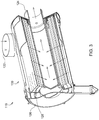
- FIG. 3 illustrates the particulate and siloxane filtration system 118 with portions removed so as to make interior components visible.
- Housing 120 surrounds and encloses filter media assembly 128, which is installed within housing 120 and positioned so that intake gases flow from inlet 122 through filter media assembly 128 to outlet 124. More specifically, intake gases flow in through inlet 122 and surround filter media assembly 128. The intake gases surrounding filter media assembly 128 are drawn through filter media assembly 128 by the pressure differential across filter media assembly 128 created by engine 110's draw of the intake gases, such that the intake gases flow transverse to filter media assembly 128 into the cavity surrounded by filter media assembly 128. The intake gases in this cavity then flow out through outlet 124.
- Housing 120 and filter media assembly 128 each have a cylindrical shape such that each surrounds a common cylindrical cavity positioned about the axis center of housing 120.
- “cylindrical” is not limited to a geometrically ideal right cylinder, but includes a cylindrical shell, elliptic cylinder, punctured disk, projected annulus, and other substantially cylindrical shapes.
- housing 120 and filter media assembly 128 may each have different shapes, such as a rectangular prism or box-like shape.
- the cylindrical shapes allow housing 120 to be opened via end cap 126, which is latched at one end of housing 120, and allow filter media assembly 128 to slide out of housing 120 in the direction of end cap 126.
- Filter media assembly 128 may then be replaced by a new or regenerated version, which can slide into that same end of housing 120, and end cap 126 can be closed and latched.
- Figure 4 illustrates filter media assembly 128 when taken out of housing 120.
- Filter media assembly 128 may also be known as a filter element, or the serviceable filter for work vehicle 100.
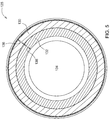
- FIG. 5 illustrates a cross-section of filter media assembly 128 taken along section plane 5-5 of Figure 4 .
- Filter media assembly 128 includes particulate media 130 and siloxane media 132.
- Particulate media 130 and siloxane media 132 are each a cylindrical shape (i.e., a cylindrical shell shape) and each is positioned so as to surround cavity 134 running down the axial center of filter media assembly 128.
- Particulate media 130 is located outward of siloxane media 132 such that it surrounds siloxane media 132, which is nested within particulate media 130.
- particulate media 130 and siloxane media 132 may be interchanged such that siloxane media 132 is located outward of particulate media 130, and particulate media 130 is nested within siloxane media 132.
- This configuration of filter media assembly 128 allows both particulates and siloxanes to be filtered out by a single filter media assembly contained within a single housing, which may be beneficial for certain applications in terms of serviceability and packaging.
- filter media assembly 128 results in intake gases flowing into housing 120, then flowing transverse to particulate media 130, then flowing transverse to siloxane media 132 until they reach cavity 134 and can flow out of housing 120 to engine 110.
- particulates which may be included in the intake gases are filtered out by particulate media 130.
- siloxanes are filtered out by siloxane media 132.
- Siloxanes may be filtered from the intake gases by multiple techniques, including the process of adsorption.
- siloxane media 132 may contain activated alumina or activated carbon, or other compounds which may adsorb gaseous siloxane. This adsorption process may be reversible as well, for example by passing a regeneration gas through the same media, which releases the siloxanes from the adsorption compound and allows siloxane media 132 to be reused for siloxane filtration.
- An embodiment utilizing a media with a reversible siloxane adsorption process may thus enable the reuse of siloxane media 132, for example by removing filter media assembly 128, regenerating siloxane media 132, and reinstalling filter media assembly 128 in work vehicle 100.
- Particulate media 130 has a thickness 136 in the radial direction, or the direction of the flow of intake gases, which may result in certain performance characteristics related to filtration efficiency (e.g., dust count, size, or weight below a threshold) and operational life (e.g., an expected operational life of 500 hours).
- siloxane media 132 has a thickness 138 in the radial direction, or the direction of the flow of intake gases, which may result in certain performance characteristics related to filtration efficiency (e.g., parts per million of siloxane below a threshold) and operational life (e.g., an expected operational life of 500 hours).
- Thickness 136 and thickness 138 may be selected for each of particulate media 130 and siloxane media 132 so as to enable the overall filter media assembly 128 to achieve the filtration efficiency and operational life targets for both particulates and siloxanes.
- the ratio of thickness 136 to thickness 138 may also be selected to achieve a similar expected operational life for both particulate media 130 and siloxane media 132, such that the expected operational life for one of the media is within 50-150% of the expected operational life of the other media. For certain applications, a smaller range may be utilized, such that the expected operational life for one of the media is within 75-125% of the expected operational life of the other media.
- Selecting such a ratio may enable filter media assembly 128 to be serviced as a single part while reducing the unused filtering capacity in either particulate media 130 or siloxane media 132. Additionally, selecting such a ratio may also enable monitoring of the condition of filter media assembly 128, as described further below.
- particulate media 130 As particulate media 130 is used in operation, it will tend to fill with dust and debris resulting in an increased pressure drop for intake gases flowing through it.
- This pressure drop can be measured, such as through a pressure sensor measuring the pressure in cavity 134, the pressure of the intake gases at a location upstream or downstream of cavity 134, or the pressure drop across filter media assembly 128.
- the pressure sensor may then send a pressure signal indicative of this pressure to a controller on work vehicle 100.
- the controller which is configured to receive this pressure signal, may send an alert regarding the remaining operational life of filter media assembly 128 based on this pressure signal, such as sending an alert once the pressure signal passes a threshold value.
- the alert may be a notification communicated to an operator of work vehicle 100 (e.g., a warning message on a display, the lighting of an indicator or icon) or a fleet manager for work vehicle 100 (e.g., a message communicated wirelessly to a server, which in turn communicates with a client used by the fleet manager) that there is no operational life remaining and the filter media assembly 128 should be replaced.
- a server which in turn communicates with a client used by the fleet manager
- the operator, fleet manager, or another individual may remove filter media assembly 128 and replace it with a new or reconditioned part with remaining operational life.
- the controller may also send an alert indicating that filter media assembly 128 has a limited number of operational hours remaining and replacement should be planned.
- the controller may also communicate, continuously or at set intervals, the remaining life left for filter media assembly 128, for example by determining how close the current pressure signal is to the threshold pressure at which a filter change is recommended, and communicating that to an operator of work vehicle 100 or a fleet manager for work vehicle 100 (e.g., 40% of filter life remaining, 200 hours of filter life remaining).
- thickness 136 and thickness 138 may each be selected such that the expected operational life of particulate media 130 is the same as the expected operational life of siloxane media 132.
- One method for selecting these thicknesses would be to sample a specific work environment for particles and siloxanes to quantify the relative concentrations of particles and siloxanes. This sampling information could be used to choose from among designs for filter media assembly 128 with different ratios of thickness 136 and thickness 138, so that the fractional volumes of the two filtration media may be appropriately selected for the specific work environment.
- the pressure drop across filter media assembly 128 may then be monitored to determine the overall remaining operational life for filter media assembly 128, under the assumption that particulate media 130 and siloxane media 132 should wear out (i.e., or reach saturation, or become exhausted) at the same rate so that the condition of particulate media 130 is representative of the condition of siloxane media 132.
- a filter change notification to the operator can depend on the actual condition of filter media assembly 128 rather than an estimated operational life. This may be beneficial if work vehicle 100 may be exposed to duty cycles heavier or lighter than the average used when the expected operational life of the filter media was determined.
Landscapes
- Engineering & Computer Science (AREA)
- Chemical & Material Sciences (AREA)
- Chemical Kinetics & Catalysis (AREA)
- General Engineering & Computer Science (AREA)
- Combustion & Propulsion (AREA)
- Mechanical Engineering (AREA)
- Analytical Chemistry (AREA)
- Manufacturing & Machinery (AREA)
- Geometry (AREA)
- Physics & Mathematics (AREA)
- Mining & Mineral Resources (AREA)
- Civil Engineering (AREA)
- Structural Engineering (AREA)
- General Chemical & Material Sciences (AREA)
- Oil, Petroleum & Natural Gas (AREA)
- Processes For Solid Components From Exhaust (AREA)
- Exhaust Gas After Treatment (AREA)
Abstract
Description
- The present disclosure relates to a filtration system. An embodiment of the present disclosure relates to a siloxane filtration system for engine intake gases.
- Work vehicles may be operated in environments, such as landfills, waste transfer stations, and recycling centers, where the air surrounding the work vehicle may contain siloxanes in a higher concentration than other work environments. Intake gases for an engine on such work vehicles may also contain an increased concentration of siloxanes, which are then exposed to the temperatures, pressures, fuels, and byproducts of combustion in the engine. This exposure may convert these siloxanes to other substances, including to silica or silicates, which may bind to, collect on, or plug portions of the engine and its exhaust aftertreatment system.
- According to an aspect of the present disclosure, a particulate and siloxane filtration system may include a housing and a filter media assembly. The filter media assembly may be disposed within the housing and positioned to filter intake gases to an internal combustion engine. The filter media assembly may include a particulate media configured to remove particulates from the intake gases and a siloxane media configured to remove siloxanes from the intake gases.
- According to another aspect of the present disclosure, the siloxane media may be positioned in series with the particulate media relative to a flow of the intake gases. Each of the particulate media and the siloxane media may at least partially surround a common cavity. One of the particulate media and the siloxane media may be nested within the other of the particulate media and the siloxane media.
- According to another aspect of the present disclosure, the particulate media and the siloxane media may each have a cylindrical shell shape, and the common cavity may be cylindrical.
- According to another aspect of the present disclosure, the filter media assembly may be configured so as to be installable within, and removable from, the housing as a single piece.
- According to another aspect of the present disclosure, the expected operational life of the particulate media may be between 50% and 150% of an expected operational life of the siloxane media.
- According to another aspect of the present disclosure, the particulate and siloxane filtration system may include a pressure sensor and a controller. The pressure sensor may be configured to provide a pressure signal indicative of a pressure of the intake gases. The controller may be configured to receive the pressure signal and determine a remaining operational life of the filter media assembly based on the pressure signal.
- According to another aspect of the present disclosure, a method of filtering particulates and siloxanes from intake gases to an internal combustion engine of a work vehicle may include providing a particulate media positioned to remove particulates from the intake gases, providing a siloxane media positioned to remove siloxanes from the intake gases, and sending an indication of a remaining operational life of at least one of the particulate media and the siloxane media, the indication based on a pressure of the intake gases and a threshold pressure associated with the particulate media.
- According to another aspect of the present disclosure, the indication may be of the remaining operational life of the siloxane media.
- According to another aspect of the present disclosure, the particulate media may have an expected operational life between 50% and 150% of the expected operational life of the siloxane media.
- According to another aspect of the present disclosure, a work vehicle may include ground-engaging tractive assemblies, an internal combustion engine, and a filtration system. The internal combustion engine may be configured to power the ground-engaging tractive assemblies so as to move the work vehicle. The filtration system may be positioned to filter intake gases to the engine. The filtration system may include a housing, a particulate media, and a siloxane media. The particulate media may be disposed within the housing and configured to remove particulates from the intake gases. The siloxane media may be disposed within the housing and configured to remove siloxanes from the intake gases.
- According to another aspect of the present disclosure, the work vehicle may include an exhaust aftertreatment system positioned to treat exhaust from the engine.
- According to another aspect of the present disclosure, the siloxane media may be positioned in series with the particulate media relative to the flow of the intake gases. The particulate media and the siloxane media may each have a cylindrical shell shape. One of the particulate media and the siloxane media may be nested within the other of the particulate media and the siloxane media.
- According to another aspect of the present disclosure, the particulate media may be positioned upstream of the siloxane media relative to the flow of the intake gases.
- According to another aspect of the present disclosure, the particulate media may have an expected operational life between 50% and 150% of the expected operational life of the siloxane media.
- According to another aspect of the present disclosure, the expected operational life of the particulate media and the siloxane media may be based on operation of the work vehicle in a landfill application.
- According to another aspect of the present disclosure, the siloxane media may be positioned in series with the particulate media relative to the flow of the intake gases. The particulate media may have an expected operational life between 50% and 150% of the expected operational life of the siloxane media.
- According to another aspect of the present disclosure, the work vehicle may include a pressure sensor and a controller. The pressure sensor may be configured to provide a pressure signal indicative of a pressure of the intake gases. The controller may be configured to receive the pressure signal and determine a remaining operational life of the siloxane media based on the pressure signal.
- According to another aspect of the present disclosure, the particulate media may have an expected operational life between 75% and 125% of the expected operational life of the siloxane media.
- According to another aspect of the present disclosure, the particulate media and the siloxane media may be included in a filter media assembly, and the filter media assembly is configured so as to be installable within, and removable from, the housing as a single piece.
- According to another aspect of the present disclosure, the siloxane media may be positioned in series with the particulate media relative to the flow of the intake gases. The particulate media and the siloxane media may be included in a filter media assembly configured so as to be installable within, and removable from, the housing as a single piece.
- The above and other features will become apparent from the following description and accompanying drawings.
- The detailed description of the drawings refers to the accompanying figures in which:
-
FIG. 1 is a right side view of a work vehicle with a particulate and siloxane filtration system, for example a wheel loader. -
FIG. 2 is a perspective view of the particulate and siloxane filtration system. -
FIG. 3 is a perspective view of the particulate and siloxane filtration system with portions removed to view its interior. -
FIG. 4 is a perspective view of a filter media assembly. -
FIG. 5 is a sectional view of the filter media assembly, taken along line 5-5 ofFIG. 4 . - Like reference numerals are used to indicate like elements throughout the several figures.
-
Figure 1 illustrateswork vehicle 100, includingchassis 102, ground-engaging tractive assemblies 104 (in this embodiment, wheels),linkage 106, andwork tool 108.Work vehicle 100 is powered by anengine 110, which in this embodiment is an internal combustion diesel engine.Engine 110 takes in gases, such as fresh atmospheric air, throughair intake assembly 112, combusts the intake gases with diesel fuel, and exhausts the combustion products toaftertreatment assembly 114.Work vehicle 100 is illustrated as a wheel loader, but may be any work vehicle with an internal combustion engine, including an articulated dump truck, backhoe loader, compact track loader, crawler (e.g., crawler dozer, crawler loader), excavator, feller buncher, forwarder, harvester, knuckleboom loader, motor grader, scraper, skidder, sprayer, skid steer, tractor (e.g., agricultural tractor), and tractor loader. -
Air intake assembly 112 filters the intake gases toengine 110 and includes pre-cleaner 116 and particulate andsiloxane filtration system 118. Pre-cleaner 116 includes a screen to filter out debris in the intake gases and then utilizes the velocity of the remaining intake gases to spin out further particulate debris which may be included with the fresh atmospheric air being taken in at the beginning ofair intake assembly 112. Pre-cleaner 116 may also be referred to as a cyclonic filter, cyclonic pre-cleaner, centrifugal filter, or centrifugal pre-cleaner, and is an optional component of the present disclosure as alternative embodiments may utilize an alternative pre-cleaner system (e.g., only a screen, pre-filters, electrostatic filtration) or may forgo a pre-cleaner system entirely. After the intake gases have passed through pre-cleaner 116, they are drawn into particulate andsiloxane filtration system 118. - Particulate and
siloxane filtration system 118 includes a housing and filtration media designed to filter particulates (e.g., dust, sand, debris) and siloxanes from the intake gases toengine 110. Siloxanes are a class of compounds which may be byproducts or waste products from industrial (e.g., semiconductor,) and domestic (e.g., personal care products) sources. As byproducts or waste products, siloxanes may be found in landfills, waste transfer stations, recycling centers, and other similar environments, and may be sufficiently volatile to become airborne and form part of the local atmospheric gases. These gases may form part of the intake gases of an internal combustion engine, either by intent as the gases contain hydrocarbons and may be harvested and combusted to produce energy, or by necessity in the case of a work vehicle taking in air from the local environment. When exposed to the temperatures and pressures of combustion, siloxanes may produce silicon dioxide (SiO2), other silicates, or other compounds which may adhere to, or accumulate within, nearby components, such as the internal components or aftertreatment systems of an internal combustion engine. The removal of particulates and siloxanes from the intake gases may improve the performance, longevity, or reliability ofengine 110 oraftertreatment assembly 114 by avoiding such adhesion or accumulation. - After traveling through particulate and
siloxane filtration system 118, the intake gases may be drawn intoengine 110, where they may be mixed with a fuel, such as diesel fuel, and combusted. The post-combustion gases may then be expelled fromengine 110 toaftertreatment assembly 114.Aftertreatment assembly 114 may be included withwork vehicle 100 to filter out certain portions of the combustion gases ofengine 110 to control emissions, for example soot, ash, and nitrogen oxides (NOx). Techniques for doing so include passing the post-combustion gases through a diesel particulate filter (DPF filter), a diesel oxidation catalyst (DOC), and/or a selective catalytic reduction catalyst (SCR). The components involved in these systems may be adversely affected by the presence of silicates in the post-combustion gases, which may fill or otherwise block the components, or adhere to the internal surfaces of the components and adversely affect their performance. After traveling throughaftertreatment assembly 114, the post-combustion gases may then be expelled through the exhaust ofwork vehicle 100. -
Figure 2 illustrates the particulate andsiloxane filtration system 118. Particulate andsiloxane filtration system 118 includes ahousing 120 which surrounds and encloses the other components of particulate andsiloxane filtration system 118 and forms aninlet 122 andoutlet 124.Housing 120 also includesend cap 126, which is removable so as to allow access to the interior ofhousing 120 and provide for a way to service the filter media.End cap 126 may also be configured to collect dust from the intake gases which comes in throughinlet 122 but does not pass through a filter media within particulate andsiloxane filtration system 118, and allow such dust to be emptied fromdust collector 127. -
Figure 3 illustrates the particulate andsiloxane filtration system 118 with portions removed so as to make interior components visible.Housing 120 surrounds and enclosesfilter media assembly 128, which is installed withinhousing 120 and positioned so that intake gases flow frominlet 122 throughfilter media assembly 128 tooutlet 124. More specifically, intake gases flow in throughinlet 122 and surroundfilter media assembly 128. The intake gases surroundingfilter media assembly 128 are drawn throughfilter media assembly 128 by the pressure differential acrossfilter media assembly 128 created byengine 110's draw of the intake gases, such that the intake gases flow transverse to filtermedia assembly 128 into the cavity surrounded byfilter media assembly 128. The intake gases in this cavity then flow out throughoutlet 124. -
Housing 120 andfilter media assembly 128 each have a cylindrical shape such that each surrounds a common cylindrical cavity positioned about the axis center ofhousing 120. As used herein, "cylindrical" is not limited to a geometrically ideal right cylinder, but includes a cylindrical shell, elliptic cylinder, punctured disk, projected annulus, and other substantially cylindrical shapes. In alternative embodiments,housing 120 andfilter media assembly 128 may each have different shapes, such as a rectangular prism or box-like shape. In the embodiment illustrated inFigure 3 , the cylindrical shapes allowhousing 120 to be opened viaend cap 126, which is latched at one end ofhousing 120, and allowfilter media assembly 128 to slide out ofhousing 120 in the direction ofend cap 126.Filter media assembly 128 may then be replaced by a new or regenerated version, which can slide into that same end ofhousing 120, andend cap 126 can be closed and latched.Figure 4 illustratesfilter media assembly 128 when taken out ofhousing 120.Filter media assembly 128 may also be known as a filter element, or the serviceable filter forwork vehicle 100. -
Figure 5 illustrates a cross-section offilter media assembly 128 taken along section plane 5-5 ofFigure 4 .Filter media assembly 128 includesparticulate media 130 andsiloxane media 132.Particulate media 130 andsiloxane media 132 are each a cylindrical shape (i.e., a cylindrical shell shape) and each is positioned so as to surroundcavity 134 running down the axial center offilter media assembly 128.Particulate media 130 is located outward ofsiloxane media 132 such that it surroundssiloxane media 132, which is nested withinparticulate media 130. In alternative embodiments,particulate media 130 andsiloxane media 132 may be interchanged such thatsiloxane media 132 is located outward ofparticulate media 130, andparticulate media 130 is nested withinsiloxane media 132. This configuration offilter media assembly 128 allows both particulates and siloxanes to be filtered out by a single filter media assembly contained within a single housing, which may be beneficial for certain applications in terms of serviceability and packaging. - The configuration of
filter media assembly 128 shown inFigure 5 results in intake gases flowing intohousing 120, then flowing transverse toparticulate media 130, then flowing transverse tosiloxane media 132 until they reachcavity 134 and can flow out ofhousing 120 toengine 110. As the intake gases flow transverse toparticulate media 130, particulates which may be included in the intake gases are filtered out byparticulate media 130. As the intake gases flow transverse tosiloxane media 132, siloxanes are filtered out bysiloxane media 132. - Siloxanes may be filtered from the intake gases by multiple techniques, including the process of adsorption. For example,
siloxane media 132 may contain activated alumina or activated carbon, or other compounds which may adsorb gaseous siloxane. This adsorption process may be reversible as well, for example by passing a regeneration gas through the same media, which releases the siloxanes from the adsorption compound and allowssiloxane media 132 to be reused for siloxane filtration. An embodiment utilizing a media with a reversible siloxane adsorption process may thus enable the reuse ofsiloxane media 132, for example by removingfilter media assembly 128, regeneratingsiloxane media 132, and reinstallingfilter media assembly 128 inwork vehicle 100. -
Particulate media 130 has athickness 136 in the radial direction, or the direction of the flow of intake gases, which may result in certain performance characteristics related to filtration efficiency (e.g., dust count, size, or weight below a threshold) and operational life (e.g., an expected operational life of 500 hours). Similarly,siloxane media 132 has athickness 138 in the radial direction, or the direction of the flow of intake gases, which may result in certain performance characteristics related to filtration efficiency (e.g., parts per million of siloxane below a threshold) and operational life (e.g., an expected operational life of 500 hours).Thickness 136 andthickness 138 may be selected for each ofparticulate media 130 andsiloxane media 132 so as to enable the overallfilter media assembly 128 to achieve the filtration efficiency and operational life targets for both particulates and siloxanes. The ratio ofthickness 136 tothickness 138 may also be selected to achieve a similar expected operational life for bothparticulate media 130 andsiloxane media 132, such that the expected operational life for one of the media is within 50-150% of the expected operational life of the other media. For certain applications, a smaller range may be utilized, such that the expected operational life for one of the media is within 75-125% of the expected operational life of the other media. Selecting such a ratio may enablefilter media assembly 128 to be serviced as a single part while reducing the unused filtering capacity in eitherparticulate media 130 orsiloxane media 132. Additionally, selecting such a ratio may also enable monitoring of the condition offilter media assembly 128, as described further below. - As
particulate media 130 is used in operation, it will tend to fill with dust and debris resulting in an increased pressure drop for intake gases flowing through it. This pressure drop can be measured, such as through a pressure sensor measuring the pressure incavity 134, the pressure of the intake gases at a location upstream or downstream ofcavity 134, or the pressure drop acrossfilter media assembly 128. The pressure sensor may then send a pressure signal indicative of this pressure to a controller onwork vehicle 100. The controller, which is configured to receive this pressure signal, may send an alert regarding the remaining operational life offilter media assembly 128 based on this pressure signal, such as sending an alert once the pressure signal passes a threshold value. The alert may be a notification communicated to an operator of work vehicle 100 (e.g., a warning message on a display, the lighting of an indicator or icon) or a fleet manager for work vehicle 100 (e.g., a message communicated wirelessly to a server, which in turn communicates with a client used by the fleet manager) that there is no operational life remaining and thefilter media assembly 128 should be replaced. Upon receiving such a communication, the operator, fleet manager, or another individual may removefilter media assembly 128 and replace it with a new or reconditioned part with remaining operational life. The controller may also send an alert indicating thatfilter media assembly 128 has a limited number of operational hours remaining and replacement should be planned. The controller may also communicate, continuously or at set intervals, the remaining life left forfilter media assembly 128, for example by determining how close the current pressure signal is to the threshold pressure at which a filter change is recommended, and communicating that to an operator ofwork vehicle 100 or a fleet manager for work vehicle 100 (e.g., 40% of filter life remaining, 200 hours of filter life remaining). - By contrast, certain siloxane adsorption media does not have a similar property where the pressure drop across the media rises as the media is used in operation so a pressure measurement cannot be used to determine when the media needs to be replaced. For such media,
thickness 136 andthickness 138 may each be selected such that the expected operational life ofparticulate media 130 is the same as the expected operational life ofsiloxane media 132. One method for selecting these thicknesses would be to sample a specific work environment for particles and siloxanes to quantify the relative concentrations of particles and siloxanes. This sampling information could be used to choose from among designs forfilter media assembly 128 with different ratios ofthickness 136 andthickness 138, so that the fractional volumes of the two filtration media may be appropriately selected for the specific work environment. - If
thickness 136 andthickness 138 are each selected to achieve a similar expected operational life betweenparticulate media 130 andsiloxane media 132, the pressure drop acrossfilter media assembly 128 may then be monitored to determine the overall remaining operational life forfilter media assembly 128, under the assumption thatparticulate media 130 andsiloxane media 132 should wear out (i.e., or reach saturation, or become exhausted) at the same rate so that the condition ofparticulate media 130 is representative of the condition ofsiloxane media 132. By setting the ratio ofthickness 136 tothickness 138 so that the expected life is the same forparticulate media 130 andsiloxane media 132, and then measuring the pressure drop acrossfilter media assembly 128, a filter change notification to the operator can depend on the actual condition offilter media assembly 128 rather than an estimated operational life. This may be beneficial ifwork vehicle 100 may be exposed to duty cycles heavier or lighter than the average used when the expected operational life of the filter media was determined. - While the disclosure has been illustrated and described in detail in the drawings and foregoing description, such illustration and description is not restrictive in character, it being understood that illustrative embodiment(s) have been shown and described and that all changes and modifications that come within the spirit of the disclosure are desired to be protected. Alternative embodiments of the present disclosure may not include all of the features described yet still benefit from at least some of the advantages of such features. Those of ordinary skill in the art may devise their own implementations that incorporate one or more of the features of the present disclosure and fall within the spirit and scope of the appended claims.
Claims (15)
- A particulate and siloxane filtration system (118) comprising:a housing (120); anda filter media assembly (128) disposed within the housing (120), the filter media assembly (128) positioned to filter intake gases to an internal combustion engine, the filter media assembly (128) comprising:a particulate media (130) configured to remove particulates from the intake gases; anda siloxane media (132) configured to remove siloxanes from the intake gases.
- The particulate and siloxane filtration system (118) of claim 1, wherein the siloxane media (132) is positioned in series with the particulate media (130) relative to a flow of the intake gases, each of the particulate media (130) and the siloxane media (132) at least partially surround a common cavity and one of the particulate media (130) and the siloxane media (132) is nested within the other of the particulate media (130) and the siloxane media (132).
- The particulate and siloxane filtration system (118) of claim 2, wherein the particulate media (130) and the siloxane media (132) each have a cylindrical shell shape, and the common cavity is cylindrical.
- The particulate and siloxane filtration system (118) of claim 2, wherein the filter media assembly (128) is configured so as to be installable within, and removable from, the housing (120) as a single piece.
- The particulate and siloxane filtration system (118) of claim 2, wherein an expected operational life of the particulate media (130) is between 50% and 150% of an expected operational life of the siloxane media (132).
- The particulate and siloxane filtration system (118) of claim 5, further comprising a pressure sensor and a controller, wherein the pressure sensor is configured to provide a pressure signal indicative of a pressure of the intake gases, the controller is configured to receive the pressure signal, and the controller is configured to determine a remaining operational life of the filter media assembly (128) based on the pressure signal.
- A method of filtering particulates and siloxanes from intake gases to an internal combustion engine of a work vehicle (100), comprising:providing a particulate media (130) positioned to remove particulates from the intake gases;providing a siloxane media (132) positioned to remove siloxanes from the intake gases; andsending an indication of a remaining operational life of at least one of the particulate media (130) and the siloxane media (132), the indication based on a pressure of the intake gases and a threshold pressure associated with the particulate media (130).
- The method of claim 7, wherein the indication is of the remaining operational life of the siloxane media (132).
- The method of claim 7, wherein the particulate media (130) has an expected operational life between 50% and 150% of the expected operational life of the siloxane media (132).
- A work vehicle (100) comprising:ground-engaging tractive assemblies (104);an internal combustion engine configured to power the ground-engaging tractive assemblies (104) so as to move the work vehicle (100); anda filtration system (118) positioned to filter intake gases to the engine, the filtration system (118) comprising:a housing (120);a particulate media (130) disposed within the housing (120), the particulate media (130) configured to remove particulates from the intake gases; anda siloxane media (132) disposed within the housing (120), the siloxane media (132) configured to remove siloxanes from the intake gases.
- The work vehicle (100) of claim 10, further comprising an exhaust aftertreatment system positioned to treat exhaust from the engine.
- The work vehicle (100) of claim 10, wherein the siloxane media (132) is positioned in series with the particulate media (130) relative to the flow of the intake gases, the particulate media (130) and the siloxane media (132) each have a cylindrical shell shape, and one of the particulate media (130) and the siloxane media (132) is nested within the other of the particulate media (130) and the siloxane media (132).
- The work vehicle (100) of claim 12, wherein the particulate media (130) is positioned upstream of the siloxane media (132) relative to the flow of the intake gases.
- The work vehicle (100) of claim 13, wherein the particulate media (130) has an expected operational life between 50% and 150% of the expected operational life of the siloxane media (132).
- The work vehicle (100) of claim 14, wherein the expected operational life of the particulate media (130) and the siloxane media (132) is based on operation of the work vehicle (100) in a landfill application.
Applications Claiming Priority (1)
| Application Number | Priority Date | Filing Date | Title |
|---|---|---|---|
| US14/640,582 US9605626B2 (en) | 2015-03-06 | 2015-03-06 | Siloxane filtration system and method |
Publications (1)
| Publication Number | Publication Date |
|---|---|
| EP3064264A1 true EP3064264A1 (en) | 2016-09-07 |
Family
ID=55701677
Family Applications (1)
| Application Number | Title | Priority Date | Filing Date |
|---|---|---|---|
| EP16155915.8A Withdrawn EP3064264A1 (en) | 2015-03-06 | 2016-02-16 | Siloxane filtration system and method |
Country Status (2)
| Country | Link |
|---|---|
| US (1) | US9605626B2 (en) |
| EP (1) | EP3064264A1 (en) |
Cited By (2)
| Publication number | Priority date | Publication date | Assignee | Title |
|---|---|---|---|---|
| WO2018052611A1 (en) * | 2016-09-14 | 2018-03-22 | Caterpillar Inc. | Air intake system for engine |
| CN114846232A (en) * | 2019-12-23 | 2022-08-02 | 卡特彼勒公司 | Siloxane removal in machine systems with blowers for pressure drop compensation |
Families Citing this family (14)
| Publication number | Priority date | Publication date | Assignee | Title |
|---|---|---|---|---|
| US9803598B2 (en) * | 2015-12-21 | 2017-10-31 | Caterpillar Inc. | Air intake system for engine |
| US10208718B2 (en) * | 2016-12-27 | 2019-02-19 | Caterpillar Inc. | Air intake system with membrane unit for siloxane removal |
| DE102018000544A1 (en) * | 2018-01-24 | 2019-07-25 | Mann+Hummel Gmbh | Filter device, in particular for gas filtration |
| US10592452B1 (en) | 2018-09-12 | 2020-03-17 | Cavium, Llc | Low latency interconnect protocol for coherent multi-chip communication |
| US10669915B2 (en) * | 2018-10-10 | 2020-06-02 | Caterpillar Inc. | System and method for determining accumulation of silicone dioxide (SiO2) in an aftertreatment system |
| US10843118B2 (en) * | 2018-10-30 | 2020-11-24 | Granitefuel Engineering Inc. | Filtration apparatus with cartridge assembly |
| JP7260311B2 (en) * | 2019-01-31 | 2023-04-18 | コベルコ建機株式会社 | construction machinery |
| US11291340B2 (en) * | 2019-03-01 | 2022-04-05 | Troy Taylor | Paint booth filter |
| EP4065903A4 (en) * | 2019-11-30 | 2023-12-27 | Work Air Technologies Pty Ltd | AIR CONDITIONING AND FILTRATION SYSTEM |
| USD1032664S1 (en) | 2022-04-14 | 2024-06-25 | Caterpillar Inc. | Filter housing and pipework for an engine |
| USD1065256S1 (en) * | 2022-04-14 | 2025-03-04 | Caterpillar Inc. | Filter for an engine |
| USD1065255S1 (en) | 2022-04-14 | 2025-03-04 | Caterpillar Inc. | Housing for a filter for an engine |
| USD1065254S1 (en) * | 2022-04-14 | 2025-03-04 | Caterpillar Inc. | Filter for an engine |
| USD1032665S1 (en) | 2022-04-14 | 2024-06-25 | Caterpillar Inc. | Filter housing and pipework for an engine |
Citations (5)
| Publication number | Priority date | Publication date | Assignee | Title |
|---|---|---|---|---|
| US20020129711A1 (en) * | 2001-03-16 | 2002-09-19 | Toyoda Boshoku Corporation | Internal combustion engine air cleaner and adsorption filter |
| DE102004028016A1 (en) * | 2004-06-08 | 2005-12-29 | Bayerische Motoren Werke Ag | Air filter, for a vehicle motor air intake, has a second active carbon filter at the clean air side of the replaceable first filter and within its space welded to the clean air funnel |
| US7264648B1 (en) * | 2003-06-19 | 2007-09-04 | Applied Filter Technology, Inc. | Removing siloxanes from a gas using a segmented filtration system customized to the gas composition |
| US20130232934A1 (en) * | 2010-05-18 | 2013-09-12 | Donaldson Company Inc. | Air cleaner assemblies with filter element and method for installing the filter element |
| DE102012005381A1 (en) * | 2012-03-16 | 2013-09-19 | Daimler Ag | Device for detecting degree of contamination of air filter of vehicle, has air filter, which has layer having luminescent material and light source, where detector is provided for determining intensity of luminescent light emitted by layer |
Family Cites Families (20)
| Publication number | Priority date | Publication date | Assignee | Title |
|---|---|---|---|---|
| JPS5498416A (en) * | 1978-01-19 | 1979-08-03 | Nippon Denso Co Ltd | Fuel vapor adsorbing air cleaner element for internal combustion engine |
| US5604306A (en) * | 1995-07-28 | 1997-02-18 | Caterpillar Inc. | Apparatus and method for detecting a plugged air filter on an engine |
| WO1998039081A1 (en) * | 1997-03-05 | 1998-09-11 | Air-Maze Corporation | Air cleaner element having incorporated sorption element |
| US6464761B1 (en) * | 1999-12-22 | 2002-10-15 | Visteon Global Technologies, Inc. | Air induction filter assembly |
| US20040050252A1 (en) * | 2002-09-16 | 2004-03-18 | Wernholm Lee S. | Air cleaner assembly and process |
| US7393381B2 (en) | 2003-06-19 | 2008-07-01 | Applied Filter Technology, Inc. | Removing siloxanes from a gas stream using a mineral based adsorption media |
| DE102004000048B4 (en) * | 2004-11-17 | 2008-08-14 | Mann + Hummel Gmbh | air filter |
| US7306652B2 (en) | 2005-03-30 | 2007-12-11 | Parker-Hannifin Corporation | Siloxane removal process |
| US7531029B2 (en) * | 2005-06-01 | 2009-05-12 | Basf Catalysts Llc | Coated screen adsorption unit for controlling evaporative hydrocarbon emissions |
| US20070068386A1 (en) | 2005-09-23 | 2007-03-29 | Mitariten Michael J | Landfill gas upgrading process |
| WO2008024329A1 (en) | 2006-08-22 | 2008-02-28 | Donaldson Company, Inc. | Biogas purification with siloxane removal |
| US7763104B2 (en) * | 2006-09-05 | 2010-07-27 | Visteon Global Technologies, Inc. | Hydrocarbon trap assembly |
| DE102006043729A1 (en) * | 2006-09-13 | 2008-03-27 | Mann + Hummel Gmbh | Filter or adsorber element with enclosed adsorption particles and a process for its preparation |
| US7591173B2 (en) * | 2007-03-06 | 2009-09-22 | Gm Global Technology Operations, Inc. | Method and apparatus for monitoring the restriction level of a vehicular air filter element |
| US7645329B2 (en) * | 2007-10-31 | 2010-01-12 | Advanced Flow Engineering, Inc. | Composite air/hydrocarbon trap filter assembly |
| CN102016266B (en) * | 2008-04-23 | 2014-09-03 | 开利公司 | Methods for Determining Air Filter Condition |
| US7833301B2 (en) * | 2008-05-30 | 2010-11-16 | Deere & Company | Engine exhaust cooler and air pre-cleaner aspirator |
| US8631770B2 (en) | 2011-02-04 | 2014-01-21 | Ut-Battelle, Llc | Mitigating the effect of siloxanes on internal combustion engines using landfill gasses |
| KR102360223B1 (en) | 2012-05-07 | 2022-02-09 | 도널드선 컴파니 인코포레이티드 | Materials, methods, and devices for siloxane contaminant removal |
| US20150023844A1 (en) * | 2014-10-09 | 2015-01-22 | Caterpillar Inc. | Siloxane filter in an exhaust aftertreatment system |
-
2015
- 2015-03-06 US US14/640,582 patent/US9605626B2/en active Active
-
2016
- 2016-02-16 EP EP16155915.8A patent/EP3064264A1/en not_active Withdrawn
Patent Citations (5)
| Publication number | Priority date | Publication date | Assignee | Title |
|---|---|---|---|---|
| US20020129711A1 (en) * | 2001-03-16 | 2002-09-19 | Toyoda Boshoku Corporation | Internal combustion engine air cleaner and adsorption filter |
| US7264648B1 (en) * | 2003-06-19 | 2007-09-04 | Applied Filter Technology, Inc. | Removing siloxanes from a gas using a segmented filtration system customized to the gas composition |
| DE102004028016A1 (en) * | 2004-06-08 | 2005-12-29 | Bayerische Motoren Werke Ag | Air filter, for a vehicle motor air intake, has a second active carbon filter at the clean air side of the replaceable first filter and within its space welded to the clean air funnel |
| US20130232934A1 (en) * | 2010-05-18 | 2013-09-12 | Donaldson Company Inc. | Air cleaner assemblies with filter element and method for installing the filter element |
| DE102012005381A1 (en) * | 2012-03-16 | 2013-09-19 | Daimler Ag | Device for detecting degree of contamination of air filter of vehicle, has air filter, which has layer having luminescent material and light source, where detector is provided for determining intensity of luminescent light emitted by layer |
Cited By (2)
| Publication number | Priority date | Publication date | Assignee | Title |
|---|---|---|---|---|
| WO2018052611A1 (en) * | 2016-09-14 | 2018-03-22 | Caterpillar Inc. | Air intake system for engine |
| CN114846232A (en) * | 2019-12-23 | 2022-08-02 | 卡特彼勒公司 | Siloxane removal in machine systems with blowers for pressure drop compensation |
Also Published As
| Publication number | Publication date |
|---|---|
| US9605626B2 (en) | 2017-03-28 |
| US20160258392A1 (en) | 2016-09-08 |
Similar Documents
| Publication | Publication Date | Title |
|---|---|---|
| US9605626B2 (en) | Siloxane filtration system and method | |
| CN203214128U (en) | Replaceable motor vehicle exhaust particle removal system | |
| CN103573361B (en) | Soot accumulated correction during jet-black quality is estimated in vehicle exhaust aftertreatment device | |
| US8282706B2 (en) | Engine exhaust after-treatment system | |
| US20090306850A1 (en) | System for monitoring DPF using wireless communication | |
| CN112943417B (en) | DPF regeneration control method, tail gas treatment system and vehicle | |
| CN101089374A (en) | Diesel exhaust system reversible particulate filter | |
| JP4186425B2 (en) | Soot particle detection sensor, diesel particulate filter device using the same, and control method therefor | |
| Majewski | Diesel particulate filters | |
| JP5896254B2 (en) | Method and arrangement for cleaning particle filters | |
| JP6865138B2 (en) | Judgment method of exhaust gas treatment equipment and judgment system of exhaust gas treatment equipment | |
| JP4226007B2 (en) | Exhaust gas purification device used for internal combustion engine and method for operating the exhaust gas purification device | |
| US20060191258A1 (en) | Particulate trap regeneration control system | |
| JP4567968B2 (en) | Exhaust gas purification device and exhaust gas purification method | |
| JP4133367B2 (en) | Exhaust purification device | |
| CN205663484U (en) | Processing apparatus behind diesel engine of circulated use | |
| JP2015151968A (en) | Breakage detection system for fine particle collection device and breakage detection method for fine particle collection device | |
| JP2017227124A (en) | Exhaust gas purification system and phosphorus poisoning suppression method for the same | |
| CN215953531U (en) | Tail gas black smoke emission monitoring and early warning system for non-road mobile machinery | |
| CN216617625U (en) | A self-cleaning exhaust gas purification system for heavy-duty diesel special vehicles | |
| KR102249588B1 (en) | Exhaust gas post processing apparatus and control method thereof | |
| US12594515B2 (en) | Particulate filter | |
| JP2677053B2 (en) | Exhaust particulate deposition amount detector | |
| CN111094709A (en) | Method for controlling a heat engine | |
| KR101126242B1 (en) | Method for preventing detection error of diesel particulate filter |
Legal Events
| Date | Code | Title | Description |
|---|---|---|---|
| PUAI | Public reference made under article 153(3) epc to a published international application that has entered the european phase |
Free format text: ORIGINAL CODE: 0009012 |
|
| AK | Designated contracting states |
Kind code of ref document: A1 Designated state(s): AL AT BE BG CH CY CZ DE DK EE ES FI FR GB GR HR HU IE IS IT LI LT LU LV MC MK MT NL NO PL PT RO RS SE SI SK SM TR |
|
| AX | Request for extension of the european patent |
Extension state: BA ME |
|
| 17P | Request for examination filed |
Effective date: 20170307 |
|
| RBV | Designated contracting states (corrected) |
Designated state(s): AL AT BE BG CH CY CZ DE DK EE ES FI FR GB GR HR HU IE IS IT LI LT LU LV MC MK MT NL NO PL PT RO RS SE SI SK SM TR |
|
| 17Q | First examination report despatched |
Effective date: 20190313 |
|
| STAA | Information on the status of an ep patent application or granted ep patent |
Free format text: STATUS: THE APPLICATION IS DEEMED TO BE WITHDRAWN |
|
| 18D | Application deemed to be withdrawn |
Effective date: 20200311 |