EP3060562B1 - Substituted pyrimidine compounds and their use as syk inhibitors - Google Patents
Substituted pyrimidine compounds and their use as syk inhibitors Download PDFInfo
- Publication number
- EP3060562B1 EP3060562B1 EP14856054.3A EP14856054A EP3060562B1 EP 3060562 B1 EP3060562 B1 EP 3060562B1 EP 14856054 A EP14856054 A EP 14856054A EP 3060562 B1 EP3060562 B1 EP 3060562B1
- Authority
- EP
- European Patent Office
- Prior art keywords
- methyl
- ylamino
- indol
- pyrazol
- pyrimidin
- Prior art date
- Legal status (The legal status is an assumption and is not a legal conclusion. Google has not performed a legal analysis and makes no representation as to the accuracy of the status listed.)
- Active
Links
- NGEXODJJSQPXEC-UHFFFAOYSA-N Cc(c(C=O)c1)n[n]1-c1nc(Cl)ncc1 Chemical compound Cc(c(C=O)c1)n[n]1-c1nc(Cl)ncc1 NGEXODJJSQPXEC-UHFFFAOYSA-N 0.000 description 2
- ZUCSXJFKXMKAOT-UHFFFAOYSA-N CC(C)C(c(c1c2)c[n](C)c1ccc2Nc1nccc(-[n]2nc(C)c(C=O)c2)n1)=O Chemical compound CC(C)C(c(c1c2)c[n](C)c1ccc2Nc1nccc(-[n]2nc(C)c(C=O)c2)n1)=O ZUCSXJFKXMKAOT-UHFFFAOYSA-N 0.000 description 1
- BLFQYOOGPVKCNI-IBGZPJMESA-N CC(C)C(c1c[n](C)c(cc2)c1cc2Nc1nccc(-[n]2nc(C)c(CN(C3)OC[C@H]3O)c2)n1)=O Chemical compound CC(C)C(c1c[n](C)c(cc2)c1cc2Nc1nccc(-[n]2nc(C)c(CN(C3)OC[C@H]3O)c2)n1)=O BLFQYOOGPVKCNI-IBGZPJMESA-N 0.000 description 1
- PYEPLBSZZOCQTB-UHFFFAOYSA-N C[n](cc(C(C1CC1)=O)c1c2)c1ccc2N Chemical compound C[n](cc(C(C1CC1)=O)c1c2)c1ccc2N PYEPLBSZZOCQTB-UHFFFAOYSA-N 0.000 description 1
- ZELVWZQZAVKPNO-UHFFFAOYSA-N Cc(c(C=O)c1)n[n]1-c1nc(Nc2ccc3[n](C)cc(C(C4CC4)=O)c3c2)ncc1 Chemical compound Cc(c(C=O)c1)n[n]1-c1nc(Nc2ccc3[n](C)cc(C(C4CC4)=O)c3c2)ncc1 ZELVWZQZAVKPNO-UHFFFAOYSA-N 0.000 description 1
- HOFPWOAFILPHER-IBGZPJMESA-N Cc(c(CN(C1)OC[C@H]1O)c1)n[n]1-c1nc(Nc(cc2)cc(c(C(C3CC3)=O)c3)c2[n]3S(C)(=O)=O)ncc1 Chemical compound Cc(c(CN(C1)OC[C@H]1O)c1)n[n]1-c1nc(Nc(cc2)cc(c(C(C3CC3)=O)c3)c2[n]3S(C)(=O)=O)ncc1 HOFPWOAFILPHER-IBGZPJMESA-N 0.000 description 1
- LHMGCDLXAOCQAV-KRWDZBQOSA-N Cc(c(CN(C1)OC[C@H]1O)c1)n[n]1-c1nc(Nc2ccc3[n](C)cc(C(C(F)(F)F)=O)c3c2)ncc1C Chemical compound Cc(c(CN(C1)OC[C@H]1O)c1)n[n]1-c1nc(Nc2ccc3[n](C)cc(C(C(F)(F)F)=O)c3c2)ncc1C LHMGCDLXAOCQAV-KRWDZBQOSA-N 0.000 description 1
- YCZUBLQESBVOSH-IBGZPJMESA-N Cc(c(CN(C1)OC[C@H]1O)c1)n[n]1-c1nc(Nc2ccc3[n](C)cc(C(C4CC4)=O)c3c2)ncc1 Chemical compound Cc(c(CN(C1)OC[C@H]1O)c1)n[n]1-c1nc(Nc2ccc3[n](C)cc(C(C4CC4)=O)c3c2)ncc1 YCZUBLQESBVOSH-IBGZPJMESA-N 0.000 description 1
- UILWLKMAKNGENX-FQEVSTJZSA-N Cc(c(CN(C1)OC[C@H]1O)c1)n[n]1-c1nc(Nc2ccc3[n](C)cc(C(C4CC4)=O)c3c2)ncc1C Chemical compound Cc(c(CN(C1)OC[C@H]1O)c1)n[n]1-c1nc(Nc2ccc3[n](C)cc(C(C4CC4)=O)c3c2)ncc1C UILWLKMAKNGENX-FQEVSTJZSA-N 0.000 description 1
- NWDMGTFNIOCVDU-UHFFFAOYSA-N Cc1n[nH]cc1C=O Chemical compound Cc1n[nH]cc1C=O NWDMGTFNIOCVDU-UHFFFAOYSA-N 0.000 description 1
- BTTNYQZNBZNDOR-UHFFFAOYSA-N Clc1nc(Cl)ncc1 Chemical compound Clc1nc(Cl)ncc1 BTTNYQZNBZNDOR-UHFFFAOYSA-N 0.000 description 1
- YBDFABRBIIRYCZ-SFHVURJKSA-N O[C@@H]1CON(Cc2c[n](-c3nc(Nc(cc4)cc5c4[n](CC(F)(F)F)cc5C(C4CC4)=O)ncc3)nc2)C1 Chemical compound O[C@@H]1CON(Cc2c[n](-c3nc(Nc(cc4)cc5c4[n](CC(F)(F)F)cc5C(C4CC4)=O)ncc3)nc2)C1 YBDFABRBIIRYCZ-SFHVURJKSA-N 0.000 description 1
- BBWJIHMTJCJDKJ-VKHMYHEASA-N O[C@@H]1CONC1 Chemical compound O[C@@H]1CONC1 BBWJIHMTJCJDKJ-VKHMYHEASA-N 0.000 description 1
Classifications
-
- C—CHEMISTRY; METALLURGY
- C07—ORGANIC CHEMISTRY
- C07D—HETEROCYCLIC COMPOUNDS
- C07D413/00—Heterocyclic compounds containing two or more hetero rings, at least one ring having nitrogen and oxygen atoms as the only ring hetero atoms
- C07D413/14—Heterocyclic compounds containing two or more hetero rings, at least one ring having nitrogen and oxygen atoms as the only ring hetero atoms containing three or more hetero rings
-
- A—HUMAN NECESSITIES
- A61—MEDICAL OR VETERINARY SCIENCE; HYGIENE
- A61K—PREPARATIONS FOR MEDICAL, DENTAL OR TOILETRY PURPOSES
- A61K31/00—Medicinal preparations containing organic active ingredients
- A61K31/33—Heterocyclic compounds
- A61K31/395—Heterocyclic compounds having nitrogen as a ring hetero atom, e.g. guanethidine or rifamycins
- A61K31/495—Heterocyclic compounds having nitrogen as a ring hetero atom, e.g. guanethidine or rifamycins having six-membered rings with two or more nitrogen atoms as the only ring heteroatoms, e.g. piperazine or tetrazines
- A61K31/505—Pyrimidines; Hydrogenated pyrimidines, e.g. trimethoprim
- A61K31/506—Pyrimidines; Hydrogenated pyrimidines, e.g. trimethoprim not condensed and containing further heterocyclic rings
-
- A—HUMAN NECESSITIES
- A61—MEDICAL OR VETERINARY SCIENCE; HYGIENE
- A61K—PREPARATIONS FOR MEDICAL, DENTAL OR TOILETRY PURPOSES
- A61K31/00—Medicinal preparations containing organic active ingredients
- A61K31/33—Heterocyclic compounds
- A61K31/395—Heterocyclic compounds having nitrogen as a ring hetero atom, e.g. guanethidine or rifamycins
- A61K31/535—Heterocyclic compounds having nitrogen as a ring hetero atom, e.g. guanethidine or rifamycins having six-membered rings with at least one nitrogen and one oxygen as the ring hetero atoms, e.g. 1,2-oxazines
- A61K31/5355—Non-condensed oxazines and containing further heterocyclic rings
-
- A—HUMAN NECESSITIES
- A61—MEDICAL OR VETERINARY SCIENCE; HYGIENE
- A61K—PREPARATIONS FOR MEDICAL, DENTAL OR TOILETRY PURPOSES
- A61K9/00—Medicinal preparations characterised by special physical form
- A61K9/0012—Galenical forms characterised by the site of application
- A61K9/0019—Injectable compositions; Intramuscular, intravenous, arterial, subcutaneous administration; Compositions to be administered through the skin in an invasive manner
- A61K9/0021—Intradermal administration, e.g. through microneedle arrays or needleless injectors
-
- A—HUMAN NECESSITIES
- A61—MEDICAL OR VETERINARY SCIENCE; HYGIENE
- A61K—PREPARATIONS FOR MEDICAL, DENTAL OR TOILETRY PURPOSES
- A61K9/00—Medicinal preparations characterised by special physical form
- A61K9/0012—Galenical forms characterised by the site of application
- A61K9/0031—Rectum, anus
-
- A—HUMAN NECESSITIES
- A61—MEDICAL OR VETERINARY SCIENCE; HYGIENE
- A61K—PREPARATIONS FOR MEDICAL, DENTAL OR TOILETRY PURPOSES
- A61K9/00—Medicinal preparations characterised by special physical form
- A61K9/0012—Galenical forms characterised by the site of application
- A61K9/0048—Eye, e.g. artificial tears
-
- A—HUMAN NECESSITIES
- A61—MEDICAL OR VETERINARY SCIENCE; HYGIENE
- A61P—SPECIFIC THERAPEUTIC ACTIVITY OF CHEMICAL COMPOUNDS OR MEDICINAL PREPARATIONS
- A61P1/00—Drugs for disorders of the alimentary tract or the digestive system
- A61P1/04—Drugs for disorders of the alimentary tract or the digestive system for ulcers, gastritis or reflux esophagitis, e.g. antacids, inhibitors of acid secretion, mucosal protectants
-
- A—HUMAN NECESSITIES
- A61—MEDICAL OR VETERINARY SCIENCE; HYGIENE
- A61P—SPECIFIC THERAPEUTIC ACTIVITY OF CHEMICAL COMPOUNDS OR MEDICINAL PREPARATIONS
- A61P1/00—Drugs for disorders of the alimentary tract or the digestive system
- A61P1/16—Drugs for disorders of the alimentary tract or the digestive system for liver or gallbladder disorders, e.g. hepatoprotective agents, cholagogues, litholytics
-
- A—HUMAN NECESSITIES
- A61—MEDICAL OR VETERINARY SCIENCE; HYGIENE
- A61P—SPECIFIC THERAPEUTIC ACTIVITY OF CHEMICAL COMPOUNDS OR MEDICINAL PREPARATIONS
- A61P11/00—Drugs for disorders of the respiratory system
-
- A—HUMAN NECESSITIES
- A61—MEDICAL OR VETERINARY SCIENCE; HYGIENE
- A61P—SPECIFIC THERAPEUTIC ACTIVITY OF CHEMICAL COMPOUNDS OR MEDICINAL PREPARATIONS
- A61P11/00—Drugs for disorders of the respiratory system
- A61P11/02—Nasal agents, e.g. decongestants
-
- A—HUMAN NECESSITIES
- A61—MEDICAL OR VETERINARY SCIENCE; HYGIENE
- A61P—SPECIFIC THERAPEUTIC ACTIVITY OF CHEMICAL COMPOUNDS OR MEDICINAL PREPARATIONS
- A61P11/00—Drugs for disorders of the respiratory system
- A61P11/06—Antiasthmatics
-
- A—HUMAN NECESSITIES
- A61—MEDICAL OR VETERINARY SCIENCE; HYGIENE
- A61P—SPECIFIC THERAPEUTIC ACTIVITY OF CHEMICAL COMPOUNDS OR MEDICINAL PREPARATIONS
- A61P13/00—Drugs for disorders of the urinary system
- A61P13/12—Drugs for disorders of the urinary system of the kidneys
-
- A—HUMAN NECESSITIES
- A61—MEDICAL OR VETERINARY SCIENCE; HYGIENE
- A61P—SPECIFIC THERAPEUTIC ACTIVITY OF CHEMICAL COMPOUNDS OR MEDICINAL PREPARATIONS
- A61P17/00—Drugs for dermatological disorders
-
- A—HUMAN NECESSITIES
- A61—MEDICAL OR VETERINARY SCIENCE; HYGIENE
- A61P—SPECIFIC THERAPEUTIC ACTIVITY OF CHEMICAL COMPOUNDS OR MEDICINAL PREPARATIONS
- A61P17/00—Drugs for dermatological disorders
- A61P17/06—Antipsoriatics
-
- A—HUMAN NECESSITIES
- A61—MEDICAL OR VETERINARY SCIENCE; HYGIENE
- A61P—SPECIFIC THERAPEUTIC ACTIVITY OF CHEMICAL COMPOUNDS OR MEDICINAL PREPARATIONS
- A61P19/00—Drugs for skeletal disorders
- A61P19/08—Drugs for skeletal disorders for bone diseases, e.g. rachitism, Paget's disease
-
- A—HUMAN NECESSITIES
- A61—MEDICAL OR VETERINARY SCIENCE; HYGIENE
- A61P—SPECIFIC THERAPEUTIC ACTIVITY OF CHEMICAL COMPOUNDS OR MEDICINAL PREPARATIONS
- A61P19/00—Drugs for skeletal disorders
- A61P19/08—Drugs for skeletal disorders for bone diseases, e.g. rachitism, Paget's disease
- A61P19/10—Drugs for skeletal disorders for bone diseases, e.g. rachitism, Paget's disease for osteoporosis
-
- A—HUMAN NECESSITIES
- A61—MEDICAL OR VETERINARY SCIENCE; HYGIENE
- A61P—SPECIFIC THERAPEUTIC ACTIVITY OF CHEMICAL COMPOUNDS OR MEDICINAL PREPARATIONS
- A61P21/00—Drugs for disorders of the muscular or neuromuscular system
-
- A—HUMAN NECESSITIES
- A61—MEDICAL OR VETERINARY SCIENCE; HYGIENE
- A61P—SPECIFIC THERAPEUTIC ACTIVITY OF CHEMICAL COMPOUNDS OR MEDICINAL PREPARATIONS
- A61P25/00—Drugs for disorders of the nervous system
-
- A—HUMAN NECESSITIES
- A61—MEDICAL OR VETERINARY SCIENCE; HYGIENE
- A61P—SPECIFIC THERAPEUTIC ACTIVITY OF CHEMICAL COMPOUNDS OR MEDICINAL PREPARATIONS
- A61P27/00—Drugs for disorders of the senses
- A61P27/02—Ophthalmic agents
-
- A—HUMAN NECESSITIES
- A61—MEDICAL OR VETERINARY SCIENCE; HYGIENE
- A61P—SPECIFIC THERAPEUTIC ACTIVITY OF CHEMICAL COMPOUNDS OR MEDICINAL PREPARATIONS
- A61P29/00—Non-central analgesic, antipyretic or antiinflammatory agents, e.g. antirheumatic agents; Non-steroidal antiinflammatory drugs [NSAID]
-
- A—HUMAN NECESSITIES
- A61—MEDICAL OR VETERINARY SCIENCE; HYGIENE
- A61P—SPECIFIC THERAPEUTIC ACTIVITY OF CHEMICAL COMPOUNDS OR MEDICINAL PREPARATIONS
- A61P35/00—Antineoplastic agents
-
- A—HUMAN NECESSITIES
- A61—MEDICAL OR VETERINARY SCIENCE; HYGIENE
- A61P—SPECIFIC THERAPEUTIC ACTIVITY OF CHEMICAL COMPOUNDS OR MEDICINAL PREPARATIONS
- A61P35/00—Antineoplastic agents
- A61P35/02—Antineoplastic agents specific for leukemia
-
- A—HUMAN NECESSITIES
- A61—MEDICAL OR VETERINARY SCIENCE; HYGIENE
- A61P—SPECIFIC THERAPEUTIC ACTIVITY OF CHEMICAL COMPOUNDS OR MEDICINAL PREPARATIONS
- A61P37/00—Drugs for immunological or allergic disorders
-
- A—HUMAN NECESSITIES
- A61—MEDICAL OR VETERINARY SCIENCE; HYGIENE
- A61P—SPECIFIC THERAPEUTIC ACTIVITY OF CHEMICAL COMPOUNDS OR MEDICINAL PREPARATIONS
- A61P37/00—Drugs for immunological or allergic disorders
- A61P37/02—Immunomodulators
-
- A—HUMAN NECESSITIES
- A61—MEDICAL OR VETERINARY SCIENCE; HYGIENE
- A61P—SPECIFIC THERAPEUTIC ACTIVITY OF CHEMICAL COMPOUNDS OR MEDICINAL PREPARATIONS
- A61P37/00—Drugs for immunological or allergic disorders
- A61P37/02—Immunomodulators
- A61P37/06—Immunosuppressants, e.g. drugs for graft rejection
-
- A—HUMAN NECESSITIES
- A61—MEDICAL OR VETERINARY SCIENCE; HYGIENE
- A61P—SPECIFIC THERAPEUTIC ACTIVITY OF CHEMICAL COMPOUNDS OR MEDICINAL PREPARATIONS
- A61P37/00—Drugs for immunological or allergic disorders
- A61P37/08—Antiallergic agents
-
- A—HUMAN NECESSITIES
- A61—MEDICAL OR VETERINARY SCIENCE; HYGIENE
- A61P—SPECIFIC THERAPEUTIC ACTIVITY OF CHEMICAL COMPOUNDS OR MEDICINAL PREPARATIONS
- A61P43/00—Drugs for specific purposes, not provided for in groups A61P1/00-A61P41/00
-
- A—HUMAN NECESSITIES
- A61—MEDICAL OR VETERINARY SCIENCE; HYGIENE
- A61P—SPECIFIC THERAPEUTIC ACTIVITY OF CHEMICAL COMPOUNDS OR MEDICINAL PREPARATIONS
- A61P7/00—Drugs for disorders of the blood or the extracellular fluid
- A61P7/06—Antianaemics
-
- A—HUMAN NECESSITIES
- A61—MEDICAL OR VETERINARY SCIENCE; HYGIENE
- A61K—PREPARATIONS FOR MEDICAL, DENTAL OR TOILETRY PURPOSES
- A61K2300/00—Mixtures or combinations of active ingredients, wherein at least one active ingredient is fully defined in groups A61K31/00 - A61K41/00
Definitions
- SYK S pleen T yrosine K inase
- SYK S pleen T yrosine K inase
- SYK is an intracellular tyrosine kinase that is involved in coupling activated immunoreceptors to signal downstream events that mediate diverse cellular responses, including proliferation, differentiation and phagocytosis.
- the receptors in which SYK performs an important function in signal transduction include for example the receptors for IgE (Fc ⁇ RI) and IgG (Fc ⁇ R1) on mast cells and B cells, the B-cell receptor (BCR) and the T-cell receptor (TCR) on B- and T-cells, the ICAM1 receptor (ICAM1 R) on epithelial cells of the respiratory tract, the DAP12-receptor on natural killer cells, dendritic cells and osteoclasts, the dectin 1-receptor on a subpopulation of T-helper cells (Th-17 cells), as well as the integrin receptors for ⁇ 1-, ⁇ 2- and ⁇ 3-integrins on neutrophils, monocytes and macrophages ( Ruzza et al., Expert Opin.
- Dysregulation and/or misregulation of different signal transduction pathways of SYK in different cell types have been implicated in numerous diseases and disorders e.g., allergic rhinitis, asthma, autoimmune diseases, rheumatoid arthritis (RA), osteopenia, osteoporosis, COPD and various leukemia and lymphomas.
- the inhibition of SYK activity by the present invention may offer a therapeutic option for treatment of many diseases associated with SYK activity.
- RA Rheumatoid arthritis
- a B cell depleting antibody is an appropriate therapeutic strategy to treat auto-immune diseases such as RA ( Edwards et al., New Eng. J. Med., 2004, 350 (25), 2572-2581 ).
- genetic deficiency of SYK in the hematopoietic compartment completely blocked the development of all macroscopic and microscopic signs of arthritis in autoantibody-induced arthritis mice model.
- SYK -/- mutation prevented the appearance of periarticular bone erosions.
- SYK -/- bone marrow chimeras were completely protected from arthritis-induced loss of articular function ( Jakus et al., Arthritis Rheum., 2010, 62 (7), 1899-1910 ).
- SYK inhibitors may also be useful in treatment of systemic lupus erythematosus (SLE) which is a chronic inflammatory autoimmune disease and can affect several organs and systems.
- SLE systemic lupus erythematosus
- TCR T-cell receptor
- This alternative FcRy/Syk duet is 100 times enzymatically more potent than the canonical CD3 ⁇ /Zap70.
- SLE T cells exhibit higher intracytoplasmic calcium flux and cytosolic protein tyrosine phosphorylation ( Nambiar et al., J. Immunol., 2003, 170, 2871-2876 ).
- SYK inhibitors may also be useful in cancer therapy, specifically heme malignancies, particularly Non-Hodgkin's Lymphomas including follicular (FL), mantle cell, Burkitt and diffuse large B cell (DLBCL) lymphomas.
- SYK is found to be dysregulated by overexpression and/or constitutively activation in a variety of primary B-lymphoma tumors and in B-lymphoma cell lines.
- mTOR mimmalian target of rapamycin
- SYK inhibitors may also be useful in the treatment of asthma and rhinitis.
- Allergic rhinitis and asthma are diseases associated with hypersensitivity reactions and inflammatory events involving a multitude of cell types including mast cells, eosinophils, T cells and dendritic cells.
- SYK is positioned in transducing the downstream cellular signals associated with cross-linking Fc ⁇ R1 and Fc ⁇ R1 receptors.
- high affinity immunoglobulin receptors for IgE (Fc ⁇ R1) and IgG (Fc ⁇ R1) become cross-linked and activate downstream processes in mast cells and other cell types leading to release of pro-inflammatory mediators and airway spasmogens.
- IgE receptor cross-linking by allergen leads to release of mediators including histamine from preformed granules, as well as the synthesis and release of newly synthesized lipid mediators including prostaglandins and leukotrienes, which lead inflammatory events.
- SYK inhibitors may also be useful in the treatment of urticaria triggered by allergic reactions but many cases have an unclear etiology.
- Acute and chronic urticaria are common skin diseases. There are many pathological similarities in chronic urticaria patients with allergen-induced mast and basophil cell degranulation reactions via IgE activation. Around 40 % of chronic spontaneous urticaria patients contain serum IgG auto-antibodies targeting IgE or the Fc ⁇ R and these are thought to drive the histamine and other mediator release via mast and basophil degranulation.
- SYK inhibitors would inhibit the signaling response post IgE medicated Fc ⁇ R activation and inhibit the mediator release known to be involved in chronic pruritis in multiple diseases.
- COPD chronic obstructive pulmonary disease
- COPD chronic obstructive pulmonary disease
- a cellular level in COPD there is in particular a multiplication of T lymphocytes, neutrophils, granulocytes and macrophages.
- An increase in the number of CD8-positive lymphocytes is known to be directly connected with the impairment of lung function.
- Another characteristic of COPD are acute deteriorations in lung function (exacerbations), characterised by viral (e.g.
- Rhinovirus or bacterial (e.g. Streptococcus pneumoniae, Haemophilus influenzae and Moraxella catarrhalis) infections.
- An inhibitor of the SYK kinase activity could also be used therapeutically in acute lung deteriorations caused by Rhinoviruses.
- WO03/057695A1 (Boehringer Ingelheim Pharmaceuticals, Inc.) describes novel 1,6-naphthyridines that have SYK inhibitory activity.
- Three more recent patent applications, WO2010/015518A2 , WO2010/015520A1 and WO2011/092128A1 (Boehringer Ingelheim International GmbH) disclose compounds having SYK inhibitory activity.
- WO04/035604A2 discloses the structural coordinates of the human SYK protein.
- WO 2011/134971 A1 discloses 7-( 1H -pyrazol-4-yl)-1,6-naphthyridine compounds as SYK inhibitors.
- WO 2011/144585 A1 discloses the pyrrolo [2,3-B] pyrazine-7-carboxamide derivatives and their use as JAK and SYK inhibitors.
- WO 2013/109882 A1 discloses pyrimidine compounds and methods for inhibiting kinases, including spleen tyrosine kinases. Also disclosed are methods for treating a kinase-mediated disease or condition by administering to a subject a therapeutically effective amount of the pyrimidine compounds.
- WO 2011/060295 A1 discloses a new group of protein kinase inhibitors, pyrropyrimidine and pyrazolopyrimidine derivatives, and pharmaceutically acceptable salts and prodrugs thereof that are useful for treating cell proliferative disease and disorder such as cancer, autoimmune diseases, infection, cardiovascular disease and neurodegenerative disease and disorder. Further provided are methods for synthesizing and administering the protein kinase inhibitor compounds and pharmaceutical formulations comprising at least one of the protein kinase inhibitor compounds together with a pharmaceutically acceptable carrier, diluent or excipient therefor and useful intermediates generated during the syntheses of the pyrropyrimidine and pyrazolopyrimidine derivatives.
- the present invention which is defined in the appended claims, relates to novel chemical compounds that display inhibition activity against the protein kinase SYK ( S pleen T yrosine K inase), the preparation and formulation thereof and their use for therapy.
- SYK protein kinase SYK
- the present invention provides pyrimidine derivatives represented by Formula (I) and their use for the treatment of conditions such as respiratory complaints, allergic diseases, osteopenia, osteoporosis, gastrointestinal diseases, autoimmune diseases, inflammatory diseases and diseases of the peripheral or central nervous system, asthma, allergic rhinitis, rheumatoid arthritis, allergic dermatitis and COPD, and various leukemia and lymphomas, or other conditions treatable by inhibiting SYK activity.
- conditions such as respiratory complaints, allergic diseases, osteopenia, osteoporosis, gastrointestinal diseases, autoimmune diseases, inflammatory diseases and diseases of the peripheral or central nervous system, asthma, allergic rhinitis, rheumatoid arthritis, allergic dermatitis and COPD, and various leukemia and lymphomas, or other conditions treatable by inhibiting SYK activity.
- the present invention provides a compound of Formula (I), as well as a pharmacologically acceptable salt thereof, wherein:
- the present invention provides pharmaceutical formulations comprising a compound of claim 1, in combination with a pharmaceutically acceptable carrier, diluent, or excipient.
- such pharmaceutical formulations are formulated for intravenous administration, subcutaneous administration, inhalation, oral administration, rectal administration, parenteral, intravitreal administration, intramuscular administration, intranasal administration, dermal administration, topical administration, optic administration, ophthalmic administration, buccal administration, tracheal administration, bronchial administration, or sublingual administration.
- such pharmaceutical composition are formulated as tablets, pills, capsules, a liquid, an inhalant, a nasal spray solution, a suppository, a solution, a gel, an emulsion, an ointment, eye drops or ear drops.
- a cell-proliferative disease or condition such as cancer
- methods for treating a cell-proliferative disease or condition comprising administering to a subject in need of such treatment a therapeutically effective amount of the compound of Formula (I) or pharmaceutically acceptable salts, pharmaceutical compositions or medicaments thereof, wherein the cell proliferative disease or condition include, for example, B- cell and/or T cell-lymphoma.
- methods of inhibiting growth of cancer cells with a compound of Formula (I) or a pharmaceutically acceptable salt thereof are described.
- a medicament for treating a SYK-mediated disease, disorder or condition in a patient comprising a therapeutically effective amount of the compound of Formula (I).
- the protein kinase includes, but is not limited to, SYK kinase.
- kinases comprising contacting a cell with a compound of Formula ( I ).
- the compound of Formula ( I ) effectively inhibits activity of one or more kinases and associated mutants selected from SYK, MLK1, or PLK3.
- protein kinase-mediated diseases or conditions are inflammatory diseases or conditions, respiratory diseases or autoimmune diseases or conditions, such as asthma, chronic obstructive pulmonary disease (COPD), adult respiratory distress syndrome (ARDS), ulcerative colitis, Crohn's disease, bronchitis, dermatitis, allergic rhinitis, psoriasis, scleroderma, urticaria, rheumatoid arthritis, multiple sclerosis, cancer, breast cancer, HIV associated diseases or systemic lupus erythematosus (SLE).
- COPD chronic obstructive pulmonary disease
- ARDS adult respiratory distress syndrome
- bronchitis dermatitis
- allergic rhinitis psoriasis
- scleroderma urticaria
- rheumatoid arthritis multiple sclerosis
- cancer breast cancer
- the invention relates to the use of the compounds of the invention for the preparation of a medicament for the treatment of diseases which can be treated by inhibition of the SYK enzyme.
- compositions comprising these compounds, methods of making these compounds, methods of inhibiting enzyme activity, particularly SYK kinase activity, through use of these compounds, and method of treating disease or disease symptoms in a mammal, particularly where inhibition of the kinase activity, can affect disease outcome.
- enzyme activity particularly SYK kinase activity
- the present invention provides a group of substituted pyrimidine derivatives and pharmaceutically acceptable salts thereof that are useful for inhibiting SYK kinase activity and for treating diseases and disorders that are mediated by SYK kinase such as inflammatory diseases including rheumatoid arthritis, autoimmune diseases including systemic lupus erythematosus (SLE) and rhinitis, cancer including leukemia, lymphoma, and osteoporosis. Further described but not part of the present invention are methods of preparing pyrimidine derivatives.
- the present invention also provides pharmaceutical formulations comprising at least one of the compounds of the present invention together with a pharmaceutically acceptable carrier, diluent or excipient thereof. Further described but not part of the invention are intermediates generated during syntheses of the pyrimidine derivative compounds.
- the present invention provides a compound of Formula (I), or pharmaceutically acceptable salt thereof, wherein:
- R 1 is selected from H, methyl, ethyl, propyl, isopropyl, butyl, cyclopropyl, cyclobutyl, cyclopentyl, 2-hydroxyethyl, 2-methoxyethyl, 2,2,2-trifluoroethyl, 2-fluoroethyl, ethylcarboxyl, methylsulfonyl, or cyclopropylmethyl.
- R 2 is H, halo, or C 1 -C 4 alkyl, wherein the C 1 -C 4 alkyl is optionally substituted with one or more halo.
- R 3 is selected from acetyl, propionyl, cyclopropyl carbonyl, fluoromethyl carbonyl, difluoromethyl carbonyl, trifluoromethyl carbonyl, methanesulfonyl, ethanesulfonyl, cyclopropanesulfonyl, benzenesulfonyl, or p -toluenesulfonyl.
- R 4 is selected from H, F, Cl, Br, CH 3 , CF 3 , ethyl, or cyclopropyl.
- R 5 is selected from H, Cl, Br, CH 3 , CF 3 , ethyl, isopropyl, or cyclopropyl.
- R 6b is H. In certain embodiments, R 6a is hydroxyl and R 6b is H.
- the invention provides a compound selected from the group consisting of:
- the invention provides a pharmaceutical formulation comprising the compound of the invention (i.e., a compound of Formula (I)), in combination with a pharmaceutically acceptable carrier, diluent, or excipient.
- the invention provides the use of a compound of Formula (I)) for preparing a medicament for the treatment of diseases which can be treated by inhibition of the SYK enzyme.
- the invention provides a compound or pharmaceutically acceptable salt thereof of Formula (I), for use in the treatment of an autoimmune condition, the inflammatory diseases and/or allergic disorders such as systemic lupus erythematosus (SLE), discoid (cutaneous) lupus, Sjorgens syndrome, Wegners graulomatosis and other vasculitides, idiopathic thrombocytopenic purpura, giant cell arteriosis, glomerulonephritis, chronic transplant rejection, chronic obstructive pulmonary disease, adult respiratory distress syndrome, asthma, severe asthma, ulcerative colitis, Crohn's disease, bronchitis, conjunctivitis, psoriasis, scleroderma, (contact and allergic) dermatitis, allergy, (allergic) rhinitis,
- SLE systemic
- the invention provides a compound or pharmaceutically acceptable salt thereof of Formula (I) for use in the treatment of rheumatoid arthritis and osteoporosis, osteolytic diseases and osteopenia.
- the invention provides a compound or pharmaceutically acceptable salt thereof of Formula (I), for use in the treatment of heme malignancies, particularly Non-Hodgkin's Lymphomas including follicular (FL), mantle cell, capsule cell lymphoma, neutropenia, small lymphocytic lymphoma, chronic lymphocytic lymphoma, Burkitt and diffuse large B cell lymphomas and T-cell lymphoma.
- Non-Hodgkin's Lymphomas including follicular (FL), mantle cell, capsule cell lymphoma, neutropenia, small lymphocytic lymphoma, chronic lymphocytic lymphoma, Burkitt and diffuse large B cell lymphomas and T-cell lymphoma.
- the condition is systemic lupus erythematosus (SLE), discoid (cutaneous) lupus, Sjorgens syndrome, Wegners graulomatosis and other vasculitides, idiopathic thrombocytopenic purpura, giant cell arteriosis, glomerulonephritis, chronic transplant rejection, chronic obstructive pulmonary disease, adult respiratory distress syndrome, asthma, severe asthma, ulcerative colitis, Crohn's disease, bronchitis, conjunctivitis, psoriasis, scleroderma, (contact and allergic) dermatitis, allergy, (allergic) rhinitis, allergic rhinoconjunctivitis, pemphigus, pemph
- the compound is administered singly or in combination with one or more additional therapeutic agents.
- the compound is administered via intravenous administration, subcutaneous administration, inhalation, oral administration, rectal administration, parenteral, intravitreal administration, intramuscular administration, intranasal administration, dermal administration, topical administration, optic administration, ophthalmic administration, buccal administration, tracheal administration, bronchial administration, or sublingual administration.
- the method comprising administering to a patient in need thereof an effective amount of a compound or pharmaceutically acceptable salt thereof of Formula ( I ).
- the heme malignancy is selected from the group consisting of Non-Hodgkin's Lymphomas including follicular (FL), mantle cell, capsule cell lymphoma, neutropenia, small lymphocytic lymphoma, chronic lymphocytic lymphoma, Burkitt and diffuse large B cell lymphomas and T-cell lymphoma.
- the first organic solvent is generally selected from relatively polar, aprotic solvents such as acetone, tetrahydrofuran, N,N- dimethylformamide, dichloromethane, dichloroethane, or acetonitrile
- the second organic solvent is generally selected from aprotic solvents such as toluene, dioxane, tetrahydrofuran, N,N- dimethylformamide, N,N -dimethylacetamide or N -methylmorpholine
- the third organic solvent is generally selected from relatively polar, solvents such as tetrahydrofuran, methanol, ethanol, dichloromethane, dichloroethane, N,N -dimethylacetamide or N,N- dimethylformamide
- the fourth solvent is generally selected from relatively polar, protic solvents such as methanol, ethanol, tert -butanol or water
- the first base is generally selected from bases such as K 2 CO 3 , Cs 2 CO 3 , NaOH, KOH, NaH, tert- BuOK, ter -BuONa, triethylamine, or diisopropylethylamine
- the second base is generally selected from bases such as tert -BuOK, tert -BuONa, Cs 2 CO 3 , or K 2 CO 3
- the third base is selected generally from bases such as NaH, n -BuLi, Cs 2 CO 3
- a palladium catalyst is generally selected from Pd(OAc) 2 , Pd 2 (dba) 3 , or Pd(dppf)Cl 2
- a ligand is generally selected from BiNap, Xantphose, or S-Phose
- the oxidizing agent is selected from oxidizing agents such as m-chloroperbenzoic acid
- Representative compounds of Formula ( I ) are listed below in Table 1. Table 1. Representative compounds of Formula ( I ) No Structure No Structure 1 2 3 4 5 6 7 8 9 10 I 11 12 13 14 15 15 17 18 19 21 21 22 23 25 26 27 28 29 30 31 32 33 34
- alkyl used alone or as part of a larger moiety such as “arylalkyl” or “cycloalkyl” refers to a straight or branched hydrocarbon radical having from 1 to 15 carbon atoms, or from 1-8 carbon atoms, or from 1-6 carbon atoms, or from 1-4 carbon atoms (unless stated otherwise) and includes, for example, methyl, ethyl, n -propyl, iso propyl, n -butyl, sec -butyl, isobutyl, tert -butyl , n -pentyl, iso- pentyl, n -hexyl and the like.
- An alkyl can be unsubstituted or substituted with one or more suitable substituents.
- cycloalkyl refers to a monocyclic or polycyclic hydrocarbon ring group having from 3 to 10 carbon atoms, or from 3 to 7 carbon atoms, in the hydrocarbon ring (unless stated otherwise) and includes, for example, cyclopropyl, cycloheptyl, cyclooctyl, cyclodecyl, cyclobutyl, adamantyl, norpinanyl, decalinyl, norbornyl, cyclohexyl, cyclopentyl, and the like.
- a cycloalkyl group can be unsubstituted or substituted with one or more suitable substituents.
- hetero refers to the replacement of at least one carbon atom member in a ring system with at least one heteroatom such as nitrogen, sulfur, and oxygen.
- heterocycloalkyl means a non-aromatic monocyclic or polycyclic ring having from 2 to 9 carbon atoms, or from 2 to 7 carbon atoms, in the ring (unless stated otherwise) and at least one heteroatom, preferably, 1 to 4 heteroatoms selected from nitrogen, sulfur (including oxidized sulfur such as sulfone or sulfoxide) and oxygen.
- the ring or ring system of the heterocycloalkyl group can be linked to another moiety of the compound via a carbon atom or a nitrogen atom, if such an atom is present.
- a heterocycloalkyl group can have a total of 3-10, or 3-8, or 5-8, atoms in the ring system (unless otherwise stated).
- a heterocycloalkyl group can have one or more carbon-carbon double bonds or carbon-heteroatom double bonds in the ring group as long as the ring group is not rendered aromatic by their presence.
- heterocycloalkyl groups include azetidinyl, aziridinyl, pyrrolidinyl, piperidinyl, piperazinyl, homopiperazinyl, morpholino, thiomorpholino, tetrahydrofuranyl, tetrahydrothiofuranyl, tetrahydropyranyl, pyranyl, and the like.
- a heterocycloalkyl group can be unsubstituted or substituted with one or more suitable substituents.
- halo includes fluoro, chloro, bromo, and iodo.
- alkoxy refers to the alkyl groups above bound through oxygen, examples of which include methoxy, ethoxy, iso -propoxy, tert -butoxy, and the like.
- alkoxy also refers to polyethers such as -O-(CH 2 ) 2 -O-CH 3 , and the like.
- An alkoxy can be unsubstituted or substituted with one or more suitable substituents.
- aryl refers to unsubstituted or substituted aromatic monocyclic or polycyclic groups and includes, for example, carbocyclic aromatic groups such as phenyl, naphthyl and the like, as well as heteroaromatic groups such as pyridyl, furanyl, thiophenyl, and the like.
- aryl also includes an aromatic ring (such as a phenyl or pyridyl ring) fused to a non-aromatic carbocyclic or heterocyclic ring.
- aromatic ring aromatic group
- aromatic ring aromatic group
- Heteroaryl groups have 4 to 14 atoms in the heteroaromatic ring(s), 1 to 9 of which are independently selected from the group consisting of oxygen, sulfur and nitrogen. Heteroaryl groups have 1-3 heteroatoms in a 5-8 membered aromatic group. An aryl or heteroaryl can be a mono- or bicyclic aromatic group.
- Typical aryl and heteroaryl groups include, for example, phenyl, quinolinyl, indazoyl, indolyl, dihydrobenzodioxynyl, 3-chlorophenyl, 2,6-dibromophenyl, pyridyl, pyrimidinyl, 3-methylpyridyl, benzothienyl, 2,4,6-tribromophenyl, 4-ethylbenzothienyl, furanyl, 3,4-diethylfuranyl, naphthyl, 4,7-dichloronaphthyl, pyrrole, pyrazole, imidazole, thiazole, and the like.
- An aryl or heteroaryl can be unsubstituted or substituted with one or more suitable substituents.
- haloalkyl refers to any alkyl radical having one or more hydrogen atoms replaced by a halogen atom.
- examples of haloalkyl include -CF 3 ,-CFH 2 , -CF 2 H, and the like.
- hydroxyl or "hydroxy” refers to -OH.
- amino refers to -NH 2 .
- hydroxyalkyl refers to any hydroxyl derivative of alkyl radical.
- hydroxyalkyl includes any alkyl radical having one or more hydrogen atoms replaced by a hydroxy group.
- arylalkyl includes any alkyl radical having one or more hydrogen atoms replaced by an aryl group, e.g., a benzyl group, a phenethyl group, and the like.
- a “substituent,” as used herein, refers to a molecular moiety that is covalently bonded to an atom within a molecule of interest.
- a ring substituent may be a moiety such as a halogen, alkyl group, haloalkyl group or other group that is covalently bonded to an atom (preferably a carbon or nitrogen atom) that is a ring member.
- Substituents of aromatic groups are generally covalently bonded to a ring carbon atom.
- substitution refers to replacing a hydrogen atom in a molecular structure with a substituent, such that the valence on the designated atom is not exceeded, and such that a chemically stable compound (i.e., a compound that can be isolated, characterized, and tested for biological activity) results from the substitution.
- certain groups can be unsubstituted or substituted with one or more suitable substituents by other than hydrogen at one or more available positions, typically 1, 2, 3, 4 or 5 positions, by one or more suitable groups (which may be the same or different). Certain groups, when substituted, are substituted with 1, 2, 3 or 4 independently selected substituents. Suitable substituents include halo, alkyl, haloalkyl, aryl, hydroxy, alkoxy, hydroxyalkyl, amino, and the like.
- the term “inhibitor” refers to a compound which inhibits one or more kinases described herein.
- SYK inhibitor refers to a compound which inhibits the SYK receptor or reduces the signaling effect.
- the term "pharmaceutically acceptable” refers a material, such as a carrier or diluent, which does not abrogate the biological activity or properties of the compounds described herein. Such materials are administered to an individual without causing undesirable biological effects or interacting in a deleterious manner with any of the components of the composition in which it is contained.
- the term "pharmaceutically acceptable salt” refers to a formulation of a compound that does not cause significant irritation to an organism to which it is administered and does not abrogate the biological activity and properties of the compounds described herein.
- the term "pharmaceutical combination” means a product that results from the mixing or combining of more than one active ingredient.
- the term "pharmaceutical composition” refers to a mixture of a compound described herein with other chemical components, such as carriers, stabilizers, diluents, dispersing agents, suspending agents, thickening agents, and/or excipients.
- prodrug refers to an agent that is converted into the parent drug in vivo.
- protein kinase-mediated disease or a "disorder or disease or condition mediated by inappropriate protein kinase activity” refers to any disease state mediated or modulated by protein kinases described herein.
- disease states include, but are not limited to, systemic lupus erythematosus (SLE), asthma, chronic obstructive pulmonary disease (COPD), adult respiratory distress syndrome (ARDS), ulcerative colitis, Crohn's disease, bronchitis, dermatitis, allergic rhinitis, psoriasis, scleroderma, urticaria, bullous disorders, collagenoses, contact dermatitis eczema, Kawasaki Disease, rosacea, Sjogren-Larsso Syndrome, rheumatoid arthritis, multiple sclerosis, inflammatory bowel syndrome, HIV, diffuse large B cell lymphoma, Non-Hodgkin lymphoma, osteosarcoma, mela
- kinase-mediated disease or “kinase-mediated disease” or a “disorder or disease or condition mediated by inappropriate kinase activity” refers to any disease state mediated or modulated by a kinase mechanism.
- SYK-mediated disease refers to any disease state mediated or modulated by SYK mechanisms.
- SYK-mediated disease states include, but are not limited to, inflammatory, respiratory diseases and autoimmune diseases, such as, by way of example only, rheumatoid arthritis, systemic lupus erythematosus (SLE), asthma, chronic obstructive pulmonary disease (COPD), adult respiratory distress syndrome (ARDs), ulcerative colitis, Crohn's disease, bronchitis, dermatitis, allergic rhinitis, psoriasis, scleroderma, urticaria, rheumatoid arthritis, multiple sclerosis, cancer, HIV-associated disease and non-Hodgkin lymphoma including diffuse large B cell lymphoma.
- rheumatoid arthritis systemic lupus erythematosus (SLE), asthma, chronic obstructive pulmonary disease (COPD), adult respiratory distress syndrome (ARDs), ulcerative colitis, Crohn's disease, bronchitis, dermatitis, allergic rhinitis
- the term "therapeutically effective amount” refers to any amount of a compound which, as compared to a corresponding subject who has not received such amount, results in improved treatment, healing, prevention, or amelioration of a disease, disorder, or side effect, or a decrease in the rate of advancement of a disease or disorder.
- the term also includes within its scope amounts effective to enhance normal physiological function.
- the term "treat,” “treating” or “treatment” refers to methods of alleviating, abating or ameliorating a disease or condition symptoms, preventing additional symptoms, ameliorating or preventing the underlying metabolic causes of symptoms, inhibiting the disease or condition, arresting the development of the disease or condition, relieving the disease or condition, causing regression of the disease or condition, relieving a condition caused by the disease or condition, or stopping the symptoms of the disease or condition either prophylactically and/or therapeutically.
- solvate refers to a complex of variable stoichiometry formed by a solute (in this invention, a compound of Formula (I) or a pharmaceutically acceptable salt thereof) and a solvent.
- solvents for the purpose of the invention may not interfere with the biological activity of the solute.
- suitable solvents include water, acetone, methanol, ethanol and acetic acid.
- the solvent used is a pharmaceutically acceptable solvent.
- suitable pharmaceutically acceptable solvents include water, ethanol and acetic acid.
- the term "subject” or “patient” encompasses mammals and non-mammals.
- mammals include, but are not limited to, humans, chimpanzees, apes monkeys, cattle, horses, sheep, goats, swine; rabbits, dogs, cats, rats, mice, guinea pigs, and the like.
- non-mammals include, but are not limited to, birds, fish and the like.
- administering refers to providing a compound of the invention and/or prodrugs thereof to a subject in need of treatment.
- carrier refers to chemical compounds or agents that facilitate the incorporation of a compound described herein into cells or tissues.
- the term "acceptable" with respect to a formulation, composition or ingredient, as used herein, means having no persistent detrimental effect on the general health of the subject being treated.
- dilute refers to chemical compounds that are used to dilute a compound described herein prior to delivery. Diluents can also be used to stabilize compounds described herein.
- an "effective amount” or “therapeutically effective amount” refer to a sufficient amount of a compound described herein being administered which will relieve to some extent one or more of the symptoms of the disease or condition being treated. The result can be reduction and/or alleviation of the signs, symptoms, or causes of a disease, or any other desired alteration of a biological system.
- an "effective amount” for therapeutic uses is the amount of the composition comprising a compound as disclosed herein required to provide a clinically significant decrease in disease symptoms.
- An appropriate "effective" amount in any individual case may be determined using techniques, such as a dose escalation study.
- a therapeutically effective amount of a compound of the invention may be in the range of e.g., about 0.01 mg/kg/day to about 100 mg/kg/day, or from about 0.1 mk/kg/day to about 10 mg/kg/day.
- the compounds of the present invention were screened against the kinase panel and inhibited the activity of at least one kinase on the panel.
- kinases include, but are not limited to SYK and mutant forms thereof.
- the compounds described herein are inhibitors of SYK kinase activity and have therapeutic benefit in the treatment of disorders associated with inappropriate kinase activity, in particular in the treatment and prevention of disease states mediated by kinases, including SYK kinase. Therefore, provided are methods of regulating and, in particular, inhibiting signal transduction cascades in which a kinase plays a role.
- the method generally involves administering to a subject or contacting a cell expressing the kinase with an effective amount of a compound described herein, prodrug, or an acceptable salt, hydrate, solvate, N -oxide and/or composition thereof, to regulate or inhibit the signal transduction cascade.
- the methods are also used to regulate and, in particular, inhibit downstream processes or cellular responses elicited by activation of the particular kinase signal transduction cascade.
- the methods are also practiced in in vitro contexts or in in vivo contexts as a therapeutic approach towards the treatment or prevention of diseases characterized by, caused by, or associated with activation of the kinase-dependent signal transduction cascade.
- compositions which comprise at least one compound provided herein, including at least one compound of Formula (I), pharmaceutically acceptable salts and/or solvates thereof, and one or more pharmaceutically acceptable carriers, diluents, adjuvant or excipients.
- such compounds and compositions are administered singly or in combination with one or more additional therapeutic agents.
- the methods of administration of such compounds and compositions include, but are not limited to, intravenous administration, inhalation, oral administration, rectal administration, parenteral, intravitreal administration, subcutaneous administration, intramuscular administration, intranasal administration, dermal administration, topical administration, ophthalmic administration, buccal administration, tracheal administration, bronchial administration, sublingual administration or optic administration.
- Compounds provided herein are administered by way of known pharmaceutical formulations, including tablets, capsules or elixirs for oral administration, suppositories for rectal administration, sterile solutions or suspensions for parenteral or intramuscular administration, lotions, gels, ointments or creams for topical administration, and the like.
- the therapeutically effective amount will vary depending on, among others, the disease indicated, the severity of the disease, the age and relative health of the subject, the potency of the compound administered, the mode of administration and the treatment desired.
- the required dosage will also vary depending on the mode of administration, the particular condition to be treated and the effect desired.
- Pharmaceutically acceptable salt forms include pharmaceutically acceptable acidic/anionic or basic/cationic salts.
- Pharmaceutically acceptable acidic/anionic salts include acetate, benzenesulfonate, benzoate, bicarbonate, bitartrate, bromide, calcium edetate, camsylate, carbonate, chloride, citrate, dihydrochloride, edetate, edisylate, estolate, esylate, fumarate, glyceptate, gluconate, glutamate, glycollylarsanilate, hexylresorcinate, hydrobromide, hydrochloride, hydroxynaphthoate, iodide, isethionate, lactate, lactobionate, malate, maleate, malonate, mandelate, mesylate, methylsulfate, mucate, napsylate, nitrate, pamoate, pantothenate, phosphate/diphosphate, polygalactu
- Pharmaceutically acceptable basic/cationic salts include, the sodium, potassium, calcium, magnesium, diethanolamine, N -methyl- D -glucamine, L -lysine, L- arginine, ammonium, ethanolamine, piperazine and triethanolamine salts.
- a pharmaceutically acceptable acid salt is formed by reaction of the free base form of a compound of Formula ( I ) with a suitable inorganic or organic acid including, but not limited to, hydrobromic, hydrochloric, sulfuric, nitric, phosphoric, succinic, maleic, formic, acetic, propionic, fumaric, citric, tartaric, lactic, benzoic, salicylic, glutamic, aspartic, p- toluenesulfonic, benzenesulfonic, methanesulfonic, ethanesulfonic, naphthalenesulfonic such as 2-naphthalenesulfonic, or hexanoic acid.
- a suitable inorganic or organic acid including, but not limited to, hydrobromic, hydrochloric, sulfuric, nitric, phosphoric, succinic, maleic, formic, acetic, propionic, fumaric, citric, tartaric, lactic, be
- a pharmaceutically acceptable acid addition salt of a compound of Formula ( I ) can comprise or be, for example, a hydrobromide, hydrochloride, sulfate, nitrate, phosphate, succinate, maleate, formarate, acetate, propionate, fumarate, citrate, tartrate, lactate, benzoate, salicylate, glutamate, aspartate, p- toluenesulfonate, benzenesulfonate, methanesulfonate, ethanesulfonate, naphthalenesulfonate (e.g., 2-naphthalenesulfonate) or hexanoate salt.
- the free acid or free base forms of the compounds of the invention may be prepared from the corresponding base addition salt or acid addition salt form, respectively.
- a compound of the invention in an acid addition salt form may be converted to the corresponding free base form by treating with a suitable base (e.g., ammonium hydroxide solution, sodium hydroxide, and the like).
- a suitable base e.g., ammonium hydroxide solution, sodium hydroxide, and the like.
- a compound of the invention in a base addition salt form may be converted to the corresponding free acid by treating with a suitable acid (e.g., hydrochloric acid, etc.).
- Prodrug derivatives of the compounds of the invention may be prepared by methods known to those of ordinary skill in the art (e.g., for further details see Saulnier et al., Bioorg. Med. Chem. Letters, 1994, 4, 1985 .
- Protected derivatives of the compounds of the invention may be prepared by means known to those of ordinary skill in the art. A detailed description of techniques applicable to the creation of protecting groups and their removal can be found in T. W. Greene, "Protecting Groups in Organic Chemistry," 3rd edition, John Wiley and Sons, Inc., 1999 .
- Compounds of the invention may be prepared as their individual stereoisomers by reaction of a racemic mixture of the compound with an optically active resolving agent to form a pair of diastereoisomeric compounds, separating the diastereomers and recovering the optically pure enantiomers.
- Resolution of enantiomers may be carried out using covalent diastereomeric derivatives of the compounds of the invention, or by using dissociable complexes (e.g., crystalline diastereomeric salts).
- Diastereomers have distinct physical properties (e.g., melting points, boiling points, solubility, reactivity, etc.) and may be readily separated by taking advantage of these dissimilarities.
- the diastereomers may be separated by chromatography, or by separation/resolution techniques based upon differences in solubility.
- the optically pure enantiomer is then recovered, along with the resolving agent, by any practical means that would not result in racemization.
- a more detailed description of the techniques applicable to the resolution of stereoisomers of compounds from their racemic mixture can be found in Jean Jacques, Andre Collet and Samuel H. Wilen, "Enantiomers, Racemates and Resolutions," John Wiley And Sons, Inc., 1981 .
- Suitable pharmaceutically acceptable carriers, diluents, adjuvants, or excipients for use in the pharmaceutical compositions of the invention include tablets (coated tablets) made of for example collidone or shellac, gum Arabic, talc, titanium dioxide or sugar, capsules (gelatin), solutions (aqueous or aqueous-ethanolic solution), syrups containing the active substances, emulsions or inhalable powders (of various saccharides such as lactose or glucose, salts and mixture of these excipients with one another) and aerosols (propellant-containing or -free inhale solutions).
- tablets coated tablets
- collidone or shellac made of for example collidone or shellac, gum Arabic, talc, titanium dioxide or sugar, capsules (gelatin), solutions (aqueous or aqueous-ethanolic solution), syrups containing the active substances, emulsions or inhalable powders (of various saccharides such as lactose or glucose, salts and mixture of
- Excipients which may be used include, for example, water, pharmaceutically acceptable organic solvents such as paraffins (e.g., petroleum fractions), vegetable oils (e.g. groundnut or sesame oil), mono- or polyfunctional alcohols (e.g., ethanol or glycerol), carriers such as natural mineral powders (e.g., kaoline, clays, talc, chalk), synthetic mineral powders (e.g., highly dispersed silicic acid and silicates), sugars (e.g., cane sugar, lactose and glucose), emulsifiers (e.g., lignin, spent sulphite liquors, methylcellulose, starch and polyvinylpyrrolidone) and lubricants (e.g., magnesium stearate, talc, stearic acid and sodium lauryl sulphate).
- paraffins e.g., petroleum fractions
- vegetable oils e.g. groundnut or sesame oil
- compounds of Formula ( I ) are made by:
- the present invention is further exemplified by the following examples that illustrate the preparation of compounds of Formula ( I ) according to the invention.
- the examples are for illustrative purpose only and are not intended, nor should they be construed as limiting the invention in any manner. Those skilled in the art will appreciate that variations and modifications can be made without changing the scope of the invention.
- SYK spleen tyrosine kinase
- Spleen tyrosine kinase is a member of the SYK family of tyrosine kinases which are non-receptor cytoplasmic tyrosine kinases sharing a characteristic dual SH2 domain separated by a linker domain.
- SYK plays a role in transmitting signals from a variety of cell surface receptors including CD74, Fc Receptor, and integrins.
- Abnormal function of SYK has been implicated in instances of rheumatoid arthritis, systemic lupus erythematosus (SLE) and hematopoietic malignancies such as non-Hodgkin lymphoma including diffuse large B cell lymphoma.
- transforming viruses such as Epstein Barr virus, bovine leukemia virus, and mouse mammary tumor virus, are known to contain "Immunoreceptor Tyrosine Activation Motifs" (ITAMs) that lead to activation of SYK.
- ITAMs Immunoreceptor Tyrosine Activation Motifs
- ATP TEKNOVATM
- substrate solution suggested manufacture substrates of PerkinElmerTM, UlightTM-TK peptide for SYK
- the reaction mixture was incubated for 1 hour.
- the stop solution made with EDTA, water, and Lance detection buffer (PERKINELMERTM) was added (12 ⁇ L each) to stop phosphorylation.
- the detection solution containing the Europium-labeled antibody (suggested manufacture substrates of PerkinElmerTM, PT66 for SYK), water, and Lance detection buffer was added (12 ⁇ L each) to the reaction mixture and incubated again for 50 minutes.
- Substrate phosphorylation was a function of the 665 nm emission measured following the addition of the detection solution and 50 minutes of incubation.
- Table 2 illustrates the inhibition of SYK by the representative compounds of Formula (I).
- Table 2. Inhibition Activity of SYK Compound Number IC50 (nM) Compound Number IC50 (nM) R406 23.62 18 159.4 1 6.15 19 271.2 2 8.63 20 66.23 3 2.82 21 230.1 4 9.42 22 79.32 5 45.56 23 3.71 6 4.69 24 3.10 7 8.28 25 5.85 8 7.37 26 87.1 9 13.33 27 5.89 10 24.43 28 106.1 11 6.28 29 69.5 12 13.53 30 2.46 13 17.3 31 26.71 14 41.72 32 3.52 15 2.98 33 5.34 16 14.21 34 5.80 17 131.7
- reference compound, R406, is multi potent, suggesting there is no selectivity across kinase whereas compounds of the present invention show better potency and better selectivity than R406.
- TNF Tumor Necrosis Factor
- TNF-a production was measured on treatment of a series of concentration of SYK inhibitor in THP-1 cells. The experiment indicates how well SYK inhibitor potently inhibits its target SYK kinase in cell, leading to inhibition of inflammatory cytokines including TNFa causing various inflammatory diseases and other diseases.
- THP-1 cells derived from human monocytic cells were obtained from the American Type Culture Collection (ATCC, Manassas, VA). This cell line was maintained with a Roswell Park Memorial Institute (RPMI) medium (GIBCO) containing 10 % fetal bovine serum (FBS; GIBCO) and 0.05 mM solution of 2-mercaptoethanol.
- the THP-1 cells were seeded at 1x 10 5 cells/100 ⁇ L/well into human IgG (10 ng/well, INVITROGEN)-coated 96 well culture plate, and serially diluted compound was then added.
- IgG stimulation (IC 50 , nM) R406 217 18 n.d 1 52 19 821 2 67 20 n.d 3 48 21 n.d 4 45 22 n.d 5 293 23 111 6 57 24 47 7 60 25 465 8 97 26 1065 9 229 27 43 10 n.d 28 n.d 11 89 29 70 12 120 30 17 13 273 31 197 14 789 32 53 15 66 33 60 16 226 34 55 17 n.d n.d.: not determined.
- IgG stimulation represents SYK-dependent pathway.
- SLE Systemic lupus erythematosus
- TLR7/8/9 are responsible for nucleic acid recognition and they trigger proinflammatory responses through activation of NK-kappaB and Type I IFN production, making a bridge between the innate and the adaptative immune systems.
- TLR9 signaling pathway was adopted for cellular SLE model using human peripheral B cells to test potency of SYK inhibitor of Formula (I).
- B cells Human peripheral CD19+ B cells from an adult healthy donor were purchased from Sanguine Biosciences (Sherman Oaks, CA). B cells were cultured in 96-well plates with complete RPMI 1640 medium (Corning, Tewksbury, MA) supplemented with 10% heat-inactivated FBS (Life Technologies, Grand Island, NY) and penicillin/streptomycin (Corning). B cells were stimulated with 1 ⁇ M ODN2006 (InvivoGen, San Diego, CA) and 20 ng/ml IFN ⁇ (PBL Assay Science, Piscataway, NJ) for 3 days for toll-like receptor-9 (TLR-9)-mediated B cell growth.
- ODN2006 InvivoGen, San Diego, CA
- IFN ⁇ PBL Assay Science, Piscataway, NJ
- peripheral B cells were differentiated with 50 nM ODN2006 and 10 ng/ml IL-2 in a presence of various concentrations of SYK inhibitors for 6 days. Culture supernatants were collected and IgM and IgG production was measured using human IgM or IgG ELISA kit (BioLegend).
- Compound No. 1 and 30 exhibited potent inhibition of IgG and IgM production via inhibition of TLR9 stimulated by ODN2006 and IFN ⁇ .
- the inhibition data (IC 50 value) of the Compound No. 1 and 30 is shown in Table 4. Table 4. Inhibition of immunoglobulin production in human B cell. Immunoglobulin (IC 50 , nM) Compound No. IgG IgM R406 369 180 1 296 232 30 188 90
- CIA mouse model was induced in DBA/1J mice (Japan Charles River Breeding Laboratories, Kanagawa, Japan) with 5 to 6 weeks of age. Animals were maintained at a temperature of 20 ⁇ 5 °C and a relative humidity of 40 ⁇ 60 %.
- Bovine type II collagen (CII, 2 mg/ml dissolved in 0.05 M acetic acid, Chondrex, Redmond, WA) was emulsified in equal volumes of Freund's complete adjuvant (4 mg/ml of Mycobacterium tuberculosis strain H37Ra; Chondrex, Redmond, WA).
- Freund's complete adjuvant 4 mg/ml of Mycobacterium tuberculosis strain H37Ra; Chondrex, Redmond, WA.
- mice were immunized intradermally at the base of the tail with 100 ⁇ g bovine type II collagen emulsified in Freund's complete adjuvant.
- all mice were boosted with an intraperitoneal injection of 100 ⁇ g type II collagen.
- the gradual onset of arthritis usually starts approximately 3 weeks after initial immunization.
- the progression of CIA was evaluated by the macroscopic scoring of paws at intervals of 3 days.
- compounds of Formula ( I ) exhibited stronger inhibition than R788 control.
- Compound No. 1 of the present invention exhibited stronger inhibition in arthritis phenotype indicated by CIA than those exhibited by R788.
- Table 5. CIA index by the representative compounds of Formula (I) Days Vehicle Compound No. 1 Compound No.
- B cell receptor (BCR)-mediated survival signals in certain B cell malignancies such as non-Hodgkin lymphomas (NHL) including diffuse large B cell lymphoma (DLBCL).
- B cell receptor (BCR) signaling pathway components represent promising treatment targets in diffuse large B cell lymphoma (DLBCL) and additional B cell tumors.
- SYK inhibitor of Compounds of Formula (I) cellular viability of diffuse large B cell lymphoma (DLBCL) cells was measured on treatment of a series of concentration of SYK inhibitor. The experiment indicates whether SYK inhibitor inhibits proliferation of DLBCL cells.
- the DLBCL cells, SUDHL4, SUDHL6 and OCI-LY1 derived from human monocytic cells were obtained from the American Type Culture Collection (ATCC, Manassas, VA, USA) or DSMZ (Braunschweig, Germany). These cell lines were maintained with suggested protocol of supplier.
- the SUDHL4, SUDHL6 and OCI-LY1 cells were seeded at 1x 10 5 cells/100 ⁇ L/well into 96 well culture plate, and serially diluted compound was then added. After an 72 hours of incubation period at 37 °C, cells were subjected to an ATPLite assay (PerkinElmer) to determine the cytotoxic effects of the compound. The IC 50 value of the test compound was calculated at Gradpad Prism 5 unless otherwise specified.
- Compound No 1 and 30 exhibited potent inhibition of proliferation of SUDHL4, SUDHL6 and OCI-LY1.
- the inhibition data (IC 50 value) of the representative compounds of Formula (I) of the present invention is shown in Table 6. Table 6. Inhibition of proliferation of DLBCL cells Inhibition of proliferation (IC 50 , nM) Compound No. SUDHL4 SUDHL6 OCI-LY1 R406 3672 3232 3886 1 1067 2842 1833 30 952 929 2304
Landscapes
- Health & Medical Sciences (AREA)
- Chemical & Material Sciences (AREA)
- Life Sciences & Earth Sciences (AREA)
- Veterinary Medicine (AREA)
- Public Health (AREA)
- General Health & Medical Sciences (AREA)
- Animal Behavior & Ethology (AREA)
- Medicinal Chemistry (AREA)
- Pharmacology & Pharmacy (AREA)
- Organic Chemistry (AREA)
- Nuclear Medicine, Radiotherapy & Molecular Imaging (AREA)
- General Chemical & Material Sciences (AREA)
- Chemical Kinetics & Catalysis (AREA)
- Engineering & Computer Science (AREA)
- Bioinformatics & Cheminformatics (AREA)
- Epidemiology (AREA)
- Immunology (AREA)
- Physical Education & Sports Medicine (AREA)
- Pulmonology (AREA)
- Dermatology (AREA)
- Rheumatology (AREA)
- Orthopedic Medicine & Surgery (AREA)
- Ophthalmology & Optometry (AREA)
- Neurology (AREA)
- Hematology (AREA)
- Diabetes (AREA)
- Transplantation (AREA)
- Urology & Nephrology (AREA)
- Otolaryngology (AREA)
- Oncology (AREA)
- Pain & Pain Management (AREA)
- Biomedical Technology (AREA)
- Gastroenterology & Hepatology (AREA)
- Neurosurgery (AREA)
- Pharmaceuticals Containing Other Organic And Inorganic Compounds (AREA)
- Plural Heterocyclic Compounds (AREA)
- Medicines That Contain Protein Lipid Enzymes And Other Medicines (AREA)
Description
- SYK (Spleen Tyrosine Kinase) is an intracellular tyrosine kinase that is involved in coupling activated immunoreceptors to signal downstream events that mediate diverse cellular responses, including proliferation, differentiation and phagocytosis.
- The receptors in which SYK performs an important function in signal transduction include for example the receptors for IgE (FcεRI) and IgG (FcγR1) on mast cells and B cells, the B-cell receptor (BCR) and the T-cell receptor (TCR) on B- and T-cells, the ICAM1 receptor (ICAM1 R) on epithelial cells of the respiratory tract, the DAP12-receptor on natural killer cells, dendritic cells and osteoclasts, the dectin 1-receptor on a subpopulation of T-helper cells (Th-17 cells), as well as the integrin receptors for β1-, β2- and β3-integrins on neutrophils, monocytes and macrophages (Ruzza et al., Expert Opin. Ther. Patents, 2009, 19 (10), 1361-1376; Ulanova et al., Expert Opin. Ther., Target., 2005, 9 (5), 901-921; Wang et al., J. Immunol., 2006, 177, 6859-6870; Slack et el., European J. Immunol., 2007, 37, 1600-1612).
- Dysregulation and/or misregulation of different signal transduction pathways of SYK in different cell types have been implicated in numerous diseases and disorders e.g., allergic rhinitis, asthma, autoimmune diseases, rheumatoid arthritis (RA), osteopenia, osteoporosis, COPD and various leukemia and lymphomas. The inhibition of SYK activity by the present invention may offer a therapeutic option for treatment of many diseases associated with SYK activity.
- Rheumatoid arthritis (RA) is an auto-immune disease characterized by inflammation of articular joints leading to debilitating destruction of bone and cartilage.
- Studies using cells from SYK knocked-out mice displayed characteristic phenotypes by blocking in B cell development (M. Turner et al., Nature, 1995, 378, 298-302; Cheng et al., Nature, 1995, 378, 303-306). These studies and elsewhere demonstrate that SYK is required for the differentiation and activation of B cells. Therefore, inhibition of SYK activity in RA patients is likely to block B cell function and hence to reduce rheumatoid factor production. In addition to the role of SYK in B cell function, the requirement for SYK activity in Fc receptor (FcR) signaling is relevant to treatment of RA. FcR activation by immune complexes in RA has been suggested to contribute to the release of multiple pro-inflammatory mediators.
- It was demonstrated that targeting B cell function by antibody rituximab, a B cell depleting antibody is an appropriate therapeutic strategy to treat auto-immune diseases such as RA (Edwards et al., New Eng. J. Med., 2004, 350 (25), 2572-2581). Furthermore, genetic deficiency of SYK in the hematopoietic compartment completely blocked the development of all macroscopic and microscopic signs of arthritis in autoantibody-induced arthritis mice model. In addition, it was demonstrated that the SYK-/- mutation prevented the appearance of periarticular bone erosions. Finally, SYK-/- bone marrow chimeras were completely protected from arthritis-induced loss of articular function (Jakus et al., Arthritis Rheum., 2010, 62 (7), 1899-1910).
- SYK inhibitors may also be useful in treatment of systemic lupus erythematosus (SLE) which is a chronic inflammatory autoimmune disease and can affect several organs and systems. Several studies have shown that T-cell receptor (TCR) signaling is modified in patients suffering from SLE (Tsokos GC., N Engl J Med, 2011, 365, 2110-2121). Instead of transmitting signals through TCR to CD3ζ and Zap70, an alternative pathway comes into play involving FcRy and SYK ([Krishnan et 1., J Immunol., 2008, 181, 8145-8152). FcRy is homologous in shape and function to CD3ζ and takes its place in SLE T cells and associates with Syk. This alternative FcRy/Syk duet is 100 times enzymatically more potent than the canonical CD3ζ/Zap70. As a result, following activation, SLE T cells exhibit higher intracytoplasmic calcium flux and cytosolic protein tyrosine phosphorylation (Nambiar et al., J. Immunol., 2003, 170, 2871-2876).
- SYK inhibitors may also be useful in cancer therapy, specifically heme malignancies, particularly Non-Hodgkin's Lymphomas including follicular (FL), mantle cell, Burkitt and diffuse large B cell (DLBCL) lymphomas. SYK is found to be dysregulated by overexpression and/or constitutively activation in a variety of primary B-lymphoma tumors and in B-lymphoma cell lines. Through the PI3K/AKT pathway, the PLD pathway and AKT independent signalling, SYK is known to activate mTOR (mammalian target of rapamycin) wihich in turn increases B-cell survival and proliferation. Inhibition of SYK in vitro results in decreased mTOR activation and a reduction of clonicity in FL cells and diffuse large B cell lymphoma (DLBCL) (Lesux L. et al., Blood, 2006, 108(13), 4156-4162 and Guruajan M. et al., J. Immun., 2007, 178, 111-121).
- SYK inhibitors may also be useful in the treatment of asthma and rhinitis. Allergic rhinitis and asthma are diseases associated with hypersensitivity reactions and inflammatory events involving a multitude of cell types including mast cells, eosinophils, T cells and dendritic cells. SYK is positioned in transducing the downstream cellular signals associated with cross-linking FcεR1 and FcγR1 receptors. Following exposure to allergen, high affinity immunoglobulin receptors for IgE (FcεR1) and IgG (FcγR1) become cross-linked and activate downstream processes in mast cells and other cell types leading to release of pro-inflammatory mediators and airway spasmogens. In the mast cell, for example, IgE receptor cross-linking by allergen leads to release of mediators including histamine from preformed granules, as well as the synthesis and release of newly synthesized lipid mediators including prostaglandins and leukotrienes, which lead inflammatory events.
- SYK inhibitors may also be useful in the treatment of urticaria triggered by allergic reactions but many cases have an unclear etiology. Acute and chronic urticaria are common skin diseases. There are many pathological similarities in chronic urticaria patients with allergen-induced mast and basophil cell degranulation reactions via IgE activation. Around 40 % of chronic spontaneous urticaria patients contain serum IgG auto-antibodies targeting IgE or the FcεR and these are thought to drive the histamine and other mediator release via mast and basophil degranulation. SYK inhibitors would inhibit the signaling response post IgE medicated FcεR activation and inhibit the mediator release known to be involved in chronic pruritis in multiple diseases.
- An inhibitor of the SYK kinase activity could also be used therapeutically in treating chronic obstructive pulmonary disease (COPD) caused by microbes and allegens. COPD is characterised by a successive deterioration in lung function and chronic inflammation of the airways, which is initiated and produced by noxious substances of all kinds and contributes to the maintenance of the course of the disease. At a cellular level, in COPD there is in particular a multiplication of T lymphocytes, neutrophils, granulocytes and macrophages. An increase in the number of CD8-positive lymphocytes is known to be directly connected with the impairment of lung function. Another characteristic of COPD are acute deteriorations in lung function (exacerbations), characterised by viral (e.g. Rhinovirus), or bacterial (e.g. Streptococcus pneumoniae, Haemophilus influenzae and Moraxella catarrhalis) infections. An inhibitor of the SYK kinase activity could also be used therapeutically in acute lung deteriorations caused by Rhinoviruses.
-
WO03/057695A1 WO2010/015518A2 ,WO2010/015520A1 andWO2011/092128A1 (Boehringer Ingelheim International GmbH) disclose compounds having SYK inhibitory activity. -
WO04/035604A2 -
WO 2011/134971 A1 (Glaxo Group Ltd.) discloses 7-(1H-pyrazol-4-yl)-1,6-naphthyridine compounds as SYK inhibitors. -
WO 2011/144585 A1 (F. Hoffmann-La Roche AG) discloses the pyrrolo [2,3-B] pyrazine-7-carboxamide derivatives and their use as JAK and SYK inhibitors. -
WO 2013/109882 A1 discloses pyrimidine compounds and methods for inhibiting kinases, including spleen tyrosine kinases. Also disclosed are methods for treating a kinase-mediated disease or condition by administering to a subject a therapeutically effective amount of the pyrimidine compounds. -
WO 2011/060295 A1 discloses a new group of protein kinase inhibitors, pyrropyrimidine and pyrazolopyrimidine derivatives, and pharmaceutically acceptable salts and prodrugs thereof that are useful for treating cell proliferative disease and disorder such as cancer, autoimmune diseases, infection, cardiovascular disease and neurodegenerative disease and disorder. Further provided are methods for synthesizing and administering the protein kinase inhibitor compounds and pharmaceutical formulations comprising at least one of the protein kinase inhibitor compounds together with a pharmaceutically acceptable carrier, diluent or excipient therefor and useful intermediates generated during the syntheses of the pyrropyrimidine and pyrazolopyrimidine derivatives. - There remains, however, a need to identify further compounds which are inhibitors of spleen tyrosine kinase (SYK).
- The present invention, which is defined in the appended claims, relates to novel chemical compounds that display inhibition activity against the protein kinase SYK (Spleen Tyrosine Kinase), the preparation and formulation thereof and their use for therapy.
- The present invention provides pyrimidine derivatives represented by Formula (I) and their use for the treatment of conditions such as respiratory complaints, allergic diseases, osteopenia, osteoporosis, gastrointestinal diseases, autoimmune diseases, inflammatory diseases and diseases of the peripheral or central nervous system, asthma, allergic rhinitis, rheumatoid arthritis, allergic dermatitis and COPD, and various leukemia and lymphomas, or other conditions treatable by inhibiting SYK activity.
- The present invention provides a compound of Formula (I), as well as a pharmacologically acceptable salt thereof,
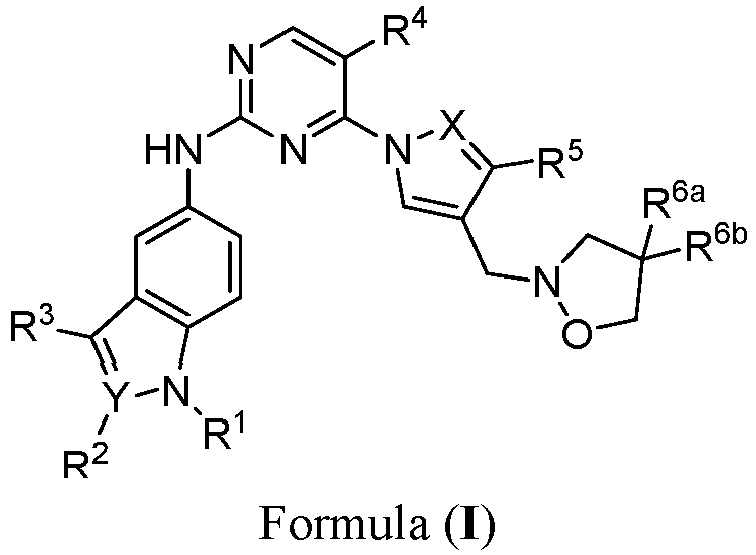
- R1, R2, R3, R4, R5, R6a, R6b, X and Y are as described herein:
- X is CH or N;
- Y is C, or N;
- When Y is N, R2 is absent;
- R1 is selected from H, C1-C6alkyl, C3-C7cycloalkyl, C(O)OR7, or S(O)2R7, wherein C1-C6 alkyl, is optionally substituted with one or more halo, hydroxy, or OR7;
- R2 is selected from H, halo, or C1-C4alkyl, wherein the C1-C4alkyl is optionally substituted with one or more halo;
- R3 is selected from H, halo, C(O)R7, or S(O2)R7;
- R4 is selected from H, halo, C1-C6alkyl, or C3-C7cycloalkyl, wherein the C1-C6alkyl, or C3-C7cycloalkyl is optionally substituted with one or more halo, amino, hydroxy, alkoxy, or haloalkyl;
- R5 is selected from H, halo, C1-C6alkyl, and C3-C7cycloalkyl, wherein C1-C6alkyl or C3-C7cycloalkyl is optionally and independently substituted with one or more halo, alkoxy, or haloalkyl;
- R6a is selected from H, halo, hydroxy, CN, CH2OH, NH2, C1-C6alkyl, C3-C7cycloalkyl, OR7, NR7R7, NHR7, or NHC(O)R7;
- R6b is selected from H, CH2OH, CH2NH2, and C1-C6alkyl;
- R7 is independently selected from C1-C6 alkyl, C3-C7cycloalkyl, phenyl, or haloalkyl, wherein the C1-C6alkyl, C3-C7cycloalkyl, phenyl, or haloalkyl, is optionally and independently substituted with one or more substituents selected from phenyl, cycloalkyl, alkyl, halo, amino, and hydroxy;
- In one aspect, the present invention provides pharmaceutical formulations comprising a compound of claim 1, in combination with a pharmaceutically acceptable carrier, diluent, or excipient. In certain embodiments, such pharmaceutical formulations are formulated for intravenous administration, subcutaneous administration, inhalation, oral administration, rectal administration, parenteral, intravitreal administration, intramuscular administration, intranasal administration, dermal administration, topical administration, optic administration, ophthalmic administration, buccal administration, tracheal administration, bronchial administration, or sublingual administration. In other embodiments, such pharmaceutical composition are formulated as tablets, pills, capsules, a liquid, an inhalant, a nasal spray solution, a suppository, a solution, a gel, an emulsion, an ointment, eye drops or ear drops.
- Further described but not part of the present invention are methods for treating a cell-proliferative disease or condition, such as cancer, comprising administering to a subject in need of such treatment a therapeutically effective amount of the compound of Formula (I) or pharmaceutically acceptable salts, pharmaceutical compositions or medicaments thereof, wherein the cell proliferative disease or condition include, for example, B- cell and/or T cell-lymphoma. Further described are methods of inhibiting growth of cancer cells with a compound of Formula (I) or a pharmaceutically acceptable salt thereof.
- Further described but not part of the present invention is a medicament for treating a SYK-mediated disease, disorder or condition in a patient comprising a therapeutically effective amount of the compound of Formula (I).
- Further described but not part of the present invention are methods for inhibiting protein kinases, comprising administering to a subject in need thereof, a therapeutically effective amount of the compound of Formula (I) or a pharmaceutically acceptable salt or pharmaceutical composition thereof. The protein kinase includes, but is not limited to, SYK kinase.
- Further described but not part of the present invention are methods for inhibiting protein kinases, comprising contacting a cell with a compound of Formula (I). The compound of Formula (I) effectively inhibits activity of one or more kinases and associated mutants selected from SYK, MLK1, or PLK3. In certain embodiments, protein kinase-mediated diseases or conditions are inflammatory diseases or conditions, respiratory diseases or autoimmune diseases or conditions, such as asthma, chronic obstructive pulmonary disease (COPD), adult respiratory distress syndrome (ARDS), ulcerative colitis, Crohn's disease, bronchitis, dermatitis, allergic rhinitis, psoriasis, scleroderma, urticaria, rheumatoid arthritis, multiple sclerosis, cancer, breast cancer, HIV associated diseases or systemic lupus erythematosus (SLE).
- Further described but not part of the present invention are methods of treating a kinase-mediated disease or condition by administering to a subject a therapeutically effective amount of the compound of Formula (I) or a pharmaceutically acceptable salt, in combination with a second therapeutic agent.
- In another aspect, the invention relates to the use of the compounds of the invention for the preparation of a medicament for the treatment of diseases which can be treated by inhibition of the SYK enzyme.
- Further described are compositions comprising these compounds, methods of making these compounds, methods of inhibiting enzyme activity, particularly SYK kinase activity, through use of these compounds, and method of treating disease or disease symptoms in a mammal, particularly where inhibition of the kinase activity, can affect disease outcome.
- Other aspects and embodiments of the invention will be apparent from the following description.
- The present invention provides a group of substituted pyrimidine derivatives and pharmaceutically acceptable salts thereof that are useful for inhibiting SYK kinase activity and for treating diseases and disorders that are mediated by SYK kinase such as inflammatory diseases including rheumatoid arthritis, autoimmune diseases including systemic lupus erythematosus (SLE) and rhinitis, cancer including leukemia, lymphoma, and osteoporosis. Further described but not part of the present invention are methods of preparing pyrimidine derivatives. The present invention also provides pharmaceutical formulations comprising at least one of the compounds of the present invention together with a pharmaceutically acceptable carrier, diluent or excipient thereof. Further described but not part of the invention are intermediates generated during syntheses of the pyrimidine derivative compounds.
- The present invention provides a compound of Formula (I), or pharmaceutically acceptable salt thereof,

- R1, R2, R3, R4, R5, R6a, R6b, X and Y are as described herein:
- X is CH or N;
- Y is C, or N;
- When Y is N, R2 is absent;
- R1 is selected from H, C1-C6alkyl, C3-C7cycloalkyl, C(O)OR7, or S(O)2R7, wherein C1-C6 alkyl, is optionally substituted with one or more halo, hydroxy, or OR7;
- R2 is selected from H, halo, or C1-C4alkyl, wherein the C1-C4alkyl is optionally substituted with one or more halo;
- R3 is selected from H, halo, C(O)R7, or S(O2)R7;
- R4 is selected from H, halo, C1-C6alkyl, or C3-C7cycloalkyl, wherein the C1-C6alkyl, or C3-C7cycloalkyl is optionally substituted with one or more halo, amino, hydroxy, alkoxy, or haloalkyl;
- R5 is selected from H, halo, C1-C6alkyl, and C3-C7cycloalkyl, wherein C1-C6alkyl or C3-C7cycloalkyl is optionally and independently substituted with one or more halo, alkoxy, or haloalkyl;
- R6a is selected from H, halo, hydroxy, CN, CH2OH, NH2, C1-C6alkyl, C3-C7cycloalkyl, OR7, NR7R7, NHR7, or NHC(O)R7;
- R6b is selected from H, CH2OH, CH2NH2, and C1-C6alkyl;
- R7 is independently selected from C1-C6 alkyl, C3-C7cycloalkyl, phenyl, or haloalkyl, wherein the C1-C6alkyl, C3-C7cycloalkyl, phenyl, or haloalkyl, is optionally and independently substituted with one or more substituents selected from phenyl, cycloalkyl, alkyl, halo, amino, and hydroxy.
- In certain embodiments, R1 is selected from H, methyl, ethyl, propyl, isopropyl, butyl, cyclopropyl, cyclobutyl, cyclopentyl, 2-hydroxyethyl, 2-methoxyethyl, 2,2,2-trifluoroethyl, 2-fluoroethyl, ethylcarboxyl, methylsulfonyl, or cyclopropylmethyl.
- In certain embodiments, R2 is H, halo, or C1-C4alkyl, wherein the C1-C4alkyl is optionally substituted with one or more halo.
- In certain embodiments, R3 is selected from acetyl, propionyl, cyclopropyl carbonyl, fluoromethyl carbonyl, difluoromethyl carbonyl, trifluoromethyl carbonyl, methanesulfonyl, ethanesulfonyl, cyclopropanesulfonyl, benzenesulfonyl, or p-toluenesulfonyl.
- In certain embodiments, R4 is selected from H, F, Cl, Br, CH3, CF3, ethyl, or cyclopropyl.
- In certain embodiments, R5 is selected from H, Cl, Br, CH3, CF3, ethyl, isopropyl, or cyclopropyl.
- In certain embodiments, R6b is H. In certain embodiments, R6a is hydroxyl and R6b is H.
- In another aspect, the invention provides a compound selected from the group consisting of:
- (S)-cyclopropyl(5-(4-(4-((4-hydroxyisoxazolidin-2-yl)methyl)-3-methyl-1 H-pyrazol-1-yl)pyrimidin-2-ylamino)-1-methyl-1H-indol-3-yl)methanone;
- (S)-1-(5-(4-(4-((4-hydroxyisoxazolidin-2-yl)methyl)-3-methyl-1H-pyrazol-1-yl)pyrimidin-2-ylamino)-1-methyl-1H-indol-3-yl)-2-methylpropan-1-one;
- (S)-2,2,2-trifluoro-1-(5-(4-(4-((4-hydroxyisoxazolidin-2-yl)methyl)-3-methyl-1H-pyrazol-1-yl)pyrimidin-2-ylamino)-1-methyl-1H-indol-3-yl)ethanone;
- (S)-2,2-difluoro-1-(5-(4-(4-((4-hydroxyisoxazolidin-2-yl)methyl)-3-methyl-1H-pyrazol-1-yl)pyrimidin-2-ylamino)-1-methyl-1H-indol-3-yl)ethanone;
- (S)-ethyl 3-acetyl-5-(4-(4-((4-hydroxyisoxazolidin-2-yl)methyl)-3-methyl-1H-pyrazol-1-yl)pyrimidin-2-ylamino)-1H-indole-1-carboxylate;
- (S)-cyclopropyl(1-ethyl-5-(4-(4-((4-hydroxyisoxazolidin-2-yl)methyl)-3-methyl-1H-pyrazol-1-yl)pyrimidin-2-ylamino)-1H-indol-3-yl)methanone;
- (S)-2,2,2-trifluoro-1-(5-(4-(4-((4-hydroxyisoxazolidin-2-yl)methyl)-3-methyl-1H-pyrazol-1-yl)pyrimidin-2-ylamino)-1H-indol-3-yl)ethanone;
- (S)-cyclopropyl(5-(4-(4-((4-hydroxyisoxazolidin-2-yl)methyl)-3-methyl-1H-pyrazol-1-yl)pyrimidin-2-ylamino)-1-isopropyl-1H-indol-3-yl)methanone;
- (S)-1-(5-(4-(4-((4-hydroxyisoxazolidin-2-yl)methyl)-3-methyl-1H-pyrazol-1-yl)pyrimidin-2-ylamino)-1-methyl-1H-indol-3-yl)ethanone;
- (R)-2,2-difluoro-1-(5-(4-(4-((4-hydroxyisoxazolidin-2-yl)methyl)-3-methyl-1H-pyrazol-1-yl)pyrimidin-2-ylamino)-1-methyl-1H-indol-3-yl)ethanone;
- (R)-cyclopropyl(1-ethyl-5-(4-(4-((4-hydroxyisoxazolidin-2-yl)methyl)-3-methyl-1H-pyrazol-1-yl)pyrimidin-2-ylamino)-1H-indol-3-yl)methanone;
- (S)-cyclopropyl(5-(4-(4-((4-hydroxyisoxazolidin-2-yl)methyl)-3-methyl-1H-pyrazol-1-yl)pyrimidin-2-ylamino)-1H-indol-3-yl)methanone;
- cyclopropyl(1-ethyl-5-(4-(4-((4-hydroxy-4-methylisoxazolidin-2-yl)methyl)-3-methyl-1H-pyrazol-1-yl)pyrimidin-2-ylamino)-1H-indol-3-yl)methanone;
- cyclopropyl(5-(4-(4-((4-hydroxy-4-methylisoxazolidin-2-yl)methyl)-3-methyl-1H-pyrazol-1-yl)pyrimidin-2-ylamino)-1-methyl-1H-indol-3-yl)methanone;
- (S)-cyclopropyl(5-(4-(4-((4-hydroxyisoxazolidin-2-yl)methyl)-3-methyl-1H-pyrazol-1-yl)pyrimidin-2-ylamino)-1-(2,2,2-trifluoroethyl)-1H-indol-3-yl)methanone;
- cyclopropyl(5-(4-(4-((4-hydroxy-4-methylisoxazolidin-2-yl)methyl)-3-methyl-1H-pyrazol-1-yl)pyrimidin-2-ylamino)-1-(2,2,2-trifluoroethyl)-1H-indol-3-yl)methanone;
- (S)-1-(5-(5-chloro-4-(4-((4-hydroxyisoxazolidin-2-yl)methyl)-3-methyl-1H-pyrazol-1-yl)pyrimidin-2-ylamino)-1-methyl-1H-indol-3-yl)-2,2,2-trifluoroethanone;
- (S)-2,2,2-trifluoro-1-(5-(4-(4-((4-hydroxyisoxazolidin-2-yl)methyl)-3-methyl-1H-pyrazol-1-yl)-5-methylpyrimidin-2-ylamino)-1-methyl-1H-indol-3-yl)ethanone;
- (S)-cyclopropyl(5-(4-(4-((4-hydroxyisoxazolidin-2-yl)methyl)-3-methyl-1H-pyrazol-1-yl)-5-methylpyrimidin-2-ylamino)-1-methyl-1H-indol-3-yl)methanone;
- (S)-cyclopropyl(1-ethyl-5-(5-fluoro-4-(4-((4-hydroxyisoxazolidin-2-yl)methyl)-3-methyl-1H-pyrazol-1-yl)pyrimidin-2-ylamino)-1H-indol-3-yl)methanone;
- (S)-cyclopropyl(1-ethyl-5-(5-fluoro-4-(3-((4-hydroxyisoxazolidin-2-yl)methyl)-4-methyl-1H-pyrrol-1-yl)pyrimidin-2-ylamino)-1H-indol-3-yl)methanone;
- (S)-cyclopropyl(1-ethyl-5-(4-(4-((4-hydroxyisoxazolidin-2-yl)methyl)-3-methyl-1H-pyrazol-1-yl)-5-methylpyrimidin-2-ylamino)-1H-indol-3-yl)methanone;
- (S)-cyclopropyl(1-(2-fluoroethyl)-5-(4-(4-((4-hydroxyisoxazolidin-2-yl)methyl)-3-methyl-1H-pyrazol-1-yl)pyrimidin-2-ylamino)-1H-indol-3-yl)methanone;
- (S)-cyclopropyl(5-(4-(3-cyclopropyl-4-((4-hydroxyisoxazolidin-2-yl)methyl)-1H-pyrazol-1-yl)pyrimidin-2-ylamino)-1-ethyl-1H-indol-3-yl)methanone;
- (S)-2-((3-methyl-1-(2-(1-methyl-3-(methylsulfonyl)-1H-indazol-5-ylamino)pyrimidin-4-yl)-1H-pyrazol-4-yl)methyl)isoxazolidin-4-ol;
- (S)-cyclopropyl(5-(4-(4-((4-hydroxyisoxazolidin-2-yl)methyl)-3-methyl-1H-pyrazol-1-yl)pyrimidin-2-ylamino)-1-(methylsulfonyl)-1H-indol-3-yl)methanone;
- (S)-cyclopropyl(1-ethyl-5-(4-(3-((4-hydroxyisoxazolidin-2-yl)methyl)-4-methyl-1H-pyrrol-1-yl)pyrimidin-2-ylamino)-1H-indol-3-yl)methanone;
- (S)-cyclopropyl(5-(4-(4-((4-hydroxyisoxazolidin-2-yl)methyl)-1H-pyrazol-1-yl)pyrimidin-2-ylamino)-1-methyl-1H-indol-3-yl)methanone;
- (S)-2-((1-(2-(3-chloro-1,2-dimethyl-1H-indol-5-ylamino)pyrimidin-4-yl)-3-methyl-1H-pyrazol-4-yl)methyl)isoxazolidin-4-ol;
- (S)-cyclopropyl(1-(2-fluoroethyl)-5-(4-(4-((4-hydroxyisoxazolidin-2-yl)methyl)-1H-pyrazol-1-yl)pyrimidin-2-ylamino)-1H-indol-3-yl)methanone;
- (S)-cyclopropyl(1-(2,2-difluoroethyl)-5-(4-(4-((4-hydroxyisoxazolidin-2-yl)methyl)-1H-pyrazol-1-yl)pyrimidin-2-ylamino)-1H-indol-3-yl)methanone; and
- (S)-cyclopropyl(5-(4-(4-((4-hydroxyisoxazolidin-2-yl)methyl)-1H-pyrazol-1-yl)pyrimidin-2-ylamino)-1-(2,2,2-trifluoroethyl)-1 H-indol-3-yl)methanone;
- or a pharmaceutically acceptable salt thereof.
- In another aspect, the invention provides a pharmaceutical formulation comprising the compound of the invention (i.e., a compound of Formula (I)), in combination with a pharmaceutically acceptable carrier, diluent, or excipient.
- In another aspect, the invention provides the use of a compound of Formula (I)) for preparing a medicament for the treatment of diseases which can be treated by inhibition of the SYK enzyme. In certain embodiments, the invention provides a compound or pharmaceutically acceptable salt thereof of Formula (I), for use in the treatment of an autoimmune condition, the inflammatory diseases and/or allergic disorders such as systemic lupus erythematosus (SLE), discoid (cutaneous) lupus, Sjorgens syndrome, Wegners graulomatosis and other vasculitides, idiopathic thrombocytopenic purpura, giant cell arteriosis, glomerulonephritis, chronic transplant rejection, chronic obstructive pulmonary disease, adult respiratory distress syndrome, asthma, severe asthma, ulcerative colitis, Crohn's disease, bronchitis, conjunctivitis, psoriasis, scleroderma, (contact and allergic) dermatitis, allergy, (allergic) rhinitis, allergic rhinoconjunctivitis, autoimmune bullous conditions including pemphigus and pemphigoid, mastocytosis, anaphylaxis, chronic (spontaneous) urticaria, Berger's disease, Evans's syndrome, granulocytopenia, Goodpasture's syndrome, hepatitis, Henoch-Schonlein purpura, multiple sclerosis, immunohaemolytic anaemia, autoimmune haemolytic anemia, Kawasaki syndrome. In certain embodiments, the invention provides a compound or pharmaceutically acceptable salt thereof of Formula (I) for use in the treatment of rheumatoid arthritis and osteoporosis, osteolytic diseases and osteopenia. In certain embodiments, the invention provides a compound or pharmaceutically acceptable salt thereof of Formula (I), for use in the treatment of heme malignancies, particularly Non-Hodgkin's Lymphomas including follicular (FL), mantle cell, capsule cell lymphoma, neutropenia, small lymphocytic lymphoma, chronic lymphocytic lymphoma, Burkitt and diffuse large B cell lymphomas and T-cell lymphoma.
- Provided but not part of the present invention is a method for treating a condition selected from an autoimmune condition, an inflammatory disease, or an allergic disorder, the method comprising administering to a patient in need of such treatment an effective amount of a compound of Formula (I). In certain embodiments, the condition is systemic lupus erythematosus (SLE), discoid (cutaneous) lupus, Sjorgens syndrome, Wegners graulomatosis and other vasculitides, idiopathic thrombocytopenic purpura, giant cell arteriosis, glomerulonephritis, chronic transplant rejection, chronic obstructive pulmonary disease, adult respiratory distress syndrome, asthma, severe asthma, ulcerative colitis, Crohn's disease, bronchitis, conjunctivitis, psoriasis, scleroderma, (contact and allergic) dermatitis, allergy, (allergic) rhinitis, allergic rhinoconjunctivitis, pemphigus, pemphigoid, mastocytosis, anaphylaxis, chronic (spontaneous) urticaria, Berger's disease, Evans's syndrome, granulocytopenia, Goodpasture's syndrome, hepatitis, Henoch-Schonlein purpura, multiple sclerosis, immunohaemolytic anaemia, autoimmune haemolytic anemia, or Kawasaki syndrome. In certain embodiments, the compound is administered singly or in combination with one or more additional therapeutic agents. In certain embodiments, the compound is administered via intravenous administration, subcutaneous administration, inhalation, oral administration, rectal administration, parenteral, intravitreal administration, intramuscular administration, intranasal administration, dermal administration, topical administration, optic administration, ophthalmic administration, buccal administration, tracheal administration, bronchial administration, or sublingual administration.
- Further described but not part of the invention is a method for treating a heme malignancy, the method comprising administering to a patient in need thereof an effective amount of a compound or pharmaceutically acceptable salt thereof of Formula (I). In certain embodiments, the heme malignancy is selected from the group consisting of Non-Hodgkin's Lymphomas including follicular (FL), mantle cell, capsule cell lymphoma, neutropenia, small lymphocytic lymphoma, chronic lymphocytic lymphoma, Burkitt and diffuse large B cell lymphomas and T-cell lymphoma.
- Further described but not part of the invention is a process for preparing a compound of Formula (I), the process comprising:
- i. reacting a compound of formula (a) with a compound of formula (b) in a first organic solvent in the presence of a first base to give a compound of formula (c);
- ii. reacting the compound of formula (c) with an aniline derivative of formula (d) in the presence of a second base, a ligand and a palladium catalyst in a second solvent to give a compound of formula (e);
- iii. reacting the compound of formula (e) with an amine derivative (f) in a third organic solvent in the presence of reducing agent such as NaBH(OAc)3 to give a compound of Formula (I); or
- iv. reacting the compound of formula (c) with an amine derivative (f) in a fourth organic solvent in the presence of reducing agent such as NaBH(OAc)3 to give a compound of formula (g);
- v. reacting the compound of formula (g) with an aniline derivative formula (d) in the presence of a second base and a palladium catalyst to give a compound of Formula (I);
or the compound of formula (e) is prepared by the following steps: - vi. reacting a compound of formula (h) with a compound of formula (i) in the presence of a first base in a second organic solvent to give a compound of formula (j);
- vii. reacting the compound of formula (j) with a compound of formula (b) in a second organic solvent in the presence of a first base to give a compound of formula (e);
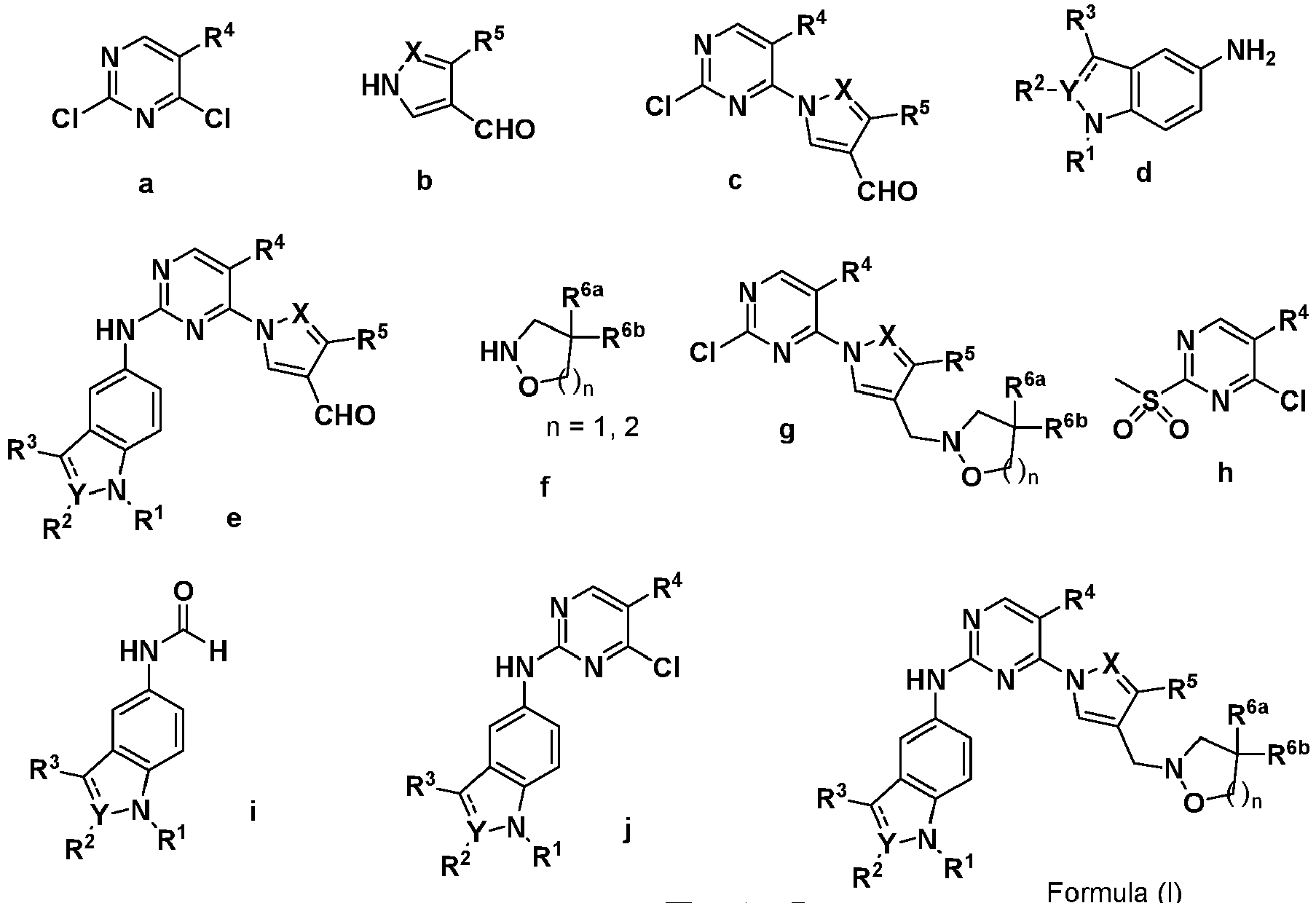
- Further described but not part of the invention is (i) a method of preparing a compound of formula (c) by reacting a compound of formula (a) with a compound of formula (b) in the presence of the first base in the first organic solvent (see Scheme 1); (ii) a method of preparing a compound of formula (e) by reacting the compound of formula (c) with aniline derivatives (d) in the presence of the second base, ligand, and a palladium catalyst in the second organic solvent (see Scheme 1); (iii) a method of preparing a compound of Formula (I) by reductive amination of the compound of formula (e) and an amine derivative by using a reducing agent in the third solvent (see Scheme 1). Further described but not part of the invention is a method of preparing a compound of Formula (I) according to Scheme 1 (Method 1).

- Further described but not part of the invention is (i) a method of preparing a compound of formula (j) from the compound of formula (i) and 4-chloro-2-(methylsulfonyl)pyrimidine (h) by reaction with NaH in the first solvent; (ii) a method of preparing a compound of formula (e) from the compound of formula (j) and formula (b) in the presence of NaH in the first solvent (Method 2).

- Further described but not part of the invention is (i) a method of preparing a compound of formula (g) by reductive amination of the compound of formula (c) and an amine derivative (R6) in the presence of a reducing agent in the third solvent (ii) a method of preparing the compound of Formula (I) by reaction of the compound of formula g with aniline derivatives (d) in the presence of the second base in the second solvent, a ligand, a palladium catalyst in the second organic solvent.
- Further described but not part of the invention is a method of preparing a compound of Formula (I) according to Scheme 3 (Method 3).

- With reference to Methods 1-3, while appropriate reaction solvents can be selected by one of ordinary skill in the art, the first organic solvent is generally selected from relatively polar, aprotic solvents such as acetone, tetrahydrofuran, N,N-dimethylformamide, dichloromethane, dichloroethane, or acetonitrile; the second organic solvent is generally selected from aprotic solvents such as toluene, dioxane, tetrahydrofuran, N,N-dimethylformamide, N,N-dimethylacetamide or N-methylmorpholine; the third organic solvent is generally selected from relatively polar, solvents such as tetrahydrofuran, methanol, ethanol, dichloromethane, dichloroethane, N,N-dimethylacetamide or N,N-dimethylformamide; the fourth solvent is generally selected from relatively polar, protic solvents such as methanol, ethanol, tert -butanol or water, and fifth solvent is generally selected from solvents such as dichloromethane, ethyl acetate, acetone, or water.
- With reference to Methods 1-3, while bases and other reactants can be selected by one of ordinary skill in the art, the first base is generally selected from bases such as K2CO3, Cs2CO3, NaOH, KOH, NaH, tert-BuOK, ter-BuONa, triethylamine, or diisopropylethylamine; the second base is generally selected from bases such as tert-BuOK, tert-BuONa, Cs2CO3, or K2CO3; the third base is selected generally from bases such as NaH, n-BuLi, Cs2CO3; a palladium catalyst is generally selected from Pd(OAc)2, Pd2(dba)3, or Pd(dppf)Cl2; a ligand is generally selected from BiNap, Xantphose, or S-Phose; the oxidizing agent is selected from oxidizing agents such as m-chloroperbenzoic acid (mCPBA) or oxone; and the reducing agent is generally selected from NaBH(OAc)3, NaBH4, or NaBH(CN)3.
- Further described but not part of the invention is a method for preparing a compound of Formula (I), the method comprising reacting a compound of formula (g)


- Representative compounds of Formula (I) are listed below in Table 1.
Table 1. Representative compounds of Formula (I) No Structure No Structure 1 
2 
3 
4 
5 
6 
7 
8 
9 
10 
11 
12 
13 
14 
15 
15 
17 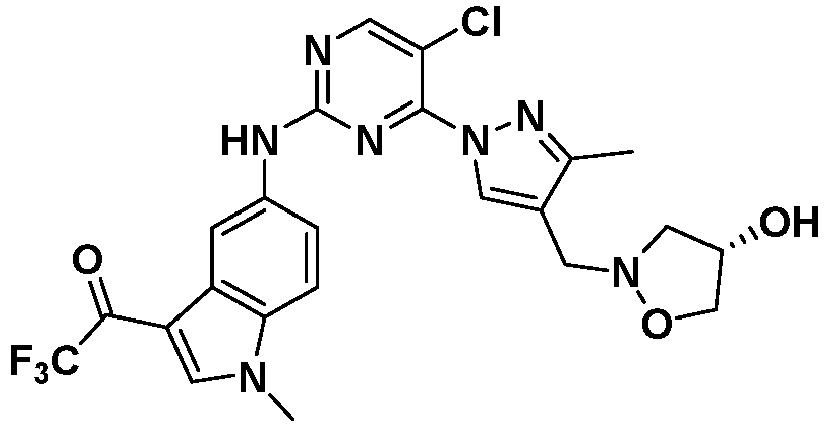
18 
19 
21 
21 
22 
23 
25 
26 
27 
28 
29 
30 
31 
32 
33 
34 
- The compounds in Table 1 are named as follows:
- (S)-cyclopropyl(5-(4-(4-((4-hydroxyisoxazolidin-2-yl)methyl)-3-methyl-1H-pyrazol-1-yl)pyrimidin-2-ylamino)-1-methyl-1H-indol-3-yl)methanone;
- (S)-1-(5-(4-(4-((4-hydroxyisoxazolidin-2-yl)methyl)-3-methyl-1H-pyrazol-1-yl)pyrimidin-2-ylamino)-1-methyl-1H-indol-3-yl)-2-methylpropan-1-one;
- (S)-2,2,2-trifluoro-1-(5-(4-(4-((4-hydroxyisoxazolidin-2-yl)methyl)-3-methyl-1H-pyrazol-1-yl)pyrimidin-2-ylamino)-1-methyl-1H-indol-3-yl)ethanone;
- (S)-2,2-difluoro-1-(5-(4-(4-((4-hydroxyisoxazolidin-2-yl)methyl)-3-methyl-1H-pyrazol-1-yl)pyrimidin-2-ylamino)-1-methyl-1H-indol-3-yl)ethanone;
- (S)-ethyl 3-acetyl-5-(4-(4-((4-hydroxyisoxazolidin-2-yl)methyl)-3-methyl-1H-pyrazol-1-yl)pyrimidin-2-ylamino)-1H-indole-1-carboxylate;
- (S)-cyclopropyl(1-ethyl-5-(4-(4-((4-hydroxyisoxazolidin-2-yl)methyl)-3-methyl-1H-pyrazol-1-yl)pyrimidin-2-ylamino)-1H-indol-3-yl)methanone;
- (S)-2,2,2-trifluoro-1-(5-(4-(4-((4-hydroxyisoxazolidin-2-yl)methyl)-3-methyl-1H-pyrazol-1-yl)pyrimidin-2-ylamino)-1H-indol-3-yl)ethanone;
- (S)-cyclopropyl(5-(4-(4-((4-hydroxyisoxazolidin-2-yl)methyl)-3-methyl-1H-pyrazol-1-yl)pyrimidin-2-ylamino)-1-isopropyl-1H-indol-3-yl)methanone;
- (S)-1-(5-(4-(4-((4-hydroxyisoxazolidin-2-yl)methyl)-3-methyl-1H-pyrazol-1-yl)pyrimidin-2-ylamino)-1-methyl-1H-indol-3-yl)ethanone;
- (R)-2,2-difluoro-1-(5-(4-(4-((4-hydroxyisoxazolidin-2-yl)methyl)-3-methyl-1H-pyrazol-1-yl)pyrimidin-2-ylamino)-1-methyl-1H-indol-3-yl)ethanone;
- (R)-cyclopropyl(1-ethyl-5-(4-(4-((4-hydroxyisoxazolidin-2-yl)methyl)-3-methyl-1H-pyrazol-1-yl)pyrimidin-2-ylamino)-1H-indol-3-yl)methanone;
- (S)-cyclopropyl(5-(4-(4-((4-hydroxyisoxazolidin-2-yl)methyl)-3-methyl-1H-pyrazol-1-yl)pyrimidin-2-ylamino)-1H-indol-3-yl)methanone;
- cyclopropyl(1-ethyl-5-(4-(4-((4-hydroxy-4-methylisoxazolidin-2-yl)methyl)-3-methyl-1H-pyrazol-1-yl)pyrimidin-2-ylamino)-1H-indol-3-yl)methanone;
- cyclopropyl(5-(4-(4-((4-hydroxy-4-methylisoxazolidin-2-yl)methyl)-3-methyl-1H-pyrazol-1-yl)pyrimidin-2-ylamino)-1-methyl-1H-indol-3-yl)methanone;
- (S)-cyclopropyl(5-(4-(4-((4-hydroxyisoxazolidin-2-yl)methyl)-3-methyl-1H-pyrazol-1-yl)pyrimidin-2-ylamino)-1-(2,2,2-trifluoroethyl)-1H-indol-3-yl)methanone;
- cyclopropyl(5-(4-(4-((4-hydroxy-4-methylisoxazolidin-2-yl)methyl)-3-methyl-1H-pyrazol-1-yl)pyrimidin-2-ylamino)-1-(2,2,2-trifluoroethyl)-1H-indol-3-yl)methanone;
- (S)-1-(5-(5-chloro-4-(4-((4-hydroxyisoxazolidin-2-yl)methyl)-3-methyl-1H-pyrazol-1-yl)pyrimidin-2-ylamino)-1-methyl-1H-indol-3-yl)-2,2,2-trifluoroethanone;
- (S)-2,2,2-trifluoro-1-(5-(4-(4-((4-hydroxyisoxazolidin-2-yl)methyl)-3-methyl-1H-pyrazol-1-yl)-5-methylpyrimidin-2-ylamino)-1-methyl-1H-indol-3-yl)ethanone;
- (S)-cyclopropyl(5-(4-(4-((4-hydroxyisoxazolidin-2-yl)methyl)-3-methyl-1H-pyrazol-1-yl)-5-methylpyrimidin-2-ylamino)-1-methyl-1H-indol-3-yl)methanone;
- (S)-cyclopropyl(1-ethyl-5-(5-fluoro-4-(4-((4-hydroxyisoxazolidin-2-yl)methyl)-3-methyl-1H-pyrazol-1-yl)pyrimidin-2-ylamino)-1H-indol-3-yl)methanone;
- (S)-cyclopropyl(1-ethyl-5-(5-fluoro-4-(3-((4-hydroxyisoxazolidin-2-yl)methyl)-4-methyl-1H-pyrrol-1-yl)pyrimidin-2-ylamino)-1H-indol-3-yl)methanone;
- (S)-cyclopropyl(1-ethyl-5-(4-(4-((4-hydroxyisoxazolidin-2-yl)methyl)-3-methyl-1H-pyrazol-1-yl)-5-methylpyrimidin-2-ylamino)-1H-indol-3-yl)methanone;
- (S)-cyclopropyl(1-(2-fluoroethyl)-5-(4-(4-((4-hydroxyisoxazolidin-2-yl)methyl)-3-methyl-1H-pyrazol-1-yl)pyrimidin-2-ylamino)-1H-indol-3-yl)methanone;
- (S)-cyclopropyl(5-(4-(3-cyclopropyl-4-((4-hydroxyisoxazolidin-2-yl)methyl)-1H-pyrazol-1-yl)pyrimidin-2-ylamino)-1-ethyl-1H-indol-3-yl)methanone;
- (S)-2-((3-methyl-1-(2-(1-methyl-3-(methylsulfonyl)-1H-indazol-5-ylamino)pyrimidin-4-yl)-1H-pyrazol-4-yl)methyl)isoxazolidin-4-ol;
- (S)-cyclopropyl(5-(4-(4-((4-hydroxyisoxazolidin-2-yl)methyl)-3-methyl-1H-pyrazol-1-yl)pyrimidin-2-ylamino)-1-(methylsulfonyl)-1H-indol-3-yl)methanone;
- cyclopropyl(5-(4-(4-((4-hydroxy-4-methylmorpholino)methyl)-1H-pyrazol-1-yl)pyrimidin-2-ylamino)-1-methyl-1H-indol-3-yl)methanone;
- (S)-cyclopropyl(1-ethyl-5-(4-(3-((4-hydroxyisoxazolidin-2-yl)methyl)-4-methyl-1H-pyrrol-1-yl)pyrimidin-2-ylamino)-1H-indol-3-yl)methanone;
- (S)-cyclopropyl(5-(4-(4-((4-hydroxyisoxazolidin-2-yl)methyl)-1H-pyrazol-1-yl)pyrimidin-2-ylamino)-1-methyl-1H-indol-3-yl)methanone;
- (S)-2-((1-(2-(3-chloro-1,2-dimethyl-1H-indol-5-ylamino)pyrimidin-4-yl)-3-methyl-1H-pyrazol-4-yl)methyl)isoxazolidin-4-ol;
- (S)-cyclopropyl(1-(2-fluoroethyl)-5-(4-(4-((4-hydroxyisoxazolidin-2-yl)methyl)-1H-pyrazol-1-yl)pyrimidin-2-ylamino)-1H-indol-3-yl)methanone;
- (S)-cyclopropyl(1-(2,2-difluoroethyl)-5-(4-(4-((4-hydroxyisoxazolidin-2-yl)methyl)-1H-pyrazol-1-yl)pyrimidin-2-ylamino)-1H-indol-3-yl)methanone;
- (S)-cyclopropyl(5-(4-(4-((4-hydroxyisoxazolidin-2-yl)methyl)-1H-pyrazol-1-yl)pyrimidin-2-ylamino)-1-(2,2,2-trifluoroethyl)-1H-indol-3-yl)methanone;
- or a pharmaceutically acceptable salt thereof.
- The term "alkyl," used alone or as part of a larger moiety such as "arylalkyl" or "cycloalkyl" refers to a straight or branched hydrocarbon radical having from 1 to 15 carbon atoms, or from 1-8 carbon atoms, or from 1-6 carbon atoms, or from 1-4 carbon atoms (unless stated otherwise) and includes, for example, methyl, ethyl, n-propyl, isopropyl, n-butyl, sec-butyl, isobutyl, tert-butyl, n-pentyl, iso-pentyl, n-hexyl and the like. An alkyl can be unsubstituted or substituted with one or more suitable substituents.
- The term "cycloalkyl" refers to a monocyclic or polycyclic hydrocarbon ring group having from 3 to 10 carbon atoms, or from 3 to 7 carbon atoms, in the hydrocarbon ring (unless stated otherwise) and includes, for example, cyclopropyl, cycloheptyl, cyclooctyl, cyclodecyl, cyclobutyl, adamantyl, norpinanyl, decalinyl, norbornyl, cyclohexyl, cyclopentyl, and the like. A cycloalkyl group can be unsubstituted or substituted with one or more suitable substituents.
- The term "hetero" refers to the replacement of at least one carbon atom member in a ring system with at least one heteroatom such as nitrogen, sulfur, and oxygen.
- The term "heterocycloalkyl" means a non-aromatic monocyclic or polycyclic ring having from 2 to 9 carbon atoms, or from 2 to 7 carbon atoms, in the ring (unless stated otherwise) and at least one heteroatom, preferably, 1 to 4 heteroatoms selected from nitrogen, sulfur (including oxidized sulfur such as sulfone or sulfoxide) and oxygen. The ring or ring system of the heterocycloalkyl group can be linked to another moiety of the compound via a carbon atom or a nitrogen atom, if such an atom is present. A heterocycloalkyl group can have a total of 3-10, or 3-8, or 5-8, atoms in the ring system (unless otherwise stated). A heterocycloalkyl group can have one or more carbon-carbon double bonds or carbon-heteroatom double bonds in the ring group as long as the ring group is not rendered aromatic by their presence.
- Examples of heterocycloalkyl groups include azetidinyl, aziridinyl, pyrrolidinyl, piperidinyl, piperazinyl, homopiperazinyl, morpholino, thiomorpholino, tetrahydrofuranyl, tetrahydrothiofuranyl, tetrahydropyranyl, pyranyl, and the like. A heterocycloalkyl group can be unsubstituted or substituted with one or more suitable substituents.
- As used herein, the term "halo" includes fluoro, chloro, bromo, and iodo.
- As used herein, the term "alkoxy" refers to the alkyl groups above bound through oxygen, examples of which include methoxy, ethoxy, iso-propoxy, tert-butoxy, and the like. In addition, alkoxy also refers to polyethers such as -O-(CH2)2-O-CH3, and the like. An alkoxy can be unsubstituted or substituted with one or more suitable substituents.
- As used herein, the term "aryl" refers to unsubstituted or substituted aromatic monocyclic or polycyclic groups and includes, for example, carbocyclic aromatic groups such as phenyl, naphthyl and the like, as well as heteroaromatic groups such as pyridyl, furanyl, thiophenyl, and the like. The term "aryl" also includes an aromatic ring (such as a phenyl or pyridyl ring) fused to a non-aromatic carbocyclic or heterocyclic ring. The term "aryl" may be interchangeably used with "aryl ring," aromatic group," and "aromatic ring. " Heteroaryl groups have 4 to 14 atoms in the heteroaromatic ring(s), 1 to 9 of which are independently selected from the group consisting of oxygen, sulfur and nitrogen. Heteroaryl groups have 1-3 heteroatoms in a 5-8 membered aromatic group. An aryl or heteroaryl can be a mono- or bicyclic aromatic group. Typical aryl and heteroaryl groups include, for example, phenyl, quinolinyl, indazoyl, indolyl, dihydrobenzodioxynyl, 3-chlorophenyl, 2,6-dibromophenyl, pyridyl, pyrimidinyl, 3-methylpyridyl, benzothienyl, 2,4,6-tribromophenyl, 4-ethylbenzothienyl, furanyl, 3,4-diethylfuranyl, naphthyl, 4,7-dichloronaphthyl, pyrrole, pyrazole, imidazole, thiazole, and the like. An aryl or heteroaryl can be unsubstituted or substituted with one or more suitable substituents.
- As used herein, the term "haloalkyl" refers to any alkyl radical having one or more hydrogen atoms replaced by a halogen atom. Examples of haloalkyl include -CF3,-CFH2, -CF2H, and the like.
- As used herein, the term "hydroxyl" or "hydroxy" refers to -OH.
- As used herein, the term "amino" refers to -NH2.
- As used herein, the term "hydroxyalkyl" refers to any hydroxyl derivative of alkyl radical. The term "hydroxyalkyl" includes any alkyl radical having one or more hydrogen atoms replaced by a hydroxy group.
- As used herein, the term "arylalkyl" includes any alkyl radical having one or more hydrogen atoms replaced by an aryl group, e.g., a benzyl group, a phenethyl group, and the like.
- A "substituent," as used herein, refers to a molecular moiety that is covalently bonded to an atom within a molecule of interest. For example, a ring substituent may be a moiety such as a halogen, alkyl group, haloalkyl group or other group that is covalently bonded to an atom (preferably a carbon or nitrogen atom) that is a ring member. Substituents of aromatic groups are generally covalently bonded to a ring carbon atom. The term "substitution" refers to replacing a hydrogen atom in a molecular structure with a substituent, such that the valence on the designated atom is not exceeded, and such that a chemically stable compound (i.e., a compound that can be isolated, characterized, and tested for biological activity) results from the substitution.
- As described above, certain groups can be unsubstituted or substituted with one or more suitable substituents by other than hydrogen at one or more available positions, typically 1, 2, 3, 4 or 5 positions, by one or more suitable groups (which may be the same or different). Certain groups, when substituted, are substituted with 1, 2, 3 or 4 independently selected substituents. Suitable substituents include halo, alkyl, haloalkyl, aryl, hydroxy, alkoxy, hydroxyalkyl, amino, and the like.
- As used herein, the term "inhibitor" refers to a compound which inhibits one or more kinases described herein. For example, the term "SYK inhibitor" refers to a compound which inhibits the SYK receptor or reduces the signaling effect.
- As used herein, the term "pharmaceutically acceptable" refers a material, such as a carrier or diluent, which does not abrogate the biological activity or properties of the compounds described herein. Such materials are administered to an individual without causing undesirable biological effects or interacting in a deleterious manner with any of the components of the composition in which it is contained.
- As used herein, the term "pharmaceutically acceptable salt" refers to a formulation of a compound that does not cause significant irritation to an organism to which it is administered and does not abrogate the biological activity and properties of the compounds described herein.
- As used herein, the term "pharmaceutical combination" means a product that results from the mixing or combining of more than one active ingredient.
- As used herein, the term "pharmaceutical composition" refers to a mixture of a compound described herein with other chemical components, such as carriers, stabilizers, diluents, dispersing agents, suspending agents, thickening agents, and/or excipients.
- As used herein, the term "prodrug" refers to an agent that is converted into the parent drug in vivo.
- As used herein, the term "protein kinase-mediated disease" or a "disorder or disease or condition mediated by inappropriate protein kinase activity" refers to any disease state mediated or modulated by protein kinases described herein. Such disease states include, but are not limited to, systemic lupus erythematosus (SLE), asthma, chronic obstructive pulmonary disease (COPD), adult respiratory distress syndrome (ARDS), ulcerative colitis, Crohn's disease, bronchitis, dermatitis, allergic rhinitis, psoriasis, scleroderma, urticaria, bullous disorders, collagenoses, contact dermatitis eczema, Kawasaki Disease, rosacea, Sjogren-Larsso Syndrome, rheumatoid arthritis, multiple sclerosis, inflammatory bowel syndrome, HIV, diffuse large B cell lymphoma, Non-Hodgkin lymphoma, osteosarcoma, melanoma, breast cancer, renal cancer, prostate cancer, colorectal cancer, thyroid cancer, ovarian cancer, pancreatic cancer, neuronal cancer, lung cancer, uterine cancer, gastrointestinal cancer, Alzheimer's disease, Parkinson's disease, osteoporosis, osteopenia, osteomalacia, osteofibrosis, Paget's disease, diabetes, blood vessel proliferative disorders, ocular diseases, cardiovascular disease, restenosis, fibrosis, atherosclerosis, arrhythmia, angina, myocardial ischemia, myocardial infarction, cardiac or vascular aneurysm, vasculitis, stroke, peripheral obstructive arteriopathy, reperfusion injury following ischemia of an organ or a tissue, endotoxic, surgical or traumatic shock, hypertension, valvular heart disease, heart failure, abnormal blood pressure, vasoconstriction, vascular abnormality, transplant rejection and infectious diseases including viral and fungal infections.
- As used herein, the term "kinase-mediated disease" or "kinase-mediated disease" or a "disorder or disease or condition mediated by inappropriate kinase activity" refers to any disease state mediated or modulated by a kinase mechanism. For example "SYK-mediated disease" refers to any disease state mediated or modulated by SYK mechanisms. Such SYK-mediated disease states include, but are not limited to, inflammatory, respiratory diseases and autoimmune diseases, such as, by way of example only, rheumatoid arthritis, systemic lupus erythematosus (SLE), asthma, chronic obstructive pulmonary disease (COPD), adult respiratory distress syndrome (ARDs), ulcerative colitis, Crohn's disease, bronchitis, dermatitis, allergic rhinitis, psoriasis, scleroderma, urticaria, rheumatoid arthritis, multiple sclerosis, cancer, HIV-associated disease and non-Hodgkin lymphoma including diffuse large B cell lymphoma.
- As used herein, the term "therapeutically effective amount" refers to any amount of a compound which, as compared to a corresponding subject who has not received such amount, results in improved treatment, healing, prevention, or amelioration of a disease, disorder, or side effect, or a decrease in the rate of advancement of a disease or disorder. The term also includes within its scope amounts effective to enhance normal physiological function.
- As used herein, the term "treat," "treating" or "treatment" refers to methods of alleviating, abating or ameliorating a disease or condition symptoms, preventing additional symptoms, ameliorating or preventing the underlying metabolic causes of symptoms, inhibiting the disease or condition, arresting the development of the disease or condition, relieving the disease or condition, causing regression of the disease or condition, relieving a condition caused by the disease or condition, or stopping the symptoms of the disease or condition either prophylactically and/or therapeutically.
- As used herein, the term "solvate" refers to a complex of variable stoichiometry formed by a solute (in this invention, a compound of Formula (I) or a pharmaceutically acceptable salt thereof) and a solvent. Such solvents for the purpose of the invention may not interfere with the biological activity of the solute. Non-limiting examples of suitable solvents include water, acetone, methanol, ethanol and acetic acid. Preferably the solvent used is a pharmaceutically acceptable solvent. Non-limiting examples of suitable pharmaceutically acceptable solvents include water, ethanol and acetic acid.
- As used herein, the term "subject" or "patient" encompasses mammals and non-mammals. Examples of mammals include, but are not limited to, humans, chimpanzees, apes monkeys, cattle, horses, sheep, goats, swine; rabbits, dogs, cats, rats, mice, guinea pigs, and the like. Examples of non-mammals include, but are not limited to, birds, fish and the like.
- As used herein, the term "administration" or "administering" of the subject compound refers to providing a compound of the invention and/or prodrugs thereof to a subject in need of treatment.
- As used herein, the term "carrier" refers to chemical compounds or agents that facilitate the incorporation of a compound described herein into cells or tissues.
- As used herein, the term "acceptable" with respect to a formulation, composition or ingredient, as used herein, means having no persistent detrimental effect on the general health of the subject being treated.
- As used herein, the term "diluent" refers to chemical compounds that are used to dilute a compound described herein prior to delivery. Diluents can also be used to stabilize compounds described herein.
- As used herein, the term "effective amount" or "therapeutically effective amount" refer to a sufficient amount of a compound described herein being administered which will relieve to some extent one or more of the symptoms of the disease or condition being treated. The result can be reduction and/or alleviation of the signs, symptoms, or causes of a disease, or any other desired alteration of a biological system. For example, an "effective amount" for therapeutic uses is the amount of the composition comprising a compound as disclosed herein required to provide a clinically significant decrease in disease symptoms. An appropriate "effective" amount in any individual case may be determined using techniques, such as a dose escalation study. By way of example only, a therapeutically effective amount of a compound of the invention may be in the range of e.g., about 0.01 mg/kg/day to about 100 mg/kg/day, or from about 0.1 mk/kg/day to about 10 mg/kg/day.
- The compounds of the present invention were screened against the kinase panel and inhibited the activity of at least one kinase on the panel. Examples of kinases include, but are not limited to SYK and mutant forms thereof.
- The compounds described herein are inhibitors of SYK kinase activity and have therapeutic benefit in the treatment of disorders associated with inappropriate kinase activity, in particular in the treatment and prevention of disease states mediated by kinases, including SYK kinase. Therefore, provided are methods of regulating and, in particular, inhibiting signal transduction cascades in which a kinase plays a role. The method generally involves administering to a subject or contacting a cell expressing the kinase with an effective amount of a compound described herein, prodrug, or an acceptable salt, hydrate, solvate, N-oxide and/or composition thereof, to regulate or inhibit the signal transduction cascade. The methods are also used to regulate and, in particular, inhibit downstream processes or cellular responses elicited by activation of the particular kinase signal transduction cascade. The methods are also practiced in in vitro contexts or in in vivo contexts as a therapeutic approach towards the treatment or prevention of diseases characterized by, caused by, or associated with activation of the kinase-dependent signal transduction cascade.
- For the therapeutic uses of compounds provided herein, including compounds of Formula (I), or pharmaceutically acceptable salts, solvates, N-oxides, prodrugs, or isomers thereof, such compounds are administered in therapeutically effective amounts either alone or as part of a pharmaceutical composition. Accordingly, provided herein are pharmaceutical compositions, which comprise at least one compound provided herein, including at least one compound of Formula (I), pharmaceutically acceptable salts and/or solvates thereof, and one or more pharmaceutically acceptable carriers, diluents, adjuvant or excipients. In addition, such compounds and compositions are administered singly or in combination with one or more additional therapeutic agents. The methods of administration of such compounds and compositions include, but are not limited to, intravenous administration, inhalation, oral administration, rectal administration, parenteral, intravitreal administration, subcutaneous administration, intramuscular administration, intranasal administration, dermal administration, topical administration, ophthalmic administration, buccal administration, tracheal administration, bronchial administration, sublingual administration or optic administration. Compounds provided herein are administered by way of known pharmaceutical formulations, including tablets, capsules or elixirs for oral administration, suppositories for rectal administration, sterile solutions or suspensions for parenteral or intramuscular administration, lotions, gels, ointments or creams for topical administration, and the like.
- The therapeutically effective amount will vary depending on, among others, the disease indicated, the severity of the disease, the age and relative health of the subject, the potency of the compound administered, the mode of administration and the treatment desired. The required dosage will also vary depending on the mode of administration, the particular condition to be treated and the effect desired.
- Pharmaceutically acceptable salt forms include pharmaceutically acceptable acidic/anionic or basic/cationic salts. Pharmaceutically acceptable acidic/anionic salts include acetate, benzenesulfonate, benzoate, bicarbonate, bitartrate, bromide, calcium edetate, camsylate, carbonate, chloride, citrate, dihydrochloride, edetate, edisylate, estolate, esylate, fumarate, glyceptate, gluconate, glutamate, glycollylarsanilate, hexylresorcinate, hydrobromide, hydrochloride, hydroxynaphthoate, iodide, isethionate, lactate, lactobionate, malate, maleate, malonate, mandelate, mesylate, methylsulfate, mucate, napsylate, nitrate, pamoate, pantothenate, phosphate/diphosphate, polygalacturonate, salicylate, stearate, subacetate, succinate, sulfate, hydrogensulfate, tannate, tartrate, teoclate, tosylate, and triethiodide salts. Pharmaceutically acceptable basic/cationic salts include, the sodium, potassium, calcium, magnesium, diethanolamine, N-methyl-D-glucamine, L-lysine, L-arginine, ammonium, ethanolamine, piperazine and triethanolamine salts.
- A pharmaceutically acceptable acid salt is formed by reaction of the free base form of a compound of Formula (I) with a suitable inorganic or organic acid including, but not limited to, hydrobromic, hydrochloric, sulfuric, nitric, phosphoric, succinic, maleic, formic, acetic, propionic, fumaric, citric, tartaric, lactic, benzoic, salicylic, glutamic, aspartic, p-toluenesulfonic, benzenesulfonic, methanesulfonic, ethanesulfonic, naphthalenesulfonic such as 2-naphthalenesulfonic, or hexanoic acid. A pharmaceutically acceptable acid addition salt of a compound of Formula (I) can comprise or be, for example, a hydrobromide, hydrochloride, sulfate, nitrate, phosphate, succinate, maleate, formarate, acetate, propionate, fumarate, citrate, tartrate, lactate, benzoate, salicylate, glutamate, aspartate, p-toluenesulfonate, benzenesulfonate, methanesulfonate, ethanesulfonate, naphthalenesulfonate (e.g., 2-naphthalenesulfonate) or hexanoate salt.
- The free acid or free base forms of the compounds of the invention may be prepared from the corresponding base addition salt or acid addition salt form, respectively. For example a compound of the invention in an acid addition salt form may be converted to the corresponding free base form by treating with a suitable base (e.g., ammonium hydroxide solution, sodium hydroxide, and the like). A compound of the invention in a base addition salt form may be converted to the corresponding free acid by treating with a suitable acid (e.g., hydrochloric acid, etc.).
- Prodrug derivatives of the compounds of the invention may be prepared by methods known to those of ordinary skill in the art (e.g., for further details see Saulnier et al., Bioorg. Med. Chem. Letters, 1994, 4, 1985.
- Protected derivatives of the compounds of the invention may be prepared by means known to those of ordinary skill in the art. A detailed description of techniques applicable to the creation of protecting groups and their removal can be found in T. W. Greene, "Protecting Groups in Organic Chemistry," 3rd edition, John Wiley and Sons, Inc., 1999.
- Compounds of the invention may be prepared as their individual stereoisomers by reaction of a racemic mixture of the compound with an optically active resolving agent to form a pair of diastereoisomeric compounds, separating the diastereomers and recovering the optically pure enantiomers. Resolution of enantiomers may be carried out using covalent diastereomeric derivatives of the compounds of the invention, or by using dissociable complexes (e.g., crystalline diastereomeric salts). Diastereomers have distinct physical properties (e.g., melting points, boiling points, solubility, reactivity, etc.) and may be readily separated by taking advantage of these dissimilarities. The diastereomers may be separated by chromatography, or by separation/resolution techniques based upon differences in solubility. The optically pure enantiomer is then recovered, along with the resolving agent, by any practical means that would not result in racemization. A more detailed description of the techniques applicable to the resolution of stereoisomers of compounds from their racemic mixture can be found in Jean Jacques, Andre Collet and Samuel H. Wilen, "Enantiomers, Racemates and Resolutions," John Wiley And Sons, Inc., 1981.
- Suitable pharmaceutically acceptable carriers, diluents, adjuvants, or excipients for use in the pharmaceutical compositions of the invention include tablets (coated tablets) made of for example collidone or shellac, gum Arabic, talc, titanium dioxide or sugar, capsules (gelatin), solutions (aqueous or aqueous-ethanolic solution), syrups containing the active substances, emulsions or inhalable powders (of various saccharides such as lactose or glucose, salts and mixture of these excipients with one another) and aerosols (propellant-containing or -free inhale solutions).
- Excipients which may be used include, for example, water, pharmaceutically acceptable organic solvents such as paraffins (e.g., petroleum fractions), vegetable oils (e.g. groundnut or sesame oil), mono- or polyfunctional alcohols (e.g., ethanol or glycerol), carriers such as natural mineral powders (e.g., kaoline, clays, talc, chalk), synthetic mineral powders (e.g., highly dispersed silicic acid and silicates), sugars (e.g., cane sugar, lactose and glucose), emulsifiers (e.g., lignin, spent sulphite liquors, methylcellulose, starch and polyvinylpyrrolidone) and lubricants (e.g., magnesium stearate, talc, stearic acid and sodium lauryl sulphate).
- Exemplary methods for preparing the compounds of the invention are described herein, including in the Examples.
- In certain embodiments, compounds of Formula (I) are made by:
- (a) optionally converting a compound of the invention into a pharmaceutically acceptable salt; (b) optionally converting a salt form of a compound of the invention to a non-salt form; (c) optionally converting an unoxidized form of a compound of the invention into a pharmaceutically acceptable N-oxide; (d) optionally resolving an individual isomer of a compound of the invention from a mixture of isomers; (e) optionally converting a non-derivatized compound of the invention into a pharmaceutically acceptable prodrug derivative; and (f) optionally converting a prodrug derivative of a compound of the invention to its non-derivatized form.
- The present invention is further exemplified by the following examples that illustrate the preparation of compounds of Formula (I) according to the invention. The examples are for illustrative purpose only and are not intended, nor should they be construed as limiting the invention in any manner. Those skilled in the art will appreciate that variations and modifications can be made without changing the scope of the invention.
- Nuclear magnetic resonance (NMR) and mass spectrometry (MS) spectra obtained for compounds described in the examples below and those described herein were consistent with that of the compounds of formulae herein.
-
- 1. Samples are run on Agilent Technologies 6120 MSD system with a Zorbax Eclipse XDB-C18 (3.5 µ) reverse phase column (4.6 x 50 mm) run at room temperature with flow rate of 1.5 mL/minute.
- 2. The mobile phase uses solvent A (water/0.1 % formic acid) and solvent B (acetonitrile/0.1 % formic acid): 95 %/5 % to 0 %/100 % (A/B) for 5 minute.
- 3. The mass spectra (m/z) were recorded using electrospray ionization (ESI).
- 4. Ionization data was rounded to the nearest integer.
- Unless otherwise indicated, all 1H NMR spectra are run on a Varian series Mercury 300 MHz. All observed protons are reported as parts-per-million (ppm) downfield from tetramethylsilane using conventional abbreviations for designation of major peaks: e.g., s (singlet), d (doublet), t (triplet), q (quartet), m (multiplet) and brs (broad singlet).
-

- To a solution of ethyl 3-methyl-1H-pyrazole-4-carbaldehyde (6.4 g, 58.0 mmol) in 60 mL of anhydrous N,N- dimethylformamide were added potassium carbonate (10.8 g, 77.8 mmol) and 2,4-dichloropyrimidine (8.64 g, 58.0 mmol) at room temperature. The resulting suspension was stirred for 14 hours at room temperature with monitoring a reaction with LC-MS or thin layer chromatography (TLC). The reaction mixture was diluted with ethyl acetate and washed with brine (x2). The collected organic layer was dried over anhydrous sodium sulfate and then concentrated in vacuo. The resulting residue was purified by silica gel chromatography using a mixture of heptanes and ethyl acetate to afford the desired intermediate 1 as a white solid (5.47 g, 42 %); MS (ESI) m/z 223 [M+H]+, 1H NMR (300 MHz, CDCl3) δ 10.06 (s, 1H), 9.04 (s, 1H), 8.70 (d, 1H, J = 5.4 Hz), 7.87 (1H, d, J = 5.4 Hz), 2.59 (s, 3H).
-

-

- A round bottomed flask was charged with 1-(2-chloropyrimidin-4-yl)-3-methyl-1H-pyrazole-4-carbaldehyde (400 mg, 1.78 mmol), (5-amino-1-methyl-1H-indol-3-yl)(cyclopropyl)methanone (385 mg, 1.0 equiv.), potassium carbonate (0.74 g, 3.0 equiv), palladium acetate (20 mg, 0.05 equiv), (9,9-dimethyl-9H-xanthene-4,5-diyl)bis(diphenylphosphine) (Xantphos, 100 mg, 0.1 equiv.) and 40 mL of anhydrous dioxane. After being degassed by nitrogen bubbling, the reaction mixture was heated at 100 °C for 12 hours. To the reaction mixture, water was added to form solids. The resulting solids were collected by filtration, washed with water followed by ethyl acetate to give brown powder (430 mg, 60%). The collected solids were dried in vacuo and then used to next step without further purification; MS (ESI) m/z 401 [M+H]+.
-

- To a slurry of intermediate 2 (500 mg, 1.14 mmol), (S)-isoxazolidin-4-ol hydrochloride (220 mg, Tetrahedron Lett., 2006, 47, 7635-7639) and triethylamine (0.79 mL) in 10 mL of dichloromethane and 10 mL of N,N-dimethylacetamide (DMAC), was added NaBH(OAc)3 (730 mg, 3.42 mmol) at room temperature. Volatiles were removed in vacuo. It was extracted with dichloromethane (x3). The collected organic layers were dried over anhydrous sodium sulfate and then concentrated in vacuo. The resulting residue was purified by silica gel chromatography (DCM/MeOH) to give 270 mg (50 %) of the desired compound 1 as a pale yellow solid; MS (ESI) m/z 474 [M+H]+, 1H NMR (300MHz, DMSO-d6) δ 9.85(s, 1H), 9.30 (s, 1H), 9.02 (s, 1H), 8.48 (d, J=5.4 Hz, 1H), 7.47 (d, J= 9.0Hz, 1H), 7.3 6 (d, J=8.7Hz, 1H), 7.13 (d, J=5.4Hz, 1H), 5.19 (s, 1H), 4.60 (d, 1H), 4.10 (m, 1H), 3.94 (d, 2H), 3.87 (s, 3H), 3.81 (m, 1H), 2.86 (m, 1H), 2.65 (m, 1H), 2.29 (s, 1H), 0.92 (d, J=6.0Hz, 2H).
-

-

- To a solution of N-(3-isobutyryl-1-methyl-1H-indol-5-yl)formamide (450mg, 1.84 mmol) in anhydrous THF (3 mL) and anhydrous DMF (3 mL) was added 60% NaH (228 mg, 5.52 mmol) at 0 °C. After being stirred for 30 min at room temperature, it was cooled to 0°C. To this, was added 4-chloro-2-(methylsulfonyl)pyrimidine (466 mg, 2.43 mmol) and then stirred for 2 hours. Quenching the reaction by addition of ice and 2N solution of sodium hydroxide (2 mL) resulted precipitation of brown solids. Additional 20 mL of water was added to complete of solid formation. The resulted solids were collected by filtration, rinsed with water and the dried in vacuo to provide the desired intermediate 5 as a brown solid (542 mg, 89%); MS (ESI) m/z 329 [M+H]+.
-

- To a solution of 3-methyl-1H-pyrazole-4-carbaldehyde (273 mg, 2.48 mmol) in anhydrous DMF (5 mL) was added 60% NaH (130 mg, 3.25mmol) at 0°C. After being stirred for 30 min at room temperature, it was cooled to 0°C. To this, was added intermediate 5 (542 mg, 1.65 mmol) and then stirred for 6 hours at 60°C. Quenching the reaction by addition of ice and 20 mL of water resulted precipitation of brown solids. The resulted solids were collected by filtration, rinsed with water and the dried in vacuo to provide the desired intermediate 6 as a brown solid (424 mg, 80%); MS (ESI) m/z 403 [M+H]+.

- To a slurry of Intermediate 6 (200 mg, 0.5 mmol), (S)-isoxazolidin-4-ol hydrochloride (95 mg, 0.75 mmol) and triethylamine (0.4 mL) in 10 mL of dichloromethane, was added NaBH(OAc)3 (0.32 g, 1.5 mmol) at room temperature. The reaction was stirred for 12 hour at room temperature and then volatiles were removed in vacuo. The resulting residue was extracted with dichloromethane and washed with brine. The collected organic layer was dried over anhydrous sodium sulfate and then concentrated in vacuo. The resulting residue was purified by silica gel chromatography (DCM/MeOH) to afford the desired Compound No. 2 as a pale yellow solid (178 mg, 75 %); MS (ESI) m/z 476 [M+H]+, 1H NMR (300MHz, CDCI3) δ 9.21 (s, 1H), 9.01 (s, 1H), 8.41 (d, J = 5.4 Hz, 1H), 7.74 (s, 1H), 7.25-7.37 (m, 3H), 4.71-4.73 (m, 1H), 4.05-4.17 (m, 3H), 3.88 (s, 3H), 3.75-3.81 (m, 1H), 3.01-3.17 (m, 1H), 2.42-3.00 (m, 1H), 2.42 (s, 3H), 1.30 (d, J = 6.6 Hz, 6H).
-

- A round bottomed flask was charged with 1-(2-chloropyrimidin-4-yl)-3-methyl-1H-pyrazole-4-carbaldehyde (574 mg, 2.58 mmol), 2-chloro-1,3-dimethyl-1H-indol-5-amine (502 mg, 1.0 equiv.), potassium carbonate (1.1 g, 3.0 equiv), palladium acetate (58 mg, 0.1 equiv.), Xantphos (298 mg, 0.2 equiv.) and 50 mL of anhydrous dioxane. After being degassed by nitrogen bubbling, the reaction mixture was heated at 100 °C for 3 hours. Volatiles were removed in vacuo and then the resulting residue was extracted with dichloromethane. The collected organic layer was dried over anhydrous sodium sulfate and then concentrated in vacuo. The resulting residue was purified by silica gel chromatography (DCM/MeOH) to give 467 mg (48 %) of the desired intermediate 3 as a pale yellow solid; MS (ESI) m/z 381 [M+H]+.
-
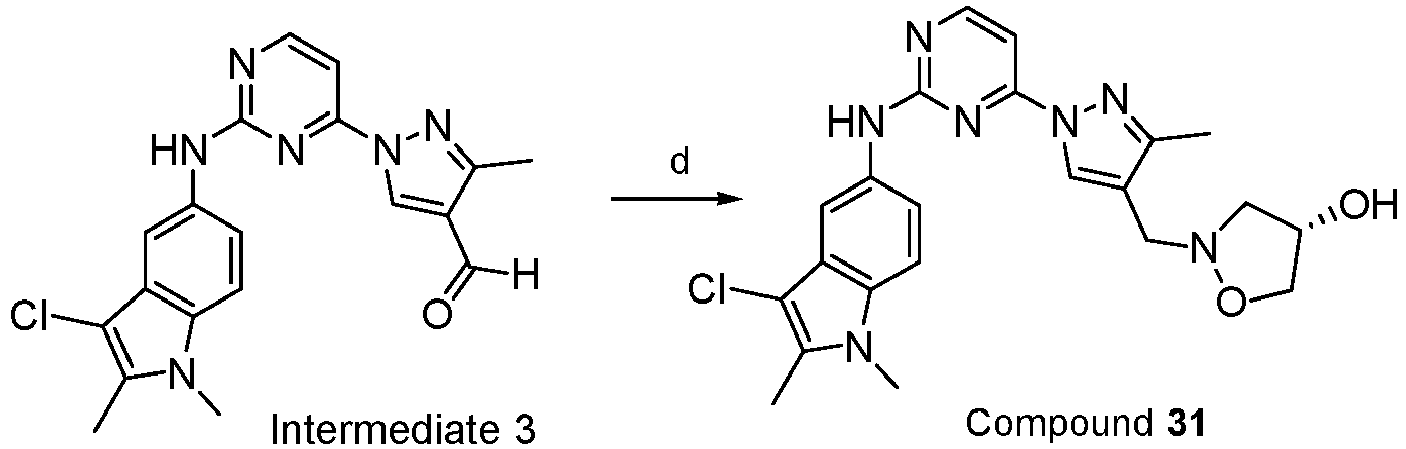
- To a slurry of Intermediate 3 (190 mg, 0.5 mmol), (S)-isoxazolidin-4-ol hydrochloride (95 mg, 0.75 mmol) and triethylamine (0.4 mL) in 10 mL of dichloromethane, was added NaBH(OAc)3 (0.32 g, 1.5 mmol) at room temperature. The reaction was stirred for 12 hour at room temperature and then quenched with 1N-NaOH. It was extracted with ethyl acetate and washed twice with brine. The collected organic layer was dried over anhydrous sodium sulfate and then concentrated in vacuo. The resulting residue was purified by silica gel chromatography (DCM/MeOH) to afford desired Compound No. 31 as a pale yellow solid (159 mg, 70 %); MS (ESI) m/z 454 [M+H]+. 1H NMR (300MHz, CDCl3) δ 8.43 (s, 1H), 8.34 (d, J = 5.4 Hz, 1H), 7.89 (s, 1H), 7.68 (s, 1H), 7.14-7.16 (m, 3H), 4.73 (brs, 1H), 4.23 (brs, 1H), 3.92-3.96 (m, 2H), 3.84 (brs, 1H), 3.63 (s, 3H), 3.25 (brs, 1H), 2.73 (brs, 1H), 2.40 (s, 3H), 2.36 (s, 3H
- The following compounds were prepared by a method similar to that described for preparations of Compound No. 1 (Method I), Compound No. 2 (Method 2) or Compound No. 31 (method 3) using the appropriate 2-amino substituted pyrimidinyl aldehyde and the appropriate amine with or without base by reductive amination.
-

-

-

-

-

-

-

-

-

-

-

-
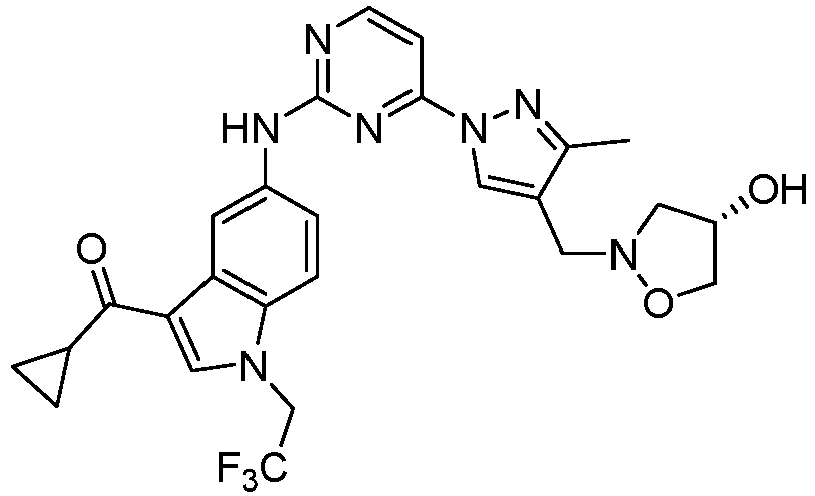
-

-

-

-

-

-

-

-

-
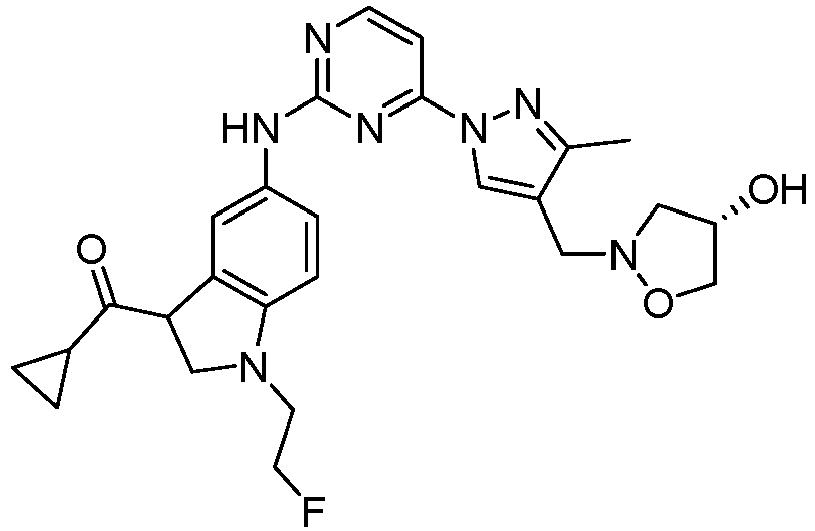
-

-

1H NMR (300MHz, DMSO-d6) δ 10.10 (s, 1H), 8.90 (s, 1H), 8.66 (s, 1H), 8.55 (d, J = 5.7Hz, 1H), 7.81 (d, J = 9.3Hz), 7.67 (d, J = 9.3Hz, 1H), 7.21 (d, J = 5.4Hz, 1H), 5.25 (brs, 1H), 4.64 (s, 1H), 4.18 (s, 3H), 4.17 (brs, 1H), 3.87 (m, 2H), 3.35 (s, 3H), 2.88 (s, 1H), 2.29 (s, 3H). -
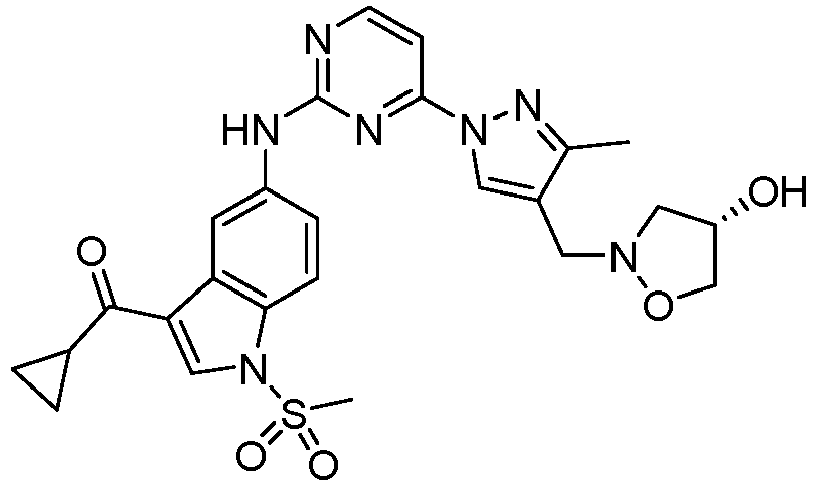
-

-
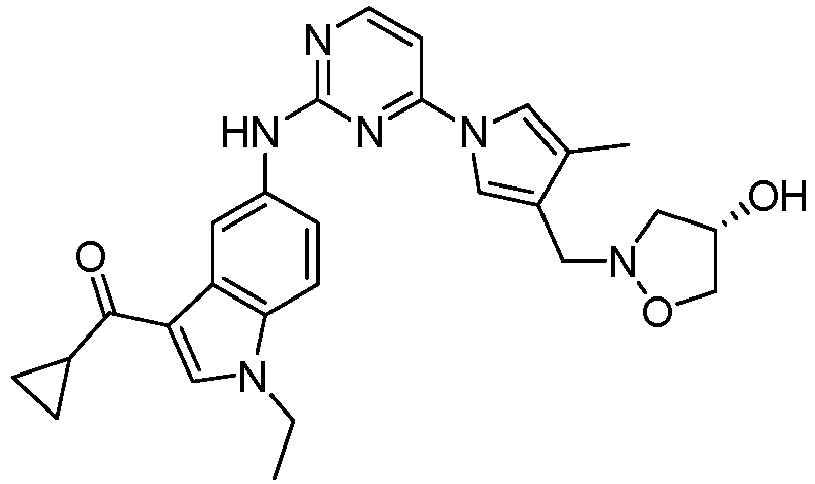
-

-

-

-

- Compounds of the present invention were assayed to measure their capacity to inhibit a spleen tyrosine kinase (SYK).
- Spleen tyrosine kinase (SYK) is a member of the SYK family of tyrosine kinases which are non-receptor cytoplasmic tyrosine kinases sharing a characteristic dual SH2 domain separated by a linker domain. SYK plays a role in transmitting signals from a variety of cell surface receptors including CD74, Fc Receptor, and integrins. Abnormal function of SYK has been implicated in instances of rheumatoid arthritis, systemic lupus erythematosus (SLE) and hematopoietic malignancies such as non-Hodgkin lymphoma including diffuse large B cell lymphoma. Several transforming viruses, such as Epstein Barr virus, bovine leukemia virus, and mouse mammary tumor virus, are known to contain "Immunoreceptor Tyrosine Activation Motifs" (ITAMs) that lead to activation of SYK.
- Compounds of the invention were initially diluted to 10 mM in 100 % DMSO (CALBIOCHEM™) for storage and made into kinase buffer solution to create a compound concentration ranging from 1uM and 10uM. Serial dilutions of compounds of the invention were dispensed into a 96-well plate (GREINER BIOSCIENCES™) at 6µL each. Purified full-length human SYK (CARNA BIOSCIENCES™) were diluted in kinase buffer and added to the compound solutions and pre-incubated for 30 minutes at room temperature. Next, ATP (TEKNOVA™) of Km (15 uM) and substrate solution (suggested manufacture substrates of PerkinElmer™, Ulight™-TK peptide for SYK) was added (12 uL each) to the wells containing the compound solution and enzyme. The reaction mixture was incubated for 1 hour. Following the incubation, the stop solution made with EDTA, water, and Lance detection buffer (PERKINELMER™) was added (12µL each) to stop phosphorylation. Following the addition of the stop solution and 5 minutes of shaking, the detection solution containing the Europium-labeled antibody (suggested manufacture substrates of PerkinElmer™, PT66 for SYK), water, and Lance detection buffer was added (12 µL each) to the reaction mixture and incubated again for 50 minutes. Substrate phosphorylation was a function of the 665 nm emission measured following the addition of the detection solution and 50 minutes of incubation.
- Compounds of Formula (I) exhibited useful pharmacological properties. As used herein, an way to describe potency of inhibitory activity (nM) is a value of inhibitory activity at 50 % (IC50). Reference compound, R406 (active form of R788, Rigel Pharmaceutical Inc.) was used for SYK to judge inhibitory activity of compounds of Formula (I).
- Table 2 illustrates the inhibition of SYK by the representative compounds of Formula (I).
Table 2. Inhibition Activity of SYK Compound Number IC50 (nM) Compound Number IC50 (nM) R406 23.62 18 159.4 1 6.15 19 271.2 2 8.63 20 66.23 3 2.82 21 230.1 4 9.42 22 79.32 5 45.56 23 3.71 6 4.69 24 3.10 7 8.28 25 5.85 8 7.37 26 87.1 9 13.33 27 5.89 10 24.43 28 106.1 11 6.28 29 69.5 12 13.53 30 2.46 13 17.3 31 26.71 14 41.72 32 3.52 15 2.98 33 5.34 16 14.21 34 5.80 17 131.7 - As shown in Table 2, reference compound, R406, is multi potent, suggesting there is no selectivity across kinase whereas compounds of the present invention show better potency and better selectivity than R406.
- In order to address cellular potency of Compounds of Formula (I), TNF-a production was measured on treatment of a series of concentration of SYK inhibitor in THP-1 cells. The experiment indicates how well SYK inhibitor potently inhibits its target SYK kinase in cell, leading to inhibition of inflammatory cytokines including TNFa causing various inflammatory diseases and other diseases.
- For SYK-dependent TNF-α release assay (i.e., via IgG stimulation), THP-1 cells derived from human monocytic cells were obtained from the American Type Culture Collection (ATCC, Manassas, VA). This cell line was maintained with a Roswell Park Memorial Institute (RPMI) medium (GIBCO) containing 10 % fetal bovine serum (FBS; GIBCO) and 0.05 mM solution of 2-mercaptoethanol. The THP-1 cells were seeded at 1x 10⁵ cells/100 µL/well into human IgG (10 ng/well, INVITROGEN)-coated 96 well culture plate, and serially diluted compound was then added. After an 18 hours of incubation period at 37 °C, supernatants were collected for the determination of the TNF-α level by enzyme-linked immunosorbent assay (ELISA), and the remaining cells were subjected to an MTT (yellow tetrazolium salt) assay to determine the cytotoxic effects of the compound. The IC50 value of the test compound was calculated at Gradpad Prism 5 unless otherwise specified.
- Compounds of Formula (I) exhibited useful pharmacological properties. As used herein, control used without the presence of an inhibitor indicates inhibition of TNF-α release in the IC50.
- Most of compounds of Formula (I) exhibited stronger inhibition than R406 control in a SYK dependent manner (e.g., IgG stimulation). The inhibition data (IC50 value) of the representative compounds of Formula (I) of the present invention is shown in Table 3.
Table 3. TNF-α release inhibition by inhibiting SYK dependent pathway with the representative compounds of Formula (I). Compound no. IgG stimulation (IC50, nM) Compound no. IgG stimulation (IC50, nM) R406 217 18 n.d 1 52 19 821 2 67 20 n.d 3 48 21 n.d 4 45 22 n.d 5 293 23 111 6 57 24 47 7 60 25 465 8 97 26 1065 9 229 27 43 10 n.d 28 n.d 11 89 29 70 12 120 30 17 13 273 31 197 14 789 32 53 15 66 33 60 16 226 34 55 17 n.d n.d.: not determined. IgG stimulation represents SYK-dependent pathway. - Systemic lupus erythematosus (SLE) is a chronic inflammatory autoimmune disease and can affect several organs and systems. It is characterized by high production of autoantibodies against nuclear compounds. TLR7/8/9 are responsible for nucleic acid recognition and they trigger proinflammatory responses through activation of NK-kappaB and Type I IFN production, making a bridge between the innate and the adaptative immune systems. TLR9 signaling pathway was adopted for cellular SLE model using human peripheral B cells to test potency of SYK inhibitor of Formula (I).
- Human peripheral CD19+ B cells from an adult healthy donor were purchased from Sanguine Biosciences (Sherman Oaks, CA). B cells were cultured in 96-well plates with complete RPMI 1640 medium (Corning, Tewksbury, MA) supplemented with 10% heat-inactivated FBS (Life Technologies, Grand Island, NY) and penicillin/streptomycin (Corning). B cells were stimulated with 1 µM ODN2006 (InvivoGen, San Diego, CA) and 20 ng/ml IFNα (PBL Assay Science, Piscataway, NJ) for 3 days for toll-like receptor-9 (TLR-9)-mediated B cell growth. To differentiate naïve B cells into plasma cells, peripheral B cells were differentiated with 50 nM ODN2006 and 10 ng/ml IL-2 in a presence of various concentrations of SYK inhibitors for 6 days. Culture supernatants were collected and IgM and IgG production was measured using human IgM or IgG ELISA kit (BioLegend).
- Compound No. 1 and 30 exhibited potent inhibition of IgG and IgM production via inhibition of TLR9 stimulated by ODN2006 and IFNα.. The inhibition data (IC50 value) of the Compound No.1 and 30 is shown in Table 4.
Table 4. Inhibition of immunoglobulin production in human B cell. Immunoglobulin (IC50, nM) Compound No. IgG IgM R406 369 180 1 296 232 30 188 90 - CIA mouse model was induced in DBA/1J mice (Japan Charles River Breeding Laboratories, Kanagawa, Japan) with 5 to 6 weeks of age. Animals were maintained at a temperature of 20±5 °C and a relative humidity of 40∼60 %.
- Bovine type II collagen (CII, 2 mg/ml dissolved in 0.05 M acetic acid, Chondrex, Redmond, WA) was emulsified in equal volumes of Freund's complete adjuvant (4 mg/ml of Mycobacterium tuberculosis strain H37Ra; Chondrex, Redmond, WA). On day 0, mice were immunized intradermally at the base of the tail with 100 µg bovine type II collagen emulsified in Freund's complete adjuvant. On day 21, all mice were boosted with an intraperitoneal injection of 100 µg type II collagen.
- Compounds 1, 6 and R788 (reference, R406 prodrug) were used for this experiment. These compounds were dissolved in NMP/20% cyclodextrin/PEG400 5:45:50 solution and filtered by 0.25 µM membrane filter. All the test substances were administered once daily at 30mg/kg/day by oral gavage for 3 weeks.
- The gradual onset of arthritis usually starts approximately 3 weeks after initial immunization. The progression of CIA was evaluated by the macroscopic scoring of paws at intervals of 3 days. The edema and swelling of each paw was scored visually as was described previously, using a scale of 0-4, where 0 = no visible abnormalities, 1 = mild redness or swelling of the wrist or up to three inflamed digits, 2 = more than three inflamed digits or moderate redness and swelling of the ankle or wrist, 3 = severe ankle and wrist inflammation, 4 = extensive ankle and wrist inflammation including all digits. Therefore, the score of each mouse was calculated for the four limbs (maximum total score of 16 for each mouse) (Courtenay JS, Dallman MJ, Dayan AD, et al., Immunisation against heterologous type II collagen induces arthritis in mice, Nature, 1980, 283, 666-668)
- Arthritis was considered to be present if the score was >2. The blind scoring was performed by four independent observers. In this study, data was calculated by following equation.

- Compounds of Formula (I) exhibited useful pharmacological properties. As used herein, control used without the presence of an inhibitor indicates CIA index.
- In certain embodiments, compounds of Formula (I) exhibited stronger inhibition than R788 control. Specifically, Compound No. 1 of the present invention exhibited stronger inhibition in arthritis phenotype indicated by CIA than those exhibited by R788.
Table 5. CIA index by the representative compounds of Formula (I) Days Vehicle Compound No. 1 Compound No. 6 R788 4 100.0 3.0±2.8 0.0±0.0 36.7±22.7 7 100.0 24.0±9.2 10.9±8.9 82.2±45.2 10 100.0 40.1±13.8 32.3±11.5 80.3±27.3 13 100.0 36.2±12.0 45.3±10.5 97.8±25.0 17 100.0 33.5±10.5 53.3±7.4 73.3±11.2 19 100.0 33.6±10.4 63.4±4.0 72.1±11.2 - While this invention has been particularly shown and described in example embodiments thereof, it will be understood by those skilled in the art that various changes in form and details may be made therein without departing from the scope of the invention encompassed by the appended claims.
- Several lines of evidence support the role of B cell receptor (BCR)-mediated survival signals in certain B cell malignancies such as non-Hodgkin lymphomas (NHL) including diffuse large B cell lymphoma (DLBCL). B cell receptor (BCR) signaling pathway components represent promising treatment targets in diffuse large B cell lymphoma (DLBCL) and additional B cell tumors. In order to address whether SYK inhibitor of Compounds of Formula (I), cellular viability of diffuse large B cell lymphoma (DLBCL) cells was measured on treatment of a series of concentration of SYK inhibitor. The experiment indicates whether SYK inhibitor inhibits proliferation of DLBCL cells.
- The DLBCL cells, SUDHL4, SUDHL6 and OCI-LY1 derived from human monocytic cells were obtained from the American Type Culture Collection (ATCC, Manassas, VA, USA) or DSMZ (Braunschweig, Germany). These cell lines were maintained with suggested protocol of supplier. The SUDHL4, SUDHL6 and OCI-LY1 cells were seeded at 1x 10⁵ cells/100 µL/well into 96 well culture plate, and serially diluted compound was then added. After an 72 hours of incubation period at 37 °C, cells were subjected to an ATPLite assay (PerkinElmer) to determine the cytotoxic effects of the compound. The IC50 value of the test compound was calculated at Gradpad Prism 5 unless otherwise specified.
- Compound No 1 and 30 exhibited potent inhibition of proliferation of SUDHL4, SUDHL6 and OCI-LY1. The inhibition data (IC50 value) of the representative compounds of Formula (I) of the present invention is shown in Table 6.
Table 6. Inhibition of proliferation of DLBCL cells Inhibition of proliferation (IC50, nM) Compound No. SUDHL4 SUDHL6 OCI-LY1 R406 3672 3232 3886 1 1067 2842 1833 30 952 929 2304
Claims (13)
- A compound of Formula (I):
 R1, R2, R3, R4, R5, R6a, R6b, X and Y are as described herein:X is CH or N;Y is C, or N;When Y is N, R2 is absent;R1 is selected from H, C1-C6alkyl, C3-C7cycloalkyl, C(O)OR7, or S(O)2R7, wherein C1-C6 alkyl, is optionally substituted with one or more halo, hydroxy, or OR7;R2 is selected from H, halo, or C1-C4alkyl, wherein the C1-C4alkyl is optionally substituted with one or more halo;R3 is selected from H, halo, C(O)R7, or S(O2)R7;R4 is selected from H, halo, C1-C6alkyl, or C3-C7cycloalkyl, wherein the C1-C6alkyl, or C3-C7cycloalkyl is optionally substituted with one or more halo, amino, hydroxy, alkoxy, or haloalkyl;R5 is selected from H, halo, C1-C6alkyl, and C3-C7cycloalkyl, wherein C1-C6alkyl or C3-C7cycloalkyl is optionally and independently substituted with one or more halo, alkoxy, or haloalkyl;R6a is selected from H, halo, hydroxy, CN, CH2OH, NH2, C1-C6alkyl, C3-C7cycloalkyl, OR7, NR7R7, NHR7, or NHC(O)R7;R6b is selected from H, CH2OH, CH2NH2, and C1-C6alkyl;R7 is independently selected from C1-C6 alkyl, C3-C7cycloalkyl, phenyl, or haloalkyl, wherein the C1-C6alkyl, C3-C7cycloalkyl, phenyl, or haloalkyl, is optionally and independently substituted with one or more substituents selected from phenyl, cycloalkyl, alkyl, halo, amino, and hydroxy;or a pharmaceutically acceptable salt thereof.
 - The compound of claim 1, wherein R1 is selected from H, methyl, ethyl, propyl, isopropyl, butyl, cyclopropyl, cyclobutyl, cyclopentyl, 2-hydroxyethyl, 2-methoxyethyl, 2,2,2-trifluoroethyl, 2-fluoroethyl, ethylcarboxyl, methylsulfonyl, or cyclopropylmethyl.
- The compound of claim 1, wherein R3 is selected from acetyl, propionyl, cyclopropyl carbonyl, fluoromethyl carbonyl, difluoromethyl carbonyl, trifluoromethyl carbonyl, methanesulfonyl, ethanesulfonyl, cyclopropanesulfonyl, benzenesulfonyl, or p-toluenesulfonyl.
- The compound of claim 1, wherein R4 is selected from H, F, Cl, Br, CH3, CF3, ethyl, or cyclopropyl.
- The compound of claim 1, wherein R5 is selected from H, Cl, Br, CH3, CF3, ethyl, isopropyl, or cyclopropyl.
- The compound of claim 1 selected from the group consisting of(S)-cyclopropyl(5-(4-(4-((4-hydroxyisoxazolidin-2-yl)methyl)-3-methyl-1H-pyrazol-1-yl)pyrimidin-2-ylamino)-1-methyl-1H-indol-3-yl)methanone;(S)-1-(5-(4-(4-((4-hydroxyisoxazolidin-2-yl)methyl)-3-methyl-1H-pyrazol-1-yl)pyrimidin-2-ylamino)-1-methyl-1H-indol-3-yl)-2-methylpropan-1-one;(S)-2,2,2-trifluoro-1-(5-(4-(4-((4-hydroxyisoxazolidin-2-yl)methyl)-3-methyl-1H-pyrazol-1-yl)pyrimidin-2-ylamino)-1-methyl-1H-indol-3-yl)ethanone;(S)-2,2-difluoro-1-(5-(4-(4-((4-hydroxyisoxazolidin-2-yl)methyl)-3-methyl-1H-pyrazol-1-yl)pyrimidin-2-ylamino)-1-methyl-1H-indol-3-yl)ethanone;(S)-ethyl 3-acetyl-5-(4-(4-((4-hydroxyisoxazolidin-2-yl)methyl)-3-methyl-1H-pyrazol-1-yl)pyrimidin-2-ylamino)-1H-indole-1-carboxylate;(S)-cyclopropyl(1-ethyl-5-(4-(4-((4-hydroxyisoxazolidin-2-yl)methyl)-3-methyl-1H-pyrazol-1-yl)pyrimidin-2-ylamino)-1H-indol-3-yl)methanone;(S)-2,2,2-trifluoro-1-(5-(4-(4-((4-hydroxyisoxazolidin-2-yl)methyl)-3-methyl-1H-pyrazol-1-yl)pyrimidin-2-ylamino)-1H-indol-3-yl)ethanone;(S)-cyclopropyl(5-(4-(4-((4-hydroxyisoxazolidin-2-yl)methyl)-3-methyl-1H-pyrazol-1-yl)pyrimidin-2-ylamino)-1-isopropyl-1H-indol-3-yl)methanone;(S)-1-(5-(4-(4-((4-hydroxyisoxazolidin-2-yl)methyl)-3-methyl-1H-pyrazol-1-yl)pyrimidin-2-ylamino)-1-methyl-1H-indol-3-yl)ethanone;(R)-2,2-difluoro-1-(5-(4-(4-((4-hydroxyisoxazolidin-2-yl)methyl)-3-methyl-1H-pyrazol-1-yl)pyrimidin-2-ylamino)-1-methyl-1H-indol-3-yl)ethanone;(R)-cyclopropyl(1-ethyl-5-(4-(4-((4-hydroxyisoxazolidin-2-yl)methyl)-3-methyl-1H-pyrazol-1-yl)pyrimidin-2-ylamino)-1H-indol-3-yl)methanone;(S)-cyclopropyl(5-(4-(4-((4-hydroxyisoxazolidin-2-yl)methyl)-3-methyl-1H-pyrazol-1-yl)pyrimidin-2-ylamino)-1H-indol-3-yl)methanone;cyclopropyl(1-ethyl-5-(4-(4-((4-hydroxy-4-methylisoxazolidin-2-yl)methyl)-3-methyl-1H-pyrazol-1-yl)pyrimidin-2-ylamino)-1H-indol-3-yl)methanone;cyclopropyl(5-(4-(4-((4-hydroxy-4-methylisoxazolidin-2-yl)methyl)-3-methyl-1H-pyrazol-1-yl)pyrimidin-2-ylamino)-1-methyl-1H-indol-3-yl)methanone;(S)-cyclopropyl(5-(4-(4-((4-hydroxyisoxazolidin-2-yl)methyl)-3-methyl-1H-pyrazol-1-yl)pyrimidin-2-ylamino)-1-(2,2,2-trifluoroethyl)-1H-indol-3-yl)methanone;cyclopropyl(5-(4-(4-((4-hydroxy-4-methylisoxazolidin-2-yl)methyl)-3-methyl-1H-pyrazol-1-yl)pyrimidin-2-ylamino)-1-(2,2,2-trifluoroethyl)-1H-indol-3-yl)methanone;(S)-1-(5-(5-chloro-4-(4-((4-hydroxyisoxazolidin-2-yl)methyl)-3-methyl-1H-pyrazol-1-yl)pyrimidin-2-ylamino)-1-methyl-1H-indol-3-yl)-2,2,2-trifluoroethanone;(S)-2,2,2-trifluoro-1-(5-(4-(4-((4-hydroxyisoxazolidin-2-yl)methyl)-3-methyl-1H-pyrazol-1-yl)-5-methylpyrimidin-2-ylamino)-1-methyl-1H-indol-3-yl)ethanone;(S)-cyclopropyl(5-(4-(4-((4-hydroxyisoxazolidin-2-yl)methyl)-3-methyl-1H-pyrazol-1-yl)-5-methylpyrimidin-2-ylamino)-1-methyl-1H-indol-3-yl)methanone;(S)-cyclopropyl(1-ethyl-5-(5-fluoro-4-(4-((4-hydroxyisoxazolidin-2-yl)methyl)-3-methyl-1H-pyrazol-1-yl)pyrimidin-2-ylamino)-1H-indol-3-yl)methanone;(S)-cyclopropyl(1-ethyl-5-(5-fluoro-4-(3-((4-hydroxyisoxazolidin-2-yl)methyl)-4-methyl-1H-pyrrol-1-yl)pyrimidin-2-ylamino)-1H-indol-3-yl)methanone;(S)-cyclopropyl(1-ethyl-5-(4-(4-((4-hydroxyisoxazolidin-2-yl)methyl)-3-methyl-1H-pyrazol-1-yl)-5-methylpyrimidin-2-ylamino)-1H-indol-3-yl)methanone;(S)-cyclopropyl(1-(2-fluoroethyl)-5-(4-(4-((4-hydroxyisoxazolidin-2-yl)methyl)-3-methyl-1H-pyrazol-1-yl)pyrimidin-2-ylamino)-1H-indol-3-yl)methanone;(S)-cyclopropyl(5-(4-(3-cyclopropyl-4-((4-hydroxyisoxazolidin-2-yl)methyl)-1H-pyrazol-1-yl)pyrimidin-2-ylamino)-1-ethyl-1H-indol-3-yl)methanone;(S)-2-((3-methyl-1-(2-(1-methyl-3-(methylsulfonyl)-1H-indazol-5-ylamino)pyrimidin-4-yl)-1H-pyrazol-4-yl)methyl)isoxazolidin-4-ol;(S)-cyclopropyl(5-(4-(4-((4-hydroxyisoxazolidin-2-yl)methyl)-3-methyl-1H-pyrazol-1-yl)pyrimidin-2-ylamino)-1-(methylsulfonyl)-1H-indol-3-yl)methanone;(S)-cyclopropyl(1-ethyl-5-(4-(3-((4-hydroxyisoxazolidin-2-yl)methyl)-4-methyl-1H-pyrrol-1-yl)pyrimidin-2-ylamino)-1H-indol-3-yl)methanone;(S)-cyclopropyl(5-(4-(4-((4-hydroxyisoxazolidin-2-yl)methyl)-1H-pyrazol-1-yl)pyrimidin-2-ylamino)-1-methyl-1H-indol-3-yl)methanone;(S)-cyclopropyl(1-(2-fluoroethyl)-5-(4-(4-((4-hydroxyisoxazolidin-2-yl)methyl)-1H-pyrazol-1-yl)pyrimidin-2-ylamino)-1H-indol-3-yl)methanone;(S)-cyclopropyl(1-(2,2-difluoroethyl)-5-(4-(4-((4-hydroxyisoxazolidin-2-yl)methyl)-1H-pyrazol-1-yl)pyrimidin-2-ylamino)-1H-indol-3-yl)methanone; and(S)-cyclopropyl(5-(4-(4-((4-hydroxyisoxazolidin-2-yl)methyl)-1H-pyrazol-1-yl)pyrimidin-2-ylamino)-1-(2,2,2-trifluoroethyl)-1H-indol-3-yl)methanone;or a pharmaceutically acceptable salt thereof.
- A pharmaceutical formulation comprising a compound of claim 1, in combination with a pharmaceutically acceptable carrier, diluent, or excipient.
- Use of a compound or pharmaceutically acceptable salt thereof as defined in claim 1 for preparing a medicament for the treatment of diseases which can be treated by inhibition of the SYK enzyme.
- A compound or pharmaceutically acceptable salt thereof of claim 1, for use in the treatment of an autoimmune condition, the inflammatory diseases and/or allergic disorders.
- The compound or pharmaceutically acceptable salt thereof of claim 1, for the use of claim 9, wherein the autoimmune condition, the inflammatory diseases and/or allergic disorders are selected from systemic lupus erythematosus (SLE), discoid (cutaneous) lupus, Sjorgens syndrome, Wegners graulomatosis and other vasculitides, idiopathic thrombocytopenic purpura, giant cell arteriosis, glomerulonephritis, chronic transplant rejection, chronic obstructive pulmonary disease, adult respiratory distress syndrome, asthma, severe asthma, ulcerative colitis, Crohn's disease, bronchitis, conjunctivitis, psoriasis, scleroderma, (contact and allergic) dermatitis, allergy, (allergic) rhinitis, allergic rhinoconjunctivitis, autoimmune bullous conditions including pemphigus and pemphigoid, mastocytosis, anaphylaxis, chronic (spontaneous) urticaria, Berger's disease, Evans's syndrome, granulocytopenia, Goodpasture's syndrome, hepatitis, Henoch-Schonlein purpura, multiple sclerosis, immunohaemolytic anaemia, autoimmune haemolytic anemia, Kawasaki syndrome.
- A compound or pharmaceutically acceptable salt thereof of claim 1, for the use of claim 10 in the treatment of rheumatoid arthritis and osteoporosis, osteolytic diseases and osteopenia.
- A compound or pharmaceutically acceptable salt thereof of claim 1, for use in the treatment of heme malignancies.
- A compound or pharmaceutically acceptable salt thereof of claim 1, for the use of claim 12, wherein the heme malignancies is Non-Hodgkin's Lymphomas including follicular (FL), mantle cell, capsule cell lymphoma, neutropenia, small lymphocytic lymphoma, chronic lymphocytic lymphoma, Burkitt and diffuse large B cell lymphomas and T-cell lymphoma.
Priority Applications (1)
| Application Number | Priority Date | Filing Date | Title |
|---|---|---|---|
| PL14856054T PL3060562T3 (en) | 2013-10-21 | 2014-10-21 | Substituted pyrimidine compounds and their use as syk inhibitors |
Applications Claiming Priority (2)
| Application Number | Priority Date | Filing Date | Title |
|---|---|---|---|
| US201361893866P | 2013-10-21 | 2013-10-21 | |
| PCT/US2014/061649 WO2015061369A1 (en) | 2013-10-21 | 2014-10-21 | Substituted pyrimidine compounds and their use as syk inhibitors |
Publications (3)
| Publication Number | Publication Date |
|---|---|
| EP3060562A1 EP3060562A1 (en) | 2016-08-31 |
| EP3060562A4 EP3060562A4 (en) | 2017-06-14 |
| EP3060562B1 true EP3060562B1 (en) | 2021-07-28 |
Family
ID=52826699
Family Applications (1)
| Application Number | Title | Priority Date | Filing Date |
|---|---|---|---|
| EP14856054.3A Active EP3060562B1 (en) | 2013-10-21 | 2014-10-21 | Substituted pyrimidine compounds and their use as syk inhibitors |
Country Status (20)
| Country | Link |
|---|---|
| US (1) | US9212178B2 (en) |
| EP (1) | EP3060562B1 (en) |
| JP (1) | JP6434506B2 (en) |
| KR (1) | KR102228034B1 (en) |
| CN (1) | CN105940000B (en) |
| AU (1) | AU2014340249B2 (en) |
| CL (1) | CL2016000939A1 (en) |
| EA (1) | EA030962B1 (en) |
| ES (1) | ES2890552T3 (en) |
| HU (1) | HUE056048T2 (en) |
| IL (1) | IL244817B (en) |
| MX (1) | MX376059B (en) |
| MY (1) | MY184561A (en) |
| NZ (1) | NZ718576A (en) |
| PH (1) | PH12016500735B1 (en) |
| PL (1) | PL3060562T3 (en) |
| PT (1) | PT3060562T (en) |
| SA (1) | SA516370989B1 (en) |
| SG (1) | SG11201602566XA (en) |
| WO (1) | WO2015061369A1 (en) |
Families Citing this family (8)
| Publication number | Priority date | Publication date | Assignee | Title |
|---|---|---|---|---|
| CA3129665A1 (en) | 2019-03-21 | 2020-09-24 | Onxeo | A dbait molecule in combination with kinase inhibitor for the treatment of cancer |
| KR20220098759A (en) | 2019-11-08 | 2022-07-12 | 인쎄름 (엥스띠뛰 나씨오날 드 라 쌍떼 에 드 라 흐쉐르슈 메디깔) | A method of treating cancer that has acquired resistance to a kinase inhibitor |
| WO2021148581A1 (en) | 2020-01-22 | 2021-07-29 | Onxeo | Novel dbait molecule and its use |
| CN113248472B (en) * | 2020-02-12 | 2022-06-28 | 中国药科大学 | Anti-osteoporosis compounds and derivatives thereof, pharmaceutical compositions, preparation methods and applications |
| KR20210152312A (en) * | 2020-06-08 | 2021-12-15 | 주식회사 종근당 | 4-(4,5-dihydro-1h-pyrazol-1-yl)pyrimidine compound as cannabinoid receptor (cb1 receptor) antagonists and pharmaceutical composition including the same |
| US20240285621A1 (en) * | 2020-09-23 | 2024-08-29 | Nerviano Medical Sciences S.R.L. | Pyrazolyl-pyrimidine derivatives as kinase inhibitors |
| CN121443596A (en) * | 2023-04-24 | 2026-01-30 | 深圳市原力生命科学有限公司 | CDK2 inhibitors and their usage |
| WO2026148272A1 (en) | 2025-01-06 | 2026-07-09 | Oscotec Inc. | Crystalline forms of spleen tyrosine kinase inhibitor ski-o-703 |
Family Cites Families (17)
| Publication number | Priority date | Publication date | Assignee | Title |
|---|---|---|---|---|
| US20030158195A1 (en) | 2001-12-21 | 2003-08-21 | Cywin Charles L. | 1,6 naphthyridines useful as inhibitors of SYK kinase |
| US20070020253A1 (en) | 2002-10-16 | 2007-01-25 | David Williams | Spleen tyrosine kinase catalytic domain:crystal structure and binding pockets thereof |
| SE0300120D0 (en) * | 2003-01-17 | 2003-01-17 | Astrazeneca Ab | Novel compounds |
| US7393854B2 (en) * | 2003-01-17 | 2008-07-01 | Astrazeneca Ab | Thienopyrimidinedinones and their use in modulation of autoimmune disease |
| SE0300119D0 (en) * | 2003-01-17 | 2003-01-17 | Astrazeneca Ab | Novel compounds |
| JP2009511527A (en) | 2005-10-13 | 2009-03-19 | グラクソ グループ リミテッド | Pyrrolopyrimidine derivatives as Syk inhibitors |
| WO2009032703A1 (en) * | 2007-08-28 | 2009-03-12 | Irm Llc | 2- (het) arylamino-6-aminopyridine derivatives and fused forms thereof as anaplastic lymphoma kinase inhibitors |
| JP2011529932A (en) | 2008-08-05 | 2011-12-15 | ベーリンガー インゲルハイム インターナショナル ゲゼルシャフト ミット ベシュレンクテル ハフツング | Substituted naphthyridine and its use as a medicament |
| US8604049B2 (en) | 2008-08-05 | 2013-12-10 | Boehringer Ingelheim International Gmbh | 4-dimethylamino-phenyl-substituted naphthyridines, and use thereof as medicaments |
| CA2780892C (en) * | 2009-11-13 | 2017-02-14 | Genosco | Kinase inhibitors |
| CA2786245A1 (en) | 2010-01-29 | 2011-08-04 | Boehringer Ingelheim International Gmbh | Substituted naphthyridines and their use as syk kinase inhibitors |
| GB201007203D0 (en) | 2010-04-29 | 2010-06-16 | Glaxo Group Ltd | Novel compounds |
| EP2571880A1 (en) | 2010-05-20 | 2013-03-27 | F.Hoffmann-La Roche Ag | Pyrrolo [2, 3 - b]pyrazine - 7 - carboxamide derivatives and their use as jak and syk inhibitors |
| WO2011156698A2 (en) * | 2010-06-11 | 2011-12-15 | Abbott Laboratories | NOVEL PYRAZOLO[3,4-d]PYRIMIDINE COMPOUNDS |
| UY34484A (en) * | 2011-12-15 | 2013-07-31 | Bayer Ip Gmbh | BENZOTIENILO-PIRROLOTRIAZINAS DISUSTITUIDAS AND ITS USES |
| CA2863517C (en) * | 2012-01-20 | 2019-11-05 | Genosco | Substituted pyrimidine compounds and their use as syk inhibitors |
| WO2013142382A1 (en) * | 2012-03-22 | 2013-09-26 | Genosco | Substituted pyridopyrimidine compounds and their use as flt3 inhibitors |
-
2014
- 2014-10-21 SG SG11201602566XA patent/SG11201602566XA/en unknown
- 2014-10-21 EP EP14856054.3A patent/EP3060562B1/en active Active
- 2014-10-21 MY MYPI2016701436A patent/MY184561A/en unknown
- 2014-10-21 WO PCT/US2014/061649 patent/WO2015061369A1/en not_active Ceased
- 2014-10-21 HU HUE14856054A patent/HUE056048T2/en unknown
- 2014-10-21 PH PH1/2016/500735A patent/PH12016500735B1/en unknown
- 2014-10-21 EA EA201690818A patent/EA030962B1/en not_active IP Right Cessation
- 2014-10-21 US US14/520,279 patent/US9212178B2/en active Active
- 2014-10-21 CN CN201480065838.7A patent/CN105940000B/en active Active
- 2014-10-21 MX MX2016004841A patent/MX376059B/en active IP Right Grant
- 2014-10-21 PL PL14856054T patent/PL3060562T3/en unknown
- 2014-10-21 NZ NZ71857614A patent/NZ718576A/en unknown
- 2014-10-21 AU AU2014340249A patent/AU2014340249B2/en active Active
- 2014-10-21 PT PT148560543T patent/PT3060562T/en unknown
- 2014-10-21 JP JP2016525001A patent/JP6434506B2/en active Active
- 2014-10-21 KR KR1020167013308A patent/KR102228034B1/en active Active
- 2014-10-21 ES ES14856054T patent/ES2890552T3/en active Active
-
2016
- 2016-03-29 IL IL244817A patent/IL244817B/en active IP Right Grant
- 2016-04-20 SA SA516370989A patent/SA516370989B1/en unknown
- 2016-04-20 CL CL2016000939A patent/CL2016000939A1/en unknown
Non-Patent Citations (1)
| Title |
|---|
| CRAIG JAMIESON ET AL: "Medicinal Chemistry of hERG Optimizations: Highlights and Hang-Ups", JOURNAL OF MEDICINAL CHEMISTRY, AMERICAN CHEMICAL SOCIETY, US, vol. 49, no. 17, 24 August 2006 (2006-08-24), pages 5029 - 5046, XP007913541, ISSN: 0022-2623, [retrieved on 20060727], DOI: 10.1021/JM060379 * |
Also Published As
| Publication number | Publication date |
|---|---|
| SG11201602566XA (en) | 2016-05-30 |
| IL244817A0 (en) | 2016-05-31 |
| IL244817B (en) | 2019-07-31 |
| SA516370989B1 (en) | 2018-04-05 |
| MX2016004841A (en) | 2016-07-26 |
| US20150111883A1 (en) | 2015-04-23 |
| US9212178B2 (en) | 2015-12-15 |
| WO2015061369A1 (en) | 2015-04-30 |
| EP3060562A1 (en) | 2016-08-31 |
| NZ718576A (en) | 2019-11-29 |
| MX376059B (en) | 2025-03-07 |
| MY184561A (en) | 2021-04-03 |
| JP6434506B2 (en) | 2018-12-05 |
| CL2016000939A1 (en) | 2016-11-11 |
| PL3060562T3 (en) | 2022-01-10 |
| JP2016534054A (en) | 2016-11-04 |
| HUE056048T2 (en) | 2022-01-28 |
| CN105940000A (en) | 2016-09-14 |
| EA201690818A1 (en) | 2016-08-31 |
| KR102228034B1 (en) | 2021-03-16 |
| PH12016500735A1 (en) | 2016-05-30 |
| EA030962B1 (en) | 2018-10-31 |
| AU2014340249A1 (en) | 2016-04-28 |
| AU2014340249B2 (en) | 2017-05-25 |
| HK1226395A1 (en) | 2017-09-29 |
| PT3060562T (en) | 2021-09-02 |
| KR20160068967A (en) | 2016-06-15 |
| CN105940000B (en) | 2019-12-24 |
| PH12016500735B1 (en) | 2022-04-29 |
| BR112016008060A8 (en) | 2020-03-17 |
| EP3060562A4 (en) | 2017-06-14 |
| ES2890552T3 (en) | 2022-01-20 |
Similar Documents
| Publication | Publication Date | Title |
|---|---|---|
| EP2804861B1 (en) | Substituted pyrimidine compounds and their use as syk inhibitors | |
| US9212178B2 (en) | Substituted pyrimidine compounds and their use as SYK inhibitors | |
| US12398141B2 (en) | JAK kinase inhibitor, preparation method for same, and applications thereof in field of medicine | |
| US20230107277A1 (en) | Substituted pyridazine compound | |
| US11161854B2 (en) | Indazolyl-spiro[2.2]pentane-carbonitrile derivatives as LRRK2 inhibitors, pharmaceutical compositions, and uses thereof | |
| EA018484B1 (en) | Compounds and compositions as kinase inhibitors | |
| US11414395B2 (en) | Heterocyclic compounds as modulators of mGluR7 | |
| KR20250164854A (en) | Substituted indazole propionic acid derivative compounds and their use as AMPK activators | |
| TW201713629A (en) | A novel benzimidazole compound and the medical use thereof | |
| US8247404B2 (en) | Derivatives of 2-oxoalkyl-1-piperazin-2-one, preparation method thereof and therapeutic use of same | |
| HK1226395B (en) | Substituted pyrimidine compounds and their use as syk inhibitors | |
| CN109912514B (en) | (2-heteroarylaminophenyl) nitrogen heterocyclic derivative and application thereof | |
| BR112016008060B1 (en) | COMPOUND, PHARMACEUTICAL FORMULATION, PROCESS FOR PREPARING A COMPOUND OF FORMULA (I), METHOD FOR PREPARING A COMPOUND, USE OF THE COMPOUND OR PHARMACEUTICALLY ACCEPTABLE SALT THEREOF | |
| HK1205106B (en) | Substituted pyrimidine compounds and their use as syk inhibitors |
Legal Events
| Date | Code | Title | Description |
|---|---|---|---|
| PUAI | Public reference made under article 153(3) epc to a published international application that has entered the european phase |
Free format text: ORIGINAL CODE: 0009012 |
|
| 17P | Request for examination filed |
Effective date: 20160413 |
|
| AK | Designated contracting states |
Kind code of ref document: A1 Designated state(s): AL AT BE BG CH CY CZ DE DK EE ES FI FR GB GR HR HU IE IS IT LI LT LU LV MC MK MT NL NO PL PT RO RS SE SI SK SM TR |
|
| AX | Request for extension of the european patent |
Extension state: BA ME |
|
| RIN1 | Information on inventor provided before grant (corrected) |
Inventor name: PARK, SUNG-HO Inventor name: CHOI, JANG-SIK Inventor name: HWANG, HAE-JUN Inventor name: JUNG, DONG-SIK Inventor name: LEE, JAEKYOO Inventor name: LEE, JAESANG Inventor name: KIM, JUNG-HO Inventor name: LEE, IN, YONG Inventor name: KIM, SE-WON Inventor name: CHOI, YUNG-GEUN Inventor name: LEE, TAE-IM Inventor name: SUH, BYUNG-CHUL Inventor name: SONG, HO-JUHN Inventor name: KOH, JONG, SUNG Inventor name: SALGAONKAR, PARESH DEVIDAS |
|
| DAX | Request for extension of the european patent (deleted) | ||
| A4 | Supplementary search report drawn up and despatched |
Effective date: 20170515 |
|
| RIC1 | Information provided on ipc code assigned before grant |
Ipc: A61K 31/506 20060101ALI20170509BHEP Ipc: A61P 35/00 20060101ALI20170509BHEP Ipc: C07D 413/14 20060101AFI20170509BHEP Ipc: C07D 413/04 20060101ALI20170509BHEP Ipc: A61K 31/505 20060101ALI20170509BHEP |
|
| REG | Reference to a national code |
Ref country code: HK Ref legal event code: DE Ref document number: 1226395 Country of ref document: HK |
|
| STAA | Information on the status of an ep patent application or granted ep patent |
Free format text: STATUS: EXAMINATION IS IN PROGRESS |
|
| 17Q | First examination report despatched |
Effective date: 20181220 |
|
| GRAP | Despatch of communication of intention to grant a patent |
Free format text: ORIGINAL CODE: EPIDOSNIGR1 |
|
| STAA | Information on the status of an ep patent application or granted ep patent |
Free format text: STATUS: GRANT OF PATENT IS INTENDED |
|
| INTG | Intention to grant announced |
Effective date: 20210326 |
|
| INTG | Intention to grant announced |
Effective date: 20210331 |
|
| GRAS | Grant fee paid |
Free format text: ORIGINAL CODE: EPIDOSNIGR3 |
|
| GRAA | (expected) grant |
Free format text: ORIGINAL CODE: 0009210 |
|
| STAA | Information on the status of an ep patent application or granted ep patent |
Free format text: STATUS: THE PATENT HAS BEEN GRANTED |
|
| AK | Designated contracting states |
Kind code of ref document: B1 Designated state(s): AL AT BE BG CH CY CZ DE DK EE ES FI FR GB GR HR HU IE IS IT LI LT LU LV MC MK MT NL NO PL PT RO RS SE SI SK SM TR |
|
| REG | Reference to a national code |
Ref country code: GB Ref legal event code: FG4D |
|
| REG | Reference to a national code |
Ref country code: CH Ref legal event code: EP |
|
| REG | Reference to a national code |
Ref country code: DE Ref legal event code: R096 Ref document number: 602014079106 Country of ref document: DE |
|
| REG | Reference to a national code |
Ref country code: AT Ref legal event code: REF Ref document number: 1414652 Country of ref document: AT Kind code of ref document: T Effective date: 20210815 |
|
| REG | Reference to a national code |
Ref country code: IE Ref legal event code: FG4D |
|
| REG | Reference to a national code |
Ref country code: PT Ref legal event code: SC4A Ref document number: 3060562 Country of ref document: PT Date of ref document: 20210902 Kind code of ref document: T Free format text: AVAILABILITY OF NATIONAL TRANSLATION Effective date: 20210827 |
|
| REG | Reference to a national code |
Ref country code: RO Ref legal event code: EPE |
|
| REG | Reference to a national code |
Ref country code: FI Ref legal event code: FGE |
|
| REG | Reference to a national code |
Ref country code: NL Ref legal event code: FP |
|
| REG | Reference to a national code |
Ref country code: LT Ref legal event code: MG9D |
|
| REG | Reference to a national code |
Ref country code: SE Ref legal event code: TRGR |
|
| REG | Reference to a national code |
Ref country code: GR Ref legal event code: EP Ref document number: 20210402595 Country of ref document: GR Effective date: 20211111 |
|
| REG | Reference to a national code |
Ref country code: ES Ref legal event code: FG2A Ref document number: 2890552 Country of ref document: ES Kind code of ref document: T3 Effective date: 20220120 |
|
| REG | Reference to a national code |
Ref country code: HU Ref legal event code: AG4A Ref document number: E056048 Country of ref document: HU |
|
| PG25 | Lapsed in a contracting state [announced via postgrant information from national office to epo] |
Ref country code: HR Free format text: LAPSE BECAUSE OF FAILURE TO SUBMIT A TRANSLATION OF THE DESCRIPTION OR TO PAY THE FEE WITHIN THE PRESCRIBED TIME-LIMIT Effective date: 20210728 Ref country code: RS Free format text: LAPSE BECAUSE OF FAILURE TO SUBMIT A TRANSLATION OF THE DESCRIPTION OR TO PAY THE FEE WITHIN THE PRESCRIBED TIME-LIMIT Effective date: 20210728 Ref country code: LT Free format text: LAPSE BECAUSE OF FAILURE TO SUBMIT A TRANSLATION OF THE DESCRIPTION OR TO PAY THE FEE WITHIN THE PRESCRIBED TIME-LIMIT Effective date: 20210728 Ref country code: BG Free format text: LAPSE BECAUSE OF FAILURE TO SUBMIT A TRANSLATION OF THE DESCRIPTION OR TO PAY THE FEE WITHIN THE PRESCRIBED TIME-LIMIT Effective date: 20211028 Ref country code: NO Free format text: LAPSE BECAUSE OF FAILURE TO SUBMIT A TRANSLATION OF THE DESCRIPTION OR TO PAY THE FEE WITHIN THE PRESCRIBED TIME-LIMIT Effective date: 20211028 |
|
| REG | Reference to a national code |
Ref country code: AT Ref legal event code: UEP Ref document number: 1414652 Country of ref document: AT Kind code of ref document: T Effective date: 20210728 |
|
| PG25 | Lapsed in a contracting state [announced via postgrant information from national office to epo] |
Ref country code: LV Free format text: LAPSE BECAUSE OF FAILURE TO SUBMIT A TRANSLATION OF THE DESCRIPTION OR TO PAY THE FEE WITHIN THE PRESCRIBED TIME-LIMIT Effective date: 20210728 |
|
| PG25 | Lapsed in a contracting state [announced via postgrant information from national office to epo] |
Ref country code: DK Free format text: LAPSE BECAUSE OF FAILURE TO SUBMIT A TRANSLATION OF THE DESCRIPTION OR TO PAY THE FEE WITHIN THE PRESCRIBED TIME-LIMIT Effective date: 20210728 |
|
| REG | Reference to a national code |
Ref country code: DE Ref legal event code: R097 Ref document number: 602014079106 Country of ref document: DE |
|
| PG25 | Lapsed in a contracting state [announced via postgrant information from national office to epo] |
Ref country code: SM Free format text: LAPSE BECAUSE OF FAILURE TO SUBMIT A TRANSLATION OF THE DESCRIPTION OR TO PAY THE FEE WITHIN THE PRESCRIBED TIME-LIMIT Effective date: 20210728 Ref country code: SK Free format text: LAPSE BECAUSE OF FAILURE TO SUBMIT A TRANSLATION OF THE DESCRIPTION OR TO PAY THE FEE WITHIN THE PRESCRIBED TIME-LIMIT Effective date: 20210728 Ref country code: EE Free format text: LAPSE BECAUSE OF FAILURE TO SUBMIT A TRANSLATION OF THE DESCRIPTION OR TO PAY THE FEE WITHIN THE PRESCRIBED TIME-LIMIT Effective date: 20210728 Ref country code: CZ Free format text: LAPSE BECAUSE OF FAILURE TO SUBMIT A TRANSLATION OF THE DESCRIPTION OR TO PAY THE FEE WITHIN THE PRESCRIBED TIME-LIMIT Effective date: 20210728 Ref country code: AL Free format text: LAPSE BECAUSE OF FAILURE TO SUBMIT A TRANSLATION OF THE DESCRIPTION OR TO PAY THE FEE WITHIN THE PRESCRIBED TIME-LIMIT Effective date: 20210728 |
|
| PLBE | No opposition filed within time limit |
Free format text: ORIGINAL CODE: 0009261 |
|
| STAA | Information on the status of an ep patent application or granted ep patent |
Free format text: STATUS: NO OPPOSITION FILED WITHIN TIME LIMIT |
|
| PG25 | Lapsed in a contracting state [announced via postgrant information from national office to epo] |
Ref country code: MC Free format text: LAPSE BECAUSE OF FAILURE TO SUBMIT A TRANSLATION OF THE DESCRIPTION OR TO PAY THE FEE WITHIN THE PRESCRIBED TIME-LIMIT Effective date: 20210728 |
|
| 26N | No opposition filed |
Effective date: 20220429 |
|
| PG25 | Lapsed in a contracting state [announced via postgrant information from national office to epo] |
Ref country code: LU Free format text: LAPSE BECAUSE OF NON-PAYMENT OF DUE FEES Effective date: 20211021 |
|
| PG25 | Lapsed in a contracting state [announced via postgrant information from national office to epo] |
Ref country code: IE Free format text: LAPSE BECAUSE OF NON-PAYMENT OF DUE FEES Effective date: 20211021 |
|
| PG25 | Lapsed in a contracting state [announced via postgrant information from national office to epo] |
Ref country code: CY Free format text: LAPSE BECAUSE OF FAILURE TO SUBMIT A TRANSLATION OF THE DESCRIPTION OR TO PAY THE FEE WITHIN THE PRESCRIBED TIME-LIMIT Effective date: 20210728 |
|
| PG25 | Lapsed in a contracting state [announced via postgrant information from national office to epo] |
Ref country code: MK Free format text: LAPSE BECAUSE OF FAILURE TO SUBMIT A TRANSLATION OF THE DESCRIPTION OR TO PAY THE FEE WITHIN THE PRESCRIBED TIME-LIMIT Effective date: 20210728 |
|
| REG | Reference to a national code |
Ref country code: DE Ref legal event code: R082 Ref document number: 602014079106 Country of ref document: DE |
|
| PG25 | Lapsed in a contracting state [announced via postgrant information from national office to epo] |
Ref country code: MT Free format text: LAPSE BECAUSE OF FAILURE TO SUBMIT A TRANSLATION OF THE DESCRIPTION OR TO PAY THE FEE WITHIN THE PRESCRIBED TIME-LIMIT Effective date: 20210728 |
|
| REG | Reference to a national code |
Ref country code: CH Ref legal event code: U11 Free format text: ST27 STATUS EVENT CODE: U-0-0-U10-U11 (AS PROVIDED BY THE NATIONAL OFFICE) Effective date: 20251101 |
|
| PGFP | Annual fee paid to national office [announced via postgrant information from national office to epo] |
Ref country code: NL Payment date: 20251023 Year of fee payment: 12 |
|
| PGFP | Annual fee paid to national office [announced via postgrant information from national office to epo] |
Ref country code: PT Payment date: 20251014 Year of fee payment: 12 |
|
| PGFP | Annual fee paid to national office [announced via postgrant information from national office to epo] |
Ref country code: HU Payment date: 20251118 Year of fee payment: 12 |
|
| PGFP | Annual fee paid to national office [announced via postgrant information from national office to epo] |
Ref country code: GB Payment date: 20251029 Year of fee payment: 12 |
|
| PGFP | Annual fee paid to national office [announced via postgrant information from national office to epo] |
Ref country code: AT Payment date: 20251024 Year of fee payment: 12 |
|
| PGFP | Annual fee paid to national office [announced via postgrant information from national office to epo] |
Ref country code: FI Payment date: 20251022 Year of fee payment: 12 Ref country code: IT Payment date: 20251022 Year of fee payment: 12 |
|
| PGFP | Annual fee paid to national office [announced via postgrant information from national office to epo] |
Ref country code: FR Payment date: 20251024 Year of fee payment: 12 |
|
| PGFP | Annual fee paid to national office [announced via postgrant information from national office to epo] |
Ref country code: BE Payment date: 20251022 Year of fee payment: 12 Ref country code: TR Payment date: 20251016 Year of fee payment: 12 Ref country code: GR Payment date: 20251024 Year of fee payment: 12 |
|
| PGFP | Annual fee paid to national office [announced via postgrant information from national office to epo] |
Ref country code: CH Payment date: 20251101 Year of fee payment: 12 Ref country code: SE Payment date: 20251022 Year of fee payment: 12 |
|
| PGFP | Annual fee paid to national office [announced via postgrant information from national office to epo] |
Ref country code: PL Payment date: 20251014 Year of fee payment: 12 |
|
| PGFP | Annual fee paid to national office [announced via postgrant information from national office to epo] |
Ref country code: RO Payment date: 20251020 Year of fee payment: 12 |
|
| PGFP | Annual fee paid to national office [announced via postgrant information from national office to epo] |
Ref country code: ES Payment date: 20251114 Year of fee payment: 12 |
|
| PGFP | Annual fee paid to national office [announced via postgrant information from national office to epo] |
Ref country code: DE Payment date: 20251222 Year of fee payment: 12 |