EP3059230A1 - Method for the epoxidation of propene with hydrogen peroxide - Google Patents
Method for the epoxidation of propene with hydrogen peroxide Download PDFInfo
- Publication number
- EP3059230A1 EP3059230A1 EP15155418.5A EP15155418A EP3059230A1 EP 3059230 A1 EP3059230 A1 EP 3059230A1 EP 15155418 A EP15155418 A EP 15155418A EP 3059230 A1 EP3059230 A1 EP 3059230A1
- Authority
- EP
- European Patent Office
- Prior art keywords
- propene
- liquid
- loop reactor
- phase
- reaction mixture
- Prior art date
- Legal status (The legal status is an assumption and is not a legal conclusion. Google has not performed a legal analysis and makes no representation as to the accuracy of the status listed.)
- Withdrawn
Links
- QQONPFPTGQHPMA-UHFFFAOYSA-N Propene Chemical compound CC=C QQONPFPTGQHPMA-UHFFFAOYSA-N 0.000 title claims abstract description 138
- MHAJPDPJQMAIIY-UHFFFAOYSA-N Hydrogen peroxide Chemical compound OO MHAJPDPJQMAIIY-UHFFFAOYSA-N 0.000 title claims abstract description 72
- 238000006735 epoxidation reaction Methods 0.000 title claims abstract description 49
- 238000000034 method Methods 0.000 title claims abstract description 25
- 239000011541 reaction mixture Substances 0.000 claims abstract description 48
- 239000008346 aqueous phase Substances 0.000 claims abstract description 42
- 239000003054 catalyst Substances 0.000 claims abstract description 39
- 239000007791 liquid phase Substances 0.000 claims abstract description 33
- GOOHAUXETOMSMM-UHFFFAOYSA-N Propylene oxide Chemical compound CC1CO1 GOOHAUXETOMSMM-UHFFFAOYSA-N 0.000 claims abstract description 24
- 238000000622 liquid--liquid extraction Methods 0.000 claims abstract description 22
- 238000000638 solvent extraction Methods 0.000 claims abstract description 22
- 238000002156 mixing Methods 0.000 claims abstract description 10
- 238000000605 extraction Methods 0.000 claims description 27
- 239000011572 manganese Substances 0.000 claims description 27
- PWHULOQIROXLJO-UHFFFAOYSA-N Manganese Chemical compound [Mn] PWHULOQIROXLJO-UHFFFAOYSA-N 0.000 claims description 26
- 229910052748 manganese Inorganic materials 0.000 claims description 26
- 238000006243 chemical reaction Methods 0.000 claims description 20
- 239000012074 organic phase Substances 0.000 claims description 16
- XLYOFNOQVPJJNP-UHFFFAOYSA-N water Substances O XLYOFNOQVPJJNP-UHFFFAOYSA-N 0.000 claims description 12
- 239000007858 starting material Substances 0.000 claims description 9
- 239000003446 ligand Substances 0.000 claims description 8
- 239000012071 phase Substances 0.000 claims description 8
- 239000002253 acid Substances 0.000 claims description 3
- 239000003021 water soluble solvent Substances 0.000 claims description 2
- ATUOYWHBWRKTHZ-UHFFFAOYSA-N Propane Chemical compound CCC ATUOYWHBWRKTHZ-UHFFFAOYSA-N 0.000 description 18
- 239000003444 phase transfer catalyst Substances 0.000 description 16
- 239000000047 product Substances 0.000 description 11
- 125000000217 alkyl group Chemical group 0.000 description 9
- 125000004432 carbon atom Chemical group C* 0.000 description 9
- 239000001294 propane Substances 0.000 description 9
- 238000012856 packing Methods 0.000 description 8
- 239000002904 solvent Substances 0.000 description 8
- 150000001768 cations Chemical class 0.000 description 7
- 238000004821 distillation Methods 0.000 description 7
- WLDGDTPNAKWAIR-UHFFFAOYSA-N 1,4,7-trimethyl-1,4,7-triazonane Chemical compound CN1CCN(C)CCN(C)CC1 WLDGDTPNAKWAIR-UHFFFAOYSA-N 0.000 description 6
- 239000003426 co-catalyst Substances 0.000 description 6
- MAUMSNABMVEOGP-UHFFFAOYSA-N (methyl-$l^{2}-azanyl)methane Chemical compound C[N]C MAUMSNABMVEOGP-UHFFFAOYSA-N 0.000 description 5
- 235000019387 fatty acid methyl ester Nutrition 0.000 description 5
- 150000003839 salts Chemical class 0.000 description 5
- 229910016887 MnIV Inorganic materials 0.000 description 4
- MUBZPKHOEPUJKR-UHFFFAOYSA-N Oxalic acid Chemical compound OC(=O)C(O)=O MUBZPKHOEPUJKR-UHFFFAOYSA-N 0.000 description 4
- OAICVXFJPJFONN-UHFFFAOYSA-N Phosphorus Chemical compound [P] OAICVXFJPJFONN-UHFFFAOYSA-N 0.000 description 4
- 125000003342 alkenyl group Chemical group 0.000 description 4
- 150000001875 compounds Chemical class 0.000 description 4
- 235000014113 dietary fatty acids Nutrition 0.000 description 4
- 239000000194 fatty acid Substances 0.000 description 4
- 229930195729 fatty acid Natural products 0.000 description 4
- 239000000203 mixture Substances 0.000 description 4
- 229910052698 phosphorus Inorganic materials 0.000 description 4
- 239000011574 phosphorus Substances 0.000 description 4
- 238000000926 separation method Methods 0.000 description 4
- WFKWXMTUELFFGS-UHFFFAOYSA-N tungsten Chemical compound [W] WFKWXMTUELFFGS-UHFFFAOYSA-N 0.000 description 4
- 229910052721 tungsten Inorganic materials 0.000 description 4
- 239000010937 tungsten Substances 0.000 description 4
- ITWBWJFEJCHKSN-UHFFFAOYSA-N 1,4,7-triazonane Chemical compound C1CNCCNCCN1 ITWBWJFEJCHKSN-UHFFFAOYSA-N 0.000 description 3
- 125000000954 2-hydroxyethyl group Chemical group [H]C([*])([H])C([H])([H])O[H] 0.000 description 3
- OAKJQQAXSVQMHS-UHFFFAOYSA-N Hydrazine Chemical compound NN OAKJQQAXSVQMHS-UHFFFAOYSA-N 0.000 description 3
- KFZMGEQAYNKOFK-UHFFFAOYSA-N Isopropanol Chemical compound CC(C)O KFZMGEQAYNKOFK-UHFFFAOYSA-N 0.000 description 3
- 125000003710 aryl alkyl group Chemical group 0.000 description 3
- 125000003118 aryl group Chemical group 0.000 description 3
- 125000000753 cycloalkyl group Chemical group 0.000 description 3
- 150000004665 fatty acids Chemical class 0.000 description 3
- 239000007788 liquid Substances 0.000 description 3
- 125000002496 methyl group Chemical group [H]C([H])([H])* 0.000 description 3
- 238000005191 phase separation Methods 0.000 description 3
- 150000003242 quaternary ammonium salts Chemical class 0.000 description 3
- HZAXFHJVJLSVMW-UHFFFAOYSA-N 2-Aminoethan-1-ol Chemical compound NCCO HZAXFHJVJLSVMW-UHFFFAOYSA-N 0.000 description 2
- LFQSCWFLJHTTHZ-UHFFFAOYSA-N Ethanol Chemical compound CCO LFQSCWFLJHTTHZ-UHFFFAOYSA-N 0.000 description 2
- NBIIXXVUZAFLBC-UHFFFAOYSA-N Phosphoric acid Chemical compound OP(O)(O)=O NBIIXXVUZAFLBC-UHFFFAOYSA-N 0.000 description 2
- 150000001450 anions Chemical class 0.000 description 2
- PYKYMHQGRFAEBM-UHFFFAOYSA-N anthraquinone Natural products CCC(=O)c1c(O)c2C(=O)C3C(C=CC=C3O)C(=O)c2cc1CC(=O)OC PYKYMHQGRFAEBM-UHFFFAOYSA-N 0.000 description 2
- 150000004056 anthraquinones Chemical class 0.000 description 2
- 125000004429 atom Chemical group 0.000 description 2
- 239000006227 byproduct Substances 0.000 description 2
- 238000001816 cooling Methods 0.000 description 2
- 230000007062 hydrolysis Effects 0.000 description 2
- 238000006460 hydrolysis reaction Methods 0.000 description 2
- 150000002696 manganese Chemical class 0.000 description 2
- JZMJDSHXVKJFKW-UHFFFAOYSA-M methyl sulfate(1-) Chemical compound COS([O-])(=O)=O JZMJDSHXVKJFKW-UHFFFAOYSA-M 0.000 description 2
- 125000004433 nitrogen atom Chemical group N* 0.000 description 2
- 230000003647 oxidation Effects 0.000 description 2
- 238000007254 oxidation reaction Methods 0.000 description 2
- 229920000768 polyamine Polymers 0.000 description 2
- 238000004064 recycling Methods 0.000 description 2
- 230000003068 static effect Effects 0.000 description 2
- 150000003512 tertiary amines Chemical class 0.000 description 2
- -1 tetraalkylammonium halides Chemical class 0.000 description 2
- 150000005621 tetraalkylammonium salts Chemical class 0.000 description 2
- GETQZCLCWQTVFV-UHFFFAOYSA-N trimethylamine Chemical compound CN(C)C GETQZCLCWQTVFV-UHFFFAOYSA-N 0.000 description 2
- DNIAPMSPPWPWGF-GSVOUGTGSA-N (R)-(-)-Propylene glycol Chemical compound C[C@@H](O)CO DNIAPMSPPWPWGF-GSVOUGTGSA-N 0.000 description 1
- UYXFOIMFLBVYDL-UHFFFAOYSA-N 1,2,4,7-tetramethyl-1,4,7-triazonane Chemical compound CC1CN(C)CCN(C)CCN1C UYXFOIMFLBVYDL-UHFFFAOYSA-N 0.000 description 1
- LRPVVAOGGZFVFO-UHFFFAOYSA-N 1,5,9-trimethyl-1,5,9-triazacyclododecane Chemical compound CN1CCCN(C)CCCN(C)CCC1 LRPVVAOGGZFVFO-UHFFFAOYSA-N 0.000 description 1
- HXKKHQJGJAFBHI-UHFFFAOYSA-N 1-aminopropan-2-ol Chemical compound CC(O)CN HXKKHQJGJAFBHI-UHFFFAOYSA-N 0.000 description 1
- CPELXLSAUQHCOX-UHFFFAOYSA-M Bromide Chemical compound [Br-] CPELXLSAUQHCOX-UHFFFAOYSA-M 0.000 description 1
- VEXZGXHMUGYJMC-UHFFFAOYSA-M Chloride anion Chemical compound [Cl-] VEXZGXHMUGYJMC-UHFFFAOYSA-M 0.000 description 1
- KIWBPDUYBMNFTB-UHFFFAOYSA-N Ethyl hydrogen sulfate Chemical compound CCOS(O)(=O)=O KIWBPDUYBMNFTB-UHFFFAOYSA-N 0.000 description 1
- 229910021380 Manganese Chloride Inorganic materials 0.000 description 1
- GLFNIEUTAYBVOC-UHFFFAOYSA-L Manganese chloride Chemical compound Cl[Mn]Cl GLFNIEUTAYBVOC-UHFFFAOYSA-L 0.000 description 1
- AFVFQIVMOAPDHO-UHFFFAOYSA-M Methanesulfonate Chemical compound CS([O-])(=O)=O AFVFQIVMOAPDHO-UHFFFAOYSA-M 0.000 description 1
- 229910002651 NO3 Inorganic materials 0.000 description 1
- NHNBFGGVMKEFGY-UHFFFAOYSA-N Nitrate Chemical compound [O-][N+]([O-])=O NHNBFGGVMKEFGY-UHFFFAOYSA-N 0.000 description 1
- NBIIXXVUZAFLBC-UHFFFAOYSA-L Phosphate ion(2-) Chemical compound OP([O-])([O-])=O NBIIXXVUZAFLBC-UHFFFAOYSA-L 0.000 description 1
- QAOWNCQODCNURD-UHFFFAOYSA-L Sulfate Chemical compound [O-]S([O-])(=O)=O QAOWNCQODCNURD-UHFFFAOYSA-L 0.000 description 1
- GSEJCLTVZPLZKY-UHFFFAOYSA-N Triethanolamine Chemical compound OCCN(CCO)CCO GSEJCLTVZPLZKY-UHFFFAOYSA-N 0.000 description 1
- SLINHMUFWFWBMU-UHFFFAOYSA-N Triisopropanolamine Chemical compound CC(O)CN(CC(C)O)CC(C)O SLINHMUFWFWBMU-UHFFFAOYSA-N 0.000 description 1
- 230000002378 acidificating effect Effects 0.000 description 1
- 125000002015 acyclic group Chemical group 0.000 description 1
- 239000000654 additive Substances 0.000 description 1
- 150000001338 aliphatic hydrocarbons Chemical class 0.000 description 1
- 150000001336 alkenes Chemical class 0.000 description 1
- 229910000147 aluminium phosphate Inorganic materials 0.000 description 1
- 239000012431 aqueous reaction media Substances 0.000 description 1
- 239000007864 aqueous solution Substances 0.000 description 1
- 229910052785 arsenic Inorganic materials 0.000 description 1
- RQNWIZPPADIBDY-UHFFFAOYSA-N arsenic atom Chemical compound [As] RQNWIZPPADIBDY-UHFFFAOYSA-N 0.000 description 1
- 239000010796 biological waste Substances 0.000 description 1
- 230000015572 biosynthetic process Effects 0.000 description 1
- 238000009835 boiling Methods 0.000 description 1
- 150000001728 carbonyl compounds Chemical class 0.000 description 1
- 230000003197 catalytic effect Effects 0.000 description 1
- RLGQACBPNDBWTB-UHFFFAOYSA-N cetyltrimethylammonium ion Chemical class CCCCCCCCCCCCCCCC[N+](C)(C)C RLGQACBPNDBWTB-UHFFFAOYSA-N 0.000 description 1
- 239000007795 chemical reaction product Substances 0.000 description 1
- 125000004122 cyclic group Chemical group 0.000 description 1
- RJYMRRJVDRJMJW-UHFFFAOYSA-L dibromomanganese Chemical compound Br[Mn]Br RJYMRRJVDRJMJW-UHFFFAOYSA-L 0.000 description 1
- YMWUJEATGCHHMB-UHFFFAOYSA-N dichloromethane Substances ClCCl YMWUJEATGCHHMB-UHFFFAOYSA-N 0.000 description 1
- ZBCBWPMODOFKDW-UHFFFAOYSA-N diethanolamine Chemical compound OCCNCCO ZBCBWPMODOFKDW-UHFFFAOYSA-N 0.000 description 1
- 229940043237 diethanolamine Drugs 0.000 description 1
- NBIIXXVUZAFLBC-UHFFFAOYSA-M dihydrogenphosphate Chemical compound OP(O)([O-])=O NBIIXXVUZAFLBC-UHFFFAOYSA-M 0.000 description 1
- LVTYICIALWPMFW-UHFFFAOYSA-N diisopropanolamine Chemical compound CC(O)CNCC(C)O LVTYICIALWPMFW-UHFFFAOYSA-N 0.000 description 1
- 229940043276 diisopropanolamine Drugs 0.000 description 1
- NAPSCFZYZVSQHF-UHFFFAOYSA-N dimantine Chemical compound CCCCCCCCCCCCCCCCCCN(C)C NAPSCFZYZVSQHF-UHFFFAOYSA-N 0.000 description 1
- 229950010007 dimantine Drugs 0.000 description 1
- VAYGXNSJCAHWJZ-UHFFFAOYSA-N dimethyl sulfate Chemical compound COS(=O)(=O)OC VAYGXNSJCAHWJZ-UHFFFAOYSA-N 0.000 description 1
- VICYBMUVWHJEFT-UHFFFAOYSA-N dodecyltrimethylammonium ion Chemical class CCCCCCCCCCCC[N+](C)(C)C VICYBMUVWHJEFT-UHFFFAOYSA-N 0.000 description 1
- 230000000694 effects Effects 0.000 description 1
- 239000000839 emulsion Substances 0.000 description 1
- 229940031098 ethanolamine Drugs 0.000 description 1
- 125000000816 ethylene group Chemical group [H]C([H])([*:1])C([H])([H])[*:2] 0.000 description 1
- 239000012530 fluid Substances 0.000 description 1
- 125000005842 heteroatom Chemical group 0.000 description 1
- 239000002815 homogeneous catalyst Substances 0.000 description 1
- 239000012535 impurity Substances 0.000 description 1
- 238000011065 in-situ storage Methods 0.000 description 1
- 150000002500 ions Chemical class 0.000 description 1
- 229940102253 isopropanolamine Drugs 0.000 description 1
- 230000014759 maintenance of location Effects 0.000 description 1
- 229940071125 manganese acetate Drugs 0.000 description 1
- 235000002867 manganese chloride Nutrition 0.000 description 1
- 239000011565 manganese chloride Substances 0.000 description 1
- 229940099607 manganese chloride Drugs 0.000 description 1
- 229940099596 manganese sulfate Drugs 0.000 description 1
- 235000007079 manganese sulphate Nutrition 0.000 description 1
- 239000011702 manganese sulphate Substances 0.000 description 1
- UOGMEBQRZBEZQT-UHFFFAOYSA-L manganese(2+);diacetate Chemical compound [Mn+2].CC([O-])=O.CC([O-])=O UOGMEBQRZBEZQT-UHFFFAOYSA-L 0.000 description 1
- MIVBAHRSNUNMPP-UHFFFAOYSA-N manganese(2+);dinitrate Chemical compound [Mn+2].[O-][N+]([O-])=O.[O-][N+]([O-])=O MIVBAHRSNUNMPP-UHFFFAOYSA-N 0.000 description 1
- SQQMAOCOWKFBNP-UHFFFAOYSA-L manganese(II) sulfate Chemical compound [Mn+2].[O-]S([O-])(=O)=O SQQMAOCOWKFBNP-UHFFFAOYSA-L 0.000 description 1
- 150000004702 methyl esters Chemical class 0.000 description 1
- ZUZLIXGTXQBUDC-UHFFFAOYSA-N methyltrioctylammonium Chemical class CCCCCCCC[N+](C)(CCCCCCCC)CCCCCCCC ZUZLIXGTXQBUDC-UHFFFAOYSA-N 0.000 description 1
- XKBGEWXEAPTVCK-UHFFFAOYSA-M methyltrioctylammonium chloride Chemical compound [Cl-].CCCCCCCC[N+](C)(CCCCCCCC)CCCCCCCC XKBGEWXEAPTVCK-UHFFFAOYSA-M 0.000 description 1
- DNIAPMSPPWPWGF-UHFFFAOYSA-N monopropylene glycol Natural products CC(O)CO DNIAPMSPPWPWGF-UHFFFAOYSA-N 0.000 description 1
- YWFWDNVOPHGWMX-UHFFFAOYSA-N n,n-dimethyldodecan-1-amine Chemical compound CCCCCCCCCCCCN(C)C YWFWDNVOPHGWMX-UHFFFAOYSA-N 0.000 description 1
- NHLUVTZJQOJKCC-UHFFFAOYSA-N n,n-dimethylhexadecan-1-amine Chemical compound CCCCCCCCCCCCCCCCN(C)C NHLUVTZJQOJKCC-UHFFFAOYSA-N 0.000 description 1
- XTAZYLNFDRKIHJ-UHFFFAOYSA-N n,n-dioctyloctan-1-amine Chemical compound CCCCCCCCN(CCCCCCCC)CCCCCCCC XTAZYLNFDRKIHJ-UHFFFAOYSA-N 0.000 description 1
- 239000003921 oil Substances 0.000 description 1
- 235000019198 oils Nutrition 0.000 description 1
- JRZJOMJEPLMPRA-UHFFFAOYSA-N olefin Natural products CCCCCCCC=C JRZJOMJEPLMPRA-UHFFFAOYSA-N 0.000 description 1
- 235000006408 oxalic acid Nutrition 0.000 description 1
- 150000004714 phosphonium salts Chemical group 0.000 description 1
- 235000013772 propylene glycol Nutrition 0.000 description 1
- 238000005086 pumping Methods 0.000 description 1
- 125000001453 quaternary ammonium group Chemical group 0.000 description 1
- 238000005956 quaternization reaction Methods 0.000 description 1
- 238000011084 recovery Methods 0.000 description 1
- XMVONEAAOPAGAO-UHFFFAOYSA-N sodium tungstate Chemical compound [Na+].[Na+].[O-][W]([O-])(=O)=O XMVONEAAOPAGAO-UHFFFAOYSA-N 0.000 description 1
- 125000001424 substituent group Chemical group 0.000 description 1
- 125000001302 tertiary amino group Chemical group 0.000 description 1
- JOXIMZWYDAKGHI-UHFFFAOYSA-N toluene-4-sulfonic acid Chemical compound CC1=CC=C(S(O)(=O)=O)C=C1 JOXIMZWYDAKGHI-UHFFFAOYSA-N 0.000 description 1
- HJHUXWBTVVFLQI-UHFFFAOYSA-N tributyl(methyl)azanium Chemical class CCCC[N+](C)(CCCC)CCCC HJHUXWBTVVFLQI-UHFFFAOYSA-N 0.000 description 1
- IMFACGCPASFAPR-UHFFFAOYSA-N tributylamine Chemical compound CCCCN(CCCC)CCCC IMFACGCPASFAPR-UHFFFAOYSA-N 0.000 description 1
- ITMCEJHCFYSIIV-UHFFFAOYSA-N triflic acid Chemical compound OS(=O)(=O)C(F)(F)F ITMCEJHCFYSIIV-UHFFFAOYSA-N 0.000 description 1
- PDSVZUAJOIQXRK-UHFFFAOYSA-N trimethyl(octadecyl)azanium Chemical class CCCCCCCCCCCCCCCCCC[N+](C)(C)C PDSVZUAJOIQXRK-UHFFFAOYSA-N 0.000 description 1
- 229960004418 trolamine Drugs 0.000 description 1
- 150000004670 unsaturated fatty acids Chemical class 0.000 description 1
- 235000021122 unsaturated fatty acids Nutrition 0.000 description 1
- 235000015112 vegetable and seed oil Nutrition 0.000 description 1
- 239000008158 vegetable oil Substances 0.000 description 1
- 238000004065 wastewater treatment Methods 0.000 description 1
- 239000003799 water insoluble solvent Substances 0.000 description 1
- 238000010626 work up procedure Methods 0.000 description 1
Images
Classifications
-
- C—CHEMISTRY; METALLURGY
- C07—ORGANIC CHEMISTRY
- C07D—HETEROCYCLIC COMPOUNDS
- C07D301/00—Preparation of oxiranes
- C07D301/02—Synthesis of the oxirane ring
- C07D301/03—Synthesis of the oxirane ring by oxidation of unsaturated compounds, or of mixtures of unsaturated and saturated compounds
- C07D301/12—Synthesis of the oxirane ring by oxidation of unsaturated compounds, or of mixtures of unsaturated and saturated compounds with hydrogen peroxide or inorganic peroxides or peracids
-
- C—CHEMISTRY; METALLURGY
- C07—ORGANIC CHEMISTRY
- C07D—HETEROCYCLIC COMPOUNDS
- C07D303/00—Compounds containing three-membered rings having one oxygen atom as the only ring hetero atom
- C07D303/02—Compounds containing oxirane rings
- C07D303/04—Compounds containing oxirane rings containing only hydrogen and carbon atoms in addition to the ring oxygen atoms
Definitions
- the invention relates to a method for the epoxidation of propene with hydrogen peroxide in the presence of a homogeneous epoxidation catalyst where the reaction is carried out in a reaction mixture comprising an aqueous liquid phase and an organic liquid phase.
- WO 2011/063937 discloses epoxidation of propene in an aqueous reaction medium with a water soluble manganese complex as epoxidation catalyst.
- the reaction product propene oxide may be stripped with propene at low pressure or may form an organic phase with liquefied propene at high pressure.
- WO 2011/107188 teaches using a loop reactor for this reaction.
- US 5,274,140 discloses epoxidation of propene with hydrogen peroxide in the presence of a catalyst system comprising a heteropolytungstate as epoxidation catalyst and tricaprylmethylammonium chloride as phase transfer catalyst. The reaction is carried out with 1,2-dichloromethane as solvent.
- propene oxide can be recovered from the aqueous phase of a two phase epoxidation reaction mixture with low energy requirement and little hydrolysis of propene oxide by extraction with propene.
- the extraction column may serve as an additional reactor for increasing hydrogen peroxide conversion to propene oxide.
- Subject of the invention is therefore a method for the epoxidation of propene, comprising continuously reacting propene with hydrogen peroxide in the presence of a homogeneous epoxidation catalyst, the reaction being carried out in a reaction mixture comprising an aqueous liquid phase and an organic liquid phase using a loop reactor with mixing of the liquid phases, where aqueous phase withdrawn from the loop reactor is extracted by liquid-liquid-extraction using propene as extractant to provide an extract comprising propene and propene oxide.
- the homogeneous epoxidation catalyst preferably comprises a water soluble manganese complex and the extraction is preferably carried out in an extraction column.
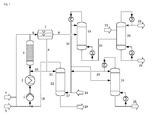
- Fig. 1 shows a preferred embodiment of the method of the invention using both propene starting material and non-reacted propene recovered from the reaction mixture as extractant in an extraction column operated in counter current flow.
- propene is reacted with hydrogen peroxide in the presence of a homogeneous epoxidation catalyst in a reaction mixture comprising an aqueous liquid phase and an organic liquid phase.
- Hydrogen peroxide can be used as an aqueous solution, preferably containing from 20 to 75 % by weight hydrogen peroxide and most preferably from 40 to 70 % by weight.
- an aqueous hydrogen peroxide solution prepared by an anthraquinone process is used.
- a crude hydrogen peroxide solution as obtained in the extraction step of the anthraquinone process may be used in the method of the invention.
- the homogeneous epoxidation catalyst is a water soluble epoxidation catalyst comprising a manganese complex.
- the manganese complex preferably comprises at least one polydentate ligand which preferably coordinates through nitrogen atoms, most preferably through tertiary amino groups.
- the manganese complex may be a mononuclear complex of formula [LMnX m ]Y n , a dinuclear complex of formula [LMn( ⁇ -X) m MnL]Y n or a polynuclear complex of formula [L p Mn p ( ⁇ -X) m ]Y n , where L is a polydentate ligand, X is a coordinating species, ⁇ -X is a bridging coordinating species, Y is a non-coordinating counter ion, m is 1, 2 or 3, n is an integer providing for the charge neutrality of the complex, and p is from 3 to 5.
- X and ⁇ -X are preferably selected from the group consisting of RO - , Cl - , Br - , I - , F - , NCS - , N 3 - , I 3 - , NH 3 , NR 3 , RCOO - , RSO 3 - , ROSO 3 - , OH - , O 2- , O 2 2- , HOO - , H 2 O, SH - , CN - , OCN - , C 2 O 4 2- and SO 4 2- , where R is alkyl, cycloalkyl, aryl or aralkyl with no more than 20 carbon atoms.
- Y is preferably selected from the group consisting of RO - , Cl - , Br - , I - , F - , RCOO-, SO 4 2- , PF 6 - , p-tolylsulfonate and trifluoromethylsulfonate, where R is alkyl, cycloalkyl, aryl or aralkyl with no more than 20 carbon atoms.
- Manganese may be in the oxidation state +2, +3, +4, or +7, the oxidation states +3 and +4 being preferred.
- Preferred polydentate ligands are acyclic polyamines containing at least 7 atoms in the backbone or cyclic polyamines containing at least 9 atoms in the ring, each having the nitrogen atoms separated by at least two carbon atoms.
- Most preferred are ligands having a 1,4,7-triazacyclononane (Tacn) ring system, which may be substituted with one or more alkyl, cycloalkyl, aryl or aralkyl groups each containing up to 20 carbon atoms.
- Preferred substituents are methyl groups.
- Suitable ligands with a Tacn ring system are N',N",N"'-trimethyl-1,4,7-triazacyclononane (TmTacn) and 2-methyl-1,4,7-trimethyl-1,4,7-triazacyclononane, with TmTacn being preferred.
- Another suitable ligand is 1,5,9-trimethyl-1,5,9-triazacyclododecane.
- dinuclear manganese complexes [(TmTacn)Mn IV ( ⁇ -O) 3 Mn IV (TmTacn)](PF 6 ) 2 and [(TmTacn)Mn IV ( ⁇ -O) 3 Mn IV (TmTacn)](CH 3 COO) 2 .
- the manganese complex may be formed in the reaction mixture by reaction of the polydentate ligand with a manganese salt, preferably manganese sulfate, manganese acetate, manganese nitrate, manganese chloride or manganese bromide with Mn 2+ or Mn 3+ .
- a manganese salt preferably manganese sulfate, manganese acetate, manganese nitrate, manganese chloride or manganese bromide with Mn 2+ or Mn 3+ .
- the manganese complex is prepared separately and added to the reaction mixture.
- the water soluble epoxidation catalyst preferably comprises oxalic acid, an oxalate or a mixture of both as a co-catalyst in addition to the manganese complex.
- the co-catalyst is preferably used in a molar excess to the manganese complex, preferably with a molar ratio of co-catalyst to manganese complex in the range of from 10 : 1 to 10 000 : 1.
- the organic phase may contain a water insoluble solvent, but preferably contains less than 30 % by weight, more preferably less than 5 % by weight of a solvent.
- the homogeneous epoxidation catalyst comprises a heteropolytungstate.
- the heteropolytungstate preferably comprises phosphorus or arsenic as heteroatom, most preferably phosphorus, i.e. the heteropolytungstate is a polytungstophosphate.
- Heteropolytungstates are known from the prior art. Most preferred are polytungstophosphates with a molar ratio of phosphorus to tungsten of from 1 : 2 to 1 : 12.
- the polytungstophosphate is preferably generated in situ from phosphoric acid and sodium tungstate, which are preferably employed in a molar ratio of phosphorus to tungsten of from 1 : 2 to 10 : 1.
- a polytungstophosphate reacts with hydrogen peroxide in the aqueous phase to give peroxotungstates and peroxotungstophosphates, such as PO 4 [WO(O 2 ) 2 ] 4 3- and HPO 4 [WO(O 2 ) 2 ] 2 2- and the corresponding partially protonated species.
- the heteropolytungstate is preferably used in combination with a phase transfer catalyst.
- phase transfer catalyst refers to a compound comprising a cation or forming a cation in the aqueous phase, which cation forms a salt with the peroxotungstate and peroxotungstophosphate that is soluble in the organic phase.
- the phase transfer catalyst preferably comprises a singly charged cation or a compound forming a singly charged cation in the aqueous phase.
- Suitable as phase transfer catalysts are quaternary ammonium salts, tertiary amines and quaternary phosphonium salts.
- Suitable quaternary ammonium salts are tetraalkylammonium salts comprising at least 12 carbon atoms in total in the alkyl groups, such as dodecyltrimethylammonium salts, hexadecyltrimethylammonium salts, octadecyltrimethylammonium salts, methyltributylammonium salts and methyltrioctylammonium salts.
- Suitable quaternary ammonium salts may comprise singly and doubly charged anions, for example chloride, bromide, nitrate, sulfate, hydrogenphosphate, dihydrogenphosphate, methylsulfonate, methylsulfate and ethylsulfate.
- Suitable tertiary amines are dodecyldimethylamine, hexadecyldimethylamine, octadecyldimethylamine, tributylamine and trioctylamine.
- the phase transfer catalyst is preferably used in an amount providing a molar ratio of phase transfer catalyst to tungsten of from 0.2 : 1 to 3 : 1, more preferably from 0.4 : 1 to 1 : 1, the molar ratio referring to the amount of cations or cation forming compounds in the phase transfer catalyst.
- phase transfer catalysts can be prepared by esterifying ethanolamine, isopropanolamine, diethanolamine, diisopropanolamine, triethanolamine or triisopropanolamine with a fatty acid followed by quaternization with dimethylsulfate.
- phase transfer catalysts Compared to tetraalkylammonium salts, these phase transfer catalysts have the advantage of being readily biodegradable which allows direct discharge of aqueous effluents from the method of the invention to a biological waste water treatment. Compared to tetraalkylammonium halides, these phase transfer catalysts provide reaction mixtures that are less corrosive. These preferred phase transfer catalysts are preferably added as a mixture comprising from 5 to 50 % by weight of a solvent selected from ethanol, 2-propanol, aliphatic hydrocarbons, fatty acids and fatty acid triglycerides to facilitate dosing and dispersing in the reaction mixture.
- a solvent selected from ethanol, 2-propanol, aliphatic hydrocarbons, fatty acids and fatty acid triglycerides to facilitate dosing and dispersing in the reaction mixture.
- heteropolytungstate and the phase transfer catalysts may be added as a mixture or separately, with separate addition to the reaction mixture being preferred.
- the resulting homogeneous epoxidation catalyst will be largely present in the organic liquid phase of the reaction mixture.
- the epoxidation can be carried out both with and without addition of a solvent, which is preferably not water miscible.
- a solvent which is preferably not water miscible.
- an epoxidized fatty acid methyl ester is used as solvent.
- the methyl ester of the corresponding unsaturated fatty acid may be added, which is then converted in the reaction mixture to the epoxidized fatty acid methyl ester.
- the solvent is preferably added in an amount providing a solvent content of the organic liquid phase of the reaction mixture of from 10 to 90 % by weight.
- the reaction is carried out in a reaction mixture comprising an aqueous liquid phase and an organic liquid phase with mixing of the liquid phases.
- the ratio of the volume of the aqueous phase to the volume of the organic phase is maintained in the range of from 10 : 1 to 1 : 10.
- the ratio is more preferably from 2 : 1 to 1 : 4.
- Mixing of the liquid phases can be performed by turbulent flow of the reaction mixture, by passing reaction mixture through fixed mixing elements, such as static mixers, structured packings or random packings, or by a moving mixing element, such as a stirrer or a rotating pump.
- the aqueous phase preferably comprises less than 30 % by weight, more preferably less than 5 % by weight of a water soluble solvent.
- solvent refers to compounds added in addition to propene, epoxidation catalyst, co-catalyst or phase transfer catalyst, and impurities introduced with these components, such as propane introduced with propene, and does not encompass products formed from propene.
- the epoxidation reaction is preferably carried out at a temperature of from 0 °C to 70 °C, more preferably from 5 °C to 40 °C and most preferably from 10 °C to 30 °C.
- the epoxidation reaction is preferably carried out at a temperature of from 30 °C to 100 °C, more preferably from 60 °C to 90 °C.
- Epoxidation with a catalyst comprising a manganese complex is most preferably carried out at 10 °C to 20 °C and a pressure of from 0.8 to 2.0 MPa.
- Epoxidation with a catalyst comprising a heteropolytungstate is most preferably carried out at 60 °C to 90 °C and a pressure of from 3 to 5 MPa.
- the reaction is carried out continuously in a loop reactor.
- the term loop reactor here refers to a reactor in which reaction mixture is circulated driven by a pump. Pumping of the reaction mixture provides mixing of the liquid phases.
- the loop reactor may comprise vessels for increasing the volume in the loop and providing the residence time necessary for achieving the desired hydrogen peroxide conversion.
- further mixing of the reaction mixture is provided in such vessels, for example by static mixers, structured packings or random packings arranged in a tube of enlarged diameter or by a stirred vessel arranged in the reactor loop.
- a heat exchanger is arranged in the loop for cooling the reaction mixture in order to remove the heat of reaction, the reaction mixture preferably being passed through the heat exchanger in every cycle of the loop.
- the heat exchanger is preferably a tube bundle heat exchanger with the reaction mixture being passed through the tubes or a plate heat exchanger.
- the diameter of the tubes or the distance between plates is preferably chosen sufficiently narrow for providing turbulent flow and mixing of the two liquid phases.
- the average residence time in the loop reactor is preferably selected to provide a hydrogen peroxide conversion of more than 85 %, more preferably of from 95 % to 99.5 %.
- the average residence time is preferably from 20 to 240 min.
- Propene is preferably used in molar excess to hydrogen peroxide in order to achieve high conversion of hydrogen peroxide and the molar ratio of propene fed to the loop reactor to hydrogen peroxide fed to the loop reactor is preferably from 1.2 : 1 to 12 : 1, more preferably from 2 : 1 to 8 : 1.
- Propene can be used as a technical mixture with propane, preferably containing from 0.1 to 15 vol-% of propane.
- the amount of catalyst fed to the loop reactor is preferably chosen to provide a molar ratio of hydrogen peroxide fed to the loop reactor to manganese fed to the loop reactor of from 100 : 1 to 10 000 000 : 1, more preferably from 1000 : 1 to 1 000 000 : 1 and most preferably 10 000 : 1 to 100 000 : 1.
- the amount of catalyst fed to the loop reactor is preferably chosen to provide a molar ratio of hydrogen peroxide fed to the loop reactor to tungsten fed to the loop reactor of from 10 : 1 to 10 000 : 1, more preferably from 50 : 1 to 5 000 : 1.
- the concentration of hydrogen peroxide in the aqueous liquid phase is preferably maintained at less than 1.0 % by weight during the reaction. More preferably, the concentration of hydrogen peroxide is maintained at from 0.1 to 1.0 % by weight, most preferably at from 0.2 to 0.7 % by weight.
- the concentration of hydrogen peroxide in the aqueous liquid phase is preferably maintained at from 0.1 to 5 % by weight, preferably 0.5 to 3 % by weight.
- the concentration of hydrogen peroxide in the aqueous liquid phase may be adjusted by adjusting the molar ratio of propene to hydrogen peroxide fed to the loop reactor, adjusting the feed rate for feeding hydrogen peroxide to the loop reactor or adjusting the feed rate for feeding epoxidation catalyst to the reactor, with a higher molar ratio of propene to hydrogen peroxide, a lower feed rate for hydrogen peroxide or a higher feed rate for epoxidation catalyst leading to a lower concentration of hydrogen peroxide in the aqueous liquid phase.
- aqueous phase is withdrawn from the loop reactor and extracted by liquid-liquid-extraction using propene as extractant.
- the extraction provides an extract comprising propene and propene oxide and an extracted aqueous phase depleted in propene oxide.
- reaction mixture is continuously withdrawn from the loop reactor, the withdrawn reaction mixture is separated into a separated aqueous phase and a separated organic phase and a part or all of the separated aqueous phase is extracted.
- the amount of withdrawn reaction mixture preferably corresponds to the total of liquid flows entering the mixed reactor in order to maintain a constant hold-up in the mixed reactor.
- Separation of the withdrawn reaction mixture into a separated aqueous phase and a separated organic phase may be carried out with any phase separating device known from the prior art.
- the phase separating device may be a settler or a device which applies a centrifugal force to the reaction mixture, such as a hydrocyclone or a centrifuge.
- the pressure in the phase separation is maintained higher than the vapor pressure of propene in order to maintain propene in the liquid phase.
- the liquid-liquid-extraction may be carried out with any liquid-liquid-extraction device known from the prior art, such as a mixer/settler combination, a series of mixers and settlers, an extraction column or a centrifugal extractor.
- the liquid-liquid-extraction is carried out in an extraction column operated in counter current flow.
- the extraction column may comprise trays, such as sieve trays, or may comprise packings, which may be structured packings or random packings.
- the internals of the extraction column preferably provide a separation efficiency of from 1 to 10 equilibrium stages, more preferably 2 to 5 equilibrium stages.
- Liquid-liquid-extraction is preferably carried out at a temperature of from 0 to 40 °C, more preferably from 10 to 30 °C.
- the reaction mixture withdrawn from the loop reactor or the aqueous phase passed to the liquid-liquid-extraction is preferably cooled in a heat exchanger to a temperature within this range.
- the pressure in the liquid-liquid-extraction is maintained higher than the vapor pressure of propene at the extraction temperature in order to maintain a liquid propene phase.
- a part of the aqueous phase withdrawn from the loop reactor is continuously recycled into the loop reactor.
- the fraction of separated aqueous phase recycled into the loop reactor is preferably adjusted to maintain a constant phase ratio of aqueous liquid phase to organic liquid phase within the loop reactor.
- the part of the aqueous phase to be recycled into the loop reactor may be withdrawn before the liquid-liquid-extraction, passing the remaining aqueous phase to the liquid-liquid-extraction or it may be withdrawn after the liquid-liquid-extraction, recycling a part of the extracted aqueous phase into the loop reactor.
- the aqueous phase to be recycled into the loop reactor is withdrawn before the liquid-liquid-extraction to reduce the flow of aqueous phase in the liquid-liquid-extraction.
- the propene contained in the extract of the liquid-liquid-extraction is preferably passed to the loop reactor, preferably in the liquid state.
- the extract may be passed to a work-up stage in which propene is separated from propene oxide, for example by distillation, and the separated propene is passed to the loop reactor. This may involve combining the extract with separated organic phase obtained from phase separation of withdrawn reaction mixture, preferably before separating propene from propene oxide.
- the extract is passed to the loop reactor without separating propene oxide and most preferably, the extract is passed directly to the loop reactor without any further separation step.
- Propene starting material may be used as extractant.
- non-reacted propene recovered from the reaction mixture may be used as extractant.
- the extractant comprises propene separated from an organic phase withdrawn from the loop reactor.
- all propene starting material and non-reacted propene recovered from the reaction mixture is passed to the liquid-liquid-extraction as extractant and the extract from the liquid-liquid-extraction is passed directly to the loop reactor without any further separation step.
- propane will accumulate in the loop reactor.
- a part of the recovered non-reacted propene is preferably withdrawn and subjected to a distillation in a C3-splitter column providing a bottom product enriched in propane, which is discharged, and an overhead product depleted in propane, which is recycled to the loop reactor.
- a water soluble epoxidation catalyst comprising a manganese complex
- liquid-liquid-extraction is carried out in an extraction column
- the catalyst contained in the aqueous phase fed to the extraction column will effect reaction of propene of the extractant with non-reacted hydrogen peroxide contained in the aqueous phase.
- the extraction column will then serve as an additional reactor for increasing hydrogen peroxide conversion to propene oxide.
- the extraction column may then be cooled, for example using one or several heat exchangers arranged within the extraction column, to remove the heat generated by this reaction.
- reaction mixture comprising the manganese complex is withdrawn from the loop reactor and acid is added to the withdrawn reaction mixture before separating it into an organic phase A and an aqueous phase B.
- the acid is added in an amount to adjust the pH of aqueous phase B to a value between 1 and 2.5.
- Aqueous phase B is then extracted with propene in the liquid-liquid-extraction and part or all of the aqueous phase obtained after extraction is recycled to the loop reactor.
- Lowering of the pH reduces the catalytic activity of the manganese complex and at the same time increases its stability.
- the aqueous phase obtained after extraction comprises a higher fraction of catalytically active manganese complex which can be reused in the loop reactor upon recycling of the extracted aqueous phase.
- Fig. 1 shows a preferred embodiment of the method of the invention using both propene starting material and non-reacted propene recovered from the reaction mixture as extractant in an extraction column operated in counter current flow.
- Fig. 1 shows a loop reactor comprising a circulation pump (1), a heat exchanger (2) for cooling the reaction mixture, and a vessel (3) with a packing for keeping the aqueous phase and the organic phase mixed during the necessary retention time in the loop.
- Catalyst (4) comprising a water soluble manganese complex, and hydrogen peroxide (5) are fed to the loop reactor. Buffer and co-catalyst can also be fed to the loop reactor, but are not shown.
- Reaction mixture (6) is withdrawn from the loop reactor in an amount corresponding to the feeds to the loop reactor.
- the withdrawn reaction mixture comprises an organic phase, comprising propene oxide formed by the reaction and non-reacted propene, and an aqueous phase, comprising hydrogen peroxide, water formed from and introduced with the hydrogen peroxide, epoxidation catalyst and optional additives, such as buffer and co-catalyst.
- Withdrawn reaction mixture (6) is separated in a settler (7) into a separated aqueous phase (8) and a separated organic phase (9).
- a fraction (10) of the separated aqueous phase (8) is recycled into the loop reactor to maintain a constant phase ratio of aqueous liquid phase to organic liquid phase within the loop reactor and the remainder (11) is passed to an extraction column (12) operated in counter current.
- the separated organic phase (9) is passed to a first distillation column (13) where a stream (14) of non-reacted propene is separated from a crude propene oxide product (15).
- the stream (14) of non-reacted propene is combined with the propene starting material (16) and the combined stream (17) is fed as extractant to the extraction column (12).
- the extract (18) withdrawn from extraction column (12), comprising propene and propene oxide, is passed directly to the loop reactor as propene feed to the reaction.
- the extracted aqueous phase (19) is further processed for recovering propene and optionally 1,2-propanediol formed as a by-product (not shown).
- the crude propene oxide product (15) is purified in a second distillation column (20) to provide a propene oxide overhead product (21) and a bottoms product (22) comprising high boiling byproducts.
- a stream comprising hydrazine (23) is preferably fed to the second distillation column above the feeding point of the crude propene oxide product (15) to remove carbonyl compounds comprised in the crude propene oxide.
- a part of the stream (14) of non-reacted propene is withdrawn and fed to a C3-splitter column (24) where propane introduced with the propene starting material (16) is separated and withdrawn as bottoms product (25).
- propane introduced with the propene starting material (16) is separated and withdrawn as bottoms product (25).
- the overhead product (26) from the C3-splitter column (24), which is depleted in propane, is returned to stream (14).
Landscapes
- Chemical & Material Sciences (AREA)
- Organic Chemistry (AREA)
- Inorganic Chemistry (AREA)
- Epoxy Compounds (AREA)
- Low-Molecular Organic Synthesis Reactions Using Catalysts (AREA)
- Catalysts (AREA)
Abstract
The method for the epoxidation of propene comprises continuously reacting propene with hydrogen peroxide in the presence of a homogeneous epoxidation catalyst in a reaction mixture comprising an aqueous liquid phase and an organic liquid phase using a loop reactor with mixing of the liquid phases, withdrawing aqueous phase from the loop reactor and extracting it by liquid-liquid-extraction using propene as extractant to provide an extract comprising propene and propene oxide.
Description
- The invention relates to a method for the epoxidation of propene with hydrogen peroxide in the presence of a homogeneous epoxidation catalyst where the reaction is carried out in a reaction mixture comprising an aqueous liquid phase and an organic liquid phase.
- Methods for the epoxidation of an olefin with hydrogen peroxide using a homogeneous water soluble manganese complex as epoxidation catalyst are known from D. E. De Vos et al., Tetrahedron Letters 39 (1998) 3221-3224 and from
US 5,329,024 . -
WO 2011/063937 discloses epoxidation of propene in an aqueous reaction medium with a water soluble manganese complex as epoxidation catalyst. The reaction product propene oxide may be stripped with propene at low pressure or may form an organic phase with liquefied propene at high pressure.WO 2011/107188 teaches using a loop reactor for this reaction. -
US 5,274,140 discloses epoxidation of propene with hydrogen peroxide in the presence of a catalyst system comprising a heteropolytungstate as epoxidation catalyst and tricaprylmethylammonium chloride as phase transfer catalyst. The reaction is carried out with 1,2-dichloromethane as solvent. - When propene is epoxidized with hydrogen peroxide and a homogeneous catalyst in a two phase reaction mixture, the aqueous phase will contain a considerable amount of the product propene oxide. Recovery of propene oxide by distillation leads to hydrolysis of propene oxide when the distillation is carried out at the acidic pH at which the epoxidation is usually performed.
- It has now been found that propene oxide can be recovered from the aqueous phase of a two phase epoxidation reaction mixture with low energy requirement and little hydrolysis of propene oxide by extraction with propene.
- When a water soluble epoxidation catalyst comprising a manganese complex is used and extraction is carried out in an extraction column, the extraction column may serve as an additional reactor for increasing hydrogen peroxide conversion to propene oxide.
- Subject of the invention is therefore a method for the epoxidation of propene, comprising continuously reacting propene with hydrogen peroxide in the presence of a homogeneous epoxidation catalyst, the reaction being carried out in a reaction mixture comprising an aqueous liquid phase and an organic liquid phase using a loop reactor with mixing of the liquid phases, where aqueous phase withdrawn from the loop reactor is extracted by liquid-liquid-extraction using propene as extractant to provide an extract comprising propene and propene oxide.
- The homogeneous epoxidation catalyst preferably comprises a water soluble manganese complex and the extraction is preferably carried out in an extraction column.
-
Fig. 1 shows a preferred embodiment of the method of the invention using both propene starting material and non-reacted propene recovered from the reaction mixture as extractant in an extraction column operated in counter current flow. - In the method of the invention propene is reacted with hydrogen peroxide in the presence of a homogeneous epoxidation catalyst in a reaction mixture comprising an aqueous liquid phase and an organic liquid phase.
- Hydrogen peroxide can be used as an aqueous solution, preferably containing from 20 to 75 % by weight hydrogen peroxide and most preferably from 40 to 70 % by weight. Preferably, an aqueous hydrogen peroxide solution prepared by an anthraquinone process is used. A crude hydrogen peroxide solution as obtained in the extraction step of the anthraquinone process may be used in the method of the invention.
- In one embodiment of the invention, the homogeneous epoxidation catalyst is a water soluble epoxidation catalyst comprising a manganese complex. The manganese complex preferably comprises at least one polydentate ligand which preferably coordinates through nitrogen atoms, most preferably through tertiary amino groups. The manganese complex may be a mononuclear complex of formula [LMnXm]Yn, a dinuclear complex of formula [LMn(µ-X)mMnL]Yn or a polynuclear complex of formula [LpMnp(µ-X)m]Yn, where L is a polydentate ligand, X is a coordinating species, µ-X is a bridging coordinating species, Y is a non-coordinating counter ion, m is 1, 2 or 3, n is an integer providing for the charge neutrality of the complex, and p is from 3 to 5. X and µ-X are preferably selected from the group consisting of RO-, Cl-, Br-, I-, F-, NCS-, N3 -, I3 -, NH3, NR3, RCOO-, RSO3 -, ROSO3 -, OH-, O2-, O2 2-, HOO-, H2O, SH-, CN-, OCN-, C2O4 2- and SO4 2-, where R is alkyl, cycloalkyl, aryl or aralkyl with no more than 20 carbon atoms. Y is preferably selected from the group consisting of RO-, Cl-, Br-, I-, F-, RCOO-, SO4 2-, PF6 -, p-tolylsulfonate and trifluoromethylsulfonate, where R is alkyl, cycloalkyl, aryl or aralkyl with no more than 20 carbon atoms. Manganese may be in the oxidation state +2, +3, +4, or +7, the oxidation states +3 and +4 being preferred.
- Preferred polydentate ligands are acyclic polyamines containing at least 7 atoms in the backbone or cyclic polyamines containing at least 9 atoms in the ring, each having the nitrogen atoms separated by at least two carbon atoms. Most preferred are ligands having a 1,4,7-triazacyclononane (Tacn) ring system, which may be substituted with one or more alkyl, cycloalkyl, aryl or aralkyl groups each containing up to 20 carbon atoms. Preferred substituents are methyl groups. Suitable ligands with a Tacn ring system are N',N",N"'-trimethyl-1,4,7-triazacyclononane (TmTacn) and 2-methyl-1,4,7-trimethyl-1,4,7-triazacyclononane, with TmTacn being preferred. Another suitable ligand is 1,5,9-trimethyl-1,5,9-triazacyclododecane.
- Most preferred are the dinuclear manganese complexes [(TmTacn)MnIV(µ-O)3MnIV(TmTacn)](PF6)2 and [(TmTacn)MnIV(µ-O)3MnIV(TmTacn)](CH3COO)2.
- The manganese complex may be formed in the reaction mixture by reaction of the polydentate ligand with a manganese salt, preferably manganese sulfate, manganese acetate, manganese nitrate, manganese chloride or manganese bromide with Mn2+ or Mn3+. Preferably, the manganese complex is prepared separately and added to the reaction mixture.
- The water soluble epoxidation catalyst preferably comprises oxalic acid, an oxalate or a mixture of both as a co-catalyst in addition to the manganese complex. The co-catalyst is preferably used in a molar excess to the manganese complex, preferably with a molar ratio of co-catalyst to manganese complex in the range of from 10 : 1 to 10 000 : 1.
- When a water soluble epoxidation catalyst is used, the organic phase may contain a water insoluble solvent, but preferably contains less than 30 % by weight, more preferably less than 5 % by weight of a solvent.
- In another embodiment of the invention, the homogeneous epoxidation catalyst comprises a heteropolytungstate. The heteropolytungstate preferably comprises phosphorus or arsenic as heteroatom, most preferably phosphorus, i.e. the heteropolytungstate is a polytungstophosphate. Heteropolytungstates are known from the prior art. Most preferred are polytungstophosphates with a molar ratio of phosphorus to tungsten of from 1 : 2 to 1 : 12. The polytungstophosphate is preferably generated in situ from phosphoric acid and sodium tungstate, which are preferably employed in a molar ratio of phosphorus to tungsten of from 1 : 2 to 10 : 1. A polytungstophosphate reacts with hydrogen peroxide in the aqueous phase to give peroxotungstates and peroxotungstophosphates, such as PO4[WO(O2)2]4 3- and HPO4[WO(O2)2]2 2- and the corresponding partially protonated species.
- The heteropolytungstate is preferably used in combination with a phase transfer catalyst. The term phase transfer catalyst refers to a compound comprising a cation or forming a cation in the aqueous phase, which cation forms a salt with the peroxotungstate and peroxotungstophosphate that is soluble in the organic phase. The phase transfer catalyst preferably comprises a singly charged cation or a compound forming a singly charged cation in the aqueous phase. Suitable as phase transfer catalysts are quaternary ammonium salts, tertiary amines and quaternary phosphonium salts. Suitable quaternary ammonium salts are tetraalkylammonium salts comprising at least 12 carbon atoms in total in the alkyl groups, such as dodecyltrimethylammonium salts, hexadecyltrimethylammonium salts, octadecyltrimethylammonium salts, methyltributylammonium salts and methyltrioctylammonium salts. Suitable quaternary ammonium salts may comprise singly and doubly charged anions, for example chloride, bromide, nitrate, sulfate, hydrogenphosphate, dihydrogenphosphate, methylsulfonate, methylsulfate and ethylsulfate. Suitable tertiary amines are dodecyldimethylamine, hexadecyldimethylamine, octadecyldimethylamine, tributylamine and trioctylamine.
- The phase transfer catalyst is preferably used in an amount providing a molar ratio of phase transfer catalyst to tungsten of from 0.2 : 1 to 3 : 1, more preferably from 0.4 : 1 to 1 : 1, the molar ratio referring to the amount of cations or cation forming compounds in the phase transfer catalyst.
- Preferably, the phase transfer catalyst comprises a salt with a quaternary ammonium ion of structure R1R2R3R4N+, where R1 is a group Y-O(C=O)R5, Y being a group CH2CH2, CH(CH3)CH2 or CH2CH(CH3) and R5 being an alkyl or alkenyl group containing 11 to 21 carbon atoms, R2 is an alkyl group containing 1 to 4 carbon atoms and R3 and R4 are, independently of one another, R1, R2 or Y-OH. Preferred are salts with methyl sulfate as anion, for which R2 is methyl and R5 is a linear alkyl or alkenyl group. More preferred are the salts (CH3)3N+CH2CH2O(C=O)R5 CH3OSO3 -, (CH3)2N+(CH2CH2OH)(CH2CH2O(C=O)R5) CH3OSO3 -, (CH3)2N+(CH2CH2O(C=O)R5)2 CH3OSO3 -, CH3N+(CH2CH2OH)2(CH2CH2O(C=O)R5) CH3OSO3 -, CH3N+(CH2CH2OH)(CH2CH2O(C=O)R5)2 CH3OSO3 -, CH3N+(CH2CH2O(C=O)R5)3 CH3OSO3 -, (CH3)3N+CH2CH(CH3)O(C=O)R5 CH3OSO3 -, (CH3)2N+(CH2CH(CH3)OH)(CH2CH(CH3)O(C=O)R5) CH3OSO3 - and (CH3)2N+(CH2CH(CH3)O(C=O)R5)2 CH3OSO3 -, in which R5 is a linear alkyl or alkenyl group containing 11 to 21 carbon atoms. Most preferred is the salt (CH3)2N+(CH2CH(CH3)O(C=O)R5)2 CH3OSO3 - in which R5 is a linear alkyl or alkenyl group containing 11 to 17 carbon atoms. These preferred phase transfer catalysts can be prepared by esterifying ethanolamine, isopropanolamine, diethanolamine, diisopropanolamine, triethanolamine or triisopropanolamine with a fatty acid followed by quaternization with dimethylsulfate. Compared to tetraalkylammonium salts, these phase transfer catalysts have the advantage of being readily biodegradable which allows direct discharge of aqueous effluents from the method of the invention to a biological waste water treatment. Compared to tetraalkylammonium halides, these phase transfer catalysts provide reaction mixtures that are less corrosive. These preferred phase transfer catalysts are preferably added as a mixture comprising from 5 to 50 % by weight of a solvent selected from ethanol, 2-propanol, aliphatic hydrocarbons, fatty acids and fatty acid triglycerides to facilitate dosing and dispersing in the reaction mixture.
- The heteropolytungstate and the phase transfer catalysts may be added as a mixture or separately, with separate addition to the reaction mixture being preferred.
- When a heteropolytungstate is used in combination with a phase transfer catalysts, the resulting homogeneous epoxidation catalyst will be largely present in the organic liquid phase of the reaction mixture. With such a homogeneous epoxidation catalyst the epoxidation can be carried out both with and without addition of a solvent, which is preferably not water miscible. Preferably, an epoxidized fatty acid methyl ester is used as solvent. As an alternative to adding an epoxidized fatty acid methyl ester to the reaction mixture, the methyl ester of the corresponding unsaturated fatty acid may be added, which is then converted in the reaction mixture to the epoxidized fatty acid methyl ester. Preferred are epoxidized fatty acid methyl ester containing fatty acids derived from vegetable oils, preferably soy oil. Addition of an epoxidized fatty acid methyl ester prevents the formation of stable emulsions and facilitates phase separation of the two liquid phases of the reaction mixture. The solvent is preferably added in an amount providing a solvent content of the organic liquid phase of the reaction mixture of from 10 to 90 % by weight.
- The reaction is carried out in a reaction mixture comprising an aqueous liquid phase and an organic liquid phase with mixing of the liquid phases. Preferably, the ratio of the volume of the aqueous phase to the volume of the organic phase is maintained in the range of from 10 : 1 to 1 : 10. When an epoxidation catalyst comprising a manganese complex is used, the ratio is more preferably from 2 : 1 to 1 : 4. Mixing of the liquid phases can be performed by turbulent flow of the reaction mixture, by passing reaction mixture through fixed mixing elements, such as static mixers, structured packings or random packings, or by a moving mixing element, such as a stirrer or a rotating pump.
- Independently of which type of homogeneous epoxidation catalyst is used, the aqueous phase preferably comprises less than 30 % by weight, more preferably less than 5 % by weight of a water soluble solvent. The term solvent here refers to compounds added in addition to propene, epoxidation catalyst, co-catalyst or phase transfer catalyst, and impurities introduced with these components, such as propane introduced with propene, and does not encompass products formed from propene.
- When an epoxidation catalyst comprising a manganese complex is used, the epoxidation reaction is preferably carried out at a temperature of from 0 °C to 70 °C, more preferably from 5 °C to 40 °C and most preferably from 10 °C to 30 °C. When an epoxidation catalyst comprising a heteropolytungstate is used, the epoxidation reaction is preferably carried out at a temperature of from 30 °C to 100 °C, more preferably from 60 °C to 90 °C.
- The epoxidation is carried out at elevated pressure to maintain propene in the liquid phase. Epoxidation with a catalyst comprising a manganese complex is most preferably carried out at 10 °C to 20 °C and a pressure of from 0.8 to 2.0 MPa.. Epoxidation with a catalyst comprising a heteropolytungstate is most preferably carried out at 60 °C to 90 °C and a pressure of from 3 to 5 MPa.
- The reaction is carried out continuously in a loop reactor. The term loop reactor here refers to a reactor in which reaction mixture is circulated driven by a pump. Pumping of the reaction mixture provides mixing of the liquid phases. The loop reactor may comprise vessels for increasing the volume in the loop and providing the residence time necessary for achieving the desired hydrogen peroxide conversion. Preferably, further mixing of the reaction mixture is provided in such vessels, for example by static mixers, structured packings or random packings arranged in a tube of enlarged diameter or by a stirred vessel arranged in the reactor loop. Preferably, a heat exchanger is arranged in the loop for cooling the reaction mixture in order to remove the heat of reaction, the reaction mixture preferably being passed through the heat exchanger in every cycle of the loop. The heat exchanger is preferably a tube bundle heat exchanger with the reaction mixture being passed through the tubes or a plate heat exchanger. The diameter of the tubes or the distance between plates is preferably chosen sufficiently narrow for providing turbulent flow and mixing of the two liquid phases.
- The average residence time in the loop reactor, calculated as the ratio of the volume of the loop reactor divided by the sum of all fluid flows entering the loop reactor, is preferably selected to provide a hydrogen peroxide conversion of more than 85 %, more preferably of from 95 % to 99.5 %. For this purpose, the average residence time is preferably from 20 to 240 min.
- Propene is preferably used in molar excess to hydrogen peroxide in order to achieve high conversion of hydrogen peroxide and the molar ratio of propene fed to the loop reactor to hydrogen peroxide fed to the loop reactor is preferably from 1.2 : 1 to 12 : 1, more preferably from 2 : 1 to 8 : 1. Propene can be used as a technical mixture with propane, preferably containing from 0.1 to 15 vol-% of propane.
- When an epoxidation catalyst comprising a manganese complex is used, the amount of catalyst fed to the loop reactor is preferably chosen to provide a molar ratio of hydrogen peroxide fed to the loop reactor to manganese fed to the loop reactor of from 100 : 1 to 10 000 000 : 1, more preferably from 1000 : 1 to 1 000 000 : 1 and most preferably 10 000 : 1 to 100 000 : 1. When an epoxidation catalyst comprising a heteropolytungstate is used, the amount of catalyst fed to the loop reactor is preferably chosen to provide a molar ratio of hydrogen peroxide fed to the loop reactor to tungsten fed to the loop reactor of from 10 : 1 to 10 000 : 1, more preferably from 50 : 1 to 5 000 : 1.
- When an epoxidation catalyst comprising a manganese complex is used, the concentration of hydrogen peroxide in the aqueous liquid phase is preferably maintained at less than 1.0 % by weight during the reaction. More preferably, the concentration of hydrogen peroxide is maintained at from 0.1 to 1.0 % by weight, most preferably at from 0.2 to 0.7 % by weight. When an epoxidation catalyst comprising a heteropolytungstate is used, the concentration of hydrogen peroxide in the aqueous liquid phase is preferably maintained at from 0.1 to 5 % by weight, preferably 0.5 to 3 % by weight. The concentration of hydrogen peroxide in the aqueous liquid phase may be adjusted by adjusting the molar ratio of propene to hydrogen peroxide fed to the loop reactor, adjusting the feed rate for feeding hydrogen peroxide to the loop reactor or adjusting the feed rate for feeding epoxidation catalyst to the reactor, with a higher molar ratio of propene to hydrogen peroxide, a lower feed rate for hydrogen peroxide or a higher feed rate for epoxidation catalyst leading to a lower concentration of hydrogen peroxide in the aqueous liquid phase.
- In the method of the invention, aqueous phase is withdrawn from the loop reactor and extracted by liquid-liquid-extraction using propene as extractant. The extraction provides an extract comprising propene and propene oxide and an extracted aqueous phase depleted in propene oxide.
- Preferably, reaction mixture is continuously withdrawn from the loop reactor, the withdrawn reaction mixture is separated into a separated aqueous phase and a separated organic phase and a part or all of the separated aqueous phase is extracted. The amount of withdrawn reaction mixture preferably corresponds to the total of liquid flows entering the mixed reactor in order to maintain a constant hold-up in the mixed reactor. Separation of the withdrawn reaction mixture into a separated aqueous phase and a separated organic phase may be carried out with any phase separating device known from the prior art. The phase separating device may be a settler or a device which applies a centrifugal force to the reaction mixture, such as a hydrocyclone or a centrifuge. The pressure in the phase separation is maintained higher than the vapor pressure of propene in order to maintain propene in the liquid phase.
- The liquid-liquid-extraction may be carried out with any liquid-liquid-extraction device known from the prior art, such as a mixer/settler combination, a series of mixers and settlers, an extraction column or a centrifugal extractor. Preferably, the liquid-liquid-extraction is carried out in an extraction column operated in counter current flow. The extraction column may comprise trays, such as sieve trays, or may comprise packings, which may be structured packings or random packings. The internals of the extraction column preferably provide a separation efficiency of from 1 to 10 equilibrium stages, more preferably 2 to 5 equilibrium stages.
- Liquid-liquid-extraction is preferably carried out at a temperature of from 0 to 40 °C, more preferably from 10 to 30 °C. When the epoxidation is carried out at a higher temperature, the reaction mixture withdrawn from the loop reactor or the aqueous phase passed to the liquid-liquid-extraction is preferably cooled in a heat exchanger to a temperature within this range. The pressure in the liquid-liquid-extraction is maintained higher than the vapor pressure of propene at the extraction temperature in order to maintain a liquid propene phase.
- A part of the aqueous phase withdrawn from the loop reactor is continuously recycled into the loop reactor. The fraction of separated aqueous phase recycled into the loop reactor is preferably adjusted to maintain a constant phase ratio of aqueous liquid phase to organic liquid phase within the loop reactor. The part of the aqueous phase to be recycled into the loop reactor may be withdrawn before the liquid-liquid-extraction, passing the remaining aqueous phase to the liquid-liquid-extraction or it may be withdrawn after the liquid-liquid-extraction, recycling a part of the extracted aqueous phase into the loop reactor. Preferably, the aqueous phase to be recycled into the loop reactor is withdrawn before the liquid-liquid-extraction to reduce the flow of aqueous phase in the liquid-liquid-extraction.
- The propene contained in the extract of the liquid-liquid-extraction is preferably passed to the loop reactor, preferably in the liquid state. For this purpose, the extract may be passed to a work-up stage in which propene is separated from propene oxide, for example by distillation, and the separated propene is passed to the loop reactor. This may involve combining the extract with separated organic phase obtained from phase separation of withdrawn reaction mixture, preferably before separating propene from propene oxide. However, in a preferred embodiment the extract is passed to the loop reactor without separating propene oxide and most preferably, the extract is passed directly to the loop reactor without any further separation step.
- Propene starting material may be used as extractant. Alternatively or in addition to propene starting material, non-reacted propene recovered from the reaction mixture may be used as extractant. Preferably, the extractant comprises propene separated from an organic phase withdrawn from the loop reactor. Most preferably, all propene starting material and non-reacted propene recovered from the reaction mixture is passed to the liquid-liquid-extraction as extractant and the extract from the liquid-liquid-extraction is passed directly to the loop reactor without any further separation step.
- When a propene starting material is used which comprises propane and non-reacted propene is recovered and recycled to the loop reactor, propane will accumulate in the loop reactor. In this case, a part of the recovered non-reacted propene is preferably withdrawn and subjected to a distillation in a C3-splitter column providing a bottom product enriched in propane, which is discharged, and an overhead product depleted in propane, which is recycled to the loop reactor.
- When a water soluble epoxidation catalyst comprising a manganese complex is used and liquid-liquid-extraction is carried out in an extraction column, the catalyst contained in the aqueous phase fed to the extraction column will effect reaction of propene of the extractant with non-reacted hydrogen peroxide contained in the aqueous phase. The extraction column will then serve as an additional reactor for increasing hydrogen peroxide conversion to propene oxide. The extraction column may then be cooled, for example using one or several heat exchangers arranged within the extraction column, to remove the heat generated by this reaction.
- In an alternative embodiment, reaction mixture comprising the manganese complex is withdrawn from the loop reactor and acid is added to the withdrawn reaction mixture before separating it into an organic phase A and an aqueous phase B. The acid is added in an amount to adjust the pH of aqueous phase B to a value between 1 and 2.5. Aqueous phase B is then extracted with propene in the liquid-liquid-extraction and part or all of the aqueous phase obtained after extraction is recycled to the loop reactor. Lowering of the pH reduces the catalytic activity of the manganese complex and at the same time increases its stability. As a result, further reaction of hydrogen peroxide with propene in the liquid-liquid-extraction is suppressed and the aqueous phase obtained after extraction comprises a higher fraction of catalytically active manganese complex which can be reused in the loop reactor upon recycling of the extracted aqueous phase.
-
Fig. 1 shows a preferred embodiment of the method of the invention using both propene starting material and non-reacted propene recovered from the reaction mixture as extractant in an extraction column operated in counter current flow. -
Fig. 1 shows a loop reactor comprising a circulation pump (1), a heat exchanger (2) for cooling the reaction mixture, and a vessel (3) with a packing for keeping the aqueous phase and the organic phase mixed during the necessary retention time in the loop. Catalyst (4), comprising a water soluble manganese complex, and hydrogen peroxide (5) are fed to the loop reactor. Buffer and co-catalyst can also be fed to the loop reactor, but are not shown. Reaction mixture (6) is withdrawn from the loop reactor in an amount corresponding to the feeds to the loop reactor. The withdrawn reaction mixture comprises an organic phase, comprising propene oxide formed by the reaction and non-reacted propene, and an aqueous phase, comprising hydrogen peroxide, water formed from and introduced with the hydrogen peroxide, epoxidation catalyst and optional additives, such as buffer and co-catalyst. Withdrawn reaction mixture (6) is separated in a settler (7) into a separated aqueous phase (8) and a separated organic phase (9). A fraction (10) of the separated aqueous phase (8) is recycled into the loop reactor to maintain a constant phase ratio of aqueous liquid phase to organic liquid phase within the loop reactor and the remainder (11) is passed to an extraction column (12) operated in counter current. The separated organic phase (9) is passed to a first distillation column (13) where a stream (14) of non-reacted propene is separated from a crude propene oxide product (15). The stream (14) of non-reacted propene is combined with the propene starting material (16) and the combined stream (17) is fed as extractant to the extraction column (12). The extract (18) withdrawn from extraction column (12), comprising propene and propene oxide, is passed directly to the loop reactor as propene feed to the reaction. The extracted aqueous phase (19) is further processed for recovering propene and optionally 1,2-propanediol formed as a by-product (not shown). - The crude propene oxide product (15) is purified in a second distillation column (20) to provide a propene oxide overhead product (21) and a bottoms product (22) comprising high boiling byproducts. A stream comprising hydrazine (23) is preferably fed to the second distillation column above the feeding point of the crude propene oxide product (15) to remove carbonyl compounds comprised in the crude propene oxide.
- A part of the stream (14) of non-reacted propene is withdrawn and fed to a C3-splitter column (24) where propane introduced with the propene starting material (16) is separated and withdrawn as bottoms product (25). The overhead product (26) from the C3-splitter column (24), which is depleted in propane, is returned to stream (14).
Claims (12)
- A method for the epoxidation of propene, comprising continuously reacting propene with hydrogen peroxide in the presence of a homogeneous epoxidation catalyst, the reaction being carried out in a reaction mixture comprising an aqueous liquid phase and an organic liquid phase using a loop reactor with mixing of the liquid phases, characterized in that aqueous phase withdrawn from the loop reactor is extracted by liquid-liquid-extraction using propene as extractant to provide an extract comprising propene and propene oxide.
- The method of claim 1, characterized in that reaction mixture is continuously withdrawn from the loop reactor, the withdrawn reaction mixture is separated into a separated aqueous phase and a separated organic phase and a part or all of the separated aqueous phase is extracted.
- The method of claim 1 or 2, characterized in that the aqueous liquid phase of the reaction mixture comprises less than 30 % by weight of water soluble solvents.
- The method of any one of claims 1 to 3, characterized in that liquid-liquid-extraction is carried out in an extraction column operated in counter current flow.
- The method of any one of claims 1 to 4, characterized in that the propene contained in the extract is passed to the loop reactor.
- The method of claim 5, characterized in that the extract is passed to the loop reactor without separating propene oxide.
- The method of claim 5 or 6, characterized in that the extractant comprises all or a part of the propene starting material.
- The method of any one of claims 1 to 7, characterized in that the extractant comprises propene separated from an organic phase withdrawn from the loop reactor.
- The method of any one of claims 1 to 8, characterized in that the epoxidation catalyst comprises a water soluble manganese complex.
- The method of claim 9, characterized in that the manganese complex carries a 1,4,7-trimethyl-1,4,7-triazacyclonane ligand.
- The method of claim 9 or 10, characterized in that reaction mixture is withdrawn from the loop reactor and separated into an organic phase A and an aqueous phase B, acid is added to the withdrawn reaction mixture before separating phases in an amount to adjust the pH of aqueous phase B to a value between 1 and 2.5, aqueous phase B is extracted with propene and part or all of the aqueous phase obtained after extraction is recycled to the loop reactor.
- The method of any one of claims 1 to 8, characterized in that the epoxidation catalyst comprises a heteropolytungstate.
Priority Applications (8)
| Application Number | Priority Date | Filing Date | Title |
|---|---|---|---|
| EP15155418.5A EP3059230A1 (en) | 2015-02-17 | 2015-02-17 | Method for the epoxidation of propene with hydrogen peroxide |
| CN201680010717.1A CN107250122A (en) | 2015-02-17 | 2016-02-03 | With the method for hydrogen peroxide epoxidation propylene |
| EP16702568.3A EP3259257A1 (en) | 2015-02-17 | 2016-02-03 | Method for the epoxidation of propene with hydrogen peroxide |
| PCT/EP2016/052222 WO2016131650A1 (en) | 2015-02-17 | 2016-02-03 | Method for the epoxidation of propene with hydrogen peroxide |
| JP2017543807A JP2018508506A (en) | 2015-02-17 | 2016-02-03 | Propene epoxidation method using hydrogen peroxide |
| KR1020177020596A KR20170117035A (en) | 2015-02-17 | 2016-02-03 | Method for the epoxidation of propene with hydrogen peroxide |
| US15/550,836 US20180057473A1 (en) | 2015-02-17 | 2016-02-03 | Method for the epoxidation of propene with hydrogen peroxide |
| TW105104307A TW201702237A (en) | 2015-02-17 | 2016-02-15 | Method for the epoxidation of propene with hydrogen peroxide |
Applications Claiming Priority (1)
| Application Number | Priority Date | Filing Date | Title |
|---|---|---|---|
| EP15155418.5A EP3059230A1 (en) | 2015-02-17 | 2015-02-17 | Method for the epoxidation of propene with hydrogen peroxide |
Publications (1)
| Publication Number | Publication Date |
|---|---|
| EP3059230A1 true EP3059230A1 (en) | 2016-08-24 |
Family
ID=52469752
Family Applications (2)
| Application Number | Title | Priority Date | Filing Date |
|---|---|---|---|
| EP15155418.5A Withdrawn EP3059230A1 (en) | 2015-02-17 | 2015-02-17 | Method for the epoxidation of propene with hydrogen peroxide |
| EP16702568.3A Withdrawn EP3259257A1 (en) | 2015-02-17 | 2016-02-03 | Method for the epoxidation of propene with hydrogen peroxide |
Family Applications After (1)
| Application Number | Title | Priority Date | Filing Date |
|---|---|---|---|
| EP16702568.3A Withdrawn EP3259257A1 (en) | 2015-02-17 | 2016-02-03 | Method for the epoxidation of propene with hydrogen peroxide |
Country Status (7)
| Country | Link |
|---|---|
| US (1) | US20180057473A1 (en) |
| EP (2) | EP3059230A1 (en) |
| JP (1) | JP2018508506A (en) |
| KR (1) | KR20170117035A (en) |
| CN (1) | CN107250122A (en) |
| TW (1) | TW201702237A (en) |
| WO (1) | WO2016131650A1 (en) |
Families Citing this family (17)
| Publication number | Priority date | Publication date | Assignee | Title |
|---|---|---|---|---|
| CN107257792B (en) | 2015-02-17 | 2021-04-02 | 赢创运营有限公司 | Process for epoxidizing olefins with hydrogen peroxide |
| EP3059229A1 (en) | 2015-02-17 | 2016-08-24 | Evonik Degussa GmbH | Method for the epoxidation of an olefin with hydrogen peroxide |
| HUE046136T2 (en) | 2015-11-25 | 2020-02-28 | Evonik Operations Gmbh | Method for the production of 1,2-propane diol from propene and hydrogen peroxide |
| TWI707847B (en) | 2015-11-26 | 2020-10-21 | 德商贏創運營有限公司 | Process for the epoxidation of propene |
| ES2873407T3 (en) | 2015-11-26 | 2021-11-03 | Evonik Operations Gmbh | Process and reactor for the epoxidation of propene |
| PL3380459T3 (en) | 2015-11-26 | 2020-06-01 | Evonik Operations Gmbh | Process for the epoxidation of an olefin |
| CN108473453B (en) | 2016-01-19 | 2020-08-04 | 赢创运营有限公司 | Epoxidation method of olefins |
| HUE052019T2 (en) | 2016-03-21 | 2021-04-28 | Evonik Operations Gmbh | Process for the epoxidation of propene |
| EP3246323A1 (en) | 2016-05-17 | 2017-11-22 | Evonik Degussa GmbH | Integrated process for making propene oxide from propane |
| EP3406603A1 (en) | 2017-05-22 | 2018-11-28 | Evonik Degussa GmbH | Process for the epoxidation of propene |
| CN109438392A (en) * | 2018-10-30 | 2019-03-08 | 江苏扬农化工集团有限公司 | A kind of method of hydrogen peroxide Direct Epoxidation synthesizing epoxypropane |
| CN109608418B (en) * | 2019-01-10 | 2022-08-30 | 山东凯泰科技股份有限公司 | Method for continuously producing propylene oxide by directly oxidizing propylene with hydrogen peroxide through tower reactor |
| CN109535102A (en) * | 2019-01-10 | 2019-03-29 | 山东凯泰科技股份有限公司 | A method of making hydrogen peroxide direct oxidation propylene continuous preparation of epoxypropane using tubular reactor |
| KR102609694B1 (en) * | 2019-10-29 | 2023-12-06 | 한화솔루션 주식회사 | Cyclododecanone and method for preparation of the same |
| PL3988531T3 (en) | 2020-10-21 | 2023-01-02 | Evonik Operations Gmbh | A method for the preparation of 1,2-propanediol |
| EP3988530B1 (en) * | 2020-10-21 | 2022-11-30 | Evonik Operations GmbH | A method for the preparation of 1,2-propanediol |
| HUE061260T2 (en) | 2020-10-21 | 2023-05-28 | Evonik Operations Gmbh | A method for the preparation of 1,2-propanediol |
Citations (5)
| Publication number | Priority date | Publication date | Assignee | Title |
|---|---|---|---|---|
| US5274140A (en) | 1979-07-19 | 1993-12-28 | Instituto Guido Donegani, S.P.A. | Process for catalytically epoxidizing olefin with hydrogen peroxide |
| US5329024A (en) | 1993-03-30 | 1994-07-12 | National Starch And Chemical Investment Holding Corporation | Epoxidation of olefins via certain manganese complexes |
| US6288248B1 (en) * | 1997-11-27 | 2001-09-11 | Solvay (Société Anonyme) | Epichlorohydrin-based product and process for manufacturing this product |
| WO2011063937A1 (en) | 2009-11-27 | 2011-06-03 | Momentive Specialty Chemicals Research Belgium Sa | Process for the manufacture of propylene oxide |
| WO2011107188A2 (en) | 2010-02-02 | 2011-09-09 | Momentive Specialty Chemicals Research S.A. | Process for the manufacture of a 1,2-epoxide and a device for carrying out said process |
-
2015
- 2015-02-17 EP EP15155418.5A patent/EP3059230A1/en not_active Withdrawn
-
2016
- 2016-02-03 WO PCT/EP2016/052222 patent/WO2016131650A1/en not_active Ceased
- 2016-02-03 US US15/550,836 patent/US20180057473A1/en not_active Abandoned
- 2016-02-03 JP JP2017543807A patent/JP2018508506A/en active Pending
- 2016-02-03 EP EP16702568.3A patent/EP3259257A1/en not_active Withdrawn
- 2016-02-03 KR KR1020177020596A patent/KR20170117035A/en not_active Withdrawn
- 2016-02-03 CN CN201680010717.1A patent/CN107250122A/en active Pending
- 2016-02-15 TW TW105104307A patent/TW201702237A/en unknown
Patent Citations (5)
| Publication number | Priority date | Publication date | Assignee | Title |
|---|---|---|---|---|
| US5274140A (en) | 1979-07-19 | 1993-12-28 | Instituto Guido Donegani, S.P.A. | Process for catalytically epoxidizing olefin with hydrogen peroxide |
| US5329024A (en) | 1993-03-30 | 1994-07-12 | National Starch And Chemical Investment Holding Corporation | Epoxidation of olefins via certain manganese complexes |
| US6288248B1 (en) * | 1997-11-27 | 2001-09-11 | Solvay (Société Anonyme) | Epichlorohydrin-based product and process for manufacturing this product |
| WO2011063937A1 (en) | 2009-11-27 | 2011-06-03 | Momentive Specialty Chemicals Research Belgium Sa | Process for the manufacture of propylene oxide |
| WO2011107188A2 (en) | 2010-02-02 | 2011-09-09 | Momentive Specialty Chemicals Research S.A. | Process for the manufacture of a 1,2-epoxide and a device for carrying out said process |
Non-Patent Citations (1)
| Title |
|---|
| D. E. DE VOS ET AL., TETRAHEDRON LETTERS, vol. 39, 1998, pages 3221 - 3224 |
Also Published As
| Publication number | Publication date |
|---|---|
| CN107250122A (en) | 2017-10-13 |
| WO2016131650A1 (en) | 2016-08-25 |
| EP3259257A1 (en) | 2017-12-27 |
| KR20170117035A (en) | 2017-10-20 |
| JP2018508506A (en) | 2018-03-29 |
| US20180057473A1 (en) | 2018-03-01 |
| TW201702237A (en) | 2017-01-16 |
Similar Documents
| Publication | Publication Date | Title |
|---|---|---|
| EP3059230A1 (en) | Method for the epoxidation of propene with hydrogen peroxide | |
| EP3259260B1 (en) | Method for the epoxidation of an olefin with hydrogen peroxide | |
| EP3059228A1 (en) | Method for the epoxidation of allyl chloride with hydrogen peroxide | |
| US12612346B2 (en) | Method for the preparation of 1,2-propanediol | |
| KR102842320B1 (en) | Method for producing 1,2-propanediol | |
| TWI805033B (en) | A method for the preparation of 1,2-propanediol | |
| US12577218B2 (en) | Method for increasing propylene oxide output of an integrated process for making propylene oxide and propylene glycol | |
| CA3195439C (en) | A method for the preparation of 1,2-propanediol | |
| JP5781166B2 (en) | Apparatus and method using nitroalkane as an azeotropic agent for azeotropic removal of water from hydrous acid solutions | |
| US12612347B2 (en) | Method for the preparation of 1,2-propanediol | |
| CA3196318C (en) | A method for the preparation of 1,2-propanediol |
Legal Events
| Date | Code | Title | Description |
|---|---|---|---|
| PUAI | Public reference made under article 153(3) epc to a published international application that has entered the european phase |
Free format text: ORIGINAL CODE: 0009012 |
|
| AK | Designated contracting states |
Kind code of ref document: A1 Designated state(s): AL AT BE BG CH CY CZ DE DK EE ES FI FR GB GR HR HU IE IS IT LI LT LU LV MC MK MT NL NO PL PT RO RS SE SI SK SM TR |
|
| AX | Request for extension of the european patent |
Extension state: BA ME |
|
| STAA | Information on the status of an ep patent application or granted ep patent |
Free format text: STATUS: THE APPLICATION IS DEEMED TO BE WITHDRAWN |
|
| 18D | Application deemed to be withdrawn |
Effective date: 20170225 |