EP3057936B1 - Fixed bed process for clay catalyzed alkylation of aromatic amines - Google Patents
Fixed bed process for clay catalyzed alkylation of aromatic amines Download PDFInfo
- Publication number
- EP3057936B1 EP3057936B1 EP14790918.8A EP14790918A EP3057936B1 EP 3057936 B1 EP3057936 B1 EP 3057936B1 EP 14790918 A EP14790918 A EP 14790918A EP 3057936 B1 EP3057936 B1 EP 3057936B1
- Authority
- EP
- European Patent Office
- Prior art keywords
- aromatic amine
- process according
- reactor
- mixture
- reaction
- Prior art date
- Legal status (The legal status is an assumption and is not a legal conclusion. Google has not performed a legal analysis and makes no representation as to the accuracy of the status listed.)
- Not-in-force
Links
Images
Classifications
-
- C—CHEMISTRY; METALLURGY
- C07—ORGANIC CHEMISTRY
- C07C—ACYCLIC OR CARBOCYCLIC COMPOUNDS
- C07C209/00—Preparation of compounds containing amino groups bound to a carbon skeleton
- C07C209/68—Preparation of compounds containing amino groups bound to a carbon skeleton from amines, by reactions not involving amino groups, e.g. reduction of unsaturated amines, aromatisation, or substitution of the carbon skeleton
-
- C—CHEMISTRY; METALLURGY
- C07—ORGANIC CHEMISTRY
- C07C—ACYCLIC OR CARBOCYCLIC COMPOUNDS
- C07C211/00—Compounds containing amino groups bound to a carbon skeleton
- C07C211/43—Compounds containing amino groups bound to a carbon skeleton having amino groups bound to carbon atoms of six-membered aromatic rings of the carbon skeleton
- C07C211/54—Compounds containing amino groups bound to a carbon skeleton having amino groups bound to carbon atoms of six-membered aromatic rings of the carbon skeleton having amino groups bound to two or three six-membered aromatic rings
- C07C211/55—Diphenylamines
-
- C—CHEMISTRY; METALLURGY
- C07—ORGANIC CHEMISTRY
- C07C—ACYCLIC OR CARBOCYCLIC COMPOUNDS
- C07C211/00—Compounds containing amino groups bound to a carbon skeleton
- C07C211/43—Compounds containing amino groups bound to a carbon skeleton having amino groups bound to carbon atoms of six-membered aromatic rings of the carbon skeleton
- C07C211/57—Compounds containing amino groups bound to a carbon skeleton having amino groups bound to carbon atoms of six-membered aromatic rings of the carbon skeleton having amino groups bound to carbon atoms of six-membered aromatic rings being part of condensed ring systems of the carbon skeleton
- C07C211/58—Naphthylamines; N-substituted derivatives thereof
-
- Y—GENERAL TAGGING OF NEW TECHNOLOGICAL DEVELOPMENTS; GENERAL TAGGING OF CROSS-SECTIONAL TECHNOLOGIES SPANNING OVER SEVERAL SECTIONS OF THE IPC; TECHNICAL SUBJECTS COVERED BY FORMER USPC CROSS-REFERENCE ART COLLECTIONS [XRACs] AND DIGESTS
- Y02—TECHNOLOGIES OR APPLICATIONS FOR MITIGATION OR ADAPTATION AGAINST CLIMATE CHANGE
- Y02P—CLIMATE CHANGE MITIGATION TECHNOLOGIES IN THE PRODUCTION OR PROCESSING OF GOODS
- Y02P20/00—Technologies relating to chemical industry
- Y02P20/50—Improvements relating to the production of bulk chemicals
- Y02P20/582—Recycling of unreacted starting or intermediate materials
Definitions
- an improved process readily run as a continuous process, for alkylating aromatic amines, for example, diarylamines such as diphenylamine, dinaphthylamine, N-phenyl-N-naphthyl amine etc., with an olefin, whereby a mixture of the aromatic amine and the olefin are passed through a clay catalyst in a fixed bed reactor system.
- aromatic amines for example, diarylamines such as diphenylamine, dinaphthylamine, N-phenyl-N-naphthyl amine etc.
- Alkylated aromatic amines e.g., diarylamines, such as alkylated diphenylamine
- diarylamines such as alkylated diphenylamine
- lubricating oils including e.g., mineral oil derived lubricants and synthetic lubricants, etc.
- light colored products which are liquid at room temperature are desirable for a number of practical reasons.
- alkylation of diarylamines, such as diphenylamine, with olefins in the presence of suitable alkylation catalysts is well known in the art.
- U.S. Pat. No. 2,943,112 discloses a two-step process whereby alkylation of diphenylamine, in the presence of acid catalysts or clay catalysts, with relatively unreactive olefins, such as secondary alkenes, is followed by an alkylation reaction with more reactive olefins to scavenge the unreacted diphenylamine, with clay catalysts providing the desired light color.
- U.S. Pat. No. 3,496,230 discloses the preparation of a mixture of 80% dinonydiphenylamine and 15% nonyldiphenylamine in the presence of Friedel-Crafts catalysts such as AlCl 3 and ZnCl 2 , but mixtures contaminated by traces of chlorine, metal compounds and undesirable by-products, e.g. N-alkylated diphenylamines and diphenylamines alkylated in the 2- and 2'-positions, are obtained which are black in color and very viscous.
- Friedel-Crafts catalysts such as AlCl 3 and ZnCl 2
- European Patent Application No. 387 979 discloses the reaction of diphenylamine with an eightfold excess of tripropylene carried out in the presence of large quantities of acid-activated clays.
- U.S. Pat. No. 4,824,601 discloses the use of acidic clay catalysts for the alkylation of diphenylamine to produce a light colored, liquid product by reacting certain molar ratios of reactants within specific temperature ranges for a time sufficient to ensure the alkylated product contains less than 25% dialkylated diphenylamine.
- the limit on the amount of dialkylated diphenylamine is disclosed as necessary to avoid the formation of crystallized, solid products.
- U. S. Pat. Nos. 5,672,752 , 5,214,211 and 5,750,787 disclose processes for alkylating diphenylamine with linear alpha olefins and diisobutylene in the presence of a clay catalyst, which selectively result in a higher proportion of monoalkylated diphenylamine and a lower proportion of unsubstituted diphenylamine and/or disubstituted or polysubstituted diphenylamines.
- 6,204,412 discloses a method of alkylating diphenylamine to obtain a light colored, liquid product, which comprises a two-step method wherein, in the second step, a second olefin is added to the reaction mixture containing diphenylamine and diisobutylene (and/or an alpha-olefin of the disclosed formula) to scavenge or reduce the amount of unreacted diphenylamine in the product U.
- a second olefin is added to the reaction mixture containing diphenylamine and diisobutylene (and/or an alpha-olefin of the disclosed formula) to scavenge or reduce the amount of unreacted diphenylamine in the product U.
- a second olefin is added to the reaction mixture containing diphenylamine and diisobutylene (and/or an alpha-olefin of the disclosed formula) to scavenge or reduce the amount of unreacted diphenylamine in the
- 6,315,925 discloses a process which comprises alkylating diphenylamine with an excess of nonene or a mixture of isomeric nonenes in the presence of from 2.0 to 25.0% by weight, based on diphenylamine, of an acidic clay in the absence of a free protonic acid, resulting in a mixture containing at least 68.0% dinonyldiphenylamine, from 20.0 to 30.0% nonyldiphenylamine, not more than 3.5% trinonyldiphenylamine; and not more than 1.0% diphenylamine.
- U. S. Pat. No. 6,355,839 discloses a process for preparation of alkylated diphenylamine antioxidant which comprises alkylating diphenylamine with a polyisobutylene in the presence of a clay catalyst, wherein the polyisobutylene has an average molecular weight in the range of 120 to 600 and wherein the polyisobutylene contains at least 25% methylvinylidene isomer.
- U. S. Pat. No. 8,828,916 discloses a process for preparing nonylated diphenylamines which improves nonene usage by recycling and reusing stripped unreacted nonenes from an earlier process.
- the process comprises consecutive recycle of recovered nonenes conducted in a sequential two step temperature reaction.
- the nonene alkylated diphenylamine product mixture is a useful antioxidant when added to a lubricating composition.
- Fixed bed reactors for catalytic reactions are known.
- One advantage of fixed bed reactors over, e.g., standard reaction kettles, is that they are readily adapted to continuous processes which can be used to control contact times with the catalyst by varying feed rates.
- Another advantage is the excellent heat transfer and control capability.
- one rudimentary fixed bed reactor useful for the present catalytic alkylation is a tube or column with a porous support at one end for preventing flow through of catalyst. The catalyst is loaded into the tube or column and reactants are passed through. The rate at which the reactants progress through the catalyst determines the residence time.
- the shape of the fixed bed reactor is not limited to the rudimentary device above and a variety of geometries and sizes are known.
- Multibed reactors comprising several fixed bed reactors, typically in parallel, are common. Multiple passes can be used in a process if desired and it is possible to arrange two or more reactors in series.
- each reactor can contain the same or different catalyst, be of equal or different volume, heated or cooled at the same or different temperatures.
- the reactant composition may be the same or different in different reactors, for example, additional amounts of an alkylating agent, or in some embodiments a different reactive species, may be fed into a downstream reactor along with the reaction mixture produced in a previous reactor,
- the present invention provides an improved process for alkylating aromatic amines, for example, diarylamines such as diphenylamine, dinaphthylamine, N-phenyl-N-naphthyl amine etc., with olefins, e.g., nonenes, isobutylene, oligomers of isobutylene, oligomers of propylene, etc., using a clay catalyst in a fixed bed reactor system, e.g., plug flow, fixed bed reactor system.
- the process of the invention eliminates the need for various processing steps, e.g., there is no need for a separate step to isolate the catalyst from the product mixture etc., and is conveniently run as a continuous process. In many embodiments the reaction is run at temperatures above the boiling point of one or more is the reactants and can be run under pressure.
- the products obtained are low in color and can comprise predominately a single compound, but liquid products comprising mixtures of alkylated aromatic amines can also be prepared.
- liquid products comprising mixtures of alkylated aromatic amines
- a mixture of mono-alkyl and di-alkyl diphenyl amine, plus a minor or negligible amount of trialkyl diphenyl amine is often obtained, which mixture is liquid at room temperature.
- catalyst, catalyst amount and catalyst preparation e.g., catalyst conditioning, reaction temperature, mole ratios of alkylating olefin to aromatic amine, flow rates etc., can be varied to optimize product distribution.
- the process of the invention is also flexible in that a number of reactor systems can be employed, e.g., the reactor system can employ a single reactor including a multibed reactor, or a series of reactors, the reactor can be closed or vented, multiple temperature zones may be employed, multiple reactant feeds can be introduced e.g., to allow for further introduction of reactants, internal recycling of recovered reactants, or to alter the composition of the reaction mixture, etc. It is also possible for the process to include using multiple alkylation steps for greater control of temperature, reaction rates, product distribution etc.
- the process of the invention is most efficiently run as a continuous process.
- the present process may be used in the alkylation of a variety of aromatic amines, i.e., monodi-, and tri-aromatic amines and diamino aromatics, for example diphenylamine, dinaphthylamine, N-phenyl-1-naphthylamine, N-phenyl-2-naphthylamine, p,p'-phenylenediamine, p-amino-diphenylamine, p-methylamino-diphenylamine and p-isopropylamino-diphenylamine.
- aromatic amines i.e., monodi-, and tri-aromatic amines and diamino aromatics
- diphenylamine dinaphthylamine, N-phenyl-1-naphthylamine, N-phenyl-2-naphthylamine, p,p'-phenylenediamine, p-amin
- the aromatic amine being alkylated is of formula: ArNH 2 , Ar 2 NH, Ar 3 N or R 2 N-Ar-NR 2 ,
- Certain embodiments relate to the alkylation of an aromatic amine of formula Ar 2 NH or R 2 N-Ar-NR 2 , for example, Ar 2 NH.
- the olefins used in the present method are selected from propene, butene, pentene, hexene, octene, nonene, a mixture of nonenes, decene, undecene, dodecene, tetradecene, hexadecene octadecene, including straight chain or branched isomers and isomers differing by the placement of the double bond, for example, 1-nonene, 2-nonene etc., and n-butene, iso- butene, isooctene, 2-ethylhexene and the like. Mixtures of olefins are often employed.
- the olefins are derived from propene or isobutylene, e.g., certain embodiments the one or more olefins comprise one or more of isobutylene, di-isobutylene, tri-isobutylene, di-propylene, tri-propylene and the like. Often, the olefin will comprise mixtures of propylene and butylene oligomers, e.g., oligomer mixtures comprising propylene or butylene dimers, trimers and/or tetramers etc., which mixtures often include the monomeric species. In certain embodiments the one or more olefins comprise isobutylene, di-isobutylene, tri-isobutylene, di-propylene, tri-propylene or tetrapropylene.
- the reactions are often run under pressures greater than atmospheric. In some cases this is due the pressure created by forcing the reactants through the catalyst and a specified flow rate.
- very volatile olefins e.g. propene, butene and iso-butene
- higher pressure is highly desired.
- the one or more olefins is selected from the group of diisobutylene and nonene. In many cases, such as when nonene is obtained by trimerization of propylene, a mixture of nonenes will be present.
- the mole ratio of the one or more olefins to the aromatic amine is generally from 0.8:1 to 5:1, e.g., from 1:1 to 4:1 or from 1:1 to 3:1. While the process can be run using equimolar amounts of olefin and amine, it is generally run using a higher amount of olefin, for example, the mole ratio of the one or more olefins to the aromatic amine is often from 1.1:1, 1.2 or 1.3 to 5:1 or 4:1, e.g., from 1.3:1 to 4:1, from 1:5 to 4:1, or from 2:1 to 4:1. Unreacted amine, olefin or olefin byproducts, e.g., olefin oligomers or cracking products, can be removed from the product mixture using standard techniques, such as distillation.
- yields of alkylated amines are high based on starting amine, e.g., 75% to 100%, typically higher than 80 or 85%, and in many embodiments the yield of alkylated amines based on starting amine is 90%, 95% or greater.
- a number of known methods to reduce the amount of unreacted amines, such as reaction with highly reactive olefins may be employed, however, this is not a regular occurrence.
- Clays useful as catalysts in the present invention are "acid treated clays", specifically acid treated bentonite clay.
- useful clays include bentonite clays consisting predominantly of the clay mineral montmorillonite, which are characterized by rapid slaking when it is in the air dried state and only a slight swelling when placed in water.
- Acid treated bentonite clays useful as catalysts include F24X, F-24, F 22B, F20X, presently sold by BASF, formerly from ENGELHARD.
- the clay catalysts may contain some water as received. Removal of the water prior to use is reported to result in a lighter colored product in similar reactions, e.g., US 5,672,752. It has been found that removal of water can improve reaction kinetics of the inventive process and reduces dimerization of the olefin. Therefore it is desirable to use a low water content clay or to remove the water, for example, by vacuum stripping, heating the clay with a nitrogen sweep, azeotroping with organic liquids including olefins, or any other method known in the art.
- the clay is F-24X which is pretreated to remove water, and in many of these embodiments the pretreatment also removes dust.
- the catalyst is packed in a column and rinsed with twice its weight in methanol to remove dust and draw moisture out. The catalyst is then dried in an 80°C oven overnight to evaporate methanol. If necessary, the catalyst can be further rinsed with a less polar and chemically inert solvent, such as heptane, for methanol removal before the drying step.
- the water is removed by passing crude, unstripped reaction product or nonenes through the columns. Often, the bottom of the reactor tube may be packed with fine material (glass wool, sand, fine alumina or F-20X clay) to prevent the passage of catalyst dust.
- Some clays used to alkylate aromatic amines in standard batch reactions run in kettles may not be optimum for use in the present invention under certain conditions for a variety of reasons. This is often due to physical properties of the clay, for example, the fine particle size of F-20X may lead to extra back-pressure as the reactants are passed through a column packed with this clay. Therefore, when using, e.g., F-20X clay, higher internal pressure may be required to move the reactants through the clay at the desired flow rate.
- the reaction is typically run in a reactor heated at a temperature of from 50°C to 250°C, for example from 100°C to 200°C and in some embodiments from 140°C to 180°C.
- the reaction can be carried out at a single temperature or, sequentially, at different temperatures. In some cases, the reaction may cause enough of an exotherm which will require a means for dissipating excess heat. Adjusting the rate at which individual reactants are added may also impact the reaction temperature.
- the starting materials may be preheated prior to introduction to the reactor.
- one or more of the reactants are solid at room temperature and the solid component or a mixture comprising the solid component is heated to a temperature to keep the component or the mixture liquid.
- the reaction is typically run at the temperatures above, the product mixture cooled and then filtered, transferred to a vessel where excess olefin is removed by distillation or stripping, and other steps to finish the product may occur.
- this batch process there are several steps which require that the reaction / product mixture be heated and cooled.
- the reactants are often heated for better handling before addition to the reactor, the reactor is heated, the product after reaction is cooled before final filtration, the product mixture is then reheated to strip off the excess olefin after which the product is allowed to cool.
- the present process eliminates the need for filtering the product, and dispenses with the need to provide agitation to the reaction.
- the reactants are typically passed through the clay filled reactor bed or beds at the reaction temperature, the product mixture is collected at elevated temperature while excess olefin is continuously stripped out and fed back into the reactor. The need to cool, filter and reheat the product mixture for stripping the excess olefin is eliminated.
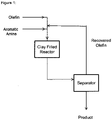
- a simplified reactor scheme is shown in Figure 1 . The practitioner can immediately envision from the scheme that additional reactors and feed lines can be added, tanks for mixing reactants prior to introduction to the catalysts can be inserted as well as valves and other controls, etc. In Figure 1 , heating can be carried out anywhere along the reaction train, for example, reactant holding tanks, mixing tanks, feed lines, reactors, etc.
- the reactors are the tubes of shell and tube heat exchangers filled with the catalyst where the shell is used to maintain temperature control of the reaction mixture.
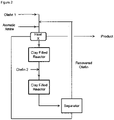
- Figure 2 A sampling of additional design elements are illustrated by the simplified scheme shown in Figure 2 , including an additional reactor and additional olefin feed line. Variations on the design of Figure 2 could include elimination of olefin feed 1 or olefin feed 2, inclusion of additional feeds and/or reactors, etc.
- Figure 2 also references the use of heat exchangers in the reaction apparatus design which can be used as economizers. The economizers allow one to transfer the heat from one stream of the system to cool another, saving both heating and cooling costs.
- Figure 2 illustrates passing the still hot product mixture through one or more heat exchanges positioned elsewhere in the reactor apparatus, which makes use of the heat given off during cooling of the product to preheat the reactor feed or feeds.
- the process of the invention is conveniently carried out in an apparatus comprising a shell and tube heat exchanger setup of parallel clay filled tubes to be used as fixed beds.
- Unreacted alkenes are typically fed in excess and continuously stripped off the crude product mixture directly after reaction.
- the reaction product is itself used as the heat exchanger fluid, typically without external cooling, often at or near the temperature at which it was collected. Removal of unreacted alkenes can be carried out under reduced pressure if desired.
- the reaction can be carried out in a neutral solvent such as mineral oil or an inert hydrocarbon solvent, but generally no solvent is necessary.
- a neutral solvent such as mineral oil or an inert hydrocarbon solvent
- the use of an excess of olefin can act as a solvent.
- Inert gas such as nitrogen, can be used to minimize oxidation of products during reaction, but mostly to allow operation at higher temperatures with the lower boiling oligomers.
- the olefin and aromatic amine reactants can be introduced into the reactor separately through different individual feeds, separately but through the same line, or they may be mixed together before being introduced to the fixed bed reactor through the same feed.
- the reactants may be mixed together in a vessel and the resulting mixture may be introduced to the reactor through a single feed. It is also possible to introduce a reaction mixture into the reactor and then introduce additional doses of one or more reactants at a later point, often using additional feeds.
- the reactants are pumped into and through the reactor.
- the rate of flow through the catalyst can thus be controlled by adjusting the pump.
- a certain amount of increased pressure within the reactor will generally exist due to the back pressure created by the flow of reactants though the catalyst bed or other points in the reactor system, faster feed rates generating higher pressure. It is also possible to draw the reactants through the reactor by pumping the reaction mixture out after passage through the reactor and control the flow rate by adjusting the post reactor pump.
- the pressure under which the reaction occurs is, at least partially, a function of the olefin used, the reaction temperature, the flow rate, and/or the clay catalyst selected.
- the reaction pressure is below 250 psi (1.7 MPa), and frequently 100 psi (0.69 MPa) or less and in some embodiments the reaction can be run at roughly atmospheric pressure.
- One particular embodiment relates to the alkylation of diphenylamine providing alkylated diphenylamines, which are known as effective antioxidants, for example, reaction of diphenyl amine with nonenes, 2,4,4-trimethylpentene and the like produce commercially valuable alkylated diphenylamines, often as a mixture of mono- and di-alkylated compounds, many of which are liquids.
- the process can be employed to alkylate a diaryl amine to produce a product mixture which comprises:
- the process is used to prepare a liquid mixture of nonylated diphenylamines comprising
- a stainless-steel tube (1 inch (25 mm) diameter, 13 inches (330 mm) in length) was charged with 92.0 grams of F-24 bentonite catalyst (20-60 mesh (250 to 841 ⁇ m)), which catalyst was pretreated to remove water.
- the reaction tube was placed vertically inside a tube furnace.
- the reaction temperature was set at 180°C.
- a six point thermocouple recorded the internal temperature of the reaction tube along its length.
- the set-temperature of the reaction was maintained on only the upper half of the tube and the bottom end maintained temperatures between 60-90°C. The nominal volume of the reactor was therefore estimated as the upper half, where set-temperatures were maintained.
- Example 2 followed the procedure of Example 1 except that the flow rate was set at 8.4 grams per hour for Example 2 and 5.7 grams per hour for Example 3.
- DPA conversion in each example was 99-100% and the product had a light color. Analysis of the product ratios are shown in Table 1. Table 1. Table 1. Results for Nonylation of Diphenylamine Ex/ Interval Flow Rate (g/h) Catalyst Age (h) % DPA % Monoalklyated % DiAlkylated % Tri-Alkylated 1/a 12.9 58 0 18.6 73.0 6.5 1/b 12.9 107 0 21.9 72.6 5.3 1/c 12.9 207 0 27.3 69.3 3.6 1/d 12.9 338 0.4 36.5 61.2 2.1 2 8.4 310 0 23.8 71.5 4.7 3 5.7 332 0 17.5 75.0 7.4
- Example 4-7 The reactions of Examples 4-7 were run similarly to that of Example 1; Examples 4-6 were run for over 1,000 hours while adjusting the flow rate and temperature to maintain the excellent conversion and product ratio obtained during the initial portion of the reaction, Example 7 was run for 300 hours. Data taken at early intervals and information on raw material feed, reaction conditions etc., are shown in Table 2 along with the data from Example 1, interval c.
- DPA diphenylamine
- the feed line connecting the reaction mixture to the reactor was also heated to pre-heat the reactants to about 130°C.
- the heated reactant mixture pumped into the reactor at a mass flow rate between 13 and 14 grams per hour.
- Sample product fractions were collected in reagent bottles at ambient temperature at various time intervals and analyzed by Gas Chromatography to determine the product and raw material ratio. Data recorded at 209 hours is shown in Table 2.
- the reaction was performed according to the procedure of Example 4 except that a 25 psig (0.17 MPa) check valve was attached to the outlet of the tubular reactor, and the weight ratio of nonenes to DPA is reduced from 2.4 to 2.24, which reduces the mole ratio of nonenes to DPA from 3.2 to 3.0.
- the reaction is run under a pressure of 25 psig (0.17 MPa) preventing evaporation of nonenes from the reaction mixture. Although less nonenes is used, the reaction rate improves by about 10%. Data recorded at 198 hours is shown in Table 2.
- the reaction was performed according to the procedure of Example 5 except that the reaction temperature was set at 145°C. DPA conversion was 99-100% and the product in liquid form had a light color. Data recorded at 206 hours is shown in Table 2.
- Example 5 The reaction was performed according to the procedure of Example 5 except that the catalyst is FULCAT 22B granule of the same volume, which catalyst was pretreated to remove water. Data recorded at 215 hours is shown in Table 2.
- DPA conversion in each of Examples 4-7 was 99-100% and the product had a light color.
- Analysis of the product ratios and information on raw material feed, reaction conditions, mass of effluent products and catalyst run time are shown in Table 2.
- Nonylated DPA amount and unreacted nonenes were estimated based on crude products' GC data.
- the temperature record point 6 is at the position of about 1 inch (25 mm) from the top of the tube
- the temperature record point 1 is at the position of about 1 inch (25 mm) from the bottom of the tube
- the temperature record point 4 is at the position of midpoint of tube and used as set point of temperature. Table 2.
- Example 5 The reaction of Example 5 was run successfully for over 1,000. After about 500 hours the flow rate was reduced to about 8.7 gram/hour; after about 1050 hours the flow rate was reduced to about 4.7 gram/hour. DPA conversion and product remained consistently high; the ratio of non-alkylated : mono-alkylated : di-alkylated : tri-alkylated DPA of the fraction collected at 724 hours was 0.4 : 19.7 : 75.3 : 4.3, and the ratio at 1398 hours was 0.5 : 20.1 : 74.9: 4.4.
- a stainless-steel tube (1 inch (25 mm) diameter, 13 inches (330 mm) in length) was charged with 106 grams of F-24X BASF catalyst (20-60 mesh (250 to 841 ⁇ m)), which catalyst was pretreated to remove water.
- a six point thermocouple recorded the internal temperature of the reaction tube along its length. The reaction temperature was set at 130°C.
- a 25 psig (0.17 MPa) check valve was attached to the outlet of the tubular reactor and the reaction was run under pressure as in Example 5.
- Diphenylamine, alpha-methylstyrene and toluene were mixed in a 1 : 1.45 : 1.25 mass ratio and heated in feed flask to about 50°C.
- the feed line connecting the reaction mixture to the reactor was heated to pre-heat the reactants to about 110°C.
- the heated reactant mixture was pumped into the reactor at a mass flow rate between 40 to 42 grams per hour. Samples were taken at intervals and analyzed by Gas Chromatography to determine the product and raw material ratio as above.
- the reactants were pumped through the reactor for a total of 7 hours. Crude product, 292 gram in total was collected. A 253 gram portion of the crude was stripped under vacuum and heat leaving 146.7 grams of isolated product.
- the distillate toluene had a mass of 90.13 grams.
- DPA and styrene conversions were both 99-100% and the product is in liquid form and had an amber color.
- the stripped product's composition is shown below.
- Component GC area% Diphenylamine 0.53 ⁇ -methyl styrene dimer-1 7.85 ⁇ -methyl styrene dimer-2 0.33 ⁇ -methyl styrene dimer-3 0.72
- Mono-alkylated DPA 9.15 Di- alkylated DPA 71.76 Tri-alkylated DPA-1 0.21 Tri-alkylated DPA-2 4.76 Tri-alkylated DPA-3 0.30 Others 4.40
- Example 9 N-phenyl-alpha-naphthylamine (PANA) Alkylated by Tetrapropylenes
- a stainless-steel tube (1 inch (25 mm) diameter, 13 inches (330 mm) in length) was charged with 106 grams of F-24X BASF catalyst (20-60 mesh (250 to 841 ⁇ m)), which catalyst was pretreated to remove water.
- a six point thermocouple recorded the internal temperature of the reaction tube along its length.
- the reaction tube was set at 155°C.
- a 25 psig (0.17 MPa) check valve was attached to the outlet of the tubular reactor and the reaction was run under pressure.
- the feed line connecting the reaction mixture to the reactor was heated to pre-heat the reactants to about 130 °C.
Landscapes
- Chemical & Material Sciences (AREA)
- Organic Chemistry (AREA)
- Chemical Kinetics & Catalysis (AREA)
- Organic Low-Molecular-Weight Compounds And Preparation Thereof (AREA)
- Low-Molecular Organic Synthesis Reactions Using Catalysts (AREA)
Description
- Provided is an improved process, readily run as a continuous process, for alkylating aromatic amines, for example, diarylamines such as diphenylamine, dinaphthylamine, N-phenyl-N-naphthyl amine etc., with an olefin, whereby a mixture of the aromatic amine and the olefin are passed through a clay catalyst in a fixed bed reactor system.
- Alkylated aromatic amines, e.g., diarylamines, such as alkylated diphenylamine, are well known in the art to be effective stabilizers / antioxidants in a wide variety of organic materials, for example, polymeric substances such as natural or synthetic rubber, other elastomers and plastics, lubricating oils including e.g., mineral oil derived lubricants and synthetic lubricants, etc. In many these applications, light colored products which are liquid at room temperature are desirable for a number of practical reasons.
- Alkylation of diarylamines, such as diphenylamine, with olefins in the presence of suitable alkylation catalysts is well known in the art. For example,
U.S. Pat. No. 2,943,112 discloses a two-step process whereby alkylation of diphenylamine, in the presence of acid catalysts or clay catalysts, with relatively unreactive olefins, such as secondary alkenes, is followed by an alkylation reaction with more reactive olefins to scavenge the unreacted diphenylamine, with clay catalysts providing the desired light color. -
U.S. Pat. No. 3,496,230 discloses the preparation of a mixture of 80% dinonydiphenylamine and 15% nonyldiphenylamine in the presence of Friedel-Crafts catalysts such as AlCl3 and ZnCl2, but mixtures contaminated by traces of chlorine, metal compounds and undesirable by-products, e.g. N-alkylated diphenylamines and diphenylamines alkylated in the 2- and 2'-positions, are obtained which are black in color and very viscous. -
European Patent Application No. 387 979 -
U.S. Pat. No. 4,824,601 discloses the use of acidic clay catalysts for the alkylation of diphenylamine to produce a light colored, liquid product by reacting certain molar ratios of reactants within specific temperature ranges for a time sufficient to ensure the alkylated product contains less than 25% dialkylated diphenylamine. The limit on the amount of dialkylated diphenylamine is disclosed as necessary to avoid the formation of crystallized, solid products. -
U. S. Pat. Nos. 5,672,752 ,5,214,211 and5,750,787 disclose processes for alkylating diphenylamine with linear alpha olefins and diisobutylene in the presence of a clay catalyst, which selectively result in a higher proportion of monoalkylated diphenylamine and a lower proportion of unsubstituted diphenylamine and/or disubstituted or polysubstituted diphenylamines.U.S. Pat. No. 6,204,412 discloses a method of alkylating diphenylamine to obtain a light colored, liquid product, which comprises a two-step method wherein, in the second step, a second olefin is added to the reaction mixture containing diphenylamine and diisobutylene (and/or an alpha-olefin of the disclosed formula) to scavenge or reduce the amount of unreacted diphenylamine in the productU. S. Pat. No. 6,315,925 discloses a process which comprises alkylating diphenylamine with an excess of nonene or a mixture of isomeric nonenes in the presence of from 2.0 to 25.0% by weight, based on diphenylamine, of an acidic clay in the absence of a free protonic acid, resulting in a mixture containing at least 68.0% dinonyldiphenylamine, from 20.0 to 30.0% nonyldiphenylamine, not more than 3.5% trinonyldiphenylamine; and not more than 1.0% diphenylamine. -
U. S. Pat. No. 6,355,839 discloses a process for preparation of alkylated diphenylamine antioxidant which comprises alkylating diphenylamine with a polyisobutylene in the presence of a clay catalyst, wherein the polyisobutylene has an average molecular weight in the range of 120 to 600 and wherein the polyisobutylene contains at least 25% methylvinylidene isomer. -
U. S. Pat. No. 8,828,916 discloses a process for preparing nonylated diphenylamines which improves nonene usage by recycling and reusing stripped unreacted nonenes from an earlier process. The process comprises consecutive recycle of recovered nonenes conducted in a sequential two step temperature reaction. The nonene alkylated diphenylamine product mixture is a useful antioxidant when added to a lubricating composition. - There is still a need however for a more efficient and less expensive process for alkylating aromatic amines that will provide a high quality product with low color in a controllable manner.
- Fixed bed reactors for catalytic reactions are known. One advantage of fixed bed reactors over, e.g., standard reaction kettles, is that they are readily adapted to continuous processes which can be used to control contact times with the catalyst by varying feed rates. Another advantage is the excellent heat transfer and control capability. Conceptually simple, one rudimentary fixed bed reactor useful for the present catalytic alkylation is a tube or column with a porous support at one end for preventing flow through of catalyst. The catalyst is loaded into the tube or column and reactants are passed through. The rate at which the reactants progress through the catalyst determines the residence time.
- Of course, the shape of the fixed bed reactor is not limited to the rudimentary device above and a variety of geometries and sizes are known. Multibed reactors comprising several fixed bed reactors, typically in parallel, are common. Multiple passes can be used in a process if desired and it is possible to arrange two or more reactors in series. When using more than one single tube or multibed reactor, each reactor can contain the same or different catalyst, be of equal or different volume, heated or cooled at the same or different temperatures. It is also possible for the reactant composition to be the same or different in different reactors, for example, additional amounts of an alkylating agent, or in some embodiments a different reactive species, may be fed into a downstream reactor along with the reaction mixture produced in a previous reactor,
- The present invention provides an improved process for alkylating aromatic amines, for example, diarylamines such as diphenylamine, dinaphthylamine, N-phenyl-N-naphthyl amine etc., with olefins, e.g., nonenes, isobutylene, oligomers of isobutylene, oligomers of propylene, etc., using a clay catalyst in a fixed bed reactor system, e.g., plug flow, fixed bed reactor system. The process of the invention eliminates the need for various processing steps, e.g., there is no need for a separate step to isolate the catalyst from the product mixture etc., and is conveniently run as a continuous process. In many embodiments the reaction is run at temperatures above the boiling point of one or more is the reactants and can be run under pressure.
- The products obtained are low in color and can comprise predominately a single compound, but liquid products comprising mixtures of alkylated aromatic amines can also be prepared. For example, in the alkylation of diphenylamine with nonenes, a mixture of mono-alkyl and di-alkyl diphenyl amine, plus a minor or negligible amount of trialkyl diphenyl amine, is often obtained, which mixture is liquid at room temperature. Proper selection of catalyst, catalyst amount and catalyst preparation, e.g., catalyst conditioning, reaction temperature, mole ratios of alkylating olefin to aromatic amine, flow rates etc., can be varied to optimize product distribution.
- The process of the invention is also flexible in that a number of reactor systems can be employed, e.g., the reactor system can employ a single reactor including a multibed reactor, or a series of reactors, the reactor can be closed or vented, multiple temperature zones may be employed, multiple reactant feeds can be introduced e.g., to allow for further introduction of reactants, internal recycling of recovered reactants, or to alter the composition of the reaction mixture, etc. It is also possible for the process to include using multiple alkylation steps for greater control of temperature, reaction rates, product distribution etc.
-
-
Figure 1 is a block diagram of one embodiment of the invention showing the progress of the reaction and recovery of excess olefin in a simplified reaction setup -
Figure 2 is a block diagram of a further embodiment of the invention showing the use of the reaction product as heat exchanger fluid - One broad embodiment of the invention provides a process for alkylating an aromatic amine comprising:
- a) loading a fixed bed reactor with an acid treated bentonite clay
- b) heating or cooling the reactor to within a selected temperature range, e.g., from 50°C to 250°C
- c) passing through the acid treated clay in the fixed bed reactor a mixture comprising one or more olefins selected from propene, butene, pentene, hexene, octene, nonene, a mixture of nonenes, decene, undecene, dodecene, tetradecene, hexadecene, and octadecene, and an aromatic amine of formula:
ArNH2, Ar2NH, Ar3N or R2N-Ar-NR2,
- wherein each Ar of the aromatic amine starting material is independently selected from the group consisting of phenyl, phenyl substituted by C1-18 alkyl, naphthyl, and naphthyl substituted by C1-18 alkyl;
- and each R is independently selected from the group consisting of H, C1-18 alkyl, phenyl, phenyl substituted by C1-18 alkyl, naphthyl, and naphthyl substituted by C1-18 alkyl;
- to yield a product wherein one or more of the groups Ar are alkylated by one or more alkyl groups derived from the olefin, wherein the reaction pressure is below 250 psi (1.7 MPa).
- The process of the invention is most efficiently run as a continuous process.
- The present process may be used in the alkylation of a variety of aromatic amines, i.e., monodi-, and tri-aromatic amines and diamino aromatics, for example diphenylamine, dinaphthylamine, N-phenyl-1-naphthylamine, N-phenyl-2-naphthylamine, p,p'-phenylenediamine, p-amino-diphenylamine, p-methylamino-diphenylamine and p-isopropylamino-diphenylamine.
- In many embodiments the aromatic amine being alkylated is of formula:
ArNH2, Ar2NH, Ar3N or R2N-Ar-NR2,
- wherein each Ar is independently selected from the group consisting of phenyl, phenyl substituted by C1-12 alkyl, naphthyl, and naphthyl substituted by C1-12 alkyl; for example phenyl, phenyl substituted by C1-12 alkyl or naphthyl; for example, phenyl, phenyl substituted by C1-9 alkyl or naphthyl;
- and each R is independently selected from the group consisting of H, C1-18 alkyl, phenyl, phenyl substituted by C1-18 alkyl, and naphthyl, e.g., H, C1-12 alkyl, phenyl or phenyl substituted by C1-12 alkyl; e.g., H, C1-12 alkyl, phenyl.
- Certain embodiments relate to the alkylation of an aromatic amine of formula Ar2NH or R2N-Ar-NR2, for example, Ar2NH.
- The olefins used in the present method are selected from propene, butene, pentene, hexene, octene, nonene, a mixture of nonenes, decene, undecene, dodecene, tetradecene, hexadecene octadecene, including straight chain or branched isomers and isomers differing by the placement of the double bond, for example, 1-nonene, 2-nonene etc., and n-butene, iso- butene, isooctene, 2-ethylhexene and the like. Mixtures of olefins are often employed. In some select embodiments the olefins are derived from propene or isobutylene, e.g., certain embodiments the one or more olefins comprise one or more of isobutylene, di-isobutylene, tri-isobutylene, di-propylene, tri-propylene and the like. Often, the olefin will comprise mixtures of propylene and butylene oligomers, e.g., oligomer mixtures comprising propylene or butylene dimers, trimers and/or tetramers etc., which mixtures often include the monomeric species. In certain embodiments the one or more olefins comprise isobutylene, di-isobutylene, tri-isobutylene, di-propylene, tri-propylene or tetrapropylene.
- The reactions are often run under pressures greater than atmospheric. In some cases this is due the pressure created by forcing the reactants through the catalyst and a specified flow rate. In the case of very volatile olefins, e.g. propene, butene and iso-butene, and when the selected olefin has a boiling point below the reaction temperature, higher pressure is highly desired.
- In many embodiments the one or more olefins is selected from the group of diisobutylene and nonene. In many cases, such as when nonene is obtained by trimerization of propylene, a mixture of nonenes will be present.
- The mole ratio of the one or more olefins to the aromatic amine is generally from 0.8:1 to 5:1, e.g., from 1:1 to 4:1 or from 1:1 to 3:1. While the process can be run using equimolar amounts of olefin and amine, it is generally run using a higher amount of olefin, for example, the mole ratio of the one or more olefins to the aromatic amine is often from 1.1:1, 1.2 or 1.3 to 5:1 or 4:1, e.g., from 1.3:1 to 4:1, from 1:5 to 4:1, or from 2:1 to 4:1. Unreacted amine, olefin or olefin byproducts, e.g., olefin oligomers or cracking products, can be removed from the product mixture using standard techniques, such as distillation.
- In general, yields of alkylated amines are high based on starting amine, e.g., 75% to 100%, typically higher than 80 or 85%, and in many embodiments the yield of alkylated amines based on starting amine is 90%, 95% or greater. In the event that too large a quantity of unreacted amine remains, a number of known methods to reduce the amount of unreacted amines, such as reaction with highly reactive olefins may be employed, however, this is not a regular occurrence.
- Clays useful as catalysts in the present invention are "acid treated clays", specifically acid treated bentonite clay. For example, useful clays include bentonite clays consisting predominantly of the clay mineral montmorillonite, which are characterized by rapid slaking when it is in the air dried state and only a slight swelling when placed in water. Acid treated bentonite clays useful as catalysts include F24X, F-24, F 22B, F20X, presently sold by BASF, formerly from ENGELHARD.
- The clay catalysts may contain some water as received. Removal of the water prior to use is reported to result in a lighter colored product in similar reactions, e.g., US 5,672,752. It has been found that removal of water can improve reaction kinetics of the inventive process and reduces dimerization of the olefin. Therefore it is desirable to use a low water content clay or to remove the water, for example, by vacuum stripping, heating the clay with a nitrogen sweep, azeotroping with organic liquids including olefins, or any other method known in the art.
- In particular embodiments, the clay is F-24X which is pretreated to remove water, and in many of these embodiments the pretreatment also removes dust. For example, the catalyst is packed in a column and rinsed with twice its weight in methanol to remove dust and draw moisture out. The catalyst is then dried in an 80°C oven overnight to evaporate methanol. If necessary, the catalyst can be further rinsed with a less polar and chemically inert solvent, such as heptane, for methanol removal before the drying step. In some embodiments of the invention, the water is removed by passing crude, unstripped reaction product or nonenes through the columns. Often, the bottom of the reactor tube may be packed with fine material (glass wool, sand, fine alumina or F-20X clay) to prevent the passage of catalyst dust.
- Some clays used to alkylate aromatic amines in standard batch reactions run in kettles may not be optimum for use in the present invention under certain conditions for a variety of reasons. This is often due to physical properties of the clay, for example, the fine particle size of F-20X may lead to extra back-pressure as the reactants are passed through a column packed with this clay. Therefore, when using, e.g., F-20X clay, higher internal pressure may be required to move the reactants through the clay at the desired flow rate.
- The reaction is typically run in a reactor heated at a temperature of from 50°C to 250°C, for example from 100°C to 200°C and in some embodiments from 140°C to 180°C. The reaction can be carried out at a single temperature or, sequentially, at different temperatures. In some cases, the reaction may cause enough of an exotherm which will require a means for dissipating excess heat. Adjusting the rate at which individual reactants are added may also impact the reaction temperature.
- The starting materials may be preheated prior to introduction to the reactor. In some embodiments one or more of the reactants are solid at room temperature and the solid component or a mixture comprising the solid component is heated to a temperature to keep the component or the mixture liquid.
- When alkylating aromatic amines, such as di-aryl amines, with an olefin using a standard batch process, the reaction is typically run at the temperatures above, the product mixture cooled and then filtered, transferred to a vessel where excess olefin is removed by distillation or stripping, and other steps to finish the product may occur. During this batch process there are several steps which require that the reaction / product mixture be heated and cooled. For example, the reactants are often heated for better handling before addition to the reactor, the reactor is heated, the product after reaction is cooled before final filtration, the product mixture is then reheated to strip off the excess olefin after which the product is allowed to cool.
- By using the fixed bed reactor the present process eliminates the need for filtering the product, and dispenses with the need to provide agitation to the reaction. Other process efficiencies are also readily realized. For example, the reactants are typically passed through the clay filled reactor bed or beds at the reaction temperature, the product mixture is collected at elevated temperature while excess olefin is continuously stripped out and fed back into the reactor. The need to cool, filter and reheat the product mixture for stripping the excess olefin is eliminated. A simplified reactor scheme is shown in
Figure 1 . The practitioner can immediately envision from the scheme that additional reactors and feed lines can be added, tanks for mixing reactants prior to introduction to the catalysts can be inserted as well as valves and other controls, etc. InFigure 1 , heating can be carried out anywhere along the reaction train, for example, reactant holding tanks, mixing tanks, feed lines, reactors, etc. - In one embodiment, the reactors are the tubes of shell and tube heat exchangers filled with the catalyst where the shell is used to maintain temperature control of the reaction mixture.
- A sampling of additional design elements are illustrated by the simplified scheme shown in
Figure 2 , including an additional reactor and additional olefin feed line. Variations on the design ofFigure 2 could include elimination ofolefin feed 1 orolefin feed 2, inclusion of additional feeds and/or reactors, etc.Figure 2 also references the use of heat exchangers in the reaction apparatus design which can be used as economizers. The economizers allow one to transfer the heat from one stream of the system to cool another, saving both heating and cooling costs. For example,Figure 2 illustrates passing the still hot product mixture through one or more heat exchanges positioned elsewhere in the reactor apparatus, which makes use of the heat given off during cooling of the product to preheat the reactor feed or feeds. - For example, the process of the invention is conveniently carried out in an apparatus comprising a shell and tube heat exchanger setup of parallel clay filled tubes to be used as fixed beds. Unreacted alkenes are typically fed in excess and continuously stripped off the crude product mixture directly after reaction. In particular embodiments, the reaction product is itself used as the heat exchanger fluid, typically without external cooling, often at or near the temperature at which it was collected. Removal of unreacted alkenes can be carried out under reduced pressure if desired.
- If desired, the reaction can be carried out in a neutral solvent such as mineral oil or an inert hydrocarbon solvent, but generally no solvent is necessary. In some embodiments, the use of an excess of olefin can act as a solvent. Inert gas, such as nitrogen, can be used to minimize oxidation of products during reaction, but mostly to allow operation at higher temperatures with the lower boiling oligomers.
- The olefin and aromatic amine reactants can be introduced into the reactor separately through different individual feeds, separately but through the same line, or they may be mixed together before being introduced to the fixed bed reactor through the same feed. For example, the reactants may be mixed together in a vessel and the resulting mixture may be introduced to the reactor through a single feed. It is also possible to introduce a reaction mixture into the reactor and then introduce additional doses of one or more reactants at a later point, often using additional feeds.
- Typically, the reactants are pumped into and through the reactor. The rate of flow through the catalyst can thus be controlled by adjusting the pump. A certain amount of increased pressure within the reactor will generally exist due to the back pressure created by the flow of reactants though the catalyst bed or other points in the reactor system, faster feed rates generating higher pressure. It is also possible to draw the reactants through the reactor by pumping the reaction mixture out after passage through the reactor and control the flow rate by adjusting the post reactor pump.
- Typically the pressure under which the reaction occurs is, at least partially, a function of the olefin used, the reaction temperature, the flow rate, and/or the clay catalyst selected. The reaction pressure is below 250 psi (1.7 MPa), and frequently 100 psi (0.69 MPa) or less and in some embodiments the reaction can be run at roughly atmospheric pressure.
- One particular embodiment relates to the alkylation of diphenylamine providing alkylated diphenylamines, which are known as effective antioxidants, for example, reaction of diphenyl amine with nonenes, 2,4,4-trimethylpentene and the like produce commercially valuable alkylated diphenylamines, often as a mixture of mono- and di-alkylated compounds, many of which are liquids.
- For example, the process can be employed to alkylate a diaryl amine to produce a product mixture which comprises:
- less than 1% by weight of starting aromatic amine, based on all aromatic amines present,
- 15% to 35% of mono-alkylated aromatic amine;
- 55% to 80% di-alkylated aromatic amine; and
- 0.5 to 15% of tri-alkylated aromatic amine.
- For example:
- less than 1% by weight of starting aromatic amine, based on all aromatic amines present,
- 15% to 30% of mono-alkylated aromatic amine;
- 60% to 80% di-alkylated aromatic amine; and
- 0.5 to 10% of tri-alkylated aromatic amine.
- In a select embodiment, the process is used to prepare a liquid mixture of nonylated diphenylamines comprising
- less than 1% by weight of starting diphenylamine,
- 15% to 35%, e.g., 15% to 30%, of mono-nonyldiphenyl amine;
- 55% to 80%,e.g., 60% to 80%, di-nonyldiphenyl amine; and
- 0.5 to 15%, e.g., 0.5 to 10% of tri- nonyldiphenyl amine, based on all aromatic amines present.
- Other product ratios can be produced by varying the catalyst, flow rate etc., of the process.
- A stainless-steel tube (1 inch (25 mm) diameter, 13 inches (330 mm) in length) was charged with 92.0 grams of F-24 bentonite catalyst (20-60 mesh (250 to 841 µm)), which catalyst was pretreated to remove water. The reaction tube was placed vertically inside a tube furnace. The reaction temperature was set at 180°C. A six point thermocouple recorded the internal temperature of the reaction tube along its length. The set-temperature of the reaction was maintained on only the upper half of the tube and the bottom end maintained temperatures between 60-90°C. The nominal volume of the reactor was therefore estimated as the upper half, where set-temperatures were maintained.
- Nonenes and diphenylamine were mixed in a 2.9:1 mass ratio, i.e., 3.9:1 mole ratio (nonenes:DPA) and heated, from about 60°C to about 130°C to avoid precipitation of diphenylamine (mp 50-52°C). The feed line connecting the reaction mixture to the reactor was also heated at from about 60°C to about 130°C. The heated reactant mixture was pumped into the reactor at a mass flow rate between 12 and 13 grams per hour. Sample product fractions were collected in a round-bottom flask. Final filtration of the product was unnecessary as the catalyst was stationary during the process. The reactants were pumped through the reactor for a total of 340 hours. Samples were taken at intervals a-d, reaction time recorded as Catalyst Age, and analyzed by gas chromatography to determine the product ratio.
- Examples 2 and 3 followed the procedure of Example 1 except that the flow rate was set at 8.4 grams per hour for Example 2 and 5.7 grams per hour for Example 3.
- DPA conversion in each example was 99-100% and the product had a light color. Analysis of the product ratios are shown in Table 1.
Table 1. Results for Nonylation of Diphenylamine Ex/ Interval Flow Rate (g/h) Catalyst Age (h) % DPA % Monoalklyated % DiAlkylated % Tri-Alkylated 1/a 12.9 58 0 18.6 73.0 6.5 1/b 12.9 107 0 21.9 72.6 5.3 1/c 12.9 207 0 27.3 69.3 3.6 1/d 12.9 338 0.4 36.5 61.2 2.1 2 8.4 310 0 23.8 71.5 4.7 3 5.7 332 0 17.5 75.0 7.4 - The reactions of Examples 4-7 were run similarly to that of Example 1; Examples 4-6 were run for over 1,000 hours while adjusting the flow rate and temperature to maintain the excellent conversion and product ratio obtained during the initial portion of the reaction, Example 7 was run for 300 hours. Data taken at early intervals and information on raw material feed, reaction conditions etc., are shown in Table 2 along with the data from Example 1, interval c.
- Following a procedure similar to that of Example 1, a stainless-steel tube (1 inch (25 mm) diameter, 13 inches (330 mm) in length) was charged with 104 grams of F-24X BASF catalyst (20-60 mesh (250 to 841 µm)), which catalyst was pretreated to remove water. The reaction tube was placed vertically inside a tube furnace. The reaction temperature was set at 155°C. A six point thermocouple recorded the internal temperature of the reaction tube along its length. Nonenes and diphenylamine were mixed in a 2.4:1 mass ratio, i.e., 3.2:1 mole ratio (nonenes: DPA) and heated, e.g., from about 60°C to about 130°C to avoid the precipitation of diphenylamine (mp = 52°C). The feed line connecting the reaction mixture to the reactor was also heated to pre-heat the reactants to about 130°C. The heated reactant mixture pumped into the reactor at a mass flow rate between 13 and 14 grams per hour. Sample product fractions were collected in reagent bottles at ambient temperature at various time intervals and analyzed by Gas Chromatography to determine the product and raw material ratio. Data recorded at 209 hours is shown in Table 2.
- The reaction was performed according to the procedure of Example 4 except that a 25 psig (0.17 MPa) check valve was attached to the outlet of the tubular reactor, and the weight ratio of nonenes to DPA is reduced from 2.4 to 2.24, which reduces the mole ratio of nonenes to DPA from 3.2 to 3.0. The reaction is run under a pressure of 25 psig (0.17 MPa) preventing evaporation of nonenes from the reaction mixture. Although less nonenes is used, the reaction rate improves by about 10%. Data recorded at 198 hours is shown in Table 2.
- The reaction was performed according to the procedure of Example 5 except that the reaction temperature was set at 145°C. DPA conversion was 99-100% and the product in liquid form had a light color. Data recorded at 206 hours is shown in Table 2.
- The reaction was performed according to the procedure of Example 5 except that the catalyst is FULCAT 22B granule of the same volume, which catalyst was pretreated to remove water. Data recorded at 215 hours is shown in Table 2.
- DPA conversion in each of Examples 4-7 was 99-100% and the product had a light color. Analysis of the product ratios and information on raw material feed, reaction conditions, mass of effluent products and catalyst run time are shown in Table 2. Nonylated DPA amount and unreacted nonenes were estimated based on crude products' GC data. The temperature record point 6 is at the position of about 1 inch (25 mm) from the top of the tube, the
temperature record point 1 is at the position of about 1 inch (25 mm) from the bottom of the tube, the temperature record point 4 is at the position of midpoint of tube and used as set point of temperature.Table 2. Conditions and Results for Nonylation of Diphenylamine Raw Materials and Catalyst Ex 4 Ex 5 Ex 6 Ex 7 Ex 1/c Diphenylamine 875 1017 856 889 690 Nonenes 2100 2278 1491 1990 2001 Weight Ratio 2.4 : 1 2.24:1 2:24:1 2.24:1 2.90:1 Catalyst F-24X F-24X F-24X FULCAT 22B granule F-24 Catalyst particle size 20-60 20-60 20-60 20-60 20-60 Catalyst Amount (gram) 104 106 104 86 92 Reaction Conditions Temperature Set point (°C) 155 155 145 155 180 Temp Record point-6 (°C) 148 160 137 159 145 Temp Record point-4 (°C) 155 154 145 153 180 Temp Record point-1 (°C) 94 150 113 138 95 Pressure (psig) - 25 (0.17 MPa) 25 (0.17 MPa) 25 (0.17 MPa) - Average Flow Rate (g/hour) 14 16 10 13 13 Run time (hours) 209 198 206 215 207 Results and Amounts of Crude and Finished Product Crude Product Amount (g) 2944 3115 2056 2879 2690 Unreacted Nonenes Amount (g) 877 857 617 892 1447 Product Amount (g) 2066 2258 1439 1987 1243 Product Compositions Calculated By GC Data Diphenylamine(DPA) 0.10 0.20 0.07 0.14 0 Mono-nonylated DPAs 17.3 15.7 18.5 19.5 21.9 Di-nonylated DPAs 75.8 78.0 76.2 76.3 72.6 Tri-nonylated DPAs 6.8 6.1 4.8 3.8 5.3 - Extended Example 5 - The reaction of Example 5 was run successfully for over 1,000. After about 500 hours the flow rate was reduced to about 8.7 gram/hour; after about 1050 hours the flow rate was reduced to about 4.7 gram/hour. DPA conversion and product remained consistently high; the ratio of non-alkylated : mono-alkylated : di-alkylated : tri-alkylated DPA of the fraction collected at 724 hours was 0.4 : 19.7 : 75.3 : 4.3, and the ratio at 1398 hours was 0.5 : 20.1 : 74.9: 4.4.
- Removal of Nonenes from Alkylated DPA - Fractions taken from Examples 4, 6 and 7 were stripped under vacuum and heat by using a rotavap or distillation pot. Unreacted nonenes were readily separated from alkylated DPA. The weights recorded for the samples before and after nonene removal verify the assumption that the GC data relative to the area percentage of nonenes and alkylated DPA recorded in the tables are consistent with the actual mass ratios of nonenes and alkylated DPA. Results are shown in Table 3.
Table 3. Product Fractions and Isolations Example 4 6 7 Crude Product Amount (g) 1095 862.0 434.8 Product Amount (g) 775.1 629.3 306.6 Recovered Nonenes (g) 308.4 217.2 126.7 Crude Product Compositions Nonenes 26.01 27.43 30.37 Nonenes dimer 0.21 0.15 0.30 Diphenylamine(DPA) 0.30 0.11 0.27 Mono-nonylated DPAs 12.20 14.70 13.62 Di-nonylated DPAs 56.39 54.75 52.31 Tri-nonylated DPAs 5.10 2.87 3.13 Compositions After Nonene Removal Nonenes 0.23 0.34 0.11 Nonenes dimer 0.24 0.14 0.22 Diphenylamine(DPA) 0.30 0.15 0.23 Mono-nonylated DPAs 17.76 20.50 19.70 Di-nonylated DPAs 75.05 74.77 75.26 Tri-nonylated DPAs 6.42 4.11 4.49 - A stainless-steel tube (1 inch (25 mm) diameter, 13 inches (330 mm) in length) was charged with 106 grams of F-24X BASF catalyst (20-60 mesh (250 to 841 µm)), which catalyst was pretreated to remove water. A six point thermocouple recorded the internal temperature of the reaction tube along its length. The reaction temperature was set at 130°C. A 25 psig (0.17 MPa) check valve was attached to the outlet of the tubular reactor and the reaction was run under pressure as in Example 5.
- Diphenylamine, alpha-methylstyrene and toluene were mixed in a 1 : 1.45 : 1.25 mass ratio and heated in feed flask to about 50°C. The feed line connecting the reaction mixture to the reactor was heated to pre-heat the reactants to about 110°C. The heated reactant mixture was pumped into the reactor at a mass flow rate between 40 to 42 grams per hour. Samples were taken at intervals and analyzed by Gas Chromatography to determine the product and raw material ratio as above. The reactants were pumped through the reactor for a total of 7 hours. Crude product, 292 gram in total was collected. A 253 gram portion of the crude was stripped under vacuum and heat leaving 146.7 grams of isolated product. The distillate toluene had a mass of 90.13 grams. DPA and styrene conversions were both 99-100% and the product is in liquid form and had an amber color. The stripped product's composition is shown below.
Component GC area% Diphenylamine 0.53 α-methyl styrene dimer-1 7.85 α-methyl styrene dimer-2 0.33 α-methyl styrene dimer-3 0.72 Mono-alkylated DPA 9.15 Di- alkylated DPA 71.76 Tri-alkylated DPA-1 0.21 Tri-alkylated DPA-2 4.76 Tri-alkylated DPA-3 0.30 Others 4.40 - Example 9 N-phenyl-alpha-naphthylamine (PANA) Alkylated by Tetrapropylenes A stainless-steel tube (1 inch (25 mm) diameter, 13 inches (330 mm) in length) was charged with 106 grams of F-24X BASF catalyst (20-60 mesh (250 to 841 µm)), which catalyst was pretreated to remove water. A six point thermocouple recorded the internal temperature of the reaction tube along its length. The reaction tube was set at 155°C. A 25 psig (0.17 MPa) check valve was attached to the outlet of the tubular reactor and the reaction was run under pressure.
- Tetrapropylenes and N-phenyl-alpha-naphthylamine were mixed in a 1.75 : 1 mass ratio, i.e., 2.2 : 1 mole ratio (alkene : PANA) and heated, from about 60 °C to about 80 °C to avoid the precipitation of PANA (mp = 59 °C). The feed line connecting the reaction mixture to the reactor was heated to pre-heat the reactants to about 130 °C.
- The heated reactant mixture pumped into the reactor at a mass flow rate between 36 and 43 grams per hour (averagely 38 grams per hour on average). Sample product fractions were collected in reagent bottles at ambient temperature. The reactants were pumped through the reactor for a total of 27 hours. Samples were taken at intervals and analyzed by gc to determine the product and raw material ratio. Crude product, 1041 gram in total, was collected. A 272.98 gram portion of crude product was stripped under vacuum and heat leaving 170.23 grams of an isolated amber liquid product, the composition of which is shown below.
Component GC area% Tetrapropylene Dimers 0.84 PANA 6.80 Mono-C12 APAN 81.14 Di-C12 APAN-1 6.28 Di-C12 APAN-2 4.29 Others 0.6
Claims (14)
- A process for alkylating an aromatic amine comprising:a) loading a fixed bed reactor with an acid treated bentonite clay,b) heating or cooling the reactor to within a selected temperature range,c) passing through the acid treated clay in the fixed bed reactor a mixture comprisingone or more olefins selected from propene, butene, pentene, hexene, octene, nonene, a mixture of nonenes, decene, undecene, dodecene, tetradecene, hexadecene, and octadecene; andan aromatic amine of formula:
ArNH2, Ar2NH, Ar3N or R2N-Ar-NR2,
wherein each Ar is independently selected from the group consisting of phenyl, phenyl substituted by C1-18 alkyl, naphthyl, and naphthyl substituted by C1-18 alkyl;
andeach R is independently selected from the group consisting of H, C1-18 alkyl, phenyl, phenyl substituted by C1-18 alkyl, naphthyl, and naphthyl substituted by C1-18 alkyl;to yield a product wherein one or more of the groups Ar are alkylated by one or more alkyl groups derived from the olefin;wherein the reaction pressure is below 250 psi (1.7 MPa). - The process according to claim 1 wherein the aromatic amine is of the formula Ar2NH, preferably wherein the aromatic amine is diphenylamine, dinaphthylamine or N-phenyl-N-naphthyl amine.
- The process according to claim 1 wherein the one or more olefins is selected from hexene, octene, nonene, a mixture of nonenes, decene, undecene, dodecene, tetradecene, hexadecene and octadecene.
- The process according to claim 1 wherein the one or more olefins comprise isobutylene, tri-isobutylene, di-propylene, tri-propylene or tetra-propylene.
- The process according to claim 1 wherein the one or more olefins and the aromatic amine are mixed together before being introduced to the fixed bed reactor through the same feed, preferably wherein the one or more olefins and the aromatic amine are mixed together in a vessel and heated at temperatures of from 40°C up to the first selected reaction temperature before being introduced to the fixed bed reactor.
- The process according to claim 1 wherein the one or more olefins and the aromatic amine are introduced to the fixed bed reactor separately through different feeds.
- The process according to claim 1 wherein the fixed bed reactor in b) is heated to a temperature of from 50°C to 250°C.
- The process according to claim 1 wherein the mole ratio of the one or more olefins to the aromatic amine is from 2:1 to 4:1.
- The process according to claim 1 comprisinga) loading a plug flow, fixed bed reactor with an acid treated clay,b) heating the reactor to a temperature of from 100°C to 200°C,c) passing through the acid treated clay in the plug flow, fixed bed reactor a mixture comprising:one or more olefins selected from octene, nonene, a mixture of nonenes, decene, undecene, dodecene, tetradecene, hexadecene and octadecene; andan aromatic amine of formula Ar2NH
wherein each Ar is independently selected from the group consisting of phenyl and naphthyl. - The process according to claim 9 wherein the product comprises:less than 1% by weight of starting aromatic amine, based on all aromatic amines present,15% to 35% of mono-alkylated aromatic amine;55% to 80% di-alkylated aromatic amine; and0.5 to 15% of tri-alkylated aromatic amine.
- The process according to claim 10 wherein the olefin is selected from the group consisting of nonenes, decene and dodecene and the product is a liquid at room temperature.
- The process according to claim 1, wherein the mixture comprising one or more olefins and aromatic amine are passed through the clay filled reactor bed or beds at the reaction temperature, the product mixture is collected at elevated temperature while excess olefin is continuously stripped out.
- The process according to claim 12 wherein the excess olefin is continuously stripped out and fed back into the reactor.
- The process according to claim 12 wherein the reactors are tubes of shell and tube heat exchangers filled with the catalyst where the shell is used to maintain temperature control of the reaction mixture, preferably wherein the reaction product is fed through heat exchanges as heat exchanger fluid.
Applications Claiming Priority (3)
| Application Number | Priority Date | Filing Date | Title |
|---|---|---|---|
| US201361890392P | 2013-10-14 | 2013-10-14 | |
| US14/509,123 US9617201B2 (en) | 2013-10-14 | 2014-10-08 | Fixed bed process for clay catalyzed alkylation of aromatic amines |
| PCT/US2014/059880 WO2015057487A1 (en) | 2013-10-14 | 2014-10-09 | Fixed bed process for clay catalyzed alkylation of aromatic amines |
Publications (2)
| Publication Number | Publication Date |
|---|---|
| EP3057936A1 EP3057936A1 (en) | 2016-08-24 |
| EP3057936B1 true EP3057936B1 (en) | 2022-08-31 |
Family
ID=52810222
Family Applications (1)
| Application Number | Title | Priority Date | Filing Date |
|---|---|---|---|
| EP14790918.8A Not-in-force EP3057936B1 (en) | 2013-10-14 | 2014-10-09 | Fixed bed process for clay catalyzed alkylation of aromatic amines |
Country Status (6)
| Country | Link |
|---|---|
| US (1) | US9617201B2 (en) |
| EP (1) | EP3057936B1 (en) |
| CN (1) | CN105636931B (en) |
| ES (1) | ES2930525T3 (en) |
| SG (1) | SG11201601762RA (en) |
| WO (1) | WO2015057487A1 (en) |
Families Citing this family (2)
| Publication number | Priority date | Publication date | Assignee | Title |
|---|---|---|---|---|
| CN109574854A (en) * | 2017-09-28 | 2019-04-05 | 中国石油天然气股份有限公司 | A kind of alkylated N-phenyl-α-naphthylamine antioxidant and preparation method thereof |
| CN109369418A (en) * | 2018-10-10 | 2019-02-22 | 河南师范大学 | Continuous synthesis process and synthesis device of an energy-saving and environmentally friendly alkylaniline liquid antioxidant |
Family Cites Families (14)
| Publication number | Priority date | Publication date | Assignee | Title |
|---|---|---|---|---|
| US2943112A (en) | 1957-11-06 | 1960-06-28 | Pennsalt Chemicals Corp | Alkylation of diphenylamine |
| US3496230A (en) | 1966-02-17 | 1970-02-17 | American Cyanamid Co | Process for mixture of mono- and dialkyl-diphenylamines |
| GB8332797D0 (en) | 1983-12-08 | 1984-01-18 | Ciba Geigy Ag | Antioxidant production |
| US4740620A (en) * | 1985-11-08 | 1988-04-26 | Air Products And Chemicals, Inc. | Alkylation of aromatic amines in the presence of acidic, crystalline molecular sieves |
| JP2539677B2 (en) | 1989-01-13 | 1996-10-02 | 日本石油株式会社 | Lubricating oil composition |
| US5214211A (en) | 1991-12-12 | 1993-05-25 | Uop | Alkylation of diarylamines with olefins using rare earth modified pillared clays |
| US5672752A (en) | 1995-09-13 | 1997-09-30 | The Bfgoodrich Company | Liquid alkylated diphenylamine antioxidant |
| US5750787A (en) | 1995-09-13 | 1998-05-12 | B. F. Goodrich Company | Liquid alkylated diphenylamine antioxidant |
| CA2205098A1 (en) * | 1996-05-17 | 1997-11-17 | James D. Burrington | Alkylation of aromatic amines using a heteropoly catalyst |
| SG65759A1 (en) | 1997-06-06 | 1999-06-22 | Ciba Sc Holding Ag | Nonylated diphenylamines |
| US6204412B1 (en) | 1999-04-16 | 2001-03-20 | The B. F. Goodrich Company | Method of manufacturing alkylated diphenylamine compositions and products thereof |
| US6355839B1 (en) | 2001-08-31 | 2002-03-12 | Chevron U.S.A., Inc. | Alkylation of diphenylamine with polyisobutylene oligomers |
| US8828916B2 (en) | 2006-12-28 | 2014-09-09 | Chevron Oronite Company Llc | Method to prepare nonylated diphenylamine using recycle sequential temperatures |
| CN102112434A (en) | 2008-08-08 | 2011-06-29 | 雅宝公司 | Octylated phenyl-alpha-naphthylamine product mixtures and preparation of such mixtures having high octylated phenyl-alpha-naphthylamine content |
-
2014
- 2014-10-08 US US14/509,123 patent/US9617201B2/en not_active Expired - Fee Related
- 2014-10-09 EP EP14790918.8A patent/EP3057936B1/en not_active Not-in-force
- 2014-10-09 ES ES14790918T patent/ES2930525T3/en active Active
- 2014-10-09 WO PCT/US2014/059880 patent/WO2015057487A1/en not_active Ceased
- 2014-10-09 SG SG11201601762RA patent/SG11201601762RA/en unknown
- 2014-10-09 CN CN201480056271.7A patent/CN105636931B/en not_active Expired - Fee Related
Also Published As
| Publication number | Publication date |
|---|---|
| CN105636931A (en) | 2016-06-01 |
| ES2930525T3 (en) | 2022-12-14 |
| CN105636931B (en) | 2017-12-22 |
| EP3057936A1 (en) | 2016-08-24 |
| WO2015057487A1 (en) | 2015-04-23 |
| SG11201601762RA (en) | 2016-04-28 |
| US9617201B2 (en) | 2017-04-11 |
| US20150105588A1 (en) | 2015-04-16 |
Similar Documents
| Publication | Publication Date | Title |
|---|---|---|
| EP1288189B1 (en) | Alkylation of diphenylamine with polyisobutylene oligomers | |
| EP3322690B1 (en) | Diaryl amine antioxidants prepared from branched olefins | |
| EP1948578B1 (en) | Oligomerization reaction | |
| EP1020425B1 (en) | Liquid alkylated diphenylamine antioxidant | |
| EP1480746B1 (en) | A reactive distillation alkylation process including in situ catalyst regeneration | |
| KR100636484B1 (en) | Methods for preparing alkylated diphenylamine compositions and their products | |
| EP1939169B1 (en) | Method to prepare nonylated diphenylamine using recycle and sequential temperatures | |
| US9617201B2 (en) | Fixed bed process for clay catalyzed alkylation of aromatic amines | |
| CA2794924C (en) | Improved production of alkylaromatic compounds | |
| SU532344A3 (en) | Method for processing liquid products of pyrolysis of hydrocarbons | |
| EP0286029B1 (en) | Alkylation of aromatic amines over a1 exchanged zeolites | |
| EP3064273B1 (en) | Process for alkylation of aromatic amines including steps for regeneration of clay catalyst | |
| JPH0251539B2 (en) | ||
| EP0039218B1 (en) | Improvement in process for the alkylation of benzene with propylene | |
| US7456319B2 (en) | Para-alkylation of aromatic primary amines | |
| EP0515022A2 (en) | Process for preparing oligomers | |
| EP1216224A2 (en) | Method of manufacturing alkylated phenylnaphthylamine compositions; and products | |
| JPS6116792B2 (en) | ||
| HK1029579B (en) | Liquid alkylated diphenylamine antioxidant |
Legal Events
| Date | Code | Title | Description |
|---|---|---|---|
| PUAI | Public reference made under article 153(3) epc to a published international application that has entered the european phase |
Free format text: ORIGINAL CODE: 0009012 |
|
| 17P | Request for examination filed |
Effective date: 20160511 |
|
| AK | Designated contracting states |
Kind code of ref document: A1 Designated state(s): AL AT BE BG CH CY CZ DE DK EE ES FI FR GB GR HR HU IE IS IT LI LT LU LV MC MK MT NL NO PL PT RO RS SE SI SK SM TR |
|
| AX | Request for extension of the european patent |
Extension state: BA ME |
|
| RIN1 | Information on inventor provided before grant (corrected) |
Inventor name: COHN, MITCHEL Inventor name: TRUE, ALAN B. Inventor name: CHEN, HUIYUAN Inventor name: ABBOTT, RONALD D. |
|
| DAX | Request for extension of the european patent (deleted) | ||
| STAA | Information on the status of an ep patent application or granted ep patent |
Free format text: STATUS: EXAMINATION IS IN PROGRESS |
|
| 17Q | First examination report despatched |
Effective date: 20181001 |
|
| RAP1 | Party data changed (applicant data changed or rights of an application transferred) |
Owner name: LANXESS SOLUTIONS US INC. |
|
| RAP1 | Party data changed (applicant data changed or rights of an application transferred) |
Owner name: LANXESS SOLUTIONS US INC. |
|
| RAP1 | Party data changed (applicant data changed or rights of an application transferred) |
Owner name: LANXESS CORPORATION |
|
| GRAP | Despatch of communication of intention to grant a patent |
Free format text: ORIGINAL CODE: EPIDOSNIGR1 |
|
| STAA | Information on the status of an ep patent application or granted ep patent |
Free format text: STATUS: GRANT OF PATENT IS INTENDED |
|
| INTG | Intention to grant announced |
Effective date: 20220321 |
|
| GRAS | Grant fee paid |
Free format text: ORIGINAL CODE: EPIDOSNIGR3 |
|
| GRAA | (expected) grant |
Free format text: ORIGINAL CODE: 0009210 |
|
| STAA | Information on the status of an ep patent application or granted ep patent |
Free format text: STATUS: THE PATENT HAS BEEN GRANTED |
|
| AK | Designated contracting states |
Kind code of ref document: B1 Designated state(s): AL AT BE BG CH CY CZ DE DK EE ES FI FR GB GR HR HU IE IS IT LI LT LU LV MC MK MT NL NO PL PT RO RS SE SI SK SM TR |
|
| REG | Reference to a national code |
Ref country code: CH Ref legal event code: EP Ref country code: GB Ref legal event code: FG4D |
|
| REG | Reference to a national code |
Ref country code: AT Ref legal event code: REF Ref document number: 1515217 Country of ref document: AT Kind code of ref document: T Effective date: 20220915 Ref country code: DE Ref legal event code: R096 Ref document number: 602014084814 Country of ref document: DE |
|
| REG | Reference to a national code |
Ref country code: IE Ref legal event code: FG4D |
|
| REG | Reference to a national code |
Ref country code: ES Ref legal event code: FG2A Ref document number: 2930525 Country of ref document: ES Kind code of ref document: T3 Effective date: 20221214 |
|
| REG | Reference to a national code |
Ref country code: LT Ref legal event code: MG9D |
|
| REG | Reference to a national code |
Ref country code: NL Ref legal event code: MP Effective date: 20220831 |
|
| REG | Reference to a national code |
Ref country code: SK Ref legal event code: T3 Ref document number: E 40787 Country of ref document: SK |
|
| PG25 | Lapsed in a contracting state [announced via postgrant information from national office to epo] |
Ref country code: SE Free format text: LAPSE BECAUSE OF FAILURE TO SUBMIT A TRANSLATION OF THE DESCRIPTION OR TO PAY THE FEE WITHIN THE PRESCRIBED TIME-LIMIT Effective date: 20220831 Ref country code: RS Free format text: LAPSE BECAUSE OF FAILURE TO SUBMIT A TRANSLATION OF THE DESCRIPTION OR TO PAY THE FEE WITHIN THE PRESCRIBED TIME-LIMIT Effective date: 20220831 Ref country code: NO Free format text: LAPSE BECAUSE OF FAILURE TO SUBMIT A TRANSLATION OF THE DESCRIPTION OR TO PAY THE FEE WITHIN THE PRESCRIBED TIME-LIMIT Effective date: 20221130 Ref country code: LV Free format text: LAPSE BECAUSE OF FAILURE TO SUBMIT A TRANSLATION OF THE DESCRIPTION OR TO PAY THE FEE WITHIN THE PRESCRIBED TIME-LIMIT Effective date: 20220831 Ref country code: LT Free format text: LAPSE BECAUSE OF FAILURE TO SUBMIT A TRANSLATION OF THE DESCRIPTION OR TO PAY THE FEE WITHIN THE PRESCRIBED TIME-LIMIT Effective date: 20220831 Ref country code: FI Free format text: LAPSE BECAUSE OF FAILURE TO SUBMIT A TRANSLATION OF THE DESCRIPTION OR TO PAY THE FEE WITHIN THE PRESCRIBED TIME-LIMIT Effective date: 20220831 |
|
| REG | Reference to a national code |
Ref country code: AT Ref legal event code: MK05 Ref document number: 1515217 Country of ref document: AT Kind code of ref document: T Effective date: 20220831 |
|
| PG25 | Lapsed in a contracting state [announced via postgrant information from national office to epo] |
Ref country code: PL Free format text: LAPSE BECAUSE OF FAILURE TO SUBMIT A TRANSLATION OF THE DESCRIPTION OR TO PAY THE FEE WITHIN THE PRESCRIBED TIME-LIMIT Effective date: 20220831 Ref country code: IS Free format text: LAPSE BECAUSE OF FAILURE TO SUBMIT A TRANSLATION OF THE DESCRIPTION OR TO PAY THE FEE WITHIN THE PRESCRIBED TIME-LIMIT Effective date: 20221231 Ref country code: HR Free format text: LAPSE BECAUSE OF FAILURE TO SUBMIT A TRANSLATION OF THE DESCRIPTION OR TO PAY THE FEE WITHIN THE PRESCRIBED TIME-LIMIT Effective date: 20220831 Ref country code: GR Free format text: LAPSE BECAUSE OF FAILURE TO SUBMIT A TRANSLATION OF THE DESCRIPTION OR TO PAY THE FEE WITHIN THE PRESCRIBED TIME-LIMIT Effective date: 20221201 |
|
| PG25 | Lapsed in a contracting state [announced via postgrant information from national office to epo] |
Ref country code: SM Free format text: LAPSE BECAUSE OF FAILURE TO SUBMIT A TRANSLATION OF THE DESCRIPTION OR TO PAY THE FEE WITHIN THE PRESCRIBED TIME-LIMIT Effective date: 20220831 Ref country code: RO Free format text: LAPSE BECAUSE OF FAILURE TO SUBMIT A TRANSLATION OF THE DESCRIPTION OR TO PAY THE FEE WITHIN THE PRESCRIBED TIME-LIMIT Effective date: 20220831 Ref country code: PT Free format text: LAPSE BECAUSE OF FAILURE TO SUBMIT A TRANSLATION OF THE DESCRIPTION OR TO PAY THE FEE WITHIN THE PRESCRIBED TIME-LIMIT Effective date: 20230102 Ref country code: DK Free format text: LAPSE BECAUSE OF FAILURE TO SUBMIT A TRANSLATION OF THE DESCRIPTION OR TO PAY THE FEE WITHIN THE PRESCRIBED TIME-LIMIT Effective date: 20220831 Ref country code: CZ Free format text: LAPSE BECAUSE OF FAILURE TO SUBMIT A TRANSLATION OF THE DESCRIPTION OR TO PAY THE FEE WITHIN THE PRESCRIBED TIME-LIMIT Effective date: 20220831 Ref country code: AT Free format text: LAPSE BECAUSE OF FAILURE TO SUBMIT A TRANSLATION OF THE DESCRIPTION OR TO PAY THE FEE WITHIN THE PRESCRIBED TIME-LIMIT Effective date: 20220831 |
|
| PG25 | Lapsed in a contracting state [announced via postgrant information from national office to epo] |
Ref country code: MC Free format text: LAPSE BECAUSE OF FAILURE TO SUBMIT A TRANSLATION OF THE DESCRIPTION OR TO PAY THE FEE WITHIN THE PRESCRIBED TIME-LIMIT Effective date: 20220831 Ref country code: EE Free format text: LAPSE BECAUSE OF FAILURE TO SUBMIT A TRANSLATION OF THE DESCRIPTION OR TO PAY THE FEE WITHIN THE PRESCRIBED TIME-LIMIT Effective date: 20220831 |
|
| REG | Reference to a national code |
Ref country code: CH Ref legal event code: PL |
|
| REG | Reference to a national code |
Ref country code: DE Ref legal event code: R097 Ref document number: 602014084814 Country of ref document: DE |
|
| REG | Reference to a national code |
Ref country code: BE Ref legal event code: MM Effective date: 20221031 |
|
| PG25 | Lapsed in a contracting state [announced via postgrant information from national office to epo] |
Ref country code: NL Free format text: LAPSE BECAUSE OF FAILURE TO SUBMIT A TRANSLATION OF THE DESCRIPTION OR TO PAY THE FEE WITHIN THE PRESCRIBED TIME-LIMIT Effective date: 20220831 Ref country code: LU Free format text: LAPSE BECAUSE OF NON-PAYMENT OF DUE FEES Effective date: 20221009 Ref country code: AL Free format text: LAPSE BECAUSE OF FAILURE TO SUBMIT A TRANSLATION OF THE DESCRIPTION OR TO PAY THE FEE WITHIN THE PRESCRIBED TIME-LIMIT Effective date: 20220831 |
|
| PLBE | No opposition filed within time limit |
Free format text: ORIGINAL CODE: 0009261 |
|
| STAA | Information on the status of an ep patent application or granted ep patent |
Free format text: STATUS: NO OPPOSITION FILED WITHIN TIME LIMIT |
|
| P01 | Opt-out of the competence of the unified patent court (upc) registered |
Effective date: 20230608 |
|
| PG25 | Lapsed in a contracting state [announced via postgrant information from national office to epo] |
Ref country code: LI Free format text: LAPSE BECAUSE OF NON-PAYMENT OF DUE FEES Effective date: 20221031 Ref country code: CH Free format text: LAPSE BECAUSE OF NON-PAYMENT OF DUE FEES Effective date: 20221031 |
|
| 26N | No opposition filed |
Effective date: 20230601 |
|
| PG25 | Lapsed in a contracting state [announced via postgrant information from national office to epo] |
Ref country code: SI Free format text: LAPSE BECAUSE OF FAILURE TO SUBMIT A TRANSLATION OF THE DESCRIPTION OR TO PAY THE FEE WITHIN THE PRESCRIBED TIME-LIMIT Effective date: 20220831 |
|
| PG25 | Lapsed in a contracting state [announced via postgrant information from national office to epo] |
Ref country code: BE Free format text: LAPSE BECAUSE OF NON-PAYMENT OF DUE FEES Effective date: 20221031 |
|
| PG25 | Lapsed in a contracting state [announced via postgrant information from national office to epo] |
Ref country code: IE Free format text: LAPSE BECAUSE OF NON-PAYMENT OF DUE FEES Effective date: 20221009 |
|
| PGFP | Annual fee paid to national office [announced via postgrant information from national office to epo] |
Ref country code: IT Payment date: 20230913 Year of fee payment: 10 Ref country code: GB Payment date: 20230831 Year of fee payment: 10 |
|
| PGFP | Annual fee paid to national office [announced via postgrant information from national office to epo] |
Ref country code: SK Payment date: 20230912 Year of fee payment: 10 Ref country code: FR Payment date: 20230911 Year of fee payment: 10 |
|
| PGFP | Annual fee paid to national office [announced via postgrant information from national office to epo] |
Ref country code: ES Payment date: 20231103 Year of fee payment: 10 |
|
| PGFP | Annual fee paid to national office [announced via postgrant information from national office to epo] |
Ref country code: DE Payment date: 20230830 Year of fee payment: 10 |
|
| PG25 | Lapsed in a contracting state [announced via postgrant information from national office to epo] |
Ref country code: HU Free format text: LAPSE BECAUSE OF FAILURE TO SUBMIT A TRANSLATION OF THE DESCRIPTION OR TO PAY THE FEE WITHIN THE PRESCRIBED TIME-LIMIT; INVALID AB INITIO Effective date: 20141009 |
|
| PG25 | Lapsed in a contracting state [announced via postgrant information from national office to epo] |
Ref country code: CY Free format text: LAPSE BECAUSE OF FAILURE TO SUBMIT A TRANSLATION OF THE DESCRIPTION OR TO PAY THE FEE WITHIN THE PRESCRIBED TIME-LIMIT Effective date: 20220831 |
|
| PG25 | Lapsed in a contracting state [announced via postgrant information from national office to epo] |
Ref country code: MK Free format text: LAPSE BECAUSE OF FAILURE TO SUBMIT A TRANSLATION OF THE DESCRIPTION OR TO PAY THE FEE WITHIN THE PRESCRIBED TIME-LIMIT Effective date: 20220831 |
|
| PG25 | Lapsed in a contracting state [announced via postgrant information from national office to epo] |
Ref country code: BG Free format text: LAPSE BECAUSE OF FAILURE TO SUBMIT A TRANSLATION OF THE DESCRIPTION OR TO PAY THE FEE WITHIN THE PRESCRIBED TIME-LIMIT Effective date: 20220831 |
|
| PG25 | Lapsed in a contracting state [announced via postgrant information from national office to epo] |
Ref country code: MT Free format text: LAPSE BECAUSE OF FAILURE TO SUBMIT A TRANSLATION OF THE DESCRIPTION OR TO PAY THE FEE WITHIN THE PRESCRIBED TIME-LIMIT Effective date: 20220831 |
|
| REG | Reference to a national code |
Ref country code: DE Ref legal event code: R119 Ref document number: 602014084814 Country of ref document: DE |
|
| REG | Reference to a national code |
Ref country code: SK Ref legal event code: MM4A Ref document number: E 40787 Country of ref document: SK Effective date: 20241009 |
|
| GBPC | Gb: european patent ceased through non-payment of renewal fee |
Effective date: 20241009 |
|
| PG25 | Lapsed in a contracting state [announced via postgrant information from national office to epo] |
Ref country code: DE Free format text: LAPSE BECAUSE OF NON-PAYMENT OF DUE FEES Effective date: 20250501 |
|
| PG25 | Lapsed in a contracting state [announced via postgrant information from national office to epo] |
Ref country code: GB Free format text: LAPSE BECAUSE OF NON-PAYMENT OF DUE FEES Effective date: 20241009 |
|
| PG25 | Lapsed in a contracting state [announced via postgrant information from national office to epo] |
Ref country code: FR Free format text: LAPSE BECAUSE OF NON-PAYMENT OF DUE FEES Effective date: 20241031 |
|
| PG25 | Lapsed in a contracting state [announced via postgrant information from national office to epo] |
Ref country code: SK Free format text: LAPSE BECAUSE OF NON-PAYMENT OF DUE FEES Effective date: 20241009 |
|
| PG25 | Lapsed in a contracting state [announced via postgrant information from national office to epo] |
Ref country code: IT Free format text: LAPSE BECAUSE OF NON-PAYMENT OF DUE FEES Effective date: 20241009 |
|
| REG | Reference to a national code |
Ref country code: ES Ref legal event code: FD2A Effective date: 20251128 |
|
| PG25 | Lapsed in a contracting state [announced via postgrant information from national office to epo] |
Ref country code: TR Free format text: LAPSE BECAUSE OF FAILURE TO SUBMIT A TRANSLATION OF THE DESCRIPTION OR TO PAY THE FEE WITHIN THE PRESCRIBED TIME-LIMIT Effective date: 20220831 |
|
| PG25 | Lapsed in a contracting state [announced via postgrant information from national office to epo] |
Ref country code: ES Free format text: LAPSE BECAUSE OF NON-PAYMENT OF DUE FEES Effective date: 20241010 |