EP3057592B1 - Hepatitis b viral assembly effectors - Google Patents
Hepatitis b viral assembly effectors Download PDFInfo
- Publication number
- EP3057592B1 EP3057592B1 EP14853713.7A EP14853713A EP3057592B1 EP 3057592 B1 EP3057592 B1 EP 3057592B1 EP 14853713 A EP14853713 A EP 14853713A EP 3057592 B1 EP3057592 B1 EP 3057592B1
- Authority
- EP
- European Patent Office
- Prior art keywords
- alkyl
- mmol
- compound
- reaction
- group
- Prior art date
- Legal status (The legal status is an assumption and is not a legal conclusion. Google has not performed a legal analysis and makes no representation as to the accuracy of the status listed.)
- Not-in-force
Links
- 230000003612 virological effect Effects 0.000 title description 21
- 239000012636 effector Substances 0.000 title description 9
- 208000006454 hepatitis Diseases 0.000 title description 2
- 231100000283 hepatitis Toxicity 0.000 title description 2
- 150000001875 compounds Chemical class 0.000 claims description 153
- 125000004169 (C1-C6) alkyl group Chemical group 0.000 claims description 45
- 229910052736 halogen Inorganic materials 0.000 claims description 44
- 150000002367 halogens Chemical class 0.000 claims description 44
- -1 -N(R')(R") Chemical group 0.000 claims description 38
- 125000004093 cyano group Chemical group *C#N 0.000 claims description 30
- 239000008194 pharmaceutical composition Substances 0.000 claims description 25
- 150000003839 salts Chemical class 0.000 claims description 23
- 238000011282 treatment Methods 0.000 claims description 19
- 125000002496 methyl group Chemical group [H]C([H])([H])* 0.000 claims description 18
- 125000002023 trifluoromethyl group Chemical group FC(F)(F)* 0.000 claims description 15
- 125000000956 methoxy group Chemical group [H]C([H])([H])O* 0.000 claims description 12
- 125000001495 ethyl group Chemical group [H]C([H])([H])C([H])([H])* 0.000 claims description 11
- 125000000876 trifluoromethoxy group Chemical group FC(F)(F)O* 0.000 claims description 9
- 125000001309 chloro group Chemical group Cl* 0.000 claims description 8
- 208000002672 hepatitis B Diseases 0.000 claims description 8
- 125000000999 tert-butyl group Chemical group [H]C([H])([H])C(*)(C([H])([H])[H])C([H])([H])[H] 0.000 claims description 8
- 208000036142 Viral infection Diseases 0.000 claims description 6
- 125000001246 bromo group Chemical group Br* 0.000 claims description 6
- 239000000546 pharmaceutical excipient Substances 0.000 claims description 6
- 230000009385 viral infection Effects 0.000 claims description 6
- 229910052757 nitrogen Inorganic materials 0.000 claims description 5
- 125000001449 isopropyl group Chemical group [H]C([H])([H])C([H])(*)C([H])([H])[H] 0.000 claims description 4
- 125000004433 nitrogen atom Chemical group N* 0.000 claims description 4
- 125000004108 n-butyl group Chemical group [H]C([H])([H])C([H])([H])C([H])([H])C([H])([H])* 0.000 claims description 3
- 125000004123 n-propyl group Chemical group [H]C([H])([H])C([H])([H])C([H])([H])* 0.000 claims description 3
- 230000002265 prevention Effects 0.000 claims description 2
- XEKOWRVHYACXOJ-UHFFFAOYSA-N Ethyl acetate Chemical compound CCOC(C)=O XEKOWRVHYACXOJ-UHFFFAOYSA-N 0.000 description 207
- VLKZOEOYAKHREP-UHFFFAOYSA-N n-Hexane Chemical class CCCCCC VLKZOEOYAKHREP-UHFFFAOYSA-N 0.000 description 157
- YMWUJEATGCHHMB-UHFFFAOYSA-N Dichloromethane Chemical compound ClCCl YMWUJEATGCHHMB-UHFFFAOYSA-N 0.000 description 150
- IAZDPXIOMUYVGZ-WFGJKAKNSA-N Dimethyl sulfoxide Chemical compound [2H]C([2H])([2H])S(=O)C([2H])([2H])[2H] IAZDPXIOMUYVGZ-WFGJKAKNSA-N 0.000 description 140
- 238000006243 chemical reaction Methods 0.000 description 134
- 235000019439 ethyl acetate Nutrition 0.000 description 103
- 238000005160 1H NMR spectroscopy Methods 0.000 description 97
- 239000000243 solution Substances 0.000 description 95
- 239000012043 crude product Substances 0.000 description 89
- 230000015572 biosynthetic process Effects 0.000 description 79
- 238000003786 synthesis reaction Methods 0.000 description 78
- 102100034343 Integrase Human genes 0.000 description 76
- 108010092799 RNA-directed DNA polymerase Proteins 0.000 description 76
- 239000000203 mixture Substances 0.000 description 73
- 239000007787 solid Substances 0.000 description 55
- 239000012300 argon atmosphere Substances 0.000 description 54
- OKKJLVBELUTLKV-UHFFFAOYSA-N Methanol Chemical compound OC OKKJLVBELUTLKV-UHFFFAOYSA-N 0.000 description 48
- HEDRZPFGACZZDS-MICDWDOJSA-N Trichloro(2H)methane Chemical compound [2H]C(Cl)(Cl)Cl HEDRZPFGACZZDS-MICDWDOJSA-N 0.000 description 48
- PMZURENOXWZQFD-UHFFFAOYSA-L Sodium Sulfate Chemical compound [Na+].[Na+].[O-]S([O-])(=O)=O PMZURENOXWZQFD-UHFFFAOYSA-L 0.000 description 45
- 229910052938 sodium sulfate Inorganic materials 0.000 description 45
- 235000011152 sodium sulphate Nutrition 0.000 description 45
- UIIMBOGNXHQVGW-UHFFFAOYSA-M Sodium bicarbonate Chemical class [Na+].OC([O-])=O UIIMBOGNXHQVGW-UHFFFAOYSA-M 0.000 description 39
- XLYOFNOQVPJJNP-UHFFFAOYSA-N water Substances O XLYOFNOQVPJJNP-UHFFFAOYSA-N 0.000 description 38
- 239000000284 extract Substances 0.000 description 37
- 239000011541 reaction mixture Substances 0.000 description 37
- 238000010898 silica gel chromatography Methods 0.000 description 33
- 239000003039 volatile agent Substances 0.000 description 28
- JGFZNNIVVJXRND-UHFFFAOYSA-N N,N-Diisopropylethylamine (DIPEA) Chemical compound CCN(C(C)C)C(C)C JGFZNNIVVJXRND-UHFFFAOYSA-N 0.000 description 24
- JUJWROOIHBZHMG-UHFFFAOYSA-N Pyridine Chemical compound C1=CC=NC=C1 JUJWROOIHBZHMG-UHFFFAOYSA-N 0.000 description 24
- USFZMSVCRYTOJT-UHFFFAOYSA-N Ammonium acetate Chemical compound N.CC(O)=O USFZMSVCRYTOJT-UHFFFAOYSA-N 0.000 description 23
- VEXZGXHMUGYJMC-UHFFFAOYSA-N Hydrochloric acid Chemical compound Cl VEXZGXHMUGYJMC-UHFFFAOYSA-N 0.000 description 23
- 238000000034 method Methods 0.000 description 23
- CWXPZXBSDSIRCS-UHFFFAOYSA-N tert-butyl piperazine-1-carboxylate Chemical compound CC(C)(C)OC(=O)N1CCNCC1 CWXPZXBSDSIRCS-UHFFFAOYSA-N 0.000 description 23
- DTQVDTLACAAQTR-UHFFFAOYSA-N Trifluoroacetic acid Chemical compound OC(=O)C(F)(F)F DTQVDTLACAAQTR-UHFFFAOYSA-N 0.000 description 22
- RZXMPPFPUUCRFN-UHFFFAOYSA-N p-toluidine Chemical compound CC1=CC=C(N)C=C1 RZXMPPFPUUCRFN-UHFFFAOYSA-N 0.000 description 21
- LRHPLDYGYMQRHN-UHFFFAOYSA-N N-Butanol Chemical compound CCCCO LRHPLDYGYMQRHN-UHFFFAOYSA-N 0.000 description 20
- RYHBNJHYFVUHQT-UHFFFAOYSA-N 1,4-Dioxane Chemical compound C1COCCO1 RYHBNJHYFVUHQT-UHFFFAOYSA-N 0.000 description 19
- IAZDPXIOMUYVGZ-UHFFFAOYSA-N Dimethylsulphoxide Chemical compound CS(C)=O IAZDPXIOMUYVGZ-UHFFFAOYSA-N 0.000 description 18
- WYURNTSHIVDZCO-UHFFFAOYSA-N Tetrahydrofuran Chemical compound C1CCOC1 WYURNTSHIVDZCO-UHFFFAOYSA-N 0.000 description 18
- ZMANZCXQSJIPKH-UHFFFAOYSA-N Triethylamine Chemical compound CCN(CC)CC ZMANZCXQSJIPKH-UHFFFAOYSA-N 0.000 description 18
- 210000000234 capsid Anatomy 0.000 description 18
- DTJVECUKADWGMO-UHFFFAOYSA-N 4-methoxybenzenesulfonyl chloride Chemical compound COC1=CC=C(S(Cl)(=O)=O)C=C1 DTJVECUKADWGMO-UHFFFAOYSA-N 0.000 description 16
- RTZKZFJDLAIYFH-UHFFFAOYSA-N Diethyl ether Chemical compound CCOCC RTZKZFJDLAIYFH-UHFFFAOYSA-N 0.000 description 16
- 229910000030 sodium bicarbonate Inorganic materials 0.000 description 15
- 230000000694 effects Effects 0.000 description 14
- LFQSCWFLJHTTHZ-UHFFFAOYSA-N Ethanol Chemical compound CCO LFQSCWFLJHTTHZ-UHFFFAOYSA-N 0.000 description 13
- 208000015181 infectious disease Diseases 0.000 description 13
- 125000001424 substituent group Chemical group 0.000 description 13
- OFBQJSOFQDEBGM-UHFFFAOYSA-N Pentane Chemical compound CCCCC OFBQJSOFQDEBGM-UHFFFAOYSA-N 0.000 description 12
- UMJSCPRVCHMLSP-UHFFFAOYSA-N pyridine Natural products COC1=CC=CN=C1 UMJSCPRVCHMLSP-UHFFFAOYSA-N 0.000 description 12
- 125000004432 carbon atom Chemical group C* 0.000 description 11
- 238000004895 liquid chromatography mass spectrometry Methods 0.000 description 11
- 238000004704 ultra performance liquid chromatography Methods 0.000 description 11
- HBAQYPYDRFILMT-UHFFFAOYSA-N 8-[3-(1-cyclopropylpyrazol-4-yl)-1H-pyrazolo[4,3-d]pyrimidin-5-yl]-3-methyl-3,8-diazabicyclo[3.2.1]octan-2-one Chemical class C1(CC1)N1N=CC(=C1)C1=NNC2=C1N=C(N=C2)N1C2C(N(CC1CC2)C)=O HBAQYPYDRFILMT-UHFFFAOYSA-N 0.000 description 10
- WEVYAHXRMPXWCK-UHFFFAOYSA-N Acetonitrile Chemical compound CC#N WEVYAHXRMPXWCK-UHFFFAOYSA-N 0.000 description 10
- 101710132601 Capsid protein Proteins 0.000 description 10
- BTLKROSJMNFSQZ-UHFFFAOYSA-N 2,4-dichloro-6-methylpyrimidine Chemical compound CC1=CC(Cl)=NC(Cl)=N1 BTLKROSJMNFSQZ-UHFFFAOYSA-N 0.000 description 9
- QOPLCURPYPOIIB-UHFFFAOYSA-N 2,4-dichloro-6-propan-2-ylpyrimidine Chemical compound CC(C)C1=CC(Cl)=NC(Cl)=N1 QOPLCURPYPOIIB-UHFFFAOYSA-N 0.000 description 9
- RVQUEDRMLIIAPV-UHFFFAOYSA-N 6-methyl-N-(4-methylphenyl)-2-piperazin-1-ylpyrimidin-4-amine Chemical compound CC1=CC(=NC(=N1)N1CCNCC1)NC1=CC=C(C=C1)C RVQUEDRMLIIAPV-UHFFFAOYSA-N 0.000 description 9
- RFIOZSIHFNEKFF-UHFFFAOYSA-M piperazine-1-carboxylate Chemical compound [O-]C(=O)N1CCNCC1 RFIOZSIHFNEKFF-UHFFFAOYSA-M 0.000 description 9
- 239000000543 intermediate Substances 0.000 description 8
- 238000002360 preparation method Methods 0.000 description 8
- 238000002560 therapeutic procedure Methods 0.000 description 8
- 108091032973 (ribonucleotides)n+m Proteins 0.000 description 7
- 241001465754 Metazoa Species 0.000 description 7
- ZMXDDKWLCZADIW-UHFFFAOYSA-N N,N-Dimethylformamide Chemical compound CN(C)C=O ZMXDDKWLCZADIW-UHFFFAOYSA-N 0.000 description 7
- AFBPFSWMIHJQDM-UHFFFAOYSA-N N-methyl-N-phenylamine Natural products CNC1=CC=CC=C1 AFBPFSWMIHJQDM-UHFFFAOYSA-N 0.000 description 7
- 239000012298 atmosphere Substances 0.000 description 7
- 238000011144 upstream manufacturing Methods 0.000 description 7
- PTAOXBDEZZAYPR-UHFFFAOYSA-N 2-[4-(4-methoxyphenyl)sulfonylpiperazin-1-yl]-4-methyl-6-methylsulfonylpyrimidine Chemical compound COC1=CC=C(C=C1)S(=O)(=O)N1CCN(CC1)C1=NC(=CC(=N1)C)S(=O)(=O)C PTAOXBDEZZAYPR-UHFFFAOYSA-N 0.000 description 6
- KZQRKRRLVHPJKQ-UHFFFAOYSA-N 4-chloro-2-[4-(4-methoxyphenyl)sulfonylpiperazin-1-yl]-6-methylpyrimidine Chemical compound ClC1=NC(=NC(=C1)C)N1CCN(CC1)S(=O)(=O)C1=CC=C(C=C1)OC KZQRKRRLVHPJKQ-UHFFFAOYSA-N 0.000 description 6
- XKRFYHLGVUSROY-UHFFFAOYSA-N Argon Chemical compound [Ar] XKRFYHLGVUSROY-UHFFFAOYSA-N 0.000 description 6
- 108091036055 CccDNA Proteins 0.000 description 6
- CIROQKUSRQWJOK-UHFFFAOYSA-N N-(4-fluorophenyl)-2-piperazin-1-yl-6-propan-2-ylpyrimidin-4-amine Chemical compound FC1=CC=C(C=C1)NC1=NC(=NC(=C1)C(C)C)N1CCNCC1 CIROQKUSRQWJOK-UHFFFAOYSA-N 0.000 description 6
- HEMHJVSKTPXQMS-UHFFFAOYSA-M Sodium hydroxide Chemical compound [OH-].[Na+] HEMHJVSKTPXQMS-UHFFFAOYSA-M 0.000 description 6
- YXFVVABEGXRONW-UHFFFAOYSA-N Toluene Chemical compound CC1=CC=CC=C1 YXFVVABEGXRONW-UHFFFAOYSA-N 0.000 description 6
- 241000700605 Viruses Species 0.000 description 6
- 239000002253 acid Substances 0.000 description 6
- 230000000840 anti-viral effect Effects 0.000 description 6
- 239000007788 liquid Substances 0.000 description 6
- ZCSHNCUQKCANBX-UHFFFAOYSA-N lithium diisopropylamide Chemical compound [Li+].CC(C)[N-]C(C)C ZCSHNCUQKCANBX-UHFFFAOYSA-N 0.000 description 6
- IUYHWZFSGMZEOG-UHFFFAOYSA-M magnesium;propane;chloride Chemical compound [Mg+2].[Cl-].C[CH-]C IUYHWZFSGMZEOG-UHFFFAOYSA-M 0.000 description 6
- 238000004519 manufacturing process Methods 0.000 description 6
- 239000002777 nucleoside Substances 0.000 description 6
- 229940002612 prodrug Drugs 0.000 description 6
- 239000000651 prodrug Substances 0.000 description 6
- CXNIUSPIQKWYAI-UHFFFAOYSA-N xantphos Chemical compound C=12OC3=C(P(C=4C=CC=CC=4)C=4C=CC=CC=4)C=CC=C3C(C)(C)C2=CC=CC=1P(C=1C=CC=CC=1)C1=CC=CC=C1 CXNIUSPIQKWYAI-UHFFFAOYSA-N 0.000 description 6
- DPVIABCMTHHTGB-UHFFFAOYSA-N 2,4,6-trichloropyrimidine Chemical compound ClC1=CC(Cl)=NC(Cl)=N1 DPVIABCMTHHTGB-UHFFFAOYSA-N 0.000 description 5
- 241000124008 Mammalia Species 0.000 description 5
- 230000002378 acidificating effect Effects 0.000 description 5
- 239000011203 carbon fibre reinforced carbon Substances 0.000 description 5
- 210000004027 cell Anatomy 0.000 description 5
- 125000000753 cycloalkyl group Chemical group 0.000 description 5
- 239000000539 dimer Substances 0.000 description 5
- 229910052739 hydrogen Inorganic materials 0.000 description 5
- 239000012044 organic layer Substances 0.000 description 5
- 239000006188 syrup Substances 0.000 description 5
- 235000020357 syrup Nutrition 0.000 description 5
- 238000012360 testing method Methods 0.000 description 5
- ZTNFYAJHLPMNSN-UHFFFAOYSA-N 2,4-dichloro-6-(trifluoromethyl)pyrimidine Chemical compound FC(F)(F)C1=CC(Cl)=NC(Cl)=N1 ZTNFYAJHLPMNSN-UHFFFAOYSA-N 0.000 description 4
- ZEGCKSCTOWFFRE-UHFFFAOYSA-N 2,4-dichloro-6-ethylpyrimidine Chemical compound CCC1=CC(Cl)=NC(Cl)=N1 ZEGCKSCTOWFFRE-UHFFFAOYSA-N 0.000 description 4
- XUJXLDZCRUCDJC-UHFFFAOYSA-N 2,4-dichloro-6-propylpyrimidine Chemical compound CCCC1=CC(Cl)=NC(Cl)=N1 XUJXLDZCRUCDJC-UHFFFAOYSA-N 0.000 description 4
- CKAXAKLKSZIHFX-UHFFFAOYSA-N 2-[4-(4-methoxyphenyl)sulfonylpiperazin-1-yl]-4-methyl-1H-pyrimidin-6-one Chemical compound COC1=CC=C(C=C1)S(=O)(=O)N1CCN(CC1)C1=NC(=CC(N1)=O)C CKAXAKLKSZIHFX-UHFFFAOYSA-N 0.000 description 4
- ATUBZEOXIOVERE-UHFFFAOYSA-N 2-[4-(4-methoxyphenyl)sulfonylpiperazin-1-yl]-4-methyl-6-propan-2-yloxypyrimidine Chemical compound COC1=CC=C(C=C1)S(=O)(=O)N1CCN(CC1)C1=NC(C)=CC(OC(C)C)=N1 ATUBZEOXIOVERE-UHFFFAOYSA-N 0.000 description 4
- CXTFJQMQPUUAPC-UHFFFAOYSA-N 2-[4-(4-methoxyphenyl)sulfonylpiperazin-1-yl]-N-(4-methylphenyl)-6-propylpyrimidin-4-amine Chemical compound COC1=CC=C(C=C1)S(=O)(=O)N1CCN(CC1)C1=NC(=CC(=N1)NC1=CC=C(C=C1)C)CCC CXTFJQMQPUUAPC-UHFFFAOYSA-N 0.000 description 4
- QRKYKZLUWWTZMB-UHFFFAOYSA-N 2-benzylsulfanyl-4-methyl-6-propan-2-yloxypyrimidine Chemical compound CC(C)OC1=NC(SCC2=CC=CC=C2)=NC(C)=C1 QRKYKZLUWWTZMB-UHFFFAOYSA-N 0.000 description 4
- DBPIAEFFMRJSPN-UHFFFAOYSA-N 2-benzylsulfonyl-4-methyl-6-propan-2-yloxypyrimidine Chemical compound CC(C)OC1=CC(C)=NC(S(=O)(=O)CC=2C=CC=CC=2)=N1 DBPIAEFFMRJSPN-UHFFFAOYSA-N 0.000 description 4
- GLWCUQHONLZTOE-UHFFFAOYSA-N 2-chloro-4-methyl-6-methylsulfanylpyrimidine Chemical compound CSC1=CC(C)=NC(Cl)=N1 GLWCUQHONLZTOE-UHFFFAOYSA-N 0.000 description 4
- VSQLXUHRMAPWJF-UHFFFAOYSA-N 2-chloro-6-ethyl-N-(4-methylphenyl)pyrimidin-4-amine Chemical compound ClC1=NC(=CC(=N1)NC1=CC=C(C=C1)C)CC VSQLXUHRMAPWJF-UHFFFAOYSA-N 0.000 description 4
- DUGBFZBUCWJLCN-UHFFFAOYSA-N 2-chloro-N-(4-methylphenyl)-6-propylpyrimidin-4-amine Chemical compound ClC1=NC(=CC(=N1)NC1=CC=C(C=C1)C)CCC DUGBFZBUCWJLCN-UHFFFAOYSA-N 0.000 description 4
- VQYCMPOEBZHYRS-UHFFFAOYSA-N 4-[4-[4-methyl-6-(4-methylanilino)pyrimidin-2-yl]piperazin-1-yl]sulfonylphenol Chemical compound C1=CC(C)=CC=C1NC1=CC(C)=NC(N2CCN(CC2)S(=O)(=O)C=2C=CC(O)=CC=2)=N1 VQYCMPOEBZHYRS-UHFFFAOYSA-N 0.000 description 4
- YOTVTGGVLHYPGQ-UHFFFAOYSA-N 4-methyl-2-piperazin-1-yl-6-propan-2-yloxypyrimidine Chemical compound C(C)(C)OC1=NC(=NC(=C1)C)N1CCNCC1 YOTVTGGVLHYPGQ-UHFFFAOYSA-N 0.000 description 4
- WFNCOXZAMWHQKQ-UHFFFAOYSA-N 4-methyl-6-methylsulfanyl-2-piperazin-1-ylpyrimidine Chemical compound CC1=NC(=NC(=C1)SC)N1CCNCC1 WFNCOXZAMWHQKQ-UHFFFAOYSA-N 0.000 description 4
- JXRGUPLJCCDGKG-UHFFFAOYSA-N 4-nitrobenzenesulfonyl chloride Chemical compound [O-][N+](=O)C1=CC=C(S(Cl)(=O)=O)C=C1 JXRGUPLJCCDGKG-UHFFFAOYSA-N 0.000 description 4
- IROWWTVZNHKLLE-UHFFFAOYSA-N 6-(trifluoromethyl)-1h-pyrimidine-2,4-dione Chemical compound FC(F)(F)C1=CC(=O)NC(=O)N1 IROWWTVZNHKLLE-UHFFFAOYSA-N 0.000 description 4
- YIYGEJXSXCNOFM-UHFFFAOYSA-N 6-ethyl-2-[4-(4-methoxyphenyl)sulfonylpiperazin-1-yl]-N-(4-methylphenyl)pyrimidin-4-amine Chemical compound C(C)C1=CC(=NC(=N1)N1CCN(CC1)S(=O)(=O)C1=CC=C(C=C1)OC)NC1=CC=C(C=C1)C YIYGEJXSXCNOFM-UHFFFAOYSA-N 0.000 description 4
- WRVJUDFHXOTHCR-UHFFFAOYSA-N 6-tert-butyl-2-[4-(4-methoxyphenyl)sulfonylpiperazin-1-yl]-N-(4-methylphenyl)pyrimidin-4-amine Chemical compound C(C)(C)(C)C1=CC(=NC(=N1)N1CCN(CC1)S(=O)(=O)C1=CC=C(C=C1)OC)NC1=CC=C(C=C1)C WRVJUDFHXOTHCR-UHFFFAOYSA-N 0.000 description 4
- ONLPGKCAAWTOML-UHFFFAOYSA-N 6-tert-butyl-2-chloro-N-(4-methylphenyl)pyrimidin-4-amine Chemical compound C(C)(C)(C)C1=CC(=NC(=N1)Cl)NC1=CC=C(C=C1)C ONLPGKCAAWTOML-UHFFFAOYSA-N 0.000 description 4
- LFKWIABBDDVTNY-UHFFFAOYSA-N 6-tert-butyl-N-(4-methylphenyl)-2-piperazin-1-ylpyrimidin-4-amine Chemical compound C(C)(C)(C)C1=CC(=NC(=N1)N1CCNCC1)NC1=CC=C(C=C1)C LFKWIABBDDVTNY-UHFFFAOYSA-N 0.000 description 4
- NLXLAEXVIDQMFP-UHFFFAOYSA-N Ammonia chloride Chemical class [NH4+].[Cl-] NLXLAEXVIDQMFP-UHFFFAOYSA-N 0.000 description 4
- 0 COc1cccc(*N)c1 Chemical compound COc1cccc(*N)c1 0.000 description 4
- 108020004414 DNA Proteins 0.000 description 4
- 102000006992 Interferon-alpha Human genes 0.000 description 4
- 108010047761 Interferon-alpha Proteins 0.000 description 4
- CFEZKMZBZDTMPS-UHFFFAOYSA-N N-(4-methylphenyl)-2-piperazin-1-yl-6-(trifluoromethyl)pyrimidin-4-amine Chemical compound N1(CCNCC1)C1=NC(=CC(=N1)NC1=CC=C(C=C1)C)C(F)(F)F CFEZKMZBZDTMPS-UHFFFAOYSA-N 0.000 description 4
- HAYSNFQFJBKETC-UHFFFAOYSA-N N-(4-methylphenyl)-2-piperazin-1-yl-6-propan-2-ylpyrimidin-4-amine Chemical compound C(C)(C)C1=CC(=NC(=N1)N1CCNCC1)NC1=CC=C(C=C1)C HAYSNFQFJBKETC-UHFFFAOYSA-N 0.000 description 4
- TWANHBASEUJEBM-UHFFFAOYSA-N N-(4-methylphenyl)-2-piperazin-1-yl-6-propylpyrimidin-4-amine Chemical compound N1(CCNCC1)C1=NC(=CC(=N1)NC1=CC=C(C=C1)C)CCC TWANHBASEUJEBM-UHFFFAOYSA-N 0.000 description 4
- CZPWVGJYEJSRLH-UHFFFAOYSA-N Pyrimidine Chemical compound C1=CN=CN=C1 CZPWVGJYEJSRLH-UHFFFAOYSA-N 0.000 description 4
- VYPSYNLAJGMNEJ-UHFFFAOYSA-N Silicium dioxide Chemical compound O=[Si]=O VYPSYNLAJGMNEJ-UHFFFAOYSA-N 0.000 description 4
- 108020005202 Viral DNA Proteins 0.000 description 4
- 125000003545 alkoxy group Chemical group 0.000 description 4
- 125000000217 alkyl group Chemical group 0.000 description 4
- 238000003556 assay Methods 0.000 description 4
- 230000037396 body weight Effects 0.000 description 4
- 239000012267 brine Substances 0.000 description 4
- 238000004440 column chromatography Methods 0.000 description 4
- 230000002950 deficient Effects 0.000 description 4
- 235000019441 ethanol Nutrition 0.000 description 4
- 150000002430 hydrocarbons Chemical class 0.000 description 4
- 125000004435 hydrogen atom Chemical class [H]* 0.000 description 4
- 238000004949 mass spectrometry Methods 0.000 description 4
- 239000002609 medium Substances 0.000 description 4
- 150000003833 nucleoside derivatives Chemical class 0.000 description 4
- 125000003729 nucleotide group Chemical group 0.000 description 4
- 238000002953 preparative HPLC Methods 0.000 description 4
- HPALAKNZSZLMCH-UHFFFAOYSA-M sodium;chloride;hydrate Chemical compound O.[Na+].[Cl-] HPALAKNZSZLMCH-UHFFFAOYSA-M 0.000 description 4
- 239000008279 sol Substances 0.000 description 4
- 230000000707 stereoselective effect Effects 0.000 description 4
- 239000003826 tablet Substances 0.000 description 4
- LLYPJDMJMCQQNL-UHFFFAOYSA-N tert-butyl 4-(4-methyl-6-methylsulfanylpyrimidin-2-yl)piperazine-1-carboxylate Chemical compound CC1=NC(=NC(=C1)SC)N1CCN(CC1)C(=O)OC(C)(C)C LLYPJDMJMCQQNL-UHFFFAOYSA-N 0.000 description 4
- WVVIAXQAXAEQIS-UHFFFAOYSA-N tert-butyl 4-(4-methyl-6-propan-2-yloxypyrimidin-2-yl)piperazine-1-carboxylate Chemical compound C(C)(C)OC1=NC(=NC(=C1)C)N1CCN(CC1)C(=O)OC(C)(C)C WVVIAXQAXAEQIS-UHFFFAOYSA-N 0.000 description 4
- TWNJVHMXWLJPKC-UHFFFAOYSA-N tert-butyl 4-[4-(4-methylanilino)-6-propan-2-ylpyrimidin-2-yl]piperazine-1-carboxylate Chemical compound C(C)(C)C1=NC(=NC(=C1)NC1=CC=C(C=C1)C)N1CCN(CC1)C(=O)OC(C)(C)C TWNJVHMXWLJPKC-UHFFFAOYSA-N 0.000 description 4
- WDSQEMLISDWLAV-UHFFFAOYSA-N tert-butyl 4-[4-tert-butyl-6-(4-methylanilino)pyrimidin-2-yl]piperazine-1-carboxylate Chemical compound CC1=CC=C(NC2=NC(=NC(=C2)C(C)(C)C)N2CCN(CC2)C(=O)OC(C)(C)C)C=C1 WDSQEMLISDWLAV-UHFFFAOYSA-N 0.000 description 4
- WAEHHKBSBUEBCK-UHFFFAOYSA-N 2-[4-(4-methoxyphenyl)sulfonylpiperazin-1-yl]-N-(4-methylphenyl)-6-propan-2-ylpyrimidin-4-amine Chemical compound C(C)(C)C1=CC(=NC(=N1)N1CCN(CC1)S(=O)(=O)C1=CC=C(C=C1)OC)NC1=CC=C(C=C1)C WAEHHKBSBUEBCK-UHFFFAOYSA-N 0.000 description 3
- RTJIRHFUOHMMRS-UHFFFAOYSA-N 2-chloro-6-methyl-n-(4-methylphenyl)pyrimidin-4-amine Chemical compound C1=CC(C)=CC=C1NC1=CC(C)=NC(Cl)=N1 RTJIRHFUOHMMRS-UHFFFAOYSA-N 0.000 description 3
- XJJLFNRODZXLEU-UHFFFAOYSA-N 2-chloro-N-(4-fluorophenyl)-6-propan-2-ylpyrimidin-4-amine Chemical compound ClC1=NC(=CC(=N1)NC1=CC=C(C=C1)F)C(C)C XJJLFNRODZXLEU-UHFFFAOYSA-N 0.000 description 3
- KRZCOLNOCZKSDF-UHFFFAOYSA-N 4-fluoroaniline Chemical compound NC1=CC=C(F)C=C1 KRZCOLNOCZKSDF-UHFFFAOYSA-N 0.000 description 3
- QTBSBXVTEAMEQO-UHFFFAOYSA-N Acetic acid Chemical compound CC(O)=O QTBSBXVTEAMEQO-UHFFFAOYSA-N 0.000 description 3
- 239000004215 Carbon black (E152) Substances 0.000 description 3
- 102000014150 Interferons Human genes 0.000 description 3
- 108010050904 Interferons Proteins 0.000 description 3
- KFZMGEQAYNKOFK-UHFFFAOYSA-N Isopropanol Chemical compound CC(C)O KFZMGEQAYNKOFK-UHFFFAOYSA-N 0.000 description 3
- KWYUFKZDYYNOTN-UHFFFAOYSA-M Potassium hydroxide Chemical compound [OH-].[K+] KWYUFKZDYYNOTN-UHFFFAOYSA-M 0.000 description 3
- XSQUKJJJFZCRTK-UHFFFAOYSA-N Urea Chemical compound NC(N)=O XSQUKJJJFZCRTK-UHFFFAOYSA-N 0.000 description 3
- 125000003342 alkenyl group Chemical group 0.000 description 3
- 125000000304 alkynyl group Chemical group 0.000 description 3
- 239000003443 antiviral agent Substances 0.000 description 3
- 229910052786 argon Inorganic materials 0.000 description 3
- QVGXLLKOCUKJST-UHFFFAOYSA-N atomic oxygen Chemical compound [O] QVGXLLKOCUKJST-UHFFFAOYSA-N 0.000 description 3
- 239000002585 base Substances 0.000 description 3
- FJDQFPXHSGXQBY-UHFFFAOYSA-L caesium carbonate Chemical compound [Cs+].[Cs+].[O-]C([O-])=O FJDQFPXHSGXQBY-UHFFFAOYSA-L 0.000 description 3
- 229910000024 caesium carbonate Inorganic materials 0.000 description 3
- 229910052799 carbon Inorganic materials 0.000 description 3
- 239000003153 chemical reaction reagent Substances 0.000 description 3
- 239000000460 chlorine Substances 0.000 description 3
- 229940126214 compound 3 Drugs 0.000 description 3
- 208000037265 diseases, disorders, signs and symptoms Diseases 0.000 description 3
- 239000003814 drug Substances 0.000 description 3
- 229930195733 hydrocarbon Natural products 0.000 description 3
- 239000001257 hydrogen Substances 0.000 description 3
- 125000002887 hydroxy group Chemical group [H]O* 0.000 description 3
- 239000005457 ice water Substances 0.000 description 3
- 239000007924 injection Substances 0.000 description 3
- 238000002347 injection Methods 0.000 description 3
- 229940079322 interferon Drugs 0.000 description 3
- INQOMBQAUSQDDS-UHFFFAOYSA-N iodomethane Chemical compound IC INQOMBQAUSQDDS-UHFFFAOYSA-N 0.000 description 3
- 239000001301 oxygen Substances 0.000 description 3
- 229910052760 oxygen Inorganic materials 0.000 description 3
- XHXFXVLFKHQFAL-UHFFFAOYSA-N phosphoryl trichloride Chemical compound ClP(Cl)(Cl)=O XHXFXVLFKHQFAL-UHFFFAOYSA-N 0.000 description 3
- 239000000047 product Substances 0.000 description 3
- 238000010791 quenching Methods 0.000 description 3
- 230000009467 reduction Effects 0.000 description 3
- 230000002441 reversible effect Effects 0.000 description 3
- 239000000523 sample Substances 0.000 description 3
- 239000002904 solvent Substances 0.000 description 3
- YBBRCQOCSYXUOC-UHFFFAOYSA-N sulfuryl dichloride Chemical class ClS(Cl)(=O)=O YBBRCQOCSYXUOC-UHFFFAOYSA-N 0.000 description 3
- 239000006228 supernatant Substances 0.000 description 3
- 239000000725 suspension Substances 0.000 description 3
- 230000009466 transformation Effects 0.000 description 3
- GHYOCDFICYLMRF-UTIIJYGPSA-N (2S,3R)-N-[(2S)-3-(cyclopenten-1-yl)-1-[(2R)-2-methyloxiran-2-yl]-1-oxopropan-2-yl]-3-hydroxy-3-(4-methoxyphenyl)-2-[[(2S)-2-[(2-morpholin-4-ylacetyl)amino]propanoyl]amino]propanamide Chemical compound C1(=CCCC1)C[C@@H](C(=O)[C@@]1(OC1)C)NC([C@H]([C@@H](C1=CC=C(C=C1)OC)O)NC([C@H](C)NC(CN1CCOCC1)=O)=O)=O GHYOCDFICYLMRF-UTIIJYGPSA-N 0.000 description 2
- QFLWZFQWSBQYPS-AWRAUJHKSA-N (3S)-3-[[(2S)-2-[[(2S)-2-[5-[(3aS,6aR)-2-oxo-1,3,3a,4,6,6a-hexahydrothieno[3,4-d]imidazol-4-yl]pentanoylamino]-3-methylbutanoyl]amino]-3-(4-hydroxyphenyl)propanoyl]amino]-4-[1-bis(4-chlorophenoxy)phosphorylbutylamino]-4-oxobutanoic acid Chemical compound CCCC(NC(=O)[C@H](CC(O)=O)NC(=O)[C@H](Cc1ccc(O)cc1)NC(=O)[C@@H](NC(=O)CCCCC1SC[C@@H]2NC(=O)N[C@H]12)C(C)C)P(=O)(Oc1ccc(Cl)cc1)Oc1ccc(Cl)cc1 QFLWZFQWSBQYPS-AWRAUJHKSA-N 0.000 description 2
- OOKAZRDERJMRCJ-KOUAFAAESA-N (3r)-7-[(1s,2s,4ar,6s,8s)-2,6-dimethyl-8-[(2s)-2-methylbutanoyl]oxy-1,2,4a,5,6,7,8,8a-octahydronaphthalen-1-yl]-3-hydroxy-5-oxoheptanoic acid Chemical compound C1=C[C@H](C)[C@H](CCC(=O)C[C@@H](O)CC(O)=O)C2[C@@H](OC(=O)[C@@H](C)CC)C[C@@H](C)C[C@@H]21 OOKAZRDERJMRCJ-KOUAFAAESA-N 0.000 description 2
- VUEGYUOUAAVYAS-JGGQBBKZSA-N (6ar,9s,10ar)-9-(dimethylsulfamoylamino)-7-methyl-6,6a,8,9,10,10a-hexahydro-4h-indolo[4,3-fg]quinoline Chemical compound C1=CC([C@H]2C[C@@H](CN(C)[C@@H]2C2)NS(=O)(=O)N(C)C)=C3C2=CNC3=C1 VUEGYUOUAAVYAS-JGGQBBKZSA-N 0.000 description 2
- DEVSOMFAQLZNKR-RJRFIUFISA-N (z)-3-[3-[3,5-bis(trifluoromethyl)phenyl]-1,2,4-triazol-1-yl]-n'-pyrazin-2-ylprop-2-enehydrazide Chemical compound FC(F)(F)C1=CC(C(F)(F)F)=CC(C2=NN(\C=C/C(=O)NNC=3N=CC=NC=3)C=N2)=C1 DEVSOMFAQLZNKR-RJRFIUFISA-N 0.000 description 2
- QRADKVYIJIAENZ-UHFFFAOYSA-N 1-[[bromo(difluoro)methyl]-ethoxyphosphoryl]oxyethane Chemical compound CCOP(=O)(C(F)(F)Br)OCC QRADKVYIJIAENZ-UHFFFAOYSA-N 0.000 description 2
- WGFNXGPBPIJYLI-UHFFFAOYSA-N 2,6-difluoro-3-[(3-fluorophenyl)sulfonylamino]-n-(3-methoxy-1h-pyrazolo[3,4-b]pyridin-5-yl)benzamide Chemical compound C1=C2C(OC)=NNC2=NC=C1NC(=O)C(C=1F)=C(F)C=CC=1NS(=O)(=O)C1=CC=CC(F)=C1 WGFNXGPBPIJYLI-UHFFFAOYSA-N 0.000 description 2
- QEBYEVQKHRUYPE-UHFFFAOYSA-N 2-(2-chlorophenyl)-5-[(1-methylpyrazol-3-yl)methyl]-4-[[methyl(pyridin-3-ylmethyl)amino]methyl]-1h-pyrazolo[4,3-c]pyridine-3,6-dione Chemical compound C1=CN(C)N=C1CN1C(=O)C=C2NN(C=3C(=CC=CC=3)Cl)C(=O)C2=C1CN(C)CC1=CC=CN=C1 QEBYEVQKHRUYPE-UHFFFAOYSA-N 0.000 description 2
- VVCMGAUPZIKYTH-VGHSCWAPSA-N 2-acetyloxybenzoic acid;[(2s,3r)-4-(dimethylamino)-3-methyl-1,2-diphenylbutan-2-yl] propanoate;1,3,7-trimethylpurine-2,6-dione Chemical compound CC(=O)OC1=CC=CC=C1C(O)=O.CN1C(=O)N(C)C(=O)C2=C1N=CN2C.C([C@](OC(=O)CC)([C@H](C)CN(C)C)C=1C=CC=CC=1)C1=CC=CC=C1 VVCMGAUPZIKYTH-VGHSCWAPSA-N 0.000 description 2
- TVTJUIAKQFIXCE-HUKYDQBMSA-N 2-amino-9-[(2R,3S,4S,5R)-4-fluoro-3-hydroxy-5-(hydroxymethyl)oxolan-2-yl]-7-prop-2-ynyl-1H-purine-6,8-dione Chemical compound NC=1NC(C=2N(C(N(C=2N=1)[C@@H]1O[C@@H]([C@H]([C@H]1O)F)CO)=O)CC#C)=O TVTJUIAKQFIXCE-HUKYDQBMSA-N 0.000 description 2
- IJCWZWYJJJGSBT-UHFFFAOYSA-N 2-benzylsulfanyl-6-methyl-1h-pyrimidin-4-one Chemical compound N1C(C)=CC(=O)N=C1SCC1=CC=CC=C1 IJCWZWYJJJGSBT-UHFFFAOYSA-N 0.000 description 2
- DGKWQSWSFGGLEG-UHFFFAOYSA-N 2-chloro-N-(4-methylphenyl)-6-(trifluoromethyl)pyrimidin-4-amine Chemical compound CC1=CC=C(NC2=CC(=NC(Cl)=N2)C(F)(F)F)C=C1 DGKWQSWSFGGLEG-UHFFFAOYSA-N 0.000 description 2
- GQADZXWQGXERMF-UHFFFAOYSA-N 2-chloro-N-(4-methylphenyl)-6-propan-2-ylpyrimidin-4-amine Chemical compound ClC1=NC(=CC(=N1)NC1=CC=C(C=C1)C)C(C)C GQADZXWQGXERMF-UHFFFAOYSA-N 0.000 description 2
- DFRAKBCRUYUFNT-UHFFFAOYSA-N 3,8-dicyclohexyl-2,4,7,9-tetrahydro-[1,3]oxazino[5,6-h][1,3]benzoxazine Chemical compound C1CCCCC1N1CC(C=CC2=C3OCN(C2)C2CCCCC2)=C3OC1 DFRAKBCRUYUFNT-UHFFFAOYSA-N 0.000 description 2
- NHQDETIJWKXCTC-UHFFFAOYSA-N 3-chloroperbenzoic acid Chemical compound OOC(=O)C1=CC=CC(Cl)=C1 NHQDETIJWKXCTC-UHFFFAOYSA-N 0.000 description 2
- RJEJKVPFKWIIOR-UHFFFAOYSA-N 4-[4-(4-chloro-6-methylpyrimidin-2-yl)piperazin-1-yl]sulfonylphenol Chemical compound CC1=CC(Cl)=NC(=N1)N1CCN(CC1)S(=O)(=O)C1=CC=C(O)C=C1 RJEJKVPFKWIIOR-UHFFFAOYSA-N 0.000 description 2
- MPMKMQHJHDHPBE-RUZDIDTESA-N 4-[[(2r)-1-(1-benzothiophene-3-carbonyl)-2-methylazetidine-2-carbonyl]-[(3-chlorophenyl)methyl]amino]butanoic acid Chemical compound O=C([C@@]1(N(CC1)C(=O)C=1C2=CC=CC=C2SC=1)C)N(CCCC(O)=O)CC1=CC=CC(Cl)=C1 MPMKMQHJHDHPBE-RUZDIDTESA-N 0.000 description 2
- BNJWMYNLJALREQ-UHFFFAOYSA-N 4-chloro-6-methyl-2-[4-[4-[(2-methylpropan-2-yl)oxy]phenyl]sulfonylpiperazin-1-yl]pyrimidine Chemical compound C(C)(C)(C)OC1=CC=C(C=C1)S(=O)(=O)N1CCN(CC1)C1=NC(=CC(=N1)Cl)C BNJWMYNLJALREQ-UHFFFAOYSA-N 0.000 description 2
- SSJOVNFACNOXNV-UHFFFAOYSA-N 4-chloro-6-methyl-2-piperazin-1-ylpyrimidine Chemical compound CC1=CC(Cl)=NC(N2CCNCC2)=N1 SSJOVNFACNOXNV-UHFFFAOYSA-N 0.000 description 2
- DQAZPZIYEOGZAF-UHFFFAOYSA-N 4-ethyl-n-[4-(3-ethynylanilino)-7-methoxyquinazolin-6-yl]piperazine-1-carboxamide Chemical compound C1CN(CC)CCN1C(=O)NC(C(=CC1=NC=N2)OC)=CC1=C2NC1=CC=CC(C#C)=C1 DQAZPZIYEOGZAF-UHFFFAOYSA-N 0.000 description 2
- XKQZGGLHJYTXJA-UHFFFAOYSA-N 4-hydroxybenzenesulfonyl chloride Chemical compound OC1=CC=C(S(Cl)(=O)=O)C=C1 XKQZGGLHJYTXJA-UHFFFAOYSA-N 0.000 description 2
- JJSOWDBHBXDLTP-UHFFFAOYSA-N 4-tert-butyl-2,6-dichloropyrimidine Chemical compound CC(C)(C)C1=CC(Cl)=NC(Cl)=N1 JJSOWDBHBXDLTP-UHFFFAOYSA-N 0.000 description 2
- VKLKXFOZNHEBSW-UHFFFAOYSA-N 5-[[3-[(4-morpholin-4-ylbenzoyl)amino]phenyl]methoxy]pyridine-3-carboxamide Chemical compound O1CCN(CC1)C1=CC=C(C(=O)NC=2C=C(COC=3C=NC=C(C(=O)N)C=3)C=CC=2)C=C1 VKLKXFOZNHEBSW-UHFFFAOYSA-N 0.000 description 2
- RSIWALKZYXPAGW-NSHDSACASA-N 6-(3-fluorophenyl)-3-methyl-7-[(1s)-1-(7h-purin-6-ylamino)ethyl]-[1,3]thiazolo[3,2-a]pyrimidin-5-one Chemical compound C=1([C@@H](NC=2C=3N=CNC=3N=CN=2)C)N=C2SC=C(C)N2C(=O)C=1C1=CC=CC(F)=C1 RSIWALKZYXPAGW-NSHDSACASA-N 0.000 description 2
- MVEBXTYAWRAOSV-UHFFFAOYSA-N 6-ethyl-N-(4-methylphenyl)-2-piperazin-1-ylpyrimidin-4-amine Chemical compound CCC1=CC(NC2=CC=C(C)C=C2)=NC(=N1)N1CCNCC1 MVEBXTYAWRAOSV-UHFFFAOYSA-N 0.000 description 2
- XASOHFCUIQARJT-UHFFFAOYSA-N 8-methoxy-6-[7-(2-morpholin-4-ylethoxy)imidazo[1,2-a]pyridin-3-yl]-2-(2,2,2-trifluoroethyl)-3,4-dihydroisoquinolin-1-one Chemical compound C(N1C(=O)C2=C(OC)C=C(C=3N4C(=NC=3)C=C(C=C4)OCCN3CCOCC3)C=C2CC1)C(F)(F)F XASOHFCUIQARJT-UHFFFAOYSA-N 0.000 description 2
- CIWBSHSKHKDKBQ-JLAZNSOCSA-N Ascorbic acid Chemical compound OC[C@H](O)[C@H]1OC(=O)C(O)=C1O CIWBSHSKHKDKBQ-JLAZNSOCSA-N 0.000 description 2
- IJGRMHOSHXDMSA-UHFFFAOYSA-N Atomic nitrogen Chemical compound N#N IJGRMHOSHXDMSA-UHFFFAOYSA-N 0.000 description 2
- 241000283690 Bos taurus Species 0.000 description 2
- JQUCWIWWWKZNCS-LESHARBVSA-N C(C1=CC=CC=C1)(=O)NC=1SC[C@H]2[C@@](N1)(CO[C@H](C2)C)C=2SC=C(N2)NC(=O)C2=NC=C(C=C2)OC(F)F Chemical compound C(C1=CC=CC=C1)(=O)NC=1SC[C@H]2[C@@](N1)(CO[C@H](C2)C)C=2SC=C(N2)NC(=O)C2=NC=C(C=C2)OC(F)F JQUCWIWWWKZNCS-LESHARBVSA-N 0.000 description 2
- KCBAMQOKOLXLOX-BSZYMOERSA-N CC1=C(SC=N1)C2=CC=C(C=C2)[C@H](C)NC(=O)[C@@H]3C[C@H](CN3C(=O)[C@H](C(C)(C)C)NC(=O)CCCCCCCCCCNCCCONC(=O)C4=C(C(=C(C=C4)F)F)NC5=C(C=C(C=C5)I)F)O Chemical compound CC1=C(SC=N1)C2=CC=C(C=C2)[C@H](C)NC(=O)[C@@H]3C[C@H](CN3C(=O)[C@H](C(C)(C)C)NC(=O)CCCCCCCCCCNCCCONC(=O)C4=C(C(=C(C=C4)F)F)NC5=C(C=C(C=C5)I)F)O KCBAMQOKOLXLOX-BSZYMOERSA-N 0.000 description 2
- PKMUHQIDVVOXHQ-HXUWFJFHSA-N C[C@H](C1=CC(C2=CC=C(CNC3CCCC3)S2)=CC=C1)NC(C1=C(C)C=CC(NC2CNC2)=C1)=O Chemical compound C[C@H](C1=CC(C2=CC=C(CNC3CCCC3)S2)=CC=C1)NC(C1=C(C)C=CC(NC2CNC2)=C1)=O PKMUHQIDVVOXHQ-HXUWFJFHSA-N 0.000 description 2
- 241000282472 Canis lupus familiaris Species 0.000 description 2
- RGSFGYAAUTVSQA-UHFFFAOYSA-N Cyclopentane Chemical compound C1CCCC1 RGSFGYAAUTVSQA-UHFFFAOYSA-N 0.000 description 2
- YZCKVEUIGOORGS-OUBTZVSYSA-N Deuterium Chemical group [2H] YZCKVEUIGOORGS-OUBTZVSYSA-N 0.000 description 2
- 239000006144 Dulbecco’s modified Eagle's medium Substances 0.000 description 2
- 241000283086 Equidae Species 0.000 description 2
- 241000282326 Felis catus Species 0.000 description 2
- 241000700721 Hepatitis B virus Species 0.000 description 2
- UFHFLCQGNIYNRP-UHFFFAOYSA-N Hydrogen Chemical compound [H][H] UFHFLCQGNIYNRP-UHFFFAOYSA-N 0.000 description 2
- HWGBHCRJGXAGEU-UHFFFAOYSA-N Methylthiouracil Chemical compound CC1=CC(=O)NC(=S)N1 HWGBHCRJGXAGEU-UHFFFAOYSA-N 0.000 description 2
- 241000699670 Mus sp. Species 0.000 description 2
- AVYVHIKSFXVDBG-UHFFFAOYSA-N N-benzyl-N-hydroxy-2,2-dimethylbutanamide Chemical compound C(C1=CC=CC=C1)N(C(C(CC)(C)C)=O)O AVYVHIKSFXVDBG-UHFFFAOYSA-N 0.000 description 2
- 229910019142 PO4 Inorganic materials 0.000 description 2
- 241001494479 Pecora Species 0.000 description 2
- OAICVXFJPJFONN-UHFFFAOYSA-N Phosphorus Chemical compound [P] OAICVXFJPJFONN-UHFFFAOYSA-N 0.000 description 2
- GLUUGHFHXGJENI-UHFFFAOYSA-N Piperazine Chemical group C1CNCCN1 GLUUGHFHXGJENI-UHFFFAOYSA-N 0.000 description 2
- KNAHARQHSZJURB-UHFFFAOYSA-N Propylthiouracile Chemical compound CCCC1=CC(=O)NC(=S)N1 KNAHARQHSZJURB-UHFFFAOYSA-N 0.000 description 2
- 241000700159 Rattus Species 0.000 description 2
- 108010067390 Viral Proteins Proteins 0.000 description 2
- 239000000654 additive Substances 0.000 description 2
- 230000008484 agonism Effects 0.000 description 2
- 125000003158 alcohol group Chemical group 0.000 description 2
- 125000005206 alkoxycarbonyloxymethyl group Chemical group 0.000 description 2
- 230000003281 allosteric effect Effects 0.000 description 2
- 125000000266 alpha-aminoacyl group Chemical group 0.000 description 2
- 230000008485 antagonism Effects 0.000 description 2
- 229940121357 antivirals Drugs 0.000 description 2
- XRWSZZJLZRKHHD-WVWIJVSJSA-N asunaprevir Chemical compound O=C([C@@H]1C[C@H](CN1C(=O)[C@@H](NC(=O)OC(C)(C)C)C(C)(C)C)OC1=NC=C(C2=CC=C(Cl)C=C21)OC)N[C@]1(C(=O)NS(=O)(=O)C2CC2)C[C@H]1C=C XRWSZZJLZRKHHD-WVWIJVSJSA-N 0.000 description 2
- 125000004429 atom Chemical group 0.000 description 2
- 230000008901 benefit Effects 0.000 description 2
- 230000000975 bioactive effect Effects 0.000 description 2
- 229960000074 biopharmaceutical Drugs 0.000 description 2
- 239000002775 capsule Substances 0.000 description 2
- 150000001721 carbon Chemical group 0.000 description 2
- 239000003795 chemical substances by application Substances 0.000 description 2
- 229910052801 chlorine Inorganic materials 0.000 description 2
- 230000001684 chronic effect Effects 0.000 description 2
- 238000002648 combination therapy Methods 0.000 description 2
- 229940125797 compound 12 Drugs 0.000 description 2
- 229940125833 compound 23 Drugs 0.000 description 2
- 229940125961 compound 24 Drugs 0.000 description 2
- 229940125851 compound 27 Drugs 0.000 description 2
- 229940125898 compound 5 Drugs 0.000 description 2
- 229940126179 compound 72 Drugs 0.000 description 2
- GBRBMTNGQBKBQE-UHFFFAOYSA-L copper;diiodide Chemical compound I[Cu]I GBRBMTNGQBKBQE-UHFFFAOYSA-L 0.000 description 2
- HGCIXCUEYOPUTN-UHFFFAOYSA-N cyclohexene Chemical compound C1CCC=CC1 HGCIXCUEYOPUTN-UHFFFAOYSA-N 0.000 description 2
- 210000000805 cytoplasm Anatomy 0.000 description 2
- 229910052805 deuterium Inorganic materials 0.000 description 2
- 201000010099 disease Diseases 0.000 description 2
- 229940079593 drug Drugs 0.000 description 2
- 239000003937 drug carrier Substances 0.000 description 2
- BJXYHBKEQFQVES-NWDGAFQWSA-N enpatoran Chemical compound N[C@H]1CN(C[C@H](C1)C(F)(F)F)C1=C2C=CC=NC2=C(C=C1)C#N BJXYHBKEQFQVES-NWDGAFQWSA-N 0.000 description 2
- 150000002148 esters Chemical class 0.000 description 2
- OCJKUQIPRNZDTK-UHFFFAOYSA-N ethyl 4,4,4-trifluoro-3-oxobutanoate Chemical compound CCOC(=O)CC(=O)C(F)(F)F OCJKUQIPRNZDTK-UHFFFAOYSA-N 0.000 description 2
- 239000000706 filtrate Substances 0.000 description 2
- 229910052731 fluorine Inorganic materials 0.000 description 2
- 238000009472 formulation Methods 0.000 description 2
- 230000006870 function Effects 0.000 description 2
- 238000001727 in vivo Methods 0.000 description 2
- 125000000959 isobutyl group Chemical group [H]C([H])([H])C([H])(C([H])([H])[H])C([H])([H])* 0.000 description 2
- 125000001972 isopentyl group Chemical group [H]C([H])([H])C([H])(C([H])([H])[H])C([H])([H])C([H])([H])* 0.000 description 2
- 239000010410 layer Substances 0.000 description 2
- HQKMJHAJHXVSDF-UHFFFAOYSA-L magnesium stearate Chemical compound [Mg+2].CCCCCCCCCCCCCCCCCC([O-])=O.CCCCCCCCCCCCCCCCCC([O-])=O HQKMJHAJHXVSDF-UHFFFAOYSA-L 0.000 description 2
- CQRPUKWAZPZXTO-UHFFFAOYSA-M magnesium;2-methylpropane;chloride Chemical compound [Mg+2].[Cl-].C[C-](C)C CQRPUKWAZPZXTO-UHFFFAOYSA-M 0.000 description 2
- 230000008018 melting Effects 0.000 description 2
- 238000002844 melting Methods 0.000 description 2
- 108020004999 messenger RNA Proteins 0.000 description 2
- LPOIGVZLNWEGJG-UHFFFAOYSA-N n-benzyl-5-(4-methylpiperazin-1-yl)-2-nitroaniline Chemical compound C1CN(C)CCN1C1=CC=C([N+]([O-])=O)C(NCC=2C=CC=CC=2)=C1 LPOIGVZLNWEGJG-UHFFFAOYSA-N 0.000 description 2
- 230000006911 nucleation Effects 0.000 description 2
- 238000010899 nucleation Methods 0.000 description 2
- 125000003835 nucleoside group Chemical group 0.000 description 2
- 239000002773 nucleotide Substances 0.000 description 2
- 230000036961 partial effect Effects 0.000 description 2
- NBIIXXVUZAFLBC-UHFFFAOYSA-K phosphate Chemical compound [O-]P([O-])([O-])=O NBIIXXVUZAFLBC-UHFFFAOYSA-K 0.000 description 2
- 239000010452 phosphate Substances 0.000 description 2
- BWHMMNNQKKPAPP-UHFFFAOYSA-L potassium carbonate Chemical compound [K+].[K+].[O-]C([O-])=O BWHMMNNQKKPAPP-UHFFFAOYSA-L 0.000 description 2
- 239000003755 preservative agent Substances 0.000 description 2
- 150000003141 primary amines Chemical class 0.000 description 2
- 230000004850 protein–protein interaction Effects 0.000 description 2
- 150000003230 pyrimidines Chemical class 0.000 description 2
- 230000000171 quenching effect Effects 0.000 description 2
- 150000003254 radicals Chemical class 0.000 description 2
- 230000002829 reductive effect Effects 0.000 description 2
- 230000004044 response Effects 0.000 description 2
- 229920006395 saturated elastomer Polymers 0.000 description 2
- 150000003335 secondary amines Chemical class 0.000 description 2
- 238000000926 separation method Methods 0.000 description 2
- 239000011734 sodium Substances 0.000 description 2
- KSAVQLQVUXSOCR-UHFFFAOYSA-M sodium lauroyl sarcosinate Chemical compound [Na+].CCCCCCCCCCCC(=O)N(C)CC([O-])=O KSAVQLQVUXSOCR-UHFFFAOYSA-M 0.000 description 2
- 239000012453 solvate Substances 0.000 description 2
- 239000000126 substance Substances 0.000 description 2
- 239000000829 suppository Substances 0.000 description 2
- 239000000375 suspending agent Substances 0.000 description 2
- 239000012730 sustained-release form Substances 0.000 description 2
- DYHSDKLCOJIUFX-UHFFFAOYSA-N tert-butoxycarbonyl anhydride Chemical compound CC(C)(C)OC(=O)OC(=O)OC(C)(C)C DYHSDKLCOJIUFX-UHFFFAOYSA-N 0.000 description 2
- DHRKPOXBSFDUFA-UHFFFAOYSA-N tert-butyl 4-(4-aminophenyl)sulfonylpiperazine-1-carboxylate Chemical compound C1CN(C(=O)OC(C)(C)C)CCN1S(=O)(=O)C1=CC=C(N)C=C1 DHRKPOXBSFDUFA-UHFFFAOYSA-N 0.000 description 2
- SDKDYCKHUYMMGC-UHFFFAOYSA-N tert-butyl 4-(4-chloro-6-methylpyrimidin-2-yl)piperazine-1-carboxylate Chemical compound CC1=CC(Cl)=NC(N2CCN(CC2)C(=O)OC(C)(C)C)=N1 SDKDYCKHUYMMGC-UHFFFAOYSA-N 0.000 description 2
- FNYGSFIGPKAOOG-UHFFFAOYSA-N tert-butyl 4-(4-nitrophenyl)sulfonylpiperazine-1-carboxylate Chemical compound C1CN(C(=O)OC(C)(C)C)CCN1S(=O)(=O)C1=CC=C([N+]([O-])=O)C=C1 FNYGSFIGPKAOOG-UHFFFAOYSA-N 0.000 description 2
- ZKMZFUZPCYVCDL-UHFFFAOYSA-N tert-butyl 4-[4-(4-methylanilino)-6-propylpyrimidin-2-yl]piperazine-1-carboxylate Chemical compound C(CC)C1=NC(=NC(=C1)NC1=CC=C(C=C1)C)N1CCN(CC1)C(=O)OC(C)(C)C ZKMZFUZPCYVCDL-UHFFFAOYSA-N 0.000 description 2
- PIUOSLRYGCCUPU-UHFFFAOYSA-N tert-butyl 4-[4-[(2,2,2-trifluoroacetyl)amino]phenyl]sulfonylpiperazine-1-carboxylate Chemical compound C(C)(C)(C)OC(=O)N1CCN(CC1)S(=O)(=O)C1=CC=C(C=C1)NC(C(F)(F)F)=O PIUOSLRYGCCUPU-UHFFFAOYSA-N 0.000 description 2
- ZUONHMJZUWKMJS-UHFFFAOYSA-N tert-butyl 4-[4-ethyl-6-(4-methylanilino)pyrimidin-2-yl]piperazine-1-carboxylate Chemical compound CCC1=CC(NC2=CC=C(C)C=C2)=NC(=N1)N1CCN(CC1)C(=O)OC(C)(C)C ZUONHMJZUWKMJS-UHFFFAOYSA-N 0.000 description 2
- 230000001225 therapeutic effect Effects 0.000 description 2
- 210000001519 tissue Anatomy 0.000 description 2
- VZCYOOQTPOCHFL-UHFFFAOYSA-N trans-butenedioic acid Natural products OC(=O)C=CC(O)=O VZCYOOQTPOCHFL-UHFFFAOYSA-N 0.000 description 2
- 238000013518 transcription Methods 0.000 description 2
- 230000035897 transcription Effects 0.000 description 2
- QAEDZJGFFMLHHQ-UHFFFAOYSA-N trifluoroacetic anhydride Chemical compound FC(F)(F)C(=O)OC(=O)C(F)(F)F QAEDZJGFFMLHHQ-UHFFFAOYSA-N 0.000 description 2
- RIOQSEWOXXDEQQ-UHFFFAOYSA-N triphenylphosphine Chemical compound C1=CC=CC=C1P(C=1C=CC=CC=1)C1=CC=CC=C1 RIOQSEWOXXDEQQ-UHFFFAOYSA-N 0.000 description 2
- 239000003981 vehicle Substances 0.000 description 2
- 210000002845 virion Anatomy 0.000 description 2
- UAOUIVVJBYDFKD-XKCDOFEDSA-N (1R,9R,10S,11R,12R,15S,18S,21R)-10,11,21-trihydroxy-8,8-dimethyl-14-methylidene-4-(prop-2-enylamino)-20-oxa-5-thia-3-azahexacyclo[9.7.2.112,15.01,9.02,6.012,18]henicosa-2(6),3-dien-13-one Chemical compound C([C@@H]1[C@@H](O)[C@@]23C(C1=C)=O)C[C@H]2[C@]12C(N=C(NCC=C)S4)=C4CC(C)(C)[C@H]1[C@H](O)[C@]3(O)OC2 UAOUIVVJBYDFKD-XKCDOFEDSA-N 0.000 description 1
- 125000006273 (C1-C3) alkyl group Chemical group 0.000 description 1
- 125000004178 (C1-C4) alkyl group Chemical group 0.000 description 1
- 125000004191 (C1-C6) alkoxy group Chemical group 0.000 description 1
- 125000005862 (C1-C6)alkanoyl group Chemical group 0.000 description 1
- 125000005859 (C1-C6)alkanoyloxymethyl group Chemical group 0.000 description 1
- 125000004209 (C1-C8) alkyl group Chemical group 0.000 description 1
- 125000005845 (C2-C12)alkanoyloxymethyl group Chemical group 0.000 description 1
- 125000005913 (C3-C6) cycloalkyl group Chemical group 0.000 description 1
- GHOKWGTUZJEAQD-ZETCQYMHSA-N (D)-(+)-Pantothenic acid Chemical compound OCC(C)(C)[C@@H](O)C(=O)NCCC(O)=O GHOKWGTUZJEAQD-ZETCQYMHSA-N 0.000 description 1
- LYOKOJQBUZRTMX-UHFFFAOYSA-N 1,3-bis[[1,1,1,3,3,3-hexafluoro-2-(trifluoromethyl)propan-2-yl]oxy]-2,2-bis[[1,1,1,3,3,3-hexafluoro-2-(trifluoromethyl)propan-2-yl]oxymethyl]propane Chemical compound FC(F)(F)C(C(F)(F)F)(C(F)(F)F)OCC(COC(C(F)(F)F)(C(F)(F)F)C(F)(F)F)(COC(C(F)(F)F)(C(F)(F)F)C(F)(F)F)COC(C(F)(F)F)(C(F)(F)F)C(F)(F)F LYOKOJQBUZRTMX-UHFFFAOYSA-N 0.000 description 1
- CBCKQZAAMUWICA-UHFFFAOYSA-N 1,4-phenylenediamine Chemical group NC1=CC=C(N)C=C1 CBCKQZAAMUWICA-UHFFFAOYSA-N 0.000 description 1
- 125000005851 1-(N-(alkoxycarbonyl)amino)ethyl group Chemical group 0.000 description 1
- 125000005846 1-(alkanoyloxy)ethyl group Chemical group 0.000 description 1
- 125000005848 1-(alkoxycarbonyloxy)ethyl group Chemical group 0.000 description 1
- KQZLRWGGWXJPOS-NLFPWZOASA-N 1-[(1R)-1-(2,4-dichlorophenyl)ethyl]-6-[(4S,5R)-4-[(2S)-2-(hydroxymethyl)pyrrolidin-1-yl]-5-methylcyclohexen-1-yl]pyrazolo[3,4-b]pyrazine-3-carbonitrile Chemical compound ClC1=C(C=CC(=C1)Cl)[C@@H](C)N1N=C(C=2C1=NC(=CN=2)C1=CC[C@@H]([C@@H](C1)C)N1[C@@H](CCC1)CO)C#N KQZLRWGGWXJPOS-NLFPWZOASA-N 0.000 description 1
- WZZBNLYBHUDSHF-DHLKQENFSA-N 1-[(3s,4s)-4-[8-(2-chloro-4-pyrimidin-2-yloxyphenyl)-7-fluoro-2-methylimidazo[4,5-c]quinolin-1-yl]-3-fluoropiperidin-1-yl]-2-hydroxyethanone Chemical compound CC1=NC2=CN=C3C=C(F)C(C=4C(=CC(OC=5N=CC=CN=5)=CC=4)Cl)=CC3=C2N1[C@H]1CCN(C(=O)CO)C[C@@H]1F WZZBNLYBHUDSHF-DHLKQENFSA-N 0.000 description 1
- 125000005847 1-methyl-1-(alkanoyloxy)-ethyl group Chemical group 0.000 description 1
- 125000005849 1-methyl-1-(alkoxycarbonyloxy)ethyl group Chemical group 0.000 description 1
- IIZPXYDJLKNOIY-JXPKJXOSSA-N 1-palmitoyl-2-arachidonoyl-sn-glycero-3-phosphocholine Chemical compound CCCCCCCCCCCCCCCC(=O)OC[C@H](COP([O-])(=O)OCC[N+](C)(C)C)OC(=O)CCC\C=C/C\C=C/C\C=C/C\C=C/CCCCC IIZPXYDJLKNOIY-JXPKJXOSSA-N 0.000 description 1
- GIKMWFAAEIACRF-UHFFFAOYSA-N 2,4,5-trichloropyrimidine Chemical compound ClC1=NC=C(Cl)C(Cl)=N1 GIKMWFAAEIACRF-UHFFFAOYSA-N 0.000 description 1
- WXTMDXOMEHJXQO-UHFFFAOYSA-N 2,5-dihydroxybenzoic acid Chemical compound OC(=O)C1=CC(O)=CC=C1O WXTMDXOMEHJXQO-UHFFFAOYSA-N 0.000 description 1
- FNXRCNIMURJKIA-UHFFFAOYSA-N 2-[4-[4-(dimethylamino)phenyl]sulfonylpiperazin-1-yl]-6-methyl-N-(4-methylphenyl)pyrimidin-4-amine Chemical compound CN(C)C1=CC=C(C=C1)S(=O)(=O)N1CCN(CC1)C1=NC(C)=CC(NC2=CC=C(C)C=C2)=N1 FNXRCNIMURJKIA-UHFFFAOYSA-N 0.000 description 1
- 125000004918 2-methyl-2-pentyl group Chemical group CC(C)(CCC)* 0.000 description 1
- 125000004493 2-methylbut-1-yl group Chemical group CC(C*)CC 0.000 description 1
- 125000003903 2-propenyl group Chemical group [H]C([*])([H])C([H])=C([H])[H] 0.000 description 1
- FEWJPZIEWOKRBE-UHFFFAOYSA-M 3-carboxy-2,3-dihydroxypropanoate Chemical compound OC(=O)C(O)C(O)C([O-])=O FEWJPZIEWOKRBE-UHFFFAOYSA-M 0.000 description 1
- 125000004917 3-methyl-2-butyl group Chemical group CC(C(C)*)C 0.000 description 1
- 125000004919 3-methyl-2-pentyl group Chemical group CC(C(C)*)CC 0.000 description 1
- WDFQBORIUYODSI-UHFFFAOYSA-N 4-bromoaniline Chemical compound NC1=CC=C(Br)C=C1 WDFQBORIUYODSI-UHFFFAOYSA-N 0.000 description 1
- 125000004920 4-methyl-2-pentyl group Chemical group CC(CC(C)*)C 0.000 description 1
- ODGIMMLDVSWADK-UHFFFAOYSA-N 4-trifluoromethylaniline Chemical compound NC1=CC=C(C(F)(F)F)C=C1 ODGIMMLDVSWADK-UHFFFAOYSA-N 0.000 description 1
- LLKFNPUXQZHIAE-UHFFFAOYSA-N 5-(3-aminopropyl)-8-bromo-3-methyl-2h-pyrazolo[4,3-c]quinolin-4-one Chemical compound O=C1N(CCCN)C2=CC=C(Br)C=C2C2=C1C(C)=NN2 LLKFNPUXQZHIAE-UHFFFAOYSA-N 0.000 description 1
- VTILWYBQQRECER-UHFFFAOYSA-N 5-sulfonylcyclohexa-1,3-diene Chemical group O=S(=O)=C1CC=CC=C1 VTILWYBQQRECER-UHFFFAOYSA-N 0.000 description 1
- KSGHETGEZSQDHJ-UHFFFAOYSA-N 6-methyl-2-[4-[4-(methylamino)phenyl]sulfonylpiperazin-1-yl]-N-(4-methylphenyl)pyrimidin-4-amine Chemical compound CC1=CC(=NC(=N1)N1CCN(CC1)S(=O)(=O)C1=CC=C(C=C1)NC)NC1=CC=C(C=C1)C KSGHETGEZSQDHJ-UHFFFAOYSA-N 0.000 description 1
- CRXQMCZVYZJPSQ-UHFFFAOYSA-N 6-methyl-N-(4-methylphenyl)-2-[4-[4-[(2-methylpropan-2-yl)oxy]phenyl]sulfonylpiperazin-1-yl]pyrimidin-4-amine Chemical compound C(C)(C)(C)OC1=CC=C(C=C1)S(=O)(=O)N1CCN(CC1)C1=NC(=CC(=N1)NC1=CC=C(C=C1)C)C CRXQMCZVYZJPSQ-UHFFFAOYSA-N 0.000 description 1
- QTBSBXVTEAMEQO-UHFFFAOYSA-M Acetate Chemical compound CC([O-])=O QTBSBXVTEAMEQO-UHFFFAOYSA-M 0.000 description 1
- 206010060933 Adverse event Diseases 0.000 description 1
- 235000019489 Almond oil Nutrition 0.000 description 1
- 108700023418 Amidases Proteins 0.000 description 1
- CPELXLSAUQHCOX-UHFFFAOYSA-M Bromide Chemical compound [Br-] CPELXLSAUQHCOX-UHFFFAOYSA-M 0.000 description 1
- YFGYVKUWNJCWMO-SREVYHEPSA-N C/C(/N)=C/C(Nc(cc1)ccc1F)=N Chemical compound C/C(/N)=C/C(Nc(cc1)ccc1F)=N YFGYVKUWNJCWMO-SREVYHEPSA-N 0.000 description 1
- 125000000882 C2-C6 alkenyl group Chemical group 0.000 description 1
- 125000003601 C2-C6 alkynyl group Chemical group 0.000 description 1
- CYXIKVJGGGSRHP-UHFFFAOYSA-N CC(C)c(cc1)ccc1S(N(CC1)CCN1c1nc(C)cc(Nc2ccc(C)cc2)n1)(=O)=O Chemical compound CC(C)c(cc1)ccc1S(N(CC1)CCN1c1nc(C)cc(Nc2ccc(C)cc2)n1)(=O)=O CYXIKVJGGGSRHP-UHFFFAOYSA-N 0.000 description 1
- BQXUPNKLZNSUMC-YUQWMIPFSA-N CCN(CCCCCOCC(=O)N[C@H](C(=O)N1C[C@H](O)C[C@H]1C(=O)N[C@@H](C)c1ccc(cc1)-c1scnc1C)C(C)(C)C)CCOc1ccc(cc1)C(=O)c1c(sc2cc(O)ccc12)-c1ccc(O)cc1 Chemical compound CCN(CCCCCOCC(=O)N[C@H](C(=O)N1C[C@H](O)C[C@H]1C(=O)N[C@@H](C)c1ccc(cc1)-c1scnc1C)C(C)(C)C)CCOc1ccc(cc1)C(=O)c1c(sc2cc(O)ccc12)-c1ccc(O)cc1 BQXUPNKLZNSUMC-YUQWMIPFSA-N 0.000 description 1
- OYPRJOBELJOOCE-UHFFFAOYSA-N Calcium Chemical compound [Ca] OYPRJOBELJOOCE-UHFFFAOYSA-N 0.000 description 1
- 108090000565 Capsid Proteins Proteins 0.000 description 1
- KXDHJXZQYSOELW-UHFFFAOYSA-M Carbamate Chemical compound NC([O-])=O KXDHJXZQYSOELW-UHFFFAOYSA-M 0.000 description 1
- OKTJSMMVPCPJKN-UHFFFAOYSA-N Carbon Chemical compound [C] OKTJSMMVPCPJKN-UHFFFAOYSA-N 0.000 description 1
- OKTJSMMVPCPJKN-NJFSPNSNSA-N Carbon-14 Chemical compound [14C] OKTJSMMVPCPJKN-NJFSPNSNSA-N 0.000 description 1
- 241000700198 Cavia Species 0.000 description 1
- DRGYGBDXZMWPOK-UHFFFAOYSA-N Cc(cc1)ccc1Nc1cc(C)nc(NCCNS(c(cc2)cc(cc3)c2cc3N(C)C)(=O)=O)n1 Chemical compound Cc(cc1)ccc1Nc1cc(C)nc(NCCNS(c(cc2)cc(cc3)c2cc3N(C)C)(=O)=O)n1 DRGYGBDXZMWPOK-UHFFFAOYSA-N 0.000 description 1
- JIAAWDDGPKXGGU-UHFFFAOYSA-N Cc(cc1)ccc1Nc1nc(N(CC2)CCN2S(c(cc2)cc(cc3)c2cc3N(C)C)(=O)=O)nc(C)c1 Chemical compound Cc(cc1)ccc1Nc1nc(N(CC2)CCN2S(c(cc2)cc(cc3)c2cc3N(C)C)(=O)=O)nc(C)c1 JIAAWDDGPKXGGU-UHFFFAOYSA-N 0.000 description 1
- VOCXMKGBVARIJC-UHFFFAOYSA-O Cc(cc1)ccc1Nc1nc(N(CC2)CCN2S(c(cc2)ccc2F)[OH2+])nc(C)c1 Chemical compound Cc(cc1)ccc1Nc1nc(N(CC2)CCN2S(c(cc2)ccc2F)[OH2+])nc(C)c1 VOCXMKGBVARIJC-UHFFFAOYSA-O 0.000 description 1
- NECQNUCSIZYIGY-UHFFFAOYSA-N Cc(cc1)ccc1Nc1nc(N(CC2)CCN2S(c(cc2OC)ccc2OC)(=O)=O)nc(C)c1 Chemical compound Cc(cc1)ccc1Nc1nc(N(CC2)CCN2S(c(cc2OC)ccc2OC)(=O)=O)nc(C)c1 NECQNUCSIZYIGY-UHFFFAOYSA-N 0.000 description 1
- LIYCYPMHHCIZKT-UHFFFAOYSA-N Cc(cc1)ccc1Nc1nc(N(CC2)CCN2S(c2cc(OC)ccc2)(=O)=O)nc(C)c1 Chemical compound Cc(cc1)ccc1Nc1nc(N(CC2)CCN2S(c2cc(OC)ccc2)(=O)=O)nc(C)c1 LIYCYPMHHCIZKT-UHFFFAOYSA-N 0.000 description 1
- SPHGTLXNQGGIQZ-UHFFFAOYSA-N Cc(cc1)ccc1Nc1nc(N(CC2)CCN2S(c2cc(cccc3)c3cc2)(=O)=O)nc(C)c1 Chemical compound Cc(cc1)ccc1Nc1nc(N(CC2)CCN2S(c2cc(cccc3)c3cc2)(=O)=O)nc(C)c1 SPHGTLXNQGGIQZ-UHFFFAOYSA-N 0.000 description 1
- QZRLUJKRFSKMFN-UHFFFAOYSA-N Cc(cc1)ccc1Nc1nc(N(CC2)CCN2[S+](c(cc2)ccc2OC)[OH2+])nc(C)c1 Chemical compound Cc(cc1)ccc1Nc1nc(N(CC2)CCN2[S+](c(cc2)ccc2OC)[OH2+])nc(C)c1 QZRLUJKRFSKMFN-UHFFFAOYSA-N 0.000 description 1
- YXBWRUONLDAWGR-UHFFFAOYSA-N Cc(cc1)ccc1Nc1nc(N(CC2)CCN2[S-2](c2ccccc2)[O-])nc(C)c1 Chemical compound Cc(cc1)ccc1Nc1nc(N(CC2)CCN2[S-2](c2ccccc2)[O-])nc(C)c1 YXBWRUONLDAWGR-UHFFFAOYSA-N 0.000 description 1
- HKIULDVDVPMURI-UHFFFAOYSA-N Cc(cc1)ccc1Nc1nc(NCCNS(c2cc(cccc3)c3cc2)(=O)=O)nc(C)c1 Chemical compound Cc(cc1)ccc1Nc1nc(NCCNS(c2cc(cccc3)c3cc2)(=O)=O)nc(C)c1 HKIULDVDVPMURI-UHFFFAOYSA-N 0.000 description 1
- VTLOUHWTPLZXHP-UHFFFAOYSA-N Cc1cc(Nc(cc2)ccc2Cl)nc(N(CC2)CCN2S(c(cc2)ccc2OC)(=O)=O)n1 Chemical compound Cc1cc(Nc(cc2)ccc2Cl)nc(N(CC2)CCN2S(c(cc2)ccc2OC)(=O)=O)n1 VTLOUHWTPLZXHP-UHFFFAOYSA-N 0.000 description 1
- 102100023321 Ceruloplasmin Human genes 0.000 description 1
- VEXZGXHMUGYJMC-UHFFFAOYSA-M Chloride anion Chemical compound [Cl-] VEXZGXHMUGYJMC-UHFFFAOYSA-M 0.000 description 1
- ZAMOUSCENKQFHK-UHFFFAOYSA-N Chlorine atom Chemical compound [Cl] ZAMOUSCENKQFHK-UHFFFAOYSA-N 0.000 description 1
- 108020004638 Circular DNA Proteins 0.000 description 1
- KRKNYBCHXYNGOX-UHFFFAOYSA-K Citrate Chemical compound [O-]C(=O)CC(O)(CC([O-])=O)C([O-])=O KRKNYBCHXYNGOX-UHFFFAOYSA-K 0.000 description 1
- 102000008186 Collagen Human genes 0.000 description 1
- 108010035532 Collagen Proteins 0.000 description 1
- 229940126639 Compound 33 Drugs 0.000 description 1
- 229920002261 Corn starch Polymers 0.000 description 1
- PMPVIKIVABFJJI-UHFFFAOYSA-N Cyclobutane Chemical compound C1CCC1 PMPVIKIVABFJJI-UHFFFAOYSA-N 0.000 description 1
- LVZWSLJZHVFIQJ-UHFFFAOYSA-N Cyclopropane Chemical compound C1CC1 LVZWSLJZHVFIQJ-UHFFFAOYSA-N 0.000 description 1
- DSLZVSRJTYRBFB-LLEIAEIESA-N D-glucaric acid Chemical compound OC(=O)[C@@H](O)[C@@H](O)[C@H](O)[C@@H](O)C(O)=O DSLZVSRJTYRBFB-LLEIAEIESA-N 0.000 description 1
- RGHNJXZEOKUKBD-SQOUGZDYSA-M D-gluconate Chemical compound OC[C@@H](O)[C@@H](O)[C@H](O)[C@@H](O)C([O-])=O RGHNJXZEOKUKBD-SQOUGZDYSA-M 0.000 description 1
- 102000053602 DNA Human genes 0.000 description 1
- FEWJPZIEWOKRBE-JCYAYHJZSA-N Dextrotartaric acid Chemical compound OC(=O)[C@H](O)[C@@H](O)C(O)=O FEWJPZIEWOKRBE-JCYAYHJZSA-N 0.000 description 1
- 206010059866 Drug resistance Diseases 0.000 description 1
- 241000792859 Enema Species 0.000 description 1
- 108090000371 Esterases Proteins 0.000 description 1
- RRSNDVCODIMOFX-MPKOGUQCSA-N Fc1c(Cl)cccc1[C@H]1[C@@H](NC2(CCCCC2)[C@@]11C(=O)Nc2cc(Cl)ccc12)C(=O)Nc1ccc(cc1)C(=O)NCCCCCc1cccc2C(=O)N(Cc12)C1CCC(=O)NC1=O Chemical compound Fc1c(Cl)cccc1[C@H]1[C@@H](NC2(CCCCC2)[C@@]11C(=O)Nc2cc(Cl)ccc12)C(=O)Nc1ccc(cc1)C(=O)NCCCCCc1cccc2C(=O)N(Cc12)C1CCC(=O)NC1=O RRSNDVCODIMOFX-MPKOGUQCSA-N 0.000 description 1
- PXGOKWXKJXAPGV-UHFFFAOYSA-N Fluorine Chemical compound FF PXGOKWXKJXAPGV-UHFFFAOYSA-N 0.000 description 1
- BDAGIHXWWSANSR-UHFFFAOYSA-M Formate Chemical compound [O-]C=O BDAGIHXWWSANSR-UHFFFAOYSA-M 0.000 description 1
- VZCYOOQTPOCHFL-OWOJBTEDSA-N Fumaric acid Chemical compound OC(=O)\C=C\C(O)=O VZCYOOQTPOCHFL-OWOJBTEDSA-N 0.000 description 1
- 206010019799 Hepatitis viral Diseases 0.000 description 1
- 241000282412 Homo Species 0.000 description 1
- DGAQECJNVWCQMB-PUAWFVPOSA-M Ilexoside XXIX Chemical compound C[C@@H]1CC[C@@]2(CC[C@@]3(C(=CC[C@H]4[C@]3(CC[C@@H]5[C@@]4(CC[C@@H](C5(C)C)OS(=O)(=O)[O-])C)C)[C@@H]2[C@]1(C)O)C)C(=O)O[C@H]6[C@@H]([C@H]([C@@H]([C@H](O6)CO)O)O)O.[Na+] DGAQECJNVWCQMB-PUAWFVPOSA-M 0.000 description 1
- 150000008575 L-amino acids Chemical class 0.000 description 1
- WHUUTDBJXJRKMK-VKHMYHEASA-N L-glutamic acid Chemical compound OC(=O)[C@@H](N)CCC(O)=O WHUUTDBJXJRKMK-VKHMYHEASA-N 0.000 description 1
- JVTAAEKCZFNVCJ-UHFFFAOYSA-M Lactate Chemical compound CC(O)C([O-])=O JVTAAEKCZFNVCJ-UHFFFAOYSA-M 0.000 description 1
- GUBGYTABKSRVRQ-QKKXKWKRSA-N Lactose Natural products OC[C@H]1O[C@@H](O[C@H]2[C@H](O)[C@@H](O)C(O)O[C@@H]2CO)[C@H](O)[C@@H](O)[C@H]1O GUBGYTABKSRVRQ-QKKXKWKRSA-N 0.000 description 1
- 235000010643 Leucaena leucocephala Nutrition 0.000 description 1
- 240000007472 Leucaena leucocephala Species 0.000 description 1
- WHXSMMKQMYFTQS-UHFFFAOYSA-N Lithium Chemical compound [Li] WHXSMMKQMYFTQS-UHFFFAOYSA-N 0.000 description 1
- FYYHWMGAXLPEAU-UHFFFAOYSA-N Magnesium Chemical compound [Mg] FYYHWMGAXLPEAU-UHFFFAOYSA-N 0.000 description 1
- MPCRDALPQLDDFX-UHFFFAOYSA-L Magnesium perchlorate Chemical compound [Mg+2].[O-]Cl(=O)(=O)=O.[O-]Cl(=O)(=O)=O MPCRDALPQLDDFX-UHFFFAOYSA-L 0.000 description 1
- 235000019759 Maize starch Nutrition 0.000 description 1
- AFVFQIVMOAPDHO-UHFFFAOYSA-N Methanesulfonic acid Chemical compound CS(O)(=O)=O AFVFQIVMOAPDHO-UHFFFAOYSA-N 0.000 description 1
- 229920000168 Microcrystalline cellulose Polymers 0.000 description 1
- HSHXDCVZWHOWCS-UHFFFAOYSA-N N'-hexadecylthiophene-2-carbohydrazide Chemical compound CCCCCCCCCCCCCCCCNNC(=O)c1cccs1 HSHXDCVZWHOWCS-UHFFFAOYSA-N 0.000 description 1
- 125000005855 N,N-di(C1-C2)alkylcarbamoyl-(C1-C2)alkyl group Chemical group 0.000 description 1
- 125000005850 N-(alkoxycarbonyl)aminomethyl group Chemical group 0.000 description 1
- 229910002651 NO3 Inorganic materials 0.000 description 1
- NHNBFGGVMKEFGY-UHFFFAOYSA-N Nitrate Chemical compound [O-][N+]([O-])=O NHNBFGGVMKEFGY-UHFFFAOYSA-N 0.000 description 1
- 108090001074 Nucleocapsid Proteins Proteins 0.000 description 1
- 125000005861 N—(C1-C6)alkoxycarbonylaminomethyl group Chemical group 0.000 description 1
- 241000283973 Oryctolagus cuniculus Species 0.000 description 1
- MUBZPKHOEPUJKR-UHFFFAOYSA-N Oxalic acid Chemical compound OC(=O)C(O)=O MUBZPKHOEPUJKR-UHFFFAOYSA-N 0.000 description 1
- KDLHZDBZIXYQEI-UHFFFAOYSA-N Palladium on carbon Substances [Pd] KDLHZDBZIXYQEI-UHFFFAOYSA-N 0.000 description 1
- 108700019535 Phosphoprotein Phosphatases Proteins 0.000 description 1
- 102000045595 Phosphoprotein Phosphatases Human genes 0.000 description 1
- 240000006711 Pistacia vera Species 0.000 description 1
- ZLMJMSJWJFRBEC-UHFFFAOYSA-N Potassium Chemical compound [K] ZLMJMSJWJFRBEC-UHFFFAOYSA-N 0.000 description 1
- 241000288906 Primates Species 0.000 description 1
- 238000011529 RT qPCR Methods 0.000 description 1
- 241000283984 Rodentia Species 0.000 description 1
- PNUZDKCDAWUEGK-CYZMBNFOSA-N Sitafloxacin Chemical compound C([C@H]1N)N(C=2C(=C3C(C(C(C(O)=O)=CN3[C@H]3[C@H](C3)F)=O)=CC=2F)Cl)CC11CC1 PNUZDKCDAWUEGK-CYZMBNFOSA-N 0.000 description 1
- DBMJMQXJHONAFJ-UHFFFAOYSA-M Sodium laurylsulphate Chemical compound [Na+].CCCCCCCCCCCCOS([O-])(=O)=O DBMJMQXJHONAFJ-UHFFFAOYSA-M 0.000 description 1
- 241000282887 Suidae Species 0.000 description 1
- QAOWNCQODCNURD-UHFFFAOYSA-L Sulfate Chemical compound [O-]S([O-])(=O)=O QAOWNCQODCNURD-UHFFFAOYSA-L 0.000 description 1
- QAOWNCQODCNURD-UHFFFAOYSA-N Sulfuric acid Chemical compound OS(O)(=O)=O QAOWNCQODCNURD-UHFFFAOYSA-N 0.000 description 1
- 241000282898 Sus scrofa Species 0.000 description 1
- 229920002253 Tannate Polymers 0.000 description 1
- 239000004098 Tetracycline Substances 0.000 description 1
- 102000004142 Trypsin Human genes 0.000 description 1
- 108090000631 Trypsin Proteins 0.000 description 1
- HCHKCACWOHOZIP-UHFFFAOYSA-N Zinc Chemical compound [Zn] HCHKCACWOHOZIP-UHFFFAOYSA-N 0.000 description 1
- LJOOWESTVASNOG-UFJKPHDISA-N [(1s,3r,4ar,7s,8s,8as)-3-hydroxy-8-[2-[(4r)-4-hydroxy-6-oxooxan-2-yl]ethyl]-7-methyl-1,2,3,4,4a,7,8,8a-octahydronaphthalen-1-yl] (2s)-2-methylbutanoate Chemical compound C([C@H]1[C@@H](C)C=C[C@H]2C[C@@H](O)C[C@@H]([C@H]12)OC(=O)[C@@H](C)CC)CC1C[C@@H](O)CC(=O)O1 LJOOWESTVASNOG-UFJKPHDISA-N 0.000 description 1
- PSLUFJFHTBIXMW-WYEYVKMPSA-N [(3r,4ar,5s,6s,6as,10s,10ar,10bs)-3-ethenyl-10,10b-dihydroxy-3,4a,7,7,10a-pentamethyl-1-oxo-6-(2-pyridin-2-ylethylcarbamoyloxy)-5,6,6a,8,9,10-hexahydro-2h-benzo[f]chromen-5-yl] acetate Chemical compound O([C@@H]1[C@@H]([C@]2(O[C@](C)(CC(=O)[C@]2(O)[C@@]2(C)[C@@H](O)CCC(C)(C)[C@@H]21)C=C)C)OC(=O)C)C(=O)NCCC1=CC=CC=N1 PSLUFJFHTBIXMW-WYEYVKMPSA-N 0.000 description 1
- 230000001594 aberrant effect Effects 0.000 description 1
- 239000003070 absorption delaying agent Substances 0.000 description 1
- 229940022663 acetate Drugs 0.000 description 1
- 150000007513 acids Chemical class 0.000 description 1
- 230000003213 activating effect Effects 0.000 description 1
- 239000013543 active substance Substances 0.000 description 1
- 230000001154 acute effect Effects 0.000 description 1
- 125000004423 acyloxy group Chemical group 0.000 description 1
- 230000002411 adverse Effects 0.000 description 1
- 229910052783 alkali metal Inorganic materials 0.000 description 1
- 150000001340 alkali metals Chemical class 0.000 description 1
- 229910052784 alkaline earth metal Inorganic materials 0.000 description 1
- 230000000172 allergic effect Effects 0.000 description 1
- 239000008168 almond oil Substances 0.000 description 1
- HSFWRNGVRCDJHI-UHFFFAOYSA-N alpha-acetylene Natural products C#C HSFWRNGVRCDJHI-UHFFFAOYSA-N 0.000 description 1
- 102000005922 amidase Human genes 0.000 description 1
- 150000001408 amides Chemical class 0.000 description 1
- 150000001412 amines Chemical class 0.000 description 1
- 150000001413 amino acids Chemical class 0.000 description 1
- 125000003277 amino group Chemical group 0.000 description 1
- 150000001448 anilines Chemical class 0.000 description 1
- 238000010171 animal model Methods 0.000 description 1
- 150000001450 anions Chemical class 0.000 description 1
- 239000008135 aqueous vehicle Substances 0.000 description 1
- 125000005251 aryl acyl group Chemical group 0.000 description 1
- 229940072107 ascorbate Drugs 0.000 description 1
- 235000010323 ascorbic acid Nutrition 0.000 description 1
- 239000011668 ascorbic acid Substances 0.000 description 1
- 208000010668 atopic eczema Diseases 0.000 description 1
- 150000007514 bases Chemical class 0.000 description 1
- 229940077388 benzenesulfonate Drugs 0.000 description 1
- SRSXLGNVWSONIS-UHFFFAOYSA-M benzenesulfonate Chemical compound [O-]S(=O)(=O)C1=CC=CC=C1 SRSXLGNVWSONIS-UHFFFAOYSA-M 0.000 description 1
- WPYMKLBDIGXBTP-UHFFFAOYSA-N benzoic acid Chemical compound OC(=O)C1=CC=CC=C1 WPYMKLBDIGXBTP-UHFFFAOYSA-N 0.000 description 1
- AGEZXYOZHKGVCM-UHFFFAOYSA-N benzyl bromide Chemical compound BrCC1=CC=CC=C1 AGEZXYOZHKGVCM-UHFFFAOYSA-N 0.000 description 1
- 239000011230 binding agent Substances 0.000 description 1
- 239000008280 blood Substances 0.000 description 1
- 210000004369 blood Anatomy 0.000 description 1
- 239000010836 blood and blood product Substances 0.000 description 1
- 229940125691 blood product Drugs 0.000 description 1
- 210000001124 body fluid Anatomy 0.000 description 1
- 239000010839 body fluid Substances 0.000 description 1
- 229910052794 bromium Inorganic materials 0.000 description 1
- 239000000337 buffer salt Substances 0.000 description 1
- 125000004369 butenyl group Chemical group C(=CCC)* 0.000 description 1
- 125000000484 butyl group Chemical group [H]C([*])([H])C([H])([H])C([H])([H])C([H])([H])[H] 0.000 description 1
- 125000000480 butynyl group Chemical group [*]C#CC([H])([H])C([H])([H])[H] 0.000 description 1
- 239000011575 calcium Substances 0.000 description 1
- 229910052791 calcium Inorganic materials 0.000 description 1
- FUFJGUQYACFECW-UHFFFAOYSA-L calcium hydrogenphosphate Chemical compound [Ca+2].OP([O-])([O-])=O FUFJGUQYACFECW-UHFFFAOYSA-L 0.000 description 1
- 239000004202 carbamide Substances 0.000 description 1
- 125000005854 carbamoyl-(C1-C2)alkyl group Chemical group 0.000 description 1
- 125000002837 carbocyclic group Chemical group 0.000 description 1
- 235000014633 carbohydrates Nutrition 0.000 description 1
- 150000001720 carbohydrates Chemical class 0.000 description 1
- 150000001732 carboxylic acid derivatives Chemical group 0.000 description 1
- 125000002843 carboxylic acid group Chemical group 0.000 description 1
- 239000000969 carrier Substances 0.000 description 1
- 150000001768 cations Chemical class 0.000 description 1
- 239000001913 cellulose Substances 0.000 description 1
- 235000010980 cellulose Nutrition 0.000 description 1
- 229920002678 cellulose Polymers 0.000 description 1
- 238000000633 chiral stationary phase gas chromatography Methods 0.000 description 1
- 238000004587 chromatography analysis Methods 0.000 description 1
- 208000019425 cirrhosis of liver Diseases 0.000 description 1
- 229940001468 citrate Drugs 0.000 description 1
- 238000000576 coating method Methods 0.000 description 1
- 229940110456 cocoa butter Drugs 0.000 description 1
- 235000019868 cocoa butter Nutrition 0.000 description 1
- 229920001436 collagen Polymers 0.000 description 1
- 239000003086 colorant Substances 0.000 description 1
- 238000004040 coloring Methods 0.000 description 1
- 229940127204 compound 29 Drugs 0.000 description 1
- 229940125877 compound 31 Drugs 0.000 description 1
- 238000013270 controlled release Methods 0.000 description 1
- 125000000000 cycloalkoxy group Chemical group 0.000 description 1
- 125000000113 cyclohexyl group Chemical group [H]C1([H])C([H])([H])C([H])([H])C([H])(*)C([H])([H])C1([H])[H] 0.000 description 1
- 230000034994 death Effects 0.000 description 1
- 231100000517 death Toxicity 0.000 description 1
- 125000005852 di-N,N—(C1-C2)alkylamino(C2-C3)alkyl group Chemical group 0.000 description 1
- 235000019700 dicalcium phosphate Nutrition 0.000 description 1
- 239000007884 disintegrant Substances 0.000 description 1
- 208000035475 disorder Diseases 0.000 description 1
- 239000002270 dispersing agent Substances 0.000 description 1
- 239000002612 dispersion medium Substances 0.000 description 1
- 239000002552 dosage form Substances 0.000 description 1
- 238000007876 drug discovery Methods 0.000 description 1
- 239000000975 dye Substances 0.000 description 1
- 239000003995 emulsifying agent Substances 0.000 description 1
- 239000000839 emulsion Substances 0.000 description 1
- 150000002081 enamines Chemical class 0.000 description 1
- 239000007920 enema Substances 0.000 description 1
- 229940079360 enema for constipation Drugs 0.000 description 1
- 229960000980 entecavir Drugs 0.000 description 1
- YXPVEXCTPGULBZ-WQYNNSOESA-N entecavir hydrate Chemical compound O.C1=NC=2C(=O)NC(N)=NC=2N1[C@H]1C[C@H](O)[C@@H](CO)C1=C YXPVEXCTPGULBZ-WQYNNSOESA-N 0.000 description 1
- 230000002255 enzymatic effect Effects 0.000 description 1
- 238000006911 enzymatic reaction Methods 0.000 description 1
- 230000004049 epigenetic modification Effects 0.000 description 1
- CCIVGXIOQKPBKL-UHFFFAOYSA-M ethanesulfonate Chemical compound CCS([O-])(=O)=O CCIVGXIOQKPBKL-UHFFFAOYSA-M 0.000 description 1
- BEFDCLMNVWHSGT-UHFFFAOYSA-N ethenylcyclopentane Chemical compound C=CC1CCCC1 BEFDCLMNVWHSGT-UHFFFAOYSA-N 0.000 description 1
- 125000002534 ethynyl group Chemical group [H]C#C* 0.000 description 1
- 239000003925 fat Substances 0.000 description 1
- 235000019197 fats Nutrition 0.000 description 1
- 239000000945 filler Substances 0.000 description 1
- 239000000796 flavoring agent Substances 0.000 description 1
- 239000007850 fluorescent dye Substances 0.000 description 1
- 239000011737 fluorine Substances 0.000 description 1
- 235000003599 food sweetener Nutrition 0.000 description 1
- 125000005643 gamma-butyrolacton-4-yl group Chemical group 0.000 description 1
- 229940050410 gluconate Drugs 0.000 description 1
- 229930195712 glutamate Natural products 0.000 description 1
- 125000005456 glyceride group Chemical group 0.000 description 1
- 125000003147 glycosyl group Chemical group 0.000 description 1
- 239000001963 growth medium Substances 0.000 description 1
- 125000001475 halogen functional group Chemical group 0.000 description 1
- 230000036541 health Effects 0.000 description 1
- 150000002373 hemiacetals Chemical group 0.000 description 1
- 208000010710 hepatitis C virus infection Diseases 0.000 description 1
- 206010073071 hepatocellular carcinoma Diseases 0.000 description 1
- 231100000844 hepatocellular carcinoma Toxicity 0.000 description 1
- DMEGYFMYUHOHGS-UHFFFAOYSA-N heptamethylene Natural products C1CCCCCC1 DMEGYFMYUHOHGS-UHFFFAOYSA-N 0.000 description 1
- 125000000623 heterocyclic group Chemical group 0.000 description 1
- 125000004051 hexyl group Chemical group [H]C([H])([H])C([H])([H])C([H])([H])C([H])([H])C([H])([H])C([H])([H])* 0.000 description 1
- 125000005980 hexynyl group Chemical group 0.000 description 1
- 238000004128 high performance liquid chromatography Methods 0.000 description 1
- 150000003840 hydrochlorides Chemical class 0.000 description 1
- XMBWDFGMSWQBCA-UHFFFAOYSA-N hydrogen iodide Chemical compound I XMBWDFGMSWQBCA-UHFFFAOYSA-N 0.000 description 1
- QAOWNCQODCNURD-UHFFFAOYSA-M hydrogensulfate Chemical compound OS([O-])(=O)=O QAOWNCQODCNURD-UHFFFAOYSA-M 0.000 description 1
- 239000001866 hydroxypropyl methyl cellulose Substances 0.000 description 1
- 235000010979 hydroxypropyl methyl cellulose Nutrition 0.000 description 1
- 229920003088 hydroxypropyl methyl cellulose Polymers 0.000 description 1
- 150000002466 imines Chemical class 0.000 description 1
- 230000028993 immune response Effects 0.000 description 1
- 230000006872 improvement Effects 0.000 description 1
- 230000002458 infectious effect Effects 0.000 description 1
- 230000036512 infertility Effects 0.000 description 1
- 238000001802 infusion Methods 0.000 description 1
- 230000005764 inhibitory process Effects 0.000 description 1
- 230000000977 initiatory effect Effects 0.000 description 1
- 230000003993 interaction Effects 0.000 description 1
- 230000002452 interceptive effect Effects 0.000 description 1
- 230000000968 intestinal effect Effects 0.000 description 1
- 210000000936 intestine Anatomy 0.000 description 1
- 238000007918 intramuscular administration Methods 0.000 description 1
- 239000007927 intramuscular injection Substances 0.000 description 1
- 239000007928 intraperitoneal injection Substances 0.000 description 1
- 238000001990 intravenous administration Methods 0.000 description 1
- 159000000014 iron salts Chemical class 0.000 description 1
- TWBYWOBDOCUKOW-UHFFFAOYSA-M isonicotinate Chemical compound [O-]C(=O)C1=CC=NC=C1 TWBYWOBDOCUKOW-UHFFFAOYSA-M 0.000 description 1
- 239000007951 isotonicity adjuster Substances 0.000 description 1
- 229940001447 lactate Drugs 0.000 description 1
- 239000008101 lactose Substances 0.000 description 1
- 235000010445 lecithin Nutrition 0.000 description 1
- 239000000787 lecithin Substances 0.000 description 1
- 229940067606 lecithin Drugs 0.000 description 1
- 229910052744 lithium Inorganic materials 0.000 description 1
- 210000004185 liver Anatomy 0.000 description 1
- 201000007270 liver cancer Diseases 0.000 description 1
- 208000019423 liver disease Diseases 0.000 description 1
- 208000014018 liver neoplasm Diseases 0.000 description 1
- 239000007937 lozenge Substances 0.000 description 1
- 239000000314 lubricant Substances 0.000 description 1
- 239000011777 magnesium Substances 0.000 description 1
- 229910052749 magnesium Inorganic materials 0.000 description 1
- 235000019359 magnesium stearate Nutrition 0.000 description 1
- 230000014759 maintenance of location Effects 0.000 description 1
- 229940049920 malate Drugs 0.000 description 1
- VZCYOOQTPOCHFL-UPHRSURJSA-N maleic acid Chemical compound OC(=O)\C=C/C(O)=O VZCYOOQTPOCHFL-UPHRSURJSA-N 0.000 description 1
- BJEPYKJPYRNKOW-UHFFFAOYSA-N malic acid Chemical compound OC(=O)C(O)CC(O)=O BJEPYKJPYRNKOW-UHFFFAOYSA-N 0.000 description 1
- 239000000463 material Substances 0.000 description 1
- 230000007246 mechanism Effects 0.000 description 1
- 230000002503 metabolic effect Effects 0.000 description 1
- 230000004060 metabolic process Effects 0.000 description 1
- UVFSBMWXJBYDMA-UHFFFAOYSA-N methyl 4-(2-chloro-4-fluorophenyl)-6-methyl-2-pyridin-2-yl-1,4-dihydropyrimidine-5-carboxylate Chemical compound COC(=O)C1=C(C)NC(C=2N=CC=CC=2)=NC1C1=CC=C(F)C=C1Cl UVFSBMWXJBYDMA-UHFFFAOYSA-N 0.000 description 1
- 235000010270 methyl p-hydroxybenzoate Nutrition 0.000 description 1
- 235000019813 microcrystalline cellulose Nutrition 0.000 description 1
- 239000008108 microcrystalline cellulose Substances 0.000 description 1
- 229940016286 microcrystalline cellulose Drugs 0.000 description 1
- 150000007522 mineralic acids Chemical class 0.000 description 1
- 125000002950 monocyclic group Chemical group 0.000 description 1
- 125000005858 morpholino(C2-C3)alkyl group Chemical group 0.000 description 1
- 125000001971 neopentyl group Chemical group [H]C([*])([H])C(C([H])([H])[H])(C([H])([H])[H])C([H])([H])[H] 0.000 description 1
- 239000002687 nonaqueous vehicle Substances 0.000 description 1
- 231100000252 nontoxic Toxicity 0.000 description 1
- 230000003000 nontoxic effect Effects 0.000 description 1
- 229940049964 oleate Drugs 0.000 description 1
- ZQPPMHVWECSIRJ-KTKRTIGZSA-N oleic acid Chemical compound CCCCCCCC\C=C/CCCCCCCC(O)=O ZQPPMHVWECSIRJ-KTKRTIGZSA-N 0.000 description 1
- 230000003287 optical effect Effects 0.000 description 1
- 150000007524 organic acids Chemical class 0.000 description 1
- 235000005985 organic acids Nutrition 0.000 description 1
- 239000003960 organic solvent Substances 0.000 description 1
- 230000001590 oxidative effect Effects 0.000 description 1
- BHAAPTBBJKJZER-UHFFFAOYSA-N p-anisidine Chemical compound COC1=CC=C(N)C=C1 BHAAPTBBJKJZER-UHFFFAOYSA-N 0.000 description 1
- 229910052763 palladium Inorganic materials 0.000 description 1
- WLJNZVDCPSBLRP-UHFFFAOYSA-N pamoic acid Chemical class C1=CC=C2C(CC=3C4=CC=CC=C4C=C(C=3O)C(=O)O)=C(O)C(C(O)=O)=CC2=C1 WLJNZVDCPSBLRP-UHFFFAOYSA-N 0.000 description 1
- 229940014662 pantothenate Drugs 0.000 description 1
- 235000019161 pantothenic acid Nutrition 0.000 description 1
- 239000011713 pantothenic acid Substances 0.000 description 1
- 238000007911 parenteral administration Methods 0.000 description 1
- 125000002255 pentenyl group Chemical group C(=CCCC)* 0.000 description 1
- 125000001147 pentyl group Chemical group C(CCCC)* 0.000 description 1
- 125000005981 pentynyl group Chemical group 0.000 description 1
- 125000001476 phosphono group Chemical group [H]OP(*)(=O)O[H] 0.000 description 1
- 229910052698 phosphorus Inorganic materials 0.000 description 1
- 239000011574 phosphorus Substances 0.000 description 1
- 125000005856 piperidino(C2-C3)alkyl group Chemical group 0.000 description 1
- 239000001267 polyvinylpyrrolidone Substances 0.000 description 1
- 235000013855 polyvinylpyrrolidone Nutrition 0.000 description 1
- 229920000036 polyvinylpyrrolidone Polymers 0.000 description 1
- 229910052700 potassium Inorganic materials 0.000 description 1
- 239000011591 potassium Substances 0.000 description 1
- 229910000027 potassium carbonate Inorganic materials 0.000 description 1
- 229920001592 potato starch Polymers 0.000 description 1
- 239000000843 powder Substances 0.000 description 1
- 230000002335 preservative effect Effects 0.000 description 1
- 125000002924 primary amino group Chemical group [H]N([H])* 0.000 description 1
- 230000008569 process Effects 0.000 description 1
- VVWRJUBEIPHGQF-UHFFFAOYSA-N propan-2-yl n-propan-2-yloxycarbonyliminocarbamate Chemical compound CC(C)OC(=O)N=NC(=O)OC(C)C VVWRJUBEIPHGQF-UHFFFAOYSA-N 0.000 description 1
- 125000001436 propyl group Chemical group [H]C([*])([H])C([H])([H])C([H])([H])[H] 0.000 description 1
- 235000010232 propyl p-hydroxybenzoate Nutrition 0.000 description 1
- QELSKZZBTMNZEB-UHFFFAOYSA-N propylparaben Chemical class CCCOC(=O)C1=CC=C(O)C=C1 QELSKZZBTMNZEB-UHFFFAOYSA-N 0.000 description 1
- 125000002568 propynyl group Chemical group [*]C#CC([H])([H])[H] 0.000 description 1
- 230000004952 protein activity Effects 0.000 description 1
- 239000013636 protein dimer Substances 0.000 description 1
- 102000004169 proteins and genes Human genes 0.000 description 1
- 108090000623 proteins and genes Proteins 0.000 description 1
- 229940083082 pyrimidine derivative acting on arteriolar smooth muscle Drugs 0.000 description 1
- YAAWASYJIRZXSZ-UHFFFAOYSA-N pyrimidine-2,4-diamine Chemical class NC1=CC=NC(N)=N1 YAAWASYJIRZXSZ-UHFFFAOYSA-N 0.000 description 1
- 239000002510 pyrogen Substances 0.000 description 1
- 125000005857 pyrrolidino(C2-C3)alkyl group Chemical group 0.000 description 1
- 239000000376 reactant Substances 0.000 description 1
- 238000003753 real-time PCR Methods 0.000 description 1
- 238000001953 recrystallisation Methods 0.000 description 1
- 238000012552 review Methods 0.000 description 1
- YGSDEFSMJLZEOE-UHFFFAOYSA-M salicylate Chemical compound OC1=CC=CC=C1C([O-])=O YGSDEFSMJLZEOE-UHFFFAOYSA-M 0.000 description 1
- 229960001860 salicylate Drugs 0.000 description 1
- 238000012216 screening Methods 0.000 description 1
- 239000000377 silicon dioxide Substances 0.000 description 1
- 238000009097 single-agent therapy Methods 0.000 description 1
- 229910052708 sodium Inorganic materials 0.000 description 1
- QDRKDTQENPPHOJ-UHFFFAOYSA-N sodium ethoxide Chemical compound [Na+].CC[O-] QDRKDTQENPPHOJ-UHFFFAOYSA-N 0.000 description 1
- 235000019333 sodium laurylsulphate Nutrition 0.000 description 1
- RMBAVIFYHOYIFM-UHFFFAOYSA-M sodium methanethiolate Chemical compound [Na+].[S-]C RMBAVIFYHOYIFM-UHFFFAOYSA-M 0.000 description 1
- 229940080313 sodium starch Drugs 0.000 description 1
- 235000010199 sorbic acid Nutrition 0.000 description 1
- 239000004334 sorbic acid Substances 0.000 description 1
- 229940075582 sorbic acid Drugs 0.000 description 1
- 239000000600 sorbitol Substances 0.000 description 1
- 235000010356 sorbitol Nutrition 0.000 description 1
- 239000003381 stabilizer Substances 0.000 description 1
- 230000000087 stabilizing effect Effects 0.000 description 1
- 239000007858 starting material Substances 0.000 description 1
- 238000007920 subcutaneous administration Methods 0.000 description 1
- 239000007929 subcutaneous injection Substances 0.000 description 1
- 238000006467 substitution reaction Methods 0.000 description 1
- 239000000758 substrate Substances 0.000 description 1
- KDYFGRWQOYBRFD-UHFFFAOYSA-L succinate(2-) Chemical compound [O-]C(=O)CCC([O-])=O KDYFGRWQOYBRFD-UHFFFAOYSA-L 0.000 description 1
- 230000000153 supplemental effect Effects 0.000 description 1
- 239000002511 suppository base Substances 0.000 description 1
- 230000002459 sustained effect Effects 0.000 description 1
- 238000013268 sustained release Methods 0.000 description 1
- 239000003765 sweetening agent Substances 0.000 description 1
- 208000024891 symptom Diseases 0.000 description 1
- 239000000454 talc Substances 0.000 description 1
- 229910052623 talc Inorganic materials 0.000 description 1
- 229940095064 tartrate Drugs 0.000 description 1
- 150000003512 tertiary amines Chemical class 0.000 description 1
- 229930101283 tetracycline Natural products 0.000 description 1
- 229960002180 tetracycline Drugs 0.000 description 1
- 235000019364 tetracycline Nutrition 0.000 description 1
- 150000003522 tetracyclines Chemical class 0.000 description 1
- YLQBMQCUIZJEEH-UHFFFAOYSA-N tetrahydrofuran Natural products C=1C=COC=1 YLQBMQCUIZJEEH-UHFFFAOYSA-N 0.000 description 1
- FYSNRJHAOHDILO-UHFFFAOYSA-N thionyl chloride Chemical compound ClS(Cl)=O FYSNRJHAOHDILO-UHFFFAOYSA-N 0.000 description 1
- 238000003354 tissue distribution assay Methods 0.000 description 1
- JOXIMZWYDAKGHI-UHFFFAOYSA-N toluene-4-sulfonic acid Chemical compound CC1=CC=C(S(O)(=O)=O)C=C1 JOXIMZWYDAKGHI-UHFFFAOYSA-N 0.000 description 1
- 230000000699 topical effect Effects 0.000 description 1
- 238000000844 transformation Methods 0.000 description 1
- 238000011269 treatment regimen Methods 0.000 description 1
- 239000012588 trypsin Substances 0.000 description 1
- 229930195735 unsaturated hydrocarbon Natural products 0.000 description 1
- 235000015112 vegetable and seed oil Nutrition 0.000 description 1
- 239000008158 vegetable oil Substances 0.000 description 1
- 125000000391 vinyl group Chemical group [H]C([*])=C([H])[H] 0.000 description 1
- 229920002554 vinyl polymer Polymers 0.000 description 1
- 201000001862 viral hepatitis Diseases 0.000 description 1
- 239000000080 wetting agent Substances 0.000 description 1
- 229910052725 zinc Inorganic materials 0.000 description 1
- 239000011701 zinc Substances 0.000 description 1
- 125000005863 α-amino(C1-C4)alkanoyl group Chemical group 0.000 description 1
- 125000005853 β-dimethylaminoethyl group Chemical group 0.000 description 1
Classifications
-
- A—HUMAN NECESSITIES
- A61—MEDICAL OR VETERINARY SCIENCE; HYGIENE
- A61K—PREPARATIONS FOR MEDICAL, DENTAL OR TOILETRY PURPOSES
- A61K31/00—Medicinal preparations containing organic active ingredients
- A61K31/33—Heterocyclic compounds
- A61K31/395—Heterocyclic compounds having nitrogen as a ring hetero atom, e.g. guanethidine or rifamycins
- A61K31/495—Heterocyclic compounds having nitrogen as a ring hetero atom, e.g. guanethidine or rifamycins having six-membered rings with two or more nitrogen atoms as the only ring heteroatoms, e.g. piperazine or tetrazines
- A61K31/505—Pyrimidines; Hydrogenated pyrimidines, e.g. trimethoprim
- A61K31/506—Pyrimidines; Hydrogenated pyrimidines, e.g. trimethoprim not condensed and containing further heterocyclic rings
-
- C—CHEMISTRY; METALLURGY
- C07—ORGANIC CHEMISTRY
- C07D—HETEROCYCLIC COMPOUNDS
- C07D239/00—Heterocyclic compounds containing 1,3-diazine or hydrogenated 1,3-diazine rings
- C07D239/02—Heterocyclic compounds containing 1,3-diazine or hydrogenated 1,3-diazine rings not condensed with other rings
- C07D239/24—Heterocyclic compounds containing 1,3-diazine or hydrogenated 1,3-diazine rings not condensed with other rings having three or more double bonds between ring members or between ring members and non-ring members
- C07D239/28—Heterocyclic compounds containing 1,3-diazine or hydrogenated 1,3-diazine rings not condensed with other rings having three or more double bonds between ring members or between ring members and non-ring members with hetero atoms or with carbon atoms having three bonds to hetero atoms with at the most one bond to halogen, directly attached to ring carbon atoms
- C07D239/46—Two or more oxygen, sulphur or nitrogen atoms
- C07D239/47—One nitrogen atom and one oxygen or sulfur atom, e.g. cytosine
-
- C—CHEMISTRY; METALLURGY
- C07—ORGANIC CHEMISTRY
- C07D—HETEROCYCLIC COMPOUNDS
- C07D239/00—Heterocyclic compounds containing 1,3-diazine or hydrogenated 1,3-diazine rings
- C07D239/02—Heterocyclic compounds containing 1,3-diazine or hydrogenated 1,3-diazine rings not condensed with other rings
- C07D239/24—Heterocyclic compounds containing 1,3-diazine or hydrogenated 1,3-diazine rings not condensed with other rings having three or more double bonds between ring members or between ring members and non-ring members
- C07D239/28—Heterocyclic compounds containing 1,3-diazine or hydrogenated 1,3-diazine rings not condensed with other rings having three or more double bonds between ring members or between ring members and non-ring members with hetero atoms or with carbon atoms having three bonds to hetero atoms with at the most one bond to halogen, directly attached to ring carbon atoms
- C07D239/46—Two or more oxygen, sulphur or nitrogen atoms
- C07D239/48—Two nitrogen atoms
Definitions
- Hepatitis B causes viral hepatitis that can further lead to chronic liver disease and increase the risk of liver cirrhosis and liver cancer (hepatocellular carcinoma).
- HBV can be spread by body fluids: from mother to child, by sex, and via blood products. Children born to HBV-positive mothers may also be infected, unless vaccinated at birth.
- chronic HBV is primarily treated with nucleosides/nucleotides (e.g. entecavir) that suppress the virus while the patient remains on treatment but do not eliminate the infection, even after many years of treatment.
- nucleosides/nucleotides e.g. entecavir
- entecavir nucleosides/nucleotides
- antiviral nucleoside therapy may lead to the emergence of antiviral drug resistance.
- interferon ⁇ or pegylated interferon ⁇ The only FDA approved alternative to antiviral nucleoside/nucleotide analogs is treatment with interferon ⁇ or pegylated interferon ⁇ .
- interferon ⁇ or pegylated interferon ⁇ the adverse event incidence and profile of interferon-a can result in poor tolerability, and many patients are unable to complete therapy.
- only a small percentage of patients are considered appropriate for interferon therapy, as only a small subset of patients who present with low viral loads and transaminitis greater than 2x the upper limit of normal are likely to have a sustained clinical response to a year-long course of interferon therapy.
- interferon-based therapies are used in only a small percentage of all diagnosed patients who elect for treatment.
- HBV treatments can range from palliative to benign neglect.
- Nucleoside analogs suppress virus production, treating the symptom, but leave the infection intact.
- Interferon ⁇ has severe side effects and less tolerability among patients and is successful as a finite treatment strategy in only a small minority of patients. There is a clear on-going need for more effective treatments for HBV infections.
- WO2010/118367 and WO2007/035010 are directed to pyrimidines for the treatment of hepatitis C virus infections. These documents however, only describe condensed pyrimidine derivatives.
- the present disclosure is directed in part to 2,4-diaminopyrimidine compounds having activity against hepatitis B virus, for example, by affecting assembly of viral capsid proteins.
- disclosed compounds may be considered CpAMs-core protein allosteric modifiers-which can lead to defective viral capsid assembly.
- CpAMs may affect steps "upstream" of capsid assembly by altering the concentrations of Cp (core protein) available as dimers as compared to capsid or other multimeric forms.
- Disclosed compounds or CpAMs may noticeably affect functions upstream of viral assembly, such as interfering with cccDNA transcription, RNA stability and/or protein-protein interactions.
- the present invention provides a pharmaceutical composition comprising:
- the present invention provides a pharmaceutical composition of the first aspect for use in the treatment, amelioration, prevention or substantial delay of a hepatitis B viral infection in an individual, wherein the pharmaceutical composition is for administration to the individual.
- the present invention relates to a compound of Formula 1, Formula 1-A, or Formula 1-B according to the first aspect for use in the treatment of a hepatitis B viral infection.
- the compound of the pharmaceutical composition according to the first aspect is selected from the group consisting of:
- an assembly effector can include one or more such effectors.
- Treating includes any effect, e.g., lessening, reducing, modulating, or eliminating, that results in the improvement of the condition, disease, disorder and the like.
- alkenyl refers to an unsaturated straight or branched hydrocarbon having at least one carbon-carbon double bond, such as a straight or branched group of 2-6 or 3-4 carbon atoms, referred to herein for example as C 2 -C 6 alkenyl, and C 3 -C 4 alkenyl, respectively.
- alkenyl groups include, but are not limited to, vinyl, allyl, butenyl, pentenyl, etc.
- alkoxy refers to a straight or branched alkyl group attached to an oxygen (alkyl-O-).
- exemplary alkoxy groups include, but are not limited to, groups with an alkyl group of 1-6 or 2-6 carbon atoms, referred to herein as C 1 -C 6 alkoxy, and C 2 -C 6 alkoxy, respectively.
- exemplary alkoxy groups include, but are not limited to methoxy, ethoxy, isopropoxy, etc.
- alkyl refers to a saturated straight or branched hydrocarbon, such as a straight or branched group of 1-6, 1-4, or 1-3 carbon atoms, referred to herein as C 1 -C 6 alkyl, C 1 -C 4 alkyl, and C 1 -C 3 alkyl, respectively.
- Exemplary alkyl groups include, but are not limited to, methyl, ethyl, propyl, isopropyl, 2-methyl-1-propyl, 2-methyl-2-propyl, 2-methyl-1-butyl, 3-methyl-1-butyl, 3-methyl-2-butyl, 2,2-dimethyl-1-propyl, 2-methyl-1-pentyl, 3-methyl-1-pentyl, 4-methyl-1-pentyl, 2-methyl-2-pentyl, 3-methyl-2-pentyl, 4-methyl-2-pentyl, 2,2-dimethyl-1-butyl, 3,3-dimethyl-1-butyl, 2-ethyl-1-butyl, butyl, isobutyl, t-butyl, pentyl, isopentyl, neopentyl, hexyl, etc.
- alkynyl refers to an unsaturated straight or branched hydrocarbon having at least one carbon-carbon triple bond, such as a straight or branched group of 2-6, or 3-6 carbon atoms, referred to herein as C 2 -C 6 alkynyl and C 3 -C 6 alkynyl, respectively.
- exemplary alkynyl groups include, but are not limited to, ethynyl, propynyl, butynyl, pentynyl, hexynyl, methylpropynyl, etc.
- cycloalkoxy refers to a cycloalkyl group attached to an oxygen (cycloalkyl-O-).
- cycloalkyl refers to a monocyclic saturated or partially unsaturated hydrocarbon group of, for example 3-6, or 4-6 carbons, referred to herein, e.g., as C 3 -C 6 cycloalkyl or C 4 -C 6 cycloalkyl.
- exemplary cycloalkyl groups include, but are not limited to, cyclohexane, cyclohexene, cyclopentane, cyclobutane or, cyclopropane.
- halo or halogen as used herein refer to F, Cl, Br, or I.
- hydroxy and "hydroxyl” as used herein refers to the radical -OH.
- “Pharmaceutically or pharmacologically acceptable” include molecular entities and compositions that do not produce an adverse, allergic or other untoward reaction when administered to an animal, or a human, as appropriate.
- preparations should meet sterility, pyrogenicity, general safety, and purity standards as required by FDA Office of Biologics standards.
- compositions may also contain other active compounds providing supplemental, additional, or enhanced therapeutic functions.
- composition refers to a composition comprising at least one compound as disclosed herein formulated together with one or more pharmaceutically acceptable carriers.
- “Individual,” “patient,” or “subject” are used interchangeably and include any animal, including mammals, preferably mice, rats, other rodents, rabbits, dogs, cats, swine, cattle, sheep, horses, or primates, and most preferably humans.
- the compounds described herein can be administered to a mammal, such as a human, but can also be administered to other mammals such as an animal in need of veterinary treatment, e.g., domestic animals (e.g., dogs, cats, and the like), farm animals ( e.g., cows, sheep, pigs, horses, and the like) and laboratory animals ( e.g., rats, mice, guinea pigs, and the like).
- the mammal treated in the methods of the disclosure is desirably a mammal in which treatment of hepatitis B is desired.
- “Modulation” includes antagonism (e.g., inhibition), agonism, partial antagonism and/or partial agonism.
- the term "therapeutically effective amount” means the amount of the subject compound that will elicit the biological or medical response of a tissue, system, animal or human that is being sought by the researcher, veterinarian, medical doctor or other clinician.
- the compounds described herein are administered in therapeutically effective amounts to treat a disease.
- pharmaceutically acceptable salt(s) refers to salts of acidic or basic groups that may be present in compounds used in the present compositions.
- Compounds included in the present compositions that are basic in nature are capable of forming a wide variety of salts with various inorganic and organic acids.
- the acids that may be used to prepare pharmaceutically acceptable acid addition salts of such basic compounds are those that form non-toxic acid addition salts, i.e., salts containing pharmacologically acceptable anions, including but not limited to malate, oxalate, chloride, bromide, iodide, nitrate, sulfate, bisulfate, phosphate, acid phosphate, isonicotinate, acetate, lactate, salicylate, citrate, tartrate, oleate, tannate, pantothenate, bitartrate, ascorbate, succinate, maleate, gentisinate, fumarate, gluconate, glucaronate, saccharate, formate, benzoate, glutamate, methanesulfonate, ethanesulfonate, benzenesulfonate, p -toluenesulfonate and pamoate (i.e., 1,1'-methylene-bis
- Compounds included in the present compositions that are acidic in nature are capable of forming base salts with various pharmacologically acceptable cations.
- Examples of such salts include alkali metal or alkaline earth metal salts and, particularly, calcium, magnesium, sodium, lithium, zinc, potassium, and iron salts.
- Compounds included in the present compositions that include a basic or acidic moiety may also form pharmaceutically acceptable salts with various amino acids.
- the compounds of the disclosure may contain both acidic and basic groups; for example, one amino and one carboxylic acid group. In such a case, the compound can exist as an acid addition salt, a zwitterion, or a base salt.
- the compounds of the disclosure may contain one or more chiral centers and/or double bonds and, therefore, exist as stereoisomers, such as geometric isomers, enantiomers or diastereomers.
- stereoisomers when used herein consist of all geometric isomers, enantiomers or diastereomers. These compounds may be designated by the symbols “R” or “S,” depending on the configuration of substituents around the stereogenic carbon atom.
- Stereoisomers include enantiomers and diastereomers. Mixtures of enantiomers or diastereomers may be designated "( ⁇ )" in nomenclature, but the skilled artisan will recognize that a structure may denote a chiral center implicitly.
- the compounds of the disclosure may contain one or more chiral centers and/or double bonds and, therefore, exist as geometric isomers, enantiomers or diastereomers.
- the enantiomer and diastereomers may be designated by the symbols "(+),” "(-).” “R” or “S,” depending on the configuration of substituents around the stereogenic carbon atom, but the skilled artisan will recognize that a structure may denote a chiral center implicitly.
- Geometric isomers resulting from the arrangement of substituents around a carbon-carbon double bond or arrangement of substituents around a cycloalkyl or heterocyclic ring, can also exist in the compounds of the present disclosure.
- stereoisomers when used herein consist of all geometric isomers, enantiomers or diastereomers. The present disclosure encompasses various stereoisomers of these compounds and mixtures thereof.
- Individual enantiomers and diasteriomers of compounds of the present disclosure can be prepared synthetically from commercially available starting materials that contain asymmetric or stereogenic centers, or by preparation of racemic mixtures followed by resolution methods well known to those of ordinary skill in the art. These methods of resolution are exemplified by (1) attachment of a mixture of enantiomers to a chiral auxiliary, separation of the resulting mixture of diasteriomers by recrystallization or chromatography and liberation of the optically pure product from the auxiliary, (2) salt formation employing an optically active resolving agent, (3) direct separation of the mixture of optical enantiomers on chiral liquid chromatographic columns or (4) kinetic resolution using stereoselective chemical or enzymatic reagents.
- Racemic mixtures can also be resolved into their component enantiomers by well known methods, such as chiral-phase gas chromatography or crystallizing the compound in a chiral solvent.
- Stereoselective syntheses a chemical or enzymatic reaction in which a single reactant forms an unequal mixture of stereoisomers during the creation of a new stereocenter or during the transformation of a pre-existing one, are well known in the art.
- Stereoselective syntheses encompass both enantio- and diastereoselective transformations. For examples, see Carreira and Kvaerno, Classics in Stereoselective Synthesis, Wiley-VCH: Weinheim, 2009 .
- the compounds disclosed herein can exist in solvated as well as unsolvated forms with pharmaceutically acceptable solvents such as water, ethanol, and the like.
- the compound is amorphous.
- the compound is a polymorph.
- the compound is in a crystalline form.
- the disclosure also embraces isotopically-labeled compounds as described herein which are identical to those recited herein, except that one or more atoms are replaced by an atom having an atomic mass or mass number different from the atomic mass or mass number usually found in nature.
- isotopes that can be incorporated into compounds of the disclosure include isotopes of hydrogen, carbon, nitrogen, oxygen, phosphorus, fluorine and chlorine, such as 2 H, 3 H, 13 C, 14 C, 15 N, 18 O, 17 O, 31 P, 32 P, 35 S, 18 F, and 36 Cl, respectively.
- a compound of the disclosure may have one or more H atom replaced with deuterium.
- Certain isotopically-labeled disclosed compounds are useful in compound and/or substrate tissue distribution assays. Tritiated (i.e., 3 H) and carbon-14 (i.e., 14 C) isotopes are particularly preferred for their ease of preparation and detectability. Further, substitution with heavier isotopes such as deuterium ( i.e., 2 H) may afford certain therapeutic advantages resulting from greater metabolic stability ( e.g., increased in vivo half-life or reduced dosage requirements) and hence may be preferred in some circumstances.
- Isotopically labeled compounds of the disclosure can generally be prepared by following procedures analogous to those disclosed in the e.g., Examples herein by substituting an isotopically labeled reagent for a non-isotopically labeled reagent.
- prodrug refers to compounds that are transformed in vivo to yield a disclosed compound or a pharmaceutically acceptable salt, hydrate or solvate of the compound. The transformation may occur by various mechanisms (such as by esterase, amidase, phosphatase, oxidative and/or reductive metabolism) in various locations (such as in the intestinal lumen or upon transit of the intestine, blood or liver). Prodrugs are well known in the art (for example, see Rautio, Kumpulainen, et al, Nature Reviews Drug Discovery 2008, 7, 255 ).
- a prodrug can comprise an ester formed by the replacement of the hydrogen atom of the acid group, for example with a group such as (C 1 -C 8 )alkyl, (C 2 -C 12 )alkanoyloxymethyl, 1-(alkanoyloxy)ethyl having from 4 to 9 carbon atoms, 1-methyl-1-(alkanoyloxy)-ethyl having from 5 to 10 carbon atoms, alkoxycarbonyloxymethyl having from 3 to 6 carbon atoms, 1-(alkoxycarbonyloxy)ethyl having from 4 to 7 carbon atoms, 1-methyl-1-(alkoxycarbonyloxy)ethyl having from 5 to 8 carbon atoms, N- (alkoxycarbonyl)aminomethyl having from 3 to 9 carbon atoms, 1-( N -(alkoxycarbonyl)aminomethyl having from 3 to 9 carbon atoms, 1-( N -(alkoxycarbonyl)aminomethyl having from 3 to 9
- a prodrug can be formed by the replacement of the hydrogen atom of the alcohol group with a group such as, for example, (C 1 -C 6 )alkanoyloxymethyl, 1-((C 1-6 )alkanoyloxy)ethyl, 1-methyl-1-((C 1 -C 6 )alkanoyloxy)ethyl (C 1 -C 6 )alkoxycarbonyloxymethyl, N -(C 1 -C 6 )alkoxycarbonylaminomethyl, succinoyl, (C 1 -C 6 )alkanoyl, ⁇ -amino(C 1 -C 4 )alkanoyl, arylacyl and ⁇ -aminoacyl, or ⁇ -aminoacyl- ⁇ -aminoacyl, wherein each ⁇ -aminoacyl group is independently selected from the naturally occurring L-amino acids; or P(O)(
- a prodrug can be formed, for example, by creation of an amide or carbamate, an N -acyloxyakyl derivative, an (oxodioxolenyl)methyl derivative, an N -Mannich base, imine or enamine.
- a secondary amine can be metabolically cleaved to generate a bioactive primary amine, or a tertiary amine can metabolically cleaved to generate a bioactive primary or secondary amine.
- the present invention is based in part on the discovery of that certain classes of compounds such as those described herein may activate assembly of the viral capsid independent of the normal nucleating signals, e.g. act as core protein allosteric modulators having an effect against HBV.
- certain classes of compounds such as those described herein may activate assembly of the viral capsid independent of the normal nucleating signals.
- disclosed compounds may activate assembly of the viral capsid independent of the normal nucleating signals.
- Hepatitis B virus for example, consists of an envelope, a nucleocapsid core, viral DNA, and reverse transcriptase (RT). Infection starts when the virus enters the host. The viral core enclosing the viral DNA and the RT are then transferred to cytoplasm of the host and to the host's nucleus, a process in which the circular and partially double stranded viral DNA is released from the viral core.
- RT reverse transcriptase
- cccDNA covalently-closed circular DNA
- pg RNA pregenomic RNA
- pg RNA pregenomic RNA
- core protein RNA
- reverse transcriptase Encapsidation of the pregenomic RNA and the reverse transcriptase by core protein results in the formation of immature HBV cores which maturate as the pregenomic RNA is reverse transcribed to the circular and partially double stranded DNA, completing the cycle.
- capsid Central to HBV infection is the assembly of the viral core.
- the capsid itself is a complex of 120 copies of core protein homodimers that spontaneously self-assemble.
- AE assembly effectors
- capsid assembly begins with an CpAM•Cp (Assembly effector•Core protein) complex instead of waiting for the biological RT•pgRNA nucleating complex; the resulting capsid is thus defective.
- CpAMs can leverage consumption of a few molecules needed for nucleation to consume for example up to 117 Cp dimers.
- CpAMs may have one or both of activities such as substantially interacting with or e.g., binding to Cp dimers, activating assembly, and/or substantially binding or interacting with capsids at e.g., a higher affinity as compared to binding to the Cp dimer.
- Core proteins also have roles upstream of capsid assembly and are associated with nuclear cccDNA and affect their stability and transcription; they are involved in export of the pregenomic RNA from the nucleus.
- the compounds provided herein may affect virus assembly by interacting with core protein dimers as well as capsids, and/or may affect core protein activity upstream of capsid assembly.
- Defective assembly can immediately suppress virus production. Suppressed Cp activity upstream of assembly can also interfere with activities of the virus required for stability of the infection itself.
- provided compounds may successfully treat HBV with a finite course of therapy (as opposed to the potentially life-long therapy necessary with current antiviral nucleosides/nucleotides), e.g. such finite therapy would result from a loss of new viral proteins and mRNA resulting from epigenetic modification of the viral cccDNA, as well as a reduction in new infectious virions.
- disclosed compounds may activate viral capsid assembly independent of the normal nucleating signals leading to defective assembly: capsid assembly begins with an AE•Cp complex instead of waiting for the biological RT•pgRNA nucleating complex; the resulting capsid or aberrant complex, e.g., cannot support production of a new virion.
- disclosed compounds may leverage consumption of a few molecules needed for nucleation to consume up to 120 Cp dimers.
- disclosed compounds may, for example, alter the concentration of Cp (core protein), likely required for activities upstream of capsid assembly. Suppressing Cp activity upstream of assembly interferes with the Cp interactions with the viral reservoir (cccDNA). This may lead to clearance of the infection by reduction of viral proteins and cccDNA activity.
- composition comprising: (i) a compound of Formula 1 having the structure: or a pharmaceutically acceptable salt, stereoisomer or prodrug thereof, wherein:
- p is 1 or 2.
- the compound of Formula 1 is represented by Formula 1-A: or a pharmaceutically acceptable salt or stereoisomer thereof, wherein:
- R 21 and/or R 24 is -H.
- R 22 is selected from the group consisting of H, -C 1 -C 6 alkyl,-C 1 -C 6 alkoxy, -C 1 -C 6 alkyl-O-C 1 -C 6 alkyl, halogen, cyano, -OH, -C(O)H, -CO 2 R', -C(O)N(R')(R"), -C(O)C 1 -C 6 alkyl, -N(R')(R"), -NO 2 , -N(R')C(O)C 1 -C 6 alkyl, -S(O) w -C 1 -C 6 alkyl, -N(R')S(O) w -C 1 -C 6 alkyl, and -S(O) w -N(R')(R").
- R 22 is independently for each occurrence selected from the group consisting of -H, -C 1 -C 6 alkyl, -C 1 -C 6 alkoxy, and halogen.
- R 23 is selected from the group consisting of H, -C 1 -C 6 alkyl,-C 1 -C 6 alkoxy, -C 1 -C 6 alkyl-O-C 1 -C 6 alkyl, halogen, cyano, -OH, -C(O)H, -CO 2 R', -C(O)N(R')(R"), -C(O)C 1 -C 6 alkyl, -N(R')(R"), -NO 2 , -N(R')C(O)C 1 -C 6 alkyl, -S(O) w -C 1 -C 6 alkyl, -N(R')S(O) w -C 1 -C6alkyl, and -S(O) w -N(R')(R").
- R 23 is independently for each occurrence selected from the group consisting of -H, -C 1 -C 6 alkyl, -C 1 -C 6 alkoxy, and halogen.
- R 25 is selected from the group consisting of -H, -C 1 -C 6 alkyl,-C 1 -C 6 alkoxy, halogen, cyano, -CO 2 R', -N(R')C(O)C 1 -C 6 alkyl, -C(O)N(R')(R"), -C(O)C 1 -C 6 alkyl, and -N(R')(R").
- R 1 is selected independently for each occurrence from the group consisting of -H, -C 1 -C 6 alkyl, -C 1 -C 6 alkoxy, halogen, cyano, and -OH.
- q is 1 or 2.
- the compound of Formula 1 is represented by Formula 1-B: or a pharmaceutically acceptable salt or stereoisomer thereof; wherein R 1 is selected from the group consisting of -H, -CH 3 , -CH 2 CH 3 , -CF 3 , -F, -Cl, -Br, cyano, -OCH 3 , and -OCF 3 ;
- R 3 of Formula 1, 1-A or 1-B is selected from the group consisting of -CH 3 , -CH(CH 3 ) 2 , -CH 2 CH 2 CH 3 , -CF 3 , and -C(CH 3 ) 3 .
- R 2 of Formula 1, 1-A or 1-B is selected from the group consisting of -H, -CH 3 , -CH 2 CH 3 , -CF 3 , -F, -Cl, -Br, -CN, -OCH 3 , and -OCF 3 .
- the present disclosure provides a method of treating, ameliorating, preventing, or substantially delaying a hepatitis B viral infection in an individual, the method comprising administering to the individual a compound or a pharmaceutical composition disclosed herein.
- the present disclosure relates to use of a compound of Formula 1, Formula 1-A, or Formula 1-B in the manufacture of a medicament for the treatment of a hepatitis B viral infection.
- Disclosed compounds may be prepared by methods known in the art.
- a disclosed compound may be preparing using a method comprising providing 2,4-dichloro-6-substituted pyrimidine and a R-substituted aniline group together in an organic solvent (wherein R may be selected from R 1 above), and then contacting a resultant compound with Z (e.g. piperazine or 4-amino aniline group).
- Z e.g. piperazine or 4-amino aniline group
- HBV infection e.g. an acute or chronic HBV infection
- the method includes administering to a patient a pharmaceutical composition comprising a therapeutically effective amount of a disclosed compound.
- an indicated administration dose may be in the range between about 0.1 to about 15 mg/kg body weight.
- the administration dose of the compound may be less than 10 mg/kg body weight.
- the administration dose may be less than 5 mg/kg body weight.
- the administration dose may be in the range between about 0.1 to about 1 mg/kg body weight.
- the dose may be conveniently administered once daily, or in divided doses up to, for example, four times a day or in sustained release form.
- a compound or composition may be administered by any conventional route, in particular: enterally, topically, orally, nasally, e.g. in the form of tablets or capsules, via suppositories, or parenterally, e.g. in the form of injectable solutions or suspensions, for intravenous, intra-muscular, sub-cutaneous, or intra-peritoneal injection.
- Suitable formulations and pharmaceutical compositions will include those formulated in a conventional manner using one or more physiologically acceptable carriers or excipients, and any of those known and commercially available and currently employed in the clinical setting.
- the compounds may be formulated for oral, buccal, topical, parenteral, rectal or transdermal administration or in a form suitable for administration by inhalation or insufflation (either orally or nasally).
- compositions may take the form of, for example, tablets or capsules prepared by conventional means with pharmaceutically acceptable excipients such as binding agents (e.g. pregelatinized maize starch, polyvinylpyrrolidone or hydroxypropyl methylcellulose); fillers (e.g. lactose, microcrystalline cellulose or calcium hydrogen phosphate); lubricants (e.g. magnesium stearate, talc or silica); disintegrants (e.g. potato starch or sodium starch glycollate); or wetting agents (e.g. sodium lauryl sulfate). Tablets may be coated by methods well known in the art.
- pharmaceutically acceptable excipients such as binding agents (e.g. pregelatinized maize starch, polyvinylpyrrolidone or hydroxypropyl methylcellulose); fillers (e.g. lactose, microcrystalline cellulose or calcium hydrogen phosphate); lubricants (e.g. magnesium stearate, talc or silica); dis
- Liquid preparations for oral administration may take the form of, for example, solutions, syrups or suspensions, or they may be presented as a dry product for constitution with water or other suitable vehicle before use.
- Such liquid preparations may be prepared by conventional means with pharmaceutically acceptable additives such as suspending agents (e.g. sorbitol syrup, cellulose derivatives or hydrogenated edible fats); emulsifying agents (e.g. lecithin or acacia); non-aqueous vehicles (e.g. almond oil, oily esters, ethyl alcohol or fractionated vegetable oils); and preservatives (e.g. methyl or propyl-p-hydroxybenzoates or sorbic acid). Preparations may also contain buffer salts, flavoring, coloring and sweetening agents as appropriate.
- suspending agents e.g. sorbitol syrup, cellulose derivatives or hydrogenated edible fats
- emulsifying agents e.g. lecithin or acacia
- non-aqueous vehicles e
- compositions for oral administration may also be suitably formulated to give controlled-release or sustained release of the active compound(s) over an extended period.
- compositions may take the form of tablets or lozenges formulated in a conventional manner known to the skilled artisan.
- a compound may also be formulated for parenteral administration by injection e.g. by bolus injection or continuous infusion.
- Formulations for injection may be presented in unit dosage form e.g. in ampoules or in multi-dose containers, with an added preservative.
- the compositions may take such forms as suspensions, solutions or emulsions in oily or aqueous vehicles, and may contain additives such as suspending, stabilizing and/or dispersing agents.
- the compound may be in powder form for constitution with a suitable vehicle, e.g. sterile pyrogen-free water, before use.
- Compounds may also be formulated for rectal administration as suppositories or retention enemas, e.g. containing conventional suppository bases such as cocoa butter or other glycerides.
- disclosed compounds may be administered as part of a combination therapy in conjunction with one or more antivirals.
- antivirals include nucleoside analogs, interferon ⁇ , and other assembly effectors, for instance heteroaryldihydropyrimidines (HAPs) such as methyl 4-(2-chloro-4-fluorophenyl)-6-methyl-2-(pyridin-2-yl)-1,4-dihydropyrimidine-5-carboxylate.
- HAPs heteroaryldihydropyrimidines
- This may involve administering to a subject a first amount of a disclosed compound in combination with a second amount of an antiviral, wherein the first and second amounts together comprise a pharmaceutically effective amount.
- the first amount, the second amount, or both may be the same, more, or less than effective amounts of each compound administered as monotherapies.
- Therapeutically effective amounts of disclosed compound and antiviral may be co-administered to the subject, i.e., administered to the subject simultaneously or separately, in any given order and by the same or different routes of administration.
- additional drugs may be given in conjunction with the above combination therapy.
- tert- butyl piperazine-1-carboxylate 4 (238 mg, 1.28 mmol) and N , N- diisopropylethylamine (DIPEA; 0.30 mL, 1.70 mmol) at RT; the mixture was heated to 100 °C and stirred for 16 h. The reaction was monitored by TLC; after completion of the reaction, the volatiles were removed in vacuo to obtain the crude product.
- DIPEA N , N- diisopropylethylamine
- Typical procedure A To a stirred solution of compound 6 (40 mg, 0.14 mmol) in CH 2 Cl 2 (5 mL) under argon atmosphere were added pyridine (0.06 mL, 0.70 mmol), and sulfonyl chloride (29.5 mg, 0.15 mmol) at 0 °C; warmed to RT and stirred for 4 h. The reaction was monitored by TLC; after completion the reaction, the reaction mixture was diluted with CH 2 Cl 2 (30 mL), washed with water (15 mL), 1 N HCl (10 mL), 10% NaHCO 3 solution (15 mL), brine (15 mL), dried over sodium sulfate, filtered and concentrated in vacuo to obtain the crude product.
- reaction was monitored by TLC; after completion of the reaction, the reaction mixture was diluted with CH 2 Cl 2 (30 mL), washed with 1 N HCl (15 mL), 10% NaHCO 3 solution (20 mL), water (20 mL), dried over sodium sulfate, filtered and concentrated in vacuo to obtain the crude product.
- the crude product was washed with diethyl ether (2 x 5 mL) and n -pentane (2 x 5 mL) and dried in vacuo to afford compound 64 (110 mg, 67%) as a white solid.
- reaction was monitored by TLC; after completion of the reaction, the reaction mixture was filtered through celite, washed with CH 2 Cl 2 , (2 x 20 mL) and the filtrate was concentrated in vacuo to obtain the crude compound 65 (73 mg, 78%) as an off-white solid.
- reaction was monitored by TLC; after completion of the reaction, the reaction mixture was diluted with EtOAc (30 mL), washed with water (20 mL), 1 N HCl (15 mL), 10% NaHCO 3 solution (20 mL), brine (20 mL), dried over sodium sulfate, filtered and concentrated in vacuo to obtain the crude product.
- the crude product was washed with diethyl ether (2 x 10 mL) and n -pentane (2 x 10 mL) and dried in vacuo to afford compound 66 (760 mg, 76%) as a white solid.
- reaction was monitored by TLC; after completion of the reaction, the reaction mixture was diluted with water (50 mL) and extracted with EtOAc (3 x 50 mL). The combined organic extracts dried over sodium sulfate, filtered and concentrated in vacuo to obtain crude. The crude product was purified through silica gel column chromatography using 15% EtOAc/hexanes to afford compound 70 (500 mg, 13%) as an off-white solid.
- reaction was monitored by TLC; after completion of the reaction, the reaction mixture was diluted with water (20 mL) and extracted with CH 2 Cl 2 (2 x 30 mL); the combined organic extracts were dried over sodium sulfate, filtered and concentrated in vacuo to obtain the crude product.
- the crude product was purified through silica gel column chromatography using 20% EtOAc/ hexanes to afford compound 73 (40 mg, 23%) as an off-white solid.
- reaction was monitored by TLC; after completion the reaction, the reaction mixture was diluted with water (20 mL) and extracted with EtOAc (2 x 30 mL). The combined organic extracts were washed with water (50 mL) dried over sodium sulfate, filtered and concentrated in vacuo to obtain the crude product. The crude product was purified through silica gel column chromatography using 20% EtOAc/hexanes to afford 28 (20 mg, 36%) as an off-white solid.
- reaction was monitored by TLC; after completion of the reaction, the reaction mixture was quenched with saturated ammonium chloride solution (20 mL) and extracted with EtOAc (2 x 30 mL). The combined organic extracts were dried over sodium sulfate, filtered and concentrated in vacuo to obtain the crude product.
- the crude product was purified through silica gel column chromatography using 5% EtOAc/ hexanes to afford compound 84 (120 mg, 19%) as a low melting pale yellow solid.
- reaction was monitored by TLC; after completion of the reaction, the reaction mixture was diluted with water (20 mL) and extracted with EtOAc (2 x 30 mL). The combined organic extracts were dried over sodium sulfate, filtered and concentrated in vacuo to obtain the crude product.
- the crude product was purified through silica gel column chromatography using 10% EtOAc/ hexanes to afford compound 85 (30 mg, 21%) as a sticky solid.
- the aqueous layer was basified with 5% aqueous NaHCO 3 solution (10 mL) and extracted with CH 2 Cl 2 (2 x 30 mL). The combined organic extracts were dried over sodium sulfate, filtered and concentrated in vacuo to obtain crude compound 87 (35 mg, 72%) as an off-white solid.
- reaction was monitored by TLC; after completion of the reaction, the reaction mixture was diluted with CH 2 Cl 2 (20 mL) and washed with 2 N HCl (2 x 10 mL). The organic layer was dried over sodium sulfate, filtered and concentrated in vacuo to obtain the crude product, which was precipitated with 20% EtOAc/ hexanes to afford 29 (25 mg, 45%) as an off-white solid.
- reaction was monitored by TLC; after completion of the reaction, the reaction mixture was quenched with aqueous saturated ammonium chloride solution (20 mL) and extracted with EtOAc (2 x 50 mL). The combined organic extracts were dried over sodium sulfate, filtered and concentrated in vacuo to obtain the crude product.
- the crude product was purified through silica gel column chromatography using 2% EtOAc/ hexanes to afford compound 9 (500 mg, 50%) as a white solid.
- Compound 9 may also be prepared from trichloropyrimidine and isopropyl magnesium chloride as described above.
- reaction was monitored by TLC; after the reaction was complete, the reaction mixture was diluted with water (15 mL), the pH was adjusted to ⁇ 8 with aqueous saturated NaHCO 3 solution (20 mL), and extracted with EtOAc (2 x 30 mL). The combined organic extracts were dried over sodium sulfate, filtered and concentrated in vacuo to obtain the crude compound 90 (100 mg, 85%) as white solid.
- reaction was monitored by TLC; after completion of the reaction, the reaction mixture was diluted with CH 2 Cl 2 (30 mL), washed with IN HCl (10 mL) and aqueous saturated NaHCO 3 solution (10 mL). The organic layer was separated, dried over sodium sulfate, filtered and concentrated in vacuo to obtain the crude product, which was triturated with 2% CH 2 Cl 2 / n -pentane to afford 30 (50 mg, 32%) as a white solid.
- reaction was monitored by TLC; after completion of the reaction, the reaction mixture was diluted with water (15 mL), the pH was adjusted to ⁇ 8 with aqueous saturated NaHCO 3 solution (10 mL), and extracted with EtOAc (2 x 30 mL). The combined organic extracts were dried over sodium sulfate, filtered and concentrated in vacuo to obtain the crude compound 95 (50 mg, 87%) as white solid.
- reaction was monitored by TLC; after completion of the reaction, the reaction mixture was diluted with CH 2 Cl 2 (30 mL) and washed with 1 N HCl (10 mL), followed by aqueous saturated NaHCO 3 solution (10 mL). The organic layer was dried over sodium sulfate, filtered and concentrated in vacuo to obtain the crude product, which was triturated with 2% CH 2 Cl 2 / n- pentane to afford 31 (30 mg, 40%) as a white solid.
- the aqueous layer was basified with 10% aqueous NaHCO 3 solution (10 mL) and extracted with CH 2 Cl 2 (2 x 30 mL). The combined organic extracts were dried over sodium sulfate, filtered and concentrated in vacuo to obtain the crude product.
- the crude product was purified through silica gel column chromatography using 5% EtOAc/ hexanes to afford compound 100 (50 mg, 66%) as a white solid.
- reaction was monitored by TLC; after completion of the reaction, the reaction mixture was diluted with CH 2 Cl 2 (15 mL) and washed with 1 N HCl (2 x 15 mL) and 10% aqueous NaHCO 3 (20 mL). The organic layer was dried over sodium sulfate, filtered and concentrated in vacuo to obtain the crude product, which was precipitated with 5% EtOAc/ hexanes to afford 32 (30 mg, 39%) as a white solid.
- reaction was monitored by TLC; after completion of the reaction, the reaction mixture was diluted with ice water (20 mL), neutralized with 10% aqueous NaHCO 3 solution (15 mL) and extracted with CH 2 Cl 2 (2 x 30 mL). The combined organic extracts were dried over sodium sulfate, filtered and concentrated in vacuo to obtain the crude product, which was precipitated with 10% EtOAc/ hexanes to afford compound 107 (55 mg, 51%) as an off-white solid.
- reaction was monitored by TLC; after completion of the reaction, the reaction mixture was diluted with CH 2 Cl 2 (15 mL), washed with 10% aqueous NaHCO 3 solution (10 mL) and 1 N HCl (2 x 15 mL). The organic layer was dried over sodium sulfate, filtered and concentrated in vacuo to obtain the crude product, which was triturated with 5% EtOAc/ n -pentane (2 x 5 mL) to afford 33 (35 mg, 47%) as an off-white solid.
- Typical procedure B A mixture of 170 (75 mg, 0.17 mmol) and 4-bromoaniline (1 g) was heated at 120-130 °C in a sealed tube for 4 h. The reaction was monitored by TLC; after completion of the reaction, the reaction mixture was diluted with water (20 mL) and extracted with CH 2 Cl 2 (3 x 50 mL). The combined organic extracts were dried over sodium sulfate, filtered and concentrated in vacuo to obtain the crude product. The crude product was either directly dried in vacuo or triturated or purified by column chromatography or preparative HPLC to afford the desired compound.
- Typical procedure C To a stirred solution of compound 179 (70 mg, 0.18 mmol) in 1,4-dioxane (3 mL) under argon atmosphere were added 4-(trifluoromethyl)aniline (32.4 mg, 0.20 mmol) and cesium carbonate (71 mg, 0.21 mmol) at RT, and the mixture was purged with argon for 30 min. To this were added Pd 2 (dba) 3 (4 mg, 0.004 mmol), Xantphos (5.2 mg, 0.009 mmol), and the mixture was heated to 110-120 °C and stirred for 16 h. The reaction was monitored by TLC; after completion of the reaction, the volatiles were removed in vacuo to obtain the crude product.
- 4-(trifluoromethyl)aniline 32.4 mg, 0.20 mmol
- cesium carbonate 71 mg, 0.21 mmol
- Pd 2 (dba) 3 4 mg, 0.004 mmol
- Xantphos 5.2 mg
- Typical procedure D A mixture of compound 180 (35 mg, 0.091 mmol) and p- anisidine (11.3 mg, 0.091 mmol) was dissolved in p -dioxane (2 mL). An HCl solution (4 N in p- dioxane) was added dropwise until the solution was acidic by pH paper. The reaction was heated at 90 °C for 16 h. The reaction was monitored by TLC; after completion the reaction mixture was diluted with water (10 mL) and extracted with CH 2 Cl 2 (3 x 10 mL). The combined organic extracts were dried over sodium sulfate, filtered and concentrated in vacuo to afford to obtain the crude product.
- Target compound 45 is shown below and may be prepared by known methods:
- a screening for assembly effector activity was conducted based on a fluorescence quenching assay developed in the Zlotnick lab (Stray et al., 2006; Zlotnick et al., 2007).
- a Cp mutant is specifically labeled with a fluorescent dye. In the dimeric state fluorescence is intense. However, when the Cp assembles, the dye molecules accumulate at fivefold and quasi-sixfold vertices to self quench by up to 95%.
- the Cp concentration is chosen so that addition ofNaCl, typically 150 mM or 300 mM is sufficient to induce about 25% assembly. Thus, assembly effectors that enhance assembly are readily detected.
- AD38 cells grown in a 175 cm flask with Growth Medium (DMEM/F12 (1:1) (cat# SH30023.01, Hyclone, 1X Pen/step (cat#: 30-002-CL, Mediatech, Inc), 10% FBS (cat#: 101, Tissue Culture Biologics), 250 ⁇ g/mL G418 (cat#: 30-234-CR, Mediatech, Inc), 1 ⁇ g/mL Tetracycline (cat#: T3325, Teknova)) were detached with 0.25% trypsin.
- Tetracycline-free treatment medium 15 mL DMEM/F12 (1:1) (cat# SH30023.01, Hyclone, 1x Pen/step (cat#: 30-002-CL, Mediatech, Inc), with 2% FBS, Tet-system approved (cat#: 631106, Clontech) were then added to mix and spun at 1300 rpm for 5 min. Pelleted cells were then re-suspended/washed with 50 mL of 1X PBS 2 times and 10 mL treatment medium one time. AD38 cells were then re-suspended with 10 mL of treatment medium and counted.
- Viral load was quantitated against known standards by using ViiATM 7 Software. Viral load in the supernatant from wells with treated cells were compared against viral load in supernatant from DMSO control wells ( ⁇ 3 per plate). In Table 4, concentrations of test compound causing reductions in viral load greater than at least 3 standard deviations from the DMSO controls across all plates were considered active, with (+) depicting meets criteria for significant activity, and (++) depicting exceeds criteria.
Landscapes
- Chemical & Material Sciences (AREA)
- Organic Chemistry (AREA)
- Health & Medical Sciences (AREA)
- Medicinal Chemistry (AREA)
- Pharmacology & Pharmacy (AREA)
- Epidemiology (AREA)
- Life Sciences & Earth Sciences (AREA)
- Animal Behavior & Ethology (AREA)
- General Health & Medical Sciences (AREA)
- Public Health (AREA)
- Veterinary Medicine (AREA)
- Pharmaceuticals Containing Other Organic And Inorganic Compounds (AREA)
- Acyclic And Carbocyclic Compounds In Medicinal Compositions (AREA)
Description
- This application claims the benefit of and priority to United States Provisional Patent Application serial number
61/892,591, filed October 18, 2013 - This invention was made with government support under R01-AI067417 awarded by the National Institutes of Health. The government has certain rights in the invention.
- Hepatitis B (HBV) causes viral hepatitis that can further lead to chronic liver disease and increase the risk of liver cirrhosis and liver cancer (hepatocellular carcinoma). Worldwide, more than 2 billion people have been infected with HBV, around 360 million people are chronically infected and every year HBV infection causes more than one million deaths. HBV can be spread by body fluids: from mother to child, by sex, and via blood products. Children born to HBV-positive mothers may also be infected, unless vaccinated at birth.
- At present, chronic HBV is primarily treated with nucleosides/nucleotides (e.g. entecavir) that suppress the virus while the patient remains on treatment but do not eliminate the infection, even after many years of treatment. Once a patient starts taking nucleotide analogs most must continue taking them or risk the possibility of a life threatening immune response to viral rebound. Further, antiviral nucleoside therapy may lead to the emergence of antiviral drug resistance.
- The only FDA approved alternative to antiviral nucleoside/nucleotide analogs is treatment with interferon α or pegylated interferon α. Unfortunately, the adverse event incidence and profile of interferon-a can result in poor tolerability, and many patients are unable to complete therapy. Moreover, only a small percentage of patients are considered appropriate for interferon therapy, as only a small subset of patients who present with low viral loads and transaminitis greater than 2x the upper limit of normal are likely to have a sustained clinical response to a year-long course of interferon therapy. As a result, interferon-based therapies are used in only a small percentage of all diagnosed patients who elect for treatment.
- Thus, current HBV treatments can range from palliative to benign neglect. Nucleoside analogs suppress virus production, treating the symptom, but leave the infection intact. Interferon α has severe side effects and less tolerability among patients and is successful as a finite treatment strategy in only a small minority of patients. There is a clear on-going need for more effective treatments for HBV infections.
-
WO2010/118367 andWO2007/035010 are directed to pyrimidines for the treatment of hepatitis C virus infections. These documents however, only describe condensed pyrimidine derivatives. - The present disclosure is directed in part to 2,4-diaminopyrimidine compounds having activity against hepatitis B virus, for example, by affecting assembly of viral capsid proteins. For example, disclosed compounds may be considered CpAMs-core protein allosteric modifiers-which can lead to defective viral capsid assembly. Without being bound by any theory, such CpAMs may affect steps "upstream" of capsid assembly by altering the concentrations of Cp (core protein) available as dimers as compared to capsid or other multimeric forms. Disclosed compounds or CpAMs may noticeably affect functions upstream of viral assembly, such as interfering with cccDNA transcription, RNA stability and/or protein-protein interactions.
- In one aspect, the present invention provides a pharmaceutical composition comprising:
- (i) a compound of Formula 1 having the structure:

- X is selected from the group consisting of
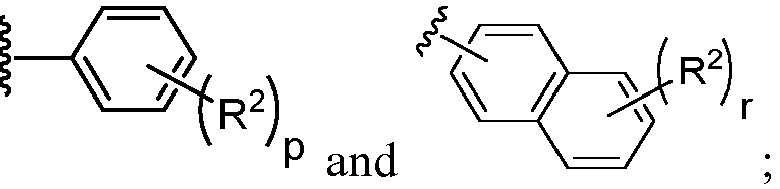
- q is 0, 1, 2, 3 or 4;
- p is 0, 1, 2, 3, or 4;
- r is 0, 1, 2, 3, or 4;
- R1 is independently for each occurrence selected from the group consisting of -H, -C1-C6alkyl, -C1-C6alkoxy, -C1-C6alkyl-O-C1-C6alkyl, halogen, cyano, -OH, -C(O)H, -CO2R',-C(O)N(R')(R''), -C(O)C1-C6alkyl, -N(R')(R"), -NO2, -N(R')C(O)C1-C6alkyl, -S(O)w-C1-C6alkyl, -N(R')S(O)w-C1-C6alkyl, and -S(O)w-N(R')(R");
- w is 0, 1 or 2;
- R' is independently for each occurrence selected from the group consisting of -H and -C1-C6alkyl;
- R" is independently for each occurrence selected from the group consisting of -H and -C1-C6alkyl; or R' and R" are taken together with the nitrogen atom to which they are attached to form a 4-7 membered heterocyclic ring;
- R2 is independently for each occurrence selected from the group consisting of -H, -C1-C6alkyl, -C1-C6alkoxy, -C1-C6alkyl-O-C1-C6alkyl, halogen, cyano, -OH, -C(O)H, -CO2R',-C(O)N(R')(R"), -C(O)C1-C6alkyl, -N(R')(R"), -S(O)w-C1-C6alkyl, -N(R')S(O)w-C1-C6alkyl, and -S(O)w-N(R')(R"); and
- R3 is selected from the group consisting of -H and -C1-C6alkyl;
- wherein C1-C6alkyl or C1-C6alkoxy may be independently for each occurrence optionally substituted with one, two, or three halogens; and
- X is selected from the group consisting of
- (ii) a pharmaceutically acceptable excipient.
- R21 is independently for each occurrence selected from the group consisting of -H and halogen;
- R22 is independently for each occurrence selected from the group consisting of -H, -C1-C6alkyl, -C1-C6alkoxy, -C1-C6alkyl-O-C1-C6alkyl, halogen, cyano, -OH, -C(O)H, -CO2R',-C(O)N(R')(R"), -C(O)C1-C6alkyl, -N(R')(R"), -NO2, -N(R')C(O)C1-C6alkyl, -S(O)w-C1-C6alkyl, -N(R')S(O)w-C1-C6alkyl, and -S(O)w-N(R')(R");
- R23 is independently for each occurrence selected from the group consisting of -H, -C1-C6alkyl, -C1-C6alkoxy, -C1-C6alkyl-O-C1-C6alkyl, halogen, cyano, -OH, -C(O)H, -CO2R',-C(O)N(R')(R"), -C(O)C1-C6alkyl, -N(R')(R"), -NO2, -N(R')C(O)C1-C6alkyl, -S(O)w-C1-C6alkyl, -N(R')S(O)w-C1-C6alkyl, and -S(O)w-N(R')(R"); and
- R24 is independently for each occurrence selected from the group consisting of -H and halogen;
- R25 is independently for each occurrence selected from the group consisting of -H, -C1-C6alkyl, -C1-C6alkoxy, -C1-C6alkyl-O-C1-C6alkyl, halogen, cyano, -OH, -C(O)H, -CO2R',-C(O)N(R')(R"), -C(O)C1-C6alkyl, -N(R')(R"), -S(O)w-C1-C6alkyl, -N(R')S(O)w-C1-C6alkyl, and -S(O)w-N(R')(R");
- wherein C1-C6alkyl or C1-C6alkoxy may be independently for each occurrence optionally substituted with one, two, or three halogens.
- In another aspect, the present invention provides a pharmaceutical composition of the first aspect for use in the treatment, amelioration, prevention or substantial delay of a hepatitis B viral infection in an individual, wherein the pharmaceutical composition is for administration to the individual.
- In another aspect, the present invention relates to a compound of Formula 1, Formula 1-A, or Formula 1-B according to the first aspect for use in the treatment of a hepatitis B viral infection.
- In a suitable embodiment, the compound of the pharmaceutical composition according to the first aspect is selected from the group consisting of:


- The features and other details of the disclosure will now be more particularly described. Before further description of the present invention, certain terms employed in the specification, examples and appended claims are collected here. These definitions should be read in light of the remainder of the disclosure and understood as by a person of skill in the art. Unless defined otherwise, all technical and scientific terms used herein have the same meaning as commonly understood by a person of ordinary skill in the art.
- As intended herein, the terms "a" and "an" include singular as well as plural references unless the context clearly dictates otherwise. For example, the term "an assembly effector" can include one or more such effectors.
- "Treating" includes any effect, e.g., lessening, reducing, modulating, or eliminating, that results in the improvement of the condition, disease, disorder and the like.
- The term "alkenyl" as used herein refers to an unsaturated straight or branched hydrocarbon having at least one carbon-carbon double bond, such as a straight or branched group of 2-6 or 3-4 carbon atoms, referred to herein for example as C2-C6 alkenyl, and C3-C4 alkenyl, respectively. Exemplary alkenyl groups include, but are not limited to, vinyl, allyl, butenyl, pentenyl, etc.
- The term "alkoxy" as used herein refers to a straight or branched alkyl group attached to an oxygen (alkyl-O-). Exemplary alkoxy groups include, but are not limited to, groups with an alkyl group of 1-6 or 2-6 carbon atoms, referred to herein as C1-C6 alkoxy, and C2-C6 alkoxy, respectively. Exemplary alkoxy groups include, but are not limited to methoxy, ethoxy, isopropoxy, etc.
- The term "alkyl" as used herein refers to a saturated straight or branched hydrocarbon, such as a straight or branched group of 1-6, 1-4, or 1-3 carbon atoms, referred to herein as C1-C6 alkyl, C1-C4 alkyl, and C1-C3 alkyl, respectively. Exemplary alkyl groups include, but are not limited to, methyl, ethyl, propyl, isopropyl, 2-methyl-1-propyl, 2-methyl-2-propyl, 2-methyl-1-butyl, 3-methyl-1-butyl, 3-methyl-2-butyl, 2,2-dimethyl-1-propyl, 2-methyl-1-pentyl, 3-methyl-1-pentyl, 4-methyl-1-pentyl, 2-methyl-2-pentyl, 3-methyl-2-pentyl, 4-methyl-2-pentyl, 2,2-dimethyl-1-butyl, 3,3-dimethyl-1-butyl, 2-ethyl-1-butyl, butyl, isobutyl, t-butyl, pentyl, isopentyl, neopentyl, hexyl, etc.
- The term "alkynyl" as used herein refers to an unsaturated straight or branched hydrocarbon having at least one carbon-carbon triple bond, such as a straight or branched group of 2-6, or 3-6 carbon atoms, referred to herein as C2-C6 alkynyl and C3-C6 alkynyl, respectively. Exemplary alkynyl groups include, but are not limited to, ethynyl, propynyl, butynyl, pentynyl, hexynyl, methylpropynyl, etc.
- The term "cycloalkoxy" as used herein refers to a cycloalkyl group attached to an oxygen (cycloalkyl-O-).
- The term "cycloalkyl" as used herein refers to a monocyclic saturated or partially unsaturated hydrocarbon group of, for example 3-6, or 4-6 carbons, referred to herein, e.g., as C3-C6 cycloalkyl or C4-C6 cycloalkyl. Exemplary cycloalkyl groups include, but are not limited to, cyclohexane, cyclohexene, cyclopentane, cyclobutane or, cyclopropane.
- The terms "halo" or "halogen" as used herein refer to F, Cl, Br, or I.
- The terms "hydroxy" and "hydroxyl" as used herein refers to the radical -OH.
- "Pharmaceutically or pharmacologically acceptable" include molecular entities and compositions that do not produce an adverse, allergic or other untoward reaction when administered to an animal, or a human, as appropriate. For human administration, preparations should meet sterility, pyrogenicity, general safety, and purity standards as required by FDA Office of Biologics standards.
- The term "pharmaceutically acceptable carrier" or "pharmaceutically acceptable excipient" as used herein refers to any and all solvents, dispersion media, coatings, isotonic and absorption delaying agents, and the like, that are compatible with pharmaceutical administration. The use of such media and agents for pharmaceutically active substances is well known in the art. The compositions may also contain other active compounds providing supplemental, additional, or enhanced therapeutic functions.
- The term "pharmaceutical composition" as used herein refers to a composition comprising at least one compound as disclosed herein formulated together with one or more pharmaceutically acceptable carriers.
- "Individual," "patient," or "subject" are used interchangeably and include any animal, including mammals, preferably mice, rats, other rodents, rabbits, dogs, cats, swine, cattle, sheep, horses, or primates, and most preferably humans. The compounds described herein can be administered to a mammal, such as a human, but can also be administered to other mammals such as an animal in need of veterinary treatment, e.g., domestic animals (e.g., dogs, cats, and the like), farm animals (e.g., cows, sheep, pigs, horses, and the like) and laboratory animals (e.g., rats, mice, guinea pigs, and the like). The mammal treated in the methods of the disclosure is desirably a mammal in which treatment of hepatitis B is desired. "Modulation" includes antagonism (e.g., inhibition), agonism, partial antagonism and/or partial agonism.
- In the present disclosure, the term "therapeutically effective amount" means the amount of the subject compound that will elicit the biological or medical response of a tissue, system, animal or human that is being sought by the researcher, veterinarian, medical doctor or other clinician. The compounds described herein are administered in therapeutically effective amounts to treat a disease.
- The term "pharmaceutically acceptable salt(s)" as used herein refers to salts of acidic or basic groups that may be present in compounds used in the present compositions. Compounds included in the present compositions that are basic in nature are capable of forming a wide variety of salts with various inorganic and organic acids. The acids that may be used to prepare pharmaceutically acceptable acid addition salts of such basic compounds are those that form non-toxic acid addition salts, i.e., salts containing pharmacologically acceptable anions, including but not limited to malate, oxalate, chloride, bromide, iodide, nitrate, sulfate, bisulfate, phosphate, acid phosphate, isonicotinate, acetate, lactate, salicylate, citrate, tartrate, oleate, tannate, pantothenate, bitartrate, ascorbate, succinate, maleate, gentisinate, fumarate, gluconate, glucaronate, saccharate, formate, benzoate, glutamate, methanesulfonate, ethanesulfonate, benzenesulfonate, p-toluenesulfonate and pamoate (i.e., 1,1'-methylene-bis-(2-hydroxy-3-naphthoate)) salts. Compounds included in the present compositions that are acidic in nature are capable of forming base salts with various pharmacologically acceptable cations. Examples of such salts include alkali metal or alkaline earth metal salts and, particularly, calcium, magnesium, sodium, lithium, zinc, potassium, and iron salts. Compounds included in the present compositions that include a basic or acidic moiety may also form pharmaceutically acceptable salts with various amino acids. The compounds of the disclosure may contain both acidic and basic groups; for example, one amino and one carboxylic acid group. In such a case, the compound can exist as an acid addition salt, a zwitterion, or a base salt.
- The compounds of the disclosure may contain one or more chiral centers and/or double bonds and, therefore, exist as stereoisomers, such as geometric isomers, enantiomers or diastereomers. The term "stereoisomers" when used herein consist of all geometric isomers, enantiomers or diastereomers. These compounds may be designated by the symbols "R" or "S," depending on the configuration of substituents around the stereogenic carbon atom. The present disclosure encompasses various stereoisomers of these compounds and mixtures thereof. Stereoisomers include enantiomers and diastereomers. Mixtures of enantiomers or diastereomers may be designated "(±)" in nomenclature, but the skilled artisan will recognize that a structure may denote a chiral center implicitly.
- The compounds of the disclosure may contain one or more chiral centers and/or double bonds and, therefore, exist as geometric isomers, enantiomers or diastereomers. The enantiomer and diastereomers may be designated by the symbols "(+)," "(-)." "R" or "S," depending on the configuration of substituents around the stereogenic carbon atom, but the skilled artisan will recognize that a structure may denote a chiral center implicitly. Geometric isomers, resulting from the arrangement of substituents around a carbon-carbon double bond or arrangement of substituents around a cycloalkyl or heterocyclic ring, can also exist in the compounds of the present disclosure. The symboldenotes a bond that may be a single, double or triple bond as described herein. Substituents around a carbon-carbon double bond are designated as being in the "Z" or "E" configuration wherein the terms "Z" and "E" are used in accordance with IUPAC standards. Unless otherwise specified, structures depicting double bonds encompass both the "E" and "Z" isomers. Substituents around a carbon-carbon double bond alternatively can be referred to as "cis" or "trans," where "cis" represents substituents on the same side of the double bond and "trans" represents substituents on opposite sides of the double bond. The arrangement of substituents around a carbocyclic ring can also be designated as "cis" or "trans." The term "cis" represents substituents on the same side of the plane of the ring and the term "trans" represents substituents on opposite sides of the plane of the ring. Mixtures of compounds wherein the substituents are disposed on both the same and opposite sides of plane of the ring are designated "cis/trans."

- The term "stereoisomers" when used herein consist of all geometric isomers, enantiomers or diastereomers. The present disclosure encompasses various stereoisomers of these compounds and mixtures thereof.
- Individual enantiomers and diasteriomers of compounds of the present disclosure can be prepared synthetically from commercially available starting materials that contain asymmetric or stereogenic centers, or by preparation of racemic mixtures followed by resolution methods well known to those of ordinary skill in the art. These methods of resolution are exemplified by (1) attachment of a mixture of enantiomers to a chiral auxiliary, separation of the resulting mixture of diasteriomers by recrystallization or chromatography and liberation of the optically pure product from the auxiliary, (2) salt formation employing an optically active resolving agent, (3) direct separation of the mixture of optical enantiomers on chiral liquid chromatographic columns or (4) kinetic resolution using stereoselective chemical or enzymatic reagents. Racemic mixtures can also be resolved into their component enantiomers by well known methods, such as chiral-phase gas chromatography or crystallizing the compound in a chiral solvent. Stereoselective syntheses, a chemical or enzymatic reaction in which a single reactant forms an unequal mixture of stereoisomers during the creation of a new stereocenter or during the transformation of a pre-existing one, are well known in the art. Stereoselective syntheses encompass both enantio- and diastereoselective transformations. For examples, see Carreira and Kvaerno, Classics in Stereoselective Synthesis, Wiley-VCH: Weinheim, 2009.
- The compounds disclosed herein can exist in solvated as well as unsolvated forms with pharmaceutically acceptable solvents such as water, ethanol, and the like. In one example, the compound is amorphous. In one example, the compound is a polymorph. In another example, the compound is in a crystalline form.
- The disclosure also embraces isotopically-labeled compounds as described herein which are identical to those recited herein, except that one or more atoms are replaced by an atom having an atomic mass or mass number different from the atomic mass or mass number usually found in nature. Examples of isotopes that can be incorporated into compounds of the disclosure include isotopes of hydrogen, carbon, nitrogen, oxygen, phosphorus, fluorine and chlorine, such as 2H, 3H, 13C, 14C, 15N, 18O, 17O, 31P, 32P, 35S, 18F, and 36Cl, respectively. For example, a compound of the disclosure may have one or more H atom replaced with deuterium.
- Certain isotopically-labeled disclosed compounds (e.g., those labeled with 3H and 14C) are useful in compound and/or substrate tissue distribution assays. Tritiated (i.e., 3H) and carbon-14 (i.e., 14C) isotopes are particularly preferred for their ease of preparation and detectability. Further, substitution with heavier isotopes such as deuterium (i.e., 2H) may afford certain therapeutic advantages resulting from greater metabolic stability (e.g., increased in vivo half-life or reduced dosage requirements) and hence may be preferred in some circumstances. Isotopically labeled compounds of the disclosure can generally be prepared by following procedures analogous to those disclosed in the e.g., Examples herein by substituting an isotopically labeled reagent for a non-isotopically labeled reagent.
- The term "prodrug" refers to compounds that are transformed in vivo to yield a disclosed compound or a pharmaceutically acceptable salt, hydrate or solvate of the compound. The transformation may occur by various mechanisms (such as by esterase, amidase, phosphatase, oxidative and/or reductive metabolism) in various locations (such as in the intestinal lumen or upon transit of the intestine, blood or liver). Prodrugs are well known in the art (for example, see Rautio, Kumpulainen, et al, Nature Reviews Drug Discovery 2008, 7, 255). For example, if a compound of the disclosure or a pharmaceutically acceptable salt, hydrate or solvate of the compound contains a carboxylic acid functional group, a prodrug can comprise an ester formed by the replacement of the hydrogen atom of the acid group, for example with a group such as (C1-C8)alkyl, (C2-C12)alkanoyloxymethyl, 1-(alkanoyloxy)ethyl having from 4 to 9 carbon atoms, 1-methyl-1-(alkanoyloxy)-ethyl having from 5 to 10 carbon atoms, alkoxycarbonyloxymethyl having from 3 to 6 carbon atoms, 1-(alkoxycarbonyloxy)ethyl having from 4 to 7 carbon atoms, 1-methyl-1-(alkoxycarbonyloxy)ethyl having from 5 to 8 carbon atoms, N-(alkoxycarbonyl)aminomethyl having from 3 to 9 carbon atoms, 1-(N-(alkoxycarbonyl)amino)ethyl having from 4 to 10 carbon atoms, 3-phthalidyl, 4-crotonolactonyl, gamma-butyrolacton-4-yl, di-N,N-(C1-C2)alkylamino(C2-C3)alkyl (such as β-dimethylaminoethyl), carbamoyl-(C1-C2)alkyl, N,N-di(C1-C2)alkylcarbamoyl-(C1-C2)alkyl and piperidino-, pyrrolidino- or morpholino(C2-C3)alkyl.
- Similarly, if a compound disclosed herein contains an alcohol functional group, a prodrug can be formed by the replacement of the hydrogen atom of the alcohol group with a group such as, for example, (C1-C6)alkanoyloxymethyl, 1-((C1-6)alkanoyloxy)ethyl, 1-methyl-1-((C1-C6)alkanoyloxy)ethyl (C1-C6)alkoxycarbonyloxymethyl, N-(C1-C6)alkoxycarbonylaminomethyl, succinoyl, (C1-C6)alkanoyl, α-amino(C1-C4)alkanoyl, arylacyl and α-aminoacyl, or α-aminoacyl-α-aminoacyl, wherein each α-aminoacyl group is independently selected from the naturally occurring L-amino acids; or P(O)(OH)2, -P(O)(O(C1-C6)alkyl)2, or glycosyl (the radical resulting from the removal of a hydroxyl group of the hemiacetal form of a carbohydrate).
- If a compound described herein incorporates an amine functional group, a prodrug can be formed, for example, by creation of an amide or carbamate, an N-acyloxyakyl derivative, an (oxodioxolenyl)methyl derivative, an N-Mannich base, imine or enamine. In addition, a secondary amine can be metabolically cleaved to generate a bioactive primary amine, or a tertiary amine can metabolically cleaved to generate a bioactive primary or secondary amine. For examples, see Simplício, et al., Molecules 2008, 13, 519 and references therein.
- The present invention is based in part on the discovery of that certain classes of compounds such as those described herein may activate assembly of the viral capsid independent of the normal nucleating signals, e.g. act as core protein allosteric modulators having an effect against HBV. For example, disclosed compounds may activate assembly of the viral capsid independent of the normal nucleating signals.
- Hepatitis B virus, for example, consists of an envelope, a nucleocapsid core, viral DNA, and reverse transcriptase (RT). Infection starts when the virus enters the host. The viral core enclosing the viral DNA and the RT are then transferred to cytoplasm of the host and to the host's nucleus, a process in which the circular and partially double stranded viral DNA is released from the viral core.
- Inside the nucleus, the viral DNA is converted into a covalently-closed circular DNA (cccDNA), which codes for a pregenomic RNA (pg RNA) and other mRNAs. The pregenomic RNA, exported to the cytoplasm, codes for core protein and the reverse transcriptase. Encapsidation of the pregenomic RNA and the reverse transcriptase by core protein results in the formation of immature HBV cores which maturate as the pregenomic RNA is reverse transcribed to the circular and partially double stranded DNA, completing the cycle.
- Central to HBV infection is the assembly of the viral core. The capsid itself is a complex of 120 copies of core protein homodimers that spontaneously self-assemble. In the presence of assembly effectors (AE) capsid assembly begins with an CpAM•Cp (Assembly effector•Core protein) complex instead of waiting for the biological RT•pgRNA nucleating complex; the resulting capsid is thus defective. CpAMs can leverage consumption of a few molecules needed for nucleation to consume for example up to 117 Cp dimers. To nucleate assembly, in some examples, CpAMs may have one or both of activities such as substantially interacting with or e.g., binding to Cp dimers, activating assembly, and/or substantially binding or interacting with capsids at e.g., a higher affinity as compared to binding to the Cp dimer.
- Core proteins also have roles upstream of capsid assembly and are associated with nuclear cccDNA and affect their stability and transcription; they are involved in export of the pregenomic RNA from the nucleus.
- For example, the compounds provided herein may affect virus assembly by interacting with core protein dimers as well as capsids, and/or may affect core protein activity upstream of capsid assembly. Defective assembly can immediately suppress virus production. Suppressed Cp activity upstream of assembly can also interfere with activities of the virus required for stability of the infection itself. For example, provided compounds may successfully treat HBV with a finite course of therapy (as opposed to the potentially life-long therapy necessary with current antiviral nucleosides/nucleotides), e.g. such finite therapy would result from a loss of new viral proteins and mRNA resulting from epigenetic modification of the viral cccDNA, as well as a reduction in new infectious virions. In other words, disclosed compounds may activate viral capsid assembly independent of the normal nucleating signals leading to defective assembly: capsid assembly begins with an AE•Cp complex instead of waiting for the biological RT•pgRNA nucleating complex; the resulting capsid or aberrant complex, e.g., cannot support production of a new virion. In some examples, disclosed compounds may leverage consumption of a few molecules needed for nucleation to consume up to 120 Cp dimers. Without being bound by theory, disclosed compounds may, for example, alter the concentration of Cp (core protein), likely required for activities upstream of capsid assembly. Suppressing Cp activity upstream of assembly interferes with the Cp interactions with the viral reservoir (cccDNA). This may lead to clearance of the infection by reduction of viral proteins and cccDNA activity.
- The disclosure provides, in an example, compounds of Formula 1 below, and a pharmaceutical composition comprising: (i) a compound of Formula 1 having the structure:

- X is selected from the group consisting of

- q is 0, 1, 2, 3 or 4;
- p is 0, 1, 2, 3, or 4;
- r is 0, 1, 2, 3, or 4;
- R1 is independently for each occurrence selected from the group consisting of -H, -C1-C6alkyl, -C1-C6alkoxy, -C1-C6alkyl-O-C1-C6alkyl, halogen, cyano, -OH, -C(O)H, -CO2R',-C(O)N(R')(R"), -C(O)C1-C6alkyl, -N(R')(R"), -NO2, -N(R')C(O)C1-C6alkyl, -S(O)w-C1-C6alkyl, -N(R')S(O)w-C1-C6alkyl, and -S(O)w-N(R')(R");
- w is 0, 1 or 2;
- R' is independently for each occurrence selected from the group consisting of -H and -C1-C6alkyl;
- R" is independently for each occurrence selected from the group consisting of -H and -C1-C6alkyl; or R' and R" are taken together with the nitrogen atom to which they are attached to form a 4-7 membered heterocyclic ring;
- R2 is independently for each occurrence selected from the group consisting of -H, -C1-C6alkyl, -C1-C6alkoxy, -C1-C6alkyl-O-C1-C6alkyl, halogen, cyano, -OH, -C(O)H, -CO2R',-C(O)N(R')(R"), -C(O)C1-C6alkyl, -N(R')(R"), -NO2, -N(R')C(O)C1-C6alkyl, -S(O)w-C1-C6alkyl, -N(R')S(O)w-C1-C6alkyl, and -S(O)w-N(R')(R"); and
- R3 is selected from the group consisting of -H and -C1-C6alkyl;
- wherein C1-C6alkyl or C1-C6alkoxy may be independently for each occurrence optionally substituted with one, two, or three halogens; and (ii) a pharmaceutically acceptable excipient.
- In certain examples, p is 1 or 2.
- In certain examples, the compound of Formula 1 is represented by Formula 1-A:
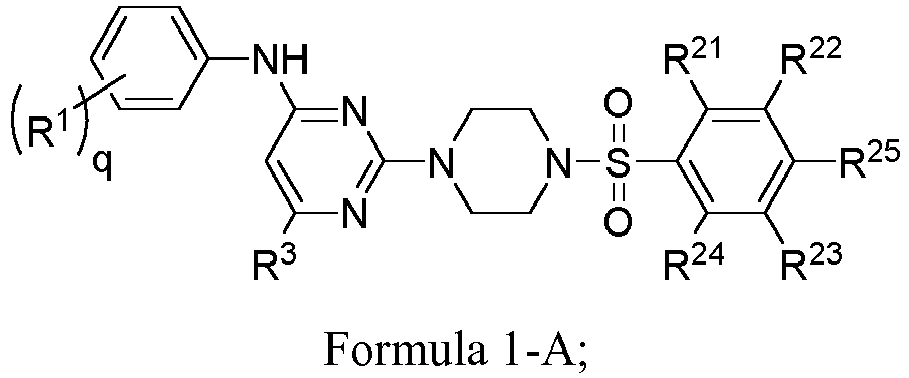
- R1 is independently for each occurrence selected from the group consisting of -H, -C1-C6alkyl, -C1-C6alkoxy, -C1-C6alkyl-O-C1-C6alkyl, halogen, cyano, -OH, -C(O)H, -CO2R',-C(O)N(R')(R"), -C(O)C1-C6alkyl, -N(R')(R"), -NO2, -N(R')C(O)C1-C6alkyl, -S(O)w-C1-C6alkyl, -N(R')S(O)w-C1-C6alkyl, and -S(O)w-N(R')(R");
- R21 is independently for each occurrence selected from the group consisting of -H and halogen;
- R22 is independently for each occurrence selected from the group consisting of -H, -C1-C6alkyl, -C1-C6alkoxy, -C1-C6alkyl-O-C1-C6alkyl, halogen, cyano, -OH, -C(O)H, -CO2R',-C(O)N(R')(R"), -C(O)C1-C6alkyl, -N(R')(R"), -NO2, -N(R')C(O)C1-C6alkyl, -S(O)w-C1-C6alkyl, -N(R')S(O)w-C1-C6alkyl, and -S(O)w-N(R')(R");
- R23 is independently for each occurrence selected from the group consisting of -H, -C1-C6alkyl, -C1-C6alkoxy, -C1-C6alkyl-O-C1-C6alkyl, halogen, cyano, -OH, -C(O)H, -CO2R',-C(O)N(R')(R"), -C(O)C1-C6alkyl, -N(R')(R"), -NO2, -N(R')C(O)C1-C6alkyl, -S(O)w-C1-C6alkyl, -N(R')S(O)w-C1-C6alkyl, and -S(O)w-N(R')(R"); and
- R24 is independently for each occurrence selected from the group consisting of -H and halogen;
- R25 is independently for each occurrence selected from the group consisting of -H, -C1-C6alkyl, -C1-C6alkoxy, -C1-C6alkyl-O-C1-C6alkyl, halogen, cyano, -OH, -C(O)H, -CO2R',-C(O)N(R')(R"), -C(O)C1-C6alkyl, -N(R')(R"), -NO2, -N(R')C(O)C1-C6alkyl, -S(O)w-C1-C6alkyl, -N(R')S(O)w-C1-C6alkyl, and -S(O)w-N(R')(R");
- w is 0, 1 or 2;
- q is 0, 1, 2, 3 or 4;
- R' is independently for each occurrence selected from the group consisting of -H and -C1-C6alkyl;
- R" is independently for each occurrence selected from the group consisting of -H and -C1-C6alkyl; or R' and R" are taken together with the nitrogen atom to which they are attached to form a 4-7 membered heterocyclic ring;
- R3 is selected from the group consisting of -H and -C1-C6alkyl;
- wherein C1-C6alkyl or C1-C6alkoxy may be independently for each occurrence optionally substituted with one, two, or three halogens;
- wherein C1-C6alkyl or C1-C6alkoxy may be independently for each occurrence optionally substituted with one, two, or three halogens.
- In certain examples, R21 and/or R24 is -H.
- In certain examples, R22 is selected from the group consisting of H, -C1-C6alkyl,-C1-C6alkoxy, -C1-C6alkyl-O-C1-C6alkyl, halogen, cyano, -OH, -C(O)H, -CO2R', -C(O)N(R')(R"), -C(O)C1-C6alkyl, -N(R')(R"), -NO2, -N(R')C(O)C1-C6alkyl, -S(O)w-C1-C6alkyl, -N(R')S(O)w-C1-C6alkyl, and -S(O)w-N(R')(R").
- In certain examples, R22 is independently for each occurrence selected from the group consisting of -H, -C1-C6alkyl, -C1-C6alkoxy, and halogen.
- In certain examples, R23 is selected from the group consisting of H, -C1-C6alkyl,-C1-C6alkoxy, -C1-C6alkyl-O-C1-C6alkyl, halogen, cyano, -OH, -C(O)H, -CO2R', -C(O)N(R')(R"), -C(O)C1-C6alkyl, -N(R')(R"), -NO2, -N(R')C(O)C1-C6alkyl, -S(O)w-C1-C6alkyl, -N(R')S(O)w-C1-C6alkyl, and -S(O)w-N(R')(R").
- In certain examples, R23 is independently for each occurrence selected from the group consisting of -H, -C1-C6alkyl, -C1-C6alkoxy, and halogen.
- In certain examples, R25 is selected from the group consisting of -H, -C1-C6alkyl,-C1-C6alkoxy, halogen, cyano, -CO2R', -N(R')C(O)C1-C6alkyl, -C(O)N(R')(R"), -C(O)C1-C6alkyl, and -N(R')(R").
- In certain examples, R1 is selected independently for each occurrence from the group consisting of -H, -C1-C6alkyl, -C1-C6alkoxy, halogen, cyano, and -OH.
- In certain examples, q is 1 or 2.
- In certain examples, the compound of Formula 1 is represented by Formula 1-B:

- R23 is selected from the group consisting of -H, -CH3, -F, and -OCH3; and
- R25 is selected from the group consisting of -H, -CH3, -CH2CH3, -CH2CH2CH2CH3, -CF3, -F, -Cl, -OH, -OCH3, -OCH2CH3, -OC(CH3)3, -OCH2CH2CH2CH3, -NH2, -NHCH3, -NHC(O)CH3, -NHC(O)CF3, -OCHF2, and -OCF3, with other R substituents as above.
- In certain examples, R3 of Formula 1, 1-A or 1-B is selected from the group consisting of -CH3, -CH(CH3)2, -CH2CH2CH3, -CF3, and -C(CH3)3.
- In certain examples, R2 of Formula 1, 1-A or 1-B is selected from the group consisting of -H, -CH3, -CH2CH3, -CF3, -F, -Cl, -Br, -CN, -OCH3, and -OCF3.
- The present disclosure provides a method of treating, ameliorating, preventing, or substantially delaying a hepatitis B viral infection in an individual, the method comprising administering to the individual a compound or a pharmaceutical composition disclosed herein.
- The present disclosure relates to use of a compound of Formula 1, Formula 1-A, or Formula 1-B in the manufacture of a medicament for the treatment of a hepatitis B viral infection.
- Disclosed compounds may be prepared by methods known in the art. A disclosed compound may be preparing using a method comprising providing 2,4-dichloro-6-substituted pyrimidine and a R-substituted aniline group together in an organic solvent (wherein R may be selected from R1 above), and then contacting a resultant compound with Z (e.g. piperazine or 4-amino aniline group).
- Thereafter, an optionally substituted sulfonyl benzene group is added. Further, disclosed herein is a method for treating HBV infection (e.g. an acute or chronic HBV infection) in a patient in need thereof is provided. The method includes administering to a patient a pharmaceutical composition comprising a therapeutically effective amount of a disclosed compound.
- For use in accordance with this method, the appropriate dosage is expected to vary depending on, for example, the particular compound employed, the mode of administration, and the nature and severity of the infection to be treated as well as the specific infection to be treated and is within the purview of the treating physician. Usually, an indicated administration dose may be in the range between about 0.1 to about 15 mg/kg body weight. In some cases, the administration dose of the compound may be less than 10 mg/kg body weight. In other cases, the administration dose may be less than 5 mg/kg body weight. In yet other cases, the administration dose may be in the range between about 0.1 to about 1 mg/kg body weight. The dose may be conveniently administered once daily, or in divided doses up to, for example, four times a day or in sustained release form.
- A compound or composition may be administered by any conventional route, in particular: enterally, topically, orally, nasally, e.g. in the form of tablets or capsules, via suppositories, or parenterally, e.g. in the form of injectable solutions or suspensions, for intravenous, intra-muscular, sub-cutaneous, or intra-peritoneal injection. Suitable formulations and pharmaceutical compositions will include those formulated in a conventional manner using one or more physiologically acceptable carriers or excipients, and any of those known and commercially available and currently employed in the clinical setting. Thus, the compounds may be formulated for oral, buccal, topical, parenteral, rectal or transdermal administration or in a form suitable for administration by inhalation or insufflation (either orally or nasally).
- For oral administration, pharmaceutical compositions may take the form of, for example, tablets or capsules prepared by conventional means with pharmaceutically acceptable excipients such as binding agents (e.g. pregelatinized maize starch, polyvinylpyrrolidone or hydroxypropyl methylcellulose); fillers (e.g. lactose, microcrystalline cellulose or calcium hydrogen phosphate); lubricants (e.g. magnesium stearate, talc or silica); disintegrants (e.g. potato starch or sodium starch glycollate); or wetting agents (e.g. sodium lauryl sulfate). Tablets may be coated by methods well known in the art. Liquid preparations for oral administration may take the form of, for example, solutions, syrups or suspensions, or they may be presented as a dry product for constitution with water or other suitable vehicle before use. Such liquid preparations may be prepared by conventional means with pharmaceutically acceptable additives such as suspending agents (e.g. sorbitol syrup, cellulose derivatives or hydrogenated edible fats); emulsifying agents (e.g. lecithin or acacia); non-aqueous vehicles (e.g. almond oil, oily esters, ethyl alcohol or fractionated vegetable oils); and preservatives (e.g. methyl or propyl-p-hydroxybenzoates or sorbic acid). Preparations may also contain buffer salts, flavoring, coloring and sweetening agents as appropriate.
- Preparations for oral administration may also be suitably formulated to give controlled-release or sustained release of the active compound(s) over an extended period. For buccal administration the compositions may take the form of tablets or lozenges formulated in a conventional manner known to the skilled artisan.
- A compound may also be formulated for parenteral administration by injection e.g. by bolus injection or continuous infusion. Formulations for injection may be presented in unit dosage form e.g. in ampoules or in multi-dose containers, with an added preservative. The compositions may take such forms as suspensions, solutions or emulsions in oily or aqueous vehicles, and may contain additives such as suspending, stabilizing and/or dispersing agents. Alternatively, the compound may be in powder form for constitution with a suitable vehicle, e.g. sterile pyrogen-free water, before use. Compounds may also be formulated for rectal administration as suppositories or retention enemas, e.g. containing conventional suppository bases such as cocoa butter or other glycerides.
- In some cases, disclosed compounds may be administered as part of a combination therapy in conjunction with one or more antivirals. Exemplary antivirals include nucleoside analogs, interferon α, and other assembly effectors, for instance heteroaryldihydropyrimidines (HAPs) such as methyl 4-(2-chloro-4-fluorophenyl)-6-methyl-2-(pyridin-2-yl)-1,4-dihydropyrimidine-5-carboxylate. This may involve administering to a subject a first amount of a disclosed compound in combination with a second amount of an antiviral, wherein the first and second amounts together comprise a pharmaceutically effective amount. The first amount, the second amount, or both may be the same, more, or less than effective amounts of each compound administered as monotherapies. Therapeutically effective amounts of disclosed compound and antiviral may be co-administered to the subject, i.e., administered to the subject simultaneously or separately, in any given order and by the same or different routes of administration. In some instances, it may be advantageous to initiate administration of a disclosed compound or composition first, for example one or more days or weeks prior to initiation of administration of the antiviral. Moreover, additional drugs may be given in conjunction with the above combination therapy.
-

-
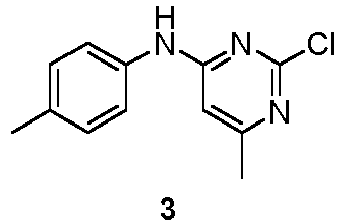
- To a stirred solution of 2,4-dichloro-6-methylpyrimidine 1 (600 mg, 3.68 mmol) in CH3CN (5 mL) under argon atmosphere were added p-toluidine 2 (473 mg, 4.41 mmol) and triethylamine (0.77 mL, 5.52 mmol) at RT; the mixture was warmed to 80 °C and stirred for 24 h. The reaction was monitored by TLC; after completion of the reaction, the volatiles were removed in vacuo to obtain the crude product. The crude product was purified through silica gel column chromatography using 10% ethyl acetate (EtOAc)/hexanes to afford compound 3 (300 mg, 35%) as an off-white solid. TLC: 20% EtOAc/ hexanes (Rf : 0.4); 1H-NMR (DMSO-d6 , 400 MHz): δ 9.76 (s, 1H), 7.42 (d, J = 8.0 Hz, 2H), 7.16 (d, J = 8.4 Hz, 2H), 6.52 (s, 1H), 2.27 (s, 3H), 2.25 (s, 3H).
-

- To a stirred solution of compound 3 (200 mg, 0.85 mmol) in n-butanol (3 mL) under argon atmosphere were added tert-butyl piperazine-1-carboxylate 4 (238 mg, 1.28 mmol) and N,N-diisopropylethylamine (DIPEA; 0.30 mL, 1.70 mmol) at RT; the mixture was heated to 100 °C and stirred for 16 h. The reaction was monitored by TLC; after completion of the reaction, the volatiles were removed in vacuo to obtain the crude product. The crude product was purified through silica gel column chromatography using 20% EtOAc/ hexanes to afford compound 5 (220 mg, 67%) as an off-white solid. TLC: 20% EtOAc/ hexanes (Rf : 0.5); 1H-NMR (DMSO-d6 , 400 MHz): δ 9.00 (s, 1H), 7.45 (d, J = 8.4 Hz, 2H), 7.10 (d, J = 8.0 Hz, 2H), 5.89 (s, 1H), 3.66 (t, J = 5.6 Hz, 4H), 3.31 (t, J = 5.6 Hz, 4H), 2.24 (s, 3H), 2.12 (s, 3H), 1.42 (s, 9H).
-

- To a stirred solution of compound 5 (220 mg, 0.57 mmol) in CH2Cl2 (3 mL) under inert atmosphere was added trifluoroacetic acid (0.25 mL, 2.86 mmol) at 0 °C; the mixture was warmed to 15 °C and stirred for 30 min. The reaction was monitored by TLC; after completion of the reaction, the volatiles were removed in vacuo. The residue was neutralized with saturated NaHCO3 solution (30 mL) and extracted with EtOAc (2 x 30 mL). The combined organic extracts were dried over sodium sulfate, filtered and concentrated in vacuo to afford compound 6 (130 mg, 80%) as an off-white solid. TLC: 5% MeOH/ CH2Cl2 (Rf : 0.2); 1H-NMR (DMSO-d6 , 400 MHz): δ 8.98 (s, 1H), 7.45 (d, J = 8.4 Hz, 2H), 7.09 (d, J = 8.4 Hz, 2H), 5.87 (s, 1H), 3.67 (t, J = 5.2 Hz, 4H), 2.81 (t, J = 4.8 Hz, 4H), 2.24 (s, 3H), 2.12 (s, 3H).
-

-
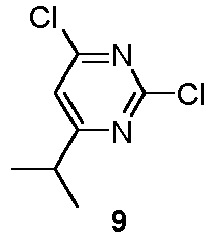
- To a stirred solution of 2,4,6-trichloropyrimidine 7 (10 g, 54.49 mmol) in anhydrous tetrahydrofuran (THF; 200 mL) were added isopropyl magnesium chloride 8 (2 M sol. in THF, 54.5 mL, 109.0 mmol) and copper iodide (520 mg, 2.72 mmol) at -20 °C under argon atmosphere; the mixture was stirred at 0 °C for 2 h. The reaction was monitored by TLC; after completion of the reaction, the reaction mixture was quenched with aqueous saturated ammonium chloride solution (150 mL) and extracted with EtOAc (2 x 150 mL). The combined organic extracts were dried over sodium sulfate, filtered and concentrated in vacuo to obtain the crude product. The crude product was purified through silica gel column chromatography using 2% EtOAc/ hexanes to afford compound 9 (6 g, 58%) as a colorless liquid. TLC: 7% EtOAc/ hexanes (Rf : 0.8); 1H-NMR (CDCl3, 400 MHz): δ 7.16 (s, 1H), 3.04-2.97 (m, 1H), 1.31 (d, J = 6.8 Hz, 6H).
-

- To a stirred solution of compound 9 (4.5 g, 23.56 mmol) in ethanol (50 mL) were added 4-fluoroaniline 10 (2.61 g, 23.56 mmol) and triethylamine (5.1 mL, 35.34 mmol) at RT under argon atmosphere; heated to 70 °C and stirred for 24 h. The reaction was monitored by TLC; after completion of the reaction, the volatiles were removed in vacuo to obtain the crude product. The crude product was purified through silica gel column chromatography using 4% EtOAc/hexanes to afford compound 11 (3.5 g, 56%) as an off-white solid. TLC: 10% EtOAc/ hexanes (Rf : 0.2); 1H-NMR (CDCl3, 400 MHz): δ 7.30-7.28 (m, 2H), 7.11 (t, J = 8.0 Hz, 2H), 6.96 (brs, 1H), 6.30 (s, 1H), 2.84-2.77 (m, 1H), 1.21 (d, J = 6.8 Hz, 6H).
-

- To a stirred solution of compound 11 (3.5 g, 13.21 mmol) in n-butanol (60 mL) were added tert-butyl piperazine-1-carboxylate 4 (3.66 g, 19.81 mmol) and N,N-diisopropylethylamine (3.65 mL, 19.81 mmol) in sealed tube at RT under argon atmosphere; the mixture was heated to 120 °C and stirred for 36 h. The reaction was monitored by TLC; after completion of the reaction, the volatiles were removed in vacuo to obtain the crude product. The crude product was purified through silica gel column chromatography using 10% EtOAc/ hexanes to afford compound 12 (4 g, 73%) as a white solid. TLC: 10% EtOAc/ hexanes (Rf : 0.8); 1H-NMR (CDCl3, 400 MHz): δ 7.30-7.28 (m, 2H), 7.03 (t, J = 8.4 Hz, 2H), 6.32 (br s, 1H), 5.79 (s, 1H), 3.77 (t, J = 5.2 Hz, 4H), 3.49-3.46 (m, 4H), 2.72-2.61 (m, 1H), 1.48 (s, 9H), 1.18 (d, J = 6.8 Hz, 6H).
-

- To a stirred solution of compound 12 (500 mg, 1.2 mmol) in CH2Cl2 (10 mL) was added 4 N HCl in 1,4-dioxane (4 mL) at 0 °C under argon atmosphere; the mixture was warmed to RT and stirred for 2 h. The reaction was monitored by TLC; after completion of the reaction, the volatiles were removed in vacuo. The residue was neutralized with 10% NaHCO3 solution (20 mL) and extracted with EtOAc (2 x 30 mL). The combined organic extracts were dried over sodium sulfate, filtered and concentrated in vacuo to afford compound 13 (340 mg, 90%) as an off-white solid. TLC: 10% CH3OH/ CH2Cl2 (Rf : 0.2); 1H-NMR (DMSO-d6 , 400 MHz): δ 9.09 (s, 1H), 7.62-7.58 (m, 2H), 7.11 (t, J = 8.8 Hz, 2H), 5.86 (s, 1H), 3.60 (t, J = 4.8 Hz, 4H), 2.71 (t, J = 4.8 Hz, 4H), 2.67-2.58 (m, 1H), 1.18 (d, J = 6.8 Hz, 6H).
- Intermediates 6 and 13 were converted to final products either by using commercially available sulfonyl chlorides or by using prepared sulfonyl chlorides employing typical procedure A and the results are captured in Table 1 below.
- Typical procedure A: To a stirred solution of compound 6 (40 mg, 0.14 mmol) in CH2Cl2 (5 mL) under argon atmosphere were added pyridine (0.06 mL, 0.70 mmol), and sulfonyl chloride (29.5 mg, 0.15 mmol) at 0 °C; warmed to RT and stirred for 4 h. The reaction was monitored by TLC; after completion the reaction, the reaction mixture was diluted with CH2Cl2 (30 mL), washed with water (15 mL), 1 N HCl (10 mL), 10% NaHCO3 solution (15 mL), brine (15 mL), dried over sodium sulfate, filtered and concentrated in vacuo to obtain the crude product. The precipitated material was either directly dried in vacuo or triturated or purified by column chromatography to afford the desired target compounds.
Table 1 Target Cmpd. No. Structure Procedure, Intermediate Rx. Yield Mass Spec. Found Mass Spec. Calculated 1H-NMR 1 
A, 6 41% 438.6 (M++1); 437.19 for C23H27N5O2S 1H-NMR (DMSO-d6 , 400 MHz): δ 9.00 (s, 1H), 7.62 (d, J = 8.0 Hz, 2H), 7.43-7.38 (m, 4H), 7.08 (d, J = 8.0 Hz, 2H), 5.86 (s, 1H), 3.77 (t, J = 4.8 Hz, 4H), 2.89 (t, J = 4.8 Hz, 4H), 2.38 (s, 3H), 2.24 (s, 3H), 2.08 (s, 3H) 2 
A, 6 21% 508.6 (M++1); 507.16 for C23H24F3N5O3S 1H-NMR (DMSO-d6 , 400 MHz): δ 9.00 (s, 1H), 7.89 (d, J = 6.8 Hz, 2H), 7.61 (d, J = 8.0 Hz, 2H),7.40 (d, J = 8.4 Hz, 2H), 7.08 (d, J = 8.0 Hz, 2H), 5.87 (s, 1H), 3.78 (t, J = 5.2 Hz, 4H), 2.97 (t, J = 4.8 Hz, 4H), 2.24 (s, 3H), 2.09 (s, 3H) 3 
A, 6 39% 458.7 (M++1) 457.13 for C22H24ClN5O2S 1H-NMR (DMSO-d6 , 400 MHz): δ 9.00 (s, 1H), 7.75 (d, J = 6.8 Hz, 2H), 7.69 (d, J = 6.8 Hz, 2H), 7.39 (d, J = 8.4Hz, 2H), 7.08 (d, J = 8.4 Hz, 2H), 5.87 (s, 1H), 3.78 (t, J = 4.4 Hz, 4H), 2.95 (t, J = 4.8Hz, 4H), 2.24 (s, 3H), 2.09 (s, 3H); 4 
A, 6 33% 490.4 (M++1); 439.17 for C22H25N5O3S 1H-NMR (DMSO-d6 , 400 MHz): δ 10.51 (s, 1H), 9.00 (s, 1H), 7.56 (d, J = 8.8 Hz, 2H), 7.40 (d, J = 8.4 Hz, 2H), 7.08 (d, J = 8.4 Hz, 2H), 6.93 (d, J = 8.8 Hz, 2H), 5.86 (s, 1H), 3.76 (t, J = 4.8 Hz, 4H), 2.86 (t, J = 4.8 Hz, 4H), 2.24 (s, 3H), 2.09 (s, 3H); 5 
A, 6 24% 452.7 (M++1); 451.20 for C24H29N5O2S 1H-NMR (DMSO-d6 , 400 MHz): δ 9.00 (s, 1H), 7.64 (d, J = 8.4 Hz, 2H), 7.46 (d, J = 8.4 Hz, 2H), 7.39 (d, J = 8.4 Hz, 2H), 7.08 (d, J = 8.4 Hz, 2H), 5.86 (s, 1H), 3.77 (t, J = 4.8 Hz, 4H), 2.89 (t, J = 4.8Hz, 4H), 2.71-2.65 (m, 2H), 2.21 (s, 3H), 2.08 (s, 3H), 1.18 (t, J = 7.6Hz, 3H); 6 
A, 6 66% 466.7 (M++1); 465.22 for C25H31N5O2S 1H-NMR (DMSO-d6 , 400 MHz): δ 9.01 (s, 1H), 7.66 (d, J = 8.4 Hz, 2H), 7.49 (d, J = 8.4 Hz, 2H), 7.39 (d, J = 8.4Hz, 2H), 7.08 (d, J = 8.0 Hz, 2H), 5.86 (s, 1H), 3.77 (t, J = 4.8 Hz, 4H), 3.01-2.94 (m, 1H), 2.90 (t, J = 4.8 Hz, 4H), 2.24 (s, 3H), 2.08 (s, 3H), 1.20 (d, J = 6.8 Hz, 6H); 7 A, 6 46% 438.6 (M++1); 437.19 for C23H27N5O2S 1H-NMR (DMSO-d6 , 400 MHz): δ 9.01 (s, 1H), 7.55-7.50 (m, 4H), 7.39 (d, J = 8.4 Hz, 2H), 7.08 (d, J = 8.4 Hz, 2H), 5.86 (s, 1H), 3.77 (t, J = 4.8 Hz, 4H), 2.91 (t, J = 4.8 Hz, 4H), 2.39 (s, 3H), 2.24 (s, 3H), 2.08 (s, 3H); 
8 
A, 6 59% 468.6 (M++1); 467.20 C24H29N5O3S 1H-NMR (DMSO-d6 , 400 MHz): δ 9.00 (s, 1H), 7.65 (d, J = 8.8 Hz, 2H), 7.39 (d, J = 8.4 Hz, 2H), 7.09 (d, J = 8.8 Hz, 4H), 5.86 (s, 1H), 4.10 (q, 2H), 3.77 (t, J = 4.8 Hz, 4H), 2.87 (t, J = 4.8 Hz, 4H), 2.24 (s, 3H), 2.08 (s, 3H), 1.32 (t, J = 7.2 Hz, 3H); 9 
A, 6 43% 496.7 (M++1); 495.23 for C26H33N5O3S 1H-NMR (DMSO-d6 , 400 MHz): δ 9.01 (s, 1H), 7.65 (d, J = 8.8 Hz, 2H), 7.39 (d, J = 8.4 Hz, 2H), 7.12-7.07 (m, 4H), 5.86 (s, 1H), 4.03 (t, J = 6.8 Hz, 2H), 3.77 (t, J = 4.8 Hz, 4H), 2.87 (t, J = 4.8 Hz, 4H), 2.24 (s, 3H), 2.08 (s, 3H), 1.72-1.65 (m, 2H), 1.44-1.38 (m, 2H), 0.91 (t J = 7.6 Hz, 3H); 10 
A, 6 92% 481.2022 476.2008 for C24H29N6O3S (M+H)+ 1H NMR (400 MHz, CDCl3) δ 7.71 - 7.61 (m, 4H), 7.58 (s, 1H), 7.12 (d, J = 1.5 Hz, 4H), 6.34 (s, 1H), 5.80 (s, 1H), 3.87 (t, J = 4.9 Hz, 4H), 3.00 (t, J = 5.0 Hz, 4H), 2.31 (s, 3H), 2.19 (s, 3H), 2.13 (s, 3H) 11 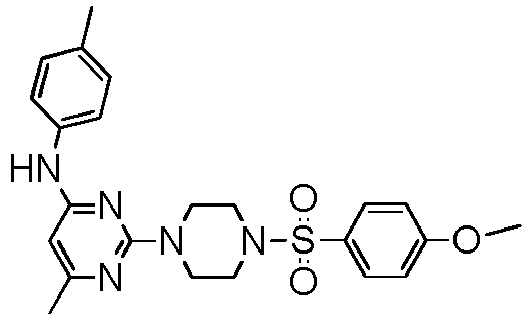
A, 6 59% 454.1926 454.1913 for C23H28N5O3S (M+H)+ 1H NMR (400 MHz, CDCl3) δ 7.69 - 7.55 (m, 2H), 7.08 (s, 4H), 6.96 - 6.86 (m, 2H), 6.23 (s, 1H), 5.75 (s, 1H), 3.83 (t, J = 5.1 Hz, 4H), 3.79 (s, 3H), 2.95 (t, J = 5.0 Hz, 4H), 2.26 (s, 3H), 2.14 - 2.02 (m, 3H). 12 
A, 6 73% 424.1810 424.1807 for C22H26N5O2S (M+H)+ 1H NMR (400 MHz, CDCl3) δ 7.74 (d, J = 7.6 Hz, 2H), 7.60-7.44 (m, 3H), 7.13 (s, 4H), 6.29 (s, 1H), 5.81 (s, 1H), 3.89 (s, 4H), 3.03 (t, J = 5.1 Hz, 4H), 2.32 (s, 3H), 2.14 (br s, 3H). 13 
A, 6 64% 442.1731 442.1713 for C22H25N5O4FS (M+H)+ 1H NMR (400 MHz, CDCl3) δ 7.81 -7.70 (m, 2H), 7.22 - 7.07 (m, 6H), 6.29 (s, 1H), 5.81 (s, 1H), 3.89 (t, J = 5.1 Hz, 4H), 3.02 (t, J = 5.0 Hz, 4H), 2.32 (s, 3H), 2.15 (s, 3H). 14 
A, 6 55% 442.2 (M+H)+ 442.1713 for C22H25N5O2FS (M+H)+ 1H NMR (500 MHz, CDCl3) δ 7.85 (t, 1H), 7.59 - 7.54 (m, 1H), 7.28 (dd, J = 7.7, 0.9 Hz, 1H), 7.22 - 7.12 (m, 5H), 6.32 (s, 1H), 5.84 (s, 1H), 3.91 (t, 4H), 3.23 (t, 4H), 2.34 (s, 3H), 2.17 (s, 3H). 15 
A, 6 67% 442.2 (M+H)+ 442.1713 for C22H25N5O2FS (M+H)+ 1H NMR (500 MHz, CDCl3) δ 7.68 - 7.36 (m, 5H), 7.29 - 7.26 (m, 1H), 7.26-7.24 (m, 2H), 6.50 (s, 1H), 5.94 (s, 1H), 4.02 (t, 4H), 3.18 (t, 4H), 2.45 (s, 3H), 2.27 (s, 3H). 16 
A, 6 60% 454.2 (M+H)+ 454.1913 for C23H28N5O3S (M+H)+ 1H NMR (500 MHz, CDCl3) δ 7.53 (t, J = 8.0 Hz, 1H), 7.45 (d, J = 7.7 Hz, 3H), 7.38 (d, J = 1.4 Hz, 4H), 7.29 - 7.27 (m, J = 6.1 Hz, 1H), 7.26 - 7.20 (m, 4H), 6.43 (s, 1H), 5.94 (s, 1H), 4.02 (t, 4H), 3.96 (s, 3H), 3.18 (t, J = 4.8 Hz, 4H), 2.45 (s, 3H), 2.27 (s, 3H). 17 
A, 6 55% 474.2 (M+H)+ 474.1964 for C26H28N5O2S (M+H)+ 1H NMR (500 MHz, CDCl3) δ 8.47 (s, 1H), 8.10 (t, 3H), 8.04 (d, J = 8.0 Hz, 1H), 7.89 (dd, J = 8.7, 1.8 Hz, 1H), 7.80 - 7.73 (m, 3H), 7.40 (s, 2H), 6.43 (s, 1H), 5.93 (s, 1H), 4.05 (t, 4H), 3.25 (t, 4H), 2.46 (s, 3H), 2.26 (s, 3H). 18 
A, 6 50% 484.2 (M+H)+ 484.2019 for C24H30N5O4S (M+H)+ 1H NMR (400 MHz, CDCl3) δ 7.49 (dd, J = 8.4, 2.1 Hz, 1H), 7.38 (s, 1H), 7.32 (d, J = 2.0 Hz, 1H), 7.29 - 7.26 (m, 2H), 7.24 (s, 1H), 7.05 (d, J = 8.5 Hz, 2H), 6.43 (s, 1H), 5.94 (s, 1H), 4.05 - 4.01 (m, J = 7.9, 3.9 Hz, 10H), 3.16 (t, 4H), 2.45 (s, 3H), 2.28 (s, 3H). 19 
A, 6 61% 517.3 (M+H)+ 517.2386 for C24H33N6O2S (M+H)+ 1H NMR (400 MHz, CDCl3) δ 8.13 (d, J = 1.3 Hz, 1H), 7.78 (d, J = 9.2 Hz, 1H), 7.67 (d, J = 8.7 Hz, 1H), 7.59 (dd, J = 8.7, 1.8 Hz, 1H), 7.20 (dd, J = 9.1, 2.5 Hz, 1H), 7.13 (s, 3H), 6.86 (d, J = 2.4 Hz, 1H), 6.28 (s, 1H), 5.79 (s, 1H), 3.90 (t, 4H), 3.11 - 3.04 (m, 10H), 2.32 (s, 3H), 2.13 (s, 3H). 20 
A, 6 40% 480.1 (M+H)+ 480.2433 for C26H34N5O2S (M+H)+ 1H NMR (400 MHz, CDCl3) δ 7.65 (d, J = 7.8 Hz, 2H), 7.31 (d, J = 7.8 Hz, 2H), 7.14 (s, 4H), 6.29 (s, 1H), 5.82 (s, 1H), 3.90 (s, 4H), 3.04 (t, 4H), 2.66 (t, J = 7.6 Hz, 2H), 2.33 (s, 3H), 2.15 (s, 3H), 1.64-1.59 (m, 2H), 1.35 (dd, J = 14.7, 7.4 Hz, 2H), 0.93 (t, J = 7.3 Hz, 3H). 21 
A, 13 31% 456.5 (M++1) 455.18 for C23H26FN5O2S 1H-NMR (DMSO-d6, 400 MHz): δ 9.16 (s, 1H), 7.76-7.69 (m, 3H), 7.63 (t, J = 7.2 Hz, 2H), 7.56-7.52 (m, 2H), 7.11 (t, J = 8.8 Hz, 2H), 5.87 (s, 1H), 3.79-3.77 (m, 4H), 2.94 (t, J = 4.8 Hz, 4H), 2.66-2.55 (m, 1H), 1.11 (d, J = 6.8 Hz, 6H). 22 
A, 13 41% 470.1 (M++1) 469.19 for C24H28FN5O2S 1H-NMR (DMSO-d6, 400 MHz): δ 9.16 (s, 1H), 7.63 (d, J = 8.0 Hz, 2H), 7.56-7.52 (m, 2H), 7.43 (d, J = 8.0 Hz, 2H), 7.11 (t, J = 8.8 Hz, 2H), 5.87 (s, 1H), 3.78 (t, J = 4.8 Hz, 4H), 2.90 (t, J = 4.8 Hz, 4H), 2.62-2.53 (m, 1H), 2.38 (s, 3H), 1.11 (d, J = 6.8 Hz, 6H). -

- Synthesis of 6-methyl-2-(4-((4-nitrophenyl) sulfonyl piperazin-1-yl)-N-(p-tolyl) pyrimidin-4-amine (64): To a stirred solution of compound 6 (100 mg, 0.35 mmol) in CH2Cl2 (5 mL) under argon atmosphere were added pyridine (0.15 mL, 1.76 mmol) and 4-nitrobenzenesulfonyl chloride 63 (78 mg, 0.35 mmol) at 0 °C; warmed to RT and stirred for 4 h. The reaction was monitored by TLC; after completion of the reaction, the reaction mixture was diluted with CH2Cl2 (30 mL), washed with 1 N HCl (15 mL), 10% NaHCO3 solution (20 mL), water (20 mL), dried over sodium sulfate, filtered and concentrated in vacuo to obtain the crude product. The crude product was washed with diethyl ether (2 x 5 mL) and n-pentane (2 x 5 mL) and dried in vacuo to afford compound 64 (110 mg, 67%) as a white solid. TLC: 5% MeOH/ CH2Cl2 (Rf : 0.8); 1H-NMR (DMSO-d6 , 400 MHz): δ 9.00 (s, 1H), 8.41 (d, J = 8.8 Hz, 2H), 8.01 (d, J = 8.8 Hz, 2H), 7.38 (d, J = 8.4 Hz, 2H), 7.08 (d, J = 8.4 Hz, 2H), 5.86 (s, 1H), 3.79 (t, J = 5.2 Hz, 4H), 3.02 (t, J = 4.8 Hz, 4H), 2.24 (s, 3H), 2.08 (s, 3H).
- Synthesis of 6-methyl-2-(4-((4-nitrophenyl) sulfonyl piperazin-1-yl)-N-(p-tolyl) pyrimidin-4-amine (65): To a stirred solution of compound 64 (100 mg, 0.21 mmol) in MeOH (5 mL) under argon atmosphere was added 10% Pd/C (30 mg) at RT; the mixture was stirred under hydrogen atmosphere (balloon pressure) for 4 h. The reaction was monitored by TLC; after completion of the reaction, the reaction mixture was filtered through celite, washed with CH2Cl2, (2 x 20 mL) and the filtrate was concentrated in vacuo to obtain the crude compound 65 (73 mg, 78%) as an off-white solid. TLC: 5% MeOH/ CH2Cl2 (Rf : 0.5); 1H-NMR (DMSO-d6 , 400 MHz): δ 8.99 (s, 1H), 7.40 (t, J = 8.4 Hz, 2H), 7.35 (d, J = 8.8 Hz, 2H), 7.08 (d, J = 8.0 Hz, 2H), 6.62 (d, J = 8.4 Hz, 2H), 6.05 (br s, 2H), 5.86 (s, 1H), 3.75 (t, J = 5.2 Hz, 4H), 2.82 (t, J = 5.2 Hz, 4H), 2.24 (s, 3H), 2.09 (s, 3H).
- Synthesis of 2-(4-((4-(dimethylamino) phenyl) sulfonyl)piperazin-1-yl)-6-methyl-N-(p-tolyl)pyrimidin-4-amine (target compound 23) & 6-methyl-2-(4-((4-(methylamino) phenyl) sulfonyl) piperazin-1-yl)-N-(p-tolyl)pyrimidin-4-amine (target compound 24): To a stirred solution of compound 65 (140 mg, 0.31 mmol) in N,N-dimethylformamide (DMF; 5 mL) under argon atmosphere were added potassium carbonate (110 mg, 0.79 mmol), methyl iodide (0.05 mL, 0.79 mmol) at 0 °C; warmed to 50 °C and stirred for 16 h. The reaction was monitored by TLC; after completion of the reaction, the reaction mixture was diluted with ice cold water (10 mL) and the precipitated solid was filtered, washed with ether (2 x 5 mL) to obtain the crude product, which was purified by preparative HPLC to afford target compounds 23 (30 mg, 20%) & 24 (25 mg, 17%) as off-white solids.
- Analytical data of target compound 23: TLC: 5% MeOH/ CH2Cl2 (Rf : 0.6); 1H-NMR (DMSO-d6, 400 MHz): δ 9.00 (s, 1H), 7.48 (d, J = 9.2 Hz, 2H), 7.39 (d, J = 8.4 Hz, 2H), 7.08 (d, J = 8.0 Hz, 2H), 6.77 (d, J = 8.8 Hz, 2H), 5.85 (s, 1H), 3.76 (t, J = 5.2 Hz, 4H), 2.98 (s, 6H), 2.82 (t, J = 4.8 Hz, 4H), 2.24 (s, 3H), 2.08 (s, 3H); LC-MS: 99.37%; 467.0 (M++1); (column; X-select CSH C-18, (50 × 3.0 mm, 3.5 µm); RT 3.06 min. 0.05% TFA (Aq):ACN; 0.8 mL/min); UPLC (purity): 99.15%; (column: Acquity BEH C-18 (50 x 2.1 mm, 1.7 µ); RT 2.14 min. ACN:0.025% TFA (Aq); 0.5 mL/min) (IP13090223).
- Analytical data of target compound 24: TLC: 5% MeOH/ CH2Cl2 (Rf : 0.5); 1H-NMR (DMSO-d6, 400 MHz): δ 8.99 (s, 1H), 7.40 (d, J = 8.8 Hz, 4H), 7.08 (d, J = 8.0 Hz, 2H), 6.65-6.63 (m, 1H), 6.61 (d, J = 8.8 Hz, 2H), 5.86 (s, 1H), 3.76 (t, J = 4.8 Hz, 4H), 2.82 (t, J = 4.8 Hz, 4H), 2.70 (d, J = 5.2 Hz, 3H), 2.24 (s, 3H), 2.08 (s, 3H); LC-MS: 93.74%; 453.0 (M++1); (column; X-select CSH C-18, (50 × 3.0 mm, 3.5 µm); RT 2.92 min. 0.05% TFA (Aq) : ACN; 0.8 mL/min); UPLC (purity): 92.23%; (column: Acquity BEH C-18 (50 x 2.1 mm, 1.7 µ); RT 2.04 min. ACN: 0.025% TFA (Aq); 0.5 mL/min) (IP13090222).
-
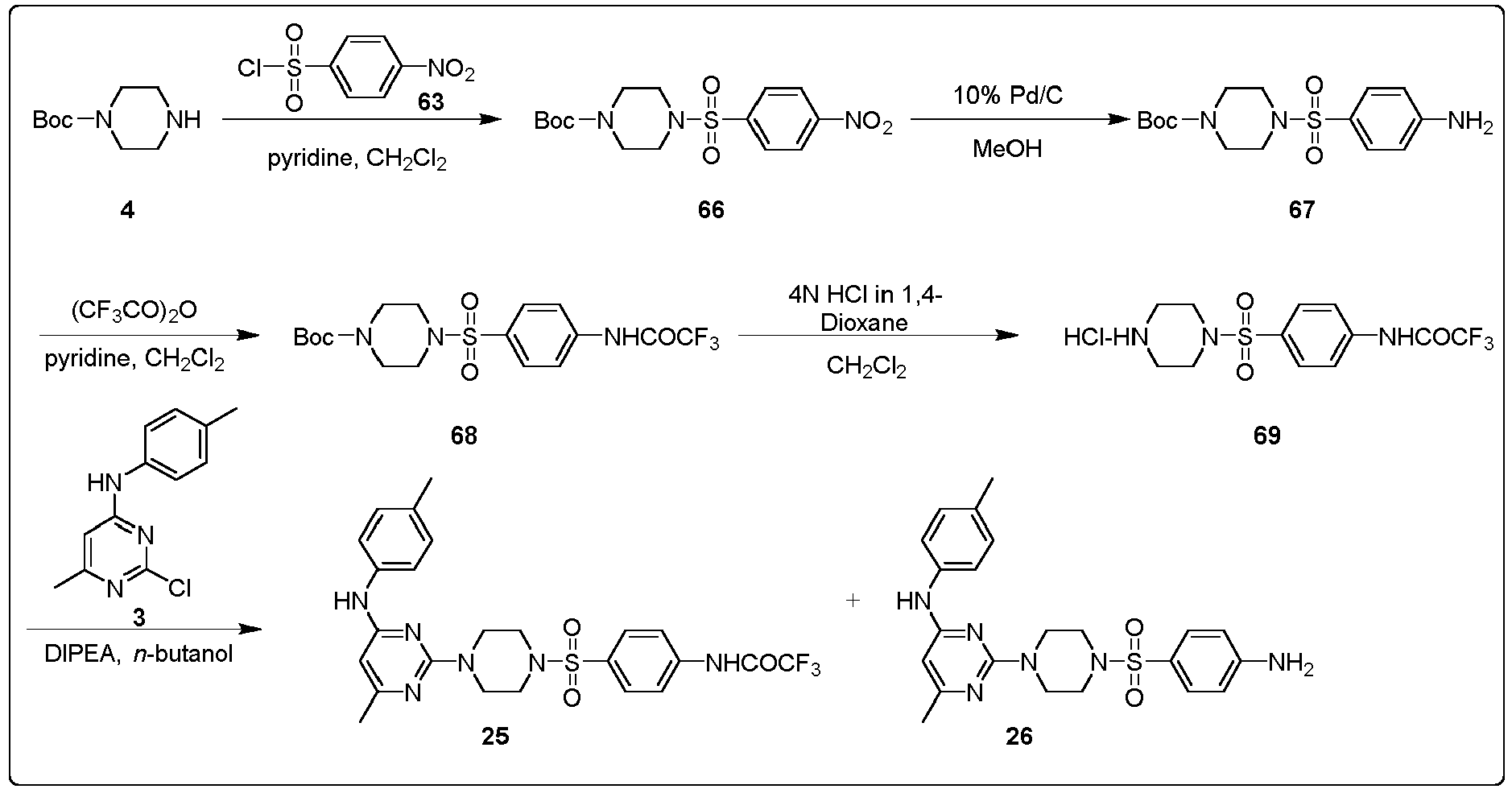
- Synthesis of tert-butyl 4-((4-nitrophenyl)sulfonyl)piperazine-1-carboxylate (66): To a stirred solution of tert-butyl piperazine-1-carboxylate 4 (500 mg, 2.68 mmol) in CH2Cl2 (10 mL) under argon atmosphere were added pyridine (1.1 mL, 13.4 mmol), 4-nitrobenzenesulfonyl chloride 63 (594 mg, 2.68 mmol) at 0 °C; warmed to RT and stirred for 4 h. The reaction was monitored by TLC; after completion of the reaction, the reaction mixture was diluted with EtOAc (30 mL), washed with water (20 mL), 1 N HCl (15 mL), 10% NaHCO3 solution (20 mL), brine (20 mL), dried over sodium sulfate, filtered and concentrated in vacuo to obtain the crude product. The crude product was washed with diethyl ether (2 x 10 mL) and n-pentane (2 x 10 mL) and dried in vacuo to afford compound 66 (760 mg, 76%) as a white solid. TLC: 30% EtOAc/ hexanes (Rf : 0.5); 1H-NMR (CDCl3, 500 MHz): δ 8.39 (d, J = 9.0 Hz, 2H), 7.94 (d, J = 9.0 Hz, 2H), 3.53 (t, J = 5.0 Hz, 4H), 3.04 (t, J = 5.0 Hz, 4H), 1.40 (s, 9H).
- Synthesis of tert-butyl 4-((4-aminophenyl) sulfonyl) piperazine-1-carboxylate (67): To a stirred solution of compound 66 (750 mg, 2.02 mmol) in MeOH (10 mL) under argon atmosphere was added 10% Pd/ C (200 mg) at RT and stirred under hydrogen atmosphere (balloon pressure) for 6 h. The reaction was monitored by TLC; after completion of the reaction, the reaction mixture was filtered through celite, washed with CH2Cl2 (2 x 30 mL), and the filtrate was concentrated in vacuo to obtain the crude product. The crude product was washed with CH2Cl2 (2 x 10 mL) to afford compound 67 (610 mg, 89%) as white solid. TLC: 30% EtOAc/ hexanes (Rf : 0.3); 1H-NMR (CDCl3, 400 MHz): δ 7.54 (d, J = 8.4 Hz, 2H), 6.78 (d, J = 8.4 Hz, 2H), 3.49 (t, J = 5.6 Hz, 4H), 2.93 (t, J = 5.2 Hz, 4H), 1.41 (s, 9H).
- Synthesis of tert-butyl 4-((4-(2,2,2-trifluoroacetamido)phenyl)sulfonyl)piperazine-1-carboxylate (68): To a stirred solution of compound 67 (100 mg, 0.29 mmol) in CH2Cl2 (3 mL) under argon atmosphere were added pyridine (0.04 mL, 0.58 mmol) and trifluoroacetic anhydride (0.04 mL, 0.29 mmol) at 0 °C; and stirred for 30 min. The reaction was monitored by TLC; after completion the reaction, the reaction mixture was diluted with water (20 mL) and extracted with CH2Cl2 (2 x 20 mL). The combined organic extracts were dried over sodium sulfate, filtered and concentrated in vacuo to obtain the crude product. The crude product was purified through silica gel column chromatography using 30% EtOAc/ hexanes to afford compound 68 (105 mg, 82%) as white solid. TLC: 40% EtOAc/ hexanes (Rf : 0.8); 1H-NMR (DMSO-d6, 400 MHz): δ 11.64 (s, 1H), 7.95 (d, J = 8.0 Hz, 2H), 7.78 (d, J = 9.2 Hz, 2H), 3.38 (t, J = 5.2 Hz, 4H), 2.85 (t, J = 5.2 Hz, 4H), 1.33 (s, 9H).
- Synthesis of 2,2,2-triffuoro-N(4-(piperazin-1-ylsulfonyl)phenyl)acetamide hydrochloride (69): To a stirred solution of compound 68 (100 mg, 0.22 mmol) in CH2Cl2 (3 mL) was added 4 N HCl in 1,4-dioxane (2 mL) under argon atmosphere at 0 °C was stirred for 3 h. The reaction was monitored by TLC; after completion of the reaction, the volatiles were removed in vacuo to obtain the crude product. The crude product was triturated with diethyl ether (2 x 5 mL) and dried in vacuo to afford compound 69 (45 mg, HCl salt) as an off-white solid. TLC: 5% MeOH/ CH2Cl2 (Rf : 0.2); 1H-NMR (DMSO-d6, 500 MHz): δ 11.78 (br s, 1H), 9.05 (br s, 1H), 8.50 (d, J = 6.8 Hz, 2H), 7.85 (d, J= 7.2 Hz, 2H), 3.17-3.16 (m, 4H), 3.13-3.12 (m, 4H).
- Synthesis of 2,2,2-trifluoro-N-(4-((4-(4-methyl-6-(p-tolylamino)pyrimidin-2-yl) piperazin-1-yl)sulfonyl) phenyl) acetamide (25) & 2,2,2-trifluoro-N-(4-((4-(4-methyl-6-(p-tolylamino)pyrimidin-2-yl)piperazin-1-yl)sulfonyl) phenyl) acetamide (26): To a stirred solution of compound 69 (70 mg, 0.29 mmol) in n-butanol (3 mL) under argon atmosphere were added compound 3 (100 mg, 0.29 mmol), diisopropylethylamine (0.13 mL, 0.74 mmol) at RT; warmed to 100 °C and stirred for 12 h. The reaction was monitored by TLC; after completion of the reaction, the volatiles were removed in vacuo to obtain crude. The crude product was purified through silica gel column chromatography using 30% EtOAc/ hexanes to afford 25 (20 mg, 12%) & 26 (30 mg, 20%) as an off-white solid. Analytical data of 25: TLC: 40% EtOAc/ hexanes (Rf : 0.6); 1H-NMR (DMSO-d6, 400 MHz): δ 11.60 (s, 1H), 9.00 (s, 1H), 7.93 (d, J = 9.2 Hz, 2H), 7.79 (d, J = 8.8 Hz, 2H), 7.39 (d, J = 8.4 Hz, 2H), 7.08 (d, J = 8.4 Hz, 2H), 5.86 (s, 1H), 3.77 (t, J = 5.2 Hz, 4H), 2.92 (t, J = 4.8 Hz, 4H), 2.24 (s, 3H), 2.08 (s, 3H); LC-MS: 98.84%; 534.9 (M++1); (column: X-select CSH C-18, (50 × 3.0 mm, 3.5 µm); RT 3.13 min. 0.05% TFA (Aq):ACN; 0.8 mL/min); UPLC (purity): 97.15%; (column: Acquity BEH C-18 (50 x 2.1 mm, 1.7 µ); RT 2.13 min. ACN:0.025% TFA (Aq); 0.5 mL/min) (IP13090981).
- Analytical data of 26: TLC: 40% EtOAc/ hexanes (Rf : 0.5); 1H-NMR (DMSO-d6, 400 MHz): δ 8.99 (s, 1H), 7.40 (d, J = 8.4 Hz, 2H), 7.35 (d, J = 8.8 Hz, 2H), 7.08 (d, J = 8.0 Hz, 2H), 6.62 (d, J = 8.8 Hz, 2H), 6.05 (br s, 2H), 5.86 (s, 1H), 3.75 (t, J = 4.8 Hz, 4H), 2.82 (t, J = 4.8 Hz, 4H), 2.24 (s, 3H), 2.09 (s, 3H); LC-MS: 98.05%; 438.9 (M++1); (column: X-select CSH C-18, (50 × 3.0 mm, 3.5 µm); RT 2.81 min. 0.05% TFA (Aq):ACN; 0.8 mL/min); UPLC (purity): 95.75%; (column: Acquity BEH C-18 (50 x 2.1 mm, 1.7 µ); RT 1.93 min. ACN:0.025% TFA (Aq); 0.5 mL/min) (IP13100012).
-
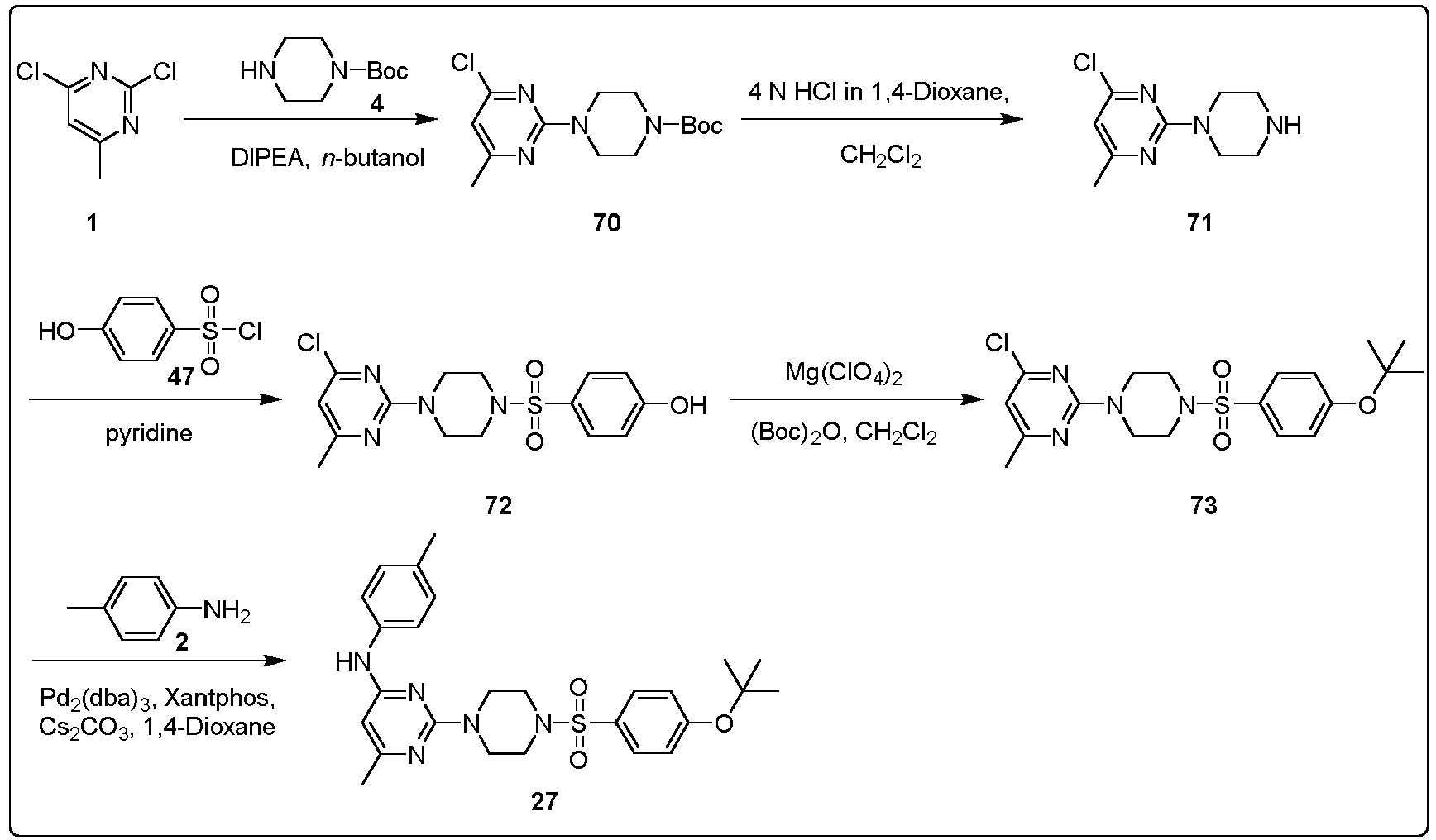
- Synthesis of tert-butyl 4-(4-chloro-6-methylpyrimidin-2-yl) piperazine-1-carboxylate (70): To a stirred solution of 2,4-dichloro-6-methylpyrimidine 1 (2 g, 12.26 mmol) in n-butanol (10 mL) under argon atmosphere were added tert-butyl piperazine-1-carboxylate 4 (2.74 g, 14.72 mmol), diisopropylethylamine (4.2 mL, 24.53 mmol) in a sealed tube at RT; warmed to 100 °C and stirred for 16 h. The reaction was monitored by TLC; after completion of the reaction, the reaction mixture was diluted with water (50 mL) and extracted with EtOAc (3 x 50 mL). The combined organic extracts dried over sodium sulfate, filtered and concentrated in vacuo to obtain crude. The crude product was purified through silica gel column chromatography using 15% EtOAc/hexanes to afford compound 70 (500 mg, 13%) as an off-white solid. TLC: 10% EtOAc/ hexanes (Rf : 0.6); 1H-NMR (DMSO-d6, 500 MHz): δ 6.66 (s, 1H), 3.69 (t, J = 5.0 Hz, 4H), 3.38 (t, J = 5.0 Hz, 4H), 2.28 (s, 3H), 1.41 (s, 9H).
- Synthesis of 4-chloro-6-methyl-2-(piperazin-1-yl)pyrimidine (71): To a stirred solution of compound 70 (500 mg, 1.59 mmol) in CH2Cl2 (3 mL) under inert atmosphere was added 4 N HCl in 1,4-dioxane (5 mL) at 0 °C and stirred for 6 h. The reaction was monitored by TLC; after completion of the reaction, the volatiles were removed in vacuo. The residue was neutralized with saturated NaHCO3 solution (30 mL) and extracted with EtOAc (2 x 30 mL). The combined organic extracts were dried over sodium sulfate, filtered and concentrated in vacuo to obtain compound 71 (270 mg, 79%) as white solid. TLC: 30% EtOAc/ hexanes (Rf : 0.2); 1H-NMR (DMSO-d6, 400 MHz): δ 6.58 (s 1H), 3.62 (t, J = 5.2 Hz, 4H), 2.70 (t, J = 5.2 Hz, 4H), 2.27 (s, 3H).
- Synthesis of 4-((4-(4-chloro-6-methylpyrimidin-2-yl)piperazin-1-yl)sulfonyl)phenol (72): To a stirred solution of compound 71 (250 mg, 1.17 mmol) in CH2Cl2 (10 mL) under argon atmosphere were added pyridine (0.47 mL, 5.86 mmol), 4-hydroxybenzenesulfonyl chloride 47 (452 mg, 2.34 mmol) at 0 °C; the mixture was warmed to RT and stirred for 16 h. The reaction was monitored by TLC; after completion of the reaction, the reaction mixture was diluted with water (30 mL) and extracted with CH2Cl2 (2 x 70 mL). The combined organic extracts were dried over sodium sulfate, filtered and concentrated in vacuo to obtain the crude product. The crude product was purified through silica gel column chromatography using 20% EtOAc/ hexanes to afford compound 72 (160 mg, 37%) as an off-white solid. TLC: 40% EtOAc/ hexanes (Rf : 0.8); 1H-NMR (DMSO-d6, 400 MHz): δ 10.53 (s, 1H), 7.55 (d, J = 6.8 Hz, 2H), 6.93 (d, J = 6.8 Hz, 2H), 6.65 (s, 1H), 3.79 (t, J = 4.8 Hz, 4H), 2.88 (t, J = 4.8 Hz, 4H), 2.24 (s, 3H).
- Synthesis of 2-(4-((4-(tert-butoxy)phenyl)sulfonyl)piperazin-1-yl)-4-chloro-6-methylpyrimidine (73): To a stirred solution of compound 72 (150 mg, 0.40 mmol) in CH2Cl2 (10 mL) under argon atmosphere were added magnesium perchlorate (36 mg, 0.16 mmol), Boc-anhydride (0.35 mg, 1.62 mmol) at 0 °C; the mixture was warmed to 45 °C and stirred for 48 h. The reaction was monitored by TLC; after completion of the reaction, the reaction mixture was diluted with water (20 mL) and extracted with CH2Cl2 (2 x 30 mL); the combined organic extracts were dried over sodium sulfate, filtered and concentrated in vacuo to obtain the crude product. The crude product was purified through silica gel column chromatography using 20% EtOAc/ hexanes to afford compound 73 (40 mg, 23%) as an off-white solid. TLC: 30% EtOAc/ hexanes (Rf : 0.6); 1H-NMR (DMSO d6, 400 MHz): δ 7.63 (d, J = 8.8 Hz, 2H), 7.17 (d, J = 8.8 Hz, 2H), 6.65 (s, 1H), 3.80 (t, J = 5.2 Hz, 4H), 2.93 (t, J =5.2 Hz, 4H), 2.24 (s, 3H), 1.37 (s, 9H).
- Synthesis of 2-(4-((4-(tert-butoxy)phenyl)sulfonyl)piperazin-1-yl)-6-methyl-N-(p-tolyl)pyrimidin-4-amine (target compound 27): To a stirred solution of compound 73 (40 mg, 0.09 mmol) in 1,4-dioxane (4 mL) under inert atmosphere were added p-toluidine 2 (13 mg, 0.12 mmol), cesium carbonate (46 mg, 0.14 mmol) at RT, purged under argon for 15 min. To this were added Pd2(dba)3 (4.5 mg, 0.004 mmol), Xantphos (3.8 mg, 0.006 mmol) in a sealed tube; heated to 120 °C and stirred for 16 h. The reaction was monitored by TLC; after completion of the reaction, the volatiles were removed in vacuo to obtain the crude product. The crude product was purified through silica gel column chromatography using 25% EtOAc/ hexanes to afford 27 (15 mg, 32%) as an off-white solid. TLC: 30% EtOAc/ hexanes (Rf : 0.5); 1H-NMR (DMSO-d6, 400 MHz): δ 9.00 (s, 1H), 7.64 (d, J = 8.8 Hz, 2H), 7.40 (d, J = 8.4 Hz, 2H),7.17 (d, J = 8.8 Hz, 2H), 7.08 (d, J = 8.4 Hz, 2H), 5.86 (s, 1H), 3.77 (t, J = 5.2 Hz, 4H), 2.90 (t, J = 5.2 Hz, 4H), 2.24 (s, 3H), 2.09 (s, 3H), 1.36 (s, 9H); LC-MS: 96.84%; 496.4 (M++1); (column; X-select CSH C-18, (50 × 3.0 mm, 3.5 µm); RT 3.89 min. 0.05% TFA (Aq):ACN; 0.8 mL/min); UPLC (purity): 96.72%; (column: Acquity UPLC BEH C-18 (2.1 x 50 mm, 1.7 µ); RT 2.37 min. ACN:0.025% TFA (Aq); 0.5 mL/min) (IP13110106).
-

- Synthesis of 4-((4-(4-methyl-6-(p-tolylamino)pyrimidin-2-yl)piperazin-1-yl) sulfonyl) phenol (28): To a stirred solution of target compound 4 (50 mg, 0.11 mmol) in CH3CN (5 mL) were added potassium hydroxide (352 mg, 6.26 mmol) in H2O (5 mL), diethyl (bromodifluoromethyl) phosphonate 83 (0.1 mL, 0.56 mmol) at 0 °C; warmed to 10 °C and stirred for 2 h. The reaction was monitored by TLC; after completion the reaction, the reaction mixture was diluted with water (20 mL) and extracted with EtOAc (2 x 30 mL). The combined organic extracts were washed with water (50 mL) dried over sodium sulfate, filtered and concentrated in vacuo to obtain the crude product. The crude product was purified through silica gel column chromatography using 20% EtOAc/hexanes to afford 28 (20 mg, 36%) as an off-white solid. TLC: 40% EtOAc/ hexanes (Rf : 0.8); 1H-NMR (DMSO-d6, 400 MHz): δ 9.00 (s, 1H), 7.81 (d, J = 8.8 Hz, 2H), 7.56-7.20 (m, 5H), 7.08 (d, J = 8.4 Hz, 2H), 5.86 (s, 1H), 3.78 (t, J = 4.8 Hz, 4H), 2.93 (t, J = 4.8 Hz, 4H), 2.24 (s, 3H), 2.08 (s, 3H); LC-MS: 97.11%; 490.4 (M++1); (column: X-select CSH C-18, (50 × 3.0 mm, 3.5 µm); RT 3.67 min. 0.05% TFA (Aq):ACN; 0.8 mL/min); UPLC (purity): 98.09%; (column: Acquity BEH C-18 (50 x 2.1 mm, 1.7 µ); RT 2.18 min. ACN:0.025% TFA (Aq); 0.5 mL/min) (IP13090051).
-

- Synthesis of 2,4-dichloro-6-ethylpyrimidine (84): To a stirred solution of 2,4-dichloro-6-methylpyrimidine 1 (600 mg, 3.68 mmol) in THF (10 mL) under argon atmosphere was added lithium diisopropylamide (LDA; 2 M sol. in THF, 2.2 mL, 4.40 mmol) at -78 °C and stirred for 30 min. To this was added methyl iodide (0.27 mL, 4.40 mmol) at -78 °C and the reaction stirred for 3 h. The reaction was monitored by TLC; after completion of the reaction, the reaction mixture was quenched with saturated ammonium chloride solution (20 mL) and extracted with EtOAc (2 x 30 mL). The combined organic extracts were dried over sodium sulfate, filtered and concentrated in vacuo to obtain the crude product. The crude product was purified through silica gel column chromatography using 5% EtOAc/ hexanes to afford compound 84 (120 mg, 19%) as a low melting pale yellow solid. TLC: 10% EtOAc/ hexanes (Rf : 0.8); 1H-NMR (CDCl3, 400 MHz): δ 7.17 (s, 1H), 2.80 (q, 2H), 1.32 (t, J = 7.6 Hz, 3H).
- Synthesis of 2-chloro-6-ethyl-N-(p-tolyl)pyrimidin-4-amine (85): To a stirred solution of compound 84 (100 mg, 0.56 mmol) in 1,4-dioxane (5 mL) under argon atmosphere was added p-toluidine 2 (47.4 mg, 0.43 mmol) at RT and the mixture degassed under argon for 10 min. To this were added Pd2(dba)3 (20.6 mg, 0.02 mmol), Xantphos (19.5 mg, 0.03 mmol) and cesium carbonate (202 mg, 0.62 mmol) at RT; the reaction was heated to 110 °C and stirred for 2 h. The reaction was monitored by TLC; after completion of the reaction, the reaction mixture was diluted with water (20 mL) and extracted with EtOAc (2 x 30 mL). The combined organic extracts were dried over sodium sulfate, filtered and concentrated in vacuo to obtain the crude product. The crude product was purified through silica gel column chromatography using 10% EtOAc/ hexanes to afford compound 85 (30 mg, 21%) as a sticky solid. TLC: 15% EtOAc/ hexanes (Rf : 0.3); 1H-NMR (CDCl3, 400 MHz): δ 7.21 (d, J = 8.4 Hz, 2H), 7.15 (d, J = 8.4 Hz, 2H), 6.82 (br s, 1H), 6.38 (s, 1H), 2.58 (q, 2H), 2.37 (s, 3H), 1.21 (t, J = 7.6 Hz, 3H). Synthesis of tert-butyl 4-(4-ethyl-6-(p-tolylamino)pyrimidin-2-yl)piperazine-1-carboxylate (86): To a stirred solution of compound 85 (30 mg, 0.12 mmol) in n-butanol (2 mL) under argon atmosphere were added tert-butyl piperazine-1-carboxylate 4 (33.7 mg, 0.18 mmol) and N,N-diisopropylethylamine (0.04 mL, 0.24 mmol) in sealed tube at RT; the mixture was heated to 80 °C and stirred for 5 h. The reaction was monitored by TLC; after completion of the reaction, the volatiles were removed in vacuo to obtain the crude product. The crude product was purified through silica gel column chromatography using 15% EtOAc/ hexanes to afford compound 86 (65 mg, 68%) as a low melting colorless solid. TLC: 20% EtOAc/ hexanes (Rf : 0.6); 1H-NMR (DMSO-d6, 400 MHz): δ 9.02 (s, 1H), 7.46 (d, J = 8.4 Hz, 2H), 7.10 (d, J = 8.4 Hz, 2H), 5.90 (s, 1H), 3.67 (t, J = 4.8 Hz, 4H), 3.37 (t, J = 5.2 Hz, 4H), 2.40 (q, 2H), 2.27 (s, 3H), 1.46 (s, 9H), 1.14 (t, J = 7.6 Hz, 3H).
- Synthesis of 6-ethyl-2-(piperazin-1-yl)-N-(p-tolyl)pyrimidin-4-amine (87): To a stirred solution of compound 86 (65 mg, 0.16 mmol) in CH2Cl2 (2 mL) under argon atmosphere was added 4 N HCl in 1,4-dioxane (0.25 mL, 0.82 mmol) at 0 °C; warmed to RT and stirred for 2 h. The reaction was monitored by TLC; after completion of the reaction, the reaction mixture was diluted with water (15 mL) and extracted with CH2Cl2 (2 x 20 mL). The aqueous layer was basified with 5% aqueous NaHCO3 solution (10 mL) and extracted with CH2Cl2 (2 x 30 mL). The combined organic extracts were dried over sodium sulfate, filtered and concentrated in vacuo to obtain crude compound 87 (35 mg, 72%) as an off-white solid. TLC: 10% CH3OH/ CH2Cl2 (Rf : 0.3); 1H-NMR (DMSO-d6, 500 MHz): δ 8.98 (s, 1H), 7.47 (d, J = 8.0 Hz, 2H), 7.09 (d, J = 8.5 Hz, 2H), 5.86 (s, 1H), 3.63-3.62 (m, 4H), 2.74-2.73 (m, 4H), 2.41-2.37 (m, 3H), 2.24 (s, 3H), 1.13 (t, J = 8.0 Hz, 3H).
- Synthesis of 6-ethyl-2-(4-((4-methoxyphenyl)sulfonyl)piperazin-1-yl)-N-(p-tolyl) pyrimidin-4-amine (29): To a stirred solution of compound 87 (35 mg, 0.11 mmol) in CH2Cl2 (2 mL) under argon atmosphere were added pyridine (0.047 mL, 0.58 mmol) and 4-methoxybenzenesulfonyl chloride 40 (26.7 mg, 0.12 mmol) at 0 °C; the mixture was warmed to RT and stirred for 16 h. The reaction was monitored by TLC; after completion of the reaction, the reaction mixture was diluted with CH2Cl2 (20 mL) and washed with 2 N HCl (2 x 10 mL). The organic layer was dried over sodium sulfate, filtered and concentrated in vacuo to obtain the crude product, which was precipitated with 20% EtOAc/ hexanes to afford 29 (25 mg, 45%) as an off-white solid. TLC: 5% CH3OH/CH2Cl2 (Rf : 0.7); 1H-NMR (DMSO-d6, 400 MHz): δ 9.02 (s, 1H), 7.67 (d, J = 8.8 Hz, 2H), 7.40 (d, J = 8.4 Hz, 2H), 7.13 (d, J = 8.8 Hz, 2H), 7.08 (d, J = 8.4 Hz, 2H), 5.87 (s, 1H), 3.82 (s, 3H), 3.78 (t, J = 4.8 Hz, 4H), 2.88 (t, J = 4.8 Hz, 4H), 2.36 (q, 2H), 2.24 (s, 3H), 1.09 (t, J = 7.6 Hz, 3H); LC-MS: 95.60%; 468.6 (M++1); (column: X-select CSH C-18 (50 × 3.0 mm, 3.5 µm); RT 3.70 min. 0.05% TFA (Aq):ACN; 0.8 mL/min); UPLC (purity): 98.98%; (column: Acquity BEH C-18 (50 x 2.1 mm, 1.7 µ); RT 2.13 min. ACN:0.025% TFA (Aq); 0.5 mL/min) (IP13070762).
-

- Synthesis of 2,4-dichloro-6-isopropylpyrimidine (9): To a stirred solution of 2,4-dichloro-6-ethylpyrimidine 84 (950 mg, 5.36 mmol) in THF (50 mL) under argon atmosphere was added LDA (2 M sol. in THF, 5.37 mL, 10.73 mmol) at -70 °C and stirred for 30 min. To this was added methyl iodide (0.66 mL, 10.73 mmol) at -70 °C and stirred for 2 h. The reaction was monitored by TLC; after completion of the reaction, the reaction mixture was quenched with aqueous saturated ammonium chloride solution (20 mL) and extracted with EtOAc (2 x 50 mL). The combined organic extracts were dried over sodium sulfate, filtered and concentrated in vacuo to obtain the crude product. The crude product was purified through silica gel column chromatography using 2% EtOAc/ hexanes to afford compound 9 (500 mg, 50%) as a white solid. TLC: 10% EtOAc/ hexanes (Rf : 0.5); 1H-NMR (CDCl3, 400 MHz): δ 7.16 (s, 1H), 3.04-2.97 (m, 1H), 1.31 (d, J = 6.8 Hz, 6H).
- Note: Compound 9 may also be prepared from trichloropyrimidine and isopropyl magnesium chloride as described above.
- Synthesis of 2-chloro-6-isopropyl-N-(p-tolyl)pyrimidin-4-amine (88): To a stirred solution of compound 9 (500 mg, 2.61 mmol) in acetonitrile (8 mL) under argon atmosphere were added p-toluidine 2 (285 mg, 2.61 mmol) and triethylamine (0.73 mL, 5.23 mmol) in sealed tube at RT; the mixture was heated to 60 °C and stirred for 24 h. The reaction was monitored by TLC; after completion of the reaction, the volatiles were removed in vacuo, the residue was diluted with water (30 mL), and then extracted with EtOAc (2 x 40 mL). The combined organic extracts were dried over sodium sulfate, filtered and concentrated in vacuo to obtain the crude product. The crude product was purified through silica gel column chromatography using 7% EtOAc/ hexanes to afford compound 88 (130 mg, 19%) as white solid. TLC: 20% EtOAc/ hexanes (Rf : 0.3); 1H-NMR (DMSO-d6, 500 MHz): δ 9.80 (s, 1H), 7.42 (d, J = 7.5 Hz, 2H), 7.16 (d, J = 8.0 Hz, 2H), 6.53 (s, 1H), 2.78-2.76 (m, 1H), 2.27 (s, 3H), 1.16 (d, J = 7.0 Hz, 6H).
- Synthesis of tert-butyl 4-(4-isopropyl-6-(p-tolylamino)pyrimidin-2-yl)piperazine-1-carboxylate (89): To a stirred solution of compound 88 (160 mg, 0.61 mmol) in n-butanol (5 mL) under argon atmosphere were added tert-butyl piperazine-1-carboxylate 4 (342 mg, 1.83 mmol) and N,N-diisopropylethylamine (0.21 mL, 1.22 mmol) in sealed tube at RT; the mixture was heated to 100 °C and stirred for 24 h. The reaction was monitored by TLC; after the reaction was complete, the volatiles were removed in vacuo, the residue was diluted with water (20 mL), and extracted with EtOAc (2 x 30 mL). The combined organic extracts were dried over sodium sulfate, filtered and concentrated in vacuo to obtain the crude product. The crude product was purified through silica gel column chromatography using 30% EtOAc/ hexanes to afford compound 89 (155 mg, 61%) as white solid. TLC: 15% EtOAc/ hexanes (Rf : 0.3); 1H-NMR (DMSO-d6, 500 MHz): δ 9.05 (s, 1H), 7.47 (d, J = 8.5 Hz, 2H), 7.10 (d, J = 8.0 Hz, 2H), 5.91 (s, 1H), 3.68-3.66 (m, 4H), 3.43-3.37 (m, 4H), 2.63-2.60 (m, 1H), 2.24 (s,3H), 1.42 (s, 9H), 1.14 (d, J = 7.5 Hz, 6H).
- Synthesis of 6-isopropyl-2-(piperazin-1-yl)-N-(p-tolyl)pyrimidin-4-amine (90): To a stirred solution of compound 89 (155 mg, 0.37 mmol) in CH2Cl2 (5 mL) under argon atmosphere was added 4 N HCl in 1,4-dioxane (0.47 mL, 1.87 mmol) at 0 °C; the mixture was warmed to RT and stirred for 4 h. The reaction was monitored by TLC; after the reaction was complete, the reaction mixture was diluted with water (15 mL), the pH was adjusted to ∼8 with aqueous saturated NaHCO3 solution (20 mL), and extracted with EtOAc (2 x 30 mL). The combined organic extracts were dried over sodium sulfate, filtered and concentrated in vacuo to obtain the crude compound 90 (100 mg, 85%) as white solid. TLC: 50% EtOAc/ hexanes (Rf : 0.2); 1H-NMR (DMSO-d6, 500 MHz): δ 8.99 (s, 1H), 7.48 (d, J = 8.0 Hz, 2H), 7.08 (d, J = 8.0 Hz, 2H), 5.86 (s, 1H), 3.61-3.59 (m, 4H), 2.71-2.70 (m, 4H), 2.64-2.58 (m, 1H), 2.23 (s, 3H), 1.13 (d, J = 7.5 Hz, 6H).
- Synthesis of 6-isopropyl-2-(4-((4-methoxyphenyl) sulfonyl) piperazin-1-yl)-N-(p-tolyl) pyrimidin-4-amine (30): To a stirred solution of compound 90 (100 mg, 0.32 mmol) in CH2Cl2 (5 mL) under argon atmosphere were added 4-methoxybenzenesulfonyl chloride 40 (73 mg, 0.35 mmol) and pyridine (0.13 mL, 1.6 mmol) at 0 °C; the mixture was warmed to RT and stirred for 16 h. The reaction was monitored by TLC; after completion of the reaction, the reaction mixture was diluted with CH2Cl2 (30 mL), washed with IN HCl (10 mL) and aqueous saturated NaHCO3 solution (10 mL). The organic layer was separated, dried over sodium sulfate, filtered and concentrated in vacuo to obtain the crude product, which was triturated with 2% CH2Cl2/ n-pentane to afford 30 (50 mg, 32%) as a white solid. TLC: 5% CH3OH/CH2Cl2 (Rf : 0.8); 1H-NMR (DMSO-d6, 400 MHz): δ 9.03 (s, 1H), 7.68 (d, J = 8.8 Hz, 2H), 7.41 (d, J = 8.0 Hz, 2H), 7.13 (d, J = 8.8 Hz, 2H), 7.08 (d, J = 8.4 Hz, 2H), 5.87 (s, 1H), 3.82 (s, 3H), 3.78 (t, J = 4.4 Hz, 4H), 2.89 (t, J = 4.8 Hz, 4H), 2.56-2.52 (m, 1H), 2.24 (s, 3H), 1.10 (d, J = 6.8 Hz, 6H); LC-MS: 97.21%; 482.4 (M++1); (column: X-select CSH C-18 (50 × 3.0 mm, 3.5 µm); RT 3.70 min. 0.05% TFA (Aq):ACN; 0.8 mL/min); UPLC (purity): 98.80%; (column: Acquity BEH C-18 (50 x 2.1 mm, 1.7 µ); RT 2.19 min. ACN:0.025% TFA (Aq); 0.5 mL/min) (IP13080332).
-

- Synthesis of 4-(tert-butyl)-2,6-dichloropyrimidine (92): To a stirred solution of 2,4,6-trichloropyrimidine 7 (1.5 g, 8.19 mmol) in THF (50 mL) under argon atmosphere were added tert-butyl magnesium chloride 91 (2 M sol. in diethyl ether, 6.12 mL, 12.29 mmol) and copper iodide (78 mg, 0.41 mmol) at -10 °C; the mixture was stirred at 0 °C for 1 h. The reaction was monitored by TLC; after completion of the reaction, the reaction mixture was quenched with aqueous saturated ammonium chloride solution (50 mL) and extracted with EtOAc (2 x 60 mL). The combined organic extracts were dried over sodium sulfate, filtered and concentrated in vacuo to obtain the crude product. The crude product was purified through silica gel column chromatography using 2% EtOAc/ hexanes to afford compound 92 (900 mg, 56%) as colorless semi solid. TLC: 10% EtOAc/ hexanes (Rf : 0.5); 1H-NMR (CDCl3, 500 MHz): δ 7.40 (s, 1H), 1.32 (s, 9H).
- Synthesis of 6-(tert-butyl)-2-chloro-N-(p-tolyl)pyrimidin-4-amine (93): To a stirred solution of compound 92 (500 mg, 2.43 mmol) in acetonitrile (8 mL) under argon atmosphere were added p-toluidine 2 (265 mg, 2.43 mmol) and triethylamine (0.68 mL, 4.87 mmol) in a sealed tube at RT; the mixture was heated to 60 °C and stirred for 24 h. The reaction was monitored by TLC; after completion of the reaction, the volatiles were removed in vacuo, the residue was diluted with water (20 mL), and extracted with EtOAc (2 x 40 mL). The combined organic extracts were dried over sodium sulfate, filtered and concentrated in vacuo to obtain the crude product. The crude product was purified through silica gel column chromatography using 7% EtOAc/ hexanes to afford compound 93 (70 mg, 10%) as a white solid. TLC: 20% EtOAc/ hexanes (Rf : 0.2); 1H-NMR (DMSO-d6, 400 MHz): δ 9.80 (s, 1H), 7.44 (d, J = 8.0 Hz, 2H), 7.16 (d, J = 8.0 Hz, 2H), 6.64 (s, 1H), 2.27 (s, 3H), 1.22 (s, 9H). Synthesis of tert-butyl 4-(4-(tert-butyl)-6-(p-tolylamino)pyrimidin-2-yl)piperazine-1-carboxylate (94): To a stirred solution of compound 93 (70 mg, 0.25 mmol) in n-butanol (5 mL) under argon atmosphere were added tert-butyl piperazine-1-carboxylate 4 (142 mg, 0.76 mmol) and N,N-diisopropylethylamine (0.08 mL, 0.51 mmol) in a sealed tube at RT; the mixture was heated to 100 °C and stirred for 24 h. The reaction was monitored by TLC; after completion of the reaction, the volatiles were removed in vacuo, the residue was diluted with water (20 mL) and extracted with EtOAc (2 x 30 mL). The combined organic extracts were dried over sodium sulfate, filtered and concentrated in vacuo to obtain the crude product. The crude product was purified through silica gel column chromatography using 30% EtOAc/ hexanes to afford compound 94 (75 mg, 69%) as a white solid. TLC: 15% EtOAc/ hexanes (Rf : 0.3); 1H-NMR (DMSO-d6, 500 MHz): δ 9.07 (s, 1H), 7.49 (d, J = 8.0 Hz, 2H), 7.10 (d, J = 8.5 Hz, 2H), 6.03 (s, 1H), 3.68-3.66 (m, 4H), 3.40-3.35 (m, 4H), 2.24 (s, 3H), 1.42 (s, 9H), 1.20 (s, 9H).
- Synthesis of 6-(tert-butyl)-2-(piperazin-1-yl)-N-(p-tolyl)pyrimidin-4-amine (95): To a stirred solution of compound 94 (75 mg, 0.18 mmol) in CH2Cl2 (5 mL) under argon atmosphere was added 4 N HCl in 1,4-dioxane (0.28 mL, 0.88 mmol) at 0 °C; the mixture was warmed to RT and stirred for 4 h. The reaction was monitored by TLC; after completion of the reaction, the reaction mixture was diluted with water (15 mL), the pH was adjusted to ∼8 with aqueous saturated NaHCO3 solution (10 mL), and extracted with EtOAc (2 x 30 mL). The combined organic extracts were dried over sodium sulfate, filtered and concentrated in vacuo to obtain the crude compound 95 (50 mg, 87%) as white solid. TLC: 50% EtOAc/hexanes (Rf : 0.2); 1H-NMR (DMSO-d6, 400 MHz): δ 8.99 (s, 1H), 7.48 (d, J = 8.8 Hz, 2H), 7.07 (d, J = 8.0 Hz, 2H), 5.98 (s, 1H), 3.61 (t, J = 4.8 Hz, 4H), 2.72 (t, J = 4.8 Hz, 4H), 2.23 (s, 3H), 1.19 (s, 9H). Synthesis of 6-(tert-butyl)-2-(4-((4-methoxyphenyl)sulfonyl)piperazin-1-yl)-N-(p-tolyl) pyrimidin-4-amine (31): To a stirred solution of compound 95 (50 mg, 0.15 mmol) in CH2Cl2 (5 mL) under argon atmosphere were added 4-methoxybenzenesulfonyl chloride 40 (35 mg, 0.17 mmol) and pyridine (0.06 mL, 0.76 mmol) at 0 °C; the mixture was warmed to RT and stirred for 16 h. The reaction was monitored by TLC; after completion of the reaction, the reaction mixture was diluted with CH2Cl2 (30 mL) and washed with 1 N HCl (10 mL), followed by aqueous saturated NaHCO3 solution (10 mL). The organic layer was dried over sodium sulfate, filtered and concentrated in vacuo to obtain the crude product, which was triturated with 2% CH2Cl2/ n-pentane to afford 31 (30 mg, 40%) as a white solid. TLC: 5% CH3OH/CH2Cl2 (Rf : 0.9); 1H-NMR (DMSO-d6, 400 MHz): δ 9.05 (br s, 1H), 7.68 (d, J = 9.2 Hz, 2H), 7.42 (d, J = 8.4 Hz, 2H), 7.13 (d, J = 9.2 Hz, 2H), 7.08 (d, J = 8.4 Hz, 2H), 6.00 (s, 1H), 3.82 (s, 3H), 3.80 (t, J = 4.4 Hz, 4H), 2.90 (t, J = 4.8 Hz, 4H), 2.24 (s, 3H), 1.16 (s, 9H); LC-MS: 97.25%; 496.4 (M++1); (column: X-select CSH C-18 (50 × 3.0 mm, 3.5 µm); RT 3.95min. 0.05% TFA (Aq):ACN; 0.8 mL/min); HPLC (purity): 99.15%; (column: Eclipse-XDB-C-18 (150 x 4.6 mm, 5 µm); RT 13.55 min. ACN:5 mM NH4OAc (Aq); 1.0 mL/min) (IP13080340).
-

- Synthesis of 2,4-dichloro-6-propylpyrimidine (97): A stirred solution of 6-propyl-2-thioxo-2,3-dihydropyrimidin-4 (1H)-one 96 (1 g, 5.81 mmol) in phosphoryl trichloride (5 mL) under argon atmosphere was heated to 110 °C and stirred for 16 h. The reaction was monitored by TLC; after completion of the reaction, the reaction mixture was diluted with ice water (20 mL), neutralized with aqueous saturated NaHCO3 solution (20 mL) and extracted with CH2Cl2 (2 x 30 mL). The combined organic extracts were dried over sodium sulfate, filtered and concentrated in vacuo to obtain the crude product. The crude product was purified through silica gel column chromatography using 2% EtOAc/ hexanes to afford compound 97 (300 mg, 27%) as a colorless liquid. TLC: 10% EtOAc/ hexanes (Rf : 0.8); 1H-NMR (CDCl3, 400 MHz): δ 7.15 (s, 1H), 2.72 (t, J = 7.6 Hz, 2H), 1.81-1.72 (m, 2H), 0.99 (t, J = 7.6 Hz, 3H).
- Synthesis of 2-chloro-6-propyl-N-(p-tolyl) pyrimidin-4-amine (98): To a stirred solution of compound 97 (300 mg, 1.57 mmol) in CH3CN (5 mL) under argon atmosphere were added p-toluidine 2 (205 mg, 1.88 mmol) and triethylamine (0.45 mL, 3.14 mmol) at RT; the mixture was heated to 70 °C and stirred for 36 h. The reaction was monitored by TLC; after completion of the reaction, the volatiles were removed in vacuo to obtain the crude product. The crude product was purified through silica gel column chromatography using 4% EtOAc/ hexanes to afford compound 98 (120 mg, 30%) as a sticky syrup. TLC: 10% EtOAc/ hexanes (Rf : 0.4); 1H-NMR (DMSO-d6, 400 MHz): δ 9.77 (s, 1H), 7.41 (d, J = 8.4 Hz, 2H), 7.16 (d, J = 8.4 Hz, 2H), 6.51 (s, 1H), 2.50-2.47 (m, 2H), 2.27 (s, 3H), 1.64-1.59 (m, 2H), 0.89 (t, J = 7.6 Hz, 3H).
- Synthesis of tert-butyl 4-(4-propyl-6-(p-tolylamino)pyrimidin-2-yl)piperazine-1-carboxylate (99): To a stirred solution of compound 98 (100 mg, 0.38 mmol) in n-butanol (5 mL) under argon atmosphere were added tert-butyl piperazine-1-carboxylate 4 (107 mg, 0.57 mmol) and N,N-diisopropylethylamine (0.14 mL, 0.76 mmol) at RT; the mixture was heated to 100 °C and stirred for 20 h. The reaction was monitored by TLC; after completion of the reaction, the volatiles were removed in vacuo to obtain the crude product. The crude product was purified through silica gel column chromatography using 10% EtOAc/ hexanes to afford compound 99 (100 mg, 64%) as a white solid. TLC: 10% EtOAc/ hexanes (Rf : 0.8); 1H-NMR (DMSO-d6, 400 MHz): δ 9.02 (s, 1H), 7.46 (d, J = 8.4 Hz, 2H), 7.10 (d, J = 8.0 Hz, 2H), 5.88 (s, 1H), 3.66 (t, J = 5.2 Hz, 4H), 3.37 (t, J = 5.2 Hz, 4H), 2.36 (t, J = 7.6 Hz, 2H), 2.24 (s, 3H), 1.66-1.56 (m, 2H), 1.42 (s, 9H), 0.90 (t, J = 7.6 Hz, 3H).
- Synthesis of 2-(piperazin-1-yl)-6-propyl-N-(p-tolyl)pyrimidin-4-amine (100): To a stirred solution of compound 99 (100 mg, 0.24 mmol) in CH2Cl2 (2 mL) under argon atmosphere was added 4 N HCl in 1,4-dioxane (0.30 mL, 1.20 mmol) at 0 °C; the mixture was warmed to RT and stirred for 2 h. The reaction was monitored by TLC; after completion of the reaction, the reaction mixture was diluted with water (15 mL) and extracted with CH2Cl2 (2 x 20 mL). The aqueous layer was basified with 10% aqueous NaHCO3 solution (10 mL) and extracted with CH2Cl2 (2 x 30 mL). The combined organic extracts were dried over sodium sulfate, filtered and concentrated in vacuo to obtain the crude product. The crude product was purified through silica gel column chromatography using 5% EtOAc/ hexanes to afford compound 100 (50 mg, 66%) as a white solid. TLC: 10% CH3OH/CH2Cl2 (Rf : 0.3); 1H-NMR (DMSO-d6, 500 MHz): δ 8.94 (s, 1H), 7.47 (d, J = 8.0 Hz, 2H), 7.09 (d, J = 8.5 Hz, 2H), 5.84 (s, 1H), 3.61-3.59 (m, 4H), 2.72-2.70 (m, 4H), 2.37-2.33 (m, 3H), 2.24 (s, 3H), 1.63-1.59 (m, 2H), 0.91 (t, J = 7.0 Hz, 3H).
- Synthesis of 2-(4-((4-methoxyphenyl) sulfonyl) piperazin-1-yl)-6-propyl-N-(p-tolyl) pyrimidin-4-amine (32): To a stirred solution of compound 100 (50 mg, 0.16 mmol) in CH2Cl2 (4 mL) under argon atmosphere were added pyridine (0.067 mL, 0.80 mmol) and 4-methoxybenzenesulfonyl chloride 40 (36.5 mg, 0.17 mmol) at 0 °C; the mixture was warmed to RT and stirred for 3 h. The reaction was monitored by TLC; after completion of the reaction, the reaction mixture was diluted with CH2Cl2 (15 mL) and washed with 1 N HCl (2 x 15 mL) and 10% aqueous NaHCO3 (20 mL). The organic layer was dried over sodium sulfate, filtered and concentrated in vacuo to obtain the crude product, which was precipitated with 5% EtOAc/ hexanes to afford 32 (30 mg, 39%) as a white solid. TLC: 5% CH3OH/CH2Cl2 (Rf : 0.7); 1H-NMR (DMSO-d6, 400 MHz): δ 9.03 (br s, 1H), 7.67 (d, J = 8.8 Hz, 2H), 7.40 (d, J = 8.4 Hz, 2H), 7.14-7.08 (m, 4H), 5.86 (s, 1H), 3.82 (s, 3H), 3.78 (t, J = 5.2 Hz, 4H), 2.89-2.87 (m, 4H), 2.32 (t, J = 7.2 Hz, 2H), 2.24 (s, 3H), 1.61-1.52 (m, 2H), 0.86 (t, J = 7.6 Hz, 3H); LC-MS: 98.96%; 482.6 (M++1); (column: X-select CSH C-18, (50 × 3.0 mm, 3.5 µm); RT 3.76 min. 0.05% TFA (Aq):ACN; 0.8 mL/min); UPLC (purity): 98.43%; (column: Acquity BEH C-18 (50 x 2.1 mm, 1.7 µ); RT 2.24 min. ACN:0.025% TFA (Aq); 0.5 mL/min) (IP13080047).
-

- Synthesis of 6-(trifluoromethyl)pyrimidine-2,4(1H,3H)-dione (103): To a stirred solution of ethyl 4,4,4-trifluoro-3-oxobutanoate 101 (3 g, 16.30 mmol) in ethanol (30 mL) under argon atmosphere were added urea 102 (978 mg, 16.30 mmol) and freshly prepared sodium ethoxide (750 mg of Na in 30 mL of EtOH) at RT; the mixture was heated to 90 °C and stirred for 24 h. The reaction was monitored by TLC; after completion of the reaction, the volatiles were removed in vacuo, diluted with water (25 mL), acidified with 1 N HCl (10 mL) and extracted with EtOAc (2 x 40 mL). The combined organic extracts were dried over sodium sulfate, filtered and concentrated in vacuo to afford compound 103 (650 mg, 22%) as a white solid. TLC: 5% CH3OH/CH2Cl2 (Rf : 0.3); 1H-NMR (DMSO-d6, 500 MHz): δ 12.07 (s, 1H), 11.54 (s, 1H), 6.07 (s, 1H).
- Synthesis of 2,4-dichloro-6-(trifluoromethyl)pyrimidine (104): To a stirred solution of compound 103 (150 mg, 0.83 mmol) in DMF (5 mL) under argon atmosphere was added sulfurous dichloride (0.75 mL) in sealed tube at 0 °C; the mixture was heated to 75 °C and stirred for 4 h. The reaction was monitored by TLC; after completion of the reaction, the reaction mixture was diluted with ice water (20 mL), neutralized with 10% aqueous NaHCO3 solution (20 mL) and extracted with hexanes (2 x 30 mL). The combined organic extracts were dried over sodium sulfate, filtered and concentrated in vacuo at 35 °C to afford compound 104 (100 mg) as colorless liquid. TLC: 10% EtOAc/ hexanes (Rf : 0.9); 1H-NMR (CDCl3, 500 MHz): δ 7.65 (s, 1H).
- Synthesis of 2-chloro-N-(p-tolyl)-6-(trifluoromethyl)pyrimidin-4-amine (105): To a stirred solution of compound 104 (400 mg, 1.86 mmol) in CH3CN (6 mL) under argon atmosphere were added p-toluidine 2 (202 mg, 1.86 mmol) and triethylamine (0.40 mL, 2.79 mmol) in a sealed tube at RT; the mixture was heated to 70 °C and stirred for 24 h. The reaction was monitored by TLC; after completion of the reaction, the volatiles were removed in vacuo to obtain the crude product. The crude product was purified through silica gel column chromatography using 7% EtOAc/ hexanes to afford compound 105 (120 mg, 22%) as a yellow solid. TLC: 15% EtOAc/ hexanes (Rf : 0.5); 1H-NMR (DMSO-d6, 400 MHz): δ 10.47 (br s, 1H), 7.50-7.48 (m, 2H), 7.22 (d, J = 8.4 Hz, 2H), 7.06 (br s, 1H), 2.30 (s, 3H).
- Synthesis of tert-butyl 4-(4-(p-tolylamino)-6-(trifluoromethyl)pyrimidin-2-yl) piperazine-1-carboxylate (106): To a stirred solution of compound 105 (120 mg, 0.41 mmol) in n-butanol (7 mL) under argon atmosphere were added tert-butyl piperazine-1-carboxylate 4 (116 mg, 0.62 mmol) and N,N-diisopropylethylamine (0.15 mL, 0.83 mmol) at RT; the mixture was heated to 100 °C and stirred for 24 h. The reaction was monitored by TLC; after completion of the reaction, the volatiles were removed in vacuo to obtain the crude product. The crude product was purified through silica gel column chromatography using 10% EtOAc/hexanes to afford compound 106 (140 mg, 77%) as a white solid. TLC: 5% EtOAc/ Toluene (Rf : 0.8); 1H-NMR (DMSO-d6, 400 MHz): δ 9.66 (s, 1H), 7.49 (d, J = 8.0 Hz, 2H), 7.17 (d, J = 8.0 Hz, 2H), 6.36 (s, 1H), 3.69 (t, J = 5.6 Hz, 4H), 3.40 (t, J = 6.0 Hz, 4H), 2.27 (s, 3H), 1.42 (s, 9H).
- Synthesis of 2-(piperazin-1-yl)-N-(p-tolyl)-6-(trifluoromethyl)pyrimidin-4-amine (107): To a stirred solution of compound 106 (140 mg, 0.32 mmol) in CH2Cl2 (3 mL) under argon atmosphere was added 4 N HCl in 1,4-dioxane (0.40 mL, 1.60 mmol) at 0 °C; the mixture was warmed to RT and stirred for 2 h. The reaction was monitored by TLC; after completion of the reaction, the reaction mixture was diluted with ice water (20 mL), neutralized with 10% aqueous NaHCO3 solution (15 mL) and extracted with CH2Cl2 (2 x 30 mL). The combined organic extracts were dried over sodium sulfate, filtered and concentrated in vacuo to obtain the crude product, which was precipitated with 10% EtOAc/ hexanes to afford compound 107 (55 mg, 51%) as an off-white solid. TLC: 10% CH3OH/CH2Cl2 (Rf : 0.3); 1H-NMR (DMSO-d6, 400 MHz): δ 9.61 (s, 1H), 7.48 (d, J = 8.0 Hz, 2H), 7.15 (d, J = 8.0 Hz, 2H), 6.33 (s, 1H), 3.66 (t, J = 4.8 Hz, 4H), 2.77 (t, J = 5.2 Hz, 4H), 2.26 (s, 3H).
- Synthesis of2-(4-((4-methoxyphenyl) sulfonyl) piperazin-1-yl)-N-(p-tolyl)-6-(trifluoromethyl) pyrimidin-4-amine (33): To a stirred solution of compound 107 (50 mg, 0.14 mmol) in CH2Cl2 (3 mL) under argon atmosphere were added pyridine (0.06 mL, 0.74 mmol) and 4-methoxybenzenesulfonyl chloride 40 (33.7 mg, 0.16 mmol) at 0 °C; the mixture was warmed to RT and stirred for 4 h. The reaction was monitored by TLC; after completion of the reaction, the reaction mixture was diluted with CH2Cl2 (15 mL), washed with 10% aqueous NaHCO3 solution (10 mL) and 1 N HCl (2 x 15 mL). The organic layer was dried over sodium sulfate, filtered and concentrated in vacuo to obtain the crude product, which was triturated with 5% EtOAc/n-pentane (2 x 5 mL) to afford 33 (35 mg, 47%) as an off-white solid. TLC: 50% EtOAc/ hexanes (Rf : 0.8); 1H-NMR (DMSO-d6, 400 MHz): δ 9.65 (s, 1H), 7.68 (d, J = 8.8 Hz, 2H), 7.43 (d, J = 8.4 Hz, 2H), 7.16-7.12 (m, 4H), 6.33 (s, 1H), 3.82 (s, 3H), 3.80 (t, J = 4.8 Hz, 4H), 2.92 (t, J = 4.8 Hz, 4H), 2.26 (s, 3H); LC-MS: 96.91%; 508.5 (M++1); (column: X-select CSH C-18 (50 × 3.0 mm, 3.5 µm); RT 4.37 min. 5 mM NH4OAc:ACN; 0.8 mL/min); UPLC (purity): 96.23%; (column: Acquity BEH C-18 (50 x 2.1 mm, 1.7 µ); RT 3.05 min. ACN:0.025% TFA (Aq); 0.5 mL/min) (IP13080500).
-

-

- To a stirred solution of 2, 4-dichloro-6-methylpyrimidine 1 (200 mg, 1.22 mmol) under argon atmosphere in THF (10 mL) was added sodium methanethiolate (103 mg, 1.47 mmol in 4 mL of water) at -10 °C and stirred for 2 h. The reaction was monitored by TLC; after completion of the reaction, the reaction mixture was diluted with water (20 mL) and extracted with EtOAc (2 x 30 mL). The combined organic extracts were dried over sodium sulfate, filtered and concentrated in vacuo to obtain the crude product. The crude product was purified through silica gel column chromatography using 3% EtOAc/ hexanes to afford compound 166 (130 mg, 61%) as a white solid. TLC: 5% EtOAc/ Toluene (Rf : 0.8); 1H-NMR (DMSO-d6, 400 MHz): δ 7.38 (s, 1H), 2.53 (s, 3H), 2.37 (s, 3H).
-

- To a stirred solution of compound 166 (100 mg, 0.57 mmol) in n-butanol (5 mL) under argon atmosphere were added tert-butyl piperazine-1-carboxylate 4 (160 mg, 0.86 mmol), diisopropylethylamine (0.16 mL, 0.86 mmol) at RT; the mixture was heated to 100 °C and stirred for 24 h in a sealed tube. The reaction was monitored by TLC; after completion of the reaction, the volatiles were removed in vacuo to obtain the crude product. The crude product was purified through silica gel column chromatography using 10% EtOAc/ hexanes to afford compound 167 (120 mg, 65%) as a sticky white solid. TLC: 15% EtOAc/ hexanes (Rf : 0.7); 1H-NMR (DMSO-d6, 400 MHz): δ 6.48 (s, 1H), 3.70 (t, J = 4.8 Hz, 4H), 3.78 (t, J = 4.8 Hz, 4H), 2.45 (s, 3H), 2.20 (s, 3H), 1.42 (s, 9H).
-
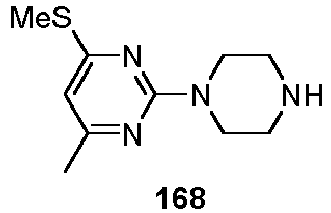
- To a stirred solution of compound 167 (2 g, 6.17 mmol) in CH2Cl2 (40 mL) under inert atmosphere was added 4 N HCl in 1,4-dioxane (10 mL) at 0 °C; the mixture was warmed to RT and stirred for 3 h. The reaction was monitored by TLC; after completion of the reaction, the volatiles were removed in vacuo. The residue was neutralized with saturated NaHCO3 solution (30 mL) and extracted with CH2Cl2(2 x 30 mL). The combined organic extracts were dried over sodium sulfate, filtered and concentrated in vacuo to afford crude compound 168 (1.2 g) as a white solid. TLC: 10% MeOH/ CH2Cl2 (Rf : 0.2); 1H-NMR (DMSO-d6, 400 MHz): δ 6.41 (s, 1H), 3.63 (t, J = 5.2 Hz, 4H), 2.70 (t, J = 5.2 Hz, 4H), 2.43 (s, 3H), 2.17 (s, 3H).
-

- To a stirred solution of 168 (1.2 g, crude) in CH2Cl2 (30 mL) under argon atmosphere were added pyridine (2.18 mL, 26.75 mmol), 4-methoxybenzenesulfonyl chloride 35 (1.21 g, 5.87 mmol) at 0 °C; the mixture was warmed to RT and stirred for 4 h. The reaction was monitored by TLC; after completion of the reaction, the reaction mixture was diluted with water (20 mL) and extracted with CH2Cl2 (2 x 30 mL). The combined organic extracts were washed with 1 N HCl (2 x 50 mL), 10% NaHCO3 solution (2 x 50 mL), brine (30 mL), dried over sodium sulfate, filtered and concentrated in vacuo to obtain the crude product. The crude product was triturated with pentane (2 x 5 mL) to afford compound 169 (1.2 g, 57%) as white solid. TLC: 50% EtOAc/ hexanes (Rf : 0.8); 1H-NMR (DMSO-d6, 400 MHz): δ 7.67 (d, J = 8.8 Hz, 2H), 7.13 (d, J = 9.2 Hz, 2H), 6.46 (s, 1H), 3.83 (s, 3H), 3.81 (t, J = 5.2 Hz, 4H), 2.89 (t, J = 4.8 Hz, 4H), 2.41 (s, 3H), 2.16 (s, 3H).
- Synthesis of 2-(4-((4-methoxyphenyl) sulfonyl)piperazin-1-yl)-4-methyl-6-(methylsulfonyl)pyrimidine (170):
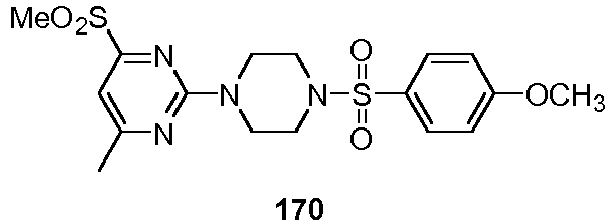
- To a stirred solution of 169 (1.2 g, 3.04 mmol) in CH2Cl2 (48 mL) under argon atmosphere were added m-chloroperoxybenzoic acid (1.4 g, 8.11 mmol) at 0 °C; the mixture was warmed to RT and stirred for 24 h. The reaction was monitored by TLC; after completion of the reaction, the reaction mixture was diluted with water (50 mL) and extracted with CH2Cl2 (2 x 150 mL). The combined organic extracts were washed with 10% NaHCO3 solution (100 mL), dried over sodium sulfate, filtered and concentrated in vacuo to obtain the crude product. The crude product was purified through silica gel column chromatography using 40% EtOAc/ hexanes to afford compound 170 (1 g, 77%) as an off-white solid. TLC: 60% EtOAc/ hexanes (Rf : 0.5); 1H-NMR (DMSO-d6, 400 MHz): δ 7.68 (d, J = 9.2 Hz, 2H), 7.14 (d, J = 9.2 Hz, 2H), 7.03 (s, 1H), 3.88 (t, J = 4.8 Hz, 4H), 3.83 (s, 3H), 3.21 (s, 3H), 2.94 (t, J = 4.8 Hz, 4H), 2.39 (s, 3H).
-

-

- To a stirred solution of 2-mercapto-6-methylpyrimidin-4(3H)-one 171 (1 g, 7.04 mmol) in 1,4-dioxane (10 mL) was added sodium hydroxide (563 mg, 14.07 mmol in 10 mL of water) and benzyl bromide (1.3 g, 7.74 mmol) at 0 °C; the mixture was heated to 50 °C and stirred for 1 h. The reaction was monitored by TLC; after completion of the reaction, the reaction mixture was diluted with ice cold water (20 mL) and the pH was neutralized with 6 N HCl. The precipitated solid was filtered, washed with EtOAc (2 x 5 mL), water (2 x10 mL) and dried in vacuo to afford compound 172 (1 g, 62%) as a yellow syrup. TLC: 40% EtOAc/ hexane (Rf : 0.5); 1H-NMR (DMSO-d6 , 400 MHz): δ 12.50-12.23 (m, 1H), 7.42-7.39 (m, 2H), 7.33-7.22 (m, 3H), 5.99 (br s, 1H), 4.37 (s, 2H), 2.20 (s, 3H).
-

- To a stirred solution of diisopropyl azodicarboxylate (1.3 g, 6.46 mmol) in ether (10 mL) under argon atmosphere were added triphenyl phosphine (1.6 g, 6.46 mmol) and compound 172 (500 mg, 2.15 mmol) at RT and the mixture was stirred for 15 min. To this was added isopropyl alcohol (0.4 mL, 5.38 mmol) at RT; the reaction was stirred for 72 h. The reaction was monitored by TLC; after completion of the reaction, the volatiles were removed in vacuo to obtain the crude product. The crude product was purified through silica gel column chromatography using 5% EtOAc/ hexanes to afford compound 173 (350 mg, 59%) as a yellow syrup. TLC: 40% EtOAc/ hexanes (Rf : 0.7); 1H-NMR (DMSO-d6 , 400 MHz): δ 7.41 (d, J = 8.4 Hz, 2H), 7.32-7.28 (m, 2H), 7.25-7.21 (m, 1H), 6.40 (s, 1H), 5.30-5.29 (m, 1H), 4.36 (s, 2H), 2.29 (s, 3H), 1.25 (d, J = 6.4 Hz, 6H).
-
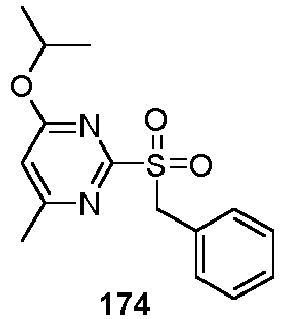
- To a stirred solution of compound 173 (650 mg, 2.37 mmol) in CH2Cl2 (10 mL) under argon atmosphere was added m-chloroperoxybenzoic acid (818 mg, 4.74 mmol) at 0 °C; the mixture was warmed to RT and stirred for 4 h. The reaction was monitored by TLC; after completion of the reaction, the reaction mixture was diluted with water (20 mL) and extracted with CH2Cl2 (2 x 30 mL). The combined organic extracts were washed with 10% NaHCO3 solution (30 mL) dried over sodium sulfate, filtered and concentrated in vacuo to obtain the crude product. The crude product was purified through silica gel column chromatography using 40% EtOAc/hexanes to afford compound 174 (530 mg, 73%) as white solid. TLC: 30% EtOAc/ hexanes (Rf : 0.4); 1H-NMR (DMSO-d6 , 400 MHz): δ 7.39-7.29 (m, 5H), 7.02 (s, 1H), 5.36-5.30 (m, 1H), 4.90 (s, 2H), 2.49 (d, J = 4.8 Hz, 3H), 1.31 (d, J = 6.0 Hz, 6H).
-

- To a stirred solution of compound 174 (200 mg, 0.65 mmol) in 1,4-dioxane (10 mL) under argon atmosphere were added tert-butyl piperazine-1-carboxylate 4 (364 mg, 1.96 mmol) and diisopropylethylamine (0.28 mL, 1.96 mmol) at RT; the mixture was heated to 90 °C and stirred for 48 h. The reaction was monitored by TLC; after completion of the reaction, the volatiles were removed in vacuo to obtain the crude product. The crude product was purified through silica gel column chromatography using 20% EtOAc/ hexanes to afford compound 175 (150 mg, 64%) as a yellow syrup. TLC: 40% EtOAc/ hexanes (Rf : 0.6); 1H-NMR (DMSO-d6 , 400 MHz): δ 5.89 (s, 1H), 5.24-5.18 (m, 1H), 3.68-3.65 (m, 4H), 3.38-3.58 (m, 4H), 2.17 (s, 3H), 1.48 (s, 9H), 1.26 (d, J = 6.0 Hz, 6H).
-

- To a stirred solution of compound 175 (150 mg, 0.44 mmol) in CH2Cl2 (5 mL) under inert atmosphere was added 4 N HCl in 1,4-dioxane (0.6 mL) at 0 °C; the mixture was warmed to RT and stirred for 4 h. The reaction was monitored by TLC; after completion of the reaction, the volatiles were removed in vacuo. The pH of the residue was neutralized with saturated NaHCO3 solution (30 mL) and extracted with CH2Cl2 (2 x 30 mL). The combined organic extracts were dried over sodium sulfate, filtered and concentrated in vacuo to afford compound 176 (80 mg, 80%) as a white solid. TLC: 40% EtOAc/hexanes (Rf : 0.2); 1H-NMR (DMSO-d6 , 400 MHz): δ 5.81 (s, 1H), 5.22-5.12 (m, 1H), 3.62-3.58 (m, 4H), 2.72-2.65 (m, 4H), 2.12 (s, 3H), 1.25 (d, J = 6.0 Hz, 6H).
-

- To a stirred solution of 176 (80 mg, 0.35 mmol) in CH2Cl2 (5 mL) under argon atmosphere were added pyridine (0.14 mL, 2.2 mmol) and 4-methoxybenzenesulfonyl chloride 35 (100 mg, 0.48 mmol) at 0 °C; the mixture was warmed to RT and stirred for 4 h. The reaction was monitored by TLC; after completion of the reaction, the reaction mixture was diluted with water (20 mL) and extracted with CH2Cl2 (2 x 30 mL). The combined organic extracts were washed with 1 N HCl (20 mL), 10% NaHCO3 solution (30 mL), brine (30 mL), dried over sodium sulfate, filtered and concentrated in vacuo to afford crude compound 177 (100 mg) as an off-white solid. TLC: 5% MeOH/ CH2Cl2 (Rf : 0.8); 1H-NMR (DMSO-d6 , 400 MHz): δ 7.67 (d, J = 7.2 Hz, 2H), 7.13 (d, J = 7.2 Hz, 2H), 5.87 (s, 1H), 5.18-5.12 (m, 1H), 3.83 (s, 3H), 3.78 (t, J = 4.8 Hz, 4H), 2.88 (t, J = 4.8 Hz, 4H), 2.13 (s, 3H), 1.22 (d, J = 6.0 Hz, 6H).
-

- To a stirred solution of compound 177 (100 mg, 0.24 mmol) in acetic acid (5 mL) was added 10% aqueous H2SO4 (5 mL) at 0 °C and the mixture was heated to 90 °C for 2 h. The reaction was monitored by TLC; after completion of the reaction, the volatiles were removed in vacuo. The pH of the residue was neutralized with 4 N aqueous NaOH solution (30 mL) and the aqueous mixture was extracted with 10% MeOH/CH2Cl2 (2 x 30 mL). The combined organic extracts were dried over sodium sulfate, filtered and concentrated in vacuo to afford compound 178 (70 mg, 78%) as an off-white solid. TLC: 5% MeOH/ CH2Cl2 (Rf : 0.2); 1H-NMR (DMSO-d6 , 400 MHz): δ 7.67 (d, J = 7.2 Hz, 2H), 7.14 (d, J = 7.2 Hz, 2H), 5.57 (s, 1H), 3.84 (s, 3H), 3.69 (t, J = 4.8 Hz, 4H), 2.86 (t, J = 4.8 Hz, 4H), 2.02 (s, 3H).
-

- To compound 178 (70 mg, 0.19 mmol) was added phosphorous oxychloride (3 mL) under argon atmosphere at 0 °C; the mixture was heated at 90 °C for 3 h. The reaction was monitored by TLC; after completion of the reaction, the volatiles were removed in vacuo. The pH of the residue was neutralized with aqueous NaHCO3 solution (30 mL) and the aqueous mixture extracted with EtOAc (2 x 30 mL). The combined organic extracts were dried over sodium sulfate, filtered and concentrated in vacuo to afford compound 179 (50 mg, 68%) as an off-white solid. TLC: 5% MeOH/ CH2Cl2 (Rf : 0.7); 1H-NMR (DMSO-d6 , 400 MHz): δ 7.66 (d, J = 7.2 Hz, 2H), 7.13 (d, J = 6.8 Hz, 2H), 6.65 (s, 1H), 3.83 (s, 3H), 3.80 (t, J = 4.8 Hz, 3H), 2.91 (t, J = 4.8 Hz, 4H), 2.24 (s, 3H).
- In a similar manner, compound 180 was prepared:

- Further target compounds were prepared using compounds 170, 179, and 180 reacted with various amines employing the following typical procedures B, C, or D and the results are shown in Table 2 below.
- Typical procedure B: A mixture of 170 (75 mg, 0.17 mmol) and 4-bromoaniline (1 g) was heated at 120-130 °C in a sealed tube for 4 h. The reaction was monitored by TLC; after completion of the reaction, the reaction mixture was diluted with water (20 mL) and extracted with CH2Cl2 (3 x 50 mL). The combined organic extracts were dried over sodium sulfate, filtered and concentrated in vacuo to obtain the crude product. The crude product was either directly dried in vacuo or triturated or purified by column chromatography or preparative HPLC to afford the desired compound.
- Typical procedure C: To a stirred solution of compound 179 (70 mg, 0.18 mmol) in 1,4-dioxane (3 mL) under argon atmosphere were added 4-(trifluoromethyl)aniline (32.4 mg, 0.20 mmol) and cesium carbonate (71 mg, 0.21 mmol) at RT, and the mixture was purged with argon for 30 min. To this were added Pd2(dba)3 (4 mg, 0.004 mmol), Xantphos (5.2 mg, 0.009 mmol), and the mixture was heated to 110-120 °C and stirred for 16 h. The reaction was monitored by TLC; after completion of the reaction, the volatiles were removed in vacuo to obtain the crude product. The residue was diluted with water and extracted with EtOAc (2 x 20 mL). The combined organic extracts were dried over sodium sulfate, filtered and dried in vacuo to obtain the crude product. The crude product was directly dried in vacuo, triturated or purified by column chromatography or preparative HPLC to afford the desired compound.
- Typical procedure D: A mixture of compound 180 (35 mg, 0.091 mmol) and p-anisidine (11.3 mg, 0.091 mmol) was dissolved in p-dioxane (2 mL). An HCl solution (4 N in p-dioxane) was added dropwise until the solution was acidic by pH paper. The reaction was heated at 90 °C for 16 h. The reaction was monitored by TLC; after completion the reaction mixture was diluted with water (10 mL) and extracted with CH2Cl2 (3 x 10 mL). The combined organic extracts were dried over sodium sulfate, filtered and concentrated in vacuo to afford to obtain the crude product. The crude product was either directly dried in vacuo or triturated or purified by column chromatography or preparative HPLC to afford the desired compound.
Table 2 Target Cmpd. No. Structure Procedure, Intermediates Rx. Yield Mass Spec. Found Mass Spec. Calculated 1H-NMR 34 
B, 170 38% 517.19 (M++1), 519.8 (M++2); 517.08 for C22H24BrN5O 3S 1H-NMR (DMSO-d6, 500 MHz): δ 9.27 (s, 1H), 7.68 (d, J = 8.5 Hz, 2H), 7.53 (d, J = 8.5 Hz, 2H), 7.65 (d, J = 8.5 Hz, 2H), 7.14 (d, J = 9.0 Hz, 2H), 5.90 (s, 1H), 3.83 (s, 3H), 3.90-3.77 (m, 4H), 2.91-2.86 (m, 4H), 2.12 (s, 3H); 35 
B, 170 38% 467.9 (M++1); 467.20 for C24H29N5O3S 1H-NMR (DMSO-d6 , 400 MHz): δ 9.02 (s, 1H), 7.68 (d, J = 8.8 Hz, 2H), 7.43 (d, J = 8.4 Hz, 2H), 7.14-7.11 (m, 4H), 5.87 (s, 1H), 3.82 (s, 3H), 3.78 (d, J = 4.8 Hz, 4H), 2.88 (t, J = 4.8 Hz, 4H), 2.57-2.53 (m, 2H), 2.08 (s, 3H), 1.64 (t, J = 7.6 Hz, 3H); 36 
B, 170 40% 523.9 (M++1); 523.15 for C23H24F3N5O 4S 1H-NMR (DMSO-d6 , 500 MHz): δ 9.33 (s, 1H), 7.69-7.66 (m, 4H), 7.28 (d, J = 8.5 Hz, 2H), 7.14 (d, J = 9.0 Hz, 2H), 5.92 (s, 1H), 3.83 (s, 3H), 3.79 (t, J = 4.5 Hz, 4H), 2.91 (t, J = 4.5 Hz, 4H), 2.12 (s, 3H); 37 
B, 170 22% 473.9 (M++1); 473.13 C22H24ClN5O 3S 1H-NMR (DMSO-d6 , 500 MHz): δ 9.26 (s, 1H), 7.68 (d, J = 9.0 Hz, 2H), 7.58 (d, J = 9.0 Hz, 2H), 7.32 (d, J = 8.5 Hz, 2H), 7.14 (d, J = 8.5 Hz, 2H), 5.90 (s, 1H), 3.83 (s, 3H), 3.90-3.77 (m, 4H), 2.91-2.86 (m, 4H), 2.11 (s, 3H); 38 
B, 170 44% 458.0 (M++1); 457.16 for C22H24FN5O3 S 1H-NMR (DMSO-d6 , 400 MHz): δ 9.13 (s, 1H), 7.67 (d, J = 8.0 Hz, 2H), 7.55-7.51 (m, 2H), 7.14-7.09 (m, 4H), 5.86 (s, 1H), 3.82 (s, 3H), 3.77 (t, J = 4.8 Hz, 4H), 2.88 (t, J = 4.8 Hz, 4H), 2.09 (s, 3H); 39 
B, 170 38% 440.3 (M++1); 439.17 for C22H25N5O3S 1H-NMR (DMSO-d6 , 400 MHz): δ 9.11 (s, 1H), 7.67 (d, J = 6.8 Hz, 2H), 7.53 (d, J = 7.6 Hz, 2H), 7.28 (t, J = 7.6 Hz, 2H), 7.13 (d, J = 7.2 Hz, 2H), 6.95 (t, J = 7.2 Hz, 1H), 5.90 (s, 1H), 3.82 (s, 3H), 3.78 (t, J = 4.8 Hz, 4H), 2.89 (t, J = 4.8 Hz, 4H), 2.10 (s, 3H); 40 
C, 179 38% 507.9 (M++1); 507.16 for C23H24F3N5O 3S 1H-NMR (DMSO-d6 , 400 MHz): δ 9.54 (s, 1H), 7.78 (d, J = 8.8 Hz, 2H), 7.69-7.64 (m, 4H), 7.13 (d, J = 7.2 Hz, 2H), 5.97 (s, 1H), 3.82 (s, 3H), 3.80 (t, J = 5.2 Hz, 4H), 2.91 (t, J = 4.8 Hz, 4H), 2.14 (s, 3H); 41 
C, 179 40% 469.9 (M++1); 469.18 for C23H27N5O4S 1H-NMR (DMSO-d6 , 400 MHz): 8.91 (s, 1H), 7.67 (d, J = 7.2 Hz, 2H), 7.40 (d, J = 8.8 Hz, 2H), 7.13 (d, J = 7.2 Hz, 2H), 6.87 (d, J = 8.8 Hz, 2H), 5.81 (s, 1H), 3.83 (s, 3H), 3.76 (t, J = 4.8 Hz, 4H), 3.72 (s, 3H), 2.87 (t, J = 4.8 Hz, 4H), 2.07 (s, 3H); 42 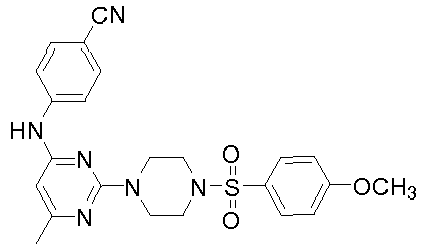
C, 179 25% 465.3 (M++1); 464.16 for C23H24N6O3S 1H-NMR (DMSO-d6 , 400 MHz): δ 9.65 (s, 1H), 7.76-7.67 (m, 6H), 7.13 (d, J = 9.2 Hz, 2H), 5.98 (s, 1H), 3.82 (s, 3H), 3.80 (t, J = 4.8 Hz, 4H), 2.91 (t, J = 4.8 Hz, 4H), 2.14 (s, 3H); 43 
D, 180 54% 470.2 (M+1)+ 469.18 for C23H27N5O4S 1H NMR (400 MHz, CDCl3) δ 7.35 (t, J = 7.9 Hz, 2H), 7.25 (s, 1H), 7.19 (d, J = 2.7 Hz, 2H), 7.10 (d, J = 8.6 Hz, 2H), 7.03 (dd, J = 8.3, 2.5 Hz, 1H), 6.81 (d, J = 8.6 Hz, 2H), 6.18 (s, 1H), 5.65 (s, 1H), 3.84 (m, 4H), 3.78 (s, 3H), 3.74 (s, 3H), 2.99 (m, 4H). 44 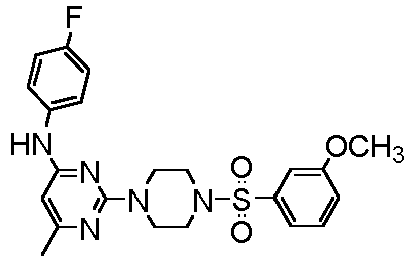
D, 180 59% 458.2 (M+1)+ 457.16 for C22H24FN5O3 S 1H NMR (400 MHz, CDCl3) δ 7.35 (t, J = 7.9 Hz, 2H), 7.25 (s, 1H), 7.17 (dd, J = 9.2, 4.5 Hz, 3H), 7.03 (dd, J = 8.2, 2.5 Hz, 1H), 6.96 (t, J = 8.6 Hz, 2H), 6.28 (s, 1H), 5.69 (s, 1H), 3.83 (t, J = 5.0 Hz, 4H), 3.77 (s, 3H), 2.99 (t, J = 5.0 Hz, 4H) - Target compound 45 is shown below and may be prepared by known methods:

- A screening for assembly effector activity was conducted based on a fluorescence quenching assay developed in the Zlotnick lab (Stray et al., 2006; Zlotnick et al., 2007). A Cp mutant is specifically labeled with a fluorescent dye. In the dimeric state fluorescence is intense. However, when the Cp assembles, the dye molecules accumulate at fivefold and quasi-sixfold vertices to self quench by up to 95%. In the high throughput screen, the Cp concentration is chosen so that addition ofNaCl, typically 150 mM or 300 mM is sufficient to induce about 25% assembly. Thus, assembly effectors that enhance assembly are readily detected.
- As illustrated by the effect of CpAM molecules on HBV Cp assembly, as measured using the fluorescence quenching assay, the test revealed that the CpAM molecules enhanced assembly kinetics and stabilized protein-protein interactions (Table 3). Control reactions, with no drug, show 25±5% assembly in a 24 h time period.
Table 3 Target Compound # % Capsid formation at 24 h (10 µM) 1 95 2 83 3 94 4 99 5 91 6 92 7 79 8 98 9 93 10 96 11 89 12 73 13 60 14 67 15 76 16 95 17 70 18 71 19 83 20 90 21 71 22 80 23 88 24 96 25 94 26 96 27 84 28 96 29 94 30 87 31 87 32 69 33 93 34 96 35 81 36 78 37 93 38 75 39 56 40 91 41 84 42 69 43 97 44 92 45 87 - AD38 cells grown in a 175 cm flask with Growth Medium (DMEM/F12 (1:1) (cat# SH30023.01, Hyclone, 1X Pen/step (cat#: 30-002-CL, Mediatech, Inc), 10% FBS (cat#: 101, Tissue Culture Biologics), 250 µg/mL G418 (cat#: 30-234-CR, Mediatech, Inc), 1 µg/mL Tetracycline (cat#: T3325, Teknova)) were detached with 0.25% trypsin. Tetracycline-free treatment medium (15 mL DMEM/F12 (1:1) (cat# SH30023.01, Hyclone, 1x Pen/step (cat#: 30-002-CL, Mediatech, Inc), with 2% FBS, Tet-system approved (cat#: 631106, Clontech) were then added to mix and spun at 1300 rpm for 5 min. Pelleted cells were then re-suspended/washed with 50 mL of 1X PBS 2 times and 10 mL treatment medium one time. AD38 cells were then re-suspended with 10 mL of treatment medium and counted. Wells of a collagen coated 96-well NUNC microtiter plate were seeded at 50,000/well in 180 µL of treatment medium, and 20 µL of either 10% DMSO (Control) or a 10X solution of test compound in 10% DMSO in treatment media was added for a final compound concentration 1, 3, or 10 µM (1.0% final [DMSO]) and plates were incubated for 5 days at 37 °C.
- Subsequently viral load production was assayed by quantitative PCR of the core sequence. Briefly, 5 µL of clarified supernatant was added to a PCR reaction mixture that contained forward primers HBV-f 5'-CTGTGCCTTGGGTGGCTTT-3', reverse primers HBV-r 5'-AAGGAAAGAAGTCAGAAGGCAAAA-3' and Fluorescent TaqMantm Probes HBV-probe 5'-FAM/AGCTCCAAA/ZEN/TTCTTTATAAGGGTCGATGTCCATG/3IABkFQ -3' in Quanta Biosciences PerfeCTa® qPCR Toughmix®, and was subsequently on an Applied Biosystems VIIA7 in a final volume of 20 µL. The PCR mixture was incubated at 45 °C for 5 minutes, then 95 °C for 10 min, followed by 40 cycles of 10 seconds at 95 °C and 20 seconds at 60 °C. Viral load was quantitated against known standards by using ViiA™ 7 Software. Viral load in the supernatant from wells with treated cells were compared against viral load in supernatant from DMSO control wells (≥ 3 per plate). In Table 4, concentrations of test compound causing reductions in viral load greater than at least 3 standard deviations from the DMSO controls across all plates were considered active, with (+) depicting meets criteria for significant activity, and (++) depicting exceeds criteria.
Table 4 Test concentration Target Compound # 1 µM 3 µM 10 µM 1 ++ ++ 3 ++ ++ ++ 5 ++ ++ 6 ++ ++ 7 + ++ ++ 8 ++ ++ 10 + ++ ++ 11 ++ ++ 15 ++ ++ 16 ++ ++ ++ 18 ++ ++ 23 + ++ ++ 24 ++ ++ 26 ++ ++ 27 ++ ++ 28 ++ ++ ++ 29 ++ ++ ++ 31 ++ ++ 32 ++ ++ ++ 33 ++ ++ ++ 34 ++ ++ ++ 35 ++ ++ ++ 37 ++ ++ ++ 40 ++ ++ ++ 42 ++ -
- <110> INDIANA UNIVERSITY RESEARCH AND TECHNOLOGY CORPORATION
- <120> HEPATITIS B VIRAL ASSEMBLY EFFECTORS
- <130> IURTC-13109-01-WO-E
- <140>
PCT/US2014/060869
<141> 2014-10-16 - <150>
US61/892,591
<151> 2013-10-18 - <160> 3
- <170> PatentIn version 3.5
- <210> 1
<211> 18
<212> DNA
<213> artificial - <220>
<223> forward primer HBV-f - <400> 1
ctgtgccttg ggtggctt 18 - <210> 2
<211> 24
<212> DNA
<213> artificial - <220>
<223> Reverse primer HBV-r - <400> 2
aaggaaagaa gtcagaaggc aaaa 24 - <210> 3
<211> 34
<212> DNA
<213> artificial - <220>
<223> HBV probe - <400> 3
agctccaaat tctttataag ggtcgatgtc catg 34
In a suitable embodiment, the compound of Formula 1 is represented by Formula 1-A:

In a suitable embodiment, R1 is selected independently for each occurrence from the group consisting of -H, -C1-C6alkyl, -C1-C6alkoxy, halogen, cyano, and -OH.
In a suitable embodiment, q is 1 or 2.
In a suitable embodiment, the compound of Formula 1 is represented by Formula 1-B:

In a suitable embodiment, R1 is selected from the group consisting of -H, -CH3, -CH2CH3, -CF3, -F, -Cl, -Br, cyano, -OCH3, and -OCF3.
In a suitable embodiment, R23 is selected from the group consisting of -H, -CH3, -F, and -OCH3. In a suitable embodiment, R25 is selected from the group consisting of -H, -CH3, -CH2CH3, -CH2CH2CH2CH3, -CF3, -F, -Cl, -OH, -OCH3, -OCH2CH3, -OC(CH3)3, -OCH2CH2CH2CH3, -NH2, -NHCH3, -NHC(O)CF3, -OCHF2, and -OCF3.
In a suitable embodiment, R3 is selected from the group consisting of -CH3, -CH(CH3)2,-CH2CH2CH3, -CF3, and -C(CH3)3.
In a suitable embodiment, R2 is selected from the group consisting of -H, -CH3, -CH2CH3, -CF3, -F, -Cl, -Br, cyano, -OCH3, and -OCF3.
Claims (15)
- A pharmaceutical composition comprising:(i) a compound of Formula 1 having the structure:
 X is selected from the group consisting of
 q is 0, 1, 2, 3 or 4;p is 0, 1, 2, 3, or 4;r is 0, 1, 2, 3, or 4;R1 is independently for each occurrence selected from the group consisting of -H, -C1-C6alkyl, -C1-C6alkoxy, -C1-C6alkyl-O-C1-C6alkyl, halogen, cyano, -OH, -C(O)H, -CO2R',-C(O)N(R')(R"), -C(O)C1-C6alkyl, -N(R')(R"), -NO2, -N(R')C(O)C1-C6alkyl, -S(O)w-C1-C6alkyl, -N(R')S(O)w-C1-C6alkyl, and -S(O)w-N(R')(R");w is 0, 1 or 2;R' is independently for each occurrence selected from the group consisting of -H and -C1-C6alkyl;R" is independently for each occurrence selected from the group consisting of -H and -C1-C6alkyl; or R' and R" are taken together with the nitrogen atom to which they are attached to form a 4-7 membered heterocyclic ring;R2 is independently for each occurrence selected from the group consisting of -H, -C1-C6alkyl, -C1-C6alkoxy, -C1-C6alkyl-O-C1-C6alkyl, halogen, cyano, -OH, -C(O)H, -CO2R',-C(O)N(R')(R"), -C(O)C1-C6alkyl, -N(R')(R"), -S(O)w-C1-C6alkyl, -N(R')S(O)w-C1-C6alkyl, and -S(O)w-N(R')(R"); andR3 is selected from the group consisting of -H and -C1-C6alkyl;wherein C1-C6alkyl or C1-C6alkoxy may be independently for each occurrence optionally substituted with one, two, or three halogens; and(ii) a pharmaceutically acceptable excipient.
 - The pharmaceutical composition according to claim 1, wherein p is 1 or 2.
- The pharmaceutical composition according to claim 1, wherein the compound of Formula 1 is represented by Formula 1-A:
 R21 is independently for each occurrence selected from the group consisting of -H and halogen;R22 is independently for each occurrence selected from the group consisting of -H, -C1-C6alkyl, -C1-C6alkoxy, -C1-C6alkyl-O-C1-C6alkyl, halogen, cyano, -OH, -C(O)H, -CO2R',-C(O)N(R')(R"), -C(O)C1-C6alkyl, -N(R')(R"), -NO2, -N(R')C(O)C1-C6alkyl, -S(O)w-C1-C6alkyl, -N(R')S(O)w-C1-C6alkyl, and -S(O)w-N(R')(R");R23 is independently for each occurrence selected from the group consisting of -H, -C1-C6alkyl, -C1-C6alkoxy, -C1-C6alkyl-O-C1-C6alkyl, halogen, cyano, -OH, -C(O)H, -CO2R',-C(O)N(R')(R"), -C(O)C1-C6alkyl, -N(R')(R"), -NO2, -N(R')C(O)C1-C6alkyl, -S(O)w-C1-C6alkyl, -N(R')S(O)w-C1-C6alkyl, and -S(O)w-N(R')(R"); andR24 is independently for each occurrence selected from the group consisting of -H and halogen;R25 is independently for each occurrence selected from the group consisting of -H, -C1-C6alkyl, -C1-C6alkoxy, -C1-C6alkyl-O-C1-C6alkyl, halogen, cyano, -OH, -C(O)H, -CO2R',-C(O)N(R')(R"), -C(O)C1-C6alkyl, -N(R')(R"), -S(O)w-C1-C6alkyl, -N(R')S(O)w-C1-C6alkyl, and -S(O)w-N(R')(R");wherein C1-C6alkyl or C1-C6alkoxy may be independently for each occurrence optionally substituted with one, two, or three halogens.
 - The pharmaceutical composition according to claim 3, wherein R21 and/or R24 is -H; and/or R22 is independently for each occurrence selected from the group consisting of -H, -C1-C6alkyl,-C1-C6alkoxy, and halogen; and/or
R23 is independently for each occurrence selected from the group consisting of -H, -C1-C6alkyl,-C1-C6alkoxy, and halogen; and/or
R25 is selected from the group consisting of -H, -C1-C6alkyl, -C1-C6alkoxy, halogen, cyano, -CO2R', -C(O)N(R')(R"), -C(O)C1-C6alkyl, and -N(R')(R"). - The pharmaceutical composition according to any one of claims 1-4, wherein R1 is selected independently for each occurrence from the group consisting of -H, -C1-C6alkyl, -C1-C6alkoxy, halogen, cyano, and -OH.
- The pharmaceutical composition according to any one of claims 1-5, wherein q is 1 or 2.
- The pharmaceutical composition according to any one of claims 3-5, wherein the compound of Formula 1 is represented by Formula 1-B:

- The pharmaceutical composition according to any one of claims 1-7, wherein R1 is selected from the group consisting of -H, -CH3, -CH2CH3, -CF3, -F, -Cl, -Br, cyano, -OCH3, and -OCF3.
- The pharmaceutical composition according to claim 3, wherein R23 is selected from the group consisting of -H, -CH3, -F, and -OCH3.
- The pharmaceutical composition according to claim 3 or 7, wherein R25 is selected from the group consisting of -H, -CH3, -CH2CH3, -CH2CH2CH2CH3, -CF3, -F, -Cl, -OH, -OCH3,-OCH2CH3, -OC(CH3)3, -OCH2CH2CH2CH3, -NH2, -NHCH3, -NHC(O)CF3, -OCHF2, and -OCF3.
- The pharmaceutical composition according to any one of claims 1-10, wherein R3 is selected from the group consisting of -CH3, -CH(CH3)2, -CH2CH2CH3, -CF3, and -C(CH3)3.
- The pharmaceutical composition according claim 1 or 2, wherein R2 is selected from the group consisting of -H, -CH3, -CH2CH3, -CF3, -F, -Cl, -Br, cyano, -OCH3, and -OCF3.
- A pharmaceutical composition according to any one of claims 1-12 for use in the treatment, amelioration, prevention or substantial delay of a hepatitis B viral infection in an individual, wherein the pharmaceutical composition is for administration to the individual.
- A compound of Formula 1, Formula 1-A, or Formula 1-B according to any one of claims 1-12 for use in treatment of a hepatitis B viral infection.
- The pharmaceutical composition of claim 1, wherein the compound is selected from the group consisting of:





Applications Claiming Priority (2)
| Application Number | Priority Date | Filing Date | Title |
|---|---|---|---|
| US201361892591P | 2013-10-18 | 2013-10-18 | |
| PCT/US2014/060869 WO2015057945A1 (en) | 2013-10-18 | 2014-10-16 | Hepatitis b viral assembly effectors |
Publications (3)
| Publication Number | Publication Date |
|---|---|
| EP3057592A1 EP3057592A1 (en) | 2016-08-24 |
| EP3057592A4 EP3057592A4 (en) | 2017-04-19 |
| EP3057592B1 true EP3057592B1 (en) | 2019-05-22 |
Family
ID=52828690
Family Applications (1)
| Application Number | Title | Priority Date | Filing Date |
|---|---|---|---|
| EP14853713.7A Not-in-force EP3057592B1 (en) | 2013-10-18 | 2014-10-16 | Hepatitis b viral assembly effectors |
Country Status (7)
| Country | Link |
|---|---|
| US (1) | US10220034B2 (en) |
| EP (1) | EP3057592B1 (en) |
| CN (1) | CN105828823B (en) |
| AU (1) | AU2014337298B2 (en) |
| CA (1) | CA2927560A1 (en) |
| ES (1) | ES2739435T3 (en) |
| WO (1) | WO2015057945A1 (en) |
Families Citing this family (41)
| Publication number | Priority date | Publication date | Assignee | Title |
|---|---|---|---|---|
| EP2794565B1 (en) | 2011-12-21 | 2017-07-26 | Novira Therapeutics Inc. | Hepatitis b antiviral agents |
| CA2881057C (en) | 2012-08-28 | 2020-10-27 | Janssen Sciences Ireland Uc | Sulfamoyl-arylamides and the use thereof as medicaments for the treatment of hepatitis b |
| JP6466348B2 (en) | 2013-02-28 | 2019-02-06 | ヤンセン・サイエンシズ・アイルランド・アンリミテッド・カンパニー | Sulfamoyl-arylamide and its use as a medicament for treating hepatitis B |
| HUE033542T2 (en) | 2013-04-03 | 2017-12-28 | Janssen Sciences Ireland Uc | N-phenyl-carboxamide derivatives and the use thereof as medicaments for the treatment of hepatitis b |
| HUE040446T2 (en) | 2013-05-17 | 2019-03-28 | Janssen Sciences Ireland Uc | Sulphamoylthiophenamide derivatives and their use as medicaments for the treatment of hepatitis B |
| TW202126620A (en) | 2013-05-17 | 2021-07-16 | 愛爾蘭商健生科學愛爾蘭無限公司 | Sulphamoylpyrrolamide derivatives and the use thereof as medicaments for the treatment of hepatitis b |
| WO2015011281A1 (en) | 2013-07-25 | 2015-01-29 | Janssen R&D Ireland | Glyoxamide substituted pyrrolamide derivatives and the use thereof as medicaments for the treatment of hepatitis b |
| MX368158B (en) | 2013-10-23 | 2019-09-20 | Janssen Sciences Ireland Uc | Carboxamide derivatives and the use thereof as medicaments for the treatment of hepatitis b. |
| US9169212B2 (en) | 2014-01-16 | 2015-10-27 | Novira Therapeutics, Inc. | Azepane derivatives and methods of treating hepatitis B infections |
| US10392349B2 (en) | 2014-01-16 | 2019-08-27 | Novira Therapeutics, Inc. | Azepane derivatives and methods of treating hepatitis B infections |
| JP6553059B2 (en) | 2014-02-05 | 2019-07-31 | ノヴィラ・セラピューティクス・インコーポレイテッド | Combination therapy for the treatment of HBV infection |
| PL3102572T3 (en) | 2014-02-06 | 2019-04-30 | Janssen Sciences Ireland Uc | Sulphamoylpyrrolamide derivatives and the use thereof as medicaments for the treatment of hepatitis b |
| EP3271019A1 (en) | 2015-03-19 | 2018-01-24 | Novira Therapeutics Inc. | Azocane and azonane derivatives and methods of treating hepatitis b infections |
| WO2016168619A1 (en) * | 2015-04-17 | 2016-10-20 | Indiana University Research And Technology Corporation | Hepatitis b viral assembly effectors |
| US10875876B2 (en) | 2015-07-02 | 2020-12-29 | Janssen Sciences Ireland Uc | Cyclized sulfamoylarylamide derivatives and the use thereof as medicaments for the treatment of hepatitis B |
| AR106192A1 (en) | 2015-09-29 | 2017-12-20 | Novira Therapeutics Inc | CRYSTAL FORMS OF AN ANTIVIRAL AGENT AGAINST HEPATITIS B |
| WO2017181141A2 (en) | 2016-04-15 | 2017-10-19 | Novira Therapeutics, Inc. | Combinations and methods comprising a capsid assembly inhibitor |
| WO2017197046A1 (en) | 2016-05-10 | 2017-11-16 | C4 Therapeutics, Inc. | C3-carbon linked glutarimide degronimers for target protein degradation |
| CN109562113A (en) | 2016-05-10 | 2019-04-02 | C4医药公司 | Spiro degron for target protein degradation |
| CN121974842A (en) | 2016-05-10 | 2026-05-05 | C4医药公司 | Amine-linked C3-glutarimide degradation determinant for target protein degradation |
| CN109562107A (en) | 2016-05-10 | 2019-04-02 | C4医药公司 | Heterocyclic degrons for target protein degradation |
| JOP20190024A1 (en) | 2016-08-26 | 2019-02-19 | Gilead Sciences Inc | Substituted pyrrolizine compounds and uses thereof |
| CN108976172B (en) * | 2017-05-31 | 2021-12-07 | 华东师范大学 | 4-pyrimidinediamine micromolecule organic compound and derivative and application thereof |
| EP4717317A3 (en) | 2017-06-20 | 2026-06-03 | C4 Therapeutics, Inc. | N/o-linked degrons and degronimers for protein degradation |
| MX2020004838A (en) | 2017-11-02 | 2020-10-16 | Aicuris Gmbh & Co Kg | NEW INDOL-2-CARBOXAMIDES SUBSTITUTED WITH PYRAZOLOPIPERIDINE, OF HIGH ACTIVITY, ACTIVE AGAINST HEPATITIS B VIRUS (HBV). |
| EA202091113A1 (en) | 2017-11-02 | 2020-08-28 | Айкурис Гмбх Унд Ко. Кг | NEW HIGHLY ACTIVE AMINOTHIAZOL SUBSTITUTED INDOL-2-CARBOXAMIDES ACTIVE AGAINST HEPATITIS B VIRUS (HBV) |
| JP7050165B2 (en) | 2018-02-26 | 2022-04-07 | ギリアード サイエンシーズ, インコーポレイテッド | Substituted pyrrolidine compounds as HBV replication inhibitors |
| SG11202007097QA (en) | 2018-03-14 | 2020-08-28 | Janssen Sciences Ireland Unlimited Co | Capsid assembly modulator dosing regimen |
| UY38434A (en) | 2018-11-02 | 2020-05-29 | Aicuris Gmbh & Co Kg | NEW 6,7-DIHYDRO-4H-PYRAZOLE [1,5-A] PIRAZIN INDOL-2-CARBOXAMIDES ACTIVE AGAINST THE HEPATITIS B VIRUS (HBV) |
| PY1991611A (en) | 2018-11-02 | 2022-03-14 | Aicuris Gmbh & Co Kg | NEW UREA 6,7-DIHYDRO-4H-PYRAZOLE [1,5-A] PYRAZINES ACTIVE AGAINST HEPATITIS B VIRUS (HBV) |
| PY1991606A (en) | 2018-11-02 | 2022-02-10 | Aicuris Gmbh & Co Kg | NEW UREA 6,7-DIHYDRO-4H-PYRAZOLE [4,3-C] PYRIDINES ACTIVE AGAINST HEPATITIS B VIRUS (HBV) |
| US20220009945A1 (en) | 2018-11-02 | 2022-01-13 | Aicuris Gmbh & Co. Kg | Novel urea 6,7-dihydro-4h-thiazole[5,4-c]pyridines active against the hepatitis b virus (hbv) |
| AR116947A1 (en) | 2018-11-02 | 2021-06-30 | Aicuris Gmbh & Co Kg | DERIVATIVES OF UREA 6,7-DIHIDRO-4H-PIRAZOLO [1,5-A] PIRAZINAS-INDOL-2-CARBOXAMIDAS ACTIVE AGAINST THE VIRUS OF HEPATITIS B (HBV) |
| AR117188A1 (en) | 2018-11-02 | 2021-07-21 | Aicuris Gmbh & Co Kg | DERIVATIVES OF UREA 6,7-DIHIDRO-4H-PIRAZOLO [1,5-A] PYRAZINES ACTIVE AGAINST THE VIRUS OF HEPATITIS B (HBV) |
| EP3897631A4 (en) | 2018-12-20 | 2022-11-23 | C4 Therapeutics, Inc. | TARGETED PROTEIN DEGRADATION |
| EP3962909B1 (en) | 2019-04-30 | 2023-10-04 | AiCuris GmbH & Co. KG | Novel oxalyl piperazines active against the hepatitis b virus (hbv) |
| MX2021013086A (en) | 2019-04-30 | 2021-11-17 | Aicuris Gmbh & Co Kg | Novel phenyl and pyridyl ureas active against the hepatitis b virus (hbv). |
| US20220306647A1 (en) | 2019-04-30 | 2022-09-29 | Aicuris Gmbh & Co. Kg | Novel indole-2-carboxamides active against the hepatitus b virus (hbv) |
| KR20220002498A (en) | 2019-04-30 | 2022-01-06 | 아이쿠리스 게엠베하 운트 코. 카게 | Novel indolizine-2-carboxamide active against hepatitis B virus (HBV) |
| BR112021021454A2 (en) | 2019-05-06 | 2021-12-21 | Janssen Sciences Ireland Unlimited Co | Amide derivatives useful in the treatment of HBV infection or HBV-induced diseases |
| GB202014736D0 (en) * | 2020-09-18 | 2020-11-04 | Imperial College Innovations Ltd | Novel compounds and their use in therapy |
Family Cites Families (8)
| Publication number | Priority date | Publication date | Assignee | Title |
|---|---|---|---|---|
| WO2006004776A1 (en) | 2004-06-29 | 2006-01-12 | Rigel Pharmaceuticals, Inc. | 4-pyrimidineamine compounds and their uses as anti-proliferative agents |
| US20060293343A1 (en) | 2005-05-18 | 2006-12-28 | Asahi Kasei Pharma Corporation | Pyrimidine derivatives |
| US7816351B2 (en) | 2005-09-23 | 2010-10-19 | Equispharm Co., Ltd | 5,6-dimethylthieno[2,3-di] pyrimidine derivatives, the preparation method thereof and the pharmaceutical composition comprising the same for anti-virus |
| WO2010118367A2 (en) | 2009-04-10 | 2010-10-14 | Progenics Pharmaceuticals, Inc. | Antiviral pyrimidines |
| JP2013530942A (en) * | 2010-05-07 | 2013-08-01 | カリフォルニア・インスティチュート・オブ・テクノロジー | Methods and compositions for inhibition of transitional endoplasmic reticulum ATPase |
| AU2012244550C1 (en) | 2011-04-21 | 2017-06-22 | Origenis Gmbh | Pyrazolo [4, 3-d] pyrimidines useful as kinase inhibitors |
| US9487534B2 (en) * | 2011-08-02 | 2016-11-08 | Scripps Research Institute, A Not-For-Profit Public Benefit Corporation Of California | Modulators of virus assembly as antiviral agents |
| WO2014060112A1 (en) | 2012-10-19 | 2014-04-24 | Origenis Gmbh | Pyrazolo[4,3-d]pyrimidines as kinase inhibitors |
-
2014
- 2014-10-16 US US15/030,378 patent/US10220034B2/en not_active Expired - Fee Related
- 2014-10-16 WO PCT/US2014/060869 patent/WO2015057945A1/en not_active Ceased
- 2014-10-16 ES ES14853713T patent/ES2739435T3/en active Active
- 2014-10-16 CN CN201480068103.XA patent/CN105828823B/en not_active Expired - Fee Related
- 2014-10-16 AU AU2014337298A patent/AU2014337298B2/en not_active Ceased
- 2014-10-16 CA CA2927560A patent/CA2927560A1/en not_active Abandoned
- 2014-10-16 EP EP14853713.7A patent/EP3057592B1/en not_active Not-in-force
Non-Patent Citations (1)
| Title |
|---|
| None * |
Also Published As
| Publication number | Publication date |
|---|---|
| CA2927560A1 (en) | 2015-04-23 |
| ES2739435T3 (en) | 2020-01-31 |
| AU2014337298A1 (en) | 2016-05-05 |
| EP3057592A1 (en) | 2016-08-24 |
| AU2014337298B2 (en) | 2018-12-06 |
| EP3057592A4 (en) | 2017-04-19 |
| CN105828823A (en) | 2016-08-03 |
| US20160271130A1 (en) | 2016-09-22 |
| CN105828823B (en) | 2019-06-14 |
| WO2015057945A1 (en) | 2015-04-23 |
| US10220034B2 (en) | 2019-03-05 |
Similar Documents
| Publication | Publication Date | Title |
|---|---|---|
| US10220034B2 (en) | Hepatitis B viral assembly effectors | |
| EP3283472B1 (en) | Hepatitis b viral assembly effectors | |
| EP3349581B1 (en) | Hepatitis b core protein modulators | |
| EP2651899B1 (en) | Substituted 6,6-fused nitrogenous heterocyclic compounds and uses thereof | |
| EP2124951B1 (en) | 5-cyan0-4- (pyrrolo[2, 3b]pyridine-3-yl) -pyrimidine derivatives useful as protein kinase inhibitors | |
| CN105503827B (en) | EGFR inhibitor and its preparation method and application | |
| JP2018508555A (en) | Bicyclic imidazolo derivatives | |
| JP5124471B2 (en) | Substituted bicyclic pyrimidone derivatives | |
| CA3196676A1 (en) | Pyrimidine compounds, compositions, and medicinal applications thereof | |
| JP2018076285A (en) | Medicament containing bicyclic imidazolo derivative | |
| EP2465859A1 (en) | 8-Triazolylxanthine derivatives, processes for their production and their use as adenosine receptor antagonists | |
| EP3087060B1 (en) | Pyrimidone carboxamide compounds as pde2 inhibitors | |
| CN112341431A (en) | Heterocyclic compounds as FGFR4 inhibitors | |
| WO2020187292A1 (en) | 2-substituted pyrazoleamino-4-substituted amino-5-pyrimidine formamide compound, composition and use thereof | |
| TW201422610A (en) | Secondary alcohol substituted triazoles as PDE10 inhibitors | |
| HK1258761B (en) | Hepatitis b core protein modulators |
Legal Events
| Date | Code | Title | Description |
|---|---|---|---|
| PUAI | Public reference made under article 153(3) epc to a published international application that has entered the european phase |
Free format text: ORIGINAL CODE: 0009012 |
|
| 17P | Request for examination filed |
Effective date: 20160509 |
|
| AK | Designated contracting states |
Kind code of ref document: A1 Designated state(s): AL AT BE BG CH CY CZ DE DK EE ES FI FR GB GR HR HU IE IS IT LI LT LU LV MC MK MT NL NO PL PT RO RS SE SI SK SM TR |
|
| AX | Request for extension of the european patent |
Extension state: BA ME |
|
| DAX | Request for extension of the european patent (deleted) | ||
| A4 | Supplementary search report drawn up and despatched |
Effective date: 20170316 |
|
| RIC1 | Information provided on ipc code assigned before grant |
Ipc: A61K 31/535 20060101AFI20170311BHEP Ipc: A61K 31/497 20060101ALI20170311BHEP Ipc: C07D 413/00 20060101ALI20170311BHEP |
|
| RAP1 | Party data changed (applicant data changed or rights of an application transferred) |
Owner name: INDIANA UNIVERSITY RESEARCH AND TECHNOLOGY CORPORA |
|
| STAA | Information on the status of an ep patent application or granted ep patent |
Free format text: STATUS: EXAMINATION IS IN PROGRESS |
|
| 17Q | First examination report despatched |
Effective date: 20180319 |
|
| GRAP | Despatch of communication of intention to grant a patent |
Free format text: ORIGINAL CODE: EPIDOSNIGR1 |
|
| STAA | Information on the status of an ep patent application or granted ep patent |
Free format text: STATUS: GRANT OF PATENT IS INTENDED |
|
| INTG | Intention to grant announced |
Effective date: 20181204 |
|
| RIN1 | Information on inventor provided before grant (corrected) |
Inventor name: ZLOTNICK, ADAM Inventor name: FRANCIS, SAMSON Inventor name: LI, LICHUN Inventor name: TURNER, WILLIAM JR. |
|
| GRAS | Grant fee paid |
Free format text: ORIGINAL CODE: EPIDOSNIGR3 |
|
| GRAA | (expected) grant |
Free format text: ORIGINAL CODE: 0009210 |
|
| STAA | Information on the status of an ep patent application or granted ep patent |
Free format text: STATUS: THE PATENT HAS BEEN GRANTED |
|
| AK | Designated contracting states |
Kind code of ref document: B1 Designated state(s): AL AT BE BG CH CY CZ DE DK EE ES FI FR GB GR HR HU IE IS IT LI LT LU LV MC MK MT NL NO PL PT RO RS SE SI SK SM TR |
|
| REG | Reference to a national code |
Ref country code: GB Ref legal event code: FG4D |
|
| REG | Reference to a national code |
Ref country code: CH Ref legal event code: EP |
|
| REG | Reference to a national code |
Ref country code: IE Ref legal event code: FG4D |
|
| REG | Reference to a national code |
Ref country code: DE Ref legal event code: R096 Ref document number: 602014047399 Country of ref document: DE |
|
| REG | Reference to a national code |
Ref country code: AT Ref legal event code: REF Ref document number: 1135258 Country of ref document: AT Kind code of ref document: T Effective date: 20190615 |
|
| REG | Reference to a national code |
Ref country code: NL Ref legal event code: MP Effective date: 20190522 |
|
| REG | Reference to a national code |
Ref country code: LT Ref legal event code: MG4D |
|
| PG25 | Lapsed in a contracting state [announced via postgrant information from national office to epo] |
Ref country code: HR Free format text: LAPSE BECAUSE OF FAILURE TO SUBMIT A TRANSLATION OF THE DESCRIPTION OR TO PAY THE FEE WITHIN THE PRESCRIBED TIME-LIMIT Effective date: 20190522 Ref country code: NL Free format text: LAPSE BECAUSE OF FAILURE TO SUBMIT A TRANSLATION OF THE DESCRIPTION OR TO PAY THE FEE WITHIN THE PRESCRIBED TIME-LIMIT Effective date: 20190522 Ref country code: LT Free format text: LAPSE BECAUSE OF FAILURE TO SUBMIT A TRANSLATION OF THE DESCRIPTION OR TO PAY THE FEE WITHIN THE PRESCRIBED TIME-LIMIT Effective date: 20190522 Ref country code: FI Free format text: LAPSE BECAUSE OF FAILURE TO SUBMIT A TRANSLATION OF THE DESCRIPTION OR TO PAY THE FEE WITHIN THE PRESCRIBED TIME-LIMIT Effective date: 20190522 Ref country code: PT Free format text: LAPSE BECAUSE OF FAILURE TO SUBMIT A TRANSLATION OF THE DESCRIPTION OR TO PAY THE FEE WITHIN THE PRESCRIBED TIME-LIMIT Effective date: 20190922 Ref country code: NO Free format text: LAPSE BECAUSE OF FAILURE TO SUBMIT A TRANSLATION OF THE DESCRIPTION OR TO PAY THE FEE WITHIN THE PRESCRIBED TIME-LIMIT Effective date: 20190822 Ref country code: AL Free format text: LAPSE BECAUSE OF FAILURE TO SUBMIT A TRANSLATION OF THE DESCRIPTION OR TO PAY THE FEE WITHIN THE PRESCRIBED TIME-LIMIT Effective date: 20190522 Ref country code: SE Free format text: LAPSE BECAUSE OF FAILURE TO SUBMIT A TRANSLATION OF THE DESCRIPTION OR TO PAY THE FEE WITHIN THE PRESCRIBED TIME-LIMIT Effective date: 20190522 |
|
| PG25 | Lapsed in a contracting state [announced via postgrant information from national office to epo] |
Ref country code: LV Free format text: LAPSE BECAUSE OF FAILURE TO SUBMIT A TRANSLATION OF THE DESCRIPTION OR TO PAY THE FEE WITHIN THE PRESCRIBED TIME-LIMIT Effective date: 20190522 Ref country code: BG Free format text: LAPSE BECAUSE OF FAILURE TO SUBMIT A TRANSLATION OF THE DESCRIPTION OR TO PAY THE FEE WITHIN THE PRESCRIBED TIME-LIMIT Effective date: 20190822 Ref country code: GR Free format text: LAPSE BECAUSE OF FAILURE TO SUBMIT A TRANSLATION OF THE DESCRIPTION OR TO PAY THE FEE WITHIN THE PRESCRIBED TIME-LIMIT Effective date: 20190823 Ref country code: RS Free format text: LAPSE BECAUSE OF FAILURE TO SUBMIT A TRANSLATION OF THE DESCRIPTION OR TO PAY THE FEE WITHIN THE PRESCRIBED TIME-LIMIT Effective date: 20190522 |
|
| REG | Reference to a national code |
Ref country code: AT Ref legal event code: MK05 Ref document number: 1135258 Country of ref document: AT Kind code of ref document: T Effective date: 20190522 |
|
| PG25 | Lapsed in a contracting state [announced via postgrant information from national office to epo] |
Ref country code: RO Free format text: LAPSE BECAUSE OF FAILURE TO SUBMIT A TRANSLATION OF THE DESCRIPTION OR TO PAY THE FEE WITHIN THE PRESCRIBED TIME-LIMIT Effective date: 20190522 Ref country code: CZ Free format text: LAPSE BECAUSE OF FAILURE TO SUBMIT A TRANSLATION OF THE DESCRIPTION OR TO PAY THE FEE WITHIN THE PRESCRIBED TIME-LIMIT Effective date: 20190522 Ref country code: AT Free format text: LAPSE BECAUSE OF FAILURE TO SUBMIT A TRANSLATION OF THE DESCRIPTION OR TO PAY THE FEE WITHIN THE PRESCRIBED TIME-LIMIT Effective date: 20190522 Ref country code: EE Free format text: LAPSE BECAUSE OF FAILURE TO SUBMIT A TRANSLATION OF THE DESCRIPTION OR TO PAY THE FEE WITHIN THE PRESCRIBED TIME-LIMIT Effective date: 20190522 Ref country code: SK Free format text: LAPSE BECAUSE OF FAILURE TO SUBMIT A TRANSLATION OF THE DESCRIPTION OR TO PAY THE FEE WITHIN THE PRESCRIBED TIME-LIMIT Effective date: 20190522 Ref country code: DK Free format text: LAPSE BECAUSE OF FAILURE TO SUBMIT A TRANSLATION OF THE DESCRIPTION OR TO PAY THE FEE WITHIN THE PRESCRIBED TIME-LIMIT Effective date: 20190522 |
|
| REG | Reference to a national code |
Ref country code: ES Ref legal event code: FG2A Ref document number: 2739435 Country of ref document: ES Kind code of ref document: T3 Effective date: 20200131 |
|
| REG | Reference to a national code |
Ref country code: DE Ref legal event code: R097 Ref document number: 602014047399 Country of ref document: DE |
|
| PG25 | Lapsed in a contracting state [announced via postgrant information from national office to epo] |
Ref country code: SM Free format text: LAPSE BECAUSE OF FAILURE TO SUBMIT A TRANSLATION OF THE DESCRIPTION OR TO PAY THE FEE WITHIN THE PRESCRIBED TIME-LIMIT Effective date: 20190522 |
|
| PLBE | No opposition filed within time limit |
Free format text: ORIGINAL CODE: 0009261 |
|
| STAA | Information on the status of an ep patent application or granted ep patent |
Free format text: STATUS: NO OPPOSITION FILED WITHIN TIME LIMIT |
|
| PG25 | Lapsed in a contracting state [announced via postgrant information from national office to epo] |
Ref country code: TR Free format text: LAPSE BECAUSE OF FAILURE TO SUBMIT A TRANSLATION OF THE DESCRIPTION OR TO PAY THE FEE WITHIN THE PRESCRIBED TIME-LIMIT Effective date: 20190522 |
|
| 26N | No opposition filed |
Effective date: 20200225 |
|
| PG25 | Lapsed in a contracting state [announced via postgrant information from national office to epo] |
Ref country code: PL Free format text: LAPSE BECAUSE OF FAILURE TO SUBMIT A TRANSLATION OF THE DESCRIPTION OR TO PAY THE FEE WITHIN THE PRESCRIBED TIME-LIMIT Effective date: 20190522 |
|
| PG25 | Lapsed in a contracting state [announced via postgrant information from national office to epo] |
Ref country code: SI Free format text: LAPSE BECAUSE OF FAILURE TO SUBMIT A TRANSLATION OF THE DESCRIPTION OR TO PAY THE FEE WITHIN THE PRESCRIBED TIME-LIMIT Effective date: 20190522 Ref country code: MC Free format text: LAPSE BECAUSE OF FAILURE TO SUBMIT A TRANSLATION OF THE DESCRIPTION OR TO PAY THE FEE WITHIN THE PRESCRIBED TIME-LIMIT Effective date: 20190522 |
|
| REG | Reference to a national code |
Ref country code: CH Ref legal event code: PL |
|
| PG25 | Lapsed in a contracting state [announced via postgrant information from national office to epo] |
Ref country code: LU Free format text: LAPSE BECAUSE OF NON-PAYMENT OF DUE FEES Effective date: 20191016 Ref country code: LI Free format text: LAPSE BECAUSE OF NON-PAYMENT OF DUE FEES Effective date: 20191031 Ref country code: CH Free format text: LAPSE BECAUSE OF NON-PAYMENT OF DUE FEES Effective date: 20191031 |
|
| REG | Reference to a national code |
Ref country code: BE Ref legal event code: MM Effective date: 20191031 |
|
| PG25 | Lapsed in a contracting state [announced via postgrant information from national office to epo] |
Ref country code: BE Free format text: LAPSE BECAUSE OF NON-PAYMENT OF DUE FEES Effective date: 20191031 |
|
| PG25 | Lapsed in a contracting state [announced via postgrant information from national office to epo] |
Ref country code: IE Free format text: LAPSE BECAUSE OF NON-PAYMENT OF DUE FEES Effective date: 20191016 |
|
| PGFP | Annual fee paid to national office [announced via postgrant information from national office to epo] |
Ref country code: ES Payment date: 20201103 Year of fee payment: 7 Ref country code: GB Payment date: 20201027 Year of fee payment: 7 Ref country code: FR Payment date: 20201026 Year of fee payment: 7 Ref country code: IT Payment date: 20201023 Year of fee payment: 7 Ref country code: DE Payment date: 20201028 Year of fee payment: 7 |
|
| PG25 | Lapsed in a contracting state [announced via postgrant information from national office to epo] |
Ref country code: CY Free format text: LAPSE BECAUSE OF FAILURE TO SUBMIT A TRANSLATION OF THE DESCRIPTION OR TO PAY THE FEE WITHIN THE PRESCRIBED TIME-LIMIT Effective date: 20190522 |
|
| PG25 | Lapsed in a contracting state [announced via postgrant information from national office to epo] |
Ref country code: IS Free format text: LAPSE BECAUSE OF FAILURE TO SUBMIT A TRANSLATION OF THE DESCRIPTION OR TO PAY THE FEE WITHIN THE PRESCRIBED TIME-LIMIT Effective date: 20190922 |
|
| PG25 | Lapsed in a contracting state [announced via postgrant information from national office to epo] |
Ref country code: HU Free format text: LAPSE BECAUSE OF FAILURE TO SUBMIT A TRANSLATION OF THE DESCRIPTION OR TO PAY THE FEE WITHIN THE PRESCRIBED TIME-LIMIT; INVALID AB INITIO Effective date: 20141016 Ref country code: MT Free format text: LAPSE BECAUSE OF FAILURE TO SUBMIT A TRANSLATION OF THE DESCRIPTION OR TO PAY THE FEE WITHIN THE PRESCRIBED TIME-LIMIT Effective date: 20190522 |
|
| REG | Reference to a national code |
Ref country code: DE Ref legal event code: R119 Ref document number: 602014047399 Country of ref document: DE |
|
| GBPC | Gb: european patent ceased through non-payment of renewal fee |
Effective date: 20211016 |
|
| PG25 | Lapsed in a contracting state [announced via postgrant information from national office to epo] |
Ref country code: MK Free format text: LAPSE BECAUSE OF FAILURE TO SUBMIT A TRANSLATION OF THE DESCRIPTION OR TO PAY THE FEE WITHIN THE PRESCRIBED TIME-LIMIT Effective date: 20190522 |
|
| PG25 | Lapsed in a contracting state [announced via postgrant information from national office to epo] |
Ref country code: GB Free format text: LAPSE BECAUSE OF NON-PAYMENT OF DUE FEES Effective date: 20211016 Ref country code: DE Free format text: LAPSE BECAUSE OF NON-PAYMENT OF DUE FEES Effective date: 20220503 |
|
| PG25 | Lapsed in a contracting state [announced via postgrant information from national office to epo] |
Ref country code: FR Free format text: LAPSE BECAUSE OF NON-PAYMENT OF DUE FEES Effective date: 20211031 |
|
| PG25 | Lapsed in a contracting state [announced via postgrant information from national office to epo] |
Ref country code: IT Free format text: LAPSE BECAUSE OF NON-PAYMENT OF DUE FEES Effective date: 20211016 |
|
| REG | Reference to a national code |
Ref country code: ES Ref legal event code: FD2A Effective date: 20230210 |
|
| PG25 | Lapsed in a contracting state [announced via postgrant information from national office to epo] |
Ref country code: ES Free format text: LAPSE BECAUSE OF NON-PAYMENT OF DUE FEES Effective date: 20211017 |